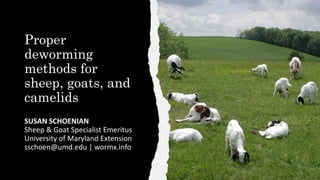


Proper
deworming
methods for
sheep, goats, and
camelids
SUSAN SCHOENIAN
Sheep & Goat Specialist Emeritus
University of Maryland Extension
sschoen@umd.edu | wormx.info
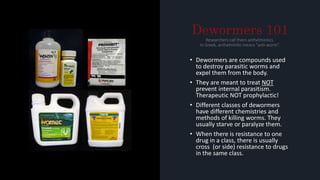
• Dewormers are compounds used
to destroy parasitic worms and
expel them from the body.
• They are meant to treat NOT
prevent internal parasitism.
Therapeutic NOT prophylactic!
• Different classes of dewormers
have different chemistries and
methods of killing worms. They
usually starve or paralyze them.
• When there is resistance to one
drug in a class, there is usually
cross (or side) resistance to drugs
in the same class.
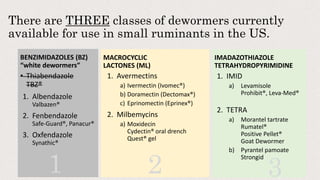
There are THREE classes of dewormers currently
available for use in small ruminants in the US.
BENZIMIDAZOLES (BZ)
“white dewormers”
• Thiabendazole
TBZ®
1. Albendazole
Valbazen®
2. Fenbendazole
Safe-Guard®, Panacur®
3. Oxfendazole
Synathic®
MACROCYCLIC
LACTONES (ML)
1. Avermectins
a) Ivermectin (Ivomec®)
b) Doramectin (Dectomax®)
c) Eprinomectin (Eprinex®)
2. Milbemycins
a) Moxidecin
Cydectin® oral drench
Quest® gel
1
IMADAZOTHIAZOLE
TETRAHYDROPYRIMIDINE
1. IMID
a) Levamisole
Prohibit®, Leva-Med®
2. TETRA
a) Morantel tartrate
Rumatel®
Positive Pellet®
Goat Dewormer
b) Pyrantel pamoate
Strongid
2 3
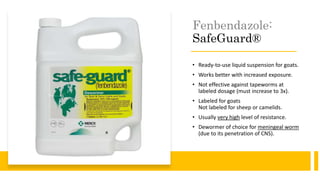
Fenbendazole:
SafeGuard®
• Ready-to-use liquid suspension for goats.
• Works better with increased exposure.
• Not effective against tapeworms at
labeled dosage (must increase to 3x).
• Labeled for goats
Not labeled for sheep or camelids.
• Usually very high level of resistance.
• Dewormer of choice for meningeal worm
(due to its penetration of CNS).
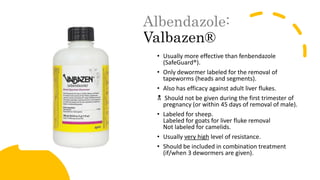
Albendazole:
Valbazen®
• Usually more effective than fenbendazole
(SafeGuard®).
• Only dewormer labeled for the removal of
tapeworms (heads and segments).
• Also has efficacy against adult liver flukes.
 Should not be given during the first trimester of
pregnancy (or within 45 days of removal of male).
• Labeled for sheep.
Labeled for goats for liver fluke removal
Not labeled for camelids.
• Usually very high level of resistance.
• Should be included in combination treatment
(if/when 3 dewormers are given).
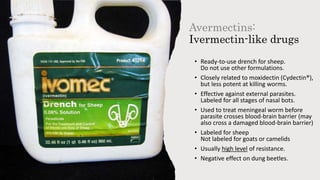
Avermectins:
Ivermectin-like drugs
• Ready-to-use drench for sheep.
Do not use other formulations.
• Closely related to moxidectin (Cydectin®),
but less potent at killing worms.
• Effective against external parasites.
Labeled for all stages of nasal bots.
• Used to treat meningeal worm before
parasite crosses blood-brain barrier (may
also cross a damaged blood-brain barrier)
• Labeled for sheep
Not labeled for goats or camelids
• Usually high level of resistance.
• Negative effect on dung beetles.
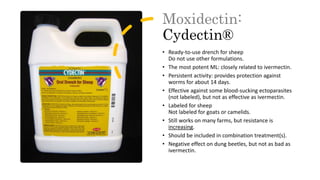
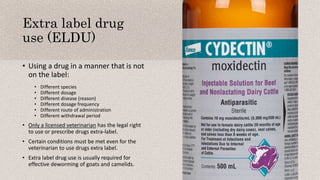
Moxidectin:
Cydectin®
• Ready-to-use drench for sheep
Do not use other formulations.
• The most potent ML: closely related to ivermectin.
• Persistent activity: provides protection against
worms for about 14 days.
• Effective against some blood-sucking ectoparasites
(not labeled), but not as effective as ivermectin.
• Labeled for sheep
Not labeled for goats or camelids.
• Still works on many farms, but resistance is
increasing.
• Should be included in combination treatment(s).
• Negative effect on dung beetles, but not as bad as
ivermectin.
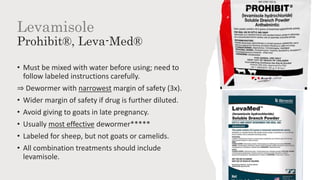
Levamisole
Prohibit®, Leva-Med®
• Must be mixed with water before using; need to
follow labeled instructions carefully.
⇒ Dewormer with narrowest margin of safety (3x).
• Wider margin of safety if drug is further diluted.
• Avoid giving to goats in late pregnancy.
• Usually most effective dewormer*****
• Labeled for sheep, but not goats or camelids.
• All combination treatments should include
levamisole.
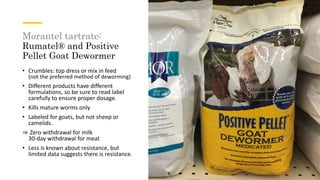
Morantel tartrate:
Rumatel® and Positive
Pellet Goat Dewormer
• Crumbles: top dress or mix in feed
(not the preferred method of deworming)
• Different products have different
formulations, so be sure to read label
carefully to ensure proper dosage.
• Kills mature worms only
• Labeled for goats, but not sheep or
camelids.
⇒ Zero withdrawal for milk
30-day withdrawal for meat
• Less is known about resistance, but
limited data suggests there is resistance.
Extra label drug
use (ELDU)
• Using a drug in a manner that is not
on the label:
• Different species
• Different dosage
• Different disease (reason)
• Different dosage frequency
• Different route of administration
• Different withdrawal period
• Only a licensed veterinarian has the legal right
to use or prescribe drugs extra-label.
• Certain conditions must be met even for the
veterinarian to use drugs extra label.
• Extra label drug use is usually required for
effective deworming of goats and camelids.
Veterinarian-
client-patient
relationship
(VCPR)
• You must have a valid
veterinarian-client-
patient-relationship in
order to use drugs
extra label.
• A VCPR means the vet
has knowledge of the
animals he/she is
treating (must visit
farm*).
• A VCPR is now required
to use antibiotics, too.
*Frequency varies by vet.
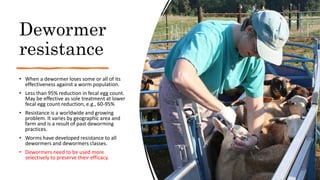
Dewormer
resistance
• When a dewormer loses some or all of its
effectiveness against a worm population.
• Less than 95% reduction in fecal egg count.
May be effective as sole treatment at lower
fecal egg count reduction, e.g., 60-95%
• Resistance is a worldwide and growing
problem. It varies by geographic area and
farm and is a result of past deworming
practices.
• Worms have developed resistance to all
dewormers and dewormers classes.
• Dewormers need to be used more
selectively to preserve their efficacy.
Determining dewormer resistance
FECAL EGG COUNT REDUCTION TEST
• Before and after fecal egg counts from the
same 10-15 animals.
• Levamisole, benzimidazoles (10-14 days)
• Avermectins (14-17 days)
• Moxidectin (17-21 days)
• Combination (drug with longest interval)
• Must test each dewormer or combination
separately.
• Can use pooled or individual fecal samples.
• New protocols announced recently.
• Can learn to do yourself.
• Some universities offer low-cost fecal egg
counting (wormx.info/lowcostfec)
DRENCHRIGHT® LARVAL ASSAY
• Laboratory test that uses worm larvae to
determine resistance to all dewormers
simultaneously using a pooled fecal
sample from 10-12 animals.
• Expensive test
One time cost of ~$500 per sample
• Louisiana State University only place that
does test Not yet available after
University of Georgia did for many years.
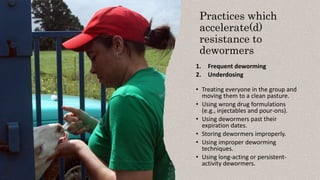
Practices which
accelerate(d)
resistance to
dewormers
1. Frequent deworming
2. Underdosing
• Treating everyone in the group and
moving them to a clean pasture.
• Using wrong drug formulations
(e.g., injectables and pour-ons).
• Using dewormers past their
expiration dates.
• Storing dewormers improperly.
• Using improper deworming
techniques.
• Using long-acting or persistent-
activity dewormers.
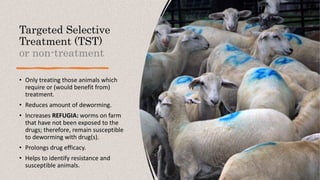
Targeted Selective
Treatment (TST)
or non-treatment
• Only treating those animals which
require or (would benefit from)
treatment.
• Reduces amount of deworming.
• Increases REFUGIA: worms on farm
that have not been exposed to the
drugs; therefore, remain susceptible
to deworming with drug(s).
• Prolongs drug efficacy.
• Helps to identify resistance and
susceptible animals.
Tools for
making selective
deworming decisions
1.FAMACHA© eye
anemia system
2.Five Point Check©
3.Performance
indicators
4.Fecal egg counts
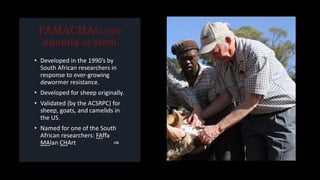
• Developed in the 1990’s by
South African researchers in
response to ever-growing
dewormer resistance.
• Developed for sheep originally.
• Validated (by the ACSRPC) for
sheep, goats, and camelids in
the US.
• Named for one of the South
African researchers: FAffa
MAlan CHArt ⇒
FAMACHA©
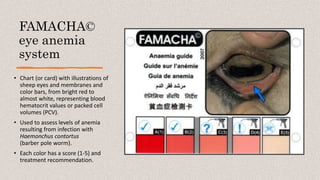
eye anemia
system
• Chart (or card) with illustrations of
sheep eyes and membranes and
color bars, from bright red to
almost white, representing blood
hematocrit values or packed cell
volumes (PCV).
• Used to assess levels of anemia
resulting from infection with
Haemonchus contortus
(barber pole worm).
• Each color has a score (1-5) and
treatment recommendation.
Using the
FAMACHA©
system properly
• Use proper scoring technique
COVER-PUSH-PULL-POP
• Examine animals every 2-3 weeks
during expected periods of
Haemonchus challenge (sometimes
more often).
• In adult animals treat 4s and 5s.
• In lambs/kids and periparturient
females, treat, 3s, 4s, and 5s.
• Treatment of 3s is where most of the
decision-making lies.
• Use in conjunction with other
parasite control and husbandry
practices.
You must take training in order to get a FAMACHA© card: in person or online.
Five Point
Check©
• Developed by the same South African
researchers to address limitations of the
FAMACHA© system, which only addresses
damage caused by blood-feeding
parasites.
• Utilizes five checkpoints on the animal’s
body to evaluate impact(s) of other
parasites.
• Five check points include nose, eye, jaw,
back, and tail.
• For goats, coat condition is another good
indicator of health.
Five-Point Check indicators. Adapted from Bath and van Wyk (2009).
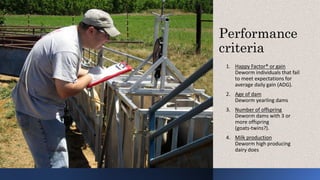
Performance
criteria
1. Happy Factor® or gain
Deworm individuals that fail
to meet expectations for
average daily gain (ADG).
2. Age of dam
Deworm yearling dams
3. Number of offspring
Deworm dams with 3 or
more offspring
(goats-twins?).
4. Milk production
Deworm high producing
dairy does
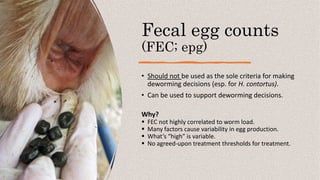
Fecal egg counts
(FEC; epg)
• Should not be used as the sole criteria for making
deworming decisions (esp. for H. contortus).
• Can be used to support deworming decisions.
Why?
 FEC not highly correlated to worm load.
 Many factors cause variability in egg production.
 What’s “high” is variable.
 No agreed-upon treatment thresholds for treatment.
Fecal egg counts
Instead use fecal egg counts to:
1. To determine effectiveness of deworming
treatment.
2. Test for dewormer resistance.
3. Select animals that are more resistant to
internal parasitism.
4. Cull animals that are more susceptible to
internal parasitism and are responsible for
contaminating pastures (70:30 rule).
5. Monitor pasture contamination.
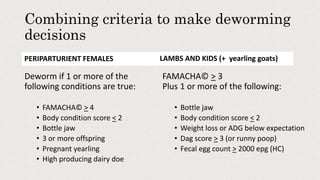
Combining criteria to make deworming
decisions
PERIPARTURIENT FEMALES
Deworm if 1 or more of the
following conditions are true:
• FAMACHA© > 4
• Body condition score < 2
• Bottle jaw
• 3 or more offspring
• Pregnant yearling
• High producing dairy doe
LAMBS AND KIDS (+ yearling goats)
FAMACHA© > 3
Plus 1 or more of the following:
• Bottle jaw
• Body condition score < 2
• Weight loss or ADG below expectation
• Dag score > 3 (or runny poop)
• Fecal egg count > 2000 epg (HC)
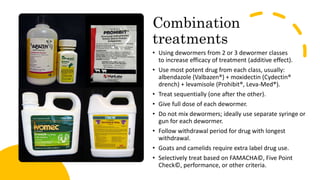
Combination
treatments
• Using dewormers from 2 or 3 dewormer classes
to increase efficacy of treatment (additive effect).
• Use most potent drug from each class, usually:
albendazole (Valbazen®) + moxidectin (Cydectin®
drench) + levamisole (Prohibit®, Leva-Med®).
• Treat sequentially (one after the other).
• Give full dose of each dewormer.
• Do not mix dewormers; ideally use separate syringe or
gun for each dewormer.
• Follow withdrawal period for drug with longest
withdrawal.
• Goats and camelids require extra label drug use.
• Selectively treat based on FAMACHA©, Five Point
Check©, performance, or other criteria.
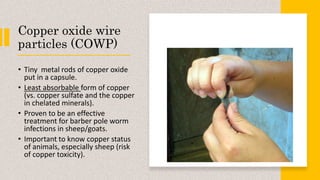
Copper oxide wire
particles (COWP)
• Tiny metal rods of copper oxide
put in a capsule.
• Least absorbable form of copper
(vs. copper sulfate and the copper
in chelated minerals).
• Proven to be an effective
treatment for barber pole worm
infections in sheep/goats.
• Important to know copper status
of animals, especially sheep (risk
of copper toxicity).
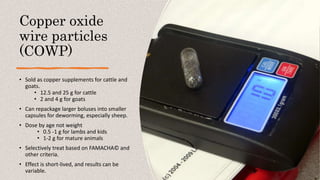
Copper oxide
wire particles
(COWP)
• Sold as copper supplements for cattle and
goats.
• 12.5 and 25 g for cattle
• 2 and 4 g for goats
• Can repackage larger boluses into smaller
capsules for deworming, especially sheep.
• Dose by age not weight
• 0.5 -1 g for lambs and kids
• 1-2 g for mature animals
• Selectively treat based on FAMACHA© and
other criteria.
• Effect is short-lived, and results can be
variable.
How to determine if treatment was
effective
Observation
• Still alive
• Bottle jaw goes away
• Bottle jaw usually goes away quickly after
an effective treatment
• FAMACHA© score improves.
• Scores usually improve in 7 to 10 days
• Improvement in 1 score by 2 weeks.
• Normal appetite and behavior.
• Longer term: increase body condition
and weight gain.
Fecal egg count reduction
• Before and after fecal egg count
• < 95% means that there is resistance
to the dewormer;
• Treatment may still be effective at 60-
95% fecal egg count reduction.
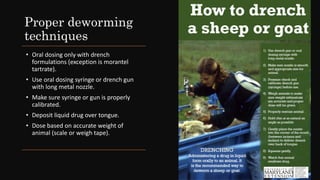
Proper deworming
techniques
• Oral dosing only with drench
formulations (exception is morantel
tartrate).
• Use oral dosing syringe or drench gun
with long metal nozzle.
• Make sure syringe or gun is properly
calibrated.
• Deposit liquid drug over tongue.
• Dose based on accurate weight of
animal (scale or weigh tape).
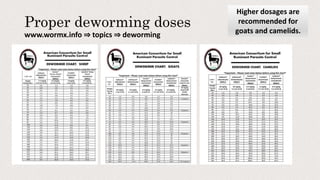
Proper deworming doses
www.wormx.info ⇒ topics ⇒ deworming
Higher dosages are
recommended for
goats and camelids.
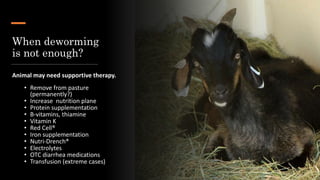
When deworming
is not enough?
Animal may need supportive therapy.
• Remove from pasture
(permanently?)
• Increase nutrition plane
• Protein supplementation
• B-vitamins, thiamine
• Vitamin K
• Red Cell®
• Iron supplementation
• Nutri-Drench®
• Electrolytes
• OTC diarrhea medications
• Transfusion (extreme cases)
Questions?
Comments?
SUSAN SCHOENIAN
Sheep & Goat Specialist Emeritus
University of Maryland Extension
sschoen@umd.edu
www.wormx.info
www.sheepandgoat.com
www.sheep101.info
facebook.com/MDSmallRuminant/

Proper deworming methods

  • 1.
    Proper deworming methods for sheep, goats,and camelids SUSAN SCHOENIAN Sheep & Goat Specialist Emeritus University of Maryland Extension sschoen@umd.edu | wormx.info
  • 2.
    • Dewormers arecompounds used to destroy parasitic worms and expel them from the body. • They are meant to treat NOT prevent internal parasitism. Therapeutic NOT prophylactic! • Different classes of dewormers have different chemistries and methods of killing worms. They usually starve or paralyze them. • When there is resistance to one drug in a class, there is usually cross (or side) resistance to drugs in the same class.
  • 3.
    There are THREEclasses of dewormers currently available for use in small ruminants in the US. BENZIMIDAZOLES (BZ) “white dewormers” • Thiabendazole TBZ® 1. Albendazole Valbazen® 2. Fenbendazole Safe-Guard®, Panacur® 3. Oxfendazole Synathic® MACROCYCLIC LACTONES (ML) 1. Avermectins a) Ivermectin (Ivomec®) b) Doramectin (Dectomax®) c) Eprinomectin (Eprinex®) 2. Milbemycins a) Moxidecin Cydectin® oral drench Quest® gel 1 IMADAZOTHIAZOLE TETRAHYDROPYRIMIDINE 1. IMID a) Levamisole Prohibit®, Leva-Med® 2. TETRA a) Morantel tartrate Rumatel® Positive Pellet® Goat Dewormer b) Pyrantel pamoate Strongid 2 3
  • 4.
    Fenbendazole: SafeGuard® • Ready-to-use liquidsuspension for goats. • Works better with increased exposure. • Not effective against tapeworms at labeled dosage (must increase to 3x). • Labeled for goats Not labeled for sheep or camelids. • Usually very high level of resistance. • Dewormer of choice for meningeal worm (due to its penetration of CNS).
  • 5.
    Albendazole: Valbazen® • Usually moreeffective than fenbendazole (SafeGuard®). • Only dewormer labeled for the removal of tapeworms (heads and segments). • Also has efficacy against adult liver flukes.  Should not be given during the first trimester of pregnancy (or within 45 days of removal of male). • Labeled for sheep. Labeled for goats for liver fluke removal Not labeled for camelids. • Usually very high level of resistance. • Should be included in combination treatment (if/when 3 dewormers are given).
  • 6.
    Avermectins: Ivermectin-like drugs • Ready-to-usedrench for sheep. Do not use other formulations. • Closely related to moxidectin (Cydectin®), but less potent at killing worms. • Effective against external parasites. Labeled for all stages of nasal bots. • Used to treat meningeal worm before parasite crosses blood-brain barrier (may also cross a damaged blood-brain barrier) • Labeled for sheep Not labeled for goats or camelids • Usually high level of resistance. • Negative effect on dung beetles.
  • 7.
    Moxidectin: Cydectin® • Ready-to-use drenchfor sheep Do not use other formulations. • The most potent ML: closely related to ivermectin. • Persistent activity: provides protection against worms for about 14 days. • Effective against some blood-sucking ectoparasites (not labeled), but not as effective as ivermectin. • Labeled for sheep Not labeled for goats or camelids. • Still works on many farms, but resistance is increasing. • Should be included in combination treatment(s). • Negative effect on dung beetles, but not as bad as ivermectin.
  • 8.
    Levamisole Prohibit®, Leva-Med® • Mustbe mixed with water before using; need to follow labeled instructions carefully. ⇒ Dewormer with narrowest margin of safety (3x). • Wider margin of safety if drug is further diluted. • Avoid giving to goats in late pregnancy. • Usually most effective dewormer***** • Labeled for sheep, but not goats or camelids. • All combination treatments should include levamisole.
  • 9.
    Morantel tartrate: Rumatel® andPositive Pellet Goat Dewormer • Crumbles: top dress or mix in feed (not the preferred method of deworming) • Different products have different formulations, so be sure to read label carefully to ensure proper dosage. • Kills mature worms only • Labeled for goats, but not sheep or camelids. ⇒ Zero withdrawal for milk 30-day withdrawal for meat • Less is known about resistance, but limited data suggests there is resistance.
  • 10.
    Extra label drug use(ELDU) • Using a drug in a manner that is not on the label: • Different species • Different dosage • Different disease (reason) • Different dosage frequency • Different route of administration • Different withdrawal period • Only a licensed veterinarian has the legal right to use or prescribe drugs extra-label. • Certain conditions must be met even for the veterinarian to use drugs extra label. • Extra label drug use is usually required for effective deworming of goats and camelids.
  • 11.
    Veterinarian- client-patient relationship (VCPR) • You musthave a valid veterinarian-client- patient-relationship in order to use drugs extra label. • A VCPR means the vet has knowledge of the animals he/she is treating (must visit farm*). • A VCPR is now required to use antibiotics, too. *Frequency varies by vet.
  • 12.
    Dewormer resistance • When adewormer loses some or all of its effectiveness against a worm population. • Less than 95% reduction in fecal egg count. May be effective as sole treatment at lower fecal egg count reduction, e.g., 60-95% • Resistance is a worldwide and growing problem. It varies by geographic area and farm and is a result of past deworming practices. • Worms have developed resistance to all dewormers and dewormers classes. • Dewormers need to be used more selectively to preserve their efficacy.
  • 13.
    Determining dewormer resistance FECALEGG COUNT REDUCTION TEST • Before and after fecal egg counts from the same 10-15 animals. • Levamisole, benzimidazoles (10-14 days) • Avermectins (14-17 days) • Moxidectin (17-21 days) • Combination (drug with longest interval) • Must test each dewormer or combination separately. • Can use pooled or individual fecal samples. • New protocols announced recently. • Can learn to do yourself. • Some universities offer low-cost fecal egg counting (wormx.info/lowcostfec) DRENCHRIGHT® LARVAL ASSAY • Laboratory test that uses worm larvae to determine resistance to all dewormers simultaneously using a pooled fecal sample from 10-12 animals. • Expensive test One time cost of ~$500 per sample • Louisiana State University only place that does test Not yet available after University of Georgia did for many years.
  • 14.
    Practices which accelerate(d) resistance to dewormers 1.Frequent deworming 2. Underdosing • Treating everyone in the group and moving them to a clean pasture. • Using wrong drug formulations (e.g., injectables and pour-ons). • Using dewormers past their expiration dates. • Storing dewormers improperly. • Using improper deworming techniques. • Using long-acting or persistent- activity dewormers.
  • 15.
    Targeted Selective Treatment (TST) ornon-treatment • Only treating those animals which require or (would benefit from) treatment. • Reduces amount of deworming. • Increases REFUGIA: worms on farm that have not been exposed to the drugs; therefore, remain susceptible to deworming with drug(s). • Prolongs drug efficacy. • Helps to identify resistance and susceptible animals.
  • 16.
    Tools for making selective dewormingdecisions 1.FAMACHA© eye anemia system 2.Five Point Check© 3.Performance indicators 4.Fecal egg counts
  • 17.
    • Developed inthe 1990’s by South African researchers in response to ever-growing dewormer resistance. • Developed for sheep originally. • Validated (by the ACSRPC) for sheep, goats, and camelids in the US. • Named for one of the South African researchers: FAffa MAlan CHArt ⇒
  • 18.
    FAMACHA© eye anemia system • Chart(or card) with illustrations of sheep eyes and membranes and color bars, from bright red to almost white, representing blood hematocrit values or packed cell volumes (PCV). • Used to assess levels of anemia resulting from infection with Haemonchus contortus (barber pole worm). • Each color has a score (1-5) and treatment recommendation.
  • 19.
    Using the FAMACHA© system properly •Use proper scoring technique COVER-PUSH-PULL-POP • Examine animals every 2-3 weeks during expected periods of Haemonchus challenge (sometimes more often). • In adult animals treat 4s and 5s. • In lambs/kids and periparturient females, treat, 3s, 4s, and 5s. • Treatment of 3s is where most of the decision-making lies. • Use in conjunction with other parasite control and husbandry practices. You must take training in order to get a FAMACHA© card: in person or online.
  • 20.
    Five Point Check© • Developedby the same South African researchers to address limitations of the FAMACHA© system, which only addresses damage caused by blood-feeding parasites. • Utilizes five checkpoints on the animal’s body to evaluate impact(s) of other parasites. • Five check points include nose, eye, jaw, back, and tail. • For goats, coat condition is another good indicator of health. Five-Point Check indicators. Adapted from Bath and van Wyk (2009).
  • 21.
    Performance criteria 1. Happy Factor®or gain Deworm individuals that fail to meet expectations for average daily gain (ADG). 2. Age of dam Deworm yearling dams 3. Number of offspring Deworm dams with 3 or more offspring (goats-twins?). 4. Milk production Deworm high producing dairy does
  • 22.
    Fecal egg counts (FEC;epg) • Should not be used as the sole criteria for making deworming decisions (esp. for H. contortus). • Can be used to support deworming decisions. Why?  FEC not highly correlated to worm load.  Many factors cause variability in egg production.  What’s “high” is variable.  No agreed-upon treatment thresholds for treatment.
  • 23.
    Fecal egg counts Insteaduse fecal egg counts to: 1. To determine effectiveness of deworming treatment. 2. Test for dewormer resistance. 3. Select animals that are more resistant to internal parasitism. 4. Cull animals that are more susceptible to internal parasitism and are responsible for contaminating pastures (70:30 rule). 5. Monitor pasture contamination.
  • 24.
    Combining criteria tomake deworming decisions PERIPARTURIENT FEMALES Deworm if 1 or more of the following conditions are true: • FAMACHA© > 4 • Body condition score < 2 • Bottle jaw • 3 or more offspring • Pregnant yearling • High producing dairy doe LAMBS AND KIDS (+ yearling goats) FAMACHA© > 3 Plus 1 or more of the following: • Bottle jaw • Body condition score < 2 • Weight loss or ADG below expectation • Dag score > 3 (or runny poop) • Fecal egg count > 2000 epg (HC)
  • 25.
    Combination treatments • Using dewormersfrom 2 or 3 dewormer classes to increase efficacy of treatment (additive effect). • Use most potent drug from each class, usually: albendazole (Valbazen®) + moxidectin (Cydectin® drench) + levamisole (Prohibit®, Leva-Med®). • Treat sequentially (one after the other). • Give full dose of each dewormer. • Do not mix dewormers; ideally use separate syringe or gun for each dewormer. • Follow withdrawal period for drug with longest withdrawal. • Goats and camelids require extra label drug use. • Selectively treat based on FAMACHA©, Five Point Check©, performance, or other criteria.
  • 26.
    Copper oxide wire particles(COWP) • Tiny metal rods of copper oxide put in a capsule. • Least absorbable form of copper (vs. copper sulfate and the copper in chelated minerals). • Proven to be an effective treatment for barber pole worm infections in sheep/goats. • Important to know copper status of animals, especially sheep (risk of copper toxicity).
  • 27.
    Copper oxide wire particles (COWP) •Sold as copper supplements for cattle and goats. • 12.5 and 25 g for cattle • 2 and 4 g for goats • Can repackage larger boluses into smaller capsules for deworming, especially sheep. • Dose by age not weight • 0.5 -1 g for lambs and kids • 1-2 g for mature animals • Selectively treat based on FAMACHA© and other criteria. • Effect is short-lived, and results can be variable.
  • 28.
    How to determineif treatment was effective Observation • Still alive • Bottle jaw goes away • Bottle jaw usually goes away quickly after an effective treatment • FAMACHA© score improves. • Scores usually improve in 7 to 10 days • Improvement in 1 score by 2 weeks. • Normal appetite and behavior. • Longer term: increase body condition and weight gain. Fecal egg count reduction • Before and after fecal egg count • < 95% means that there is resistance to the dewormer; • Treatment may still be effective at 60- 95% fecal egg count reduction.
  • 29.
    Proper deworming techniques • Oraldosing only with drench formulations (exception is morantel tartrate). • Use oral dosing syringe or drench gun with long metal nozzle. • Make sure syringe or gun is properly calibrated. • Deposit liquid drug over tongue. • Dose based on accurate weight of animal (scale or weigh tape).
  • 30.
    Proper deworming doses www.wormx.info⇒ topics ⇒ deworming Higher dosages are recommended for goats and camelids.
  • 31.
    When deworming is notenough? Animal may need supportive therapy. • Remove from pasture (permanently?) • Increase nutrition plane • Protein supplementation • B-vitamins, thiamine • Vitamin K • Red Cell® • Iron supplementation • Nutri-Drench® • Electrolytes • OTC diarrhea medications • Transfusion (extreme cases)
  • 32.
    Questions? Comments? SUSAN SCHOENIAN Sheep &Goat Specialist Emeritus University of Maryland Extension sschoen@umd.edu www.wormx.info www.sheepandgoat.com www.sheep101.info facebook.com/MDSmallRuminant/