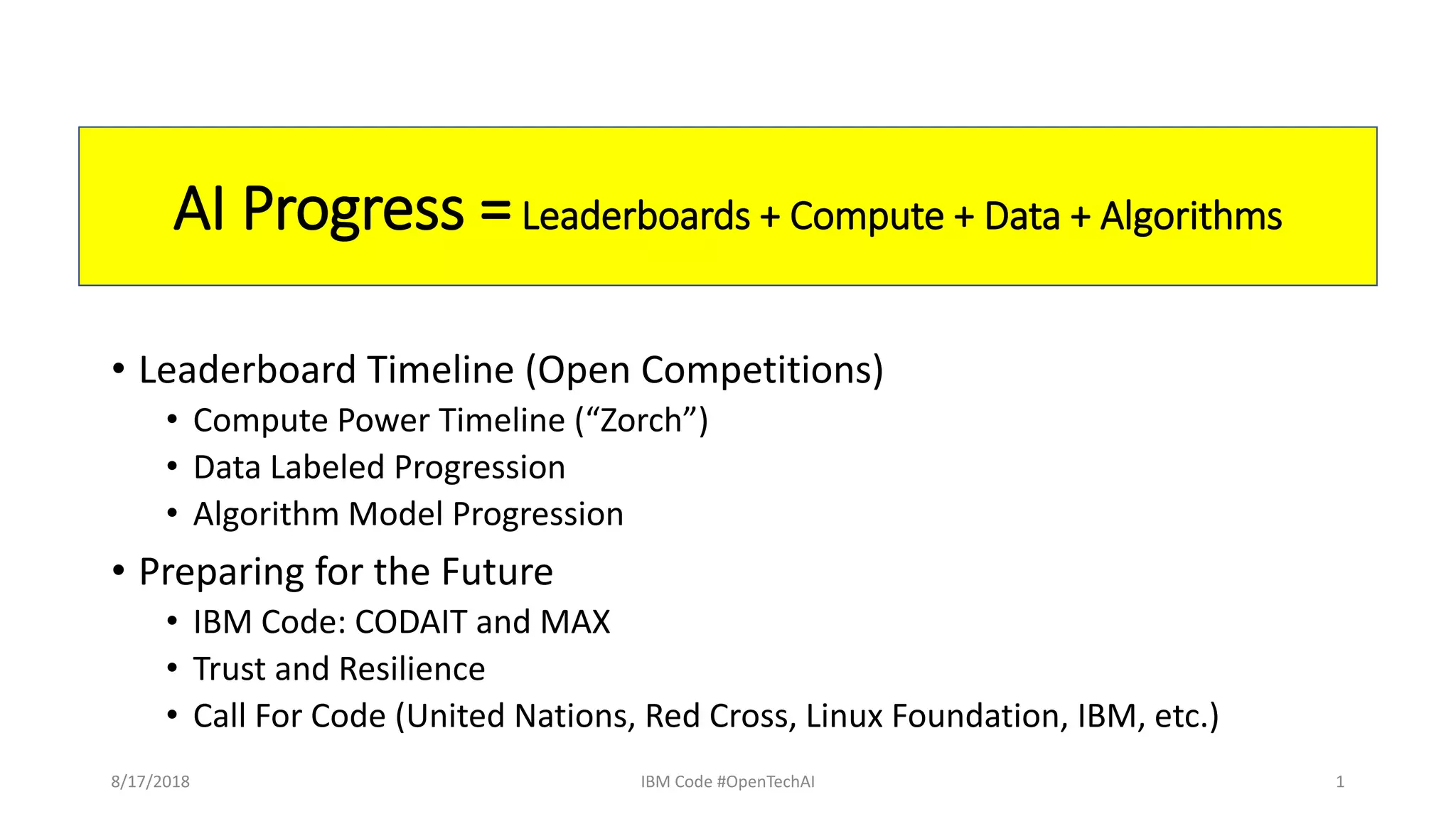
AI Progress =Leaderboards + Compute + Data + Algorithms
• Leaderboard Timeline (Open Competitions)
• Compute Power Timeline (“Zorch”)
• Data Labeled Progression
• Algorithm Model Progression
• Preparing for the Future
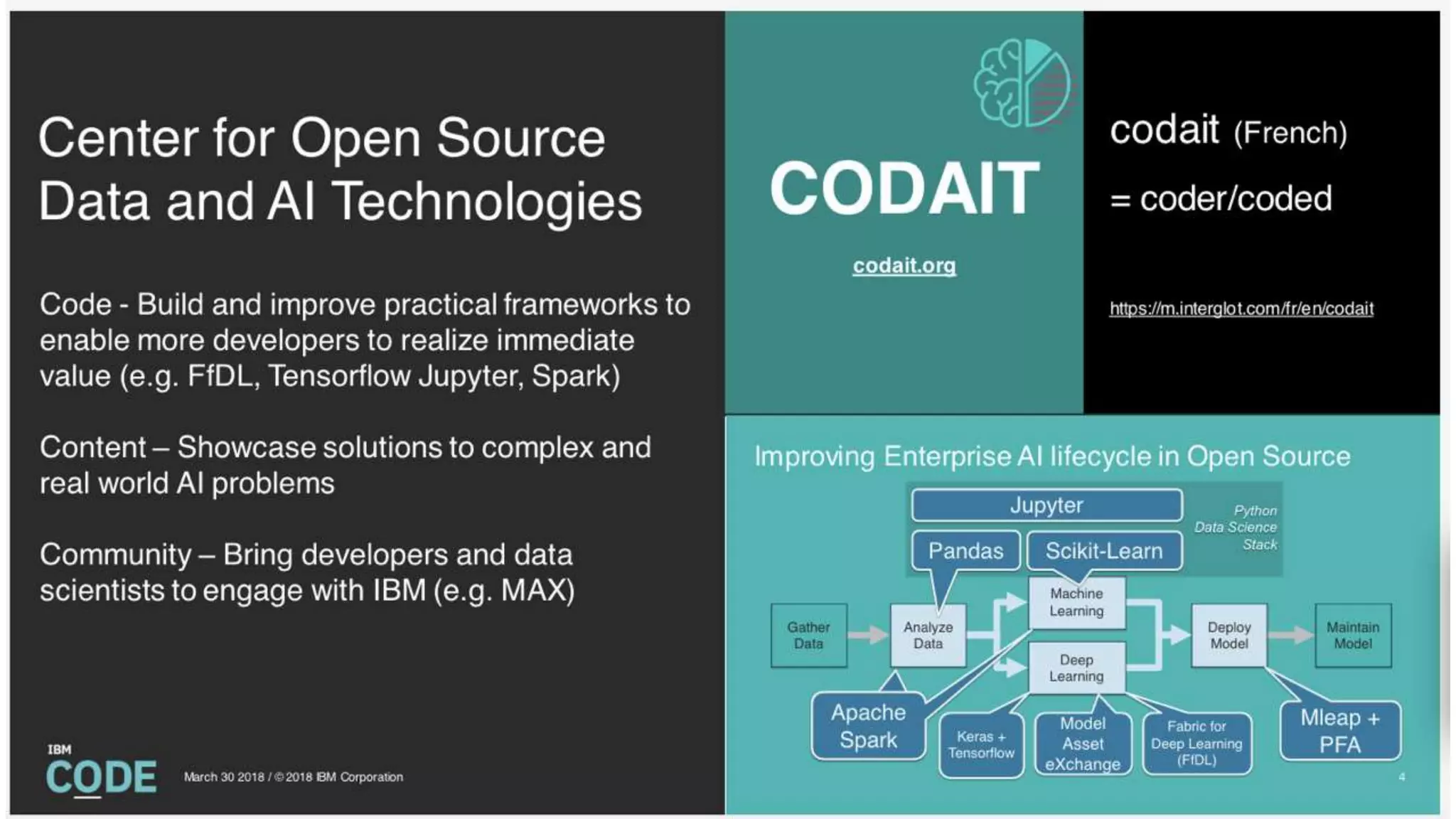
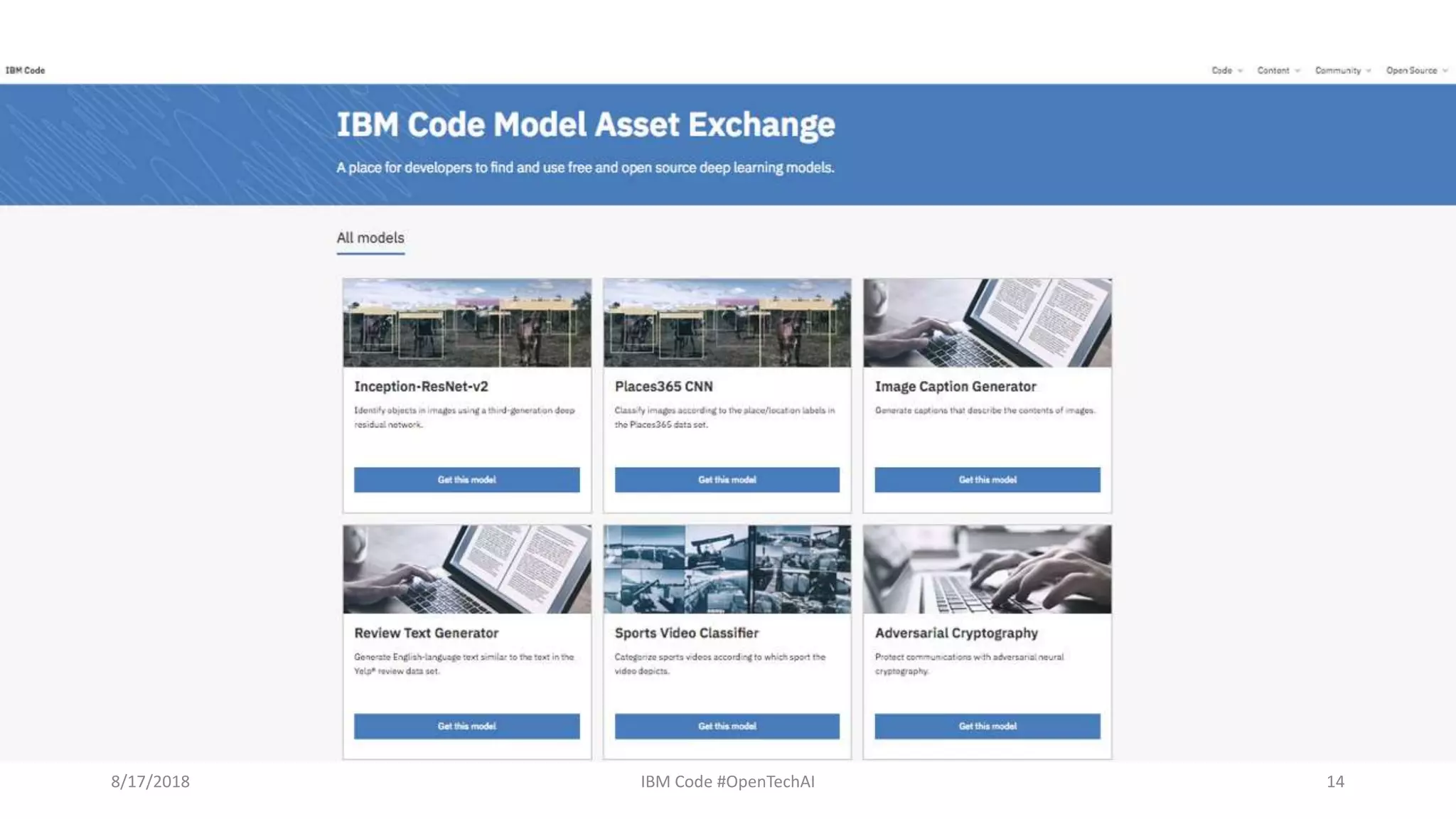
• IBM Code: CODAIT and MAX
• Trust and Resilience
• Call For Code (United Nations, Red Cross, Linux Foundation, IBM, etc.)
8/17/2018 IBM Code #OpenTechAI 1
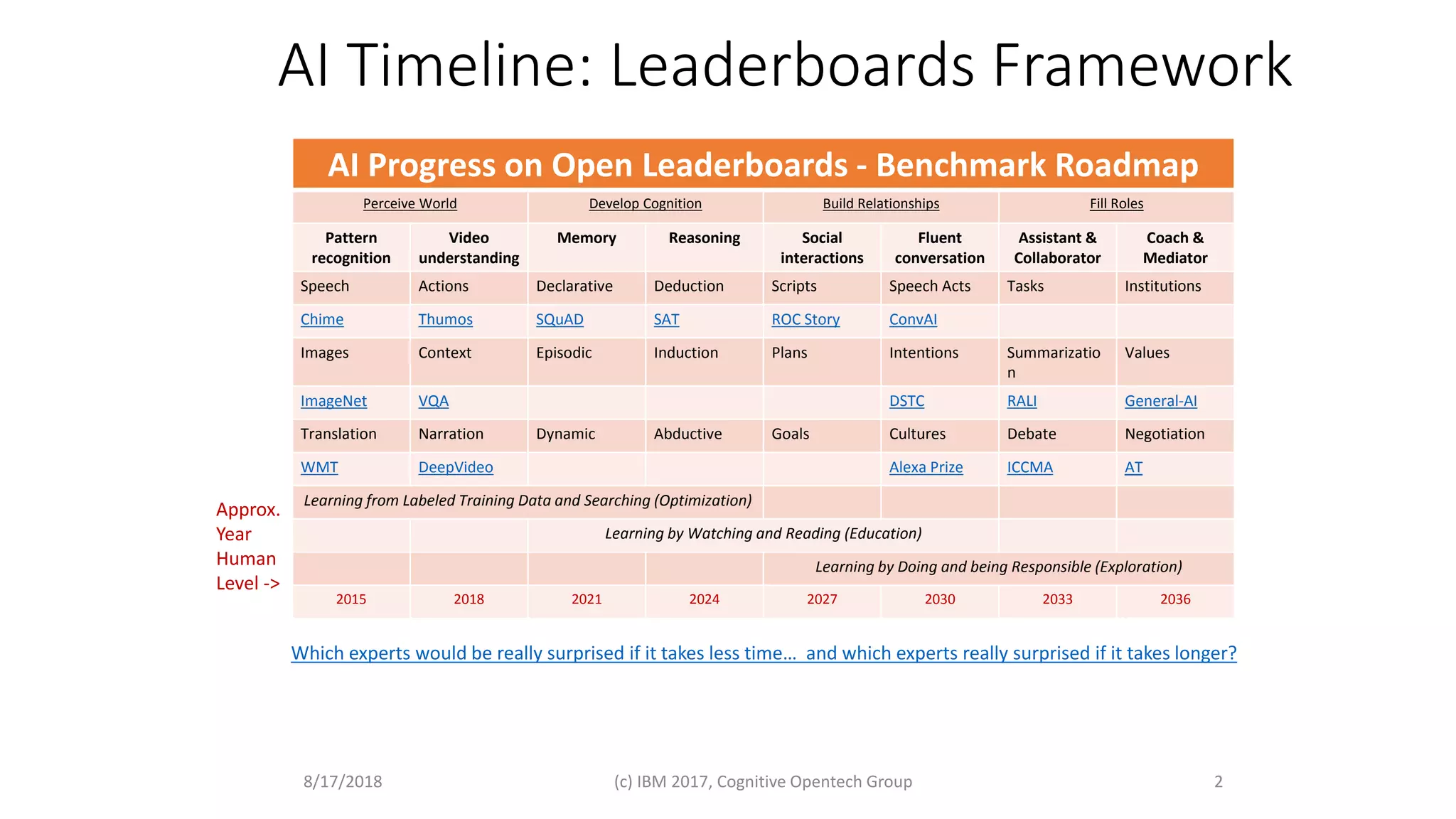
AI Timeline: Leaderboards Framework
AI Progress on Open Leaderboards - Benchmark Roadmap
Perceive World Develop Cognition Build Relationships Fill Roles
Pattern
recognition
Video
understanding
Memory Reasoning Social
interactions
Fluent
conversation
Assistant &
Collaborator
Coach &
Mediator
Speech Actions Declarative Deduction Scripts Speech Acts Tasks Institutions
Chime Thumos SQuAD SAT ROC Story ConvAI
Images Context Episodic Induction Plans Intentions Summarizatio
n
Values
ImageNet VQA DSTC RALI General-AI
Translation Narration Dynamic Abductive Goals Cultures Debate Negotiation
WMT DeepVideo Alexa Prize ICCMA AT
Learning from Labeled Training Data and Searching (Optimization)
Learning by Watching and Reading (Education)
Learning by Doing and being Responsible (Exploration)
2015 2018 2021 2024 2027 2030 2033 2036
8/17/2018 (c) IBM 2017, Cognitive Opentech Group 2
Which experts would be really surprised if it takes less time… and which experts really surprised if it takes longer?
Approx.
Year
Human
Level ->
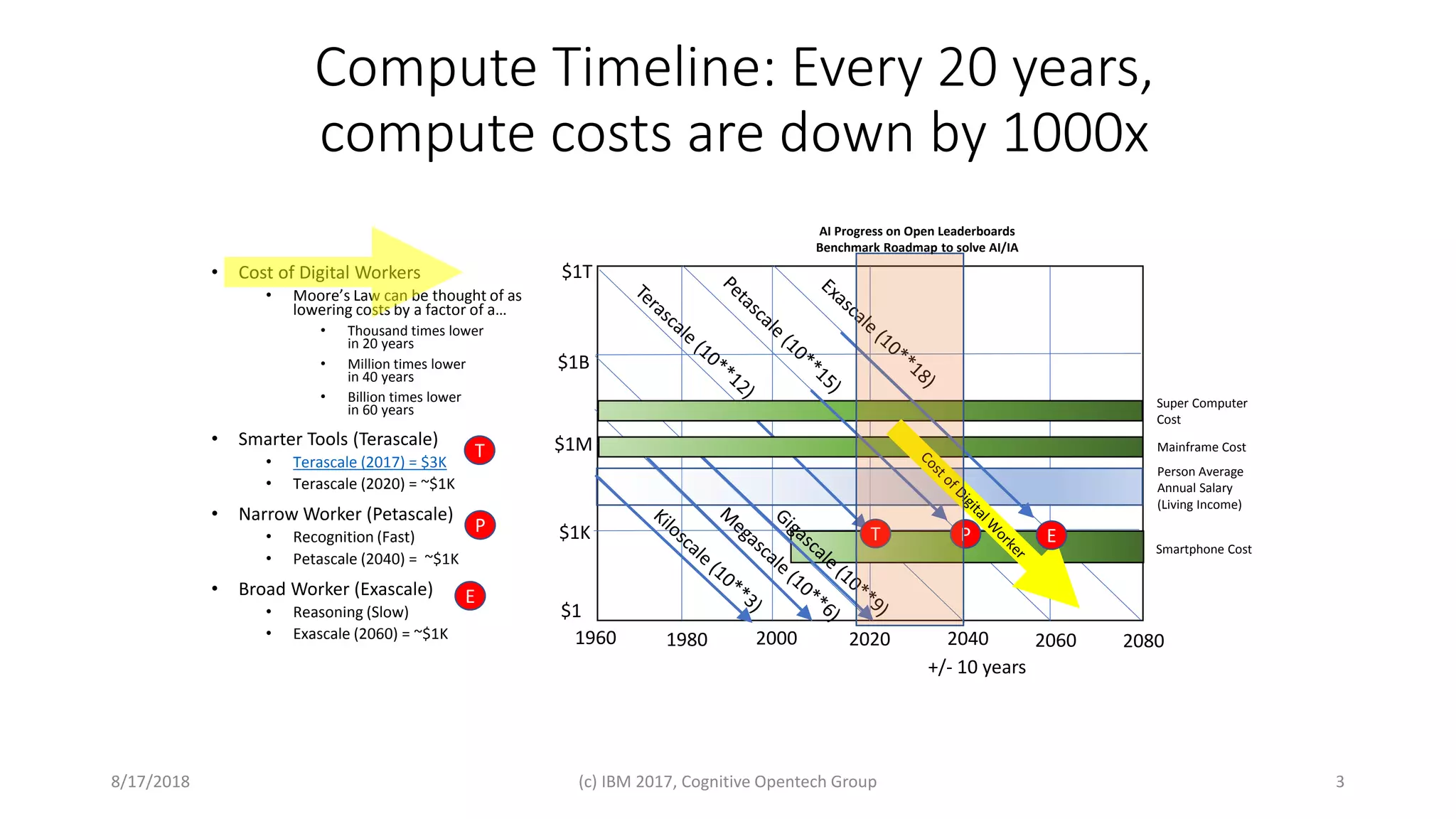
Compute Timeline: Every 20 years,
compute costs are down by 1000x
• Cost of Digital Workers
• Moore’s Law can be thought of as
lowering costs by a factor of a…
• Thousand times lower
in 20 years
• Million times lower
in 40 years
• Billion times lower
in 60 years
• Smarter Tools (Terascale)
• Terascale (2017) = $3K
• Terascale (2020) = ~$1K
• Narrow Worker (Petascale)
• Recognition (Fast)
• Petascale (2040) = ~$1K
• Broad Worker (Exascale)
• Reasoning (Slow)
• Exascale (2060) = ~$1K
38/17/2018 (c) IBM 2017, Cognitive Opentech Group
2080204020001960
$1K
$1M
$1B
$1T
206020201980
+/- 10 years
$1
Person Average
Annual Salary
(Living Income)
Super Computer
Cost
Mainframe Cost
Smartphone Cost
T
P
E
T P E
AI Progress on Open Leaderboards
Benchmark Roadmap to solve AI/IA
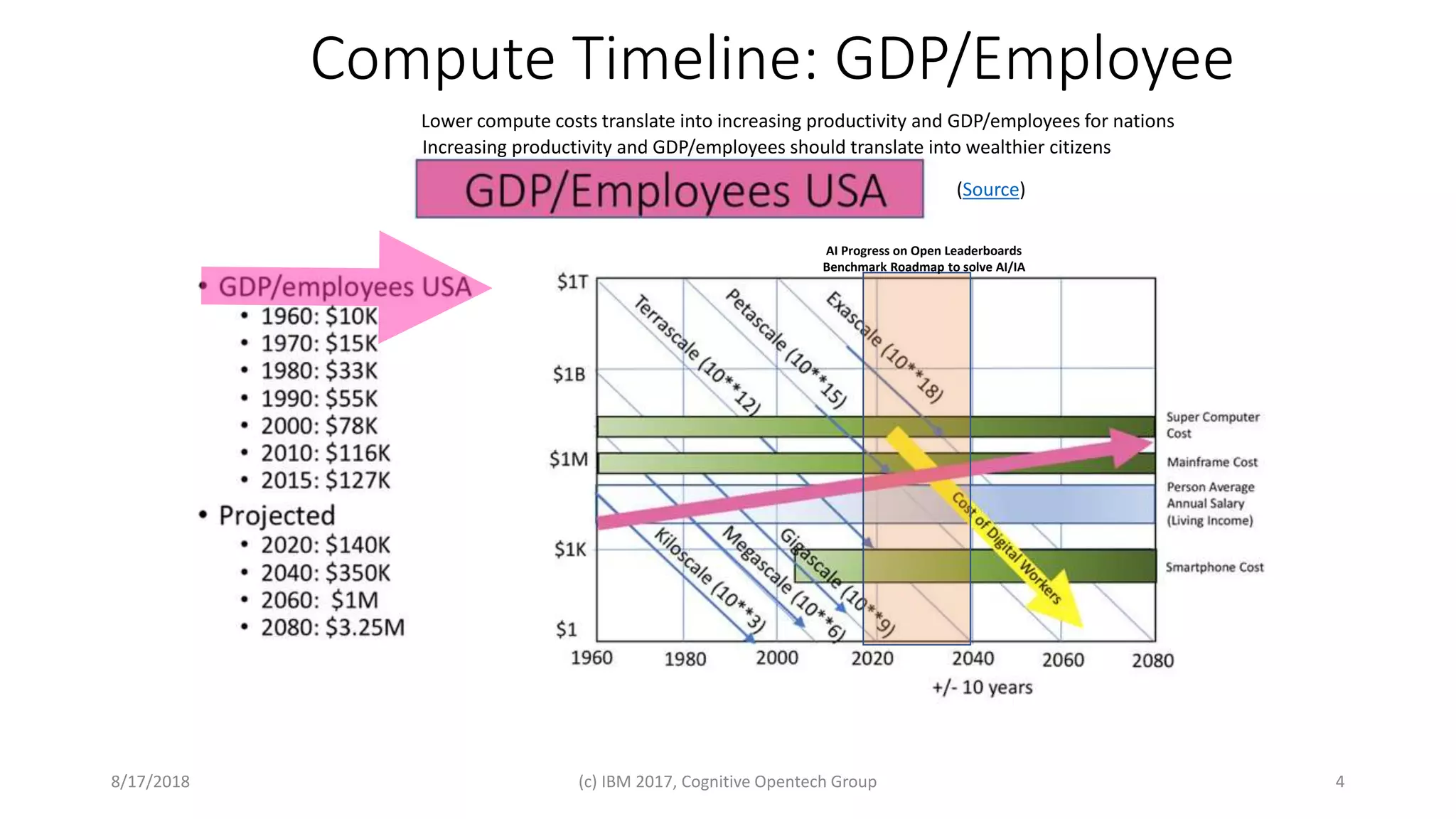
Compute Timeline: GDP/Employee
8/17/2018 (c) IBM 2017, Cognitive Opentech Group 4
(Source)
Lower compute costs translate into increasing productivity and GDP/employees for nations
Increasing productivity and GDP/employees should translate into wealthier citizens
AI Progress on Open Leaderboards
Benchmark Roadmap to solve AI/IA
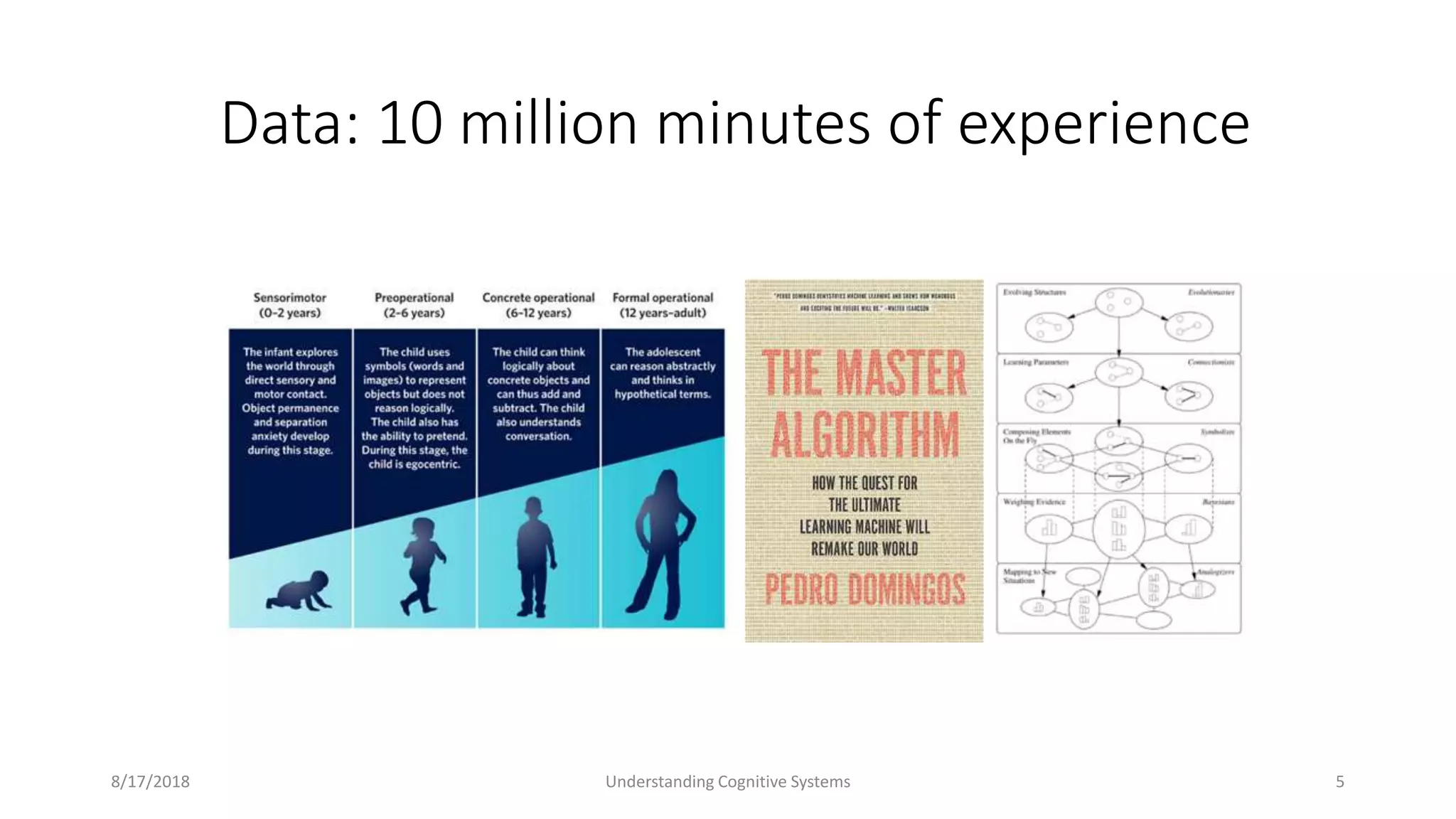
Data: 10 million minutes of experience
8/17/2018 Understanding Cognitive Systems 5
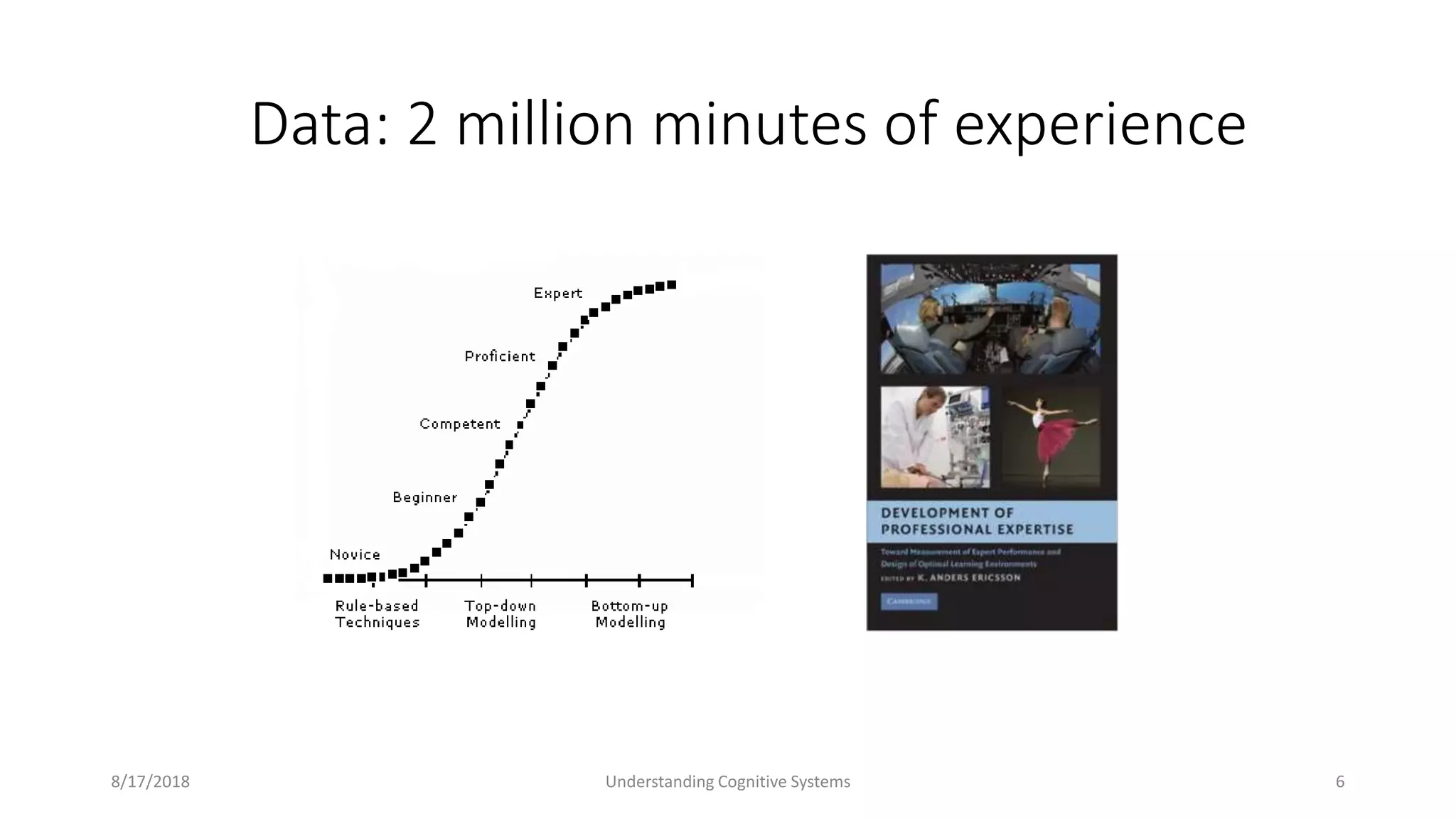
Data: 2 million minutes of experience
8/17/2018 Understanding Cognitive Systems 6
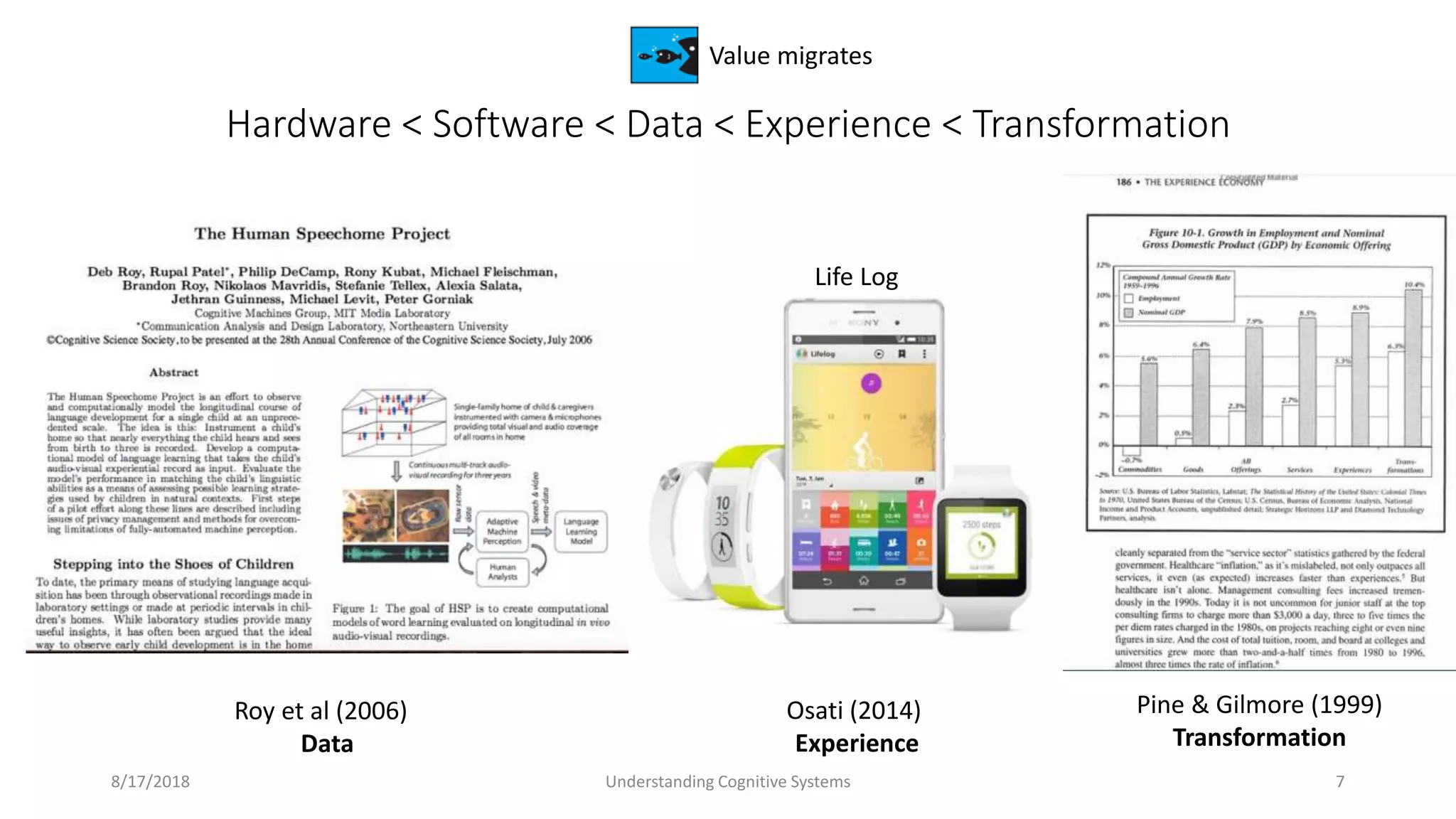
Hardware < Software < Data < Experience < Transformation
8/17/2018 Understanding Cognitive Systems 7
Value migrates
Pine & Gilmore (1999)
Transformation
Roy et al (2006)
Data
Osati (2014)
Experience
Life Log
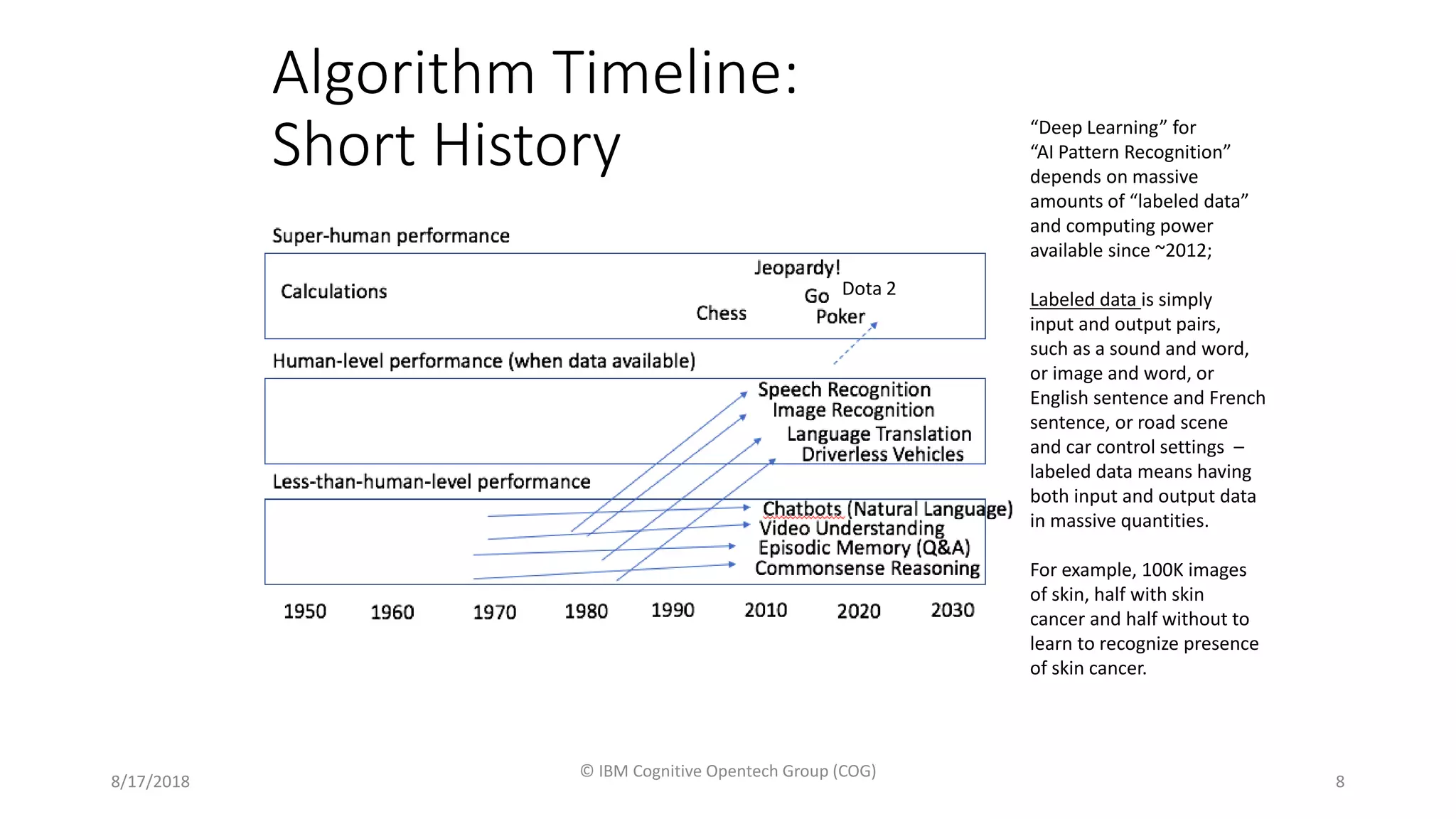
Algorithm Timeline:
Short History
8/17/2018
© IBM Cognitive Opentech Group (COG)
8
Dota 2
“Deep Learning” for
“AI Pattern Recognition”
depends on massive
amounts of “labeled data”
and computing power
available since ~2012;
Labeled data is simply
input and output pairs,
such as a sound and word,
or image and word, or
English sentence and French
sentence, or road scene
and car control settings –
labeled data means having
both input and output data
in massive quantities.
For example, 100K images
of skin, half with skin
cancer and half without to
learn to recognize presence
of skin cancer.
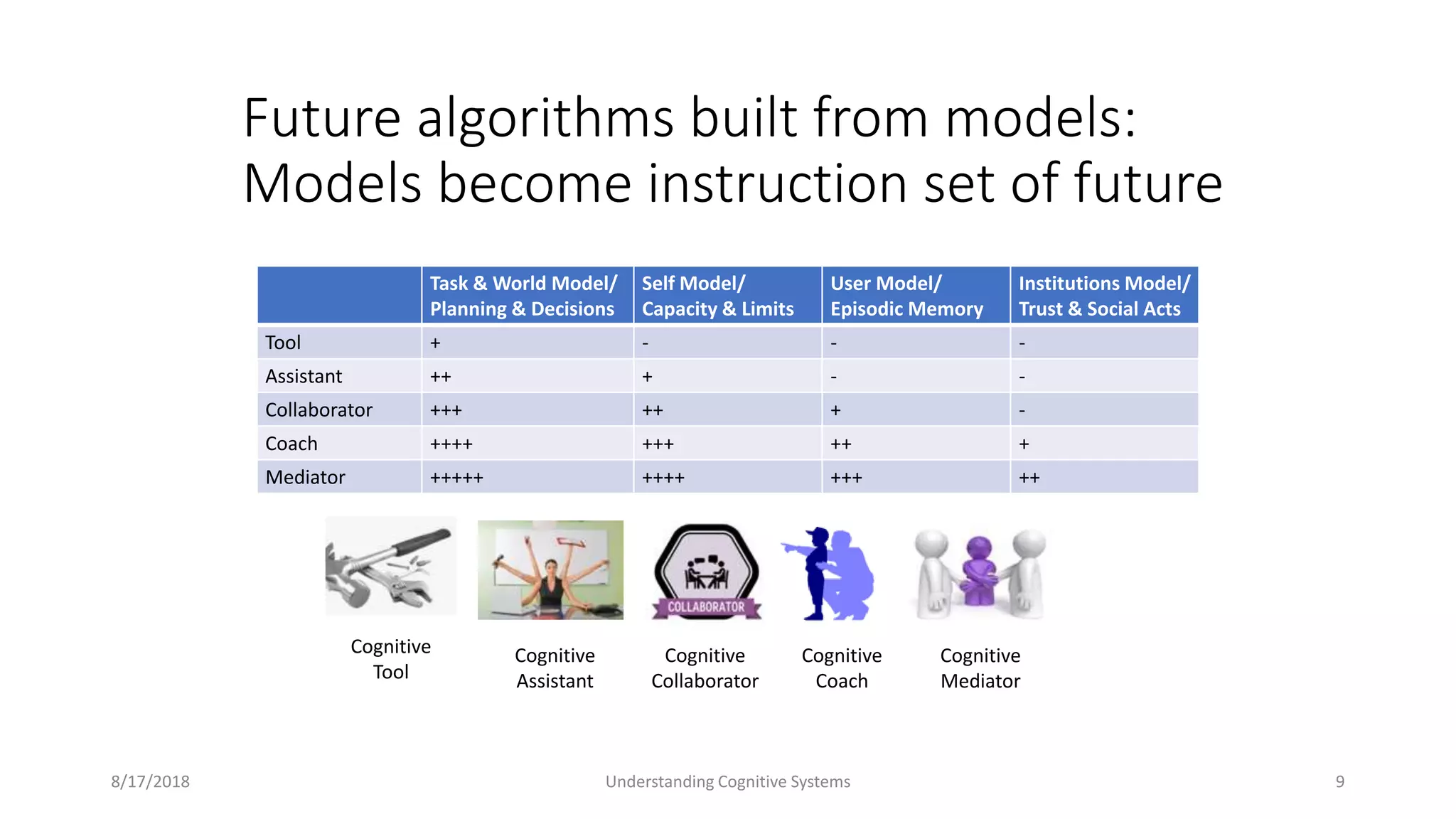
Future algorithms built from models:
Models become instruction set of future
8/17/2018 Understanding Cognitive Systems 9
Task & World Model/
Planning & Decisions
Self Model/
Capacity & Limits
User Model/
Episodic Memory
Institutions Model/
Trust & Social Acts
Tool + - - -
Assistant ++ + - -
Collaborator +++ ++ + -
Coach ++++ +++ ++ +
Mediator +++++ ++++ +++ ++
Cognitive
Tool
Cognitive
Assistant
Cognitive
Collaborator
Cognitive
Coach
Cognitive
Mediator
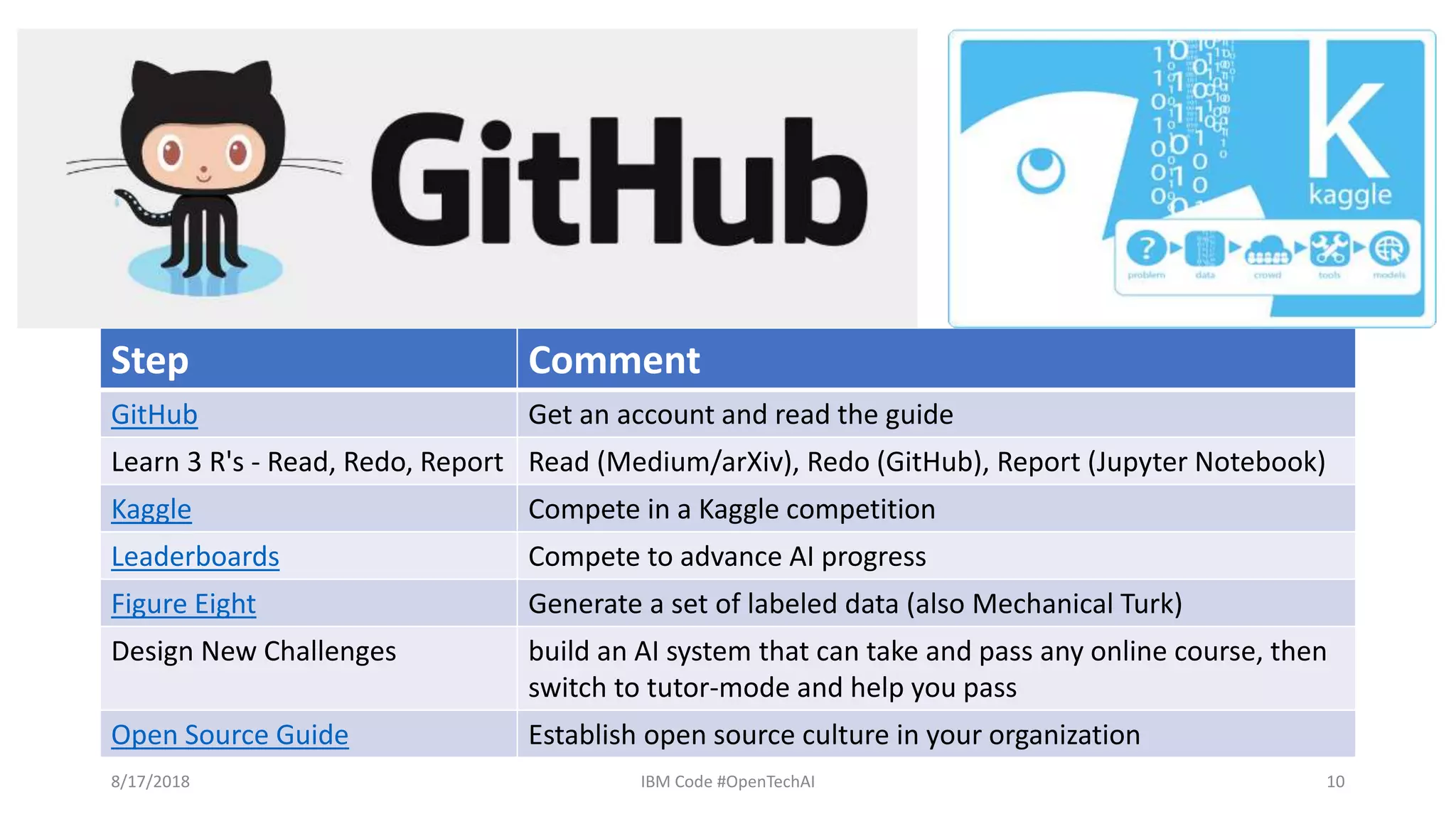
Step Comment
GitHub Get an account and read the guide
Learn 3 R's - Read, Redo, Report Read (Medium/arXiv), Redo (GitHub), Report (Jupyter Notebook)
Kaggle Compete in a Kaggle competition
Leaderboards Compete to advance AI progress
Figure Eight Generate a set of labeled data (also Mechanical Turk)
Design New Challenges build an AI system that can take and pass any online course, then
switch to tutor-mode and help you pass
Open Source Guide Establish open source culture in your organization
8/17/2018 IBM Code #OpenTechAI 10
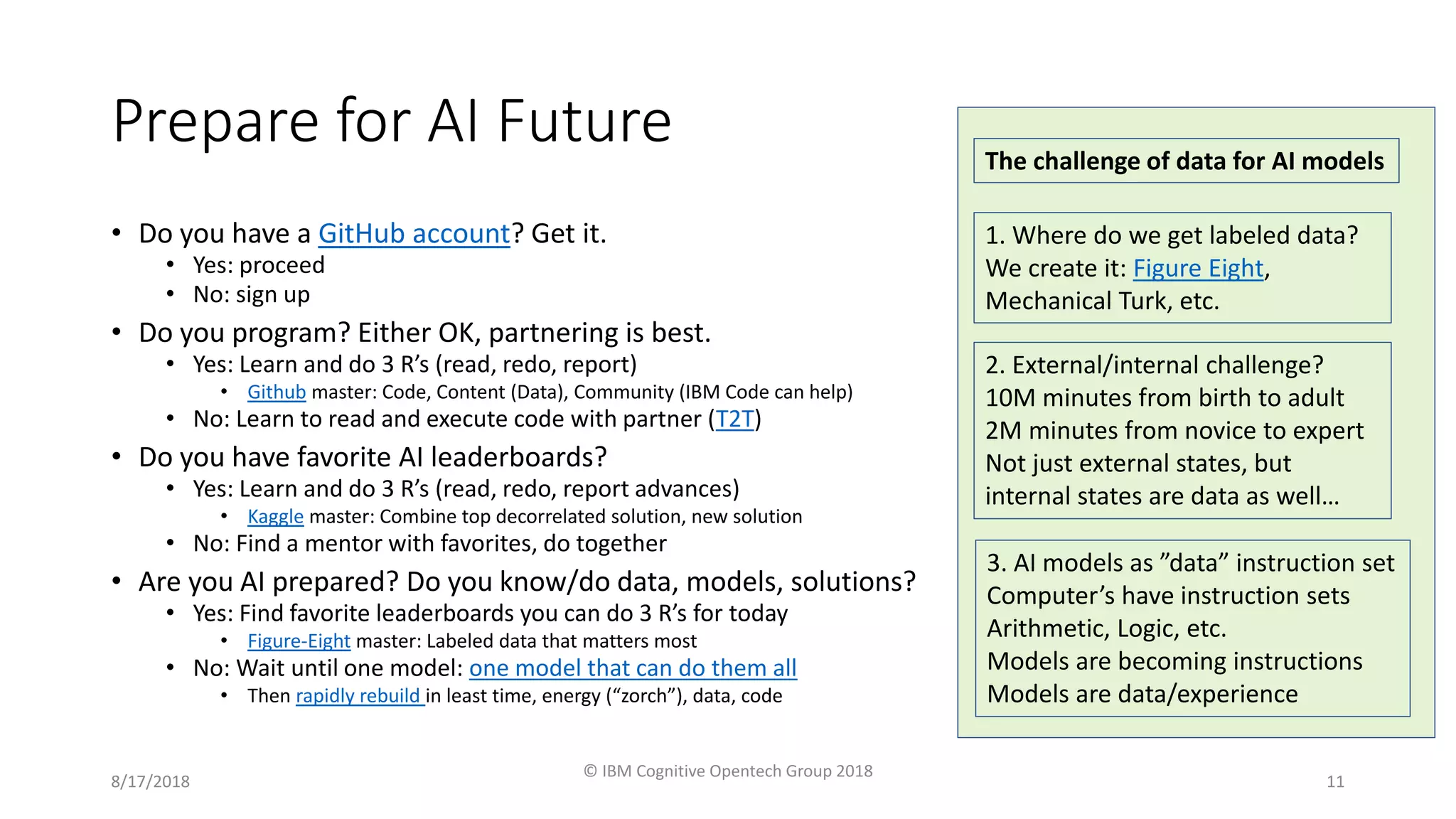
Prepare for AI Future
• Do you have a GitHub account? Get it.
• Yes: proceed
• No: sign up
• Do you program? Either OK, partnering is best.
• Yes: Learn and do 3 R’s (read, redo, report)
• Github master: Code, Content (Data), Community (IBM Code can help)
• No: Learn to read and execute code with partner (T2T)
• Do you have favorite AI leaderboards?
• Yes: Learn and do 3 R’s (read, redo, report advances)
• Kaggle master: Combine top decorrelated solution, new solution
• No: Find a mentor with favorites, do together
• Are you AI prepared? Do you know/do data, models, solutions?
• Yes: Find favorite leaderboards you can do 3 R’s for today
• Figure-Eight master: Labeled data that matters most
• No: Wait until one model: one model that can do them all
• Then rapidly rebuild in least time, energy (“zorch”), data, code
8/17/2018
© IBM Cognitive Opentech Group 2018
11
1. Where do we get labeled data?
We create it: Figure Eight,
Mechanical Turk, etc.
2. External/internal challenge?
10M minutes from birth to adult
2M minutes from novice to expert
Not just external states, but
internal states are data as well…
The challenge of data for AI models
3. AI models as ”data” instruction set
Computer’s have instruction sets
Arithmetic, Logic, etc.
Models are becoming instructions
Models are data/experience
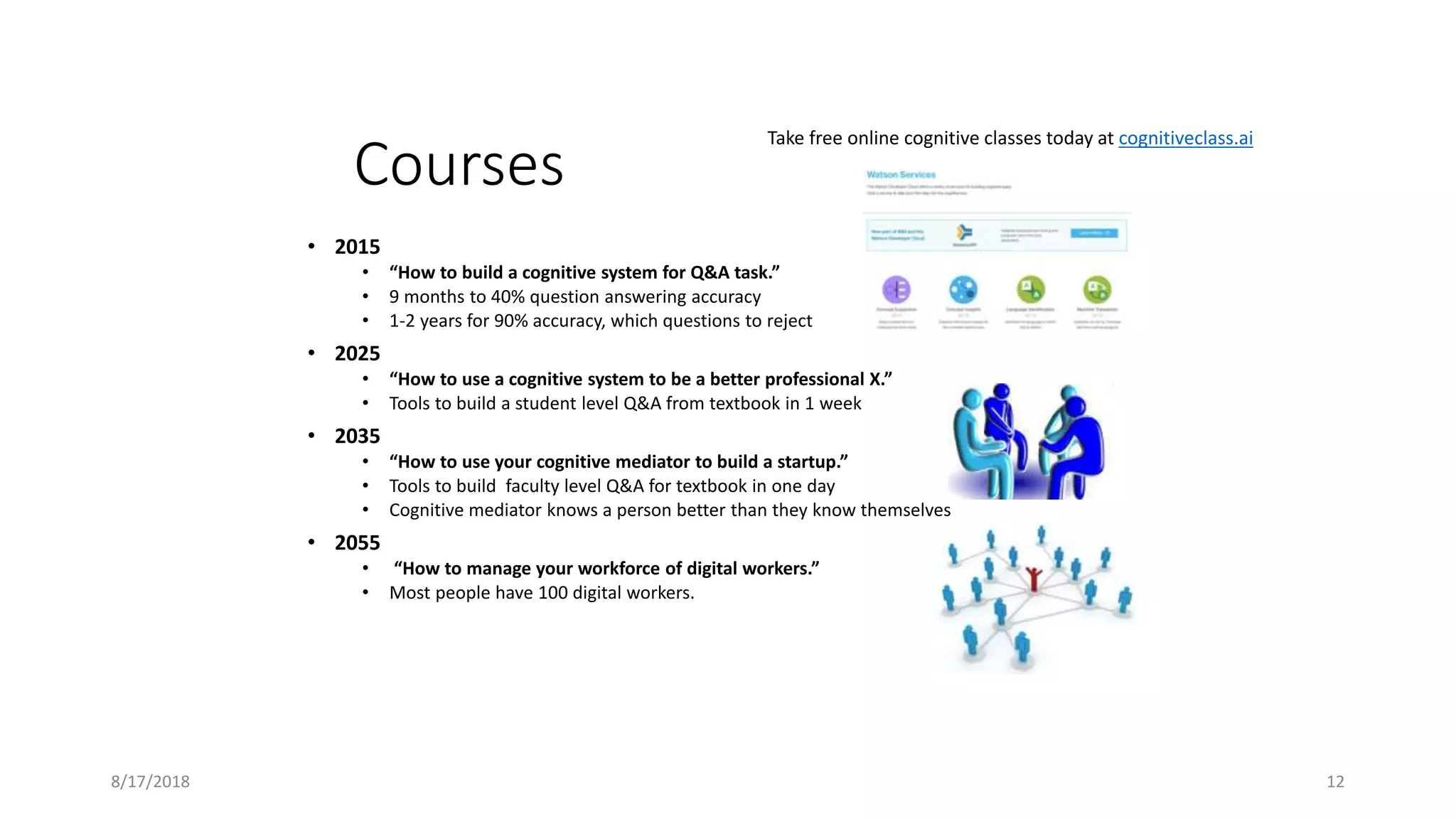
Courses
• 2015
• “How to build a cognitive system for Q&A task.”
• 9 months to 40% question answering accuracy
• 1-2 years for 90% accuracy, which questions to reject
• 2025
• “How to use a cognitive system to be a better professional X.”
• Tools to build a student level Q&A from textbook in 1 week
• 2035
• “How to use your cognitive mediator to build a startup.”
• Tools to build faculty level Q&A for textbook in one day
• Cognitive mediator knows a person better than they know themselves
• 2055
• “How to manage your workforce of digital workers.”
• Most people have 100 digital workers.
8/17/2018 12
Take free online cognitive classes today at cognitiveclass.ai
8/17/2018 IBM Code #OpenTechAI 13
8/17/2018 IBM Code #OpenTechAI 14
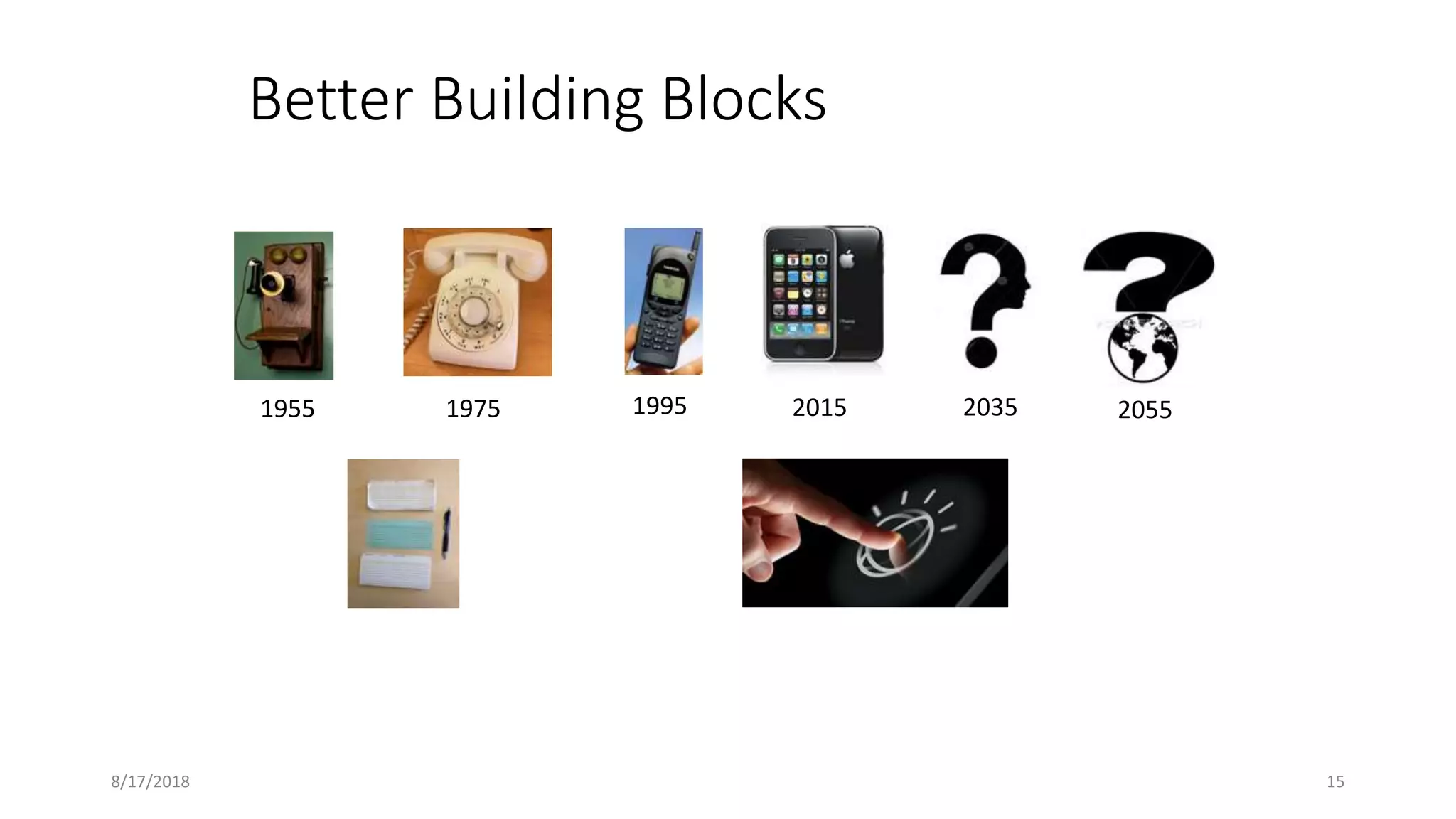
8/17/2018 15
1955 1975 1995 2015 2035 2055
Better Building Blocks
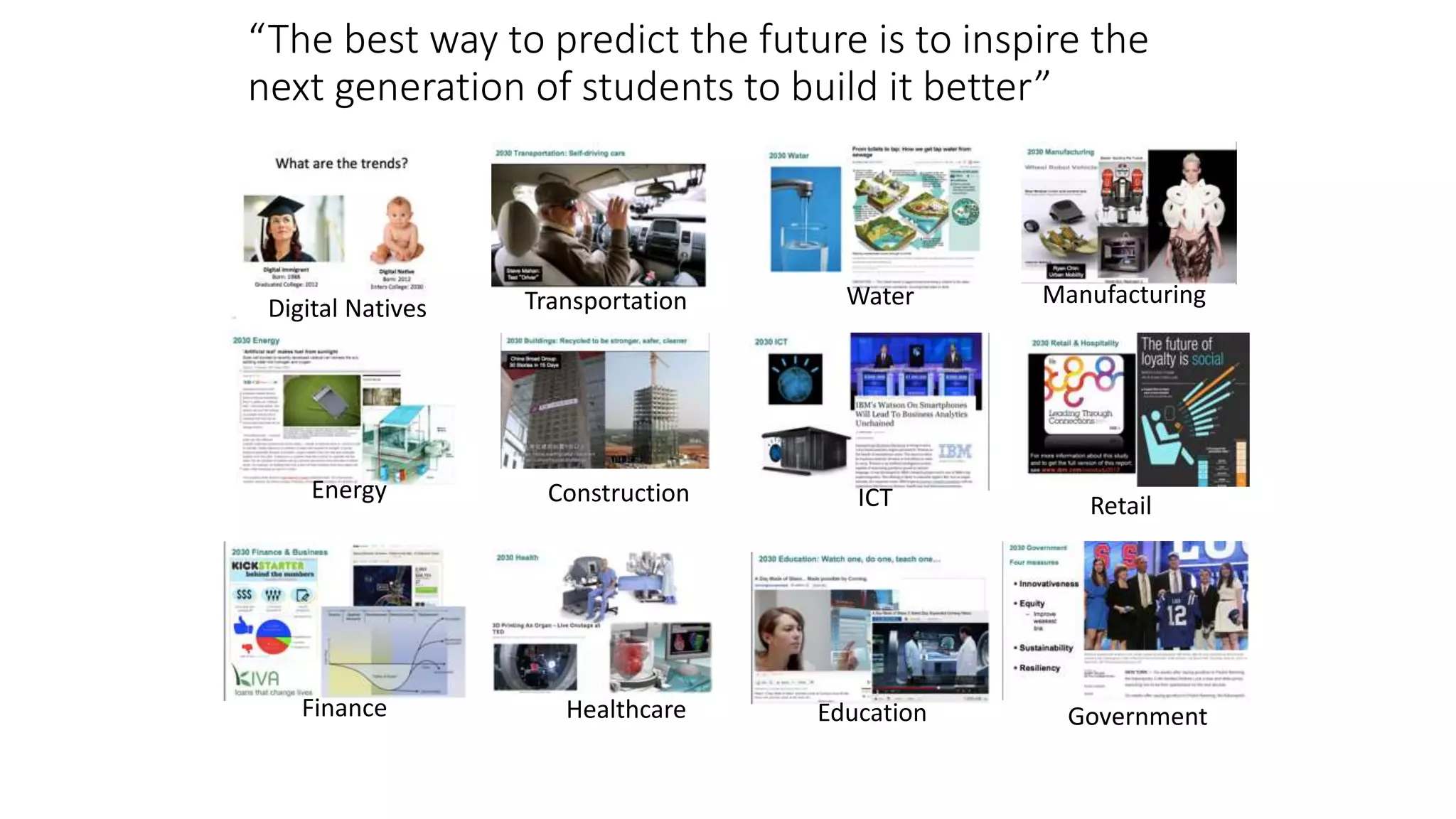
“The best way to predict the future is to inspire the
next generation of students to build it better”
Digital Natives Transportation Water Manufacturing
Energy Construction ICT Retail
Finance Healthcare Education Government
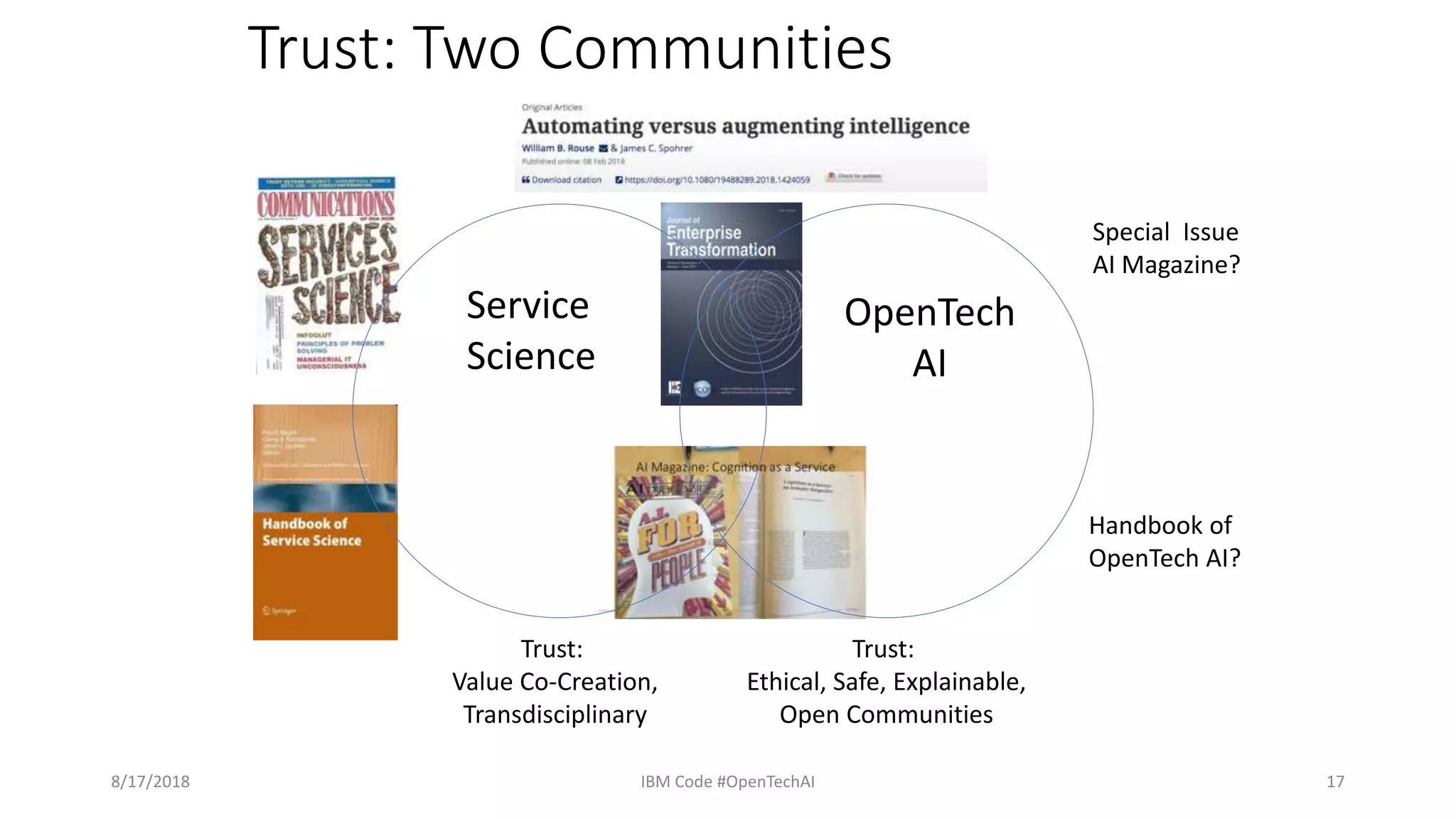
Trust: Two Communities
8/17/2018 IBM Code #OpenTechAI 17
Service
Science
OpenTech
AI
Trust:
Value Co-Creation,
Transdisciplinary
Trust:
Ethical, Safe, Explainable,
Open Communities
Special Issue
AI Magazine?
Handbook of
OpenTech AI?
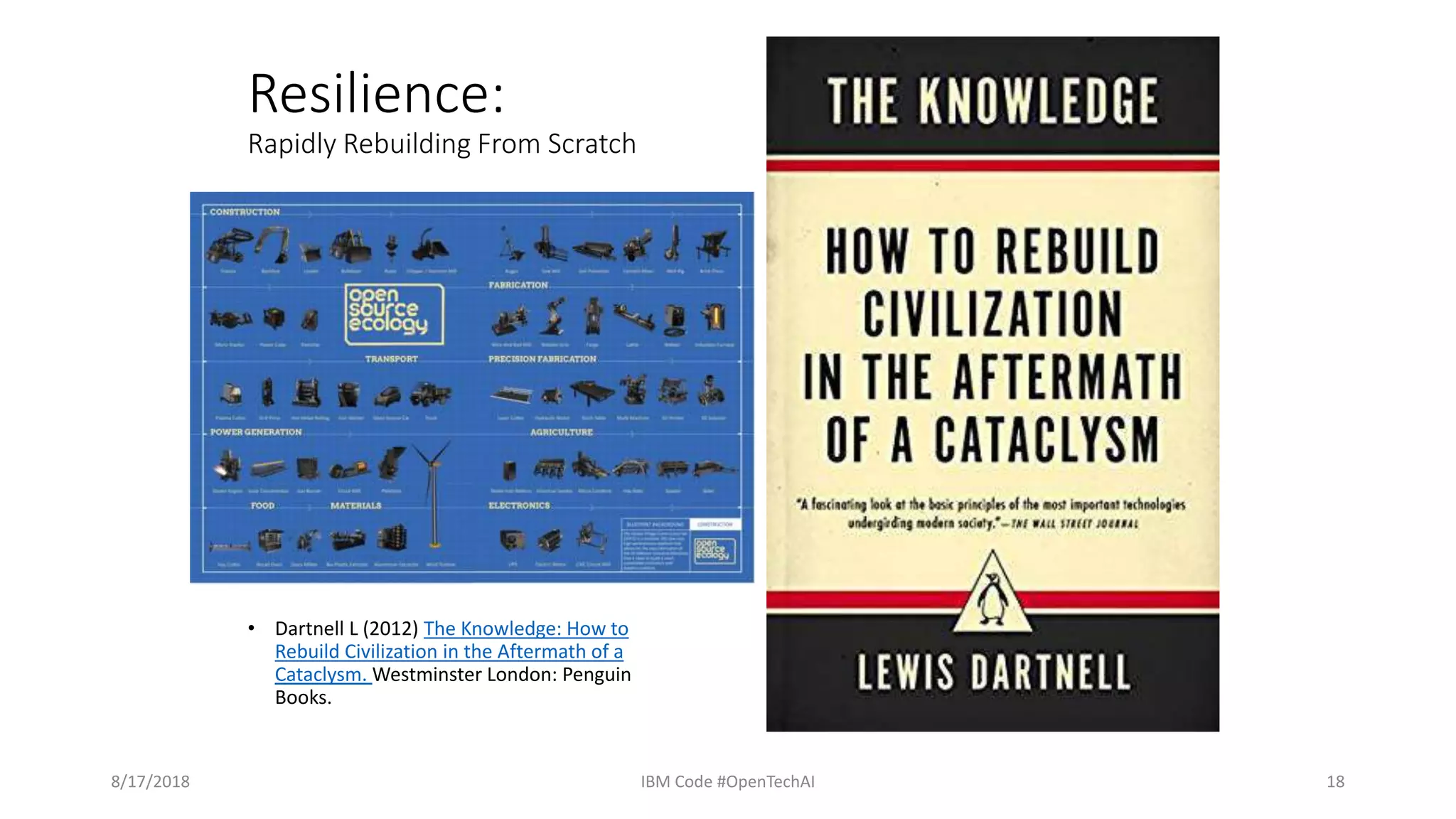
Resilience:
Rapidly Rebuilding From Scratch
• Dartnell L (2012) The Knowledge: How to
Rebuild Civilization in the Aftermath of a
Cataclysm. Westminster London: Penguin
Books.
8/17/2018 IBM Code #OpenTechAI 18
8/17/2018 IBM Code #OpenTechAI 19

Ai progress = leaderboards compute data algorithms 20180817 v3

  • 1.
    AI Progress =Leaderboards+ Compute + Data + Algorithms • Leaderboard Timeline (Open Competitions) • Compute Power Timeline (“Zorch”) • Data Labeled Progression • Algorithm Model Progression • Preparing for the Future • IBM Code: CODAIT and MAX • Trust and Resilience • Call For Code (United Nations, Red Cross, Linux Foundation, IBM, etc.) 8/17/2018 IBM Code #OpenTechAI 1
  • 2.
    AI Timeline: LeaderboardsFramework AI Progress on Open Leaderboards - Benchmark Roadmap Perceive World Develop Cognition Build Relationships Fill Roles Pattern recognition Video understanding Memory Reasoning Social interactions Fluent conversation Assistant & Collaborator Coach & Mediator Speech Actions Declarative Deduction Scripts Speech Acts Tasks Institutions Chime Thumos SQuAD SAT ROC Story ConvAI Images Context Episodic Induction Plans Intentions Summarizatio n Values ImageNet VQA DSTC RALI General-AI Translation Narration Dynamic Abductive Goals Cultures Debate Negotiation WMT DeepVideo Alexa Prize ICCMA AT Learning from Labeled Training Data and Searching (Optimization) Learning by Watching and Reading (Education) Learning by Doing and being Responsible (Exploration) 2015 2018 2021 2024 2027 2030 2033 2036 8/17/2018 (c) IBM 2017, Cognitive Opentech Group 2 Which experts would be really surprised if it takes less time… and which experts really surprised if it takes longer? Approx. Year Human Level ->
  • 3.
    Compute Timeline: Every20 years, compute costs are down by 1000x • Cost of Digital Workers • Moore’s Law can be thought of as lowering costs by a factor of a… • Thousand times lower in 20 years • Million times lower in 40 years • Billion times lower in 60 years • Smarter Tools (Terascale) • Terascale (2017) = $3K • Terascale (2020) = ~$1K • Narrow Worker (Petascale) • Recognition (Fast) • Petascale (2040) = ~$1K • Broad Worker (Exascale) • Reasoning (Slow) • Exascale (2060) = ~$1K 38/17/2018 (c) IBM 2017, Cognitive Opentech Group 2080204020001960 $1K $1M $1B $1T 206020201980 +/- 10 years $1 Person Average Annual Salary (Living Income) Super Computer Cost Mainframe Cost Smartphone Cost T P E T P E AI Progress on Open Leaderboards Benchmark Roadmap to solve AI/IA
  • 4.
    Compute Timeline: GDP/Employee 8/17/2018(c) IBM 2017, Cognitive Opentech Group 4 (Source) Lower compute costs translate into increasing productivity and GDP/employees for nations Increasing productivity and GDP/employees should translate into wealthier citizens AI Progress on Open Leaderboards Benchmark Roadmap to solve AI/IA
  • 5.
    Data: 10 millionminutes of experience 8/17/2018 Understanding Cognitive Systems 5
  • 6.
    Data: 2 millionminutes of experience 8/17/2018 Understanding Cognitive Systems 6
  • 7.
    Hardware < Software< Data < Experience < Transformation 8/17/2018 Understanding Cognitive Systems 7 Value migrates Pine & Gilmore (1999) Transformation Roy et al (2006) Data Osati (2014) Experience Life Log
  • 8.
    Algorithm Timeline: Short History 8/17/2018 ©IBM Cognitive Opentech Group (COG) 8 Dota 2 “Deep Learning” for “AI Pattern Recognition” depends on massive amounts of “labeled data” and computing power available since ~2012; Labeled data is simply input and output pairs, such as a sound and word, or image and word, or English sentence and French sentence, or road scene and car control settings – labeled data means having both input and output data in massive quantities. For example, 100K images of skin, half with skin cancer and half without to learn to recognize presence of skin cancer.
  • 9.
    Future algorithms builtfrom models: Models become instruction set of future 8/17/2018 Understanding Cognitive Systems 9 Task & World Model/ Planning & Decisions Self Model/ Capacity & Limits User Model/ Episodic Memory Institutions Model/ Trust & Social Acts Tool + - - - Assistant ++ + - - Collaborator +++ ++ + - Coach ++++ +++ ++ + Mediator +++++ ++++ +++ ++ Cognitive Tool Cognitive Assistant Cognitive Collaborator Cognitive Coach Cognitive Mediator
  • 10.
    Step Comment GitHub Getan account and read the guide Learn 3 R's - Read, Redo, Report Read (Medium/arXiv), Redo (GitHub), Report (Jupyter Notebook) Kaggle Compete in a Kaggle competition Leaderboards Compete to advance AI progress Figure Eight Generate a set of labeled data (also Mechanical Turk) Design New Challenges build an AI system that can take and pass any online course, then switch to tutor-mode and help you pass Open Source Guide Establish open source culture in your organization 8/17/2018 IBM Code #OpenTechAI 10
  • 11.
    Prepare for AIFuture • Do you have a GitHub account? Get it. • Yes: proceed • No: sign up • Do you program? Either OK, partnering is best. • Yes: Learn and do 3 R’s (read, redo, report) • Github master: Code, Content (Data), Community (IBM Code can help) • No: Learn to read and execute code with partner (T2T) • Do you have favorite AI leaderboards? • Yes: Learn and do 3 R’s (read, redo, report advances) • Kaggle master: Combine top decorrelated solution, new solution • No: Find a mentor with favorites, do together • Are you AI prepared? Do you know/do data, models, solutions? • Yes: Find favorite leaderboards you can do 3 R’s for today • Figure-Eight master: Labeled data that matters most • No: Wait until one model: one model that can do them all • Then rapidly rebuild in least time, energy (“zorch”), data, code 8/17/2018 © IBM Cognitive Opentech Group 2018 11 1. Where do we get labeled data? We create it: Figure Eight, Mechanical Turk, etc. 2. External/internal challenge? 10M minutes from birth to adult 2M minutes from novice to expert Not just external states, but internal states are data as well… The challenge of data for AI models 3. AI models as ”data” instruction set Computer’s have instruction sets Arithmetic, Logic, etc. Models are becoming instructions Models are data/experience
  • 12.
    Courses • 2015 • “Howto build a cognitive system for Q&A task.” • 9 months to 40% question answering accuracy • 1-2 years for 90% accuracy, which questions to reject • 2025 • “How to use a cognitive system to be a better professional X.” • Tools to build a student level Q&A from textbook in 1 week • 2035 • “How to use your cognitive mediator to build a startup.” • Tools to build faculty level Q&A for textbook in one day • Cognitive mediator knows a person better than they know themselves • 2055 • “How to manage your workforce of digital workers.” • Most people have 100 digital workers. 8/17/2018 12 Take free online cognitive classes today at cognitiveclass.ai
  • 13.
    8/17/2018 IBM Code#OpenTechAI 13
  • 14.
    8/17/2018 IBM Code#OpenTechAI 14
  • 15.
    8/17/2018 15 1955 19751995 2015 2035 2055 Better Building Blocks
  • 16.
    “The best wayto predict the future is to inspire the next generation of students to build it better” Digital Natives Transportation Water Manufacturing Energy Construction ICT Retail Finance Healthcare Education Government
  • 17.
    Trust: Two Communities 8/17/2018IBM Code #OpenTechAI 17 Service Science OpenTech AI Trust: Value Co-Creation, Transdisciplinary Trust: Ethical, Safe, Explainable, Open Communities Special Issue AI Magazine? Handbook of OpenTech AI?
  • 18.
    Resilience: Rapidly Rebuilding FromScratch • Dartnell L (2012) The Knowledge: How to Rebuild Civilization in the Aftermath of a Cataclysm. Westminster London: Penguin Books. 8/17/2018 IBM Code #OpenTechAI 18
  • 19.
    8/17/2018 IBM Code#OpenTechAI 19

Editor's Notes

  • #2 IBM Code: http://ibm.com/code CODAIT: http://codait.org/ MAX: https://developer.ibm.com/code/exchanges/models/ Call For Code: https://callforcode.org/ To reuse, send request to Jim Spohrer <spohrer@gmail.com> To cite: Spohrer J (2019) AI Progress = Leaderboards + Compurer + Data + Algorithms. URL = http://slideshare.net/spohrer/ai-progress-=-leaderboards-computer-data-algorithms-20180817-v3 Also cite: Rouse WB, Spohrer JC (2018) Automating versus augmenting intelligence. Journal of Enterprise Transformation. 2018 Feb 7:1-21.
  • #3 Expert predictions on HMLI: URL https://arxiv.org/pdf/1705.08807.pdf 2015 Pattern Recognition Speech: URL: http://spandh.dcs.shef.ac.uk/chime_challenge/chime2016/results.html 2015 Pattern Recognition Images: URL: http://www.image-net.org/ 2015 Patten Recognition Translation: URL: http://www.statmt.org/wmt17/ 2018 Video Understanding Actions: URL: http://www.thumos.info/home.html > Also UCF101 http://crcv.ucf.edu/data/UCF101.php 2018 Video Understanding Context: URL: http://visualqa.org/challenge.html 2018 Video Understanding DeepVideo: URL: http://cs.stanford.edu/people/karpathy/deepvideo/ 2021 Memory Declarative: URL: https://rajpurkar.github.io/SQuAD-explorer/ Also Allen AI Kaggle Science Challenge https://www.kaggle.com/c/the-allen-ai-science-challenge 2024 Reasoning Deduction: URL: http://www.satcompetition.org/ 2027: Social Interaction Scripts: URL: https://competitions.codalab.org/competitions/15333 2030: Fluent Conversation Speech Acts: URL: http://convai.io/ 2030: Fluent Conversation Intentions: URL: http://workshop.colips.org/dstc6/ 2030: Fluent Conversation Alexa Prize: URL: https://developer.amazon.com/alexaprize 2033: Assistant & Collaborator Summarization: URL: http://rali.iro.umontreal.ca/rali/?q=en/Automatic%20summarization 2033: Assistant & Collaborator Debate: URL: http://argumentationcompetition.org/2015/ 2036: Coach & Mediator General AI: URL: https://www.general-ai-challenge.org/ 2036: Coach & Mediator Negotiation: URL: https://easychair.org/cfp/AT2017
  • #4 What is beyond Exascale? Zetta (21), Yotta (24) Time dimension (x-axis) is plus or minus 10 years…. Daniel Pakkala (VTT) URL: https://aiimpacts.org/preliminary-prices-for-human-level-hardware/ Dan Gruhl: https://www.washingtonpost.com/archive/business/1983/11/06/in-pursuit-of-the-10-gigaflop-machine/012c995a-2b16-470b-96df-d823c245306e/?utm_term=.d4bde5652826   In 1983 10 GF was ~10 million.   That's 24.55 million in today's dollars.   or 2.4 billion for 1 TF in 1983   Today 1 TF is about $3k http://www.popsci.com/intel-teraflop-chip
  • #5 Source: http://service-science.info/archives/4741
  • #8 Where is the variety? Hardware and even software standardizing into modules and algorithms…. Data will standardize next into categories and types…. Experience is where the uniqueness is, and variety and variability, and identity. Pine and Gilmore – Experience Economy Book – Chapter 10 – Transformation Economy - https://www.amazon.com/Experience-Economy-Theater-Every-Business/dp/0875848192#reader_0875848192 Pine II, B. J. & Gilmore, J. H. (1999). The experience economy: work is theatre & every business a stage. Harvard Business Press. pp: 186-189. (Chapter 10 is about the transformation economy) Osati, Sohrab (Dec 18, 2014) Sony Lifelog App Gains GPS Support for Android Wear. SonyRumors.net http://www.sonyrumors.net/2014/12/18/sony-lifelog-app-gains-gps-support-for-android-wear/ Roy, D., Patel, R., DeCamp, P., Kubat, R., Fleischman, M., Roy, B., ... & Levit, M. (2006). The human speechome project. In Symbol Grounding and Beyond (pp. 192-196). Springer, Berlin, Heidelberg.
  • #9 1950 Nathaniel Rochester (IBM) 701 first commercial computer that did super-human levels of numeric calculations routinely. He worked at MIT on arithmetic unit of WhirlWind I programmable computer. Dota 2 is most recent August 11, 2017 as a super-human game player in Valve Dota 2 competition – Elon Musk’s OpenAI result. Miles Bundage tracks gaming progress: http://www.milesbrundage.com/blog-posts/my-ai-forecasts-past-present-and-future-main-post DOTA2: https://blog.openai.com/more-on-dota-2/
  • #11 GitHub – open source code – http://github.com Kaggle – data and competitions – http://Kaggle.com Leaderboard – AI an competitions - https://www.slideshare.net/spohrer/leaderboards-80909263 Figure Eight – label data - https://en.wikipedia.org/wiki/Figure_Eight_Inc. Open Source Guides – reader, contributor, committer, governance - https://opensource.guide/ GitHub is to knowledge in action (writing code) as Wikidedia is to knowledge in text (writing text)
  • #12 Github registration URL: https://github.com/ Lukas Kaiser – one model that can do all leaderboard best - https://www.youtube.com/watch?v=8FpdEmySsuc T2T URL: https://github.com/tensorflow/tensor2tensor T2T iPython Notebook URL: https://colab.research.google.com/notebook#fileId=/v2/external/notebooks/t2t/hello_t2t.ipynb One favorite that can do them all: https://www.youtube.com/watch?v=8FpdEmySsuc URLs Github: code, content (data), community – http://github.com Kaggle: competition and leaderboards - http://Kaggle.com Figure-Eight: lots of labeled data – http://figure-eight.com Rapidly Rebuild: Danko Nicolic - AI Kindergarten (Practopoesis) - https://www.youtube.com/watch?v=aMQCi3Sn2mE Lukas Kaiser wants to get one model that can do all leaderboards – one model to do them all Danko Nicolic wants to rapidly rebuild from scratch intelligent agents (that behave well socially with people)– rapid rebuilding
  • #13 Free online cognitive classe URL: https://cognitiveclass.ai/ Here is what I tell students.... ... to try to provoke their thinking about the cognitive era:     (0) 2015 - about 9 months to build a formative Q&A system - 40% accuracy;         - another 1-2 years and a team of 10-20, can get it to 90% accuracy, by reducing the scope ("sorry that question is out of scope")         - today's systems can only answer questions, if the answers are already existing in the text explicitly         - debater is an example of where we would like to get to though in 5 years: https://www.youtube.com/watch?v=7g59PJxbGhY         - more about the ambitions at  http://cognitive-science.info     (1) 2025: Watson will be able to rapidly ingest just about any textbooks and produce a Q&A system         - the Q&A system will rival C-grade (average) student performance on questions     (2) 2035 - above, but rivals C-level (average) faculty performance on questions     (3) 2035 - an exascale of compute power costs about $1000         - an exascale is the equivalent compute of one person's brain power (at 20W power)     (4) 2035 - nearly everyone has a cognitive mediator that knows them in many ways better than they know themselves          - memory of all health information, memory of everyone you have ever interacted with, executive assistant, personal coach, process and memory aid, etc.     (5) 2055 - nearly everyone has 100 cognitive assistants that "work for them"         - better management of your cognitive assistant workforce is a course taught at university In 2015, we are at the beginning of the beginning or the cognitive era... In 2025, we will be middle of beginning... easy to generate average student level performance on questions in textbook.... In 2035, we will be end of beginning (one brain power equivalent)... easy to generate average faculty level performance on questions in textbook....     http://www.slideshare.net/spohrer/spohrer-ubi-learn-20151103-v2 By 2055, roughly 2x 20 year generations out, the cognitive era will be in full force. Cellphones will likely become body suits - with burst-mode super-strength and super-safety features: Suits - body suit cell phones Cognitive Mediators will read everything for us, and relate the information to  us - and what we know and our goals. Think combined personal coach, executive assistant, personal research team.... The key is knowing which problem to work on next - see this long video for the answer - energy, water, food, wellness -  and note especially the wellness suit at the end:     https://www.youtube.com/watch?v=YY7f1t9y9a0&index=10&list=WL Do not be put off by the beginning of the video - it is a bit over hyped and trivial, to say the leasat... but the projects are really good if you have the patience to watch.
  • #14 Source: Vijay Bommireddipally (CODAIT Director) and Fred Reiss (CODAIT Chief Architect)
  • #16 The weakest link is what needs to be improved – according to system scientists. Accessing help, service, experts is the weakest link in most systems. By 2035 the phone may have the power of one human brain – by 2055 the phone may have the power of all human brains. Before trying to answer the question about which types of sciences are more important – the ones that try to explain the external world or the ones that try to explain the internal world – consider this, slide that shows the different telephones that I have used in my life. I grew up in rural Maine, where we had a party line telephone because we were somewhat remote on our farm in Newburgh, Maine. However, over the years phones got much better…. So in 2035 or 2055, who are you going to call when you need help?
  • #17 By 2036, there will be an accumulation of knowledge as well as a distribution of knowledge in service systems globally. We need to ensure as there is knowledge accumulation that service systems at all scale become more resilient. Leading to the capability of rapid rebuilding of service systems across scales, by T-shaped people who understand how to rapidly rebuild – knowledge has been chunked, modularized, and put into networks that support rapid rebuilding.
  • #19 URL Amazon: https://www.amazon.com/Knowledge-Rebuild-Civilization-Aftermath-Cataclysm-ebook/dp/B00DMCV5YS/ URL TED Talk: https://www.youtube.com/watch?v=CdTzsbqQyhY Citation: Dartnell L (2012) The Knowledge: How to Rebuild Civilization in the Aftermath of a Cataclysm. Westminster London: Penguin Books. Jim Spohrer Blogs: Grand Challenge: http://service-science.info/archives/2189 Re-readings: http://service-science.info/archives/4416
  • #20 IBM Code – http://ibm.com/code