OPTIMIZING EMAIL CAMPAIGNS
WITH AI RECOMMENDATION ENGINE
July 2024
PRODUCT FEATURE PRESENTATION
Ajay Bhatta
AI-POWERED EMAIL TIMING
RECOMMENDATION ENGINE
• Purpose: Optimize email send times using customer
engagement data to enhance email marketing
effectiveness.
• Platform: Integrates with the existing B2B SaaS
platform for small to medium-sized businesses,
currently serving 10,000 active users.
• Solution: Data-driven recommendations for optimal
email send times
• Benefits:
⚬ Boosts email open and click-through rates
⚬ Drives campaign performance and user engagement
⚬ Increases marketing ROI for businesses
VISION & GOALS, KPIS
REVOLUTIONIZE EMAIL MARKETING FOR SMBS IN NEPAL
WITH AI-POWERED TIMING OPTIMIZATION
V
User adoption rate of the feature
Improvement in email open and click-through rates
Positive user feedback on the recommendation engine
Increase email engagement rates
Improve user experience with actionable insights
Boost marketing efficiency by reducing manual scheduling efforts
Drive business growth through effective email marketing
KPI
G
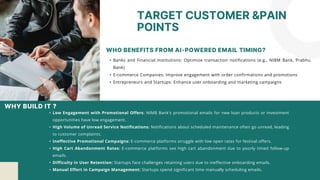
TARGET CUSTOMER &PAIN
POINTS
WHO BENEFITS FROM AI-POWERED EMAIL TIMING?
WHY BUILD IT ?
• Banks and Financial Institutions: Optimize transaction notifications (e.g., NIBM Bank, Prabhu
Bank)
• E-commerce Companies: Improve engagement with order confirmations and promotions
• Entrepreneurs and Startups: Enhance user onboarding and marketing campaigns
• Low Engagement with Promotional Offers: NIMB Bank's promotional emails for new loan products or investment
opportunities have low engagement.
• High Volume of Unread Service Notifications: Notifications about scheduled maintenance often go unread, leading
to customer complaints.
• Ineffective Promotional Campaigns: E-commerce platforms struggle with low open rates for festival offers.
• High Cart Abandonment Rates: E-commerce platforms see high cart abandonment due to poorly timed follow-up
emails.
• Difficulty in User Retention: Startups face challenges retaining users due to ineffective onboarding emails.
• Manual Effort in Campaign Management: Startups spend significant time manually scheduling emails.
COMPETITORS &
PRODUCT
INSPIRATION
INSPIRATION FOR THE PRODUCTS
01
Cloudlaya
• Strengths: Bulk email marketing
• Weaknesses: No AI-powered timing, limited personalization
02
Weakness/Opportunities Among Competitor
03
Product Inspiration:
Amazon:
• Uses: AI for personalized send times
• Results: Higher open and click-through rates
• Limited Personalization: Competitors don't
use AI for send time optimization
• Static Send Times: Manual scheduling or basic
options
• Quantity over Quality: Emphasis on bulk over
targeted communication
01
02
Mailchimp:
• Uses: Predictive analytics for optimal send times
• Results: Enhanced marketing effectiveness
03
HubSpot:
• Uses: AI to optimize email timing
• Results: Improved engagement and marketing
outcomes
Local Competition:
Webtech Line
• Strengths: Mass email marketing foundation
• Weaknesses: Basic scheduling, no behavior analysis
eSewa/Khalti:
• Strengths: Large user base, frequent communication
• Weaknesses: Generic campaigns, lacks timing optimization
01
02 03
OPPORTUNITIES FOR AI-POWERED
RECOMMENDATION ENGINE
WE WILL SOLVE THE PROBLEMS
Differentiation
Enhanced Engagement Improved Campaign Effectiveness
Introducing AI-powered optimization for email
send times would differentiate the service
from competitors, providing a unique value
proposition
By leveraging AI to identify optimal send times,
businesses can increase email open and click-
through rates, leading to higher customer
engagement and satisfaction.
Optimized email timings can lead to more
effective marketing campaigns, driving better
results for businesses across various sectors,
including financial institutions, e-commerce
platforms, and startups.
PRODUCT USABILITY
AND FUNCTIONALITY
WHAT USE CASE WE COULD WORK ON
Financial Institutions E-commerce Platforms Entrepreneurs and Startups
• Scenario: Marketing manager at Nabil
Bank aims to improve email
engagement.
• Use Case: Optimize send times for
transactional, promotional, and service
emails.
• Engagement Data: Open rates, click-
through rates, response times.
• Scenario: Digital Marketing Specialist at
Foodmandu focuses on sales and
customer satisfaction.
• Use Case: Send personalized emails
during peak hours.
• Engagement Data: Open rates, click-
through rates, response times.
• Scenario: Founder of Samsara Creation
wants to enhance user engagement.
• Use Case: Optimize onboarding emails
and product updates.
• Engagement Data: Open rates, click-
through rates, response times
POTENTIAL
FEATURES &
FUNCTIONALITIES
At the heart of our success lies the unwavering
satisfaction of our clients. We take pride in
fostering lasting partnerships, consistently
exceeding expectations, and delivering results
that not only meet but surpass the unique
objectives of each client we serve.
Feature 1 : Data Collection and Integration
⚬ Set up data pipelines for real-time and historical data collection.
⚬ High impact and essential for AI analysis.
Feature 2 : AI Algorithm Development
⚬ Develop algorithms to recommend optimal send times.
⚬ High impact on email marketing ROI.
Feature 3 : Recommendation Engine Development
⚬ Build the engine to generate and display insights.
⚬ High value for user adoption.
Feature 4 : Basic Reporting Dashboard
⚬ Implement tracking for key metrics like open rates and click-through rates.
⚬ Medium impact for initial insights.
Feature 5 :Customer Segmentation
⚬ Automated segmentation based on engagement patterns.
⚬ Medium impact for targeted recommendations.
Feature 6 :Personalized Insights Dashboard
⚬ Display key metrics and recommendations.
⚬ Medium impact for user satisfaction.
Feature Priority Matrix
PROJECT
PLAN
• Total Duration: 6 Sprints (14 days each)
• Resources Needed:
⚬ Software Engineers
⚬ Data Scientist/Machine Learning Engineer
⚬ Project Manager
⚬ Product Manager
⚬ UI/UX Designer
Potential project risks
• Integration Challenges: Difficulty in integrating AI engine with existing systems,
potentially causing delays.
• AI Model Accuracy: Ensuring the AI model accurately predicts optimal send times with
varied customer data.
• Data Quality: Inconsistencies in customer engagement data quality impacting AI
performance.
• Resource Availability: Risks from key team members or resources being unavailable
during critical phases.
• Scalability Issues: Ensuring the feature can scale effectively to handle varying user loads.
• User Adoption: Potential challenges in user acceptance and adoption across different
market segments.
01
02
03
Go-to-Market Strategy
WE WILL WIN THE MARKET
Pre-Launch Activities:
Launch Activities:
Post-Launch Activities
• Align all internal teams (Development, Marketing, Sales) on
the feature's benefits, values, functionalities, and support
processes.
• Conduct regular stand-ups, sprint planning meetings, and
review sessions.
• Create user guides, tutorials, and training sessions.
• Identify a group of existing users for beta testing, gather
feedback, and make improvements.
• Announce the new feature to existing customers via release
notes.
• Equip the sales team with tools and information to promote
the feature.
• Host webinars and live demos to showcase the feature,
explain its benefits, and answer user questions.
• Collect feedback from users through surveys and direct
interactions.
• Use feedback and performance data for iterative improvements.
• Track KPIs such as user adoption rate, engagement metrics, and
user satisfaction scores.
• Provide continuous support through tutorials, FAQs, and
customer support channels
01
02
03
Measuring Success: User
Feedback & Data
GAUGING SUCCESS: FROM USER FEEDBACK TO DATA-
DRIVEN INSIGHTS
Gathering User Feedback
Monitoring User Adoption
Measuring Business Impact
• Surveys: Short, targeted surveys embedded within the
platform gather immediate feedback on user experience.
• Feedback Forms: Dedicated forms allow users to submit
detailed suggestions and report issues.
• Interviews: One-on-one sessions with users from diverse
segments (banks, e-commerce) provide deeper insights.
• Focus Groups: Group discussions facilitate in-depth
exploration of user experiences and challenges
• Track User Satisfaction: Surveys like CSAT (Customer
Satisfaction) and NPS (Net Promoter Score) gauge user
sentiment.
• Adoption Rate: Monitor how many users have activated and
are actively using the AI-powered email timing feature.
• Engagement Metrics: Analyze data on the frequency of
feature use, time spent, and number of campaigns created.
• Success Metrics: Analyze the impact on key email marketing
metrics: open rates, click-through rates, and conversion rates.
• Customer Retention: Monitor retention rates pre- and post-
launch to understand the feature's influence on user loyalty.
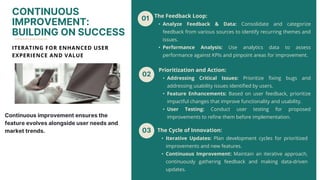
CONTINUOUS
IMPROVEMENT:
BUILDING ON SUCCESS
ITERATING FOR ENHANCED USER
EXPERIENCE AND VALUE
01 The Feedback Loop:
• Analyze Feedback & Data: Consolidate and categorize
feedback from various sources to identify recurring themes and
issues.
• Performance Analysis: Use analytics data to assess
performance against KPIs and pinpoint areas for improvement.
02
Continuous improvement ensures the
feature evolves alongside user needs and
market trends. 03
Prioritization and Action:
• Addressing Critical Issues: Prioritize fixing bugs and
addressing usability issues identified by users.
• Feature Enhancements: Based on user feedback, prioritize
impactful changes that improve functionality and usability.
• User Testing: Conduct user testing for proposed
improvements to refine them before implementation.
The Cycle of Innovation:
• Iterative Updates: Plan development cycles for prioritized
improvements and new features.
• Continuous Improvement: Maintain an iterative approach,
continuously gathering feedback and making data-driven
updates.
THANK YOU
FOR YOUR NICE ATTENTION
AJAY BHATTA

AI-Powered Email Recommendation Engine Presentation

  • 1.
    OPTIMIZING EMAIL CAMPAIGNS WITHAI RECOMMENDATION ENGINE July 2024 PRODUCT FEATURE PRESENTATION Ajay Bhatta
  • 2.
    AI-POWERED EMAIL TIMING RECOMMENDATIONENGINE • Purpose: Optimize email send times using customer engagement data to enhance email marketing effectiveness. • Platform: Integrates with the existing B2B SaaS platform for small to medium-sized businesses, currently serving 10,000 active users. • Solution: Data-driven recommendations for optimal email send times • Benefits: ⚬ Boosts email open and click-through rates ⚬ Drives campaign performance and user engagement ⚬ Increases marketing ROI for businesses
  • 3.
    VISION & GOALS,KPIS REVOLUTIONIZE EMAIL MARKETING FOR SMBS IN NEPAL WITH AI-POWERED TIMING OPTIMIZATION V User adoption rate of the feature Improvement in email open and click-through rates Positive user feedback on the recommendation engine Increase email engagement rates Improve user experience with actionable insights Boost marketing efficiency by reducing manual scheduling efforts Drive business growth through effective email marketing KPI G
  • 4.
    TARGET CUSTOMER &PAIN POINTS WHOBENEFITS FROM AI-POWERED EMAIL TIMING? WHY BUILD IT ? • Banks and Financial Institutions: Optimize transaction notifications (e.g., NIBM Bank, Prabhu Bank) • E-commerce Companies: Improve engagement with order confirmations and promotions • Entrepreneurs and Startups: Enhance user onboarding and marketing campaigns • Low Engagement with Promotional Offers: NIMB Bank's promotional emails for new loan products or investment opportunities have low engagement. • High Volume of Unread Service Notifications: Notifications about scheduled maintenance often go unread, leading to customer complaints. • Ineffective Promotional Campaigns: E-commerce platforms struggle with low open rates for festival offers. • High Cart Abandonment Rates: E-commerce platforms see high cart abandonment due to poorly timed follow-up emails. • Difficulty in User Retention: Startups face challenges retaining users due to ineffective onboarding emails. • Manual Effort in Campaign Management: Startups spend significant time manually scheduling emails.
  • 5.
    COMPETITORS & PRODUCT INSPIRATION INSPIRATION FORTHE PRODUCTS 01 Cloudlaya • Strengths: Bulk email marketing • Weaknesses: No AI-powered timing, limited personalization 02 Weakness/Opportunities Among Competitor 03 Product Inspiration: Amazon: • Uses: AI for personalized send times • Results: Higher open and click-through rates • Limited Personalization: Competitors don't use AI for send time optimization • Static Send Times: Manual scheduling or basic options • Quantity over Quality: Emphasis on bulk over targeted communication 01 02 Mailchimp: • Uses: Predictive analytics for optimal send times • Results: Enhanced marketing effectiveness 03 HubSpot: • Uses: AI to optimize email timing • Results: Improved engagement and marketing outcomes Local Competition: Webtech Line • Strengths: Mass email marketing foundation • Weaknesses: Basic scheduling, no behavior analysis eSewa/Khalti: • Strengths: Large user base, frequent communication • Weaknesses: Generic campaigns, lacks timing optimization
  • 6.
    01 02 03 OPPORTUNITIES FORAI-POWERED RECOMMENDATION ENGINE WE WILL SOLVE THE PROBLEMS Differentiation Enhanced Engagement Improved Campaign Effectiveness Introducing AI-powered optimization for email send times would differentiate the service from competitors, providing a unique value proposition By leveraging AI to identify optimal send times, businesses can increase email open and click- through rates, leading to higher customer engagement and satisfaction. Optimized email timings can lead to more effective marketing campaigns, driving better results for businesses across various sectors, including financial institutions, e-commerce platforms, and startups.
  • 7.
    PRODUCT USABILITY AND FUNCTIONALITY WHATUSE CASE WE COULD WORK ON Financial Institutions E-commerce Platforms Entrepreneurs and Startups • Scenario: Marketing manager at Nabil Bank aims to improve email engagement. • Use Case: Optimize send times for transactional, promotional, and service emails. • Engagement Data: Open rates, click- through rates, response times. • Scenario: Digital Marketing Specialist at Foodmandu focuses on sales and customer satisfaction. • Use Case: Send personalized emails during peak hours. • Engagement Data: Open rates, click- through rates, response times. • Scenario: Founder of Samsara Creation wants to enhance user engagement. • Use Case: Optimize onboarding emails and product updates. • Engagement Data: Open rates, click- through rates, response times
  • 8.
    POTENTIAL FEATURES & FUNCTIONALITIES At theheart of our success lies the unwavering satisfaction of our clients. We take pride in fostering lasting partnerships, consistently exceeding expectations, and delivering results that not only meet but surpass the unique objectives of each client we serve. Feature 1 : Data Collection and Integration ⚬ Set up data pipelines for real-time and historical data collection. ⚬ High impact and essential for AI analysis. Feature 2 : AI Algorithm Development ⚬ Develop algorithms to recommend optimal send times. ⚬ High impact on email marketing ROI. Feature 3 : Recommendation Engine Development ⚬ Build the engine to generate and display insights. ⚬ High value for user adoption. Feature 4 : Basic Reporting Dashboard ⚬ Implement tracking for key metrics like open rates and click-through rates. ⚬ Medium impact for initial insights. Feature 5 :Customer Segmentation ⚬ Automated segmentation based on engagement patterns. ⚬ Medium impact for targeted recommendations. Feature 6 :Personalized Insights Dashboard ⚬ Display key metrics and recommendations. ⚬ Medium impact for user satisfaction. Feature Priority Matrix
  • 9.
    PROJECT PLAN • Total Duration:6 Sprints (14 days each) • Resources Needed: ⚬ Software Engineers ⚬ Data Scientist/Machine Learning Engineer ⚬ Project Manager ⚬ Product Manager ⚬ UI/UX Designer Potential project risks • Integration Challenges: Difficulty in integrating AI engine with existing systems, potentially causing delays. • AI Model Accuracy: Ensuring the AI model accurately predicts optimal send times with varied customer data. • Data Quality: Inconsistencies in customer engagement data quality impacting AI performance. • Resource Availability: Risks from key team members or resources being unavailable during critical phases. • Scalability Issues: Ensuring the feature can scale effectively to handle varying user loads. • User Adoption: Potential challenges in user acceptance and adoption across different market segments.
  • 10.
    01 02 03 Go-to-Market Strategy WE WILLWIN THE MARKET Pre-Launch Activities: Launch Activities: Post-Launch Activities • Align all internal teams (Development, Marketing, Sales) on the feature's benefits, values, functionalities, and support processes. • Conduct regular stand-ups, sprint planning meetings, and review sessions. • Create user guides, tutorials, and training sessions. • Identify a group of existing users for beta testing, gather feedback, and make improvements. • Announce the new feature to existing customers via release notes. • Equip the sales team with tools and information to promote the feature. • Host webinars and live demos to showcase the feature, explain its benefits, and answer user questions. • Collect feedback from users through surveys and direct interactions. • Use feedback and performance data for iterative improvements. • Track KPIs such as user adoption rate, engagement metrics, and user satisfaction scores. • Provide continuous support through tutorials, FAQs, and customer support channels
  • 11.
    01 02 03 Measuring Success: User Feedback& Data GAUGING SUCCESS: FROM USER FEEDBACK TO DATA- DRIVEN INSIGHTS Gathering User Feedback Monitoring User Adoption Measuring Business Impact • Surveys: Short, targeted surveys embedded within the platform gather immediate feedback on user experience. • Feedback Forms: Dedicated forms allow users to submit detailed suggestions and report issues. • Interviews: One-on-one sessions with users from diverse segments (banks, e-commerce) provide deeper insights. • Focus Groups: Group discussions facilitate in-depth exploration of user experiences and challenges • Track User Satisfaction: Surveys like CSAT (Customer Satisfaction) and NPS (Net Promoter Score) gauge user sentiment. • Adoption Rate: Monitor how many users have activated and are actively using the AI-powered email timing feature. • Engagement Metrics: Analyze data on the frequency of feature use, time spent, and number of campaigns created. • Success Metrics: Analyze the impact on key email marketing metrics: open rates, click-through rates, and conversion rates. • Customer Retention: Monitor retention rates pre- and post- launch to understand the feature's influence on user loyalty.
  • 12.
    CONTINUOUS IMPROVEMENT: BUILDING ON SUCCESS ITERATINGFOR ENHANCED USER EXPERIENCE AND VALUE 01 The Feedback Loop: • Analyze Feedback & Data: Consolidate and categorize feedback from various sources to identify recurring themes and issues. • Performance Analysis: Use analytics data to assess performance against KPIs and pinpoint areas for improvement. 02 Continuous improvement ensures the feature evolves alongside user needs and market trends. 03 Prioritization and Action: • Addressing Critical Issues: Prioritize fixing bugs and addressing usability issues identified by users. • Feature Enhancements: Based on user feedback, prioritize impactful changes that improve functionality and usability. • User Testing: Conduct user testing for proposed improvements to refine them before implementation. The Cycle of Innovation: • Iterative Updates: Plan development cycles for prioritized improvements and new features. • Continuous Improvement: Maintain an iterative approach, continuously gathering feedback and making data-driven updates.
  • 13.
    THANK YOU FOR YOURNICE ATTENTION AJAY BHATTA