Artificial Intelligence
Conditional Probabilities
Monty Hall Problem
Portland Data Science Group
Created by Ferlitsch
Community Outreach Officer
July, 2017
Conditional vs. Independent
• Independent Probability – the probability of some event A
occurring is not dependent on a past event.
e.g., Coin Tossing. Each time a coin is tossed, the probability of heads or tails
on that toss does not change.
In otherwords, the prior imbalance in accumulated tosses of heads
or tails does not change (increase or decrease) the likelihood of
heads or tails on any one coin toss.
• Conditional Probability – the probability of some event A
occurring is dependent on some past event B.
e.g., Monty Hall Gameshow Problem
Monty Hall Problem - Paradox
• A Brain Teaser problem based on Let’s Make a Deal, hosted
by Monty Hall.
• There are three doors with prizes behind them.
• One door has a valuable prize (car), and the other doors a non-valuable
prize (goat).
• The contestant picks one door.
• Monty Hall opens a second door that does not have the valuable prize,
and asks the contestant if they want to keep their original choice or
switch to the third opened door instead.
• Problem original posed by Steve Selvin in American
Statistician in 1975.
• The intuitive solution would be that there was no change in outcome (50/50).
• Selvin proposed that switching to the third door had a 2/3 probability of
having the valuable prize (car).
Monty Hall Problem
Door 1 Door 2 Door 3
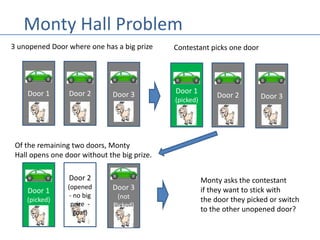
3 unopened Door where one has a big prize
Door 1
(picked)
Door 2 Door 3
Contestant picks one door
Door 1
(picked)
Door 2
(opened
- no big
prize -
goat)
Door 3
(not
Picked)
Of the remaining two doors, Monty
Hall opens one door without the big prize.
Monty asks the contestant
if they want to stick with
the door they picked or switch
to the other unopened door?
Monty Hall Problem - Paradox
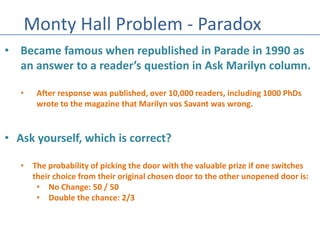
• Became famous when republished in Parade in 1990 as
an answer to a reader’s question in Ask Marilyn column.
• After response was published, over 10,000 readers, including 1000 PhDs
wrote to the magazine that Marilyn vos Savant was wrong.
• Ask yourself, which is correct?
• The probability of picking the door with the valuable prize if one switches
their choice from their original chosen door to the other unopened door is:
• No Change: 50 / 50
• Double the chance: 2/3
Probability Distribution
Door 1
(picked)
Door 2 Door 3
1
3
2
3
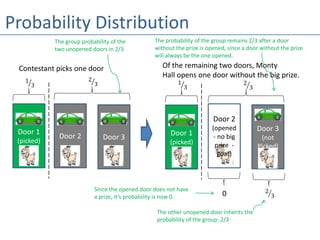
Contestant picks one door
Door 1
(picked)
1
3
Door 2
(opened
- no big
prize -
goat)
Door 3
(not
Picked)
2
3
Of the remaining two doors, Monty
Hall opens one door without the big prize.
The group probability of the
two unopened doors in 2/3
The probability of the group remains 2/3 after a door
without the prize is opened, since a door without the prize
will always be the one opened.
2
30
Since the opened door does not have
a prize, it’s probability is now 0.
The other unopened door inherits the
probability of the group: 2/3
Empirical Demonstration
The other unopened door inherits the
probability of the group: 2/3
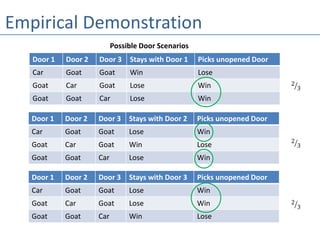
Door 1 Door 2 Door 3 Stays with Door 1 Picks unopened Door
Car Goat Goat Win Lose
Goat Car Goat Lose Win
Goat Goat Car Lose Win
Possible Door Scenarios
Door 1 Door 2 Door 3 Stays with Door 2 Picks unopened Door
Car Goat Goat Lose Win
Goat Car Goat Win Lose
Goat Goat Car Lose Win
Door 1 Door 2 Door 3 Stays with Door 3 Picks unopened Door
Car Goat Goat Lose Win
Goat Car Goat Lose Win
Goat Goat Car Win Lose
2
3
2
3
2
3

AI - Monty Hall Paradox

  • 1.
    Artificial Intelligence Conditional Probabilities MontyHall Problem Portland Data Science Group Created by Ferlitsch Community Outreach Officer July, 2017
  • 2.
    Conditional vs. Independent •Independent Probability – the probability of some event A occurring is not dependent on a past event. e.g., Coin Tossing. Each time a coin is tossed, the probability of heads or tails on that toss does not change. In otherwords, the prior imbalance in accumulated tosses of heads or tails does not change (increase or decrease) the likelihood of heads or tails on any one coin toss. • Conditional Probability – the probability of some event A occurring is dependent on some past event B. e.g., Monty Hall Gameshow Problem
  • 3.
    Monty Hall Problem- Paradox • A Brain Teaser problem based on Let’s Make a Deal, hosted by Monty Hall. • There are three doors with prizes behind them. • One door has a valuable prize (car), and the other doors a non-valuable prize (goat). • The contestant picks one door. • Monty Hall opens a second door that does not have the valuable prize, and asks the contestant if they want to keep their original choice or switch to the third opened door instead. • Problem original posed by Steve Selvin in American Statistician in 1975. • The intuitive solution would be that there was no change in outcome (50/50). • Selvin proposed that switching to the third door had a 2/3 probability of having the valuable prize (car).
  • 4.
    Monty Hall Problem Door1 Door 2 Door 3 3 unopened Door where one has a big prize Door 1 (picked) Door 2 Door 3 Contestant picks one door Door 1 (picked) Door 2 (opened - no big prize - goat) Door 3 (not Picked) Of the remaining two doors, Monty Hall opens one door without the big prize. Monty asks the contestant if they want to stick with the door they picked or switch to the other unopened door?
  • 5.
    Monty Hall Problem- Paradox • Became famous when republished in Parade in 1990 as an answer to a reader’s question in Ask Marilyn column. • After response was published, over 10,000 readers, including 1000 PhDs wrote to the magazine that Marilyn vos Savant was wrong. • Ask yourself, which is correct? • The probability of picking the door with the valuable prize if one switches their choice from their original chosen door to the other unopened door is: • No Change: 50 / 50 • Double the chance: 2/3
  • 6.
    Probability Distribution Door 1 (picked) Door2 Door 3 1 3 2 3 Contestant picks one door Door 1 (picked) 1 3 Door 2 (opened - no big prize - goat) Door 3 (not Picked) 2 3 Of the remaining two doors, Monty Hall opens one door without the big prize. The group probability of the two unopened doors in 2/3 The probability of the group remains 2/3 after a door without the prize is opened, since a door without the prize will always be the one opened. 2 30 Since the opened door does not have a prize, it’s probability is now 0. The other unopened door inherits the probability of the group: 2/3
  • 7.
    Empirical Demonstration The otherunopened door inherits the probability of the group: 2/3 Door 1 Door 2 Door 3 Stays with Door 1 Picks unopened Door Car Goat Goat Win Lose Goat Car Goat Lose Win Goat Goat Car Lose Win Possible Door Scenarios Door 1 Door 2 Door 3 Stays with Door 2 Picks unopened Door Car Goat Goat Lose Win Goat Car Goat Win Lose Goat Goat Car Lose Win Door 1 Door 2 Door 3 Stays with Door 3 Picks unopened Door Car Goat Goat Lose Win Goat Car Goat Lose Win Goat Goat Car Win Lose 2 3 2 3 2 3