AI Agents in Business
Transforming Business Operations with
AI-Driven Solutions
Yaser Alimardani Zonozi
03.09.2024
Agenda â—Ź Introduction to AI Agents
â—Ź Fundamentals of AI Agents in Business
â—Ź Integration and Application in Business
â—Ź Case Studies
â—Ź Future Trends
â—Ź Challenges and Solutions
â—Ź Q&A
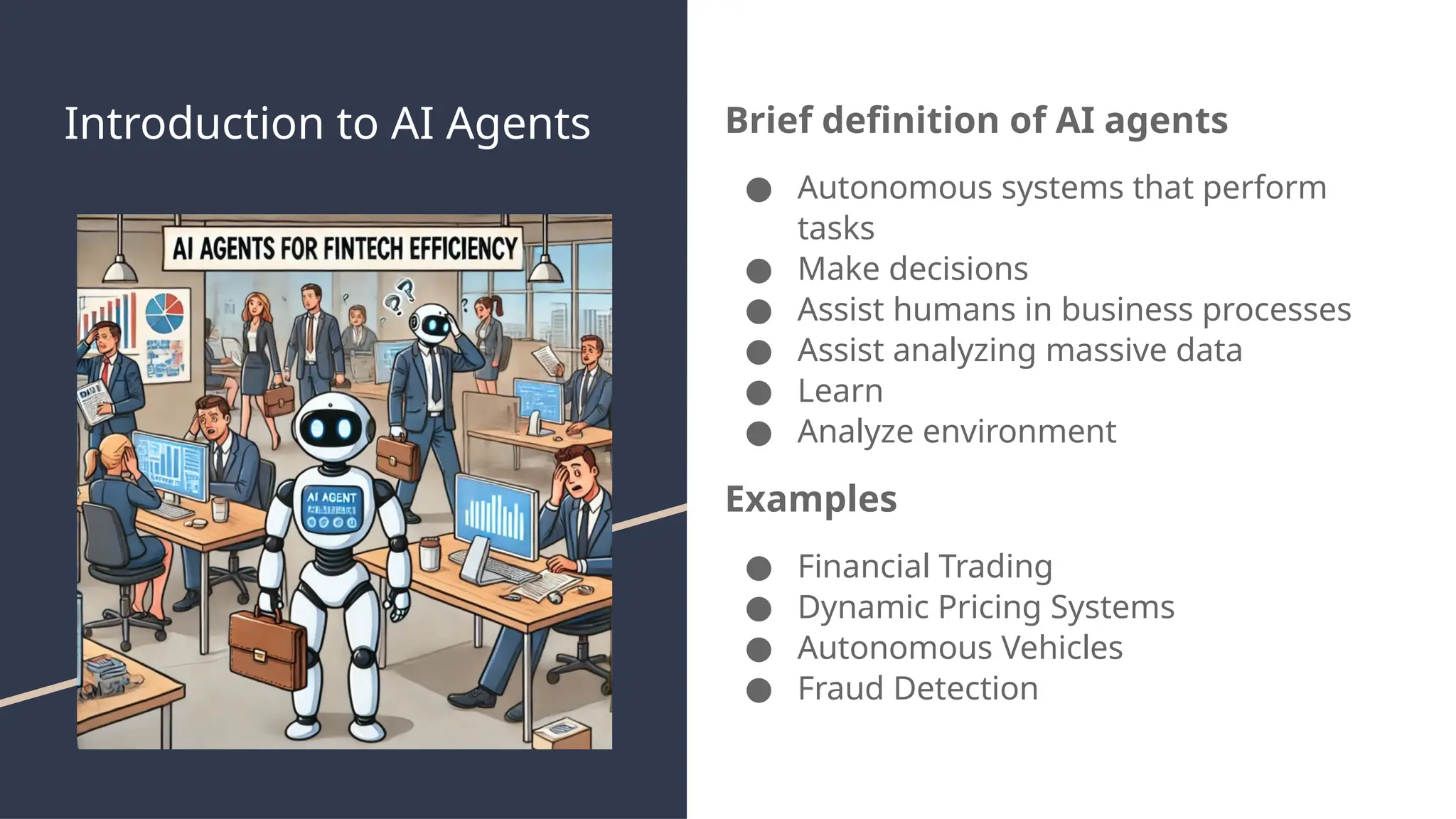
Introduction to AI Agents Brief definition of AI agents
â—Ź Autonomous systems that perform
tasks
â—Ź Make decisions
â—Ź Assist humans in business processes
â—Ź Assist analyzing massive data
â—Ź Learn
â—Ź Analyze environment
Examples
â—Ź Financial Trading
â—Ź Dynamic Pricing Systems
â—Ź Autonomous Vehicles
â—Ź Fraud Detection
Fundamentals of AI Agents
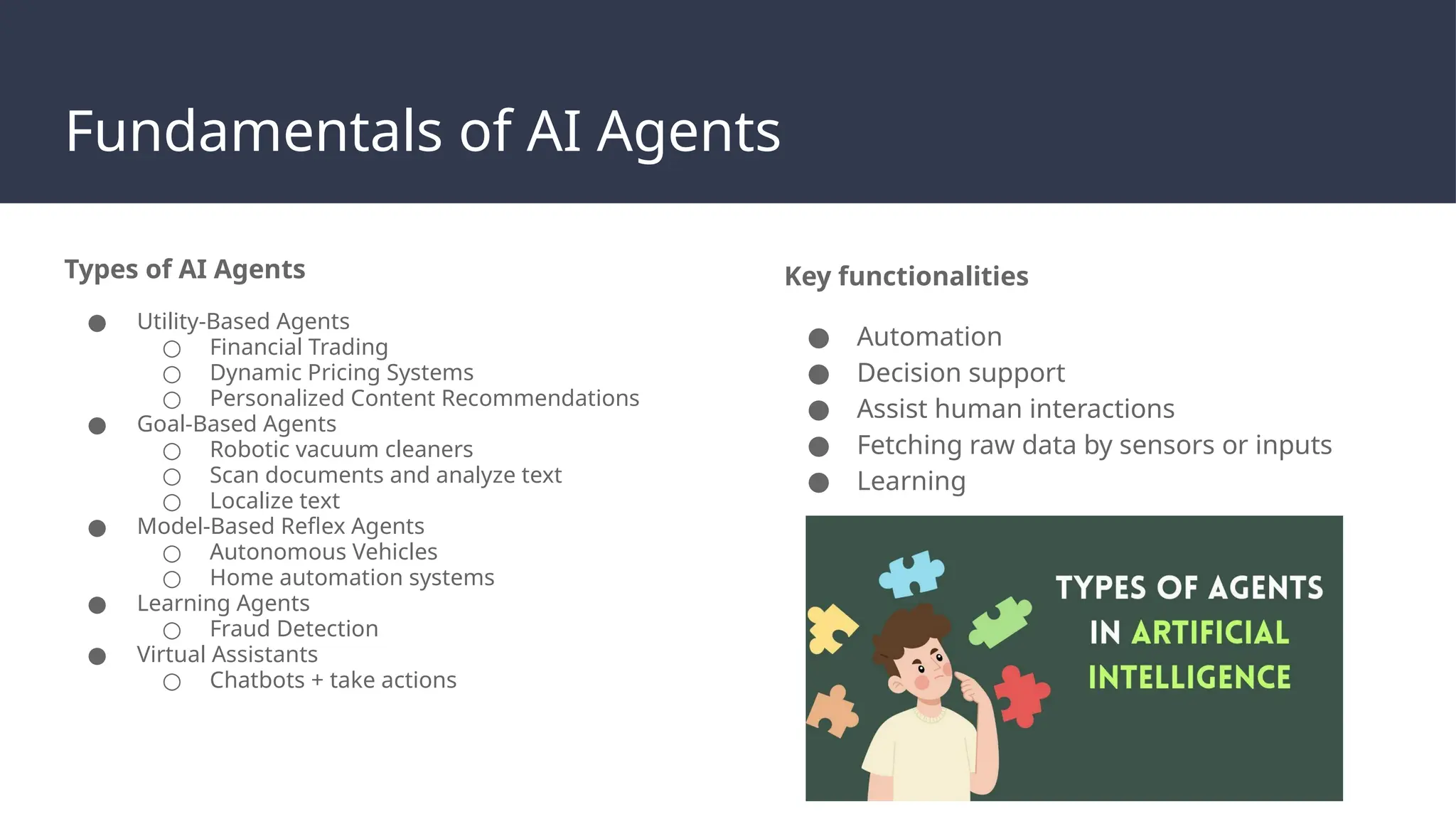
Types of AI Agents
â—Ź Utility-Based Agents
â—‹ Financial Trading
â—‹ Dynamic Pricing Systems
â—‹ Personalized Content Recommendations
â—Ź Goal-Based Agents
â—‹ Robotic vacuum cleaners
â—‹ Scan documents and analyze text
â—‹ Localize text
â—Ź Model-Based Reflex Agents
â—‹ Autonomous Vehicles
â—‹ Home automation systems
â—Ź Learning Agents
â—‹ Fraud Detection
â—Ź Virtual Assistants
â—‹ Chatbots + take actions
Key functionalities
â—Ź Automation
â—Ź Decision support
â—Ź Assist human interactions
â—Ź Fetching raw data by sensors or inputs
â—Ź Learning
Integration and
Application in
Business
How AI agents are integrated
â—Ź Customer Service
â—‹ AI-driven chatbots and virtual assistants
â—Ź Operations
â—‹ Optimizing logistics in supply chain management
â—Ź Decision-Making
â—‹ AI in predictive analytics for business strategy like
fraud detection
Benefits
â—Ź Cost savings
â—Ź Efficiency and speed
â—Ź 24/7 availability
â—Ź Improved customer satisfaction
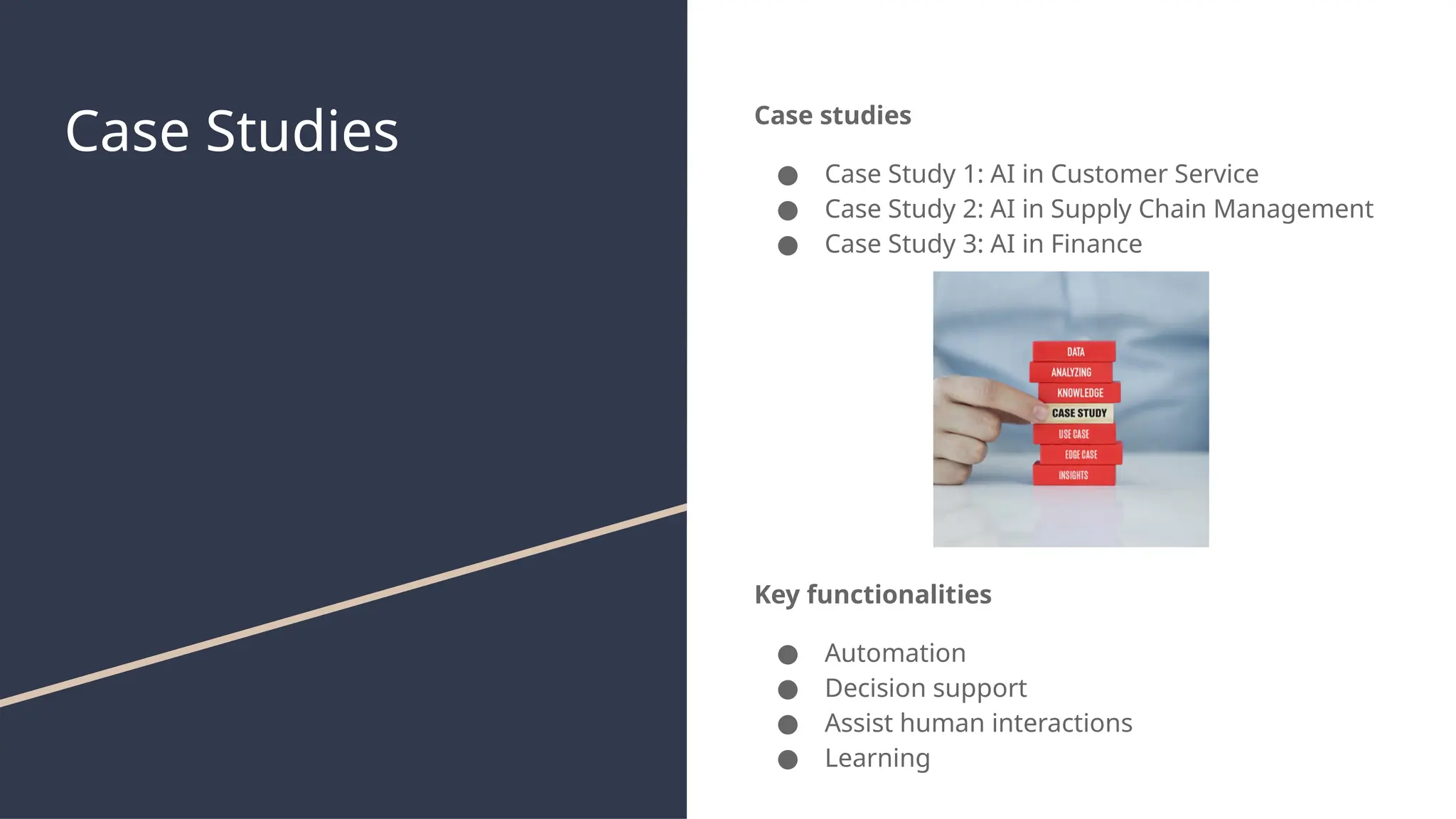
Case Studies Case studies
â—Ź Case Study 1: AI in Customer Service
â—Ź Case Study 2: AI in Supply Chain Management
â—Ź Case Study 3: AI in Finance
Key functionalities
â—Ź Automation
â—Ź Decision support
â—Ź Assist human interactions
â—Ź Learning
Key features in
Customer Service
platforms
Key features
â—Ź Availability
â—Ź The correctness of the answer
â—Ź Dynamic demand of requests
â—Ź Cost
â—Ź Knowledge management
â—Ź Multi languages
AI Agents vs Human
agents in Customer
Service platforms
Human Agents
â—Ź Domain knowledge is different to each agent
â—Ź Hard to share domain knowledge
â—Ź Hard to scale up for high demands and scale down for low
demands
â—Ź Human cost
â—Ź Company cost (Offices, hardware)
â—Ź Simple tickets needs attention same as others
â—Ź Hard to manage working time
â—Ź Hard to support multi languages
AI Agents
â—Ź Up-to-date domain knowledge
â—Ź Reusable domain knowledge
â—Ź Easy to scale up and down
â—Ź Learn and adjust solutions based on response of users
â—Ź Pay as you use (On demand cost)
â—Ź Simple questions can be answered easily
â—Ź 24/7 available
â—Ź Support multi languages
â—Ź Need human agents for complex problems
Case Study 1: AI in Customer Service
Motel Rocks
â—Ź Previous strategy
â—‹ Using Zendesk to communicate with
customers
â—Ź AI solution
â—‹ Using Zendesk Advanced AI instead of
Zendesk
â—‹ Only focus on complex queries
â—Ź Result
â—‹ 43% of tickets deflected by AI agents
â—‹ 50% reduction in ticket volume due to self-
service
â—‹ 9.44% increase in customer satisfaction
Telstra
â—Ź Previous strategy
â—‹ Customers were asking questions in different context
â—‹ To answer questions, agents should take a look on the
previous data of customers and find solution through
a massive repository
â—Ź AI solution
â—‹ Used Microsoft Azure OpenAI service
â—‹ Gather all information agent needs to find the best
answer and recommend some answers
â—Ź Result
â—‹ 20% less follow-up on calls
â—‹ 84% of agents said it positively impacted customer
interactions
â—‹ 90% of agents are more effective
Case Study 2:
AI in Supply Chain
Management
SAP
â—Ź Propose AI-Driven Supply-Chain Innovations
to Transform Manufacturing
â—Ź Utilizing real-time data for better decision-
making across the supply chain
â—Ź Key improvements
â—‹ Optimizing decisions with AI-driven insights
â—‹ Streamlining product development
â—‹ Detecting equipment anomalies by sensors
and smart devices
â—Ź Result
â—‹ 10% decrease in overall supply chain planning
costs
â—‹ 10% reduction in inventory carrying costs and
stock turnover rate
â—‹ 15% increase in supply chain workforce
productivity
Case Study 3:
AI in Finance
RAZE Banking
â—Ź Concern
â—‹ traditional risk management methods were
failing to keep up with the ever-changing
world of cyber threats, compliance issues and
operational risk
â—Ź Solution
â—‹ Working with RTS Labs, which develops AI
solutions, to build a better risk-mitigation
strategy
â—Ź Result
â—‹ 45% reduction in fraudulent transactions
â—‹ 20% improvement in regulatory compliance
efficiency
Future Trends â—Ź Increased Autonomy
â—‹ AI agents taking on more complex, decision-
making roles
â—Ź Integration with Emerging Tech
â—‹ AI agents combining with IoT and blockchain
â—Ź Personalization
â—‹ AI agents offering more customized
experiences to users
â—Ź Scalability
â—‹ Wider adoption across various industries.
Challenges and
Solutions
â—Ź Challenges
â—‹ Trust and transparency issues
â—‹ Ethical concerns
â—‹ Integration with legacy systems
â—‹ Data security and privacy
â—Ź Solutions
â—‹ Developing explainable AI
â—‹ Implementing robust AI governance
â—‹ Continuous monitoring and updating AI
systems
References â—Ź https://botpress.com/blog/real-world-applica
tions-of-ai-agents
â—Ź https://yellow.ai/blog/ai-agents/
â—Ź https://www.vktr.com/ai-disruption/5-ai-case-
studies-in-customer-service-and-support/
â—Ź https://www.vktr.com/the-wire/sap-unveils-ai-
driven-supply-chain-innovations-to-transform
-manufacturing/
â—Ź https://www.vktr.com/ai-disruption/5-ai-case-
studies-in-risk-management/
â—Ź https://smythos.com/ai-agents/ethics/
â—Ź https://deepmind.google/discover/blog/the-e
thics-of-advanced-ai-assistants/
Q&A

AI agents in Business - real case studies

  • 1.
    AI Agents inBusiness Transforming Business Operations with AI-Driven Solutions Yaser Alimardani Zonozi 03.09.2024
  • 2.
    Agenda â—Ź Introductionto AI Agents â—Ź Fundamentals of AI Agents in Business â—Ź Integration and Application in Business â—Ź Case Studies â—Ź Future Trends â—Ź Challenges and Solutions â—Ź Q&A
  • 3.
    Introduction to AIAgents Brief definition of AI agents â—Ź Autonomous systems that perform tasks â—Ź Make decisions â—Ź Assist humans in business processes â—Ź Assist analyzing massive data â—Ź Learn â—Ź Analyze environment Examples â—Ź Financial Trading â—Ź Dynamic Pricing Systems â—Ź Autonomous Vehicles â—Ź Fraud Detection
  • 4.
    Fundamentals of AIAgents Types of AI Agents â—Ź Utility-Based Agents â—‹ Financial Trading â—‹ Dynamic Pricing Systems â—‹ Personalized Content Recommendations â—Ź Goal-Based Agents â—‹ Robotic vacuum cleaners â—‹ Scan documents and analyze text â—‹ Localize text â—Ź Model-Based Reflex Agents â—‹ Autonomous Vehicles â—‹ Home automation systems â—Ź Learning Agents â—‹ Fraud Detection â—Ź Virtual Assistants â—‹ Chatbots + take actions Key functionalities â—Ź Automation â—Ź Decision support â—Ź Assist human interactions â—Ź Fetching raw data by sensors or inputs â—Ź Learning
  • 5.
    Integration and Application in Business HowAI agents are integrated â—Ź Customer Service â—‹ AI-driven chatbots and virtual assistants â—Ź Operations â—‹ Optimizing logistics in supply chain management â—Ź Decision-Making â—‹ AI in predictive analytics for business strategy like fraud detection Benefits â—Ź Cost savings â—Ź Efficiency and speed â—Ź 24/7 availability â—Ź Improved customer satisfaction
  • 6.
    Case Studies Casestudies â—Ź Case Study 1: AI in Customer Service â—Ź Case Study 2: AI in Supply Chain Management â—Ź Case Study 3: AI in Finance Key functionalities â—Ź Automation â—Ź Decision support â—Ź Assist human interactions â—Ź Learning
  • 7.
    Key features in CustomerService platforms Key features â—Ź Availability â—Ź The correctness of the answer â—Ź Dynamic demand of requests â—Ź Cost â—Ź Knowledge management â—Ź Multi languages
  • 8.
    AI Agents vsHuman agents in Customer Service platforms Human Agents â—Ź Domain knowledge is different to each agent â—Ź Hard to share domain knowledge â—Ź Hard to scale up for high demands and scale down for low demands â—Ź Human cost â—Ź Company cost (Offices, hardware) â—Ź Simple tickets needs attention same as others â—Ź Hard to manage working time â—Ź Hard to support multi languages AI Agents â—Ź Up-to-date domain knowledge â—Ź Reusable domain knowledge â—Ź Easy to scale up and down â—Ź Learn and adjust solutions based on response of users â—Ź Pay as you use (On demand cost) â—Ź Simple questions can be answered easily â—Ź 24/7 available â—Ź Support multi languages â—Ź Need human agents for complex problems
  • 9.
    Case Study 1:AI in Customer Service Motel Rocks â—Ź Previous strategy â—‹ Using Zendesk to communicate with customers â—Ź AI solution â—‹ Using Zendesk Advanced AI instead of Zendesk â—‹ Only focus on complex queries â—Ź Result â—‹ 43% of tickets deflected by AI agents â—‹ 50% reduction in ticket volume due to self- service â—‹ 9.44% increase in customer satisfaction Telstra â—Ź Previous strategy â—‹ Customers were asking questions in different context â—‹ To answer questions, agents should take a look on the previous data of customers and find solution through a massive repository â—Ź AI solution â—‹ Used Microsoft Azure OpenAI service â—‹ Gather all information agent needs to find the best answer and recommend some answers â—Ź Result â—‹ 20% less follow-up on calls â—‹ 84% of agents said it positively impacted customer interactions â—‹ 90% of agents are more effective
  • 10.
    Case Study 2: AIin Supply Chain Management SAP â—Ź Propose AI-Driven Supply-Chain Innovations to Transform Manufacturing â—Ź Utilizing real-time data for better decision- making across the supply chain â—Ź Key improvements â—‹ Optimizing decisions with AI-driven insights â—‹ Streamlining product development â—‹ Detecting equipment anomalies by sensors and smart devices â—Ź Result â—‹ 10% decrease in overall supply chain planning costs â—‹ 10% reduction in inventory carrying costs and stock turnover rate â—‹ 15% increase in supply chain workforce productivity
  • 11.
    Case Study 3: AIin Finance RAZE Banking â—Ź Concern â—‹ traditional risk management methods were failing to keep up with the ever-changing world of cyber threats, compliance issues and operational risk â—Ź Solution â—‹ Working with RTS Labs, which develops AI solutions, to build a better risk-mitigation strategy â—Ź Result â—‹ 45% reduction in fraudulent transactions â—‹ 20% improvement in regulatory compliance efficiency
  • 12.
    Future Trends â—ŹIncreased Autonomy â—‹ AI agents taking on more complex, decision- making roles â—Ź Integration with Emerging Tech â—‹ AI agents combining with IoT and blockchain â—Ź Personalization â—‹ AI agents offering more customized experiences to users â—Ź Scalability â—‹ Wider adoption across various industries.
  • 13.
    Challenges and Solutions â—Ź Challenges â—‹Trust and transparency issues â—‹ Ethical concerns â—‹ Integration with legacy systems â—‹ Data security and privacy â—Ź Solutions â—‹ Developing explainable AI â—‹ Implementing robust AI governance â—‹ Continuous monitoring and updating AI systems
  • 14.
    References â—Ź https://botpress.com/blog/real-world-applica tions-of-ai-agents â—Źhttps://yellow.ai/blog/ai-agents/ â—Ź https://www.vktr.com/ai-disruption/5-ai-case- studies-in-customer-service-and-support/ â—Ź https://www.vktr.com/the-wire/sap-unveils-ai- driven-supply-chain-innovations-to-transform -manufacturing/ â—Ź https://www.vktr.com/ai-disruption/5-ai-case- studies-in-risk-management/ â—Ź https://smythos.com/ai-agents/ethics/ â—Ź https://deepmind.google/discover/blog/the-e thics-of-advanced-ai-assistants/
  • 15.

Editor's Notes

  • #1 Speech: Good morning everyone. I’m Yaser, and today we’ll discuss about role of AI agents in business. We’ll also review case studies that highlight their impact, discuss future trends, and talk about the challenges we have.
  • #2 Speech: Here’s a quick overview of what we’ll be discussing today. I’ll start with an introduction to AI Agents, explaining what they are and why they’re important. Then, we’ll dive into the fundamentals of AI Agents in Business How to integrate them into different business strategies across various industries. I’ll share some real-world case studies to illustrate their impact we’ll look ahead at future trends and challenges. Finally, I’ll mention some challenges and solutions to use AI agents and then we can have QA at the end. So feel free to take a note if you feel you have question and then ask it at the end.
  • #3 Dynamic pricing systems: Uber in a rainy day or rent price for apartments in a urgent situations Personalized content recommendation: Customized theme, health tips Speech: Let’s begin by defining AI agents. AI agents are autonomous systems designed to perform tasks, make decisions, and assist humans in various business processes. They’re capable of analyzing massive amounts of data quickly, enabling businesses to operate more efficiently. For instance, AI agents are used in financial trading to make real-time decisions in dynamic pricing systems to adjust prices based on demand, and in fraud detection to identify suspicious activities. AI agent are not only provide information but also take actions based on user inputs and stimuli.
  • #4 Speech: AI agents can be categorized into different types based on their functionalities and how they operate. First, we have Utility-Based Agents, which make decisions to maximize a specific utility. Examples include financial trading systems, dynamic pricing models, and personalized content recommendations. Goal-Based Agents are designed to achieve specific goals, like robotic vacuum cleaners that navigate around obstacles, or systems that scan and localize text in documents. Model-Based Reflex Agents use a model of the world to make decisions, as seen in autonomous vehicles and home automation systems. Learning Agents are perhaps the most advanced, continuously improving from past experiences. These are used in fraud detection, virtual assistants, and chatbots that not only interact with users but also take actions based on those interactions. Across all these types, key functionalities include automation of tasks, providing decision support, and enhancing human interactions.
  • #5 Speech: AI agents are deeply integrated into various aspects of business operations. In Customer Service, AI-driven chatbots and virtual assistants handle inquiries, offering 24/7 support and improving customer satisfaction. In Operations, AI optimizes logistics within supply chain management, ensuring efficient delivery processes. For Decision-Making, AI plays a crucial role in predictive analytics, helping businesses strategize more effectively, detect fraud, and even enhance ad targeting. The benefits of integrating AI agents are significant: they lead to substantial cost savings, increased efficiency and speed, higher customer satisfaction.
  • #6 Speech: Let’s look at how AI agents are being applied in real-world scenarios across different industries. Case Study 1: AI in Customer Service—here, AI-driven chatbots and virtual assistants automate customer interactions, providing decision support and improving response times, which greatly enhances customer satisfaction. Case Study 2: AI in Supply Chain Management—AI optimizes logistics, automates processes, and provides decision support, leading to increased efficiency and reduced costs. Case Study 3: AI in Finance—AI is used for fraud detection and predictive analytics, automating complex data analysis and assisting in making more informed financial decisions. Lets taka a look on some case study and see how AI improve business strategies
  • #7 Motel rocks is a fashion brand company Telstra is Telecommunications company in Australia Speech: Let’s explore two compelling case studies where AI significantly enhanced business operations. Motel Rocks initially used Zendesk for customer communication but found it challenging to manage the volume of inquiries. By upgrading to Zendesk Advanced AI, they shifted their focus to handling only complex queries, allowing AI to deflect 43% of tickets and reduce ticket volume by 50% through self-service options, leading to a 9.44% increase in customer satisfaction. Telstra, on the other hand, faced challenges where agents had to manually check lots of amounts of customer data to find solutions. By implementing Microsoft Azure OpenAI service, Telstra’s AI solution now gathers all relevant information, recommends answers, and helps agents respond more efficiently. This led to 20% less follow-up calls, with 84% of agents reporting a positive impact on customer interactions and 90% feeling more effective in their roles.
  • #8 Motel rocks is a fashion brand company Telstra is Telecommunications company in Australia Speech: Let’s explore two compelling case studies where AI significantly enhanced business operations. Motel Rocks initially used Zendesk for customer communication but found it challenging to manage the volume of inquiries. By upgrading to Zendesk Advanced AI, they shifted their focus to handling only complex queries, allowing AI to deflect 43% of tickets and reduce ticket volume by 50% through self-service options, leading to a 9.44% increase in customer satisfaction. Telstra, on the other hand, faced challenges where agents had to manually check lots of amounts of customer data to find solutions. By implementing Microsoft Azure OpenAI service, Telstra’s AI solution now gathers all relevant information, recommends answers, and helps agents respond more efficiently. This led to 20% less follow-up calls, with 84% of agents reporting a positive impact on customer interactions and 90% feeling more effective in their roles.
  • #9 Motel rocks is a fashion brand company Telstra is Telecommunications company in Australia Speech: Let’s explore two compelling case studies where AI significantly enhanced business operations. Motel Rocks initially used Zendesk for customer communication but found it challenging to manage the volume of inquiries. By upgrading to Zendesk Advanced AI, they shifted their focus to handling only complex queries, allowing AI to deflect 43% of tickets and reduce ticket volume by 50% through self-service options, leading to a 9.44% increase in customer satisfaction. Telstra, on the other hand, faced challenges where agents had to manually check lots of amounts of customer data to find solutions. By implementing Microsoft Azure OpenAI service, Telstra’s AI solution now gathers all relevant information, recommends answers, and helps agents respond more efficiently. This led to 20% less follow-up calls, with 84% of agents reporting a positive impact on customer interactions and 90% feeling more effective in their roles.
  • #10 Optimizing decisions across the supply chain with AI-driven insights Speech: Now, let’s take a look at how SAP is transforming the manufacturing industry with AI-driven supply chain innovations. As everyone knows SAP is a ERP leader in a world. By utilizing real-time data, SAP enables better decision-making across the entire supply chain. Some of the key improvements include optimizing decisions with AI-driven insights, streamlining product development, and detecting equipment anomalies before they cause disruptions. These innovations have delivered remarkable results: a 10% decrease in overall supply chain planning costs, a 10% reduction in inventory carrying costs and stock turnover rate, and a 15% increase in workforce productivity. SAP's AI copilot Joule to gather and enhance new product ideas quickly and effectively using natural language queries. This case study showcases how integrating AI into supply chain management can lead to significant cost savings, efficiency gains, and enhanced operational performance.
  • #11 Speech: RAZE Banking faced significant challenges as traditional risk management methods struggled to keep up with the rapidly evolving landscape of cyber threats, compliance issues, and operational risks. To address this, they partnered with RTS Labs to develop an AI-powered risk mitigation strategy. This collaboration led to a 45% reduction in fraudulent transactions and a 20% improvement in regulatory compliance efficiency. This case demonstrates the power of AI in enhancing risk management and ensuring that businesses stay ahead of emerging threats while maintaining compliance. Of course risk management is not only for finance industry and it will be applied to several industries
  • #12 Speech: As AI technology continues to advance, we’re seeing several key trends shaping the future of AI agents. Increased Autonomy is one of them, with AI agents taking on more complex decision-making roles, allowing businesses to rely on them for critical functions. Integration with Emerging Technologies like IoT and blockchain is also on the rise, enabling AI agents to operate in more interconnected and secure environments. Personalization is another major trend, with AI agents offering increasingly customized experiences to users. Lastly, Scalability is becoming a reality as AI agents are adopted across a broader range of industries, driving widespread transformation and efficiency improvements. For example you can hear from the social media that AI is using in the game and food industry as well.
  • #13 Safety risks: Vulnerabilities to hacking, accidents, and misuse, especially for AI controlling critical infrastructure Bias: Potential to discriminate based on flawed data or assumptions Transparency: Inability to understand opaque “black box” AI reasoning Accountability: Unclear legal/moral responsibility when AI causes harm Privacy: Extensive data collection often lacks consent safeguards Societal impacts: Effects on social norms Speech: Trust and transparency issues arise as stakeholders need to understand and trust AI decisions. Ethical concerns also play a critical role, particularly around fairness and bias in AI systems. Additionally, integrating AI with legacy systems can be complex and resource-intensive, while data security and privacy concerns must be managed to protect sensitive information. To tackle these challenges, we can adopt several solutions. We need to build trust. Implement robust AI governance frameworks ensures ethical standards and compliance. Continuous monitoring and updating AI systems are crucial for maintaining accuracy, security, and relevance. These strategies collectively help in overcoming the hurdles and maximizing the benefits of AI technology.
  • #14 I used these references and it was not enough to be deep in this topic. Technologies and AI are growing fast and we need to be updated every day to be align with the latest news and updates regarding how we can apply AI agents to improve business strategies and reduce cost and increase efficiency.