It covers the chemical nature, mechanism of action, uses, side effects, and recent developments related to ketoconazole in pharmaceutical applications.
Use of Ketoconazole
•Pharmaceutical Applications and Mechanism
of Action
• Presented by: [Your Name]
• [Institution Name]
2.
Introduction
• Ketoconazole isa broad-spectrum antifungal
agent belonging to the imidazole class, used to
treat fungal infections in humans and animals.
3.
Objectives
• • Understandthe chemical nature and
mechanism of ketoconazole
• • Explore its therapeutic applications
• • Identify adverse effects and limitations
4.
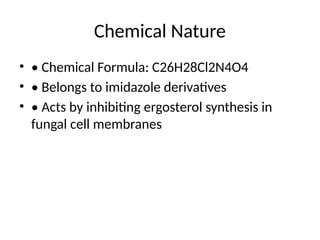
Chemical Nature
• •Chemical Formula: C26H28Cl2N4O4
• • Belongs to imidazole derivatives
• • Acts by inhibiting ergosterol synthesis in
fungal cell membranes
5.
Mechanism of Action
•• Inhibits fungal cytochrome P450 enzyme
(lanosterol 14α-demethylase)
• • Prevents conversion of lanosterol to
ergosterol
• • Disrupts cell membrane integrity, leading to
fungal death
6.
Pharmaceutical Uses
• •Treatment of systemic and superficial fungal
infections
• • Effective against dermatophytes, yeasts, and
dimorphic fungi
• • Available in topical, oral, and shampoo
formulations
7.
Common Indications
• •Tinea infections (ringworm, athlete’s foot)
• • Seborrheic dermatitis and dandruff
• • Candidiasis (oral, cutaneous, systemic)
• • Fungal prostatitis and chronic
mucocutaneous candidiasis
8.
Topical Applications
• •Ketoconazole creams and shampoos used
for local fungal infections
• • Reduces inflammation and itching
• • Typical concentration: 1–2% formulations
9.
Systemic Administration
• •Oral ketoconazole used for systemic fungal
infections
• • Absorbed well in acidic environment
• • Must monitor liver function due to potential
hepatotoxicity
10.
Adverse Effects
• •Hepatotoxicity (rare but serious)
• • Gastrointestinal disturbances
• • Endocrine effects: decreases testosterone
and cortisol synthesis
• • Allergic reactions or skin irritation (topical)
11.
Drug Interactions
• •Inhibits CYP3A4 enzyme – can increase
plasma levels of other drugs
• • Avoid co-administration with certain
antihistamines, anticoagulants, and statins
12.
Recent Developments
• •Decline in oral use due to safety concerns
• • Preference for safer azoles like fluconazole
and itraconazole
• • Continued use in dermatology as topical
formulation
13.
Advantages
• • Broadantifungal spectrum
• • Dual anti-inflammatory and antifungal
properties
• • Effective topical control for scalp and skin
infections
14.
Limitations
• • Systemictoxicity limits oral use
• • Resistance development in long-term use
• • Requires acidic medium for absorption
15.
Conclusion
• Ketoconazole remainsan important antifungal
agent, especially in topical therapy, despite
reduced systemic use due to safety concerns.
16.
References
• • Goodman& Gilman’s Pharmacological Basis
of Therapeutics
• • WHO Model List of Essential Medicines
• • FDA Drug Safety Communications
• • Research Articles in Antimicrobial Agents
and Chemotherapy Journal
![Use of Ketoconazole
• Pharmaceutical Applications and Mechanism
of Action
• Presented by: [Your Name]
• [Institution Name]](https://image.slidesharecdn.com/useofketoconazole-251124152519-18976553/85/agriculture_sci_Use_of_Ketoconazole-pptx-1-320.jpg)
![Use of Ketoconazole
• Pharmaceutical Applications and Mechanism
of Action
• Presented by: [Your Name]
• [Institution Name]](https://image.slidesharecdn.com/useofketoconazole-251124152519-18976553/75/agriculture_sci_Use_of_Ketoconazole-pptx-1-2048.jpg)