Agile methods: Facts and myths
1st Agile Cyprus Meetup
Vangelis Monochristou, Co-Founder of Agile Cyprus
Facts about Agile
• Project Management Institute - Pulse of the Profession 2015:
• 38% of organizations report using agile frequently
• 75% of highly agile organizations met their goals, 65% finished on time, and
67% finished within budget. Compared to organizations with low agility,
where only 56% met their business goals, 40% finished on time, and 45%
finished within budget
• Agile organizations grow revenue 37% faster and generate 30% higher profits
than non-agile companies
Facts about Agile
• Project Management Institute - Pulse of the Profession 2016:
• 9% of organizations report using agile always
• 28% of organizations report using agile often
• 31% of organizations report using agile sometimes
Facts about Agile
• HP online survey of 601 development and IT professionals (2015)
• Agile is the new normal
• Two-thirds described their company as either "pure agile" or "leaning towards
agile, regarding the primary development method used in their organization
across projects
• A hybrid approach is used by 24 percent of respondents, meaning that they
incorporate at least some agile principles into the management of their
software development projects
• Only nine percent describe themselves as using "pure waterfall" or "leaning
towards waterfall“
• Driven by the young, but felt by all
Facts about Agile
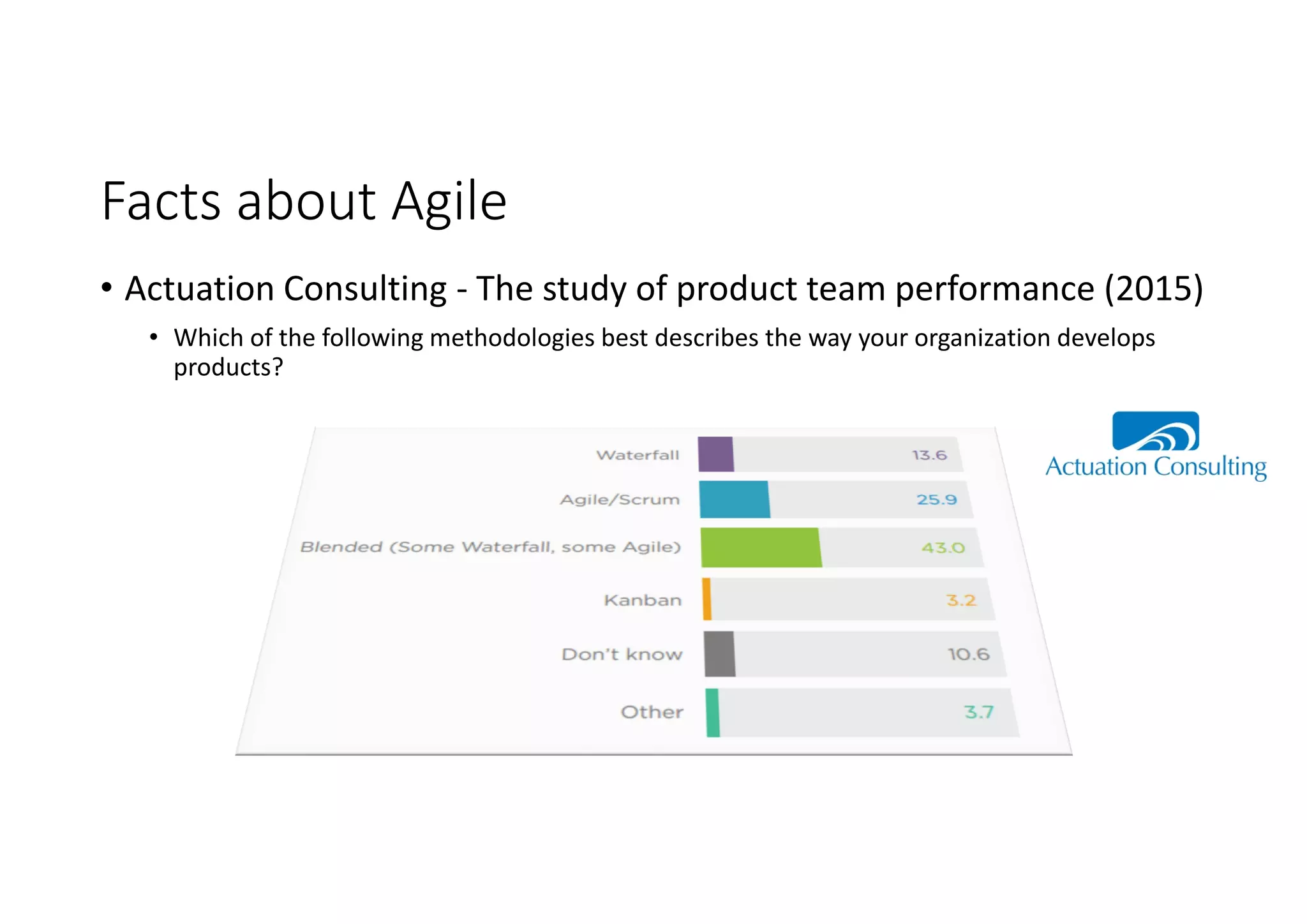
• Actuation Consulting - The study of product team performance (2015)
• Which of the following methodologies best describes the way your organization develops
products?
Facts about Agile
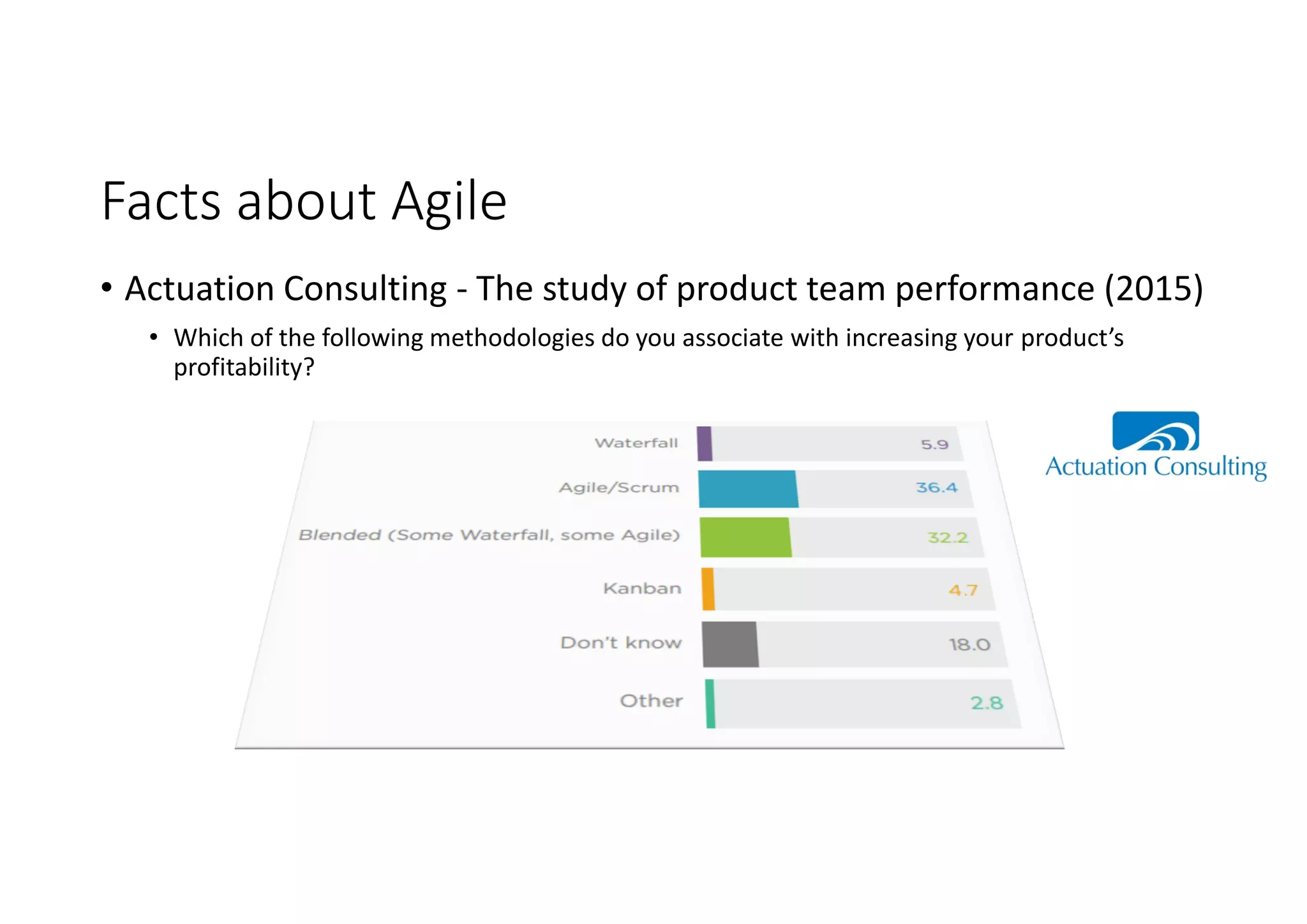
• Actuation Consulting - The study of product team performance (2015)
• Which of the following methodologies do you associate with increasing your product’s
profitability?
Facts about Agile
• VersionOne – 10th Annual State of Agile™ Survey (2016)
• 3,880 respondents
• Agile methodologies are no longer solely the domain of startups and small
development shops
• Agile is going global
• The pool of talent and agile experience continues to grow
• Only 1% of the 3,880 respondents said that their agile implementation was
unsuccessful
Facts about Agile
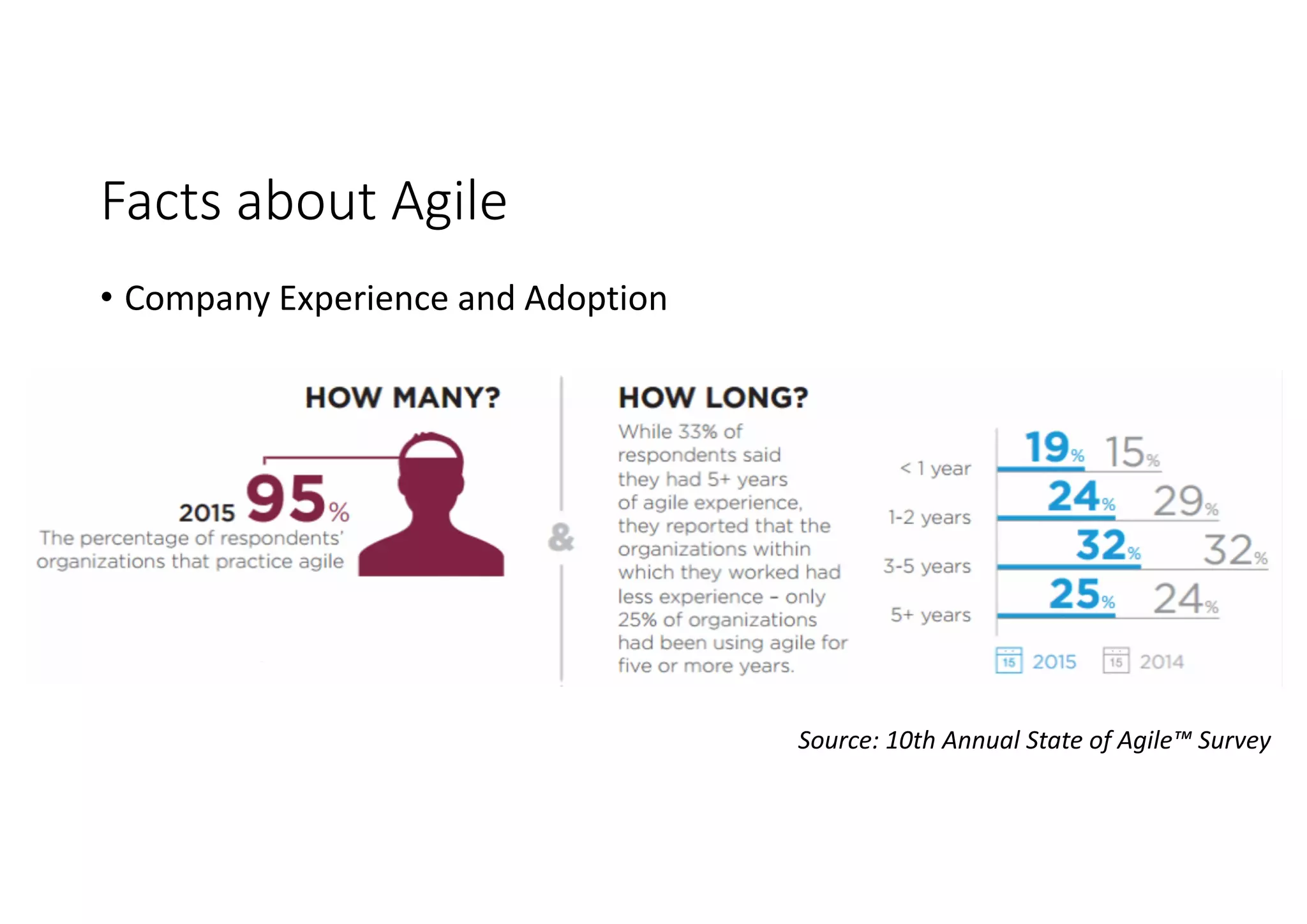
Source: 10th Annual State of Agile™ Survey
• Company Experience and Adoption
Facts about Agile
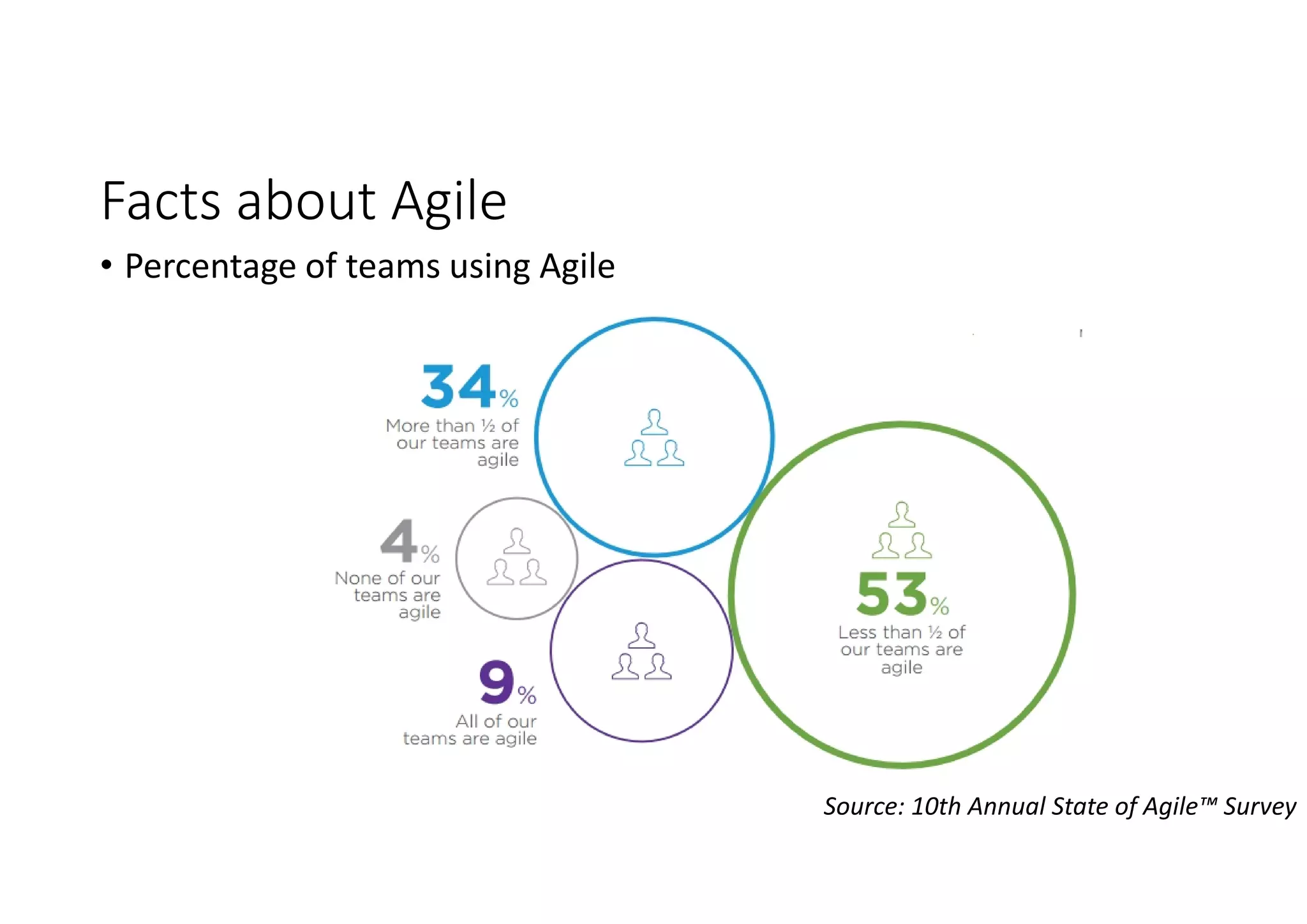
Source: 10th Annual State of Agile™ Survey
• Percentage of teams using Agile
Facts about Agile
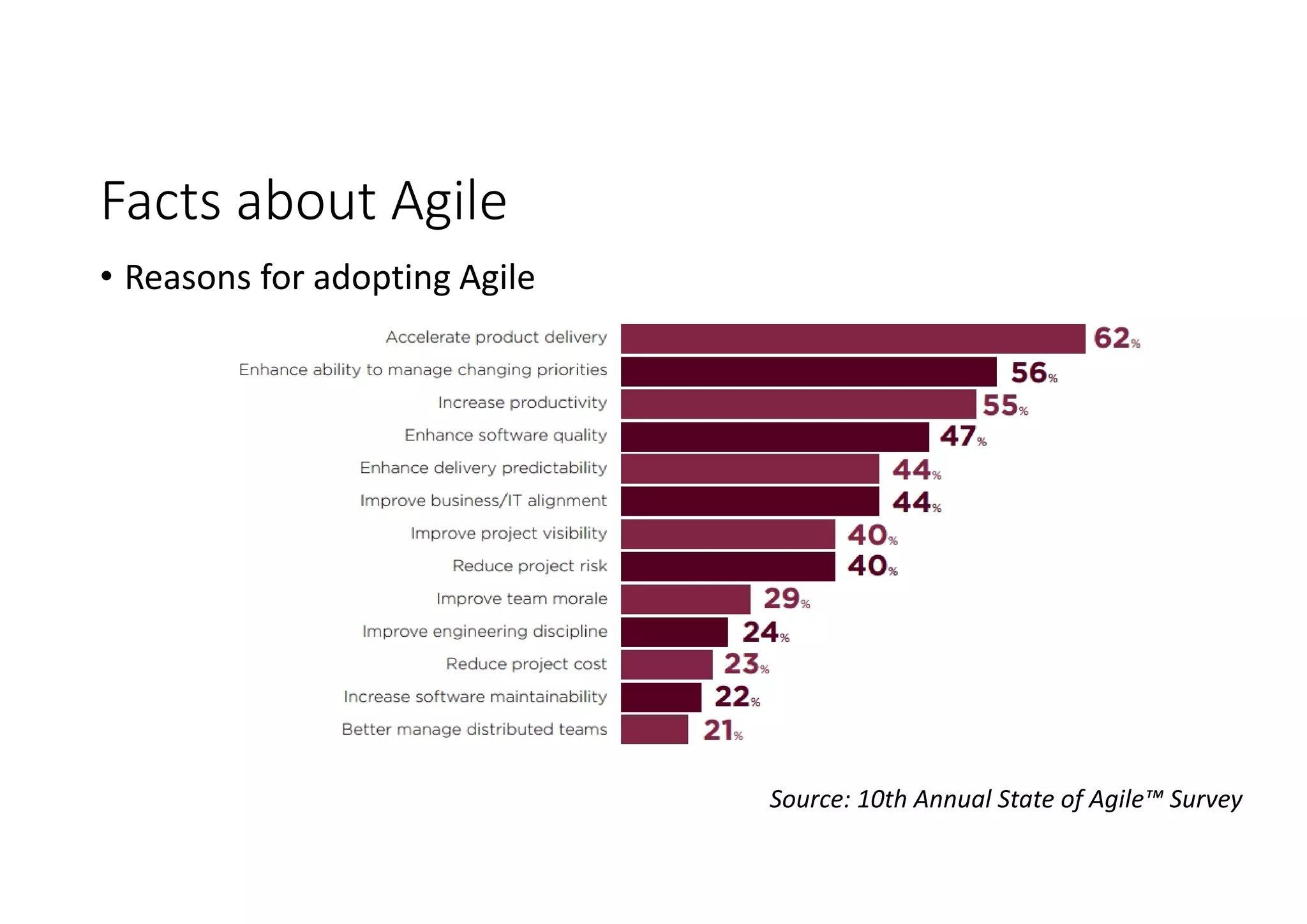
Source: 10th Annual State of Agile™ Survey
• Reasons for adopting Agile
Facts about Agile
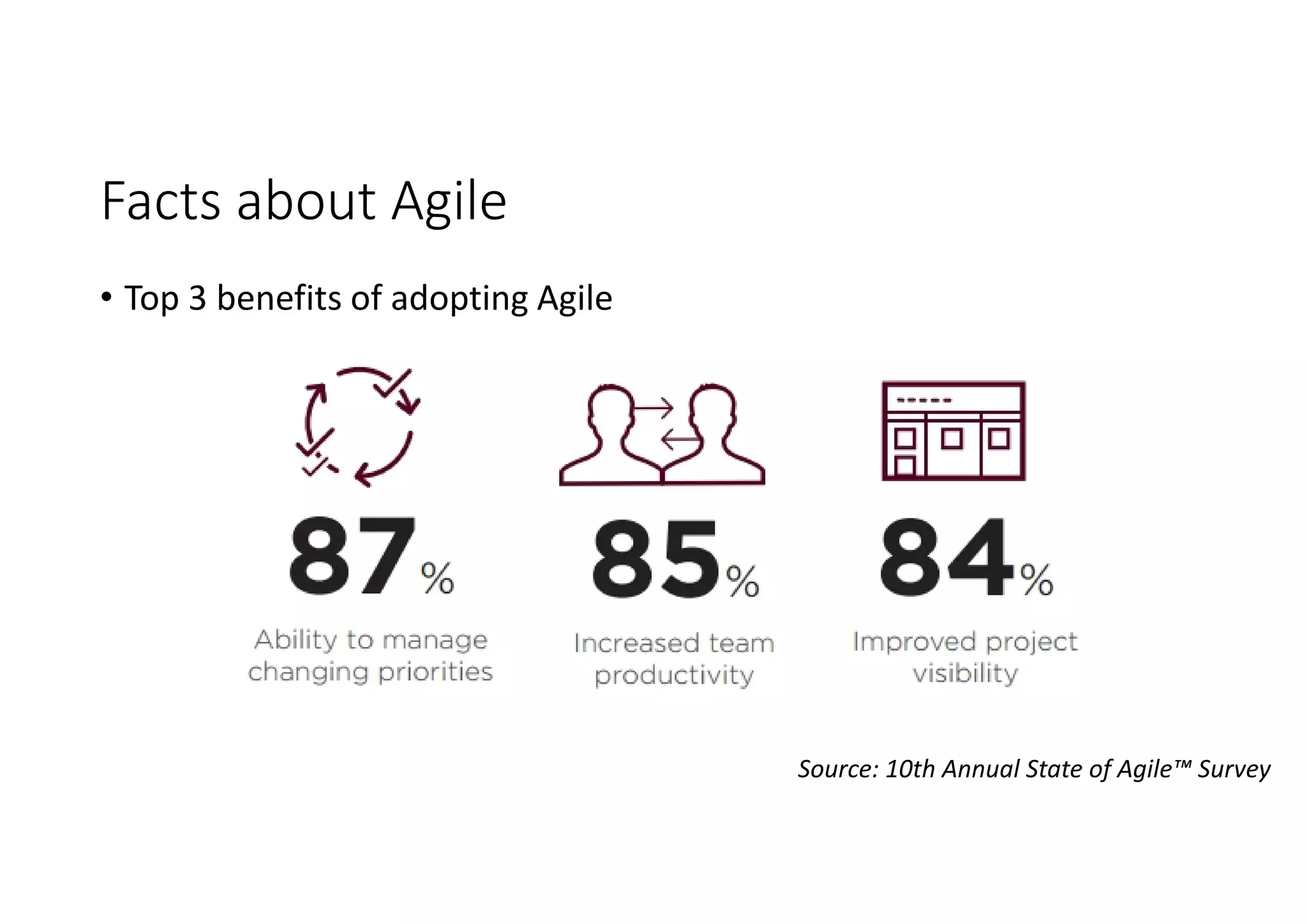
Source: 10th Annual State of Agile™ Survey
• Top 3 benefits of adopting Agile
Facts about Agile
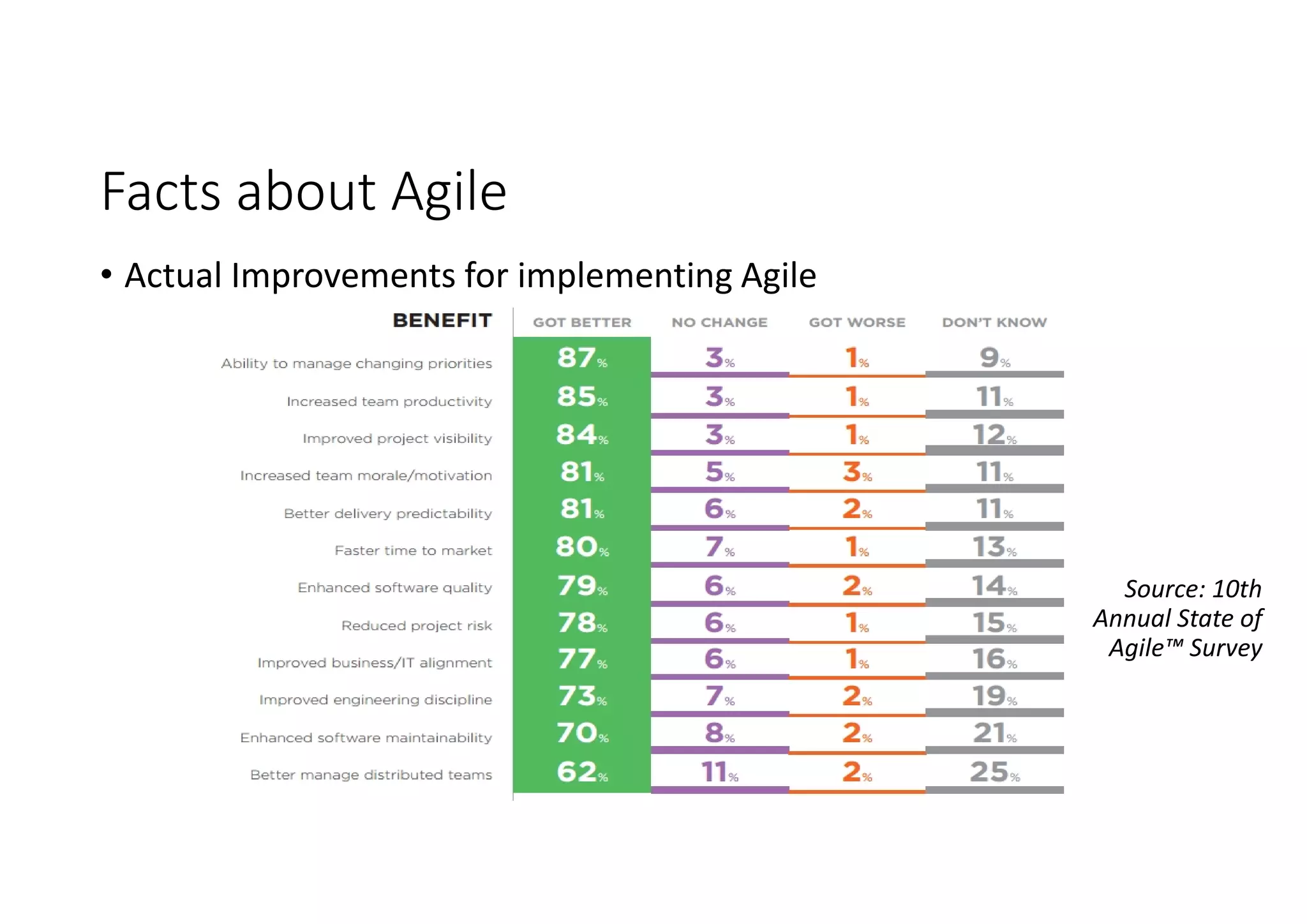
Source: 10th
Annual State of
Agile™ Survey
• Actual Improvements for implementing Agile
Facts about Agile
Source: 10th Annual State of Agile™ Survey
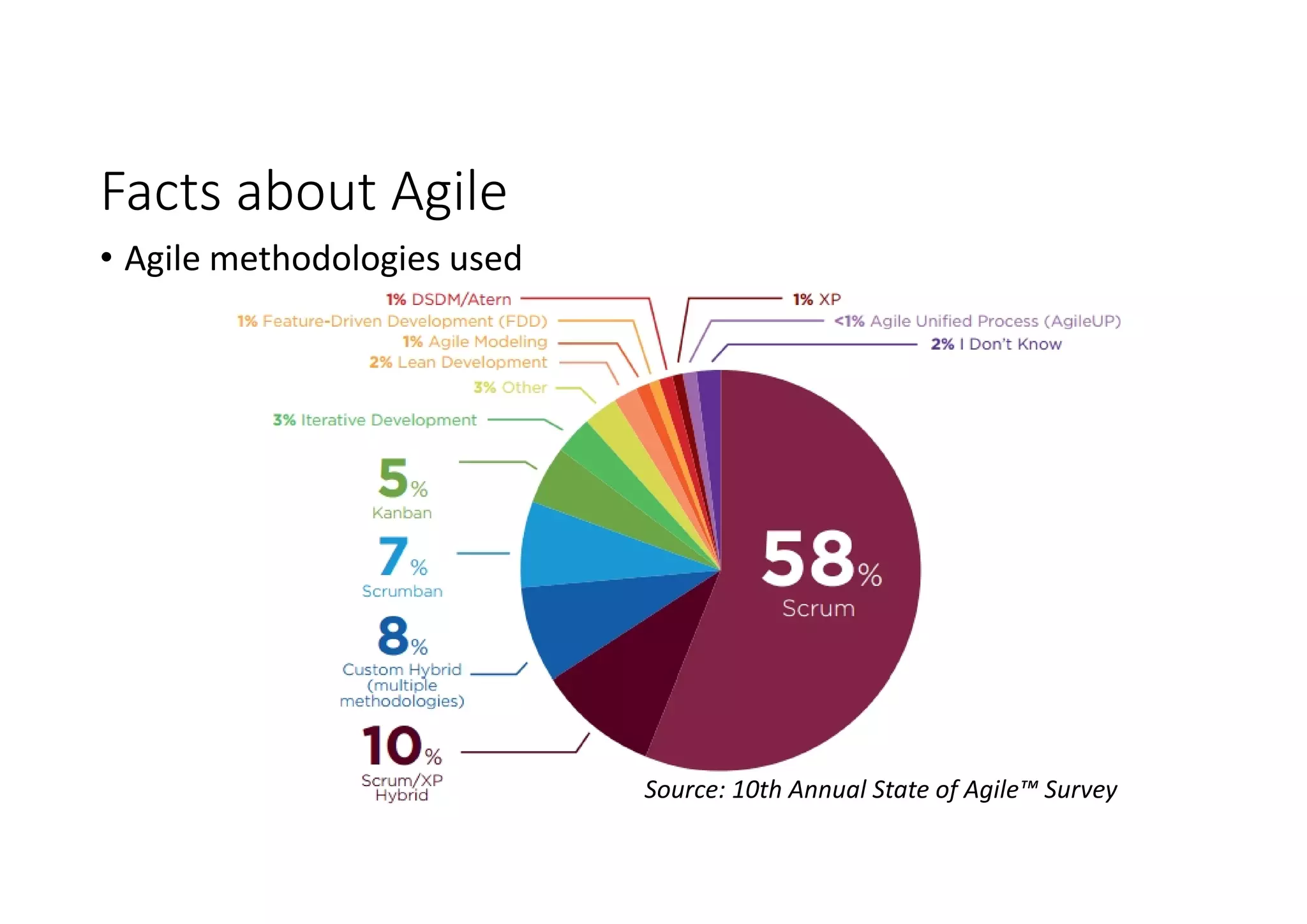
• Agile methodologies used
Facts about Agile
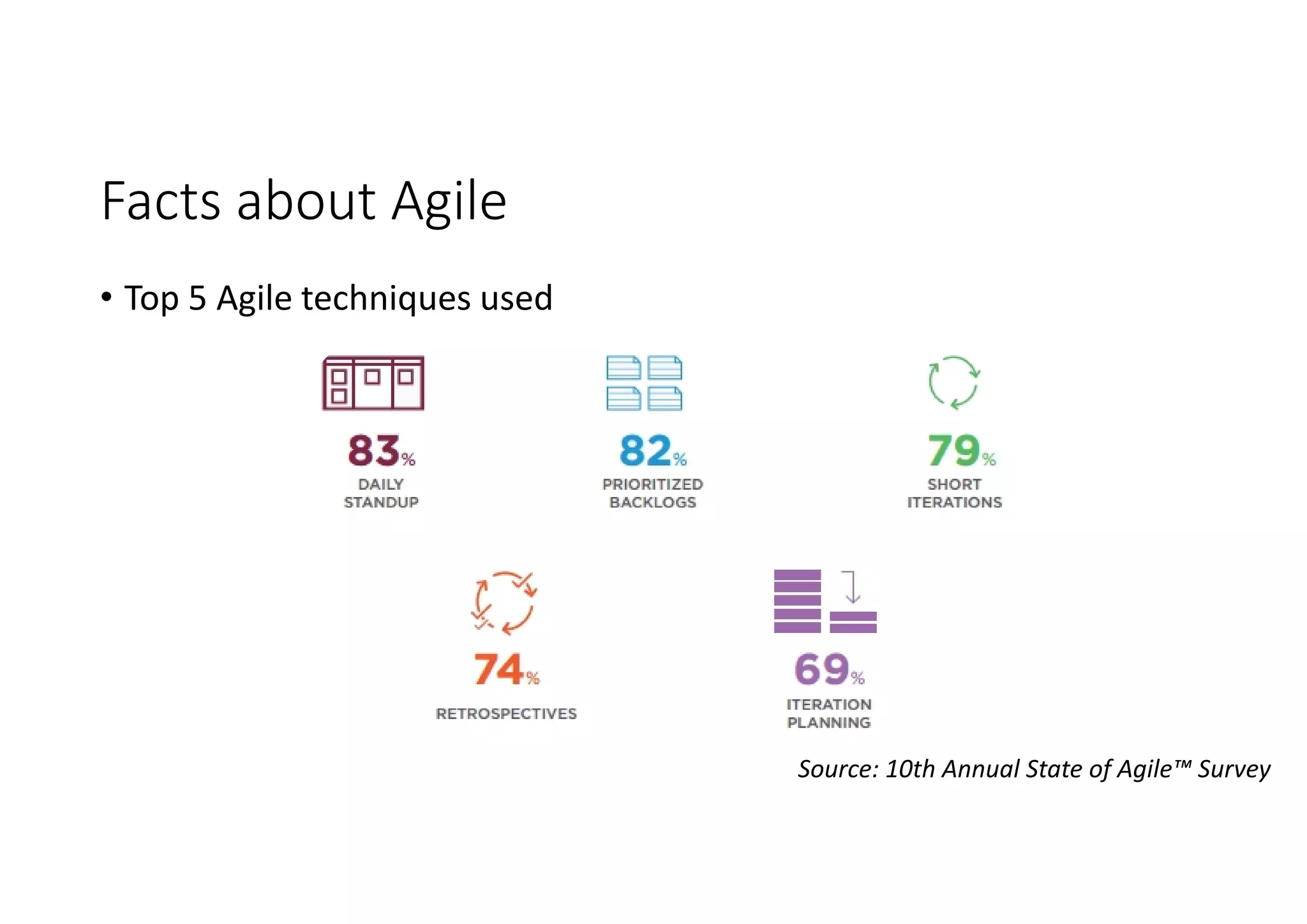
Source: 10th Annual State of Agile™ Survey
• Top 5 Agile techniques used
Facts about Agile
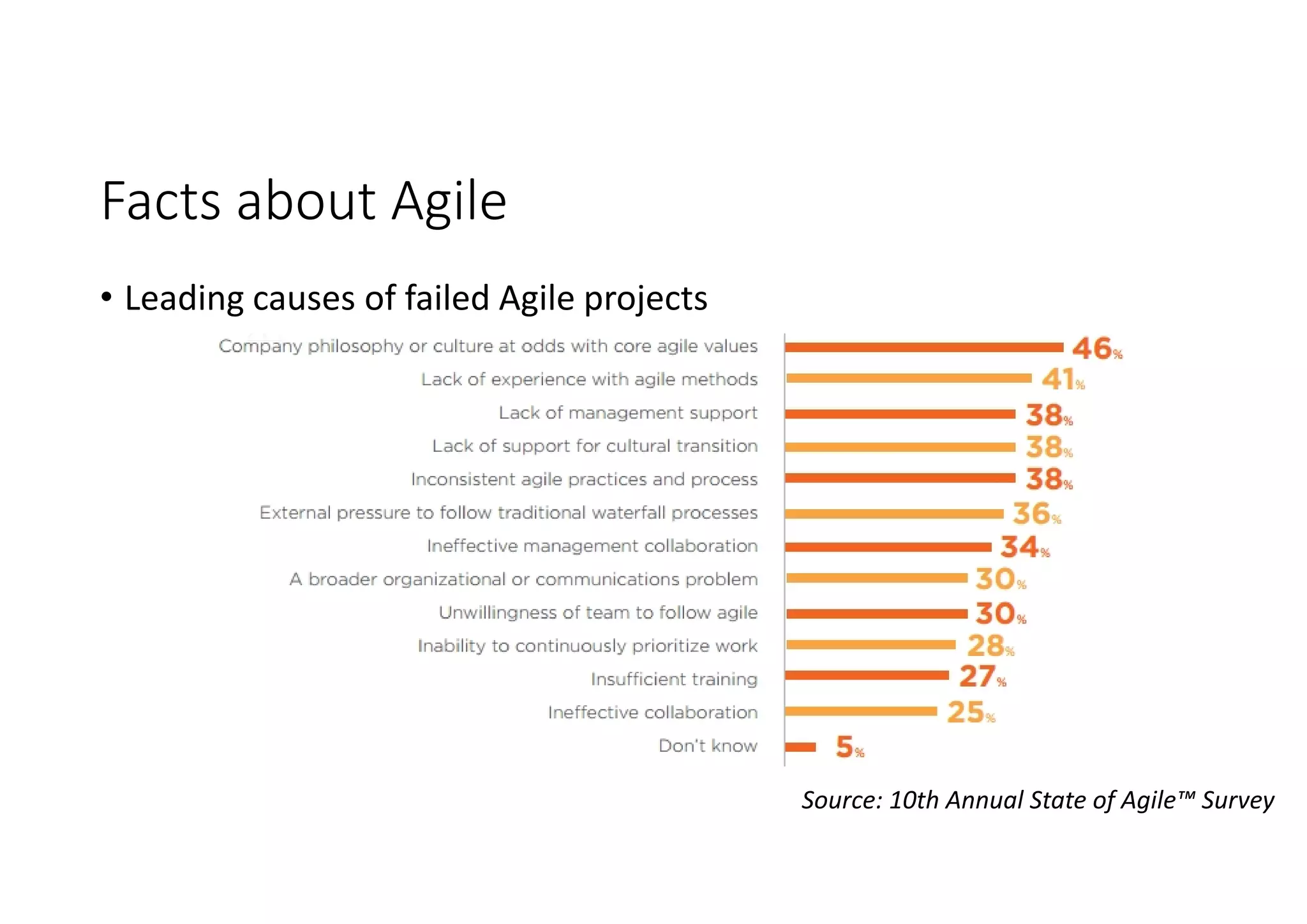
Source: 10th Annual State of Agile™ Survey
• Leading causes of failed Agile projects
Facts about Agile
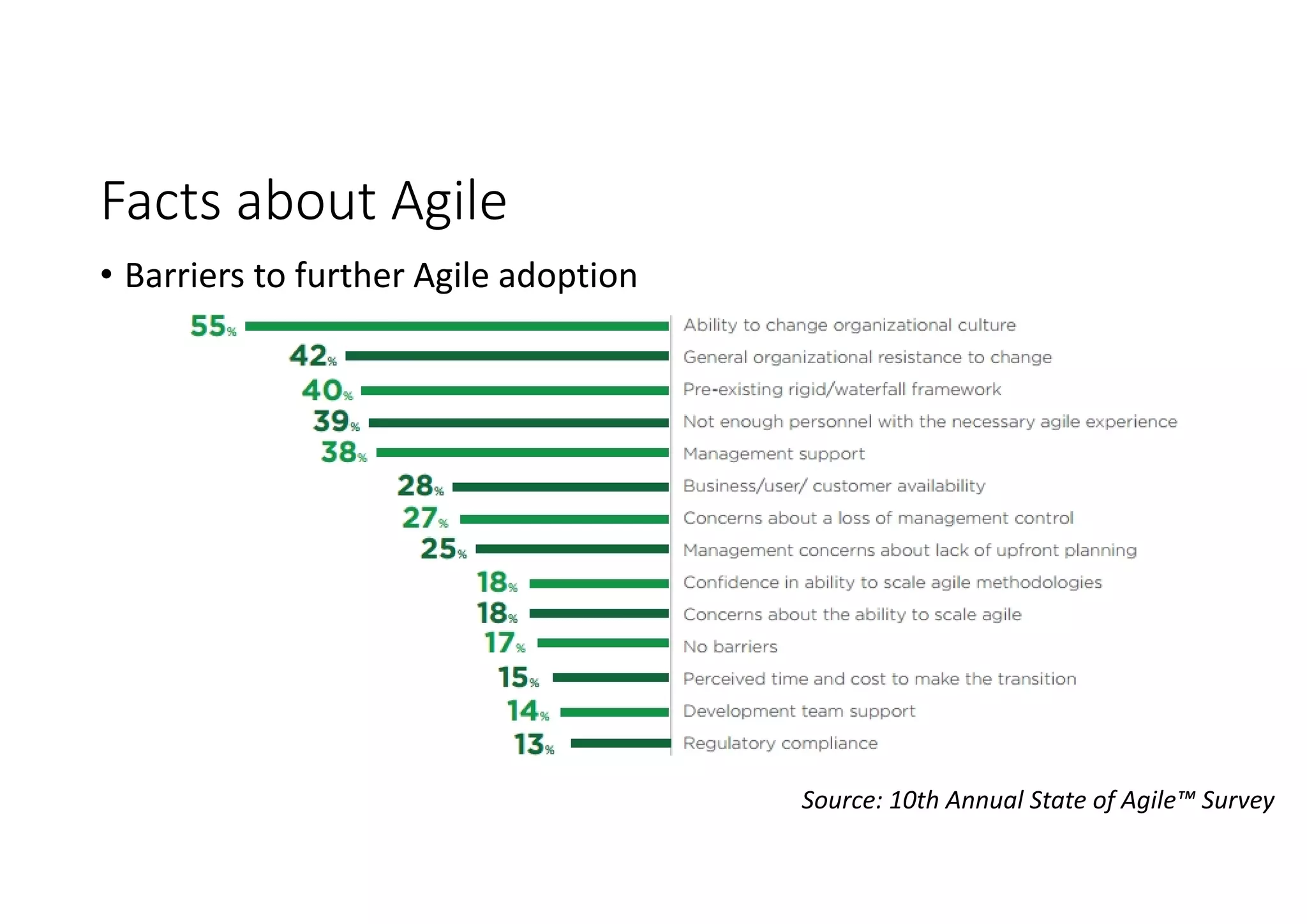
Source: 10th Annual State of Agile™ Survey
• Barriers to further Agile adoption
Myths about Agile
• Myth #1: Agile is new
• the Agile manifesto was published in 2001
• the Scrum Pattern Language was introduced at PLoP (Pattern Languages of
Programs Conference) 1998
• the Episodes Pattern Language (the forerunner of XP) was presented at PLoP
1995
• Tom Gilb’s Evolutionary Delivery Method dates back to 1976
Myths about Agile
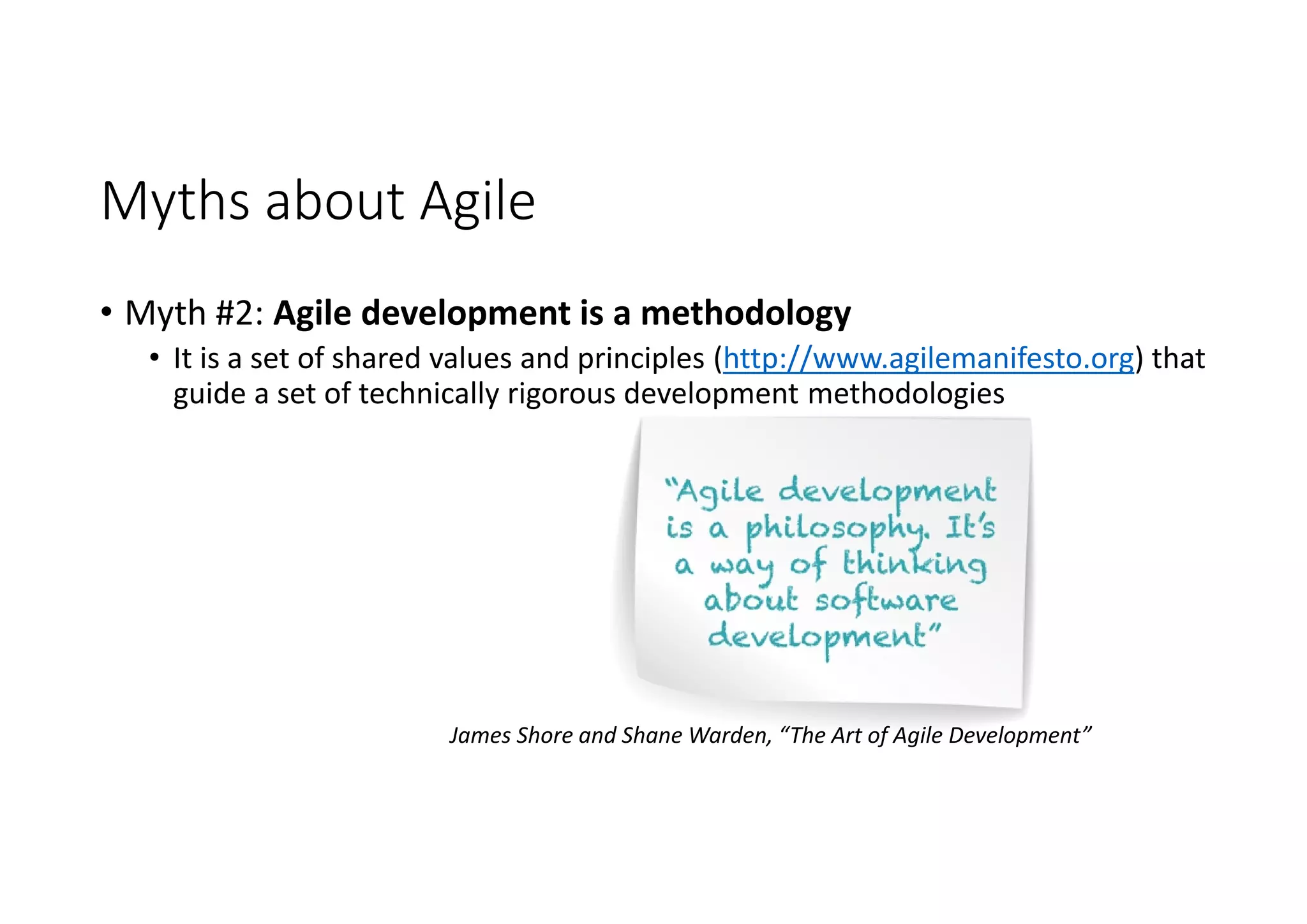
• Myth #2: Agile development is a methodology
• It is a set of shared values and principles (http://www.agilemanifesto.org) that
guide a set of technically rigorous development methodologies
James Shore and Shane Warden, “The Art of Agile Development”
Myths about Agile
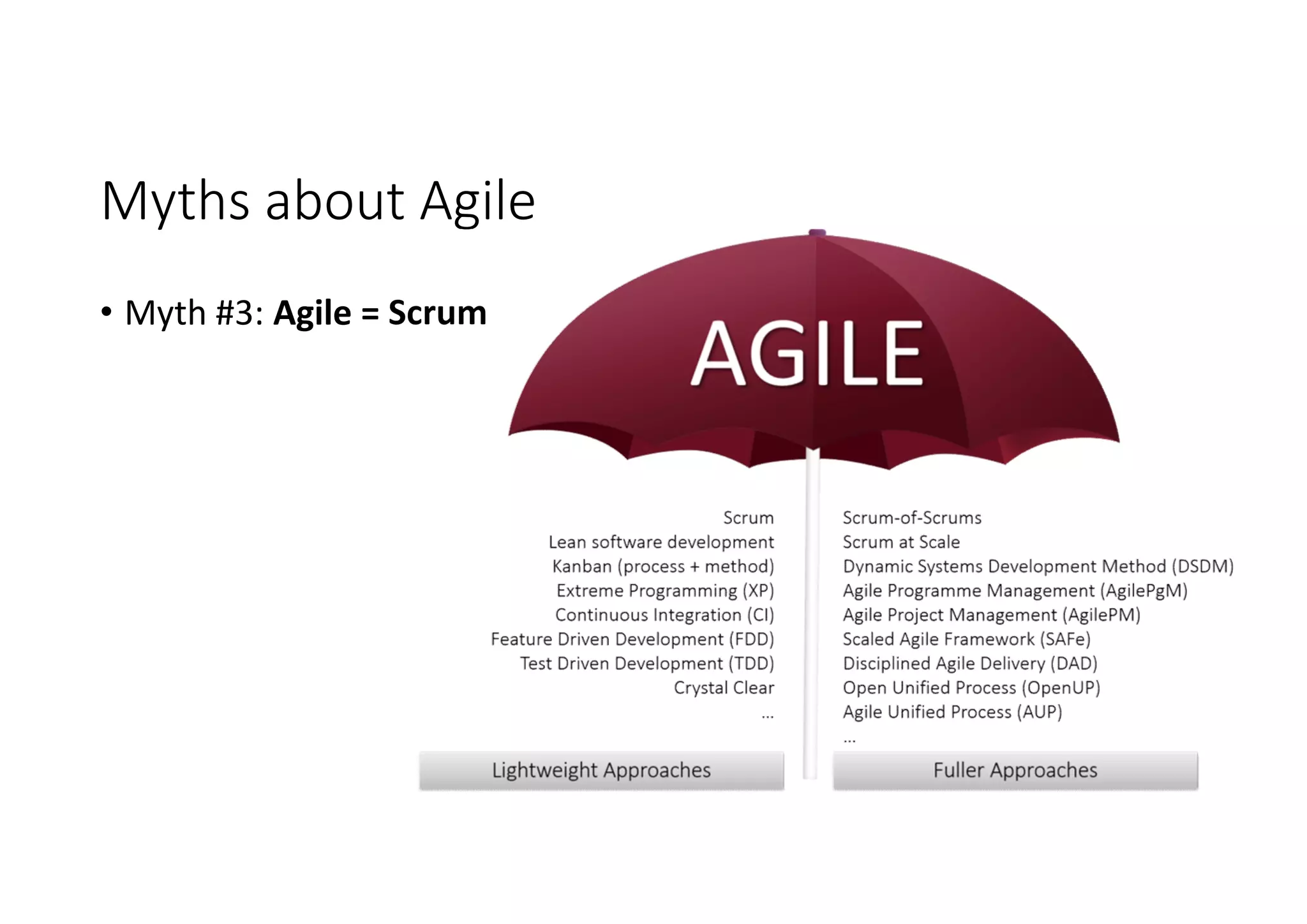
• Myth #3: Agile = Scrum
Myths about Agile
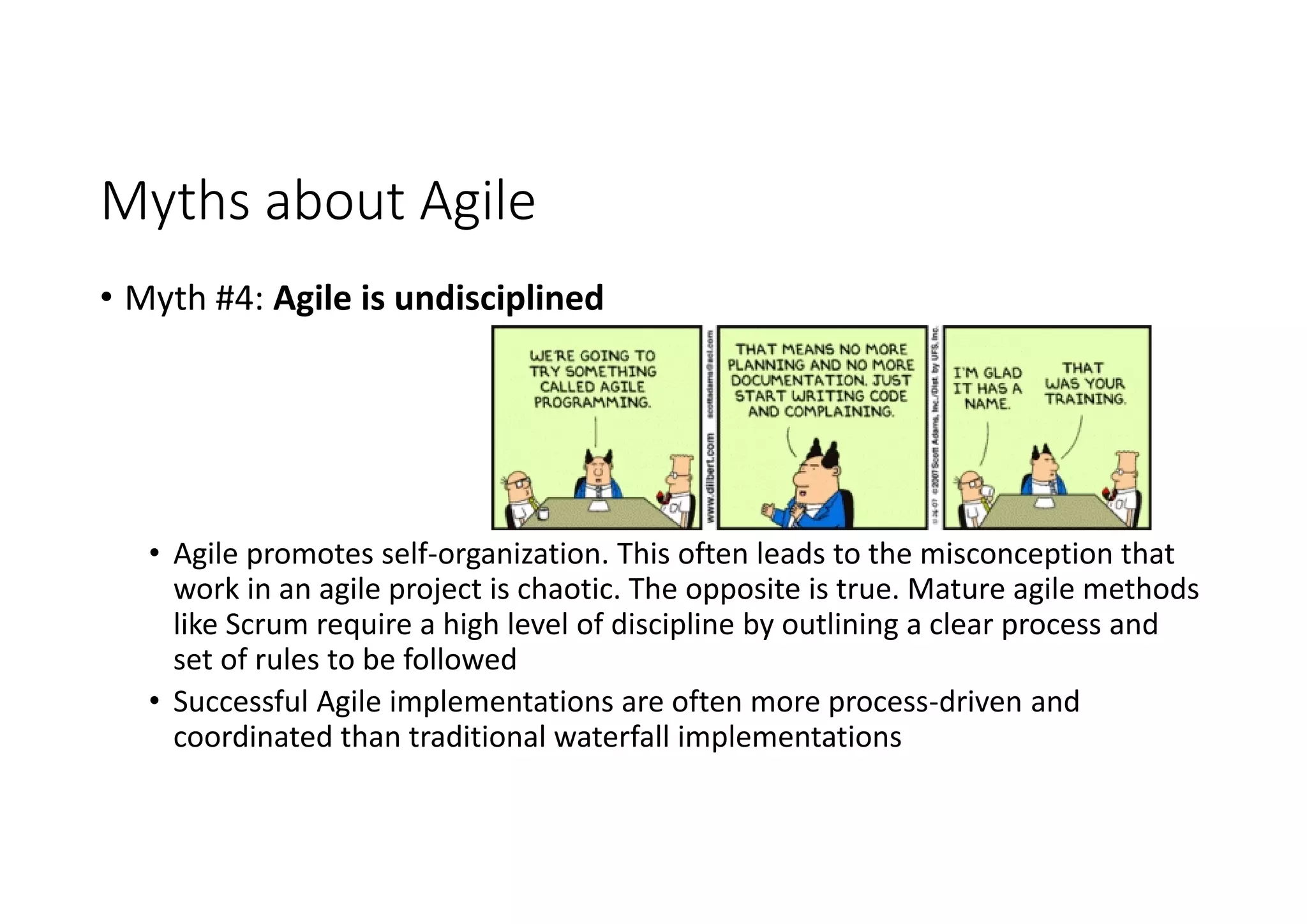
• Myth #4: Agile is undisciplined
• Agile promotes self-organization. This often leads to the misconception that
work in an agile project is chaotic. The opposite is true. Mature agile methods
like Scrum require a high level of discipline by outlining a clear process and
set of rules to be followed
• Successful Agile implementations are often more process-driven and
coordinated than traditional waterfall implementations
Myths about Agile
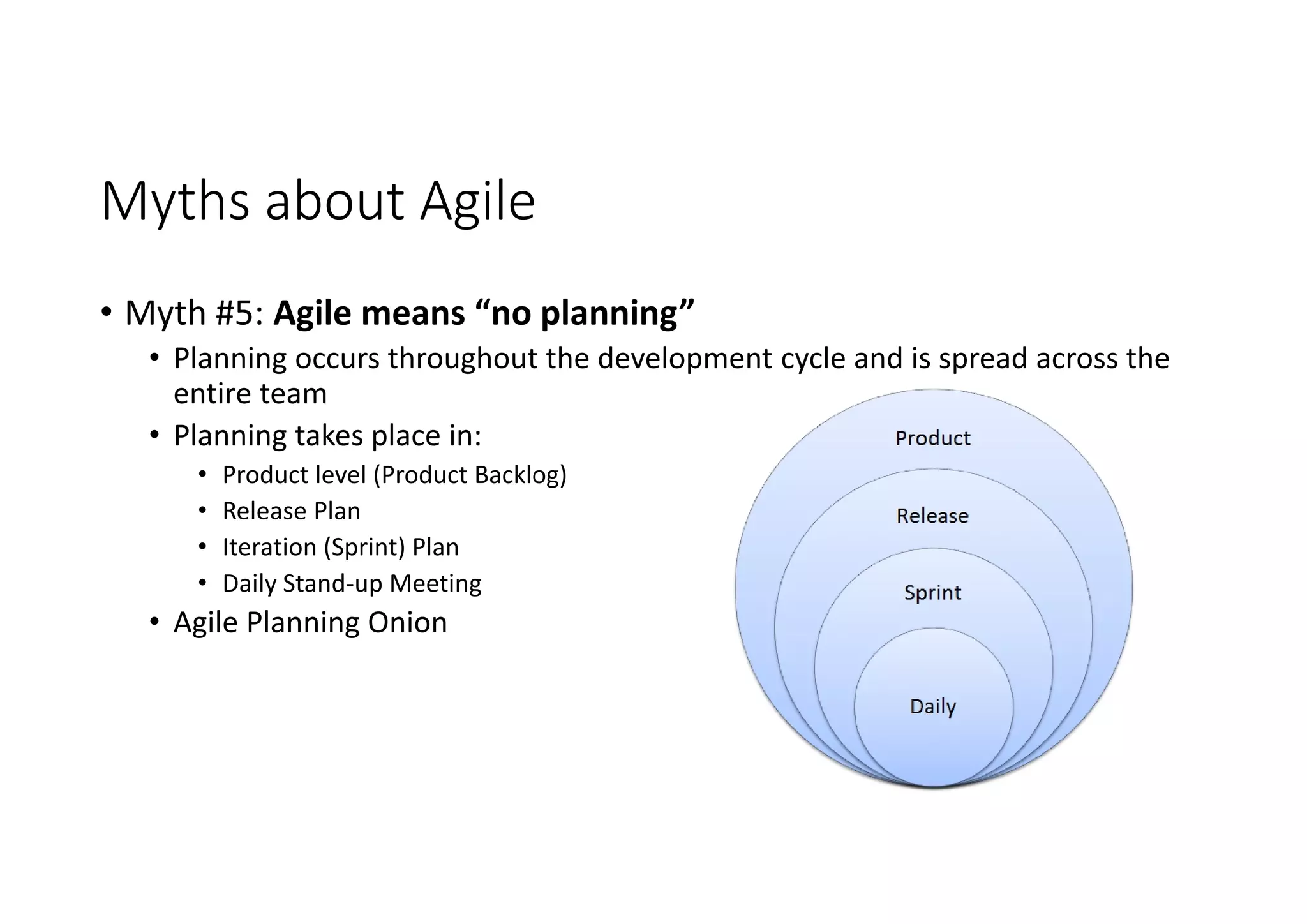
• Myth #5: Agile means “no planning”
• Planning occurs throughout the development cycle and is spread across the
entire team
• Planning takes place in:
• Product level (Product Backlog)
• Release Plan
• Iteration (Sprint) Plan
• Daily Stand-up Meeting
• Agile Planning Onion
Myths about Agile
• Myth #7: Agile means “no documentation”
• As at the beginning of a project things are not accurate by nature, there is
little upfront documentation, it’s rather ‘as required’. During iterations /
sprints, plans and requirements are continuously challenged and refined. This
results in continuous extension and adaption of documentation
• Agile does not prevent any development team from generating as much
documentation as the project requires
• The natural process of Agile development tends to generate a greater amount
of documentation than traditional methodologies
Myths about Agile
• Myth #8: Agile means “no design”
• Agile probably means more design. Design is inherent all the way through
development, at every planning meeting and more
• Agile development stresses simple upfront design to focus on the foundation
and general structure of the software, instead of big-up-front design which is
invalidated five minutes after someone starts coding
Big Design Up Front (BDUF) is “harmful” but little upfront design (LUFD) is
“absolutely essential”, Robert C. Martin (one of the founders of the Agile
Manifesto)
Myths about Agile
• Myth #9: Agile requires that stakeholders and developers work in a
single location
• Agile emphasizes heavy stakeholder involvement throughout a development
effort. As a result, many assume that team members must all work in the
same location (co-located) for Agile to be successful
• With modern technology, this is no longer the case. It’s real-time
communication and collaboration that matter, not where or how they occur
Myths about Agile
• Myth #10: Agile does not scale – Agile is only for small projects
• The one thing Agile does bring to the conversation, is instead of looking for
ways to scale up your project, look for ways to scale things down
• Agile encourages breaking large, complex projects into many small,
manageable pieces
• This means that it can indeed scale – even for big projects
Myths about Agile
• Myth #11: Agile is easy
• It is not easy at all to successfully transform an organisation or team to
become agile
• It is usually not easy to change a complex systems delivery lifecycle to a
simple one
• Understanding agile is not something that can be achieved by simply reading
a book. It requires practical experience and the help / guidance / coaching of
an expert
Myths about Agile
• Myth #12: Agile is a silver bullet
• Agile is not the answer to all IT problems
• There's nothing inherently magical about Agile. You can fail just as
spectacularly on an Agile project as you can using any other traditional
method
• Agile may not be the best approach in projects that cannot be broken down
into small units of work that can be completed in one- to four week
increments
Myths about Agile
• Myth #13: Agile gives instant benefit
• While a transformation to agile can deliver huge benefits, the reality is that
the majority of transformations go through a learning curve
• Lack of experience / dedication can also lead to poor performance
Myths about Agile
• Myth #14: Agile is faster
• While it may be true that Agile as a whole makes development process faster,
the initial process might be anything but fast
• Agile methodology ensures there are lesser bugs to fix and the software is
sustainable
• Agile also aims to minimize waste, which helps to make sure that the process
is not stuck with the tasks that do not have a “value”
Myths about Agile
• Myth #15: Agile is only for software development
• It is true that the Agile Manifesto describes agile in the context of software
delivery, but agile can be applied successfully in business environments that
are not exclusively software-related
• Agile is suited to any dynamic business environment that experiences
variability, such as product development, marketing or business change
Thoughts
• Agile brings better results
• Agile sells
• Agile is trendy (that’s not always good)
• Customers love and ask for Agile ….. but at the same time they:
• prefer fixed priced contracts
• want heavy upfront analysis documentation
• don’t like changes in the scope
• try to avoid constant customer involvement
Let’s discuss it in one of our next meetups!!!!
Thank you!!!!
Vangelis Monochristou
vmono1@gmail.com
Find us on LinkedIn and on Facebook and
keep informed about our next meetups
Help us to grow the community !!

Agile Methods: Facts and Myths - 1st Agile Cyprus Meetup

  • 1.
    Agile methods: Factsand myths 1st Agile Cyprus Meetup Vangelis Monochristou, Co-Founder of Agile Cyprus
  • 2.
    Facts about Agile •Project Management Institute - Pulse of the Profession 2015: • 38% of organizations report using agile frequently • 75% of highly agile organizations met their goals, 65% finished on time, and 67% finished within budget. Compared to organizations with low agility, where only 56% met their business goals, 40% finished on time, and 45% finished within budget • Agile organizations grow revenue 37% faster and generate 30% higher profits than non-agile companies
  • 3.
    Facts about Agile •Project Management Institute - Pulse of the Profession 2016: • 9% of organizations report using agile always • 28% of organizations report using agile often • 31% of organizations report using agile sometimes
  • 4.
    Facts about Agile •HP online survey of 601 development and IT professionals (2015) • Agile is the new normal • Two-thirds described their company as either "pure agile" or "leaning towards agile, regarding the primary development method used in their organization across projects • A hybrid approach is used by 24 percent of respondents, meaning that they incorporate at least some agile principles into the management of their software development projects • Only nine percent describe themselves as using "pure waterfall" or "leaning towards waterfall“ • Driven by the young, but felt by all
  • 5.
    Facts about Agile •Actuation Consulting - The study of product team performance (2015) • Which of the following methodologies best describes the way your organization develops products?
  • 6.
    Facts about Agile •Actuation Consulting - The study of product team performance (2015) • Which of the following methodologies do you associate with increasing your product’s profitability?
  • 7.
    Facts about Agile •VersionOne – 10th Annual State of Agile™ Survey (2016) • 3,880 respondents • Agile methodologies are no longer solely the domain of startups and small development shops • Agile is going global • The pool of talent and agile experience continues to grow • Only 1% of the 3,880 respondents said that their agile implementation was unsuccessful
  • 8.
    Facts about Agile Source:10th Annual State of Agile™ Survey • Company Experience and Adoption
  • 9.
    Facts about Agile Source:10th Annual State of Agile™ Survey • Percentage of teams using Agile
  • 10.
    Facts about Agile Source:10th Annual State of Agile™ Survey • Reasons for adopting Agile
  • 11.
    Facts about Agile Source:10th Annual State of Agile™ Survey • Top 3 benefits of adopting Agile
  • 12.
    Facts about Agile Source:10th Annual State of Agile™ Survey • Actual Improvements for implementing Agile
  • 13.
    Facts about Agile Source:10th Annual State of Agile™ Survey • Agile methodologies used
  • 14.
    Facts about Agile Source:10th Annual State of Agile™ Survey • Top 5 Agile techniques used
  • 15.
    Facts about Agile Source:10th Annual State of Agile™ Survey • Leading causes of failed Agile projects
  • 16.
    Facts about Agile Source:10th Annual State of Agile™ Survey • Barriers to further Agile adoption
  • 17.
    Myths about Agile •Myth #1: Agile is new • the Agile manifesto was published in 2001 • the Scrum Pattern Language was introduced at PLoP (Pattern Languages of Programs Conference) 1998 • the Episodes Pattern Language (the forerunner of XP) was presented at PLoP 1995 • Tom Gilb’s Evolutionary Delivery Method dates back to 1976
  • 18.
    Myths about Agile •Myth #2: Agile development is a methodology • It is a set of shared values and principles (http://www.agilemanifesto.org) that guide a set of technically rigorous development methodologies James Shore and Shane Warden, “The Art of Agile Development”
  • 19.
    Myths about Agile •Myth #3: Agile = Scrum
  • 20.
    Myths about Agile •Myth #4: Agile is undisciplined • Agile promotes self-organization. This often leads to the misconception that work in an agile project is chaotic. The opposite is true. Mature agile methods like Scrum require a high level of discipline by outlining a clear process and set of rules to be followed • Successful Agile implementations are often more process-driven and coordinated than traditional waterfall implementations
  • 21.
    Myths about Agile •Myth #5: Agile means “no planning” • Planning occurs throughout the development cycle and is spread across the entire team • Planning takes place in: • Product level (Product Backlog) • Release Plan • Iteration (Sprint) Plan • Daily Stand-up Meeting • Agile Planning Onion
  • 22.
    Myths about Agile •Myth #7: Agile means “no documentation” • As at the beginning of a project things are not accurate by nature, there is little upfront documentation, it’s rather ‘as required’. During iterations / sprints, plans and requirements are continuously challenged and refined. This results in continuous extension and adaption of documentation • Agile does not prevent any development team from generating as much documentation as the project requires • The natural process of Agile development tends to generate a greater amount of documentation than traditional methodologies
  • 23.
    Myths about Agile •Myth #8: Agile means “no design” • Agile probably means more design. Design is inherent all the way through development, at every planning meeting and more • Agile development stresses simple upfront design to focus on the foundation and general structure of the software, instead of big-up-front design which is invalidated five minutes after someone starts coding Big Design Up Front (BDUF) is “harmful” but little upfront design (LUFD) is “absolutely essential”, Robert C. Martin (one of the founders of the Agile Manifesto)
  • 24.
    Myths about Agile •Myth #9: Agile requires that stakeholders and developers work in a single location • Agile emphasizes heavy stakeholder involvement throughout a development effort. As a result, many assume that team members must all work in the same location (co-located) for Agile to be successful • With modern technology, this is no longer the case. It’s real-time communication and collaboration that matter, not where or how they occur
  • 25.
    Myths about Agile •Myth #10: Agile does not scale – Agile is only for small projects • The one thing Agile does bring to the conversation, is instead of looking for ways to scale up your project, look for ways to scale things down • Agile encourages breaking large, complex projects into many small, manageable pieces • This means that it can indeed scale – even for big projects
  • 26.
    Myths about Agile •Myth #11: Agile is easy • It is not easy at all to successfully transform an organisation or team to become agile • It is usually not easy to change a complex systems delivery lifecycle to a simple one • Understanding agile is not something that can be achieved by simply reading a book. It requires practical experience and the help / guidance / coaching of an expert
  • 27.
    Myths about Agile •Myth #12: Agile is a silver bullet • Agile is not the answer to all IT problems • There's nothing inherently magical about Agile. You can fail just as spectacularly on an Agile project as you can using any other traditional method • Agile may not be the best approach in projects that cannot be broken down into small units of work that can be completed in one- to four week increments
  • 28.
    Myths about Agile •Myth #13: Agile gives instant benefit • While a transformation to agile can deliver huge benefits, the reality is that the majority of transformations go through a learning curve • Lack of experience / dedication can also lead to poor performance
  • 29.
    Myths about Agile •Myth #14: Agile is faster • While it may be true that Agile as a whole makes development process faster, the initial process might be anything but fast • Agile methodology ensures there are lesser bugs to fix and the software is sustainable • Agile also aims to minimize waste, which helps to make sure that the process is not stuck with the tasks that do not have a “value”
  • 30.
    Myths about Agile •Myth #15: Agile is only for software development • It is true that the Agile Manifesto describes agile in the context of software delivery, but agile can be applied successfully in business environments that are not exclusively software-related • Agile is suited to any dynamic business environment that experiences variability, such as product development, marketing or business change
  • 31.
    Thoughts • Agile bringsbetter results • Agile sells • Agile is trendy (that’s not always good) • Customers love and ask for Agile ….. but at the same time they: • prefer fixed priced contracts • want heavy upfront analysis documentation • don’t like changes in the scope • try to avoid constant customer involvement Let’s discuss it in one of our next meetups!!!!
  • 32.
    Thank you!!!! Vangelis Monochristou vmono1@gmail.com Findus on LinkedIn and on Facebook and keep informed about our next meetups Help us to grow the community !!

Editor's Notes

  • #2 I didn’t know that its so interesting to hear your golden paragraph from someone else. Noni thank you. I would like to thank you all for choosing to spent your evening with us. We are honestly impressed by the number of participants and we hope that you will find the meetup interesting. Before I start my presentation, I would like to ask from all of you to participate actively into the Agile Cyprus community. You can help us in organizing or promoting next meetups and of course you can even be one of our next speakers. As the first speaker of Agile Cyprus I thought that it would be better to talk about a more generic subject. Therefore, I prepared an introductory presentation with the aim to demonstrate some data and statistics regarding the usage of Agile methods and also to present a selection of the most common myths / misconceptions related to the Agile Methodologies
  • #3 I choose to start with some data provided by PMI. The reasons is simple. PMI is the main representative of the old school /traditional PM. Although the fact that their perception has changed a little bit, (remember that since 2012 they offer the PMI –ACP certification recognizing the importance of the Agile Methods) PMI is not the most “friendly” environment for Agile. Therefore it has more value when you find data published by such an organization. So ,in the …survey ….
  • #4 Just for your information in the 2016 survey there were almost 2700 responders
  • #5 An interesting survey from HP (you can easily find the white paper). Some of main conclusions:
  • #8 Next slides contain the results of the 10th … Bear in mind that Version One is a SW company implementing tools for agile teams. That's something that has taken into account regarding the representativeness of the sample.
  • #11 As you can understand multiple answers were allowed
  • #18 From facts to Myths. A simple search in google will result 10s of myths / misconception related to the agile. I have just included the most important of them from my point of view.
  • #19 I think there is no reason to mention the 4 values or the 12 Principles of the Agile Manifesto
  • #20 No Agile is an umbrella. There are many methodologies following these principles and values. SCRUM is one of them. Of course it is the most popular by far. The % in various surveys regarding the specific agile method that companies use is between 50-60%. Yes, Scrum is the most popular 40-50% Most Popular Agile Tools and Processes used (2012): Scrum – 43% Lean & Test Driven Development (TDD) – 11% eXtreme Programming – 10% Feature Development Driven – 9% Complex Adaptive System – 4% Crystal – 3% Dynamic Systems Development Method – 3% Other – 6% None – 10%
  • #21 This myth comes in many flavours. Agile = anarchy Agile is cowboy programming Agile means “code and fix”.
  • #23 This myth most likely stems from a misinterpretation of the Agile Manifesto’s value stating that “Working software over comprehensive documentation. It is important to understand that the value does not say that documentation is not required. It just says that the focus should be on producing working SW instead of spending exhaustive amounts of time and effort creating detailed documentation
  • #25 Its true that co –location is something that was considered very crucial for the successful adoption of agile by the supporters of the Agile methods. Nowadays …. Teleconferencing systems, screen-sharing tools, etc.
  • #26 Scaling SW is difficult, regardless of the approach. There is no easy way to coordinate, communicate and keep large teams in the same direction towards the same cause. Its hard work……. But its requires experience
  • #27 It is not easy at all (and usually the effort needed is underestimated)…. It requires cultural change. Try to remember the main reasons that Agile fails.
  • #28 Lets be honest. There is no single silver bullet SW development method/framework. There are many reasons why IT projects fail and improper execution of a SW develop method is just one of them. You will probably fail faster busing Agile (due to the visibility it brings) but unfortunately you will fail.
  • #29 …and this is highly related to people’s skills and capabilities