By: Emerson Saum, Jake Buckey,
Megan Reilly-Cruz, and Aleethea Tyler
 Agent Orange was a chemical used by
American Troops, during the Vietnam war.
 It was named after the orange stripe painted on
its’ 55-gallon barrel.
 Used to Defoliate the Jungle and Forest that the
Southern Vietnam troops used for cover.
 Also used to induce forced urbanization draft.
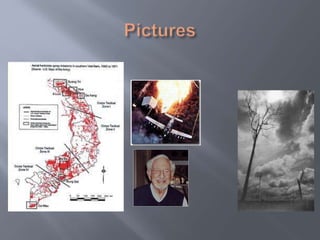
 U.S. planes sprayed some 11-12 million gallons
of it between 1961-1971.
 Agent Orange was the most effective chemical
spray the U.S. Government had ever used.
 Contained Dioxin which even in small doses is
very toxic.
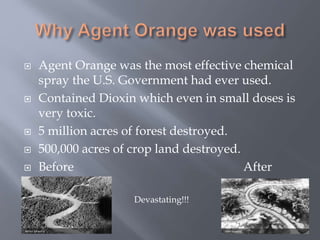
 5 million acres of forest destroyed.
 500,000 acres of crop land destroyed.
 Before After
Devastating!!!
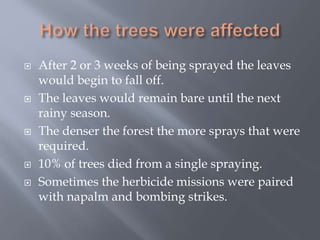
 Arthur Galston created the herbicide in 1943,
trying to help soy beans grow quicker.
 Noticed that it was extremely effective at
defoliation.
 Galston was very concerned about the potential
health effects on humans.
 Was also concerned about ecological damage, it
endangered many shellfish and migratory fish.
 Galston opposed the use of it in war.
 Asserted that Agent Orange harm could continue
for an untold amount of time.
 Used primarily in Operation Ranch Hand
 U.S. troops were told that the spray was used
to kill crops that guerrillas were eating when in
reality it was the peasants who ate the vast
majority of the food.
 Chemicals in the spray frequently ended up in
water and crop supplies.
 The U.S. Air force flew nearly 20,000 missions.
 10% of total land area sprayed at least once.
 20% of forest cover sprayed at least once.
 “Trees are our enemy.”
 Hundreds of tree species were effected.
 Minimum of 20 million cubic meters destroyed
estimates of up to 90 million persist.
 Of the upland forests sprayed, the hardest hit
were the dense forests of Ma Da, Phu Binh, Sa
Thay, A Luoi and along Route 19.
 259,000 acres of mangroves.
 Afterward many invasive species of grass arrived.
 Many species habitat were greatly destroyed.
 Rats and Mice thrived because of the damage.
 After 2 or 3 weeks of being sprayed the leaves
would begin to fall off.
 The leaves would remain bare until the next
rainy season.
 The denser the forest the more sprays that were
required.
 10% of trees died from a single spraying.
 Sometimes the herbicide missions were paired
with napalm and bombing strikes.
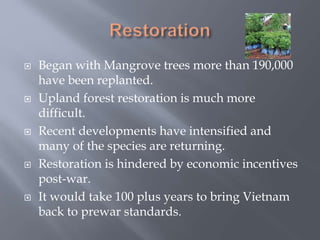
 Began with Mangrove trees more than 190,000
have been replanted.
 Upland forest restoration is much more
difficult.
 Recent developments have intensified and
many of the species are returning.
 Restoration is hindered by economic incentives
post-war.
 It would take 100 plus years to bring Vietnam
back to prewar standards.
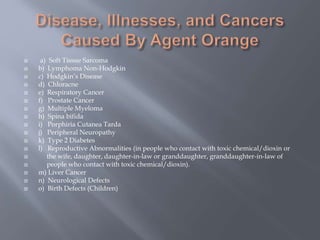
 a) Soft Tissue Sarcoma
 b) Lymphoma Non-Hodgkin
 c) Hodgkin’s Disease
 d) Chloracne
 e) Respiratory Cancer
 f) Prostate Cancer
 g) Multiple Myeloma
 h) Spina bifida
 i) Porphiria Cutanea Tarda
 j) Peripheral Neuropathy
 k) Type 2 Diabetes
 l) Reproductive Abnormalities (in people who contact with toxic chemical/dioxin or
 the wife, daughter, daughter-in-law or granddaughter, granddaughter-in-law of
 people who contact with toxic chemical/dioxin).
 m) Liver Cancer
 n) Neurological Defects
 o) Birth Defects (Children)
 4.5 million of 18 million people who live in
Vietnam were exposed to the sprayings
 Estimates that 3 million Vietnamese were
effected
 150,000 children were born with birth defects in
Vietnam
 The toxin was in the soil and common sense
can describe
 Many American Troops and their offspring
suffered from it
 Since 1978 several law suits have been filed
against Dow Chemical, Monsanto, and
Diamond Shamrock the companies producing
Agent Orange.
 On May 4, 1984 seven chemical companies
agreed to pay 180 million to victims if no other
lawsuits were brought forth.
 The courts continue to fight over rights for the
veterans.
 H.R. 543: Blue Water Navy Vietnam Veterans
Act of 2013.
 Vietnam Association of Victims of Agent
Orange is Vietnamese rights group who filed a
lawsuit citing international law in 2004.
 Agent Orange Act signed into Law in 1991 by
Pres. George. W. Bush.
 U. S.- Vietnam Dialogue Group on Agent
Orange/Dioxin supports $300 million plan of
action in 2007.
 Vietnam Red Cross has raised $22 million for
those who are sick or disabled.
 Shayla Harris, Amatatham, P. “Cleaning Agent Orange,” The
New York Times, 9 Aug. 2012. 4 Dec.
2013.http://www.nytimes.com/2008/06/23
/us/23galston.html?_r=0
 Fred A. Wilcox, Waiting for an Army to Die: The Tragedy of
Agent Orange, AOR Agent Orange Record”
http://www.agentorangerecord.com/information/the_quest_for
_additional_relief/P1/, 2012. 6 Dec 2013.
 http://www.theguardian.com/commentisfree/2008/feb/10/age
ntofsuffering
 Institute of Medicine, “Blue Water Navy Vietnam Veterans and
Agent Orange Exposure,”
http://www.iom.edu/Reports/2011/Blue-Water-Navy-Vietnam-
Veterans-and-Agent-Orange-Exposure.aspx
National Academy of Sciences. 4 Sept. 2013. 5 Dec. 2013
Agent orange and its devastating effects

Agent orange and its devastating effects

  • 1.
    By: Emerson Saum,Jake Buckey, Megan Reilly-Cruz, and Aleethea Tyler
  • 2.
     Agent Orangewas a chemical used by American Troops, during the Vietnam war.  It was named after the orange stripe painted on its’ 55-gallon barrel.  Used to Defoliate the Jungle and Forest that the Southern Vietnam troops used for cover.  Also used to induce forced urbanization draft.  U.S. planes sprayed some 11-12 million gallons of it between 1961-1971.
  • 3.
     Agent Orangewas the most effective chemical spray the U.S. Government had ever used.  Contained Dioxin which even in small doses is very toxic.  5 million acres of forest destroyed.  500,000 acres of crop land destroyed.  Before After Devastating!!!
  • 4.
     Arthur Galstoncreated the herbicide in 1943, trying to help soy beans grow quicker.  Noticed that it was extremely effective at defoliation.  Galston was very concerned about the potential health effects on humans.  Was also concerned about ecological damage, it endangered many shellfish and migratory fish.  Galston opposed the use of it in war.  Asserted that Agent Orange harm could continue for an untold amount of time.
  • 5.
     Used primarilyin Operation Ranch Hand  U.S. troops were told that the spray was used to kill crops that guerrillas were eating when in reality it was the peasants who ate the vast majority of the food.  Chemicals in the spray frequently ended up in water and crop supplies.  The U.S. Air force flew nearly 20,000 missions.  10% of total land area sprayed at least once.  20% of forest cover sprayed at least once.
  • 7.
     “Trees areour enemy.”  Hundreds of tree species were effected.  Minimum of 20 million cubic meters destroyed estimates of up to 90 million persist.  Of the upland forests sprayed, the hardest hit were the dense forests of Ma Da, Phu Binh, Sa Thay, A Luoi and along Route 19.  259,000 acres of mangroves.  Afterward many invasive species of grass arrived.  Many species habitat were greatly destroyed.  Rats and Mice thrived because of the damage.
  • 8.
     After 2or 3 weeks of being sprayed the leaves would begin to fall off.  The leaves would remain bare until the next rainy season.  The denser the forest the more sprays that were required.  10% of trees died from a single spraying.  Sometimes the herbicide missions were paired with napalm and bombing strikes.
  • 10.
     Began withMangrove trees more than 190,000 have been replanted.  Upland forest restoration is much more difficult.  Recent developments have intensified and many of the species are returning.  Restoration is hindered by economic incentives post-war.  It would take 100 plus years to bring Vietnam back to prewar standards.
  • 11.
     a) SoftTissue Sarcoma  b) Lymphoma Non-Hodgkin  c) Hodgkin’s Disease  d) Chloracne  e) Respiratory Cancer  f) Prostate Cancer  g) Multiple Myeloma  h) Spina bifida  i) Porphiria Cutanea Tarda  j) Peripheral Neuropathy  k) Type 2 Diabetes  l) Reproductive Abnormalities (in people who contact with toxic chemical/dioxin or  the wife, daughter, daughter-in-law or granddaughter, granddaughter-in-law of  people who contact with toxic chemical/dioxin).  m) Liver Cancer  n) Neurological Defects  o) Birth Defects (Children)
  • 12.
     4.5 millionof 18 million people who live in Vietnam were exposed to the sprayings  Estimates that 3 million Vietnamese were effected  150,000 children were born with birth defects in Vietnam  The toxin was in the soil and common sense can describe  Many American Troops and their offspring suffered from it
  • 13.
     Since 1978several law suits have been filed against Dow Chemical, Monsanto, and Diamond Shamrock the companies producing Agent Orange.  On May 4, 1984 seven chemical companies agreed to pay 180 million to victims if no other lawsuits were brought forth.  The courts continue to fight over rights for the veterans.  H.R. 543: Blue Water Navy Vietnam Veterans Act of 2013.
  • 14.
     Vietnam Associationof Victims of Agent Orange is Vietnamese rights group who filed a lawsuit citing international law in 2004.  Agent Orange Act signed into Law in 1991 by Pres. George. W. Bush.  U. S.- Vietnam Dialogue Group on Agent Orange/Dioxin supports $300 million plan of action in 2007.  Vietnam Red Cross has raised $22 million for those who are sick or disabled.
  • 15.
     Shayla Harris,Amatatham, P. “Cleaning Agent Orange,” The New York Times, 9 Aug. 2012. 4 Dec. 2013.http://www.nytimes.com/2008/06/23 /us/23galston.html?_r=0  Fred A. Wilcox, Waiting for an Army to Die: The Tragedy of Agent Orange, AOR Agent Orange Record” http://www.agentorangerecord.com/information/the_quest_for _additional_relief/P1/, 2012. 6 Dec 2013.  http://www.theguardian.com/commentisfree/2008/feb/10/age ntofsuffering  Institute of Medicine, “Blue Water Navy Vietnam Veterans and Agent Orange Exposure,” http://www.iom.edu/Reports/2011/Blue-Water-Navy-Vietnam- Veterans-and-Agent-Orange-Exposure.aspx National Academy of Sciences. 4 Sept. 2013. 5 Dec. 2013

Editor's Notes

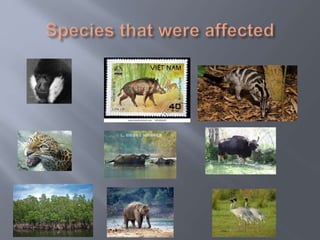
  • #5 Leaves falling off the trees was a common trait of agent orange
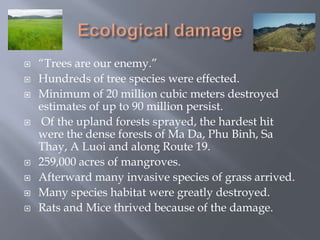
  • #7 Map of where the U.S. sprayed the Agent Orange. Essentially throughout the entire country A picture of the planes deploying Agent Orange Arthur Galston the creator of Agent Orange A tree that has been sprayed and is missing its leaves
  • #8 Quote by American Army commander, from Philip Jones Griffiths,. An example of how the military viewed trees. Not very ecofriendly to say the least. Termed ecological warfare and ecocide invasive species called American grass Top corner on left is Vietnam grass on right is the American grass
  • #9 1. To defoliate the lower portions of the rain forest multiple sprayings were required
  • #10 Left to right top row: White Cheek Gibbons, Wild Boar, Crivets Left to Right middle row: Leopard, Wild Water Buffalo, gaur Left to Right bottom row: mangrove trees, Asian Elephants, Eastern Sarus Cranes
  • #11 Mangrove trees are relatively easy to restore Upland forest ecology requires harvesting the right seeds, replanting soil, making sure there is a layer of shade of trees to grow under, and much more work
  • #12 U.S. Congress distributed more than $40 million to help develop health programs and remediate “hot spots” $6 mil of that money goes to help to those with disabilities from Agent Orange exposure in Da Nang. Vietnam gov, provides. $40 mil, each year. To those affected.
  • #13 1. Anyone who simply traveled through the area could become affected 2. People could become affected by anything that had dioxin in it, such as anything that went through the soil, any fish. 3. Your parents or grandparents exposure could lead to affects
  • #14 Veterans were outraged because it was settle out of court. 2. H.R. 543 The Blue Water Navy Vietnam Veterans Act of 2013 This bill has been before congress before in the effort for it to be passed It it to amend title 38,of the United States Code, to clarify presumptions relating to the exposure of certain veterans who served in the vicinity of the Republic of Vietnam, and for other purposes. Although the Institute of Medicine found several plausible ways by which Blue Water Navy veterans could have been exposed to herbicides, there was not enough information for the IOM to determine whether Blue Water Navy personnel were or were not exposed to Agent Orange.
  • #16  http://www.iom.edu/Reports/2011/Blue-Water-Navy-Vietnam-Veterans-and-Agent-Orange-Exposure.aspx ” http://www.agentorangerecord.com/information/the_quest_for_additional_relief/P1/
  • #17 This is the link for the video that would be good to be shown at the end of the presentation. It is a good summary about everything the paper discussed. http://www.nytimes.com/video/world/asia/100000001713916/cleaning-agent-orange.html?smid=pl-share