A.C.E. Development Project The African Arts ~ ~ Culture ~ ~Entertainment District Presented by  PASS Coach, LLC ™
Purpose of Project Organize the Community coordinating information improve safety and participation facilitate funding for small and large businesses create jobs and opportunities for youth
Structure of Project An Incubator Without Walls nucleus of expertise in politics, management, and technology Community Development small business / entrepreneurs youth development community – business – education – government –industry:  partnerships skills / knowledge research, innovation, and technology transfer marketing and distribution of goods and services
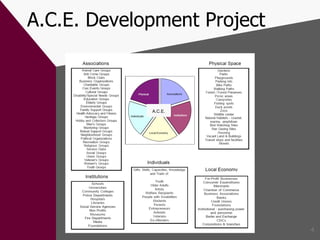
A.C.E. Development Project A.C.E.
Management of Project Crenshaw Chamber of Commerce African Village Leadership Coalition Black Business Association Recycling Black Dollars Community Build AVEDA will assist in formation and direction Other major entities and partners
Services Provided to Owners management real estate marketing and research / publishing and printing / advertising and public relations communications (broadcast media) insurance and leasing image development community age groupings information systems and technology finance (investment and accounting) non-profits and philanthropy
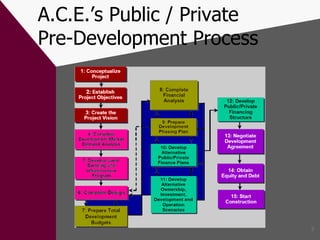
A.C.E.’s Public / Private  Pre-Development Process
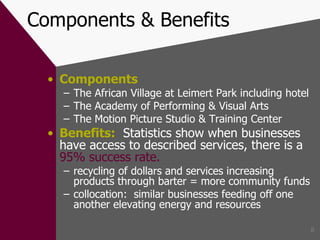
Components & Benefits Components The African Village at Leimert Park including hotel The Academy of Performing & Visual Arts The Motion Picture Studio & Training Center Benefits:   Statistics show when businesses have access to described services, there is a  95% success rate. recycling of dollars and services increasing products through barter = more community funds collocation:  similar businesses feeding off one another elevating energy and resources
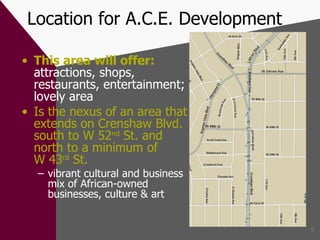
Location for A.C.E. Development This area will offer:   attractions, shops, restaurants, entertainment; lovely area Is the nexus of an area that extends on Crenshaw Blvd. south to W 52 nd  St. and north to a minimum of  W 43 rd  St. vibrant cultural and business mix of African-owned businesses, culture & art
Cultural Tourism Definition *"Travel directed toward experiencing the arts, heritage and special character of a place.“ Cultural Tourists: A Growing Segment of the Travel Market An increasing number of visitors is comprised of special interest travelers who rank the arts, heritage and/or other cultural activities as one of the top five reasons for traveling. *Source:  The White House Conference on Travel and Tourism
Cultural   Tourism Benefits Whether through a visit to a museum, an arts festival, a heritage area, a performance or an historic building, authentic cultural attractions educate, elevate and entertain travelers nationwide. Creative partnerships between the cultural, commercial and public sectors afford communities, states and regions opportunities to create cultural tourism enterprises. These partnerships can further the missions of cultural organizations, expand the travel industry, and offer sustainable economic and social development strategies for areas in need of new business opportunities.
Partners in Tourism Partners in Tourism A coalition of associations and federal agencies, including the National Endowment for the Arts, building a common agenda for cultural tourism. Representing a broad spectrum of arts, humanities and heritage organizations throughout the country, the partners' purpose is to advance the role of culture and heritage in national, state and local travel and tourism.
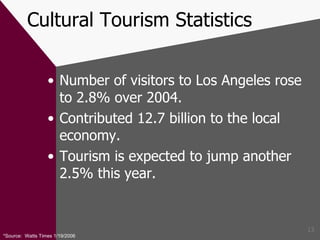
Cultural Tourism Statistics Number of visitors to Los Angeles rose to 2.8% over 2004. Contributed 12.7 billion to the local economy. Tourism is expected to jump another 2.5% this year. *Source:  Watts Times 1/19/2006
Other Similar Efforts: What can we learn? Abyssinian Development Corp. (ADC) ADC recognizes that in order to promote a healthy and balanced community there must be a strong infrastructure including quality services to sustain the area. ADC has worked to strengthen and rebuild the fabric of the community through economic development initiatives that support entrepreneurial activity, develop and promote local businesses, and create jobs for residents. ADC is the proud developer of projects such as Pathmark, which employs over 200 local residents and Harlem Center, a mixed-use development with retail commercial space and an office tower, that has resulted in over 500 jobs for local residents. The International House of Pancakes that will occupy space on the ground floor of the Thurgood Marshall Academy building is a franchise owned by a group of local entrepreneurs who worked with ADC through its Neighborhood Franchise Project.
What can we learn? (cont.) Fulton Street Mall Preservation planning approach, a relatively new method for studying and planning the future of historic places Values-based preservation planning recognizes that places – or spaces made culturally meaningful by use and users – are important to different types of constituents for different reasons.  It takes into consideration that meaning and value change over time: in order to fully understand the meaning of a place, and its potential for the future, one must examine the various ways in which the place is valued by different contemporary constituents. This requires looking at the economy, the built environment, and the culture of a place, as a whole, before determining what should be retained or transformed. And it requires deliberately bringing the voices of Mall users into the conversation.  Over a year’s research and consultation, we found that the Fulton Street Mall is an  important place to many different groups of people who feel a strong stake in its future. Economically, the Mall is thriving.
How Partnerships Work Definition of Public-Private Partnerships  A Public-Private Partnership is a contractual agreement between a public agency (federal, state or local) and a private sector entity. Through this agreement, the skills and assets of each sector (public and private) are shared in delivering a service or facility for the use of the general public. In addition to the sharing of resources, each party shares in the risks and rewards potential in the delivery of the service and/or facility.
How Partnerships Work (cont.) Keys to Successful Public-Private Partnerships political leadership public-sector involvement a well-thought out plan a dedicated income stream open communications with stakeholders selecting the right partner (or partners)
How Partnerships Work (cont.) Reminders for Public Officials It must be a real partnership, with shared burdens and shared rewards for both the public and private participants. There must be real incentives for the private sector or they will not participate.  The public-sector must use its resources effectively and judiciously, focusing on projects where there can be success.  Keep it simple for the private-sector by minimizing the bureaucratic procedures that can cripple a project . Remember that "Land is King"--it provides the public with the opportunity to control the projects . Public-private partnerships are a necessary and important part of the process.
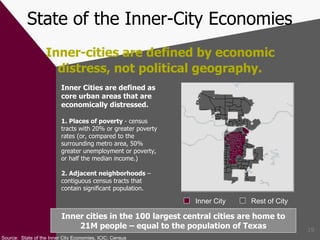
State of the Inner-City Economies Inner-cities are defined by economic distress, not political geography. Inner Cities are defined as core urban areas that are economically distressed.  1. Places of poverty  - census tracts with 20% or greater poverty rates (or, compared to the surrounding metro area, 50% greater unemployment or poverty, or half the median income.) 2. Adjacent neighborhoods  – contiguous census tracts that contain significant population. Inner cities in the 100 largest central cities are home to 21M people – equal to the population of Texas Source:  State of the Inner City Economies, ICIC; Census Inner City Rest of City
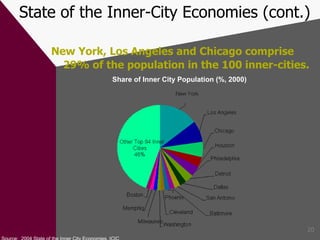
State of the Inner-City Economies (cont.) New York, Los Angeles and Chicago comprise 29% of the population in the 100 inner-cities. Source:  2004  State of the Inner City Economies, ICIC Share of Inner City Population (%, 2000)
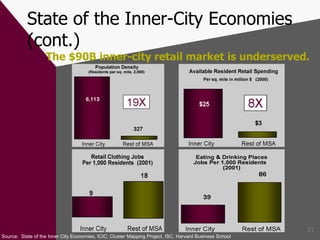
State of the Inner-City Economies (cont.) The $90B inner-city retail market is underserved. Source:  State of the Inner City Economies, ICIC;  Cluster Mapping Project, ISC, Harvard Business School
Project Objectives Understand landscape and pressure points for engagement: who, how, when, where & what? Mapping exercise Best practice case studies Increase awareness by fund officials, money managers, and consultants of best practice in the field . Develop a network Communications strategy
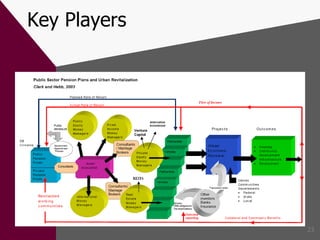
Key Players
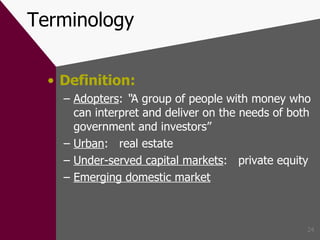
Terminology Definition: Adopters :  “ A group of people with money who can interpret and deliver on the needs of both government and investors” Urban :   real estate Under-served capital markets :   private equity Emerging domestic market
Findings to Date Adopters Those with existing policies and / or programs that have shown activity investing in urban revitalization. Potential Adopters Those that have expressed an interest in urban revitalization policies (often in relation to other existing policies and programs) . Possible Adopters Those that have investments in inner city, but do not identify them within the stated goal of urban revitalization.
The Two Primary Types of P3 Real Estate Projects The public/private finance, design, development, construction and operation of needed public facilities and government sponsored commercial developments. The proactive management of underutilized government-owned real estate assets.
Scope of the U.S. Industry The public/private development of needed public facilities and government sponsored commercial developments is now a $50 to $75 billion per year industry. All levels of government in the U.S. own real estate valued at $5.6 trillion.
Types of Development Government/University/School District Office Buildings Urban Mixed-Use Residential (High-Rise and Garden Apartments) Hotel/Conference Centers and Convention Hotels Airport Facilities (Terminals, Air Cargo and Hotels) University Facilities and Student Housing Technology and Bio-Tech Parks Transit-Oriented Developments (TODs) Sports and Entertainment Facilities
Public Partner(s) in the U.S. Using P3 Approach Federal, State, County and City Government Colleges and Universities Public School Systems Public Authorities Special Purpose Development Corporations Non-Profit Corporations
The Basic Characteristics of U.S. Public Partner(s) Power to Lease Land Ability to Issue Bonds Ability to Leverage Project Generated Tax Revenue Power to Provide Capital and Non-Capital Incentives and Investments Ability to Execute a Development Agreement
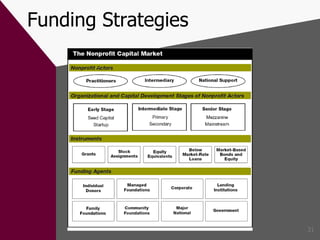
Funding Strategies
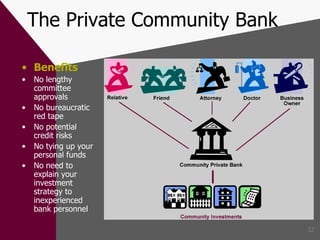
The Private Community Bank Benefits No lengthy committee approvals No bureaucratic red tape No potential credit risks No tying up your personal funds No need to explain your investment strategy to inexperienced bank personnel
Sustainability Definition: “ Development that meets the needs of the present without compromising the ability of future generations to meet  their own needs.” Source:  Brundtland Commission; 1987
Sustainability (cont.) Defining Smart Growth Development or growth that does not compromise the community’s future ability to prosper.
Sustainability at Each Level economic environment social environment physical environment natural environment
Thank You For Attending Omar Bey, Presenter [email_address] AVEDA:  A.C.E. District  Contact Information: B. W. Hall [email_address]

African village LA

  • 1.
    A.C.E. Development ProjectThe African Arts ~ ~ Culture ~ ~Entertainment District Presented by PASS Coach, LLC ™
  • 2.
    Purpose of ProjectOrganize the Community coordinating information improve safety and participation facilitate funding for small and large businesses create jobs and opportunities for youth
  • 3.
    Structure of ProjectAn Incubator Without Walls nucleus of expertise in politics, management, and technology Community Development small business / entrepreneurs youth development community – business – education – government –industry: partnerships skills / knowledge research, innovation, and technology transfer marketing and distribution of goods and services
  • 4.
  • 5.
    Management of ProjectCrenshaw Chamber of Commerce African Village Leadership Coalition Black Business Association Recycling Black Dollars Community Build AVEDA will assist in formation and direction Other major entities and partners
  • 6.
    Services Provided toOwners management real estate marketing and research / publishing and printing / advertising and public relations communications (broadcast media) insurance and leasing image development community age groupings information systems and technology finance (investment and accounting) non-profits and philanthropy
  • 7.
    A.C.E.’s Public /Private Pre-Development Process
  • 8.
    Components & BenefitsComponents The African Village at Leimert Park including hotel The Academy of Performing & Visual Arts The Motion Picture Studio & Training Center Benefits: Statistics show when businesses have access to described services, there is a 95% success rate. recycling of dollars and services increasing products through barter = more community funds collocation: similar businesses feeding off one another elevating energy and resources
  • 9.
    Location for A.C.E.Development This area will offer: attractions, shops, restaurants, entertainment; lovely area Is the nexus of an area that extends on Crenshaw Blvd. south to W 52 nd St. and north to a minimum of W 43 rd St. vibrant cultural and business mix of African-owned businesses, culture & art
  • 10.
    Cultural Tourism Definition*"Travel directed toward experiencing the arts, heritage and special character of a place.“ Cultural Tourists: A Growing Segment of the Travel Market An increasing number of visitors is comprised of special interest travelers who rank the arts, heritage and/or other cultural activities as one of the top five reasons for traveling. *Source: The White House Conference on Travel and Tourism
  • 11.
    Cultural Tourism Benefits Whether through a visit to a museum, an arts festival, a heritage area, a performance or an historic building, authentic cultural attractions educate, elevate and entertain travelers nationwide. Creative partnerships between the cultural, commercial and public sectors afford communities, states and regions opportunities to create cultural tourism enterprises. These partnerships can further the missions of cultural organizations, expand the travel industry, and offer sustainable economic and social development strategies for areas in need of new business opportunities.
  • 12.
    Partners in TourismPartners in Tourism A coalition of associations and federal agencies, including the National Endowment for the Arts, building a common agenda for cultural tourism. Representing a broad spectrum of arts, humanities and heritage organizations throughout the country, the partners' purpose is to advance the role of culture and heritage in national, state and local travel and tourism.
  • 13.
    Cultural Tourism StatisticsNumber of visitors to Los Angeles rose to 2.8% over 2004. Contributed 12.7 billion to the local economy. Tourism is expected to jump another 2.5% this year. *Source: Watts Times 1/19/2006
  • 14.
    Other Similar Efforts:What can we learn? Abyssinian Development Corp. (ADC) ADC recognizes that in order to promote a healthy and balanced community there must be a strong infrastructure including quality services to sustain the area. ADC has worked to strengthen and rebuild the fabric of the community through economic development initiatives that support entrepreneurial activity, develop and promote local businesses, and create jobs for residents. ADC is the proud developer of projects such as Pathmark, which employs over 200 local residents and Harlem Center, a mixed-use development with retail commercial space and an office tower, that has resulted in over 500 jobs for local residents. The International House of Pancakes that will occupy space on the ground floor of the Thurgood Marshall Academy building is a franchise owned by a group of local entrepreneurs who worked with ADC through its Neighborhood Franchise Project.
  • 15.
    What can welearn? (cont.) Fulton Street Mall Preservation planning approach, a relatively new method for studying and planning the future of historic places Values-based preservation planning recognizes that places – or spaces made culturally meaningful by use and users – are important to different types of constituents for different reasons. It takes into consideration that meaning and value change over time: in order to fully understand the meaning of a place, and its potential for the future, one must examine the various ways in which the place is valued by different contemporary constituents. This requires looking at the economy, the built environment, and the culture of a place, as a whole, before determining what should be retained or transformed. And it requires deliberately bringing the voices of Mall users into the conversation. Over a year’s research and consultation, we found that the Fulton Street Mall is an important place to many different groups of people who feel a strong stake in its future. Economically, the Mall is thriving.
  • 16.
    How Partnerships WorkDefinition of Public-Private Partnerships A Public-Private Partnership is a contractual agreement between a public agency (federal, state or local) and a private sector entity. Through this agreement, the skills and assets of each sector (public and private) are shared in delivering a service or facility for the use of the general public. In addition to the sharing of resources, each party shares in the risks and rewards potential in the delivery of the service and/or facility.
  • 17.
    How Partnerships Work(cont.) Keys to Successful Public-Private Partnerships political leadership public-sector involvement a well-thought out plan a dedicated income stream open communications with stakeholders selecting the right partner (or partners)
  • 18.
    How Partnerships Work(cont.) Reminders for Public Officials It must be a real partnership, with shared burdens and shared rewards for both the public and private participants. There must be real incentives for the private sector or they will not participate. The public-sector must use its resources effectively and judiciously, focusing on projects where there can be success. Keep it simple for the private-sector by minimizing the bureaucratic procedures that can cripple a project . Remember that "Land is King"--it provides the public with the opportunity to control the projects . Public-private partnerships are a necessary and important part of the process.
  • 19.
    State of theInner-City Economies Inner-cities are defined by economic distress, not political geography. Inner Cities are defined as core urban areas that are economically distressed. 1. Places of poverty - census tracts with 20% or greater poverty rates (or, compared to the surrounding metro area, 50% greater unemployment or poverty, or half the median income.) 2. Adjacent neighborhoods – contiguous census tracts that contain significant population. Inner cities in the 100 largest central cities are home to 21M people – equal to the population of Texas Source: State of the Inner City Economies, ICIC; Census Inner City Rest of City
  • 20.
    State of theInner-City Economies (cont.) New York, Los Angeles and Chicago comprise 29% of the population in the 100 inner-cities. Source: 2004 State of the Inner City Economies, ICIC Share of Inner City Population (%, 2000)
  • 21.
    State of theInner-City Economies (cont.) The $90B inner-city retail market is underserved. Source: State of the Inner City Economies, ICIC; Cluster Mapping Project, ISC, Harvard Business School
  • 22.
    Project Objectives Understandlandscape and pressure points for engagement: who, how, when, where & what? Mapping exercise Best practice case studies Increase awareness by fund officials, money managers, and consultants of best practice in the field . Develop a network Communications strategy
  • 23.
  • 24.
    Terminology Definition: Adopters: “ A group of people with money who can interpret and deliver on the needs of both government and investors” Urban : real estate Under-served capital markets : private equity Emerging domestic market
  • 25.
    Findings to DateAdopters Those with existing policies and / or programs that have shown activity investing in urban revitalization. Potential Adopters Those that have expressed an interest in urban revitalization policies (often in relation to other existing policies and programs) . Possible Adopters Those that have investments in inner city, but do not identify them within the stated goal of urban revitalization.
  • 26.
    The Two PrimaryTypes of P3 Real Estate Projects The public/private finance, design, development, construction and operation of needed public facilities and government sponsored commercial developments. The proactive management of underutilized government-owned real estate assets.
  • 27.
    Scope of theU.S. Industry The public/private development of needed public facilities and government sponsored commercial developments is now a $50 to $75 billion per year industry. All levels of government in the U.S. own real estate valued at $5.6 trillion.
  • 28.
    Types of DevelopmentGovernment/University/School District Office Buildings Urban Mixed-Use Residential (High-Rise and Garden Apartments) Hotel/Conference Centers and Convention Hotels Airport Facilities (Terminals, Air Cargo and Hotels) University Facilities and Student Housing Technology and Bio-Tech Parks Transit-Oriented Developments (TODs) Sports and Entertainment Facilities
  • 29.
    Public Partner(s) inthe U.S. Using P3 Approach Federal, State, County and City Government Colleges and Universities Public School Systems Public Authorities Special Purpose Development Corporations Non-Profit Corporations
  • 30.
    The Basic Characteristicsof U.S. Public Partner(s) Power to Lease Land Ability to Issue Bonds Ability to Leverage Project Generated Tax Revenue Power to Provide Capital and Non-Capital Incentives and Investments Ability to Execute a Development Agreement
  • 31.
  • 32.
    The Private CommunityBank Benefits No lengthy committee approvals No bureaucratic red tape No potential credit risks No tying up your personal funds No need to explain your investment strategy to inexperienced bank personnel
  • 33.
    Sustainability Definition: “Development that meets the needs of the present without compromising the ability of future generations to meet their own needs.” Source: Brundtland Commission; 1987
  • 34.
    Sustainability (cont.) DefiningSmart Growth Development or growth that does not compromise the community’s future ability to prosper.
  • 35.
    Sustainability at EachLevel economic environment social environment physical environment natural environment
  • 36.
    Thank You ForAttending Omar Bey, Presenter [email_address] AVEDA: A.C.E. District Contact Information: B. W. Hall [email_address]