Advanced JavaScript Techniques
@hoatle – eXo Platform
Agenda

OOP (Object Oriented Programming)

Scope

Closure

Context (this, arguments...)
OOP

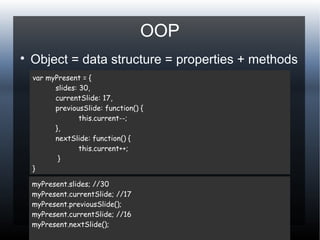
Object = data structure = properties + methods
var myPresent = {
slides: 30,
currentSlide: 17,
previousSlide: function() {
this.current--;
},
nextSlide: function() {
this.current++;
}
}
myPresent.slides; //30
myPresent.currentSlide; //17
myPresent.previousSlide();
myPresent.currentSlide; //16
myPresent.nextSlide();
OOP
3 primary goals of oop:

Encapsulation

Polymorphism

Inheritance
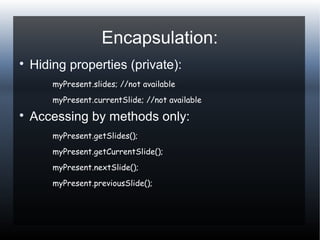
Encapsulation:

Hiding properties (private):
myPresent.slides; //not available
myPresent.currentSlide; //not available

Accessing by methods only:
myPresent.getSlides();
myPresent.getCurrentSlide();
myPresent.nextSlide();
myPresent.previousSlide();
Polymorphism
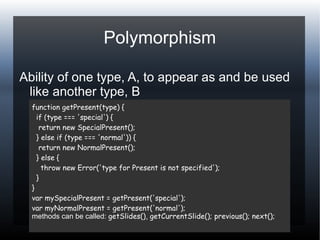
Ability of one type, A, to appear as and be used
like another type, B
function getPresent(type) {
if (type === 'special') {
return new SpecialPresent();
} else if (type === 'normal')) {
return new NormalPresent();
} else {
throw new Error('type for Present is not specified');
}
}
var mySpecialPresent = getPresent('special');
var myNormalPresent = getPresent('normal');
methods can be called: getSlides(), getCurrentSlide(); previous(); next();
Inheritance
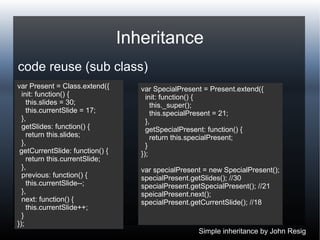
code reuse (sub class)
var Present = Class.extend({
init: function() {
this.slides = 30;
this.currentSlide = 17;
},
getSlides: function() {
return this.slides;
},
getCurrentSlide: function() {
return this.currentSlide;
},
previous: function() {
this.currentSlide--;
},
next: function() {
this.currentSlide++;
}
});
var SpecialPresent = Present.extend({
init: function() {
this._super();
this.specialPresent = 21;
},
getSpecialPresent: function() {
return this.specialPresent;
}
});
var specialPresent = new SpecialPresent();
specialPresent.getSlides(); //30
specialPresent.getSpecialPresent(); //21
speicalPresent.next();
specialPresent.getCurrentSlide(); //18
Simple inheritance by John Resig
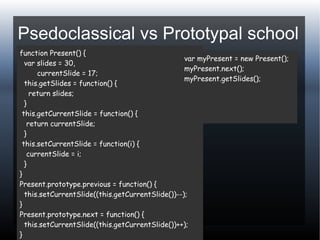
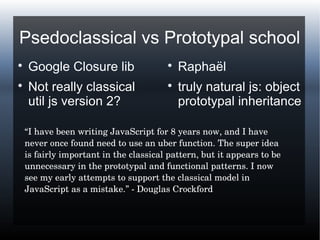
Psedoclassical vs Prototypal school
function Present() {
var slides = 30,
currentSlide = 17;
this.getSlides = function() {
return slides;
}
this.getCurrentSlide = function() {
return currentSlide;
}
this.setCurrentSlide = function(i) {
currentSlide = i;
}
}
Present.prototype.previous = function() {
this.setCurrentSlide((this.getCurrentSlide())--);
}
Present.prototype.next = function() {
this.setCurrentSlide((this.getCurrentSlide())++);
}
var myPresent = new Present();
myPresent.next();
myPresent.getSlides();
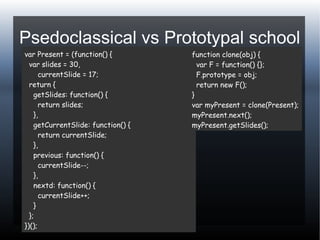
Psedoclassical vs Prototypal school
var Present = (function() {
var slides = 30,
currentSlide = 17;
return {
getSlides: function() {
return slides;
},
getCurrentSlide: function() {
return currentSlide;
},
previous: function() {
currentSlide--;
},
nextd: function() {
currentSlide++;
}
};
})();
function clone(obj) {
var F = function() {};
F.prototype = obj;
return new F();
}
var myPresent = clone(Present);
myPresent.next();
myPresent.getSlides();
Psedoclassical vs Prototypal school

Google Closure lib

Not really classical
util js version 2?

Raphaël

truly natural js: object
prototypal inheritance
“I have been writing JavaScript for 8 years now, and I have 
never once found need to use an uber function. The super idea 
is fairly important in the classical pattern, but it appears to be 
unnecessary in the prototypal and functional patterns. I now 
see my early attempts to support the classical model in 
JavaScript as a mistake.” ­ Douglas Crockford
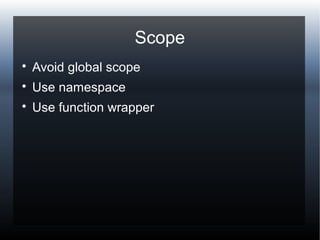
Scope

Avoid global scope

Use namespace

Use function wrapper
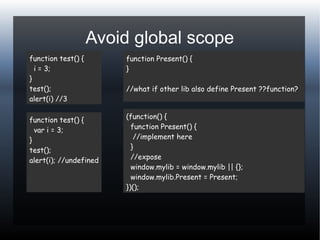
Avoid global scope
function test() {
i = 3;
}
test();
alert(i) //3
function test() {
var i = 3;
}
test();
alert(i); //undefined
function Present() {
}
//what if other lib also define Present ??function?
(function() {
function Present() {
//implement here
}
//expose
window.mylib = window.mylib || {};
window.mylib.Present = Present;
})();
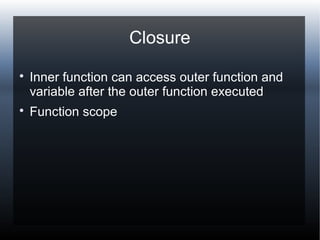
Closure

Inner function can access outer function and
variable after the outer function executed

Function scope
Context

this

arguments
Thanks for your attention!
Questions?

Advanced Javascript Techniques

  • 1.
  • 2.
    Agenda  OOP (Object OrientedProgramming)  Scope  Closure  Context (this, arguments...)
  • 3.
    OOP  Object = datastructure = properties + methods var myPresent = { slides: 30, currentSlide: 17, previousSlide: function() { this.current--; }, nextSlide: function() { this.current++; } } myPresent.slides; //30 myPresent.currentSlide; //17 myPresent.previousSlide(); myPresent.currentSlide; //16 myPresent.nextSlide();
  • 4.
    OOP 3 primary goalsof oop:  Encapsulation  Polymorphism  Inheritance
  • 5.
    Encapsulation:  Hiding properties (private): myPresent.slides;//not available myPresent.currentSlide; //not available  Accessing by methods only: myPresent.getSlides(); myPresent.getCurrentSlide(); myPresent.nextSlide(); myPresent.previousSlide();
  • 6.
    Polymorphism Ability of onetype, A, to appear as and be used like another type, B function getPresent(type) { if (type === 'special') { return new SpecialPresent(); } else if (type === 'normal')) { return new NormalPresent(); } else { throw new Error('type for Present is not specified'); } } var mySpecialPresent = getPresent('special'); var myNormalPresent = getPresent('normal'); methods can be called: getSlides(), getCurrentSlide(); previous(); next();
  • 7.
    Inheritance code reuse (subclass) var Present = Class.extend({ init: function() { this.slides = 30; this.currentSlide = 17; }, getSlides: function() { return this.slides; }, getCurrentSlide: function() { return this.currentSlide; }, previous: function() { this.currentSlide--; }, next: function() { this.currentSlide++; } }); var SpecialPresent = Present.extend({ init: function() { this._super(); this.specialPresent = 21; }, getSpecialPresent: function() { return this.specialPresent; } }); var specialPresent = new SpecialPresent(); specialPresent.getSlides(); //30 specialPresent.getSpecialPresent(); //21 speicalPresent.next(); specialPresent.getCurrentSlide(); //18 Simple inheritance by John Resig
  • 8.
    Psedoclassical vs Prototypalschool function Present() { var slides = 30, currentSlide = 17; this.getSlides = function() { return slides; } this.getCurrentSlide = function() { return currentSlide; } this.setCurrentSlide = function(i) { currentSlide = i; } } Present.prototype.previous = function() { this.setCurrentSlide((this.getCurrentSlide())--); } Present.prototype.next = function() { this.setCurrentSlide((this.getCurrentSlide())++); } var myPresent = new Present(); myPresent.next(); myPresent.getSlides();
  • 9.
    Psedoclassical vs Prototypalschool var Present = (function() { var slides = 30, currentSlide = 17; return { getSlides: function() { return slides; }, getCurrentSlide: function() { return currentSlide; }, previous: function() { currentSlide--; }, nextd: function() { currentSlide++; } }; })(); function clone(obj) { var F = function() {}; F.prototype = obj; return new F(); } var myPresent = clone(Present); myPresent.next(); myPresent.getSlides();
  • 10.
    Psedoclassical vs Prototypalschool  Google Closure lib  Not really classical util js version 2?  Raphaël  truly natural js: object prototypal inheritance “I have been writing JavaScript for 8 years now, and I have  never once found need to use an uber function. The super idea  is fairly important in the classical pattern, but it appears to be  unnecessary in the prototypal and functional patterns. I now  see my early attempts to support the classical model in  JavaScript as a mistake.” ­ Douglas Crockford
  • 11.
    Scope  Avoid global scope  Usenamespace  Use function wrapper
  • 12.
    Avoid global scope functiontest() { i = 3; } test(); alert(i) //3 function test() { var i = 3; } test(); alert(i); //undefined function Present() { } //what if other lib also define Present ??function? (function() { function Present() { //implement here } //expose window.mylib = window.mylib || {}; window.mylib.Present = Present; })();
  • 13.
    Closure  Inner function canaccess outer function and variable after the outer function executed  Function scope
  • 14.
  • 15.
    Thanks for yourattention! Questions?