S E N T E N C E E L E M E N T S
ADVANCED GRAMMAR
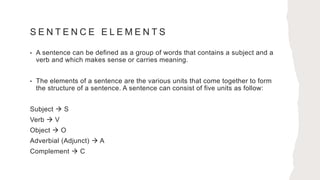
S E N T E N C E E L E M E N T S
‱ A sentence can be defined as a group of words that contains a subject and a
verb and which makes sense or carries meaning.
‱ The elements of a sentence are the various units that come together to form
the structure of a sentence. A sentence can consist of five units as follow:
Subject  S
Verb  V
Object  O
Adverbial (Adjunct)  A
Complement  C
S U B J E C T
‱ Subject is a word or group of words which tells who/what the sentence is about
or what/who does the action.
‱ The subject could be considered as simple, compound, or complete subject.
Simple subjects
The simple subject is the main word(s) in the complete subject; for examples,
‱ A boy is playing with his mother.
Compound subjects
A compound subject contains two or more subjects that have the same verb. The
simple subjects in a compound subject are usually joined by 'and' or 'or'; for
examples,
‱ A boy and his mother are in the house.
Complete subjects
The complete subject includes all the words that tell who or what the sentence is
about; for examples,
‱ A lovely boy is playing with his mother.
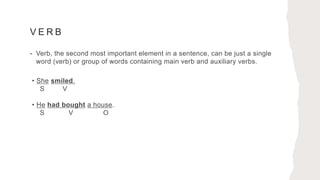
V E R B
‱ Verb, the second most important element in a sentence, can be just a single
word (verb) or group of words containing main verb and auxiliary verbs.
‱ She smiled.
S V
‱ He had bought a house.
S V O
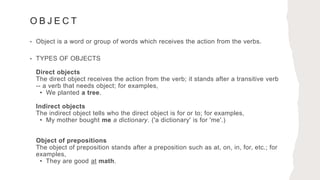
O B J E C T
‱ Object is a word or group of words which receives the action from the verbs.
‱ TYPES OF OBJECTS
Direct objects
The direct object receives the action from the verb; it stands after a transitive verb
-- a verb that needs object; for examples,
‱ We planted a tree.
Indirect objects
The indirect object tells who the direct object is for or to; for examples,
‱ My mother bought me a dictionary. ('a dictionary' is for 'me'.)
Object of prepositions
The object of preposition stands after a preposition such as at, on, in, for, etc.; for
examples,
‱ They are good at math.
A D V E R B I A L
‱ Adverbial is a word or group of words which is used as an adverb in a sentence.
‱ What can be an adverbial?
[1] An adverb
‱ I get up early.
‱ He drives carefully.
[2] An adverb phrase
‱ They work very hard.
‱ She came a bit late.
[3] A prepositional phrase used as an adverb
‱ They are at a hotel.
‱ I’m going to the bank.
‱ We will talk after lunch time.
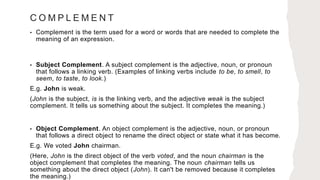
C O M P L E M E N T
‱ Complement is the term used for a word or words that are needed to complete the
meaning of an expression.
‱ Subject Complement. A subject complement is the adjective, noun, or pronoun
that follows a linking verb. (Examples of linking verbs include to be, to smell, to
seem, to taste, to look.)
E.g. John is weak.
(John is the subject, is is the linking verb, and the adjective weak is the subject
complement. It tells us something about the subject. It completes the meaning.)
‱ Object Complement. An object complement is the adjective, noun, or pronoun
that follows a direct object to rename the direct object or state what it has become.
E.g. We voted John chairman.
(Here, John is the direct object of the verb voted, and the noun chairman is the
object complement that completes the meaning. The noun chairman tells us
something about the direct object (John). It can't be removed because it completes
the meaning.)
G I V E T H E E L E M E N T S O F T H E
S E N T E N C E S !
1. The wall collapsed
2. During the war, many people lost their homes
3. I promised the children a trip to the zoo
4. When he was 12, David moved to London
5. Paul hired a bicycle

ADVANCED GRAMMAR 6 - SENTENCES ELEMENTS.pptx

  • 1.
    S E NT E N C E E L E M E N T S ADVANCED GRAMMAR
  • 2.
    S E NT E N C E E L E M E N T S ‱ A sentence can be defined as a group of words that contains a subject and a verb and which makes sense or carries meaning. ‱ The elements of a sentence are the various units that come together to form the structure of a sentence. A sentence can consist of five units as follow: Subject  S Verb  V Object  O Adverbial (Adjunct)  A Complement  C
  • 3.
    S U BJ E C T ‱ Subject is a word or group of words which tells who/what the sentence is about or what/who does the action. ‱ The subject could be considered as simple, compound, or complete subject. Simple subjects The simple subject is the main word(s) in the complete subject; for examples, ‱ A boy is playing with his mother. Compound subjects A compound subject contains two or more subjects that have the same verb. The simple subjects in a compound subject are usually joined by 'and' or 'or'; for examples, ‱ A boy and his mother are in the house. Complete subjects The complete subject includes all the words that tell who or what the sentence is about; for examples, ‱ A lovely boy is playing with his mother.
  • 4.
    V E RB ‱ Verb, the second most important element in a sentence, can be just a single word (verb) or group of words containing main verb and auxiliary verbs. ‱ She smiled. S V ‱ He had bought a house. S V O
  • 5.
    O B JE C T ‱ Object is a word or group of words which receives the action from the verbs. ‱ TYPES OF OBJECTS Direct objects The direct object receives the action from the verb; it stands after a transitive verb -- a verb that needs object; for examples, ‱ We planted a tree. Indirect objects The indirect object tells who the direct object is for or to; for examples, ‱ My mother bought me a dictionary. ('a dictionary' is for 'me'.) Object of prepositions The object of preposition stands after a preposition such as at, on, in, for, etc.; for examples, ‱ They are good at math.
  • 6.
    A D VE R B I A L ‱ Adverbial is a word or group of words which is used as an adverb in a sentence. ‱ What can be an adverbial? [1] An adverb ‱ I get up early. ‱ He drives carefully. [2] An adverb phrase ‱ They work very hard. ‱ She came a bit late. [3] A prepositional phrase used as an adverb ‱ They are at a hotel. ‱ I’m going to the bank. ‱ We will talk after lunch time.
  • 7.
    C O MP L E M E N T ‱ Complement is the term used for a word or words that are needed to complete the meaning of an expression. ‱ Subject Complement. A subject complement is the adjective, noun, or pronoun that follows a linking verb. (Examples of linking verbs include to be, to smell, to seem, to taste, to look.) E.g. John is weak. (John is the subject, is is the linking verb, and the adjective weak is the subject complement. It tells us something about the subject. It completes the meaning.) ‱ Object Complement. An object complement is the adjective, noun, or pronoun that follows a direct object to rename the direct object or state what it has become. E.g. We voted John chairman. (Here, John is the direct object of the verb voted, and the noun chairman is the object complement that completes the meaning. The noun chairman tells us something about the direct object (John). It can't be removed because it completes the meaning.)
  • 8.
    G I VE T H E E L E M E N T S O F T H E S E N T E N C E S ! 1. The wall collapsed 2. During the war, many people lost their homes 3. I promised the children a trip to the zoo 4. When he was 12, David moved to London 5. Paul hired a bicycle