Advanced Encryption Standard
(AES)
AES
●
●
AES is an encryption standard chosen by the
National Institute of Standards and
Technology(NIST), USA to protect classified
information. It has been accepted world wide as
a desirable algorithm to encrypt sensitive data.
It is a block cipher which operates on block size
of 128 bits for both encrypting as well as
decrypting.
Why AES?
●
●
●
●
●
In 1997 the cracking of DES algorithm became possible.
AES was a long term solution to replace DES
NIST started searching for new feasible algorithm and
proposed its requirement in 1997.
In 2001 Rijndael algorithm designed by Rijment and
Daemon of Belgium was declared as the winner of the
competition.
It met all Security, Cost and Implementation criteria.
How Does it works?
●
AES basically repeats 4 major functions to encrypt
data.It takes 128 bit block of data and a key and
gives a ciphertext as output.The functions are:
I. Sub Bytes
II.Shift Rows
III.Mix Columns
IV.Add Key
How Does it works?
●
●
The number of rounds performed by the algorithm strictly depends on
the size of key.
The following table gives overview of no. Of rounds performed with
the input of varying key lengths:
Key S ize(in bits) Rounds
128.................................................10
192.................................................12
256.................................................14
The larger the number of keys the more secure will be the data.
The time taken by s/w to encrypt will increase with no. of rounds.
How Does it works?
D
E
m(128bits)
m(128bits)
k k
E(m,k) D(n,k)
n(128bits) n(128bits)
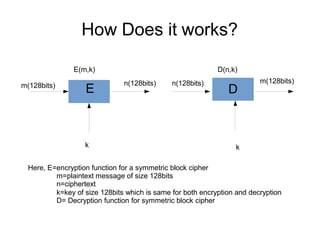
Here, E=encryption function for a symmetric block cipher
m=plaintext message of size 128bits
n=ciphertext
k=key of size 128bits which is same for both encryption and decryption
D= Decryption function for symmetric block cipher
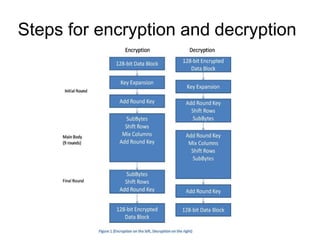
Steps for encryption and decryption
Analysis of Steps
●
●
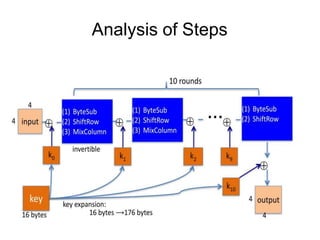
KeyExpansions- In the key Expansion process the given 128
bits cipher key is stored in [4]x[4] bytes matrix (16*8=128 bits)
and then the four column words of the key matrix is expanded
into a schedule of 44 words (44*4=176) resulting in 11 round
keys (176/11=16 bytes or 128 bits).
Number of round keys = Nr + 1. Where Nr is the number of
rounds (which is 10 in case of 128 bits key size) So here the
round keys = 11.
Analysis of Steps
Analysis of Steps
●
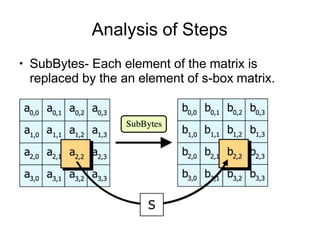
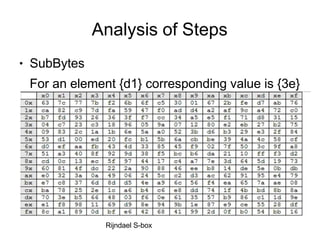
SubBytes- Each element of the matrix is
replaced by the an element of s-box matrix.
Analysis of Steps
● SubBytes
For an element {d1} corresponding value is {3e}
Rijndael S-box
Analysis of Steps
●
●
●
●
●
SubBytes
The S-box is a special lookup table which is
constructed by Galois fields.
The Generating function used in this algorithm
is GF(2^8)
i.e. 256 values are possible
The elements of the sbox are written in
hexadecimal system
Analysis of Steps
●
●
●
Shift Rows
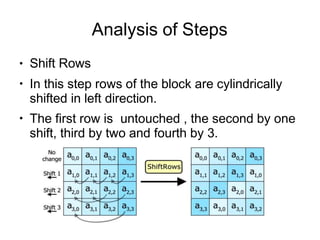
In this step rows of the block are cylindrically
shifted in left direction.
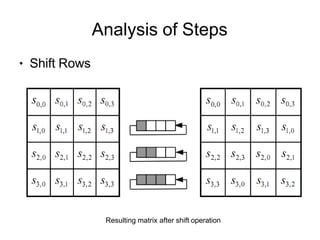
The first row is untouched , the second by one
shift, third by two and fourth by 3.
Analysis of Steps
● Shift Rows
Resulting matrix after shift operation
Analysis of Steps
●
●
●
●
●
●
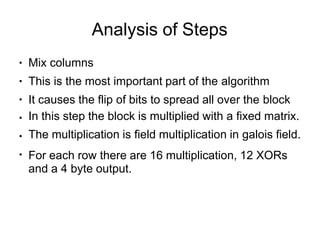
Mix columns
This is the most important part of the algorithm
It causes the flip of bits to spread all over the block
In this step the block is multiplied with a fixed matrix.
The multiplication is field multiplication in galois field.
For each row there are 16 multiplication, 12 XORs
and a 4 byte output.
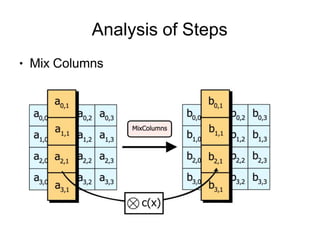
Analysis of Steps
● Mix Columns
Analysis of Steps
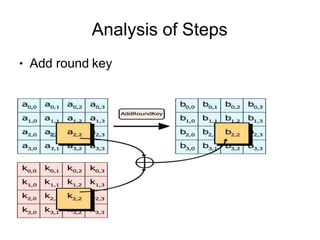
● Add round key
Analysis of Steps
●
●
●
●
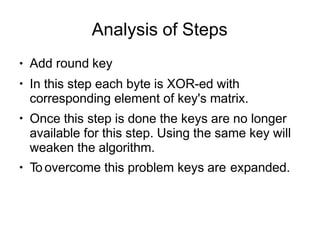
Add round key
In this step each byte is XOR-ed with
corresponding element of key's matrix.
Once this step is done the keys are no longer
available for this step. Using the same key will
weaken the algorithm.
To overcome this problem keys are expanded.
Analysis of Steps
●
●
In the last round the mix column step is
skipped.
It is not documented anywhere why this is done
but recently a paper was published against this
method highlighting the weakening of cipher
text.
Attacks
Find Yourself

Advance Encryption Standard (A-E-S).pptx

  • 1.
  • 2.
    AES ● ● AES is anencryption standard chosen by the National Institute of Standards and Technology(NIST), USA to protect classified information. It has been accepted world wide as a desirable algorithm to encrypt sensitive data. It is a block cipher which operates on block size of 128 bits for both encrypting as well as decrypting.
  • 3.
    Why AES? ● ● ● ● ● In 1997the cracking of DES algorithm became possible. AES was a long term solution to replace DES NIST started searching for new feasible algorithm and proposed its requirement in 1997. In 2001 Rijndael algorithm designed by Rijment and Daemon of Belgium was declared as the winner of the competition. It met all Security, Cost and Implementation criteria.
  • 4.
    How Does itworks? ● AES basically repeats 4 major functions to encrypt data.It takes 128 bit block of data and a key and gives a ciphertext as output.The functions are: I. Sub Bytes II.Shift Rows III.Mix Columns IV.Add Key
  • 5.
    How Does itworks? ● ● The number of rounds performed by the algorithm strictly depends on the size of key. The following table gives overview of no. Of rounds performed with the input of varying key lengths: Key S ize(in bits) Rounds 128.................................................10 192.................................................12 256.................................................14 The larger the number of keys the more secure will be the data. The time taken by s/w to encrypt will increase with no. of rounds.
  • 6.
    How Does itworks? D E m(128bits) m(128bits) k k E(m,k) D(n,k) n(128bits) n(128bits) Here, E=encryption function for a symmetric block cipher m=plaintext message of size 128bits n=ciphertext k=key of size 128bits which is same for both encryption and decryption D= Decryption function for symmetric block cipher
  • 7.
    Steps for encryptionand decryption
  • 8.
    Analysis of Steps ● ● KeyExpansions-In the key Expansion process the given 128 bits cipher key is stored in [4]x[4] bytes matrix (16*8=128 bits) and then the four column words of the key matrix is expanded into a schedule of 44 words (44*4=176) resulting in 11 round keys (176/11=16 bytes or 128 bits). Number of round keys = Nr + 1. Where Nr is the number of rounds (which is 10 in case of 128 bits key size) So here the round keys = 11.
  • 9.
  • 10.
    Analysis of Steps ● SubBytes-Each element of the matrix is replaced by the an element of s-box matrix.
  • 11.
    Analysis of Steps ●SubBytes For an element {d1} corresponding value is {3e} Rijndael S-box
  • 12.
    Analysis of Steps ● ● ● ● ● SubBytes TheS-box is a special lookup table which is constructed by Galois fields. The Generating function used in this algorithm is GF(2^8) i.e. 256 values are possible The elements of the sbox are written in hexadecimal system
  • 13.
    Analysis of Steps ● ● ● ShiftRows In this step rows of the block are cylindrically shifted in left direction. The first row is untouched , the second by one shift, third by two and fourth by 3.
  • 14.
    Analysis of Steps ●Shift Rows Resulting matrix after shift operation
  • 15.
    Analysis of Steps ● ● ● ● ● ● Mixcolumns This is the most important part of the algorithm It causes the flip of bits to spread all over the block In this step the block is multiplied with a fixed matrix. The multiplication is field multiplication in galois field. For each row there are 16 multiplication, 12 XORs and a 4 byte output.
  • 16.
  • 17.
    Analysis of Steps ●Add round key
  • 18.
    Analysis of Steps ● ● ● ● Addround key In this step each byte is XOR-ed with corresponding element of key's matrix. Once this step is done the keys are no longer available for this step. Using the same key will weaken the algorithm. To overcome this problem keys are expanded.
  • 19.
    Analysis of Steps ● ● Inthe last round the mix column step is skipped. It is not documented anywhere why this is done but recently a paper was published against this method highlighting the weakening of cipher text.
  • 20.