ADVANCE AUDITING
Introduction
An overview of Auditing
• The term audit is derived from the Latin term
‘audire,’ which means to hear.
• In early days an auditor used to listen to the
accounts read over by an accountant in order to
check them.
• The original objective of auditing was to detect
and prevent errors and frauds.
• With the increase in the size of the companies
and the volume of transactions the main
objective of audit shifted to ascertaining whether
the accounts were true and fair rather than true
and correct.
• Developments have led to further enlargement
in the scope of the term ‘audit’.
Definition
According to General Guidelines on Internal Auditing
issued by the Institute of Charted Accountants of India:
“Auditing is a systematic and independent examination of
data, statements, records, operations and performance
(financial or otherwise) of an enterprises for a stated
purpose. In any auditing situation, the auditor perceives
and recognizes the propositions before him for
examination, collects evidence, evaluates the same and on
this basis formulates his judgement which is communicated
through his audit report.”
Key phrases
• Systematic : An Audit should be carefully planned.
• Independent : The Auditor should not be susceptible to
any influence or pressure from client or anybody else.
• Data, statements, records, operations and performance :
Indicates the scope of Audit.
• Slated Purpose : Clearly Defined.
Key phrases contd..
• Perceives and recognizes the propositions before him for
examination, collects evidence : Have a clear idea about
propositions he is examining.
• Collects Evidence : Collect relevant evidence depending
upon the proposition he needs to examine.
• Evaluates Evidence : Evaluate it on the basis of his
professional knowledge and skill.
• Formulates judgement/ opinions : Communicated
through Audit Report.
Features of Auditing
• Systematic and scientific examination of the books of
accounts of a business.
• Audit is undertaken by an independent person or body of
persons who are duly qualified for the job.
• Verification of the results shown by the profit and loss
account and the state of affairs as shown by the balance
sheet.
• done with the help of vouchers, documents, information
and explanations received from the authorities
• The auditor has to satisfy himself with the authenticity of
the financial statements and report that they exhibit a
true and fair view of the state of affairs of the concern.
• The auditor has to inspect, compare, check, review,
scrutinize the vouchers supporting the transactions and
examine correspondence, minute books of share holders,
directors, Memorandum of Association and Articles of
association etc., in order to establish correctness of the
books of accounts.
Objectives of Auditing
• Expression of Opinion - (as per Section 227 of the
Companies Act 1956,) report to the owners whether the
balance sheet gives a true and fair view of the Company’s
state of affairs and the profit and loss A/c gives a correct
figure of profit of loss for the financial year.
• Secondary objective – it is also called the incidental
objective as it is incidental to the satisfaction of the main
objective. The incidental objective of auditing are:
i. Detection and prevention of Frauds, and
ii. Detection and prevention of Errors.
Advantages of Auditing
To the Owners
1. Serves as a basis for relying on financial
statements :
a) Determination of purchase consideration
b) Settlement of accounts in partnership firm.
c) Assess the reliability of financial statement in
joint stock companies.
d) Verify that grants being utilized properly in non
trading organisations.
To Others
i. To employees – negotiating higher wages or
bonus.
ii. To creditors – for taking credit decisions.
iii. To monitoring agencies – basis for monitoring
financial information.
To Management
i. Improvement in control system.
ii. Settlement of claims , facilitates taxations etc
Limitations of Auditing
• Minimization and not elimination of error.
• Dependence on explanation by others
• Conflict with others
• Corrupt practices to influence the auditors
• No assurance
• Detailed checking not possible
Basic principles governing an audit
AAS-1 describes the basic principles, which govern the
auditor's professional responsibilities and which should be
complied with whenever an audit is carried out. These
are:-
• Integrity, objectivity and independence: The
auditor should be straightforward, honest and sincere in
his approach to his professional work.
• Confidentiality: The auditor should respect the
confidentiality of information acquired in the course of
his work and should not disclose any such information to
a third party without specific authority or unless there is
legal or professional duty to disclose.
• Skill and competence: The audit should be
performed and the report prepared with due
professional care by persons who have adequate
training, experience and competence.
• Work performed by others: When the auditor
delegates work to assistant* or uses work performed by
other auditors or experts, he will continue to be
responsible for forming and expressing his opinion on
the financial information.
• Documentation: The auditor should document
matters, which are important in providing evidence that
the audit was carried out in accordance with the basic
principles.
• Planning: The auditor should plan his work to enable
him to conduct an effective audit in an efficient and
timely manner.
• Audit evidence: The auditor should obtain sufficient
appropriate audit evidence through the performance of
compliance and substantive test procedure. It will enable
him to draw reasonable conclusions there from on which
he has to base his opinion on the financial information.
• Accounting system & internal control: The auditor
should gain an understanding of the accounting system
and related internal controls.
• Audit conclusions and reporting: The auditor
should review and assess the conclusions drawn from the
audit evidence obtained and from his knowledge of
business of the entity as the basis for the expression of
his opinion on the financial information.
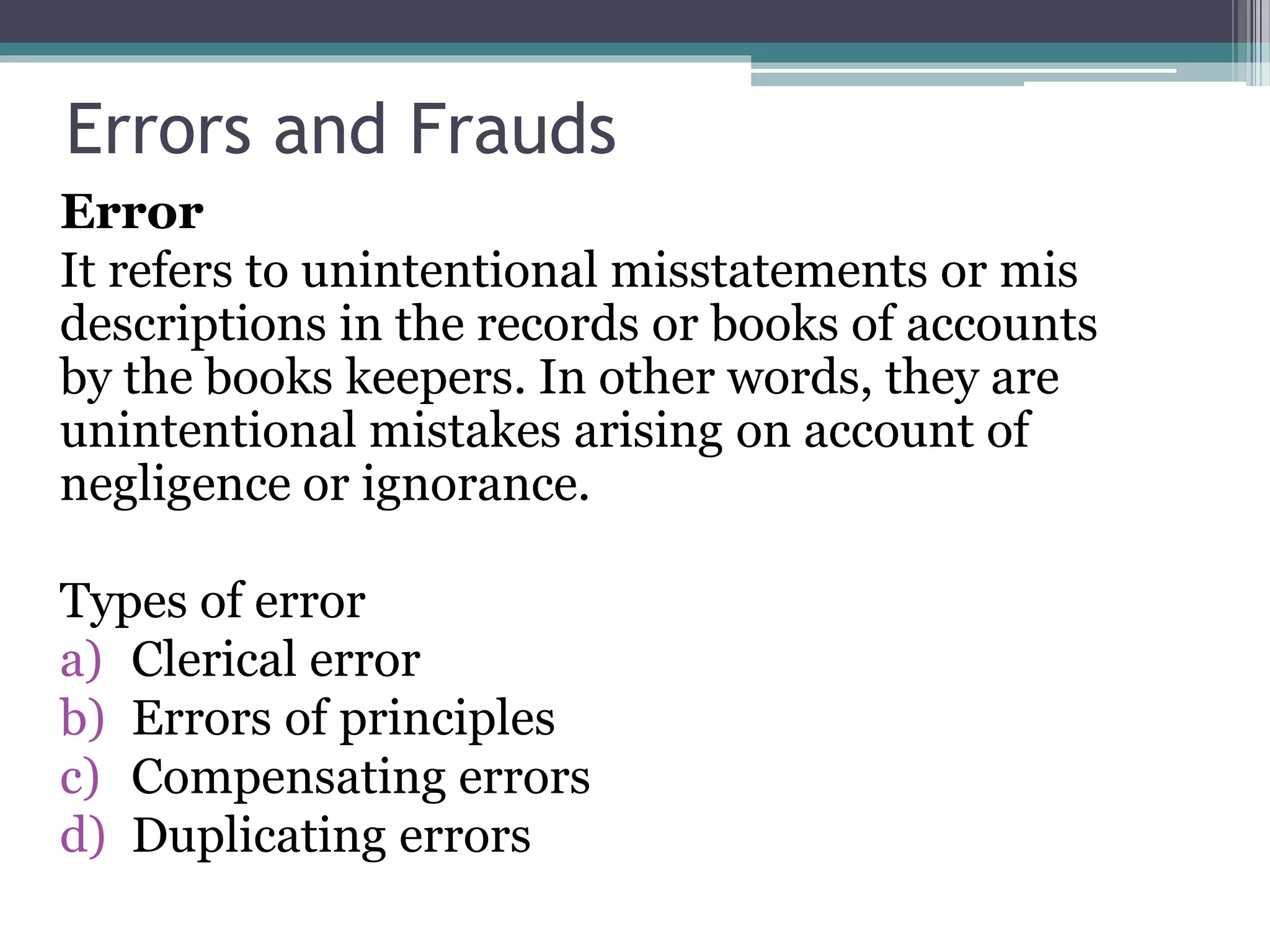
Errors and Frauds
Error
It refers to unintentional misstatements or mis
descriptions in the records or books of accounts
by the books keepers. In other words, they are
unintentional mistakes arising on account of
negligence or ignorance.
Types of error
a) Clerical error
b) Errors of principles
c) Compensating errors
d) Duplicating errors
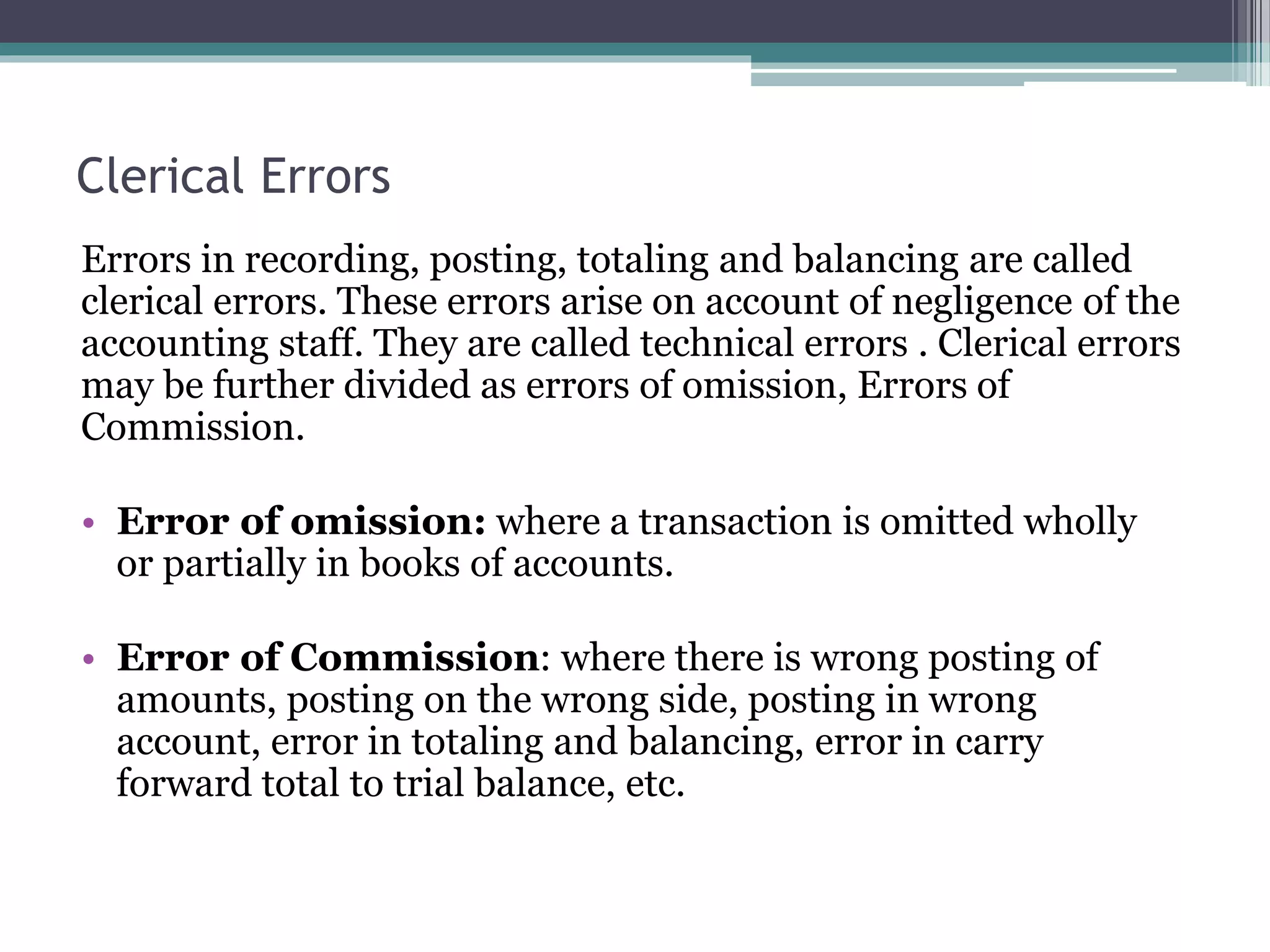
Clerical Errors
Errors in recording, posting, totaling and balancing are called
clerical errors. These errors arise on account of negligence of the
accounting staff. They are called technical errors . Clerical errors
may be further divided as errors of omission, Errors of
Commission.
• Error of omission: where a transaction is omitted wholly
or partially in books of accounts.
• Error of Commission: where there is wrong posting of
amounts, posting on the wrong side, posting in wrong
account, error in totaling and balancing, error in carry
forward total to trial balance, etc.
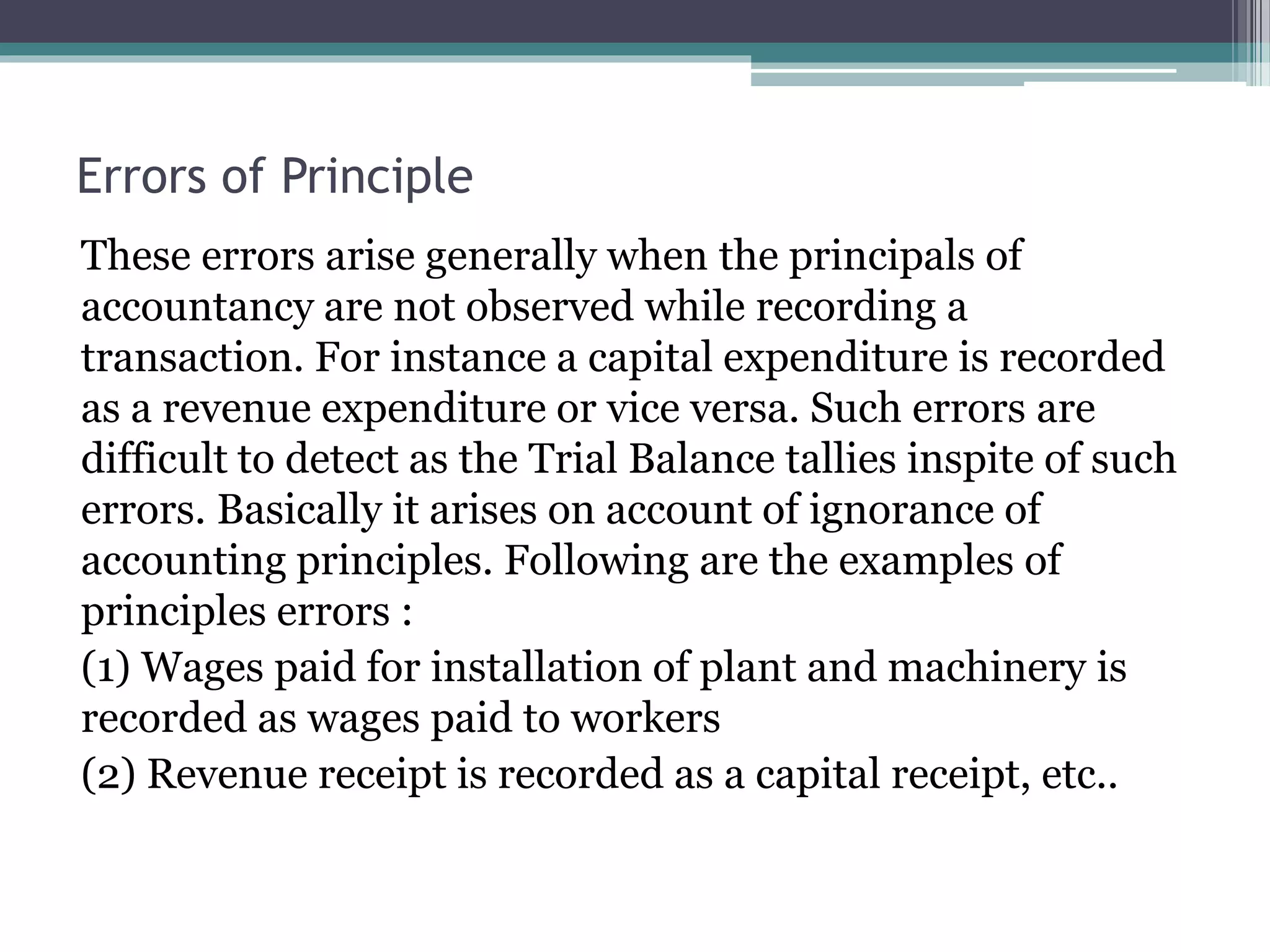
Errors of Principle
These errors arise generally when the principals of
accountancy are not observed while recording a
transaction. For instance a capital expenditure is recorded
as a revenue expenditure or vice versa. Such errors are
difficult to detect as the Trial Balance tallies inspite of such
errors. Basically it arises on account of ignorance of
accounting principles. Following are the examples of
principles errors :
(1) Wages paid for installation of plant and machinery is
recorded as wages paid to workers
(2) Revenue receipt is recorded as a capital receipt, etc..
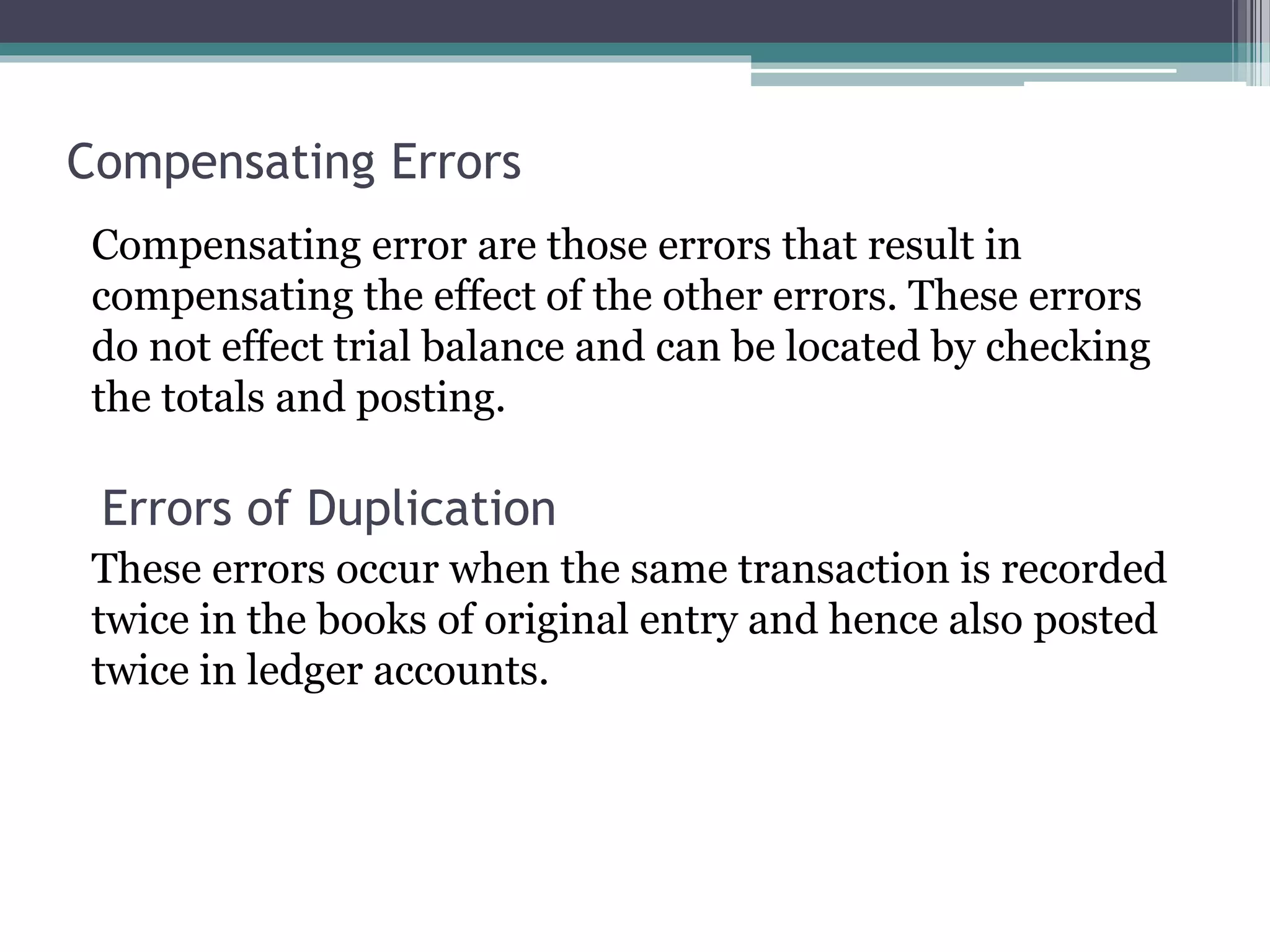
Compensating Errors
Compensating error are those errors that result in
compensating the effect of the other errors. These errors
do not effect trial balance and can be located by checking
the totals and posting.
Errors of Duplication
These errors occur when the same transaction is recorded
twice in the books of original entry and hence also posted
twice in ledger accounts.
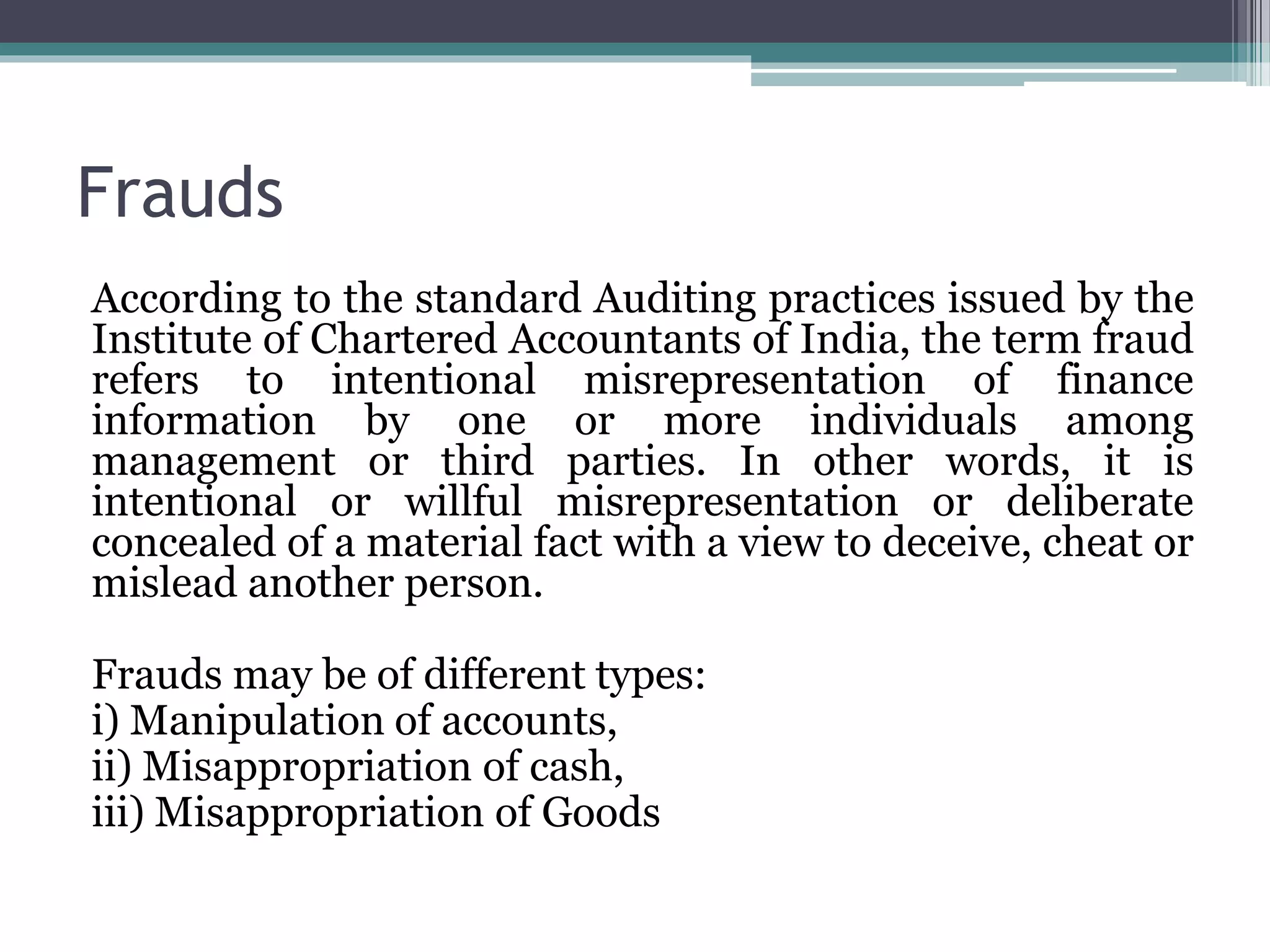
Frauds
According to the standard Auditing practices issued by the
Institute of Chartered Accountants of India, the term fraud
refers to intentional misrepresentation of finance
information by one or more individuals among
management or third parties. In other words, it is
intentional or willful misrepresentation or deliberate
concealed of a material fact with a view to deceive, cheat or
mislead another person.
Frauds may be of different types:
i) Manipulation of accounts,
ii) Misappropriation of cash,
iii) Misappropriation of Goods
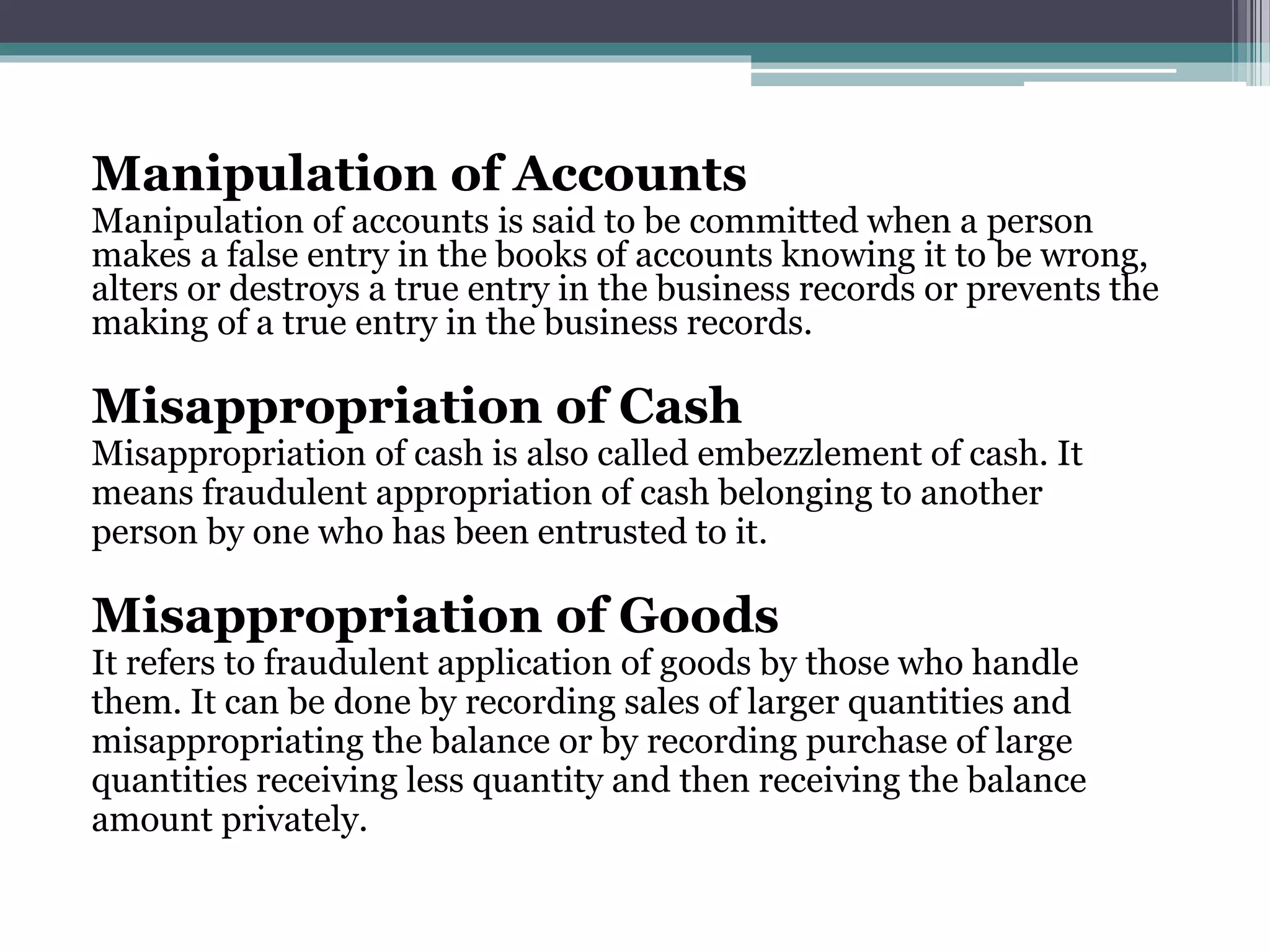
Manipulation of Accounts
Manipulation of accounts is said to be committed when a person
makes a false entry in the books of accounts knowing it to be wrong,
alters or destroys a true entry in the business records or prevents the
making of a true entry in the business records.
Misappropriation of Cash
Misappropriation of cash is also called embezzlement of cash. It
means fraudulent appropriation of cash belonging to another
person by one who has been entrusted to it.
Misappropriation of Goods
It refers to fraudulent application of goods by those who handle
them. It can be done by recording sales of larger quantities and
misappropriating the balance or by recording purchase of large
quantities receiving less quantity and then receiving the balance
amount privately.
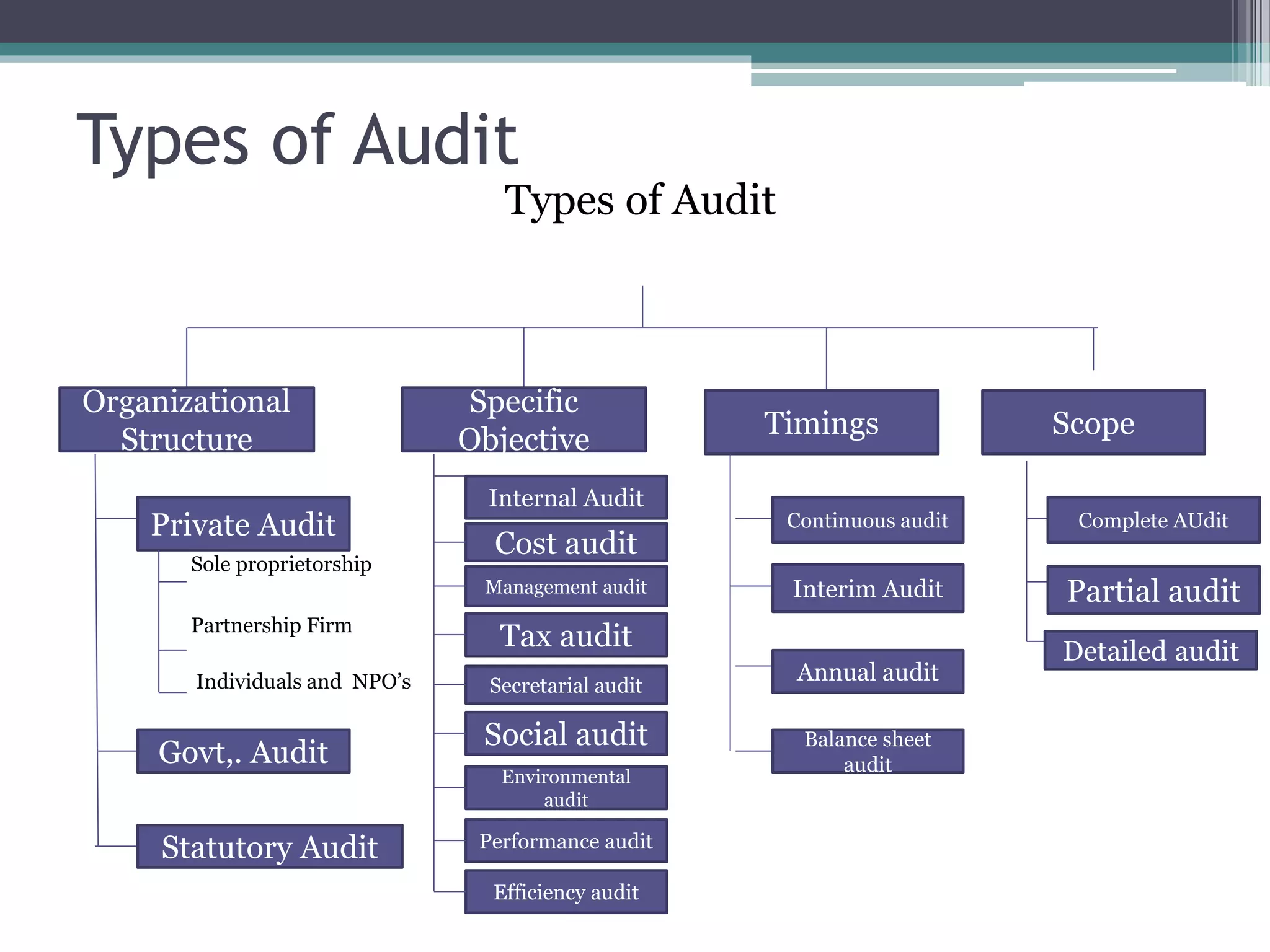
Types of Audit
Types of Audit
Sole proprietorship
Partnership Firm
Individuals and NPO’s
Organizational
Structure
Specific
Objective
Timings Scope
Private Audit
Govt,. Audit
Statutory Audit
Internal Audit
Cost audit
Management audit
Tax audit
Secretarial audit
Social audit
Environmental
audit
Performance audit
Efficiency audit
Continuous audit
Interim Audit
Annual audit
Balance sheet
audit
Complete AUdit
Partial audit
Detailed audit
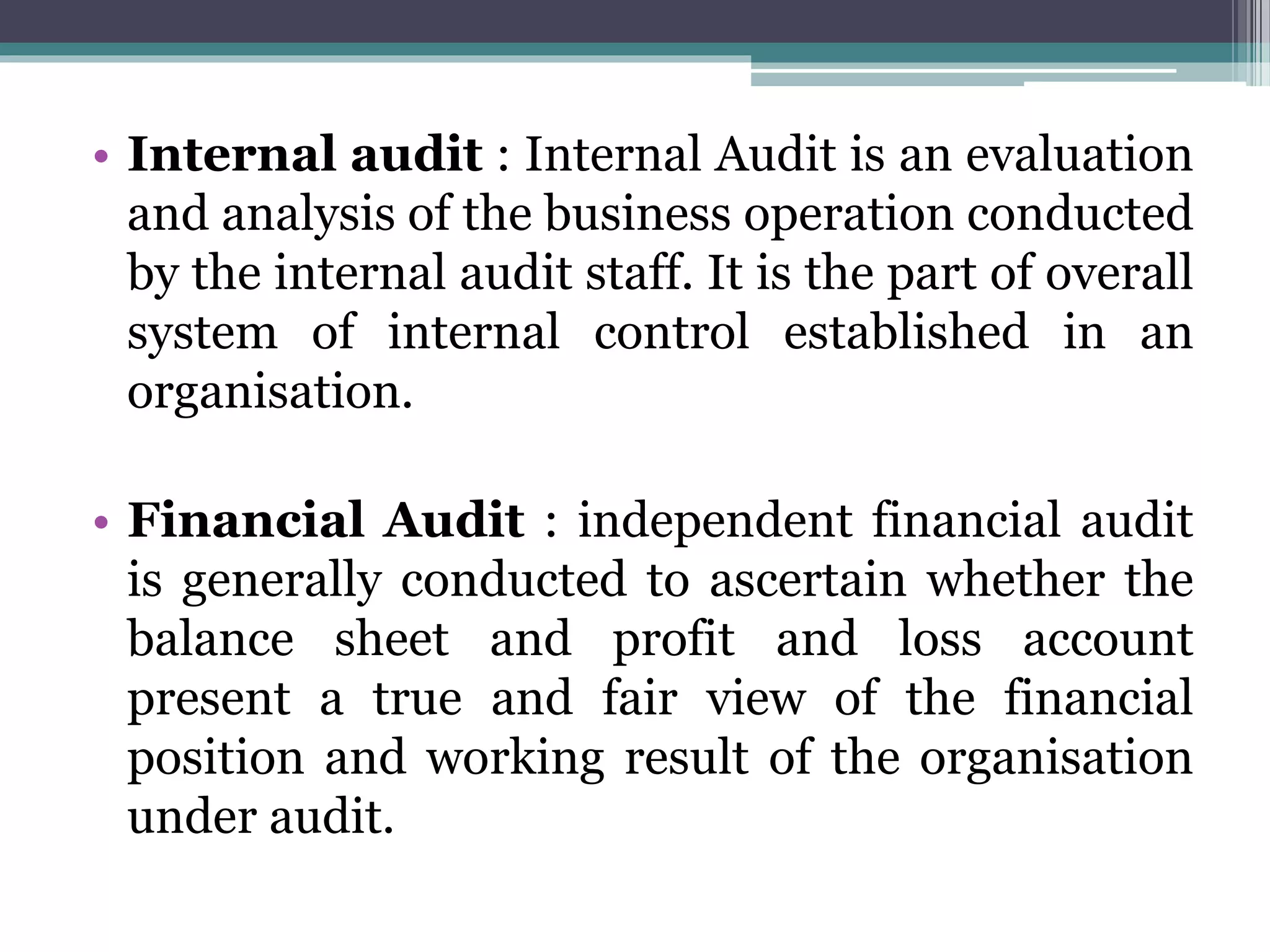
• Internal audit : Internal Audit is an evaluation
and analysis of the business operation conducted
by the internal audit staff. It is the part of overall
system of internal control established in an
organisation.
• Financial Audit : independent financial audit
is generally conducted to ascertain whether the
balance sheet and profit and loss account
present a true and fair view of the financial
position and working result of the organisation
under audit.
• Secretarial Audit : Secretarial audit is a
process to check compliance with the provisions
of various laws and rules/regulations,
maintenance of books , records etc.. by an
independent professional to ensure that the
company has complied with legal and procedural
requirements and has also followed the due
process.
• Cost Audit : a system of audit introduced by
the Government of India for the review,
examination, and appraisal of cost accounting
records and attendant information, required to
be maintained by specified industries.
• Tax Audit : The objective of such audit is to assist
the tax authorities in making the correct income
tax assessment of the assesses concerned.
• Bank Audit : The Banking Regulation Act 1949
contains the provisions relating to the
maintenance of accounts and their audit.
• Co-operative society Audit : the management
of the affairs of the co-operative society is in hands
of some of the elected members. This necessitates
an independent financial audit of accounts of co-
operatives socities.
• Trust audit : It is specifically provided in the
law or in trust deed that the trustees shall get the
financial statements of the trust audited.
• Insurance Audit : Insurance regulatory and
development act 1999 contains the provision of
the maintenance of accounts and audit of the
insurance companies.
• Partnership Firms : At present, partnership
firms in India are not legally required to get their
financial statements audited. Still, many firms
get their financial statements audited.
• Sole proprietorship Audit : like partnership
firms, sole proprietorship concerns are also not
legally required to get their financial statements
audited by independent financial auditors.
• Government audit : It is the duty of
Comptroller and Auditor general of India
(CA&G) to audit the receipts and expenditure of
the Union government and State government.
• Management audit : it is a structured review
of the systems and procedures of an organisation
in order to evaluate whether they are being
conducted efficiently and effectively.
• Functional Audit : in this form, a function is
analyzed thoroughly with respect to system process,
input and output.
• Propriety Audit : Under this type of audit, the
expenditure is analyzed with a view to ascertain the
cases of improper, avoidable or in fructuous
expenditure even though the expenditure has been
incurred in conformity with the existing rules and
regulations.
• Efficiency Audit : efficiency Audit or performance
audit is a form of audit which is being carried out for
ascertaining the efficiency/performance of a
system/process/input.

Advance auditing - The Master Slide

  • 1.
  • 2.
    Introduction An overview ofAuditing • The term audit is derived from the Latin term ‘audire,’ which means to hear. • In early days an auditor used to listen to the accounts read over by an accountant in order to check them. • The original objective of auditing was to detect and prevent errors and frauds.
  • 3.
    • With theincrease in the size of the companies and the volume of transactions the main objective of audit shifted to ascertaining whether the accounts were true and fair rather than true and correct. • Developments have led to further enlargement in the scope of the term ‘audit’.
  • 4.
    Definition According to GeneralGuidelines on Internal Auditing issued by the Institute of Charted Accountants of India: “Auditing is a systematic and independent examination of data, statements, records, operations and performance (financial or otherwise) of an enterprises for a stated purpose. In any auditing situation, the auditor perceives and recognizes the propositions before him for examination, collects evidence, evaluates the same and on this basis formulates his judgement which is communicated through his audit report.”
  • 5.
    Key phrases • Systematic: An Audit should be carefully planned. • Independent : The Auditor should not be susceptible to any influence or pressure from client or anybody else. • Data, statements, records, operations and performance : Indicates the scope of Audit. • Slated Purpose : Clearly Defined.
  • 6.
    Key phrases contd.. •Perceives and recognizes the propositions before him for examination, collects evidence : Have a clear idea about propositions he is examining. • Collects Evidence : Collect relevant evidence depending upon the proposition he needs to examine. • Evaluates Evidence : Evaluate it on the basis of his professional knowledge and skill. • Formulates judgement/ opinions : Communicated through Audit Report.
  • 7.
    Features of Auditing •Systematic and scientific examination of the books of accounts of a business. • Audit is undertaken by an independent person or body of persons who are duly qualified for the job. • Verification of the results shown by the profit and loss account and the state of affairs as shown by the balance sheet. • done with the help of vouchers, documents, information and explanations received from the authorities
  • 8.
    • The auditorhas to satisfy himself with the authenticity of the financial statements and report that they exhibit a true and fair view of the state of affairs of the concern. • The auditor has to inspect, compare, check, review, scrutinize the vouchers supporting the transactions and examine correspondence, minute books of share holders, directors, Memorandum of Association and Articles of association etc., in order to establish correctness of the books of accounts.
  • 9.
    Objectives of Auditing •Expression of Opinion - (as per Section 227 of the Companies Act 1956,) report to the owners whether the balance sheet gives a true and fair view of the Company’s state of affairs and the profit and loss A/c gives a correct figure of profit of loss for the financial year. • Secondary objective – it is also called the incidental objective as it is incidental to the satisfaction of the main objective. The incidental objective of auditing are: i. Detection and prevention of Frauds, and ii. Detection and prevention of Errors.
  • 10.
    Advantages of Auditing Tothe Owners 1. Serves as a basis for relying on financial statements : a) Determination of purchase consideration b) Settlement of accounts in partnership firm. c) Assess the reliability of financial statement in joint stock companies. d) Verify that grants being utilized properly in non trading organisations.
  • 11.
    To Others i. Toemployees – negotiating higher wages or bonus. ii. To creditors – for taking credit decisions. iii. To monitoring agencies – basis for monitoring financial information. To Management i. Improvement in control system. ii. Settlement of claims , facilitates taxations etc
  • 12.
    Limitations of Auditing •Minimization and not elimination of error. • Dependence on explanation by others • Conflict with others • Corrupt practices to influence the auditors • No assurance • Detailed checking not possible
  • 13.
    Basic principles governingan audit AAS-1 describes the basic principles, which govern the auditor's professional responsibilities and which should be complied with whenever an audit is carried out. These are:- • Integrity, objectivity and independence: The auditor should be straightforward, honest and sincere in his approach to his professional work. • Confidentiality: The auditor should respect the confidentiality of information acquired in the course of his work and should not disclose any such information to a third party without specific authority or unless there is legal or professional duty to disclose.
  • 14.
    • Skill andcompetence: The audit should be performed and the report prepared with due professional care by persons who have adequate training, experience and competence. • Work performed by others: When the auditor delegates work to assistant* or uses work performed by other auditors or experts, he will continue to be responsible for forming and expressing his opinion on the financial information. • Documentation: The auditor should document matters, which are important in providing evidence that the audit was carried out in accordance with the basic principles.
  • 15.
    • Planning: Theauditor should plan his work to enable him to conduct an effective audit in an efficient and timely manner. • Audit evidence: The auditor should obtain sufficient appropriate audit evidence through the performance of compliance and substantive test procedure. It will enable him to draw reasonable conclusions there from on which he has to base his opinion on the financial information. • Accounting system & internal control: The auditor should gain an understanding of the accounting system and related internal controls.
  • 16.
    • Audit conclusionsand reporting: The auditor should review and assess the conclusions drawn from the audit evidence obtained and from his knowledge of business of the entity as the basis for the expression of his opinion on the financial information.
  • 17.
    Errors and Frauds Error Itrefers to unintentional misstatements or mis descriptions in the records or books of accounts by the books keepers. In other words, they are unintentional mistakes arising on account of negligence or ignorance. Types of error a) Clerical error b) Errors of principles c) Compensating errors d) Duplicating errors
  • 18.
    Clerical Errors Errors inrecording, posting, totaling and balancing are called clerical errors. These errors arise on account of negligence of the accounting staff. They are called technical errors . Clerical errors may be further divided as errors of omission, Errors of Commission. • Error of omission: where a transaction is omitted wholly or partially in books of accounts. • Error of Commission: where there is wrong posting of amounts, posting on the wrong side, posting in wrong account, error in totaling and balancing, error in carry forward total to trial balance, etc.
  • 19.
    Errors of Principle Theseerrors arise generally when the principals of accountancy are not observed while recording a transaction. For instance a capital expenditure is recorded as a revenue expenditure or vice versa. Such errors are difficult to detect as the Trial Balance tallies inspite of such errors. Basically it arises on account of ignorance of accounting principles. Following are the examples of principles errors : (1) Wages paid for installation of plant and machinery is recorded as wages paid to workers (2) Revenue receipt is recorded as a capital receipt, etc..
  • 20.
    Compensating Errors Compensating errorare those errors that result in compensating the effect of the other errors. These errors do not effect trial balance and can be located by checking the totals and posting. Errors of Duplication These errors occur when the same transaction is recorded twice in the books of original entry and hence also posted twice in ledger accounts.
  • 21.
    Frauds According to thestandard Auditing practices issued by the Institute of Chartered Accountants of India, the term fraud refers to intentional misrepresentation of finance information by one or more individuals among management or third parties. In other words, it is intentional or willful misrepresentation or deliberate concealed of a material fact with a view to deceive, cheat or mislead another person. Frauds may be of different types: i) Manipulation of accounts, ii) Misappropriation of cash, iii) Misappropriation of Goods
  • 22.
    Manipulation of Accounts Manipulationof accounts is said to be committed when a person makes a false entry in the books of accounts knowing it to be wrong, alters or destroys a true entry in the business records or prevents the making of a true entry in the business records. Misappropriation of Cash Misappropriation of cash is also called embezzlement of cash. It means fraudulent appropriation of cash belonging to another person by one who has been entrusted to it. Misappropriation of Goods It refers to fraudulent application of goods by those who handle them. It can be done by recording sales of larger quantities and misappropriating the balance or by recording purchase of large quantities receiving less quantity and then receiving the balance amount privately.
  • 23.
    Types of Audit Typesof Audit Sole proprietorship Partnership Firm Individuals and NPO’s Organizational Structure Specific Objective Timings Scope Private Audit Govt,. Audit Statutory Audit Internal Audit Cost audit Management audit Tax audit Secretarial audit Social audit Environmental audit Performance audit Efficiency audit Continuous audit Interim Audit Annual audit Balance sheet audit Complete AUdit Partial audit Detailed audit
  • 24.
    • Internal audit: Internal Audit is an evaluation and analysis of the business operation conducted by the internal audit staff. It is the part of overall system of internal control established in an organisation. • Financial Audit : independent financial audit is generally conducted to ascertain whether the balance sheet and profit and loss account present a true and fair view of the financial position and working result of the organisation under audit.
  • 25.
    • Secretarial Audit: Secretarial audit is a process to check compliance with the provisions of various laws and rules/regulations, maintenance of books , records etc.. by an independent professional to ensure that the company has complied with legal and procedural requirements and has also followed the due process. • Cost Audit : a system of audit introduced by the Government of India for the review, examination, and appraisal of cost accounting records and attendant information, required to be maintained by specified industries.
  • 26.
    • Tax Audit: The objective of such audit is to assist the tax authorities in making the correct income tax assessment of the assesses concerned. • Bank Audit : The Banking Regulation Act 1949 contains the provisions relating to the maintenance of accounts and their audit. • Co-operative society Audit : the management of the affairs of the co-operative society is in hands of some of the elected members. This necessitates an independent financial audit of accounts of co- operatives socities.
  • 27.
    • Trust audit: It is specifically provided in the law or in trust deed that the trustees shall get the financial statements of the trust audited. • Insurance Audit : Insurance regulatory and development act 1999 contains the provision of the maintenance of accounts and audit of the insurance companies. • Partnership Firms : At present, partnership firms in India are not legally required to get their financial statements audited. Still, many firms get their financial statements audited.
  • 28.
    • Sole proprietorshipAudit : like partnership firms, sole proprietorship concerns are also not legally required to get their financial statements audited by independent financial auditors. • Government audit : It is the duty of Comptroller and Auditor general of India (CA&G) to audit the receipts and expenditure of the Union government and State government. • Management audit : it is a structured review of the systems and procedures of an organisation in order to evaluate whether they are being conducted efficiently and effectively.
  • 29.
    • Functional Audit: in this form, a function is analyzed thoroughly with respect to system process, input and output. • Propriety Audit : Under this type of audit, the expenditure is analyzed with a view to ascertain the cases of improper, avoidable or in fructuous expenditure even though the expenditure has been incurred in conformity with the existing rules and regulations. • Efficiency Audit : efficiency Audit or performance audit is a form of audit which is being carried out for ascertaining the efficiency/performance of a system/process/input.

Editor's Notes

  • #4 True – free from material misstatements Fair – faithfully without any bias, reflect economic substance of transaction rather than legal form.