Treasures from the real-life "Island of
the Blue Dolphins" need safe home 
By Los Angeles Times, adapted by Newsela staff on 03.31.16  
Word Count 653  
 
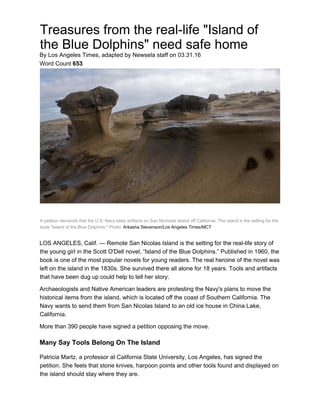
A petition demands that the U.S. Navy keep artifacts on San Nicholas Island off California. The island is the setting for the
book "Island of the Blue Dolphins." Photo: Arkasha Stevenson/Los Angeles Times/MCT  
LOS ANGELES, Calif. — Remote San Nicolas Island is the setting for the real-life story of
the young girl in the Scott O'Dell novel, “Island of the Blue Dolphins.” Published in 1960, the
book is one of the most popular novels for young readers. The real heroine of the novel was
left on the island in the 1830s. She survived there all alone for 18 years. Tools and artifacts
that have been dug up could help to tell her story. 
Archaeologists and Native American leaders are protesting the Navy's plans to move the
historical items from the island, which is located off the coast of Southern California. The
Navy wants to send them from San Nicolas Island to an old ice house in China Lake,
California. 
More than 390 people have signed a petition opposing the move. 
Many Say Tools Belong On The Island
Patricia Martz, a professor at California State University, Los Angeles, has signed the
petition. She feels that stone knives, harpoon points and other tools found and displayed on
the island should stay where they are. 
“For one thing, the artifacts were recovered from a marine environment,” she said. They
would be moved to China Lake, which is in the desert 250 miles away, and Martz feels the
ice house will not have the proper temperature and humidity levels for them. 
“Beyond all that, every time artifacts are packed up and moved around, things get broken
and lost,” she added. 
Steve Schwartz is a former Navy archaeologist who spent 20 years searching for the cave
where the Lone Woman of San Nicolas Island, as she came to be called, may have lived.
He found the cave, buried under sand, in 2012. He is also against the plan to move the
artifacts. 
Island Was Home To Small Tribe
The Nicoleno Indians inhabited the remote island. Very little is known about the tribe. In the
early 1800s, they suffered devastating losses in many fights with Russian fur traders and
Alaskan sea otter hunters. The Nicoleno population of about 300 dropped sharply to a few
dozen after a particularly brutal battle in 1814. 
In 1835, a ship was sent by Franciscan fathers to bring the few remaining Indians to the
mainland. All but one made the trip aboard the ship. 
According to legend, the woman jumped overboard and swam for shore after realizing that
her baby had been left behind. A sudden storm forced the ship's captain to shove off
without her. Legend has it that as she was running back home, the baby was eaten by wild
dogs. 
"What actually happened ... remains a mystery," Schwartz said. 
Navy Says Not To Worry
Navy officials insist the tools and items will be safely transported. In fact, Navy Captain C.D.
Janke sent a response to the petition. It said that the ice house follows all government rules
and has things like ramps for the disabled so the public can see the items. 
“It is a well-insulated former ice house, with a climate control system that maintains stable
temperature and humidity,” Janke said. 
About 60 miles off the California coast, San Nicolas is a lonely Navy base. It is dotted with
missile tracking stations. There are also 540 known archaeology sites that could be more
than 8,000 years old.  
Martz, the professor, said the tools are important to California history and legend, and are
too precious to risk being moved to a desert. 
Living Alone Was Safer
In 1853, the Lone Woman, by then about 50 years old, was skinning a seal and living in a
cave when she was found by sailing fur traders. She left the island and sailed with them to
Santa Barbara, California. 
She spoke only a few words in her native language and sang songs. Just seven weeks later
in civilization, the woman died of a stomach illness. She is buried at the Santa Barbara
Mission and remains as mysterious as ever.   
Quiz
1 Read the section “Many Say Tools Belong On The Island.” Select the paragraph from the
section that highlights a possible effect of transporting the artifacts. 
2 Which section of the article BEST explains how the famous Native American woman ended up
living alone on San Nicolas Island? 
(A) "Many Say Tools Belong On The Island" 
(B) "Island Was Home To Small Tribe" 
(C) "Navy Says Not To Worry" 
(D) "Living Alone Was Safer" 
3 Each of these sentences contains an important detail from the article. Which sentence would
make the BEST summary of the article? 
(A) Native American leaders and archaeologists are protesting the Navy’s decision to
move important artifacts from San Nicolas Island to a new location. 
(B) The U.S. Navy has released a statement explaining that the Native American artifacts
will be moved to a facility that is easier for the public to access. 
(C) Artifacts discovered on San Nicolas Island may be the key to understanding the life of
a mysterious Native American woman who lived alone on the island for many years. 
(D) Archaeologists are concerned that Native American artifacts can be damaged when
they are moved from one location to another location. 
4 Which alternate title for the section “Living Alone Was Safer” would also BEST express that
section's main idea? 
(A) “The Lone Woman's Tragic End” 
(B) “An Exciting Moment For Sailors” 
(C) “Island Tribe Suffered Many Losses” 
(D) “Tribe Member Stranded In Sudden Storm” 

Adv LA Island Article

  • 1.
    Treasures from thereal-life "Island of the Blue Dolphins" need safe home  By Los Angeles Times, adapted by Newsela staff on 03.31.16   Word Count 653     A petition demands that the U.S. Navy keep artifacts on San Nicholas Island off California. The island is the setting for the book "Island of the Blue Dolphins." Photo: Arkasha Stevenson/Los Angeles Times/MCT   LOS ANGELES, Calif. — Remote San Nicolas Island is the setting for the real-life story of the young girl in the Scott O'Dell novel, “Island of the Blue Dolphins.” Published in 1960, the book is one of the most popular novels for young readers. The real heroine of the novel was left on the island in the 1830s. She survived there all alone for 18 years. Tools and artifacts that have been dug up could help to tell her story.  Archaeologists and Native American leaders are protesting the Navy's plans to move the historical items from the island, which is located off the coast of Southern California. The Navy wants to send them from San Nicolas Island to an old ice house in China Lake, California.  More than 390 people have signed a petition opposing the move.  Many Say Tools Belong On The Island Patricia Martz, a professor at California State University, Los Angeles, has signed the petition. She feels that stone knives, harpoon points and other tools found and displayed on the island should stay where they are. 
  • 2.
    “For one thing,the artifacts were recovered from a marine environment,” she said. They would be moved to China Lake, which is in the desert 250 miles away, and Martz feels the ice house will not have the proper temperature and humidity levels for them.  “Beyond all that, every time artifacts are packed up and moved around, things get broken and lost,” she added.  Steve Schwartz is a former Navy archaeologist who spent 20 years searching for the cave where the Lone Woman of San Nicolas Island, as she came to be called, may have lived. He found the cave, buried under sand, in 2012. He is also against the plan to move the artifacts.  Island Was Home To Small Tribe The Nicoleno Indians inhabited the remote island. Very little is known about the tribe. In the early 1800s, they suffered devastating losses in many fights with Russian fur traders and Alaskan sea otter hunters. The Nicoleno population of about 300 dropped sharply to a few dozen after a particularly brutal battle in 1814.  In 1835, a ship was sent by Franciscan fathers to bring the few remaining Indians to the mainland. All but one made the trip aboard the ship.  According to legend, the woman jumped overboard and swam for shore after realizing that her baby had been left behind. A sudden storm forced the ship's captain to shove off without her. Legend has it that as she was running back home, the baby was eaten by wild dogs.  "What actually happened ... remains a mystery," Schwartz said.  Navy Says Not To Worry Navy officials insist the tools and items will be safely transported. In fact, Navy Captain C.D. Janke sent a response to the petition. It said that the ice house follows all government rules and has things like ramps for the disabled so the public can see the items.  “It is a well-insulated former ice house, with a climate control system that maintains stable temperature and humidity,” Janke said.  About 60 miles off the California coast, San Nicolas is a lonely Navy base. It is dotted with missile tracking stations. There are also 540 known archaeology sites that could be more than 8,000 years old.   Martz, the professor, said the tools are important to California history and legend, and are too precious to risk being moved to a desert. 
  • 3.
    Living Alone WasSafer In 1853, the Lone Woman, by then about 50 years old, was skinning a seal and living in a cave when she was found by sailing fur traders. She left the island and sailed with them to Santa Barbara, California.  She spoke only a few words in her native language and sang songs. Just seven weeks later in civilization, the woman died of a stomach illness. She is buried at the Santa Barbara Mission and remains as mysterious as ever.   
  • 4.
    Quiz 1 Read thesection “Many Say Tools Belong On The Island.” Select the paragraph from the section that highlights a possible effect of transporting the artifacts.  2 Which section of the article BEST explains how the famous Native American woman ended up living alone on San Nicolas Island?  (A) "Many Say Tools Belong On The Island"  (B) "Island Was Home To Small Tribe"  (C) "Navy Says Not To Worry"  (D) "Living Alone Was Safer"  3 Each of these sentences contains an important detail from the article. Which sentence would make the BEST summary of the article?  (A) Native American leaders and archaeologists are protesting the Navy’s decision to move important artifacts from San Nicolas Island to a new location.  (B) The U.S. Navy has released a statement explaining that the Native American artifacts will be moved to a facility that is easier for the public to access.  (C) Artifacts discovered on San Nicolas Island may be the key to understanding the life of a mysterious Native American woman who lived alone on the island for many years.  (D) Archaeologists are concerned that Native American artifacts can be damaged when they are moved from one location to another location.  4 Which alternate title for the section “Living Alone Was Safer” would also BEST express that section's main idea?  (A) “The Lone Woman's Tragic End”  (B) “An Exciting Moment For Sailors”  (C) “Island Tribe Suffered Many Losses”  (D) “Tribe Member Stranded In Sudden Storm”