TRANSFORMATIVE IMPACT OF
ARTIFICIAL INTELLIGENCE ON
ONLINE DISPUTE RESOLUTION
METHODS
Presented by:
Khushi Jain
CHAPTER 1 : INTRODUCTION
 The transformative impact of Artificial Intelligence (AI) on alternative dispute resolution (ADR) methods is a
pivotal topic in the contemporary legal landscape.
 AI's rapid evolution is evident in its integration into various legal facets, with roots traced back to the coining
of the term by John McCarthy, a pioneer in the field.
 Definition: AI encompasses the capability of computers to mimic intelligent behaviors, relying on extensive
labeled training data for decision-making.
•RESEARCH OBJECTIVES
•RESEARCH PROBLEM
•RESEARCH QUESTION
•HYPOTHESIS
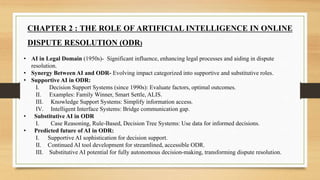
• AI in Legal Domain (1950s)- Significant influence, enhancing legal processes and aiding in dispute
resolution.
• Synergy Between AI and ODR- Evolving impact categorized into supportive and substitutive roles.
• Supportive AI in ODR:
I. Decision Support Systems (since 1990s): Evaluate factors, optimal outcomes.
II. Examples: Family Winner, Smart Settle, ALIS.
III. Knowledge Support Systems: Simplify information access.
IV. Intelligent Interface Systems: Bridge communication gap.
• Substitutive AI in ODR
I. Case Reasoning, Rule-Based, Decision Tree Systems: Use data for informed decisions.
• Predicted future of AI in ODR:
I. Supportive AI sophistication for decision support.
II. Continued AI tool development for streamlined, accessible ODR.
III. Substitutive AI potential for fully autonomous decision-making, transforming dispute resolution.
CHAPTER 2 : THE ROLE OF ARTIFICIAL INTELLIGENCE IN ONLINE
DISPUTE RESOLUTION (ODR)
 Streamlining Judicial Procedure
 Cautious Approach to AI-Assisted Pleas
 Two-Tier Dispute Resolution System:
 Access to Justice Concerns
 Transparency and Governance Challenges
 Privacy-Related Concerns:
 Ethical Safeguards and Continuous Monitoring
CHAPTER 3 : CHALLENGES IN AI INTEGRATION IN ODR
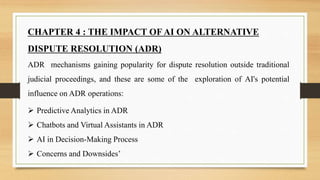
CHAPTER 4 : THE IMPACT OF AI ON ALTERNATIVE
DISPUTE RESOLUTION (ADR)
ADR mechanisms gaining popularity for dispute resolution outside traditional
judicial proceedings, and these are some of the exploration of AI's potential
influence on ADR operations:
 Predictive Analytics in ADR
 Chatbots and Virtual Assistants in ADR
 AI in Decision-Making Process
 Concerns and Downsides’

ADR PRESENTATION PPT

  • 1.
    TRANSFORMATIVE IMPACT OF ARTIFICIALINTELLIGENCE ON ONLINE DISPUTE RESOLUTION METHODS Presented by: Khushi Jain
  • 2.
    CHAPTER 1 :INTRODUCTION  The transformative impact of Artificial Intelligence (AI) on alternative dispute resolution (ADR) methods is a pivotal topic in the contemporary legal landscape.  AI's rapid evolution is evident in its integration into various legal facets, with roots traced back to the coining of the term by John McCarthy, a pioneer in the field.  Definition: AI encompasses the capability of computers to mimic intelligent behaviors, relying on extensive labeled training data for decision-making. •RESEARCH OBJECTIVES •RESEARCH PROBLEM •RESEARCH QUESTION •HYPOTHESIS
  • 3.
    • AI inLegal Domain (1950s)- Significant influence, enhancing legal processes and aiding in dispute resolution. • Synergy Between AI and ODR- Evolving impact categorized into supportive and substitutive roles. • Supportive AI in ODR: I. Decision Support Systems (since 1990s): Evaluate factors, optimal outcomes. II. Examples: Family Winner, Smart Settle, ALIS. III. Knowledge Support Systems: Simplify information access. IV. Intelligent Interface Systems: Bridge communication gap. • Substitutive AI in ODR I. Case Reasoning, Rule-Based, Decision Tree Systems: Use data for informed decisions. • Predicted future of AI in ODR: I. Supportive AI sophistication for decision support. II. Continued AI tool development for streamlined, accessible ODR. III. Substitutive AI potential for fully autonomous decision-making, transforming dispute resolution. CHAPTER 2 : THE ROLE OF ARTIFICIAL INTELLIGENCE IN ONLINE DISPUTE RESOLUTION (ODR)
  • 4.
     Streamlining JudicialProcedure  Cautious Approach to AI-Assisted Pleas  Two-Tier Dispute Resolution System:  Access to Justice Concerns  Transparency and Governance Challenges  Privacy-Related Concerns:  Ethical Safeguards and Continuous Monitoring CHAPTER 3 : CHALLENGES IN AI INTEGRATION IN ODR
  • 5.
    CHAPTER 4 :THE IMPACT OF AI ON ALTERNATIVE DISPUTE RESOLUTION (ADR) ADR mechanisms gaining popularity for dispute resolution outside traditional judicial proceedings, and these are some of the exploration of AI's potential influence on ADR operations:  Predictive Analytics in ADR  Chatbots and Virtual Assistants in ADR  AI in Decision-Making Process  Concerns and Downsides’