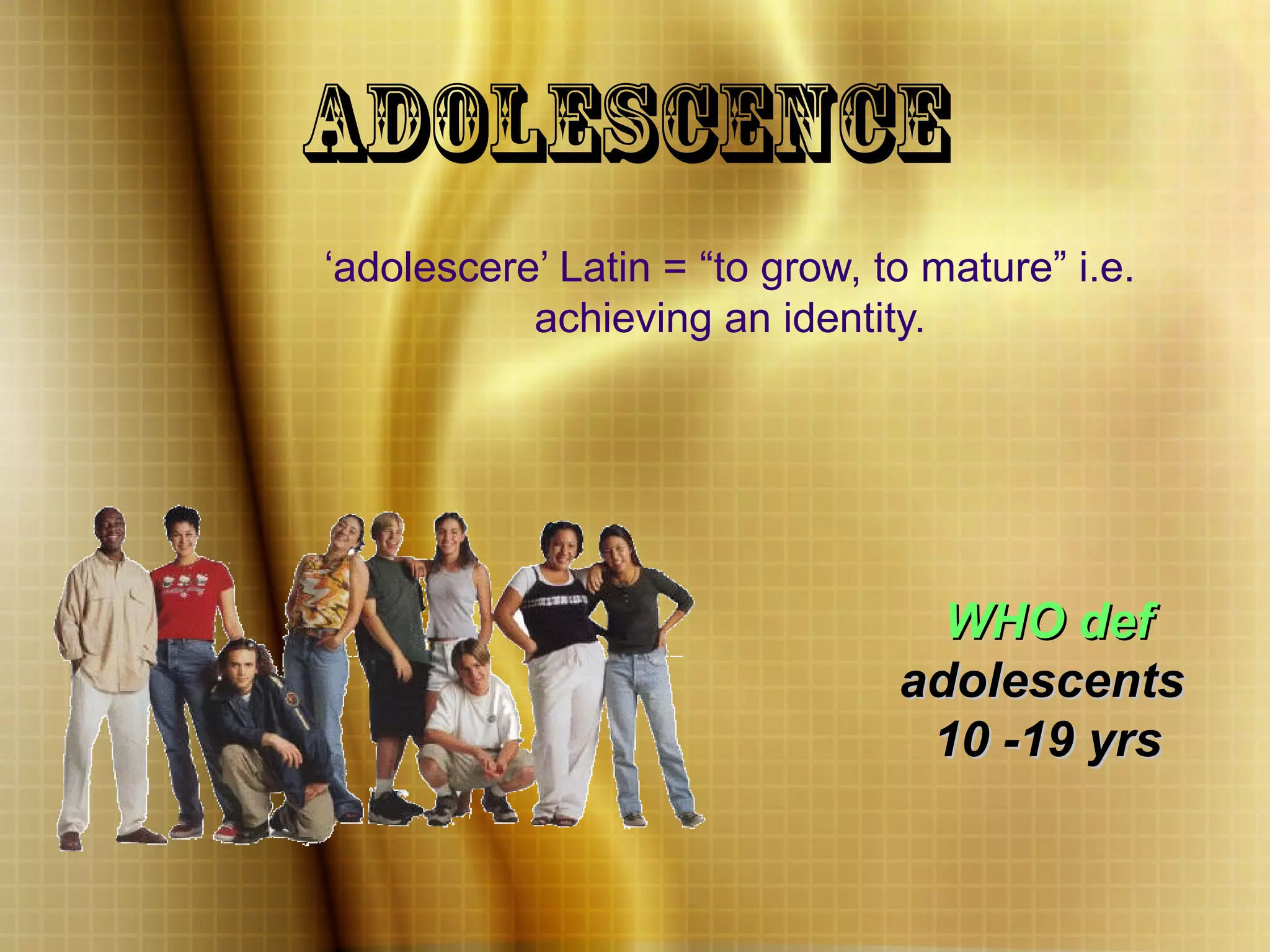
WHO defWHO def
adolescentsadolescents
10 -19 yrs10 -19 yrs
Adolescence
‘adolescere’ Latin = “to grow, to mature” i.e.
achieving an identity.
Adolescence
Definition:Definition:
• “A period between childhood and
adulthood.”
» Oxford’s Dictionary
• “Adolescence is that period of life of an
individual when society no longer views
him as a child but does not as yet
concede him either the roles or the
functions inherent in the status of adult”.
» Holinshead.
Adolescence
is..
…that part in our life where
nothing seems to go
smoothly yet our best
Adolescence
WHO / UN Definitions:
– Adolescent : 10 – 19 years
– Youth : 15 – 24 years
– Young Adults : 10 – 24 years
Some Definitions
• Puberty
Physical characteristics that occur during
adolescence
• The Growth Spurt
Rapid changes in height and weight during puberty.
• Primary Sex Characteristics
The changes that mark the beginning of puberty for
girls and boys.
• Secondary Sex Characteristics
Other external changes that make adolescents look
like mature men and women
TeenagersTeenagers
Comprise 2nd largest population group. (23%)Comprise 2nd largest population group. (23%)
• over 1 billion world overover 1 billion world over
• World over - 1 out of every 5 personWorld over - 1 out of every 5 person
• Developing - 1 out of every 4 personDeveloping - 1 out of every 4 person
• 10-19 years age group constitute > 1/510-19 years age group constitute > 1/5thth
of India’s population.of India’s population.
• By the year 2010 there will be moreBy the year 2010 there will be more
adolescents alive in the world than everadolescents alive in the world than ever
beforebefore
• Healthy and well-adjusted adolescents ofHealthy and well-adjusted adolescents of
today will become productive citizenstoday will become productive citizens
andand
dynamic leaders of tomorrow.dynamic leaders of tomorrow.
CSN Vittal
Salient attributes of Adolescence
•
Physical, psychological, emotional
and social development
•
Rapid but uneven physical growth
•
Sexual maturity and onset of sexual
activity
•
Desire for exploration and
experimentation
•
Development of adult mental process
and self identity
•
Transition from dependence to
relative independence
Factors affecting the adolescent
development
• Socioeconomic circumstances
• The environment in which they live and
grow
• The quality of relationships with their
families
• Communities and peer groups
• Opportunities for education and
employment
Growth Spurt
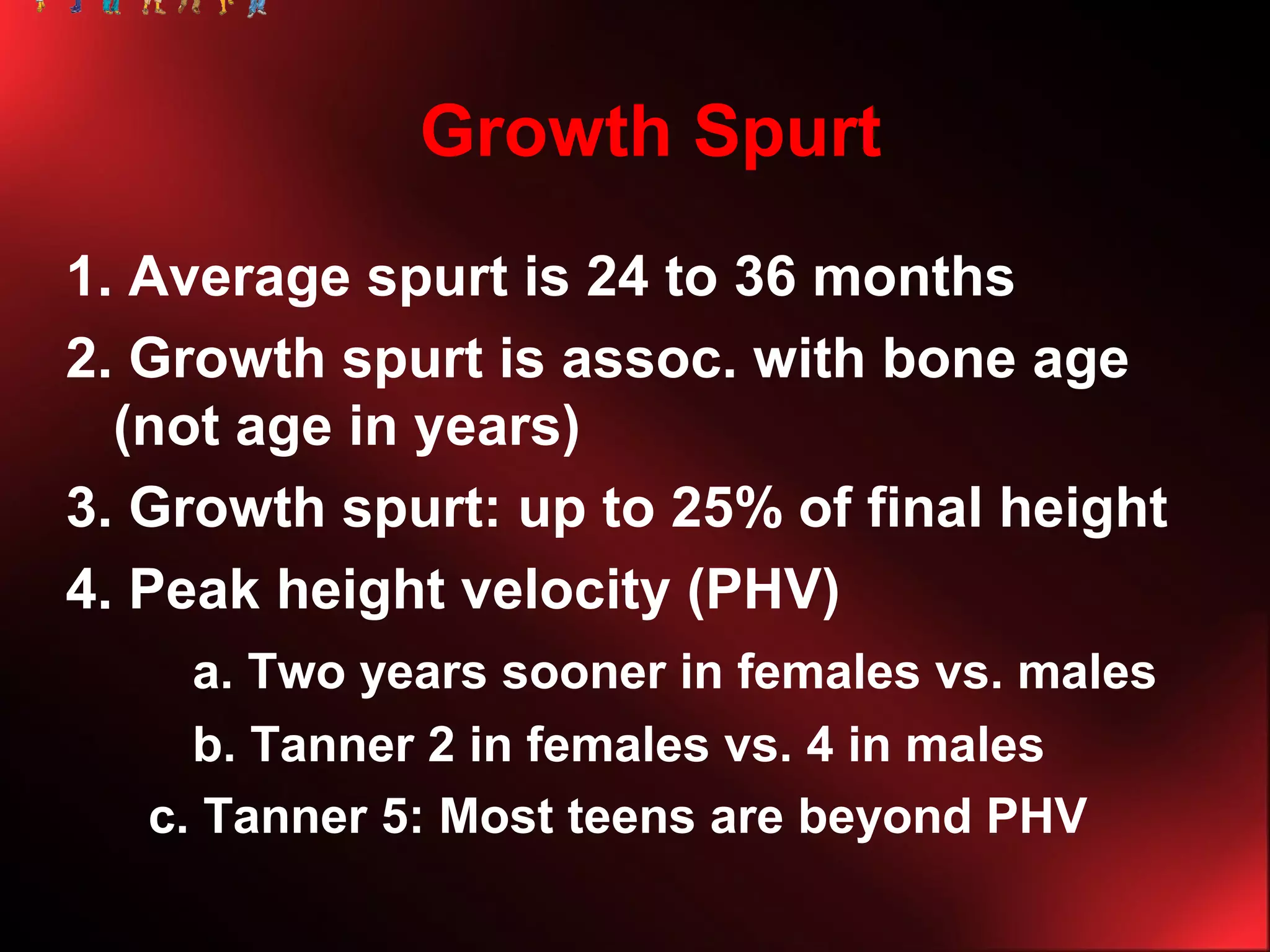
1. Average spurt is 24 to 36 months
2. Growth spurt is assoc. with bone age
(not age in years)
3. Growth spurt: up to 25% of final height
4. Peak height velocity (PHV)
a. Two years sooner in females vs. males
b. Tanner 2 in females vs. 4 in males
c. Tanner 5: Most teens are beyond PHV
1. Starts: 10 years in females vs 11.5
years in males
2. PHV: 8.0 cm/year in females vs 9 cm
in males
3. Age: PHV at 11.5 years in females vs
13.5 in males (Two years sooner in
females vs. males) - Tanner 2 in females vs.
4 in males
4. Depends on onset of puberty and
effects of nutrition / illness
5. End: epiphyseal/diaphyseal
closure (adult bone age)
Linear Growth
Tanner’s Stages
Sequence of somatic andSequence of somatic and
physiologic changes give rise tophysiologic changes give rise to
sexual maturitysexual maturity
• SMR Stages :
1 to 5 on parameters:
1. Pubic hair
2. Breast development
3. Genital development
SMR Stages - Girls
BreastBreast StageStage Pubic HairPubic Hair
Prepubertal – Nipple elevation
only
I Prepubertal, no pubic hair
Small, raised breast bud
(thelarche)
II Sparse growth of hair along labia
General enlargement of raising
of breast and areola
III Pigmentation, coarsening and
curling, with an increase in
amount
Further enlargement with
projection of areola and nipple
as secondary mound
IV Hair resembles adult type, but
not spread to medial thighs
Adult contour, with areola in
same contour as breast, &
only nipple projecting
V Adult type and quantity, spread
to medial thighs
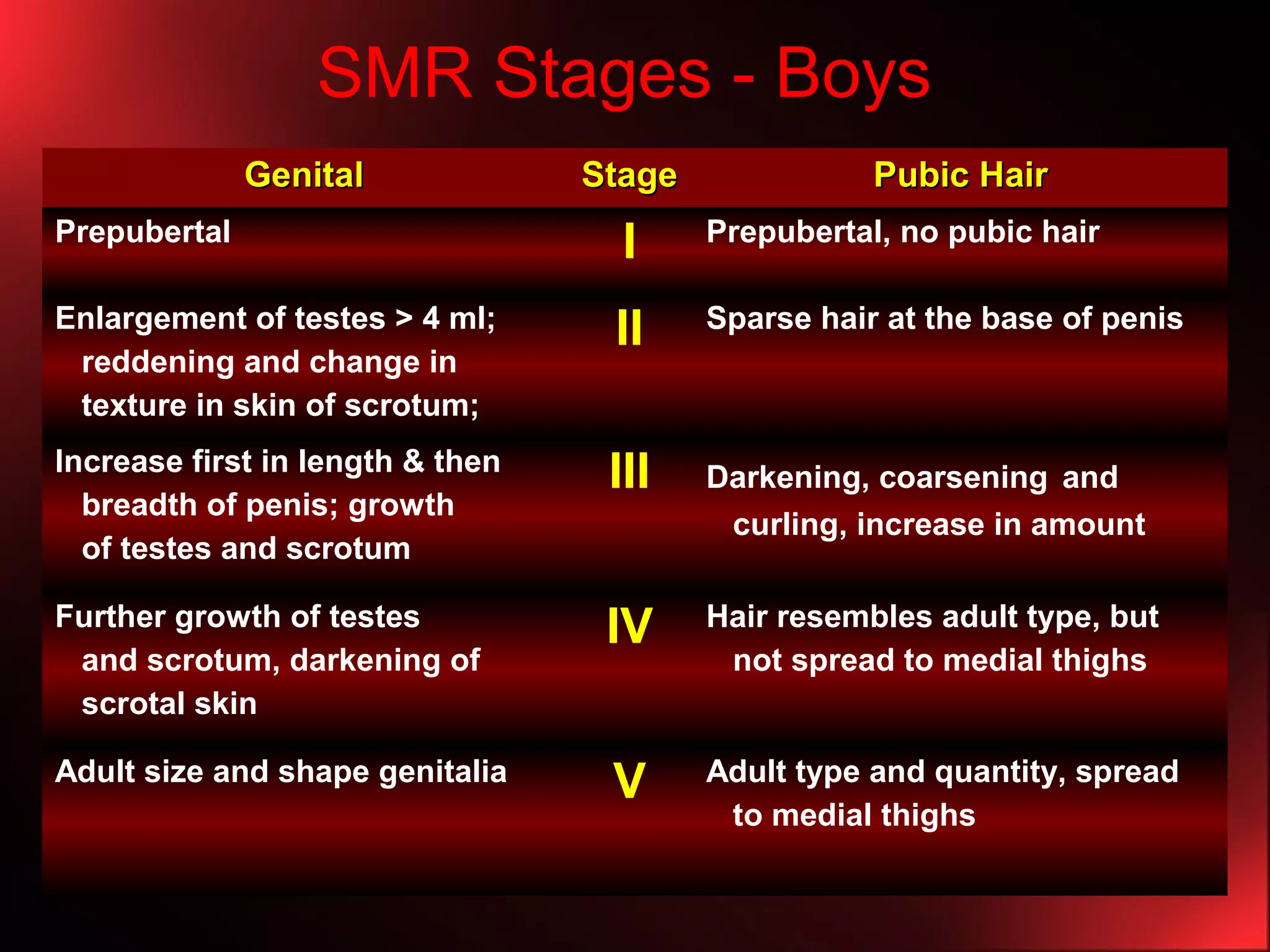
SMR Stages - Boys
GenitalGenital StageStage Pubic HairPubic Hair
Prepubertal
I Prepubertal, no pubic hair
Enlargement of testes > 4 ml;
reddening and change in
texture in skin of scrotum;
II Sparse hair at the base of penis
Increase first in length & then
breadth of penis; growth
of testes and scrotum
III Darkening, coarsening and
curling, increase in amount
Further growth of testes
and scrotum, darkening of
scrotal skin
IV Hair resembles adult type, but
not spread to medial thighs
Adult size and shape genitalia
V Adult type and quantity, spread
to medial thighs
Sexual Maturity Rating – Tanner
Adolescence
StagesStages
Early : 9-13 years
Mid : 14-15 years
Late: 16-19 years
Adolescence
Variable Early Middle Late
Age 10-13 14-16 17-20
SMR 1-2 3-5 5
Somatic Sec. sex
characters
Rapid growth
High growth peaks,
body shape and
comp. change, acne,
odor, menarche,
spermarche
Slower growth
Sexual Interest exceeds
activity
Drive surges,
experimentation,
orientation
Consolidation
of sexual
identity
Cognitive
& moral
Concrete
operational,
conventional
morality
Emergence of
abstract thought, self
centered
Idealism,
absolutism
The Sequential Changes
of Puberty
Adolescent Female
• Breast bud (thelarche)
• Pubic hair development
(pubarche)
• Height velocity peak
• Menarche
• Axillary hair
• Final pubertal changes,
e.g., full breast, pubic hair, and completed
height development
Biological
Changes
Adolescent Male
• Early testicular growth
• Pubarche
• Testicular and penile growth
• Nocturnal emissions (spermarche)
• Height velocity changes
• Marked voice changes
• Facial hair growth
• Final pubertal changes
e.g. full genital, height and muscle development
The Sequential Changes
of PubertyBiological
Changes
ELIZ HEALTH PATH FOR ADOLESCENTS
Under Weight
< 18.5
Normal
18.5 – 24.9
Over Weight
25 – 29.9
Obesity
> 30
• Rapid and uneven growth and development vis a vis peers
• Ignorance about sex and sexuality
• Endocrinal and other psychological changes
• Lack of understanding & suboptimal support at family level
• Social frustration
• Inadequate school syllabus
• Misdirected peer pressure, absence of adequate knowledge
• Lack of recreational, creative and working opportunities.
• Lack of rehabilitation facilities for handicapped adolescents
Factors contributing to healthFactors contributing to health
problems of adolescentsproblems of adolescents
Psychosocial Development
Teenage Adult
With Parents Rebellious Reacceptance
Puberty changes Concern Acceptance
Friends / peers All important More selective
Behaviour Risk taking Put self limits
Attitudes Highly
moralistic
Realistic
Factors affecting Adolescent Health
• Social environment:
– Attitudes and norms
– Relationships with family
– Policies of the decision makers
– Mass media
• Gender:
– Discrimination
• General health:
– Problems of childhood – malnutrition, deprivation,
abuse, infections, etc.
– Problems of adolescence – risk taking behaviour,
tobacco, alcohol, unprotected sex, violence and
injury, etc.
Protective Factors of Adolescent Health
1. Caring and meaningful relationships
2. Positive school environment
3. Structure and boundaries of behaviour
4. Having spiritual beliefs
5. Encouragement of self expression
6. Opportunities for participation and
contribution
ISSUES BOTHERING BOYS
Inadequate facial hair Embarrassment
Breast enlargement - Do -
Pimples - Do -
Self stimulation Physiological
Size of penis Does not matter at
all !
Interest in sex & nudity Natural
Pornography Distorted image
Chance for sexual
abuse
Avoid & resist
ISSUES BOTHERING GIRLS
Hirsutism Embarrassment
Breast shape, size - Do -
Pimples - Do -
Urge for self stimulation Not unusual
Interest in sex & nudity Natural
Sexual exploitation To be recognized early &
resisted
Menstrual problems …….
“The way a person pictures his
or her body”
Body image
• Important ingredient of self-concept
• Help whether we accept or reject
ourselves
• Whether we feel confident in social
relationships
• Whether we have an idealized or
realistic idea of attractiveness, strength,
skills and sex appeal.
Body Image
Perceptual
Evaluation of size of one’s bodyEvaluation of size of one’s body
1
Affective or cognitive
Evaluation of abilitiesEvaluation of abilities
2
Body image – Self Esteem
• Comparing with peers – developing a
feeling of inferiority
• Interfere with day to day functioning
and studies
• Problems in relationships with peers
and family, jealousy, arguments and
other negative expressions
Higher levels of body satisfaction are
associated with higher levels of self esteem.
“The sum total of one’s thinking, feeling,
attitude and behaviour towards sex”
Human Sexuality
•  The physical aspect
to enjoy beauty is not a sin, but not at the
cost of someone’s discomfort.
• The mental aspect
“giving type” – finding happiness in making
the partner happy.
• The spiritual aspect
“do not hurt someone if possible &
do not hurt yourself ever”
Adolescent Sexuality & Sexual Behaviour
• Adolescence is a
period of
heightened
feelings, arousal,
urges and sexual
feelings directed
towards self and
the others
• During
adolescence
sexual exploration
and expression is
common
• Certain
restlessness of
character
• 47% of women between 20-24
yrs were married before 18 yrs
• 12% of women between 15-19
yrs have already become mothers
• 43 % of women & 11% of men
aged 20-24 yrs had sexual debut
• 10% of teenagers suffer from
STIs
• HIV prevalence is 0.18% among
20-24 yrs olds
(NFHS 3 )
In India
Issues in Human Sexuality
• Individual’s role as per
accepted norms for that
particular sex.
• Depends on economy,
education status of
families, career options,
etc.
• Individual’s role as per
accepted norms for that
particular sex.
• Depends on economy,
education status of
families, career options,
etc.
• Recognition of one’s
own sex
• Recognition of one’s
own sex
Gender
Identity
Gender
Identity
Gender RoleGender Role
Issues in Human Sexuality
• Transexualism (Gender Identity Disorders)
• Homosexuality
• Pornography
• Virginity
– Based on tradition, self discipline and self
dignity
• Premarital Sex
Are the horizontal lines parallel?
If so why do they appear like that ?
OpticalIllusions
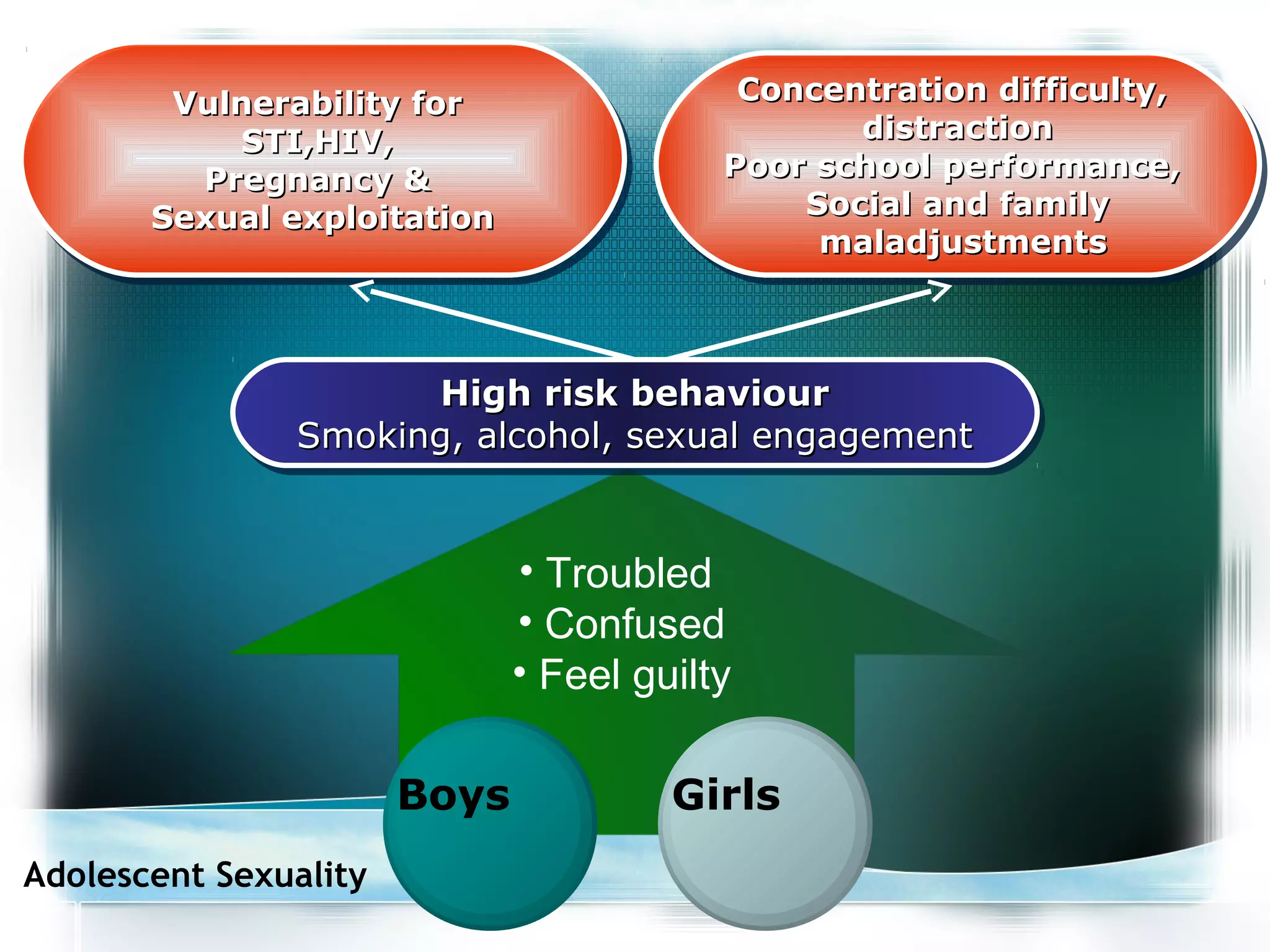
Adolescent Sexuality
High risk behaviourHigh risk behaviour
Smoking, alcohol, sexual engagementSmoking, alcohol, sexual engagement
High risk behaviourHigh risk behaviour
Smoking, alcohol, sexual engagementSmoking, alcohol, sexual engagement
• Troubled
• Confused
• Feel guilty
Boys Girls
Vulnerability forVulnerability for
STI,HIV,STI,HIV,
Pregnancy &Pregnancy &
Sexual exploitationSexual exploitation
Vulnerability forVulnerability for
STI,HIV,STI,HIV,
Pregnancy &Pregnancy &
Sexual exploitationSexual exploitation
Concentration difficulty,Concentration difficulty,
distractiondistraction
Poor school performance,Poor school performance,
Social and familySocial and family
maladjustmentsmaladjustments
Concentration difficulty,Concentration difficulty,
distractiondistraction
Poor school performance,Poor school performance,
Social and familySocial and family
maladjustmentsmaladjustments
Illness
– G & D problems
– Precocious or delayed puberty
– Short stature
Risky behaviours
– Accidents
– Intended injuries
– Violence
– Homicide & Suicide
Adolescent Violence, Injuries & Sexual abuse
• Physical Injuries
• Alcoholism & drug abuse
• Delinquent behaviour
• Eating and sleep disorders
• Reproductive health problems
• Post traumatic stress disorders
• Depression and anxiety
• Suicidal behaviour and self harm
Nutritional problems
– Under nutrition
– Obesity
– Eating disorders
– Micronutrient deficiencies
• An Adolescent
- Male expected to take 2400 Cal / d
(As much an adult sedentary male)
- Girl may require 2100 Cal / day
(A little less than that of her mother)
Issues in Adolescent Nutrition
• Under nutrition – 47 % girls and 58 % boys between 15-19
yrs (BMI < 18)
• Anemia (Hb < 13g/dL) - > 56% girls & 30 % boys
• Early malnutrition affects physical work capacity
• Stunting and delayed maturation compound
the risk of adolescent pregnancy
• 75% relative increase in obesity in adolescents is noted
since 1970
• Inadequate food supply, gender based discrimination –
strong factors
Reproductive Health Problems
– High maternal mortality
– High perinatal mortality
– High LBW rate
– Abortion
– Menstrual problems
– RTI
Mental Health Problems
– Behaviour disorders
– Emotional problems
– Stress & anxiety
– Depression
– Scholastic issues
– Substance usage
– Psychiatric disorders
Mental Health Problems
Erik EriksonErik Erikson
All of the earlier crystallizations of identityAll of the earlier crystallizations of identity
formed during childhood come intoformed during childhood come into
question during adolescence with thequestion during adolescence with the
overwhelming combination of physicaloverwhelming combination of physical
changes, increased sex drive,changes, increased sex drive,
expanded mental abilities, andexpanded mental abilities, and
increasing and conflicting socialincreasing and conflicting social
demands.demands.
CrisisCrisis – dose not connote catastrophe or
threat but a turning point in the life of an
individual
CrisisCrisis – dose not connote catastrophe or
threat but a turning point in the life of an
individual
– Identity problems
Drug Abuse - warning signals
• Sudden fall in academic performance
• Noticeable change in attitudes,
interests & behaviour
• Isolation from others
• Frequently altering moods of
depression & elation
• Easy fatigability, lack of enthusiasm /
marked incapacity for enjoyment
Other Adolescent Health Problems
• Infections
– Tuberculosis
– UTIs
• Sleep Disorders
– Insomnia
– Day time sleep
• Skin Problems
• Orthopedic problems
– Slipped Femoral Capital epiphyseal disk
• Chronic Diseases
– Head ache
– Refractive errors
– Goiter
– Asthma
1. Self-Awareness
2. Empathy
3. Critical Thinking
4. Creative Thinking
5. Decision Making
6. Problem solving
7. Effective Communication
8. Interpersonal Relationship
9. Coping With Stress
10. Coping With Emotions
CSN Vittal cc oo rree
ll iiff ee ss kk ii ll ssll
SAYING ‘NO’ TO PEER PRESSURE
If one is assertive one can :
– Stand up for one’s own values and needs
– Take control of one’s own decisions
– Trust and value one’s own feelings
– Recognise the attempts of others to control
Nobody has a right to touch you unless you want
them to, be firm and say ‘NO’
Learn to say ‘NO’ the first time itself, it will be much easier
than doing it later.
Remember while saying NO don’t hurt the person, rather
make the person feel how hurt you yourself are, having to
say NO.
Barriers preventing adolescents from
seeking available health services
• Do not recognise illnesses
• Unaware of consequences
• Do not want to draw attention to themselves
• Do not know where to go
• Fear that health workers may
- humiliate their patients
- ask difficult questions
- conduct unpleasant procedures
• Uncomfortable with health workers of the opposite sex
• Parental consent required
• Concerns about confidentiality
• Cumbersome bureaucratic procedure
• Long waiting time
– To setup ideal Adolescent Friendly health
facilities
– To make existing ones more youth friendly
– Deliver services and supplies outside
health settings, e.g. school linked clinics,
market place clinics & workplace clinics,
etc.
Adolescents InsideAdolescents Inside
Handle with CareHandle with Care
Thank Q
- Vittal

Adolescence

  • 1.
    WHO defWHO def adolescentsadolescents 10-19 yrs10 -19 yrs Adolescence ‘adolescere’ Latin = “to grow, to mature” i.e. achieving an identity.
  • 2.
    Adolescence Definition:Definition: • “A periodbetween childhood and adulthood.” » Oxford’s Dictionary • “Adolescence is that period of life of an individual when society no longer views him as a child but does not as yet concede him either the roles or the functions inherent in the status of adult”. » Holinshead.
  • 3.
    Adolescence is.. …that part inour life where nothing seems to go smoothly yet our best
  • 4.
    Adolescence WHO / UNDefinitions: – Adolescent : 10 – 19 years – Youth : 15 – 24 years – Young Adults : 10 – 24 years
  • 5.
    Some Definitions • Puberty Physicalcharacteristics that occur during adolescence • The Growth Spurt Rapid changes in height and weight during puberty. • Primary Sex Characteristics The changes that mark the beginning of puberty for girls and boys. • Secondary Sex Characteristics Other external changes that make adolescents look like mature men and women
  • 6.
    TeenagersTeenagers Comprise 2nd largestpopulation group. (23%)Comprise 2nd largest population group. (23%) • over 1 billion world overover 1 billion world over • World over - 1 out of every 5 personWorld over - 1 out of every 5 person • Developing - 1 out of every 4 personDeveloping - 1 out of every 4 person • 10-19 years age group constitute > 1/510-19 years age group constitute > 1/5thth of India’s population.of India’s population. • By the year 2010 there will be moreBy the year 2010 there will be more adolescents alive in the world than everadolescents alive in the world than ever beforebefore • Healthy and well-adjusted adolescents ofHealthy and well-adjusted adolescents of today will become productive citizenstoday will become productive citizens andand dynamic leaders of tomorrow.dynamic leaders of tomorrow. CSN Vittal
  • 7.
    Salient attributes ofAdolescence • Physical, psychological, emotional and social development • Rapid but uneven physical growth • Sexual maturity and onset of sexual activity • Desire for exploration and experimentation • Development of adult mental process and self identity • Transition from dependence to relative independence
  • 8.
    Factors affecting theadolescent development • Socioeconomic circumstances • The environment in which they live and grow • The quality of relationships with their families • Communities and peer groups • Opportunities for education and employment
  • 9.
    Growth Spurt 1. Averagespurt is 24 to 36 months 2. Growth spurt is assoc. with bone age (not age in years) 3. Growth spurt: up to 25% of final height 4. Peak height velocity (PHV) a. Two years sooner in females vs. males b. Tanner 2 in females vs. 4 in males c. Tanner 5: Most teens are beyond PHV
  • 10.
    1. Starts: 10years in females vs 11.5 years in males 2. PHV: 8.0 cm/year in females vs 9 cm in males 3. Age: PHV at 11.5 years in females vs 13.5 in males (Two years sooner in females vs. males) - Tanner 2 in females vs. 4 in males 4. Depends on onset of puberty and effects of nutrition / illness 5. End: epiphyseal/diaphyseal closure (adult bone age) Linear Growth
  • 11.
    Tanner’s Stages Sequence ofsomatic andSequence of somatic and physiologic changes give rise tophysiologic changes give rise to sexual maturitysexual maturity • SMR Stages : 1 to 5 on parameters: 1. Pubic hair 2. Breast development 3. Genital development
  • 12.
    SMR Stages -Girls BreastBreast StageStage Pubic HairPubic Hair Prepubertal – Nipple elevation only I Prepubertal, no pubic hair Small, raised breast bud (thelarche) II Sparse growth of hair along labia General enlargement of raising of breast and areola III Pigmentation, coarsening and curling, with an increase in amount Further enlargement with projection of areola and nipple as secondary mound IV Hair resembles adult type, but not spread to medial thighs Adult contour, with areola in same contour as breast, & only nipple projecting V Adult type and quantity, spread to medial thighs
  • 13.
    SMR Stages -Boys GenitalGenital StageStage Pubic HairPubic Hair Prepubertal I Prepubertal, no pubic hair Enlargement of testes > 4 ml; reddening and change in texture in skin of scrotum; II Sparse hair at the base of penis Increase first in length & then breadth of penis; growth of testes and scrotum III Darkening, coarsening and curling, increase in amount Further growth of testes and scrotum, darkening of scrotal skin IV Hair resembles adult type, but not spread to medial thighs Adult size and shape genitalia V Adult type and quantity, spread to medial thighs
  • 14.
  • 15.
    Adolescence StagesStages Early : 9-13years Mid : 14-15 years Late: 16-19 years
  • 16.
    Adolescence Variable Early MiddleLate Age 10-13 14-16 17-20 SMR 1-2 3-5 5 Somatic Sec. sex characters Rapid growth High growth peaks, body shape and comp. change, acne, odor, menarche, spermarche Slower growth Sexual Interest exceeds activity Drive surges, experimentation, orientation Consolidation of sexual identity Cognitive & moral Concrete operational, conventional morality Emergence of abstract thought, self centered Idealism, absolutism
  • 17.
    The Sequential Changes ofPuberty Adolescent Female • Breast bud (thelarche) • Pubic hair development (pubarche) • Height velocity peak • Menarche • Axillary hair • Final pubertal changes, e.g., full breast, pubic hair, and completed height development Biological Changes
  • 18.
    Adolescent Male • Earlytesticular growth • Pubarche • Testicular and penile growth • Nocturnal emissions (spermarche) • Height velocity changes • Marked voice changes • Facial hair growth • Final pubertal changes e.g. full genital, height and muscle development The Sequential Changes of PubertyBiological Changes
  • 19.
    ELIZ HEALTH PATHFOR ADOLESCENTS Under Weight < 18.5 Normal 18.5 – 24.9 Over Weight 25 – 29.9 Obesity > 30
  • 21.
    • Rapid anduneven growth and development vis a vis peers • Ignorance about sex and sexuality • Endocrinal and other psychological changes • Lack of understanding & suboptimal support at family level • Social frustration • Inadequate school syllabus • Misdirected peer pressure, absence of adequate knowledge • Lack of recreational, creative and working opportunities. • Lack of rehabilitation facilities for handicapped adolescents Factors contributing to healthFactors contributing to health problems of adolescentsproblems of adolescents
  • 22.
    Psychosocial Development Teenage Adult WithParents Rebellious Reacceptance Puberty changes Concern Acceptance Friends / peers All important More selective Behaviour Risk taking Put self limits Attitudes Highly moralistic Realistic
  • 23.
    Factors affecting AdolescentHealth • Social environment: – Attitudes and norms – Relationships with family – Policies of the decision makers – Mass media • Gender: – Discrimination • General health: – Problems of childhood – malnutrition, deprivation, abuse, infections, etc. – Problems of adolescence – risk taking behaviour, tobacco, alcohol, unprotected sex, violence and injury, etc.
  • 24.
    Protective Factors ofAdolescent Health 1. Caring and meaningful relationships 2. Positive school environment 3. Structure and boundaries of behaviour 4. Having spiritual beliefs 5. Encouragement of self expression 6. Opportunities for participation and contribution
  • 25.
    ISSUES BOTHERING BOYS Inadequatefacial hair Embarrassment Breast enlargement - Do - Pimples - Do - Self stimulation Physiological Size of penis Does not matter at all ! Interest in sex & nudity Natural Pornography Distorted image Chance for sexual abuse Avoid & resist
  • 26.
    ISSUES BOTHERING GIRLS HirsutismEmbarrassment Breast shape, size - Do - Pimples - Do - Urge for self stimulation Not unusual Interest in sex & nudity Natural Sexual exploitation To be recognized early & resisted Menstrual problems …….
  • 27.
    “The way aperson pictures his or her body”
  • 28.
    Body image • Importantingredient of self-concept • Help whether we accept or reject ourselves • Whether we feel confident in social relationships • Whether we have an idealized or realistic idea of attractiveness, strength, skills and sex appeal.
  • 29.
    Body Image Perceptual Evaluation ofsize of one’s bodyEvaluation of size of one’s body 1 Affective or cognitive Evaluation of abilitiesEvaluation of abilities 2
  • 30.
    Body image –Self Esteem • Comparing with peers – developing a feeling of inferiority • Interfere with day to day functioning and studies • Problems in relationships with peers and family, jealousy, arguments and other negative expressions Higher levels of body satisfaction are associated with higher levels of self esteem.
  • 31.
    “The sum totalof one’s thinking, feeling, attitude and behaviour towards sex”
  • 32.
    Human Sexuality •  Thephysical aspect to enjoy beauty is not a sin, but not at the cost of someone’s discomfort. • The mental aspect “giving type” – finding happiness in making the partner happy. • The spiritual aspect “do not hurt someone if possible & do not hurt yourself ever”
  • 33.
    Adolescent Sexuality &Sexual Behaviour • Adolescence is a period of heightened feelings, arousal, urges and sexual feelings directed towards self and the others • During adolescence sexual exploration and expression is common • Certain restlessness of character • 47% of women between 20-24 yrs were married before 18 yrs • 12% of women between 15-19 yrs have already become mothers • 43 % of women & 11% of men aged 20-24 yrs had sexual debut • 10% of teenagers suffer from STIs • HIV prevalence is 0.18% among 20-24 yrs olds (NFHS 3 ) In India
  • 34.
    Issues in HumanSexuality • Individual’s role as per accepted norms for that particular sex. • Depends on economy, education status of families, career options, etc. • Individual’s role as per accepted norms for that particular sex. • Depends on economy, education status of families, career options, etc. • Recognition of one’s own sex • Recognition of one’s own sex Gender Identity Gender Identity Gender RoleGender Role
  • 35.
    Issues in HumanSexuality • Transexualism (Gender Identity Disorders) • Homosexuality • Pornography • Virginity – Based on tradition, self discipline and self dignity • Premarital Sex
  • 36.
    Are the horizontallines parallel? If so why do they appear like that ? OpticalIllusions
  • 37.
    Adolescent Sexuality High riskbehaviourHigh risk behaviour Smoking, alcohol, sexual engagementSmoking, alcohol, sexual engagement High risk behaviourHigh risk behaviour Smoking, alcohol, sexual engagementSmoking, alcohol, sexual engagement • Troubled • Confused • Feel guilty Boys Girls Vulnerability forVulnerability for STI,HIV,STI,HIV, Pregnancy &Pregnancy & Sexual exploitationSexual exploitation Vulnerability forVulnerability for STI,HIV,STI,HIV, Pregnancy &Pregnancy & Sexual exploitationSexual exploitation Concentration difficulty,Concentration difficulty, distractiondistraction Poor school performance,Poor school performance, Social and familySocial and family maladjustmentsmaladjustments Concentration difficulty,Concentration difficulty, distractiondistraction Poor school performance,Poor school performance, Social and familySocial and family maladjustmentsmaladjustments
  • 39.
    Illness – G &D problems – Precocious or delayed puberty – Short stature
  • 40.
    Risky behaviours – Accidents –Intended injuries – Violence – Homicide & Suicide
  • 41.
    Adolescent Violence, Injuries& Sexual abuse • Physical Injuries • Alcoholism & drug abuse • Delinquent behaviour • Eating and sleep disorders • Reproductive health problems • Post traumatic stress disorders • Depression and anxiety • Suicidal behaviour and self harm
  • 42.
    Nutritional problems – Undernutrition – Obesity – Eating disorders – Micronutrient deficiencies • An Adolescent - Male expected to take 2400 Cal / d (As much an adult sedentary male) - Girl may require 2100 Cal / day (A little less than that of her mother)
  • 43.
    Issues in AdolescentNutrition • Under nutrition – 47 % girls and 58 % boys between 15-19 yrs (BMI < 18) • Anemia (Hb < 13g/dL) - > 56% girls & 30 % boys • Early malnutrition affects physical work capacity • Stunting and delayed maturation compound the risk of adolescent pregnancy • 75% relative increase in obesity in adolescents is noted since 1970 • Inadequate food supply, gender based discrimination – strong factors
  • 44.
    Reproductive Health Problems –High maternal mortality – High perinatal mortality – High LBW rate – Abortion – Menstrual problems – RTI
  • 45.
    Mental Health Problems –Behaviour disorders – Emotional problems – Stress & anxiety – Depression – Scholastic issues – Substance usage – Psychiatric disorders
  • 46.
    Mental Health Problems ErikEriksonErik Erikson All of the earlier crystallizations of identityAll of the earlier crystallizations of identity formed during childhood come intoformed during childhood come into question during adolescence with thequestion during adolescence with the overwhelming combination of physicaloverwhelming combination of physical changes, increased sex drive,changes, increased sex drive, expanded mental abilities, andexpanded mental abilities, and increasing and conflicting socialincreasing and conflicting social demands.demands. CrisisCrisis – dose not connote catastrophe or threat but a turning point in the life of an individual CrisisCrisis – dose not connote catastrophe or threat but a turning point in the life of an individual – Identity problems
  • 47.
    Drug Abuse -warning signals • Sudden fall in academic performance • Noticeable change in attitudes, interests & behaviour • Isolation from others • Frequently altering moods of depression & elation • Easy fatigability, lack of enthusiasm / marked incapacity for enjoyment
  • 48.
    Other Adolescent HealthProblems • Infections – Tuberculosis – UTIs • Sleep Disorders – Insomnia – Day time sleep • Skin Problems • Orthopedic problems – Slipped Femoral Capital epiphyseal disk • Chronic Diseases – Head ache – Refractive errors – Goiter – Asthma
  • 51.
    1. Self-Awareness 2. Empathy 3.Critical Thinking 4. Creative Thinking 5. Decision Making 6. Problem solving 7. Effective Communication 8. Interpersonal Relationship 9. Coping With Stress 10. Coping With Emotions CSN Vittal cc oo rree ll iiff ee ss kk ii ll ssll
  • 52.
    SAYING ‘NO’ TOPEER PRESSURE If one is assertive one can : – Stand up for one’s own values and needs – Take control of one’s own decisions – Trust and value one’s own feelings – Recognise the attempts of others to control Nobody has a right to touch you unless you want them to, be firm and say ‘NO’ Learn to say ‘NO’ the first time itself, it will be much easier than doing it later. Remember while saying NO don’t hurt the person, rather make the person feel how hurt you yourself are, having to say NO.
  • 57.
    Barriers preventing adolescentsfrom seeking available health services • Do not recognise illnesses • Unaware of consequences • Do not want to draw attention to themselves • Do not know where to go • Fear that health workers may - humiliate their patients - ask difficult questions - conduct unpleasant procedures • Uncomfortable with health workers of the opposite sex • Parental consent required • Concerns about confidentiality • Cumbersome bureaucratic procedure • Long waiting time
  • 58.
    – To setupideal Adolescent Friendly health facilities – To make existing ones more youth friendly – Deliver services and supplies outside health settings, e.g. school linked clinics, market place clinics & workplace clinics, etc.
  • 59.
    Adolescents InsideAdolescents Inside Handlewith CareHandle with Care Thank Q - Vittal