

Universal
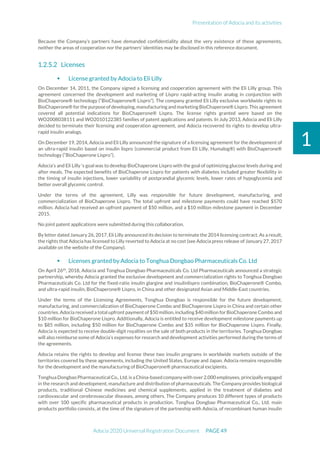
Document
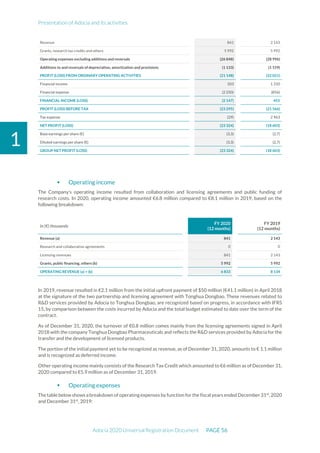
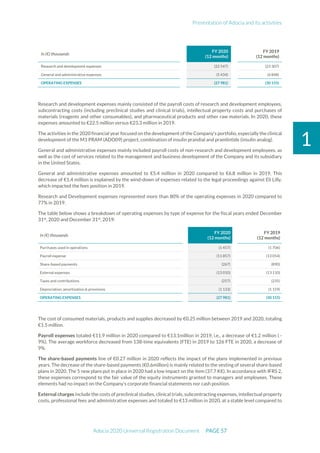
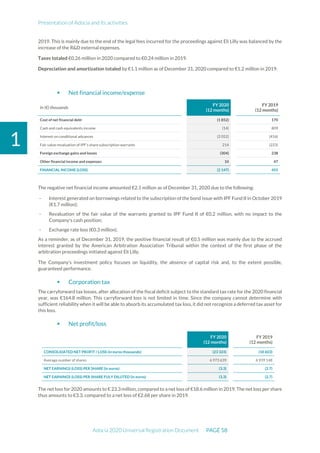
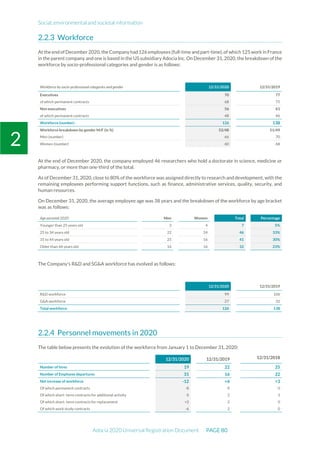
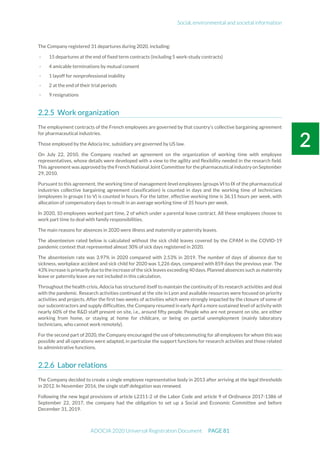
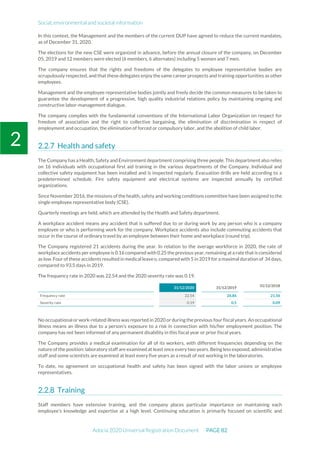
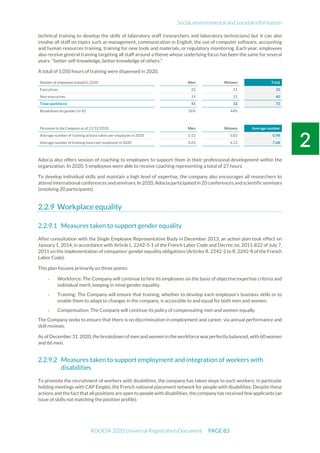
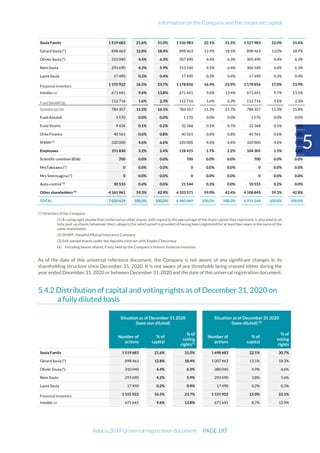
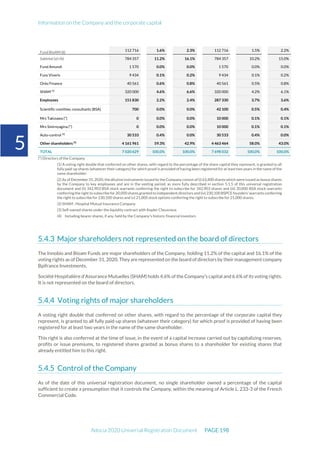
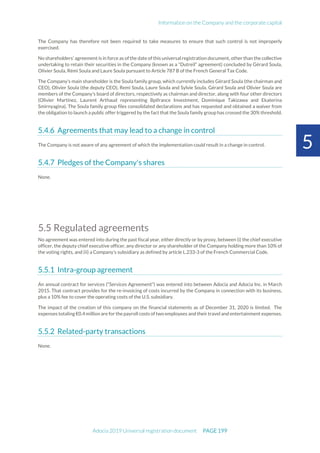
Registration 2020
This is a translation into English of the universal
registration document of the Company issued in
French and it is available on the website of the Issuer
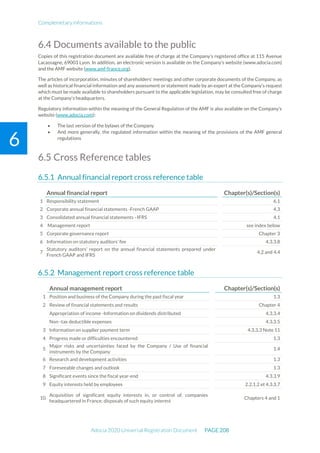
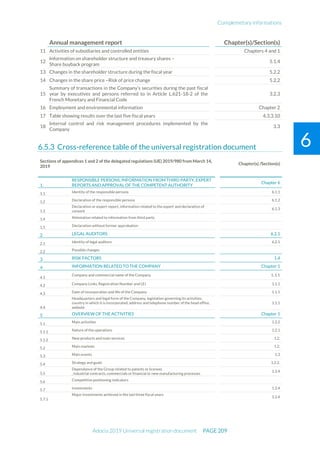
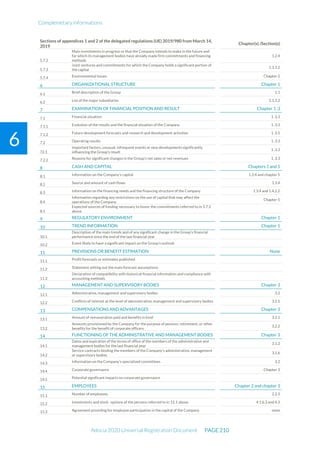
Adocia 2020 Universal Registration Document PAGE 2
Adocia 2020 Universal Registration Document PAGE 3
A French société anonyme (corporation) with €702,062.9 in share capital
Registered office: 115 avenue Lacassagne
69003 Lyon, France
Lyon Trade and Companies Registry No. 487 647 737
The universal registration document was filed on April 20, 2021 with the AMF, as the competent authority
under Regulation (EU) 2017/1129, without prior approval in accordance with Article 9 of that Regulation.
The universal registration document may be used for the purposes of a public offering of financial securities or
the admission of financial securities to trading on a regulated market if it is supplemented by a transaction note
and if necessary, a summary and all the amendments to the universal registration document. The assembly then
formed is approved by the AMF in accordance with Regulation (EU) 2017/1129.
Copies of this universal registration document are available free of charge from the Company at 115, Avenue
Lacassagne, 69003 Lyon. In addition, an electronic version is available on the Company’s website
(www.adocia.com) and on the AMF website (www.amf-france.org).
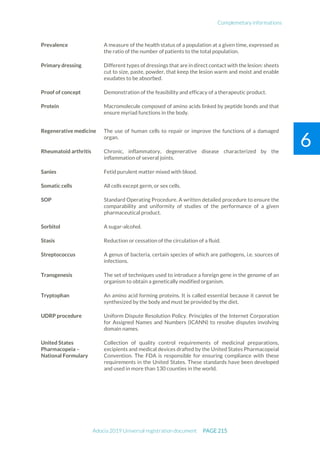
This is a free translation into English of the
(universal) registration document of Adocia
issued in French and it is available on the
website of the Issuer. This free translation is
for an informational purpose only.
Adocia 2020 Universal Registration Document PAGE 4
NOTICE
In this universal registration document, the terms “Adocia” or the “Company” refer to Adocia, a French société
anonyme (corporation) whose registered office is located at 115, Avenue Lacassagne, 69003 Lyon, France, and which
is registered with the Lyon Trade and Companies Registry under number 487 647 737 and, when appropriate, its
subsidiary, Adocia Inc., a company incorporated in the state of Delaware, whose head office is located at 270258 San
Diego, CA 92198-2258, U.S.A.
The consolidated financial statements prepared under IFRS for the fiscal year ended December 31, 2020 are
presented on pages 120 to 154 of this universal registration document. The statutory auditors’ report on the
consolidated financial statements prepared under IFRS for the fiscal year ended December 31, 2020 is presented on
pages 155 to 161 of this universal registration document.
The corporate financial statements prepared under French GAAP for the fiscal year ended December 31, 2020 are
presented on pages 162 to 182 of this universal registration document. The statutory auditor’s report on the
corporate financial statements prepared under French GAAP for the fiscal year ended December 31, 2020 is
presented on pages 183 to 188.
Pursuant to Article 19 of Commission Regulation (EC) No. 2017/1129 of June 14, 2017,
- The consolidated financial statements ended December 31, 2019 and the related statutory auditors’ reports
presented respectively in paragraph 4.1 and 4.2 of the 2019 universal registration document filed with the AMF
on April 22, 2020 with reference D.20-0330
- The consolidated financial statements ended December 31, 2018 and the related statutory auditors’ reports
presented respectively in paragraph 4.1 and 4.2 of the 2018 universal registration document filed with the AMF
on April 12th
, 2019 with reference D.19-0328
are incorporated by reference in this universal registration document.
The non-included parts of this(ese) document(s) are either irrelevant for the investor or covered elsewhere in the
universal registration document.
A glossary containing the definitions of certain technical terms used in this registration document, as well as an index
of abbreviations used, can be found in paragraph 6.6. Terms indicated by an asterisk (*) are defined in the glossary.
Adocia 2020 Universal Registration Document PAGE 5
DISCLAIMER
Market and competition information
This universal registration document contains, in particular in section 1.3 “Description of Activities”, information about
the Company’s markets and competitive position. This information is taken, in particular, from studies conducted by
external sources. Publicly available information that the Company deems reliable has not been verified by
independent experts, and the Company cannot guarantee thata third party using different methods to collect, analyze
or calculate data on these markets would obtain the same results.
Forward-looking information
This universal registration document contains information on the Company’s outlook and development priorities. At
times, this information is identified by the use of the future or conditional tense or forward-looking words such as
“consider”, “plan”, “think”, “have as an objective”, “expect”, “intend”, “should”, “aspire to”, “estimate”, “believe”, “wish”,
“could” or, where applicable, the negative form of these terms, or any variation thereof or similar terminology. This
information is not historical data and should not be viewed as a guarantee that the facts and events described will
occur. This information is based on data, assumptions and estimates that the Company deems reasonable. It may
change or be modified due to uncertainties associated with, in particular, the economic, financial, competitive and
regulatory environment. This information is provided in the various sections of this universal registration document
and includes data related to the Company’s intentions, estimates and objectives with respect to, among other things,
the market in which it operates and its strategy, growth, results, financial position, cash position and forecasts. The
forward-looking information in this universal registration document is provided only as of the date of this registration
document. The Company operates in a constantly changing competitive environment. Therefore, it cannot anticipate
all risks, uncertainties and other factors that may affect its business, the potential impact thereof on its business, or
the extent to which the occurrence of a risk or combination of risks could have significantly different results from
thosementioned in any forward-looking information. Itshouldbe noted thatnone of this forward-looking information
is a guarantee of actual results.
Risk factors
Investors are advised to carefully review the risk factors described in paragraph 1.5 “Risk Factors” of this universal
registration document before making any investment decision. The occurrence of any or all of these risks may have a
material adverse impact on the Company’s business, financial position, results or outlook. Furthermore, other risks
not yet identified or not deemed significant by the Company as of the date of this universal registration document
may also have a material adverse impact.
Adocia 2020 Universal Registration Document PAGE 6
Adocia 2020 Universal Registration Document PAGE 7
Table of contents
1 PRESENTATION OF ADOCIA AND ITS
ACTIVITIES 10
1.1 About Adocia and its evolution 10
1.2 Description of activities 14
1.3 Analysis and comments on activities during the
year 54
1.4 Risk factors 62
2 SOCIAL, ENVIRONMENTAL AND
SOCIETAL INFORMATION 78
2.1 Methodology note 78
2.2 Social data 78
2.3 Environmental data 84
2.4 Social data: information on social responsibility
in favor of sustainable development 87
3 CORPORATE GOVERNANCE 92
3.1 Governance Code 92
3.2 Compensation and benefits received by officers
and directors 105
3.3 Risk management and internal control
procedures implemented by the Company 113
4 ANNUAL FINANCIAL STATEMENTS AS
OF DECEMBER 31, 2020 120
4.1 Consolidated Financial Statements 120
4.2 Statutory auditors’ report on the consolidated
financial statements 155
4.3 Corporate annual financial statements 162
4.4 Statutory auditors’ report on the corporate
financial statements 183
5 INFORMATION ON THE COMPANY
AND THE CORPORATE CAPITAL 192
5.1 Corporate capital 192
5.2 Authorized capital 194
5.3 Articles of incorporation and statutes 194
5.4 Major shareholders 196
5.5 Regulated agreements 199
6 COMPLEMETARY INFORMATIONS 206
6.1 Persons responsible 206
6.2 Statutory Auditors 207
6.3 Information from third parties, experts’
statements and declaration of interests 207
6.4 Documents available to the public 208
6.5 Cross Reference tables 208
Glossary 212
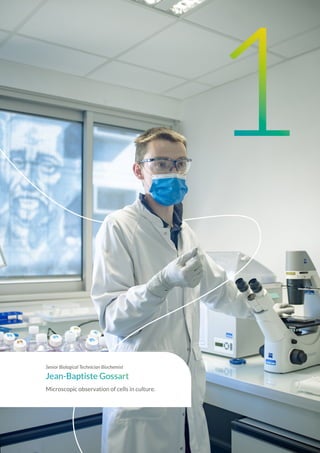
1
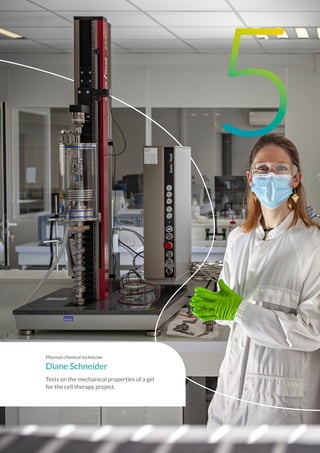
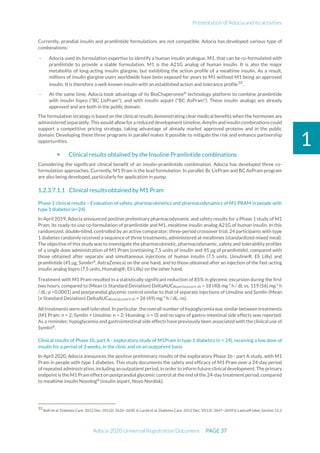
Senior Biological Technician Biochemist
Jean-Baptiste Gossart
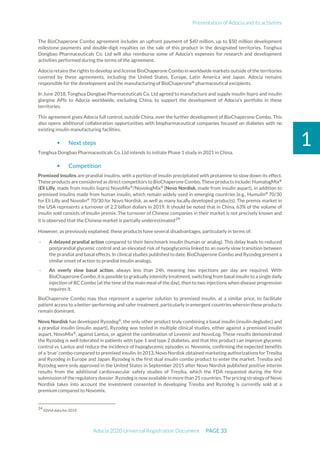
Microscopic observation of cells in culture.
Adocia 2020 Universal Registration Document PAGE 9
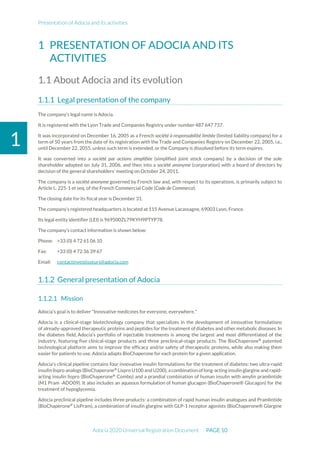
Chapter 1
1 PRESENTATION OF ADOCIA AND ITS ACTIVITIES 10
1.1 About Adocia and its evolution 10
Legal presentation of the company 10
General presentation of Adocia 10
Organizational chart 12
Investments and real estate 13
1.2 Description of activities 14
The BioChaperone®
technology platform 15
Pipeline presentation 16
Adocia’s pipeline for the treatment of diabetes 17
Intellectual Property 44
Legal 48
1.3 Analysis and comments on activities during the year 54
Main activities during the year 54
Presentation of the financial statements 55
Financial position and appropriation of profit 55
Cash, financing and equity 59
Foreseeable developments, future prospects and significant events after the end of
the fiscal year 61
1.4 Risk factors 62
Risks associated with the Company’s activity 63
Financial risks 66
Risks associated with dependence on third parties 69
Regulatory and legal risks 71
Insurance and risk coverage 75
Extraordinary events and disputes 75
Presentation of Adocia and its activities
Adocia 2020 Universal Registration Document PAGE 10
1
1 PRESENTATION OF ADOCIA AND ITS
ACTIVITIES
1.1 About Adocia and its evolution
Legal presentation of the company
The company’s legal name is Adocia.
It is registered with the Lyon Trade and Companies Registry under number 487 647 737.
It was incorporated on December 16, 2005 as a French société à responsabilité limitée (limited liability company) for a
term of 50 years from the date of its registration with the Trade and Companies Registry on December 22, 2005, i.e.,
until December 22, 2055, unless such term is extended, or the Company is dissolved before its term expires.
It was converted into a société par actions simplifiée (simplified joint stock company) by a decision of the sole
shareholder adopted on July 31, 2006, and then into a société anonyme (corporation) with a board of directors by
decision of the general shareholders’ meeting on October 24, 2011.
The company is a société anonyme governed by French law and, with respect to its operations, is primarily subject to
Article L. 225-1 et seq. of the French Commercial Code (Code de Commerce).
The closing date for its fiscal year is December 31.
The company’s registered headquarters is located at 115 Avenue Lacassagne, 69003 Lyon, France.
Its legal entity identifier (LEI) is 969500ZL79KYH9PTYP78.
The company’s contact information is shown below:
Phone: +33 (0) 4 72 61 06 10
Fax: +33 (0) 4 72 36 39 67
Email: contactinvestisseurs@adocia.com
General presentation of Adocia
Mission
Adocia's goal is to deliver "Innovative medicines for everyone, everywhere."
Adocia is a clinical-stage biotechnology company that specializes in the development of innovative formulations
of already-approved therapeutic proteins and peptides for the treatment of diabetes and other metabolic diseases. In
the diabetes field, Adocia’s portfolio of injectable treatments is among the largest and most differentiated of the
industry, featuring five clinical-stage products and three preclinical-stage products. The BioChaperone®
patented
technological platform aims to improve the efficacy and/or safety of therapeutic proteins, while also making them
easier for patients to use. Adocia adapts BioChaperone for each protein for a given application.
Adocia's clinical pipeline contains four innovative insulin formulations for the treatment of diabetes: two ultra-rapid
insulin lispro analogs (BioChaperone®
Lispro U100 and U200), a combination of long-acting insulin glargine and rapid-
acting insulin lispro (BioChaperone®
Combo) and a prandial combination of human insulin with amylin pramlintide
(M1 Pram -ADO09). It also includes an aqueous formulation of human glucagon (BioChaperone® Glucagon) for the
treatment of hypoglycemia.
Adocia preclinical pipeline includes three products: a combination of rapid human insulin analogues and Pramlintide
(BioChaperone®
LisPram), a combination of insulin glargine with GLP-1 receptor agonists (BioChaperone® Glargine
1 1
Presentation of Adocia and its activities
Adocia 2020 Universal Registration Document PAGE 11
1
GLP-1) for the treatment of diabetes and a ready-to-use combination of glucagon and a GLP-1 receptor agonist
(BioChaperone®
Glucagon GLP1) for the treatment of obesity.
Adocia recently added a fourth program, a preclinical stage cell therapy program, focused on the development of a
hydrogel structure for use in people with type 1 diabetes. The first patent application supporting this program was
filed.
Significant events in the business development of the company
As the results of these research efforts and their commercial development take many years, for the first ten years the
company’s annual financial statements have mainly reflected research and development costs which, for the most
part, have been financed by capital increases, Bpifrance repayable advances and grants, and the research tax credit.
Since its inception on December 16, 2005, and before its IPO, the company raised over €27 million through capital
increases subscribed, in particular, by its founders, Gérard, Olivier and Rémi Soula, and institutional investors
(IdInvest, Amundi, Viveris, BioAm, SHAM and InnoBio). In 2012, the Company was listed on the Euronext Paris
regulated market and raised more than €27.4 million (excluding transaction costs). In March 2015, it completed a
private placement of nearly €32 million by issuing new shares to investors specialized in the healthcare sector,
particularly in the United States.
The BioChaperone Lispro program has been licensed twice to the American company Eli Lilly. Between December
2011 and January 2013, a first partnership was signed, which was terminated by joint agreement.
Then, a second agreement, based on the results obtained from two phase 2a studies, was reached on December 19,
2014 on the development of an ultra-rapid insulin with two formulations: BioChaperone Lispro U100 and
BioChaperone Lispro U200. Over their partnership, Eli Lilly and Adocia successfully completed 6 clinical studies on
BioChaperone Lispro U100 and U200.
On January 26,2016,Lilly announced its decision to terminatethis agreementin order to prioritize an internal project,
LY900014 (Lyumjev®). The termination of the contract was followed by two arbitration proceedings, which have
been closed since and detailed in section "Disputes" 1.2.7.3 of this present document.
Following the termination of the second partnership, Adocia regained full ownership of the rights that had been
licensed and has been continuing to develop its product.
Throughout 2016, the Company focused its efforts entirely on diabetes by discontinuing its monoclonal antibodies
and DriveIn programs and launching new BioChaperone Combo projects, combinations of long-acting insulin glargine
with GLP-1 and, recently, combinations of prandial insulins.
In 2017 Adocia achieved key milestones in the development of its products, by demonstrating a better fast-off profile
for BioChaperone Lispro than for the Novo Nordisk ultra-rapid insulin Fiasp®
, successfully completing the first clinical
trial for the BioChaperone Glucagon project and demonstrating the dose linearity of BioChaperone Combo. The
company also announced the expansion of its portfolio to new therapeutic fields other than diabetes, with the launch
of two new projects for the treatment of obesity and short bowel system.
In April 2018, Adocia signed with the Chinese company, Tonghua Dongbao Pharmaceuticals Co. Ltd, a strategic
alliance for the development and commercialization of BioChaperone®
Combo and BioChaperone®
Lispro in China
and in certain other countries. These licensing agreements have a total potential value of $ 135 million (Adocia is
expected to receive double-digit royalties on the future sales of both products) including $50 million when the
partnership was signed. In June 2018, the companies also signed two global supply agreements for Insulin Lispro and
Insulin Glargine. Thus, Adocia will be able to carry out its BioChaperone Lispro et BioChaperone Combo projects in
Europe, in the US and in Japan.
In late 2019, the Company established a debt financing plan, with attached warrants. This financing line consists in a
bond issue, for a total amount of EUR 15 million to finance the development of its portfolio.
Over the past two years, Adocia has continued to develop products under the partnership with Tonghua Dongbao.
The Company made progress in the development of its entire portfolio, notably with the M1 Pram project, a co-
formulation of synergistic therapeutic hormones pramlintide and M1 insulin.
In 2020, despite a year disrupted by the Covid-19 pandemic, the Company continued to develop its projects. In August
2020, Adocia was granted a State-guaranteed loan by the French government of 7 million euros, which enabled the
Company to have a greater financial visibility and to be in a position of strength to sign a partnership.
Presentation of Adocia and its activities
Adocia 2020 Universal Registration Document PAGE 12
1
This loan also allowed the Company to have a greater financial visibility and to be in a stronger position to sign new
partnerships.
Organizational chart
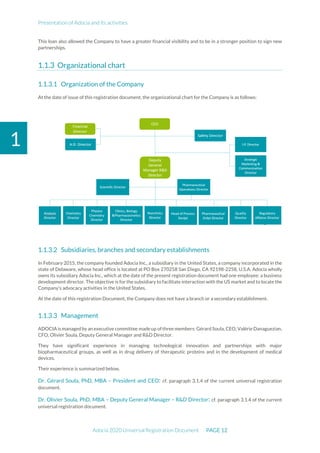
Organization of the Company
At the date of issue of this registration document, the organizational chart for the Company is as follows:
Subsidiaries, branches and secondary establishments
In February 2015, the company founded Adocia Inc., a subsidiary in the United States, a company incorporated in the
state of Delaware, whose head office is located at PO Box 270258 San Diego, CA 92198-2258, U.S.A. Adocia wholly
owns its subsidiary Adocia Inc., which at the date of the present registration document had one employee: a business
development director. The objective is for the subsidiary to facilitate interaction with the US market and to locate the
Company's advocacy activities in the United States.
At the date of this registration Document, the Company does not have a branch or a secondary establishment.
Management
ADOCIA is managed by an executive committee madeup ofthree members: Gérard Soula, CEO, Valérie Danaguezian,
CFO, Olivier Soula, Deputy General Manager and R&D Director.
They have significant experience in managing technological innovation and partnerships with major
biopharmaceutical groups, as well as in drug delivery of therapeutic proteins and in the development of medical
devices.
Their experience is summarized below,
Dr. Gérard Soula, PhD, MBA – President and CEO: cf. paragraph 3.1.4 of the current universal registration
document.
Dr. Olivier Soula, PhD, MBA – Deputy General Manager – R&D Director: cf. paragraph 3.1.4 of the current
universal registration document.
Presentation of Adocia and its activities
Adocia 2020 Universal Registration Document PAGE 13
1
Mrs. Valérie Danaguezian: Administrative and Financial Director
Valérie Danaguezian is a graduate of ISC and began her career in corporate auditing and financial consulting with
Calan Ramonilo et Associés, a member of Deloitte & Touche, where she stayed for four years. In 1991, she joined
Sanofi Pasteur where she was in charge of the group’s financial consolidation, eventually being promoted as Director
of the group’s research and development expenditures management control. In 2003 she joined Flamel Technologies
and held the position of administration and financial officer for 3 years. In 2006 Valérie Danaguezian joined Adocia as
CFO and member of the Executive team. She is specialized in the financial management of innovative research and
development projects, and has acquired extensive experience in management control systems, international
standards and internal controls.
Investments and real estate
The company outsources a significant portion of its research and development activities. Its investments in fixed
assets are therefore relatively low in value compared with its research and development expenditures, with the
exception of the real estate investments presented in the section below.
The investments made during the last three fiscal years are as follow:
En milliers d'euros
FY 2020
(12 months)
FY 2019
(12 months)
FY 2018
(12 months)
Intangible assets - 13 70
Property, plant and equipment - 234 5
Other tangible assets 148 1 798 764
Non-current financial assets 12 35 250
TOTAL 160 2 081 1 089
Major investments
 Description of real estate
The Company is headquartered in Lyon, 115 avenue Lacassagne in the 3rd arrondissement (district) of the city of Lyon.
The Company has been located at these premises since it was founded, initially as a tenant of the city of Lyon
(Métropole de Lyon), and then as owner. In February 2016, to make its presence at this site permanent, the Company
acquired the building with a total area of 7,120 m², the land on which the building is located and parking spaces. The
acquisition of this property for a total of €5.5 million was financed by a bank loan. In 2017, the company added to its
installation on the site by acquiring a hangar adjacent to the main building for €0.5 million and developing a green
space in the interior courtyard for €0.3 million.
In 2018, after the signature of the partnership with the Chinese company Tonghua Dongbao Pharmaceuticals Co. Ltd,
the Company initiated refurbishing on two floors of 450 sqm each, mainly dedicated to the Analytical Department.
These works were finalized in 2019.
 Other property, plant, and equipment
The principal property, plant, and equipment that the company holds is described in note 2 to the notes to the
corporate financial statements prepared in accordance with IFRS, in chapter 4 of this universal registration document.
Major current and future investments
Over the course of 2021, Adocia plans a minima investments to purchase the scientific material needed for the
research and development activities of its current and future projects.
Further refurbishment of the building would require new financial income.
Presentation of Adocia and its activities
Adocia 2020 Universal Registration Document PAGE 14
1
1.2 Description of activities
Adocia is a French biotechnology company founded in December 2005 by Gérard, Olivier and Remi Soula.
Adocia focuses on the development of innovative medicine, for the treatment of diabetes and other metabolic
diseases.
Since 2005, Adocia’s value lies in its ability to formulate already approved therapeutic proteins and peptides to make
them more effective, better tolerated or easier for patients to use. To do this, Adocia relies on its patented
BioChaperone® technology platform as well as on the know-how and expertise carried by a highly qualified team.
Adocia's portfolio of therapeutic protein formulations includes six clinical stage products and four preclinical stage
products. Since 2020, Adocia’s work has also focused on a technology platform for cell therapy, primarily for its
application in diabetes.
Adocia's mission is "to deliver more effective treatments, easier to use and more accessible, to people with diabetes
andothermetabolic diseases inorder to help them better treattheir diseaseandavoidtheir long-term consequences".
In 2019, more than 463 million people have diabetes worldwide1
. Despite significant advancement in the treatment
of diabetes over the past 30 years, the medical need remains high, and it is estimated that 79%of people with diabetes
live with severe complications2
. The treatments complexity and the costs associated place an additional strain on
people living with diabetes and may be responsible for a decline in treatment compliance, as well as a deterioration in
the long-term quality of care.
The question arises of the capacity of the healthcare systems to cope with the colossal expenses generated by this
disease, in a context of an overall increased pressure on health expenditure. In 2019, global spending on diabetes
accounted for $760 billion1
.
Therefore, Adocia believes that any new diabetes treatment must meet a triple challenge:
- Offer better performance, through more 'physiologic' treatment approaches to address the disease in its
complexity;
- Facilitate the use of treatments, to maximize the chances of patients’ compliance without placing further daily
constraints on them;
- Guarantee costs control: to ensure the greatest number of patients can access the best treatment and to
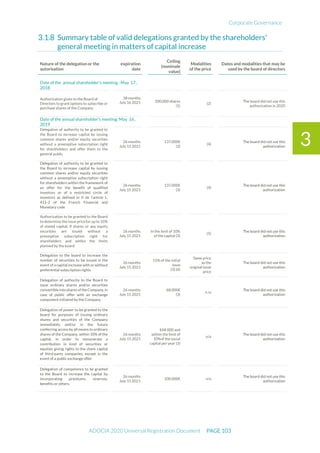
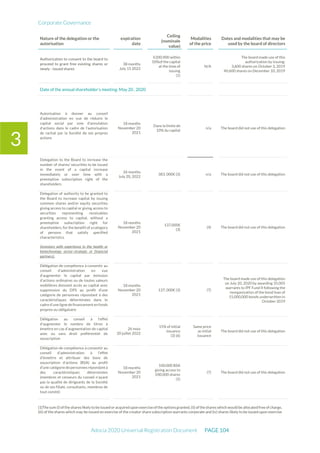
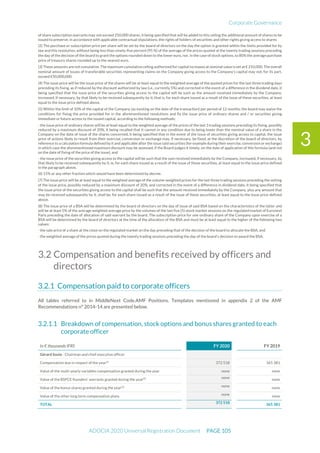
guarantee the sustainability of our healthcare systems.
To meetthis triplechallenge,Adociaadopts anoriginalstrategywhich consists ofimprovingtheefficacyandthesafety
of already-approved therapeutic proteins and peptides, while facilitating their use by patients. In order to do this,
Adocia has developed a proprietary formulation technology, BioChaperone®. The formulation approach is simple to
implement and provides the opportunity to improve and combine in an original way already-approved proteins. It also
takes advantage of the track record of already-used therapeutic proteins in terms of safety, efficacy and production
infrastructure. This business-model based on reformulation makes possible to deliver innovative treatments with
improved performance while having relatively short and less expensive development cycles, compared to developing
new proteins.
By adapting BioChaperone to each protein to face specific technical challenges, Adocia has developed a differentiated
portfolio of innovative formulations of metabolic hormones for the treatment of diabetes. Each product aims to meet
the specific needs of people living with diabetes. Adocia aims to demonstrate the clinical proof of concept of its
products before licensing them out to a pharmaceutical partner responsible for bringing the product to the market
and ensuring its commercialization.
Since April 2018, Adocia entered a partnership with a Chinese company, Tonghua Dongbao Pharmaceuticals Co. Ltd,
which acquired the rights to develop and commercialize BioChaperone Lispro et BioChaperone Combo programs in
China and other Asian and Middle East territories.
1
International Diabetes Federation, 2019
2
Hazel-Fernandez & al; American Journal of Managed Care. 2015
Presentation of Adocia and its activities
Adocia 2020 Universal Registration Document PAGE 15
1
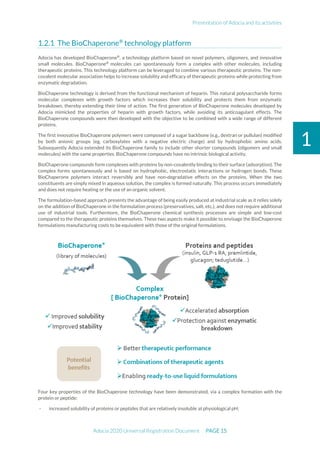
The BioChaperone®
technology platform
Adocia has developed BioChaperone®
, a technology platform based on novel polymers, oligomers, and innovative
small molecules. BioChaperone®
molecules can spontaneously form a complex with other molecules, including
therapeutic proteins. This technology platform can be leveraged to combine various therapeutic proteins. The non-
covalent molecular association helps to increase solubility and efficacy of therapeutic proteins while protecting from
enzymatic degradation.
BioChaperone technology is derived from the functional mechanism of heparin. This natural polysaccharide forms
molecular complexes with growth factors which increases their solubility and protects them from enzymatic
breakdown, thereby extending their time of action. The first generation of BioChaperone molecules developed by
Adocia mimicked the properties of heparin with growth factors, while avoiding its anticoagulant effects. The
BioChaperone compounds were then developed with the objective to be combined with a wide range of different
proteins.
The first innovative BioChaperone polymers were composed of a sugar backbone (e.g., dextran or pullulan) modified
by both anionic groups (eg. carboxylates with a negative electric charge) and by hydrophobic amino acids.
Subsequently Adocia extended its BioChaperone family to include other shorter compounds (oligomers and small
molecules) with the same properties. BioChaperone compounds have no intrinsic biological activity.
BioChaperone compounds form complexes with proteins by non-covalently binding to their surface (adsorption). The
complex forms spontaneously and is based on hydrophobic, electrostatic interactions or hydrogen bonds. These
BioChaperone polymers interact reversibly and have non-degradative effects on the proteins. When the two
constituents are simply mixed in aqueous solution, the complex is formed naturally. This process occurs immediately
and does not require heating or the use of an organic solvent.
The formulation-based approach presents the advantage of being easily produced at industrial scale as it relies solely
on the addition of BioChaperone in the formulation process (preservatives, salt, etc.), and does not require additional
use of industrial tools. Furthermore, the BioChaperone chemical synthesis processes are simple and low-cost
compared to the therapeutic proteins themselves. These two aspects make it possible to envisage the BioChaperone
formulations manufacturing costs to be equivalent with those of the original formulations.
Four key properties of the BioChaperone technology have been demonstrated, via a complex formation with the
protein or peptide:
- increased solubility of proteins or peptides that are relatively insoluble at physiological pH;
Presentation of Adocia and its activities
Adocia 2020 Universal Registration Document PAGE 16
1
- increased stability of proteins or peptides during storage;
- protection of proteins or peptides against enzymatic breakdown; and
- stabilization of the activity of proteins or peptides in the presence of cells.
Pharmaceutical products developed using BioChaperone technology are therefore designed to be more effective, to
be easier to use for the patient or to offer new applications.
To date, Adocia’s research team has developed more than 500 BioChaperone compounds, an impressive collection
that continues to grow over time. The main distinction among BioChaperone compounds are their size, type and the
number of anionic and hydrophobic grafts. This portfolio of molecules was rapidly developed to advance several
classes of difficult to formulate therapeutic proteins; notably insulins and other metabolic hormones used in the
treatment of diabetes (glucagon, amylin, etc).
BioChaperone technology is protected by several patent families, for BioChaperone molecules alone and for
formulations with BioChaperone. In addition, Adocia also has patent families covering compositions which include
active ingredients without BioChaperone.
Pipeline presentation
Over the years, Adocia has developed a broad portfolio of injectable treatments for type 1 and 2 diabetes patients
based on its BioChaperone technology and on other innovative formulation. In 2020, Adocia, leveraging the
knowledge accumulated over the past15 years, addedanew cell therapy platform technology to its diabetes portfolio.
Adocia's portfolio revolves around three development strategies:
- Biobetters: Leveraging already approved products, Adocia is able to improve the performance of therapeutics
with high medical value.
- Innovative bi-hormonal combinations: Combining two hormones with complementary or synergistic effects,
Adocia technology makes it possible to explore combination products that may have new medical benefits for
people suffering from metabolic diseases.
- Cell therapy: Long-term solution for patients by offering a platform for cell replacement therapy. Cell therapy
offers a curative treatment by replacing the affected cells.
As of today, Adocia’s clinical pipeline features multiple innovative insulin formulations for the treatment of diabetes:
- An ultra-rapid insulin BioChaperone Lispro, in two strengths U100 and U200
- A combination of long-acting insulin glargine and rapid-acting insulin lispro: BioChaperone Combo,
- Combinations of insulin and amylin analogue (pramlintide), a synergistic hormone to mealtime insulin:
• A metabolite of insulin glargine (M1) and amylin: M1Pram
• Insulin lispro and amylin: BC LisPram
• Insulin aspart and amylin: BC AsPram
- A ready-to-use aqueous formulation of human glucagon: BioChaperone Glucagon
Adocia also has several projects in preclinical development, including a combination of insulin glargine with GLP-1
Receptor Agonist (BioChaperone Glargine Liraglutide – BC GlaLira). Patent applications have been submitted for
other projects that are not detailed here (as of the publication date of this Universal Registration Document).
Presentation of Adocia and its activities
Adocia 2020 Universal Registration Document PAGE 17
1
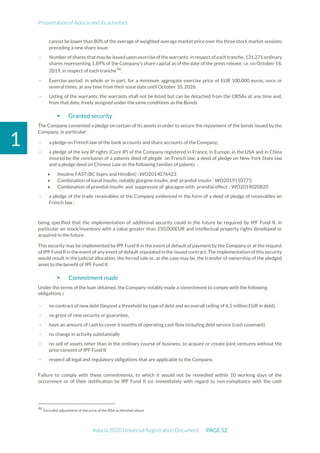
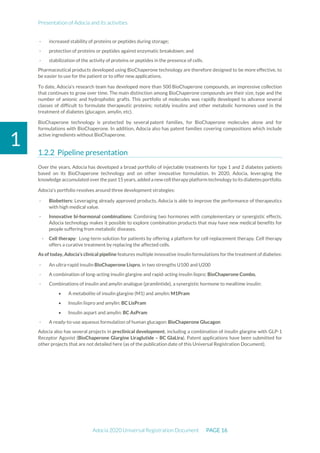
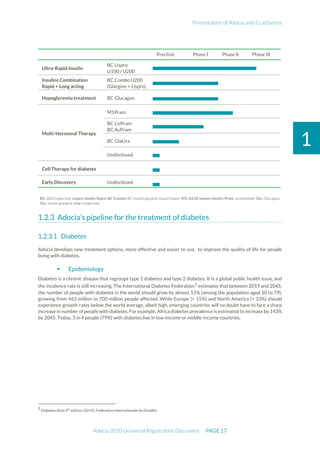
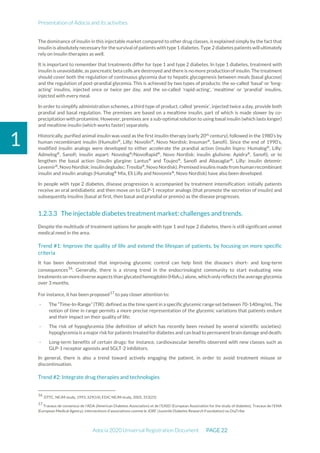
Preclinic Phase I Phase II Phase III
Ultra-Rapid Insulin
BC Lispro
U100 / U200
Insulins Combination
Rapid + Long acting
BC Combo U200
(Glargine + Lispro)
Hypoglycemia treatment BC Glucagon
Multi-Hormonal Therapy
M1Pram
BC LisPram
BC AsPram
BC GlaLira
Undisclosed
Cell Therapy for diabetes
Early Discovery Undisclosed
Adocia’s pipeline for the treatment of diabetes
Diabetes
Adocia develops new treatment options, more effective and easier to use, to improve the quality of life for people
living with diabetes.
 Epidemiology
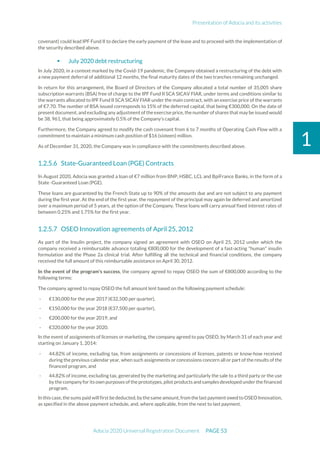
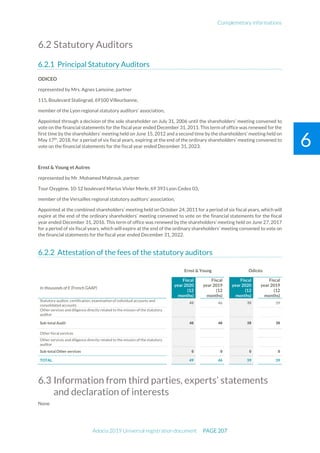
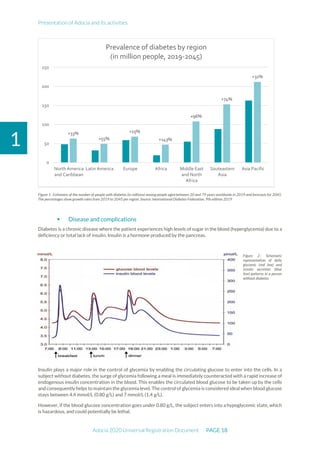
Diabetes is a chronic disease that regroups type 1 diabetes and type 2 diabetes. It is a global public health issue, and
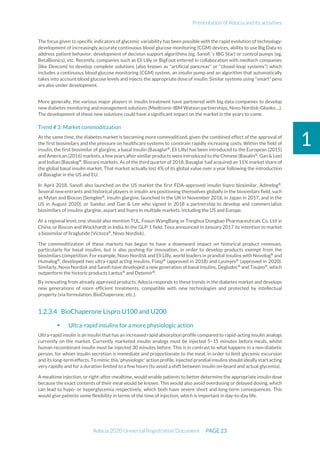
the incidence rate is still increasing. The International Diabetes Federation3
estimates that between 2019 and 2045,
the number of people with diabetes in the world should grow by almost 51% (among the population aged 20 to 79),
growing from 463 million to 700 million people affected. While Europe (+ 15%) and North America (+ 33%) should
experience growth rates below the world average, albeit high, emerging countries will no doubt have to face a sharp
increase in number of people with diabetes. For example, Africa diabetes prevalence is estimated to increase by 143%
by 2045. Today, 3 in 4 people (79%) with diabetes live in low-income or middle-income countries.
3
Diabetes Atlas 9th
edition (2019), Fédération Internationale du Diabète
BC: BioChaperone; Lispro: insulin lispro; BC Combo: BC insulin glargine insulin lispro; M1: A21G human insulin; Pram: pramlintide; Glu: Glucagon;
Gla: insulin glargine, Lira: Liraglutide
Presentation of Adocia and its activities
Adocia 2020 Universal Registration Document PAGE 18
1
Figure 1 : Estimates of the number of people with diabetes (in millions) among people aged between 20 and 79 years worldwide in 2019 and forecasts for 2045.
The percentages show growth rates from 2019 to 2045 per region. Source: International Diabetes Federation, 9th edition 2019
 Disease and complications
Diabetes is a chronic disease where the patient experiences high levels of sugar in the blood (hyperglycemia) due to a
deficiency or total lack of insulin. Insulin is a hormone produced by the pancreas.
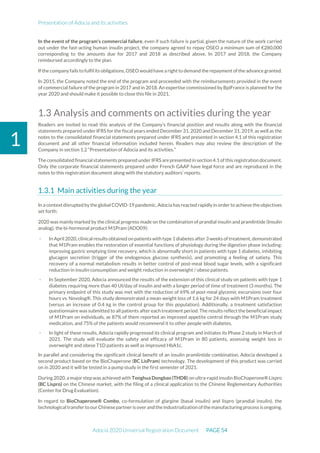
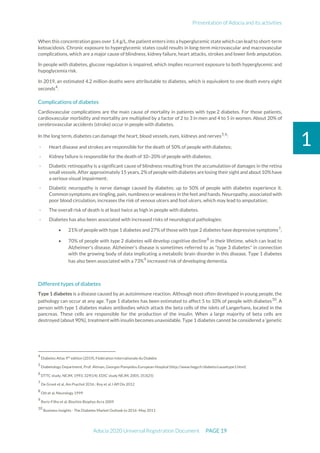
Figure 2 : Schematic
representation of daily
glycemic (red line) and
insulin secretion (blue
line) patterns in a person
without diabetes
Insulin plays a major role in the control of glycemia by enabling the circulating glucose to enter into the cells. In a
subject without diabetes, the surge of glycemia following a meal is immediately counteracted with a rapid increase of
endogenous insulin concentration in the blood. This enables the circulated blood glucose to be taken up by the cells
and consequently helps to maintain the glycemia level. The control of glycemia is considered ideal when blood glucose
stays between 4.4 mmol/L (0.80 g/L) and 7 mmol/L (1.4 g/L).
However, if the blood glucose concentration goes under 0.80 g/L, the subject enters into a hypoglycemic state, which
is hazardous, and could potentially be lethal.
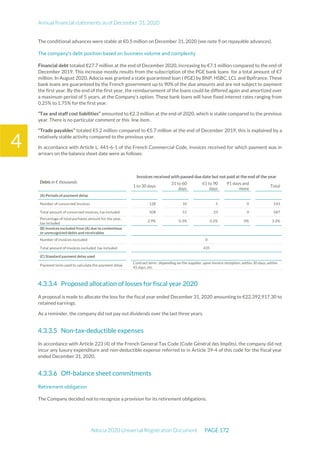
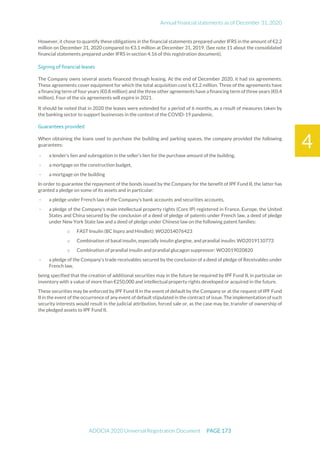
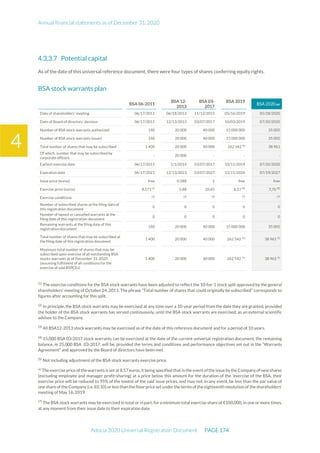
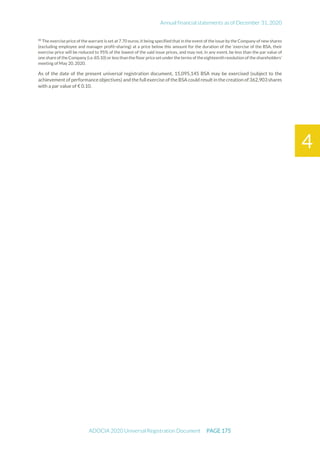
+33%
+55%
+15%
+143%
+96%
+74%
+31%
0
50
100
150
200
250
North America
and Caribbean
Latin America Europe Africa Middle East
and North
Africa
Souteastern
Asia
Asia Pacific
Prevalence of diabetes by region
(in million people, 2019-2045)
Presentation of Adocia and its activities
Adocia 2020 Universal Registration Document PAGE 19
1
When this concentration goes over 1.4 g/L, the patient enters into a hyperglycemic state which can lead to short-term
ketoacidosis. Chronic exposure to hyperglycemic states could results in long-term microvascular and macrovascular
complications, which are a major cause of blindness, kidney failure, heart attacks, strokes and lower limb amputation.
In people with diabetes, glucose regulation is impaired, which implies recurrent exposure to both hyperglycemic and
hypoglycemia risk.
In 2019, an estimated 4.2 million deaths were attributable to diabetes, which is equivalent to one death every eight
seconds4
.
Complications of diabetes
Cardiovascular complications are the main cause of mortality in patients with type 2 diabetes. For those patients,
cardiovascular morbidity and mortality are multiplied by a factor of 2 to 3 in men and 4 to 5 in women. About 20% of
cerebrovascular accidents (stroke) occur in people with diabetes.
In the long term, diabetes can damage the heart, blood vessels, eyes, kidneys and nerves5,6
:
- Heart disease and strokes are responsible for the death of 50% of people with diabetes;
- Kidney failure is responsible for the death of 10–20% of people with diabetes;
- Diabetic retinopathy is a significant cause of blindness resulting from the accumulation of damages in the retina
small vessels.After approximately 15 years,2%of people with diabetes are losing their sight and about10%have
a serious visual impairment;
- Diabetic neuropathy is nerve damage caused by diabetes; up to 50% of people with diabetes experience it.
Common symptoms are tingling, pain, numbness or weakness in the feet and hands. Neuropathy, associated with
poor blood circulation, increases the risk of venous ulcers and foot ulcers, which may lead to amputation;
- The overall risk of death is at least twice as high in people with diabetes.
- Diabetes has also been associated with increased risks of neurological pathologies:
• 21% of people with type 1 diabetes and 27% of those with type 2 diabetes have depressive symptoms7
;
• 70% of people with type 2 diabetes will develop cognitive decline8
in their lifetime, which can lead to
Alzheimer's disease. Alzheimer's disease is sometimes referred to as "type 3 diabetes" in connection
with the growing body of data implicating a metabolic brain disorder in this disease. Type 1 diabetes
has also been associated with a 73%9
increased risk of developing dementia.
Different types of diabetes
Type 1 diabetes is a disease caused by an autoimmune reaction. Although most often developed in young people, the
pathology can occur at any age. Type 1 diabetes has been estimated to affect 5 to 10% of people with diabetes10
. A
person with type 1 diabetes makes antibodies which attack the beta cells of the islets of Langerhans, located in the
pancreas. These cells are responsible for the production of the insulin. When a large majority of beta cells are
destroyed (about 90%), treatment with insulin becomes unavoidable. Type 1 diabetes cannot be considered a 'genetic
4
Diabetes Atlas 9th
edition (2019), Fédération Internationale du Diabète
5
Diabetology Department, Prof. Altman, Georges Pompidou European Hospital (http://www.hegp.fr/diabeto/causetype1.html)
6
DTTC study, NEJM, 1993, 329(14); EDIC study NEJM, 2005, 353(25)
7
De Groot et al, Am Psychol 2016 ; Roy et al J Aff Dis 2012
8
Ott et al, Neurology 1999
9
Roriz-Filho et al, Biochim Biophys Acra 2009
10
Business Insights - The Diabetes Market Outlook to 2016–May 2011
Presentation of Adocia and its activities
Adocia 2020 Universal Registration Document PAGE 20
1
disease'. In 90% of new cases there is no parental history at all of type 1 diabetes and the risk of developing type 1
diabetes if one of the two parents has it is lower than 2–3%11
.
Type 2 diabetes is characterized primarily by resistance of cells to insulin, i.e., “insulin resistance”. Type 2 diabetes has
been estimated to affect 90% of people with diabetes12
. Type 2 diabetes is a progressive disease: insulin resistance
begins with excessive insulin production, which degrades the islets of Langerhans. Once this degradation is initiated,
the amount of insulin being produced decreases. Type 2 diabetes is considered asymptomatic and is only discovered
when measuring blood glucose levels (glycemia). It is estimated that the majority of patients have already lost half of
their beta cells at the time of diagnosis. Genetic predisposition is a predominant factor and being overweight is an
aggravating cause of type 2 diabetes.
Other forms of diabetes, called secondary forms (owing to the fact they are a consequence of other disorders or
pathologies) do existalthough their prevalence is marginal: genetic insulin secretion defects, genetic insulin sensitivity
defects, diabetes due to pancreatitis or pancreatic cancer, drug-induced diabetes, etc. Pregnancy can also cause
diabetes which, even if it disappears after childbirth, can nonetheless be a precursor to type 2 diabetes.
A complex hormonal disorder
Although insulin is a life-saving treatment for people with type 1 diabetes, as insulin triggers the metabolization of
ingested glucose, the reality of hormonal deregulations due to diabetes is more complex than a simple lack of insulin.
Indeed, in a person who does not have diabetes, glycemia is regulated by a multitude of metabolic hormones, including
insulin, acting in synergy to keep glycemia levels within a very precise range.
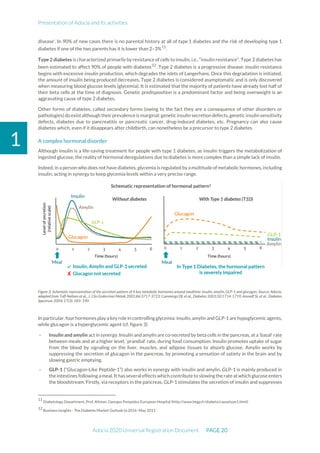
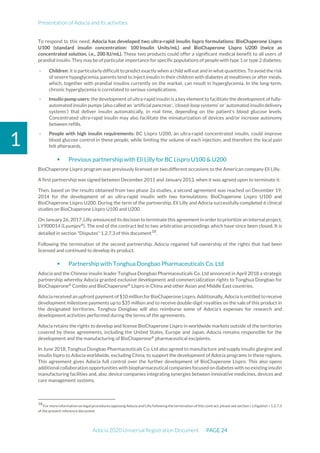
Figure 3: Schematic representation of the secretion pattern of 4 key metabolic hormones around mealtime: insulin, amylin, GLP-1 and glucagon. Source: Adocia,
adapted from Toff-Neilsen et al., J. Clin Endocrinol Metab 2001;86:3717-3723; Cummings DE et al., Diabetes 2001;50:1714-1719; Aronoff SL et al., Diabetes
Spectrum 2004; 17(3): 183–190
In particular, fourhormones play a key role in controlling glycemia: insulin,amylin and GLP-1 are hypoglycemic agents,
while glucagon is a hyperglycemic agent (cf. figure 3)
- Insulin and amylin act in synergy. Insulin and amylin are co-secreted by beta cells in the pancreas, at a 'basal' rate
between meals and at a higher level, ‘prandial’ rate, during food consumption. Insulin promotes uptake of sugar
from the blood by signaling on the liver, muscles, and adipose tissues to absorb glucose. Amylin works by
suppressing the secretion of glucagon in the pancreas, by promoting a sensation of satiety in the brain and by
slowing gastric emptying.
- GLP-1 (“Glucagon-Like Peptide-1”) also works in synergy with insulin and amylin. GLP-1 is mainly produced in
the intestines following a meal. It has several effects which contribute to slowing the rate at which glucose enters
the bloodstream. Firstly, via receptors in the pancreas, GLP-1 stimulates the secretion of insulin and suppresses
11
Diabetology Department, Prof. Altman, Georges Pompidou European Hospital (http://www.hegp.fr/diabeto/causetype1.html)
12
Business Insights - The Diabetes Market Outlook to 2016–May 2011
Presentation of Adocia and its activities
Adocia 2020 Universal Registration Document PAGE 21
1
the secretion of glucagon. Secondly, by affecting the central and peripheral nervous system, GLP-1 slows gastric
emptying and induces a feeling of satiety.
- Glucagon, produced by alpha cells in the pancreas, is a hyperglycemic agent; it promotes the release of glucose
from the muscles and liver into the bloodstream. This is particularly useful between meals and during periods of
exertion (physical or mental).
Combined, these four hormones keep glycemia levels within a very precise range, avoiding hypoglycemia, which can
be immediately debilitating or even fatal if severe, and hyperglycemia, responsible for severe long-term
complications13
.
In each of these four classes, at least one compound has been approved by the FDA.
Those with a short action, for postprandial use, are:
- Prandial insulins:
• Recombinant human insulin (named also « rHI »): several brands worldwide
• Rapid insulin analogs: insulin lispro (Humalog®
, Eli Lilly; or Admelog®
, Sanofi), insulin aspart
(Novolog/NovoRapid®
, Novo Nordisk); insulin glulisine (Apidra®
, Sanofi)
• Ultra-rapid isulin analogs: insuline lispro-aabc (Lyumjev®), insuline aspart (Fiasp®)
- Amylin analog: pramlintide (Symlin®
, AstraZeneca);
- GLP-1 receptor agonists: exenatide (Byetta®
, AstraZeneca), lixisenatide (Lyxumia®
, Sanofi)14
- Human glucagon (Glucagon®
and Baqsimi®
, Eli Lilly, and Glucagen®
, Novo Nordisk)
In people with type 1 diabetes, this physiological hormonal regulation is severely impaired (see figure 3): notonly does
the destruction of pancreatic beta cells lead to the lack of insulin and amylin secretion, GLP-1 secretion by intestinal
cells is also reduced. In the absence of glucagon suppressants i.e., GLP-1 and amylin, glucose is abnormally secreted at
mealtimes.
Therefore, prandial hyperglycemia is potentially caused by three factors: 1) glucagon secretion, which leads to the
release of sugars even before the person starts eating; 2) faster gastric emptying resulting in a massive surge of
glucose; 3) the absence of insulin, which prevents the uptake of endogenous and exogenous sugars. This in part might
explain why prandial insulin injection alone is not enough to completely control post-prandial hyperglycemia in insulin
dependent diabetes patients.
Diabetes treatment
Diabetes is a global pandemic affecting 463 million people in 2019. The diabetic population continues to grow at a
significant rate, mainly due to changing lifestyles (more urban, more sedentary, with diets higher in fat and sugars) for
many populations throughout the world. Historically, the injectable diabetes treatment market has been dominated
by three major players: Eli Lilly, Novo Nordisk and Sanofi, with all three initially focusing on insulin and, more recently,
on GLP-1s. However, the dominance of these three players may well come to change under the influence of several
major trends, including treatment personalization and commoditization.
According to Novo Nordisk, the global market for diabetes treatment with injectable products (insulins, GLP-1
receptor analogs, glucagon) grew by 18.1% per year between 2008 and 2018, accounting for $29 billion15
, i.e., more
than 50% of the total market for antidiabetic medications. (cf. figure 4).
13
D. Nathan et al, Diabetes Care 2014 Jan; 37(1): 9-16 (overview of the Diabetes Control and Complications Trial)
14
Among theGLP-1 receptor analogs,thereare also long-acting products, whose action is pharmacologic but not physiological,in particularOzempic®
(Semaglutide, Novo Nordisk, weekly injection) Victoza® (liraglutide, Novo Nordisk, daily injection), Trulicity® (dulaglutide, Eli Lilly, weekly injection),
Bydureon® (long-acting exenatide formulation, AstraZeneca, weekly injection), and Tanzeum® (abliglutide, GlaxoSmithKline, weekly injection).
15
Estimations from annual reports. On the diagram below, this market is valued at $49 billion dollars according to IMS data, reported by Novo Nordisk,
a figure that does not take into account discounts granted to payers.
Presentation of Adocia and its activities
Adocia 2020 Universal Registration Document PAGE 22
1
The dominance of insulin in this injectable market compared to other drug classes, is explained simply by the fact that
insulin is absolutely necessary for the survival of patients with type 1 diabetes. Type 2 diabetes patients will ultimately
rely on insulin therapies as well.
It is important to remember that treatments differ for type 1 and type 2 diabetes. In type 1 diabetes, treatment with
insulin is unavoidable, as pancreatic beta cells are destroyed and there is no more production of insulin. The treatment
should cover both the regulation of continuous glycemia due to hepatic glycogenesis between meals (basal glucose)
and the regulation of post-prandial glycemia. This is achieved by two types of products: the so-called 'basal' or 'long-
acting' insulins, injected once or twice per day, and the so-called 'rapid-acting', ‘mealtime’ or 'prandial' insulins,
injected with every meal.
In order to simplify administration schemes, a third type of product, called 'premix', injected twice a day, provide both
prandial and basal regulation. The premixes are based on a mealtime insulin, part of which is made slower by co-
precipitation with protamine. However, premixes are a sub-optimal solution to using basal insulin (which lasts longer)
and mealtime insulin (which works faster) separately.
Historically, purified animal insulin was used as the first insulin-therapy (early 20th
century), followed in the 1980’s by
human recombinant insulin (Humulin®
, Lilly; Novolin®
, Novo Nordisk; Insuman®
, Sanofi). Since the end of 1990’s,
modified insulin analogs were developed to either accelerate the prandial action (insulin lispro: Humalog®
, Lilly;
Admelog®
, Sanofi; insulin aspart: Novolog®
/NovoRapid®
, Novo Nordisk; insulin glulisine: Apidra®
, Sanofi), or to
lengthen the basal action (insulin glargine: Lantus®
and Toujeo®
, Sanofi and Abasaglar®
, Lilly; insulin detemir:
Levemir®
,Novo Nordisk;insulin degludec:Tresiba®
,Novo Nordisk).Premixedinsulins madefrom human recombinant
insulin and insulin analogs (Humalog®
Mix, Eli Lilly and Novomix®
, Novo Nordisk) have also been developed.
In people with type 2 diabetes, disease progression is accompanied by treatment intensification: initially patients
receive an oral antidiabetic and then move on to GLP-1 receptor analogs (that promote the secretion of insulin) and
subsequently insulins (basal at first, then basal and prandial or premix) as the disease progresses.
The injectable diabetes treatment market: challenges and trends.
Despite the multitude of treatment options for people with type 1 and type 2 diabetes, there is still significant unmet
medical need in the area.
Trend #1: Improve the quality of life and extend the lifespan of patients, by focusing on more specific
criteria
It has been demonstrated that improving glycemic control can help limit the disease's short- and long-term
consequences16
. Generally, there is a strong trend in the endocrinologist community to start evaluating new
treatments on morediverse aspects than glycated hemoglobin (HbA1c) alone, which only reflects the average glycemia
over 3 months.
For instance, it has been proposed17
to pay closer attention to:
- The “Time-In-Range” (TIR): defined as the time spent in aspecific glycemic range set between 70-140mg/mL. The
notion of time in range permits a more precise representation of the glycemic variations that patients endure
and their impact on their quality of life;
- The risk of hypoglycemia (the definition of which has recently been revised by several scientific societies):
hypoglycemia is a major riskforpatients treated for diabetes and can lead to permanentbrain damage and death;
- Long-term benefits of certain drugs: for instance, cardiovascular benefits observed with new classes such as
GLP-1 receptor agonists and SGLT-2 inhibitors.
In general, there is also a trend toward actively engaging the patient, in order to avoid treatment misuse or
discontinuation.
Trend #2: Integrate drug therapies and technologies
16
DTTC, NEJM study, 1993, 329(14); EDIC NEJM study, 2005, 353(25)
17
Travaux de consensus de l’ADA (American Diabetes Association) et de l’EASD (European Association for the study of diabetes). Travaux de l’EMA
(European Medical Agency), interventions d’associations comme le JDRF (Juvenile Diabetes Research Foundation) ou DiaTribe
Presentation of Adocia and its activities
Adocia 2020 Universal Registration Document PAGE 23
1
The focus given to specific indicators of glycemic variability has been possible with the rapid evolution of technology:
development of increasingly accurate continuous blood glucose monitoring (CGM) devices, ability to use Big Data to
address patient behavior, development of decision support algorithms (eg. Sanofi ‘s IBG Star) or control pumps (eg.
BetaBionics), etc. Recently, companies such as Eli Lilly or BigFoot entered in collaboration with medtech companies
(like Dexcom) to develop complete solutions (also known as "artificial pancreas" or "closed-loop systems") which
includes a continuous blood glucose monitoring (CGM) system, an insulin pump and an algorithm that automatically
takes into account blood glucose levels and injects the appropriate dose of insulin. Similar systems using "smart" pens
are also under development.
More generally, the various major players in insulin treatment have partnered with big data companies to develop
new diabetes monitoring and management solutions (Medtronic-IBM Watson partnerships, Novo Nordisk-Glooko ...).
The development of these new solutions could have a significant impact on the market in the years to come.
Trend # 3: Market commoditization
At the same time, the diabetes market is becoming more commoditized, given the combined effect of the approval of
the first biosimilars and the pressure on healthcare systems to constrain rapidly increasing costs. Within the field of
insulin, the first biosimilar of glargine, a basal insulin (Basaglar®
, Eli Lilly) has been introduced to the European (2015)
and American (2016) markets,a few years after similar products were introduced to the Chinese (Basalin®
, Gan & Lee)
and Indian (Basalog®
, Biocon) markets. As of the third quarter of 2018, Basaglar had acquired an 11% market share of
the global basal insulin market. That market actually lost 4% of its global value over a year following the introduction
of Basaglar in the US and EU.
In April 2018, Sanofi also launched on the US market the first FDA-approved insulin lispro biosimilar, Admelog®
.
Several new entrants and historical players in insulin are positioning themselves globally in the biosimilars field, such
as Mylan and Biocon (Semglee®
, insulin glargine, launched in the UK in November 2018, in Japan in 2017, and in the
US in August 2020), or Sandoz and Gan & Lee who signed in 2018 a partnership to develop and commercialize
biosimilars of insulins glargine, aspart and lispro in multiple markets, including the US and Europe.
At a regional level, one should also mention TUL, Fosun WangBang or Tonghua Dongbao Pharmaceuticals Co. Ltd in
China, or Biocon and Wockhardt in India. In the GLP-1 field, Teva announced in January 2017 its intention to market
a biosimilar of liraglutide (Victoza®
, Novo Nordisk).
The commoditization of these markets has begun to have a downward impact on historical product revenues,
particularly for basal insulins, but is also pushing for innovation, in order to develop products exempt from the
biosimilars competition. For example, Novo Nordisk and Eli Lilly, world leaders in prandial insulins with Novolog®
and
Humalog®
, developed two ultra-rapid acting insulins, Fiasp®
(approved in 2018) and Lyumjev®
(approved in 2020).
Similarly, Novo Nordisk and Sanofi have developed a new generation of basal insulins, Degludec®
and Toujeo®
, which
outperform the historic products Lantus®
and Detemir®
.
By innovating from already approved products, Adocia responds to these trends in the diabetes market and develops
new generations of more efficient treatments, compatible with new technologies and protected by intellectual
property (via formulation, BioChaperone, etc.).
BioChaperone Lispro U100 and U200
 Ultra-rapid insulins for a more physiologic action
Ultra-rapid insulin is an insulin that has an increased rapid absorption profile compared to rapid-acting insulin analogs
currently on the market. Currently marketed insulin analogs must be injected 5–15 minutes before meals, whilst
human recombinant insulin must be injected 30 minutes before. This is in contrast to what happens in a non-diabetic
person, for whom insulin secretion is immediate and proportionate to the meal, in order to limit glycemic excursion
and its long-term effects. To mimic this 'physiologic' action profile, injected prandial insulins should ideally start acting
very rapidly and for a duration limited to a few hours (to avoid a shift between insulin on-board and actual glycemia).
A mealtime injection, or right-after-mealtime, would enable patients to better determine the appropriate insulin dose
because the exact contents of their meal would be known. This would also avoid overdosing or delayed dosing, which
can lead to hypo- or hyperglycemia respectively, which both have severe short and long-term consequences. This
would give patients some flexibility in terms of the time of injection, which is important in day-to-day life.
Presentation of Adocia and its activities
Adocia 2020 Universal Registration Document PAGE 24
1
To respond to this need, Adocia has developed two ultra-rapid insulin lispro formulations: BioChaperone Lispro
U100 (standard insulin concentration: 100 Insulin Units/mL) and BioChaperone Lispro U200 (twice as
concentrated solution, i.e., 200 IU/mL). These two products could offer a significant medical benefit to all users of
prandial insulin.They maybe ofparticular importance for specific populations of people with type 1 or type 2 diabetes:
- Children: it is particularly difficult to predict exactly when a child will eat and in what quantities. To avoid the risk
of severe hypoglycemia, parents tend to inject insulin in their children with diabetes at mealtimes or after meals,
which, together with prandial insulins currently on the market, can result in hyperglycemia. In the long-term,
chronic hyperglycemia is correlated to serious complications.
- Insulin pump users: the development of ultra-rapid insulin is akey element to facilitate the development of fully-
automated insulin pumps (also called an 'artificial pancreas', ‘closed-loop systems’ or ‘automated insulin delivery
systems’) that deliver insulin automatically, in real time, depending on the patient's blood glucose levels.
Concentrated ultra-rapid insulin may also facilitate the miniaturization of devices and/or increase autonomy
between refills.
- People with high insulin requirements: BC Lispro U200, an ultra-rapid concentrated insulin, could improve
blood glucose control in these people, while limiting the volume of each injection, and therefore the local pain
felt afterwards.
 Previous partnership with Eli Lilly for BC Lispro U100 & U200
BioChaperone Lispro program was previously licensed on two different occasions to the American company Eli Lilly.
A first partnership was signed between December 2011 and January 2013, when it was agreed upon to terminate it.
Then, based on the results obtained from two phase 2a studies, a second agreement was reached on December 19,
2014 for the development of an ultra-rapid insulin with two formulations: BioChaperone Lispro U100 and
BioChaperone Lispro U200. During the term of the partnership, Eli Lilly and Adocia successfully completed 6 clinical
studies on BioChaperone Lispro U100 and U200.
On January 26,2017,Lilly announced its decision to terminatethis agreementin order to prioritize an internal project,
LY900014 (Lyumjev®
). The end of the contract led to two arbitration proceedings which have since been closed. It is
detailed in section "Disputes" 1.2.7.3 of this document18
.
Following the termination of the second partnership, Adocia regained full ownership of the rights that had been
licensed and continued to develop its product.
 Partnership with Tonghua Dongbao Pharmaceuticals Co. Ltd
Adocia and the Chinese insulin leader Tonghua Dongbao Pharmaceuticals Co. Ltd annonced in April 2018 a strategic
partnership whereby Adocia granted exclusive development and commercialization rights to Tonghua Dongbao for
BioChaperone®
Combo and BioChaperone®
Lispro in China and other Asian and Middle East countries.
Adocia received an upfront payment of$10 million forBioChaperone Lispro. Additionally, Adocia is entitled to receive
development milestone payments up to $35 million and to receive double-digit royalties on the sale of this product in
the designated territories. Tonghua Dongbao will also reimburse some of Adocia’s expenses for research and
development activities performed during the terms of the agreements.
Adocia retains the rights to develop and license BioChaperone Lispro in worldwide markets outside of the territories
covered by these agreements, including the United States, Europe and Japan. Adocia remains responsible for the
development and the manufacturing of BioChaperone®
pharmaceutical excipients.
In June 2018, Tonghua Dongbao Pharmaceuticals Co. Ltd also agreed to manufacture and supply insulin glargine and
insulin lispro to Adocia worldwide, excluding China, to support the development of Adocia programs in these regions.
This agreement gives Adocia full control over the further development of BioChaperone Lispro. This also opens
additional collaboration opportunities with biopharmaceutical companies focusedon diabetes with no existing insulin
manufacturing facilities and, also, device companies integrating synergies between innovative medicines, devices and
care management systems.
18
Formoreinformation onlegal procedures opposing Adocia andLillyfollowingthetermination of this contract, pleasesee section« Litigation » 1.2.7.3
of the present reference document
Presentation of Adocia and its activities
Adocia 2020 Universal Registration Document PAGE 25
1
 Results obtained with BC Lispro U100 & U200
To date, BioChaperone Lispro has been successfully tested in 10 clinical studies, in more than 250 people with type 1
or type 2 diabetes. BioChaperone Lispro has repeatedly shown an ultra-rapid profile compared to reference analog
insulins aspart and lispro, whereas it was injected via syringes or insulin pumps. BC Lispro also showed superiority on
some pharmacodynamic and pharmacokinetic parameters over Fiasp®
.
Phase 2a clinical results – Pharmacokinetic and pharmacodynamic study in people with type 1 diabetes
(n=36)
The objective of this study was to compare the pharmacokinetic and pharmacodynamic profiles of the BioChaperone
Lispro U100 complex to those of Humalog®
U100. In April 2014, Adocia announced the results of this study, which
showed the 30% faster onset of action and 69% better early metabolic effect of BioChaperone Lispro compared to
Humalog in 36 patients with type 1 diabetes.Theseresults areconsistentwith thepharmacokinetics ofBioChaperone
Lispro, which reaches its concentration peak 35% faster than Humalog; the amount of insulin present in the blood for
the first 30 minutes is also 170% greater when it is formulated with BioChaperone.
Phase 2a clinical results – Second pharmacokinetic and pharmacodynamic dose-response study in people
with type 1 diabetes (n=37)
In May 2014, Adocia initiated a second Phase 2a clinical study that aimed to evaluate the linearity of the effect of
BioChaperone Lispro U100 for various doses in a range covering the needs of the majority of patients (0.1, 0.2 and
0.4 IU/kg). Positive results from this study were announced in September 2014. In this usual dose range,
BioChaperone Lispro demonstrated the ultra-rapid linearity of its pharmacokinetic profile with respect to the dose
(normalization test). The ultra-rapid effect was also observed in all pharmacodynamic profiles, whatever the dose
tested.
Phase 2a clinical results – Study of the response to a standardized meal in people with type 1 diabetes
(n=38)
Adocia and Lilly jointly announced in January 2015 that Adocia would initiate the first clinical study under this
partnership. This Phase 1b/2a study aimed to evaluate the improvement in postprandial glycemic control obtained
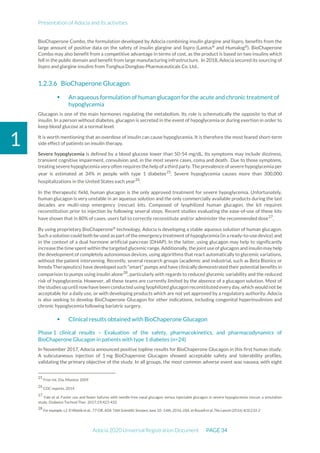
with BioChaperone Lispro compared to Humalog in 38 patients with type 1 diabetes after a standardized meal. The
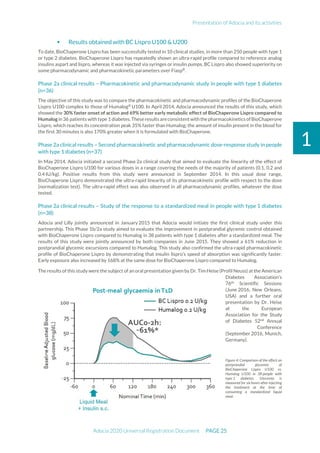
results of this study were jointly announced by both companies in June 2015. They showed a 61% reduction in
postprandial glycemic excursions compared to Humalog. This study also confirmed the ultra-rapid pharmacokinetic
profile of BioChaperone Lispro by demonstrating that insulin lispro’s speed of absorption was significantly faster.
Early exposure also increased by 168% at the same dose for BioChaperone Lispro compared to Humalog.
The results of this study were the subject of an oral presentation given by Dr. Tim Heise (Profil Neuss) at the American
Diabetes Association's
76th
Scientific Sessions
(June 2016, New Orleans,
USA) and a further oral
presentation by Dr. Heise
at the European
Association for the Study
of Diabetes 52nd
Annual
Conference
(September 2016, Munich,
Germany).
Figure 4: Comparison of the effect on
postprandial glycemia of
BioChaperone Lispro U100 vs.
Humalog U100 in 38 people with
type 1 diabetes. Glycemia is
measured for six hours after injecting
the treatment at the time of
consuming a standardized liquid
meal.
Presentation of Adocia and its activities
Adocia 2020 Universal Registration Document PAGE 26
1
Phase 1b clinical results – Study evaluating the potential for bioequivalence of the BioChaperone Lispro
U200 formulation compared to BioChaperone Lispro U100, based on their pharmacokinetic and
pharmacodynamics profiles in healthy volunteers (n= 26)
In June 2014, Adocia announced it was developing BioChaperone®
Lispro U300, a concentrated insulin lispro
formulation at 300 IU/mL of insulin lispro with BioChaperone. Preclinical data demonstrated that BioChaperone
Lispro U300 had an ultra-rapid action compared to Humalog 100 IU/mL. This ultra-rapid action was equivalent to that
obtained with BioChaperone Lispro U100 in the same model.
As part of the partnership with Lilly, a 200 IU/mL formulation, BioChaperone®
Lispro U200, was developed, with Eli
Lilly marketing a Humalog formulation at this concentration, Humalog U200. Further to positive preclinical results,
BioChaperone Lispro U200 was clinically tested in a pilot bioequivalence study comparing it to BioChaperone Lispro
U100, the positive results of which were announced in December 2015.
This pilot study aimed to demonstrate the potential for bioequivalence between the two products.
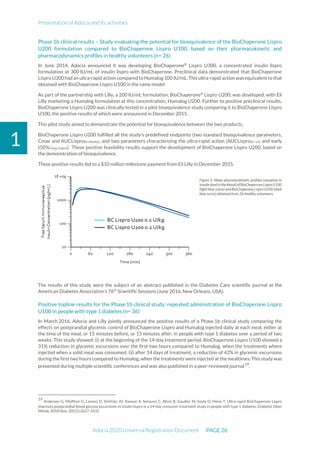
BioChaperone Lispro U200 fulfilled all the study's predefined endpoints (two standard bioequivalence parameters,
Cmax and AUCLispro(0-infinity), and two parameters characterizing the ultra-rapid action (AUCLispro(0–1 h) and early
t50%Cmax Lispro). These positive feasibility results support the development of BioChaperone Lispro U200, based on
the demonstration of bioequivalence.
These positive results led to a $10 million milestone payment from Eli Lilly in December 2015.
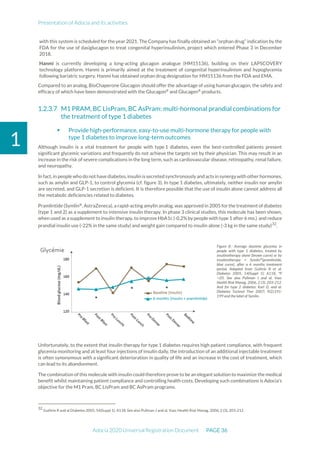
Figure 5: Mean pharmacokinetic profiles (variation in
insulinlevelinthe blood) ofBioChaperoneLispro U100
(light blue curve) and BioChaperone Lispro U200 (dark
blue curve) obtained from 26 healthy volunteers.
The results of this study were the subject of an abstract published in the Diabetes Care scientific journal at the
American Diabetes Association's 76th
Scientific Sessions (June 2016, New Orleans, USA).
Positive topline results for the Phase 1b clinical study: repeated administration of BioChaperone Lispro
U100 in people with type 1 diabetes (n= 36)
In March 2016, Adocia and Lilly jointly announced the positive results of a Phase 1b clinical study comparing the
effects on postprandial glycemic control of BioChaperone Lispro and Humalog injected daily at each meal, either at
the time of the meal, or 15 minutes before, or 15 minutes after, in people with type 1 diabetes over a period of two
weeks. This study showed: (i) at the beginning of the 14-day treatment period, BioChaperone Lispro U100 showed a
31% reduction in glycemic excursions over the first two hours compared to Humalog, when the treatments where
injected when a solid meal was consumed; (ii) after 14 days of treatment, a reduction of 42% in glycemic excursions
during the first two hours compared to Humalog, when the treatments were injected at the mealtimes. This study was
presented during multiple scientific conferences and was also published in a peer-reviewed journal19
.
19
Andersen G, Meiffren G, Lamers D, DeVries JH, Ranson A, Seroussi C, Alluis B, Gaudier M, Soula O, Heise T. Ultra-rapid BioChaperone Lispro
improves postprandial blood glucose excursions vs insulin lispro in a 14-day crossover treatment study in people with type 1 diabetes. Diabetes Obes
Metab. 2018 Nov; 20(11):2627-2632
Presentation of Adocia and its activities
Adocia 2020 Universal Registration Document PAGE 27
1
Positive topline results for the Phase 1b clinical study: repeated administration of BioChaperone Lispro
U100 in people with type 2 diabetes (n=51)
In April 2016, Adocia and Lilly jointly announced the positive results of a Phase 1b study comparing the effects on
postprandial glycemic control of BioChaperone Lispro and Humalog injected daily at mealtimes for 14 days in people
with type 2 diabetes. BioChaperone Lispro demonstrated an ultra-rapid pharmacokinetic profile with a statistically
significant increase of 83% in exposure to insulin lispro during the first 30 minutes post injection, compared to
Humalog. On the basis of a post-hoc analysis including four meal tests per patient for each treatment (days 1, 2, 13
and 14), BioChaperone Lispro also showed a statistically significant decrease of 22% in glycemic excursions for the
first two hours, compared to Humalog.
Main results from this study were published in Diabetes Care following the 77th
Scientific Sessions of the American
Diabetes Association (June 2017, San Diego, USA).
Positive topline results for a Phase 1 clinical study: evaluation of BioChaperone Lispro U100 in healthy
Japanese subjects (n=15)
In May 2016, Adocia and Lilly jointly announced the positive results of a Phase 1 study evaluating BioChaperone
Lispro U100 ultra-rapid insulin in Japanese subjects. This study aimed to compare the pharmacokinetic and
pharmacodynamic profiles of BioChaperone Lispro to those of Humalog in 15 healthy Japanese subjects under
euglycemic clamp conditions. Although the study was not designed to perform statistical analysis, the results show an
acceleration in the pharmacokinetic and pharmacodynamic profiles of BioChaperone Lispro compared to Humalog,
as well as the linearity of insulin exposure as a function of the dose administered. The results of the study were
generated to allow the inclusion of Japanese diabetes patients into the Phase 3 program.
Positive topline resultsfor Phase 1b clinicalstudy:evaluation of BioChaperone LisproU100inpeople with
type 1 diabetes using an insulin pump vs. Humalog®
(n=44)
In December 2016, Adocia and Lilly jointly announced the success of a Phase 1b clinical study comparing the effects
of BioChaperone Lispro and Humalog on postprandial glycemic control in people with type 1 diabetes using an insulin
pump. During this study, BioChaperone Lispro U100 demonstrated a statistically significant increase in insulin
exposure over the first 30 minutes after a mealtime bolus, compared to Humalog. The accelerated absorption of
BioChaperone Lispro U100 was also observed in the three insulin delivery devices tested (Roche Accu-Chek®
Spirit,
Medtronic Paradigm®
Veo™ and a syringe with insulin).
Positive topline results for the Phase 1b clinical study: evaluation of BioChaperone Lispro U100 in people
with type 1 diabetes using an insulin pump vs. Fiasp®
and Novolog®
(n=42)
In December 2017, Adocia announced the success of a Phase 1b clinical study comparing BioChaperone Lispro to the
rapid-acting insulin Novolog®
(Novo Nordisk) and to the recently approved ultra-rapid insulin aspart formulation
Fiasp®
(Novo Nordisk) in patients with type 1 diabetes. This study was the first direct comparison of two ultra-rapid
insulin formulations. Forty-two participants received, under euglycemic clamp conditions, single doses of these three
products via an insulin pump during three separate visits. The objectives of the study included comparing the
glucodynamic effects and pharmacokinetic profiles obtained with the three treatments.
BioChaperone Lispro satisfied the primary endpoint, showing a statistically significant increase of 63% in metabolic
effect during the first hour compared to Novolog®
. This result confirms the ultra-rapid profile observed in previous
studies when compared to Humalog®
. Furthermore, BioChaperone Lispro showed astatistically significant 'faster-off'
metabolic profile compared to the othertwo products,reaching the lateTmax 18 minutes before Fiasp®
and22 minutes
before Novolog®
. BioChaperone Lispro also showed an early metabolic effect similar to that of Fiasp®
during the first
hour.
Thus, BioChaperone Lispro has demonstrated a reproducible absorption profile through several studies, several
populations and several modes of administration.
Results from this study were made public in an abstract in the scientific journal Diabetes Care following the 78th
Scientific Sessions of the American Diabetes Association (June 2018, Orlando, USA), an oral presentation during the
Presentation of Adocia and its activities
Adocia 2020 Universal Registration Document PAGE 28
1
54th
Annual Conference of the European Association for the Study of Diabetes (October 2018, Berlin, Germany) and
in a peer-reviewed publication20
.
Positive clinical results confirming the ultra-rapid profile of BC Lispro including insulin from its partner
Tonghua Dongbao
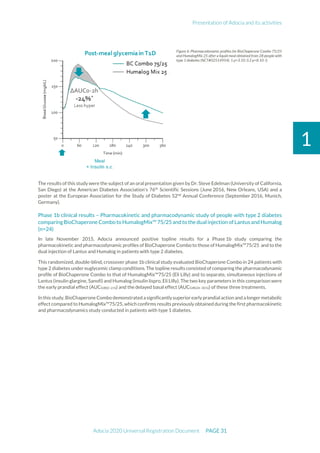
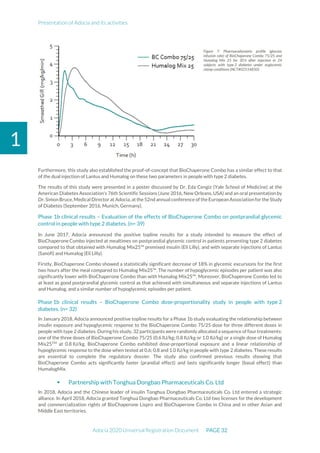
In January 2021, Adocia announced the positive results of the pharmacological study comparing BioChaperone (BC)
Lispro, formulations using insulin lispro from two different sources: the biosimilar of its partner Tonghua Dongbao
(THDB), and Humalog®
, marketed by Eli Lilly. From a CMC perspective, all comparability data between THDB's lispro
and Lilly's lispro has been generated to date. This bridging study validates the BioChaperone Lispro clinical data, in
order to include previously obtained clinical data in the phase 3 dossier.
BC Lispro, formulated with insulin lispro from Tonghua Dongbao, demonstrates significantly faster absorption than
the two Humalog®
formulations marketed in Europe and the USA; and a stronger early effect. Conversely, the late
exposure and late effect of BC Lispro (THDB) is reduced compared to the two Humalog®
formulations. All four
formulations showed good safety in use and were well tolerated. These results confirm the specific ultra-rapid action
profile of BC Lispro, with a safety profile similar to that of Humalog®
.
 Study using the Beta Bionics iLetTM
system (n=30)
In January 2019, Adocia announced the initiation of a first home-use trial testing the ultra-rapid insulin BioChaperone
Lispro with Beta Bionics automated insulin delivery system, the iLetTM
.
The iLet is a so called “Hybrid Closed-Loop” system. It consists of an autonomous infusion pump paired with a
continuous glucose monitor (CGM). The system uses clinically tested mathematical dosing algorithms driven by
machine learning to calculate and dose insulin as needed. The iLet used in this trial will be set on an insulin-only
configuration (another version allows the co-infusion of glucagon).
The use of an ultra-rapid insulin in a hybrid closed-loop system should improve the reactivity and so the efficiency of
this system to control glycemia.
This multi-arm, cross-over, USA-only clinical trial, will recruit up to 30 people with type 1 diabetes to participate in
three 7-day study arms. It will compare the pharmacokinetic and pharmacodynamic profiles, intra- and inter-
individual, for subjects using the iLet system with insulin lispro, insulin aspart, and BioChaperone Lispro. The co-
primary endpoints will be mean continuous glucose monitoring glucose (CGMG) and portion of time spent in severe
hypoglycemia (CGMG <54 mg/dL).
Results were delayed until 2021 due to difficulty in supplying equipment by Beta Bionics, independent of Adocia.
 Next steps
Tonghua Dongbao Pharmaceuticals Co. Ltd plans to file BC Lispro's Phase 3 dossier in 2021.
Based on BioChaperone Lispro's strong clinical dossier, Adocia is seeking a new partner for entry into phase 3 and
commercialization for territories excluded from the licensing agreement with Tonghua Dongbao Pharmaceuticals Co.
Ltd. (THDB). The primary territories for partnering will be the US, EU, Latin America, and Japan.
 Competition
Several companies have sought to develop an ultra-rapid insulin with an action profile close to the physiologic activity
of insulin.
Novo Nordisk has developed a high-speed formulation of insulin aspart called Fiasp®. In 2016, Fiasp received
approval from the European Medicines Agency for its launch on the European market for the treatment of type 1 and
type 2 diabetes. Following a request for additional information from FDA (Complete Response Letter), Novo Nordisk
resubmitted its file early in 2017 and Fiasp was approved by the FDA in September 2017. Fiasp has been available in
the United States since January 2018 at a price similar to that of Novolog. Fiasp is now available in 33 countries and
in 2019 achieved $186 million dollars in sales (19,303 million DKK)21.
20
Heise T, Meiffren G, Alluis B, Seroussi C, Ranson A, Arrubla J, Correia J, Gaudier M, Soula O, Soula R, DeVries JH, Klein O, Bode BW.
Pharmacodynamic and pharmacokinetic properties of BioChaperone Lispro vs faster aspart and insulin aspart in patients with type 1 diabetes on
continuous subcutaneous insulin infusion. A randomized euglycemic clamp study. Diabetes Obes Metab. 2018 Dec 18.
21
Novo Nordisk Annual Report, 2019
Presentation of Adocia and its activities
Adocia 2020 Universal Registration Document PAGE 29
1
A Phase 1b study of Fiasp in 52 patients with type 1 diabetes showed that the product had early pharmacokinetic and
pharmacodynamic profiles significantly faster than insulin aspart. On the other hand, this does not translate into a
fast-out / fast-off effect (faster insulin release / shorter duration activity), as it has been shown for BioChaperone
Lispro U100 in several Phase 1b Studies. This latter effect is desirable as it may reduce the risk of hypoglycemia. In
Phase 3 studies, Fiasp confirmed its ultra-rapid absorption profile but did not show superiority in terms of
hypoglycemia compared to insulin aspart.
In 2017, when the collaboration with Adocia and Eli Lilly ended, Eli Lilly announced that it had developed a competing
ultra-rapid insulin project LY900014 (insulin lispro formulated with treprostinil and citrate, among other excipients).
In June2020,EliLilly launchedLyumjev®, which presents pharmacokinetic andpharmacodynamic profiles fasterthan
those of Humalog (insulin lispro) in the first minutes after injection. However, Lilly did not demonstrate a faster "fast-
out / fast-off" effect than insulin lispro, unlike BioChaperone Lispro. In the Phase 3 trial, Lyumjev met the non-
inferiority criterion for reduction in glycated hemoglobin (HbA1c) compared to Humalog and demonstrated a better
glucose control after a meal.
Mannkind, founded in 1991, developed Afrezza®
, an inhalable human insulin with an ultra-rapid profile, whose peak
concentration is observed 12 to 15 minutes after inhalation. On June 27, 2014, the FDA approved the use of Afrezza
to improve glycemic control in adults with diabetes. This approval, however, was accompanied by restrictions on
patient populations (not recommended for smokers and patients with ketoacidosis) that could use Afrezza and a
"black box warning" (warning about the potential risk of a drug, which should be included explicitly on the packaging),
regarding the risk of bronchospasm associated with the treatment. In addition, the FDA requested that Mannkind
carry out four post-marketing clinical trials. An Afrezza marketing agreement with Sanofi in 2014 was terminated on
April 4, 2016. Since then, Mannkind has continued to market Afrezza by its own means (except Brazil where a
partnership has been signed with Biomm).Afrezzagenerated $25.3 million in net income,upby 46%from 2018 ($17.3
million). This growth is mainly due to an increase in demand, the first sales recorded in Brazil, an increase in prices as
well as a more suitable product mix (there are disposable cartridges of 4, 8 or 12 units of insulin).
In June 2020, Arecor announced the results of phase 1 of its ultra-rapid insulin (AT-247). This is a crossover,
randomized, double-blind, single-dose, 3-week PK / PD study. Conducted in 19 patients with type 1 diabetes, the trial
demonstrated that absorption of AT247 was accelerated compared to NovoRapid® and Fiasp®. Insulin AT247 was
detected in the blood 12 minutes (p = 0.0004) earlier than with NovoRapid and 2 minutes (p = 0.0003) earlier than
Fiasp. Arecor intends to explore the application of AT247 in a closed loop system (or artificial pancreas). These
systems require the fastest insulin in order to minimize patient intervention at mealtimes.
Thermalin Inc. is also working on ultra-fast, thermo-stable and ultra-concentrated insulins (U500), in particular for
patch pump applications. In August 2019, Thermalin announced the selection of T-1123 as a clinical candidate for
trials in type 1 and 2 patients22
.
Other competing projects have been abandoned, in particular the association between human insulin and
hyaluronidase developed by Halozyme (which refocused its activities on the applications of hyaluronidase in oncology
at the end of 2014) and the high-speed formulations BIOD-250 and BIOD-238 developed by Biodel (which was the
subject in 2016 of a "reverse-merger" operation by Albireo, which resulted in the deprioritization ofBiodel's historical
activities).
BioChaperone Combo
 A safer alternative to premixed insulin for treatment intensification in people with
type 2 diabetes.
Type 2 diabetes is a progressive disease requiring progressive treatment intensification. Today, 50% of patients on
basal insulin do not meet their glycemic control targets23
.
To improve glycemic control, the patient may be recommended to add a prandial component to his/her treatment
regimen. This can be achieved via the addition of prandial insulin to the basal insulin, or by replacing basal insulin with
22
Thermalin Press Release, August 6, 2019
23
Sanofi communication – Q3 2015 presentation
Presentation of Adocia and its activities
Adocia 2020 Universal Registration Document PAGE 30
1
premixed insulin. Premixed insulin is a fixed-dose combination of a soluble fraction and a precipitated fraction of the
rapid-acting prandial insulin analog. It is usually injected twiceper day. It is thus an easier regimen than multiple insulin
injections: one product only, twice per day at a fixed ratio (rather than two products, four times per day at variable
doses).
Thank to this simple administration scheme, premixed insulins are therefore particularly recommended for elderly
patients. They are also widely used in emerging countries due to an overall lower cost. However, they do not offer
ideal medical performance, due to a delayed and prolonged prandial action, a basal action profile of less than 24 hours
and an elevated risk of hypoglycemia.
To meet the medical need for a regimen as simple as that of premixed insulin but as effective as a multiple-injection
regimen, Adocia has developed BioChaperone Combo, a combination of insulin glargine (basal) and insulin lispro
(prandial) at neutral pH. For a longtime, it was technically impossible to actually combine the gold-standard basal
acting insulin, insulin glargine, and a rapid acting insulin into the same product, as they could not be formulated in the
same pH range. BioChaperone technology makes it possible to solubilize insulin glargine at neutral pH and thus make
it compatible with any prandial insulin.
By truly combining a basal insulin and a prandial insulin without changing their individual pharmacodynamic profiles,
BioChaperone Combo could advantageously replace premix insulins in populations using them.
 Clinical results obtained with BioChaperone Combo
To date, BioChaperone Combo has been successfully tested in 5 clinical studies in 143 people with type 1 or type 2
diabetes, and repeatedly showed a faster prandial profile and longer basal profile compared to an analog insulin
premix (HumalogMix 75/25).
Phase 1b clinical results – First pharmacodynamic and pharmacokinetic study in people with type 1
diabetes (n=20)
In the first quarter of 2014, Adocia announced positive results for a study that had aimed to compare the
pharmacodynamic and pharmacokinetic profiles of BioChaperone Combo to those of HumalogMix (insulin lispro
premix 75/25, Eli Lilly) in people with type 1 diabetes under euglycemic clamp conditions. The following positive
results were obtained: onset ofaction ofBioChaperone was at least 30% faster than thatof HumalogMix; the duration
of action observed for BioChaperone Combo was longer than 30 hours in the majority of patients but only 18 hours
with HumalogMix; and BioChaperone Combo was well tolerated.
Phase 1b clinical results – Evaluation of the effects of BioChaperone Combo on postprandial glycemic
control in people with type 1 diabetes (n=28)
In early November 2015, Adocia announced positive results for a Phase 1b clinical study evaluating postprandial
effects of BioChaperone Combo in 28 patients with type 1 diabetes. This randomized double-blind crossover study
compared the effect on postprandial glycemia of individualized doses of BioChaperone Combo and
HumalogMix™75/25 (Eli Lilly), injected at the start of a standardized meal. The study fulfilled its primary endpoint,
demonstrating that BioChaperone Combo decreased postprandial glycemia significantly more than Humalog
Mix™75/25 during the first two hours (∆AUCBG(0–2h)). The minimal blood glucose level observed during the period was
also significantly better controlled with BioChaperone Combo vs. HumalogMix™75/25. Although this study was not
designed to measure differences in the incidence of hypoglycemic episodes between the two treatment groups, a
reduced number of hypoglycemic events was observed with BioChaperone Combo vs. Humalog®
MixTM
75/25
Presentation of Adocia and its activities
Adocia 2020 Universal Registration Document PAGE 31
1
Figure 6: Pharmacodynamic profiles for BioChaperone Combo 75/25
and HumalogMix 25 after a liquid meal obtained from 28 people with
type 1 diabetes (NCT#02514954). 1 p=3.10-3.2 p=8.10-3.
The results of this study were the subject of an oral presentation given by Dr. Steve Edelman (University of California,
San Diego) at the American Diabetes Association's 76th
Scientific Sessions (June 2016, New Orleans, USA) and a
poster at the European Association for the Study of Diabetes 52nd
Annual Conference (September 2016, Munich,
Germany).
Phase 1b clinical results – Pharmacokinetic and pharmacodynamic study of people with type 2 diabetes
comparing BioChaperone Combo to HumalogMix™ 75/25 and to the dual injection of Lantus and Humalog
(n=24)
In late November 2015, Adocia announced positive topline results for a Phase 1b study comparing the
pharmacokinetic and pharmacodynamic profiles of BioChaperone Combo to those of HumalogMix™75/25 and to the
dual injection of Lantus and Humalog in patients with type 2 diabetes.
This randomized, double-blind, crossover phase 1b clinical study evaluated BioChaperone Combo in 24 patients with
type 2 diabetes under euglycemic clamp conditions. The topline results consisted of comparing the pharmacodynamic
profile of BioChaperone Combo to that of HumalogMix™75/25 (Eli Lilly) and to separate, simultaneous injections of
Lantus (insulin glargine, Sanofi) and Humalog (insulin lispro, Eli Lilly). The two key parameters in this comparison were
the early prandial effect (AUCGIR(0–2 h)) and the delayed basal effect (AUCGIR(24–30 h)) of these three treatments.
In this study,BioChaperone Combo demonstrated asignificantly superior early prandial action and a longer metabolic
effect compared to HumalogMix™75/25, which confirms results previously obtained during the first pharmacokinetic
and pharmacodynamics study conducted in patients with type 1 diabetes.
Presentation of Adocia and its activities
Adocia 2020 Universal Registration Document PAGE 32
1
Figure 7: Pharmacodynamic profile (glucose
infusion rate) of BioChaperone Combo 75/25 and
Humalog Mix 25 for 30 h after injection in 24
subjects with type 2 diabetes under euglycemic
clamp conditions (NCT#02514850).
Furthermore, this study also established the proof-of-concept that BioChaperone Combo has a similar effect to that
of the dual injection of Lantus and Humalog on these two parameters in people with type 2 diabetes.
The results of this study were presented in a poster discussed by Dr. Eda Cengiz (Yale School of Medicine) at the
American Diabetes Association's 76th Scientific Sessions (June 2016, New Orleans, USA) and an oral presentation by
Dr. Simon Bruce, Medical Director at Adocia,at the52nd annual conference of theEuropean Association for theStudy
of Diabetes (September 2016, Munich, Germany).
Phase 1b clinical results – Evaluation of the effects of BioChaperone Combo on postprandial glycemic
control in people with type 2 diabetes. (n= 39)
In June 2017, Adocia announced the positive topline results for a study intended to measure the effect of
BioChaperone Combo injected at mealtimes on postprandial glycemic control in patients presenting type 2 diabetes
compared to that obtained with Humalog Mix25™ premixed insulin (Eli Lilly), and with separate injections of Lantus
(Sanofi) and Humalog (Eli Lilly).
Firstly, BioChaperone Combo showed a statistically significant decrease of 18% in glycemic excursions for the first
two hours after the meal compared to Humalog Mix25™. The number of hypoglycemic episodes per patient was also
significantly lower with BioChaperone Combo than with Humalog Mix25™. Moreover, BioChaperone Combo led to
at least as good postprandial glycemic control as that achieved with simultaneous and separate injections of Lantus
and Humalog, and a similar number of hypoglycemic episodes per patient.
Phase 1b clinical results – BioChaperone Combo dose-proportionality study in people with type 2
diabetes. (n= 32)
In January 2018, Adocia announced positive topline results for a Phase 1b study evaluating the relationship between
insulin exposure and hypoglycemic response to the BioChaperone Combo 75/25 dose for three different doses in
people with type 2 diabetes. During his study, 32 participants were randomly allocated a sequence of four treatments:
one of the three doses of BioChaperone Combo 75/25 (0.6 IU/kg; 0.8 IU/kg or 1.0 IU/kg) or a single dose of Humalog
Mix25TM
at 0.8 IU/kg. BioChaperone Combo exhibited dose-proportional exposure and a linear relationship of
hypoglycemic response to the dose when tested at 0.6; 0.8 and 1.0 IU/kg in people with type 2 diabetes. These results
are essential to complete the regulatory dossier. The study also confirmed previous results showing that
BioChaperone Combo acts significantly faster (prandial effect) and lasts significantly longer (basal effect) than
HumalogMix.
 Partnership with Tonghua Dongbao Pharmaceuticals Co. Ltd
In 2018, Adocia and the Chinese leader of insulin Tonghua Dongbao Pharmaceuticals Co. Ltd entered a strategic
alliance. In April 2018, Adocia granted Tonghua Dongbao Pharmaceuticals Co. Ltd two licenses for the development
and commercialization rights of BioChaperone Lispro and BioChaperone Combo in China and in other Asian and
Middle East territories.
Presentation of Adocia and its activities
Adocia 2020 Universal Registration Document PAGE 33
1
The BioChaperone Combo agreement includes an upfront payment of $40 million, up to $50 million development
milestone payments and double-digit royalties on the sale of this product in the designated territories. Tonghua
Dongbao Pharmaceuticals Co. Ltd will also reimburse some of Adocia’s expenses for research and development
activities performed during the terms of the agreement.
Adocia retains the rights to develop and license BioChaperone Combo in worldwide markets outside of the territories
covered by these agreements, including the United States, Europe, Latin America and Japan. Adocia remains
responsible for the development and the manufacturing of BioChaperone®
pharmaceutical excipients.
In June 2018, Tonghua Dongbao Pharmaceuticals Co. Ltd agreed to manufacture and supply insulin lispro and insulin
glargine APIs to Adocia worldwide, excluding China, to support the development of Adocia’s portfolio in these
territories.
This agreement gives Adocia full control, outside China, over the further development of BioChaperone Combo. This
also opens additional collaboration opportunities with biopharmaceutical companies focused on diabetes with no
existing insulin manufacturing facilities.
 Next steps
Tonghua Dongbao Pharmaceuticals Co. Ltd intends to initiate Phase 1 study in 2021 in China.
 Competition
Premixed insulins are prandial insulins, with a portion of insulin precipitated with protamine to slow down its effect.
These products are consideredas direct competitors to BioChaperone Combo. Theseproductsinclude: HumalogMix®
(Eli Lilly, made from insulin lispro) NovoMix®
/NovologMix®
(Novo Nordisk, made from insulin aspart), in addition to
premixed insulins made from human insulin, which remain widely used in emerging countries (e.g., Humulin®
70/30
for Eli Lilly and Novolin®
70/30 for Novo Nordisk, as well as many locally developed products). The premix market in
the USA represents a turnover of 2.2 billion dollars in 2019. It should be noted that in China, 63% of the volume of
insulin sold consists of insulin premix. The turnover of Chinese companies in their market is not precisely known and
it is observed that the Chinese market is partially underestimated24
.
However, as previously explained, these products have several disadvantages, particularly in terms of:
- A delayed prandial action compared to their benchmark insulin (human or analog). This delay leads to reduced
postprandial glycemic control and an elevated risk of hypoglycemia linked to an overly slow transition between
the prandial and basal effects. In clinical studies published to date, BioChaperone Combo and Ryzodeg present a
similar onset of action to prandial insulin analogs.
- An overly slow basal action, always less than 24h, meaning two injections per day are required. With
BioChaperone Combo, it is possible to gradually intensify treatment, switching from basal insulin to a single daily
injection of BC Combo (at the time of the main meal of the day), then to two injections when disease progression
requires it.
BioChaperone Combo may thus represent a superior solution to premixed insulin, at a similar price, to facilitate
patient access to a better-performing and safer treatment, particularly in emergent countries wherein these products
remain dominant.
Novo Nordisk has developed Ryzodeg®
, the only other product truly combining a basal insulin (insulin degludec) and
a prandial insulin (insulin aspart), Ryzodeg was tested in multiple clinical studies, either against a premixed insulin
aspart, NovoMix®
, against Lantus, or against the combination of Levemir and NovoLog. These results demonstrated
the Ryzodeg is well tolerated in patients with type 1 and type 2 diabetes, and that this product can improve glycemic
control vs. Lantus and reduce the incidence of hypoglycemic episodes vs. Novomix, confirming the expected benefits
of a 'true' combo compared to premixed insulin. In 2013, Novo Nordisk obtained marketing authorizations for Tresiba
and Ryzodeg in Europe and Japan. Ryzodeg is the first dual insulin combo product to enter the market. Tresiba and
Ryzodeg were only approved in the United States in September 2015 after Novo Nordisk published positive interim
results from the additional cardiovascular safety studies of Tresiba, which the FDA requested during the first
submission of the regulatory dossier. Ryzodeg is now available in more than 25 countries. The pricing strategy of Novo
Nordisk takes into account the investment consented in developing Tresiba and Ryzodeg is currently sold at a
premium compared to Novomix.
24
IQVIA data for 2019
Presentation of Adocia and its activities
Adocia 2020 Universal Registration Document PAGE 34
1
BioChaperone Combo, the formulation developed by Adocia combining insulin glargine and lispro, benefits from the
large amount of positive data on the safety of insulin glargine and lispro (Lantus®
and Humalog®
). BioChaperone
Combo may also benefit from a competitive advantage in terms of cost, as the product is based on two insulins which
fell in the public domain and benefit from large manufacturing infrastructure. In 2018, Adocia secured its sourcing of
lispro and glargine insulins from Tonghua Dongbao Pharmaceuticals Co. Ltd..
BioChaperone Glucagon
 An aqueous formulation of human glucagon for the acute and chronic treatment of
hypoglycemia
Glucagon is one of the main hormones regulating the metabolism. Its role is schematically the opposite to that of
insulin. In a person without diabetes, glucagon is secreted in the event of hypoglycemia or during exertion in order to
keep blood glucose at a normal level.
It is worth mentioning that an overdose of insulin can cause hypoglycemia. It is therefore the most feared short-term
side effect of patients on insulin therapy.
Severe hypoglycemia is defined by a blood glucose lower than 50-54 mg/dL. Its symptoms may include dizziness,
transient cognitive impairment, convulsion and, in the most severe cases, coma and death. Due to those symptoms,
treating severe hypoglycemia very often requires the help of athird party. The prevalence of severe hypoglycemia per
year is estimated at 34% in people with type 1 diabetes25
. Severe hypoglycemia causes more than 300,000
hospitalizations in the United States each year26
.
In the therapeutic field, human glucagon is the only approved treatment for severe hypoglycemia. Unfortunately,
human glucagon is very unstable in an aqueous solution and the only commercially available products during the last
decades are multi-step emergency (rescue) kits. Composed of lyophilized human glucagon, the kit requires
reconstitution prior to injection by following several steps. Recent studies evaluating the ease-of-use of these kits
have shown that in 80% of cases, users fail to correctly reconstitute and/or administer the recommended dose27
.
By using proprietary BioChaperone®
technology, Adocia is developing a stable aqueous solution of human glucagon.
Such a solution could both be used as part of the emergency treatment of hypoglycemia (in a ready-to-use device) and
in the context of a dual hormone artificial pancreas (DHAP). In the latter, using glucagon may help to significantly
increase the time spent within the targeted glycemic range. Additionally, the joint use of glucagon and insulin may help
the development of completely autonomous devices, using algorithms that react automatically to glycemic variations,
without the patient intervening. Recently, several research groups (academic and industrial, such as Beta Bionics or
Inreda Therapeutics) have developed such “smart” pumps and have clinically demonstrated their potential benefits in
comparison to pumps using insulin alone28
, particularly with regards to reduced glycemic variability and the reduced
risk of hypoglycemia. However, all these teams are currently limited by the absence of a glucagon solution. Most of
the studies up until now have been conducted using lyophilized glucagon reconstituted every day, which would not be
acceptable for a daily use, or with developing products which are not yet approved by a regulatory authority. Adocia
is also seeking to develop BioChaperone Glucagon for other indications, including congenital hyperinsulinism and
chronic hypoglycemia following bariatric surgery.
 Clinical results obtained with BioChaperone Glucagon
Phase 1 clinical results – Evaluation of the safety, pharmacokinetics, and pharmacodynamics of
BioChaperone Glucagon in patients with type 1 diabetes (n=24)
In November 2017, Adocia announced positive topline results for BioChaperone Glucagon in this first human study.
A subcutaneous injection of 1 mg BioChaperone Glucagon showed acceptable safety and tolerability profiles,
validating the primary objective of the study. In all groups, the most common adverse event was nausea, with eight
25
Frier Int. Dia. Monitor 2009
26
CDC reports, 2014
27
Yale et al. Faster use and fewer failures with needle-free nasal glucagon versus injectable glucagon in severe hypoglycemia rescue: a simulation
study. Diabetes Technol Ther. 2017;19;423-432
28
For example, c.f. El Khatib et al., 77-OR, ADA 76th Scientific Sessions June 10–14th, 2016, USA. et Russell et al, The Lancet (2016) 4(3):233-2
Presentation of Adocia and its activities
Adocia 2020 Universal Registration Document PAGE 35
1
events observed in 25 patients with BioChaperone Glucagon vs. five events in 24 patients with Glucagen®
HypoKit®
.
The median time to reach a clinically risk-free level of blood glucose of 70 mg/dL was 11 min for BioChaperone
Glucagon and almost 7 min for the reconstituted commercial product Glucagen®
. All patients achieved hypoglycemic
resolution within 35 minutes of injection.
 Next steps
Adocia is actively seeking a partner to continue clinical development with a Phase 1/2 study. This study may be the
last before the program enters Phase 3 of its clinical development. At the same time, Adocia has identified a high
quality and easy to use injection device for BioChaperone Glucagon.
 Competition
The product developed by Adocia is an aqueous formulation based on human glucagon, an approved peptide. This is a
de-risked approach, compared to formulations developed by other competitors based on new peptides (glucagon
analogs).
For the treatment of severe hypoglycemia, four products are currently on the market:
“Historical” products to be reconstituted: Glucagon®
(Eli Lilly) and GlucaGen®
Hypokit®
(Novo Nordisk). In both
cases, these emergency kits require real-time reconstitution of lyophilized glucagon and injection using a syringe. The
entire operation takes between 7 and 9 steps. In a real emergency situation, when the patient is unconscious, these
devices have proven to be extremely difficult to use by third parties, especially since they are not always trained in
their use. In a study, 130 parents of people with type 1 diabetes are placed in a simulated hypoglycemic emergency
situation, 69% of them experienced difficulty handling the emergency kit (GlucaGen Hypokit)29
. Due to the difficulty
of using these products, they remain under-prescribed and under-utilized, leading to frequent interventions by
emergency teams. Response time can be fatal. Several companies, including Adocia, are therefore developing ready-
to-use alternatives for emergency treatment.
Eli Lilly received in 2019 the regulatory approval from the American and European regulatory authorities for
Baqsimi®
, a presentation in the form of a single-use nasal spray, which might be apparently easier to use for a naive
user. In 2019, Baqsimi's worldwide sales reached $22.4 million. Baqsimi sales are forecasted to reach $277 million in
2026 and to account for 30% of global glucagon sales30
. At the same time, Eli Lilly ended the development of a soluble
glucagon analogue in 2018.
Xeris received FDA approval in September 2019 for the use of Gvoke®
, a liquid formulation of human glucagon
(obtained using the organic solvent DMSO), to treat severe hypoglycemia. The company now markets Gvoke as a
HypoPen®
autoinjector pen and as a pre-filled syringe. The product was launched in November 2019 in the USA and
Gvoke recorded sales of $1.1 million in 2019 (2020 sales are estimated at $16 million). In December 2020, the ready-
to-use glucagon solution received a positive opinion from the EMA's CHMP. It will be marketed in Europe under the
name Ogluo®
. Marketing Authorization is expected in the first quarter of 2021, with a possible launch in the second
half of 2021. Consensus estimates that the product will achieve $288.6 million in 202631
.
Xeris also intends to develop this product as mini-pens for moderate hypoglycemia and as cartridges for use in pumps
(artificial pancreas or other chronic uses of glucagon). The company is conducting a Phase 2 study in pump for
hypoglycemia following bariatric surgery and is conducting a Phase 2 pump trial to reduce exercise-induced
hypoglycemia.
Zealand Pharma received FDA approval on March 22, 2021 for the use of Zegalogue®
for the treatment of severe
hypoglycemia in patients with diabetes. It is a glucagon analogue, dasiglucagon.
Dasiglucagon is developed for three main indications: the treatment of severe hypoglycemia, the use in bi-hormonal
pumps ("artificial pancreas") and the chronic treatment of congenital hyperinsulinism (in glucagon pump). Zealand
Pharma is preparing to market the ready-to-use HypoPal® pre-filled pen for the emergency treatment of severe
hypoglycemia. In addition, the company recently demonstrated the non-inferiority of dasiglucagon, compared to Eli
Lilly's glucagon, in a Phase 2b study in Beta-Bionics' artificial pancreas, iLet ™. The initiation of a pivotal Phase 3 study
29
Harris, G et al Practical Diabetes Int. 2001: 18;22-25.
30
EvaluatePharma® Consensus Sales Forecast based on: Morgan Stanley to 2025 (28 Oct 20); Wolfe Research to 2030 (13 Oct 20); Cantor Fitzgerald
to 2026 (16 Dec 20)
31
EvaluatePharma® Consensus Sales Forecast based on: RBC Capital Markets to 2024 (07 May 20); Piper Sandler to 2027 (18 Jun 20); SVB Leerink
to 2035 (02 Jul 20); Jefferies to 2025 (08 May 20); Mizuho Securities to 2024 (08 May 20)
Presentation of Adocia and its activities
Adocia 2020 Universal Registration Document PAGE 36
1
with this system is scheduled for the year 2021. The Company has finally obtained an “orphan drug” indication by the
FDA for the use of dasiglucagon to treat congenital hyperinsulinism, project which entered Phase 3 in December
2018.
Hanmi is currently developing a long-acting glucagon analogue (HM15136), building on their LAPSCOVERY
technology platform. Hanmi is primarily aimed at the treatment of congenital hyperinsulinism and hypoglycemia
following bariatric surgery. Hanmi has obtained orphan drug designation for HM15136 from the FDA and EMA.
Compared to an analog, BioChaperone Glucagon should offer the advantage of using human glucagon, the safety and
efficacy of which have been demonstrated with the Glucagon®
and Glucagen®
products.
M1 PRAM, BC LisPram, BC AsPram: multi-hormonal prandial combinations for
the treatment of type 1 diabetes
 Provide high-performance, easy-to-use multi-hormone therapy for people with
type 1 diabetes to improve long-term outcomes
Although insulin is a vital treatment for people with type 1 diabetes, even the best-controlled patients present
significant glycemic variations and frequently do not achieve the targets set by their physician. This may result in an
increase in the risk of severe complications in the long term, such as cardiovascular disease, retinopathy, renal failure,
and neuropathy.
In fact, in people who do not have diabetes, insulin is secreted synchronously and acts in synergy with other hormones,
such as amylin and GLP-1, to control glycemia (cf. figure 3). In type 1 diabetes, ultimately, neither insulin nor amylin
are secreted, and GLP-1 secretion is deficient. It is therefore possible that the use of insulin alone cannot address all
the metabolic deficiencies related to diabetes.
Pramlintide (Symlin®
, AstraZeneca), a rapid-acting amylin analog, was approved in 2005 for the treatment of diabetes
(type 1 and 2) as a supplement to intensive insulin therapy. In phase 3 clinical studies, this molecule has been shown,
when used as a supplement to insulin therapy, to improve HbA1c (-0,2% by people with type 1 after 6 mo.) and reduce
prandial insulin use (-22% in the same study) and weight gain compared to insulin alone (-3 kg in the same study)32
.
Figure 8 : Average daytime glycemia in
people with type 1 diabetes, treated by
insulinotherapy alone (brown curve) or by
insulinotherapy + Symlin®
(pramlintide,
blue curve), after a 6 months treatment
period. Adapted from Guthrie R et al.
Diabetes 2005, 54(Suppl 1): A118, *P
<.05. See also Pullman J and al. Vasc
Health Risk Manag. 2006, 2 (3), 203-212.
And for type 2 diabetes: Karl D, and al.
Diabetes Technol Ther 2007; 9(2):191-
199 and the label of Symlin.
Unfortunately, to the extent that insulin therapy for type 1 diabetes requires high patient compliance, with frequent
glycemia monitoring and at least four injections of insulin daily, the introduction of an additional injectable treatment
is often synonymous with a significant deterioration in quality of life and an increase in the cost of treatment, which
can lead to its abandonment.
The combination of this molecule with insulin could therefore prove to be an elegant solution to maximize the medical
benefit whilst maintaining patient compliance and controlling health costs. Developing such combinations is Adocia's
objective for the M1 Pram, BC LisPram and BC AsPram programs.
32
Guthrie R and al Diabetes 2005, 54(Suppl 1): A118. See also Pullman J and al. Vasc Health Risk Manag. 2006, 2 (3), 203-212
Presentation of Adocia and its activities
Adocia 2020 Universal Registration Document PAGE 37
1
Currently, prandial insulin and pramlintide formulations are not compatible. Adocia has developed various type of
combinations:
- Adocia used its formulation expertise to identify a human insulin analogue, M1, that can be co-formulated with
pramlintide to provide a stable formulation. M1 is the A21G analog of human insulin. It is also the major
metabolite of long-acting insulin glargine, but exhibiting the action profile of a mealtime insulin. As a result,
millions of insulin glargine users worldwide have been exposed for years to M1 without M1 being an approved
insulin. It is therefore a well-known insulin with an established action and tolerance profile33
.
- At the same time, Adocia took advantage of its BioChaperonne®
technology platform to combine pramlintide
with insulin lispro ("BC LisPram"), and with insulin aspart ("BC AsPram"). These insulin analogs are already
approved and are both in the public domain.
The formulation strategy is based on the clinical results demonstrating clear medical benefits when the hormones are
administered separately. This would allow for a reduced development timeline. Amylin andinsulin combinations could
support a competitive pricing strategy, taking advantage of already market approved proteins and in the public
domain. Developing these three programs in parallel makes it possible to mitigate the risk and enhance partnership
opportunities.
 Clinical results obtained by the Insuline Pramlintide combinations
Considering the significant clinical benefit of an insulin-pramlintide combination, Adocia has developed three co-
formulation approaches. Currently, M1 Pram is the lead formulation. In parallel, Bc LisPram and BC AsPram program
are also being developed, particularly for application in pump.
1.2.3.7.1.1 Clinical results obtained by M1 Pram
Phase 1 clinical results – Evaluation of safety, pharmacokinetics and pharmacodynamics of M1 PRAM in people with
type 1 diabetes (n=24)
In April 2019, Adocia announced positive preliminary pharmacodynamic and safety results for a Phase 1 study of M1
Pram, its ready-to-use co-formulation of pramlintide and M1, mealtime insulin analog A21G of human insulin. In this
randomized, double-blind, controlled by an active comparator, three-period crossover trial, 24 participants with type
1 diabetes randomly received a sequence of three treatments, administered at mealtimes (standardized mixed meal).
The objective of this study was to investigate the pharmacokinetic, pharmacodynamic, safety and tolerability profiles
of a single dose administration of M1 Pram (containing 7.5 units of insulin and 45 µg of pramlintide), compared with
those obtained after separate and simultaneous injections of human insulin (7.5 units, Umuline®, Eli Lilly) and
pramlintide (45 µg, Symlin®
, AstraZeneca) on the one hand, and to those obtained after an injection of the fast-acting
insulin analog lispro (7.5 units, Humalog®, Eli Lilly) on the other hand.
Treatment with M1 Pram resulted in a statistically significant reduction of 85% in glycemic excursion during the first
two hours, compared to (Mean (± Standard Deviation) DeltaAUCBlood Glucose 0-2h = 18 (40) mg * h / dL vs. 119 (56) mg * h
/ dL; p <0.0001) and postprandial glycemic control similar to that of separate injections of Umuline and Symlin (Mean
(± Standard Deviation) DeltaAUCBlood glucose 0-2h = 26 (49) mg * h / dL, ns).
All treatments were well tolerated. In particular, the overall number of hypoglycemia was similar between treatments
(M1 Pram: n = 2; Symlin + Umuline: n = 2; Humalog: n = 0) and no signs of gastro-intestinal side effects was reported.
As a reminder, hypoglycemia and gastrointestinal side effects have previously been associated with the clinical use of
Symlin®
.
Clinical results of Phase 1b, part A - exploratory study of M1Pram in type 1 diabetics (n = 24), receiving a low dose of
insulin for a period of 3 weeks, in the clinic and on an outpatient basis
In April 2020, Adocia announces the positive preliminary results of the exploratory Phase 1b - part A study, with M1
Pram in people with type 1 diabetes. This study documents the safety and efficacy of M1 Pram over a 24-day period
of repeated administration,including anoutpatient period, in order to inform future clinicaldevelopment. The primary
endpoint is the M1 Pram effect on postprandial glycemic control at the end of the 24-day treatment period, compared
to mealtime insulin Novolog®
(insulin aspart, Novo Nordisk).
33
Bolli et al. Diabetes Care. 2012 Dec; 35(12): 2626–2630. & Lucidi et al. Diabetes Care. 2012 Dec; 35(12): 2647–2649 & Lantus® label, Section 12.3
Presentation of Adocia and its activities
Adocia 2020 Universal Registration Document PAGE 38
1
This two-period, randomized, double-blind, crossover trial, controlled by an active comparator was to assess the
safety and efficacy of M1 Pram. 24 participants with type 1 diabetes received multiple daily doses of either M1Pram
or Novolog over two periods of 24 days each (including 4 days in clinic and 20 days under participants’ usual life
conditions), after a stabilization period to determine the optimal basal insulin dosage.
In a meal-test administered at the clinic on day 24, treatment with M1 Pram allowed a reduction of postprandial
glycemic excursion vs. Novolog®
by more than 100% during the 2 hours after the meal (p = 0.0001) and resulting in an
overall decrease of 39%(n.s.) over the first4 hours.During the3-week outpatient treatment period, M1 Pram resulted
in a 70 min daily increase in the “Tight Time-in-Range” (time spent in a narrow blood glucose target, p = 0.001) vs.
Novolog®
. M1 Pram also allowed an average weight loss of 0.7 kg compared to the initial weight (p = 0.012). These
results are consistent with the known pharmacological effects of pramlintide. Both treatments were well tolerated,
and no serious side effects were seen during the 24 days of treatment.
Clinical results of Phase 1b, part B - repeated administration of M1 Pram in people with type 1 diabetes (n = 16)
receiving a high dose of insulin, for a period of 3 weeks, with in-clinic and outpatient settings
In September 2020, Adocia announced positive preliminary results from a Phase 1b clinical study with M1 Pram in
subjects with type 1 diabetes.
This two-period, randomized,double-blind, crossover trial controlled by an active comparatorwas to assess thesafety
and efficacy of M1 Pram. As part of this extension of the initial study, patients requiring more than 40 IU/day of
mealtime insulin were recruited, in order to document the safety/efficacy of high ratio of M1Pram. Sixteen subjects
with type 1 diabetes received several daily doses of M1Pram and Novolog (insulin aspart, Novo Nordisk) over two
periods of 24 days each (including 4 days in-clinic and 20 days in outpatient), after a stabilization period aimed at
optimizing the basal insulin regimen. During standardized meals at the clinic on day 24, treatment with individualized
doses of M1 Pram resulted in a69%decrease in glycemic excursion compared to Novolog during the first 4 hours after
the meal (primary endpoint: Delta AUCPG 0-4h, 47 ± 149 mg.h / dL vs 145 ± 162 mg.h / dL, LSM ratio 0.31 p = 0.0266).
At the end of the treatment period, a significant mean weight loss of 1.6 kg from baseline was observed in people
treated with M1 Pram. This weight loss was statistically different from the 0.4 kg weight increase seen in people
treated with Novolog (p = 0.0065).
In addition, a treatment satisfaction questionnaire was submitted to all patients after each treatment period. The
results reflect the beneficial impact of M1 Pram on individuals, with 87% of them reporting better appetite control
thanks to the M1 Pram drug, and 75% of patients recommending it to other people with diabetes.
In terms of safety, both treatments were well tolerated, and no serious treatment-related adverse events were
reported. M1Pram showed good local tolerance.
1.2.3.7.1.2 BC LisPram and BC AsPram clinical development
Phase 1 clinical results - Evaluation of the safety, pharmacokinetics and pharmacodynamics of BioChaperone Insulin-
Pramlintide in people with type 1 diabetes (n = 24)
In September 2018, Adocia announced positive pharmacodynamic and safety topline results from the Phase 1 study
of M1 Pram, the ready-to-use co-formulation of pramlintide and human insulin. This randomized, double-blind, active
comparator-controlled, three-period cross-over study, enrolled 24 participants with type 1 diabetes. Subjects were
randomly allocated to a sequence of three treatments, administered at the time of food intake (standardized mixed
meal). This study aimed to investigate the pharmacokinetics, pharmacodynamics, and the safety and tolerability of a
single fixed dose of BC Pram Ins (containing 7.5 insulin units and 45 µg pramlintide), compared on the one hand to
separate and simultaneous injections of human insulin (7.5 IU, Humulin®, Eli Lilly) and pramlintide (45 µg, Symlin®
,
AstraZeneca), and on the other hand to an injection of rapid-acting insulin analog lispro (7.5 IU, Humalog®
, Eli Lilly).
Treatment with BC Pram Ins resulted in a statistically significant 97% reduction of blood glucose excursions over the
first two hours compared to Humalog (Mean(±SD) DeltaAUCGIR 0-2h = 4 (63) mg*h/dL vs. 126(74) mg*h/dL; p<0.0001)
and a comparable postprandial glycemic control to that of the separate injections of Humulin and Symlin (LS- Mean
DeltaAUCGIR 0-2h = 21 (66) mg*h/dL, n.s.).
All treatments were well tolerated. In particular, the overall number of hypoglycemia was similar between treatments
(BC Pram Ins: n=4; Symlin + Humulin: n=3; Humalog: n=3) and there were no warnings on gastro-intestinal side-
effects with any of the administered treatments. As a reminder, hypoglycemia and gastro-intestinal side effects have
been previously associated with Symlin®
clinical use.
Presentation of Adocia and its activities
Adocia 2020 Universal Registration Document PAGE 39
1
Proof of concept obtained at McGill University, Montreal, Canada, n = 29
The clinical proof of concept was established by Dr. Amhad Haidar of McGill University, Canada, comparing the
simultaneous administration of insulin lispro and pramlintide via two separate pumps to the administration of lispro
alone. Lispro + pramlintide administered simultaneously resulted in a + 10% improvement in time spent in the
glycemic target (“time-in-range”) compared to Lispro (Humalog®) alone (84% vs. 74%). A satisfaction questionnaire
was also sent to the 29 patients included. Of these, 27 would recommend switching from insulin lispro alone to a fixed
combination of insulin and pramlintide34
.
Adocia developed BC LisPram and BC AsPram formulations with the goal of achieving similar results with a
formulation that combines the two hormones in one pump.
 Next steps for Insulines-Pramlintides programs
Adocia announced on March10, 2021 that it had started a Phase 2 study with M1Pram multiple daily injection.
A phase 1 pump study is also planned for the first half of 2021 with BC LisPram.
Adocia plans to explore additional indications for M1Pram as a second step, including treatment of people with
Alzheimer's disease35 36 37
.
 Competition
To date and to our knowledge, only Biozeus, a Brazilian biotechnology company, Arecor andXeris Pharmaceutical are
developing a combination of insulin and amylin.
Biozeus is working on along-acting amylin analog(BZ043).In April 2019, they announcedthatthey had demonstrated
a normoglycemic effect in animals, in combination with glargine. The program no longer appears active in 202038
.
In October 2019, Arecor announced that it had signed a research, development and commercialization agreement
with JDRF for a co-formulation of insulin and amylin for the treatment of diabetes. The JDRF (Juvenile Diabetes
Research Foundation) is a global organization funding research for type 1 diabetes. Under this collaboration, Arecor
34
Ahmad Haidar et al. Diabetes Care 2020 Jan; dc191922
35
de Groot et al. Am Psychol 2016, Roy et al. J. Aff. Dis. 2012; Ott et al. Neurology1999
36
Robin et al. Diabetes Educ 2009, Robin et all. Curr Med Res Opin 2007
37
Zhu et al. Alzheimer and Dementia 2017
38
Biozeus Pharmaceuticals, press release 22 avril 2019
Results comparing thetimespent in thetarget areaforthe29 patients with type1 diabetes,treatedwith insulin lispro aloneor with insulin
lispro and pramlintide co-administered
Presentation of Adocia and its activities
Adocia 2020 Universal Registration Document PAGE 40
1
and the JDRF are equally contributing to the development of AT271, a liquid and stable solution of insulin and amylin,
taking advantage of Arecor's technological platform: ArestatTM
. The program has not yet entered the clinical stage39
.
Xeris began a first clinical study in 2019 for their insulin and amylin co-formulation called XerisolTM
(XP-3924). In June
2020, the company announced positive results from a comparative study between Xerisol and Humulin®
R in adults
with type 1 diabetes. Improved blood sugar control and Xerisol has a good tolerance profile40
. It is important to note
that this study was conducted on only 18 patients, with a single injection, and compared to human insulin.
AstraZeneca, owning the commercial product Symlin®
(pramlintide), has successfully conducted Phase 1 clinical
studies of co-administration, using two independent pumps, delivering mealtime insulin and pramlintide. These trials
were partially funded by Juvenile Diabetes Research Foundation (JDRF). The positive results are obtained in line with
Adocia's approach, which consists of combining the two products in the same formulation for better clinical benefit41
.
Novo Nordisk is also developing a new long-acting amylin analog, which is currently tested alone in 2 Phase 1 clinical
trials, and in combination with semaglutide, Novo Nordisk’s last generation GLP-1. This product is intended for use in
overweight or obese patients, but not in patients with diabetes.
Zealand Pharma in collaboration with Boehringer Ingelheim, is also developing a long-acting amylin analog for people
with obesity as well as for people with type 2 diabetes. A phase 1 study planned in 2017 was cancelled and the project
is registered as in preclinical development.
BioChaperone Glargine GLP-1
 Combinations to intensify treatment for people with type 2 diabetes using basal
insulin
Basal insulin remains an essential treatment for patients with uncontrolled type 2 diabetes using oral antidiabetic
agents. However, according to some estimates, 50% of people with diabetes using basal insulin alone as an injectable
treatment do not meet their glycemic target42
.
As the underlying mechanisms of action of basal insulin and GLP-1 receptor agonists (GLP-1s) are complementary,
combinations of the two agents have been developed as one product, once-daily treatment intensification options for
these patients. In Phase 3 clinical studies, these combinations demonstrated improved glycemic control whilst
reducing the incidence of adverse reactions compared to each agent used separately (hypoglycemia level similar to or
lower than basal insulin alone and less gastrointestinal adverse reactions GLP-1 alone)2
. Two basal insulin-GLP-1
combinations were approved by the FDA in November 2016: Xultophy®
(Novo Nordisk) combining degludec and
liraglutide; and Soliqua®
/Suliqua®
(Sanofi) made of glargine and lixisenatide.
In September 2016, Adocia announced the launch of a new BioChaperone program to combine basal insulin and GLP-
1. This program benefits from the expertise gained through the BioChaperone Combo project because it relies on
BioChaperone's ability to solubilize insulin glargine at physiologic pH. This makes it possible to combine it with the
two GLP-1 market leaders: liraglutide (Victoza®
, Novo Nordisk, daily administration) and dulaglutide (Trulicity®
, Eli
Lilly, weekly administration), in order to develop two potential candidates:
- BioChaperone®
Glargine Liraglutide, with a strong potential price advantage, as it is based on two proteins in, or
about to enter, the public domain, and
- BioChaperone®
Glargine Dulaglutide, with a strong potential for best-in-class performance, based on the
excellent pharmacologic profile of dulaglutide and glargine.
These two candidates, intended for daily use, may help improve glycemic control whilst also reducing the number of
injections and limiting costs for the patient.
39
Xeris, press release, 18 juin 2020
40
Xeris, press release, 18 juin 2020
41
Control of Postprandial Hyperglycemia in Type 1 Diabetes by 24-Hour Fixed-Dose Coadministration of Pramlintide and Regular Human Insulin: A
Randomized, Two-Way Crossover Study, Riddle et al., Diabetes care, 2018
42
Sanofi, JP Morgan Healthcare Conference Presentation, San Francisco, January 12, 2015.
Presentation of Adocia and its activities
Adocia 2020 Universal Registration Document PAGE 41
1
 Preclinical results and next steps
Adocia generated positive stability and preclinical results for the program BioChaperone Glargine GLP-1 and is
seeking a partner to continue development.
 Competition
Two combinations of basal insulin and a GLP-1 agonist were recently approved for the treatment of type 2 diabetes.
Xultophy®
(insulin degludec and liraglutide, Novo Nordisk) was approved in Europe in September 2014 and in the
United States in November 2016. Soliqua®
/Suliqua®
(insulin glargine and lixisenatide, Sanofi) was approved in the
United States and Europe in November 2016.
In both cases, these products may be used to intensify treatment after using basal insulin or a GLP-1 agonist alone.
The two combinations demonstrated in phase 3 clinical studies significant advantages compared to basal insulin:
lower HbA1c, weight loss, less nausea than GLP-1 used alone. In the case of Xultophy, the product helps patients to
lose weight. In the case of Soliqua, the product is neutral with regard to weight gain (compared to the increase in
weight when using insulin). Furthermore, using a combination makes it possible to limit the number of injections to
one per day and, in the American healthcare system, to also limit the cost borne by the patient (by requiring only a
single "copay" payment per product).
The two companies launched their products on the US market in early 2017. Novo Nordisk fixed set a price for
Xultophy equivalent to the cost of acquiring both products individually (ie. Victoza + Tresiba prices) minus a reduction
of about 20%. While Sanofi was more aggressive, fixing a pricing structure equivalent to the average price of a GLP-1,
a price about 33% lower than that of Xultophy (before negotiations). Indeed, as Sanofi had already amortized its
investments in insulin glargine (now in the public domain), it has more leeway to set its prices. Conversely, Novo
Nordisk must recoup the investments in the development of insulin degludec and liraglutide and must also protect the
independent Tresiba (insulin degludec) and Victoza (liraglutide) brands.
Compared to these products, BioChaperone Basal GLP-1 formulations could be positioned at potentially similar
performance levels. Moreover, in the caseofBioChaperone Glargine Liraglutide, the productcould have an advantage
in terms of pricing similar to, or even higher than, Soliqua, by using two molecules that are going to be in the public
domain.
One last competitor product in development is the combination developed by the Korean company Hanmi of a weekly
insulin (LAPS-Insulin, currently in the phase 1) and a weekly GLP-1 (efpeglenatide). This combination was licensed to
Sanofi in November 2015, as well as each component independently (including a once-monthly version of
efpeglenatide), under an agreement including an initial payment of $434 million (€400 million) and expected to total
$4.2 billion (€3.5 billion). In January 2017, Sanofi announced its was relinquishing the rights to LAPS-insulin and
concentrating on the development of efpeglenatide (the weekly injectable version entered phase 3 in 2017). This
announcement resulted in Hanmi refunding Sanofi $250 million (€196 million) and a reduction of the total potential
amount of the agreement to €2.72 billion. For its part, Hanmi is responsible for the development of the weekly LAPS-
insulin/efpeglenatide combination (or LAPS Insulin Combo HM1422), a product for which Sanofi retains a licensing
option. Hanmi also has to bear some of the development costs of efpeglenatide, which was not the case in the initial
agreement. This combination of insulin and GLP-1 is currently in preclinical development.
Other preclinical projects
Two projects, in the preclinical development stage, were put on hold in an effort to prioritize projects within the
portfolio.
1.2.3.9.1.1 BioChaperone Glucagon GLP-1 for the treatment of obesity
The objective of this project is to provide an effective and easy-to-use multi-hormonal treatment (glucagon and GLP-
1).
The World Health Organization (WHO) estimates that there were 650 million obese adults in the world in 2016, or
13% of the world's population. This number has nearly tripled since 1975 and continues to grow43
. The obesity rate
43
Key facts about being obese and overweight, WHO, October 2017
Presentation of Adocia and its activities
Adocia 2020 Universal Registration Document PAGE 42
1
varies from one country to the next with, for example, 39.2% of adults obese (and 65% overweight) in the United
States44
.
Today, only 2% of obese patients use medication. This low percentage is due to the limited efficacy of the medicinal
products available and the lack of persistence of their effects over time. These treatments, oral or injected
subcutaneously, can lead to a rapid loss of 3 to 10% of body weight, but this loss is rarely stabilized in the long term.
Some of these treatments are also associated with adverse reactions (nausea, cardiac risk, diarrhea, etc.). Mechanisms
of action include a decrease in the food bolus, a limitation of nutrient absorption, or an increase in energy expenditure.
Recent studies have shown that a multi-hormonal approach targeting both GLP-1 receptors and other metabolic
hormone receptors, such as glucagon or GIP, could increase energy expenditure, promote significant weight loss and
improve blood glucose control in obese people45
. Based on these results, several companies have initiated the
development of co-agonists or combinations allowing this multi-hormonal approach.
Based on this promising research and its BioChaperone Glucagon formulation, Adocia has developed BioChaperone
Glucagon GLP-1, a two-in-one combination of human glucagon and exenatide (Byetta®
, AstraZeneca), a GLP-1
receptor agonist. It has been previously shown that the combination of glucagon and GLP-1 RA works by increasing
satiety, slowing gastric emptying and increasing energy expenditure. In contrast to the multi-agonist approaches,
Adocia's formulation approach makes it possible to rely on the efficacy and safety profiles of two approved molecules,
while favoring the choice of the best ratio between these two molecules to optimize the product profile.
 In vitro results and next steps
Promising in vitro stability results of BioChaperone Glucagon GLP-1 have been demonstrated. As a strategic decision
by the company, the development of this project has taken secondary priority within the pipeline.
 Competition
The competition includes both products already approved for the treatment of obesity, and multi-hormonal
treatments currently under development.
This market of the treatment of obesity is growing strongly (+120% per year since the end of 2015), due to the rapid
increase of the obese population, the emergence of more effective products like Saxenda®
(liraglutide, Novo Nordisk)
and growing awareness of the value of drug approaches. Five products are currently approved for the treatment of
obesity, for a global market still relatively limited, $500 million in 2017.
There are currently 33 products in clinical development to treat obesity, with various approaches in terms of
mechanism of action and expected efficacy.
Among the products in development, Ozempic®
, Novo Nordisk’s semaglutide, a GLP-1 agonist already approved for
the treatment of diabetes, has shown positive weight loss results in Phase 2 studies. This product approved for
patients with Type 2 diabetes entered into a Phase 3 for treating obese patients.
Eli Lilly also presented promising results of a co-agonist GLP-1 and GIP (the tirzepatide) by patients with type 2
diabetes during the EASD international conference in October 2018. Eli Lilly plans to start soon the clinical
development of this product for obese patients in December 2019.
1.2.3.9.1.2 BioChaperone Teduglutide for the treatment of short bowel syndrome
The program objective is to simplify chronic treatment injections for a better quality of life for people with severe
short bowel syndrome.
Short bowel syndrome (SBS) is a serious disease caused by either a congenital defect, intestinal obstruction or
extensive surgical resection of the intestinal tract, resulting in a functional small intestine less than 200 cm in length.
Sufferers have an intestine which is too short to absorb enough ingested food, leading to not only malnutrition and
weight loss but also dehydration, severe diarrhea, abdominal pain, and fatigue. In the long term, various complications
may occur including anemia or hyperkeratosis.
44
NCHS Data Brief, Prevalence of obesity among adults and youth: United States, 2015–2016
45
Cegla G. et al, Diabetes 2014;63:3711–3720; Henderson SJ. et al, Diabetes, Obesity and Metabolism 2016; 18: 1176–1190; Evers A. et al, J Med
Chem. 2017 May 25;60(10):4293-4303
Presentation of Adocia and its activities
Adocia 2020 Universal Registration Document PAGE 43
1
In its most severe forms (intestine less than 1 m), SBS requires supplementary parenteral or enteral nutrition to
compensate fortheeffects ofdiarrhea, malabsorption ofnutrients,intestinaldilatation andintestinal dysmotility. This
supplementary nutrition can also sometimes lead to severe complications, particularly involving the liver.
Gattex®
/Revestive®
(teduglutide, GLP-2 analog, Takeda/Shire) can be prescribed to improve intestinal absorption
and reduce the need for parenteral nutrition. Indeed, GLP-2 promotes the growth of intestinal villi, reduces intestinal
flow and reduces acid secretions in the stomach. However, teduglutide is unstable in aqueous solution and is only
available in the form of a lyophilized powder to be reconstituted before each daily injection. Reconstituting the
product involves 22 steps and the use of 6 different objects (syringes, needle, vial). A ready-to-use solution could
therefore have significant benefits for people with short bowel syndrome.
 In vitro results and next steps
Promising in vitro results were obtained on BioChaperone® Teduglutide. Further development of this project has
taken secondary priority due to current resources.
 Competition
Today, the only competitor product on the market is teduglutide itself (Gattex®
, Takeda), which has recently
addressed a significant medical need. Sales reached $568 million in 2019. The annual cost of Gattex®
is approximately
$350,000 per year in the USA and €240,000 per year in France.
Two GLP-2 analog projects are currently in clinical development for the treatment of short bowel syndrome. Zealand
Pharma is developing glepaglutide, a stable analog of GLP-2 in liquid form. Gelpaglutide entered Phase 3 in October
2018. In addition, Therachon acquired in September 2018 the apraglutide formerly developed by Glypharma.
Apraglutide is a long-acting GLP-2 analog with the potential to reduce injections to once or twice a week. This
compound has the same disadvantage as teduglutide i.e., instability in liquid form, and is being developed as a powder
for reconstitution. Glypharma had announced positive toxicity and safety results in Phase 1 clinical study in healthy
subjects. A new analog GLP-2 announced by Hanmi in January 2019 entered in Phase 1 during Q1 2019.
Cell Therapy
 Cell therapy: the ultimate goal for people living with diabetes
25 million of people with type 1 diabetes live without β-cells, destroyed by their own immune system. Cell therapy
involves administering living cells to patients in order to restore glycemic control.
Since the 1980s, the transplantation of islets of Langerhans from the pancreas of deceased donors has been possible.
However, this technique, although approved by the health authorities, is limited to a small patient population because
two major problems persist:
• The scarcity of donors
• The lifelong use of immunosuppressive treatments to prevent rejection of transplanted cells by the immune
system, causing a significant increase in the risk of infection and certain cancers.
Today, recent advances in cell biology allowing stem cells to be differentiated into cells like β-cells, will solve the
problem of donor shortages and expand treatment to a larger patient population. However, a real challenge remains
to overcome: effectively implanting these β-cells for the long term.
To address these issues, Adocia has designed an innovative hydrogel matrix capable of maintaining cell activity while
protecting them from rejection by the immune system.
 In vitro/In vivo results and next steps
Adocia has developed a flexible, stable and biocompatible hydrogel matrix. The program was initiated with human
islets of Langerhans to demonstrate the proof-of-concept of the tolerance and efficacy of an easily transplantable
implant. The process was straightforward and the transplanted islets were functional and rapidly delivering insulin in
response to a glucose stimulus. The next step will be to extend the application to stem cells, which will remove the
limitations of the number of donors.
A collaboration has been established with the research team of Professor Pattou (DiabInnov®
, Inserm Lille, France),
worldwide renowned expert in the field of islet of Langerhans transplants in humans but also in preclinical models.
Presentation of Adocia and its activities
Adocia 2020 Universal Registration Document PAGE 44
1
The preliminary results obtained through this collaboration are promising. A family of patents relating to cell therapy
was also filed in early 2021.
Adocia aims to obtain the proof-of-concept in large animals in 2021, for a potential clinical entry in 2022.
 Competition
While many research teams are focused on cell biology to obtain β cells from stem cells, Adocia is focused on
developing a matrix capable of accommodating these cells. Other public and private research teams are also working
on β-cell encapsulation. To date, around ten programs have been initiated based on various technologies. No company
has yet entered phase 3. Among the most advanced:
- ViaCyte, working both on a polymer device (ePTFE) in collaboration with Gore, and on stem cells. To date, they
have two categories of macro-encapsulation devices: PEC-Direct and PEC-QT which let the micro-
vascularization arrive at the level of the cells, and PEC-Encap, based on the Encaptra®
technology, which seeks
contact between the graft and the immune cells and thus prevents the patient's autoimmune response. In 2020,
a phase 1/2 was underway for PEC-Direct and PEC-Encap.
- Sigilon Therapeutics is developing a spherical matrix based on alginate (AfibromerTM
). In 2018, the proof of
concept was carried out in primates. On April 4,2018, a partnership was signed with Eli Lilly for the development
of encapsulated cells for cell therapy, for which Sigilon received an initial paymentof $63 million. This technology
is being developed in parallel for the treatment of hemophilia.
- Vertex, which acquired Semma Therapeutic for USD 950 million on September 3, 2019, is developing two
approaches to deliver insulin-producing cells: one product of immunosuppressive therapy, the other protects
cells within of a PTFE-based medical device. The proof of concept has been obtained in animals.
- Procyon Technologies signed on December 8, 2020 an exclusive research agreement with Novo Nordisk for the
development of an implantable device used to encapsulate β-cells. While Novo Nordisk brings its expertise in
stem cells, Procyon's strength lies in the development of a system allowing optimal oxygenation of cells within
the implantable device.
Most of these companies focus their research on technologies based on alginate or PTFE (poly-tetra-fluoro-ethylene).
Adocia now offers an innovative approach with a matrix based on an innovative hydrogel.
Intellectual Property
Innovation policy
Adocia’s mission is to create and develop inventions that are subsequently licensed.
These inventions involve in particular innovative therapeutic treatments based on the combination of our processing
technology (BioChaperone®) with therapeutic protein agents.
Since its founding, Adocia has created inventions in several therapeutic domains based on its BioChaperone®
technology, such as the healing of chronic wounds and the treatment of diabetes with insulin therapy. In 2016 the
Company refocused its business on the treatment of diabetes, which is reflected in its patent portfolio.
The Company’s innovation policy consists of all measures the Company takes in this area. The Company’s innovative
mission guides the recruitment of management employees and technicians, employee training, and its work methods.
More specifically, researchers receive both internal and external training related to IP.
The inventions that Adocia develops are cross-disciplinary and cover various scientific fields, in particular chemistry,
physical chemistry, analytics and biology. Teams of experts have therefore been formed, and then expanded, in each
discipline. The various teams are coordinated during regular working meetings held for each project. In addition, each
lead scientist presents a bimonthly report on scientific advances every two weeks.
Mr. Gérard Soula has significant research and innovation management experience, with over 30 years’ experience in
this field. Mr. Olivier Soula, Deputy General Manager and R&D Director has more than 15 years of experience in R&D
management, first with Flamel Technologies and then with Adocia.
Presentation of Adocia and its activities
Adocia 2020 Universal Registration Document PAGE 45
1
Procedures for the protection of Intellectual Property
 IP department and external Industrial Property consultancy
The Intellectual Property department is under the responsibility of Walter Roger, IP Director and comprises three
people at the date of this universal registration document.
The Intellectual Property department, in collaboration with an intellectual property consulting firm, evaluates the
patentability of inventions and, if applicable, conducts studies of freedom to operate for the products intended to be
utilized, in particular via a license. Patent applications and examination procedures are conducted in collaboration
with this consulting firm.
This intellectual property firm, Cabinet Tripoz, manages the Company's portfolio of patents.
 Designation of inventor and remuneration
An invention declaration form has been created to describe the invention and designate its inventor(s), specifying
their respective contribution.
Besides, Adocia has set up an attractive compensation policy for inventions to promote innovation within the
Company. An internal memorandum explains the conditions under which employee-inventors are entitled to the
additional compensation prescribed by the French Intellectual Property Code and provides for payment of attractive
lump-sum fixed compensation after submission of a first patent application and granting of a patent in Europe or the
United States, as well as variable compensation that increases in accordance with sales generated by the relevant
invention.
Mr. Gérard Soula has assigned to the company, without any financial consideration, all of the rights he held for
inventions within the Company’s field of business at the date of this registration document. Assignment agreements
are signed whenever required by national law (in particular, in the USA and in Canada).Furthermore, Mr. Gérard Soula
has undertaken to assign to theCompany, also without any financial consideration, all new intellectual property rights
within the company’s field of business that he may hold in the future during the time he continues to be an officer of
the Company.
 Communication and confidentiality
It is essential for an innovation company such as Adocia to manage communication and control the confidentiality of
information.
Technical communication is therefore approved by the Intellectual Property department and, if applicable, subject to
contracts suitable to the situation (see chapter relating to Contracts below).
Patents and patent applications
 Intellectual Property protection policy
The success of the Company depends at least in part on its ability to protect its inventions, primarily by obtaining and
renewing patents in Europe, the United States and the rest of the world.
Since March 16, 2013, priority applications are only submitted in France since it is no longer necessary to apply for a
US patent in order for protection to be recognized in this country. Before the new regulation took effect in the United
States on March 16, 2013, priority applications were filed simultaneously in France and the United States to
implement protection as rapidly as possible.
However, direct extensions in the United States are often conducted simultaneously with PCT extensions to ensure
direct and rapid US procedures.
 Offensive, alternative and defensive strategies
An active policy is pursued to protect products under clinical development (offensive strategy) as well as products
derived from alternative solutions (alternative strategy) and products corresponding to defensive solutions
(defensive strategies). Patent applications are qualified as (i) protection of core business, (ii) protection of alternative
solutions and (iii) defensive applications.
Presentation of Adocia and its activities
Adocia 2020 Universal Registration Document PAGE 46
1
 Territories
Patent coverages are examined with respect to the importance of inventions, and three predetermined strategies are
implemented by the Company concerning the choice of countries in which the national phase of PCT applications are
in force (no later than 30 months after submitting the priority application). These three predetermined strategies are:
- Strategy 1 for defensive applications: United States and Europe;
- Strategy 2 for alternative solutions: United States, Europe, China, India, and possibly Brazil, Canada, Japan,
Australia and/or Israel;
- Strategy 3 for the core business: United States, Europe, Canada, China, Japan, India, Australia, Israel, Mexico,
Brazil, Russia (or Eurasia), South Africa, Singapore and South Korea, even additional territories depending on the
market; In this strategy 3, direct filings can bemadesimultaneously with the filing of the PCT application. in order
to obtain protection, in particular in non-PCT member states.
 Patents Applications in the sole name of Adocia
Patents applications submitted by the Company are filed in the name of the Company if their inventors are all
employees, with the exception of Mr. Gérard Soula. In the case of company employees, every employment contract
for staff contributing to invention contains a clause covering inventions, and all inventions legally belong to the
Company as stipulated in article L.611-7 of the French Intellectual Property Code. Transfer agreements are
systematically signed for each invention whenever required by government regulation.
 Types of patent application
There are two main types of patent:
- Patents concerning an object (also known as “composition of matter” patents) may involve polymers, composites
or compositions;
- Patents concerning actions, such as utilizations or procedures.
- In addition, depending on the evolution of legislation, patent applications relating to specific therapeutic
applications, dosages and / or methods of treatment are also filed to supplement the protections.
 Portfolio
A review of the portfolio is carried out regularly and notably led to the discontinuation of certain patents granted
which were no longer relevant to ongoing projects.
To date inventions are protected by patent application filings comprising 29 distinct families. Adocia's portfolio
contains more than 250 patents and patent applications belonging to the Company, of which 213 are being examined
by patent authorities. The table below indicates the number of patents granted as well as the patent applications
currently underway, by territory, as of December 31, 2020:
Territoiries Patents Ongoing patent application
France 14 8
USA 13 15
Europe (Brevet Européen) 4 27
South Africa 0 7
Saudi Arabia 2 9
Australia 2 4
Bahreïn 0 2
Brazil 0 7
Brunei Darussalam 0 2
Cambodia 0 1
Presentation of Adocia and its activities
Adocia 2020 Universal Registration Document PAGE 47
1
Canada 0 5
China 3 15
South Korea 0 9
Egypt 0 2
United Arab Emirates 0 5
Eurasia (Eurasian patent) 1 8
Hong Kong 2 9
India 0 10
Indonesia 0 5
Israël 2 7
Japan 1 7
Koweït 0 2
Macao 1 0
Malaisia 0 3
Mexico 2 6
New Zealand 0 3
Pakistan 0 2
Philippines 0 6
Qatar 0 2
Singapore 1 8
Thailand 0 4
Taiwan 0 2
Ouzbékistan 0 2
Vietnam 0 2
PCT NA 7
TOTAL 48 213
Adocia's portfolio is primarily composed of “composition of matter” patents. More specifically, the families involving
prandial or basal insulin, amylin receptor agonists (RA) and glucagon rely on polymers, composites and/or
compositions.
The FAST insulin project (BC Lispro and HinsBet) comprises tens of families of patent that include many delivered
patents.
It includes in particular, the WO2014076422 and WO2014076423 families currently under review for which patent
applications have been submitted in Australia, Brazil, Canada, China, Eurasia, Europe, Hong Kong, Israel, India, Japan,
South Korea, Mexico, Saudi Arabia, Singapore, the United States and South Africa. The WO2014076423 application
led indeed to the issuance of the patents US9700599 in the United States, EP2918804 in Europe, CN104902922 in
China and JP6322642 in Japan.
The patents for these families, subject to their delivery and to payment of annuities, will confer protection until 2033.
The project for the combination of basal insulin, notably glargine insulin, and prandial insulin, comprises around 15
families of patents.
We can cite among these the WO2017211916 and WO201721903 applications submitted in 2017, involving new
composites and new compositions combining a basal insulin, like glargine insulin and a prandial insulin. These families
have patents pending in the following countries or regions: South Africa, Saudi Arabia, Brazil Cambodia, China, Egypt,
Europe, India, Indonesia, Japan, Mexico, Eurasia, Singapore and United States. Subject to payment of annuities, the
patents of this family will provide protection until 2037.
We may also mention the applications WO12019110773, WO2019110774.
Presentation of Adocia and its activities
Adocia 2020 Universal Registration Document PAGE 48
1
The glucagon project involves in particular the applications WO2017211917 et WO2017211917 submitted in2017.
These families have patents pending in the following countries or regions: Australia, Brazil, Canada, China, South
Korea, Europe, Japan,Mexico,New-Zealand, andSingapore. Subject to payment ofannuities,the patents of this family
will provide protection until 2037. The applications WO2019110837 et WO2019110836 concern also the glucagon.
ADOCIA is still developing a project involving a composition combining amylin, an agonist of amylin or an agonist of
amylin receptor, in particular Pramlintide, formulated at physiological pH value. This project involves notably the
applications WO2018122278, WO2019110788 et WO2019110797.
Another project involves combinations of prandial insulins with GLP-1 RA, which includes the application
WO2019020820.
Adocia also developed a formulation including a combination of prandial insulin and glucagon suppressor with
prandial effect. This works leads to the application WO2019020820,which is entering in regional andnational phases.
In 2020, Adocia also has filed applications, in particular related to associations of different APIs to obtain very
interesting results in terms of treatment for patients. However, these requests are not yet public.
In early 2021, the Company filed an application related to cell therapy, a new topic of research.
It should be noted that published patent applications and PCT applications as well as patents granted can be found on
the internet using free patent databases, such as Espacenet or USPair (USPTO).
 Portfolio management
The portfolio is examined periodically for patent applications made for inventions that are no longer under
development and that can neither be sold nor licensed. These are terminated to reduce costs. This is the case of
applications concerning nanoparticles, for example.
Legal
Major Contracts
 Protection of proprietary technologies
Before any exchange of information or material of a confidential nature with a third party, a suitable contract is
drafted that systematically includes confidentiality and restriction of use clauses. A confidentiality contract is
generally signed first when assessing the relevance of entering into a possible commercial relationship or
collaboration. There will follow, depending on the situation, one or more contracts for transfer of equipment, service
provision, consulting or collaboration, which will ensure, among other provisions, that Adocia retains full ownership
of the results (related to Adocia's proprietary technologies) arising from these contracts and of the intellectual
property rights attached to these results.
 Cooperation agreements
Starting in November 2007, the Company began signing cooperation agreements with various major pharmaceutical
groups.
The Company did not assign intellectual property rights to its technology with any of the agreements it signed, and no
implicit license can arise from any of the cooperation agreements with its partners, as this is a prerequisite demanded
by Adocia upon signing any such agreement.
Partners may hold rights only to inventions developed strictly within the scope of the cooperation that is the subject
of these agreements, and to no other inventions. Depending on the partner, title may be held jointly with the company
or outright by the partner.
Most of these cooperation agreements involve evaluating BioChaperone® technology with respect to active
pharmaceutical ingredients that are already marketed or are under pharmaceutical development.
Studies are conducted in either the Company’s or the partners'laboratories, and the costs of such trials are either fully
paid by the Company’s partners or shared between the partner and Adocia.
Presentation of Adocia and its activities
Adocia 2020 Universal Registration Document PAGE 49
1
Because the Company’s partners have demanded confidentiality about the very existence of these agreements,
neither the areas of cooperation nor the partners' identities may be disclosed in this reference document.
Licenses
 License granted by Adocia to Eli Lilly
On December 14, 2011, the Company signed a licensing and cooperation agreement with the Eli Lilly group. This
agreement concerned the development and marketing of Lispro rapid-acting insulin analog in conjunction with
BioChaperone® technology (“BioChaperone® Lispro”). The company granted Eli Lilly exclusive worldwide rights to
BioChaperone® for the purpose of developing, manufacturing and marketing BioChaperone® Lispro. This agreement
covered all potential indications for BioChaperone® Lispro. The license rights granted were based on the
WO2008038111 and WO2010122385 families of patent applications and patents. In July 2013, Adocia and Eli Lilly
decided to terminate their licensing and cooperation agreement, and Adocia recovered its rights to develop ultra-
rapid insulin analogs.
On December 19, 2014, Adocia and Eli Lilly announced the signature of a licensing agreement for the development of
an ultra-rapid insulin based on insulin lispro (commercial product from Eli Lilly, Humalog®) with BioChaperone®
technology (“BioChaperone Lispro”).
Adocia’s and Eli Lilly ‘s goal was to develop BioChaperone Lispro with the goal of optimizing glucose levels during and
after meals. The expected benefits of BioChaperone Lispro for patients with diabetes included greater flexibility in
the timing of insulin injections, lower variability of postprandial glycemic levels, lower rates of hypoglycemia and
better overall glycemic control.
Under the terms of the agreement, Lilly was responsible for future development, manufacturing, and
commercialization of BioChaperone Lispro. The total upfront and milestone payments could have reached $570
million. Adocia had received an upfront payment of $50 million, and a $10 million milestone payment in December
2015.
No joint patent applications were submitted during this collaboration.
By letter dated January 26, 2017, Eli Lilly announced its decision to terminate the 2014 licensing contract. As a result,
the rights that Adocia has licensed to Lilly reverted to Adocia at no cost (see Adocia press release of January 27, 2017
available on the website of the Company).
 Licenses granted by Adocia to Tonghua Dongbao Pharmaceuticals Co. Ltd
On April 26th
, 2018, Adocia and Tonghua Dongbao Pharmaceuticals Co. Ltd Pharmaceuticals announced a strategic
partnership, whereby Adocia granted the exclusive development and commercialization rights to Tonghua Dongbao
Pharmaceuticals Co. Ltd for the fixed-ratio insulin glargine and insulinlispro combination, BioChaperone® Combo,
and ultra-rapid insulin, BioChaperone® Lispro, in China and other designated Asian and Middle-East countries.
Under the terms of the Licensing Agreements, Tonghua Dongbao is responsible for the future development,
manufacturing, and commercialization of BioChaperone Combo and BioChaperone Lispro in China and certain other
countries. Adocia received a total upfront payment of $50 million, including $40 million for BioChaperone Combo and
$10 million for BioChaperone Lispro. Additionally, Adocia is entitled to receive development milestone payments up
to $85 million, including $50 million for BioChaperone Combo and $35 million for BioChaperone Lispro. Finally,
Adocia is expected to receive double-digit royalties on the sale of both products in the territories. Tonghua Dongbao
will also reimburse some of Adocia’s expenses for research and development activities performed during the terms of
the agreements.
Adocia retains the rights to develop and license these two insulin programs in worldwide markets outside of the
territories covered by these agreements, including the United States, Europe and Japan. Adocia remains responsible
for the development and the manufacturing of BioChaperone® pharmaceutical excipients.
TonghuaDongbao Pharmaceutical Co., Ltd. is aChina-basedcompany with over 2.000 employees, principally engaged
in the research and development, manufacture and distribution of pharmaceuticals. The Company provides biological
products, traditional Chinese medicines and chemical supplements, applied in the treatment of diabetes and
cardiovascular and cerebrovascular diseases, among others. The Company produces 10 different types of products
with over 100 specific pharmaceutical products in production. Tonghua Dongbao Pharmaceutical Co., Ltd. main
products portfolio consists, at the time of the signature of the partneship with Adocia, of recombinant human insulin
Presentation of Adocia and its activities
Adocia 2020 Universal Registration Document PAGE 50
1
crystal API, regular recombinant human insulin injection Gansulin R, isophane protamine recombinant human insulin
injection Gansulin N,30/70 mixture recombinanthuman insulin injection Gansulin 30R, 3 50/50 mixture recombinant
human insulin injection Gansulin 50R, 40/60 mixture recombinant human insulin injection Gansulin 40R, Zhen Nao
Ning capsules and Dongbao Gantai tablets, among others. Tonghua Dongbao Pharmaceutical Co., Ltd. also provides
medical instruments. The Company distributes its products within domestic markets and to overseas markets.
Litigation
 Arbitrations
In October 2017, Adocia announced in a press release its filing of an arbitration claim against Eli Lilly & Co related to
a research and licensing agreement signed in 2014. This proceeding concerned some $11 million and other specific
compensation for changes made to the development plan during the collaboration. The arbitration court found in
favor of Adocia in the first phase of arbitration against Eli Lilly in August 2018 and Adocia announced via a press
release the same month that the company would separately seek interest, litigation fees and costs in addition to the
damages awarded. In October 2018, the arbitration court granted Adocia fees’ interests on the amount cited above
accruing from March 30, 2017.
In February 2018 Adocia announced additional arbitration claims against Eli Lilly & Company arising out of Lilly’s
misappropriation and improper use of Adocia’s confidential information and discoveries as well as Lilly’s breaches of
several collaboration and confidentiality agreements. Adocia was seeking monetary damages in excess of $1.3 billion
(before taking into account the interests pre-and post-judgement) as well as others specific relief. In the second phase
of this arbitration, Lilly filed counterclaims against Adocia seeking approximately 188 million including prejudgment
interest. These counterclaims were based on an allegation that Adocia concealed its discoveries and confidential
information which were at issue in Adocia's claims. Adocia denied Lilly's claims.
In August 2019, the American Arbitration Association Panel rejected the additional claims submitted by Adocia as
well as the counterclaims of Eli Lilly.
On September 30, 2019, Adocia announced receipt of the payment of USD 14.3 million corresponds to the USD 11.6
million in damages plus interest awarded to Adocia in August 2018 by an American Arbitration Association Panel
presiding over Adocia’s arbitration claims against Eli Lilly as compensation of a contractual milestone payment
disputed by Lilly.
The arbitration procedure is now finalized.
 Civil Action
Eli Lilly and Company (“Lilly”) filed a complaint against Adocia in the United States District Court of the Southern
District of Indiana on October 9th, 2018. Lilly’s complaint seeked a declaratory judgment that “the designations of
inventorship currently appearing on [Lilly’s] United States Patent Nos. 9,901,623 and 9,993,555 are complete and
correct, as required by the patent laws of the United States.” US Patent No.9,901,623 is entitled “Rapid-acting insulin
compositions” and was issued on February 27, 2018. US Patent No 9,993,555 is entitled “Rapid-acting insulin
compositions” and was issued on June 12, 2018. Lilly contended in its complaint that it filed the action because Adocia
had asserted that Lilly’s patents reflected Adocia’s inventive contributions.
In September 2019, Adocia and Eli Lilly agreed together to file a consent judgment to conclude the civil litigation
initiated by Eli Lilly at the Court of the Southern District of Indiana in October 2018. The consent judgement was
registered by the Court of the Southern District of Indiana in October 2019 and concluded this litigation. Each party
will cover its own legal fees and associated costs, without any further financial consequence.
Consequently, the litigation in the Court of the Southern District of Indiana is now fully concluded.
Insulin supply agreements
Adocia and Tonghua Dongbao Pharmaceuticals Co. Ltd announced on June 1st
, 2018 an expansion of their strategic
alliance see section 1.3.8.2 « Licences granted by Adocia toTonghua Dongbao Co.Ltd » above) by signing with the Chinese
company two supply agreements in insulin. Under the terms of the agreements, Tonghua Dongbao Pharmaceuticals
Co. Ltd will manufacture and supply insulin lispro and insulin glargine APIs to Adocia worldwide, excluding China in
accordance with Adocia’s specifications and established quality standards.
Presentation of Adocia and its activities
Adocia 2020 Universal Registration Document PAGE 51
1
Local leader on the Chinese insulin market, Tonghua Dongbao Pharmaceuticals Co. Ltd can currently produce several
tons of insulin per year divided on numerous outstanding production plants. While the Chinese company already
commercializes human insulin products in China and in other markets, Tonghua Dongbao Pharmaceuticals Co. Ltd
develops in parallel several insulin analogs. Notably, its insulin glargine was approved in China at the end of 2019, and
its insulin lispro is expected to enter Phase 3 trials in the near future. Insulin lispro from Tonghua Dongbao
Pharmaceuticals Co. Ltd. is produced in the same plant as human insulin used in its commercial products; this plant
has recently passed a cGMP standard audit allowing Phase 3 entry into Europe of this human insulin from Tonghua
Dongbao Pharmaceuticals Co. Ltd.
Bond loan concluded with IPF Fund II
On October 11th, 2019, the Company signed a bond financial line with IPF Fund II to finance its growth.
This financing line consists in a bond issue, structured in two tranches of equal amounts, of a total number of EUR 15
million of bonds (“Bonds”) to each of which is attached a warrant (the “BSA”), hereinafter collectively referred to as
the “OBSA”, for a maximum amount of principal loan of 15 million euros.
The Bonds were issued in two tranches, each for a principal amount of 7,500,000 euro (the « Tranche A » and “the
Tranche B” and together the “Issue” entirely reserved for IPF Fund II SCA, SICAV FIAR (hereinafter referred to as "IPF
Fund II").
The first tranche (Tranche A), amounting to 7.5 million euros, was subscribed on October 11, 2019, at the signing of
the contract. The second tranche (Tranche B) was subscribed on December 10, 2019.
In return for this loan, the Company issued BSA giving right to Adocia’s shares (1 Bond = 1 BSA) with characteristics
detailed below.
In addition, the Company granted IPF Fund II a pledge on part of its assets (bank accounts, securities accounts, trade
receivables, stock) as well as a pledge of certain key Adocia patents (« Core IP »).
 The terms and conditions of the Bonds are as follows :
- Nominal Amountof thebondissue:EUR15,000,000 in two tranches: TrancheA:EUR7,500,000;Tranche B:EUR
7,500,000.
- Initial par value: EUR 1 euro per Bond.
- Issue date: Tranche A: October 11, 2019 and Tranche B: December 10, 2019.
- Maturity: the twentieth quarter falling after the issue date of each tranche.
- Interest: EURIBOR + 8% (Cash margin) +3% (PIK margin).
- First redemption of the capital deferred for a 12-month period, then the reimbursement will be of 10%, then
20%, finally 30% and at last 40% the last year.
- Early redemption possible at any time, subject to early redemption fee, for an amount of 8% if the exit occurs
during the first year, 7% in the course of the second year and finally 6% the third year.
- Security: customary security interests granted to the benefit of the bondholders’ body. (pledge of the bank
accounts and securities accounts, pledge of the trade receivables, pledge of the stock, and pledge of Adocia’s key
patents registered in France, in Europe, in the United States and in China.
- Assignment: the bonds can be freely assigned to any fund or financial institution, to the exclusion of any
competitor of the Company or any fund managing or having invested in a competitor of the Company.
 The main terms and conditions of the warrants are as follows:
- Number of warrants: 15,000,000, i.e. 7,500,000 under Tranche A and 7,500,000 under Tranche B, creating the
right for each tranche to subscribe to a number of ordinary shares of the Company equals to 15% of the amount
drawn, i.e. an amount of 1,125,000 EUR each tranche, divided by the share strike price.
- Exercise price: EUR 8.57, it being specified that, in the event the Company issues new shares (excluding
employee and manager incentive scheme) at a lower price during the warrants’ exercise period, the IPF warrants
exercise price shall be reduced to 95% of the lower of the said issue prices, it being specified that the issue price
Presentation of Adocia and its activities
Adocia 2020 Universal Registration Document PAGE 52
1
cannot be lower than 80% of the average of weighted average market price over the three stock market sessions
preceding a new share issue.
- Number ofshares thatmay be issuedupon exercise of the warrants: in respect of each tranche,131,271 ordinary
shares representing 1.89% of the Company’s share capital as of the date of the press release, i.e. on October 14,
2019, in respect of each tranche46
.
- Exercise period: in whole or in part, for a minimum aggregate exercise price of EUR 100,000 euros, once or
several times, at any time from their issue date until October 10, 2026.
- Listing of the warrants: the warrants shall not be listed but can be detached from the OBSAs at any time and,
from that date, freely assigned under the same conditions as the Bonds.
 Granted security
The Company consented a pledge on certain of its assets in order to secure the repayment of the bonds issued by the
Company, in particular:
- a pledge on French law of the bank accounts and share accounts of the Company;
- a pledge of the key IP rights (Core IP) of the Company registered in France, in Europe, in the USA and in China
insured by the conclusion of a patents deed of plegde on French law, a deed of pledge on New York State law
and a pledge deed on Chinese Law on the following families of patents :
• Insuline FAST (BC lispro and HinsBet) : WO2014076423
• Combination of basal insulin, notably glargine insulin, and prandial insulin : WO2019110773
• Combination of prandial insulin and suppressor of glucagon with prandial effect : WO2019020820
- a pledge of the trade receivables of the Company evidenced in the form of a deed of pledge of receivables on
French law ;
being specified that the implementation of additional security could in the future be required by IPF Fund II, in
particular on stock/inventory with a value greater than 250,000EUR and intellectual property rights developed or
acquired in the future.
This security may be implemented by IPF Fund II in the event of default of payment by the Company or at the request
of IPF Fund II in the event of any event of default stipulated in the issued contract. The implementation of this security
would result in the judicial allocation, the forced sale or, as the case may be, the transfer of ownership of the pledged
asset to the benefit of IPF Fund II.
 Commitment made
Under the terms of the loan obtained, the Company notably made a commitment to comply with the following
obligations:
- no contract of new debt (beyond a threshold by type of debt and an overall ceiling of 6.5 million EUR in debt),
- no grant of new security or guarantee,
- have an amount of cash to cover 6 months of operating cash flow including debt service (cash covenant)
- no change in activity substantially
- no sell of assets other than in the ordinary course of business, to acquire or create joint ventures without the
prior consent of IPF Fund II
- respect all legal and regulatory obligations that are applicable to the Company.
Failure to comply with these commitments, to which it would not be remedied within 10 working days of the
occurrence or of their notification by IPF Fund II (or immediately with regard to non-compliance with the cash
46
Excluded adjustment of the price of the BSA as detailed above
Presentation of Adocia and its activities
Adocia 2020 Universal Registration Document PAGE 53
1
covenant) could lead IPF Fund II to declare the early payment of the lease and to proceed with the implementation of
the security described above.
 July 2020 debt restructuring
In July 2020, in a context marked by the Covid-19 pandemic, the Company obtained a restructuring of the debt with
a new payment deferral of additional 12 months, the final maturity dates of the two tranches remaining unchanged.
In return for this arrangement, the Board of Directors of the Company allocated a total number of 35,005 share
subscription warrants (BSA) free of charge to the IPF Fund II SCA SICAV FIAR, under terms and conditions similar to
the warrants allocated to IPF Fund II SCA SICAV FIAR under the main contract, with an exercise price of the warrants
of €7.70. The number of BSA issued corresponds to 15% of the deferred capital, that being €300,000. On the date of
present document, and excluding any adjustmentof the exercise price, the number of shares that may be issued would
be 38, 961, that being approximately 0.5% of the Company’s capital.
Furthermore, the Company agreed to modify the cash covenant from 6 to 7 months of Operating Cash Flow with a
commitment to maintain a minimum cash position of $16 (sixteen) million.
As of December 31, 2020, the Company was in compliance with the commitments described above.
State-Guaranteed Loan (PGE) Contracts
In August 2020, Adocia was granted a loan of €7 million from BNP, HSBC, LCL and BpiFrance Banks, in the form of a
State -Guaranteed Loan (PGE).
These loans are guaranteed by the French State up to 90% of the amounts due and are not subject to any payment
during the first year. At the end of the first year, the repayment of the principal may again be deferred and amortized
over a maximum period of 5 years, at the option of the Company. These loans will carry annual fixed interest rates of
between 0.25% and 1.75% for the first year.
OSEO Innovation agreements of April 25, 2012
As part of the Insulin project, the company signed an agreement with OSEO on April 25, 2012 under which the
company received a reimbursable advance totaling €800,000 for the development of a fast-acting "human" insulin
formulation and the Phase 2a clinical trial. After fulfilling all the technical and financial conditions, the company
received the full amount of this reimbursable assistance on April 30, 2012.
In the event of the program's success, the company agreed to repay OSEO the sum of €800,000 according to the
following terms:
The company agreed to repay OSEO the full amount lent based on the following payment schedule:
- €130,000 for the year 2017 (€32,500 per quarter),
- €150,000 for the year 2018 (€37,500 per quarter),
- €200,000 for the year 2019, and
- €320,000 for the year 2020.
In the event of assignments of licenses or marketing, the company agreed to pay OSEO, by March 31 of each year and
starting on January 1, 2014:
- 44.82% of income, excluding tax, from assignments or concessions of licenses, patents or know-how received
during the previous calendar year, when such assignments or concessions concern all or part of the results of the
financed program, and
- 44.82% of income, excluding tax, generated by the marketing and particularly the sale to a third party or the use
by the companyfor its own purposes ofthe prototypes, pilot products andsamples developed under the financed
program.
In this case,thesums paid will first bededucted,bythesameamount,from the lastpaymentowed to OSEOInnovation,
as specified in the above payment schedule, and, where applicable, from the next to last payment.
Presentation of Adocia and its activities
Adocia 2020 Universal Registration Document PAGE 54
1
In the event of the program's commercial failure, even if such failure is partial, given the nature of the work carried
out under the fast-acting human insulin project, the company agreed to repay OSEO a minimum sum of €280,000
corresponding to the amounts due for 2017 and 2018 as described above. In 2017 and 2018, the Company
reimbursed accordingly to the plan.
If the company fails to fulfil its obligations, OSEO wouldhave a right to demand the repayment of the advance granted.
In 2015, the Company noted the end of the program and proceeded with the reimbursements provided in the event
of commercial failure of the program in 2017 and in 2018. An expertise commissioned by BpiFrance is planned for the
year 2020 and should make it possible to close this file in 2021.
1.3 Analysis and comments on activities during the year
Readers are invited to read this analysis of the Company’s financial position and results along with the financial
statements prepared under IFRS for the fiscal years ended December 31, 2020 and December 31, 2019, as well as the
notes to the consolidated financial statements prepared under IFRS and presented in section 4.1 of this registration
document and all other financial information included herein. Readers may also review the description of the
Company in section 1.2 “Presentation of Adocia and its activities.”
The consolidated financialstatements prepared under IFRS are presented in section 4.1 of this registration document.
Only the corporate financial statements prepared under French GAAP have legal force and are reproduced in the
notes to this registration document along with the statutory auditors’ reports.
Main activities during the year
In a contextdisrupted by theglobal COVID-19 pandemic, Adocia has reacted rapidly in order to achieve the objectives
set forth:
2020 was mainly marked by the clinical progress made on the combination of prandial insulin and pramlintide (Insulin
analog), the bi-hormonal product M1Pram (ADO09):
- In April 2020, clinicalresults obtained on patients with type 1 diabetes after 3 weeks of treatment, demonstrated
that M1Pram enables the restoration of essential functions of physiology during the digestion phase including:
improving gastric emptying time recovery, which is abnormally short in patients with type 1 diabetes, inhibiting
glucagon secretion (trigger of the endogenous glucose synthesis), and promoting a feeling of satiety. This
recovery of a normal metabolism results in better control of post-meal blood sugar levels, with a significant
reduction in insulin consumption and weight reduction in overweight / obese patients.
- In September 2020, Adocia announced the results of the extension of this clinical study on patients with type 1
diabetes requiring more than 40 UI/day of insulin and with a longer period of time of treatment (3 months). The
primary endpoint of this study was met with the reduction of 69% of post-meal glycemic excursions over four
hours vs. Novolog®. This study demonstrated a mean weight loss of 1.6 kg for 24 days with M1Pram treatment
(versus an increase of 0.4 kg in the control group for this population). Additionally, a treatment satisfaction
questionnaire was submitted to all patients after each treatment period. The results reflect the beneficial impact
of M1Pram on individuals, as 87% of them reported an improved appetite control through the M1Pram study
medication, and 75% of the patients would recommend it to other people with diabetes.
- In light of these results, Adocia rapidly progressed its clinical program and initiates its Phase 2 study in March of
2021. The study will evaluate the safety and efficacy of M1Pram in 80 patients, assessing weight loss in
overweight and obese T1D patients as well as improved HbA1c.
In parallel and considering the significant clinical benefit of an insulin pramlintide combination, Adocia developed a
second product based on the BioChaperone (BC LisPram) technology. The development of this product was carried
on in 2020 and it will be tested in a pump study in the first semester of 2021.
During 2020, a major step was achieved with Tonghua Dongbao (THDB) on ultra-rapid insulin BioChaperone® Lispro
(BC Lispro) on the Chinese market, with the filing of a clinical application to the Chinese Reglementary Authorities
(Center for Drug Evaluation).
In regard to BioChaperone® Combo, co-formulation of glargine (basal insulin) and lispro (prandial insulin), the
technologicaltransferto ourChinesepartneris overandtheindustrialization ofthemanufacturingprocess is ongoing.
Presentation of Adocia and its activities
Adocia 2020 Universal Registration Document PAGE 55
1
Adocia is currently working together with Tonghua Dongbao on the clinical development plan and the preparation of
the reglementary application for its commercialization in China, which represents a market with a strong potential.
In 2020, Adocia realized a “bridging” clinical study which demonstrated that the BioChaperone Lispro formulation
composed of insulin lispro manufactured by Tonghua Dongbao, had a similar ultra-rapid
pharmacokinetic/pharmacodynamic and safety profile, compared with the BioChaperone Lispro formulation
composed with insulin lispro, Humalog®
. Results from this study complete the dossier for BioChaperone Lispro,
composed of insulin lispro from Tonghua Dongbao, required for initiation of Phase 3 studies in China, Europe, and the
US.
Adocia also developed a new technology for cell therapy in 2020 and developed an innovative stable biocompatible
hydrogel scaffold to host and protect pancreatic cell implants. This aims to restore glycemic control without requiring
insulin injection and immunosuppressant drugs. An academic collaboration has been established with the research
team of Professor François Pattou (DiabInnov®, Inserm Lille®, France), a worldwide leader of Langerhans islet
transplant in clinical and non-clinical stages, . The preliminary results obtained via this collaboration are promising.
On a financial basis, in the COVID-19 pandemic context, the Company was granted a non-dilutive loan of € 7 million
via a State-guaranteed loan (PGE) by BNP, HSBC, LCL and Bpifrance in August 2020. Its initial term is one year with a
5-year amortization option. Adocia negotiated in parallel with IPF Partners a rescheduling of the terms of the loan
contracted in 2019 for a total amount of €15 million. A differed repayment period of 12 months for an amount of €2
million was granted and Adocia issued in return 35 005(BSA) warrants to IPF Partners.
Presentation of the financial statements
General information
The Company's principal activity is research and development of innovative formulations of pre-approved
therapeutic proteins. It has in particular a high level of expertise in the field of insulin. The proprietary technology
platform, called BioChaperone®, aims to improve the efficacy of therapeutic proteins and their ease of use for
patients.
Main accounting principles
 Revenue recognition
Adocia generates revenue from collaboration and licensing agreements signed with other companies operating in its
sector and from public funding of research costs (grants and research tax credit).
 Research and development costs
Research and development costs are recognized as expenses on the income statement in the year in which they are
incurred. Development costs are capitalized only when the conditions required by IAS 38 are met. As of the date of
this registration document, these conditions have not been met and the Company therefore does not capitalize its
development costs.
Financial position and appropriation of profit
Components of income
The following table summarizes the Company’s incomestatement under IFRS for the fiscal yearended December 31st
,
2020 and provides a comparison with fiscal year 2019.
In (€) thousands Notes
FY 2020
(12 months)
FY 2019
(12 months)
Operating revenue 6 833 8 134
Presentation of Adocia and its activities
Adocia 2020 Universal Registration Document PAGE 56
1
Revenue 841 2 143
Grants, research tax credits and others 5 992 5 992
Operating expenses excluding additions and reversals (26 848) (28 996)
Additions to and reversals of depreciation, amortization and provisions (1 133) (1 159)
PROFIT (LOSS) FROM ORDINARY OPERATING ACTIVITIES (21 148) (22 021)
Financial income 103 1 310
Financial expense (2 250) (856)
FINANCIAL INCOME (LOSS) (2 147) 455
PROFIT (LOSS) BEFORE TAX (23 295) (21 566)
Tax expense (29) 2 963
NET PROFIT (LOSS) (23 324) (18 603)
Base earnings per share (€) (3,3) (2,7)
Diluted earnings per share (€) (3,3) (2,7)
GROUP NET PROFIT (LOSS) (23 324) (18 603)
 Operating income
The Company’s operating income resulted from collaboration and licensing agreements and public funding of
research costs. In 2020, operating income amounted €6.8 million compared to €8.1 million in 2019, based on the
following breakdown:
In (€) thousands
FY 2020
(12 months)
FY 2019
(12 months)
Revenue (a) 841 2 143
Research and collaborative agreements 0 0
Licensing revenues 841 2 143
Grants, public financing, others (b) 5 992 5 992
OPERATING REVENUE (a) + (b) 6 833 8 134
In 2019, revenue resulted in €2.1 million from the initial upfront payment of $50 million (€41.1 million) in April 2018
at the signature of the two partnership and licensing agreement with Tonghua Dongbao. These revenues related to
R&D services provided by Adocia to Tonghua Dongbao, are recognized based on progress, in accordance with IFRS
15, by comparison between the costs incurred by Adocia and the total budget estimated to date over the term of the
contract.
As of December 31, 2020, the turnover of €0.8 million comes mainly from the licensing agreements signed in April
2018 with the company Tonghua Dongbao Pharmaceuticals and reflects the R&D services provided by Adocia for the
transfer and the development of licensed products.
The portion of the initial payment yet to be recognized as revenue, as of December 31, 2020, amounts to € 1.1 million
and is recognized as deferred income.
Other operating income mainly consists of the Research Tax Credit which amounted to €6 million as of December 31,
2020 compared to €5.9 million as of December 31, 2019.
 Operating expenses
The table below shows a breakdown of operating expenses by function for the fiscal years ended December 31st
,2020
and December 31st
, 2019:
Presentation of Adocia and its activities
Adocia 2020 Universal Registration Document PAGE 57
1
In (€) thousands
FY 2020
(12 months)
FY 2019
(12 months)
Research and development expenses (22 547) (23 307)
General and administrative expenses (5 434) (6 848)
OPERATING EXPENSES (27 981) (30 155)
Research and development expenses mainly consisted of the payroll costs of research and development employees,
subcontracting costs (including preclinical studies and clinical trials), intellectual property costs and purchases of
materials (reagents and other consumables), and pharmaceutical products and other raw materials. In 2020, these
expenses amounted to €22.5 million versus €23.3 million in 2019.
The activities in the 2020 financial year focused on the development of the Company's portfolio, especially the clinical
development of the M1 PRAM (ADO09) project, combination of insulin prandial and pramlintide (insulin analog).
General and administrative expenses mainly included payroll costs of non-research and development employees, as
well as the cost of services related to the management and business development of the Company and its subsidiary
in the United States.
General and administrative expenses amounted to €5.4 million in 2020 compared to €6.8 million in 2019. This
decrease of €1.4 million is explained by the wind-down of expenses related to the legal proceedings against Eli Lilly,
which impacted the fees position in 2019.
Research and Development expenses represented more than 80% of the operating expenses in 2020 compared to
77% in 2019.
The table below shows a breakdown of operating expenses by type of expense for the fiscal years ended December
31st
, 2020 and December 31st
, 2019:
In (€) thousands
FY 2020
(12 months)
FY 2019
(12 months)
Purchases used in operations (1 457) (1 706)
Payroll expense (11 857) (13 054)
Share-based payments (267) (890)
External expenses (13 010) (13 110)
Taxes and contributions (257) (235)
Depreciation, amortization & provisions (1 133) (1 159)
OPERATING EXPENSES (27 981) (30 155)
The cost of consumed materials, products and supplies decreased by €0.25 million between 2019 and 2020, totaling
€1.5 million.
Payroll expenses totaled €11.9 million in 2020 compared to €13.1million in 2019, i.e., a decrease of €1.2 million ( -
9%). The average workforce decreased from 138-time equivalents (FTE) in 2019 to 126 FTE in 2020, a decrease of
9%.
The share-based payments line of €0.27 million in 2020 reflects the impact of the plans implemented in previous
years. The decrease of the share-based payments (€0.6million) is mainly related to the vesting of several share-based
plans in 2020. The 5 new plans put in place in 2020 had a low impact on the item (37.7 K€). In accordance with IFRS 2,
these expenses correspond to the fair value of the equity instruments granted to managers and employees. These
elements had no impact on the Company’s corporate financial statements nor cash position.
External charges include the costs of preclinical studies, clinical trials, subcontracting expenses, intellectual property
costs, professional fees and administrative expenses and totaled to €13 million in 2020, at a stable level compared to
Presentation of Adocia and its activities
Adocia 2020 Universal Registration Document PAGE 58
1
2019. This is mainly due to the end of the legal fees incurred for the proceedings against Eli Lilly was balanced by the
increase of the R&D external expenses.
Taxes totaled €0.26 million in 2020 compared to €0.24 million in 2019.
Depreciation and amortization totaled by €1.1 million as of December 31, 2020 compared to €1.2 million in 2019.
 Net financial income/expense
In (€) thousands
FY 2020
(12 months)
FY 2019
(12 months)
Cost of net financial debt (1 852) 170
Cash and cash equivalents income (14) 809
Interest on conditional advances (2 052) (416)
Fair value revaluation of IPF's share subscription warrants 214 (223)
Foreign exchange gains and losses (304) 238
Other financial income and expenses 10 47
FINANCIAL INCOME (LOSS) (2 147) 455
The negative net financial income amounted €2.1 million as of December 31, 2020 due to the following:
- Interest generated on borrowings related to the subscription of the bond issue with IPF Fund II in October 2019
(€1.7 million);
- Revaluation of the fair value of the warrants granted to IPF Fund II of €0.2 million, with no impact to the
Company's cash position;
- Exchange rate loss (€0.3 million).
As a reminder, as of December 31, 2019, the positive financial result of €0.5 million was mainly due to the accrued
interest granted by the American Arbitration Association Tribunal within the context of the first phase of the
arbitration proceedings initiated against Eli Lilly.
The Company’s investment policy focuses on liquidity, the absence of capital risk and, to the extent possible,
guaranteed performance.
 Corporation tax
The carryforward tax losses, after allocation of the fiscal deficit subject to the standard tax rate for the 2020 financial
year, was €164.8 million. This carryforward loss is not limited in time. Since the company cannot determine with
sufficient reliability when it will be able to absorb its accumulated tax loss, it did not recognize a deferred tax asset for
this loss.
 Net profit/loss
The net loss for 2020 amounts to € 23.3 million, compared to a net loss of €18.6 million in 2019. The net loss per share
thus amounts to €3.3, compared to a net loss of €2.68 per share in 2019.
FY 2020
(12 months)
FY 2019
(12 months)
CONSOLIDATED NET PROFIT / LOSS (in euros thousands) (23 324) (18 603)
Average number of shares 6 973 639 6 939 148
NET EARNINGS (LOSS) PER SHARE (in euros) (3.3) (2.7)
NET EARNINGS (LOSS) PER SHARE FULY DILUTED (in euros) (3.3) (2.7)
Presentation of Adocia and its activities
Adocia 2020 Universal Registration Document PAGE 59
1
Balance sheet analysis
 Non-current assets
Non-current assets amounted to €8.7 million at the end of 2020, compared with €9.7 million in 2019. These
investments are partially offset by depreciation for the year amounting to €1 million between 2019 and 2020. This
decrease reflects the amortization of fixed assets for the period as well as a low level of investment in 2020.
 Current assets
Current assets amounted to €36.4 million on December 31st, 2020 compared to €52.2 million on December 31st,
2019, consisting of the following items:
- "Cash and cash equivalents" decreased from €43.7 million as of December 31st, 2019 to €28.1 million as of
December 31st,2020. The€15.5 million variation in 2020 is mainly due to the consumption of cash over the year,
which amounted to €22 million, partially offset by the subscription of PGE loans for a total amount of €7 million.
In August 2020, Adocia was indeed granted a loan of €7 million from BNP, HSBC, LCL and Bpifrance in the form
of a State- Guaranteed Loan (PGE).
- Other current assets amounted to €7.8 million on December 31st, 2020 and consisted mainly of the receivable
related to the research tax credit (CIR) of €6 million. On December 31st, 2019, this item amounted to €8 million,
of which €5.9 million related to CIR. There is no comment regarding the variation of this item.
 Current and non-current liabilities
Liabilities consisted mainly of four items presented on the balance sheet according to their maturity:
- "Trade payables” under current liabilities amount to €4.9 million on December 31st, 2020, compared to €5.3
million at December 31st, 2019.
- "Financial debt” totaling €28.2 million on December 31st, 2020, increasing by €7 million compared to the
previous year. This increase is mainly due to the subscription of a state-guaranteed loan (PGE) by BPI, HSBC,
BNP and LCL banks for an amount of € 7 million in August 2020.
- “Long-term provisions” mainly comprise provisions of retirement benefits, which totaled €2.2 million for fiscal
year 2020 versus €3.1 million for fiscal year 2019.
- “Other liabilities” for 2020 included tax and social security liabilities which amounted to €2.3 million. This item
is stable and there is no further comment. In 2020, other liabilities also included €1.1 million, versus €1.9 million
last year, in deferred revenue related to the agreements signed with Tonghua Dongbao Pharmaceuticals Co. Ltd,
in April 2018.
Cash, financing and equity
Readers are invited to review notes 9 and 10 to the consolidated financial statements prepared under IFRS for the
fiscal years ended December 31, 2019 and December 31, 2020, which are presented in section 4.1.6 and Chapter 5 of
this universal registration document.
Debt financing
Thanks to its research activities, the Company has benefited from reimbursable grants from BpiFrance and COFACE,
without bearing any interest, for a total amount of €4.1 million.
As of December 31st, 2020, the outstanding amount of the loans receives from BpiFrance were €0.5 million and
relates solely to the repayable advance of €0.8 million received in 2012 for the development of a formulation of fast-
acting "human" insulin and the Phase 2a clinical study. In 2015, the Company noted the end of the program and
proceeded with the reimbursements provided in the event of commercial failure of the program in 2017 and 2018. An
expertise commissioned by BpiFrance was realized in 2020 and should make it possible to close this dossier in 2021.
Details of this repayable advance can befound in chapter 1.3.7 of the present universal registration document.
Presentation of Adocia and its activities
Adocia 2020 Universal Registration Document PAGE 60
1
In addition, the Company uses other financial liabilities to finance the acquisition of lab equipment and materials.
Future obligations under these leasing contracts amounted to €0.2 million as of December 31st, 2020.
The Company contracted its first bank loan, in 2016, to finance the purchase of the building that it has occupied since
its creation as well as adjoiningparking and a second loan, in 2019, to finance building renovations. At the end of 2020,
the outstanding capital of these bank loans amounted to €5.1 million.
In 2019, the Company subscribed to a bond issue, with warrants, for a total of €15 million from IPF Fund II, through
two tranches of €7.5 million each, on October 11th, 2019 and December 10th, 2019. This contract is detailed in
paragraph 1.3.7.5 of the present universal registration document.
In July 2020, in a by the Covid-19 pandemic context, the Company obtained a restructuring of the debt with a new
payment deferral of additional 12 months, the final maturity dates of the two tranches remaining unchanged.
The Board of Directors of the Company allocated, in return for this arrangement, to the IPF Fund II SCA SICAV FIAR
a total number of 35,005 share subscription warrants (BSA), under terms and conditions similar to those warrants
allocated to IPF Fund II SCA SICAV FIAR under the main contract, with an exercise price of the warrants of €7.70.
Finally, in August 2020, Adocia was granted a loan of €7 million from BNP, HSBC, LCL and BpiFrance Banks, in the
form of a State -Guaranteed Loan (PGE).
These loans are guaranteed by the French State up to 90% of the amounts due and are not subject to any payment
during the first year. At the end of the first year, the repayment of the principal may again be deferred and amortized
over a maximum period of 5 years, at the option of the Company. These loans will carry annual fixed interest rates of
between 0.25% and 1.75% for the first year.
As of December 31st, 2020, Adocia's financial debt was €28.2 million, with a short-term (less than a year) component
of €3 million.
Cash flows
In (€) thousands, Consolidated financial statements, IAS/IFRS
FY 2020
(12 months)
FY 2019
(12 months)
Net cash flow generated by operating activities (21 854) (9 655)
Net cash flow in connection with investment transactions (204) (2 054)
Net cash flow in connection with financing transactions 6 512 15 529
Changes in net cash (15 547) 3 820
Cash and cash equivalents at the start of the year 43 661 39 841
Cash and cash equivalents at year-end 28 114 43 661
 Net cash flow from operations
For fiscal year 2020, net cash outflows related to operations amounted to €21.9 million compared to a net cash inflow
of €9.7 million in the previous year. This change mainly reflects a similar level of expenses as last year’s ones (after
restatement of flows related to legal proceedings against Eli Lilly on 2019).
Net cash flow in 2019 included:
- Collection of $14.3 million, or €13 million, from Eli Lilly following the favorable outcome of the first part of the
arbitration proceedings,
- Reimbursement of insurance of $4 million, or €3.6 million, following the absence of a gain in the second part of
the arbitration against Eli Lilly,
- Collection of €3.4 million relating to the corporate income taxclaim for year 2014 and the fiscal treatment of the
upfront payment paid by Eli Lilly.
Presentation of Adocia and its activities
Adocia 2020 Universal Registration Document PAGE 61
1
 Net cash flow from investments
Cash used in investing activities amounted to 0.2 million euros, compared to 2.1 million euros last year. This decrease
reflects the low level of investment over the year 2020.
In 2019, the Company had carried out renovation work on two 450 square meter floors intended mainly for the
Analysis department's activities (for 1.8 million euros including exterior fittings and furniture).
 Net cash flow from financing transactions
In 2020, cash consumption related to investment transactions of €0.2 million is mainly due to the subscription of the
PGE loans for an amount of €7 million.
In 2019, cash consumption related to investment transactions was mainly due to the subscription of a bond issue loan
by IPF for an amount of €15 million.
Funding sources needed in the future
In order to meet the financial commitments made to its lenders and taking into account the cash position of 28.1
million euros as of 31 December 2020 and the forecasts made, the Company will have to sign a fundraising or
partnership transaction by the third quarter of 2021.
Foreseeable developments, future prospects and significant events
after the end of the fiscal year
Trend information
See section 1.3 of this registration document which describes the epidemiological data for the pathologies targeted
by the BioChaperone® technology platform, and, for certain pathologies, market trends and size.
Profit forecasts and estimates
The Company does not plan to make profit forecasts or estimates.
Significant change in the financial or trading position
Since its emergence in China in December 2019, the coronavirus known as "Covid-19" has spread throughout the
world, leading the World Health Organization to declare a global pandemic situation in March 2020. This health crisis
has had an impact on the organization of work with the use of short time working and teleworking. The Company's
research and development activities have been maintained, but the search for partners has been severely disrupted
by the containment measures and the travel ban.
The main risk factors ofthis epidemic have been identified anddetailed in section 1.4.1.3 of this Universal Registration
Document. The materialization of these risks could have a downward impact on the level of the Company's forecasted
expenses, as well as on the expected revenues from collaborations, which is difficult to quantify with precision at the
date of this document.
In this context, the Company approached its banking and regional partners in 2020 to benefit from the measures put
in place by the government to support companies in this exceptional context. The Company benefited from these
measures by obtaining a government-guaranteed loan of 7 million euros in August 2020.
Presentation of Adocia and its activities
Adocia 2020 Universal Registration Document PAGE 62
1
1.4 Risk factors
The Group operates in a changing environment involving risks, some of which are beyond its control. Investors are
invited to take into consideration all of the information contained in this universal registration document, including
the risk factors described in this chapter before deciding to acquire or subscribe for shares in the Company.
The Company has carried out a review of the risks which could have a significant unfavorable effect on the Company,
its activity, its financial situation, its results, its prospects or on its capacity to achieve its objectives and which, in this
context are important before making any investment decision. As of the date of this universal registration document,
the Company is not aware of any significant risks other than those presented in this section.
These risks are grouped according to 4 categories, without hierarchy between them: business-related risks, financial
risks, risks of dependence on third parties and regulatory and legal risks, it being specified that within each of among
them, the most important risk factors are presented, according to the Company's assessment on the date of the
Universal Registration Document, first. The occurrence of new events, either internal to the Company or external, is
therefore likely to modify this order of importance in the future.
The section below presents the summary of the main risk factors identified by the Company and indicates for each of
them, the probability of occurrence as well as their negative impact on the Company on the date of filing of this
reference document. The probability of occurrence is assessed on four levels ("Very likely", "Most likely", "Fairly
likely" and "Unlikely") and the consequences in terms of negative impact are assessed on three levels ("High", "
Medium ”and“ Low ”). In each section below, the risk factors are presented in decreasing order of importance,
according to the Company's assessment as of the date of this reference document. The occurrence of new events,
either internal to the Company or external, is likely to modify this order of importance in the future.
Referen-
ce
Risk factor
Occurrence
probability
Impact
1.4.1 Risks linked to the company's activity
1.4.1.1
The Company is dependent on its capacity to innovate and conclude partnership
agreements
most likely high
1.4.1.2
Research and development programs are long, time consuming and expensive and may
have an uncertain outcome
most likely
high
1.4.1.3
The spread of a Covid-19 pandemic can disrupt the activity of the
Company, in particular the development of its research programs
most likely
high
1.4.1.4
The products resulting from the Company's research are positioned in competitive and
rapidly changing markets most likely high
1.4.2 Risks related to the financial position of the company
1.4.2.1 The company has a history of significant operating losses that could continue most likely high
1.4.2.2
The Company may need to strengthen its equity or to resort to additional financing in
order to ensure its development
most likely
high
1.4.2.3 The Company is exposed to the risk of an increase in interest rates unlikely average
1.4.2.4 The market price of the Company's shares is likely to be affected by significant volatility very likely average
1.4.2.5 The Company risks being more exposed to currency risks most likely low
1.4.3 Risks related to dependence on third parties
1.4.3.1
The marketing of the Company's product candidates depends on the actions taken by its
partners, which are beyond the Company's control
most likely
high
1.4.3.2
The Company sources from third parties to obtain specific proteins in sufficient quantity
and quality
most likely
high
1.4.3.3
The Company is dependent on its subcontractors to carry out its preclinical, clinical
activities and manufacture of clinical batches
most likely average
1.4.4 Regulatory and legal risks
1.4.4.1 The Company operates in an increasingly restrictive regulatory environment most likely high
1.4.4.2
The protection of the Company's patents and other intellectual property rights is
uncertain and may be insufficient to protect it from its competitors.
most likely high
1.4.4.3
Third parties could assert property rights over the inventions that the Company
develops
most likely average
1.4.4.4 The responsibility of the Company could be brought into play for product liability unlikely low
Presentation of Adocia and its activities
Adocia 2020 Universal Registration Document PAGE 63
1
Referen-
ce
Risk factor
Occurrence
probability
Impact
1.4.4.5
Following the pledge made for the benefit of IPF, the Company may not have its
intellectual property
most likely average
1.4.4.6 The use of chemicals and hazardous substances could lead to accidents unlikely low
Risks associated with the Company’s activity
The Company is dependent on its capacity to innovate and conclude
partnerships agreements.
The Company does not plan to develop or market therapeutic products from its research. The Company’s main
strategy is to develop innovative formulations for various therapeutic proteins and then to license the use thereof to
major players in the pharmaceutical, biotechnology and medical devices industries for the development and
marketing of therapeutic products.
As of the date of this universal registration document, the Company has licensed two of its products (BC lispro and BC
Combo) to a Chinese partner, the company Tonghua Dongbao, which continues their development, in particular
clinical and regulatory, and which must then ensure the production and the marketing in China and in other territories
as defined in the contract.
The Company has developed a portfolio of products based on its BioChaperone ® technology and focused on the
treatment of diabetes, mainly based on insulin. Based on the experience and expertise of its teams, it seeks to enrich
its portfolio of innovative products, in particular by working on combinations of hormones or by seeking to extend the
application of its innovations outside of diabetes. But these research programs aiming to identify new product
candidates require substantial technical, financial and human resources. Research programs may initially show
promise in identifying potential product candidates, yet fail to yield product candidates for clinical development that
would be attractive to potential partners, for a number of reasons, including:
- The research methodology used may not be successful in identifying potential product candidates; or
- Product candidates may, on further study or through clinical trials, show inadequate efficacy, harmful side
effects, undifferentiated features or other characteristics suggesting that they are unlikely to be effective or safe
products.
Therefore, it is not certain that the Company will be able to identify new product candidates through its internal
research. The Company could also focus its efforts and its human and financial resources on candidates who could
prove unsuccessful.
Finally, the products developed by the Company may not be sufficiently reliable, effective, and innovative to attract
major players in the pharmaceutical, biotechnology and medical device industry and convince them to conclude
license and collaboration agreements relating to products and technologies of the Company.
If despite of all these efforts, the Company is unable to conclude license and collaboration partnerships for these
innovative products, it may lack the necessary funding to continue the internal development of its leading products.
Failure to enter into such agreements could further delay or even imped the development, manufacture and / or
marketing of attractive leading products or any other product and have a significant adverse effect on the financial
position and operational results of the Company, insofar as income from license agreements on candidate products
could be delayed or even never materialize. In such a case, the Company could choose not to market, nor to continue
the development of the leading products.
Research and development programs are lengthy, time-consuming and costly
processes, the outcome of which remains uncertain
Research programs are designed to identify new product candidates and require substantial technical, financial, and
human resources. Only a small minority of all research programs result in product candidates, and completion of
preclinical studies does not guarantee that we will initiate additional studies or trials for our product candidates.
If a product candidate passes the preclinical stage, the Company must then develop and design clinical trials to test
specific characteristics of the candidate. In order to carry out clinical trials, the Company mustfirst obtain appropriate
Presentation of Adocia and its activities
Adocia 2020 Universal Registration Document PAGE 64
1
authorizations to conduct clinical trials in the countries where the Company will seek market authorization. The
Company cannot predict the time that will be necessary for regulatory authorities to review the trial protocol and
approve the files submitted to them. For example, for its phase 3 clinical trials for the treatment of diabetic foot ulcers
conducted in India, the Company submitted the authorization request to the Drug Controller General of India (Indian
drug regulation body) in September 2012. However, processing of this request was delayed by the internal
restructuring of the Indian regulatory agency, and the Company was only granted final authorization in August 2014.
The completion of clinical trials will depend on various factors, such as the therapeutic indication in question, the size
of the population affected, clinical trial design, qualification and initialization of clinical trial sites, availability of the
investigational product,the proximity ofpatients to clinical testsites,the eligibility criteria for trials, recruitmentrates
and competition for the recruitment of patients, and compliance with and changes in regulatory requirements.
Moreover, the Company cannot guarantee that clinical trials that are authorized will be completed within the planned
timeframes. In addition, the data obtained from these clinical trials may be subject to differing interpretations, which
may delay, restrict, or prevent obtaining regulatory authorization, in particular if the clinical data is deemed
incomplete.
Lastly, at each stage of a product’s progress through the clinical trials, there will be a significant risk of failure that may
prevent continued development of a drug candidate, such as intolerance to the product, insufficient therapeutic
benefits, and inability to meet prespecified primary endpoints or side effects. Even if the Company obtains positive
results from preclinical or early clinical studies, the Company may not achieve success in future studies. Furthermore,
the Company, its relevant partners or the regulatory authorities may suspend or terminate clinical trials if they deem
that the subjects participating in the trials are exposed to health risks.
The innovative therapeutic protein formulations that the Company currently provides and intends in the future to
provide its current and future industrial partners for incorporation into their own products may also not prove to be
sufficiently effective and/or have a sufficient safety profile to justify marketing them.
The inability of the Company and/or its partners to successfully complete the necessary clinical trials, including
obtaining positive results, andmeet certain other requirements for regulatory approval, could cause the development
of the Company’s research programs and technologies to be delayed or abandoned. As a result, the Company may
never realize revenues from certain product candidates, despite significant investments.
TheCompany’s medium andlong-term business,financialposition,income,expansion,andoutlookcouldbematerially
impacted by the occurrence of one or more of these risks.
The spread of a Covid-19-type pandemic could disrupt the Company's
business, in particular the development of its research programs
An epidemic of acute respiratory infections and pneumonia emerged in China in December 2019. This coronavirus
called "Covid-19" then spread around the world, leading the World Health Organization to declare a situation in
March 2020 of a global pandemic. As of the date of this universal registration document, containment measures have
been implemented in France and in several countries around the world, including those where the Company operates.
Although the impact of this pandemic on the Company's activity is at this stage difficult to quantify, if global spread
and containment measures were to continue in particular in France, Germany or the United States, the development
of Society's research programs could be severely disrupted:
. On the one hand, by limiting the personnel who can travel to the Company's research site, and by disrupting the
continuity of supplies of raw materials, consumables and protections necessary for the personnel to ensure the
development of the Company's research programs; and
. On the other hand, by affecting the activity of the subcontractors on which the Company is dependent (see in this
sense the risk described in section 1.4.3 of this document), and by generating in particular:
- delays in the transmission and analysis of the results obtained on the completed preclinical and clinical studies;
- difficulties in the continuation of clinical and preclinical studies launched by the Company or the delay or
cancellation of new studies already planned, due in particular to a delay in the recruitment of patients;
- a limitation of the human resources available for the conduct of these studies or, concerning preclinical studies,
difficulties in supplying animals,
Presentation of Adocia and its activities
Adocia 2020 Universal Registration Document PAGE 65
1
- difficulties in convincing future partners of the effectiveness of its drug candidates in the absence of new clinical
or preclinical results.
- delays on the part of the administrative authorities in obtaining the authorizations necessary to launch the
Company's clinical trials,
- slowdowns in the necessary interactions with local authorities, ethics committees or other regulatory
authorities due, in particular, to limitations in human resources or forced holidays of employees of said
authorities, or the refusal of these administrative authorities, such as the FDA, ANSM or EMA, to accept data
from clinical trials conducted in affected geographic areas;
- changes in local regulations due to the measures taken with regard to the COVID-19 coronavirus epidemic,
which couldforcetheCompanyto modifytheprotocols andmodalities ofits clinicaltrials,which couldthus result
in unforeseen costs, or even in the interruption of these trials.
Furthermore, the collaboration between the Company and its partner in China could be impacted by difficulties or
delays in the activities carried out by its partner to bring the licensed products of BC lispro and BC Combo to the
market, within the deadlines initially provided.
In addition, the difficulties or even the inability for the employees, collaborators, or partners of the Company, taking
into account travel restrictions, to travel in order to ensure the latest method transfers, technical assistance and
validation of regulatory advancements and clinics could also slow the development of the Company's research
programs.
Similarly, given the containment measures, the Company could be penalized by a lack of visibility with the scientific
and financial community due to the cancellation of international congresses and conferences.
Finally, this situation could make it more difficult for the Company to obtain, in due time, the additional funds
necessary for its development (see section 1.5.2.2 of this universal registration document).
In conclusion, in a context of crisis that could persist, the Company cannot be assured that its research program, in
particular the preclinical and clinical studies, can be implemented under the conditions and within the deadlines
provided if the one or more of the risks mentioned above should materialize. The materialization of these risks could
thus have a significant unfavorable effect on the activity of the Company, in particular by lowering the level of forecast
expenditure, as well as expected income from collaborations, difficult to quantify with precision at the date of this
universal registration document.
The products resulting from the Company's research are positioned in
competitive and rapidly changing markets
Research on products incorporating the Company's technologies is positioned in markets in which there are already
therapeutic products, the use of which is sometimes very widespread. In addition, competing therapeutic products or
technologies, whether existing, under development or even unknown to date, could, in the more or less near future,
take significant market shares and limit the_ Company and its partners’ capacity to market products incorporating the
Company's technologies successfully.
The markets in which the Company and its current and future partners are present and intend to develop are
experiencing, and should continue to experience, rapid and significant technological upheavals. In fact, the diabetes
market in which the Company is positioning itself is undergoing strong change with the development of increasingly
precise blood glucose monitoring (CGM) devices, with the use of Big data to measure patient behavior and the
development of algorithms to assist in decision-making or pump monitoring. The Company must therefore integrate
market research and technologies into its search for candidate products in order to license innovations that meet
market needs.
Competitors of the Company and its current and future partners could develop new therapeutic products and
innovative technologies that are more effective, more reliable and / or less expensive than those developed by the
Company or its partners, which could make the products candidates and / or the Company's current or future
technologies not competitive enough, obsolete, or unprofitable.
The Company's competitors could benefit from:
- considerably greater financial, technical and human resources than those available to the Company at each stage
of the discovery, development, manufacturing and marketing processes;
Presentation of Adocia and its activities
Adocia 2020 Universal Registration Document PAGE 66
1
- greater experience in the field of preclinical trials, in the conduct of clinical studies, in obtaining regulatory
authorizations, in the marketing of drugs, in patent disputes and in the manufacture and marketing of
pharmaceutical products ;
- products already approved or in an advanced stage of development;
- recommendations or decisions regarding reimbursements which would be more favorable for products of
comparable efficiency;
- stronger protection thanks to their patents;
- more innovative drug delivery technologies or devices; and or
- collaboration agreements with key players and major research organizations in the Company's target markets.
Furthermore, even if the leading products of the Company and its partners obtain the required regulatory
authorizations, their acceptance by the targeted medical community is in no way guaranteed. The Company cannot
guarantee that the marketing of products incorporating its technologies will take place, afortiori, within the estimated
deadlines, or that the medical community will give them a favorable reception or that its partners will deploy the
resources necessary for the success of their marketing.
If the Company and its partners fail to market the product for lack of sufficient acceptance by the market or of the
means implemented for the marketing or the resolution of other problems post-marketing, the Company and its
partners will have devoted financial means, development resources and precious time to research programs that will
not ultimately have produced commercially viable products. The activity of the Company, its operating results and its
prospects could under these conditions be significantly affected.
Financial risks
The Company has a risk of significant operating losses that could persist
The Company has posted operating losses every year since its creation in 2005. As of December 31, 20209, its
cumulative net losses presented under IFRS rules (including losses carried forward) were €73.1 million.
These losses are mainly due to internal and external research and development expenses, in particular in connection
with the numerous in vivo and clinical trials conducted. As its research and development activities continue, the
Company may experience additional operating losses in future years, which may be higher than in the past, in
particular due to:
- increased research and development costs associated with thedevelopment of its projects as they progress (due,
in particular, to the need to conduct clinical trials, without any guarantee as to the point at which such costs may
be assumed by the partners with which the Company plans to enter into license agreements);
- stricter regulatory requirements governing the manufacturing of its products;
- a larger project portfolio; and
- expanded research and development activities and, perhaps, the acquisition of new technologies, products or
licenses.
An increasein such expenses could have amaterial adverse impact on the Companyandits business,financial position,
income, expansion, and outlook.
To limit its operating losses or become profitable in the long term, the Company must manage to collect revenues
which, at this stage, could be from two sources:
 Income related to the conclusion of license and collaboration agreements
- The business model of the Company is based on the signing of partnerships which must generate income in the
form of initial payments, milestone payments and then royalties on sales made by the partner.
- The conclusion of a major license and collaboration contract with a partner can have a n immediate effect on the
profitability of a given fiscal year.
Presentation of Adocia and its activities
Adocia 2020 Universal Registration Document PAGE 67
1
- Thus, the signing in 2018 of the partnership with the Chinese company Tonghua Dongbao was accompanied by
the payment of an initial amount of $ 50 million and enabled the Company to generate a net profit and a positive
change in cash flow on the exercise.
- This type of income depends on our ability to enter into such agreements.
- On theotherhand,thenextincomeexpectedunderthis contractarepayments which depend on theachievement
of scientific objectives (payment in stages) which do not depend solely on the actions of the Company, insofar as
certain activities are carried out directly by the partner. If the project does not meet the planned objectives, the
Company could therefore not receive all of the revenues provided for in the contract.
- To ensure its financial profitability, and pending the potential income provided for in this contract, the Company
must enter into other partnerships, which may not be achieved or may not be done under reasonable conditions.
- In addition, in France, the allocation of carryforward loss is capped at 1 million euros, increased by 50% of the
fraction of profits exceeding this ceiling. The unused balance of the deficit remains transferable to the following
years and is chargeable under the same conditions without limitation in time. It cannot be excluded that future
tax developments in the area of corporate taxation will call into question, in whole or in part, the allocation of
these previous deficits to future profits or limit them over time. Such a change would have a significant impact on
the level of net losses displayed by the Company.
 Research tax credit
- To finance its activities, the Company benefits from certain tax advantages such as the Research Tax Credit
("CIR"), which consists in the French State offering a tax credit to companies investing significantly in research
and development. Research expenses eligible for the CIR include in particular salaries and wages, depreciation of
research equipment, provision of subcontracted services to approved research organizations (public or private)
and intellectual property costs.
- The Company has benefited from the research tax credit each year since its creation, which has been
systematically reimbursed after the filing of the corresponding application given its status as a European SME.
The loss of this status would no longer open the right to immediate reimbursement but to reimbursement at the
end of the three-year period.
- Thus,in 2020,theCompanyreceived the sum of6million eurosin reimbursementofthe CIRdeclared as expenses
generated in 2019.
- For 2020, the Company recorded an amount of CIR of 6million euros which appears in its receivables and for
which it will request reimbursement in 2021.
- Concerning 2020 and the years to come, a questioning by the tax administration of the methods of calculation of
research and development expenses retained by the Company, or the loss of the profit of the CIR following a
change of regulations or to a dispute from the tax administration cannot be totally excluded, even if the Company
considers that it is in order with the requirements of documentation and eligibility of expenses. If such situations
occur, it could have a material adverse effect on the results, financial condition, and prospects of the Company.
Failing to become profitable and to remain profitable, the Company risks seeing the stock market price of its shares
decline, and its ability to raise funds, develop its activity, diversify its product offering or continue its altered
operations.
The Company may need to strengthen its equity or resort to additional
financing in order to ensure its development.
The Company will continue to have significant financing needs in the future for the development of its technologies
and the pursuit of its strategy. The Company may be unable to self-finance its growth, which would lead it to seek
other sources of financing, by means of strengthening its equity by way of capital increase and / or taking out banking
loans.
The Company may not be able to raise additional capital when it needs it, or it may not be available on financially
acceptable terms to the Company. If the necessary funds are not available, the Company may have to:
- postpone, reduce or cancel research programs;
Presentation of Adocia and its activities
Adocia 2020 Universal Registration Document PAGE 68
1
- obtain funds through partnership agreements which could force it to renounce rights to certain of its
technologies or certain of its products;
- grant licenses on all or part of its portfolio to partners or third parties; or
- conclude new collaboration agreements which could be less favorable to it than those which it could have
obtained in a different context.
In addition, to the extent that the Company raises capital by issuing new shares, the participation of its shareholders
could be diluted, particularly in a context where the value of the Company's share has reached a historically low level,
which could result in a potentially significant dilution of the current shareholders.
Historically, the Company has financed its growth mainly by strengthening its equity capital, in the form of capital
increases. For the acquisition of the building carried out in February 2016, the Company contracted conventional
bank loans which were then completed to finance the renovation works of the building.
At the end of 2019, the Company resorted to financing 15 million euros through a bond issue associated with share
subscription warrants (BSA). In 2020, the Company obtained a State-guaranteed loan (PGE) of € 7 million in the
context of the COVID-19 health crisis.
The Company is actively seeking partners for the mature projects in its portfolio and continues their development
while nonetheless focusing its expenses on priority projects and activities.
The Company's cash and cash equivalents amounted to almost € 44 million as of December 31, 2019 and almost € 28
million as of December 31, 2020.
The Company has carried out a specific review of its liquidity risk and considers that it is able to meet its future
maturities over the next 12 months.
In order to meet the financial commitments made to its lenders and taking into account the cash position of €28.1
million euros on December 31, 2020 and the forecasts made, the Company will need to have entered into a capital
raising or partnership transaction in the third quarter of 2021. Management is confident about the outcome of the
ongoing discussions regarding these new sources of funding.
The company is exposed to an increase in interest rates
In 2015, the Company contracted a loan from two banks to finance the acquisition of the building in which its research
center and head office are located. These loan contracts were negotiated at a fixed rate over a period of 12 years.
In 2019, the Company contracted a loan from IPF Fund II (IPF) for an amount of 15 million euros with an interest rate
calculated on the Euribor + margin and a maturity of 5 years. Since the signing of the contract, taking into account a
negative Euribor, a floor at 0% has been applied. However, over the term of the loan, the Company could be impacted
if the Euribor were to rise and rise above the floor.
In addition, the Company is exposed to variations in interest rates in the context of the management of its cash and
cash equivalents. The Company's cash and cash equivalents amounted to € 43.6 million as of December 31, 2019 and
nearly € 28 million as of December 31, 2020. This item is made up of term deposits, accounts paid at fixed rate and
investments in monetary SICAVs. The Company's investment policy is based exclusively on liquid products without
capital risk.
The Company strives to reduce the credit risk associated with its cash and cash equivalents by ensuring the quality of
the financial institutions to which it entrusts its investments.
The Company is not guaranteed to benefit from the same rates when renewing its term accounts when they mature.
The price of the Company’s shares is subject to significant volatility.
The price of the Company’sshares is subject to significant volatility. Thus,onDecember 31,2020 theCompany's share
price traded at €8.3, compared with €9.90 on December 31, 2019. The average daily trading volume of 22 383 shares
traded per day in 2019 remained stable in 2020 with 23 813 shares traded per day . The public float remained steady
in 2020 and was around 60% at the end of December 2020.
Presentation of Adocia and its activities
Adocia 2020 Universal Registration Document PAGE 69
1
As of April 16th
,2021, shares traded at €9.60 with an average volume of 28 255 shares traded since the beginning of
the year, a slight increase compared to the previous year.
In addition to the occurrence of the risks described herein, the market price of the Company’s shares could be
significantly affected by various factors that may impact the Company, its competitors, general economic conditions
and the biotechnology sector. In particular, the following factors may have a significant impact on the share price:
- an unfavorable movement in market conditions specific to the Company’s business sector;
- announcements by the Company, its competitors or other companies that engage in similar businesses and/or
announcements concerning the biotechnology market, including announcements about the financial and
operating performance or scientific results of such companies;
- changes, from one period to another, in the forecasts or outlook of the Company or its competitors;
- changes concerning patents or intellectual property rights of the Company or its competitors;
- announcements regarding results of the Company’s clinical trials or other scientific developments;
- changes in the political, economic and monetary context, in particular unfavorable changes in the applicable
regulatory environment in countries or markets specific to the Company’s business sector or to the Company
itself;
- announcements concerning changes to the Company’s shareholder structure;
- announcements concerning the signature of new partnership agreements or the end of existing partnership
agreements.
The Company risks being more exposed to currency risks
Foreign exchange risk is the risk that the fair value or future cash flows of a financial instrument will fluctuate due to
changes in foreign exchange rates. TheCompany's strategy is to enterinto agreements denominated in euros,because
its expenditures are also largely denominated in euros.
However, as a result of the agreement signed with Tonghua Dongbao Pharmaceuticals Co. Ltd in April 2018, a major
part of the Company’s revenues, such as the upfront payment received in connection with that agreement, were
denominated in US dollars. As a result, the Company was exposed to risk in relation to fluctuations in the euro-US
dollar exchange rate.
If the Company signs further licensing and collaboration agreements with US pharmaceutical companies, it may be
exposed to additional euro-US dollar exchange rate risks.
The Company cannot rule out that significant growth in its business may create greater exposure to exchange rate
risk. In such case, the Company will consider adopting a new policy appropriate to hedging such risk such as currency
hedging transactions and the purchase of currency forwards.
The company cannot rule out the possibility that a significant increase in its activity may result in greater exposure to
foreign exchange risk. The company will therefore again consider developing an appropriate policy to hedge these
risks.
Risks associated with dependence on third parties
The commercialization of the Company’s products depends on the actions
taken by its partners which are beyond the Company’s control
The Company is structurally dependent on the interest of its partners in its technology, as well as their diligence in
pursuing the development of products incorporating its technology.
The current and future partners of the Company could also encounter difficulties in obtaining technical and clinical
validations for products incorporating its technology. Delays or failures resulting therefrom could delay or even
jeopardize the marketing of the products concerned.
Presentation of Adocia and its activities
Adocia 2020 Universal Registration Document PAGE 70
1
The success of the Corporation's partnership agreements rests on the efforts and activities of its current and future
partners, who benefit from a great latitude in determining the methods for pursuing planned activities, as well as the
quality and nature of the efforts and means that will apply to partnership agreements. These partners may also be
unable to successfully develop and market the Company's product candidates.
The Company cannot guarantee its ability to form and renew partnerships. Nor can it guarantee the scientific and/or
commercial success of a partnership, nor have the assurance of receiving income on the basis of one of these
agreements. For example, in December 2011, the Company entered into a first license and collaboration agreement
with Eli Lilly for the development of a fast-acting analog insulin (BC lispro). In 2013, the Company and Eli Lilly decided
to terminate the said license agreement. In 2014, in light of the clinical results obtained, Eli Lilly signed a new license
agreement with Adocia, again for the formulation of a fast-acting analog insulin (BC Lispro). In January 2017, Eli Lilly
announced its decision to end this collaboration.
The following factors are particularly likely to cause the collaborations established by the Company to fail:
- the partners may not use all the means necessary to obtain the expected results within the framework of the
agreements concluded with the Company. Budget restrictions within these partners or priority given to other
development programs, in particular, could delay or even prevent the validation of the potential of products
incorporating the Company's technology, an essential step for the success of its commercial policy;
- conflicts could arise between the Company and some of its industrial partners. There is a risk that the Company's
partners will conceive or seek to establish a commercial activity using technology that competes with that of the
Company or all or part of the Company's technology, or decide to favor the internal development of products
intended for markets in competition with the candidate products of the Company, which would be de facto
competitors of the activity of the Company (refer to the paragraph on the risks linked to competition below);
- current or future partners could limit or even terminate their collaboration with the Company, which could lead
to additional costs, delays and development difficulties, obtaining authorizations by regulatory authorities and
successful marketing of product candidates of the Company, and have a significant unfavorable effect on its
activity, its financial situation, its revenues, its development and its prospects. Such restrictions or stops could
impede the Company in its efforts to attract new partners or seriously damage its image in the industry and the
financial community. They could also cause a loss of expertise for the Company and even lead to the disclosure
of important confidential information in the research and development system of the Company, even though the
partners concerned would be contractually bound to an obligation of confidentiality towards it .
In addition, the Company derived a large part of its 2018 revenues from the license and collaboration agreement
concluded with the Chinese company Tonghua Dongbao Pharmaceuticals Co. Ltd. Following the signature in April
2018 of two contracts relating to the development of an ultra-rapid formulation of insulin called BioChaperone Lispro
and a formulation of slow and fast insulin called BioChaperone Combo, Adocia received a total initial amount of $ 50
million. Under the terms of this agreement, the Company was likely to receive (i) subsequent payments of up to $ 85
million (if the product successfully passed certain major clinical and regulatory phases) and (ii) royalties on sales. (for
more information on this partnership, see section 1.3.7.2 "Licenses granted by Adocia to Tonghua Dongbao Co. Ltd"
above).
The Company cannot guarantee that collaboration with a partner will make it possible to reach the clinical and
regulatory stages determining the payment of expected income. When Eli Lilly decided to terminate the contract in
January 2017, the Company was faced with a difficult situation that forced it to review its development plan. Any
decision by a future partner to terminate their agreement with the Company could jeopardize their business,
operating results and prospects.
If the partnerships do not generate the benefits expected by the Company, its business, operating results, and
prospects could be significantly affected.
The Company sources from third parties the supply of specific proteins in
sufficient quality and quantity.
In connection with the progression of the Company’s pipeline and the initiation of later stage clinical trials for BC
Lispro U100, BC Combo and other product candidates, the Company will need to purchase greater quantities of the
specific proteins required to develop its formulations to meet the needs of larger clinical trials. The Company may be
unable to findsuppliers able tosupply the appropriate quantities andqualities ofproteins atacompetitive price, which
could delay the start or completion of clinical trials.
Presentation of Adocia and its activities
Adocia 2020 Universal Registration Document PAGE 71
1
In addition, the innovative therapeutic protein formulations that the Company develops require an association of
polymers developed by the Company with specific proteins supplied by third parties. The Company’s general policy is
to diversify its supply sources and to identify at least two suppliers for each type of purchase. Nevertheless, for certain
proteins, the various sources of supply are not interchangeable due to the specificities of each protein. Consistent
with current practices in the Company’s business sector, a single supply source is maintained for each protein. The
Company has developed alternative solutions but implementing them could delay the development of its innovative
formulations and generate additional costs.
Finally, within the framework of its partnership with the company Tonghua Dongbao, Adocia benefits from a supply
contract for insulin lispro (API) and glargine (API) according to which it is expected that the Chinese company will
produce and supply Adocia with insulin according to defined specifications and agreed quality standards. However,
the Company does not control the ability of its partner to comply with European and American regulatory standards
and to supply, within the required deadlines, quantities of products of sufficient quality.
As a result, the Company may not always have access to the specific proteins necessary for the future development of
its projects, nor can it guarantee access thereto under acceptable terms.
The inability of the Company or its partners to obtain, on financially acceptable terms, or at all, one or more specific
proteins of sufficient quality necessary for the development of its projects could have a material adverse impact on
the Company’s business, income, financial position, expansion, and outlook.
The Company is dependent on its subcontractors to carry out its preclinical
and clinical activities, and the manufacture of clinical batches.
The Company relies on specialized healthcare institutions, including clinical research organizations and clinical
investigators to conduct clinical trials of its product candidates, which are necessary to obtaining proof of concept in
order to license the Company’s technologies. Although the Company relies on these parties for high quality execution
of the Company’s clinical trials, the Company is unable to control all aspects of their activities.
If these third parties do not carry out their contractual duties or obligations or meet expected deadlines, if the third
parties need to be replaced or if the quality or accuracy of the clinical data they obtain is compromised due to failure
to adhere to the Company’s clinical protocols or good clinical practices or for other reasons, the Company’s current
or planned clinical studies may be extended, delayed or terminated.
Any extension, delay, or termination of any of the clinical trials would have a significant negative impact on the
Company’s business and would compromise the Company’s ability to license or commercialize its product candidates.
Distance from or geographical distribution of the clinical or preclinical trial centers may also create operating and
logistical difficulties, which may generate additional costs and delays.
Regulatory and legal risks
The protection of the Company's patents and other intellectual property rights
is uncertain and may be insufficient to protect it against its competitors
To protect its innovative therapeutic protein formulations and technologies, the Company relies on the protection
afforded by intellectual property rights, such as patents, patent applications, trademarks and trademark applications,
as well as the protection afforded to its trade secrets and know-how by confidentiality agreements and other
contracts. However, these means offer only limited protection and may not be successful in preventing unlawful use
of the Company’s products or technologies.
The patents and patent applications that the Company has filed and that aim to protect its technologies are recent
and many are still being examined by patent authorities. These patents and patent applications afford protection that
varies in duration from one country to another. For example, in France and in Europe, this duration is 20 years from
the date patent applications are filed. The Company devotes significant financial and human resources to protecting
its technologies, and employs means commonly used in the industry (such as filing additional results to expand one or
more patent claims) to extend the protection of its technologies beyond application periods, although it cannot
guarantee the results thereof.
Presentation of Adocia and its activities
Adocia 2020 Universal Registration Document PAGE 72
1
The outcome of patent applications for biotechnology and pharmaceutical products are generally very uncertain,
raising complex legal and scientific questions. The standards applied by patent offices to grant patents in different
countries, or to define the subject and scope of admissible applications, are not always applied in a predictable or
uniform manner and may be amended without warning. Neither the Company nor its partners can be assured that the
Company was the first to claim a given invention among its current patent applications, nor that it or its partners were
the first to submit applications to protect these inventions. The Company may therefore encounter difficulties in
gaining approval for some of its current or future patent or trademark applications currently under examination or
that may be examined in the future.
Furthermore, the fact that a patent or trademark is granted does not guarantee that it will be valid or enforceable. In
fact, the Company’s competitors could at any time successfully challenge the validity or enforceability of the
Company’s patents, patent applications, trademarks and trademark applications before the courts or in other
proceedings, which, depending on the outcome of such disputes, may result in their scope being limited, their
revocation or their circumvention by competitors. Consequently, the Company’s rights under its patents, patent
applications, trademarks and trademark applications may not afford the expected protection from competitors.
In addition, the Company may also in-license certain technologies, such as the DriveIn® technology which it has since
abandoned. The patents licensed to the Company could be challenged, discovered to have been issued on the basis of
insufficient and/or incorrect documentation or disclosure, or held to be unenforceable.
Therefore, the Company cannot guarantee with certainty that:
- the Company’s patent and trademark registration applications undergoing examination will, in fact, result in
patents and trademarks being granted; and
- the patents and trademarks granted to the Company will not be disputed or revoked;
If the Company fails to protect and maintain the intellectual property of its products or its candidate products, and to
protect its know-how, it could lose its competitive advantage and be exposed to more intense competition likely to
have a significant unfavorable effect on its business, operating results and prospects.
Furthermore, the Company cannot guarantee the adequate protection of its technologies and its innovative
formulations of therapeutic proteins developed from its technologies, which are closely linked to its know-how and
its trade secrets, against competitors or against risk of usurpation or circumvention. In fact, in the collaboration and
research contracts that it concludes, the Company may be required to provide its contracting parties, in different
forms, certain elements of its know-how, protected or not by patents, and in particular information, data or
information regarding its research, technologies or products.
The Company seeks to limit the communication of key elements of its know-how to third parties to only the
information strictly necessary for the collaboration it maintains with them and it ensures contractually that these
third parties undertake not divert, use or communicate this information, in particular by means of confidentiality
clauses. The Company cannot however guarantee that these third parties comply with these agreements, that it will
be informed of a violation of these clauses,or that the compensation that it could possibly obtain will be sufficient with
regard to the damage suffered.
In addition, these collaboration and research contracts expose the Company to the risk of seeing its contracting
parties claim the benefit of intellectual property rights over its inventions, its knowledge, or its results. Finally, these
agreements could give rise to intellectual property rights held in co-ownership or in exclusive operating concessions
under conditions unfavorable to the Company.
Thus, the Company cannot guarantee with certainty that:
- its know-how and trade secrets will not be usurped or circumvented;
- its competitors have not already developed a technology or products similar to its own;
- the extent of the protection conferred by patents and trademarks is sufficient to protect it against competition
and the patents and trademarks of third parties covering similar products or devices; and
- no contracting partner will claim the benefit of intellectual property rights over his inventions, his knowledge or
his results.
The protection by the Company of its intellectual property rights represents a significant cost linked, in particular, to
the costs of filing and maintaining patents and to the management of its other intellectual property rights. This cost
Presentation of Adocia and its activities
Adocia 2020 Universal Registration Document PAGE 73
1
could increase, especially if the Company is forced to take legal action to assert its rights. In addition to these costs,
any legal action proving necessary for the purposes of enforcing the Company's intellectual property rights,
protecting its or its know-how, or determining the validity and scope of its intellectual property rights, could have a
significant unfavorable effect on the Company's income and financial position and not provide the protection sought.
Thus, the Company was engaged in legal proceedings against its former partner, the company Eli Lilly in order to
defend its rights following the appropriation and misuse by Lilly of confidential information and discoveries belonging
to Adocia, as well as for the violation by Lilly of several collaboration and confidentiality agreements. The Tribunal
issued its decision in August 2019 and dismissed Adocia's request.
Similarly, monitoring unauthorized use of products and technologies is difficult, and the Company cannot be certain
that it will be able to prevent unauthorized diversion or use of its products and technologies, especially in foreign
countries where its rights would be less well protected.
The Company is operating in an increasingly restrictive regulatory
environment
One of the most significant challenges faced by Adocia is to succeed, with the assistance of its partners, in developing
products incorporating its technologies in an increasingly strict regulatory environment.
The statutory and regulatory provisions adopted by the ANSM*, European Commission, EMA*, FDA* and equivalent
regulatory authorities in other countries govern research and development work, preclinical trials, clinical trials, the
regulation of institutions, and the production and marketing of drugs.
The trend toward stricter statutory and regulatory supervision is worldwide, although requirements vary from one
country to another. The health authorities, in particular the FDA and EMA, have imposed increasingly strict
requirements to prove the effectiveness and safety of products, in particular with respect to the volume of data
requested.
Accordingly, the authorization process is long and costly. It may last several years, and its outcome is unpredictable.
Failure by a Company partner to obtain marketing authorization for one or more products incorporating its
technologies or obtaining authorization once the deadlines have passed could significantly affect the Company's
ability to generate income.
These delays in obtaining a regulatory authorization could:
- significantly impact the commercial exploitation of a product developed by the Company or its partners,
- impose costly procedures on the Company or its partners,
- reduce the advantages that the Company and its partners could have over their competition, and
- significantly impact the collection of revenues and royalties by the Company.
Under these conditions, several years could elapse before the product is made available to the end user, if necessary,
mainly due to the time required for carrying out clinical trials, developing products and obtaining a marketing
authorization.
Once the marketing authorization has been obtained, the Company still runs the risk of having the product approved
for a less broad indication than that requested, or that the authorization includes restrictions on the use of the
product, such as a “black-box” type mention or when the authorization is subsequently suspended, in the event, for
example, of non-compliance with the manufacturing rules or discovery of an undesirable side effect in particular. All
of these risks can have a substantial effect on the ability of the Company and its partners to generate revenue.
Third parties could assert property rights over the inventions that the
Company develops
The Company may infringe or violate the intellectual property rights of others with technologies, product candidates
or products that the Company or its partners seek to use, target, or develop and commercialize. These third parties
could bring claims against the Company or the Company’s collaborative partners, which could cause the Company to
incur substantial expense, and if successful, could require the payment of substantial damages. The Company or its
partners could be forced to cease or delay research, development, manufacturing or sales of the product or product
candidate or technology that is the subject of the suit.
Presentation of Adocia and its activities
Adocia 2020 Universal Registration Document PAGE 74
1
The Company cannot guarantee that there are no prior patents owned by third parties that may provide grounds for
an infringement action against the Company.
In addition, the Company cannot guarantee that there are no prior third-party trademark rights that may provide
grounds for an infringement action against it.
The Company’s domain names could also be the subject of Uniform Dispute Resolution Policy (UDRP) proceedings or
an infringement action brought by a third party claiming prior trademark rights. Therefore, the Company cannot
guarantee with certainty that its products do not infringe patents or trademarks owned by third parties.
The realization ofoneormoreof these risks couldhave asignificant unfavorable effect on theactivity of the Company,
its financial situation, its results, its development, and its prospects.
Following the pledge granted to IPF, the Company may not have all of its
intellectual property
In order to guarantee the repayment of the obligations subscribed by IPF on October 14, 2019, the Company has
granted a pledge on some of its assets and in particular its intellectual property rights in France, Europe, United States
of America and China (see paragraph 1.3.7.5 of this universal registration document).
In the event of non-compliance by the Company with the commitments made for the benefit of IPF, the latter could
obtain the allocation of the pledged intellectual property rights.
The Company has the option of requesting the lifting of this pledge in the context of certain transactions and subject
to certain conditions related to the cash position.
In the event that the Company does not meet the required conditions, and in the case of such a transfer of ownership,
the ability of the Company to grant a license to the products covered by these intellectual property rights could be
found. affected or delayed, which could therefore have a material adverse effect on the activity of the Company, its
financial situation, its results, its development, and its prospects.
Risks associated with liability arising from products
The Company’s business exposes it to potential liability, in particular to patients or healthy volunteers who take part
or have taken part in clinical trials conducted under its direction, if they suffer side effects in connection with such
trials, even when the instructions in the protocols have been followed.
The Company may also be liable in the event of commercial use of products incorporating its technologies. Criminal
or civil actions could be filed or initiated against the Company by users (patients, practitioners, researchers and other
healthcare or research professionals), the regulatory authorities, distributors or any other third party that uses or
markets products incorporating its technologies.
Product liability claims may be expensive to defend and may result in judgments against the Company that are
material. Although the Company has taken out specific insurance policies to cover the resulting financial risk (see
section 1.5.7 of the registration document, "Insurance and risk coverage"), and believes that this coverage is
appropriate for its business and stage of development, it cannot be certain that the insurance policies will be sufficient
to cover all claims made against it. Product liability insurance is expensive, difficult to obtain, and may not be available
in the future on acceptable terms. However, any such claims, regardless of merit, could be time-consuming and
expensive to defend, could divert management’s attention and resources, and could materially adversely affect the
Company’s reputation, business, results of operations and prospects.
The use of chemicals and hazardous substances could lead to accidents
The Company is subject to a set of environmental, health and safety laws and regulations. Biological research and
development activities require the use of certain biological materials or hazardous chemicals, which produce waste
which must be eliminated. The Company has contracted with a specialized company for the management and disposal
of this waste.
Although the Company has adopted a policy adapted to this type of risk traditionally identified in biological research
laboratories, it cannot exclude the risk of injury, accidental contamination or occupational diseases linked to the
Presentation of Adocia and its activities
Adocia 2020 Universal Registration Document PAGE 75
1
handling of chemical materials in its laboratories. In the event of an accident, the Company could be held liable and be
forced to pay significant damages to the personnel concerned.
Likewise, the regulations currently in force could be subject to major changes leading to significant compliance costs
borne by the Company.
The activity, financial situation, results, development, and prospects of the Company in the medium and long term
could be significantly affected by the realization of one or more of these risks.
Insurance and risk coverage
The company has adopted a policy to cover the main risks to which it is exposed, when possible,by taking out coverage
amounts that it deems consistent with its cash consumption requirements.
For all of the insurance policies referred to above, the company’s total expenses remained stable in the fiscal years
ended on December 31, 2019 and 2020.
The main insurance policies are:
- a “property damage” policy, which generally covers the risks of fire, explosion, lightning, electrical damage,
special risks, IT risks, loss of goods in refrigerated chambers, goods in transit, theft, machinery breakdowns and
loss of use;
- a “business liability” policy, which covers risks in connection with business operations for all damage, including
bodily injury;
- a “key person” insurance policy that insures against the death of the chairman and chief executive officer due to
illness or accident;
- a “directors' and officers' liability” insurance policy, which covers the liability of the company’s senior managers
if their liability is alleged in connection with the performance of their duties.
For all the policies, the Company and the insurer determine together the maximum coverage in adequacy with the
specificities of the Company and in line with the practices of companies in a similar field of activity.
The company’s liability in connection with clinical trials is covered by specific policies whose rates and coverage
amounts depend on the local laws applicable to the relevant clinical research center. The total amount of premiums
and coverage taken out for these trials depends in particular on the number of trials, their location and the number of
patients to be included in each trial.
The company considers that these insurance policies adequately cover the insurable risks inherent to its business
activities, and that its policy with respect to insurance is consistent with practices in its business sector. The company
does not foresee any particular difficulty in maintaining adequate insurance levels in the future, subject to market
conditions.
Nevertheless, the company cannot guarantee that it will always be able to maintain or, if necessary, obtain similar
insurance coverage at an acceptable cost, which may oblige it to take out more expensive insurance policies and/or to
assume greater risks, in particular as its business activities expand.
Extraordinary events and disputes
During the 12-month period preceding the filing date of this universal registration document, the company has not
been involved in any administrative, criminal, judicial or arbitration proceedings that may have a material adverse
impact on the company, its business, financial position, income or expansion and that is not reflected in its financial
statements. Furthermore, to the company’s knowledge, as of the date of this universal registration document, the
company is not threatened with any such proceedings.
To the Company's knowledge, no exceptional event arose during the same period that would generate additional risk
or additional unplanned costs.
However, it must be noted that all of the legal proceedings against Eli Lilly, the two arbitration proceedings launched
by Adocia and the civil action proceedings launched by Eli Lilly, ended during the 2019 financial year (see section 1.3
.7 of this universal registration document).
2
2
Adocia 2018 Reference Document PAGE 77
Chapter 2
2 SOCIAL, ENVIRONMENTAL AND SOCIETAL INFORMATION 78
2.1 Methodology note 78
Definition of labor indicators 78
Definition of safety indicators 78
2.2 Social data 78
Group remuneration policy 78
Employment 79
Workforce 80
Personnel movements in 2020 80
Work organization 81
Labor relations 81
Health and safety 82
Training 82
Workplace equality 83
2.3 Environmental data 84
General environmental policy required by Article R225-105-1 of the French Code
of Commerce 84
Pollution and waste management 84
Sustainable use of resources 85
2.4 Social data: information on social responsibility in favor of sustainable development 87
Territorial, economic and social impact of business 87
Relations with its shareholders and investors 87
Subcontracting and suppliers 87
Fair practices 88
Public health issues 88
Actions taken to promote human rights 88
Social, environmental and societal information
Adocia 2020 Universal Registration Document PAGE 78
2
2 SOCIAL, ENVIRONMENTAL AND SOCIETAL
INFORMATION
2.1 Methodology note
This report uses indicators selected to represent the main economic, social, and environmental impacts of the
Company's activities.
The social, environmental and safety indicators that were collected, calculated, and consolidated may be subject to
inherent limits in terms of the practical modalities of collection and consolidation of this data.
The data presented covers all the Company's activities and all the group's employees, unless otherwise indicated.
Definition of labor indicators
Workforce: Number of employees on staff on December 31 of the year N, under permanent or fixed term contract
(including work-study contracts). Contracts terminating on December 31 are not included in the workforce. This
calculation is not prorated for part-time workers.
New hires: Number of employees hired under permanent or fixed term contract between January 1 and December
31 of the year N. This calculation is not prorated for part-time workers. Transitions from fixed term to permanent
contracts are not included in new hires. A transition from a work-study to a fixed term or permanent contract is
counted as a new hire.
Departures: Number of employees who left the company between January 1 and December 31 of the year N. This
calculation is not prorated for part-time workers.
Absenteeism rate: The ratio of the number of days of absence due to illness, sick child or workplace accident to the
number of theoretical days worked. This figure only covers the France scope.
Number of hours worked: This indicator only covers the Company's activities located in France from January 1 to
December 31 of the year N. It corresponds to the number of hours of effective work. Interns are excluded from the
calculation.
Definition of safety indicators
These indicators only cover the Group's activities located in France.
Frequency rate (FR): (number of workplace accidents and commuting accidents resulting in medical leave / hours
worked) x 1,000,000
Severity rate (SR): (number of days lost due to temporary disabilities as a result of a workplace accident or commuting
accident / hours worked) x 1,000,000
2.2 Social data
Group remuneration policy
Remuneration
The Company has to be competitive and attractive to attract and retain top talent. It therefore applies an ambitious
remuneration policy, reflected in particular in a payroll of €7.9 million (French GAAP) for 2020.
Social, environmental and societal information
ADOCIA 2020 Universal Registration Document PAGE 79
Adocia supplements its remuneration policy with plans launched in 2008 to award free corporate shares and BSPCE
founders' warrants. Initially intended for key Company managers (directors and service line heads), and then project
managers, this policy was extended to technicians and managers at the expert and senior level in 2015. To mark
certain occasions, such as the Company’s 10th anniversary or the signing of a partnership, Adocia’s management may
decide to allocate free shares to all staff. This was the case in December 2015, June 2018 and December 2019.
Adocia is evolving in a very competitive sector, and thus decided in 2020 to hire an external firm, Deloitte, to identify
the strengths and limitations of its current policy in terms of compensation. The first mission consisted in carrying out
a compensation benchmark internally (equity) and externally (competitiveness).
This study enabled the acknowledgement of Adocia's compensation policy as fair and competitive. In the general
market, the study shows that basic wages at Adocia are well above the average. We note a loss of competitiveness
when we integrate the variable bonuses, profit-sharing and if we consider the total compensation. Despite this, total
compensation remains globally above the general market. In the healthcare labor market, the trend is the same.
Adocia decided to adapt its compensation policy and to introduce more variable part (bonus) and work on long-term
variable elements following this study and in line with market practices.
Equity interests held by employees.
To the Company's knowledge, at December 31, 2020, the Company's employees (including Olivier Soula)
held 461,870 shares, i.e. 6.6% of equity and 8.7% of voting rights in the Company. The proportion of capital
represented by the shares held by Company employees, including corporate officers, that are subject to collective
management (PEE or FPCE accounts), calculated in accordance with Article L. 225-102 of the French Code of
Commerce, was zero. The shares held by employees or corporate officers following free allocation as per Article L.
225-197 of the French Code of Commerce represented 1.9% of equity.
Employee savings
ADOCIA has implemented various employee savings schemes. Such schemes are instruments in the company's labor
policy that can meet various objectives, such as strengthening the connection between employee performance and
business results, retaining and motivating employees.
- Profit sharing (participation) implemented by an agreement signed December 11, 2013 between management
and the employees represented by the Single Employee Representative Body. There was no profit sharing
onDecember 31, 2020, given the fiscal loss registered for fiscal year 2020.
- A company savings plan (PEE) and collective retirement savings plan (PERCO) created on July 28, 2014 by
agreement of management and the employees represented by the Single Employee Representative Body.
- The time savings account (CET) set up by an agreement signed June 30, 2014 between management and the
employees represented by the Single Employee Representative Body.
The Company has not signed a profit sharing (intéressement) agreement to date.
Employment
The main objectives of Adocia’s human resources policy are to:
- attract, retain and motivate the best talent to support the development of the company’s ambitious and
innovative projects;
- provide training opportunities to employees;
- promote internalmobility andpromotions,so as to offer employees a broader scope ofactivities andenablethem
to gain new expertise.
Social, environmental and societal information
Adocia 2020 Universal Registration Document PAGE 80
2
Workforce
At the endofDecember 2020, the Company had126 employees (full-time and part-time),of which 125 work in France
in the parent company and one is based in the US subsidiary Adocia Inc. On December 31, 2020, the breakdown of the
workforce by socio-professional categories and gender is as follows:
Workforce by socio-professional categories and gender 12/31/2020 12/31/2019
Executives 70 77
of which permanent contracts 68 75
Non executives 56 61
of which permanent contracts 48 46
Workforce (number) 126 138
Workforce breakdown by gender M/F (in %) 52/48 51/49
Men (number) 66 70
Women (number) 60 68
At the end of December 2020, the company employed 46 researchers who hold a doctorate in science, medicine or
pharmacy, or more than one-third of the total.
As of December 31, 2020, close to 80% of the workforce was assigned directly to research and development, with the
remaining employees performing support functions, such as finance, administrative services, quality, security, and
human resources.
On December 31, 2020, the average employee age was 38 years and the breakdown of the workforce by age bracket
was as follows:
Age pyramid 2020 Men Women Total Percentage
Younger than 25 years old 3 4 7 5%
25 to 34 years old 22 24 46 33%
35 to 44 years old 25 16 41 30%
Older than 44 years old 16 16 32 23%
The Company's R&D and SG&A workforce has evolved as follows:
12/31/2020 12/31/2019
R&D workforce 99 106
G&A workforce 27 32
Total workforce 126 138
Personnel movements in 2020
The table below presents the evolution of the workforce from January 1 to December 31, 2020:
12/31/2020 12/31/2019 12/31/2018
Number of hires 19 22 25
Number of Employee departures 31 16 22
Net increase of workforce -12 +6 +3
Of which permanent contracts -8 0 0
Of which short- term contracts for additional activity 0 2 3
Of which short- term contracts for replacement +2 2 0
Of which work study contracts -6 2 0
Social, environmental and societal information
ADOCIA 2020 Universal Registration Document PAGE 81
The Company registered 31 departures during 2020, including:
- 15 departures at the end of fixed term contracts (including 5 work-study contracts)
- 4 amicable terminations by mutual consent
- 1 layoff for nonprofessional inability
- 2 at the end of their trial periods
- 9 resignations
Work organization
The employment contracts of the French employees are governed by that country's collective bargaining agreement
for pharmaceutical industries.
Those employed by the Adocia Inc. subsidiary are governed by US law.
On July 22, 2010, the Company reached an agreement on the organization of working time with employee
representatives, whose details were developed with a view to the agility and flexibility needed in the research field.
This agreement was approved by the French National Joint Committee for the pharmaceutical industry on September
29, 2010.
Pursuant to this agreement, the working time of management-level employees (groups VI to IX of the pharmaceutical
industries collective bargaining agreement classification) is counted in days and the working time of technicians
(employees in groups I to V) is counted in hours. For the latter, effective working time is 36.15 hours per week, with
allocation of compensatory days to result in an average working time of 35 hours per week.
In 2020, 10 employees worked part time, 2 of which under a parental leave contract. All these employees choose to
work part time to deal with family responsibilities.
The main reasons for absences in 2020 were illness and maternity or paternity leaves.
The absenteeism rated below is calculated without the sick child leaves covered by the CPAM in the COVID-19
pandemic context that represented almost 30% of sick days registered in 2020.
The absenteeism rate was 3.97% in 2020 compared with 2.53% in 2019. The number of days of absence due to
sickness, workplace accident and sick child for 2020 was 1,226 days, compared with 859 days the previous year. The
43% increase is primarily due to the increase of the sick leaves exceeding 40 days. Planned absences such as maternity
leave or paternity leave are not included in this calculation.
Throughout the health crisis, Adocia has structured itself to maintain the continuity of its research activities and deal
with the pandemic. Research activities continued at the site in Lyon and available resources were focused on priority
activities and projects. After the first two weeks of activities which were strongly impacted by the closure of some of
our subcontractors and supply difficulties, the Company resumed in early April a more sustained level of activity with
nearly 60% of the R&D staff present on site, i.e., around fifty people. People who are not present on site, are either
working from home, or staying at home for childcare, or being on partial unemployment (mainly laboratory
technicians, who cannot work remotely).
For the second part of 2020, the Company encouraged the use of telecommuting for all employees for whom this was
possible and all operations were adapted, in particular the support functions for research activities and those related
to administrative functions.
Labor relations
The Company decided to create a single employee representative body in 2013 after arriving at the legal thresholds
in 2012. In November 2016, the single staff delegation was renewed.
Following the new legal provisions of article L2311-2 of the Labor Code and article 9 of Ordinance 2017-1386 of
September 22, 2017, the company had the obligation to set up a Social and Economic Committee and before
December 31, 2019.
Social, environmental and societal information
Adocia 2020 Universal Registration Document PAGE 82
2
In this context, the Management and the members of the current DUP have agreed to reduce the current mandates,
as of December 31, 2020.
The elections for the new CSE were organized in advance, before the annual closure of the company, on December
05, 2019 and 12 members were elected (6 members, 6 alternates) including 5 women and 7 men.
The company ensures that the rights and freedoms of the delegates to employee representative bodies are
scrupulously respected, and that these delegates enjoy the same career prospects and training opportunities as other
employees.
Management and the employee representative bodies jointly and freely decide the common measures to be taken to
guarantee the development of a progressive, high quality industrial relations policy by maintaining ongoing and
constructive labor-management dialogue.
The company complies with the fundamental conventions of the International Labor Organization on respect for
freedom of association and the right to collective bargaining, the elimination of discrimination in respect of
employment and occupation, the elimination of forced or compulsory labor, and the abolition of child labor.
Health and safety
The Company has a Health, Safety and Environment department comprising three people. This department also relies
on 16 individuals with occupational first aid training in the various departments of the Company. Individual and
collective safety equipment has been installed and is inspected regularly. Evacuation drills are held according to a
predetermined schedule. Fire safety equipment and electrical systems are inspected annually by certified
organizations.
Since November 2016, the missions of the health, safety and working conditions committee have been assigned to the
single employee representative body (CSE).
Quarterly meetings are held, which are attended by the Health and Safety department.
A workplace accident means any accident that is suffered due to or during work by any person who is a company
employee or who is performing work for the company. Workplace accidents also include commuting accidents that
occur in the course of ordinary travel by an employee between their home and workplace (round trip).
The Company registered 21 accidents during the year. In relation to the average workforce in 2020, the rate of
workplace accidents per employee is 0.16 compared with 0.25 the previous year, remaining ata rate thatis considered
as low. Four of these accidents resulted in medical leave o, compared with 5 in 2019 for a maximal duration of 34 days,
compared to 93.5 days in 2019.
The frequency rate in 2020 was 22.54 and the 2020 severity rate was 0.19.
31/12/2020 31/12/2019
31/12/2018
Frequency rate 22.54 26.86 21.56
Severity rate 0.19 0.5 0.09
No occupational or work-related illness was reported in 2020 or during the previous four fiscalyears. An occupational
illness means an illness due to a person’s exposure to a risk in connection with his/her employment position. The
company has not been informed of any permanent disability in this fiscal year or prior fiscal years.
The Company provides a medical examination for all of its workers, with different frequencies depending on the
nature of the position: laboratory staff are examined at least once every two years. Being less exposed, administrative
staff and some scientists are examined at least every five years as a result of not working in the laboratories.
To date, no agreement on occupational health and safety has been signed with the labor unions or employee
representatives.
Training
Staff members have extensive training, and the company places particular importance on maintaining each
employee’s knowledge and expertise at a high level. Continuing education is primarily focused on scientific and
Social, environmental and societal information
ADOCIA 2020 Universal Registration Document PAGE 83
technical training to develop the skills of laboratory staff (researchers and laboratory technicians) but it can also
involve all staff on topics such as management, communication in English, the use of computer software, accounting
and human resources training, training for new tools and materials, or regulatory monitoring. Each year, employees
also receive general training targeting all staff around a theme whose underlying focus has been the same for several
years: "better self-knowledge, better knowledge of others."
A total of 1,050 hours of training were dispensed in 2020.
Number of employees trained in 2020 Men Women Total
Executives 22 11 33
Non executives 19 21 40
Total workforce 41 32 73
Breakdown by gender (in %) 56% 44%
Personnel in the Company as of 12/31/2020 Men Women Average number
Average number of training actions taken per employee in 2020 1,12 0,83 0,98
Average number of training hours per employee in 2020 9,23 6,12 7,68
Adocia also offers session of coaching to employees to support them in their professional development within the
organization. In 2020, 5 employees were able to receive coaching representing a total of 27 hours.
To develop individual skills and maintain a high level of expertise, the company also encourages all researchers to
attend international conferences andseminars.In 2020,Adocia participated in 20 conferences andscientific seminars
(involving 20 participants).
Workplace equality
Measures taken to support gender equality
After consultation with the Single Employee Representative Body in December 2013, an action plan took effect on
January 1, 2014, in accordance with Article L. 2242-5-1 of the French Labor Code and Decree no. 2011-822 of July 7,
2011 on the implementation of companies’ gender equality obligations (Articles R. 2242-2 to R. 2242-8 of the French
Labor Code).
This plan focuses primarily on three points:
- Workforce: The Company will continue to hire its employees on the basis of objective expertise criteria and
individual merit, keeping in mind gender equality.
- Training: The Company will ensure that training, whether to develop each employee’s business skills or to
enable them to adapt to changes in the company, is accessible to and equal for both men and women.
- Compensation: The Company will continue its policy of compensating men and women equally.
The Company seeks to ensure that there is no discrimination in employment and career, via annual performance and
skill reviews.
As ofDecember 31,2020,the breakdown of men andwomen in the workforce was perfectly balanced, with 60 women
and 66 men.
Measures taken to support employment and integration of workers with
disabilities
To promote the recruitment of workers with disabilities, the company has taken steps to such workers, in particular
holding meetings with CAP Emploi, the French national placement network for people with disabilities. Despite these
actions and the fact that all positions are open to people with disabilities, the company has received few applicants (an
issue of skills not matching the position profile).
Social, environmental and societal information
Adocia 2020 Universal Registration Document PAGE 84
2
The Company utilizes supported employment agencies for workers with disabilities (ESAT) forits supply of stationery,
maintenance and cleaning. Since 2017, the Company outsources to 2 companies in the supported employment sector:
ELISE specialized in paper recycling, and ALGED which intervenes monthly for the cleaning of green spaces.
2.3 Environmental data
General environmental policy required by Article R225-105-1 of the
French Code of Commerce
In light of its business (drug research and development) and its geographical location (laboratories located at a single
site in Lyon), the Company considers that its environmental impact is low. No provisions or guarantees for
environmental risks have been recognized to date. Its activities do not include industrial production or distribution,
or significant discharges of effluents into the environment. Its activities do not require the use of the ground as a
resource and employ few raw materials.
On February 21, 2016, the Company acquired the building located at 115, avenue Lacassagne, Lyon, in which its
laboratories and offices are located. The building has a total surface area of 6,874 m² (excluding the basement) of
which 1,602 m² was occupied by three companies to which Adocia had granted commercial leases until the end of
2019.
On June 28, 2017, the Company completed its installation on the site with the purchase of a storage building with
delivery bay, with a total surface area of 2,092 m², of which 1,650 m² underground. Following this acquisition, the
Company converted the former courtyard into a garden.
In 2018, the Company initiated the development of two floors of 450 m2 each, previously unoccupied. One will be
destined for offices and the other for laboratories for the Analysis Department. The works are carried out with a view
to improving energy consumption with an interior insulation made with 45 cm of hemp, new exterior joinery and
lighting provided by LED luminaires. The works were finalized in the first semester 2019.
In 2020, insulation work on part of the roof was carried out (500m² of the existing 1500m²).
The following factors are not discussed in this report because they were deemed irrelevant or because the Company
does not have significant information in light of the quantities and interests at stake:
- Greenhouse gas emissions
- Adaptation to climate change
- Biodiversity
- Ground use
- Visual environmental impact of the business
The employee based in the subsidiary Adocia Inc. has a low environmental impact due to his activity, limited to
business travel. This employee is permanently excluded from environmental indicators.
Despite the Company’s low environmental impact, from the outset, it has focused on environmental protection and
appointed two individuals to manage environmental aspects, one of whom, the HSQE manager, is a member of
senior management. with the objective of piloting the environmental aspects.
The Company has made the treatment and recycling of chemical substances one of its priorities.
Pollution and waste management
The Company purchases chemicals that are used in research and development operations. However, given the
Company’s size, only limited quantities of chemicals are handled, all of which are carefully monitored. The traceability
of chemicals is strictly ensured from the time they arrive (a register kept by each department tracks raw materials).
After their use in research operations, waste is recovered and stored under specific conditions until it is collected by
a specialized company.
Social, environmental and societal information
ADOCIA 2020 Universal Registration Document PAGE 85
TheCompanyhas no regulatoryobligation to monitorsolventsusedoremissionsofvolatileorganiccompounds(VOC)
for effluents linked to the use of volatile solvents used with extractors. The Company has appointed a service provider
that specializes in removing and recycling chemical waste. Before collection, which takes place at least once per
month, the Company stores its waste in appropriate containers in dedicated premises and in compliance with the
relevant safety standards.
In 2020, the quantity of hazardous laboratory waste sent to a specific center (soiled packaging and glass, chemical
waste) totaled 24.39 metric tons versus 30.2 in 2019. The Company considers that the quantity of waste that it
discharges into the city of Lyon’s wastewater treatment system is low, as most waste is recovered during handling.
The Company emits no liquid effluent in wastewater.
Furthermore, the Company has initiated the following recycling actions:
- sorting of plastics and caps
- sorting of paper and cardboard
- sorting of ink cartridges
- sorting of coffee pods
- recycling of vials, and
- sorting of batteries.
In 2020, the quantity of paper and cardboard removed totaled approximately 3.525 metric tons compared to 7.3 tons
in 2019. Sorting and packaging are undertaken by the company ELISE for recycling in the paper industry, which
generated in average 66 hours of work for employees with disabilities in 2020.
All staff are made aware of waste management and this resulted in better control of this position in 2020, in particular
with the organization of a specific operation aimed at sorting and eliminating paper archives.
The resources devoted to waste management issues are of two types:
- external resources, comprising purchases of specific containers and expenses associated with services
subcontracted to waste specialists, amounting to 38.961K€ in 2020 versus 41.4 M€ in 2019.
- internal resources, consisting of involving all employees in sorting waste and reducing energy consumption.
Training is regularly provided, in particular at the time employees are hired. Each new employee receives onboarding
during which the Safety/Environment Department provides information on environmental practices that are
implemented. During this training, employees are provided with a waste management procedure.
The Company has set up a shared space that includes refrigerators for meals. This favors meal brought from home
rather than the establishment of a catering service, to limit food waste.
Since 2016, under the impetus of the employee representative body (DUP), the Company installed a composter for
the organic waste employees create during their lunchtime meals. This initiative was carried out with the help of a
local firm.
In 2019, a vegetable garden was also put in place and allows the employee to benefit from fruits and vegetables, which
makes it possible to take advantage of a short circuit and reduce the specific packaging for the transport and
conservation of these.
In terms of noise pollution, only the laboratories’ fume chamber extractors are potential sources of noise. This
equipment, which is installed on the roof, is fitted with a soundproofing casing. Accordingly, the Company deems that
it has minimized the risk of noise pollution. Furthermore, the new system was put into place to fit out the analysis
department benefits from a very low noise level and meets the installation and regulatory standards.
Sustainable use of resources
The Company is attentive to management of its water and energy consumption.
Water
The company’s consumption of municipal water is mainly for sanitary purposes and consumption.
Social, environmental and societal information
Adocia 2020 Universal Registration Document PAGE 86
2
The Company also uses water for its research activities, and in particular for cleaning its laboratory equipment. Water
is thus used to supply the washing machines and sinks installed in the various laboratories and shared spaces in the
Company. It is discharged after use in conventional drainage systems. For some of its activities, the Company also
consumes water for the production of distilled water.
Until 2015, the Company purchased bottled water for the staff to drink. Since 2016, to reduce its environmental
impact, drinking fountains are available in the cafeteria, considerably reducing the use of water bottles and hence
plastic waste. As a result, the quantities purchased are negligible and are no longer monitored. Running water
consumption is calculated from actual consumption based on invoices. Lastly, certain research operations require
purified water, which the Company purchases in canisters.
Consumption en M3 31/12/2020 31/12/2019 31/12/2018
Bottled water NS NS NS
Distilled water NS 7 12
Current consumption water (*) 3024 3 986 2 919
Water total 3024 3 993 2 931
(*) prorated to the surface occupied by the Company
Theincreasein runningwaterconsumption between 2018 and2019 ismainlyexplainedbythe installation ofwatering
of green spaces. The Company is studying the possibility of recovering rainwater and, for this, returning to service an
existing well that would be dedicated to watering.
Electricity
With respect to energy, the Company consumes electricity only.
Since November 2019, we have significantly reduced our electricity bill due to the departure of the tenants we had
and who occupied approximately 1200m². As a result, the electricity consumption bills for 2020 correspond to our
own consumption:
Consommation 1n kWh 31/12/2020 31/12/19 31/12/2018 31/12/2017
Electricity total (*) 904 954 1 223 023 1 275 467 1 360 363
(*) prorated to the surface occupied by the Company
This decrease of the consumption is due also to the works implemented in the Analytical service as follows:
- Insulation of the walls,
- Performance of the CVC system
- Down regulation of the CVC system when the site is empty
- Led lighting with motion detection and light detection.
The Company has set up a consumption monitoring program and, at the end of each day, has a person check and turn
off electrical equipment that has been left on and adjust the temperature of heating and cooling systems. Motion
detectors that turn off lights automatically, have been installed in some locations. The Company also adopted and is
gradually implementing a plan to replace older light bulbs with new generation of low consumption bulbs.
Climate change
According to an initial analysis, the Company's production of greenhouse gas emissions is primarily from its
purchasing of raw materials and consumables. In 2020, due to the health crisis, business travel was almost non-
existent and emissions related to business travel were very limited. In 2019, the Company received from its provider
the information that its emissions related to business travel amounted to 1,376 metric tons of CO².
Given the elements above, the Company's impacts were judged too minimal to justify recognition of provisions or
guarantees for environmental risks.
Social, environmental and societal information
ADOCIA 2020 Universal Registration Document PAGE 87
2.4 Social data: information on social responsibility in
favor of sustainable development
Territorial, economic and social impact of business
Because of its activity (drug research and development), the Company considers that its environmental impact is low.
The activities of the Company generate no particular noise or visual pollution for its employees or for neighboring
residents.
Adocia has been based in Lyon since its creation and endeavors to be active and involved in its local area. In 15 years,
the company hired over 130 people, most of them coming from the Lyon area. The company’s ongoing policy is to
recruit and train young people. Each year, the company accepts workers under apprenticeship or work-training
contracts (4 at the end of December 2020) and a certain number of trainees (10 during 2020). The Company is
therefore attractive to and offers professional prospects for scientists, researchers, and technicians in the life
sciences.
In 2020, the Company’s payroll expenses, and social security contributions accounted for nearly 43.3% of the
operating expenses.
The company maintains close ties with education institutions. In this regard, it is sponsoring the 135th graduating
class ofESPCI Paris Tech in order to create and maintain multiple contacts with students during their four-year course
of study, i.e., till 2020.
Relations with its shareholders and investors
The Company's financial communication is intended to guarantee access to complete, transparent and clear
information for all. To this end, the Company publishes a number of documents for its shareholders to explain its
strategy, research being conducted, and the results obtained.
These documents are accessible on the Company's website in the Investors section, in French and in English. An email
address (contactinvestisseurs@adocia.com) is also available for investors.
The Company also complies with its obligations as alisted company. It disseminates annual information supplemented
by periodic information and press releases to the financial community and more generally to the public. It also
organizes regular telephone conferences to comment on its results and answer questions from shareholders.
In 2020, the Company participated in the Agora Biotech conference organized in November 2020 to meet individual
shareholders. She has also participated in numerous investor fairs in France, Europe and the United States, to meet its
institutional investors. Given the current health crisis, these meetings took place in the form of video conference.
Subcontracting and suppliers
The Company appoints external suppliers to perform a significant portion of its activities, in particular, activities that
require specific accreditations (Good Laboratory or Manufacturing Practices), particular facilities (animal housing
unit) ororganizations specialized in conducting clinical trials, known as contract research organizations (CROs).These
external expenses account for 30% in average of the Company's total expenses.
The supplier selection process complies with pharmaceutical regulations and takes into account criteria such as
proximity, excellence and research ethics. Due to its size and the corresponding social and environmental stakes, the
Company does not audit its suppliers on CSR issues.
At the local level, the Company has created partnerships with the Lyon Veterinary School and Namsa for conducting
its preclinical studies. The main service provider, Namsa, as well as ICB (dependent on the veterinary school of lyon)
are AAALAC accredited.
These two organizations comply with ethics legislation and have an animal welfare structure, an independent ethics
committee and socialization and enrichment programs for the two models used by the company (dog and pig). They
also have programs for animal outplacement to comply with the 3Rs rule when study conditions permit.
Social, environmental and societal information
Adocia 2020 Universal Registration Document PAGE 88
2
The Company also uses the services of numerous consulting firms in the region (patents, finance, lawyers).
Fair practices
The Company has set up mechanisms to prevent risks of corruption. Separating tasks associated with payments is one
of the means put in place for avoiding possible errors or misappropriation.
Concerning the choice of suppliers, comparative bids are requested above a certain expenditure threshold. As part of
its research and development activities, the company is obliged to comply with current standards (Good Laboratory
Practice, Good Manufacturing Practice), as well as with the regulations adopted by public health protection agencies,
such as the European Medicines Agency (EMA) and the Food and Drug Administration (FDA) in the United States.
The Company has been listed on the regulated Euronext stock exchange in Paris since February 2012. Accordingly,
purchases and sales of securities and, in particular, bonus shares and business founders’ stock warrants (BSPCE), are
subject to strict rules.
Adocia has adopted a corporate disclosure policy and a code of ethics, which are in compliance with AMF
recommendation no. 2010-07 of November 3, 2010, as well as the MiddleNext guide, which set forth and explain the
rules applicable to privileged information and the duties owed by insiders.
Public health issues
Health and consumer safety is at the core of the Company's business: developing innovative medicines for everyone,
all over the world.
The Company develops drugs based on therapeutic molecules that have already been approved. Using its proprietary
BioChaperone technology, it improves the effectiveness of such molecules, thereby simplifying and expanding their
therapeutic use, while improving patients’ quality of life.
In a worldwide pharmacological and economic context marked by the adoption of policies designed to control health
costs, the products that Adocia develops may improve the effectiveness of therapeutic molecules, while reducing the
dosage, number of applications and/or duration of treatment.
Lastly, despite the fact that the demand for pharmaceutical products in emerging countries is expanding, access to
healthcare and drugs remains problematic, even critical, in certain countries. The World Health Organization
estimates that over 80% of the deaths due to chronic pathologies occur in low- or medium-income countries. By
offering pharmaceutical products destined to become best-in-class and at lower prices than existing products,
Adocia’s strategy seems particularly suited to meet the mass needs of these emerging countries.
Given the stage of development of its entire project portfolio, no drug containing BioChaperone technology
developed by the Company has been marketed to date.
The development of the Company's projects is strictly regulated. Thus, for studies using animal models (preclinical
development) and studies using human participants (clinical development), it submits its dossiers to various approval
committees: regulatory affairs authorities (e.g. Bfarm for clinical studies in Germany) and ethics committees.
Actions taken to promote human rights
The Company endeavors to comply with prevailing regulations and is not aware of any specific issues in this regard.
The information concerning labor issues required by Article R. 225-105-1 of the French Commercial Code is provided
in sections 2.2 and 2.3 of this universal registration document.
Social, environmental and societal information
ADOCIA 2020 Universal Registration Document PAGE 89
3
ADOCIA 2020 Universal Registration Document PAGE 91
Chapter 3
3 CORPORATE GOVERNANCE 92
3.1 Governance Code 92
Methods of corporate governance 92
Members of the Board of Directors 92
Retained principles for composition of the board 96
Operation of the governing and management bodies 98
Conflicts of interest at the level of the governing and management bodies 101
Modalities of participation in the general meeting of shareholders or provision of the
articles of association that provides for such modalities 102
Information that is likely to have an impact in the event of a public offering 102
Summary table of valid delegations granted by the shareholders’ general meeting in
matters of capital increase 103
3.2 Compensation and benefits received by officers and directors 105
Compensation paid to corporate officers 105
Amounts that the Company has provisioned for payment of pensions, retirement
allowances and other benefits to corporate officers 109
Compensation policy for corporate officers 109
Compensation and benefits of non- executive corporate officers 112
Summary of the operations of the directors and of the persons mentioned in article
L.621-18-2 of the Monetary and Financial Code on the securities of the Company
carried out during the past financial year 113
3.3 Risk management and internal control procedures implemented by the Company 113
General risk management principles 113
Coordination of risk management with internal control 114
General principles of internal control 114
Limitations on risk management and internal control and areas of improvement 116
Corporate Governance
Adocia 2020 Universal Registration Document PAGE 92
3
3 CORPORATE GOVERNANCE
REPORT ON THE CORPORATE GOVERNMENT
The present report of the board on the corporate governance was adopted by the board during the session of March
18, 2021.
3.1 Governance Code
Until October 24, 2011, the Company was incorporated as a société par actions simplifiée (simplified joint stock
company). At the time of its initial public offering, the Company was converted, on October 24, 2011, into a société
anonyme (corporation) with a Board of Directors and adopted new governance rules. Shareholders appointed a six-
member Board of Directors, five of whom had been members of the Board of Directors of the Company in its previous
form as a société par actions simplifiée.
The Board of Directors, at its meeting of October 24, 2011, adopted its own Rules of Procedure which specify, inter
alia, the role and composition of the Board, the principles of conduct and the obligations of members of the Company’s
Board of Directors, and the operating procedures of the Board of Directors and its committees, as well as the rules for
determining the compensation received by their members. The Board’s Rules of Procedure can be accessed on the
Company’s website (www.adocia.fr).
To structure its governance, the Company has chosen to referto thecorporate governance code forsmall andmidcaps
as published in September 2016 by MiddleNext (the “MidleNext Code”).
Methods of corporate governance
On October 24, 2011, the Board of Directors decided to appoint Mr. Gérard Soula as Chairman of the Board of
Directors and Chief Executive Officer. As Chairman, he is responsible for organizing and directing the work of the
Board of Directors, reporting on this to the Shareholders’ Meeting, and for ensuring the proper functioning of the
Company’s bodies. As Chief Executive Officer, he is responsible for the executive management of the Company,
represents the Company in its relations with third parties, and has the powers granted to him by law to act in all
circumstances on the Company’s behalf.
On December 19, 2012, the Board of Directors decided to appoint Mr. Olivier Soula as Deputy General Manager. The
Deputy General Manager has the same powers as the Chief Executive Officer with regard to third parties.
A brief description of the main provisions of the Company’s Articles of Incorporation and Bylaws and its Rules of
Procedure governing its specialized committees is provided in this registration document, in section 5.3 ‘Articles of
Incorporation’ and section 3.1.4 ‘Operation of the governing and management bodies’.
Members of the Board of Directors
As of the filing date of this universal registration document, the members of the Company’s Board of Directors are:
Name Office
Main
functions
within the
Company
Main
functions
outside the
Company
Starting and ending dates of terms of office
Mr. Gérard Soula
Chairman of
the board of
directors
Chairman and
chief executive
officer
None
Appointed director by the shareholders’ meeting held
on October 24, 2011.
Renewed by the combined shareholders’ meeting of
May 28, 2020 for a term of three years which will expire
at the conclusion of the shareholders’ meeting convened
to vote on the financial statements for the fiscal year
ending December 31, 2022.
Corporate Governance
ADOCIA 2020 Universal Registration Document PAGE 93
3
Business address
The business address of the Chairman and Chief Executive Officer and of the Deputy General Manager is the address
of Company’s registered office.
The business addresses of the other directors are:
- Mr. Olivier Martinez, c/o Bpifrance Investissement, 6-8 Boulevard Haussmann, 75009 Paris;
- Mr. Laurent Arthaud, c/o Bpifrance Investissement, 6-8 boulevard Hausman, 75009 Paris;
- Ms. Dominique Takizawa, c/o Adocia 115 avenue Lacassagne, 69003 Lyon ;
- Ms. Ekaterina Smirnyagina, c/o Capricorn Venture Partners, De Jonge Saint Jacob, Lei 19/1-B-3000 Leuven,
Belgium.
Renewed as chairman and chief executive officer by the
board of directors’ meeting held on May 28, 2020 for
the duration of his term of office as director.
Mr. Olivier Soula
Deputy chief
executive
officer,
Director
R&D Director
VP
None
Appointed director by the shareholders’ meeting held
on October 24, 2011.
Renewed by the combined shareholders’ meeting of
May 16, 2019 for a term of three years which will expire
at the conclusion of the shareholders’ meeting convened
to vote on the financial statements for the fiscal year
ending December 31, 2021.
Renewed as deputy chief executive officer by the board
of directors’ meeting held on May 28, 2020 for the
duration of his term of office as director.
Mr. Olivier Martinez Director
Member of the
audit
committee
Investment
Manager,
Bpifrance
Investissement
Appointed director by the shareholders’ meeting held
on October 24, 2011.
Renewed by the combined shareholders’ meeting of
May 16, 2019 for a term of two years which will expire at
the conclusion of the shareholders’ meeting convened to
vote on the financial statements for the fiscal year
ending December 31, 2021.
BPI France
Investissement,
represented by Mr.
Laurent Arthaud
Director
President
of the
remuneration
committee
Deputy Chief
Executive
Officer,
Bpifrance
Investissement
Appointed director by the shareholders’ meeting held
on October 24, 2011.
Renewed by the combined shareholders’ meeting of
May 28, 2020 for a term of three years which will expire
at the conclusion of the shareholders’ meeting convened
to vote on the financial statements for the fiscal year
ending December 31, 2022.
Ms. Dominique
Takizawa
Director
President of
the audit
committee
Secretary
General,
Institut
Mérieux
Appointed director by the shareholders’ meeting held
on October 24, 2011.
Renewed by the combined shareholders’ meeting of
May 28, 2020 for a term of three years which will expire
at the conclusion of the shareholders’ meeting convened
to vote on the financial statements for the fiscal year
ending December 31, 2022.
Ms. Ekaterina
Smirnyagina
Director
Member
of the
remuneration
committee
Investment
Director,
Capricorn
Venture
Partners
Appointed director by the shareholders’ meeting held
on June 18, 2013.
Renewed by the shareholders’ meeting of May 16, 2019
for a term of three years which will expire at the
conclusion of the shareholders’ meeting convened to
vote on the financial statements for the fiscal year
ending December 31, 2021.
Corporate Governance
Adocia 2020 Universal Registration Document PAGE 94
3
Other corporate offices currently held by the directors
Name Office held Company
Mr. Gérard Soula Director Glowbl
Mr. Olivier Soula Chairman of the board of directors Glowbl
Mr. Olivier Martinez
Permanent representative of Bpifrance Investissement
Board observer
Amolyt Pharma
Permanent representative of Bpifrance Investissement
Director
HalioDx
Board observer Innate Pharma
Permanent representative of Bpifrance Investissement
Board observer
Abionyx
Member of the supervisory board Emergence Therapeutics
Mr. Laurent Arthaud
Member of the supervisory board Kurma Partners
Director Cellectis SA
Director Sparingvision SA
Director Aledia SA
Director Calyxt Inc.
Director Enyo Pharma SA.
Director Ribogenics Inc.
Ms. Dominique Takizawa
Director, permanent representative and member of the audit
committee
Jacquet Metals
Director and member of the audit committee ABL Inc. (USA) (*)
Permanent representative Laboratoire Precilens SAS
Director Lyon Pôle Bourse
Employee director Institut Mérieux
Ms. Ekaterina Smirnyagina
Director Istar Medical SA (Belgique)
Director
ConfoTherapeutics NV
(Belgique)
Director InvestEurope (Belgique)
Director HalioDx (France)
(*) Institut Mérieux group
In line with recommendation no. 1 of the MiddleNext Code, executive directors do not hold more than two other
offices, including in foreign companies.
Corporate Governance
ADOCIA 2020 Universal Registration Document PAGE 95
3
Other corporate offices, now expired, held by the directors during the last five
fiscal years
Name Office held Company
Mr. Gérard Soula Director Life Cycle Pharma A/S
Mr. Olivier Soula None None
Mr. Olivier Martinez
Director Cerenis Therapeutics
Permanent representative of Bpifrance
Investissement, Director
Alize Pharma
Permanent representative of Bpifrance
Investissement, Director
Poxel
Permanent representative of Bpifrance
Investissement, Member of the supervisory
board
Genticel
Permanent representative of Bpifrance
Investissement, Member of the executive
committee
Fab Pharma
Member of the supervisory board Cytheris
Board observer Millendo Therapeutics Inc.
Mr. Laurent Arthaud
Director Scynexis Inc.
Member of the supervisory board Emertec gestion SA
Director Calyxt Inc.
Board observer TxCell
Ms. Ekaterina Smirnyagina Director Nexstim plc (FINLANDE)
Madame Dominique Takizawa
Director, audit committee chairman and
investment committee member
April Group
Director and chairman ElsaLys (*)
Director and audit committee member Theradiag
Director and audit committee member Mérieux Nutrisciences (USA) (*)
Director and audit committee member,
Permanent representative
Transgène (*)
Permanent representative Lyon Place Financière
Biographies of the directors
Gérard Soula PhD, 76 years old, holds a doctorate in organic chemistry and is a graduate of IAE (Aix Marseille).
He founded Flamel Technologies (1990), a company listed on NASDAQ that specializes in drug delivery. He held the
positions of chairman and chief executive officer and research director in the Company until June 2005. When he left
Flamel Technologies, the Company employed 250 persons and had a market valuation of $500 million. Flamel
Technologies’ success was largely due to the performances of its Micropump and Medusa platforms.
Gérard Soula has lengthy experience in negotiating licensing agreements for technological innovations with major
biopharmaceutical groups (Novo Nordisk, Bristol Myers Squibb, GlaxoSmithKline, etc.).
Olivier Soula PhD, 51 years old, holds a doctorate in polymer physical chemistry, and is a graduate of ENSIC
Mulhouse. He also obtained an MBA from IAE in Lyon.
He began his career with Flamel Technologies, where he stayed for eight years and was inter alia nanotechnologies
research manager. He directed the development of Medusa, a therapeutic protein sustained release platform, and
successfully conducted clinical studies for three such projects. He is co-holder of over 40 patents.
Olivier Martinez, 50 years old, Senior Investment Director within the Innovation Division of Investment Bpifrance.
Corporate Governance
Adocia 2020 Universal Registration Document PAGE 96
3
Olivier Martinez started his career with CapGemini Consulting where he worked on transformation projects in the
pharmaceutical and health sectors. In 2000, he joined Bioam, amanagement company that invests in life science start-
ups, as project manager; he was subsequently appointed investment manager and member of the management board.
In 2010, Bioam was taken over by Bpifrance Investissement (previously known as CDC Entreprises). At Bpifrance,
Olivier is in chargeofinvestments in companies in thelifesciences sector(start-ups,venturecapital,listedcompanies).
Olivier is an alumnus of the Ecole Normale Supérieure (Ulm) in Paris, holds a PhD in Cell Biology from the University
of Paris XI, and an MBA from College des Ingénieurs.
Laurent Arthaud, 58 years old, is a graduate of the Ecole Polytechnique and the National Statistics and Economic
Administration School (ENSAE).
He started his career in 1986 with INSEE, and then joined the economic forecasts division of theEconomy and Finance
Ministry. In 1993, he was appointed technical advisor to the Labor Ministry and, in 1995, technical advisor to Prime
Minister Alain Juppé, in charge of employment issues. He created the system of personal services vouchers (chèque
emploi service). In 1997, Laurent Arthaud joined Rhône-Poulenc as secretary general of the group’s scientific division,
in charge inter alia of external collaborations. In 1999, he created Aventis Capital within the Aventis group, the group’s
venture capital structure, and then created the Genavent venture capital fund in partnership with Société Générale.
In 2004, Laurent Arthaud became the chairman of PharmaVent Partners, a newly created venture capital fund
management company. In 2006, he joined CDC Entreprises as deputy chief executive officer for new developments.
In 2009, he took over all CDC Entreprises life sciences activities and the InnoBio investment fund. He is currently in
charge of Bpifrance’s investments in life sciences, environmentally friendly technologies and French Tech.
Dominique Takizawa, 64 years old, retired, has held the office of Secretary General of Institut Mérieux from 2006
to 2020. She joined Mérieux Group in 2001 and has been involved in its strategic development, especially in merger
and acquisition transactions and relationships with other shareholders and investors. She also managed the IPO of
bioMérieux. Previously, she was the Chief Financial Officer of a number of companies: Pasteur Mérieux Connaught
(since renamed Sanofi Pasteur), Rhône Mérieux/Mérial etc..
Dominique Takizawa is a graduate of the HEC Business School and holds a degree in Accounting and Financial Studies
(DECF).
Ekaterina Smirnyagina, 54 years old, holds a doctorate in cellular and molecular biology.
After having completed her training by obtaining a master’s degree in biochemistry and attending Stanford Medical
School, she began her career with the Biotechnology Business Development Council. She then worked for Alta
Partners, an investment fund company in San Francisco that specializes in the health field, from 2002 to 2012. Since
then, she has held the position of manager with the Capricorn Venture Partners investment fund in Belgium.
Retained principles for composition of the board
Gender balance
Two of the Board's six members are women, which is consistent with the Law of January 27, 2011 on the gender
balance on boards, as the difference in terms of the number of male and female board members is not greater than
two.
Independent directors
In accordance with its Rules of Procedure, the Board of Directors has decided to apply the definition of independence
proposed in the MiddleNext Code's recommendation no. 3 "Composition of the Board", which requires satisfaction of
the following five criteria:
the director is not an employee or executive corporate officer of the Company, nor an employee or executive
corporate officer of a company in its group, and must not have held such a position within the last five years;
- be neither an employee or executive officer of the Company, nor an employee or executive officer of one of the
companies in his group and have not been in the past five years
- the director is not, and must not have been within the last two years, in a significant business relationship with
the Company or its group (client, supplier, competitor, service provider, creditor, banker, etc.);
Corporate Governance
ADOCIA 2020 Universal Registration Document PAGE 97
3
- the director is not a reference shareholder of the Company and does not hold a significant percentage of its
voting rights;
- the director does not have close family ties with a corporate officer or reference shareholder of the Company;
and
- the director has not been an auditor of the Company within the last six years.
At its meeting of March 18, 2021, the Board of Directors confirmed that two of its members met all the above criteria,
namely Ms. Dominique Takizawa and Ms. Ekaterina Smirnyagina. Every year, the Board of Directors reviews the
position of each of its members in light of the above criteria.
Term of office
Members of the Board of Directors are appointed by an Ordinary General Shareholders' Meeting for a three-year
term of office. In line with recommendation no.9 of the MiddleNext Code a first staggered renewal of the directors
was carried out last year following the resolutions adopted by the General Meeting held in June 2017.
Rules of Conduct
The Rules of Procedure, the Code of Conduct and the Financial Reporting Charter have been approved by the Board
of Directors. These documents set out the rules to be followed by Board members, in line with recommendation no. 1
of the MiddleNext Code.
Choice of Directors
When a Director is appointed or reappointed, information on his or her experience, skills and offices held is published
in the universal registratio document and presented to the Shareholders' Meeting. This information is also published
on the Company website, in line with recommendation no. 8 of the MiddleNext Code. A separate resolution is put to
the shareholders for the appointment or reappointment of each individual Director. These persons have gained
expertise and management experience in the various salaried and management positions they have previously held
(see section 3.1.4 “Biographies of the directors”).
There are no family ties between the persons listed above, except in the case of Messrs. Gérard Soula and Olivier
Soula, who are both members of the Board of Directors.
Furthermore, to the best of the Company’s knowledge as of the date of this reference document, no member of the
Board of Directors:
- has been convicted of fraud during the past five years;
- has been associated in his/her capacity as corporate officer or director with any bankruptcy, receivership or
liquidation during the past five years;
- has not been called into question or be penalized by official public sanction pronounced by statutory or
regulatory authorities (including designated professional bodies); and
- has been deprived by a court of the right to exercise the function of member of an administrative, management
or supervisory body of an issuer or to intervene in the management or the conduct of the affairs of a transmitter
There are no service contracts between the members of the Company’s Board of Directors or officers and the
Company.
Corporate Governance
Adocia 2020 Universal Registration Document PAGE 98
3
Operation of the governing and management bodies
Conditions for the preparation and organization of the work of the Board
The board of directors has its own Rules of Procedure, in line with the MiddleNext Code’s recommendation no. 7. This
document was approved by the Board of Directors at its meeting of October 24, 2011 and amended by the Board of
Directors at its meeting of March 7, 2017. It is available on the Company's website.
In line with recommendation no. 2, the article of the Rules of Procedure on the prevention of conflicts of interest
entitled "Disclosure Obligation" requires Directors to inform the other Board members whenever they are in a
conflict-of-interest situation,so thatitcan be ascertained whether theDirector shouldrefrain from voting and/ormay
take part in deliberations.
In addition, the Rules of Procedure explain the regulations in force concerning the disclosure and use of privileged
information, and state that the directors must refrain from carrying out transactions in the Company’s shares if they
hold privileged information. Each Board of Directors member is required to report to the Company and to the AMF
any transactions in the Company’s shares that they carry out directly or indirectly.
Prior to each meeting of the Board of Directors, and in accordance with the Rules of Procedure, the agenda for the
meeting and the preparatory documents are sent to the Board members in a timely manner, informing them of the
agenda and the matters which the Board will be asked to consider. In line with recommendation no. 4 of the
MiddleNext Code, Directors will regularly receive key information concerning the Company that may have an impact
on its commitments and financial situation, outside of scheduled Board meetings and whenever justified by events
affecting the Company. They may request explanations or additional information and, more generally, request access
to any information they consider relevant.
Operation of the Board of Directors
The board ofdirectors operates (notices ofmeetings,meetings,quorum,information forDirectors) in compliance with
the applicable laws and the Company's Articles of Incorporation and Bylaws, as set out in its Rules of Procedure.
The board of directors is responsible for determining the Company’s business strategy and overseeing its
implementation. Subject to the powers expressly granted to shareholders’ meetings and within the limit of the
corporate purpose, it considers all issues relating to the Company’s operations and makes decisions on matters
affecting the Company. It also appoints the Chairman of the board, the Chief Executive Officer and the Deputy
General Managers, and determines their compensation. Its duties also include closing of the financial statements and
consolidated financial statements, convening shareholders' meetings, and determining the agenda of any meeting and
the wording of the resolutions. Lastly, it carries out those checks and controls it considers appropriate and authorizes
agreements falling within the scope of Article L. 225-38 et seq. of the French Commercial Code (Code de commerce).
During the past fiscal year, the Company's board of Directors held five meetings (in line with recommendation no. 5
of the MiddleNext Code), on March 12, May 28, July 20, July 17, September 29, and December 17, 2020. The
Chairman of the board chaired all 5 meetings, and the attendance rate was 100%.
The following main points were addressed at the meetings:
- impact of the health crisis on the Company's activity and its prospects;
- updates on Company financing;
- opportunity to a complementary financing and potential alternatives (discussion over a stock loan with IPF
partners and conclusion of an agreement);
- follow up in regard to the legal proceedings against Eli Lilly (arbitrations and civil action);
- current negotiations with potential partners;
- progress reports on projects and main results;
- financial matters: quarterly reviews, 2021-2023 three-year plan, examination and closure of 2019 corporate
financial statements and consolidated financial statements, presentation and approval of 2021 budget;
Corporate Governance
ADOCIA 2020 Universal Registration Document PAGE 99
3
- matters relating to compensation: approval of compensation for the fiscal year, award of BSPCE founders'
warrants, award of bonus shares, award of stock options, record of acquisition of vested bonus shares,
determination of directors' fees;
- convocation of the General Shareholders' Meeting: agenda and wording of resolutions.
In 2020, in line with recommendation no. 14 of the MiddleNext Code, discussions have taken place within the
Compensation Committee on the succession plan for the Company's executives. Actions have been identified to
ensure a successful succession and identify key people in the organization, and support them in their development to
ensure the succession of Olivier Soula in his current position of R&D director. The summary of this work was reported
to the Board of Directors.
Documents were sent to the directors prior to each meeting, to enable them to prepare for the meeting. Minutes are
drawn up summarizing the deliberations at each Board meeting.
In fiscal year 2017,the Board carried out a self-assessment of its composition, organization, and operating procedures
by sending and commenting on the questionnaire sent to the Board members. Another self-assessment is planned in
2021.
Lastly, it is noted that, following recommendation no. 12, managers gave minority shareholders an opportunity to
meet with them and discuss the Company's affairs during 2020. In a context marked by the health crisis, these
meetings were held through video conference (Agora Biotech in November 2020).
Organization of committees
In line with recommendation no. 6 of the MiddleNext Code, the Board of Directors decided:
- to set up two specialized committees: the Audit Committee and the Compensation Committee
- that the Chairman of the audit Committe is entrusted to an independent director. If the Company were to
appoint a new independent director to the Board of Directors, based on its specific expertise, it could appoint
the Chairman of the Compensation Committee.
 Audit Committee
The Board of Directors of the Company, in its previous form as a société par actions, set up an Audit Committee. The
Board of Directors of the Company, in its new form as a société anonyme, decided at its meeting of October 24, 2011
to maintain the existing Audit Committee.
The Audit Committee, which is independent from the Company’s executive management team, is responsible for
assisting the Board of Directors and verifying the fairness of the financial statements, the quality of internal control,
the relevance of the information provided and the proper performance by the auditors of their duties.
The Audit Committee is composed of at least two members appointed by the Board of Directors. The term of office of
the Audit Committee members is concurrent with their term of office as members of the Board of Directors. Members
of the Audit Committee are chosen from among the members of the Board of Directors and, to the extent possible,
two-thirds are independent members, including one with specific financial or accounting expertise; all members have
a minimum level of expertise in finance and accounting.
As of the date of this report, the members of the Audit Committee are:
- Ms. Dominique Takizawa, independent member with financial and accounting expertise, and
- Mr. Olivier Martinez, Director.
Ms. Dominique Takizawa chairs this committee. Ms. Takizawa is the member of the Board with “specific financial or
accounting expertise,” due to her nearly 25 years of experience in the pharmaceutical industry and the positions she
held at Sanofi Pasteur, bioMérieux and Institut Mérieux as financial director and company secretary.
The Audit Committee met twice in 2020 on March 6, and July 17th
.
The Audit Committee’s duties include:
- monitoring the process for preparing financial information;
- ensuring the effectiveness of the internal control and risk management systems;
Corporate Governance
Adocia 2020 Universal Registration Document PAGE 100
3
- ensuring that the statutory auditors perform their duties with respect to the legal certification of the annual
financial statements and, if applicable, the consolidated financial statements;
- making recommendations on the statutory auditors proposed for appointment to general shareholders’
meetings, and reviewing the terms of their compensation;
- ensuring the independence of the statutory auditors;
- examining the conditions under which derivatives are used;
- regularly reviewing the status of major disputes; and
- in general, providing advice and making appropriate recommendations in connection with the above matters.
The Audit Committee’s rules of procedure, which were adopted on October 24, 2011 after having been approved by
the Board of Directors, describe the duties of the Audit Committee and its operating procedures, in particular the
minimum number of meetings per year. These rules of procedure also state that the committee may interview any
member of the Company’s Board of Directors and conduct any internal or external audits on any matter it deems to
come within the scope of its duties. If it does so, the Audit Committee chair must give prior notice to the Board of
Directors. In particular, the Audit Committee may interview any person involved in preparing or verifying the financial
statements (the Chief Financial Officer, the Administrative and Financial Manager and the principal financial
managers). The committee has the right to directly, independently and confidentially consult with the statutory
auditors.
 Compensation Committee
The Board of Directors of the Company, in its previous form as a société par actions simplifiée, set up a Compensation
Committee in June 2008. The Board of Directors of the Company, in its new form as a société anonyme, decided at its
meeting of October 24, 2011 to maintain the existing Committee.
The Compensation Committee is responsible inter alia for examining the compensation policy proposed by Executive
Management for the Company's executive corporate officers and employees. It presents its recommendations and
proposals concerning said (fixed, variable, and exceptional) compensation to the Board of Directors. It validates the
targets set for the award of long-term incentives (bonus shares, BSPCE founders' warrants, stock options, and BSA
stock warrants) and assesses performance at year-end.
The Compensation Committee is composed of at least two members appointed by the Board of Directors; no member
of the Board of Directors serving in a management capacity within the Company may be a member of this committee.
The term of office of each Compensation Committee member is concurrent with his/her term of office as a member
of the Board of Directors.
As of the date of this report, the members of the Compensation Committee are:
- Ms. Ekaterina Smirnyagina, independent member, and
- Mr. Laurent Arthaud, director.
Mr. Laurent Arthaud chairs this committee.
The Committee met twice in 2020: on October 13 and December 8, 2020.
The Compensation Committee’s duties include:
- reviewing the main objectives proposed by executive management with respect to compensation of Company
managers who are not corporate officers, including bonus share plans and stock subscription or purchase
options;
- reviewing the compensation of Company managers who are not corporate officers, including bonus share plans
and stock subscription or purchase options, retirement and insurance plans and non-cash benefits;
- submitting recommendations and proposals to the Board of Directors concerning:
- the compensation, retirement and insurance plans, non-cash benefits, and other financial rights, including
severance pay, of members of the Board of Directors. The committee proposes compensation amounts and
structures, in particular the rules for calculating the variable component of compensation, taking into account
the Company’s strategies, objectives and performance, as well as market practices, and bonus share plans, stock
subscription or purchase options, and any other similar incentive plan, in particular benefits granted to specific
members of the Board of Directors;
Corporate Governance
ADOCIA 2020 Universal Registration Document PAGE 101
3
- reviewing the total amount allotted to the members of the Board of Directors as remuneration fees on the board
and its committees andits distribution among themembers ofthe BoardofDirectors,as well as therequirements
for obtaining reimbursement of expenses that Board members may incur,
- preparing and submitting to the Board of Directors any reports that may be required by the Rules of Procedure;
and
- preparing any other compensation-related recommendations that may be requested by the Board of Directors.
In general, the Compensation Committee provides advice and makes appropriate recommendations in connection
with the above matters.
The Compensation Committee meets at least twice a year, in accordance with a schedule set by the chair, pursuant to
an agenda prepared by its chair and sent to the Compensation Committee members at least seven days before the
date of the meeting. The committee may also meet at the request of its chair, two of its members, or the Board of
Directors.
Non-executive Board of Directors members, who are not Compensation Committee members may attend the
committee’s meetings without restriction.
The chairman of the Company’s Board of Directors, if he is not a committee member, may be invited to attend
committee meetings. The committee may request that the chairman submit proposals to it. The chairman is not
entitled to vote and may not be present during discussions concerning his personal situation.
The Compensation Committee may request the chairman of the Board of Directors to provide it with the assistance
of any senior manager of the Company whose expertise may facilitate dealing with a matter of business on the agenda.
TheCompensation Committeechairorthemeetingchairinforms allpersons whoattendmeetings thattheyarebound
by a duty of confidentiality.
The Compensation Committee chair ensures that the reports on its work that it presents to the Board of Directors
provide complete information to the board, thus facilitating its decision-making process.
The annual report includes a presentation of the committee’s work during the past fiscal year.
In particular, the Compensation Committee reviews the draft Company report on executive compensation.
Conflicts of interest at the level of the governing and management
bodies
The Chairman and the directors are direct or indirect shareholders of the Company (see section 5.4 “Major
Shareholders”).
There are no related-party agreements.
To the Company’s knowledge, none of the Company’s directors or officers was appointed pursuant to any contract or
agreement with shareholders, customers, suppliers or other parties.
To the Company’s knowledge, as of the filing date of this reference document, none of the persons listed in section
3.1.2 “Members of the Board of Directors” of this reference document has agreed to any restriction on the disposal of
their equity interest in the Company, other than the collective undertaking to keep their Company securities (known
as a "Dutreil” agreement), concluded by Gérard Soula, Olivier Soula, Rémi Soula and Laure Soula pursuant to Article
787 B of the French Tax Code (Code général des impôts) (see section 5.4.5 of the present universal registration
document).
To the Company’s knowledge, there is no actual or potential conflict of interest between the obligations towards the
Company and the private interests and/or other obligations of the persons who are members of the Company’s
governance and management bodies or members of the executive management team, as listed in section 3.1.2
“Members of the Board of Directors” above.
Corporate Governance
Adocia 2020 Universal Registration Document PAGE 102
3
Modalities of participation in the general meeting of shareholders or
provision of the articles of association that provides for such
modalities
There are no specific provisions for the participation of shareholders to the shareholders' meeting other than those
provided for in article 19 of the bylaws (see chapter 5.3.5.1 of this universal registration document).
Information that is likely to have an impact in the event of a public
offering
Pursuant to Article L.22-10-11 of the French Commercial Code, the points likely to have an impact in the event of a
public offer are specified below:
- Shareholder structure of the Company : See Chapter 5 of this universal registration document.
- Restrictions imposed by the Articles of Incorporation and Bylaws on exercising voting rights and share transfers
or similar clauses of which the Company is aware, as required by Article L. 233-11 of the French Commercial
Code :none.
- Direct or indirect equity stakes in the Company of which the Company is aware, as required by Articles L. 233-7
and L. 233-12 of the French Commercial Code: see Chapter 5 of this reference document.
- List of holders of any securities with special control rights and a description of such rights
- The Company is not aware of the existence of any special control rights.
- Control mechanisms included in any employee share plan in which the control rights are not exercised by the
employees.
- The Company has not set up any employee share plan that may contain control mechanisms in which the control
rights are not exercised by the employees.
- Shareholder agreements of which the Company is aware that may impose restrictions on share transfers and
exercising voting rights: none.
- Rules governing the appointment and replacement of Board of Directors members and amendments to the
Articles of Incorporation and Bylaws
- The rules governing these matters are set out in the Articles of Incorporation and Bylaws and are in compliance
with the law.
- Powers of the Board of Directors, in particular the power to issue or redeem shares
- The general shareholders’ meeting held on May 28, 2020 renewed the authority granted to the Board of
Directors to carry out :
• for a period of 18 months as of the date of the meeting, a share buy-back program, in accordance with
the provisions of Article L. 225-209 et seq. of the French Commercial Code and market practices
accepted by the AMF (see sections 5.4.1, 5.4.2 and 5.1.4 of this universal registration document)and,
• issue shares by capital increasing under the conditions defined below in paragraph 3.2.8.
- Agreements entered into by the Company that will be amended or terminated in the event of a change of control
of the Company: none.
- Agreements that provide for compensation to members of the Board of Directors or employees if they resign or
are terminated without just cause or if their employment ends due to a takeover bid: none.
Corporate Governance
ADOCIA 2020 Universal Registration Document PAGE 103
3
Summary table of valid delegations granted by the shareholders’
general meeting in matters of capital increase
Nature of the delegation or the
autorisation
expiration
date
Ceiling
(nominale
value)
Modalities
of the price
Dates and modalities that may be
used by the board of directors
Date of the annual shareholder’s meeting : May 17 ,
2018
Authorization given to the Board of
Directors to grant options to subscribe or
purchase shares of the Company
38 months
July 16 2021 200,000 shares
(1)
(2)
The board did not use this
authorization in 2020
Date of the annual shareholder’s meeting: May 16 ,
2019
Delegation of authority to be granted to
the Board to increase capital by issuing
common shares and/or equity securities
without a preemptive subscription right
for shareholders and offer them to the
general public
26 months
July 15 2021
137,000€
(3)
(4)
The board did not use this
authorization
Delegation of authority to be granted to
the Board to increase capital by issuing
common shares and/or equity securities
without a preemptive subscription right
for shareholders within the framework of
an offer for the benefit of qualified
investors or of a restricted circle of
investors as defined in II de l’article L.
411-2 of the French Financial and
Monetary code
26 months
July 15 2021
137,000€
(3)
(4)
The board did not use this
authorization
Authorization to be granted to the Board
to determine the issue price for up to 10%
of stated capital, if shares or any equity
securities are issued without a
preemptive subscription right for
shareholders and within the limits
planned by the board
26 months
July 15 2021
In the limit of 10%
of the capital (3)
(5)
The board did not use this
authorization
Delegation to the board to increase the
number of securities to be issued in the
event of a capital increase with or without
preferential subscription rights
26 months
July 15 2021
15% of the initial
issue
(3) (6)
Same price
as the
original issue
price
The board did not use this
authorization
Delegation of authority to the Board to
issue ordinary shares and/or securities
convertibleinto shares oftheCompany, in
case of public offer with an exchange
component initiated by the Company.
26 months
July 15 2021
68.000€
(3)
n /a
The board did not use this
authorization
Delegation of power to be granted to the
board for purposes of issuing ordinary
shares and securities of the Company
immediately and/or in the future
conferring access by all means to ordinary
shares of the Company, within 10% of the
capital, in order to remunerate a
contribution in kind of securities or
equities giving rights to the share capital
of third-party companies, except in the
event of a public exchange offer
26 months
July 15 2021
€68 000 and
within the limit of
10%of the social
capital per year (3)
n/a
The board did not use this
authorization
Delegation of competence to be granted
to the Board to increase the capital by
incorporating premiums, reserves,
benefits or others.
26 months
July 15 2021
100.000€ n/a
The board did not use this
authorization
Corporate Governance
Adocia 2020 Universal Registration Document PAGE 104
3
Nature of the delegation or the
autorisation
expiration
date
Ceiling
(nominale
value)
Modalities
of the price
Dates and modalities that may be
used by the board of directors
Authorization to consent to the board to
proceed to grant free existing shares or
newly - issued shares
38 months
July 15 2022
€200 000 within
10%of the capital
at the time of
issuing
(1)
N/A
The board made use of this
authorization by issuing:
3,600 shares on October 3, 2019
40,600 shares on December 10, 2019
Date of the annual shareholder’s meeting: May 20 , 2020
Autorisation à donner au conseil
d’administration en vue de réduire le
capital social par voie d’annulation
d’actions dans le cadre de l’autorisation
de rachat par la Société de ses propres
actions
18 months
November 20
2021
Dans la limite de
10% du capital
n/a The board did not use of this delegation
Delegation to the Board to increase the
number of shares/ securities to be issued
in the event of a capital increase
immediately or over time with a
preemptive subscription right of the
shareholders
26 months
July 20, 2022
383, 000€ (3) n/a The board did not use of this delegation
Delegation of authority to be granted to
the Board to increase capital by issuing
common shares and/or equity securities
giving access to capital or giving access to
securities representing receivables
granting access to capital, without a
preemptive subscription right for
shareholders,forthe benefit of acategory
of persons that satisfy specified
characteristics
(investors with experience in the health or
biotechnology sector-strategic or financial
partners),
18 months
November 20
2021
137,000€
(3)
(4) The board did not use of this delegation
Délégation de compétence à consentir au
conseil d’administration en vue
d’augmenter le capital par émission
d’actions ordinaires ou de toutes valeurs
mobilières donnant accès au capital avec
suppression du DPS au profit d’une
catégorie de personnes répondant à des
caractéristiques déterminées dans le
cadred’une ligne definancement en fonds
propres ou obligataire
18 months
November 20
2021
137, 000€ (3) (7)
The board made use of this delegation
on July 20, 2020 by awarding 35,005
warrants to IPF Fund II following the
reorganization of the bond loan of
15,000,000 bonds underwritten in
October 2019
Délégation au conseil à l’effet
d’augmenter le nombre de titres à
émettre en cas d’augmentation de capital
avec ou sans droit préférentiel de
souscription
26 mois
20 juillet 2022
15% of initial
issuance
(3) (6)
Same price
as initial
issuance
The board did not use of this delegation
Délégation de compétence à consentir au
conseil d’administration à l’effet
d’émettre et attribuer des bons de
souscription d’actions (BSA) au profit
d’une catégoriedepersonnes répondant à
des caractéristiques déterminées
(membres et censeurs du conseil n’ayant
pas la qualité de dirigeants de la Société
ou de ses filiale, consultants, membres de
tout comité)
18 months
November 20
2021
100.000 BSA
giving access to
100,000 shares
(1)
(7) The board did not use of this delegation
(1)The sum (i)of the shares likely to beissued or acquired upon exerciseof the options granted, (ii) of theshares which would be allocatedfree of charge,
(iii) of the shares which may be issued on exercise of the creator share subscription warrants corporate and (iv) shares likely to be issued upon exercise
Corporate Governance
ADOCIA 2020 Universal Registration Document PAGE 105
3
of share subscription warrants may not exceed 250,000 shares, it being specified that will be added to this ceiling the additional amount of shares to be
issued to preserve, in accordance with applicable contractual stipulations, the rights of holders of securities and other rights giving access to shares
(2) The purchase or subscription price per share will be set by the board of directors on the day the option is granted within the limits provided for by
law and this resolution, without being less than ninety-five percent (95 %) of the average of the prices quoted at the twenty trading sessions preceding
the day of the decision of the board to grant the options rounded down to the lower euro, nor, in the case of stock options, to 80% the average purchase
price of treasury shares rounded up to the nearest euro.
(3) These amounts are not cumulative. The maximum cumulativeceiling authorized for capital increases at nominal valueis set at € 210,000. The overall
nominal amount of issues of transferable securities representing claims on the Company giving access to the Company's capital may not, for its part,
exceed €50,000,000.
(4) The issue price will be the issue price of the shares will be at least equal to the weighted average of the quoted prices for the last three trading days
preceding its fixing, as if reduced by the discount authorized by law (i.e., currently 5%) and corrected in the event of a difference in the dividend date, it
being specified that the issue price of the securities giving access to the capital will be such as the amount received immediately by the Company,
increased, if necessary, by that likely to be received subsequently by it, that is, for each share issued as a result of the issue of these securities, at least
equal to the issue price defined above.
(5) Within the limit of 10% of the capital of the Company (as existing on the date of the transaction) per period of 12 months, the board may waive the
conditions for fixing the price provided for in the aforementioned resolutions and fix the issue price of ordinary shares and / or securities giving
immediate or future access to the issued capital, according to the following methods:
- the issue price of ordinary shares will be at least equal to the weighted average of the prices of the last 3 trading sessions preceding its fixing, possibly
reduced by a maximum discount of 20%, it being recalled that it cannot in any condition due to being lower than the nominal value of a share in the
Company on the date of issue of the shares concerned, it being specified that in the event of the issue of securities giving access to capital, the issue
price of actions likely to result from their exercise, conversion or exchange may, if necessary, be fixed, at the discretion of the board of directors, by
reference to a calculation formula defined by it and applicable after the issue said securities (for example during their exercise, conversion or exchange)
in which case the aforementioned maximum discount may be assessed, if the Board judges it timely, on the date of application of this formula (and not
on the date of fixing of the price of the issue), and
- the issue price of the securities giving access to the capital will be such that the sum received immediately by the Company, increased, if necessary, by
that likely to be received subsequently by it, ie, for each share issued as a result of the issue of these securities, at least equal to the issue price defined
in the paragraph above,
(6) 15% or any other fraction which would have been determined by decree.
(7) The issue price will be at least equal to the weighted average of the volume-weighted prices for the last three trading sessions preceding the setting
of the issue price, possibly reduced by a maximum discount of 20%, and corrected in the event of a difference in dividend date, it being specified that
the issue price of the securities giving access to the capital shall be such that the amount received immediately by the Company, plus any amount that
may be received subsequently by it, shall be, for each share issued as a result of the issue of these securities, at least equal to the issue price defined
above.
(8) The issue price of a BSA will be determined by the board of directors on the day of issue of said BSA based on the characteristics of the latter and
will be at least 5% of the average weighted average price by the volumes of the last five (5) stock market sessions on the regulated market of Euronext
Paris preceding the date of allocation of said warrant by the board. The subscription price for one ordinary share of the Company upon exercise of a
BSA will be determined by the board of directors at the time of the allocation of the BSA and must be at least equal to the higher of the following two
values:
- the sale price of a share at the close on the regulated market on the day preceding that of the decision of the board to allocate the BSA; and
- the weighted average of the prices quoted during the twenty trading sessions preceding the day of the board's decision to award the BSA.
3.2 Compensation and benefits received by officers and
directors
Compensation paid to corporate officers
All tables referred to in MiddleNext Code.AMF Positions. Templates mentioned in appendix 2 of the AMF
Recommendations n° 2014-14 are presented below.
Breakdown of compensation, stock options and bonus shares granted to each
corporate officer
In € thousands IFRS FY 2020 FY 2019
Gérard Soula - Chairman and chief executive officer
Compensation due in respect of the year(1)
372 518 365 381
Value of the multi-yearly variables compensation granted during the year none none
Value of the BSPCE founders’ warrants granted during the year(2) none none
Value of the bonus shares granted during the year(2) none none
Value of the other long term compensation plans none none
TOTAL 372 518 365 381
Corporate Governance
Adocia 2020 Universal Registration Document PAGE 106
3
(1) including benefits in kind (see section 3.2.1.2 “Summary table of the remuneration of each executive director” below).
(2) For more details, see section 3.2.1.3 "Stock Compensation Details (AGA, BSPCE, BSA and SO)" below.
In € thousands IFRS FY 2020 FY 2019
Olivier Soula - Deputy chief executive officer
Compensation due in respect of the year(1)
283 990 285 580
Value of the multi-yearly variables compensation granted during the year none
Value of the share subscription or purchase options granted during the year(2) none none
Value of the bonus shares granted during the year(2) none 3 356
Value of the other long term compensation plans none none
TOTAL 283 990 288 580
(1)
It is specified that all of the compensation elements paid to Mr. Olivier Soula are paid under his employment contract and in his
capacity as R&D director. (see section 3.2.1.2 “Summary table of the remuneration of each executive director” below).
(2)
) For more details, see section 3.2.1.3 "Stock Compensation Details (AGA, BSPCE, BSA and SO)" below.
Breakdown of compensation paid to each corporate officer
The tables below show the compensation owed to the executive corporate officers for the fiscal years ended
December 31, 2019 and December 31, 2020, as well as the compensation such persons received during those same
fiscal years.
In € thousands IFRS FY 2020 FY 2019
Gérard Soula - Chairman and chief executive officer
Amounts owed
(1)
Amounts
paid (2)
Amounts owed
(1)
Amounts
paid (2)
Fixed compensation 364 130 364 130 356 993 356 993
Variable yearly compensation * none none none none
Variable multi year compensation* none none none none
Extraordinary compensation none none none none
Directors' fees none none none none
Non-cash benefits * 8 388 8 388 8 388 8 388
TOTAL 372 518 372 518 365 381 365 381
In € thousands IFRS FY 2020 FY 2019
Olivier Soula - Deputy chief executive officer
Amounts owed
(1)
Amounts
paid (2)
Amounts owed
(1)
Amounts
paid (2)
Fixed compensation (including paid vacation) 281 490 281 490 283 680 283 680
Variable yearly compensation * none none none none
Variable multi year compensation none none
Extraordinary compensation * none none none none
Invention premium 2 500 2 500 1 900 1 900
Directors' fees none none none none
Non-cash benefits * none none none none
TOTAL 283 990 283 990 285 580 285 580
(1)
Amounts owed for the fiscal year (2)
Amounts paid during the fiscal year
(*) The compensation of each corporate officer is determined by the Board of Directors upon the recommendation of
the Compensation Committee. It includes a fixed component, a variable component and an extraordinary component:
- The fixed componentis the officer’s reference compensation. It compensates his/her responsibilities, experience
and technical and managerial skills.
Corporate Governance
ADOCIA 2020 Universal Registration Document PAGE 107
3
- The variable component is tied to performance. It is based on the fixed salary and achievement of all the
predetermined qualitative objectives, which may relate to signing license agreements, developing partnerships,
launching clinical trials, signing feasibility contracts, cash levels and, more generally, the development and the
growth of the Company.
- The extraordinary component rewards exceptional achievements that have a significant positive impact on the
Company’s development.
M. Gérard Soula benefits from a single benefit in kind corresponding to a company car.
It is being specified that all the elements of remuneration paid to Mr. Olivier Soula are under the terms of his
employment contract and as R&D director.
Details of the compensations in the form of shares
 BSPCE, BSA or SO granted to each executive corporate officer during the fiscal
years 2019 and 2020 to each executive corporate officer
None.
 BSA or BSPCE or SO exercised during the fiscal years 2019 and 2020 by each
executive corporate officer
None.
 Bonus shares granted to each executive corporate officer during the fiscal years
2019 and 2020
In accordance with the provisions of Article L.225-197-1 of theCommercial Code, theDeputyChief Executive Officer
will be required to keep registered shares, until the termination of his duties, 10% of the shares allocated.
Full
year
Executive
corporate
officer name
Plan date and
number
Value of bonus shares
according to the
method used for
consolidated financial
statements
Number of
bonus
shares
granted
during the
fiscal year
Vesting
date
Earliest
selling
date
Performance
conditions
2019 Olivier SOULA Plan 2019 n°2.2 3 340 400 12/10/2020 10/12/2021 None
 Bonus shares thathavebecomeavailabletoeachcorporateofficer during thefiscal years
2019 and 2020
Full Year
Executive
corporate
officer name
Plan date and number
Number of
available shares
Performing
conditions
Vesting date
2020 Olivier SOULA
2016 Plan corporate
Officers board as of 03/15/2016
2 000 no (1)
2019 Olivier SOULA
2016 Plan corporate
Officers board as of 03/15/2016
2 000 no (2)
Corporate Governance
Adocia 2020 Universal Registration Document PAGE 108
3
(1)
The 2,000 AGMs were definitively acquired by the individual on March 5, 2020 but remain subject to a one-year
retention period expiring on 15 March 2021. AGMs are not subject to any performance requirements or resale
obligations.
(2)
The 2,000 AGMs were definitively acquired by the individual on March 5, 2019 and then subjected to a one-year
retention period that expired on 15 March 2020. AGMs are not subject to any performance conditions or a resale
obligation.
 History of BSA stock warrants awarded to each corporate officer
Plan 2015
executives
Plan 2016
executives
Plan 2018
N°2.2
Plan 2019
n°2.2
Date of the shareholders’ meeting
November12,
2015
November 12, 2015
November
12, 2015
May 16, 2019
Date of the board meeting 12/16/2015 03/05/2016 05/17/2018 12/10/2019
Total Number of free granted shares 5 000 20 000 15 050 33 300
Olivier Soula 5 000 8 000 12 000 150 400
Date of the definite acquisition of the shares 12/16/2016
2 000 :
03/15/2017
2 000 :
03/15/2018
2 000 :
03/15/2019
2 000 :
03/15/2020
03/15/2018
if
achievement
of
performance
criteria
05/17/2020 12/10/2020
Retention period end date 12/16/2017
2 000 :
03/15/2018
2 000 :
03/15/2019
2 000 :
03/15/2020
2 000 :
03/15/2021
03/15/2018 05/17/2020 12/10/2021
Number of shares acquired at the end of the
financial year
5 000 6 000 4 000 150 400
Acquisition date
December
2016
March 2016 March 2018 Mai 2020 December2020
Cumulative number of canceled or lapsed shares none none 8 000 none none
Date of the last cancellation none none Mars 2018 none none
Free shares granted during the acquisition at the
end of the financial year
0 0 0 0 0
 History of BSPCE, BSPCE and/or SO founders’ warrants awarded to each corporate
officer
See tables on section 5.1.5 of the current universal reference document.
 History of compensation and other benefits awarded to executive corporate
officers
Executive corporate
officers
Employment
contract
Supplemental
retirement
plan
Severance pay or
benefits that will or
may be due in the
event the officer’s
position is
terminated or
changed
Payments in
consideration for a
covenant not to
compete
Yes No Yes No Yes No Yes No
Gérard Soula
Chairman and chief executive
officer
X X X X
Term of office starting date
First appointment by the board of directors’ meeting of October 24, 2011, renewed by the combined general
meeting of June 24, 2014 and of June 27, 2017, then May 28, 2020 and as president & CEO on May 28, 2020
Corporate Governance
ADOCIA 2020 Universal Registration Document PAGE 109
3
 Equity ratio between the level of compensation of the two executive corporate
officers and the average and median compensation of the employees of the
Company
In accordance with the terms of the article n ° 2019-486 of the French commercial Code the equity ratios were
calculated on the basis of fixed, variable and exceptional compensation paid within of the Company during the fiscal
years mentioned:
Amounts that the Company has provisioned for payment of
pensions, retirement allowances and other benefits to corporate
officers
As of December 31, 2020, the Company recognized provisions of €121 ,672 for the payment of retirement benefits
to Olivier Soula. (see note 11 appearing in appendix to the consolidated accounts established according to IFRS
standards of the Company appearing chapter 4.1 of this document of universal registration) With the exception of the
above, the Company has not provisioned sums for the purpose of payment of pensions, retirement and other benefits
for the benefit of its members of the management and the board of directors.
The Company has not granted Mr. Soula any hiring or termination bonuses.
Compensation policy for corporate officers
Compensation policy for corporate officers for the 2020 fiscal year
In accordance with Article L.22-10-8of the French Commercial Code, the Board of Directors will submit for approval
by the shareholders’ meeting called to vote on the financial statements for the 2020 fiscal year the compensation
policy for the corporate officers.
These principles and criteria, which were determined by the Board of Directors during the session of the board as of
December 17, 2020, on the basis of recommendations by the Compensation Committee, are set out below:
 For the members of the Board, excluding the Chief Executive Officer and the
Deputy General Manager
Term of office end date
Ordinary general shareholders’ meeting convened to vote on the financial statements for the fiscal year ending
December 31, 2022
Olivier Soula
Deputy chief executive
officer
X X X X
Term of office starting date
First appointment by the board of directors’ meeting of December 19, 2012, renewed by the combined general
meeting of June 24, 2014, of June 27, 2017, and May 16, 2019 and as Deputy general director on May 28, 2020
Term of office end date
Ordinary general shareholders’ meeting convened to vote on the financial statements for the fiscal year ending
December 31, 2021
FY 2020 FY 2019 FY 2018 FY 2017
Gérard Soula
CEO
Ratio with average compensation 6,1 6,2 9.4 9.4
Ratio with median compensation 7,0 7,1 11.0 11.3
Olivier Soula
Deputy general director
Ratio with average compensation 4,7 4,8 6.4 6.7
Ratio with median compensation 5,4 5,5 7.6 8.0
Corporate Governance
Adocia 2020 Universal Registration Document PAGE 110
3
This policy was set out by the board meeting as of March 12, 2020 and reiterated by the board on the meeting as of
December 17, 2020.
The members of the board of directors can receive:
- remunerations for specific missions which could be entrusted to them by the board of directors and would be the
subject of regulated agreements which would be submitted to the vote of the general meeting of shareholders.
The amount of this compensation will be set by the board of directors according to the nature of the specific
mission entrusted to the administrator;
- a global annual fixed sum set by the general meeting of shareholders. The board of directors determines (within
the limit of the envelope voted by the general meeting) the amount due to each director according to the
principles described below, it being specified that only independent directors receive compensation :
• participation in the Board of Directors: lump sum of 4,000 euros per session for a physical presence
(and 2,000 euros for participation on the phone),
• chairmanship of a committee: lump sum of € 6,000 per session for physical presence (and € 3,000 for
participation on the phone).
The maximum amount of total compensation allocated annually to directors was set by the combined general meeting
of June 27, 2017 at 100,000 euros.
Travel expenses are reimbursed for each actual presence on presentation of an expense report.
Finally, directors who are not employees or managers of the Company or one of its subsidiaries could be offered the
option of subscribing, at market conditions, to share subscription warrants whose price issue date will be determined
on the day of issue of the vouchers according to their characteristics, if necessary with the help of an independent
expert.
Corporate Governance
ADOCIA 2020 Universal Registration Document PAGE 111
3
 For Mr. Gérard Soula, Chairman and Chief Executive Officer:
Compensation
components
Principles Determination criteria
Fixed compensation
The chairman and chief executive officer
receives fixed compensation.
The annual gross amount of this fixed compensation is set at
€364,130 for 2020 (for 2021 no raise)
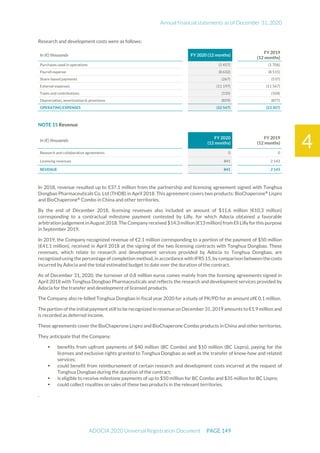
Variable compensation
The chairman and chief executive officer
receives variable compensation that may equal
75% of his fixed compensation.
This variable compensation is based on defined qualitative
objectives, which may be tied to signing licensing agreements,
developing collaborations, launching clinical trials, signing
feasibility contracts, cash levels and, more generally, the
development and growth of the Company. Whether these
objectives are met will be determined by the board of directors.
Extraordinary
compensation
The chairman and chief executive officer may be
awarded extraordinary compensation.
This extraordinary compensation is intended to compensate a
specific performance that has a major impact on the Company’s
development.
Non-cash benefits
The chairman and chief executive officer is
provided with a company car.
Supplemental
retirement plan
None None
The Chairman and Chief Executive Officer may also receive BSPCE founders’ warrants, stock options and/or bonus
shares, subject to continued employment and performance conditions.
 For Mr. Olivier Soula, Deputy General Manager:
It is being specified that all the elements of remuneration paid to Mr. Olivier Soula are under the terms of his
employment contract and as R&D director.
Compensation
components
Principles Determination criteria
Fixed compensation
The deputy chief executive officer receives fixed
compensation.
The annual gross amount of this fixed compensation is set at
€277,797 (impact of paid vacation excluded). It stays set at
€277,797 for 2021 (no raise).
Variable compensation
The deputy chief executive officer receives
variable compensation that may equal 60% of
his fixed compensation.
This variable compensation is based on defined qualitative
objectives, which may be tied to signing licensing agreements,
developing collaborations, launching clinical trials, signing
feasibility contracts, cash levels and, more generally, the
development and growth of the Company. Whether these
objectives are met will be determined by the board of directors.
Extraordinary
compensation
The deputy chief executive officer may be
awarded extraordinary compensation.
This extraordinary compensation is intended to compensate a
specific performance that has a major impact on the Company’s
development.
Non-cash benefits None None
Supplemental
retirement plan
None None
Patent bonus
The deputy chief executive officer may be
awarded bonuses on patents for which he is
named as inventor
The Deputy General Manager may also receive BSPCE founders’ warrants, stock options and/or bonus shares,subject
to continued employment and/or performance conditions, under certain conditions.
In accordance with Article L22-10-34 of the French Commercial Code, the shareholders will be asked to approve the
amounts obtained by implementing the above principles and criteria at the shareholders’ meeting called to vote on
the financial statements for the 2021fiscal year.
Approval of compensation owed or awarded to the Chairman and Chief
Executive Officer and the Deputy General Manager for the 2019 fiscal year
In accordance with Article L22-10-34 , sub-section II of the French Commercial Code, at the general shareholders’
meeting called to vote on the financial statements for the 2020 fiscal year, the shareholders will be asked to approve
thefixed,variableandextraordinarycompensation awardedorto beawardedforthe2020 fiscalyearto theChairman
and Chief Executive Officer and the Deputy General Manager in connection with said offices, as determined by the
Board of Directors in accordance with the principles and criteria approved by the shareholders at the Company
shareholders’ meeting of May 28, 2020 in the twelfth and thirteenth resolutions, will be submitted to the approval of
the shareholders’ meeting that will be held on May 20, 2021 in order to validate the financial statements for the fiscal
year 2020.
Corporate Governance
Adocia 2020 Universal Registration Document PAGE 112
3
Compensation and benefits of non- executive corporate officers
Compensation held by the non-executive corporate officers
The maximum amount of compensation allocated annually to directors was set by the combined general meeting of
June 27, 2017 at 100,000 euros.
The total amount actually paid to all directors(non-executive corporate officers) for the2020 financial year amounted
to € 52,000 in 2020 compared to € 63,000 in 2019.
Amongthenon-executive directors,only Ms.DominiqueTakizawa andEkaterina Smirnyaginareceived directors 'fees
insofar as the Board of Directors of the Company decided to grant directors' fees only to independent directors.
The amount ofcompensation paid to somemembers of the board was calculated in accordancewith the compensation
policy agreed by the board and approved by the general shareholders ‘meeting of 28 May 2020 and paid according to
the scale contained in Article 3.2.3.1 above).
Travel expenses are reimbursed for each actual presence on presentation of an expense report.
The amounts thus paid to non-executive corporate officers were as follows:
Non- executive corporate officers
sums paid during fiscal
year 2020
sums paid during
fiscal year 2019
M. Olivier Martinez – Board Administrator
Compensation for activities on the board and its committees (Article L. 225-45 of
the Code of Commerce) (*)
- -
Other compensation - -
Bpifrance Investissement
represented by Mr Laurent Arthaud – Board Administrator
Compensation for activities on the board and its committees (Article L. 225-45 of
the Code of Commerce) (*)
- -
Other compensation - -
Mrs Dominique Takizawa - Board Administrator
Compensation for activities on the board and its committees (Article L. 225-45 of
the Code of Commerce) (*)
30 000 37 000
Other compensation - -
Mrs Ekaterina Smirnyagina - Board Administrator
Compensation for activities on the board and its committees (Article L. 225-45 of
the Code of Commerce) (*)
22 000 26 000
Other compensation - -
TOTAL 52 000 63 000
(1)participation in thefivemeetings of theBoard of Directors heldin 2020 - Physical attendance at 4 meetings, amounting to 16,000 euros (4,000 euros
per session) and participation by telephone at 1 meeting, amounting to 2,000 euros (2,000 euros per session)
Chair of the audit committee: participation in the two committee meetings held in 2020. Physical attendance at 2 meetings amounting to 12,000 euros
(6,000 euros per session)
(2)participation in thefivemeetings of theBoard of Directors held in 2020 - Physical attendanceat 4 meetings, representing an amount of 16,000 euros
(4,000 euros per session) and participation by telephone at 1 meeting amounting to 2,000 euros (2,000 euros per session)
Participation in the Remuneration Committee 2020: participation in the two meetings of the remuneration committee held by telephone (i.e. 4,000
euros)
Corporate Governance
ADOCIA 2020 Universal Registration Document PAGE 113
3
BSPCE and BSA granted and SO granted to the first 10 employees who are not
corporate officers, powers and options exercised by them
Options for subscription or purchase
of shares granted to the first ten
employees who are not corporate
officers and options exercised by
them
Total number of
options allocated /
shares subscribed
or purchased
Weighted
average
price
(euros)
Plan SO
2017
n°1
Plan SO
2018
Plan SO
2019
Total number of options accumulated at
the start of the financial year
38 000 16.9 13 000 23 000 2 000
Stock subscription options granted during
the financial year
Options exercised during the fiscal year none none none none none
Total number of options canceled during
the fiscal year
17 000 none 1 000
Total number of options accumulated at
the end of the financial fiscal year
21000 16.6 0 20 000 1 000
(No BSPCE or BSA has been assigned to or exercised by non-corporate employees.
Summary of the operations of the directors and of the persons
mentioned in article L.621-18-2 of the Monetary and Financial Code
on the securities of the Company carried out during the past financial
year
None
3.3 Risk management and internal control procedures
implemented by the Company
When preparing this part of the report, the Company followed the guide on implementation of the reference
framework on internal control adapted for midcaps and small-caps published by the AMF on July 22, 2010.
General risk management principles
Definition
Adocia continues to formalize its risk management system. The Company's work initially focused on management of
the financial risks, with the creation of a number of official written procedures and the introduction of key control
points.
The Company aims to extend this process to all risks and risk factors that may impact on the Company's activities and
processes, via a documented risk mapping process, and to subsequently formalize its risk control procedures.
Goals of risk management
Adocia has adopted the definition of risk management proposed by the French financial regulator, the AMF47
,which
states that risk management is a management tool of the Company that helps:
- create and protect the Company's value, assets and reputation;
- secure decision-making and the Company’s processes to attain its objectives;
- achieve consistency between the Company’s actions and its values; and
47
Implementation guide for the reference framework on internal control adapted for midcaps and small-caps and updated on July 22, 2010
Corporate Governance
Adocia 2020 Universal Registration Document PAGE 114
3
- ensure that the Company’s employees have a shared vision of the main risks.
Components of the risk management system
The risk factors the Company has identified to date are detailed in section 1.5 of the universal reference document.
Coordination of risk management with internal control
Risk management aims to identify and analyze the main risks and risk factors that could affect the Company’s
activities, processes and objectives and define the resources to be used to keep these risks at an acceptable level, in
particular by implementing the preventive measures and controls that are part of the internal control system.
At the same time, the internal control system relies on risk management to identify the main risks that need to be
controlled. The Company has always had an internal control system, which it has continued to develop, while the
formalization of the risk management system is more recent. The Company is now committed to an initiative to
coordinate the two systems, which aims to identify the control procedures to be addressed in the key processes of the
Company that are likely to be affected by risks qualified as “major”.
General principles of internal control
Definition
Adocia has adopted the definition of internal control proposed by the AMF48
, which states that internal control is a
system that the Company implements in order to ensure:
- compliance with laws and regulations;
- implementation of the instructions and directions given by Executive Management;
- proper functioning of the Company’s internal processes;
- reliability of financial information; and
- in general that helps it to control its activities, improve the efficiency of its operations and use its resources
efficiently.
The internal control system helps to prevent and control risks that the objectives set by the Company are not
achieved, and therefore plays a key role in the conduct and management of its business activities.
Over the course of the fiscal year, Adocia continued to implement an internal control process aimed at “internally
ensuring the relevance and reliability of the information used in and disseminated in the course of the Company’s
activities”.
Components of internal control and stakeholders
 Organization
The internal control system is based on a clear organization of responsibilities, standards, resources, and procedures
implemented. In addition, the Company has always had a quality assurance system. The processes for all business
segments are described in procedures (Standard Operating Procedures, or SOPs), work instructions, notices and forms.
These written documents describe the conduct of business, define the resources and responsibilities of the
stakeholders, specify the Company’s know-how and provide specific instructions on how to carry out a particular
operation.
All of the Company’s stakeholders are involved in the internal control system.
48
Implementation guide for the reference framework on internal control adapted for midcaps and small-caps and updated on July 22, 2010
Corporate Governance
ADOCIA 2020 Universal Registration Document PAGE 115
3
 Project management and business monitoring procedures.
The Company has set up a specific organization to monitor projects and ensure that the objectives set by Executive
Management are met within the specified time frames and budgets. For each project it develops, the Company names
a project leader who reports to the R&D director and who may seek out the expertise of the different departments
within the Company, in order to complete the work defined by Executive Management. He or she is responsible for
defining the research programs, validating the objectives with Executive Management, ensuring they are achieved on
schedule and coordinating with any partners.
 Operational process procedures
All documentation relating to the quality system is saved to a dedicated intranet in order to maximize access to the
documents and their ongoing adaptation to changes in the business (document lifecycle management). The objective
is the continual improvement in the quality of the Company's or the group's business processes, for operational,
management, and support processes alike.
The quality assurance system covers the following areas:
- quality assurance, health and safety, operational risk management;
- administrative, legal, social, and financial matters, including internal control. The intention is to also include
communications and rules relating to the Company’s listing on Euronext;
- pharmaceutical, pre-clinical and clinical research and development.
With respect to information systems, procedures that have been incorporated into the quality system define the rules
relating to access to and the protection and storage of information. An IT Charter has also been put in place.
Financial reporting procedures
The Company has set up the following organization to limit its financial management risks:
- The Company’s Executive Management and, more specifically, the employees of the Finance Department are
tasked with improving internal control and incorporating the recommendations of the external auditors and the
Audit Committee;
- TheCompanymaintains an internalseparation between theproduction andoversightofthefinancialstatements
and brings in independent experts to value complex accounting items;
- If necessary, a chartered accountant is asked to verify the half-yearly and annual work for thecorporate financial
statements and the financial statements presented under IFRS;
- Payroll management is outsourced to an independent specialized firm.
 Oversight of internal control, regular reviews
The Company’s Executive Management has put in place specific internal control procedures that consist of regular
reviews of key information for each activity. For each of the areas listed below, information deemed material for the
corresponding activities has been identified and selected. It must reflect the reality of the activity and be used to track
this activity both quantitatively and qualitatively, including compliance with the standards that govern it. This key
information must be verifiable and documented. It should be updated every month by the people who conduct the
work. This system covers the following areas:
- information about Research and Development projects (pre-clinical, clinical, pharmaceutical);
- financial reporting and transactions involving the capital;
- the Company’s legal aspects, regulatory aspects and intellectual property;
- communication of accounting and financial information, as well as scientific and corporate information;
- quality and information systems;
- human resources and payroll.
These reviews are first conducted by the Company’s Management Committee, which is composed of the Chairman
and Chief Executive Officer, the R&D director, the Chief Financial Officer, and the Business Development director.
This committee meets at least once a week. If needed, it reviews data using the "Weekly Flash" report. The purpose of
Corporate Governance
Adocia 2020 Universal Registration Document PAGE 116
3
these reviews is to ensure that information on each of the separate areas truly and fairly reflects the Group's activities
and situation.
The Operations Committee (COMOP) also reviews the key information for each activity. It meets every month and is
made up of the members of the Management Committee and all of the Company’s department heads.
In general, all of the Company’s accounting options are defined by the Chief Financial Officer, discussed with
Executive Management and the Statutory Auditors and then presented to the Audit Committee and discussed. This
ensures that the Company’s practices are fully compliant with French and international (IFRS) standards and that the
financial statements are presented in a consistent manner.
At the end of each year, the Chief Financial Officer prepares a detailed budget for the following fiscal year, which is
then approved by Executive Management. This budget is presented to the Board of Directors. At the end of each
quarter, the accounting teams prepare the closing of the Group companies' individual financial statements.
The budget reviews conducted with all operational managers ensure an analytical validation of the entries and a
review of all expenditures, and the Chief Financial Officer prepares a report for Executive Management and the
directors. This report is presented and discussed periodically at the meetings of the Board of Directors.
However, it should be noted that the internal control system implemented by the Company cannot provide an
absolute guarantee that its objectives will be met.
 Internal control stakeholders
All of the Company’s stakeholders, governance bodies and employees are involved in the internal control system.
Since the Company’s creation, Executive Management has played a leading role in defining and implementing the
internal control system and subsequently in risk management.
Limitations on risk management and internal control and areas of
improvement
The Company will continue to move forward with its risk management system and to improve its monitoring of the
identified action plans. At the same time, the Company will work to update its internal control system in order to
reflect changes in its internal organization and its business, and the closer coordination with the risk management
process.
Corporate Governance
ADOCIA 2020 Universal Registration Document PAGE 117
3
4
View of the garden of Adocia, classified refuge LPO
(League of protection of the birds)
ADOCIA 2020 Universal Registration Document PAGE 119
Chapter 4
4 ANNUAL FINANCIAL STATEMENTS AS OF DECEMBER 31, 2020 120
4.1 Consolidated Financial Statements 120
Consolidated Balance Sheet, IFRS 120
Liabilities and Equity, IFRS 121
Consolidated Income Statement, IFRS 121
Statement of Changes in Equity, IFRS 122
Cash Flow Statement, IFRS 123
Notes to the Consolidated Financial Statements 124
4.2 Statutory auditors’ report on the consolidated financial statements 155
4.3 Corporate annual financial statements 162
Balance sheet, French GAAP 162
Income statement, French GAAP 163
Notes to the corporate annual financial statements 164
4.4 Statutory auditors’ report on the corporate financial statements 183
Annual financial statements as of December 31, 2020
Adocia 2020 Universal Registration Document PAGE 120
4
4 ANNUAL FINANCIAL STATEMENTS AS OF
DECEMBER 31, 2020
4.1 Consolidated Financial Statements
Consolidated Balance Sheet, IFRS
Assets, IFRS
In (€) thousands Notes
FY 2020
(12 months)
FY 2019
(12 months)
Current assets 36 446 52 218
Inventory 5 569 181
Trade and similar receivables 6 0 360
Other current assets 7 7 763 8 016
Cash and cash equivalents 8 28 114 43 661
Goodwill
Non-current assets 8 720 9 735
Other intangible assets 1 46 70
Land 2 2 032 2 032
Land development 2 322 363
Buildings and constructions 2 3 298 3 511
Laboratory equipment 2 378 579
Other property, plant and equipment 2 2 502 3 049
Non-current financial assets 3 142 130
TOTAL ASSETS 45 166 61 953
Annual financial statements as of December 31, 2020
ADOCIA 2020 Universal Registration Document PAGE 121
4
Liabilities and Equity, IFRS
In (€) thousands Notes
FY 2020
(12 months)
FY 2019
(12 months)
Current liabilities 10 723 11 234
Short-term financial debt 10 3 014 2 637
Trade and similar payables 12 4 943 5 326
Other current liabilities 12 2 766 3 271
Non-current liabilities 28 110 22 680
Long-term financial debt 10 25 180 18 518
Long-term provisions 11 2 214 3 122
Other non-current liabilities 13 715 1 040
Equity 9 6 334 28 040
Share capital 702 696
Share premium 78 731 78 788
Group translation gains and losses (29) 3
Group reserves (49 746) (32 844)
Group net profit/loss (23 324) (18 603)
TOTAL LIABILITIES 45 166 61 953
Consolidated Income Statement, IFRS
In (€) thousands Notes
FY 2020
(12 months)
FY 2019
(12 months)
Operating revenue 6 833 8 134
Revenue 15 841 2 143
Grants, research tax credits and others 16 5 992 5 992
Operating expenses excluding additions and reversals 14 (26 848) (28 996)
Additions to and reversals of depreciation, amortization, and provisions 19 (1 133) (1 159)
PROFIT (LOSS) FROM ORDINARY OPERATING ACTIVITIES 14 (21 148) (22 021)
Financial income 103 1 310
Financial expense (2 250) (856)
FINANCIAL INCOME (LOSS) 20 (2 147) 455
PROFIT (LOSS) BEFORE TAX (23 295) (21 566)
Tax expense 21 (29) 2 963
NET PROFIT (LOSS) (23 324) (18 603)
Base earnings per share (€) 22 (3,3) (2,7)
Diluted earnings per share (€) 22 (3,3) (2,7)
GROUP NET PROFIT (LOSS) (23 324) (18 603)
Actuarial adjustments on defined pension liabilities 11 1 382 81
Unclassified elements in the Group net profit (loss) 1 382 81
TOTAL PROFIT (LOSS) FOR THE YEAR (21 942) (18 522)
Annual financial statements as of December 31, 2020
Adocia 2020 Universal Registration Document PAGE 122
4
Statement of Changes in Equity, IFRS
In (€) thousands
Number
of Shares
Amount
Paid-in
capital
Reserve
Other
comprehensive
income (OCI)
Net profit
(loss)
Total
equity
BALANCE AT 12/31/2019 6 960 069 696 78 788 (31 584) (1 257) (18 603) 28 040
Profit for the year 2020 (23 324) 23 324
Gain (losses) on actuarial
adjustments on defined pension
liabilities
1 382 1 382
Translation adjustment (31)
Comprehensive income for the
period
(31) 1 382 (23 324) (21 972)
Allocation of profit for the year
2019
(18 603) 18 603
Increase in capital
Increase in capital cost
Exercise of equity instruments
(warrants)
60 560 6 (6) 0
Share-based payment 255 255
Liquidity Contract - Elimination
of treasury shares
(51) 63 12
Others 0
Total shareholder relations 60 560 6 (57) (18 285) 18 603 267
BALANCE AT 12/31/2020 7 020 629 702 78 731 (49 901) 126 (23 324) 6 334
Annual financial statements as of December 31, 2020
ADOCIA 2020 Universal Registration Document PAGE 123
4
Cash Flow Statement, IFRS
In (€) thousands
FY 2020
(12 months)
FY 2019
(12 months)
Net profit (23 324) (18 603)
Net depreciation, amortization & provisions (excl. current assets) 1 198 1 157
Capital gains and losses on non-current assets 53 18
Calculated income and expenses 2 650 (862)
Tax paid 0 0
Cash flow from operations before cost of net financial debt and tax (19 423) (18 290)
Cost of gross financial debt (1 423) 672
Change in deferred revenues (736) (2 138)
Change in working capital requirement (including employee benefits) (272) 10 101
NET CASH FLOW RELATED TO OPERATING ACTIVITES (21 854) (9 655)
Acquisitions of property, plant, and equipment & intangible assets (205) (2 019)
Disposals of property, plant, and equipment & intangible assets 0 0
Acquisitions of non-current financial assets 0 (35)
Disposals of non-current financial assets 0 0
Other cash flows related to investing activities 0 0
NET CASH FLOW RELATED TO INVESTING ACTIVITES (204) (2 054)
Capital increase 0 0
New loans and reimbursable advances 7 000 16 444
Repayments of loans and reimbursable advances (488) (915)
Other cash flows related to financing activities 0 0
NET CASH FLOW RELATED TO FINANCING ACTIVITES 6 512 15 529
CHANGE IN NET CASH AND EQUIVALENTS (15 547) 3 820
Opening cash 43 661 39 841
Closing cash 28 114 43 661
Detailed Analysis of WCR:
In (€) thousands
Change
2020 / 2019
Inventories 388
Trade and similar receivables (360)
Other receivables and advances (5)
Pre-paid expenses / other receivables (244)
Trade and similar payables 402
Other debt 91
CHANGE IN WORKING CAPITAL REQUIREMENT 272
Annual financial statements as of December 31, 2020
Adocia 2020 Universal Registration Document PAGE 124
4
Components of consolidated net cash and cash equivalents analyzed by type and reconciliation with the balance
sheet:
In (€) thousands
FY 2020
(12 months)
FY 2019
(12 months)
Short-term investment securities (due in < 3 months) 4 103 4 120
Cash on hand 24 011 39 541
NET CASH AND CASH EQUIVALENTS 28 114 43 661
Notes to the Consolidated Financial Statements
Unless specified otherwise, the amounts indicated in these notes are in thousands of euros.
Information about the company
Adocia is a biotechnology company specializing in the development of innovative formulations of pre-approved
therapeutic proteins. It has a high level of expertise in the field of insulin. The proprietary technology platform, called
BioChaperone®, aims to improve the efficacy of therapeutic proteins and their ease of use for patients.
Adocia is a limited company (société anonyme) under French law created on December 22, 2005.
The company has been listed on NYSE Euronext (compartment B) since February 20, 2012.
It has a wholly owned subsidiary (Adocia Inc.) established in March 2015 which aims to represent the company in the
US.
The financial statements under IFRS for the period from January 1 to December 31, 2020 are presented on a
consolidated basis for Adocia and its subsidiary (Adocia Inc.), the whole being called "the Company". The financial
statements were approved by the Board of Directors on March 18, 2021 and authorized for publication.
 Main events of 2020
In a contextdisrupted by theglobal COVID-19 pandemic, Adocia has reacted rapidly in order to achieve the objectives
set forth:
2020 was mainly marked by the clinical progress made on the combination of prandial insulin and pramlintide (Insulin
analog), the bi-hormonal product M1Pram (ADO09):
- In April 2020, clinical results obtained on patients with type 1 diabetes after 3 weeks of treatment,
demonstrated thatM1Pram enables the restoration of essential functions of physiology during the digestion
phase including: improving gastric emptying time recovery, which is abnormally short in patients with type
1 diabetes, inhibiting glucagon secretion (trigger of the endogenous glucose synthesis), and promoting a
feeling of satiety. This recovery of a normal metabolism results in better control of post-meal blood sugar
levels, with a significant reduction in insulin consumption and weight reduction in overweight / obese
patients.
- In September 2020, Adocia announced the results of the extension of this clinical study on patients with type
1 diabetes requiring more than 40 UI/day of insulin and with a longer period of time of treatment (3 months).
The primary endpoint of this study was met with the reduction of69% of post-meal glycemic excursions over
four hours vs. Novolog®. This study demonstrated a mean weight loss of 1.6 kg for 24 days with M1Pram
treatment (versus an increase of 0.4 kg in the control group for this population). Additionally, a treatment
satisfaction questionnaire was submitted to all patients after each treatment period. The results reflect the
beneficial impact of M1Pram on individuals, as 87% of them reported an improved appetite control through
the M1Pram study medication, and 75% of the patients would recommend it to other people with diabetes.
In light of these results, Adocia rapidly progressed its clinical program and initiated its Phase 2 study in March of
2021. The study will evaluate the safety and efficacy of M1Pram in 80 patients, assessing weight loss in
overweight and obese T1D patients as well as improved HbA1c.
Annual financial statements as of December 31, 2020
ADOCIA 2020 Universal Registration Document PAGE 125
4
In parallel and considering the significant clinical benefit of an insulin pramlintide combination, Adocia developed a
second product based on the BioChaperone (BC LisPram) technology. The development of this product was carried
on in 2020 and it will be tested in a pump study in the first semester of 2021.
During 2020, a major step was achieved with Tonghua Dongbao (THDB) on ultra-rapid insulin BioChaperone® Lispro
(BC Lispro) on the Chinese market, with the filing of a clinical application to the Chinese Reglementary Authorities
(Center for Drug Evaluation).
In regard to BioChaperone® Combo, co-formulation of glargine (basal insulin) and lispro (prandial insulin), the
technologicaltransferto ourChinesepartneris overandtheindustrialization ofthemanufacturingprocess is ongoing.
Adocia is currently working together with Tonghua Dongbao on the clinical development plan and the preparation of
the reglementary application for its commercialization in China, which represents a market with a strong potential.
In 2020, Adocia realized a “bridging” clinical study which demonstrated that the BioChaperone Lispro formulation
composed of insulin lispro manufactured by Tonghua Dongbao, had a similar ultra-rapid
pharmacokinetic/pharmacodynamic and safety profile, compared with the BioChaperone Lispro formulation
composed with insulin lispro, Humalog®. Results from this study complete the dossier for BioChaperone Lispro,
composed of insulin lispro from Tonghua Dongbao, required for initiation of Phase 3 studies in China, Europe, and the
US.
Adocia also developed a new technology for cell therapy in 2020 and developed an innovative stable biocompatible
hydrogel scaffold to host and protect pancreatic cell implants. This aims to restore glycemic control without requiring
insulin injection and immunosuppressant drugs. An academic collaboration has been established with the research
team of Professor François Pattou (DiabInnov®, Inserm Lille®, France) a worldwide leader of Langerhans islet
transplant in clinical and non-clinical stages. The preliminary results obtained via this collaboration are promising.
On a financial basis, in the COVID-19 pandemic context, the Company was granted a non-dilutive loan of € 7 million
via a State-guaranteed loan (PGE) by BNP, HSBC, LCL and Bpifrance in August 2020. Its initial term is one year with a
5-year amortization option. Adocia negotiated in parallel with IPF Partners a rescheduling of the terms of the loan
contracted in 2019 for a total amount of €15 million. A differed repayment period of 12 months for an amount of €2
million was granted and Adocia issued in return 35 005(BSA) warrants to IF Partners.
Accounting methods and principles used to draw up the financial statements
 Accounting standards
In accordance with EU Regulation 1606/2002 of July 19, 2002 on international standards, the company’s
consolidated financial statements for the period ended December 31,2020 were prepared according to the standards
and interpretations published by the International Accounting Standards Board (IASB) and adopted by the European
Union as of the reporting date.
These standards are available on the European Commission website at the following address:
http://ec.europa.eu/internal_market/accounting/ias_fr.htm
They include the international accounting standards (IAS and IFRS) and the interpretations of the Standing
Interpretations Committee (SIC) and the International Financial Interpretations Committee (IFRIC).
The accounting principles and methods used by the company for the consolidated financial statements are the same
as those used for the financial statements for the year ended December 31, 2019.
In addition, the new mandatory texts applicable to fiscal years beginning on or after January 1, 2020 are as follows:
Standards, amendments to standards and interpretations applicable as of January 1, 2020:
- IFRS 16 - Leases
- IFRIC 23 – Uncertainty over income tax treatments
- Amendments to IFRS 9 – Prepayment features with negative compensation
- Amendments to IAS 28 – Long-term interests in associates and joint ventures
- Annual improvement of IFRS standards (2015-2017 cycle)
Annual financial statements as of December 31, 2020
Adocia 2020 Universal Registration Document PAGE 126
4
- Amendments to IFRS 3 – Business combinations & IFRS 11 Partnerships
- Amendments to IAS 12 – Income taxes
- Amendments to IAS 23 - Borrowing costs
- Amendments to IAS 1 and IAS 8 – Definition of the “significative” term
- Amendments to IAS 39, IFRS 7 and IFRS 9 – Reference interest rates
These new texts adopted by the European Union did not have a significant impact on the Company’s financial
statements.
Standards, amendments to standards and interpretations adopted by the European Union but not yet
mandatory for 2020 annual financial statements:
None
Standards and interpretations published by the IASB and not yet adopted by the European Union as of
December 31, 2020:
- IFRS 17 – Insurance contracts
- Amendments to IFRS 3 – Definition of a business
- Amendments to IFRS 4 – Insurance contracts
- Amendments to IFRS 16 – Leases
The Company is currently assessing the impacts of the first application of these new standards and does not expect a
significant impact on its financial statements.
 Application of the IAS 32 standard for the loan contract signed with IPF Fund II
On October 3, 2019, the Company's board of directors, acting under delegation from the general meeting of
shareholders of May 16, 2019, authorized the issue of a bond loan with attached warrants (BSA) for a maximum
amount of €15 million. The loan was subscribed with IPF Partners through two tranches of €7.5 million each,
respectively on October 11, 2019 and December 10, 2019.
The bonds issued by the Company contain a contractual commitment to pay principal and interest repayments in the
form of cash flows. In accordance with IAS 32, these bonds are considered as financial liabilities and must be
recognized as debt at the date of each drawdown.
The exercise price of the warrants is contractually fixed at €8.57. It may, however, be revised downwards in the event
of a new share issue at a lower price. The warrants issued will therefore be settled by the exchange of a variable
number of shares for a fixed amount of cash (€1,125,000 per tranche) and are qualified, in accordance with IAS 32, as
derivative liabilities.
The valuation of these warrants on the subscription date was entrusted to an independent actuary. In view of this
valuation and the expenses incurred by the Company and directly related to this bond issue, an effective interest rate
calculation (EIR) was performed and will be used, at each balance sheet date, to discount the amount of the debt
recognized in the Company's consolidated financial statements.
In July 2020, in a context marked by the Covid-19 pandemic, the Company obtained a debt restructuring with a new
deferral of payment of the maturities of 12 additional months, with the final maturity dates of the two tranches
remaining unchanged.
In consideration for this arrangement, the Company's Board of Directors granted a total of 35,005 share warrants
(BSAs) to the IPF Fund II SCA SICAV FIAR fund free of charge, under terms and conditions similar to those of the BSAs
granted to IPF Fund II SCA SICAV FIAR under the main agreement, with an exercise price of the BSAs of €7.70. The
number of warrants corresponds to 15% of the deferred capital amount, i.e. EUR 300,000. As of the date of this
document, and excluding any adjustment to the exercise price of the BSAs, the number of shares that could be issued
would be 38,961 shares, i.e. approximately 0.5% of the Company's share capital. The fair value of the warrants has
been recognised in P&L as of 31 December 2020.
Annual financial statements as of December 31, 2020
ADOCIA 2020 Universal Registration Document PAGE 127
4
 IFRS 9 application for the recognition of the State-guaranteed loan (PGE)
contracts:
In August 2020, a €7 million non-dilutive financing was approved by BNP, HSBC, LCL and Bpifrance in the form of a
state-guaranteed bank loan (PGE).
These bank loans are guaranteed by the French government up to 90% of the due amounts and are not subject to
payment in the first year. By the end of the first year, the reimbursement of the loans could be differed again and
amortized over a maximum period of 5 years, at the Company’s option. These bank loans will have fixed interest rates
ranging from 0.25% to 1.75% for the first year.
 Basis for preparation of the financial statements
Since the creation of the Adocia Inc. subsidiary in March 2015, the Company has published consolidated financial
statements. The methods used for consolidation and translation of the financial statements are specified below
(Consolidation methods).
The company's financial statements were prepared based on the historical costprinciple, with the exception of certain
categories of assets and liabilities according to the rules set out in the IFRS. The relevant categories are indicated in
the following notes.
In order to meet the financial commitments made to its lenders and taking into account the cash position of 28.1
million euros as of December 31 2020 and the forecasts made, the Company will have to conclude a fundraising or
partnership transaction by the third quarter of 2021. Management is confident about the outcome of ongoing
discussions regarding these new sources of funding.
To prepare the financial statements in accordance with IFRS, some estimates, judgments and assumptions have been
made by the Company's management, which may have affected the amounts shown for the assets, liabilities and
contingent liabilities as of the date of preparation of the financial statements, and the amounts shown for income and
expenses during the year.
These estimates are based on the going concern assumption and on the information available at the time they were
made. They are assessed continuously based on past experience and various other factors deemed reasonable which
form the basis of the estimates of the carrying amount of the assets and liabilities. The estimates may be revised if the
circumstances on which they were based change or as a result of new information. Actual results may differ
significantly from these estimates based on different assumptions or conditions.
In preparing its annual financial statements, the main judgments made by Management and the main assumptions
used are the same as those used to prepare the financial statements for the fiscal year ended December 31, 2019.
These assumptions mainly relate to IFRS 2 ("Share-based Payment"), IFRS 15 ("Revenue from Contracts with
Customers") and, to IAS 32 (“Financial Instruments: Presentation).
 Consolidation principles
The consolidated financial statements include the financial statements of all the fully consolidated subsidiaries that
Adocia directly or indirectly controls. In accordance with IFRS 10, control is determined on the basis of three criteria:
power, exposure to variable returns and the relationship between power and these returns.
In March 2015, the company created a wholly-owned subsidiary called Adocia Inc., which was fully consolidated at
the end of December 2020.
The addition of the Adocia Inc. subsidiary to the scope of consolidation was effective on the date of creation. Income
and expenses are recorded in the consolidated income statement from the date of creation.
All transactions between the Adocia Inc. subsidiary and the company and internal results within the consolidated
group are eliminated.
The company's financial statements are prepared in euros, which is the presentation currency and functional currency
of the parent company and its subsidiary.
The method used by the company is that of the closing rate. This method entails translating the balance sheet items
at the closing rate and the income items at the average rate for the year; the translation differences, both on the
opening balance sheet items and on the income statement, are included in equity under "Translation differences".
Annual financial statements as of December 31, 2020
Adocia 2020 Universal Registration Document PAGE 128
4
 Current/non-current distinction
The balance sheet presentation used by the company makes a distinction between current and non-current assets
and liabilities.
This distinction is made based on the following rules:
assets and liabilities that fall within the scope of the company's operating working capital requirement are
classified as "current».
assets andliabilities that arenot part of the company's normaloperations are presented as "current" or "non-
current" based on whether their due date is more or less than one year.
 Intangible assets
Research and development
In accordance with IAS 38, internal research costs are recognized as expenses as soon as they are incurred.
Development costs are capitalized if and only if the following criteria are met:
- technical feasibility needed to complete the development project is established,
- the company intends to complete the project,
- the company is able to use the intangible asset,
- the company is able to demonstrate the probability that the asset will generate future economic benefits,
- the company has the technical, financial and other resources to complete the project, and
- the development costs are measured reliably.
Patents
The costs incurred prior to filing and obtaining patents are capitalized by the company under the same conditions as
those applicable to capitalizing development costs.
Other intangible assets
Intangible assets acquired separately by the company are recognized at historical cost and those acquired through a
business combination are recognized at fair value.
Concessions, licenses, and software are amortized over the expected useful life (three to five years depending on the
type of software).
 Property, plant, and equipment
Property, plant, and equipment are recognized at their original cost. They are then measured at cost less any
accumulated depreciation and impairment.
Depreciation is calculated on a straight-line basis according to the estimated useful life of theassets and, if applicable,
the residual values:
Type of asset Useful life
Land development 10 years
Buildings 20 years
Fixtures and facilities 3 to 10 years
Laboratory equipment 3 to 5 years
Furniture, office equipment 5 years
Land is not depreciated.
An item of property, plant and equipment is derecognized when it is disposed of or when no future economic benefits
are expected from its useor disposal. Any gain orloss resultingfrom the derecognition of an asset (difference between
Annual financial statements as of December 31, 2020
ADOCIA 2020 Universal Registration Document PAGE 129
4
the net proceeds and carrying amount of the asset) is included in the income statement for the year in which
derecognition occurs.
The residual values, useful lives and depreciation methods of assets are reviewed and, if necessary, adjusted at each
year-end closing. Such adjustments are treated as changes in estimate.
The depreciation of property, plant and equipment is recognized in profit or loss under depreciation and amortization.
 Leasing (including lease financing)
According to IFRS 16 (“Leases”), an asset held under a finance lease (which substantially transfers all the risks and
rewards of ownership of the asset to the company) is recorded as an asset and a liability (in the same amount) on the
balance sheet at the lower of the fair value of the asset and the sum of the discounted payments.
These assets are depreciated according to the same methods and rules described above in the previous section. The
corresponding liabilities are recorded on the balance sheet and repaid in an amount equal to the theoretical
amortization of loans whose characteristics are comparable to those of the lease agreements.
As ofDecember 31,2020,onlylease contracts fallwithin thescope of IFRS16.As theaccounting treatmentis identical
to that made under IAS 17, the application of IFRS 16 has no impact on the Company's consolidated financial
statements.
 Borrowing costs
Borrowing costs directly attributable to theacquisition, construction orproduction of an assetthat takes asubstantial
amount of time to prepare for its intended use or sale are included in the cost of the asset. All other borrowing costs
are recorded as financial expenses for the fiscal year in which they are incurred. Borrowing costs include interest and
other costs that an entity incurs to borrow funds.
 Recoverable amount of non-current assets
Assets with an indefinite useful life are not depreciated and are subject to an annual impairment test. Depreciated
assets are subject to an impairment test whenever there is an internal or external indicator that an asset may be
impaired.
Impairment testing entails comparing the net carrying amount of the tested asset to its recoverable amount. The test
is performed at the cash generating unit level, which is the smallest group of assets that includes the asset and whose
continuous use generates cash inflows that are largely independent of those generated by other assets or groups of
assets.
Impairment is recorded in the amount by which the carrying amount of an asset exceeds its recoverable amount. The
recoverable amount of an asset is the higher of its fair value less costs of disposal and its value in use.
Fair value less costs of disposal is the amount that can be obtained from the sale of an asset in an arm's length
transaction between well-informed, consenting parties, less costs of disposal.
Value in use is the present value of the estimated future cash flows expected to be derived from the continuous use of
an asset and from its disposal at the end of its useful life. Value in use is determined according to cash flow projections
generally made on the basis of five-year budgets or forecasts. For periods after five years, cash flows are extrapolated
using a steady or declining growth rate and discounted at long-term after-tax market rates that reflect market
estimates of the time value of money and the risks specific to the asset. The terminal value is determined based on the
discounting to infinity of the last cash flow of the test.
As of December 31, 2020, there were no internal or external impairment indicators for any non-current assets.
 Basis of measurement of inventories
Inventories are recognized at the lower of cost and net realizable value. They may be impaired if the expiration date
has passed and/or if the project to which they refer was discontinued by the company and considered a failure. The
cost of inventories is determined using the first-in first-out method.
 Financial assets
Financial assets are classified into four categories based on their type and the intention of holding them:
Annual financial statements as of December 31, 2020
Adocia 2020 Universal Registration Document PAGE 130
4
- Held-to-maturity investments,
- Financial assets at fair value through profit or loss,
- Loans and receivables,
- Available-for-sale financial assets.
With the exception of assets at fair value through profit or loss, all financial assets are initially recognized at cost,
which corresponds to the fair value of the price paid plus acquisition costs.
All regular way purchases and sales of financial assets are recognized on the settlement date.
Held-to-maturity investments
Held-to-maturity investments are financial assets which the company intends and is able to hold to maturity. After
their initial recognition, these assets are measured at amortized cost, using the effective interest method, less the
amount of any impairment.
Financial assets at fair value through profit or loss:
This category represents assets held for trading, i.e. assets acquired by the company for the purpose of selling them in
the short term. They are measured at fair value and changes in fair value are recorded in profit or loss. Certain assets
can also be voluntarily classified in this category.
Loans and receivables:
Non-current financial assets include advances and guarantee deposits given to third parties. Advances and guarantee
deposits are non-derivative financial assets with fixed or determinable payments that are not quoted in an active
market. Such assets are recognized at amortized cost using the effective interest method. Gains and losses are
recorded in profit or loss when the loans and receivables are derecognized or impaired.
Available-for-sale financial assets:
This category includes all other financial assets. They are measured at fair value and changes in fair value are recorded
in profit or loss until the asset is sold, cashed in or disposed of in any other way or until it is shown that the asset has
been impaired in a prolonged and significant manner. In such cases, the profit or loss, recognized until then in equity,
is transferred to profit or loss.
Available-for-sale financial assets are tested for impairment when impairment indicators exist.
When the available-for-sale financial asset is an equity instrument, impairment is final. Subsequent increases in fair
value are recognized directly in equity.
When the available-for-sale financial asset is a debt instrument, any subsequent increase is recorded in profit or loss
in an amount equal to the impairment loss previously recorded in profit or loss.
Purchases and sales of financial assets are generally recognized on the trade date.
The only financial assets measured at fair value are cash and cash equivalents, which include short-term investment
securities (money market mutual funds in euros) quoted in an active market. They therefore constitute level 1
financial assets at fair value.
Cash reserve of the liquidity agreement:
The cash reserve related to the liquidity agreement for the buyback of the company's own shares is recorded as non-
current financial assets.
 Cash and cash equivalents
Cash and short-term deposits recorded on the balance sheet include bank balances, cash on hand and short-term
deposits with an initial maturity of less than three months.
Cash equivalents are held for trading purposes, readily convertible to a known cash amount and subject to an
insignificant risk of change in value. They are measured at fair value and changes in value are recorded in financial
income/expense.
Annual financial statements as of December 31, 2020
ADOCIA 2020 Universal Registration Document PAGE 131
4
For the purposes of the cash flow statement, net cash includes cash and cash equivalents as defined above, net of bank
overdraft facilities. In the balance sheet, bank overdrafts are shown in current financial liabilities.
 Repayable advances
The company has received a certain amount of government assistance in the form of repayable advances.
Repayable advances are recognized as “Long-term financial debt" or “Short-term financial debt" depending on their
due date. In case of failure to repay the grant, the debt write-off is recognized in "Grants, government financing and
tax credits".
These advances were recognized in accordance with IAS 39: as financial advances granted at interest rates below the
market rates, the difference between the applied rate and the market rate is valuated according to IAS 20, if the
impacts are material.
 Equity
Classification in equity depends on the specific analysis of the characteristics of each instrument issued. Ordinary
shares and preferred shares have therefore been classified as equity instruments.
The incidental costs directly attributable to the issue of shares or stock options are accounted for as a deduction from
equity, net of tax.
Treasury shares held by the company under a liquidity agreement are recognized at their acquisition cost as a
reduction in equity. The gain or loss on disposal of these treasury shares is also recognized directly in equity.
 Share-based payments
In accordance with IFRS 2, benefits granted to certain employees in the form of share-based payments are measured
at the fair value of the instruments granted.
This payment can take the form of equity-settled instruments or cash-settled instruments.
The company has introduced several equity-settled payment plans.
For example, stock options are granted to senior managers, certain company employees and other private individuals
(independent directors and consultants).
The company uses the Black-Scholes model to measure the fair value of these options. This model takes into account
the features of the plan (strike price, exercise period), market data on the grant date (risk-free interest rate, volatility,
expected dividends) andgrantee behavior assumptions.Changes in valuesubsequent to the grant datehave no impact
on this initial measurement.
The value of the options is based on their expected term. This value is recorded as payroll expense or external charges
as follows: the fair value of the options granted is determined on the grant date and recognized in profit or loss over
the vesting period (period between the grant date and the plan maturity date).
For bonus shares, the fair value is also determined based on the features of the plan, market data on the grant date
and an assumption of continued employment at the end of the vesting period. If the plan does not specify vesting
conditions, the expense is recognized in full when the plan is granted; otherwise, the expense is recorded over the
vesting period based on the conditions being met.
 Provisions
Provisions are recorded when the company has a present obligation (legal or constructive) resulting from a past event,
it is probable that an outflow of resources representing economic benefits will be needed to settle the obligation, and
the amount of the obligation can be measured reliably. If the company expects the full or partial reimbursement of the
provision (for example under an insurance policy), the reimbursement is recognized as a separate asset, but only if the
reimbursement is virtually certain. The expense related to the provision is shown in the income statement net of any
reimbursement. If the effect of the time value of money is material, provisions are discounted using a pre-tax rate that
reflects, where appropriate, the risks specific to the liability. When discounting is used, the increase in the provision
related to the passage of time is recognized as a borrowing cost.
Annual financial statements as of December 31, 2020
Adocia 2020 Universal Registration Document PAGE 132
4
Provisions correspond to risks and charges that are specifically identified. They are classified as non-current or
current liabilities based on their nature, purpose, and duration.
 Social commitments
In accordance with IAS 19R, retirement plans, similar payments and other employee benefits that are considered
defined benefit plans (plan in which the company agrees to guarantee a defined amount or benefit level) are recorded
in the balance sheet based on an actuarial assessment of the obligations on the closing date, reduced by the fair value
of the plan assets. These calculations mainly include:
- an assumption related to the benefit payment date;
- a financial discount rate;
- an inflation rate;
- assumptions related to salary increases, employee turnover rate and mortality rate.
The main actuarial assumptions made at December 31, 2020 are described in note 11 to the financial statements.
Actuarial gains and losses include the effects on the obligation of changes in the calculation assumptions and
experience adjustments to the obligation. These gains and losses are recognized in other comprehensive income for
post-employment benefits.
Theprovision shown onaspecificlineofthebalancesheetrepresents thetotalobligation on theclosingdate,adjusted,
where appropriate, for past service costs. Past service costs related to a plan change are recognized immediately in
the income statement for the portion of rights already acquired and are spread out over the average period remaining
until the corresponding benefits are vested.
The expense for the year consists of the cost of services rendered, which represents an operating expense, and the
accretion expense, which represents a financial expense.
 Financial liabilities
Financial liabilities are classified into two categories and include:
- financial liabilities recognized at amortized cost, and
- financial liabilities recognized at fair value through profit or loss.
Financial liabilities recognized at amortized cost:
Loans and other financial liabilities, such as conditional advances, are generally recognized at amortized cost
calculated using the effective interest rate.
Loans and conditional advances are initially recorded at the fair value of the amount received, less directly
attributable transaction costs. After the initial recognition, interest-bearing loans are measured at amortized cost
using the effective interest method.
The portion of debt due in less than one year is presented as a current liability.
Financial liabilities at fair value through profit or loss:
This category represents liabilities held for trading, i.e. liabilities that are intended to be sold in the short term. They
are measured at fair value and changes in fair value are recorded in the income statement.
 Receivables and liabilities denominated in foreign currencies
Receivables and liabilities denominated in foreign currencies are recognized at the exchange rate at the time of the
initial transaction. At the end of the fiscal year, the items corresponding to assets and liabilities are measured at the
closing rate or at the hedging rate, where appropriate.
 Current and deferred tax
Current tax assets and liabilities for the fiscal year and previous fiscal years are measured at the amount expected to
be collected from or paid to the tax authorities. The tax rates and tax laws used to determine these amounts are those
enacted or substantively enacted as of the closing date.
Annual financial statements as of December 31, 2020
ADOCIA 2020 Universal Registration Document PAGE 133
4
Deferred taxes are recognized using the balance sheet liability method for all temporary differences existing as of the
closing date between the tax base of the assets and liabilities and their carrying amount on the balance sheet, and for
carryforward losses.
A deferred tax asset, generated by tax losses, is recognized when there is persuasive evidence that a sufficient taxable
profit will be available.
 Revenue
Revenue corresponds to the fair value of the consideration received or receivable for goods and services sold in the
normal course of the company's business. Revenue is shown net of value-added tax, returns of merchandise, rebates
and discounts.
In the normal course of its business, the company may enter into commercial agreements with pharmaceutical groups.
Payment under these agreements may generally be based on:
- The payment of a signing bonus (access fees or up-front payment)
- Payment for specific developments based on the attainment of technical milestones (milestone payments)
- Payment for research and development efforts (collaborative agreements)
- Future sales of products (royalties).
The company recognizes revenue when the amount can be measured reliably, it is probable that future economic
benefits will flow to the company, and specific criteria are met for each of the company's activities.
With regard to licenses and feasibility studies, contracts are analyzed on a case-by-case basis in order to recognize
revenue according to the IFRS 15 standard.
The licenses sold by the Company correspond to rights of use. As a consequence, the revenue generated from these
licenses is recognized immediately from the date the customer can start using the license.
When the payment of a license is a milestone payment depending on the achievement of a development, regulatory
or commercial objective, the corresponding revenue is recognized when the objective achievement becomes highly
probable.
When the payment of a license is royalties calculated on sales made by the customer, the Company applies the
exception to the general principle provided by the IFRS 15 standard on variable payments. Royalties are then
recognized as revenue when the customer sales occur.
The Company provides research and development services to customers as part of development projects which final
objective is the grant of a marketing authorization (MA). The revenue from these services is recognized according to
the percentage of completion of the project, as the customer benefits from the services progressively. The percentage
of completion is calculated as the ratio of the costs incurred by the Company for research and development services
performed under the contract to the total estimated budget for the duration of the contract.
If the license and theservices are soldtogether, thecontractprice is allocatedto the different elements of thecontract
proportionally to their fair value.
If the costs of one of the contract elements are not completely offset by the revenue calculated from fair values, the
Company applies the residual method.
 Other income
Grants:
Due to its innovative nature, the company has received since its creation a certain amount of assistance and grants
from the French government and public authorities to help finance its operation or recruit specific individuals.
These grants are recognized as income over the fiscal year in which the corresponding costs orexpenses are recorded.
Research tax credit:
The French government grants research tax credits to companies to encourage them to conduct technical and
scientific research. Companies that can substantiate research expenditures (in particular salaries and wages,
depreciation of research equipment, services outsourced to approved research organizations and intellectual
Annual financial statements as of December 31, 2020
Adocia 2020 Universal Registration Document PAGE 134
4
property costs) are eligible for a tax credit that can be used to pay the corporation tax due for the fiscal year in which
the expenses are incurred and the following three fiscal years or, where appropriate, be reimbursed for the excess
share of such tax.
 Segment information
To date, the company has not identified distinct operating segments. For the most part, the company's operations
involve regenerative medicine for the treatment of chronic diseases. All the assets and operating income presented
are located in France.
 Presentation of the income statement
The company presents its income statement by nature.
The purpose of the expenses is provided in note 14 to the financial statements.
Research and development costs:
Internal and external costs related to the research and development of new products.
Administrative expenses:
Total costs of the support and central management functions.
Other operating income and expenses:
Information appears in this item when asignificantevent occurring during theaccounting period couldgive a distorted
view of the company's performance.
Other operating income and expenses include income and expenses that are very limited in number and unusual given
their frequency, nature, or amount.
Operating profit/loss:
Operating profit/loss includes all income and expenses directly related to the company's activities, whether such
income and expenses are recurrent or result from one-time decisions or operations.
Financial income/expense:
Financial income/expense includes all:
- Expenses related to financing the company: interest paid and accretion expense on repayable advances
- Income related to interest received.
Foreign-exchange gains and losses are also recognized in financial income/expense.
Taxes:
Income tax: This item includes tax recorded for the year on any taxable income (French GAAP).
Deferred taxes are recognized for all temporary differences arising from the difference between the tax basis and
accounting basis of the assets and liabilities shown in the financial statements. The main temporary differences relate
to carryforward tax losses. The statutory tax rate on the closing date is used to determine deferred taxes.
Deferredtaxassets arerecognizedonlyto theextentthatitisprobablethatfutureearnings willbesufficientto absorb
carryforward losses. Given its stage of development, which does not allow sufficiently reliable income projections to
be made, the company did not recognize deferred tax assets on the balance sheet for carryforward losses.
 Earnings per share
Basic earnings per share is calculated by dividing the profit or loss attributable to holders of the company's shares by
the weighted average number of ordinary shares outstanding during the period.
Diluted earnings per share is determined by adjusting the profit or loss attributable to holders of ordinary shares and
the weighted average number of ordinary shares outstanding for the effects of all dilutive potential ordinary shares.
Annual financial statements as of December 31, 2020
ADOCIA 2020 Universal Registration Document PAGE 135
4
 Fair value of financial instruments
Fair value measurements are detailed by level according to the following fair value hierarchy:
- the instrument is quoted in an active market (level 1);
- measurement uses valuation techniques based on observable inputs, either directly (price) or indirectly (price
derivatives) (level 2);
- at least one material component of fair value is based on unobservable inputs (level 3).
Fair value of financial instruments traded in active markets is based on quoted prices on the balance sheet date. A
market is considered active if quoted prices are easily and regularly available from an exchange, trading officers,
brokers, an appraiser or a regulatory agency and such prices are based on regular trades. These instruments are
classified as level 1.
Fair value of financial instruments that are not quoted in an active market (for example, over-the-counter derivatives)
is determined based on valuation techniques. These methods maximize the use of observable market inputs, if
available, and, for the most part, are not based on the company's own estimates. If all the elements required to
calculate the fair value of the instrument are observable, this instrument is classified as level 2.
If one or more of the main calculation elements are not based on observable market inputs, the instrument is classified
as level 3.
Annual financial statements as of December 31, 2020
Adocia 2020 Universal Registration Document PAGE 136
4
Notes to the financial statements
Summary of notes
NOTE 1 Intangible assets
NOTE 2 Property, plant and equipment
NOTE 3 Non-current financial assets
NOTE 4 Additional information regarding deferred taxes
NOTE 5 Inventories
NOTE 6 Trade receivables
NOTE 7 Other current assets
NOTE 8 Classification and fair value of financial assets
NOTE 9 Equity
NOTE 10 Long-term financial debt
NOTE 11 Provisions
NOTE 12 Trade payables and other current liabilities
NOTE 13 Other non-current liabilities
NOTE 14 Operating profit/loss
NOTE 15 Revenue
NOTE 16 Other income
NOTE 17 Other purchases and external charges
NOTE 18 Payroll costs
NOTE 19 Depreciation, amortization and impairment
NOTE 20 Financial income/expense
NOTE 21 Corporate tax
NOTE 22
NOTE 23
NOTE 24
NOTE 25
NOTE 26
Earnings per share
Related parties and compensation of the corporate officers
Financial risk management objectives and policies
Off-balance sheet commitments
Events subsequent to year end
Annual financial statements as of December 31, 2020
ADOCIA 2020 Universal Registration Document PAGE 137
4
NOTE 1 Intangible assets
In (€) thousands 12/31/2019
Acquisitions /
Additions
Disposals /
reversals
12/31/2020
Gross amount 191 0 0 191
Depreciation and impairment 121 25 0 146
NET AMOUNT 70 (25) 0 46
Given the risks and uncertainties related to regulatory authorizations and the R&D process, the six criteria for
recognition of intangible assets are not considered as being met for any of the pending development projects. As a
result, all costs incurred by the company are recognized as expenses. The treatment is the same for costs related to
patents (see note 14).
NOTE 2 Property, plant and equipment
In (€) thousands 12/31/2019
Acquisitions /
Additions
Disposals /
reversals
12/31/2020
Land 2 032 0 0 2 032
Land development 409 0 0 409
Buildings 4 276 0 0 4 276
Laboratory equipment 3 550 149 (69) 3 630
Fixtures and facilities 3 755 52 (53) 3 753
Furniture, office equipment 1 558 24 (8) 1 573
GROSS AMOUNT 15 580 224 (131) 15 673
Land 0 0
Land development 46 41 87
Buildings 764 214 978
Laboratory equipment 2 972 349 (69) 3 252
Fixtures and facilities 1 134 378 0 1 512
Furniture, office equipment 1 125 191 (8) 1 308
DEPRECIATION AND IMPAIRMENT 6 040 1 173 (77) 7 136
Land 2 032 0 0 2 032
Land development 363 (41) 0 322
Buildings 3 511 (214) 0 3 298
Laboratory equipment 579 (201) 0 378
Fixtures and facilities 2 619 (327) (53) 2 239
Furniture, office equipment 431 (167) (0) 263
NET AMOUNT 9 535 (949) (54) 8 532
Net property, plant and equipment decreased by €1 million between 2019 and 2020, due mainly to the depreciation
of the net property, plant and equipment over the period and the low level of investment in 2020.
NOTE 3 Non-current financial assets
The company's non-current financial assets were as follows:
Annual financial statements as of December 31, 2020
Adocia 2020 Universal Registration Document PAGE 138
4
In (€) thousands 12/31/2019
Acquisitions /
Additions
Disposals /
reversals
12/31/2020
Gross amount 130 12 0) 142
Amortization and impairment
NET AMOUNT 130 12 0 142
Non-current financial assets consistmainly of guarantee deposits paid underoperating lease agreements and thecash
reserve related to the liquidity agreement (refer to section "Capital management" in note 9).
NOTE 4 Additional information regarding deferred taxes
The company cannot determine with sufficient reliability when it will be able to absorb its accumulated tax loss.
Therefore, no deferred tax asset related to these losses was recognized.
Prior carryforward losses that may give rise to deferred tax assets totaled €136.4 million on December 31, 2019 and
€164.8 million on December 31, 2020.
NOTE 5 Inventories
In (€) thousands 12/31/2020 12/31/2019
Raw materials 569 181
Semi-finished products
Finished products
TOTAL NET VALUE 569 181
The net value of inventories was €181 thousand on December 31, 2019 and €569 thousand on December 31, 2020.
This increase is due to the purchase of specific primary materials for the manufacturing of BioChaperone.
Impairment was recorded for the inventory, mainly for products related to a project which the company recognized
as a failure.
NOTE 6 Trade receivables
In (€) thousands 12/31/2020 12/31/2019
Gross amount 0 360
Impairment
TOTAL NET VALUE 0 360
Annual financial statements as of December 31, 2020
ADOCIA 2020 Universal Registration Document PAGE 139
4
NOTE 7 Other current assets
In (€) thousands 12/31/2020 12/31/2019
Research tax credit 5 992 5 861
VAT claims 618 791
Receivables from suppliers 513 519
Pre-paid expenses 551 795
Carry-back 0 0
Miscellaneous 90 49
TOTAL NET VALUE 7 763 8 016
All other current assets have a maturity of less than one year.
Since its inception, the company has been entitled to a research tax credit (CIR). At the end of each period, it therefore
recognizes as a receivable the amount of the tax credit calculated for the eligible expenses during the year. In 2019
and 2020, the company cannot apply its CIR to any tax liability. It therefore requested immediate reimbursement of
the CIR (because of its status as a European SME) and recognized the amounts of €6 million and €5.9 million,
respectively, under current assets. Please note that the (CIR) 2019 research tax credit for an amount of €5.9 million
was received in April 2020. It was received earlier than the previous years due to measures taken by the government
related to the COVID-19 pandemic.
Prepaid expenses relate to current expenses.
In addition to social security claims and other creditors, the miscellaneous item includes grants receivable.
NOTE 8 Classification and fair value of financial assets
The only financial assets measured at fair value are cash and cash equivalents, which include mutual funds, time
accounts quoted in an active market and interest-bearing accounts. They therefore constitute level 1 financial assets
at fair value.
In (€) thousands
12/31/2020 Value on the balance sheet under IAS 39 12/31/2020
Balance sheet
value
Assets at
fair value
through
profit or
loss
Held-to-
maturity
investments
Loans and
receivables
Available-
for-sale
financial
assets
Fair value
Cash on hand 24 011 24 011 24 011
Cash equivalents
(UCITS)
4 103 4 103 4 103
TOTAL ASSETS 28 114 28 114 0 0 0 28 114
NOTE 9 Equity
For easier cross-reference between the periods, the number of shares in the 2011 fiscal year has been restated to
reflect the decision taken by the shareholders' meeting on October 24, 2011 to approve a 10-for-1 stock split and to
grant 10 shares, each with a par value of €0.10, for a previously held share with a par value of €1. The table below
presents the capital over the period:
Annual financial statements as of December 31, 2020
Adocia 2020 Universal Registration Document PAGE 140
4
Number of
shares (*)
Ordinary shares
Preferred
shares -
cat. A
Preferred
shares -
cat. B
Nominal
amount
(euros)
AT JANUARY 1, 2007 140 000 140 000 1 400 000
10/19/2007 - Capital increase 93 339 93 339 933 390
12/20/2007 - Capital increase 46 668 46 668 466 680
10/22/2009 - Reduction of par value (2 520 063)
10/22/2009 - Capital increase 119 007 119 007 119 007
01/20/2010 - Grant of bonus shares 1 050 1 050 1 050
04/06/2010 - Capital increase 5 424 5 424 5 424
06/06/2010 - Grant of bonus shares 140 140 140
06/18/2010 - Capital increase 1 283 1 283 1 283
12/10/2010 - Capital increase 37 630 37 630 37 630
03/04/2011 - Grant of bonus shares 1 050 1 050 1 050
06/17/2011 - Grant of bonus shares 140 140 140
10/24/2011 - Reduction of par value
and
increase of number of
shares
4 011 579 21 420 2 730 159 1 260 000 0
12/15/2011 - Grant of bonus shares 1 400 1 400 140
02/14/2012 - Issue of IPO shares 1 592 798 1 592 798 159 280
02/14/2012 - Conversion of
preferred shares
to ordinary shares
4 433 510 (3 033 510) (1 400 000) 0
03/07/2012 - Grant of bonus shares 10 500 10 500 1 050
03/17/2012 - Issue of IPO shares 130 268 130 268 13 027
06/15/2012 - Grant of bonus shares 2 800 2 800 280
12/19/2012 - Grant of bonus shares 2 800 2 800 280
03/26/2013 - Grant of bonus shares 8 400 8 400 840
06/18/2013 - Grant of bonus shares 2 800 2 800 280
12/13/2013 - Grant of bonus shares 2 800 2 800 280
12/13/2013 - Grant of bonus shares 1 400 1 400 140
12/07/2014 - Grant of bonus shares 1 400 1 400 140
12/15/2014 - Grant of bonus shares 1 400 1 400 140
02/12/2015 - Grant of BSA 700 700 70
03/03/2015 - Exercice of BSPCE 700 700 70
03/27/2015 - Exercice of BSPCE 1 400 1 400 140
03/31/2015 - Issue of IPO Shares by
private placement
621 887 621 887 62 189
03/31/2015 - Grant of bonus shares 1 400 1 400 140
07/28/2015 - Exercice of BSPCE 2 800 2 800 280
12/16/2015 - Grant of bonus shares 1 400 1 400 140
06/21/2016 - Exercice of BSPCE 700 700 70
12/13/2016 - Grant of bonus shares 12 700 12 700 1 270
06/27/2017 - Grant of bonus shares 2 000 2 000 200
12/10/2017 - Grant of bonus shares 36 290 36 290 3 629
12/13/2017 - Grant of bonus shares 10 000 10 000 1 000
12/16/2017 - Grant of bonus shares 2 700 2 700 270
03/15/2018 - Grant of bonus shares 6 000 6 000 600
04/06/2018 - Exercise of bonus
shares
91 91 9
12/13/2018 - Grant of bonus shares 9 325 9 325 933
12/14/2018 - Grant of bonus shares 2 375 2 375 238
12/16/2018 - Grant of bonus shares 2 700 2 700 270
02/08/2019 - Grant of bonus shares 675 675 68
03/15/2019 - Grant of bonus shares 2 000 2 000 200
Annual financial statements as of December 31, 2020
ADOCIA 2020 Universal Registration Document PAGE 141
4
Number of
shares (*)
Ordinary shares
Preferred
shares -
cat. A
Preferred
shares -
cat. B
Nominal
amount
(euros)
05/17/2019 - Grant of bonus shares 5 400 5 400 540
09/25/2019 - Grant of bonus shares 1 400 1 400 140
10/03/2019 - Grant of bonus shares 5 000 5 000 500
12/05/2019 - Grant of bonus shares 2 900 2 900 290
12/13/2019 - Grant of bonus shares 6 375 6 375 638
12/14/2019 - Grant of bonus shares 2 375 2 375 238
12/16/2019 - Grant of bonus shares 2 700 2 700 270
08/02/2020 - - Grant of bonus shares 225 225 23
12/16/2019 - Grant of bonus shares 2 000 2 000 200
03/15/2020 - Grant of bonus shares 12 760 12 760 1 276
05/17//2020 - Grant of bonus shares 1 400 1 400 140
09/25/2020 - Grant of bonus shares 1 400 1 400 140
10/03//2020 - Grant of bonus shares 900 900 90
12/05//2020 - Grant of bonus shares 2 675 2 675 268
12/10/2020 - Grant of bonus shares 29 450 29 450 2 945
12/102020 - Grant of bonus shares 1 825 1 825 183
12/13/2020 - Grant of bonus shares 5 775 5 775 578
12/14/2020 - Grant of bonus shares 2 150 2 150 215
AT DECEMBER 31, 2020 7 020 629 7 020 629 0 0 702 063
Share capital
The company was created on December 22, 2005. All the shares issued are fully paid-up.
The company owns treasury shares under its liquidity agreement.
Following the initial public offering in February 2012, preferred shares were converted into ordinary shares and the
Ratchet stock warrants became null and void.
Stock warrants
Stock options were granted to (i) certain employees and managers in the form of start-up company stock warrants
("BSPCE") and stock options (“SO”,) (ii) two independent directors on the Board of Directors in the form of ordinary
stock warrants ("BSA”) and (iii) scientific consultants in the form of ordinary stock warrants (“BSA”), (iv) to the
investment company IPF in the context of the bond issue financing in October 2019 and related to the rescheduling
of the loan debt in July 2020.
The main characteristics of these share-based compensation plans are described in detail in section 4.3.3.7 of this
registration document.
Operating expenses related to the stock option plans are calculated on the basis of a Black-Scholes model. The
following parameters are used:
- volatility takes into account both the historical volatility observed in the stock market over a five-year period
and implied volatility as measured by the options exchange. Periods of abnormal volatility are excluded from the
observations;
- the risk-free interest rate used is the long-term government borrowing rate.
The cost of services rendered is recognized as an expense over the vesting period, according to IFRS 2. This expense
amounted to €0.2 million in 2020 compared to €0.1 million in 2019.
The BSAs granted to IPF are treated differently as they are an integral part of the €15 million financing that the
Company has received. The cost of BSAs at the date of attribution has been included in the calculation of the
amortized cost of debt, in accordance with IAS 32 (see dedicated paragraph 4.1.6.2). The revaluation of the fair value
of BSAs on the closing date of the BSAs affects the financial result of the period. For the record, the exercise price of
the BSA is contractually set at 8.57 euros. However, it may be revised downwards in the case of a new share issue at
Annual financial statements as of December 31, 2020
Adocia 2020 Universal Registration Document PAGE 142
4
a lower price. The issued BSAs will therefore be resolved by exchanging a variable number of shares against a fixed
amount of cash (€1,125,000 per tranche) and are qualified, in accordance with IAS 32, as passive derivatives. In July
2020, the Company obtained adebt restructuring with a further deferral of payment of the maturities of an additional
12 months, with the final maturities of the two tranches remaining unchanged. In return for this development, the
Company's Board of Directors awarded a total of 35,005 share warrants (BSA) free of charge to the IPF Fund II SCA
SICAV FIAR fund, with a BSA exercise price of €7.70 . The number of BSAs corresponds to 15% of the deferred capital
amount, or €300,000. As of the date of this document and excluding any adjustment to the exercise price of the BSAs,
the number of shares likely to be issued would be 38,961 shares, or about 0.5% of the Company's share capital. The
fair value of the BSAs was recorded in LP on 31/12/2020.
The following table shows the main characteristics of the payment plans giving a right to stock options:
Plan date and number Recipients
Performance
conditions
Vesting period Strike price (euros)
BSPCE 2013 N°1 Employees No Until 01/01/2018 5.76
BSPCE 2013 N°2 Employees No Until 01/01/2018 5.76
BSA 2013 Independant directors No Until 01/01/2016 5.88
BSPCE 2014 N°1 Employees No Until 01/01/2018 34.99
BSPCE 2014 N°2 Employees No Until 01/01/2019 34.99
BSPCE 2014
Employees et corporate
officers
Yes
Immediate vesting upon
fulfillment of relevant
performance criteria
34.99
SO 2015 N°1 Employees No Until 01/01/2019 55.64
SO 2015 N°2 Employees No Until 01/01/2020 71.12
BSPCE 2015 Corporate officer Yes
Immediate vesting upon
fulfillment of relevant
performance criteria
74.6
BSPCE 2016 Corporate officer Yes
Immediate vesting upon
fulfillment of relevant
performance criteria
61.73
BSA 2017 Consultant Yes
Immediate vesting upon
fulfillment of relevant
performance criteria
20.65
SO 2017 N°1 Employee No Until 01/01/2020 18.00
SO 2017 N°2 Employee No Until 01/01/2021 18.00
BSPCE 2017 Corporate officer Yes
Immediate vesting upon
fulfillment of relevant
performance criteria
16.00
SO 2018 Employees No Until 05/02/2022 17.00
BSA IPF 2019 - Tranche A IPF Partners No
Immediate vesting upon
fulfillment of relevant
performance criteria
8.57
BSA IPF 2019 - Tranche B IPF Partners No
Immediate vesting upon
fulfillment of relevant
performance criteria
8.57
SO 2019 Employees No Until 12/10/2021 8.00
BSA IPF 2020 IPF Partners No
Immediate on July 20,
2020
7.7
The number of options granted are presented in the following table:
Plan date and
number
Number of
granted
warrants
Number
of
cancelled
warrants
Number of
exercised
warrants
Number of
vested
warrants
Warrants not
yet vested
Initial value (in €
thousands)
BSPCE 2013 N°1 28 000 4 900 23 100 - 107
BSPCE 2013 N°2 22 400 700 21 700 - 85
Annual financial statements as of December 31, 2020
ADOCIA 2020 Universal Registration Document PAGE 143
4
BSA 2013 20 000 20 000 - 69
BSPCE 2014 N°1 14 000 2 800 11 200 - 429
BSPCE 2014 N°2 5 600 5 600 - - 172
BSPCE 2014 100 000 35 000 65 000 - 3 063
SO 2015 N°1 20 000 20 000 - - 732
SO 2015 N°2 4 000 4 000 - - 201
BSPCE 2015 40 000 40 000 - 2 220
BSPCE 2016 40 000 16 000 24 000 - 1 238
BSA 2017 40 000 15 000 25 000 307
SO 2017 N°1 13 000 9 750 3 250 375
SO 2017 N°2 40 000 39 909 91 375
BSPCE 2017 150 000 50 000 50 000 50 000 579
SO 2018 23 000 11 000 12 000 217
BSA IPF 2019 -
Tranche A (*)
131 271 131 271 478
BSA IPF 2019 -
Tranche B (*)
131 271 131 271 442
SO 2019 2 000 - 2 000 8
BSA IPF 2020 35 005 350 005 128
TOTAL 859 547 240 309 5 691 895 047 33 500 11 224
(*) The Company has issued BSA 7,500,000 per tranche of loans, which are convertible into shares for a total amount
of EUR 1,125,000 per tranche. The exercise of the BSAs at a contractually determined price of 8.57 euros would lead
to the issuance of 131,271 shares per tranche. It is specified that in the event that the Company issues new shares
(excluding employees and managers' interest) at a price below this amount during the exercise period of the BSAs,
their exercise price will be reduced to 95% of the lowest of those issue prices.
Bonus shares
Bonus shares have been granted to certain employees and managers of the company since 2008. The number of
shares granted are presented in the following table:
Plan date and number
Number of shares
initially granted
Number of
cancelled shares
Number of vested
shares
Number of shares
with ongoing
vesting
2008 Plan N°1 42 000 2 100 39 900 0
2008 Plan N°2 5 600 0 5 600 0
2009 Plan 5 600 0 5 600 0
2010 Plan N°1 5 600 0 5 600 0
2010 Plan N°2 5 600 0 5 600 0
2015 Plan N°1 - 10 years 39 150 2 860 36 290 0
2015 Plan N°2.1 5 000 5 000
2015 Plan N°2.2 12 600 1 800 10 800 0
2015 Plan Corporate officers 5 000 5 000 0
2016 Plan Corporate officers 20 000 8 000 12 000 2 000
2016 Plan N°2 40 000 3 525 36 475 6 375
2017 Plan 9 500 450 6 900 4 750
2018 Plan N°1 2 700 1 350 1 125 2 025
2018 Plan N°2 19 050 2 290 16 760 13 320
2018 Plan N°3 5 600 2 800 2 800 4 200
Annual financial statements as of December 31, 2020
Adocia 2020 Universal Registration Document PAGE 144
4
2018 Plan N°4 5 600 2 800 4 200
2018 Plan N°5 11 600 675 5 575 8 700
Plan 2019 N°1 3 600 900 3 600
Plan 2019 N°2 33 300 3 850 29 450 33 300
Plan 2019 N°3 7 300 1 825 7 300
Plan 2020 N°1 9 600 6 000 3 600
Plan 2020 N°2 11 600 11 600
Plan 2020 N°3 2 700 2 700
Plan 2020 N°4 4 800 4 800
Plan 2020 N°5 22 000 22 000
TOTAL 335 100 35 700 236 000 63 400
Movements in bonus shares are as follows:
Number of shares FY 2020 FY 2019
Number of shares with ongoing vesting at the
beginning of the year
89 770 75 695
Shares granted during the year 50 700 44 200
Shares vested during the year 60 785 28 825
Shares cancelled during the year 16 285 1 300
NUMBER OF SHARES WITH ONGOING VESTING AT
THE END OF THE YEAR
63 400 89 770
The cost of services rendered is recognized as a payroll expense over the vesting period. This expense amounted to
€0.4million in 2020 compared to €0.8 million in 2019.
Dividends
The company has not paid out any dividends over the last three years.
Capital management
Thegroup's policyis to maintain asolidcapitalbasein orderto safeguardinvestorandcreditor confidenceandsupport
future business development.
On May 19, 2014, Adocia signed a liquidity agreement with Kepler Capital Market following the termination of a
previous agreement with DSF Markets. Adocia allocated 15,026 Adocia shares and €300,000 in cash to this new
agreement.
Under the terms of the liquidity agreement, on February 10, 2015 the company decided to reduce the resources
allocated to this agreement by €700,000. The resources made available under the liquidity agreement with Kepler
Capital Markets S.A. were increased by €200,000 on September 10, 2015 and by €250,000 on February 12, 2018.
Over the course of 2020, the share buyback program was used only in connection with the liquidity agreement to
meet the objective of making a market in the company’s shares and increasing their liquidity.
As of December 31, 2020, the company had 30,533 shares and €104,644 allocated to the liquidity account under this
agreement.
NOTE 10 Long-term financial debt
Long-term financial debt includes bank loans and repayable advances.
Bank loans in the amount of €5.5 million were obtained in 2016 to finance the purchase of the building in which the
company's research center and head office are located. An additional amount of €0.3 million was released in 2017.
Between March and May 2019, the Company contracted a loan of €1.2 million to finance the development of two 450
m² floors for the analysis department, one composed of offices, the other of laboratories.
Annual financial statements as of December 31, 2020
ADOCIA 2020 Universal Registration Document PAGE 145
4
The Company also subscribed to a bond loan, with attached warrants (BSA), for a total amountof €15 million from IPF
Fund II, through two tranches of €7.5 million each, respectively on 11 October 2019 and 10 December 2019. The
exercise price of the warrants is contractually fixed at €8.57. However, it may be revised downwards in the event of a
new issue of shares at a lower price. In July 2020, the Company obtained a debt restructuring from IPF Partners. In
return for this development, the Company's BoardofDirectors awarded afree grant to theBSA IPF Fund,under terms
and conditions similar to those of the BSAs awarded under the main contract, with a BSA exercise price of 7.70 euros.
The valuation of these warrants on the subscription date was entrusted to an independent actuary. In view of this
valuation and the costs incurred by the Company, directly related to this bond issue, an interest rate calculation (EIR)
has been carried out and will be used, at each balance sheet date, to discount the amount of the debt recognized in the
Company's consolidated financial statements.
Under theterms of the bankloan obtainedfrom IPF Partners and following its reschedulingin July 2020,theCompany
has, among other things, committed to meet the following obligations:
- not to take on a new debt (beyond a threshold by type of debt and a global ceiling of € 6.5 million of debt)
- do not grant new security or guarantees,
- maintain a minimum cash position equivalent to $16 million;
- have a cash amount to cover 7 months of operating cash flow including debt service (cash covenant),
- not to change activity substantially,
- do not proceed with asset disposals other than in the normal course of business, acquisitions or joint ventures
without the prior approval of IPF Fund II,
- comply with all legal and regulatory obligations applying to the Company,
Failure to comply with these commitments, which would not be remedied within 10 working days of the occurrence
or notification by IPF Fund II (or immediately with respect to non-compliance with the covenant cash) could lead IPF
Fund II to declare the loan's anticipated due date and to proceed with the implementation of the security detailed
above.
As of December 31, 2020, the Group was in compliance with the commitments described above.
Finally, in August 2020, Adocia was granted a bank loan of € 7 million by BNP, HSBC, LCL and Bpifrance in the form of
a State Guaranteed Loan (PGE). The Company does not have to repay these loans in the first year. At the end of the
first year, the repayment of the principal may be again deferred and depreciated for up to 5 years, at the discretion of
the Company.
At the end of December 2020, the amount of financial debt was €28.2 million, €25.2 million of which was long-term.
At the end of 2020, the classification as current and non-current was as follows:
In (€) thousands Current Non-current Total
Reimbursable advances 520 520
Bank Loans 735 4 419 5 154
PGE 433 6 614 7 047
IPF loan 250 14 089 14 339
Fair value of share subscription warrants granted to IPF 929 929
Other financial debts 148 58 205
TOTAL FINANCIAL DEBT 3 014 25 180 28 194
Annual financial statements as of December 31, 2020
Adocia 2020 Universal Registration Document PAGE 146
4
12/31/2020
In (€) thousands
Balance sheet
value
Breakdown by category of instrument
Fair value through the
income statement
Debt at amortized cost
Reimbursable advances 520 520
Banks loans 5 154 5 154
PGE 7 047 7 047
IPF loan 14 339 14 339
Fair value of share subscription warrants granted to IPF 929 929
Other financial debts 205 205
TOTAL FINANCIAL DEBT 28 194 929 27 265
Details about advances granted and repaid in 2020:
In (€) thousands Amount Historical cost
VALUE AT DECEMBER 31, 2019 511 520
Long term portion 0
Short term portion 511
Grant during the year
Repayment during the year
Discount on grant during the year
Financial expenses 9
VALUE AT DECEMBER 31, 2020 520 520 (*)
Long term portion 0
Short term portion 520
(*) in € thousands 12/31/2020 Less than 1 year 1 to 5 years
More than 5
years
Avance Insuline (2012) 520 520
TOTAL 520 520
In 2015, the Company recognized the end of the program and made the scheduled repayments in the event of
commercial failure of the program over the years 2017 and 2018. An expertise commissionedby BpiFrance is planned
for 2020 and should make it possible to close this file.
NOTE 11 Provisions
In (€) thousands Employee benefits
Other long-term
provisions
Provisions for risks
and charges - less
than one year
TOTAL
VALUE AT DECEMBER
31, 2019
3 122 0 0 3 122
Additions (908) (908)
Reversal of used
provisions
0
Reversal of unused
provisions
0
VALUE AT DECEMBER
31, 2020
2 214 0 0 2 214
Annual financial statements as of December 31, 2020
ADOCIA 2020 Universal Registration Document PAGE 147
4
Provisions consist mainly of the provision for retirement benefits. This provision was estimated based on the terms of
the applicable collective agreement, i.e. collective agreement 176.
The main actuarial assumptions used to value retirement benefits are as follows:
In (€) thousands 12/31/2020 12/31/2019
Economic assumptions
Discount rate 0,40% 0,70%
Rate of annual salary increase
3% for management personnel et 2% for
technicians
5%
Demographic assumptions
Retirement age between 62 and 67 years between 62 and 67 years
Type of retirement Initiated by employee Initiated by employee
Mortality table INSEE 14-16 INSEE 13-15
Rate of tax and social security charges 44,50% 44,50%
Annual mobility Average or High depending on category Average or High depending on category
Present value of obligations 2 214 3 122
Payments to a fund
Provision recorded on the balance sheet 2 214 3 122
Past service costs for the period 450 399
Financial expense 25 49
Actuarial gains and losses 1 382 81
Annual expense 475 447
NOTE 12 Trade payables and other current liabilities
In (€) thousands 12/31/2020 12/31/2019
Trade payables 4 943 5 326
Subsidiary accounts 2 433 2 645
Notes payable
Invoices pending 2 510 2 681
Other current liabilities 2 766 3 271
Customer credit balances
Tax and social security liabilities 2 321 2 420
Other debt 27 23
Unearned income 418 829
TOTAL CURRENT OPERATING LIABILITIES 7 709 8 597
Trade payables reached €4.9 million as of December 31, 2020 compared to €5.3 million as of December 31, 2019. The
expenses related to “the non-received invoices from suppliers” are recognized as related expenses.
Unearned incomeaccountedfor attheendof2020,for€0.4million, corresponds to theshort-term partof the revenue
as upfront payment from Tonhua Dongbao’s Pharmaceuticals Co. Ltd, not recognized as revenue as of December 31,
2020.
All trade payables and other current liabilities have a maturity of less than one year.
Annual financial statements as of December 31, 2020
Adocia 2020 Universal Registration Document PAGE 148
4
Tax and staff cost liabilities are as follows:
In (€) thousands 12/31/2020 12/31/2019
Compensation owed 967 966
Debt owed to social welfare agencies 1 147 1 196
Other tax and social security liabilities 207 257
TOTAL TAX AND SOCIAL DEBTS 2 321 2 420
Other tax and staff cost liabilities on December 31, 2020 totaled for €2.3 million, which is stable compared to
December 31, 2019.
NOTE 13 Other non-current liabilities
Other non-current liabilities amounted to €0.7 million on December 31, 2020 and include the long-term part of the
unearned revenue from Tonghua Dongbao’s upfront payment in April 2018.
NOTE 14 Operating profit/loss
In (€) thousands Notes
FY 2020
(12 months)
FY 2019
(12 months)
Operating revenue 6 833 8 134
Revenue 15 841 2 143
Grants, research tax credits and others 16 5 992 5 992
Operating expenses (27 981) (30 155)
Purchases used in operations (1 457) (1 706)
Payroll expense 18 (12 124) (13 908)
External expenses 17 (13 010) (13 147)
Taxes and contributions (257) (235)
Dotation aux amortissements et provisions 19 (1 133) (1 159)
Other current operating income and expenses 0 0
PROFIT (LOSS) FROM ORDINARY OPERATING ACTIVITIES (21 148) (22 021)
Breakdown of expenses by function:
In (€) thousands
FY 2020
(12 months)
FY 2019
(12 months)
Research and development expenses (22 547) (23 307)
General and administrative expenses (5 434) (6 848)
OPERATING EXPENSES (27 981) (30 155)
General and administrative expenses amounted to €5.4 million in 2020 compared to €6.8 million in 2019.
Annual financial statements as of December 31, 2020
ADOCIA 2020 Universal Registration Document PAGE 149
4
Research and development costs were as follows:
In (€) thousands FY 2020 (12 months)
FY 2019
(12 months)
Purchases used in operations (1 457) (1 706)
Payroll expense (8 632) (8 515)
Share-based payments (267) (537)
External expenses (11 197) (11 567)
Taxes and contributions (135) (104)
Depreciation, amortization & provisions (859) (877)
OPERATING EXPENSES (22 547) (23 307)
NOTE 15 Revenue
In (€) thousands
FY 2020
(12 months)
FY 2019
(12 months)
Research and collaborative agreements 0 0
Licensing revenues 841 2 143
REVENUE 841 2 143
In 2018, revenue resulted up to €37.1 million from the partnership and licensing agreement signed with Tonghua
Dongbao Pharmaceuticals Co. Ltd (THDB) in April 2018. This agreement covers two products: BioChaperone®
Lispro
and BioChaperone®
Combo in China and other territories.
By the end of December 2018, licensing revenues also included an amount of $11.6 million (€10.3 million)
corresponding to a contractual milestone payment contested by Lilly, for which Adocia obtained a favorable
arbitration judgement in August 2018. The Company received $14.3 million (€13 million) from Eli Lilly for this purpose
in September 2019.
In 2019, the Company recognized revenue of €2.1 million corresponding to a portion of the payment of $50 million
(€41.1 million), received in April 2018 at the signing of the two licensing contracts with Tonghua Dongbao. These
revenues, which relate to research and development services provided by Adocia to Tonghua Dongbao, are
recognized using the percentage of completion method, in accordance with IFRS 15, by comparison between the costs
incurred by Adocia and the total estimated budget to date over the duration of the contract.
As of December 31, 2020, the turnover of 0.8 million euros comes mainly from the licensing agreements signed in
April 2018 with Tonghua Dongbao Pharmaceuticals and reflects the research and development services provided by
Adocia for the transfer and development of licensed products.
The Company also re-billed Tonghua Dongbao in fiscal year 2020 for a study of PK/PD for an amount of€ 0.1 million.
The portion of the initial payment still to be recognized in revenue on December 31, 2019 amounts to €1.9 million and
is recorded as deferred income.
These agreements cover the BioChaperone Lispro and BioChaperone Combo products in China and other territories.
They anticipate that the Company:
 benefits from upfront payments of $40 million (BC Combo) and $10 million (BC Lispro), paying for the
licenses and exclusive rights granted to Tonghua Dongbao as well as the transfer of know-how and related
services;
 could benefit from reimbursement of certain research and development costs incurred at the request of
Tonghua Dongbao during the duration of the contract;
 is eligible to receive milestone payments of up to $50 million for BC Combo and $35 million for BC Lispro;
 could collect royalties on sales of these two products in the relevant territories.
.
Annual financial statements as of December 31, 2020
Adocia 2020 Universal Registration Document PAGE 150
4
NOTE 16 Other income
In (€) thousands
FY 2020
(12 months)
FY 2019
(12 months)
Research tax credit 5 992 5 861
Other 0 131
OTHER INCOME 5 992 5 992
The Research Tax Credit amounted to €6 million on December 31, 2020 at a stable level compared to December 31,
2019.
In 2019, a portion of the premises owned by Adocia was leased to several companies, resulting in €131 thousand of
lease income shown on the "other income" line. As of the end of 2019, the premises have been vacated by tenants and
the Company no longer receives revenues as a result.
NOTE 17 Other purchases and external charges
Purchases and external charges mainly consist of the company's in-vivo studies, preclinical and clinical studies,
subcontracting and all its operating expenses.
These expenses amounted to € 13 million as of December 31, 2020, decreased by €1.3 million compared to 2019. This
decrease is mainly related to the end of legal proceedings against Eli Lilly, which had impacted the honorary position
in 2019.
NOTE 18 Payroll expense
Payroll expense was as follows:
In (€) thousands
FY 2020
(12 months)
FY 2019
(12 months)
Wages and salaries 8 419 9 402
Social contributions 3 437 3 653
Share-based payment 267 854
PAYROLL EXPENSE 12 124 13 908
31/12/2020 31/12/2019
Technicians 56 61
Management personnel 70 77
STAFF 126 138
On December 31, 2020, the Company had 46 postdoctoral researchers in science, medicine or pharmacy, i.e. nearly
40% of the whole staff. Nearly 80% of employees are directly assigned to research and development activities.
Staff expenses, excluding equity-based payments, amounted to €11.9 million as of December 31, 2020 compared to
€13.1 million in 2019. The decrease in staff costs is to be linked to the evolution of the average workforce from 138
Full-Time Equivalents (FTEs) in 2019 to 126 FTEs in 2020.
For some of the employees, who were unable to be onsite due to the Covid pandemic and for those who could not
work from home, Adocia chose partial unemployment. The amounts were recorded in decreases in staff costs, both in
French and IFRS standards (the allowance was not considered an operating subsidy under IAS20). The saving of staff
costs related to partial unemployment amounts to€ 0.2 million in 2020.
NOTE 19 Depreciation, amortization and impairment
Net depreciation, amortization and provisions were as follows:
Annual financial statements as of December 31, 2020
ADOCIA 2020 Universal Registration Document PAGE 151
4
In (€) thousands
FY 2020
(12 months)
FY 2019
(12 months)
Depreciation, amortization and provisions for fixed assets 1 198 1 161
Depreciation of property, plant and equipment 946 823
Amortization of intangible assets 25 25
Depreciation of leased assets 228 314
Depreciation, amortization and provisions for fixed assets (65) (2)
Provisions for risks and charges (additions)
Provisions for current assets (additions) 0 (2)
Provisions for current assets (reprise) (65)
DEPRECIATION, AMORTIZATION AND IMPAIRMENT 1 133 1 159
NOTE 20 Financial income/expense
The cost of net financial debt was as follows:
In (€) thousands
FY 2020
(12 months)
FY 2019
(12 months)
Cost of net financial debt (1 852) 170
Cash and cash equivalents income (14) 809
Interest on conditional advances (2 052) (416)
Fair value revaluation of IPF's share subscription warrants 214 (223)
Foreign exchange gains and losses (304) 238
Other financial income and expenses 10 47
FINANCIAL INCOME (LOSS) (2 147) 455
The negative financial income of €2.1 million as of December 31, 2020, is mainly due to the interests generated by the
bond loan contracted with IPF Fund II in October 2019.
This increase in financial expenses is partly compensated by the impact of the revaluation of the BSA stock warrants
granted to IPF along with the impact of the new BSAs granted in the debt restructuring agreement. Indeed, as of
December 31, 2020, the revaluation of the BSA stock warrants granted in the bond loan subscribed in October and
December 2019 amounts to a financial income of €0.2 million.
Some change variations are also recognized for a net amount of €0.3 million.
As of December 31, 2019, the positive financial income of € 0.5 million was mainly due to the interests awarded by
the Arbitration Tribunal in the first phase of the arbitration procedure initiated by Adocia against Lilly.
NOTE 21 Corporate tax
In 2020, the Company recognized a tax loss of €28.4 million.
The amount of carryforward tax losses amounted to €164.8 million. This carryforward loss is not limited in time. Since
the Company cannot determine with sufficient reliability when it will be able to absorb its accumulated tax loss, it did
not recognize a deferred tax asset for this loss.
Annual financial statements as of December 31, 2020
Adocia 2020 Universal Registration Document PAGE 152
4
The difference between pre-tax profit/loss and the actual tax expense in the consolidated financial statements under
IFRS is shown below:
In (€) thousands
FY 2020
(12 months)
FY 2019
(12 months)
PROFIT (LOSS) BEFORE TAX (23 295) (21 566)
National tax at the period standard rate 6 523 6 686
Permanent differences 1 605 4 565
Uncapitalized tax loss adjusted for deferred tax (8 140) (8 288)
ACTUAL TAX EXPENSE (13) 2 963
NOTE 22 Earnings per share
FY 2020
(12 months)
FY 2019
(12 months)
CONSOLIDATED NET PROFIT / LOSS (in euros thousands) (23 324) (18 603)
Average number of shares 6 973 639 6 939 148
NET EARNINGS (LOSS) PER SHARE (in euros) (3,3) (2,7)
NET EARNINGS (LOSS) PER SHARE FULY DILUTED (in euros) (3,3) (2,7)
NOTE 23 Related parties and compensation of the corporate officers
The main related parties are the key executives of the company and its directors.
Remuneration paid to related parties is described in the table below.
In (€) thousands
FY 2020
(12 months)
FY 2019
(12 months)
Short-term benefits 709 939
Posterior employment benefits 122 95
Share-based payment (208) (14)
TOTAL COMPENSATION PAID TO CORPORATE OFFICERS 622 1 020
NOTE 24 Financial risk management objectives and policies
Foreign exchange risk
Foreign exchange risk is the risk that the fair value or future cash flows of a financial instrument will fluctuate due to
changes in foreign exchange rates. TheCompany's strategy is to enterinto agreements denominated in euros,because
its expenditures are also largely denominated in euros.
However, as a result of the partnership and licensing agreement signed with Tonghua Dongbao Pharmaceuticals Co.
Ltd (THDB) to develop, manufacture, and commercialize BioChaperone®
Lispro and BioChaperone®
Combo in China
and other territories in Asia and the Middle East, a major part of the company’s revenues, in addition to the upfront
payment received in connection with that agreement, were denominated in US dollars. As a result, the company was
exposed to risk in relation to fluctuations in the euro-US dollar exchange rate, as it had been during the collaborative
and licensing agreements with Eli Lilly, between December 2011 and July 2013 and between December 2014 and
January 2017.
If the Company were to enter into additional licensing and collaboration agreements with U.S.pharmaceutical groups,
it could be exposed to additional Euro-US dollar exchange rate risk.
Annual financial statements as of December 31, 2020
ADOCIA 2020 Universal Registration Document PAGE 153
4
Significant growth in the company's business may create more exposure to foreign exchange risk. In that case, the
company will consider adopting a new policy appropriate to hedging this risk, such as currency hedging transactions
and the purchase of foreign exchange forward contracts.
Credit risk
The receivables related to government grants and the research tax credit pose a credit risk that is considered
immaterial in light of the company's history.
Credit risk related to cash, cash equivalents and current financial instruments is immaterial given the quality of the
contracting financial institutions.
Regarding its customers, the company believes it is not very exposed to credit risk given the types of customers with
whom it has partnership agreements (large global pharmaceutical companies). Furthermore, it has implemented
policies that ensure that its customers have an appropriate level of credit risk.
Liquidity risk
The company obtains financing under a policy implemented by the Finance Department.
The structure of the company's financing is based primarily on equity, the use of public financing (Bpifrance
Financement – ex OSEO) and an initial public offering.
Interest rate risk
In 2016, the company took out a loan from two banks to finance the acquisition of the building in which its research
center and headquarters are located. Between March and May 2019, the Company contracted a bank loan of
€1.2 million to finance the development of two 450 m² floors, one consisting of offices and the other of laboratories.
These loan contracts were negotiated at a fixed rate.
The bond loan contracted with IPF Fund II generates two types of interest: interest to be repaid quarterly and
capitalized interest to be repaid in fine. The applicable interest rates are indexed to Euribor (with a minimum set at
0%).
The state guaranteed loans have fixed interest rates between 0.25% and 1.75% as the first year’s payment. No
payment is required in the first year.
The company is exposed to changes in interest rates in the course of managing its cash and cash equivalents. The
company’s cash and cash equivalents totaled close to €43.6million on December 31, 2019 and close to €28.1 million
on December 31, 2020. This item includes term deposits, accounts that pay fixed interest and investments in money
market mutual funds. The company’s policy is to invest exclusively in liquid products with no capital risk.
The company strives to reduce the credit risk to which its cash and cash equivalents are exposed by monitoring the
quality of the financial institutions to which it entrusts its investments.
The company has no guarantee that it will obtain the same interest rates when it renews its time-deposit accounts at
maturity.
Equity risk
The company has no non-consolidated holdings or investment securities tradable on a regulated market.
NOTE 25 Off-balance sheet commitments
When obtaining the loans used to purchase the building and parking spaces, the company provided the following
guarantees:
- a lender's lien and subrogation in the seller’s lien for the purchase amount of the building,
- a mortgage on the construction budget,
- a mortgage on the building
In order to guarantee the repayment of the bonds issued by the Company for the benefit of IPF Fund II, the latter has
granted a pledge on some of its assets and in particular:
Annual financial statements as of December 31, 2020
Adocia 2020 Universal Registration Document PAGE 154
4
- a pledge under French law of the Company's bank accounts and securities accounts,
- a pledge of the Company's main intellectual property rights (Core IP) registered in France, Europe, the United
States and China secured by the conclusion of a deed of pledge of patents under French law, a deed of pledge
under New York State law and a deed of pledge under Chinese law on the following patent families:
o FAST Insulin (BC lispro and HinsBet): WO2014076423
o Combination of basal insulin, especially insulin glargine, and prandial insulin: WO2019110773
o Combination of prandial insulin and prandial glucagon suppressor: WO2019020820
- a pledge of the Company's trade receivables secured by the conclusion of a deed of pledge of Receivables under
French law,
being specified that the creation of additional securities may in the future be required by IPF Fund II, in particular on
inventory with a value of more than €250,000 and intellectual property rights developed or acquired in the future.
These securities may be enforced by IPF Fund II in the event of default by the Company or at the request of IPF Fund
II in the event of the occurrence of any event of default stipulated in the contract of issue. The implementation of such
security interests would result in the judicial attribution, forced sale or, as the case may be, transfer of ownership of
the pledged assets to IPF Fund II.
NOTE 26 Events subsequent to year end
None.
Annual financial statements as of December 31, 2020
ADOCIA 2020 Universal Registration Document PAGE 155
4
4.2 Statutory auditors’ report on the consolidated
financial statements
Annual financial statements as of December 31, 2020
Adocia 2020 Universal Registration Document PAGE 156
4
Annual financial statements as of December 31, 2020
ADOCIA 2020 Universal Registration Document PAGE 157
4
Annual financial statements as of December 31, 2020
Adocia 2020 Universal Registration Document PAGE 158
4
Annual financial statements as of December 31, 2020
ADOCIA 2020 Universal Registration Document PAGE 159
4
Annual financial statements as of December 31, 2020
Adocia 2020 Universal Registration Document PAGE 160
4
Annual financial statements as of December 31, 2020
ADOCIA 2020 Universal Registration Document PAGE 161
4
Annual financial statements as of December 31, 2020
Adocia 2020 Universal Registration Document PAGE 162
4
4.3 Corporate annual financial statements
Balance sheet, French GAAP
In € thousands French GAAP 12/31/2020 12/31/2019
Intangible assets - Gross amount 169 169
(Cumulated depreciation and amortization) (146) (121)
Intangible assets - Net amount 23 48
Tangible fixed assets
Lands 2 441 2 441
Constructions 4 275 4 275
Fixtures & fittings, industrial equipment 2 347 2 244
Other tangible fixed assets 5 212 5 172
Construction work in progress 56 106
Total tangible fixed assets 14 332 14 239
(Cumulated depreciation and amortization) (5 926) (5 058)
Total tangible fixed assets - Net amount 8 406 9 181
Financial assets - Net amount 378 315
Long term assets 8 807 9 544
Inventory and work in progress 569 181
Receivables
Advance payments made on orders 74 62
Trade and similar receivables 0 360
Other receivables 7 138 7 159
Total receivables 7 212 7 581
Cash assets and miscellaneous
Short-term investment securities 4 077 4 077
Cash assets 23 958 39 499
Pre-paid expenses 539 765
Total Cash assets and Miscellaneous 28 575 44 341
Current assets 36 356 52 104
Translation losses 6 35
TOTAL ASSETS 45 168 61 682
Annual financial statements as of December 31, 2020
ADOCIA 2020 Universal Registration Document PAGE 163
4
In € thousands French GAAP 12/31/2020 12/31/2019
Paid-up capital 702 696
Additional paid-in capital 79 615 79 621
Balance brought forward (49 683) (32 031)
Profit. loss for the year (22 393) (17 652)
Equity 8 242 30 634
Conditional advances 520 520
Provisions for risks and charges 6 35
Loans and debt with credit institutions 27 673 20 532
Misc. loans and financial debt - 2
Total financial debt 27 673 20 534
Trade and similar payables 5 213 5 651
Tax and social security liabilities 2 308 2 395
Debt on fixed assets and similar accounts 36 16
Other debt 27 23
Total miscellaneous debt 7 584 8 085
Unearned income 1 133 1 869
Translation gain 11 5
TOTAL LIABILITIES 45 168 61 682
Income statement, French GAAP
In € thousands French GAAP
FY 2020
(12 months)
FY 2019
(12 months)
Net revenue 842 2 622
Reversals of depr./amort.and prov., transfers of charges 334 3 858
Other income 48 17
Operating income 1 225 6 498
Purchase of raw materials and other supplies (incl. change in inventory) (1 457) (1 706)
Other purchases and external charges (13 577) (18 626)
Taxes and similar payments (257) (235)
Wages and salaries (7 933) (8 659)
Social contributions (3 372) (3 555)
Depreciation and provisions for fixed assets (970) (866)
Provisions for current assets 0 2
Other operating expenses (58) (99)
Operating expenses (27 626) (33 744)
Operating profit / loss (26 401) (27 246)
Financial profit / loss (2 016) 750
Profit / loss from ordinary activities before tax (28 417) (26 496)
Extraordinary profit / loss 32 4
Income tax 5 992 8 840
PROFIT / LOSS (22 393) (17 652)
Annual financial statements as of December 31, 2020
Adocia 2020 Universal Registration Document PAGE 164
4
Notes to the corporate annual financial statements
Accounting rules and methods
(Decree 83-1020 of 11/29/1983 – Articles 7, 21, 24 beginning, 24-1, 24-2 and 24-3)
The total balance sheet before allocation for the fiscal year ended December 31, 2020 was €45.2 million.
The net accounting loss was €22.4 million.
The following notes and tables form an integral part of the annual financial statements, which were approved by the
Board of Directors on March 18, 2021.
The financial statements were prepared in accordance with:
- the General Chart of Accounts approved by the ANC regulation n° 2016-07 :
- Law 83 353 of April 30, 1983:
- Decree 83 1020 of November 29, 1983:
- accounting regulations:
o 2000-06 and 2003-07 on liabilities
o 2002-10 on depreciation, amortization and impairment of assets
o 2004-06 on the definition, recognition and valuation of assets
o 2015-05 on foreign exchange gains and losses.
General accounting conventions have been applied based on the principle of conservatism in accordance with the
following basic assumptions:
- going concern,
- consistency of the accounting methods used from one year to the next,
- independence of fiscal years, and
in accordance with the general rules regarding the preparation and presentation of annual financial statements.
To prepare its financial statements, the Company has adopted the going concern assumption.
In order to meet the financial commitments made to its lenders and taking into account the cash position of €28.1
million euros on December 31, 2020 and the forecasts made, the Company will need to have entered into a capital
raising or partnership transaction in the third quarter of 2021. Management is confident about the outcome of the
ongoing discussions regarding these new sources of funding.
The basic method used to determine the value of the items accounted for is the historical cost method.
 Intangible assets
Start-up costs were capitalized and amortized over a three-year period.
Research and development costs are not capitalized and are recorded as expenses in the company's income
statement.
 Property, plant, and equipment
Tangible fixed assets are recorded at their acquisition cost (purchase price and incidental expenses).
The Company took advantage of the leeway offered and opted to depreciate assets that cannot be broken down into
components based on their useful lives.
The Company has no assets that can be broken down into components.
Depreciation is calculated on a straight-line basis according to the expected useful life.
Annual financial statements as of December 31, 2020
ADOCIA 2020 Universal Registration Document PAGE 165
4
Type of asset Useful life
Software 3 to 5 years
Land development 10 years
Buildings 20 years
Technical installations 3 to 5 years (used – new)
Fixture and fittings 7 to 10 years
Office equipment 3 to 5 years
Furniture 5 years
Other purchases of property, plant and equipment correspond to the acquisition of land, for which no impairment was
recorded.
 Equity holdings and other long-term investments
As of the filing date of this registration document, the company had a subsidiary in the United States called Adocia Inc.
which employs two people: a medical director and a marketing director.
The subsidiary’s share capital is $1 and is composed of 100 shares, all of which are owned by Adocia.
 Short-term investment securities
The company invests its funds in short-term investment securities (money market mutual funds) measured at their
acquisition cost. It has also invested a portion of its liquidity in short-term term deposits at a guaranteed fixed rate.
At the end of fiscal year 2020, the unrealized capital gain on these investments was €26 thousand.
 Inventories
Inventories are measured using the "first-in first-out" method.They may be impaired if the expiration date has passed
and/or if the project to which they refer was discontinued by the company and considered a failure.
 Revenue
In 2019, the Company recognized a revenue of €2.1 million corresponding to a portion of the initial payment of $50
million (€41.1 million), received in April 2018 at the signing of the two licensing contracts with Tonghua Dongbao.
These revenues, which relate to research and development services provided by Adocia to Tonghua Dongbao, are
recognized using the percentage of completion method by comparison between the costs incurred by Adocia and the
total estimated budget to date over the duration of the contract. The Company had also re-billed a toxicology study
in Tonghua Dongbao in December 2019 for a total of €0.3 million.
As of December 31, 2020, the turnover of €0.8 million comes mainly from the licensing agreements signed in April
2018 with Tonghua Dongbao Pharmaceuticals and reflects the research and development services provided by
Adocia for the transfer and development of licensed products.
The Company also re-billed Tonghua Dongbao a study of PK/PD for a sum of € 0.1 million in fiscal year 2020.
The portion of the initial payment still to be recognized in revenue as of December 31, 2020 amounts to €1.1million
and is recorded as deferred income.
 Change in methods
None.
Highlights of the fiscal year
In a contextdisrupted by theglobal COVID-19 pandemic, Adocia has reacted rapidly in order to achieve the objectives
set forth:
Annual financial statements as of December 31, 2020
Adocia 2020 Universal Registration Document PAGE 166
4
2020 was mainly marked by the clinical progress made on the combination of prandial insulin and pramlintide (Insulin
analog), the bi-hormonal product M1Pram (ADO09):
- In April 2020, clinical results obtained on patients with type 1 diabetes after 3 weeks of treatment, demonstrated
that M1Pram enables the restoration of essential functions of physiology during the digestion phase including:
improving gastric emptying time recovery, which is abnormally short in patients with type 1 diabetes, inhibiting
glucagon secretion (trigger of the endogenous glucose synthesis), and promoting a feeling of satiety. This
recovery of a normal metabolism results in better control of post-meal blood sugar levels, with a significant
reduction in insulin consumption and weight reduction in overweight / obese patients.
- In September 2020, Adocia announced the results of the extension of this clinical study on patients with type 1
diabetes requiring more than 40 UI/day of insulin and with a longer period of time of treatment (3 months). The
primary endpoint of this study was met with the reduction of 69% of post-meal glycemic excursions over four
hours vs. Novolog®. This study demonstrated a mean weight loss of 1.6 kg for 24 days with M1Pram treatment
(versus an increase of 0.4 kg in the control group for this population). Additionally, a treatment satisfaction
questionnaire was submitted to all patients after each treatment period. The results reflect the beneficial impact
of M1Pram on individuals, as 87% of them reported an improved appetite control through the M1Pram study
medication, and 75% of the patients would recommend it to other people with diabetes.
- In light of these results, Adocia rapidly progressed its clinical program and initiated its Phase 2 study in March of
2021. The study will evaluate the safety and efficacy of M1Pram in 80 patients, assessing weight loss in
overweight and obese T1D patients as well as improved HbA1c.
In parallel and considering the significant clinical benefit of an insulin pramlintide combination, Adocia developed a
second product based on the BioChaperone (BC LisPram) technology. The development of this product was carried
on in 2020 and it will be tested in a pump study in the first semester of 2021.
During 2020, a major step was achieved with Tonghua Dongbao (THDB) on ultra-rapid insulin BioChaperone® Lispro
(BC Lispro) on the Chinese market, with the filing of a clinical application to the Chinese Reglementary Authorities
(Center for Drug Evaluation).
In regard to BioChaperone® Combo, co-formulation of glargine (basal insulin) and lispro (prandial insulin), the
technologicaltransferto ourChinesepartneris overandtheindustrialization ofthemanufacturingprocess is ongoing.
Adocia is currently working together with Tonghua Dongbao on the clinical development plan and in the preparation
of the reglementary application for its commercialization in China, which represents a market with a strong potential.
In 2020, Adocia realized a “bridging” clinical study which demonstrated that the BioChaperone Lispro formulation
composed of insulin lispro manufactured by Tonghua Dongbao, had a similar ultra-rapid
pharmacokinetic/pharmacodynamic and safety profile, compared with the BioChaperone Lispro formulation
composed with insulin lispro, Humalog®
. Results from this study complete the dossier for BioChaperone Lispro,
composed of insulin lispro from Tonghua Dongbao, required for initiation of Phase 3 studies in China, Europe, and the
US.
Adocia also developed a new technology for cell therapy in 2020 and developed an innovative stable biocompatible
hydrogel scaffold to host and protect pancreatic cell implants. This aims to restore glycemic control without requiring
insulin injection and immunosuppressant drugs. An academic collaboration has been established with the research
team of Professor François Pattou (DiabInnov®, Inserm Lille®, France), a worldwide leader of Langerhans islet
transplant in clinical and non-clinical stages. The preliminary results obtained via this collaboration are promising.
On a financial basis, in the COVID-19 pandemic context, the Company was granted a non-dilutive loan of € 7 million
via a State-guaranteed loan (PGE) by BNP, HSBC, LCL and Bpifrance in August 2020. Its initial term is one year with a
5-year amortization option. Adocia negotiated in parallel with IPF Partners a rescheduling of the terms of the loan
contracted in 2019 for a total amount of €15 million. A differed repayment period of 12 months for an amount of €2
million was granted and Adocia issued in return 35 005(BSA) warrants to IPF Partners.
Annual financial statements as of December 31, 2020
ADOCIA 2020 Universal Registration Document PAGE 167
4
Notes to the financial statements, French GAAP
Summary of notes
NOTE 1 Intangible assets
NOTE 2 Property, plant and equipment
NOTE 3 Receivables and debts
NOTE 4 Accrued expenses
NOTE 5 Revenue accruals
NOTE 6 Prepaid expenses and unearned income
NOTE 7 Share capital structure
NOTE 8 Workforce
NOTE 9 Repayable advances and Bpifrance grants
NOTE 10 Income statement
NOTE 11 Balance sheet
NOTE 1 Intangible assets
12/31/2019
Acquisitions,
contributions,
creation,
transfers
Decreases 12/31/2020
Start-up and development costs 11 11
Other intangible assets 157 0 0 157
GROSS AMOUNT 169 0 0 169
Start-up and development costs (11) (11)
Other intangible assets (110) (25) 0 (135)
DEPRECIATION / AMORTIZATION (121) (25) 0 (146)
Start-up and development costs 0 0
Other intangible assets 48 (25) 23
NET AMOUNT 48 (25) 0 23
NOTE 2 Property, plant and equipment
12/31/2019
Acquisitions,
contributions,
creation,
transfers
Decreases 12/31/2020
Land 2 032 0 0 2 032
Annual financial statements as of December 31, 2020
Adocia 2020 Universal Registration Document PAGE 168
4
Land development 409 0 0 409
Buildings 4 275 0 0 4 275
Laboratory equipment 2 244 173 (69) 2 347
Fixtures and facilities 3 656 23 0 3 679
Furniture, office equipment 1 516 26 (8) 1 533
Advances and payment on account 106 3 (53) 56
GROSS AMOUNT 14 239 224 (131) 14 332
Land 0 0 0 0
Land development 46 41 0 87
Buildings 764 214 978
Laboratory equipment 2 015 144 (69) 2 090
Fixtures and facilities 1 122 367 0 1 489
Furniture, office equipment 1 111 180 (8) 1 283
DEPRECIATION / AMORTIZATION 5 058 945 (77) 5 926
Land 2 032 0 0 2 032
Land development 363 (41) 0 322
Buildings 3 511 (214) 0 3 298
Laboratory equipment 229 29 0 258
Fixtures and facilities 2 534 (344) 0 2 190
Furniture, office equipment 405 (154) (0) 250
Advances and payment on account 106 3 (53) 56
NET AMOUNT 9 181 (721) (54) 8 406
NOTE 3 Receivables and debts
Receivables In € thousands French GAAP Gross amount Up to 1 year
1 year or
more
Long-term financials assets 378 378
Other trade receivables 0 0
Social security and other social agencies 61 61
Government - Income tax (including CICE et CIR) 6 020 6 020
Government - Value added tax 618 618
Miscellaneous debtors 513 513
Current assets 7 212 7 212
Pre-paid expenses 539 539
TOTAL 8 130 7 752 378
Debts In € thousands French GAAP Gross amount Up to 1 year 1 year or more
Loans and debt with credit institutions 27 673 1 451 26 222
Miscellaneous loans and financial debt - -
Annual financial statements as of December 31, 2020
ADOCIA 2020 Universal Registration Document PAGE 169
4
Financial debts 27 673 1 451 26 222
Trade and similar payables 4 903 4 903
Staff and similar accounts 954 954
Social security and other agencies 1 147 1 147
Value added tax - -
Other taxes and similar 207 207
Debt on fixed assets and similar accounts* 36 36
Group and partners 310 310
Other debt 27 27
Miscellaneous debt 7 584 7 584
Unearned income 1 133 418 715
TOTAL GENERAL 36 390 9 453 26 937
NOTE 4 Accrued expenses
In € thousands French GAAP 12/31/2020 12/31/2019
Trade and similar payables 2 510 2 681
Tax and social security liabilities 1 443 1 471
TOTAL 3 953 4 152
NOTE 5 Revenue accruals
In € thousands French GAAP 12/31/2020 12/31/2019
Trade and similar receivables 0 0
Government 25 33
Other receivables 562 536
Cash assets 0 0
TOTAL 587 568
NOTE 6 Prepaid expenses and unearned income
In € thousands French GAAP 12/31/2020 12/31/2019
Operating income or expense (594) (1 104)
Financial income or expense
Extraordinary income or expense
TOTAL (594) (1 104)
NOTE 7 Share capital structure
As of January
1st, 2019
Capital
increase (in
euros)
As of
December
31st, 2020
Share capital
(in euros)
Annual financial statements as of December 31, 2020
Adocia 2020 Universal Registration Document PAGE 170
4
Common shares 6 960 069 60 560 7 020 629 702 063
NOTE 8 Workforce
12/31/2020 12/31/2019
Technicians 56 61
Management personnel 69 75
Total employees 125 136
NOTE 9 Repayable advances and Bpifrance grants
Bpifrance (ex-OSEO Innovation) agreement of April 25, 2012
As part of the Insulin project, the Company signed an agreement with Bpifrance Financement on April 25, 2012 under
which it received a repayable advance totaling €0.8 million for the development of a fast-acting "human" insulin
formulation and the Phase 2a clinical trial. After fulfilling all the technical and financial conditions, the company
received the full amount of this repayable assistance on April 30, 2012.
In the event of commercial failure of the program, even partial, given the nature of the work carried out as part of the
Rapid Human Insulin project, the Company has committed to reimburse OSEO a minimum sum of €280,000,
corresponding to the 2017 and 2018 deadlines.
In 2015, the Company recognized the end of the program and made the scheduled repayments in the event of
commercial failure of the program over the years 2017 and 2018. An expertise commissioned by BpiFrance was
realized in 2020 and should make it possible to close this file.
NOTE 10 Income statement
The Company's revenue of €0.8 million mostly results from:
- the contracts signed with Tonghua Dongbao in April 2018, for €0.7 million,
- the re-invoicing to Tonghua Dongbao, in FY 2020, of a PK/PD study for an amount of €0.1 million euros.
In € thousands French gaap
FY 2020
(12 months)
FY 2019
(12 months)
Net revenue 842 2 622
Reversals of depr./amort.and prov., transfers of charges 334 3 858
Other income 48 17
Operating income 1 225 6 498
In 2020,operating expenses totaled €27.7 million compared to €33.7 million in 2019 andincluded the following items:
In € thousands French GAAP
FY 2020
(12 months)
FY 2019
(12 months)
Purchase of raw materials ans other supplies (1 457) (1 706)
Other purchases and external charges (13 577) (18 626)
Taxes and similar payments (257) (235)
Payroll expense (11 305) (12 214)
Depreciation and provisions (970) (863)
Other operating expenses (58) (99)
Operating expenses (27 626) (33 744)
Annual financial statements as of December 31, 2020
ADOCIA 2020 Universal Registration Document PAGE 171
4
There was an operating loss of €26.4 million versus a loss of €27.2 million the previous year.
A net financial loss of €2 million was recorded in 2020 compared to a profit of €0.8 million the previous year. It is
mainly due the interest rates generated by the bond loan subscribed with IPF Fund II in October 2019.
The financial income of €0.8 million the previous year is mainly due to the interests awarded by the Arbitration
Tribunal in the first phase of the arbitration procedure initiated by Adocia against Lilly. They amounted to €0.8 million
for the period from January 1, 2019 until the date of settlement by Eli Lilly in September 2019 (versus €1.6 million in
accrued interest at the end of December 2018).
As a result, there was a pre-tax loss on ordinary activities of €28.4 million versus a loss of €26.5 million the previous
year.
After taking into account the Research Tax Credit of €6 million, fiscal year 2020 ended with a net loss after tax of
€22.4 million compared to a net loss of €17.7 million the previous year.
NOTE 11 Balance sheet
Assets
Non-current assets amountedto €8.8million on December 31,2020 compared to €9.5 million on December 31, 2019.
This decrease reflects the amortization of the assets of the period as well as a low investment level in 2020..
Current assets totaled €36.4million compared to €52.1 million a year earlier. They consisted of the following items:
- "Cash and cash equivalents" decreased from €43.6 million on December 31, 2019 to €28 million on December
31, 2020. The change in the line item (€-15.6 million) mainly results from the cash outflow totaling €22 million
over the year 2020 that is partially offset by the subscription of the PGE bank loans for an amount of €7 million.
- The "other receivables" item amounted to €7.1 million on December 31, 2020 (stable compared to 2019). It
includes receivables from the government, such as the Research Tax Credit (CIR) of €6 million, the VAT credit
and credit notes receivable from suppliers.
In accordance with Article L. 441-6-1 of the French Commercial Code, invoices issued for which payment was in
arrears on the balance sheet date were as follows:
Receivables in € thousands
Invoices received with passed due date but not paid at the end of the year
1 to 30
days
31 to 60
days
61 to 90
days
91 days and
more
Total
(A) Periods of payment delay
Number of concerned invoices 0 0 0 0 0
Total amount of concerned invoices, tax included 0 0 0 0 0
Percentage of the turnover of the year, tax included 0% 0% 0% 0% 0%
(B) Invoices excluded from (A) due to contentious
or unrecognized debts and receivables
Number of invoices excluded 0
Total amount of invoices excluded, tax included 0
(C) Standard payment delay used
Payment term used to calculate the payment delay Contract term : upon invoice reception
Prepaid expenses amounted to €0.5million in 2020 compared to €0.77 million at the end of 2019.
Liabilities
The company's equity totaled €8.2million compared to €30.6 million a year earlier.
Share capital amounted to €702,063 on December 31, 2020 versus €696,007 at the end of the previous year. The
share premium of €79.6 million at the end of 2020 was stable compared to 2019.
At the end of 2019, carryforward losses totaled €49.7 million compared to €32 million at the end of 2019, with the
difference coming from the allocation of the €17.7 million profit of the fiscal year closed end of 2019.
Annual financial statements as of December 31, 2020
Adocia 2020 Universal Registration Document PAGE 172
4
The conditional advances were stable at €0.5 million on December 31, 2020 (see note 9 on repayable advances).
The company's debt position based on business volume and complexity
Financial debt totaled €27.7 million at the end of December 2020, increasing by €7.1 million compared to the end of
December 2019. This increase mostly results from the subscription of the PGE bank loans for a total amount of €7
million. In August 2020, Adocia was granted a state guaranteed loan ( PGE) by BNP, HSBC, LCL and Bpifrance. These
bank loans are guaranteed by the French government up to 90% of the due amounts and are not subject to payment
the first year. By the end of the first year, the reimbursement of the loans could be differed again and amortized over
a maximum period of 5 years, at the Company’s option. These bank loans will have fixed interest rates ranging from
0.25% to 1.75% for the first year.
“Tax and staff cost liabilities” amounted to €2.3 million at the end of 2020, which is stable compared to the previous
year. There is no particular comment or this line item .
"Trade payables” totaled €5.2 million compared to €5.7 million at the end of December 2019, this is explained by a
relatively stable activity compared to the previous year.
In accordance with Article L. 441-6-1 of the French Commercial Code, invoices received for which payment was in
arrears on the balance sheet date were as follows:
Debts in € thousands
Invoices received with passed due date but not paid at the end of the year
1 to 30 days
31 to 60
days
61 to 90
days
91 days and
more
Total
(A) Periods of payment delay
Number of concerned invoices 128 10 5 0 143
Total amount of concerned invoices, tax included 508 51 29 0 587
Percentage of total puchases amount for the year,
tax included
2.9% 0.3% 0.2% 0% 3.3%
(B) Invoices excluded from (A) due to contentious
or unrecognized debts and receivables
Number of invoices excluded 0
Total amount of invoices excluded, tax included 435
(C) Standard payment delay used
Payment term used to calculate the payment delay
Contract term : depending on the supplier, upon invoice reception, within 30 days, within
45 days, etc.
Proposed allocation of losses for fiscal year 2020
A proposal is made to allocate the loss for the fiscal year ended December 31, 2020 amounting to €22,392,917.30 to
retained earnings.
As a reminder, the company did not pay out dividends over the last three years.
Non-tax-deductible expenses
In accordance with Article 223 (4) of the French General Tax Code (Code Général des Impôts), the company did not
incur any luxury expenditure and non-deductible expense referred to in Article 39-4 of this code for the fiscal year
ended December 31, 2020.
Off-balance sheet commitments
Retirement obligation
The Company decided not to recognize a provision for its retirement obligations.
Annual financial statements as of December 31, 2020
ADOCIA 2020 Universal Registration Document PAGE 173
4
However, it chose to quantify these obligations in the financial statements prepared under IFRS in the amount of €2.2
million on December 31, 2020 compared to €3.1 million at December 31, 2019. (See note 11 about the consolidated
financial statements prepared under IFRS in section 4.16 of this registration document).
Signing of financial leases
The Company owns several assets financed through leasing. At the end of December 2020, it had six agreements.
These agreements cover equipment for which the total acquisition cost is €1.2 million. Three of the agreements have
a financing term of four years (€0.8 million) and the three other agreements have a financing term of three years (€0.4
million). Four of the six agreements will expire in 2021.
It should be noted that in 2020 the leases were extended for a period of 6 months, as a result of measures taken by
the banking sector to support businesses in the context of the COVID-19 pandemic.
Guarantees provided
When obtaining the loans used to purchase the building and parking spaces, the company provided the following
guarantees:
- a lender's lien and subrogation in the seller’s lien for the purchase amount of the building,
- a mortgage on the construction budget,
- a mortgage on the building
In order to guarantee the repayment of the bonds issued by the Company for the benefit of IPF Fund II, the latter has
granted a pledge on some of its assets and in particular:
- a pledge under French law of the Company's bank accounts and securities accounts,
- a pledge of the Company's main intellectual property rights (Core IP) registered in France, Europe, the United
States and China secured by the conclusion of a deed of pledge of patents under French law, a deed of pledge
under New York State law and a deed of pledge under Chinese law on the following patent families:
o FAST Insulin (BC lispro and HinsBet): WO2014076423
o Combination of basal insulin, especially insulin glargine, and prandial insulin: WO2019110773
o Combination of prandial insulin and prandial glucagon suppressor: WO2019020820
- a pledge of the Company's trade receivables secured by the conclusion of a deed of pledge of Receivables under
French law,
being specified that the creation of additional securities may in the future be required by IPF Fund II, in particular on
inventory with a value of more than €250,000 and intellectual property rights developed or acquired in the future.
These securities may be enforced by IPF Fund II in the event of default by the Company or at the request of IPF Fund
II in the event of the occurrence of any event of default stipulated in the contract of issue. The implementation of such
security interests would result in the judicial attribution, forced sale or, as the case may be, transfer of ownership of
the pledged assets to IPF Fund II.
Annual financial statements as of December 31, 2020
Adocia 2020 Universal Registration Document PAGE 174
4
Potential capital
As of the date of this universal reference document, there were four types of shares conferring equity rights.
BSA stock warrants plan
BSA 06-2011
BSA 12-
2013
BSA 03-
2017
BSA 2019
IPF
BSA 2020IPF
Date of shareholders’ meeting 06/17/2011 06/18/2013 11/12/2015 05/16/2019 05/28/2020
Date of Board of directors’ decision 06/17/2011 12/13/2013 03/07/2017 10/03/2019 07/20/2020
Number of BSA stock warrants authorized 140 20 000 40 000 15 000 000 35 005
Number of BSA stock warrants issued 140 20 000 40 000 15 000 000 35 005
Total number of shares that may be subscribed 1 400 20 000 40 000 262 542 (5)
38 961
Of which, number that may be subscribed by
corporate officers
- 20 000 - - -
Earliest exercise date 06/17/2011 1/1/2014 03/07/2017 10/11/2019 07/20/2020
Expiration date 06/17/2021 12/13/2023 03/07/2027 12/11/2026 07/19/2027
Issue price (euros) free 0,588 1 free free
Exercise price (euros) 8,571(1)
5,88 20,65 8,57 (6)
7,70 (8)
Exercise conditions (2) (2) (3) (7) (7)
Number of subscribed shares at the filing date of
this registration document
0 0 0 0 0
Number of lapsed or cancelled warrants at the
filing date of this registration document
0 0 0 0 0
Remaining warrants at the filing date of this
registration document
140 20 000 40 000 15 000 000 35 005
Total number of shares that may be subscribed at
the filing date of this registration document
1 400 20 000 40 000 262 542 (5)
38 961 (5)
Maximum total number of shares that may be
subscribed upon exercise of all outstanding BSA
stocks warrants as of December 31, 2020
(assuming fulfilment of all conditions for the
exercise of said BSPCEs)
1 400 20 000 40 000 262 542 (5)
38 961 (5)
(1)
The exercise conditions for the BSA stock warrants have been adjusted to reflect the 10-for-1 stock split approved by the general
shareholders’ meeting of October 24, 2011. The phrase “Total number of shares that could originally be subscribed” corresponds to
figures after accounting for this split.
(2)
In principle, the BSA stock warrants may be exercised at any time over a 10-year period from the date they are granted, provided
the holder of the BSA stock warrants has served continuously, until the BSA stock warrants are exercised, as an external scientific
advisor to the Company.
(3)
All BSA12-2013 stock warrants may be exercised as of the date of this reference document and for a period of 10 years.
(4)
15,000 BSA 03-2017 stock warrants can be exercised at the date of the current universal registration document, the remaining
balance, ie 25,000 BSA 03-2017, will be, provided the terms and conditions and performance objectives set out in the “Warrants
Agreement” and approved by the Board of directors have been met.
(5)
Not including adjustment of the BSA stock warrants exercise price.
(6)
Theexerciseprice of thewarrants is setat8.57 euros, it being specified that inthe eventof the issueby the Companyof new shares
(excluding employee and manager profit-sharing) at a price below this amount for the duration of the 'exercise of the BSA, their
exercise price will be reduced to 95% of the lowest of the said issue prices, and may not, in any event, be less than the par value of
one share of theCompany (i.e.€0.10) or lessthanthefloor pricesetunder the terms of theeighteenth resolution of theshareholders’
meeting of May 16, 2019.
(7)
The BSA stock warrants may be exercised in total or in part, for a minimum total exercise share of €100,000, in one or more times,
at any moment from their issue date to their expiration date.
Annual financial statements as of December 31, 2020
ADOCIA 2020 Universal Registration Document PAGE 175
4
(8)
The exercise price of the warrant is set at 7.70 euros, it being specified that in the event of the issue by the Company of new shares
(excluding employee and manager profit-sharing) at a price below this amount for the duration of the 'exercise of the BSA, their
exercise price will be reduced to 95% of the lowest of the said issue prices, and may not, in any event, be less than the par value of
one share of theCompany (i.e.€0.10) or lessthanthefloor pricesetunder the terms of theeighteenth resolution of theshareholders’
meeting of May 20, 2020.
As of the date of the present universal registration document, 15,095,145 BSA may be exercised (subject to the
achievement of performance objectives) and the full exercise of the BSA could result in the creation of 362,903 shares
with a par value of € 0.10.
Annual financial statements as of December 31, 2020
Adocia 2020 Universal Registration Document PAGE 176
4
Bonus shares
Plans 2017 Plans 2018
employees
n°1
employees
n°4
employees
n°5
employees
Date of shareholders’ meeting 12/14/2017 02/08/2018 09/25/2018 12/05/2018
Recipients employees employees employees employees
Vesting date
12/15/2021
(1)
02/08/2022
(1)
09/25/2022
(1)
12/05/2022
(1)
End of retention period
12/15/2022
(2)
02/08/2023
(6)
09/25/2023
(6)
12/05/2023
(6)
Total number of bonus shares 9 500 2 700 5 600 11 600
Number of cancelled bonus shares at the end of the year 450 1 350 0 675
Number of shares with ongoing vesting at the end of the year 2 150 225 2 800 5 350
Plans 2019
n°1
employees
n°3
employees
Date of shareholders’ meeting 10/03/2019 12/10/2019
Recipients employees employees
Vesting date 10/03/2023 (1)
12/10/2023 (1)
End of retention period 10/03/2024 (6)
12/10/2024 (6)
Total number of bonus shares 3 600 7 300
Number of cancelled bonus shares at the end of the year 0 0
Number of shares with ongoing vesting at the end of the year 2 700 5 475
Plans 2020
n°1
employees
n°2
employees
n°3
employees
n°4
employees
n°5.1
employees
n°5.2
employees
Date of shareholders’ meeting 03/12/2020 07/20/2020 09/29/2020 12/17/2020 12/17/2020 12/17/2020
Recipients employees employees employees employees employees employees
Vesting date
03/12/2024
(1)
07/20/2024
(1)
09/29/2024
(1)
12/17/2024
(1)
12/17/2024
(1)
12/17/2022
(9)
End of retention period
03/12/2025
(6)
07/20/2025
(6)
09/29/2025
(6)
12/17/2025
(6)
12/17/2025
(6)
12/17/2025
(9)
Total number of bonus shares 9 600 11 600 2 700 4 800 11 500 10 500
Number of cancelled bonus shares at the end of the year 6 000
Number of shares with ongoing vesting at the end of the
year
3 600 11 600 2 700 4 800 11 500 10 500
(1) The vesting period is four years, with a block of one-quarter vesting on each anniversary date. The date stated is the latest date for the last one-
quarter block.
(2) The retention period is two years from the vesting date.
(3) The vesting period is five years, with a block of one-quarter vesting on each anniversary date starting from the second anniversary. The date stated
is the latest date for the last one-quarter block.
(4) The vesting period is two years, without retention period (ten-year plan only).
(5) Vesting is conditioned on meeting the performance objectives set for the year. The vesting date is the date the Board of directors validates these
objectives. Thereafter, a one-year retention period ensues.
(6) The retention period is one year from the vesting date.
(7) Vesting is conditioned on meeting the performance objectives set for a two-year period. The vesting date is the date the Board of directors validates
these objectives. There is no retention period.
(8) The vesting period is 1 year starting on the date of the Board of directors meeting validating the plan.
Annual financial statements as of December 31, 2020
ADOCIA 2020 Universal Registration Document PAGE 177
4
(9The final acquisition of AGA is subject to the achievement of performance conditions defined at the earliest on 12/2022 and at the latest on 12/2024,
with no retention period.
As of the date of the present universal registration document, 63,400 bonus shares were in the process of being
acquired, which may result in the creation of 64,400 shares with a par value of €0.10.
Annual financial statements as of December 31, 2020
Adocia 2020 Universal Registration Document PAGE 178
4
BSPCE founders’ warrants
2013 Plans 2014 Plans
n°1 managers n°2 managers n°1 managers corporate officers
Date of shareholders’ meeting 06/18/2013 06/18/2013 06/24/2014 06/24/2014
Date of Board of directors’ decision 12/13/2013 12/13/2013 09/25/2014 09/25/2014
Number of BSPCE stock warrants
authorized
28 000 22 400 14 000 100 000
Number of BSPCE stock warrants issued 28 000 22 400 14 000 100 000
Total number of shares that may be
subscribed
28 000 22 400 14 000 100 000
Of which by Gérard Soula - - - 20 000
Of which by Olivier Soula - - - 45 000
Earliest BSPCE stock warrant exercise date 12/13/2014 (1) 12/13/2015 (1) 06/24/2015 (1)
Fulfillment of
performance criterias
approved by the
Board of directors
meeting of
12/23/2014
BSPCE stock warrant expiration date 12/13/2023 12/13/2023 09/25/2024 09/24/2024
BSPCE stock warrant issue price (euros) free free free free
BSPCE stock warrant strike price (euros) 5.76 5.76 34.99 34.99
Exercise conditions 4-year vesting 4-year vesting 4-year vesting
Immediate vesting
upon fulfillment of
relevant performance
criteria
Number of subscribed shares at the end of
the year
4 900 700 0 0
Most recent subscription date June -16 March-15
Number of lapsed or cancelled warrants at
the end of the year
0 2 100 5 600 35 000
Most recent BSPCE subscription
cancellation
May-20 July-20 October-19
Remaining warrants at the end of the year 23 100 19 600 8 400 65 000
Total number of shares that may be
subscribed as of 12/31/2020
23 100 19 600 8 400 65 000
Maximum total number of shares that may
be subscribed on exercise of all outstanding
BSPCEs as of December 31, 2020
(assuming all exercise conditions of
aforementioned BSPCEs are met)
23 100 19 600 8 400 65 000
Annual financial statements as of December 31, 2020
ADOCIA 2020 Universal Registration Document PAGE 179
4
BSPCE BSPCE BSPCE
Corporate officers
2015
Corporate officers
2016
Corporate officers
2017
Date of shareholders’ meeting 11/12/2015 11/12/2015 11/12/2015
Date of Board of directors’ decision 12/16/2015 03/15/2016 09/08/2017
Number of BSPCE stock warrants authorized 40 000 40 000 150 000
Number of BSPCE stock warrants issued 40 000 40 000 150 000
Total number of shares that may be subscribed 40 000 40 000 150 000
Of which by Gérard Soula 40 000 40 000 75 000
Of which by Olivier Soula - - 75 000
Earliest BSPCE stock warrant exercise date
Fulfillment of
performance criteria
approved by the
Board of directors
meeting of
12/16/2015
Fulfillment of
performance criteria
approved by the
Board of directors
meeting of
12/13/2016
Upon achievement of
performance criteria
defined for 3 years
BSPCE stock warrant expiration date 12/16/2025 15/03/2026 09/08/2027
BSPCE stock warrant issue price (euros) free free Free
BSPCE stock warrant strike price (euros) 74.60 61.73 16.00
Exercise conditions
Immediate vesting upon
fulfillment of relevant
performance criteria
Immediate vesting upon
fulfillment of relevant
performance criteria
Immediate vesting upon
fulfillment of relevant
performance criteria
Number of shares subscribed at the end of the year 0 0 0
Most recent subscription date
Number of lapsed or cancelled warrants at the end of
the year
0 16 000 100 000
Most recent BSPCE subscription cancellation Deember-16 December-2020
Remaining warrants at the end of the year 40 000 24 000 50 000
Total number of shares that may be subscribed as of
12/31/2020
40 000 24 000 50 000
Maximum total number of shares that may be
subscribed on exercise of all outstanding BSPCEs as
of December 31, 2020 (assuming all exercise
conditions of aforementioned BSPCEs are met)
40 000 24 000 50 000
As of the date of the present universal registration document, 230,100 BSPCE founders’ warrants would be
exercisable (provided the performance objectives are met), and the exercise of all these BSPCE founders’ warrants
could lead to the creation of 230,100 shares of €0.10 par value.
Annual financial statements as of December 31, 2020
Adocia 2020 Universal Registration Document PAGE 180
4
Stock options
Plan SO
2018
Plan SO
2019
Date of shareholders’ meeting 05/17/2018 05/17/2018
Granting date 05/17/2018 05/17/2019
Total number of stock options granted 23 000(1)
2 000(2)
Total number of stock options that may be subscribed 23 000 2 000
Of which corporate officers - -
Earliest stock option exercise date 05/17/2018 12/10/2020
Stock option expiration date 05/17/2028 10/09/2029
Stock option strike price (euros) 17,00 8,00
Number of subscribed shares at the end of the year
Number of lapsed or cancelled stock options at the end of the year 3 000 1 000
Most recent cancellation date mars-20 mars-20
Number of remaining stock options at the end of the year 20 000 1 000
Maximum total number of stock options that may be subscribed as of 12/31/2020 8 000 500
Maximum total number of stock options that may be subscribed upon exercise of all outstanding
SOs as of December 31, 2020 (assuming all exercise conditions of aforementioned SOs are met)
20 000 1 000
(1) The 23,000 BSA granted on May 17, 2018 can be exercised per quarter by their beneficiary according to the following exercising agenda:
- 20% of the stock options starting August 3rd
, 2018;
- 20% of the stock options starting May 2nd,
2019;
- 20% of the stock options starting May 2nd
, 2020;
- 20% of the stock options starting May 2nd
, 2021; and
- The remaining balance, i.e. 20% of the stock options starting May 2nd
, 2022.
Therefore, as of the date of the present universal registration document, 60% of the stock options can be exercised.
(2) The 23,000 BSA granted on December 10, 2019 can be exercised on 2 years..
As of the filing date of the present universal registration document, 21,000 stock options are exercisable, which, if
fully exercised, would result in the creation of 21,000 shares with a par value of €0.10.
Summary of dilutive instruments
As of the filing date of the present universal registration document, the total number of ordinary shares that may be
created by full exercise of all rights giving access to the Company's share capital amounts to 677, 303 shares, i.e. a
maximum dilution of 8.88% based on fully diluted capital. Dilution in voting rights stands at6.49% on the basis of fully
diluted voting rights.
Annual financial statements as of December 31, 2020
ADOCIA 2020 Universal Registration Document PAGE 181
4
Statutory auditors’ fees
The table below shows the statutory auditors’ fees paid by the company over the last two years:
Ernst & Young Odicéo
In € thousands French GAAP
FY 2020
(12
months)
FY 2019
(12
months)
FY 2020
(12
months)
FY 2019
(12
months)
Statutory auditor services, certification, review of individual and
consolidated financial statements
49 46 39 39
Other services and due diligence directly related to the statutory audit
assignement
Subtotal audit services 49 46 39 39
Tax services
Other services
Subtotal other services 0 0 0 0
TOTAL 49 46 39 39
Events subsequent to year end
None.
Annual financial statements as of December 31, 2020
Adocia 2020 Universal Registration Document PAGE 182
4
Table showing results over the last five fiscal years
In € thousands French GAAP 12/31/2020 12/31/2019 12/31/2018 12/31/2017 12/31/2016
Capital during the fiscal year (in euros)
Share capital 702 063 696 007 693 124 691 075 685 976
Number of existing ordinary shares 7 020 629 6 960 069 6 931 244 6 910 753 6 859 763
Number of existing ordinary shares cum dividend 7 020 629 6 960 069 6 931 244 6 910 753 6 859 763
Maximum number of future shares to be created
by bond conversion
by exercise of subscription rights 63 400 89 770 75 695 62 900 105 755
Transactions and results for the fiscal year
Pre-tax revenue 842 2 622 47 562 938 11 976
Profit/loss before tax, employee profit-sharing,
depreciation, amortization and provisions
(27 415) (25 629) 7 976 (31 424) (21 096)
Income tax (5 992) (8 840) (2 242) (7 535) (7 812)
Employee profit-sharing owed for the year
Profit/loss after tax, employee profit-sharing,
depreciation, amortization and provisions
(22 393) (17 652) 9 423 (24 667) (13 993)
Distributed profit
Earnings per share (in euros per share)
Profit/loss after tax and employee profit-sharing,
but before depreciation,
amortization and provisions
(3) (2) 1 (3) (2)
Profit/loss after tax, employee profit-sharing,
depreciation, amortization and provisions
(3) (3) 1 (4) (2)
Dividend per share
Staff (in thousands of euros)
Average number of employees during the year 135 136 131 126 120
Total payroll for the year 7 933 8 659 8 682 7 372 7 622
Total employee benefits paid for the year (social
security, social agencies, etc.)
3 392 3 638 3 732 3 593 3 502
Annual financial statements as of December 31, 2020
ADOCIA 2020 Universal Registration Document PAGE 183
4
4.4 Statutory auditors’ report on the corporate financial
statements
Annual financial statements as of December 31, 2020
Adocia 2020 Universal Registration Document PAGE 184
4
Annual financial statements as of December 31, 2020
ADOCIA 2020 Universal Registration Document PAGE 185
4
Annual financial statements as of December 31, 2020
Adocia 2020 Universal Registration Document PAGE 186
4
Annual financial statements as of December 31, 2020
ADOCIA 2020 Universal Registration Document PAGE 187
4
Annual financial statements as of December 31, 2020
Adocia 2020 Universal Registration Document PAGE 188
4
Annual financial statements as of December 31, 2020
ADOCIA 2020 Universal Registration Document PAGE 189
4
Physical-chemical technician
Diane Schneider
Tests on the mechanical properties of a gel
for the cell therapy project.
5
Adocia 2020Universal registration document PAGE 191
Chapter 5
5 INFORMATION ON THE COMPANY AND THE CORPORATE CAPITAL 192
5.1 Corporate capital 192
5.1.1. Amount of corporate capital 192
5.1.2. Shares not representing capital 192
5.1.3. Company shares pledged as collateral, guarantees or security 192
5.1.4. Acquisition by the Company of its own shares 192
5.2 Authorized capital 194
Information about the Company’s capital which is under option or subject to a
conditional or unconditional agreement to be placed under option 194
History of the corporate capital 194
5.3 Articles of incorporation and statutes 194
Corporate purposes 194
Rights, privileges and restrictions pertaining to the Company’s shares 195
Requirements for amending shareholders’ rights 195
General shareholder’s meetings 195
Provisions that may have the effect of delaying, deferring or preventing a change of
control 196
5.4 Major shareholders 196
Change in the Company's capital structure over the past three years on an undiluted
basis 196
5.4.2 Distribution of capital and voting rights as of December 31, 2020 on a fully diluted basis 197
Major shareholders not represented on the board of directors 198
Voting rights of major shareholders 198
Control of the Company 198
Agreements that may lead to a change in control 199
Pledges of the Company's shares 199
5.5 Regulated agreements 199
Intra-group agreement 199
Related-party transactions 199
Statutory auditors' report on regulated agreements made in the fiscal year ended
December 31, 2020 200
Information on the Company and the corporate capital
Adocia 2020 Universal Registration Document PAGE 192
5
5 INFORMATION ON THE COMPANY
AND THE CORPORATE CAPITAL
5.1 Corporate capital
5.1.1. Amount of corporate capital
As of December 31, 2020, the Company’s capital was €702,062.90, divided into 7,020,629 fully paid-in common
shares, with a par value of €0.10 each.
5.1.2. Shares not representing capital
On October 14, 2019, the Company obtained a bond financing line from IPF Fund II. This bond loan is divided into
two tranches, each with a principal amount of 7.5 million euros. All of these, for a total amount of € 15 million, were
subscribed by IPF Fund II SCA, SICAV FIAR (for more details on the characteristics of these bonds, see section
1.3.7.5 of this universal registration document).
5.1.3. Company shares pledged as collateral, guarantees or security
None.
5.1.4. Acquisition by the Company of its own shares
The combinedgeneral meetingof theCompany’shareholders held on May28,2020 authorizedtheBoardofdirectors,
for an 18-month period from the date of the meeting, to implement a share buyback program under Article L. 225-
209 of the French Commercial Code (Code de commerce) and in accordance with the General Regulation of the Autorité
des marchés financiers (AMF) under the conditions described below. This authorization supersedes the authorization
granted on May 16, 2019 for the same purpose
Maximum number of shares that may be purchased: 10% of the corporate capital on the share buyback date. If the
shares are acquired for the purpose of stimulating the market and increasing liquidity, the number of shares included
in the calculation of the 10% limit specified above corresponds to the number of shares purchased, less the number of
shares resold over the duration of the authorization.
Objectives of the share buyback program:
- To ensure the liquidity of the Company’s shares under a liquidity agreement to be entered into with an
investment services provider;
- To honor obligations under stock option, bonus share or employee savings plans or other allocations of shares to
employees and managers of the Company or its affiliates;
- To deliver shares when the rights attached to marketable securities conferring equity rights are exercised;
- To purchase shares for the purpose of holding them for subsequent delivery as a means of exchange or payment
for any potential external growth transactions particularly in compliance with stock market regulations; or
- To cancel all or some of the repurchased shares, in accordance with the reduction of the share capital;
- More generally, to operate for any purpose that might be authorized by law or any market practice that might be
accepted by the market authorities, it being specified that, in such a case, the Company would inform its
shareholders by press release.
Information on the Company and the corporate capital
Adocia 2019 Universal registration document PAGE 193
5
Maximum purchase price: €150 per share. This purchase price will be adjusted, if necessary, to reflect transactions
involving the capital (including capitalization of reserves and bonus issues, grants of bonus shares, reverse stock splits
or stock consolidations) that may occur during the current authorization period;
The number of shares acquired by the Company for the purpose of holding them for subsequent delivery as a means
of payment or exchange in a merger, demerger or contribution of assets may not exceed 5% of the Company’s capital.
Maximum amount of funds that may be used for share buybacks: €5,000,000. The repurchased shares may be
canceled.
As of the date of the current universal reference document, this stock option purchase program was exclusively used
in the context of the Liquidity agreement with Kepler Cheuvreux- concluded May 19, 2014 - see below.
5.1.4.1 Liquidity contract signed with Kepler Cheuvreux:
The aforementioned liquidity agreement entered into for a period of 12 months renewable annually by tacit
agreement, relates to the Company's shares listed on Compartment C of the regulated market of Euronext in Paris.
At the signature of the liquidity agreement, the liquidity account was allocated an amount of € 300,000 and a number
of 15,026 shares.
5.1.4.2 The grant of shares to the employees:
During the year ended December 31, 2020, the Company did not purchase any of its own shares for the purpose of
allocating them to its employees under a stock option program, free allocation of shares, employee savings plans or
other share allocations to employees and managers of the Company or its affiliates associated thereof with the
Liquidity agreement with Kepler Cheuvreux.
5.1.4.3 Report on the liquidity contract with Kepler Cheuvreux
FY 2020 FY 2019
Number of shares purchased 157 381 91 774
Average price of the purchases (euros) 9.05 14.81
Number of shares sold 151 657 80 785
Average price of the sales (euros)) 9.67 15.319
Number of shares used during the year none none
Number of shares owned at year end and percentage of control
30 533 21 544
0.43% of capital 0.32% of capital
Value estimated at the average price of the purchases (euros) 236 258.77 214 159.28
Total trading fees (euros) 22 500 22 500
As of December 31, 2020, in connection with this contract, the Company held 30,533 shares, i.e. 0.43% of its capital
and € 104 644.60 euros in cash.
Information on the Company and the corporate capital
Adocia 2020 Universal Registration Document PAGE 194
5
5.2 Authorized capital
Information about the Company’s capital which is under option or
subject to a conditional or unconditional agreement to be placed
under option
To the Company’s knowledge, there are no call or put options or other commitments to the Company shareholders,
or granted by the Company’s shareholders, concerning the Company’s shares.
History of the corporate capital
5.2.2.1 Historical evolution since January 1st, 2018
Date Nature of operations Capital
Number of
shares created
Number of
shares
comprising the
corporate
capital
Nominal
value
Corporate
capital
Issue price
per share
Dec-17 Acquisition of AGA €1 000.00 10 000 6 910 753 €0.1 €6 910 75.30 -
March-18 Acquisition of AGA €600.00 6 000 6 916 753 €0.1 €6 916 75.30 -
June-18 SO Exercise €9.10 91 6 916 844 €0.1 €6 916 84.40 €19
Dec-18 Acquisition of AGA €1 440.00 14 400 6 931 244 €0.1 €6 931 24.40 -
March-19 Acquisition of AGA €267.50 2675 6 933 919 €0.1 €6 933 91.90 -
June-19 Acquisition of AGA €540.00 5 400 6 939 319 €0.1 €6 939 31.90 -
Oct-19 Acquisition of AGA €640.00 6 400 6 945 719 €0.1 €6 945 71.90 -
Dec-19 Acquisition of AGA €1 435.00 14 350 6 960 069 €0.1 €6 960 06.90 -
March-20 Acquisition of AGA €225.50 2 225 6 962 294 €0.1 €6 962 29.40 -
June-20 Acquisition of AGA €1 416.00 14 160 6 976 454 €0.1 €6 976 45.40 -
Sept-20
Acquisition of AGA
€230.00 2 300 6 978 754 €0.1 €6 978 75.40 -
Dec-20
Acquisition of AGA
€4 417.00 41 875 7 020 629 €0.1 €7 020 62.90 -
 Share price variation – Risk of price variation
The securities of the Company were listed on the regulated market of Euronext Paris on February 14, 2012 at the
introductory price of € 15.88.
During the 2020 financial year, the stock market price reached its highest level on January 23, 2020 at 14.88 euros
and its lowest level on March 16, 2020 at 5.81 euros. At the end of December 2020, the price stood at 8.30 euros,
leading to a market capitalization of 58.3 million euros.
In the early months of 2021, the share price increased from €8.49 on January 4, 2021 to €9.60 on April 16, 2021,
giving the Company a market capitalization of almost €67,5 million.
5.3 Articles of incorporation and statutes
Corporate purposes
The Company’s purposes, directly or indirectly, both in France and abroad, are:
- Research and development of polymer materials to create controlled-release systems for peptides and proteins
of pharmaceutical interest;
Information on the Company and the corporate capital
Adocia 2019 Universal registration document PAGE 195
5
- The registration, study, acquisition and granting of all patents, licenses, processes, trademarks and protection of
specialized knowledge in any way arising from or relating to the domains or technologies falling within the scope
of the corporate purposes;
- The design, development, manufacture, distribution, import, export and use, by any means, of medicines,
proprietary drugs and other healthcare goods;
- Thecreating,buying,rentingandtakingallbusinesses pursuantto lease-managementarrangements,andleasing,
installing and operating all establishments, businesses, factories and workshops in relation with any of the
activities specified above;
- The Company’s direct or indirect participation in all financial, real or personal property transactions and in any
civil, commercial or industrial companies that may come within the scope of the corporate purposes, or any
similar, related or complementary purpose.
Rights, privileges and restrictions pertaining to the Company’s
shares
None
Requirements for amending shareholders’ rights
The rights of shareholders as described in the Company’s articles of incorporation may only be amended by an
extraordinary general meeting of the Company’s shareholders.
General shareholder’s meetings
Holding of shareholder’s meetings (Article 19 of the articles of incorporation)
General shareholders’ meetings shall be convened and shall meet in the manner prescribed by law.
If the Company wishes to give notice of meetings electronically, instead of by mail, it must first obtain the agreement
of the shareholders concerned, who shall provide their email address.
Meetings shall be held at the registered office or at any other location specified in the notice of meeting.
The right to attend meetings is governed by the applicable statutes and regulations and requires, in particular,
registration of the shares in the name of the shareholder or of the intermediary registered on his behalf, by midnight,
Paris time, on the second business day before the meeting, either in the registered securities accounts held by the
Company or in the bearer share accounts held by the authorized intermediary.
Shareholders who do not attend a general shareholders’ meeting personally may choose one of three following
options:
- appointing a proxy under the conditions permitted by the statutes and regulations;
- voting by mail; or
- sending a proxy form to the Company without naming a proxy;
- in accordance with the requirements prescribed by the laws and regulations.
In accordance with the requirements prescribed by the statutes and regulations in force, the board of directors may
arrange for shareholders to participate and vote by videoconference or means of telecommunication that allow them
to be identified. If the board of directors decides to exercise this right for a particular shareholders’ meeting, such
board decision shall be mentioned in the announcement and/or notice of the meeting. Shareholders who participate
in shareholders’ meetings by videoconference or any of the other means of telecommunication referred to above, as
selected by the board of directors, shall be deemed present for the purposes of calculating the quorum and majority.
Information on the Company and the corporate capital
Adocia 2020 Universal Registration Document PAGE 196
5
Shareholders’ meetings shall be chaired by the chairman of the board of directors or, in the absence thereof, by the
chief executive officer, by a deputy chief executive officer if he is a director, or by a director specifically appointed for
such purpose by the board. Failing that, the shareholders’ meeting shall elect its own chairman.
The duties of vote counter shall be performed by the two participants at the shareholders’ meeting who are present
and hold the highest number of votes, and who agree to perform such duties. The officers shall appoint a secretary,
who may but is not required to be a shareholder.
An attendance sheet shall be kept, in accordance with the requirements prescribed by law.
An ordinary general shareholders’ meeting can be validly conducted pursuant to a first notice of meeting only if the
shareholders present or represented hold at least one-fifth of the shares having the right to vote. An ordinary general
shareholders’ meeting convened pursuant to a second notice of meeting may deliberate validly regardless of the
number of shareholders present or represented.
Decisions of ordinary general meetings shall be adopted by a simple majority of the votes cast by the shareholders
present or represented. The votes cast do not include those attached to shares for which the shareholder has not
taken part in the vote, has abstained, or has voted blank or null.
An extraordinary general shareholders’ meeting can be validly conducted pursuant to a first notice of meeting only if
the shareholders present or represented hold at least one-fourth of the shares having the right to vote. An
extraordinary general shareholders’ meeting can be validly conducted pursuant to a second notice of meeting only if
the shareholders present or represented hold at least one-fifth of the shares having the right to vote.
Decisions of extraordinary general meetings shall be adopted by a two-thirds majority of the votes cast by the
shareholders present or represented. The votes cast do not include those attached to shares for which the
shareholder has not taken part in the vote, has abstained, or has voted blank or null.
Copies or extracts of shareholder meeting minutes may be validly certified by the chairman of the board of directors,
a director who holds the position of chief executive officer or the secretary of the meeting.
Powers of shareholders’ meetings
Ordinary and extraordinary general shareholders’ meetings shall exercise their respective powers in accordance with
the requirements prescribed by law.
Provisions that may have the effect of delaying, deferring or
preventing a change of control
The Company’s articles of incorporation contain no provisions that may have the effect of delaying, deferring or
preventing a change of control, with the exception of the double voting rights conferred on shares for which proof of
registration in the name of the same shareholder for at least two years is provided (see in this respect section 5.4.4 of
this universal registration document).
5.4 Major shareholders
Change in the Company's capital structure over the past three years
on an undiluted basis
Situation as of
December 31 2020
Situation as of
December 31 2019
Situation as of
December 31 2018
Number
of
shares
% of
capital
% of
voting
rights
(1)
Number
of
shares
% of
the
capital
% of
the
voting
rights
Number
of
shares
% of
the
capital
% of
the
voting
rights
(1)
Information on the Company and the corporate capital
Adocia 2019 Universal registration document PAGE 197
5
Soula Family 1 519 683 21.6% 31.0% 1 536 983 22.1% 31.5% 1 527 983 22.0% 31.6%
Gérard Soula (*) 898 463 12.8% 18.4% 898 463 12.9% 18.5% 898 463 13.0% 18.7%
Olivier Soula (*) 310 040 4.4% 6.3% 307 490 4.4% 6.3% 305 490 4.4% 6.3%
Rémi Soula 293 690 4.2% 5.9% 313 540 4.5% 6.4% 306 540 4.4% 6.3%
Laure Soula 17 490 0.2% 0.4% 17 490 0.3% 0.4% 17 490 0.3% 0.4%
Financial investors 1 155 922 16.5% 23.7% 1 178 856 16.9% 23.9% 1 178 856 17.0% 23.9%
Innobio (a) 671 641 9.6% 13.8% 671 641 9.6% 13.4% 671 641 9.7% 13.5%
Fund BioAM (b) 112 716 1.6% 2.3% 112 716 1,6% 2,3% 112 716 1,6% 2,3%
Subtotal (a)+(b) 784 357 11.2% 16.1% 784 357 11.3% 15.7% 784 357 11.3% 15.8%
Fund Amundi 1 570 0.0% 0.0% 1 570 0.0% 0.0% 1 570 0.0% 0.0%
Fund Viveris 9 434 0.1% 0.2% 32 368 0.5% 0.7% 32 368 0.5% 0.6%
Oréo Finance 40 561 0.6% 0.8% 40 561 0.6% 0.8% 40 561 0.6% 0.8%
SHAM (2)
320 000 4.6% 6.6% 320 000 4.6% 6.6% 320 000 4.6% 6.7%
Employees 151 830 2.2% 2.4% 118 415 1.7% 2.2% 104 305 1.5% 1.6%
Scientific comittee (BSA) 700 0.0% 0.0% 700 0.0% 0.0% 700 0.0% 0.0%
MrsTakizawa (*) 0 0.0% 0.0% 0 0.0% 0.0% 0 0.0% 0.0%
Mrs Smirnyagina (*) 0 0.0% 0.0% 0 0.0% 0.0% 0 0.0% 0.0%
Auto-control (3)
30 533 0.4% 0.0% 21 544 0.3% 0.0% 10 555 0.2% 0.0%
Other shareholders (4)
4 161 961 59.3% 42.9% 4 103 571 59.0% 42.4% 4 108 845 59.3% 42.8%
TOTAL 7 020 629 100,0% 100,0% 6 960 069 100,0% 100,0% 6 931 244 100,0% 100,0%
(*) Directors of the Company
(1) A voting right double that conferred on other shares, with regard to the percentage of the share capital they represent, is allocated to all
fully paid-up shares (whatever their category) for which proof is provided of having been registered for at least two years in the name of the
same shareholder.
(2) SHAM : Hospital Mutual Insurance Company
(3) Self-owned shares under the liquidity contract with Kepler Cheuvreux
(4) Including bearer shares, if any, held by the Company's historic financial investors
As of the date of this universal reference document, the Company is not aware of any significant changes in its
shareholding structure since December 31, 2020. It is not aware of any thresholds being crossed either during the
year ended December 31, 2020 or between December 31, 2020 and the date of this universal registration document.
5.4.2 Distribution of capital and voting rights as of December 31, 2020 on
a fully diluted basis
Situation as of December 31 2020
(base non diluted)
Situation as of December 31 2020
(base diluted) (2)
Number of
actions
% of
capital
% of
voting
rights(1)
Number of
actions
% of
capital
% of
voting
rights
Soula Family 1 519 683 21.6% 31.0% 1 698 683 22.1% 30.7%
Gérard Soula (*) 898 463 12.8% 18.4% 1 007 463 13.1% 18.3%
Olivier Soula (*) 310 040 4.4% 6.3% 380 040 4.9% 6.6%
Rémi Soula 293 690 4.2% 5.9% 293 690 3.8% 5.6%
Laure Soula 17 490 0.2% 0.4% 17 490 0.2% 0.3%
Financial investors 1 155 922 16.5% 23.7% 1 155 922 15.0% 22.1%
Innobio (a) 671 641 9.6% 13.8% 671 641 8.7% 12.9%
Information on the Company and the corporate capital
Adocia 2020 Universal Registration Document PAGE 198
5
Fund BioAM (b) 112 716 1.6% 2.3% 112 716 1.5% 2.2%
Subtotal (a)+(b) 784 357 11.2% 16.1% 784 357 10.2% 15.0%
Fund Amundi 1 570 0.0% 0.0% 1 570 0.0% 0.0%
Funs Viveris 9 434 0.1% 0.2% 9 434 0.1% 0.2%
Oréo Finance 40 561 0.6% 0.8% 40 561 0.5% 0.8%
SHAM (3)
320 000 4.6% 6.6% 320 000 4.2% 6.1%
Employees 151 830 2.2% 2.4% 287 330 3.7% 3.6%
Scientific comittee, consultants (BSA) 700 0.0% 0.0% 42 100 0.5% 0.4%
Mrs Takizawa (*) 0 0.0% 0.0% 10 000 0.1% 0.1%
Mrs Smirnyagina (*) 0 0.0% 0.0% 10 000 0.1% 0.1%
Auto-control (4)
30 533 0.4% 0.0% 30 533 0.4% 0.0%
Other shareholders (5)
4 161 961 59.3% 42.9% 4 463 464 58.0% 43.0%
TOTAL 7 020 629 100,0% 100,0% 7 698 032 100,0% 100,0%
(*) Directors of the Company
(1) A voting right double that conferred on other shares, with regard to the percentage of the share capital they represent, is granted to all
fully paid-up shares (whatever their category) for which proof is provided of having been registered for at least two years in the name of the
same shareholder.
(2) As of December 31,2020,the dilutiveinstruments issued by the Company consist of (i)63,400 shares which wereissued as bonus shares
by the Company to key employees and are in the vesting period, as more fully described in section 5.1.5 of this universal registration
document and (ii) 342,903 BSA stock warrants conferring the right to subscribe for 342,903 shares and (iii) 20,000 BSA stock warrants
conferring the right to subscribe for 20,000 shares granted to independent directors and (iv) 230,100 BSPCE founders’ warrants conferring
the right to subscribe for 230,100 shares and (v) 21,000 stock options conferring the right to subscribe for 21,000 shares.
(2) SHAM : Hospital Mutual Insurance Company
(3) Self-owned shares under the liquidity contract with Kepler Cheuvreux
(4) Including bearer shares, if any, held by the Company's historic financial investors
Major shareholders not represented on the board of directors
The Innobio and Bioam Funds are major shareholders of the Company, holding 11.2% of the capital and 16.1% of the
voting rights as of December 31, 2020. They are represented on the board of directors by their management company
Bpifrance Investments.
Société Hospitalière d’Assurance Mutuelles (SHAM) holds 4.6% of the Company’s capital and 6.6% of its voting rights.
It is not represented on the board of directors.
Voting rights of major shareholders
A voting right double that conferred on other shares, with regard to the percentage of the corporate capital they
represent, is granted to all fully paid-up shares (whatever their category) for which proof is provided of having been
registered for at least two years in the name of the same shareholder.
This right is also conferred at the time of issue, in the event of a capital increase carried out by capitalizing reserves,
profits or issue premiums, to registered shares granted as bonus shares to a shareholder for existing shares that
already entitled him to this right.
Control of the Company
As of the date of this universal registration document, no single shareholder owned a percentage of the capital
sufficient to create a presumption that it controls the Company, within the meaning of Article L. 233-3 of the French
Commercial Code.
Information on the Company and the corporate capital
Adocia 2019 Universal registration document PAGE 199
5
The Company has therefore not been required to take measures to ensure that such control is not improperly
exercised.
No shareholders’ agreement is in force as of the date of this universal registration document, other than the collective
undertaking to retain their securities in the Company (known as a “Dutreil” agreement) concluded by Gérard Soula,
Olivier Soula, Rémi Soula and Laure Soula pursuant to Article 787 B of the French General Tax Code.
The Company's main shareholder is the Soula family group, which currently includes Gérard Soula (the chairman and
CEO), Olivier Soula (the deputy CEO), Remi Soula, Laure Soula and Sylvie Soula. Gérard Soula and Olivier Soula are
members of the Company's board of directors, respectively as chairman and director, along with four other directors
(Olivier Martinez, Laurent Arthaud representing Bpifrance Investment, Dominique Takizawa and Ekaterina
Smirnyagina). The Soula family group files consolidated declarations and has requested and obtained a waiver from
the obligation to launch a public offer triggered by the fact that the Soula family group has crossed the 30% threshold.
Agreements that may lead to a change in control
The Company is not aware of any agreement of which the implementation could result in a change in control.
Pledges of the Company's shares
None.
5.5 Regulated agreements
No agreement was entered into during the past fiscal year, either directly or by proxy, between (i) the chief executive
officer, the deputy chief executive officer, any director or any shareholder of the Company holding more than 10% of
the voting rights, and (ii) a Company’s subsidiary as defined by article L.233-3 of the French Commercial Code.
Intra-group agreement
An annual contract for services (“Services Agreement”) was entered into between Adocia and Adocia Inc. in March
2015. That contract provides for the re-invoicing of costs incurred by the Company in connection with its business,
plus a 10% fee to cover the operating costs of the U.S. subsidiary.
The impact of the creation of this company on the financial statements as of December 31, 2020 is limited. The
expenses totaling €0.4 million are for the payroll costs of two employees and their travel and entertainment expenses.
Related-party transactions
None.
Information on the Company and the corporate capital
Adocia 2020 Universal Registration Document PAGE 200
5
Statutory auditors' report on regulated agreements made in the
fiscal year ended December 31, 2020
Information on the Company and the corporate capital
Adocia 2019 Universal registration document PAGE 201
5
Information on the Company and the corporate capital
Adocia 2020 Universal Registration Document PAGE 202
5
Information on the Company and the corporate capital
Adocia 2019 Universal registration document PAGE 203
5
6
Adocia 2019 Universal registration document PAGE 205
Chapter 6
6 COMPLEMETARY INFORMATIONS
206
6.1 Persons responsible 206
Person responsible for the registration document 206
Responsibility statement 206
Person responsible for financial information 206
6.2 Statutory Auditors 207
Principal Statutory Auditors 207
Attestation of the fees of the statutory auditors 207
6.3 Information from third parties, experts’ statements and declaration of interests 207
6.4 Documents available to the public 208
6.5 Cross Reference tables 208
Annual financial report cross reference table 208
Management report cross reference table 208
Cross-reference table of the universal registration document 209
Glossary 212
Complemetary informations
Adocia 2020 Universal Registration Document PAGE 206
6
6 COMPLEMETARY INFORMATIONS
6.1 Persons responsible
Person responsible for the registration document
Gérard Soula, Chairman and Chief Executive Officer
Responsibility statement
“I hereby certify that the information contained in this registration document is, to my knowledge, accurate and
contains no omissions likely to affect its import.
I hereby certify, to the best of my knowledge, that the accounts have been drawn up in accordance with the applicable
accounting standards and give a true picture of the assets, the financial situation and the result of the company and of
all the companies included in the consolidation, and that the management report included in this registration
document presents a true picture of the development of the business, results and financial situation of the company
and of all the companies included in the consolidation and that it describes the main risks and uncertainties they face.”
April 19, 2021.
Gérard Soula
Chairman and Chief Executive Officer
Person responsible for financial information
Ms. Valérie Danaguezian
Chief Financial Officer
Address: 115, Avenue Lacassagne, 69003 Lyon
Telephone: +33 (0) 4 72 61 06 10
Fax: 33 (0) 4 72 36 39 67
Email: contactinvestisseurs@adocia.com
Complemetary informations
Adocia 2019 Universal registration document PAGE 207
6
6.2 Statutory Auditors
Principal Statutory Auditors
ODICEO
represented by Mrs. Agnes Lamoine, partner
115, Boulevard Stalingrad, 69100 Villeurbanne,
member of the Lyon regional statutory auditors’ association,
Appointed through a decision of the sole shareholder on July 31, 2006 until the shareholders’ meeting convened to
vote on the financial statements for the fiscal year ended December 31, 2011. This term of office was renewed for the
first time by the shareholders’ meeting held on June 15, 2012 and a second time by the shareholders’ meeting held on
May 17th
, 2018, for a period of six fiscal years, expiring at the end of the ordinary shareholders’ meeting convened to
vote on the financial statements for the fiscal year ended December 31, 2023.
Ernst & Young et Autres
represented by Mr. Mohamed Mabrouk, partner
Tour Oxygène, 10-12 boulevard Marius Vivier Merle, 69 393 Lyon Cedex 03,
member of the Versailles regional statutory auditors’ association,
Appointed at the combined shareholders’ meeting held on October 24, 2011 for a period of six fiscal years, which will
expire at the end of the ordinary shareholders’ meeting convened to vote on the financial statements for the fiscal
year ended December 31, 2016. This term of office was renewed by the shareholders’ meeting held on June 27, 2017
for a period of six fiscal years, which will expire at the end of the ordinary shareholders’ meeting convened to vote on
the financial statements for the fiscal year ended December 31, 2022.
Attestation of the fees of the statutory auditors
Ernst & Young Odicéo
In thousands of € (French GAAP)
Fiscal
year 2020
(12
months)
Fiscal
year 2019
(12
months)
Fiscal
year 2020
(12
months)
Fiscal
year 2019
(12
months)
Statutory auditor, certification, examination of individual accounts and
consolidated accounts
49 46 39 39
Other services and diligence directly related to the mission of the statutory
auditor
Sub-total Audit 49 46 39 39
Other fiscal services
Other services and diligence directly related to the mission of the statutory
auditor
Sub-total Other services 0 0 0 0
TOTAL 49 46 39 39
6.3 Information from third parties, experts’ statements
and declaration of interests
None
Complemetary informations
Adocia 2020 Universal Registration Document PAGE 208
6
6.4 Documents available to the public
Copies of this registration document are available free of charge at the Company’s registered office at 115 Avenue
Lacassagne, 69003 Lyon. In addition, an electronic version is available on the Company’s website (www.adocia.com)
and the AMF website (www.amf-france.org).
The articles of incorporation, minutes of shareholders' meetings and other corporate documents of the Company, as
well as historical financial information and any assessment or statement made by an expert at the Company's request
which must be made available to shareholders pursuant to the applicable legislation, may be consulted free of charge
at the Company's headquarters.
Regulatory information within the meaning of the General Regulation of the AMF is also available on the Company's
website (www.adocia.com):
• The last version of the bylaws of the Company
• And more generally, the regulated information within the meaning of the provisions of the AMF general
regulations
6.5 Cross Reference tables
Annual financial report cross reference table
Annual financial report Chapter(s)/Section(s)
1 Responsibility statement 6.1
2 Corporate annual financial statements -French GAAP 4.3
3 Consolidated annual financial statements –IFRS 4.1
4 Management report see index below
5 Corporate governance report Chapter 3
6 Information on statutory auditors’ fee 4.3.3.8
7
Statutory auditors’ report on the annual financial statements prepared under
French GAAP and IFRS
4.2 and 4.4
Management report cross reference table
Annual management report Chapter(s)/Section(s)
1 Position and business of the Company during the past fiscal year 1.3
2 Review of financial statements and results Chapter 4
Appropriation of income -Information on dividends distributed 4.3.3.4
Non -tax deductible expenses 4.3.3.5
3 Information on supplier payment term 4.3.3.3 Note 11
4 Progress made or difficulties encountered 1.3
5
Major risks and uncertainties faced by the Company / Use of financial
instruments by the Company
1.4
6 Research and development activities 1.3
7 Foreseeable changes and outlook 1.3
8 Significant events since the fiscal year-end 4.3.3.9
9 Equity interests held by employees 2.2.1.2 et 4.3.3.7
10
Acquisition of significant equity interests in, or control of, companies
headquartered in France; disposals of such equity interest
Chapters 4 and 1
Complemetary informations
Adocia 2019 Universal registration document PAGE 209
6
Annual management report Chapter(s)/Section(s)
11 Activities of subsidiaries and controlled entities Chapters 4 and 1
12
Information on shareholder structure and treasury shares –
Share buyback program
5.1.4
13 Changes in the shareholder structure during the fiscal year 5.2.2
14 Changes in the share price –Risk of price change 5.2.2
15
Summary of transactions in the Company’s securities during the past fiscal
year by executives and persons referred to in Article L.621-18-2 of the
French Monetary and Financial Code
3.2.3
16 Employment and environmental information Chapter 2
17 Table showing results over the last five fiscal years 4.3.3.10
18
Internal control and risk management procedures implemented by the
Company
3.3
Cross-reference table of the universal registration document
Sections of appendices 1 and 2 of the delegated regulations (UE) 2019/980 from March 14,
2019
Chapter(s) /Section(s)
1.
RESPONSIBLE PERSONS, INFORMATION FROM THIRD PARTY, EXPERT
REPORTS AND APPROVAL OF THE COMPETENT AUTHORITY
Chapter 6
1.1 Identity of the responsible persons 6.1.1
1.2 Declaration of the responsible persons 6.1.2
1.3
Declaration or expert report, information related to the expert and declaration of
consent
6.1.3
1.4 Attestation related to information from third party
1.5 Declaration without former approbation
2 LEGAL AUDITORS 6.2.1
2.1 Identity of legal auditors 6.2.1
2.2 Possible changes
3 RISK FACTORS 1.4
4 INFORMATION RELATED TO THE COMPANY Chapter 1
4.1
Company and commercial name of the Company 1..1.1
4.2 Company Links, Registration Number and LEI 1.1.1
4.3 Date of incorporation and life of the Company 1.1.1
4.4
Headquarters and legal form of the Company, legislation governing its activities,
country in which it is incorporated, address and telephone number of the head office,
website
1.1.1
5 OVERVIEW OF THE ACTIVITIES Chapter 1
5.1 Main activities 1.2.2
5.1.1 Nature of the operations 1.2.1
5.1.2 New products and main services 1.2.
5.2 Main markets 1.2.
5.3 Main events 1.3
5.4 Strategy and goals 1.2.2.
5.5
Dependance of the Group related to patents or licenses
, industrial contracts, commercials or financial or new manufacturing processes
1.2.4
5.6 Competitive positioning indicators
5.7 Investments 1.2.4
5.7.1
Major Investments achieved in the last three fiscal years
1.2.4
Complemetary informations
Adocia 2020 Universal Registration Document PAGE 210
6
Sections of appendices 1 and 2 of the delegated regulations (UE) 2019/980 from March 14,
2019
Chapter(s) /Section(s)
5.7.2
Main investments in progress or that the Company intends to make in the future and
for which its management bodies have already made firm commitments and financing
methods
1.2.4
5.7.3
Joint ventures and commitments for which the Company holds a significant portion of
the capital
1.1.3.2
5.7.4 Environmental issues Chapter 2
6 ORGANIZATIONAL STRUCTURE Chapter 1
6.1 Brief description of the Group 1.1
6.2 List of the major subsidiaries 1.1.3.2
7 EXAMINATION OF FINANCIAL POSITION AND RESULT Chapter 1 .3
7.1 Financial situation 1 .3.3
7.1.1 Evolution of the results and the financial situation of the Company 1 .3.3
7.1.2 Future development forecasts and research and development activities 1 .3.5
7.2 Operating results 1 .3.3
72.1
Important factors, unusual, infrequent events or new developments significantly
influencing the Group's result
1 .3.3
7.2.2 Reasons for significant changes in the Group's net sales or net revenues 1 .3.3
8 CASH AND CAPITAL Chapters 1 and 5
8.1 Information on the Company’s capital 1.3.4 and chapter 5
8.2 Source and amount of cash flows 1.3.4
8.3 Information on the financing needs and the financing structure of the Company 1.3.4 and 1.4.2.2
8.4
Information regarding any restrictions on the use of capital that may affect the
operations of the Company
Chapter 5
8.5
Expected sources of funding necessary to honor the commitments referred to in 5.7.2
above
9 REGULATORY ENVIRONMENT Chapter 1
10 TREND INFORMATION Chapter 1
10.1
Description of the main trends and of any significant change in the Group's financial
performance since the end of the last financial year
10.2 Event likely to have a significant impact on the Group's outlook
11 PREVISIONS OR BENEFIT ESTIMATION None
11.1 Profit forecasts or estimates published
11.2 Statement setting out the main forecast assumptions
11.3
Declaration of compatibility with historical financial information and compliance with
accounting methods
12 MANAGEMENT AND SUPERVISORY BODIES Chapter 3
12.1 Administrative, management and supervisory bodies 3.2
12.2 Conflicts of interest at the level of administrative, management and supervisory bodies 3.2.5
13 COMPENSATIONS AND ADVANTAGES Chapter 3
13.1 Amount of remuneration paid and benefits in kind 3.2.1
13.2
Amounts provisioned by the Company for the purpose of pension, retirement, or other
benefits for the benefit of corporate officers
3.2.2
14 FUNCTIONING OF THE ADMINISTRATIVE AND MANAGEMENT BODIES Chapter 3
14.1
Dates and expiration of the terms of office of the members of the administrative and
management bodies for the last financial year
3.1.2
14.2
Service contracts binding the members of the Company's administrative, management
or supervisory bodies
3.1.6
14.3 Information on the Company's specialized committees 3.2
14.4 Corporate governance Chapter 3
14.5 Potential significant impacts on corporate governance
15 EMPLOYEES Chapter 2 and chapter 3
15.1 Number of employees 2.2.3
15.2 Investments and stock -options of the persons referred to in 12.1 above 4.1.6.3 and 4.3
15.3 Agreement providing for employee participation in the capital of the Company none
Complemetary informations
Adocia 2019 Universal registration document PAGE 211
6
Sections of appendices 1 and 2 of the delegated regulations (UE) 2019/980 from March 14,
2019
Chapter(s) /Section(s)
16 MAJOR SHAREHOLDERS Chapter 5
16.1 Shareholders owning more than 5% of social capital or voting rights of the Company 5.4
16.2 Existence of different voting rights 5.4
16.3 Direct or indirect control of the Company 5.4
16.4 Agreement whose implementation could lead to a change of control None
17 TRANSACTIONS WITH RELATED PARTIES Chapter 4 and 5.5
18
FINANCIAL INFORMATION RELATED TO THE ASSETS AND LIABILITIES,
THE FINANCIAL SITUATION AND THE RESULTS OF THE COMPANY
Chapter 4
18.1 Historical financial information
18.1.1
audited historical financial information for the last three financial years and the audit
report
18.1.2 Change of accounting reference date
18.1.3 Accounting standards
18.1.4 Changes in accounting standards
18.1.5
Balance sheet, income statement, change in equity, cash flow tables, accounting
methods and explanatory notes
18.1.6 Consolidated financial statements
18.1.7 Date of the last financial information
18.2 Interim and other financial information
18.3 Audit of historical annual financial information
18.3.1 Independent audit of historical annual financial information
18.3.2 Other audited information
18.3.3 Source of unaudited information and reasons for non-audit
18.4 Pro forma financial information
18.5 Dividend policy
18.5.1 Description of the dividend distribution policy and any applicable restrictions
18.5.2 Amount of dividends per share for the last three financial years
18.6 Legal and arbitration proceedings
18.7 Significant change in the financial position of the Company
19 ADDITIONAL INFORMATION Chapter 5
19.1 Social capital 5.1
19.1.1
Amount of subscribed capital, number of shares issued and fully paid up and nominal
value per share, number of shares authorized
5.1
19.1.2 Information relating to shares not representing capital 5.1.2
19.1.3 Number, book value and nominal value of shares held by the Company 5.1.4
19.1.4 Information relating to convertible, exchangeable securities, or warrants Chapter 5
19.1.5
Information on the conditions governing any right of acquisition and / or any obligation
attached to the authorized capital, not issued, or on any company aiming to increase
the capital
19.1.6
Information on the capital of any member of the Group who is the subject of an option
or a conditional or unconditional agreement providing for placing it under option
none
19.1.7 History of share capital 5.1
19.2
Constitution and statutes 5.3
19.2.1
Register and corporate object 5.3.1
19.2.2
Rights, privileges, and restrictions attached to each class of shares
5.3.3
19.2.3
Provision having the effect of delaying, deferring, or preventing a change of control
5.3.5
20 MAJOR CONTRACTS 1.2.5.1
21 DOCUMENTS AVAILABLE
Complemetary informations
Adocia 2020 Universal Registration Document PAGE 212
6
Glossary
AFSSAPS Agence Française de Sécurité Sanitaire et Produits de Santé/French Agency
for the Safety of Health Products. This authority evaluates the safety of use of
health products, monitors them, controls their quality in the laboratory and
inspects their sites of manufacturing, distribution, and testing, and also
circulates information for the correct use of health products.
Amphiphile Chemical compound simultaneously possessing a hydrophilic group (soluble
in water or a solvent) and a hydrophobic group (insoluble in water or a
solvent). The hydrophilic or hydrophobic characters of the groups are
related in particular to their capacity or lack thereof to form electrostatic
interactions with water or a solvent.
Ankylosis Immobility of a joint caused by injury or disease.
Anionic group Negatively charged group of ions (anions)
Anticoagulation Phenomenon that prevents the transformation of liquid blood into a more
or less gelatinous and consistent substance
Arteriopathy Any diseases of arteries.
Bedsore (eschar) Skin lesion resulting from decreased blood flow following an ischemic
process
Biosimilar Generic form a drug whose patent has expired.
Chronic lesion Significant loss of superficial skin tissues (dermis and epidermis), generally
characterized by the absence of healing after 6 weeks of its occurrence and
regardless of the conditions of patient management.
Coacervation The separation of certain macromolecular solutions into two phases.
Complex Structure formed from several independent chemical entities.
Compliance The extent to which a patient follows the treatment prescribed.
Crohn's disease Chronic inflammatory disease of the digestive tract.
Deamidation of
asparagine
Non-enzymatic and spontaneous process that converts asparagine, an
amino acid of proteins, into aspartic acid.
Dermatitis A skin reaction caused by exposure to substances that are allergens or
irritants.
EMA European Medicines Agency. This authority evaluates and supervises the
development of new drugs for human and veterinary use in the European
Union.
Endothelial barrier Selective permeability barrier enabling and regulating exchanges of
molecules of varying sizes (water, salts, proteins, etc.) between the blood
and tissues
Complemetary informations
Adocia 2019 Universal registration document PAGE 213
6
Enzymatic breakdown This process involves the destruction of intramolecular bonds of a protein
and generally results in the production of smaller molecules. Enzymes, that
are also proteins, accelerate the natural phenomenon of protein
degradation in the body.
Epidermoid carcinoma A form of skin cancer.
Erysipelas Non-necrosing infection of the dermis or epidermis.
European
Pharmacopoeia
Collection of quality control requirements of medicinal preparations
drafted by the European Directorate for the Quality of Medicines and
Healthcare, an organization of the European Council.
Excipient Any substance in a drug product other than the drug substance(s).
FDA Food and Drug Administration. American agency responsible for approving
drugs and medical devices for marketing.
Glucose clamp
technique
Reference method used in clinical research to measure sensitivity to insulin.
Glycoregulation Regulation of the level of blood glucose, or glycemia, by the endocrine
system.
Good Manufacturing
Practices
Notion of quality assurance, established by the European Commission and
applied to the manufacturing of drugs for human or veterinary use.
Graft A chemical group bound to the molecule in question.
Granulation tissue Temporary tissue covering a lesion during the healing process.
Growth factor Protein required for the growth or regeneration of a tissue or organ.
Heparin Anticoagulant substance present in the body.
ICH International Conference of Harmonization. International body composed
of American, European and Asian health authorities, as well as
pharmaceutical companies.
Immunogenicity Capacity of an antibody to cause an immune reaction.
Incidence Number of new cases of a pathology found during a given period and for a
given population.
Ischemia Reduced blood flow to an extremity or an organ.
Islets of Langerhans Located in the pancreas, they contain three types of cells, each secreting a
different hormone: i) insulin that lowers blood glucose levels, ii) glucagon
that raises blood glucose and iii) gastrin that controls the process of
digestion.
Complemetary informations
Adocia 2020 Universal Registration Document PAGE 214
6
IU International Unit. In pharmacology it is the unit of measurement of the
quantity of a substance, based on its biological activity. One IU of insulin is
the biological equivalent of about 45.5 µg of pure crystallized insulin.
kDa (kiloDalton) Unit used to measure the molecular weight of molecules and atoms. The
value of one Dalton is the atomic weight of the hydrogen atom.
Leukemia Bone marrow cancer with anarchic proliferation of white blood cells.
Ligand In chemistry, this is an atom, ion or molecule having the capacity to bind to
one or several central atoms or ions.
Lymphoma Malignant tumor of the lymphatic system.
Marketing
Authorization (MA)
Approval of a medicine by health authorities prior to its commercialization.
Multiple sclerosis Disease of the central nervous system, in particular the brain, optic nerves
and spinal cord.
Muscular dystrophy A progressive degenerative disease of the body's muscles.
Muscular hypoxia Insufficient oxygenation of muscle tissues.
National Consultative
Ethics Committee
Independent French advisory body whose principal mission is to provide
opinions and reports dealing with ethics as pertaining to scientific progress.
Necrotizing fasciitis Infection caused by group A Streptococcus.
Nerve fiber (axon) Single extension emerging from the cell body of neurons whose function is
to transport nerve impulses.
Neuropathy Any disease of the nervous system.
Osteoarticular lesion A lesion involving both bones and joints.
Pancreas Gland in proximity to the stomach.
Pharmacodynamics Study of the effects of a drug on the body, in particular the interaction
between its cell receptor and the therapeutic substance.
Pharmacokinetics Study of the fate of a drug in the body and the body's effect on the drug as a
function of time. The pharmacokinetics of a drug can be broken down into
four phases: absorption, diffusion in the body, metabolism of the drug and
its elimination by the body.
Polymer Chemical compound formed by molecules whose feature is the repetition of
one or several atoms or groups of atoms.
Polysaccharide Complex sugar composed of several simple sugars of the same family of
polymers.
Complemetary informations
Adocia 2019 Universal registration document PAGE 215
6
Prevalence A measure of the health status of a population at a given time, expressed as
the ratio of the number of patients to the total population.
Primary dressing Different types of dressings that are in direct contact with the lesion: sheets
cut to size, paste, powder, that keep the lesion warm and moist and enable
exudates to be absorbed.
Proof of concept Demonstration of the feasibility and efficacy of a therapeutic product.
Protein Macromolecule composed of amino acids linked by peptide bonds and that
ensure myriad functions in the body.
Regenerative medicine The use of human cells to repair or improve the functions of a damaged
organ.
Rheumatoid arthritis Chronic, inflammatory, degenerative disease characterized by the
inflammation of several joints.
Sanies Fetid purulent matter mixed with blood.
Somatic cells All cells except germ, or sex cells.
SOP Standard Operating Procedure. A written detailed procedure to ensure the
comparability and uniformity of studies of the performance of a given
pharmaceutical product.
Sorbitol A sugar-alcohol.
Stasis Reduction or cessation of the circulation of a fluid.
Streptococcus A genus of bacteria, certain species of which are pathogens, i.e. sources of
infections.
Transgenesis The set of techniques used to introduce a foreign gene in the genome of an
organism to obtain a genetically modified organism.
Tryptophan An amino acid forming proteins. It is called essential because it cannot be
synthesized by the body and must be provided by the diet.
UDRP procedure Uniform Dispute Resolution Policy. Principles of the Internet Corporation
for Assigned Names and Numbers (ICANN) to resolve disputes involving
domain names.
United States
Pharmacopeia –
National Formulary
Collection of quality control requirements of medicinal preparations,
excipients and medical devices drafted by the United States Pharmacopeial
Convention. The FDA is responsible for ensuring compliance with these
requirements in the United States. These standards have been developed
and used in more than 130 counties in the world.
Adocia Universal Registration Document 2020

Adocia Universal Registration Document 2020

  • 1.
    Universal Document Registration 2020 This isa translation into English of the universal registration document of the Company issued in French and it is available on the website of the Issuer
  • 2.
    Adocia 2020 UniversalRegistration Document PAGE 2
  • 3.
    Adocia 2020 UniversalRegistration Document PAGE 3 A French société anonyme (corporation) with €702,062.9 in share capital Registered office: 115 avenue Lacassagne 69003 Lyon, France Lyon Trade and Companies Registry No. 487 647 737 The universal registration document was filed on April 20, 2021 with the AMF, as the competent authority under Regulation (EU) 2017/1129, without prior approval in accordance with Article 9 of that Regulation. The universal registration document may be used for the purposes of a public offering of financial securities or the admission of financial securities to trading on a regulated market if it is supplemented by a transaction note and if necessary, a summary and all the amendments to the universal registration document. The assembly then formed is approved by the AMF in accordance with Regulation (EU) 2017/1129. Copies of this universal registration document are available free of charge from the Company at 115, Avenue Lacassagne, 69003 Lyon. In addition, an electronic version is available on the Company’s website (www.adocia.com) and on the AMF website (www.amf-france.org). This is a free translation into English of the (universal) registration document of Adocia issued in French and it is available on the website of the Issuer. This free translation is for an informational purpose only.
  • 4.
    Adocia 2020 UniversalRegistration Document PAGE 4 NOTICE In this universal registration document, the terms “Adocia” or the “Company” refer to Adocia, a French société anonyme (corporation) whose registered office is located at 115, Avenue Lacassagne, 69003 Lyon, France, and which is registered with the Lyon Trade and Companies Registry under number 487 647 737 and, when appropriate, its subsidiary, Adocia Inc., a company incorporated in the state of Delaware, whose head office is located at 270258 San Diego, CA 92198-2258, U.S.A. The consolidated financial statements prepared under IFRS for the fiscal year ended December 31, 2020 are presented on pages 120 to 154 of this universal registration document. The statutory auditors’ report on the consolidated financial statements prepared under IFRS for the fiscal year ended December 31, 2020 is presented on pages 155 to 161 of this universal registration document. The corporate financial statements prepared under French GAAP for the fiscal year ended December 31, 2020 are presented on pages 162 to 182 of this universal registration document. The statutory auditor’s report on the corporate financial statements prepared under French GAAP for the fiscal year ended December 31, 2020 is presented on pages 183 to 188. Pursuant to Article 19 of Commission Regulation (EC) No. 2017/1129 of June 14, 2017, - The consolidated financial statements ended December 31, 2019 and the related statutory auditors’ reports presented respectively in paragraph 4.1 and 4.2 of the 2019 universal registration document filed with the AMF on April 22, 2020 with reference D.20-0330 - The consolidated financial statements ended December 31, 2018 and the related statutory auditors’ reports presented respectively in paragraph 4.1 and 4.2 of the 2018 universal registration document filed with the AMF on April 12th , 2019 with reference D.19-0328 are incorporated by reference in this universal registration document. The non-included parts of this(ese) document(s) are either irrelevant for the investor or covered elsewhere in the universal registration document. A glossary containing the definitions of certain technical terms used in this registration document, as well as an index of abbreviations used, can be found in paragraph 6.6. Terms indicated by an asterisk (*) are defined in the glossary.
  • 5.
    Adocia 2020 UniversalRegistration Document PAGE 5 DISCLAIMER Market and competition information This universal registration document contains, in particular in section 1.3 “Description of Activities”, information about the Company’s markets and competitive position. This information is taken, in particular, from studies conducted by external sources. Publicly available information that the Company deems reliable has not been verified by independent experts, and the Company cannot guarantee thata third party using different methods to collect, analyze or calculate data on these markets would obtain the same results. Forward-looking information This universal registration document contains information on the Company’s outlook and development priorities. At times, this information is identified by the use of the future or conditional tense or forward-looking words such as “consider”, “plan”, “think”, “have as an objective”, “expect”, “intend”, “should”, “aspire to”, “estimate”, “believe”, “wish”, “could” or, where applicable, the negative form of these terms, or any variation thereof or similar terminology. This information is not historical data and should not be viewed as a guarantee that the facts and events described will occur. This information is based on data, assumptions and estimates that the Company deems reasonable. It may change or be modified due to uncertainties associated with, in particular, the economic, financial, competitive and regulatory environment. This information is provided in the various sections of this universal registration document and includes data related to the Company’s intentions, estimates and objectives with respect to, among other things, the market in which it operates and its strategy, growth, results, financial position, cash position and forecasts. The forward-looking information in this universal registration document is provided only as of the date of this registration document. The Company operates in a constantly changing competitive environment. Therefore, it cannot anticipate all risks, uncertainties and other factors that may affect its business, the potential impact thereof on its business, or the extent to which the occurrence of a risk or combination of risks could have significantly different results from thosementioned in any forward-looking information. Itshouldbe noted thatnone of this forward-looking information is a guarantee of actual results. Risk factors Investors are advised to carefully review the risk factors described in paragraph 1.5 “Risk Factors” of this universal registration document before making any investment decision. The occurrence of any or all of these risks may have a material adverse impact on the Company’s business, financial position, results or outlook. Furthermore, other risks not yet identified or not deemed significant by the Company as of the date of this universal registration document may also have a material adverse impact.
  • 6.
    Adocia 2020 UniversalRegistration Document PAGE 6
  • 7.
    Adocia 2020 UniversalRegistration Document PAGE 7 Table of contents 1 PRESENTATION OF ADOCIA AND ITS ACTIVITIES 10 1.1 About Adocia and its evolution 10 1.2 Description of activities 14 1.3 Analysis and comments on activities during the year 54 1.4 Risk factors 62 2 SOCIAL, ENVIRONMENTAL AND SOCIETAL INFORMATION 78 2.1 Methodology note 78 2.2 Social data 78 2.3 Environmental data 84 2.4 Social data: information on social responsibility in favor of sustainable development 87 3 CORPORATE GOVERNANCE 92 3.1 Governance Code 92 3.2 Compensation and benefits received by officers and directors 105 3.3 Risk management and internal control procedures implemented by the Company 113 4 ANNUAL FINANCIAL STATEMENTS AS OF DECEMBER 31, 2020 120 4.1 Consolidated Financial Statements 120 4.2 Statutory auditors’ report on the consolidated financial statements 155 4.3 Corporate annual financial statements 162 4.4 Statutory auditors’ report on the corporate financial statements 183 5 INFORMATION ON THE COMPANY AND THE CORPORATE CAPITAL 192 5.1 Corporate capital 192 5.2 Authorized capital 194 5.3 Articles of incorporation and statutes 194 5.4 Major shareholders 196 5.5 Regulated agreements 199 6 COMPLEMETARY INFORMATIONS 206 6.1 Persons responsible 206 6.2 Statutory Auditors 207 6.3 Information from third parties, experts’ statements and declaration of interests 207 6.4 Documents available to the public 208 6.5 Cross Reference tables 208 Glossary 212
  • 8.
    1 Senior Biological TechnicianBiochemist Jean-Baptiste Gossart Microscopic observation of cells in culture.
  • 9.
    Adocia 2020 UniversalRegistration Document PAGE 9 Chapter 1 1 PRESENTATION OF ADOCIA AND ITS ACTIVITIES 10 1.1 About Adocia and its evolution 10 Legal presentation of the company 10 General presentation of Adocia 10 Organizational chart 12 Investments and real estate 13 1.2 Description of activities 14 The BioChaperone® technology platform 15 Pipeline presentation 16 Adocia’s pipeline for the treatment of diabetes 17 Intellectual Property 44 Legal 48 1.3 Analysis and comments on activities during the year 54 Main activities during the year 54 Presentation of the financial statements 55 Financial position and appropriation of profit 55 Cash, financing and equity 59 Foreseeable developments, future prospects and significant events after the end of the fiscal year 61 1.4 Risk factors 62 Risks associated with the Company’s activity 63 Financial risks 66 Risks associated with dependence on third parties 69 Regulatory and legal risks 71 Insurance and risk coverage 75 Extraordinary events and disputes 75
  • 10.
    Presentation of Adociaand its activities Adocia 2020 Universal Registration Document PAGE 10 1 1 PRESENTATION OF ADOCIA AND ITS ACTIVITIES 1.1 About Adocia and its evolution Legal presentation of the company The company’s legal name is Adocia. It is registered with the Lyon Trade and Companies Registry under number 487 647 737. It was incorporated on December 16, 2005 as a French société à responsabilité limitée (limited liability company) for a term of 50 years from the date of its registration with the Trade and Companies Registry on December 22, 2005, i.e., until December 22, 2055, unless such term is extended, or the Company is dissolved before its term expires. It was converted into a société par actions simplifiée (simplified joint stock company) by a decision of the sole shareholder adopted on July 31, 2006, and then into a société anonyme (corporation) with a board of directors by decision of the general shareholders’ meeting on October 24, 2011. The company is a société anonyme governed by French law and, with respect to its operations, is primarily subject to Article L. 225-1 et seq. of the French Commercial Code (Code de Commerce). The closing date for its fiscal year is December 31. The company’s registered headquarters is located at 115 Avenue Lacassagne, 69003 Lyon, France. Its legal entity identifier (LEI) is 969500ZL79KYH9PTYP78. The company’s contact information is shown below: Phone: +33 (0) 4 72 61 06 10 Fax: +33 (0) 4 72 36 39 67 Email: contactinvestisseurs@adocia.com General presentation of Adocia Mission Adocia's goal is to deliver "Innovative medicines for everyone, everywhere." Adocia is a clinical-stage biotechnology company that specializes in the development of innovative formulations of already-approved therapeutic proteins and peptides for the treatment of diabetes and other metabolic diseases. In the diabetes field, Adocia’s portfolio of injectable treatments is among the largest and most differentiated of the industry, featuring five clinical-stage products and three preclinical-stage products. The BioChaperone® patented technological platform aims to improve the efficacy and/or safety of therapeutic proteins, while also making them easier for patients to use. Adocia adapts BioChaperone for each protein for a given application. Adocia's clinical pipeline contains four innovative insulin formulations for the treatment of diabetes: two ultra-rapid insulin lispro analogs (BioChaperone® Lispro U100 and U200), a combination of long-acting insulin glargine and rapid- acting insulin lispro (BioChaperone® Combo) and a prandial combination of human insulin with amylin pramlintide (M1 Pram -ADO09). It also includes an aqueous formulation of human glucagon (BioChaperone® Glucagon) for the treatment of hypoglycemia. Adocia preclinical pipeline includes three products: a combination of rapid human insulin analogues and Pramlintide (BioChaperone® LisPram), a combination of insulin glargine with GLP-1 receptor agonists (BioChaperone® Glargine 1 1
  • 11.
    Presentation of Adociaand its activities Adocia 2020 Universal Registration Document PAGE 11 1 GLP-1) for the treatment of diabetes and a ready-to-use combination of glucagon and a GLP-1 receptor agonist (BioChaperone® Glucagon GLP1) for the treatment of obesity. Adocia recently added a fourth program, a preclinical stage cell therapy program, focused on the development of a hydrogel structure for use in people with type 1 diabetes. The first patent application supporting this program was filed. Significant events in the business development of the company As the results of these research efforts and their commercial development take many years, for the first ten years the company’s annual financial statements have mainly reflected research and development costs which, for the most part, have been financed by capital increases, Bpifrance repayable advances and grants, and the research tax credit. Since its inception on December 16, 2005, and before its IPO, the company raised over €27 million through capital increases subscribed, in particular, by its founders, Gérard, Olivier and Rémi Soula, and institutional investors (IdInvest, Amundi, Viveris, BioAm, SHAM and InnoBio). In 2012, the Company was listed on the Euronext Paris regulated market and raised more than €27.4 million (excluding transaction costs). In March 2015, it completed a private placement of nearly €32 million by issuing new shares to investors specialized in the healthcare sector, particularly in the United States. The BioChaperone Lispro program has been licensed twice to the American company Eli Lilly. Between December 2011 and January 2013, a first partnership was signed, which was terminated by joint agreement. Then, a second agreement, based on the results obtained from two phase 2a studies, was reached on December 19, 2014 on the development of an ultra-rapid insulin with two formulations: BioChaperone Lispro U100 and BioChaperone Lispro U200. Over their partnership, Eli Lilly and Adocia successfully completed 6 clinical studies on BioChaperone Lispro U100 and U200. On January 26,2016,Lilly announced its decision to terminatethis agreementin order to prioritize an internal project, LY900014 (Lyumjev®). The termination of the contract was followed by two arbitration proceedings, which have been closed since and detailed in section "Disputes" 1.2.7.3 of this present document. Following the termination of the second partnership, Adocia regained full ownership of the rights that had been licensed and has been continuing to develop its product. Throughout 2016, the Company focused its efforts entirely on diabetes by discontinuing its monoclonal antibodies and DriveIn programs and launching new BioChaperone Combo projects, combinations of long-acting insulin glargine with GLP-1 and, recently, combinations of prandial insulins. In 2017 Adocia achieved key milestones in the development of its products, by demonstrating a better fast-off profile for BioChaperone Lispro than for the Novo Nordisk ultra-rapid insulin Fiasp® , successfully completing the first clinical trial for the BioChaperone Glucagon project and demonstrating the dose linearity of BioChaperone Combo. The company also announced the expansion of its portfolio to new therapeutic fields other than diabetes, with the launch of two new projects for the treatment of obesity and short bowel system. In April 2018, Adocia signed with the Chinese company, Tonghua Dongbao Pharmaceuticals Co. Ltd, a strategic alliance for the development and commercialization of BioChaperone® Combo and BioChaperone® Lispro in China and in certain other countries. These licensing agreements have a total potential value of $ 135 million (Adocia is expected to receive double-digit royalties on the future sales of both products) including $50 million when the partnership was signed. In June 2018, the companies also signed two global supply agreements for Insulin Lispro and Insulin Glargine. Thus, Adocia will be able to carry out its BioChaperone Lispro et BioChaperone Combo projects in Europe, in the US and in Japan. In late 2019, the Company established a debt financing plan, with attached warrants. This financing line consists in a bond issue, for a total amount of EUR 15 million to finance the development of its portfolio. Over the past two years, Adocia has continued to develop products under the partnership with Tonghua Dongbao. The Company made progress in the development of its entire portfolio, notably with the M1 Pram project, a co- formulation of synergistic therapeutic hormones pramlintide and M1 insulin. In 2020, despite a year disrupted by the Covid-19 pandemic, the Company continued to develop its projects. In August 2020, Adocia was granted a State-guaranteed loan by the French government of 7 million euros, which enabled the Company to have a greater financial visibility and to be in a position of strength to sign a partnership.
  • 12.
    Presentation of Adociaand its activities Adocia 2020 Universal Registration Document PAGE 12 1 This loan also allowed the Company to have a greater financial visibility and to be in a stronger position to sign new partnerships. Organizational chart Organization of the Company At the date of issue of this registration document, the organizational chart for the Company is as follows: Subsidiaries, branches and secondary establishments In February 2015, the company founded Adocia Inc., a subsidiary in the United States, a company incorporated in the state of Delaware, whose head office is located at PO Box 270258 San Diego, CA 92198-2258, U.S.A. Adocia wholly owns its subsidiary Adocia Inc., which at the date of the present registration document had one employee: a business development director. The objective is for the subsidiary to facilitate interaction with the US market and to locate the Company's advocacy activities in the United States. At the date of this registration Document, the Company does not have a branch or a secondary establishment. Management ADOCIA is managed by an executive committee madeup ofthree members: Gérard Soula, CEO, Valérie Danaguezian, CFO, Olivier Soula, Deputy General Manager and R&D Director. They have significant experience in managing technological innovation and partnerships with major biopharmaceutical groups, as well as in drug delivery of therapeutic proteins and in the development of medical devices. Their experience is summarized below, Dr. Gérard Soula, PhD, MBA – President and CEO: cf. paragraph 3.1.4 of the current universal registration document. Dr. Olivier Soula, PhD, MBA – Deputy General Manager – R&D Director: cf. paragraph 3.1.4 of the current universal registration document.
  • 13.
    Presentation of Adociaand its activities Adocia 2020 Universal Registration Document PAGE 13 1 Mrs. Valérie Danaguezian: Administrative and Financial Director Valérie Danaguezian is a graduate of ISC and began her career in corporate auditing and financial consulting with Calan Ramonilo et Associés, a member of Deloitte & Touche, where she stayed for four years. In 1991, she joined Sanofi Pasteur where she was in charge of the group’s financial consolidation, eventually being promoted as Director of the group’s research and development expenditures management control. In 2003 she joined Flamel Technologies and held the position of administration and financial officer for 3 years. In 2006 Valérie Danaguezian joined Adocia as CFO and member of the Executive team. She is specialized in the financial management of innovative research and development projects, and has acquired extensive experience in management control systems, international standards and internal controls. Investments and real estate The company outsources a significant portion of its research and development activities. Its investments in fixed assets are therefore relatively low in value compared with its research and development expenditures, with the exception of the real estate investments presented in the section below. The investments made during the last three fiscal years are as follow: En milliers d'euros FY 2020 (12 months) FY 2019 (12 months) FY 2018 (12 months) Intangible assets - 13 70 Property, plant and equipment - 234 5 Other tangible assets 148 1 798 764 Non-current financial assets 12 35 250 TOTAL 160 2 081 1 089 Major investments  Description of real estate The Company is headquartered in Lyon, 115 avenue Lacassagne in the 3rd arrondissement (district) of the city of Lyon. The Company has been located at these premises since it was founded, initially as a tenant of the city of Lyon (Métropole de Lyon), and then as owner. In February 2016, to make its presence at this site permanent, the Company acquired the building with a total area of 7,120 m², the land on which the building is located and parking spaces. The acquisition of this property for a total of €5.5 million was financed by a bank loan. In 2017, the company added to its installation on the site by acquiring a hangar adjacent to the main building for €0.5 million and developing a green space in the interior courtyard for €0.3 million. In 2018, after the signature of the partnership with the Chinese company Tonghua Dongbao Pharmaceuticals Co. Ltd, the Company initiated refurbishing on two floors of 450 sqm each, mainly dedicated to the Analytical Department. These works were finalized in 2019.  Other property, plant, and equipment The principal property, plant, and equipment that the company holds is described in note 2 to the notes to the corporate financial statements prepared in accordance with IFRS, in chapter 4 of this universal registration document. Major current and future investments Over the course of 2021, Adocia plans a minima investments to purchase the scientific material needed for the research and development activities of its current and future projects. Further refurbishment of the building would require new financial income.
  • 14.
    Presentation of Adociaand its activities Adocia 2020 Universal Registration Document PAGE 14 1 1.2 Description of activities Adocia is a French biotechnology company founded in December 2005 by Gérard, Olivier and Remi Soula. Adocia focuses on the development of innovative medicine, for the treatment of diabetes and other metabolic diseases. Since 2005, Adocia’s value lies in its ability to formulate already approved therapeutic proteins and peptides to make them more effective, better tolerated or easier for patients to use. To do this, Adocia relies on its patented BioChaperone® technology platform as well as on the know-how and expertise carried by a highly qualified team. Adocia's portfolio of therapeutic protein formulations includes six clinical stage products and four preclinical stage products. Since 2020, Adocia’s work has also focused on a technology platform for cell therapy, primarily for its application in diabetes. Adocia's mission is "to deliver more effective treatments, easier to use and more accessible, to people with diabetes andothermetabolic diseases inorder to help them better treattheir diseaseandavoidtheir long-term consequences". In 2019, more than 463 million people have diabetes worldwide1 . Despite significant advancement in the treatment of diabetes over the past 30 years, the medical need remains high, and it is estimated that 79%of people with diabetes live with severe complications2 . The treatments complexity and the costs associated place an additional strain on people living with diabetes and may be responsible for a decline in treatment compliance, as well as a deterioration in the long-term quality of care. The question arises of the capacity of the healthcare systems to cope with the colossal expenses generated by this disease, in a context of an overall increased pressure on health expenditure. In 2019, global spending on diabetes accounted for $760 billion1 . Therefore, Adocia believes that any new diabetes treatment must meet a triple challenge: - Offer better performance, through more 'physiologic' treatment approaches to address the disease in its complexity; - Facilitate the use of treatments, to maximize the chances of patients’ compliance without placing further daily constraints on them; - Guarantee costs control: to ensure the greatest number of patients can access the best treatment and to guarantee the sustainability of our healthcare systems. To meetthis triplechallenge,Adociaadopts anoriginalstrategywhich consists ofimprovingtheefficacyandthesafety of already-approved therapeutic proteins and peptides, while facilitating their use by patients. In order to do this, Adocia has developed a proprietary formulation technology, BioChaperone®. The formulation approach is simple to implement and provides the opportunity to improve and combine in an original way already-approved proteins. It also takes advantage of the track record of already-used therapeutic proteins in terms of safety, efficacy and production infrastructure. This business-model based on reformulation makes possible to deliver innovative treatments with improved performance while having relatively short and less expensive development cycles, compared to developing new proteins. By adapting BioChaperone to each protein to face specific technical challenges, Adocia has developed a differentiated portfolio of innovative formulations of metabolic hormones for the treatment of diabetes. Each product aims to meet the specific needs of people living with diabetes. Adocia aims to demonstrate the clinical proof of concept of its products before licensing them out to a pharmaceutical partner responsible for bringing the product to the market and ensuring its commercialization. Since April 2018, Adocia entered a partnership with a Chinese company, Tonghua Dongbao Pharmaceuticals Co. Ltd, which acquired the rights to develop and commercialize BioChaperone Lispro et BioChaperone Combo programs in China and other Asian and Middle East territories. 1 International Diabetes Federation, 2019 2 Hazel-Fernandez & al; American Journal of Managed Care. 2015
  • 15.
    Presentation of Adociaand its activities Adocia 2020 Universal Registration Document PAGE 15 1 The BioChaperone® technology platform Adocia has developed BioChaperone® , a technology platform based on novel polymers, oligomers, and innovative small molecules. BioChaperone® molecules can spontaneously form a complex with other molecules, including therapeutic proteins. This technology platform can be leveraged to combine various therapeutic proteins. The non- covalent molecular association helps to increase solubility and efficacy of therapeutic proteins while protecting from enzymatic degradation. BioChaperone technology is derived from the functional mechanism of heparin. This natural polysaccharide forms molecular complexes with growth factors which increases their solubility and protects them from enzymatic breakdown, thereby extending their time of action. The first generation of BioChaperone molecules developed by Adocia mimicked the properties of heparin with growth factors, while avoiding its anticoagulant effects. The BioChaperone compounds were then developed with the objective to be combined with a wide range of different proteins. The first innovative BioChaperone polymers were composed of a sugar backbone (e.g., dextran or pullulan) modified by both anionic groups (eg. carboxylates with a negative electric charge) and by hydrophobic amino acids. Subsequently Adocia extended its BioChaperone family to include other shorter compounds (oligomers and small molecules) with the same properties. BioChaperone compounds have no intrinsic biological activity. BioChaperone compounds form complexes with proteins by non-covalently binding to their surface (adsorption). The complex forms spontaneously and is based on hydrophobic, electrostatic interactions or hydrogen bonds. These BioChaperone polymers interact reversibly and have non-degradative effects on the proteins. When the two constituents are simply mixed in aqueous solution, the complex is formed naturally. This process occurs immediately and does not require heating or the use of an organic solvent. The formulation-based approach presents the advantage of being easily produced at industrial scale as it relies solely on the addition of BioChaperone in the formulation process (preservatives, salt, etc.), and does not require additional use of industrial tools. Furthermore, the BioChaperone chemical synthesis processes are simple and low-cost compared to the therapeutic proteins themselves. These two aspects make it possible to envisage the BioChaperone formulations manufacturing costs to be equivalent with those of the original formulations. Four key properties of the BioChaperone technology have been demonstrated, via a complex formation with the protein or peptide: - increased solubility of proteins or peptides that are relatively insoluble at physiological pH;
  • 16.
    Presentation of Adociaand its activities Adocia 2020 Universal Registration Document PAGE 16 1 - increased stability of proteins or peptides during storage; - protection of proteins or peptides against enzymatic breakdown; and - stabilization of the activity of proteins or peptides in the presence of cells. Pharmaceutical products developed using BioChaperone technology are therefore designed to be more effective, to be easier to use for the patient or to offer new applications. To date, Adocia’s research team has developed more than 500 BioChaperone compounds, an impressive collection that continues to grow over time. The main distinction among BioChaperone compounds are their size, type and the number of anionic and hydrophobic grafts. This portfolio of molecules was rapidly developed to advance several classes of difficult to formulate therapeutic proteins; notably insulins and other metabolic hormones used in the treatment of diabetes (glucagon, amylin, etc). BioChaperone technology is protected by several patent families, for BioChaperone molecules alone and for formulations with BioChaperone. In addition, Adocia also has patent families covering compositions which include active ingredients without BioChaperone. Pipeline presentation Over the years, Adocia has developed a broad portfolio of injectable treatments for type 1 and 2 diabetes patients based on its BioChaperone technology and on other innovative formulation. In 2020, Adocia, leveraging the knowledge accumulated over the past15 years, addedanew cell therapy platform technology to its diabetes portfolio. Adocia's portfolio revolves around three development strategies: - Biobetters: Leveraging already approved products, Adocia is able to improve the performance of therapeutics with high medical value. - Innovative bi-hormonal combinations: Combining two hormones with complementary or synergistic effects, Adocia technology makes it possible to explore combination products that may have new medical benefits for people suffering from metabolic diseases. - Cell therapy: Long-term solution for patients by offering a platform for cell replacement therapy. Cell therapy offers a curative treatment by replacing the affected cells. As of today, Adocia’s clinical pipeline features multiple innovative insulin formulations for the treatment of diabetes: - An ultra-rapid insulin BioChaperone Lispro, in two strengths U100 and U200 - A combination of long-acting insulin glargine and rapid-acting insulin lispro: BioChaperone Combo, - Combinations of insulin and amylin analogue (pramlintide), a synergistic hormone to mealtime insulin: • A metabolite of insulin glargine (M1) and amylin: M1Pram • Insulin lispro and amylin: BC LisPram • Insulin aspart and amylin: BC AsPram - A ready-to-use aqueous formulation of human glucagon: BioChaperone Glucagon Adocia also has several projects in preclinical development, including a combination of insulin glargine with GLP-1 Receptor Agonist (BioChaperone Glargine Liraglutide – BC GlaLira). Patent applications have been submitted for other projects that are not detailed here (as of the publication date of this Universal Registration Document).
  • 17.
    Presentation of Adociaand its activities Adocia 2020 Universal Registration Document PAGE 17 1 Preclinic Phase I Phase II Phase III Ultra-Rapid Insulin BC Lispro U100 / U200 Insulins Combination Rapid + Long acting BC Combo U200 (Glargine + Lispro) Hypoglycemia treatment BC Glucagon Multi-Hormonal Therapy M1Pram BC LisPram BC AsPram BC GlaLira Undisclosed Cell Therapy for diabetes Early Discovery Undisclosed Adocia’s pipeline for the treatment of diabetes Diabetes Adocia develops new treatment options, more effective and easier to use, to improve the quality of life for people living with diabetes.  Epidemiology Diabetes is a chronic disease that regroups type 1 diabetes and type 2 diabetes. It is a global public health issue, and the incidence rate is still increasing. The International Diabetes Federation3 estimates that between 2019 and 2045, the number of people with diabetes in the world should grow by almost 51% (among the population aged 20 to 79), growing from 463 million to 700 million people affected. While Europe (+ 15%) and North America (+ 33%) should experience growth rates below the world average, albeit high, emerging countries will no doubt have to face a sharp increase in number of people with diabetes. For example, Africa diabetes prevalence is estimated to increase by 143% by 2045. Today, 3 in 4 people (79%) with diabetes live in low-income or middle-income countries. 3 Diabetes Atlas 9th edition (2019), Fédération Internationale du Diabète BC: BioChaperone; Lispro: insulin lispro; BC Combo: BC insulin glargine insulin lispro; M1: A21G human insulin; Pram: pramlintide; Glu: Glucagon; Gla: insulin glargine, Lira: Liraglutide
  • 18.
    Presentation of Adociaand its activities Adocia 2020 Universal Registration Document PAGE 18 1 Figure 1 : Estimates of the number of people with diabetes (in millions) among people aged between 20 and 79 years worldwide in 2019 and forecasts for 2045. The percentages show growth rates from 2019 to 2045 per region. Source: International Diabetes Federation, 9th edition 2019  Disease and complications Diabetes is a chronic disease where the patient experiences high levels of sugar in the blood (hyperglycemia) due to a deficiency or total lack of insulin. Insulin is a hormone produced by the pancreas. Figure 2 : Schematic representation of daily glycemic (red line) and insulin secretion (blue line) patterns in a person without diabetes Insulin plays a major role in the control of glycemia by enabling the circulating glucose to enter into the cells. In a subject without diabetes, the surge of glycemia following a meal is immediately counteracted with a rapid increase of endogenous insulin concentration in the blood. This enables the circulated blood glucose to be taken up by the cells and consequently helps to maintain the glycemia level. The control of glycemia is considered ideal when blood glucose stays between 4.4 mmol/L (0.80 g/L) and 7 mmol/L (1.4 g/L). However, if the blood glucose concentration goes under 0.80 g/L, the subject enters into a hypoglycemic state, which is hazardous, and could potentially be lethal. +33% +55% +15% +143% +96% +74% +31% 0 50 100 150 200 250 North America and Caribbean Latin America Europe Africa Middle East and North Africa Souteastern Asia Asia Pacific Prevalence of diabetes by region (in million people, 2019-2045)
  • 19.
    Presentation of Adociaand its activities Adocia 2020 Universal Registration Document PAGE 19 1 When this concentration goes over 1.4 g/L, the patient enters into a hyperglycemic state which can lead to short-term ketoacidosis. Chronic exposure to hyperglycemic states could results in long-term microvascular and macrovascular complications, which are a major cause of blindness, kidney failure, heart attacks, strokes and lower limb amputation. In people with diabetes, glucose regulation is impaired, which implies recurrent exposure to both hyperglycemic and hypoglycemia risk. In 2019, an estimated 4.2 million deaths were attributable to diabetes, which is equivalent to one death every eight seconds4 . Complications of diabetes Cardiovascular complications are the main cause of mortality in patients with type 2 diabetes. For those patients, cardiovascular morbidity and mortality are multiplied by a factor of 2 to 3 in men and 4 to 5 in women. About 20% of cerebrovascular accidents (stroke) occur in people with diabetes. In the long term, diabetes can damage the heart, blood vessels, eyes, kidneys and nerves5,6 : - Heart disease and strokes are responsible for the death of 50% of people with diabetes; - Kidney failure is responsible for the death of 10–20% of people with diabetes; - Diabetic retinopathy is a significant cause of blindness resulting from the accumulation of damages in the retina small vessels.After approximately 15 years,2%of people with diabetes are losing their sight and about10%have a serious visual impairment; - Diabetic neuropathy is nerve damage caused by diabetes; up to 50% of people with diabetes experience it. Common symptoms are tingling, pain, numbness or weakness in the feet and hands. Neuropathy, associated with poor blood circulation, increases the risk of venous ulcers and foot ulcers, which may lead to amputation; - The overall risk of death is at least twice as high in people with diabetes. - Diabetes has also been associated with increased risks of neurological pathologies: • 21% of people with type 1 diabetes and 27% of those with type 2 diabetes have depressive symptoms7 ; • 70% of people with type 2 diabetes will develop cognitive decline8 in their lifetime, which can lead to Alzheimer's disease. Alzheimer's disease is sometimes referred to as "type 3 diabetes" in connection with the growing body of data implicating a metabolic brain disorder in this disease. Type 1 diabetes has also been associated with a 73%9 increased risk of developing dementia. Different types of diabetes Type 1 diabetes is a disease caused by an autoimmune reaction. Although most often developed in young people, the pathology can occur at any age. Type 1 diabetes has been estimated to affect 5 to 10% of people with diabetes10 . A person with type 1 diabetes makes antibodies which attack the beta cells of the islets of Langerhans, located in the pancreas. These cells are responsible for the production of the insulin. When a large majority of beta cells are destroyed (about 90%), treatment with insulin becomes unavoidable. Type 1 diabetes cannot be considered a 'genetic 4 Diabetes Atlas 9th edition (2019), Fédération Internationale du Diabète 5 Diabetology Department, Prof. Altman, Georges Pompidou European Hospital (http://www.hegp.fr/diabeto/causetype1.html) 6 DTTC study, NEJM, 1993, 329(14); EDIC study NEJM, 2005, 353(25) 7 De Groot et al, Am Psychol 2016 ; Roy et al J Aff Dis 2012 8 Ott et al, Neurology 1999 9 Roriz-Filho et al, Biochim Biophys Acra 2009 10 Business Insights - The Diabetes Market Outlook to 2016–May 2011
  • 20.
    Presentation of Adociaand its activities Adocia 2020 Universal Registration Document PAGE 20 1 disease'. In 90% of new cases there is no parental history at all of type 1 diabetes and the risk of developing type 1 diabetes if one of the two parents has it is lower than 2–3%11 . Type 2 diabetes is characterized primarily by resistance of cells to insulin, i.e., “insulin resistance”. Type 2 diabetes has been estimated to affect 90% of people with diabetes12 . Type 2 diabetes is a progressive disease: insulin resistance begins with excessive insulin production, which degrades the islets of Langerhans. Once this degradation is initiated, the amount of insulin being produced decreases. Type 2 diabetes is considered asymptomatic and is only discovered when measuring blood glucose levels (glycemia). It is estimated that the majority of patients have already lost half of their beta cells at the time of diagnosis. Genetic predisposition is a predominant factor and being overweight is an aggravating cause of type 2 diabetes. Other forms of diabetes, called secondary forms (owing to the fact they are a consequence of other disorders or pathologies) do existalthough their prevalence is marginal: genetic insulin secretion defects, genetic insulin sensitivity defects, diabetes due to pancreatitis or pancreatic cancer, drug-induced diabetes, etc. Pregnancy can also cause diabetes which, even if it disappears after childbirth, can nonetheless be a precursor to type 2 diabetes. A complex hormonal disorder Although insulin is a life-saving treatment for people with type 1 diabetes, as insulin triggers the metabolization of ingested glucose, the reality of hormonal deregulations due to diabetes is more complex than a simple lack of insulin. Indeed, in a person who does not have diabetes, glycemia is regulated by a multitude of metabolic hormones, including insulin, acting in synergy to keep glycemia levels within a very precise range. Figure 3: Schematic representation of the secretion pattern of 4 key metabolic hormones around mealtime: insulin, amylin, GLP-1 and glucagon. Source: Adocia, adapted from Toff-Neilsen et al., J. Clin Endocrinol Metab 2001;86:3717-3723; Cummings DE et al., Diabetes 2001;50:1714-1719; Aronoff SL et al., Diabetes Spectrum 2004; 17(3): 183–190 In particular, fourhormones play a key role in controlling glycemia: insulin,amylin and GLP-1 are hypoglycemic agents, while glucagon is a hyperglycemic agent (cf. figure 3) - Insulin and amylin act in synergy. Insulin and amylin are co-secreted by beta cells in the pancreas, at a 'basal' rate between meals and at a higher level, ‘prandial’ rate, during food consumption. Insulin promotes uptake of sugar from the blood by signaling on the liver, muscles, and adipose tissues to absorb glucose. Amylin works by suppressing the secretion of glucagon in the pancreas, by promoting a sensation of satiety in the brain and by slowing gastric emptying. - GLP-1 (“Glucagon-Like Peptide-1”) also works in synergy with insulin and amylin. GLP-1 is mainly produced in the intestines following a meal. It has several effects which contribute to slowing the rate at which glucose enters the bloodstream. Firstly, via receptors in the pancreas, GLP-1 stimulates the secretion of insulin and suppresses 11 Diabetology Department, Prof. Altman, Georges Pompidou European Hospital (http://www.hegp.fr/diabeto/causetype1.html) 12 Business Insights - The Diabetes Market Outlook to 2016–May 2011
  • 21.
    Presentation of Adociaand its activities Adocia 2020 Universal Registration Document PAGE 21 1 the secretion of glucagon. Secondly, by affecting the central and peripheral nervous system, GLP-1 slows gastric emptying and induces a feeling of satiety. - Glucagon, produced by alpha cells in the pancreas, is a hyperglycemic agent; it promotes the release of glucose from the muscles and liver into the bloodstream. This is particularly useful between meals and during periods of exertion (physical or mental). Combined, these four hormones keep glycemia levels within a very precise range, avoiding hypoglycemia, which can be immediately debilitating or even fatal if severe, and hyperglycemia, responsible for severe long-term complications13 . In each of these four classes, at least one compound has been approved by the FDA. Those with a short action, for postprandial use, are: - Prandial insulins: • Recombinant human insulin (named also « rHI »): several brands worldwide • Rapid insulin analogs: insulin lispro (Humalog® , Eli Lilly; or Admelog® , Sanofi), insulin aspart (Novolog/NovoRapid® , Novo Nordisk); insulin glulisine (Apidra® , Sanofi) • Ultra-rapid isulin analogs: insuline lispro-aabc (Lyumjev®), insuline aspart (Fiasp®) - Amylin analog: pramlintide (Symlin® , AstraZeneca); - GLP-1 receptor agonists: exenatide (Byetta® , AstraZeneca), lixisenatide (Lyxumia® , Sanofi)14 - Human glucagon (Glucagon® and Baqsimi® , Eli Lilly, and Glucagen® , Novo Nordisk) In people with type 1 diabetes, this physiological hormonal regulation is severely impaired (see figure 3): notonly does the destruction of pancreatic beta cells lead to the lack of insulin and amylin secretion, GLP-1 secretion by intestinal cells is also reduced. In the absence of glucagon suppressants i.e., GLP-1 and amylin, glucose is abnormally secreted at mealtimes. Therefore, prandial hyperglycemia is potentially caused by three factors: 1) glucagon secretion, which leads to the release of sugars even before the person starts eating; 2) faster gastric emptying resulting in a massive surge of glucose; 3) the absence of insulin, which prevents the uptake of endogenous and exogenous sugars. This in part might explain why prandial insulin injection alone is not enough to completely control post-prandial hyperglycemia in insulin dependent diabetes patients. Diabetes treatment Diabetes is a global pandemic affecting 463 million people in 2019. The diabetic population continues to grow at a significant rate, mainly due to changing lifestyles (more urban, more sedentary, with diets higher in fat and sugars) for many populations throughout the world. Historically, the injectable diabetes treatment market has been dominated by three major players: Eli Lilly, Novo Nordisk and Sanofi, with all three initially focusing on insulin and, more recently, on GLP-1s. However, the dominance of these three players may well come to change under the influence of several major trends, including treatment personalization and commoditization. According to Novo Nordisk, the global market for diabetes treatment with injectable products (insulins, GLP-1 receptor analogs, glucagon) grew by 18.1% per year between 2008 and 2018, accounting for $29 billion15 , i.e., more than 50% of the total market for antidiabetic medications. (cf. figure 4). 13 D. Nathan et al, Diabetes Care 2014 Jan; 37(1): 9-16 (overview of the Diabetes Control and Complications Trial) 14 Among theGLP-1 receptor analogs,thereare also long-acting products, whose action is pharmacologic but not physiological,in particularOzempic® (Semaglutide, Novo Nordisk, weekly injection) Victoza® (liraglutide, Novo Nordisk, daily injection), Trulicity® (dulaglutide, Eli Lilly, weekly injection), Bydureon® (long-acting exenatide formulation, AstraZeneca, weekly injection), and Tanzeum® (abliglutide, GlaxoSmithKline, weekly injection). 15 Estimations from annual reports. On the diagram below, this market is valued at $49 billion dollars according to IMS data, reported by Novo Nordisk, a figure that does not take into account discounts granted to payers.
  • 22.
    Presentation of Adociaand its activities Adocia 2020 Universal Registration Document PAGE 22 1 The dominance of insulin in this injectable market compared to other drug classes, is explained simply by the fact that insulin is absolutely necessary for the survival of patients with type 1 diabetes. Type 2 diabetes patients will ultimately rely on insulin therapies as well. It is important to remember that treatments differ for type 1 and type 2 diabetes. In type 1 diabetes, treatment with insulin is unavoidable, as pancreatic beta cells are destroyed and there is no more production of insulin. The treatment should cover both the regulation of continuous glycemia due to hepatic glycogenesis between meals (basal glucose) and the regulation of post-prandial glycemia. This is achieved by two types of products: the so-called 'basal' or 'long- acting' insulins, injected once or twice per day, and the so-called 'rapid-acting', ‘mealtime’ or 'prandial' insulins, injected with every meal. In order to simplify administration schemes, a third type of product, called 'premix', injected twice a day, provide both prandial and basal regulation. The premixes are based on a mealtime insulin, part of which is made slower by co- precipitation with protamine. However, premixes are a sub-optimal solution to using basal insulin (which lasts longer) and mealtime insulin (which works faster) separately. Historically, purified animal insulin was used as the first insulin-therapy (early 20th century), followed in the 1980’s by human recombinant insulin (Humulin® , Lilly; Novolin® , Novo Nordisk; Insuman® , Sanofi). Since the end of 1990’s, modified insulin analogs were developed to either accelerate the prandial action (insulin lispro: Humalog® , Lilly; Admelog® , Sanofi; insulin aspart: Novolog® /NovoRapid® , Novo Nordisk; insulin glulisine: Apidra® , Sanofi), or to lengthen the basal action (insulin glargine: Lantus® and Toujeo® , Sanofi and Abasaglar® , Lilly; insulin detemir: Levemir® ,Novo Nordisk;insulin degludec:Tresiba® ,Novo Nordisk).Premixedinsulins madefrom human recombinant insulin and insulin analogs (Humalog® Mix, Eli Lilly and Novomix® , Novo Nordisk) have also been developed. In people with type 2 diabetes, disease progression is accompanied by treatment intensification: initially patients receive an oral antidiabetic and then move on to GLP-1 receptor analogs (that promote the secretion of insulin) and subsequently insulins (basal at first, then basal and prandial or premix) as the disease progresses. The injectable diabetes treatment market: challenges and trends. Despite the multitude of treatment options for people with type 1 and type 2 diabetes, there is still significant unmet medical need in the area. Trend #1: Improve the quality of life and extend the lifespan of patients, by focusing on more specific criteria It has been demonstrated that improving glycemic control can help limit the disease's short- and long-term consequences16 . Generally, there is a strong trend in the endocrinologist community to start evaluating new treatments on morediverse aspects than glycated hemoglobin (HbA1c) alone, which only reflects the average glycemia over 3 months. For instance, it has been proposed17 to pay closer attention to: - The “Time-In-Range” (TIR): defined as the time spent in aspecific glycemic range set between 70-140mg/mL. The notion of time in range permits a more precise representation of the glycemic variations that patients endure and their impact on their quality of life; - The risk of hypoglycemia (the definition of which has recently been revised by several scientific societies): hypoglycemia is a major riskforpatients treated for diabetes and can lead to permanentbrain damage and death; - Long-term benefits of certain drugs: for instance, cardiovascular benefits observed with new classes such as GLP-1 receptor agonists and SGLT-2 inhibitors. In general, there is also a trend toward actively engaging the patient, in order to avoid treatment misuse or discontinuation. Trend #2: Integrate drug therapies and technologies 16 DTTC, NEJM study, 1993, 329(14); EDIC NEJM study, 2005, 353(25) 17 Travaux de consensus de l’ADA (American Diabetes Association) et de l’EASD (European Association for the study of diabetes). Travaux de l’EMA (European Medical Agency), interventions d’associations comme le JDRF (Juvenile Diabetes Research Foundation) ou DiaTribe
  • 23.
    Presentation of Adociaand its activities Adocia 2020 Universal Registration Document PAGE 23 1 The focus given to specific indicators of glycemic variability has been possible with the rapid evolution of technology: development of increasingly accurate continuous blood glucose monitoring (CGM) devices, ability to use Big Data to address patient behavior, development of decision support algorithms (eg. Sanofi ‘s IBG Star) or control pumps (eg. BetaBionics), etc. Recently, companies such as Eli Lilly or BigFoot entered in collaboration with medtech companies (like Dexcom) to develop complete solutions (also known as "artificial pancreas" or "closed-loop systems") which includes a continuous blood glucose monitoring (CGM) system, an insulin pump and an algorithm that automatically takes into account blood glucose levels and injects the appropriate dose of insulin. Similar systems using "smart" pens are also under development. More generally, the various major players in insulin treatment have partnered with big data companies to develop new diabetes monitoring and management solutions (Medtronic-IBM Watson partnerships, Novo Nordisk-Glooko ...). The development of these new solutions could have a significant impact on the market in the years to come. Trend # 3: Market commoditization At the same time, the diabetes market is becoming more commoditized, given the combined effect of the approval of the first biosimilars and the pressure on healthcare systems to constrain rapidly increasing costs. Within the field of insulin, the first biosimilar of glargine, a basal insulin (Basaglar® , Eli Lilly) has been introduced to the European (2015) and American (2016) markets,a few years after similar products were introduced to the Chinese (Basalin® , Gan & Lee) and Indian (Basalog® , Biocon) markets. As of the third quarter of 2018, Basaglar had acquired an 11% market share of the global basal insulin market. That market actually lost 4% of its global value over a year following the introduction of Basaglar in the US and EU. In April 2018, Sanofi also launched on the US market the first FDA-approved insulin lispro biosimilar, Admelog® . Several new entrants and historical players in insulin are positioning themselves globally in the biosimilars field, such as Mylan and Biocon (Semglee® , insulin glargine, launched in the UK in November 2018, in Japan in 2017, and in the US in August 2020), or Sandoz and Gan & Lee who signed in 2018 a partnership to develop and commercialize biosimilars of insulins glargine, aspart and lispro in multiple markets, including the US and Europe. At a regional level, one should also mention TUL, Fosun WangBang or Tonghua Dongbao Pharmaceuticals Co. Ltd in China, or Biocon and Wockhardt in India. In the GLP-1 field, Teva announced in January 2017 its intention to market a biosimilar of liraglutide (Victoza® , Novo Nordisk). The commoditization of these markets has begun to have a downward impact on historical product revenues, particularly for basal insulins, but is also pushing for innovation, in order to develop products exempt from the biosimilars competition. For example, Novo Nordisk and Eli Lilly, world leaders in prandial insulins with Novolog® and Humalog® , developed two ultra-rapid acting insulins, Fiasp® (approved in 2018) and Lyumjev® (approved in 2020). Similarly, Novo Nordisk and Sanofi have developed a new generation of basal insulins, Degludec® and Toujeo® , which outperform the historic products Lantus® and Detemir® . By innovating from already approved products, Adocia responds to these trends in the diabetes market and develops new generations of more efficient treatments, compatible with new technologies and protected by intellectual property (via formulation, BioChaperone, etc.). BioChaperone Lispro U100 and U200  Ultra-rapid insulins for a more physiologic action Ultra-rapid insulin is an insulin that has an increased rapid absorption profile compared to rapid-acting insulin analogs currently on the market. Currently marketed insulin analogs must be injected 5–15 minutes before meals, whilst human recombinant insulin must be injected 30 minutes before. This is in contrast to what happens in a non-diabetic person, for whom insulin secretion is immediate and proportionate to the meal, in order to limit glycemic excursion and its long-term effects. To mimic this 'physiologic' action profile, injected prandial insulins should ideally start acting very rapidly and for a duration limited to a few hours (to avoid a shift between insulin on-board and actual glycemia). A mealtime injection, or right-after-mealtime, would enable patients to better determine the appropriate insulin dose because the exact contents of their meal would be known. This would also avoid overdosing or delayed dosing, which can lead to hypo- or hyperglycemia respectively, which both have severe short and long-term consequences. This would give patients some flexibility in terms of the time of injection, which is important in day-to-day life.
  • 24.
    Presentation of Adociaand its activities Adocia 2020 Universal Registration Document PAGE 24 1 To respond to this need, Adocia has developed two ultra-rapid insulin lispro formulations: BioChaperone Lispro U100 (standard insulin concentration: 100 Insulin Units/mL) and BioChaperone Lispro U200 (twice as concentrated solution, i.e., 200 IU/mL). These two products could offer a significant medical benefit to all users of prandial insulin.They maybe ofparticular importance for specific populations of people with type 1 or type 2 diabetes: - Children: it is particularly difficult to predict exactly when a child will eat and in what quantities. To avoid the risk of severe hypoglycemia, parents tend to inject insulin in their children with diabetes at mealtimes or after meals, which, together with prandial insulins currently on the market, can result in hyperglycemia. In the long-term, chronic hyperglycemia is correlated to serious complications. - Insulin pump users: the development of ultra-rapid insulin is akey element to facilitate the development of fully- automated insulin pumps (also called an 'artificial pancreas', ‘closed-loop systems’ or ‘automated insulin delivery systems’) that deliver insulin automatically, in real time, depending on the patient's blood glucose levels. Concentrated ultra-rapid insulin may also facilitate the miniaturization of devices and/or increase autonomy between refills. - People with high insulin requirements: BC Lispro U200, an ultra-rapid concentrated insulin, could improve blood glucose control in these people, while limiting the volume of each injection, and therefore the local pain felt afterwards.  Previous partnership with Eli Lilly for BC Lispro U100 & U200 BioChaperone Lispro program was previously licensed on two different occasions to the American company Eli Lilly. A first partnership was signed between December 2011 and January 2013, when it was agreed upon to terminate it. Then, based on the results obtained from two phase 2a studies, a second agreement was reached on December 19, 2014 for the development of an ultra-rapid insulin with two formulations: BioChaperone Lispro U100 and BioChaperone Lispro U200. During the term of the partnership, Eli Lilly and Adocia successfully completed 6 clinical studies on BioChaperone Lispro U100 and U200. On January 26,2017,Lilly announced its decision to terminatethis agreementin order to prioritize an internal project, LY900014 (Lyumjev® ). The end of the contract led to two arbitration proceedings which have since been closed. It is detailed in section "Disputes" 1.2.7.3 of this document18 . Following the termination of the second partnership, Adocia regained full ownership of the rights that had been licensed and continued to develop its product.  Partnership with Tonghua Dongbao Pharmaceuticals Co. Ltd Adocia and the Chinese insulin leader Tonghua Dongbao Pharmaceuticals Co. Ltd annonced in April 2018 a strategic partnership whereby Adocia granted exclusive development and commercialization rights to Tonghua Dongbao for BioChaperone® Combo and BioChaperone® Lispro in China and other Asian and Middle East countries. Adocia received an upfront payment of$10 million forBioChaperone Lispro. Additionally, Adocia is entitled to receive development milestone payments up to $35 million and to receive double-digit royalties on the sale of this product in the designated territories. Tonghua Dongbao will also reimburse some of Adocia’s expenses for research and development activities performed during the terms of the agreements. Adocia retains the rights to develop and license BioChaperone Lispro in worldwide markets outside of the territories covered by these agreements, including the United States, Europe and Japan. Adocia remains responsible for the development and the manufacturing of BioChaperone® pharmaceutical excipients. In June 2018, Tonghua Dongbao Pharmaceuticals Co. Ltd also agreed to manufacture and supply insulin glargine and insulin lispro to Adocia worldwide, excluding China, to support the development of Adocia programs in these regions. This agreement gives Adocia full control over the further development of BioChaperone Lispro. This also opens additional collaboration opportunities with biopharmaceutical companies focusedon diabetes with no existing insulin manufacturing facilities and, also, device companies integrating synergies between innovative medicines, devices and care management systems. 18 Formoreinformation onlegal procedures opposing Adocia andLillyfollowingthetermination of this contract, pleasesee section« Litigation » 1.2.7.3 of the present reference document
  • 25.
    Presentation of Adociaand its activities Adocia 2020 Universal Registration Document PAGE 25 1  Results obtained with BC Lispro U100 & U200 To date, BioChaperone Lispro has been successfully tested in 10 clinical studies, in more than 250 people with type 1 or type 2 diabetes. BioChaperone Lispro has repeatedly shown an ultra-rapid profile compared to reference analog insulins aspart and lispro, whereas it was injected via syringes or insulin pumps. BC Lispro also showed superiority on some pharmacodynamic and pharmacokinetic parameters over Fiasp® . Phase 2a clinical results – Pharmacokinetic and pharmacodynamic study in people with type 1 diabetes (n=36) The objective of this study was to compare the pharmacokinetic and pharmacodynamic profiles of the BioChaperone Lispro U100 complex to those of Humalog® U100. In April 2014, Adocia announced the results of this study, which showed the 30% faster onset of action and 69% better early metabolic effect of BioChaperone Lispro compared to Humalog in 36 patients with type 1 diabetes.Theseresults areconsistentwith thepharmacokinetics ofBioChaperone Lispro, which reaches its concentration peak 35% faster than Humalog; the amount of insulin present in the blood for the first 30 minutes is also 170% greater when it is formulated with BioChaperone. Phase 2a clinical results – Second pharmacokinetic and pharmacodynamic dose-response study in people with type 1 diabetes (n=37) In May 2014, Adocia initiated a second Phase 2a clinical study that aimed to evaluate the linearity of the effect of BioChaperone Lispro U100 for various doses in a range covering the needs of the majority of patients (0.1, 0.2 and 0.4 IU/kg). Positive results from this study were announced in September 2014. In this usual dose range, BioChaperone Lispro demonstrated the ultra-rapid linearity of its pharmacokinetic profile with respect to the dose (normalization test). The ultra-rapid effect was also observed in all pharmacodynamic profiles, whatever the dose tested. Phase 2a clinical results – Study of the response to a standardized meal in people with type 1 diabetes (n=38) Adocia and Lilly jointly announced in January 2015 that Adocia would initiate the first clinical study under this partnership. This Phase 1b/2a study aimed to evaluate the improvement in postprandial glycemic control obtained with BioChaperone Lispro compared to Humalog in 38 patients with type 1 diabetes after a standardized meal. The results of this study were jointly announced by both companies in June 2015. They showed a 61% reduction in postprandial glycemic excursions compared to Humalog. This study also confirmed the ultra-rapid pharmacokinetic profile of BioChaperone Lispro by demonstrating that insulin lispro’s speed of absorption was significantly faster. Early exposure also increased by 168% at the same dose for BioChaperone Lispro compared to Humalog. The results of this study were the subject of an oral presentation given by Dr. Tim Heise (Profil Neuss) at the American Diabetes Association's 76th Scientific Sessions (June 2016, New Orleans, USA) and a further oral presentation by Dr. Heise at the European Association for the Study of Diabetes 52nd Annual Conference (September 2016, Munich, Germany). Figure 4: Comparison of the effect on postprandial glycemia of BioChaperone Lispro U100 vs. Humalog U100 in 38 people with type 1 diabetes. Glycemia is measured for six hours after injecting the treatment at the time of consuming a standardized liquid meal.
  • 26.
    Presentation of Adociaand its activities Adocia 2020 Universal Registration Document PAGE 26 1 Phase 1b clinical results – Study evaluating the potential for bioequivalence of the BioChaperone Lispro U200 formulation compared to BioChaperone Lispro U100, based on their pharmacokinetic and pharmacodynamics profiles in healthy volunteers (n= 26) In June 2014, Adocia announced it was developing BioChaperone® Lispro U300, a concentrated insulin lispro formulation at 300 IU/mL of insulin lispro with BioChaperone. Preclinical data demonstrated that BioChaperone Lispro U300 had an ultra-rapid action compared to Humalog 100 IU/mL. This ultra-rapid action was equivalent to that obtained with BioChaperone Lispro U100 in the same model. As part of the partnership with Lilly, a 200 IU/mL formulation, BioChaperone® Lispro U200, was developed, with Eli Lilly marketing a Humalog formulation at this concentration, Humalog U200. Further to positive preclinical results, BioChaperone Lispro U200 was clinically tested in a pilot bioequivalence study comparing it to BioChaperone Lispro U100, the positive results of which were announced in December 2015. This pilot study aimed to demonstrate the potential for bioequivalence between the two products. BioChaperone Lispro U200 fulfilled all the study's predefined endpoints (two standard bioequivalence parameters, Cmax and AUCLispro(0-infinity), and two parameters characterizing the ultra-rapid action (AUCLispro(0–1 h) and early t50%Cmax Lispro). These positive feasibility results support the development of BioChaperone Lispro U200, based on the demonstration of bioequivalence. These positive results led to a $10 million milestone payment from Eli Lilly in December 2015. Figure 5: Mean pharmacokinetic profiles (variation in insulinlevelinthe blood) ofBioChaperoneLispro U100 (light blue curve) and BioChaperone Lispro U200 (dark blue curve) obtained from 26 healthy volunteers. The results of this study were the subject of an abstract published in the Diabetes Care scientific journal at the American Diabetes Association's 76th Scientific Sessions (June 2016, New Orleans, USA). Positive topline results for the Phase 1b clinical study: repeated administration of BioChaperone Lispro U100 in people with type 1 diabetes (n= 36) In March 2016, Adocia and Lilly jointly announced the positive results of a Phase 1b clinical study comparing the effects on postprandial glycemic control of BioChaperone Lispro and Humalog injected daily at each meal, either at the time of the meal, or 15 minutes before, or 15 minutes after, in people with type 1 diabetes over a period of two weeks. This study showed: (i) at the beginning of the 14-day treatment period, BioChaperone Lispro U100 showed a 31% reduction in glycemic excursions over the first two hours compared to Humalog, when the treatments where injected when a solid meal was consumed; (ii) after 14 days of treatment, a reduction of 42% in glycemic excursions during the first two hours compared to Humalog, when the treatments were injected at the mealtimes. This study was presented during multiple scientific conferences and was also published in a peer-reviewed journal19 . 19 Andersen G, Meiffren G, Lamers D, DeVries JH, Ranson A, Seroussi C, Alluis B, Gaudier M, Soula O, Heise T. Ultra-rapid BioChaperone Lispro improves postprandial blood glucose excursions vs insulin lispro in a 14-day crossover treatment study in people with type 1 diabetes. Diabetes Obes Metab. 2018 Nov; 20(11):2627-2632
  • 27.
    Presentation of Adociaand its activities Adocia 2020 Universal Registration Document PAGE 27 1 Positive topline results for the Phase 1b clinical study: repeated administration of BioChaperone Lispro U100 in people with type 2 diabetes (n=51) In April 2016, Adocia and Lilly jointly announced the positive results of a Phase 1b study comparing the effects on postprandial glycemic control of BioChaperone Lispro and Humalog injected daily at mealtimes for 14 days in people with type 2 diabetes. BioChaperone Lispro demonstrated an ultra-rapid pharmacokinetic profile with a statistically significant increase of 83% in exposure to insulin lispro during the first 30 minutes post injection, compared to Humalog. On the basis of a post-hoc analysis including four meal tests per patient for each treatment (days 1, 2, 13 and 14), BioChaperone Lispro also showed a statistically significant decrease of 22% in glycemic excursions for the first two hours, compared to Humalog. Main results from this study were published in Diabetes Care following the 77th Scientific Sessions of the American Diabetes Association (June 2017, San Diego, USA). Positive topline results for a Phase 1 clinical study: evaluation of BioChaperone Lispro U100 in healthy Japanese subjects (n=15) In May 2016, Adocia and Lilly jointly announced the positive results of a Phase 1 study evaluating BioChaperone Lispro U100 ultra-rapid insulin in Japanese subjects. This study aimed to compare the pharmacokinetic and pharmacodynamic profiles of BioChaperone Lispro to those of Humalog in 15 healthy Japanese subjects under euglycemic clamp conditions. Although the study was not designed to perform statistical analysis, the results show an acceleration in the pharmacokinetic and pharmacodynamic profiles of BioChaperone Lispro compared to Humalog, as well as the linearity of insulin exposure as a function of the dose administered. The results of the study were generated to allow the inclusion of Japanese diabetes patients into the Phase 3 program. Positive topline resultsfor Phase 1b clinicalstudy:evaluation of BioChaperone LisproU100inpeople with type 1 diabetes using an insulin pump vs. Humalog® (n=44) In December 2016, Adocia and Lilly jointly announced the success of a Phase 1b clinical study comparing the effects of BioChaperone Lispro and Humalog on postprandial glycemic control in people with type 1 diabetes using an insulin pump. During this study, BioChaperone Lispro U100 demonstrated a statistically significant increase in insulin exposure over the first 30 minutes after a mealtime bolus, compared to Humalog. The accelerated absorption of BioChaperone Lispro U100 was also observed in the three insulin delivery devices tested (Roche Accu-Chek® Spirit, Medtronic Paradigm® Veo™ and a syringe with insulin). Positive topline results for the Phase 1b clinical study: evaluation of BioChaperone Lispro U100 in people with type 1 diabetes using an insulin pump vs. Fiasp® and Novolog® (n=42) In December 2017, Adocia announced the success of a Phase 1b clinical study comparing BioChaperone Lispro to the rapid-acting insulin Novolog® (Novo Nordisk) and to the recently approved ultra-rapid insulin aspart formulation Fiasp® (Novo Nordisk) in patients with type 1 diabetes. This study was the first direct comparison of two ultra-rapid insulin formulations. Forty-two participants received, under euglycemic clamp conditions, single doses of these three products via an insulin pump during three separate visits. The objectives of the study included comparing the glucodynamic effects and pharmacokinetic profiles obtained with the three treatments. BioChaperone Lispro satisfied the primary endpoint, showing a statistically significant increase of 63% in metabolic effect during the first hour compared to Novolog® . This result confirms the ultra-rapid profile observed in previous studies when compared to Humalog® . Furthermore, BioChaperone Lispro showed astatistically significant 'faster-off' metabolic profile compared to the othertwo products,reaching the lateTmax 18 minutes before Fiasp® and22 minutes before Novolog® . BioChaperone Lispro also showed an early metabolic effect similar to that of Fiasp® during the first hour. Thus, BioChaperone Lispro has demonstrated a reproducible absorption profile through several studies, several populations and several modes of administration. Results from this study were made public in an abstract in the scientific journal Diabetes Care following the 78th Scientific Sessions of the American Diabetes Association (June 2018, Orlando, USA), an oral presentation during the
  • 28.
    Presentation of Adociaand its activities Adocia 2020 Universal Registration Document PAGE 28 1 54th Annual Conference of the European Association for the Study of Diabetes (October 2018, Berlin, Germany) and in a peer-reviewed publication20 . Positive clinical results confirming the ultra-rapid profile of BC Lispro including insulin from its partner Tonghua Dongbao In January 2021, Adocia announced the positive results of the pharmacological study comparing BioChaperone (BC) Lispro, formulations using insulin lispro from two different sources: the biosimilar of its partner Tonghua Dongbao (THDB), and Humalog® , marketed by Eli Lilly. From a CMC perspective, all comparability data between THDB's lispro and Lilly's lispro has been generated to date. This bridging study validates the BioChaperone Lispro clinical data, in order to include previously obtained clinical data in the phase 3 dossier. BC Lispro, formulated with insulin lispro from Tonghua Dongbao, demonstrates significantly faster absorption than the two Humalog® formulations marketed in Europe and the USA; and a stronger early effect. Conversely, the late exposure and late effect of BC Lispro (THDB) is reduced compared to the two Humalog® formulations. All four formulations showed good safety in use and were well tolerated. These results confirm the specific ultra-rapid action profile of BC Lispro, with a safety profile similar to that of Humalog® .  Study using the Beta Bionics iLetTM system (n=30) In January 2019, Adocia announced the initiation of a first home-use trial testing the ultra-rapid insulin BioChaperone Lispro with Beta Bionics automated insulin delivery system, the iLetTM . The iLet is a so called “Hybrid Closed-Loop” system. It consists of an autonomous infusion pump paired with a continuous glucose monitor (CGM). The system uses clinically tested mathematical dosing algorithms driven by machine learning to calculate and dose insulin as needed. The iLet used in this trial will be set on an insulin-only configuration (another version allows the co-infusion of glucagon). The use of an ultra-rapid insulin in a hybrid closed-loop system should improve the reactivity and so the efficiency of this system to control glycemia. This multi-arm, cross-over, USA-only clinical trial, will recruit up to 30 people with type 1 diabetes to participate in three 7-day study arms. It will compare the pharmacokinetic and pharmacodynamic profiles, intra- and inter- individual, for subjects using the iLet system with insulin lispro, insulin aspart, and BioChaperone Lispro. The co- primary endpoints will be mean continuous glucose monitoring glucose (CGMG) and portion of time spent in severe hypoglycemia (CGMG <54 mg/dL). Results were delayed until 2021 due to difficulty in supplying equipment by Beta Bionics, independent of Adocia.  Next steps Tonghua Dongbao Pharmaceuticals Co. Ltd plans to file BC Lispro's Phase 3 dossier in 2021. Based on BioChaperone Lispro's strong clinical dossier, Adocia is seeking a new partner for entry into phase 3 and commercialization for territories excluded from the licensing agreement with Tonghua Dongbao Pharmaceuticals Co. Ltd. (THDB). The primary territories for partnering will be the US, EU, Latin America, and Japan.  Competition Several companies have sought to develop an ultra-rapid insulin with an action profile close to the physiologic activity of insulin. Novo Nordisk has developed a high-speed formulation of insulin aspart called Fiasp®. In 2016, Fiasp received approval from the European Medicines Agency for its launch on the European market for the treatment of type 1 and type 2 diabetes. Following a request for additional information from FDA (Complete Response Letter), Novo Nordisk resubmitted its file early in 2017 and Fiasp was approved by the FDA in September 2017. Fiasp has been available in the United States since January 2018 at a price similar to that of Novolog. Fiasp is now available in 33 countries and in 2019 achieved $186 million dollars in sales (19,303 million DKK)21. 20 Heise T, Meiffren G, Alluis B, Seroussi C, Ranson A, Arrubla J, Correia J, Gaudier M, Soula O, Soula R, DeVries JH, Klein O, Bode BW. Pharmacodynamic and pharmacokinetic properties of BioChaperone Lispro vs faster aspart and insulin aspart in patients with type 1 diabetes on continuous subcutaneous insulin infusion. A randomized euglycemic clamp study. Diabetes Obes Metab. 2018 Dec 18. 21 Novo Nordisk Annual Report, 2019
  • 29.
    Presentation of Adociaand its activities Adocia 2020 Universal Registration Document PAGE 29 1 A Phase 1b study of Fiasp in 52 patients with type 1 diabetes showed that the product had early pharmacokinetic and pharmacodynamic profiles significantly faster than insulin aspart. On the other hand, this does not translate into a fast-out / fast-off effect (faster insulin release / shorter duration activity), as it has been shown for BioChaperone Lispro U100 in several Phase 1b Studies. This latter effect is desirable as it may reduce the risk of hypoglycemia. In Phase 3 studies, Fiasp confirmed its ultra-rapid absorption profile but did not show superiority in terms of hypoglycemia compared to insulin aspart. In 2017, when the collaboration with Adocia and Eli Lilly ended, Eli Lilly announced that it had developed a competing ultra-rapid insulin project LY900014 (insulin lispro formulated with treprostinil and citrate, among other excipients). In June2020,EliLilly launchedLyumjev®, which presents pharmacokinetic andpharmacodynamic profiles fasterthan those of Humalog (insulin lispro) in the first minutes after injection. However, Lilly did not demonstrate a faster "fast- out / fast-off" effect than insulin lispro, unlike BioChaperone Lispro. In the Phase 3 trial, Lyumjev met the non- inferiority criterion for reduction in glycated hemoglobin (HbA1c) compared to Humalog and demonstrated a better glucose control after a meal. Mannkind, founded in 1991, developed Afrezza® , an inhalable human insulin with an ultra-rapid profile, whose peak concentration is observed 12 to 15 minutes after inhalation. On June 27, 2014, the FDA approved the use of Afrezza to improve glycemic control in adults with diabetes. This approval, however, was accompanied by restrictions on patient populations (not recommended for smokers and patients with ketoacidosis) that could use Afrezza and a "black box warning" (warning about the potential risk of a drug, which should be included explicitly on the packaging), regarding the risk of bronchospasm associated with the treatment. In addition, the FDA requested that Mannkind carry out four post-marketing clinical trials. An Afrezza marketing agreement with Sanofi in 2014 was terminated on April 4, 2016. Since then, Mannkind has continued to market Afrezza by its own means (except Brazil where a partnership has been signed with Biomm).Afrezzagenerated $25.3 million in net income,upby 46%from 2018 ($17.3 million). This growth is mainly due to an increase in demand, the first sales recorded in Brazil, an increase in prices as well as a more suitable product mix (there are disposable cartridges of 4, 8 or 12 units of insulin). In June 2020, Arecor announced the results of phase 1 of its ultra-rapid insulin (AT-247). This is a crossover, randomized, double-blind, single-dose, 3-week PK / PD study. Conducted in 19 patients with type 1 diabetes, the trial demonstrated that absorption of AT247 was accelerated compared to NovoRapid® and Fiasp®. Insulin AT247 was detected in the blood 12 minutes (p = 0.0004) earlier than with NovoRapid and 2 minutes (p = 0.0003) earlier than Fiasp. Arecor intends to explore the application of AT247 in a closed loop system (or artificial pancreas). These systems require the fastest insulin in order to minimize patient intervention at mealtimes. Thermalin Inc. is also working on ultra-fast, thermo-stable and ultra-concentrated insulins (U500), in particular for patch pump applications. In August 2019, Thermalin announced the selection of T-1123 as a clinical candidate for trials in type 1 and 2 patients22 . Other competing projects have been abandoned, in particular the association between human insulin and hyaluronidase developed by Halozyme (which refocused its activities on the applications of hyaluronidase in oncology at the end of 2014) and the high-speed formulations BIOD-250 and BIOD-238 developed by Biodel (which was the subject in 2016 of a "reverse-merger" operation by Albireo, which resulted in the deprioritization ofBiodel's historical activities). BioChaperone Combo  A safer alternative to premixed insulin for treatment intensification in people with type 2 diabetes. Type 2 diabetes is a progressive disease requiring progressive treatment intensification. Today, 50% of patients on basal insulin do not meet their glycemic control targets23 . To improve glycemic control, the patient may be recommended to add a prandial component to his/her treatment regimen. This can be achieved via the addition of prandial insulin to the basal insulin, or by replacing basal insulin with 22 Thermalin Press Release, August 6, 2019 23 Sanofi communication – Q3 2015 presentation
  • 30.
    Presentation of Adociaand its activities Adocia 2020 Universal Registration Document PAGE 30 1 premixed insulin. Premixed insulin is a fixed-dose combination of a soluble fraction and a precipitated fraction of the rapid-acting prandial insulin analog. It is usually injected twiceper day. It is thus an easier regimen than multiple insulin injections: one product only, twice per day at a fixed ratio (rather than two products, four times per day at variable doses). Thank to this simple administration scheme, premixed insulins are therefore particularly recommended for elderly patients. They are also widely used in emerging countries due to an overall lower cost. However, they do not offer ideal medical performance, due to a delayed and prolonged prandial action, a basal action profile of less than 24 hours and an elevated risk of hypoglycemia. To meet the medical need for a regimen as simple as that of premixed insulin but as effective as a multiple-injection regimen, Adocia has developed BioChaperone Combo, a combination of insulin glargine (basal) and insulin lispro (prandial) at neutral pH. For a longtime, it was technically impossible to actually combine the gold-standard basal acting insulin, insulin glargine, and a rapid acting insulin into the same product, as they could not be formulated in the same pH range. BioChaperone technology makes it possible to solubilize insulin glargine at neutral pH and thus make it compatible with any prandial insulin. By truly combining a basal insulin and a prandial insulin without changing their individual pharmacodynamic profiles, BioChaperone Combo could advantageously replace premix insulins in populations using them.  Clinical results obtained with BioChaperone Combo To date, BioChaperone Combo has been successfully tested in 5 clinical studies in 143 people with type 1 or type 2 diabetes, and repeatedly showed a faster prandial profile and longer basal profile compared to an analog insulin premix (HumalogMix 75/25). Phase 1b clinical results – First pharmacodynamic and pharmacokinetic study in people with type 1 diabetes (n=20) In the first quarter of 2014, Adocia announced positive results for a study that had aimed to compare the pharmacodynamic and pharmacokinetic profiles of BioChaperone Combo to those of HumalogMix (insulin lispro premix 75/25, Eli Lilly) in people with type 1 diabetes under euglycemic clamp conditions. The following positive results were obtained: onset ofaction ofBioChaperone was at least 30% faster than thatof HumalogMix; the duration of action observed for BioChaperone Combo was longer than 30 hours in the majority of patients but only 18 hours with HumalogMix; and BioChaperone Combo was well tolerated. Phase 1b clinical results – Evaluation of the effects of BioChaperone Combo on postprandial glycemic control in people with type 1 diabetes (n=28) In early November 2015, Adocia announced positive results for a Phase 1b clinical study evaluating postprandial effects of BioChaperone Combo in 28 patients with type 1 diabetes. This randomized double-blind crossover study compared the effect on postprandial glycemia of individualized doses of BioChaperone Combo and HumalogMix™75/25 (Eli Lilly), injected at the start of a standardized meal. The study fulfilled its primary endpoint, demonstrating that BioChaperone Combo decreased postprandial glycemia significantly more than Humalog Mix™75/25 during the first two hours (∆AUCBG(0–2h)). The minimal blood glucose level observed during the period was also significantly better controlled with BioChaperone Combo vs. HumalogMix™75/25. Although this study was not designed to measure differences in the incidence of hypoglycemic episodes between the two treatment groups, a reduced number of hypoglycemic events was observed with BioChaperone Combo vs. Humalog® MixTM 75/25
  • 31.
    Presentation of Adociaand its activities Adocia 2020 Universal Registration Document PAGE 31 1 Figure 6: Pharmacodynamic profiles for BioChaperone Combo 75/25 and HumalogMix 25 after a liquid meal obtained from 28 people with type 1 diabetes (NCT#02514954). 1 p=3.10-3.2 p=8.10-3. The results of this study were the subject of an oral presentation given by Dr. Steve Edelman (University of California, San Diego) at the American Diabetes Association's 76th Scientific Sessions (June 2016, New Orleans, USA) and a poster at the European Association for the Study of Diabetes 52nd Annual Conference (September 2016, Munich, Germany). Phase 1b clinical results – Pharmacokinetic and pharmacodynamic study of people with type 2 diabetes comparing BioChaperone Combo to HumalogMix™ 75/25 and to the dual injection of Lantus and Humalog (n=24) In late November 2015, Adocia announced positive topline results for a Phase 1b study comparing the pharmacokinetic and pharmacodynamic profiles of BioChaperone Combo to those of HumalogMix™75/25 and to the dual injection of Lantus and Humalog in patients with type 2 diabetes. This randomized, double-blind, crossover phase 1b clinical study evaluated BioChaperone Combo in 24 patients with type 2 diabetes under euglycemic clamp conditions. The topline results consisted of comparing the pharmacodynamic profile of BioChaperone Combo to that of HumalogMix™75/25 (Eli Lilly) and to separate, simultaneous injections of Lantus (insulin glargine, Sanofi) and Humalog (insulin lispro, Eli Lilly). The two key parameters in this comparison were the early prandial effect (AUCGIR(0–2 h)) and the delayed basal effect (AUCGIR(24–30 h)) of these three treatments. In this study,BioChaperone Combo demonstrated asignificantly superior early prandial action and a longer metabolic effect compared to HumalogMix™75/25, which confirms results previously obtained during the first pharmacokinetic and pharmacodynamics study conducted in patients with type 1 diabetes.
  • 32.
    Presentation of Adociaand its activities Adocia 2020 Universal Registration Document PAGE 32 1 Figure 7: Pharmacodynamic profile (glucose infusion rate) of BioChaperone Combo 75/25 and Humalog Mix 25 for 30 h after injection in 24 subjects with type 2 diabetes under euglycemic clamp conditions (NCT#02514850). Furthermore, this study also established the proof-of-concept that BioChaperone Combo has a similar effect to that of the dual injection of Lantus and Humalog on these two parameters in people with type 2 diabetes. The results of this study were presented in a poster discussed by Dr. Eda Cengiz (Yale School of Medicine) at the American Diabetes Association's 76th Scientific Sessions (June 2016, New Orleans, USA) and an oral presentation by Dr. Simon Bruce, Medical Director at Adocia,at the52nd annual conference of theEuropean Association for theStudy of Diabetes (September 2016, Munich, Germany). Phase 1b clinical results – Evaluation of the effects of BioChaperone Combo on postprandial glycemic control in people with type 2 diabetes. (n= 39) In June 2017, Adocia announced the positive topline results for a study intended to measure the effect of BioChaperone Combo injected at mealtimes on postprandial glycemic control in patients presenting type 2 diabetes compared to that obtained with Humalog Mix25™ premixed insulin (Eli Lilly), and with separate injections of Lantus (Sanofi) and Humalog (Eli Lilly). Firstly, BioChaperone Combo showed a statistically significant decrease of 18% in glycemic excursions for the first two hours after the meal compared to Humalog Mix25™. The number of hypoglycemic episodes per patient was also significantly lower with BioChaperone Combo than with Humalog Mix25™. Moreover, BioChaperone Combo led to at least as good postprandial glycemic control as that achieved with simultaneous and separate injections of Lantus and Humalog, and a similar number of hypoglycemic episodes per patient. Phase 1b clinical results – BioChaperone Combo dose-proportionality study in people with type 2 diabetes. (n= 32) In January 2018, Adocia announced positive topline results for a Phase 1b study evaluating the relationship between insulin exposure and hypoglycemic response to the BioChaperone Combo 75/25 dose for three different doses in people with type 2 diabetes. During his study, 32 participants were randomly allocated a sequence of four treatments: one of the three doses of BioChaperone Combo 75/25 (0.6 IU/kg; 0.8 IU/kg or 1.0 IU/kg) or a single dose of Humalog Mix25TM at 0.8 IU/kg. BioChaperone Combo exhibited dose-proportional exposure and a linear relationship of hypoglycemic response to the dose when tested at 0.6; 0.8 and 1.0 IU/kg in people with type 2 diabetes. These results are essential to complete the regulatory dossier. The study also confirmed previous results showing that BioChaperone Combo acts significantly faster (prandial effect) and lasts significantly longer (basal effect) than HumalogMix.  Partnership with Tonghua Dongbao Pharmaceuticals Co. Ltd In 2018, Adocia and the Chinese leader of insulin Tonghua Dongbao Pharmaceuticals Co. Ltd entered a strategic alliance. In April 2018, Adocia granted Tonghua Dongbao Pharmaceuticals Co. Ltd two licenses for the development and commercialization rights of BioChaperone Lispro and BioChaperone Combo in China and in other Asian and Middle East territories.
  • 33.
    Presentation of Adociaand its activities Adocia 2020 Universal Registration Document PAGE 33 1 The BioChaperone Combo agreement includes an upfront payment of $40 million, up to $50 million development milestone payments and double-digit royalties on the sale of this product in the designated territories. Tonghua Dongbao Pharmaceuticals Co. Ltd will also reimburse some of Adocia’s expenses for research and development activities performed during the terms of the agreement. Adocia retains the rights to develop and license BioChaperone Combo in worldwide markets outside of the territories covered by these agreements, including the United States, Europe, Latin America and Japan. Adocia remains responsible for the development and the manufacturing of BioChaperone® pharmaceutical excipients. In June 2018, Tonghua Dongbao Pharmaceuticals Co. Ltd agreed to manufacture and supply insulin lispro and insulin glargine APIs to Adocia worldwide, excluding China, to support the development of Adocia’s portfolio in these territories. This agreement gives Adocia full control, outside China, over the further development of BioChaperone Combo. This also opens additional collaboration opportunities with biopharmaceutical companies focused on diabetes with no existing insulin manufacturing facilities.  Next steps Tonghua Dongbao Pharmaceuticals Co. Ltd intends to initiate Phase 1 study in 2021 in China.  Competition Premixed insulins are prandial insulins, with a portion of insulin precipitated with protamine to slow down its effect. These products are consideredas direct competitors to BioChaperone Combo. Theseproductsinclude: HumalogMix® (Eli Lilly, made from insulin lispro) NovoMix® /NovologMix® (Novo Nordisk, made from insulin aspart), in addition to premixed insulins made from human insulin, which remain widely used in emerging countries (e.g., Humulin® 70/30 for Eli Lilly and Novolin® 70/30 for Novo Nordisk, as well as many locally developed products). The premix market in the USA represents a turnover of 2.2 billion dollars in 2019. It should be noted that in China, 63% of the volume of insulin sold consists of insulin premix. The turnover of Chinese companies in their market is not precisely known and it is observed that the Chinese market is partially underestimated24 . However, as previously explained, these products have several disadvantages, particularly in terms of: - A delayed prandial action compared to their benchmark insulin (human or analog). This delay leads to reduced postprandial glycemic control and an elevated risk of hypoglycemia linked to an overly slow transition between the prandial and basal effects. In clinical studies published to date, BioChaperone Combo and Ryzodeg present a similar onset of action to prandial insulin analogs. - An overly slow basal action, always less than 24h, meaning two injections per day are required. With BioChaperone Combo, it is possible to gradually intensify treatment, switching from basal insulin to a single daily injection of BC Combo (at the time of the main meal of the day), then to two injections when disease progression requires it. BioChaperone Combo may thus represent a superior solution to premixed insulin, at a similar price, to facilitate patient access to a better-performing and safer treatment, particularly in emergent countries wherein these products remain dominant. Novo Nordisk has developed Ryzodeg® , the only other product truly combining a basal insulin (insulin degludec) and a prandial insulin (insulin aspart), Ryzodeg was tested in multiple clinical studies, either against a premixed insulin aspart, NovoMix® , against Lantus, or against the combination of Levemir and NovoLog. These results demonstrated the Ryzodeg is well tolerated in patients with type 1 and type 2 diabetes, and that this product can improve glycemic control vs. Lantus and reduce the incidence of hypoglycemic episodes vs. Novomix, confirming the expected benefits of a 'true' combo compared to premixed insulin. In 2013, Novo Nordisk obtained marketing authorizations for Tresiba and Ryzodeg in Europe and Japan. Ryzodeg is the first dual insulin combo product to enter the market. Tresiba and Ryzodeg were only approved in the United States in September 2015 after Novo Nordisk published positive interim results from the additional cardiovascular safety studies of Tresiba, which the FDA requested during the first submission of the regulatory dossier. Ryzodeg is now available in more than 25 countries. The pricing strategy of Novo Nordisk takes into account the investment consented in developing Tresiba and Ryzodeg is currently sold at a premium compared to Novomix. 24 IQVIA data for 2019
  • 34.
    Presentation of Adociaand its activities Adocia 2020 Universal Registration Document PAGE 34 1 BioChaperone Combo, the formulation developed by Adocia combining insulin glargine and lispro, benefits from the large amount of positive data on the safety of insulin glargine and lispro (Lantus® and Humalog® ). BioChaperone Combo may also benefit from a competitive advantage in terms of cost, as the product is based on two insulins which fell in the public domain and benefit from large manufacturing infrastructure. In 2018, Adocia secured its sourcing of lispro and glargine insulins from Tonghua Dongbao Pharmaceuticals Co. Ltd.. BioChaperone Glucagon  An aqueous formulation of human glucagon for the acute and chronic treatment of hypoglycemia Glucagon is one of the main hormones regulating the metabolism. Its role is schematically the opposite to that of insulin. In a person without diabetes, glucagon is secreted in the event of hypoglycemia or during exertion in order to keep blood glucose at a normal level. It is worth mentioning that an overdose of insulin can cause hypoglycemia. It is therefore the most feared short-term side effect of patients on insulin therapy. Severe hypoglycemia is defined by a blood glucose lower than 50-54 mg/dL. Its symptoms may include dizziness, transient cognitive impairment, convulsion and, in the most severe cases, coma and death. Due to those symptoms, treating severe hypoglycemia very often requires the help of athird party. The prevalence of severe hypoglycemia per year is estimated at 34% in people with type 1 diabetes25 . Severe hypoglycemia causes more than 300,000 hospitalizations in the United States each year26 . In the therapeutic field, human glucagon is the only approved treatment for severe hypoglycemia. Unfortunately, human glucagon is very unstable in an aqueous solution and the only commercially available products during the last decades are multi-step emergency (rescue) kits. Composed of lyophilized human glucagon, the kit requires reconstitution prior to injection by following several steps. Recent studies evaluating the ease-of-use of these kits have shown that in 80% of cases, users fail to correctly reconstitute and/or administer the recommended dose27 . By using proprietary BioChaperone® technology, Adocia is developing a stable aqueous solution of human glucagon. Such a solution could both be used as part of the emergency treatment of hypoglycemia (in a ready-to-use device) and in the context of a dual hormone artificial pancreas (DHAP). In the latter, using glucagon may help to significantly increase the time spent within the targeted glycemic range. Additionally, the joint use of glucagon and insulin may help the development of completely autonomous devices, using algorithms that react automatically to glycemic variations, without the patient intervening. Recently, several research groups (academic and industrial, such as Beta Bionics or Inreda Therapeutics) have developed such “smart” pumps and have clinically demonstrated their potential benefits in comparison to pumps using insulin alone28 , particularly with regards to reduced glycemic variability and the reduced risk of hypoglycemia. However, all these teams are currently limited by the absence of a glucagon solution. Most of the studies up until now have been conducted using lyophilized glucagon reconstituted every day, which would not be acceptable for a daily use, or with developing products which are not yet approved by a regulatory authority. Adocia is also seeking to develop BioChaperone Glucagon for other indications, including congenital hyperinsulinism and chronic hypoglycemia following bariatric surgery.  Clinical results obtained with BioChaperone Glucagon Phase 1 clinical results – Evaluation of the safety, pharmacokinetics, and pharmacodynamics of BioChaperone Glucagon in patients with type 1 diabetes (n=24) In November 2017, Adocia announced positive topline results for BioChaperone Glucagon in this first human study. A subcutaneous injection of 1 mg BioChaperone Glucagon showed acceptable safety and tolerability profiles, validating the primary objective of the study. In all groups, the most common adverse event was nausea, with eight 25 Frier Int. Dia. Monitor 2009 26 CDC reports, 2014 27 Yale et al. Faster use and fewer failures with needle-free nasal glucagon versus injectable glucagon in severe hypoglycemia rescue: a simulation study. Diabetes Technol Ther. 2017;19;423-432 28 For example, c.f. El Khatib et al., 77-OR, ADA 76th Scientific Sessions June 10–14th, 2016, USA. et Russell et al, The Lancet (2016) 4(3):233-2
  • 35.
    Presentation of Adociaand its activities Adocia 2020 Universal Registration Document PAGE 35 1 events observed in 25 patients with BioChaperone Glucagon vs. five events in 24 patients with Glucagen® HypoKit® . The median time to reach a clinically risk-free level of blood glucose of 70 mg/dL was 11 min for BioChaperone Glucagon and almost 7 min for the reconstituted commercial product Glucagen® . All patients achieved hypoglycemic resolution within 35 minutes of injection.  Next steps Adocia is actively seeking a partner to continue clinical development with a Phase 1/2 study. This study may be the last before the program enters Phase 3 of its clinical development. At the same time, Adocia has identified a high quality and easy to use injection device for BioChaperone Glucagon.  Competition The product developed by Adocia is an aqueous formulation based on human glucagon, an approved peptide. This is a de-risked approach, compared to formulations developed by other competitors based on new peptides (glucagon analogs). For the treatment of severe hypoglycemia, four products are currently on the market: “Historical” products to be reconstituted: Glucagon® (Eli Lilly) and GlucaGen® Hypokit® (Novo Nordisk). In both cases, these emergency kits require real-time reconstitution of lyophilized glucagon and injection using a syringe. The entire operation takes between 7 and 9 steps. In a real emergency situation, when the patient is unconscious, these devices have proven to be extremely difficult to use by third parties, especially since they are not always trained in their use. In a study, 130 parents of people with type 1 diabetes are placed in a simulated hypoglycemic emergency situation, 69% of them experienced difficulty handling the emergency kit (GlucaGen Hypokit)29 . Due to the difficulty of using these products, they remain under-prescribed and under-utilized, leading to frequent interventions by emergency teams. Response time can be fatal. Several companies, including Adocia, are therefore developing ready- to-use alternatives for emergency treatment. Eli Lilly received in 2019 the regulatory approval from the American and European regulatory authorities for Baqsimi® , a presentation in the form of a single-use nasal spray, which might be apparently easier to use for a naive user. In 2019, Baqsimi's worldwide sales reached $22.4 million. Baqsimi sales are forecasted to reach $277 million in 2026 and to account for 30% of global glucagon sales30 . At the same time, Eli Lilly ended the development of a soluble glucagon analogue in 2018. Xeris received FDA approval in September 2019 for the use of Gvoke® , a liquid formulation of human glucagon (obtained using the organic solvent DMSO), to treat severe hypoglycemia. The company now markets Gvoke as a HypoPen® autoinjector pen and as a pre-filled syringe. The product was launched in November 2019 in the USA and Gvoke recorded sales of $1.1 million in 2019 (2020 sales are estimated at $16 million). In December 2020, the ready- to-use glucagon solution received a positive opinion from the EMA's CHMP. It will be marketed in Europe under the name Ogluo® . Marketing Authorization is expected in the first quarter of 2021, with a possible launch in the second half of 2021. Consensus estimates that the product will achieve $288.6 million in 202631 . Xeris also intends to develop this product as mini-pens for moderate hypoglycemia and as cartridges for use in pumps (artificial pancreas or other chronic uses of glucagon). The company is conducting a Phase 2 study in pump for hypoglycemia following bariatric surgery and is conducting a Phase 2 pump trial to reduce exercise-induced hypoglycemia. Zealand Pharma received FDA approval on March 22, 2021 for the use of Zegalogue® for the treatment of severe hypoglycemia in patients with diabetes. It is a glucagon analogue, dasiglucagon. Dasiglucagon is developed for three main indications: the treatment of severe hypoglycemia, the use in bi-hormonal pumps ("artificial pancreas") and the chronic treatment of congenital hyperinsulinism (in glucagon pump). Zealand Pharma is preparing to market the ready-to-use HypoPal® pre-filled pen for the emergency treatment of severe hypoglycemia. In addition, the company recently demonstrated the non-inferiority of dasiglucagon, compared to Eli Lilly's glucagon, in a Phase 2b study in Beta-Bionics' artificial pancreas, iLet ™. The initiation of a pivotal Phase 3 study 29 Harris, G et al Practical Diabetes Int. 2001: 18;22-25. 30 EvaluatePharma® Consensus Sales Forecast based on: Morgan Stanley to 2025 (28 Oct 20); Wolfe Research to 2030 (13 Oct 20); Cantor Fitzgerald to 2026 (16 Dec 20) 31 EvaluatePharma® Consensus Sales Forecast based on: RBC Capital Markets to 2024 (07 May 20); Piper Sandler to 2027 (18 Jun 20); SVB Leerink to 2035 (02 Jul 20); Jefferies to 2025 (08 May 20); Mizuho Securities to 2024 (08 May 20)
  • 36.
    Presentation of Adociaand its activities Adocia 2020 Universal Registration Document PAGE 36 1 with this system is scheduled for the year 2021. The Company has finally obtained an “orphan drug” indication by the FDA for the use of dasiglucagon to treat congenital hyperinsulinism, project which entered Phase 3 in December 2018. Hanmi is currently developing a long-acting glucagon analogue (HM15136), building on their LAPSCOVERY technology platform. Hanmi is primarily aimed at the treatment of congenital hyperinsulinism and hypoglycemia following bariatric surgery. Hanmi has obtained orphan drug designation for HM15136 from the FDA and EMA. Compared to an analog, BioChaperone Glucagon should offer the advantage of using human glucagon, the safety and efficacy of which have been demonstrated with the Glucagon® and Glucagen® products. M1 PRAM, BC LisPram, BC AsPram: multi-hormonal prandial combinations for the treatment of type 1 diabetes  Provide high-performance, easy-to-use multi-hormone therapy for people with type 1 diabetes to improve long-term outcomes Although insulin is a vital treatment for people with type 1 diabetes, even the best-controlled patients present significant glycemic variations and frequently do not achieve the targets set by their physician. This may result in an increase in the risk of severe complications in the long term, such as cardiovascular disease, retinopathy, renal failure, and neuropathy. In fact, in people who do not have diabetes, insulin is secreted synchronously and acts in synergy with other hormones, such as amylin and GLP-1, to control glycemia (cf. figure 3). In type 1 diabetes, ultimately, neither insulin nor amylin are secreted, and GLP-1 secretion is deficient. It is therefore possible that the use of insulin alone cannot address all the metabolic deficiencies related to diabetes. Pramlintide (Symlin® , AstraZeneca), a rapid-acting amylin analog, was approved in 2005 for the treatment of diabetes (type 1 and 2) as a supplement to intensive insulin therapy. In phase 3 clinical studies, this molecule has been shown, when used as a supplement to insulin therapy, to improve HbA1c (-0,2% by people with type 1 after 6 mo.) and reduce prandial insulin use (-22% in the same study) and weight gain compared to insulin alone (-3 kg in the same study)32 . Figure 8 : Average daytime glycemia in people with type 1 diabetes, treated by insulinotherapy alone (brown curve) or by insulinotherapy + Symlin® (pramlintide, blue curve), after a 6 months treatment period. Adapted from Guthrie R et al. Diabetes 2005, 54(Suppl 1): A118, *P <.05. See also Pullman J and al. Vasc Health Risk Manag. 2006, 2 (3), 203-212. And for type 2 diabetes: Karl D, and al. Diabetes Technol Ther 2007; 9(2):191- 199 and the label of Symlin. Unfortunately, to the extent that insulin therapy for type 1 diabetes requires high patient compliance, with frequent glycemia monitoring and at least four injections of insulin daily, the introduction of an additional injectable treatment is often synonymous with a significant deterioration in quality of life and an increase in the cost of treatment, which can lead to its abandonment. The combination of this molecule with insulin could therefore prove to be an elegant solution to maximize the medical benefit whilst maintaining patient compliance and controlling health costs. Developing such combinations is Adocia's objective for the M1 Pram, BC LisPram and BC AsPram programs. 32 Guthrie R and al Diabetes 2005, 54(Suppl 1): A118. See also Pullman J and al. Vasc Health Risk Manag. 2006, 2 (3), 203-212
  • 37.
    Presentation of Adociaand its activities Adocia 2020 Universal Registration Document PAGE 37 1 Currently, prandial insulin and pramlintide formulations are not compatible. Adocia has developed various type of combinations: - Adocia used its formulation expertise to identify a human insulin analogue, M1, that can be co-formulated with pramlintide to provide a stable formulation. M1 is the A21G analog of human insulin. It is also the major metabolite of long-acting insulin glargine, but exhibiting the action profile of a mealtime insulin. As a result, millions of insulin glargine users worldwide have been exposed for years to M1 without M1 being an approved insulin. It is therefore a well-known insulin with an established action and tolerance profile33 . - At the same time, Adocia took advantage of its BioChaperonne® technology platform to combine pramlintide with insulin lispro ("BC LisPram"), and with insulin aspart ("BC AsPram"). These insulin analogs are already approved and are both in the public domain. The formulation strategy is based on the clinical results demonstrating clear medical benefits when the hormones are administered separately. This would allow for a reduced development timeline. Amylin andinsulin combinations could support a competitive pricing strategy, taking advantage of already market approved proteins and in the public domain. Developing these three programs in parallel makes it possible to mitigate the risk and enhance partnership opportunities.  Clinical results obtained by the Insuline Pramlintide combinations Considering the significant clinical benefit of an insulin-pramlintide combination, Adocia has developed three co- formulation approaches. Currently, M1 Pram is the lead formulation. In parallel, Bc LisPram and BC AsPram program are also being developed, particularly for application in pump. 1.2.3.7.1.1 Clinical results obtained by M1 Pram Phase 1 clinical results – Evaluation of safety, pharmacokinetics and pharmacodynamics of M1 PRAM in people with type 1 diabetes (n=24) In April 2019, Adocia announced positive preliminary pharmacodynamic and safety results for a Phase 1 study of M1 Pram, its ready-to-use co-formulation of pramlintide and M1, mealtime insulin analog A21G of human insulin. In this randomized, double-blind, controlled by an active comparator, three-period crossover trial, 24 participants with type 1 diabetes randomly received a sequence of three treatments, administered at mealtimes (standardized mixed meal). The objective of this study was to investigate the pharmacokinetic, pharmacodynamic, safety and tolerability profiles of a single dose administration of M1 Pram (containing 7.5 units of insulin and 45 µg of pramlintide), compared with those obtained after separate and simultaneous injections of human insulin (7.5 units, Umuline®, Eli Lilly) and pramlintide (45 µg, Symlin® , AstraZeneca) on the one hand, and to those obtained after an injection of the fast-acting insulin analog lispro (7.5 units, Humalog®, Eli Lilly) on the other hand. Treatment with M1 Pram resulted in a statistically significant reduction of 85% in glycemic excursion during the first two hours, compared to (Mean (± Standard Deviation) DeltaAUCBlood Glucose 0-2h = 18 (40) mg * h / dL vs. 119 (56) mg * h / dL; p <0.0001) and postprandial glycemic control similar to that of separate injections of Umuline and Symlin (Mean (± Standard Deviation) DeltaAUCBlood glucose 0-2h = 26 (49) mg * h / dL, ns). All treatments were well tolerated. In particular, the overall number of hypoglycemia was similar between treatments (M1 Pram: n = 2; Symlin + Umuline: n = 2; Humalog: n = 0) and no signs of gastro-intestinal side effects was reported. As a reminder, hypoglycemia and gastrointestinal side effects have previously been associated with the clinical use of Symlin® . Clinical results of Phase 1b, part A - exploratory study of M1Pram in type 1 diabetics (n = 24), receiving a low dose of insulin for a period of 3 weeks, in the clinic and on an outpatient basis In April 2020, Adocia announces the positive preliminary results of the exploratory Phase 1b - part A study, with M1 Pram in people with type 1 diabetes. This study documents the safety and efficacy of M1 Pram over a 24-day period of repeated administration,including anoutpatient period, in order to inform future clinicaldevelopment. The primary endpoint is the M1 Pram effect on postprandial glycemic control at the end of the 24-day treatment period, compared to mealtime insulin Novolog® (insulin aspart, Novo Nordisk). 33 Bolli et al. Diabetes Care. 2012 Dec; 35(12): 2626–2630. & Lucidi et al. Diabetes Care. 2012 Dec; 35(12): 2647–2649 & Lantus® label, Section 12.3
  • 38.
    Presentation of Adociaand its activities Adocia 2020 Universal Registration Document PAGE 38 1 This two-period, randomized, double-blind, crossover trial, controlled by an active comparator was to assess the safety and efficacy of M1 Pram. 24 participants with type 1 diabetes received multiple daily doses of either M1Pram or Novolog over two periods of 24 days each (including 4 days in clinic and 20 days under participants’ usual life conditions), after a stabilization period to determine the optimal basal insulin dosage. In a meal-test administered at the clinic on day 24, treatment with M1 Pram allowed a reduction of postprandial glycemic excursion vs. Novolog® by more than 100% during the 2 hours after the meal (p = 0.0001) and resulting in an overall decrease of 39%(n.s.) over the first4 hours.During the3-week outpatient treatment period, M1 Pram resulted in a 70 min daily increase in the “Tight Time-in-Range” (time spent in a narrow blood glucose target, p = 0.001) vs. Novolog® . M1 Pram also allowed an average weight loss of 0.7 kg compared to the initial weight (p = 0.012). These results are consistent with the known pharmacological effects of pramlintide. Both treatments were well tolerated, and no serious side effects were seen during the 24 days of treatment. Clinical results of Phase 1b, part B - repeated administration of M1 Pram in people with type 1 diabetes (n = 16) receiving a high dose of insulin, for a period of 3 weeks, with in-clinic and outpatient settings In September 2020, Adocia announced positive preliminary results from a Phase 1b clinical study with M1 Pram in subjects with type 1 diabetes. This two-period, randomized,double-blind, crossover trial controlled by an active comparatorwas to assess thesafety and efficacy of M1 Pram. As part of this extension of the initial study, patients requiring more than 40 IU/day of mealtime insulin were recruited, in order to document the safety/efficacy of high ratio of M1Pram. Sixteen subjects with type 1 diabetes received several daily doses of M1Pram and Novolog (insulin aspart, Novo Nordisk) over two periods of 24 days each (including 4 days in-clinic and 20 days in outpatient), after a stabilization period aimed at optimizing the basal insulin regimen. During standardized meals at the clinic on day 24, treatment with individualized doses of M1 Pram resulted in a69%decrease in glycemic excursion compared to Novolog during the first 4 hours after the meal (primary endpoint: Delta AUCPG 0-4h, 47 ± 149 mg.h / dL vs 145 ± 162 mg.h / dL, LSM ratio 0.31 p = 0.0266). At the end of the treatment period, a significant mean weight loss of 1.6 kg from baseline was observed in people treated with M1 Pram. This weight loss was statistically different from the 0.4 kg weight increase seen in people treated with Novolog (p = 0.0065). In addition, a treatment satisfaction questionnaire was submitted to all patients after each treatment period. The results reflect the beneficial impact of M1 Pram on individuals, with 87% of them reporting better appetite control thanks to the M1 Pram drug, and 75% of patients recommending it to other people with diabetes. In terms of safety, both treatments were well tolerated, and no serious treatment-related adverse events were reported. M1Pram showed good local tolerance. 1.2.3.7.1.2 BC LisPram and BC AsPram clinical development Phase 1 clinical results - Evaluation of the safety, pharmacokinetics and pharmacodynamics of BioChaperone Insulin- Pramlintide in people with type 1 diabetes (n = 24) In September 2018, Adocia announced positive pharmacodynamic and safety topline results from the Phase 1 study of M1 Pram, the ready-to-use co-formulation of pramlintide and human insulin. This randomized, double-blind, active comparator-controlled, three-period cross-over study, enrolled 24 participants with type 1 diabetes. Subjects were randomly allocated to a sequence of three treatments, administered at the time of food intake (standardized mixed meal). This study aimed to investigate the pharmacokinetics, pharmacodynamics, and the safety and tolerability of a single fixed dose of BC Pram Ins (containing 7.5 insulin units and 45 µg pramlintide), compared on the one hand to separate and simultaneous injections of human insulin (7.5 IU, Humulin®, Eli Lilly) and pramlintide (45 µg, Symlin® , AstraZeneca), and on the other hand to an injection of rapid-acting insulin analog lispro (7.5 IU, Humalog® , Eli Lilly). Treatment with BC Pram Ins resulted in a statistically significant 97% reduction of blood glucose excursions over the first two hours compared to Humalog (Mean(±SD) DeltaAUCGIR 0-2h = 4 (63) mg*h/dL vs. 126(74) mg*h/dL; p<0.0001) and a comparable postprandial glycemic control to that of the separate injections of Humulin and Symlin (LS- Mean DeltaAUCGIR 0-2h = 21 (66) mg*h/dL, n.s.). All treatments were well tolerated. In particular, the overall number of hypoglycemia was similar between treatments (BC Pram Ins: n=4; Symlin + Humulin: n=3; Humalog: n=3) and there were no warnings on gastro-intestinal side- effects with any of the administered treatments. As a reminder, hypoglycemia and gastro-intestinal side effects have been previously associated with Symlin® clinical use.
  • 39.
    Presentation of Adociaand its activities Adocia 2020 Universal Registration Document PAGE 39 1 Proof of concept obtained at McGill University, Montreal, Canada, n = 29 The clinical proof of concept was established by Dr. Amhad Haidar of McGill University, Canada, comparing the simultaneous administration of insulin lispro and pramlintide via two separate pumps to the administration of lispro alone. Lispro + pramlintide administered simultaneously resulted in a + 10% improvement in time spent in the glycemic target (“time-in-range”) compared to Lispro (Humalog®) alone (84% vs. 74%). A satisfaction questionnaire was also sent to the 29 patients included. Of these, 27 would recommend switching from insulin lispro alone to a fixed combination of insulin and pramlintide34 . Adocia developed BC LisPram and BC AsPram formulations with the goal of achieving similar results with a formulation that combines the two hormones in one pump.  Next steps for Insulines-Pramlintides programs Adocia announced on March10, 2021 that it had started a Phase 2 study with M1Pram multiple daily injection. A phase 1 pump study is also planned for the first half of 2021 with BC LisPram. Adocia plans to explore additional indications for M1Pram as a second step, including treatment of people with Alzheimer's disease35 36 37 .  Competition To date and to our knowledge, only Biozeus, a Brazilian biotechnology company, Arecor andXeris Pharmaceutical are developing a combination of insulin and amylin. Biozeus is working on along-acting amylin analog(BZ043).In April 2019, they announcedthatthey had demonstrated a normoglycemic effect in animals, in combination with glargine. The program no longer appears active in 202038 . In October 2019, Arecor announced that it had signed a research, development and commercialization agreement with JDRF for a co-formulation of insulin and amylin for the treatment of diabetes. The JDRF (Juvenile Diabetes Research Foundation) is a global organization funding research for type 1 diabetes. Under this collaboration, Arecor 34 Ahmad Haidar et al. Diabetes Care 2020 Jan; dc191922 35 de Groot et al. Am Psychol 2016, Roy et al. J. Aff. Dis. 2012; Ott et al. Neurology1999 36 Robin et al. Diabetes Educ 2009, Robin et all. Curr Med Res Opin 2007 37 Zhu et al. Alzheimer and Dementia 2017 38 Biozeus Pharmaceuticals, press release 22 avril 2019 Results comparing thetimespent in thetarget areaforthe29 patients with type1 diabetes,treatedwith insulin lispro aloneor with insulin lispro and pramlintide co-administered
  • 40.
    Presentation of Adociaand its activities Adocia 2020 Universal Registration Document PAGE 40 1 and the JDRF are equally contributing to the development of AT271, a liquid and stable solution of insulin and amylin, taking advantage of Arecor's technological platform: ArestatTM . The program has not yet entered the clinical stage39 . Xeris began a first clinical study in 2019 for their insulin and amylin co-formulation called XerisolTM (XP-3924). In June 2020, the company announced positive results from a comparative study between Xerisol and Humulin® R in adults with type 1 diabetes. Improved blood sugar control and Xerisol has a good tolerance profile40 . It is important to note that this study was conducted on only 18 patients, with a single injection, and compared to human insulin. AstraZeneca, owning the commercial product Symlin® (pramlintide), has successfully conducted Phase 1 clinical studies of co-administration, using two independent pumps, delivering mealtime insulin and pramlintide. These trials were partially funded by Juvenile Diabetes Research Foundation (JDRF). The positive results are obtained in line with Adocia's approach, which consists of combining the two products in the same formulation for better clinical benefit41 . Novo Nordisk is also developing a new long-acting amylin analog, which is currently tested alone in 2 Phase 1 clinical trials, and in combination with semaglutide, Novo Nordisk’s last generation GLP-1. This product is intended for use in overweight or obese patients, but not in patients with diabetes. Zealand Pharma in collaboration with Boehringer Ingelheim, is also developing a long-acting amylin analog for people with obesity as well as for people with type 2 diabetes. A phase 1 study planned in 2017 was cancelled and the project is registered as in preclinical development. BioChaperone Glargine GLP-1  Combinations to intensify treatment for people with type 2 diabetes using basal insulin Basal insulin remains an essential treatment for patients with uncontrolled type 2 diabetes using oral antidiabetic agents. However, according to some estimates, 50% of people with diabetes using basal insulin alone as an injectable treatment do not meet their glycemic target42 . As the underlying mechanisms of action of basal insulin and GLP-1 receptor agonists (GLP-1s) are complementary, combinations of the two agents have been developed as one product, once-daily treatment intensification options for these patients. In Phase 3 clinical studies, these combinations demonstrated improved glycemic control whilst reducing the incidence of adverse reactions compared to each agent used separately (hypoglycemia level similar to or lower than basal insulin alone and less gastrointestinal adverse reactions GLP-1 alone)2 . Two basal insulin-GLP-1 combinations were approved by the FDA in November 2016: Xultophy® (Novo Nordisk) combining degludec and liraglutide; and Soliqua® /Suliqua® (Sanofi) made of glargine and lixisenatide. In September 2016, Adocia announced the launch of a new BioChaperone program to combine basal insulin and GLP- 1. This program benefits from the expertise gained through the BioChaperone Combo project because it relies on BioChaperone's ability to solubilize insulin glargine at physiologic pH. This makes it possible to combine it with the two GLP-1 market leaders: liraglutide (Victoza® , Novo Nordisk, daily administration) and dulaglutide (Trulicity® , Eli Lilly, weekly administration), in order to develop two potential candidates: - BioChaperone® Glargine Liraglutide, with a strong potential price advantage, as it is based on two proteins in, or about to enter, the public domain, and - BioChaperone® Glargine Dulaglutide, with a strong potential for best-in-class performance, based on the excellent pharmacologic profile of dulaglutide and glargine. These two candidates, intended for daily use, may help improve glycemic control whilst also reducing the number of injections and limiting costs for the patient. 39 Xeris, press release, 18 juin 2020 40 Xeris, press release, 18 juin 2020 41 Control of Postprandial Hyperglycemia in Type 1 Diabetes by 24-Hour Fixed-Dose Coadministration of Pramlintide and Regular Human Insulin: A Randomized, Two-Way Crossover Study, Riddle et al., Diabetes care, 2018 42 Sanofi, JP Morgan Healthcare Conference Presentation, San Francisco, January 12, 2015.
  • 41.
    Presentation of Adociaand its activities Adocia 2020 Universal Registration Document PAGE 41 1  Preclinical results and next steps Adocia generated positive stability and preclinical results for the program BioChaperone Glargine GLP-1 and is seeking a partner to continue development.  Competition Two combinations of basal insulin and a GLP-1 agonist were recently approved for the treatment of type 2 diabetes. Xultophy® (insulin degludec and liraglutide, Novo Nordisk) was approved in Europe in September 2014 and in the United States in November 2016. Soliqua® /Suliqua® (insulin glargine and lixisenatide, Sanofi) was approved in the United States and Europe in November 2016. In both cases, these products may be used to intensify treatment after using basal insulin or a GLP-1 agonist alone. The two combinations demonstrated in phase 3 clinical studies significant advantages compared to basal insulin: lower HbA1c, weight loss, less nausea than GLP-1 used alone. In the case of Xultophy, the product helps patients to lose weight. In the case of Soliqua, the product is neutral with regard to weight gain (compared to the increase in weight when using insulin). Furthermore, using a combination makes it possible to limit the number of injections to one per day and, in the American healthcare system, to also limit the cost borne by the patient (by requiring only a single "copay" payment per product). The two companies launched their products on the US market in early 2017. Novo Nordisk fixed set a price for Xultophy equivalent to the cost of acquiring both products individually (ie. Victoza + Tresiba prices) minus a reduction of about 20%. While Sanofi was more aggressive, fixing a pricing structure equivalent to the average price of a GLP-1, a price about 33% lower than that of Xultophy (before negotiations). Indeed, as Sanofi had already amortized its investments in insulin glargine (now in the public domain), it has more leeway to set its prices. Conversely, Novo Nordisk must recoup the investments in the development of insulin degludec and liraglutide and must also protect the independent Tresiba (insulin degludec) and Victoza (liraglutide) brands. Compared to these products, BioChaperone Basal GLP-1 formulations could be positioned at potentially similar performance levels. Moreover, in the caseofBioChaperone Glargine Liraglutide, the productcould have an advantage in terms of pricing similar to, or even higher than, Soliqua, by using two molecules that are going to be in the public domain. One last competitor product in development is the combination developed by the Korean company Hanmi of a weekly insulin (LAPS-Insulin, currently in the phase 1) and a weekly GLP-1 (efpeglenatide). This combination was licensed to Sanofi in November 2015, as well as each component independently (including a once-monthly version of efpeglenatide), under an agreement including an initial payment of $434 million (€400 million) and expected to total $4.2 billion (€3.5 billion). In January 2017, Sanofi announced its was relinquishing the rights to LAPS-insulin and concentrating on the development of efpeglenatide (the weekly injectable version entered phase 3 in 2017). This announcement resulted in Hanmi refunding Sanofi $250 million (€196 million) and a reduction of the total potential amount of the agreement to €2.72 billion. For its part, Hanmi is responsible for the development of the weekly LAPS- insulin/efpeglenatide combination (or LAPS Insulin Combo HM1422), a product for which Sanofi retains a licensing option. Hanmi also has to bear some of the development costs of efpeglenatide, which was not the case in the initial agreement. This combination of insulin and GLP-1 is currently in preclinical development. Other preclinical projects Two projects, in the preclinical development stage, were put on hold in an effort to prioritize projects within the portfolio. 1.2.3.9.1.1 BioChaperone Glucagon GLP-1 for the treatment of obesity The objective of this project is to provide an effective and easy-to-use multi-hormonal treatment (glucagon and GLP- 1). The World Health Organization (WHO) estimates that there were 650 million obese adults in the world in 2016, or 13% of the world's population. This number has nearly tripled since 1975 and continues to grow43 . The obesity rate 43 Key facts about being obese and overweight, WHO, October 2017
  • 42.
    Presentation of Adociaand its activities Adocia 2020 Universal Registration Document PAGE 42 1 varies from one country to the next with, for example, 39.2% of adults obese (and 65% overweight) in the United States44 . Today, only 2% of obese patients use medication. This low percentage is due to the limited efficacy of the medicinal products available and the lack of persistence of their effects over time. These treatments, oral or injected subcutaneously, can lead to a rapid loss of 3 to 10% of body weight, but this loss is rarely stabilized in the long term. Some of these treatments are also associated with adverse reactions (nausea, cardiac risk, diarrhea, etc.). Mechanisms of action include a decrease in the food bolus, a limitation of nutrient absorption, or an increase in energy expenditure. Recent studies have shown that a multi-hormonal approach targeting both GLP-1 receptors and other metabolic hormone receptors, such as glucagon or GIP, could increase energy expenditure, promote significant weight loss and improve blood glucose control in obese people45 . Based on these results, several companies have initiated the development of co-agonists or combinations allowing this multi-hormonal approach. Based on this promising research and its BioChaperone Glucagon formulation, Adocia has developed BioChaperone Glucagon GLP-1, a two-in-one combination of human glucagon and exenatide (Byetta® , AstraZeneca), a GLP-1 receptor agonist. It has been previously shown that the combination of glucagon and GLP-1 RA works by increasing satiety, slowing gastric emptying and increasing energy expenditure. In contrast to the multi-agonist approaches, Adocia's formulation approach makes it possible to rely on the efficacy and safety profiles of two approved molecules, while favoring the choice of the best ratio between these two molecules to optimize the product profile.  In vitro results and next steps Promising in vitro stability results of BioChaperone Glucagon GLP-1 have been demonstrated. As a strategic decision by the company, the development of this project has taken secondary priority within the pipeline.  Competition The competition includes both products already approved for the treatment of obesity, and multi-hormonal treatments currently under development. This market of the treatment of obesity is growing strongly (+120% per year since the end of 2015), due to the rapid increase of the obese population, the emergence of more effective products like Saxenda® (liraglutide, Novo Nordisk) and growing awareness of the value of drug approaches. Five products are currently approved for the treatment of obesity, for a global market still relatively limited, $500 million in 2017. There are currently 33 products in clinical development to treat obesity, with various approaches in terms of mechanism of action and expected efficacy. Among the products in development, Ozempic® , Novo Nordisk’s semaglutide, a GLP-1 agonist already approved for the treatment of diabetes, has shown positive weight loss results in Phase 2 studies. This product approved for patients with Type 2 diabetes entered into a Phase 3 for treating obese patients. Eli Lilly also presented promising results of a co-agonist GLP-1 and GIP (the tirzepatide) by patients with type 2 diabetes during the EASD international conference in October 2018. Eli Lilly plans to start soon the clinical development of this product for obese patients in December 2019. 1.2.3.9.1.2 BioChaperone Teduglutide for the treatment of short bowel syndrome The program objective is to simplify chronic treatment injections for a better quality of life for people with severe short bowel syndrome. Short bowel syndrome (SBS) is a serious disease caused by either a congenital defect, intestinal obstruction or extensive surgical resection of the intestinal tract, resulting in a functional small intestine less than 200 cm in length. Sufferers have an intestine which is too short to absorb enough ingested food, leading to not only malnutrition and weight loss but also dehydration, severe diarrhea, abdominal pain, and fatigue. In the long term, various complications may occur including anemia or hyperkeratosis. 44 NCHS Data Brief, Prevalence of obesity among adults and youth: United States, 2015–2016 45 Cegla G. et al, Diabetes 2014;63:3711–3720; Henderson SJ. et al, Diabetes, Obesity and Metabolism 2016; 18: 1176–1190; Evers A. et al, J Med Chem. 2017 May 25;60(10):4293-4303
  • 43.
    Presentation of Adociaand its activities Adocia 2020 Universal Registration Document PAGE 43 1 In its most severe forms (intestine less than 1 m), SBS requires supplementary parenteral or enteral nutrition to compensate fortheeffects ofdiarrhea, malabsorption ofnutrients,intestinaldilatation andintestinal dysmotility. This supplementary nutrition can also sometimes lead to severe complications, particularly involving the liver. Gattex® /Revestive® (teduglutide, GLP-2 analog, Takeda/Shire) can be prescribed to improve intestinal absorption and reduce the need for parenteral nutrition. Indeed, GLP-2 promotes the growth of intestinal villi, reduces intestinal flow and reduces acid secretions in the stomach. However, teduglutide is unstable in aqueous solution and is only available in the form of a lyophilized powder to be reconstituted before each daily injection. Reconstituting the product involves 22 steps and the use of 6 different objects (syringes, needle, vial). A ready-to-use solution could therefore have significant benefits for people with short bowel syndrome.  In vitro results and next steps Promising in vitro results were obtained on BioChaperone® Teduglutide. Further development of this project has taken secondary priority due to current resources.  Competition Today, the only competitor product on the market is teduglutide itself (Gattex® , Takeda), which has recently addressed a significant medical need. Sales reached $568 million in 2019. The annual cost of Gattex® is approximately $350,000 per year in the USA and €240,000 per year in France. Two GLP-2 analog projects are currently in clinical development for the treatment of short bowel syndrome. Zealand Pharma is developing glepaglutide, a stable analog of GLP-2 in liquid form. Gelpaglutide entered Phase 3 in October 2018. In addition, Therachon acquired in September 2018 the apraglutide formerly developed by Glypharma. Apraglutide is a long-acting GLP-2 analog with the potential to reduce injections to once or twice a week. This compound has the same disadvantage as teduglutide i.e., instability in liquid form, and is being developed as a powder for reconstitution. Glypharma had announced positive toxicity and safety results in Phase 1 clinical study in healthy subjects. A new analog GLP-2 announced by Hanmi in January 2019 entered in Phase 1 during Q1 2019. Cell Therapy  Cell therapy: the ultimate goal for people living with diabetes 25 million of people with type 1 diabetes live without β-cells, destroyed by their own immune system. Cell therapy involves administering living cells to patients in order to restore glycemic control. Since the 1980s, the transplantation of islets of Langerhans from the pancreas of deceased donors has been possible. However, this technique, although approved by the health authorities, is limited to a small patient population because two major problems persist: • The scarcity of donors • The lifelong use of immunosuppressive treatments to prevent rejection of transplanted cells by the immune system, causing a significant increase in the risk of infection and certain cancers. Today, recent advances in cell biology allowing stem cells to be differentiated into cells like β-cells, will solve the problem of donor shortages and expand treatment to a larger patient population. However, a real challenge remains to overcome: effectively implanting these β-cells for the long term. To address these issues, Adocia has designed an innovative hydrogel matrix capable of maintaining cell activity while protecting them from rejection by the immune system.  In vitro/In vivo results and next steps Adocia has developed a flexible, stable and biocompatible hydrogel matrix. The program was initiated with human islets of Langerhans to demonstrate the proof-of-concept of the tolerance and efficacy of an easily transplantable implant. The process was straightforward and the transplanted islets were functional and rapidly delivering insulin in response to a glucose stimulus. The next step will be to extend the application to stem cells, which will remove the limitations of the number of donors. A collaboration has been established with the research team of Professor Pattou (DiabInnov® , Inserm Lille, France), worldwide renowned expert in the field of islet of Langerhans transplants in humans but also in preclinical models.
  • 44.
    Presentation of Adociaand its activities Adocia 2020 Universal Registration Document PAGE 44 1 The preliminary results obtained through this collaboration are promising. A family of patents relating to cell therapy was also filed in early 2021. Adocia aims to obtain the proof-of-concept in large animals in 2021, for a potential clinical entry in 2022.  Competition While many research teams are focused on cell biology to obtain β cells from stem cells, Adocia is focused on developing a matrix capable of accommodating these cells. Other public and private research teams are also working on β-cell encapsulation. To date, around ten programs have been initiated based on various technologies. No company has yet entered phase 3. Among the most advanced: - ViaCyte, working both on a polymer device (ePTFE) in collaboration with Gore, and on stem cells. To date, they have two categories of macro-encapsulation devices: PEC-Direct and PEC-QT which let the micro- vascularization arrive at the level of the cells, and PEC-Encap, based on the Encaptra® technology, which seeks contact between the graft and the immune cells and thus prevents the patient's autoimmune response. In 2020, a phase 1/2 was underway for PEC-Direct and PEC-Encap. - Sigilon Therapeutics is developing a spherical matrix based on alginate (AfibromerTM ). In 2018, the proof of concept was carried out in primates. On April 4,2018, a partnership was signed with Eli Lilly for the development of encapsulated cells for cell therapy, for which Sigilon received an initial paymentof $63 million. This technology is being developed in parallel for the treatment of hemophilia. - Vertex, which acquired Semma Therapeutic for USD 950 million on September 3, 2019, is developing two approaches to deliver insulin-producing cells: one product of immunosuppressive therapy, the other protects cells within of a PTFE-based medical device. The proof of concept has been obtained in animals. - Procyon Technologies signed on December 8, 2020 an exclusive research agreement with Novo Nordisk for the development of an implantable device used to encapsulate β-cells. While Novo Nordisk brings its expertise in stem cells, Procyon's strength lies in the development of a system allowing optimal oxygenation of cells within the implantable device. Most of these companies focus their research on technologies based on alginate or PTFE (poly-tetra-fluoro-ethylene). Adocia now offers an innovative approach with a matrix based on an innovative hydrogel. Intellectual Property Innovation policy Adocia’s mission is to create and develop inventions that are subsequently licensed. These inventions involve in particular innovative therapeutic treatments based on the combination of our processing technology (BioChaperone®) with therapeutic protein agents. Since its founding, Adocia has created inventions in several therapeutic domains based on its BioChaperone® technology, such as the healing of chronic wounds and the treatment of diabetes with insulin therapy. In 2016 the Company refocused its business on the treatment of diabetes, which is reflected in its patent portfolio. The Company’s innovation policy consists of all measures the Company takes in this area. The Company’s innovative mission guides the recruitment of management employees and technicians, employee training, and its work methods. More specifically, researchers receive both internal and external training related to IP. The inventions that Adocia develops are cross-disciplinary and cover various scientific fields, in particular chemistry, physical chemistry, analytics and biology. Teams of experts have therefore been formed, and then expanded, in each discipline. The various teams are coordinated during regular working meetings held for each project. In addition, each lead scientist presents a bimonthly report on scientific advances every two weeks. Mr. Gérard Soula has significant research and innovation management experience, with over 30 years’ experience in this field. Mr. Olivier Soula, Deputy General Manager and R&D Director has more than 15 years of experience in R&D management, first with Flamel Technologies and then with Adocia.
  • 45.
    Presentation of Adociaand its activities Adocia 2020 Universal Registration Document PAGE 45 1 Procedures for the protection of Intellectual Property  IP department and external Industrial Property consultancy The Intellectual Property department is under the responsibility of Walter Roger, IP Director and comprises three people at the date of this universal registration document. The Intellectual Property department, in collaboration with an intellectual property consulting firm, evaluates the patentability of inventions and, if applicable, conducts studies of freedom to operate for the products intended to be utilized, in particular via a license. Patent applications and examination procedures are conducted in collaboration with this consulting firm. This intellectual property firm, Cabinet Tripoz, manages the Company's portfolio of patents.  Designation of inventor and remuneration An invention declaration form has been created to describe the invention and designate its inventor(s), specifying their respective contribution. Besides, Adocia has set up an attractive compensation policy for inventions to promote innovation within the Company. An internal memorandum explains the conditions under which employee-inventors are entitled to the additional compensation prescribed by the French Intellectual Property Code and provides for payment of attractive lump-sum fixed compensation after submission of a first patent application and granting of a patent in Europe or the United States, as well as variable compensation that increases in accordance with sales generated by the relevant invention. Mr. Gérard Soula has assigned to the company, without any financial consideration, all of the rights he held for inventions within the Company’s field of business at the date of this registration document. Assignment agreements are signed whenever required by national law (in particular, in the USA and in Canada).Furthermore, Mr. Gérard Soula has undertaken to assign to theCompany, also without any financial consideration, all new intellectual property rights within the company’s field of business that he may hold in the future during the time he continues to be an officer of the Company.  Communication and confidentiality It is essential for an innovation company such as Adocia to manage communication and control the confidentiality of information. Technical communication is therefore approved by the Intellectual Property department and, if applicable, subject to contracts suitable to the situation (see chapter relating to Contracts below). Patents and patent applications  Intellectual Property protection policy The success of the Company depends at least in part on its ability to protect its inventions, primarily by obtaining and renewing patents in Europe, the United States and the rest of the world. Since March 16, 2013, priority applications are only submitted in France since it is no longer necessary to apply for a US patent in order for protection to be recognized in this country. Before the new regulation took effect in the United States on March 16, 2013, priority applications were filed simultaneously in France and the United States to implement protection as rapidly as possible. However, direct extensions in the United States are often conducted simultaneously with PCT extensions to ensure direct and rapid US procedures.  Offensive, alternative and defensive strategies An active policy is pursued to protect products under clinical development (offensive strategy) as well as products derived from alternative solutions (alternative strategy) and products corresponding to defensive solutions (defensive strategies). Patent applications are qualified as (i) protection of core business, (ii) protection of alternative solutions and (iii) defensive applications.
  • 46.
    Presentation of Adociaand its activities Adocia 2020 Universal Registration Document PAGE 46 1  Territories Patent coverages are examined with respect to the importance of inventions, and three predetermined strategies are implemented by the Company concerning the choice of countries in which the national phase of PCT applications are in force (no later than 30 months after submitting the priority application). These three predetermined strategies are: - Strategy 1 for defensive applications: United States and Europe; - Strategy 2 for alternative solutions: United States, Europe, China, India, and possibly Brazil, Canada, Japan, Australia and/or Israel; - Strategy 3 for the core business: United States, Europe, Canada, China, Japan, India, Australia, Israel, Mexico, Brazil, Russia (or Eurasia), South Africa, Singapore and South Korea, even additional territories depending on the market; In this strategy 3, direct filings can bemadesimultaneously with the filing of the PCT application. in order to obtain protection, in particular in non-PCT member states.  Patents Applications in the sole name of Adocia Patents applications submitted by the Company are filed in the name of the Company if their inventors are all employees, with the exception of Mr. Gérard Soula. In the case of company employees, every employment contract for staff contributing to invention contains a clause covering inventions, and all inventions legally belong to the Company as stipulated in article L.611-7 of the French Intellectual Property Code. Transfer agreements are systematically signed for each invention whenever required by government regulation.  Types of patent application There are two main types of patent: - Patents concerning an object (also known as “composition of matter” patents) may involve polymers, composites or compositions; - Patents concerning actions, such as utilizations or procedures. - In addition, depending on the evolution of legislation, patent applications relating to specific therapeutic applications, dosages and / or methods of treatment are also filed to supplement the protections.  Portfolio A review of the portfolio is carried out regularly and notably led to the discontinuation of certain patents granted which were no longer relevant to ongoing projects. To date inventions are protected by patent application filings comprising 29 distinct families. Adocia's portfolio contains more than 250 patents and patent applications belonging to the Company, of which 213 are being examined by patent authorities. The table below indicates the number of patents granted as well as the patent applications currently underway, by territory, as of December 31, 2020: Territoiries Patents Ongoing patent application France 14 8 USA 13 15 Europe (Brevet Européen) 4 27 South Africa 0 7 Saudi Arabia 2 9 Australia 2 4 Bahreïn 0 2 Brazil 0 7 Brunei Darussalam 0 2 Cambodia 0 1
  • 47.
    Presentation of Adociaand its activities Adocia 2020 Universal Registration Document PAGE 47 1 Canada 0 5 China 3 15 South Korea 0 9 Egypt 0 2 United Arab Emirates 0 5 Eurasia (Eurasian patent) 1 8 Hong Kong 2 9 India 0 10 Indonesia 0 5 Israël 2 7 Japan 1 7 Koweït 0 2 Macao 1 0 Malaisia 0 3 Mexico 2 6 New Zealand 0 3 Pakistan 0 2 Philippines 0 6 Qatar 0 2 Singapore 1 8 Thailand 0 4 Taiwan 0 2 Ouzbékistan 0 2 Vietnam 0 2 PCT NA 7 TOTAL 48 213 Adocia's portfolio is primarily composed of “composition of matter” patents. More specifically, the families involving prandial or basal insulin, amylin receptor agonists (RA) and glucagon rely on polymers, composites and/or compositions. The FAST insulin project (BC Lispro and HinsBet) comprises tens of families of patent that include many delivered patents. It includes in particular, the WO2014076422 and WO2014076423 families currently under review for which patent applications have been submitted in Australia, Brazil, Canada, China, Eurasia, Europe, Hong Kong, Israel, India, Japan, South Korea, Mexico, Saudi Arabia, Singapore, the United States and South Africa. The WO2014076423 application led indeed to the issuance of the patents US9700599 in the United States, EP2918804 in Europe, CN104902922 in China and JP6322642 in Japan. The patents for these families, subject to their delivery and to payment of annuities, will confer protection until 2033. The project for the combination of basal insulin, notably glargine insulin, and prandial insulin, comprises around 15 families of patents. We can cite among these the WO2017211916 and WO201721903 applications submitted in 2017, involving new composites and new compositions combining a basal insulin, like glargine insulin and a prandial insulin. These families have patents pending in the following countries or regions: South Africa, Saudi Arabia, Brazil Cambodia, China, Egypt, Europe, India, Indonesia, Japan, Mexico, Eurasia, Singapore and United States. Subject to payment of annuities, the patents of this family will provide protection until 2037. We may also mention the applications WO12019110773, WO2019110774.
  • 48.
    Presentation of Adociaand its activities Adocia 2020 Universal Registration Document PAGE 48 1 The glucagon project involves in particular the applications WO2017211917 et WO2017211917 submitted in2017. These families have patents pending in the following countries or regions: Australia, Brazil, Canada, China, South Korea, Europe, Japan,Mexico,New-Zealand, andSingapore. Subject to payment ofannuities,the patents of this family will provide protection until 2037. The applications WO2019110837 et WO2019110836 concern also the glucagon. ADOCIA is still developing a project involving a composition combining amylin, an agonist of amylin or an agonist of amylin receptor, in particular Pramlintide, formulated at physiological pH value. This project involves notably the applications WO2018122278, WO2019110788 et WO2019110797. Another project involves combinations of prandial insulins with GLP-1 RA, which includes the application WO2019020820. Adocia also developed a formulation including a combination of prandial insulin and glucagon suppressor with prandial effect. This works leads to the application WO2019020820,which is entering in regional andnational phases. In 2020, Adocia also has filed applications, in particular related to associations of different APIs to obtain very interesting results in terms of treatment for patients. However, these requests are not yet public. In early 2021, the Company filed an application related to cell therapy, a new topic of research. It should be noted that published patent applications and PCT applications as well as patents granted can be found on the internet using free patent databases, such as Espacenet or USPair (USPTO).  Portfolio management The portfolio is examined periodically for patent applications made for inventions that are no longer under development and that can neither be sold nor licensed. These are terminated to reduce costs. This is the case of applications concerning nanoparticles, for example. Legal Major Contracts  Protection of proprietary technologies Before any exchange of information or material of a confidential nature with a third party, a suitable contract is drafted that systematically includes confidentiality and restriction of use clauses. A confidentiality contract is generally signed first when assessing the relevance of entering into a possible commercial relationship or collaboration. There will follow, depending on the situation, one or more contracts for transfer of equipment, service provision, consulting or collaboration, which will ensure, among other provisions, that Adocia retains full ownership of the results (related to Adocia's proprietary technologies) arising from these contracts and of the intellectual property rights attached to these results.  Cooperation agreements Starting in November 2007, the Company began signing cooperation agreements with various major pharmaceutical groups. The Company did not assign intellectual property rights to its technology with any of the agreements it signed, and no implicit license can arise from any of the cooperation agreements with its partners, as this is a prerequisite demanded by Adocia upon signing any such agreement. Partners may hold rights only to inventions developed strictly within the scope of the cooperation that is the subject of these agreements, and to no other inventions. Depending on the partner, title may be held jointly with the company or outright by the partner. Most of these cooperation agreements involve evaluating BioChaperone® technology with respect to active pharmaceutical ingredients that are already marketed or are under pharmaceutical development. Studies are conducted in either the Company’s or the partners'laboratories, and the costs of such trials are either fully paid by the Company’s partners or shared between the partner and Adocia.
  • 49.
    Presentation of Adociaand its activities Adocia 2020 Universal Registration Document PAGE 49 1 Because the Company’s partners have demanded confidentiality about the very existence of these agreements, neither the areas of cooperation nor the partners' identities may be disclosed in this reference document. Licenses  License granted by Adocia to Eli Lilly On December 14, 2011, the Company signed a licensing and cooperation agreement with the Eli Lilly group. This agreement concerned the development and marketing of Lispro rapid-acting insulin analog in conjunction with BioChaperone® technology (“BioChaperone® Lispro”). The company granted Eli Lilly exclusive worldwide rights to BioChaperone® for the purpose of developing, manufacturing and marketing BioChaperone® Lispro. This agreement covered all potential indications for BioChaperone® Lispro. The license rights granted were based on the WO2008038111 and WO2010122385 families of patent applications and patents. In July 2013, Adocia and Eli Lilly decided to terminate their licensing and cooperation agreement, and Adocia recovered its rights to develop ultra- rapid insulin analogs. On December 19, 2014, Adocia and Eli Lilly announced the signature of a licensing agreement for the development of an ultra-rapid insulin based on insulin lispro (commercial product from Eli Lilly, Humalog®) with BioChaperone® technology (“BioChaperone Lispro”). Adocia’s and Eli Lilly ‘s goal was to develop BioChaperone Lispro with the goal of optimizing glucose levels during and after meals. The expected benefits of BioChaperone Lispro for patients with diabetes included greater flexibility in the timing of insulin injections, lower variability of postprandial glycemic levels, lower rates of hypoglycemia and better overall glycemic control. Under the terms of the agreement, Lilly was responsible for future development, manufacturing, and commercialization of BioChaperone Lispro. The total upfront and milestone payments could have reached $570 million. Adocia had received an upfront payment of $50 million, and a $10 million milestone payment in December 2015. No joint patent applications were submitted during this collaboration. By letter dated January 26, 2017, Eli Lilly announced its decision to terminate the 2014 licensing contract. As a result, the rights that Adocia has licensed to Lilly reverted to Adocia at no cost (see Adocia press release of January 27, 2017 available on the website of the Company).  Licenses granted by Adocia to Tonghua Dongbao Pharmaceuticals Co. Ltd On April 26th , 2018, Adocia and Tonghua Dongbao Pharmaceuticals Co. Ltd Pharmaceuticals announced a strategic partnership, whereby Adocia granted the exclusive development and commercialization rights to Tonghua Dongbao Pharmaceuticals Co. Ltd for the fixed-ratio insulin glargine and insulinlispro combination, BioChaperone® Combo, and ultra-rapid insulin, BioChaperone® Lispro, in China and other designated Asian and Middle-East countries. Under the terms of the Licensing Agreements, Tonghua Dongbao is responsible for the future development, manufacturing, and commercialization of BioChaperone Combo and BioChaperone Lispro in China and certain other countries. Adocia received a total upfront payment of $50 million, including $40 million for BioChaperone Combo and $10 million for BioChaperone Lispro. Additionally, Adocia is entitled to receive development milestone payments up to $85 million, including $50 million for BioChaperone Combo and $35 million for BioChaperone Lispro. Finally, Adocia is expected to receive double-digit royalties on the sale of both products in the territories. Tonghua Dongbao will also reimburse some of Adocia’s expenses for research and development activities performed during the terms of the agreements. Adocia retains the rights to develop and license these two insulin programs in worldwide markets outside of the territories covered by these agreements, including the United States, Europe and Japan. Adocia remains responsible for the development and the manufacturing of BioChaperone® pharmaceutical excipients. TonghuaDongbao Pharmaceutical Co., Ltd. is aChina-basedcompany with over 2.000 employees, principally engaged in the research and development, manufacture and distribution of pharmaceuticals. The Company provides biological products, traditional Chinese medicines and chemical supplements, applied in the treatment of diabetes and cardiovascular and cerebrovascular diseases, among others. The Company produces 10 different types of products with over 100 specific pharmaceutical products in production. Tonghua Dongbao Pharmaceutical Co., Ltd. main products portfolio consists, at the time of the signature of the partneship with Adocia, of recombinant human insulin
  • 50.
    Presentation of Adociaand its activities Adocia 2020 Universal Registration Document PAGE 50 1 crystal API, regular recombinant human insulin injection Gansulin R, isophane protamine recombinant human insulin injection Gansulin N,30/70 mixture recombinanthuman insulin injection Gansulin 30R, 3 50/50 mixture recombinant human insulin injection Gansulin 50R, 40/60 mixture recombinant human insulin injection Gansulin 40R, Zhen Nao Ning capsules and Dongbao Gantai tablets, among others. Tonghua Dongbao Pharmaceutical Co., Ltd. also provides medical instruments. The Company distributes its products within domestic markets and to overseas markets. Litigation  Arbitrations In October 2017, Adocia announced in a press release its filing of an arbitration claim against Eli Lilly & Co related to a research and licensing agreement signed in 2014. This proceeding concerned some $11 million and other specific compensation for changes made to the development plan during the collaboration. The arbitration court found in favor of Adocia in the first phase of arbitration against Eli Lilly in August 2018 and Adocia announced via a press release the same month that the company would separately seek interest, litigation fees and costs in addition to the damages awarded. In October 2018, the arbitration court granted Adocia fees’ interests on the amount cited above accruing from March 30, 2017. In February 2018 Adocia announced additional arbitration claims against Eli Lilly & Company arising out of Lilly’s misappropriation and improper use of Adocia’s confidential information and discoveries as well as Lilly’s breaches of several collaboration and confidentiality agreements. Adocia was seeking monetary damages in excess of $1.3 billion (before taking into account the interests pre-and post-judgement) as well as others specific relief. In the second phase of this arbitration, Lilly filed counterclaims against Adocia seeking approximately 188 million including prejudgment interest. These counterclaims were based on an allegation that Adocia concealed its discoveries and confidential information which were at issue in Adocia's claims. Adocia denied Lilly's claims. In August 2019, the American Arbitration Association Panel rejected the additional claims submitted by Adocia as well as the counterclaims of Eli Lilly. On September 30, 2019, Adocia announced receipt of the payment of USD 14.3 million corresponds to the USD 11.6 million in damages plus interest awarded to Adocia in August 2018 by an American Arbitration Association Panel presiding over Adocia’s arbitration claims against Eli Lilly as compensation of a contractual milestone payment disputed by Lilly. The arbitration procedure is now finalized.  Civil Action Eli Lilly and Company (“Lilly”) filed a complaint against Adocia in the United States District Court of the Southern District of Indiana on October 9th, 2018. Lilly’s complaint seeked a declaratory judgment that “the designations of inventorship currently appearing on [Lilly’s] United States Patent Nos. 9,901,623 and 9,993,555 are complete and correct, as required by the patent laws of the United States.” US Patent No.9,901,623 is entitled “Rapid-acting insulin compositions” and was issued on February 27, 2018. US Patent No 9,993,555 is entitled “Rapid-acting insulin compositions” and was issued on June 12, 2018. Lilly contended in its complaint that it filed the action because Adocia had asserted that Lilly’s patents reflected Adocia’s inventive contributions. In September 2019, Adocia and Eli Lilly agreed together to file a consent judgment to conclude the civil litigation initiated by Eli Lilly at the Court of the Southern District of Indiana in October 2018. The consent judgement was registered by the Court of the Southern District of Indiana in October 2019 and concluded this litigation. Each party will cover its own legal fees and associated costs, without any further financial consequence. Consequently, the litigation in the Court of the Southern District of Indiana is now fully concluded. Insulin supply agreements Adocia and Tonghua Dongbao Pharmaceuticals Co. Ltd announced on June 1st , 2018 an expansion of their strategic alliance see section 1.3.8.2 « Licences granted by Adocia toTonghua Dongbao Co.Ltd » above) by signing with the Chinese company two supply agreements in insulin. Under the terms of the agreements, Tonghua Dongbao Pharmaceuticals Co. Ltd will manufacture and supply insulin lispro and insulin glargine APIs to Adocia worldwide, excluding China in accordance with Adocia’s specifications and established quality standards.
  • 51.
    Presentation of Adociaand its activities Adocia 2020 Universal Registration Document PAGE 51 1 Local leader on the Chinese insulin market, Tonghua Dongbao Pharmaceuticals Co. Ltd can currently produce several tons of insulin per year divided on numerous outstanding production plants. While the Chinese company already commercializes human insulin products in China and in other markets, Tonghua Dongbao Pharmaceuticals Co. Ltd develops in parallel several insulin analogs. Notably, its insulin glargine was approved in China at the end of 2019, and its insulin lispro is expected to enter Phase 3 trials in the near future. Insulin lispro from Tonghua Dongbao Pharmaceuticals Co. Ltd. is produced in the same plant as human insulin used in its commercial products; this plant has recently passed a cGMP standard audit allowing Phase 3 entry into Europe of this human insulin from Tonghua Dongbao Pharmaceuticals Co. Ltd. Bond loan concluded with IPF Fund II On October 11th, 2019, the Company signed a bond financial line with IPF Fund II to finance its growth. This financing line consists in a bond issue, structured in two tranches of equal amounts, of a total number of EUR 15 million of bonds (“Bonds”) to each of which is attached a warrant (the “BSA”), hereinafter collectively referred to as the “OBSA”, for a maximum amount of principal loan of 15 million euros. The Bonds were issued in two tranches, each for a principal amount of 7,500,000 euro (the « Tranche A » and “the Tranche B” and together the “Issue” entirely reserved for IPF Fund II SCA, SICAV FIAR (hereinafter referred to as "IPF Fund II"). The first tranche (Tranche A), amounting to 7.5 million euros, was subscribed on October 11, 2019, at the signing of the contract. The second tranche (Tranche B) was subscribed on December 10, 2019. In return for this loan, the Company issued BSA giving right to Adocia’s shares (1 Bond = 1 BSA) with characteristics detailed below. In addition, the Company granted IPF Fund II a pledge on part of its assets (bank accounts, securities accounts, trade receivables, stock) as well as a pledge of certain key Adocia patents (« Core IP »).  The terms and conditions of the Bonds are as follows : - Nominal Amountof thebondissue:EUR15,000,000 in two tranches: TrancheA:EUR7,500,000;Tranche B:EUR 7,500,000. - Initial par value: EUR 1 euro per Bond. - Issue date: Tranche A: October 11, 2019 and Tranche B: December 10, 2019. - Maturity: the twentieth quarter falling after the issue date of each tranche. - Interest: EURIBOR + 8% (Cash margin) +3% (PIK margin). - First redemption of the capital deferred for a 12-month period, then the reimbursement will be of 10%, then 20%, finally 30% and at last 40% the last year. - Early redemption possible at any time, subject to early redemption fee, for an amount of 8% if the exit occurs during the first year, 7% in the course of the second year and finally 6% the third year. - Security: customary security interests granted to the benefit of the bondholders’ body. (pledge of the bank accounts and securities accounts, pledge of the trade receivables, pledge of the stock, and pledge of Adocia’s key patents registered in France, in Europe, in the United States and in China. - Assignment: the bonds can be freely assigned to any fund or financial institution, to the exclusion of any competitor of the Company or any fund managing or having invested in a competitor of the Company.  The main terms and conditions of the warrants are as follows: - Number of warrants: 15,000,000, i.e. 7,500,000 under Tranche A and 7,500,000 under Tranche B, creating the right for each tranche to subscribe to a number of ordinary shares of the Company equals to 15% of the amount drawn, i.e. an amount of 1,125,000 EUR each tranche, divided by the share strike price. - Exercise price: EUR 8.57, it being specified that, in the event the Company issues new shares (excluding employee and manager incentive scheme) at a lower price during the warrants’ exercise period, the IPF warrants exercise price shall be reduced to 95% of the lower of the said issue prices, it being specified that the issue price
  • 52.
    Presentation of Adociaand its activities Adocia 2020 Universal Registration Document PAGE 52 1 cannot be lower than 80% of the average of weighted average market price over the three stock market sessions preceding a new share issue. - Number ofshares thatmay be issuedupon exercise of the warrants: in respect of each tranche,131,271 ordinary shares representing 1.89% of the Company’s share capital as of the date of the press release, i.e. on October 14, 2019, in respect of each tranche46 . - Exercise period: in whole or in part, for a minimum aggregate exercise price of EUR 100,000 euros, once or several times, at any time from their issue date until October 10, 2026. - Listing of the warrants: the warrants shall not be listed but can be detached from the OBSAs at any time and, from that date, freely assigned under the same conditions as the Bonds.  Granted security The Company consented a pledge on certain of its assets in order to secure the repayment of the bonds issued by the Company, in particular: - a pledge on French law of the bank accounts and share accounts of the Company; - a pledge of the key IP rights (Core IP) of the Company registered in France, in Europe, in the USA and in China insured by the conclusion of a patents deed of plegde on French law, a deed of pledge on New York State law and a pledge deed on Chinese Law on the following families of patents : • Insuline FAST (BC lispro and HinsBet) : WO2014076423 • Combination of basal insulin, notably glargine insulin, and prandial insulin : WO2019110773 • Combination of prandial insulin and suppressor of glucagon with prandial effect : WO2019020820 - a pledge of the trade receivables of the Company evidenced in the form of a deed of pledge of receivables on French law ; being specified that the implementation of additional security could in the future be required by IPF Fund II, in particular on stock/inventory with a value greater than 250,000EUR and intellectual property rights developed or acquired in the future. This security may be implemented by IPF Fund II in the event of default of payment by the Company or at the request of IPF Fund II in the event of any event of default stipulated in the issued contract. The implementation of this security would result in the judicial allocation, the forced sale or, as the case may be, the transfer of ownership of the pledged asset to the benefit of IPF Fund II.  Commitment made Under the terms of the loan obtained, the Company notably made a commitment to comply with the following obligations: - no contract of new debt (beyond a threshold by type of debt and an overall ceiling of 6.5 million EUR in debt), - no grant of new security or guarantee, - have an amount of cash to cover 6 months of operating cash flow including debt service (cash covenant) - no change in activity substantially - no sell of assets other than in the ordinary course of business, to acquire or create joint ventures without the prior consent of IPF Fund II - respect all legal and regulatory obligations that are applicable to the Company. Failure to comply with these commitments, to which it would not be remedied within 10 working days of the occurrence or of their notification by IPF Fund II (or immediately with regard to non-compliance with the cash 46 Excluded adjustment of the price of the BSA as detailed above
  • 53.
    Presentation of Adociaand its activities Adocia 2020 Universal Registration Document PAGE 53 1 covenant) could lead IPF Fund II to declare the early payment of the lease and to proceed with the implementation of the security described above.  July 2020 debt restructuring In July 2020, in a context marked by the Covid-19 pandemic, the Company obtained a restructuring of the debt with a new payment deferral of additional 12 months, the final maturity dates of the two tranches remaining unchanged. In return for this arrangement, the Board of Directors of the Company allocated a total number of 35,005 share subscription warrants (BSA) free of charge to the IPF Fund II SCA SICAV FIAR, under terms and conditions similar to the warrants allocated to IPF Fund II SCA SICAV FIAR under the main contract, with an exercise price of the warrants of €7.70. The number of BSA issued corresponds to 15% of the deferred capital, that being €300,000. On the date of present document, and excluding any adjustmentof the exercise price, the number of shares that may be issued would be 38, 961, that being approximately 0.5% of the Company’s capital. Furthermore, the Company agreed to modify the cash covenant from 6 to 7 months of Operating Cash Flow with a commitment to maintain a minimum cash position of $16 (sixteen) million. As of December 31, 2020, the Company was in compliance with the commitments described above. State-Guaranteed Loan (PGE) Contracts In August 2020, Adocia was granted a loan of €7 million from BNP, HSBC, LCL and BpiFrance Banks, in the form of a State -Guaranteed Loan (PGE). These loans are guaranteed by the French State up to 90% of the amounts due and are not subject to any payment during the first year. At the end of the first year, the repayment of the principal may again be deferred and amortized over a maximum period of 5 years, at the option of the Company. These loans will carry annual fixed interest rates of between 0.25% and 1.75% for the first year. OSEO Innovation agreements of April 25, 2012 As part of the Insulin project, the company signed an agreement with OSEO on April 25, 2012 under which the company received a reimbursable advance totaling €800,000 for the development of a fast-acting "human" insulin formulation and the Phase 2a clinical trial. After fulfilling all the technical and financial conditions, the company received the full amount of this reimbursable assistance on April 30, 2012. In the event of the program's success, the company agreed to repay OSEO the sum of €800,000 according to the following terms: The company agreed to repay OSEO the full amount lent based on the following payment schedule: - €130,000 for the year 2017 (€32,500 per quarter), - €150,000 for the year 2018 (€37,500 per quarter), - €200,000 for the year 2019, and - €320,000 for the year 2020. In the event of assignments of licenses or marketing, the company agreed to pay OSEO, by March 31 of each year and starting on January 1, 2014: - 44.82% of income, excluding tax, from assignments or concessions of licenses, patents or know-how received during the previous calendar year, when such assignments or concessions concern all or part of the results of the financed program, and - 44.82% of income, excluding tax, generated by the marketing and particularly the sale to a third party or the use by the companyfor its own purposes ofthe prototypes, pilot products andsamples developed under the financed program. In this case,thesums paid will first bededucted,bythesameamount,from the lastpaymentowed to OSEOInnovation, as specified in the above payment schedule, and, where applicable, from the next to last payment.
  • 54.
    Presentation of Adociaand its activities Adocia 2020 Universal Registration Document PAGE 54 1 In the event of the program's commercial failure, even if such failure is partial, given the nature of the work carried out under the fast-acting human insulin project, the company agreed to repay OSEO a minimum sum of €280,000 corresponding to the amounts due for 2017 and 2018 as described above. In 2017 and 2018, the Company reimbursed accordingly to the plan. If the company fails to fulfil its obligations, OSEO wouldhave a right to demand the repayment of the advance granted. In 2015, the Company noted the end of the program and proceeded with the reimbursements provided in the event of commercial failure of the program in 2017 and in 2018. An expertise commissioned by BpiFrance is planned for the year 2020 and should make it possible to close this file in 2021. 1.3 Analysis and comments on activities during the year Readers are invited to read this analysis of the Company’s financial position and results along with the financial statements prepared under IFRS for the fiscal years ended December 31, 2020 and December 31, 2019, as well as the notes to the consolidated financial statements prepared under IFRS and presented in section 4.1 of this registration document and all other financial information included herein. Readers may also review the description of the Company in section 1.2 “Presentation of Adocia and its activities.” The consolidated financialstatements prepared under IFRS are presented in section 4.1 of this registration document. Only the corporate financial statements prepared under French GAAP have legal force and are reproduced in the notes to this registration document along with the statutory auditors’ reports. Main activities during the year In a contextdisrupted by theglobal COVID-19 pandemic, Adocia has reacted rapidly in order to achieve the objectives set forth: 2020 was mainly marked by the clinical progress made on the combination of prandial insulin and pramlintide (Insulin analog), the bi-hormonal product M1Pram (ADO09): - In April 2020, clinicalresults obtained on patients with type 1 diabetes after 3 weeks of treatment, demonstrated that M1Pram enables the restoration of essential functions of physiology during the digestion phase including: improving gastric emptying time recovery, which is abnormally short in patients with type 1 diabetes, inhibiting glucagon secretion (trigger of the endogenous glucose synthesis), and promoting a feeling of satiety. This recovery of a normal metabolism results in better control of post-meal blood sugar levels, with a significant reduction in insulin consumption and weight reduction in overweight / obese patients. - In September 2020, Adocia announced the results of the extension of this clinical study on patients with type 1 diabetes requiring more than 40 UI/day of insulin and with a longer period of time of treatment (3 months). The primary endpoint of this study was met with the reduction of 69% of post-meal glycemic excursions over four hours vs. Novolog®. This study demonstrated a mean weight loss of 1.6 kg for 24 days with M1Pram treatment (versus an increase of 0.4 kg in the control group for this population). Additionally, a treatment satisfaction questionnaire was submitted to all patients after each treatment period. The results reflect the beneficial impact of M1Pram on individuals, as 87% of them reported an improved appetite control through the M1Pram study medication, and 75% of the patients would recommend it to other people with diabetes. - In light of these results, Adocia rapidly progressed its clinical program and initiates its Phase 2 study in March of 2021. The study will evaluate the safety and efficacy of M1Pram in 80 patients, assessing weight loss in overweight and obese T1D patients as well as improved HbA1c. In parallel and considering the significant clinical benefit of an insulin pramlintide combination, Adocia developed a second product based on the BioChaperone (BC LisPram) technology. The development of this product was carried on in 2020 and it will be tested in a pump study in the first semester of 2021. During 2020, a major step was achieved with Tonghua Dongbao (THDB) on ultra-rapid insulin BioChaperone® Lispro (BC Lispro) on the Chinese market, with the filing of a clinical application to the Chinese Reglementary Authorities (Center for Drug Evaluation). In regard to BioChaperone® Combo, co-formulation of glargine (basal insulin) and lispro (prandial insulin), the technologicaltransferto ourChinesepartneris overandtheindustrialization ofthemanufacturingprocess is ongoing.
  • 55.
    Presentation of Adociaand its activities Adocia 2020 Universal Registration Document PAGE 55 1 Adocia is currently working together with Tonghua Dongbao on the clinical development plan and the preparation of the reglementary application for its commercialization in China, which represents a market with a strong potential. In 2020, Adocia realized a “bridging” clinical study which demonstrated that the BioChaperone Lispro formulation composed of insulin lispro manufactured by Tonghua Dongbao, had a similar ultra-rapid pharmacokinetic/pharmacodynamic and safety profile, compared with the BioChaperone Lispro formulation composed with insulin lispro, Humalog® . Results from this study complete the dossier for BioChaperone Lispro, composed of insulin lispro from Tonghua Dongbao, required for initiation of Phase 3 studies in China, Europe, and the US. Adocia also developed a new technology for cell therapy in 2020 and developed an innovative stable biocompatible hydrogel scaffold to host and protect pancreatic cell implants. This aims to restore glycemic control without requiring insulin injection and immunosuppressant drugs. An academic collaboration has been established with the research team of Professor François Pattou (DiabInnov®, Inserm Lille®, France), a worldwide leader of Langerhans islet transplant in clinical and non-clinical stages, . The preliminary results obtained via this collaboration are promising. On a financial basis, in the COVID-19 pandemic context, the Company was granted a non-dilutive loan of € 7 million via a State-guaranteed loan (PGE) by BNP, HSBC, LCL and Bpifrance in August 2020. Its initial term is one year with a 5-year amortization option. Adocia negotiated in parallel with IPF Partners a rescheduling of the terms of the loan contracted in 2019 for a total amount of €15 million. A differed repayment period of 12 months for an amount of €2 million was granted and Adocia issued in return 35 005(BSA) warrants to IPF Partners. Presentation of the financial statements General information The Company's principal activity is research and development of innovative formulations of pre-approved therapeutic proteins. It has in particular a high level of expertise in the field of insulin. The proprietary technology platform, called BioChaperone®, aims to improve the efficacy of therapeutic proteins and their ease of use for patients. Main accounting principles  Revenue recognition Adocia generates revenue from collaboration and licensing agreements signed with other companies operating in its sector and from public funding of research costs (grants and research tax credit).  Research and development costs Research and development costs are recognized as expenses on the income statement in the year in which they are incurred. Development costs are capitalized only when the conditions required by IAS 38 are met. As of the date of this registration document, these conditions have not been met and the Company therefore does not capitalize its development costs. Financial position and appropriation of profit Components of income The following table summarizes the Company’s incomestatement under IFRS for the fiscal yearended December 31st , 2020 and provides a comparison with fiscal year 2019. In (€) thousands Notes FY 2020 (12 months) FY 2019 (12 months) Operating revenue 6 833 8 134
  • 56.
    Presentation of Adociaand its activities Adocia 2020 Universal Registration Document PAGE 56 1 Revenue 841 2 143 Grants, research tax credits and others 5 992 5 992 Operating expenses excluding additions and reversals (26 848) (28 996) Additions to and reversals of depreciation, amortization and provisions (1 133) (1 159) PROFIT (LOSS) FROM ORDINARY OPERATING ACTIVITIES (21 148) (22 021) Financial income 103 1 310 Financial expense (2 250) (856) FINANCIAL INCOME (LOSS) (2 147) 455 PROFIT (LOSS) BEFORE TAX (23 295) (21 566) Tax expense (29) 2 963 NET PROFIT (LOSS) (23 324) (18 603) Base earnings per share (€) (3,3) (2,7) Diluted earnings per share (€) (3,3) (2,7) GROUP NET PROFIT (LOSS) (23 324) (18 603)  Operating income The Company’s operating income resulted from collaboration and licensing agreements and public funding of research costs. In 2020, operating income amounted €6.8 million compared to €8.1 million in 2019, based on the following breakdown: In (€) thousands FY 2020 (12 months) FY 2019 (12 months) Revenue (a) 841 2 143 Research and collaborative agreements 0 0 Licensing revenues 841 2 143 Grants, public financing, others (b) 5 992 5 992 OPERATING REVENUE (a) + (b) 6 833 8 134 In 2019, revenue resulted in €2.1 million from the initial upfront payment of $50 million (€41.1 million) in April 2018 at the signature of the two partnership and licensing agreement with Tonghua Dongbao. These revenues related to R&D services provided by Adocia to Tonghua Dongbao, are recognized based on progress, in accordance with IFRS 15, by comparison between the costs incurred by Adocia and the total budget estimated to date over the term of the contract. As of December 31, 2020, the turnover of €0.8 million comes mainly from the licensing agreements signed in April 2018 with the company Tonghua Dongbao Pharmaceuticals and reflects the R&D services provided by Adocia for the transfer and the development of licensed products. The portion of the initial payment yet to be recognized as revenue, as of December 31, 2020, amounts to € 1.1 million and is recognized as deferred income. Other operating income mainly consists of the Research Tax Credit which amounted to €6 million as of December 31, 2020 compared to €5.9 million as of December 31, 2019.  Operating expenses The table below shows a breakdown of operating expenses by function for the fiscal years ended December 31st ,2020 and December 31st , 2019:
  • 57.
    Presentation of Adociaand its activities Adocia 2020 Universal Registration Document PAGE 57 1 In (€) thousands FY 2020 (12 months) FY 2019 (12 months) Research and development expenses (22 547) (23 307) General and administrative expenses (5 434) (6 848) OPERATING EXPENSES (27 981) (30 155) Research and development expenses mainly consisted of the payroll costs of research and development employees, subcontracting costs (including preclinical studies and clinical trials), intellectual property costs and purchases of materials (reagents and other consumables), and pharmaceutical products and other raw materials. In 2020, these expenses amounted to €22.5 million versus €23.3 million in 2019. The activities in the 2020 financial year focused on the development of the Company's portfolio, especially the clinical development of the M1 PRAM (ADO09) project, combination of insulin prandial and pramlintide (insulin analog). General and administrative expenses mainly included payroll costs of non-research and development employees, as well as the cost of services related to the management and business development of the Company and its subsidiary in the United States. General and administrative expenses amounted to €5.4 million in 2020 compared to €6.8 million in 2019. This decrease of €1.4 million is explained by the wind-down of expenses related to the legal proceedings against Eli Lilly, which impacted the fees position in 2019. Research and Development expenses represented more than 80% of the operating expenses in 2020 compared to 77% in 2019. The table below shows a breakdown of operating expenses by type of expense for the fiscal years ended December 31st , 2020 and December 31st , 2019: In (€) thousands FY 2020 (12 months) FY 2019 (12 months) Purchases used in operations (1 457) (1 706) Payroll expense (11 857) (13 054) Share-based payments (267) (890) External expenses (13 010) (13 110) Taxes and contributions (257) (235) Depreciation, amortization & provisions (1 133) (1 159) OPERATING EXPENSES (27 981) (30 155) The cost of consumed materials, products and supplies decreased by €0.25 million between 2019 and 2020, totaling €1.5 million. Payroll expenses totaled €11.9 million in 2020 compared to €13.1million in 2019, i.e., a decrease of €1.2 million ( - 9%). The average workforce decreased from 138-time equivalents (FTE) in 2019 to 126 FTE in 2020, a decrease of 9%. The share-based payments line of €0.27 million in 2020 reflects the impact of the plans implemented in previous years. The decrease of the share-based payments (€0.6million) is mainly related to the vesting of several share-based plans in 2020. The 5 new plans put in place in 2020 had a low impact on the item (37.7 K€). In accordance with IFRS 2, these expenses correspond to the fair value of the equity instruments granted to managers and employees. These elements had no impact on the Company’s corporate financial statements nor cash position. External charges include the costs of preclinical studies, clinical trials, subcontracting expenses, intellectual property costs, professional fees and administrative expenses and totaled to €13 million in 2020, at a stable level compared to
  • 58.
    Presentation of Adociaand its activities Adocia 2020 Universal Registration Document PAGE 58 1 2019. This is mainly due to the end of the legal fees incurred for the proceedings against Eli Lilly was balanced by the increase of the R&D external expenses. Taxes totaled €0.26 million in 2020 compared to €0.24 million in 2019. Depreciation and amortization totaled by €1.1 million as of December 31, 2020 compared to €1.2 million in 2019.  Net financial income/expense In (€) thousands FY 2020 (12 months) FY 2019 (12 months) Cost of net financial debt (1 852) 170 Cash and cash equivalents income (14) 809 Interest on conditional advances (2 052) (416) Fair value revaluation of IPF's share subscription warrants 214 (223) Foreign exchange gains and losses (304) 238 Other financial income and expenses 10 47 FINANCIAL INCOME (LOSS) (2 147) 455 The negative net financial income amounted €2.1 million as of December 31, 2020 due to the following: - Interest generated on borrowings related to the subscription of the bond issue with IPF Fund II in October 2019 (€1.7 million); - Revaluation of the fair value of the warrants granted to IPF Fund II of €0.2 million, with no impact to the Company's cash position; - Exchange rate loss (€0.3 million). As a reminder, as of December 31, 2019, the positive financial result of €0.5 million was mainly due to the accrued interest granted by the American Arbitration Association Tribunal within the context of the first phase of the arbitration proceedings initiated against Eli Lilly. The Company’s investment policy focuses on liquidity, the absence of capital risk and, to the extent possible, guaranteed performance.  Corporation tax The carryforward tax losses, after allocation of the fiscal deficit subject to the standard tax rate for the 2020 financial year, was €164.8 million. This carryforward loss is not limited in time. Since the company cannot determine with sufficient reliability when it will be able to absorb its accumulated tax loss, it did not recognize a deferred tax asset for this loss.  Net profit/loss The net loss for 2020 amounts to € 23.3 million, compared to a net loss of €18.6 million in 2019. The net loss per share thus amounts to €3.3, compared to a net loss of €2.68 per share in 2019. FY 2020 (12 months) FY 2019 (12 months) CONSOLIDATED NET PROFIT / LOSS (in euros thousands) (23 324) (18 603) Average number of shares 6 973 639 6 939 148 NET EARNINGS (LOSS) PER SHARE (in euros) (3.3) (2.7) NET EARNINGS (LOSS) PER SHARE FULY DILUTED (in euros) (3.3) (2.7)
  • 59.
    Presentation of Adociaand its activities Adocia 2020 Universal Registration Document PAGE 59 1 Balance sheet analysis  Non-current assets Non-current assets amounted to €8.7 million at the end of 2020, compared with €9.7 million in 2019. These investments are partially offset by depreciation for the year amounting to €1 million between 2019 and 2020. This decrease reflects the amortization of fixed assets for the period as well as a low level of investment in 2020.  Current assets Current assets amounted to €36.4 million on December 31st, 2020 compared to €52.2 million on December 31st, 2019, consisting of the following items: - "Cash and cash equivalents" decreased from €43.7 million as of December 31st, 2019 to €28.1 million as of December 31st,2020. The€15.5 million variation in 2020 is mainly due to the consumption of cash over the year, which amounted to €22 million, partially offset by the subscription of PGE loans for a total amount of €7 million. In August 2020, Adocia was indeed granted a loan of €7 million from BNP, HSBC, LCL and Bpifrance in the form of a State- Guaranteed Loan (PGE). - Other current assets amounted to €7.8 million on December 31st, 2020 and consisted mainly of the receivable related to the research tax credit (CIR) of €6 million. On December 31st, 2019, this item amounted to €8 million, of which €5.9 million related to CIR. There is no comment regarding the variation of this item.  Current and non-current liabilities Liabilities consisted mainly of four items presented on the balance sheet according to their maturity: - "Trade payables” under current liabilities amount to €4.9 million on December 31st, 2020, compared to €5.3 million at December 31st, 2019. - "Financial debt” totaling €28.2 million on December 31st, 2020, increasing by €7 million compared to the previous year. This increase is mainly due to the subscription of a state-guaranteed loan (PGE) by BPI, HSBC, BNP and LCL banks for an amount of € 7 million in August 2020. - “Long-term provisions” mainly comprise provisions of retirement benefits, which totaled €2.2 million for fiscal year 2020 versus €3.1 million for fiscal year 2019. - “Other liabilities” for 2020 included tax and social security liabilities which amounted to €2.3 million. This item is stable and there is no further comment. In 2020, other liabilities also included €1.1 million, versus €1.9 million last year, in deferred revenue related to the agreements signed with Tonghua Dongbao Pharmaceuticals Co. Ltd, in April 2018. Cash, financing and equity Readers are invited to review notes 9 and 10 to the consolidated financial statements prepared under IFRS for the fiscal years ended December 31, 2019 and December 31, 2020, which are presented in section 4.1.6 and Chapter 5 of this universal registration document. Debt financing Thanks to its research activities, the Company has benefited from reimbursable grants from BpiFrance and COFACE, without bearing any interest, for a total amount of €4.1 million. As of December 31st, 2020, the outstanding amount of the loans receives from BpiFrance were €0.5 million and relates solely to the repayable advance of €0.8 million received in 2012 for the development of a formulation of fast- acting "human" insulin and the Phase 2a clinical study. In 2015, the Company noted the end of the program and proceeded with the reimbursements provided in the event of commercial failure of the program in 2017 and 2018. An expertise commissioned by BpiFrance was realized in 2020 and should make it possible to close this dossier in 2021. Details of this repayable advance can befound in chapter 1.3.7 of the present universal registration document.
  • 60.
    Presentation of Adociaand its activities Adocia 2020 Universal Registration Document PAGE 60 1 In addition, the Company uses other financial liabilities to finance the acquisition of lab equipment and materials. Future obligations under these leasing contracts amounted to €0.2 million as of December 31st, 2020. The Company contracted its first bank loan, in 2016, to finance the purchase of the building that it has occupied since its creation as well as adjoiningparking and a second loan, in 2019, to finance building renovations. At the end of 2020, the outstanding capital of these bank loans amounted to €5.1 million. In 2019, the Company subscribed to a bond issue, with warrants, for a total of €15 million from IPF Fund II, through two tranches of €7.5 million each, on October 11th, 2019 and December 10th, 2019. This contract is detailed in paragraph 1.3.7.5 of the present universal registration document. In July 2020, in a by the Covid-19 pandemic context, the Company obtained a restructuring of the debt with a new payment deferral of additional 12 months, the final maturity dates of the two tranches remaining unchanged. The Board of Directors of the Company allocated, in return for this arrangement, to the IPF Fund II SCA SICAV FIAR a total number of 35,005 share subscription warrants (BSA), under terms and conditions similar to those warrants allocated to IPF Fund II SCA SICAV FIAR under the main contract, with an exercise price of the warrants of €7.70. Finally, in August 2020, Adocia was granted a loan of €7 million from BNP, HSBC, LCL and BpiFrance Banks, in the form of a State -Guaranteed Loan (PGE). These loans are guaranteed by the French State up to 90% of the amounts due and are not subject to any payment during the first year. At the end of the first year, the repayment of the principal may again be deferred and amortized over a maximum period of 5 years, at the option of the Company. These loans will carry annual fixed interest rates of between 0.25% and 1.75% for the first year. As of December 31st, 2020, Adocia's financial debt was €28.2 million, with a short-term (less than a year) component of €3 million. Cash flows In (€) thousands, Consolidated financial statements, IAS/IFRS FY 2020 (12 months) FY 2019 (12 months) Net cash flow generated by operating activities (21 854) (9 655) Net cash flow in connection with investment transactions (204) (2 054) Net cash flow in connection with financing transactions 6 512 15 529 Changes in net cash (15 547) 3 820 Cash and cash equivalents at the start of the year 43 661 39 841 Cash and cash equivalents at year-end 28 114 43 661  Net cash flow from operations For fiscal year 2020, net cash outflows related to operations amounted to €21.9 million compared to a net cash inflow of €9.7 million in the previous year. This change mainly reflects a similar level of expenses as last year’s ones (after restatement of flows related to legal proceedings against Eli Lilly on 2019). Net cash flow in 2019 included: - Collection of $14.3 million, or €13 million, from Eli Lilly following the favorable outcome of the first part of the arbitration proceedings, - Reimbursement of insurance of $4 million, or €3.6 million, following the absence of a gain in the second part of the arbitration against Eli Lilly, - Collection of €3.4 million relating to the corporate income taxclaim for year 2014 and the fiscal treatment of the upfront payment paid by Eli Lilly.
  • 61.
    Presentation of Adociaand its activities Adocia 2020 Universal Registration Document PAGE 61 1  Net cash flow from investments Cash used in investing activities amounted to 0.2 million euros, compared to 2.1 million euros last year. This decrease reflects the low level of investment over the year 2020. In 2019, the Company had carried out renovation work on two 450 square meter floors intended mainly for the Analysis department's activities (for 1.8 million euros including exterior fittings and furniture).  Net cash flow from financing transactions In 2020, cash consumption related to investment transactions of €0.2 million is mainly due to the subscription of the PGE loans for an amount of €7 million. In 2019, cash consumption related to investment transactions was mainly due to the subscription of a bond issue loan by IPF for an amount of €15 million. Funding sources needed in the future In order to meet the financial commitments made to its lenders and taking into account the cash position of 28.1 million euros as of 31 December 2020 and the forecasts made, the Company will have to sign a fundraising or partnership transaction by the third quarter of 2021. Foreseeable developments, future prospects and significant events after the end of the fiscal year Trend information See section 1.3 of this registration document which describes the epidemiological data for the pathologies targeted by the BioChaperone® technology platform, and, for certain pathologies, market trends and size. Profit forecasts and estimates The Company does not plan to make profit forecasts or estimates. Significant change in the financial or trading position Since its emergence in China in December 2019, the coronavirus known as "Covid-19" has spread throughout the world, leading the World Health Organization to declare a global pandemic situation in March 2020. This health crisis has had an impact on the organization of work with the use of short time working and teleworking. The Company's research and development activities have been maintained, but the search for partners has been severely disrupted by the containment measures and the travel ban. The main risk factors ofthis epidemic have been identified anddetailed in section 1.4.1.3 of this Universal Registration Document. The materialization of these risks could have a downward impact on the level of the Company's forecasted expenses, as well as on the expected revenues from collaborations, which is difficult to quantify with precision at the date of this document. In this context, the Company approached its banking and regional partners in 2020 to benefit from the measures put in place by the government to support companies in this exceptional context. The Company benefited from these measures by obtaining a government-guaranteed loan of 7 million euros in August 2020.
  • 62.
    Presentation of Adociaand its activities Adocia 2020 Universal Registration Document PAGE 62 1 1.4 Risk factors The Group operates in a changing environment involving risks, some of which are beyond its control. Investors are invited to take into consideration all of the information contained in this universal registration document, including the risk factors described in this chapter before deciding to acquire or subscribe for shares in the Company. The Company has carried out a review of the risks which could have a significant unfavorable effect on the Company, its activity, its financial situation, its results, its prospects or on its capacity to achieve its objectives and which, in this context are important before making any investment decision. As of the date of this universal registration document, the Company is not aware of any significant risks other than those presented in this section. These risks are grouped according to 4 categories, without hierarchy between them: business-related risks, financial risks, risks of dependence on third parties and regulatory and legal risks, it being specified that within each of among them, the most important risk factors are presented, according to the Company's assessment on the date of the Universal Registration Document, first. The occurrence of new events, either internal to the Company or external, is therefore likely to modify this order of importance in the future. The section below presents the summary of the main risk factors identified by the Company and indicates for each of them, the probability of occurrence as well as their negative impact on the Company on the date of filing of this reference document. The probability of occurrence is assessed on four levels ("Very likely", "Most likely", "Fairly likely" and "Unlikely") and the consequences in terms of negative impact are assessed on three levels ("High", " Medium ”and“ Low ”). In each section below, the risk factors are presented in decreasing order of importance, according to the Company's assessment as of the date of this reference document. The occurrence of new events, either internal to the Company or external, is likely to modify this order of importance in the future. Referen- ce Risk factor Occurrence probability Impact 1.4.1 Risks linked to the company's activity 1.4.1.1 The Company is dependent on its capacity to innovate and conclude partnership agreements most likely high 1.4.1.2 Research and development programs are long, time consuming and expensive and may have an uncertain outcome most likely high 1.4.1.3 The spread of a Covid-19 pandemic can disrupt the activity of the Company, in particular the development of its research programs most likely high 1.4.1.4 The products resulting from the Company's research are positioned in competitive and rapidly changing markets most likely high 1.4.2 Risks related to the financial position of the company 1.4.2.1 The company has a history of significant operating losses that could continue most likely high 1.4.2.2 The Company may need to strengthen its equity or to resort to additional financing in order to ensure its development most likely high 1.4.2.3 The Company is exposed to the risk of an increase in interest rates unlikely average 1.4.2.4 The market price of the Company's shares is likely to be affected by significant volatility very likely average 1.4.2.5 The Company risks being more exposed to currency risks most likely low 1.4.3 Risks related to dependence on third parties 1.4.3.1 The marketing of the Company's product candidates depends on the actions taken by its partners, which are beyond the Company's control most likely high 1.4.3.2 The Company sources from third parties to obtain specific proteins in sufficient quantity and quality most likely high 1.4.3.3 The Company is dependent on its subcontractors to carry out its preclinical, clinical activities and manufacture of clinical batches most likely average 1.4.4 Regulatory and legal risks 1.4.4.1 The Company operates in an increasingly restrictive regulatory environment most likely high 1.4.4.2 The protection of the Company's patents and other intellectual property rights is uncertain and may be insufficient to protect it from its competitors. most likely high 1.4.4.3 Third parties could assert property rights over the inventions that the Company develops most likely average 1.4.4.4 The responsibility of the Company could be brought into play for product liability unlikely low
  • 63.
    Presentation of Adociaand its activities Adocia 2020 Universal Registration Document PAGE 63 1 Referen- ce Risk factor Occurrence probability Impact 1.4.4.5 Following the pledge made for the benefit of IPF, the Company may not have its intellectual property most likely average 1.4.4.6 The use of chemicals and hazardous substances could lead to accidents unlikely low Risks associated with the Company’s activity The Company is dependent on its capacity to innovate and conclude partnerships agreements. The Company does not plan to develop or market therapeutic products from its research. The Company’s main strategy is to develop innovative formulations for various therapeutic proteins and then to license the use thereof to major players in the pharmaceutical, biotechnology and medical devices industries for the development and marketing of therapeutic products. As of the date of this universal registration document, the Company has licensed two of its products (BC lispro and BC Combo) to a Chinese partner, the company Tonghua Dongbao, which continues their development, in particular clinical and regulatory, and which must then ensure the production and the marketing in China and in other territories as defined in the contract. The Company has developed a portfolio of products based on its BioChaperone ® technology and focused on the treatment of diabetes, mainly based on insulin. Based on the experience and expertise of its teams, it seeks to enrich its portfolio of innovative products, in particular by working on combinations of hormones or by seeking to extend the application of its innovations outside of diabetes. But these research programs aiming to identify new product candidates require substantial technical, financial and human resources. Research programs may initially show promise in identifying potential product candidates, yet fail to yield product candidates for clinical development that would be attractive to potential partners, for a number of reasons, including: - The research methodology used may not be successful in identifying potential product candidates; or - Product candidates may, on further study or through clinical trials, show inadequate efficacy, harmful side effects, undifferentiated features or other characteristics suggesting that they are unlikely to be effective or safe products. Therefore, it is not certain that the Company will be able to identify new product candidates through its internal research. The Company could also focus its efforts and its human and financial resources on candidates who could prove unsuccessful. Finally, the products developed by the Company may not be sufficiently reliable, effective, and innovative to attract major players in the pharmaceutical, biotechnology and medical device industry and convince them to conclude license and collaboration agreements relating to products and technologies of the Company. If despite of all these efforts, the Company is unable to conclude license and collaboration partnerships for these innovative products, it may lack the necessary funding to continue the internal development of its leading products. Failure to enter into such agreements could further delay or even imped the development, manufacture and / or marketing of attractive leading products or any other product and have a significant adverse effect on the financial position and operational results of the Company, insofar as income from license agreements on candidate products could be delayed or even never materialize. In such a case, the Company could choose not to market, nor to continue the development of the leading products. Research and development programs are lengthy, time-consuming and costly processes, the outcome of which remains uncertain Research programs are designed to identify new product candidates and require substantial technical, financial, and human resources. Only a small minority of all research programs result in product candidates, and completion of preclinical studies does not guarantee that we will initiate additional studies or trials for our product candidates. If a product candidate passes the preclinical stage, the Company must then develop and design clinical trials to test specific characteristics of the candidate. In order to carry out clinical trials, the Company mustfirst obtain appropriate
  • 64.
    Presentation of Adociaand its activities Adocia 2020 Universal Registration Document PAGE 64 1 authorizations to conduct clinical trials in the countries where the Company will seek market authorization. The Company cannot predict the time that will be necessary for regulatory authorities to review the trial protocol and approve the files submitted to them. For example, for its phase 3 clinical trials for the treatment of diabetic foot ulcers conducted in India, the Company submitted the authorization request to the Drug Controller General of India (Indian drug regulation body) in September 2012. However, processing of this request was delayed by the internal restructuring of the Indian regulatory agency, and the Company was only granted final authorization in August 2014. The completion of clinical trials will depend on various factors, such as the therapeutic indication in question, the size of the population affected, clinical trial design, qualification and initialization of clinical trial sites, availability of the investigational product,the proximity ofpatients to clinical testsites,the eligibility criteria for trials, recruitmentrates and competition for the recruitment of patients, and compliance with and changes in regulatory requirements. Moreover, the Company cannot guarantee that clinical trials that are authorized will be completed within the planned timeframes. In addition, the data obtained from these clinical trials may be subject to differing interpretations, which may delay, restrict, or prevent obtaining regulatory authorization, in particular if the clinical data is deemed incomplete. Lastly, at each stage of a product’s progress through the clinical trials, there will be a significant risk of failure that may prevent continued development of a drug candidate, such as intolerance to the product, insufficient therapeutic benefits, and inability to meet prespecified primary endpoints or side effects. Even if the Company obtains positive results from preclinical or early clinical studies, the Company may not achieve success in future studies. Furthermore, the Company, its relevant partners or the regulatory authorities may suspend or terminate clinical trials if they deem that the subjects participating in the trials are exposed to health risks. The innovative therapeutic protein formulations that the Company currently provides and intends in the future to provide its current and future industrial partners for incorporation into their own products may also not prove to be sufficiently effective and/or have a sufficient safety profile to justify marketing them. The inability of the Company and/or its partners to successfully complete the necessary clinical trials, including obtaining positive results, andmeet certain other requirements for regulatory approval, could cause the development of the Company’s research programs and technologies to be delayed or abandoned. As a result, the Company may never realize revenues from certain product candidates, despite significant investments. TheCompany’s medium andlong-term business,financialposition,income,expansion,andoutlookcouldbematerially impacted by the occurrence of one or more of these risks. The spread of a Covid-19-type pandemic could disrupt the Company's business, in particular the development of its research programs An epidemic of acute respiratory infections and pneumonia emerged in China in December 2019. This coronavirus called "Covid-19" then spread around the world, leading the World Health Organization to declare a situation in March 2020 of a global pandemic. As of the date of this universal registration document, containment measures have been implemented in France and in several countries around the world, including those where the Company operates. Although the impact of this pandemic on the Company's activity is at this stage difficult to quantify, if global spread and containment measures were to continue in particular in France, Germany or the United States, the development of Society's research programs could be severely disrupted: . On the one hand, by limiting the personnel who can travel to the Company's research site, and by disrupting the continuity of supplies of raw materials, consumables and protections necessary for the personnel to ensure the development of the Company's research programs; and . On the other hand, by affecting the activity of the subcontractors on which the Company is dependent (see in this sense the risk described in section 1.4.3 of this document), and by generating in particular: - delays in the transmission and analysis of the results obtained on the completed preclinical and clinical studies; - difficulties in the continuation of clinical and preclinical studies launched by the Company or the delay or cancellation of new studies already planned, due in particular to a delay in the recruitment of patients; - a limitation of the human resources available for the conduct of these studies or, concerning preclinical studies, difficulties in supplying animals,
  • 65.
    Presentation of Adociaand its activities Adocia 2020 Universal Registration Document PAGE 65 1 - difficulties in convincing future partners of the effectiveness of its drug candidates in the absence of new clinical or preclinical results. - delays on the part of the administrative authorities in obtaining the authorizations necessary to launch the Company's clinical trials, - slowdowns in the necessary interactions with local authorities, ethics committees or other regulatory authorities due, in particular, to limitations in human resources or forced holidays of employees of said authorities, or the refusal of these administrative authorities, such as the FDA, ANSM or EMA, to accept data from clinical trials conducted in affected geographic areas; - changes in local regulations due to the measures taken with regard to the COVID-19 coronavirus epidemic, which couldforcetheCompanyto modifytheprotocols andmodalities ofits clinicaltrials,which couldthus result in unforeseen costs, or even in the interruption of these trials. Furthermore, the collaboration between the Company and its partner in China could be impacted by difficulties or delays in the activities carried out by its partner to bring the licensed products of BC lispro and BC Combo to the market, within the deadlines initially provided. In addition, the difficulties or even the inability for the employees, collaborators, or partners of the Company, taking into account travel restrictions, to travel in order to ensure the latest method transfers, technical assistance and validation of regulatory advancements and clinics could also slow the development of the Company's research programs. Similarly, given the containment measures, the Company could be penalized by a lack of visibility with the scientific and financial community due to the cancellation of international congresses and conferences. Finally, this situation could make it more difficult for the Company to obtain, in due time, the additional funds necessary for its development (see section 1.5.2.2 of this universal registration document). In conclusion, in a context of crisis that could persist, the Company cannot be assured that its research program, in particular the preclinical and clinical studies, can be implemented under the conditions and within the deadlines provided if the one or more of the risks mentioned above should materialize. The materialization of these risks could thus have a significant unfavorable effect on the activity of the Company, in particular by lowering the level of forecast expenditure, as well as expected income from collaborations, difficult to quantify with precision at the date of this universal registration document. The products resulting from the Company's research are positioned in competitive and rapidly changing markets Research on products incorporating the Company's technologies is positioned in markets in which there are already therapeutic products, the use of which is sometimes very widespread. In addition, competing therapeutic products or technologies, whether existing, under development or even unknown to date, could, in the more or less near future, take significant market shares and limit the_ Company and its partners’ capacity to market products incorporating the Company's technologies successfully. The markets in which the Company and its current and future partners are present and intend to develop are experiencing, and should continue to experience, rapid and significant technological upheavals. In fact, the diabetes market in which the Company is positioning itself is undergoing strong change with the development of increasingly precise blood glucose monitoring (CGM) devices, with the use of Big data to measure patient behavior and the development of algorithms to assist in decision-making or pump monitoring. The Company must therefore integrate market research and technologies into its search for candidate products in order to license innovations that meet market needs. Competitors of the Company and its current and future partners could develop new therapeutic products and innovative technologies that are more effective, more reliable and / or less expensive than those developed by the Company or its partners, which could make the products candidates and / or the Company's current or future technologies not competitive enough, obsolete, or unprofitable. The Company's competitors could benefit from: - considerably greater financial, technical and human resources than those available to the Company at each stage of the discovery, development, manufacturing and marketing processes;
  • 66.
    Presentation of Adociaand its activities Adocia 2020 Universal Registration Document PAGE 66 1 - greater experience in the field of preclinical trials, in the conduct of clinical studies, in obtaining regulatory authorizations, in the marketing of drugs, in patent disputes and in the manufacture and marketing of pharmaceutical products ; - products already approved or in an advanced stage of development; - recommendations or decisions regarding reimbursements which would be more favorable for products of comparable efficiency; - stronger protection thanks to their patents; - more innovative drug delivery technologies or devices; and or - collaboration agreements with key players and major research organizations in the Company's target markets. Furthermore, even if the leading products of the Company and its partners obtain the required regulatory authorizations, their acceptance by the targeted medical community is in no way guaranteed. The Company cannot guarantee that the marketing of products incorporating its technologies will take place, afortiori, within the estimated deadlines, or that the medical community will give them a favorable reception or that its partners will deploy the resources necessary for the success of their marketing. If the Company and its partners fail to market the product for lack of sufficient acceptance by the market or of the means implemented for the marketing or the resolution of other problems post-marketing, the Company and its partners will have devoted financial means, development resources and precious time to research programs that will not ultimately have produced commercially viable products. The activity of the Company, its operating results and its prospects could under these conditions be significantly affected. Financial risks The Company has a risk of significant operating losses that could persist The Company has posted operating losses every year since its creation in 2005. As of December 31, 20209, its cumulative net losses presented under IFRS rules (including losses carried forward) were €73.1 million. These losses are mainly due to internal and external research and development expenses, in particular in connection with the numerous in vivo and clinical trials conducted. As its research and development activities continue, the Company may experience additional operating losses in future years, which may be higher than in the past, in particular due to: - increased research and development costs associated with thedevelopment of its projects as they progress (due, in particular, to the need to conduct clinical trials, without any guarantee as to the point at which such costs may be assumed by the partners with which the Company plans to enter into license agreements); - stricter regulatory requirements governing the manufacturing of its products; - a larger project portfolio; and - expanded research and development activities and, perhaps, the acquisition of new technologies, products or licenses. An increasein such expenses could have amaterial adverse impact on the Companyandits business,financial position, income, expansion, and outlook. To limit its operating losses or become profitable in the long term, the Company must manage to collect revenues which, at this stage, could be from two sources:  Income related to the conclusion of license and collaboration agreements - The business model of the Company is based on the signing of partnerships which must generate income in the form of initial payments, milestone payments and then royalties on sales made by the partner. - The conclusion of a major license and collaboration contract with a partner can have a n immediate effect on the profitability of a given fiscal year.
  • 67.
    Presentation of Adociaand its activities Adocia 2020 Universal Registration Document PAGE 67 1 - Thus, the signing in 2018 of the partnership with the Chinese company Tonghua Dongbao was accompanied by the payment of an initial amount of $ 50 million and enabled the Company to generate a net profit and a positive change in cash flow on the exercise. - This type of income depends on our ability to enter into such agreements. - On theotherhand,thenextincomeexpectedunderthis contractarepayments which depend on theachievement of scientific objectives (payment in stages) which do not depend solely on the actions of the Company, insofar as certain activities are carried out directly by the partner. If the project does not meet the planned objectives, the Company could therefore not receive all of the revenues provided for in the contract. - To ensure its financial profitability, and pending the potential income provided for in this contract, the Company must enter into other partnerships, which may not be achieved or may not be done under reasonable conditions. - In addition, in France, the allocation of carryforward loss is capped at 1 million euros, increased by 50% of the fraction of profits exceeding this ceiling. The unused balance of the deficit remains transferable to the following years and is chargeable under the same conditions without limitation in time. It cannot be excluded that future tax developments in the area of corporate taxation will call into question, in whole or in part, the allocation of these previous deficits to future profits or limit them over time. Such a change would have a significant impact on the level of net losses displayed by the Company.  Research tax credit - To finance its activities, the Company benefits from certain tax advantages such as the Research Tax Credit ("CIR"), which consists in the French State offering a tax credit to companies investing significantly in research and development. Research expenses eligible for the CIR include in particular salaries and wages, depreciation of research equipment, provision of subcontracted services to approved research organizations (public or private) and intellectual property costs. - The Company has benefited from the research tax credit each year since its creation, which has been systematically reimbursed after the filing of the corresponding application given its status as a European SME. The loss of this status would no longer open the right to immediate reimbursement but to reimbursement at the end of the three-year period. - Thus,in 2020,theCompanyreceived the sum of6million eurosin reimbursementofthe CIRdeclared as expenses generated in 2019. - For 2020, the Company recorded an amount of CIR of 6million euros which appears in its receivables and for which it will request reimbursement in 2021. - Concerning 2020 and the years to come, a questioning by the tax administration of the methods of calculation of research and development expenses retained by the Company, or the loss of the profit of the CIR following a change of regulations or to a dispute from the tax administration cannot be totally excluded, even if the Company considers that it is in order with the requirements of documentation and eligibility of expenses. If such situations occur, it could have a material adverse effect on the results, financial condition, and prospects of the Company. Failing to become profitable and to remain profitable, the Company risks seeing the stock market price of its shares decline, and its ability to raise funds, develop its activity, diversify its product offering or continue its altered operations. The Company may need to strengthen its equity or resort to additional financing in order to ensure its development. The Company will continue to have significant financing needs in the future for the development of its technologies and the pursuit of its strategy. The Company may be unable to self-finance its growth, which would lead it to seek other sources of financing, by means of strengthening its equity by way of capital increase and / or taking out banking loans. The Company may not be able to raise additional capital when it needs it, or it may not be available on financially acceptable terms to the Company. If the necessary funds are not available, the Company may have to: - postpone, reduce or cancel research programs;
  • 68.
    Presentation of Adociaand its activities Adocia 2020 Universal Registration Document PAGE 68 1 - obtain funds through partnership agreements which could force it to renounce rights to certain of its technologies or certain of its products; - grant licenses on all or part of its portfolio to partners or third parties; or - conclude new collaboration agreements which could be less favorable to it than those which it could have obtained in a different context. In addition, to the extent that the Company raises capital by issuing new shares, the participation of its shareholders could be diluted, particularly in a context where the value of the Company's share has reached a historically low level, which could result in a potentially significant dilution of the current shareholders. Historically, the Company has financed its growth mainly by strengthening its equity capital, in the form of capital increases. For the acquisition of the building carried out in February 2016, the Company contracted conventional bank loans which were then completed to finance the renovation works of the building. At the end of 2019, the Company resorted to financing 15 million euros through a bond issue associated with share subscription warrants (BSA). In 2020, the Company obtained a State-guaranteed loan (PGE) of € 7 million in the context of the COVID-19 health crisis. The Company is actively seeking partners for the mature projects in its portfolio and continues their development while nonetheless focusing its expenses on priority projects and activities. The Company's cash and cash equivalents amounted to almost € 44 million as of December 31, 2019 and almost € 28 million as of December 31, 2020. The Company has carried out a specific review of its liquidity risk and considers that it is able to meet its future maturities over the next 12 months. In order to meet the financial commitments made to its lenders and taking into account the cash position of €28.1 million euros on December 31, 2020 and the forecasts made, the Company will need to have entered into a capital raising or partnership transaction in the third quarter of 2021. Management is confident about the outcome of the ongoing discussions regarding these new sources of funding. The company is exposed to an increase in interest rates In 2015, the Company contracted a loan from two banks to finance the acquisition of the building in which its research center and head office are located. These loan contracts were negotiated at a fixed rate over a period of 12 years. In 2019, the Company contracted a loan from IPF Fund II (IPF) for an amount of 15 million euros with an interest rate calculated on the Euribor + margin and a maturity of 5 years. Since the signing of the contract, taking into account a negative Euribor, a floor at 0% has been applied. However, over the term of the loan, the Company could be impacted if the Euribor were to rise and rise above the floor. In addition, the Company is exposed to variations in interest rates in the context of the management of its cash and cash equivalents. The Company's cash and cash equivalents amounted to € 43.6 million as of December 31, 2019 and nearly € 28 million as of December 31, 2020. This item is made up of term deposits, accounts paid at fixed rate and investments in monetary SICAVs. The Company's investment policy is based exclusively on liquid products without capital risk. The Company strives to reduce the credit risk associated with its cash and cash equivalents by ensuring the quality of the financial institutions to which it entrusts its investments. The Company is not guaranteed to benefit from the same rates when renewing its term accounts when they mature. The price of the Company’s shares is subject to significant volatility. The price of the Company’sshares is subject to significant volatility. Thus,onDecember 31,2020 theCompany's share price traded at €8.3, compared with €9.90 on December 31, 2019. The average daily trading volume of 22 383 shares traded per day in 2019 remained stable in 2020 with 23 813 shares traded per day . The public float remained steady in 2020 and was around 60% at the end of December 2020.
  • 69.
    Presentation of Adociaand its activities Adocia 2020 Universal Registration Document PAGE 69 1 As of April 16th ,2021, shares traded at €9.60 with an average volume of 28 255 shares traded since the beginning of the year, a slight increase compared to the previous year. In addition to the occurrence of the risks described herein, the market price of the Company’s shares could be significantly affected by various factors that may impact the Company, its competitors, general economic conditions and the biotechnology sector. In particular, the following factors may have a significant impact on the share price: - an unfavorable movement in market conditions specific to the Company’s business sector; - announcements by the Company, its competitors or other companies that engage in similar businesses and/or announcements concerning the biotechnology market, including announcements about the financial and operating performance or scientific results of such companies; - changes, from one period to another, in the forecasts or outlook of the Company or its competitors; - changes concerning patents or intellectual property rights of the Company or its competitors; - announcements regarding results of the Company’s clinical trials or other scientific developments; - changes in the political, economic and monetary context, in particular unfavorable changes in the applicable regulatory environment in countries or markets specific to the Company’s business sector or to the Company itself; - announcements concerning changes to the Company’s shareholder structure; - announcements concerning the signature of new partnership agreements or the end of existing partnership agreements. The Company risks being more exposed to currency risks Foreign exchange risk is the risk that the fair value or future cash flows of a financial instrument will fluctuate due to changes in foreign exchange rates. TheCompany's strategy is to enterinto agreements denominated in euros,because its expenditures are also largely denominated in euros. However, as a result of the agreement signed with Tonghua Dongbao Pharmaceuticals Co. Ltd in April 2018, a major part of the Company’s revenues, such as the upfront payment received in connection with that agreement, were denominated in US dollars. As a result, the Company was exposed to risk in relation to fluctuations in the euro-US dollar exchange rate. If the Company signs further licensing and collaboration agreements with US pharmaceutical companies, it may be exposed to additional euro-US dollar exchange rate risks. The Company cannot rule out that significant growth in its business may create greater exposure to exchange rate risk. In such case, the Company will consider adopting a new policy appropriate to hedging such risk such as currency hedging transactions and the purchase of currency forwards. The company cannot rule out the possibility that a significant increase in its activity may result in greater exposure to foreign exchange risk. The company will therefore again consider developing an appropriate policy to hedge these risks. Risks associated with dependence on third parties The commercialization of the Company’s products depends on the actions taken by its partners which are beyond the Company’s control The Company is structurally dependent on the interest of its partners in its technology, as well as their diligence in pursuing the development of products incorporating its technology. The current and future partners of the Company could also encounter difficulties in obtaining technical and clinical validations for products incorporating its technology. Delays or failures resulting therefrom could delay or even jeopardize the marketing of the products concerned.
  • 70.
    Presentation of Adociaand its activities Adocia 2020 Universal Registration Document PAGE 70 1 The success of the Corporation's partnership agreements rests on the efforts and activities of its current and future partners, who benefit from a great latitude in determining the methods for pursuing planned activities, as well as the quality and nature of the efforts and means that will apply to partnership agreements. These partners may also be unable to successfully develop and market the Company's product candidates. The Company cannot guarantee its ability to form and renew partnerships. Nor can it guarantee the scientific and/or commercial success of a partnership, nor have the assurance of receiving income on the basis of one of these agreements. For example, in December 2011, the Company entered into a first license and collaboration agreement with Eli Lilly for the development of a fast-acting analog insulin (BC lispro). In 2013, the Company and Eli Lilly decided to terminate the said license agreement. In 2014, in light of the clinical results obtained, Eli Lilly signed a new license agreement with Adocia, again for the formulation of a fast-acting analog insulin (BC Lispro). In January 2017, Eli Lilly announced its decision to end this collaboration. The following factors are particularly likely to cause the collaborations established by the Company to fail: - the partners may not use all the means necessary to obtain the expected results within the framework of the agreements concluded with the Company. Budget restrictions within these partners or priority given to other development programs, in particular, could delay or even prevent the validation of the potential of products incorporating the Company's technology, an essential step for the success of its commercial policy; - conflicts could arise between the Company and some of its industrial partners. There is a risk that the Company's partners will conceive or seek to establish a commercial activity using technology that competes with that of the Company or all or part of the Company's technology, or decide to favor the internal development of products intended for markets in competition with the candidate products of the Company, which would be de facto competitors of the activity of the Company (refer to the paragraph on the risks linked to competition below); - current or future partners could limit or even terminate their collaboration with the Company, which could lead to additional costs, delays and development difficulties, obtaining authorizations by regulatory authorities and successful marketing of product candidates of the Company, and have a significant unfavorable effect on its activity, its financial situation, its revenues, its development and its prospects. Such restrictions or stops could impede the Company in its efforts to attract new partners or seriously damage its image in the industry and the financial community. They could also cause a loss of expertise for the Company and even lead to the disclosure of important confidential information in the research and development system of the Company, even though the partners concerned would be contractually bound to an obligation of confidentiality towards it . In addition, the Company derived a large part of its 2018 revenues from the license and collaboration agreement concluded with the Chinese company Tonghua Dongbao Pharmaceuticals Co. Ltd. Following the signature in April 2018 of two contracts relating to the development of an ultra-rapid formulation of insulin called BioChaperone Lispro and a formulation of slow and fast insulin called BioChaperone Combo, Adocia received a total initial amount of $ 50 million. Under the terms of this agreement, the Company was likely to receive (i) subsequent payments of up to $ 85 million (if the product successfully passed certain major clinical and regulatory phases) and (ii) royalties on sales. (for more information on this partnership, see section 1.3.7.2 "Licenses granted by Adocia to Tonghua Dongbao Co. Ltd" above). The Company cannot guarantee that collaboration with a partner will make it possible to reach the clinical and regulatory stages determining the payment of expected income. When Eli Lilly decided to terminate the contract in January 2017, the Company was faced with a difficult situation that forced it to review its development plan. Any decision by a future partner to terminate their agreement with the Company could jeopardize their business, operating results and prospects. If the partnerships do not generate the benefits expected by the Company, its business, operating results, and prospects could be significantly affected. The Company sources from third parties the supply of specific proteins in sufficient quality and quantity. In connection with the progression of the Company’s pipeline and the initiation of later stage clinical trials for BC Lispro U100, BC Combo and other product candidates, the Company will need to purchase greater quantities of the specific proteins required to develop its formulations to meet the needs of larger clinical trials. The Company may be unable to findsuppliers able tosupply the appropriate quantities andqualities ofproteins atacompetitive price, which could delay the start or completion of clinical trials.
  • 71.
    Presentation of Adociaand its activities Adocia 2020 Universal Registration Document PAGE 71 1 In addition, the innovative therapeutic protein formulations that the Company develops require an association of polymers developed by the Company with specific proteins supplied by third parties. The Company’s general policy is to diversify its supply sources and to identify at least two suppliers for each type of purchase. Nevertheless, for certain proteins, the various sources of supply are not interchangeable due to the specificities of each protein. Consistent with current practices in the Company’s business sector, a single supply source is maintained for each protein. The Company has developed alternative solutions but implementing them could delay the development of its innovative formulations and generate additional costs. Finally, within the framework of its partnership with the company Tonghua Dongbao, Adocia benefits from a supply contract for insulin lispro (API) and glargine (API) according to which it is expected that the Chinese company will produce and supply Adocia with insulin according to defined specifications and agreed quality standards. However, the Company does not control the ability of its partner to comply with European and American regulatory standards and to supply, within the required deadlines, quantities of products of sufficient quality. As a result, the Company may not always have access to the specific proteins necessary for the future development of its projects, nor can it guarantee access thereto under acceptable terms. The inability of the Company or its partners to obtain, on financially acceptable terms, or at all, one or more specific proteins of sufficient quality necessary for the development of its projects could have a material adverse impact on the Company’s business, income, financial position, expansion, and outlook. The Company is dependent on its subcontractors to carry out its preclinical and clinical activities, and the manufacture of clinical batches. The Company relies on specialized healthcare institutions, including clinical research organizations and clinical investigators to conduct clinical trials of its product candidates, which are necessary to obtaining proof of concept in order to license the Company’s technologies. Although the Company relies on these parties for high quality execution of the Company’s clinical trials, the Company is unable to control all aspects of their activities. If these third parties do not carry out their contractual duties or obligations or meet expected deadlines, if the third parties need to be replaced or if the quality or accuracy of the clinical data they obtain is compromised due to failure to adhere to the Company’s clinical protocols or good clinical practices or for other reasons, the Company’s current or planned clinical studies may be extended, delayed or terminated. Any extension, delay, or termination of any of the clinical trials would have a significant negative impact on the Company’s business and would compromise the Company’s ability to license or commercialize its product candidates. Distance from or geographical distribution of the clinical or preclinical trial centers may also create operating and logistical difficulties, which may generate additional costs and delays. Regulatory and legal risks The protection of the Company's patents and other intellectual property rights is uncertain and may be insufficient to protect it against its competitors To protect its innovative therapeutic protein formulations and technologies, the Company relies on the protection afforded by intellectual property rights, such as patents, patent applications, trademarks and trademark applications, as well as the protection afforded to its trade secrets and know-how by confidentiality agreements and other contracts. However, these means offer only limited protection and may not be successful in preventing unlawful use of the Company’s products or technologies. The patents and patent applications that the Company has filed and that aim to protect its technologies are recent and many are still being examined by patent authorities. These patents and patent applications afford protection that varies in duration from one country to another. For example, in France and in Europe, this duration is 20 years from the date patent applications are filed. The Company devotes significant financial and human resources to protecting its technologies, and employs means commonly used in the industry (such as filing additional results to expand one or more patent claims) to extend the protection of its technologies beyond application periods, although it cannot guarantee the results thereof.
  • 72.
    Presentation of Adociaand its activities Adocia 2020 Universal Registration Document PAGE 72 1 The outcome of patent applications for biotechnology and pharmaceutical products are generally very uncertain, raising complex legal and scientific questions. The standards applied by patent offices to grant patents in different countries, or to define the subject and scope of admissible applications, are not always applied in a predictable or uniform manner and may be amended without warning. Neither the Company nor its partners can be assured that the Company was the first to claim a given invention among its current patent applications, nor that it or its partners were the first to submit applications to protect these inventions. The Company may therefore encounter difficulties in gaining approval for some of its current or future patent or trademark applications currently under examination or that may be examined in the future. Furthermore, the fact that a patent or trademark is granted does not guarantee that it will be valid or enforceable. In fact, the Company’s competitors could at any time successfully challenge the validity or enforceability of the Company’s patents, patent applications, trademarks and trademark applications before the courts or in other proceedings, which, depending on the outcome of such disputes, may result in their scope being limited, their revocation or their circumvention by competitors. Consequently, the Company’s rights under its patents, patent applications, trademarks and trademark applications may not afford the expected protection from competitors. In addition, the Company may also in-license certain technologies, such as the DriveIn® technology which it has since abandoned. The patents licensed to the Company could be challenged, discovered to have been issued on the basis of insufficient and/or incorrect documentation or disclosure, or held to be unenforceable. Therefore, the Company cannot guarantee with certainty that: - the Company’s patent and trademark registration applications undergoing examination will, in fact, result in patents and trademarks being granted; and - the patents and trademarks granted to the Company will not be disputed or revoked; If the Company fails to protect and maintain the intellectual property of its products or its candidate products, and to protect its know-how, it could lose its competitive advantage and be exposed to more intense competition likely to have a significant unfavorable effect on its business, operating results and prospects. Furthermore, the Company cannot guarantee the adequate protection of its technologies and its innovative formulations of therapeutic proteins developed from its technologies, which are closely linked to its know-how and its trade secrets, against competitors or against risk of usurpation or circumvention. In fact, in the collaboration and research contracts that it concludes, the Company may be required to provide its contracting parties, in different forms, certain elements of its know-how, protected or not by patents, and in particular information, data or information regarding its research, technologies or products. The Company seeks to limit the communication of key elements of its know-how to third parties to only the information strictly necessary for the collaboration it maintains with them and it ensures contractually that these third parties undertake not divert, use or communicate this information, in particular by means of confidentiality clauses. The Company cannot however guarantee that these third parties comply with these agreements, that it will be informed of a violation of these clauses,or that the compensation that it could possibly obtain will be sufficient with regard to the damage suffered. In addition, these collaboration and research contracts expose the Company to the risk of seeing its contracting parties claim the benefit of intellectual property rights over its inventions, its knowledge, or its results. Finally, these agreements could give rise to intellectual property rights held in co-ownership or in exclusive operating concessions under conditions unfavorable to the Company. Thus, the Company cannot guarantee with certainty that: - its know-how and trade secrets will not be usurped or circumvented; - its competitors have not already developed a technology or products similar to its own; - the extent of the protection conferred by patents and trademarks is sufficient to protect it against competition and the patents and trademarks of third parties covering similar products or devices; and - no contracting partner will claim the benefit of intellectual property rights over his inventions, his knowledge or his results. The protection by the Company of its intellectual property rights represents a significant cost linked, in particular, to the costs of filing and maintaining patents and to the management of its other intellectual property rights. This cost
  • 73.
    Presentation of Adociaand its activities Adocia 2020 Universal Registration Document PAGE 73 1 could increase, especially if the Company is forced to take legal action to assert its rights. In addition to these costs, any legal action proving necessary for the purposes of enforcing the Company's intellectual property rights, protecting its or its know-how, or determining the validity and scope of its intellectual property rights, could have a significant unfavorable effect on the Company's income and financial position and not provide the protection sought. Thus, the Company was engaged in legal proceedings against its former partner, the company Eli Lilly in order to defend its rights following the appropriation and misuse by Lilly of confidential information and discoveries belonging to Adocia, as well as for the violation by Lilly of several collaboration and confidentiality agreements. The Tribunal issued its decision in August 2019 and dismissed Adocia's request. Similarly, monitoring unauthorized use of products and technologies is difficult, and the Company cannot be certain that it will be able to prevent unauthorized diversion or use of its products and technologies, especially in foreign countries where its rights would be less well protected. The Company is operating in an increasingly restrictive regulatory environment One of the most significant challenges faced by Adocia is to succeed, with the assistance of its partners, in developing products incorporating its technologies in an increasingly strict regulatory environment. The statutory and regulatory provisions adopted by the ANSM*, European Commission, EMA*, FDA* and equivalent regulatory authorities in other countries govern research and development work, preclinical trials, clinical trials, the regulation of institutions, and the production and marketing of drugs. The trend toward stricter statutory and regulatory supervision is worldwide, although requirements vary from one country to another. The health authorities, in particular the FDA and EMA, have imposed increasingly strict requirements to prove the effectiveness and safety of products, in particular with respect to the volume of data requested. Accordingly, the authorization process is long and costly. It may last several years, and its outcome is unpredictable. Failure by a Company partner to obtain marketing authorization for one or more products incorporating its technologies or obtaining authorization once the deadlines have passed could significantly affect the Company's ability to generate income. These delays in obtaining a regulatory authorization could: - significantly impact the commercial exploitation of a product developed by the Company or its partners, - impose costly procedures on the Company or its partners, - reduce the advantages that the Company and its partners could have over their competition, and - significantly impact the collection of revenues and royalties by the Company. Under these conditions, several years could elapse before the product is made available to the end user, if necessary, mainly due to the time required for carrying out clinical trials, developing products and obtaining a marketing authorization. Once the marketing authorization has been obtained, the Company still runs the risk of having the product approved for a less broad indication than that requested, or that the authorization includes restrictions on the use of the product, such as a “black-box” type mention or when the authorization is subsequently suspended, in the event, for example, of non-compliance with the manufacturing rules or discovery of an undesirable side effect in particular. All of these risks can have a substantial effect on the ability of the Company and its partners to generate revenue. Third parties could assert property rights over the inventions that the Company develops The Company may infringe or violate the intellectual property rights of others with technologies, product candidates or products that the Company or its partners seek to use, target, or develop and commercialize. These third parties could bring claims against the Company or the Company’s collaborative partners, which could cause the Company to incur substantial expense, and if successful, could require the payment of substantial damages. The Company or its partners could be forced to cease or delay research, development, manufacturing or sales of the product or product candidate or technology that is the subject of the suit.
  • 74.
    Presentation of Adociaand its activities Adocia 2020 Universal Registration Document PAGE 74 1 The Company cannot guarantee that there are no prior patents owned by third parties that may provide grounds for an infringement action against the Company. In addition, the Company cannot guarantee that there are no prior third-party trademark rights that may provide grounds for an infringement action against it. The Company’s domain names could also be the subject of Uniform Dispute Resolution Policy (UDRP) proceedings or an infringement action brought by a third party claiming prior trademark rights. Therefore, the Company cannot guarantee with certainty that its products do not infringe patents or trademarks owned by third parties. The realization ofoneormoreof these risks couldhave asignificant unfavorable effect on theactivity of the Company, its financial situation, its results, its development, and its prospects. Following the pledge granted to IPF, the Company may not have all of its intellectual property In order to guarantee the repayment of the obligations subscribed by IPF on October 14, 2019, the Company has granted a pledge on some of its assets and in particular its intellectual property rights in France, Europe, United States of America and China (see paragraph 1.3.7.5 of this universal registration document). In the event of non-compliance by the Company with the commitments made for the benefit of IPF, the latter could obtain the allocation of the pledged intellectual property rights. The Company has the option of requesting the lifting of this pledge in the context of certain transactions and subject to certain conditions related to the cash position. In the event that the Company does not meet the required conditions, and in the case of such a transfer of ownership, the ability of the Company to grant a license to the products covered by these intellectual property rights could be found. affected or delayed, which could therefore have a material adverse effect on the activity of the Company, its financial situation, its results, its development, and its prospects. Risks associated with liability arising from products The Company’s business exposes it to potential liability, in particular to patients or healthy volunteers who take part or have taken part in clinical trials conducted under its direction, if they suffer side effects in connection with such trials, even when the instructions in the protocols have been followed. The Company may also be liable in the event of commercial use of products incorporating its technologies. Criminal or civil actions could be filed or initiated against the Company by users (patients, practitioners, researchers and other healthcare or research professionals), the regulatory authorities, distributors or any other third party that uses or markets products incorporating its technologies. Product liability claims may be expensive to defend and may result in judgments against the Company that are material. Although the Company has taken out specific insurance policies to cover the resulting financial risk (see section 1.5.7 of the registration document, "Insurance and risk coverage"), and believes that this coverage is appropriate for its business and stage of development, it cannot be certain that the insurance policies will be sufficient to cover all claims made against it. Product liability insurance is expensive, difficult to obtain, and may not be available in the future on acceptable terms. However, any such claims, regardless of merit, could be time-consuming and expensive to defend, could divert management’s attention and resources, and could materially adversely affect the Company’s reputation, business, results of operations and prospects. The use of chemicals and hazardous substances could lead to accidents The Company is subject to a set of environmental, health and safety laws and regulations. Biological research and development activities require the use of certain biological materials or hazardous chemicals, which produce waste which must be eliminated. The Company has contracted with a specialized company for the management and disposal of this waste. Although the Company has adopted a policy adapted to this type of risk traditionally identified in biological research laboratories, it cannot exclude the risk of injury, accidental contamination or occupational diseases linked to the
  • 75.
    Presentation of Adociaand its activities Adocia 2020 Universal Registration Document PAGE 75 1 handling of chemical materials in its laboratories. In the event of an accident, the Company could be held liable and be forced to pay significant damages to the personnel concerned. Likewise, the regulations currently in force could be subject to major changes leading to significant compliance costs borne by the Company. The activity, financial situation, results, development, and prospects of the Company in the medium and long term could be significantly affected by the realization of one or more of these risks. Insurance and risk coverage The company has adopted a policy to cover the main risks to which it is exposed, when possible,by taking out coverage amounts that it deems consistent with its cash consumption requirements. For all of the insurance policies referred to above, the company’s total expenses remained stable in the fiscal years ended on December 31, 2019 and 2020. The main insurance policies are: - a “property damage” policy, which generally covers the risks of fire, explosion, lightning, electrical damage, special risks, IT risks, loss of goods in refrigerated chambers, goods in transit, theft, machinery breakdowns and loss of use; - a “business liability” policy, which covers risks in connection with business operations for all damage, including bodily injury; - a “key person” insurance policy that insures against the death of the chairman and chief executive officer due to illness or accident; - a “directors' and officers' liability” insurance policy, which covers the liability of the company’s senior managers if their liability is alleged in connection with the performance of their duties. For all the policies, the Company and the insurer determine together the maximum coverage in adequacy with the specificities of the Company and in line with the practices of companies in a similar field of activity. The company’s liability in connection with clinical trials is covered by specific policies whose rates and coverage amounts depend on the local laws applicable to the relevant clinical research center. The total amount of premiums and coverage taken out for these trials depends in particular on the number of trials, their location and the number of patients to be included in each trial. The company considers that these insurance policies adequately cover the insurable risks inherent to its business activities, and that its policy with respect to insurance is consistent with practices in its business sector. The company does not foresee any particular difficulty in maintaining adequate insurance levels in the future, subject to market conditions. Nevertheless, the company cannot guarantee that it will always be able to maintain or, if necessary, obtain similar insurance coverage at an acceptable cost, which may oblige it to take out more expensive insurance policies and/or to assume greater risks, in particular as its business activities expand. Extraordinary events and disputes During the 12-month period preceding the filing date of this universal registration document, the company has not been involved in any administrative, criminal, judicial or arbitration proceedings that may have a material adverse impact on the company, its business, financial position, income or expansion and that is not reflected in its financial statements. Furthermore, to the company’s knowledge, as of the date of this universal registration document, the company is not threatened with any such proceedings. To the Company's knowledge, no exceptional event arose during the same period that would generate additional risk or additional unplanned costs. However, it must be noted that all of the legal proceedings against Eli Lilly, the two arbitration proceedings launched by Adocia and the civil action proceedings launched by Eli Lilly, ended during the 2019 financial year (see section 1.3 .7 of this universal registration document).
  • 76.
  • 77.
    Adocia 2018 ReferenceDocument PAGE 77 Chapter 2 2 SOCIAL, ENVIRONMENTAL AND SOCIETAL INFORMATION 78 2.1 Methodology note 78 Definition of labor indicators 78 Definition of safety indicators 78 2.2 Social data 78 Group remuneration policy 78 Employment 79 Workforce 80 Personnel movements in 2020 80 Work organization 81 Labor relations 81 Health and safety 82 Training 82 Workplace equality 83 2.3 Environmental data 84 General environmental policy required by Article R225-105-1 of the French Code of Commerce 84 Pollution and waste management 84 Sustainable use of resources 85 2.4 Social data: information on social responsibility in favor of sustainable development 87 Territorial, economic and social impact of business 87 Relations with its shareholders and investors 87 Subcontracting and suppliers 87 Fair practices 88 Public health issues 88 Actions taken to promote human rights 88
  • 78.
    Social, environmental andsocietal information Adocia 2020 Universal Registration Document PAGE 78 2 2 SOCIAL, ENVIRONMENTAL AND SOCIETAL INFORMATION 2.1 Methodology note This report uses indicators selected to represent the main economic, social, and environmental impacts of the Company's activities. The social, environmental and safety indicators that were collected, calculated, and consolidated may be subject to inherent limits in terms of the practical modalities of collection and consolidation of this data. The data presented covers all the Company's activities and all the group's employees, unless otherwise indicated. Definition of labor indicators Workforce: Number of employees on staff on December 31 of the year N, under permanent or fixed term contract (including work-study contracts). Contracts terminating on December 31 are not included in the workforce. This calculation is not prorated for part-time workers. New hires: Number of employees hired under permanent or fixed term contract between January 1 and December 31 of the year N. This calculation is not prorated for part-time workers. Transitions from fixed term to permanent contracts are not included in new hires. A transition from a work-study to a fixed term or permanent contract is counted as a new hire. Departures: Number of employees who left the company between January 1 and December 31 of the year N. This calculation is not prorated for part-time workers. Absenteeism rate: The ratio of the number of days of absence due to illness, sick child or workplace accident to the number of theoretical days worked. This figure only covers the France scope. Number of hours worked: This indicator only covers the Company's activities located in France from January 1 to December 31 of the year N. It corresponds to the number of hours of effective work. Interns are excluded from the calculation. Definition of safety indicators These indicators only cover the Group's activities located in France. Frequency rate (FR): (number of workplace accidents and commuting accidents resulting in medical leave / hours worked) x 1,000,000 Severity rate (SR): (number of days lost due to temporary disabilities as a result of a workplace accident or commuting accident / hours worked) x 1,000,000 2.2 Social data Group remuneration policy Remuneration The Company has to be competitive and attractive to attract and retain top talent. It therefore applies an ambitious remuneration policy, reflected in particular in a payroll of €7.9 million (French GAAP) for 2020.
  • 79.
    Social, environmental andsocietal information ADOCIA 2020 Universal Registration Document PAGE 79 Adocia supplements its remuneration policy with plans launched in 2008 to award free corporate shares and BSPCE founders' warrants. Initially intended for key Company managers (directors and service line heads), and then project managers, this policy was extended to technicians and managers at the expert and senior level in 2015. To mark certain occasions, such as the Company’s 10th anniversary or the signing of a partnership, Adocia’s management may decide to allocate free shares to all staff. This was the case in December 2015, June 2018 and December 2019. Adocia is evolving in a very competitive sector, and thus decided in 2020 to hire an external firm, Deloitte, to identify the strengths and limitations of its current policy in terms of compensation. The first mission consisted in carrying out a compensation benchmark internally (equity) and externally (competitiveness). This study enabled the acknowledgement of Adocia's compensation policy as fair and competitive. In the general market, the study shows that basic wages at Adocia are well above the average. We note a loss of competitiveness when we integrate the variable bonuses, profit-sharing and if we consider the total compensation. Despite this, total compensation remains globally above the general market. In the healthcare labor market, the trend is the same. Adocia decided to adapt its compensation policy and to introduce more variable part (bonus) and work on long-term variable elements following this study and in line with market practices. Equity interests held by employees. To the Company's knowledge, at December 31, 2020, the Company's employees (including Olivier Soula) held 461,870 shares, i.e. 6.6% of equity and 8.7% of voting rights in the Company. The proportion of capital represented by the shares held by Company employees, including corporate officers, that are subject to collective management (PEE or FPCE accounts), calculated in accordance with Article L. 225-102 of the French Code of Commerce, was zero. The shares held by employees or corporate officers following free allocation as per Article L. 225-197 of the French Code of Commerce represented 1.9% of equity. Employee savings ADOCIA has implemented various employee savings schemes. Such schemes are instruments in the company's labor policy that can meet various objectives, such as strengthening the connection between employee performance and business results, retaining and motivating employees. - Profit sharing (participation) implemented by an agreement signed December 11, 2013 between management and the employees represented by the Single Employee Representative Body. There was no profit sharing onDecember 31, 2020, given the fiscal loss registered for fiscal year 2020. - A company savings plan (PEE) and collective retirement savings plan (PERCO) created on July 28, 2014 by agreement of management and the employees represented by the Single Employee Representative Body. - The time savings account (CET) set up by an agreement signed June 30, 2014 between management and the employees represented by the Single Employee Representative Body. The Company has not signed a profit sharing (intéressement) agreement to date. Employment The main objectives of Adocia’s human resources policy are to: - attract, retain and motivate the best talent to support the development of the company’s ambitious and innovative projects; - provide training opportunities to employees; - promote internalmobility andpromotions,so as to offer employees a broader scope ofactivities andenablethem to gain new expertise.
  • 80.
    Social, environmental andsocietal information Adocia 2020 Universal Registration Document PAGE 80 2 Workforce At the endofDecember 2020, the Company had126 employees (full-time and part-time),of which 125 work in France in the parent company and one is based in the US subsidiary Adocia Inc. On December 31, 2020, the breakdown of the workforce by socio-professional categories and gender is as follows: Workforce by socio-professional categories and gender 12/31/2020 12/31/2019 Executives 70 77 of which permanent contracts 68 75 Non executives 56 61 of which permanent contracts 48 46 Workforce (number) 126 138 Workforce breakdown by gender M/F (in %) 52/48 51/49 Men (number) 66 70 Women (number) 60 68 At the end of December 2020, the company employed 46 researchers who hold a doctorate in science, medicine or pharmacy, or more than one-third of the total. As of December 31, 2020, close to 80% of the workforce was assigned directly to research and development, with the remaining employees performing support functions, such as finance, administrative services, quality, security, and human resources. On December 31, 2020, the average employee age was 38 years and the breakdown of the workforce by age bracket was as follows: Age pyramid 2020 Men Women Total Percentage Younger than 25 years old 3 4 7 5% 25 to 34 years old 22 24 46 33% 35 to 44 years old 25 16 41 30% Older than 44 years old 16 16 32 23% The Company's R&D and SG&A workforce has evolved as follows: 12/31/2020 12/31/2019 R&D workforce 99 106 G&A workforce 27 32 Total workforce 126 138 Personnel movements in 2020 The table below presents the evolution of the workforce from January 1 to December 31, 2020: 12/31/2020 12/31/2019 12/31/2018 Number of hires 19 22 25 Number of Employee departures 31 16 22 Net increase of workforce -12 +6 +3 Of which permanent contracts -8 0 0 Of which short- term contracts for additional activity 0 2 3 Of which short- term contracts for replacement +2 2 0 Of which work study contracts -6 2 0
  • 81.
    Social, environmental andsocietal information ADOCIA 2020 Universal Registration Document PAGE 81 The Company registered 31 departures during 2020, including: - 15 departures at the end of fixed term contracts (including 5 work-study contracts) - 4 amicable terminations by mutual consent - 1 layoff for nonprofessional inability - 2 at the end of their trial periods - 9 resignations Work organization The employment contracts of the French employees are governed by that country's collective bargaining agreement for pharmaceutical industries. Those employed by the Adocia Inc. subsidiary are governed by US law. On July 22, 2010, the Company reached an agreement on the organization of working time with employee representatives, whose details were developed with a view to the agility and flexibility needed in the research field. This agreement was approved by the French National Joint Committee for the pharmaceutical industry on September 29, 2010. Pursuant to this agreement, the working time of management-level employees (groups VI to IX of the pharmaceutical industries collective bargaining agreement classification) is counted in days and the working time of technicians (employees in groups I to V) is counted in hours. For the latter, effective working time is 36.15 hours per week, with allocation of compensatory days to result in an average working time of 35 hours per week. In 2020, 10 employees worked part time, 2 of which under a parental leave contract. All these employees choose to work part time to deal with family responsibilities. The main reasons for absences in 2020 were illness and maternity or paternity leaves. The absenteeism rated below is calculated without the sick child leaves covered by the CPAM in the COVID-19 pandemic context that represented almost 30% of sick days registered in 2020. The absenteeism rate was 3.97% in 2020 compared with 2.53% in 2019. The number of days of absence due to sickness, workplace accident and sick child for 2020 was 1,226 days, compared with 859 days the previous year. The 43% increase is primarily due to the increase of the sick leaves exceeding 40 days. Planned absences such as maternity leave or paternity leave are not included in this calculation. Throughout the health crisis, Adocia has structured itself to maintain the continuity of its research activities and deal with the pandemic. Research activities continued at the site in Lyon and available resources were focused on priority activities and projects. After the first two weeks of activities which were strongly impacted by the closure of some of our subcontractors and supply difficulties, the Company resumed in early April a more sustained level of activity with nearly 60% of the R&D staff present on site, i.e., around fifty people. People who are not present on site, are either working from home, or staying at home for childcare, or being on partial unemployment (mainly laboratory technicians, who cannot work remotely). For the second part of 2020, the Company encouraged the use of telecommuting for all employees for whom this was possible and all operations were adapted, in particular the support functions for research activities and those related to administrative functions. Labor relations The Company decided to create a single employee representative body in 2013 after arriving at the legal thresholds in 2012. In November 2016, the single staff delegation was renewed. Following the new legal provisions of article L2311-2 of the Labor Code and article 9 of Ordinance 2017-1386 of September 22, 2017, the company had the obligation to set up a Social and Economic Committee and before December 31, 2019.
  • 82.
    Social, environmental andsocietal information Adocia 2020 Universal Registration Document PAGE 82 2 In this context, the Management and the members of the current DUP have agreed to reduce the current mandates, as of December 31, 2020. The elections for the new CSE were organized in advance, before the annual closure of the company, on December 05, 2019 and 12 members were elected (6 members, 6 alternates) including 5 women and 7 men. The company ensures that the rights and freedoms of the delegates to employee representative bodies are scrupulously respected, and that these delegates enjoy the same career prospects and training opportunities as other employees. Management and the employee representative bodies jointly and freely decide the common measures to be taken to guarantee the development of a progressive, high quality industrial relations policy by maintaining ongoing and constructive labor-management dialogue. The company complies with the fundamental conventions of the International Labor Organization on respect for freedom of association and the right to collective bargaining, the elimination of discrimination in respect of employment and occupation, the elimination of forced or compulsory labor, and the abolition of child labor. Health and safety The Company has a Health, Safety and Environment department comprising three people. This department also relies on 16 individuals with occupational first aid training in the various departments of the Company. Individual and collective safety equipment has been installed and is inspected regularly. Evacuation drills are held according to a predetermined schedule. Fire safety equipment and electrical systems are inspected annually by certified organizations. Since November 2016, the missions of the health, safety and working conditions committee have been assigned to the single employee representative body (CSE). Quarterly meetings are held, which are attended by the Health and Safety department. A workplace accident means any accident that is suffered due to or during work by any person who is a company employee or who is performing work for the company. Workplace accidents also include commuting accidents that occur in the course of ordinary travel by an employee between their home and workplace (round trip). The Company registered 21 accidents during the year. In relation to the average workforce in 2020, the rate of workplace accidents per employee is 0.16 compared with 0.25 the previous year, remaining ata rate thatis considered as low. Four of these accidents resulted in medical leave o, compared with 5 in 2019 for a maximal duration of 34 days, compared to 93.5 days in 2019. The frequency rate in 2020 was 22.54 and the 2020 severity rate was 0.19. 31/12/2020 31/12/2019 31/12/2018 Frequency rate 22.54 26.86 21.56 Severity rate 0.19 0.5 0.09 No occupational or work-related illness was reported in 2020 or during the previous four fiscalyears. An occupational illness means an illness due to a person’s exposure to a risk in connection with his/her employment position. The company has not been informed of any permanent disability in this fiscal year or prior fiscal years. The Company provides a medical examination for all of its workers, with different frequencies depending on the nature of the position: laboratory staff are examined at least once every two years. Being less exposed, administrative staff and some scientists are examined at least every five years as a result of not working in the laboratories. To date, no agreement on occupational health and safety has been signed with the labor unions or employee representatives. Training Staff members have extensive training, and the company places particular importance on maintaining each employee’s knowledge and expertise at a high level. Continuing education is primarily focused on scientific and
  • 83.
    Social, environmental andsocietal information ADOCIA 2020 Universal Registration Document PAGE 83 technical training to develop the skills of laboratory staff (researchers and laboratory technicians) but it can also involve all staff on topics such as management, communication in English, the use of computer software, accounting and human resources training, training for new tools and materials, or regulatory monitoring. Each year, employees also receive general training targeting all staff around a theme whose underlying focus has been the same for several years: "better self-knowledge, better knowledge of others." A total of 1,050 hours of training were dispensed in 2020. Number of employees trained in 2020 Men Women Total Executives 22 11 33 Non executives 19 21 40 Total workforce 41 32 73 Breakdown by gender (in %) 56% 44% Personnel in the Company as of 12/31/2020 Men Women Average number Average number of training actions taken per employee in 2020 1,12 0,83 0,98 Average number of training hours per employee in 2020 9,23 6,12 7,68 Adocia also offers session of coaching to employees to support them in their professional development within the organization. In 2020, 5 employees were able to receive coaching representing a total of 27 hours. To develop individual skills and maintain a high level of expertise, the company also encourages all researchers to attend international conferences andseminars.In 2020,Adocia participated in 20 conferences andscientific seminars (involving 20 participants). Workplace equality Measures taken to support gender equality After consultation with the Single Employee Representative Body in December 2013, an action plan took effect on January 1, 2014, in accordance with Article L. 2242-5-1 of the French Labor Code and Decree no. 2011-822 of July 7, 2011 on the implementation of companies’ gender equality obligations (Articles R. 2242-2 to R. 2242-8 of the French Labor Code). This plan focuses primarily on three points: - Workforce: The Company will continue to hire its employees on the basis of objective expertise criteria and individual merit, keeping in mind gender equality. - Training: The Company will ensure that training, whether to develop each employee’s business skills or to enable them to adapt to changes in the company, is accessible to and equal for both men and women. - Compensation: The Company will continue its policy of compensating men and women equally. The Company seeks to ensure that there is no discrimination in employment and career, via annual performance and skill reviews. As ofDecember 31,2020,the breakdown of men andwomen in the workforce was perfectly balanced, with 60 women and 66 men. Measures taken to support employment and integration of workers with disabilities To promote the recruitment of workers with disabilities, the company has taken steps to such workers, in particular holding meetings with CAP Emploi, the French national placement network for people with disabilities. Despite these actions and the fact that all positions are open to people with disabilities, the company has received few applicants (an issue of skills not matching the position profile).
  • 84.
    Social, environmental andsocietal information Adocia 2020 Universal Registration Document PAGE 84 2 The Company utilizes supported employment agencies for workers with disabilities (ESAT) forits supply of stationery, maintenance and cleaning. Since 2017, the Company outsources to 2 companies in the supported employment sector: ELISE specialized in paper recycling, and ALGED which intervenes monthly for the cleaning of green spaces. 2.3 Environmental data General environmental policy required by Article R225-105-1 of the French Code of Commerce In light of its business (drug research and development) and its geographical location (laboratories located at a single site in Lyon), the Company considers that its environmental impact is low. No provisions or guarantees for environmental risks have been recognized to date. Its activities do not include industrial production or distribution, or significant discharges of effluents into the environment. Its activities do not require the use of the ground as a resource and employ few raw materials. On February 21, 2016, the Company acquired the building located at 115, avenue Lacassagne, Lyon, in which its laboratories and offices are located. The building has a total surface area of 6,874 m² (excluding the basement) of which 1,602 m² was occupied by three companies to which Adocia had granted commercial leases until the end of 2019. On June 28, 2017, the Company completed its installation on the site with the purchase of a storage building with delivery bay, with a total surface area of 2,092 m², of which 1,650 m² underground. Following this acquisition, the Company converted the former courtyard into a garden. In 2018, the Company initiated the development of two floors of 450 m2 each, previously unoccupied. One will be destined for offices and the other for laboratories for the Analysis Department. The works are carried out with a view to improving energy consumption with an interior insulation made with 45 cm of hemp, new exterior joinery and lighting provided by LED luminaires. The works were finalized in the first semester 2019. In 2020, insulation work on part of the roof was carried out (500m² of the existing 1500m²). The following factors are not discussed in this report because they were deemed irrelevant or because the Company does not have significant information in light of the quantities and interests at stake: - Greenhouse gas emissions - Adaptation to climate change - Biodiversity - Ground use - Visual environmental impact of the business The employee based in the subsidiary Adocia Inc. has a low environmental impact due to his activity, limited to business travel. This employee is permanently excluded from environmental indicators. Despite the Company’s low environmental impact, from the outset, it has focused on environmental protection and appointed two individuals to manage environmental aspects, one of whom, the HSQE manager, is a member of senior management. with the objective of piloting the environmental aspects. The Company has made the treatment and recycling of chemical substances one of its priorities. Pollution and waste management The Company purchases chemicals that are used in research and development operations. However, given the Company’s size, only limited quantities of chemicals are handled, all of which are carefully monitored. The traceability of chemicals is strictly ensured from the time they arrive (a register kept by each department tracks raw materials). After their use in research operations, waste is recovered and stored under specific conditions until it is collected by a specialized company.
  • 85.
    Social, environmental andsocietal information ADOCIA 2020 Universal Registration Document PAGE 85 TheCompanyhas no regulatoryobligation to monitorsolventsusedoremissionsofvolatileorganiccompounds(VOC) for effluents linked to the use of volatile solvents used with extractors. The Company has appointed a service provider that specializes in removing and recycling chemical waste. Before collection, which takes place at least once per month, the Company stores its waste in appropriate containers in dedicated premises and in compliance with the relevant safety standards. In 2020, the quantity of hazardous laboratory waste sent to a specific center (soiled packaging and glass, chemical waste) totaled 24.39 metric tons versus 30.2 in 2019. The Company considers that the quantity of waste that it discharges into the city of Lyon’s wastewater treatment system is low, as most waste is recovered during handling. The Company emits no liquid effluent in wastewater. Furthermore, the Company has initiated the following recycling actions: - sorting of plastics and caps - sorting of paper and cardboard - sorting of ink cartridges - sorting of coffee pods - recycling of vials, and - sorting of batteries. In 2020, the quantity of paper and cardboard removed totaled approximately 3.525 metric tons compared to 7.3 tons in 2019. Sorting and packaging are undertaken by the company ELISE for recycling in the paper industry, which generated in average 66 hours of work for employees with disabilities in 2020. All staff are made aware of waste management and this resulted in better control of this position in 2020, in particular with the organization of a specific operation aimed at sorting and eliminating paper archives. The resources devoted to waste management issues are of two types: - external resources, comprising purchases of specific containers and expenses associated with services subcontracted to waste specialists, amounting to 38.961K€ in 2020 versus 41.4 M€ in 2019. - internal resources, consisting of involving all employees in sorting waste and reducing energy consumption. Training is regularly provided, in particular at the time employees are hired. Each new employee receives onboarding during which the Safety/Environment Department provides information on environmental practices that are implemented. During this training, employees are provided with a waste management procedure. The Company has set up a shared space that includes refrigerators for meals. This favors meal brought from home rather than the establishment of a catering service, to limit food waste. Since 2016, under the impetus of the employee representative body (DUP), the Company installed a composter for the organic waste employees create during their lunchtime meals. This initiative was carried out with the help of a local firm. In 2019, a vegetable garden was also put in place and allows the employee to benefit from fruits and vegetables, which makes it possible to take advantage of a short circuit and reduce the specific packaging for the transport and conservation of these. In terms of noise pollution, only the laboratories’ fume chamber extractors are potential sources of noise. This equipment, which is installed on the roof, is fitted with a soundproofing casing. Accordingly, the Company deems that it has minimized the risk of noise pollution. Furthermore, the new system was put into place to fit out the analysis department benefits from a very low noise level and meets the installation and regulatory standards. Sustainable use of resources The Company is attentive to management of its water and energy consumption. Water The company’s consumption of municipal water is mainly for sanitary purposes and consumption.
  • 86.
    Social, environmental andsocietal information Adocia 2020 Universal Registration Document PAGE 86 2 The Company also uses water for its research activities, and in particular for cleaning its laboratory equipment. Water is thus used to supply the washing machines and sinks installed in the various laboratories and shared spaces in the Company. It is discharged after use in conventional drainage systems. For some of its activities, the Company also consumes water for the production of distilled water. Until 2015, the Company purchased bottled water for the staff to drink. Since 2016, to reduce its environmental impact, drinking fountains are available in the cafeteria, considerably reducing the use of water bottles and hence plastic waste. As a result, the quantities purchased are negligible and are no longer monitored. Running water consumption is calculated from actual consumption based on invoices. Lastly, certain research operations require purified water, which the Company purchases in canisters. Consumption en M3 31/12/2020 31/12/2019 31/12/2018 Bottled water NS NS NS Distilled water NS 7 12 Current consumption water (*) 3024 3 986 2 919 Water total 3024 3 993 2 931 (*) prorated to the surface occupied by the Company Theincreasein runningwaterconsumption between 2018 and2019 ismainlyexplainedbythe installation ofwatering of green spaces. The Company is studying the possibility of recovering rainwater and, for this, returning to service an existing well that would be dedicated to watering. Electricity With respect to energy, the Company consumes electricity only. Since November 2019, we have significantly reduced our electricity bill due to the departure of the tenants we had and who occupied approximately 1200m². As a result, the electricity consumption bills for 2020 correspond to our own consumption: Consommation 1n kWh 31/12/2020 31/12/19 31/12/2018 31/12/2017 Electricity total (*) 904 954 1 223 023 1 275 467 1 360 363 (*) prorated to the surface occupied by the Company This decrease of the consumption is due also to the works implemented in the Analytical service as follows: - Insulation of the walls, - Performance of the CVC system - Down regulation of the CVC system when the site is empty - Led lighting with motion detection and light detection. The Company has set up a consumption monitoring program and, at the end of each day, has a person check and turn off electrical equipment that has been left on and adjust the temperature of heating and cooling systems. Motion detectors that turn off lights automatically, have been installed in some locations. The Company also adopted and is gradually implementing a plan to replace older light bulbs with new generation of low consumption bulbs. Climate change According to an initial analysis, the Company's production of greenhouse gas emissions is primarily from its purchasing of raw materials and consumables. In 2020, due to the health crisis, business travel was almost non- existent and emissions related to business travel were very limited. In 2019, the Company received from its provider the information that its emissions related to business travel amounted to 1,376 metric tons of CO². Given the elements above, the Company's impacts were judged too minimal to justify recognition of provisions or guarantees for environmental risks.
  • 87.
    Social, environmental andsocietal information ADOCIA 2020 Universal Registration Document PAGE 87 2.4 Social data: information on social responsibility in favor of sustainable development Territorial, economic and social impact of business Because of its activity (drug research and development), the Company considers that its environmental impact is low. The activities of the Company generate no particular noise or visual pollution for its employees or for neighboring residents. Adocia has been based in Lyon since its creation and endeavors to be active and involved in its local area. In 15 years, the company hired over 130 people, most of them coming from the Lyon area. The company’s ongoing policy is to recruit and train young people. Each year, the company accepts workers under apprenticeship or work-training contracts (4 at the end of December 2020) and a certain number of trainees (10 during 2020). The Company is therefore attractive to and offers professional prospects for scientists, researchers, and technicians in the life sciences. In 2020, the Company’s payroll expenses, and social security contributions accounted for nearly 43.3% of the operating expenses. The company maintains close ties with education institutions. In this regard, it is sponsoring the 135th graduating class ofESPCI Paris Tech in order to create and maintain multiple contacts with students during their four-year course of study, i.e., till 2020. Relations with its shareholders and investors The Company's financial communication is intended to guarantee access to complete, transparent and clear information for all. To this end, the Company publishes a number of documents for its shareholders to explain its strategy, research being conducted, and the results obtained. These documents are accessible on the Company's website in the Investors section, in French and in English. An email address (contactinvestisseurs@adocia.com) is also available for investors. The Company also complies with its obligations as alisted company. It disseminates annual information supplemented by periodic information and press releases to the financial community and more generally to the public. It also organizes regular telephone conferences to comment on its results and answer questions from shareholders. In 2020, the Company participated in the Agora Biotech conference organized in November 2020 to meet individual shareholders. She has also participated in numerous investor fairs in France, Europe and the United States, to meet its institutional investors. Given the current health crisis, these meetings took place in the form of video conference. Subcontracting and suppliers The Company appoints external suppliers to perform a significant portion of its activities, in particular, activities that require specific accreditations (Good Laboratory or Manufacturing Practices), particular facilities (animal housing unit) ororganizations specialized in conducting clinical trials, known as contract research organizations (CROs).These external expenses account for 30% in average of the Company's total expenses. The supplier selection process complies with pharmaceutical regulations and takes into account criteria such as proximity, excellence and research ethics. Due to its size and the corresponding social and environmental stakes, the Company does not audit its suppliers on CSR issues. At the local level, the Company has created partnerships with the Lyon Veterinary School and Namsa for conducting its preclinical studies. The main service provider, Namsa, as well as ICB (dependent on the veterinary school of lyon) are AAALAC accredited. These two organizations comply with ethics legislation and have an animal welfare structure, an independent ethics committee and socialization and enrichment programs for the two models used by the company (dog and pig). They also have programs for animal outplacement to comply with the 3Rs rule when study conditions permit.
  • 88.
    Social, environmental andsocietal information Adocia 2020 Universal Registration Document PAGE 88 2 The Company also uses the services of numerous consulting firms in the region (patents, finance, lawyers). Fair practices The Company has set up mechanisms to prevent risks of corruption. Separating tasks associated with payments is one of the means put in place for avoiding possible errors or misappropriation. Concerning the choice of suppliers, comparative bids are requested above a certain expenditure threshold. As part of its research and development activities, the company is obliged to comply with current standards (Good Laboratory Practice, Good Manufacturing Practice), as well as with the regulations adopted by public health protection agencies, such as the European Medicines Agency (EMA) and the Food and Drug Administration (FDA) in the United States. The Company has been listed on the regulated Euronext stock exchange in Paris since February 2012. Accordingly, purchases and sales of securities and, in particular, bonus shares and business founders’ stock warrants (BSPCE), are subject to strict rules. Adocia has adopted a corporate disclosure policy and a code of ethics, which are in compliance with AMF recommendation no. 2010-07 of November 3, 2010, as well as the MiddleNext guide, which set forth and explain the rules applicable to privileged information and the duties owed by insiders. Public health issues Health and consumer safety is at the core of the Company's business: developing innovative medicines for everyone, all over the world. The Company develops drugs based on therapeutic molecules that have already been approved. Using its proprietary BioChaperone technology, it improves the effectiveness of such molecules, thereby simplifying and expanding their therapeutic use, while improving patients’ quality of life. In a worldwide pharmacological and economic context marked by the adoption of policies designed to control health costs, the products that Adocia develops may improve the effectiveness of therapeutic molecules, while reducing the dosage, number of applications and/or duration of treatment. Lastly, despite the fact that the demand for pharmaceutical products in emerging countries is expanding, access to healthcare and drugs remains problematic, even critical, in certain countries. The World Health Organization estimates that over 80% of the deaths due to chronic pathologies occur in low- or medium-income countries. By offering pharmaceutical products destined to become best-in-class and at lower prices than existing products, Adocia’s strategy seems particularly suited to meet the mass needs of these emerging countries. Given the stage of development of its entire project portfolio, no drug containing BioChaperone technology developed by the Company has been marketed to date. The development of the Company's projects is strictly regulated. Thus, for studies using animal models (preclinical development) and studies using human participants (clinical development), it submits its dossiers to various approval committees: regulatory affairs authorities (e.g. Bfarm for clinical studies in Germany) and ethics committees. Actions taken to promote human rights The Company endeavors to comply with prevailing regulations and is not aware of any specific issues in this regard. The information concerning labor issues required by Article R. 225-105-1 of the French Commercial Code is provided in sections 2.2 and 2.3 of this universal registration document.
  • 89.
    Social, environmental andsocietal information ADOCIA 2020 Universal Registration Document PAGE 89
  • 90.
  • 91.
    ADOCIA 2020 UniversalRegistration Document PAGE 91 Chapter 3 3 CORPORATE GOVERNANCE 92 3.1 Governance Code 92 Methods of corporate governance 92 Members of the Board of Directors 92 Retained principles for composition of the board 96 Operation of the governing and management bodies 98 Conflicts of interest at the level of the governing and management bodies 101 Modalities of participation in the general meeting of shareholders or provision of the articles of association that provides for such modalities 102 Information that is likely to have an impact in the event of a public offering 102 Summary table of valid delegations granted by the shareholders’ general meeting in matters of capital increase 103 3.2 Compensation and benefits received by officers and directors 105 Compensation paid to corporate officers 105 Amounts that the Company has provisioned for payment of pensions, retirement allowances and other benefits to corporate officers 109 Compensation policy for corporate officers 109 Compensation and benefits of non- executive corporate officers 112 Summary of the operations of the directors and of the persons mentioned in article L.621-18-2 of the Monetary and Financial Code on the securities of the Company carried out during the past financial year 113 3.3 Risk management and internal control procedures implemented by the Company 113 General risk management principles 113 Coordination of risk management with internal control 114 General principles of internal control 114 Limitations on risk management and internal control and areas of improvement 116
  • 92.
    Corporate Governance Adocia 2020Universal Registration Document PAGE 92 3 3 CORPORATE GOVERNANCE REPORT ON THE CORPORATE GOVERNMENT The present report of the board on the corporate governance was adopted by the board during the session of March 18, 2021. 3.1 Governance Code Until October 24, 2011, the Company was incorporated as a société par actions simplifiée (simplified joint stock company). At the time of its initial public offering, the Company was converted, on October 24, 2011, into a société anonyme (corporation) with a Board of Directors and adopted new governance rules. Shareholders appointed a six- member Board of Directors, five of whom had been members of the Board of Directors of the Company in its previous form as a société par actions simplifiée. The Board of Directors, at its meeting of October 24, 2011, adopted its own Rules of Procedure which specify, inter alia, the role and composition of the Board, the principles of conduct and the obligations of members of the Company’s Board of Directors, and the operating procedures of the Board of Directors and its committees, as well as the rules for determining the compensation received by their members. The Board’s Rules of Procedure can be accessed on the Company’s website (www.adocia.fr). To structure its governance, the Company has chosen to referto thecorporate governance code forsmall andmidcaps as published in September 2016 by MiddleNext (the “MidleNext Code”). Methods of corporate governance On October 24, 2011, the Board of Directors decided to appoint Mr. Gérard Soula as Chairman of the Board of Directors and Chief Executive Officer. As Chairman, he is responsible for organizing and directing the work of the Board of Directors, reporting on this to the Shareholders’ Meeting, and for ensuring the proper functioning of the Company’s bodies. As Chief Executive Officer, he is responsible for the executive management of the Company, represents the Company in its relations with third parties, and has the powers granted to him by law to act in all circumstances on the Company’s behalf. On December 19, 2012, the Board of Directors decided to appoint Mr. Olivier Soula as Deputy General Manager. The Deputy General Manager has the same powers as the Chief Executive Officer with regard to third parties. A brief description of the main provisions of the Company’s Articles of Incorporation and Bylaws and its Rules of Procedure governing its specialized committees is provided in this registration document, in section 5.3 ‘Articles of Incorporation’ and section 3.1.4 ‘Operation of the governing and management bodies’. Members of the Board of Directors As of the filing date of this universal registration document, the members of the Company’s Board of Directors are: Name Office Main functions within the Company Main functions outside the Company Starting and ending dates of terms of office Mr. Gérard Soula Chairman of the board of directors Chairman and chief executive officer None Appointed director by the shareholders’ meeting held on October 24, 2011. Renewed by the combined shareholders’ meeting of May 28, 2020 for a term of three years which will expire at the conclusion of the shareholders’ meeting convened to vote on the financial statements for the fiscal year ending December 31, 2022.
  • 93.
    Corporate Governance ADOCIA 2020Universal Registration Document PAGE 93 3 Business address The business address of the Chairman and Chief Executive Officer and of the Deputy General Manager is the address of Company’s registered office. The business addresses of the other directors are: - Mr. Olivier Martinez, c/o Bpifrance Investissement, 6-8 Boulevard Haussmann, 75009 Paris; - Mr. Laurent Arthaud, c/o Bpifrance Investissement, 6-8 boulevard Hausman, 75009 Paris; - Ms. Dominique Takizawa, c/o Adocia 115 avenue Lacassagne, 69003 Lyon ; - Ms. Ekaterina Smirnyagina, c/o Capricorn Venture Partners, De Jonge Saint Jacob, Lei 19/1-B-3000 Leuven, Belgium. Renewed as chairman and chief executive officer by the board of directors’ meeting held on May 28, 2020 for the duration of his term of office as director. Mr. Olivier Soula Deputy chief executive officer, Director R&D Director VP None Appointed director by the shareholders’ meeting held on October 24, 2011. Renewed by the combined shareholders’ meeting of May 16, 2019 for a term of three years which will expire at the conclusion of the shareholders’ meeting convened to vote on the financial statements for the fiscal year ending December 31, 2021. Renewed as deputy chief executive officer by the board of directors’ meeting held on May 28, 2020 for the duration of his term of office as director. Mr. Olivier Martinez Director Member of the audit committee Investment Manager, Bpifrance Investissement Appointed director by the shareholders’ meeting held on October 24, 2011. Renewed by the combined shareholders’ meeting of May 16, 2019 for a term of two years which will expire at the conclusion of the shareholders’ meeting convened to vote on the financial statements for the fiscal year ending December 31, 2021. BPI France Investissement, represented by Mr. Laurent Arthaud Director President of the remuneration committee Deputy Chief Executive Officer, Bpifrance Investissement Appointed director by the shareholders’ meeting held on October 24, 2011. Renewed by the combined shareholders’ meeting of May 28, 2020 for a term of three years which will expire at the conclusion of the shareholders’ meeting convened to vote on the financial statements for the fiscal year ending December 31, 2022. Ms. Dominique Takizawa Director President of the audit committee Secretary General, Institut Mérieux Appointed director by the shareholders’ meeting held on October 24, 2011. Renewed by the combined shareholders’ meeting of May 28, 2020 for a term of three years which will expire at the conclusion of the shareholders’ meeting convened to vote on the financial statements for the fiscal year ending December 31, 2022. Ms. Ekaterina Smirnyagina Director Member of the remuneration committee Investment Director, Capricorn Venture Partners Appointed director by the shareholders’ meeting held on June 18, 2013. Renewed by the shareholders’ meeting of May 16, 2019 for a term of three years which will expire at the conclusion of the shareholders’ meeting convened to vote on the financial statements for the fiscal year ending December 31, 2021.
  • 94.
    Corporate Governance Adocia 2020Universal Registration Document PAGE 94 3 Other corporate offices currently held by the directors Name Office held Company Mr. Gérard Soula Director Glowbl Mr. Olivier Soula Chairman of the board of directors Glowbl Mr. Olivier Martinez Permanent representative of Bpifrance Investissement Board observer Amolyt Pharma Permanent representative of Bpifrance Investissement Director HalioDx Board observer Innate Pharma Permanent representative of Bpifrance Investissement Board observer Abionyx Member of the supervisory board Emergence Therapeutics Mr. Laurent Arthaud Member of the supervisory board Kurma Partners Director Cellectis SA Director Sparingvision SA Director Aledia SA Director Calyxt Inc. Director Enyo Pharma SA. Director Ribogenics Inc. Ms. Dominique Takizawa Director, permanent representative and member of the audit committee Jacquet Metals Director and member of the audit committee ABL Inc. (USA) (*) Permanent representative Laboratoire Precilens SAS Director Lyon Pôle Bourse Employee director Institut Mérieux Ms. Ekaterina Smirnyagina Director Istar Medical SA (Belgique) Director ConfoTherapeutics NV (Belgique) Director InvestEurope (Belgique) Director HalioDx (France) (*) Institut Mérieux group In line with recommendation no. 1 of the MiddleNext Code, executive directors do not hold more than two other offices, including in foreign companies.
  • 95.
    Corporate Governance ADOCIA 2020Universal Registration Document PAGE 95 3 Other corporate offices, now expired, held by the directors during the last five fiscal years Name Office held Company Mr. Gérard Soula Director Life Cycle Pharma A/S Mr. Olivier Soula None None Mr. Olivier Martinez Director Cerenis Therapeutics Permanent representative of Bpifrance Investissement, Director Alize Pharma Permanent representative of Bpifrance Investissement, Director Poxel Permanent representative of Bpifrance Investissement, Member of the supervisory board Genticel Permanent representative of Bpifrance Investissement, Member of the executive committee Fab Pharma Member of the supervisory board Cytheris Board observer Millendo Therapeutics Inc. Mr. Laurent Arthaud Director Scynexis Inc. Member of the supervisory board Emertec gestion SA Director Calyxt Inc. Board observer TxCell Ms. Ekaterina Smirnyagina Director Nexstim plc (FINLANDE) Madame Dominique Takizawa Director, audit committee chairman and investment committee member April Group Director and chairman ElsaLys (*) Director and audit committee member Theradiag Director and audit committee member Mérieux Nutrisciences (USA) (*) Director and audit committee member, Permanent representative Transgène (*) Permanent representative Lyon Place Financière Biographies of the directors Gérard Soula PhD, 76 years old, holds a doctorate in organic chemistry and is a graduate of IAE (Aix Marseille). He founded Flamel Technologies (1990), a company listed on NASDAQ that specializes in drug delivery. He held the positions of chairman and chief executive officer and research director in the Company until June 2005. When he left Flamel Technologies, the Company employed 250 persons and had a market valuation of $500 million. Flamel Technologies’ success was largely due to the performances of its Micropump and Medusa platforms. Gérard Soula has lengthy experience in negotiating licensing agreements for technological innovations with major biopharmaceutical groups (Novo Nordisk, Bristol Myers Squibb, GlaxoSmithKline, etc.). Olivier Soula PhD, 51 years old, holds a doctorate in polymer physical chemistry, and is a graduate of ENSIC Mulhouse. He also obtained an MBA from IAE in Lyon. He began his career with Flamel Technologies, where he stayed for eight years and was inter alia nanotechnologies research manager. He directed the development of Medusa, a therapeutic protein sustained release platform, and successfully conducted clinical studies for three such projects. He is co-holder of over 40 patents. Olivier Martinez, 50 years old, Senior Investment Director within the Innovation Division of Investment Bpifrance.
  • 96.
    Corporate Governance Adocia 2020Universal Registration Document PAGE 96 3 Olivier Martinez started his career with CapGemini Consulting where he worked on transformation projects in the pharmaceutical and health sectors. In 2000, he joined Bioam, amanagement company that invests in life science start- ups, as project manager; he was subsequently appointed investment manager and member of the management board. In 2010, Bioam was taken over by Bpifrance Investissement (previously known as CDC Entreprises). At Bpifrance, Olivier is in chargeofinvestments in companies in thelifesciences sector(start-ups,venturecapital,listedcompanies). Olivier is an alumnus of the Ecole Normale Supérieure (Ulm) in Paris, holds a PhD in Cell Biology from the University of Paris XI, and an MBA from College des Ingénieurs. Laurent Arthaud, 58 years old, is a graduate of the Ecole Polytechnique and the National Statistics and Economic Administration School (ENSAE). He started his career in 1986 with INSEE, and then joined the economic forecasts division of theEconomy and Finance Ministry. In 1993, he was appointed technical advisor to the Labor Ministry and, in 1995, technical advisor to Prime Minister Alain Juppé, in charge of employment issues. He created the system of personal services vouchers (chèque emploi service). In 1997, Laurent Arthaud joined Rhône-Poulenc as secretary general of the group’s scientific division, in charge inter alia of external collaborations. In 1999, he created Aventis Capital within the Aventis group, the group’s venture capital structure, and then created the Genavent venture capital fund in partnership with Société Générale. In 2004, Laurent Arthaud became the chairman of PharmaVent Partners, a newly created venture capital fund management company. In 2006, he joined CDC Entreprises as deputy chief executive officer for new developments. In 2009, he took over all CDC Entreprises life sciences activities and the InnoBio investment fund. He is currently in charge of Bpifrance’s investments in life sciences, environmentally friendly technologies and French Tech. Dominique Takizawa, 64 years old, retired, has held the office of Secretary General of Institut Mérieux from 2006 to 2020. She joined Mérieux Group in 2001 and has been involved in its strategic development, especially in merger and acquisition transactions and relationships with other shareholders and investors. She also managed the IPO of bioMérieux. Previously, she was the Chief Financial Officer of a number of companies: Pasteur Mérieux Connaught (since renamed Sanofi Pasteur), Rhône Mérieux/Mérial etc.. Dominique Takizawa is a graduate of the HEC Business School and holds a degree in Accounting and Financial Studies (DECF). Ekaterina Smirnyagina, 54 years old, holds a doctorate in cellular and molecular biology. After having completed her training by obtaining a master’s degree in biochemistry and attending Stanford Medical School, she began her career with the Biotechnology Business Development Council. She then worked for Alta Partners, an investment fund company in San Francisco that specializes in the health field, from 2002 to 2012. Since then, she has held the position of manager with the Capricorn Venture Partners investment fund in Belgium. Retained principles for composition of the board Gender balance Two of the Board's six members are women, which is consistent with the Law of January 27, 2011 on the gender balance on boards, as the difference in terms of the number of male and female board members is not greater than two. Independent directors In accordance with its Rules of Procedure, the Board of Directors has decided to apply the definition of independence proposed in the MiddleNext Code's recommendation no. 3 "Composition of the Board", which requires satisfaction of the following five criteria: the director is not an employee or executive corporate officer of the Company, nor an employee or executive corporate officer of a company in its group, and must not have held such a position within the last five years; - be neither an employee or executive officer of the Company, nor an employee or executive officer of one of the companies in his group and have not been in the past five years - the director is not, and must not have been within the last two years, in a significant business relationship with the Company or its group (client, supplier, competitor, service provider, creditor, banker, etc.);
  • 97.
    Corporate Governance ADOCIA 2020Universal Registration Document PAGE 97 3 - the director is not a reference shareholder of the Company and does not hold a significant percentage of its voting rights; - the director does not have close family ties with a corporate officer or reference shareholder of the Company; and - the director has not been an auditor of the Company within the last six years. At its meeting of March 18, 2021, the Board of Directors confirmed that two of its members met all the above criteria, namely Ms. Dominique Takizawa and Ms. Ekaterina Smirnyagina. Every year, the Board of Directors reviews the position of each of its members in light of the above criteria. Term of office Members of the Board of Directors are appointed by an Ordinary General Shareholders' Meeting for a three-year term of office. In line with recommendation no.9 of the MiddleNext Code a first staggered renewal of the directors was carried out last year following the resolutions adopted by the General Meeting held in June 2017. Rules of Conduct The Rules of Procedure, the Code of Conduct and the Financial Reporting Charter have been approved by the Board of Directors. These documents set out the rules to be followed by Board members, in line with recommendation no. 1 of the MiddleNext Code. Choice of Directors When a Director is appointed or reappointed, information on his or her experience, skills and offices held is published in the universal registratio document and presented to the Shareholders' Meeting. This information is also published on the Company website, in line with recommendation no. 8 of the MiddleNext Code. A separate resolution is put to the shareholders for the appointment or reappointment of each individual Director. These persons have gained expertise and management experience in the various salaried and management positions they have previously held (see section 3.1.4 “Biographies of the directors”). There are no family ties between the persons listed above, except in the case of Messrs. Gérard Soula and Olivier Soula, who are both members of the Board of Directors. Furthermore, to the best of the Company’s knowledge as of the date of this reference document, no member of the Board of Directors: - has been convicted of fraud during the past five years; - has been associated in his/her capacity as corporate officer or director with any bankruptcy, receivership or liquidation during the past five years; - has not been called into question or be penalized by official public sanction pronounced by statutory or regulatory authorities (including designated professional bodies); and - has been deprived by a court of the right to exercise the function of member of an administrative, management or supervisory body of an issuer or to intervene in the management or the conduct of the affairs of a transmitter There are no service contracts between the members of the Company’s Board of Directors or officers and the Company.
  • 98.
    Corporate Governance Adocia 2020Universal Registration Document PAGE 98 3 Operation of the governing and management bodies Conditions for the preparation and organization of the work of the Board The board of directors has its own Rules of Procedure, in line with the MiddleNext Code’s recommendation no. 7. This document was approved by the Board of Directors at its meeting of October 24, 2011 and amended by the Board of Directors at its meeting of March 7, 2017. It is available on the Company's website. In line with recommendation no. 2, the article of the Rules of Procedure on the prevention of conflicts of interest entitled "Disclosure Obligation" requires Directors to inform the other Board members whenever they are in a conflict-of-interest situation,so thatitcan be ascertained whether theDirector shouldrefrain from voting and/ormay take part in deliberations. In addition, the Rules of Procedure explain the regulations in force concerning the disclosure and use of privileged information, and state that the directors must refrain from carrying out transactions in the Company’s shares if they hold privileged information. Each Board of Directors member is required to report to the Company and to the AMF any transactions in the Company’s shares that they carry out directly or indirectly. Prior to each meeting of the Board of Directors, and in accordance with the Rules of Procedure, the agenda for the meeting and the preparatory documents are sent to the Board members in a timely manner, informing them of the agenda and the matters which the Board will be asked to consider. In line with recommendation no. 4 of the MiddleNext Code, Directors will regularly receive key information concerning the Company that may have an impact on its commitments and financial situation, outside of scheduled Board meetings and whenever justified by events affecting the Company. They may request explanations or additional information and, more generally, request access to any information they consider relevant. Operation of the Board of Directors The board ofdirectors operates (notices ofmeetings,meetings,quorum,information forDirectors) in compliance with the applicable laws and the Company's Articles of Incorporation and Bylaws, as set out in its Rules of Procedure. The board of directors is responsible for determining the Company’s business strategy and overseeing its implementation. Subject to the powers expressly granted to shareholders’ meetings and within the limit of the corporate purpose, it considers all issues relating to the Company’s operations and makes decisions on matters affecting the Company. It also appoints the Chairman of the board, the Chief Executive Officer and the Deputy General Managers, and determines their compensation. Its duties also include closing of the financial statements and consolidated financial statements, convening shareholders' meetings, and determining the agenda of any meeting and the wording of the resolutions. Lastly, it carries out those checks and controls it considers appropriate and authorizes agreements falling within the scope of Article L. 225-38 et seq. of the French Commercial Code (Code de commerce). During the past fiscal year, the Company's board of Directors held five meetings (in line with recommendation no. 5 of the MiddleNext Code), on March 12, May 28, July 20, July 17, September 29, and December 17, 2020. The Chairman of the board chaired all 5 meetings, and the attendance rate was 100%. The following main points were addressed at the meetings: - impact of the health crisis on the Company's activity and its prospects; - updates on Company financing; - opportunity to a complementary financing and potential alternatives (discussion over a stock loan with IPF partners and conclusion of an agreement); - follow up in regard to the legal proceedings against Eli Lilly (arbitrations and civil action); - current negotiations with potential partners; - progress reports on projects and main results; - financial matters: quarterly reviews, 2021-2023 three-year plan, examination and closure of 2019 corporate financial statements and consolidated financial statements, presentation and approval of 2021 budget;
  • 99.
    Corporate Governance ADOCIA 2020Universal Registration Document PAGE 99 3 - matters relating to compensation: approval of compensation for the fiscal year, award of BSPCE founders' warrants, award of bonus shares, award of stock options, record of acquisition of vested bonus shares, determination of directors' fees; - convocation of the General Shareholders' Meeting: agenda and wording of resolutions. In 2020, in line with recommendation no. 14 of the MiddleNext Code, discussions have taken place within the Compensation Committee on the succession plan for the Company's executives. Actions have been identified to ensure a successful succession and identify key people in the organization, and support them in their development to ensure the succession of Olivier Soula in his current position of R&D director. The summary of this work was reported to the Board of Directors. Documents were sent to the directors prior to each meeting, to enable them to prepare for the meeting. Minutes are drawn up summarizing the deliberations at each Board meeting. In fiscal year 2017,the Board carried out a self-assessment of its composition, organization, and operating procedures by sending and commenting on the questionnaire sent to the Board members. Another self-assessment is planned in 2021. Lastly, it is noted that, following recommendation no. 12, managers gave minority shareholders an opportunity to meet with them and discuss the Company's affairs during 2020. In a context marked by the health crisis, these meetings were held through video conference (Agora Biotech in November 2020). Organization of committees In line with recommendation no. 6 of the MiddleNext Code, the Board of Directors decided: - to set up two specialized committees: the Audit Committee and the Compensation Committee - that the Chairman of the audit Committe is entrusted to an independent director. If the Company were to appoint a new independent director to the Board of Directors, based on its specific expertise, it could appoint the Chairman of the Compensation Committee.  Audit Committee The Board of Directors of the Company, in its previous form as a société par actions, set up an Audit Committee. The Board of Directors of the Company, in its new form as a société anonyme, decided at its meeting of October 24, 2011 to maintain the existing Audit Committee. The Audit Committee, which is independent from the Company’s executive management team, is responsible for assisting the Board of Directors and verifying the fairness of the financial statements, the quality of internal control, the relevance of the information provided and the proper performance by the auditors of their duties. The Audit Committee is composed of at least two members appointed by the Board of Directors. The term of office of the Audit Committee members is concurrent with their term of office as members of the Board of Directors. Members of the Audit Committee are chosen from among the members of the Board of Directors and, to the extent possible, two-thirds are independent members, including one with specific financial or accounting expertise; all members have a minimum level of expertise in finance and accounting. As of the date of this report, the members of the Audit Committee are: - Ms. Dominique Takizawa, independent member with financial and accounting expertise, and - Mr. Olivier Martinez, Director. Ms. Dominique Takizawa chairs this committee. Ms. Takizawa is the member of the Board with “specific financial or accounting expertise,” due to her nearly 25 years of experience in the pharmaceutical industry and the positions she held at Sanofi Pasteur, bioMérieux and Institut Mérieux as financial director and company secretary. The Audit Committee met twice in 2020 on March 6, and July 17th . The Audit Committee’s duties include: - monitoring the process for preparing financial information; - ensuring the effectiveness of the internal control and risk management systems;
  • 100.
    Corporate Governance Adocia 2020Universal Registration Document PAGE 100 3 - ensuring that the statutory auditors perform their duties with respect to the legal certification of the annual financial statements and, if applicable, the consolidated financial statements; - making recommendations on the statutory auditors proposed for appointment to general shareholders’ meetings, and reviewing the terms of their compensation; - ensuring the independence of the statutory auditors; - examining the conditions under which derivatives are used; - regularly reviewing the status of major disputes; and - in general, providing advice and making appropriate recommendations in connection with the above matters. The Audit Committee’s rules of procedure, which were adopted on October 24, 2011 after having been approved by the Board of Directors, describe the duties of the Audit Committee and its operating procedures, in particular the minimum number of meetings per year. These rules of procedure also state that the committee may interview any member of the Company’s Board of Directors and conduct any internal or external audits on any matter it deems to come within the scope of its duties. If it does so, the Audit Committee chair must give prior notice to the Board of Directors. In particular, the Audit Committee may interview any person involved in preparing or verifying the financial statements (the Chief Financial Officer, the Administrative and Financial Manager and the principal financial managers). The committee has the right to directly, independently and confidentially consult with the statutory auditors.  Compensation Committee The Board of Directors of the Company, in its previous form as a société par actions simplifiée, set up a Compensation Committee in June 2008. The Board of Directors of the Company, in its new form as a société anonyme, decided at its meeting of October 24, 2011 to maintain the existing Committee. The Compensation Committee is responsible inter alia for examining the compensation policy proposed by Executive Management for the Company's executive corporate officers and employees. It presents its recommendations and proposals concerning said (fixed, variable, and exceptional) compensation to the Board of Directors. It validates the targets set for the award of long-term incentives (bonus shares, BSPCE founders' warrants, stock options, and BSA stock warrants) and assesses performance at year-end. The Compensation Committee is composed of at least two members appointed by the Board of Directors; no member of the Board of Directors serving in a management capacity within the Company may be a member of this committee. The term of office of each Compensation Committee member is concurrent with his/her term of office as a member of the Board of Directors. As of the date of this report, the members of the Compensation Committee are: - Ms. Ekaterina Smirnyagina, independent member, and - Mr. Laurent Arthaud, director. Mr. Laurent Arthaud chairs this committee. The Committee met twice in 2020: on October 13 and December 8, 2020. The Compensation Committee’s duties include: - reviewing the main objectives proposed by executive management with respect to compensation of Company managers who are not corporate officers, including bonus share plans and stock subscription or purchase options; - reviewing the compensation of Company managers who are not corporate officers, including bonus share plans and stock subscription or purchase options, retirement and insurance plans and non-cash benefits; - submitting recommendations and proposals to the Board of Directors concerning: - the compensation, retirement and insurance plans, non-cash benefits, and other financial rights, including severance pay, of members of the Board of Directors. The committee proposes compensation amounts and structures, in particular the rules for calculating the variable component of compensation, taking into account the Company’s strategies, objectives and performance, as well as market practices, and bonus share plans, stock subscription or purchase options, and any other similar incentive plan, in particular benefits granted to specific members of the Board of Directors;
  • 101.
    Corporate Governance ADOCIA 2020Universal Registration Document PAGE 101 3 - reviewing the total amount allotted to the members of the Board of Directors as remuneration fees on the board and its committees andits distribution among themembers ofthe BoardofDirectors,as well as therequirements for obtaining reimbursement of expenses that Board members may incur, - preparing and submitting to the Board of Directors any reports that may be required by the Rules of Procedure; and - preparing any other compensation-related recommendations that may be requested by the Board of Directors. In general, the Compensation Committee provides advice and makes appropriate recommendations in connection with the above matters. The Compensation Committee meets at least twice a year, in accordance with a schedule set by the chair, pursuant to an agenda prepared by its chair and sent to the Compensation Committee members at least seven days before the date of the meeting. The committee may also meet at the request of its chair, two of its members, or the Board of Directors. Non-executive Board of Directors members, who are not Compensation Committee members may attend the committee’s meetings without restriction. The chairman of the Company’s Board of Directors, if he is not a committee member, may be invited to attend committee meetings. The committee may request that the chairman submit proposals to it. The chairman is not entitled to vote and may not be present during discussions concerning his personal situation. The Compensation Committee may request the chairman of the Board of Directors to provide it with the assistance of any senior manager of the Company whose expertise may facilitate dealing with a matter of business on the agenda. TheCompensation Committeechairorthemeetingchairinforms allpersons whoattendmeetings thattheyarebound by a duty of confidentiality. The Compensation Committee chair ensures that the reports on its work that it presents to the Board of Directors provide complete information to the board, thus facilitating its decision-making process. The annual report includes a presentation of the committee’s work during the past fiscal year. In particular, the Compensation Committee reviews the draft Company report on executive compensation. Conflicts of interest at the level of the governing and management bodies The Chairman and the directors are direct or indirect shareholders of the Company (see section 5.4 “Major Shareholders”). There are no related-party agreements. To the Company’s knowledge, none of the Company’s directors or officers was appointed pursuant to any contract or agreement with shareholders, customers, suppliers or other parties. To the Company’s knowledge, as of the filing date of this reference document, none of the persons listed in section 3.1.2 “Members of the Board of Directors” of this reference document has agreed to any restriction on the disposal of their equity interest in the Company, other than the collective undertaking to keep their Company securities (known as a "Dutreil” agreement), concluded by Gérard Soula, Olivier Soula, Rémi Soula and Laure Soula pursuant to Article 787 B of the French Tax Code (Code général des impôts) (see section 5.4.5 of the present universal registration document). To the Company’s knowledge, there is no actual or potential conflict of interest between the obligations towards the Company and the private interests and/or other obligations of the persons who are members of the Company’s governance and management bodies or members of the executive management team, as listed in section 3.1.2 “Members of the Board of Directors” above.
  • 102.
    Corporate Governance Adocia 2020Universal Registration Document PAGE 102 3 Modalities of participation in the general meeting of shareholders or provision of the articles of association that provides for such modalities There are no specific provisions for the participation of shareholders to the shareholders' meeting other than those provided for in article 19 of the bylaws (see chapter 5.3.5.1 of this universal registration document). Information that is likely to have an impact in the event of a public offering Pursuant to Article L.22-10-11 of the French Commercial Code, the points likely to have an impact in the event of a public offer are specified below: - Shareholder structure of the Company : See Chapter 5 of this universal registration document. - Restrictions imposed by the Articles of Incorporation and Bylaws on exercising voting rights and share transfers or similar clauses of which the Company is aware, as required by Article L. 233-11 of the French Commercial Code :none. - Direct or indirect equity stakes in the Company of which the Company is aware, as required by Articles L. 233-7 and L. 233-12 of the French Commercial Code: see Chapter 5 of this reference document. - List of holders of any securities with special control rights and a description of such rights - The Company is not aware of the existence of any special control rights. - Control mechanisms included in any employee share plan in which the control rights are not exercised by the employees. - The Company has not set up any employee share plan that may contain control mechanisms in which the control rights are not exercised by the employees. - Shareholder agreements of which the Company is aware that may impose restrictions on share transfers and exercising voting rights: none. - Rules governing the appointment and replacement of Board of Directors members and amendments to the Articles of Incorporation and Bylaws - The rules governing these matters are set out in the Articles of Incorporation and Bylaws and are in compliance with the law. - Powers of the Board of Directors, in particular the power to issue or redeem shares - The general shareholders’ meeting held on May 28, 2020 renewed the authority granted to the Board of Directors to carry out : • for a period of 18 months as of the date of the meeting, a share buy-back program, in accordance with the provisions of Article L. 225-209 et seq. of the French Commercial Code and market practices accepted by the AMF (see sections 5.4.1, 5.4.2 and 5.1.4 of this universal registration document)and, • issue shares by capital increasing under the conditions defined below in paragraph 3.2.8. - Agreements entered into by the Company that will be amended or terminated in the event of a change of control of the Company: none. - Agreements that provide for compensation to members of the Board of Directors or employees if they resign or are terminated without just cause or if their employment ends due to a takeover bid: none.
  • 103.
    Corporate Governance ADOCIA 2020Universal Registration Document PAGE 103 3 Summary table of valid delegations granted by the shareholders’ general meeting in matters of capital increase Nature of the delegation or the autorisation expiration date Ceiling (nominale value) Modalities of the price Dates and modalities that may be used by the board of directors Date of the annual shareholder’s meeting : May 17 , 2018 Authorization given to the Board of Directors to grant options to subscribe or purchase shares of the Company 38 months July 16 2021 200,000 shares (1) (2) The board did not use this authorization in 2020 Date of the annual shareholder’s meeting: May 16 , 2019 Delegation of authority to be granted to the Board to increase capital by issuing common shares and/or equity securities without a preemptive subscription right for shareholders and offer them to the general public 26 months July 15 2021 137,000€ (3) (4) The board did not use this authorization Delegation of authority to be granted to the Board to increase capital by issuing common shares and/or equity securities without a preemptive subscription right for shareholders within the framework of an offer for the benefit of qualified investors or of a restricted circle of investors as defined in II de l’article L. 411-2 of the French Financial and Monetary code 26 months July 15 2021 137,000€ (3) (4) The board did not use this authorization Authorization to be granted to the Board to determine the issue price for up to 10% of stated capital, if shares or any equity securities are issued without a preemptive subscription right for shareholders and within the limits planned by the board 26 months July 15 2021 In the limit of 10% of the capital (3) (5) The board did not use this authorization Delegation to the board to increase the number of securities to be issued in the event of a capital increase with or without preferential subscription rights 26 months July 15 2021 15% of the initial issue (3) (6) Same price as the original issue price The board did not use this authorization Delegation of authority to the Board to issue ordinary shares and/or securities convertibleinto shares oftheCompany, in case of public offer with an exchange component initiated by the Company. 26 months July 15 2021 68.000€ (3) n /a The board did not use this authorization Delegation of power to be granted to the board for purposes of issuing ordinary shares and securities of the Company immediately and/or in the future conferring access by all means to ordinary shares of the Company, within 10% of the capital, in order to remunerate a contribution in kind of securities or equities giving rights to the share capital of third-party companies, except in the event of a public exchange offer 26 months July 15 2021 €68 000 and within the limit of 10%of the social capital per year (3) n/a The board did not use this authorization Delegation of competence to be granted to the Board to increase the capital by incorporating premiums, reserves, benefits or others. 26 months July 15 2021 100.000€ n/a The board did not use this authorization
  • 104.
    Corporate Governance Adocia 2020Universal Registration Document PAGE 104 3 Nature of the delegation or the autorisation expiration date Ceiling (nominale value) Modalities of the price Dates and modalities that may be used by the board of directors Authorization to consent to the board to proceed to grant free existing shares or newly - issued shares 38 months July 15 2022 €200 000 within 10%of the capital at the time of issuing (1) N/A The board made use of this authorization by issuing: 3,600 shares on October 3, 2019 40,600 shares on December 10, 2019 Date of the annual shareholder’s meeting: May 20 , 2020 Autorisation à donner au conseil d’administration en vue de réduire le capital social par voie d’annulation d’actions dans le cadre de l’autorisation de rachat par la Société de ses propres actions 18 months November 20 2021 Dans la limite de 10% du capital n/a The board did not use of this delegation Delegation to the Board to increase the number of shares/ securities to be issued in the event of a capital increase immediately or over time with a preemptive subscription right of the shareholders 26 months July 20, 2022 383, 000€ (3) n/a The board did not use of this delegation Delegation of authority to be granted to the Board to increase capital by issuing common shares and/or equity securities giving access to capital or giving access to securities representing receivables granting access to capital, without a preemptive subscription right for shareholders,forthe benefit of acategory of persons that satisfy specified characteristics (investors with experience in the health or biotechnology sector-strategic or financial partners), 18 months November 20 2021 137,000€ (3) (4) The board did not use of this delegation Délégation de compétence à consentir au conseil d’administration en vue d’augmenter le capital par émission d’actions ordinaires ou de toutes valeurs mobilières donnant accès au capital avec suppression du DPS au profit d’une catégorie de personnes répondant à des caractéristiques déterminées dans le cadred’une ligne definancement en fonds propres ou obligataire 18 months November 20 2021 137, 000€ (3) (7) The board made use of this delegation on July 20, 2020 by awarding 35,005 warrants to IPF Fund II following the reorganization of the bond loan of 15,000,000 bonds underwritten in October 2019 Délégation au conseil à l’effet d’augmenter le nombre de titres à émettre en cas d’augmentation de capital avec ou sans droit préférentiel de souscription 26 mois 20 juillet 2022 15% of initial issuance (3) (6) Same price as initial issuance The board did not use of this delegation Délégation de compétence à consentir au conseil d’administration à l’effet d’émettre et attribuer des bons de souscription d’actions (BSA) au profit d’une catégoriedepersonnes répondant à des caractéristiques déterminées (membres et censeurs du conseil n’ayant pas la qualité de dirigeants de la Société ou de ses filiale, consultants, membres de tout comité) 18 months November 20 2021 100.000 BSA giving access to 100,000 shares (1) (7) The board did not use of this delegation (1)The sum (i)of the shares likely to beissued or acquired upon exerciseof the options granted, (ii) of theshares which would be allocatedfree of charge, (iii) of the shares which may be issued on exercise of the creator share subscription warrants corporate and (iv) shares likely to be issued upon exercise
  • 105.
    Corporate Governance ADOCIA 2020Universal Registration Document PAGE 105 3 of share subscription warrants may not exceed 250,000 shares, it being specified that will be added to this ceiling the additional amount of shares to be issued to preserve, in accordance with applicable contractual stipulations, the rights of holders of securities and other rights giving access to shares (2) The purchase or subscription price per share will be set by the board of directors on the day the option is granted within the limits provided for by law and this resolution, without being less than ninety-five percent (95 %) of the average of the prices quoted at the twenty trading sessions preceding the day of the decision of the board to grant the options rounded down to the lower euro, nor, in the case of stock options, to 80% the average purchase price of treasury shares rounded up to the nearest euro. (3) These amounts are not cumulative. The maximum cumulativeceiling authorized for capital increases at nominal valueis set at € 210,000. The overall nominal amount of issues of transferable securities representing claims on the Company giving access to the Company's capital may not, for its part, exceed €50,000,000. (4) The issue price will be the issue price of the shares will be at least equal to the weighted average of the quoted prices for the last three trading days preceding its fixing, as if reduced by the discount authorized by law (i.e., currently 5%) and corrected in the event of a difference in the dividend date, it being specified that the issue price of the securities giving access to the capital will be such as the amount received immediately by the Company, increased, if necessary, by that likely to be received subsequently by it, that is, for each share issued as a result of the issue of these securities, at least equal to the issue price defined above. (5) Within the limit of 10% of the capital of the Company (as existing on the date of the transaction) per period of 12 months, the board may waive the conditions for fixing the price provided for in the aforementioned resolutions and fix the issue price of ordinary shares and / or securities giving immediate or future access to the issued capital, according to the following methods: - the issue price of ordinary shares will be at least equal to the weighted average of the prices of the last 3 trading sessions preceding its fixing, possibly reduced by a maximum discount of 20%, it being recalled that it cannot in any condition due to being lower than the nominal value of a share in the Company on the date of issue of the shares concerned, it being specified that in the event of the issue of securities giving access to capital, the issue price of actions likely to result from their exercise, conversion or exchange may, if necessary, be fixed, at the discretion of the board of directors, by reference to a calculation formula defined by it and applicable after the issue said securities (for example during their exercise, conversion or exchange) in which case the aforementioned maximum discount may be assessed, if the Board judges it timely, on the date of application of this formula (and not on the date of fixing of the price of the issue), and - the issue price of the securities giving access to the capital will be such that the sum received immediately by the Company, increased, if necessary, by that likely to be received subsequently by it, ie, for each share issued as a result of the issue of these securities, at least equal to the issue price defined in the paragraph above, (6) 15% or any other fraction which would have been determined by decree. (7) The issue price will be at least equal to the weighted average of the volume-weighted prices for the last three trading sessions preceding the setting of the issue price, possibly reduced by a maximum discount of 20%, and corrected in the event of a difference in dividend date, it being specified that the issue price of the securities giving access to the capital shall be such that the amount received immediately by the Company, plus any amount that may be received subsequently by it, shall be, for each share issued as a result of the issue of these securities, at least equal to the issue price defined above. (8) The issue price of a BSA will be determined by the board of directors on the day of issue of said BSA based on the characteristics of the latter and will be at least 5% of the average weighted average price by the volumes of the last five (5) stock market sessions on the regulated market of Euronext Paris preceding the date of allocation of said warrant by the board. The subscription price for one ordinary share of the Company upon exercise of a BSA will be determined by the board of directors at the time of the allocation of the BSA and must be at least equal to the higher of the following two values: - the sale price of a share at the close on the regulated market on the day preceding that of the decision of the board to allocate the BSA; and - the weighted average of the prices quoted during the twenty trading sessions preceding the day of the board's decision to award the BSA. 3.2 Compensation and benefits received by officers and directors Compensation paid to corporate officers All tables referred to in MiddleNext Code.AMF Positions. Templates mentioned in appendix 2 of the AMF Recommendations n° 2014-14 are presented below. Breakdown of compensation, stock options and bonus shares granted to each corporate officer In € thousands IFRS FY 2020 FY 2019 Gérard Soula - Chairman and chief executive officer Compensation due in respect of the year(1) 372 518 365 381 Value of the multi-yearly variables compensation granted during the year none none Value of the BSPCE founders’ warrants granted during the year(2) none none Value of the bonus shares granted during the year(2) none none Value of the other long term compensation plans none none TOTAL 372 518 365 381
  • 106.
    Corporate Governance Adocia 2020Universal Registration Document PAGE 106 3 (1) including benefits in kind (see section 3.2.1.2 “Summary table of the remuneration of each executive director” below). (2) For more details, see section 3.2.1.3 "Stock Compensation Details (AGA, BSPCE, BSA and SO)" below. In € thousands IFRS FY 2020 FY 2019 Olivier Soula - Deputy chief executive officer Compensation due in respect of the year(1) 283 990 285 580 Value of the multi-yearly variables compensation granted during the year none Value of the share subscription or purchase options granted during the year(2) none none Value of the bonus shares granted during the year(2) none 3 356 Value of the other long term compensation plans none none TOTAL 283 990 288 580 (1) It is specified that all of the compensation elements paid to Mr. Olivier Soula are paid under his employment contract and in his capacity as R&D director. (see section 3.2.1.2 “Summary table of the remuneration of each executive director” below). (2) ) For more details, see section 3.2.1.3 "Stock Compensation Details (AGA, BSPCE, BSA and SO)" below. Breakdown of compensation paid to each corporate officer The tables below show the compensation owed to the executive corporate officers for the fiscal years ended December 31, 2019 and December 31, 2020, as well as the compensation such persons received during those same fiscal years. In € thousands IFRS FY 2020 FY 2019 Gérard Soula - Chairman and chief executive officer Amounts owed (1) Amounts paid (2) Amounts owed (1) Amounts paid (2) Fixed compensation 364 130 364 130 356 993 356 993 Variable yearly compensation * none none none none Variable multi year compensation* none none none none Extraordinary compensation none none none none Directors' fees none none none none Non-cash benefits * 8 388 8 388 8 388 8 388 TOTAL 372 518 372 518 365 381 365 381 In € thousands IFRS FY 2020 FY 2019 Olivier Soula - Deputy chief executive officer Amounts owed (1) Amounts paid (2) Amounts owed (1) Amounts paid (2) Fixed compensation (including paid vacation) 281 490 281 490 283 680 283 680 Variable yearly compensation * none none none none Variable multi year compensation none none Extraordinary compensation * none none none none Invention premium 2 500 2 500 1 900 1 900 Directors' fees none none none none Non-cash benefits * none none none none TOTAL 283 990 283 990 285 580 285 580 (1) Amounts owed for the fiscal year (2) Amounts paid during the fiscal year (*) The compensation of each corporate officer is determined by the Board of Directors upon the recommendation of the Compensation Committee. It includes a fixed component, a variable component and an extraordinary component: - The fixed componentis the officer’s reference compensation. It compensates his/her responsibilities, experience and technical and managerial skills.
  • 107.
    Corporate Governance ADOCIA 2020Universal Registration Document PAGE 107 3 - The variable component is tied to performance. It is based on the fixed salary and achievement of all the predetermined qualitative objectives, which may relate to signing license agreements, developing partnerships, launching clinical trials, signing feasibility contracts, cash levels and, more generally, the development and the growth of the Company. - The extraordinary component rewards exceptional achievements that have a significant positive impact on the Company’s development. M. Gérard Soula benefits from a single benefit in kind corresponding to a company car. It is being specified that all the elements of remuneration paid to Mr. Olivier Soula are under the terms of his employment contract and as R&D director. Details of the compensations in the form of shares  BSPCE, BSA or SO granted to each executive corporate officer during the fiscal years 2019 and 2020 to each executive corporate officer None.  BSA or BSPCE or SO exercised during the fiscal years 2019 and 2020 by each executive corporate officer None.  Bonus shares granted to each executive corporate officer during the fiscal years 2019 and 2020 In accordance with the provisions of Article L.225-197-1 of theCommercial Code, theDeputyChief Executive Officer will be required to keep registered shares, until the termination of his duties, 10% of the shares allocated. Full year Executive corporate officer name Plan date and number Value of bonus shares according to the method used for consolidated financial statements Number of bonus shares granted during the fiscal year Vesting date Earliest selling date Performance conditions 2019 Olivier SOULA Plan 2019 n°2.2 3 340 400 12/10/2020 10/12/2021 None  Bonus shares thathavebecomeavailabletoeachcorporateofficer during thefiscal years 2019 and 2020 Full Year Executive corporate officer name Plan date and number Number of available shares Performing conditions Vesting date 2020 Olivier SOULA 2016 Plan corporate Officers board as of 03/15/2016 2 000 no (1) 2019 Olivier SOULA 2016 Plan corporate Officers board as of 03/15/2016 2 000 no (2)
  • 108.
    Corporate Governance Adocia 2020Universal Registration Document PAGE 108 3 (1) The 2,000 AGMs were definitively acquired by the individual on March 5, 2020 but remain subject to a one-year retention period expiring on 15 March 2021. AGMs are not subject to any performance requirements or resale obligations. (2) The 2,000 AGMs were definitively acquired by the individual on March 5, 2019 and then subjected to a one-year retention period that expired on 15 March 2020. AGMs are not subject to any performance conditions or a resale obligation.  History of BSA stock warrants awarded to each corporate officer Plan 2015 executives Plan 2016 executives Plan 2018 N°2.2 Plan 2019 n°2.2 Date of the shareholders’ meeting November12, 2015 November 12, 2015 November 12, 2015 May 16, 2019 Date of the board meeting 12/16/2015 03/05/2016 05/17/2018 12/10/2019 Total Number of free granted shares 5 000 20 000 15 050 33 300 Olivier Soula 5 000 8 000 12 000 150 400 Date of the definite acquisition of the shares 12/16/2016 2 000 : 03/15/2017 2 000 : 03/15/2018 2 000 : 03/15/2019 2 000 : 03/15/2020 03/15/2018 if achievement of performance criteria 05/17/2020 12/10/2020 Retention period end date 12/16/2017 2 000 : 03/15/2018 2 000 : 03/15/2019 2 000 : 03/15/2020 2 000 : 03/15/2021 03/15/2018 05/17/2020 12/10/2021 Number of shares acquired at the end of the financial year 5 000 6 000 4 000 150 400 Acquisition date December 2016 March 2016 March 2018 Mai 2020 December2020 Cumulative number of canceled or lapsed shares none none 8 000 none none Date of the last cancellation none none Mars 2018 none none Free shares granted during the acquisition at the end of the financial year 0 0 0 0 0  History of BSPCE, BSPCE and/or SO founders’ warrants awarded to each corporate officer See tables on section 5.1.5 of the current universal reference document.  History of compensation and other benefits awarded to executive corporate officers Executive corporate officers Employment contract Supplemental retirement plan Severance pay or benefits that will or may be due in the event the officer’s position is terminated or changed Payments in consideration for a covenant not to compete Yes No Yes No Yes No Yes No Gérard Soula Chairman and chief executive officer X X X X Term of office starting date First appointment by the board of directors’ meeting of October 24, 2011, renewed by the combined general meeting of June 24, 2014 and of June 27, 2017, then May 28, 2020 and as president & CEO on May 28, 2020
  • 109.
    Corporate Governance ADOCIA 2020Universal Registration Document PAGE 109 3  Equity ratio between the level of compensation of the two executive corporate officers and the average and median compensation of the employees of the Company In accordance with the terms of the article n ° 2019-486 of the French commercial Code the equity ratios were calculated on the basis of fixed, variable and exceptional compensation paid within of the Company during the fiscal years mentioned: Amounts that the Company has provisioned for payment of pensions, retirement allowances and other benefits to corporate officers As of December 31, 2020, the Company recognized provisions of €121 ,672 for the payment of retirement benefits to Olivier Soula. (see note 11 appearing in appendix to the consolidated accounts established according to IFRS standards of the Company appearing chapter 4.1 of this document of universal registration) With the exception of the above, the Company has not provisioned sums for the purpose of payment of pensions, retirement and other benefits for the benefit of its members of the management and the board of directors. The Company has not granted Mr. Soula any hiring or termination bonuses. Compensation policy for corporate officers Compensation policy for corporate officers for the 2020 fiscal year In accordance with Article L.22-10-8of the French Commercial Code, the Board of Directors will submit for approval by the shareholders’ meeting called to vote on the financial statements for the 2020 fiscal year the compensation policy for the corporate officers. These principles and criteria, which were determined by the Board of Directors during the session of the board as of December 17, 2020, on the basis of recommendations by the Compensation Committee, are set out below:  For the members of the Board, excluding the Chief Executive Officer and the Deputy General Manager Term of office end date Ordinary general shareholders’ meeting convened to vote on the financial statements for the fiscal year ending December 31, 2022 Olivier Soula Deputy chief executive officer X X X X Term of office starting date First appointment by the board of directors’ meeting of December 19, 2012, renewed by the combined general meeting of June 24, 2014, of June 27, 2017, and May 16, 2019 and as Deputy general director on May 28, 2020 Term of office end date Ordinary general shareholders’ meeting convened to vote on the financial statements for the fiscal year ending December 31, 2021 FY 2020 FY 2019 FY 2018 FY 2017 Gérard Soula CEO Ratio with average compensation 6,1 6,2 9.4 9.4 Ratio with median compensation 7,0 7,1 11.0 11.3 Olivier Soula Deputy general director Ratio with average compensation 4,7 4,8 6.4 6.7 Ratio with median compensation 5,4 5,5 7.6 8.0
  • 110.
    Corporate Governance Adocia 2020Universal Registration Document PAGE 110 3 This policy was set out by the board meeting as of March 12, 2020 and reiterated by the board on the meeting as of December 17, 2020. The members of the board of directors can receive: - remunerations for specific missions which could be entrusted to them by the board of directors and would be the subject of regulated agreements which would be submitted to the vote of the general meeting of shareholders. The amount of this compensation will be set by the board of directors according to the nature of the specific mission entrusted to the administrator; - a global annual fixed sum set by the general meeting of shareholders. The board of directors determines (within the limit of the envelope voted by the general meeting) the amount due to each director according to the principles described below, it being specified that only independent directors receive compensation : • participation in the Board of Directors: lump sum of 4,000 euros per session for a physical presence (and 2,000 euros for participation on the phone), • chairmanship of a committee: lump sum of € 6,000 per session for physical presence (and € 3,000 for participation on the phone). The maximum amount of total compensation allocated annually to directors was set by the combined general meeting of June 27, 2017 at 100,000 euros. Travel expenses are reimbursed for each actual presence on presentation of an expense report. Finally, directors who are not employees or managers of the Company or one of its subsidiaries could be offered the option of subscribing, at market conditions, to share subscription warrants whose price issue date will be determined on the day of issue of the vouchers according to their characteristics, if necessary with the help of an independent expert.
  • 111.
    Corporate Governance ADOCIA 2020Universal Registration Document PAGE 111 3  For Mr. Gérard Soula, Chairman and Chief Executive Officer: Compensation components Principles Determination criteria Fixed compensation The chairman and chief executive officer receives fixed compensation. The annual gross amount of this fixed compensation is set at €364,130 for 2020 (for 2021 no raise) Variable compensation The chairman and chief executive officer receives variable compensation that may equal 75% of his fixed compensation. This variable compensation is based on defined qualitative objectives, which may be tied to signing licensing agreements, developing collaborations, launching clinical trials, signing feasibility contracts, cash levels and, more generally, the development and growth of the Company. Whether these objectives are met will be determined by the board of directors. Extraordinary compensation The chairman and chief executive officer may be awarded extraordinary compensation. This extraordinary compensation is intended to compensate a specific performance that has a major impact on the Company’s development. Non-cash benefits The chairman and chief executive officer is provided with a company car. Supplemental retirement plan None None The Chairman and Chief Executive Officer may also receive BSPCE founders’ warrants, stock options and/or bonus shares, subject to continued employment and performance conditions.  For Mr. Olivier Soula, Deputy General Manager: It is being specified that all the elements of remuneration paid to Mr. Olivier Soula are under the terms of his employment contract and as R&D director. Compensation components Principles Determination criteria Fixed compensation The deputy chief executive officer receives fixed compensation. The annual gross amount of this fixed compensation is set at €277,797 (impact of paid vacation excluded). It stays set at €277,797 for 2021 (no raise). Variable compensation The deputy chief executive officer receives variable compensation that may equal 60% of his fixed compensation. This variable compensation is based on defined qualitative objectives, which may be tied to signing licensing agreements, developing collaborations, launching clinical trials, signing feasibility contracts, cash levels and, more generally, the development and growth of the Company. Whether these objectives are met will be determined by the board of directors. Extraordinary compensation The deputy chief executive officer may be awarded extraordinary compensation. This extraordinary compensation is intended to compensate a specific performance that has a major impact on the Company’s development. Non-cash benefits None None Supplemental retirement plan None None Patent bonus The deputy chief executive officer may be awarded bonuses on patents for which he is named as inventor The Deputy General Manager may also receive BSPCE founders’ warrants, stock options and/or bonus shares,subject to continued employment and/or performance conditions, under certain conditions. In accordance with Article L22-10-34 of the French Commercial Code, the shareholders will be asked to approve the amounts obtained by implementing the above principles and criteria at the shareholders’ meeting called to vote on the financial statements for the 2021fiscal year. Approval of compensation owed or awarded to the Chairman and Chief Executive Officer and the Deputy General Manager for the 2019 fiscal year In accordance with Article L22-10-34 , sub-section II of the French Commercial Code, at the general shareholders’ meeting called to vote on the financial statements for the 2020 fiscal year, the shareholders will be asked to approve thefixed,variableandextraordinarycompensation awardedorto beawardedforthe2020 fiscalyearto theChairman and Chief Executive Officer and the Deputy General Manager in connection with said offices, as determined by the Board of Directors in accordance with the principles and criteria approved by the shareholders at the Company shareholders’ meeting of May 28, 2020 in the twelfth and thirteenth resolutions, will be submitted to the approval of the shareholders’ meeting that will be held on May 20, 2021 in order to validate the financial statements for the fiscal year 2020.
  • 112.
    Corporate Governance Adocia 2020Universal Registration Document PAGE 112 3 Compensation and benefits of non- executive corporate officers Compensation held by the non-executive corporate officers The maximum amount of compensation allocated annually to directors was set by the combined general meeting of June 27, 2017 at 100,000 euros. The total amount actually paid to all directors(non-executive corporate officers) for the2020 financial year amounted to € 52,000 in 2020 compared to € 63,000 in 2019. Amongthenon-executive directors,only Ms.DominiqueTakizawa andEkaterina Smirnyaginareceived directors 'fees insofar as the Board of Directors of the Company decided to grant directors' fees only to independent directors. The amount ofcompensation paid to somemembers of the board was calculated in accordancewith the compensation policy agreed by the board and approved by the general shareholders ‘meeting of 28 May 2020 and paid according to the scale contained in Article 3.2.3.1 above). Travel expenses are reimbursed for each actual presence on presentation of an expense report. The amounts thus paid to non-executive corporate officers were as follows: Non- executive corporate officers sums paid during fiscal year 2020 sums paid during fiscal year 2019 M. Olivier Martinez – Board Administrator Compensation for activities on the board and its committees (Article L. 225-45 of the Code of Commerce) (*) - - Other compensation - - Bpifrance Investissement represented by Mr Laurent Arthaud – Board Administrator Compensation for activities on the board and its committees (Article L. 225-45 of the Code of Commerce) (*) - - Other compensation - - Mrs Dominique Takizawa - Board Administrator Compensation for activities on the board and its committees (Article L. 225-45 of the Code of Commerce) (*) 30 000 37 000 Other compensation - - Mrs Ekaterina Smirnyagina - Board Administrator Compensation for activities on the board and its committees (Article L. 225-45 of the Code of Commerce) (*) 22 000 26 000 Other compensation - - TOTAL 52 000 63 000 (1)participation in thefivemeetings of theBoard of Directors heldin 2020 - Physical attendance at 4 meetings, amounting to 16,000 euros (4,000 euros per session) and participation by telephone at 1 meeting, amounting to 2,000 euros (2,000 euros per session) Chair of the audit committee: participation in the two committee meetings held in 2020. Physical attendance at 2 meetings amounting to 12,000 euros (6,000 euros per session) (2)participation in thefivemeetings of theBoard of Directors held in 2020 - Physical attendanceat 4 meetings, representing an amount of 16,000 euros (4,000 euros per session) and participation by telephone at 1 meeting amounting to 2,000 euros (2,000 euros per session) Participation in the Remuneration Committee 2020: participation in the two meetings of the remuneration committee held by telephone (i.e. 4,000 euros)
  • 113.
    Corporate Governance ADOCIA 2020Universal Registration Document PAGE 113 3 BSPCE and BSA granted and SO granted to the first 10 employees who are not corporate officers, powers and options exercised by them Options for subscription or purchase of shares granted to the first ten employees who are not corporate officers and options exercised by them Total number of options allocated / shares subscribed or purchased Weighted average price (euros) Plan SO 2017 n°1 Plan SO 2018 Plan SO 2019 Total number of options accumulated at the start of the financial year 38 000 16.9 13 000 23 000 2 000 Stock subscription options granted during the financial year Options exercised during the fiscal year none none none none none Total number of options canceled during the fiscal year 17 000 none 1 000 Total number of options accumulated at the end of the financial fiscal year 21000 16.6 0 20 000 1 000 (No BSPCE or BSA has been assigned to or exercised by non-corporate employees. Summary of the operations of the directors and of the persons mentioned in article L.621-18-2 of the Monetary and Financial Code on the securities of the Company carried out during the past financial year None 3.3 Risk management and internal control procedures implemented by the Company When preparing this part of the report, the Company followed the guide on implementation of the reference framework on internal control adapted for midcaps and small-caps published by the AMF on July 22, 2010. General risk management principles Definition Adocia continues to formalize its risk management system. The Company's work initially focused on management of the financial risks, with the creation of a number of official written procedures and the introduction of key control points. The Company aims to extend this process to all risks and risk factors that may impact on the Company's activities and processes, via a documented risk mapping process, and to subsequently formalize its risk control procedures. Goals of risk management Adocia has adopted the definition of risk management proposed by the French financial regulator, the AMF47 ,which states that risk management is a management tool of the Company that helps: - create and protect the Company's value, assets and reputation; - secure decision-making and the Company’s processes to attain its objectives; - achieve consistency between the Company’s actions and its values; and 47 Implementation guide for the reference framework on internal control adapted for midcaps and small-caps and updated on July 22, 2010
  • 114.
    Corporate Governance Adocia 2020Universal Registration Document PAGE 114 3 - ensure that the Company’s employees have a shared vision of the main risks. Components of the risk management system The risk factors the Company has identified to date are detailed in section 1.5 of the universal reference document. Coordination of risk management with internal control Risk management aims to identify and analyze the main risks and risk factors that could affect the Company’s activities, processes and objectives and define the resources to be used to keep these risks at an acceptable level, in particular by implementing the preventive measures and controls that are part of the internal control system. At the same time, the internal control system relies on risk management to identify the main risks that need to be controlled. The Company has always had an internal control system, which it has continued to develop, while the formalization of the risk management system is more recent. The Company is now committed to an initiative to coordinate the two systems, which aims to identify the control procedures to be addressed in the key processes of the Company that are likely to be affected by risks qualified as “major”. General principles of internal control Definition Adocia has adopted the definition of internal control proposed by the AMF48 , which states that internal control is a system that the Company implements in order to ensure: - compliance with laws and regulations; - implementation of the instructions and directions given by Executive Management; - proper functioning of the Company’s internal processes; - reliability of financial information; and - in general that helps it to control its activities, improve the efficiency of its operations and use its resources efficiently. The internal control system helps to prevent and control risks that the objectives set by the Company are not achieved, and therefore plays a key role in the conduct and management of its business activities. Over the course of the fiscal year, Adocia continued to implement an internal control process aimed at “internally ensuring the relevance and reliability of the information used in and disseminated in the course of the Company’s activities”. Components of internal control and stakeholders  Organization The internal control system is based on a clear organization of responsibilities, standards, resources, and procedures implemented. In addition, the Company has always had a quality assurance system. The processes for all business segments are described in procedures (Standard Operating Procedures, or SOPs), work instructions, notices and forms. These written documents describe the conduct of business, define the resources and responsibilities of the stakeholders, specify the Company’s know-how and provide specific instructions on how to carry out a particular operation. All of the Company’s stakeholders are involved in the internal control system. 48 Implementation guide for the reference framework on internal control adapted for midcaps and small-caps and updated on July 22, 2010
  • 115.
    Corporate Governance ADOCIA 2020Universal Registration Document PAGE 115 3  Project management and business monitoring procedures. The Company has set up a specific organization to monitor projects and ensure that the objectives set by Executive Management are met within the specified time frames and budgets. For each project it develops, the Company names a project leader who reports to the R&D director and who may seek out the expertise of the different departments within the Company, in order to complete the work defined by Executive Management. He or she is responsible for defining the research programs, validating the objectives with Executive Management, ensuring they are achieved on schedule and coordinating with any partners.  Operational process procedures All documentation relating to the quality system is saved to a dedicated intranet in order to maximize access to the documents and their ongoing adaptation to changes in the business (document lifecycle management). The objective is the continual improvement in the quality of the Company's or the group's business processes, for operational, management, and support processes alike. The quality assurance system covers the following areas: - quality assurance, health and safety, operational risk management; - administrative, legal, social, and financial matters, including internal control. The intention is to also include communications and rules relating to the Company’s listing on Euronext; - pharmaceutical, pre-clinical and clinical research and development. With respect to information systems, procedures that have been incorporated into the quality system define the rules relating to access to and the protection and storage of information. An IT Charter has also been put in place. Financial reporting procedures The Company has set up the following organization to limit its financial management risks: - The Company’s Executive Management and, more specifically, the employees of the Finance Department are tasked with improving internal control and incorporating the recommendations of the external auditors and the Audit Committee; - TheCompanymaintains an internalseparation between theproduction andoversightofthefinancialstatements and brings in independent experts to value complex accounting items; - If necessary, a chartered accountant is asked to verify the half-yearly and annual work for thecorporate financial statements and the financial statements presented under IFRS; - Payroll management is outsourced to an independent specialized firm.  Oversight of internal control, regular reviews The Company’s Executive Management has put in place specific internal control procedures that consist of regular reviews of key information for each activity. For each of the areas listed below, information deemed material for the corresponding activities has been identified and selected. It must reflect the reality of the activity and be used to track this activity both quantitatively and qualitatively, including compliance with the standards that govern it. This key information must be verifiable and documented. It should be updated every month by the people who conduct the work. This system covers the following areas: - information about Research and Development projects (pre-clinical, clinical, pharmaceutical); - financial reporting and transactions involving the capital; - the Company’s legal aspects, regulatory aspects and intellectual property; - communication of accounting and financial information, as well as scientific and corporate information; - quality and information systems; - human resources and payroll. These reviews are first conducted by the Company’s Management Committee, which is composed of the Chairman and Chief Executive Officer, the R&D director, the Chief Financial Officer, and the Business Development director. This committee meets at least once a week. If needed, it reviews data using the "Weekly Flash" report. The purpose of
  • 116.
    Corporate Governance Adocia 2020Universal Registration Document PAGE 116 3 these reviews is to ensure that information on each of the separate areas truly and fairly reflects the Group's activities and situation. The Operations Committee (COMOP) also reviews the key information for each activity. It meets every month and is made up of the members of the Management Committee and all of the Company’s department heads. In general, all of the Company’s accounting options are defined by the Chief Financial Officer, discussed with Executive Management and the Statutory Auditors and then presented to the Audit Committee and discussed. This ensures that the Company’s practices are fully compliant with French and international (IFRS) standards and that the financial statements are presented in a consistent manner. At the end of each year, the Chief Financial Officer prepares a detailed budget for the following fiscal year, which is then approved by Executive Management. This budget is presented to the Board of Directors. At the end of each quarter, the accounting teams prepare the closing of the Group companies' individual financial statements. The budget reviews conducted with all operational managers ensure an analytical validation of the entries and a review of all expenditures, and the Chief Financial Officer prepares a report for Executive Management and the directors. This report is presented and discussed periodically at the meetings of the Board of Directors. However, it should be noted that the internal control system implemented by the Company cannot provide an absolute guarantee that its objectives will be met.  Internal control stakeholders All of the Company’s stakeholders, governance bodies and employees are involved in the internal control system. Since the Company’s creation, Executive Management has played a leading role in defining and implementing the internal control system and subsequently in risk management. Limitations on risk management and internal control and areas of improvement The Company will continue to move forward with its risk management system and to improve its monitoring of the identified action plans. At the same time, the Company will work to update its internal control system in order to reflect changes in its internal organization and its business, and the closer coordination with the risk management process.
  • 117.
    Corporate Governance ADOCIA 2020Universal Registration Document PAGE 117 3
  • 118.
    4 View of thegarden of Adocia, classified refuge LPO (League of protection of the birds)
  • 119.
    ADOCIA 2020 UniversalRegistration Document PAGE 119 Chapter 4 4 ANNUAL FINANCIAL STATEMENTS AS OF DECEMBER 31, 2020 120 4.1 Consolidated Financial Statements 120 Consolidated Balance Sheet, IFRS 120 Liabilities and Equity, IFRS 121 Consolidated Income Statement, IFRS 121 Statement of Changes in Equity, IFRS 122 Cash Flow Statement, IFRS 123 Notes to the Consolidated Financial Statements 124 4.2 Statutory auditors’ report on the consolidated financial statements 155 4.3 Corporate annual financial statements 162 Balance sheet, French GAAP 162 Income statement, French GAAP 163 Notes to the corporate annual financial statements 164 4.4 Statutory auditors’ report on the corporate financial statements 183
  • 120.
    Annual financial statementsas of December 31, 2020 Adocia 2020 Universal Registration Document PAGE 120 4 4 ANNUAL FINANCIAL STATEMENTS AS OF DECEMBER 31, 2020 4.1 Consolidated Financial Statements Consolidated Balance Sheet, IFRS Assets, IFRS In (€) thousands Notes FY 2020 (12 months) FY 2019 (12 months) Current assets 36 446 52 218 Inventory 5 569 181 Trade and similar receivables 6 0 360 Other current assets 7 7 763 8 016 Cash and cash equivalents 8 28 114 43 661 Goodwill Non-current assets 8 720 9 735 Other intangible assets 1 46 70 Land 2 2 032 2 032 Land development 2 322 363 Buildings and constructions 2 3 298 3 511 Laboratory equipment 2 378 579 Other property, plant and equipment 2 2 502 3 049 Non-current financial assets 3 142 130 TOTAL ASSETS 45 166 61 953
  • 121.
    Annual financial statementsas of December 31, 2020 ADOCIA 2020 Universal Registration Document PAGE 121 4 Liabilities and Equity, IFRS In (€) thousands Notes FY 2020 (12 months) FY 2019 (12 months) Current liabilities 10 723 11 234 Short-term financial debt 10 3 014 2 637 Trade and similar payables 12 4 943 5 326 Other current liabilities 12 2 766 3 271 Non-current liabilities 28 110 22 680 Long-term financial debt 10 25 180 18 518 Long-term provisions 11 2 214 3 122 Other non-current liabilities 13 715 1 040 Equity 9 6 334 28 040 Share capital 702 696 Share premium 78 731 78 788 Group translation gains and losses (29) 3 Group reserves (49 746) (32 844) Group net profit/loss (23 324) (18 603) TOTAL LIABILITIES 45 166 61 953 Consolidated Income Statement, IFRS In (€) thousands Notes FY 2020 (12 months) FY 2019 (12 months) Operating revenue 6 833 8 134 Revenue 15 841 2 143 Grants, research tax credits and others 16 5 992 5 992 Operating expenses excluding additions and reversals 14 (26 848) (28 996) Additions to and reversals of depreciation, amortization, and provisions 19 (1 133) (1 159) PROFIT (LOSS) FROM ORDINARY OPERATING ACTIVITIES 14 (21 148) (22 021) Financial income 103 1 310 Financial expense (2 250) (856) FINANCIAL INCOME (LOSS) 20 (2 147) 455 PROFIT (LOSS) BEFORE TAX (23 295) (21 566) Tax expense 21 (29) 2 963 NET PROFIT (LOSS) (23 324) (18 603) Base earnings per share (€) 22 (3,3) (2,7) Diluted earnings per share (€) 22 (3,3) (2,7) GROUP NET PROFIT (LOSS) (23 324) (18 603) Actuarial adjustments on defined pension liabilities 11 1 382 81 Unclassified elements in the Group net profit (loss) 1 382 81 TOTAL PROFIT (LOSS) FOR THE YEAR (21 942) (18 522)
  • 122.
    Annual financial statementsas of December 31, 2020 Adocia 2020 Universal Registration Document PAGE 122 4 Statement of Changes in Equity, IFRS In (€) thousands Number of Shares Amount Paid-in capital Reserve Other comprehensive income (OCI) Net profit (loss) Total equity BALANCE AT 12/31/2019 6 960 069 696 78 788 (31 584) (1 257) (18 603) 28 040 Profit for the year 2020 (23 324) 23 324 Gain (losses) on actuarial adjustments on defined pension liabilities 1 382 1 382 Translation adjustment (31) Comprehensive income for the period (31) 1 382 (23 324) (21 972) Allocation of profit for the year 2019 (18 603) 18 603 Increase in capital Increase in capital cost Exercise of equity instruments (warrants) 60 560 6 (6) 0 Share-based payment 255 255 Liquidity Contract - Elimination of treasury shares (51) 63 12 Others 0 Total shareholder relations 60 560 6 (57) (18 285) 18 603 267 BALANCE AT 12/31/2020 7 020 629 702 78 731 (49 901) 126 (23 324) 6 334
  • 123.
    Annual financial statementsas of December 31, 2020 ADOCIA 2020 Universal Registration Document PAGE 123 4 Cash Flow Statement, IFRS In (€) thousands FY 2020 (12 months) FY 2019 (12 months) Net profit (23 324) (18 603) Net depreciation, amortization & provisions (excl. current assets) 1 198 1 157 Capital gains and losses on non-current assets 53 18 Calculated income and expenses 2 650 (862) Tax paid 0 0 Cash flow from operations before cost of net financial debt and tax (19 423) (18 290) Cost of gross financial debt (1 423) 672 Change in deferred revenues (736) (2 138) Change in working capital requirement (including employee benefits) (272) 10 101 NET CASH FLOW RELATED TO OPERATING ACTIVITES (21 854) (9 655) Acquisitions of property, plant, and equipment & intangible assets (205) (2 019) Disposals of property, plant, and equipment & intangible assets 0 0 Acquisitions of non-current financial assets 0 (35) Disposals of non-current financial assets 0 0 Other cash flows related to investing activities 0 0 NET CASH FLOW RELATED TO INVESTING ACTIVITES (204) (2 054) Capital increase 0 0 New loans and reimbursable advances 7 000 16 444 Repayments of loans and reimbursable advances (488) (915) Other cash flows related to financing activities 0 0 NET CASH FLOW RELATED TO FINANCING ACTIVITES 6 512 15 529 CHANGE IN NET CASH AND EQUIVALENTS (15 547) 3 820 Opening cash 43 661 39 841 Closing cash 28 114 43 661 Detailed Analysis of WCR: In (€) thousands Change 2020 / 2019 Inventories 388 Trade and similar receivables (360) Other receivables and advances (5) Pre-paid expenses / other receivables (244) Trade and similar payables 402 Other debt 91 CHANGE IN WORKING CAPITAL REQUIREMENT 272
  • 124.
    Annual financial statementsas of December 31, 2020 Adocia 2020 Universal Registration Document PAGE 124 4 Components of consolidated net cash and cash equivalents analyzed by type and reconciliation with the balance sheet: In (€) thousands FY 2020 (12 months) FY 2019 (12 months) Short-term investment securities (due in < 3 months) 4 103 4 120 Cash on hand 24 011 39 541 NET CASH AND CASH EQUIVALENTS 28 114 43 661 Notes to the Consolidated Financial Statements Unless specified otherwise, the amounts indicated in these notes are in thousands of euros. Information about the company Adocia is a biotechnology company specializing in the development of innovative formulations of pre-approved therapeutic proteins. It has a high level of expertise in the field of insulin. The proprietary technology platform, called BioChaperone®, aims to improve the efficacy of therapeutic proteins and their ease of use for patients. Adocia is a limited company (société anonyme) under French law created on December 22, 2005. The company has been listed on NYSE Euronext (compartment B) since February 20, 2012. It has a wholly owned subsidiary (Adocia Inc.) established in March 2015 which aims to represent the company in the US. The financial statements under IFRS for the period from January 1 to December 31, 2020 are presented on a consolidated basis for Adocia and its subsidiary (Adocia Inc.), the whole being called "the Company". The financial statements were approved by the Board of Directors on March 18, 2021 and authorized for publication.  Main events of 2020 In a contextdisrupted by theglobal COVID-19 pandemic, Adocia has reacted rapidly in order to achieve the objectives set forth: 2020 was mainly marked by the clinical progress made on the combination of prandial insulin and pramlintide (Insulin analog), the bi-hormonal product M1Pram (ADO09): - In April 2020, clinical results obtained on patients with type 1 diabetes after 3 weeks of treatment, demonstrated thatM1Pram enables the restoration of essential functions of physiology during the digestion phase including: improving gastric emptying time recovery, which is abnormally short in patients with type 1 diabetes, inhibiting glucagon secretion (trigger of the endogenous glucose synthesis), and promoting a feeling of satiety. This recovery of a normal metabolism results in better control of post-meal blood sugar levels, with a significant reduction in insulin consumption and weight reduction in overweight / obese patients. - In September 2020, Adocia announced the results of the extension of this clinical study on patients with type 1 diabetes requiring more than 40 UI/day of insulin and with a longer period of time of treatment (3 months). The primary endpoint of this study was met with the reduction of69% of post-meal glycemic excursions over four hours vs. Novolog®. This study demonstrated a mean weight loss of 1.6 kg for 24 days with M1Pram treatment (versus an increase of 0.4 kg in the control group for this population). Additionally, a treatment satisfaction questionnaire was submitted to all patients after each treatment period. The results reflect the beneficial impact of M1Pram on individuals, as 87% of them reported an improved appetite control through the M1Pram study medication, and 75% of the patients would recommend it to other people with diabetes. In light of these results, Adocia rapidly progressed its clinical program and initiated its Phase 2 study in March of 2021. The study will evaluate the safety and efficacy of M1Pram in 80 patients, assessing weight loss in overweight and obese T1D patients as well as improved HbA1c.
  • 125.
    Annual financial statementsas of December 31, 2020 ADOCIA 2020 Universal Registration Document PAGE 125 4 In parallel and considering the significant clinical benefit of an insulin pramlintide combination, Adocia developed a second product based on the BioChaperone (BC LisPram) technology. The development of this product was carried on in 2020 and it will be tested in a pump study in the first semester of 2021. During 2020, a major step was achieved with Tonghua Dongbao (THDB) on ultra-rapid insulin BioChaperone® Lispro (BC Lispro) on the Chinese market, with the filing of a clinical application to the Chinese Reglementary Authorities (Center for Drug Evaluation). In regard to BioChaperone® Combo, co-formulation of glargine (basal insulin) and lispro (prandial insulin), the technologicaltransferto ourChinesepartneris overandtheindustrialization ofthemanufacturingprocess is ongoing. Adocia is currently working together with Tonghua Dongbao on the clinical development plan and the preparation of the reglementary application for its commercialization in China, which represents a market with a strong potential. In 2020, Adocia realized a “bridging” clinical study which demonstrated that the BioChaperone Lispro formulation composed of insulin lispro manufactured by Tonghua Dongbao, had a similar ultra-rapid pharmacokinetic/pharmacodynamic and safety profile, compared with the BioChaperone Lispro formulation composed with insulin lispro, Humalog®. Results from this study complete the dossier for BioChaperone Lispro, composed of insulin lispro from Tonghua Dongbao, required for initiation of Phase 3 studies in China, Europe, and the US. Adocia also developed a new technology for cell therapy in 2020 and developed an innovative stable biocompatible hydrogel scaffold to host and protect pancreatic cell implants. This aims to restore glycemic control without requiring insulin injection and immunosuppressant drugs. An academic collaboration has been established with the research team of Professor François Pattou (DiabInnov®, Inserm Lille®, France) a worldwide leader of Langerhans islet transplant in clinical and non-clinical stages. The preliminary results obtained via this collaboration are promising. On a financial basis, in the COVID-19 pandemic context, the Company was granted a non-dilutive loan of € 7 million via a State-guaranteed loan (PGE) by BNP, HSBC, LCL and Bpifrance in August 2020. Its initial term is one year with a 5-year amortization option. Adocia negotiated in parallel with IPF Partners a rescheduling of the terms of the loan contracted in 2019 for a total amount of €15 million. A differed repayment period of 12 months for an amount of €2 million was granted and Adocia issued in return 35 005(BSA) warrants to IF Partners. Accounting methods and principles used to draw up the financial statements  Accounting standards In accordance with EU Regulation 1606/2002 of July 19, 2002 on international standards, the company’s consolidated financial statements for the period ended December 31,2020 were prepared according to the standards and interpretations published by the International Accounting Standards Board (IASB) and adopted by the European Union as of the reporting date. These standards are available on the European Commission website at the following address: http://ec.europa.eu/internal_market/accounting/ias_fr.htm They include the international accounting standards (IAS and IFRS) and the interpretations of the Standing Interpretations Committee (SIC) and the International Financial Interpretations Committee (IFRIC). The accounting principles and methods used by the company for the consolidated financial statements are the same as those used for the financial statements for the year ended December 31, 2019. In addition, the new mandatory texts applicable to fiscal years beginning on or after January 1, 2020 are as follows: Standards, amendments to standards and interpretations applicable as of January 1, 2020: - IFRS 16 - Leases - IFRIC 23 – Uncertainty over income tax treatments - Amendments to IFRS 9 – Prepayment features with negative compensation - Amendments to IAS 28 – Long-term interests in associates and joint ventures - Annual improvement of IFRS standards (2015-2017 cycle)
  • 126.
    Annual financial statementsas of December 31, 2020 Adocia 2020 Universal Registration Document PAGE 126 4 - Amendments to IFRS 3 – Business combinations & IFRS 11 Partnerships - Amendments to IAS 12 – Income taxes - Amendments to IAS 23 - Borrowing costs - Amendments to IAS 1 and IAS 8 – Definition of the “significative” term - Amendments to IAS 39, IFRS 7 and IFRS 9 – Reference interest rates These new texts adopted by the European Union did not have a significant impact on the Company’s financial statements. Standards, amendments to standards and interpretations adopted by the European Union but not yet mandatory for 2020 annual financial statements: None Standards and interpretations published by the IASB and not yet adopted by the European Union as of December 31, 2020: - IFRS 17 – Insurance contracts - Amendments to IFRS 3 – Definition of a business - Amendments to IFRS 4 – Insurance contracts - Amendments to IFRS 16 – Leases The Company is currently assessing the impacts of the first application of these new standards and does not expect a significant impact on its financial statements.  Application of the IAS 32 standard for the loan contract signed with IPF Fund II On October 3, 2019, the Company's board of directors, acting under delegation from the general meeting of shareholders of May 16, 2019, authorized the issue of a bond loan with attached warrants (BSA) for a maximum amount of €15 million. The loan was subscribed with IPF Partners through two tranches of €7.5 million each, respectively on October 11, 2019 and December 10, 2019. The bonds issued by the Company contain a contractual commitment to pay principal and interest repayments in the form of cash flows. In accordance with IAS 32, these bonds are considered as financial liabilities and must be recognized as debt at the date of each drawdown. The exercise price of the warrants is contractually fixed at €8.57. It may, however, be revised downwards in the event of a new share issue at a lower price. The warrants issued will therefore be settled by the exchange of a variable number of shares for a fixed amount of cash (€1,125,000 per tranche) and are qualified, in accordance with IAS 32, as derivative liabilities. The valuation of these warrants on the subscription date was entrusted to an independent actuary. In view of this valuation and the expenses incurred by the Company and directly related to this bond issue, an effective interest rate calculation (EIR) was performed and will be used, at each balance sheet date, to discount the amount of the debt recognized in the Company's consolidated financial statements. In July 2020, in a context marked by the Covid-19 pandemic, the Company obtained a debt restructuring with a new deferral of payment of the maturities of 12 additional months, with the final maturity dates of the two tranches remaining unchanged. In consideration for this arrangement, the Company's Board of Directors granted a total of 35,005 share warrants (BSAs) to the IPF Fund II SCA SICAV FIAR fund free of charge, under terms and conditions similar to those of the BSAs granted to IPF Fund II SCA SICAV FIAR under the main agreement, with an exercise price of the BSAs of €7.70. The number of warrants corresponds to 15% of the deferred capital amount, i.e. EUR 300,000. As of the date of this document, and excluding any adjustment to the exercise price of the BSAs, the number of shares that could be issued would be 38,961 shares, i.e. approximately 0.5% of the Company's share capital. The fair value of the warrants has been recognised in P&L as of 31 December 2020.
  • 127.
    Annual financial statementsas of December 31, 2020 ADOCIA 2020 Universal Registration Document PAGE 127 4  IFRS 9 application for the recognition of the State-guaranteed loan (PGE) contracts: In August 2020, a €7 million non-dilutive financing was approved by BNP, HSBC, LCL and Bpifrance in the form of a state-guaranteed bank loan (PGE). These bank loans are guaranteed by the French government up to 90% of the due amounts and are not subject to payment in the first year. By the end of the first year, the reimbursement of the loans could be differed again and amortized over a maximum period of 5 years, at the Company’s option. These bank loans will have fixed interest rates ranging from 0.25% to 1.75% for the first year.  Basis for preparation of the financial statements Since the creation of the Adocia Inc. subsidiary in March 2015, the Company has published consolidated financial statements. The methods used for consolidation and translation of the financial statements are specified below (Consolidation methods). The company's financial statements were prepared based on the historical costprinciple, with the exception of certain categories of assets and liabilities according to the rules set out in the IFRS. The relevant categories are indicated in the following notes. In order to meet the financial commitments made to its lenders and taking into account the cash position of 28.1 million euros as of December 31 2020 and the forecasts made, the Company will have to conclude a fundraising or partnership transaction by the third quarter of 2021. Management is confident about the outcome of ongoing discussions regarding these new sources of funding. To prepare the financial statements in accordance with IFRS, some estimates, judgments and assumptions have been made by the Company's management, which may have affected the amounts shown for the assets, liabilities and contingent liabilities as of the date of preparation of the financial statements, and the amounts shown for income and expenses during the year. These estimates are based on the going concern assumption and on the information available at the time they were made. They are assessed continuously based on past experience and various other factors deemed reasonable which form the basis of the estimates of the carrying amount of the assets and liabilities. The estimates may be revised if the circumstances on which they were based change or as a result of new information. Actual results may differ significantly from these estimates based on different assumptions or conditions. In preparing its annual financial statements, the main judgments made by Management and the main assumptions used are the same as those used to prepare the financial statements for the fiscal year ended December 31, 2019. These assumptions mainly relate to IFRS 2 ("Share-based Payment"), IFRS 15 ("Revenue from Contracts with Customers") and, to IAS 32 (“Financial Instruments: Presentation).  Consolidation principles The consolidated financial statements include the financial statements of all the fully consolidated subsidiaries that Adocia directly or indirectly controls. In accordance with IFRS 10, control is determined on the basis of three criteria: power, exposure to variable returns and the relationship between power and these returns. In March 2015, the company created a wholly-owned subsidiary called Adocia Inc., which was fully consolidated at the end of December 2020. The addition of the Adocia Inc. subsidiary to the scope of consolidation was effective on the date of creation. Income and expenses are recorded in the consolidated income statement from the date of creation. All transactions between the Adocia Inc. subsidiary and the company and internal results within the consolidated group are eliminated. The company's financial statements are prepared in euros, which is the presentation currency and functional currency of the parent company and its subsidiary. The method used by the company is that of the closing rate. This method entails translating the balance sheet items at the closing rate and the income items at the average rate for the year; the translation differences, both on the opening balance sheet items and on the income statement, are included in equity under "Translation differences".
  • 128.
    Annual financial statementsas of December 31, 2020 Adocia 2020 Universal Registration Document PAGE 128 4  Current/non-current distinction The balance sheet presentation used by the company makes a distinction between current and non-current assets and liabilities. This distinction is made based on the following rules: assets and liabilities that fall within the scope of the company's operating working capital requirement are classified as "current». assets andliabilities that arenot part of the company's normaloperations are presented as "current" or "non- current" based on whether their due date is more or less than one year.  Intangible assets Research and development In accordance with IAS 38, internal research costs are recognized as expenses as soon as they are incurred. Development costs are capitalized if and only if the following criteria are met: - technical feasibility needed to complete the development project is established, - the company intends to complete the project, - the company is able to use the intangible asset, - the company is able to demonstrate the probability that the asset will generate future economic benefits, - the company has the technical, financial and other resources to complete the project, and - the development costs are measured reliably. Patents The costs incurred prior to filing and obtaining patents are capitalized by the company under the same conditions as those applicable to capitalizing development costs. Other intangible assets Intangible assets acquired separately by the company are recognized at historical cost and those acquired through a business combination are recognized at fair value. Concessions, licenses, and software are amortized over the expected useful life (three to five years depending on the type of software).  Property, plant, and equipment Property, plant, and equipment are recognized at their original cost. They are then measured at cost less any accumulated depreciation and impairment. Depreciation is calculated on a straight-line basis according to the estimated useful life of theassets and, if applicable, the residual values: Type of asset Useful life Land development 10 years Buildings 20 years Fixtures and facilities 3 to 10 years Laboratory equipment 3 to 5 years Furniture, office equipment 5 years Land is not depreciated. An item of property, plant and equipment is derecognized when it is disposed of or when no future economic benefits are expected from its useor disposal. Any gain orloss resultingfrom the derecognition of an asset (difference between
  • 129.
    Annual financial statementsas of December 31, 2020 ADOCIA 2020 Universal Registration Document PAGE 129 4 the net proceeds and carrying amount of the asset) is included in the income statement for the year in which derecognition occurs. The residual values, useful lives and depreciation methods of assets are reviewed and, if necessary, adjusted at each year-end closing. Such adjustments are treated as changes in estimate. The depreciation of property, plant and equipment is recognized in profit or loss under depreciation and amortization.  Leasing (including lease financing) According to IFRS 16 (“Leases”), an asset held under a finance lease (which substantially transfers all the risks and rewards of ownership of the asset to the company) is recorded as an asset and a liability (in the same amount) on the balance sheet at the lower of the fair value of the asset and the sum of the discounted payments. These assets are depreciated according to the same methods and rules described above in the previous section. The corresponding liabilities are recorded on the balance sheet and repaid in an amount equal to the theoretical amortization of loans whose characteristics are comparable to those of the lease agreements. As ofDecember 31,2020,onlylease contracts fallwithin thescope of IFRS16.As theaccounting treatmentis identical to that made under IAS 17, the application of IFRS 16 has no impact on the Company's consolidated financial statements.  Borrowing costs Borrowing costs directly attributable to theacquisition, construction orproduction of an assetthat takes asubstantial amount of time to prepare for its intended use or sale are included in the cost of the asset. All other borrowing costs are recorded as financial expenses for the fiscal year in which they are incurred. Borrowing costs include interest and other costs that an entity incurs to borrow funds.  Recoverable amount of non-current assets Assets with an indefinite useful life are not depreciated and are subject to an annual impairment test. Depreciated assets are subject to an impairment test whenever there is an internal or external indicator that an asset may be impaired. Impairment testing entails comparing the net carrying amount of the tested asset to its recoverable amount. The test is performed at the cash generating unit level, which is the smallest group of assets that includes the asset and whose continuous use generates cash inflows that are largely independent of those generated by other assets or groups of assets. Impairment is recorded in the amount by which the carrying amount of an asset exceeds its recoverable amount. The recoverable amount of an asset is the higher of its fair value less costs of disposal and its value in use. Fair value less costs of disposal is the amount that can be obtained from the sale of an asset in an arm's length transaction between well-informed, consenting parties, less costs of disposal. Value in use is the present value of the estimated future cash flows expected to be derived from the continuous use of an asset and from its disposal at the end of its useful life. Value in use is determined according to cash flow projections generally made on the basis of five-year budgets or forecasts. For periods after five years, cash flows are extrapolated using a steady or declining growth rate and discounted at long-term after-tax market rates that reflect market estimates of the time value of money and the risks specific to the asset. The terminal value is determined based on the discounting to infinity of the last cash flow of the test. As of December 31, 2020, there were no internal or external impairment indicators for any non-current assets.  Basis of measurement of inventories Inventories are recognized at the lower of cost and net realizable value. They may be impaired if the expiration date has passed and/or if the project to which they refer was discontinued by the company and considered a failure. The cost of inventories is determined using the first-in first-out method.  Financial assets Financial assets are classified into four categories based on their type and the intention of holding them:
  • 130.
    Annual financial statementsas of December 31, 2020 Adocia 2020 Universal Registration Document PAGE 130 4 - Held-to-maturity investments, - Financial assets at fair value through profit or loss, - Loans and receivables, - Available-for-sale financial assets. With the exception of assets at fair value through profit or loss, all financial assets are initially recognized at cost, which corresponds to the fair value of the price paid plus acquisition costs. All regular way purchases and sales of financial assets are recognized on the settlement date. Held-to-maturity investments Held-to-maturity investments are financial assets which the company intends and is able to hold to maturity. After their initial recognition, these assets are measured at amortized cost, using the effective interest method, less the amount of any impairment. Financial assets at fair value through profit or loss: This category represents assets held for trading, i.e. assets acquired by the company for the purpose of selling them in the short term. They are measured at fair value and changes in fair value are recorded in profit or loss. Certain assets can also be voluntarily classified in this category. Loans and receivables: Non-current financial assets include advances and guarantee deposits given to third parties. Advances and guarantee deposits are non-derivative financial assets with fixed or determinable payments that are not quoted in an active market. Such assets are recognized at amortized cost using the effective interest method. Gains and losses are recorded in profit or loss when the loans and receivables are derecognized or impaired. Available-for-sale financial assets: This category includes all other financial assets. They are measured at fair value and changes in fair value are recorded in profit or loss until the asset is sold, cashed in or disposed of in any other way or until it is shown that the asset has been impaired in a prolonged and significant manner. In such cases, the profit or loss, recognized until then in equity, is transferred to profit or loss. Available-for-sale financial assets are tested for impairment when impairment indicators exist. When the available-for-sale financial asset is an equity instrument, impairment is final. Subsequent increases in fair value are recognized directly in equity. When the available-for-sale financial asset is a debt instrument, any subsequent increase is recorded in profit or loss in an amount equal to the impairment loss previously recorded in profit or loss. Purchases and sales of financial assets are generally recognized on the trade date. The only financial assets measured at fair value are cash and cash equivalents, which include short-term investment securities (money market mutual funds in euros) quoted in an active market. They therefore constitute level 1 financial assets at fair value. Cash reserve of the liquidity agreement: The cash reserve related to the liquidity agreement for the buyback of the company's own shares is recorded as non- current financial assets.  Cash and cash equivalents Cash and short-term deposits recorded on the balance sheet include bank balances, cash on hand and short-term deposits with an initial maturity of less than three months. Cash equivalents are held for trading purposes, readily convertible to a known cash amount and subject to an insignificant risk of change in value. They are measured at fair value and changes in value are recorded in financial income/expense.
  • 131.
    Annual financial statementsas of December 31, 2020 ADOCIA 2020 Universal Registration Document PAGE 131 4 For the purposes of the cash flow statement, net cash includes cash and cash equivalents as defined above, net of bank overdraft facilities. In the balance sheet, bank overdrafts are shown in current financial liabilities.  Repayable advances The company has received a certain amount of government assistance in the form of repayable advances. Repayable advances are recognized as “Long-term financial debt" or “Short-term financial debt" depending on their due date. In case of failure to repay the grant, the debt write-off is recognized in "Grants, government financing and tax credits". These advances were recognized in accordance with IAS 39: as financial advances granted at interest rates below the market rates, the difference between the applied rate and the market rate is valuated according to IAS 20, if the impacts are material.  Equity Classification in equity depends on the specific analysis of the characteristics of each instrument issued. Ordinary shares and preferred shares have therefore been classified as equity instruments. The incidental costs directly attributable to the issue of shares or stock options are accounted for as a deduction from equity, net of tax. Treasury shares held by the company under a liquidity agreement are recognized at their acquisition cost as a reduction in equity. The gain or loss on disposal of these treasury shares is also recognized directly in equity.  Share-based payments In accordance with IFRS 2, benefits granted to certain employees in the form of share-based payments are measured at the fair value of the instruments granted. This payment can take the form of equity-settled instruments or cash-settled instruments. The company has introduced several equity-settled payment plans. For example, stock options are granted to senior managers, certain company employees and other private individuals (independent directors and consultants). The company uses the Black-Scholes model to measure the fair value of these options. This model takes into account the features of the plan (strike price, exercise period), market data on the grant date (risk-free interest rate, volatility, expected dividends) andgrantee behavior assumptions.Changes in valuesubsequent to the grant datehave no impact on this initial measurement. The value of the options is based on their expected term. This value is recorded as payroll expense or external charges as follows: the fair value of the options granted is determined on the grant date and recognized in profit or loss over the vesting period (period between the grant date and the plan maturity date). For bonus shares, the fair value is also determined based on the features of the plan, market data on the grant date and an assumption of continued employment at the end of the vesting period. If the plan does not specify vesting conditions, the expense is recognized in full when the plan is granted; otherwise, the expense is recorded over the vesting period based on the conditions being met.  Provisions Provisions are recorded when the company has a present obligation (legal or constructive) resulting from a past event, it is probable that an outflow of resources representing economic benefits will be needed to settle the obligation, and the amount of the obligation can be measured reliably. If the company expects the full or partial reimbursement of the provision (for example under an insurance policy), the reimbursement is recognized as a separate asset, but only if the reimbursement is virtually certain. The expense related to the provision is shown in the income statement net of any reimbursement. If the effect of the time value of money is material, provisions are discounted using a pre-tax rate that reflects, where appropriate, the risks specific to the liability. When discounting is used, the increase in the provision related to the passage of time is recognized as a borrowing cost.
  • 132.
    Annual financial statementsas of December 31, 2020 Adocia 2020 Universal Registration Document PAGE 132 4 Provisions correspond to risks and charges that are specifically identified. They are classified as non-current or current liabilities based on their nature, purpose, and duration.  Social commitments In accordance with IAS 19R, retirement plans, similar payments and other employee benefits that are considered defined benefit plans (plan in which the company agrees to guarantee a defined amount or benefit level) are recorded in the balance sheet based on an actuarial assessment of the obligations on the closing date, reduced by the fair value of the plan assets. These calculations mainly include: - an assumption related to the benefit payment date; - a financial discount rate; - an inflation rate; - assumptions related to salary increases, employee turnover rate and mortality rate. The main actuarial assumptions made at December 31, 2020 are described in note 11 to the financial statements. Actuarial gains and losses include the effects on the obligation of changes in the calculation assumptions and experience adjustments to the obligation. These gains and losses are recognized in other comprehensive income for post-employment benefits. Theprovision shown onaspecificlineofthebalancesheetrepresents thetotalobligation on theclosingdate,adjusted, where appropriate, for past service costs. Past service costs related to a plan change are recognized immediately in the income statement for the portion of rights already acquired and are spread out over the average period remaining until the corresponding benefits are vested. The expense for the year consists of the cost of services rendered, which represents an operating expense, and the accretion expense, which represents a financial expense.  Financial liabilities Financial liabilities are classified into two categories and include: - financial liabilities recognized at amortized cost, and - financial liabilities recognized at fair value through profit or loss. Financial liabilities recognized at amortized cost: Loans and other financial liabilities, such as conditional advances, are generally recognized at amortized cost calculated using the effective interest rate. Loans and conditional advances are initially recorded at the fair value of the amount received, less directly attributable transaction costs. After the initial recognition, interest-bearing loans are measured at amortized cost using the effective interest method. The portion of debt due in less than one year is presented as a current liability. Financial liabilities at fair value through profit or loss: This category represents liabilities held for trading, i.e. liabilities that are intended to be sold in the short term. They are measured at fair value and changes in fair value are recorded in the income statement.  Receivables and liabilities denominated in foreign currencies Receivables and liabilities denominated in foreign currencies are recognized at the exchange rate at the time of the initial transaction. At the end of the fiscal year, the items corresponding to assets and liabilities are measured at the closing rate or at the hedging rate, where appropriate.  Current and deferred tax Current tax assets and liabilities for the fiscal year and previous fiscal years are measured at the amount expected to be collected from or paid to the tax authorities. The tax rates and tax laws used to determine these amounts are those enacted or substantively enacted as of the closing date.
  • 133.
    Annual financial statementsas of December 31, 2020 ADOCIA 2020 Universal Registration Document PAGE 133 4 Deferred taxes are recognized using the balance sheet liability method for all temporary differences existing as of the closing date between the tax base of the assets and liabilities and their carrying amount on the balance sheet, and for carryforward losses. A deferred tax asset, generated by tax losses, is recognized when there is persuasive evidence that a sufficient taxable profit will be available.  Revenue Revenue corresponds to the fair value of the consideration received or receivable for goods and services sold in the normal course of the company's business. Revenue is shown net of value-added tax, returns of merchandise, rebates and discounts. In the normal course of its business, the company may enter into commercial agreements with pharmaceutical groups. Payment under these agreements may generally be based on: - The payment of a signing bonus (access fees or up-front payment) - Payment for specific developments based on the attainment of technical milestones (milestone payments) - Payment for research and development efforts (collaborative agreements) - Future sales of products (royalties). The company recognizes revenue when the amount can be measured reliably, it is probable that future economic benefits will flow to the company, and specific criteria are met for each of the company's activities. With regard to licenses and feasibility studies, contracts are analyzed on a case-by-case basis in order to recognize revenue according to the IFRS 15 standard. The licenses sold by the Company correspond to rights of use. As a consequence, the revenue generated from these licenses is recognized immediately from the date the customer can start using the license. When the payment of a license is a milestone payment depending on the achievement of a development, regulatory or commercial objective, the corresponding revenue is recognized when the objective achievement becomes highly probable. When the payment of a license is royalties calculated on sales made by the customer, the Company applies the exception to the general principle provided by the IFRS 15 standard on variable payments. Royalties are then recognized as revenue when the customer sales occur. The Company provides research and development services to customers as part of development projects which final objective is the grant of a marketing authorization (MA). The revenue from these services is recognized according to the percentage of completion of the project, as the customer benefits from the services progressively. The percentage of completion is calculated as the ratio of the costs incurred by the Company for research and development services performed under the contract to the total estimated budget for the duration of the contract. If the license and theservices are soldtogether, thecontractprice is allocatedto the different elements of thecontract proportionally to their fair value. If the costs of one of the contract elements are not completely offset by the revenue calculated from fair values, the Company applies the residual method.  Other income Grants: Due to its innovative nature, the company has received since its creation a certain amount of assistance and grants from the French government and public authorities to help finance its operation or recruit specific individuals. These grants are recognized as income over the fiscal year in which the corresponding costs orexpenses are recorded. Research tax credit: The French government grants research tax credits to companies to encourage them to conduct technical and scientific research. Companies that can substantiate research expenditures (in particular salaries and wages, depreciation of research equipment, services outsourced to approved research organizations and intellectual
  • 134.
    Annual financial statementsas of December 31, 2020 Adocia 2020 Universal Registration Document PAGE 134 4 property costs) are eligible for a tax credit that can be used to pay the corporation tax due for the fiscal year in which the expenses are incurred and the following three fiscal years or, where appropriate, be reimbursed for the excess share of such tax.  Segment information To date, the company has not identified distinct operating segments. For the most part, the company's operations involve regenerative medicine for the treatment of chronic diseases. All the assets and operating income presented are located in France.  Presentation of the income statement The company presents its income statement by nature. The purpose of the expenses is provided in note 14 to the financial statements. Research and development costs: Internal and external costs related to the research and development of new products. Administrative expenses: Total costs of the support and central management functions. Other operating income and expenses: Information appears in this item when asignificantevent occurring during theaccounting period couldgive a distorted view of the company's performance. Other operating income and expenses include income and expenses that are very limited in number and unusual given their frequency, nature, or amount. Operating profit/loss: Operating profit/loss includes all income and expenses directly related to the company's activities, whether such income and expenses are recurrent or result from one-time decisions or operations. Financial income/expense: Financial income/expense includes all: - Expenses related to financing the company: interest paid and accretion expense on repayable advances - Income related to interest received. Foreign-exchange gains and losses are also recognized in financial income/expense. Taxes: Income tax: This item includes tax recorded for the year on any taxable income (French GAAP). Deferred taxes are recognized for all temporary differences arising from the difference between the tax basis and accounting basis of the assets and liabilities shown in the financial statements. The main temporary differences relate to carryforward tax losses. The statutory tax rate on the closing date is used to determine deferred taxes. Deferredtaxassets arerecognizedonlyto theextentthatitisprobablethatfutureearnings willbesufficientto absorb carryforward losses. Given its stage of development, which does not allow sufficiently reliable income projections to be made, the company did not recognize deferred tax assets on the balance sheet for carryforward losses.  Earnings per share Basic earnings per share is calculated by dividing the profit or loss attributable to holders of the company's shares by the weighted average number of ordinary shares outstanding during the period. Diluted earnings per share is determined by adjusting the profit or loss attributable to holders of ordinary shares and the weighted average number of ordinary shares outstanding for the effects of all dilutive potential ordinary shares.
  • 135.
    Annual financial statementsas of December 31, 2020 ADOCIA 2020 Universal Registration Document PAGE 135 4  Fair value of financial instruments Fair value measurements are detailed by level according to the following fair value hierarchy: - the instrument is quoted in an active market (level 1); - measurement uses valuation techniques based on observable inputs, either directly (price) or indirectly (price derivatives) (level 2); - at least one material component of fair value is based on unobservable inputs (level 3). Fair value of financial instruments traded in active markets is based on quoted prices on the balance sheet date. A market is considered active if quoted prices are easily and regularly available from an exchange, trading officers, brokers, an appraiser or a regulatory agency and such prices are based on regular trades. These instruments are classified as level 1. Fair value of financial instruments that are not quoted in an active market (for example, over-the-counter derivatives) is determined based on valuation techniques. These methods maximize the use of observable market inputs, if available, and, for the most part, are not based on the company's own estimates. If all the elements required to calculate the fair value of the instrument are observable, this instrument is classified as level 2. If one or more of the main calculation elements are not based on observable market inputs, the instrument is classified as level 3.
  • 136.
    Annual financial statementsas of December 31, 2020 Adocia 2020 Universal Registration Document PAGE 136 4 Notes to the financial statements Summary of notes NOTE 1 Intangible assets NOTE 2 Property, plant and equipment NOTE 3 Non-current financial assets NOTE 4 Additional information regarding deferred taxes NOTE 5 Inventories NOTE 6 Trade receivables NOTE 7 Other current assets NOTE 8 Classification and fair value of financial assets NOTE 9 Equity NOTE 10 Long-term financial debt NOTE 11 Provisions NOTE 12 Trade payables and other current liabilities NOTE 13 Other non-current liabilities NOTE 14 Operating profit/loss NOTE 15 Revenue NOTE 16 Other income NOTE 17 Other purchases and external charges NOTE 18 Payroll costs NOTE 19 Depreciation, amortization and impairment NOTE 20 Financial income/expense NOTE 21 Corporate tax NOTE 22 NOTE 23 NOTE 24 NOTE 25 NOTE 26 Earnings per share Related parties and compensation of the corporate officers Financial risk management objectives and policies Off-balance sheet commitments Events subsequent to year end
  • 137.
    Annual financial statementsas of December 31, 2020 ADOCIA 2020 Universal Registration Document PAGE 137 4 NOTE 1 Intangible assets In (€) thousands 12/31/2019 Acquisitions / Additions Disposals / reversals 12/31/2020 Gross amount 191 0 0 191 Depreciation and impairment 121 25 0 146 NET AMOUNT 70 (25) 0 46 Given the risks and uncertainties related to regulatory authorizations and the R&D process, the six criteria for recognition of intangible assets are not considered as being met for any of the pending development projects. As a result, all costs incurred by the company are recognized as expenses. The treatment is the same for costs related to patents (see note 14). NOTE 2 Property, plant and equipment In (€) thousands 12/31/2019 Acquisitions / Additions Disposals / reversals 12/31/2020 Land 2 032 0 0 2 032 Land development 409 0 0 409 Buildings 4 276 0 0 4 276 Laboratory equipment 3 550 149 (69) 3 630 Fixtures and facilities 3 755 52 (53) 3 753 Furniture, office equipment 1 558 24 (8) 1 573 GROSS AMOUNT 15 580 224 (131) 15 673 Land 0 0 Land development 46 41 87 Buildings 764 214 978 Laboratory equipment 2 972 349 (69) 3 252 Fixtures and facilities 1 134 378 0 1 512 Furniture, office equipment 1 125 191 (8) 1 308 DEPRECIATION AND IMPAIRMENT 6 040 1 173 (77) 7 136 Land 2 032 0 0 2 032 Land development 363 (41) 0 322 Buildings 3 511 (214) 0 3 298 Laboratory equipment 579 (201) 0 378 Fixtures and facilities 2 619 (327) (53) 2 239 Furniture, office equipment 431 (167) (0) 263 NET AMOUNT 9 535 (949) (54) 8 532 Net property, plant and equipment decreased by €1 million between 2019 and 2020, due mainly to the depreciation of the net property, plant and equipment over the period and the low level of investment in 2020. NOTE 3 Non-current financial assets The company's non-current financial assets were as follows:
  • 138.
    Annual financial statementsas of December 31, 2020 Adocia 2020 Universal Registration Document PAGE 138 4 In (€) thousands 12/31/2019 Acquisitions / Additions Disposals / reversals 12/31/2020 Gross amount 130 12 0) 142 Amortization and impairment NET AMOUNT 130 12 0 142 Non-current financial assets consistmainly of guarantee deposits paid underoperating lease agreements and thecash reserve related to the liquidity agreement (refer to section "Capital management" in note 9). NOTE 4 Additional information regarding deferred taxes The company cannot determine with sufficient reliability when it will be able to absorb its accumulated tax loss. Therefore, no deferred tax asset related to these losses was recognized. Prior carryforward losses that may give rise to deferred tax assets totaled €136.4 million on December 31, 2019 and €164.8 million on December 31, 2020. NOTE 5 Inventories In (€) thousands 12/31/2020 12/31/2019 Raw materials 569 181 Semi-finished products Finished products TOTAL NET VALUE 569 181 The net value of inventories was €181 thousand on December 31, 2019 and €569 thousand on December 31, 2020. This increase is due to the purchase of specific primary materials for the manufacturing of BioChaperone. Impairment was recorded for the inventory, mainly for products related to a project which the company recognized as a failure. NOTE 6 Trade receivables In (€) thousands 12/31/2020 12/31/2019 Gross amount 0 360 Impairment TOTAL NET VALUE 0 360
  • 139.
    Annual financial statementsas of December 31, 2020 ADOCIA 2020 Universal Registration Document PAGE 139 4 NOTE 7 Other current assets In (€) thousands 12/31/2020 12/31/2019 Research tax credit 5 992 5 861 VAT claims 618 791 Receivables from suppliers 513 519 Pre-paid expenses 551 795 Carry-back 0 0 Miscellaneous 90 49 TOTAL NET VALUE 7 763 8 016 All other current assets have a maturity of less than one year. Since its inception, the company has been entitled to a research tax credit (CIR). At the end of each period, it therefore recognizes as a receivable the amount of the tax credit calculated for the eligible expenses during the year. In 2019 and 2020, the company cannot apply its CIR to any tax liability. It therefore requested immediate reimbursement of the CIR (because of its status as a European SME) and recognized the amounts of €6 million and €5.9 million, respectively, under current assets. Please note that the (CIR) 2019 research tax credit for an amount of €5.9 million was received in April 2020. It was received earlier than the previous years due to measures taken by the government related to the COVID-19 pandemic. Prepaid expenses relate to current expenses. In addition to social security claims and other creditors, the miscellaneous item includes grants receivable. NOTE 8 Classification and fair value of financial assets The only financial assets measured at fair value are cash and cash equivalents, which include mutual funds, time accounts quoted in an active market and interest-bearing accounts. They therefore constitute level 1 financial assets at fair value. In (€) thousands 12/31/2020 Value on the balance sheet under IAS 39 12/31/2020 Balance sheet value Assets at fair value through profit or loss Held-to- maturity investments Loans and receivables Available- for-sale financial assets Fair value Cash on hand 24 011 24 011 24 011 Cash equivalents (UCITS) 4 103 4 103 4 103 TOTAL ASSETS 28 114 28 114 0 0 0 28 114 NOTE 9 Equity For easier cross-reference between the periods, the number of shares in the 2011 fiscal year has been restated to reflect the decision taken by the shareholders' meeting on October 24, 2011 to approve a 10-for-1 stock split and to grant 10 shares, each with a par value of €0.10, for a previously held share with a par value of €1. The table below presents the capital over the period:
  • 140.
    Annual financial statementsas of December 31, 2020 Adocia 2020 Universal Registration Document PAGE 140 4 Number of shares (*) Ordinary shares Preferred shares - cat. A Preferred shares - cat. B Nominal amount (euros) AT JANUARY 1, 2007 140 000 140 000 1 400 000 10/19/2007 - Capital increase 93 339 93 339 933 390 12/20/2007 - Capital increase 46 668 46 668 466 680 10/22/2009 - Reduction of par value (2 520 063) 10/22/2009 - Capital increase 119 007 119 007 119 007 01/20/2010 - Grant of bonus shares 1 050 1 050 1 050 04/06/2010 - Capital increase 5 424 5 424 5 424 06/06/2010 - Grant of bonus shares 140 140 140 06/18/2010 - Capital increase 1 283 1 283 1 283 12/10/2010 - Capital increase 37 630 37 630 37 630 03/04/2011 - Grant of bonus shares 1 050 1 050 1 050 06/17/2011 - Grant of bonus shares 140 140 140 10/24/2011 - Reduction of par value and increase of number of shares 4 011 579 21 420 2 730 159 1 260 000 0 12/15/2011 - Grant of bonus shares 1 400 1 400 140 02/14/2012 - Issue of IPO shares 1 592 798 1 592 798 159 280 02/14/2012 - Conversion of preferred shares to ordinary shares 4 433 510 (3 033 510) (1 400 000) 0 03/07/2012 - Grant of bonus shares 10 500 10 500 1 050 03/17/2012 - Issue of IPO shares 130 268 130 268 13 027 06/15/2012 - Grant of bonus shares 2 800 2 800 280 12/19/2012 - Grant of bonus shares 2 800 2 800 280 03/26/2013 - Grant of bonus shares 8 400 8 400 840 06/18/2013 - Grant of bonus shares 2 800 2 800 280 12/13/2013 - Grant of bonus shares 2 800 2 800 280 12/13/2013 - Grant of bonus shares 1 400 1 400 140 12/07/2014 - Grant of bonus shares 1 400 1 400 140 12/15/2014 - Grant of bonus shares 1 400 1 400 140 02/12/2015 - Grant of BSA 700 700 70 03/03/2015 - Exercice of BSPCE 700 700 70 03/27/2015 - Exercice of BSPCE 1 400 1 400 140 03/31/2015 - Issue of IPO Shares by private placement 621 887 621 887 62 189 03/31/2015 - Grant of bonus shares 1 400 1 400 140 07/28/2015 - Exercice of BSPCE 2 800 2 800 280 12/16/2015 - Grant of bonus shares 1 400 1 400 140 06/21/2016 - Exercice of BSPCE 700 700 70 12/13/2016 - Grant of bonus shares 12 700 12 700 1 270 06/27/2017 - Grant of bonus shares 2 000 2 000 200 12/10/2017 - Grant of bonus shares 36 290 36 290 3 629 12/13/2017 - Grant of bonus shares 10 000 10 000 1 000 12/16/2017 - Grant of bonus shares 2 700 2 700 270 03/15/2018 - Grant of bonus shares 6 000 6 000 600 04/06/2018 - Exercise of bonus shares 91 91 9 12/13/2018 - Grant of bonus shares 9 325 9 325 933 12/14/2018 - Grant of bonus shares 2 375 2 375 238 12/16/2018 - Grant of bonus shares 2 700 2 700 270 02/08/2019 - Grant of bonus shares 675 675 68 03/15/2019 - Grant of bonus shares 2 000 2 000 200
  • 141.
    Annual financial statementsas of December 31, 2020 ADOCIA 2020 Universal Registration Document PAGE 141 4 Number of shares (*) Ordinary shares Preferred shares - cat. A Preferred shares - cat. B Nominal amount (euros) 05/17/2019 - Grant of bonus shares 5 400 5 400 540 09/25/2019 - Grant of bonus shares 1 400 1 400 140 10/03/2019 - Grant of bonus shares 5 000 5 000 500 12/05/2019 - Grant of bonus shares 2 900 2 900 290 12/13/2019 - Grant of bonus shares 6 375 6 375 638 12/14/2019 - Grant of bonus shares 2 375 2 375 238 12/16/2019 - Grant of bonus shares 2 700 2 700 270 08/02/2020 - - Grant of bonus shares 225 225 23 12/16/2019 - Grant of bonus shares 2 000 2 000 200 03/15/2020 - Grant of bonus shares 12 760 12 760 1 276 05/17//2020 - Grant of bonus shares 1 400 1 400 140 09/25/2020 - Grant of bonus shares 1 400 1 400 140 10/03//2020 - Grant of bonus shares 900 900 90 12/05//2020 - Grant of bonus shares 2 675 2 675 268 12/10/2020 - Grant of bonus shares 29 450 29 450 2 945 12/102020 - Grant of bonus shares 1 825 1 825 183 12/13/2020 - Grant of bonus shares 5 775 5 775 578 12/14/2020 - Grant of bonus shares 2 150 2 150 215 AT DECEMBER 31, 2020 7 020 629 7 020 629 0 0 702 063 Share capital The company was created on December 22, 2005. All the shares issued are fully paid-up. The company owns treasury shares under its liquidity agreement. Following the initial public offering in February 2012, preferred shares were converted into ordinary shares and the Ratchet stock warrants became null and void. Stock warrants Stock options were granted to (i) certain employees and managers in the form of start-up company stock warrants ("BSPCE") and stock options (“SO”,) (ii) two independent directors on the Board of Directors in the form of ordinary stock warrants ("BSA”) and (iii) scientific consultants in the form of ordinary stock warrants (“BSA”), (iv) to the investment company IPF in the context of the bond issue financing in October 2019 and related to the rescheduling of the loan debt in July 2020. The main characteristics of these share-based compensation plans are described in detail in section 4.3.3.7 of this registration document. Operating expenses related to the stock option plans are calculated on the basis of a Black-Scholes model. The following parameters are used: - volatility takes into account both the historical volatility observed in the stock market over a five-year period and implied volatility as measured by the options exchange. Periods of abnormal volatility are excluded from the observations; - the risk-free interest rate used is the long-term government borrowing rate. The cost of services rendered is recognized as an expense over the vesting period, according to IFRS 2. This expense amounted to €0.2 million in 2020 compared to €0.1 million in 2019. The BSAs granted to IPF are treated differently as they are an integral part of the €15 million financing that the Company has received. The cost of BSAs at the date of attribution has been included in the calculation of the amortized cost of debt, in accordance with IAS 32 (see dedicated paragraph 4.1.6.2). The revaluation of the fair value of BSAs on the closing date of the BSAs affects the financial result of the period. For the record, the exercise price of the BSA is contractually set at 8.57 euros. However, it may be revised downwards in the case of a new share issue at
  • 142.
    Annual financial statementsas of December 31, 2020 Adocia 2020 Universal Registration Document PAGE 142 4 a lower price. The issued BSAs will therefore be resolved by exchanging a variable number of shares against a fixed amount of cash (€1,125,000 per tranche) and are qualified, in accordance with IAS 32, as passive derivatives. In July 2020, the Company obtained adebt restructuring with a further deferral of payment of the maturities of an additional 12 months, with the final maturities of the two tranches remaining unchanged. In return for this development, the Company's Board of Directors awarded a total of 35,005 share warrants (BSA) free of charge to the IPF Fund II SCA SICAV FIAR fund, with a BSA exercise price of €7.70 . The number of BSAs corresponds to 15% of the deferred capital amount, or €300,000. As of the date of this document and excluding any adjustment to the exercise price of the BSAs, the number of shares likely to be issued would be 38,961 shares, or about 0.5% of the Company's share capital. The fair value of the BSAs was recorded in LP on 31/12/2020. The following table shows the main characteristics of the payment plans giving a right to stock options: Plan date and number Recipients Performance conditions Vesting period Strike price (euros) BSPCE 2013 N°1 Employees No Until 01/01/2018 5.76 BSPCE 2013 N°2 Employees No Until 01/01/2018 5.76 BSA 2013 Independant directors No Until 01/01/2016 5.88 BSPCE 2014 N°1 Employees No Until 01/01/2018 34.99 BSPCE 2014 N°2 Employees No Until 01/01/2019 34.99 BSPCE 2014 Employees et corporate officers Yes Immediate vesting upon fulfillment of relevant performance criteria 34.99 SO 2015 N°1 Employees No Until 01/01/2019 55.64 SO 2015 N°2 Employees No Until 01/01/2020 71.12 BSPCE 2015 Corporate officer Yes Immediate vesting upon fulfillment of relevant performance criteria 74.6 BSPCE 2016 Corporate officer Yes Immediate vesting upon fulfillment of relevant performance criteria 61.73 BSA 2017 Consultant Yes Immediate vesting upon fulfillment of relevant performance criteria 20.65 SO 2017 N°1 Employee No Until 01/01/2020 18.00 SO 2017 N°2 Employee No Until 01/01/2021 18.00 BSPCE 2017 Corporate officer Yes Immediate vesting upon fulfillment of relevant performance criteria 16.00 SO 2018 Employees No Until 05/02/2022 17.00 BSA IPF 2019 - Tranche A IPF Partners No Immediate vesting upon fulfillment of relevant performance criteria 8.57 BSA IPF 2019 - Tranche B IPF Partners No Immediate vesting upon fulfillment of relevant performance criteria 8.57 SO 2019 Employees No Until 12/10/2021 8.00 BSA IPF 2020 IPF Partners No Immediate on July 20, 2020 7.7 The number of options granted are presented in the following table: Plan date and number Number of granted warrants Number of cancelled warrants Number of exercised warrants Number of vested warrants Warrants not yet vested Initial value (in € thousands) BSPCE 2013 N°1 28 000 4 900 23 100 - 107 BSPCE 2013 N°2 22 400 700 21 700 - 85
  • 143.
    Annual financial statementsas of December 31, 2020 ADOCIA 2020 Universal Registration Document PAGE 143 4 BSA 2013 20 000 20 000 - 69 BSPCE 2014 N°1 14 000 2 800 11 200 - 429 BSPCE 2014 N°2 5 600 5 600 - - 172 BSPCE 2014 100 000 35 000 65 000 - 3 063 SO 2015 N°1 20 000 20 000 - - 732 SO 2015 N°2 4 000 4 000 - - 201 BSPCE 2015 40 000 40 000 - 2 220 BSPCE 2016 40 000 16 000 24 000 - 1 238 BSA 2017 40 000 15 000 25 000 307 SO 2017 N°1 13 000 9 750 3 250 375 SO 2017 N°2 40 000 39 909 91 375 BSPCE 2017 150 000 50 000 50 000 50 000 579 SO 2018 23 000 11 000 12 000 217 BSA IPF 2019 - Tranche A (*) 131 271 131 271 478 BSA IPF 2019 - Tranche B (*) 131 271 131 271 442 SO 2019 2 000 - 2 000 8 BSA IPF 2020 35 005 350 005 128 TOTAL 859 547 240 309 5 691 895 047 33 500 11 224 (*) The Company has issued BSA 7,500,000 per tranche of loans, which are convertible into shares for a total amount of EUR 1,125,000 per tranche. The exercise of the BSAs at a contractually determined price of 8.57 euros would lead to the issuance of 131,271 shares per tranche. It is specified that in the event that the Company issues new shares (excluding employees and managers' interest) at a price below this amount during the exercise period of the BSAs, their exercise price will be reduced to 95% of the lowest of those issue prices. Bonus shares Bonus shares have been granted to certain employees and managers of the company since 2008. The number of shares granted are presented in the following table: Plan date and number Number of shares initially granted Number of cancelled shares Number of vested shares Number of shares with ongoing vesting 2008 Plan N°1 42 000 2 100 39 900 0 2008 Plan N°2 5 600 0 5 600 0 2009 Plan 5 600 0 5 600 0 2010 Plan N°1 5 600 0 5 600 0 2010 Plan N°2 5 600 0 5 600 0 2015 Plan N°1 - 10 years 39 150 2 860 36 290 0 2015 Plan N°2.1 5 000 5 000 2015 Plan N°2.2 12 600 1 800 10 800 0 2015 Plan Corporate officers 5 000 5 000 0 2016 Plan Corporate officers 20 000 8 000 12 000 2 000 2016 Plan N°2 40 000 3 525 36 475 6 375 2017 Plan 9 500 450 6 900 4 750 2018 Plan N°1 2 700 1 350 1 125 2 025 2018 Plan N°2 19 050 2 290 16 760 13 320 2018 Plan N°3 5 600 2 800 2 800 4 200
  • 144.
    Annual financial statementsas of December 31, 2020 Adocia 2020 Universal Registration Document PAGE 144 4 2018 Plan N°4 5 600 2 800 4 200 2018 Plan N°5 11 600 675 5 575 8 700 Plan 2019 N°1 3 600 900 3 600 Plan 2019 N°2 33 300 3 850 29 450 33 300 Plan 2019 N°3 7 300 1 825 7 300 Plan 2020 N°1 9 600 6 000 3 600 Plan 2020 N°2 11 600 11 600 Plan 2020 N°3 2 700 2 700 Plan 2020 N°4 4 800 4 800 Plan 2020 N°5 22 000 22 000 TOTAL 335 100 35 700 236 000 63 400 Movements in bonus shares are as follows: Number of shares FY 2020 FY 2019 Number of shares with ongoing vesting at the beginning of the year 89 770 75 695 Shares granted during the year 50 700 44 200 Shares vested during the year 60 785 28 825 Shares cancelled during the year 16 285 1 300 NUMBER OF SHARES WITH ONGOING VESTING AT THE END OF THE YEAR 63 400 89 770 The cost of services rendered is recognized as a payroll expense over the vesting period. This expense amounted to €0.4million in 2020 compared to €0.8 million in 2019. Dividends The company has not paid out any dividends over the last three years. Capital management Thegroup's policyis to maintain asolidcapitalbasein orderto safeguardinvestorandcreditor confidenceandsupport future business development. On May 19, 2014, Adocia signed a liquidity agreement with Kepler Capital Market following the termination of a previous agreement with DSF Markets. Adocia allocated 15,026 Adocia shares and €300,000 in cash to this new agreement. Under the terms of the liquidity agreement, on February 10, 2015 the company decided to reduce the resources allocated to this agreement by €700,000. The resources made available under the liquidity agreement with Kepler Capital Markets S.A. were increased by €200,000 on September 10, 2015 and by €250,000 on February 12, 2018. Over the course of 2020, the share buyback program was used only in connection with the liquidity agreement to meet the objective of making a market in the company’s shares and increasing their liquidity. As of December 31, 2020, the company had 30,533 shares and €104,644 allocated to the liquidity account under this agreement. NOTE 10 Long-term financial debt Long-term financial debt includes bank loans and repayable advances. Bank loans in the amount of €5.5 million were obtained in 2016 to finance the purchase of the building in which the company's research center and head office are located. An additional amount of €0.3 million was released in 2017. Between March and May 2019, the Company contracted a loan of €1.2 million to finance the development of two 450 m² floors for the analysis department, one composed of offices, the other of laboratories.
  • 145.
    Annual financial statementsas of December 31, 2020 ADOCIA 2020 Universal Registration Document PAGE 145 4 The Company also subscribed to a bond loan, with attached warrants (BSA), for a total amountof €15 million from IPF Fund II, through two tranches of €7.5 million each, respectively on 11 October 2019 and 10 December 2019. The exercise price of the warrants is contractually fixed at €8.57. However, it may be revised downwards in the event of a new issue of shares at a lower price. In July 2020, the Company obtained a debt restructuring from IPF Partners. In return for this development, the Company's BoardofDirectors awarded afree grant to theBSA IPF Fund,under terms and conditions similar to those of the BSAs awarded under the main contract, with a BSA exercise price of 7.70 euros. The valuation of these warrants on the subscription date was entrusted to an independent actuary. In view of this valuation and the costs incurred by the Company, directly related to this bond issue, an interest rate calculation (EIR) has been carried out and will be used, at each balance sheet date, to discount the amount of the debt recognized in the Company's consolidated financial statements. Under theterms of the bankloan obtainedfrom IPF Partners and following its reschedulingin July 2020,theCompany has, among other things, committed to meet the following obligations: - not to take on a new debt (beyond a threshold by type of debt and a global ceiling of € 6.5 million of debt) - do not grant new security or guarantees, - maintain a minimum cash position equivalent to $16 million; - have a cash amount to cover 7 months of operating cash flow including debt service (cash covenant), - not to change activity substantially, - do not proceed with asset disposals other than in the normal course of business, acquisitions or joint ventures without the prior approval of IPF Fund II, - comply with all legal and regulatory obligations applying to the Company, Failure to comply with these commitments, which would not be remedied within 10 working days of the occurrence or notification by IPF Fund II (or immediately with respect to non-compliance with the covenant cash) could lead IPF Fund II to declare the loan's anticipated due date and to proceed with the implementation of the security detailed above. As of December 31, 2020, the Group was in compliance with the commitments described above. Finally, in August 2020, Adocia was granted a bank loan of € 7 million by BNP, HSBC, LCL and Bpifrance in the form of a State Guaranteed Loan (PGE). The Company does not have to repay these loans in the first year. At the end of the first year, the repayment of the principal may be again deferred and depreciated for up to 5 years, at the discretion of the Company. At the end of December 2020, the amount of financial debt was €28.2 million, €25.2 million of which was long-term. At the end of 2020, the classification as current and non-current was as follows: In (€) thousands Current Non-current Total Reimbursable advances 520 520 Bank Loans 735 4 419 5 154 PGE 433 6 614 7 047 IPF loan 250 14 089 14 339 Fair value of share subscription warrants granted to IPF 929 929 Other financial debts 148 58 205 TOTAL FINANCIAL DEBT 3 014 25 180 28 194
  • 146.
    Annual financial statementsas of December 31, 2020 Adocia 2020 Universal Registration Document PAGE 146 4 12/31/2020 In (€) thousands Balance sheet value Breakdown by category of instrument Fair value through the income statement Debt at amortized cost Reimbursable advances 520 520 Banks loans 5 154 5 154 PGE 7 047 7 047 IPF loan 14 339 14 339 Fair value of share subscription warrants granted to IPF 929 929 Other financial debts 205 205 TOTAL FINANCIAL DEBT 28 194 929 27 265 Details about advances granted and repaid in 2020: In (€) thousands Amount Historical cost VALUE AT DECEMBER 31, 2019 511 520 Long term portion 0 Short term portion 511 Grant during the year Repayment during the year Discount on grant during the year Financial expenses 9 VALUE AT DECEMBER 31, 2020 520 520 (*) Long term portion 0 Short term portion 520 (*) in € thousands 12/31/2020 Less than 1 year 1 to 5 years More than 5 years Avance Insuline (2012) 520 520 TOTAL 520 520 In 2015, the Company recognized the end of the program and made the scheduled repayments in the event of commercial failure of the program over the years 2017 and 2018. An expertise commissionedby BpiFrance is planned for 2020 and should make it possible to close this file. NOTE 11 Provisions In (€) thousands Employee benefits Other long-term provisions Provisions for risks and charges - less than one year TOTAL VALUE AT DECEMBER 31, 2019 3 122 0 0 3 122 Additions (908) (908) Reversal of used provisions 0 Reversal of unused provisions 0 VALUE AT DECEMBER 31, 2020 2 214 0 0 2 214
  • 147.
    Annual financial statementsas of December 31, 2020 ADOCIA 2020 Universal Registration Document PAGE 147 4 Provisions consist mainly of the provision for retirement benefits. This provision was estimated based on the terms of the applicable collective agreement, i.e. collective agreement 176. The main actuarial assumptions used to value retirement benefits are as follows: In (€) thousands 12/31/2020 12/31/2019 Economic assumptions Discount rate 0,40% 0,70% Rate of annual salary increase 3% for management personnel et 2% for technicians 5% Demographic assumptions Retirement age between 62 and 67 years between 62 and 67 years Type of retirement Initiated by employee Initiated by employee Mortality table INSEE 14-16 INSEE 13-15 Rate of tax and social security charges 44,50% 44,50% Annual mobility Average or High depending on category Average or High depending on category Present value of obligations 2 214 3 122 Payments to a fund Provision recorded on the balance sheet 2 214 3 122 Past service costs for the period 450 399 Financial expense 25 49 Actuarial gains and losses 1 382 81 Annual expense 475 447 NOTE 12 Trade payables and other current liabilities In (€) thousands 12/31/2020 12/31/2019 Trade payables 4 943 5 326 Subsidiary accounts 2 433 2 645 Notes payable Invoices pending 2 510 2 681 Other current liabilities 2 766 3 271 Customer credit balances Tax and social security liabilities 2 321 2 420 Other debt 27 23 Unearned income 418 829 TOTAL CURRENT OPERATING LIABILITIES 7 709 8 597 Trade payables reached €4.9 million as of December 31, 2020 compared to €5.3 million as of December 31, 2019. The expenses related to “the non-received invoices from suppliers” are recognized as related expenses. Unearned incomeaccountedfor attheendof2020,for€0.4million, corresponds to theshort-term partof the revenue as upfront payment from Tonhua Dongbao’s Pharmaceuticals Co. Ltd, not recognized as revenue as of December 31, 2020. All trade payables and other current liabilities have a maturity of less than one year.
  • 148.
    Annual financial statementsas of December 31, 2020 Adocia 2020 Universal Registration Document PAGE 148 4 Tax and staff cost liabilities are as follows: In (€) thousands 12/31/2020 12/31/2019 Compensation owed 967 966 Debt owed to social welfare agencies 1 147 1 196 Other tax and social security liabilities 207 257 TOTAL TAX AND SOCIAL DEBTS 2 321 2 420 Other tax and staff cost liabilities on December 31, 2020 totaled for €2.3 million, which is stable compared to December 31, 2019. NOTE 13 Other non-current liabilities Other non-current liabilities amounted to €0.7 million on December 31, 2020 and include the long-term part of the unearned revenue from Tonghua Dongbao’s upfront payment in April 2018. NOTE 14 Operating profit/loss In (€) thousands Notes FY 2020 (12 months) FY 2019 (12 months) Operating revenue 6 833 8 134 Revenue 15 841 2 143 Grants, research tax credits and others 16 5 992 5 992 Operating expenses (27 981) (30 155) Purchases used in operations (1 457) (1 706) Payroll expense 18 (12 124) (13 908) External expenses 17 (13 010) (13 147) Taxes and contributions (257) (235) Dotation aux amortissements et provisions 19 (1 133) (1 159) Other current operating income and expenses 0 0 PROFIT (LOSS) FROM ORDINARY OPERATING ACTIVITIES (21 148) (22 021) Breakdown of expenses by function: In (€) thousands FY 2020 (12 months) FY 2019 (12 months) Research and development expenses (22 547) (23 307) General and administrative expenses (5 434) (6 848) OPERATING EXPENSES (27 981) (30 155) General and administrative expenses amounted to €5.4 million in 2020 compared to €6.8 million in 2019.
  • 149.
    Annual financial statementsas of December 31, 2020 ADOCIA 2020 Universal Registration Document PAGE 149 4 Research and development costs were as follows: In (€) thousands FY 2020 (12 months) FY 2019 (12 months) Purchases used in operations (1 457) (1 706) Payroll expense (8 632) (8 515) Share-based payments (267) (537) External expenses (11 197) (11 567) Taxes and contributions (135) (104) Depreciation, amortization & provisions (859) (877) OPERATING EXPENSES (22 547) (23 307) NOTE 15 Revenue In (€) thousands FY 2020 (12 months) FY 2019 (12 months) Research and collaborative agreements 0 0 Licensing revenues 841 2 143 REVENUE 841 2 143 In 2018, revenue resulted up to €37.1 million from the partnership and licensing agreement signed with Tonghua Dongbao Pharmaceuticals Co. Ltd (THDB) in April 2018. This agreement covers two products: BioChaperone® Lispro and BioChaperone® Combo in China and other territories. By the end of December 2018, licensing revenues also included an amount of $11.6 million (€10.3 million) corresponding to a contractual milestone payment contested by Lilly, for which Adocia obtained a favorable arbitration judgement in August 2018. The Company received $14.3 million (€13 million) from Eli Lilly for this purpose in September 2019. In 2019, the Company recognized revenue of €2.1 million corresponding to a portion of the payment of $50 million (€41.1 million), received in April 2018 at the signing of the two licensing contracts with Tonghua Dongbao. These revenues, which relate to research and development services provided by Adocia to Tonghua Dongbao, are recognized using the percentage of completion method, in accordance with IFRS 15, by comparison between the costs incurred by Adocia and the total estimated budget to date over the duration of the contract. As of December 31, 2020, the turnover of 0.8 million euros comes mainly from the licensing agreements signed in April 2018 with Tonghua Dongbao Pharmaceuticals and reflects the research and development services provided by Adocia for the transfer and development of licensed products. The Company also re-billed Tonghua Dongbao in fiscal year 2020 for a study of PK/PD for an amount of€ 0.1 million. The portion of the initial payment still to be recognized in revenue on December 31, 2019 amounts to €1.9 million and is recorded as deferred income. These agreements cover the BioChaperone Lispro and BioChaperone Combo products in China and other territories. They anticipate that the Company:  benefits from upfront payments of $40 million (BC Combo) and $10 million (BC Lispro), paying for the licenses and exclusive rights granted to Tonghua Dongbao as well as the transfer of know-how and related services;  could benefit from reimbursement of certain research and development costs incurred at the request of Tonghua Dongbao during the duration of the contract;  is eligible to receive milestone payments of up to $50 million for BC Combo and $35 million for BC Lispro;  could collect royalties on sales of these two products in the relevant territories. .
  • 150.
    Annual financial statementsas of December 31, 2020 Adocia 2020 Universal Registration Document PAGE 150 4 NOTE 16 Other income In (€) thousands FY 2020 (12 months) FY 2019 (12 months) Research tax credit 5 992 5 861 Other 0 131 OTHER INCOME 5 992 5 992 The Research Tax Credit amounted to €6 million on December 31, 2020 at a stable level compared to December 31, 2019. In 2019, a portion of the premises owned by Adocia was leased to several companies, resulting in €131 thousand of lease income shown on the "other income" line. As of the end of 2019, the premises have been vacated by tenants and the Company no longer receives revenues as a result. NOTE 17 Other purchases and external charges Purchases and external charges mainly consist of the company's in-vivo studies, preclinical and clinical studies, subcontracting and all its operating expenses. These expenses amounted to € 13 million as of December 31, 2020, decreased by €1.3 million compared to 2019. This decrease is mainly related to the end of legal proceedings against Eli Lilly, which had impacted the honorary position in 2019. NOTE 18 Payroll expense Payroll expense was as follows: In (€) thousands FY 2020 (12 months) FY 2019 (12 months) Wages and salaries 8 419 9 402 Social contributions 3 437 3 653 Share-based payment 267 854 PAYROLL EXPENSE 12 124 13 908 31/12/2020 31/12/2019 Technicians 56 61 Management personnel 70 77 STAFF 126 138 On December 31, 2020, the Company had 46 postdoctoral researchers in science, medicine or pharmacy, i.e. nearly 40% of the whole staff. Nearly 80% of employees are directly assigned to research and development activities. Staff expenses, excluding equity-based payments, amounted to €11.9 million as of December 31, 2020 compared to €13.1 million in 2019. The decrease in staff costs is to be linked to the evolution of the average workforce from 138 Full-Time Equivalents (FTEs) in 2019 to 126 FTEs in 2020. For some of the employees, who were unable to be onsite due to the Covid pandemic and for those who could not work from home, Adocia chose partial unemployment. The amounts were recorded in decreases in staff costs, both in French and IFRS standards (the allowance was not considered an operating subsidy under IAS20). The saving of staff costs related to partial unemployment amounts to€ 0.2 million in 2020. NOTE 19 Depreciation, amortization and impairment Net depreciation, amortization and provisions were as follows:
  • 151.
    Annual financial statementsas of December 31, 2020 ADOCIA 2020 Universal Registration Document PAGE 151 4 In (€) thousands FY 2020 (12 months) FY 2019 (12 months) Depreciation, amortization and provisions for fixed assets 1 198 1 161 Depreciation of property, plant and equipment 946 823 Amortization of intangible assets 25 25 Depreciation of leased assets 228 314 Depreciation, amortization and provisions for fixed assets (65) (2) Provisions for risks and charges (additions) Provisions for current assets (additions) 0 (2) Provisions for current assets (reprise) (65) DEPRECIATION, AMORTIZATION AND IMPAIRMENT 1 133 1 159 NOTE 20 Financial income/expense The cost of net financial debt was as follows: In (€) thousands FY 2020 (12 months) FY 2019 (12 months) Cost of net financial debt (1 852) 170 Cash and cash equivalents income (14) 809 Interest on conditional advances (2 052) (416) Fair value revaluation of IPF's share subscription warrants 214 (223) Foreign exchange gains and losses (304) 238 Other financial income and expenses 10 47 FINANCIAL INCOME (LOSS) (2 147) 455 The negative financial income of €2.1 million as of December 31, 2020, is mainly due to the interests generated by the bond loan contracted with IPF Fund II in October 2019. This increase in financial expenses is partly compensated by the impact of the revaluation of the BSA stock warrants granted to IPF along with the impact of the new BSAs granted in the debt restructuring agreement. Indeed, as of December 31, 2020, the revaluation of the BSA stock warrants granted in the bond loan subscribed in October and December 2019 amounts to a financial income of €0.2 million. Some change variations are also recognized for a net amount of €0.3 million. As of December 31, 2019, the positive financial income of € 0.5 million was mainly due to the interests awarded by the Arbitration Tribunal in the first phase of the arbitration procedure initiated by Adocia against Lilly. NOTE 21 Corporate tax In 2020, the Company recognized a tax loss of €28.4 million. The amount of carryforward tax losses amounted to €164.8 million. This carryforward loss is not limited in time. Since the Company cannot determine with sufficient reliability when it will be able to absorb its accumulated tax loss, it did not recognize a deferred tax asset for this loss.
  • 152.
    Annual financial statementsas of December 31, 2020 Adocia 2020 Universal Registration Document PAGE 152 4 The difference between pre-tax profit/loss and the actual tax expense in the consolidated financial statements under IFRS is shown below: In (€) thousands FY 2020 (12 months) FY 2019 (12 months) PROFIT (LOSS) BEFORE TAX (23 295) (21 566) National tax at the period standard rate 6 523 6 686 Permanent differences 1 605 4 565 Uncapitalized tax loss adjusted for deferred tax (8 140) (8 288) ACTUAL TAX EXPENSE (13) 2 963 NOTE 22 Earnings per share FY 2020 (12 months) FY 2019 (12 months) CONSOLIDATED NET PROFIT / LOSS (in euros thousands) (23 324) (18 603) Average number of shares 6 973 639 6 939 148 NET EARNINGS (LOSS) PER SHARE (in euros) (3,3) (2,7) NET EARNINGS (LOSS) PER SHARE FULY DILUTED (in euros) (3,3) (2,7) NOTE 23 Related parties and compensation of the corporate officers The main related parties are the key executives of the company and its directors. Remuneration paid to related parties is described in the table below. In (€) thousands FY 2020 (12 months) FY 2019 (12 months) Short-term benefits 709 939 Posterior employment benefits 122 95 Share-based payment (208) (14) TOTAL COMPENSATION PAID TO CORPORATE OFFICERS 622 1 020 NOTE 24 Financial risk management objectives and policies Foreign exchange risk Foreign exchange risk is the risk that the fair value or future cash flows of a financial instrument will fluctuate due to changes in foreign exchange rates. TheCompany's strategy is to enterinto agreements denominated in euros,because its expenditures are also largely denominated in euros. However, as a result of the partnership and licensing agreement signed with Tonghua Dongbao Pharmaceuticals Co. Ltd (THDB) to develop, manufacture, and commercialize BioChaperone® Lispro and BioChaperone® Combo in China and other territories in Asia and the Middle East, a major part of the company’s revenues, in addition to the upfront payment received in connection with that agreement, were denominated in US dollars. As a result, the company was exposed to risk in relation to fluctuations in the euro-US dollar exchange rate, as it had been during the collaborative and licensing agreements with Eli Lilly, between December 2011 and July 2013 and between December 2014 and January 2017. If the Company were to enter into additional licensing and collaboration agreements with U.S.pharmaceutical groups, it could be exposed to additional Euro-US dollar exchange rate risk.
  • 153.
    Annual financial statementsas of December 31, 2020 ADOCIA 2020 Universal Registration Document PAGE 153 4 Significant growth in the company's business may create more exposure to foreign exchange risk. In that case, the company will consider adopting a new policy appropriate to hedging this risk, such as currency hedging transactions and the purchase of foreign exchange forward contracts. Credit risk The receivables related to government grants and the research tax credit pose a credit risk that is considered immaterial in light of the company's history. Credit risk related to cash, cash equivalents and current financial instruments is immaterial given the quality of the contracting financial institutions. Regarding its customers, the company believes it is not very exposed to credit risk given the types of customers with whom it has partnership agreements (large global pharmaceutical companies). Furthermore, it has implemented policies that ensure that its customers have an appropriate level of credit risk. Liquidity risk The company obtains financing under a policy implemented by the Finance Department. The structure of the company's financing is based primarily on equity, the use of public financing (Bpifrance Financement – ex OSEO) and an initial public offering. Interest rate risk In 2016, the company took out a loan from two banks to finance the acquisition of the building in which its research center and headquarters are located. Between March and May 2019, the Company contracted a bank loan of €1.2 million to finance the development of two 450 m² floors, one consisting of offices and the other of laboratories. These loan contracts were negotiated at a fixed rate. The bond loan contracted with IPF Fund II generates two types of interest: interest to be repaid quarterly and capitalized interest to be repaid in fine. The applicable interest rates are indexed to Euribor (with a minimum set at 0%). The state guaranteed loans have fixed interest rates between 0.25% and 1.75% as the first year’s payment. No payment is required in the first year. The company is exposed to changes in interest rates in the course of managing its cash and cash equivalents. The company’s cash and cash equivalents totaled close to €43.6million on December 31, 2019 and close to €28.1 million on December 31, 2020. This item includes term deposits, accounts that pay fixed interest and investments in money market mutual funds. The company’s policy is to invest exclusively in liquid products with no capital risk. The company strives to reduce the credit risk to which its cash and cash equivalents are exposed by monitoring the quality of the financial institutions to which it entrusts its investments. The company has no guarantee that it will obtain the same interest rates when it renews its time-deposit accounts at maturity. Equity risk The company has no non-consolidated holdings or investment securities tradable on a regulated market. NOTE 25 Off-balance sheet commitments When obtaining the loans used to purchase the building and parking spaces, the company provided the following guarantees: - a lender's lien and subrogation in the seller’s lien for the purchase amount of the building, - a mortgage on the construction budget, - a mortgage on the building In order to guarantee the repayment of the bonds issued by the Company for the benefit of IPF Fund II, the latter has granted a pledge on some of its assets and in particular:
  • 154.
    Annual financial statementsas of December 31, 2020 Adocia 2020 Universal Registration Document PAGE 154 4 - a pledge under French law of the Company's bank accounts and securities accounts, - a pledge of the Company's main intellectual property rights (Core IP) registered in France, Europe, the United States and China secured by the conclusion of a deed of pledge of patents under French law, a deed of pledge under New York State law and a deed of pledge under Chinese law on the following patent families: o FAST Insulin (BC lispro and HinsBet): WO2014076423 o Combination of basal insulin, especially insulin glargine, and prandial insulin: WO2019110773 o Combination of prandial insulin and prandial glucagon suppressor: WO2019020820 - a pledge of the Company's trade receivables secured by the conclusion of a deed of pledge of Receivables under French law, being specified that the creation of additional securities may in the future be required by IPF Fund II, in particular on inventory with a value of more than €250,000 and intellectual property rights developed or acquired in the future. These securities may be enforced by IPF Fund II in the event of default by the Company or at the request of IPF Fund II in the event of the occurrence of any event of default stipulated in the contract of issue. The implementation of such security interests would result in the judicial attribution, forced sale or, as the case may be, transfer of ownership of the pledged assets to IPF Fund II. NOTE 26 Events subsequent to year end None.
  • 155.
    Annual financial statementsas of December 31, 2020 ADOCIA 2020 Universal Registration Document PAGE 155 4 4.2 Statutory auditors’ report on the consolidated financial statements
  • 156.
    Annual financial statementsas of December 31, 2020 Adocia 2020 Universal Registration Document PAGE 156 4
  • 157.
    Annual financial statementsas of December 31, 2020 ADOCIA 2020 Universal Registration Document PAGE 157 4
  • 158.
    Annual financial statementsas of December 31, 2020 Adocia 2020 Universal Registration Document PAGE 158 4
  • 159.
    Annual financial statementsas of December 31, 2020 ADOCIA 2020 Universal Registration Document PAGE 159 4
  • 160.
    Annual financial statementsas of December 31, 2020 Adocia 2020 Universal Registration Document PAGE 160 4
  • 161.
    Annual financial statementsas of December 31, 2020 ADOCIA 2020 Universal Registration Document PAGE 161 4
  • 162.
    Annual financial statementsas of December 31, 2020 Adocia 2020 Universal Registration Document PAGE 162 4 4.3 Corporate annual financial statements Balance sheet, French GAAP In € thousands French GAAP 12/31/2020 12/31/2019 Intangible assets - Gross amount 169 169 (Cumulated depreciation and amortization) (146) (121) Intangible assets - Net amount 23 48 Tangible fixed assets Lands 2 441 2 441 Constructions 4 275 4 275 Fixtures & fittings, industrial equipment 2 347 2 244 Other tangible fixed assets 5 212 5 172 Construction work in progress 56 106 Total tangible fixed assets 14 332 14 239 (Cumulated depreciation and amortization) (5 926) (5 058) Total tangible fixed assets - Net amount 8 406 9 181 Financial assets - Net amount 378 315 Long term assets 8 807 9 544 Inventory and work in progress 569 181 Receivables Advance payments made on orders 74 62 Trade and similar receivables 0 360 Other receivables 7 138 7 159 Total receivables 7 212 7 581 Cash assets and miscellaneous Short-term investment securities 4 077 4 077 Cash assets 23 958 39 499 Pre-paid expenses 539 765 Total Cash assets and Miscellaneous 28 575 44 341 Current assets 36 356 52 104 Translation losses 6 35 TOTAL ASSETS 45 168 61 682
  • 163.
    Annual financial statementsas of December 31, 2020 ADOCIA 2020 Universal Registration Document PAGE 163 4 In € thousands French GAAP 12/31/2020 12/31/2019 Paid-up capital 702 696 Additional paid-in capital 79 615 79 621 Balance brought forward (49 683) (32 031) Profit. loss for the year (22 393) (17 652) Equity 8 242 30 634 Conditional advances 520 520 Provisions for risks and charges 6 35 Loans and debt with credit institutions 27 673 20 532 Misc. loans and financial debt - 2 Total financial debt 27 673 20 534 Trade and similar payables 5 213 5 651 Tax and social security liabilities 2 308 2 395 Debt on fixed assets and similar accounts 36 16 Other debt 27 23 Total miscellaneous debt 7 584 8 085 Unearned income 1 133 1 869 Translation gain 11 5 TOTAL LIABILITIES 45 168 61 682 Income statement, French GAAP In € thousands French GAAP FY 2020 (12 months) FY 2019 (12 months) Net revenue 842 2 622 Reversals of depr./amort.and prov., transfers of charges 334 3 858 Other income 48 17 Operating income 1 225 6 498 Purchase of raw materials and other supplies (incl. change in inventory) (1 457) (1 706) Other purchases and external charges (13 577) (18 626) Taxes and similar payments (257) (235) Wages and salaries (7 933) (8 659) Social contributions (3 372) (3 555) Depreciation and provisions for fixed assets (970) (866) Provisions for current assets 0 2 Other operating expenses (58) (99) Operating expenses (27 626) (33 744) Operating profit / loss (26 401) (27 246) Financial profit / loss (2 016) 750 Profit / loss from ordinary activities before tax (28 417) (26 496) Extraordinary profit / loss 32 4 Income tax 5 992 8 840 PROFIT / LOSS (22 393) (17 652)
  • 164.
    Annual financial statementsas of December 31, 2020 Adocia 2020 Universal Registration Document PAGE 164 4 Notes to the corporate annual financial statements Accounting rules and methods (Decree 83-1020 of 11/29/1983 – Articles 7, 21, 24 beginning, 24-1, 24-2 and 24-3) The total balance sheet before allocation for the fiscal year ended December 31, 2020 was €45.2 million. The net accounting loss was €22.4 million. The following notes and tables form an integral part of the annual financial statements, which were approved by the Board of Directors on March 18, 2021. The financial statements were prepared in accordance with: - the General Chart of Accounts approved by the ANC regulation n° 2016-07 : - Law 83 353 of April 30, 1983: - Decree 83 1020 of November 29, 1983: - accounting regulations: o 2000-06 and 2003-07 on liabilities o 2002-10 on depreciation, amortization and impairment of assets o 2004-06 on the definition, recognition and valuation of assets o 2015-05 on foreign exchange gains and losses. General accounting conventions have been applied based on the principle of conservatism in accordance with the following basic assumptions: - going concern, - consistency of the accounting methods used from one year to the next, - independence of fiscal years, and in accordance with the general rules regarding the preparation and presentation of annual financial statements. To prepare its financial statements, the Company has adopted the going concern assumption. In order to meet the financial commitments made to its lenders and taking into account the cash position of €28.1 million euros on December 31, 2020 and the forecasts made, the Company will need to have entered into a capital raising or partnership transaction in the third quarter of 2021. Management is confident about the outcome of the ongoing discussions regarding these new sources of funding. The basic method used to determine the value of the items accounted for is the historical cost method.  Intangible assets Start-up costs were capitalized and amortized over a three-year period. Research and development costs are not capitalized and are recorded as expenses in the company's income statement.  Property, plant, and equipment Tangible fixed assets are recorded at their acquisition cost (purchase price and incidental expenses). The Company took advantage of the leeway offered and opted to depreciate assets that cannot be broken down into components based on their useful lives. The Company has no assets that can be broken down into components. Depreciation is calculated on a straight-line basis according to the expected useful life.
  • 165.
    Annual financial statementsas of December 31, 2020 ADOCIA 2020 Universal Registration Document PAGE 165 4 Type of asset Useful life Software 3 to 5 years Land development 10 years Buildings 20 years Technical installations 3 to 5 years (used – new) Fixture and fittings 7 to 10 years Office equipment 3 to 5 years Furniture 5 years Other purchases of property, plant and equipment correspond to the acquisition of land, for which no impairment was recorded.  Equity holdings and other long-term investments As of the filing date of this registration document, the company had a subsidiary in the United States called Adocia Inc. which employs two people: a medical director and a marketing director. The subsidiary’s share capital is $1 and is composed of 100 shares, all of which are owned by Adocia.  Short-term investment securities The company invests its funds in short-term investment securities (money market mutual funds) measured at their acquisition cost. It has also invested a portion of its liquidity in short-term term deposits at a guaranteed fixed rate. At the end of fiscal year 2020, the unrealized capital gain on these investments was €26 thousand.  Inventories Inventories are measured using the "first-in first-out" method.They may be impaired if the expiration date has passed and/or if the project to which they refer was discontinued by the company and considered a failure.  Revenue In 2019, the Company recognized a revenue of €2.1 million corresponding to a portion of the initial payment of $50 million (€41.1 million), received in April 2018 at the signing of the two licensing contracts with Tonghua Dongbao. These revenues, which relate to research and development services provided by Adocia to Tonghua Dongbao, are recognized using the percentage of completion method by comparison between the costs incurred by Adocia and the total estimated budget to date over the duration of the contract. The Company had also re-billed a toxicology study in Tonghua Dongbao in December 2019 for a total of €0.3 million. As of December 31, 2020, the turnover of €0.8 million comes mainly from the licensing agreements signed in April 2018 with Tonghua Dongbao Pharmaceuticals and reflects the research and development services provided by Adocia for the transfer and development of licensed products. The Company also re-billed Tonghua Dongbao a study of PK/PD for a sum of € 0.1 million in fiscal year 2020. The portion of the initial payment still to be recognized in revenue as of December 31, 2020 amounts to €1.1million and is recorded as deferred income.  Change in methods None. Highlights of the fiscal year In a contextdisrupted by theglobal COVID-19 pandemic, Adocia has reacted rapidly in order to achieve the objectives set forth:
  • 166.
    Annual financial statementsas of December 31, 2020 Adocia 2020 Universal Registration Document PAGE 166 4 2020 was mainly marked by the clinical progress made on the combination of prandial insulin and pramlintide (Insulin analog), the bi-hormonal product M1Pram (ADO09): - In April 2020, clinical results obtained on patients with type 1 diabetes after 3 weeks of treatment, demonstrated that M1Pram enables the restoration of essential functions of physiology during the digestion phase including: improving gastric emptying time recovery, which is abnormally short in patients with type 1 diabetes, inhibiting glucagon secretion (trigger of the endogenous glucose synthesis), and promoting a feeling of satiety. This recovery of a normal metabolism results in better control of post-meal blood sugar levels, with a significant reduction in insulin consumption and weight reduction in overweight / obese patients. - In September 2020, Adocia announced the results of the extension of this clinical study on patients with type 1 diabetes requiring more than 40 UI/day of insulin and with a longer period of time of treatment (3 months). The primary endpoint of this study was met with the reduction of 69% of post-meal glycemic excursions over four hours vs. Novolog®. This study demonstrated a mean weight loss of 1.6 kg for 24 days with M1Pram treatment (versus an increase of 0.4 kg in the control group for this population). Additionally, a treatment satisfaction questionnaire was submitted to all patients after each treatment period. The results reflect the beneficial impact of M1Pram on individuals, as 87% of them reported an improved appetite control through the M1Pram study medication, and 75% of the patients would recommend it to other people with diabetes. - In light of these results, Adocia rapidly progressed its clinical program and initiated its Phase 2 study in March of 2021. The study will evaluate the safety and efficacy of M1Pram in 80 patients, assessing weight loss in overweight and obese T1D patients as well as improved HbA1c. In parallel and considering the significant clinical benefit of an insulin pramlintide combination, Adocia developed a second product based on the BioChaperone (BC LisPram) technology. The development of this product was carried on in 2020 and it will be tested in a pump study in the first semester of 2021. During 2020, a major step was achieved with Tonghua Dongbao (THDB) on ultra-rapid insulin BioChaperone® Lispro (BC Lispro) on the Chinese market, with the filing of a clinical application to the Chinese Reglementary Authorities (Center for Drug Evaluation). In regard to BioChaperone® Combo, co-formulation of glargine (basal insulin) and lispro (prandial insulin), the technologicaltransferto ourChinesepartneris overandtheindustrialization ofthemanufacturingprocess is ongoing. Adocia is currently working together with Tonghua Dongbao on the clinical development plan and in the preparation of the reglementary application for its commercialization in China, which represents a market with a strong potential. In 2020, Adocia realized a “bridging” clinical study which demonstrated that the BioChaperone Lispro formulation composed of insulin lispro manufactured by Tonghua Dongbao, had a similar ultra-rapid pharmacokinetic/pharmacodynamic and safety profile, compared with the BioChaperone Lispro formulation composed with insulin lispro, Humalog® . Results from this study complete the dossier for BioChaperone Lispro, composed of insulin lispro from Tonghua Dongbao, required for initiation of Phase 3 studies in China, Europe, and the US. Adocia also developed a new technology for cell therapy in 2020 and developed an innovative stable biocompatible hydrogel scaffold to host and protect pancreatic cell implants. This aims to restore glycemic control without requiring insulin injection and immunosuppressant drugs. An academic collaboration has been established with the research team of Professor François Pattou (DiabInnov®, Inserm Lille®, France), a worldwide leader of Langerhans islet transplant in clinical and non-clinical stages. The preliminary results obtained via this collaboration are promising. On a financial basis, in the COVID-19 pandemic context, the Company was granted a non-dilutive loan of € 7 million via a State-guaranteed loan (PGE) by BNP, HSBC, LCL and Bpifrance in August 2020. Its initial term is one year with a 5-year amortization option. Adocia negotiated in parallel with IPF Partners a rescheduling of the terms of the loan contracted in 2019 for a total amount of €15 million. A differed repayment period of 12 months for an amount of €2 million was granted and Adocia issued in return 35 005(BSA) warrants to IPF Partners.
  • 167.
    Annual financial statementsas of December 31, 2020 ADOCIA 2020 Universal Registration Document PAGE 167 4 Notes to the financial statements, French GAAP Summary of notes NOTE 1 Intangible assets NOTE 2 Property, plant and equipment NOTE 3 Receivables and debts NOTE 4 Accrued expenses NOTE 5 Revenue accruals NOTE 6 Prepaid expenses and unearned income NOTE 7 Share capital structure NOTE 8 Workforce NOTE 9 Repayable advances and Bpifrance grants NOTE 10 Income statement NOTE 11 Balance sheet NOTE 1 Intangible assets 12/31/2019 Acquisitions, contributions, creation, transfers Decreases 12/31/2020 Start-up and development costs 11 11 Other intangible assets 157 0 0 157 GROSS AMOUNT 169 0 0 169 Start-up and development costs (11) (11) Other intangible assets (110) (25) 0 (135) DEPRECIATION / AMORTIZATION (121) (25) 0 (146) Start-up and development costs 0 0 Other intangible assets 48 (25) 23 NET AMOUNT 48 (25) 0 23 NOTE 2 Property, plant and equipment 12/31/2019 Acquisitions, contributions, creation, transfers Decreases 12/31/2020 Land 2 032 0 0 2 032
  • 168.
    Annual financial statementsas of December 31, 2020 Adocia 2020 Universal Registration Document PAGE 168 4 Land development 409 0 0 409 Buildings 4 275 0 0 4 275 Laboratory equipment 2 244 173 (69) 2 347 Fixtures and facilities 3 656 23 0 3 679 Furniture, office equipment 1 516 26 (8) 1 533 Advances and payment on account 106 3 (53) 56 GROSS AMOUNT 14 239 224 (131) 14 332 Land 0 0 0 0 Land development 46 41 0 87 Buildings 764 214 978 Laboratory equipment 2 015 144 (69) 2 090 Fixtures and facilities 1 122 367 0 1 489 Furniture, office equipment 1 111 180 (8) 1 283 DEPRECIATION / AMORTIZATION 5 058 945 (77) 5 926 Land 2 032 0 0 2 032 Land development 363 (41) 0 322 Buildings 3 511 (214) 0 3 298 Laboratory equipment 229 29 0 258 Fixtures and facilities 2 534 (344) 0 2 190 Furniture, office equipment 405 (154) (0) 250 Advances and payment on account 106 3 (53) 56 NET AMOUNT 9 181 (721) (54) 8 406 NOTE 3 Receivables and debts Receivables In € thousands French GAAP Gross amount Up to 1 year 1 year or more Long-term financials assets 378 378 Other trade receivables 0 0 Social security and other social agencies 61 61 Government - Income tax (including CICE et CIR) 6 020 6 020 Government - Value added tax 618 618 Miscellaneous debtors 513 513 Current assets 7 212 7 212 Pre-paid expenses 539 539 TOTAL 8 130 7 752 378 Debts In € thousands French GAAP Gross amount Up to 1 year 1 year or more Loans and debt with credit institutions 27 673 1 451 26 222 Miscellaneous loans and financial debt - -
  • 169.
    Annual financial statementsas of December 31, 2020 ADOCIA 2020 Universal Registration Document PAGE 169 4 Financial debts 27 673 1 451 26 222 Trade and similar payables 4 903 4 903 Staff and similar accounts 954 954 Social security and other agencies 1 147 1 147 Value added tax - - Other taxes and similar 207 207 Debt on fixed assets and similar accounts* 36 36 Group and partners 310 310 Other debt 27 27 Miscellaneous debt 7 584 7 584 Unearned income 1 133 418 715 TOTAL GENERAL 36 390 9 453 26 937 NOTE 4 Accrued expenses In € thousands French GAAP 12/31/2020 12/31/2019 Trade and similar payables 2 510 2 681 Tax and social security liabilities 1 443 1 471 TOTAL 3 953 4 152 NOTE 5 Revenue accruals In € thousands French GAAP 12/31/2020 12/31/2019 Trade and similar receivables 0 0 Government 25 33 Other receivables 562 536 Cash assets 0 0 TOTAL 587 568 NOTE 6 Prepaid expenses and unearned income In € thousands French GAAP 12/31/2020 12/31/2019 Operating income or expense (594) (1 104) Financial income or expense Extraordinary income or expense TOTAL (594) (1 104) NOTE 7 Share capital structure As of January 1st, 2019 Capital increase (in euros) As of December 31st, 2020 Share capital (in euros)
  • 170.
    Annual financial statementsas of December 31, 2020 Adocia 2020 Universal Registration Document PAGE 170 4 Common shares 6 960 069 60 560 7 020 629 702 063 NOTE 8 Workforce 12/31/2020 12/31/2019 Technicians 56 61 Management personnel 69 75 Total employees 125 136 NOTE 9 Repayable advances and Bpifrance grants Bpifrance (ex-OSEO Innovation) agreement of April 25, 2012 As part of the Insulin project, the Company signed an agreement with Bpifrance Financement on April 25, 2012 under which it received a repayable advance totaling €0.8 million for the development of a fast-acting "human" insulin formulation and the Phase 2a clinical trial. After fulfilling all the technical and financial conditions, the company received the full amount of this repayable assistance on April 30, 2012. In the event of commercial failure of the program, even partial, given the nature of the work carried out as part of the Rapid Human Insulin project, the Company has committed to reimburse OSEO a minimum sum of €280,000, corresponding to the 2017 and 2018 deadlines. In 2015, the Company recognized the end of the program and made the scheduled repayments in the event of commercial failure of the program over the years 2017 and 2018. An expertise commissioned by BpiFrance was realized in 2020 and should make it possible to close this file. NOTE 10 Income statement The Company's revenue of €0.8 million mostly results from: - the contracts signed with Tonghua Dongbao in April 2018, for €0.7 million, - the re-invoicing to Tonghua Dongbao, in FY 2020, of a PK/PD study for an amount of €0.1 million euros. In € thousands French gaap FY 2020 (12 months) FY 2019 (12 months) Net revenue 842 2 622 Reversals of depr./amort.and prov., transfers of charges 334 3 858 Other income 48 17 Operating income 1 225 6 498 In 2020,operating expenses totaled €27.7 million compared to €33.7 million in 2019 andincluded the following items: In € thousands French GAAP FY 2020 (12 months) FY 2019 (12 months) Purchase of raw materials ans other supplies (1 457) (1 706) Other purchases and external charges (13 577) (18 626) Taxes and similar payments (257) (235) Payroll expense (11 305) (12 214) Depreciation and provisions (970) (863) Other operating expenses (58) (99) Operating expenses (27 626) (33 744)
  • 171.
    Annual financial statementsas of December 31, 2020 ADOCIA 2020 Universal Registration Document PAGE 171 4 There was an operating loss of €26.4 million versus a loss of €27.2 million the previous year. A net financial loss of €2 million was recorded in 2020 compared to a profit of €0.8 million the previous year. It is mainly due the interest rates generated by the bond loan subscribed with IPF Fund II in October 2019. The financial income of €0.8 million the previous year is mainly due to the interests awarded by the Arbitration Tribunal in the first phase of the arbitration procedure initiated by Adocia against Lilly. They amounted to €0.8 million for the period from January 1, 2019 until the date of settlement by Eli Lilly in September 2019 (versus €1.6 million in accrued interest at the end of December 2018). As a result, there was a pre-tax loss on ordinary activities of €28.4 million versus a loss of €26.5 million the previous year. After taking into account the Research Tax Credit of €6 million, fiscal year 2020 ended with a net loss after tax of €22.4 million compared to a net loss of €17.7 million the previous year. NOTE 11 Balance sheet Assets Non-current assets amountedto €8.8million on December 31,2020 compared to €9.5 million on December 31, 2019. This decrease reflects the amortization of the assets of the period as well as a low investment level in 2020.. Current assets totaled €36.4million compared to €52.1 million a year earlier. They consisted of the following items: - "Cash and cash equivalents" decreased from €43.6 million on December 31, 2019 to €28 million on December 31, 2020. The change in the line item (€-15.6 million) mainly results from the cash outflow totaling €22 million over the year 2020 that is partially offset by the subscription of the PGE bank loans for an amount of €7 million. - The "other receivables" item amounted to €7.1 million on December 31, 2020 (stable compared to 2019). It includes receivables from the government, such as the Research Tax Credit (CIR) of €6 million, the VAT credit and credit notes receivable from suppliers. In accordance with Article L. 441-6-1 of the French Commercial Code, invoices issued for which payment was in arrears on the balance sheet date were as follows: Receivables in € thousands Invoices received with passed due date but not paid at the end of the year 1 to 30 days 31 to 60 days 61 to 90 days 91 days and more Total (A) Periods of payment delay Number of concerned invoices 0 0 0 0 0 Total amount of concerned invoices, tax included 0 0 0 0 0 Percentage of the turnover of the year, tax included 0% 0% 0% 0% 0% (B) Invoices excluded from (A) due to contentious or unrecognized debts and receivables Number of invoices excluded 0 Total amount of invoices excluded, tax included 0 (C) Standard payment delay used Payment term used to calculate the payment delay Contract term : upon invoice reception Prepaid expenses amounted to €0.5million in 2020 compared to €0.77 million at the end of 2019. Liabilities The company's equity totaled €8.2million compared to €30.6 million a year earlier. Share capital amounted to €702,063 on December 31, 2020 versus €696,007 at the end of the previous year. The share premium of €79.6 million at the end of 2020 was stable compared to 2019. At the end of 2019, carryforward losses totaled €49.7 million compared to €32 million at the end of 2019, with the difference coming from the allocation of the €17.7 million profit of the fiscal year closed end of 2019.
  • 172.
    Annual financial statementsas of December 31, 2020 Adocia 2020 Universal Registration Document PAGE 172 4 The conditional advances were stable at €0.5 million on December 31, 2020 (see note 9 on repayable advances). The company's debt position based on business volume and complexity Financial debt totaled €27.7 million at the end of December 2020, increasing by €7.1 million compared to the end of December 2019. This increase mostly results from the subscription of the PGE bank loans for a total amount of €7 million. In August 2020, Adocia was granted a state guaranteed loan ( PGE) by BNP, HSBC, LCL and Bpifrance. These bank loans are guaranteed by the French government up to 90% of the due amounts and are not subject to payment the first year. By the end of the first year, the reimbursement of the loans could be differed again and amortized over a maximum period of 5 years, at the Company’s option. These bank loans will have fixed interest rates ranging from 0.25% to 1.75% for the first year. “Tax and staff cost liabilities” amounted to €2.3 million at the end of 2020, which is stable compared to the previous year. There is no particular comment or this line item . "Trade payables” totaled €5.2 million compared to €5.7 million at the end of December 2019, this is explained by a relatively stable activity compared to the previous year. In accordance with Article L. 441-6-1 of the French Commercial Code, invoices received for which payment was in arrears on the balance sheet date were as follows: Debts in € thousands Invoices received with passed due date but not paid at the end of the year 1 to 30 days 31 to 60 days 61 to 90 days 91 days and more Total (A) Periods of payment delay Number of concerned invoices 128 10 5 0 143 Total amount of concerned invoices, tax included 508 51 29 0 587 Percentage of total puchases amount for the year, tax included 2.9% 0.3% 0.2% 0% 3.3% (B) Invoices excluded from (A) due to contentious or unrecognized debts and receivables Number of invoices excluded 0 Total amount of invoices excluded, tax included 435 (C) Standard payment delay used Payment term used to calculate the payment delay Contract term : depending on the supplier, upon invoice reception, within 30 days, within 45 days, etc. Proposed allocation of losses for fiscal year 2020 A proposal is made to allocate the loss for the fiscal year ended December 31, 2020 amounting to €22,392,917.30 to retained earnings. As a reminder, the company did not pay out dividends over the last three years. Non-tax-deductible expenses In accordance with Article 223 (4) of the French General Tax Code (Code Général des Impôts), the company did not incur any luxury expenditure and non-deductible expense referred to in Article 39-4 of this code for the fiscal year ended December 31, 2020. Off-balance sheet commitments Retirement obligation The Company decided not to recognize a provision for its retirement obligations.
  • 173.
    Annual financial statementsas of December 31, 2020 ADOCIA 2020 Universal Registration Document PAGE 173 4 However, it chose to quantify these obligations in the financial statements prepared under IFRS in the amount of €2.2 million on December 31, 2020 compared to €3.1 million at December 31, 2019. (See note 11 about the consolidated financial statements prepared under IFRS in section 4.16 of this registration document). Signing of financial leases The Company owns several assets financed through leasing. At the end of December 2020, it had six agreements. These agreements cover equipment for which the total acquisition cost is €1.2 million. Three of the agreements have a financing term of four years (€0.8 million) and the three other agreements have a financing term of three years (€0.4 million). Four of the six agreements will expire in 2021. It should be noted that in 2020 the leases were extended for a period of 6 months, as a result of measures taken by the banking sector to support businesses in the context of the COVID-19 pandemic. Guarantees provided When obtaining the loans used to purchase the building and parking spaces, the company provided the following guarantees: - a lender's lien and subrogation in the seller’s lien for the purchase amount of the building, - a mortgage on the construction budget, - a mortgage on the building In order to guarantee the repayment of the bonds issued by the Company for the benefit of IPF Fund II, the latter has granted a pledge on some of its assets and in particular: - a pledge under French law of the Company's bank accounts and securities accounts, - a pledge of the Company's main intellectual property rights (Core IP) registered in France, Europe, the United States and China secured by the conclusion of a deed of pledge of patents under French law, a deed of pledge under New York State law and a deed of pledge under Chinese law on the following patent families: o FAST Insulin (BC lispro and HinsBet): WO2014076423 o Combination of basal insulin, especially insulin glargine, and prandial insulin: WO2019110773 o Combination of prandial insulin and prandial glucagon suppressor: WO2019020820 - a pledge of the Company's trade receivables secured by the conclusion of a deed of pledge of Receivables under French law, being specified that the creation of additional securities may in the future be required by IPF Fund II, in particular on inventory with a value of more than €250,000 and intellectual property rights developed or acquired in the future. These securities may be enforced by IPF Fund II in the event of default by the Company or at the request of IPF Fund II in the event of the occurrence of any event of default stipulated in the contract of issue. The implementation of such security interests would result in the judicial attribution, forced sale or, as the case may be, transfer of ownership of the pledged assets to IPF Fund II.
  • 174.
    Annual financial statementsas of December 31, 2020 Adocia 2020 Universal Registration Document PAGE 174 4 Potential capital As of the date of this universal reference document, there were four types of shares conferring equity rights. BSA stock warrants plan BSA 06-2011 BSA 12- 2013 BSA 03- 2017 BSA 2019 IPF BSA 2020IPF Date of shareholders’ meeting 06/17/2011 06/18/2013 11/12/2015 05/16/2019 05/28/2020 Date of Board of directors’ decision 06/17/2011 12/13/2013 03/07/2017 10/03/2019 07/20/2020 Number of BSA stock warrants authorized 140 20 000 40 000 15 000 000 35 005 Number of BSA stock warrants issued 140 20 000 40 000 15 000 000 35 005 Total number of shares that may be subscribed 1 400 20 000 40 000 262 542 (5) 38 961 Of which, number that may be subscribed by corporate officers - 20 000 - - - Earliest exercise date 06/17/2011 1/1/2014 03/07/2017 10/11/2019 07/20/2020 Expiration date 06/17/2021 12/13/2023 03/07/2027 12/11/2026 07/19/2027 Issue price (euros) free 0,588 1 free free Exercise price (euros) 8,571(1) 5,88 20,65 8,57 (6) 7,70 (8) Exercise conditions (2) (2) (3) (7) (7) Number of subscribed shares at the filing date of this registration document 0 0 0 0 0 Number of lapsed or cancelled warrants at the filing date of this registration document 0 0 0 0 0 Remaining warrants at the filing date of this registration document 140 20 000 40 000 15 000 000 35 005 Total number of shares that may be subscribed at the filing date of this registration document 1 400 20 000 40 000 262 542 (5) 38 961 (5) Maximum total number of shares that may be subscribed upon exercise of all outstanding BSA stocks warrants as of December 31, 2020 (assuming fulfilment of all conditions for the exercise of said BSPCEs) 1 400 20 000 40 000 262 542 (5) 38 961 (5) (1) The exercise conditions for the BSA stock warrants have been adjusted to reflect the 10-for-1 stock split approved by the general shareholders’ meeting of October 24, 2011. The phrase “Total number of shares that could originally be subscribed” corresponds to figures after accounting for this split. (2) In principle, the BSA stock warrants may be exercised at any time over a 10-year period from the date they are granted, provided the holder of the BSA stock warrants has served continuously, until the BSA stock warrants are exercised, as an external scientific advisor to the Company. (3) All BSA12-2013 stock warrants may be exercised as of the date of this reference document and for a period of 10 years. (4) 15,000 BSA 03-2017 stock warrants can be exercised at the date of the current universal registration document, the remaining balance, ie 25,000 BSA 03-2017, will be, provided the terms and conditions and performance objectives set out in the “Warrants Agreement” and approved by the Board of directors have been met. (5) Not including adjustment of the BSA stock warrants exercise price. (6) Theexerciseprice of thewarrants is setat8.57 euros, it being specified that inthe eventof the issueby the Companyof new shares (excluding employee and manager profit-sharing) at a price below this amount for the duration of the 'exercise of the BSA, their exercise price will be reduced to 95% of the lowest of the said issue prices, and may not, in any event, be less than the par value of one share of theCompany (i.e.€0.10) or lessthanthefloor pricesetunder the terms of theeighteenth resolution of theshareholders’ meeting of May 16, 2019. (7) The BSA stock warrants may be exercised in total or in part, for a minimum total exercise share of €100,000, in one or more times, at any moment from their issue date to their expiration date.
  • 175.
    Annual financial statementsas of December 31, 2020 ADOCIA 2020 Universal Registration Document PAGE 175 4 (8) The exercise price of the warrant is set at 7.70 euros, it being specified that in the event of the issue by the Company of new shares (excluding employee and manager profit-sharing) at a price below this amount for the duration of the 'exercise of the BSA, their exercise price will be reduced to 95% of the lowest of the said issue prices, and may not, in any event, be less than the par value of one share of theCompany (i.e.€0.10) or lessthanthefloor pricesetunder the terms of theeighteenth resolution of theshareholders’ meeting of May 20, 2020. As of the date of the present universal registration document, 15,095,145 BSA may be exercised (subject to the achievement of performance objectives) and the full exercise of the BSA could result in the creation of 362,903 shares with a par value of € 0.10.
  • 176.
    Annual financial statementsas of December 31, 2020 Adocia 2020 Universal Registration Document PAGE 176 4 Bonus shares Plans 2017 Plans 2018 employees n°1 employees n°4 employees n°5 employees Date of shareholders’ meeting 12/14/2017 02/08/2018 09/25/2018 12/05/2018 Recipients employees employees employees employees Vesting date 12/15/2021 (1) 02/08/2022 (1) 09/25/2022 (1) 12/05/2022 (1) End of retention period 12/15/2022 (2) 02/08/2023 (6) 09/25/2023 (6) 12/05/2023 (6) Total number of bonus shares 9 500 2 700 5 600 11 600 Number of cancelled bonus shares at the end of the year 450 1 350 0 675 Number of shares with ongoing vesting at the end of the year 2 150 225 2 800 5 350 Plans 2019 n°1 employees n°3 employees Date of shareholders’ meeting 10/03/2019 12/10/2019 Recipients employees employees Vesting date 10/03/2023 (1) 12/10/2023 (1) End of retention period 10/03/2024 (6) 12/10/2024 (6) Total number of bonus shares 3 600 7 300 Number of cancelled bonus shares at the end of the year 0 0 Number of shares with ongoing vesting at the end of the year 2 700 5 475 Plans 2020 n°1 employees n°2 employees n°3 employees n°4 employees n°5.1 employees n°5.2 employees Date of shareholders’ meeting 03/12/2020 07/20/2020 09/29/2020 12/17/2020 12/17/2020 12/17/2020 Recipients employees employees employees employees employees employees Vesting date 03/12/2024 (1) 07/20/2024 (1) 09/29/2024 (1) 12/17/2024 (1) 12/17/2024 (1) 12/17/2022 (9) End of retention period 03/12/2025 (6) 07/20/2025 (6) 09/29/2025 (6) 12/17/2025 (6) 12/17/2025 (6) 12/17/2025 (9) Total number of bonus shares 9 600 11 600 2 700 4 800 11 500 10 500 Number of cancelled bonus shares at the end of the year 6 000 Number of shares with ongoing vesting at the end of the year 3 600 11 600 2 700 4 800 11 500 10 500 (1) The vesting period is four years, with a block of one-quarter vesting on each anniversary date. The date stated is the latest date for the last one- quarter block. (2) The retention period is two years from the vesting date. (3) The vesting period is five years, with a block of one-quarter vesting on each anniversary date starting from the second anniversary. The date stated is the latest date for the last one-quarter block. (4) The vesting period is two years, without retention period (ten-year plan only). (5) Vesting is conditioned on meeting the performance objectives set for the year. The vesting date is the date the Board of directors validates these objectives. Thereafter, a one-year retention period ensues. (6) The retention period is one year from the vesting date. (7) Vesting is conditioned on meeting the performance objectives set for a two-year period. The vesting date is the date the Board of directors validates these objectives. There is no retention period. (8) The vesting period is 1 year starting on the date of the Board of directors meeting validating the plan.
  • 177.
    Annual financial statementsas of December 31, 2020 ADOCIA 2020 Universal Registration Document PAGE 177 4 (9The final acquisition of AGA is subject to the achievement of performance conditions defined at the earliest on 12/2022 and at the latest on 12/2024, with no retention period. As of the date of the present universal registration document, 63,400 bonus shares were in the process of being acquired, which may result in the creation of 64,400 shares with a par value of €0.10.
  • 178.
    Annual financial statementsas of December 31, 2020 Adocia 2020 Universal Registration Document PAGE 178 4 BSPCE founders’ warrants 2013 Plans 2014 Plans n°1 managers n°2 managers n°1 managers corporate officers Date of shareholders’ meeting 06/18/2013 06/18/2013 06/24/2014 06/24/2014 Date of Board of directors’ decision 12/13/2013 12/13/2013 09/25/2014 09/25/2014 Number of BSPCE stock warrants authorized 28 000 22 400 14 000 100 000 Number of BSPCE stock warrants issued 28 000 22 400 14 000 100 000 Total number of shares that may be subscribed 28 000 22 400 14 000 100 000 Of which by Gérard Soula - - - 20 000 Of which by Olivier Soula - - - 45 000 Earliest BSPCE stock warrant exercise date 12/13/2014 (1) 12/13/2015 (1) 06/24/2015 (1) Fulfillment of performance criterias approved by the Board of directors meeting of 12/23/2014 BSPCE stock warrant expiration date 12/13/2023 12/13/2023 09/25/2024 09/24/2024 BSPCE stock warrant issue price (euros) free free free free BSPCE stock warrant strike price (euros) 5.76 5.76 34.99 34.99 Exercise conditions 4-year vesting 4-year vesting 4-year vesting Immediate vesting upon fulfillment of relevant performance criteria Number of subscribed shares at the end of the year 4 900 700 0 0 Most recent subscription date June -16 March-15 Number of lapsed or cancelled warrants at the end of the year 0 2 100 5 600 35 000 Most recent BSPCE subscription cancellation May-20 July-20 October-19 Remaining warrants at the end of the year 23 100 19 600 8 400 65 000 Total number of shares that may be subscribed as of 12/31/2020 23 100 19 600 8 400 65 000 Maximum total number of shares that may be subscribed on exercise of all outstanding BSPCEs as of December 31, 2020 (assuming all exercise conditions of aforementioned BSPCEs are met) 23 100 19 600 8 400 65 000
  • 179.
    Annual financial statementsas of December 31, 2020 ADOCIA 2020 Universal Registration Document PAGE 179 4 BSPCE BSPCE BSPCE Corporate officers 2015 Corporate officers 2016 Corporate officers 2017 Date of shareholders’ meeting 11/12/2015 11/12/2015 11/12/2015 Date of Board of directors’ decision 12/16/2015 03/15/2016 09/08/2017 Number of BSPCE stock warrants authorized 40 000 40 000 150 000 Number of BSPCE stock warrants issued 40 000 40 000 150 000 Total number of shares that may be subscribed 40 000 40 000 150 000 Of which by Gérard Soula 40 000 40 000 75 000 Of which by Olivier Soula - - 75 000 Earliest BSPCE stock warrant exercise date Fulfillment of performance criteria approved by the Board of directors meeting of 12/16/2015 Fulfillment of performance criteria approved by the Board of directors meeting of 12/13/2016 Upon achievement of performance criteria defined for 3 years BSPCE stock warrant expiration date 12/16/2025 15/03/2026 09/08/2027 BSPCE stock warrant issue price (euros) free free Free BSPCE stock warrant strike price (euros) 74.60 61.73 16.00 Exercise conditions Immediate vesting upon fulfillment of relevant performance criteria Immediate vesting upon fulfillment of relevant performance criteria Immediate vesting upon fulfillment of relevant performance criteria Number of shares subscribed at the end of the year 0 0 0 Most recent subscription date Number of lapsed or cancelled warrants at the end of the year 0 16 000 100 000 Most recent BSPCE subscription cancellation Deember-16 December-2020 Remaining warrants at the end of the year 40 000 24 000 50 000 Total number of shares that may be subscribed as of 12/31/2020 40 000 24 000 50 000 Maximum total number of shares that may be subscribed on exercise of all outstanding BSPCEs as of December 31, 2020 (assuming all exercise conditions of aforementioned BSPCEs are met) 40 000 24 000 50 000 As of the date of the present universal registration document, 230,100 BSPCE founders’ warrants would be exercisable (provided the performance objectives are met), and the exercise of all these BSPCE founders’ warrants could lead to the creation of 230,100 shares of €0.10 par value.
  • 180.
    Annual financial statementsas of December 31, 2020 Adocia 2020 Universal Registration Document PAGE 180 4 Stock options Plan SO 2018 Plan SO 2019 Date of shareholders’ meeting 05/17/2018 05/17/2018 Granting date 05/17/2018 05/17/2019 Total number of stock options granted 23 000(1) 2 000(2) Total number of stock options that may be subscribed 23 000 2 000 Of which corporate officers - - Earliest stock option exercise date 05/17/2018 12/10/2020 Stock option expiration date 05/17/2028 10/09/2029 Stock option strike price (euros) 17,00 8,00 Number of subscribed shares at the end of the year Number of lapsed or cancelled stock options at the end of the year 3 000 1 000 Most recent cancellation date mars-20 mars-20 Number of remaining stock options at the end of the year 20 000 1 000 Maximum total number of stock options that may be subscribed as of 12/31/2020 8 000 500 Maximum total number of stock options that may be subscribed upon exercise of all outstanding SOs as of December 31, 2020 (assuming all exercise conditions of aforementioned SOs are met) 20 000 1 000 (1) The 23,000 BSA granted on May 17, 2018 can be exercised per quarter by their beneficiary according to the following exercising agenda: - 20% of the stock options starting August 3rd , 2018; - 20% of the stock options starting May 2nd, 2019; - 20% of the stock options starting May 2nd , 2020; - 20% of the stock options starting May 2nd , 2021; and - The remaining balance, i.e. 20% of the stock options starting May 2nd , 2022. Therefore, as of the date of the present universal registration document, 60% of the stock options can be exercised. (2) The 23,000 BSA granted on December 10, 2019 can be exercised on 2 years.. As of the filing date of the present universal registration document, 21,000 stock options are exercisable, which, if fully exercised, would result in the creation of 21,000 shares with a par value of €0.10. Summary of dilutive instruments As of the filing date of the present universal registration document, the total number of ordinary shares that may be created by full exercise of all rights giving access to the Company's share capital amounts to 677, 303 shares, i.e. a maximum dilution of 8.88% based on fully diluted capital. Dilution in voting rights stands at6.49% on the basis of fully diluted voting rights.
  • 181.
    Annual financial statementsas of December 31, 2020 ADOCIA 2020 Universal Registration Document PAGE 181 4 Statutory auditors’ fees The table below shows the statutory auditors’ fees paid by the company over the last two years: Ernst & Young Odicéo In € thousands French GAAP FY 2020 (12 months) FY 2019 (12 months) FY 2020 (12 months) FY 2019 (12 months) Statutory auditor services, certification, review of individual and consolidated financial statements 49 46 39 39 Other services and due diligence directly related to the statutory audit assignement Subtotal audit services 49 46 39 39 Tax services Other services Subtotal other services 0 0 0 0 TOTAL 49 46 39 39 Events subsequent to year end None.
  • 182.
    Annual financial statementsas of December 31, 2020 Adocia 2020 Universal Registration Document PAGE 182 4 Table showing results over the last five fiscal years In € thousands French GAAP 12/31/2020 12/31/2019 12/31/2018 12/31/2017 12/31/2016 Capital during the fiscal year (in euros) Share capital 702 063 696 007 693 124 691 075 685 976 Number of existing ordinary shares 7 020 629 6 960 069 6 931 244 6 910 753 6 859 763 Number of existing ordinary shares cum dividend 7 020 629 6 960 069 6 931 244 6 910 753 6 859 763 Maximum number of future shares to be created by bond conversion by exercise of subscription rights 63 400 89 770 75 695 62 900 105 755 Transactions and results for the fiscal year Pre-tax revenue 842 2 622 47 562 938 11 976 Profit/loss before tax, employee profit-sharing, depreciation, amortization and provisions (27 415) (25 629) 7 976 (31 424) (21 096) Income tax (5 992) (8 840) (2 242) (7 535) (7 812) Employee profit-sharing owed for the year Profit/loss after tax, employee profit-sharing, depreciation, amortization and provisions (22 393) (17 652) 9 423 (24 667) (13 993) Distributed profit Earnings per share (in euros per share) Profit/loss after tax and employee profit-sharing, but before depreciation, amortization and provisions (3) (2) 1 (3) (2) Profit/loss after tax, employee profit-sharing, depreciation, amortization and provisions (3) (3) 1 (4) (2) Dividend per share Staff (in thousands of euros) Average number of employees during the year 135 136 131 126 120 Total payroll for the year 7 933 8 659 8 682 7 372 7 622 Total employee benefits paid for the year (social security, social agencies, etc.) 3 392 3 638 3 732 3 593 3 502
  • 183.
    Annual financial statementsas of December 31, 2020 ADOCIA 2020 Universal Registration Document PAGE 183 4 4.4 Statutory auditors’ report on the corporate financial statements
  • 184.
    Annual financial statementsas of December 31, 2020 Adocia 2020 Universal Registration Document PAGE 184 4
  • 185.
    Annual financial statementsas of December 31, 2020 ADOCIA 2020 Universal Registration Document PAGE 185 4
  • 186.
    Annual financial statementsas of December 31, 2020 Adocia 2020 Universal Registration Document PAGE 186 4
  • 187.
    Annual financial statementsas of December 31, 2020 ADOCIA 2020 Universal Registration Document PAGE 187 4
  • 188.
    Annual financial statementsas of December 31, 2020 Adocia 2020 Universal Registration Document PAGE 188 4
  • 189.
    Annual financial statementsas of December 31, 2020 ADOCIA 2020 Universal Registration Document PAGE 189 4
  • 190.
    Physical-chemical technician Diane Schneider Testson the mechanical properties of a gel for the cell therapy project. 5
  • 191.
    Adocia 2020Universal registrationdocument PAGE 191 Chapter 5 5 INFORMATION ON THE COMPANY AND THE CORPORATE CAPITAL 192 5.1 Corporate capital 192 5.1.1. Amount of corporate capital 192 5.1.2. Shares not representing capital 192 5.1.3. Company shares pledged as collateral, guarantees or security 192 5.1.4. Acquisition by the Company of its own shares 192 5.2 Authorized capital 194 Information about the Company’s capital which is under option or subject to a conditional or unconditional agreement to be placed under option 194 History of the corporate capital 194 5.3 Articles of incorporation and statutes 194 Corporate purposes 194 Rights, privileges and restrictions pertaining to the Company’s shares 195 Requirements for amending shareholders’ rights 195 General shareholder’s meetings 195 Provisions that may have the effect of delaying, deferring or preventing a change of control 196 5.4 Major shareholders 196 Change in the Company's capital structure over the past three years on an undiluted basis 196 5.4.2 Distribution of capital and voting rights as of December 31, 2020 on a fully diluted basis 197 Major shareholders not represented on the board of directors 198 Voting rights of major shareholders 198 Control of the Company 198 Agreements that may lead to a change in control 199 Pledges of the Company's shares 199 5.5 Regulated agreements 199 Intra-group agreement 199 Related-party transactions 199 Statutory auditors' report on regulated agreements made in the fiscal year ended December 31, 2020 200
  • 192.
    Information on theCompany and the corporate capital Adocia 2020 Universal Registration Document PAGE 192 5 5 INFORMATION ON THE COMPANY AND THE CORPORATE CAPITAL 5.1 Corporate capital 5.1.1. Amount of corporate capital As of December 31, 2020, the Company’s capital was €702,062.90, divided into 7,020,629 fully paid-in common shares, with a par value of €0.10 each. 5.1.2. Shares not representing capital On October 14, 2019, the Company obtained a bond financing line from IPF Fund II. This bond loan is divided into two tranches, each with a principal amount of 7.5 million euros. All of these, for a total amount of € 15 million, were subscribed by IPF Fund II SCA, SICAV FIAR (for more details on the characteristics of these bonds, see section 1.3.7.5 of this universal registration document). 5.1.3. Company shares pledged as collateral, guarantees or security None. 5.1.4. Acquisition by the Company of its own shares The combinedgeneral meetingof theCompany’shareholders held on May28,2020 authorizedtheBoardofdirectors, for an 18-month period from the date of the meeting, to implement a share buyback program under Article L. 225- 209 of the French Commercial Code (Code de commerce) and in accordance with the General Regulation of the Autorité des marchés financiers (AMF) under the conditions described below. This authorization supersedes the authorization granted on May 16, 2019 for the same purpose Maximum number of shares that may be purchased: 10% of the corporate capital on the share buyback date. If the shares are acquired for the purpose of stimulating the market and increasing liquidity, the number of shares included in the calculation of the 10% limit specified above corresponds to the number of shares purchased, less the number of shares resold over the duration of the authorization. Objectives of the share buyback program: - To ensure the liquidity of the Company’s shares under a liquidity agreement to be entered into with an investment services provider; - To honor obligations under stock option, bonus share or employee savings plans or other allocations of shares to employees and managers of the Company or its affiliates; - To deliver shares when the rights attached to marketable securities conferring equity rights are exercised; - To purchase shares for the purpose of holding them for subsequent delivery as a means of exchange or payment for any potential external growth transactions particularly in compliance with stock market regulations; or - To cancel all or some of the repurchased shares, in accordance with the reduction of the share capital; - More generally, to operate for any purpose that might be authorized by law or any market practice that might be accepted by the market authorities, it being specified that, in such a case, the Company would inform its shareholders by press release.
  • 193.
    Information on theCompany and the corporate capital Adocia 2019 Universal registration document PAGE 193 5 Maximum purchase price: €150 per share. This purchase price will be adjusted, if necessary, to reflect transactions involving the capital (including capitalization of reserves and bonus issues, grants of bonus shares, reverse stock splits or stock consolidations) that may occur during the current authorization period; The number of shares acquired by the Company for the purpose of holding them for subsequent delivery as a means of payment or exchange in a merger, demerger or contribution of assets may not exceed 5% of the Company’s capital. Maximum amount of funds that may be used for share buybacks: €5,000,000. The repurchased shares may be canceled. As of the date of the current universal reference document, this stock option purchase program was exclusively used in the context of the Liquidity agreement with Kepler Cheuvreux- concluded May 19, 2014 - see below. 5.1.4.1 Liquidity contract signed with Kepler Cheuvreux: The aforementioned liquidity agreement entered into for a period of 12 months renewable annually by tacit agreement, relates to the Company's shares listed on Compartment C of the regulated market of Euronext in Paris. At the signature of the liquidity agreement, the liquidity account was allocated an amount of € 300,000 and a number of 15,026 shares. 5.1.4.2 The grant of shares to the employees: During the year ended December 31, 2020, the Company did not purchase any of its own shares for the purpose of allocating them to its employees under a stock option program, free allocation of shares, employee savings plans or other share allocations to employees and managers of the Company or its affiliates associated thereof with the Liquidity agreement with Kepler Cheuvreux. 5.1.4.3 Report on the liquidity contract with Kepler Cheuvreux FY 2020 FY 2019 Number of shares purchased 157 381 91 774 Average price of the purchases (euros) 9.05 14.81 Number of shares sold 151 657 80 785 Average price of the sales (euros)) 9.67 15.319 Number of shares used during the year none none Number of shares owned at year end and percentage of control 30 533 21 544 0.43% of capital 0.32% of capital Value estimated at the average price of the purchases (euros) 236 258.77 214 159.28 Total trading fees (euros) 22 500 22 500 As of December 31, 2020, in connection with this contract, the Company held 30,533 shares, i.e. 0.43% of its capital and € 104 644.60 euros in cash.
  • 194.
    Information on theCompany and the corporate capital Adocia 2020 Universal Registration Document PAGE 194 5 5.2 Authorized capital Information about the Company’s capital which is under option or subject to a conditional or unconditional agreement to be placed under option To the Company’s knowledge, there are no call or put options or other commitments to the Company shareholders, or granted by the Company’s shareholders, concerning the Company’s shares. History of the corporate capital 5.2.2.1 Historical evolution since January 1st, 2018 Date Nature of operations Capital Number of shares created Number of shares comprising the corporate capital Nominal value Corporate capital Issue price per share Dec-17 Acquisition of AGA €1 000.00 10 000 6 910 753 €0.1 €6 910 75.30 - March-18 Acquisition of AGA €600.00 6 000 6 916 753 €0.1 €6 916 75.30 - June-18 SO Exercise €9.10 91 6 916 844 €0.1 €6 916 84.40 €19 Dec-18 Acquisition of AGA €1 440.00 14 400 6 931 244 €0.1 €6 931 24.40 - March-19 Acquisition of AGA €267.50 2675 6 933 919 €0.1 €6 933 91.90 - June-19 Acquisition of AGA €540.00 5 400 6 939 319 €0.1 €6 939 31.90 - Oct-19 Acquisition of AGA €640.00 6 400 6 945 719 €0.1 €6 945 71.90 - Dec-19 Acquisition of AGA €1 435.00 14 350 6 960 069 €0.1 €6 960 06.90 - March-20 Acquisition of AGA €225.50 2 225 6 962 294 €0.1 €6 962 29.40 - June-20 Acquisition of AGA €1 416.00 14 160 6 976 454 €0.1 €6 976 45.40 - Sept-20 Acquisition of AGA €230.00 2 300 6 978 754 €0.1 €6 978 75.40 - Dec-20 Acquisition of AGA €4 417.00 41 875 7 020 629 €0.1 €7 020 62.90 -  Share price variation – Risk of price variation The securities of the Company were listed on the regulated market of Euronext Paris on February 14, 2012 at the introductory price of € 15.88. During the 2020 financial year, the stock market price reached its highest level on January 23, 2020 at 14.88 euros and its lowest level on March 16, 2020 at 5.81 euros. At the end of December 2020, the price stood at 8.30 euros, leading to a market capitalization of 58.3 million euros. In the early months of 2021, the share price increased from €8.49 on January 4, 2021 to €9.60 on April 16, 2021, giving the Company a market capitalization of almost €67,5 million. 5.3 Articles of incorporation and statutes Corporate purposes The Company’s purposes, directly or indirectly, both in France and abroad, are: - Research and development of polymer materials to create controlled-release systems for peptides and proteins of pharmaceutical interest;
  • 195.
    Information on theCompany and the corporate capital Adocia 2019 Universal registration document PAGE 195 5 - The registration, study, acquisition and granting of all patents, licenses, processes, trademarks and protection of specialized knowledge in any way arising from or relating to the domains or technologies falling within the scope of the corporate purposes; - The design, development, manufacture, distribution, import, export and use, by any means, of medicines, proprietary drugs and other healthcare goods; - Thecreating,buying,rentingandtakingallbusinesses pursuantto lease-managementarrangements,andleasing, installing and operating all establishments, businesses, factories and workshops in relation with any of the activities specified above; - The Company’s direct or indirect participation in all financial, real or personal property transactions and in any civil, commercial or industrial companies that may come within the scope of the corporate purposes, or any similar, related or complementary purpose. Rights, privileges and restrictions pertaining to the Company’s shares None Requirements for amending shareholders’ rights The rights of shareholders as described in the Company’s articles of incorporation may only be amended by an extraordinary general meeting of the Company’s shareholders. General shareholder’s meetings Holding of shareholder’s meetings (Article 19 of the articles of incorporation) General shareholders’ meetings shall be convened and shall meet in the manner prescribed by law. If the Company wishes to give notice of meetings electronically, instead of by mail, it must first obtain the agreement of the shareholders concerned, who shall provide their email address. Meetings shall be held at the registered office or at any other location specified in the notice of meeting. The right to attend meetings is governed by the applicable statutes and regulations and requires, in particular, registration of the shares in the name of the shareholder or of the intermediary registered on his behalf, by midnight, Paris time, on the second business day before the meeting, either in the registered securities accounts held by the Company or in the bearer share accounts held by the authorized intermediary. Shareholders who do not attend a general shareholders’ meeting personally may choose one of three following options: - appointing a proxy under the conditions permitted by the statutes and regulations; - voting by mail; or - sending a proxy form to the Company without naming a proxy; - in accordance with the requirements prescribed by the laws and regulations. In accordance with the requirements prescribed by the statutes and regulations in force, the board of directors may arrange for shareholders to participate and vote by videoconference or means of telecommunication that allow them to be identified. If the board of directors decides to exercise this right for a particular shareholders’ meeting, such board decision shall be mentioned in the announcement and/or notice of the meeting. Shareholders who participate in shareholders’ meetings by videoconference or any of the other means of telecommunication referred to above, as selected by the board of directors, shall be deemed present for the purposes of calculating the quorum and majority.
  • 196.
    Information on theCompany and the corporate capital Adocia 2020 Universal Registration Document PAGE 196 5 Shareholders’ meetings shall be chaired by the chairman of the board of directors or, in the absence thereof, by the chief executive officer, by a deputy chief executive officer if he is a director, or by a director specifically appointed for such purpose by the board. Failing that, the shareholders’ meeting shall elect its own chairman. The duties of vote counter shall be performed by the two participants at the shareholders’ meeting who are present and hold the highest number of votes, and who agree to perform such duties. The officers shall appoint a secretary, who may but is not required to be a shareholder. An attendance sheet shall be kept, in accordance with the requirements prescribed by law. An ordinary general shareholders’ meeting can be validly conducted pursuant to a first notice of meeting only if the shareholders present or represented hold at least one-fifth of the shares having the right to vote. An ordinary general shareholders’ meeting convened pursuant to a second notice of meeting may deliberate validly regardless of the number of shareholders present or represented. Decisions of ordinary general meetings shall be adopted by a simple majority of the votes cast by the shareholders present or represented. The votes cast do not include those attached to shares for which the shareholder has not taken part in the vote, has abstained, or has voted blank or null. An extraordinary general shareholders’ meeting can be validly conducted pursuant to a first notice of meeting only if the shareholders present or represented hold at least one-fourth of the shares having the right to vote. An extraordinary general shareholders’ meeting can be validly conducted pursuant to a second notice of meeting only if the shareholders present or represented hold at least one-fifth of the shares having the right to vote. Decisions of extraordinary general meetings shall be adopted by a two-thirds majority of the votes cast by the shareholders present or represented. The votes cast do not include those attached to shares for which the shareholder has not taken part in the vote, has abstained, or has voted blank or null. Copies or extracts of shareholder meeting minutes may be validly certified by the chairman of the board of directors, a director who holds the position of chief executive officer or the secretary of the meeting. Powers of shareholders’ meetings Ordinary and extraordinary general shareholders’ meetings shall exercise their respective powers in accordance with the requirements prescribed by law. Provisions that may have the effect of delaying, deferring or preventing a change of control The Company’s articles of incorporation contain no provisions that may have the effect of delaying, deferring or preventing a change of control, with the exception of the double voting rights conferred on shares for which proof of registration in the name of the same shareholder for at least two years is provided (see in this respect section 5.4.4 of this universal registration document). 5.4 Major shareholders Change in the Company's capital structure over the past three years on an undiluted basis Situation as of December 31 2020 Situation as of December 31 2019 Situation as of December 31 2018 Number of shares % of capital % of voting rights (1) Number of shares % of the capital % of the voting rights Number of shares % of the capital % of the voting rights (1)
  • 197.
    Information on theCompany and the corporate capital Adocia 2019 Universal registration document PAGE 197 5 Soula Family 1 519 683 21.6% 31.0% 1 536 983 22.1% 31.5% 1 527 983 22.0% 31.6% Gérard Soula (*) 898 463 12.8% 18.4% 898 463 12.9% 18.5% 898 463 13.0% 18.7% Olivier Soula (*) 310 040 4.4% 6.3% 307 490 4.4% 6.3% 305 490 4.4% 6.3% Rémi Soula 293 690 4.2% 5.9% 313 540 4.5% 6.4% 306 540 4.4% 6.3% Laure Soula 17 490 0.2% 0.4% 17 490 0.3% 0.4% 17 490 0.3% 0.4% Financial investors 1 155 922 16.5% 23.7% 1 178 856 16.9% 23.9% 1 178 856 17.0% 23.9% Innobio (a) 671 641 9.6% 13.8% 671 641 9.6% 13.4% 671 641 9.7% 13.5% Fund BioAM (b) 112 716 1.6% 2.3% 112 716 1,6% 2,3% 112 716 1,6% 2,3% Subtotal (a)+(b) 784 357 11.2% 16.1% 784 357 11.3% 15.7% 784 357 11.3% 15.8% Fund Amundi 1 570 0.0% 0.0% 1 570 0.0% 0.0% 1 570 0.0% 0.0% Fund Viveris 9 434 0.1% 0.2% 32 368 0.5% 0.7% 32 368 0.5% 0.6% Oréo Finance 40 561 0.6% 0.8% 40 561 0.6% 0.8% 40 561 0.6% 0.8% SHAM (2) 320 000 4.6% 6.6% 320 000 4.6% 6.6% 320 000 4.6% 6.7% Employees 151 830 2.2% 2.4% 118 415 1.7% 2.2% 104 305 1.5% 1.6% Scientific comittee (BSA) 700 0.0% 0.0% 700 0.0% 0.0% 700 0.0% 0.0% MrsTakizawa (*) 0 0.0% 0.0% 0 0.0% 0.0% 0 0.0% 0.0% Mrs Smirnyagina (*) 0 0.0% 0.0% 0 0.0% 0.0% 0 0.0% 0.0% Auto-control (3) 30 533 0.4% 0.0% 21 544 0.3% 0.0% 10 555 0.2% 0.0% Other shareholders (4) 4 161 961 59.3% 42.9% 4 103 571 59.0% 42.4% 4 108 845 59.3% 42.8% TOTAL 7 020 629 100,0% 100,0% 6 960 069 100,0% 100,0% 6 931 244 100,0% 100,0% (*) Directors of the Company (1) A voting right double that conferred on other shares, with regard to the percentage of the share capital they represent, is allocated to all fully paid-up shares (whatever their category) for which proof is provided of having been registered for at least two years in the name of the same shareholder. (2) SHAM : Hospital Mutual Insurance Company (3) Self-owned shares under the liquidity contract with Kepler Cheuvreux (4) Including bearer shares, if any, held by the Company's historic financial investors As of the date of this universal reference document, the Company is not aware of any significant changes in its shareholding structure since December 31, 2020. It is not aware of any thresholds being crossed either during the year ended December 31, 2020 or between December 31, 2020 and the date of this universal registration document. 5.4.2 Distribution of capital and voting rights as of December 31, 2020 on a fully diluted basis Situation as of December 31 2020 (base non diluted) Situation as of December 31 2020 (base diluted) (2) Number of actions % of capital % of voting rights(1) Number of actions % of capital % of voting rights Soula Family 1 519 683 21.6% 31.0% 1 698 683 22.1% 30.7% Gérard Soula (*) 898 463 12.8% 18.4% 1 007 463 13.1% 18.3% Olivier Soula (*) 310 040 4.4% 6.3% 380 040 4.9% 6.6% Rémi Soula 293 690 4.2% 5.9% 293 690 3.8% 5.6% Laure Soula 17 490 0.2% 0.4% 17 490 0.2% 0.3% Financial investors 1 155 922 16.5% 23.7% 1 155 922 15.0% 22.1% Innobio (a) 671 641 9.6% 13.8% 671 641 8.7% 12.9%
  • 198.
    Information on theCompany and the corporate capital Adocia 2020 Universal Registration Document PAGE 198 5 Fund BioAM (b) 112 716 1.6% 2.3% 112 716 1.5% 2.2% Subtotal (a)+(b) 784 357 11.2% 16.1% 784 357 10.2% 15.0% Fund Amundi 1 570 0.0% 0.0% 1 570 0.0% 0.0% Funs Viveris 9 434 0.1% 0.2% 9 434 0.1% 0.2% Oréo Finance 40 561 0.6% 0.8% 40 561 0.5% 0.8% SHAM (3) 320 000 4.6% 6.6% 320 000 4.2% 6.1% Employees 151 830 2.2% 2.4% 287 330 3.7% 3.6% Scientific comittee, consultants (BSA) 700 0.0% 0.0% 42 100 0.5% 0.4% Mrs Takizawa (*) 0 0.0% 0.0% 10 000 0.1% 0.1% Mrs Smirnyagina (*) 0 0.0% 0.0% 10 000 0.1% 0.1% Auto-control (4) 30 533 0.4% 0.0% 30 533 0.4% 0.0% Other shareholders (5) 4 161 961 59.3% 42.9% 4 463 464 58.0% 43.0% TOTAL 7 020 629 100,0% 100,0% 7 698 032 100,0% 100,0% (*) Directors of the Company (1) A voting right double that conferred on other shares, with regard to the percentage of the share capital they represent, is granted to all fully paid-up shares (whatever their category) for which proof is provided of having been registered for at least two years in the name of the same shareholder. (2) As of December 31,2020,the dilutiveinstruments issued by the Company consist of (i)63,400 shares which wereissued as bonus shares by the Company to key employees and are in the vesting period, as more fully described in section 5.1.5 of this universal registration document and (ii) 342,903 BSA stock warrants conferring the right to subscribe for 342,903 shares and (iii) 20,000 BSA stock warrants conferring the right to subscribe for 20,000 shares granted to independent directors and (iv) 230,100 BSPCE founders’ warrants conferring the right to subscribe for 230,100 shares and (v) 21,000 stock options conferring the right to subscribe for 21,000 shares. (2) SHAM : Hospital Mutual Insurance Company (3) Self-owned shares under the liquidity contract with Kepler Cheuvreux (4) Including bearer shares, if any, held by the Company's historic financial investors Major shareholders not represented on the board of directors The Innobio and Bioam Funds are major shareholders of the Company, holding 11.2% of the capital and 16.1% of the voting rights as of December 31, 2020. They are represented on the board of directors by their management company Bpifrance Investments. Société Hospitalière d’Assurance Mutuelles (SHAM) holds 4.6% of the Company’s capital and 6.6% of its voting rights. It is not represented on the board of directors. Voting rights of major shareholders A voting right double that conferred on other shares, with regard to the percentage of the corporate capital they represent, is granted to all fully paid-up shares (whatever their category) for which proof is provided of having been registered for at least two years in the name of the same shareholder. This right is also conferred at the time of issue, in the event of a capital increase carried out by capitalizing reserves, profits or issue premiums, to registered shares granted as bonus shares to a shareholder for existing shares that already entitled him to this right. Control of the Company As of the date of this universal registration document, no single shareholder owned a percentage of the capital sufficient to create a presumption that it controls the Company, within the meaning of Article L. 233-3 of the French Commercial Code.
  • 199.
    Information on theCompany and the corporate capital Adocia 2019 Universal registration document PAGE 199 5 The Company has therefore not been required to take measures to ensure that such control is not improperly exercised. No shareholders’ agreement is in force as of the date of this universal registration document, other than the collective undertaking to retain their securities in the Company (known as a “Dutreil” agreement) concluded by Gérard Soula, Olivier Soula, Rémi Soula and Laure Soula pursuant to Article 787 B of the French General Tax Code. The Company's main shareholder is the Soula family group, which currently includes Gérard Soula (the chairman and CEO), Olivier Soula (the deputy CEO), Remi Soula, Laure Soula and Sylvie Soula. Gérard Soula and Olivier Soula are members of the Company's board of directors, respectively as chairman and director, along with four other directors (Olivier Martinez, Laurent Arthaud representing Bpifrance Investment, Dominique Takizawa and Ekaterina Smirnyagina). The Soula family group files consolidated declarations and has requested and obtained a waiver from the obligation to launch a public offer triggered by the fact that the Soula family group has crossed the 30% threshold. Agreements that may lead to a change in control The Company is not aware of any agreement of which the implementation could result in a change in control. Pledges of the Company's shares None. 5.5 Regulated agreements No agreement was entered into during the past fiscal year, either directly or by proxy, between (i) the chief executive officer, the deputy chief executive officer, any director or any shareholder of the Company holding more than 10% of the voting rights, and (ii) a Company’s subsidiary as defined by article L.233-3 of the French Commercial Code. Intra-group agreement An annual contract for services (“Services Agreement”) was entered into between Adocia and Adocia Inc. in March 2015. That contract provides for the re-invoicing of costs incurred by the Company in connection with its business, plus a 10% fee to cover the operating costs of the U.S. subsidiary. The impact of the creation of this company on the financial statements as of December 31, 2020 is limited. The expenses totaling €0.4 million are for the payroll costs of two employees and their travel and entertainment expenses. Related-party transactions None.
  • 200.
    Information on theCompany and the corporate capital Adocia 2020 Universal Registration Document PAGE 200 5 Statutory auditors' report on regulated agreements made in the fiscal year ended December 31, 2020
  • 201.
    Information on theCompany and the corporate capital Adocia 2019 Universal registration document PAGE 201 5
  • 202.
    Information on theCompany and the corporate capital Adocia 2020 Universal Registration Document PAGE 202 5
  • 203.
    Information on theCompany and the corporate capital Adocia 2019 Universal registration document PAGE 203 5
  • 204.
  • 205.
    Adocia 2019 Universalregistration document PAGE 205 Chapter 6 6 COMPLEMETARY INFORMATIONS 206 6.1 Persons responsible 206 Person responsible for the registration document 206 Responsibility statement 206 Person responsible for financial information 206 6.2 Statutory Auditors 207 Principal Statutory Auditors 207 Attestation of the fees of the statutory auditors 207 6.3 Information from third parties, experts’ statements and declaration of interests 207 6.4 Documents available to the public 208 6.5 Cross Reference tables 208 Annual financial report cross reference table 208 Management report cross reference table 208 Cross-reference table of the universal registration document 209 Glossary 212
  • 206.
    Complemetary informations Adocia 2020Universal Registration Document PAGE 206 6 6 COMPLEMETARY INFORMATIONS 6.1 Persons responsible Person responsible for the registration document Gérard Soula, Chairman and Chief Executive Officer Responsibility statement “I hereby certify that the information contained in this registration document is, to my knowledge, accurate and contains no omissions likely to affect its import. I hereby certify, to the best of my knowledge, that the accounts have been drawn up in accordance with the applicable accounting standards and give a true picture of the assets, the financial situation and the result of the company and of all the companies included in the consolidation, and that the management report included in this registration document presents a true picture of the development of the business, results and financial situation of the company and of all the companies included in the consolidation and that it describes the main risks and uncertainties they face.” April 19, 2021. Gérard Soula Chairman and Chief Executive Officer Person responsible for financial information Ms. Valérie Danaguezian Chief Financial Officer Address: 115, Avenue Lacassagne, 69003 Lyon Telephone: +33 (0) 4 72 61 06 10 Fax: 33 (0) 4 72 36 39 67 Email: contactinvestisseurs@adocia.com
  • 207.
    Complemetary informations Adocia 2019Universal registration document PAGE 207 6 6.2 Statutory Auditors Principal Statutory Auditors ODICEO represented by Mrs. Agnes Lamoine, partner 115, Boulevard Stalingrad, 69100 Villeurbanne, member of the Lyon regional statutory auditors’ association, Appointed through a decision of the sole shareholder on July 31, 2006 until the shareholders’ meeting convened to vote on the financial statements for the fiscal year ended December 31, 2011. This term of office was renewed for the first time by the shareholders’ meeting held on June 15, 2012 and a second time by the shareholders’ meeting held on May 17th , 2018, for a period of six fiscal years, expiring at the end of the ordinary shareholders’ meeting convened to vote on the financial statements for the fiscal year ended December 31, 2023. Ernst & Young et Autres represented by Mr. Mohamed Mabrouk, partner Tour Oxygène, 10-12 boulevard Marius Vivier Merle, 69 393 Lyon Cedex 03, member of the Versailles regional statutory auditors’ association, Appointed at the combined shareholders’ meeting held on October 24, 2011 for a period of six fiscal years, which will expire at the end of the ordinary shareholders’ meeting convened to vote on the financial statements for the fiscal year ended December 31, 2016. This term of office was renewed by the shareholders’ meeting held on June 27, 2017 for a period of six fiscal years, which will expire at the end of the ordinary shareholders’ meeting convened to vote on the financial statements for the fiscal year ended December 31, 2022. Attestation of the fees of the statutory auditors Ernst & Young Odicéo In thousands of € (French GAAP) Fiscal year 2020 (12 months) Fiscal year 2019 (12 months) Fiscal year 2020 (12 months) Fiscal year 2019 (12 months) Statutory auditor, certification, examination of individual accounts and consolidated accounts 49 46 39 39 Other services and diligence directly related to the mission of the statutory auditor Sub-total Audit 49 46 39 39 Other fiscal services Other services and diligence directly related to the mission of the statutory auditor Sub-total Other services 0 0 0 0 TOTAL 49 46 39 39 6.3 Information from third parties, experts’ statements and declaration of interests None
  • 208.
    Complemetary informations Adocia 2020Universal Registration Document PAGE 208 6 6.4 Documents available to the public Copies of this registration document are available free of charge at the Company’s registered office at 115 Avenue Lacassagne, 69003 Lyon. In addition, an electronic version is available on the Company’s website (www.adocia.com) and the AMF website (www.amf-france.org). The articles of incorporation, minutes of shareholders' meetings and other corporate documents of the Company, as well as historical financial information and any assessment or statement made by an expert at the Company's request which must be made available to shareholders pursuant to the applicable legislation, may be consulted free of charge at the Company's headquarters. Regulatory information within the meaning of the General Regulation of the AMF is also available on the Company's website (www.adocia.com): • The last version of the bylaws of the Company • And more generally, the regulated information within the meaning of the provisions of the AMF general regulations 6.5 Cross Reference tables Annual financial report cross reference table Annual financial report Chapter(s)/Section(s) 1 Responsibility statement 6.1 2 Corporate annual financial statements -French GAAP 4.3 3 Consolidated annual financial statements –IFRS 4.1 4 Management report see index below 5 Corporate governance report Chapter 3 6 Information on statutory auditors’ fee 4.3.3.8 7 Statutory auditors’ report on the annual financial statements prepared under French GAAP and IFRS 4.2 and 4.4 Management report cross reference table Annual management report Chapter(s)/Section(s) 1 Position and business of the Company during the past fiscal year 1.3 2 Review of financial statements and results Chapter 4 Appropriation of income -Information on dividends distributed 4.3.3.4 Non -tax deductible expenses 4.3.3.5 3 Information on supplier payment term 4.3.3.3 Note 11 4 Progress made or difficulties encountered 1.3 5 Major risks and uncertainties faced by the Company / Use of financial instruments by the Company 1.4 6 Research and development activities 1.3 7 Foreseeable changes and outlook 1.3 8 Significant events since the fiscal year-end 4.3.3.9 9 Equity interests held by employees 2.2.1.2 et 4.3.3.7 10 Acquisition of significant equity interests in, or control of, companies headquartered in France; disposals of such equity interest Chapters 4 and 1
  • 209.
    Complemetary informations Adocia 2019Universal registration document PAGE 209 6 Annual management report Chapter(s)/Section(s) 11 Activities of subsidiaries and controlled entities Chapters 4 and 1 12 Information on shareholder structure and treasury shares – Share buyback program 5.1.4 13 Changes in the shareholder structure during the fiscal year 5.2.2 14 Changes in the share price –Risk of price change 5.2.2 15 Summary of transactions in the Company’s securities during the past fiscal year by executives and persons referred to in Article L.621-18-2 of the French Monetary and Financial Code 3.2.3 16 Employment and environmental information Chapter 2 17 Table showing results over the last five fiscal years 4.3.3.10 18 Internal control and risk management procedures implemented by the Company 3.3 Cross-reference table of the universal registration document Sections of appendices 1 and 2 of the delegated regulations (UE) 2019/980 from March 14, 2019 Chapter(s) /Section(s) 1. RESPONSIBLE PERSONS, INFORMATION FROM THIRD PARTY, EXPERT REPORTS AND APPROVAL OF THE COMPETENT AUTHORITY Chapter 6 1.1 Identity of the responsible persons 6.1.1 1.2 Declaration of the responsible persons 6.1.2 1.3 Declaration or expert report, information related to the expert and declaration of consent 6.1.3 1.4 Attestation related to information from third party 1.5 Declaration without former approbation 2 LEGAL AUDITORS 6.2.1 2.1 Identity of legal auditors 6.2.1 2.2 Possible changes 3 RISK FACTORS 1.4 4 INFORMATION RELATED TO THE COMPANY Chapter 1 4.1 Company and commercial name of the Company 1..1.1 4.2 Company Links, Registration Number and LEI 1.1.1 4.3 Date of incorporation and life of the Company 1.1.1 4.4 Headquarters and legal form of the Company, legislation governing its activities, country in which it is incorporated, address and telephone number of the head office, website 1.1.1 5 OVERVIEW OF THE ACTIVITIES Chapter 1 5.1 Main activities 1.2.2 5.1.1 Nature of the operations 1.2.1 5.1.2 New products and main services 1.2. 5.2 Main markets 1.2. 5.3 Main events 1.3 5.4 Strategy and goals 1.2.2. 5.5 Dependance of the Group related to patents or licenses , industrial contracts, commercials or financial or new manufacturing processes 1.2.4 5.6 Competitive positioning indicators 5.7 Investments 1.2.4 5.7.1 Major Investments achieved in the last three fiscal years 1.2.4
  • 210.
    Complemetary informations Adocia 2020Universal Registration Document PAGE 210 6 Sections of appendices 1 and 2 of the delegated regulations (UE) 2019/980 from March 14, 2019 Chapter(s) /Section(s) 5.7.2 Main investments in progress or that the Company intends to make in the future and for which its management bodies have already made firm commitments and financing methods 1.2.4 5.7.3 Joint ventures and commitments for which the Company holds a significant portion of the capital 1.1.3.2 5.7.4 Environmental issues Chapter 2 6 ORGANIZATIONAL STRUCTURE Chapter 1 6.1 Brief description of the Group 1.1 6.2 List of the major subsidiaries 1.1.3.2 7 EXAMINATION OF FINANCIAL POSITION AND RESULT Chapter 1 .3 7.1 Financial situation 1 .3.3 7.1.1 Evolution of the results and the financial situation of the Company 1 .3.3 7.1.2 Future development forecasts and research and development activities 1 .3.5 7.2 Operating results 1 .3.3 72.1 Important factors, unusual, infrequent events or new developments significantly influencing the Group's result 1 .3.3 7.2.2 Reasons for significant changes in the Group's net sales or net revenues 1 .3.3 8 CASH AND CAPITAL Chapters 1 and 5 8.1 Information on the Company’s capital 1.3.4 and chapter 5 8.2 Source and amount of cash flows 1.3.4 8.3 Information on the financing needs and the financing structure of the Company 1.3.4 and 1.4.2.2 8.4 Information regarding any restrictions on the use of capital that may affect the operations of the Company Chapter 5 8.5 Expected sources of funding necessary to honor the commitments referred to in 5.7.2 above 9 REGULATORY ENVIRONMENT Chapter 1 10 TREND INFORMATION Chapter 1 10.1 Description of the main trends and of any significant change in the Group's financial performance since the end of the last financial year 10.2 Event likely to have a significant impact on the Group's outlook 11 PREVISIONS OR BENEFIT ESTIMATION None 11.1 Profit forecasts or estimates published 11.2 Statement setting out the main forecast assumptions 11.3 Declaration of compatibility with historical financial information and compliance with accounting methods 12 MANAGEMENT AND SUPERVISORY BODIES Chapter 3 12.1 Administrative, management and supervisory bodies 3.2 12.2 Conflicts of interest at the level of administrative, management and supervisory bodies 3.2.5 13 COMPENSATIONS AND ADVANTAGES Chapter 3 13.1 Amount of remuneration paid and benefits in kind 3.2.1 13.2 Amounts provisioned by the Company for the purpose of pension, retirement, or other benefits for the benefit of corporate officers 3.2.2 14 FUNCTIONING OF THE ADMINISTRATIVE AND MANAGEMENT BODIES Chapter 3 14.1 Dates and expiration of the terms of office of the members of the administrative and management bodies for the last financial year 3.1.2 14.2 Service contracts binding the members of the Company's administrative, management or supervisory bodies 3.1.6 14.3 Information on the Company's specialized committees 3.2 14.4 Corporate governance Chapter 3 14.5 Potential significant impacts on corporate governance 15 EMPLOYEES Chapter 2 and chapter 3 15.1 Number of employees 2.2.3 15.2 Investments and stock -options of the persons referred to in 12.1 above 4.1.6.3 and 4.3 15.3 Agreement providing for employee participation in the capital of the Company none
  • 211.
    Complemetary informations Adocia 2019Universal registration document PAGE 211 6 Sections of appendices 1 and 2 of the delegated regulations (UE) 2019/980 from March 14, 2019 Chapter(s) /Section(s) 16 MAJOR SHAREHOLDERS Chapter 5 16.1 Shareholders owning more than 5% of social capital or voting rights of the Company 5.4 16.2 Existence of different voting rights 5.4 16.3 Direct or indirect control of the Company 5.4 16.4 Agreement whose implementation could lead to a change of control None 17 TRANSACTIONS WITH RELATED PARTIES Chapter 4 and 5.5 18 FINANCIAL INFORMATION RELATED TO THE ASSETS AND LIABILITIES, THE FINANCIAL SITUATION AND THE RESULTS OF THE COMPANY Chapter 4 18.1 Historical financial information 18.1.1 audited historical financial information for the last three financial years and the audit report 18.1.2 Change of accounting reference date 18.1.3 Accounting standards 18.1.4 Changes in accounting standards 18.1.5 Balance sheet, income statement, change in equity, cash flow tables, accounting methods and explanatory notes 18.1.6 Consolidated financial statements 18.1.7 Date of the last financial information 18.2 Interim and other financial information 18.3 Audit of historical annual financial information 18.3.1 Independent audit of historical annual financial information 18.3.2 Other audited information 18.3.3 Source of unaudited information and reasons for non-audit 18.4 Pro forma financial information 18.5 Dividend policy 18.5.1 Description of the dividend distribution policy and any applicable restrictions 18.5.2 Amount of dividends per share for the last three financial years 18.6 Legal and arbitration proceedings 18.7 Significant change in the financial position of the Company 19 ADDITIONAL INFORMATION Chapter 5 19.1 Social capital 5.1 19.1.1 Amount of subscribed capital, number of shares issued and fully paid up and nominal value per share, number of shares authorized 5.1 19.1.2 Information relating to shares not representing capital 5.1.2 19.1.3 Number, book value and nominal value of shares held by the Company 5.1.4 19.1.4 Information relating to convertible, exchangeable securities, or warrants Chapter 5 19.1.5 Information on the conditions governing any right of acquisition and / or any obligation attached to the authorized capital, not issued, or on any company aiming to increase the capital 19.1.6 Information on the capital of any member of the Group who is the subject of an option or a conditional or unconditional agreement providing for placing it under option none 19.1.7 History of share capital 5.1 19.2 Constitution and statutes 5.3 19.2.1 Register and corporate object 5.3.1 19.2.2 Rights, privileges, and restrictions attached to each class of shares 5.3.3 19.2.3 Provision having the effect of delaying, deferring, or preventing a change of control 5.3.5 20 MAJOR CONTRACTS 1.2.5.1 21 DOCUMENTS AVAILABLE
  • 212.
    Complemetary informations Adocia 2020Universal Registration Document PAGE 212 6 Glossary AFSSAPS Agence Française de Sécurité Sanitaire et Produits de Santé/French Agency for the Safety of Health Products. This authority evaluates the safety of use of health products, monitors them, controls their quality in the laboratory and inspects their sites of manufacturing, distribution, and testing, and also circulates information for the correct use of health products. Amphiphile Chemical compound simultaneously possessing a hydrophilic group (soluble in water or a solvent) and a hydrophobic group (insoluble in water or a solvent). The hydrophilic or hydrophobic characters of the groups are related in particular to their capacity or lack thereof to form electrostatic interactions with water or a solvent. Ankylosis Immobility of a joint caused by injury or disease. Anionic group Negatively charged group of ions (anions) Anticoagulation Phenomenon that prevents the transformation of liquid blood into a more or less gelatinous and consistent substance Arteriopathy Any diseases of arteries. Bedsore (eschar) Skin lesion resulting from decreased blood flow following an ischemic process Biosimilar Generic form a drug whose patent has expired. Chronic lesion Significant loss of superficial skin tissues (dermis and epidermis), generally characterized by the absence of healing after 6 weeks of its occurrence and regardless of the conditions of patient management. Coacervation The separation of certain macromolecular solutions into two phases. Complex Structure formed from several independent chemical entities. Compliance The extent to which a patient follows the treatment prescribed. Crohn's disease Chronic inflammatory disease of the digestive tract. Deamidation of asparagine Non-enzymatic and spontaneous process that converts asparagine, an amino acid of proteins, into aspartic acid. Dermatitis A skin reaction caused by exposure to substances that are allergens or irritants. EMA European Medicines Agency. This authority evaluates and supervises the development of new drugs for human and veterinary use in the European Union. Endothelial barrier Selective permeability barrier enabling and regulating exchanges of molecules of varying sizes (water, salts, proteins, etc.) between the blood and tissues
  • 213.
    Complemetary informations Adocia 2019Universal registration document PAGE 213 6 Enzymatic breakdown This process involves the destruction of intramolecular bonds of a protein and generally results in the production of smaller molecules. Enzymes, that are also proteins, accelerate the natural phenomenon of protein degradation in the body. Epidermoid carcinoma A form of skin cancer. Erysipelas Non-necrosing infection of the dermis or epidermis. European Pharmacopoeia Collection of quality control requirements of medicinal preparations drafted by the European Directorate for the Quality of Medicines and Healthcare, an organization of the European Council. Excipient Any substance in a drug product other than the drug substance(s). FDA Food and Drug Administration. American agency responsible for approving drugs and medical devices for marketing. Glucose clamp technique Reference method used in clinical research to measure sensitivity to insulin. Glycoregulation Regulation of the level of blood glucose, or glycemia, by the endocrine system. Good Manufacturing Practices Notion of quality assurance, established by the European Commission and applied to the manufacturing of drugs for human or veterinary use. Graft A chemical group bound to the molecule in question. Granulation tissue Temporary tissue covering a lesion during the healing process. Growth factor Protein required for the growth or regeneration of a tissue or organ. Heparin Anticoagulant substance present in the body. ICH International Conference of Harmonization. International body composed of American, European and Asian health authorities, as well as pharmaceutical companies. Immunogenicity Capacity of an antibody to cause an immune reaction. Incidence Number of new cases of a pathology found during a given period and for a given population. Ischemia Reduced blood flow to an extremity or an organ. Islets of Langerhans Located in the pancreas, they contain three types of cells, each secreting a different hormone: i) insulin that lowers blood glucose levels, ii) glucagon that raises blood glucose and iii) gastrin that controls the process of digestion.
  • 214.
    Complemetary informations Adocia 2020Universal Registration Document PAGE 214 6 IU International Unit. In pharmacology it is the unit of measurement of the quantity of a substance, based on its biological activity. One IU of insulin is the biological equivalent of about 45.5 µg of pure crystallized insulin. kDa (kiloDalton) Unit used to measure the molecular weight of molecules and atoms. The value of one Dalton is the atomic weight of the hydrogen atom. Leukemia Bone marrow cancer with anarchic proliferation of white blood cells. Ligand In chemistry, this is an atom, ion or molecule having the capacity to bind to one or several central atoms or ions. Lymphoma Malignant tumor of the lymphatic system. Marketing Authorization (MA) Approval of a medicine by health authorities prior to its commercialization. Multiple sclerosis Disease of the central nervous system, in particular the brain, optic nerves and spinal cord. Muscular dystrophy A progressive degenerative disease of the body's muscles. Muscular hypoxia Insufficient oxygenation of muscle tissues. National Consultative Ethics Committee Independent French advisory body whose principal mission is to provide opinions and reports dealing with ethics as pertaining to scientific progress. Necrotizing fasciitis Infection caused by group A Streptococcus. Nerve fiber (axon) Single extension emerging from the cell body of neurons whose function is to transport nerve impulses. Neuropathy Any disease of the nervous system. Osteoarticular lesion A lesion involving both bones and joints. Pancreas Gland in proximity to the stomach. Pharmacodynamics Study of the effects of a drug on the body, in particular the interaction between its cell receptor and the therapeutic substance. Pharmacokinetics Study of the fate of a drug in the body and the body's effect on the drug as a function of time. The pharmacokinetics of a drug can be broken down into four phases: absorption, diffusion in the body, metabolism of the drug and its elimination by the body. Polymer Chemical compound formed by molecules whose feature is the repetition of one or several atoms or groups of atoms. Polysaccharide Complex sugar composed of several simple sugars of the same family of polymers.
  • 215.
    Complemetary informations Adocia 2019Universal registration document PAGE 215 6 Prevalence A measure of the health status of a population at a given time, expressed as the ratio of the number of patients to the total population. Primary dressing Different types of dressings that are in direct contact with the lesion: sheets cut to size, paste, powder, that keep the lesion warm and moist and enable exudates to be absorbed. Proof of concept Demonstration of the feasibility and efficacy of a therapeutic product. Protein Macromolecule composed of amino acids linked by peptide bonds and that ensure myriad functions in the body. Regenerative medicine The use of human cells to repair or improve the functions of a damaged organ. Rheumatoid arthritis Chronic, inflammatory, degenerative disease characterized by the inflammation of several joints. Sanies Fetid purulent matter mixed with blood. Somatic cells All cells except germ, or sex cells. SOP Standard Operating Procedure. A written detailed procedure to ensure the comparability and uniformity of studies of the performance of a given pharmaceutical product. Sorbitol A sugar-alcohol. Stasis Reduction or cessation of the circulation of a fluid. Streptococcus A genus of bacteria, certain species of which are pathogens, i.e. sources of infections. Transgenesis The set of techniques used to introduce a foreign gene in the genome of an organism to obtain a genetically modified organism. Tryptophan An amino acid forming proteins. It is called essential because it cannot be synthesized by the body and must be provided by the diet. UDRP procedure Uniform Dispute Resolution Policy. Principles of the Internet Corporation for Assigned Names and Numbers (ICANN) to resolve disputes involving domain names. United States Pharmacopeia – National Formulary Collection of quality control requirements of medicinal preparations, excipients and medical devices drafted by the United States Pharmacopeial Convention. The FDA is responsible for ensuring compliance with these requirements in the United States. These standards have been developed and used in more than 130 counties in the world.