ADDITIONAL READING
Teachers as Reflective Practitioners
The Basics of thinking
“Thinking about
Thinking”
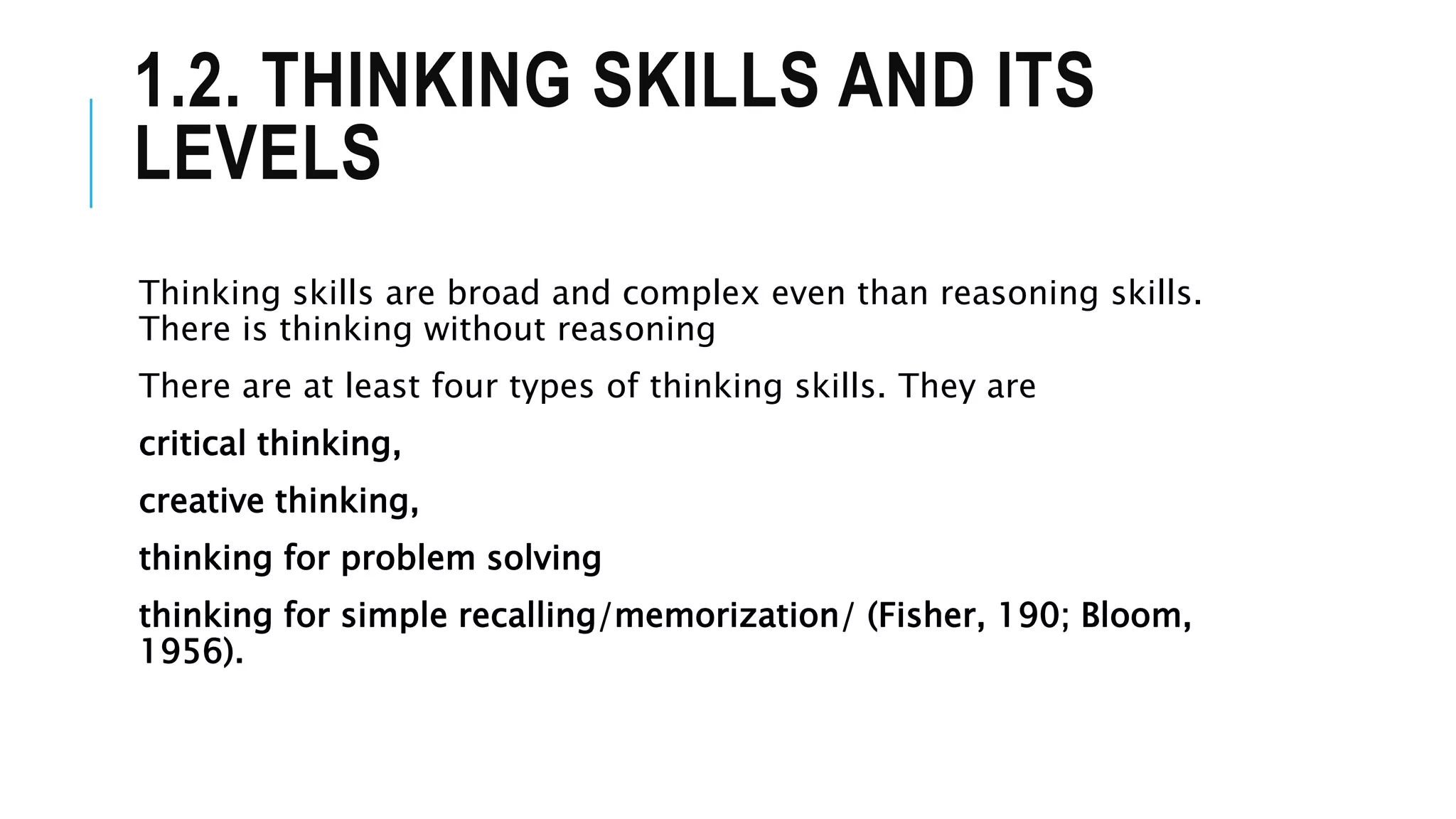
1.2. THINKING SKILLS AND ITS
LEVELS
Thinking skills are broad and complex even than reasoning skills.
There is thinking without reasoning
There are at least four types of thinking skills. They are
critical thinking,
creative thinking,
thinking for problem solving
thinking for simple recalling/memorization/ (Fisher, 190; Bloom,
1956).
1. CRITICAL THINKING SKILLS
Based on reflective thinking
focuses on interpreting, analyzing, and
evaluating information, with a set of reflective
attitudes, skills, and abilities to guide thoughts,
beliefs and actions.
2.CREATIVE THINKING
Uses unusual ideas and innovative thoughts,
puts things together in new and imaginative ways.
It is like thinking outside of the box
uses the idea of substituting, combining, modifying,
synthesizing, eliminating and rearranging
3. PROBLEM SOLVING
Involves solving, illustrating, collecting, interpreting etc to search
solutions of problems.
Prefers deductive reasoning skills
4. THINKING FOR
MEMORIZATION/SIMPLE
RECALLING
The lowest level of thinking skills
Very useful ground for the next three
skills
pays attention for listing, naming,
recalling, etc of factual related data.
REFLECTIVE THINKING
is often used synonymously to Critical
thinking .
But part of the critical thinking
Focus on making judgments about what
has happened.
REFLECTIVE THINKING, CONT’D
Starts on hesitation and mental
difficulty
An act of searching, hunting,
inquiring, to resolve the doubt
Reflection and Reflective
Practices
To conclude reflection in general it is:
•A conscious response
•It is not something to be developed
but a process to be recognized.
•Active and aware process that can
occur anytime and anywhere.
Help us to re-capture, re-live, make
sense of, think about, contextualize,
and evaluate practices systematically
to make decisions and choices from
experiences
CHARACTERISTICS OF REFLECTIVE
PRACTICES
1. Active concern with aims, consequences, means and technical
efficiency.
2. Cyclical or spiraling process
3. It requires competence in methods of evidence based practices
4. Open-mindedness, responsibility and wholeheartedness
5. Practitioners judgments and research.
6. collaboration and dialogue with colleagues.
7. mediating external frameworks with your practice
N.B. reflective actions in teaching can be conceptualized as spiral in
which we begin with reflection-for-action, move to reflection-in-
practice and then to reflection-on-practice
Teaching is an action, interpersonal and intentional aims about
students’ learning.
Teaching is an action that moves students from the known to the
unknown issues and vise versa just for better understanding .
The complicated nature of educational issues and the practical
demands of classroom teaching ensure that teachers’ work is never
finished.
When
 performance standards,
 practicalities,
 personal ideals and
 wider educational concerns
are some of the requirements and possible conflicts may seem to be
arising.
Teaching is a very complex and demanding that requires teachers to
be:
managers of people,
analyzers of data, and
researchers of best practices and instructional methodologies and
these skills are utilized each day.
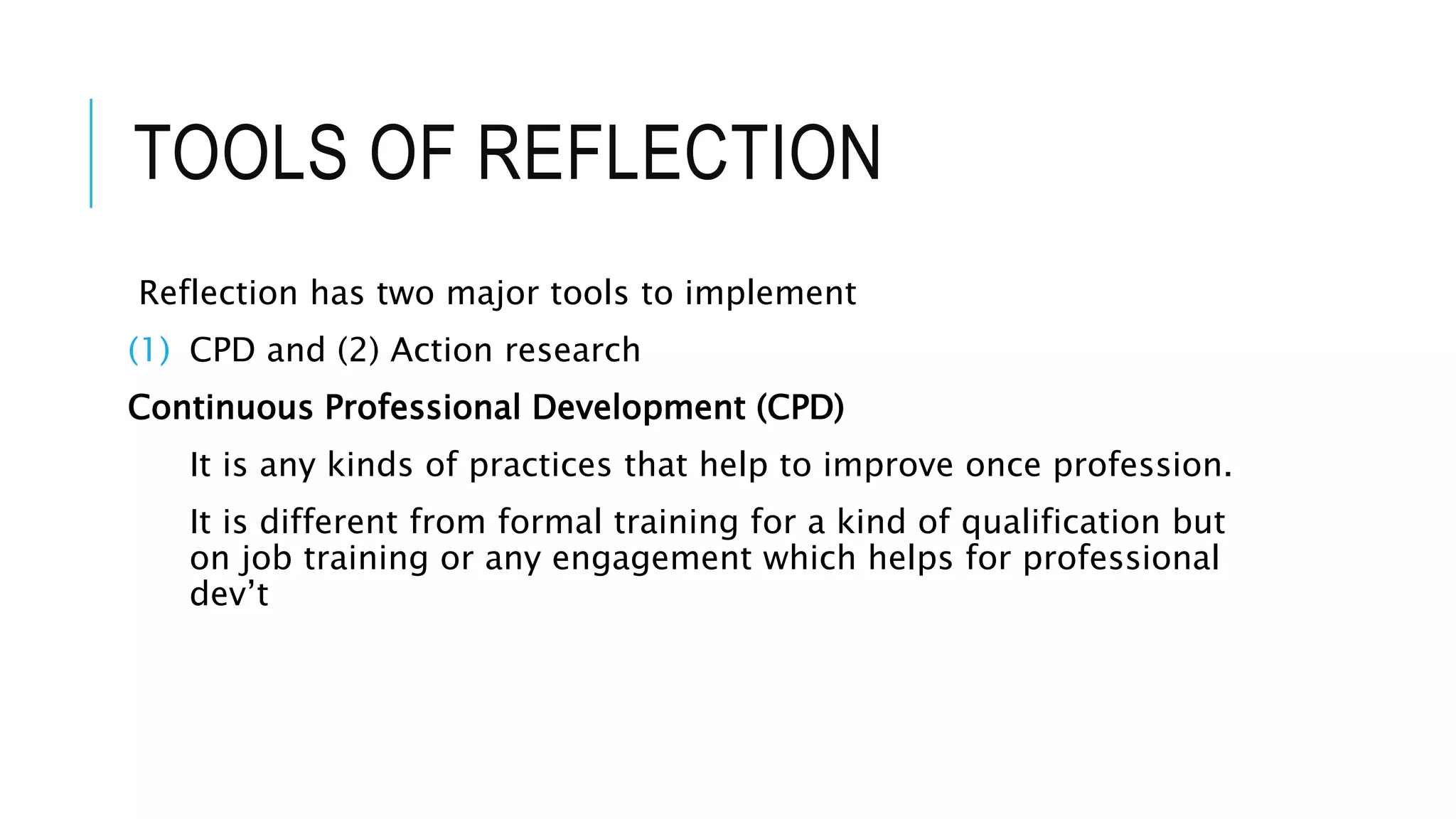
TOOLS OF REFLECTION
Reflection has two major tools to implement
(1) CPD and (2) Action research
Continuous Professional Development (CPD)
It is any kinds of practices that help to improve once profession.
It is different from formal training for a kind of qualification but
on job training or any engagement which helps for professional
dev’t
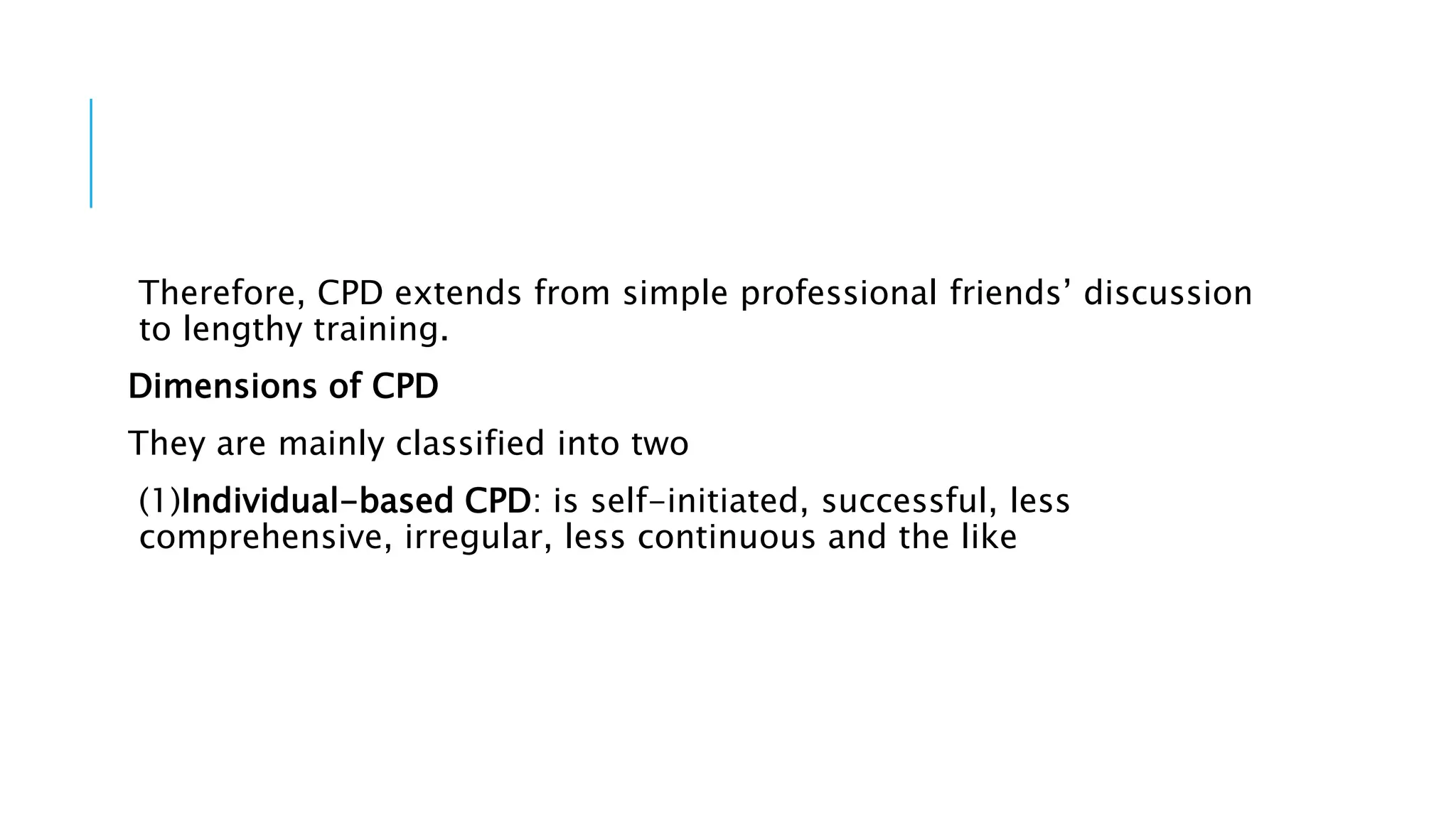
Therefore, CPD extends from simple professional friends’ discussion
to lengthy training.
Dimensions of CPD
They are mainly classified into two
(1)Individual-based CPD: is self-initiated, successful, less
comprehensive, irregular, less continuous and the like
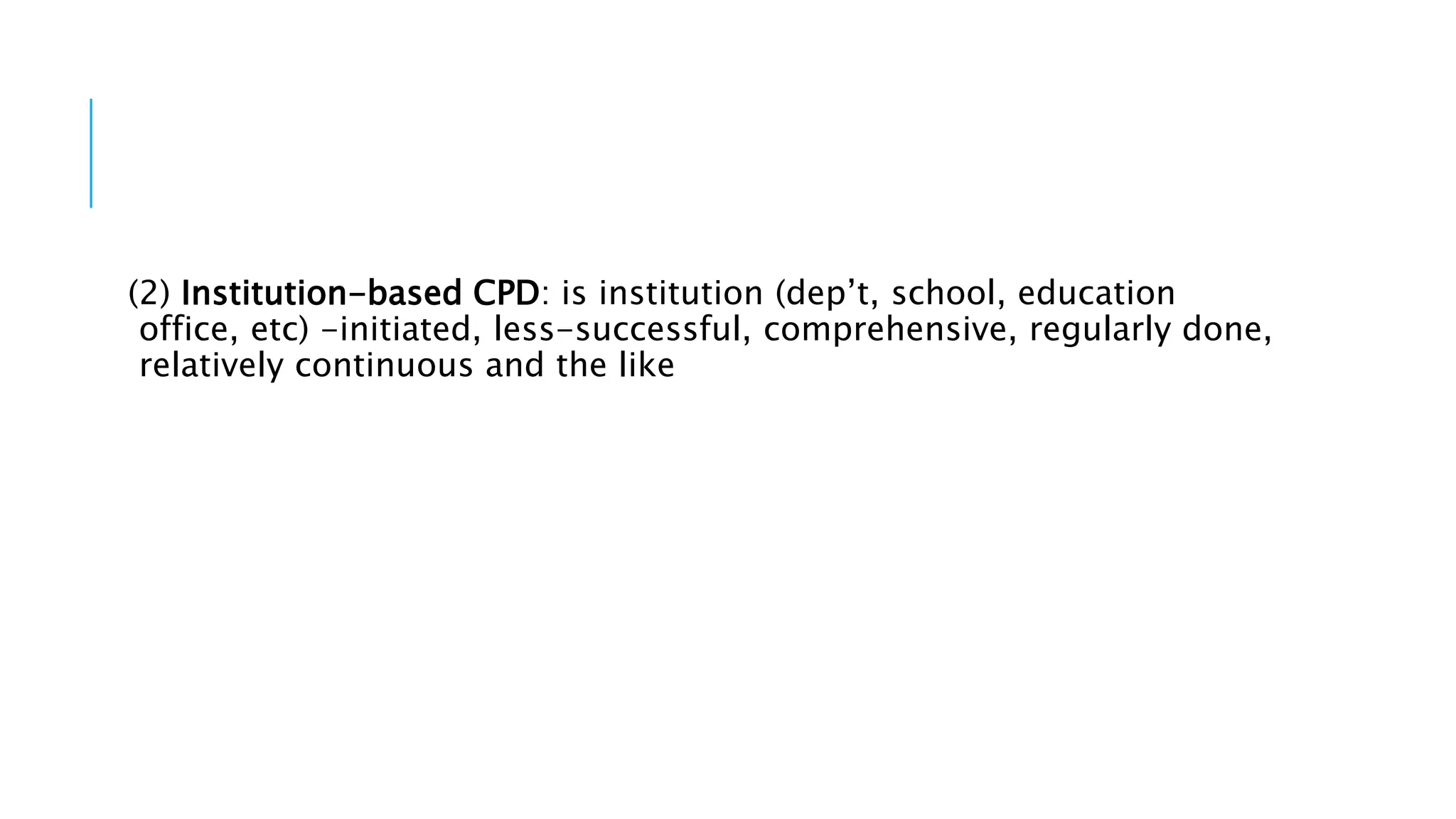
(2) Institution-based CPD: is institution (dep’t, school, education
office, etc) -initiated, less-successful, comprehensive, regularly done,
relatively continuous and the like

ADDITIONAL READING.pptx

  • 1.
    ADDITIONAL READING Teachers asReflective Practitioners The Basics of thinking “Thinking about Thinking”
  • 2.
    1.2. THINKING SKILLSAND ITS LEVELS Thinking skills are broad and complex even than reasoning skills. There is thinking without reasoning There are at least four types of thinking skills. They are critical thinking, creative thinking, thinking for problem solving thinking for simple recalling/memorization/ (Fisher, 190; Bloom, 1956).
  • 3.
    1. CRITICAL THINKINGSKILLS Based on reflective thinking focuses on interpreting, analyzing, and evaluating information, with a set of reflective attitudes, skills, and abilities to guide thoughts, beliefs and actions.
  • 4.
    2.CREATIVE THINKING Uses unusualideas and innovative thoughts, puts things together in new and imaginative ways. It is like thinking outside of the box uses the idea of substituting, combining, modifying, synthesizing, eliminating and rearranging
  • 5.
    3. PROBLEM SOLVING Involvessolving, illustrating, collecting, interpreting etc to search solutions of problems. Prefers deductive reasoning skills
  • 6.
    4. THINKING FOR MEMORIZATION/SIMPLE RECALLING Thelowest level of thinking skills Very useful ground for the next three skills pays attention for listing, naming, recalling, etc of factual related data.
  • 7.
    REFLECTIVE THINKING is oftenused synonymously to Critical thinking . But part of the critical thinking Focus on making judgments about what has happened.
  • 8.
    REFLECTIVE THINKING, CONT’D Startson hesitation and mental difficulty An act of searching, hunting, inquiring, to resolve the doubt
  • 9.
  • 10.
    To conclude reflectionin general it is: •A conscious response •It is not something to be developed but a process to be recognized. •Active and aware process that can occur anytime and anywhere.
  • 11.
    Help us tore-capture, re-live, make sense of, think about, contextualize, and evaluate practices systematically to make decisions and choices from experiences
  • 12.
    CHARACTERISTICS OF REFLECTIVE PRACTICES 1.Active concern with aims, consequences, means and technical efficiency. 2. Cyclical or spiraling process 3. It requires competence in methods of evidence based practices 4. Open-mindedness, responsibility and wholeheartedness 5. Practitioners judgments and research. 6. collaboration and dialogue with colleagues. 7. mediating external frameworks with your practice
  • 13.
    N.B. reflective actionsin teaching can be conceptualized as spiral in which we begin with reflection-for-action, move to reflection-in- practice and then to reflection-on-practice
  • 14.
    Teaching is anaction, interpersonal and intentional aims about students’ learning. Teaching is an action that moves students from the known to the unknown issues and vise versa just for better understanding .
  • 15.
    The complicated natureof educational issues and the practical demands of classroom teaching ensure that teachers’ work is never finished. When  performance standards,  practicalities,  personal ideals and  wider educational concerns are some of the requirements and possible conflicts may seem to be arising.
  • 16.
    Teaching is avery complex and demanding that requires teachers to be: managers of people, analyzers of data, and researchers of best practices and instructional methodologies and these skills are utilized each day.
  • 17.
    TOOLS OF REFLECTION Reflectionhas two major tools to implement (1) CPD and (2) Action research Continuous Professional Development (CPD) It is any kinds of practices that help to improve once profession. It is different from formal training for a kind of qualification but on job training or any engagement which helps for professional dev’t
  • 18.
    Therefore, CPD extendsfrom simple professional friends’ discussion to lengthy training. Dimensions of CPD They are mainly classified into two (1)Individual-based CPD: is self-initiated, successful, less comprehensive, irregular, less continuous and the like
  • 19.
    (2) Institution-based CPD:is institution (dep’t, school, education office, etc) -initiated, less-successful, comprehensive, regularly done, relatively continuous and the like