The EMERGE project benefits from a grant under the Active Citizens Fund Cyprus program, funded by Iceland, Liechtenstein and Norway,
through the EEA and Norway Grants 2014-2021.
Module 4
Understanding Active Citizenship & Civic Engagement
Unit 2: Active Citizenship and Civic Engagement
Civic engagement is
necessary in a
democratic society
for the effective
functioning of one’s
community and
state, as it fosters
the democratic
institutions.
It is crucial for to
encourage every
citizen, as well as
non-government
organisations, to
actively participate
in civil society, and
be part of the
political and
decision-making
processes. People
and NGOs must
continue to ensure
the rights for all to
participate.
Active citizenship is
a term that has been
used in recent years
and has several
meanings.
What does the term
‘active citizenship’
mean to you? There
are no wrong
answers and what
you say and discuss
will reflect where
you are coming from
in relation to this
subject.
Let’s look at the two
word separately:
‘Active’ and
‘Citizenship’ What
do they mean to
you?
Introduction
G
e
t
y
o
u
r
d
e
v
i
c
e
s
(
l
a
p
t
o
p
o
r
m
o
b
i
l
e
)
a
n
d
a
c
c
e
s
s
t
h
e
i
n
t
e
r
n
e
t
Visit Padlet platform (a link will
be provided by the instructor)
Write on the wall what do you
think Active Citizenship and
Civic engagement are (words/
phrases etc.) Besides voting,
what are the ways that citizens
can actively participate and
engage?
G
r
o
u
p
D
i
s
c
u
s
s
i
o
n
/
R
e
fl
e
c
ti
o
n
Defining Active Citizenship and Civic Engagement
‘Civic engagement means working to make a difference in the civic life of our communities and developing the
combination of knowledge, skills, values and motivation to make that difference. It means promoting the quality of life in
a community, through both political and non-political processes’
Source: Ehrlich, T. (Ed.). (2000). Civic responsibility and higher education. Greenwood Publishing Group.
‘Civic engagement refers to the ways in which citizens participate in the life of a community in order to improve conditions
for others or to help shape the community’s future’
Source: Adler, R. P., & Goggin, J. (2005). What do we mean by “civic engagement”?. Journal of transformative education, 3(3), 236-253.
UNICEF defines civic engagement as: “individual or collective actions in which people participate to improve the well-
being of communities or society in general”.
Source: Cho, A., Byrne, J. Pelter, Z. (2020) Digital civic engagement by young people. UNICEF Offices of Global insight and Policy. Accessed
on January 5, 2021
Definitions - Civic Engagement
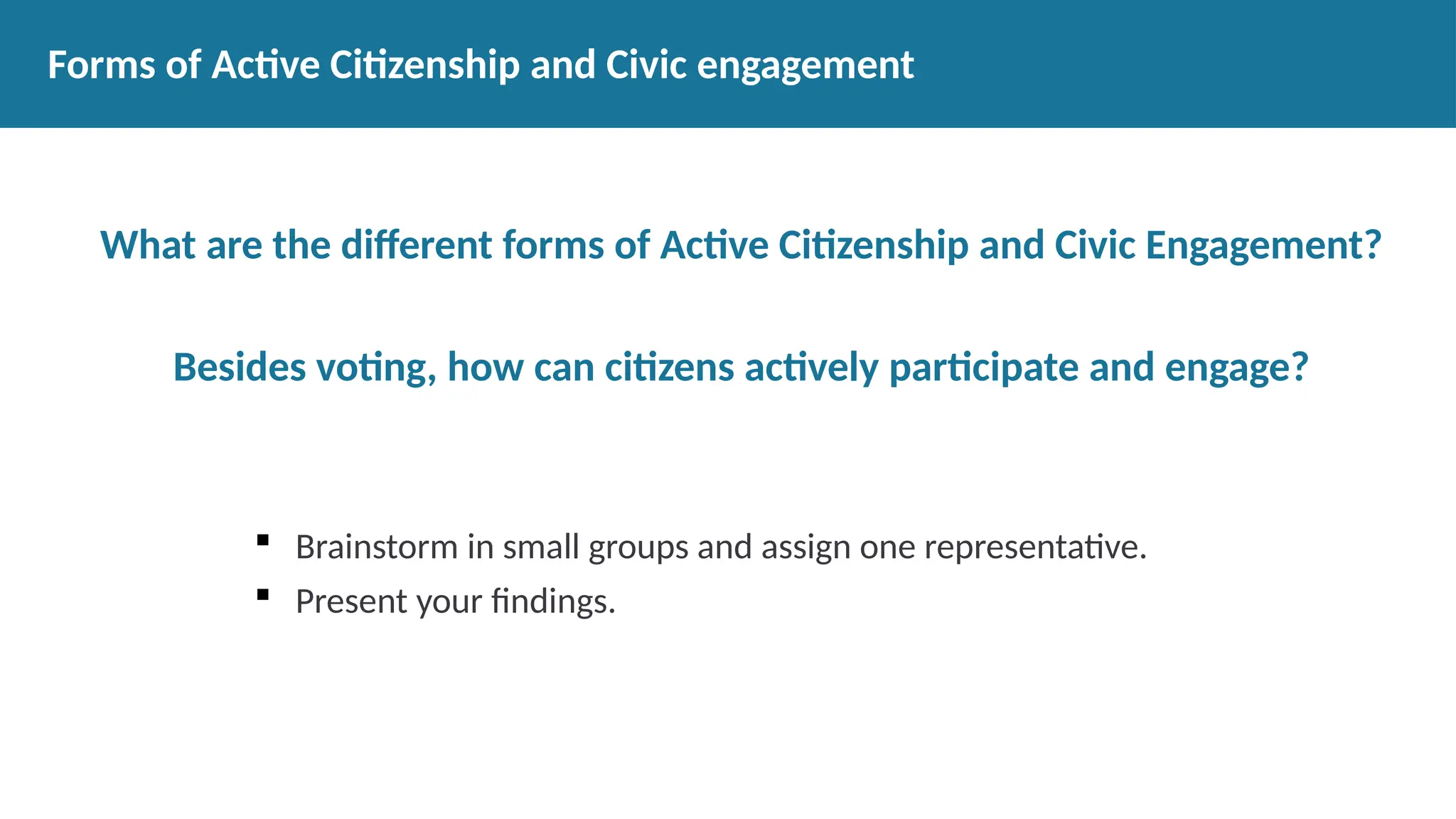
One simple idea of active citizenship then is that of participation in
public affairs: “If we are to have a healthy democracy we need to
support each other in identifying the issues that concern us, and
develop the confidence and skills to make a difference to the world
around us.” (Woodward 2004)
Hoskins and Mascherini (2009) defined active citizenship as; Participation
in civil society, community and/or political life, characterised by mutual
respect and non-violence and in accordance with human rights and
democracy. (Hoskins, 2009)
Definitions - Active Citizenship
Active citizens’ are those who look beyond the basic legal duties and are further engaged
voluntarily in activities that somehow affect the public life of their locality or communities.
What are the different forms of Active Citizenship and Civic Engagement?
Besides voting, how can citizens actively participate and engage?
 Brainstorm in small groups and assign one representative.
 Present your findings.
Forms of Active Citizenship and Civic engagement
 Civic engagement entails the active involvement of individuals, either
independently, in groups, or through non-governmental organizations (NGOs),
in addressing local, national, and global issues. It encompasses a wide range of
actions taken by people to advance their beliefs and interests, express their
views, and participate in social and political matters.
 It is crucial to recognize that civic engagement extends beyond traditional
political processes such as voting. There are numerous avenues through which
individuals can actively contribute to society and make a difference. This
includes volunteering, community organizing, advocating for social causes,
participating in public discussions and debates, engaging in peaceful protests,
and supporting nonprofit organizations.
 By actively engaging in civic life, individuals have the opportunity to shape
their communities, express their values, and contribute to the betterment of
society. Civic engagement is a vital aspect of democratic participation and
helps foster an informed and active citizenry.
Forms of Active Citizenship and Civic engagement
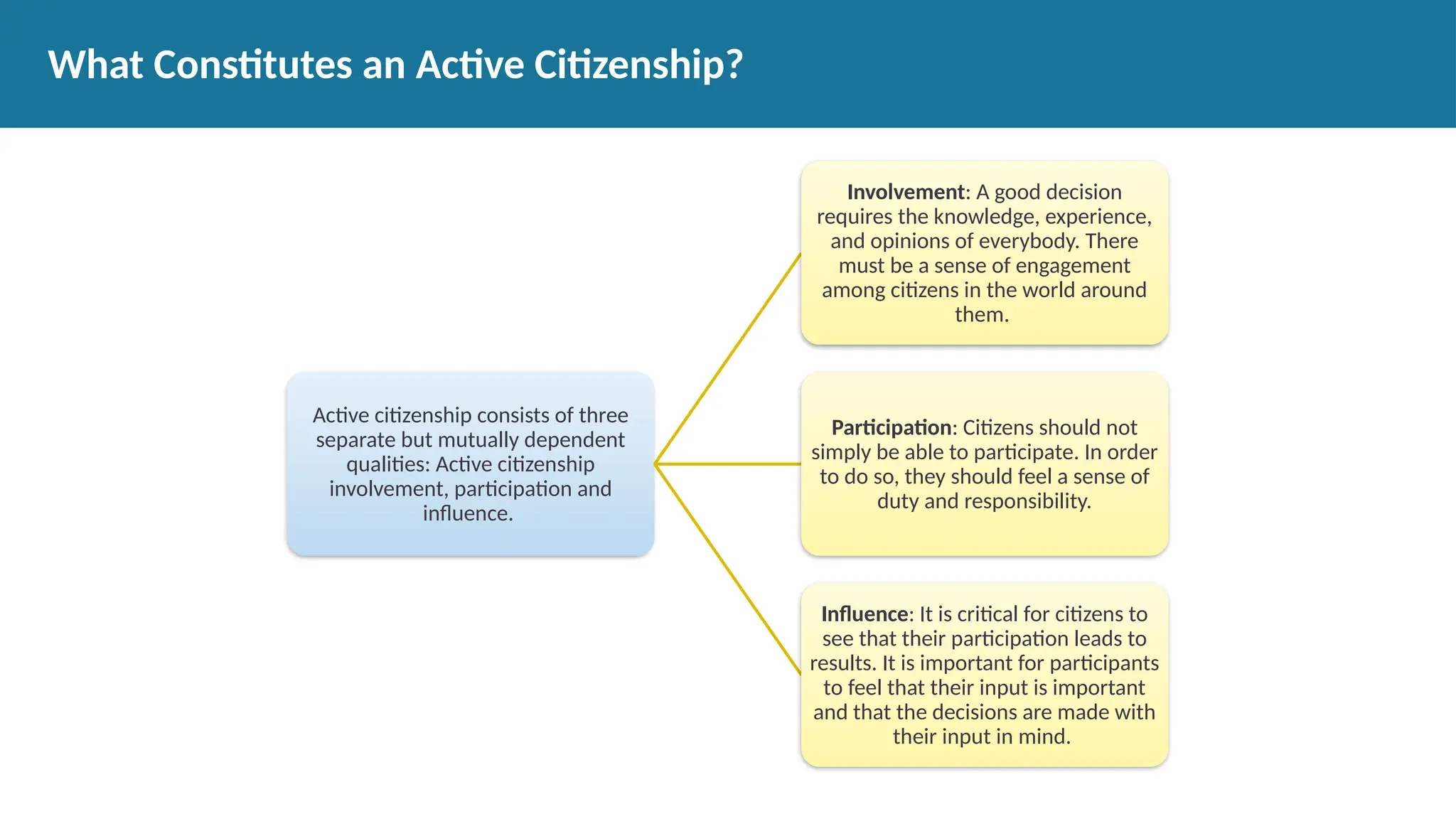
Active citizenship consists of three
separate but mutually dependent
qualities: Active citizenship
involvement, participation and
influence.
Involvement: A good decision
requires the knowledge, experience,
and opinions of everybody. There
must be a sense of engagement
among citizens in the world around
them.
Participation: Citizens should not
simply be able to participate. In order
to do so, they should feel a sense of
duty and responsibility.
Influence: It is critical for citizens to
see that their participation leads to
results. It is important for participants
to feel that their input is important
and that the decisions are made with
their input in mind.
What Constitutes an Active Citizenship?
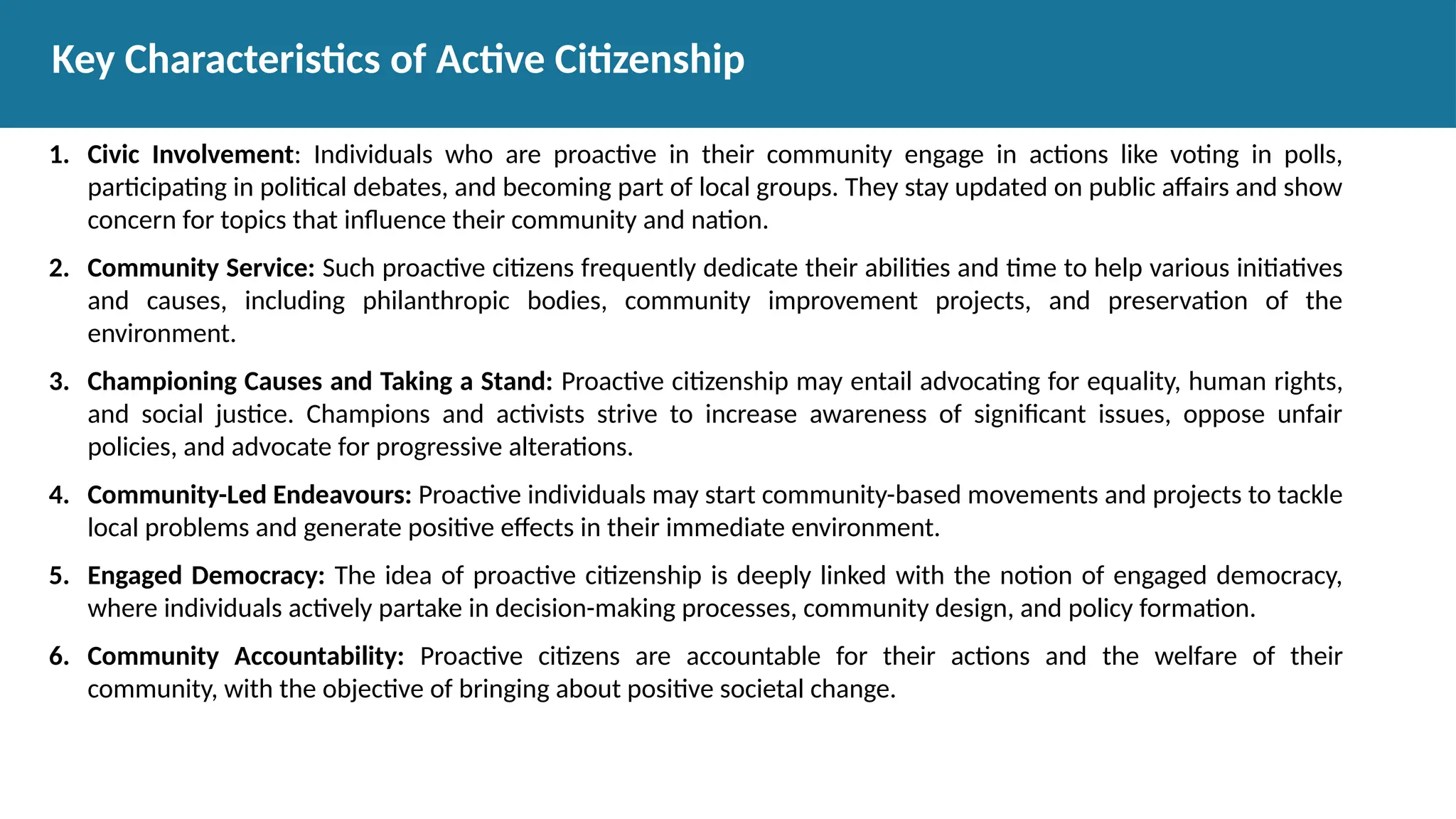
1. Civic Involvement: Individuals who are proactive in their community engage in actions like voting in polls,
participating in political debates, and becoming part of local groups. They stay updated on public affairs and show
concern for topics that influence their community and nation.
2. Community Service: Such proactive citizens frequently dedicate their abilities and time to help various initiatives
and causes, including philanthropic bodies, community improvement projects, and preservation of the
environment.
3. Championing Causes and Taking a Stand: Proactive citizenship may entail advocating for equality, human rights,
and social justice. Champions and activists strive to increase awareness of significant issues, oppose unfair
policies, and advocate for progressive alterations.
4. Community-Led Endeavours: Proactive individuals may start community-based movements and projects to tackle
local problems and generate positive effects in their immediate environment.
5. Engaged Democracy: The idea of proactive citizenship is deeply linked with the notion of engaged democracy,
where individuals actively partake in decision-making processes, community design, and policy formation.
6. Community Accountability: Proactive citizens are accountable for their actions and the welfare of their
community, with the objective of bringing about positive societal change.
Key Characteristics of Active Citizenship
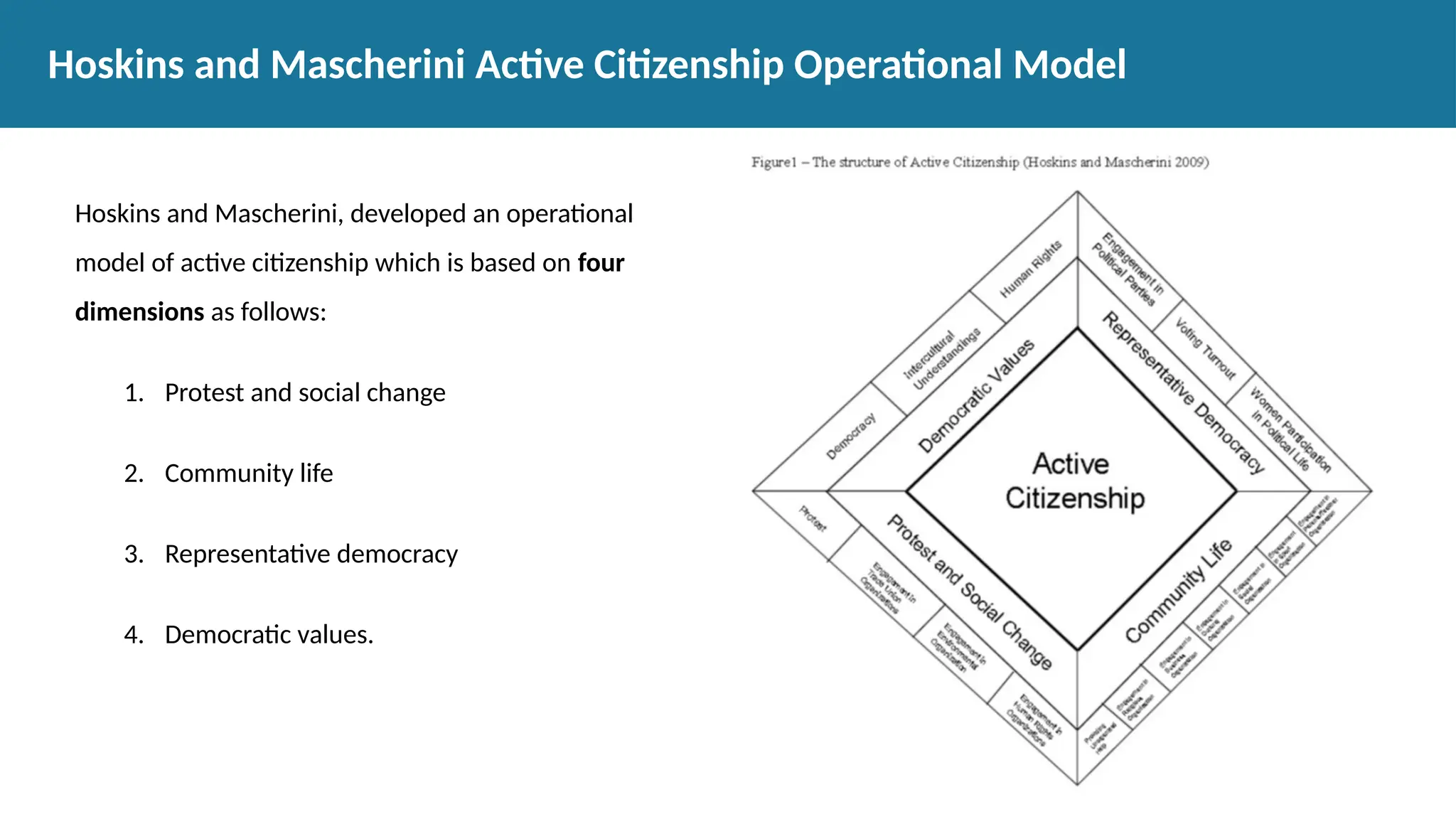
Hoskins and Mascherini, developed an operational
model of active citizenship which is based on four
dimensions as follows:
1. Protest and social change
2. Community life
3. Representative democracy
4. Democratic values.
Hoskins and Mascherini Active Citizenship Operational Model
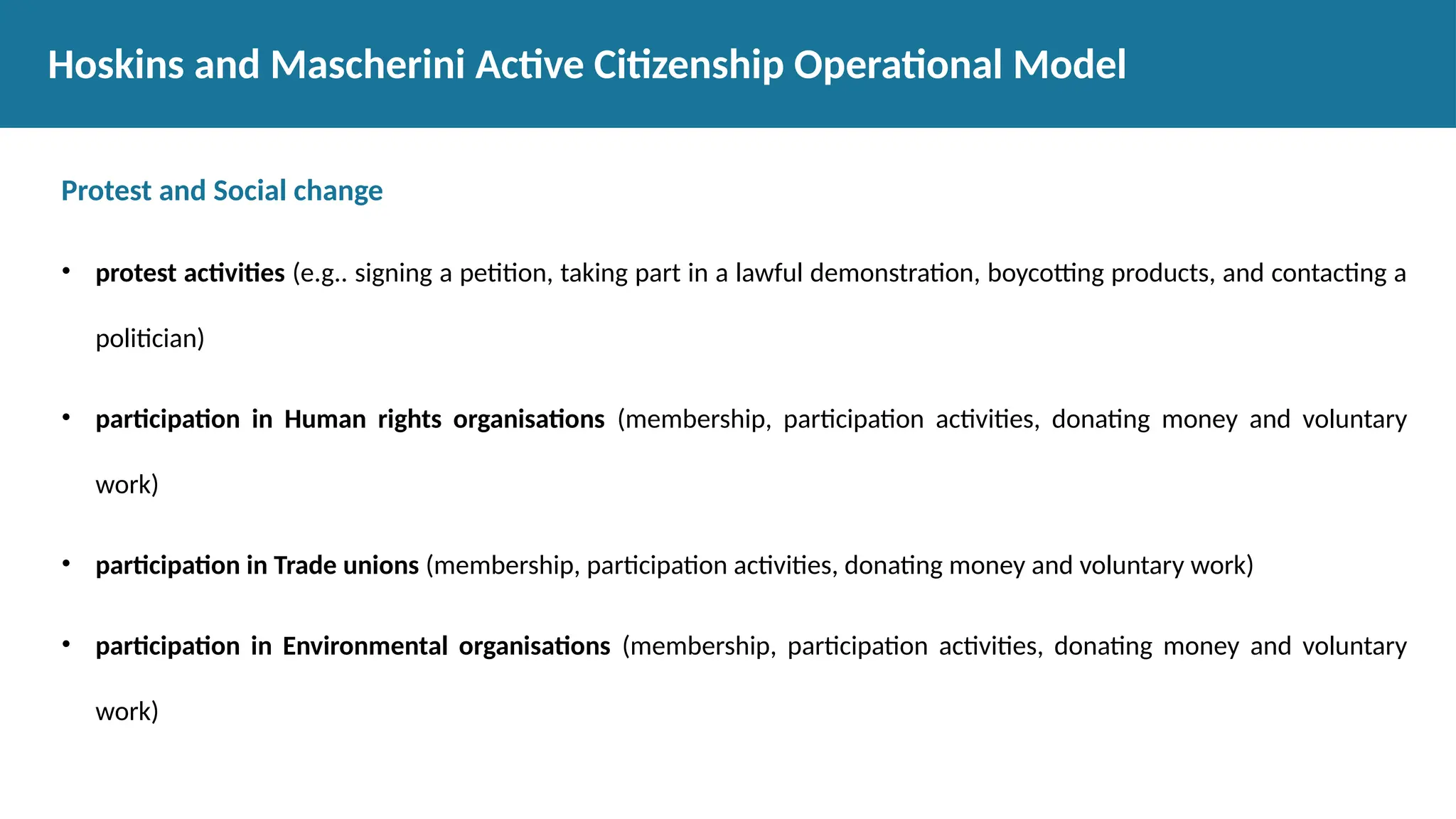
Protest and Social change
• protest activities (e.g.. signing a petition, taking part in a lawful demonstration, boycotting products, and contacting a
politician)
• participation in Human rights organisations (membership, participation activities, donating money and voluntary
work)
• participation in Trade unions (membership, participation activities, donating money and voluntary work)
• participation in Environmental organisations (membership, participation activities, donating money and voluntary
work)
Hoskins and Mascherini Active Citizenship Operational Model
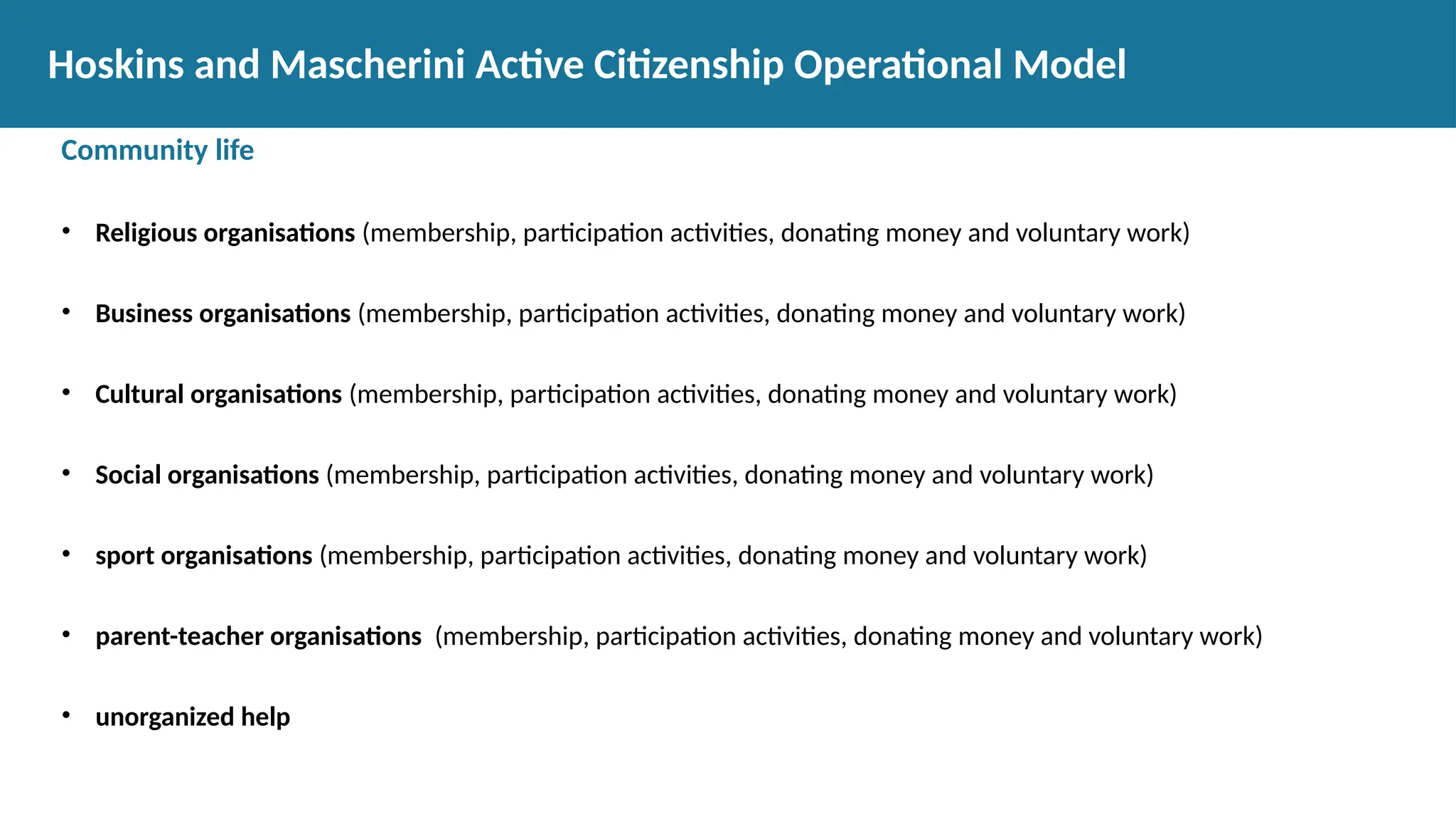
Community life
• Religious organisations (membership, participation activities, donating money and voluntary work)
• Business organisations (membership, participation activities, donating money and voluntary work)
• Cultural organisations (membership, participation activities, donating money and voluntary work)
• Social organisations (membership, participation activities, donating money and voluntary work)
• sport organisations (membership, participation activities, donating money and voluntary work)
• parent-teacher organisations (membership, participation activities, donating money and voluntary work)
• unorganized help
Hoskins and Mascherini Active Citizenship Operational Model
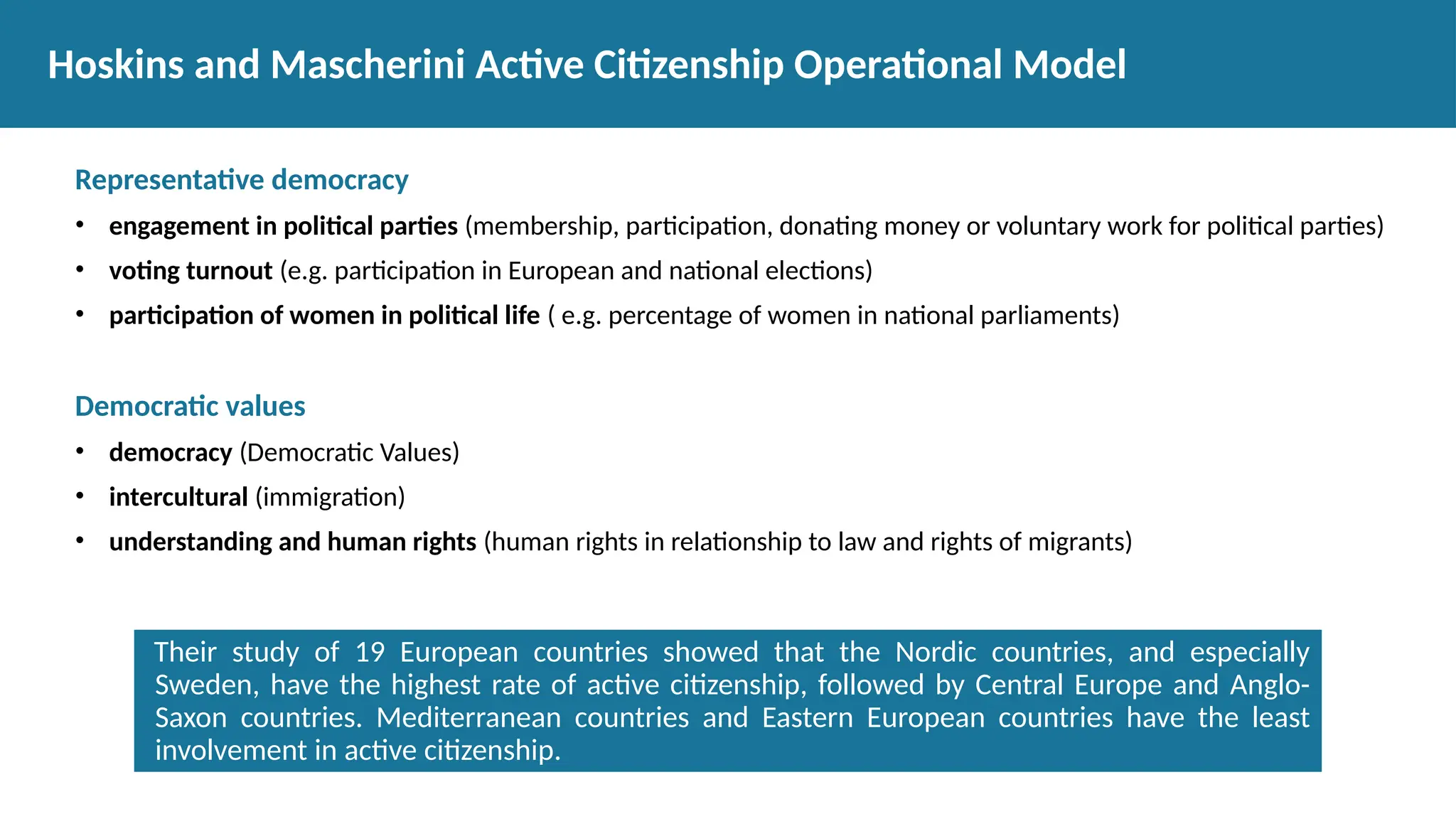
Representative democracy
• engagement in political parties (membership, participation, donating money or voluntary work for political parties)
• voting turnout (e.g. participation in European and national elections)
• participation of women in political life ( e.g. percentage of women in national parliaments)
Democratic values
• democracy (Democratic Values)
• intercultural (immigration)
• understanding and human rights (human rights in relationship to law and rights of migrants)
Hoskins and Mascherini Active Citizenship Operational Model
Their study of 19 European countries showed that the Nordic countries, and especially
Sweden, have the highest rate of active citizenship, followed by Central Europe and Anglo-
Saxon countries. Mediterranean countries and Eastern European countries have the least
involvement in active citizenship.
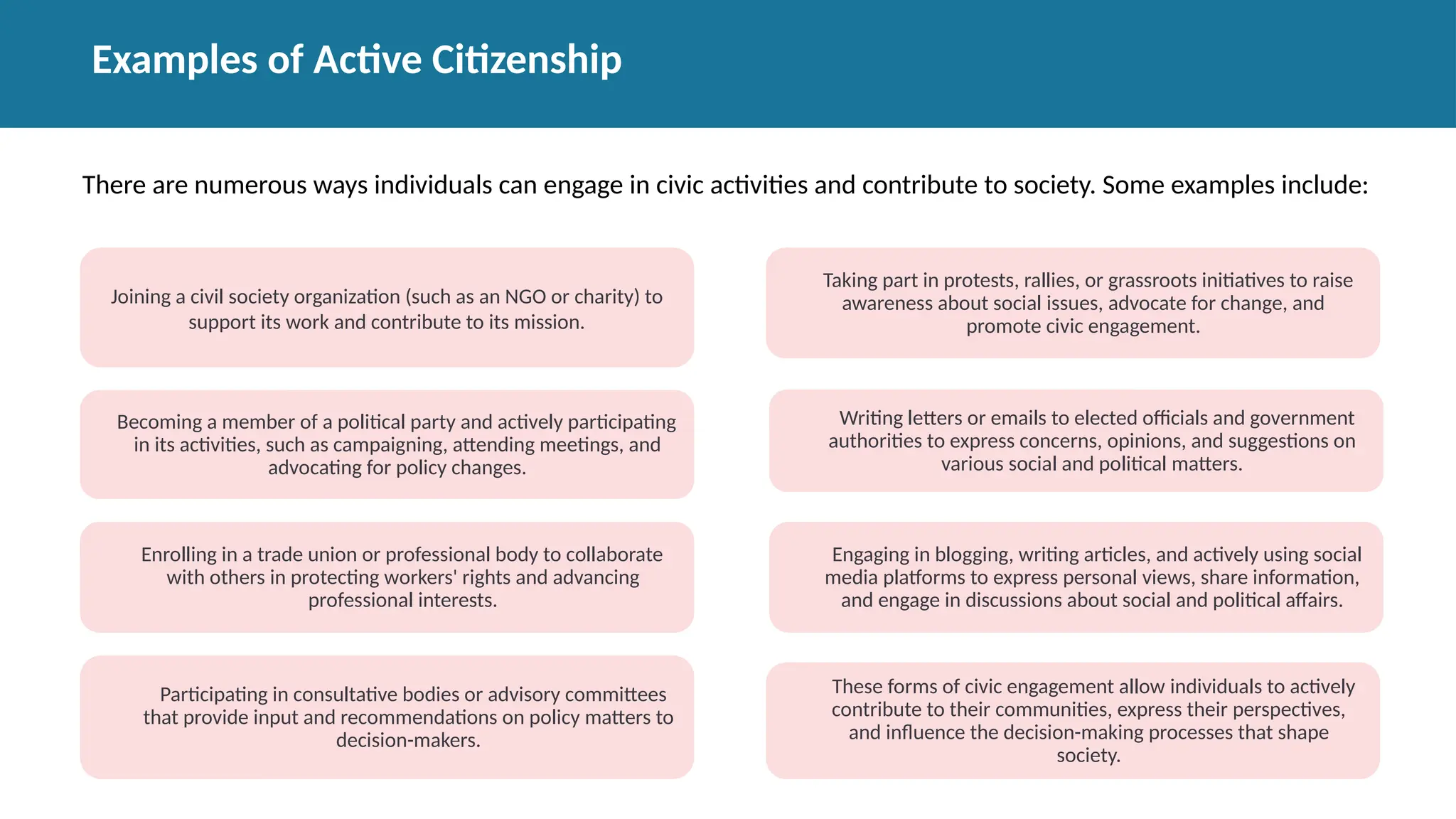
Examples of Active Citizenship
Joining a civil society organization (such as an NGO or charity) to
support its work and contribute to its mission.
Becoming a member of a political party and actively participating
in its activities, such as campaigning, attending meetings, and
advocating for policy changes.
Enrolling in a trade union or professional body to collaborate
with others in protecting workers' rights and advancing
professional interests.
Participating in consultative bodies or advisory committees
that provide input and recommendations on policy matters to
decision-makers.
Taking part in protests, rallies, or grassroots initiatives to raise
awareness about social issues, advocate for change, and
promote civic engagement.
Writing letters or emails to elected officials and government
authorities to express concerns, opinions, and suggestions on
various social and political matters.
Engaging in blogging, writing articles, and actively using social
media platforms to express personal views, share information,
and engage in discussions about social and political affairs.
These forms of civic engagement allow individuals to actively
contribute to their communities, express their perspectives,
and influence the decision-making processes that shape
society.
There are numerous ways individuals can engage in civic activities and contribute to society. Some examples include:
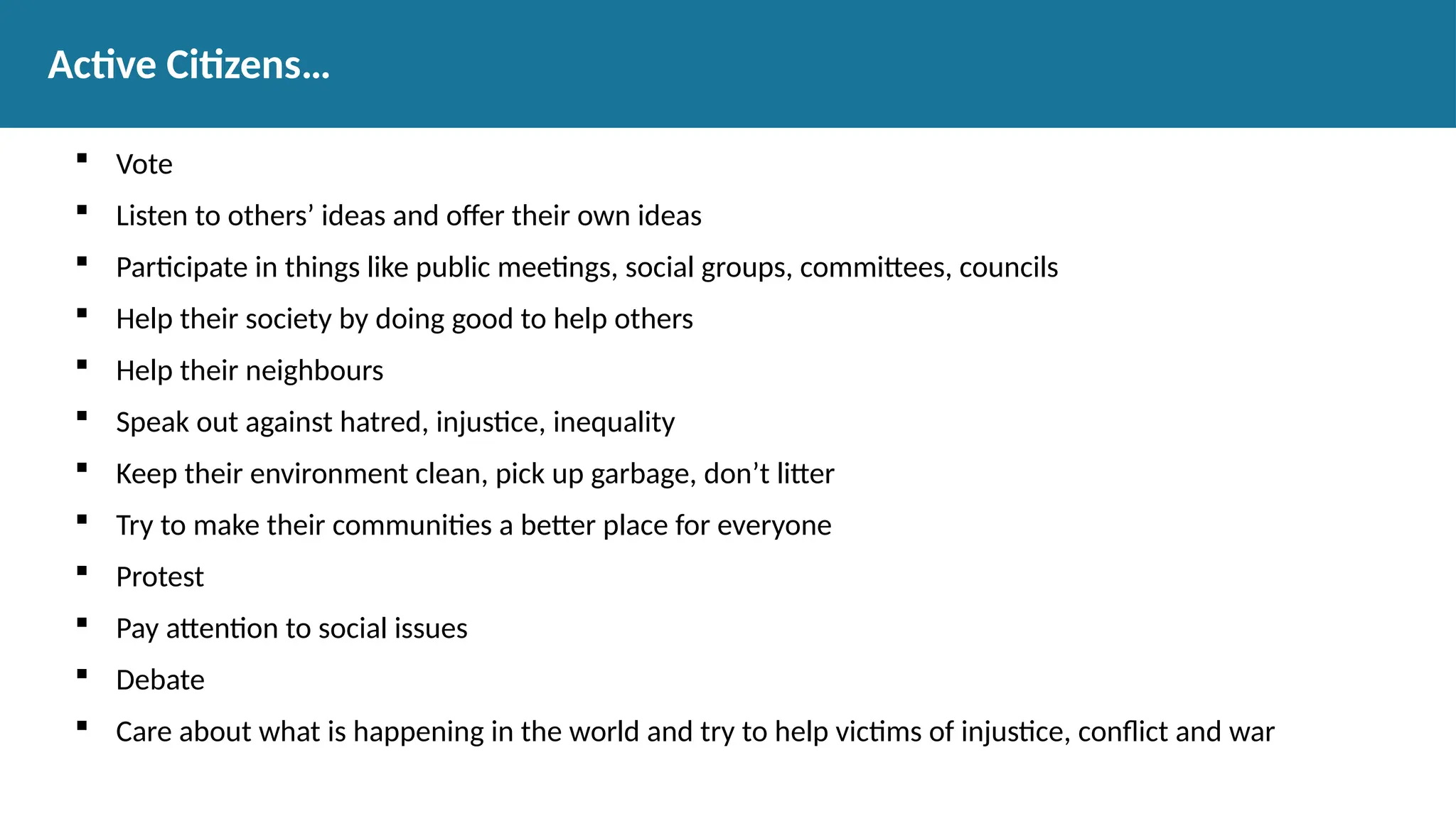
 Vote
 Listen to others’ ideas and offer their own ideas
 Participate in things like public meetings, social groups, committees, councils
 Help their society by doing good to help others
 Help their neighbours
 Speak out against hatred, injustice, inequality
 Keep their environment clean, pick up garbage, don’t litter
 Try to make their communities a better place for everyone
 Protest
 Pay attention to social issues
 Debate
 Care about what is happening in the world and try to help victims of injustice, conflict and war
Active Citizens…
Benefits of Active Citizenship
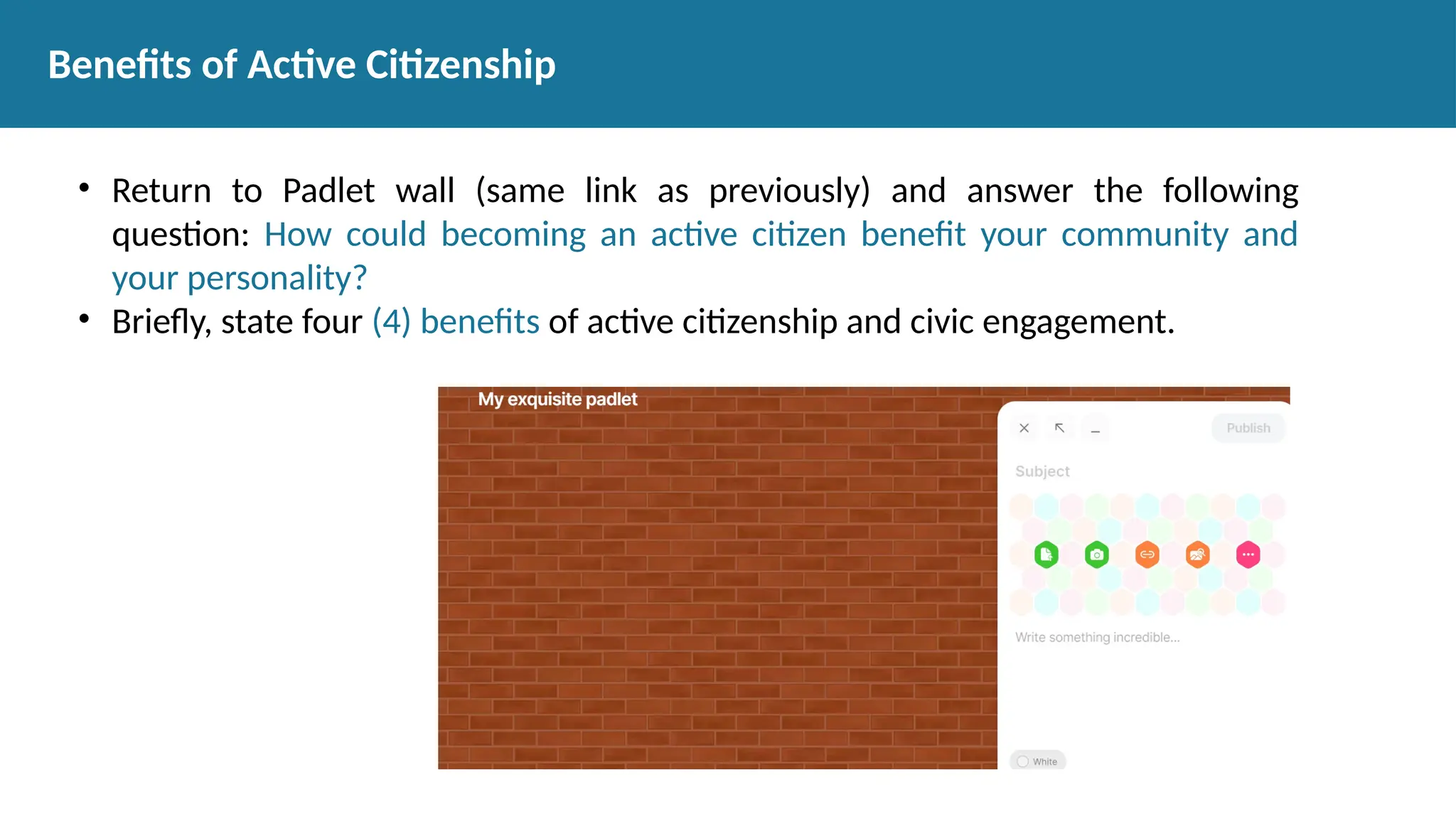
• Return to Padlet wall (same link as previously) and answer the following
question: How could becoming an active citizen benefit your community and
your personality?
• Briefly, state four (4) benefits of active citizenship and civic engagement.
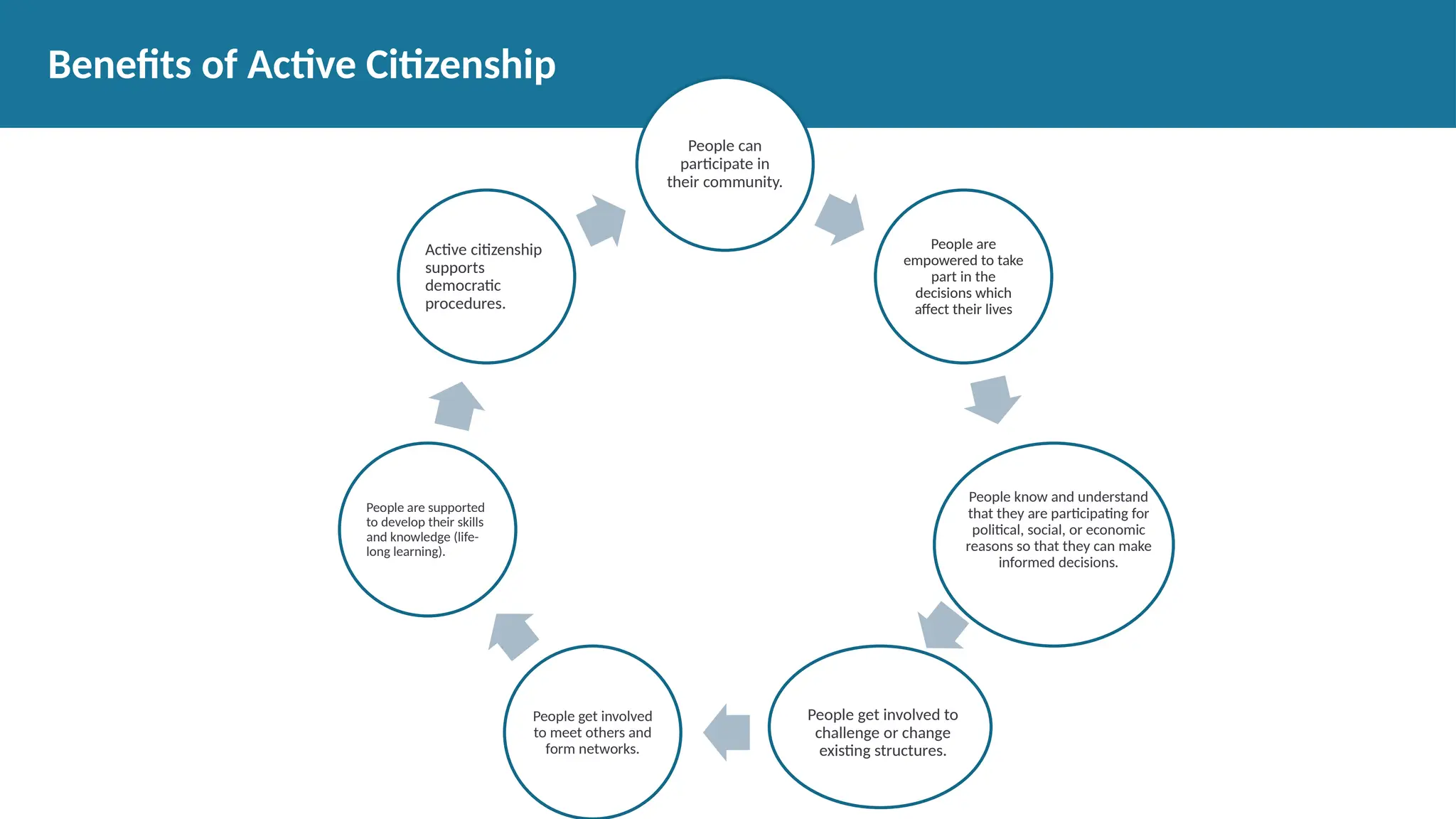
People can
participate in
their community.
People are
empowered to take
part in the
decisions which
affect their lives
People know and understand
that they are participating for
political, social, or economic
reasons so that they can make
informed decisions.
People get involved to
challenge or change
existing structures.
People get involved
to meet others and
form networks.
People are supported
to develop their skills
and knowledge (life-
long learning).
Active citizenship
supports
democratic
procedures.
Benefits of Active Citizenship
Activity: Constraints and Motivations for Active citizenship and engagement
 Students will work in groups
 Each group will find a case of a situation when people don’t participate actively in their community or society.
 Discuss why people do not get involved in that particular case.
 Possible strategies that can be used to engage people to get involved in that situation.
 Brainstorm and make a list of reasons that prevent people from being socially engaged (worksheet)
 Brainstorm and make a list of how to engage people in social and civic issues (worksheet)
Worksheet: Group Activity
Participation in the Community and Connecting People: Active citizenship encourages participation in local community
activities. This could be anything from local clean-up drives to organizing community events. This fosters a sense of
community spirit and helps individuals build connections with each other, enhancing social cohesion.
Empowering People to Influence the Decisions Which Affect Their Lives: Active citizens have the opportunity to influence
the policies and decisions that impact their daily lives. This could be through voting, participating in public consultations,
or engaging with local representatives. This not only leads to policies that better reflect the needs and interests of the
community, but also gives individuals a sense of agency.
Knowledge and Understanding of the Political, Social, and Economic Context of Their Participation: Active citizenship
often involves gaining a deeper understanding of the political, social, and economic context of one's actions. This
knowledge helps individuals make more informed decisions about their actions and how they can contribute to their
community.
Motivations to be an Active Citizen
Ability to Challenge Existing Structures While Supporting Democratic Procedures: Active citizens are well-positioned to
question and challenge existing power structures in a democratic way. They can use their voice and their vote to push for
changes that they believe are necessary, helping to keep authorities accountable and ensuring that democratic processes
are upheld.
Supporting People to Develop Their Skills and Knowledge to Build Fairer and More Resilient Societies: Active citizenship
can contribute to personal development by encouraging individuals to learn new skills, such as leadership,
communication, or problem-solving skills. These abilities are not only valuable for personal growth but also contribute to
the development of a more resilient society, as individuals are better equipped to face challenges and contribute
positively to their communities.
Motivations to be an Active Citizen
The EMERGE project benefits from a grant under the Active Citizens Fund Cyprus program, funded by Iceland, Liechtenstein and Norway,
through the EEA and Norway Grants 2014-2021.

Active Citizenship WP2_Module-4_PPT_Unit-2.pptx

  • 1.
    The EMERGE projectbenefits from a grant under the Active Citizens Fund Cyprus program, funded by Iceland, Liechtenstein and Norway, through the EEA and Norway Grants 2014-2021. Module 4 Understanding Active Citizenship & Civic Engagement Unit 2: Active Citizenship and Civic Engagement
  • 2.
    Civic engagement is necessaryin a democratic society for the effective functioning of one’s community and state, as it fosters the democratic institutions. It is crucial for to encourage every citizen, as well as non-government organisations, to actively participate in civil society, and be part of the political and decision-making processes. People and NGOs must continue to ensure the rights for all to participate. Active citizenship is a term that has been used in recent years and has several meanings. What does the term ‘active citizenship’ mean to you? There are no wrong answers and what you say and discuss will reflect where you are coming from in relation to this subject. Let’s look at the two word separately: ‘Active’ and ‘Citizenship’ What do they mean to you? Introduction
  • 3.
    G e t y o u r d e v i c e s ( l a p t o p o r m o b i l e ) a n d a c c e s s t h e i n t e r n e t Visit Padlet platform(a link will be provided by the instructor) Write on the wall what do you think Active Citizenship and Civic engagement are (words/ phrases etc.) Besides voting, what are the ways that citizens can actively participate and engage? G r o u p D i s c u s s i o n / R e fl e c ti o n Defining Active Citizenship and Civic Engagement
  • 4.
    Defining Active Citizenshipand Civic Engagement
  • 5.
    ‘Civic engagement meansworking to make a difference in the civic life of our communities and developing the combination of knowledge, skills, values and motivation to make that difference. It means promoting the quality of life in a community, through both political and non-political processes’ Source: Ehrlich, T. (Ed.). (2000). Civic responsibility and higher education. Greenwood Publishing Group. ‘Civic engagement refers to the ways in which citizens participate in the life of a community in order to improve conditions for others or to help shape the community’s future’ Source: Adler, R. P., & Goggin, J. (2005). What do we mean by “civic engagement”?. Journal of transformative education, 3(3), 236-253. UNICEF defines civic engagement as: “individual or collective actions in which people participate to improve the well- being of communities or society in general”. Source: Cho, A., Byrne, J. Pelter, Z. (2020) Digital civic engagement by young people. UNICEF Offices of Global insight and Policy. Accessed on January 5, 2021 Definitions - Civic Engagement
  • 6.
    One simple ideaof active citizenship then is that of participation in public affairs: “If we are to have a healthy democracy we need to support each other in identifying the issues that concern us, and develop the confidence and skills to make a difference to the world around us.” (Woodward 2004) Hoskins and Mascherini (2009) defined active citizenship as; Participation in civil society, community and/or political life, characterised by mutual respect and non-violence and in accordance with human rights and democracy. (Hoskins, 2009) Definitions - Active Citizenship Active citizens’ are those who look beyond the basic legal duties and are further engaged voluntarily in activities that somehow affect the public life of their locality or communities.
  • 7.
    What are thedifferent forms of Active Citizenship and Civic Engagement? Besides voting, how can citizens actively participate and engage?  Brainstorm in small groups and assign one representative.  Present your findings. Forms of Active Citizenship and Civic engagement
  • 8.
     Civic engagemententails the active involvement of individuals, either independently, in groups, or through non-governmental organizations (NGOs), in addressing local, national, and global issues. It encompasses a wide range of actions taken by people to advance their beliefs and interests, express their views, and participate in social and political matters.  It is crucial to recognize that civic engagement extends beyond traditional political processes such as voting. There are numerous avenues through which individuals can actively contribute to society and make a difference. This includes volunteering, community organizing, advocating for social causes, participating in public discussions and debates, engaging in peaceful protests, and supporting nonprofit organizations.  By actively engaging in civic life, individuals have the opportunity to shape their communities, express their values, and contribute to the betterment of society. Civic engagement is a vital aspect of democratic participation and helps foster an informed and active citizenry. Forms of Active Citizenship and Civic engagement
  • 9.
    Active citizenship consistsof three separate but mutually dependent qualities: Active citizenship involvement, participation and influence. Involvement: A good decision requires the knowledge, experience, and opinions of everybody. There must be a sense of engagement among citizens in the world around them. Participation: Citizens should not simply be able to participate. In order to do so, they should feel a sense of duty and responsibility. Influence: It is critical for citizens to see that their participation leads to results. It is important for participants to feel that their input is important and that the decisions are made with their input in mind. What Constitutes an Active Citizenship?
  • 10.
    1. Civic Involvement:Individuals who are proactive in their community engage in actions like voting in polls, participating in political debates, and becoming part of local groups. They stay updated on public affairs and show concern for topics that influence their community and nation. 2. Community Service: Such proactive citizens frequently dedicate their abilities and time to help various initiatives and causes, including philanthropic bodies, community improvement projects, and preservation of the environment. 3. Championing Causes and Taking a Stand: Proactive citizenship may entail advocating for equality, human rights, and social justice. Champions and activists strive to increase awareness of significant issues, oppose unfair policies, and advocate for progressive alterations. 4. Community-Led Endeavours: Proactive individuals may start community-based movements and projects to tackle local problems and generate positive effects in their immediate environment. 5. Engaged Democracy: The idea of proactive citizenship is deeply linked with the notion of engaged democracy, where individuals actively partake in decision-making processes, community design, and policy formation. 6. Community Accountability: Proactive citizens are accountable for their actions and the welfare of their community, with the objective of bringing about positive societal change. Key Characteristics of Active Citizenship
  • 11.
    Hoskins and Mascherini,developed an operational model of active citizenship which is based on four dimensions as follows: 1. Protest and social change 2. Community life 3. Representative democracy 4. Democratic values. Hoskins and Mascherini Active Citizenship Operational Model
  • 12.
    Protest and Socialchange • protest activities (e.g.. signing a petition, taking part in a lawful demonstration, boycotting products, and contacting a politician) • participation in Human rights organisations (membership, participation activities, donating money and voluntary work) • participation in Trade unions (membership, participation activities, donating money and voluntary work) • participation in Environmental organisations (membership, participation activities, donating money and voluntary work) Hoskins and Mascherini Active Citizenship Operational Model
  • 13.
    Community life • Religiousorganisations (membership, participation activities, donating money and voluntary work) • Business organisations (membership, participation activities, donating money and voluntary work) • Cultural organisations (membership, participation activities, donating money and voluntary work) • Social organisations (membership, participation activities, donating money and voluntary work) • sport organisations (membership, participation activities, donating money and voluntary work) • parent-teacher organisations (membership, participation activities, donating money and voluntary work) • unorganized help Hoskins and Mascherini Active Citizenship Operational Model
  • 14.
    Representative democracy • engagementin political parties (membership, participation, donating money or voluntary work for political parties) • voting turnout (e.g. participation in European and national elections) • participation of women in political life ( e.g. percentage of women in national parliaments) Democratic values • democracy (Democratic Values) • intercultural (immigration) • understanding and human rights (human rights in relationship to law and rights of migrants) Hoskins and Mascherini Active Citizenship Operational Model Their study of 19 European countries showed that the Nordic countries, and especially Sweden, have the highest rate of active citizenship, followed by Central Europe and Anglo- Saxon countries. Mediterranean countries and Eastern European countries have the least involvement in active citizenship.
  • 15.
    Examples of ActiveCitizenship Joining a civil society organization (such as an NGO or charity) to support its work and contribute to its mission. Becoming a member of a political party and actively participating in its activities, such as campaigning, attending meetings, and advocating for policy changes. Enrolling in a trade union or professional body to collaborate with others in protecting workers' rights and advancing professional interests. Participating in consultative bodies or advisory committees that provide input and recommendations on policy matters to decision-makers. Taking part in protests, rallies, or grassroots initiatives to raise awareness about social issues, advocate for change, and promote civic engagement. Writing letters or emails to elected officials and government authorities to express concerns, opinions, and suggestions on various social and political matters. Engaging in blogging, writing articles, and actively using social media platforms to express personal views, share information, and engage in discussions about social and political affairs. These forms of civic engagement allow individuals to actively contribute to their communities, express their perspectives, and influence the decision-making processes that shape society. There are numerous ways individuals can engage in civic activities and contribute to society. Some examples include:
  • 16.
     Vote  Listento others’ ideas and offer their own ideas  Participate in things like public meetings, social groups, committees, councils  Help their society by doing good to help others  Help their neighbours  Speak out against hatred, injustice, inequality  Keep their environment clean, pick up garbage, don’t litter  Try to make their communities a better place for everyone  Protest  Pay attention to social issues  Debate  Care about what is happening in the world and try to help victims of injustice, conflict and war Active Citizens…
  • 17.
    Benefits of ActiveCitizenship • Return to Padlet wall (same link as previously) and answer the following question: How could becoming an active citizen benefit your community and your personality? • Briefly, state four (4) benefits of active citizenship and civic engagement.
  • 18.
    People can participate in theircommunity. People are empowered to take part in the decisions which affect their lives People know and understand that they are participating for political, social, or economic reasons so that they can make informed decisions. People get involved to challenge or change existing structures. People get involved to meet others and form networks. People are supported to develop their skills and knowledge (life- long learning). Active citizenship supports democratic procedures. Benefits of Active Citizenship
  • 19.
    Activity: Constraints andMotivations for Active citizenship and engagement  Students will work in groups  Each group will find a case of a situation when people don’t participate actively in their community or society.  Discuss why people do not get involved in that particular case.  Possible strategies that can be used to engage people to get involved in that situation.  Brainstorm and make a list of reasons that prevent people from being socially engaged (worksheet)  Brainstorm and make a list of how to engage people in social and civic issues (worksheet) Worksheet: Group Activity
  • 20.
    Participation in theCommunity and Connecting People: Active citizenship encourages participation in local community activities. This could be anything from local clean-up drives to organizing community events. This fosters a sense of community spirit and helps individuals build connections with each other, enhancing social cohesion. Empowering People to Influence the Decisions Which Affect Their Lives: Active citizens have the opportunity to influence the policies and decisions that impact their daily lives. This could be through voting, participating in public consultations, or engaging with local representatives. This not only leads to policies that better reflect the needs and interests of the community, but also gives individuals a sense of agency. Knowledge and Understanding of the Political, Social, and Economic Context of Their Participation: Active citizenship often involves gaining a deeper understanding of the political, social, and economic context of one's actions. This knowledge helps individuals make more informed decisions about their actions and how they can contribute to their community. Motivations to be an Active Citizen
  • 21.
    Ability to ChallengeExisting Structures While Supporting Democratic Procedures: Active citizens are well-positioned to question and challenge existing power structures in a democratic way. They can use their voice and their vote to push for changes that they believe are necessary, helping to keep authorities accountable and ensuring that democratic processes are upheld. Supporting People to Develop Their Skills and Knowledge to Build Fairer and More Resilient Societies: Active citizenship can contribute to personal development by encouraging individuals to learn new skills, such as leadership, communication, or problem-solving skills. These abilities are not only valuable for personal growth but also contribute to the development of a more resilient society, as individuals are better equipped to face challenges and contribute positively to their communities. Motivations to be an Active Citizen
  • 22.
    The EMERGE projectbenefits from a grant under the Active Citizens Fund Cyprus program, funded by Iceland, Liechtenstein and Norway, through the EEA and Norway Grants 2014-2021.

Editor's Notes

  • #6 Text Source: Hoskins, B. (2014). Active Citizenship. In: Michalos, A.C. (eds) Encyclopedia of Quality of Life and Well-Being Research. Springer. Picture source: This Photo by Unknown Author is licensed under CC BY-SA-NC
  • #8 Picture source: This Photo by Unknown Author is licensed under CC BY-SA-NC
  • #11 Text/ Picture Source: Mascherini, M., Manca, A. R., & Hoskins, B. (2009). The characterization of active citizenship in Europe. European Commission EUR JRC47543 EN.
  • #12 Text Source: Mascherini, M., Manca, A. R., & Hoskins, B. (2009). The characterization of active citizenship in Europe. European Commission EUR JRC47543 EN.
  • #13 Text Source: Mascherini, M., Manca, A. R., & Hoskins, B. (2009). The characterization of active citizenship in Europe. European Commission EUR JRC47543 EN.
  • #14 Text Source: Mascherini, M., Manca, A. R., & Hoskins, B. (2009). The characterization of active citizenship in Europe. European Commission EUR JRC47543 EN.