Action Learning

 “Knowing is not enough; we must apply.
Willing is not enough; we must do.” - Goethe


         The Chicago School of Professional Psychology
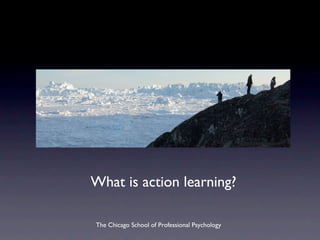
What is action learning?

The Chicago School of Professional Psychology
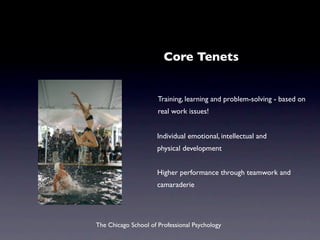
Core Tenets


                      Training, learning and problem-solving - based on
                      real work issues!


                      Individual emotional, intellectual and
                      physical development


                      Higher performance through teamwork and
                      camaraderie


The Chicago School of Professional Psychology
The concept emerges


                                        -Witnessed students discussing problems
                                        -Collaborative and reflective approach
                                        -Supportive colleagues
                                        -Breakthroughs based on deep questioning

Professor Reg Revans
                                        -Cross-disciplinary skill sets
                                        -Brings concept to Welsh coal mines


                  The Chicago School of Professional Psychology
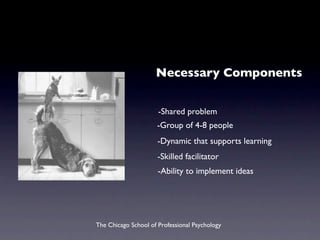
Necessary Components


                      -Shared problem
                      -Group of 4-8 people
                      -Dynamic that supports learning
                      -Skilled facilitator
                      -Ability to implement ideas


The Chicago School of Professional Psychology
Necessary Attitudes


                      -Willingness to listen
                      -Desire to reflect
                      -Non dogmatic approach
                      -Desire to execute
                      -Team orientation


The Chicago School of Professional Psychology
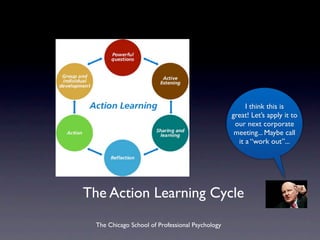
I think this is
                                                  great! Let’s apply it to
                                                   our next corporate
                                                   meeting... Maybe call
                                                    it a “work out”...


The Action Learning Cycle
  The Chicago School of Professional Psychology
Potential Benefits...

             On the job learning

          Leadership development

  Holistic rather than reductionist thinking

Increased teamwork and group commitment

    Fostering of a work culture that can
adapt to changes in the external environment


      The Chicago School of Professional Psychology
Possible obstacles?

                -Reflection viewed as a luxury
                -Conflicting personalities
                -Competing agendas (resource conflict)
                -Lack of cultural fit
                -Learning not an organizational priority
                -Hierarchical roadblocks


The Chicago School of Professional Psychology
Potential Areas of
                                   Research

                          -Employee engagement & satisfaction

                          -Performance benchmarking - more
                          business innovation?


I think I just
   saw an
 innovation!


    The Chicago School of Professional Psychology
“Action will remove the doubt that
  theory cannot solve.” - Pehyl Hsieh


   The Chicago School of Professional Psychology
Thank you and...
                                  Happy learning!

                                   Marcus LaTour

                     I’d welcome correspondence at:

                marcus_io_psychologist@yahoo.com


The Chicago School of Professional Psychology

Action Learning Presentation

  • 1.
    Action Learning “Knowingis not enough; we must apply. Willing is not enough; we must do.” - Goethe The Chicago School of Professional Psychology
  • 2.
    What is actionlearning? The Chicago School of Professional Psychology
  • 3.
    Core Tenets Training, learning and problem-solving - based on real work issues! Individual emotional, intellectual and physical development Higher performance through teamwork and camaraderie The Chicago School of Professional Psychology
  • 4.
    The concept emerges -Witnessed students discussing problems -Collaborative and reflective approach -Supportive colleagues -Breakthroughs based on deep questioning Professor Reg Revans -Cross-disciplinary skill sets -Brings concept to Welsh coal mines The Chicago School of Professional Psychology
  • 5.
    Necessary Components -Shared problem -Group of 4-8 people -Dynamic that supports learning -Skilled facilitator -Ability to implement ideas The Chicago School of Professional Psychology
  • 6.
    Necessary Attitudes -Willingness to listen -Desire to reflect -Non dogmatic approach -Desire to execute -Team orientation The Chicago School of Professional Psychology
  • 7.
    I think thisis great! Let’s apply it to our next corporate meeting... Maybe call it a “work out”... The Action Learning Cycle The Chicago School of Professional Psychology
  • 8.
    Potential Benefits... On the job learning Leadership development Holistic rather than reductionist thinking Increased teamwork and group commitment Fostering of a work culture that can adapt to changes in the external environment The Chicago School of Professional Psychology
  • 9.
    Possible obstacles? -Reflection viewed as a luxury -Conflicting personalities -Competing agendas (resource conflict) -Lack of cultural fit -Learning not an organizational priority -Hierarchical roadblocks The Chicago School of Professional Psychology
  • 10.
    Potential Areas of Research -Employee engagement & satisfaction -Performance benchmarking - more business innovation? I think I just saw an innovation! The Chicago School of Professional Psychology
  • 11.
    “Action will removethe doubt that theory cannot solve.” - Pehyl Hsieh The Chicago School of Professional Psychology
  • 12.
    Thank you and... Happy learning! Marcus LaTour I’d welcome correspondence at: marcus_io_psychologist@yahoo.com The Chicago School of Professional Psychology