ACTION RESEARCH
Outline
• Definition
• Objectives
• Types
• Steps
• Benefits
• Limitations
What is not Action Research?
Action research is not what usually comes to mind when we hear the
word “research”. Action research is not a library project where we
learn more about a topic that interests us. It is not about doing
research on or about people, or finding all available information on a
topic looking for the correct answers. It is not what we call ‘’a
conventional research’’ where we generally answer the question
‘’what is happening?’’ and we take a hypothesis and try to develop
it.
Definition
What is Action Research?
Action research is a process in which participants examine their own
educational practice systematically and carefully. It is a form of
investigation used by teachers to attempt to solve problems and
improve professional practices in their own classrooms. Teachers
are continually observing students, collecting data and changing
practices to improve the student learning and the classroom and
school environment. It provides a framework that guides teachers
toward a better understanding of why, when, and how students
become better learners. It involves people working to improve their
skills, techniques, and strategies.
Objectives
Teachers conduct an action research to:
• Support their professional development.
• Reflect on and assess their teaching process.
• Explore and test new ideas, methods, and materials.
• Assess how effective the approaches used were.
• Improve the professional practice through continual learning and
progressive problem solving.
• Know what is actually happening in their classrooms, what learners
are thinking, why learners are reacting in the ways they do.
•Know what aspects of the classroom they should focus on to
develop their teaching most effectively.
•Identify problems and seek solutions systematically.
•To get feedback as to the success or failure of what they are doing.
Types
Individual Action Research:
Individual action research is a research conducted by one teacher.
This type of research is conducted to analyze a specific issue in the
classroom. It may seek solutions to problems of classroom
management, instructional strategies, use of materials, or student
learning.
Collaborative Research:
Collaborative research involves two or more teachers studying a
topic. The topic may involve a single classroom or a common
problem shared by classrooms. Typically, a group of students, larger
than just one class, are tested, and the results are analyzed,
interpreted, adjusted.
School-Wide Research:
 
Action research programs are generally created from a problem
found within an entire school. For this type of action research, a
school may have concerns about a school-wide problem. The entire
staff works together through this research to study the problem,
implement changes, and correct the problem or increase
performance. Teams work together to narrow the question, gather
and analyze data, and decide on a plan of action.
Steps
Before teachers plan the steps in their action
research process, they will need to take into
consideration some conditions:
•Openness
•Ability to listen
•Ability to see things differently
•Willingness to share knowledge
•Desire for change/improvement
•Availability and ability to negotiate
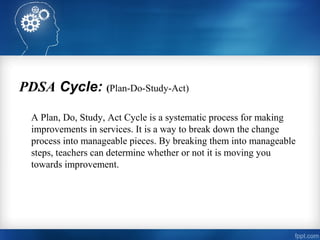
PDSA Cycle: (Plan-Do-Study-Act)
A Plan, Do, Study, Act Cycle is a systematic process for making
improvements in services. It is a way to break down the change
process into manageable pieces. By breaking them into manageable
steps, teachers can determine whether or not it is moving you
towards improvement.
 
• Define the opportunity for improvement
• Gather data to describe the processes as they are currently working
• Identify causes or problems
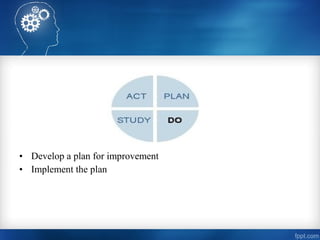
• Develop a plan for improvement
• Implement the plan
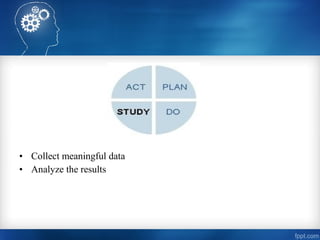
• Collect meaningful data
• Analyze the results
• Standardize the action
Or
• Continue working for improvement
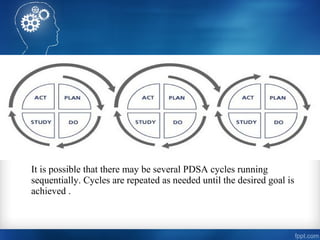
It is possible that there may be several PDSA cycles running
sequentially. Cycles are repeated as needed until the desired goal is
achieved .
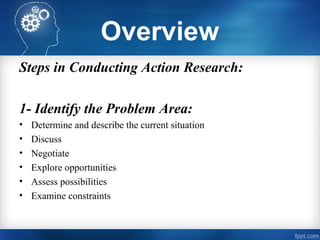
Overview
Steps in Conducting Action Research:
1- Identify the Problem Area:
• Determine and describe the current situation
• Discuss
• Negotiate
• Explore opportunities
• Assess possibilities
• Examine constraints
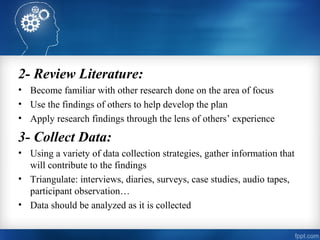
2- Review Literature:
• Become familiar with other research done on the area of focus
• Use the findings of others to help develop the plan
• Apply research findings through the lens of others’ experience
3- Collect Data:
• Using a variety of data collection strategies, gather information that
will contribute to the findings
• Triangulate: interviews, diaries, surveys, case studies, audio tapes,
participant observation…
• Data should be analyzed as it is collected
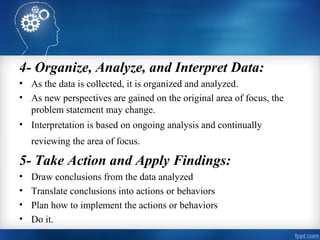
4- Organize, Analyze, and Interpret Data:
• As the data is collected, it is organized and analyzed.
• As new perspectives are gained on the original area of focus, the
problem statement may change.
• Interpretation is based on ongoing analysis and continually
reviewing the area of focus. 
5- Take Action and Apply Findings: 
• Draw conclusions from the data analyzed
• Translate conclusions into actions or behaviors
• Plan how to implement the actions or behaviors
• Do it.
Benefits
• Action research allows teachers to grow and gain confidence in their
work. It develops their thinking skills, sense of efficacy, willingness
to share and communicate, and attitudes toward the process of
change.
• Through action research, teachers learn about themselves, their
students, their colleagues, and can determine ways to continually
improve.
• Action research in pairs or by teams of teachers allows time to talk
with others about teaching and teaching strategies. By working on
these teams, teachers must describe their own teaching styles and
strategies and share their thoughts with others. Through these
discussions with colleagues they develop stronger relationships.
• As the practice of action research becomes part of the school
culture, we see increased sharing and collaboration across
departments, disciplines, grade levels, and schools.
• It improves communication. Teachers are brought together for a
shared purpose. Educators involved in action research become more
flexible in their thinking and more open to new ideas.
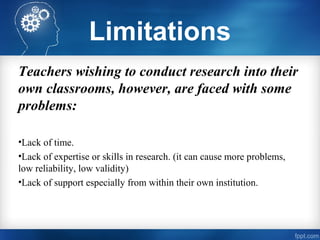
Limitations
Teachers wishing to conduct research into their
own classrooms, however, are faced with some
problems:
•Lack of time.
•Lack of expertise or skills in research. (it can cause more problems,
low reliability, low validity)
•Lack of support especially from within their own institution.
Conclusion
Action research is an important area for the teachers. It is seen
as a significant tool to empower the teacher and also act as the tool
for the reflection for his or her own practices. The action research is
a systematic process involving various steps from the identification
of the problem to the conclusions and decision making.
Thank you

Action research

  • 1.
  • 2.
    Outline • Definition • Objectives •Types • Steps • Benefits • Limitations
  • 3.
    What is notAction Research? Action research is not what usually comes to mind when we hear the word “research”. Action research is not a library project where we learn more about a topic that interests us. It is not about doing research on or about people, or finding all available information on a topic looking for the correct answers. It is not what we call ‘’a conventional research’’ where we generally answer the question ‘’what is happening?’’ and we take a hypothesis and try to develop it. Definition
  • 4.
    What is ActionResearch? Action research is a process in which participants examine their own educational practice systematically and carefully. It is a form of investigation used by teachers to attempt to solve problems and improve professional practices in their own classrooms. Teachers are continually observing students, collecting data and changing practices to improve the student learning and the classroom and school environment. It provides a framework that guides teachers toward a better understanding of why, when, and how students become better learners. It involves people working to improve their skills, techniques, and strategies.
  • 5.
    Objectives Teachers conduct anaction research to: • Support their professional development. • Reflect on and assess their teaching process. • Explore and test new ideas, methods, and materials. • Assess how effective the approaches used were. • Improve the professional practice through continual learning and progressive problem solving. • Know what is actually happening in their classrooms, what learners are thinking, why learners are reacting in the ways they do.
  • 6.
    •Know what aspectsof the classroom they should focus on to develop their teaching most effectively. •Identify problems and seek solutions systematically. •To get feedback as to the success or failure of what they are doing.
  • 7.
    Types Individual Action Research: Individualaction research is a research conducted by one teacher. This type of research is conducted to analyze a specific issue in the classroom. It may seek solutions to problems of classroom management, instructional strategies, use of materials, or student learning.
  • 8.
    Collaborative Research: Collaborative researchinvolves two or more teachers studying a topic. The topic may involve a single classroom or a common problem shared by classrooms. Typically, a group of students, larger than just one class, are tested, and the results are analyzed, interpreted, adjusted.
  • 9.
    School-Wide Research:   Action researchprograms are generally created from a problem found within an entire school. For this type of action research, a school may have concerns about a school-wide problem. The entire staff works together through this research to study the problem, implement changes, and correct the problem or increase performance. Teams work together to narrow the question, gather and analyze data, and decide on a plan of action.
  • 10.
    Steps Before teachers planthe steps in their action research process, they will need to take into consideration some conditions: •Openness •Ability to listen •Ability to see things differently •Willingness to share knowledge •Desire for change/improvement •Availability and ability to negotiate
  • 11.
    PDSA Cycle: (Plan-Do-Study-Act) APlan, Do, Study, Act Cycle is a systematic process for making improvements in services. It is a way to break down the change process into manageable pieces. By breaking them into manageable steps, teachers can determine whether or not it is moving you towards improvement.
  • 13.
      • Define theopportunity for improvement • Gather data to describe the processes as they are currently working • Identify causes or problems
  • 14.
    • Develop aplan for improvement • Implement the plan
  • 15.
    • Collect meaningfuldata • Analyze the results
  • 16.
    • Standardize theaction Or • Continue working for improvement
  • 17.
    It is possiblethat there may be several PDSA cycles running sequentially. Cycles are repeated as needed until the desired goal is achieved .
  • 18.
    Overview Steps in ConductingAction Research: 1- Identify the Problem Area: • Determine and describe the current situation • Discuss • Negotiate • Explore opportunities • Assess possibilities • Examine constraints
  • 19.
    2- Review Literature: •Become familiar with other research done on the area of focus • Use the findings of others to help develop the plan • Apply research findings through the lens of others’ experience 3- Collect Data: • Using a variety of data collection strategies, gather information that will contribute to the findings • Triangulate: interviews, diaries, surveys, case studies, audio tapes, participant observation… • Data should be analyzed as it is collected
  • 20.
    4- Organize, Analyze,and Interpret Data: • As the data is collected, it is organized and analyzed. • As new perspectives are gained on the original area of focus, the problem statement may change. • Interpretation is based on ongoing analysis and continually reviewing the area of focus.  5- Take Action and Apply Findings:  • Draw conclusions from the data analyzed • Translate conclusions into actions or behaviors • Plan how to implement the actions or behaviors • Do it.
  • 21.
    Benefits • Action researchallows teachers to grow and gain confidence in their work. It develops their thinking skills, sense of efficacy, willingness to share and communicate, and attitudes toward the process of change. • Through action research, teachers learn about themselves, their students, their colleagues, and can determine ways to continually improve. • Action research in pairs or by teams of teachers allows time to talk with others about teaching and teaching strategies. By working on these teams, teachers must describe their own teaching styles and strategies and share their thoughts with others. Through these discussions with colleagues they develop stronger relationships.
  • 22.
    • As thepractice of action research becomes part of the school culture, we see increased sharing and collaboration across departments, disciplines, grade levels, and schools. • It improves communication. Teachers are brought together for a shared purpose. Educators involved in action research become more flexible in their thinking and more open to new ideas.
  • 23.
    Limitations Teachers wishing toconduct research into their own classrooms, however, are faced with some problems: •Lack of time. •Lack of expertise or skills in research. (it can cause more problems, low reliability, low validity) •Lack of support especially from within their own institution.
  • 24.
    Conclusion Action research isan important area for the teachers. It is seen as a significant tool to empower the teacher and also act as the tool for the reflection for his or her own practices. The action research is a systematic process involving various steps from the identification of the problem to the conclusions and decision making.
  • 25.