4th
of July, 2009
Issue #7
The ScamsThe ScamsThe ScamsThe Scams
Local & National Industry NewsLocal & National Industry NewsLocal & National Industry NewsLocal & National Industry News
Exclusive ArticlesExclusive ArticlesExclusive ArticlesExclusive Articles
The source for casino surveillance activity
Internet viewing on the World Game Protection Catwalk:
http://www.worldgameprotection.com/archive/
The ScamsThe ScamsThe ScamsThe Scams
Local & National Industry NewsLocal & National Industry NewsLocal & National Industry NewsLocal & National Industry News
Exclusive ArticlesExclusive ArticlesExclusive ArticlesExclusive Articles
surveillance activity
Internet viewing on the World Game Protection Catwalk:
http://www.worldgameprotection.com/archive/
Borgata Joins the Digital Revolution
When the Borgata Casino Hotel and Spa opened in July 2003, Pelco was selected as its
supplier for video security. The first casino to open in Atlantic City in over 13 years, the
Borgata surveillance system included Pelco’s full line of fixed cameras, Spect
positioning systems and the CM9760 Video Matrix Switch
and commissioned by North American Video of Brick, New Jersey.
An incredibly successful joint venture between Boyd Gaming and MGM MIRAGE,
Borgata continues to grow to
experience in Atlantic City. After only two years of successful operation, Borgata
expanded, including the addition of
operation, making it an outstanding ven
Two years later Borgata expanded again when it opened its $400 million Water Club
Hotel, home to 800 guestrooms and suites, a two
event and retail spaces. Each of these expansions required additional surveillance, and
under the direction of Greg Schaaf, Director of Surveillance, a Pelco CM9780 Matrix
Switch was commissioned.
Led by Tony Piccolo, Borgata Surveillance Technical Manag
of the casino’s technical team, this new matrix system was connected to the original
CM9760 as a node, allowing security and surveillance operators to access and control any
camera from either the original or the new system. T
the CM9780 reduces the expanded security footprint by a factor of 4:1. This not only
allows Borgata to house the equipment in a much smaller space, but also reduces
requirements for power and air
efficient and environmentally friendly.
An Analog to IP Migration
While digital video recording was available in 2003 when the casino first opened its
doors, Borgata made the decision to wait until the products in the digit
mature before standardizing on a solution. Improvements in compression technologies,
the development of advanced product features and reduction in video storage costs were
among the most important requirements for the casino. In the summ
Borgata Joins the Digital Revolution
When the Borgata Casino Hotel and Spa opened in July 2003, Pelco was selected as its
supplier for video security. The first casino to open in Atlantic City in over 13 years, the
Borgata surveillance system included Pelco’s full line of fixed cameras, Spect

positioning systems and the CM9760 Video Matrix Switch – all of which were installed
and commissioned by North American Video of Brick, New Jersey.
An incredibly successful joint venture between Boyd Gaming and MGM MIRAGE,
Borgata continues to grow to provide the pre-eminent gaming and entertainment
experience in Atlantic City. After only two years of successful operation, Borgata
expanded, including the addition of 48 poker tables to its already successful poker
operation, making it an outstanding venue for daily tournaments.
Two years later Borgata expanded again when it opened its $400 million Water Club
Hotel, home to 800 guestrooms and suites, a two-story spa, five heated pools
event and retail spaces. Each of these expansions required additional surveillance, and
under the direction of Greg Schaaf, Director of Surveillance, a Pelco CM9780 Matrix
Led by Tony Piccolo, Borgata Surveillance Technical Manager, John Alvarez
of the casino’s technical team, this new matrix system was connected to the original
CM9760 as a node, allowing security and surveillance operators to access and control any
camera from either the original or the new system. The new high-density architecture of
the CM9780 reduces the expanded security footprint by a factor of 4:1. This not only
allows Borgata to house the equipment in a much smaller space, but also reduces
requirements for power and air-conditioning, making the expansion more cost effective,
efficient and environmentally friendly.
While digital video recording was available in 2003 when the casino first opened its
doors, Borgata made the decision to wait until the products in the digital space were more
mature before standardizing on a solution. Improvements in compression technologies,
the development of advanced product features and reduction in video storage costs were
among the most important requirements for the casino. In the summer of 2007,
By Joe McDevitt, Pelco Vice President, Large Systems Sales
Borgata Joins the Digital Revolution
When the Borgata Casino Hotel and Spa opened in July 2003, Pelco was selected as its
supplier for video security. The first casino to open in Atlantic City in over 13 years, the
Borgata surveillance system included Pelco’s full line of fixed cameras, Spectra

all of which were installed
An incredibly successful joint venture between Boyd Gaming and MGM MIRAGE,
eminent gaming and entertainment
experience in Atlantic City. After only two years of successful operation, Borgata
poker tables to its already successful poker
Two years later Borgata expanded again when it opened its $400 million Water Club
story spa, five heated pools as well as
event and retail spaces. Each of these expansions required additional surveillance, and
under the direction of Greg Schaaf, Director of Surveillance, a Pelco CM9780 Matrix
Alvarez and the rest
of the casino’s technical team, this new matrix system was connected to the original
CM9760 as a node, allowing security and surveillance operators to access and control any
density architecture of
the CM9780 reduces the expanded security footprint by a factor of 4:1. This not only
allows Borgata to house the equipment in a much smaller space, but also reduces
expansion more cost effective,
While digital video recording was available in 2003 when the casino first opened its
al space were more
mature before standardizing on a solution. Improvements in compression technologies,
the development of advanced product features and reduction in video storage costs were
er of 2007, Greg
By Joe McDevitt, Pelco Vice President, Large Systems Sales
Schaaf began evaluating digital video recording systems and numerous manufacturers
were invited to install evaluation systems for consideration. Moreover, Schaaf took a
proactive role and included the New Jersey Casino Control Commission (CCC) and the
Department of Gaming Enforcement (DGE) in the evaluation process, ensuring that the
systems under consideration met regulatory required criteria, including frame rate,
resolution, redundancy and retention.
After several months of evaluation, Pelco’s Endura system made the short list. To deliver
the perfect solution, however, the Borgata team suggested several changes be made to the
user interface to better accommodate their daily activities. Pelco’s Large Systems Sales
(LSS) team in Orangeburg, New York worked with Sustaining Engineering in Clovis,
California, to design and implement those changes to ensure the maximum functionality
between Endura and the security team’s distinct applications. After only three days, the
LSS team returned to Borgata with new workstation software, demonstrating our
fanatical commitment to one of our customers.
Among the changes incorporated into the software was a “quick export function,” which
allows video under review to be burned directly to DVD or other external media.
Pelco’s sales team liked this feature so much that it is now included in all Endura
WS5000 workstations as a standard function allowing customers all over the world to
benefit from Borgata’s intuitive ideas. The casino accepted these changes and eventually
chose Pelco as the provider for their digital solution.
Once selected, Pelco again teamed with North American Video (NAV) for the sale and
installation of the Endura system. Under the direction of NAV’s Project Manager, Joe
Laskay, and with the assistance of Pelco’s Integrated Systems Specialist, Dirk Demar, the
Endura system was configured to run in parallel with Borgata’s existing VCR-based
installations, allowing the Endura installation to be completely tested for functionality,
retention time, and camera routing as well as to gain CCC and DGE approval without any
downtime to mission-critical casino operations. Once all these factors were verified and
approved, the cutover from the VCRs to the full Endura solution was implemented and
final commissioning completed.
According to Schaaf, “We were fortunate to have an exceptional Pelco team assigned to
Borgata Hotel Casino & Spa’s digital transition, which was a huge undertaking
particularly due to the complexity of the scope of work and the regulatory environment of
a large operating casino. With all the challenges of such a project, the transition was
seamless. We did face the expected – and sometimes unexpected – issues, but the
response of the Pelco team was exceptional.”
The integration between the newly installed Endura system and the two matrix switchers
now gives Borgata the best of both the digital and analog worlds. The analog system is
used for live camera coverage allowing operators to use their joystick keyboards for
switching and controlling cameras on the surveillance room’s newly installed monitor
wall, the advantage of which is the instant access to uncompressed, latency-free video.
One of the Endura system’s premiere components, the CM9700-MDD (Matrix Digital
Decoder) creates the bridge between the matrix and digital systems, acting as a decoder
and decompressing Endura recorded video for input to the matrix systems inputs.
Such an arrangement allows any recorded camera feed to be viewed on any monitor. An
intelligent connection from the matrix CPU to the MDD then allows the CM9700
keyboard to manipulate the recorded video directly from the keyboard’s joystick,
permitting fast forward, rewind, frame advancement forward or backward, pause and
other commonly used “VCR type” controls. An instant playback function is also
available. An example of this takes place when an operator is performing live
surveillance of a particular gaming table through the matrix switcher. A simple keystroke
automatically retrieves the recorded video from that camera 30 seconds prior to the
issuance of the command. That recorded video is then displayed on the operator’s
working monitor so that a “quick review” can be performed without going to a separate
workstation. This makes the overall operation much more intuitive and simple than the
previously installed VHS-based system.
Another advantage of the digital recording solution is the outstanding picture quality
Endura displays. All cameras are recorded in real time, 30 images per second in 4 CIF
resolution. And with Endura’s superior compression algorithm, this is all achieved with a
maximum bit rate of 2 MBps, which keeps storage costs and network traffic to a
minimum.
Today, Borgata relies on Pelco for all of its casino surveillance needs. They are satisfied
with the system’s ease of use and are well positioned to take advantage of Endura’s
continued development. In fact, planning is already underway to deploy the new
NET5402R-HD Endura decoders for use with the surveillance department’s high
definition monitors, providing them with the proper aspect ratio for high definition
viewing. We welcome Borgata to the Endura family and look forward to many years of
working together.
Sidebar: The staff at Borgata would like to acknowledge the outstanding service and
support they have received from numerous Pelco employees, specifically: Kevin Bozarth,
Anthony Benz, Kevin O’Brien, Dirk Demar and Walter Santos.
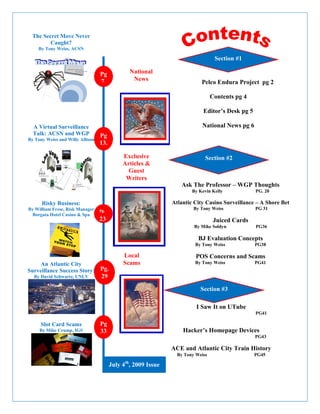
Section #1
Section #2
Section #3
World Pelco Endura Project pg 2
Contents pg 4
Editor’s Desk pg 5
National News pg 6
Ask The Professor – WGP Thoughts
By Kevin Kelly PG. 20
Atlantic City Casino Surveillance – A Shore Bet
By Tony Weiss PG 31
Juiced Cards
By Mike Soldyn PG36
BJ Evaluation Concepts
By Tony Weiss PG38
POS Concerns and Scams
By Tony Weiss PG41
I Saw It on UTube
PG41
Hacker’s Homepage Devices
PG43
ACE and Atlantic City Train History
By Tony Weiss PG45
National
News
Exclusive
Articles &
Guest
Writers
Local
Scams
The Secret Move Never
Caught?
By Tony Weiss, ACSN
Poker Cheating Devices
& Methods
By Tony Weiss, ACSN
A Virtual Surveillance
Talk: ACSN and WGP
By Tony Weiss and Willy Allison
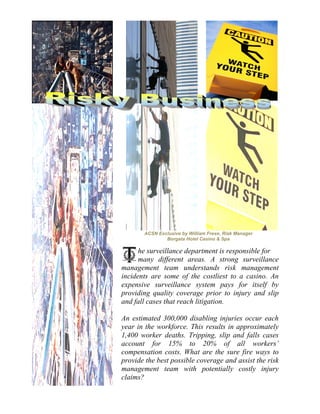
Risky Business:
By William Frese, Risk Manager
Borgata Hotel Casino & Spa
An Atlantic City
Surveillance Success Story:
By David Schwartz, UNLV
Slot Card Scams
By Mike Crump, IGS
Pg
7.
Pg.
Pg.
July 4th
, 2009 Issue
Pg
13.
Pg.
29
23
0
Pg
33
ACSN Guest Editor’s Desk ~
Labor reductions create anxiety and short term stress, believe me, I know! But those of us in a
supervisory or managerial role must communicate effectively. Employees look
sensible decision-making, commitment, communication and integrity. Listen to the employees and
their concerns, have individual and group meetings, address the operational needs, set goals to best
service your department and company. Ch
benefits. Prepare by building a skilled team and manage them toward the goals. Share and celebrate
the positive results. By doing so, employees embrace
Change is normal. In the workplace
communication, knowledge and learning of new skills. You must challenge the way things are done.
A statement by Michael Dylan, an Internet Entrepreneur, “A powerful way to reach inside and create
new habits or behavior is to learn why we do what we do, and how much better it would be if we didn’t
do it”! Review old time policies and procedures. Are they still required or useful? Are new methods
available? What new skills are needed?
You can embrace change by having passion in your work. Passion will make you challenge and
question the way things are done. Passion will make you identify changes to improve productivity and
service. Passion will challenge you to learn new skills, take risks that pu
saying: “No risk, No fear; No fear, No passion; No passion, No fun”. You have to have fun in your
work.
Change can be scary,
Although this was not a specific surveillance topic, change is occurring at a rapid pace in our
professional field. It’s an exciting and challenging time to be in the casino surveillance industry.
Thanks to Greg, Tony and the team at Borgata for allow
Robert H. Deissler. Director of Surveillance
Email: rdeissler@hahrrahs.com
ACSN Guest Editor’s Desk ~ “Change”
The word “change” can be scary. I know it
human nature to resist change, especially if something is
successful in the past. We are conditioned to belie
change is bad. Why tamper with something that works?
Some changes are inevitable. Take the change of seasons,
a natural cycle of change. Each season has challenges but
we accept them, we adapt, and find ways to have fun.
Some changes are unforeseen, like the recent market
We all felt the effects on our personal and professional lives.
When change happens, especially when it appears negative,
we tend to be fearful, resistant and pessimistic. But
up to new possibilities and new ways of thinking can be very
rewarding. Recently, the economic crisis resulted in my wife
losing her job after 23 years. After so many years in her
career you can imagine all the feelings this brought to light.
But since then, new doors have opened and my ever
wife, who always sees the glass half full, is exploring new
opportunities and a new career.
anxiety and short term stress, believe me, I know! But those of us in a
supervisory or managerial role must communicate effectively. Employees look to Management for
making, commitment, communication and integrity. Listen to the employees and
their concerns, have individual and group meetings, address the operational needs, set goals to best
service your department and company. Check to make sure employees understand the goals and the
benefits. Prepare by building a skilled team and manage them toward the goals. Share and celebrate
By doing so, employees embrace change.
Change is normal. In the workplace change occurs through new technology, innovation,
communication, knowledge and learning of new skills. You must challenge the way things are done.
A statement by Michael Dylan, an Internet Entrepreneur, “A powerful way to reach inside and create
ts or behavior is to learn why we do what we do, and how much better it would be if we didn’t
do it”! Review old time policies and procedures. Are they still required or useful? Are new methods
available? What new skills are needed?
e change by having passion in your work. Passion will make you challenge and
question the way things are done. Passion will make you identify changes to improve productivity and
service. Passion will challenge you to learn new skills, take risks that push your potential. There is a
saying: “No risk, No fear; No fear, No passion; No passion, No fun”. You have to have fun in your
Change can be scary, but it can be very rewarding!
Although this was not a specific surveillance topic, change is occurring at a rapid pace in our
professional field. It’s an exciting and challenging time to be in the casino surveillance industry.
Thanks to Greg, Tony and the team at Borgata for allowing me to write this editorial for the newsletter.
Director of Surveillance, Harrah’s Resort - Atlantic City, NJ 08401
rdeissler@hahrrahs.com - Phone: 609-441-5146
The word “change” can be scary. I know it is for me. It is
to resist change, especially if something is
successful in the past. We are conditioned to believe that
with something that works?
Some changes are inevitable. Take the change of seasons,
a natural cycle of change. Each season has challenges but
we accept them, we adapt, and find ways to have fun.
Some changes are unforeseen, like the recent market crash.
We all felt the effects on our personal and professional lives.
When change happens, especially when it appears negative,
we tend to be fearful, resistant and pessimistic. But opening
new ways of thinking can be very
rewarding. Recently, the economic crisis resulted in my wife
losing her job after 23 years. After so many years in her
career you can imagine all the feelings this brought to light.
But since then, new doors have opened and my ever-positive
ways sees the glass half full, is exploring new
anxiety and short term stress, believe me, I know! But those of us in a
to Management for
making, commitment, communication and integrity. Listen to the employees and
their concerns, have individual and group meetings, address the operational needs, set goals to best
eck to make sure employees understand the goals and the
benefits. Prepare by building a skilled team and manage them toward the goals. Share and celebrate
change occurs through new technology, innovation,
communication, knowledge and learning of new skills. You must challenge the way things are done.
A statement by Michael Dylan, an Internet Entrepreneur, “A powerful way to reach inside and create
ts or behavior is to learn why we do what we do, and how much better it would be if we didn’t
do it”! Review old time policies and procedures. Are they still required or useful? Are new methods
e change by having passion in your work. Passion will make you challenge and
question the way things are done. Passion will make you identify changes to improve productivity and
sh your potential. There is a
saying: “No risk, No fear; No fear, No passion; No passion, No fun”. You have to have fun in your
Although this was not a specific surveillance topic, change is occurring at a rapid pace in our
professional field. It’s an exciting and challenging time to be in the casino surveillance industry.
ing me to write this editorial for the newsletter.
Atlantic City, NJ 08401
Billionaire wins debt forgiveness case in high court of England in the
amount of 2 million pounds.
Credit departments should take notice as extensions and large lines are
established.
Is this the beginning of more to come?
See link for the full story
http://www.dailymail.co.uk/news/article-1052131/Billionaire-gambler-called-
Fat-Man-wins-court-bid-avoid-paying-2m-casino-debt-unfair-game.html
Borgata is host to a historic world record craps roll
An electric moment for all involved from the players on the game to all of the
staff on duty at Borgata.
See link for the full story
http://www.pressofatlanticcity.com/news/top_three/article_8472527c-48df-
11de-b35c-001cc4c03286.html
Wharton School of Business Ivy Leaguer accused in a Black Jack Scam
Move over M.I.T. here comes Wharton
See link for the full story
http://media.www.dailypennsylvanian.com/media/storage/paper882/news/200
8/09/30/News/Wharton.Student.Accused.In.Conn.Casino.Scam-
3459779.shtml
An ACSN Exclusive
By Tony Weiss
An extremely dangerous move was discussed at the most recent World Game Protection
conference in Las Vegas. Sal Piacente who began his career in Atlantic City as a blackjack
dealer at the Atlantis Casino detailed the Black Widow sleight of hand apparatus that has the
potential to devastate the casino industry. Sal was a speaker at the conference and is a highly
sought after game protection consultant. Can you imagine a move that is impossible to catch on
camera? One that takes less than a fraction of a second and can easily empty a rack of
$1,000’s in gaming cheques? The details of the Black Widow’s potential as a casino cheating
device will come alive in this exclusive Atlantic City Surveillance News investigation.
Our first example of the Black Widow working her magic has a craps dealer on the game who
has just dealt to heavy $100 action. The dealer is experienced and well liked by the crew he has
worked with for years. The player ends his play and wants to be cashed out. The dealer brings
in all of the $100 cheques for the box to tally. Since the dealer already has $500 cheques in his
working stack he is instructed to cut out $10,000 in the “come” for the color up. The experienced
dealer has a feel for a full stack of gaming cheques and grabs a stack off the top of the working
stack, cuts down the $10,000 and passes it off to the player. He clears his hands and the player
soon after leaves the game.
“You just missed a $500 gaming cheque theft courtesy of the Black Widow!”
The dealer was able to squeeze off (21) purple
$500 gaming cheques utilizing his ability to “feel”
the stack. He cuts out the stack and pulls back
only to release the Black Widow apparatus
instantly making the extra $500 gaming cheque
slide up his sleeve without any hand movement
that might bring attention to his immediate
supervisors. The traditional clearing of the hands
procedure is soon after shown to the eye in the
sky. Let’s do the math and see how devastating
the move can be to our industry. One $500 gaming
cheque taken off the game each shift equates to
$125,000 per year even with a few weeks off for
vacation.
Not bad for an initial investment of $249.99.
Do we have your attention yet?
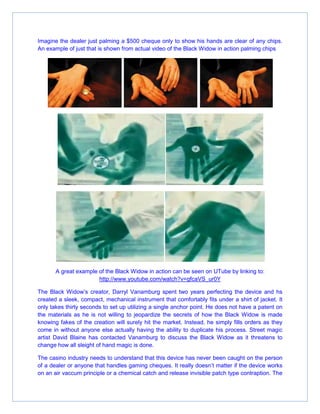
Imagine the dealer just palming a $500 cheque only to show his hands are clear of any chips.
An example of just that is shown from actual video of the Black Widow in action palming chips
A great example of the Black Widow in action can be seen on UTube by linking to:
http://www.youtube.com/watch?v=gfcaVS_ur0Y
The Black Widow’s creator, Darryl Vanamburg spent two years perfecting the device and hs
created a sleek, compact, mechanical instrument that comfortably fits under a shirt of jacket. It
only takes thirty seconds to set up utilizing a single anchor point. He does not have a patent on
the materials as he is not willing to jeopardize the secrets of how the Black Widow is made
knowing fakes of the creation will surely hit the market. Instead, he simply fills orders as they
come in without anyone else actually having the ability to duplicate his process. Street magic
artist David Blaine has contacted Vanamburg to discuss the Black Widow as it threatens to
change how all sleight of hand magic is done.
The casino industry needs to understand that this device has never been caught on the person
of a dealer or anyone that handles gaming cheques. It really doesn’t matter if the device works
on an air vaccum principle or a chemical catch and release invisible patch type contraption. The
only thing that needs to be understood is all of the scenerios and possibilities this so called
sleight of hand “magic trick” has to impact the revenue of a casino without ever being noticed. A
few more scenes are played out by our dealer that is incorporating the Black Widow.
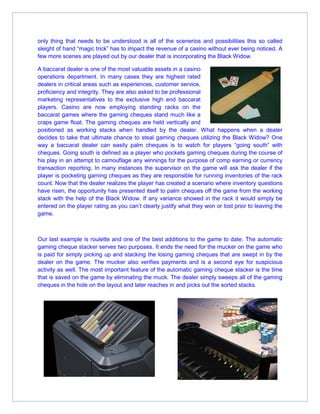
A baccarat dealer is one of the most valuable assets in a casino
operations department. In many cases they are highest rated
dealers in critical areas such as experiences, customer service,
proficiency and integrity. They are also asked to be professional
marketing representatives to the exclusive high end baccarat
players. Casino are now employing standing racks on the
baccarat games where the gaming cheques stand much like a
craps game float. The gaming cheques are held vertically and
positioned as working stacks when handled by the dealer. What happens when a dealer
decides to take that ultimate chance to steal gaming cheques utilizing the Black Widow? One
way a baccarat dealer can easily palm cheques is to watch for players “going south” with
cheques. Going south is defined as a player who pockets gaming cheques during the course of
his play in an attempt to camouflage any winnings for the purpose of comp earning or currency
transaction reporting. In many instances the supervisor on the game will ask the dealer if the
player is pocketing gaming cheques as they are responsible for running inventories of the rack
count. Now that the dealer realizes the player has created a scenario where inventory questions
have risen, the opportunity has presented itself to palm cheques off the game from the working
stack with the help of the Black Widow. If any variance showed in the rack it would simply be
entered on the player rating as you can’t clearly justify what they won or lost prior to leaving the
game.
Our last example is roulette and one of the best additions to the game to date. The automatic
gaming cheque stacker serves two purposes. It ends the need for the mucker on the game who
is paid for simply picking up and stacking the losing gaming cheques that are swept in by the
dealer on the game. The mucker also verifies payments and is a second eye for suspicious
activity as well. The most important feature of the automatic gaming cheque stacker is the time
that is saved on the game by eliminating the muck. The dealer simply sweeps all of the gaming
cheques in the hole on the layout and later reaches in and picks out the sorted stacks.
The time is money principal is one that the casinos utilize daily when factoring the expected win
for each table game. The automatic gaming cheque stacker is a valuable asset on roulette as it
clearly saves down time between spins. The concern with the machine is that the black hole
presents the perfect opportunity for a dealer to reach in an area that is not a traditional “perfect
view” for surveillance. Any dealer armed with the Black Widow now has the perfect excuse to
reach below the table into the dark hole after sweeping unaccounted gaming cheques
Each scenario becomes a threat as the Black Widow has never been caught on the person of a
casino dealer arrested for theft of gaming cheques. The simple fact that the world’s best
magicians call the Black Widow the great sleight of hand invention to date is enough concern to
raise the possibility of the device being used in a casino environment. The industry should take
notice and consider new ways to account for the rack inventory as well as moving past
traditional “clearing hands” rule of thumb procedures. Let’s continue to reveal any and all
possible threats and new cheat moves by communicating what is out there compromising our
revenue.
Follow up conversations with Sal Piacente concluded that the Black Widow in its current format
would work best from the box position in craps as the release movement and physical
characteristics of the device tubing are best concealed under a jacket. Of course, all devices
can be altered to fit any situation. Sal currently posesses his own version that works in a casino
environment for a dealer.
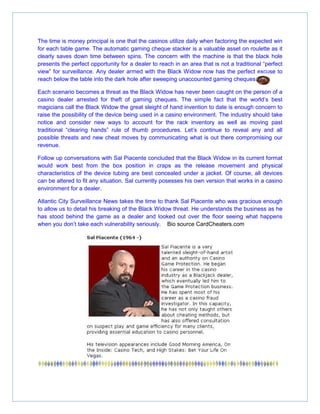
Atlantic City Surveillance News takes the time to thank Sal Piacente who was gracious enough
to allow us to detail his breaking of the Black Widow threat. He understands the business as he
has stood behind the game as a dealer and looked out over the floor seeing what happens
when you don’t take each vulnerability seriously. Bio source CardCheaters.com
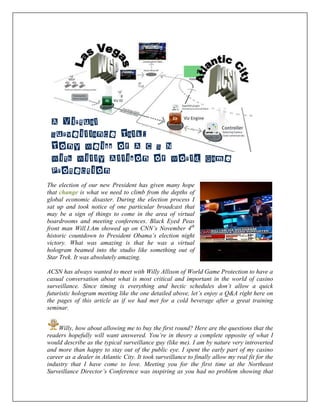
The election of our new President has given many hope
that change is what we need to climb from the depths of
global economic disaster. During the election process I
sat up and took notice of one particular broadcast that
may be a sign of things to come in the area of virtual
boardrooms and meeting conferences. Black Eyed Peas
front man Will.I.Am showed up on CNN’s November 4th
historic countdown to President Obama’s election night
victory. What was amazing is that he was a virtual
hologram beamed into the studio like something out of
Star Trek. It was absolutely amazing.
ACSN has always wanted to meet with Willy Allison of World Game Protection to have a
casual conversation about what is most critical and important in the world of casino
surveillance. Since timing is everything and hectic schedules don’t allow a quick
futuristic hologram meeting like the one detailed above, let’s enjoy a Q&A right here on
the pages of this article as if we had met for a cold beverage after a great training
seminar.
Willy, how about allowing me to buy the first round? Here are the questions that the
readers hopefully will want answered. You’re in theory a complete opposite of what I
would describe as the typical surveillance guy (like me). I am by nature very introverted
and more than happy to stay out of the public eye. I spent the early part of my casino
career as a dealer in Atlantic City. It took surveillance to finally allow my real fit for the
industry that I have come to love. Meeting you for the first time at the Northeast
Surveillance Director’s Conference was inspiring as you had no problem showing that
A Virtual
Surveillance Talk:
Tony Weiss of A C S N
With Willy Allison of World Game
Protection
you really have passion for our industry as well. It was very interesting to see a well
spoken and outgoing guy from Australia marketing casino surveillance and all of its
possibilities. With all of that being said, my first round question is simply, why
surveillance as your chosen profession?
Willy: It’s all I ever wanted to do since I first laid eyes on a television screen. Honestly?
Truthfully? I guess I was just lucky. I had no idea what casino surveillance was when I
first got into it. I got into it by chance. I was a 21-year old pup, just married, living in
Surfers Paradise on the Gold Coast, a popular beachside resort area in Australia. I had
only been in a casino maybe two or three times before. I knew surfing or selling suntan
lotion to tourists wasn’t going to provide for my new bride so I thought I better get a real
job. They had just legalized casinos in my home state and Hilton (Conrad Jupiter’s) had
come to town and built a 5-star casino & hotel employing over 2,000 people. This was
significant on the Gold Coast, as up until then the town didn’t really have 5-star hotels,
let alone a casino. One of my mates had got a job as a dealer and convinced me to apply
for a job. I thought it could be quite interesting and the thought of free lunches was
irresistible.
Back in those days there weren’t too many experienced dealers so they did all their own
training in-house. During the recruitment process they would cull you by giving you a
math test. I did really well and I got a call back asking if I would be interested in
applying for a surveillance position. I was like, what is that? Anyway, after some
interviews with the top dogs I got the job as a probationary surveillance trainee for 3-
months. Basically it was like a surveillance academy for beginners. I was told if I didn’t
pass the testing I wouldn’t get the job. Some didn’t make it. That motivated me to do well.
I passed the training course and well, I’ve never looked back.
From the time I got into the room, I liked it. The essence of surveillance is catching bad
people. As you move up in management the role gets broader but most surveillance
professionals agree it doesn’t matter how high up you get on the totem pole or how
buried in paperwork and politics you become, you never lose that thirst for the fresh kill.
It may have been timing but back in the 80’s & 90’s the casino industry really took off
around the world. Opportunities to move up and around were all over the place. My
bride and I share a love for traveling and seeing the world, so the casino industry has
worked out great for us. I have been able to have a career that provides for both our
wants and needs. We’re forever grateful for the opportunities the industry has given us
and feel a loyalty to it.
Round #2 - Where did you come up with the vision for World Game Protection
and the conference ideas? It almost seems to be a niche market that would exhaust itself
after time with regard to attendees?
Willy: In 2002 I was working as a Surveillance Director in Argentina. Great times.
Unfortunately Argentina went bankrupt. That’s right, the country went bankrupt. This
was not good for the casino business. Revenues dropped by 70% overnight and players
stopped coming. It was a pretty ugly scene. An opportunity came up to move to Las Vegas
and open a US office for an Australian digital video recording company. I wanted to
learn more about digital CCTV and felt it was a great opportunity as casino surveillance
operations were just starting to embrace new digital technology. So after 15 years in
casino surveillance operations I decided it was time for a career change and left
Argentina for Las Vegas to give it a try.
I did that for a couple of years. During that period I traveled around the US and Canada
quite a bit, visiting and meeting with surveillance managers. I found it really interesting.
Many casinos were located in isolated places across the country and in a lot of cases
surveillance managers were relatively new to the casino business. Salespeople primarily
drove information on technology. One of the things that stood out for me was how we, as
a unique niche field in a global industry, didn’t have a place where we could all go to see
and learn about best practices and technology on a regular basis. I felt there was a need
for us to have our own show once a year so we could focus on the latest surveillance and
game protection techniques. I felt there was a lot that we could all learn from each other.
Although G2E had traditionally been a place to see new surveillance technology, I felt a
small, more intimate show was needed that would place surveillance professionals and
suppliers front & center. I also wanted to focus on educational content and give our guys
a place to meet once a year where they can feel at home with their peers, talk shop and
make important contacts. It is very difficult to do that at some of the larger shows.
In 2005 I pitched the idea to the vendor I was working for as a way to sponsor an event
that would lead to huge exposure and help cement their reputation as a company
committed to the industry. Unfortunately (or fortunately) they didn’t like the idea. I’m
pretty stubborn and really believed it was important for our industry and it could work,
so the next day I quit my job, started World Game Protection and did it myself.
Coming up with ideas for the show is a challenge I don’t take lightly. I spend a lot of time
designing the program each year. It’s the one thing I lay awake thinking about all the
time. We want to always keep it fresh. I’m always looking for speakers that have or are
doing good things that can help others in surveillance. I will travel to the end of the earth
to find interesting people with good things to say, (Well, maybe to warm tropical areas).
We’ve had most of the best in the business over the years but we are a niche field and
new ideas are getting harder to find. To find new ideas each year I do a lot of talking
with surveillance directors, attend a lot of seminars and Google a lot (probably too
much). Often the ideas come from surveillance people that email me. I think moving
forward we are definitely heading in a more interactive direction with new segments like
the Innovation Forum and the Golden Dome Awards. As I mentioned, there’s a lot to
learn from each other.
Regarding attendance growth I think all shows put too much emphasis on numbers. I’m
not really in this for that reason. I’m a surveillance guy first, conference organizer
second. My main priority is that we put on a good show and casino surveillance
professionals have somewhere to go to learn and network each year. I knew when I
started the World Game Protection Conference there was a limited niche market. In
saying that I do feel strongly that at least one representative from every casino in the
world should be there each year. I believe in the show’s importance to the industry. Will
that happen? Probably not, but if it does I’ll buy everyone at the show a beer.
Round #3 - You keep branching out and expanding the empire with
regards to the Director’s Academy at UNLV, Catwalk site, Four Masters traveling
training seminars, early surveillance theories such as the “Four Pillars”, magazine
articles and interviews, collaborations with industry professionals around the world and
traveling everywhere for requested appearances. Do you get tired and if you had to give
everything up except one portion of the business, what would you keep?
Willy: Dude, I’m just a surveillance guy trying to make a living in a very tough economy
and hopefully do something good. The newsletter, articles and speaking all come with the
territory of communicating the message of our business. It just so happens the Catwalk is
a labor of love and the speaking, although I don’t consider myself to be a speaker, allows
me to stay in touch and connect with our customers.
One of the great things about World Game Protection is that you get to meet a lot of
interesting people. It sounds like a cliché but really I’m talking very interesting people.
I’m a student of the game and love having the opportunity to work with these people.
There are a lot of things I would like to do with World Game Protection but it is very
tough at the moment. The economy is a real pisser. As a small business reliant on the
casino industry, our plans have taken a real hit in the last year. We’re working twice as
hard for half as much. Unfortunately, training budgets are an easy target for casino cost
cutters. The irony is that they are searching for efficiency but teaching people to be better
at what they do is the very definition of efficiency and I believe the key to surviving in
hard times. Casinos should be looking at improving the way their people work,
increasing their skill sets and multi-tasking.
Energy is important in our business. I’m not sure but when it comes to the World Game
Protection Conference I think I may be the only casino conference organizer out there
who actually physically trains for their annual event. The 3-day event can really take it
out of you both mentally and physically so I have developed a special training regime
each year that gives me more energy for the show. It starts 12 weeks out from the show. I
increase my reps in the gym and focus more on cardio. I hate cardio and would prefer to
push iron so it’s a real task for me but I find it helps my energy levels and increases my
bicep curl strength & stamina.
Asking me to choose one portion of our business over another is like asking me to choose
between my kids. Financially the World Game Protection Conference has been our
aircraft carrier and will always be dear to my heart (and hopefully my wallet) because it
was our first event and it brings our industry together. But if money were no object, the
“sweet child of mine” would be the Surveillance Directors Academy. I personally like the
closeness and bond you get from spending a week with a small group of dedicated and
accomplished surveillance managers that really want to be strong surveillance leaders.
It’s very cool and I enjoy learning from our instructors and from the students themselves.
It’s comprehensive and hard-core surveillance and I really dig it and what it stands for.
Round #4 – Here is a concept. What if the industry took your lead and
saw surveillance as a marketing tool as well as an asset protection branch of the casino?
Many of the new age theories of surveillance have every aspect of the operation
scrutinized in an effort to evaluate performance and efficiencies. How does the industry
incorporate some of your proven marketing strategies into a successful selling of
surveillance as a marketing and money generating tool?
Willy: First off you got to have a product to market. If your surveillance department isn’t
adding value to your organization or contributing to the bottom line it’s a moot point.
Anyone can review video, take phone calls and write reports. There’s no ROI on that.
You got to focus on the knowledge and skills of your people and what they bring to the
organization. The ROI comes when your people are well trained, knowledgeable about
casino business drivers, motivated and they produce intelligence that can save the casino
money or increase revenues over time.
OK, so let’s say you introduce key performance indicators and set goals for your team
that would focus on observations that can result on a direct effect on the bottom line. It
could be detection of cheating, theft, advantage players and payout discrepancies. You
not only prioritize your discretionary monitoring time to those areas, you also allocate
resources to investigations and analysis focused on improving gaming efficiency,
minimizing areas of risk and increasing profitability. I know what you’re thinking: It
doesn’t matter what surveillance says, gaming is not going to buy it. It comes back to
establishing and marketing your credibility as a knowledge center. If we developed the
knowledge and skill set in surveillance to be more analytical, mathematical, business
minded and improved the way we presented information there would be a better chance
our observations/analysis would be accepted.
Round #5 – The newest instant access communication tool is
Skype. The virtual conversation we are having within this article can actually
come to life as end users sign in on the site and are instantly brought together. Do you
see a use for this type of technology for World Game Protection Inc. with regards to an
option for the Four Masters? Another question posed to you as a former “in the
trenches” casino surveillance professional would be: Do you see surveillance
departments using Skype to investigate scams as they happens by showing each other the
visual components of a scam in a real time format?
Willy: Call me old school but for me, casino surveillance training is better conducted in
analog, not digital. Surveillance people already spend too much time in front of monitors.
I think students want to get away from that environment and have a “real” learning
experience. We like to provide training experiences where students and teachers can
interact naturally. I think teachers respond better to human interaction in a classroom
and students get a lot out of interacting with other students. Online courses are a bit two-
dimensional for me and come with too many computer compatibility type issues for my
liking. It’s just not my scene.
From a business perspective the other thing you have to consider is digital piracy. In
most specialized, niche industries, an expert with invaluable experience and knowledge
commands high fees. Their knowledge is perceived as valuable and should be treated and
respected as such. The casino training market is relatively small compared with other
industries. Casino experts have a limited market for which to make a living. They could
not survive if their expertise and services were copied and distributed without permission
or more importantly, compensation.
In the digital age there seems to be this acceptance of downloading material for free and
distributing among the masses. Our industry is guilty of this as well. One large casino
corporation in particular is well known amongst training circles as plagiarizing
specialized training courses and distributing among their properties. They would
probably argue there’s nothing wrong with that but they have to understand they’re
taking bread off the table of people that have dedicated their lives to sharing their
knowledge with others. I’m all for information sharing but not at the expense of someone
who works hard and is committed to the industry. The industry should respect their value
and contribution instead of stealing from them. I think until casino corporations can
guarantee these practices are discontinued you will see reluctance from any professional
trainers to go down that path. It’s just not viable in a small market.
I do see potential for video over the Internet technology (like Skype) to be used for
communication purposes or among surveillance departments. I think that’s a great idea.
I would even go as far as to say that we may even see a day where casino surveillance
could be out-sourced via the web. Here’s something to think about. Let’s say it costs a
casino $1M a year to run a surveillance department and the return is say $250K a year
(a $750K loss). If a company came along and said it could provide the same service,
using well trained, performance proven operators from a remote location in Las Vegas
for $500K a year, and they could guarantee a return of $2M a year, would a company
consider it?
At this stage Tony, I’d just like to add that I love to get emails from surveillance people,
but I do have a spam filter that blocks phrases like; “Our regulators would never allow
it”, “Because the players would not accept it”, “ What if the server goes down” or
“Legal and HR said we couldn’t”
Round #6 – The map, tribal casinos versus the rest and old
school mentality. How does your business branch out and reach new markets such as the
East Coast? Is there a big difference in tribal casinos training efforts in surveillance? Do
you find more of the open minded surveillance directors attending conferences and why?
Willy: Our road map going forward is “on demand”. We have our annual events like the
WGPC and the SDA and the other 2-day specialized courses but I would like to expand
into what we can do for your specific casino (East Coast included). We would like to
create an “industry-accepted” standard for surveillance training that would tie in with
in-house key performance indicators. If you don’t already have them, let us work with
you to develop them. We want to offer a total surveillance performance management
package.
There’s a huge difference between tribal and corporate casinos when it comes to
investment in humans and technology. Somewhere along the line U.S. corporate casinos
stopped focusing on the development of their employees and put their money into
nightclubs, famous chefs and executive bonus programs. Hell, most surveillance directors
I speak to from corporate casinos don’t even have a budget line allocated to training and
development. When it comes to investing in individual employee training and
development there’s no “I” in corporate but there’s an I in tribe.
Tribal casinos invest in their people and give them the latest technology to help them do
their job. An example is digital video systems. Most tribal casinos are now digital. It’s
hard to believe that I can watch video on my cell phone when a lot of corporate casinos
are still using VHS recorders and tapes. There’s a huge divide.
In terms of training, the numbers speak for themselves. Ask anyone involved in training
casino people. There’s about the same amount of tribal casinos as corporate casinos in
the US. In most training and educational events run by private companies, consultants or
universities, the attendance is usually about 60-80% tribal. At last year’s Surveillance
Directors Academy we had one student from the corporate world. What does that say?
The corporate argument is that they hire enough talent and have their own in-house
resources to provide their own training. That’s OK but I think it can confine the growth
and development of staff and foster a sort of “our way is the only way” mentality. I think
it is healthier for organizations to learn from different perspectives and proven best
practices from around the industry. From what I see, it seems that corporations really
lean on their surveillance directors to do it all including training. When was the last time
you saw the casino manager conduct the dealer training? I’ve also heard of well-wishing
surveillance directors request some of their people attend specialized seminars only to be
told, “That’s what we pay you for.”
Regarding conferences, by its very definition, a conference is a formal meeting for
discussion. This implies attendees are open-minded. I would say 90-something percent of our
attendees at the WGPC are there because they feel they can learn something new. Whether
it’s from attending the lectures and forums or whether it’s from meeting or catching up with
experts and peers it’s because they want to learn and share ideas. I think all surveillance
directors need to stay up-to-date with what’s going on in the industry. It’s not like marketing
or food & beverage conferences. Most new ways of doing things can be learned in
magazines, books or the Internet. Good surveillance intelligence on scams, etc. is hard to
find anywhere except by word of mouth. They don’t publish that stuff (except for the ACSN
and the Catwalk, of course).
1
World Game Protection Conference
By Kevin “Ask The Professor” Kelly for ACSN
In March of 2009 I was fortunate enough to speak at the 4th
Annual World Game Protection Conference. Willy and Jo
Allison and their staff did an excellent job coordinating a
comprehensive three day event. I had the opportunity to meet
surveillance, casino personnel, vendors and law enforcement
professionals from around the world looking to expand their knowledge, improve
communication in the surveillance community, and share ideas and techniques designed
to enhance our abilities to protect the casino industry as a whole. Las Vegas is an
exciting place and it would be easy for many attendees to fall into the cliché “what
happens in Vegas stays in Vegas” and disappear. However, I can personally attest that
for this conference that was not the case. All of the days and each session were well
attended and provided positive “take-aways” on many fronts. I’ll provide a brief
summary of some of the feedback I received as well as some of my “take aways”.
Communication-Networking
Over the past four months I have maintained steady contact with quite a few attendees
following up on information covered over the course of the three days and beyond. The
ability to create and maintain contacts in various jurisdictions and to share information
on the latest scam, new policies, procedures or the latest technologies is invaluable.
When there have been documented cases of hundreds of thousands of dollars being lost to
marked cards, false shuffles, ratings fraud and a host of other scams – just one well timed
phone call or e-mail from one of these contacts can pay a huge dividend.
Hole-Card Play
My presentation on “hole card” play received some solid feedback and illustrated how
different jurisdictions view the problem. Each case must be viewed individually and
handled by the law enforcement agency responsible in that jurisdiction. However, certain
situations that sometimes go hand in hand with “hole” card play are false identification
and SARC/CTR activity. Just like many “advantage players”, “hole card” players like to
play in chip,s not cash, in an effort to avoid the possibility that they will be requested to
provide valid identification should they reach the $10,000 cash threshold on buy-ins.
These individuals may divide up cash outs, as wel,l to avoid detection at the Casino Cage
and circumvent CTR regulations. In these instances SARC report filings may also
discourage this type of play. In conversations with representatives from foreign
jurisdictions, just presenting or possessing a false or tampered identification can have
serious consequences for these individuals.
Another question raised in conversations after the conference was “hole” card play in
Three Card Poker. James Grosjean who literally wrote the book on Black Jack “hole”
2
card play,“Beyond Counting” – has covered the edge and basic strategy deviations in
Three Card Poker.
One of the differences in Three Card Poker is many more dealers will expose the bottom
card of their hand as a byproduct of removing the cards from the automatic shuffler as
opposed to a Black Jack shoe. The edge in Black Jack with “hole” card knowledge of
about 11% (adjusted for realistic decisions to avoid detection) is much higher than the
3% in Three Card Poker. Proper camera coverage when available will be able to detect
exposed cards coming out of the automatic shuffler for surveillance personnel but similar
to Black Jack – basic strategy is another indicator for casino floor personnel or
surveillance operators not watching from the optimum vantage point.
Players who frequently stand with hands of Jack high or lower but fold on other
occasions bear a closer look. If the dealer’s exposed card is not a qualifying Ace, King or
Queen, the player can stand on virtually any hand. This player will frequently “kill” his
hand if the dealer does qualify so as not to show he stayed with a poor hand like 10-high.
If the dealer does not qualify, the player must expose his poor hands to get paid. At this
point floor or CCTV personnel should be making a note of what the dealer’s bottom card
was to see if the player consistently folded into Ace, King or Queen but stayed in vs. Jack
or less. Similar to our example in Black Jack where a player “splits” 10”s into a 10 and
the dealer’s “hole” card is a 5 but the player loses to a miracle “6”, the Three Card
Poker “hole” card player can also play versus advantageous exposed low cards but walk
into pairs, straights or flushes. For this reason results are not the sole barometer but
consistently staying vs. non-qualifying cards is a critical component of Three Card Poker
“hole” card play. These basic strategy variations also apply to “marked” cards if the
“top” card is not protected as it is removed from the shuffler. In conjunction with a
marked card, an exposed card and a weak dealer can give up two thirds of the house
hand in Three Card Poker and lead to disastrous hold percentages.
We have seen instances where team play will be utilized as well in Three Card Poker.
The player who can view or compromise the bottom card sits in seat #1 or #2 and signals
the money player sitting in seat #5 or #6. This allows the money player in seat #5 or #6 to
give the appearance of “blind” betting. If seat #1 sees a low card – no signal is given
and seat #5 lets his “blind” wager stay, diverting suspicion. If seat #1 sees an Ace, King
or Queen he signals seat #5 (in our case with chips- 3 for Ace – 2 for King – 1 for
Queen). Once seat #5 sees the signal he suddenly decides to look at his cards, if he beats
the Ace, King or Queen he plays otherwise he folds. This play can be easily missed by
making a quick judgment that the “blind” bettor is a poor player or harmless because he
is betting “blind”.
If Three Card Poker hold is weak you might also want to look to re-position or lower the
shuffler to reduce the height or distance from the layout. A lifting motion is always going
to be necessary as the dealer needs to clear the “lip” that catches the remaining deck
stub, however, lowering the shuffler may also be a deterrent.
3
Baccarat
Another positive “take-away” was the case of the Baccarat “hand muck” discussed
during the Pelco Golden Dome portion of the conference. The coverage was a big plus
but the tells discussed were also critical. The player who switched the card in - keeping
one hand “frozen” to the table is a solid tip. Also, the betting pattern and the “high”
action players letting the “small” bettor turn the cards over is a tangible tip to include in
all Baccarat observations. Of course the player “cleaning up” (getting the extra card
out) and eating the card when discovered and detained is instant casino folklore.
Card Daubing
The coverage of the card daubing case in California was excellent and a great example
of how observations don’t end at the conclusion of play. The daubing kit attached to the
palms of the player’s hand and how easily it was concealed on the table were
enlightening.
False Ratings-Comps
There seemed to be some consensus that there has been an uptick in false ratings and
comp abuses in conjunction with a tightening economy. Questions did arise on
monitoring actual cash from Soft Count drop records vs. rated cash recorded by floor
personnel. In most cases this is a solid method to find inflated or non-existent buy-ins as
the rated cash should never exceed the actual cash in Soft Count. Sometimes the
difference is just a math error, duplicate entry or mis-keyed into the system however, on
some occasions this will expose a bogus buy-in and play designed to get “comp” or
promotional dollars into an agents account.
Masters Classes
There was a tremendous amount of information available from Masters Classes as
Darrin Hoke, George Joseph, Sal Piacente and Bill Zender covered Slots, Poker, Table
Games Cheating and Advantage Play. I was able to spend time in each class and observe
how various jurisdictions responded to the tailor made offerings. Sal Piacente was
subsequently in Atlantic City and agreed to contribute to this edition of the ACSN. Darrin
also joined the panel discussion on false ratings and comp abuse alluded to above. I met
Bill Zender many years ago and we have been corresponding for quite some time. This
knowledge and unique perspective is always appreciated.
Space is always a concern for our editor-in-chief so, although there would be many more
areas to discuss we will do so in future issues As always, thanks for taking the time to
read these articles in the ACSN and any and all feedback is welcome. It was great to meet
many of the people who have contacted us over the years and now I have faces to go with
these communiqués – I look forward to continuing these connections and would like to
hear or read some of your “take aways”. Perhaps you have a topic we could feature in a
future issue.
he surveillance department is responsible for
many different areas. A strong surveillance
management team understands risk management
incidents are some of the costliest to a casino. An
expensive surveillance system pays for itself by
providing quality coverage prior to injury and slip
and fall cases that reach litigation.
An estimated 300,000 disabling injuries occur each
year in the workforce. This results in approximately
1,400 worker deaths. Tripping, slip and falls cases
account for 15% to 20% of all workers’
compensation costs. What are the sure fire ways to
provide the best possible coverage and assist the risk
management team with potentially costly injury
claims?
ACSN Exclusive by William Frese, Risk Manager
Borgata Hotel Casino & Spa
Risk Management and Surveillance
The Role of Risk Management
Making sure the money that comes in the front door doesn’t go out the back door - that is
the primary responsibility of Risk Management in the hospitality and gaming industry.
Table games and slot machines have odds that are weighted in the casino’s favor which
make it less likely that it will suffer a major loss. Unfortunately, major losses can come
from other areas such as claims and litigation. Risk Management’s role is to reduce the
likelihood of these losses, and the Surveillance Department is a key ally in this effort.
This article will take you through the fundamentals of Risk Management and show how
Surveillance can be utilized to reduce risk and positively impact the bottom line of your
organization.
Loss Prevention
One of the essential functions of every Risk Management Department is to reduce the
frequency of events that could result in injury to guests and employees and potential
liability against the property. The first step towards accomplishing this difficult task is
called risk assessment/identification. Risk assessment/identification is designed to
identify hazards proactively to eliminate them before a guest or employee gets hurt. Risk
management is everyone’s responsibility in an organization and the only way to be
successful is if all employees are on the lookout for hazardous conditions. The Risk
Manager is only one person, and cannot be all places at all times. That, of course, is true
everywhere, but in the gaming industry we have another set of eyes that are open at all
times – Surveillance. Surveillance should be on the lookout for any hazardous conditions
that could cause injury and immediately report them through the proper channels.
Examples of these conditions include tripping hazards, blocked exits, unruly crowds and
construction/renovation areas.
Another method for proactively identifying risk is through the use of safety rounds.
Generally, safety rounds are department specific safety “checklists” that are evaluated
on a periodic basis (usually monthly). This is designed to identify areas where injuries
could occur before they happen, and to implement immediate measures to eliminate the
safety risk. It could also identify topics in which staff may need additional safety
training.
Risk identification can also be reactive. This is usually done through an incident
reporting process which captures information after an unfortunate event has already
occurred. These incident reports are then mined for data to identify trends which will
allow for the development and implementation of risk reductions initiatives. Since this is
a reactive process based on the evaluation of incidents that may have taken place some
time in the past, there can be some delay in identifying these hazards and preventing
future incidents. This is where the Surveillance Department comes in. The Surveillance
Department may be able to identify these trends on a more concurrent basis since they
are constantly, and in real-time, seeing incidents occurring on the property. The
Department should be on the lookout for safety trends and report them to Risk
Management.
Claims Management
While preventing injuries and claims is the most important aspect of Risk Management,
unfortunately, despite a property’s best efforts, an incident might happen. This gives rise
to the next essential function of Risk Management – claims management.
I will use an example of one type of event to show how Risk Management and
Surveillance can work together to reduce exposure – slips/trips and falls. Slips/trips and
falls are a risk for every business and frequently result in claims. A common
misconception is that if a patron falls on your property, you are automatically
responsible. This is not true. In most states, in order for a company to be held liable for
a slip/trip and fall on the premises, one of the following criteria must be met:
1. The Company, or an employee of a company, created a slipping or tripping
hazard,
2. The Company did not create the hazard, but they had actual notice of the hazard
and did nothing to eliminate the hazard or warn patrons of the hazard, or
3. The Company did not create or have actual notice of the hazard, but the hazard
existed for so long, was in such a location or was so significant that the Company
should have know about the hazard and should have taken action to eliminate the
hazard or warn patrons of the hazard. This is called constructive notice.
As you can see from the above criteria, the existence of a hazard and how it came to be
are vital to understanding if a slip/fall claim is valid. While there are many investigative
techniques that can be used to recreate a slip/fall incident, none is as valuable as video
coverage of the fall. Video gives us an unbiased picture of what occurred. When
reviewing a slip/trip video, we are looking to answer the following questions:
1. Did a fall occur?
2. Did the fall occur where the guest alleges it occurred?
3. Was there a hazard?
4. If so, can we go back and figure out who created the hazard?
5. How long was the hazard in existence?
6. Did any company employees walk past the hazard? If so, what action did they
take, if any?
7. Was the hazard located in an area that is heavily traveled by employees?
8. Were there warning signs (such as a wet floor sign) in the area of the hazard?
9. Did anyone else slip/trip on the hazard prior to the claimant?
10. How many guests walked through the area where the hazard was located without
slipping/tripping?
11. When was the last time an environmental services employee passed through the
area?
12. What body part of the guest struck the floor?
13. Does the guest appear injured? Can they ambulate?
14. Is the response by Company employees appropriate and timely?
15. Are there witnesses in the area?
The answers to the questions above will frequently dictate how a claim is handled.
Contrary to popular belief, it is not Risk Management’s goal to protect the Company
from liability by concealing facts, destroying video, altering documents, fabricating
statements and staging investigations. Risk wants to know the truth about what happened
so that the Claims personnel can determine if liability exists. If liability exists, the claims
adjuster will aggressively try to resolve the claim with the guest. Denying valid claims
will only result in litigation, which will cost the Company more money in the long run.
And you will lose the litigation. You will also lose the customer.
If the video shows that liability does not exist, the claims adjuster will aggressively
defend the claim. It is essential for any slip/trip and fall that the Surveillance
Department retain footage of all angles of the fall and the general scene of the fall which
includes at least one hour prior to the fall and until the incident has concluded. This
includes coverage of any remedial actions taken after the fall such as spill clean-up and
disposition of the claimant (i.e. coverage of Security escorts or ambulance arrival and
departure).
Being able to explain the specific facts to a claimant or a claimant’s attorney by relying
on objective video will frequently result in the claimant dropping the case, and it can be
done in a way that does not necessarily jeopardize your relationship with the customer.
Unfortunately, no matter how honest a risk management employee may be, the customer
(and a jury) will trust video over Risk Management every day.
Obviously, the trickiest claims to manage are those where liability is not clear. Even the
best surveillance systems may not pick up every incident or certain key circumstances
may be just out of view. How to handle such a case may depend upon a variety of factors
such as:
• How severe is the injury?
• Can the case be resolved for a Hotel or Dining comp or a minimal amount of
money?
• How much would it cost to defend a lawsuit?
• How good a customer is the claimant?
• Does the claimant make a good, sympathetic witness?
• Does the company have a history of problems in the area where the claimant was
injured?
One thing that must be avoided is the reputation that a company settles every case,
regardless of liability, just to avoid litigation. This will make the company a target for
scammers and plaintiff’s attorneys and will end up costing the company far more than
litigating defensible claims.
Workers Compensation
The example above focuses on the guest claim. Surveillance can be a great asset to Risk
Management in the realm of workers compensation as well. In most jurisdictions,
workers compensation is a no-fault insurance system, meaning that an employee who is
hurt on the job is entitled to coverage for certain expenses regardless of whether a
hazard exists that causes the employee’s injury. Basically, if the employee is hurt on the
job, he/she is covered under workers compensation. As such, many of the questions
asked in the example above may not be relevant to the claim (although they may certainly
be relevant to identify safety issues).
Surveillance’s main role in workers compensation is to help eliminate fraudulent claims.
Fraudulent claims come primarily in two forms: (1) employees who claim an injury
occurred on property when it did not, and (2) employees who claim or exaggerate an
injury from an incident that happened on property when he/she is not truly hurt.
Surveillance can help fight both.
Obviously, it is imperative that Risk Management collect very detailed information from
the employee as to where and when an incident occurred, exactly what happened and the
complete nature of the injuries. This information is then passed on to Surveillance to see
if the incident is on tape. If the location is on tape at the exact time of the alleged
incident, and no incident is seen, you may have a fraudulent claim.
Even if the incident is visible and is exactly as described by the employee, you may still
have a fraudulent claim. Here is an example from Borgata: We had an employee who
presented to our on-site Medical Unit in great pain and limping severely. The Medical
Unit staff could not find objective evidence of an injury which would justify such
symptoms. They notified Risk Management. We notified Surveillance. We asked
Surveillance to track the employee throughout the building, including to and from her car
which was parked in the employee garage. Not surprisingly, the employee’s severe limp
disappeared as soon as she exited the building and walked towards her vehicle.
Risk Management in the Gaming Industry
Many aspects of Risk Management are consistent no matter the industry in which you
work. Insurance, claims handling, workers compensation, litigation, risk assessment and
law may vary somewhat between industries, but the concepts are essentially the same.
That being said, there are a few factors that make Risk Management in a casino a little
different from Risk Management in other industries. The existence of extensive
surveillance coverage is a primary example. As discussed above, it can greatly simplify
the claims management process. It can also help you identify trends and monitor safety
practices. Very few industries have access to such outstanding video technology which
can dramatically change how claims are handled and how safety is monitored.
But in addition to this, there are other fundamental differences between risk in the
gaming world and risk in other industries. First, Risk Management in the casino industry
is diverse. Take the risks that are faced by hotels, restaurants, bars, casinos, spas, pools,
parking facilities, concert venues and nightclubs, add them together, and you get a wide
variety of potential exposures. The result is a high-frequency, low-severity claims
environment. This means that with so many risks and so many members of the public
passing through the doors, many claims will occur. Fortunately, the claims do not tend
to be serious. Most claims will be of the slip/fall, theft and property damage variety.
This is in contrast to some other industries, such as my previous industry - healthcare,
where the claims are less frequent, but the severity is huge. Claims will commonly result
in $1M plus settlements and jury verdicts in the eight figure range. In the gaming
industry, many claims will resolve for a free night in the hotel or a complimentary dinner.
Risk also serves a customer service role in hospitality. In order to maintain your client
base, Risk Management must handle guests in a customer friendly way, even if the plan is
to deny a claim. This can be particularly challenging, as most guests are in an agitated
state before ever reaching Risk Management. If they are trying to contact Risk
Management, they are most likely not satisfied with something, and it has not yet been
resolved to their liking. Risk has the delicate task of protecting the assets of the
organization by appropriately adjusting claims without jeopardizing the organization’s
relationship with the customer. This is more art than science.
Another factor is the guest. Guests come to a casino with certain expectations. They
expect to have a good time, they expect to get value, they may expect to get free food or
rooms and they may expect to win money (or at least not lose too much). When those
expectations are not met, a claim can arise. This is especially prevalent with the guest
who ends up losing far more money than he/she planned. The guest starts to look for a
way to recover the losses. It creates an environment where fraudulent claims are
frequent. Fortunately, we have Surveillance to helps us combat those claims.
Conclusion
Risk Management performs many essential functions in a hospitality and gaming
organization - all designed to protect the assets of the organization. But risk
management is only effective if looked at as an enterprise-wide initiative. Departments
that may have very specific responsibilities such as marketing or slot operations or hotel
sales all must think about the risk management implications of their efforts. Because of
this, it is imperative that the Risk Management Department establish close relationships
with all departments, and help the departments understand their role in managing risk.
Certainly, none is more important than the Surveillance Department.
Bill Frese is the Director of Risk Management at Borgata Hotel Casino & Spa. Bill has
15 years of experience in risk management in the health care and hospitality industries.
Bill has Bachelor of Science degree from West Chester University in West Chester, PA
and a law degree from The Dickinson School of Law in Carlisle, Pa. Bill has also served
as Adjunct Faculty at Rutgers University teaching Security, Loss Prevention and Risk
Management as part of the school’s Bachelor of Science in Hospitality Program.
An ACSN Exclusive
“From surveillance to gaming research”
Growing up in Atlantic City, I had some interesting jobs, but working in the surveillance
department of a major casino is the one that people ask me the most about today. There’s not
much interest in the behind-the-scenes world of Mr. Peanut or a beach sanitation technician, but
casino surveillance gets people talking.
I came to work in surveillance by a long, and not completely direct, route. That’s
probably typical of the profession. I don’t think I’ve ever met anyone who wanted to be a casino
surveillance officer when they were growing up. Both during and after my tenure in the monitor,
most of the people I’ve met in the field are former law-enforcement officers and former floor
workers, with a good assortment of people who just drifted into the job.
I took my first job on the casino floor—and got my first 21 license—when I was still in
college. Casino security seemed to offer more freedom and experience than parking cars or
waiting tables, even though it was much less remunerative. I chose to work at the Trump Taj
Mahal because it was (in 1994) the newest and largest resort on the island, and a quick jitney ride
from home.
Working in casino security at the Taj taught me a great deal about customer service and
about working in a big organization. It gave me an appreciation for the power of casino gaming,
of its lure to patrons and its economic impact on the city and state. The job also helped me to see
that, as much as I learned from my professors, good theories often meant little in practice.
Naturally, then, I decided to continue with my studies, going off to Los Angeles to get a
doctorate in American History. While getting my degree, I decided to write my dissertation on
the development of the American casino industry, with a focus on the Las Vegas Strip. I was
surprised to learn that, as important as casinos were to several local economies, there hadn’t been
much serious historical scrutiny of the industry.
After getting my degree, I returned to Atlantic City, this time working in surveillance at
the Taj. Having learned a great deal about the history of casinos, I wanted to learn more about
how casinos operate. I figured that there was no better place to do that than a surveillance
department, since surveillance interacts with just about every casino department.
Needless to say, working in surveillance
is a great education, both in casino operations
and in regard to the human condition. There is a
great deal to pick up quickly, none of which
comes easy—most veteran operators probably
forget how hard it was to memorize the camera
numbers and position, or the thrill of
successfully following a subject across the
casino floor for the first time without calling out
for a camera number.
When a position at the University of
Nevada Las Vegas became available, I applied
for it and, to my great surprise, was chosen to fill
it. As director of the Center for Gaming
Research, I oversee one of the world’s biggest
collections of books, periodicals, and unique
information about gambling and run several
programs at the university. It’s a big change, but
I use the knowledge I gained working in
surveillance quite often. I frequently speak to
the local, national, and international media about
casinos and gambling, and the time I spent in the
industry helps me to correct many
misperceptions about how the casino business
runs.
In a sense, what I do now isn’t that much
different from what I did as a surveillance
officer. I’m still primarily observing and
reporting on what I see, only now I’m looking at
visitation trends and revenue numbers instead of
slot banks and table games. I can definitely say
that working in surveillance was a great
preparation for a career studying the casino
industry.
David G. Schwartz
Director, Center for Gaming Research
University of Nevada Las Vegas
Atlantic City Surveillance News is
grateful to Dr. David Schwartz for
detailing a small portion of his success
story. He is a great example for everyone
entering the casino industry with regards
to career opportunities. Atlantic City and
ACSN are proud to say growing up in
Atlantic City and working in the monitor
room have served him well.
He authored, “Roll The Bones” covering
a concise look at gaming history. He is
often asked to speak or appear on the
casino industry lecture and seminar
circuit. He is among the youngest ever to
earn a doctorate from UCLA.
ACSN utilizes UNLV’s gaming resource
and research site for many of the articles
written by the staff contributors. Dave
also has a great site for current casino
industry news and events. He constantly
updates the site with fresh information.
Below are links to both sites.
Research
http://library.nevada.edu/speccol/gaming/
index.html
Resource
http://www.dieiscast.com/
“A Shore Bet”
By Tony Weiss, published in Casino Connection Magazine, March 2009
“Surveillance teams are finding more and better ways to safeguard the bottom line”
The Stockton Institute of Gaming Management
at Richard Stockton College of New Jersey
offers one-day workshops covering all aspects
of casino surveillance, providing a unique
opportunity for table games, slots, internal
audit and other career-minded casino
professionals to get a rare inside look at the
world behind the cameras.
Networking lets casinos stay a step ahead of
criminal activity. Information shared among
the surveillance community has led to some of
the largest arrests of casino criminal cheating
enterprises in the country. Casino surveillance
draws its sources of information from master
contact email lists, controlled internet portals
maintained by surveillance insiders, posted
newsletters like the Atlantic City Surveillance
News, and meetings with gaming enforcement
police and gaming conferences.
Surveillance departments serve their
customers, both internal and external, by
understanding the business needs of the
casino, communicating at all levels, and
global information networking. These
practices constitute a win for surveillance and
casino management, and a detriment to
cheaters.
Everyone knows surveillance protects casinos by
monitoring and protecting the integrity of table
games, slots and finance departments. Now
surveillance is finding new ways to identify
weaknesses and vulnerabilities that affect the
bottom line.
In evaluating table games activity, enlightened
surveillance departments not only identify specific
triggers in each game and develop a hit list of
criminal, cheating, suspicious and advantage
techniques, they also provide a detailed
assessment to management. This information
identifies policy and procedural weaknesses and
permits analyses of underperforming areas,
giving executives the information they need for
continued shareholder confidence.
Systematic and professional investigative
principles are also used in non-traditional areas
such as litigation, food and beverage and risk
management.
For a long time, surveillance controlled
knowledge of the latest cheating techniques—as
well as time-tested scams—by controlling the
number of people authorized to investigate
suspicious activity. The belief was that by limiting
the personnel who are aware of cheating
techniques, surveillance would in turn limit the
dissemination of inside information to bad actors.
The new approach is to share this information
with all levels of surveillance and casino
management, trusting them with a full
understanding of areas of concern in their
assigned duties.
Tony Weiss is a surveillance manager for
Borgata Hotel Casino and Spa, editor of
Atlantic City Surveillance News, and a
SIGMA surveillance gaming instructor.
When new technology is incorporated into any business, a risk analysis should be
performed prior to implementing the technology. This holds true for player rating cards.
Players Club Features Being Scammed
System Bonusing, Promotional Credits, Points Manipulation and Downloadable Credits are
features designed for the players club and/or the marketing department to use as a
marketing tool and to reward or attract players. It is an area that has shown significant
increases in abuse. In the last quarter, it has been the fastest growing scam reported.
These features have been around for some time but within the last year we have seen a
substantial increase in use by casinos.
System Bonusing
This feature is designed for the players club to reward players who cycle a lot of money into
a machine. The intent is to allow the player's club to reward the player for their play by
increasing their next winning hand by up to ten times. If the next winning hand is 2 credits,
the player is paid 20 credits. If the next winning hand happens to be the top award, the
customer would be paid the top award times ten.
An additional hard meter should be installed for accounting purposes and the feature must
be turned on in the machine’s menu when a technician is optioning the machine. When
the technician is optioning the machine, checks should be made to ensure this option is
not turned on if it is not to be used. Audits should be done periodically to ensure the
feature is not being abused if used.
Players Club Security Issues and ScamsPlayers Club Security Issues and ScamsPlayers Club Security Issues and ScamsPlayers Club Security Issues and Scams
ACSN Exclusive by Mike Crump,ACSN Exclusive by Mike Crump,ACSN Exclusive by Mike Crump,ACSN Exclusive by Mike Crump,
Innovative Gaming SolutionsInnovative Gaming SolutionsInnovative Gaming SolutionsInnovative Gaming Solutions
You must know who has the capabilities to access this feature and monitor them for abuse.
If not, a player can accumulate large amounts of credits, points and cash back very quickly.
The red flag is a player redeeming large amounts of cash back points. This has been the
most common abuse. A current scam I was asked for help on involved a player redeeming
$10,000 of cash back points. His points were accumulated on machines with system
bonusing turned on. This allowed him to earn points ten times faster than anyone else.
Promotional Credits, Points Manipulation and Downloadable Credits
As long as we have tracked play on table games we have seen pit clerks putting in false
rating for players. It is because we have a human being tracking another human being’s
play. With slot machines the machine tracks every coin or credit wagered. With the
features of promotional credits and downloadable credits slot players can now be given a
similar advantage.
Promotional Credits have become very popular with the players club. The most common
use is to give a player free "money" to play with as a reward for entering the club system.
The promotional credits cannot be cashed out.
You are given, as an example, $40 promotional credits in your account. When you go to
the slot machine, you can download some or all of the promotional credits and play. You
cannot cash them out. You CAN cash out what you win from your promotional credits. SO,
technically it is not free money. YOU MUST look at how much money people win from their
promotional credits to accurately assess the loss for credits given.
There are three types of credits used with this system
Promotional credits- credits that can be played but not cashed out
but the winnings from such play can be cashed out
Cashable Credits- credits that can be given to a player which can be
cashed out and are the same as money (the original intent of cashable credits was
for players with an established line of credit at the cage, they could download
credits from their account)
NON-Cashable Credits- credits given to a player that can only be
played and not cashed out. If a cash out is attempted by the player, the credits will
go back to their account. No cash is involved.
Surveillance, Gaming Commission and of course department managers must performs
reviews and audits to let the employees know they are monitoring the system for abuse. If
the employees feel as if no one is watching, some will give away credits to undeserving
people. Over time, the promotional credits seem to be like play money. Employees will
give them away as freely as some Supervisors do comps.
These new features are fun for the players, a great marketing tool for the casino but must
be closely monitored for abuse. As new features like these are used, employees will find a
way to abuse them. Stay on the lookout for the abuse - it can and will be VERY costly to
you if you don't. This area has shown the fast increase in scams in the last quarter.
Michael Crump, Innovative Gaming Solutions
ACSN thanks Mike Crump and his team at Innovative
Gaming Solutions for writing the above article. Mike has
always found the time to answer questions for ACSN as the
newest slot scams hit the industry. His expertise makes IGS
one the best training and consulting gaming groups out
there.
You can view the IGS current lineup of training offerings at:
http://www.innovativegamingsolutions.com/
There are many ways to mark playing cards one of which is juice. As in all types of card marking, juicing can
be detected by adjusting your eyes, instead of using glasses or contacts. There are many
juicing. Line juicing, edge juicing, also dime dot sized juicing. The markings can be on crooked decks, or
marked on the game by a player. For our industry we would see markings done on a live game. Various sites
sell juice for marking cards. There are standards to some of the patterns of j
found on http://cardshark.us/readers_frs.shtml
The juiced cards represent just a portion of patterns that could be used to mark cards. Notice all the 10, Jack,
Queen, King cards have the same marking this leads us to believe these markings are for a Black Jack game.
For this type of game, not all the cards will be marked. You may find only the high or plus cards are marked, on
the other hand you may find only the low and neutral cards marked. Each person who marks a card has
own type of pattern or process, so the options to marking are many.
The juice is not fruit juice, it is a combination of chemicals used to make a solution to mark cards in a way as
not to destroy or discolor the cards. The juice markings are easily observed by un
example was found on http://cardshark.us/readers_frs.shtml
By Michael Soldyn, ACSN
There are many ways to mark playing cards one of which is juice. As in all types of card marking, juicing can
be detected by adjusting your eyes, instead of using glasses or contacts. There are many
juicing. Line juicing, edge juicing, also dime dot sized juicing. The markings can be on crooked decks, or
marked on the game by a player. For our industry we would see markings done on a live game. Various sites
cards. There are standards to some of the patterns of juiced cards, (
http://cardshark.us/readers_frs.shtml)
The juiced cards represent just a portion of patterns that could be used to mark cards. Notice all the 10, Jack,
Queen, King cards have the same marking this leads us to believe these markings are for a Black Jack game.
ards will be marked. You may find only the high or plus cards are marked, on
the other hand you may find only the low and neutral cards marked. Each person who marks a card has
o the options to marking are many.
The juice is not fruit juice, it is a combination of chemicals used to make a solution to mark cards in a way as
not to destroy or discolor the cards. The juice markings are easily observed by un-focusing your eyes. An
http://cardshark.us/readers_frs.shtml.
By Michael Soldyn, ACSN
There are many ways to mark playing cards one of which is juice. As in all types of card marking, juicing can
be detected by adjusting your eyes, instead of using glasses or contacts. There are many different ways of
juicing. Line juicing, edge juicing, also dime dot sized juicing. The markings can be on crooked decks, or
marked on the game by a player. For our industry we would see markings done on a live game. Various sites
uiced cards, (three examples below
The juiced cards represent just a portion of patterns that could be used to mark cards. Notice all the 10, Jack,
Queen, King cards have the same marking this leads us to believe these markings are for a Black Jack game.
ards will be marked. You may find only the high or plus cards are marked, on
the other hand you may find only the low and neutral cards marked. Each person who marks a card has their
The juice is not fruit juice, it is a combination of chemicals used to make a solution to mark cards in a way as
focusing your eyes. An
Videos on Juice Marks found on cards
http://www.youtube.com/watch?v=gxircrssY64
http://www.youtube.com/watch?v=UA5MqZQwGJk
http://search.live.com/video/results.aspx?q=card+cheat+video&first=41&docid=868125442586&mid=2C607E
7D91CFCB6C061E2C607E7D91CFCB6C061E&FORM=VIVR15
The latest rumors on the card marking front have groups of high end gaming cheats over in Europe utilizing
advanced radioactive isotopes to mark high value cards. The exact principle has not been detailed as the
methods are only rumored. If the group were in fact utilizing principles of decaying isotopes radiating off of
specific value cards, they would need to utilize an isotope detector that becomes an instant cheating device
felony charge. The effort may be worth the risk in a high stakes poker game knowing the end result could easily
be an indictable offense.
The question becomes whether or not a detector can pick up specific alpha and beta particles as the isotopes
decay and radiate from the cards. Each card value would have to have a different isotope to differentiate the
card value and suit. Poker and card games where the player handles the cards are the most vulnerable for
obvious reasons. This is one more example of card marking evidence that disappears at the blink of an eye.
The card on the left is the card regularly
seen. Un-focus your eyes you can see
the juice lines.
The card on the right is seen out of
focus so the juice lines are easily
visible.
Card Marking Rumors:Card Marking Rumors:Card Marking Rumors:Card Marking Rumors: UsingUsingUsingUsing Radioactive IsotopesRadioactive IsotopesRadioactive IsotopesRadioactive Isotopes
BY: Tony Weiss, ACSN
Assigning Monetary Values to Basic Strategy
Errors by Tracking the History of the Hand
By Tony Weiss, ACSN
A now very famous article was written November of 2007 titled, “Fold ‘Em” and landed as a
cover story for Barron’s financial news. It detailed a meteoric rise for Macau and warned that
investors should cash in their chips and take profits. Since that article was printed the big three
of Wynn, MGM and Sands Las Vegas have seen as much as 70% of their value vanish like an ace
in a master magician’s hand.
http://online.barrons.com/article/SB119525677121796327.html
Many of the factors detailed in the Barron’s report are out of the control of the surveillance department.
We are charged with asset protection through extensive evaluation of areas such as table games. Black
Jack is the king of table games and draws a staggering 50% revenue tally. Proactive surveillance
departments look at every aspect of the game and evaluate the play by providing executive management
with detailed reports. The initial reports are met with feedback so an appreciation develops for the work
that’s involved to break down the play. In order to keep interest in the information that is provided to top
management you must adapt and upgrade the product. An obvious attention grabber upgrade was to
assign monetary values to basic strategy mistakes.
How do you do this and why does it have such an impact?
It all started with a conversation that took place between a few surveillance guys that like to discuss the
games and new ways to think about tracking play. We met with a count team head who has well over two
decades of card counting experience. He was asked if basic strategy errors were tracked to the point
where the outcome reconstructed to determine what would happen to the cards and wager if the hand was
played correctly. The answer was obvious, no, and began the thought process to track the history and
explain swings on each hand where basic strategy errors were noted.
Here is a simplified example to explain the theory. Our high roller is on the game and has $150,000 win.
The play is checked and shows that one hand in particular had a basic strategy deviation error. The error
deviation was not made due to any knowledge of the count. He wagers $15,000 and stood on a two card
total of sixteen (16) with the dealer showing a nine (9) value up card. The dealer turns over a seven (7) in
the hole and pulls a four (4) for a total of twenty (20). Most manual and voice survey programs would
simply note the 4% error as compared to playing the hand correctly.
This is where we are presented an opportunity to think outside the box and have an impact that will
enhance the report. We follow the hand into the next round and note a six (6) and the first card dealt. Our
crystal ball allows us to see the future with regards to card values still in the shoe that should have been
used. We take the six (6) and reconstruct the previous hand following strict basic strategy guidelines. If
the hand was played out by our high roller without mistake he would have had a twenty (20) and the
dealer would have broke with twenty-two (22).
Dealer’s Hand:
nine up card seven hole card four drawn to complete hand
High Roller’s Hand:
sixteen total and doesn’t hit against the dealer’s nine up card
First Card Issued Next Round:
six would have broke the house if basic strategy was followed
The report now details a $30,000 swing in the play. That is an incredible 20% of his noted win that will
never be realized. What more does the management team need to peak their interest? You have shown the
ability to break down the play and provide specific examples of the impact of monetary totals for basic
strategy errors.
Profits are derived from “21” much in part to pioneers of the game like Dr. Edward Thorp. He
single handedly showed the game could be beat by using mathematical card counting principles.
Table games have debated the importance of understanding basic strategy compared to card
counting knowledge. This debate will always rage on as new theories and different advantage
play evolves. A great way to look at basic strategy is to always think something is going on when
deviations are noted. Start with known cheating methods and then consider advantage play.
By Tony Weiss, ACSN
A concern and potential scam was recently detected as part of a recent surveillance observation
in the clubs. The initial observation showed the associate holding back cash for drinks and
eventually dropping same in his tip bucket.
Further investigation showed a gap of approximately 15 minutes where the POS (Point of Sale)
display was disabled and the register receipts could not be viewed by the surveillance monitor.
The associate cut off the power supply to the printer. By doing so he cut the last link of streaming
information to the surveillance cable that shows receipt display on our monitors.
The register information passes through the POS box and then gets linked via an adaptor to the
printer. From that point the information linked back out to the surveillance cable system to the
designated surveillance camera number for viewing. By disabling the POS view you are exposed
to various possible thefts and potential scams.
Point of Sale
Concerns
&
Potential
Scams
The gray arrow shows the power supply button that was cut
off to trigger the POS viewing disable. Once the power is shut
down, you loose the link from the register to the POS unit.
The information stream fails to show in the designated
surveillance monitor.
The back of the printer shows the connector that sends
the information from the register to the printer interface.
http://www.youtube.com/watch?v=ejJr2-
auxDo&feature=related
23 Ways to Mark Cards
Fantastic tutorial for gaining further
knowledge of marked cards
http://www.youtube.com/watch?v=s31YQAJN7ac
Thought you have seen everything?
Player sits at a table in Fresno, California and
placed a bag of pot as his bet. When it is
questioned he simply adjusts the bet by taking
a few buds back.
Below we see that the world of video has been taken to a new level. All of the
casino scams shown below can be viewed by typing the listed HTTP on your
search bar for each incident. We will update each issue with You Tube scams!
Hackers Homepage still selling cheating devices. Here is their most current offerings:
GAMBLING MACHINE JACKPOTTER & CREDIT SIGNALER
OUR GAMBLING MACHINE JACKPOTTER HITS THE JACKPOT!!!
MICRO EDITION (This device will affect ALL machines in ALL countries) Click on above photo
to see the results of the device used on a machine with a ticket printer. We have now combined 2
products into one with exclusive DUAL-ATTACK technology. Use this device to manipulate all
kinds of gambling machines including video slots, video poker, video blackjack, fruit,
electromechanical slot machines, etc. All machines will be affected using this device. We've tested
it on over 30 different machines from around the world with differing positive results including:
credits added, larger payouts, and the outright emptying of entire machine contents. YOU WILL
BE AMAZED! This concealable device can be placed in an ordinary handbag, camera case,
pocket, etc... So small, it will fit in a pack of cigarettes, including the battery, and still have room
for several cigarettes!!! Powered by a standard AA battery.
$249.00 Buy Now
A CUSTOMER FAXED THIS SLOT MACHINE VOUCHER (8/5/06)
ANOTHER CUSTOMER FAXED THESE 2 SLOT MACHINE VOUCHERS (10/12/06)
THEY PURCHASED OUR BEST DEAL 5 BELOW, We have blacked out identifying numbers.
ATTENTION CUSTOMERS, please email or fax your results, tickets, etc... from using our
products. We are always happy to hear from our customers. We will never release any personal
information and will always remove or black out any identifying information.
But wait, there's MORE, order today and get the following 3 manuals absolutely FREE!!!
876 BILL CHANGER JACKPOTTING The manual describes how to easily JACKPOT several
popular BILL CHANGING machines. These machines can hold as much as $3,600.00 in quarters
and you can JACKPOT the ENTIRE CONTENTS of these machines. We include 2 methods with
NO special tools needed or no device to build, in fact, one method would appear to be using the
machine normally. These Bill Changers are commonly found at many 24 hour self-serve CAR
WASH facilities making it perfect because you could go late at night and no one will be around to
see you JACKPOT the machine. We explain step-by-step how to perform these methods and how to
exchange the quarters into greenbacks without a second look from a bank teller. Imagine hitting
3,4,5,6,7,8 or more machines a night with up to $3,600.00 in quarters. (EMAIL OR CONTACT US
if you want to purchase this manual separately.)
804d GAMBLING MACHINE BILL ACCEPTOR HACK MANUAL
[ This product has just been updated for a total of 5 different methods that work on the MOST
popular current bill acceptors and we include links to web sites that show the exact models of bill
acceptors. This item will be sold to a LIMITED number of people and then discontinued. ORDER
NOW before you get shut out!] The methods described are easy to perform and do not require any
special skills or tools. They work on MOST Bill Acceptors/Validators, such as change machines,
vending machines, gambling machines, and bill changers at CASINOS. The potential at the
casinos is UNLIMITED because most of their bill acceptors will accept up to $100 dollar bills,
whereas vending machines will only accept up to $10 or $20 dollar bills. You can rack up several
thousand credits on a machine in only a few minutes, and then simply cash out the machine.
Methods were tried and tested in the United States only, and we cannot confirm if they'll work in
other countries, although we believe some of these methods could be modified to work
internationally. UPDATE: One of the methods included in this manual has been confirmed to work
on Automated Bet Machines commonly found at most Dog and Horse RaceTracks.
ANOTHER CUSTOMER FAXED THESE 2 SLOT MACHINE VOUCHERS (10/12/06)
By Tony Weiss, ACSN
Atlantic City has a long history of train service dating back to 1854. The newest
generation of train service is the Atlantic City Express Service (ACES), which is a joint
venture between the Borgata, Harrah’s and Caesars casinos. The service is a direct
connection from Manhattan’s legendary
Penn Station in New York City to
Atlantic City with a stop over in
Newark, New Jersey. The ride allows
the New Yorker an opportunity to sit
back and relax surrounded by first class
amenities. All of the seats are situated
with plenty of stretch room and comfort
in mind. First class offers a range of
services from a private lounge with full
beverage service to high definition
technology.
ACES has set up a very easy to navigate internet site at http://www.acestrain.com/. All
of the user information such as schedules, fares, routes, play and stay, and FAQ questions
are readily available. Another great feature of the train is the free shuttle service that will
take you from the terminal to your destination upon your arrival in Atlantic City.
It looks like the CRDA along with Borgata, Caesar’s and Harrah’s have thought of
everything to make that long Friday drive from the Big Apple a thing of the past. Now
the weekend getaway begins with a relaxing first class adventure as you climb aboard
ACES where you are treated like a high roller.
It would be great to see local traffic also taking advantage of the train. You could take the
train up to New York and take in a show or visit one of the two new baseball stadiums
that opened for the Mets and Yankees. All Aboard, tickets please!
The history of train travel to Atlantic City began in 1854 when the first train arrived from
Camden, New Jersey. Jonathan Pitney is given credit for the railway idea some two years
earlier. The railway thrived and helped Atlantic City become the rest and relaxation
health resort destination that Dr. Pitney had envisioned. The cool breezes and salt air
were the perfect combination as people poured into Atlantic City for their summer get-
away.
In the early to middle part of the 1870’s
United States President Ulysses S. Grant
spent his summer vacations at the United
States Hotel in Atlantic City. The hotel
was the largest hotel in the country at the
time. We know the location of the massive
hotel to be near what is now the Showboat
Casino. The hotel is shown in its prime
during the 1883 summer season.
What happened when the grand luxury hotels had to deal with all of the sand that was
being tracked into the opulent lobbies? A railroad conductor from the Atlantic City-
Camden line thought he had just the solution. Alexander Boardman made his pitch to the
Atlantic City Council and the rest is history. His idea of a wooden walk from the beach to
the hotels was accepted and became known as “Boardman’s Walk”. As the decades wore
on the walkway became famous and was affectionately termed the Atlantic City Boardwalk.
The final photo from the Atlantic County
Historic Society shows an amazing 1870
Epicycloidel wheel ride with a wooden walking
path on the beach. Trains, conductors and
tourism all go hand in hand from the earliest
planning of the resort to the boardwalk to the
ACES train we have in place serving our high
end patrons today. Atlantic City is committed to
offering the first class destination amenities that
it is famous for since the middle of the 1800’s.
ACSN Reserves the right to all transmitted information. Any information is for the private and confidential
use of the subscriber. Subscriber shall not reproduce, transmit in whole or in part, in any form or by any
means, including without limitation, electronic, mechanical or photocopy, or otherwise convey to a non-
subscriber property, person(s) not authorized outside subscriber property management or anyone else
without the prior written authorization of ACSN News! Information for exclusive usage by surveillance
members of Atlantic City.

ACSN Issue #7 - Final Copy

  • 1.
    4th of July, 2009 Issue#7 The ScamsThe ScamsThe ScamsThe Scams Local & National Industry NewsLocal & National Industry NewsLocal & National Industry NewsLocal & National Industry News Exclusive ArticlesExclusive ArticlesExclusive ArticlesExclusive Articles The source for casino surveillance activity Internet viewing on the World Game Protection Catwalk: http://www.worldgameprotection.com/archive/ The ScamsThe ScamsThe ScamsThe Scams Local & National Industry NewsLocal & National Industry NewsLocal & National Industry NewsLocal & National Industry News Exclusive ArticlesExclusive ArticlesExclusive ArticlesExclusive Articles surveillance activity Internet viewing on the World Game Protection Catwalk: http://www.worldgameprotection.com/archive/
  • 2.
    Borgata Joins theDigital Revolution When the Borgata Casino Hotel and Spa opened in July 2003, Pelco was selected as its supplier for video security. The first casino to open in Atlantic City in over 13 years, the Borgata surveillance system included Pelco’s full line of fixed cameras, Spect positioning systems and the CM9760 Video Matrix Switch and commissioned by North American Video of Brick, New Jersey. An incredibly successful joint venture between Boyd Gaming and MGM MIRAGE, Borgata continues to grow to experience in Atlantic City. After only two years of successful operation, Borgata expanded, including the addition of operation, making it an outstanding ven Two years later Borgata expanded again when it opened its $400 million Water Club Hotel, home to 800 guestrooms and suites, a two event and retail spaces. Each of these expansions required additional surveillance, and under the direction of Greg Schaaf, Director of Surveillance, a Pelco CM9780 Matrix Switch was commissioned. Led by Tony Piccolo, Borgata Surveillance Technical Manag of the casino’s technical team, this new matrix system was connected to the original CM9760 as a node, allowing security and surveillance operators to access and control any camera from either the original or the new system. T the CM9780 reduces the expanded security footprint by a factor of 4:1. This not only allows Borgata to house the equipment in a much smaller space, but also reduces requirements for power and air efficient and environmentally friendly. An Analog to IP Migration While digital video recording was available in 2003 when the casino first opened its doors, Borgata made the decision to wait until the products in the digit mature before standardizing on a solution. Improvements in compression technologies, the development of advanced product features and reduction in video storage costs were among the most important requirements for the casino. In the summ Borgata Joins the Digital Revolution When the Borgata Casino Hotel and Spa opened in July 2003, Pelco was selected as its supplier for video security. The first casino to open in Atlantic City in over 13 years, the Borgata surveillance system included Pelco’s full line of fixed cameras, Spect positioning systems and the CM9760 Video Matrix Switch – all of which were installed and commissioned by North American Video of Brick, New Jersey. An incredibly successful joint venture between Boyd Gaming and MGM MIRAGE, Borgata continues to grow to provide the pre-eminent gaming and entertainment experience in Atlantic City. After only two years of successful operation, Borgata expanded, including the addition of 48 poker tables to its already successful poker operation, making it an outstanding venue for daily tournaments. Two years later Borgata expanded again when it opened its $400 million Water Club Hotel, home to 800 guestrooms and suites, a two-story spa, five heated pools event and retail spaces. Each of these expansions required additional surveillance, and under the direction of Greg Schaaf, Director of Surveillance, a Pelco CM9780 Matrix Led by Tony Piccolo, Borgata Surveillance Technical Manager, John Alvarez of the casino’s technical team, this new matrix system was connected to the original CM9760 as a node, allowing security and surveillance operators to access and control any camera from either the original or the new system. The new high-density architecture of the CM9780 reduces the expanded security footprint by a factor of 4:1. This not only allows Borgata to house the equipment in a much smaller space, but also reduces requirements for power and air-conditioning, making the expansion more cost effective, efficient and environmentally friendly. While digital video recording was available in 2003 when the casino first opened its doors, Borgata made the decision to wait until the products in the digital space were more mature before standardizing on a solution. Improvements in compression technologies, the development of advanced product features and reduction in video storage costs were among the most important requirements for the casino. In the summer of 2007, By Joe McDevitt, Pelco Vice President, Large Systems Sales Borgata Joins the Digital Revolution When the Borgata Casino Hotel and Spa opened in July 2003, Pelco was selected as its supplier for video security. The first casino to open in Atlantic City in over 13 years, the Borgata surveillance system included Pelco’s full line of fixed cameras, Spectra all of which were installed An incredibly successful joint venture between Boyd Gaming and MGM MIRAGE, eminent gaming and entertainment experience in Atlantic City. After only two years of successful operation, Borgata poker tables to its already successful poker Two years later Borgata expanded again when it opened its $400 million Water Club story spa, five heated pools as well as event and retail spaces. Each of these expansions required additional surveillance, and under the direction of Greg Schaaf, Director of Surveillance, a Pelco CM9780 Matrix Alvarez and the rest of the casino’s technical team, this new matrix system was connected to the original CM9760 as a node, allowing security and surveillance operators to access and control any density architecture of the CM9780 reduces the expanded security footprint by a factor of 4:1. This not only allows Borgata to house the equipment in a much smaller space, but also reduces expansion more cost effective, While digital video recording was available in 2003 when the casino first opened its al space were more mature before standardizing on a solution. Improvements in compression technologies, the development of advanced product features and reduction in video storage costs were er of 2007, Greg By Joe McDevitt, Pelco Vice President, Large Systems Sales
  • 3.
    Schaaf began evaluatingdigital video recording systems and numerous manufacturers were invited to install evaluation systems for consideration. Moreover, Schaaf took a proactive role and included the New Jersey Casino Control Commission (CCC) and the Department of Gaming Enforcement (DGE) in the evaluation process, ensuring that the systems under consideration met regulatory required criteria, including frame rate, resolution, redundancy and retention. After several months of evaluation, Pelco’s Endura system made the short list. To deliver the perfect solution, however, the Borgata team suggested several changes be made to the user interface to better accommodate their daily activities. Pelco’s Large Systems Sales (LSS) team in Orangeburg, New York worked with Sustaining Engineering in Clovis, California, to design and implement those changes to ensure the maximum functionality between Endura and the security team’s distinct applications. After only three days, the LSS team returned to Borgata with new workstation software, demonstrating our fanatical commitment to one of our customers. Among the changes incorporated into the software was a “quick export function,” which allows video under review to be burned directly to DVD or other external media. Pelco’s sales team liked this feature so much that it is now included in all Endura WS5000 workstations as a standard function allowing customers all over the world to benefit from Borgata’s intuitive ideas. The casino accepted these changes and eventually chose Pelco as the provider for their digital solution. Once selected, Pelco again teamed with North American Video (NAV) for the sale and installation of the Endura system. Under the direction of NAV’s Project Manager, Joe Laskay, and with the assistance of Pelco’s Integrated Systems Specialist, Dirk Demar, the Endura system was configured to run in parallel with Borgata’s existing VCR-based installations, allowing the Endura installation to be completely tested for functionality, retention time, and camera routing as well as to gain CCC and DGE approval without any downtime to mission-critical casino operations. Once all these factors were verified and approved, the cutover from the VCRs to the full Endura solution was implemented and final commissioning completed. According to Schaaf, “We were fortunate to have an exceptional Pelco team assigned to Borgata Hotel Casino & Spa’s digital transition, which was a huge undertaking particularly due to the complexity of the scope of work and the regulatory environment of a large operating casino. With all the challenges of such a project, the transition was seamless. We did face the expected – and sometimes unexpected – issues, but the response of the Pelco team was exceptional.” The integration between the newly installed Endura system and the two matrix switchers now gives Borgata the best of both the digital and analog worlds. The analog system is used for live camera coverage allowing operators to use their joystick keyboards for switching and controlling cameras on the surveillance room’s newly installed monitor wall, the advantage of which is the instant access to uncompressed, latency-free video. One of the Endura system’s premiere components, the CM9700-MDD (Matrix Digital
  • 4.
    Decoder) creates thebridge between the matrix and digital systems, acting as a decoder and decompressing Endura recorded video for input to the matrix systems inputs. Such an arrangement allows any recorded camera feed to be viewed on any monitor. An intelligent connection from the matrix CPU to the MDD then allows the CM9700 keyboard to manipulate the recorded video directly from the keyboard’s joystick, permitting fast forward, rewind, frame advancement forward or backward, pause and other commonly used “VCR type” controls. An instant playback function is also available. An example of this takes place when an operator is performing live surveillance of a particular gaming table through the matrix switcher. A simple keystroke automatically retrieves the recorded video from that camera 30 seconds prior to the issuance of the command. That recorded video is then displayed on the operator’s working monitor so that a “quick review” can be performed without going to a separate workstation. This makes the overall operation much more intuitive and simple than the previously installed VHS-based system. Another advantage of the digital recording solution is the outstanding picture quality Endura displays. All cameras are recorded in real time, 30 images per second in 4 CIF resolution. And with Endura’s superior compression algorithm, this is all achieved with a maximum bit rate of 2 MBps, which keeps storage costs and network traffic to a minimum. Today, Borgata relies on Pelco for all of its casino surveillance needs. They are satisfied with the system’s ease of use and are well positioned to take advantage of Endura’s continued development. In fact, planning is already underway to deploy the new NET5402R-HD Endura decoders for use with the surveillance department’s high definition monitors, providing them with the proper aspect ratio for high definition viewing. We welcome Borgata to the Endura family and look forward to many years of working together. Sidebar: The staff at Borgata would like to acknowledge the outstanding service and support they have received from numerous Pelco employees, specifically: Kevin Bozarth, Anthony Benz, Kevin O’Brien, Dirk Demar and Walter Santos.
  • 5.
    Section #1 Section #2 Section#3 World Pelco Endura Project pg 2 Contents pg 4 Editor’s Desk pg 5 National News pg 6 Ask The Professor – WGP Thoughts By Kevin Kelly PG. 20 Atlantic City Casino Surveillance – A Shore Bet By Tony Weiss PG 31 Juiced Cards By Mike Soldyn PG36 BJ Evaluation Concepts By Tony Weiss PG38 POS Concerns and Scams By Tony Weiss PG41 I Saw It on UTube PG41 Hacker’s Homepage Devices PG43 ACE and Atlantic City Train History By Tony Weiss PG45 National News Exclusive Articles & Guest Writers Local Scams The Secret Move Never Caught? By Tony Weiss, ACSN Poker Cheating Devices & Methods By Tony Weiss, ACSN A Virtual Surveillance Talk: ACSN and WGP By Tony Weiss and Willy Allison Risky Business: By William Frese, Risk Manager Borgata Hotel Casino & Spa An Atlantic City Surveillance Success Story: By David Schwartz, UNLV Slot Card Scams By Mike Crump, IGS Pg 7. Pg. Pg. July 4th , 2009 Issue Pg 13. Pg. 29 23 0 Pg 33
  • 6.
    ACSN Guest Editor’sDesk ~ Labor reductions create anxiety and short term stress, believe me, I know! But those of us in a supervisory or managerial role must communicate effectively. Employees look sensible decision-making, commitment, communication and integrity. Listen to the employees and their concerns, have individual and group meetings, address the operational needs, set goals to best service your department and company. Ch benefits. Prepare by building a skilled team and manage them toward the goals. Share and celebrate the positive results. By doing so, employees embrace Change is normal. In the workplace communication, knowledge and learning of new skills. You must challenge the way things are done. A statement by Michael Dylan, an Internet Entrepreneur, “A powerful way to reach inside and create new habits or behavior is to learn why we do what we do, and how much better it would be if we didn’t do it”! Review old time policies and procedures. Are they still required or useful? Are new methods available? What new skills are needed? You can embrace change by having passion in your work. Passion will make you challenge and question the way things are done. Passion will make you identify changes to improve productivity and service. Passion will challenge you to learn new skills, take risks that pu saying: “No risk, No fear; No fear, No passion; No passion, No fun”. You have to have fun in your work. Change can be scary, Although this was not a specific surveillance topic, change is occurring at a rapid pace in our professional field. It’s an exciting and challenging time to be in the casino surveillance industry. Thanks to Greg, Tony and the team at Borgata for allow Robert H. Deissler. Director of Surveillance Email: rdeissler@hahrrahs.com ACSN Guest Editor’s Desk ~ “Change” The word “change” can be scary. I know it human nature to resist change, especially if something is successful in the past. We are conditioned to belie change is bad. Why tamper with something that works? Some changes are inevitable. Take the change of seasons, a natural cycle of change. Each season has challenges but we accept them, we adapt, and find ways to have fun. Some changes are unforeseen, like the recent market We all felt the effects on our personal and professional lives. When change happens, especially when it appears negative, we tend to be fearful, resistant and pessimistic. But up to new possibilities and new ways of thinking can be very rewarding. Recently, the economic crisis resulted in my wife losing her job after 23 years. After so many years in her career you can imagine all the feelings this brought to light. But since then, new doors have opened and my ever wife, who always sees the glass half full, is exploring new opportunities and a new career. anxiety and short term stress, believe me, I know! But those of us in a supervisory or managerial role must communicate effectively. Employees look to Management for making, commitment, communication and integrity. Listen to the employees and their concerns, have individual and group meetings, address the operational needs, set goals to best service your department and company. Check to make sure employees understand the goals and the benefits. Prepare by building a skilled team and manage them toward the goals. Share and celebrate By doing so, employees embrace change. Change is normal. In the workplace change occurs through new technology, innovation, communication, knowledge and learning of new skills. You must challenge the way things are done. A statement by Michael Dylan, an Internet Entrepreneur, “A powerful way to reach inside and create ts or behavior is to learn why we do what we do, and how much better it would be if we didn’t do it”! Review old time policies and procedures. Are they still required or useful? Are new methods available? What new skills are needed? e change by having passion in your work. Passion will make you challenge and question the way things are done. Passion will make you identify changes to improve productivity and service. Passion will challenge you to learn new skills, take risks that push your potential. There is a saying: “No risk, No fear; No fear, No passion; No passion, No fun”. You have to have fun in your Change can be scary, but it can be very rewarding! Although this was not a specific surveillance topic, change is occurring at a rapid pace in our professional field. It’s an exciting and challenging time to be in the casino surveillance industry. Thanks to Greg, Tony and the team at Borgata for allowing me to write this editorial for the newsletter. Director of Surveillance, Harrah’s Resort - Atlantic City, NJ 08401 rdeissler@hahrrahs.com - Phone: 609-441-5146 The word “change” can be scary. I know it is for me. It is to resist change, especially if something is successful in the past. We are conditioned to believe that with something that works? Some changes are inevitable. Take the change of seasons, a natural cycle of change. Each season has challenges but we accept them, we adapt, and find ways to have fun. Some changes are unforeseen, like the recent market crash. We all felt the effects on our personal and professional lives. When change happens, especially when it appears negative, we tend to be fearful, resistant and pessimistic. But opening new ways of thinking can be very rewarding. Recently, the economic crisis resulted in my wife losing her job after 23 years. After so many years in her career you can imagine all the feelings this brought to light. But since then, new doors have opened and my ever-positive ways sees the glass half full, is exploring new anxiety and short term stress, believe me, I know! But those of us in a to Management for making, commitment, communication and integrity. Listen to the employees and their concerns, have individual and group meetings, address the operational needs, set goals to best eck to make sure employees understand the goals and the benefits. Prepare by building a skilled team and manage them toward the goals. Share and celebrate change occurs through new technology, innovation, communication, knowledge and learning of new skills. You must challenge the way things are done. A statement by Michael Dylan, an Internet Entrepreneur, “A powerful way to reach inside and create ts or behavior is to learn why we do what we do, and how much better it would be if we didn’t do it”! Review old time policies and procedures. Are they still required or useful? Are new methods e change by having passion in your work. Passion will make you challenge and question the way things are done. Passion will make you identify changes to improve productivity and sh your potential. There is a saying: “No risk, No fear; No fear, No passion; No passion, No fun”. You have to have fun in your Although this was not a specific surveillance topic, change is occurring at a rapid pace in our professional field. It’s an exciting and challenging time to be in the casino surveillance industry. ing me to write this editorial for the newsletter. Atlantic City, NJ 08401
  • 7.
    Billionaire wins debtforgiveness case in high court of England in the amount of 2 million pounds. Credit departments should take notice as extensions and large lines are established. Is this the beginning of more to come? See link for the full story http://www.dailymail.co.uk/news/article-1052131/Billionaire-gambler-called- Fat-Man-wins-court-bid-avoid-paying-2m-casino-debt-unfair-game.html Borgata is host to a historic world record craps roll An electric moment for all involved from the players on the game to all of the staff on duty at Borgata. See link for the full story http://www.pressofatlanticcity.com/news/top_three/article_8472527c-48df- 11de-b35c-001cc4c03286.html Wharton School of Business Ivy Leaguer accused in a Black Jack Scam Move over M.I.T. here comes Wharton See link for the full story http://media.www.dailypennsylvanian.com/media/storage/paper882/news/200 8/09/30/News/Wharton.Student.Accused.In.Conn.Casino.Scam- 3459779.shtml
  • 8.
  • 9.
    An extremely dangerousmove was discussed at the most recent World Game Protection conference in Las Vegas. Sal Piacente who began his career in Atlantic City as a blackjack dealer at the Atlantis Casino detailed the Black Widow sleight of hand apparatus that has the potential to devastate the casino industry. Sal was a speaker at the conference and is a highly sought after game protection consultant. Can you imagine a move that is impossible to catch on camera? One that takes less than a fraction of a second and can easily empty a rack of $1,000’s in gaming cheques? The details of the Black Widow’s potential as a casino cheating device will come alive in this exclusive Atlantic City Surveillance News investigation. Our first example of the Black Widow working her magic has a craps dealer on the game who has just dealt to heavy $100 action. The dealer is experienced and well liked by the crew he has worked with for years. The player ends his play and wants to be cashed out. The dealer brings in all of the $100 cheques for the box to tally. Since the dealer already has $500 cheques in his working stack he is instructed to cut out $10,000 in the “come” for the color up. The experienced dealer has a feel for a full stack of gaming cheques and grabs a stack off the top of the working stack, cuts down the $10,000 and passes it off to the player. He clears his hands and the player soon after leaves the game. “You just missed a $500 gaming cheque theft courtesy of the Black Widow!” The dealer was able to squeeze off (21) purple $500 gaming cheques utilizing his ability to “feel” the stack. He cuts out the stack and pulls back only to release the Black Widow apparatus instantly making the extra $500 gaming cheque slide up his sleeve without any hand movement that might bring attention to his immediate supervisors. The traditional clearing of the hands procedure is soon after shown to the eye in the sky. Let’s do the math and see how devastating the move can be to our industry. One $500 gaming cheque taken off the game each shift equates to $125,000 per year even with a few weeks off for vacation. Not bad for an initial investment of $249.99. Do we have your attention yet?
  • 10.
    Imagine the dealerjust palming a $500 cheque only to show his hands are clear of any chips. An example of just that is shown from actual video of the Black Widow in action palming chips A great example of the Black Widow in action can be seen on UTube by linking to: http://www.youtube.com/watch?v=gfcaVS_ur0Y The Black Widow’s creator, Darryl Vanamburg spent two years perfecting the device and hs created a sleek, compact, mechanical instrument that comfortably fits under a shirt of jacket. It only takes thirty seconds to set up utilizing a single anchor point. He does not have a patent on the materials as he is not willing to jeopardize the secrets of how the Black Widow is made knowing fakes of the creation will surely hit the market. Instead, he simply fills orders as they come in without anyone else actually having the ability to duplicate his process. Street magic artist David Blaine has contacted Vanamburg to discuss the Black Widow as it threatens to change how all sleight of hand magic is done. The casino industry needs to understand that this device has never been caught on the person of a dealer or anyone that handles gaming cheques. It really doesn’t matter if the device works on an air vaccum principle or a chemical catch and release invisible patch type contraption. The
  • 11.
    only thing thatneeds to be understood is all of the scenerios and possibilities this so called sleight of hand “magic trick” has to impact the revenue of a casino without ever being noticed. A few more scenes are played out by our dealer that is incorporating the Black Widow. A baccarat dealer is one of the most valuable assets in a casino operations department. In many cases they are highest rated dealers in critical areas such as experiences, customer service, proficiency and integrity. They are also asked to be professional marketing representatives to the exclusive high end baccarat players. Casino are now employing standing racks on the baccarat games where the gaming cheques stand much like a craps game float. The gaming cheques are held vertically and positioned as working stacks when handled by the dealer. What happens when a dealer decides to take that ultimate chance to steal gaming cheques utilizing the Black Widow? One way a baccarat dealer can easily palm cheques is to watch for players “going south” with cheques. Going south is defined as a player who pockets gaming cheques during the course of his play in an attempt to camouflage any winnings for the purpose of comp earning or currency transaction reporting. In many instances the supervisor on the game will ask the dealer if the player is pocketing gaming cheques as they are responsible for running inventories of the rack count. Now that the dealer realizes the player has created a scenario where inventory questions have risen, the opportunity has presented itself to palm cheques off the game from the working stack with the help of the Black Widow. If any variance showed in the rack it would simply be entered on the player rating as you can’t clearly justify what they won or lost prior to leaving the game. Our last example is roulette and one of the best additions to the game to date. The automatic gaming cheque stacker serves two purposes. It ends the need for the mucker on the game who is paid for simply picking up and stacking the losing gaming cheques that are swept in by the dealer on the game. The mucker also verifies payments and is a second eye for suspicious activity as well. The most important feature of the automatic gaming cheque stacker is the time that is saved on the game by eliminating the muck. The dealer simply sweeps all of the gaming cheques in the hole on the layout and later reaches in and picks out the sorted stacks.
  • 12.
    The time ismoney principal is one that the casinos utilize daily when factoring the expected win for each table game. The automatic gaming cheque stacker is a valuable asset on roulette as it clearly saves down time between spins. The concern with the machine is that the black hole presents the perfect opportunity for a dealer to reach in an area that is not a traditional “perfect view” for surveillance. Any dealer armed with the Black Widow now has the perfect excuse to reach below the table into the dark hole after sweeping unaccounted gaming cheques Each scenario becomes a threat as the Black Widow has never been caught on the person of a casino dealer arrested for theft of gaming cheques. The simple fact that the world’s best magicians call the Black Widow the great sleight of hand invention to date is enough concern to raise the possibility of the device being used in a casino environment. The industry should take notice and consider new ways to account for the rack inventory as well as moving past traditional “clearing hands” rule of thumb procedures. Let’s continue to reveal any and all possible threats and new cheat moves by communicating what is out there compromising our revenue. Follow up conversations with Sal Piacente concluded that the Black Widow in its current format would work best from the box position in craps as the release movement and physical characteristics of the device tubing are best concealed under a jacket. Of course, all devices can be altered to fit any situation. Sal currently posesses his own version that works in a casino environment for a dealer. Atlantic City Surveillance News takes the time to thank Sal Piacente who was gracious enough to allow us to detail his breaking of the Black Widow threat. He understands the business as he has stood behind the game as a dealer and looked out over the floor seeing what happens when you don’t take each vulnerability seriously. Bio source CardCheaters.com
  • 13.
    The election ofour new President has given many hope that change is what we need to climb from the depths of global economic disaster. During the election process I sat up and took notice of one particular broadcast that may be a sign of things to come in the area of virtual boardrooms and meeting conferences. Black Eyed Peas front man Will.I.Am showed up on CNN’s November 4th historic countdown to President Obama’s election night victory. What was amazing is that he was a virtual hologram beamed into the studio like something out of Star Trek. It was absolutely amazing. ACSN has always wanted to meet with Willy Allison of World Game Protection to have a casual conversation about what is most critical and important in the world of casino surveillance. Since timing is everything and hectic schedules don’t allow a quick futuristic hologram meeting like the one detailed above, let’s enjoy a Q&A right here on the pages of this article as if we had met for a cold beverage after a great training seminar. Willy, how about allowing me to buy the first round? Here are the questions that the readers hopefully will want answered. You’re in theory a complete opposite of what I would describe as the typical surveillance guy (like me). I am by nature very introverted and more than happy to stay out of the public eye. I spent the early part of my casino career as a dealer in Atlantic City. It took surveillance to finally allow my real fit for the industry that I have come to love. Meeting you for the first time at the Northeast Surveillance Director’s Conference was inspiring as you had no problem showing that A Virtual Surveillance Talk: Tony Weiss of A C S N With Willy Allison of World Game Protection
  • 14.
    you really havepassion for our industry as well. It was very interesting to see a well spoken and outgoing guy from Australia marketing casino surveillance and all of its possibilities. With all of that being said, my first round question is simply, why surveillance as your chosen profession? Willy: It’s all I ever wanted to do since I first laid eyes on a television screen. Honestly? Truthfully? I guess I was just lucky. I had no idea what casino surveillance was when I first got into it. I got into it by chance. I was a 21-year old pup, just married, living in Surfers Paradise on the Gold Coast, a popular beachside resort area in Australia. I had only been in a casino maybe two or three times before. I knew surfing or selling suntan lotion to tourists wasn’t going to provide for my new bride so I thought I better get a real job. They had just legalized casinos in my home state and Hilton (Conrad Jupiter’s) had come to town and built a 5-star casino & hotel employing over 2,000 people. This was significant on the Gold Coast, as up until then the town didn’t really have 5-star hotels, let alone a casino. One of my mates had got a job as a dealer and convinced me to apply for a job. I thought it could be quite interesting and the thought of free lunches was irresistible. Back in those days there weren’t too many experienced dealers so they did all their own training in-house. During the recruitment process they would cull you by giving you a math test. I did really well and I got a call back asking if I would be interested in applying for a surveillance position. I was like, what is that? Anyway, after some interviews with the top dogs I got the job as a probationary surveillance trainee for 3- months. Basically it was like a surveillance academy for beginners. I was told if I didn’t pass the testing I wouldn’t get the job. Some didn’t make it. That motivated me to do well. I passed the training course and well, I’ve never looked back. From the time I got into the room, I liked it. The essence of surveillance is catching bad people. As you move up in management the role gets broader but most surveillance professionals agree it doesn’t matter how high up you get on the totem pole or how buried in paperwork and politics you become, you never lose that thirst for the fresh kill. It may have been timing but back in the 80’s & 90’s the casino industry really took off around the world. Opportunities to move up and around were all over the place. My bride and I share a love for traveling and seeing the world, so the casino industry has worked out great for us. I have been able to have a career that provides for both our wants and needs. We’re forever grateful for the opportunities the industry has given us and feel a loyalty to it. Round #2 - Where did you come up with the vision for World Game Protection and the conference ideas? It almost seems to be a niche market that would exhaust itself after time with regard to attendees? Willy: In 2002 I was working as a Surveillance Director in Argentina. Great times. Unfortunately Argentina went bankrupt. That’s right, the country went bankrupt. This was not good for the casino business. Revenues dropped by 70% overnight and players
  • 15.
    stopped coming. Itwas a pretty ugly scene. An opportunity came up to move to Las Vegas and open a US office for an Australian digital video recording company. I wanted to learn more about digital CCTV and felt it was a great opportunity as casino surveillance operations were just starting to embrace new digital technology. So after 15 years in casino surveillance operations I decided it was time for a career change and left Argentina for Las Vegas to give it a try. I did that for a couple of years. During that period I traveled around the US and Canada quite a bit, visiting and meeting with surveillance managers. I found it really interesting. Many casinos were located in isolated places across the country and in a lot of cases surveillance managers were relatively new to the casino business. Salespeople primarily drove information on technology. One of the things that stood out for me was how we, as a unique niche field in a global industry, didn’t have a place where we could all go to see and learn about best practices and technology on a regular basis. I felt there was a need for us to have our own show once a year so we could focus on the latest surveillance and game protection techniques. I felt there was a lot that we could all learn from each other. Although G2E had traditionally been a place to see new surveillance technology, I felt a small, more intimate show was needed that would place surveillance professionals and suppliers front & center. I also wanted to focus on educational content and give our guys a place to meet once a year where they can feel at home with their peers, talk shop and make important contacts. It is very difficult to do that at some of the larger shows. In 2005 I pitched the idea to the vendor I was working for as a way to sponsor an event that would lead to huge exposure and help cement their reputation as a company committed to the industry. Unfortunately (or fortunately) they didn’t like the idea. I’m pretty stubborn and really believed it was important for our industry and it could work, so the next day I quit my job, started World Game Protection and did it myself. Coming up with ideas for the show is a challenge I don’t take lightly. I spend a lot of time designing the program each year. It’s the one thing I lay awake thinking about all the time. We want to always keep it fresh. I’m always looking for speakers that have or are doing good things that can help others in surveillance. I will travel to the end of the earth to find interesting people with good things to say, (Well, maybe to warm tropical areas). We’ve had most of the best in the business over the years but we are a niche field and new ideas are getting harder to find. To find new ideas each year I do a lot of talking with surveillance directors, attend a lot of seminars and Google a lot (probably too much). Often the ideas come from surveillance people that email me. I think moving forward we are definitely heading in a more interactive direction with new segments like the Innovation Forum and the Golden Dome Awards. As I mentioned, there’s a lot to learn from each other. Regarding attendance growth I think all shows put too much emphasis on numbers. I’m not really in this for that reason. I’m a surveillance guy first, conference organizer second. My main priority is that we put on a good show and casino surveillance professionals have somewhere to go to learn and network each year. I knew when I
  • 16.
    started the WorldGame Protection Conference there was a limited niche market. In saying that I do feel strongly that at least one representative from every casino in the world should be there each year. I believe in the show’s importance to the industry. Will that happen? Probably not, but if it does I’ll buy everyone at the show a beer. Round #3 - You keep branching out and expanding the empire with regards to the Director’s Academy at UNLV, Catwalk site, Four Masters traveling training seminars, early surveillance theories such as the “Four Pillars”, magazine articles and interviews, collaborations with industry professionals around the world and traveling everywhere for requested appearances. Do you get tired and if you had to give everything up except one portion of the business, what would you keep? Willy: Dude, I’m just a surveillance guy trying to make a living in a very tough economy and hopefully do something good. The newsletter, articles and speaking all come with the territory of communicating the message of our business. It just so happens the Catwalk is a labor of love and the speaking, although I don’t consider myself to be a speaker, allows me to stay in touch and connect with our customers. One of the great things about World Game Protection is that you get to meet a lot of interesting people. It sounds like a cliché but really I’m talking very interesting people. I’m a student of the game and love having the opportunity to work with these people. There are a lot of things I would like to do with World Game Protection but it is very tough at the moment. The economy is a real pisser. As a small business reliant on the casino industry, our plans have taken a real hit in the last year. We’re working twice as hard for half as much. Unfortunately, training budgets are an easy target for casino cost cutters. The irony is that they are searching for efficiency but teaching people to be better at what they do is the very definition of efficiency and I believe the key to surviving in hard times. Casinos should be looking at improving the way their people work, increasing their skill sets and multi-tasking. Energy is important in our business. I’m not sure but when it comes to the World Game Protection Conference I think I may be the only casino conference organizer out there who actually physically trains for their annual event. The 3-day event can really take it out of you both mentally and physically so I have developed a special training regime each year that gives me more energy for the show. It starts 12 weeks out from the show. I increase my reps in the gym and focus more on cardio. I hate cardio and would prefer to push iron so it’s a real task for me but I find it helps my energy levels and increases my bicep curl strength & stamina. Asking me to choose one portion of our business over another is like asking me to choose between my kids. Financially the World Game Protection Conference has been our aircraft carrier and will always be dear to my heart (and hopefully my wallet) because it was our first event and it brings our industry together. But if money were no object, the “sweet child of mine” would be the Surveillance Directors Academy. I personally like the closeness and bond you get from spending a week with a small group of dedicated and
  • 17.
    accomplished surveillance managersthat really want to be strong surveillance leaders. It’s very cool and I enjoy learning from our instructors and from the students themselves. It’s comprehensive and hard-core surveillance and I really dig it and what it stands for. Round #4 – Here is a concept. What if the industry took your lead and saw surveillance as a marketing tool as well as an asset protection branch of the casino? Many of the new age theories of surveillance have every aspect of the operation scrutinized in an effort to evaluate performance and efficiencies. How does the industry incorporate some of your proven marketing strategies into a successful selling of surveillance as a marketing and money generating tool? Willy: First off you got to have a product to market. If your surveillance department isn’t adding value to your organization or contributing to the bottom line it’s a moot point. Anyone can review video, take phone calls and write reports. There’s no ROI on that. You got to focus on the knowledge and skills of your people and what they bring to the organization. The ROI comes when your people are well trained, knowledgeable about casino business drivers, motivated and they produce intelligence that can save the casino money or increase revenues over time. OK, so let’s say you introduce key performance indicators and set goals for your team that would focus on observations that can result on a direct effect on the bottom line. It could be detection of cheating, theft, advantage players and payout discrepancies. You not only prioritize your discretionary monitoring time to those areas, you also allocate resources to investigations and analysis focused on improving gaming efficiency, minimizing areas of risk and increasing profitability. I know what you’re thinking: It doesn’t matter what surveillance says, gaming is not going to buy it. It comes back to establishing and marketing your credibility as a knowledge center. If we developed the knowledge and skill set in surveillance to be more analytical, mathematical, business minded and improved the way we presented information there would be a better chance our observations/analysis would be accepted. Round #5 – The newest instant access communication tool is Skype. The virtual conversation we are having within this article can actually come to life as end users sign in on the site and are instantly brought together. Do you see a use for this type of technology for World Game Protection Inc. with regards to an option for the Four Masters? Another question posed to you as a former “in the trenches” casino surveillance professional would be: Do you see surveillance departments using Skype to investigate scams as they happens by showing each other the visual components of a scam in a real time format? Willy: Call me old school but for me, casino surveillance training is better conducted in analog, not digital. Surveillance people already spend too much time in front of monitors. I think students want to get away from that environment and have a “real” learning
  • 18.
    experience. We liketo provide training experiences where students and teachers can interact naturally. I think teachers respond better to human interaction in a classroom and students get a lot out of interacting with other students. Online courses are a bit two- dimensional for me and come with too many computer compatibility type issues for my liking. It’s just not my scene. From a business perspective the other thing you have to consider is digital piracy. In most specialized, niche industries, an expert with invaluable experience and knowledge commands high fees. Their knowledge is perceived as valuable and should be treated and respected as such. The casino training market is relatively small compared with other industries. Casino experts have a limited market for which to make a living. They could not survive if their expertise and services were copied and distributed without permission or more importantly, compensation. In the digital age there seems to be this acceptance of downloading material for free and distributing among the masses. Our industry is guilty of this as well. One large casino corporation in particular is well known amongst training circles as plagiarizing specialized training courses and distributing among their properties. They would probably argue there’s nothing wrong with that but they have to understand they’re taking bread off the table of people that have dedicated their lives to sharing their knowledge with others. I’m all for information sharing but not at the expense of someone who works hard and is committed to the industry. The industry should respect their value and contribution instead of stealing from them. I think until casino corporations can guarantee these practices are discontinued you will see reluctance from any professional trainers to go down that path. It’s just not viable in a small market. I do see potential for video over the Internet technology (like Skype) to be used for communication purposes or among surveillance departments. I think that’s a great idea. I would even go as far as to say that we may even see a day where casino surveillance could be out-sourced via the web. Here’s something to think about. Let’s say it costs a casino $1M a year to run a surveillance department and the return is say $250K a year (a $750K loss). If a company came along and said it could provide the same service, using well trained, performance proven operators from a remote location in Las Vegas for $500K a year, and they could guarantee a return of $2M a year, would a company consider it? At this stage Tony, I’d just like to add that I love to get emails from surveillance people, but I do have a spam filter that blocks phrases like; “Our regulators would never allow it”, “Because the players would not accept it”, “ What if the server goes down” or “Legal and HR said we couldn’t” Round #6 – The map, tribal casinos versus the rest and old school mentality. How does your business branch out and reach new markets such as the East Coast? Is there a big difference in tribal casinos training efforts in surveillance? Do you find more of the open minded surveillance directors attending conferences and why?
  • 19.
    Willy: Our roadmap going forward is “on demand”. We have our annual events like the WGPC and the SDA and the other 2-day specialized courses but I would like to expand into what we can do for your specific casino (East Coast included). We would like to create an “industry-accepted” standard for surveillance training that would tie in with in-house key performance indicators. If you don’t already have them, let us work with you to develop them. We want to offer a total surveillance performance management package. There’s a huge difference between tribal and corporate casinos when it comes to investment in humans and technology. Somewhere along the line U.S. corporate casinos stopped focusing on the development of their employees and put their money into nightclubs, famous chefs and executive bonus programs. Hell, most surveillance directors I speak to from corporate casinos don’t even have a budget line allocated to training and development. When it comes to investing in individual employee training and development there’s no “I” in corporate but there’s an I in tribe. Tribal casinos invest in their people and give them the latest technology to help them do their job. An example is digital video systems. Most tribal casinos are now digital. It’s hard to believe that I can watch video on my cell phone when a lot of corporate casinos are still using VHS recorders and tapes. There’s a huge divide. In terms of training, the numbers speak for themselves. Ask anyone involved in training casino people. There’s about the same amount of tribal casinos as corporate casinos in the US. In most training and educational events run by private companies, consultants or universities, the attendance is usually about 60-80% tribal. At last year’s Surveillance Directors Academy we had one student from the corporate world. What does that say? The corporate argument is that they hire enough talent and have their own in-house resources to provide their own training. That’s OK but I think it can confine the growth and development of staff and foster a sort of “our way is the only way” mentality. I think it is healthier for organizations to learn from different perspectives and proven best practices from around the industry. From what I see, it seems that corporations really lean on their surveillance directors to do it all including training. When was the last time you saw the casino manager conduct the dealer training? I’ve also heard of well-wishing surveillance directors request some of their people attend specialized seminars only to be told, “That’s what we pay you for.” Regarding conferences, by its very definition, a conference is a formal meeting for discussion. This implies attendees are open-minded. I would say 90-something percent of our attendees at the WGPC are there because they feel they can learn something new. Whether it’s from attending the lectures and forums or whether it’s from meeting or catching up with experts and peers it’s because they want to learn and share ideas. I think all surveillance directors need to stay up-to-date with what’s going on in the industry. It’s not like marketing or food & beverage conferences. Most new ways of doing things can be learned in magazines, books or the Internet. Good surveillance intelligence on scams, etc. is hard to find anywhere except by word of mouth. They don’t publish that stuff (except for the ACSN and the Catwalk, of course).
  • 20.
    1 World Game ProtectionConference By Kevin “Ask The Professor” Kelly for ACSN In March of 2009 I was fortunate enough to speak at the 4th Annual World Game Protection Conference. Willy and Jo Allison and their staff did an excellent job coordinating a comprehensive three day event. I had the opportunity to meet surveillance, casino personnel, vendors and law enforcement professionals from around the world looking to expand their knowledge, improve communication in the surveillance community, and share ideas and techniques designed to enhance our abilities to protect the casino industry as a whole. Las Vegas is an exciting place and it would be easy for many attendees to fall into the cliché “what happens in Vegas stays in Vegas” and disappear. However, I can personally attest that for this conference that was not the case. All of the days and each session were well attended and provided positive “take-aways” on many fronts. I’ll provide a brief summary of some of the feedback I received as well as some of my “take aways”. Communication-Networking Over the past four months I have maintained steady contact with quite a few attendees following up on information covered over the course of the three days and beyond. The ability to create and maintain contacts in various jurisdictions and to share information on the latest scam, new policies, procedures or the latest technologies is invaluable. When there have been documented cases of hundreds of thousands of dollars being lost to marked cards, false shuffles, ratings fraud and a host of other scams – just one well timed phone call or e-mail from one of these contacts can pay a huge dividend. Hole-Card Play My presentation on “hole card” play received some solid feedback and illustrated how different jurisdictions view the problem. Each case must be viewed individually and handled by the law enforcement agency responsible in that jurisdiction. However, certain situations that sometimes go hand in hand with “hole” card play are false identification and SARC/CTR activity. Just like many “advantage players”, “hole card” players like to play in chip,s not cash, in an effort to avoid the possibility that they will be requested to provide valid identification should they reach the $10,000 cash threshold on buy-ins. These individuals may divide up cash outs, as wel,l to avoid detection at the Casino Cage and circumvent CTR regulations. In these instances SARC report filings may also discourage this type of play. In conversations with representatives from foreign jurisdictions, just presenting or possessing a false or tampered identification can have serious consequences for these individuals. Another question raised in conversations after the conference was “hole” card play in Three Card Poker. James Grosjean who literally wrote the book on Black Jack “hole”
  • 21.
    2 card play,“Beyond Counting”– has covered the edge and basic strategy deviations in Three Card Poker. One of the differences in Three Card Poker is many more dealers will expose the bottom card of their hand as a byproduct of removing the cards from the automatic shuffler as opposed to a Black Jack shoe. The edge in Black Jack with “hole” card knowledge of about 11% (adjusted for realistic decisions to avoid detection) is much higher than the 3% in Three Card Poker. Proper camera coverage when available will be able to detect exposed cards coming out of the automatic shuffler for surveillance personnel but similar to Black Jack – basic strategy is another indicator for casino floor personnel or surveillance operators not watching from the optimum vantage point. Players who frequently stand with hands of Jack high or lower but fold on other occasions bear a closer look. If the dealer’s exposed card is not a qualifying Ace, King or Queen, the player can stand on virtually any hand. This player will frequently “kill” his hand if the dealer does qualify so as not to show he stayed with a poor hand like 10-high. If the dealer does not qualify, the player must expose his poor hands to get paid. At this point floor or CCTV personnel should be making a note of what the dealer’s bottom card was to see if the player consistently folded into Ace, King or Queen but stayed in vs. Jack or less. Similar to our example in Black Jack where a player “splits” 10”s into a 10 and the dealer’s “hole” card is a 5 but the player loses to a miracle “6”, the Three Card Poker “hole” card player can also play versus advantageous exposed low cards but walk into pairs, straights or flushes. For this reason results are not the sole barometer but consistently staying vs. non-qualifying cards is a critical component of Three Card Poker “hole” card play. These basic strategy variations also apply to “marked” cards if the “top” card is not protected as it is removed from the shuffler. In conjunction with a marked card, an exposed card and a weak dealer can give up two thirds of the house hand in Three Card Poker and lead to disastrous hold percentages. We have seen instances where team play will be utilized as well in Three Card Poker. The player who can view or compromise the bottom card sits in seat #1 or #2 and signals the money player sitting in seat #5 or #6. This allows the money player in seat #5 or #6 to give the appearance of “blind” betting. If seat #1 sees a low card – no signal is given and seat #5 lets his “blind” wager stay, diverting suspicion. If seat #1 sees an Ace, King or Queen he signals seat #5 (in our case with chips- 3 for Ace – 2 for King – 1 for Queen). Once seat #5 sees the signal he suddenly decides to look at his cards, if he beats the Ace, King or Queen he plays otherwise he folds. This play can be easily missed by making a quick judgment that the “blind” bettor is a poor player or harmless because he is betting “blind”. If Three Card Poker hold is weak you might also want to look to re-position or lower the shuffler to reduce the height or distance from the layout. A lifting motion is always going to be necessary as the dealer needs to clear the “lip” that catches the remaining deck stub, however, lowering the shuffler may also be a deterrent.
  • 22.
    3 Baccarat Another positive “take-away”was the case of the Baccarat “hand muck” discussed during the Pelco Golden Dome portion of the conference. The coverage was a big plus but the tells discussed were also critical. The player who switched the card in - keeping one hand “frozen” to the table is a solid tip. Also, the betting pattern and the “high” action players letting the “small” bettor turn the cards over is a tangible tip to include in all Baccarat observations. Of course the player “cleaning up” (getting the extra card out) and eating the card when discovered and detained is instant casino folklore. Card Daubing The coverage of the card daubing case in California was excellent and a great example of how observations don’t end at the conclusion of play. The daubing kit attached to the palms of the player’s hand and how easily it was concealed on the table were enlightening. False Ratings-Comps There seemed to be some consensus that there has been an uptick in false ratings and comp abuses in conjunction with a tightening economy. Questions did arise on monitoring actual cash from Soft Count drop records vs. rated cash recorded by floor personnel. In most cases this is a solid method to find inflated or non-existent buy-ins as the rated cash should never exceed the actual cash in Soft Count. Sometimes the difference is just a math error, duplicate entry or mis-keyed into the system however, on some occasions this will expose a bogus buy-in and play designed to get “comp” or promotional dollars into an agents account. Masters Classes There was a tremendous amount of information available from Masters Classes as Darrin Hoke, George Joseph, Sal Piacente and Bill Zender covered Slots, Poker, Table Games Cheating and Advantage Play. I was able to spend time in each class and observe how various jurisdictions responded to the tailor made offerings. Sal Piacente was subsequently in Atlantic City and agreed to contribute to this edition of the ACSN. Darrin also joined the panel discussion on false ratings and comp abuse alluded to above. I met Bill Zender many years ago and we have been corresponding for quite some time. This knowledge and unique perspective is always appreciated. Space is always a concern for our editor-in-chief so, although there would be many more areas to discuss we will do so in future issues As always, thanks for taking the time to read these articles in the ACSN and any and all feedback is welcome. It was great to meet many of the people who have contacted us over the years and now I have faces to go with these communiqués – I look forward to continuing these connections and would like to hear or read some of your “take aways”. Perhaps you have a topic we could feature in a future issue.
  • 23.
    he surveillance departmentis responsible for many different areas. A strong surveillance management team understands risk management incidents are some of the costliest to a casino. An expensive surveillance system pays for itself by providing quality coverage prior to injury and slip and fall cases that reach litigation. An estimated 300,000 disabling injuries occur each year in the workforce. This results in approximately 1,400 worker deaths. Tripping, slip and falls cases account for 15% to 20% of all workers’ compensation costs. What are the sure fire ways to provide the best possible coverage and assist the risk management team with potentially costly injury claims? ACSN Exclusive by William Frese, Risk Manager Borgata Hotel Casino & Spa
  • 24.
    Risk Management andSurveillance The Role of Risk Management Making sure the money that comes in the front door doesn’t go out the back door - that is the primary responsibility of Risk Management in the hospitality and gaming industry. Table games and slot machines have odds that are weighted in the casino’s favor which make it less likely that it will suffer a major loss. Unfortunately, major losses can come from other areas such as claims and litigation. Risk Management’s role is to reduce the likelihood of these losses, and the Surveillance Department is a key ally in this effort. This article will take you through the fundamentals of Risk Management and show how Surveillance can be utilized to reduce risk and positively impact the bottom line of your organization. Loss Prevention One of the essential functions of every Risk Management Department is to reduce the frequency of events that could result in injury to guests and employees and potential liability against the property. The first step towards accomplishing this difficult task is called risk assessment/identification. Risk assessment/identification is designed to identify hazards proactively to eliminate them before a guest or employee gets hurt. Risk management is everyone’s responsibility in an organization and the only way to be successful is if all employees are on the lookout for hazardous conditions. The Risk Manager is only one person, and cannot be all places at all times. That, of course, is true everywhere, but in the gaming industry we have another set of eyes that are open at all times – Surveillance. Surveillance should be on the lookout for any hazardous conditions that could cause injury and immediately report them through the proper channels. Examples of these conditions include tripping hazards, blocked exits, unruly crowds and construction/renovation areas. Another method for proactively identifying risk is through the use of safety rounds. Generally, safety rounds are department specific safety “checklists” that are evaluated on a periodic basis (usually monthly). This is designed to identify areas where injuries could occur before they happen, and to implement immediate measures to eliminate the safety risk. It could also identify topics in which staff may need additional safety training. Risk identification can also be reactive. This is usually done through an incident reporting process which captures information after an unfortunate event has already occurred. These incident reports are then mined for data to identify trends which will allow for the development and implementation of risk reductions initiatives. Since this is a reactive process based on the evaluation of incidents that may have taken place some time in the past, there can be some delay in identifying these hazards and preventing future incidents. This is where the Surveillance Department comes in. The Surveillance Department may be able to identify these trends on a more concurrent basis since they are constantly, and in real-time, seeing incidents occurring on the property. The
  • 25.
    Department should beon the lookout for safety trends and report them to Risk Management. Claims Management While preventing injuries and claims is the most important aspect of Risk Management, unfortunately, despite a property’s best efforts, an incident might happen. This gives rise to the next essential function of Risk Management – claims management. I will use an example of one type of event to show how Risk Management and Surveillance can work together to reduce exposure – slips/trips and falls. Slips/trips and falls are a risk for every business and frequently result in claims. A common misconception is that if a patron falls on your property, you are automatically responsible. This is not true. In most states, in order for a company to be held liable for a slip/trip and fall on the premises, one of the following criteria must be met: 1. The Company, or an employee of a company, created a slipping or tripping hazard, 2. The Company did not create the hazard, but they had actual notice of the hazard and did nothing to eliminate the hazard or warn patrons of the hazard, or 3. The Company did not create or have actual notice of the hazard, but the hazard existed for so long, was in such a location or was so significant that the Company should have know about the hazard and should have taken action to eliminate the hazard or warn patrons of the hazard. This is called constructive notice. As you can see from the above criteria, the existence of a hazard and how it came to be are vital to understanding if a slip/fall claim is valid. While there are many investigative techniques that can be used to recreate a slip/fall incident, none is as valuable as video coverage of the fall. Video gives us an unbiased picture of what occurred. When reviewing a slip/trip video, we are looking to answer the following questions: 1. Did a fall occur? 2. Did the fall occur where the guest alleges it occurred? 3. Was there a hazard? 4. If so, can we go back and figure out who created the hazard? 5. How long was the hazard in existence? 6. Did any company employees walk past the hazard? If so, what action did they take, if any? 7. Was the hazard located in an area that is heavily traveled by employees? 8. Were there warning signs (such as a wet floor sign) in the area of the hazard? 9. Did anyone else slip/trip on the hazard prior to the claimant? 10. How many guests walked through the area where the hazard was located without slipping/tripping? 11. When was the last time an environmental services employee passed through the area? 12. What body part of the guest struck the floor?
  • 26.
    13. Does theguest appear injured? Can they ambulate? 14. Is the response by Company employees appropriate and timely? 15. Are there witnesses in the area? The answers to the questions above will frequently dictate how a claim is handled. Contrary to popular belief, it is not Risk Management’s goal to protect the Company from liability by concealing facts, destroying video, altering documents, fabricating statements and staging investigations. Risk wants to know the truth about what happened so that the Claims personnel can determine if liability exists. If liability exists, the claims adjuster will aggressively try to resolve the claim with the guest. Denying valid claims will only result in litigation, which will cost the Company more money in the long run. And you will lose the litigation. You will also lose the customer. If the video shows that liability does not exist, the claims adjuster will aggressively defend the claim. It is essential for any slip/trip and fall that the Surveillance Department retain footage of all angles of the fall and the general scene of the fall which includes at least one hour prior to the fall and until the incident has concluded. This includes coverage of any remedial actions taken after the fall such as spill clean-up and disposition of the claimant (i.e. coverage of Security escorts or ambulance arrival and departure). Being able to explain the specific facts to a claimant or a claimant’s attorney by relying on objective video will frequently result in the claimant dropping the case, and it can be done in a way that does not necessarily jeopardize your relationship with the customer. Unfortunately, no matter how honest a risk management employee may be, the customer (and a jury) will trust video over Risk Management every day. Obviously, the trickiest claims to manage are those where liability is not clear. Even the best surveillance systems may not pick up every incident or certain key circumstances may be just out of view. How to handle such a case may depend upon a variety of factors such as: • How severe is the injury? • Can the case be resolved for a Hotel or Dining comp or a minimal amount of money? • How much would it cost to defend a lawsuit? • How good a customer is the claimant? • Does the claimant make a good, sympathetic witness? • Does the company have a history of problems in the area where the claimant was injured? One thing that must be avoided is the reputation that a company settles every case, regardless of liability, just to avoid litigation. This will make the company a target for scammers and plaintiff’s attorneys and will end up costing the company far more than litigating defensible claims.
  • 27.
    Workers Compensation The exampleabove focuses on the guest claim. Surveillance can be a great asset to Risk Management in the realm of workers compensation as well. In most jurisdictions, workers compensation is a no-fault insurance system, meaning that an employee who is hurt on the job is entitled to coverage for certain expenses regardless of whether a hazard exists that causes the employee’s injury. Basically, if the employee is hurt on the job, he/she is covered under workers compensation. As such, many of the questions asked in the example above may not be relevant to the claim (although they may certainly be relevant to identify safety issues). Surveillance’s main role in workers compensation is to help eliminate fraudulent claims. Fraudulent claims come primarily in two forms: (1) employees who claim an injury occurred on property when it did not, and (2) employees who claim or exaggerate an injury from an incident that happened on property when he/she is not truly hurt. Surveillance can help fight both. Obviously, it is imperative that Risk Management collect very detailed information from the employee as to where and when an incident occurred, exactly what happened and the complete nature of the injuries. This information is then passed on to Surveillance to see if the incident is on tape. If the location is on tape at the exact time of the alleged incident, and no incident is seen, you may have a fraudulent claim. Even if the incident is visible and is exactly as described by the employee, you may still have a fraudulent claim. Here is an example from Borgata: We had an employee who presented to our on-site Medical Unit in great pain and limping severely. The Medical Unit staff could not find objective evidence of an injury which would justify such symptoms. They notified Risk Management. We notified Surveillance. We asked Surveillance to track the employee throughout the building, including to and from her car which was parked in the employee garage. Not surprisingly, the employee’s severe limp disappeared as soon as she exited the building and walked towards her vehicle. Risk Management in the Gaming Industry Many aspects of Risk Management are consistent no matter the industry in which you work. Insurance, claims handling, workers compensation, litigation, risk assessment and law may vary somewhat between industries, but the concepts are essentially the same. That being said, there are a few factors that make Risk Management in a casino a little different from Risk Management in other industries. The existence of extensive surveillance coverage is a primary example. As discussed above, it can greatly simplify the claims management process. It can also help you identify trends and monitor safety practices. Very few industries have access to such outstanding video technology which can dramatically change how claims are handled and how safety is monitored. But in addition to this, there are other fundamental differences between risk in the gaming world and risk in other industries. First, Risk Management in the casino industry
  • 28.
    is diverse. Takethe risks that are faced by hotels, restaurants, bars, casinos, spas, pools, parking facilities, concert venues and nightclubs, add them together, and you get a wide variety of potential exposures. The result is a high-frequency, low-severity claims environment. This means that with so many risks and so many members of the public passing through the doors, many claims will occur. Fortunately, the claims do not tend to be serious. Most claims will be of the slip/fall, theft and property damage variety. This is in contrast to some other industries, such as my previous industry - healthcare, where the claims are less frequent, but the severity is huge. Claims will commonly result in $1M plus settlements and jury verdicts in the eight figure range. In the gaming industry, many claims will resolve for a free night in the hotel or a complimentary dinner. Risk also serves a customer service role in hospitality. In order to maintain your client base, Risk Management must handle guests in a customer friendly way, even if the plan is to deny a claim. This can be particularly challenging, as most guests are in an agitated state before ever reaching Risk Management. If they are trying to contact Risk Management, they are most likely not satisfied with something, and it has not yet been resolved to their liking. Risk has the delicate task of protecting the assets of the organization by appropriately adjusting claims without jeopardizing the organization’s relationship with the customer. This is more art than science. Another factor is the guest. Guests come to a casino with certain expectations. They expect to have a good time, they expect to get value, they may expect to get free food or rooms and they may expect to win money (or at least not lose too much). When those expectations are not met, a claim can arise. This is especially prevalent with the guest who ends up losing far more money than he/she planned. The guest starts to look for a way to recover the losses. It creates an environment where fraudulent claims are frequent. Fortunately, we have Surveillance to helps us combat those claims. Conclusion Risk Management performs many essential functions in a hospitality and gaming organization - all designed to protect the assets of the organization. But risk management is only effective if looked at as an enterprise-wide initiative. Departments that may have very specific responsibilities such as marketing or slot operations or hotel sales all must think about the risk management implications of their efforts. Because of this, it is imperative that the Risk Management Department establish close relationships with all departments, and help the departments understand their role in managing risk. Certainly, none is more important than the Surveillance Department. Bill Frese is the Director of Risk Management at Borgata Hotel Casino & Spa. Bill has 15 years of experience in risk management in the health care and hospitality industries. Bill has Bachelor of Science degree from West Chester University in West Chester, PA and a law degree from The Dickinson School of Law in Carlisle, Pa. Bill has also served as Adjunct Faculty at Rutgers University teaching Security, Loss Prevention and Risk Management as part of the school’s Bachelor of Science in Hospitality Program.
  • 29.
    An ACSN Exclusive “Fromsurveillance to gaming research” Growing up in Atlantic City, I had some interesting jobs, but working in the surveillance department of a major casino is the one that people ask me the most about today. There’s not much interest in the behind-the-scenes world of Mr. Peanut or a beach sanitation technician, but casino surveillance gets people talking. I came to work in surveillance by a long, and not completely direct, route. That’s probably typical of the profession. I don’t think I’ve ever met anyone who wanted to be a casino surveillance officer when they were growing up. Both during and after my tenure in the monitor, most of the people I’ve met in the field are former law-enforcement officers and former floor workers, with a good assortment of people who just drifted into the job. I took my first job on the casino floor—and got my first 21 license—when I was still in college. Casino security seemed to offer more freedom and experience than parking cars or waiting tables, even though it was much less remunerative. I chose to work at the Trump Taj Mahal because it was (in 1994) the newest and largest resort on the island, and a quick jitney ride from home. Working in casino security at the Taj taught me a great deal about customer service and about working in a big organization. It gave me an appreciation for the power of casino gaming, of its lure to patrons and its economic impact on the city and state. The job also helped me to see that, as much as I learned from my professors, good theories often meant little in practice. Naturally, then, I decided to continue with my studies, going off to Los Angeles to get a doctorate in American History. While getting my degree, I decided to write my dissertation on the development of the American casino industry, with a focus on the Las Vegas Strip. I was surprised to learn that, as important as casinos were to several local economies, there hadn’t been much serious historical scrutiny of the industry. After getting my degree, I returned to Atlantic City, this time working in surveillance at the Taj. Having learned a great deal about the history of casinos, I wanted to learn more about how casinos operate. I figured that there was no better place to do that than a surveillance department, since surveillance interacts with just about every casino department.
  • 30.
    Needless to say,working in surveillance is a great education, both in casino operations and in regard to the human condition. There is a great deal to pick up quickly, none of which comes easy—most veteran operators probably forget how hard it was to memorize the camera numbers and position, or the thrill of successfully following a subject across the casino floor for the first time without calling out for a camera number. When a position at the University of Nevada Las Vegas became available, I applied for it and, to my great surprise, was chosen to fill it. As director of the Center for Gaming Research, I oversee one of the world’s biggest collections of books, periodicals, and unique information about gambling and run several programs at the university. It’s a big change, but I use the knowledge I gained working in surveillance quite often. I frequently speak to the local, national, and international media about casinos and gambling, and the time I spent in the industry helps me to correct many misperceptions about how the casino business runs. In a sense, what I do now isn’t that much different from what I did as a surveillance officer. I’m still primarily observing and reporting on what I see, only now I’m looking at visitation trends and revenue numbers instead of slot banks and table games. I can definitely say that working in surveillance was a great preparation for a career studying the casino industry. David G. Schwartz Director, Center for Gaming Research University of Nevada Las Vegas Atlantic City Surveillance News is grateful to Dr. David Schwartz for detailing a small portion of his success story. He is a great example for everyone entering the casino industry with regards to career opportunities. Atlantic City and ACSN are proud to say growing up in Atlantic City and working in the monitor room have served him well. He authored, “Roll The Bones” covering a concise look at gaming history. He is often asked to speak or appear on the casino industry lecture and seminar circuit. He is among the youngest ever to earn a doctorate from UCLA. ACSN utilizes UNLV’s gaming resource and research site for many of the articles written by the staff contributors. Dave also has a great site for current casino industry news and events. He constantly updates the site with fresh information. Below are links to both sites. Research http://library.nevada.edu/speccol/gaming/ index.html Resource http://www.dieiscast.com/
  • 31.
    “A Shore Bet” ByTony Weiss, published in Casino Connection Magazine, March 2009
  • 32.
    “Surveillance teams arefinding more and better ways to safeguard the bottom line” The Stockton Institute of Gaming Management at Richard Stockton College of New Jersey offers one-day workshops covering all aspects of casino surveillance, providing a unique opportunity for table games, slots, internal audit and other career-minded casino professionals to get a rare inside look at the world behind the cameras. Networking lets casinos stay a step ahead of criminal activity. Information shared among the surveillance community has led to some of the largest arrests of casino criminal cheating enterprises in the country. Casino surveillance draws its sources of information from master contact email lists, controlled internet portals maintained by surveillance insiders, posted newsletters like the Atlantic City Surveillance News, and meetings with gaming enforcement police and gaming conferences. Surveillance departments serve their customers, both internal and external, by understanding the business needs of the casino, communicating at all levels, and global information networking. These practices constitute a win for surveillance and casino management, and a detriment to cheaters. Everyone knows surveillance protects casinos by monitoring and protecting the integrity of table games, slots and finance departments. Now surveillance is finding new ways to identify weaknesses and vulnerabilities that affect the bottom line. In evaluating table games activity, enlightened surveillance departments not only identify specific triggers in each game and develop a hit list of criminal, cheating, suspicious and advantage techniques, they also provide a detailed assessment to management. This information identifies policy and procedural weaknesses and permits analyses of underperforming areas, giving executives the information they need for continued shareholder confidence. Systematic and professional investigative principles are also used in non-traditional areas such as litigation, food and beverage and risk management. For a long time, surveillance controlled knowledge of the latest cheating techniques—as well as time-tested scams—by controlling the number of people authorized to investigate suspicious activity. The belief was that by limiting the personnel who are aware of cheating techniques, surveillance would in turn limit the dissemination of inside information to bad actors. The new approach is to share this information with all levels of surveillance and casino management, trusting them with a full understanding of areas of concern in their assigned duties. Tony Weiss is a surveillance manager for Borgata Hotel Casino and Spa, editor of Atlantic City Surveillance News, and a SIGMA surveillance gaming instructor.
  • 33.
    When new technologyis incorporated into any business, a risk analysis should be performed prior to implementing the technology. This holds true for player rating cards. Players Club Features Being Scammed System Bonusing, Promotional Credits, Points Manipulation and Downloadable Credits are features designed for the players club and/or the marketing department to use as a marketing tool and to reward or attract players. It is an area that has shown significant increases in abuse. In the last quarter, it has been the fastest growing scam reported. These features have been around for some time but within the last year we have seen a substantial increase in use by casinos. System Bonusing This feature is designed for the players club to reward players who cycle a lot of money into a machine. The intent is to allow the player's club to reward the player for their play by increasing their next winning hand by up to ten times. If the next winning hand is 2 credits, the player is paid 20 credits. If the next winning hand happens to be the top award, the customer would be paid the top award times ten. An additional hard meter should be installed for accounting purposes and the feature must be turned on in the machine’s menu when a technician is optioning the machine. When the technician is optioning the machine, checks should be made to ensure this option is not turned on if it is not to be used. Audits should be done periodically to ensure the feature is not being abused if used. Players Club Security Issues and ScamsPlayers Club Security Issues and ScamsPlayers Club Security Issues and ScamsPlayers Club Security Issues and Scams ACSN Exclusive by Mike Crump,ACSN Exclusive by Mike Crump,ACSN Exclusive by Mike Crump,ACSN Exclusive by Mike Crump, Innovative Gaming SolutionsInnovative Gaming SolutionsInnovative Gaming SolutionsInnovative Gaming Solutions
  • 34.
    You must knowwho has the capabilities to access this feature and monitor them for abuse. If not, a player can accumulate large amounts of credits, points and cash back very quickly. The red flag is a player redeeming large amounts of cash back points. This has been the most common abuse. A current scam I was asked for help on involved a player redeeming $10,000 of cash back points. His points were accumulated on machines with system bonusing turned on. This allowed him to earn points ten times faster than anyone else. Promotional Credits, Points Manipulation and Downloadable Credits As long as we have tracked play on table games we have seen pit clerks putting in false rating for players. It is because we have a human being tracking another human being’s play. With slot machines the machine tracks every coin or credit wagered. With the features of promotional credits and downloadable credits slot players can now be given a similar advantage. Promotional Credits have become very popular with the players club. The most common use is to give a player free "money" to play with as a reward for entering the club system. The promotional credits cannot be cashed out. You are given, as an example, $40 promotional credits in your account. When you go to the slot machine, you can download some or all of the promotional credits and play. You cannot cash them out. You CAN cash out what you win from your promotional credits. SO, technically it is not free money. YOU MUST look at how much money people win from their promotional credits to accurately assess the loss for credits given. There are three types of credits used with this system Promotional credits- credits that can be played but not cashed out but the winnings from such play can be cashed out Cashable Credits- credits that can be given to a player which can be cashed out and are the same as money (the original intent of cashable credits was for players with an established line of credit at the cage, they could download credits from their account)
  • 35.
    NON-Cashable Credits- creditsgiven to a player that can only be played and not cashed out. If a cash out is attempted by the player, the credits will go back to their account. No cash is involved. Surveillance, Gaming Commission and of course department managers must performs reviews and audits to let the employees know they are monitoring the system for abuse. If the employees feel as if no one is watching, some will give away credits to undeserving people. Over time, the promotional credits seem to be like play money. Employees will give them away as freely as some Supervisors do comps. These new features are fun for the players, a great marketing tool for the casino but must be closely monitored for abuse. As new features like these are used, employees will find a way to abuse them. Stay on the lookout for the abuse - it can and will be VERY costly to you if you don't. This area has shown the fast increase in scams in the last quarter. Michael Crump, Innovative Gaming Solutions ACSN thanks Mike Crump and his team at Innovative Gaming Solutions for writing the above article. Mike has always found the time to answer questions for ACSN as the newest slot scams hit the industry. His expertise makes IGS one the best training and consulting gaming groups out there. You can view the IGS current lineup of training offerings at: http://www.innovativegamingsolutions.com/
  • 36.
    There are manyways to mark playing cards one of which is juice. As in all types of card marking, juicing can be detected by adjusting your eyes, instead of using glasses or contacts. There are many juicing. Line juicing, edge juicing, also dime dot sized juicing. The markings can be on crooked decks, or marked on the game by a player. For our industry we would see markings done on a live game. Various sites sell juice for marking cards. There are standards to some of the patterns of j found on http://cardshark.us/readers_frs.shtml The juiced cards represent just a portion of patterns that could be used to mark cards. Notice all the 10, Jack, Queen, King cards have the same marking this leads us to believe these markings are for a Black Jack game. For this type of game, not all the cards will be marked. You may find only the high or plus cards are marked, on the other hand you may find only the low and neutral cards marked. Each person who marks a card has own type of pattern or process, so the options to marking are many. The juice is not fruit juice, it is a combination of chemicals used to make a solution to mark cards in a way as not to destroy or discolor the cards. The juice markings are easily observed by un example was found on http://cardshark.us/readers_frs.shtml By Michael Soldyn, ACSN There are many ways to mark playing cards one of which is juice. As in all types of card marking, juicing can be detected by adjusting your eyes, instead of using glasses or contacts. There are many juicing. Line juicing, edge juicing, also dime dot sized juicing. The markings can be on crooked decks, or marked on the game by a player. For our industry we would see markings done on a live game. Various sites cards. There are standards to some of the patterns of juiced cards, ( http://cardshark.us/readers_frs.shtml) The juiced cards represent just a portion of patterns that could be used to mark cards. Notice all the 10, Jack, Queen, King cards have the same marking this leads us to believe these markings are for a Black Jack game. ards will be marked. You may find only the high or plus cards are marked, on the other hand you may find only the low and neutral cards marked. Each person who marks a card has o the options to marking are many. The juice is not fruit juice, it is a combination of chemicals used to make a solution to mark cards in a way as not to destroy or discolor the cards. The juice markings are easily observed by un-focusing your eyes. An http://cardshark.us/readers_frs.shtml. By Michael Soldyn, ACSN There are many ways to mark playing cards one of which is juice. As in all types of card marking, juicing can be detected by adjusting your eyes, instead of using glasses or contacts. There are many different ways of juicing. Line juicing, edge juicing, also dime dot sized juicing. The markings can be on crooked decks, or marked on the game by a player. For our industry we would see markings done on a live game. Various sites uiced cards, (three examples below The juiced cards represent just a portion of patterns that could be used to mark cards. Notice all the 10, Jack, Queen, King cards have the same marking this leads us to believe these markings are for a Black Jack game. ards will be marked. You may find only the high or plus cards are marked, on the other hand you may find only the low and neutral cards marked. Each person who marks a card has their The juice is not fruit juice, it is a combination of chemicals used to make a solution to mark cards in a way as focusing your eyes. An
  • 37.
    Videos on JuiceMarks found on cards http://www.youtube.com/watch?v=gxircrssY64 http://www.youtube.com/watch?v=UA5MqZQwGJk http://search.live.com/video/results.aspx?q=card+cheat+video&first=41&docid=868125442586&mid=2C607E 7D91CFCB6C061E2C607E7D91CFCB6C061E&FORM=VIVR15 The latest rumors on the card marking front have groups of high end gaming cheats over in Europe utilizing advanced radioactive isotopes to mark high value cards. The exact principle has not been detailed as the methods are only rumored. If the group were in fact utilizing principles of decaying isotopes radiating off of specific value cards, they would need to utilize an isotope detector that becomes an instant cheating device felony charge. The effort may be worth the risk in a high stakes poker game knowing the end result could easily be an indictable offense. The question becomes whether or not a detector can pick up specific alpha and beta particles as the isotopes decay and radiate from the cards. Each card value would have to have a different isotope to differentiate the card value and suit. Poker and card games where the player handles the cards are the most vulnerable for obvious reasons. This is one more example of card marking evidence that disappears at the blink of an eye. The card on the left is the card regularly seen. Un-focus your eyes you can see the juice lines. The card on the right is seen out of focus so the juice lines are easily visible. Card Marking Rumors:Card Marking Rumors:Card Marking Rumors:Card Marking Rumors: UsingUsingUsingUsing Radioactive IsotopesRadioactive IsotopesRadioactive IsotopesRadioactive Isotopes BY: Tony Weiss, ACSN
  • 38.
    Assigning Monetary Valuesto Basic Strategy Errors by Tracking the History of the Hand By Tony Weiss, ACSN
  • 39.
    A now veryfamous article was written November of 2007 titled, “Fold ‘Em” and landed as a cover story for Barron’s financial news. It detailed a meteoric rise for Macau and warned that investors should cash in their chips and take profits. Since that article was printed the big three of Wynn, MGM and Sands Las Vegas have seen as much as 70% of their value vanish like an ace in a master magician’s hand. http://online.barrons.com/article/SB119525677121796327.html Many of the factors detailed in the Barron’s report are out of the control of the surveillance department. We are charged with asset protection through extensive evaluation of areas such as table games. Black Jack is the king of table games and draws a staggering 50% revenue tally. Proactive surveillance departments look at every aspect of the game and evaluate the play by providing executive management with detailed reports. The initial reports are met with feedback so an appreciation develops for the work that’s involved to break down the play. In order to keep interest in the information that is provided to top management you must adapt and upgrade the product. An obvious attention grabber upgrade was to assign monetary values to basic strategy mistakes. How do you do this and why does it have such an impact? It all started with a conversation that took place between a few surveillance guys that like to discuss the games and new ways to think about tracking play. We met with a count team head who has well over two decades of card counting experience. He was asked if basic strategy errors were tracked to the point where the outcome reconstructed to determine what would happen to the cards and wager if the hand was played correctly. The answer was obvious, no, and began the thought process to track the history and explain swings on each hand where basic strategy errors were noted. Here is a simplified example to explain the theory. Our high roller is on the game and has $150,000 win. The play is checked and shows that one hand in particular had a basic strategy deviation error. The error deviation was not made due to any knowledge of the count. He wagers $15,000 and stood on a two card total of sixteen (16) with the dealer showing a nine (9) value up card. The dealer turns over a seven (7) in the hole and pulls a four (4) for a total of twenty (20). Most manual and voice survey programs would simply note the 4% error as compared to playing the hand correctly. This is where we are presented an opportunity to think outside the box and have an impact that will enhance the report. We follow the hand into the next round and note a six (6) and the first card dealt. Our
  • 40.
    crystal ball allowsus to see the future with regards to card values still in the shoe that should have been used. We take the six (6) and reconstruct the previous hand following strict basic strategy guidelines. If the hand was played out by our high roller without mistake he would have had a twenty (20) and the dealer would have broke with twenty-two (22). Dealer’s Hand: nine up card seven hole card four drawn to complete hand High Roller’s Hand: sixteen total and doesn’t hit against the dealer’s nine up card First Card Issued Next Round: six would have broke the house if basic strategy was followed The report now details a $30,000 swing in the play. That is an incredible 20% of his noted win that will never be realized. What more does the management team need to peak their interest? You have shown the ability to break down the play and provide specific examples of the impact of monetary totals for basic strategy errors. Profits are derived from “21” much in part to pioneers of the game like Dr. Edward Thorp. He single handedly showed the game could be beat by using mathematical card counting principles. Table games have debated the importance of understanding basic strategy compared to card counting knowledge. This debate will always rage on as new theories and different advantage play evolves. A great way to look at basic strategy is to always think something is going on when deviations are noted. Start with known cheating methods and then consider advantage play.
  • 41.
    By Tony Weiss,ACSN A concern and potential scam was recently detected as part of a recent surveillance observation in the clubs. The initial observation showed the associate holding back cash for drinks and eventually dropping same in his tip bucket. Further investigation showed a gap of approximately 15 minutes where the POS (Point of Sale) display was disabled and the register receipts could not be viewed by the surveillance monitor. The associate cut off the power supply to the printer. By doing so he cut the last link of streaming information to the surveillance cable that shows receipt display on our monitors. The register information passes through the POS box and then gets linked via an adaptor to the printer. From that point the information linked back out to the surveillance cable system to the designated surveillance camera number for viewing. By disabling the POS view you are exposed to various possible thefts and potential scams. Point of Sale Concerns & Potential Scams The gray arrow shows the power supply button that was cut off to trigger the POS viewing disable. Once the power is shut down, you loose the link from the register to the POS unit. The information stream fails to show in the designated surveillance monitor. The back of the printer shows the connector that sends the information from the register to the printer interface.
  • 42.
    http://www.youtube.com/watch?v=ejJr2- auxDo&feature=related 23 Ways toMark Cards Fantastic tutorial for gaining further knowledge of marked cards http://www.youtube.com/watch?v=s31YQAJN7ac Thought you have seen everything? Player sits at a table in Fresno, California and placed a bag of pot as his bet. When it is questioned he simply adjusts the bet by taking a few buds back. Below we see that the world of video has been taken to a new level. All of the casino scams shown below can be viewed by typing the listed HTTP on your search bar for each incident. We will update each issue with You Tube scams!
  • 43.
    Hackers Homepage stillselling cheating devices. Here is their most current offerings: GAMBLING MACHINE JACKPOTTER & CREDIT SIGNALER OUR GAMBLING MACHINE JACKPOTTER HITS THE JACKPOT!!! MICRO EDITION (This device will affect ALL machines in ALL countries) Click on above photo to see the results of the device used on a machine with a ticket printer. We have now combined 2 products into one with exclusive DUAL-ATTACK technology. Use this device to manipulate all kinds of gambling machines including video slots, video poker, video blackjack, fruit, electromechanical slot machines, etc. All machines will be affected using this device. We've tested it on over 30 different machines from around the world with differing positive results including: credits added, larger payouts, and the outright emptying of entire machine contents. YOU WILL BE AMAZED! This concealable device can be placed in an ordinary handbag, camera case, pocket, etc... So small, it will fit in a pack of cigarettes, including the battery, and still have room for several cigarettes!!! Powered by a standard AA battery. $249.00 Buy Now A CUSTOMER FAXED THIS SLOT MACHINE VOUCHER (8/5/06) ANOTHER CUSTOMER FAXED THESE 2 SLOT MACHINE VOUCHERS (10/12/06) THEY PURCHASED OUR BEST DEAL 5 BELOW, We have blacked out identifying numbers. ATTENTION CUSTOMERS, please email or fax your results, tickets, etc... from using our products. We are always happy to hear from our customers. We will never release any personal information and will always remove or black out any identifying information. But wait, there's MORE, order today and get the following 3 manuals absolutely FREE!!! 876 BILL CHANGER JACKPOTTING The manual describes how to easily JACKPOT several popular BILL CHANGING machines. These machines can hold as much as $3,600.00 in quarters and you can JACKPOT the ENTIRE CONTENTS of these machines. We include 2 methods with NO special tools needed or no device to build, in fact, one method would appear to be using the machine normally. These Bill Changers are commonly found at many 24 hour self-serve CAR WASH facilities making it perfect because you could go late at night and no one will be around to
  • 44.
    see you JACKPOTthe machine. We explain step-by-step how to perform these methods and how to exchange the quarters into greenbacks without a second look from a bank teller. Imagine hitting 3,4,5,6,7,8 or more machines a night with up to $3,600.00 in quarters. (EMAIL OR CONTACT US if you want to purchase this manual separately.) 804d GAMBLING MACHINE BILL ACCEPTOR HACK MANUAL [ This product has just been updated for a total of 5 different methods that work on the MOST popular current bill acceptors and we include links to web sites that show the exact models of bill acceptors. This item will be sold to a LIMITED number of people and then discontinued. ORDER NOW before you get shut out!] The methods described are easy to perform and do not require any special skills or tools. They work on MOST Bill Acceptors/Validators, such as change machines, vending machines, gambling machines, and bill changers at CASINOS. The potential at the casinos is UNLIMITED because most of their bill acceptors will accept up to $100 dollar bills, whereas vending machines will only accept up to $10 or $20 dollar bills. You can rack up several thousand credits on a machine in only a few minutes, and then simply cash out the machine. Methods were tried and tested in the United States only, and we cannot confirm if they'll work in other countries, although we believe some of these methods could be modified to work internationally. UPDATE: One of the methods included in this manual has been confirmed to work on Automated Bet Machines commonly found at most Dog and Horse RaceTracks. ANOTHER CUSTOMER FAXED THESE 2 SLOT MACHINE VOUCHERS (10/12/06)
  • 45.
    By Tony Weiss,ACSN Atlantic City has a long history of train service dating back to 1854. The newest generation of train service is the Atlantic City Express Service (ACES), which is a joint venture between the Borgata, Harrah’s and Caesars casinos. The service is a direct connection from Manhattan’s legendary Penn Station in New York City to Atlantic City with a stop over in Newark, New Jersey. The ride allows the New Yorker an opportunity to sit back and relax surrounded by first class amenities. All of the seats are situated with plenty of stretch room and comfort in mind. First class offers a range of services from a private lounge with full beverage service to high definition technology. ACES has set up a very easy to navigate internet site at http://www.acestrain.com/. All of the user information such as schedules, fares, routes, play and stay, and FAQ questions are readily available. Another great feature of the train is the free shuttle service that will take you from the terminal to your destination upon your arrival in Atlantic City. It looks like the CRDA along with Borgata, Caesar’s and Harrah’s have thought of everything to make that long Friday drive from the Big Apple a thing of the past. Now the weekend getaway begins with a relaxing first class adventure as you climb aboard ACES where you are treated like a high roller. It would be great to see local traffic also taking advantage of the train. You could take the train up to New York and take in a show or visit one of the two new baseball stadiums that opened for the Mets and Yankees. All Aboard, tickets please!
  • 46.
    The history oftrain travel to Atlantic City began in 1854 when the first train arrived from Camden, New Jersey. Jonathan Pitney is given credit for the railway idea some two years earlier. The railway thrived and helped Atlantic City become the rest and relaxation health resort destination that Dr. Pitney had envisioned. The cool breezes and salt air were the perfect combination as people poured into Atlantic City for their summer get- away. In the early to middle part of the 1870’s United States President Ulysses S. Grant spent his summer vacations at the United States Hotel in Atlantic City. The hotel was the largest hotel in the country at the time. We know the location of the massive hotel to be near what is now the Showboat Casino. The hotel is shown in its prime during the 1883 summer season. What happened when the grand luxury hotels had to deal with all of the sand that was being tracked into the opulent lobbies? A railroad conductor from the Atlantic City- Camden line thought he had just the solution. Alexander Boardman made his pitch to the Atlantic City Council and the rest is history. His idea of a wooden walk from the beach to the hotels was accepted and became known as “Boardman’s Walk”. As the decades wore on the walkway became famous and was affectionately termed the Atlantic City Boardwalk. The final photo from the Atlantic County Historic Society shows an amazing 1870 Epicycloidel wheel ride with a wooden walking path on the beach. Trains, conductors and tourism all go hand in hand from the earliest planning of the resort to the boardwalk to the ACES train we have in place serving our high end patrons today. Atlantic City is committed to offering the first class destination amenities that it is famous for since the middle of the 1800’s.
  • 47.
    ACSN Reserves theright to all transmitted information. Any information is for the private and confidential use of the subscriber. Subscriber shall not reproduce, transmit in whole or in part, in any form or by any means, including without limitation, electronic, mechanical or photocopy, or otherwise convey to a non- subscriber property, person(s) not authorized outside subscriber property management or anyone else without the prior written authorization of ACSN News! Information for exclusive usage by surveillance members of Atlantic City.