ACROSPORT
What is acrosport?
It is a choreographic and acrobatic sport.
Acrosport is also a sport of cooperation, where there is the presence of team
mates that synchronize their motor actions in a stable space to achieve the
realization of figures or human pyramids.
 Elements
o Training of figures or bodily pyramids
o Floor gymnastic skills with transitions between figures
o Music that supports choreographic component of combination of the above
elements
o Technique: allows the correct formation of more or less complex pyramids
o Artistic value: creative potential of human beings. It allows the formation of
beautiful figures using the body as an element of communication and
expression.
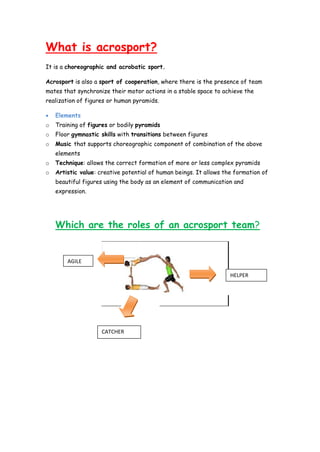
Which are the roles of an acrosport team?
CATCHER
AGILE
HELPER
Technical aspects
Supports:
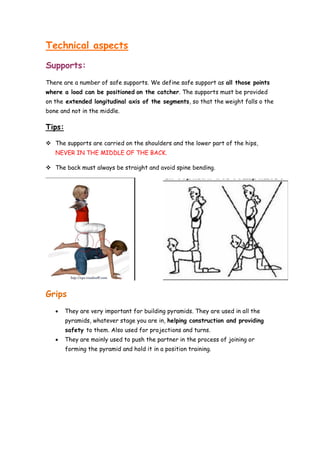
There are a number of safe supports. We define safe support as all those points
where a load can be positioned on the catcher. The supports must be provided
on the extended longitudinal axis of the segments, so that the weight falls o the
bone and not in the middle.
Tips:
 The supports are carried on the shoulders and the lower part of the hips,
NEVER IN THE MIDDLE OF THE BACK.
 The back must always be straight and avoid spine bending.
Grips
 They are very important for building pyramids. They are used in all the
pyramids, whatever stage you are in, helping construction and providing
safety to them. Also used for projections and turns.
 They are mainly used to push the partner in the process of joining or
forming the pyramid and hold it in a position training.
What are dams in acrosport?
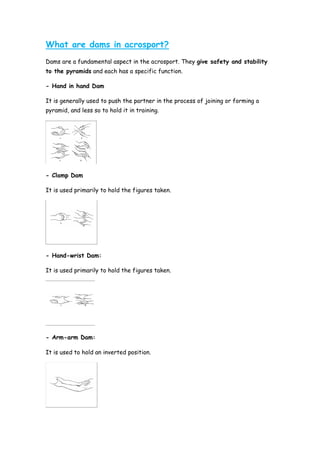
Dams are a fundamental aspect in the acrosport. They give safety and stability
to the pyramids and each has a specific function.
- Hand in hand Dam
It is generally used to push the partner in the process of joining or forming a
pyramid, and less so to hold it in training.
- Clamp Dam
It is used primarily to hold the figures taken.
- Hand-wrist Dam:
It is used primarily to hold the figures taken.
- Arm-arm Dam:
It is used to hold an inverted position.
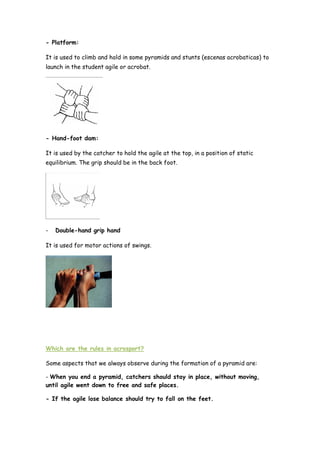
- Platform:
It is used to climb and hold in some pyramids and stunts (escenas acrobaticas) to
launch in the student agile or acrobat.
- Hand-foot dam:
It is used by the catcher to hold the agile at the top, in a position of static
equilibrium. The grip should be in the back foot.
- Double-hand grip hand
It is used for motor actions of swings.
Which are the rules in acrosport?
Some aspects that we always observe during the formation of a pyramid are:
- When you end a pyramid, catchers should stay in place, without moving,
until agile went down to free and safe places.
- If the agile lose balance should try to fall on the feet.
- Any person who falls never must not grip anyone.
Also in each of the formations, we must take into account:
- Place the back always straight
-Do not relax the muscles in order to adapt to rigid postures
- Do not rest or stand (apoyarse) on the back half of the classmate
- Locate areas suitable for the support
How to make a proper pyramid?
- Phase 1: Construction of the pyramid, assemble
Forming the base, catchers will adopt the positions selected in the firmest
position possible. Students who will occupy the highest part will climb keeping
close as possible to the base, with head erect and exerting downward pressure
force, avoiding any push out laterally. The pyramid is formed from the inside out
and from bottom to top.
- Phase 2: Stabilization
The pyramid must be kept for at least 5 seconds. If the weight distribution is
correct, the pyramid will stay. If it’s necessary doing position corrections should
be made to correct the imbalances that occur.
- Phase 3: Outcome, disassemble
This should always be done in reverse to the first phase, being agile which should
go down forward or sideways. The helpers help at the reception, holding by the
waist and back to the agile, always have in mind that guidelines on the reception on
the ground that are explained below:
- The ground contact should always be open with your feet slightly outward to
increase the basis of balance. Going down, it is always ahead.
- The agile, after losing the balance, must always try to fall on the feet, bending
the knees to absorb the impact.
- The spine should be straight, arms outstretched to the sides and trunk (tronco)
bended (doblado) forward.
- The catchers must keep their positions till agile fall in places safely.
There are two important aspects when developing an acrosport choreography,
and are:
- Firstly, the exercises link (transitions) between a pyramid and the next one.
- Secondly, appropriate music to choreography.

Acrosport

  • 1.
  • 2.
    What is acrosport? Itis a choreographic and acrobatic sport. Acrosport is also a sport of cooperation, where there is the presence of team mates that synchronize their motor actions in a stable space to achieve the realization of figures or human pyramids.  Elements o Training of figures or bodily pyramids o Floor gymnastic skills with transitions between figures o Music that supports choreographic component of combination of the above elements o Technique: allows the correct formation of more or less complex pyramids o Artistic value: creative potential of human beings. It allows the formation of beautiful figures using the body as an element of communication and expression. Which are the roles of an acrosport team? CATCHER AGILE HELPER
  • 3.
    Technical aspects Supports: There area number of safe supports. We define safe support as all those points where a load can be positioned on the catcher. The supports must be provided on the extended longitudinal axis of the segments, so that the weight falls o the bone and not in the middle. Tips:  The supports are carried on the shoulders and the lower part of the hips, NEVER IN THE MIDDLE OF THE BACK.  The back must always be straight and avoid spine bending. Grips  They are very important for building pyramids. They are used in all the pyramids, whatever stage you are in, helping construction and providing safety to them. Also used for projections and turns.  They are mainly used to push the partner in the process of joining or forming the pyramid and hold it in a position training.
  • 4.
    What are damsin acrosport? Dams are a fundamental aspect in the acrosport. They give safety and stability to the pyramids and each has a specific function. - Hand in hand Dam It is generally used to push the partner in the process of joining or forming a pyramid, and less so to hold it in training. - Clamp Dam It is used primarily to hold the figures taken. - Hand-wrist Dam: It is used primarily to hold the figures taken. - Arm-arm Dam: It is used to hold an inverted position.
  • 5.
    - Platform: It isused to climb and hold in some pyramids and stunts (escenas acrobaticas) to launch in the student agile or acrobat. - Hand-foot dam: It is used by the catcher to hold the agile at the top, in a position of static equilibrium. The grip should be in the back foot. - Double-hand grip hand It is used for motor actions of swings. Which are the rules in acrosport? Some aspects that we always observe during the formation of a pyramid are: - When you end a pyramid, catchers should stay in place, without moving, until agile went down to free and safe places. - If the agile lose balance should try to fall on the feet.
  • 6.
    - Any personwho falls never must not grip anyone. Also in each of the formations, we must take into account: - Place the back always straight -Do not relax the muscles in order to adapt to rigid postures - Do not rest or stand (apoyarse) on the back half of the classmate - Locate areas suitable for the support How to make a proper pyramid? - Phase 1: Construction of the pyramid, assemble Forming the base, catchers will adopt the positions selected in the firmest position possible. Students who will occupy the highest part will climb keeping close as possible to the base, with head erect and exerting downward pressure force, avoiding any push out laterally. The pyramid is formed from the inside out and from bottom to top. - Phase 2: Stabilization The pyramid must be kept for at least 5 seconds. If the weight distribution is correct, the pyramid will stay. If it’s necessary doing position corrections should be made to correct the imbalances that occur.
  • 7.
    - Phase 3:Outcome, disassemble This should always be done in reverse to the first phase, being agile which should go down forward or sideways. The helpers help at the reception, holding by the waist and back to the agile, always have in mind that guidelines on the reception on the ground that are explained below: - The ground contact should always be open with your feet slightly outward to increase the basis of balance. Going down, it is always ahead. - The agile, after losing the balance, must always try to fall on the feet, bending the knees to absorb the impact. - The spine should be straight, arms outstretched to the sides and trunk (tronco) bended (doblado) forward. - The catchers must keep their positions till agile fall in places safely. There are two important aspects when developing an acrosport choreography, and are: - Firstly, the exercises link (transitions) between a pyramid and the next one. - Secondly, appropriate music to choreography.