Crafting Effective
Acknowledgment
Letters: Best
Practices and
Strategies
Acknowledgment letters are essential for expressing and . They serve to reinforce relationships
and demonstrate professionalism. In this presentation, we will explore the best practices and strategies for crafting
e ective
ff acknowledgment letters that leave a lasting impression.
INTRODUCTION TO ACKNOWLEDGMENT LETTERS
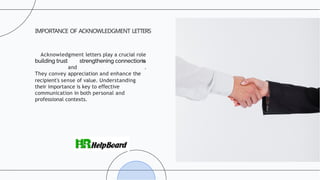
Acknowledgment letters play a crucial role
in
and .
They convey appreciation and enhance the
recipient's sense of value. Understanding
their importance is key to e ective
ff
communication in both personal and
professional contexts.
IMPORTANCE OF ACKNOWLEDGMENT LETTERS
An e ective
ff acknowledgment letter should include essential elements such as a , a clear statement of
, and a that reinforces the relationship. Each element contributes to a well-rounded and
impactful message.
KEY ELEMENTS OF ACKNOWLEDGMENT LETTERS
The of your letter should match the
relationship with the recipient. Use
while maintaining
warmth and sincerity. Tailoring your message
enhances its e ectiveness
ff and ensures the
recipient feels valued.
TONE AND LANGUAGE CONSIDERATIONS
Personalizing your acknowledgment letter is
vital for making it meaningful. Incorporate
specific details about the recipient's
contributions or actions. This approach
demonstrates that you genuinely appreciate
their e orts
ff and strengthens your connection.
PERSONALIZATION TECHNIQUES
Avoid common pitfalls such as being too
vague, overly formal, or neglecting to
proofread. These mistakes can diminish the
impact of your acknowledgment letter. Stay
clear and concise, ensuring your message
resonates with the recipient.
COMMON MISTAKES TO AVOID
Examples provide valuable insights into e ective
ff writing. Review various templates and formats to inspire
your own letters. Understanding di erent
ff contexts will help you craft tailored messages for diverse situations.
EXAMPLES OF ACKNOWLEDGMENT LETTERS
In conclusion, crafting e ective
ff acknowledgment letters requires
attention to detail, personalization, and a professional tone. By
implementing the best practices discussed, you can enhance your
communication skills and strengthen your relationships.
CONCLUSION AND KEY TAKEAWAYS
Thanks
!
Do you have any questions?
info@hrhelpboard.com
www.hrhelpboard.com
@hrhelpboard

Acknowledgement Sample, Acknowledgement Letter

  • 1.
  • 2.
    Acknowledgment letters areessential for expressing and . They serve to reinforce relationships and demonstrate professionalism. In this presentation, we will explore the best practices and strategies for crafting e ective ff acknowledgment letters that leave a lasting impression. INTRODUCTION TO ACKNOWLEDGMENT LETTERS
  • 3.
    Acknowledgment letters playa crucial role in and . They convey appreciation and enhance the recipient's sense of value. Understanding their importance is key to e ective ff communication in both personal and professional contexts. IMPORTANCE OF ACKNOWLEDGMENT LETTERS
  • 4.
    An e ective ffacknowledgment letter should include essential elements such as a , a clear statement of , and a that reinforces the relationship. Each element contributes to a well-rounded and impactful message. KEY ELEMENTS OF ACKNOWLEDGMENT LETTERS
  • 5.
    The of yourletter should match the relationship with the recipient. Use while maintaining warmth and sincerity. Tailoring your message enhances its e ectiveness ff and ensures the recipient feels valued. TONE AND LANGUAGE CONSIDERATIONS
  • 6.
    Personalizing your acknowledgmentletter is vital for making it meaningful. Incorporate specific details about the recipient's contributions or actions. This approach demonstrates that you genuinely appreciate their e orts ff and strengthens your connection. PERSONALIZATION TECHNIQUES
  • 7.
    Avoid common pitfallssuch as being too vague, overly formal, or neglecting to proofread. These mistakes can diminish the impact of your acknowledgment letter. Stay clear and concise, ensuring your message resonates with the recipient. COMMON MISTAKES TO AVOID
  • 8.
    Examples provide valuableinsights into e ective ff writing. Review various templates and formats to inspire your own letters. Understanding di erent ff contexts will help you craft tailored messages for diverse situations. EXAMPLES OF ACKNOWLEDGMENT LETTERS
  • 9.
    In conclusion, craftinge ective ff acknowledgment letters requires attention to detail, personalization, and a professional tone. By implementing the best practices discussed, you can enhance your communication skills and strengthen your relationships. CONCLUSION AND KEY TAKEAWAYS
  • 10.
    Thanks ! Do you haveany questions? info@hrhelpboard.com www.hrhelpboard.com @hrhelpboard