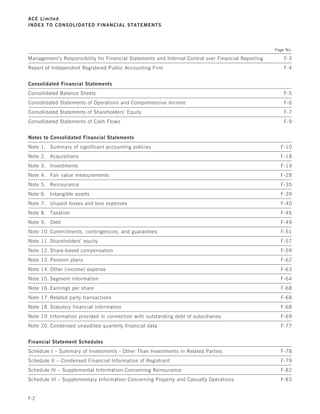
ACE Limited
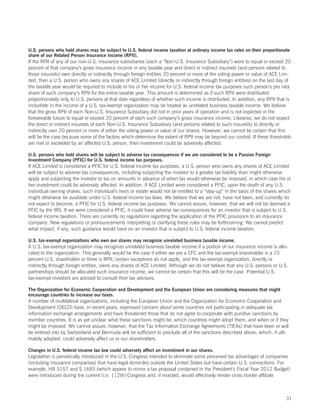
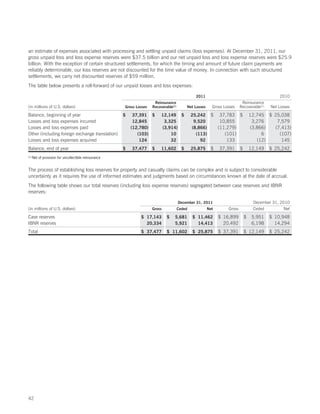
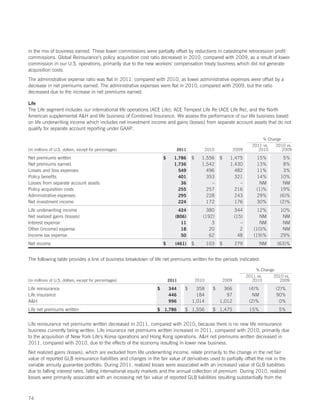
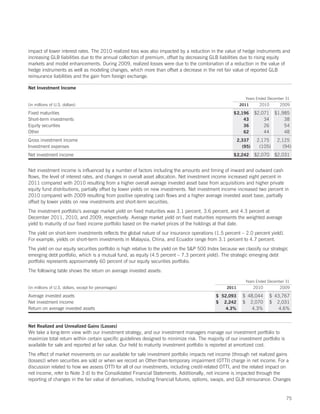
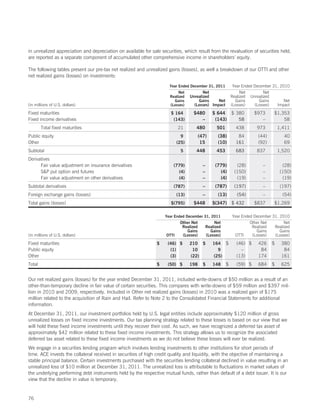
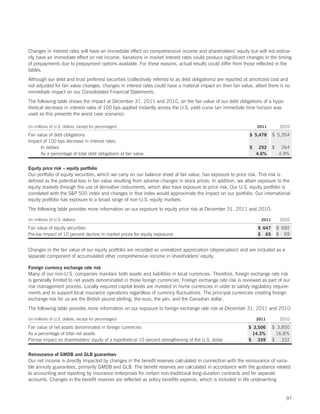
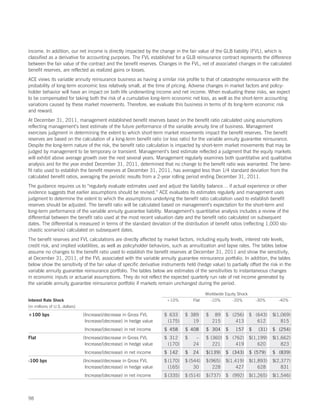
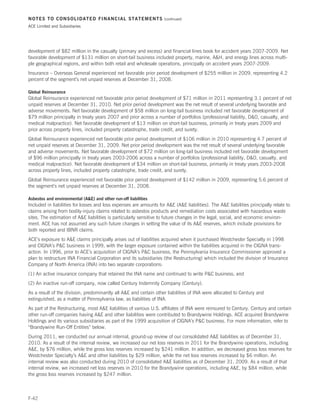
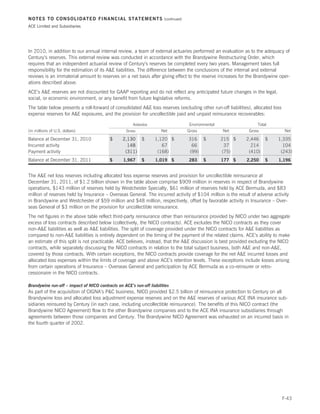
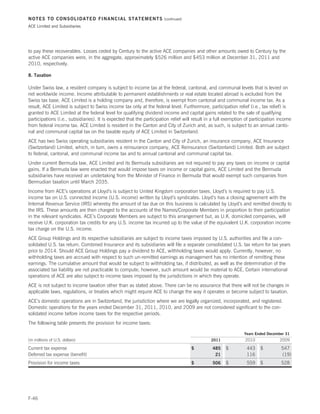
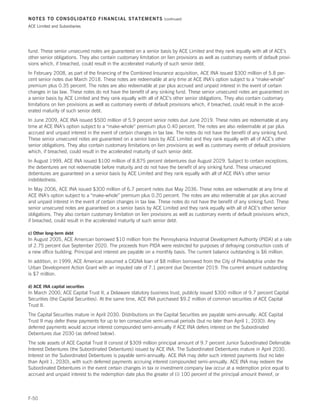
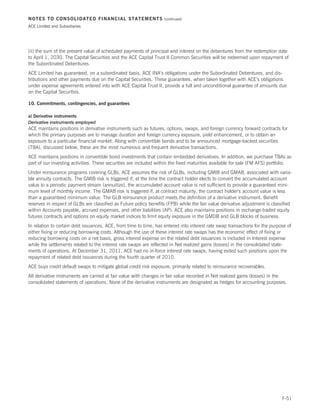
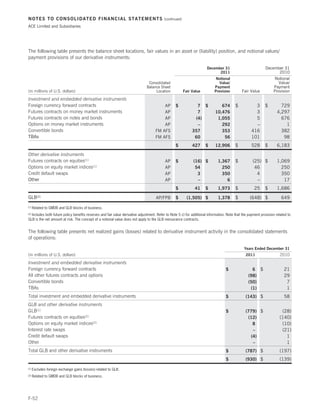
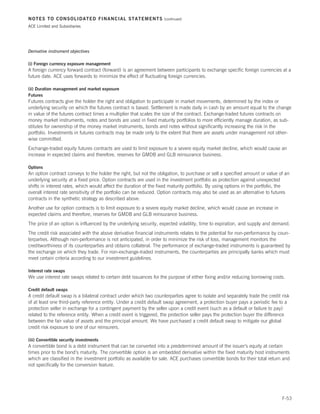
                                      ACE Limited Annual Report 2011


                 Annual Report 2011
ACE Limited
Bärengasse 32
CH-8001 Zurich
Switzerland

acegroup.com
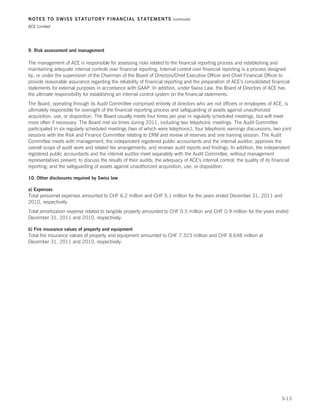
The ACE Group is one of the world’s largest multiline

property and casualty insurers. With operations in
53 countries, ACE provides commercial and personal
property and casualty insurance, personal accident
and supplemental health insurance, reinsurance and
life insurance to a diverse group of clients. ACE Limited,
the parent company of the ACE Group, is listed on
the New York Stock Exchange (NYSE: ACE) and is a
component of the S&P 500 index.


We take on the responsibility of risk so our clients can
take on the responsibility of making things happen.
We call this insuring progress.                   ®


Financial Summary     1
To My Fellow ACE Shareholders         2
Product, Distribution and Geographic Diversification   11
A Local Presence Globally    20
Business Segment Overview        21
                                                             Design and art direction:
Insurance – Overseas General      22                         Rob Frankle
Insurance – North American       24                          for Leo Burnett Business

Global Reinsurance    26
                                                             This Annual Report contains trademarks, trade
Life   28                                                    names and service marks owned by ACE
ACE Limited Board of Directors    30                         Limited and its subsidiaries. In addition, this
                                                             report contains trademarks, trade names or
Officers and Executives     31                               service marks of companies other than us,
Shareholder Information     32                               which belong to their respective owners.

                                                             This report is printed on recycled paper
Form 10-K                                                    containing 10% and 50% post-consumer
                                                             waste. These papers are certified to the
Swiss Statutory Financial Statements                         international standards of the Forest
Environmental Statement                                      Stewardship Council (FSC), which promotes
                                                             responsible management of the world’s
                                                             forests. It was printed by Allied Printing,
                                                             an FSC-certified printer.
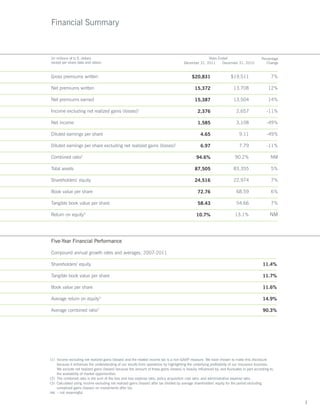
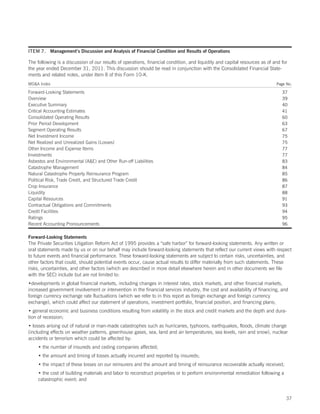
Financial Summary


(in millions of U.S. dollars                                                                          Years Ended                          Percentage
except per share data and ratios)                                                       December 31, 2011     December 31, 2010               Change


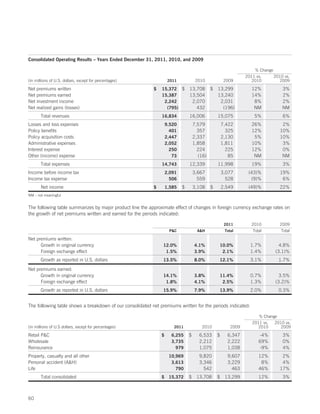
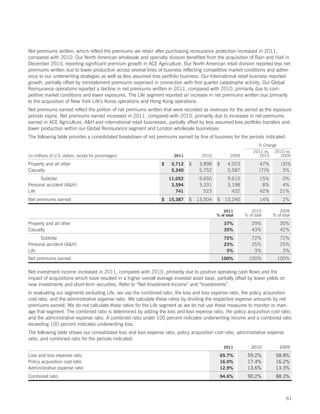
Gross premiums written                                                                       $20,831                   $19,511                    7%

Net premiums written                                                                           15,372                    13,708                 12%

Net premiums earned                                                                            15,387                    13,504                 14%

Income excluding net realized gains (losses)1                                                    2,376                     2,657               -11%

Net income                                                                                       1,585                     3,108               -49%

Diluted earnings per share                                                                         4.65                      9.11              -49%

Diluted earnings per share excluding net realized gains (losses)1                                  6.97                      7.79              -11%

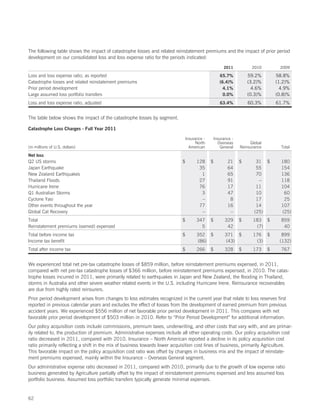
Combined ratio2                                                                                 94.6%                     90.2%                  NM

Total assets                                                                                   87,505                    83,355                   5%

Shareholders’ equity                                                                           24,516                    22,974                   7%

Book value per share                                                                             72.76                     68.59                  6%

Tangible book value per share                                                                    58.43                     54.66                  7%

Return on equity3                                                                               10.7%                     13.1%                  NM


Five-Year Financial Performance

Compound annual growth rates and averages, 2007-2011

Shareholders’ equity                                                                                                                        11.4%

Tangible book value per share                                                                                                               11.7%

Book value per share                                                                                                                        11.6%

Average return on equity3                                                                                                                   14.9%

Average combined ratio2                                                                                                                     90.3%


(1) ncome excluding net realized gains (losses) and the related income tax is a non-GAAP measure. We have chosen to make this disclosure
    I
    because it enhances the understanding of our results from operations by highlighting the underlying profitability of our insurance business.
    We exclude net realized gains (losses) because the amount of these gains (losses) is heavily influenced by, and fluctuates in part according to,
    the availability of market opportunities.
(2)  he combined ratio is the sum of the loss and loss expense ratio, policy acquisition cost ratio, and administrative expense ratio.
    T
(3)  alculated using income excluding net realized gains (losses) after tax divided by average shareholders’ equity for the period excluding
    C
    unrealized gains (losses) on investments after tax.
NM – not meaningful


                                                                                                                                                        1
To My Fellow ACE Shareholders


    Evan G. Greenberg
    Chairman and
    Chief Executive Officer


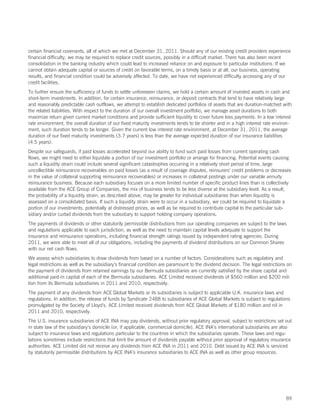
                              ACE performed well in 2011 with financial results that again distinguished our company in the
                              costliest year on record for natural catastrophes globally. With a diversified spread of business
                              by both product and geography, a conservative approach to risk management and underwrit-
                              ing, and a consistent focus on execution, we outperformed the property and casualty industry
                              as measured by operating income, book value and premium revenue growth, and ROE. Our
                              financial results were the product of a clear long-term strategy that we have patiently pursued
                              over the years, and this should continue to benefit us well into the future. The remarkable
                              growth and transformation of our company continued in 2011, and at year-end ACE was the
                              fifth-largest global PC insurer in the world by market cap – up from #11 just five years ago
                              and #14 a decade ago.

                              From Japan’s powerful earthquake and devastating tsunami to earthquakes in New Zealand,
                              floods in Australia and Thailand and severe tornadoes in the United States, 2011 was a year-
                              long newsreel of natural disasters that impacted the industry’s balance sheet with estimated
                              losses in excess of $105 billion, well more than double the $48 billion from 2010 and setting
                              a new record for the industry globally. In addition to the catastrophes, overall business condi-
                              tions remained quite challenging throughout the year with sluggish economic growth in devel-
                              oped economies, financial market volatility fed by the Euro crisis, and soft pricing in insurance
                              markets globally, not to mention extraordinary geopolitical events such as the Arab Spring. In
                              the context of this environment, ACE produced after-tax operating income of nearly $2.4 billion,
                              down 11% from 2010 – a good result relative to the industry, with most companies down on
                              average 20%-50% or more. Our earnings included about $860 million in pre-tax catastrophe
                              losses or twice as much as we incurred in 2010. Excluding the impact of catastrophes from
                              both years, ACE’s operating income increased 5% over 2010.


2
Our strong operating results benefited from both organic growth, particularly in Asia and Latin
America, as well as our late-2010 and early-2011 acquisitions – Rain and Hail in the U.S.,
Jerneh Insurance in Malaysia and New York Life’s operations in Korea and Hong Kong. We
expect these three acquisitions to continue delivering the benefits we envisioned at the time we
acquired them – namely, their revenue and earnings potential as well as their long-term strategic
value – enabling us to take advantage of powerful socioeconomic trends such as America’s
growing food exports to the rest of the world and the rising middle class in fast-growing
developing markets. These new businesses also provide us with enhanced diversification and
sources of revenue not tied to the commercial PC pricing cycle. In November, we acquired
U.S. agribusiness insurer Penn Millers to enhance our capabilities in the agriculture market,
and in December, we acquired Rio Guayas Compañia de Seguros y Reaseguros, the fourth-largest
non-life insurer in Ecuador, which will double our premium volume and broaden our distribu-
tion in that country – one of nine markets in Latin America in which we are active. Whether
organically or through acquisitions to complement our organic activity, we will continue on the
path toward greater diversification, increasing our presence where we see opportunity, and
this translates over time into future top-line growth, more stable earnings power and superior
returns to shareholders.

The single best measure of long-term shareholder wealth creation is book value growth, and in
2011 our book value per share grew 6% while tangible book value per share grew 7% – not
exactly in line with our long-term objective or recent past but quite good considering the catas-
trophe losses and 2%-3% investment yields. Over the last five years, these two measures have
grown at a compound annual rate of about 12%. Share price is ultimately a function of earn-
ings and book value growth. Our shareholders benefited last year from a 14% return on ACE’s
common stock, which compares favorably with a 2% return for the SP 500 and zero growth
for the SP Property  Casualty Insurance Index. ACE’s five-year total return to shareholders –
a measure that captures the combination of share price appreciation and dividends – is 28%,
one of the best performances of any insurance or financial services company in the world.


Product and geographic diversification

ACE is predominantly a global commercial and specialty PC insurance company, but we are
patiently and successfully increasing the balance between products exposed to the commercial
PC pricing cycle and those that are not. This has been part of our long-term strategy. Our PC
product line covers traditional industrial commercial risks such as property insurance, workers’
compensation and general liability plans for large corporations and medium-size companies
as well as specialty coverages ranging from environmental and professional liability to airport
liability and oil rigs. We have two market-leading franchises, ACE USA and ACE International,
which market both industrial commercial and specialty products primarily through retail insur-
ance brokers globally. We also have three well-respected franchises that focus on specialty and
harder-to-place risks, or excess and surplus lines products, distributed through wholesale brokers
– ACE Westchester in the U.S., ACE Global Markets in the London market and our original
company, ACE Bermuda. We also are a major writer of personal accident and supplemental
health insurance globally and have a fast-growing, highly targeted personal lines business
with presence in both the United States and many international markets. Complementing our
PC and AH businesses is a relatively small but growing international life insurance business
focused primarily in emerging markets. Lastly, we have a well-established PC reinsurance


                                                                                                     3
business with operations globally. Products such as accident and health, life insurance, per-
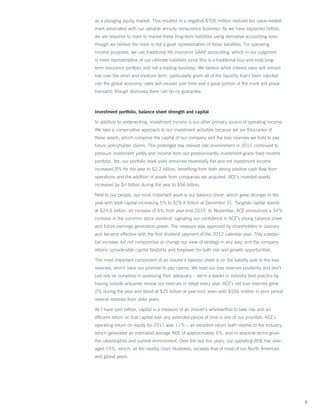
                                   sonal lines and crop insurance are far less impacted by the PC pricing cycle, and in 2011, as
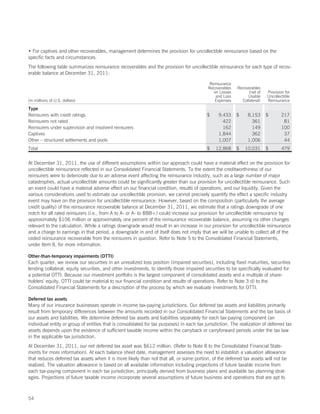
                                   the chart nearby illustrates, approximately 50% of our net premiums came from these lines.

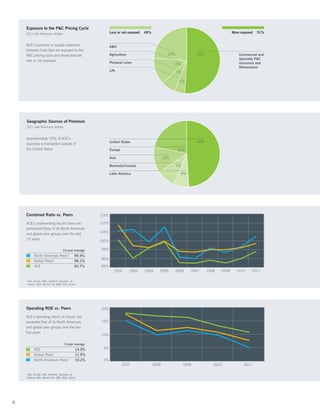
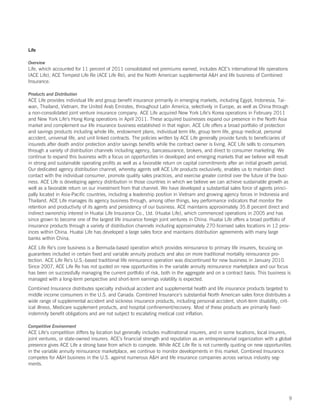
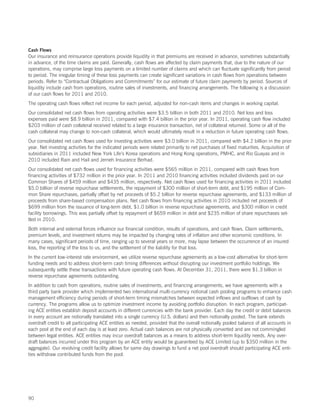
                                   In addition to product diversification, our broad geographic presence is a unique strength and
                                   places us in a very select group of global insurers. One-half of our business is in the U.S. with
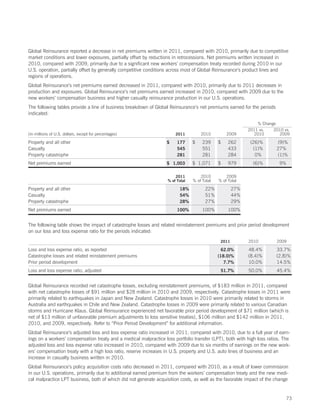
                                   the balance conducted locally in 52 other countries, and this is illustrated in the nearby chart.
                                   Some of our fastest growth is occurring in the developing markets of Asia Pacific and Latin
                                   America – two regions that produced double-digit premium growth in 2011 and have doubled
                                   in size over the last five years.

                                   This combination of product breadth and geographic presence enables us to reach a wide
                                   variety of customers through many different distribution channels. For example, we serve
                                   businesses of all sizes – from large multinational companies to small and medium-size local
    “ ur tremendous product
     O                             businesses through global and regional brokers and agents all over the world. We also serve
     and geographic diversifi-     companies and affinity groups looking to provide or offer supplemental health, accident and
     cation is a key strategy      life insurance programs to their employees, customers or members through ACE’s telemarket-
     of the company that           ing centers and bancassurance partners. And we serve individuals and their families purchas-
     provides balance to           ing personal accident, supplemental health, homeowners, automobile, life and other specialty
     current revenue and           coverage primarily through agents, travel agencies and the Internet.
     income as well as better      Our tremendous product and geographic diversification, as I said earlier, is a key strategy of the
     future opportunity and        company that provides balance to current revenue and income as well as better future opportu-
     predictability of results.”   nity and predictability of results. The strategy has served us well given the unpredictable nature
                                   and volatility of risk, the PC industry pricing cycle and the notable differences in economic
                                   conditions between the developed and developing worlds.


                                   Underwriting discipline – an ACE hallmark
                                   All of our businesses share a common trait – we are underwriters, we take risk for a living.
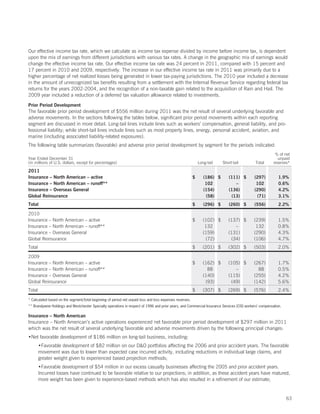
                                   Underwriting is embedded in our ethos and one of the defining characteristics of our culture,
                                   and so we insist on always making a profit in our basic business of taking risk. As an under-
                                   writing company, we are dedicated to continuously improving and refining our underwriting
                                   capabilities, particularly through data analytics, portfolio management and the overall use of
                                   data-driven decision making. We are good, but there is much scope to improve and refine our
                                   process so that we might push the envelope of what it means to have superior risk selection
                                   given the tools available.

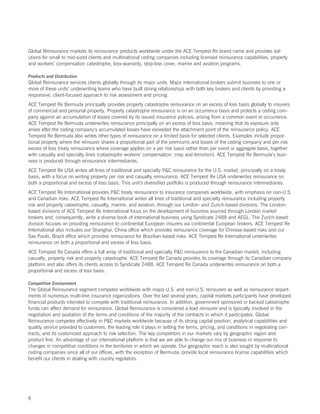
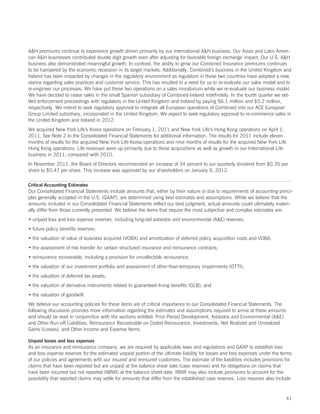
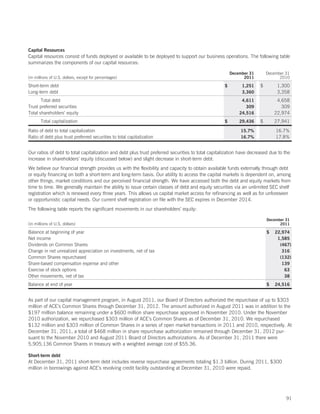
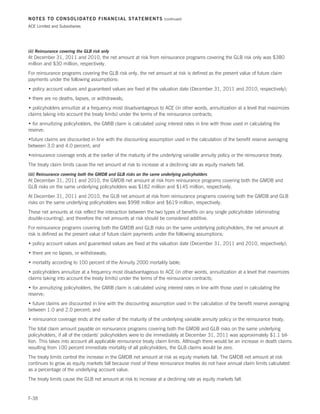
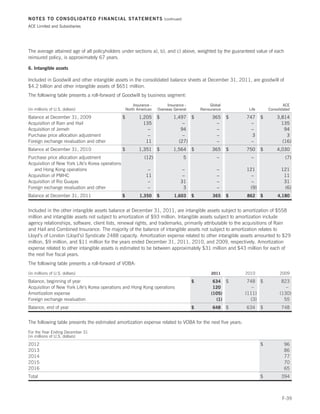
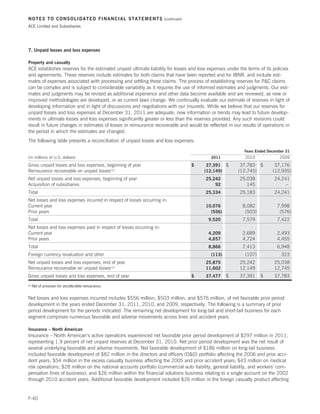
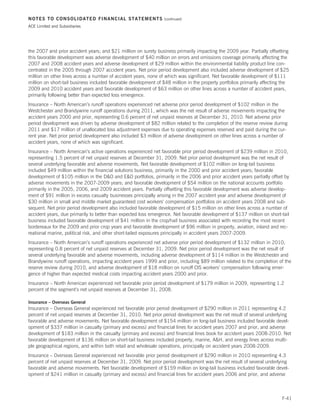
                                   In 2011, we produced $731 million in PC underwriting income while our PC combined
                                   ratio, which measures our underwriting profit margin, was 94.6%. This is an excellent result
                                   that demonstrates ACE’s commitment to underwriting discipline and extends our track record of
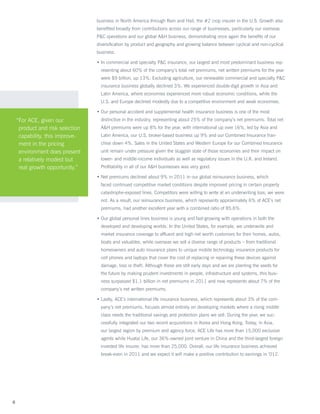
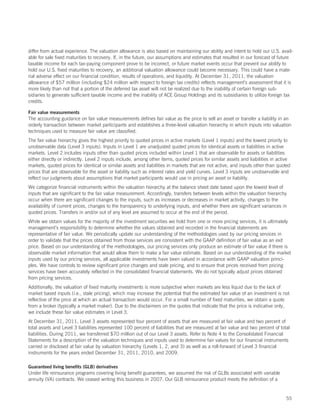
                                   producing a cumulative underwriting profit since we were founded in 1985. The chart nearby
                                   illustrates our underwriting performance versus the industry and our peers over the last 10
                                   years and what it means at ACE to be an underwriting company.

                                   In the third quarter, our net income and book value were impacted by Euro crisis-related
                                   financial market volatility in interest rates, which fell to their lowest level in a century, as well


4
as a plunging equity market. This resulted in a negative $706 million realized fair value-related
mark associated with our variable annuity reinsurance business. As we have explained before,
we are required to mark to market these long-term liabilities using derivative accounting even
though we believe the mark is not a good representation of those liabilities. For operating
income purposes, we use traditional life insurance GAAP accounting, which in our judgment
is more representative of our ultimate liabilities since this is a traditional buy-and-hold long-
term insurance portfolio and not a trading business. We believe while interest rates will remain
low over the short and medium term, particularly given all of the liquidity that’s been injected
into the global economy, rates will recover over time and a good portion of the mark will prove
transient, though obviously there can be no guarantee.


Investment portfolio, balance sheet strength and capital

In addition to underwriting, investment income is our other primary source of operating income.
We take a conservative approach to our investment activities because we are fiduciaries of
these assets, which comprise the capital of our company and the loss reserves we hold to pay
future policyholder claims. The prolonged low interest rate environment in 2011 continued to
pressure investment yields and income from our predominantly investment-grade fixed income
portfolio. Yet, our portfolio book yield remained essentially flat and net investment income
increased 8% for the year to $2.2 billion, benefiting from both strong positive cash flow from
operations and the addition of assets from companies we acquired. ACE’s invested assets
increased by $4 billion during the year to $56 billion.

Next to our people, our most important asset is our balance sheet, which grew stronger in the
year with total capital increasing 5% to $29.4 billion at December 31. Tangible capital stands
at $24.6 billion, an increase of 6% from year-end 2010. In November, ACE announced a 34%
increase in the common stock dividend, signaling our confidence in ACE’s strong balance sheet
and future earnings generation power. The measure was approved by shareholders in January
and became effective with the first dividend payment of the 2012 calendar year. This substan-
tial increase did not compromise or change our view of strategy in any way, and the company
retains considerable capital flexibility and firepower for both risk and growth opportunities.

The most important component of an insurer’s balance sheet is on the liability side or the loss
reserves, which back our promise to pay claims. We treat our loss reserves prudently and don’t
just rely on ourselves in assessing their adequacy – we’re a leader in industry best practice by
having outside actuaries review our reserves in detail every year. ACE’s net loss reserves grew
2% during the year and stood at $25 billion at year-end, even with $556 million in prior period
reserve releases from older years.

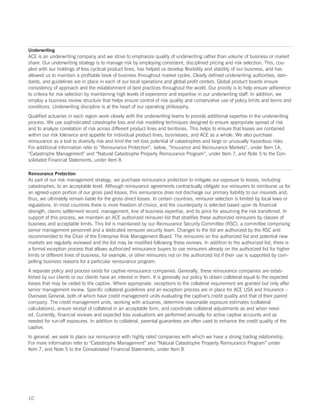
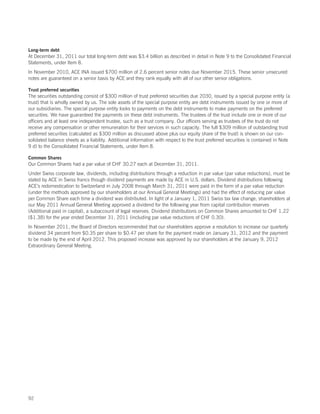
As I have said before, capital is a measure of an insurer’s wherewithal to take risk and an
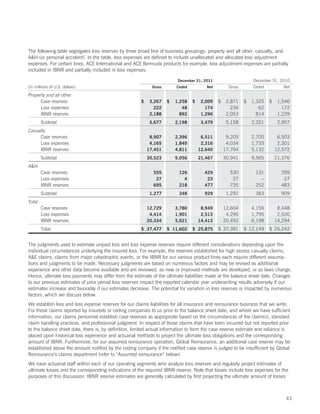
efficient return on that capital over any extended period of time is one of our priorities. ACE’s
operating return on equity for 2011 was 11% – an excellent return both relative to the industry,
which generated an estimated average ROE of approximately 4%, and in absolute terms given
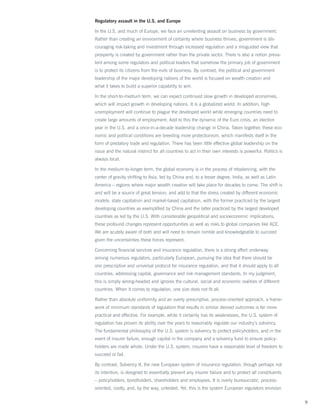
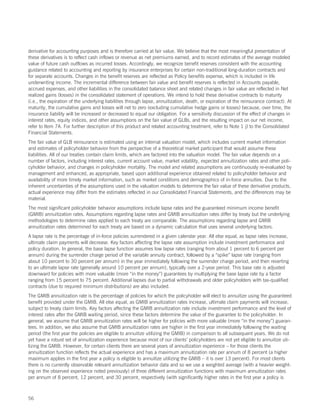
the catastrophes and current environment. Over the last five years, our operating ROE has aver-
aged 15%, which, as the nearby chart illustrates, exceeds that of most of our North American
and global peers.


                                                                                                    5
Exposure to the PC Pricing Cycle
    2011 Net Premiums Written                                  Less or not exposed   49%                                                  More exposed   51%


    ACE’s business is equally balanced                         AH
    between lines that are exposed to the
    PC pricing cycle and those that are                       Agriculture                          24%               51%                     Commercial and
                                                                                                                                              Specialty PC
    less or not exposed                                        Personal Lines                           13%                                   Insurance and
                                                                                                                                              Reinsurance
                                                               Life
                                                                                                          7%

                                                                                                            5%


    Geographic Sources of Premium
    2011 Net Premiums Written


    Approximately 50% of ACE’s
                                                               United States                                          49%
    business is transacted outside of
    the United States                                          Europe                                      21%

                                                               Asia                               13%

                                                               Bermuda/Canada                             9%

                                                               Latin America                                8%


    Combined Ratio vs. Peers                            115%

    ACE’s underwriting results have out-                110%
    performed those of its North American
    and global peer groups over the last                105%
    10 years
                                                        100%

                                      10-year average   95%
             North American Peers1              99.4%
                                                        90%
             Global Peers2                      98.1%
             ACE                                92.7%   85%                                                                                          2011
                                                                  2002       2003    2004     2005        2006    2007      2008   2009      2010    2011

    1
        AIG, Chubb, CNA, Hartford, Travelers, XL
    2
        Allianz, AXA, Munich Re, QBE, RSA, Zurich


    Operating ROE vs. Peers                             20%

    ACE’s operating return on equity has
    exceeded that of its North American                 15%
    and global peer groups over the last
    five years
                                                        10%

                                       5-year average
             ACE                                14.9%    5%
             Global Peers2                      11.9%
             North American Peers1              10.2%    0%
                                                                        2007               2008                2009            2010              2011

    1
        AIG, Chubb, CNA, Hartford, Travelers, XL
    2
        Allianz, AXA, Munich Re, QBE, RSA, Zurich


6
A changing market

Whether it was the tsunami that followed the Japanese earthquake, the floods in Australia
and Thailand or the spring tornadoes in the U.S., most of the year’s record natural catastro-
phe losses were what we call non-modeled events. The mathematical risk and pricing models
the industry uses to project losses from natural catastrophes didn’t include these events, and
there is now an overall rise in the industry’s perception of risk. In my judgment, these non-
modeled losses remind us how imprecise the science of catastrophe underwriting is, and this
lesson applies to many other product areas where we use past experience to project the future.
Unfortunately, the past is not necessarily representative of the future, as is often the case. Many
casualty lines come to mind.

Despite the losses, the industry remains well capitalized and many competitors continue their
pursuit of market share at the expense of an adequate underwriting profit or risk-adjusted
return on capital. Their balance sheets and reserves overall might be OK, although that varies by
company, but their ROEs and income statements are not. And the external environment remains
troubled – slow economic growth, interest rates at historic lows, high catastrophe losses and
prices that in most lines of business aren’t keeping up with loss cost trend. All this adds pressure
to the rates insurers charge.

In the U.S., as the year progressed, a floor developed under pricing in most classes, rate
decreases slowed and many classes began to achieve flat or modestly positive rate. This chang-
ing market continued to accelerate into the fourth quarter and beginning of ’012 with greater
rate increases taking hold where the pain from losses in any given line – property or workers’
comp are good examples – becomes so acute that more substantial rate increases follow. For
the balance of most classes, again, rates have flattened broadly or are rising modest single digit.
Catastrophe-exposed property rates continue to rise more substantially while casualty prices are
flat to up but generally not yet at a pace that exceeds loss costs. Outside the U.S., the market
remains soft except in catastrophe-prone areas. In my judgment, this is not a balance sheet-
driven hard market but rather an income statement-driven price correction and rate increases,
therefore, will be more modest and take longer to materialize. We project industry combined
ratios excluding catastrophes will continue to climb but at a slower rate. Nonetheless, these
price increases are a good development and we are encouraged by the trend.

However, from what we observe today, with industry capital redundant, loss reserves reason-
ably adequate and operating cash flow positive, it will likely take some combination of external
events such as catastrophes both natural and manmade, or a pick-up in inflation, together with
continued underpricing, before we see a meaningful impact to the industry balance sheet and
rates overall move with conviction to a level that produces a reasonable risk-adjusted ROE. For
now, the industry is transitioning toward managing mediocrity with greater excellence. For ACE,
given our product and risk selection capability, this improvement in the pricing environment
does present a relatively modest but real growth opportunity.


Premium growth from acquisitions and organic activity

During the year, we continued to balance underwriting discipline with opportunities to grow.
Total company net written premiums in 2011 were $15.4 billion, up 12% compared with 2010.
While we are primarily builders and focused first on organic growth, a substantial portion of last
year’s increase was attributed to recent acquisitions, the largest being our expanded agriculture


                                                                                                       7
business in North America through Rain and Hail, the #2 crop insurer in the U.S. Growth also
                                  benefited broadly from contributions across our range of businesses, particularly our overseas
                                  PC operations and our global AH business, demonstrating once again the benefits of our
                                  diversification by product and geography and growing balance between cyclical and non-cyclical
                                  business.

                                  • n commercial and specialty PC insurance, our largest and most predominant business rep-
                                    I
                                    resenting about 60% of the company’s total net premiums, net written premiums for the year
                                    were $9 billion, up 13%. Excluding agriculture, our renewable commercial and specialty PC
                                    insurance business globally declined 3%. We experienced double-digit growth in Asia and
                                    Latin America, where economies experienced more robust economic conditions, while the
                                    U.S. and Europe declined modestly due to a competitive environment and weak economies.

                                  •  ur personal accident and supplemental health insurance business is one of the most
                                    O
    “ or ACE, given our
     F                              distinctive in the industry, representing about 25% of the company’s net premiums. Total net
     product and risk selection     AH premiums were up 8% for the year, with international up over 16%, led by Asia and
     capability, this improve-      Latin America, our U.S. broker-based business up 9% and our Combined Insurance fran-
     ment in the pricing            chise down 4%. Sales in the United States and Western Europe for our Combined Insurance
     environment does present       unit remain under pressure given the sluggish state of those economies and their impact on
     a relatively modest but        lower- and middle-income individuals as well as regulatory issues in the U.K. and Ireland.
     real growth opportunity.”      Profitability in all of our AH businesses was very good.

                                  •  et premiums declined about 9% in 2011 in our global reinsurance business, which
                                    N
                                    faced continued competitive market conditions despite improved pricing in certain property
                                    catastrophe-exposed lines. Competitors were willing to write at an underwriting loss; we were
                                    not. As a result, our reinsurance business, which represents approximately 6% of ACE’s net
                                    premiums, had another excellent year with a combined ratio of 85.6%.

                                  •  ur global personal lines business is young and fast-growing with operations in both the
                                    O
                                    developed and developing worlds. In the United States, for example, we underwrite and
                                    market insurance coverage to affluent and high net worth customers for their homes, autos,
                                    boats and valuables, while overseas we sell a diverse range of products – from traditional
                                    homeowners and auto insurance plans to unique mobile technology insurance products for
                                    cell phones and laptops that cover the cost of replacing or repairing these devices against
                                    damage, loss or theft. Although these are still early days and we are planting the seeds for
                                    the future by making prudent investments in people, infrastructure and systems, this busi-
                                    ness surpassed $1.1 billion in net premiums in 2011 and now represents about 7% of the
                                    company’s net written premiums.

                                  •  astly, ACE’s international life insurance business, which represents about 3% of the com-
                                    L
                                    pany’s net premiums, focuses almost entirely on developing markets where a rising middle
                                    class needs the traditional savings and protection plans we sell. During the year, we suc-
                                    cessfully integrated our two recent acquisitions in Korea and Hong Kong. Today, in Asia,
                                    our largest region by premium and agency force, ACE Life has more than 15,000 exclusive
                                    agents while Huatai Life, our 36%-owned joint venture in China and the third-largest foreign
                                    invested life insurer, has more than 25,000. Overall, our life insurance business achieved
                                    break-even in 2011 and we expect it will make a positive contribution to earnings in ’012.


8
Regulatory assault in the U.S. and Europe

In the U.S. and much of Europe, we face an unrelenting assault on business by government.
Rather than creating an environment of certainty where business thrives, government is dis-
couraging risk-taking and investment through increased regulation and a misguided view that
prosperity is created by government rather than the private sector. There is also a notion preva-
lent among some regulators and political leaders that somehow the primary job of government
is to protect its citizens from the evils of business. By contrast, the political and government
leadership of the major developing nations of the world is focused on wealth creation and
what it takes to build a superior capability to win.

In the short-to-medium term, we can expect continued slow growth in developed economies,
which will impact growth in developing nations. It is a globalized world. In addition, high
unemployment will continue to plague the developed world while emerging countries need to
create large amounts of employment. Add to this the dynamic of the Euro crisis, an election
year in the U.S. and a once-in-a-decade leadership change in China. Taken together, these eco-
nomic and political conditions are breeding more protectionism, which manifests itself in the
form of predatory trade and regulation. There has been little effective global leadership on the
issue and the natural instinct for all countries to act in their own interests is powerful. Politics is
always local.

In the medium-to-longer term, the global economy is in the process of rebalancing, with the
center of gravity shifting to Asia, led by China and, to a lesser degree, India, as well as Latin
America – regions where major wealth creation will take place for decades to come. The shift is
and will be a source of great tension, and add to that the stress created by different economic
models: state capitalism and market-based capitalism, with the former practiced by the largest
developing countries as exemplified by China and the latter practiced by the largest developed
countries as led by the U.S. With considerable geopolitical and socioeconomic implications,
these profound changes represent opportunities as well as risks to global companies like ACE.
We are acutely aware of both and will need to remain nimble and knowledgeable to succeed
given the uncertainties these forces represent.

Concerning financial services and insurance regulation, there is a strong effort underway
among numerous regulators, particularly European, pursuing the idea that there should be
one prescriptive and universal protocol for insurance regulation, and that it should apply to all
countries, addressing capital, governance and risk management standards. In my judgment,
this is simply wrong-headed and ignores the cultural, social and economic realities of different
countries. When it comes to regulation, one size does not fit all.

Rather than absolute uniformity and an overly prescriptive, process-oriented approach, a frame-
work of minimum standards of regulation that results in similar desired outcomes is far more
practical and effective. For example, while it certainly has its weaknesses, the U.S. system of
regulation has proven its ability over the years to reasonably regulate our industry’s solvency.
The fundamental philosophy of the U.S. system is solvency to protect policyholders, and in the
event of insurer failure, enough capital in the company and a solvency fund to ensure policy-
holders are made whole. Under the U.S. system, insurers have a reasonable level of freedom to
succeed or fail.

By contrast, Solvency II, the new European system of insurance regulation, though perhaps not
its intention, is designed to essentially prevent any insurer failure and to protect all constituents
– policyholders, bondholders, shareholders and employees. It is overly bureaucratic, process-
oriented, costly, and, by the way, untested. Yet, this is the system European regulators envision

                                                                                                          9
for the world and believe should be used as the measure to judge the equivalency of all others
     for purposes of reciprocity. Our industry fared well during the financial crisis, so I am not sure
     what problem we are trying to solve by pressing to adopt a Solvency II-like system as our global
     standard of regulation. In fact, I believe such an approach would do great harm. If we aren’t
     careful, we will turn our industry into a utility.

     I am all for modernizing our regulatory structures to take advantage of advances in risk man-
     agement, technology and finance that have occurred over the past 20 years. Frankly, there are
     parts of Solvency II that have merit. But let’s be thoughtful and clear about our objectives. To
     begin with, the U.S., led by the new Federal Insurance Office with the support and knowledge
     of the NAIC and state regulators, can together bring a powerful voice and an alternative
     approach to this debate.


     The ACE culture: optimism

     During the year we had a number of changes to our senior management team. John Keogh was
     appointed chief operating officer of the company, with responsibility for PC insurance opera-
     tions globally, in addition to his duties as chairman of the Overseas General business segment.
     John Lupica was named chairman of the company’s North American insurance operations,
     succeeding Brian Dowd in this role. After 17 years with ACE, Brian retired from full-time
     employment but remains an active and vital member of our Office of the Chairman working with
     me and other members of the management team focused on underwriting strategy and other
     related matters. He has much to contribute and we will continue to benefit from his knowledge
     of this business. John Keogh and John Lupica are two experienced and impressive leaders with
     over 25 years each in our industry. The depth, breadth and continuity of our management team
     globally are truly a source of strength for our company.

     And so, to my fellow employees, my senior management team colleagues and our outstanding
     board of directors, I thank you all for your contributions to a very good year at ACE. I also wish
     to thank, in particular, Bruce Crockett and John Krol, two long-serving directors who have
     announced they are retiring. Bruce has served on the board since 1995 and John since
     2001; I am grateful to both for their wisdom and counsel over many years.

     We live in very difficult and complex times that will likely persist, and we strive to recognize
     that in our planning because we are realists. But at ACE we are also optimists – we have a
     quiet confidence and a culture of optimism for good reason: We believe in the opportunity that
     surrounds us and we are committed as a team to working hard to take advantage of it. The
     professional women and men of ACE around the globe distinguish our company every day by
     their expertise, discipline, youthful energy and passion. I am very proud to be but one member
     of this tremendous family.

     Sincerely,


     Evan G. Greenberg
     Chairman and Chief Executive Officer


10
ACE’s broad portfolio of insurance products –
commercial and specialty PC, AH, personal
lines, reinsurance and life – combined with its
local presence in more than 50 countries around
the world, enables the company to serve customers
ranging from large multinational companies to
small and mid-size businesses to local consumers.
The company’s diverse distribution channels,
including brokers, captive and independent
agents, telemarketing, bancassurance and
affinity partnerships and the Internet, offer the
possibility of extending relationships with
existing customers and distribution partners
while reaching new ones in locations around
the globe.
The following stories illustrate ACE’s product,
distribution and geographic diversification
and highlight how the company is effectively
meeting customers’ wide-ranging insurance
and risk management needs.


                                                    11
Honeywell
     As global corporations expand their operations
     around the world, ACE is on the ground in every
     major market to provide much needed risk manage-
     ment services and risk transfer solutions. The long
     relationship between ACE and Honeywell exempli-
     fies how ACE’s geographic breadth, global resources
     and expertise support the complex needs of sophis-
     ticated clients.

     Honeywell is a Fortune 100 diversified technol-
     ogy and manufacturing leader, serving customers
     worldwide with aerospace products and services,
     commercial and residential control technologies,
     automotive products, turbochargers and performance
     materials. The company was one of ACE’s early
     policyholders 25 years ago.

     Today, ACE provides 20 different specialty products
     and services covering Honeywell’s operations in
     more than 100 countries globally. These run the
     gamut from accident and health, excess casualty
     and aviation coverages for multiple countries, to
     working with Honeywell’s insurance subsidiaries for
     U.S. workers’ compensation, commercial auto-
     mobile and international liability risks. ACE is also
     key in Honeywell’s Defense Base Act coverage for
     its U.S. government contracts and environmental
     liability coverage, among other programs.

     “Wherever we are in the world, ACE is there to work       ACE provides large multinational
     with us to reach a solution,” says Lois Fuchs, Vice       companies with a wide range
     President, Risk Management, at Honeywell.                 of industrial commercial and
                                                               specialty coverages
     Honeywell’s emphasis on safety and security is
                                                               • Aviation
     supported in nearly 40 countries by ESIS – ACE’s
                                                               •  asualty (foreign, excess,
                                                                 C
     risk management services unit. Each year, ESIS risk         general, umbrella)
                                                               • Contract liability
     engineering experts make approximately 300 site
                                                               • Construction/wrap-ups
     visits to Honeywell facilities to evaluate occupational   • Defense Base Act
     safety and health risks and provide related improve-      •  irectors and officers/
                                                                 D
                                                                 professional lines
     ment recommendations and training. For Honey-
                                                               • Energy and power generation
     well’s newly acquired companies, ESIS conducts            • Environmental risks
     baseline assessments of industrial hygiene, worksta-      • Errors and omissions
                                                               • Events liability
     tion ergonomics and machine guarding equipment
                                                               • Group accident and health
     and works with Honeywell to bring them up to              • Manufacturing risks
     Honeywell’s high standards.                               • Marine – inland/ocean
                                                               • Medical risk
     Always at the forefront of risk management,               • Mergers and acquisitions
     Honeywell recently was among the first companies          • Political risk/trade credit
     to take advantage of ACE’s new services for global        • Product liability
                                                               • Property
     companies, including the global client executive
                                                               • Risk/claims management
     program and ACE’s WorldviewSM information portal,         • Surety
     that help manage the growing touchpoints between          • Privacy/network security

     Honeywell and ACE across the globe.                       • Workers’ compensation

12
Honeywell purchases ACE’s com-
mercial PC insurance and related
services for multinational compa-
nies through large global insurance
brokers. ACE distributes industrial
commercial and specialty PC
insurance to large and mid-size
companies primarily through retail
insurance brokers and excess and
surplus lines products through
wholesale insurance brokers.


Photos, l-r: ESIS Industrial Hygiene
Practice Leader Tim Frazer (I), con-
ducts training at a Honeywell facility
in Nanjing, China; Lois Fuchs, Vice
President, Risk Management,
Honeywell, with John Alfieri, New
York Regional Executive Officer, ACE
USA, and President, Global Client
Executive Practice, at Honeywell’s
headquarters in Morris Township,
N.J.; and Mark Kealy (l), Vice
President, Casualty, ACE Bermuda
International, with Paul Piazza,
Director, Risk Management,
Honeywell, in Dublin, Ireland.

                                         13
Telefónica                                              Telefónica’s customers purchase
                                                             ACE’s mobile device replace-
                                                             ment coverage and personal
     In both developed and developing markets around         accident insurance in three
                                                             ways: 1) face to face in
     the world, ACE offers consumers basic protection,       Telefónica’s retail stores, 2) via
     such as personal accident and supplemental health       ACE’s telemarketing centers,
     insurance, as well as novel lifestyle-oriented cover-   and 3) through their phone
                                                             service. ACE distributes personal
     age like mobile phone insurance. To reach large
                                                             lines insurance to individual
     numbers of potential customers efficiently, ACE         consumers and their families
     often partners with major consumer companies, such      through multiple channels. ACE
     as Spain’s telecommunications giant Telefónica, to      also distributes specialty per-
                                                             sonal lines coverage, personal
     sponsor insurance programs.
                                                             accident and supplemental health
     When Telefónica acquired O2, the United Kingdom’s       insurance through companies
                                                             and affinity groups looking to
     leading mobile operator, in 2006, it discovered
                                                             provide or offer insurance to
     ACE’s mobile phone program for retail customers,        their employees or members.
     which it had provided for O2 for several years. The
     program, offered to customers with long-term con-
     tracts, quickly provided a replacement mobile phone
     in the event of accidental damage, theft or loss.
     Thanks to the mobile program’s success, Telefónica
     Insurance, the company’s insurance subsidiary,
     engaged ACE to jointly sponsor similar coverage
     in other European and South American markets,
     primarily through Telefónica’s O2 and Movistar retail
     locations.

     Business flourished, and Telefónica Insurance and
     ACE also recognized another opportunity – offer-
     ing AH insurance, such as personal accident and
     hospital cash coverages, through face-to-face and
     telemarketing sales to phone customers in South
     America.

     More recently, ACE has developed a way for Tele-
     fónica customers in Brazil to purchase very basic
     insurance coverages through their phone service.

     The underwriting and program management ser-
     vices ACE provides in cooperation with Telefónica
     Insurance have also become more complex with the
     addition of new products and varying distribution       ACE offers a range of personal
                                                             insurance products to individuals
     channels across a broad range of markets.
                                                             and families
     “The partnership that we’ve developed with ACE
                                                             Accident  Health
     not only provides valuable coverages and expands        • Personal accident
     our relationship with our customers, but also pro-      • Supplemental health and disability
     duces revenue and financial management benefits         •  ravel insurance (leisure, business
                                                               T
                                                               and student)
     to our company,” says Augusto Perez, Director of        •  ayment protection (life,
                                                               P
                                                               disability, unemployment)
     Insurance, Telefónica Group.

     ACE and Telefónica Insurance hope to continue to        Personal Lines
                                                             • Auto
     partner in developing new ways to meet the needs
                                                             • Homeowners/renters
     of local consumers, manage risk and grow their          • Recreational marine
     businesses together.                                    • Valuables
                                                             • Mobile technology
                                                             • Umbrella liability

14
Photos, l-r: Augusto Perez (l), Director
of Insurance, Telefónica Group,
with Chris Eappariello, ACE’s Sr. Vice
President, Specialty Personal Lines,
in Telefónica’s flagship retail store in
Madrid, Spain. In Brazil, individual
consumers can purchase basic insur-
ance coverages backed by ACE as
part of their phone service through a
unit of Telefónica.

                                           15
Curio Pack
     Having a local presence globally is a key differen-
     tiator for ACE, one that the company continues to
     enlarge through acquisitions and joint ventures. In
     Malaysia, for example, ACE’s late-2010 acquisition
     of Jerneh Insurance, one of the country’s leading
     general insurers, greatly expanded ACE’s access
     to the small and medium-size enterprise (SME)
     market through independent agencies.

     Curio Pack is a mid-size freight forwarder that
     transports by air or sea a bewildering array of cargo,
     from personal effects to Rolls Royce automobiles
     and satellites, and enjoys a niche in serving aero-
     space exhibitions. A one-stop specialized logistics
     solutions provider affiliated with Yamato Transport
     of Japan, Curio Pack serves customers throughout
     Southeast Asia.

     Owners and managers of SME businesses in
     Malaysia regard trust as a paramount consideration in
     their dealings with agencies and insurers and often
     remain loyal to those who earn it with repeat busi-
     ness over many years. For nearly a decade, Jerneh
     has provided a variety of insurance policies to Curio
     Pack, including marine cargo, marine liability,
     warehouse, commercial automobile, fire, burglary
     and public liability coverages through Expertway
     Agencies.

     “ACE Jerneh and Expertway are a team of profes-
     sionals who really understand our business and our
     risks,” says Ngiam Chong Lee, Curio Pack’s owner.
     “They always provide us with sound advice working
     toward practical insurance solutions.”

     Today, ACE Jerneh’s 1,800 independent agency
     relationships provide the critical link to the SME
     market segment in Malaysia. For example, Expert-
     way Agencies, one of ACE Jerneh’s top-producing
     distributors, enjoys a strong clientele of more than
     1,000 of these companies.
                                                              ACE provides a range of com-
     With expanded access to local customer segments
                                                              mercial insurance coverages for
     and distribution capabilities, ACE is poised for         small and mid-size businesses
     growth in this fast-growing economy.
                                                              • Disaster protection
                                                              •  asualty, including
                                                                C
                                                                international casualty
                                                              • Environmental
                                                              • Inland marine
                                                              • Professional risk
                                                              • Medical risk
                                                              •  ackage policies (property
                                                                P
                                                                and general liability)
                                                              •  laims and risk
                                                                C
                                                                management services

16
Curio Pack purchases ACE’s
commercial PC insurance
through an independent agency.
ACE distributes commercial
insurance for small and mid-size
companies primarily through
independent agencies and regional
brokerage firms.


                                    Ngiam Chong Lee (c), owner of
                                    Curio Pack, with Fion Foong (l),
                                    Kuala Lumpur Agency Executive,
                                    ACE Jerneh, and Thomas Hoong,
                                    Managing Director of Expertway
                                    Agencies, at Curio Pack’s warehouse
                                    in Subang, Malaysia.

                                                                          17
The Lie Family                                            The Lie family purchases life
                                                               insurance coverage through ACE’s
                                                               captive agents. ACE distributes life
     In emerging economies in Asia and Latin America,          insurance for individuals, families
                                                               and groups through a number of
     where strong economic growth has created rising           channels including its own agents,
     middle-class populations with significant assets          banks, brokers and affinity groups.
     and lifestyles to safeguard, ACE offers life insurance
     products to meet the needs of individual clients
     like Rudy Lie in Indonesia. The managing director
     at a large travel agency in Indonesia, Mr. Lie lives
     in North Jakarta with his wife and two children, a
     five-year-old son and a daughter nearing her first
     birthday.

     Wanting to assure financial stability for his young
     family, Mr. Lie purchased comprehensive life
     insurance coverage through ACE Life in Indonesia.
     Marketed as ACE Flexi Link, this popular unit-linked
     product provides Mr. Lie with both insurance and
     long-term savings components, which he supple-
     ments with a variety of riders covering hospital-
     ization and surgical expenses, hospital cash and
     waiver of premium in the event of disability.

     “ACE Life Indonesia offers me the most comprehen-
     sive life insurance coverage that satisfies my family’s
     needs,” says Mr. Lie.

     Sisilia Yong Natsir, who became ACE’s top-selling
     agent in Indonesia in 2011 only a year after join-
     ing the company, advised Mr. Lie on his insurance
     purchase, initially making contact last year while
     traveling on an ACE sales incentive trip.

     The company’s primary distribution channel, a sales
     force of 3,600 highly trained captive agents with a
     focus on ethical sales practices, has helped propel
     its rapid growth in a market that holds significant
     potential – a high percentage of Indonesia’s popula-
     tion of more than 250 million remains uninsured.          ACE offers a variety of
                                                               life insurance products to
     Since establishing operations in 2009, the company
                                                               individuals or groups
     has opened 10 offices in cities across Indonesia
                                                               Protection products
     and introduced a variety of protection and savings-
                                                               • Term life
     oriented products for the individual and group            • Whole life
     markets. To date, more than 25,000 people have            • Credit/mortgage life
     purchased individual life products, while 274,000
                                                               Savings-oriented products
     policyholders are insured through groups.                 • Universal life
                                                               • Variable/unit-linked
     As new markets with similar economic and demo-
                                                               • Endowments
     graphic trends develop in Asia, Latin America and         • Annuities
     the Middle East, ACE Life will seek to replicate the
                                                               Riders
     success it has achieved in Indonesia.
                                                               • Personal accident
                                                               • Disability
                                                               • In-hospital and surgical cash
                                                               • Critical illness/cancer
                                                               • Waiver of premium

18
Rudy Lie and his family (all seated)
– wife, Sui Sing, with daughter,
Raflynn, and son, Raffles – with ACE
Life agent Sisilia Yong Natsir at the
family’s home in North Jakarta,
Indonesia.

                                        19
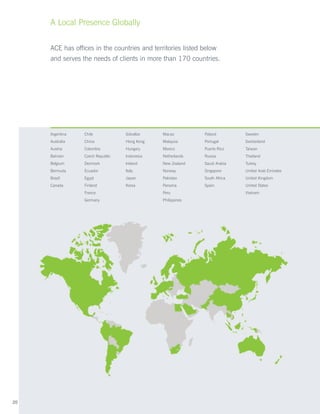
A Local Presence Globally


     ACE has offices in the countries and territories listed below
     and serves the needs of clients in more than 170 countries.


     Argentina	Chile	               Gibraltar	   Macao	         Poland	         Sweden
     Australia	   China	            Hong Kong	   Malaysia	      Portugal	       Switzerland
     Austria	     Colombia	         Hungary	     Mexico	        Puerto Rico	    Taiwan
     Bahrain	     Czech Republic	   Indonesia	   Netherlands	   Russia	         Thailand
     Belgium	     Denmark	          Ireland	     New Zealand	   Saudi Arabia	   Turkey
     Bermuda	     Ecuador	          Italy	       Norway	        Singapore	      United Arab Emirates
     Brazil	      Egypt	            Japan	       Pakistan	      South Africa	   United Kingdom
     Canada	      Finland	          Korea	       Panama 	       Spain	          United States
     	            France 		                      Peru		                         Vietnam
     	            Germany		                      Philippines


20
Business Segment Overview

The ACE Group is one of the world’s leading providers of commercial property and
casualty (PC) insurance and reinsurance. The company also has a major presence in
the accident and health (AH) business as well as a young and growing life insurance
operation and specialty personal lines business. ACE is represented around the world
by a collection of market-leading franchises within four business segments.


Insurance – Overseas General:                                         Global Reinsurance:
Insurance – Overseas General comprises ACE International,             Marketing its coverage worldwide under the ACE
the company’s retail broker-distributed business outside of           Tempest Re brand, the businesses of the Global
North America, and ACE Global Markets, a London-based                 Reinsurance segment provide a broad range of property
excess and surplus lines business that includes a syndicate           and casualty reinsurance products to a diverse array of
on the Lloyd’s trading floor. These businesses write a variety        primary insurers. Business units include ACE Tempest Re
of coverage, including property, casualty, professional lines,        Bermuda, ACE Tempest Re USA, ACE Tempest Re Canada,
marine, energy, aviation, political risk, construction risk, AH      and ACE Tempest Re International, which encompasses
and specialty consumer-oriented products. ACE’s AH busi-             PC reinsurance operations based in London, São Paulo
ness is mainly personal accident, with some supplemental              and Zurich. ACE Tempest Re also has operations in China
medical coverage. Insurance – Overseas General also includes          and Brazil through Lloyd’s.
the international operations of Combined Insurance, which
provides specialty accident and supplemental health insur-
ance products to middle-income consumers in Europe, Latin             Life:
America and Asia Pacific.                                             ACE Life provides traditional life insurance protection and
                                                                      savings products to meet the needs of individuals and
                                                                      groups in a growing number of countries throughout Asia,
Insurance – North American:                                           Latin America and the Middle East. The North American
The five operating businesses of the Insurance – North                AH and life businesses of Combined Insurance are also
American segment serve clients ranging from the largest               included in this segment’s results. Combined Insurance
multinationals to mid-size and small businesses to high net           distributes specialty individual accident and supplemental
worth individuals. ACE USA, which distributes coverage                health and life insurance products targeted to middle-
through retail brokers, provides a broad array of specialty           income consumers in the U.S. and Canada. ACE Tempest
property, casualty, and AH insurance products and risk               Life Re provides specialty life reinsurance products to
management services to corporate clients across the United            life insurers.
States and Canada. ACE Westchester specializes in excess
and surplus lines specialty products, including crop insurance
and specialty agribusiness coverages distributed through
independent agents, as well as property, inland marine,
casualty, professional lines, and environmental liability prod-
ucts distributed through wholesale brokers. ACE Bermuda,
the original insurance company of the ACE Group, writes
high-level excess liability, property, political risk and directors
and officers insurance worldwide. ACE Private Risk Services
provides high net worth individuals and families with home-
owners, automobile, valuables, umbrella and recreational
marine insurance. ACE Commercial Risk Services offers
specialty insurance products and solutions for small busi-
nesses through several distribution channels.


                                                                                                                                    21
Insurance – Overseas General


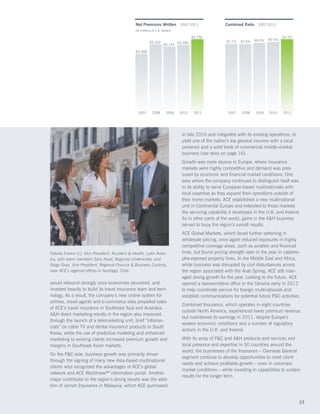
                                    Results for the Insurance – Overseas General
                                    business segment in 2011 demonstrated the
                                    benefits of having diversified capabilities –
                                    across product lines and geographies –
                                    during extraordinarily challenging times.

                                    While economic weakness in Europe and natural disasters
                                    in New Zealand, Australia, Thailand and Japan impacted
                                    results, strong demand for AH products around the globe
                                    and a healthy economic environment in Latin America and
                                    Asia provided effective counterweights. In 2011, despite the
                                    catastrophe losses, the businesses of the Insurance – Over-
                                    seas General segment produced operating income of $703
     John Keogh                     million and a combined ratio of 94.3%.
     Vice Chairman and
                                    Latin America’s economic buoyancy continued to offer op-
     Chief Operating Officer,
     ACE Limited                    portunities for ACE’s PC and AH businesses. Brazil led
     Chairman,                      the way for the company as ACE continued to expand well
     Insurance – Overseas General   beyond São Paulo into the country’s faster-growing north-
                                    ern states. The introduction of new or enhanced products
                                    such as environmental liability, medical malpractice, surety
                                    and export products liability also contributed to ACE’s
                                    strong sales in Brazil. Throughout the region, the contin-
                                    ued economic expansion has increased import and export
                                    traffic, driving up demand for ACE’s marine insurance and
                                    multinational capabilities. Major infrastructure projects in
                                    the Pacific-side economies of Colombia, Peru, Ecuador and
                                    Chile allowed ACE to demonstrate its flexibility in providing
                                    large clients with such coverages as construction and marine
                                    cargo, while also supporting smaller local companies and
                                    suppliers that serve those projects.
                                    The region’s rising middle-class population, along with new
                                    product and distribution variations, enabled ACE to expand
                                    AH sales through its various sponsors, including banks,
                                    retailers and telecommunications companies. Increasing
                                    its presence in the mobile market during the year offered
                                    a dual opportunity – providing replacement coverage for
                                    devices and offering AH coverages through direct market-
                                    ing (see story on page 14). At the end of the year, ACE
                                    purchased Rio Guayas, a leading general insurer in Ecuador,
                                    to complement its existing business in the country in terms
                                    of geographic presence, distribution and products, including
                                    personal and small commercial lines.
                                    In the Asia Pacific region, AH was an area of particular
                                    strength as economic headwinds that had hampered sales
                                    in recent years diminished in 2011. ACE foresaw that travel


22
Net Premiums Written 2007-2011                           Combined Ratio 2007-2011
                                                (In millions of U.S. dollars)

                                                                                         $5,756                                           94.3%
                                                                                                                          89.0%   90.5%
                                                           $5,332               $5,280                    87.7%   87.6%
                                                                      $5,145

                                                $4,568


                                                  2007       2008       2009     2010     2011            2007    2008    2009    2010    2011


                                                                                  in late 2010 and integrated with its existing operations, to
                                                                                  yield one of the nation’s top general insurers with a local
                                                                                  presence and a solid book of commercial middle-market
                                                                                  business (see story on page 16).
                                                                                  Growth was more elusive in Europe, where insurance
                                                                                  markets were highly competitive and demand was pres-
                                                                                  sured by economic and financial market conditions. One
                                                                                  area where the company continued to distinguish itself was
                                                                                  in its ability to serve European-based multinationals with
                                                                                  local expertise as they expand their operations outside of
                                                                                  their home markets. ACE established a new multinational
                                                                                  unit in Continental Europe and extended to those markets
                                                                                  the servicing capability it developed in the U.K. and Ireland.
                                                                                  As in other parts of the world, gains in the AH business
                                                                                  served to buoy the region’s overall results.
                                                                                  ACE Global Markets, which faced further softening in
                                                                                  wholesale pricing, once again reduced exposures in highly
                                                                                  competitive coverage areas, such as aviation and financial
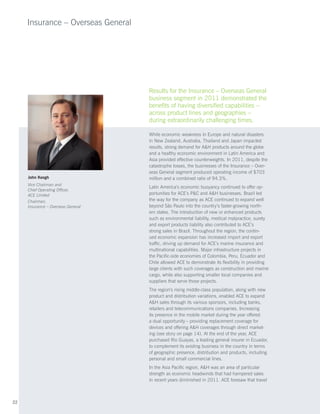
Fabiola Franco (c), Vice President, Accident  Health, Latin Amer-                lines, but found pricing strength later in the year in catastro-
ica, with team members Sara Assef, Regional Underwriter, and                      phe-exposed property lines. In the Middle East and Africa,
Diego Sosa, Vice President, Regional Finance  Business Controls,                 while business was disrupted by civil disturbances across
near ACE’s regional offices in Santiago, Chile.                                   the region associated with the Arab Spring, ACE still man-
                                                                                  aged strong growth for the year. Looking to the future, ACE
would rebound strongly once economies recovered, and                              opened a representative office in the Ukraine early in 2012
invested heavily to build its travel insurance team and tech-                     to help coordinate service for foreign multinationals and
nology. As a result, the company’s new online system for                          establish communications for potential future PC activities.
airlines, travel agents and e-commerce sites propelled sales
                                                                                  Combined Insurance, which operates in eight countries
of ACE’s travel insurance in Southeast Asia and Australia.
                                                                                  outside North America, experienced lower premium revenue
AH direct marketing results in the region also improved
                                                                                  but maintained its earnings in 2011, despite Europe’s
through the launch of a telemarketing unit, brief “infomer-
                                                                                  weaker economic conditions and a number of regulatory
cials” on cable TV and dental insurance products in South
                                                                                  actions in the U.K. and Ireland.
Korea, while the use of predictive modeling and enhanced
marketing to existing clients increased premium growth and                        With its array of PC and AH products and services and
margins in Southeast Asian markets.                                               local presence and expertise in 50 countries around the
                                                                                  world, the businesses of the Insurance – Overseas General
On the PC side, business growth was primarily driven
                                                                                  segment continue to develop opportunities to meet client
through the signing of many new Asia-based multinational
                                                                                  needs and achieve profitable growth – even in uncertain
clients who recognized the advantages of ACE’s global
                                                                                  market conditions – while investing in capabilities to sustain
network and ACE WorldviewSM information portal. Another
                                                                                  results for the longer term.
major contributor to the region’s strong results was the addi-
tion of Jerneh Insurance in Malaysia, which ACE purchased


                                                                                                                                                  23
Insurance – North American


                                  After two relatively benign years for weather-
                                  related events in the U.S., insurers had to
                                  contend with the dual challenges of severe
                                  natural catastrophes and continued weak
                                  market conditions throughout most of 2011.

                                  The unusual number and severity of catastrophes around
                                  the globe and in North America, including Hurricane Irene
                                  and a severe snowstorm in the Northeast, tornadoes in the
                                  Midwest and Southeast, flooding in many areas of the U.S.,
                                  wildfires in the Southwest, and an earthquake in Virginia,
                                  clearly put pressure on underwriting results. Yet, key strate-
                                  gies executed over the last several years and continuing
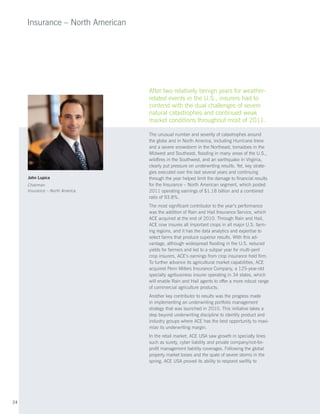
     John Lupica                  through the year helped limit the damage to financial results
     Chairman                     for the Insurance – North American segment, which posted
     Insurance – North America    2011 operating earnings of $1.18 billion and a combined
                                  ratio of 93.8%.
                                  The most significant contributor to the year’s performance
                                  was the addition of Rain and Hail Insurance Service, which
                                  ACE acquired at the end of 2010. Through Rain and Hail,
                                  ACE now insures all important crops in all major U.S. farm-
                                  ing regions, and it has the data analytics and expertise to
                                  select farms that produce superior results. With this ad-
                                  vantage, although widespread flooding in the U.S. reduced
                                  yields for farmers and led to a subpar year for multi-peril
                                  crop insurers, ACE’s earnings from crop insurance held firm.
                                  To further advance its agricultural market capabilities, ACE
                                  acquired Penn Millers Insurance Company, a 125-year-old
                                  specialty agribusiness insurer operating in 34 states, which
                                  will enable Rain and Hail agents to offer a more robust range
                                  of commercial agriculture products.
                                  Another key contributor to results was the progress made
                                  in implementing an underwriting portfolio management
                                  strategy that was launched in 2010. This initiative takes a
                                  step beyond underwriting discipline to identify product and
                                  industry groups where ACE has the best opportunity to maxi-
                                  mize its underwriting margin.
                                  In the retail market, ACE USA saw growth in specialty lines
                                  such as surety, cyber liability and private company/not-for-
                                  profit management liability coverages. Following the global
                                  property market losses and the spate of severe storms in the
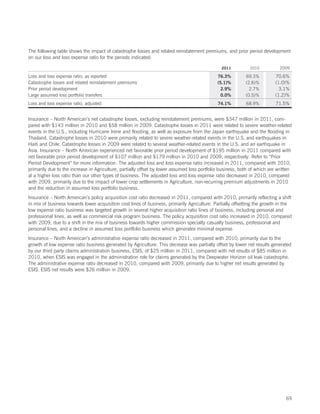
                                  spring, ACE USA proved its ability to respond swiftly to


24
Net Premiums Written 2007-2011                          Combined Ratio 2007-2011
                                                (In millions of U.S. dollars)

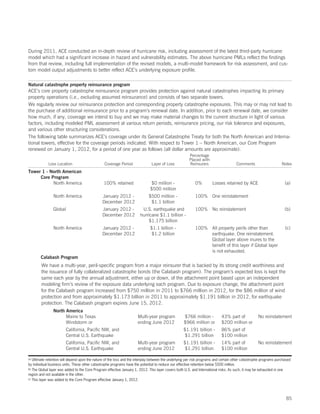
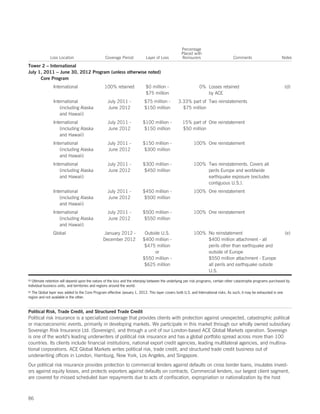
                                                                                       $6,851                                            93.8%
                                                                                                                 91.1%   89.8%   90.3%
                                                                                                         88.5%

                                                $5,833                   $5,797
                                                           $5,636 $5,641


                                                  2007       2008       2009    2010    2011             2007    2008    2009    2010    2011


                                                                                 In ACE Westchester, an excess and surplus lines company,
                                                                                 improving premium rates for property catastrophe cover-
                                                                                 age contributed to solid underwriting results in 2011, while
                                                                                 in the casualty business, where rates remained soft, ACE
                                                                                 Westchester continued to manage its risk selection very
                                                                                 carefully. ACE Bermuda delivered excellent performance in a
                                                                                 highly competitive marketplace. In the aftermath of the Gulf
                                                                                 of Mexico’s Deepwater Horizon disaster in 2010, premium
                                                                                 rates for energy excess catastrophe coverage improved
                                                                                 substantially, offsetting softer pricing in other lines, such as
                                                                                 management liability.
                                                                                 ACE Private Risk Services, which offers specialty personal
                                                                                 lines coverages to high net worth individuals and fami-
                                                                                 lies, continued to build out its brand and operations while
                                                                                 launching a new claims system and integrating predictive
                                                                                 modeling into its underwriting process. Its highly personal-
                                                                                 ized response to the year’s catastrophes, including Hurri-
                                                                                 cane Irene and a severe October snowstorm in the North-
                                                                                 east, earned high marks from clients.
ACE USA’s Lee Farrow (l), Senior Vice President, Life Sciences, and
Caroline Clouser, Executive Vice President, Medical Risk, outside                ACE Commercial Risk Services, a recently established
ACE’s offices in Jersey City, N.J.                                               operation dedicated to providing specialty insurance solu-
                                                                                 tions to small businesses with local, regional, national or
the shift to gradually firming prices in the property mar-                       global exposures, made good progress in establishing its
ket. In addition, the company continued to build on efforts                      infrastructure. This unit offers its products, such as environ-
it launched in 2010 to enhance service to multinational                          mental liability and privacy protection and network security
clients by assigning additional accounts to its global client                    coverages, through multiple distribution channels, including
executive program, which provides these clients with a                           retail agents and brokers, wholesale brokers and wholesale
single senior strategic partner for coordinating all of ACE’s                    producers, program agents and other alternative channels.
global resources and expertise. This program is helping                          Through a balanced set of product lines coupled with
to assure high levels of client service and satisfaction, a                      advanced underwriting portfolio analysis and manage-
strong record of client retention as well as entrée to new                       ment techniques, the businesses of the Insurance – North
business opportunities. During the year, ACE also introduced                     American segment continued to deliver underwriting profits
version 2.0 of ACE Worldview,SM its unique Web-based                             through a prolonged soft market. With its full capabilities –
portal that now allows nearly 1,000 risk managers and                            financial strength, risk capacity and underwriting expertise
brokers to manage key aspects of their ACE insurance                             in numerous coverage areas – firmly in place, ACE is well
programs online. Worldview earned awards for innovation                          prepared to respond to market opportunities in the region as
from Business Insurance and Risk  Insurance magazines                           insurance market conditions continue to improve.
in 2011.


                                                                                                                                                    25
Global Reinsurance


                            In a year when insured losses from natural
                            catastrophes worldwide reached record
                            levels and struck particularly heavy blows in
                            the Asia Pacific and North America regions,
                            many reinsurers reported their worst under-
                            writing results in a number of years.

                            To make matters worse, most of the year’s major catastro-
                            phes had not been modeled for the losses that they ultimately
                            produced and occurred in areas where reinsurance tends to
                            be written at lower attachment levels. Yet, ACE Tempest
                            Re stood out from its peers, delivering excellent financial
                            results by continuing to diversify its book of business and
                            managing its exposure levels around the world. As a result,
     Jacques Bonneau        the Global Reinsurance segment generated an underwriting
     Chairman               profit even after adjusting for the impact of positive prior period
     ACE Tempest Re Group   development, and produced after-tax operating income of
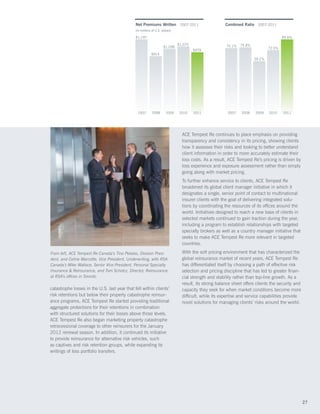
                            $401 million and a combined ratio of 85.6%, while the
                            average combined ratio of its global competitor group was
                            well over 100%.
                            With the year’s unusual catastrophe activity exposing the
                            risk management weaknesses of some competitors, ACE’s
                            overall financial strength continued to serve as a differentia-
                            tor for ACE Tempest Re, enabling it to attract clients who
                            required stability in their reinsurance partners and offer them
                            the capacity and flexibility to meet their needs.
                            As a result of the healthy capital cushion that the industry
                            had accumulated in recent years, the reinsurance market
                            remained competitive throughout 2011 despite the heavy
                            catastrophe losses, and so ACE Tempest Re selected its risks
                            carefully and reduced gross premiums written by more than
                            10% from the previous year. In response to market condi-
                            tions, it shifted the composition of its portfolio, rotating out
                            of lines where margins were compressed due to a risk-return
                            mismatch and moving more toward shorter-tail property-
                            oriented risks.
                            In the continuing competitive environment of recent years,
                            ACE Tempest Re has taken a number of steps to forge
                            stronger relationships with clients and to deliver innovative
                            solutions and enhanced service. For example, due to the


26
Net Premiums Written 2007-2011                           Combined Ratio 2007-2011
                                               (In millions of U.S. dollars)

                                               $1,197                                                                                   85.6%

                                                                               $1,075                   75.1%   75.8%
                                                                     $1,038                                                     72.5%
                                                                                        $979
                                                           $914
                                                                                                                        59.2%


                                                 2007       2008       2009    2010     2011             2007    2008   2009    2010    2011


                                                                                 ACE Tempest Re continues to place emphasis on providing
                                                                                 transparency and consistency in its pricing, showing clients
                                                                                 how it assesses their risks and looking to better understand
                                                                                 client information in order to more accurately estimate their
                                                                                 loss costs. As a result, ACE Tempest Re’s pricing is driven by
                                                                                 loss experience and exposure assessment rather than simply
                                                                                 going along with market pricing.
                                                                                 To further enhance service to clients, ACE Tempest Re
                                                                                 broadened its global client manager initiative in which it
                                                                                 designates a single, senior point of contact to multinational
                                                                                 insurer clients with the goal of delivering integrated solu-
                                                                                 tions by coordinating the resources of its offices around the
                                                                                 world. Initiatives designed to reach a new base of clients in
                                                                                 selected markets continued to gain traction during the year,
                                                                                 including a program to establish relationships with targeted
                                                                                 specialty brokers as well as a country manager initiative that
                                                                                 seeks to make ACE Tempest Re more relevant in targeted
                                                                                 countries.

From left, ACE Tempest Re Canada’s Tino Petalas, Division Presi-                 With the soft pricing environment that has characterized the
dent, and Celine Marcotte, Vice President, Underwriting, with RSA                global reinsurance market of recent years, ACE Tempest Re
Canada’s Mike Wallace, Senior Vice President, Personal Specialty                 has differentiated itself by choosing a path of effective risk
Insurance  Reinsurance, and Tom Scholcz, Director, Reinsurance,                 selection and pricing discipline that has led to greater finan-
at RSA’s offices in Toronto.                                                     cial strength and stability rather than top-line growth. As a
                                                                                 result, its strong balance sheet offers clients the security and
catastrophe losses in the U.S. last year that fell within clients’               capacity they seek for when market conditions become more
risk retentions but below their property catastrophe reinsur-                    difficult, while its expertise and service capabilities provide
ance programs, ACE Tempest Re started providing traditional                      novel solutions for managing clients’ risks around the world.
aggregate protections for their retentions in combination
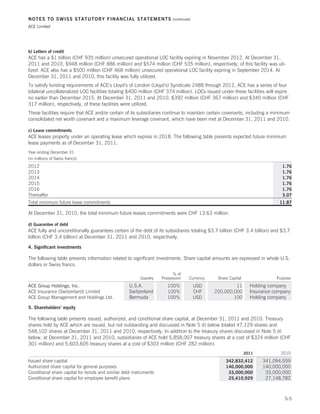
with structured solutions for their losses above those levels.
ACE Tempest Re also began marketing property catastrophe
retrocessional coverage to other reinsurers for the January
2012 renewal season. In addition, it continued its initiative
to provide reinsurance for alternative risk vehicles, such
as captives and risk retention groups, while expanding its
writings of loss portfolio transfers.


                                                                                                                                                    27
Life                       The Life segment comprises three distinct
                                businesses – ACE Life, the North American
                                operations of Combined Insurance, and ACE
                                Tempest Life Re. ACE Life provides tradi-
                                tional life insurance protection and savings
                                products to individuals and groups in Asia,
                                Latin America and the Middle East. In the
                                U.S. and Canada, Combined Insurance offers
                                individual accident and supplemental health
                                and life insurance products to middle-income
                                consumers. ACE Tempest Life Re provides
                                solutions to the complex risk and capital
                                management challenges facing life insurers
                                around the globe.

                                In 2011, the businesses of the Life segment generated
                                operating income of $348 million, a 16% gain from $300
                                million in 2010.
                                While economic growth remained sluggish in developed
                                markets in 2011, ACE Life continued to expand its presence
                                in Asian and Latin American markets where growing econo-
                                mies, young and rising middle-class populations and low
     Ed Clancy (l)              insurance penetration rates combine to create opportunities
     Chairman, Life             for strong business growth.
     Executive Vice President
     Global Accident  Health   Although the business is still relatively young, ACE Life
     and Life                   now operates in 30 markets around the world and has
                                a sales force of more than 42,000 agents. In Asia, ACE
     Russell Bundschuh          Life provides a full spectrum of savings, protection and
     President                  investment-oriented products, distributed primarily through
     ACE Life                   agency and bancassurance channels. Huatai Life Insurance
                                Co., ACE’s 36%-owned joint venture with Huatai Insur-
                                ance Group, employs both channels as one of the leading
                                foreign joint-venture life companies in China based on total
                                premiums. The company now has a captive force of 26,000
                                agents in 270 sales locations across 12 provinces. Agency
                                sales continued to grow briskly in 2011, but a slowdown
                                in economic growth, coupled with new legislation affecting
                                banks, created some headwinds for sales through Huatai
                                Life’s bancassurance partnerships.
                                The acquisition of New York Life’s operations in Hong Kong
                                and South Korea added substantially to ACE Life’s agency
                                force, revenues and assets in Asia and contributed strongly
                                to its bottom line results in 2011. Integration of these units
                                proceeded according to plan in 2011, including robust
                                campaigns to raise ACE’s profile in these markets. Initially,
                                both units were exclusively agency based, but during the
                                year distribution was broadened through the introduction of
                                a bancassurance channel in Korea.
                                Elsewhere in Asia, ACE Life’s subsidiary in Vietnam now
                                has over 8,000 agents and was profitable for the second
                                year in a row. In Indonesia, where ACE Life launched its


28
Net Premiums Written 2007-2011                          Operating Income 2007-2011
                                                 (In millions of U.S. dollars)                           (In millions of U.S. dollars)

                                                                                          $1,786                                                $348

                                                                                 $1,556                                                  $300
                                                                       $1,475                                                    $283

                                                            $1,198


                                                                                                          $166        $168


                                                  $381


                                                   2007       2008       2009    2010      2011            2007       2008       2009    2010   2011


                                                                                   In the Middle East, ACE Life provides individual life products
                                                                                   through agents, brokers and telemarketing, and group life
                                                                                   and medical insurance primarily through brokers. In Europe,
                                                                                   ACE Life markets life products as a supplement to ACE’s
                                                                                   group AH offerings distributed through sponsors and bro-
                                                                                   kers in several countries.
                                                                                   The North American operation of Combined Insurance met
                                                                                   its earnings target despite challenging economic conditions
                                                                                   including high unemployment rates in rural areas. Com-
                                                                                   bined has launched a number of initiatives to help build its
                                                                                   agency force, including a recruitment program directed at
                                                                                   returning military veterans that has yielded promising early
                                                                                   results.
                                                                                   Due to financial market volatility in the third quarter, ACE
                                                                                   incurred a substantial charge to book value from a negative
                                                                                   mark to market in its variable annuity reinsurance business.
                                                                                   The company believes the negative mark did not reflect its
                                                                                   liabilities and that it would accrete back to book value over
ACE Life Korea’s Joo Min Park (l), Chief Operating Officer, and Joon               time, an effect that was partially realized as equity markets
Choi, Chief Agency Officer, at the company’s offices in Seoul,                     rebounded later in the year.
South Korea.                                                                       With its operations now established in many of the high-
                                                                                   est opportunity markets around the world, ACE Life began
subsidiary just two years ago, premiums grew rapidly and                           to take important steps in 2011 to strengthen systems,
the agency force expanded to 3,600 (see story on page 18).                         enhance agency training and productivity, expand support
In Thailand, ACE Life maintained its profitability, even while                     teams, upgrade reporting processes, and gain efficiencies
the nation’s widespread flooding catastrophe impeded busi-                         through economies of scale. These initiatives are designed
ness growth.                                                                       to help ACE Life achieve sustainable, profitable growth in
Latin America is another strategically important region for                        the years ahead.
ACE Life. In contrast to Asia, where the focus has been on
direct sales to individuals, ACE Life has emphasized credit
life and other forms of group business in Latin America,
leveraging the sponsor distribution network built by ACE’s
international AH business. Sales growth for these products
continued to be strong for ACE Life in Brazil, Mexico, Colom-
bia and Chile.


                                                                                                                                                       29
ACE Limited Board of Directors


                       Evan G. Greenberg                             Robert M. Hernandez                                Robert Ripp
                       Chairman and                                  Lead Director                                      Chairman
                       Chief Executive Officer                       ACE Limited                                        Lightpath
                       ACE Limited                                                                                      Technologies Inc.
                                                                     Chairman
                                                                     RTI International
                                                                     Metals, Inc.


                       Michael G. Atieh                              John A. Krol                                       Eugene B. Shanks, Jr.
                       Retired Executive                             Non-Executive Chairman                             Director
                       Chairman                                      Delphi Automotive, LLP                             Federal Home Loan
                       Eyetech, Inc.                                                                                    Mortgage Corporation


                       Mary A. Cirillo                               Peter Menikoff                                     Theodore E. Shasta
                       Advisor                                       Private Investor                                   Retired Partner
                       Hudson Venture                                                                                   Wellington Management
                       Partners L.P.                                                                                    Company


                       Michael P. Connors                            Leo F. Mullin                                      Olivier Steimer
                       Chairman and                                  Senior Advisor                                     Chairman of the Board
                       Chief Executive Officer                       Goldman Sachs Capital                              Banque Cantonale
                       Information Services                          Partners                                           Vaudoise
                       Group, Inc.


                       Bruce L. Crockett                             Thomas J. Neff
                       Chairman                                      Chairman
                       Crockett Technologies                         Spencer Stuart, U.S.
                       Associates (CTA)


     Board Committees


     Audit Committee             Compensation Committee   Nominating                       Risk  Finance Committee    Executive Committee
                                                          Governance Committee
     Robert Ripp, Chairman       John A. Krol, Chairman                                     Olivier Steimer, Chairman   Evan G. Greenberg, Chairman
     Michael G. Atieh            Mary A. Cirillo          Thomas J. Neff, Chairman          Bruce L. Crockett           Robert M. Hernandez
     Peter Menikoff              Michael P. Connors       Mary A. Cirillo                   Leo F. Mullin               John A. Krol
     Theodore E. Shasta          Robert M. Hernandez      Robert M. Hernandez               Eugene B. Shanks, Jr.       Thomas J. Neff
                                 Thomas J. Neff           John A. Krol                                                  Robert Ripp
                                                                                                                        Olivier Steimer


30
Officers and Executives


ACE Limited Executive Officers*                  Phillip B. Cole                           Ashley Mullins
                                                 Global Human Resources Officer,           Global Compliance and Business Ethics
Evan G. Greenberg
                                                 ACE Group                                 Officer, ACE Group
Chairman and Chief Executive Officer
                                                 Robert Courtemanche                       William O’Farrell
John Keogh
                                                 Division President, ACE Private           Chief Reinsurance Officer, ACE Group
Vice Chairman and Chief Operating Officer;
                                                 Risk Services
Chairman, Insurance – Overseas General                                                     Constantin Petalas
                                                 Brian E. Dowd                             Division President, ACE Tempest Re
Philip V. Bancroft
                                                 Office of the Chairman                    Canada
Chief Financial Officer
                                                 Rees Fletcher                             Richard Pryce
Robert Cusumano
                                                 Division President, ACE Bermuda           Regional President, ACE UK
General Counsel
                                                 Samantha Froud                            Sean Ringsted
John Lupica
                                                 Chief Administration Officer,             Chief Risk Officer and Chief Actuary,
Chairman, Insurance – North America;
                                                 Bermuda Operations                        ACE Group
President, ACE USA
                                                 David Furby                               Steve Roberts
                                                 Division President, Commercial Property   Managing Director, ACE Tempest Re
*Executive Officers for SEC reporting purposes    Casualty, ACE Overseas General          International
                                                 Jeffery Hager                             Julie Schaekel
ACE Group Executives                             Regional President, ACE Far East          Chief Auditor, ACE Group

Juan Andrade                                     Andrew Kendrick                           Matthew Shaw
Division President, Global Personal Lines        Chairman, ACE European Group              Division President, ACE Global Markets
and Small Commercial Insurance                   Bruce Kessler                             Kevin Shearan
Jacques Q. Bonneau                               Division President, ACE Westchester       Chief Information Officer, ACE Group
Chairman, ACE Tempest Re Group                   Rainer Kirchgaessner                      Damien Sullivan
Timothy Boroughs                                 Global Corporate Development Officer,     Regional President, ACE Asia Pacific
Chief Investment Officer, ACE Group              ACE Group
                                                                                           Saloon Tham
Charles Brooks                                   Ken Koreyva                               Regional President, Asia Pacific, ACE Life
Global Operations Officer, ACE Group             Treasurer, ACE Group
                                                                                           James E. Wixtead
Russell G. Bundschuh                             Frank Lattal                              Division President, ACE Tempest Re USA
President, ACE Life                              Chief Claims Officer, ACE Group

Jorge Luis Cazar                                 Edward Levin
Regional President, ACE Latin America            Division President, Accident  Health,
                                                 ACE Overseas General
Joseph S. Clabby
Regional President, ACE Continental              David Lupica
Europe                                           Division President, ACE Commercial
                                                 Risk Services
Edward Clancy
Chairman, Life; Executive Vice President,        Christopher Maleno
Global Accident  Health and Life                Chief Operating Officer, ACE USA
                                                 Timothy Mardon
                                                 Division President, ACE Tempest Re
                                                 Bermuda
                                                 Patrick McGovern
                                                 Chief Communications Officer, ACE Group
                                                 Paul Medini
                                                 Chief Accounting Officer, ACE Group


                                                                                                                                        31
Shareholder Information


     Visit the Investor Information section of acegroup.com,                                                Send Certificates for Transfer and
     write to the Investor Relations Department at ACE Limited                                              Address Changes to:
     or e-mail investorrelations@acegroup.com for copies of                                                 Computershare Shareowner Services LLC
     the company’s reports to the Securities and Exchange                                                   Stock Transfer Department
     Commission on Form 10-K, Form 10-Q or Form 8-K,                                                        P.O. Box 358010
     all of which are available without charge.                                                             Pittsburgh, PA 15252-8010 USA


     Address Investor Relations Inquiries to:                                                               Independent Auditors:
     Investor Relations                                                                                     PricewaterhouseCoopers AG
     ACE Limited                                                                                            Birchstrasse 160
     17 Woodbourne Avenue                                                                                   8050 Zurich
     Hamilton HM 08                                                                                         Switzerland
     Bermuda                                                                                                Tel: 41 58 792 44 00
     Tel: 441 299 9283
                                                                                                            PricewaterhouseCoopers LLP
     Fax: 441 292 8675
                                                                                                            Two Commerce Square, Suite 1700
     E-mail: investorrelations@acegroup.com
                                                                                                            Philadelphia, PA 19103 USA
                                                                                                            Tel: 267 330 3000
     Transfer Agent  Registrar:
     Computershare Shareowner Services LLC                                                                  New York Stock Exchange Symbol:
     480 Washington Boulevard                                                                               ACE
     Jersey City, NJ 07310-2053 USA
     Tel: 201 680 4637
                                                                                                            ACE Common Shares Cusip Number:
                                                                                                            H0023R-10-5
     Address Shareholder Inquiries to:
     Computershare Shareowner Services LLC
     P.O. Box 358016                                                                                        CEO and CFO Certifications
     Pittsburgh, PA 15252-8016 USA                                                                          In 2011, ACE Limited’s Chief Executive Officer (CEO)
     Website: www.computershare.com                                                                         provided to the New York Stock Exchange the annual
     (select Equity Access  More)                                                                          CEO certification regarding ACE Limited’s compliance
                                                                                                            with the New York Stock Exchange’s corporate governance
                                                                                                            listing standards. In addition, in 2011, ACE Limited filed
                                                                                                            with the U.S. Securities and Exchange Commission all
                                                                                                            certifications of its CEO and Chief Financial Officer
                                                                                                            required by the Sarbanes-Oxley Act of 2002.


     Price Range of Common Shares and Dividends
     As of February 10, 2012, the company had 337,153,475 Common Shares outstanding with 4,095 registered holders of Common Shares. The
     accompanying table sets forth the cash dividends and the high and low closing sales prices of our Common Shares, as reported on the NYSE
     Composite Tape for the periods indicated. From July 2008 through March 31, 2011, ACE Limited paid dividends by way of par value reduction.
     Subsequent 2011 dividends were distributed from capital contribution reserves (additional paid-in capital) through the transfer of dividends from
     additional paid-in capital to retained earnings under the method approved by our shareholders at the May 2011 annual general meeting.

                                                                       2011                                                                                  2010

                                                                                          Dividends                                                                     Dividends


     Quarter Ending                           High             Low                    USD             CHF                          High             Low               USD           CHF


     March 31                              $65.74           $60.15                  $0.33             0.30                       $52.88           $47.50             $0.31          0.33

     June 30                               $69.35           $63.95                  $0.35             0.29                       $53.89           $48.43             $0.33          0.34

     September 30                          $68.38           $58.98                  $0.35             0.31                       $58.80           $50.83             $0.33          0.32

     December 31                           $73.33           $59.11                  $0.35 (1)         0.32                       $62.37           $58.10             $0.33          0.32

     (1)
           O
            n January 9, 2012, ACE’s shareholders approved a dividend resolution recommended by the Board of Directors that increased the quarterly dividend from
           $0.35 per share to $0.47 per share for the payment made on January 31, 2012 and the payment to be made by the end of April 2012.


32
UNITED STATES SECURITIES AND EXCHANGE COMMISSION
                                                              Washington, D.C. 20549


                                           FORM 10-K
È        Annual Report Pursuant to Section 13 or 15(d) of the Securities Exchange Act of 1934
                                                 For the fiscal year ended December 31, 2011
                                                                       OR
‘        Transition Report Pursuant to Section 13 or 15(d) of the Securities Exchange Act of 1934
                                                  For the transition period from     to
                                                           Commission File No. 1-11778


                                                              ACE LIMITED
                                                   (Exact name of registrant as specified in its charter)
                              Switzerland                                                                     98-0091805
       (State or other jurisdiction of incorporation or organization)                              (I.R.S. Employer Identification No.)
                                                                    Baerengasse 32
                                                           Zurich, Switzerland CH-8001
                                                    (Address of principal executive offices) (Zip Code)
                                                               +41 (0)43 456 76 00
                                                   Registrant’s telephone number, including area code


                                            Securities registered pursuant to Section 12(b) of the Act:
Title of each class                                                                                         Name of each exchange on which registered

Common Shares, par value CHF 30.27 per share                                                                New York Stock Exchange


                                         Securities registered pursuant to Section 12(g) of the Act: None
Indicate by check mark if the registrant is a well-known seasoned issuer, as defined in Rule 405 of the Securities
Act. YES Í NO ‘
Indicate by check mark if the registrant is not required to file reports pursuant to Section 13 or Section 15(d) of the
Act. YES ‘ NO Í
Indicate by check mark whether the registrant (1) has filed all reports required to be filed by Section 13 or 15(d) of the Securities
Exchange Act of 1934 during the preceding 12 months (or for such shorter periods that the registrant was required to file such
reports), and (2) has been subject to such filing requirements for the past 90 days. YES Í NO ‘
Indicate by checkmark whether the registrant has submitted electronically and posted on its corporate Web site, if any, every Inter-
active Data File required to be submitted and posted pursuant to Rule 405 of Regulation S-T (§232.405 of this chapter) during the
preceding 12 months (or for such shorter period that the registrant was required to submit and post such files). YES Í NO ‘
Indicate by check mark if disclosure of delinquent filers pursuant to Item 405 of Regulation S-K is not contained herein, and will not
be contained, to the best of the registrant’s knowledge, in definitive proxy or information statements incorporated by reference into
Part III of this Form 10-K or any amendment to this Form 10-K. Í
Indicate by check mark whether the registrant is a large accelerated filer, an accelerated filer, a non-accelerated filer, or a smaller
reporting company. See the definitions of “large accelerated filer,” “accelerated filer” and “smaller reporting company” in Rule 12b-2
of the Exchange Act. (Check one):
Large accelerated filer Í      Accelerated filer ‘
Non-accelerated filer ‘ (Do not check if a smaller reporting company)                      Smaller reporting company ‘
Indicate by check mark whether the registrant is a shell company (as defined in Rule 12b-2 of the Exchange Act) YES ‘ NO Í
The aggregate market value of voting stock held by non-affiliates as of June 30, 2011 (the last business day of the registrant’s most
recently completed second fiscal quarter), was approximately $22 billion. For the purposes of this computation, shares held by direc-
tors and officers of the registrant have been excluded. Such exclusion is not intended, nor shall it be deemed, to be an admission that
such persons are affiliates of the registrant.
As of February 10, 2012 there were 337,153,475 Common Shares par value CHF 30.27 of the registrant outstanding.


                                                        Documents Incorporated by Reference
Certain portions of the registrant’s definitive proxy statement relating to its 2012 Annual General Meeting of Shareholders are
incorporated by reference into Part III of this report.
ACE LIMITED INDEX TO 10-K


PART I                                                                                                                    Page

ITEM 1.    Business                                                                                                         2
ITEM 1A. Risk Factors                                                                                                      20
ITEM 1B. Unresolved Staff Comments                                                                                         32
ITEM 2.    Properties                                                                                                      32
ITEM 3.    Legal Proceedings                                                                                               32
ITEM 4.    Mine Safety Disclosures                                                                                         33


PART II
ITEM 5.    Market for Registrant’s Common Equity, Related Stockholder Matters and Issuer Purchases of Equity Securities    34
ITEM 6.    Selected Financial Data                                                                                         36
ITEM 7.    Management’s Discussion and Analysis of Financial Condition and Results of Operations                           37
ITEM 7A. Quantitative and Qualitative Disclosures About Market Risk                                                        96
ITEM 8.    Financial Statements and Supplementary Data                                                                    101
ITEM 9.    Changes in and Disagreements With Accountants on Accounting and Financial Disclosure                           101
ITEM 9A. Controls and Procedures                                                                                          101
ITEM 9B. Other Information                                                                                                101


PART III
ITEM 10. Directors, Executive Officers and Corporate Governance                                                           102
ITEM 11. Executive Compensation                                                                                           102
ITEM 12. Security Ownership of Certain Beneficial Owners and Management and Related Stockholder Matters                   102
ITEM 13. Certain Relationships and Related Transactions, and Director Independence                                        102
ITEM 14. Principal Accounting Fees and Services                                                                           102


PART IV
ITEM 15. Exhibits, Financial Statement Schedules                                                                          103
PART I


ITEM 1. Business


General Development of Business
ACE Limited is the Swiss-incorporated holding company of the ACE Group of Companies. ACE opened its business office in
Bermuda in 1985 and continues to maintain operations in Bermuda. ACE Limited, which is headquartered in Zurich, Switzer-
land, and its direct and indirect subsidiaries (collectively, the ACE Group of Companies, ACE, we, us, or our) is a
global insurance and reinsurance organization, serving the needs of customers in more than 170 countries. We offer commer-
cial insurance products and service offerings such as risk management programs, loss control and engineering and complex
claims management. We also provide specialized insurance products ranging from Directors  Officers (DO) and professional
liability to various specialty-casualty and umbrella and excess casualty lines to niche areas such as aviation and energy. In
addition, we supply personal accident, supplemental health, and life insurance to individuals in select countries. At
December 31, 2011, ACE had total assets of $88 billion and shareholders’ equity of $25 billion.
We have grown our business through increased premium volume, expansion of product offerings and geographic reach, and
acquisition of other companies.
We acquired New York Life’s Korea operations on February 1, 2011 and New York Life’s Hong Kong operations on April 1,
2011 for approximately $425 million in cash. The addition of these operations expands our presence in Asia and comple-
ments the life insurance business. These acquired businesses operate under our Life segment.
We acquired Penn Millers Holding Corporation (PMHC) on November 30, 2011 for approximately $107 million in cash.
PMHC’s primary insurance subsidiary, Penn Millers Insurance Company, is a well-established underwriter in the agribusiness
market since 1887 and currently operates in 34 states. PMHC operates under our Insurance – North American segment. We
acquired Rio Guayas Compania de Seguros y Reaseguros (Rio Guayas), a general insurance company in Ecuador on
December 28, 2011. Rio Guayas sells a range of insurance products, including auto, life, property, and accident and health
(AH). The acquisition of Rio Guayas will expand our capabilities in terms of geography, products, and distribution. Rio
Guayas operates under our Insurance – Overseas General segment.

Employees
At December 31, 2011, there were approximately 16,500 employees in the ACE Group of Companies. We believe that
employee relations are satisfactory.

Customers
For most of the commercial lines of business that we offer, insureds typically use the services of an insurance broker or agent.
An insurance broker acts as an agent for the insureds, offering advice on the types and amount of insurance to purchase and
also assisting in the negotiation of price and terms and conditions. We obtain business from the local and major international
insurance brokers and typically pay a commission to brokers for any business accepted and bound. Loss of all or a substantial
portion of the business provided by one or more of these brokers could have a material adverse effect on our business. In our
opinion, no material part of our business is dependent upon a single insured or group of insureds. We do not believe that the
loss of any one insured would have a material adverse effect on our financial condition or results of operations and no one
insured or group of affiliated insureds account for as much as 10 percent of our consolidated revenues.

Competition
Competition in the insurance and reinsurance marketplace is substantial. Competition varies by type of business and geographic
area. Competitors include other stock companies, mutual companies, alternative risk sharing groups (such as group captives
and catastrophe pools), and other underwriting organizations. These companies sell through various distribution channels and
business models, across a broad array of product lines, and with a high level of variation regarding geographic, marketing, and
customer segmentation. We compete for business not only on the basis of price, but also on the basis of availability of coverage
desired by customers and quality of service. Our ability to compete is dependent on a number of factors, particularly our ability
to maintain the appropriate financial strength ratings as assigned by independent rating agencies. Our broad market capabilities
in commercial, specialty and AH lines made available by our underwriting expertise, business infrastructure and global pres-
ence, defines our competitive advantage. Our strong balance sheet is attractive to businesses, such as ceding companies


2
requiring security solutions, and our strong capital position and global platform affords us opportunities for growth not available
to smaller, less diversified insurance companies. Refer to “Segment Information” for competitive environment by segment.

Trademarks and Trade Names
We use various trademarks and trade names in our business. These trademarks and trade names protect names of certain
products and services we offer and are important to the extent they provide goodwill and name recognition in the insurance
industry. We use commercially reasonable efforts to protect these proprietary rights, including various trade secret and trade-
mark laws. One or more of the trademarks and trade names could be material to our ability to sell our products and services.
We have taken appropriate steps to protect our ownership of key names and we believe it is unlikely that anyone would be
able to prevent us from using names in places or circumstances material to our operations.

Available Information
We make available free of charge through our website (www.acegroup.com, under Investor Information / Financial Reports or
Investor Information / SEC – Section 16 Filings) our annual report on Form 10-K, quarterly reports on Form 10-Q, current
reports on Form 8-K, and amendments to those reports filed or furnished pursuant to Section 13(a) or 15(d) of the Exchange
Act (15 U.S.C. 78m(a) or 78o(d)) as soon as reasonably practicable after we electronically file such material with, or furnish it
to, the U.S. Securities and Exchange Commission (SEC).
We also make available free of charge through our website (under Investor Information / Corporate Governance) our Corporate
Governance Guidelines, our Code of Conduct, and Charters for the Committees of our Board of Directors (the Board). These
documents are also available in print to any shareholder who requests them from our Investor Relations Department through
the following:
Telephone: +1 (441) 299-9283
Facsimile: +1 (441) 292-8675
E-mail: investorrelations@acegroup.com

We also use this website as a means of disclosing material, non-public information and for complying with our disclosure obli-
gations under SEC Regulation FD (Fair Disclosure). Accordingly, investors should monitor the Investor Information portion of
our website, in addition to following our press releases, SEC filings, and public conference calls and webcasts. The information
contained on, or that may be accessed through, our website is not incorporated by reference into, and is not a part of, this
report.
The public may also read and copy any materials ACE files with the SEC at the SEC’s Public Reference Room at 100 F Street,
NE, Washington, DC 20549. The public may obtain information on the operation of the Public Reference Room by calling the
SEC at 1-800-SEC-0330. The SEC maintains an Internet site that contains reports, proxy and information statements, and
other information regarding issuers that file electronically with the SEC. The address of the SEC’s website is
http://www.sec.gov.


Segment Information
We operate through the following business segments, certain of which represent the aggregation of distinct operating seg-
ments: Insurance – North American, Insurance – Overseas General, Global Reinsurance, and Life.
The following table sets forth an analysis of net premiums earned by segment for the periods indicated:

                                           2011 Net                       2010 Net                        2009 Net
Years Ended December 31                    Premiums                       Premiums                        Premiums
(in millions of U.S. dollars)                 Earned     % of Total          Earned      % of Total          Earned      % of Total

Insurance – North American            $      6,911             45% $         5,651             42% $         5,684             43%
Insurance – Overseas General                 5,737             37%           5,240             39%           5,147             39%
Global Reinsurance                           1,003              7%           1,071              8%             979              7%
Life                                         1,736             11%           1,542             11%           1,430             11%
       Total                          $    15,387             100% $        13,504            100% $       13,240             100%


                                                                                                                                      3
Additional financial information about our segments, including net premiums earned by geographic area, is included in Note
15 to the Consolidated Financial Statements, under Item 8.

Insurance – North American

Overview
The Insurance – North American segment comprises our operations in the U.S., Canada, and Bermuda. This segment, which
accounted for 45 percent of our 2011 consolidated net premiums earned, includes our retail divisions ACE USA (including
ACE Canada), ACE Commercial Risk Services, and ACE Private Risk Services; our wholesale and specialty divisions ACE West-
chester, ACE Agriculture and ACE Bermuda; and various run-off operations, including Brandywine Holdings Corporation
(Brandywine).

Products and Distribution
ACE USA, our retail operating division in North America, provides a broad array of PC, AH, and risk management products
and services to a diverse group of North American commercial and non commercial enterprises and consumers. ACE USA is
this segment’s largest operation and represented approximately 49 percent of Insurance – North American’s net premiums
earned in 2011. ACE USA distributes its insurance products primarily through a limited number of retail brokers. In addition to
using brokers, certain products are also distributed through general agents, independent agents, managing general agents
(MGA), managing general underwriters, alliances, affinity groups, and direct marketing operations. Products offered include
property, general liability, excess liability, workers’ compensation, commercial marine, automobile liability, professional lines
DO and errors and omissions (EO), medical liability, aerospace, and AH coverages, as well as claims and risk manage-
ment products and services.
ACE USA’s on-going operations are organized into the following distinct business units, each offering specialized products and
services targeted at specific niche markets:
• ACE Risk Management offers a wide range of customized casualty products to respond to the needs of mid-size to large
companies, including national accounts, irrespective of industry. These programs are designed to help insureds address the
significant costs of financing and managing risk for workers’ compensation and general and auto liability coverages. A variety
of program structures are offered to support each client’s risk financing needs including: large deductible, captives, third-party
rent-a-captives, funded deductibles, paid or incurred loss retrospective plans, and net present value and other risk financing
structures, including a prospective close-out product. We also underwrite assumed loss portfolio contracts in which insured
loss events have occurred prior to the inception of the contract, when the contract carries the requisite amount of insurance
risk transfer. These contracts can cause significant variances to premiums, losses and loss expenses, and expense ratios in the
periods in which they are written.
• ACE Foreign Casualty provides products which insure specific global operating risks of U.S.-based multinational companies.
Coverage programs include Controlled Master Programs where we pair a master policy issued in the U.S. with local policies
issued in foreign countries, International Advantage covering liability and incidental property cover for U.S.-based companies
with employees who travel on business outside of the U.S., and Defense Base Act Workers’ Compensation which provides
coverage for prime contractors and subcontractors performing work overseas under contracts authorized, approved or financed
by the U.S. government or its agencies. In addition, Foreign Casualty has deductible programs, captive programs, and paid or
incurred loss retrospective plans for U.S.-based insured’s foreign operations.
• ACE North America Property  Specialty Lines, through its specialized operating units, offers a wide range of products to
diverse insureds. Property products include primary, quota share and excess all-risk insurance for U.S. based companies with
domestic or global exposures, as well as risk management programs and services for U.S. multinational companies, including
Controlled Master Programs and captive programs. Commercial Marine products are available for U.S. and global marine
exposures. Inland Marine products provide solutions for the construction, transportation, warehouse and communications
industries, as well as museums and other commercial institutions with fine art exposures. Aerospace products are available for
airport owners and operators, as well as satellite operators. Other specialized units provide products for weather-related
exposures, the unique needs of the energy industry, and engineering and insurance-related services for the operating units.
• ACE Casualty Risk offers specialty casualty products to a broad range of customers, ranging from small, local businesses to
large, multinational clients. Key coverages offered by ACE Casualty Risk include umbrella and excess liability, environmental
risk for commercial and industrial risks, and wrap-up programs written on a loss sensitive basis, protecting contractors and


4
project sponsors with multi-risk coverage on large single- and multi-location construction projects. We also write custom casu-
alty products for specialized industry segments and unique risks as well as products which address the needs of public entities
such as educational institutions.
• ACE Professional Risk provides management liability and professional liability (DO and EO) as well as surety and kid-
nap  extortion products to middle market and Fortune 1000 clients.
• ACE Canada (ACE USA’s Canadian operations) offers a broad range of PC products as well as life and AH coverage. ACE
Canada specializes in providing customized products to commercial and industrial clients as well as to groups and associa-
tions, operating nationally or internationally.
• ACE Accident  Health works with employers, travel agencies, and affinity groups to offer a variety of accident and other
supplemental insurance programs. Key products include employee benefit plans, occupational accident, student accident, and
worldwide travel accident and global medical programs. With respect to products that include supplemental medical and
hospital indemnity coverages, we typically pay fixed amounts for claims and are therefore insulated from rising health care
costs. ACE Accident  Health also provides specialty personal lines products, including credit card enhancement programs
(identity theft, rental car collision damage waiver, trip travel, and purchase protection benefits), and disaster recovery programs
distributed through affinity groups.
• ACE Medical Risk offers a wide range of liability products for the health care industry only through licensed excess and sur-
plus lines brokers. Products include primary coverages for professional liability and general liability for selected types of
medical facilities, excess/umbrella liability for medical facilities, primary and excess coverages for products liability for bio-
technology and specialty pharmaceutical companies, and liability insurance for human clinical trials.
• ESIS Inc. (ESIS), ACE USA’s in-house third-party claims administrator, performs claims management and risk control serv-
ices for domestic and international organizations, as well as for the Insurance – North American segment. These services
include comprehensive medical managed care, integrated disability services, and pre-loss control and risk management serv-
ices. Additional insurance-related services are offered by ESIS’s Recovery Services International, which provides salvage and
subrogation and health care recovery services. ESIS’s services are available through a preferred relationship with ACE Risk
Management or separately for those clients that select insurance and claims management services independently. The net
results for ESIS are included in Insurance – North American’s administrative expenses.
ACE Commercial Risk Services serves the insurance needs of small and mid-sized businesses in North America with local,
national or global exposures by delivering an array of specialty product solutions for targeted industries that lend themselves to
technology-assisted underwriting. ACE Commercial Risk Services offers packaged policies as well as solutions that can be tail-
ored to suit a particular product segment, multiple lines of coverage or specific distribution channels using advanced systems
to efficiently transact large volumes of business. Core products and services for small businesses include: disaster protection,
casualty insurance (including international casualty), environmental, inland marine, professional risk, medical risk, and
claims  risk management services. These ACE Commercial Risk Services’ products are offered through wholesale, retail, pro-
gram agent and alternative distribution channels. In addition, ACE Commercial Risk Services offers coverage for specialty
programs, writing a variety of commercial coverages through program agents.
ACE Private Risk Services provides personal lines coverages including homeowners, automobile, valuables, umbrella liability,
and recreational marine insurance for high net worth individuals and families in North America. ACE Private Risk Services’
products are distributed through independent regional agents and brokers.
ACE Westchester serves the market for business risks that tends to be harder to place due to unique or complex exposures and
offers wholesale distribution of excess and surplus property, inland marine, casualty, professional lines, and environmental
liability products.
ACE Agriculture provides comprehensive multiple peril crop and crop/hail insurance protection to customers throughout the
U.S. and Canada through Rain and Hail Insurance Service, Inc. (Rain and Hail). Coverages include various revenue and
income products, yield protection, crop, hail and nursery insurance. For additional information, refer to “Crop Insurance”,
under Item 7. To complement our agriculture business strategy, on November 30, 2011, we completed our acquisition of
PMHC. PMHC’s primary insurance subsidiary, Penn Millers Insurance Company, provides specialty property and casualty
insurance coverages to companies that manufacture, process and distribute agriculture products.
ACE Bermuda is our original insurance company. It provides commercial insurance products on an excess basis mainly to a
global client base targeting Fortune 1000 companies and covering exposures that are generally low in frequency and high in


                                                                                                                                     5
severity. ACE Bermuda offers excess liability, professional lines, excess property, and political risk, the latter being written on a
subscription basis by Sovereign Risk Insurance Ltd. (Sovereign), a wholly-owned managing agent. ACE Bermuda accesses its
clients primarily through the Bermuda offices of major, internationally recognized insurance brokers.
The run-off operations include Brandywine, Commercial Insurance Services, residual market workers’ compensation business,
pools and syndicates not attributable to a single business group, and other exited lines of business. Run-off operations do not
actively sell insurance products, but are responsible for the management of existing policies and settlement of related claims.

Competitive Environment
ACE USA and ACE Westchester compete against a number of large, national carriers as well as regional competitors and other
entities offering risk alternatives such as self-insured retentions and captive programs. The markets in which we compete are
subject to significant cycles of fluctuating capacity and wide disparities in price adequacy. We strive to offer superior service,
which we believe has differentiated us from our competitors. The ACE USA and ACE Westchester operations pursue a special-
ist strategy and focus on market opportunities where we can compete effectively based on service levels and product design,
while still achieving an adequate level of profitability. A competitive advantage is also achieved through ACE USA’s innovative
product offerings and our ability to provide multiple products to a single client due to our nationwide local presence. An addi-
tional competitive strength of all our domestic commercial units is the ability to deliver global products and coverage to
customers in concert with our Insurance – Overseas General segment. ACE USA has grown, in part, from the leveraging of
cross-marketing opportunities with our other operations to take advantage of our organization’s global presence. ACE Agri-
culture primarily operates in a federally regulated program where all approved providers offer the same product forms and rates
through independent and/or captive agents. ACE Bermuda competes against international commercial carriers writing business
on an excess of loss basis. ACE Commercial Risk Services competes against numerous insurance companies ranging from
large national carriers to small and mid-size insurers who provide specialty coverages and standard PC products. ACE Private
Risk Services competes against insurance companies of varying sizes that sell products through various distribution channels,
including through the internet.

Insurance – Overseas General

Overview
The Insurance – Overseas General segment, which accounted for 37 percent of 2011 consolidated net premiums earned,
comprises ACE International, our global retail insurance operations, the wholesale insurance business of ACE Global Markets,
and the international AH and life business of Combined Insurance. ACE International is our retail business serving local
companies and insureds to large multinationals outside the U.S., Bermuda, and Canada. ACE Global Markets, our London-
based excess and surplus lines business, includes Lloyd’s of London (Lloyd’s) Syndicate 2488 (Syndicate 2488). ACE
provides funds at Lloyd’s to support underwriting by Syndicate 2488, which is managed by ACE Underwriting Agencies Lim-
ited and has an underwriting capacity of £360 million for 2012. The reinsurance operation of ACE Global Markets is included
in the Global Reinsurance segment.

Products and Distribution
ACE International maintains a presence in every major insurance market in the world and is organized geographically along
product lines that provide dedicated underwriting focus to customers. ACE International’s PC business is generally written, on
both a direct and assumed basis, through major international, regional, and local brokers and agents. Its AH and other con-
sumer lines products are distributed through brokers, agents, direct marketing programs, and sponsor relationships. Certain
ACE Europe branded products are also offered via an e-commerce platform, ACE Online, that allows brokers to quote, bind,
and issue specialty policies online. Property insurance products include traditional commercial fire coverage as well as energy
industry-related, construction, and other technical coverages. Principal casualty products are commercial primary and excess
casualty, environmental, marine, and general liability. ACE International specialty coverages include DO professional
indemnity, energy, aviation, political risk and specialty personal lines products. The AH operations primarily offer personal
accident and supplemental medical products to meet the insurance needs of individuals and groups outside of U.S. insurance
markets. These coverages include accidental death, business/holiday travel, specified disease, credit life, disability, medical
and hospital indemnity, and income protection coverages. We are not in the primary health care business. With respect to our
supplemental medical and hospital indemnity products, we typically pay fixed amounts for claims and are therefore insulated
from rising health care costs. ACE International’s personal lines operations provide specialty products and services designed to
meet the needs of specific target markets and include property damage, auto, homeowners, and personal liability.


6
The following is a discussion of ACE International’s areas of operations: ACE Europe, ACE Asia Pacific, ACE Far East, and ACE
Latin America.
• ACE Europe is headquartered in London and offers a broad range of PC, AH, and specialty coverages throughout the
European Union, Central and Eastern Europe, the Commonwealth of Independent States, the Middle East, North Africa, and
South Africa. ACE’s operations in these regions comprise both insurance subsidiaries and joint ventures.
• ACE Asia Pacific is headquartered in Singapore and has an extensive network of operations offering a broad range of PC,
AH, and specialty coverages principally directed at large and mid-sized corporations as well as individual consumers. This
region also provides management, underwriting, reinsurance protection and administrative support to our equity investee,
Huatai Insurance Company of China, Limited.
• ACE Far East is based in Tokyo and offers a broad range of PC, AH, and personal lines insurance products and services to
businesses and consumers in Japan, principally delivered through an extensive agency network.
• ACE Latin America includes business operations throughout Latin America and the Caribbean, focusing on PC, AH, and
specialty personal lines insurance products and services to both large and small commercial clients as well as individual con-
sumers.
ACE Global Markets offers products through its parallel distribution network via ACE European Group Limited (AEGL) and
Syndicate 2488. ACE Global Markets uses Syndicate 2488 to underwrite PC business on a global basis through Lloyd’s
worldwide licenses. ACE Global Markets uses AEGL to underwrite similar classes of business through its network of U.K. and
European licenses, and in the U.S. where it is eligible to write excess and surplus lines business. Factors influencing the deci-
sion to place business with Syndicate 2488 or AEGL include licensing eligibilities, capitalization requirements, and client/
broker preference. All business underwritten by ACE Global Markets is accessed through registered brokers. The main lines of
business include aviation, property, energy, professional lines, marine, political risk, and AH.
Combined Insurance uses an international sales force of independent contractor agents to distribute a wide range of supple-
mental AH products, including personal accident, short-term disability, critical conditions and cancer aid, and hospital
confinement/recovery. Most of these products are primarily fixed-indemnity obligations and are not subject to escalating medi-
cal cost inflation.

Competitive Environment
ACE International’s primary competitors include U.S.-based companies with global operations, as well as non-U.S. global car-
riers and indigenous companies in regional and local markets. For the AH lines of business, including those offered by
Combined Insurance, locally-based competitors include financial institutions and bank-owned insurance subsidiaries. Our
international operations have the distinct advantage of being part of one of the few international insurance groups with a global
network of licensed companies able to write policies on a locally admitted basis. The principal competitive factors that affect
the international operations are underwriting expertise and pricing, relative operating efficiency, product differentiation, pro-
ducer relations, and the quality of policyholder services. A competitive strength of our international operations is our global
network and breadth of insurance programs, which assist individuals and business organizations to meet their risk manage-
ment objectives, while also giving us the advantage of accessing local technical expertise, accomplishing a spread of risk, and
offering a global network to service multinational accounts.
ACE Global Markets is one of the preeminent international specialty insurers in London and is an established lead underwriter
on a significant portion of the risks underwritten for all lines of business. This leadership position allows ACE Global Markets to
set the policy terms and conditions of many of the policies written. All lines of business face competition, depending on the
business class, from Lloyd’s syndicates, the London market, and other major international insurers and reinsurers. Competition
for international risks is also seen from domestic insurers in the country of origin of the insured. ACE Global Markets differ-
entiates itself from competitors through long standing experience in its product lines, its multiple insurance entities (Syndicate
2488 and AEGL), and the quality of its underwriting and claims service.

Global Reinsurance

Overview
The Global Reinsurance segment, which accounted for seven percent of 2011 consolidated net premiums earned, represents
ACE ’s reinsurance operations comprising ACE Tempest Re Bermuda, ACE Tempest Re USA, ACE Tempest Re International,
and ACE Tempest Re Canada. The Global Reinsurance segment also includes ACE Global Markets’ reinsurance operations.


                                                                                                                                 7
Global Reinsurance markets its reinsurance products worldwide under the ACE Tempest Re brand name and provides sol-
utions for small to mid-sized clients and multinational ceding companies including licensed reinsurance capabilities, property
and workers’ compensation catastrophe, loss-warranty, stop-loss cover, marine and aviation programs.

Products and Distribution
Global Reinsurance services clients globally through its major units. Major international brokers submit business to one or
more of these units’ underwriting teams who have built strong relationships with both key brokers and clients by providing a
responsive, client-focused approach to risk assessment and pricing.
ACE Tempest Re Bermuda principally provides property catastrophe reinsurance on an excess of loss basis globally to insurers
of commercial and personal property. Property catastrophe reinsurance is on an occurrence basis and protects a ceding com-
pany against an accumulation of losses covered by its issued insurance policies, arising from a common event or occurrence.
ACE Tempest Re Bermuda underwrites reinsurance principally on an excess of loss basis, meaning that its exposure only
arises after the ceding company’s accumulated losses have exceeded the attachment point of the reinsurance policy. ACE
Tempest Re Bermuda also writes other types of reinsurance on a limited basis for selected clients. Examples include propor-
tional property where the reinsurer shares a proportional part of the premiums and losses of the ceding company and per risk
excess of loss treaty reinsurance where coverage applies on a per risk basis rather than per event or aggregate basis, together
with casualty and specialty lines (catastrophe workers’ compensation, crop and terrorism). ACE Tempest Re Bermuda’s busi-
ness is produced through reinsurance intermediaries.
ACE Tempest Re USA writes all lines of traditional and specialty PC reinsurance for the U.S. market, principally on a treaty
basis, with a focus on writing property per risk and casualty reinsurance. ACE Tempest Re USA underwrites reinsurance on
both a proportional and excess of loss basis. This unit’s diversified portfolio is produced through reinsurance intermediaries.
ACE Tempest Re International provides PC treaty reinsurance to insurance companies worldwide, with emphasis on non-U.S.
and Canadian risks. ACE Tempest Re International writes all lines of traditional and specialty reinsurance including property
risk and property catastrophe, casualty, marine, and aviation, through our London- and Zurich-based divisions. The London-
based divisions of ACE Tempest Re International focus on the development of business sourced through London market
brokers and, consequently, write a diverse book of international business using Syndicate 2488 and AEGL. The Zurich-based
division focuses on providing reinsurance to continental European insurers via continental European brokers. ACE Tempest Re
International also includes our Shanghai, China office which provides reinsurance coverage for Chinese-based risks and our
Sao Paulo, Brazil office which provides reinsurance for Brazilian-based risks. ACE Tempest Re International underwrites
reinsurance on both a proportional and excess of loss basis.
ACE Tempest Re Canada offers a full array of traditional and specialty PC reinsurance to the Canadian market, including
casualty, property risk and property catastrophe. ACE Tempest Re Canada provides its coverage through its Canadian company
platform and also offers its clients access to Syndicate 2488. ACE Tempest Re Canada underwrites reinsurance on both a
proportional and excess of loss basis.

Competitive Environment
The Global Reinsurance segment competes worldwide with major U.S. and non-U.S. reinsurers as well as reinsurance depart-
ments of numerous multi-line insurance organizations. Over the last several years, capital markets participants have developed
financial products intended to compete with traditional reinsurance. In addition, government sponsored or backed catastrophe
funds can affect demand for reinsurance. Global Reinsurance is considered a lead reinsurer and is typically involved in the
negotiation and quotation of the terms and conditions of the majority of the contracts in which it participates. Global
Reinsurance competes effectively in PC markets worldwide because of its strong capital position, analytical capabilities and
quality service provided to customers, the leading role it plays in setting the terms, pricing, and conditions in negotiating con-
tracts, and its customized approach to risk selection. The key competitors in our markets vary by geographic region and
product line. An advantage of our international platform is that we are able to change our mix of business in response to
changes in competitive conditions in the territories in which we operate. Our geographic reach is also sought by multinational
ceding companies since all of our offices, with the exception of Bermuda, provide local reinsurance license capabilities which
benefit our clients in dealing with country regulators.


8
Life

Overview
Life, which accounted for 11 percent of 2011 consolidated net premiums earned, includes ACE’s international life operations
(ACE Life), ACE Tempest Life Re (ACE Life Re), and the North American supplemental AH and life business of Combined
Insurance.

Products and Distribution
ACE Life provides individual life and group benefit insurance primarily in emerging markets, including Egypt, Indonesia, Tai-
wan, Thailand, Vietnam, the United Arab Emirates, throughout Latin America, selectively in Europe, as well as China through
a non-consolidated joint venture insurance company. ACE Life acquired New York Life’s Korea operations in February 2011
and New York Life’s Hong Kong operations in April 2011. These acquired businesses expand our presence in the North Asia
market and complement our life insurance business established in that region. ACE Life offers a broad portfolio of protection
and savings products including whole life, endowment plans, individual term life, group term life, group medical, personal
accident, universal life, and unit linked contracts. The policies written by ACE Life generally provide funds to beneficiaries of
insureds after death and/or protection and/or savings benefits while the contract owner is living. ACE Life sells to consumers
through a variety of distribution channels including agency, bancassurance, brokers, and direct to consumer marketing. We
continue to expand this business with a focus on opportunities in developed and emerging markets that we believe will result
in strong and sustainable operating profits as well as a favorable return on capital commitments after an initial growth period.
Our dedicated agency distribution channel, whereby agents sell ACE Life products exclusively, enables us to maintain direct
contact with the individual consumer, promote quality sales practices, and exercise greater control over the future of the busi-
ness. ACE Life is developing agency distribution in those countries in which we believe we can achieve sustainable growth as
well as a favorable return on our investment from that channel. We have developed a substantial sales force of agents princi-
pally located in Asia-Pacific countries, including a leadership position in Vietnam and growing agency forces in Indonesia and
Thailand. ACE Life manages its agency business through, among other things, key performance indicators that monitor the
retention and productivity of its agents and persistency of our business. ACE maintains approximately 35.8 percent direct and
indirect ownership interest in Huatai Life Insurance Co., Ltd. (Huatai Life), which commenced operations in 2005 and has
since grown to become one of the largest life insurance foreign joint ventures in China. Huatai Life offers a broad portfolio of
insurance products through a variety of distribution channels including approximately 270 licensed sales locations in 12 prov-
inces within China. Huatai Life has developed a large sales force and maintains distribution agreements with many large
banks within China.
ACE Life Re’s core business is a Bermuda-based operation which provides reinsurance to primary life insurers, focusing on
guarantees included in certain fixed and variable annuity products and also on more traditional mortality reinsurance pro-
tection. ACE Life Re’s U.S.-based traditional life reinsurance operation was discontinued for new business in January 2010.
Since 2007, ACE Life Re has not quoted on new opportunities in the variable annuity reinsurance marketplace and our focus
has been on successfully managing the current portfolio of risk, both in the aggregate and on a contract basis. This business is
managed with a long-term perspective and short-term earnings volatility is expected.
Combined Insurance distributes specialty individual accident and supplemental health and life insurance products targeted to
middle income consumers in the U.S. and Canada. Combined Insurance’s substantial North American sales force distributes a
wide range of supplemental accident and sickness insurance products, including personal accident, short-term disability, crit-
ical illness, Medicare supplement products, and hospital confinement/recovery. Most of these products are primarily fixed-
indemnity benefit obligations and are not subject to escalating medical cost inflation.

Competitive Environment
ACE Life’s competition differs by location but generally includes multinational insurers, and in some locations, local insurers,
joint ventures, or state-owned insurers. ACE’s financial strength and reputation as an entrepreneurial organization with a global
presence gives ACE Life a strong base from which to compete. While ACE Life Re is not currently quoting on new opportunities
in the variable annuity reinsurance marketplace, we continue to monitor developments in this market. Combined Insurance
competes for AH business in the U.S. against numerous AH and life insurance companies across various industry seg-
ments.


                                                                                                                                9
Underwriting
ACE is an underwriting company and we strive to emphasize quality of underwriting rather than volume of business or market
share. Our underwriting strategy is to manage risk by employing consistent, disciplined pricing and risk selection. This, cou-
pled with our holdings of less cyclical product lines, has helped us develop flexibility and stability of our business, and has
allowed us to maintain a profitable book of business throughout market cycles. Clearly defined underwriting authorities, stan-
dards, and guidelines are in place in each of our local operations and global profit centers. Global product boards ensure
consistency of approach and the establishment of best practices throughout the world. Our priority is to help ensure adherence
to criteria for risk selection by maintaining high levels of experience and expertise in our underwriting staff. In addition, we
employ a business review structure that helps ensure control of risk quality and conservative use of policy limits and terms and
conditions. Underwriting discipline is at the heart of our operating philosophy.
Qualified actuaries in each region work closely with the underwriting teams to provide additional expertise in the underwriting
process. We use sophisticated catastrophe loss and risk modeling techniques designed to ensure appropriate spread of risk
and to analyze correlation of risk across different product lines and territories. This helps to ensure that losses are contained
within our risk tolerance and appetite for individual product lines, businesses, and ACE as a whole. We also purchase
reinsurance as a tool to diversify risk and limit the net loss potential of catastrophes and large or unusually hazardous risks.
For additional information refer to “Reinsurance Protection”, below, “Insurance and Reinsurance Markets”, under Item 1A,
“Catastrophe Management” and “Natural Catastrophe Property Reinsurance Program”, under Item 7, and Note 5 to the Con-
solidated Financial Statements, under Item 8.

Reinsurance Protection
As part of our risk management strategy, we purchase reinsurance protection to mitigate our exposure to losses, including
catastrophes, to an acceptable level. Although reinsurance agreements contractually obligate our reinsurers to reimburse us for
an agreed-upon portion of our gross paid losses, this reinsurance does not discharge our primary liability to our insureds and,
thus, we ultimately remain liable for the gross direct losses. In certain countries, reinsurer selection is limited by local laws or
regulations. In most countries there is more freedom of choice, and the counterparty is selected based upon its financial
strength, claims settlement record, management, line of business expertise, and its price for assuming the risk transferred. In
support of this process, we maintain an ACE authorized reinsurer list that stratifies these authorized reinsurers by classes of
business and acceptable limits. This list is maintained by our Reinsurance Security Committee (RSC), a committee comprising
senior management personnel and a dedicated reinsurer security team. Changes to the list are authorized by the RSC and
recommended to the Chair of the Enterprise Risk Management Board. The reinsurers on the authorized list and potential new
markets are regularly reviewed and the list may be modified following these reviews. In addition to the authorized list, there is
a formal exception process that allows authorized reinsurance buyers to use reinsurers already on the authorized list for higher
limits or different lines of business, for example, or other reinsurers not on the authorized list if their use is supported by com-
pelling business reasons for a particular reinsurance program.
A separate policy and process exists for captive reinsurance companies. Generally, these reinsurance companies are estab-
lished by our clients or our clients have an interest in them. It is generally our policy to obtain collateral equal to the expected
losses that may be ceded to the captive. Where appropriate, exceptions to the collateral requirement are granted but only after
senior management review. Specific collateral guidelines and an exception process are in place for ACE USA and Insurance –
Overseas General, both of which have credit management units evaluating the captive’s credit quality and that of their parent
company. The credit management units, working with actuaries, determine reasonable exposure estimates (collateral
calculations), ensure receipt of collateral in an acceptable form, and coordinate collateral adjustments as and when need-
ed. Currently, financial reviews and expected loss evaluations are performed annually for active captive accounts and as
needed for run-off exposures. In addition to collateral, parental guarantees are often used to enhance the credit quality of the
captive.
In general, we seek to place our reinsurance with highly rated companies with which we have a strong trading relationship.
For more information refer to “Catastrophe Management” and “Natural Catastrophe Property Reinsurance Program” under
Item 7, and Note 5 to the Consolidated Financial Statements, under Item 8.


10
Unpaid Losses and Loss Expenses
We establish reserves for unpaid losses and loss expenses, which are estimates of future payments on reported and unreported
claims for losses and related expenses, with respect to insured events that have occurred. The process of establishing loss and
loss expense reserves for PC claims can be complex and is subject to considerable uncertainty as it requires the use of
informed estimates and judgments based on circumstances known at the date of accrual. These estimates and judgments are
based on numerous factors, and may be revised as additional experience and other data become available and are reviewed,
as new or improved methodologies are developed, or as laws change. We have actuarial staff in each of our operating seg-
ments who regularly analyze the levels of loss and loss expense reserves, taking into consideration factors that may impact the
ultimate settlement value of the unpaid losses and loss expenses. These analyses could result in future changes in the esti-
mates of loss and loss expense reserves or reinsurance recoverables and any such changes would be reflected in our results of
operations in the period in which the estimates are changed. Losses and loss expenses are charged to income as incurred. The
reserve for unpaid losses and loss expenses represents the estimated ultimate losses and loss expenses less paid losses and
loss expenses, and comprises case reserves and incurred but not reported (IBNR) loss reserves. With the exception of certain
structured settlements, for which the timing and amount of future claim payments are reliably determinable, our loss reserves
are not discounted for the time value of money. In connection with these structured settlements, we carried net reserves of
$59 million, net of discount, at December 31, 2011.
During the loss settlement period, which can be many years in duration, additional facts regarding individual claims and
trends often will become known. As these become apparent, case reserves may be adjusted by allocation from IBNR without
any change in the overall reserve. In addition, the circumstances of individual claims or the application of statistical and actua-
rial methods to loss experience data may lead to the adjustment of the overall reserves upward or downward from time to time.
Accordingly, the ultimate settlement of losses may be significantly greater than or less than reported loss and loss expense
reserves.
We have considered asbestos and environmental (AE) claims and claims expenses in establishing the liability for unpaid
losses and loss expenses and have developed reserving methods which consider historical experience as well as incorporate
new sources of data to estimate the ultimate losses arising from AE exposures. The reserves for AE claims and claims
expenses represent management’s best estimate of future loss and loss expense payments and recoveries that are expected to
develop over the next several decades. We continuously monitor evolving case law and its effect on environmental and latent
injury claims, we monitor AE claims activity quarterly, and we perform a full reserve review annually.
For each product line, management, in conjunction with internal actuaries, develops a “best estimate” of the ultimate settle-
ment value of the unpaid losses and loss expenses that it believes provides a reasonable estimate of the required reserve. We
evaluate our estimates of reserves quarterly in light of developing information. While we are unable at this time to determine
whether additional reserves may be necessary in the future, we believe that our reserves for unpaid losses and loss expenses
are adequate at December 31, 2011. Future additions to reserves, if needed, could have a material adverse effect upon our
financial condition, results of operations, and cash flows.
For more information refer to “Critical Accounting Estimates – Unpaid losses and loss expenses”, under Item 7 and Note 7 to
the Consolidated Financial Statements, under Item 8.
The “Analysis of Losses and Loss Expenses Development” table shown below presents, for each balance sheet date over the
period 2001-2011, the gross and net loss and loss expense reserves recorded at the balance sheet date and subsequent net
payments on the associated liabilities. The reserves represent the amount required for the estimated future settlement value of
liabilities incurred at or prior to the balance sheet date and those estimates may change subsequent to the balance sheet date
as new information emerges regarding the ultimate settlement value of the liability. Accordingly, the table also presents
through December 31, 2011, for each balance sheet date, the cumulative impact of subsequent valuations of the liabilities
incurred at the original balance sheet date. The data in the table is presented in accordance with reporting requirements of the
SEC. This table should be interpreted with care by those not familiar with its format or those who are familiar with other trian-
gulations arranged by origin year of loss such as accident or underwriting year rather than balance sheet date, as shown
below. To clarify the interpretation of the table, we use the reserves established at December 31, 2001, in the following
example.
The top two lines of the table show, for successive balance sheet dates, the gross and net unpaid losses and loss expenses
recorded as provision for liabilities incurred at or prior to each balance sheet date. It can be seen that at December 31, 2001,
a reserve of $10.6 billion net of reinsurance had been established.


                                                                                                                                11
The upper (paid) triangulation presents the net amounts paid as of periods subsequent to the balance sheet date. Hence in the
2002 financial year, $2.7 billion of payments were made on liabilities contemplated in the December 31, 2001, reserve
balance. At the end of the 2011 financial year, there were cumulative net payments of $9.2 billion on this block of liabilities.
The lower triangulation within the table shows the revised estimate of the net liability originally recorded at each balance sheet
date as of the end of subsequent financial years. With the benefit of actual loss emergence and hindsight over the intervening
period, the net liabilities incurred as of December 31, 2001, are now estimated to be $13.2 billion, rather than the original
estimate of $10.6 billion. One of the key drivers of this change has been adverse development on latent claims that we
categorize as AE covered under the National Indemnity Company (NICO) reinsurance treaties. Of the cumulative deficiency of
$2.6 billion recognized in the ten years since December 31, 2001, $1.2 billion relates to non-latent claims and $1.4 billion
relates to latent claims. The deficiency of $2.6 billion was identified and recorded as follows: $727 million deficient in 2002,
$208 million deficient in 2003, $989 million deficient in 2004, $184 million deficient in 2005, $155 million deficient in
2006, $133 million deficient in 2007, $86 million deficient in 2008, $11 million deficient in 2009, $36 million redundant
in 2010, and $126 million deficient in 2011.
Importantly, the cumulative deficiency or redundancy for different balance sheet dates are not independent and, therefore,
should not be added together. In the last year, we revised our estimate of the December 31, 2001, liabilities from $13.1 bil-
lion to $13.2 billion. This adverse development of $126 million will also be included in each column to the right of the
December 31, 2001, column to recognize that this additional amount was also required in the reserves established for each
annual balance sheet date from December 31, 2002, to December 31, 2011.
The loss development table shows that our original estimate of the net unpaid loss and loss expense requirement at
December 31, 2010, of $25.2 billion has, with the benefit of actual loss emergence and hindsight, been revised to $24.7 bil-
lion at December 31, 2011. This favorable movement of $556 million is referred to as prior period development and is the net
result of a number of underlying movements both favorable and adverse. The key underlying movements are discussed in
more detail within the “Prior Period Development” section of Item 7.
The bottom lines of the table show the re-estimated amount of previously recorded gross liabilities at December 31, 2011,
together with the change in reinsurance recoverable. Similar to the net liabilities, the cumulative redundancy or deficiency on
the gross liability is the difference between the gross liability originally recorded and the re-estimated gross liability at
December 31, 2011. For example, with respect to the gross unpaid loss and loss expenses of $20.9 billion for December 31,
2001, this gross liability was re-estimated to be $28.9 billion at December 31, 2011, resulting in the cumulative deficiency
on the gross liability originally recorded for the 2001 balance sheet year of $7.9 billion. This deficiency relates primarily to
U.S. liabilities, including AE liabilities for 1996 and prior. The gross deficiency results in a net deficiency of $2.6 billion after
consideration of substantial reinsurance coverage that reduces the gross loss; approximately $4.0 billion was covered by
reinsurance placed when the risks were originally written and $1.3 billion and $95 million of the remaining insurance cover-
age has been ceded under the Brandywine NICO Agreement and Westchester NICO Agreement, respectively.
We do not consider it appropriate to extrapolate future deficiencies or redundancies based upon the table, as conditions and
trends that have affected development of the liability in the past may not necessarily recur in the future. We believe that our
current estimates of net liabilities appropriately reflect our current knowledge of the business profile and the prevailing market,
social, legal, and economic conditions while giving due consideration to historical trends and volatility evidenced in our mar-
kets over the longer term. The key issues and considerations involved in establishing our estimate of the net liabilities are
discussed in more detail within the “Critical Accounting Estimates – Unpaid losses and loss expenses” section of Item 7.
On April 1, 2008, we acquired Combined Insurance. On December 1, 2010, we acquired Jerneh Insurance Berhad. On
December 28, 2010, we acquired all of the outstanding commons stock of Rain and Hail not previously owned by us. We
acquired PMHC and Rio Guayas on November 30, 2011 and December 28, 2011, respectively. The unpaid loss information
for these acquisitions has been included in the table commencing in the year of acquisition.


12
Analysis of Losses and Loss Expenses Development

                                                                 Years Ended December 31
(in millions of
U.S. dollars)            2001      2002      2003      2004      2005      2006      2007   2008   2009   2010    2011

Gross unpaid losses       $ 20,941 $24,597 $27,083 $31,483 $35,055 $35,517 $37,112 $37,176 $37,783 $ 37,391 $37,477
Net unpaid losses          10,617    11,988 14,674 17,517 20,458 22,008 23,592 24,241 25,038 25,242              25,875
Net paid losses
(cumulative) as of:
    1 year later            2,667      2,702     2,855    3,293   3,711   4,038   3,628   4,455   4,724  4,657
    2 years later           4,640      4,379     4,878    5,483   6,487   6,356   6,092   7,526   7,510
    3 years later           5,568      5,817     6,427    7,222   7,998   8,062   8,393   9,690
    4 years later           6,688      7,009     7,819    8,066   9,269   9,748   9,949
    5 years later           7,496      8,032     8,416    8,920 10,597 10,826
    6 years later           8,014      8,390     9,049    9,810 11,428
    7 years later           8,226      8,851     9,781 10,478
    8 years later           8,584      9,372 10,332
    9 years later           8,971      9,872
    10 years later          9,243
Net liability
re-estimated as of:
    End of year            10,617    11,988 14,674 17,517 20,458 22,008 23,592 24,241 25,038 25,242              25,875
    1 year later           11,344    12,170 15,221 17,603 20,446 21,791 22,778 23,653 24,481 24,686
    2 years later          11,552    13,215 15,468 17,651 20,366 21,188 22,158 23,127 23,801
    3 years later          12,541    13,477 15,732 17,629 19,926 20,650 21,596 22,576
    4 years later          12,725    13,790 16,015 17,509 19,589 20,080 21,037
    5 years later          12,880    14,152 16,086 17,276 19,258 19,618
    6 years later          13,013    14,201 15,994 17,116 19,136
    7 years later          13,099    14,210 15,965 17,061
    8 years later          13,110    14,185 15,990
    9 years later          13,074    14,269
    10 years later         13,200
Cumulative redundancy/
    (deficiency) on net
    unpaid losses           (2,583) (2,281) (1,316)         456   1,322   2,390   2,555   1,665   1,237    556
Cumulative deficiency
    related to AE          (1,399)     (883)     (883)    (418)   (418)   (366)   (337)   (286)   (203)    (99)
Cumulative redundancy/
    (deficiency)
    excluding AE           (1,184) (1,398)       (433)     874   1,740   2,756   2,892   1,951   1,440    655
Gross unpaid losses        20,941    24,597 27,083 31,483 35,055 35,517 37,112 37,176 37,783 37,391              37,477
Reinsurance recoverable
    on unpaid losses       10,324    12,609 12,409 13,966 14,597 13,509 13,520 12,935 12,745 12,149              11,602
Net unpaid losses          10,617    11,988 14,674 17,517 20,458 22,008 23,592 24,241 25,038 25,242              25,875
Gross liability
    re-estimated           28,854    29,953 31,068 31,823 33,118 32,820 33,892 35,194 36,188 36,436
Reinsurance recoverable
    on unpaid losses       15,654    15,684 15,078 14,762 13,982 13,202 12,855 12,618 12,387 11,750
Net liability re-estimated 13,200    14,269 15,990 17,061 19,136 19,618 21,037 22,576 23,801 24,686
Cumulative redundancy/
    (deficiency) on gross
    unpaid losses         $ (7,913) $ (5,356) $ (3,985) $ (340) $ 1,937 $ 2,697 $ 3,220 $ 1,982 $ 1,595 $ 955


The reference to “losses” in the table above refers to losses and loss expenses.


                                                                                                                     13
Reconciliation of Unpaid Losses and Loss Expenses

Years Ended December 31
(in millions of U.S. dollars)                                                                2011            2010           2009

Gross unpaid losses and loss expenses at beginning of year                          $      37,391 $       37,783 $        37,176
Reinsurance recoverable on unpaid losses(1)                                               (12,149)       (12,745)        (12,935)
Net unpaid losses and loss expenses at beginning of year                                  25,242         25,038          24,241
Acquisition of subsidiaries                                                                   92            145               –
Total                                                                                     25,334         25,183          24,241
Net losses and loss expenses incurred in respect of losses occurring in:
      Current year                                                                        10,076           8,082          7,998
      Prior years                                                                           (556)           (503)          (576)
Total                                                                                      9,520           7,579          7,422
Net losses and loss expenses paid in respect of losses occurring in:
      Current year                                                                         4,209           2,689          2,493
      Prior years                                                                          4,657           4,724          4,455
Total                                                                                      8,866           7,413          6,948
Foreign currency revaluation and other                                                       (113)           (107)          323
Net unpaid losses and loss expenses at end of year                                        25,875         25,242          25,038
Reinsurance recoverable on unpaid losses(1)                                               11,602         12,149          12,745
Gross unpaid losses and loss expenses at end of year                                $     37,477     $   37,391      $   37,783
(1)   Net of provision for uncollectible reinsurance


Net losses and loss expenses incurred for 2011 were $9.5 billion, compared with $7.6 billion in 2010, and $7.4 billion in
2009. Net losses and loss expenses incurred for 2011, 2010, and 2009, includes $556 million, $503 million, and $576
million of net favorable prior period development, respectively. For more information, refer to the “Prior Period Development”
section of Item 7.

Investments
Our objective is to maximize investment income and total return while ensuring an appropriate level of liquidity, investment
quality and diversification. As such, ACE’s investment portfolio is invested primarily in investment-grade fixed-income securities
as measured by the major rating agencies. We do not allow leverage or complex credit structures in our investment portfolio.
The critical aspects of the investment process are controlled by ACE Asset Management, an indirect wholly-owned subsidiary
of ACE. These aspects include asset allocation, portfolio and guideline design, risk management and oversight of external asset
managers. In this regard, ACE Asset Management:
• conducts formal asset allocation modeling for each of the ACE subsidiaries, providing formal recommendations for the portfo-
lio’s structure;
• establishes recommended investment guidelines that are appropriate to the prescribed asset allocation targets;
• provides the analysis, evaluation, and selection of our external investment advisors;
• establishes and develops investment-related analytics to enhance portfolio engineering and risk control;
• monitors and aggregates the correlated risk of the overall investment portfolio; and
• provides governance over the investment process for each of our operating companies to ensure consistency of approach
and adherence to investment guidelines.
Under our guidance and direction, external asset managers conduct security and sector selection and transaction execution.
This use of multiple managers benefits ACE in several ways – it provides us with operational and cost efficiencies, diversity of
styles and approaches, innovations in investment research and credit and risk management, all of which enhance the risk
adjusted returns of our portfolios.


14
ACE Asset Management determines the investment portfolio’s allowable, targeted asset allocation and ranges for each of the
operating segments. These asset allocation targets are derived from sophisticated asset and liability modeling that measures
correlated histories of returns and volatility of returns. Allowable investment classes are further refined through analysis of our
operating environment, including expected volatility of cash flows, potential impact on our capital position, as well as regu-
latory and rating agency considerations.
Under the overall supervision of the Risk  Finance Committee of the Board, ACE’s governance over investment management
is rigorous and ongoing. Among its responsibilities, the Risk  Finance Committee of the Board:
• reviews and approves asset allocation targets and investment policy to ensure that it is consistent with our overall goals, strat-
egies, and objectives;
• reviews and approves investment guidelines to ensure that appropriate levels of portfolio liquidity, credit quality, diversifica-
tion, and volatility are maintained; and
• systematically reviews the portfolio’s exposures including any potential violations of investment guidelines.
We have long-standing global credit limits for our entire portfolio across the organization and for individual obligors. Exposures
are aggregated, monitored, and actively managed by our Global Credit Committee, comprised of senior executives, including
our Chief Financial Officer, our Chief Risk Officer, our Chief Investment Officer, and our Treasurer. Additionally, the Board has
established a Risk  Finance Committee which helps execute the Board’s supervisory responsibilities pertaining to enterprise
risk management including investment risk.
Within the guidelines and asset allocation parameters established by the Risk  Finance Committee, individual investment
committees of the operating segments determine tactical asset allocation. Additionally, these committees review all investment-
related activity that affects their operating company, including the selection of outside investment advisors, proposed asset
allocations changes, and the systematic review of investment guidelines.
For additional information regarding the investment portfolio, including breakdowns of the sector and maturity distributions,
refer to Note 3 to the Consolidated Financial Statements, under Item 8.

Regulation
Our insurance and reinsurance subsidiaries conduct business globally, including all 50 states of the United States and the
District of Columbia. Our businesses in each of these jurisdictions are subject to varying degrees of regulation and supervision.
The laws and regulations of the jurisdictions in which our insurance and reinsurance subsidiaries are domiciled require among
other things that these subsidiaries maintain minimum levels of statutory capital, surplus and liquidity, meet solvency stan-
dards, and submit to periodic examinations of their financial condition. The complex regulatory environments in which ACE
operates are subject to change and are regularly monitored. The following is an overview discussion of regulations for our
operations in Switzerland, the U.S., Bermuda, and other international locations.

Swiss Operations
The Swiss Financial Market Supervisory Authority, which we refer to as “FINMA”, has the discretion to supervise our group
activities. Under so-called “group supervision,” FINMA has the right to supervise ACE on a group-wide basis. The regulatory
power of FINMA covers in particular the following areas:
• reporting on organization;
• reporting on structure;
• reporting on internal transactions;
• solvency;
• group/conglomerate report; and
• corporate governance/risk management/internal control system.
In 2008, we received written confirmation from the Federal Office of Private Insurance (FOPI), a FINMA predecessor insurance
supervising authority, that it does not intend to subject us to group supervision so long as certain business parameters within
Switzerland are not exceeded. From time to time, we may exceed these parameters. While we cannot assure that FINMA will


                                                                                                                                  15
not change these parameters or otherwise begin to exercise group supervision over us, we do not presently foresee becoming
subject to such group supervision at ACE’s current or anticipated business levels in Switzerland. However, the costs and
administrative burdens of group supervision, should we be subjected to it, could be substantial.
In 2008, we formed ACE Insurance (Switzerland) Limited which offers various insurance covers to small and mid-sized Swiss
companies, as well as AH solutions to individuals. We have also formed a reinsurance subsidiary named ACE Reinsurance
(Switzerland) Limited which we operate as primarily a provider of reinsurance to other ACE entities. Both new companies are
licensed and governed by FINMA.

U.S. Operations
Our U.S. insurance subsidiaries are subject to extensive regulation and supervision by the states in which they do business.
The laws of the various states establish departments of insurance with broad authority to regulate, among other things: the
standards of solvency that must be met and maintained, the licensing of insurers and their producers, approval of policy forms
and rates, the nature of and limitations on investments, restrictions on the size of the risks which may be insured under a sin-
gle policy, deposits of securities for the benefit of policyholders, requirements for the acceptability of reinsurers, periodic
examinations of the affairs of insurance companies, the form and content of reports of financial condition required to be filed,
and the adequacy of reserves for unearned premiums, losses, and other purposes.
Our U.S. insurance subsidiaries are required to file detailed annual and quarterly reports with state insurance regulators in
each of the states in which they do business. In addition, our U.S. insurance subsidiaries’ operations and financial records are
subject to examination at regular intervals by state regulators.
All states have enacted legislation that regulates insurance holding companies. This legislation provides that each insurance
company in the system is required to register with the insurance department of its state of domicile and furnish information
concerning the operations of companies within the holding company system that may materially affect the operations,
management, or financial condition of the insurers within the system. All transactions within a holding company system must
be fair and equitable. Notice to the insurance departments is required prior to the consummation of transactions affecting the
ownership or control of an insurer and of certain material transactions between an insurer and an entity in its holding company
system. In addition, certain transactions may not be consummated without the department’s prior approval.
Statutory surplus is an important measure utilized by the regulators and rating agencies to assess our U.S. insurance sub-
sidiaries’ ability to support business operations and provide dividend capacity. Our U.S. insurance subsidiaries are subject to
various state statutory and regulatory restrictions that limit the amount of dividends that may be paid without prior approval
from regulatory authorities. These restrictions differ by state, but are generally based on calculations incorporating statutory
surplus, statutory net income, and/or investment income.
The National Association of Insurance Commissioners (NAIC) has a risk-based capital requirement for PC insurance compa-
nies. This risk-based capital formula is used by many state regulatory authorities to identify insurance companies that may be
undercapitalized and which merit further regulatory attention. These requirements are designed to monitor capital adequacy
using a formula that prescribes a series of risk measurements to determine a minimum capital amount for an insurance com-
pany, based on the profile of the individual company. The ratio of a company’s actual policyholder surplus to its minimum
capital requirement will determine whether any state regulatory action is required. There are progressive risk-based capital
failure levels that trigger more stringent regulatory action. If an insurer’s policyholders’ surplus falls below the Mandatory Con-
trol Level (70 percent of the Authorized Control Level, as defined by the NAIC), the relevant insurance commissioner is
required to place the insurer under regulatory control. However, an insurance commissioner may allow a PC company
operating below the Mandatory Control Level that is writing no business and is running off its existing business to continue its
run-off. Brandywine is running off its liabilities consistent with the terms of an order issued by the Insurance Commissioner of
Pennsylvania. This includes periodic reporting obligations to the Pennsylvania Insurance Department.
Government intervention has also occurred in the insurance and reinsurance markets in relation to terrorism coverage in the
U.S. (and through industry initiatives in other countries). The U.S. Terrorism Risk Insurance Act (TRIA), which was enacted in
2002 to ensure the availability of insurance coverage for certain types of terrorist acts in the U.S., was extended in 2007 for
seven years, through 2014, and applies to certain of our operations.
From time to time, ACE and its subsidiaries and affiliates receive inquiries from state agencies and attorneys general, with
which we generally comply, seeking information concerning business practices, such as underwriting and non-traditional or
loss mitigation insurance products. Moreover, many recent factors, such as consequences of and reactions to industry and


16
economic conditions and focus on domestic issues, have contributed to the potential for change in the legal and regulatory
framework applicable to ACE’s U.S. operations and businesses. We cannot assure that changes in laws or investigative or
enforcement activities in the various U.S states will not have a material adverse impact on our financial condition, results of
operations, or business practices. More information on insurance industry investigations, including settlement agreements and
related matters, is set forth in Note 10 to the Consolidated Financial Statements, under Item 8.
Bermuda Operations
The Insurance Act 1978 of Bermuda and related regulations, as amended (the Insurance Act), regulates the insurance busi-
ness of our Bermuda insurance subsidiaries and provides that no person may carry on any insurance business in or from
within Bermuda unless registered as an insurer by the Bermuda Monetary Authority (BMA). The Insurance Act makes no dis-
tinction between insurance and reinsurance business. The Insurance Act imposes solvency and liquidity standards and
auditing and reporting requirements on Bermuda insurance companies and grants the BMA powers to supervise, investigate,
and intervene in the affairs of insurance companies.
In 2008, the Bermuda insurance supervisory framework underwent major revision with the passage of the Insurance Amend-
ment Act 2008 (the Amendment Act). The Amendment Act established new risk-based regulatory capital adequacy and
solvency margin requirements for Bermuda insurers.
Our Bermuda domiciled insurance subsidiaries must prepare annual statutory financial statements and file them with the
BMA, and certain subsidiaries must file audited annual financial statements prepared in accordance with accounting principles
generally accepted in the U.S. (GAAP), International Financial Reporting Standards (IFRS), or any such other generally
accepted accounting principles as the BMA may recognize. These audited financials are made public by the BMA. The
Insurance Act prescribes rules for the preparation and content of the statutory financial statements and are distinct from the
financial statements prepared for presentation to an insurer’s shareholders under the Companies Act 1981 of Bermuda (the
Companies Act). These ACE subsidiaries are required to give detailed information and analyses regarding premiums, claims,
reinsurance and investments.
Under the new regulatory framework, the BMA has promulgated the Insurance (Prudential Standards) (Class 4 Solvency
Requirement) Order 2008 (the Order) which, inter alia, mandates that a Class 4 insurer’s Enhanced Capital Requirement
(ECR) be calculated by either (a) the model set out in Schedule 1 to the Order, or (b) an internal capital model which the BMA
has approved for use for this purpose. ACE’s Bermuda Class 4 insurance subsidiaries use the BMA model in calculating their
solvency requirements.
During 2011, the BMA also issued the Insurance (Prudential Standards) (Class 4 and Class 3B Solvency Requirement)
Amendment Rules 2011, Insurance (Prudential Standards) (Class E Solvency Requirement) Rules 2011 and the Insurance
(Prudential Standards) (Class 3A Solvency Requirement) Rules 2011.
The Insurance (Prudential Standards) (Class 4 and Class 3B Solvency Requirement) Amendment Rules 2011 amends the
Order for Class 4 companies issued in 2008. The Insurance (Prudential Standards) (Class E Solvency Requirement) Rules
2011 and the Insurance (Prudential Standards) (Class 3A Solvency Requirement) Rules 2011 require that as of
December 31, 2011, Class E (long term business) companies and Class 3A (general business) companies follow similar rules
as those set out above for Class 4 companies.
The new risk-based regulatory capital adequacy and solvency margin regime provides a risk-based capital model (termed the
Bermuda Solvency Capital Requirement (BSCR)) as a tool to assist the BMA both in measuring risk and in determining appro-
priate levels of capitalization. The BSCR employs a standard mathematical model that correlates the risk underwritten by
Bermuda insurers to the capital that is dedicated to their business. The framework that has been developed applies a standard
measurement format to the risk associated with an insurer’s assets, liabilities, and premiums, including a formula to take
account of catastrophe risk exposure. In order to minimize the risk of a shortfall in capital arising from an unexpected adverse
deviation and in moving towards the implementation of a risk-based capital approach, the BMA requires that insurers operate
at or above a threshold capital level (termed the Target Capital Level (TCL)), which exceeds the BSCR or approved internal
model minimum amounts.
These capital requirements require that Class 4, 3B and 3A insurers hold available statutory capital and surplus equal to or
exceeding ECR and set TCL at 120 percent of ECR. The BMA also has a degree of discretion enabling it to impose ECR on
insurers in particular cases, for instance where an insurer falls below the TCL. While they must calculate its ECR annually by
reference to either the BSCR or an approved internal model, Class 4, 3B and 3A insurers must also ensure that, at all times,
its ECR is at least equal to minimum solvency margins as prescribed on the regulations. Similar rules now apply to Class E
long term insurers, but they are being phased in over three years.


                                                                                                                              17
Under the Insurance Act, Class 4 and 3B insurers are prohibited from declaring or paying any dividends of more than 25
percent of its total statutory capital and surplus, as shown in its previous financial year statutory balance sheet, unless at least
seven days before payment of the dividends it files with the BMA an affidavit that it will continue to meet its required solvency
margins. In addition, Class 4, 3B or E insurers must obtain the BMA’s prior approval before reducing its total statutory capital,
as shown in its previous financial year statutory balance sheet, by 15 percent or more. Furthermore, under the Companies Act,
the Bermuda insurance subsidiaries may only declare and pay a dividend from retained earnings, and a dividend or dis-
tribution from contributed surplus if it has no reasonable grounds for believing that it is, or would after the payment be, unable
to pay its liabilities as they become due, or if the realizable value of its assets would not be less than the aggregate of its
liabilities and its issued share capital and share premium accounts.

Other International Operations
The extent of insurance regulation varies significantly among the countries in which the non-U.S. ACE operations conduct
business. While each country imposes licensing, solvency, auditing, and financial reporting requirements, the type and extent
of the requirements differ substantially. For example:
• in some countries, insurers are required to prepare and file quarterly financial reports, and in others, only annual reports;
• some regulators require intermediaries to be involved in the sale of insurance products, whereas other regulators permit
direct sales contact between the insurer and the customer;
• the extent of restrictions imposed upon an insurer’s use of local and offshore reinsurance vary;
• policy form filing and rate regulation vary by country;
• the frequency of contact and periodic on-site examinations by insurance authorities differ by country; and
• regulatory requirements relating to insurer dividend policies vary by country.
Significant variations can also be found in the size, structure, and resources of the local regulatory departments that oversee
insurance activities. Certain regulators prefer close relationships with all subject insurers and others operate a risk-based
approach.
ACE operates in some countries through subsidiaries and in some countries through branches of subsidiaries. Local capital
requirements applicable to a subsidiary generally include its branches. Certain ACE companies are jointly owned with local
companies to comply with legal requirements for local ownership. Other legal requirements include discretionary licensing
procedures, compulsory cessions of reinsurance, local retention of funds and records, data privacy and protection program
requirements, and foreign exchange controls. ACE’s international companies are also subject to multinational application of
certain U.S. laws.
There are various regulatory bodies and initiatives that impact ACE in multiple international jurisdictions and the potential for
significant impact on ACE could be heightened as a result of recent industry and economic developments. In particular, the
European Union’s (EU) executive body, the European Commission, is implementing new capital adequacy and risk manage-
ment regulations for the European insurance industry, known as Solvency II, which aims to establish a revised set of EU-wide
capital requirements and risk management standards that will replace the current Solvency I requirements. Once finalized,
Solvency II is expected to set out new, strengthened requirements applicable to the entire EU relating to capital adequacy and
risk management for insurers. Other jurisdictions such as Bermuda, Switzerland, and U.S. are also seeking changes in their
respective capital and risk management requirements.

Enterprise Risk Management
As an insurer, ACE is in the business of profitably managing risk for its customers. Since risk management must permeate an
organization conducting a global insurance business, we have an established Enterprise Risk Management (ERM) framework
that is integrated into management of our businesses and is led by ACE’s senior management. As a result, ERM is a part of the
day-to-day management of ACE and its operations.
Our global ERM framework is broadly multi-disciplinary and its objectives include:
• support core risk management responsibilities at division and corporate levels through the identification and management of
risks that aggregate and/or correlate across divisions;


18
• identify, analyze, and mitigate significant external risks that could impair the financial condition of ACE and/or hinder its
business objectives;
• coordinate accumulation guidelines and actual exposure relative to guidelines, risk codes, and other risk processes;
• provide analysis and maintain accumulation and economic capital and information systems that enable business leaders to
make appropriate and consistent risk/return decisions;
• identify and assess emerging risk issues; and
• develop and communicate to our business lines consistent risk management processes.
ACE’s Enterprise Risk Management Board (ERMB) reports to and assists the Chief Executive Officer in the oversight and review
of the ERM framework which covers the processes and guidelines used to manage insurance risk, financial risk, strategic risk,
and operational risk. The ERMB is chaired by ACE’s Chief Risk Officer and Chief Actuary. The ERMB meets at least monthly,
and is comprised of ACE’s most senior executives, in addition to the Chair: the Chief Executive Officer, Chief Financial Officer,
Chief Investment Officer, Chief Claims Officer, General Counsel, Chief Executive Officer for Insurance – North America, Chief
Executive Officer for ACE Overseas General, and our Chief Executive Officer for Global Reinsurance.
The ERMB is provided support from various sources, including the Enterprise Risk Unit (ERU) and Product Boards. The ERU
is responsible for the collation and analysis of two types of information. First, external information that provides insight to the
ERMB on risks that might significantly impact ACE’s key objectives and second, internal risk aggregations from its business
writings and other activities such as investments. The ERU is independent of the operating units and reports to our Chief Risk
Officer and Chief Actuary. The Product Boards exist to provide oversight for products that we offer globally. A Product Board
currently exists for each of the following products; property/energy, marine, casualty, professional lines, aviation, and political
risk. Each Product Board is responsible for ensuring consistency in underwriting and pricing standards, identification of emerg-
ing issues, and guidelines for relevant accumulations.
ACE’s Chief Risk Officer and Chief Actuary also reports to the Board’s Risk  Finance Committee, which helps execute the
Board’s supervisory responsibilities pertaining to ERM. The role of the Risk  Finance Committee includes evaluation of the
integrity and effectiveness of our ERM procedures and systems and information; governance on major policy decisions pertain-
ing to risk aggregation and minimization, and assessment of our major decisions and preparedness levels pertaining to
perceived material risks. The Audit Committee, which regularly meets with the Risk  Finance Committee, provides oversight
of the financial reporting process and safeguarding of assets.
Others within the ERM structure contribute toward accomplishing ACE’s ERM objectives, including regional management,
Internal Audit, Compliance, external consultants, and managers of our internal control processes and procedures.

Tax Matters
Refer to “Risk Factors”, under Item 1A below, and Note 1 n) to the Consolidated Financial Statements, under Item 8.


                                                                                                                                  19
ITEM 1A. Risk Factors

Factors that could have a material impact on our results of operations or financial condition are outlined below. Additional risks
not presently known to us or that we currently deem insignificant may also impair our business or results of operations as they
become known facts or as facts and circumstances change. Any of the risks described below could result in a significant or
material adverse effect on our results of operations or financial condition.

Business

U.S. and global economic and financial industry events and their consequences could harm our business, our liquidity and
financial condition, and our stock price.
The consequences of adverse global market and economic conditions may affect (among other aspects of our business) the
demand for and claims made under our products, the ability of customers, counterparties, and others to establish or maintain
their relationships with us, our ability to access and efficiently use internal and external capital resources, the availability of
reinsurance protection, the risks we assume under reinsurance programs covering variable annuity guarantees, and our
investment performance. Volatility in the U.S. and other securities markets may adversely affect our stock price.

Our results of operations or financial condition could be adversely affected by the occurrence of natural and man-made disasters.
We have substantial exposure to losses resulting from natural disasters, man-made catastrophes, and other catastrophic
events. Catastrophes can be caused by various events, including hurricanes, typhoons, earthquakes, hailstorms, explosions,
severe winter weather, fires, war, acts of terrorism, nuclear accidents, political instability, and other natural or man-made dis-
asters, including a global or other wide-impact pandemic. The incidence and severity of catastrophes are inherently
unpredictable and our losses from catastrophes could be substantial. In addition, climate conditions may be changing, primar-
ily through changes in global temperatures, which may increase the frequency and severity of natural catastrophes and the
resulting losses in the future. We cannot predict the impact that changing climate conditions, if any, may have on our results
of operations or our financial condition. Additionally, we cannot predict how legal, regulatory and/or social responses to con-
cerns around global climate change may impact our business. The occurrence of claims from catastrophic events could result
in substantial volatility in our results of operations or financial condition for any fiscal quarter or year. Increases in the values
and concentrations of insured property may also increase the severity of these occurrences in the future. Although we attempt
to manage our exposure to such events through the use of underwriting controls and the purchase of third-party reinsurance,
catastrophic events are inherently unpredictable and the actual nature of such events when they occur could be more frequent
or severe than contemplated in our pricing and risk management expectations. As a result, the occurrence of one or more
catastrophic events could have an adverse effect on our results of operations or financial condition.

If actual claims exceed our loss reserves, our financial results could be adversely affected.
Our results of operations and financial condition depend upon our ability to accurately assess the potential losses associated
with the risks that we insure and reinsure. We establish reserves for unpaid losses and loss expenses, which are estimates of
future payments of reported and unreported claims for losses and related expenses, with respect to insured events that have
occurred at or prior to the date of the balance sheet. The process of establishing reserves can be highly complex and is subject
to considerable variability as it requires the use of informed estimates and judgments.
We have actuarial staff in each of our operating segments who analyze insurance reserves and regularly evaluate the levels of
loss reserves. Any such evaluations could result in future changes in estimates of losses or reinsurance recoverables and would
be reflected in our results of operations in the period in which the estimates are changed. Losses and loss expenses are
charged to income as incurred. Reserves for unpaid losses and loss expenses represent the estimated ultimate losses and loss
expenses less paid losses and loss expenses, and comprise case reserves and IBNR. During the loss settlement period, which
can be many years in duration for some of our lines of business, additional facts regarding individual claims and trends often
will become known. As these become apparent, case reserves may be adjusted by allocation from IBNR without any change in
overall reserves. In addition, application of statistical and actuarial methods may require the adjustment of overall reserves
upward or downward from time to time.
Included in our liabilities for losses and loss expenses are liabilities for latent claims such as AE. At December 31, 2011,
these AE liabilities represented approximately 5.7 percent of our liabilities for losses and loss expenses. These claims are
principally related to claims arising from remediation costs associated with hazardous waste sites and bodily-injury claims
related to exposure to asbestos products and environmental hazards. The estimation of these liabilities is subject to many


20
complex variables including: the current legal environment; specific settlements that may be used as precedents to settle future
claims; assumptions regarding trends with respect to claim severity and the frequency of higher severity claims; assumptions
regarding the ability to allocate liability among defendants (including bankruptcy trusts) and other insurers; the ability of a
claimant to bring a claim in a state in which they have no residency or exposure; the ability of a policyholder to claim the right
to non-products coverage; whether high-level excess policies have the potential to be accessed given the policyholder’s claim
trends and liability situation; payments to unimpaired claimants; and, the potential liability of peripheral defendants.
Accordingly, the ultimate settlement of losses, arising from either latent or non-latent causes, may be significantly greater or
less than the loss and loss expense reserves held at the date of the balance sheet. If our loss reserves are determined to be
inadequate, we will be required to increase loss reserves at the time of such determination and our net income will be
reduced. If the increase in loss reserves is large enough, we could incur a net loss and a net reduction of our capital.

The effects of emerging claim and coverage issues on our business are uncertain.
As industry practices and legislative, regulatory, judicial, social, financial, and other environmental conditions change,
unexpected and unintended issues related to claims and coverage may emerge. These issues may adversely affect our busi-
ness by either extending coverage beyond our underwriting intent or by increasing the frequency and severity of claims. In
some instances, these changes may not become apparent until some time after we have issued insurance or reinsurance con-
tracts that are affected by the changes. As a result, the full extent of liability under our insurance or reinsurance contracts may
not be known for many years after a contract is issued.

The failure of any of the loss limitation methods we employ could have an adverse effect on our results of operations or financial
condition.
We seek to manage our loss exposure by maintaining a disciplined underwriting process throughout our insurance operations.
We also look to limit our loss exposure by writing a number of our insurance and reinsurance contracts on an excess of loss
basis. Excess of loss insurance and reinsurance indemnifies the insured against losses in excess of a specified amount. In
addition, we limit program size for each client and purchase third-party reinsurance for our own account. In the case of our
assumed proportional reinsurance treaties, we seek per occurrence limitations or loss and loss expense ratio caps to limit the
impact of losses ceded by the client. In proportional reinsurance, the reinsurer shares a proportional part of the premiums and
losses of the reinsured. We also seek to limit our loss exposure by geographic diversification. Geographic zone limitations
involve significant underwriting judgments, including the determination of the area of the zones and the inclusion of a partic-
ular policy within a particular zone’s limits. Various provisions of our policies, such as limitations or exclusions from coverage
or choice of forum negotiated to limit our risks, may not be enforceable in the manner we intend. As a result, one or more
catastrophic or other events could result in claims that substantially exceed our expectations, which could have an adverse
effect on our results of operations or financial condition.

We may be unable to purchase reinsurance, and if we successfully purchase reinsurance, we are subject to the possibility of
non-payment.
We purchase reinsurance to protect against catastrophes, to increase the amount of protection we can provide our clients, and
as part of our overall risk management strategy. Our reinsurance business also purchases some retrocessional protection. A
retrocessional reinsurance agreement allows a reinsurer to cede to another company all or part of the reinsurance that was
originally assumed by the reinsurer. A reinsurer’s or retrocessionaire’s insolvency or inability or unwillingness to make timely
payments under the terms of its reinsurance agreement with us could have an adverse effect on us because we remain liable
to the insured. From time to time, market conditions have limited, and in some cases have prevented, insurers and reinsurers
from obtaining the types and amounts of reinsurance or retrocessional reinsurance that they consider adequate for their busi-
ness needs.
There is no guarantee our desired amounts of reinsurance or retrocessional reinsurance will be available in the marketplace in
the future. In addition to capacity risk, the remaining capacity may not be on terms we deem appropriate or acceptable or with
companies with whom we want to do business. Finally, we face some degree of counterparty risk whenever we purchase
reinsurance or retrocessional reinsurance. Consequently, the insolvency, inability, or unwillingness of any of our present or
future reinsurers to make timely payments to us under the terms of our reinsurance or retrocessional agreements could have
an adverse effect on us. At December 31, 2011, we had $12.4 billion of reinsurance recoverables, net of reserves for
uncollectible recoverables.


                                                                                                                                   21
Certain of our subsidiaries are liable for AE and other exposures they have reinsured to our inactive run-off company Century
Indemnity Company (Century). At December 31, 2011, the aggregate reinsurance balances ceded by our active subsidiaries to
Century were approximately $877 million. Should Century’s loss reserves experience adverse development in the future and
should Century be placed into rehabilitation or liquidation, the reinsurance recoverables due from Century to its affiliates would
be payable only after the payment in full of certain expenses and liabilities, including administrative expenses and direct policy
liabilities. Thus, the intercompany reinsurance recoverables would be at risk to the extent of the shortage of assets remaining
to pay these recoverables. While we believe the intercompany reinsurance recoverables from Century are not impaired at this
time, we cannot assure that adverse development with respect to Century’s loss reserves, if manifested, will not result in Cen-
tury’s insolvency, which could result in our recognizing a loss to the extent of any uncollectible reinsurance from Century. This
could have an adverse effect on our results of operations or financial condition.

Our net income may be volatile because certain products sold by our Life business expose us to reserve and fair value liability
changes that are directly affected by market and other factors and assumptions.
Our pricing and valuation of life insurance and annuity products, including reinsurance programs, are based upon various
assumptions, including but not limited to market changes, mortality rates, morbidity rates, and policyholder behav-
ior. Significant deviations in actual experience from our pricing assumptions could have an adverse effect on the profitability of
our products and our business.
Under reinsurance programs covering variable annuity guarantees, we assumed the risk of guaranteed minimum death bene-
fits (GMDB) and guaranteed living benefits (GLB) associated with variable annuity contracts. We ceased writing this business
in 2007. Our net income is directly impacted by changes in the reserves calculated in connection with the reinsurance of
GMDB and GLB liabilities. In addition, our net income is directly impacted by the change in the fair value of the GLB liability.
Reported liabilities for both GMDB and GLB reinsurance are determined using internal valuation models. Such valuations
require considerable judgment and are subject to significant uncertainty. The valuation of these products is subject to fluctua-
tions arising from, among other factors, changes in interest rates, changes in equity markets, changes in credit markets,
changes in the allocation of the investments underlying annuitant’s account values, and assumptions regarding future policy-
holder behavior. Significant changes in behavior as a result of policyholder reactions to market or economic conditions could
be material. We view our variable annuity reinsurance business as having a similar risk profile to that of catastrophe
reinsurance, with the probability of long-term economic loss relatively small at the time of pricing. Adverse changes in market
factors and policyholder behavior will have an impact on both life underwriting income and net income. When evaluating
these risks, we expect to be compensated for taking both the risk of a cumulative long-term economic net loss, as well as the
short-term accounting variations caused by these market movements. Therefore, we evaluate this business in terms of its long-
term economic risk and reward. Refer to the “Critical Accounting Estimates – Guaranteed living benefits (GLB) derivatives”,
under Item 7 and “Quantitative and Qualitative Disclosures about Market Risk – Reinsurance of GLB and GMDB guarantees”,
under Item 7A for additional information.

A failure in our operational systems or infrastructure or those of third parties could disrupt business, damage our reputation, and
cause losses.
Our operations rely on the secure processing, storage, and transmission of confidential and other information in our computer
systems and networks. Our business depends on effective information systems and the integrity and timeliness of the data it
uses to run our business. Our ability to adequately price products and services, to establish reserves, to provide effective and
efficient service to our customers, and to timely and accurately report our financial results also depends significantly on the
integrity of the data in our information systems. Although we take protective measures and endeavor to modify them as
circumstances warrant, our computer systems, software, and networks may be vulnerable to unauthorized access, computer
viruses or other malicious code, catastrophe events, and other events that could have security consequences. If one or more of
such events occur, this may jeopardize ACE’s or its clients’ or counterparties’ confidential and other information processed and
stored in, and transmitted through, its computer systems and networks, or otherwise cause interruptions or malfunctions in
ACE’s, its clients’, its counterparties’, or third parties’ operations, or result in data loss which could result in significant losses or
reputational damage. ACE may be required to expend significant additional resources to modify our protective measures or to
investigate and remediate vulnerabilities or other exposures, and we may be subject to litigation and financial losses that are
either not insured against or not fully covered by insurance maintained.
Despite the contingency plans and facilities we have in place, our ability to conduct business may be adversely affected by a
disruption of the infrastructure that supports our business in the communities in which we are located, or of outsourced serv-
ices or functions. This may include a disruption involving electrical, communications, transportation, or other services used by


22
ACE. These disruptions may occur, for example, as a result of events that affect only the buildings occupied by ACE or as a
result of events with a broader effect on the cities where those buildings are located. If a disruption occurs in one location and
ACE employees in that location are unable to occupy our offices and conduct business or communicate with or travel to other
locations, our ability to service and interact with clients may suffer and we may not be able to successfully implement con-
tingency plans that depend on communication or travel.

Employee error and misconduct may be difficult to detect and prevent and could adversely affect our business, results of
operations, and financial condition.
Losses may result from, among other things, fraud, errors, failure to document transactions properly, failure to obtain proper
internal authorization, or failure to comply with regulatory requirements. It is not always possible to deter or prevent employee
misconduct and the precautions ACE takes to prevent and detect this activity may not be effective in all cases. Resultant losses
could adversely affect our business, results of operations, and financial condition.

We have exposure to counterparties in various industries which may subject us to credit risk.
We have exposure to counterparties in various industries, including banks, hedge funds and other investment vehicles, and
through reinsurance and derivative transactions. Many of these transactions expose us to credit risk in the event our counter-
party fails to perform its obligations. Even if we are entitled to collateral when a counterparty defaults, such collateral may be
illiquid or proceeds from such collateral when liquidated may not be sufficient to recover the full amount of the obligation. We
also have exposure to financial institutions in the form of secured and unsecured debt instruments and equity securities.

The integration of acquired companies may not be as successful as we anticipate.
Acquisitions involve numerous risks, including operational, strategic, financial, accounting, and tax risks such as potential
liabilities associated with the acquired business. Difficulties in integrating an acquired company may result in the acquired
company performing differently than we currently expect or in our failure to realize anticipated expense-related efficiencies. Our
existing businesses could also be negatively impacted by acquisitions. In addition, intangible assets recorded in connection
with insurance company acquisitions may be impaired if agency retention and policy persistency differ from expectations.
There is also the potential that proposed acquisitions that have been publicly announced will not be consummated, even if a
definitive agreement has been signed by the parties. If an agreement is terminated before closing, the result would be that our
proposed acquisition would not occur, which could, among other things, expose us to damages or liability and adversely
impact our stock price and future operations.

We utilize analytical models to assist our decision making in key areas such as underwriting, reserving, and catastrophe risks but
actual results could differ materially from the model outputs.
We employ various modeling techniques (e.g., scenarios, predictive, stochastic and/or forecasting) to analyze and estimate
exposures, loss trends and other risks associated with our assets and liabilities. We utilize the modeled outputs and related
analyses to assist us in decision-making, for example related to underwriting, pricing, reserving, reinsurance, and catastrophe
risk. The modeled outputs and related analyses are subject to various assumptions, uncertainties, and the inherent limitations
of any statistical analysis, including the use of historical internal and industry data. Consequently, actual results may differ
materially from our modeled results. If, based upon these models or other factors, we misprice our products or underestimate
the frequency and/or severity of loss events, our results of operations or financial condition may be adversely affected. If, based
upon these models or other factors, we misprice our products or overestimate the risks we are exposed to, new business
growth and retention of our existing business may be adversely affected which could have a material adverse effect on our
results of operations.

Financial Strength and Debt Ratings

A decline in our financial strength ratings could affect our standing among brokers and customers and cause our premiums and
earnings to decrease. A decline in our debt ratings could increase our borrowing costs and impact our ability to access capital
markets.
Ratings are an important factor in establishing the competitive position of insurance and reinsurance companies. The objective
of these rating systems is to provide an opinion of an insurer’s financial strength and ability to meet ongoing obligations to its
policyholders. Our financial strength ratings reflect the rating agencies’ opinions of our claims paying ability, are not evalua-
tions directed to investors in our securities, and are not recommendations to buy, sell, or hold our securities. If our financial
strength ratings are reduced from their current levels by one or more of these rating agencies, our competitive position in the


                                                                                                                                23
insurance industry could suffer and it would be more difficult for us to market our products. A downgrade, therefore, could
result in a substantial loss of business as insureds, ceding companies, and brokers move to other insurers and reinsurers with
higher ratings. If one or more of our debt ratings were downgraded, we could also incur higher borrowing costs, and our ability
to access the capital markets could be impacted. Additionally, we could be required to post collateral or be faced with the
cancellation of premium in certain circumstances. Refer to “Ratings”, under Item 7 for additional information.
We cannot give any assurance regarding whether or to what extent any of the rating agencies may downgrade our ratings in
the future.

Loss of Key Executives

We could be adversely affected by the loss of one or more key executives or by an inability to attract and retain qualified
personnel.
Our success depends on our ability to retain the services of our existing key executives and to attract and retain additional quali-
fied personnel in the future. The loss of the services of any of our key executives or the inability to hire and retain other highly
qualified personnel in the future could adversely affect our ability to conduct our business. This risk may be particularly acute
for us relative to some of our competitors because some of our senior executives work in countries where they are not citizens,
such as Bermuda, and work permit and immigration issues could adversely affect the ability to retain or hire key persons. We
do not maintain key person life insurance policies with respect to our employees.

Brokers and Customers

Since we depend on a few brokers for a large portion of our revenues, loss of business provided by any one of them could
adversely affect us.
We market our insurance and reinsurance worldwide primarily through insurance and reinsurance brokers. Marsh, Inc. and its
affiliates and Aon Corporation and its affiliates provided approximately 12 percent and 10 percent, respectively, of our gross
premiums written in 2011. Loss of all or a substantial portion of the business provided by one or more of these brokers could
have an adverse effect on our business.

Our reliance on brokers subjects us to credit risk.
In accordance with industry practice, we generally pay amounts owed on claims under our insurance and reinsurance con-
tracts to brokers, and these brokers, in turn, pay these amounts over to the clients that have purchased insurance or
reinsurance from us. Although the law is unsettled and depends upon the facts and circumstances of the particular case, in
some jurisdictions, if a broker fails to make such a payment, we might remain liable to the insured or ceding insurer for the
deficiency. Conversely, in certain jurisdictions, when the insured or ceding insurer pays premiums for these policies to brokers
for payment over to us, these premiums might be considered to have been paid and the insured or ceding insurer will no lon-
ger be liable to us for those amounts, whether or not we have actually received the premiums from the broker. Consequently,
we assume a degree of credit risk associated with brokers with whom we transact business. However, due to the unsettled and
fact-specific nature of the law, we are unable to quantify our exposure to this risk. To date, we have not experienced any mate-
rial losses related to these credit risks.

Certain of our policies subject us to credit risk from customers.
We offer high-deductible policies which are primarily provided in the workers’ compensation and certain general liability pro-
tection lines of our business. Under the terms of these policies, our customers are responsible for a set dollar amount per claim
and/or an aggregate amount for all covered claims before we are ultimately liable. However, we may be required under such
policies to pay third party claimants directly and then seek reimbursement for losses within the deductible from our customers.
This subjects us to credit risk from these customers. While we generally seek to mitigate this risk through collateral agreements
and maintain a provision for uncollectible accounts associated with this credit exposure, an increased inability of customers to
reimburse us in this context could have an adverse effect on our financial condition and results of operations. In addition, a
lack of credit available to our customers could impact our ability to collateralize this risk to our satisfaction, which in turn,
could reduce the amount of high-deductible policies we could offer.


24
Liquidity and Investments

Our investment performance may affect our financial results and ability to conduct business.
Our funds are invested by professional investment management firms under the direction of our management team in accord-
ance with investment guidelines approved by the Risk  Finance Committee of the Board of Directors. Although our
investment guidelines stress diversification of risks and conservation of principal and liquidity, our investments are subject to
market risks, as well as risks inherent in individual securities. The volatility of our loss claims may force us to liquidate secu-
rities, which may cause us to incur capital losses. Realized and unrealized losses in our investment portfolio would generally
reduce our book value, and if significant, can affect our ability to conduct business. We experienced $453 million of pre-tax
realized and unrealized gains on our investment portfolio in 2011. The carrying value of our investment portfolio was $55.7
billion at December 31, 2011.

Financial markets events create greater risks relating to impairment of investments.
As a part of our ongoing analysis of our investment portfolio, we are required to assess whether the debt and equity securities
we hold for which we have recorded an unrealized loss have been “other-than-temporarily impaired”. Refer to Note 3 to the
Consolidated Financial Statements, under Item 8 for additional information. This analysis requires a high degree of judgment
and requires us to make certain assessments about the potential for recovery of the assets we hold. Declines in relevant stock
and other financial markets could adversely affect our net income and other financial results, and may result in additional
impairments.

We may be adversely affected by interest rate changes.
Our operating results are affected by the performance of our investment portfolio. Our investment portfolio contains primarily
fixed income investments and may be adversely affected by changes in interest rates. Volatility in interest rates could also have
an adverse effect on our investment income and operating results. For example, if interest rates decline, funds reinvested will
earn less than the maturing investment. Interest rates are highly sensitive to many factors, including inflation, monetary and
fiscal policies, and domestic and international political conditions. Although we take measures to manage the risks of investing
in a changing interest rate environment, we may not be able to effectively mitigate interest rate sensitivity. Our mitigation
efforts include maintaining a high quality portfolio with a relatively short duration to reduce the effect of interest rate changes
on book value. A significant increase in interest rates would generally have an adverse effect on our book value.

We may require additional capital or financing sources in the future, which may not be available or may be available only on
unfavorable terms.
Our future capital and financing requirements depend on many factors, including our ability to write new business successfully
and to establish premium rates and reserves at levels sufficient to cover losses, as well as our investment performance. We
may need to raise additional funds through financings or access funds through existing or new credit facilities or through short-
term reverse repurchase agreements. We also from time to time seek to refinance debt or credit as amounts become due or
commitments expire. Any equity or debt financing or refinancing, if available at all, may be on terms that are not favorable to
us. In the case of equity financings, dilution to our shareholders could result, and in any case, such securities may have rights,
preferences, and privileges that are senior to those of our Common Shares. Our access to funds under existing credit facilities
is dependent on the ability of the banks that are parties to the facilities to meet their funding commitments. Also, consolidation
in the banking industry could lead to increased reliance on and exposure to particular institutions. If we cannot obtain
adequate capital or sources of credit on favorable terms, or at all, we could be forced to utilize assets otherwise available for
our business operations, and our business, results of operations, and financial condition could be adversely affected. It is
possible that, in the future, one or more of the rating agencies may reduce our existing ratings. If one or more of our ratings
were downgraded, we could incur higher borrowing costs and our ability to access the capital markets could be impacted.

We may be required to post additional collateral because of changes in our reinsurance liabilities to regulated insurance
companies, or because of regulatory changes that affect our companies.
If our reinsurance liabilities increase, we may be required to post additional collateral for insurance company clients. In addi-
tion, regulatory changes sometimes affect our obligations to post collateral. Several such regulatory changes have been
implemented or are currently under consideration, including changes related to variable annuity contracts. The need to post
this additional collateral, if significant enough, may require us to sell investments at a loss in order to provide securities of suit-
able credit quality or otherwise secure adequate capital at an unattractive cost. This could adversely impact our net income
and liquidity and capital resources.


                                                                                                                                    25
Our investment portfolio includes below investment-grade securities that have a higher degree of credit or default risk which
could adversely affect our results of operations and financial condition.
Our fixed income portfolio is primarily invested in high quality, investment-grade securities. However, we invest a smaller por-
tion of the portfolio in below investment-grade securities. At December 31, 2011, below investment-grade securities
comprised approximately 12 percent of our fixed income portfolio. These securities, which pay a higher rate of interest, also
have a higher degree of credit or default risk. These securities may also be less liquid in times of economic weakness or mar-
ket disruptions. While we have put in place procedures to monitor the credit risk and liquidity of our invested assets, it is
possible that, in periods of economic weakness (such as recession), we may experience default losses in our portfolio, which
could adversely affect our net income and book value.

Exchange Rates

Our operating results and shareholders’ equity may be adversely affected by currency fluctuations.
Our reporting currency is the U.S. dollar. Where possible, capital levels in local currencies are limited to satisfy minimum regu-
latory requirements and to support local insurance operations. The principal currencies creating foreign exchange risk are the
British pound sterling, the euro, the yen, and the Canadian dollar. At December 31, 2011, approximately 14.3 percent of our
net assets were denominated in foreign currencies. We may experience losses resulting from fluctuations in the values of
non-U.S. currencies, which could adversely impact our results of operations and financial condition.

Regulatory and Other Governmental Developments

The regulatory and political regimes under which we operate, and their volatility, could have an adverse effect on our business.
Our insurance and reinsurance subsidiaries conduct business globally. Our businesses in each jurisdiction are subject to vary-
ing degrees of regulation and supervision. The laws and regulations of the jurisdictions in which our insurance and reinsurance
subsidiaries are domiciled require, among other things, maintenance of minimum levels of statutory capital, surplus, and
liquidity; various solvency standards; and periodic examinations of subsidiaries’ financial condition. In some jurisdictions, laws
and regulations also restrict payments of dividends and reductions of capital. Applicable statutes, regulations, and policies may
also restrict the ability of these subsidiaries to write insurance and reinsurance policies, to make certain investments, and to
distribute funds. The purpose of insurance laws and regulations generally is to protect insureds and ceding insurance compa-
nies, not our shareholders. Also, governmental support of individual competitors can lead to increased pricing pressure and a
distortion of market dynamics.
The insurance industry is affected by political, judicial, and legal developments that may create new and expanded regulations
and theories of liability. The current economic climate and the recent financial crisis present additional uncertainties and risks
relating to increased regulation and the potential for increased involvement of the U.S. and other governments in the financial
services industry.
In July 2010, the U.S. enacted comprehensive financial reform legislation, known as the Dodd-Frank Wall Street Reform and
Consumer Protection Act (Dodd-Frank Act), which creates a new regulatory regime for financial services companies. Pursuant
to the legislation, a Federal Insurance Office (FIO) has been established to focus on systemic risk oversight and to develop
federal policy on prudential aspects of international insurance matters. The FIO is conducting a study for submission to the
U.S. Congress on how to modernize and improve insurance regulation in the U.S. While the impact to ACE of the establish-
ment and activity of the FIO is not clear, it is possible that it could have an adverse effect on our business and operations.
Moreover, various federal regulatory agencies have begun proposing and adopting regulations in furtherance of the Dodd-Frank
Act provisions and will continue in the coming months, such as the proposed regulations issued by the Financial Stability
Oversight Council to identify certain nonbank financial companies to be subject to supervision by the Board of Governors of the
Federal Reserve System. To the extent these or other requirements ultimately apply to us when adopted in final form, they
could require us to change how we conduct and manage our business and could adversely affect us. A recent proposed regu-
lation to impose assessments on financial services companies does not, as currently drafted, apply to us, but it is still unclear
how and to what extent these requirements might apply to us under final regulations and whether we would have to make
material contributions if they were applicable.
The European Union’s executive body, the European Commission, is implementing new capital adequacy and risk manage-
ment regulations called Solvency II that would apply to our businesses across the European Union. In addition, regulators in
countries where we have operations are working with the International Association of Insurance Supervisors (and in the U.S.,


26
with the National Association of Insurance Commissioners) to consider changes to insurance company supervision, including
solvency requirements and group supervision.
In the event of, or even in the absence of, changes in applicable laws and regulations in particular jurisdictions, we may from
time to time face more challenges, or changes in approach to oversight of our business, from our insurance or other regulators,
including challenges resulting from the use of older information technology that cannot be quickly adjusted to address new
regulatory requirements.
We may not be able to comply fully with, or obtain appropriate exemptions from, applicable statutes and regulations which
could have an adverse effect on our business, as could changes in the laws and regulations that apply to us. Failure to comply
with or to obtain appropriate authorizations and/or exemptions under any applicable laws and regulations could result in
restrictions on our ability to do business or undertake activities that are regulated in one or more of the jurisdictions in which
we conduct business and could subject us to fines and other sanctions.

Our operations in developing nations expose us to political developments that could have an adverse effect on our business,
liquidity, results of operations, and financial condition.
Our international operations include operations in various developing nations. Both current and future foreign operations could
be adversely affected by unfavorable political developments including law changes, tax changes, regulatory restrictions, and
nationalization of our operations without compensation. Adverse actions from any one country could have an adverse effect on
our business, liquidity, results of operations, and financial condition depending on the magnitude of the event and our net
financial exposure at that time in that country.

We may become subject to additional Swiss regulation.
The Swiss Financial Market Supervisory Authority (FINMA) has the discretion to supervise our group activities. Under so-called
“group supervision”, FINMA has the right to supervise ACE on a group-wide basis. In March 2008, we received written con-
firmation from the Federal Office of Private Insurance (FOPI), a FINMA predecessor insurance supervising authority, that it
does not intend to subject us to group supervision so long as certain business parameters within Switzerland are not exceeded.
From time to time, we may exceed these parameters. While we cannot assure that FINMA will not change these parameters or
otherwise begin to exercise group supervision over us, we do not presently foresee becoming subject to such group supervision
at ACE’s current or anticipated business levels in Switzerland. However, the costs and administrative burdens of such group
supervision, should we be subjected to it, could be substantial.

Company Structure

Our ability to pay dividends and to make payments on indebtedness may be constrained by our holding company structure.
ACE Limited is a holding company and does not have any significant operations or assets other than its ownership of the
shares of its operating insurance and reinsurance subsidiaries. Dividends and other permitted distributions from our insurance
subsidiaries are our primary source of funds to meet ongoing cash requirements, including any future debt service payments
and other expenses, and to pay dividends to our shareholders. Some of our insurance subsidiaries are subject to significant
regulatory restrictions limiting their ability to declare and pay dividends. The inability of our insurance subsidiaries to pay divi-
dends in an amount sufficient to enable us to meet our cash requirements at the holding company level could have an adverse
effect on our operations and our ability to pay dividends to our shareholders and/or meet our debt service obligations.

ACE Limited is a Swiss company; it may be difficult to enforce judgments against it or its directors and executive officers.
ACE Limited is incorporated pursuant to the laws of Switzerland. In addition, certain of our directors and officers reside outside
the U.S. and all or a substantial portion of our assets and the assets of such persons are located in jurisdictions outside the
U.S. As such, it may be difficult or impossible to effect service of process within the U.S. upon those persons or to recover
against us or them on judgments of U.S. courts, including judgments predicated upon civil liability provisions of the U.S.
federal securities laws.
ACE has been advised by its Swiss counsel that there is doubt as to whether the courts in Switzerland would enforce:
• judgments of U.S. courts based upon the civil liability provisions of the U.S. federal securities laws obtained in actions
against it or its directors and officers, who reside outside the U.S.; or
• original actions brought in Switzerland against these persons or ACE predicated solely upon U.S. federal securities laws.


                                                                                                                                  27
ACE has also been advised by its Swiss counsel that there is no treaty in effect between the U.S. and Switzerland providing for
this enforcement and there are grounds upon which Swiss courts may not enforce judgments of U.S. courts. Some remedies
available under the laws of U.S. jurisdictions, including some remedies available under the U.S. federal securities laws, would
not be allowed in Swiss courts as contrary to that nation’s public policy.
As a result of the increase in par value of our shares that occurred in connection with our continuation from a Cayman Islands
corporation to a Swiss corporation in July 2008 (Continuation), we have less flexibility with respect to certain aspects of capi-
tal management than previously.
As of December 31, 2011, the par value of our Common Shares is CHF 30.27 per share. Under Swiss law, we generally may
not issue registered shares below their par value. In the event there is a need to raise common equity capital at a time when
the trading price of our registered shares is below our par value, we will need to obtain approval of our shareholders to
decrease the par value of our registered shares. We cannot assure that we would be able to obtain such shareholder approval.
Furthermore, obtaining shareholder approval would require filing a preliminary proxy statement with the SEC and convening a
meeting of shareholders which would delay any capital raising plans. Furthermore, any reduction in par value would decrease
our ability to pay dividends as a repayment of share capital which is not subject to Swiss withholding tax. See “Taxation –
Shareholders may be subject to Swiss withholding taxes on the payment of dividends” for additional information.

Insurance and Reinsurance Markets

Competition in the insurance and reinsurance markets could reduce our margins.
Insurance and reinsurance markets are highly competitive. We compete on an international and regional basis with major
U.S., Bermuda, European, and other international insurers and reinsurers and with underwriting syndicates, some of which
have greater financial, marketing, and management resources than we do. We also compete with new companies that con-
tinue to be formed to enter the insurance and reinsurance markets. In addition, capital market participants have created
alternative products that are intended to compete with reinsurance products. Increased competition could result in fewer sub-
missions, lower premium rates, and less favorable policy terms and conditions, which could reduce our profit margins and
adversely impact our net income and book value.

Insurance and reinsurance markets are historically cyclical, and we expect to experience periods with excess underwriting
capacity and unfavorable premium rates.
The insurance and reinsurance markets have historically been cyclical, characterized by periods of intense price competition
due to excessive underwriting capacity as well as periods when shortages of capacity permitted favorable premium levels. An
increase in premium levels is often offset by an increasing supply of insurance and reinsurance capacity, either by capital pro-
vided by new entrants or by the commitment of additional capital by existing insurers or reinsurers, which may cause prices to
decrease. Any of these factors could lead to a significant reduction in premium rates, less favorable policy terms, and fewer
submissions for our underwriting services. In addition to these considerations, changes in the frequency and severity of losses
suffered by insureds and insurers may affect the cycles of the insurance and reinsurance markets significantly, as could peri-
ods of economic weakness (such as recession).

Charter Documents and Applicable Law

There are provisions in our charter documents that may reduce the voting rights of our Common Shares.
Our Articles of Association generally provide that shareholders have one vote for each Common Share held by them and are
entitled to vote at all meetings of shareholders. However, the voting rights exercisable by a shareholder may be limited so that
certain persons or groups are not deemed to hold 10 percent or more of the voting power conferred by our Common Shares.
Moreover, these provisions could have the effect of reducing the voting power of some shareholders who would not otherwise
be subject to the limitation by virtue of their direct share ownership. Our Board of Directors may refuse to register holders of
shares as shareholders with voting rights based on certain grounds, including if the holder would, directly or indirectly, for-
mally, constructively or beneficially own (as described in Articles 8 and 14 of our Articles of Association) or otherwise control
voting rights with respect to 10 percent or more of the registered share capital recorded in the commercial register. In addition,
the Board of Directors shall reject entry of holders of registered shares as shareholders with voting rights in the share register or
shall decide on their deregistration when the acquirer or shareholder upon request does not expressly state that she/he has
acquired or holds the shares in her/his own name and for her/his account.


28
Applicable laws may make it difficult to effect a change of control of our company.
Before a person can acquire control of a U.S. insurance company, prior written approval must be obtained from the insurance
commissioner of the state where the domestic insurer is domiciled. Prior to granting approval of an application to acquire con-
trol of a domestic insurer, the state insurance commissioner will consider such factors as the financial strength of the
applicant, the integrity and management of the applicant’s Board of Directors and executive officers, the acquirer’s plans for
the future operations of the domestic insurer, and any anti-competitive results that may arise from the consummation of the
acquisition of control. Generally, state statutes provide that control over a domestic insurer is presumed to exist if any person,
directly or indirectly, owns, controls, holds with the power to vote, or holds proxies representing 10 percent or more of the
voting securities of the domestic insurer. Because a person acquiring 10 percent or more of our Common Shares would
indirectly control the same percentage of the stock of our U.S. insurance subsidiaries, the insurance change of control laws of
various U.S. jurisdictions would likely apply to such a transaction. Laws of other jurisdictions in which one or more of our
existing subsidiaries are, or a future subsidiary may be, organized or domiciled may contain similar restrictions on the acquis-
ition of control of ACE.
While our Articles of Association limit the voting power of any shareholder to less than 10 percent, we cannot assure that the
applicable regulatory body would agree that a shareholder who owned 10 percent or more of our Common Shares did not,
because of the limitation on the voting power of such shares, control the applicable insurance subsidiary.
These laws may discourage potential acquisition proposals and may delay, deter, or prevent a change of control of ACE, includ-
ing transactions that some or all of our shareholders might consider to be desirable.

U.S. persons who own our Common Shares may have more difficulty in protecting their interests than U.S. persons who are
shareholders of a U.S. corporation.
Swiss corporate law, which applies to us, differs in certain material respects from laws generally applicable to U.S. corpo-
rations and their shareholders. These differences include the manner in which directors must disclose transactions in which
they have an interest, the rights of shareholders to bring class action and derivative lawsuits, and the scope of indemnification
available to directors and officers.

Anti-takeover provisions in our charter and corporate documents could impede an attempt to replace our directors or to effect a
change of control, which could diminish the value of our Common Shares.
Our Articles of Association contain provisions that may make it more difficult for shareholders to replace directors and could
delay or prevent a change of control that a shareholder might consider favorable. These provisions include staggered terms for
the Board of Directors and voting restrictions. These provisions may prevent a shareholder from receiving the benefit from any
premium over the market price of our Common Shares offered by a bidder in a potential takeover. Even in the absence of an
attempt to effect a change in management or a takeover attempt, these provisions may adversely affect the prevailing market
price of our Common Shares if they are viewed as discouraging takeover attempts in the future.

Shareholder voting requirements under Swiss law may limit ACE’s flexibility with respect to certain aspects of capital
management.
Swiss law allows our shareholders to authorize share capital which can be issued by the Board of Directors without share-
holder approval but this authorization must be renewed by the shareholders every two years. Swiss law also does not provide
as much flexibility in the various terms that can attach to different classes of stock as permitted in other jurisdictions. Swiss
law also reserves for approval by shareholders many corporate actions over which the Board of Directors previously had
authority. For example, dividends must be approved by shareholders. While we do not believe that Swiss law requirements
relating to our capital management will have an adverse effect on ACE, we cannot assure that situations will not arise where
such flexibility would have provided substantial benefits to our shareholders.

Taxation

Shareholders may be subject to Swiss withholding taxes on the payment of dividends.
Our dividends are generally subject to a Swiss federal withholding tax at a rate of 35 percent. The tax must be withheld from
the gross distribution, and be paid to the Swiss Federal Tax Administration. A U.S. holder that qualifies for benefits under the
Convention between the United States of America and the Swiss Confederation for the Avoidance of Double Taxation with
Respect to Taxes on Income, (U.S.-Swiss Tax Treaty), may apply for a refund of the tax withheld in excess of the 15 percent
treaty rate (or for a full refund in the case of qualifying retirement arrangements). Payment of a dividend in the form of a par
value reduction or qualifying capital contribution reserves reduction is not subject to Swiss withholding tax. We have previously


                                                                                                                                29
obtained shareholder approval for dividends to be paid in the form of a reduction of our par value or qualifying capital con-
tribution reserves and, subject to the requirements of our business and applicable law, we currently intend to continue to
annually recommend to shareholders that they approve the payment of dividends in such form. We estimate we would be able
to pay dividends in the form of a reduction of par value or qualifying contribution reserves capital, and thus exempt from Swiss
withholding tax, for approximately 15-20 years after the Continuation. This range may vary depending upon changes in
annual dividends, special dividends, fluctuations in U.S. dollar/Swiss franc exchange rates, changes in par value or qualifying
capital contribution reserves or changes or new interpretations to Swiss tax law or regulations. In addition, we cannot assure
that our shareholders will approve a reduction in par value or qualifying capital contribution reserves each year, that we will be
able to meet the other legal requirements for a reduction in par value, or that Swiss withholding rules will not be changed in
the future.

We may become subject to taxes in Bermuda after March 31, 2035, which may have an adverse effect on our results of
operations and shareholder investment.
The Bermuda Minister of Finance, under the Exempted Undertakings Tax Protection Act 1966 of Bermuda, as amended, has
given ACE Limited and its Bermuda insurance subsidiaries a written assurance that if any legislation is enacted in Bermuda
that would impose tax computed on profits or income, or computed on any capital asset, gain, or appreciation, or any tax in
the nature of estate duty or inheritance tax, then the imposition of any such tax would not be applicable to those companies or
any of their respective operations, shares, debentures, or other obligations until March 31, 2035, except insofar as such tax
would apply to persons ordinarily resident in Bermuda or is payable by us in respect of real property owned or leased by us in
Bermuda. We cannot be certain that we will not be subject to any Bermuda tax after March 31, 2035.

ACE Limited, our Bermuda-based management and holding company and our non-U.S. subsidiaries may become subject to U.S.
tax, which may have an adverse effect on our results of operations and your investment.
ACE Limited, ACE Group Management  Holdings Ltd. and our non-U.S. subsidiaries, including ACE Bermuda Insurance Ltd.,
and ACE Tempest Reinsurance Ltd., operate in a manner so that none of these companies should be subject to U.S. tax (other
than U.S. excise tax on insurance and reinsurance premium income attributable to insuring or reinsuring U.S. risks and U.S.
withholding tax on some types of U.S. source investment income), because none of these companies should be treated as
engaged in a trade or business within the U.S. However, because there is considerable uncertainty as to the activities that
constitute being engaged in a trade or business within the U.S., we cannot be certain that the Internal Revenue Service (IRS)
will not contend successfully that ACE Limited or its non-U.S. subsidiaries are engaged in a trade or business in the U.S. If
ACE Limited or any of its non-U.S. subsidiaries were considered to be engaged in a trade or business in the U.S., such entity
could be subject to U.S. corporate income and branch profits taxes on the portion of its earnings effectively connected to such
U.S. business, in which case our results of operations and your investment could be adversely affected.

Acquisition of 10 percent or more of ACE Limited’s shares may result in taxation under the “controlled foreign corporation” (CFC)
rules.
Under certain circumstances, a U.S. person who owns 10 percent or more of the voting power of a foreign corporation that is
a CFC (a foreign corporation in which 10 percent U.S. shareholders own more than 50 percent of the voting power or value of
the stock of a foreign corporation or more than 25 percent of a foreign insurance corporation) for an uninterrupted period of
30 days or more during a taxable year must include in gross income for U.S. federal income tax purposes such “10 percent
U.S. Shareholder’s” pro rata share of the CFC’s “subpart F income”, even if the subpart F income is not distributed to such 10
percent U.S. Shareholder if such 10 percent U.S. Shareholder owns (directly or indirectly through foreign entities) any of our
shares on the last day of our fiscal year. Subpart F income of a foreign insurance corporation typically includes foreign
personal holding company income (such as interest, dividends, and other types of passive income), as well as insurance and
reinsurance income (including underwriting and investment income) attributable to the insurance of risks situated outside the
CFC’s country of incorporation.
We believe that because of the dispersion of our share ownership, provisions in our organizational documents that limit voting
power, and other factors, no U.S. person or U.S. partnership who acquires shares of ACE Limited directly or indirectly through
one or more foreign entities should be required to include our subpart F income in income under the CFC rules of U.S. tax law.
It is possible, however, that the IRS could challenge the effectiveness of these provisions and that a court could sustain such a
challenge, in which case the investment could be adversely affected if 10 percent or more of ACE Limited’s stock is owned.


30
U.S. persons who hold shares may be subject to U.S. federal income taxation at ordinary income tax rates on their proportionate
share of our Related Person Insurance Income (RPII).
If the RPII of any of our non-U.S. insurance subsidiaries (each a “Non-U.S. Insurance Subsidiary”) were to equal or exceed 20
percent of that company’s gross insurance income in any taxable year and direct or indirect insureds (and persons related to
those insureds) own directly or indirectly through foreign entities 20 percent or more of the voting power or value of ACE Lim-
ited, then a U.S. person who owns any shares of ACE Limited (directly or indirectly through foreign entities) on the last day of
the taxable year would be required to include in his or her income for U.S. federal income tax purposes such person’s pro rata
share of such company’s RPII for the entire taxable year. This amount is determined as if such RPII were distributed
proportionately only to U.S. persons at that date regardless of whether such income is distributed. In addition, any RPII that is
includible in the income of a U.S. tax-exempt organization may be treated as unrelated business taxable income. We believe
that the gross RPII of each Non-U.S. Insurance Subsidiary did not in prior years of operation and is not expected in the
foreseeable future to equal or exceed 20 percent of each such company’s gross insurance income. Likewise, we do not expect
the direct or indirect insureds of each Non-U.S. Insurance Subsidiary (and persons related to such insureds) to directly or
indirectly own 20 percent or more of either the voting power or value of our shares. However, we cannot be certain that this
will be the case because some of the factors which determine the extent of RPII may be beyond our control. If these thresholds
are met or exceeded by an affected U.S. person, their investment could be adversely affected.

U.S. persons who hold shares will be subject to adverse tax consequences if we are considered to be a Passive Foreign
Investment Company (PFIC) for U.S. federal income tax purposes.
If ACE Limited is considered a PFIC for U.S. federal income tax purposes, a U.S. person who owns any shares of ACE Limited
will be subject to adverse tax consequences, including subjecting the investor to a greater tax liability than might otherwise
apply and subjecting the investor to tax on amounts in advance of when tax would otherwise be imposed, in which case his or
her investment could be adversely affected. In addition, if ACE Limited were considered a PFIC, upon the death of any U.S.
individual owning shares, such individual’s heirs or estate would not be entitled to a “step-up” in the basis of the shares which
might otherwise be available under U.S. federal income tax laws. We believe that we are not, have not been, and currently do
not expect to become, a PFIC for U.S. federal income tax purposes. We cannot assure, however, that we will not be deemed a
PFIC by the IRS. If we were considered a PFIC, it could have adverse tax consequences for an investor that is subject to U.S.
federal income taxation. There are currently no regulations regarding the application of the PFIC provisions to an insurance
company. New regulations or pronouncements interpreting or clarifying these rules may be forthcoming. We cannot predict
what impact, if any, such guidance would have on an investor that is subject to U.S. federal income taxation.

U.S. tax-exempt organizations who own our shares may recognize unrelated business taxable income.
A U.S. tax-exempt organization may recognize unrelated business taxable income if a portion of our insurance income is allo-
cated to the organization. This generally would be the case if either we are a CFC and the tax-exempt shareholder is a 10
percent U.S. shareholder or there is RPII, certain exceptions do not apply, and the tax-exempt organization, directly or
indirectly through foreign entities, owns any shares of ACE Limited. Although we do not believe that any U.S. persons or U.S.
partnerships should be allocated such insurance income, we cannot be certain that this will be the case. Potential U.S.
tax-exempt investors are advised to consult their tax advisors.

The Organization for Economic Cooperation and Development and the European Union are considering measures that might
encourage countries to increase our taxes.
A number of multilateral organizations, including the European Union and the Organization for Economic Cooperation and
Development (OECD) have, in recent years, expressed concern about some countries not participating in adequate tax
information exchange arrangements and have threatened those that do not agree to cooperate with punitive sanctions by
member countries. It is as yet unclear what these sanctions might be, which countries might adopt them, and when or if they
might be imposed. We cannot assure, however, that the Tax Information Exchange Agreements (TIEAs) that have been or will
be entered into by Switzerland and Bermuda will be sufficient to preclude all of the sanctions described above, which, if ulti-
mately adopted, could adversely affect us or our shareholders.

Changes in U.S. federal income tax law could adversely affect an investment in our shares.
Legislation is periodically introduced in the U.S. Congress intended to eliminate some perceived tax advantages of companies
(including insurance companies) that have legal domiciles outside the United States but have certain U.S. connections. For
example, HR 3157 and S 1693 (which appear to mirror a tax proposal contained in the President’s Fiscal Year 2012 Budget)
were introduced during the current (i.e. 112th) Congress and, if enacted, would effectively render cross border affiliate


                                                                                                                              31
reinsurance by foreign-owned U.S. insurance/reinsurance companies uneconomical regardless of whether or not it is properly
priced under the Internationally accepted arms-length standard. Such a law could have an adverse impact on us or our share-
holders. It is possible that other legislative proposals could emerge in the future that could have an adverse impact on us or
our shareholders.

ITEM 1B. Unresolved Staff Comments

There are currently no unresolved SEC staff comments regarding our periodic or current reports.

ITEM 2. Properties

We maintain office facilities around the world including in North America, Europe (including our principal executive offices in
Switzerland), Bermuda, Latin America, Asia and the Far East. Most of our office facilities are leased, although we own major
facilities in Hamilton, Bermuda and Philadelphia, U.S. Management considers its office facilities suitable and adequate for the
current level of operations.

ITEM 3. Legal Proceedings

Our insurance subsidiaries are subject to claims litigation involving disputed interpretations of policy coverages and, in some
jurisdictions, direct actions by allegedly-injured persons seeking damages from policyholders. These lawsuits, involving claims
on policies issued by our subsidiaries which are typical to the insurance industry in general and in the normal course of busi-
ness, are considered in our loss and loss expense reserves. In addition to claims litigation, we are subject to lawsuits and
regulatory actions in the normal course of business that do not arise from or directly relate to claims on insurance policies. This
category of business litigation typically involves, among other things, allegations of underwriting errors or misconduct,
employment claims, regulatory activity, or disputes arising from our business ventures. In the opinion of management, our
ultimate liability for these matters is not likely to have a material adverse effect on our consolidated financial condition,
although it is possible that the effect could be material to our consolidated results of operations for an individual reporting peri-
od.
More information relating to legal proceedings is set forth in Note 10 f) to the Consolidated Financial Statements, under
Item 8, which is hereby incorporated herein by reference.

EXECUTIVE OFFICERS OF THE REGISTRANT

Name                                              Age   Position
Evan G. Greenberg                                 57    Chairman, President, Chief Executive Officer, and Director
John W. Keogh                                     47    Vice Chairman, Chief Operating Officer; Chairman, ACE Overseas General
Philip V. Bancroft                                52    Chief Financial Officer
Robert F. Cusumano                                55    General Counsel and Secretary
John J. Lupica                                    46    Chairman, Insurance – North America; President, ACE USA


Evan G. Greenberg has been a director of ACE since August 2002. Mr. Greenberg was elected Chairman of the Board of Direc-
tors in May 2007. Mr. Greenberg became a director of The Coca-Cola Company in February 2011. Mr. Greenberg was
appointed to the position of President and Chief Executive Officer of ACE in May 2004, and in June 2003, was appointed
President and Chief Operating Officer of ACE. Mr. Greenberg was appointed to the position of Chief Executive Officer of ACE
Overseas General in April 2002. He joined ACE as Vice Chairman, ACE Limited, and Chief Executive Officer of ACE Tempest
Re in November 2001. Prior to joining ACE, Mr. Greenberg was most recently President and Chief Operating Officer of Ameri-
can International Group (AIG), a position he held from 1997 until 2000.
John W. Keogh was appointed Chief Operating Officer of ACE Limited in July 2011 and Vice Chairman of ACE Limited and
ACE Group Holdings in August 2010. Mr. Keogh joined ACE as Chief Executive Officer of ACE Overseas General in April 2006
and became Chairman of ACE Overseas General in August 2010. Prior to joining ACE, Mr. Keogh served as Senior Vice Presi-
dent, Domestic General Insurance of AIG, and President and Chief Executive Officer of National Union Fire Insurance


32
Company, AIG’s member company that specializes in DO and fiduciary liability coverages. Mr. Keogh joined AIG in 1986. He
served in a number of other senior positions there including as Executive Vice President of AIG’s Domestic Brokerage Group
and as President and Chief Operating Officer of AIG’s Lexington Insurance Company unit.
Philip V. Bancroft was appointed Chief Financial Officer of ACE in January 2002. For nearly twenty years, Mr. Bancroft
worked for PricewaterhouseCoopers LLP. Prior to joining ACE, he served as partner-in-charge of the New York Regional
Insurance Practice. Mr. Bancroft had been a partner with PricewaterhouseCoopers LLP for 10 years.
Robert F. Cusumano was appointed General Counsel and Secretary of ACE in March 2005. Mr. Cusumano joined ACE from
the international law firm of Debevoise  Plimpton LLP, where he was a partner and a member of the firm’s Litigation
Department from 2003 to 2005. From 1990 to 2003, Mr. Cusumano was a partner with the law firm of Simpson Thacher 
Bartlett LLP.
John J. Lupica was appointed Chairman, Insurance – North America, in July 2011. Mr. Lupica also serves as President of
ACE USA, a position he has held since 2006. Mr. Lupica had been Chief Operating Officer, Insurance-North America, since
2010. Previously, he served as Division President of ACE Professional Risk and ACE USA Regional Operations. Mr. Lupica
joined ACE USA as Executive Vice President of Professional Risk in 2000. Prior to joining ACE, he served as Senior Vice Presi-
dent for Munich-American Risk Partners, Inc. He also held various management positions at AIG.

ITEM 4. Mine Safety Disclosures

Item not applicable.


                                                                                                                            33
PART II


ITEM 5. Market for Registrant’s Common Equity, Related Stockholder Matters and Issuer Repurchases of Equity Securities

Our Common Shares (known as Ordinary Shares previous to ACE’s July 2008 redomestication to Switzerland), with a current
par value of CHF 30.27 per share, have been listed on the New York Stock Exchange since March 25, 1993.

Quarterly Stock Information
The following table sets forth the high and low closing sales prices of our Common Shares per fiscal quarter, as reported on the
New York Stock Exchange Composite Tape, and cash dividends on Common Shares for the periods indicated:

                                                                   2011                                                            2010
                                                                                 Dividends                                                     Dividends
Quarter Ending                                 High             Low            USD             CHF            High             Low            USD             CHF

March 31                                 $   65.74       $   60.15       $    0.33            0.30      $   52.88       $   47.50       $    0.31            0.33
June 30                                  $   69.35       $   63.95       $    0.35            0.29      $   53.89       $   48.43       $    0.33            0.34
September 30                             $   68.38       $   58.98       $    0.35            0.31      $   58.80       $   50.83       $    0.33            0.32
December 31                              $   73.33       $   59.11       $    0.35(1)         0.32      $   62.37       $   58.10       $    0.33            0.32
  On January 9, 2012, ACE’s shareholders approved a dividend resolution recommended by the Board of Directors that increased the quarterly dividend installments from
(1)

$0.35 per share to $0.47 per share for the payment made on January 31, 2012 and the payment to be made by the end of April 2012.


We have paid dividends each quarter since we became a public company in 1993. Following ACE’s redomestication to Swit-
zerland in July 2008 through March 31, 2011, dividends were distributed by way of a par value reduction. Subsequent 2011
dividends were distributed from capital contribution reserves (Additional paid-in capital) through the transfer of dividends from
Additional paid-in capital to Retained earnings under the method approved by our shareholders at the May 2011 annual gen-
eral meeting.
ACE Limited is a holding company whose principal sources of income are investment income and dividends from its operating
subsidiaries. The ability of the operating subsidiaries to pay dividends to us and our ability to pay dividends to our share-
holders are each subject to legal and regulatory restrictions. The recommendation and payment of future dividends will be at
the discretion of the Board of Directors and will be dependent upon shareholder approval, profits and financial requirements of
ACE and other factors, including legal restrictions on the payment of dividends and such other factors as the Board of Directors
deems relevant. Refer to Item 1A and Item 7 for additional information.
The last reported sale price of the Common Shares on the New York Stock Exchange Composite Tape on February 10, 2012
was $73.08.
The approximate number of record holders of Common Shares as of February 10, 2012 was 4,095.

Issuer’s Repurchases of Equity Securities
The following table provides information with respect to purchases by ACE of its Common Shares during the three months
ended December 31, 2011:

                                                                                                                           Total Number        Approximate Dollar
                                                                                                                                of Shares         Value of Shares
                                                                                 Total Number       Average Price          Purchased as              that May Yet
                                                                                     of Shares           Paid per         Part of Publicly          be Purchased
Period                                                                             Purchased*              Share       Announced Plan**         Under the Plan**

October 1 through October 31                                                        33,030            $69.75                      –               $500 million
November 1 through November 30                                                       9,662            $71.14                      –               $500 million
December 1 through December 31                                                     467,864            $68.56                461,428               $468 million
Total                                                                              510,556

* This column primarily represents open market share repurchases made in December 2011. Other activity during the three months ended December 31, 2011, is related
to the surrender to ACE of Common Shares to satisfy tax withholding obligations in connection with the vesting of restricted stock issued to employees.

** In August 2011, our Board of Directors authorized the repurchase of up to $303 million of ACE’s Common Shares through December 31, 2012. The amount authorized
in August 2011 was in addition to the $197 million balance remaining under a $600 million share repurchase authorization in November 2010.


34
Performance Graph
Set forth below is a line graph comparing the dollar change in the cumulative total shareholder return on ACE’s Common
Shares from December 31, 2006, through December 31, 2011, as compared to the cumulative total return of the Standard 
Poor’s 500 Stock Index and the cumulative total return of the Standard  Poor’s Property-Casualty Insurance Index. The chart
depicts the value on December 31, 2007, 2008, 2009, 2010, and 2011, of a $100 investment made on December 31,
2006, with all dividends reinvested.
                          $150


                                                                                                                          $128

                          $125

                                                                                                           $112

                                                 $105
                                    $100
                          $100
                                 $100            $104
                                     $100                                                                                 $99
                                                                      $90                    $89           $97


                                                  $87
                                                                                             $84
                          $75
                                                                                                           $75            $75

                                                                      $67                    $69

                                                                      $61

                          $50
                                  12/31/2006   12/31/2007          12/31/2008         12/31/2009         12/31/2010     12/31/2011
          ACE Limited                $100        $104                $90                 $89               $112           $128
          SP 500 index              $100        $105                $67                 $84               $97            $99
          SP 500 PC index          $100        $87                 $61                 $69               $75            $75
                                                    ACE Limite d            SP 500 Inde x         SP 500 PC Inde x


                                                                                                                                     35
ITEM 6. Selected Financial Data

The following table sets forth selected consolidated financial data of ACE as of and for the years ended December 31, 2011,
2010, 2009, 2008, and 2007. These selected financial and other data should be read in conjunction with the Consolidated
Financial Statements and related notes, under Item 8, and with Item 7, “Management’s Discussion and Analysis of Financial
Condition and Results of Operations”.

(in millions of U.S. dollars, except for share data
and percentages)                                                                2011                 2010                  2009                  2008                  2007
Operations data:
Net premiums earned                                  $                       15,387      $         13,504      $        13,240       $        13,203       $         12,297
Net investment income                                                         2,242                 2,070                2,031                 2,062                  1,918
Net realized gains (losses):
Net OTTI losses recognized in income                                             (50)                  (59)                 (397)              (1,064)                  (141)
Net realized gains (losses) excluding OTTI losses                               (745)                  491                   201                 (569)                    80
Total net realized gains (losses)                                              (795)                  432                  (196)               (1,633)                  (61)
Losses and loss expenses                                                      9,520                 7,579                 7,422                 7,603                 7,351
Policy benefits                                                                 401                   357                   325                   399                   168
Policy acquisition costs and administrative expenses                          4,499                 4,195                 3,941                 3,872                 3,226
Interest expense                                                                250                   224                   225                   230                   175
Other (income) expense                                                           73                   (16)                   85                   (39)                   81
Income tax expense                                                              506                   559                   528                   370                   575
Net income                                                                    1,585                 3,108                 2,549                 1,197                 2,578
Dividends on Preferred Shares                                                     –                     –                     –                   (24)                  (45)
Net income available to holders of Common Shares $                            1,585      $          3,108      $          2,549      $          1,173      $          2,533
Diluted earnings per share(1)                                       $           4.65     $            9.11     $            7.55     $            3.50     $            7.63
Balance sheet data (at end of period):
Total investments                                                   $        55,676      $         51,407      $        46,515       $        39,715       $         41,779
Cash                                                                            614                   772                  669                   867                    510
Total assets                                                                 87,505                83,355               77,980                72,057                 72,090
Net unpaid losses and loss expenses                                          25,875                25,242               25,038                24,241                 23,592
Net future policy benefits                                                    4,025                 2,825                2,710                 2,645                    537
Long-term debt                                                                3,360                 3,358                3,158                 2,806                  1,811
Trust preferred securities                                                      309                   309                  309                   309                    309
Total liabilities                                                            62,989                60,381               58,313                57,611                 55,413
Shareholders’ equity                                                         24,516                22,974               19,667                14,446                 16,677
Book value per share                                                $         72.76      $          68.59      $         58.44       $         43.30       $          48.89
Selected data
Loss and loss expense ratio(2)                                                65.7%                 59.2%                58.8%                 60.6%                  61.6%
Underwriting and administrative expense ratio(3)                              28.9%                 31.0%                29.5%                 29.0%                  26.3%
Combined ratio(4)                                                             94.6%                 90.2%                88.3%                 89.6%                  87.9%
Net loss reserves to capital and surplus ratio(5)                          122.0%               122.2%                141.1%                186.1%                144.7%
Weighted-average shares outstanding – diluted                         340,780,224          341,246,387           337,539,294           334,606,237           331,989,064
Cash dividends per share                                            $        1.38        $        1.30         $        1.19         $        1.09         $        1.06

(1)   Diluted earnings per share is calculated by dividing net income available to holders of Common Shares by weighted-average shares outstanding – diluted.
  The loss and loss expense ratio is calculated by dividing the losses and loss expenses by net premiums earned excluding the Life segment premiums. Net premiums
(2)

earned for the Life segment were $1.7 billion, $1.5 billion, $1.4 billion, $1.2 billion, and $368 million, for the years ended December 31, 2011, 2010, 2009, 2008, and
2007, respectively.
  The underwriting and administrative expense ratio is calculated by dividing the policy acquisition costs and administrative expenses by net premiums earned, excluding
(3)

the Life segment.
(4)   The combined ratio is the sum of the loss and loss expense ratio and the underwriting and administrative expense ratio.
  The net loss reserves to capital and surplus ratio is calculated by dividing the sum of the net unpaid losses and loss expenses and net future policy benefits for life and
(5)

annuity contracts by shareholders’ equity.


36
ITEM 7. Management’s Discussion and Analysis of Financial Condition and Results of Operations

The following is a discussion of our results of operations, financial condition, and liquidity and capital resources as of and for
the year ended December 31, 2011. This discussion should be read in conjunction with the Consolidated Financial State-
ments and related notes, under Item 8 of this Form 10-K.
MDA Index                                                                                                                  Page No.

Forward-Looking Statements                                                                                                     37
Overview                                                                                                                       39
Executive Summary                                                                                                              40
Critical Accounting Estimates                                                                                                  41
Consolidated Operating Results                                                                                                 60
Prior Period Development                                                                                                       63
Segment Operating Results                                                                                                      67
Net Investment Income                                                                                                          75
Net Realized and Unrealized Gains (Losses)                                                                                     75
Other Income and Expense Items                                                                                                 77
Investments                                                                                                                    77
Asbestos and Environmental (AE) and Other Run-off Liabilities                                                                 83
Catastrophe Management                                                                                                         84
Natural Catastrophe Property Reinsurance Program                                                                               85
Political Risk, Trade Credit, and Structured Trade Credit                                                                      86
Crop Insurance                                                                                                                 87
Liquidity                                                                                                                      88
Capital Resources                                                                                                              91
Contractual Obligations and Commitments                                                                                        93
Credit Facilities                                                                                                              94
Ratings                                                                                                                        95
Recent Accounting Pronouncements                                                                                               96

Forward-Looking Statements
The Private Securities Litigation Reform Act of 1995 provides a “safe harbor” for forward-looking statements. Any written or
oral statements made by us or on our behalf may include forward-looking statements that reflect our current views with respect
to future events and financial performance. These forward-looking statements are subject to certain risks, uncertainties, and
other factors that could, should potential events occur, cause actual results to differ materially from such statements. These
risks, uncertainties, and other factors (which are described in more detail elsewhere herein and in other documents we file
with the SEC) include but are not limited to:
•developments in global financial markets, including changes in interest rates, stock markets, and other financial markets,
increased government involvement or intervention in the financial services industry, the cost and availability of financing, and
foreign currency exchange rate fluctuations (which we refer to in this report as foreign exchange and foreign currency
exchange), which could affect our statement of operations, investment portfolio, financial position, and financing plans;
• general economic and business conditions resulting from volatility in the stock and credit markets and the depth and dura-
tion of recession;
• losses arising out of natural or man-made catastrophes such as hurricanes, typhoons, earthquakes, floods, climate change
(including effects on weather patterns, greenhouse gases, sea, land and air temperatures, sea levels, rain and snow), nuclear
accidents or terrorism which could be affected by:
    • the number of insureds and ceding companies affected;
    • the amount and timing of losses actually incurred and reported by insureds;
    • the impact of these losses on our reinsurers and the amount and timing of reinsurance recoverable actually received;
    • the cost of building materials and labor to reconstruct properties or to perform environmental remediation following a
    catastrophic event; and


                                                                                                                                 37
• complex coverage and regulatory issues such as whether losses occurred from storm surge or flooding and related law-
     suits;
• actions that rating agencies may take from time to time, such as financial strength or credit ratings downgrades or placing
these ratings on credit watch negative or the equivalent;
• global political conditions, the occurrence of any terrorist attacks, including any nuclear, radiological, biological, or chemical
events, or the outbreak and effects of war, and possible business disruption or economic contraction that may result from such
events;
• the ability to collect reinsurance recoverable, credit developments of reinsurers, and any delays with respect thereto and
changes in the cost, quality, or availability of reinsurance;
• actual loss experience from insured or reinsured events and the timing of claim payments;
• the uncertainties of the loss-reserving and claims-settlement processes, including the difficulties associated with assessing
environmental damage and asbestos-related latent injuries, the impact of aggregate-policy-coverage limits, and the impact of
bankruptcy protection sought by various asbestos producers and other related businesses and the timing of loss payments;
• changes to our assessment as to whether it is more likely than not that we will be required to sell, or have the intent to sell,
available for sale fixed maturities before their anticipated recovery;
• infection rates and severity of pandemics and their effects on our business operations and claims activity;
• judicial decisions and rulings, new theories of liability, legal tactics, and settlement terms;
• the effects of public company bankruptcies and/or accounting restatements, as well as disclosures by and investigations of
public companies relating to possible accounting irregularities, and other corporate governance issues, including the effects of
such events on:
     • the capital markets;
     • the markets for directors and officers (DO) and errors and omissions (EO) insurance; and
     • claims and litigation arising out of such disclosures or practices by other companies;
• uncertainties relating to governmental, legislative and regulatory policies, developments, actions, investigations and treaties,
which, among other things, could subject us to insurance regulation or taxation in additional jurisdictions or affect our current
operations;
• the actual amount of new and renewal business, market acceptance of our products, and risks associated with the
introduction of new products and services and entering new markets, including regulatory constraints on exit strategies;
• the competitive environment in which we operate, including trends in pricing or in policy terms and conditions, which may
differ from our projections and changes in market conditions that could render our business strategies ineffective or obsolete;
• acquisitions made by us performing differently than expected, our failure to realize anticipated expense-related efficiencies or
growth from acquisitions, the impact of acquisitions on our pre-existing organization or announced acquisitions not closing;
• risks associated with being a Swiss corporation, including reduced flexibility with respect to certain aspects of capital man-
agement and the potential for additional regulatory burdens;
• the potential impact from government-mandated insurance coverage for acts of terrorism;
• the availability of borrowings and letters of credit under our credit facilities;
• the adequacy of collateral supporting funded high deductible programs;
• changes in the distribution or placement of risks due to increased consolidation of insurance and reinsurance brokers;
• material differences between actual and expected assessments for guaranty funds and mandatory pooling arrangements;
• the effects of investigations into market practices in the property and casualty (PC) industry;
• changing rates of inflation and other economic conditions, for example, recession;


38
• the amount of dividends received from subsidiaries;
• loss of the services of any of our executive officers without suitable replacements being recruited in a reasonable time frame;
• the ability of our technology resources to perform as anticipated; and
• management’s response to these factors and actual events (including, but not limited to, those described above).
The words “believe,” “anticipate,” “estimate,” “project,” “should,” “plan,” “expect,” “intend,” “hope,” “feel,” ”foresee,” “will
likely result,” or “will continue,” and variations thereof and similar expressions, identify forward-looking statements. You are
cautioned not to place undue reliance on these forward-looking statements, which speak only as of their dates. We under-
take no obligation to publicly update or review any forward-looking statements, whether as a result of new information, future
events or otherwise.

Overview
ACE Limited is the Swiss-incorporated holding company of the ACE Group of Companies. ACE opened its business office in
Bermuda in 1985 and continues to maintain operations in Bermuda. ACE, which is headquartered in Zurich, Switzerland, and
its direct and indirect subsidiaries, are a global insurance and reinsurance organization, serving the needs of commercial and
individual customers with total assets of $88 billion and shareholder’s equity of $25 billion at December 31, 2011. ACE is
predominantly a global property and casualty insurance company with both a commercial and specialty product orientation.
We offer commercial insurance, specialty products and AH solutions to customers in more than 170 countries. We are also
expanding our personal lines and international life insurance businesses. As we have grown, we have developed products and
diversified our offerings to meet the needs of our customers.
We operate through the following business segments: Insurance – North American, Insurance – Overseas General, Global
Reinsurance, and Life.
The Insurance – North American segment includes retail divisions ACE USA (including ACE Canada), ACE Commercial Risk
Services and ACE Private Risk Services; our wholesale and specialty divisions ACE Westchester, ACE Agriculture and ACE
Bermuda; and various run-off operations, including Brandywine Holdings Corporation (Brandywine). Our retail products range
from commercial lines with service offerings such as risk management, loss control and engineering programs, and specialty
commercial PC and AH to personal lines homeowners, automobiles, liability, valuable articles and marine coverages. Our
wholesale and specialty products include excess and surplus property, professional liability, inland marine, specialty property,
specialty casualty, political risk, captive programs and comprehensive multiple-peril crop and hail insurance products.
The Insurance – Overseas General segment comprises ACE International, our retail business serving territories outside the
U.S., Bermuda, and Canada; the international accident  health (AH) and life business of Combined Insurance; and the
wholesale insurance business of ACE Global Markets. ACE International has a presence in major developed markets and grow-
ing economies serving multinational clients and local customers. A significant amount of our global business is with local
companies, offering traditional and specialty PC products including DO and professional liability, specialty personal lines,
and energy products. Our international AH and life business primarily focuses on personal accident and supplemental medi-
cal. ACE Global Markets offers specialty products including aviation, marine, financial lines, energy, and political risk.
The Global Reinsurance segment represents our reinsurance operations, comprising ACE Tempest Re Bermuda, ACE Tempest
Re USA, ACE Tempest Re International, ACE Tempest Re Canada, and the reinsurance operation of ACE Global Markets.
Global Reinsurance provides solutions for customers ranging from small commercial insureds to multinational ceding compa-
nies. Global Reinsurance offers products such as property and workers’ compensation catastrophe, DO, professional liability,
specialty casualty and specialty property.
The Life segment includes our international life operations (ACE Life), ACE Tempest Life Re (ACE Life Re), and the North
American supplemental AH and life business of Combined Insurance. For more information on each of our segments refer to
“Segment Information” under Item 1.
Our product and geographic diversification differentiates us from the vast majority of our competitors and has been a source of
stability during periods of industry volatility. Our long-term business strategy focuses on sustained growth in book value ach-
ieved through a combination of underwriting and investment income. By doing so, we provide value to our clients and
shareholders through the utilization of our substantial capital base in the insurance and reinsurance markets.


                                                                                                                               39
We are organized along a profit center structure by line of business and territory that does not necessarily correspond to corpo-
rate legal entities. Profit centers can access various legal entities, subject to licensing and other regulatory rules. Profit centers
are expected to generate underwriting income and appropriate risk-adjusted returns. This corporate structure has facilitated the
development of management talent by giving each profit center’s senior management team the necessary autonomy within
underwriting authorities to make operating decisions and create products and coverages needed by its target customer base.
We are an underwriting organization and senior management is focused on delivering underwriting profit. We strive to achieve
underwriting income by only writing policies which we believe adequately compensate us for the risk we accept.

Our insurance and reinsurance operations generate gross revenues from two principal sources: premiums and investment
income. Cash flow is generated from premiums collected and investment income received less paid losses and loss expenses,
policy acquisition costs, and administrative expenses. Invested assets are substantially held in liquid, investment grade fixed
income securities of relatively short duration. Claims payments in any short-term period are highly unpredictable due to the
random nature of loss events and the timing of claims awards or settlements. The value of investments held to pay future
claims is subject to market forces such as the level of interest rates, stock market volatility, and credit events such as corporate
defaults. The actual cost of claims is also volatile based on loss trends, inflation rates, court awards, and catastrophes. We
believe that our cash balance, our highly liquid investments, credit facilities, and reinsurance protection provide sufficient liq-
uidity to meet unforeseen claim demands that might occur in the year ahead. Refer to “Liquidity” and “Capital Resources” for
additional information.

Executive Summary
The insurance industry experienced significant catastrophe losses in 2011, resulting in above average insured losses from
natural catastrophes and man-made disasters. In addition, the industry was challenged with several government fiscal crises,
slow economic growth in developed markets and challenging insurance market conditions. Our long-pursued strategy is to
achieve product and geographic diversification on a global scale while maintaining underwriting discipline and trading market
share for underwriting profit. This has given us greater balance between those product areas exposed to the PC cycle and
those that are not.

With respect to the catastrophe events of 2011, our results compared with 2010, were adversely impacted by net after-tax
losses, including reinstatement premiums, of $767 million and $342 million, respectively. Catastrophe losses included the
Japan and New Zealand earthquakes, floods in Thailand, storms in Australia and other severe weather related events in the
U.S. including Hurricane Irene. Refer to “Consolidated Operating Results” for additional information.

In our North American wholesale and specialty division, net premiums written increased primarily due to growth in Agriculture
driven by our acquisition of Rain and Hail Insurance Service, Inc. (Rain and Hail). In 2011, we have written substantially
more premium volume in Agriculture than we originally projected due to higher crop commodity prices. To complement our
Agriculture business strategy, we acquired Penn Millers Holding Corporation (PMHC) on November 30, 2011. PMHC operates
under our Insurance – North American segment. See Note 2 to the Consolidated Financial Statements for additional
information. Offsetting this was a decrease in our wholesale casualty net premiums written due to competitive market con-
ditions and adherence to our underwriting standards. In our North American retail division, net premiums written increased in
targeted classes including AH and certain property and professional lines as well as personal lines business. Our North
American portfolio benefited from positive renewal rates across most classes of property and casualty lines with greater price
increases occurring in classes where industry combined ratios are under stress and where transactions require larger amounts
of capacity.

Net premiums written were up in our international PC business in 2011, primarily due to growth in our international retail
operations and the acquisition of Jerneh Insurance Berhad in December 2010. Our international retail business reported
growth in all regions including double digit growth in Asia, and Latin America and our international AH and personal lines
reported growth due to increased retention and new business writings in all regions. With respect to our International whole-
sale business, we continue to reduce our exposure due to inadequate pricing. Both our retail and wholesale International PC
businesses benefited from foreign exchange impact.

Our Global Reinsurance segment reported a decline in net premiums written in 2011, compared with 2010, as conditions
remain competitive. While net premiums written were down, our Global Reinsurance segment produced a combined ratio of
85.6 percent, reflecting good underwriting discipline and risk selection, especially considering the catastrophes recorded in
2011.


40
AH premiums continue to experience growth driven primarily by our international AH business. Our Asian and Latin Ameri-
can AH businesses contributed double digit growth even after adjusting for favorable foreign exchange impact. Our U.S. AH
business also demonstrated meaningful growth. In contrast, the ability to grow our Combined Insurance premiums continues
to be hampered by the economic recession in its target markets. Additionally, Combined’s business in the United Kingdom and
Ireland has been impacted by changes in the regulatory environment as regulators in these two countries have adopted a new
stance regarding sales practices and customer service. This has resulted in a need for us to re-evaluate our sales model and to
re-engineer our processes. We have put these two operations on a sales moratorium while we re-evaluate our business model.
We have decided to cease sales in the small Spanish subsidiary of Combined-Ireland indefinitely. In the fourth quarter we set-
tled enforcement proceedings with regulators in the United Kingdom and Ireland by paying $6.1 million and $5.2 million,
respectively. We intend to seek regulatory approval to integrate all European operations of Combined into our ACE European
Group Limited subsidiary, incorporated in the United Kingdom. We expect to seek regulatory approval to re-commence sales in
the United Kingdom and Ireland in 2012.
We acquired New York Life’s Korea operations on February 1, 2011 and New York Life’s Hong Kong operations on April 1,
2011. See Note 2 to the Consolidated Financial Statements for additional information. The results for 2011 include eleven
months of results for the acquired New York Life Korea operations and nine months of results for the acquired New York Life
Hong Kong operations. Life revenues were up primarily due to these acquisitions as well as growth in our International Life
business in 2011, compared with 2010.
In November 2011, the Board of Directors recommended an increase of 34 percent to our quarterly dividend from $0.35 per
share to $0.47 per share. This increase was approved by our shareholders on January 9, 2012.

Critical Accounting Estimates
Our Consolidated Financial Statements include amounts that, either by their nature or due to requirements of accounting princi-
ples generally accepted in the U.S. (GAAP), are determined using best estimates and assumptions. While we believe that the
amounts included in our Consolidated Financial Statements reflect our best judgment, actual amounts could ultimately materi-
ally differ from those currently presented. We believe the items that require the most subjective and complex estimates are:
• unpaid loss and loss expense reserves, including long-tail asbestos and environmental (AE) reserves;
• future policy benefits reserves;
• the valuation of value of business acquired (VOBA) and amortization of deferred policy acquisition costs and VOBA;
• the assessment of risk transfer for certain structured insurance and reinsurance contracts;
• reinsurance recoverable, including a provision for uncollectible reinsurance;
• the valuation of our investment portfolio and assessment of other-than-temporary impairments (OTTI);
• the valuation of deferred tax assets;
• the valuation of derivative instruments related to guaranteed living benefits (GLB); and
• the valuation of goodwill.
We believe our accounting policies for these items are of critical importance to our Consolidated Financial Statements. The
following discussion provides more information regarding the estimates and assumptions required to arrive at these amounts
and should be read in conjunction with the sections entitled: Prior Period Development, Asbestos and Environmental (AE)
and Other Run-off Liabilities, Reinsurance Recoverable on Ceded Reinsurance, Investments, Net Realized and Unrealized
Gains (Losses), and Other Income and Expense Items.

Unpaid losses and loss expenses
As an insurance and reinsurance company, we are required by applicable laws and regulations and GAAP to establish loss
and loss expense reserves for the estimated unpaid portion of the ultimate liability for losses and loss expenses under the terms
of our policies and agreements with our insured and reinsured customers. The estimate of the liabilities includes provisions for
claims that have been reported but are unpaid at the balance sheet date (case reserves) and for obligations on claims that
have been incurred but not reported (IBNR) at the balance sheet date. IBNR may also include provisions to account for the
possibility that reported claims may settle for amounts that differ from the established case reserves. Loss reserves also include


                                                                                                                               41
an estimate of expenses associated with processing and settling unpaid claims (loss expenses). At December 31, 2011, our
gross unpaid loss and loss expense reserves were $37.5 billion and our net unpaid loss and loss expense reserves were $25.9
billion. With the exception of certain structured settlements, for which the timing and amount of future claim payments are
reliably determinable, our loss reserves are not discounted for the time value of money. In connection with such structured
settlements, we carry net discounted reserves of $59 million.
The table below presents a roll-forward of our unpaid losses and loss expenses:

                                                                                                 2011                                             2010
                                                                       Reinsurance                                           Reinsurance
(in millions of U.S. dollars)                          Gross Losses   Recoverable(1)         Net Losses     Gross Losses    Recoverable(1)   Net Losses

Balance, beginning of year                             $    37,391 $       12,149 $            25,242 $ 37,783 $                    12,745 $ 25,038
Losses and loss expenses incurred                           12,845          3,325               9,520    10,855                      3,276    7,579
Losses and loss expenses paid                              (12,780)        (3,914)             (8,866)  (11,279)                    (3,866)  (7,413)
Other (including foreign exchange translation)                (103)            10                (113)     (101)                         6     (107)
Losses and loss expenses acquired                              124             32                  92       133                        (12)     145
Balance, end of year                                   $   37,477     $    11,602        $     25,875      $    37,391      $       12,149   $ 25,242
(1)   Net of provision for uncollectible reinsurance


The process of establishing loss reserves for property and casualty claims can be complex and is subject to considerable
uncertainty as it requires the use of informed estimates and judgments based on circumstances known at the date of accrual.
The following table shows our total reserves (including loss expense reserves) segregated between case reserves and IBNR
reserves:

                                                                                       December 31, 2011                             December 31, 2010
(in millions of U.S. dollars)                                         Gross            Ceded              Net       Gross            Ceded          Net

Case reserves                                                  $ 17,143       $    5,681       $ 11,462         $ 16,899        $    5,951   $ 10,948
IBNR reserves                                                    20,334            5,921         14,413           20,492             6,198     14,294
Total                                                          $ 37,477       $ 11,602         $ 25,875         $ 37,391        $ 12,149     $ 25,242


42
The following table segregates loss reserves by three broad line of business groupings: property and all other, casualty, and
AH (or personal accident). In the table, loss expenses are defined to include unallocated and allocated loss adjustment
expenses. For certain lines, ACE International and ACE Bermuda products for example, loss adjustment expenses are partially
included in IBNR and partially included in loss expenses.

                                                                          December 31, 2011                     December 31, 2010
(in millions of U.S. dollars)                                Gross       Ceded          Net         Gross       Ceded          Net

Property and all other
      Case reserves                                    $    3,267    $   1,258   $    2,009   $    2,871    $   1,325   $    1,546
      Loss expenses                                           222           48          174          234           62          172
      IBNR reserves                                         2,188          892        1,296        2,053          814        1,239
        Subtotal                                            5,677        2,198        3,479        5,158        2,201        2,957
Casualty
     Case reserves                                          8,907        2,396        6,511        9,203        2,700        6,503
     Loss expenses                                          4,165        1,849        2,316        4,034        1,733        2,301
     IBNR reserves                                         17,451        4,811       12,640       17,704        5,132       12,572
        Subtotal                                           30,523        9,056       21,467       30,941        9,565       21,376
AH
        Case reserves                                        555          126          429          530          131          399
        Loss expenses                                         27            4           23           27            –           27
        IBNR reserves                                        695          218          477          735          252          483
        Subtotal                                            1,277         348          929         1,292         383          909
Total
        Case reserves                                      12,729        3,780        8,949       12,604        4,156        8,448
        Loss expenses                                       4,414        1,901        2,513        4,295        1,795        2,500
        IBNR reserves                                      20,334        5,921       14,413       20,492        6,198       14,294
        Total                                          $ 37,477      $ 11,602    $ 25,875     $ 37,391      $ 12,149    $ 25,242


The judgments used to estimate unpaid loss and loss expense reserves require different considerations depending upon the
individual circumstances underlying the insured loss. For example, the reserves established for high excess casualty claims,
AE claims, claims from major catastrophic events, or the IBNR for our various product lines each require different assump-
tions and judgments to be made. Necessary judgments are based on numerous factors and may be revised as additional
experience and other data become available and are reviewed, as new or improved methods are developed, or as laws change.
Hence, ultimate loss payments may differ from the estimate of the ultimate liabilities made at the balance sheet date. Changes
to our previous estimates of prior period loss reserves impact the reported calendar year underwriting results adversely if our
estimates increase and favorably if our estimates decrease. The potential for variation in loss reserves is impacted by numerous
factors, which we discuss below.
We establish loss and loss expense reserves for our claims liabilities for all insurance and reinsurance business that we write.
For those claims reported by insureds or ceding companies to us prior to the balance sheet date, and where we have sufficient
information, our claims personnel establish case reserves as appropriate based on the circumstances of the claim(s), standard
claim handling practices, and professional judgment. In respect of those claims that have been incurred but not reported prior
to the balance sheet date, there is, by definition, limited actual information to form the case reserve estimate and reliance is
placed upon historical loss experience and actuarial methods to project the ultimate loss obligations and the corresponding
amount of IBNR. Furthermore, for our assumed reinsurance operation, Global Reinsurance, an additional case reserve may be
established above the amount notified by the ceding company if the notified case reserve is judged to be insufficient by Global
Reinsurance’s claims department (refer to “Assumed reinsurance” below).
We have actuarial staff within each of our operating segments who analyze loss reserves and regularly project estimates of
ultimate losses and the corresponding indications of the required IBNR reserve. Note that losses include loss expenses for the
purposes of this discussion. IBNR reserve estimates are generally calculated by first projecting the ultimate amount of losses


                                                                                                                                43
for a product line and subtracting paid losses and case reserves for reported claims. The judgments involved in projecting the
ultimate losses may include the use and interpretation of various standard actuarial reserving methods that place reliance on
the extrapolation of actual historical data, loss development patterns, and industry data as appropriate. The estimate of the
required IBNR reserve also requires judgment by actuaries and management to reflect the impact of more contemporary and
subjective factors, both qualitative and quantitative. Among some of these factors that might be considered are changes in
business mix or volume, changes in ceded reinsurance structures, reported and projected loss trends, inflation, the legal envi-
ronment, and the terms and conditions of the contracts sold to our insured parties.
Typically, for each product line, one or more standard actuarial reserving methods may be used to estimate ultimate losses and
loss expenses, and from these estimates, a single actuarial central estimate is selected. Exceptions to the use of standard
actuarial projection methods occur for individual claims of significance that require complex legal, claims, and actuarial analy-
sis and judgment (for example, AE account projections or high excess casualty accounts in litigation) or for product lines
where the nature of the claims experience and/or availability of the data prevent application of such standard methods. In
addition, claims arising from certain catastrophic events require evaluations that do not utilize standard actuarial loss projec-
tion methods but are based upon our exposure at the time of the event and the circumstances of the catastrophe and its post-
event impact.

Standard actuarial reserving methods
The standard actuarial reserving methods may include, but are not limited to, expected loss ratio, paid and reported loss devel-
opment, and Bornhuetter-Ferguson methods. A general description of these methods is provided below. In the subsequent
discussion on short- and long-tail business, reference is also made, where appropriate, to how consideration in method
selection impacted 2011 results. In addition to these standard methods, we may use other recognized actuarial methods and
approaches depending upon the product line characteristics and available data. To ensure that the projections of future loss
emergence based on historical loss development patterns are representative of the underlying business, the historical loss and
premium data is required to be of sufficient homogeneity and credibility. For example, to improve data homogeneity, we may
subdivide product line data further by similar risk attribute (e.g., geography, coverage such as property versus liability
exposure, or origin year), project ultimate losses for these homogenous groups and then combine the results to provide the
overall product line estimate. The premium and loss data are aggregated by origin year (e.g., the year in which the losses were
incurred – “accident year” or “report year”, for example) and annual or quarterly development periods. Implicit in the standard
actuarial methods that we generally utilize is the need for two fundamental assumptions: first, the pattern by which losses are
expected to emerge over time for each origin year and second, the expected loss ratio for each origin year (i.e., accident,
report, or underwriting).
The expected loss ratio for any particular origin year is selected after consideration of a number of factors, including historical
loss ratios adjusted for intervening rate changes, premium and loss trends, industry benchmarks, the results of policy level loss
modeling at the time of underwriting, and other more subjective considerations for the product line and external environment
as noted above. The expected loss ratio for a given origin year is initially established at the start of the origin year as part of the
planning process. This analysis is performed in conjunction with underwriters and management. The expected loss ratio
method arrives at an ultimate loss estimate by multiplying the expected ultimate loss ratio by the corresponding premium base.
This method is most commonly used as the basis for the actuarial central estimate for immature origin periods on product lines
where the actual paid or reported loss experience is not yet deemed sufficiently credible to serve as the principal basis for the
selection of ultimate losses. The expected loss ratio for a given origin year may be modified over time if the underlying assump-
tions such as loss trend or premium rate changes differ from the original assumptions.
Our selected paid and reported development patterns provide a benchmark against which the actual emerging loss experience
can be monitored. Where possible, development patterns are selected based on historical loss emergence by origin year with
appropriate allowance for changes in business mix, claims handling process, or ceded reinsurance that are likely to lead to a
discernible difference between the rate of historical and future loss emergence. For product lines where the historical data is
viewed to have low statistical credibility, the selected development patterns also reflect relevant industry benchmarks and/or
experience from similar product lines written elsewhere within ACE. This most commonly occurs for relatively new product
lines that have limited historical data or for high severity/low frequency portfolios where our historical experience exhibits con-
siderable volatility and/or lacks credibility. The paid and reported loss development methods convert the selected loss
emergence pattern to a set of multiplicative factors which are then applied to actual paid or reported losses to arrive at an
estimate of ultimate losses for each period. Due to their multiplicative nature, the paid and reported loss development methods


44
will leverage differences between actual and expected loss emergence. These methods tend to be utilized for more mature ori-
gin periods and for those portfolios where the loss emergence has been relatively consistent over time.
The Bornhuetter-Ferguson method is essentially a combination of the expected loss ratio method and the loss development
method, where the loss development method is given more weight as the origin year matures. This approach allows a logical
transition between the expected loss ratio method which is generally utilized at earlier maturities and the loss development
methods which are typically utilized at latter maturities. We usually apply this method using reported loss data although paid
data may be used.
The applicability of actuarial methods will also be impacted by the attachment point of the policy or contract with the insured
or ceding company. In the case of low attachment points typical of primary insurance or working layer reinsurance, the experi-
ence tends to be more frequency driven. For these product types, standard actuarial methods generally work well in
determining loss reserve levels, as the loss experience is often credible, given a sufficient history and volume of claims experi-
ence. In the case of high attachment points typical of excess insurance or excess of loss reinsurance, the experience tends to
be severity driven, as only a loss of significant size will enter the layer. For these product lines, it typically takes longer for loss
experience to gain credibility, which adds uncertainty to the estimates derived from standard actuarial methods. For products
such as our assumed reinsurance business, we typically supplement the standard actuarial methods with an analysis of each
contract’s terms, original pricing information, subsequent internal and external analyses of the ongoing contracts, market
exposures and history, and qualitative input from claims managers. This approach is also used for structured or unique con-
tracts.

Determining management’s best estimate
Our recorded reserves represent management’s best estimate of the provision for unpaid claims as of the balance sheet date.
We perform an actuarial reserve review for each product line at least once a year. At the conclusion of each review, we estab-
lish an actuarial central estimate. The process to select the actuarial central estimate, when more than one estimate is
available, may differ across product lines. For example, an actuary may base the central estimate on loss projections devel-
oped using an incurred loss development approach instead of a paid loss development approach when reported losses are
viewed to be a more credible indication of the ultimate loss compared with paid losses. The availability of estimates for differ-
ent projection techniques will depend upon the product line, the underwriting circumstances, and the maturity of the loss
emergence. For a well-established product line with sufficient volume and history, the actuarial central estimate may be drawn
from a weighting of paid and reported loss development and/or Bornhuetter-Ferguson methods. However, for a new long-tail
product line for which we have limited data and experience or a rapidly growing line, the emerging loss experience may not
have sufficient credibility to allow selection of loss development or Bornhuetter-Ferguson methods and reliance may be placed
upon the expected loss ratio method until the experience matures and becomes credible.
Management’s best estimate is developed from the actuarial central estimate after collaboration with actuarial, underwriting,
claims, legal, and finance departments and culminates with the input of reserve committees. Each business unit reserve
committee includes the participation of the relevant parties from actuarial, finance, claims, and unit senior management and
has the responsibility for finalizing and approving the estimate to be used as management’s best estimate. Reserves are further
reviewed by ACE’s Chief Actuary and senior management. The objective of such a process is to determine a single estimate
that we believe represents a better estimate than any other. Such an estimate is viewed by management to be the best esti-
mate of ultimate loss settlements and is determined based on consideration of a number of factors in addition to the actuarial
central estimate, including but not limited to:
• segmentation of data to provide sufficient homogeneity and credibility for loss projection methods;
• extent of internal historical loss data, and industry information where required;
• historical variability of actual loss emergence compared with expected loss emergence;
• perceived credibility of emerged loss experience; and
• nature and extent of underlying assumptions.
Management does not build in any specific provision for uncertainty.
We do not calculate ranges of loss reserve estimates for our individual loss reserve studies. Such ranges are generally not a
true reflection of the potential difference between loss reserves estimated at the balance sheet date and the ultimate settlement


                                                                                                                                     45
value of losses. This is due to the fact that an actuarial range is developed based on known events as of the valuation date
whereas actual prior period development reported in subsequent consolidated financial statements relates in part to events and
circumstances that were unknown as of the original valuation date. While we believe that our recorded reserves are reasonable
and represent management’s best estimate for each product line as of the current valuation date, future changes to our view of
the ultimate liabilities are possible. A five percent change in our net loss reserves equates to $1.3 billion and represents five
percent of shareholders’ equity at December 31, 2011. Historically, including AE reserve charges, our reserves, at times,
have developed in excess of 10 percent of recorded amounts. Refer to “Analysis of Losses and Loss Expenses Development”,
under Item 1, for a summary of historical volatility between estimated loss reserves and ultimate loss settlements.
We perform internal loss reserve studies for all product lines at least once a year; the timing of such studies varies throughout
the year. Additionally, each quarter for most product lines, we review the emergence of actual losses relative to expectations. If
warranted from findings in loss emergence tests, we may alter the timing of our product line reserve studies. Finally, loss
reserve studies are performed annually by external third-parties and the findings are used to test the reasonability of our
internal findings.
The time period between the date of loss occurrence and the final payment date of the ensuing claim(s) is referred to as the
“claim-tail”. The following is a discussion of specific reserving considerations for both short-tail and long-tail product lines. In
this section, we reference the nature of recent prior period development to give a high-level understanding of how these
considerations translate through the reserving process into financial decisions. Refer to “Consolidated Operating Results” for
more information on prior period development.

Short-tail and long-tail business

Short-tail business
Short-tail business generally describes product lines for which losses are typically known and paid shortly after the loss
actually occurs. This would include, for example, most property, personal accident, aviation hull, and automobile physical
damage policies that we write. There are some exceptions on certain product lines or events (e.g., major hurricanes or earth-
quakes) where the event has occurred, but the final settlement amount is highly uncertain and not known with certainty for a
potentially lengthy period. Due to the short reporting and development pattern for these product lines, the uncertainty asso-
ciated with our estimate of ultimate losses for any particular accident period diminishes relatively quickly as actual loss
experience emerges. We typically assign credibility to methods that incorporate actual loss emergence, such as the paid and
reported loss development and Bornhuetter-Ferguson methods, sooner than would be the case for long-tail lines at a similar
stage of development for a given origin year. The reserving process for short-tail losses arising from catastrophic events typi-
cally involves an assessment by the claims department, in conjunction with underwriters and actuaries, of our exposure and
estimated losses immediately following an event and then subsequent revisions of the estimated losses as our insureds provide
updated actual loss information.
For the 2011 origin year, the short-tail line loss reserves were typically established for the non-catastrophe exposures using a
combination of the expected loss ratio method and methods that incorporate actual loss emergence. As the year progressed,
we also adjusted these reserves for large non-catastrophe loss activity that we considered to be greater than the historical aver-
ages. Reserves were also established for losses that arose on catastrophe activity during 2011 using the approach described
above. The underlying calculation for the non-catastrophe losses requires initial expected loss ratios by product line adjusted
for actual experience during the 2011 calendar year. As previously noted, the derivation of initial loss ratios incorporates
actuarial projections of prior years’ losses, past and expected future loss and exposure trends, rate adequacy for new and
renewal business, and ceded reinsurance coverage and costs. We also considered our view of the impact of terms and con-
ditions and the market environment, which by their nature tend to be more subjective relative to other factors. Since there is
some degree of random volatility of non-catastrophe loss experience from year to year, we considered average loss experience
over several years when developing loss estimates for the current accident year. For our short-tail businesses taken as a whole,
overall loss trend assumptions did not differ significantly relative to prior years.
In terms of prior accident years, the bulk of the changes made in the 2011 calendar year arose from origin years 2007-2009.
Specifically, the Insurance – North American, Insurance – Overseas General, and Global Reinsurance segments experienced
$111 million, $136 million, and $13 million of favorable prior period development, respectively, primarily due to lower than
anticipated loss emergence. In the Insurance – North American and Insurance – Overseas General segments, these prior
period movements were primarily the result of changes to the ultimate loss estimates for the 2007-2009 origin years in


46
response to the latest reported loss data rather than any significant changes to underlying actuarial assumptions such as loss
development patterns. In the Global Reinsurance segment, the prior period movements were primarily the result of changes to
the ultimate loss estimates for the 2005-2009 origin years principally in response to the latest reported loss data, rather than
any significant changes to underlying actuarial assumptions such as loss development patterns.
For a detailed analysis of changes in assumptions related to short-tail prior accident year reserves during calendar year 2011,
refer to “Prior Period Development”.

Long-tail business
Long-tail business describes lines of business for which specific losses may not be known/reported for some period and for
which claims can take significant time to settle/close. This includes most casualty lines such as general liability, DO, and
workers’ compensation. There are many factors contributing to the uncertainty and volatility of long-tail business. Among these
are:
• Our historical loss data and experience is sometimes too immature and lacking in credibility to rely upon for reserving pur-
poses. Where this is the case, in our reserve analysis we rely on industry loss ratios or industry benchmark development
patterns that we believe reflect the nature and coverage of the underwritten business and its future development, where avail-
able. For such product lines, actual loss experience may differ from industry loss statistics as well as loss experience for
previous underwriting years;
• The inherent uncertainty around loss trends, claims inflation (e.g., medical and judicial) and underlying economic con-
ditions;
• The inherent uncertainty of the estimated duration of the paid and reporting loss development patterns beyond the historical
record requires that professional judgment be used in the determination of the length of the patterns based on the historical
data and other information;
• The inherent uncertainty of assuming that historical paid and reported loss development patterns for older origin years will
be representative of subsequent loss emergence on recent origin years. For example, changes over time in the processes and
procedures for establishing case reserves can distort reported loss development patterns or changes in ceded reinsurance struc-
tures by origin year can alter the development of paid and reported losses;
• Loss reserve analyses typically require loss or other data be grouped by common characteristics in some manner. If data
from two combined lines of business exhibit different characteristics, such as loss payment patterns, the credibility of the
reserve estimate could be affected. Additionally, since casualty lines of business can have significant intricacies in the terms
and conditions afforded to the insured, there is an inherent risk as to the homogeneity of the underlying data used in perform-
ing reserve analyses; and
• The applicability of the price change data used to estimate ultimate loss ratios for most recent origin years.
As can be seen from the above, various factors are considered when determining appropriate data, assumptions, and methods
used to establish the loss reserve estimates for long-tail product lines. These factors may also vary by origin year for given
product lines. The derivation of loss development patterns from data and the selection of a tail factor to project ultimate losses
from actual loss emergence require considerable judgment, particularly with respect to the extent to which historical loss
experience is relied upon to support changes in key reserving assumptions. Examples of the relationship between changes in
historical loss experience and key reserving assumptions are provided below.
For those long-tail product lines that are less claim frequency and more claim severity oriented, such as professional lines and
high excess casualty, we placed more reliance upon expert legal and claims review of the specific circumstance underlying
reported cases rather than loss development patterns. Where appropriate, we then supplemented this with loss development
and Bornhuetter-Ferguson approaches to provide for claims that have been reported but are too immature to develop individual
claims estimates and also to provide for pure IBNR. The assumptions used for these lines of business are updated over time to
reflect new claim and legal advice judged to be of significance.
For the 2011 origin year, loss reserves were typically established through the application of individual product line expected
loss ratios that contemplated assumptions similar in nature to those noted in the short-tail line discussion. Our assumptions on
loss trend and development patterns reflect reliance on our historical loss data provided the length and volume of history and
homogeneity afford credibility. For those portfolios where we feel that our data lacks credibility, our assumptions require judg-


                                                                                                                                47
mental use of industry loss trends and development patterns. We note that industry patterns are not always available to match
the nature of the business being written; this issue is particularly problematic for non-U.S. exposed lines. Given the underlying
volatility of the long-tail product lines and the lengthy period required for full paid and reported loss emergence, we typically
assign little to no credibility to actual loss emergence in the early development periods. Accordingly, we generally used the
expected loss ratio method for the 2011 and immediately preceding origin years to establish reserves by product line. We
monitor actual paid and reported loss emergence relative to expected loss emergence for most individual product lines. Recent
experience has generally been favorable relative to our expectations. While we do not yet believe that this favorable experience
is sufficiently credible to be fully reflected in our booked ultimate losses for immature years, we have been giving increasing
weight to emerging experience as origin years mature and the loss emergence gains credibility.
The process to develop 2011 origin year reserves for our long-tail casualty business relies heavily on prior origin year reserves
and historical loss ratios adjusted to current rate and loss trend levels. When estimating the ultimate loss levels for these prior
origin years for the major long-tail lines in Insurance – North American, Insurance – Overseas General, and Global
Reinsurance no changes of significance were made to the loss development patterns, however, we have revised historical loss
and exposure trend assumptions to reflect emerged frequency and severity trends observed in both our internal data and avail-
able industry data. In general, this has resulted in lower historical loss trend assumptions. While we have not assumed that
these reduced loss trends continued in 2011, we have reflected this information in the process to derive expected loss ratio
assumptions from historical data adjusted to 2011 origin year levels.
For long-tail portfolios where actual loss emergence in calendar year 2011 was lower than expected for the more recent origin
years, the deviation was not typically seen as sufficiently credible, particularly given the volatility and lengthy period for full
loss emergence, to fully reflect in our booked ultimate loss selections or the actuarial assumptions underlying the reserve
reviews. However, for certain product lines with early loss emergence on more recent origin years that was greater than
expected, we did respond since we believe that such adverse emergence is generally significant relative to the loss emergence
pattern assumptions (e.g. origin years 2008 – 2010 for casualty and financial lines in Insurance – Overseas General). Such
judgments were made with due consideration to the factors impacting reserve uncertainty as discussed above. The reserve
actions that we took in 2011 are discussed further below and in the section entitled “Prior Period Development”. Our booked
reserves include reserves for what we believe to be our exposure to claims related to the credit-crunch and recent financial
frauds (primarily EO and DO) based on information received to date.
For more mature origin years, typically 2007 and prior, we gave meaningful weight to indicated ultimates derived from meth-
ods that rely on the paid and reported loss development patterns based on historical experience where sufficient credibility
existed (2006 and prior for our longest tailed lines). This is consistent with our historical approach of allowing favorable loss
emergence sufficient time to be reliably established before assigning it full credibility (generally five or six years). For those
lines where the historical experience lacked credibility, we placed reliance upon the latest benchmark patterns (where avail-
able) from external industry bodies such as Insurance Services Office (ISO) or the National Council on Compensation
Insurance, Inc. (NCCI). In such cases, the assumptions used to project ultimate loss estimates will not fully reflect our own
actual loss experience until our data is deemed sufficiently credible.
The prior period development in 2011 for long-tail lines of business comprised several main components. First, we experi-
enced favorable prior period development on a number of product lines where actual loss emergence was lower than expected
and/or increased weighting was given to experience-based methods as relevant origin years mature (typically 2007 and prior).
In particular, this included DO, excess casualty, and medical risk operations product lines in Insurance – North American
principally in origin years 2005 and 2006 ($179 million favorable), casualty and financial lines in Insurance – Overseas
General for origin years 2007 and prior ($337 million favorable), and origin years 2007 and prior for long-tail product lines in
Global Reinsurance ($79 million favorable). Second, we experienced adverse development on 2008 and subsequent years
principally arising from large claims activity in casualty and financial lines in Insurance – Overseas General ($183 million) and
in Insurance – North American EO ($31 million). Third, we experienced adverse development from Insurance – North Ameri-
can inactive product lines including Westchester and Brandywine run-off operations ($102 million). The causes for the
Westchester and Brandywine operations are described further below.
For a detailed analysis of changes in assumptions related to long-tail prior accident year reserves during calendar year 2011,
refer to “Prior Period Development”.


48
Sensitivity to underlying assumptions
While we believe that our reserve for unpaid losses and loss expenses at December 31, 2011, is adequate, new information or
emerging trends that differ from our assumptions may lead to future development of losses and loss expenses that is sig-
nificantly greater or less than the recorded reserve, which could have a material effect on future operating results. As noted
previously, our best estimate of required loss reserves for most portfolios is judgmentally selected for each origin year after
considering the results from any number of reserving methods and is not a purely mechanical process. Therefore, it is difficult
to convey, in a simple and quantitative manner, the impact that a change to a single assumption will have on our best esti-
mate. In the examples below, we attempt to give an indication of the potential impact by isolating a single change for a
specific reserving method that would be pertinent in establishing the best estimate for the product line described. We consider
each of the following sensitivity analyses to represent a reasonably likely deviation in the underlying assumption.

Insurance – North American
Given the long reporting and paid development patterns for workers’ compensation business, the development factors used to
project actual current losses to ultimate losses for the company’s current exposure requires considerable judgment that could
be material to consolidated loss and loss expense reserves. Specifically, adjusting ground up ultimate losses by a one percent
change in the tail factor (i.e., 1.04 changed to either 1.05 or 1.03) would cause a change of approximately $315 million,
either positive or negative, for the projected net loss and loss expense reserves. This represents an impact of 9.1 percent rela-
tive to recorded net loss and loss expense reserves of approximately $3.5 billion.
Our ACE Bermuda operations write predominantly high excess liability coverage on an occurrence-first-reported basis (typically
with attachment points in excess of $325 million and gross limits of up to $150 million) and DO and other professional
liability coverage on a claims-made basis (typically with attachment points in excess of $125 million and gross limits of up to
$50 million). Due to the layer of exposure covered, the expected frequency for this book is very low. As a result of the low
frequency/high severity nature of the book, a small difference in the actual vs. expected claim frequency, either positive or
negative, could result in a material change to the projected ultimate loss if such change in claim frequency was related to a
policy where close to maximum limits were deployed.

Insurance – Overseas General
Certain long-tail lines, such as casualty and professional lines, are particularly susceptible to changes in loss trend and claim
inflation. Heightened perceptions of tort and settlement awards around the world are increasing the demand for these products
as well as contributing to the uncertainty in the reserving estimates. Our reserving methods rely on loss development patterns
estimated from historical data and while we attempt to adjust such factors for known changes in the current tort environment,
it is possible that such factors may not entirely reflect all recent trends in tort environments. For example, when applying the
reported loss development method, the lengthening of our selected loss development patterns by six months would increase
reserve estimates on long-tail casualty and professional lines for accident years 2002-2009 by approximately $270 million.
This represents an impact of 12.9 percent relative to recorded net loss and loss expense reserves of approximately $2.1 bil-
lion.

Global Reinsurance
Typically, there is inherent uncertainty around the length of paid and reported development patterns, especially for certain
casualty lines such as excess workers’ compensation or general liability, which may take up to 30 years to fully develop. This
uncertainty is accentuated by the need to supplement client development patterns with industry development patterns due to
the sometimes low credibility of the data. The underlying source and selection of the final development patterns can thus have
a significant impact on the selected ultimate net losses and loss expenses. For example, a 20 percent shortening or length-
ening of the development patterns used for U.S. long-tail lines would cause the loss reserve estimate derived by the reported
Bornhuetter-Ferguson method for these lines to change by approximately $337 million. This represents an impact of 24.1
percent relative to recorded net loss and loss expense reserves of approximately $1.4 billion.

Assumed reinsurance
At December 31, 2011, net unpaid losses and loss expenses for the Global Reinsurance segment aggregated to $2.5 billion,
consisting of $886 million of case reserves and $1.6 billion of IBNR. In comparison, at December 31, 2010, net unpaid
losses and loss expenses for the Global Reinsurance segment aggregated to $2.4 billion, consisting of $830 million of case
reserves and $1.6 billion of IBNR.


                                                                                                                               49
For catastrophe business, we principally estimate unpaid losses and loss expenses on an event basis by considering various
sources of information, including specific loss estimates reported by our cedants, ceding company and overall industry loss
estimates reported by our brokers, and our internal data regarding reinsured exposures related to the geographical location of
the event. Our internal data analysis enables us to establish catastrophe reserves for known events with more certainty at an
earlier date than would be the case if we solely relied on reports from third parties to determine carried reserves.
For our casualty reinsurance business, we generally rely on ceding companies to report claims and then use that data as a key
input to estimate unpaid losses and loss expenses. Due to the reliance on claims information reported by ceding companies,
as well as other factors, the estimation of unpaid losses and loss expenses for assumed reinsurance includes certain risks and
uncertainties that are unique relative to our direct insurance business. These include, but are not necessarily limited to, the
following:
• The reported claims information could be inaccurate;
• Typically, a lag exists between the reporting of a loss event to a ceding company and its reporting to us as a reinsurance
claim. The use of a broker to transmit financial information from a ceding company to us increases the reporting lag. Because
most of our reinsurance business is produced by brokers, ceding companies generally first submit claim and other financial
information to brokers, who then report the proportionate share of such information to each reinsurer of a particular treaty. The
reporting lag generally results in a longer period of time between the date a claim is incurred and the date a claim is reported
compared with direct insurance operations. Therefore, the risk of delayed recognition of loss reserve development is higher for
assumed reinsurance than for direct insurance lines; and
• The historical claims data for a particular reinsurance contract can be limited relative to our insurance business in that there
may be less historical information available. Further, for certain coverages or products, such as excess of loss contracts, there
may be relatively few expected claims in a particular year so the actual number of claims may be susceptible to significant
variability. In such cases, the actuary often relies on industry data from several recognized sources.
We mitigate the above risks in several ways. In addition to routine analytical reviews of ceding company reports to ensure
reported claims information appears reasonable, we perform regular underwriting and claims audits of certain ceding compa-
nies to ensure reported claims information is accurate, complete, and timely. As appropriate, audit findings are used to adjust
claims in the reserving process. We also use our knowledge of the historical development of losses from individual ceding
companies to adjust the level of adequacy we believe exists in the reported ceded losses.
On occasion, there will be differences between our carried loss reserves and unearned premium reserves and the amount of
loss reserves and unearned premium reserves reported by the ceding companies. This is due to the fact that we receive con-
sistent and timely information from ceding companies only with respect to case reserves. For IBNR, we use historical
experience and other statistical information, depending on the type of business, to estimate the ultimate loss. We estimate our
unearned premium reserve by applying estimated earning patterns to net premiums written for each treaty based upon that
treaty’s coverage basis (i.e., risks attaching or losses occurring). At December 31, 2011, the case reserves reported to us by
our ceding companies were $873 million, compared with the $886 million we recorded. Our policy is to post additional case
reserves in addition to the amounts reported by our cedants when our evaluation of the ultimate value of a reported claim is
different than the evaluation of that claim by our cedant.
Within the Insurance – North American segment, we also have exposure to certain liability reinsurance lines that have been in
run-off since 1994. Unpaid losses and loss expenses relating to this run-off reinsurance business resides within the Brandy-
wine Division of our Insurance – North American segment. Most of the remaining unpaid loss and loss expense reserves for
the run-off reinsurance business relate to AE claims. (Refer to “Asbestos and Environmental (AE) and other run-off
liabilities” for additional information.)

Asbestos and environmental reserves
Included in our liabilities for losses and loss expenses are amounts for AE (AE liabilities). The AE liabilities principally
relate to claims arising from bodily-injury claims related to asbestos products and remediation costs associated with hazardous
waste sites. The estimation of our AE liabilities is particularly sensitive to future changes in the legal, social, and economic
environment. We have not assumed any such future changes in setting the value of our AE reserves, which include provi-
sions for both reported and IBNR claims.
During 2011, we conducted our annual internal, ground-up review of our consolidated AE liabilities as of December 31,
2010. As a result of the internal review, we increased our net loss reserves for the Brandywine operations, including AE, by


50
$76 million, while the gross loss reserves increased by $241 million. In addition, we decreased gross loss reserves for West-
chester Specialty’s AE and other liabilities by $29 million, and net loss reserves increased by $6 million. Our AE reserves
are not discounted for GAAP reporting and do not reflect any anticipated future changes in the legal, social or economic envi-
ronment, or any benefit from future legislative reforms.
There are many complex variables that we consider when estimating the reserves for our inventory of asbestos accounts and
these variables may directly impact the predicted outcome. We believe the most significant variables relating to our AE
reserves include the current legal environment; specific settlements that may be used as precedents to settle future claims;
assumptions regarding trends with respect to claim severity and the frequency of higher severity claims; assumptions regarding
the ability to allocate liability among defendants (including bankruptcy trusts) and other insurers; the ability of a claimant to
bring a claim in a state in which they have no residency or exposure; the ability of a policyholder to claim the right to
unaggregated coverage; whether high-level excess policies have the potential to be accessed given the policyholder’s claim
trends and liability situation; payments to unimpaired claimants; and, the potential liability of peripheral defendants. Based on
the policies, the facts, the law, and a careful analysis of the impact that these factors will likely have on any given account, we
estimate the potential liability for indemnity, policyholder defense costs, and coverage litigation expense.
The results in asbestos cases announced by other carriers or defendants may well have little or no relevance to us because
coverage exposures are highly dependent upon the specific facts of individual coverage and resolution status of disputes
among carriers, policyholders, and claimants.
For more information refer to “Asbestos and Environmental (AE) and Other Run-off Liabilities” and to Note 7 to the Con-
solidated Financial Statements, under Item 8, for more information.

Future policy benefits reserves
We issue contracts in our Insurance – Overseas General and Life segments that are classified as long-duration. These contracts
generally include accident and supplemental health products, term and whole life products, endowment products, and
annuities. In accordance with GAAP, we establish reserves for contracts determined to be long-duration based on approved
actuarial methods that include assumptions related to expenses, mortality, morbidity, persistency, and investment yields with a
factor for adverse deviation. These assumptions are “locked in” at the inception of the contract, meaning we use our original
assumptions throughout the life of the policy and do not subsequently modify them unless we deem the reserves to be
inadequate. The future policy benefits reserves balance is regularly evaluated for a premium deficiency. If experience is less
favorable than assumptions, additional liabilities may be required, resulting in a charge to policyholder benefits and claims.

Valuation of value of business acquired (VOBA) and amortization of deferred policy acquisition costs and VOBA
As part of the acquisition of businesses that sell long-duration contracts, such as life products, we established an intangible
asset related to VOBA, which represented the fair value of the future profits of the in-force contracts. The valuation of VOBA at
the time of acquisition is derived from similar assumptions to those used to establish the associated future policy benefits
reserves. The most significant input in this calculation is the discount rate used to arrive at the present value of the net cash
flows. We amortize deferred policy acquisition costs associated with long-duration contracts and VOBA (collectively policy
acquisition costs) over the estimated life of the contracts in proportion to premium revenue recognized. The estimated life is
established at the inception of the contracts or upon acquisition and is based on current persistency assumptions. Policy
acquisition costs are reviewed to determine if they are recoverable from future income, including investment income.
Unrecoverable costs, if any, are expensed in the period this determination is made.

Risk transfer
In the ordinary course of business, we both purchase (or cede) and sell (or assume) reinsurance protection. We discontinued
the purchase of all finite reinsurance contracts, as a matter of policy, in 2002. For both ceded and assumed reinsurance, risk
transfer requirements must be met in order to use reinsurance accounting, principally resulting in the recognition of cash flows
under the contract as premiums and losses. If risk transfer requirements are not met, a contract is to be accounted for as a
deposit, typically resulting in the recognition of cash flows under the contract through a deposit asset or liability and not as
revenue or expense. To meet risk transfer requirements, a reinsurance contract must include both insurance risk, consisting of
underwriting and timing risk, and a reasonable possibility of a significant loss for the assuming entity. We also apply similar
risk transfer requirements to determine whether certain commercial insurance contracts should be accounted for as insurance
or a deposit. Contracts that include fixed premium (i.e., premium not subject to adjustment based on loss experience under
the contract) for fixed coverage generally transfer risk and do not require judgment.


                                                                                                                                51
Reinsurance and insurance contracts that include both significant risk sharing provisions, such as adjustments to premiums or
loss coverage based on loss experience, and relatively low policy limits as evidenced by a high proportion of maximum pre-
mium assessments to loss limits, can require considerable judgment to determine whether or not risk transfer requirements are
met. For such contracts, often referred to as finite or structured products, we require that risk transfer be specifically assessed
for each contract by developing expected cash flow analyses at contract inception. To support risk transfer, the cash flow
analyses must demonstrate that a significant loss is reasonably possible, such as a scenario in which the ratio of the net pres-
ent value of losses divided by the net present value of premiums equals or exceeds 110 percent. For purposes of cash flow
analyses, we generally use a risk-free rate of return consistent with the expected average duration of loss payments. In addi-
tion, to support insurance risk, we must prove the reinsurer’s risk of loss varies with that of the reinsured and/or support
various scenarios under which the assuming entity can recognize a significant loss.
To ensure risk transfer requirements are routinely assessed, qualitative and quantitative risk transfer analyses and memoranda
supporting risk transfer are developed by underwriters for all structured products. We have established protocols for structured
products that include criteria triggering an accounting review of the contract prior to quoting. If any criterion is triggered, a
contract must be reviewed by a committee established by each of our operating segments with reporting oversight, including
peer review, from our global Structured Transaction Review Committee.
With respect to ceded reinsurance, we entered into a few multi-year excess of loss retrospectively-rated contracts, principally in
2002. These contracts primarily provided severity protection for specific product divisions. Because traditional one-year
reinsurance coverage had become relatively costly, these contracts were generally entered in order to secure a more cost-
effective reinsurance program. All of these contracts transferred risk and were accounted for as reinsurance. In addition, we
maintain a few aggregate excess of loss reinsurance contracts that were principally entered into prior to 2003, such as the
NICO contracts referred to in the section entitled, “Asbestos and Environmental (AE) and Other Run-off Liabilities”. Sub-
sequent to the ACE INA acquisition, we have not purchased any retroactive ceded reinsurance contracts.
With respect to assumed reinsurance and insurance contracts, products giving rise to judgments regarding risk transfer were
primarily sold by our financial solutions business. Although we have significantly curtailed writing financial solutions business,
several contracts remain in-force and principally include multi-year retrospectively-rated contracts and loss portfolio transfers.
Because transfer of insurance risk is generally a primary client motivation for purchasing these products, relatively few
insurance and reinsurance contracts have historically been written for which we concluded that risk transfer criteria had not
been met. For certain insurance contracts that have been reported as deposits, the insured desired to self-insure a risk but was
required, legally or otherwise, to purchase insurance so that claimants would be protected by a licensed insurance company in
the event of non-payment from the insured.
A significant portion of ACE Tempest Re USA’s business is written through quota share treaties (approximately $458 million of
net premiums earned in 2011, comprised of $379 million of first dollar quota share treaties and $79 million of excess quota
share treaties), a small portion of which are categorized as structured products. Structured quota share treaties typically con-
tain relatively low aggregate policy limits, a feature that reduces loss coverage in some manner, and a profit sharing provision.
These have been deemed to have met risk transfer requirements.

Reinsurance recoverable
Reinsurance recoverable includes the balances due to us from reinsurance companies for paid and unpaid losses and loss
expenses and is presented net of a provision for uncollectible reinsurance. The provision for uncollectible reinsurance is
determined based upon a review of the financial condition of the reinsurers and other factors. Ceded reinsurance contracts do
not relieve our primary obligation to our policyholders. Consequently, an exposure exists with respect to reinsurance recover-
able to the extent that any reinsurer is unable or unwilling to meet its obligations or disputes the liabilities assumed under the
reinsurance contracts. We determine the reinsurance recoverable on unpaid losses and loss expenses using actuarial estimates
as well as a determination of our ability to cede unpaid losses and loss expenses under existing reinsurance contracts.
The recognition of a reinsurance recoverable asset requires two key judgments. The first judgment involves our estimation
based on the amount of gross reserves and the percentage of that amount which may be ceded to reinsurers. Ceded IBNR,
which is a major component of the reinsurance recoverable on unpaid losses and loss expenses, is generally developed as part
of our loss reserving process and, consequently, its estimation is subject to similar risks and uncertainties as the estimation of
gross IBNR (refer to “Critical Accounting Estimates – Unpaid losses and loss expenses”). The second judgment involves our
estimate of the amount of the reinsurance recoverable balance that we may ultimately be unable to recover from reinsurers
due to insolvency, contractual dispute, or for other reasons. Amounts estimated to be uncollectible are reflected in a provision


52
that reduces the reinsurance recoverable asset and, in turn, shareholders’ equity. Changes in the provision for uncollectible
reinsurance are reflected in net income.
Although the contractual obligation of individual reinsurers to pay their reinsurance obligations is based on specific contract
provisions, the collectability of such amounts requires estimation by management. The majority of the balance we have
accrued as recoverable will not be due for collection until sometime in the future, and the duration of our recoverables may be
longer than the duration of our direct exposures. Over this period of time, economic conditions and operational performance of
a particular reinsurer may impact their ability to meet these obligations and while they may continue to acknowledge their
contractual obligation to do so, they may not have the financial resources or willingness to fully meet their obligation to us.
To estimate the provision for uncollectible reinsurance, the reinsurance recoverable must first be determined for each reinsurer.
This determination is based on a process rather than an estimate, although an element of judgment must be applied. As part
of the process, ceded IBNR is allocated to reinsurance contracts because ceded IBNR is not generally calculated on a contract
by contract basis. The allocations are generally based on premiums ceded under reinsurance contracts, adjusted for actual loss
experience and historical relationships between gross and ceded losses. If actual experience varies materially from historical
experience, including that used to determine ceded premium, the allocation of reinsurance recoverable by reinsurer will
change. While such change is unlikely to result in a large percentage change in the provision for uncollectible reinsurance, it
could, nevertheless, have a material effect on our net income in the period recorded.
Generally, we use a default analysis to estimate uncollectible reinsurance. The primary components of the default analysis are
reinsurance recoverable balances by reinsurer, net of collateral, and default factors used to estimate the probability that the
reinsurer may be unable to meet its future obligations in full. The definition of collateral for this purpose requires some judg-
ment and is generally limited to assets held in an ACE-only beneficiary trust, letters of credit, and liabilities held by us with the
same legal entity for which we believe there is a right of offset. We do not currently include multi-beneficiary trusts. However,
we have several reinsurers that have established multi-beneficiary trusts for which certain of our companies are beneficiaries.
The determination of the default factor is principally based on the financial strength rating of the reinsurer and a corresponding
default factor applicable to the financial strength rating. Default factors require considerable judgment and are determined
using the current financial strength rating, or rating equivalent, of each reinsurer as well as other key considerations and
assumptions. Significant considerations and assumptions include, but are not necessarily limited to, the following:
• For reinsurers that maintain a financial strength rating from a major rating agency, and for which recoverable balances are
considered representative of the larger population (i.e., default probabilities are consistent with similarly rated reinsurers and
payment durations conform to averages), the judgment exercised by management to determine the provision for uncollectible
reinsurance of each reinsurer is typically limited because the financial rating is based on a published source and the default
factor we apply is based on a historical default factor of a major rating agency applicable to the particular rating class. Default
factors applied for financial ratings of AAA, AA, A, BBB, BB, B, and CCC, are 0.5 percent, 1.2 percent, 1.9 percent, 4.7 per-
cent, 9.6 percent, 23.8 percent, and 49.7 percent, respectively. Because the model we use is predicated on the historical
default factors of a major rating agency, we do not generally consider alternative factors. However, when a recoverable is
expected to be paid in a brief period of time by a highly-rated reinsurer, such as certain property catastrophe claims, a default
factor may not be applied;
• For balances recoverable from reinsurers that are both unrated by a major rating agency and for which management is
unable to determine a credible rating equivalent based on a parent, affiliate, or peer company, we determine a rating equiv-
alent based on an analysis of the reinsurer that considers an assessment of the creditworthiness of the particular entity,
industry benchmarks, or other factors as considered appropriate. We then apply the applicable default factor for that rating
class. For balances recoverable from unrated reinsurers for which our ceded reserve is below a certain threshold, we generally
apply a default factor of 25 percent;
• For balances recoverable from reinsurers that are either insolvent or under regulatory supervision, we establish a default
factor and resulting provision for uncollectible reinsurance based on specific facts and circumstances surrounding each com-
pany. Upon initial notification of an insolvency, we generally recognize expense for a substantial portion of all balances
outstanding, net of collateral, through a combination of write-offs of recoverable balances and increases to the provision for
uncollectible reinsurance. When regulatory action is taken on a reinsurer, we generally recognize a default factor by estimating
an expected recovery on all balances outstanding, net of collateral. When sufficient credible information becomes available, we
adjust the provision for uncollectible reinsurance by establishing a default factor pursuant to information received; and


                                                                                                                                  53
• For captives and other recoverables, management determines the provision for uncollectible reinsurance based on the
specific facts and circumstances.
The following table summarizes reinsurance recoverables and the provision for uncollectible reinsurance for each type of recov-
erable balance at December 31, 2011:

                                                                                             Reinsurance
                                                                                            Recoverables   Recoverables
                                                                                               on Losses         (net of   Provision for
                                                                                                and Loss        Usable     Uncollectible
(in millions of U.S. dollars)                                                                   Expenses     Collateral)   Reinsurance

Type
Reinsurers with credit ratings                                                             $     9,433     $    8,153      $       217
Reinsurers not rated                                                                               422            361               81
Reinsurers under supervision and insolvent reinsurers                                              162            149              100
Captives                                                                                         1,844            362               37
Other – structured settlements and pools                                                         1,007          1,006               44
Total                                                                                      $    12,868     $   10,031      $       479


At December 31, 2011, the use of different assumptions within our approach could have a material effect on the provision for
uncollectible reinsurance reflected in our Consolidated Financial Statements. To the extent the creditworthiness of our
reinsurers were to deteriorate due to an adverse event affecting the reinsurance industry, such as a large number of major
catastrophes, actual uncollectible amounts could be significantly greater than our provision for uncollectible reinsurance. Such
an event could have a material adverse effect on our financial condition, results of operations, and our liquidity. Given the
various considerations used to estimate our uncollectible provision, we cannot precisely quantify the effect a specific industry
event may have on the provision for uncollectible reinsurance. However, based on the composition (particularly the average
credit quality) of the reinsurance recoverable balance at December 31, 2011, we estimate that a ratings downgrade of one
notch for all rated reinsurers (i.e., from A to A- or A- to BBB+) could increase our provision for uncollectible reinsurance by
approximately $106 million or approximately one percent of the reinsurance recoverable balance, assuming no other changes
relevant to the calculation. While a ratings downgrade would result in an increase in our provision for uncollectible reinsurance
and a charge to earnings in that period, a downgrade in and of itself does not imply that we will be unable to collect all of the
ceded reinsurance recoverable from the reinsurers in question. Refer to Note 5 to the Consolidated Financial Statements,
under Item 8, for more information.

Other-than-temporary impairments (OTTI)
Each quarter, we review our securities in an unrealized loss position (impaired securities), including fixed maturities, securities
lending collateral, equity securities, and other investments, to identify those impaired securities to be specifically evaluated for
a potential OTTI. Because our investment portfolio is the largest component of consolidated assets and a multiple of share-
holders’ equity, OTTI could be material to our financial condition and results of operations. Refer to Note 3 d) to the
Consolidated Financial Statements for a description of the process by which we evaluate investments for OTTI.

Deferred tax assets
Many of our insurance businesses operate in income tax-paying jurisdictions. Our deferred tax assets and liabilities primarily
result from temporary differences between the amounts recorded in our Consolidated Financial Statements and the tax basis of
our assets and liabilities. We determine deferred tax assets and liabilities separately for each tax-paying component (an
individual entity or group of entities that is consolidated for tax purposes) in each tax jurisdiction. The realization of deferred tax
assets depends upon the existence of sufficient taxable income within the carryback or carryforward periods under the tax law
in the applicable tax jurisdiction.
At December 31, 2011, our net deferred tax asset was $612 million. (Refer to Note 8 to the Consolidated Financial State-
ments for more information). At each balance sheet date, management assesses the need to establish a valuation allowance
that reduces deferred tax assets when it is more likely than not that all, or some portion, of the deferred tax assets will not be
realized. The valuation allowance is based on all available information including projections of future taxable income from
each tax-paying component in each tax jurisdiction, principally derived from business plans and available tax planning strat-
egies. Projections of future taxable income incorporate several assumptions of future business and operations that are apt to


54
differ from actual experience. The valuation allowance is also based on maintaining our ability and intent to hold our U.S. avail-
able for sale fixed maturities to recovery. If, in the future, our assumptions and estimates that resulted in our forecast of future
taxable income for each tax-paying component prove to be incorrect, or future market events occur that prevent our ability to
hold our U.S. fixed maturities to recovery, an additional valuation allowance could become necessary. This could have a mate-
rial adverse effect on our financial condition, results of operations, and liquidity. At December 31, 2011, the valuation
allowance of $57 million (including $24 million with respect to foreign tax credits) reflects management’s assessment that it is
more likely than not that a portion of the deferred tax asset will not be realized due to the inability of certain foreign sub-
sidiaries to generate sufficient taxable income and the inability of ACE Group Holdings and its subsidiaries to utilize foreign tax
credits.

Fair value measurements
The accounting guidance on fair value measurements defines fair value as the price to sell an asset or transfer a liability in an
orderly transaction between market participants and establishes a three-level valuation hierarchy in which inputs into valuation
techniques used to measure fair value are classified.
The fair value hierarchy gives the highest priority to quoted prices in active markets (Level 1 inputs) and the lowest priority to
unobservable data (Level 3 inputs). Inputs in Level 1 are unadjusted quoted prices for identical assets or liabilities in active
markets. Level 2 includes inputs other than quoted prices included within Level 1 that are observable for assets or liabilities
either directly or indirectly. Level 2 inputs include, among other items, quoted prices for similar assets and liabilities in active
markets, quoted prices for identical or similar assets and liabilities in markets that are not active, and inputs other than quoted
prices that are observable for the asset or liability such as interest rates and yield curves. Level 3 inputs are unobservable and
reflect our judgments about assumptions that market participants would use in pricing an asset or liability.
We categorize financial instruments within the valuation hierarchy at the balance sheet date based upon the lowest level of
inputs that are significant to the fair value measurement. Accordingly, transfers between levels within the valuation hierarchy
occur when there are significant changes to the inputs, such as increases or decreases in market activity, changes to the
availability of current prices, changes to the transparency to underlying inputs, and whether there are significant variances in
quoted prices. Transfers in and/or out of any level are assumed to occur at the end of the period.
While we obtain values for the majority of the investment securities we hold from one or more pricing services, it is ultimately
management’s responsibility to determine whether the values obtained and recorded in the financial statements are
representative of fair value. We periodically update our understanding of the methodologies used by our pricing services in
order to validate that the prices obtained from those services are consistent with the GAAP definition of fair value as an exit
price. Based on our understanding of the methodologies, our pricing services only produce an estimate of fair value if there is
observable market information that would allow them to make a fair value estimate. Based on our understanding of the market
inputs used by our pricing services, all applicable investments have been valued in accordance with GAAP valuation princi-
ples. We have controls to review significant price changes and stale pricing, and to ensure that prices received from pricing
services have been accurately reflected in the consolidated financial statements. We do not typically adjust prices obtained
from pricing services.
Additionally, the valuation of fixed maturity investments is more subjective when markets are less liquid due to the lack of
market based inputs (i.e., stale pricing), which may increase the potential that the estimated fair value of an investment is not
reflective of the price at which an actual transaction would occur. For a small number of fixed maturities, we obtain a quote
from a broker (typically a market maker). Due to the disclaimers on the quotes that indicate that the price is indicative only,
we include these fair value estimates in Level 3.
At December 31, 2011, Level 3 assets represented four percent of assets that are measured at fair value and two percent of
total assets and Level 3 liabilities represented 100 percent of liabilities that are measured at fair value and two percent of total
liabilities. During 2011, we transferred $70 million out of our Level 3 assets. Refer to Note 4 to the Consolidated Financial
Statements for a description of the valuation techniques and inputs used to determine fair values for our financial instruments
carried or disclosed at fair value by valuation hierarchy (Levels 1, 2, and 3) as well as a roll-forward of Level 3 financial
instruments for the years ended December 31, 2011, 2010, and 2009.

Guaranteed living benefits (GLB) derivatives
Under life reinsurance programs covering living benefit guarantees, we assumed the risk of GLBs associated with variable
annuity (VA) contracts. We ceased writing this business in 2007. Our GLB reinsurance product meets the definition of a


                                                                                                                                  55
derivative for accounting purposes and is therefore carried at fair value. We believe that the most meaningful presentation of
these derivatives is to reflect cash inflows or revenue as net premiums earned, and to record estimates of the average modeled
value of future cash outflows as incurred losses. Accordingly, we recognize benefit reserves consistent with the accounting
guidance related to accounting and reporting by insurance enterprises for certain non-traditional long-duration contracts and
for separate accounts. Changes in the benefit reserves are reflected as Policy benefits expense, which is included in life
underwriting income. The incremental difference between fair value and benefit reserves is reflected in Accounts payable,
accrued expenses, and other liabilities in the consolidated balance sheet and related changes in fair value are reflected in Net
realized gains (losses) in the consolidated statement of operations. We intend to hold these derivative contracts to maturity
(i.e., the expiration of the underlying liabilities through lapse, annuitization, death, or expiration of the reinsurance contract). At
maturity, the cumulative gains and losses will net to zero (excluding cumulative hedge gains or losses) because, over time, the
insurance liability will be increased or decreased to equal our obligation. For a sensitivity discussion of the effect of changes in
interest rates, equity indices, and other assumptions on the fair value of GLBs, and the resulting impact on our net income,
refer to Item 7A. For further description of this product and related accounting treatment, refer to Note 1 j) to the Consolidated
Financial Statements.
The fair value of GLB reinsurance is estimated using an internal valuation model, which includes current market information
and estimates of policyholder behavior from the perspective of a theoretical market participant that would assume these
liabilities. All of our treaties contain claim limits, which are factored into the valuation model. The fair value depends on a
number of factors, including interest rates, current account value, market volatility, expected annuitization rates and other poli-
cyholder behavior, and changes in policyholder mortality. The model and related assumptions are continuously re-evaluated by
management and enhanced, as appropriate, based upon additional experience obtained related to policyholder behavior and
availability of more timely market information, such as market conditions and demographics of in-force annuities. Due to the
inherent uncertainties of the assumptions used in the valuation models to determine the fair value of these derivative products,
actual experience may differ from the estimates reflected in our Consolidated Financial Statements, and the differences may be
material.
The most significant policyholder behavior assumptions include lapse rates and the guaranteed minimum income benefit
(GMIB) annuitization rates. Assumptions regarding lapse rates and GMIB annuitization rates differ by treaty but the underlying
methodologies to determine rates applied to each treaty are comparable. The assumptions regarding lapse and GMIB
annuitization rates determined for each treaty are based on a dynamic calculation that uses several underlying factors.
A lapse rate is the percentage of in-force policies surrendered in a given calendar year. All else equal, as lapse rates increase,
ultimate claim payments will decrease. Key factors affecting the lapse rate assumption include investment performance and
policy duration. In general, the base lapse function assumes low lapse rates (ranging from about 1 percent to 6 percent per
annum) during the surrender charge period of the variable annuity contract, followed by a “spike” lapse rate (ranging from
about 10 percent to 30 percent per annum) in the year immediately following the surrender charge period, and then reverting
to an ultimate lapse rate (generally around 10 percent per annum), typically over a 2-year period. This base rate is adjusted
downward for policies with more valuable (more “in the money”) guarantees by multiplying the base lapse rate by a factor
ranging from 15 percent to 75 percent. Additional lapses due to partial withdrawals and older policyholders with tax-qualified
contracts (due to required minimum distributions) are also included.
The GMIB annuitization rate is the percentage of policies for which the policyholder will elect to annuitize using the guaranteed
benefit provided under the GMIB. All else equal, as GMIB annuitization rates increase, ultimate claim payments will increase,
subject to treaty claim limits. Key factors affecting the GMIB annuitization rate include investment performance and the level of
interest rates after the GMIB waiting period, since these factors determine the value of the guarantee to the policyholder. In
general, we assume that GMIB annuitization rates will be higher for policies with more valuable (more “in the money”) guaran-
tees. In addition, we also assume that GMIB annuitization rates are higher in the first year immediately following the waiting
period (the first year the policies are eligible to annuitize utilizing the GMIB) in comparison to all subsequent years. We do not
yet have a robust set of annuitization experience because most of our clients’ policyholders are not yet eligible to annuitize uti-
lizing the GMIB. However, for certain clients there are several years of annuitization experience – for those clients the
annuitization function reflects the actual experience and has a maximum annuitization rate per annum of 8 percent (a higher
maximum applies in the first year a policy is eligible to annuitize utilizing the GMIB – it is over 13 percent). For most clients
there is no currently observable relevant annuitization behavior data and so we use a weighted average (with a heavier weight-
ing on the observed experience noted previously) of three different annuitization functions with maximum annuitization rates
per annum of 8 percent, 12 percent, and 30 percent, respectively (with significantly higher rates in the first year a policy is


56
eligible to annuitize utilizing the GMIB). As noted elsewhere, our GMIB reinsurance treaties include claim limits to protect us in
the event that actual annuitization behavior is significantly higher than expected.
Based on our 2011 review, no changes were made to actuarial or behavior assumptions. We made minor technical refine-
ments to the model with a favorable net income impact of approximately $14 million.
During the year ended December 31, 2011, we recorded realized losses of $812 million primarily due to increasing net fair
value of reported GLB reinsurance liabilities resulting substantially from falling interest rates, falling international equity mar-
kets and the annual collection of premium. This excludes realized losses of $4 million, during the year ended December 31,
2011 on derivative hedge instruments held to partially offset the risk in the VA guarantee reinsurance portfolio. These
derivatives do not receive hedge accounting treatment. Refer to the “Net Realized and Unrealized Gains (Losses)” section for a
breakdown of the realized gains (losses) on GLB reinsurance and derivatives for the years ended 2011 and 2010.
ACE Tempest Life Re employs a strategy to manage the financial market and policyholder behavior risks embedded in the
reinsurance of VA guarantees. Risk management begins with underwriting a prospective client and guarantee design, with
particular focus on protecting our position from policyholder options that, because of anti-selective behavior, could adversely
impact our obligation.
A second layer of risk management is the structure of the reinsurance contracts. All VA guarantee reinsurance contracts
include some form of annual or aggregate claim limit(s). The different categories of claim limits are described below:
• Reinsurance programs covering GMDB with an annual claim limit of 2 percent of account value. This category accounts for
approximately 65 percent of the total reinsured GMDB guaranteed value. Less than 1 percent of the guaranteed value in this
category has additional reinsurance coverage for GLB.
• Reinsurance programs covering GMDB with claim limit(s) that are a function of the underlying guaranteed value. This category
accounts for approximately 20 percent of the total reinsured GMDB guaranteed value. The annual claim limit expressed as a percent-
age of guaranteed value ranges from 0.4 percent to 2 percent. Approximately 75 percent of guaranteed value in this category is also
subject to annual claim deductibles that range from 0.1 percent to 0.2 percent of guaranteed value (i.e., our reinsurance coverage
would only pay total annual claims in excess of 0.1 percent to 0.2 percent of the total guaranteed value). Approximately 50 percent of
guaranteed value in this category is also subject to an aggregate claim limit which was approximately $380 million as of
December 31, 2011. Approximately 75 percent of guaranteed value in this category has additional reinsurance coverage for GLB.
• Reinsurance programs covering GMDB and Guaranteed Minimum Accumulation Benefits (GMAB). This category accounts
for approximately 20 percent of the total reinsured GLB guaranteed value and 15 percent of the total reinsured GMDB guaran-
teed value. These reinsurance programs are quota-share agreements with the quota-share decreasing as the ratio of account
value to guaranteed value decreases. The quota-share is 100 percent for ratios between 100 percent and 75 percent, 60
percent for additional losses on ratios between 75 percent and 45 percent, and 30 percent for further losses on ratios below
45 percent. Approximately 35 percent of guaranteed value in this category is also subject to a claim deductible of 8.8 percent
of guaranteed value (i.e., our reinsurance coverage would only pay when the ratio of account value to guaranteed value is
below 91.2 percent).
• Reinsurance programs covering GMIB with an annual claim limit. This category accounts for approximately 50 percent of
the total reinsured GLB guaranteed value. The annual claim limit is 10 percent of guaranteed value on over 95 percent of the
guaranteed value in this category. Additionally, reinsurance programs in this category have an annual annuitization limit that
ranges between 17.5 percent and 30 percent with approximately 65 percent of guaranteed value subject to an annuitization
limit of 20 percent or under, and the remaining 35 percent subject to an annuitization limit of 30 percent. Approximately 40
percent of guaranteed value in this category is also subject to minimum annuity conversion factors that limit the exposure to
low interest rates. Approximately 40 percent of guaranteed value in this category has additional reinsurance coverage for
GMDB.
• Reinsurance programs covering GMIB with aggregate claim limit. This category accounts for approximately 30 percent of the
total reinsured GLB guaranteed value. The aggregate claim limit for reinsurance programs in this category is approximately
$1.9 billion. Additionally, reinsurance programs in this category have an annual annuitization limit of 20 percent and approx-
imately 55 percent of guaranteed value in this category is also subject to minimum annuity conversion factors that limit the
exposure to low interest rates. Approximately 45 percent of guaranteed value in this category has additional reinsurance cover-
age for GMDB.


                                                                                                                                    57
A third layer of risk management is the hedging strategy which is focused on mitigating long-term economic losses at a portfo-
lio level. ACE Tempest Life Re owned financial market instruments as part of the hedging strategy with a fair value of $38
million and $21 million at December 31, 2011 and 2010, respectively. The instruments are substantially collateralized by our
counterparties, on a daily basis.
We also limit the aggregate amount of variable annuity reinsurance guarantee risk we are willing to assume. The last sub-
stantive U.S. transaction was quoted in mid-2007 and the last transaction in Japan was quoted in late 2007. The aggregate
number of policyholders is currently decreasing through policyholder withdrawals and deaths at a rate of 5-10 percent annu-
ally.
Note that GLB claims cannot occur for any reinsured policy until it has reached the end of its “waiting period”. The vast
majority of policies we reinsure reach the end of their “waiting periods” in 2013 or later, as shown in the table below.

                                                                                            Percent of
                                                                                        living benefit
                                Year of first payment eligibility                     account values

                                2011 and prior                                                  1%
                                2012                                                            7%
                                2013                                                           23%
                                2014                                                           18%
                                2015                                                            5%
                                2016                                                            5%
                                2017                                                           19%
                                2018 and after                                                 22%
                                Total                                                         100%


The following table provides the historical cash flows under these policies for the periods indicated. The amounts represent
accrued past premium received and claims paid, split by benefit type.

(in millions of U.S. dollars)                                                                                 2011          2010

Death Benefits (GMDB)
Premium                                                                                                  $     98    $      109
Less paid claims                                                                                              117           127
Net                                                                                                      $     (19) $        (18)
Living Benefits (Includes GMIB and GMAB)
Premium                                                                                                  $    164    $      163
Less paid claims                                                                                                3             3
Net                                                                                                      $    161    $      160
Total VA Guaranteed Benefits
Premium                                                                                                  $    262    $      272
Less paid claims                                                                                              120           130
Net                                                                                                      $    142    $      142

Death Benefits (GMDB)
For premiums and claims from VA contracts reinsuring GMDBs, at current market levels, we expect approximately $130 mil-
lion of claims and $86 million of premium on death benefits over the next 12 months.

GLB (includes GMIB and GMAB)
Our GLB’s predominantly include premiums and claims from VA contracts reinsuring GMIB and GMAB. Substantially all of our
living benefit reinsurance clients’ policyholders are currently ineligible to trigger a claim payment. The vast majority of these
policyholders become eligible in years 2013 and beyond. At current market levels, we expect approximately $1 million of
claims and $156 million of premium on living benefits over the next 12 months.


58
Collateral
In order for its U.S.-domiciled clients to obtain statutory reserve credit, ACE Tempest Life Re holds collateral on behalf of its
clients in the form of qualified assets in trust or letters of credit, in an amount sufficient for them to obtain statutory reserve
credit. The timing of the calculation and amount of the collateral varies by client according to the particulars of the reinsurance
treaty and the statutory reserve guidelines of the client’s state of domicile.

Goodwill Impairment
Goodwill, which represents the excess of acquisition cost over the estimated fair value of net assets acquired, was $4.2 billion
at December 31, 2011. During 2011, our goodwill balance increased by approximately four percent, primarily due to acquis-
itions. Goodwill is not amortized but is subject to a periodic evaluation for impairment at least annually, or earlier if there are
any indications of possible impairment. The impairment evaluation first uses a qualitative assessment to determine whether it
is more likely than not (i.e., more than a 50 percent probability) that the fair value of a reporting unit is greater than its carry-
ing amount. If a reporting unit fails this qualitative assessment a quantitative analysis is used. The quantitative analysis is a
two-step process in which an initial assessment for potential impairment is performed and, if a potential impairment is pres-
ent, the amount of impairment is measured and recorded. Impairment is tested at the reporting unit level. Goodwill is assigned
to applicable reporting units of acquired entities at acquisition. The most significant reporting units are:
• New York Life’s Korea operations and Hong Kong operations acquired in 2011;
• Rain and Hail acquired in 2010;
• North American and International divisions of Combined Insurance acquired in 2008;
• Domestic and International divisions of ACE INA acquired in 1999; and
• ACE Tempest Re’s catastrophe businesses acquired in 1996 and 1998.
There are other reporting units that resulted from smaller acquisitions that are also assessed annually. A quantitative goodwill
impairment analysis was prepared in 2011 for the North American and International divisions of Combined Insurance with
goodwill balances of $738 million and $130 million, respectively. Based on our impairment testing for 2011, we determined
that no impairment was required and that none of our reporting units were at risk for impairment.
To estimate the fair value of a reporting unit, we consistently applied a combination of the following models: an earnings multi-
ple, a book value multiple, a discounted cash flow or an allocated market capitalization. The earnings and book value models
apply multiples, including the consideration of a control premium, of comparable publicly traded companies to forecasted
earnings or book value of each reporting unit and consider current market transactions. The discounted cash flow model
applies a discount to estimated cash flows including a terminal value calculation. The market capitalization model applies a
control premium to our market capitalization and, as adjusted, compares the allocated market capitalization to the allocated
book value of each reporting unit.
To determine an appropriate control premium, we considered both the mean and range of control premiums paid in our
industry for recent transactions involving businesses similar to our reporting units. We then selected a control premium within
the range appropriate to our business.
We must assess whether the current fair value of our reporting units is at least equal to the fair value used in the determination
of goodwill. In doing this, we make assumptions and estimates about the profitability attributable to our reporting units, includ-
ing:
• short-term and long-term growth rates;
• estimated cost of equity and changes in long-term risk-free interest rates;
• selection of appropriate earnings and book value market multiples to be used in various multiple approaches; and
• risk premium applied in determining discount rate for calculating net present value of estimated future cash flows.
If our assumptions and estimates made in assessing the fair value of acquired entities change in the future, goodwill could be
materially adjusted. This would cause us to write-down the carrying value of goodwill and could have a material adverse effect
on our results of operations in the period the charge is taken.


                                                                                                                                  59
Consolidated Operating Results – Years Ended December 31, 2011, 2010, and 2009

                                                                                                                   % Change
                                                                                                               2011 vs.     2010 vs.
(in millions of U.S. dollars, except for percentages)               2011            2010             2009         2010         2009

Net premiums written                                       $   15,372 $        13,708       $   13,299            12%           3%
Net premiums earned                                            15,387          13,504           13,240            14%           2%
Net investment income                                           2,242           2,070            2,031             8%           2%
Net realized gains (losses)                                      (795)            432             (196)            NM           NM
       Total revenues                                          16,834          16,006           15,075             5%           6%
Losses and loss expenses                                           9,520           7,579            7,422         26%           2%
Policy benefits                                                      401             357              325         12%          10%
Policy acquisition costs                                           2,447           2,337            2,130          5%          10%
Administrative expenses                                            2,052           1,858            1,811         10%           3%
Interest expense                                                     250             224              225         12%           0%
Other (income) expense                                                73             (16)              85          NM           NM
       Total expenses                                          14,743          12,339           11,998            19%           3%
Income before income tax                                           2,091           3,667            3,077       (43)%          19%
Income tax expense                                                   506             559              528        (9)%           6%
       Net income                                          $       1,585   $       3,108    $       2,549       (49)%          22%
NM – not meaningful


The following table summarizes by major product line the approximate effect of changes in foreign currency exchange rates on
the growth of net premiums written and earned for the periods indicated:

                                                                                                     2011        2010          2009
                                                                    PC              AH             Total        Total         Total

Net premiums written:
      Growth in original currency                               12.0%              4.1%         10.0%            1.7%          4.8%
      Foreign exchange effect                                    1.5%              3.9%          2.1%            1.4%        (3.1)%
       Growth as reported in U.S. dollars                       13.5%              8.0%         12.1%            3.1%         1.7%

Net premiums earned:
      Growth in original currency                               14.1%              3.8%         11.4%            0.7%          3.5%
      Foreign exchange effect                                    1.8%              4.1%          2.5%            1.3%        (3.2)%
       Growth as reported in U.S. dollars                       15.9%              7.9%         13.9%            2.0%         0.3%


The following table shows a breakdown of our consolidated net premiums written for the periods indicated:

                                                                                                                     % Change
                                                                                                                  2011 vs.  2010 vs.
(in millions of U.S dollars, except for percentages)                  2011             2010             2009         2010      2009

Retail PC                                                     $     6,255     $     6,533      $     6,347          -4%        3%
Wholesale                                                            3,735           2,212            2,222          69%        0%
Reinsurance                                                            979           1,075            1,038          -9%        4%
Property, casualty and all other                                    10,969           9,820            9,607          12%        2%
Personal accident (AH)                                              3,613           3,346            3,229           8%        4%
Life                                                                   790             542              463          46%       17%
       Total consolidated                                      $    15,372     $    13,708      $    13,299          12%        3%


60
Net premiums written, which reflect the premiums we retain after purchasing reinsurance protection increased in 2011,
compared with 2010. Our North American wholesale and specialty division benefited from the acquisition of Rain and Hail in
December 2010, reporting significant premium growth in ACE Agriculture. Our North American retail division reported less net
premiums written due to lower production across several lines of business reflecting competitive market conditions and adher-
ence to our underwriting strategies as well as less assumed loss portfolio business. Our International retail business reported
growth, partially offset by reinstatement premiums expensed in connection with first quarter catastrophe activity. Our Global
Reinsurance operations reported a decline in net premiums written in 2011, compared with 2010, primarily due to com-
petitive market conditions and lower exposures. The Life segment reported an increase in net premiums written due primarily
to the acquisition of New York Life’s Korea operations and Hong Kong operations.
Net premiums earned reflect the portion of net premiums written that were recorded as revenues for the period as the exposure
periods expire. Net premiums earned increased in 2011, compared with 2010, primarily due to increases in net premiums
earned in ACE Agriculture, AH and international retail businesses, partially offset by less assumed loss portfolio transfers and
lower production within our Global Reinsurance segment and London wholesale businesses.
The following table provides a consolidated breakdown of net premiums earned by line of business for the periods indicated:
                                                                                                                   % Change
                                                                                                                 2011 vs. 2010 vs.
(in millions of U.S. dollars, except for percentages)                   2011         2010            2009           2010     2009

Property and all other                                           $    5,712    $    3,898    $     4,023            47%        (3)%
Casualty                                                              5,340         5,752          5,587            (7)%        3%
      Subtotal                                                       11,052         9,650          9,610            15%         0%
Personal accident (AH)                                               3,594         3,331          3,198             8%         4%
Life                                                                    741           523            432            42%        21%
Net premiums earned                                              $   15,387    $   13,504    $    13,240            14%         2%

                                                                                                2011           2010           2009
                                                                                             % of total     % of total     % of total

Property and all other                                                                           37%            29%            30%
Casualty                                                                                         35%            43%            42%
      Subtotal                                                                                   72%            72%            72%
Personal accident (AH)                                                                          23%            25%            25%
Life                                                                                              5%             3%             3%
Net premiums earned                                                                              100%         100%           100%

Net investment income increased in 2011, compared with 2010, primarily due to positive operating cash flows and the
impact of acquisitions which have resulted in a higher overall average invested asset base, partially offset by lower yields on
new investments and short-term securities. Refer to “Net Investment Income” and “Investments”.
In evaluating our segments excluding Life, we use the combined ratio, the loss and loss expense ratio, the policy acquisition
cost ratio, and the administrative expense ratio. We calculate these ratios by dividing the respective expense amounts by net
premiums earned. We do not calculate these ratios for the Life segment as we do not use these measures to monitor or man-
age that segment. The combined ratio is determined by adding the loss and loss expense ratio, the policy acquisition cost ratio,
and the administrative expense ratio. A combined ratio under 100 percent indicates underwriting income and a combined ratio
exceeding 100 percent indicates underwriting loss.
The following table shows our consolidated loss and loss expense ratio, policy acquisition cost ratio, administrative expense
ratio, and combined ratio for the periods indicated:
                                                                                                 2011           2010           2009

Loss and loss expense ratio                                                                   65.7%          59.2%          58.8%
Policy acquisition cost ratio                                                                 16.0%          17.4%          16.2%
Administrative expense ratio                                                                  12.9%          13.6%          13.3%
Combined ratio                                                                                94.6%          90.2%          88.3%


                                                                                                                                  61
The following table shows the impact of catastrophe losses and related reinstatement premiums and the impact of prior period
development on our consolidated loss and loss expense ratio for the periods indicated:
                                                                                                2011           2010          2009

Loss and loss expense ratio, as reported                                                       65.7%         59.2%         58.8%
Catastrophe losses and related reinstatement premiums                                          (6.4)%        (3.2)%        (1.2)%
Prior period development                                                                         4.1%          4.6%          4.9%
Large assumed loss portfolio transfers                                                           0.0%        (0.3)%        (0.8)%
Loss and loss expense ratio, adjusted                                                          63.4%         60.3%         61.7%


The table below shows the impact of the catastrophe losses by segment.

Catastrophe Loss Charges - Full Year 2011

                                                                             Insurance -   Insurance -
                                                                                   North     Overseas         Global
(in millions of U.S. dollars)                                                  American       General    Reinsurance         Total

Net loss
Q2 US storms                                                                $      128     $      21     $       31 $        180
Japan Earthquake                                                                    35            64             55          154
New Zealand Earthquakes                                                              1            65             70          136
Thailand Floods                                                                     27            91              –          118
Hurricane Irene                                                                     76            17             11          104
Q1 Australian Storms                                                                 3            47             10           60
Cyclone Yasi                                                                         –             8             17           25
Other events throughout the year                                                    77            16             14          107
Global Cat Recovery                                                                  –             –            (25)         (25)
Total                                                                       $      347     $     329     $     183 $         859
Reinstatement premiums (earned) expensed                                             5            42            (7)           40
Total before income tax                                                     $      352 $         371 $         176 $         899
Income tax benefit                                                                 (86)          (43)           (3)         (132)
Total after income tax                                                      $      266     $     328     $     173     $     767


We experienced total net pre-tax catastrophe losses of $859 million, before reinstatement premiums expensed, in 2011,
compared with net pre-tax catastrophe losses of $366 million, before reinstatement premiums expensed, in 2010. The catas-
trophe losses incurred in 2011, were primarily related to earthquakes in Japan and New Zealand, the flooding in Thailand,
storms in Australia and other severe weather related events in the U.S. including Hurricane Irene. Reinsurance recoverables
are due from highly rated reinsurers.
Prior period development arises from changes to loss estimates recognized in the current year that relate to loss reserves first
reported in previous calendar years and excludes the effect of losses from the development of earned premium from previous
accident years. We experienced $556 million of net favorable prior period development in 2011. This compares with net
favorable prior period development of $503 million in 2010. Refer to “Prior Period Development” for additional information.
Our policy acquisition costs include commissions, premium taxes, underwriting, and other costs that vary with, and are primar-
ily related to, the production of premium. Administrative expenses include all other operating costs. Our policy acquisition cost
ratio decreased in 2011, compared with 2010. Insurance – North American reported a decline in its policy acquisition cost
ratio primarily reflecting a shift in the mix of business towards lower acquisition cost lines of business, primarily Agriculture.
This favorable impact on the policy acquisition cost ratio was offset by changes in business mix and the impact of reinstate-
ment premiums expensed, mainly within the Insurance – Overseas General segment.
Our administrative expense ratio decreased in 2011, compared with 2010, primarily due to the growth of low expense ratio
business generated by Agriculture partially offset by the impact of reinstatement premiums expensed and less assumed loss
portfolio business. Assumed loss portfolio transfers typically generate minimal expenses.


62
Our effective income tax rate, which we calculate as income tax expense divided by income before income tax, is dependent
upon the mix of earnings from different jurisdictions with various tax rates. A change in the geographic mix of earnings would
change the effective income tax rate. Our effective income tax rate was 24 percent in 2011, compared with 15 percent and
17 percent in 2010 and 2009, respectively. The increase in our effective income tax rate in 2011 was primarily due to a
higher percentage of net realized losses being generated in lower tax-paying jurisdictions. The 2010 year included a decrease
in the amount of unrecognized tax benefits resulting from a settlement with the Internal Revenue Service regarding federal tax
returns for the years 2002-2004, and the recognition of a non-taxable gain related to the acquisition of Rain and Hail. The
2009 year included a reduction of a deferred tax valuation allowance related to investments.

Prior Period Development
The favorable prior period development of $556 million during 2011 was the net result of several underlying favorable and
adverse movements. In the sections following the tables below, significant prior period movements within each reporting
segment are discussed in more detail. Long-tail lines include lines such as workers’ compensation, general liability, and pro-
fessional liability; while short-tail lines include lines such as most property lines, energy, personal accident, aviation, and
marine (including associated liability-related exposures).
The following table summarizes (favorable) and adverse prior period development by segment for the periods indicated:
                                                                                                                                                          % of net
Year Ended December 31                                                                                                                                     unpaid
(in millions of U.S. dollars, except for percentages)                                                         Long-tail    Short-tail        Total       reserves*

2011
Insurance – North American – active                                                                       $      (186) $      (111) $        (297)          1.9%
Insurance – North American – runoff**                                                                             102            –            102           0.6%
Insurance – Overseas General                                                                                     (154)        (136)          (290)          4.2%
Global Reinsurance                                                                                                (58)         (13)           (71)          3.1%
Total                                                                                                     $      (296) $      (260) $        (556)          2.2%

2010
Insurance – North American – active                                                                       $      (102) $      (137) $        (239)          1.5%
Insurance – North American – runoff**                                                                             132            –            132           0.8%
Insurance – Overseas General                                                                                     (159)        (131)          (290)          4.3%
Global Reinsurance                                                                                                (72)         (34)          (106)          4.7%
Total                                                                                                     $      (201) $      (302) $        (503)          2.0%

2009
Insurance – North American – active                                                                       $      (162) $      (105) $        (267)          1.7%
Insurance – North American – runoff**                                                                              88            –             88           0.5%
Insurance – Overseas General                                                                                     (140)        (115)          (255)          4.2%
Global Reinsurance                                                                                                (93)         (49)          (142)          5.6%
Total                                                                                                     $      (307) $      (269) $        (576)          2.4%

* Calculated based on the segment/total beginning of period net unpaid loss and loss expenses reserves.
** Brandywine Holdings and Westchester Specialty operations in respect of 1996 and prior years, and Commercial Insurance Services (CIS) workers’ compensation.

Insurance – North American
Insurance – North American’s active operations experienced net favorable prior period development of $297 million in 2011
which was the net result of several underlying favorable and adverse movements driven by the following principal changes:
•Net favorable development of $186 million on long-tail business, including:
        •Favorable development of $82 million on our DO portfolios affecting the 2006 and prior accident years. The favorable
        movement was due to lower than expected case incurred activity, including reductions in individual large claims, and
        greater weight given to experienced based projection methods;
        •Favorable development of $54 million in our excess casualty businesses affecting the 2005 and prior accident years.
        Incurred losses have continued to be favorable relative to our projections; in addition, as these accident years have matured,
        more weight has been given to experience-based methods which has also resulted in a refinement of our estimate;


                                                                                                                                                                 63
•Favorable development of $43 million in our medical risk operations, primarily impacting the 2006 and prior accident
     years. This portfolio, composed largely of excess hospital professional liability insurance, experienced continued low levels
     of reported and paid loss activity leading to reduced estimates of ultimate loss versus our prior review;
     •Favorable development of $28 million on our national accounts portfolios which consist of commercial auto liability,
     general liability, and workers’ compensation lines of business. The favorable development is the net impact of favorable
     and unfavorable movements, including:
          •Favorable development of $40 million on the 2010 accident year primarily relating to our annual assessment of
          multi-claimant events including industrial accidents. Consistent with prior years, we reviewed these potential
          exposures after the close of the accident year to allow for late reporting or identification of significant losses;
          •Favorable development of $33 million on the 2003 through 2007 accident years, primarily in workers’ compensa-
          tion. Case activity in these portfolios, especially in our excess and high deductible products, has continued to be
          lower than expected. As these accident years matured, greater weight has been given to experience-based methods.
          The combination of this lower than expected activity and shift in weighting methodology has resulted in this favorable
          development; and
          •Adverse development of $45 million on the 2002 and prior accident years, primarily in workers’ compensation.
          This adverse activity is due in part to data refinements and analysis relating to these accident periods.
     • Favorable development of $26 million on the 2002 though 2010 accident years in our financial solutions business unit
     relating to a single account. This development is due to more refined claimant level information provided by the insured in
     2011. Analysis of this data led to reduction in our estimates of future losses as well as a recovery of past overpayments;
     • Favorable development of $26 million in our foreign casualty product affecting the 2007 and prior accident years. The
     paid and reported loss activity on the general liability and employers liability lines for this product were lower than expect-
     ations based on our prior review, resulting in reductions in ultimate losses for these coverage lines;
     • Favorable development of $21 million on surety business, primarily impacting the 2009 accident year. Case emergence
     and development for this accident year continues to be more favorable than anticipated in our prior review, as well as in
     our original pricing for the policies written covering this period. We had assumed higher claims frequency due to
     recession, however this did not materialize in our portfolio;
     • Adverse development of $40 million on errors and omissions coverage primarily affecting the 2007 and 2008 accident
     years. This development was due to increases on specific claims where new facts, including adverse legal verdicts,
     emerged since our last review;
     • Adverse development of $29 million in our environmental liability product line concentrated in the 2005 through 2007
     accident years. There was adverse movement on specific large remediation cost cap policies observed in the 2011 calen-
     dar year, which prompted an increase in our estimate of ultimate loss and loss expenses under these insurance programs;
     and
     • Remaining adverse development of $25 million relates to other lines across a number of accident years, none of which
     was significant individually or in the aggregate.
• Net favorable development of $111 million on short-tail business, including:
     • Favorable development of $48 million in our property portfolios primarily affecting the 2009 and 2010 accident years
     as our assessment of ultimate losses, including catastrophe losses, developed favorably during calendar year 2011; and
     • Favorable development of $63 million on other lines across a number of accident years, primarily following better than
     expected loss emergence, none of which was significant individually or in the aggregate.
Insurance – North American’s runoff operations incurred net adverse prior period development of $102 million in our West-
chester and Brandywine run-off operations during 2011, which was the net result of favorable and adverse movements
impacting accident years 2000 and prior, driven by the following principal changes:
•Adverse development of $82 million related to the completion of the reserve review during 2011. The development primarily
arose from case specific asbestos and environmental claims related to increased loss and defense cost payment activity. Fur-
ther, we experienced increased paid loss and case reserve activity on our assumed reinsurance portfolio;


64
•Adverse development of $17 million on unallocated loss adjustment expenses due to run-off operating expenses paid during
2011; and
•The remaining $3 million of adverse development arose on other run-off lines, none of which was significant individually or
in the aggregate.
Insurance – North American’s active operations experienced net favorable prior period development of $239 million in 2010,
resulting from several underlying favorable and adverse movements, driven by the following principal changes:
•Net favorable development of $102 million on long-tail business, including:
    •Favorable development of $105 million in our DO and EO portfolios following detailed claim and actuarial reviews of
    case activity in 2010. This development was the net of favorable movements primarily in the 2006 and prior accident
    years, partially offset by adverse movements in the 2007-2009 years;
    •Favorable development of $54 million on our national accounts portfolio. The favorable development was a function of
    two primary factors. First, this development related to our annual assessment in 2010 of multi-claimant events including
    industrial accidents. Consistent with prior years, we reviewed these potential exposures for accident year 2009, after the
    close of the accident year to allow for late reporting or identification of significant losses. Second, there was better than
    expected loss emergence reported in 2010 on the 2005 and 2006 accident years and greater weighting assigned to
    experienced-based methods;
    •Favorable development of $49 million within our financial solutions business driven by the favorable impact of a settle-
    ment in 2010 on a major contract, primarily in the 2000 and prior accident years;
    •Adverse development of $91 million in our excess casualty businesses principally arising in the 2007 accident year fol-
    lowing case specific developments on several open claims;
    •Adverse development of $30 million in our small and middle market guaranteed cost workers’ compensation portfolios
    that was driven by an increasing trend in claims frequency and allocated claims expenses on accident years 2008 and
    subsequent; and
    •Favorable development of $15 million on other lines across a number of accident years, primarily following better than
    expected loss emergence, none of which was significant individually or in the aggregate.
•Net favorable development of $137 million on short-tail business, including:
    •Favorable development of $96 million in property, aviation, inland and recreational marine, political risk, and other
    short-tailed exposures principally in accident years 2007-2009 following lower than expected loss emergence; and
    •Favorable development of $41 million in our crop/hail business associated with recording the most recent bordereaux for
    the 2009 and prior crop years. The $41 million reflects the net of improvement in the loss estimate ($86 million) and a
    corresponding increase in profit share commission expense ($45 million).
Insurance – North American’s runoff operations experienced net adverse prior period development of $132 million in 2010,
which was the net result of several underlying favorable and adverse movements impacting accident years 2000 and prior,
driven by the following principal changes:
    •Adverse development of $114 million in our Westchester and Brandywine runoff operations. This development includes
    $89 million related to the completion of the reserve review during 2010 and is comprised primarily of adverse develop-
    ment for asbestos claims related to increased loss and defense cost payment activity on a limited number of accounts and
    adverse development for assumed reinsurance due to increased paid loss and case reserve activity in recent years, parti-
    ally offset by increased distributions received from insolvent reinsurers and commutations. This also includes additional
    adverse development of $19 million for unallocated loss adjustment expenses due to runoff operating expenses paid dur-
    ing the current year; and
    •Adverse development of $18 million on runoff CIS workers’ compensation following emergence of higher than expected
    medical costs.
Insurance – North American active operations experienced net favorable prior period development of $267 million in 2009,
representing 1.7 percent of the segment’s beginning of period net unpaid loss and loss expense reserves.


                                                                                                                               65
Insurance – North American runoff operations incurred net adverse prior period development of $88 million in 2009, repre-
senting 0.5 percent of the segment’s beginning of period net unpaid loss and loss expense reserves.

Insurance – Overseas General
Insurance – Overseas General experienced net favorable prior period development of $290 million in 2011, which was the net
result of several underlying favorable and adverse movements, driven by the following principal changes:
• Net favorable development of $154 million on long-tail business, including:
     • Favorable development of $337 million in casualty (primary and excess) and financial lines for accident years 2007
     and prior. We have recognized the impact of favorable loss emergence since the prior study and assigned increased
     weight to experience-based methods; and
     • Adverse development of $183 million in casualty (primary and excess) and financial lines for accident years 2008-
     2010 in response to claims emergence in 2011. First, the impact of notified large claims and a high level review of
     potential ultimate exposure from large claims across these lines led to a $140 million increase across these accident
     years. Second, the completion of a claims review related to the exposure from financial fraud and subprime claims led to
     another increase of $20 million. Finally, reserves were strengthened by $20 million in response to increasing frequency
     and severity trends within European primary casualty.
     • Net favorable development of $136 million on short-tail business, including property, marine, AH, and energy lines
     across multiple geographical regions, and within both retail and wholesale operations, principally as a result of lower than
     expected loss emergence, principally on accident years 2008-2009.
Insurance – Overseas General experienced net favorable prior period development of $290 million in 2010, which was the net
result of several underlying favorable and adverse movements, driven by the following principal changes:
• Net favorable development of $159 million on long-tail business, including:
     • Favorable development of $241 million in casualty (primary and excess) and financial lines for accident years 2006
     and prior that recognized both favorable loss emergence and a greater weight to experience-based methods as years
     mature; and
     •Adverse development of $82 million in casualty (primary and excess) and financial lines for accident years 2007-2009
     principally arising from a claims review of financial crisis-related claims (adverse $57 million impact) and emergence of
     adverse frequency and severity trends within certain portfolios (adverse $24 million impact).
•Net favorable development of $131 million on short-tail business, including property, marine, AH, and energy lines across
multiple geographical regions, and within both retail and wholesale operations, principally as a result of lower than expected
loss emergence, principally on accident years 2007-2009.
Insurance – Overseas General incurred net favorable prior period development of $255 million in 2009, representing 4.2
percent of the segment’s beginning of period net unpaid loss and loss expense reserves.

Global Reinsurance
Global Reinsurance experienced net favorable prior period development of $71 million in 2011, which was the net result of
several underlying favorable and adverse movements, driven by the following principal changes:
•Net favorable development of $58 million on long-tail business, including net favorable prior period development of $79 mil-
lion principally in treaty years 2007 and prior across a number of portfolios (professional liability, DO, casualty, and medical
malpractice). The lower loss estimates arose from a combination of favorable paid and incurred loss trends and increased
weighting to experience-based methods; and
•Net favorable development of $13 million on short-tail business, including net favorable prior period development of $34
million principally in treaty years 2009 and prior across property lines, including property catastrophe, trade credit and surety
principally as a result of lower than anticipated loss emergence.
Global Reinsurance experienced net favorable prior period development of $106 million in 2010, which was the net result of
several underlying favorable and adverse movements, driven by the following principal changes:


66
•Net favorable development of $72 million on long-tail business, including net favorable prior period development of $96 mil-
lion principally in treaty years 2003-2006 across a number of portfolios (professional liability, DO, casualty, and medical
malpractice). The lower loss estimates arose from a combination of favorable incurred loss trends and increased weighting to
experience-based methods.
•Net favorable development of $34 million on short-tail business, primarily in treaty years 2003-2008 across property lines,
including property catastrophe, trade credit and surety principally as a result of lower than anticipated loss emergence.
Global Reinsurance experienced net favorable prior period development of $142 million in 2009, representing 5.6 percent of
the segment’s beginning of period net unpaid loss and loss expense reserves.

Segment Operating Results – Years Ended December 31, 2011, 2010, and 2009
The discussions that follow include tables that show our segment operating results for the years ended December 31, 2011,
2010, and 2009.
We operate through the following business segments: Insurance – North American, Insurance – Overseas General, Global
Reinsurance, and Life. For additional information on each of our segments refer to “Segment Information” under Item 1.

Insurance – North American
The Insurance – North American segment comprises our operations in the U.S., Canada, and Bermuda. This segment includes
our retail divisions ACE USA (including ACE Canada), ACE Commercial Risk Services, and ACE Private Risk Services; our
wholesale and specialty divisions ACE Westchester, ACE Agriculture and ACE Bermuda; and various run-off operations, includ-
ing Brandywine Holdings Corporation (Brandywine).

                                                                                                               % Change
                                                                                                           2011 vs.   2010 vs.
(in millions of U.S. dollars, except for percentages)                    2011        2010         2009        2010       2009

Net premiums written                                               $    6,851   $   5,797    $   5,641        18%            3%
Net premiums earned                                                     6,911       5,651        5,684        22%          (1)%
Losses and loss expenses                                                5,276       3,918        4,013        35%          (2)%
Policy acquisition costs                                                  613         625          517        (2)%         21%
Administrative expenses                                                   592         561          572          6%         (2)%
Underwriting income                                                       430         547          582       (21)%         (6)%
Net investment income                                                   1,170       1,138        1,094          3%           4%
Net realized gains (losses)                                                34         417           10       (92)%          NM
Interest expense                                                           15           9            1         67%          NM
Other (income) expense                                                      5         (22)          36          NM          NM
Income tax expense                                                        394         436          384       (10)%         14%
Net income                                                         $    1,220   $   1,679    $   1,265       (27)%         33%

Loss and loss expense ratio                                            76.3%        69.3%        70.6%
Policy acquisition cost ratio                                           8.9%        11.1%         9.1%
Administrative expense ratio                                            8.6%         9.9%        10.1%
Combined ratio                                                         93.8%        90.3%        89.8%


Insurance – North American reported an increase in net premiums written in 2011, compared with 2010. Our wholesale and
specialty division reported significantly higher premiums in 2011, compared with 2010, specifically in Agriculture due to the
acquisition of Rain and Hail in December 2010. This increase was partially offset by lower wholesale casualty production due
to competitive market conditions and our adherence to underwriting standards. Our retail division also reported less net pre-
miums written in 2011, compared with 2010, due to lower production in many of our retail property and casualty lines
reflecting competitive market conditions and our adherence to underwriting standards. In addition, our retail division wrote less
assumed loss portfolio transfer business in 2011, compared with 2010. These decreases were partially offset by growth in
targeted classes, including AH and certain property and professional lines. Also, our personal lines business reported higher
written premiums in 2011, compared with 2010, reflecting growth in homeowners and automobile business, as well as other


                                                                                                                              67
specialty offerings. Insurance – North American reported an increase in net premiums written in 2010, compared with 2009.
For 2010, compared with 2009, the retail division reported growth in AH, worker’s compensation, commercial risk and new
program business as well as increased premium retention in professional risk lines and favorable foreign exchange impact on
Canadian business. The retail division also benefited from one-time premium-related adjustments totaling $80 million in the
fourth quarter of 2010. Our personal lines business reported growth in homeowners and auto insurance as well as specialty
offerings in 2010. These increases were partially offset by less new business and renewed policies across several lines of
business, reflecting a decline in value of exposures, competitive market conditions, and our adherence to underwriting dis-
cipline. These factors were especially evident in our national accounts, as well as aerospace and energy lines of business.
Growth in the retail division was also offset by a decline in assumed loss portfolio business. Net premiums written in our
wholesale division increased in 2010, compared with 2009, primarily due to higher premium retention and increases in pro-
fessional lines business. These increases were partially offset by lower crop production primarily reflecting the impact of crop
settlements. In 2010, we received the results from the previous crop reinsurance year which required us to make adjustments
to previously estimated premiums, losses and loss expenses, and profit share commission.
Insurance – North American reported an increase in net premiums earned in 2011, compared with 2010. This increase was
primarily attributable to higher wholesale and specialty premiums in ACE Agriculture due to the acquisition of Rain and Hail in
December 2010. Our retail businesses generated lower net earned premiums mainly in the property and casualty risk lines of
business reflecting lower writings in these lines due to adherence to underwriting standards and less premiums associated with
assumed loss portfolio transfer business in 2011, compared with 2010. These decreases were partially offset by growth in
certain lines of business within our professional risk, AH and program operations. Net premiums earned for the personal
lines business increased in 2011, compared with 2010, due to continued expansion of the ACE Private Risk Services product
offerings. Insurance-North American reported a decline in net premiums earned in 2010, compared with 2009. This decline
was attributable to less assumed loss portfolio transfer business, lower risk management business in the retail division, lower
professional and casualty business and less favorable crop settlements in ACE Agriculture. These decreases were partially off-
set by increases in worker’s compensation, professional risk, AH, and personal lines business, favorable foreign exchange
impact, a one-time premium-related adjustment totaling $80 million and new program business.
The following two tables provide a line of business breakdown of Insurance – North American’s net premiums earned for the
periods indicated:

                                                                                                                  % Change
                                                                                                              2011 vs.   2010 vs.
(in millions of U.S. dollars, except for percentages)                      2011          2010         2009       2010       2009

Property and all other                                             $      1,232     $   1,180    $   1,137        4%          4%
Agriculture                                                               1,942           398          553        NM       (28)%
Casualty                                                                  3,380         3,777        3,734     (11)%          1%
Personal accident (AH)                                                     357           296          260       21%         14%
Net premiums earned                                                $      6,911     $   5,651    $   5,684      22%         (1)%

                                                                           2011         2010         2009
                                                                       % of Total   % of Total   % of Total

Property and all other                                                     18%           21%          20%
Agriculture                                                                28%            7%          10%
Casualty                                                                   49%           67%          66%
Personal accident (AH)                                                     5%            5%           4%
Net premiums earned                                                       100%          100%         100%


68
The following table shows the impact of catastrophe losses and related reinstatement premiums, and prior period development
on our loss and loss expense ratio for the periods indicated:

                                                                                               2011          2010           2009

Loss and loss expense ratio, as reported                                                     76.3%         69.3%         70.6%
Catastrophe losses and related reinstatement premiums                                        (5.1)%        (2.6)%        (1.0)%
Prior period development                                                                       2.9%          2.7%          3.1%
Large assumed loss portfolio transfers                                                         0.0%        (0.5)%        (1.2)%
Loss and loss expense ratio, adjusted                                                        74.1%         68.9%          71.5%


Insurance – North American’s net catastrophe losses, excluding reinstatement premiums, were $347 million in 2011, com-
pared with $143 million in 2010 and $58 million in 2009. Catastrophe losses in 2011 were related to severe weather-related
events in the U.S., including Hurricane Irene and flooding, as well as exposure from the Japan earthquake and the flooding in
Thailand. Catastrophe losses in 2010 were primarily related to severe weather-related events in the U.S. and earthquakes in
Haiti and Chile. Catastrophe losses in 2009 were related to several weather-related events in the U.S. and an earthquake in
Asia. Insurance – North American experienced net favorable prior period development of $195 million in 2011 compared with
net favorable prior period development of $107 million and $179 million in 2010 and 2009, respectively. Refer to “Prior
Period Development” for more information. The adjusted loss and loss expense ratio increased in 2011, compared with 2010,
primarily due to the increase in Agriculture, partially offset by lower assumed loss portfolio business, both of which are written
at a higher loss ratio than our other types of business. The adjusted loss and loss expense ratio decreased in 2010, compared
with 2009, primarily due to the impact of lower crop settlements in Agriculture, non-recurring premium adjustments in 2010
and the reduction in assumed loss portfolio business.
Insurance – North American’s policy acquisition cost ratio decreased in 2011, compared with 2010, primarily reflecting a shift
in mix of business towards lower acquisition cost lines of business, primarily Agriculture. Partially offsetting the growth in the
low expense ratio business was targeted growth in several higher acquisition ratio lines of business, including personal and
professional lines, as well as commercial risk program business. The policy acquisition cost ratio increased in 2010, compared
with 2009, due to a shift in the mix of business towards higher commission specialty casualty business, professional and
personal lines, and a decline in assumed loss portfolio business which generates minimal expense.
Insurance – North American’s administrative expense ratio decreased in 2011, compared with 2010, primarily due to the
growth of low expense ratio business generated by Agriculture. This decrease was partially offset by lower net results generated
by our third party claims administration business, ESIS, of $25 million in 2011, compared with net results of $85 million in
2010, when ESIS was engaged in the administration role for claims generated by the Deepwater Horizon oil leak catastrophe.
The administrative expense ratio decreased in 2010, compared with 2009, primarily due to higher net results generated by
ESIS. ESIS net results were $26 million in 2009.


                                                                                                                               69
Insurance – Overseas General
The Insurance – Overseas General segment comprises ACE International, our retail business serving territories outside the
U.S., Bermuda, and Canada; the international AH and life business of Combined Insurance; and the wholesale insurance
business of ACE Global Markets, our London-based excess and surplus lines business that includes Lloyd’s Syndicate 2488.
The reinsurance operation of ACE Global Markets is included in the Global Reinsurance segment.
                                                                                                                      % Change
                                                                                                                  2011 vs.   2010 vs.
(in millions of U.S. dollars, except for percentages)                      2011           2010             2009      2010       2009

Net premiums written                                                $    5,756     $     5,280      $    5,145       9%          3%
Net premiums earned                                                      5,737           5,240           5,147       9%          2%
Losses and loss expenses                                                 3,073           2,647           2,597      16%          2%
Policy benefits                                                              –               4               4       NM          0%
Policy acquisition costs                                                 1,393           1,251           1,202      11%          4%
Administrative expenses                                                    945             840             783      13%          7%
Underwriting income                                                        326               498           561     (35)%       (11)%
Net investment income                                                      548               475           479       15%        (1)%
Net realized gains (losses)                                                 33               123           (20)    (73)%         NM
Interest expense                                                             5                 1             –        NM         NM
Other (income) expense                                                       –               (13)           20        NM         NM
Income tax expense                                                         169               173           186      (2)%        (7)%
Net income                                                          $      733     $         935    $      814     (22)%        15%
Loss and loss expense ratio                                             53.6%           50.6%            50.5%
Policy acquisition cost ratio                                           24.2%           23.9%            23.3%
Administrative expense ratio                                            16.5%           16.0%            15.2%
Combined ratio                                                          94.3%           90.5%            89.0%


Insurance – Overseas General conducts business internationally and in most major foreign currencies. The following table
summarizes by major product line the approximate effect of changes in foreign currency exchange rates on the growth of net
premiums written and earned for the periods indicated:
                                                                                  2011                             2010         2009
                                                                     PC               AH              Total       Total        Total

Net premiums written:
      Growth in original currency                                   4.1%           5.2%                 4.5%       0.2%         2.9%
      Foreign exchange effect                                       3.7%           5.7%                 4.5%       2.4%       (6.4)%
       Growth as reported in U.S. dollars                           7.8%          10.9%                 9.0%       2.6%       (3.5)%

Net premiums earned:
      Growth in original currency                                   3.9%           5.1%                 4.3%      (0.4)%        3.2%
      Foreign exchange effect                                       4.5%           6.1%                 5.2%        2.2%      (6.8)%
       Growth as reported in U.S. dollars                           8.4%          11.2%                 9.5%       1.8%       (3.6)%


Insurance – Overseas General’s net premiums written increased in 2011, compared with 2010, primarily due to growth in our
international retail operations and the acquisition of Jerneh Insurance Berhad in December 2010, and favorable foreign
exchange, partially offset by reinstatement premiums of approximately $42 million expensed in connection with the first quar-
ter 2011 catastrophe activity. Our international retail businesses reported growth in all regions but primarily in Asia Pacific and
Latin America. In addition, AH and personal lines business experienced growth due to an increase in retention as well new
business in all regions. Our London wholesale business unit reported declines of 3 percent, mainly due to results in Financial
Lines, where business is lapsing due to inadequate pricing. Insurance – Overseas General’s net premiums written increased in
2010, compared with 2009, primarily due to growth in our international retail operations and favorable foreign exchange
impact,


70
partially offset by reinstatement premiums of approximately $33 million expensed in connection with the first quarter 2010
catastrophe activity. Our growth was mainly driven by new business in Asia Pacific and Latin America. In 2010, compared
with 2009, our London wholesale business unit reported lower production in most product lines due to declinations of busi-
ness where we did not believe rates were acceptable relative to risk.
Insurance – Overseas General’s net premiums earned increased in 2011, compared with 2010, primarily due to the growth in
the international retail operations and favorable foreign exchange impact, partially offset by lower wholesale writings and the
reinstatement premiums expensed in connection with first quarter 2011 catastrophe activity. On a constant dollar basis, net
premiums earned increased due to growth in PC and AH production in our international retail operations. Our London
wholesale operations reported a decline in net premiums earned due to lower production over the last year. Insurance – Over-
seas General’s net premiums earned increased in 2010, compared with 2009, primarily due to the growth in our PC and
AH production and favorable foreign exchange impact, partially offset by lower wholesale writings and reinstatement pre-
miums expensed in connection with first quarter 2010 catastrophe activity.
The following two tables provide a line of business and regional breakdown of Insurance – Overseas General’s net premiums
earned for the periods indicated:

                                                                                                                % Change
                                                                                                            2011 vs.   2010 vs.
(in millions of U.S. dollars, except for percentages)                   2011         2010          2009        2010       2009

Line of Business
Property and all other                                             $   2,080    $   1,800     $   1,787       16%          1%
Casualty                                                               1,415        1,424         1,420       (1)%         0%
Personal accident (AH)                                                2,242        2,016         1,940       11%          4%
Net premiums earned                                                $   5,737    $   5,240     $   5,147         9%         2%

Region
Europe                                                             $   2,317    $   2,284     $   2,348        1%         (3)%
Asia Pacific                                                           1,115          847           754       32%         12%
Far East                                                                 519          465           451       12%           3%
Latin America                                                          1,071          905           772       18%         17%
                                                                       5,022        4,501         4,325       12%           4%
ACE Global Markets                                                       715          739           822       (3)%       (10)%
Net premiums earned                                                $   5,737    $   5,240     $   5,147         9%         2%


                                                                        2011         2010          2009
                                                                         % of         % of          % of
                                                                        Total         Total         Total

Line of Business
Property and all other                                                  36%          34%           34%
Casualty                                                                25%          27%           28%
Personal accident (AH)                                                 39%          39%           38%
Net premiums earned                                                    100%         100%          100%

Region
Europe                                                                  40%          44%           45%
Asia Pacific                                                            20%          16%           15%
Far East                                                                 9%           9%            9%
Latin America                                                           19%          17%           15%
                                                                        88%          86%           84%
ACE Global Markets                                                      12%          14%           16%
Net premiums earned                                                    100%         100%          100%


                                                                                                                             71
The following table shows the impact of catastrophe losses and related reinstatement premiums and prior period development
on our loss and loss expense ratio for the periods indicated:

                                                                                             2011       2010         2009

Loss and loss expense ratio, as reported                                                 53.6%        50.6%        50.5%
Catastrophe losses and related reinstatement premiums                                    (6.1)%       (2.8)%       (1.0)%
Prior period development                                                                   5.0%         5.5%         5.0%
Loss and loss expense ratio, adjusted                                                    52.5%        53.3%        54.5%


Net catastrophe losses, excluding reinstatement premiums, were $329 million in 2011, compared with $132 million in 2010
and $51 million in 2009, respectively. Catastrophe losses in 2011 included flooding in Thailand, earthquakes in New Zea-
land and Japan and storms in the U.S. and Australia. Catastrophe losses in 2010 were primarily related to earthquakes in
Chile and Mexico, and storms in Australia and Europe. Catastrophe losses in 2009 were primarily related to floods and wind-
storms in Europe. Insurance – Overseas General experienced net favorable prior period development of $290 million, $290
million and $255 million in 2011, 2010 and 2009, respectively. Refer to “Prior Period Development” for more information.
Insurance – Overseas General’s policy acquisition cost ratio increased in 2011, compared with 2010, as well as in 2010,
compared with 2009, primarily due to the impact of catastrophe-related reinstatement premiums expensed and changes in
mix of business.
Insurance – Overseas General’s administrative expense ratio increased in 2011, compared with 2010, primarily due to the
impact of reinstatement premiums expensed, and reduced wholesale net earned premiums. Insurance – Overseas General’s
administrative expense ratio increased in 2010, compared with 2009, primarily due to the inclusion of Combined Insurance
for the full year and the impact of reinstatement premiums.

Global Reinsurance
The Global Reinsurance segment represents our reinsurance operations comprising ACE Tempest Re Bermuda, ACE Tempest
Re USA, ACE Tempest Re International, and ACE Tempest Re Canada. Global Reinsurance markets its reinsurance products
worldwide under the ACE Tempest Re brand name and provides a broad range of coverage to a diverse array of primary PC
companies.

                                                                                                          % Change
                                                                                                      2011 vs.   2010 vs.
(in millions of U.S. dollars, except for percentages)                 2011        2010         2009      2010       2009

Net premiums written                                            $     979    $   1,075   $   1,038       (9)%         4%
Net premiums earned                                                 1,003        1,071         979       (6)%         9%
Losses and loss expenses                                              621          518         330       20%         57%
Policy acquisition costs                                              185          204         195       (9)%         5%
Administrative expenses                                                52           55          55       (5)%         0%
Underwriting income                                                   145         294          399      (51)%       (26)%
Net investment income                                                 287         288          278       (0)%          4%
Net realized gains (losses)                                           (50)         93          (17)        NM         NM
Interest expense                                                        2           –            –         NM         NM
Other (income) expense                                                 (1)        (23)           2        96%         NM
Income tax expense                                                     30          42           46      (29)%        (9)%
Net income                                                      $     351    $    656    $     612      (46)%          7%

Loss and loss expense ratio                                         62.0%        48.4%       33.7%
Policy acquisition cost ratio                                       18.4%        19.0%       19.9%
Administrative expense ratio                                         5.2%         5.1%        5.6%
Combined ratio                                                      85.6%        72.5%       59.2%


72
Global Reinsurance reported a decrease in net premiums written in 2011, compared with 2010, primarily due to competitive
market conditions and lower exposures, partially offset by reductions in retrocessions. Net premiums written increased in
2010, compared with 2009, primarily due to a significant new workers’ compensation treaty recorded during 2010 in our
U.S. operation, partially offset by generally competitive conditions across most of Global Reinsurance’s product lines and
regions of operations.
Global Reinsurance’s net premiums earned decreased in 2011, compared with 2010, primarily due to 2011 decreases in
production and exposures. Global Reinsurance’s net premiums earned increased in 2010, compared with 2009 due to the
new workers’ compensation business and higher casualty reinsurance production in our U.S. operations.
The following tables provide a line of business breakdown of Global Reinsurance’s net premiums earned for the periods
indicated:

                                                                                                               % Change
                                                                                                           2011 vs.   2010 vs.
(in millions of U.S. dollars, except for percentages)                  2011         2010         2009         2010       2009

Property and all other                                             $    177     $    239     $    262       (26)%       (9)%
Casualty                                                                545          551          433        (1)%       27%
Property catastrophe                                                    281          281          284         0%        (1)%
Net premiums earned                                                $ 1,003      $ 1,071      $    979        (6)%        9%

                                                                       2011         2010         2009
                                                                   % of Total   % of Total   % of Total

Property and all other                                                   18%          22%            27%
Casualty                                                                 54%          51%            44%
Property catastrophe                                                     28%          27%            29%
Net premiums earned                                                     100%         100%         100%


The following table shows the impact of catastrophe losses and related reinstatement premiums and prior period development
on our loss and loss expense ratio for the periods indicated:

                                                                                              2011         2010         2009

Loss and loss expense ratio, as reported                                                       62.0%       48.4%        33.7%
Catastrophe losses and related reinstatement premiums                                        (18.0)%       (8.4)%       (2.8)%
Prior period development                                                                        7.7%       10.0%        14.5%
Loss and loss expense ratio, adjusted                                                         51.7%        50.0%        45.4%


Global Reinsurance recorded net catastrophe losses, excluding reinstatement premiums, of $183 million in 2011, compared
with net catastrophe losses of $91 million and $28 million in 2010 and 2009, respectively. Catastrophe losses in 2011 were
primarily related to earthquakes in Japan and New Zealand. Catastrophe losses in 2010 were primarily related to storms in
Australia and earthquakes in Chile and New Zealand. Catastrophe losses in 2009 were primarily related to various Canadian
storms and Hurricane Klaus. Global Reinsurance experienced net favorable prior period development of $71 million (which is
net of $13 million of unfavorable premium adjustments to loss sensitive treaties), $106 million and $142 million in 2011,
2010, and 2009, respectively. Refer to “Prior Period Development” for additional information.
Global Reinsurance’s adjusted loss and loss expense ratio increased in 2011, compared with 2010, due to a full year of earn-
ings on a workers’ compensation treaty and a medical malpractice loss portfolio transfer (LPT), both with high loss ratios. The
adjusted loss and loss expense ratio increased in 2010, compared with 2009 due to six months of earnings on the new work-
ers’ compensation treaty with a high loss ratio, reserve increases in U.S. property and U.S. auto lines of business and an
increase in casualty business written in 2010.
Global Reinsurance’s policy acquisition costs ratio decreased in 2011, compared with 2010, as a result of lower commission
in our U.S. operations, primarily due to additional earned premium from the workers’ compensation treaty and the new medi-
cal malpractice LPT business, both of which did not generate acquisition costs, as well as the favorable impact of the change


                                                                                                                             73
in the mix of business earned. These lower commissions were partially offset by reductions in catastrophe retrocession profit
commissions. Global Reinsurance’s policy acquisition cost ratio decreased in 2010, compared with 2009, as a result of lower
commission in our U.S. operations, primarily due to the new workers’ compensation treaty business which did not generate
acquisition costs.
The administrative expense ratio was flat in 2011, compared with 2010, as lower administrative expenses were offset by a
decrease in net premiums earned. The administrative expenses were flat in 2010, compared with 2009, but the ratio
decreased due to the increase in net premiums earned.

Life
The Life segment includes our international life operations (ACE Life), ACE Tempest Life Re (ACE Life Re), and the North
American supplemental AH and life business of Combined Insurance. We assess the performance of our life business based
on life underwriting income which includes net investment income and gains (losses) from separate account assets that do not
qualify for separate account reporting under GAAP.

                                                                                                                               % Change
                                                                                                                          2011 vs.  2010 vs.
(in millions of U.S. dollars, except for percentages)                          2011              2010           2009         2010       2009

Net premiums written                                                 $     1,786      $     1,556       $   1,475           15%          5%
Net premiums earned                                                        1,736            1,542           1,430           13%          8%
Losses and loss expenses                                                     549              496             482           11%          3%
Policy benefits                                                              401              353             321           14%        10%
Losses from separate account assets                                           36                –               –            NM         NM
Policy acquisition costs                                                     255              257             216           (1)%       19%
Administrative expenses                                                      295              228             243           29%        (6)%
Net investment income                                                        224              172             176           30%        (2)%
Life underwriting income                                                      424              380              344         12%        10%
Net realized gains (losses)                                                 (806)            (192)              (15)         NM         NM
Interest expense                                                               11                3                 –         NM         NM
Other (income) expense                                                         18               20                 2      (10)%         NM
Income tax expense                                                             50               62                48      (19)%        29%
Net income                                                           $      (461)     $          103    $       279            NM     (63)%


The following table provides a line of business breakdown of life net premiums written for the periods indicated:

                                                                                                                            % Change
                                                                                                                       2011 vs.     2010 vs.
(in millions of U.S. dollars, except for percentages)                    2011             2010           2009             2010         2009

Life reinsurance                                                 $       344      $     358         $     366           (4)%         (2)%
Life insurance                                                           446            184                97            NM          90%
AH                                                                      996          1,014             1,012           (2)%           0%
Life net premiums written                                        $ 1,786          $ 1,556           $ 1,475             15%           5%


Life reinsurance net premiums written decreased in 2011, compared with 2010, because there is no new life reinsurance
business currently being written. Life insurance net premiums written increased in 2011, compared with 2010, primarily due
to the acquisition of New York Life’s Korea operations and Hong Kong operations. AH net premiums written decreased in
2011, compared with 2010, due to the effects of the economy resulting in lower new business.
Net realized gains (losses), which are excluded from life underwriting income, relate primarily to the change in the net fair
value of reported GLB reinsurance liabilities and changes in the fair value of derivatives used to partially offset the risk in the
variable annuity guarantee portfolio. During 2011, realized losses were associated with an increased value of GLB liabilities
due to falling interest rates, falling international equity markets and the annual collection of premium. During 2010, realized
losses were primarily associated with an increasing net fair value of reported GLB liabilities resulting substantially from the


74
impact of lower interest rates. The 2010 realized loss was also impacted by a reduction in the value of hedge instruments and
increasing GLB liabilities due to the annual collection of premium, offset by decreasing GLB liabilities due to rising equity
markets and model enhancements. During 2009, realized losses were due to the combination of a reduction in the value of
hedge instruments as well as modeling changes, which more than offset a decrease in the net fair value of reported GLB
reinsurance liabilities and the gain from foreign exchange.

Net Investment Income

                                                                                                            Years Ended December 31
(in millions of U.S. dollars)                                                                             2011      2010      2009

Fixed maturities                                                                                      $2,196      $2,071    $1,985
Short-term investments                                                                                    43          34        38
Equity securities                                                                                         36          26        54
Other                                                                                                     62          44        48
Gross investment income                                                                                  2,337     2,175     2,125
Investment expenses                                                                                        (95)     (105)      (94)
Net investment income                                                                                 $2,242      $2,070    $2,031


Net investment income is influenced by a number of factors including the amounts and timing of inward and outward cash
flows, the level of interest rates, and changes in overall asset allocation. Net investment income increased eight percent in
2011 compared with 2010 resulting from a higher overall average invested asset base from acquisitions and higher private
equity fund distributions, partially offset by lower yields on new investments. Net investment income increased two percent in
2010 compared with 2009 resulting from positive operating cash flows and a higher average invested asset base, partially
offset by lower yields on new investments and short-term securities.
The investment portfolio’s average market yield on fixed maturities was 3.1 percent, 3.6 percent, and 4.3 percent at
December 2011, 2010, and 2009, respectively. Average market yield on fixed maturities represents the weighted average
yield to maturity of our fixed income portfolio based on the market prices of the holdings at that date.
The yield on short-term investments reflects the global nature of our insurance operations (1.5 percent – 2.0 percent yield).
For example, yields on short-term investments in Malaysia, China, and Ecuador range from 3.1 percent to 4.7 percent.
The yield on our equity securities portfolio is high relative to the yield on the SP 500 Index because we classify our strategic
emerging debt portfolio, which is a mutual fund, as equity (4.5 percent – 7.3 percent yield). The strategic emerging debt
portfolio represents approximately 60 percent of our equity securities portfolio.
The following table shows the return on average invested assets:

                                                                                                            Years Ended December 31
(in millions of U.S. dollars, except for percentages)                                             2011            2010        2009

Average invested assets                                                                      $ 52,093      $ 48,044      $ 43,767
Net investment income                                                                        $ 2,242       $ 2,070       $ 2,031
Return on average invested assets                                                                4.3%          4.3%          4.6%


Net Realized and Unrealized Gains (Losses)
We take a long-term view with our investment strategy, and our investment managers manage our investment portfolio to
maximize total return within certain specific guidelines designed to minimize risk. The majority of our investment portfolio is
available for sale and reported at fair value. Our held to maturity investment portfolio is reported at amortized cost.
The effect of market movements on our available for sale investment portfolio impacts net income (through net realized gains
(losses)) when securities are sold or when we record an Other-than-temporary impairment (OTTI) charge in net income. For a
discussion related to how we assess OTTI for all of our investments, including credit-related OTTI, and the related impact on
net income, refer to Note 3 d) to the Consolidated Financial Statements. Additionally, net income is impacted through the
reporting of changes in the fair value of derivatives, including financial futures, options, swaps, and GLB reinsurance. Changes


                                                                                                                                  75
in unrealized appreciation and depreciation on available for sale securities, which result from the revaluation of securities held,
are reported as a separate component of accumulated other comprehensive income in shareholders’ equity.

The following tables present our pre-tax net realized and unrealized gains (losses), as well a breakdown of our OTTI and other
net realized gains (losses) on investments:

                                                                      Year Ended December 31, 2011            Year Ended December 31, 2010
                                                                           Net           Net                      Net         Net
                                                                      Realized    Unrealized                 Realized Unrealized
                                                                        Gains         Gains     Net            Gains        Gains       Net
(in millions of U.S. dollars)                                         (Losses)      (Losses) Impact          (Losses)    (Losses)   Impact

Fixed maturities                                                       $ 164       $480          $ 644 $ 380             $973      $1,353
Fixed income derivatives                                                (143)         –           (143)   58                –          58
        Total fixed maturities                                             21        480           501         438        973         1,411
Public equity                                                                9          (47)        (38)        84         (44)         40
Other                                                                      (25)          15         (10)       161         (92)         69
Subtotal                                                                    5        448           453         683        837         1,520
Derivatives
      Fair value adjustment on insurance derivatives                    (779)             –        (779)       (28)          –          (28)
      SP put option and futures                                          (4)             –          (4)      (150)          –         (150)
      Fair value adjustment on other derivatives                          (4)             –          (4)       (19)          –          (19)
Subtotal derivatives                                                    (787)             –        (787)      (197)          –         (197)
Foreign exchange gains (losses)                                            (13)           –         (13)        (54)         –          (54)
Total gains (losses)                                                   $(795)      $448          $(347) $ 432            $837      $1,269

                                                                    Year Ended December 31, 2011             Year Ended December 31, 2010
                                                                            Other Net              Net                Other Net        Net
                                                                             Realized         Realized                 Realized   Realized
                                                                               Gains            Gains                    Gains       Gains
(in millions of U.S. dollars)                                       OTTI     (Losses)         (Losses)        OTTI     (Losses)   (Losses)

Fixed maturities                                                $    (46) $       210 $          164 $          (46) $     426    $    380
Public equity                                                         (1)          10              9              –         84          84
Other                                                                 (3)         (22)           (25)           (13)       174         161
Total                                                           $    (50) $       198     $      148     $      (59) $     684    $    625


Our net realized gains (losses) for the year ended December 31, 2011, included write-downs of $50 million as a result of an
other-than-temporary decline in fair value of certain securities. This compares with write-downs of $59 million and $397 mil-
lion in 2010 and 2009, respectively. Included in Other net realized gains (losses) in 2010 was a realized gain of $175
million related to the acquisition of Rain and Hail. Refer to Note 2 to the Consolidated Financial Statements for additional
information.
At December 31, 2011, our investment portfolios held by U.S. legal entities include approximately $120 million of gross
unrealized losses on fixed income investments. Our tax planning strategy related to these losses is based on our view that we
will hold these fixed income investments until they recover their cost. As such, we have recognized a deferred tax asset of
approximately $42 million related to these fixed income investments. This strategy allows us to recognize the associated
deferred tax asset related to these fixed income investments as we do not believe these losses will ever be realized.
We engage in a securities lending program which involves lending investments to other institutions for short periods of
time. ACE invests the collateral received in securities of high credit quality and liquidity, with the objective of maintaining a
stable principal balance. Certain investments purchased with the securities lending collateral declined in value resulting in an
unrealized loss of $10 million at December 31, 2011. The unrealized loss is attributable to fluctuations in market values of
the underlying performing debt instruments held by the respective mutual funds, rather than default of a debt issuer. It is our
view that the decline in value is temporary.


76
Other Income and Expense Items

                                                                                                                                                   Years Ended December 31
(in millions of U.S. dollars)                                                                                                              2011          2010            2009

Losses from separate account assets                                                                                                        $ 36          $     –         $ –
Equity in net (income) loss of partially-owned entities                                                                                     (40)             (81)         39
Federal excise and capital taxes                                                                                                             20               19          16
Amortization of intangible assets                                                                                                            29                9          11
Noncontrolling interest expense                                                                                                               2               14           3
Other(1)                                                                                                                                     26               23          16
Other (income) expense                                                                                                                     $ 73          $(16)           $85
(1)   Included in Other are acquisition-related costs of $5 million and $14 million in 2011 and 2010, respectively. Acquisition-related costs were immaterial in 2009.


Other (income) expense includes losses from separate account assets that do not qualify for separate account reporting under
GAAP (failed separate accounts). The offsetting movement in the separate account liabilities is included in Policy benefits.
Equity in net (income) loss of partially-owned entities includes our share of net (income) loss related to investment funds, lim-
ited partnerships, partially-owned investment companies, and partially-owned insurance companies. Certain federal excise and
capital taxes incurred as a result of capital management initiatives are included in Other (income) expense in the consolidated
statements of operations. As these are considered capital transactions, they are excluded from underwriting results.

Investments
Our investment portfolio is invested primarily in publicly traded, investment grade fixed income securities with an average
credit quality of A/Aa as rated by the independent investment rating services Standard and Poor’s (SP)/ Moody’s Investors
Service (Moody’s). This average credit quality rating reflects the recent downgrade by SP of the credit rating of securities
issued by the U.S. government. The portfolio is externally managed by independent, professional investment managers and is
broadly diversified across geographies, sectors, and issuers. Our Other investments principally comprise direct investments,
investment funds, and limited partnerships. We hold no collateralized debt obligations or collateralized loan obligations in our
investment portfolio and we provide no credit default protection. We have long-standing global credit limits for our entire
portfolio across the organization. Exposures are aggregated, monitored, and actively managed by our Global Credit Committee,
comprised of senior executives, including our Chief Financial Officer, our Chief Risk Officer, our Chief Investment Officer, and
our Treasurer. We also have well-established, strict contractual investment rules requiring managers to maintain highly diversi-
fied exposures to individual issuers and closely monitor investment manager compliance with portfolio guidelines.
As part of our fixed income diversification strategy and because we intend to hold them to maturity, we transferred securities
with a fair value of $6.8 billion in 2010 from Fixed maturities available for sale to Fixed maturities held to maturity. There
were no transfers in 2011.
The average duration of our fixed income securities, including the effect of options and swaps was 3.7 years at both
December 31, 2011 and 2010. We estimate that a 100 basis point (bps) increase in interest rates would reduce our book
value by approximately $1.9 billion at December 31, 2011.
The following table shows the fair value and cost/amortized cost of our invested assets:
                                                                                                               December 31, 2011                      December 31, 2010
                                                                                                                              Cost/                                Cost/
                                                                                                                          Amortized                            Amortized
(in millions of U.S. dollars)                                                                          Fair Value              Cost            Fair Value           Cost

Fixed maturities available for sale                                                              $      41,967        $      40,450       $      37,539        $     36,542
Fixed maturities held to maturity                                                                        8,605                8,447               9,461               9,501
Short-term investments                                                                                   2,301                2,301               1,983               1,983
                                                                                                        52,873               51,198              48,983              48,026
Equity securities                                                                                          647                  671                 692                 666
Other investments                                                                                        2,314                2,112               1,692               1,511
           Total investments                                                                     $      55,834        $      53,981       $      51,367        $     50,203


                                                                                                                                                                           77
The fair value of our total investments increased $4.5 billion during 2011, primarily due to the investing of operating cash
flows, unrealized appreciation, and the acquisition of New York Life’s Hong Kong operations and Korea operations.
The following tables show the market value of our fixed maturities and short-term investments at December 31, 2011 and
2010. The first table lists investments according to type and the second according to SP credit rating:

                                                                                   December 31, 2011            December 31, 2010
                                                                                           Percentage                   Percentage
(in millions of U.S. dollars, except for percentages)                      Market Value       of Total   Market Value      of Total

Treasury                                                                      $ 2,361            5%       $ 2,075            4%
Agency                                                                          1,725            3%         2,015            4%
Corporate and asset-backed securities                                          17,030           32%        15,900           33%
Mortgage-backed securities                                                     13,237           25%        12,362           25%
Municipal                                                                       2,888            6%         2,449            5%
Non-U.S.                                                                       13,331           25%        12,199           25%
Short-term investments                                                          2,301            4%         1,983            4%
Total                                                                         $52,873          100%       $48,983          100%

AAA                                                                           $ 9,284           18%       $23,718           48%
AA                                                                             20,562           39%         4,714           10%
A                                                                              10,106           19%         8,482           17%
BBB                                                                             6,152           12%         5,487           11%
BB                                                                              3,755            7%         3,357            7%
B                                                                               2,428            4%         2,393            5%
Other                                                                             586            1%           832            2%
Total                                                                         $52,873          100%       $48,983          100%


As part of our overall investment strategy, we may invest in states, municipalities, and other political subdivisions fixed
maturity securities (Municipal). We apply the same investment selection process described previously to our Municipal
investments. The portfolio is highly diversified primarily in state general obligation bonds and essential service revenue bonds
including education, and utilities (water, power, and sewers). As of December 31, 2011, one state, including political sub-
divisions and other municipal issuers within the state, represented approximately 20 percent of our Municipal investments. A
majority of the single state exposure represents special revenue bonds. Over 71 percent of our Municipal investments carry an
SP rating of AA- or better and none carry fair values that reflect a significantly different risk compared to those ratings. These
Municipal investments are split 38 percent and 62 percent between general obligation and special revenue bonds,
respectively.
Our exposure to the Euro results primarily from ACE European Group which is headquartered in London and offers a broad
range of coverages throughout the European Union, Central, and Eastern Europe. ACE primarily invests in Euro denominated
investments to support its local currency insurance obligations and required capital levels. ACE’s local currency investment
portfolios have strict contractual investment guidelines requiring managers to maintain a high quality and diversified portfolio
to both sector and individual issuers. Investment portfolios are monitored daily to ensure investment manager compliance with
portfolio guidelines.
Our non-U.S. investment grade fixed income portfolios are currency-matched with the insurance liabilities of our non-U.S.
operations. We have 80 percent of our non-U.S. fixed income portfolio denominated in G7 currencies. The average credit qual-
ity of our non-U.S. fixed income securities is AA and 54 percent of our holdings are rated AAA or guaranteed by governments
or quasi-government agencies. Within the context of these investment portfolios, our government and corporate bond holdings
are highly diversified across industries and geographies. Issuer limits are based on credit rating (AA—two percent, A—one
percent, BBB—0.5 percent of the total portfolio) and are monitored on a daily basis by ACE via an internal compliance sys-
tem. Because of this investment approach we do not have a direct exposure to troubled sovereign borrowers in Europe. We
manage our indirect exposure using the same credit rating based investment approach. Accordingly, we do not believe our
indirect exposure is material.


78
The table below summarizes the market value and amortized cost of our Non-U.S. fixed income portfolio by country/sovereign
for Non-U.S. government securities at December 31, 2011:

(in millions of U.S. dollars)                                                                                                       Market Value        Amortized Cost

United Kingdom                                                                                                                        $ 1,161              $ 1,113
Canada                                                                                                                                    912                  877
Republic of Korea                                                                                                                         448                  426
Japan                                                                                                                                     398                  397
Germany                                                                                                                                   344                  333
Province of Ontario                                                                                                                       227                  216
Federative Republic of Brazil                                                                                                             190                  185
France                                                                                                                                    152                  151
Province of Quebec                                                                                                                        151                  141
Swiss Confederation                                                                                                                       141                  134
People’s Republic of China                                                                                                                129                  126
Kingdom of Thailand                                                                                                                       126                  121
Federation of Malaysia                                                                                                                    125                  124
State of Queensland                                                                                                                       114                  109
Commonwealth of Australia                                                                                                                 107                   98
United Mexican States                                                                                                                      91                   86
State of New South Wales                                                                                                                   77                   73
Taiwan                                                                                                                                     54                   52
State of Victoria                                                                                                                          54                   51
Socialist Republic of Vietnam                                                                                                              39                   39
State of Qatar                                                                                                                             38                   37
Province of Manitoba                                                                                                                       36                   34
Republic of Austria                                                                                                                        36                   35
Russian Federation                                                                                                                         36                   35
Dominion of New Zealand                                                                                                                    36                   35
Other Non-U.S. Government(1)                                                                                                              509                  491
Non-U.S. Government Securities                                                                                                          5,731                5,519
Eurozone Non-U.S. Corporate (excluding United Kingdom)(2)                                                                                 2,347                2,339
Other Non-U.S. Corporate                                                                                                                  5,253                5,102
Total                                                                                                                                 $13,331              $12,960

(1) Includes investments in Spain and Italy of $0.4 million. There are no investments in Portugal, Ireland, or Greece. Our gross and net Eurozone Non-U.S. Government secu-
rities exposure is the same.
  Refer to the following table for further detail on Eurozone Non-U.S Corporate securities. Our gross and net Eurozone Non-U.S. Corporate securities exposure is the
(2)

same.


                                                                                                                                                                        79
The table below summarizes the market value and amortized cost of our Eurozone fixed income portfolio (excluding United
Kingdom) by industry at December 31, 2011:

                                                                             Market Value by Industry                      Amortized Cost
(in millions of U.S. dollars)                                     Bank   Financial   Industrial   Utility          Total

Netherlands                                                      $202     $129        $239        $130       $ 700            $ 684
France                                                            126       31         113         142         412              421
Germany                                                           292        9          68           7         376              366
Luxembourg                                                         27       10         214          88         339              345
Euro Supranational                                                197        –           –           –         197              193
Spain                                                              52        4          55           6         117              120
Ireland                                                            20        –          75          19         114              113
Italy                                                              26        1          12           2          41               46
Austria                                                            20        –           4           –          24               24
Finland                                                             7        –           3           3          13               13
Belgium                                                             –        –          12           1          13               12
Portugal                                                            –        –           1           –           1                2
Eurozone Non-U.S. Corporate Securities                           $969     $184        $796        $398       $2,347           $2,339


The table below summarizes the market value and amortized cost of the top 10 Eurozone bank exposures within our Eurozone
fixed income portfolio (excluding United Kingdom) at December 31, 2011:

(in millions of U.S. dollars)                                                                        Market Value          Amortized Cost

KFW                                                                                                         $184               $180
European Investment Bank                                                                                     178                175
Rabobank Nederland NV                                                                                         99                 98
Deutsche Bank AG                                                                                              47                 46
Bank Nederlandse Gemeenten                                                                                    34                 34
Credit Agricole Groupe                                                                                        31                 31
BNP Paribas SA                                                                                                29                 30
Hypo Real Estate Holding AG                                                                                   25                 25
Nederlandse Waterschapsbank NV                                                                                24                 24
ABN AMRO Group NV                                                                                             24                 24

The table below summarizes the market value and amortized cost of the top 10 Eurozone corporate exposures within our
Eurozone fixed income portfolio (excluding United Kingdom) at December 31, 2011:

(in millions of U.S. dollars)                                                                        Market Value          Amortized Cost

EDF SA                                                                                                      $76                $80
ING Groep NV                                                                                                 74                 77
Deutsche Telekom AG                                                                                          70                 64
Royal Dutch Shell PLC                                                                                        65                 60
Intelsat SA                                                                                                  52                 51
Telefonica SA                                                                                                46                 46
Telecom Italia SpA                                                                                           43                 45
Gazprom OAO                                                                                                  40                 39
Liberty Global Inc                                                                                           39                 37
ArcelorMittal                                                                                                36                 37


80
The table below summarizes our largest exposures to corporate bonds by market value at December 31, 2011:

(in millions of U.S. dollars)                                                                                         Market Value

General Electric Co                                                                                                         $429
JP Morgan Chase  Co                                                                                                         428
Citigroup Inc                                                                                                                345
The Goldman Sachs Group Inc                                                                                                  315
Bank of America Corp                                                                                                         301
Verizon Communications Inc                                                                                                   289
Morgan Stanley                                                                                                               277
ATT INC                                                                                                                     241
Wells Fargo  Co                                                                                                             200
HSBC Holdings Plc                                                                                                            194
Lloyds Banking Group Plc                                                                                                     172
Comcast Corp                                                                                                                 170
Kraft Foods Inc                                                                                                              165
Royal Bank of Scotland Group Plc                                                                                             156
Time Warner Cable Inc                                                                                                        140
ConocoPhillips                                                                                                               131
BP Plc                                                                                                                       121
Credit Suisse Group                                                                                                          121
Pfizer Inc                                                                                                                   118
American Express Co                                                                                                          117
Dominion Resources Inc/VA                                                                                                    115
Philip Morris International Inc                                                                                              111
Anheuser-Busch InBev NV                                                                                                      111
Enterprise Products Partners LP                                                                                              108
UBS AG                                                                                                                       107


Mortgage-backed securities

Additional details on the mortgage-backed component of our investment portfolio at December 31, 2011, are provided below:

                                                Mortgage-backed securities
                                                      Market Value

                                                                                             SP Credit Rating
                                                                                                                 BB and
(in millions of U.S. dollars)                                                AAA        AA         A   BBB        below      Total

Mortgage-backed securities
Agency residential mortgage-backed (RMBS)                               $    –     $11,118     $ –     $ –       $ –      $11,118
Non-agency RMBS                                                            201          31      25      18        520         795
Commercial mortgage-backed                                               1,286          22      10       6          –       1,324
       Total mortgage-backed securities                                 $1,487     $11,171     $35     $24       $520     $13,237


                                                                                                                                81
Mortgage-backed securities
                                                        Amortized Cost

                                                                                                  SP Credit Rating
                                                                                                                      BB and
(in millions of U.S. dollars)                                                    AAA         AA         A   BBB        below      Total

Mortgage-backed securities
Agency RMBS                                                                  $    –    $10,705      $ –     $ –       $ –      $10,705
Non-agency RMBS                                                                 210         33       28      20        679         970
Commercial mortgage-backed                                                    1,219         19        9       6          –       1,253
        Total mortgage-backed securities                                     $1,429    $10,757      $37     $26       $679     $12,928


Our mortgage-backed securities are rated predominantly AA and comprise approximately 25 percent of our fixed income portfo-
lio. This compares with a 34 percent mortgage-backed weighting in representative indices of the U.S. fixed income market at
the end of 2011. The minimum rating for initial purchases of mortgage-backed securities is AA for agency mortgages and AAA
for non-agency mortgages.
Agency RMBS represent securities which have been issued by Federal agencies (Government National Mortgage Association,
Federal National Mortgage Association, and Federal Home Loan Mortgage Corporation) with implied or explicit government
guarantees. These represent 93 percent of our total RMBS portfolio. Our non-agency RMBS are backed primarily by prime
collateral and are broadly diversified in over 129,000 loans. This portfolio’s loan-to-value ratio is approximately 68 percent
with an average Fair Isaac Corporation (FICO) score of 730. With this conservative loan-to-value ratio and subordinated collat-
eral of seven percent, the cumulative 5-year foreclosure rate would have to rise to 12 percent from current levels before
principal is impaired. The current foreclosure rate of our non-agency RMBS portfolio is nine percent.
Our commercial mortgage-backed securities (CMBS) are rated predominantly AAA, broadly diversified with over 14,000 loans
with 60 percent of the portfolio issued before 2006 and 27 percent issued after 2009. The average loan-to-value ratio is
approximately 65 percent with a debt service coverage ratio in excess of 1.7 and weighted-average subordinated collateral of
33 percent. The cumulative foreclosure rate would have to rise to 43 percent before principal is impaired. The foreclosure rate
for our CMBS portfolio at the end of 2011 was approximately 2.7 percent.

Below-investment grade corporate fixed income portfolio
Below-investment grade securities have different characteristics than investment grade corporate debt securities. Risk of loss
from default by the borrower is greater with below-investment grade securities. Below-investment grade securities are generally
unsecured and are often subordinated to other creditors of the issuer. Also, issuers of below-investment grade securities usu-
ally have higher levels of debt and are more sensitive to adverse economic conditions, such as recession or increasing interest
rates, than are investment grade issuers. At December 31, 2011, our fixed income investment portfolio included below-
investment grade and non-rated securities which, in total, comprised approximately 12 percent of our fixed income portfolio.
Our below-investment grade and non-rated portfolio includes over 900 issuers, with the greatest single exposure being $81
million.
We manage high yield bonds as a distinct and separate asset class from investment grade bonds. The allocation to high yield
bonds is explicitly set by internal management and is targeted to securities in the upper tier of credit quality (BB/B). Our mini-
mum rating for initial purchase is BB/B. Six external investment managers are responsible for high yield security selection and
portfolio construction. Our high yield managers have a conservative approach to credit selection and very low historical default
experience. Holdings are highly diversified across industries and subject to a 1.5 percent issuer limit as a percentage of high
yield allocation. We monitor position limits daily through an internal compliance system. Derivative and structured securities
(e.g. credit default swaps and collateralized loan obligations) are not permitted in the high-yield portfolio.


82
Reinsurance recoverable on ceded reinsurance
The following table shows a composition of our reinsurance recoverable for the periods indicated:

(in millions of U.S. dollars)                                                                                        2011           2010

Reinsurance recoverable on unpaid losses and loss expenses, net of a provision for uncollectible
   reinsurance                                                                                             $ 11,602          $   12,149
Reinsurance recoverable on paid losses and loss expenses, net of a provision for uncollectible reinsurance      787                 722
Net reinsurance recoverable on losses and loss expenses                                                       $   12,389     $   12,871

Reinsurance recoverable on policy benefits                                                                    $       249    $      281


We evaluate the financial condition of our reinsurers and potential reinsurers on a regular basis and also monitor concen-
trations of credit risk with reinsurers. The provision for uncollectible reinsurance is required principally due to the failure of
reinsurers to indemnify us, primarily because of disputes under reinsurance contracts and insolvencies. The provision for
uncollectible reinsurance is based on a default analysis applied to gross reinsurance recoverables, net of approximately $2.8
billion of collateral. The decrease in net reinsurance recoverable on losses and loss expenses was primarily due to favorable
prior period development on ceded reserves and cash collections on our run-off stop loss covers.

Asbestos and environmental (AE) and other run-off liabilities
Included in ACE’s liabilities for losses and loss expenses are amounts for AE (AE liabilities). The AE liabilities principally relate
to claims arising from bodily-injury claims related to asbestos products and remediation costs associated with hazardous waste
sites. The estimation of ACE’s AE liabilities is particularly sensitive to future changes in the legal, social, and economic environ-
ment. ACE has not assumed any such future changes in setting the value of our AE reserves, which include provisions for both
reported and IBNR claims. Refer to Note 7 to the Consolidated Financial Statements, under Item 8, for more information.

Reserving considerations
For asbestos, ACE faces claims relating to policies issued to manufacturers, distributors, installers, and other parties in the
chain of commerce for asbestos and products containing asbestos. Claims can be filed by individual claimants or groups of
claimants with the potential for hundreds of individual claimants at one time. Claimants will generally allege damages across
an extended time period which may coincide with multiple policies for a single insured.
Environmental claims present exposure for remediation and defense costs associated with the contamination of property as a
result of pollution. It is common, especially for larger defendants, to be named as a potentially responsible party at multiple
sites.
The table below summarizes count information for asbestos and environmental claims for the years ended December 31,
2011 and 2010, for direct policies only:

                                                                                                                     2011           2010

Asbestos (by causative agent)
Open at the beginning of year                                                                                       1,025          1,023
Newly reported                                                                                                         65             66
Closed or otherwise disposed                                                                                           30             64
Open at end of year                                                                                                 1,060          1,025

Environmental (by site)
Open at the beginning of year                                                                                       3,332          3,371
Newly reported                                                                                                        129            133
Closed or otherwise disposed                                                                                           48            172
Open at end of year                                                                                                 3,413          3,332


Closed or otherwise disposed claims were significantly lower in 2011, compared with 2010, due to a review in the prior year
of inactive files that revealed that payment was no longer sought on the files; therefore, the files were closed.


                                                                                                                                       83
The following table shows our gross and net survival ratios for our AE loss reserves and allocated loss adjustment expense
(ALAE) reserves at December 31, 2011 and 2010:

                                                                                     2011 Survival Ratios                2010 Survival Ratios
                                                                      3 Year               1 Year               3 Year          1 Year
                                                                  Gross        Net     Gross      Net       Gross      Net   Gross       Net

Asbestos                                                           5.9         5.9      6.3       5.1        6.4      9.0        6.6     8.4
Environmental                                                      3.4         3.1      2.9       2.4        3.6      4.2        4.3     4.8
Total                                                              5.4         5.1      5.5       4.3        5.8      7.4        6.2     7.3


The net ratios reflect third party reinsurance other than the aggregate excess reinsurance provided under the NICO contracts.
These survival ratios are calculated by dividing the asbestos or environmental loss and ALAE reserves by the average asbestos
or environmental loss and ALAE payments for the three most recent calendar years (3 year survival ratio), and by asbestos or
environmental loss and ALAE payments in 2011 (1 year survival ratio). The survival ratios provide only a very rough depiction
of reserves and are significantly impacted by a number of factors such as aggressive settlement practices, variations in gross to
ceded relationships within the asbestos or environmental claims, and levels of coverage provided. We, therefore, urge caution
in using these very simplistic ratios to gauge reserve adequacy and note that the 1 year survival ratios, particularly, are likely to
move considerably from year to year for the reasons just described.
The 1 year net survival ratio decreased in 2011, compared with 2010, primarily due to higher net asbestos and environmental
payments in 2011.

Catastrophe management
We actively monitor our catastrophe risk accumulation around the world. The following modeled loss information reflects our
in-force portfolio at October 1, 2011 and reinsurance program at January 1, 2012.
The table below shows our modeled annual aggregate pre-tax probable maximum loss (PML), net of reinsurance, for 100-year
and 250-year return periods for U.S. hurricanes and California earthquakes at December 31, 2011, and December 31, 2010.
The table also shows ACE’s corresponding share of pre-tax industry losses for each of the return periods for U.S. hurricanes
and California earthquakes at December 31, 2011. For example, according to the model, for the 1-in-100 return period sce-
nario, there is a one percent chance that our losses incurred in any year from U.S. hurricanes could be in excess of $1.8
billion (or seven percent of our total shareholders’ equity at December 31, 2011). We estimate that at such hypothetical loss
levels, ACE’s share of aggregate industry losses would be approximately one percent.

                                                U.S. Hurricanes                                         California Earthquakes
                                         December 31,                 December 31,                   December 31,             December 31,
                                            2011                         2010                            2011                    2010
                                               % of Total                                                 % of Total
Modeled Annual                              Shareholders’     % of                                     Shareholders’    % of
Aggregate Net PML                     ACE         Equity Industry               ACE             ACE           Equity Industry         ACE
                                                          (in millions of U.S. dollars, except for percentages)
1-in-100                     $     1,812            7%       1.0% $            1,182 $        869               4%      2.2% $           798
1-in-250                     $     2,385           10%       0.9% $            1,570 $      1,065               4%      1.7% $           912


The modeling estimates of both ACE and industry loss levels are inherently uncertain owing to key assumptions. First, while
the use of third-party catastrophe modeling packages to simulate potential hurricane and earthquake losses is prevalent within
the insurance industry, the models are reliant upon significant meteorology, seismology, and engineering assumptions to esti-
mate hurricane and earthquake losses. In particular, modeled hurricane and earthquake events are not always a
representation of actual events and ensuing additional loss potential. Second, there is no universal standard in the preparation
of insured data for use in the models and the running of the modeling software. Third, we are reliant upon third-party esti-
mates of industry insured exposures and there is significant variation possible around the relationship between our loss and
that of the industry following an event. Fourth, we assume that our reinsurance recoveries following an event are fully collec-
tible. These loss estimates do not represent our potential maximum exposures and it is highly likely that our actual incurred
losses would vary materially from the modeled estimates.


84
During 2011, ACE conducted an in-depth review of hurricane risk, including assessment of the latest third-party hurricane
model which had a significant increase in hazard and vulnerability estimates. The above hurricane PMLs reflect the findings
from that review, including full implementation of the revised models, a multi-model framework for risk assessment, and cus-
tom model output adjustments to better reflect ACE’s underlying exposure profile.

Natural catastrophe property reinsurance program
ACE’s core property catastrophe reinsurance program provides protection against natural catastrophes impacting its primary
property operations (i.e., excluding assumed reinsurance) and consists of two separate towers.
We regularly review our reinsurance protection and corresponding property catastrophe exposures. This may or may not lead to
the purchase of additional reinsurance prior to a program’s renewal date. In addition, prior to each renewal date, we consider
how much, if any, coverage we intend to buy and we may make material changes to the current structure in light of various
factors, including modeled PML assessment at various return periods, reinsurance pricing, our risk tolerance and exposures,
and various other structuring considerations.
The following table summarizes ACE’s coverage under its General Catastrophe Treaty for both the North American and Interna-
tional towers, effective for the coverage periods indicated. With respect to Tower 1 – North American, our Core Program
renewed on January 1, 2012, for a period of one year as follows (all dollar amounts are approximate):
                                                                                                        Percentage
                                                                                                        Placed with
             Loss Location                       Coverage Period               Layer of Loss            Reinsurers                    Comments                      Notes
Tower 1 - North American
     Core Program
           North America                        100% retained                  $0 million -                 0%         Losses retained by ACE                         (a)
                                                                               $500 million
                North America                   January 2012 -                $500 million -                100% One reinstatement
                                                December 2012                  $1.1 billion
                Global                          January 2012 -           U.S. earthquake and                100% No reinstatement                                     (b)
                                                December 2012           hurricane $1.1 billion -
                                                                            $1.175 billion
                North America                   January 2012 -                 $1.1 billion -               100% All property perils other than                       (c)
                                                December 2012                   $1.2 billion                     earthquake. One reinstatement.
                                                                                                                 Global layer above inures to the
                                                                                                                 benefit of this layer if Global layer
                                                                                                                 is not exhausted.
        Calabash Program
        We have a multi-year, peril-specific program from a major reinsurer that is backed by its strong credit worthiness and
        the issuance of fully collateralized catastrophe bonds (the Calabash program). The program’s expected loss is kept the
        same each year by the annual adjustment, either up or down, of the attachment point based upon an independent
        modeling firm’s review of the exposure data underlying each program. Due to exposure change, the attachment point
        for the Calabash program increased from $750 million in 2011 to $766 million in 2012, for the $86 million of wind
        protection and from approximately $1.173 billion in 2011 to approximately $1.191 billion in 2012, for earthquake
        protection. The Calabash program expires June 15, 2012.
                North America
                      Maine to Texas                                   Multi-year program           $766 million -           43% part of            No reinstatement
                      Windstorm or                                     ending June 2012             $966 million or          $200 million or
                         California, Pacific NW, and                                                $1.191 billion -         86% part of
                         Central U.S. Earthquake                                                     $1.291 billion          $100 million
                         California, Pacific NW, and                   Multi-year program           $1.191 billion -         14% part of            No reinstatement
                         Central U.S. Earthquake                       ending June 2012              $1.291 billion          $100 million

(a) Ultimate retention will depend upon the nature of the loss and the interplay between the underlying per risk programs and certain other catastrophe programs purchased
by individual business units. These other catastrophe programs have the potential to reduce our effective retention below $500 million.
(b) The Global layer was added to the Core Program effective January 1, 2012. This layer covers both U.S. and International risks. As such, it may be exhausted in one

region and not available in the other.
(c) This layer was added to the Core Program effective January 1, 2012.


                                                                                                                                                                       85
Percentage
                                                                                                  Placed with
              Loss Location                      Coverage Period            Layer of Loss         Reinsurers                        Comments                       Notes

Tower 2 – International
July 1, 2011 – June 30, 2012 Program (unless otherwise noted)
      Core Program
                International                    100% retained             $0 million -                       0% Losses retained                                       (d)
                                                                           $75 million                           by ACE
                International                      July 2011 -             $75 million -         3.33% part of Two reinstatements
                   (including Alaska               June 2012               $150 million            $75 million
                   and Hawaii)
                International                      July 2011 -            $100 million -           15% part of One reinstatement
                   (including Alaska               June 2012               $150 million            $50 million
                   and Hawaii)
                International                      July 2011 -            $150 million -                  100% One reinstatement
                   (including Alaska               June 2012               $300 million
                   and Hawaii)
                International                      July 2011 -            $300 million -                  100% Two reinstatements. Covers all
                   (including Alaska               June 2012               $450 million                        perils Europe and worldwide
                   and Hawaii)                                                                                 earthquake exposure (excludes
                                                                                                               contiguous U.S.).
                International                      July 2011 -            $450 million -                  100% One reinstatement
                   (including Alaska               June 2012               $500 million
                   and Hawaii)
                International                      July 2011 -            $500 million -                  100% One reinstatement
                   (including Alaska               June 2012               $550 million
                   and Hawaii)
                Global                          January 2012 -             Outside U.S.                   100% No reinstatement                                        (e)
                                                December 2012             $400 million -                       $400 million attachment - all
                                                                           $475 million                        perils other than earthquake and
                                                                                or                             outside of Europe
                                                                          $550 million -                       $550 million attachment - Europe
                                                                           $625 million                        all perils and earthquake outside
                                                                                                               U.S.
(d)Ultimate retention will depend upon the nature of the loss and the interplay between the underlying per risk programs, certain other catastrophe programs purchased by
individual business units, and territories and regions around the world.
  The Global layer was added to the Core Program effective January 1, 2012. This layer covers both U.S. and International risks. As such, it may be exhausted in one
(e)

region and not available in the other.


Political Risk, Trade Credit, and Structured Trade Credit
Political risk insurance is a specialized coverage that provides clients with protection against unexpected, catastrophic political
or macroeconomic events, primarily in developing markets. We participate in this market through our wholly owned subsidiary
Sovereign Risk Insurance Ltd. (Sovereign), and through a unit of our London-based ACE Global Markets operation. Sovereign
is one of the world’s leading underwriters of political risk insurance and has a global portfolio spread across more than 100
countries. Its clients include financial institutions, national export credit agencies, leading multilateral agencies, and multina-
tional corporations. ACE Global Markets writes political risk, trade credit, and structured trade credit business out of
underwriting offices in London, Hamburg, New York, Los Angeles, and Singapore.
Our political risk insurance provides protection to commercial lenders against defaults on cross border loans, insulates invest-
ors against equity losses, and protects exporters against defaults on contracts. Commercial lenders, our largest client segment,
are covered for missed scheduled loan repayments due to acts of confiscation, expropriation or nationalization by the host


86
government; currency inconvertibility or exchange transfer restrictions, or war or other acts of political violence. In addition, in
the case of loans to government-owned entities or loans that have a government guarantee, political risk policies cover sched-
uled payments against risks of nonpayment or non-honoring of government guarantees. Equity investors and corporations
receive similar coverage to that of lenders, except they are protected against financial losses, inability to repatriate dividends,
and physical damage to their operations caused by covered events. Our export contracts protection provides coverage for both
exporters and their financing banks against the risk of contract frustration due to government actions, including non-payment
by government entities.
ACE Global Markets’ trade credit and structured trade credit businesses cover losses due to insolvency, protracted default, and
political risk perils including export and license cancellation. It provides trade credit coverage to larger companies that have
sophisticated credit risk management systems, with exposure to multiple customers and that have the ability to self-insure
losses up to a certain level through excess of loss coverage. Its structured trade credit business provides coverage to trade
finance banks, exporters, and trading companies, with exposure to trade-related financing instruments.
We have implemented structural features in our policies in order to control potential losses within the political risk, trade credit,
and structured credit businesses. These include basic loss sharing features that include co-insurance and deductibles, and in
the case of trade credit, the use of non-qualifying losses that drop smaller exposures deemed too difficult to assess. Ultimate
loss severity is also limited by using waiting periods to enable the insurer and insured to agree on recovery strategies, and the
subrogation of the rights of the lender/exporter to the insurer following a claim. We have the option to pay claims over the
original loan payment schedule, rather than in a lump sum in order to provide insureds and the insurer additional time to
remedy problems and work towards full recoveries. It is important to note that political risk, trade credit, and structured trade
credit policies are named peril conditional contracts, not financial guarantees, and claims are only paid after conditions and
warranties are fulfilled. Political risk, trade credit, and structured trade credit insurance do not cover currency devaluations,
bond defaults, any form of derivatives, movements in overseas equity markets, transactions deemed illegal, or situations where
corruption or misrepresentation has occurred, or debt that is not legally enforceable. In addition to assessing and mitigating
potential exposure on a policy-by-policy basis, we also have specific risk management measures in place to manage overall
exposure and risk. These measures include placing country and individual transaction limits based on country risk and credit
ratings, combined single loss limits on multi-country policies, the use of reinsurance protection, and regular modeling and
stress-testing of the portfolio.

Crop insurance
We are, and have been since the 1980s, one of the leading writers of crop insurance in the U.S. and have conducted that
business through an MGA subsidiary of Rain and Hail. We provide protection throughout the U.S. and are therefore geo-
graphically diversified, which reduces the risk of exposure to a single event or a heavy accumulation of losses in any one
region. Our crop insurance business comprises two components – Multi-Peril Crop Insurance (MPCI) and hail insurance.
The MPCI program is a partnership with the U.S. Department of Agriculture (USDA). The policies cover revenue shortfalls or
production losses due to natural causes such as drought, excessive moisture, hail, wind, frost, insects, and disease. Generally,
policies have deductibles ranging from 10 percent to 50 percent of the insured’s risk. The USDA’s Risk Management Agency
(RMA) sets the policy terms and conditions, rates and forms, and is also responsible for setting compliance standards. As a
participating company, we report all details of policies underwritten to the RMA and are party to a Standard Reinsurance
Agreement (SRA). The SRA sets out the relationship between private insurance companies and the Federal Crop Insurance
Corporation (FCIC) concerning the terms and conditions regarding the risks each will bear as well as the timing of the annual
settlement and the Administrative and Operating expense payment (AO subsidy). Each year the RMA issues a final SRA for
the subsequent reinsurance year which runs July 1 through June 30.
In July 2010, the RMA released the 2011 SRA which established the terms and conditions applicable for the 2011
reinsurance year (i.e., July 1, 2010 through June 30, 2011). Similar to the 2010 SRA, the 2011 SRA contained the pro-rata
and state stop-loss provisions which continued to allow companies to limit the exposure of any one state or group of states on
their underwriting results. Generally, it also continued to allow companies to selectively retain the more attractive risks while
ceding the historically less profitable risks to the federal government. While the 2011 SRA reduced the potential underwriting
profit, it also decreased the maximum underwriting loss, compared with the 2010 SRA. Despite the potential underwriting
profitability reduction, we believe the 2011 SRA allowed for an acceptable rate of return. In addition to the pro-rata and excess
of loss reinsurance protections inherent in the SRA, we cede business on a quota-share basis to third-party reinsurers and fur-
ther protect our net retained position through the purchase of state stop-loss reinsurance in the private market place. The


                                                                                                                                  87
2011 SRA amended the provisions related to the annual settlement. Prior to the 2011 SRA, the annual settlement (where our
portion of any underwriting gain or loss is determined and paid) occurred in the first quarter following the close of the
reinsurance year. Effective with the 2011 SRA, the annual settlement will occur in the fourth quarter following the close of the
reinsurance year. The application of this amendment had no impact on our 2011 financial results.
In July 2011, the RMA released the 2012 SRA which establishes the terms and conditions for the 2012 reinsurance year
(i.e., July 1, 2011 through June 30, 2012). The 2012 SRA amends the provisions related to the AO subsidy. Prior to the
2012 SRA, the AO subsidy was paid monthly during the reinsurance year. Effective with the 2012 SRA, the AO subsidy
will be paid in the fourth quarter following the end of the reinsurance year. The application of this amendment had no impact
on our 2011 financial results.
On the MPCI business, we recognize net premiums written as we receive acreage reports from the policyholders on the various
crops throughout the U.S. and these reports allow us to determine the actual premium associated with the liability that is
being planted. The MPCI program has specific timeframes as to when producers must report acreage to us and in certain
cases, the reporting occurs after the close of the respective reinsurance year. Once the net premium written has been booked,
the premium is then earned over the growing season for the crops. A majority of the crops that are covered in the program are
typically subject to the SRA in effect at the beginning of the year. Given the major crops covered in the program, we typically
see a substantial written and earned premium impact in the second and third quarters. For our 2011 fiscal year results, winter
wheat planting was the only significant planting subject to the 2012 SRA. Given that the winter wheat crop does not represent
a significant portion of our crop business, the application of the 2012 SRA had minimal impact on our 2011 financial results.
The rating of MPCI premium is determined using a number of factors including commodity prices and related volatility. For
instance, in most states the rating for the MPCI Revenue Product for corn includes a factor that is based on the average price
in February of the Chicago Board of Trade December corn futures. To the extent that the corn commodity prices are higher in
February than they were in the previous February, and all other factors are the same, the increase in corn prices will increase
the corn premium year over year.
Prior to the acquisition of Rain and Hail, we regularly received reports relating to the previous reinsurance year(s), resulting in
adjustments to previously reported premiums, losses and loss expenses, and profit share commissions. The adjustments were
typically more significant in the first quarter of the year compared with other periods. Following the Rain and Hail acquisition
on December 28, 2010, we have access to such information sooner. Accordingly, the more significant changes in estimate
that previously occurred in the first quarter now occur one quarter earlier.
Our hail program is a private offering. Premium is earned on the hail program over the coverage period of the policy. Given the
very short nature of the growing season, most hail business is typically written in the second and third quarters with the
earned premium also more heavily occurring during this time frame. We use industry data to develop our own rates and forms
for the coverage offered. The policy primarily protects farmers against yield reduction caused by hail and/or fire, and related
costs such as transit to storage. We offer various deductibles to allow the grower to partially self-insure for a reduced premium
cost. We limit our hail exposures through the use of township liability limits, quota-share reinsurance cessions, and state stop-
loss reinsurance on our net retained hail business.

Liquidity
Liquidity is a measure of a company’s ability to generate cash flows sufficient to meet the short-term and long-term cash
requirements of its business operations. As a holding company, ACE Limited possesses assets that consist primarily of the
stock of its subsidiaries and other investments. In addition to net investment income, ACE Limited’s cash flows depend primar-
ily on dividends or other statutorily permissible payments. Historically, these dividends and other payments have come from
ACE’s Bermuda-based operating subsidiaries, which we refer to as our Bermuda subsidiaries. Our consolidated sources of
funds consist primarily of net premiums written, fees, net investment income, and proceeds from sales and maturities of
investments. Funds are used at our various companies primarily to pay claims, operating expenses, and dividends and to serv-
ice debt and purchase investments.
We anticipate that positive cash flows from operations (underwriting activities and investment income) should be sufficient to
cover cash outflows under most loss scenarios through 2012. Should the need arise, we generally have access to capital
markets and available credit facilities. Refer to “Credit Facilities” below for additional information. Our access to funds under
existing credit facilities is dependent on the ability of the banks that are parties to the facilities to meet their funding commit-
ments. Our existing credit facilities have remaining terms expiring between 2012 and 2015 and require that we maintain


88
certain financial covenants, all of which we met at December 31, 2011. Should any of our existing credit providers experience
financial difficulty, we may be required to replace credit sources, possibly in a difficult market. There has also been recent
consolidation in the banking industry which could lead to increased reliance on and exposure to particular institutions. If we
cannot obtain adequate capital or sources of credit on favorable terms, on a timely basis or at all, our business, operating
results, and financial condition could be adversely affected. To date, we have not experienced difficulty accessing any of our
credit facilities.
To further ensure the sufficiency of funds to settle unforeseen claims, we hold a certain amount of invested assets in cash and
short-term investments. In addition, for certain insurance, reinsurance, or deposit contracts that tend to have relatively large
and reasonably predictable cash outflows, we attempt to establish dedicated portfolios of assets that are duration-matched with
the related liabilities. With respect to the duration of our overall investment portfolio, we manage asset durations to both
maximize return given current market conditions and provide sufficient liquidity to cover future loss payments. In a low interest
rate environment, the overall duration of our fixed maturity investments tends to be shorter and in a high interest rate environ-
ment, such duration tends to be longer. Given the current low interest rate environment, at December 31, 2011, the average
duration of our fixed maturity investments (3.7 years) is less than the average expected duration of our insurance liabilities
(4.5 years).
Despite our safeguards, if paid losses accelerated beyond our ability to fund such paid losses from current operating cash
flows, we might need to either liquidate a portion of our investment portfolio or arrange for financing. Potential events causing
such a liquidity strain could include several significant catastrophes occurring in a relatively short period of time, large
uncollectible reinsurance recoverables on paid losses (as a result of coverage disputes, reinsurers’ credit problems or decreases
in the value of collateral supporting reinsurance recoverables) or increases in collateral postings under our variable annuity
reinsurance business. Because each subsidiary focuses on a more limited number of specific product lines than is collectively
available from the ACE Group of Companies, the mix of business tends to be less diverse at the subsidiary level. As a result,
the probability of a liquidity strain, as described above, may be greater for individual subsidiaries than when liquidity is
assessed on a consolidated basis. If such a liquidity strain were to occur in a subsidiary, we could be required to liquidate a
portion of our investments, potentially at distressed prices, as well as be required to contribute capital to the particular sub-
sidiary and/or curtail dividends from the subsidiary to support holding company operations.
The payments of dividends or other statutorily permissible distributions from our operating companies are subject to the laws
and regulations applicable to each jurisdiction, as well as the need to maintain capital levels adequate to support the
insurance and reinsurance operations, including financial strength ratings issued by independent rating agencies. During
2011, we were able to meet all of our obligations, including the payments of dividend distributions on our Common Shares
with our net cash flows.
We assess which subsidiaries to draw dividends from based on a number of factors. Considerations such as regulatory and
legal restrictions as well as the subsidiary’s financial condition are paramount to the dividend decision. The legal restrictions on
the payment of dividends from retained earnings by our Bermuda subsidiaries are currently satisfied by the share capital and
additional paid-in capital of each of the Bermuda subsidiaries. ACE Limited received dividends of $560 million and $200 mil-
lion from its Bermuda subsidiaries in 2011 and 2010, respectively.
The payment of any dividends from ACE Global Markets or its subsidiaries is subject to applicable U.K. insurance laws and
regulations. In addition, the release of funds by Syndicate 2488 to subsidiaries of ACE Global Markets is subject to regulations
promulgated by the Society of Lloyd’s. ACE Limited received dividends from ACE Global Markets of $180 million and nil in
2011 and 2010, respectively.
The U.S. insurance subsidiaries of ACE INA may pay dividends, without prior regulatory approval, subject to restrictions set out
in state law of the subsidiary’s domicile (or, if applicable, commercial domicile). ACE INA’s international subsidiaries are also
subject to insurance laws and regulations particular to the countries in which the subsidiaries operate. These laws and regu-
lations sometimes include restrictions that limit the amount of dividends payable without prior approval of regulatory insurance
authorities. ACE Limited did not receive any dividends from ACE INA in 2011 and 2010. Debt issued by ACE INA is serviced
by statutorily permissible distributions by ACE INA’s insurance subsidiaries to ACE INA as well as other group resources.


                                                                                                                                 89
Cash Flows
Our insurance and reinsurance operations provide liquidity in that premiums are received in advance, sometimes substantially
in advance, of the time claims are paid. Generally, cash flows are affected by claim payments that, due to the nature of our
operations, may comprise large loss payments on a limited number of claims and which can fluctuate significantly from period
to period. The irregular timing of these loss payments can create significant variations in cash flows from operations between
periods. Refer to “Contractual Obligations and Commitments” for our estimate of future claim payments by period. Sources of
liquidity include cash from operations, routine sales of investments, and financing arrangements. The following is a discussion
of our cash flows for 2011 and 2010.
The operating cash flows reflect net income for each period, adjusted for non-cash items and changes in working capital.
Our consolidated net cash flows from operating activities were $3.5 billion in both 2011 and 2010. Net loss and loss
expenses paid were $8.9 billion in 2011, compared with $7.4 billion in the prior year. In 2011, operating cash flow included
$203 million of cash collateral received related to a large insurance transaction, net of collateral returned. Some or all of the
cash collateral may change to non-cash collateral, which would ultimately result in a reduction in future operating cash flows.
Our consolidated net cash flows used for investing activities were $3.0 billion in 2011, compared with $4.2 billion in the prior
year. Net investing activities for the indicated periods were related primarily to net purchases of fixed maturities. Acquisition of
subsidiaries in 2011 included New York Life’s Korea operations and Hong Kong operations, PMHC, and Rio Guayas and in
2010 included Rain and Hail and Jerneh Insurance Berhad.
Our consolidated net cash flows used for financing activities were $565 million in 2011, compared with cash flows from
financing activities of $732 million in the prior year. In 2011 and 2010 financing activities included dividends paid on our
Common Shares of $459 million and $435 million, respectively. Net cash flows used for financing activities in 2011 included
$5.0 billion of reverse repurchase settlements, the repayment of $300 million of short-term debt, and $195 million of Com-
mon Share repurchases, partially offset by net proceeds of $5.2 billion for reverse repurchase agreements, and $133 million of
proceeds from share-based compensation plans. Net cash flows from financing activities in 2010 included net proceeds of
$699 million from the issuance of long-term debt, $1.0 billion in reverse repurchase agreements, and $300 million in credit
facility borrowings. This was partially offset by repayment of $659 million in debt and $235 million of share repurchases set-
tled in 2010.
Both internal and external forces influence our financial condition, results of operations, and cash flows. Claim settlements,
premium levels, and investment returns may be impacted by changing rates of inflation and other economic conditions. In
many cases, significant periods of time, ranging up to several years or more, may lapse between the occurrence of an insured
loss, the reporting of the loss to us, and the settlement of the liability for that loss.
In the current low-interest rate environment, we utilize reverse repurchase agreements as a low-cost alternative for short-term
funding needs and to address short-term cash timing differences without disrupting our investment portfolio holdings. We
subsequently settle these transactions with future operating cash flows. At December 31, 2011, there were $1.3 billion in
reverse repurchase agreements outstanding.
In addition to cash from operations, routine sales of investments, and financing arrangements, we have agreements with a
third party bank provider which implemented two international multi-currency notional cash pooling programs to enhance cash
management efficiency during periods of short-term timing mismatches between expected inflows and outflows of cash by
currency. The programs allow us to optimize investment income by avoiding portfolio disruption. In each program, participat-
ing ACE entities establish deposit accounts in different currencies with the bank provider. Each day the credit or debit balances
in every account are notionally translated into a single currency (U.S. dollars) and then notionally pooled. The bank extends
overdraft credit to all participating ACE entities as needed, provided that the overall notionally pooled balance of all accounts in
each pool at the end of each day is at least zero. Actual cash balances are not physically converted and are not commingled
between legal entities. ACE entities may incur overdraft balances as a means to address short-term liquidity needs. Any over-
draft balances incurred under this program by an ACE entity would be guaranteed by ACE Limited (up to $350 million in the
aggregate). Our revolving credit facility allows for same day drawings to fund a net pool overdraft should participating ACE enti-
ties withdraw contributed funds from the pool.


90
Capital Resources
Capital resources consist of funds deployed or available to be deployed to support our business operations. The following table
summarizes the components of our capital resources:

                                                                                                       December 31       December 31
(in millions of U.S. dollars, except for percentages)                                                        2011              2010

Short-term debt                                                                                    $        1,251    $        1,300
Long-term debt                                                                                              3,360             3,358
       Total debt                                                                                           4,611             4,658
Trust preferred securities                                                                                    309               309
Total shareholders’ equity                                                                                 24,516            22,974
       Total capitalization                                                                        $       29,436    $       27,941

Ratio of debt to total capitalization                                                                       15.7%            16.7%
Ratio of debt plus trust preferred securities to total capitalization                                       16.7%            17.8%


Our ratios of debt to total capitalization and debt plus trust preferred securities to total capitalization have decreased due to the
increase in shareholders’ equity (discussed below) and slight decrease in short-term debt.
We believe our financial strength provides us with the flexibility and capacity to obtain available funds externally through debt
or equity financing on both a short-term and long-term basis. Our ability to access the capital markets is dependent on, among
other things, market conditions and our perceived financial strength. We have accessed both the debt and equity markets from
time to time. We generally maintain the ability to issue certain classes of debt and equity securities via an unlimited SEC shelf
registration which is renewed every three years. This allows us capital market access for refinancing as well as for unforeseen
or opportunistic capital needs. Our current shelf registration on file with the SEC expires in December 2014.
The following table reports the significant movements in our shareholders’ equity:

                                                                                                                         December 31
(in millions of U.S. dollars)                                                                                                  2011

Balance at beginning of year                                                                                             $   22,974
Net income                                                                                                                    1,585
Dividends on Common Shares                                                                                                     (467)
Change in net unrealized appreciation on investments, net of tax                                                                316
Common Shares repurchased                                                                                                      (132)
Share-based compensation expense and other                                                                                      139
Exercise of stock options                                                                                                        63
Other movements, net of tax                                                                                                      38
Balance at end of year                                                                                                   $   24,516


As part of our capital management program, in August 2011, our Board of Directors authorized the repurchase of up to $303
million of ACE’s Common Shares through December 31, 2012. The amount authorized in August 2011 was in addition to the
$197 million balance remaining under a $600 million share repurchase approved in November 2010. Under the November
2010 authorization, we repurchased $303 million of ACE’s Common Shares as of December 31, 2010. We repurchased
$132 million and $303 million of Common Shares in a series of open market transactions in 2011 and 2010, respectively. At
December 31, 2011, a total of $468 million in share repurchase authorization remained through December 31, 2012 pur-
suant to the November 2010 and August 2011 Board of Directors authorizations. As of December 31, 2011 there were
5,905,136 Common Shares in treasury with a weighted average cost of $55.36.

Short-term debt
At December 31, 2011 short-term debt includes reverse repurchase agreements totaling $1.3 billion. During 2011, $300
million in borrowings against ACE’s revolving credit facility outstanding at December 31, 2010 were repaid.


                                                                                                                                   91
Long-term debt
At December 31, 2011 our total long-term debt was $3.4 billion as described in detail in Note 9 to the Consolidated Financial
Statements, under Item 8.
In November 2010, ACE INA issued $700 million of 2.6 percent senior notes due November 2015. These senior unsecured
notes are guaranteed on a senior basis by ACE and they rank equally with all of our other senior obligations.

Trust preferred securities
The securities outstanding consist of $300 million of trust preferred securities due 2030, issued by a special purpose entity (a
trust) that is wholly owned by us. The sole assets of the special purpose entity are debt instruments issued by one or more of
our subsidiaries. The special purpose entity looks to payments on the debt instruments to make payments on the preferred
securities. We have guaranteed the payments on these debt instruments. The trustees of the trust include one or more of our
officers and at least one independent trustee, such as a trust company. Our officers serving as trustees of the trust do not
receive any compensation or other remuneration for their services in such capacity. The full $309 million of outstanding trust
preferred securities (calculated as $300 million as discussed above plus our equity share of the trust) is shown on our con-
solidated balance sheets as a liability. Additional information with respect to the trust preferred securities is contained in Note
9 d) to the Consolidated Financial Statements, under Item 8.

Common Shares
Our Common Shares had a par value of CHF 30.27 each at December 31, 2011.
Under Swiss corporate law, dividends, including distributions through a reduction in par value (par value reductions), must be
stated by ACE in Swiss francs though dividend payments are made by ACE in U.S. dollars. Dividend distributions following
ACE’s redomestication to Switzerland in July 2008 through March 31, 2011 were paid in the form of a par value reduction
(under the methods approved by our shareholders at our Annual General Meetings) and had the effect of reducing par value
per Common Share each time a dividend was distributed. In light of a January 1, 2011 Swiss tax law change, shareholders at
our May 2011 Annual General Meeting approved a dividend for the following year from capital contribution reserves
(Additional paid in capital), a subaccount of legal reserves. Dividend distributions on Common Shares amounted to CHF 1.22
($1.38) for the year ended December 31, 2011 (including par value reductions of CHF 0.30).
In November 2011, the Board of Directors recommended that our shareholders approve a resolution to increase our quarterly
dividend 34 percent from $0.35 per share to $0.47 per share for the payment made on January 31, 2012 and the payment
to be made by the end of April 2012. This proposed increase was approved by our shareholders at the January 9, 2012
Extraordinary General Meeting.


92
Contractual Obligations and Commitments
The table below shows our contractual obligations and commitments including our payments due by period at December 31,
2011:

                                                                                        Payments Due By Period
                                                                                                    2013           2015
(in millions of U.S. dollars)                                          Total         2012       and 2014       and 2016       There-after

Payment amounts determinable from the respective contracts
Deposit liabilities                                              $      663    $       31   $        53    $        36    $        543
Purchase obligations                                                    315           100           127             88               –
Limited partnerships – funding commitments                              777           235           384            158               –
Operating leases                                                        497            93           132            106             166
Short-term debt                                                       1,251         1,251             –              –               –
Long-term debt                                                        3,363             –           500          1,150           1,713
Trust preferred securities                                              309             –             –              –             309
Interest on debt obligations                                          1,900           208           399            296             997
Total obligations in which payment amounts are determinable
   from the respective contracts                                      9,075         1,918         1,595          1,834           3,728
Payment amounts not determinable from the respective
   contracts
Estimated gross loss payments under insurance and reinsurance
   contracts                                                         37,477         9,449         9,517          5,433          13,078
Estimated payments for future life and annuity policy benefits        9,487           301           623            573           7,990
Total contractual obligations and commitments                    $ 56,039      $   11,668   $    11,735    $     7,840    $     24,796


The above table excludes the following items:
Pension obligations: Minimum funding requirements for our pension obligations are immaterial. Subsequent funding commit-
ments are apt to vary due to many factors and are difficult to estimate at this time. Refer to Note 13 to the Consolidated
Financial Statements, under Item 8, for additional information.
Liabilities for unrecognized tax benefits: The liability for unrecognized tax benefits, excluding interest, was $134 million at
December 31, 2011. We recognize accruals for interest and penalties, if any, related to unrecognized tax benefits in income
tax expense in the consolidated statements of operations. At December 31, 2011, we had $22 million in liabilities for income
tax-related interest in our consolidated balance sheet. We are unable to make a reasonably reliable estimate for the timing of
cash settlement with respect to these liabilities. Refer to Note 8 to the Consolidated Financial Statements, under Item 8, for
more information.
We have no other significant contractual obligations or commitments not reflected in the table above.

Deposit liabilities
Deposit liabilities include reinsurance deposit liabilities of $318 million and contract holder deposit funds of $345 million at
December 31, 2011. The reinsurance deposit liabilities arise from contracts we sold for which there is not a significant trans-
fer of risk. At contract inception, the deposit liability is equal to net cash received. An accretion rate is established based on
actuarial estimates whereby the deposit liability is increased to the estimated amount payable over the term of the contract.
The deposit accretion rate is the rate of return required to fund expected future payment obligations. We periodically reassess
the estimated ultimate liability and related expected rate of return. Any resulting changes to the amount of the deposit liability
are reflected as an adjustment to earnings to reflect the cumulative effect of the period the contract has been in force, and by
an adjustment to the future accretion rate of the liability over the remaining estimated contract term.
Additional information with respect to deposit liabilities is contained in Note 1 k) to the Consolidated Financial Statements,
under Item 8.


                                                                                                                                      93
Purchase obligations
We are party to enforceable and legally binding agreements to purchase certain services. Purchase obligations in the table pri-
marily comprise audit fees and agreements with vendors to purchase system software administration and maintenance services.

Limited partnerships – funding commitments
In connection with our investments in limited partnerships, we have commitments that may require funding over the next
several years. The timing of the payment of these commitments is uncertain and will differ from our estimated timing in the
table.

Operating lease commitments
We lease office space in most countries in which we operate under operating leases that expire at various dates through Febru-
ary 2033. We renew and enter into new leases in the ordinary course of business as required.

Estimated gross loss payments under insurance and reinsurance contracts
We are obligated to pay claims under insurance and reinsurance contracts for specified loss events covered under those con-
tracts. Such loss payments represent our most significant future payment obligation as a PC insurance and reinsurance
company. In contrast to other contractual obligations, cash payments are not determinable from the terms specified within the
contract. For example, we do not ultimately make a payment to our counterparty for many insurance and reinsurance con-
tracts (i.e., when a loss event has not occurred) and if a payment is to be made, the amount and timing cannot be determined
from the contract. In the table above, we estimate payments by period relating to our gross liability for unpaid losses and loss
expenses included in the consolidated balance sheet at December 31, 2011, and do not take into account reinsurance
recoverable. These estimated loss payments are inherently uncertain and the amount and timing of actual loss payments are
likely to differ from these estimates and the differences could be material. Given the numerous factors and assumptions
involved in both estimates of loss and loss expense reserves and related estimates as to the timing of future loss and loss
expense payments in the table above, differences between actual and estimated loss payments will not necessarily indicate a
commensurate change in ultimate loss estimates.

Estimated payments for future life and annuity policy benefits
We establish reserves for future policy benefits for life and annuity contracts. The amounts in the table are gross of fees or
premiums due from the underlying contracts. The liability for future policy benefits for life and annuity contracts presented in
our balance sheet is discounted and reflected net of fees or premiums due from the underlying contracts. Accordingly, the
estimated amounts in the table exceed the liability for future policy benefits for life and annuity contracts presented in our
balance sheet. Payment amounts related to these reserves must be estimated and are not determinable from the contract. Due
to the uncertainty with respect to the timing and amount of these payments, actual results could materially differ from the
estimates in the table.

Credit Facilities
As our Bermuda subsidiaries are not admitted insurers and reinsurers in the U.S., the terms of certain U.S. insurance and
reinsurance contracts require them to provide collateral, which can be in the form of letters of credit (LOCs). In addition, ACE
Global Markets is required to satisfy certain U.S. regulatory trust fund requirements which can be met by the issuance of
LOCs. LOCs may also be used for general corporate purposes and to provide underwriting capacity as funds at Lloyd’s.
The following table shows our main credit facilities by credit line, usage, and expiry date at December 31, 2011:
                                                                                                              Credit
(in millions of U.S. dollars)                                                                                 Line(1)    Usage    Expiry Date

Syndicated Letter of Credit Facility                                                                         $1,000     $ 948    Nov. 2012
Revolving Credit/LOC Facility(2)                                                                                500        55    Nov. 2012
Bilateral Letter of Credit Facility                                                                             500       500    Sept. 2014
Funds at Lloyds’s Capital Facilities(3)                                                                         400       392    Dec. 2015
Total                                                                                                        $2,400     $1,895
(1)   Certain facilities are guaranteed by operating subsidiaries and/or ACE Limited.
(2)   May also be used for LOCs.
(3)   Supports ACE Global Markets underwriting capacity for Lloyd’s Syndicate 2488 (see discussion below).


94
In November 2010, we entered into four LOC facility agreements which collectively permit the issuance of up to $400 million
of LOCs. We expect that most of the LOCs issued under the LOC agreements will be used to support the ongoing Funds at
Lloyd’s requirements of Syndicate 2488, but LOCs may also be used for other general corporate purposes.
It is anticipated that our commercial facilities will be renewed on expiry but such renewals are subject to the availability of
credit from banks utilized by ACE. In the event that such credit support is insufficient, we could be required to provide alter-
native security to clients. This could take the form of additional insurance trusts supported by our investment portfolio or funds
withheld using our cash resources. The value of LOCs required is driven by, among other things, statutory liabilities reported by
variable annuity guarantee reinsurance clients, loss development of existing reserves, the payment pattern of such reserves,
the expansion of business, and loss experience of such business.
The facilities in the table above require that we maintain certain covenants, all of which have been met at December 31,
2011. These covenants include:
(i) Maintenance of a minimum consolidated net worth in an amount not less than the “Minimum Amount”. For the
    purpose of this calculation, the Minimum Amount is an amount equal to the sum of the base amount (currently
    $16.1 billion) plus 25 percent of consolidated net income for each fiscal quarter, ending after the date on which the
    current base amount became effective, plus 50 percent of any increase in consolidated net worth during the same
    period, attributable to the issuance of Common and Preferred Shares. The Minimum Amount is subject to an annual
    reset provision.
(ii)Maintenance of a maximum debt to total capitalization ratio of not greater than 0.35 to 1. Under this covenant, debt
    does not include trust preferred securities or mezzanine equity, except where the ratio of the sum of trust preferred
    securities and mezzanine equity to total capitalization is greater than 15 percent. In this circumstance, the amount
    greater than 15 percent would be included in the debt to total capitalization ratio.
At December 31, 2011, (a) the minimum consolidated net worth requirement under the covenant described in (i) above was
$16.5 billion and our actual consolidated net worth as calculated under that covenant was $22.8 billion and (b) our ratio of
debt to total capitalization was 0.157 to 1, which is below the maximum debt to total capitalization ratio of 0.35 to 1 as
described in (ii) above.
Our failure to comply with the covenants under any credit facility would, subject to grace periods in the case of certain cove-
nants, result in an event of default. This could require us to repay any outstanding borrowings or to cash collateralize LOCs
under such facility. A failure by ACE Limited (or any of its subsidiaries) to pay an obligation due for an amount exceeding $50
million would result in an event of default under all of the facilities described above.

Ratings
ACE Limited and its subsidiaries are assigned credit and financial strength (insurance) ratings from internationally recognized
rating agencies, including SP, A.M. Best, Moody’s, and Fitch. The ratings issued on our companies by these agencies are
announced publicly and are available directly from the agencies. Our internet site, www.acegroup.com, also contains some
information about our ratings, which can be found under the Investor Information tab but such information on our website is
not incorporated by reference into this report.
Financial strength ratings reflect the rating agencies’ opinions of a company’s claims paying ability. Independent ratings are
one of the important factors that establish our competitive position in the insurance markets. The rating agencies consider
many factors in determining the financial strength rating of an insurance company, including the relative level of statutory sur-
plus necessary to support the business operations of the company. These ratings are based upon factors relevant to
policyholders, agents, and intermediaries and are not directed toward the protection of investors. Such ratings are not recom-
mendations to buy, sell, or hold securities.
Credit ratings assess a company’s ability to make timely payments of principal and interest on its debt.
It is possible that, in the future, one or more of the rating agencies may reduce our existing ratings. If one or more of our rat-
ings were downgraded, we could incur higher borrowing costs and our ability to access the capital markets could be impacted.
In addition, our insurance and reinsurance operations could be adversely impacted by a downgrade in our financial strength
ratings, including a possible reduction in demand for our products in certain markets. For example, the ACE Global Markets
capital facility requires that collateral be posted if the SP financial strength rating of ACE falls to BBB+ or lower. Also, we
have insurance and reinsurance contracts which contain rating triggers. In the event the SP or A.M. Best financial strength


                                                                                                                               95
ratings of ACE fall to BBB+ or lower, we may be faced with the cancellation of premium or be required to post collateral on
our underlying obligation associated with this premium. We estimate that at December 31, 2011, a one-notch downgrade of
our SP or A.M. Best financial strength ratings would result in an immaterial loss of premium or requirement for collateral to
be posted.

Recent Accounting Pronouncements
Refer to Note 1 to the Consolidated Financial Statements, under Item 8. for a discussion of new accounting pronouncements.

Item 7A.       Quantitative and Qualitative Disclosures about Market Risk


Market Sensitive Instruments and Risk Management
Market risk represents the potential for loss due to adverse changes in the fair value of financial instruments. We are exposed
to potential losses from various market risks including changes in interest rates, equity prices, and foreign currency exchange
rates. Further, through writing the GLB and GMDB products, we are exposed to volatility in the equity and credit markets, as
well as interest rates and the equity markets. Our investment portfolio consists primarily of fixed income securities, denomi-
nated in both U.S. dollars and foreign currencies, which are sensitive to changes in interest rates and foreign currency
exchange rates. The majority of our fixed income portfolio is classified as available for sale. The effect of market movements on
our available for sale investment portfolio impacts net income (through net realized gains (losses)) when securities are sold or
when we record an OTTI charge in net income. Changes in interest rates and foreign currency exchange rates will have an
immediate effect on comprehensive income and shareholders’ equity but will not ordinarily have an immediate effect on net
income. From time to time, we also use investment derivative instruments such as futures, options, swaps, and foreign cur-
rency forward contracts to manage the duration of our investment portfolio and foreign currency exposures and also to obtain
exposure to a particular financial market. At December 31, 2011 and 2010, our notional exposure to investment derivative
instruments was $14.8 billion and $7.8 billion, respectively. In addition, as part of our investing activity, we purchase to be
announced mortgage backed securities (TBAs). These instruments are recognized as assets or liabilities in our Consolidated
Financial Statements and are sensitive to changes in interest rates, foreign currency exchange rates, and equity security prices.
Changes in the fair value of TBAs are included in net realized gains (losses) and therefore, have an immediate effect on both
our net income and shareholders’ equity.
We seek to mitigate market risk using a number of techniques, including maintaining and managing the assets and liabilities
of our international operations consistent with the foreign currencies of the underlying insurance and reinsurance businesses,
thereby limiting exchange rate risk to net assets denominated in foreign currencies.
The following is a discussion of our primary market risk exposures at December 31, 2011. Our policies to address these risks
in 2011 were not materially different from 2010. We do not currently anticipate significant changes in our primary market risk
exposures or in how those exposures are managed in future reporting periods based upon what is known or expected to be in
effect in future reporting periods.

Interest rate risk – fixed income portfolio and debt obligations
Our fixed income portfolio and debt obligations have exposure to interest rate risk. Changes in investment values attributable to
interest rate changes are mitigated by corresponding and partially offsetting changes in the economic value of our insurance
reserves and debt obligations. We monitor this exposure through periodic reviews of our asset and liability positions.
The following table shows the impact at December 31, 2011 and 2010, on the fair value of our fixed income portfolio of a
hypothetical increase in interest rates of 100 bps applied instantly across the U.S. yield curve (an immediate time horizon was
used as this presents the worst case scenario):

(in millions of U.S. dollars, except for percentages)                                                          2011        2010

Fair value of fixed income portfolio                                                                      $ 52,873    $ 48,983
Pre-tax impact of 100 bps increase in interest rates:
       In dollars                                                                                         $ 1,946     $ 1,806
       As a percentage of total fixed income portfolio at fair value                                         3.7%        3.7%


96
Changes in interest rates will have an immediate effect on comprehensive income and shareholders’ equity but will not ordina-
rily have an immediate effect on net income. Variations in market interest rates could produce significant changes in the timing
of prepayments due to prepayment options available. For these reasons, actual results could differ from those reflected in the
tables.
Although our debt and trust preferred securities (collectively referred to as debt obligations) are reported at amortized cost and
not adjusted for fair value changes, changes in interest rates could have a material impact on their fair value, albeit there is no
immediate impact on our Consolidated Financial Statements.
The following table shows the impact at December 31, 2011 and 2010, on the fair value of our debt obligations of a hypo-
thetical decrease in interest rates of 100 bps applied instantly across the U.S. yield curve (an immediate time horizon was
used as this presents the worst case scenario):

(in millions of U.S. dollars, except for percentages)                                                             2011          2010

Fair value of debt obligations                                                                                $ 5,478      $ 5,354
Impact of 100 bps decrease in interest rates:
       In dollars                                                                                             $    252     $    264
       As a percentage of total debt obligations at fair value                                                    4.6%         4.9%


Equity price risk – equity portfolio
Our portfolio of equity securities, which we carry on our balance sheet at fair value, has exposure to price risk. This risk is
defined as the potential loss in fair value resulting from adverse changes in stock prices. In addition, we attain exposure to the
equity markets through the use of derivative instruments, which also have exposure to price risk. Our U.S. equity portfolio is
correlated with the SP 500 index and changes in that index would approximate the impact on our portfolio. Our international
equity portfolio has exposure to a broad range of non-U.S. equity markets.
The following table provides more information on our exposure to equity price risk at December 31, 2011 and 2010:

(in millions of U.S. dollars)                                                                                       2011        2010

Fair value of equity securities                                                                                   $ 647        $ 692
Pre-tax impact of 10 percent decline in market prices for equity exposures                                        $ 65         $ 69


Changes in the fair value of our equity portfolio are recorded as unrealized appreciation (depreciation) and are included as a
separate component of accumulated other comprehensive income in shareholders’ equity.

Foreign currency exchange rate risk
Many of our non-U.S. companies maintain both assets and liabilities in local currencies. Therefore, foreign exchange rate risk
is generally limited to net assets denominated in those foreign currencies. Foreign exchange rate risk is reviewed as part of our
risk management process. Locally required capital levels are invested in home currencies in order to satisfy regulatory require-
ments and to support local insurance operations regardless of currency fluctuations. The principal currencies creating foreign
exchange risk for us are the British pound sterling, the euro, the yen, and the Canadian dollar.
The following table provides more information on our exposure to foreign exchange rate risk at December 31, 2011 and 2010:

(in millions of U.S. dollars, except for percentages)                                                             2011          2010

Fair value of net assets denominated in foreign currencies                                                    $ 3,506      $ 3,850
As a percentage of total net assets                                                                            14.3%        16.8%
Pre-tax impact on shareholders’ equity of a hypothetical 10 percent strengthening of the U.S. dollar          $ 339        $ 332


Reinsurance of GMDB and GLB guarantees
Our net income is directly impacted by changes in the benefit reserves calculated in connection with the reinsurance of varia-
ble annuity guarantees, primarily GMDB and GLB. The benefit reserves are calculated in accordance with the guidance related
to accounting and reporting by insurance enterprises for certain non-traditional long-duration contracts and for separate
accounts. Changes in the benefit reserves are reflected as policy benefits expense, which is included in life underwriting


                                                                                                                                  97
income. In addition, our net income is directly impacted by the change in the fair value of the GLB liability (FVL), which is
classified as a derivative for accounting purposes. The FVL established for a GLB reinsurance contract represents the difference
between the fair value of the contract and the benefit reserves. Changes in the FVL, net of associated changes in the calculated
benefit reserves, are reflected as realized gains or losses.
ACE views its variable annuity reinsurance business as having a similar risk profile to that of catastrophe reinsurance with the
probability of long-term economic loss relatively small, at the time of pricing. Adverse changes in market factors and policy-
holder behavior will have an impact on both life underwriting income and net income. When evaluating these risks, we expect
to be compensated for taking both the risk of a cumulative long-term economic net loss, as well as the short-term accounting
variations caused by these market movements. Therefore, we evaluate this business in terms of its long-term economic risk
and reward.
At December 31, 2011, management established benefit reserves based on the benefit ratio calculated using assumptions
reflecting management’s best estimate of the future performance of the variable annuity line of business. Management
exercises judgment in determining the extent to which short-term market movements impact the benefit reserves. The benefit
reserves are based on the calculation of a long-term benefit ratio (or loss ratio) for the variable annuity guarantee reinsurance.
Despite the long-term nature of the risk, the benefit ratio calculation is impacted by short-term market movements that may be
judged by management to be temporary or transient. Management’s best estimate reflected a judgment that the equity markets
will exhibit above average growth over the next several years. Management regularly examines both quantitative and qualitative
analysis and for the year ended December 31, 2011, determined that no change to the benefit ratio was warranted. The bene-
fit ratio used to establish the benefit reserves at December 31, 2011, has averaged less than 1/4 standard deviation from the
calculated benefit ratios, averaging the periodic results from a 2-year rolling period ending December 31, 2011.
The guidance requires us to “regularly evaluate estimates used and adjust the liability balance… if actual experience or other
evidence suggests that earlier assumptions should be revised.” ACE evaluates its estimates regularly and management uses
judgment to determine the extent to which the assumptions underlying the benefit ratio calculation used to establish benefit
reserves should be adjusted. The benefit ratio will be calculated based on management’s expectation for the short-term and
long-term performance of the variable annuity guarantee liability. Management’s quantitative analysis includes a review of the
differential between the benefit ratio used at the most recent valuation date and the benefit ratio calculated on subsequent
dates. The differential is measured in terms of the standard deviation of the distribution of benefit ratios (reflecting 1,000 sto-
chastic scenarios) calculated on subsequent dates.
The benefit reserves and FVL calculations are directly affected by market factors, including equity levels, interest rate levels,
credit risk, and implied volatilities, as well as policyholder behaviors, such as annuitization and lapse rates. The tables below
assume no changes to the benefit ratio used to establish the benefit reserves at December 31, 2011 and show the sensitivity,
at December 31, 2011, of the FVL associated with the variable annuity guarantee reinsurance portfolio. In addition, the tables
below show the sensitivity of the fair value of specific derivative instruments held (hedge value) to partially offset the risk in the
variable annuity guarantee reinsurance portfolio. The tables below are estimates of the sensitivities to instantaneous changes
in economic inputs or actuarial assumptions. They do not reflect the expected quarterly run rate of net income generated by
the variable annuity guarantee reinsurance portfolio if markets remain unchanged during the period.

                                                                                           Worldwide Equity Shock
Interest Rate Shock                                                    +10%         Flat     -10%        -20%           -30%      -40%
(in millions of U.S. dollars)

+100 bps                        (Increase)/decrease in Gross FVL      $ 633     $ 389      $    89   $ (256)        $ (643)     $(1,069)
                                 Increase/(decrease) in hedge value    (175)       19          215       413           612          815
                                Increase/(decrease) in net income     $ 458     $ 408      $ 304     $    157       $    (31)   $ (254)
Flat                            (Increase)/decrease in Gross FVL      $ 312     $    –     $ (360) $ (762)          $(1,199)    $(1,662)
                                 Increase/(decrease) in hedge value    (170)        24        221      419              620         823
                                Increase/(decrease) in net income     $ 142     $   24     $(139)    $ (343)        $ (579)     $ (839)
-100 bps                        (Increase)/decrease in Gross FVL      $ (170)   $ (544)    $(965)    $(1,419)       $(1,893)    $(2,377)
                                 Increase/(decrease) in hedge value     (165)       30        228         427           628         831
                                Increase/(decrease) in net income     $ (335)   $ (514)    $(737)    $ (992)        $(1,265)    $(1,546)


98
Sensitivities to Other Economic Variables                     AA-rated Credit Spreads       Interest Rate Volatility           Equity Volatility
(in millions of U.S. dollars)                                 +100           -100           +2%            -2%              +2%           -2%

(Increase)/decrease in Gross FVL                         $     169    $     (169) $            (5) $            –      $     (23) $         22
Increase/(decrease) in hedge value                               –             –                –               –              4            (4)
Increase/(decrease) in net income                        $     169    $     (169) $            (5) $            –      $     (19) $         18

Sensitivities to Actuarial Assumptions                                                                        Mortality
(in millions of U.S. dollars)                                                               +20%          +10%              -10%          -20%

(Increase)/decrease in Gross FVL                                                        $     38     $        19       $     (20) $        (39)
Increase/(decrease) in hedge value                                                             –               –               –             –
Increase/(decrease) in net income                                                       $     38     $        19       $     (20) $        (39)

                                                                                                               Lapses
(in millions of U.S. dollars)                                                               +50%          +25%              -25%          -50%

(Increase)/decrease in Gross FVL                                                        $    400     $      217        $    (256) $       (558)
Increase/(decrease) in hedge value                                                             –              –                –             –
Increase/(decrease) in net income                                                       $    400     $      217        $    (256) $       (558)

                                                                                                            Annuitization
(in millions of U.S. dollars)                                                               +50%          +25%              -25%          -50%

(Increase)/decrease in Gross FVL                                                        $   (324) $        (186) $          239     $      527
Increase/(decrease) in hedge value                                                             –              –               –              –
Increase/(decrease) in net income                                                       $   (324) $        (186) $          239     $      527


The above table assumes equity shocks impact all global equity markets equally and that the interest rate shock is a parallel
shift in the U.S. yield curve. Our liabilities are sensitive to global equity markets in the following proportions: 70 percent-80
percent US equity, 10 percent-20 percent international equity ex-Japan, 5 percent-15 percent Japan equity. We would sug-
gest using the SP 500 index as a proxy for US equity, the MSCI ex Japan index as a proxy for international equity, and the
TOPIX as a proxy for Japan equity. Our liabilities are also sensitive to global interest rates at various points on the yield curve,
mainly the US Treasury curve in the following proportions: 5 percent-15 percent short-term rates (maturing in less than 5
years), 20 percent-30 percent medium-term rates (maturing between 5 years and 10 years, inclusive), and 60 percent-70
percent long-term rates (maturing beyond 10 years). A change in AA-rated credit spreads (AA-rated credit spreads are a proxy
for both our own credit spreads and the credit spreads of the ceding insurers) impacts the rate used to discount cash flows in
the fair value model. The hedge sensitivity is from December 31, 2011 market levels and includes the favorable impact of an
adjustment to the hedge portfolio made subsequent to that date.
The above sensitivities are not directly additive because changes in one factor will affect the sensitivity to changes in other
factors. Also, the sensitivities do not scale linearly and may be proportionally greater for larger movements in the market fac-
tors. Sensitivities may also vary due to foreign exchange rate fluctuations. The calculation of the FVL is based on internal
models that include assumptions regarding future policyholder behavior, including lapse, annuitization, and asset allocation.
These assumptions impact both the absolute level of the FVL as well as the sensitivities to changes in market factors shown
above. Additionally, actual sensitivity of our net income may differ from those disclosed in the tables above due to differences
between short-term market movements and management judgment regarding the long-term assumptions implicit in our benefit
ratios. Furthermore, the sensitivities above could vary by multiples of the sensitivities in the tables above.


                                                                                                                                              99
Variable Annuity Net Amount at Risk
Refer to Note 5 c) to the Consolidated Financial Statements for the definition of net amount at risk.

a) Reinsurance covering the GMDB risk only
The table below shows the net amount at risk at December 31, 2011 following an immediate change in equity market levels,
assuming all global equity markets are impacted equally.
                                                                                                  Equity Shock
(in million of U.S. dollars, except percentages)                   +20%           Flat            -20%         -40%          -60%         -80%

GMDB net amount at risk                                         $ 1,332      $ 1,833         $ 2,499      $ 2,686        $ 2,533     $ 2,147
Claims at 100% immediate mortality                                  713          404             363          344            312         282


At December 31, 2011 and 2010, the net amount at risk from reinsurance programs covering the GMDB risk only was $1.8
billion for both years.
In addition, the table shows the total claim amount payable on reinsurance programs covering the GMDB risk only, if all of the
cedants’ policyholders were to die immediately at December 31, 2011. This takes into account all applicable reinsurance
treaty claim limits.
The treaty claim limits function as a ceiling on the net amount at risk as equity markets fall. In addition, the claims payable if
all of the policyholders were to die immediately declines as equity markets fall due to the specific nature of these claim limits,
many of which are annual claim limits calculated as a percentage of the reinsured account value. There is also some impact
due to a small portion of the GMDB reinsurance under which claims are positively correlated to equity markets (claims
decrease as equity markets fall).

b) Reinsurance covering the GLB risk only
The table below shows the net amount at risk at December 31, 2011 following an immediate change in equity market levels,
assuming all global equity markets are impacted equally.
                                                                                                   Equity Shock
(in million of U.S. dollars, except percentages)                  +20%         Flat           -20%          -40%             -60%         -80%

GLB net amount at risk                                            $ 94    $ 380        $ 1,058           $ 1,859        $ 2,403      $ 2,535


At December 31, 2011 and 2010, the net amount at risk from reinsurance programs covering the GLB risk only was $380
million and $30 million, respectively.
The treaty claim limits cause the net amount at risk to increase at a declining rate as equity markets fall.

c) Reinsurance covering both the GMDB and GLB risks on the same underlying policyholders
The table below shows the net amount at risk at December 31, 2011 following an immediate change in equity market levels,
assuming all global equity markets are impacted equally.
                                                                                                     Equity Shock
(in million of U.S. dollars, except percentages)                      +20%            Flat         -20%          -40%         -60%        -80%

GMDB net amount at risk                                             $ 123     $     182       $     239    $     294     $     355   $     410
GLB net amount at risk                                                585           998           1,554        2,144         2,639       2,908
Claims at 100% immediate mortality                                    709         1,090           1,308        1,489         1,683       1,865


At December 31, 2011 and 2010, the GMDB net amount at risk from reinsurance programs covering both the GMDB and
GLB risks on the same underlying policyholders was $182 million and $145 million, respectively.
At December 31, 2011 and 2010, the GLB net amount at risk from reinsurance programs covering both the GMDB and GLB
risks on the same underlying policyholders was $998 million and $619 million, respectively.
These net amounts at risk reflect the interaction between the two types of benefits on any single policyholder (eliminating
double-counting), and therefore the net amounts at risk should be considered additive.


100
In addition, the table shows the total claim amount payable on reinsurance programs covering both the GMDB and GLB risks
on the same underlying policyholders, if all of the cedants’ policyholders were to die immediately at December 31, 2011. This
takes into account all applicable reinsurance treaty claim limits. Although this calculation shows an increase in death claims
resulting from 100 percent immediate mortality of all policyholders, the GLB claims would be zero in this scenario.
The treaty limits control the increase in the GMDB net amount at risk as equity markets fall. The GMDB net amount at risk
continues to grow as equity markets fall because most of these reinsurance treaties do not have annual claim limits calculated
as a percentage of the underlying account value.
The treaty limits cause the GLB net amount at risk to increase at a declining rate as equity markets fall.

ITEM 8. Financial Statements and Supplementary Data

The financial statements and supplementary data required by Regulation S-X are included in this Form 10-K commencing on
page F-1.

ITEM 9. Changes in and Disagreements with Accountants on Accounting and Financial Disclosure

There have been no changes in, or any disagreements with, accountants on accounting and financial disclosure within the two
years ended December 31, 2011.

ITEM 9A. Controls and Procedures

ACE’s management, with the participation of ACE’s Chief Executive Officer and Chief Financial Officer, evaluated the effective-
ness of ACE’s disclosure controls and procedures as defined in Rule 13(a) -15(e) and Rule 15(d) -15(e) under the Securities
Exchange Act of 1934 as of December 31, 2011. Based upon that evaluation, ACE’s Chief Executive Officer and Chief Finan-
cial Officer concluded that ACE’s disclosure controls and procedures are effective in allowing information required to be
disclosed in reports filed under the Securities and Exchange Act of 1934 to be recorded, processed, summarized, and reported
within time periods specified in the rules and forms of the SEC, and that such information is accumulated and communicated
to ACE’s management, including its Chief Executive Officer and Chief Financial Officer, as appropriate to allow timely decisions
regarding required disclosure.
There has been no change in ACE’s internal controls over financial reporting during the three months ended December 31,
2011, that has materially affected, or is reasonably likely to materially affect, ACE’s internal controls over financial reporting.
ACE’s management report on internal control over financial reporting is included on page F-3 and PricewaterhouseCoopers
LLP’s audit report is included on page F-4.

ITEM 9B. Other Information

Item not applicable.


                                                                                                                                 101
PART III


ITEM 10. Directors, Executive Officers and Corporate Governance

Information pertaining to this item is incorporated by reference to the sections entitled “Agenda Item No. 1: Election of
Directors”, “Corporate Governance – Director Independence and Other Information,” “Corporate Governance – Did our Officers
and Directors Comply with Section 16(a) Beneficial Ownership Reporting in 2011?”, “Corporate Governance – How are Direc-
tors Nominated?”, and “Corporate Governance – The Committees of the Board – The Audit Committee” of the definitive proxy
statement for the 2012 Annual General Meeting of Shareholders which will be filed with the SEC not later than 120 days after
the close of the fiscal year pursuant to regulation 14A. Also incorporated herein by reference is the text under the caption
“Executive Officers of the Registrant” appearing at the end of Part I of the Annual Report on Form 10-K.

Code of Ethics
ACE has adopted a Code of Conduct, which sets forth standards by which all ACE employees, officers, and directors must
abide as they work for ACE. ACE has posted this Code of Conduct on its Internet site (www.acegroup.com, under Investor
Information / Corporate Governance / Integrity First: The ACE Code of Conduct). ACE intends to disclose on its Internet site any
amendments to, or waivers from, its Code of Conduct that are required to be publicly disclosed pursuant to the rules of the
SEC or the New York Stock Exchange.

ITEM 11. Executive Compensation

This item is incorporated by reference to the sections entitled “Executive Compensation” of the definitive proxy statement for
the 2012 Annual General Meeting of Shareholders which will be filed with the SEC not later than 120 days after the close of
the fiscal year pursuant to regulation 14A.

ITEM 12. Security Ownership of Certain Beneficial Owners and Management and Related Stockholder Matters

This item is incorporated by reference to the sections entitled “Agenda Item No. 9: Amendment to the ACE Limited Employee
Stock Purchase Plan – Equity Compensation Plan Information” and “Information About our Common Share Ownership” of the
definitive proxy statement for the 2012 Annual General Meeting of Shareholders which will be filed with the SEC not later than
120 days after the close of the fiscal year pursuant to regulation 14A.

ITEM 13. Certain Relationships and Related Transactions and Director Independence

This item is incorporated by reference to the sections entitled “Corporate Governance – What Is Our Related Party Transactions
Approval Policy and What Procedures Do We Use to Implement It?”, “Corporate Governance – What Related Person Trans-
actions Do We Have?”, and “Corporate Governance – Director Independence and Other Information” of the definitive proxy
statement for the 2012 Annual General Meeting of Shareholders which will be filed with the SEC not later than 120 days after
the close of the fiscal year pursuant to regulation 14A.

ITEM 14. Principal Accounting Fees and Services

This item is incorporated by reference to the section entitled “Agenda Item No. 6.2: Election of Auditors – Ratification of
appointment of PricewaterhouseCoopers LLP (United States) as independent registered public accounting firm for purposes of
United States securities law reporting for the year ending December 31, 2012” of the definitive proxy statement for the 2012
Annual General Meeting of Shareholders which will be filed with the SEC not later than 120 days after the close of the fiscal
year pursuant to regulation 14A.


102
PART IV


ITEM 15. Exhibits, Financial Statement Schedules

(a) Financial Statements, Schedules, and Exhibits

1.         Consolidated Financial Statements                                                                                Page
–          Management’s Responsibility for Financial Statements and Internal Control over Financial Reporting                 F-3
–          Report of Independent Registered Public Accounting Firm                                                            F-4
–          Consolidated Balance Sheets at December 31, 2011 and 2010                                                          F-5
–          Consolidated Statements of Operations and Comprehensive Income for the years ended December 31,
           2011, 2010, and 2009                                                                                               F-6
–          Consolidated Statements of Shareholders’ Equity for the years ended December 31, 2011, 2010, and
           2009                                                                                                              F-7
–          Consolidated Statements of Cash Flows for the years ended December 31, 2011, 2010, and 2009                       F-9
–          Notes to Consolidated Financial Statements                                                                       F-10
2.         Financial Statement Schedules
–          Schedule I – Summary of Investments – Other Than Investments in Related Parties                                  F-78
–          Schedule II – Condensed Financial Information of Registrant (Parent Company Only)                                F-79
–          Schedule IV – Supplemental Information Concerning Reinsurance                                                    F-82
–          Schedule VI – Supplementary Information Concerning Property and Casualty Operations                              F-83

Other schedules have been omitted as they are not applicable to ACE, or the required information has been included in the
Consolidated Financial Statements and related notes.

3. Exhibits
                                                                                   Incorporated by Reference
Exhibit                                                                            Original                                   Filed
Number          Exhibit Description                                         Form   Number                    Date Filed   Herewith

     3.1        Articles of Association of the Company, as amended and      8-K         3             April 1, 2011
                restated
     3.2        Organizational Regulations of the Company, as amended       8-K         3         August 15, 2011
                and restated
     4.1        Articles of Association of the Company, as amended and      8-K         4             April 1, 2011
                restated
     4.2        Organizational Regulations of the Company, as amended       8-K         4         August 15, 2011
                and restated
     4.3        Specimen share certificate representing Common Shares       8-K       4.3            July 18, 2008
     4.4        Form of 2.6 percent Senior Notes due 2015                   8-K       4.1     November 23, 2010
     4.5        Indenture, dated March 15, 2002, between ACE Limited        8-K       4.1         March 22, 2002
                and Bank One Trust Company, N.A.
     4.6        Senior Indenture, dated August 1, 1999, among ACE INA      S-3/A      4.5         August 12, 1999
                Holdings, Inc., ACE Limited and Bank One, N.A. (formerly
                The First National Bank of Chicago), as trustee
     4.7        Indenture, dated November 30, 1999, among ACE INA          10-K    10.38          March 29, 2000
                Holdings, Inc. and Bank One Trust Company, N.A., as
                trustee
     4.8        Indenture, dated December 1, 1999, among ACE INA           10-K    10.41          March 29, 2000
                Holdings, Inc., ACE Limited and Bank One Trust Company,
                National Association, as trustee


                                                                                                                              103
Incorporated by Reference
Exhibit                                                                      Original                                   Filed
Number    Exhibit Description                                         Form   Number                    Date Filed   Herewith

  4.9     Amended and Restated Trust Agreement, dated March 31,       10-K   4.17           March 16, 2006
          2000, among ACE INA Holdings, Inc., Bank One Trust
          Company, National Association, as property trustee, Bank
          One Delaware Inc., as Delaware trustee and the admin-
          istrative trustees named therein
  4.10    Common Securities Guarantee Agreement, dated                10-K   4.18           March 16, 2006
          March 31, 2000
  4.11    Capital Securities Guarantee Agreement, dated March 31,     10-K   4.19           March 16, 2006
          2000
 10.1     Agreement and Plan of Merger by and among Rain and          10-Q   10.1         November 8, 2010
          Hail Insurance Service, Inc., Steve C. Harms, as share-
          holders’ representative, ACE American Insurance Company,
          Raha Iowa Acquisition Corp. and ACE Limited
 10.2*    Form of Indemnification Agreement between the Company       10-Q   10.1             August 6, 2010
          and individuals who became directors of the Company after
          the Company’s redomestication to Switzerland
 10.3*    Second Amended and Restated Indemnification Agreement       10-Q   10.1             August 7, 2007
          in the form executed between the Company and directors
          (except for Olivier Steimer) and/or officers
 10.4*    Indemnification agreement between the Company and           10-K   10.2         February 27, 2009
          Olivier Steimer, dated November 20, 2008
 10.5     Letter of credit facility agreements dated November 18,     10-K   10.5         February 25, 2011
          2010, between ACE Limited and Lloyds TSB Bank PLC
 10.6     Letter of credit facility agreements dated November 18,     10-K   10.6         February 25, 2011
          2010, between ACE Limited and ING Bank N.V., London
          Branch
 10.7     Letter of credit facility agreements dated November 18,     10-K   10.7         February 25, 2011
          2010, between ACE Limited and The Bank of Tokyo-
          Mitsibushi UFJ, Ltd., New York Branch
 10.8     Letter of credit facility agreements dated November 18,     10-K   10.8         February 25, 2011
          2010, between ACE Limited and The Royal Bank of
          Scotland PLC
 10.9     Second Amended and Restated Reimbursement Agreement          8-K   10.1       November 14, 2007
          for $1,000,000,000 Unsecured Letter of Credit Facility,
          dated as of November 8, 2007, among ACE Limited, cer-
          tain subsidiaries, various lenders and Wachovia Capital
          Markets, LLC and Banc of America Securities LLC as joint
          lead arrangers and joint bookrunners
 10.10    First Amendment and Waiver dated as of July 10, 2008, to     8-K   10.7              July 16, 2008
          the Second Amended and Restated Reimbursement
          Agreement for $1,000,000,000 Unsecured Letter of Credit
          Facility, dated as of November 8, 2007, among ACE Lim-
          ited, certain subsidiaries, various lenders and Wachovia
          Capital Markets, LLC and Banc of America Securities LLC
          as joint lead arrangers and joint bookrunners


104
Incorporated by Reference
Exhibit                                                                        Original                                   Filed
Number    Exhibit Description                                           Form   Number                    Date Filed   Herewith

 10.11    Second Amended and Restated Credit Agreement for               8-K    10.2      November 14, 2007
          $500,000,000 dated as of November 8, 2007, among
          ACE Limited, certain subsidiaries, various lenders and
          J.P. Morgan Securities Inc. and Barclays Capital as joint
          lead arrangers and joint bookrunners
 10.12    First Amendment and Waiver dated July 10, 2008, to the         8-K    10.6             July 16, 2008
          Second Amended and Restated Credit Agreement for
          $500,000,000 dated as of November 8, 2007, among
          ACE Limited, certain subsidiaries, various lenders and
          J.P. Morgan Securities Inc. and Barclays Capital as joint
          lead arrangers and joint bookrunners
 10.13    Letter of Credit Agreement for $500,000,000, dated June       10-Q    10.1            August 7, 2009
          16, 2009, among ACE Limited, and Deutsche Bank,
          New York Branch
 10.14*   Employment Terms dated October 29, 2001, between ACE          10-K   10.64          March 27, 2003
          Limited and Evan Greenberg
 10.15*   Employment Terms dated November 2, 2001, between              10-K   10.65          March 27, 2003
          ACE Limited and Philip V. Bancroft
 10.16*   Executive Severance Agreement between ACE Limited and         10-Q   10. 1             May 10, 2004
          Philip Bancroft, effective January 2, 2002
 10.17*   Letter Regarding Executive Severance between ACE Limited      10-K   10.17        February 25, 2011
          and Philip V. Bancroft
 10.18*   Employment Terms dated February 25, 2005, between             10-K   10.21            March 1, 2007
          ACE Limited and Robert Cusumano
 10.19*   Employment Terms dated April 10, 2006, between ACE            10-K   10.29        February 29, 2008
          and John Keogh
 10.20*   Executive Severance Agreement between ACE and John            10-K   10.30        February 29, 2008
          Keogh
 10.21*   ACE Limited Executive Severance Plan as amended                                                                X
          effective May 18, 2011
 10.22*   Form of employment agreement between the Company (or           8-K    10.1             July 16, 2008
          subsidiaries of the Company) and executive officers of the
          Company to allocate a percentage of aggregate salary to the
          Company (or subsidiaries of the Company)
 10.23*   Description of Executive Officer Cash Compensation for        10-Q    10.1        November 3, 2011
          2011
 10.24*   Description of Directors Compensation                         10-Q    10.2        November 3, 2011
 10.25*   ACE Limited Annual Performance Incentive Plan                  S-1   10.13         January 21, 1993
 10.26*   ACE Limited Elective Deferred Compensation Plan (as           10-K   10.24          March 16, 2006
          amended and restated effective January 1, 2005)
 10.27*   ACE USA Officer Deferred Compensation Plan (as amended        10-K   10.25          March 16, 2006
          through January 1, 2001)
 10.28*   ACE USA Officer Deferred Compensation Plan (as amended        10-K   10.36        February 27, 2009
          and restated effective January 1, 2009)


                                                                                                                          105
Incorporated by Reference
Exhibit                                                                     Original                                   Filed
Number    Exhibit Description                                        Form   Number                    Date Filed   Herewith
10.29*    First Amendment to the Amended and Restated ACE USA        10-K   10.28        February 25, 2010
          Officers Deferred Compensation Plan
10.30*    Form of Swiss Mandatory Retirement Benefit Agreement       10-Q    10.2               May 7, 2010
          (for Swiss-employed named executive officers)
10.31*    ACE Limited Supplemental Retirement Plan (as amended       10-Q    10.1      November 14, 2001
          and restated effective July 1, 2001)
10.32*    Amendments to the ACE Limited Supplemental Retirement      10-K   10.38        February 29, 2008
          Plan and the ACE Limited Elective Deferred Compensation
          Plan
10.33*    ACE Limited Elective Deferred Compensation Plan (as        10-K   10.39        February 27, 2009
          amended and restated effective January 1, 2009)
10.34*    Deferred Compensation Plan amendments, effective           10-K   10.40        February 27, 2009
          January 1, 2009
10.35*    Amendment to the ACE Limited Supplemental Retirement       10-K   10.39        February 29, 2008
          Plan
10.36*    Amendment and restated ACE Limited Supplemental            10-K   10.42        February 27, 2009
          Retirement Plan, effective January 1, 2009
10.37*    ACE USA Supplemental Employee Retirement Savings Plan      10-Q    10.6             May 15, 2000
10.38*    ACE USA Supplemental Employee Retirement Savings Plan      10-K   10.30            March 1, 2007
          (as amended through the Second Amendment)
10.39*    ACE USA Supplemental Employee Retirement Savings Plan      10-K   10.31            March 1, 2007
          (as amended through the Third Amendment)
10.40*    ACE USA Supplemental Employee Retirement Savings Plan      10-K   10.46        February 27, 2009
          (as amended and restated)
10.41*    First Amendment to the Amended and Restated ACE USA        10-K   10.39        February 25, 2010
          Supplemental Employee Retirement Savings Plan
10.42*    The ACE Limited 1995 Outside Directors Plan (as            10-Q    10.1          August 14, 2003
          amended through the Seventh Amendment)
10.43*    Board of Directors Resolution Amending Option Awards for   10-Q    10.2               May 8, 2009
          Gary Stuart
10.44*    ACE Limited 1995 Long-Term Incentive Plan (as amended      10-K   10.33            March 1, 2007
          through the Third Amendment)
10.45*    ACE Limited 1998 Long-Term Incentive Plan (as amended      10-K   10.34            March 1, 2007
          through the Fourth Amendment)
10.46*    ACE Limited 1999 Replacement Long-Term Incentive Plan      10-Q    10.1      November 15, 1999
10.47*    ACE Limited Rules of the Approved U.K. Stock Option        10-Q    10.2        February 13, 1998
          Program
10.48*    ACE Limited 2004 Long-Term Incentive Plan (as amended       8-K       10            May 21, 2010
          through the Fifth Amendment)
10.49*    Revised Form of Restricted Stock Award Terms under the     10-Q    10.3        November 8, 2006
          ACE Limited 2004 Long-Term Incentive Plan


106
Incorporated by Reference
Exhibit                                                                     Original                                   Filed
Number    Exhibit Description                                        Form   Number                    Date Filed   Herewith

10.50*    Form of Restricted Stock Award Terms under the ACE Lim-    10-K   10.54        February 27, 2009
          ited 2004 Long-Term Incentive Plan
10.51*    Form of Restricted Stock Award Terms under the ACE Lim-    10-K   10.55        February 27, 2009
          ited 2004 Long-Term Incentive Plan
10.52*    Director Restricted Stock Award Terms under the ACE Lim-   10-Q    10.1        November 9, 2009
          ited 2004 Long-Term Incentive Plan
10.53*    Form of Restricted Stock Unit Award Terms under the ACE     8-K    10.3     September 13, 2004
          Limited 2004 Long-Term Incentive Plan
10.54*    Form of Restricted Stock Unit Award Terms under the ACE    10-Q    10.4        November 8, 2006
          Limited 2004 Long-Term Incentive Plan
10.55*    Form of Restricted Stock Unit Award Terms under the ACE    10-Q    10.1               May 8, 2008
          Limited 2004 Long-Term Incentive Plan
10.56*    Form of Restricted Stock Unit Award Terms under the ACE    10-Q    10.2               May 8, 2008
          Limited 2004 Long-Term Incentive Plan
10.57*    Form of Restricted Stock Unit Award Terms under the ACE    10-K   10.60        February 27, 2009
          Limited 2004 Long-Term Incentive Plan
10.58*    Form of Incentive Stock Option Terms under the ACE Lim-     8-K    10.4     September 13, 2004
          ited 2004 Long-Term Incentive Plan
10.59*    Form of Incentive Stock Option Terms under the ACE Lim-    10-Q    10.4               May 8, 2008
          ited 2004 Long-Term Incentive Plan
10.60*    Form of Incentive Stock Option Terms under the ACE Lim-    10-K   10.63        February 27, 2009
          ited 2004 Long-Term Incentive Plan
10.61*    Form of Non-Qualified Stock Option Terms under the ACE      8-K    10.5     September 13, 2004
          Limited 2004 Long-Term Incentive Plan
10.62*    Form of Non-Qualified Stock Option Terms under the ACE     10-Q    10.3               May 8, 2008
          Limited 2004 Long-Term Incentive Plan
10.63*    Form of Performance Based Restricted Stock Award Terms     10-Q    10.3               May 5, 2006
          under the ACE Limited 2004 Long-Term Incentive Plan, as
          updated through May 4, 2006
10.64*    Revised Form of Performance Based Restricted Stock         10-Q    10.2        November 8, 2006
          Award Terms under the ACE Limited 2004 Long-Term
          Incentive Plan
10.65*    Revised Form of Performance Based Restricted Stock         10-K   10.65        February 25, 2011
          Award Terms under The ACE Limited 2004 Long-Term
          Incentive Plan
10.66*    Form of Restricted Stock Unit Award Terms (for outside     10-Q    10.2        November 7, 2007
          directors) under the ACE Limited 2004 Long-Term
          Incentive Plan
10.67*    Form of Restricted Stock Unit Award Terms (for outside     10-Q    10.2            August 7, 2009
          directors) under the ACE Limited 2004 Long-Term
          Incentive Plan


                                                                                                                       107
Incorporated by Reference
Exhibit                                                                                Original                                   Filed
Number          Exhibit Description                                             Form   Number                    Date Filed   Herewith

 10.68*         Form of Incentive Stock Option Terms under the ACE Lim-         10-Q    10.1            August 4, 2011
                ited 2004 Long-Term Incentive Plan for Messrs. Greenberg
                and Cusumano
 10.69*         Form of Non-Qualified Stock Option Terms under the ACE          10-Q    10.2            August 4, 2011
                Limited 2004 Long-Term Incentive Plan for Messrs.
                Greenberg and Cusumano
 10.70*         Form of Restricted Stock Award Terms under the ACE Lim-         10-Q    10.3            August 4, 2011
                ited 2004 Long-Term Incentive Plan for Messrs. Greenberg
                and Cusumano
 10.71*         ACE Limited Employee Stock Purchase Plan (as amended            10-K   10.69        February 27, 2009
                effective March 1, 2007)
 10.72*         Form of Performance Based Restricted Stock Award Terms                                                           X
                under the ACE Limited 2004 Long-Term Incentive Plan for
                Messrs. Greenberg and Cusumano
 12.1           Ratio of earnings to fixed charges and preferred share divi-                                                     X
                dends calculation
 21.1           Subsidiaries of the Company                                                                                      X
 23.1           Consent of PricewaterhouseCoopers LLP                                                                            X
 31.1           Certification Pursuant to Section 302 of The Sarbanes-                                                           X
                Oxley Act of 2002
 31.2           Certification Pursuant to Section 302 of The Sarbanes-                                                           X
                Oxley Act of 2002
 32.1           Certification Pursuant to 18 U.S.C. Section 1350, As                                                             X
                Adopted Pursuant to Section 906 of The Sarbanes-Oxley
                Act of 2002
 32.2           Certification Pursuant to 18 U.S.C. Section 1350, As                                                             X
                Adopted Pursuant to Section 906 of The Sarbanes-Oxley
                Act of 2002
101             The following financial information from ACE Limited’s                                                           X
                Annual Report on Form 10-K for the year ended December
                31, 2011, formatted in XBRL: (i) Consolidated Balance
                Sheets at December 31, 2011 and 2010; (ii) Consolidated
                Statements of Operations and Comprehensive Income for
                the years ended December 31, 2011, 2010, and 2009;
                (iii) Consolidated Statements of Shareholders’ Equity for the
                years ended December 31, 2011, 2010, and 2009;
                (iv) Consolidated Statements of Cash Flows for the years
                ended December 31, 2011, 2010, and 2009; and
                (v) Notes to the Consolidated Financial Statements
* Management Contract or Compensation Plan


108
SIGNATURES

Pursuant to the requirements of Section 13 or 15(d) of the Securities Exchange Act of 1934, the registrant has duly
caused this report to be signed on its behalf by the undersigned, thereunto duly authorized.

                                                           ACE LIMITED

                                                           By: /S/ PHILIP V. BANCROFT
                                                                Philip V. Bancroft
                                                                Chief Financial Officer
February 24, 2012
Pursuant to the requirements of the Securities Exchange Act of 1934, this report has been signed below by the following per-
sons on behalf of the registrant and in the capacities and on the dates indicated.

                        Signature                                           Title                              Date


         /S/ EVAN G. GREENBERG                       Chairman, President, Chief Executive              February 24, 2012
                   Evan G. Greenberg
                                                     Officer; Director

          /S/ PHILIP V. BANCROFT                     Chief Financial Officer                           February 24, 2012
                    Philip V. Bancroft
                                                     (Principal Financial Officer)

            /S/ PAUL B. MEDINI                       Chief Accounting Officer                          February 24, 2012
                     Paul B. Medini
                                                     (Principal Accounting Officer)

           /S/ MICHAEL G. ATIEH                      Director                                          February 24, 2012
                    Michael G. Atieh


            /S/ MARY A. CIRILLO                      Director                                          February 24, 2012
                     Mary A. Cirillo


          /s/    Michael P. Connors                  Director                                          February 24, 2012
                   Michael P. Connors


          /S/ BRUCE L. CROCKETT                      Director                                          February 24, 2012
                    Bruce L. Crockett


        /S/ ROBERT M. HERNANDEZ                      Director                                          February 24, 2012
                  Robert M. Hernandez


                /S/ JOHN A. KROL                     Director                                          February 24, 2012
                      John A. Krol


            /S/ PETER MENIKOFF                       Director                                          February 24, 2012
                     Peter Menikoff


                /S/ LEO F. MULLIN                    Director                                          February 24, 2012
                      Leo F. Mullin


                                                                                                                         109
Signature                     Title         Date


         /S/ THOMAS J. NEFF         Director           February 24, 2012
               Thomas J. Neff


          /S/ ROBERT RIPP           Director           February 24, 2012
                Robert Ripp


      /S/ EUGENE B. SHANKS, JR.     Director           February 24, 2012
            Eugene B. Shanks, Jr.


        /S/ THEODORE SHASTA         Director           February 24, 2012
              Theodore Shasta


         /S/ OLIVIER STEIMER        Director           February 24, 2012
               Olivier Steimer


110
ACE LIMITED AND SUBSIDIARIES

CONSOLIDATED FINANCIAL STATEMENTS

        DECEMBER 31, 2011


                                    F-1
ACE Limited
INDEX TO CONSOLIDATED FINANCIAL STATEMENTS


                                                                                                     Page No.

Management’s Responsibility for Financial Statements and Internal Control over Financial Reporting       F-3
Report of Independent Registered Public Accounting Firm                                                  F-4


Consolidated Financial Statements
Consolidated Balance Sheets                                                                              F-5
Consolidated Statements of Operations and Comprehensive Income                                           F-6
Consolidated Statements of Shareholders’ Equity                                                          F-7
Consolidated Statements of Cash Flows                                                                    F-9


Notes to Consolidated Financial Statements
Note 1. Summary of significant accounting policies                                                     F-10
Note 2. Acquisitions                                                                                   F-18
Note 3. Investments                                                                                    F-19
Note 4. Fair value measurements                                                                        F-28
Note 5. Reinsurance                                                                                    F-35
Note 6. Intangible assets                                                                              F-39
Note 7. Unpaid losses and loss expenses                                                                F-40
Note 8. Taxation                                                                                       F-46
Note 9. Debt                                                                                           F-49
Note 10. Commitments, contingencies, and guarantees                                                    F-51
Note 11. Shareholders’ equity                                                                          F-57
Note 12. Share-based compensation                                                                      F-59
Note 13. Pension plans                                                                                 F-62
Note 14. Other (income) expense                                                                        F-63
Note 15. Segment information                                                                           F-64
Note 16. Earnings per share                                                                            F-68
Note 17. Related party transactions                                                                    F-68
Note 18. Statutory financial information                                                               F-68
Note 19. Information provided in connection with outstanding debt of subsidiaries                      F-69
Note 20. Condensed unaudited quarterly financial data                                                  F-77


Financial Statement Schedules
Schedule I – Summary of Investments - Other Than Investments in Related Parties                        F-78
Schedule II – Condensed Financial Information of Registrant                                            F-79
Schedule IV – Supplemental Information Concerning Reinsurance                                          F-82
Schedule VI – Supplementary Information Concerning Property and Casualty Operations                    F-83


F-2
MANAGEMENT’S RESPONSIBILITY FOR FINANCIAL STATEMENTS AND
INTERNAL CONTROL OVER FINANCIAL REPORTING


Financial Statements
The consolidated financial statements of ACE Limited (ACE) were prepared by management, who are responsible for their reli-
ability and objectivity. The statements have been prepared in conformity with accounting principles generally accepted in the
United States of America and, as such, include amounts based on informed estimates and judgments of management. Finan-
cial information elsewhere in this annual report is consistent with that in the consolidated financial statements.
The Board of Directors, operating through its Audit Committee, which is composed entirely of directors who are not officers or
employees of ACE, provides oversight of the financial reporting process and safeguarding of assets against unauthorized
acquisition, use or disposition. The Audit Committee annually recommends the appointment of an independent registered
public accounting firm and submits its recommendation to the Board of Directors for approval.
The Audit Committee meets with management, the independent registered public accountants and the internal auditor; appro-
ves the overall scope of audit work and related fee arrangements; and reviews audit reports and findings. In addition, the
independent registered public accountants and the internal auditor meet separately with the Audit Committee, without
management representatives present, to discuss the results of their audits; the adequacy of ACE’s internal control; the quality
of its financial reporting; and the safeguarding of assets against unauthorized acquisition, use or disposition.
The consolidated financial statements have been audited by an independent registered public accounting firm, Pricewaterhou-
seCoopers LLP, who were given unrestricted access to all financial records and related data, including minutes of all meetings
of the Board of Directors and committees of the Board. ACE believes that all representations made to our independent regis-
tered public accountants during their audits were valid and appropriate.

Internal Control over Financial Reporting
The management of ACE is responsible for establishing and maintaining adequate internal control over financial reporting.
Pursuant to the rules and regulations of the Securities and Exchange Commission, internal control over financial reporting is a
process designed by, or under the supervision of our Chief Executive Officer and Chief Financial Officer to provide reasonable
assurance regarding the reliability of financial reporting and the preparation of our consolidated financial statements for
external purposes in accordance with accounting principles generally accepted in the United States of America.
As of December 31, 2011, management has evaluated the effectiveness of ACE’s internal control over financial reporting
based on the criteria for effective internal control over financial reporting established in “Internal Control – Integrated
Framework,” issued by the Committee of Sponsoring Organizations of the Treadway Commission. Based on this evaluation, we
have concluded that ACE’s internal control over financial reporting was effective as of December 31, 2011.
PricewaterhouseCoopers LLP, the independent registered public accounting firm that audited the consolidated financial state-
ments of ACE included in this Annual Report, has issued a report on the effectiveness of ACE’s internal controls over financial
reporting as of December 31, 2011. The report, which expresses an unqualified opinion on the effectiveness of ACE’s internal
control over financial reporting as of December 31, 2011, is included in this Item under “Report of Independent Registered
Public Accounting Firm” and follows this statement.


/S/ EVAN G. GREENBERG                                  /S/ PHILIP V. BANCROFT
Evan G. Greenberg                                      Philip V. Bancroft
Chairman, President and Chief Executive Officer        Chief Financial Officer


                                                                                                                             F-3
REPORT OF INDEPENDENT REGISTERED PUBLIC ACCOUNTING FIRM


To the Board of Directors and Shareholders of ACE Limited:
In our opinion, the accompanying consolidated balance sheets and the related consolidated statements of operations and
comprehensive income, shareholders’ equity, and cash flows present fairly, in all material respects, the financial position of
ACE Limited and its subsidiaries (the “Company”) at December 31, 2011 and December 31, 2010, and the results of their
operations and their cash flows for each of the three years in the period ended December 31, 2011 in conformity with
accounting principles generally accepted in the United States of America. In addition, in our opinion, the financial statement
schedules listed in the index appearing under Item 15 (2) present fairly, in all material respects, the information set forth
therein when read in conjunction with the related consolidated financial statements. Also in our opinion, the Company main-
tained, in all material respects, effective internal control over financial reporting as of December 31, 2011, based on criteria
established in Internal Control - Integrated Framework issued by the Committee of Sponsoring Organizations of the Treadway
Commission (COSO). The Company’s management is responsible for these financial statements and financial statement
schedules, for maintaining effective internal control over financial reporting and for its assessment of the effectiveness of
internal control over financial reporting included in Internal Control Over Financial Reporting, appearing in Management’s
Responsibility for Financial Statements and Internal Controls Over Financial Reporting. Our responsibility is to express opinions
on these financial statements, on the financial statement schedules, and on the Company’s internal control over financial
reporting based on our integrated audits. We conducted our audits in accordance with the standards of the Public Company
Accounting Oversight Board (United States). Those standards require that we plan and perform the audits to obtain reasonable
assurance about whether the financial statements are free of material misstatement and whether effective internal control over
financial reporting was maintained in all material respects. Our audits of the financial statements included examining, on a test
basis, evidence supporting the amounts and disclosures in the financial statements, assessing the accounting principles used
and significant estimates made by management, and evaluating the overall financial statement presentation. Our audit of
internal control over financial reporting included obtaining an understanding of internal control over financial reporting, assess-
ing the risk that a material weakness exists, and testing and evaluating the design and operating effectiveness of internal
control based on the assessed risk. Our audits also included performing such other procedures as we considered necessary in
the circumstances. We believe that our audits provide a reasonable basis for our opinions.
A company’s internal control over financial reporting is a process designed to provide reasonable assurance regarding the reli-
ability of financial reporting and the preparation of financial statements for external purposes in accordance with generally
accepted accounting principles. A company’s internal control over financial reporting includes those policies and procedures
that (i) pertain to the maintenance of records that, in reasonable detail, accurately and fairly reflect the transactions and dis-
positions of the assets of the company; (ii) provide reasonable assurance that transactions are recorded as necessary to permit
preparation of financial statements in accordance with generally accepted accounting principles, and that receipts and
expenditures of the company are being made only in accordance with authorizations of management and directors of the
company; and (iii) provide reasonable assurance regarding prevention or timely detection of unauthorized acquisition, use, or
disposition of the company’s assets that could have a material effect on the financial statements.
Because of its inherent limitations, internal control over financial reporting may not prevent or detect misstatements. Also,
projections of any evaluation of effectiveness to future periods are subject to the risk that controls may become inadequate
because of changes in conditions, or that the degree of compliance with the policies or procedures may deteriorate.
PricewaterhouseCoopers LLP
Philadelphia, Pennsylvania
February 24, 2012


F-4
CONSOLIDATED BALANCE SHEETS
ACE Limited and Subsidiaries


                                                                                                   December 31       December 31
(in millions of U.S. dollars, except share and per share data)                                           2011              2010
Assets
Investments
   Fixed maturities available for sale, at fair value (amortized cost – $40,450 and $36,542)
      (includes hybrid financial instruments of $357 and $416)                                 $      41,967     $      37,539
   Fixed maturities held to maturity, at amortized cost (fair value – $8,605 and $9,461)               8,447             9,501
   Equity securities, at fair value (cost – $671 and $666)                                               647               692
   Short-term investments, at fair value and amortized cost                                            2,301             1,983
   Other investments (cost – $2,112 and $1,511)                                                        2,314             1,692
      Total investments                                                                               55,676            51,407
Cash                                                                                                     614               772
Securities lending collateral                                                                          1,375             1,495
Accrued investment income                                                                                547               521
Insurance and reinsurance balances receivable                                                          4,387             4,233
Reinsurance recoverable on losses and loss expenses                                                   12,389            12,871
Reinsurance recoverable on policy benefits                                                               249               281
Deferred policy acquisition costs                                                                      1,761             1,641
Value of business acquired                                                                               648               634
Goodwill and other intangible assets                                                                   4,831             4,664
Prepaid reinsurance premiums                                                                           1,541             1,511
Deferred tax assets                                                                                      612               769
Investments in partially-owned insurance companies (cost – $373 and $357)                                380               360
Other assets                                                                                           2,495             2,196
Total assets                                                                                   $      87,505     $      83,355
Liabilities
Unpaid losses and loss expenses                                                                $      37,477     $      37,391
Unearned premiums                                                                                      6,334             6,330
Future policy benefits                                                                                 4,274             3,106
Insurance and reinsurance balances payable                                                             3,542             3,282
Deposit liabilities                                                                                      663               421
Securities lending payable                                                                             1,385             1,518
Payable for securities purchased                                                                         287               292
Accounts payable, accrued expenses, and other liabilities                                              3,948             2,958
Income taxes payable                                                                                     159               116
Short-term debt                                                                                        1,251             1,300
Long-term debt                                                                                         3,360             3,358
Trust preferred securities                                                                               309               309
Total liabilities                                                                                     62,989            60,381
Commitments and contingencies

Shareholders’ equity
Common Shares (CHF 30.27 and CHF 30.57 par value, 342,832,412 and
   341,094,559 shares issued, 336,927,276 and 334,942,852 shares outstanding)                         10,095            10,161
Common Shares in treasury (5,905,136 and 6,151,707 shares)                                              (327)             (330)
Additional paid-in capital                                                                             5,326             5,623
Retained earnings                                                                                      7,511             5,926
Deferred compensation obligation                                                                           –                 2
Accumulated other comprehensive income (AOCI)                                                          1,911             1,594
Common Shares issued to employee trust                                                                     –                (2)
Total shareholders’ equity                                                                            24,516            22,974
Total liabilities and shareholders’ equity                                                     $      87,505     $      83,355

See accompanying notes to the consolidated financial statements


                                                                                                                             F-5
CONSOLIDATED STATEMENTS OF OPERATIONS AND COMPREHENSIVE INCOME
ACE Limited and Subsidiaries


For the years ended December 31, 2011, 2010 and 2009
(in millions of U.S. dollars, except per share data)                                       2011          2010          2009
Revenues
Net premiums written                                                                 $   15,372    $   13,708 $      13,299
Change in unearned premiums                                                                  15          (204)          (59)
Net premiums earned                                                                      15,387        13,504        13,240
Net investment income                                                                     2,242         2,070         2,031
Net realized gains (losses):
Other-than-temporary impairment (OTTI) losses gross                                         (65)         (128)         (699)
Portion of OTTI losses recognized in other comprehensive income (OCI)                        15            69           302
Net OTTI losses recognized in income                                                        (50)         (59)          (397)
Net realized gains (losses) excluding OTTI losses                                          (745)         491            201
Total net realized gains (losses)                                                          (795)         432           (196)
Total revenues                                                                           16,834        16,006        15,075
Expenses
Losses and loss expenses                                                                  9,520         7,579         7,422
Policy benefits                                                                             401           357           325
Policy acquisition costs                                                                  2,447         2,337         2,130
Administrative expenses                                                                   2,052         1,858         1,811
Interest expense                                                                            250           224           225
Other (income) expense                                                                       73           (16)           85
Total expenses                                                                           14,743        12,339        11,998
Income before income tax                                                                  2,091         3,667         3,077
Income tax expense                                                                          506           559           528
Net income                                                                           $    1,585    $    3,108    $    2,549
Other comprehensive income (loss)
Unrealized appreciation                                                              $      646 $       1,526 $       2,712
Reclassification adjustment for net realized (gains) losses included in net income         (173)         (632)           75
                                                                                           473           894          2,787
Change in:
Cumulative translation adjustment                                                            (5)          (7)          568
Pension liability                                                                             8           11           (48)
Other comprehensive income, before income tax                                               476           898         3,307
Income tax expense related to OCI items                                                    (159)         (127)         (568)
Other comprehensive income                                                                 317           771          2,739
Comprehensive income                                                                 $    1,902    $    3,879    $    5,288
Earnings per share
Basic earnings per share                                                             $     4.68    $     9.15    $     7.57
Diluted earnings per share                                                           $     4.65    $     9.11    $     7.55

See accompanying notes to the consolidated financial statements


F-6
CONSOLIDATED STATEMENTS OF SHAREHOLDERS’ EQUITY
ACE Limited and Subsidiaries


For the years ended December 31, 2011, 2010 and 2009
(in millions of U.S. dollars)                                                      2011          2010          2009

Common Shares
Balance – beginning of year                                                  $   10,161 $      10,503 $      10,827
Net shares issued under employee share-based compensation plans                       –            71            73
Exercise of stock options                                                            47            30             5
Dividends on Common Shares-par value reduction                                     (113)         (443)         (402)
Balance – end of year                                                            10,095        10,161        10,503
Common Shares in treasury
Balance – beginning of year                                                        (330)           (3)           (3)
Common Shares repurchased                                                          (132)         (303)            –
Other Common Shares issued in treasury, net of net shares redeemed under
   employee share-based compensation plans                                         135            (24)            –
Balance – end of year                                                              (327)         (330)           (3)
Additional paid-in capital
Balance – beginning of year                                                       5,623         5,526         5,464
Net shares redeemed under employee share-based compensation plans                  (104)          (64)          (77)
Exercise of stock options                                                            16            23            10
Share-based compensation expense and other                                          139           139           121
Tax (expense) benefit on share-based compensation expense                             6            (1)            8
Funding of dividends to Retained earnings                                          (354)            –             –
Balance – end of year                                                             5,326         5,623         5,526
Retained earnings
Balance – beginning of year                                                       5,926         2,818            74
Effect of adoption of OTTI standard                                                   –             –           195
Net income                                                                        1,585         3,108         2,549
Funding of dividends from Additional paid-in capital                                354             –             –
Dividends on Common Shares                                                         (354)            –             –
Balance – end of year                                                             7,511         5,926         2,818
Deferred compensation obligation
Balance – beginning of year                                                           2             2             3
Decrease to obligation                                                               (2)            –            (1)
Balance – end of year                                                        $        –    $        2    $        2
Accumulated other comprehensive income
Net unrealized appreciation (depreciation) on investments
Balance – beginning of year                                                  $    1,399    $     657     $   (1,712)
Effect of adoption of OTTI standard                                                   –            –           (242)
Change in year, net of income tax expense of $(157), $(152), and $(481)             316          742          2,611
Balance – end of year                                                             1,715         1,399          657
Cumulative translation adjustment
Balance – beginning of year                                                        262           240           (161)
Change in year, net of income tax (expense) benefit of $1, $29, and $(167)          (4)           22            401
Balance – end of year                                                              258           262           240

See accompanying notes to the consolidated financial statements


                                                                                                                 F-7
CONSOLIDATED STATEMENTS OF SHAREHOLDERS’ EQUITY                              (continued)

ACE Limited and Subsidiaries


For the years ended December 31, 2011, 2010 and 2009
(in millions of U.S. dollars)                                                                2011          2010          2009

Pension liability adjustment
Balance – beginning of year                                                                   (67)          (74)          (43)
Change in year, net of income tax (expense) benefit of $(3), $(4), and $17                      5             7           (31)
Balance – end of year                                                                         (62)          (67)          (74)
Accumulated other comprehensive income                                                      1,911         1,594          823
Common Shares issued to employee trust
Balance – beginning of year                                                                    (2)           (2)           (3)
Decrease in Common Shares                                                                       2             –             1
Balance – end of year                                                                           –            (2)           (2)
Total shareholders’ equity                                                         $       24,516    $   22,974    $   19,667

See accompanying notes to the consolidated financial statements


F-8
CONSOLIDATED STATEMENTS OF CASH FLOWS
ACE Limited and Subsidiaries


For the years ended December 31, 2011, 2010 and 2009
(in millions of U.S. dollars)                                                            2011           2010           2009
Cash flows from operating activities
Net income                                                                        $    1,585     $    3,108     $    2,549
Adjustments to reconcile net income to net cash flows from operating activities
   Net realized losses (gains)                                                            795           (432)           196
   Amortization of premiums/discounts on fixed maturities                                 152            145             53
   Deferred income taxes                                                                   19            116            (19)
   Unpaid losses and loss expenses                                                         43           (360)           298
   Unearned premiums                                                                        9            262            102
   Future policy benefits                                                                  78             48             67
   Insurance and reinsurance balances payable                                             216           (172)           434
   Accounts payable, accrued expenses, and other liabilities                               39            130           (206)
   Income taxes payable                                                                    39             10             13
   Insurance and reinsurance balances receivable                                         (217)            50           (119)
   Reinsurance recoverable on losses and loss expenses                                    531            626            518
   Reinsurance recoverable on policy benefits                                              25             49            (51)
   Deferred policy acquisition costs                                                     (160)          (193)          (309)
   Prepaid reinsurance premiums                                                           (34)           (13)            24
   Other                                                                                  350            172           (215)
       Net cash flows from operating activities                                        3,470          3,546          3,335
Cash flows from investing activities
Purchases of fixed maturities available for sale                                      (23,823)       (29,985)       (31,789)
Purchases of to be announced mortgage-backed securities                                  (755)        (1,271)        (5,471)
Purchases of fixed maturities held to maturity                                           (340)          (616)          (472)
Purchases of equity securities                                                           (309)          (794)          (354)
Sales of fixed maturities available for sale                                           17,176         23,096         23,693
Sales of to be announced mortgage-backed securities                                       795          1,183          5,961
Sales of fixed maturities held to maturity                                                  –              –             11
Sales of equity securities                                                                376            774          1,272
Maturities and redemptions of fixed maturities available for sale                       3,720          3,660          3,404
Maturities and redemptions of fixed maturities held to maturity                         1,279          1,353            514
Net derivative instruments settlements                                                    (67)          (109)           (92)
Acquisition of subsidiaries (net of cash acquired of $91 in 2011 and $80 in
   2010)                                                                                 (606)        (1,139)            –
Other                                                                                    (482)          (333)           99
   Net cash flows used for investing activities                                        (3,036)        (4,181)        (3,224)
Cash flows from financing activities
Dividends paid on Common Shares                                                          (459)         (435)           (388)
Common Shares repurchased                                                                (195)         (235)              –
Proceeds from issuance of short-term debt                                               5,238         1,300               –
Repayment of short-term debt                                                           (5,288)         (159)           (466)
Proceeds from issuance of long-term debt                                                    –           699             500
Repayment of long-term debt                                                                 –          (500)              –
Proceeds from share-based compensation plans                                              133            63              25
Tax benefit (expense) on share-based compensation expense                                   6            (1)              8
   Net cash flows (used for) from financing activities                                   (565)          732            (321)
Effect of foreign currency rate changes on cash and cash equivalents                      (27)             6            12
Net (decrease) increase in cash                                                          (158)          103            (198)
Cash – beginning of year                                                                  772           669             867
Cash – end of year                                                                $      614     $      772     $      669
Supplemental cash flow information
Taxes paid                                                                        $      460     $      434     $      538
Interest paid                                                                     $      234     $      204     $      228
See accompanying notes to the consolidated financial statements


                                                                                                                         F-9
NOTES TO CONSOLIDATED FINANCIAL STATEMENTS
ACE Limited and Subsidiaries


1. Summary of significant accounting policies

a) Basis of presentation
ACE Limited is a holding company incorporated in Zurich, Switzerland. ACE Limited, through its various subsidiaries, provides
a broad range of insurance and reinsurance products to insureds worldwide. ACE operates through the following business
segments: Insurance – North American, Insurance – Overseas General, Global Reinsurance, and Life. Refer to Note 15 for
additional information.
The accompanying consolidated financial statements, which include the accounts of ACE Limited and its subsidiaries
(collectively, ACE, we, us, or our), have been prepared in accordance with accounting principles generally accepted in the
United States of America (GAAP) and, in the opinion of management, reflect all adjustments (consisting of normally recurring
accruals) necessary for a fair statement of the results and financial position for such periods. All significant intercompany
accounts and transactions have been eliminated.
The preparation of financial statements in conformity with GAAP requires management to make estimates and assumptions
that affect the reported amounts of assets and liabilities, disclosure of contingent assets and liabilities at the date of the finan-
cial statements, and the reported amounts of revenues and expenses during the reporting period. Amounts included in the
consolidated financial statements reflect our best estimates and assumptions; actual amounts could differ materially from these
estimates. ACE’s principal estimates include:
• unpaid loss and loss expense reserves and future policy benefits reserves;
• the valuation of value of business acquired (VOBA) and amortization of deferred policy acquisition costs and VOBA;
• reinsurance recoverable, including a provision for uncollectible reinsurance;
• the assessment of risk transfer for certain structured insurance and reinsurance contracts;
• the valuation of the investment portfolio and assessment of OTTI;
• the valuation of deferred tax assets;
• the valuation of derivative instruments related to guaranteed living benefits (GLB); and
• the valuation of goodwill.

b) Premiums
Premiums are generally recognized as written upon inception of the policy. For multi-year policies for which premiums written
are payable in annual installments, only the current annual premium is included as written at policy inception due to the abil-
ity of the insured/reinsured to commute or cancel coverage within the term of the policy. The remaining annual premiums are
included as written at each successive anniversary date within the multi-year term.
For property and casualty (PC) insurance and reinsurance products, premiums written are primarily earned on a pro-rata
basis over the terms of the policies to which they relate. Unearned premiums represent the portion of premiums written appli-
cable to the unexpired portion of the policies in force. For retrospectively-rated policies, written premiums are adjusted to
reflect expected ultimate premiums consistent with changes to reported losses, or other measures of exposure as stated in the
policy, and earned over the coverage period of the policy. For retrospectively-rated multi-year policies, the amount of premiums
recognized in the current period is computed, using a with-and-without method, as the difference between the ceding enter-
prise’s total contract costs before and after the experience under the contract at the reporting date. Accordingly, for
retrospectively-rated multi-year policies, additional premiums are generally written and earned when losses are incurred.
Mandatory reinstatement premiums assessed on reinsurance policies are earned in the period of the loss event that gave rise
to the reinstatement premiums. All remaining unearned premiums are recognized over the remaining coverage period.
Premiums from long duration contracts such as certain traditional term life, whole life, endowment, and long duration personal
accident and health (AH) policies are generally recognized as revenue when due from policyholders. Traditional life policies
include those contracts with fixed and guaranteed premiums and benefits. Benefits and expenses are matched with such
income to result in the recognition of profit over the life of the contracts.


F-10
NOTES TO CONSOLIDATED FINANCIAL STATEMENTS                            (continued)

ACE Limited and Subsidiaries


Retroactive loss portfolio transfer (LPT) contracts in which the insured loss events occurred prior to the inception of the con-
tract are evaluated to determine whether they meet the established criteria for reinsurance accounting. If reinsurance
accounting is appropriate, written premiums are fully earned and corresponding losses and loss expenses recognized at the
inception of the contract. The contracts can cause significant variances in gross premiums written, net premiums written, net
premiums earned, and net incurred losses in the years in which they are written. Reinsurance contracts sold not meeting the
established criteria for reinsurance accounting are recorded using the deposit method as described below in Note 1 k).
Reinsurance premiums assumed are based on information provided by ceding companies supplemented by our own estimates
of premium when we have not received ceding company reports. The information used in establishing these estimates is
reviewed and adjustments are recorded in the period in which they are determined. These premiums are earned over the
coverage terms of the related reinsurance contracts and range from one to three years.

c) Deferred policy acquisition costs and value of business acquired
Policy acquisition costs consist of commissions, premium taxes, and underwriting and other costs that vary with, and are
primarily related to, the production of premium. A VOBA intangible asset is established upon the acquisition of blocks of long
duration contracts and represents the present value of estimated net cash flows for the contracts in force at the time of the
acquisition. Acquisition costs and VOBA, collectively policy acquisition costs, are deferred and amortized. Policy acquisition
costs on PC contracts are generally amortized ratably over the period in which premiums are earned. Policy acquisition costs
on long duration contracts are amortized over the estimated life of the contracts, generally in proportion to premium revenue
recognized. Policy acquisition costs are reviewed to determine if they are recoverable from future income, including investment
income. Unrecoverable costs are expensed in the period identified.
Advertising costs are expensed as incurred except for direct-response campaigns, principally related to AH business produced
by the Insurance – Overseas General segment, which are deferred and recognized over the expected future benefit period. For
individual direct-response marketing campaigns that we can demonstrate have specifically resulted in incremental sales to
customers and such sales have probable future economic benefits, incremental costs directly related to the marketing cam-
paigns are capitalized. Deferred marketing costs are reviewed regularly for recoverability and amortized over five years, the
expected economic future benefit period. The expected future benefit period is evaluated periodically based on historical results
and adjusted prospectively. The amount of deferred marketing costs reported in Deferred policy acquisition costs was
$236 million and $253 million at December 31, 2011 and 2010, respectively. The amortization expense for deferred market-
ing costs was $128 million, $115 million, and $103 million for the years ended December 31, 2011, 2010, and 2009,
respectively.

d) Reinsurance
ACE assumes and cedes reinsurance with other insurance companies to provide greater diversification of business and mini-
mize the net loss potential arising from large risks. Ceded reinsurance contracts do not relieve ACE of its primary obligation to
its policyholders.
For both ceded and assumed reinsurance, risk transfer requirements must be met in order to obtain reinsurance status for
accounting purposes, principally resulting in the recognition of cash flows under the contract as premiums and losses. To meet
risk transfer requirements, a reinsurance contract must include insurance risk, consisting of both underwriting and timing risk,
and a reasonable possibility of a significant loss for the assuming entity. To assess risk transfer for certain contracts, ACE gen-
erally develops expected discounted cash flow analyses at contract inception. Deposit accounting is used for contracts that do
not meet risk transfer requirements. Deposit accounting requires that consideration received or paid be recorded in the balance
sheet as opposed to recording premiums written or losses incurred in the statement of operations. Non-refundable fees on
deposit contracts are earned based on the terms of the contract. Refer to Note 1 k).
Reinsurance recoverable includes the balances due from reinsurance companies for paid and unpaid losses and loss expenses
and policy benefits that will be recovered from reinsurers, based on contracts in force. The method for determining the
reinsurance recoverable on unpaid losses and loss expenses incurred but not reported (IBNR) involves actuarial estimates
consistent with those used to establish the associated liability for unpaid losses and loss expenses as well as a determination
of ACE’s ability to cede unpaid losses and loss expenses.
Reinsurance recoverable is presented net of a provision for uncollectible reinsurance determined based upon a review of the
financial condition of reinsurers and other factors. The provision for uncollectible reinsurance is based on an estimate of the
amount of the reinsurance recoverable balance that will ultimately be unrecoverable due to reinsurer insolvency, a contractual


                                                                                                                              F-11
NOTES TO CONSOLIDATED FINANCIAL STATEMENTS                         (continued)

ACE Limited and Subsidiaries


dispute, or any other reason. The valuation of this provision includes several judgments including certain aspects of the alloca-
tion of reinsurance recoverable on IBNR claims by reinsurer and a default analysis to estimate uncollectible reinsurance. The
primary components of the default analysis are reinsurance recoverable balances by reinsurer, net of collateral, and default
factors used to determine the portion of a reinsurer’s balance deemed uncollectible. The definition of collateral for this purpose
requires some judgment and is generally limited to assets held in an ACE-only beneficiary trust, letters of credit, and liabilities
held with the same legal entity for which ACE believes there is a contractual right of offset. The determination of the default
factor is principally based on the financial strength rating of the reinsurer. Default factors require considerable judgment and
are determined using the current financial strength rating, or rating equivalent, of each reinsurer as well as other key consid-
erations and assumptions. The more significant considerations include, but are not necessarily limited to, the following:
• For reinsurers that maintain a financial strength rating from a major rating agency, and for which recoverable balances are
considered representative of the larger population (i.e., default probabilities are consistent with similarly rated reinsurers and
payment durations conform to averages), the financial rating is based on a published source and the default factor is based on
published default statistics of a major rating agency applicable to the reinsurer’s particular rating class. When a recoverable is
expected to be paid in a brief period of time by a highly rated reinsurer, such as certain property catastrophe claims, a default
factor may not be applied;
• For balances recoverable from reinsurers that are both unrated by a major rating agency and for which management is
unable to determine a credible rating equivalent based on a parent, affiliate, or peer company, we determine a rating equiv-
alent based on an analysis of the reinsurer that considers an assessment of the creditworthiness of the particular entity,
industry benchmarks, or other factors as considered appropriate. We then apply the applicable default factor for that rating
class. For balances recoverable from unrated reinsurers for which the ceded reserve is below a certain threshold, we generally
apply a default factor of 25 percent, consistent with published statistics of a major rating agency;
• For balances recoverable from reinsurers that are either insolvent or under regulatory supervision, we establish a default
factor and resulting provision for uncollectible reinsurance based on reinsurer-specific facts and circumstances. Upon initial
notification of an insolvency, we generally recognize an expense for a substantial portion of all balances outstanding, net of
collateral, through a combination of write-offs of recoverable balances and increases to the provision for uncollectible
reinsurance. When regulatory action is taken on a reinsurer, we generally recognize a default factor by estimating an expected
recovery on all balances outstanding, net of collateral. When sufficient credible information becomes available, we adjust the
provision for uncollectible reinsurance by establishing a default factor pursuant to information received; and
• For other recoverables, management determines the provision for uncollectible reinsurance based on the specific facts and
circumstances.
The methods used to determine the reinsurance recoverable balance and related provision for uncollectible reinsurance are
regularly reviewed and updated and any resulting adjustments are reflected in earnings in the period identified.
Prepaid reinsurance premiums represent the portion of premiums ceded to reinsurers applicable to the unexpired coverage
terms of the reinsurance contracts in force.
The value of reinsurance business assumed of $35 million and $92 million at December 31, 2011 and 2010, respectively,
included in Other assets in the accompanying consolidated balance sheets, represents the excess of estimated ultimate value
of the liabilities assumed under retroactive reinsurance contracts over consideration received. The value of reinsurance busi-
ness assumed is amortized and recorded to losses and loss expenses based on the payment pattern of the losses assumed and
ranges between 7 and 40 years. The unamortized value is reviewed regularly to determine if it is recoverable based upon the
terms of the contract, estimated losses and loss expenses, and anticipated investment income. Unrecoverable amounts are
expensed in the period identified.

e) Investments
Fixed maturity investments are classified as either available for sale or held to maturity. The available for sale portfolio is
reported at fair value. The held to maturity portfolio includes securities for which we have the ability and intent to hold to
maturity or redemption and is reported at amortized cost. Equity securities are classified as available for sale and are recorded
at fair value. Short-term investments comprise securities due to mature within one year of the date of purchase and are
recorded at fair value which typically approximates cost. Short-term investments include certain cash and cash equivalents,
which are part of investment portfolios under the management of external investment managers.


F-12
NOTES TO CONSOLIDATED FINANCIAL STATEMENTS                          (continued)

ACE Limited and Subsidiaries


Other investments principally comprise life insurance policies, policy loans, trading securities, other direct equity investments,
investment funds, and limited partnerships.
• Life insurance policies are carried at policy cash surrender value.
• Policy loans are carried at outstanding balance.
• Trading securities are recorded on a trade date basis and carried at fair value. Unrealized gains and losses on trading secu-
rities are reflected in net income.
• Other investments over which ACE can exercise significant influence are accounted for using the equity method.
• All other investments over which ACE cannot exercise significant influence are carried at fair value with changes in fair value
recognized through OCI. For these investments, investment income and realized gains are recognized as related distributions
are received.
• Partially-owned investment companies comprise entities in which we hold an ownership interest in excess of three percent.
These investments as well as ACE’s investments in investment funds where its ownership interest is in excess of three percent
are accounted for under the equity method because ACE exerts significant influence. These investments apply investment
company accounting to determine operating results, and ACE retains the investment company accounting in applying the
equity method. This means that investment income, realized gains or losses, and unrealized gains or losses are included in the
portion of equity earnings reflected in Other (income) expense.
Investments in partially-owned insurance companies primarily represent direct investments in which ACE has significant influ-
ence and, as such, meet the requirements for equity accounting. We report our share of the net income or loss of the partially-
owned insurance companies in Other (income) expense. Investments in partially-owned insurance companies over which ACE
does not exert significant influence are carried at fair value.
Realized gains or losses on sales of investments are determined on a first-in, first-out basis. Unrealized appreciation
(depreciation) on investments is included as a separate component of AOCI in shareholders’ equity. We regularly review our
investments for OTTI. Refer to Note 3 for additional information.
With respect to securities where the decline in value is determined to be temporary and the security’s value is not written
down, a subsequent decision may be made to sell that security and realize a loss. Subsequent decisions on security sales are
the result of changing or unforeseen facts and circumstances (i.e., arising from a large insured loss such as a catastrophe),
deterioration of the creditworthiness of the issuer or its industry, or changes in regulatory requirements. We believe that sub-
sequent decisions to sell such securities are consistent with the classification of the majority of the portfolio as available for
sale.
We use derivative instruments including futures, options, swaps, and foreign currency forward contracts for the purpose of
managing certain investment portfolio risks and exposures. Refer to Note 10 for additional information. Derivatives are reported
at fair value and recorded in the accompanying consolidated balance sheets in Accounts payable, accrued expenses, and other
liabilities with changes in fair value included in Net realized gains (losses) in the consolidated statements of operations. Collat-
eral held by brokers equal to a percentage of the total value of open futures contracts is included in the investment portfolio.
Net investment income includes interest and dividend income and amortization of fixed maturity market premiums and dis-
counts and is net of investment management and custody fees. For mortgage-backed securities, and any other holdings for
which there is a prepayment risk, prepayment assumptions are evaluated and revised as necessary. Any adjustments required
due to the resultant change in effective yields and maturities are recognized prospectively. Prepayment fees or call premiums
that are only payable when a security is called prior to its maturity are earned when received and reflected in Net investment
income.
ACE participates in a securities lending program operated by a third party banking institution whereby certain assets are loaned
to qualified borrowers and from which it earns an incremental return. Borrowers provide collateral, in the form of either cash or
approved securities, of 102 percent of the fair value of the loaned securities. Each security loan is deemed to be an overnight
transaction. Cash collateral is invested in a collateral pool which is managed by the banking institution. The collateral pool is
subject to written investment guidelines with key objectives which include the safeguard of principal and adequate liquidity to
meet anticipated redemptions. The fair value of the loaned securities is monitored on a daily basis, with additional collateral
obtained or refunded as the fair value of the loaned securities changes. The collateral is held by the third party banking


                                                                                                                               F-13
NOTES TO CONSOLIDATED FINANCIAL STATEMENTS                            (continued)

ACE Limited and Subsidiaries


institution, and the collateral can only be accessed in the event that the institution borrowing the securities is in default under
the lending agreement. As a result of these restrictions, we consider our securities lending activities to be non-cash investing
and financing activities. An indemnification agreement with the lending agent protects us in the event a borrower becomes
insolvent or fails to return any of the securities on loan. The fair value of the securities on loan is included in fixed maturities
and equity securities. The securities lending collateral is reported as a separate line in total assets with a related liability reflect-
ing our obligation to return the collateral plus interest.
Similar to securities lending arrangements, securities sold under reverse repurchase agreements, whereby ACE sells securities
and repurchases them at a future date for a predetermined price, are accounted for as collateralized investments and borrow-
ings and are recorded at the contractual repurchase amounts plus accrued interest. Assets to be repurchased are the same, or
substantially the same, as the assets transferred and the transferor, through right of substitution, maintains the right and ability
to redeem the collateral on short notice. The fair value of the underlying securities is included in fixed maturities and equity
securities. In contrast to securities lending programs, the use of cash received is not restricted. We report the obligation to
return the cash as Short-term debt in the consolidated balance sheets.
Refer to Note 4 for a discussion on the determination of fair value for ACE’s various investment securities.

f) Cash
Cash includes cash on hand and deposits with an original maturity of three months or less at time of purchase. Cash held by
external money managers is included in Short-term investments.
We have agreements with a third party bank provider which implemented two international multi-currency notional cash pool-
ing programs. In each program, participating ACE entities establish deposit accounts in different currencies with the bank
provider and each day the credit or debit balances in every account are notionally translated into a single currency (U.S. dol-
lars) and then notionally pooled. The bank extends overdraft credit to any participating ACE entity as needed, provided that the
overall notionally-pooled balance of all accounts in each pool at the end of each day is at least zero. Actual cash balances are
not physically converted and are not commingled between legal entities. Any overdraft balances incurred under this program
by an ACE entity would be guaranteed by ACE Limited (up to $350 million in the aggregate). Our revolving credit facility
allows for same day drawings to fund a net pool overdraft should participating ACE entities withdraw contributed funds from
the pool.

g) Goodwill and other intangible assets
Goodwill represents the excess of the cost of acquisitions over the fair value of net assets acquired and is not amortized.
Goodwill is assigned at acquisition to the applicable reporting unit of the acquired entities giving rise to the goodwill. Goodwill
impairment tests are performed annually, or more frequently if circumstances indicate a possible impairment. For goodwill
impairment testing, we use a qualitative assessment to determine whether it is more likely than not (i.e., more than a 50 per-
cent probability) that the fair value of a reporting unit is greater than its carrying amount. If our assessment indicates less than
a 50 percent probability that fair value exceeds carrying value, we quantitatively estimate a reporting unit’s fair value using a
consistently applied combination of the following models: an earnings multiple, a book value multiple, a discounted cash flow,
or an allocated market capitalization model. The earnings and book value models apply multiples of comparable publicly
traded companies to forecasted earnings or book value of each reporting unit and consider current market transactions. The
discounted cash flow model applies a discount to estimated cash flows including a terminal value calculation. The market
capitalization model allocates market capitalization to each reporting unit. Where appropriate, we consider the impact of a
control premium. Goodwill recorded in connection with investments in partially-owned insurance companies is recorded in
Investments in partially-owned insurance companies and is also measured for impairment annually.
Indefinite lived intangible assets are not subject to amortization. Finite lived intangible assets are amortized over their useful
lives, generally ranging from 4 to 20 years. The carrying amounts of intangible assets are regularly reviewed for indicators of
impairment. Impairment is recognized if the carrying amount is not recoverable from its undiscounted cash flows and is meas-
ured as the difference between the carrying amount and fair value.

h) Unpaid losses and loss expenses
A liability is established for the estimated unpaid losses and loss expenses under the terms of, and with respect to, ACE’s poli-
cies and agreements. These amounts include provision for both reported claims (case reserves) and IBNR claims. The
methods of determining such estimates and establishing the resulting liability are reviewed regularly and any adjustments are


F-14
NOTES TO CONSOLIDATED FINANCIAL STATEMENTS                          (continued)

ACE Limited and Subsidiaries


reflected in operations in the period in which they become known. Future developments may result in losses and loss
expenses materially greater or less than recorded amounts.
Except for net loss and loss expense reserves of $59 million net of discount held at December 31, 2011, representing struc-
tured settlements for which the timing and amount of future claim payments are reliably determinable, ACE does not discount
its PC loss reserves. Structured settlements represent contracts purchased from life insurance companies primarily to settle
workers’ compensation claims, where payments to the claimant by the life insurance company are expected to be made in the
form of an annuity. ACE retains the liability to the claimant in the event that the life insurance company fails to pay. At
December 31, 2011, the gross liability for the amount due to claimants was $644 million and reinsurance recoverables for
amounts due from the life insurance companies was $585 million. For structured settlement contracts where payments are
guaranteed regardless of claimant life expectancy, the amounts recoverable from the life insurance companies are included in
Other assets, as they do not meet the requirements for reinsurance accounting. At December 31, 2011, there was $59 million
included in Other assets in the consolidated balance sheets relating to structured settlements.
Included in unpaid losses and loss expenses are liabilities for asbestos and environmental (AE) claims and expenses. These
unpaid losses and loss expenses are principally related to claims arising from remediation costs associated with hazardous
waste sites and bodily-injury claims related to asbestos products and environmental hazards. The estimation of these liabilities
is particularly sensitive to changes in the legal environment, including specific settlements that may be used as precedents to
settle future claims. However, ACE does not anticipate future changes in laws and regulations in setting its AE reserve levels.
Prior period development arises from changes to loss estimates recognized in the current year that relate to loss reserves first
reported in previous calendar years and excludes the effect of losses from the development of earned premiums from previous
accident years. With respect to crop business, prior to the December 2010 acquisition of Rain and Hail Insurance Service, Inc.
(Rain and Hail), reports relating to the previous crop year(s) were normally received in subsequent calendar years and this
typically resulted in adjustments to the previously reported premiums, losses and loss expenses, and profit share commis-
sion. Following the acquisition, such information is available before the close of the calendar year. Commencing with the
quarter ended September 30, 2009, prior period development for the crop business includes adjustments to both crop losses
and loss expenses and the related crop profit share commission.
For purposes of analysis and disclosure, management views prior period development to be changes in the nominal value of
loss estimates from period to period and excludes changes in loss estimates that do not arise from the emergence of claims,
such as those related to uncollectible reinsurance, interest, unallocated loss adjustment expenses, or foreign currency. Accord-
ingly, specific items excluded from prior period development include the following: gains/losses related to foreign currency
remeasurement; losses recognized from the early termination or commutation of reinsurance agreements that principally relate
to the time value of money; changes in the value of reinsurance business assumed reflected in losses incurred but principally
related to the time value of money; and losses that arise from changes in estimates of earned premiums from prior accident
years. Except for foreign currency remeasurement, which is disclosed separately, these items are included in current year
losses.

i) Future policy benefits
The valuation of long duration contract reserves requires management to make estimates and assumptions regarding expenses,
mortality, persistency, and investment yields. Such estimates are primarily based on historical experience and information
provided by ceding companies and include a margin for adverse deviation. Interest rates used in calculating reserves range
from less than one percent to six percent and one percent to seven percent at December 31, 2011 and 2010, respectively.
Actual results could differ materially from these estimates. Management monitors actual experience, and where circumstances
warrant, will revise assumptions and the related reserve estimates. Revisions are recorded in the period they are determined.
Certain of our long duration contracts have assets that do not qualify for separate account reporting under GAAP (failed sepa-
rate accounts). The assets related to failed separate accounts are reported in Other investments and the offsetting liabilities are
reported in Future policy benefits in the consolidated balance sheets. Changes in the fair value of failed separate account
assets are reported in Other income (expense) and the offsetting movements in the failed separate account liabilities are
included in Policy benefits in the consolidated statements of operations.

j) Assumed reinsurance programs involving minimum benefit guarantees under annuity contracts
ACE reinsures various death and living benefit guarantees associated with variable annuities issued primarily in the United
States and Japan. Each reinsurance treaty covers variable annuities written during a limited period, typically not exceeding two


                                                                                                                               F-15
NOTES TO CONSOLIDATED FINANCIAL STATEMENTS                         (continued)

ACE Limited and Subsidiaries


years. We generally receive a monthly premium during the accumulation phase of the covered annuities (in-force) based on a
percentage of either the underlying accumulated account values or the underlying accumulated guaranteed values. Depending
on an annuitant’s age, the accumulation phase can last many years. To limit our exposure under these programs, all
reinsurance treaties include aggregate claim limits and many include an aggregate deductible.
The guarantees which are payable on death, referred to as guaranteed minimum death benefits (GMDB), principally cover
shortfalls between accumulated account value at the time of an annuitant’s death and either i) an annuitant’s total deposits;
ii) an annuitant’s total deposits plus a minimum annual return; or iii) the highest accumulated account value attained at any
policy anniversary date. In addition, a death benefit may be based on a formula specified in the variable annuity contract that
uses a percentage of the growth of the underlying contract value. Liabilities for GMDBs are based on cumulative assessments
or premiums to date multiplied by a benefit ratio that is determined by estimating the present value of benefit payments and
related adjustment expenses divided by the present value of cumulative assessment or expected fees during the contract
period.
Under reinsurance programs covering GLBs, we assume the risk of guaranteed minimum income benefits (GMIB) and guaran-
teed minimum accumulation benefits (GMAB) associated with variable annuity contracts. The GMIB risk is triggered if, at the
time the contract holder elects to convert the accumulated account value to a periodic payment stream (annuitize), the accu-
mulated account value is not sufficient to provide a guaranteed minimum level of monthly income. The GMAB risk is triggered
if, at contract maturity, the contract holder’s account value is less than a guaranteed minimum value. Our GLB reinsurance
product meets the definition of a derivative for accounting purposes and is carried at fair value with changes in fair value
recognized in income and classified as described below. As the assuming entity, we are obligated to provide coverage until the
earlier of the expiration of the underlying guaranteed benefit or the treaty expiration date. Premiums received under the
reinsurance treaties are classified as premium. Expected losses allocated to premiums received are classified as policy benefits
and valued similar to GMDB reinsurance. Other changes in fair value, principally arising from changes in expected losses allo-
cated to expected future premiums, are classified as Net realized gains (losses). Fair value represents management’s estimate
of exit price and thus includes a risk margin. We may recognize a realized loss for other changes in fair value due to adverse
changes in the capital markets (i.e., declining interest rates and/or declining equity markets) and changes in policyholder
behavior (i.e., increased annuitization or decreased lapse rates) although we expect the business to be profitable. We believe
this presentation provides the most meaningful disclosure of changes in the underlying risk within the GLB reinsurance pro-
grams for a given reporting period. Refer to Note 5 c) for additional information.

k) Deposit assets and liabilities
Deposit assets arise from ceded reinsurance contracts purchased that do not transfer significant underwriting or timing risk.
Under deposit accounting, consideration received or paid, excluding non-refundable fees, is recorded as a deposit asset or
liability in the balance sheet as opposed to recording ceded premiums and losses in the statement of operations. Interest
income on deposits, representing the consideration received or to be received in excess of cash payments related to the deposit
contract, is earned based on an effective yield calculation. The calculation of the effective yield is based on the amount and
timing of actual cash flows at the balance sheet date and the estimated amount and timing of future cash flows. The effective
yield is recalculated periodically to reflect revised estimates of cash flows. When a change in the actual or estimated cash
flows occurs, the resulting change to the carrying amount of the deposit asset is reported as income or expense. Deposit assets
of $133 million and $144 million at December 31, 2011 and 2010, respectively, are reflected in Other assets in the con-
solidated balance sheets and the accretion of deposit assets related to interest pursuant to the effective yield calculation is
reflected in Net investment income in the consolidated statements of operations.
Non-refundable fees are earned based on contract terms. Non-refundable fees paid but unearned are reflected in Other assets
in the consolidated balance sheets and earned fees are reflected in Other (income) expense in the consolidated statements of
operations.
Deposit liabilities include reinsurance deposit liabilities of $318 million and $351 million and contract holder deposit funds of
$345 million and $70 million at December 31, 2011 and 2010, respectively. The reinsurance deposit liabilities arise from
contracts sold for which there is not a significant transfer of risk. At contract inception, the deposit liability equals net cash
received. An accretion rate is established based on actuarial estimates whereby the deposit liability is increased to the esti-
mated amount payable over the contract term. The deposit accretion rate is the rate of return required to fund expected future
payment obligations. We periodically reassess the estimated ultimate liability and related expected rate of return. Changes to


F-16
NOTES TO CONSOLIDATED FINANCIAL STATEMENTS                            (continued)

ACE Limited and Subsidiaries


the amount of the deposit liability are reflected through Interest expense to reflect the cumulative effect of the period the con-
tract has been in force, and by an adjustment to the future accretion rate of the liability over the remaining estimated contract
term.
Contract holder deposit funds represent a liability for investment contracts sold that do not meet the definition of an insurance
contract and are sold with a guaranteed rate of return. The liability equals accumulated policy account values, which consist of
the deposit payments plus credited interest, less withdrawals and amounts assessed through the end of the period.

l) Foreign currency remeasurement and translation
The functional currency for each of our foreign operations is generally the currency of the local operating environment. Trans-
actions in currencies other than a foreign operation’s functional currency are remeasured into the functional currency and the
resulting foreign exchange gains and losses are reflected in Net realized gains (losses) in the consolidated statements of oper-
ations. Functional currency assets and liabilities are translated into the reporting currency, U.S. dollars, using period end rates
of exchange and the related translation adjustments are recorded as a separate component of AOCI. Functional statement of
operations amounts expressed in functional currencies are translated using average exchange rates. Gains and losses resulting
from foreign currency transactions are recorded in Net realized gains (losses) in the consolidated statements of operations.

m) Administrative expenses
Administrative expenses generally include all operating costs other than policy acquisition costs. The Insurance – North Ameri-
can segment manages and uses an in-house third-party claims administrator, ESIS Inc. (ESIS). ESIS performs claims
management and risk control services for domestic and international organizations that self-insure PC exposures as well as
internal PC exposures. The net operating results of ESIS are included within Administrative expenses in the consolidated
statements of operations and were $21 million, $85 million, and $26 million for the years ended December 31, 2011, 2010,
and 2009, respectively.

n) Income taxes
Income taxes have been recorded related to those operations subject to income taxes. Deferred tax assets and liabilities result
from temporary differences between the amounts recorded in the consolidated financial statements and the tax basis of our
assets and liabilities. Refer to Note 8 for additional information. The effect on deferred tax assets and liabilities of a change in
tax rates is recognized in income in the period that includes the enactment date. A valuation allowance against deferred tax
assets is recorded if it is more likely than not that all, or some portion, of the benefits related to deferred tax assets will not be
realized. The valuation allowance assessment considers tax planning strategies, where applicable.
We recognize uncertain tax positions deemed more likely than not of being sustained upon examination. Recognized income
tax positions are measured at the largest amount that is greater than 50 percent likely of being realized. Changes in recognition
or measurement are reflected in the period in which the change in judgment occurs.

o) Earnings per share
Basic earnings per share is calculated using the weighted-average shares outstanding including participating securities with
non-forfeitable rights to dividends such as unvested restricted stock. All potentially dilutive securities including stock options
are excluded from the basic earnings per share calculation. In calculating diluted earnings per share, the weighted-average
shares outstanding is increased to include all potentially dilutive securities. Basic and diluted earnings per share are calculated
by dividing net income available to common shareholders by the applicable weighted-average number of shares outstanding
during the year.

p) Cash flow information
Premiums received and losses paid associated with the GLB reinsurance products, which as discussed previously meet the
definition of a derivative instrument for accounting purposes, are included within cash flows from operating activities in the
consolidated statement of cash flows. Cash flows, such as settlements and collateral requirements, associated with all other
derivative instruments are included on a net basis within cash flows from investing activities in the consolidated statement of
cash flows. Purchases, sales, and maturities of short-term investments are recorded net for purposes of the consolidated
statements of cash flows and are classified with cash flows related to fixed maturities.


                                                                                                                                   F-17
NOTES TO CONSOLIDATED FINANCIAL STATEMENTS                            (continued)

ACE Limited and Subsidiaries


q) Derivatives
ACE recognizes all derivatives at fair value in the consolidated balance sheets and participates in derivative instruments in two
principal ways:
(i) To sell protection to customers as an insurance or reinsurance contract that meets the definition of a derivative for account-
ing purposes. For 2011 and 2010, the reinsurance of GLBs was our primary product falling into this category; and
(ii) To mitigate financial risks, principally arising from investment holdings, products sold, or assets and liabilities held in for-
eign currencies. For these instruments, changes in assets or liabilities measured at fair value are recorded as realized gains or
losses in the consolidated statement of operations.
We did not designate any derivatives as accounting hedges during 2011, 2010, or 2009.

r) Share-based compensation
ACE measures and records compensation cost for all share-based payment awards at grant-date fair value. Compensation
costs are recognized for share-based payment awards with only service conditions that have graded vesting schedules on a
straight-line basis over the requisite service period for each separately vesting portion of the award as if the award was, in
substance, multiple awards. Refer to Note 12 for additional information.

s) New accounting pronouncements
Adopted in 2011
Testing goodwill for impairment
In September 2011, the Financial Accounting Standards Board (FASB) issued new accounting guidance which eliminates the
requirement to calculate the fair value of reporting units at least annually and replaces it with an optional qualitative assess-
ment. This guidance is effective for annual and interim goodwill impairment tests performed for fiscal years beginning after
December 15, 2011, with early adoption permitted. We adopted this guidance on October 1, 2011. The application of the
new guidance resulted in a change in the procedures for assessing goodwill impairment, and did not impact our financial
condition or results of operations.

Adopted in 2012
Accounting for costs associated with acquiring or renewing insurance contracts
In October 2010, the FASB issued new guidance related to the accounting for costs associated with acquiring or renewing
insurance contracts. The guidance modifies the definition of acquisition costs to specify that a cost must be directly related to
the successful acquisition of a new or renewal insurance contract in order to be deferred. Additionally, this new guidance will
require that direct-response advertising costs be accounted for as deferred acquisition costs for measurement and subsequent
accounting. This guidance is effective for interim and annual reporting periods beginning on January 1, 2012. We adopted
this guidance retrospectively effective January 1, 2012 and we will therefore adjust previously issued financial statements that
are presented as comparative financial statements in future filings beginning with our March 31, 2012 Form 10-Q. Upon
adoption in 2012, we recorded a decrease in Retained earnings of approximately $188 million as of December 31, 2011. We
anticipate that the new standard will result in an immaterial decrease to Net income for the year ended December 31, 2012,
principally in our Life segment.

Fair value measurements
In May 2011, the FASB issued new guidance on fair value measurements to revise the wording used to describe the require-
ments for measuring fair value and for disclosing information about fair value measurements. The guidance is not necessarily
intended to result in a significant change in the application of the current requirements. Instead it is intended to clarify the
application of existing fair value measurement requirements. It also changes certain principles or requirements for measuring
fair value and disclosing information about fair value measurements. This guidance is effective for interim and annual reporting
periods beginning on or after December 15, 2011. This guidance, which became effective for ACE on January 1, 2012,
changed disclosure only and did not impact our financial condition or results of operations.

2. Acquisitions

ACE acquired New York Life’s Korea operations on February 1, 2011 and New York Life’s Hong Kong operations on April 1,
2011 for approximately $425 million in cash. These acquired businesses, now operating under our Life segment, expand our


F-18
NOTES TO CONSOLIDATED FINANCIAL STATEMENTS                         (continued)

ACE Limited and Subsidiaries


presence in the North Asia market and complement our life insurance business established in that region. These acquisitions
generated approximately $121 million of goodwill, none of which is expected to be deductible for income tax purposes, and
approximately $130 million of intangible assets. The most significant intangible asset is VOBA.
We acquired Penn Millers Holding Corporation (PMHC) on November 30, 2011 for approximately $107 million in cash.
PMHC’s primary insurance subsidiary, Penn Millers Insurance Company, is a well-established underwriter in the agribusiness
market since 1887 and currently operates in 34 states. PMHC operates under our Insurance – North American segment.
We acquired Rio Guayas Compania de Seguros y Reaseguros (Rio Guayas), a general insurance company in Ecuador on
December 28, 2011. Rio Guayas sells a range of insurance products, including auto, life, property, and AH. The acquisition
of Rio Guayas will expand our capabilities in terms of geography, products, and distribution. Rio Guayas operates under our
Insurance – Overseas General segment.

Prior year acquisitions
On December 28, 2010, ACE acquired all the outstanding common stock of Rain and Hail not previously owned by ACE for
approximately $1.1 billion in cash. Rain and Hail has served America’s farmers since 1919, providing comprehensive multiple
peril crop and crop/hail insurance protection to customers in the U.S. and Canada. This acquisition is consistent with ACE’s
strategy to expand its specialty lines business and provides further diversification of ACE’s global product mix.
Prior to the consummation of this business combination, ACE’s 20.1 percent ownership in Rain and Hail was recorded in
Investments in partially-owned insurance companies in the consolidated balance sheets. In accordance with GAAP, at the date
of the business combination, ACE was deemed to have disposed of its 20.1 percent ownership interest and recognized 100
percent of the assets and liabilities of Rain and Hail at acquisition date fair value. In connection with this deemed disposition,
ACE recognized a $175 million gain in Net realized gains (losses) in the consolidated statement of operations, which repre-
sents the excess of acquisition date fair value of the 20.1 percent ownership interest over the cost basis. Acquisition date fair
value of the 20.1 percent ownership interest was determined by first calculating the implied fair value of 100 percent of Rain
and Hail based on the purchase price for the net assets not previously owned by ACE at the acquisition date. The implied fair
value of the 20.1 percent ownership interest was then reduced to reflect a noncontrolling interest discount. The consolidated
financial statements include the results of Rain and Hail from December 28, 2010.
The acquisition generated $123 million of goodwill, none of which is expected to be deductible for income tax purposes, and
$523 million of other intangible assets based on ACE’s purchase price allocation. Goodwill and other intangible assets arising
from this acquisition are included in our Insurance – North American segment. Legal and other expenses incurred to complete
the acquisition amounted to $2 million and are included in Other (income) expense.
On December 1, 2010, ACE acquired Jerneh Insurance Berhad (Jerneh), a general insurance company in Malaysia, for
approximately $218 million in cash. The acquisitions of Rain and Hail and Jerneh were financed with cash on hand and the
use of reverse repurchase agreements of $1 billion.

3. Investments

a) Transfers of securities
As part of our fixed income diversification strategy, we hold certain securities to maturity. Because we have the intent to hold
these securities to maturity, we transferred securities with a total fair value of $6.8 billion during 2010 from Fixed maturities
available for sale to Fixed maturities held to maturity in the consolidated balance sheet. The net unrealized appreciation at the
date of the transfer continues to be reported as a component of AOCI and is being amortized over the remaining life of the
securities as an adjustment of yield in a manner consistent with the amortization of any premium or discount. There were no
transfers in 2011.


                                                                                                                             F-19
NOTES TO CONSOLIDATED FINANCIAL STATEMENTS                        (continued)

ACE Limited and Subsidiaries


b) Fixed maturities
The following tables present the amortized cost and fair value of fixed maturities and related OTTI recognized in AOCI:

                                                                                    Gross          Gross                           OTTI
December 31, 2011                                             Amortized        Unrealized     Unrealized                   Recognized in
(in millions of U.S. dollars)                                      Cost       Appreciation   Depreciation     Fair Value           AOCI

Available for sale
U.S. Treasury and agency                                  $     2,774     $          186     $        – $       2,960      $           –
Foreign                                                        12,025                475            (99)       12,401                 (2)
Corporate securities                                           14,055                773           (135)       14,693                (22)
Mortgage-backed securities                                      9,979                397           (175)       10,201               (151)
States, municipalities, and political subdivisions              1,617                 96             (1)        1,712                  –
                                                          $    40,450     $        1,927     $     (410) $     41,967      $        (175)

Held to maturity
U.S. Treasury and agency                                  $     1,078     $           48     $         – $       1,126     $           –
Foreign                                                           935                 18             (23)          930                 –
Corporate securities                                            2,338                 44             (45)        2,337                 –
Mortgage-backed securities                                      2,949                 90              (3)        3,036                 –
States, municipalities, and political subdivisions              1,147                 32              (3)        1,176                 –
                                                          $     8,447     $          232     $       (74) $      8,605     $           –


                                                                                 Gross             Gross                             OTTI
December 31, 2010                                             Amortized     Unrealized        Unrealized                       Recognized
(in millions of U.S. dollars)                                      Cost    Appreciation      Depreciation     Fair Value          in AOCI

Available for sale
U.S. Treasury and agency                                  $     2,904     $           74     $      (15) $      2,963      $           –
Foreign                                                        10,926                340            (80)       11,186                (28)
Corporate securities                                           12,902                754            (69)       13,587                (29)
Mortgage-backed securities                                      8,508                213           (205)        8,516               (228)
States, municipalities, and political subdivisions              1,302                 15            (30)        1,287                  –
                                                          $    36,542     $       1,396      $     (399) $     37,539      $        (285)

Held to maturity
U.S. Treasury and agency                                  $     1,105     $           32     $       (10) $     1,127      $           –
Foreign                                                         1,049                  1             (37)       1,013                  –
Corporate securities                                            2,361                 12             (60)       2,313                  –
Mortgage-backed securities                                      3,811                 62             (27)       3,846                  –
States, municipalities, and political subdivisions              1,175                  5             (18)       1,162                  –
                                                          $     9,501     $          112     $     (152) $      9,461      $           –


As discussed in Note 3 d), if a credit loss is indicated on an impaired fixed maturity, an OTTI is considered to have occurred
and the portion of the impairment not related to credit losses (non-credit OTTI) is recognized in OCI. Included in the “OTTI
Recognized in AOCI” columns above are the cumulative amounts of non-credit OTTI recognized in OCI adjusted for subsequent
sales, maturities, and redemptions. OTTI Recognized in AOCI does not include the impact of subsequent changes in fair value
of the related securities. In periods subsequent to a recognition of OTTI in OCI, changes in the fair value of the related fixed
maturities are reflected in Unrealized appreciation (depreciation) in the consolidated statement of shareholders’ equity. For the
years ended December 31, 2011 and 2010, $48 million of net unrealized depreciation and $193 million of net unrealized
appreciation, respectively, related to such securities is included in OCI. At December 31, 2011 and 2010, AOCI includes net
unrealized depreciation of $155 million and $99 million, respectively, related to securities remaining in the investment portfo-
lio at those dates for which ACE has recognized a non-credit OTTI.


F-20
NOTES TO CONSOLIDATED FINANCIAL STATEMENTS                            (continued)

ACE Limited and Subsidiaries


Mortgage-backed securities (MBS) issued by U.S. government agencies are combined with all other to be announced mortgage
derivatives held (refer to Note 10 a) (iv)) and are included in the category, “Mortgage-backed securities”. Approximately 84
percent and 79 percent of the total mortgage-backed securities at December 31, 2011 and December 31, 2010, respectively,
are represented by investments in U.S. government agency bonds. The remainder of the mortgage exposure consists of
collateralized mortgage obligations and non-government mortgage-backed securities, the majority of which provide a planned
structure for principal and interest payments and carry a rating of AAA by the major credit rating agencies.
The following table presents the amortized cost and fair value of fixed maturities by contractual maturity:
                                                                                         December 31                             December 31
                                                                                               2011                                      2010
(in millions of U.S. dollars)                                       Amortized Cost         Fair Value       Amortized Cost          Fair Value

Available for sale
Due in 1 year or less                                           $          2,321     $       2,349      $         1,846      $        1,985
Due after 1 year through 5 years                                          12,325            12,722               13,094              13,444
Due after 5 years through 10 years                                        12,379            12,995               10,276              10,782
Due after 10 years                                                         3,446             3,700                2,818               2,812
                                                                          30,471            31,766               28,034              29,023
Mortgage-backed securities                                                 9,979            10,201                8,508               8,516
                                                                $         40,450     $      41,967      $        36,542      $       37,539

Held to maturity
Due in 1 year or less                                           $             393    $          396     $            400     $           404
Due after 1 year through 5 years                                            2,062             2,090                1,983               2,010
Due after 5 years through 10 years                                          2,376             2,399                2,613               2,524
Due after 10 years                                                            667               684                  694                 677
                                                                            5,498             5,569                5,690               5,615
Mortgage-backed securities                                                  2,949             3,036                3,811               3,846
                                                                $           8,447    $        8,605     $          9,501     $         9,461


Expected maturities could differ from contractual maturities because borrowers may have the right to call or prepay obligations,
with or without call or prepayment penalties.

c) Equity securities
The following table presents the cost and fair value of equity securities:
                                                                                                             December 31         December 31
(in millions of U.S. dollars)                                                                                      2011                2010

Cost                                                                                                    $            671 $               666
Gross unrealized appreciation                                                                                         18                  28
Gross unrealized depreciation                                                                                        (42)                 (2)
Fair value                                                                                              $            647     $           692


d) Net realized gains (losses)
In accordance with guidance related to the recognition and presentation of OTTI adopted on April 1, 2009, when an impair-
ment related to a fixed maturity has occurred, OTTI is required to be recorded in net income if management has the intent to
sell the security or it is more likely than not that we will be required to sell the security before the recovery of its amortized
cost. Further, in cases where we do not intend to sell the security and it is more likely than not that we will not be required to
sell the security, ACE must evaluate the security to determine the portion of the impairment, if any, related to credit losses. If a
credit loss is indicated, an OTTI is considered to have occurred and any portion of the OTTI related to credit losses must be
reflected in net income while the portion of OTTI related to all other factors is recognized in OCI. For fixed maturities held to
maturity, OTTI recognized in OCI is accreted from AOCI to the amortized cost of the fixed maturity prospectively over the
remaining term of the securities.


                                                                                                                                         F-21
NOTES TO CONSOLIDATED FINANCIAL STATEMENTS                            (continued)

ACE Limited and Subsidiaries


Each quarter, securities in an unrealized loss position (impaired securities), including fixed maturities, securities lending collat-
eral, equity securities, and other investments, are reviewed to identify impaired securities to be specifically evaluated for a
potential OTTI.
For all non-fixed maturities, OTTI is evaluated based on the following:
• the amount of time a security has been in a loss position and the magnitude of the loss position;
• the period in which cost is expected to be recovered, if at all, based on various criteria including economic conditions and
other issuer-specific developments; and
• ACE’s ability and intent to hold the security to the expected recovery period.
As a general rule, we also consider that equity securities in an unrealized loss position for twelve consecutive months are
impaired.

Evaluation of potential credit losses related to fixed maturities
We review each fixed maturity in an unrealized loss position to assess whether the security is a candidate for credit loss. Specif-
ically, we consider credit rating, market price, and issuer-specific financial information, among other factors, to assess the
likelihood of collection of all principal and interest as contractually due. Securities for which we determine that credit loss is
likely are subjected to further analysis to estimate the credit loss recognized in net income, if any. In general, credit loss recog-
nized in net income equals the difference between the security’s amortized cost and the net present value of its projected
future cash flows discounted at the effective interest rate implicit in the debt security. All significant assumptions used in
determining credit losses are subject to change as market conditions evolve.

U.S. Treasury and agency obligations (including agency mortgage-backed securities), foreign government obligations, and states,
municipalities, and political subdivisions obligations
U.S. Treasury and agency obligations (including agency mortgage-backed securities), foreign government obligations, and
states, municipalities, and political subdivisions obligations represent less than $15 million of gross unrealized loss at
December 31, 2011. These securities were evaluated for credit loss primarily using qualitative assessments of the likelihood of
credit loss considering credit rating of the issuers and level of credit enhancement, if any. ACE concluded that the high level of
creditworthiness of the issuers coupled with credit enhancement, where applicable, supports recognizing no credit loss in net
income.

Corporate securities
Projected cash flows for corporate securities (principally senior unsecured bonds) are driven primarily by assumptions regard-
ing probability of default and also the timing and amount of recoveries associated with defaults. We develop these estimates
using information based on market observable data, issuer-specific information, and credit ratings. ACE developed its default
assumption by using historical default data by Moody’s Investors Service (Moody’s) rating category to calculate a 1-in-100
year probability of default, which results in a default assumption in excess of the historical mean default rate. We believe that
use of a default assumption in excess of the historical mean is reasonable in light of current market conditions.
The following table presents default assumptions by Moody’s rating category (historical mean default rate provided for
comparison):

                                                                                                        1-in-100 Year    Historical Mean
Moody’s Rating Category                                                                                   Default Rate      Default Rate

Investment Grade:
Aaa-Baa                                                                                                    0.0-1.4%          0.0-0.3%
Below Investment Grade:
Ba                                                                                                             4.8%                1.1%
B                                                                                                             12.8%                3.4%
Caa-C                                                                                                         53.5%               13.9%


F-22
NOTES TO CONSOLIDATED FINANCIAL STATEMENTS                                              (continued)

ACE Limited and Subsidiaries


Consistent with management’s approach to developing default rate assumptions considering recent market conditions, ACE
assumed a 25 percent recovery rate (the par value of a defaulted security that will be recovered) across all rating categories
rather than using Moody’s historical mean recovery rate of 41 percent. ACE believes that use of a recovery rate assumption
lower than the historical mean is reasonable in light of recent market conditions.
Application of the methodology and assumptions described above resulted in credit losses recognized in net income for corpo-
rate securities for the years ended December 31, 2011 and 2010 of $9 million and $14 million, respectively. Credit losses
recognized in net income for corporate securities from April 1, 2009 (the date of adoption) to December 31, 2009, were $59
million.

Mortgage-backed securities
For mortgage-backed securities, credit impairment is assessed using a cash flow model that estimates the cash flows on the
underlying mortgages, using the security-specific collateral and transaction structure. The model estimates cash flows from the
underlying mortgage loans and distributes those cash flows to various tranches of securities, considering the transaction struc-
ture and any subordination and credit enhancements that exist in that structure. The cash flow model incorporates actual cash
flows on the mortgage-backed securities through the current period and then projects the remaining cash flows using a num-
ber of assumptions, including default rates, prepayment rates, and loss severity rates (the par value of a defaulted security that
will not be recovered) on foreclosed properties.
ACE develops specific assumptions using market data, where available, and includes internal estimates as well as estimates
published by rating agencies and other third-party sources. ACE projects default rates by mortgage sector considering current
underlying mortgage loan performance, generally assuming:
• lower loss severity for Prime sector bonds versus ALT-A and Sub-prime bonds; and
• lower loss severity for older vintage securities versus more recent vintage securities, which reflects the decline in under-
writing standards through 2007.
These estimates are extrapolated along a default timing curve to estimate the total lifetime pool default rate. Other assumptions
used contemplate the actual collateral attributes, including geographic concentrations, rating agency loss projections, rating
actions, and current market prices. If cash flow projections indicate that losses will exceed the credit enhancement for a given
tranche, then we do not expect to recover our amortized cost basis and we recognize an estimated credit loss in net income.
The following table presents the significant assumptions used to estimate future cash flows for specific mortgage-backed secu-
rities evaluated for potential credit loss by sector and vintage:

Range of Significant Assumptions Used
                                                                                                                                                          Loss Severity
Sector(1)                                                                                                           Vintage       Default Rate(2)               Rate(2)

Prime                                                                                                       2003 and prior                 16%                   29%
                                                                                                                    2004                17-42%                31-49%
                                                                                                                    2005                25-45%                44-58%
                                                                                                              2006-2007                 26-53%                43-58%
ALT-A                                                                                                       2003 and prior                 23%                   48%
                                                                                                                    2004                   33%                   53%
                                                                                                                    2005                30-47%                54-67%
                                                                                                              2006-2007                 57-66%                61-72%
Sub-prime                                                                                                   2003 and prior                 45%                   62%
                                                                                                                    2004                   49%                   76%
                                                                                                                    2005                   58%                   78%
                                                                                                              2006-2007                 70-78%                70-86%
(1)   Prime, ALT-A, and Sub-prime sector bonds are categorized based on creditworthiness of the borrower.

  Default rate and loss severity rate assumptions vary within a given sector and vintage depending upon the geographic concentration of the collateral underlying the bond
(2)

and the level of serious delinquencies, among other factors.


                                                                                                                                                                    F-23
NOTES TO CONSOLIDATED FINANCIAL STATEMENTS                             (continued)

ACE Limited and Subsidiaries


Application of the methodology and assumptions described above resulted in credit losses recognized in net income for
mortgage-backed securities for the years ended December 31, 2011 and 2010, of $11 million and $32 million, respectively.
Credit losses recognized in net income for mortgage-backed securities from April 1, 2009 (the date of adoption) to
December 31, 2009, were $56 million.
The following table presents the Net realized gains (losses) and the losses included in Net realized gains (losses) and OCI as a
result of conditions which caused us to conclude the decline in fair value of certain investments was “other-than-temporary”
and the change in net unrealized appreciation (depreciation) on investments:

                                                                                                        Years Ended December 31
(in millions of U.S. dollars)                                                            2011             2010            2009

Fixed maturities:
OTTI on fixed maturities, gross                                                      $    (61) $          (115) $          (536)
OTTI on fixed maturities recognized in OCI (pre-tax)                                       15               69              302
OTTI on fixed maturities, net                                                             (46)             (46)            (234)
Gross realized gains excluding OTTI                                                       410              569              591
Gross realized losses excluding OTTI                                                     (200)            (143)            (398)
Total fixed maturities                                                                    164             380               (41)
Equity securities:
OTTI on equity securities                                                                  (1)               –              (26)
Gross realized gains excluding OTTI                                                        15               86              105
Gross realized losses excluding OTTI                                                       (5)              (2)            (224)
Total equity securities                                                                     9               84             (145)
OTTI on other investments                                                                  (3)             (13)            (137)
Foreign exchange losses                                                                   (13)             (54)             (21)
Investment and embedded derivative instruments                                           (143)              58               68
Fair value adjustments on insurance derivative                                           (779)             (28)             368
SP put options and futures                                                                (4)            (150)            (363)
Other derivative instruments                                                               (4)             (19)             (93)
Other                                                                                     (22)             174              168
Net realized gains (losses)                                                              (795)            432              (196)
Change in net unrealized appreciation (depreciation) on investments:
Fixed maturities available for sale                                                       569              451           2,723
Fixed maturities held to maturity                                                         (89)             522              (6)
Equity securities                                                                         (47)             (44)            213
Other                                                                                      40              (35)            162
Income tax expense                                                                       (157)            (152)           (481)
Change in net unrealized appreciation on investments                                      316             742            2,611
Total net realized gains (losses) and change in net unrealized appreciation
   (depreciation) on investments                                                     $   (479) $        1,174     $      2,415


F-24
NOTES TO CONSOLIDATED FINANCIAL STATEMENTS                                  (continued)

ACE Limited and Subsidiaries


The following table presents a roll-forward of pre-tax credit losses related to fixed maturities for which a portion of OTTI was
recognized in OCI:

                                                                                                                                 Nine Months Ended
                                                                                                Years Ended December 31
                                                                                                                                      December 31
(in millions of U.S. dollars)                                                              2011                     2010                     2009

Balance of credit losses related to securities still held-beginning of
   period                                                              $                   137      $               174      $                130
Additions where no OTTI was previously recorded                                             12                       34                       104
Additions where an OTTI was previously recorded                                              8                       12                        11
Reductions reflecting amounts previously recorded in OCI but
   subsequently reflected in net income                                                       –                        –                       (2)
Reductions for securities sold during the period                                            (83)                     (83)                     (69)
Balance of credit losses related to securities still held-end of period $                      74   $               137      $                174


e) Other investments
The following table presents the fair value and cost of other investments:

                                                                                                December 31                            December 31
                                                                                                      2011                                   2010
(in millions of U.S. dollars)                                                 Fair Value                 Cost        Fair Value               Cost

Investment funds                                                     $              378    $             277    $           329    $          232
Limited partnerships                                                                531                  429                438               356
Partially-owned investment companies                                                904                  904                688               688
Life insurance policies                                                             127                  127                118               118
Policy loans                                                                        143                  143                 54                54
Trading securities                                                                  194                  195                 37                35
Other                                                                                37                   37                 28                28
Total                                                                $            2,314    $            2,112   $      1,692       $        1,511


Investment funds include one highly diversified fund investment as well as several direct funds that employ a variety of invest-
ment styles such as long/short equity and arbitrage/distressed. Included in limited partnerships and partially-owned investment
companies are 59 individual limited partnerships covering a broad range of investment strategies including large cap buyouts,
specialist buyouts, growth capital, distressed, mezzanine, real estate, and co-investments. The underlying portfolio consists of
various public and private debt and equity securities of publicly traded and privately held companies and real estate assets.
The underlying investments across various partnerships, geographies, industries, asset types, and investment strategies pro-
vide risk diversification within the limited partnership portfolio and the overall investment portfolio. Trading securities comprise
$162 million of mutual funds related to failed separate accounts acquired in 2011. Trading securities also include $24 million
of equity securities, and $8 million of fixed maturities in rabbi trusts at December 31, 2011, compared with $28 million of
equity securities and $9 million of fixed maturities in rabbi trusts at December 31, 2010. In addition, rabbi trusts also include
life insurance policies. Refer to Note 11 f) for additional information.


                                                                                                                                              F-25
NOTES TO CONSOLIDATED FINANCIAL STATEMENTS                                           (continued)

ACE Limited and Subsidiaries


f) Investments in partially-owned insurance companies
The following table presents Investments in partially-owned insurance companies:

                                                                                 December 31                                 December 31
                                                                                       2011                                        2010
                                                        Carrying Issued Share      Ownership           Carrying Issued Share   Ownership
(in millions of U.S. dollars, except percentages)         Value        Capital     Percentage            Value        Capital Percentage            Domicile

Freisenbruch-Meyer                      $                      8 $          5        40.0% $                 8 $             5    40.0%       Bermuda
ACE Cooperative Ins. Co. – Saudi Arabia                        7           27        30.0%                   7              27    30.0%    Saudi Arabia
Huatai Insurance Company                                     241          457        20.0%                 229             207    21.3%           China
Huatai Life Insurance Company                                118          196        20.0%                 112             179    20.0%           China
Russian Reinsurance Company                                    2            4        23.3%                   –               –        –          Russia
Island Heritage                                                4           27        10.8%                   4              27    10.8% Cayman Islands
Total                                               $        380 $        716                      $       360 $           445


Huatai Insurance Company and Huatai Life Insurance Company are China-based entities which provide a range of PC, life,
and investment products.

g) Gross unrealized loss
At December 31, 2011, there were 3,873 fixed maturities out of a total of 22,198 fixed maturities in an unrealized loss posi-
tion. The largest single unrealized loss in the fixed maturities was $9 million. There were approximately 77 equity securities
out of a total of 179 equity securities in an unrealized loss position. The largest single unrealized loss in the equity securities
was $32 million. Fixed maturities in an unrealized loss position at December 31, 2011 comprised both investment grade and
below investment grade securities for which fair value declined primarily due to widening credit spreads since the date of
purchase. Equity securities in an unrealized loss position include foreign fixed income securities held in a commingled fund
structure for which fair value declined primarily due to widening credit spreads since the date of purchase.
The following tables present, for all securities in an unrealized loss position (including securities on loan), the aggregate fair
value and gross unrealized loss by length of time the security has continuously been in an unrealized loss position:

                                                                 0 – 12 Months                          Over 12 Months                                  Total
December 31, 2011                                                       Gross                                      Gross                                Gross
(in millions of U.S. dollars)               Fair Value        Unrealized Loss          Fair Value        Unrealized Loss         Fair Value   Unrealized Loss

Foreign                              $          1,801        $          (82.2) $             529       $         (40.0) $          2,330      $      (122.2)
Corporate securities                            3,084                  (148.2)               268                 (32.2)            3,352             (180.4)
Mortgage-backed securities                        440                    (7.5)               586                (170.2)            1,026             (177.7)
States, municipalities, and
   political subdivisions                               30               (0.4)                  98                 (3.5)              128               (3.9)
Total fixed maturities                          5,355                  (238.3)             1,481                (245.9)            6,836             (484.2)
Equity securities                                 484                   (42.3)                 –                     –               484              (42.3)
Other investments                                  88                    (8.3)                 –                     –                88               (8.3)
Total                                $          5,927        $         (288.9) $           1,481       $        (245.9) $          7,408      $      (534.8)


F-26
NOTES TO CONSOLIDATED FINANCIAL STATEMENTS                                               (continued)

ACE Limited and Subsidiaries


                                                                0 – 12 Months                              Over 12 Months                                        Total
December 31, 2010                                                         Gross                                      Gross                                       Gross
(in millions of U.S. dollars)                  Fair Value       Unrealized Loss             Fair Value     Unrealized Loss              Fair Value     Unrealized Loss

U.S. Treasury and agency                 $            864      $          (24.6) $                 –      $              – $                 864      $        (24.6)
Foreign                                             4,409                 (79.0)                 312                 (37.6)                4,721              (116.6)
Corporate securities                                3,553                 (85.1)                 273                 (43.9)                3,826              (129.0)
Mortgage-backed securities                          3,904                 (67.3)               1,031                (165.1)                4,935              (232.4)
States, municipalities, and
   political subdivisions                           1,115                 (36.2)                    79                (11.9)               1,194               (48.1)
Total fixed maturities                            13,845                (292.2)                1,695                (258.5)              15,540               (550.7)
Equity securities                                     45                  (1.9)                    1                  (0.3)                  46                 (2.2)
Other investments                                     66                  (8.7)                    –                     –                   66                 (8.7)
Total                                    $        13,956       $        (302.8) $              1,696      $         (258.8) $            15,652       $       (561.6)


h) Net investment income
The following table presents the sources of net investment income:

                                                                                                                                            Years Ended December 31
(in millions of U.S. dollars)                                                                                         2011                   2010               2009

Fixed maturities                                                                                          $          2,196      $          2,071      $        1,985
Short-term investments                                                                                                  43                    34                  38
Equity securities                                                                                                       36                    26                  54
Other                                                                                                                   62                    44                  48
Gross investment income                                                                                              2,337                 2,175               2,125
Investment expenses                                                                                                    (95)                 (105)                (94)
Net investment income                                                                                     $          2,242      $          2,070      $        2,031


i) Restricted assets
ACE is required to maintain assets on deposit with various regulatory authorities to support its insurance and reinsurance
operations. These requirements are generally promulgated in the statutory regulations of the individual jurisdictions. The assets
on deposit are available to settle insurance and reinsurance liabilities. ACE is required to restrict assets pledged under reverse
repurchase agreements. We also use trust funds in certain large reinsurance transactions where the trust funds are set up for
the benefit of the ceding companies and generally take the place of letter of credit (LOC) requirements. We also have invest-
ments in segregated portfolios primarily to provide collateral or guarantees for LOCs and derivative transactions. Included in
restricted assets at December 31, 2011 and 2010, are fixed maturities and short-term investments totaling $14.9 billion and
$13.0 billion, respectively, and cash of $179 million and $104 million, respectively.
The following table presents the components of restricted assets:

                                                                                                                                    December 31           December 31
(in millions of U.S. dollars)                                                                                                             2011                  2010

Trust funds                                                                                                                     $          9,940      $        8,200
Deposits with non-U.S. regulatory authorities                                                                                              2,240               2,289
Deposits with U.S. regulatory authorities                                                                                                  1,307               1,384
Other pledged assets(1)                                                                                                                    1,615               1,190
                                                                                                                                $         15,102      $       13,063
(1)   Includes restricted assets of $1.3 billion and $1.0 billion at December 31, 2011 and 2010, respectively, pledged under reverse repurchase agreements.


                                                                                                                                                                 F-27
NOTES TO CONSOLIDATED FINANCIAL STATEMENTS                          (continued)

ACE Limited and Subsidiaries


4. Fair value measurements

a) Fair value hierarchy
Fair value of financial assets and financial liabilities is estimated based on the framework established in the fair value account-
ing guidance. The guidance defines fair value as the price to sell an asset or transfer a liability in an orderly transaction
between market participants and establishes a three-level valuation hierarchy in which inputs into valuation techniques used
to measure fair value are classified. The fair value hierarchy gives the highest priority to quoted prices in active markets and
the lowest priority to unobservable data.
The three levels of the hierarchy are as follows:
• Level 1 – Unadjusted quoted prices for identical assets or liabilities in active markets;
• Level 2 – Includes, among other items, inputs other than quoted prices that are observable for the asset or liability such as
interest rates and yield curves, quoted prices for similar assets and liabilities in active markets, and quoted prices for identical
or similar assets and liabilities in markets that are not active; and
• Level 3 – Inputs that are unobservable and reflect management’s judgments about assumptions that market participants
would use in pricing an asset or liability.
We categorize financial instruments within the valuation hierarchy at the balance sheet date based upon the lowest level of
inputs that are significant to the fair value measurement. Accordingly, transfers between levels within the valuation hierarchy
occur when there are significant changes to the inputs, such as increases or decreases in market activity, changes to the
availability of current prices, changes to the transparency to underlying inputs, and whether there are significant variances in
quoted prices. Transfers in and/or out of any level are assumed to occur at the end of the period.
We use one or more pricing services to obtain fair value measurements for the majority of the investment securities we hold.
Based on management’s understanding of the methodologies used, these pricing services only produce an estimate of fair
value if there is observable market information that would allow them to make a fair value estimate. Based on our under-
standing of the market inputs used by the pricing services, all applicable investments have been valued in accordance with
GAAP. We do not typically adjust prices obtained from pricing services. The following is a description of the valuation tech-
niques and inputs used to determine fair values for financial instruments carried at fair value, as well as the general
classification of such financial instruments pursuant to the valuation hierarchy.

Fixed maturities
We use pricing services to estimate fair value measurements for the majority of our fixed maturities. The pricing services use
market quotations for fixed maturities that have quoted prices in active markets; such securities are classified within Level 1.
For fixed maturities other than U.S. Treasury securities that generally do not trade on a daily basis, the pricing services prepare
estimates of fair value measurements using their pricing applications, which include available relevant market information,
benchmark curves, benchmarking of like securities, sector groupings, and matrix pricing. Additional valuation factors that can
be taken into account are nominal spreads, dollar basis, and liquidity adjustments. The pricing services evaluate each asset
class based on relevant market and credit information, perceived market movements, and sector news. The market inputs
used in the pricing evaluation, listed in the approximate order of priority include: benchmark yields, reported trades, broker/
dealer quotes, issuer spreads, two-sided markets, benchmark securities, bids, offers, reference data, and industry and
economic events. The extent of the use of each input is dependent on the asset class and the market conditions. Given the
asset class, the priority of the use of inputs may change or some market inputs may not be relevant. Additionally, the valuation
of fixed maturity investments is more subjective when markets are less liquid due to the lack of market based inputs (i.e., stale
pricing), which may increase the potential that the estimated fair value of an investment is not reflective of the price at which
an actual transaction would occur. The overwhelming majority of fixed maturities are classified within Level 2 because the
most significant inputs used in the pricing techniques are observable. For a small number of fixed maturities, we obtain a
quote from a broker (typically a market maker). Due to the disclaimers on the quotes that indicate that the price is indicative
only, we include these fair value estimates in Level 3.


F-28
NOTES TO CONSOLIDATED FINANCIAL STATEMENTS                          (continued)

ACE Limited and Subsidiaries


Equity securities
Equity securities with active markets are classified within Level 1 as fair values are based on quoted market prices. For
non-public equity securities, fair values are based on market valuations and are classified within Level 2. Equity securities for
which pricing is unobservable are classified within Level 3.

Short-term investments
Short-term investments, which comprise securities due to mature within one year of the date of purchase that are traded in
active markets, are classified within Level 1 as fair values are based on quoted market prices. Securities such as commercial
paper and discount notes are classified within Level 2 because these securities are typically not actively traded due to their
approaching maturity and, as such, their cost approximates fair value.

Other investments
Fair values for the majority of Other investments including investments in partially-owned investment companies, investment
funds, and limited partnerships are based on their respective net asset values or equivalent (NAV). The majority of these
investments, for which NAV was used as a practical expedient to measure fair value, are classified within Level 3 because
either ACE will never have the contractual option to redeem the investment or will not have the contractual option to redeem
the investments in the near term. The remainder of such investments is classified within Level 2. The underlying assets within
failed separate accounts, as described in Note 1 i), comprise mutual funds classified within Level 1 in the valuation hierarchy
on the same basis as other equity securities traded in active markets. Equity securities and fixed maturities held in rabbi trusts
maintained by ACE for deferred compensation plans, and included in Other investments, are classified within the valuation
hierarchy on the same basis as other equity securities and fixed maturities.

Securities lending collateral
The underlying assets included in Securities lending collateral are fixed maturities which are classified in the valuation hier-
archy on the same basis as other fixed maturities. Excluded from the valuation hierarchy is the corresponding liability related to
ACE’s obligation to return the collateral plus interest as it is reported at contract value and not fair value on the consolidated
balance sheets.

Investment derivative instruments
Actively traded investment derivative instruments, including futures, options, and exchange-traded forward contracts, are classi-
fied within Level 1 as fair values are based on quoted market prices. Investment derivative instruments are recorded in
Accounts payable, accrued expenses, and other liabilities in the consolidated balance sheets.

Other derivative instruments
We maintain positions in other derivative instruments including exchange-traded equity futures contracts and option contracts
designed to limit exposure to a severe equity market decline, which would cause an increase in expected claims and, there-
fore, reserves for our GMDB and GLB reinsurance business. Our position in exchange-traded equity futures contracts is
classified within Level 1. The fair value of the majority of the remaining positions in other derivative instruments is based on
significant observable inputs including equity security and interest rate indices. Accordingly, these are classified within Level 2.
Our position in credit default swaps is typically included within Level 3. Other derivative instruments are recorded in Accounts
payable, accrued expenses, and other liabilities in the consolidated balance sheets.

Separate account assets
Separate account assets represent segregated funds where investment risks are borne by the customers, except to the extent of
certain guarantees made by ACE. Separate account assets comprise mutual funds classified in the valuation hierarchy on the
same basis as other equity securities traded in active markets and are classified within Level 1. Separate account assets also
include fixed maturities classified within Level 2 because the most significant inputs used in the pricing techniques are
observable. Excluded from the valuation hierarchy are the corresponding liabilities as they are reported at contract value and
not fair value on the consolidated balance sheets. Separate account assets are recorded in Other assets in the consolidated
balance sheets.


                                                                                                                               F-29
NOTES TO CONSOLIDATED FINANCIAL STATEMENTS                         (continued)

ACE Limited and Subsidiaries


Guaranteed living benefits
The GLB arises from life reinsurance programs covering living benefit guarantees whereby we assume the risk of GMIB and
GMAB associated with variable annuity contracts. GLB’s are recorded in Accounts payable, accrued expenses, and other
liabilities and Future policy benefits in the consolidated balance sheets. For GLB reinsurance, ACE estimates fair value using
an internal valuation model which includes current market information and estimates of policyholder behavior. All of the trea-
ties contain claim limits, which are factored into the valuation model. The fair value depends on a number of inputs, including
changes in interest rates, changes in equity markets, credit risk, current account value, changes in market volatility, expected
annuitization rates, changes in policyholder behavior, and changes in policyholder mortality.
The most significant policyholder behavior assumptions include lapse rates and the GMIB annuitization rates. Assumptions
regarding lapse rates and GMIB annuitization rates differ by treaty but the underlying methodologies to determine rates applied
to each treaty are comparable. The assumptions regarding lapse and GMIB annuitization rates determined for each treaty are
based on a dynamic calculation that uses several underlying factors.
A lapse rate is the percentage of in-force policies surrendered in a given calendar year. All else equal, as lapse rates increase,
ultimate claim payments will decrease. In general, the base lapse function assumes low lapse rates (ranging from about 1
percent to 6 percent per annum) during the surrender charge period of the GMIB contract, followed by a “spike” lapse rate
(ranging from about 10 percent to 30 percent per annum) in the year immediately following the surrender charge period, and
then reverting to an ultimate lapse rate (generally around 10 percent per annum), typically over a 2-year period. This base rate
is adjusted downward for policies with more valuable guarantees (policies with guaranteed values far in excess of their account
values) by multiplying the base lapse rate by a factor ranging from 15 percent to 75 percent. Additional lapses due to partial
withdrawals and older policyholders with tax-qualified contracts (due to required minimum distributions) are also included.
The GMIB annuitization rate is the percentage of policies for which the policyholder will elect to annuitize using the guaranteed
benefit provided under the GMIB. All else equal, as GMIB annuitization rates increase, ultimate claim payments will increase,
subject to treaty claim limits. In general ACE assumes that GMIB annuitization rates will be higher for policies with more val-
uable guarantees (policies with guaranteed values far in excess of their account values). In addition, we also assume that
GMIB annuitization rates are higher in the first year immediately following the waiting period (the first year the policies are
eligible to annuitize using the GMIB) in comparison to all subsequent years. We do not yet have a robust set of annuitization
experience because most of our clients’ policyholders are not yet eligible to annuitize using the GMIB. However, for certain
clients there are several years of annuitization experience. For these clients the annuitization function reflects the actual
experience and has a maximum annuitization rate per annum of 8 percent (a higher maximum applies in the first year a policy
is eligible to annuitize using the GMIB – it is over 13 percent). For most clients, there is no currently observable relevant
annuitization behavior data and so we use a weighted-average (with a heavier weighting on the observed experience noted
previously) of three different annuitization functions with maximum annuitization rates per annum of 8 percent, 12 percent,
and 30 percent, respectively (with significantly higher rates in the first year a policy is eligible to annuitize using the GMIB).
The GMIB reinsurance treaties include claim limits to protect ACE in the event that actual annuitization behavior is significantly
higher than expected.
The effect of changes in key market factors on assumed lapse and annuitization rates reflect emerging trends using data avail-
able from cedants. For treaties with limited experience, rates are established in line with data received from other ceding
companies adjusted, as appropriate, with industry estimates. The model and related assumptions are continuously
re-evaluated by management and enhanced, as appropriate, based upon additional experience obtained related to policyholder
behavior and availability of more information, such as market conditions, market participant assumptions, and demographics
of in-force annuities. During 2011, no changes were made to actuarial or behavioral assumptions. We made minor technical
refinements to the model with a favorable net income impact of approximately $14 million and $98 million for the years
ended December 31, 2011 and 2010, respectively.
We view the variable annuity reinsurance business as having a similar risk profile to that of catastrophe reinsurance, with the
probability of a cumulative long-term economic net loss relatively small at the time of pricing. However, adverse changes in
market factors and policyholder behavior will have an adverse impact on net income, which may be material. Because of the
significant use of unobservable inputs including policyholder behavior, GLB reinsurance is classified within Level 3.


F-30
NOTES TO CONSOLIDATED FINANCIAL STATEMENTS                                                 (continued)

ACE Limited and Subsidiaries


The following tables present, by valuation hierarchy, the financial instruments measured at fair value on a recurring basis:

December 31, 2011
(in millions of U.S. dollars)                                                                    Level 1                Level 2                Level 3                   Total

Assets:
Fixed maturities available for sale
U.S. Treasury and agency                                                              $          1,691       $         1,264        $               5       $         2,960
Foreign                                                                                            212                12,156                       33                12,401
Corporate securities                                                                                20                14,539                      134                14,693
Mortgage-backed securities                                                                           –                10,173                       28                10,201
States, municipalities, and political subdivisions                                                   –                 1,711                        1                 1,712
                                                                                                 1,923                39,843                      201                41,967
Equity securities                                                                                  632                      2                     13                     647
Short-term investments                                                                           1,246                  1,055                      –                   2,301
Other investments                                                                                  208                    229                  1,877                   2,314
Securities lending collateral                                                                        –                  1,375                      –                   1,375
Investment derivative instruments                                                                   10                      –                      –                      10
Other derivative instruments                                                                       (16)                    54                      3                      41
Separate account assets                                                                            607                     53                      –                     660
Total assets measured at fair value                                                   $          4,610       $        42,611        $          2,094        $        49,315

Liabilities:
GLB(1)                                                                                $                  –   $                 –    $          1,319        $          1,319

  Our GLB reinsurance product meets the definition of a derivative instrument for accounting purposes and is accordingly carried at fair value. Excluded from the table
(1)

above is the portion of the GLB derivative liability classified as Future policy benefits in the consolidated balance sheets. Refer to Note 5 c) for additional information.


There were no significant gross transfers between Level 1 and Level 2 during the year ended December 31, 2011.

December 31, 2010
(in millions of U.S. dollars)                                                                    Level 1                Level 2                Level 3                   Total

Assets:
Fixed maturities available for sale
U.S. Treasury and agency                                                              $           1,564      $         1,399        $               –       $         2,963
Foreign                                                                                             187               10,973                       26                11,186
Corporate securities                                                                                 31               13,441                      115                13,587
Mortgage-backed securities                                                                            –                8,477                       39                 8,516
States, municipalities, and political subdivisions                                                    –                1,285                        2                 1,287
                                                                                                  1,782               35,575                      182                37,539
Equity securities                                                                                   676                     3                      13                    692
Short-term investments                                                                              903                 1,080                       –                  1,983
Other investments                                                                                    39                   221                   1,432                  1,692
Securities lending collateral                                                                         –                 1,495                       –                  1,495
Investment derivative instruments                                                                    11                     –                       –                     11
Other derivative instruments                                                                        (25)                   46                       4                     25
Separate account assets                                                                             308                     –                       –                    308
Total assets measured at fair value                                                   $           3,694      $        38,420        $           1,631       $        43,745

Liabilities:
GLB(1)                                                                                $                  –   $                 –    $             507       $             507

  Our GLB reinsurance product meets the definition of a derivative instrument for accounting purposes and is accordingly carried at fair value. Excluded from the table
(1)

above is the portion of the GLB derivative liability classified as Future policy benefits in the consolidated balance sheets. Refer to Note 5 c) for additional information.


                                                                                                                                                                          F-31
NOTES TO CONSOLIDATED FINANCIAL STATEMENTS                              (continued)

ACE Limited and Subsidiaries


There were no significant gross transfers between Level 1 and Level 2 during the year ended December 31, 2010.

Fair value of alternative investments
Included in Other investments in the fair value hierarchy at December 31, 2011 and 2010 are investment funds, limited part-
nerships, and partially-owned investment companies measured at fair value using NAV as a practical expedient. At
December 31, 2011 and 2010, there were no probable or pending sales related to any of the investments measured at fair
value using NAV.
The following table presents, by investment category, the expected liquidation period, fair value, and maximum future funding
commitments of alternative investments:

                                                                                             December 31                     December 31
                                                                                                   2011                              2010
                                                        Expected                              Maximum                            Maximum
                                                      Liquidation                        Future Funding                     Future Funding
(in millions of U.S. dollars)                              Period           Fair Value    Commitments          Fair Value    Commitments

Financial                                          5 to 9 Years     $             205    $         141     $        192     $        151
Real estate                                        3 to 9 Years                   270                96             163               92
Distressed                                         6 to 9 Years                   182                57             243               43
Mezzanine                                          6 to 9 Years                   195               282             125              173
Traditional                                        3 to 8 Years                   565               200             376              291
Vintage                                            1 to 3 Years                    18                 1              27                3
Investment funds                                 Not Applicable                   378                 –             329                –
                                                                    $           1,813    $          777    $     1,455      $        753


Included in all categories in the above table except for Investment funds are investments for which ACE will never have the
contractual option to redeem but receives distributions based on the liquidation of the underlying assets. Included in the
“Expected Liquidation Period” column above is the range in years over which ACE expects the majority of underlying assets in
the respective categories to be liquidated. Further, for all categories except for Investment funds, ACE does not have the ability
to sell or transfer the investments without the consent from the general partner of individual funds.


Financial
Financial consists of investments in private equity funds targeting financial services companies such as financial institutions
and insurance services around the world.

Real estate
Real estate consists of investments in private equity funds targeting global distress opportunities, value added U.S. properties,
and global mezzanine debt securities in the commercial real estate market.

Distressed
Distressed consists of investments in private equity funds targeting distressed debt/credit and equity opportunities in the U.S.

Mezzanine
Mezzanine consists of investments in private equity funds targeting private mezzanine debt of large-cap and mid-cap compa-
nies in the U.S. and worldwide.

Traditional
Traditional consists of investments in private equity funds employing traditional private equity investment strategies such as
buyout and venture with different geographical focuses including Brazil, Asia, Europe, and the U.S.

Vintage
Vintage consists of investments in private equity funds made before 2002 and where the funds’ commitment periods had
already expired.


F-32
NOTES TO CONSOLIDATED FINANCIAL STATEMENTS                                                 (continued)

ACE Limited and Subsidiaries


Investment funds
ACE’s investment funds employ various investment strategies such as long/short equity and arbitrage/distressed. Included in
this category are investments for which ACE has the option to redeem at agreed upon value as described in each investment
fund’s subscription agreement. Depending on the terms of the various subscription agreements, investment fund investments
may be redeemed monthly, quarterly, semi-annually, or annually. If ACE wishes to redeem an investment fund investment, it
must first determine if the investment fund is still in a lock-up period (a time when ACE cannot redeem its investment so that
the investment fund manager has time to build the portfolio). If the investment fund is no longer in its lock-up period, ACE
must then notify the investment fund manager of its intention to redeem by the notification date prescribed by the subscription
agreement. Subsequent to notification, the investment fund can redeem ACE’s investment within several months of the
notification. Notice periods for redemption of the investment funds range between 5 and 120 days. ACE can redeem its
investment funds without consent from the investment fund managers.

Level 3 financial instruments
The following tables present a reconciliation of the beginning and ending balances of financial instruments measured at fair
value using significant unobservable inputs (Level 3):

                                                                                                                                                         Assets    Liabilities
                                                                        Available-for-Sale Debt Securities
                                               U.S.                                                States,
                                           Treasury                                         municipalities,                                             Other
Year Ended December 31, 2011                   and                  Corporate                and political          Equity            Other         derivative
(in millions of U.S. dollars)               agency      Foreign     securities     MBS       subdivisions        securities     investments       instruments          GLB(1)

Balance-Beginning of year      $                   –    $    26 $         115 $39 $                        2     $       13 $         1,432       $           4    $     507
Transfers into Level 3                             –          9            42    4                         –              –               –                   –            –
Transfers out of Level 3                           –        (18)           (4) (48)                        –              –               –                   –            –
Change in Net Unrealized Gains
   (Losses) included in OCI                        –         (1)            (2)       –                    –              (1)             93                  –            –
Net Realized Gains/Losses                          –          –             (3)       –                    –               4              (3)                 2          812
Purchases                                          5         23             32       59                    –               5             602                  –            –
Sales                                              –         (3)           (27)     (17)                   –              (8)            (55)                 –            –
Settlements                                        –         (3)           (19)      (9)                  (1)              –            (192)                (3)           –
Balance-End of year                        $       5    $    33 $         134 $28 $                        1     $       13 $         1,877       $           3    $ 1,319

Net Realized Gains/Losses
   Attributable to Changes in
   Fair Value at the Balance
   Sheet Date                              $       –    $      –    $         –    $ –      $               –    $         –    $          (3) $             (1) $       812
  Our GLB reinsurance product meets the definition of a derivative instrument for accounting purposes and is accordingly carried at fair value. Excluded from the table
(1)

above is the portion of the GLB derivative liability classified as Future policy benefits in the consolidated balance sheets. Refer to Note 5c) for additional information.


                                                                                                                                                                         F-33
NOTES TO CONSOLIDATED FINANCIAL STATEMENTS                                                 (continued)

ACE Limited and Subsidiaries


                                                                                                                                                           Assets    Liabilities
                                                                        Available-for-Sale Debt Securities
                                                                                                   States,
                                                                                            municipalities,                                               Other
Year Ended December 31, 2010                                   Corporate                     and political           Equity             Other         derivative
(in millions of U.S. dollars)                      Foreign     securities         MBS        subdivisions         securities      investments       instruments          GLB(1)
Balance-Beginning of year                          $ 59 $            168 $ 21 $                            3    $        12      $      1,149       $         14     $     443
Transfers into (Out of) Level 3                      (14)            (25)  (1)                             –              1                 –                  –             –
Change in Net Unrealized Gains
   (Losses) included in OCI                               1             9            –                     –               –                53                  –             –
Net Realized Gains/Losses                                 1            (3)           –                     –               1                (7)                 2            64
Purchases, Sales, Issuances, and
   Settlements, Net                                    (21)          (34)          19                     (1)             (1)              237               (12)              –
Balance-End of year                                $ 26        $     115      $ 39        $                2    $        13      $      1,432       $           4    $     507
Net Realized Gains/Losses
   Attributable to Changes in Fair
   Value at the Balance Sheet Date                 $      –    $         –    $      –    $                –    $          –     $           (7) $              1    $       64
(1)Our GLB reinsurance product meets the definition of a derivative instrument for accounting purposes and is accordingly carried at fair value. Excluded from the table
above is the portion of the GLB derivative liability classified as Future policy benefits in the consolidated balance sheets. The liability for GLB reinsurance was $648 million
at December 31, 2010, and $559 million at December 31, 2009, which includes a fair value derivative adjustment of $507 million and $443 million, respectively.

                                                                                                                                                           Assets    Liabilities
                                                                        Available-for-Sale Debt Securities
                                                                                                   States,
                                                                                            municipalities,                                               Other
Year Ended December 31, 2009                                   Corporate                     and political           Equity             Other         derivative
(in millions of U.S. dollars)                      Foreign     securities         MBS        subdivisions         securities      investments       instruments          GLB(1)
Balance-Beginning of year                          $ 45        $     117      $ 109 $                      3    $        21      $      1,099 $               87     $     811
Transfers into (Out of) Level 3                       4                8        (37)                       –              –               (30)                 –             –
Change in Net Unrealized Gains
   (Losses) included in OCI                               5           17           12                      –               9               191                 –             –
Net Realized Gains/Losses                                (1)           1           (2)                     –               –              (149)              (71)         (368)
Purchases, Sales, Issuances, and
   Settlements, Net                                       6           25          (61)                     –            (18)                38                 (2)             –
Balance-End of year                                $ 59        $     168      $ 21        $                3    $        12      $      1,149       $         14     $     443
Net Realized Gains/Losses
   Attributable to Changes in Fair
   Value at the Balance Sheet Date                 $      2    $        1     $      –    $                –    $          –     $        (149) $            (71) $ (368)
(1)Our GLB reinsurance product meets the definition of a derivative instrument for accounting purposes and is accordingly carried at fair value. Excluded from the table
above is the portion of the GLB derivative liability classified as Future policy benefits in the consolidated balance sheets. The liability for GLB reinsurance was $559 million
at December 31, 2009, and $910 million at December 31, 2008, which includes a fair value derivative adjustment of $443 million and $811 million, respectively.


c) Financial instruments disclosed, but not carried, at fair value
ACE uses various financial instruments in the normal course of its business. Our insurance contracts are excluded from fair
value of financial instruments accounting guidance and, therefore, are not included in the amounts discussed below.
The carrying values of cash, other assets, other liabilities, and other financial instruments not included below approximated
their fair values.

Investments in partially-owned insurance companies
Fair values for investments in partially-owned insurance companies are based on ACE’s share of the net assets based on the
financial statements provided by those companies.


F-34
NOTES TO CONSOLIDATED FINANCIAL STATEMENTS                          (continued)

ACE Limited and Subsidiaries


Short- and long-term debt and trust preferred securities
Where practical, fair values for short-term debt, long-term debt, and trust preferred securities are estimated using discounted
cash flow calculations based principally on observable inputs including incremental borrowing rates, which reflect ACE’s credit
rating, for similar types of borrowings with maturities consistent with those remaining for the debt being valued.
The following table presents carrying values and fair values of financial instruments not measured at fair value:

                                                                                        December 31                            December 31
                                                                                              2011                                     2010
(in millions of U.S. dollars)                                      Carrying Value        Fair Value       Carrying Value          Fair Value

Assets:
Fixed maturities held to maturity
U.S. Treasury and agency                                       $          1,078     $       1,126     $          1,105     $         1,127
Foreign                                                                     935               930                1,049               1,013
Corporate securities                                                      2,338             2,337                2,361               2,313
Mortgage-backed securities                                                2,949             3,036                3,811               3,846
States, municipalities, and political subdivisions                        1,147             1,176                1,175               1,162
   Total fixed maturities held to maturity                                8,447             8,605                9,501               9,461

Liabilities:
Short-term debt                                                           1,251             1,251                1,300               1,300
Long-term debt                                                            3,360             3,823                3,358               3,690
Trust preferred securities                                                  309               404                  309                 364
   Total liabilities                                           $          4,920     $       5,478     $          4,967     $         5,354


5. Reinsurance

a) Consolidated reinsurance
ACE purchases reinsurance to manage various exposures including catastrophe risks. Although reinsurance agreements con-
tractually obligate ACE’s reinsurers to reimburse it for the agreed-upon portion of its gross paid losses, they do not discharge
ACE’s primary liability. The amounts for net premiums written and net premiums earned in the consolidated statements of
operations are net of reinsurance. The following table presents direct, assumed, and ceded premiums:

                                                                                                                 Years Ended December 31
(in millions of U.S. dollars)                                                                2011                 2010                2009

Premiums written
Direct                                                                              $     17,626 $             15,887 $            15,467
Assumed                                                                                    3,205                3,624               3,697
Ceded                                                                                     (5,459)              (5,803)             (5,865)
Net                                                                                 $     15,372      $        13,708      $       13,299

Premiums earned
Direct                                                                              $     17,534 $             15,780 $            15,415
Assumed                                                                                    3,349                3,516               3,768
Ceded                                                                                     (5,496)              (5,792)             (5,943)
Net                                                                                 $     15,387      $        13,504      $       13,240


For the years ended December 31, 2011, 2010, and 2009, reinsurance recoveries on losses and loss expenses incurred were
$3.3 billion, $3.3 billion, and $3.7 billion, respectively.


                                                                                                                                       F-35
NOTES TO CONSOLIDATED FINANCIAL STATEMENTS                             (continued)

ACE Limited and Subsidiaries


b) Reinsurance recoverable on ceded reinsurance
The following table presents the composition of reinsurance recoverable on losses and loss expenses:

                                                                                                       December 31         December 31
(in millions of U.S. dollars)                                                                                2011                2010

Reinsurance recoverable on unpaid losses and loss expenses, net of a provision for uncollectible
   reinsurance                                                                                     $      11,602       $         12,149
Reinsurance recoverable on paid losses and loss expenses, net of a provision for uncollectible
   reinsurance                                                                                                787                  722
Net reinsurance recoverable on losses and loss expenses                                            $      12,389       $         12,871


We evaluate the financial condition of our reinsurers and potential reinsurers on a regular basis and also monitor concen-
trations of credit risk with reinsurers. The provision for uncollectible reinsurance is required principally due to the potential
failure of reinsurers to indemnify ACE, primarily because of disputes under reinsurance contracts and insolvencies. We have
established provisions for amounts estimated to be uncollectible. At December 31, 2011 and 2010, we recorded a provision
for uncollectible reinsurance of $479 million and $530 million, respectively.
The following tables present a listing, at December 31, 2011, of the categories of ACE’s reinsurers. The first category, largest
reinsurers, represents all groups of reinsurers where the gross recoverable exceeds one percent of ACE’s total shareholders’
equity. The provision for uncollectible reinsurance for the largest reinsurers, other reinsurers rated A- or better, and other
reinsurers with ratings lower than A- is principally based on an analysis of the credit quality of the reinsurer and collateral
balances. Other pools and government agencies include amounts backed by certain state and federal agencies. In certain
states, insurance companies are required by law to participate in these pools. Structured settlements include annuities pur-
chased from life insurance companies to settle claims. Since we retain the ultimate liability in the event that the life company
fails to pay, we reflect the amount as a liability and a recoverable/receivable for GAAP purposes. Other captives include
companies established and owned by our insurance clients to assume a significant portion of their direct insurance risk from
ACE (they are structured to allow clients to self-insure a portion of their insurance risk). It is generally our policy to obtain
collateral equal to expected losses. Where appropriate, exceptions are granted but only with review and approval at a senior
officer level. The final category, Other, includes amounts recoverable that are in dispute or are from companies that are in
supervision, rehabilitation, or liquidation. We establish the provision for uncollectible reinsurance in this category based on a
case by case analysis of individual situations including the merits of the underlying matter, credit and collateral analysis, and
consideration of our collection experience in similar situations.

                                                                                                                                     % of
(in millions of U.S. dollars, except percentages)                                                         2011       Provision      Gross

Categories
Largest reinsurers                                                                                     $ 6,230        $109         1.7%
Other reinsurers balances rated A- or better                                                             3,109          57         1.8%
Other reinsurers balances with ratings lower than A- or not rated                                          667         108        16.2%
Other pools and government agencies                                                                        122           8         6.6%
Structured settlements                                                                                     585          22         3.8%
Other captives                                                                                           1,842          37         2.0%
Other                                                                                                      313         138        44.1%
Total                                                                                                  $12,868        $479         3.7%


Largest Reinsurers
Berkshire Hathaway Insurance Group                  Munich Re Group                        Swiss Re Group
Everest Re Group                                    National Workers Compensation          Transatlantic Holdings
HDI Re Group (Hanover Re)                             Reinsurance Pool                     XL Capital Group
Lloyd’s of London                                   Partner Re


F-36
NOTES TO CONSOLIDATED FINANCIAL STATEMENTS                         (continued)

ACE Limited and Subsidiaries


c) Assumed life reinsurance programs involving minimum benefit guarantees under annuity contracts
The following table presents income and expenses relating to GMDB and GLB reinsurance. GLBs include GMIBs as well as
some GMABs originating in Japan.

                                                                                                          Years Ended December 31
(in millions of U.S. dollars)                                                              2011             2010            2009

GMDB
Net premiums earned                                                              $           98     $        109   $          104
Policy benefits and other reserve adjustments                                    $           59     $         99   $          111
GLB
Net premiums earned                                                              $          163 $            164 $            159
Policy benefits and other reserve adjustments                                                47               29               20
Net realized gains (losses)                                                                (812)             (64)             368
(Loss) gain recognized in income                                                 $         (696) $            71 $            507
Net cash received                                                                $          161 $            160 $            156
Net (increase) decrease in liability                                             $         (857) $           (89) $           351


At December 31, 2011, reported liabilities for GMDB and GLB reinsurance were $138 million and $1.5 billion, respectively,
compared with $185 million and $648 million, respectively, at December 31, 2010. The reported liability for GLB
reinsurance of $1.5 billion at December 31, 2011, and $648 million at December 31, 2010, includes a fair value derivative
adjustment of $1.3 billion and $507 million, respectively. Included in Net realized gains (losses) in the table above are gains
(losses) related to foreign exchange and other fair value derivative adjustments. Reported liabilities for both GMDB and GLB
reinsurance are determined using internal valuation models. Such valuations require considerable judgment and are subject to
significant uncertainty. The valuation of these products is subject to fluctuations arising from, among other factors, changes in
interest rates, changes in equity markets, changes in credit markets, changes in the allocation of the investments underlying
annuitants’ account values, and assumptions regarding future policyholder behavior. These models and the related assump-
tions are continually reviewed by management and enhanced, as appropriate, based upon improvements in modeling
assumptions and availability of more information, such as market conditions and demographics of in-force annuities.

Variable Annuity Net Amount at Risk
(i) Reinsurance covering the GMDB risk only
At December 31, 2011 and 2010, the net amount at risk from reinsurance programs covering the GMDB risk only was $1.8
billion in both years.
For reinsurance programs covering the GMDB risk only, the net amount at risk is defined as the present value of future claim
payments under the following assumptions:
• policy account values and guaranteed values are fixed at the valuation date (December 31, 2011 and 2010, respectively);
• there are no lapses or withdrawals;
• mortality according to 100 percent of the Annuity 2000 mortality table;
• future claims are discounted in line with the discounting assumption used in the calculation of the benefit reserve averaging
between 1.5 and 2.5 percent; and
• reinsurance coverage ends at the earlier of the maturity of the underlying variable annuity policy or the reinsurance treaty.
The total claim amount payable on reinsurance programs covering the GMDB risk only, if all the cedants’ policyholders were to
die immediately at December 31, 2011 was approximately $400 million. This takes into account all applicable reinsurance
treaty claim limits.
The treaty claim limits function as a ceiling on the net amount at risk as equity markets fall. In addition, the claims payable if
all of the policyholders were to die immediately declines as equity markets fall due to the specific nature of these claim limits,
many of which are annual claim limits calculated as a percentage of the reinsured account value. There is also some impact
due to a small portion of the GMDB reinsurance under which claims are positively correlated to equity markets (claims
decrease as equity markets fall).


                                                                                                                              F-37
NOTES TO CONSOLIDATED FINANCIAL STATEMENTS                           (continued)

ACE Limited and Subsidiaries


(ii) Reinsurance covering the GLB risk only
At December 31, 2011 and 2010, the net amount at risk from reinsurance programs covering the GLB risk only was $380
million and $30 million, respectively.
For reinsurance programs covering the GLB risk only, the net amount at risk is defined as the present value of future claim
payments under the following assumptions:
• policy account values and guaranteed values are fixed at the valuation date (December 31, 2011 and 2010, respectively);
• there are no deaths, lapses, or withdrawals;
• policyholders annuitize at a frequency most disadvantageous to ACE (in other words, annuitization at a level that maximizes
claims taking into account the treaty limits) under the terms of the reinsurance contracts;
• for annuitizing policyholders, the GMIB claim is calculated using interest rates in line with those used in calculating the
reserve;
•future claims are discounted in line with the discounting assumption used in the calculation of the benefit reserve averaging
between 3.0 and 4.0 percent; and
•reinsurance coverage ends at the earlier of the maturity of the underlying variable annuity policy or the reinsurance treaty.
The treaty claim limits cause the net amount at risk to increase at a declining rate as equity markets fall.
(iii) Reinsurance covering both the GMDB and GLB risks on the same underlying policyholders
At December 31, 2011 and 2010, the GMDB net amount at risk from reinsurance programs covering both the GMDB and
GLB risks on the same underlying policyholders was $182 million and $145 million, respectively.
At December 31, 2011 and 2010, the GLB net amount at risk from reinsurance programs covering both the GMDB and GLB
risks on the same underlying policyholders was $998 million and $619 million, respectively.
These net amounts at risk reflect the interaction between the two types of benefits on any single policyholder (eliminating
double-counting), and therefore the net amounts at risk should be considered additive.
For reinsurance programs covering both the GMDB and GLB risks on the same underlying policyholders, the net amount at
risk is defined as the present value of future claim payments under the following assumptions:
• policy account values and guaranteed values are fixed at the valuation date (December 31, 2011 and 2010, respectively);
• there are no lapses, or withdrawals;
• mortality according to 100 percent of the Annuity 2000 mortality table;
• policyholders annuitize at a frequency most disadvantageous to ACE (in other words, annuitization at a level that maximizes
claims taking into account the treaty limits) under the terms of the reinsurance contracts;
• for annuitizing policyholders, the GMIB claim is calculated using interest rates in line with those used in calculating the
reserve;
• future claims are discounted in line with the discounting assumption used in the calculation of the benefit reserve averaging
between 1.0 and 2.0 percent; and
• reinsurance coverage ends at the earlier of the maturity of the underlying variable annuity policy or the reinsurance treaty.
The total claim amount payable on reinsurance programs covering both the GMDB and GLB risks on the same underlying
policyholders, if all of the cedants’ policyholders were to die immediately at December 31, 2011 was approximately $1.1 bil-
lion. This takes into account all applicable reinsurance treaty claim limits. Although there would be an increase in death claims
resulting from 100 percent immediate mortality of all policyholders, the GLB claims would be zero.
The treaty limits control the increase in the GMDB net amount at risk as equity markets fall. The GMDB net amount at risk
continues to grow as equity markets fall because most of these reinsurance treaties do not have annual claim limits calculated
as a percentage of the underlying account value.
The treaty limits cause the GLB net amount at risk to increase at a declining rate as equity markets fall.


F-38
NOTES TO CONSOLIDATED FINANCIAL STATEMENTS                                  (continued)

ACE Limited and Subsidiaries


The average attained age of all policyholders under sections a), b), and c) above, weighted by the guaranteed value of each
reinsured policy, is approximately 67 years.

6. Intangible assets

Included in Goodwill and other intangible assets in the consolidated balance sheets at December 31, 2011, are goodwill of
$4.2 billion and other intangible assets of $651 million.
The following table presents a roll-forward of Goodwill by business segment:
                                                          Insurance -        Insurance -               Global                           ACE
(in millions of U.S. dollars)                         North American    Overseas General          Reinsurance        Life       Consolidated

Balance at December 31, 2009                      $          1,205      $        1,497 $                365     $   747     $       3,814
Acquisition of Rain and Hail                                   135                   –                    –           –               135
Acquisition of Jerneh                                            –                  94                    –           –                94
Purchase price allocation adjustment                             –                   –                    –           3                 3
Foreign exchange revaluation and other                          11                 (27)                   –           –               (16)
Balance at December 31, 2010                      $          1,351      $        1,564        $         365     $   750     $       4,030
Purchase price allocation adjustment                            (12)                      5               –           –                  (7)
Acquisition of New York Life’s Korea operations
   and Hong Kong operations                                       –                    –                  –         121                121
Acquisition of PMHC                                              11                    –                  –           –                 11
Acquisition of Rio Guayas                                         –                   31                  –           –                 31
Foreign exchange revaluation and other                            –                    3                  –          (9)                (6)
Balance at December 31, 2011                      $           1,350     $         1,603       $         365     $   862     $        4,180


Included in the other intangible assets balance at December 31, 2011, are intangible assets subject to amortization of $558
million and intangible assets not subject to amortization of $93 million. Intangible assets subject to amortization include
agency relationships, software, client lists, renewal rights, and trademarks, primarily attributable to the acquisitions of Rain
and Hail and Combined Insurance. The majority of the balance of intangible assets not subject to amortization relates to
Lloyd’s of London (Lloyd’s) Syndicate 2488 capacity. Amortization expense related to other intangible assets amounted to $29
million, $9 million, and $11 million for the years ended December 31, 2011, 2010, and 2009, respectively. Amortization
expense related to other intangible assets is estimated to be between approximately $31 million and $43 million for each of
the next five fiscal years.
The following table presents a roll-forward of VOBA:
(in millions of U.S. dollars)                                                                          2011         2010              2009
Balance, beginning of year                                                                    $         634 $        748 $             823
Acquisition of New York Life’s Korea operations and Hong Kong operations                                120            –                 –
Amortization expense                                                                                   (105)        (111)             (130)
Foreign exchange revaluation                                                                             (1)          (3)               55
Balance, end of year                                                                          $         648     $   634     $          748


The following table presents the estimated amortization expense related to VOBA for the next five years:
For the Year Ending December 31
(in millions of U.S. dollars)
2012                                                                                                                        $           96
2013                                                                                                                                    86
2014                                                                                                                                    77
2015                                                                                                                                    70
2016                                                                                                                                    65
Total                                                                                                                       $          394


                                                                                                                                       F-39
NOTES TO CONSOLIDATED FINANCIAL STATEMENTS                             (continued)

ACE Limited and Subsidiaries


7. Unpaid losses and loss expenses

Property and casualty
ACE establishes reserves for the estimated unpaid ultimate liability for losses and loss expenses under the terms of its policies
and agreements. These reserves include estimates for both claims that have been reported and for IBNR, and include esti-
mates of expenses associated with processing and settling these claims. The process of establishing reserves for PC claims
can be complex and is subject to considerable variability as it requires the use of informed estimates and judgments. Our esti-
mates and judgments may be revised as additional experience and other data become available and are reviewed, as new or
improved methodologies are developed, or as current laws change. We continually evaluate our estimate of reserves in light of
developing information and in light of discussions and negotiations with our insureds. While we believe that our reserves for
unpaid losses and loss expenses at December 31, 2011 are adequate, new information or trends may lead to future develop-
ments in ultimate losses and loss expenses significantly greater or less than the reserves provided. Any such revisions could
result in future changes in estimates of losses or reinsurance recoverable and would be reflected in our results of operations in
the period in which the estimates are changed.
The following table presents a reconciliation of unpaid losses and loss expenses:

                                                                                                          Years Ended December 31
(in millions of U.S. dollars)                                                              2011            2010             2009
Gross unpaid losses and loss expenses, beginning of year                             $    37,391 $      37,783 $         37,176
Reinsurance recoverable on unpaid losses(1)                                              (12,149)      (12,745)         (12,935)
Net unpaid losses and loss expenses, beginning of year                                   25,242         25,038           24,241
Acquisition of subsidiaries                                                                  92            145                –
Total                                                                                    25,334         25,183           24,241
Net losses and loss expenses incurred in respect of losses occurring in:
Current year                                                                             10,076          8,082            7,998
Prior years                                                                                (556)          (503)            (576)
Total                                                                                     9,520          7,579            7,422
Net losses and loss expenses paid in respect of losses occurring in:
Current year                                                                              4,209          2,689            2,493
Prior years                                                                               4,657          4,724            4,455
Total                                                                                     8,866          7,413            6,948
Foreign currency revaluation and other                                                     (113)           (107)            323
Net unpaid losses and loss expenses, end of year                                         25,875         25,242           25,038
Reinsurance recoverable on unpaid losses(1)                                              11,602         12,149           12,745
Gross unpaid losses and loss expenses, end of year                                   $   37,477    $    37,391     $     37,783
(1)   Net of provision for uncollectible reinsurance.


Net losses and loss expenses incurred includes $556 million, $503 million, and $576 million, of net favorable prior period
development in the years ended December 31, 2011, 2010, and 2009, respectively. The following is a summary of prior
period development for the periods indicated. The remaining net development for long-tail and short-tail business for each
segment comprises numerous favorable and adverse movements across lines and accident years.

Insurance – North American
Insurance – North American’s active operations experienced net favorable prior period development of $297 million in 2011,
representing 1.9 percent of net unpaid reserves at December 31, 2010. Net prior period development was the net result of
several underlying favorable and adverse movements. Net favorable development of $186 million on long-tail business
included favorable development of $82 million in the directors and officers (DO) portfolio affecting the 2006 and prior acci-
dent years; $54 million in the excess casualty business affecting the 2005 and prior accident years; $43 million on medical
risk operations; $28 million on the national accounts portfolio (commercial auto liability, general liability, and workers’ com-
pensation lines of business); and $26 million within the financial solutions business relating to a single account on the 2002
through 2010 accident years. Additional favorable development included $26 million in the foreign casualty product affecting


F-40
NOTES TO CONSOLIDATED FINANCIAL STATEMENTS                        (continued)

ACE Limited and Subsidiaries


the 2007 and prior accident years; and $21 million on surety business primarily impacting the 2009 year. Partially offsetting
this favorable development was adverse development of $40 million on errors and omissions coverage primarily affecting the
2007 and 2008 accident years and adverse development of $29 million within the environmental liability product line con-
centrated in the 2005 through 2007 accident years. Net prior period development also included adverse development of $25
million on other lines across a number of accident years, none of which was significant. Net favorable development of $111
million on short-tail business included favorable development of $48 million in the property portfolios primarily affecting the
2009 and 2010 accident years and favorable development of $63 million on other lines across a number of accident years,
primarily following better than expected loss emergence.
Insurance – North American’s runoff operations experienced net adverse prior period development of $102 million in the
Westchester and Brandywine runoff operations during 2011, which was the net result of adverse movements impacting the
accident years 2000 and prior, representing 0.6 percent of net unpaid reserves at December 31, 2010. Net adverse prior
period development was driven by adverse development of $82 million related to the completion of the reserve review during
2011 and $17 million of unallocated loss adjustment expenses due to operating expenses reserved and paid during the cur-
rent year. Net prior period development also included $3 million of adverse development on other lines across a number of
accident years, none of which was significant.
Insurance – North American’s active operations experienced net favorable prior period development of $239 million in 2010,
representing 1.5 percent of net unpaid reserves at December 31, 2009. Net prior period development was the net result of
several underlying favorable and adverse movements. Net favorable development of $102 million on long-tail business
included $49 million within the financial solutions business, primarily in the 2000 and prior accident years; favorable
development of $105 million in the DO and EO portfolios, primarily in the 2006 and prior accident years partially offset by
adverse movements in the 2007-2009 years; and favorable development of $54 million on the national accounts portfolio
primarily in the 2005, 2006, and 2009 accident years. Partially offsetting this favorable development was adverse develop-
ment of $91 million in excess casualty businesses principally arising in the 2007 accident year and adverse development of
$30 million in small and middle market guaranteed cost workers’ compensation portfolios on accident years 2008 and sub-
sequent. Net prior period development also included favorable development of $15 million on other lines across a number of
accident years, due primarily to better than expected loss emergence. Net favorable development of $137 million on short-tail
business included favorable development of $41 million in the crop/hail business associated with recording the most recent
bordereaux for the 2009 and prior crop years and favorable development of $96 million in property, aviation, inland and rec-
reational marine, political risk, and other short-tailed exposures principally in accident years 2007-2009.
Insurance – North American’s runoff operations experienced net adverse prior period development of $132 million in 2010,
representing 0.8 percent of net unpaid reserves at December 31, 2009. Net prior period development was the net result of
several underlying favorable and adverse movements, including adverse development of $114 million in the Westchester and
Brandywine runoff operations, impacting accident years 1999 and prior, including $89 million related to the completion of the
reserve review during 2010, and adverse development of $18 million on runoff CIS workers’ compensation following emer-
gence of higher than expected medical costs impacting accident years 2000 and prior.
Insurance – North American experienced net favorable prior period development of $179 million in 2009, representing 1.2
percent of the segment’s net unpaid reserves at December 31, 2008.

Insurance – Overseas General
Insurance – Overseas General experienced net favorable prior period development of $290 million in 2011 representing 4.2
percent of net unpaid reserves at December 31, 2010. Net prior period development was the net result of several underlying
favorable and adverse movements. Net favorable development of $154 million on long-tail business included favorable devel-
opment of $337 million in casualty (primary and excess) and financial lines for accident years 2007 and prior, and adverse
development of $183 million in the casualty (primary and excess) and financial lines book for accident years 2008-2010. Net
favorable development of $136 million on short-tail business included property, marine, AH, and energy lines across multi-
ple geographical regions, and within both retail and wholesale operations, principally on accident years 2008-2009.
Insurance – Overseas General experienced net favorable prior period development of $290 million in 2010 representing 4.3
percent of net unpaid reserves at December 31, 2009. Net prior period development was the net result of several underlying
favorable and adverse movements. Net favorable development of $159 million on long-tail business included favorable devel-
opment of $241 million in casualty (primary and excess) and financial lines for accident years 2006 and prior, and adverse


                                                                                                                           F-41
NOTES TO CONSOLIDATED FINANCIAL STATEMENTS                           (continued)

ACE Limited and Subsidiaries


development of $82 million in the casualty (primary and excess) and financial lines book for accident years 2007-2009. Net
favorable development of $131 million on short-tail business included property, marine, AH, and energy lines across multi-
ple geographical regions, and within both retail and wholesale operations, principally on accident years 2007-2009.
Insurance – Overseas General experienced net favorable prior period development of $255 million in 2009, representing 4.2
percent of the segment’s net unpaid reserves at December 31, 2008.

Global Reinsurance
Global Reinsurance experienced net favorable prior period development of $71 million in 2011 representing 3.1 percent of net
unpaid reserves at December 31, 2010. Net prior period development was the net result of several underlying favorable and
adverse movements. Net favorable development of $58 million on long-tail business included net favorable development of
$79 million principally in treaty years 2007 and prior across a number of portfolios (professional liability, DO, casualty, and
medical malpractice). Net favorable development of $13 million on short-tail business, primarily in treaty years 2009 and
prior across property lines, included property catastrophe, trade credit, and surety.
Global Reinsurance experienced net favorable prior period development of $106 million in 2010 representing 4.7 percent of
net unpaid reserves at December 31, 2009. Net prior period development was the net result of several underlying favorable
and adverse movements. Net favorable development of $72 million on long-tail business included net favorable development
of $96 million principally in treaty years 2003-2006 across a number of portfolios (professional liability, DO, casualty, and
medical malpractice). Net favorable development of $34 million on short-tail business, primarily in treaty years 2003-2008
across property lines, included property catastrophe, trade credit, and surety.
Global Reinsurance experienced net favorable prior period development of $142 million in 2009, representing 5.6 percent of
the segment’s net unpaid reserves at December 31, 2008.

Asbestos and environmental (AE) and other run-off liabilities
Included in liabilities for losses and loss expenses are amounts for AE (AE liabilities). The AE liabilities principally relate to
claims arising from bodily-injury claims related to asbestos products and remediation costs associated with hazardous waste
sites. The estimation of AE liabilities is particularly sensitive to future changes in the legal, social, and economic environ-
ment. ACE has not assumed any such future changes in setting the value of its AE reserves, which include provisions for
both reported and IBNR claims.
ACE’s exposure to AE claims principally arises out of liabilities acquired when it purchased Westchester Specialty in 1998
and CIGNA’s PC business in 1999, with the larger exposure contained within the liabilities acquired in the CIGNA trans-
action. In 1996, prior to ACE’s acquisition of CIGNA’s PC business, the Pennsylvania Insurance Commissioner approved a
plan to restructure INA Financial Corporation and its subsidiaries (the Restructuring) which included the division of Insurance
Company of North America (INA) into two separate corporations:
(1) An active insurance company that retained the INA name and continued to write PC business; and
(2) An inactive run-off company, now called Century Indemnity Company (Century).
As a result of the division, predominantly all AE and certain other liabilities of INA were allocated to Century and
extinguished, as a matter of Pennsylvania law, as liabilities of INA.
As part of the Restructuring, most AE liabilities of various U.S. affiliates of INA were reinsured to Century. Century and certain
other run-off companies having AE and other liabilities were contributed to Brandywine Holdings. ACE acquired Brandywine
Holdings and its various subsidiaries as part of the 1999 acquisition of CIGNA’s PC business. For more information, refer to
“Brandywine Run-Off Entities” below.
During 2011, we conducted our annual internal, ground-up review of our consolidated AE liabilities as of December 31,
2010. As a result of the internal review, we increased our net loss reserves in 2011 for the Brandywine operations, including
AE, by $76 million, while the gross loss reserves increased by $241 million. In addition, we decreased gross loss reserves for
Westchester Specialty’s AE and other liabilities by $29 million, while the net loss reserves increased by $6 million. An
internal review was also conducted during 2010 of consolidated AE liabilities as of December 31, 2009. As a result of that
internal review, we increased net loss reserves in 2010 for the Brandywine operations, including AE, by $84 million, while
the gross loss reserves increased by $247 million.


F-42
NOTES TO CONSOLIDATED FINANCIAL STATEMENTS                             (continued)

ACE Limited and Subsidiaries


In 2010, in addition to our annual internal review, a team of external actuaries performed an evaluation as to the adequacy of
Century’s reserves. This external review was conducted in accordance with the Brandywine Restructuring Order, which
requires that an independent actuarial review of Century’s reserves be completed every two years. Management takes full
responsibility for the estimation of its AE liabilities. The difference between the conclusions of the internal and external
reviews is an immaterial amount to reserves on a net basis after giving effect to the reserve increases for the Brandywine oper-
ations described above.
ACE’s AE reserves are not discounted for GAAP reporting and do not reflect any anticipated future changes in the legal,
social, or economic environment, or any benefit from future legislative reforms.
The table below presents a roll-forward of consolidated AE loss reserves (excluding other run-off liabilities), allocated loss
expense reserves for AE exposures, and the provision for uncollectible paid and unpaid reinsurance recoverables:

                                                       Asbestos                       Environmental                Total
(in millions of U.S. dollars)                      Gross             Net             Gross            Net      Gross               Net

Balance at December 31, 2010              $      2,130 $          1,120 $            316     $        215 $   2,446    $     1,335
Incurred activity                                  148               67               66               37       214            104
Payment activity                                  (311)            (168)             (99)             (75)     (410)          (243)
Balance at December 31, 2011              $       1,967    $      1,019 $            283     $        177 $   2,250    $     1,196


The AE net loss reserves including allocated loss expense reserves and provision for uncollectible reinsurance at
December 31, 2011, of $1.2 billion shown in the table above comprise $909 million in reserves in respect of Brandywine
operations, $143 million of reserves held by Westchester Specialty, $61 million of reserves held by ACE Bermuda, and $83
million of reserves held by Insurance – Overseas General. The incurred activity of $104 million is the result of adverse activity
in Brandywine and Westchester of $59 million and $48 million, respectively, offset by favorable activity in Insurance – Over-
seas General of $3 million on the provision for uncollectible reinsurance.
The net figures in the above table reflect third-party reinsurance other than reinsurance provided by NICO under two aggregate
excess of loss contracts described below (collectively, the NICO contracts). ACE excludes the NICO contracts as they cover
non-AE liabilities as well as AE liabilities. The split of coverage provided under the NICO contracts for AE liabilities as
compared to non-AE liabilities is entirely dependent on the timing of the payment of the related claims. ACE’s ability to make
an estimate of this split is not practicable. ACE believes, instead, that the AE discussion is best provided excluding the NICO
contracts, while separately discussing the NICO contracts in relation to the total subject business, both AE and non-AE,
covered by those contracts. With certain exceptions, the NICO contracts provide coverage for the net AE incurred losses and
allocated loss expenses within the limits of coverage and above ACE’s retention levels. These exceptions include losses arising
from certain operations of Insurance – Overseas General and participation by ACE Bermuda as a co-reinsurer or retro-
cessionaire in the NICO contracts.

Brandywine run-off – impact of NICO contracts on ACE’s run-off liabilities
As part of the acquisition of CIGNA’s PC business, NICO provided $2.5 billion of reinsurance protection to Century on all
Brandywine loss and allocated loss adjustment expense reserves and on the AE reserves of various ACE INA insurance sub-
sidiaries reinsured by Century (in each case, including uncollectible reinsurance). The benefits of this NICO contract (the
Brandywine NICO Agreement) flow to the other Brandywine companies and to the ACE INA insurance subsidiaries through
agreements between those companies and Century. The Brandywine NICO Agreement was exhausted on an incurred basis in
the fourth quarter of 2002.


                                                                                                                                  F-43
NOTES TO CONSOLIDATED FINANCIAL STATEMENTS                                                  (continued)

ACE Limited and Subsidiaries


The following table presents a roll-forward of net loss reserves, allocated loss expense reserves, and provision for uncollectible
paid and unpaid reinsurance recoverables in respect of Brandywine operations only, including the impact of the Brandywine
NICO Agreement for the year ended December 31, 2011:

                                                                                           Brandywine                                                             Net of NICO
(in millions of U.S. dollars)                                                  AE              Other(1)                    Total        NICO Coverage              Coverage

Balance at December 31, 2010                                     $          1,044 $                  881 $               1,925 $                  928 $                 997
Incurred activity                                                              59                      9                    68                      –                    68
Paid activity                                                                (194)                   (98)                 (292)                  (304)                   12
Balance at December 31, 2011                                     $             909     $             792      $          1,701       $             624        $       1,077

(1)   Other consists primarily of workers’ compensation, non-AE general liability losses, and provision for uncollectible reinsurance on non-AE business.


The incurred activity of $68 million primarily relates to the internal review of consolidated AE liabilities as discussed above.


Westchester Specialty – impact of NICO contracts on ACE’s run-off liabilities
As part of the Westchester Specialty acquisition in 1998, NICO provided a 75 percent pro-rata share of $1 billion of
reinsurance protection on losses and loss adjustment expenses incurred on or before December 31, 1996, in excess of a
retention of $721 million (the 1998 NICO Agreement). NICO has also provided an 85 percent pro-rata share of $150 million
of reinsurance protection on losses and allocated loss adjustment expenses incurred on or before December 31, 1992, in
excess of a retention of $755 million (the 1992 NICO Agreement). At December 31, 2011, the remaining unused incurred
limit under the 1998 NICO Agreement was $504 million, which is only available for losses and loss adjustment expenses. The
1992 NICO Agreement was exhausted on a paid basis in 2009.
The following table presents a roll-forward of net loss reserves, allocated loss expense reserves, and provision for uncollectible
paid and unpaid reinsurance recoverables in respect of 1996 and prior Westchester Specialty operations that are the subject
business of the NICO covers for the year ended December 31, 2011:

                                                                                      Westchester Specialty                                                       Net of NICO
(in millions of U.S. dollars)                                                  AE                Other                     Total        NICO Coverage              Coverage

Balance at December 31, 2010                                     $             122 $                   87 $                 209 $                 186 $                   23
Incurred activity                                                               48                    (29)                   19                    14                      5
Paid activity                                                                  (27)                    (4)                  (31)                  (35)                     4
Balance at December 31, 2011                                     $             143     $               54     $             197      $             165        $           32


Brandywine run-off entities
In addition to housing a significant portion of ACE’s AE exposure, the Brandywine operations include run-off liabilities related
to various insurance and reinsurance businesses. ACE’s Brandywine operations comprise Century (a Pennsylvania insurer) and
Century International Reinsurance Company Ltd., a Bermuda insurer (CIRC). The Brandywine companies are direct or indirect
subsidiaries of Brandywine Holdings.
During the three months ended June 30, 2010, in order to better align assets and liabilities, Brandywine Holdings Corporation
transferred its ownership of CIRC stock to Century. Thus, Century (which reinsures substantially all of CIRC’s liabilities)
became the direct parent of CIRC and Century’s statutory surplus rose above the $25 million required by the 1996 Pennsylva-
nia Insurance Department Restructuring Order. The realignment of CIRC as a subsidiary of Century increased Century’s surplus
and strengthened its ability to meet its future obligations, including its obligations as a reinsurer of the ACE active companies.
The transfer of CIRC stock increased Century’s assets by $169 million and resulted in (a) the elimination of Century’s reserve
cession to the aggregate excess of loss agreement, described below (the XOL) and (b) an increase in Century’s surplus by $26
million to $51 million as of June 30, 2010. Century’s increased statutory surplus position allowed it to satisfy certain balances
payable to ACE active companies under another affiliate reinsurance agreement. Due to a contractual provision, these balances
were prohibited from being paid to ACE active companies while Century was ceding statutory reserves under the XOL.


F-44
NOTES TO CONSOLIDATED FINANCIAL STATEMENTS                          (continued)

ACE Limited and Subsidiaries


The U.S.-based ACE INA companies assumed two contractual obligations in respect of the Brandywine operations in con-
nection with the Restructuring: a dividend retention fund obligation and a surplus maintenance obligation in the form of the
XOL.
INA Financial Corporation established and funded a dividend retention fund (the Dividend Retention Fund) consisting of
$50 million plus investment earnings. Pursuant to an interpretation of the Brandywine Restructuring Order, the full balance of
the Dividend Retention Fund was contributed to Century as of December 31, 2002. Under the Restructuring Order, while any
obligation to maintain the Dividend Retention Fund is in effect, to the extent dividends are paid by INA Holdings Corporation to
its parent, INA Financial Corporation, and to the extent INA Financial Corporation then pays such dividends to INA Corpo-
ration, a portion of those dividends must be withheld to replenish the principal of the Dividend Retention Fund to $50 million.
During 2011 and 2010, $35 million and $15 million, respectively, were withheld from such dividends and deposited in the
Dividend Retention Fund by INA Financial Corporation. Effective January 28, 2011, the Pennsylvania Insurance Department
clarified the scope of the Dividend Retention Fund that capital contributions from the Dividend Retention Fund to Century shall
not be required until the XOL Agreement has less than $200 million of capacity remaining on an incurred basis for statutory
reporting purposes. The amount of the capital contribution shall be the lesser of the amount necessary to restore the XOL
Agreement capacity to $200 million or the Dividend Retention Fund balance. The Dividend Retention Fund may not be termi-
nated without prior written approval from the Pennsylvania Insurance Commissioner.
In addition, an ACE INA insurance subsidiary provided reinsurance coverage to Century in the amount of $800 million under
an XOL, triggered if the statutory capital and surplus of Century falls below $25 million or if Century lacks liquid assets with
which to pay claims as they become due.
Effective December 31, 2004, ACE INA Holdings contributed $100 million to Century in exchange for a surplus note. After
giving effect to the contribution and issuance of the surplus note, the statutory surplus of Century at December 31, 2011 was
$25 million and approximately $146 million in statutory-basis losses have been ceded to the XOL on an inception-to-date
basis. Century reports the amount ceded under the XOL in accordance with statutory accounting principles, which differ from
GAAP by, among other things, allowing Century to discount its liabilities, including certain asbestos related and environmental
pollution liabilities. For GAAP reporting purposes, intercompany reinsurance recoverables related to the XOL are eliminated
upon consolidation. To estimate ACE’s remaining claim exposure under the XOL on an undiscounted basis, ACE adjusts the
statutory cession to exclude the discount embedded in statutory loss reserves. At December 31, 2011, approximately $440
million in undiscounted losses were ceded under the XOL, leaving a remaining limit of coverage under that agreement of
approximately $360 million. At December 31, 2010, the remaining limit of coverage under the agreement was $410 million
on an undiscounted basis.
While ACE believes it has no legal obligation to fund losses above the XOL limit of coverage, ACE’s consolidated results would
nevertheless continue to include any losses above the limit of coverage for so long as the Brandywine companies remain con-
solidated subsidiaries of ACE.

Uncertainties relating to ACE’s ultimate Brandywine exposure
In addition to the Dividend Retention Fund and XOL commitments described above, certain ACE entities are primarily liable for
asbestos, environmental, and other exposures that they have reinsured to Century. Accordingly, if Century were to become
insolvent and ACE were to lose control of Century, some or all of the recoverables due to these ACE companies from Century
could become uncollectible, yet those ACE entities would continue to be responsible to pay claims to their insureds or
reinsureds. At December 31, 2011 and 2010, the aggregate reinsurance balances ceded by the active ACE companies to
Century were approximately $877 million and $881 million, respectively. At December 31, 2011 and 2010, Century’s carried
gross reserves (including reserves ceded by the active ACE companies to Century) were $2.4 billion and $2.7 billion,
respectively. ACE believes the intercompany reinsurance recoverables, which relate to liabilities payable over many years (i.e.,
25 years or more), are not impaired. A substantial portion of the liabilities ceded to Century by its affiliates have, in turn, been
ceded by Century to NICO and, at December 31, 2011 and 2010, remaining cover on a paid loss basis was approximately
$624 million and $928 million, respectively. Should Century’s loss reserves experience adverse development in the future and
should Century be placed into rehabilitation or liquidation, the reinsurance recoverables due from Century to its affiliates would
be payable only after the payment in full of certain expenses and liabilities, including administrative expenses and direct policy
liabilities. Thus, the intercompany reinsurance recoverables would be at risk to the extent of the shortage of assets remaining


                                                                                                                               F-45
NOTES TO CONSOLIDATED FINANCIAL STATEMENTS                            (continued)

ACE Limited and Subsidiaries


to pay these recoverables. Losses ceded by Century to the active ACE companies and other amounts owed to Century by the
active ACE companies were, in the aggregate, approximately $526 million and $453 million at December 31, 2011 and
2010, respectively.

8. Taxation

Under Swiss law, a resident company is subject to income tax at the federal, cantonal, and communal levels that is levied on
net worldwide income. Income attributable to permanent establishments or real estate located abroad is excluded from the
Swiss tax base. ACE Limited is a holding company and, therefore, is exempt from cantonal and communal income tax. As a
result, ACE Limited is subject to Swiss income tax only at the federal level. Furthermore, participation relief (i.e., tax relief) is
granted to ACE Limited at the federal level for qualifying dividend income and capital gains related to the sale of qualifying
participations (i.e., subsidiaries). It is expected that the participation relief will result in a full exemption of participation income
from federal income tax. ACE Limited is resident in the Canton and City of Zurich and, as such, is subject to an annual canto-
nal and communal capital tax on the taxable equity of ACE Limited in Switzerland.
ACE has two Swiss operating subsidiaries resident in the Canton and City of Zurich, an insurance company, ACE Insurance
(Switzerland) Limited, which, in turn, owns a reinsurance company, ACE Reinsurance (Switzerland) Limited. Both are subject
to federal, cantonal, and communal income tax and to annual cantonal and communal capital tax.
Under current Bermuda law, ACE Limited and its Bermuda subsidiaries are not required to pay any taxes on income or capital
gains. If a Bermuda law were enacted that would impose taxes on income or capital gains, ACE Limited and the Bermuda
subsidiaries have received an undertaking from the Minister of Finance in Bermuda that would exempt such companies from
Bermudian taxation until March 2035.
Income from ACE’s operations at Lloyd’s is subject to United Kingdom corporation taxes. Lloyd’s is required to pay U.S.
income tax on U.S. connected income (U.S. income) written by Lloyd’s syndicates. Lloyd’s has a closing agreement with the
Internal Revenue Service (IRS) whereby the amount of tax due on this business is calculated by Lloyd’s and remitted directly to
the IRS. These amounts are then charged to the accounts of the Names/Corporate Members in proportion to their participation
in the relevant syndicates. ACE’s Corporate Members are subject to this arrangement but, as U.K. domiciled companies, will
receive U.K. corporation tax credits for any U.S. income tax incurred up to the value of the equivalent U.K. corporation income
tax charge on the U.S. income.
ACE Group Holdings and its respective subsidiaries are subject to income taxes imposed by U.S. authorities and file a con-
solidated U.S. tax return. Combined Insurance and its subsidiaries will file a separate consolidated U.S. tax return for tax years
prior to 2014. Should ACE Group Holdings pay a dividend to ACE, withholding taxes would apply. Currently, however, no
withholding taxes are accrued with respect to such un-remitted earnings as management has no intention of remitting these
earnings. The cumulative amount that would be subject to withholding tax, if distributed, as well as the determination of the
associated tax liability are not practicable to compute; however, such amount would be material to ACE. Certain international
operations of ACE are also subject to income taxes imposed by the jurisdictions in which they operate.
ACE is not subject to income taxation other than as stated above. There can be no assurance that there will not be changes in
applicable laws, regulations, or treaties which might require ACE to change the way it operates or become subject to taxation.
ACE’s domestic operations are in Switzerland, the jurisdiction where we are legally organized, incorporated, and registered.
Domestic operations for the years ended December 31, 2011, 2010, and 2009 are not considered significant to the con-
solidated income before income taxes for the respective periods.
The following table presents the provision for income taxes:

                                                                                                                Years Ended December 31
(in millions of U.S. dollars)                                                                  2011              2010              2009

Current tax expense                                                                  $          485    $         443    $          547
Deferred tax expense (benefit)                                                                   21              116               (19)
Provision for income taxes                                                           $          506    $         559    $          528


F-46
NOTES TO CONSOLIDATED FINANCIAL STATEMENTS                          (continued)

ACE Limited and Subsidiaries


The most significant jurisdictions contributing to the overall taxation of ACE are calculated using the following rates: Switzer-
land 7.83 percent, Bermuda 0.0 percent, U.S. 35.0 percent, and U.K. 26.0 percent. The following table presents a
reconciliation of the difference between the provision for income taxes and the expected tax provision at the Swiss statutory
income tax rate:

                                                                                                           Years Ended December 31
(in millions of U.S. dollars)                                                              2011              2010            2009

Expected tax provision at Swiss statutory tax rate                                $         164    $          287    $          241
Permanent differences:
Taxes on earnings subject to rate other than Swiss statutory tax rate                       323               327               319
Tax-exempt interest and dividends received deduction, net of proration                      (21)              (20)              (25)
Net withholding taxes                                                                        19                15                14
Change in valuation allowance                                                                (2)               (3)              (48)
Non-taxable acquisition gain                                                                  –               (61)                –
Other                                                                                        23                14                27
Total provision for income taxes                                                  $         506    $          559    $          528


The following table presents the components of the net deferred tax assets:

                                                                                                       December 31       December 31
(in millions of U.S. dollars)                                                                                2011              2010

Deferred tax assets:
   Loss reserve discount                                                                           $          933    $          852
   Unearned premiums reserve                                                                                   85                87
   Foreign tax credits                                                                                      1,074               952
   Investments                                                                                                 67                51
   Provision for uncollectible balances                                                                       113               132
   Loss carry-forwards                                                                                         43                57
   Other, net                                                                                                  31               114
   Cumulative translation adjustment                                                                            5                 2
   Total deferred tax assets                                                                                2,351             2,247
Deferred tax liabilities:
   Deferred policy acquisition costs                                                                          107               100
   VOBA and other intangible assets                                                                           373               367
   Un-remitted foreign earnings                                                                               810               718
   Unrealized appreciation on investments                                                                     392               262
   Total deferred tax liabilities                                                                           1,682             1,447
Valuation allowance                                                                                            57                31
Net deferred tax assets                                                                            $          612    $          769


The valuation allowance of $57 million at December 31, 2011, and $31 million at December 31, 2010, reflects manage-
ment’s assessment, based on available information, that it is more likely than not that a portion of the deferred tax assets will
not be realized due to the inability of certain foreign subsidiaries to generate sufficient taxable income and the inability of ACE
Group Holdings and its subsidiaries to utilize foreign tax credits. Adjustments to the valuation allowance are made when there
is a change in management’s assessment of the amount of deferred tax assets that are realizable.
At December 31, 2011, ACE has net operating loss carry-forwards of $172 million which, if unutilized, will expire in the years
2012-2031, and a foreign tax credit carry-forward in the amount of $42 million which, if unutilized, will expire in the years
2015-2019.


                                                                                                                                F-47
NOTES TO CONSOLIDATED FINANCIAL STATEMENTS                         (continued)

ACE Limited and Subsidiaries


The following table presents a reconciliation of the beginning and ending amount of unrecognized tax benefits:

                                                                                                      December 31       December 31
(in millions of U.S. dollars)                                                                               2011              2010

Balance, beginning of year                                                                        $          139 $            155
Additions based on tax positions related to the current year                                                   1                1
Reductions for tax positions of prior years                                                                   (6)             (17)
Balance, end of year                                                                              $          134    $         139


Included in the balance at December 31, 2011 and 2010, is $1 million of unrecognized tax benefits for which the ultimate
deductibility is highly certain but for which there is uncertainty about the timing of such deductibility. Because of the impact of
deferred tax accounting, other than interest and penalties, an unfavorable resolution of these temporary items would not affect
the annual effective tax rate but would accelerate the payment of cash to the taxing authority to an earlier period. Con-
sequently, the total amount of unrecognized tax benefits at December 31, 2011, that would affect the effective tax rate, if
recognized, is $133 million.
ACE recognizes accruals for interest and penalties, if any, related to unrecognized tax benefits in income tax expense in the
consolidated statements of operations. Tax-related interest and penalties reported in the consolidated statements of operations
for the years ended December 31, 2011, 2010, and 2009 were $3 million, $(1) million, and $6 million, respectively. At
December 31, 2011 and 2010, ACE recorded $22 million and $19 million, respectively, in liabilities for tax-related interest in
our consolidated balance sheets.
In 2010, ACE reached final settlement with the IRS Appeals Division (Appeals) regarding its federal tax returns for 2002,
2003, and 2004. As a result of the settlement, the amount of unrecognized tax benefits including interest was reduced by
approximately $21 million. Additionally, in June 2010, the IRS completed its field examination of ACE’s federal tax returns for
2005, 2006, and 2007 and has proposed several adjustments principally involving transfer pricing and other insurance-
related matters. In July 2010, we filed a written protest with the IRS, and the case is currently being reviewed by Appeals.
ACE believes that it is reasonably likely that a settlement will be reached with Appeals on these tax years during 2012. The
IRS commenced its field examination of ACE’s federal tax returns for 2008 and 2009 during January 2011. It is reasonably
possible that over the next twelve months, the amount of unrecognized tax benefits may change resulting from the
re-evaluation of unrecognized tax benefits arising from examinations of taxing authorities and from the closing of tax statutes of
limitations. In particular, the resolution of appeals and negotiations with taxing authorities cannot be predicted with reasonable
precision in advance of final resolution although favorable settlements have been reached in prior periods. With few
exceptions, ACE is no longer subject to state and local or non-U.S. income tax examinations for years before 2005.


F-48
NOTES TO CONSOLIDATED FINANCIAL STATEMENTS                        (continued)

ACE Limited and Subsidiaries


9. Debt

Debt outstanding consisted of the following:

                                                                                                     December 31       December 31
(in millions of U.S. dollars)                                                                              2011              2010
Short-term debt
   ACE Limited revolving credit facility                                                         $            –    $          300
   Reverse repurchase agreements                                                                          1,251             1,000
                                                                                                 $        1,251    $        1,300
Long-term debt
   ACE INA senior notes due 2014                                                                 $          500    $          500
   ACE INA senior notes due 2015                                                                            449               447
   ACE INA senior notes due 2015                                                                            699               699
   ACE INA senior notes due 2017                                                                            500               500
   ACE INA senior notes due 2018                                                                            300               300
   ACE INA senior notes due 2019                                                                            500               500
   ACE INA debentures due 2029                                                                              100               100
   ACE INA senior notes due 2036                                                                            299               299
   Other                                                                                                     13                13
                                                                                                 $        3,360    $        3,358
Trust Preferred Securities
   ACE INA capital securities due 2030                                                           $          309    $          309


a) Short-term debt
ACE has executed reverse repurchase agreements with certain counterparties under which ACE agreed to sell securities and
repurchase them at a future date for a predetermined price. At December 31, 2011, there were $1.3 billion of reverse
repurchase agreements outstanding with a weighted average interest rate of 0.32 percent.


b) ACE INA notes and debentures
In June 2004, ACE INA issued $500 million of 5.875 percent senior notes due June 2014. These notes are redeemable at
any time at ACE INA’s option subject to a “make-whole” premium plus 0.20 percent. The notes are also redeemable at par
plus accrued and unpaid interest in the event of certain changes in tax law. The notes do not have the benefit of any sinking
fund. These senior unsecured notes are guaranteed on a senior basis by ACE Limited and they rank equally with all of ACE’s
other senior obligations. They also contain customary limitation on lien provisions as well as customary events of default provi-
sions which, if breached, could result in the accelerated maturity of such senior debt.
In May 2008, ACE INA issued $450 million of 5.6 percent senior notes due May 2015. These notes are redeemable at any
time at ACE INA’s option subject to a “make-whole” premium plus 0.35 percent. The notes are also redeemable at par plus
accrued and unpaid interest in the event of certain changes in tax law. The notes do not have the benefit of any sinking fund.
These senior unsecured notes are guaranteed on a senior basis by ACE Limited and they rank equally with all of ACE’s other
senior obligations. They also contain customary limitations on lien provisions as well as customary events of default provisions
which, if breached, could result in the accelerated maturity of such senior debt.
In November 2010, ACE INA issued $700 million of 2.6 percent senior notes due November 2015. These notes are
redeemable at any time at ACE INA’s option subject to a “make-whole” premium plus 0.20 percent. The notes are also
redeemable at par plus accrued and unpaid interest in the event of certain changes in tax law. The notes do not have the
benefit of any sinking fund. These senior unsecured notes are guaranteed on a senior basis by ACE Limited and they rank
equally with all of ACE’s other senior obligations. They also contain customary limitations on lien provisions as well as
customary events of default provisions which, if breached, could result in the accelerated maturity of such senior debt.
In February 2007, ACE INA issued $500 million of 5.7 percent senior notes due February 2017. These notes are redeemable
at any time at ACE INA’s option subject to a “make-whole” premium plus 0.20 percent. The notes are also redeemable at par
plus accrued and unpaid interest in the event of certain changes in tax law. These notes do not have the benefit of any sinking


                                                                                                                              F-49
NOTES TO CONSOLIDATED FINANCIAL STATEMENTS                        (continued)

ACE Limited and Subsidiaries


fund. These senior unsecured notes are guaranteed on a senior basis by ACE Limited and they rank equally with all of ACE’s
other senior obligations. They also contain customary limitation on lien provisions as well as customary events of default provi-
sions which, if breached, could result in the accelerated maturity of such senior debt.
In February 2008, as part of the financing of the Combined Insurance acquisition, ACE INA issued $300 million of 5.8 per-
cent senior notes due March 2018. These notes are redeemable at any time at ACE INA’s option subject to a “make-whole”
premium plus 0.35 percent. The notes are also redeemable at par plus accrued and unpaid interest in the event of certain
changes in tax law. These notes do not have the benefit of any sinking fund. These senior unsecured notes are guaranteed on
a senior basis by ACE Limited and they rank equally with all of ACE’s other senior obligations. They also contain customary
limitations on lien provisions as well as customary events of default provisions which, if breached, could result in the accel-
erated maturity of such senior debt.
In June 2009, ACE INA issued $500 million of 5.9 percent senior notes due June 2019. These notes are redeemable at any
time at ACE INA’s option subject to a “make-whole” premium plus 0.40 percent. The notes are also redeemable at par plus
accrued and unpaid interest in the event of certain changes in tax law. The notes do not have the benefit of any sinking fund.
These senior unsecured notes are guaranteed on a senior basis by ACE Limited and they rank equally with all of ACE’s other
senior obligations. They also contain customary limitations on lien provisions as well as customary events of default provisions
which, if breached, could result in the accelerated maturity of such senior debt.
In August 1999, ACE INA issued $100 million of 8.875 percent debentures due August 2029. Subject to certain exceptions,
the debentures are not redeemable before maturity and do not have the benefit of any sinking fund. These unsecured
debentures are guaranteed on a senior basis by ACE Limited and they rank equally with all of ACE INA’s other senior
indebtedness.
In May 2006, ACE INA issued $300 million of 6.7 percent notes due May 2036. These notes are redeemable at any time at
ACE INA’s option subject to a “make-whole” premium plus 0.20 percent. The notes are also redeemable at par plus accrued
and unpaid interest in the event of certain changes in tax law. These notes do not have the benefit of any sinking fund. These
senior unsecured notes are guaranteed on a senior basis by ACE Limited and they rank equally with all of ACE’s other senior
obligations. They also contain customary limitation on lien provisions as well as customary events of default provisions which,
if breached, could result in the accelerated maturity of such senior debt.

c) Other long-term debt
In August 2005, ACE American borrowed $10 million from the Pennsylvania Industrial Development Authority (PIDA) at a rate
of 2.75 percent due September 2020. The proceeds from PIDA were restricted for purposes of defraying construction costs of
a new office building. Principal and interest are payable on a monthly basis. The current balance outstanding is $6 million.
In addition, in 1999, ACE American assumed a CIGNA loan of $8 million borrowed from the City of Philadelphia under the
Urban Development Action Grant with an imputed rate of 7.1 percent due December 2019. The current amount outstanding
is $7 million.

d) ACE INA capital securities
In March 2000, ACE Capital Trust II, a Delaware statutory business trust, publicly issued $300 million of 9.7 percent Capital
Securities (the Capital Securities). At the same time, ACE INA purchased $9.2 million of common securities of ACE Capital
Trust II.
The Capital Securities mature in April 2030. Distributions on the Capital Securities are payable semi-annually. ACE Capital
Trust II may defer these payments for up to ten consecutive semi-annual periods (but no later than April 1, 2030). Any
deferred payments would accrue interest compounded semi-annually if ACE INA defers interest on the Subordinated
Debentures due 2030 (as defined below).
The sole assets of ACE Capital Trust II consist of $309 million principal amount of 9.7 percent Junior Subordinated Deferrable
Interest Debentures (the Subordinated Debentures) issued by ACE INA. The Subordinated Debentures mature in April 2030.
Interest on the Subordinated Debentures is payable semi-annually. ACE INA may defer such interest payments (but no later
than April 1, 2030), with such deferred payments accruing interest compounded semi-annually. ACE INA may redeem the
Subordinated Debentures in the event certain changes in tax or investment company law occur at a redemption price equal to
accrued and unpaid interest to the redemption date plus the greater of (i) 100 percent of the principal amount thereof, or


F-50
NOTES TO CONSOLIDATED FINANCIAL STATEMENTS                         (continued)

ACE Limited and Subsidiaries


(ii) the sum of the present value of scheduled payments of principal and interest on the debentures from the redemption date
to April 1, 2030. The Capital Securities and the ACE Capital Trust II Common Securities will be redeemed upon repayment of
the Subordinated Debentures.
ACE Limited has guaranteed, on a subordinated basis, ACE INA’s obligations under the Subordinated Debentures, and dis-
tributions and other payments due on the Capital Securities. These guarantees, when taken together with ACE’s obligations
under expense agreements entered into with ACE Capital Trust II, provide a full and unconditional guarantee of amounts due
on the Capital Securities.

10. Commitments, contingencies, and guarantees

a) Derivative instruments
Derivative instruments employed
ACE maintains positions in derivative instruments such as futures, options, swaps, and foreign currency forward contracts for
which the primary purposes are to manage duration and foreign currency exposure, yield enhancement, or to obtain an
exposure to a particular financial market. Along with convertible bonds and to be announced mortgage-backed securities
(TBA), discussed below, these are the most numerous and frequent derivative transactions.
ACE maintains positions in convertible bond investments that contain embedded derivatives. In addition, we purchase TBAs as
part of our investing activities. These securities are included within the fixed maturities available for sale (FM AFS) portfolio.
Under reinsurance programs covering GLBs, ACE assumes the risk of GLBs, including GMIB and GMAB, associated with varia-
ble annuity contracts. The GMIB risk is triggered if, at the time the contract holder elects to convert the accumulated account
value to a periodic payment stream (annuitize), the accumulated account value is not sufficient to provide a guaranteed mini-
mum level of monthly income. The GMAB risk is triggered if, at contract maturity, the contract holder’s account value is less
than a guaranteed minimum value. The GLB reinsurance product meets the definition of a derivative instrument. Benefit
reserves in respect of GLBs are classified as Future policy benefits (FPB) while the fair value derivative adjustment is classified
within Accounts payable, accrued expenses, and other liabilities (AP). ACE also maintains positions in exchange-traded equity
futures contracts and options on equity market indices to limit equity exposure in the GMDB and GLB blocks of business.
In relation to certain debt issuances, ACE, from time to time, has entered into interest rate swap transactions for the purpose of
either fixing or reducing borrowing costs. Although the use of these interest rate swaps has the economic effect of fixing or
reducing borrowing costs on a net basis, gross interest expense on the related debt issuances is included in Interest expense
while the settlements related to the interest rate swaps are reflected in Net realized gains (losses) in the consolidated state-
ments of operations. At December 31, 2011, ACE had no in-force interest rate swaps, having exited such positions upon the
repayment of related debt issuances during the fourth quarter of 2010.
ACE buys credit default swaps to mitigate global credit risk exposure, primarily related to reinsurance recoverables.
All derivative instruments are carried at fair value with changes in fair value recorded in Net realized gains (losses) in the
consolidated statements of operations. None of the derivative instruments are designated as hedges for accounting purposes.


                                                                                                                              F-51
NOTES TO CONSOLIDATED FINANCIAL STATEMENTS                                                (continued)

ACE Limited and Subsidiaries


The following table presents the balance sheet locations, fair values in an asset or (liability) position, and notional values/
payment provisions of our derivative instruments:

                                                                                                                       December 31                            December 31
                                                                                                                             2011                                    2010
                                                                                                                             Notional                             Notional
                                                                                Consolidated                                   Value/                                Value/
                                                                               Balance Sheet                                Payment                               Payment
(in millions of U.S. dollars)                                                       Location            Fair Value          Provision         Fair Value          Provision
Investment and embedded derivative instruments
Foreign currency forward contracts                                                      AP        $            7 $             674        $           3       $        729
Futures contracts on money market instruments                                           AP                     7            10,476                    3              4,297
Futures contracts on notes and bonds                                                    AP                    (4)            1,055                    5                676
Options on money market instruments                                                     AP                     –               292                    –                  1
Convertible bonds                                                                   FM AFS                   357               353                  416                382
TBAs                                                                                FM AFS                    60                56                  101                 98
                                                                                                  $          427      $     12,906        $         528       $      6,183
Other derivative instruments
Futures contracts on equities(1)                                                           AP     $           (16) $          1,367       $          (25) $          1,069
Options on equity market indices(1)                                                        AP                  54               250                   46               250
Credit default swaps                                                                       AP                   3               350                    4               350
Other                                                                                      AP                   –                 6                    –                17
                                                                                                  $            41     $       1,973       $           25      $      1,686
GLB(2)                                                                               AP/FPB       $       (1,505) $           1,378       $        (648) $              649
(1)   Related to GMDB and GLB blocks of business.
  Includes both future policy benefits reserves and fair value derivative adjustment. Refer to Note 5 c) for additional information. Note that the payment provision related to
(2)

GLB is the net amount at risk. The concept of a notional value does not apply to the GLB reinsurance contracts.


The following table presents net realized gains (losses) related to derivative instrument activity in the consolidated statements
of operations:

                                                                                                                                                Years Ended December 31
(in millions of U.S. dollars)                                                                                                                    2011                  2010
Investment and embedded derivative instruments
Foreign currency forward contracts                                                                                                 $                6 $                   21
All other futures contracts and options                                                                                                           (98)                    29
Convertible bonds                                                                                                                                 (50)                     7
TBAs                                                                                                                                               (1)                     1
Total investment and embedded derivative instruments                                                                               $             (143) $                  58
GLB and other derivative instruments
GLB(1)                                                                                                                             $             (779) $                (28)
Futures contracts on equities(2)                                                                                                                  (12)                 (140)
Options on equity market indices(2)                                                                                                                 8                   (10)
Interest rate swaps                                                                                                                                 –                   (21)
Credit default swaps                                                                                                                               (4)                    1
Other                                                                                                                                               –                     1
Total GLB and other derivative instruments                                                                                         $             (787) $               (197)
                                                                                                                                   $             (930) $               (139)
(1)   Excludes foreign exchange gains (losses) related to GLB.
(2)   Related to GMDB and GLB blocks of business.


F-52
NOTES TO CONSOLIDATED FINANCIAL STATEMENTS                         (continued)

ACE Limited and Subsidiaries


Derivative instrument objectives

(i) Foreign currency exposure management
A foreign currency forward contract (forward) is an agreement between participants to exchange specific foreign currencies at a
future date. ACE uses forwards to minimize the effect of fluctuating foreign currencies.

(ii) Duration management and market exposure
Futures
Futures contracts give the holder the right and obligation to participate in market movements, determined by the index or
underlying security on which the futures contract is based. Settlement is made daily in cash by an amount equal to the change
in value of the futures contract times a multiplier that scales the size of the contract. Exchange-traded futures contracts on
money market instruments, notes and bonds are used in fixed maturity portfolios to more efficiently manage duration, as sub-
stitutes for ownership of the money market instruments, bonds and notes without significantly increasing the risk in the
portfolio. Investments in futures contracts may be made only to the extent that there are assets under management not other-
wise committed.
Exchange-traded equity futures contracts are used to limit exposure to a severe equity market decline, which would cause an
increase in expected claims and therefore, reserves for GMDB and GLB reinsurance business.

Options
An option contract conveys to the holder the right, but not the obligation, to purchase or sell a specified amount or value of an
underlying security at a fixed price. Option contracts are used in the investment portfolio as protection against unexpected
shifts in interest rates, which would affect the duration of the fixed maturity portfolio. By using options in the portfolio, the
overall interest rate sensitivity of the portfolio can be reduced. Option contracts may also be used as an alternative to futures
contracts in the synthetic strategy as described above.
Another use for option contracts is to limit exposure to a severe equity market decline, which would cause an increase in
expected claims and therefore, reserves for GMDB and GLB reinsurance business.
The price of an option is influenced by the underlying security, expected volatility, time to expiration, and supply and demand.
The credit risk associated with the above derivative financial instruments relates to the potential for non-performance by coun-
terparties. Although non-performance is not anticipated, in order to minimize the risk of loss, management monitors the
creditworthiness of its counterparties and obtains collateral. The performance of exchange-traded instruments is guaranteed by
the exchange on which they trade. For non-exchange-traded instruments, the counterparties are principally banks which must
meet certain criteria according to our investment guidelines.

Interest rate swaps
We use interest rate swaps related to certain debt issuances for the purpose of either fixing and/or reducing borrowing costs.

Credit default swaps
A credit default swap is a bilateral contract under which two counterparties agree to isolate and separately trade the credit risk
of at least one third-party reference entity. Under a credit default swap agreement, a protection buyer pays a periodic fee to a
protection seller in exchange for a contingent payment by the seller upon a credit event (such as a default or failure to pay)
related to the reference entity. When a credit event is triggered, the protection seller pays the protection buyer the difference
between the fair value of assets and the principal amount. We have purchased a credit default swap to mitigate our global
credit risk exposure to one of our reinsurers.

(iii) Convertible security investments
A convertible bond is a debt instrument that can be converted into a predetermined amount of the issuer’s equity at certain
times prior to the bond’s maturity. The convertible option is an embedded derivative within the fixed maturity host instruments
which are classified in the investment portfolio as available for sale. ACE purchases convertible bonds for their total return and
not specifically for the conversion feature.


                                                                                                                              F-53
NOTES TO CONSOLIDATED FINANCIAL STATEMENTS                          (continued)

ACE Limited and Subsidiaries


(iv) TBA
By acquiring a TBA, we make a commitment to purchase a future issuance of mortgage-backed securities. For the period
between purchase of the TBA and issuance of the underlying security, we account for our position as a derivative in the con-
solidated financial statements. ACE purchases TBAs both for their total return and for the flexibility they provide related to our
mortgage-backed security strategy.

(v) GLB
Under the GLB program, as the assuming entity, ACE is obligated to provide coverage until the expiration or maturity of the
underlying annuities. Premiums received under the reinsurance treaties are classified as premium. Expected losses allocated to
premiums received are classified as future policy benefits and valued similar to GMDB reinsurance. Other changes in fair val-
ue, principally arising from changes in expected losses allocated to expected future premiums, are classified as Net realized
gains (losses). Fair value represents management’s estimate of exit price and thus, includes a risk margin. We may recognize a
realized loss for other changes in fair value due to adverse changes in the capital markets (e.g., declining interest rates and/or
declining equity markets) and changes in actual or estimated future policyholder behavior (e.g., increased annuitization or
decreased lapse rates) although we expect the business to be profitable. We believe this presentation provides the most mean-
ingful disclosure of changes in the underlying risk within the GLB reinsurance programs for a given reporting period.

b) Concentrations of credit risk
Our investment portfolio is managed following prudent standards of diversification. Specific provisions limit the allowable hold-
ings of a single issue and issuer. We believe that there are no significant concentrations of credit risk associated with our
investments. Our three largest exposures by issuer at December 31, 2011, were General Electric Company, JP Morgan
Chase  Co., and Citigroup Inc. Our largest exposure by industry at December 31, 2011, was financial services.
We market our insurance and reinsurance worldwide primarily through insurance and reinsurance brokers. We assume a
degree of credit risk associated with brokers with whom we transact business. During the year ended December 31, 2011,
approximately 12 percent of our gross premiums written were generated from or placed by Marsh, Inc. and its affiliates and 10
percent by Aon Corporation and its affiliates. Both of these entities are large, well established companies and there are no
indications that either of them is financially troubled at December 31, 2011. No other broker and no one insured or reinsured
accounted for more than ten percent of gross premiums written in the three years ended December 31, 2011, 2010, and
2009.

c) Other investments
At December 31, 2011, included in Other investments in the consolidated balance sheet are investments in limited partner-
ships and partially-owned investment companies with a carrying value of $1,435 million. In connection with these
investments, we have commitments that may require funding of up to $777 million over the next several years.

d) Credit facilities
We have a $500 million unsecured revolving credit facility expiring in November 2012 available for general corporate pur-
poses and the issuance of LOCs. Outstanding LOCs issued under this facility were $55 million at December 31, 2011. This
facility requires that ACE Limited and/or certain of its subsidiaries continue to maintain certain covenants, including a mini-
mum consolidated net worth covenant and a maximum leverage covenant, which have been met at December 31, 2011.

e) Letters of credit
We have a $1 billion unsecured operational LOC facility expiring in November 2012. At December 31, 2011, $948 million of
this facility was utilized. We also have a $500 million unsecured operational LOC facility expiring in September 2014. At
December 31, 2011, this facility was fully utilized.
To satisfy funding requirements of ACE’s Lloyd’s Syndicate 2488 through 2012, we have a series of four bilateral
uncollateralized LOC facilities totaling $400 million. LOCs issued under these facilities will expire no earlier than December
2015. At December 31, 2011, $392 million of this facility was utilized.
These facilities require that ACE Limited and/or certain of its subsidiaries continue to maintain certain covenants, including a
minimum consolidated net worth covenant and a maximum leverage covenant, which have been met at December 31, 2011.


F-54
NOTES TO CONSOLIDATED FINANCIAL STATEMENTS                         (continued)

ACE Limited and Subsidiaries


f) Legal proceedings
(i) Claims and other litigation
Our insurance subsidiaries are subject to claims litigation involving disputed interpretations of policy coverages and, in some
jurisdictions, direct actions by allegedly-injured persons seeking damages from policyholders. These lawsuits, involving claims
on policies issued by our subsidiaries which are typical to the insurance industry in general and in the normal course of busi-
ness, are considered in our loss and loss expense reserves. In addition to claims litigation, we are subject to lawsuits and
regulatory actions in the normal course of business that do not arise from or directly relate to claims on insurance policies. This
category of business litigation typically involves, among other things, allegations of underwriting errors or misconduct,
employment claims, regulatory activity, or disputes arising from our business ventures. In the opinion of management, our
ultimate liability for these matters is not likely to have a material adverse effect on our consolidated financial condition,
although it is possible that the effect could be material to our consolidated results of operations for an individual reporting
period.

(ii) Business practices litigation
ACE Limited, ACE INA Holdings Inc., and ACE USA, Inc., along with a number of other insurers and brokers, were named in a
series of federal putative nationwide class actions brought by insurance policyholders. The Judicial Panel on Multidistrict Liti-
gation (JPML) consolidated these cases in the District of New Jersey. On August 1, 2005, plaintiffs in the New Jersey
consolidated proceedings filed two consolidated amended complaints – one concerning commercial insurance and the other
concerning employee benefit plans. The employee benefit plans litigation against ACE Limited has been dismissed.
In the commercial insurance complaint, the plaintiffs named ACE Limited, ACE INA Holdings Inc., ACE USA, Inc., ACE Ameri-
can Insurance Co., Illinois Union Insurance Co., and Indemnity Insurance Co. of North America. They allege that certain
brokers and insurers, including certain ACE entities, conspired to increase premiums and allocate customers through the use
of “B” quotes and contingent commissions. In addition, they allege that the broker defendants received additional income by
improperly placing their clients’ business with insurers through related wholesale entities that acted as intermediaries between
brokers and insurers. Plaintiffs also allege that broker defendants tied the purchase of primary insurance to the placement of
such coverage with reinsurance carriers through the broker defendants’ reinsurance broker subsidiaries. The complaint asserts
the following causes of action against the ACE defendants: Federal Racketeer Influenced and Corrupt Organizations Act (RICO),
federal antitrust law, state antitrust law, aiding and abetting breach of fiduciary duty, and unjust enrichment.
In 2006 and 2007, the Court dismissed plaintiffs’ first two attempts to properly plead a case without prejudice and permitted
plaintiffs one final opportunity to re-plead. The amended complaint, filed on May 22, 2007, purported to add several new ACE
defendants: ACE Group Holdings, Inc., ACE US Holdings, Inc., Westchester Fire Insurance Company, INA Corporation, INA
Financial Corporation, INA Holdings Corporation, ACE Property and Casualty Insurance Company, and Pacific Employers
Insurance Company. Plaintiffs also added a new antitrust claim against Marsh, the ACE defendants, and other insurers based
on the same allegations as the other claims but limited to excess casualty insurance. In 2007, the Court granted defendants’
motions to dismiss plaintiffs’ antitrust and RICO claims with prejudice. The Court also declined to exercise supplemental juris-
diction over plaintiffs’ state law claims and dismissed those claims without prejudice. Plaintiffs appealed to the United States
Court of Appeals for the Third Circuit. On August 16, 2010, the Third Circuit affirmed, in part, and vacated, in part, the District
Court’s previous dismissals with instructions for further briefing at the District Court on remand. Defendants renewed their
motions consistent with the Third Circuit’s instructions. On June 28, 2011, the District Court administratively terminated
defendants’ motions without prejudice to re-file after adjudication of issues related to a proposed class settlement involving a
number of other parties and stayed the case. On October 17, 2011 the Court lifted the stay and indicated that it will issue a
new scheduling order in the coming months. The Court has not yet finally approved the proposed class settlement, and has
not yet indicated when it will finally resolve all issues such that the ACE defendants may re-file their motions to dismiss.
As of February 23, 2012, plaintiffs have not specified an amount of alleged damages and the Court has not decided defend-
ants’ renewed motions to dismiss. The Court has also not determined if this case may proceed as a class action and has,
therefore, not determined the size or scope of any class. As a result, ACE is unable to reasonably estimate the potential loss or
range of losses, if any, arising from this litigation.


                                                                                                                              F-55
NOTES TO CONSOLIDATED FINANCIAL STATEMENTS                          (continued)

ACE Limited and Subsidiaries


There are a number of federal actions brought by policyholders based on allegations similar to the allegations in the con-
solidated federal actions that were filed in, or transferred to, the United States District Court for the District of New Jersey for
coordination (“tag-along cases”). On October 17, 2011 the Court lifted the stay and indicated that it will issue a new schedul-
ing order in the coming months.
• New Cingular Wireless Headquarters LLC et al. v. Marsh  McLennan Companies, Inc. et al. (Case No. 06-5120; D.N.J.),
was originally filed in the Northern District of Georgia on April 4, 2006. ACE Limited, ACE American Ins. Co., ACE USA, Inc.,
ACE Bermuda Insurance Ltd., Illinois Union Ins. Co., Pacific Employers Ins. Co., and Lloyd’s of London Syndicate 2488 AGM,
along with a number of other insurers and brokers, are named.
• Avery Dennison Corp. v. Marsh  McLennan Companies, Inc. et al. (Case No. 07-00757; D.N.J.) was filed on February 13,
2007. ACE Limited, ACE INA Holdings Inc., ACE USA, Inc., and ACE American Insurance Co., along with a number of other
insurers and brokers, are named.
• Henley Management Co., Inc. et al. v. Marsh, Inc. et al. (Case No. 07-2389; D.N.J.) was filed on May 27, 2007. ACE
USA, Inc., along with a number of other insurers and Marsh, Inc., are named.
• Lincoln Adventures LLC et al. v. Those Certain Underwriters at Lloyd’s, London Members of Syndicates 0033 et al. (Case
No. 07-60991; D.N.J.) was originally filed in the Southern District of Florida on July 13, 2007. Supreme Auto Transport LLC
et al. v. Certain Underwriters of Lloyd’s of London, et al. (Case No. 07-6703; D.N.J.) was originally filed in the Southern Dis-
trict of New York on July 25, 2007. Lloyd’s of London Syndicate 2488 AGM, along with a number of other Lloyd’s of London
Syndicates and various brokers, are named in both actions. The allegations in these putative class-action lawsuits are similar
to the allegations in the consolidated federal actions identified above, although these lawsuits focus on alleged conduct within
the London insurance market.
• Sears, Roebuck  Co. et al. v. Marsh  McLennan Companies, Inc. et al. (Case No. 07-2535; D.N.J.) was originally filed in
the Northern District of Georgia on October 12, 2007. ACE American Insurance Co., ACE Bermuda Insurance Ltd., and West-
chester Surplus Lines Insurance Co., along with a number of other insurers and brokers, are named.
As of February 23, 2012, plaintiffs have not specified an amount of alleged damages in any of the tag-along cases. The pro-
ceedings in the tag-along cases were stayed at a very early stage, before the ACE defendants could challenge the sufficiency of
the claims with, for example, motions to dismiss. Also, the scope of the tag-along cases, in large part, will be affected by the
outcome of the Multidistrict Litigation Court’s decision on defendants’ renewed motions to dismiss. As a result, ACE is unable
to reasonably estimate the potential loss or range of losses, if any, arising from these litigations.
In addition to the related federal cases, there are two pending state cases with allegations similar to those in the consolidated
federal actions described above:
• Van Emden Management Corporation v. Marsh  McLennan Companies, Inc., et al. (Case No. 05-0066A; Superior Court of
Massachusetts), a class action in Massachusetts, was filed on January 13, 2005. Illinois Union Insurance Company is
named. The Van Emden case has been stayed pending resolution of the consolidated proceedings in the District of New Jersey
or until further order of the Court.
As of February 23, 2012, plaintiffs have not specified an amount of alleged damages in this case. The proceedings were
stayed at a very early stage, before Illinois Union could challenge the sufficiency of the claims with, for example, a motion to
dismiss. As a result, ACE is unable to reasonably estimate the potential loss or range of losses, if any, arising from this liti-
gation.
• State of Ohio, ex. rel. Marc E. Dann, Attorney General v. American Int’l Group, Inc. et al. (Case No. 07-633857; Court of
Common Pleas in Cuyahoga County, Ohio) is an Ohio state action filed by the Ohio Attorney General on August 24, 2007.
ACE INA Holdings Inc., ACE American Insurance Co., ACE Property  Casualty Insurance Co., Insurance Company of North
America, and Westchester Fire Insurance Co., along with a number of other insurance companies and Marsh, are named. In
December 2011 the ACE parties agreed to settle the case for $1.97 million. On December 27, 2011 the case was voluntarily
dismissed with prejudice.
In all of the lawsuits described above, except where specifically noted, plaintiffs seek compensatory and in some cases special
damages without specifying an amount. As a result, ACE cannot at this time estimate its potential costs related to these legal
matters and, accordingly, no liability for compensatory damages has been established in the consolidated financial statements.


F-56
NOTES TO CONSOLIDATED FINANCIAL STATEMENTS                          (continued)

ACE Limited and Subsidiaries


ACE’s ultimate liability for these matters is not likely to have a material adverse effect on ACE’s consolidated financial con-
dition, although it is possible that the effect could be material to ACE’s consolidated results of operations for an individual
reporting period.

g) Lease commitments
We lease office space and equipment in the countries in which we operate under operating leases which expire at various
dates through 2033. We renew and enter into new leases in the ordinary course of business as required. Total rent expense
with respect to these operating leases was $114 million, $83 million, and $84 million for the years ended December 31,
2011, 2010, and 2009, respectively. Future minimum lease payments under the leases are expected to be as follows:

For the year ending December 31
(in millions of U.S. dollars)

2012                                                                                                                $              93
2013                                                                                                                               72
2014                                                                                                                               60
2015                                                                                                                               54
2016                                                                                                                               52
Thereafter                                                                                                                        166
Total minimum future lease commitments                                                                              $             497


11. Shareholders’ equity

a) Common Shares
All Common Shares of ACE are authorized under Swiss corporate law. Though the par value of Common Shares is stated in
Swiss francs, we continue to use U.S. dollars as our reporting currency for preparing the consolidated financial statements.
Under Swiss corporate law, we may not generally issue Common Shares below their par value. In the event there is a need to
raise common equity at a time when the trading price of ACE’s Common Shares is below par value, we will obtain shareholder
approval to decrease the par value of the Common Shares.
Under Swiss corporate law, dividends, including distributions through a reduction in par value (par value reduction), must be
stated in Swiss francs though dividend payments are made by ACE in U.S. dollars. Dividend distributions following ACE’s
redomestication to Switzerland in July 2008 through March 2011 were paid in the form of a par value reduction (under the
methods approved by our shareholders at our Annual General Meetings) and had the effect of reducing par value per Common
Share each time a dividend was distributed. In light of a January 1, 2011 Swiss tax law change, shareholders at our May
2011 Annual General Meeting approved a dividend for the following year from capital contribution reserves (additional paid in
capital), a subaccount of legal reserves.
In November 2011, the Board recommended that our shareholders approve a resolution to increase our quarterly dividend
from $0.35 per share to $0.47 per share for the payment made on January 31, 2012 and the payment to be made by the
end of April 2012. This proposed increase was approved by our shareholders at the January 9, 2012 Extraordinary General
Meeting.


                                                                                                                                  F-57
NOTES TO CONSOLIDATED FINANCIAL STATEMENTS                         (continued)

ACE Limited and Subsidiaries


b) Shares issued, outstanding, authorized, and conditional
The following table presents a roll-forward of changes in Common Shares issued and outstanding:

                                                                                                      Years Ended December 31
                                                                                        2011           2010               2009

Shares issued, beginning of year                                                 341,094,559    337,841,616    335,413,501
Shares issued, net                                                                         –      2,268,000      2,000,000
Exercise of stock options                                                          1,737,853        984,943        168,720
Shares issued under ESPP                                                                   –              –        259,395
Shares issued, end of year                                                       342,832,412    341,094,559 337,841,616
Common Shares in treasury, end of year                                            (5,905,136)    (6,151,707) (1,316,959)
Shares issued and outstanding, end of year                                       336,927,276    334,942,852    336,524,657

Common Shares issued to employee trust
Balance, beginning of year                                                          (101,481)      (101,481)       (108,981)
Shares redeemed                                                                       92,014              –           7,500
Balance, end of year                                                                  (9,467)      (101,481)       (101,481)

Decreases in Common Shares in treasury are principally due to issuances of shares upon the exercise of employee stock
options, grants of restricted stock, and purchases under the Employee Stock Purchase Plan (ESPP). Increases in Common
Shares in treasury are due to open market repurchases of Common Shares and the surrender of Common Shares to satisfy tax
withholding obligations in connection with the vesting of restricted stock and the forfeiture of unvested restricted stock.
For the years ended December 2011, and 2010, ACE repurchased 2,058,860 and 4,926,082 Common Shares in a series of
open market transactions, respectively. The cost of these shares, which were placed in treasury, totaled $132 million and
$303 million for the years ended December 31, 2011 and 2010, respectively. ACE repurchased these Common Shares to
partially offset potential dilution from the exercise of stock options and the granting of restricted stock under share-based
compensation plans.
At December 31, 2011 and 2010, 5,905,136 and 6,151,707 Common Shares, respectively, remain in treasury after net
shares redeemed under employee share-based compensation plans. Common Shares held in treasury are accounted for at
cost.
Common Shares issued to employee trust are issued by ACE to a rabbi trust for deferred compensation obligations as dis-
cussed in Note 11 f) below.

Authorized share capital for general purposes
The ACE Limited Board of Directors (Board) has shareholder-approved authority as set forth in the Articles of Association to
increase for general purposes ACE’s share capital from time to time through May 19, 2012, by the issuance of up to
140,000,000 fully paid up Common Shares, with a par value equal to the par value of ACE’s Common Shares as set forth in
the Articles of Association at the time of any such issuance. ACE is seeking shareholder approval at its 2012 annual general
meeting for a new pool of authorized share capital for general purposes to replace the existing 140,000,000 share pool when
it expires.

Conditional share capital for bonds and similar debt instruments
The share capital of ACE may be increased through the issuance of a maximum of 33,000,000 fully paid up Common Shares
with a par value of CHF 30.27 each through the exercise of conversion and/or option or warrant rights granted in connection
with bonds, notes, or similar instruments, issued or to be issued by ACE, including convertible debt instruments.

Conditional share capital for employee benefit plans
The share capital of ACE may be increased through the issuance of a maximum of 25,410,929 fully paid up Common Shares
with a par value of CHF 30.27 each in connection with the exercise of option rights granted to any employee of ACE, and any
consultant, director, or other person providing services to ACE.


F-58
NOTES TO CONSOLIDATED FINANCIAL STATEMENTS                          (continued)

ACE Limited and Subsidiaries


c) ACE Limited securities repurchase authorization
In August 2011, the Board authorized the repurchase of up to $303 million of ACE’s Common Shares through December 31,
2012. The amount authorized in August 2011 was in addition to the $197 million balance remaining under a $600 million
share repurchase program approved in November 2010. These authorizations were granted to allow ACE to repurchase
Common Shares to partially offset potential dilution from the exercise of stock options and the granting of restricted stock under
share-based compensation plans. Such repurchases may be made in the open market, in privately negotiated transactions,
block trades, accelerated repurchases and/or through option or other forward transactions. At December 31, 2011, $468 mil-
lion in share repurchase authorization remained through December 31, 2012, pursuant to the November 2010 and August
2011 Board authorizations.

d) General restrictions
The holders of the Common Shares are entitled to receive dividends as proposed by the Board and approved by the share-
holders. Holders of Common Shares are allowed one vote per share provided that, if the controlled shares of any shareholder
constitute ten percent or more of the outstanding Common Shares of ACE, only a fraction of the vote will be allowed so as not
to exceed ten percent. Entry of acquirers of Common Shares as shareholders with voting rights in the share register may be
refused if it would confer voting rights with respect to ten percent or more of the registered share capital recorded in the
commercial register.

e) Dividends
As discussed above, dividend distributions on Common Shares following ACE’s redomestication to Switzerland in July 2008
through March 31, 2011 were paid as a par value reduction while subsequent dividend distributions were funded from capital
contribution reserves (Additional paid-in capital) and paid out of free reserves (Retained earnings) under the method approved
by our shareholders at the May 2011 Annual General Meeting. Dividend distributions on Common Shares amounted to CHF
1.22 ($1.38) per Common Share (including a par value reduction of CHF 0.30 per Common Share), CHF 1.31 ($1.30) per
Common Share, and CHF 1.26 ($1.19) per Common Share for the years ended December 31, 2011, 2010, and 2009,
respectively. Par value reductions have been reflected as such through Common Shares in the consolidated statements of
shareholders’ equity. The par value per Common Share at December 31, 2011, stands at CHF 30.27.

f) Deferred compensation obligation
ACE maintains rabbi trusts for deferred compensation plans principally for employees and former directors. The shares issued
by ACE to the rabbi trusts in connection with deferrals of share compensation are classified in shareholders’ equity and
accounted for at historical cost in a manner similar to Common Shares in treasury. These shares are recorded in Common
Shares issued to employee trust and the obligations are recorded in Deferred compensation obligation in the consolidated
balance sheets. Changes in the fair value of the shares underlying the obligations are recorded in Accounts payable, accrued
expenses, and other liabilities in the consolidated balance sheets and the related expense or income is recorded in Admin-
istrative expenses in the consolidated statements of operations.
The rabbi trusts also hold other assets, such as fixed maturities, equity securities, and life insurance policies. The assets of the
rabbi trusts are consolidated with ACE’s assets and reflected in Other investments in the consolidated balance sheets. Except
for life insurance policies which are reflected at cash surrender value, these assets are classified as trading securities and
reported at fair value with changes in fair value reflected in Other (income) expense in the consolidated statements of oper-
ations. Except for obligations related to life insurance policies which are carried at cash surrender value, the related deferred
compensation obligation is carried at fair value and included in Accounts payable, accrued expenses, and other liabilities in
the consolidated balance sheets with changes reflected as a corresponding increase or decrease to Other (income) expense in
the consolidated statements of operations.

12. Share-based compensation

ACE has share-based compensation plans which currently provide for awards of stock options, restricted stock, and restricted
stock units to its employees and members of the Board.
ACE principally issues restricted stock grants and stock options on a graded vesting schedule. ACE recognizes compensation
cost for restricted stock and stock option grants with only service conditions that have a graded vesting schedule on a straight-
line basis over the requisite service period for each separately vesting portion of the award as if the award was, in-substance,


                                                                                                                               F-59
NOTES TO CONSOLIDATED FINANCIAL STATEMENTS                          (continued)

ACE Limited and Subsidiaries


multiple awards. We incorporate an estimate of future forfeitures into the determination of compensation cost for both grants of
restricted stock and stock options.
During 2004, we established the ACE Limited 2004 Long-Term Incentive Plan (the 2004 LTIP), which replaced our prior
incentive plans except for outstanding awards. The 2004 LTIP will continue in effect until terminated by the Board. Under the
2004 LTIP, a total of 30,600,000 Common Shares of ACE are authorized to be issued pursuant to awards made as stock
options, stock appreciation rights, performance shares, performance units, restricted stock, and restricted stock units. The
maximum number of shares that may be delivered to participants and their beneficiaries under the 2004 LTIP shall be equal
to the sum of: (i) 30,600,000 shares; and (ii) any shares that are represented by awards granted under the prior plans that
are forfeited, expired, or are canceled after the effective date of the 2004 LTIP, without delivery of shares or which result in the
forfeiture of the shares back to ACE to the extent that such shares would have been added back to the reserve under the terms
of the applicable prior plan. At December 31, 2011, a total of 9,411,758 shares remain available for future issuance under
this plan.
Under the 2004 LTIP, 3,000,000 Common Shares are authorized to be issued under the ESPP. At December 31, 2011, a
total of 189,297 Common Shares remain available for issuance under the ESPP.
ACE generally issues Common Shares for the exercise of stock options, restricted stock, and purchases under the ESPP from
un-issued reserved shares and Common Shares in treasury.
Share-based compensation expense for stock options and shares issued under the ESPP amounted to $27 million ($15 mil-
lion after tax), $28 million ($21 million after tax), and $27 million ($11 million after tax) for the years ended December 31,
2011, 2010, and 2009, respectively. For the years ended December 31, 2011, 2010, and 2009, restricted stock expense
was $112 million ($73 million after tax), $111 million ($79 million after tax), and $94 million ($75 million after tax),
respectively. Unrecognized compensation expense related to the unvested portion of ACE’s employee share-based awards was
$120 million at December 31, 2011, and is expected to be recognized over a weighted-average period of approximately 1
year.

Stock options
ACE’s 2004 LTIP provides for grants of both incentive and non-qualified stock options principally at an option price per share
of 100 percent of the fair value of ACE’s Common Shares on the date of grant. Stock options are generally granted with a
3-year vesting period and a 10-year term. The stock options vest in equal annual installments over the respective vesting peri-
od, which is also the requisite service period.
Included in ACE’s share-based compensation expense in the year ended December 31, 2011, is a portion of the cost related
to the 2008-2011 stock option grants. The fair value of the stock options was estimated on the date of grant using the Black-
Scholes option-pricing model that uses the weighted-average assumptions noted below. The risk-free interest rate is based on
the U.S. Treasury yield curve in effect at the time of grant. The expected life (estimated period of time from grant to exercise
date) was estimated using the historical exercise behavior of employees. Expected volatility was calculated as a blend of
(a) historical volatility based on daily closing prices over a period equal to the expected life assumption, (b) long-term historical
volatility based on daily closing prices over the period from ACE’s initial public trading date through the most recent quarter,
and (c) implied volatility derived from ACE’s publicly traded options.
The fair value of the options issued is estimated on the date of grant using the Black-Scholes option-pricing model. The follow-
ing table presents the weighted-average model assumptions used for grants for the years indicated:

                                                                                                               Years Ended December 31
                                                                                                       2011         2010        2009

Dividend yield                                                                                         2.2%        2.5%        2.8%
Expected volatility                                                                                  28.8%        30.3%       45.4%
Risk-free interest rate                                                                                2.3%        2.5%        2.2%
Forfeiture rate                                                                                        6.5%        7.5%        7.5%
Expected life                                                                                      5.4 years    5.4 years   5.4 years


F-60
NOTES TO CONSOLIDATED FINANCIAL STATEMENTS                            (continued)

ACE Limited and Subsidiaries


The following table presents a roll-forward of ACE’s stock options:

                                                                                                   Number of   Weighted-Average
                                                                                                     Options      Exercise Price

Options outstanding, December 31, 2008                                                           9,923,563     $         46.24
Granted                                                                                          2,339,036     $         38.60
Exercised                                                                                         (537,556)    $         27.71
Forfeited                                                                                         (241,939)    $         50.48
Options outstanding, December 31, 2009                                                          11,483,104     $         45.46
Granted                                                                                          2,094,227     $         50.38
Exercised                                                                                       (1,328,715)    $         40.11
Forfeited                                                                                         (305,723)    $         49.77
Options outstanding, December 31, 2010                                                          11,942,893     $         46.80
Granted                                                                                          1,649,824     $         62.68
Exercised                                                                                       (2,741,238)    $         44.45
Forfeited                                                                                         (271,972)    $         51.33
Options outstanding, December 31, 2011                                                          10,579,507     $         49.78
Options exercisable, December 31, 2011                                                           7,044,330     $         47.80


The weighted-average remaining contractual term was 6.1 years for the stock options outstanding and 4.7 years for the stock
options exercisable at December 31, 2011. The total intrinsic value was $215 million for stock options outstanding and $157
million for stock options exercisable at December 31, 2011. The weighted-average fair value for the stock options granted for
the years ended December 31, 2011, 2010, and 2009, was $14.67, $12.09, and $12.95, respectively. The total intrinsic
value for stock options exercised during the years ended December 31, 2011, 2010, and 2009, was $63 million, $22 mil-
lion, and $12 million, respectively.
The amount of cash received during the year ended December 31, 2011 from the exercise of stock options was $121 million.

Restricted stock and restricted stock units
ACE’s 2004 LTIP provides for grants of restricted stock and restricted stock units with a 4-year vesting period, based on a
graded vesting schedule. ACE also grants restricted stock awards to non-management directors which vest at the following
year’s annual general meeting. The restricted stock is granted at market close price on the date of grant. Each restricted stock
unit represents our obligation to deliver to the holder one Common Share upon vesting. Included in our share-based
compensation expense for the year ended December 31, 2011, is a portion of the cost related to the restricted stock granted in
the years 2007 – 2011.


                                                                                                                           F-61
NOTES TO CONSOLIDATED FINANCIAL STATEMENTS                       (continued)

ACE Limited and Subsidiaries


The following table presents a roll-forward of our restricted stock. Included in the roll-forward below are 32,660 and 36,248
restricted stock awards that were granted to non-management directors during 2011 and 2010, respectively:

                                                                                                                 Weighted-Average
                                                                                                    Number of     Grant-Date Fair
                                                                                              Restricted Stock              Value

Unvested restricted stock, December 31, 2008                                                     3,883,230       $        57.01
Granted                                                                                          2,603,344       $        39.05
Vested and issued                                                                               (1,447,676)      $        54.85
Forfeited                                                                                         (165,469)      $        51.45
Unvested restricted stock, December 31, 2009                                                     4,873,429       $        48.25
Granted                                                                                          2,461,076       $        51.09
Vested and issued                                                                               (1,771,423)      $        50.79
Forfeited                                                                                         (257,350)      $        47.93
Unvested restricted stock, December 31, 2010                                                     5,305,732       $        48.74
Granted                                                                                          1,808,745       $        60.01
Vested and issued                                                                               (1,929,189)      $        50.82
Forfeited                                                                                         (333,798)      $        47.46
Unvested restricted stock, December 31, 2011                                                     4,851,490       $        52.20


During the years ended December 31, 2011, 2010, and 2009, ACE awarded 261,214 restricted stock units, 326,091
restricted stock units, and 333,104 restricted stock units, respectively, to employees and officers of ACE and its subsidiaries
each with a weighted-average grant date fair value of $62.85, $50.36, and $38.75, respectively. At December 31, 2011, the
number of unvested restricted stock units was 656,837.
Prior to 2009, ACE granted restricted stock units with a 1-year vesting period to non-management directors. Delivery of
Common Shares on account of these restricted stock units to non-management directors is deferred until six months after the
date of the non-management directors’ termination from the Board. At December 31, 2011, the number of deferred restricted
stock units was 226,503.

ESPP
The ESPP gives participating employees the right to purchase Common Shares through payroll deductions during consecutive
“Subscription Periods” at a purchase price of 85 percent of the fair value of a Common Share on the Exercise Date (“Purchase
Price”). Annual purchases by participants are limited to the number of whole shares that can be purchased by an amount
equal to ten percent of the participant’s compensation or $25,000, whichever is less. The ESPP has two six-month Sub-
scription Periods, the first of which runs between January 1 and June 30 and the second of which runs between July 1 and
December 31 of each year. The amounts that have been collected from participants during a Subscription Period are used on
the “Exercise Date” to purchase full shares of Common Shares. An Exercise Date is generally the last trading day of a Sub-
scription Period. The number of shares purchased is equal to the total amount, at the Exercise Date, that has been collected
from the participants through payroll deductions for that Subscription Period, divided by the “Purchase Price”, rounded down
to the next full share. Participants may withdraw from an offering before the exercise date and obtain a refund of the amounts
withheld through payroll deductions. Pursuant to the provisions of the ESPP, during 2011, employees paid $11.8 million to
purchase 205,812 shares.

13. Pension plans
ACE provides pension benefits to eligible employees and their dependents through various defined contribution plans and
defined benefit plans sponsored by ACE. The defined contribution plans include a capital accumulation plan (401(k)) in the
U.S. The defined benefit plans consist of various plans offered in certain jurisdictions outside of the U.S. and Bermuda.

Defined contribution plans (including 401(k))
Under these plans, employees’ contributions may be supplemented by ACE matching contributions based on the level of
employee contribution. These contributions are invested at the election of each employee in one or more of several investment


F-62
NOTES TO CONSOLIDATED FINANCIAL STATEMENTS                                                  (continued)

ACE Limited and Subsidiaries


portfolios offered by a third party investment advisor. Expenses for these plans totaled $96 million, $87 million, and $84 mil-
lion for the years ended December 31, 2011, 2010, and 2009, respectively.

Defined benefit plans
We maintain non-contributory defined benefit plans that cover certain employees, principally located in Europe and Asia. We
do not provide any such plans to U.S.-based employees. We account for pension benefits using the accrual method. Benefits
under these plans are based on employees’ years of service and compensation during final years of service. All underlying
defined benefit plans are subject to periodic actuarial valuation by qualified local actuarial firms using actuarial models in
calculating the pension expense and liability for each plan. We use December 31 as the measurement date for our defined
benefit pension plans.
At December 31, 2011, the fair value of plan assets and the projected benefit obligation were $434 million and $508 million,
respectively. The fair value of plan assets and the projected benefit obligation were $394 million and $487 million,
respectively, at December 31, 2010. The accrued pension liability of $74 million at December 31, 2011, and $93 million at
December 31, 2010, is included in Accounts payable, accrued expenses, and other liabilities in the consolidated balance
sheets.
The defined benefit pension plan contribution for 2012 is expected to be $17 million. The estimated net actuarial loss for the
defined benefit pension plans that will be amortized from AOCI into net benefit costs over the next year is $2 million.
Benefit payments were $16 million and $15 million in 2011 and 2010, respectively. Expected future payments are as fol-
lows:

For the year ending December 31
(in millions of U.S. dollars)

2012                                                                                                                                                        $             22
2013                                                                                                                                                                      23
2014                                                                                                                                                                      22
2015                                                                                                                                                                      24
2016                                                                                                                                                                      25
2017-2021                                                                                                                                                                131

14. Other (income) expense

The following table presents the components of Other (income) expense as reflected in the consolidated statements of oper-
ations:

                                                                                                                                                 Years Ended December 31
(in millions of U.S. dollars)                                                                                             2011                    2010                   2009
Losses from separate account assets                                                                                         $36 $                     – $                  –
Equity in net (income) loss of partially-owned entities                                                                     (40)                    (81)                  39
Federal excise and capital taxes                                                                                             20                      19                   16
Amortization of intangible assets                                                                                            29                       9                   11
Noncontrolling interest expense                                                                                               2                      14                    3
Other(1)                                                                                                                     26                      23                   16
Other (income) expense                                                                                                      $73      $              (16) $                85
(1)   Included in Other are acquisition-related costs of $5 million and $14 million in 2011 and 2010, respectively. Acquisition-related costs were immaterial in 2009.


Other (income) expense includes losses from separate account assets that do not qualify for separate account reporting under
GAAP (failed separate accounts). The offsetting movement in the separate account liabilities is included in Policy benefits.
Refer to Note 1 i) for additional information. Equity in net (income) loss of partially-owned entities includes our share of net
(income) loss related to investment funds, limited partnerships, partially-owned investment companies, and partially-owned
insurance companies. Certain federal excise and capital taxes incurred as a result of capital management initiatives are
included in Other (income) expense in the consolidated statements of operations. As these are considered capital transactions,
they are excluded from underwriting results.


                                                                                                                                                                         F-63
NOTES TO CONSOLIDATED FINANCIAL STATEMENTS                        (continued)

ACE Limited and Subsidiaries


15. Segment information

ACE operates through the following business segments, certain of which represent the aggregation of distinct operating seg-
ments: Insurance – North American, Insurance – Overseas General, Global Reinsurance, and Life. These segments distribute
their products through various forms of brokers, agencies, and direct marketing programs. All business segments have estab-
lished relationships with reinsurance intermediaries.
The Insurance – North American segment comprises the operations in the U.S., Canada, and Bermuda. This segment includes
the operations of ACE USA (including ACE Canada), ACE Bermuda, ACE Commercial Risk Services, ACE Private Risk Services,
ACE Westchester, ACE Agriculture, and various run-off operations. ACE USA is the North American retail operating division
which provides a broad array of PC, AH, and risk management products and services to a diverse group of commercial and
non-commercial enterprises and consumers. ACE Bermuda provides commercial insurance products on an excess basis
mainly to a global client base targeting Fortune 1000 companies, covering exposures that are generally low in frequency and
high in severity. ACE Commercial Risk Services addresses the insurance needs of small to mid-sized businesses in North
America by delivering an array of specialty product solutions for targeted industries that lend themselves to technology-assisted
underwriting. ACE Private Risk Services provides personal lines coverages for high net worth individuals and families in North
America. ACE Westchester specializes in the North American wholesale distribution of excess and surplus PC, environmental,
professional and inland marine products. ACE Agriculture provides comprehensive Multi-Peril Crop Insurance and crop/hail
insurance protection to customers throughout the U.S. and Canada through Rain and Hail and Agribusiness insurance through
Penn Millers Insurance Company. The run-off operations include Brandywine, Commercial Insurance Services, residual market
workers’ compensation business, pools and syndicates not attributable to a single business group, and other exited lines of
business. Run-off operations do not actively sell insurance products, but are responsible for the management of existing poli-
cies and settlement of related claims.
The Insurance – Overseas General segment comprises ACE International, our global retail insurance operations, the wholesale
insurance business of ACE Global Markets, and the international AH and life business of Combined Insurance. ACE Interna-
tional is our retail business serving territories outside the U.S., Bermuda, and Canada, and maintains a presence in every
major insurance market in the world and is organized geographically along product lines that provide dedicated underwriting
focus to customers. ACE International has four regions of operations: ACE Europe, ACE Asia Pacific, ACE Far East, and ACE
Latin America. Companies within the Insurance – Overseas General segment write a variety of insurance products including
PC, professional lines (DO and EO), marine, energy, aviation, political risk, specialty consumer-oriented products, and
AH (principally accident and supplemental health). ACE Global Markets, our London-based excess and surplus lines busi-
ness, includes Lloyd’s Syndicate 2488, offers products through its parallel distribution network via ACE European Group
Limited (AEGL) and Lloyd’s Syndicate 2488. ACE provides funds at Lloyd’s to support underwriting by Syndicate 2488, which
is managed by ACE Underwriting Agencies Limited. ACE Global Markets utilizes Syndicate 2488 to underwrite PC business
on a global basis through Lloyd’s worldwide licenses. ACE Global Markets utilizes AEGL to underwrite similar classes of busi-
ness through its network of U.K. and European licenses, and in the U.S. where it is eligible to write excess and surplus lines
business. The reinsurance operation of ACE Global Markets is included in the Global Reinsurance segment. Combined
Insurance distributes a wide range of supplemental accident and health products.
The Global Reinsurance segment represents ACE’s reinsurance operations comprising ACE Tempest Re Bermuda, ACE Tem-
pest Re USA, ACE Tempest Re International, and ACE Tempest Re Canada. These divisions provide a broad range of property
catastrophe, casualty, and property reinsurance coverages to a diverse array of primary PC insurers. The Global Reinsurance
segment also includes ACE Global Markets’ reinsurance operations.
The Life segment includes ACE’s international life operations (ACE Life), ACE Tempest Life Re (ACE Life Re), and the North
American supplemental AH and life business of Combined Insurance. ACE Life provides a broad portfolio of protection and
savings products including whole life, endowment plans, individual term life, group term life, group medical, personal acci-
dent, universal life and unit linked contracts through multiple distribution channels primarily in emerging markets, including
Egypt, Indonesia, Taiwan, Thailand, Vietnam, the United Arab Emirates, throughout Latin America, selectively in Europe, as
well as China through a partially-owned insurance company. ACE Life also includes the newly acquired business of New York
Life’s Korea operations and Hong Kong operations which expands our presence in the North Asia market and complements
our life insurance business established in that region. ACE Life Re helps clients (ceding companies) manage mortality, morbid-
ity, and lapse risks embedded in their books of business. ACE Life Re’s core business is a Bermuda-based operation which
provides reinsurance to primary life insurers, focusing on guarantees included in certain fixed and variable annuity products


F-64
NOTES TO CONSOLIDATED FINANCIAL STATEMENTS                               (continued)

ACE Limited and Subsidiaries


and also on more traditional mortality reinsurance protection. ACE Life Re’s U.S.-based traditional life reinsurance operation
was discontinued for new business in January 2010. Since 2007, ACE Life Re has not quoted on new opportunities in the
variable annuity reinsurance marketplace. Combined Insurance distributes specialty individual accident and supplemental
health and life insurance products targeted to middle income consumers in the U.S. and Canada.
Corporate and Other (Corporate) includes ACE Limited, ACE Group Management and Holdings Ltd., ACE INA Holdings, Inc.,
and intercompany eliminations. Losses and loss expenses arise in connection with the commutation of ceded reinsurance
contracts that result from a differential between the consideration received from reinsurers and the related reduction of
reinsurance recoverable, principally related to the time value of money. Due to our initiatives to reduce reinsurance recoverable
balances and thereby encourage such commutations, losses recognized in connection with the commutation of ceded
reinsurance contracts are generally not considered when assessing segment performance and, accordingly, are directly allo-
cated to Corporate. ACE also eliminates the impact of intersegment loss portfolio transfer transactions which are not reflected
in the results within the statements of operations by segment.
For segment reporting purposes, certain items have been presented in a different manner than in the consolidated financial
statements. Management uses underwriting income as the main measure of segment performance. ACE calculates under-
writing income by subtracting Losses and loss expenses, Policy benefits, Policy acquisition costs, and Administrative expenses
from Net premiums earned. For the Life business, management also includes Net investment income and gains (losses) from
separate account assets that do not qualify for separate account reporting as components of underwriting income. For the year
ended December 31, 2011, Life underwriting income of $424 million includes net investment income of $224 million and
Losses from separate account assets of $36 million.
The following tables present the operations by segment:

Statement of Operations by Segment

                                                 Insurance –       Insurance –
For the year ended December 31, 2011                   North          Overseas         Global                    Corporate           ACE
(in millions of U.S. dollars)                      American            General    Reinsurance         Life       and Other   Consolidated
Net premiums written                         $       6,851     $       5,756     $       979    $   1,786    $         –     $   15,372
Net premiums earned                                  6,911             5,737           1,003        1,736              –         15,387
Losses and loss expenses                             5,276             3,073             621          549              1          9,520
Policy benefits                                          –                 –               –          401              –            401
Policy acquisition costs                               613             1,393             185          255              1          2,447
Administrative expenses                                592               945              52          295            168          2,052
Underwriting income (loss)                             430               326             145         236             (170)          967
Net investment income                                1,170               548             287          224             13          2,242
Net realized gains (losses) including OTTI              34                33             (50)        (806)            (6)          (795)
Interest expense                                        15                 5               2           11            217            250
Other (income) expense:
       Losses from separate account assets               –                  –             –           36                –             36
       Other                                             5                  –             (1)         18               15             37
Income tax expense (benefit)                           394               169              30          50             (137)          506
Net income (loss)                            $       1,220     $         733     $       351    $    (461) $         (258) $      1,585


                                                                                                                                     F-65
NOTES TO CONSOLIDATED FINANCIAL STATEMENTS                                 (continued)

ACE Limited and Subsidiaries


Statement of Operations by Segment

                                                 Insurance –        Insurance –
For the year ended December 31, 2010                   North           Overseas          Global                             Corporate            ACE
(in millions of U.S. dollars)                      American             General     Reinsurance                 Life        and Other    Consolidated

Net premiums written                         $      5,797       $        5,280     $         1,075    $       1,556     $         –      $   13,708
Net premiums earned                                 5,651                5,240               1,071            1,542               –          13,504
Losses and loss expenses                            3,918                2,647                 518              496               –           7,579
Policy benefits                                         –                    4                   –              353               –             357
Policy acquisition costs                              625                1,251                 204              257               –           2,337
Administrative expenses                               561                  840                  55              228             174           1,858
Underwriting income (loss)                             547                498                 294              208             (174)          1,373
Net investment income                               1,138                 475                 288               172              (3)          2,070
Net realized gains (losses) including OTTI            417                 123                  93              (192)             (9)            432
Interest expense                                        9                   1                   –                 3             211             224
Other (income) expense                                (22)                (13)                (23)               20              22             (16)
Income tax expense (benefit)                          436                 173                  42                62            (154)            559
Net income (loss)                            $      1,679       $         935      $          656     $        103      $      (265) $        3,108


Statement of Operations by Segment

                                                  Insurance –        Insurance –
For the year ended December 31, 2009                    North           Overseas            Global                           Corporate           ACE
(in millions of U.S. dollars)                       American             General       Reinsurance               Life        and Other   Consolidated

Net premiums written                         $        5,641          $   5,145           $   1,038        $ 1,475       $          –     $   13,299
Net premiums earned                                   5,684              5,147                 979          1,430                  –         13,240
Losses and loss expenses                              4,013              2,597                 330            482                  –          7,422
Policy benefits                                           –                  4                   –            321                  –            325
Policy acquisition costs                                517              1,202                 195            216                  –          2,130
Administrative expenses                                 572                783                  55            243                158          1,811
Underwriting income (loss)                              582                561                 399              168             (158)         1,552
Net investment income                                 1,094                479                 278              176                4          2,031
Net realized gains (losses) including OTTI               10                (20)                (17)             (15)            (154)          (196)
Interest expense                                          1                  –                   –                –              224            225
Other (income) expense                                   36                 20                   2                2               25             85
Income tax expense (benefit)                            384                186                  46               48             (136)           528
Net income (loss)                            $        1,265          $     814           $     612        $     279     $       (421) $       2,549


Underwriting assets are reviewed in total by management for purpose of decision-making. Other than goodwill, ACE does not
allocate assets to its segments.


F-66
NOTES TO CONSOLIDATED FINANCIAL STATEMENTS                       (continued)

ACE Limited and Subsidiaries


The following table presents the net premiums earned for each segment by product:

For the year ended December 31, 2011                               Property                    Life, Accident                 ACE
(in millions of U.S. dollars)                                        All Other       Casualty             Health        Consolidated

Insurance – North American                                  $          3,174     $    3,380     $         357      $         6,911
Insurance – Overseas General                                           2,080          1,415             2,242                5,737
Global Reinsurance                                                       458            545                 –                1,003
Life                                                                       –              –             1,736                1,736
                                                            $          5,712     $    5,340     $       4,335      $        15,387


For the year ended December 31, 2010

Insurance – North American                                  $         1,578      $    3,777     $         296      $         5,651
Insurance – Overseas General                                          1,800           1,424             2,016                5,240
Global Reinsurance                                                      520             551                 –                1,071
Life                                                                      –               –             1,542                1,542
                                                            $         3,898      $    5,752     $       3,854      $       13,504

For the year ended December 31, 2009

Insurance – North American                                  $         1,690      $    3,734     $         260      $         5,684
Insurance – Overseas General                                          1,787           1,420             1,940                5,147
Global Reinsurance                                                      546             433                 –                  979
Life                                                                      –               –             1,430                1,430
                                                            $         4,023      $    5,587     $       3,630      $       13,240


The following table presents ACE’s net premiums earned by geographic region. Allocations have been made on the basis of
location of risk:

                                                                                                            Asia
Year ended                                                      North America         Europe    Pacific/Far East       Latin America

2011                                                                    61%            18%                14%                   7%
2010                                                                    61%            20%                13%                   6%
2009                                                                    63%            20%                12%                   5%


                                                                                                                               F-67
NOTES TO CONSOLIDATED FINANCIAL STATEMENTS                         (continued)

ACE Limited and Subsidiaries


16. Earnings per share

As discussed in Note 1, the following table presents the computation of basic and diluted earnings per share:

                                                                                                          Years Ended December 31
(in millions of U.S. dollars, except share and per share data)                            2011             2010             2009

Numerator:
Net Income                                                                       $       1,585   $        3,108   $        2,549

Denominator:
Denominator for basic earnings per share:
  Weighted-average shares outstanding                                            338,159,409      339,685,143      336,725,625
Denominator for diluted earnings per share:
  Share-based compensation plans                                                     2,620,815       1,561,244          813,669
   Adjusted weighted-average shares outstanding and assumed conversions          340,780,224      341,246,387      337,539,294

Basic earnings per share                                                         $        4.68   $         9.15   $         7.57

Diluted earnings per share                                                       $        4.65   $         9.11   $         7.55


Excluded from adjusted weighted-average shares outstanding and assumed conversions is the impact of securities that would
have been anti-dilutive during the respective years. For the years ended December 31, 2011, 2010, and 2009, the potential
anti-dilutive share conversions were 111,326 shares, 256,868 shares, and 1,230,881 shares, respectively.

17. Related party transactions

The ACE Foundation – Bermuda is an unconsolidated not-for-profit organization whose primary purpose is to fund charitable
causes in Bermuda. The Trustees are principally ACE management. ACE maintains a non-interest bearing demand note
receivable from the ACE Foundation – Bermuda, the balance of which was $29 million and $30 million, at December 31,
2011 and 2010, respectively. The receivable is included in Other assets in the consolidated balance sheets. The borrower has
used the related proceeds to finance investments in Bermuda real estate, some of which have been rented to ACE employees
at rates established by independent, professional real estate appraisers. The borrower uses income from the investments to
both repay the note and to fund charitable activities. Accordingly, we report the demand note at the lower of its principal value
or the fair value of assets held by the borrower to repay the loan, including the real estate properties.

18. Statutory financial information

ACE’s insurance and reinsurance subsidiaries are subject to insurance laws and regulations in the jurisdictions in which they
operate. These regulations include restrictions that limit the amount of dividends or other distributions, such as loans or cash
advances, available to shareholders without prior approval of the insurance regulatory authorities.
There are no statutory restrictions on the payment of dividends from retained earnings by any of the Bermuda subsidiaries as
the minimum statutory capital and surplus requirements are satisfied by the share capital and additional paid-in capital of
each of the Bermuda subsidiaries.
Our U.S. subsidiaries file financial statements prepared in accordance with statutory accounting practices prescribed or permit-
ted by insurance regulators.
Statutory accounting differs from GAAP in the reporting of certain reinsurance contracts, investments, subsidiaries, acquisition
expenses, fixed assets, deferred income taxes, and certain other items. The statutory capital and surplus of the U.S. sub-
sidiaries met regulatory requirements for 2011, 2010, and 2009. The amount of dividends available to be paid in 2012,
without prior approval from the state insurance departments, totals $653 million.


F-68
NOTES TO CONSOLIDATED FINANCIAL STATEMENTS                         (continued)

ACE Limited and Subsidiaries


The following table presents the combined statutory capital and surplus and statutory net income (loss) of the Bermuda, U.S.,
and Swiss subsidiaries at and for the years ended December 31, 2011, 2010, and 2009:

                                                                                                Bermuda Subsidiaries
(in millions of U.S. dollars)                                                            2011               2010           2009

Statutory capital and surplus                                                    $    11,786    $       11,484        $   9,164
Statutory net income                                                             $       713    $        2,175        $   2,369

                                                                                                  U.S. Subsidiaries
                                                                                         2011               2010           2009

Statutory capital and surplus                                                    $      5,851   $         6,279       $   5,885
Statutory net income                                                             $        693   $         1,025       $     904

                                                                                                 Swiss Subsidiaries
                                                                                         2011               2010           2009

Statutory capital and surplus                                                    $        578   $           518       $    468
Statutory net income (loss)                                                      $         20   $            35       $    (12)

As permitted by the Restructuring discussed previously in Note 7, certain of our U.S. subsidiaries discount certain AE
liabilities, which increased statutory capital and surplus by approximately $192 million, $206 million, and $215 million at
December 31, 2011, 2010, and 2009, respectively.
Our international subsidiaries prepare statutory financial statements based on local laws and regulations. Some jurisdictions
impose complex regulatory requirements on insurance companies while other jurisdictions impose fewer requirements. In
some countries, we must obtain licenses issued by governmental authorities to conduct local insurance business. These
licenses may be subject to reserves and minimum capital and solvency tests. Jurisdictions may impose fines, censure, and/or
criminal sanctions for violation of regulatory requirements.

19. Information provided in connection with outstanding debt of subsidiaries

The following tables present condensed consolidating financial information at December 31, 2011 and December 31, 2010,
and for the years ended December 31, 2011, 2010, and 2009 for ACE Limited (the Parent Guarantor) and ACE INA Hold-
ings, Inc. (the Subsidiary Issuer). The Subsidiary Issuer is an indirect 100 percent-owned subsidiary of the Parent Guarantor.
Investments in subsidiaries are accounted for by the Parent Guarantor under the equity method for purposes of the supple-
mental consolidating presentation. Earnings of subsidiaries are reflected in the Parent Guarantor’s investment accounts and
earnings. The Parent Guarantor fully and unconditionally guarantees certain of the debt of the Subsidiary Issuer. Condensed
consolidating financial information of the Subsidiary Issuer is presented on a consolidated basis and consists principally of the
net assets, results of operations, and cash flows of operating insurance company subsidiaries.


                                                                                                                             F-69
NOTES TO CONSOLIDATED FINANCIAL STATEMENTS                                                (continued)

ACE Limited and Subsidiaries


Condensed Consolidating Balance Sheet at December 31, 2011

                                                                                               ACE INA           Other ACE
                                                                      ACE Limited         Holdings, Inc.            Limited
                                                                          (Parent           (Subsidiary    Subsidiaries and         Consolidating       ACE Limited
(in millions of U.S. dollars)                                          Guarantor)                Issuer)     Eliminations(1)       Adjustments(2)       Consolidated

Assets
Investments                                   $                                 33    $        28,848      $      26,795       $              –     $      55,676
Cash                                                                           106                382                126                      –               614
Insurance and reinsurance balances receivable                                    –              3,944                443                      –             4,387
Reinsurance recoverable on losses and loss
   expenses                                                                    –               17,146              (4,757)                   –             12,389
Reinsurance recoverable on policy benefits                                     –                  941                (692)                   –                249
Value of business acquired                                                     –                  648                   –                    –                648
Goodwill and other intangible assets                                           –                4,280                 551                    –              4,831
Investments in subsidiaries                                               24,055                    –                   –              (24,055)                 –
Due from subsidiaries and affiliates, net                                    498                    –                   –                 (498)                 –
Other assets                                                                   8                7,181               1,522                    –              8,711
Total assets                                                     $        24,700      $        63,370      $      23,988       $       (24,553) $          87,505

Liabilities
Unpaid losses and loss expenses                                  $               –    $        30,837      $        6,640      $              – $          37,477
Unearned premiums                                                                –              5,416                 918                     –             6,334
Future policy benefits                                                           –              3,673                 601                     –             4,274
Due to subsidiaries and affiliates, net                                          –                316                 182                  (498)                –
Short-term debt                                                                  –                850                 401                     –             1,251
Long-term debt                                                                   –              3,360                   –                     –             3,360
Trust preferred securities                                                       –                309                   –                     –               309
Other liabilities                                                              184              7,769               2,031                     –             9,984
Total liabilities                                                              184             52,530             10,773                   (498)           62,989
Total shareholders’ equity                                                24,516               10,840             13,215               (24,055)            24,516
Total liabilities and shareholders’ equity                       $        24,700      $        63,370      $      23,988       $       (24,553) $          87,505

(1)   Includes all other subsidiaries of ACE Limited and intercompany eliminations.
(2)   Includes ACE Limited parent company eliminations.


F-70
NOTES TO CONSOLIDATED FINANCIAL STATEMENTS                                                 (continued)

ACE Limited and Subsidiaries


Condensed Consolidating Balance Sheet at December 31, 2010

                                                                                               ACE INA           Other ACE
                                                                      ACE Limited         Holdings, Inc.            Limited
                                                                          (Parent           (Subsidiary    Subsidiaries and         Consolidating        ACE Limited
(in millions of U.S. dollars)                                          Guarantor)                Issuer)     Eliminations(1)       Adjustments(2)        Consolidated

Assets
Investments                                   $                                 47    $        26,718      $      24,642 $                     –    $        51,407
Cash(3)                                                                        308                573               (109)                      –                772
Insurance and reinsurance balances receivable                                    –              3,710                523                       –              4,233
Reinsurance recoverable on losses and loss
   expenses                                                                    –               16,877              (4,006)                   –               12,871
Reinsurance recoverable on policy benefits                                     –                  959                (678)                   –                  281
Value of business acquired                                                     –                  634                   –                    –                  634
Goodwill and other intangible assets                                           –                4,113                 551                    –                4,664
Investments in subsidiaries                                               22,529                    –                   –              (22,529)                   –
Due from subsidiaries and affiliates, net                                    564                    –                   –                 (564)                   –
Other assets                                                                  14                7,045               1,434                    –                8,493
Total assets                                                     $        23,462      $        60,629      $      22,357       $       (23,093) $            83,355

Liabilities
Unpaid losses and loss expenses                                  $               –    $        30,430      $        6,961      $              – $            37,391
Unearned premiums                                                                –              5,379                 951                     –               6,330
Future policy benefits                                                           –              2,495                 611                     –               3,106
Due to subsidiaries and affiliates, net                                          –                555                   9                  (564)                  –
Short-term debt                                                                300              1,000                   –                     –               1,300
Long-term debt                                                                   –              3,358                   –                     –               3,358
Trust preferred securities                                                       –                309                   –                     –                 309
Other liabilities                                                              188              7,394               1,005                     –               8,587
Total liabilities                                                              488             50,920               9,537                  (564)             60,381
Total shareholders’ equity                                                22,974                9,709             12,820               (22,529)              22,974
Total liabilities and shareholders’ equity                       $        23,462      $        60,629      $      22,357       $       (23,093) $            83,355
(1)   Includes all other subsidiaries of ACE Limited and intercompany eliminations.
(2)   Includes ACE Limited parent company eliminations.
  ACE maintains two notional multi-currency cash pools (Pools) with a third-party bank. At December 31, 2010, the cash balance of one or more entities was negative;
(3)

however, the overall Pool balances were positive. Refer to Note 1 f) for additional information.


                                                                                                                                                                  F-71
NOTES TO CONSOLIDATED FINANCIAL STATEMENTS                                                (continued)

ACE Limited and Subsidiaries


Condensed Consolidating Statement of Operations

                                                                                                   ACE INA            Other ACE
                                                                               ACE Limited    Holdings, Inc.             Limited
For the year ended December 31, 2011                                               (Parent      (Subsidiary     Subsidiaries and     Consolidating   ACE Limited
(in millions of U.S. dollars)                                                   Guarantor)           Issuer)      Eliminations(1)   Adjustments(2)   Consolidated

Net premiums written                                                           $          – $           9,081   $         6,291 $              – $       15,372
Net premiums earned                                                                       –             9,082             6,305                –         15,387
Net investment income                                                                     2             1,096             1,144                –          2,242
Equity in earnings of subsidiaries                                                    1,504                 –                 –           (1,504)             –
Net realized gains (losses) including OTTI                                               (4)               62              (853)               –           (795)
Losses and loss expenses                                                                  –             5,889             3,631                –          9,520
Policy benefits                                                                           –               192               209                –            401
Policy acquisition costs and administrative expenses                                     69             2,520             1,910                –          4,499
Interest (income) expense                                                               (37)              267                20                –            250
Other (income) expense                                                                 (125)              135                63                –             73
Income tax expense                                                                       10               422                74                –            506
Net income                                                                     $      1,585   $          815    $           689     $     (1,504) $       1,585


Condensed Consolidating Statement of Operations

                                                                                                   ACE INA            Other ACE
                                                                                ACE Limited   Holdings, Inc.             Limited
For the year ended December 31, 2010                                                (Parent     (Subsidiary     Subsidiaries and     Consolidating   ACE Limited
(in millions of U.S. dollars)                                                    Guarantor)          Issuer)      Eliminations(1)   Adjustments(2)   Consolidated

Net premiums written                                                           $          – $           8,195   $        5,513      $          – $       13,708
Net premiums earned                                                                       –             7,940            5,564                 –         13,504
Net investment income                                                                     1             1,011            1,058                 –          2,070
Equity in earnings of subsidiaries                                                    3,066                 –                –            (3,066)             –
Net realized gains (losses) including OTTI                                              (42)              303              171                 –            432
Losses and loss expenses                                                                  –             4,910            2,669                 –          7,579
Policy benefits                                                                           –               148              209                 –            357
Policy acquisition costs and administrative expenses                                     70             2,372            1,753                 –          4,195
Interest (income) expense                                                               (37)              251               10                 –            224
Other (income) expense                                                                 (123)               95               12                 –            (16)
Income tax expense                                                                        7               447              105                 –            559
Net income                                                                     $      3,108   $         1,031   $        2,035      $     (3,066) $       3,108
(1)   Includes all other subsidiaries of ACE Limited and intercompany eliminations.
(2)   Includes ACE Limited parent company eliminations.


F-72
NOTES TO CONSOLIDATED FINANCIAL STATEMENTS                                                (continued)

ACE Limited and Subsidiaries


Condensed Consolidating Statement of Operations

                                                                                               ACE INA           Other ACE
                                                                       ACE Limited        Holdings, Inc.            Limited
For the year ended December 31, 2009                                       (Parent          (Subsidiary    Subsidiaries and         Consolidating   ACE Limited
(in millions of U.S. dollars)                                           Guarantor)               Issuer)     Eliminations(1)       Adjustments(2)   Consolidated

Net premiums written                                             $              – $             7,407      $        5,892 $                  – $       13,299
Net premiums earned                                                             –               7,411               5,829                    –         13,240
Net investment income                                                           1               1,003               1,027                    –          2,031
Equity in earnings of subsidiaries                                          2,636                   –                   –               (2,636)             –
Net realized gains (losses) including OTTI                                    (75)                 75                (196)                   –           (196)
Losses and loss expenses                                                        –               4,620               2,802                    –          7,422
Policy benefits                                                                 –                  84                 241                    –            325
Policy acquisition costs and administrative
   expenses                                                                     54              2,180               1,707                      –        3,941
Interest (income) expense                                                      (43)               261                   7                      –          225
Other (income) expense                                                           7                 44                  34                      –           85
Income tax expense (benefit)                                                    (5)               395                 138                      –          528
Net income                                                       $          2,549     $           905      $        1,731      $        (2,636) $       2,549
(1)   Includes all other subsidiaries of ACE Limited and intercompany eliminations.
(2)   Includes ACE Limited parent company eliminations.


                                                                                                                                                           F-73
NOTES TO CONSOLIDATED FINANCIAL STATEMENTS                                                     (continued)

ACE Limited and Subsidiaries


Condensed Consolidating Statement of Cash Flows

                                                                                                   ACE INA             Other ACE
                                                                     ACE Limited              Holdings, Inc.              Limited
For the year ended December 31, 2011                                     (Parent                (Subsidiary      Subsidiaries and         Consolidating       ACE Limited
(in millions of U.S. dollars)                                         Guarantor)                     Issuer)       Eliminations(1)       Adjustments(2)       Consolidated

Net cash flows from operating activities                         $             762        $          1,053       $         2,395     $           (740) $           3,470
Cash flows from investing activities
       Purchases of fixed maturities available for
          sale                                                                        –           (12,203)              (12,375)                     –           (24,578)
       Purchases of fixed maturities held to
          maturity                                                                –                   (338)                   (2)                    –              (340)
       Purchases of equity securities                                             –                   (157)                 (152)                    –              (309)
       Sales of fixed maturities available for sale                               9                  9,718                 8,244                     –            17,971
       Sales of equity securities                                                 –                    354                    22                     –               376
       Maturities and redemptions of fixed
          maturities available for sale                                               –              1,784                 1,936                     –             3,720
       Maturities and redemptions of fixed
          maturities held to maturity                                            –                     933                   346                    –              1,279
       Net derivative instruments settlements                                   (3)                    (24)                  (40)                   –                (67)
       Capital contribution to subsidiaries                                   (385)                      –                     –                  385                  –
       Advances (to) from affiliates                                            41                       –                     –                  (41)                 –
       Acquisition of subsidiaries (net of cash
          acquired of $91)                                                            –               (569)                   (37)                   –               (606)
       Other                                                                          –               (420)                   (62)                   –               (482)
       Net cash flows used for investing activities                           (338)                   (922)               (2,120)                 344             (3,036)
Cash flows from financing activities
       Dividends paid on Common Shares                                        (459)                          –                 –                     –               (459)
       Common Shares repurchased                                                 –                           –              (195)                    –               (195)
       Net proceeds from issuance (repayment) of
          short-term debt                                                     (300)                   (150)                  400                     –                (50)
       Proceeds from share-based compensation
          plans                                                                133                       –                     –                    –                133
       Advances (to) from affiliates                                             –                    (149)                  108                   41                  –
       Dividends to parent company                                               –                       –                  (740)                 740                  –
       Capital contribution from parent                                          –                       –                   385                 (385)                 –
       Tax benefit on share-based compensation
          expense                                                                     –                      3                  3                    –                  6
       Net cash flows used for financing activities                           (626)                   (296)                   (39)                396                (565)
Effect of foreign currency rate changes on cash
   and cash equivalents                                                               –                 (26)                   (1)                   –                (27)
       Net increase (decrease) in cash                                        (202)                   (191)                  235                     –               (158)
       Cash – beginning of period(3)                                           308                     573                  (109)                    –                772
       Cash – end of period                                      $             106        $            382       $           126     $               –    $          614

(1)   Includes all other subsidiaries of ACE Limited and intercompany eliminations.
(2)   Includes ACE Limited parent company eliminations.
  ACE maintains two notional multi-currency cash pools with a third-party bank. At December 31, 2010, the cash balance of one or more entities was negative; however,
(3)

the overall notional multi-currency cash pool balances were positive. Refer to Note 1 f) for additional information.


F-74
NOTES TO CONSOLIDATED FINANCIAL STATEMENTS                                                  (continued)

ACE Limited and Subsidiaries


Condensed Consolidating Statement of Cash Flows

                                                                                                ACE INA             Other ACE
                                                                       ACE Limited         Holdings, Inc.              Limited
For the year ended December 31, 2010                                       (Parent           (Subsidiary      Subsidiaries and         Consolidating       ACE Limited
(in millions of U.S. dollars)                                           Guarantor)                Issuer)       Eliminations(1)       Adjustments(2)       Consolidated
Net cash flows from operating activities                         $            (176) $            1,798        $        2,124      $           (200) $           3,546
Cash flows from investing activities
       Purchases of fixed maturities available for
          sale                                                                   (1)           (13,785)              (17,470)                    –           (31,256)
       Purchases of fixed maturities held to
          maturity                                                                –               (615)                  (1)                     –              (616)
       Purchases of equity securities                                             –               (107)                (687)                     –              (794)
       Sales of fixed maturities available for sale                               –             10,225               14,054                      –            24,279
       Sales of equity securities                                                 –                 17                  757                      –               774
       Maturities and redemptions of fixed
          maturities available for sale                                           –              1,845                 1,815                     –              3,660
       Maturities and redemptions of fixed
          maturities held to maturity                                            –               1,142                    211                    –              1,353
       Net derivative instruments settlements                                   (3)                (10)                   (96)                   –               (109)
       Capital contribution to subsidiaries                                   (290)                  –                      –                  290                  –
       Advances (to) from affiliates                                           851                   –                      –                 (851)                 –
       Acquisition of subsidiaries (net of cash
          acquired of $80)                                                        –             (1,139)                     –                    –             (1,139)
       Other                                                                      –               (253)                   (80)                   –               (333)
       Net cash flows from (used for) investing
          activities                                                           557              (2,680)               (1,497)                 (561)            (4,181)
Cash flows from financing activities
       Dividends paid on Common Shares                                        (435)                       –                 –                    –               (435)
       Common shares repurchased                                                 –                        –              (235)                   –               (235)
       Proceeds from share-based compensation
          plans                                                                 63                        –                 –                    –                  63
       Net proceeds from issuance of short-term
          debt                                                                 300                  841                     –                    –              1,141
       Net proceeds from issuance of long-term
          debt                                                                    –                 199                     –                    –                199
       Advances (to) from affiliates                                              –                   3                  (854)                 851                  –
       Dividends to parent company                                                –                   –                  (200)                 200                  –
       Capital contribution from parent                                           –                   –                   290                 (290)                 –
       Tax expense on share-based compensation
          expense                                                                 –                       –                 (1)                  –                  (1)
       Net cash flows from (used for) financing
          activities                                                           (72)              1,043                (1,000)                  761                732
Effect of foreign currency rate changes on cash
   and cash equivalents                                                           –                   12                    (6)                  –                   6
       Net increase (decrease) in cash                                         309                  173                  (379)                   –                103
       Cash – beginning of period(3)                                            (1)                 400                   270                    –                669
       Cash – end of period(3)                                   $             308     $            573       $          (109) $                 –     $          772
(1)   Includes all other subsidiaries of ACE Limited and intercompany eliminations.
(2)   Includes ACE Limited parent company eliminations.
  ACE maintains two notional multi-currency cash pools with a third-party bank. At December 31, 2010 and 2009, the cash balance of one or more entities was negative;
(3)

however, the overall notional multi-currency cash pool balances were positive. Refer to Note 1 f) for additional information.


                                                                                                                                                                  F-75
NOTES TO CONSOLIDATED FINANCIAL STATEMENTS                                                   (continued)

ACE Limited and Subsidiaries


Condensed Consolidating Statement of Cash Flows

                                                                                                     ACE INA            Other ACE
                                                                             ACE Limited        Holdings, Inc.             Limited
For the year ended December 31, 2009                                             (Parent          (Subsidiary     Subsidiaries and     Consolidating     ACE Limited
(in millions of U.S. dollars)                                                 Guarantor)               Issuer)      Eliminations(1)   Adjustments(2)     Consolidated

Net cash flows from operating activities                                        $ 594            $ 1,888            $ 1,203              $(350)          $ 3,335
Cash flows from investing activities
       Purchases of fixed maturities available for sale                                –           (16,877)             (20,383)               –             (37,260)
       Purchases of fixed maturities held to maturity                                  –              (457)                 (15)               –                (472)
       Purchases of equity securities                                                  –              (186)                (168)               –                (354)
       Sales of fixed maturities available for sale                                   88            12,650               16,916                –              29,654
       Sales of fixed maturities held to maturity                                      –                10                    1                –                  11
       Sales of equity securities                                                      –               544                  728                –               1,272
       Maturities and redemptions of fixed maturities
          available for sale                                                           –
Ace limited 2011 annual report

Ace limited 2011 annual report

  • 1.
    ACE Limited ACE Limited Annual Report 2011 Annual Report 2011 ACE Limited Bärengasse 32 CH-8001 Zurich Switzerland acegroup.com
  • 2.
    The ACE Groupis one of the world’s largest multiline property and casualty insurers. With operations in 53 countries, ACE provides commercial and personal property and casualty insurance, personal accident and supplemental health insurance, reinsurance and life insurance to a diverse group of clients. ACE Limited, the parent company of the ACE Group, is listed on the New York Stock Exchange (NYSE: ACE) and is a component of the S&P 500 index. We take on the responsibility of risk so our clients can take on the responsibility of making things happen. We call this insuring progress. ® Financial Summary 1 To My Fellow ACE Shareholders 2 Product, Distribution and Geographic Diversification 11 A Local Presence Globally 20 Business Segment Overview 21 Design and art direction: Insurance – Overseas General 22 Rob Frankle Insurance – North American 24 for Leo Burnett Business Global Reinsurance 26 This Annual Report contains trademarks, trade Life 28 names and service marks owned by ACE ACE Limited Board of Directors 30 Limited and its subsidiaries. In addition, this report contains trademarks, trade names or Officers and Executives 31 service marks of companies other than us, Shareholder Information 32 which belong to their respective owners. This report is printed on recycled paper Form 10-K containing 10% and 50% post-consumer waste. These papers are certified to the Swiss Statutory Financial Statements international standards of the Forest Environmental Statement Stewardship Council (FSC), which promotes responsible management of the world’s forests. It was printed by Allied Printing, an FSC-certified printer.
  • 3.
    Financial Summary (in millionsof U.S. dollars Years Ended Percentage except per share data and ratios) December 31, 2011 December 31, 2010 Change Gross premiums written $20,831 $19,511 7% Net premiums written 15,372 13,708 12% Net premiums earned 15,387 13,504 14% Income excluding net realized gains (losses)1 2,376 2,657 -11% Net income 1,585 3,108 -49% Diluted earnings per share 4.65 9.11 -49% Diluted earnings per share excluding net realized gains (losses)1 6.97 7.79 -11% Combined ratio2 94.6% 90.2% NM Total assets 87,505 83,355 5% Shareholders’ equity 24,516 22,974 7% Book value per share 72.76 68.59 6% Tangible book value per share 58.43 54.66 7% Return on equity3 10.7% 13.1% NM Five-Year Financial Performance Compound annual growth rates and averages, 2007-2011 Shareholders’ equity 11.4% Tangible book value per share 11.7% Book value per share 11.6% Average return on equity3 14.9% Average combined ratio2 90.3% (1) ncome excluding net realized gains (losses) and the related income tax is a non-GAAP measure. We have chosen to make this disclosure I because it enhances the understanding of our results from operations by highlighting the underlying profitability of our insurance business. We exclude net realized gains (losses) because the amount of these gains (losses) is heavily influenced by, and fluctuates in part according to, the availability of market opportunities. (2) he combined ratio is the sum of the loss and loss expense ratio, policy acquisition cost ratio, and administrative expense ratio. T (3) alculated using income excluding net realized gains (losses) after tax divided by average shareholders’ equity for the period excluding C unrealized gains (losses) on investments after tax. NM – not meaningful 1
  • 4.
    To My FellowACE Shareholders Evan G. Greenberg Chairman and Chief Executive Officer ACE performed well in 2011 with financial results that again distinguished our company in the costliest year on record for natural catastrophes globally. With a diversified spread of business by both product and geography, a conservative approach to risk management and underwrit- ing, and a consistent focus on execution, we outperformed the property and casualty industry as measured by operating income, book value and premium revenue growth, and ROE. Our financial results were the product of a clear long-term strategy that we have patiently pursued over the years, and this should continue to benefit us well into the future. The remarkable growth and transformation of our company continued in 2011, and at year-end ACE was the fifth-largest global PC insurer in the world by market cap – up from #11 just five years ago and #14 a decade ago. From Japan’s powerful earthquake and devastating tsunami to earthquakes in New Zealand, floods in Australia and Thailand and severe tornadoes in the United States, 2011 was a year- long newsreel of natural disasters that impacted the industry’s balance sheet with estimated losses in excess of $105 billion, well more than double the $48 billion from 2010 and setting a new record for the industry globally. In addition to the catastrophes, overall business condi- tions remained quite challenging throughout the year with sluggish economic growth in devel- oped economies, financial market volatility fed by the Euro crisis, and soft pricing in insurance markets globally, not to mention extraordinary geopolitical events such as the Arab Spring. In the context of this environment, ACE produced after-tax operating income of nearly $2.4 billion, down 11% from 2010 – a good result relative to the industry, with most companies down on average 20%-50% or more. Our earnings included about $860 million in pre-tax catastrophe losses or twice as much as we incurred in 2010. Excluding the impact of catastrophes from both years, ACE’s operating income increased 5% over 2010. 2
  • 5.
    Our strong operatingresults benefited from both organic growth, particularly in Asia and Latin America, as well as our late-2010 and early-2011 acquisitions – Rain and Hail in the U.S., Jerneh Insurance in Malaysia and New York Life’s operations in Korea and Hong Kong. We expect these three acquisitions to continue delivering the benefits we envisioned at the time we acquired them – namely, their revenue and earnings potential as well as their long-term strategic value – enabling us to take advantage of powerful socioeconomic trends such as America’s growing food exports to the rest of the world and the rising middle class in fast-growing developing markets. These new businesses also provide us with enhanced diversification and sources of revenue not tied to the commercial PC pricing cycle. In November, we acquired U.S. agribusiness insurer Penn Millers to enhance our capabilities in the agriculture market, and in December, we acquired Rio Guayas Compañia de Seguros y Reaseguros, the fourth-largest non-life insurer in Ecuador, which will double our premium volume and broaden our distribu- tion in that country – one of nine markets in Latin America in which we are active. Whether organically or through acquisitions to complement our organic activity, we will continue on the path toward greater diversification, increasing our presence where we see opportunity, and this translates over time into future top-line growth, more stable earnings power and superior returns to shareholders. The single best measure of long-term shareholder wealth creation is book value growth, and in 2011 our book value per share grew 6% while tangible book value per share grew 7% – not exactly in line with our long-term objective or recent past but quite good considering the catas- trophe losses and 2%-3% investment yields. Over the last five years, these two measures have grown at a compound annual rate of about 12%. Share price is ultimately a function of earn- ings and book value growth. Our shareholders benefited last year from a 14% return on ACE’s common stock, which compares favorably with a 2% return for the SP 500 and zero growth for the SP Property Casualty Insurance Index. ACE’s five-year total return to shareholders – a measure that captures the combination of share price appreciation and dividends – is 28%, one of the best performances of any insurance or financial services company in the world. Product and geographic diversification ACE is predominantly a global commercial and specialty PC insurance company, but we are patiently and successfully increasing the balance between products exposed to the commercial PC pricing cycle and those that are not. This has been part of our long-term strategy. Our PC product line covers traditional industrial commercial risks such as property insurance, workers’ compensation and general liability plans for large corporations and medium-size companies as well as specialty coverages ranging from environmental and professional liability to airport liability and oil rigs. We have two market-leading franchises, ACE USA and ACE International, which market both industrial commercial and specialty products primarily through retail insur- ance brokers globally. We also have three well-respected franchises that focus on specialty and harder-to-place risks, or excess and surplus lines products, distributed through wholesale brokers – ACE Westchester in the U.S., ACE Global Markets in the London market and our original company, ACE Bermuda. We also are a major writer of personal accident and supplemental health insurance globally and have a fast-growing, highly targeted personal lines business with presence in both the United States and many international markets. Complementing our PC and AH businesses is a relatively small but growing international life insurance business focused primarily in emerging markets. Lastly, we have a well-established PC reinsurance 3
  • 6.
    business with operationsglobally. Products such as accident and health, life insurance, per- sonal lines and crop insurance are far less impacted by the PC pricing cycle, and in 2011, as the chart nearby illustrates, approximately 50% of our net premiums came from these lines. In addition to product diversification, our broad geographic presence is a unique strength and places us in a very select group of global insurers. One-half of our business is in the U.S. with the balance conducted locally in 52 other countries, and this is illustrated in the nearby chart. Some of our fastest growth is occurring in the developing markets of Asia Pacific and Latin America – two regions that produced double-digit premium growth in 2011 and have doubled in size over the last five years. This combination of product breadth and geographic presence enables us to reach a wide variety of customers through many different distribution channels. For example, we serve businesses of all sizes – from large multinational companies to small and medium-size local “ ur tremendous product O businesses through global and regional brokers and agents all over the world. We also serve and geographic diversifi- companies and affinity groups looking to provide or offer supplemental health, accident and cation is a key strategy life insurance programs to their employees, customers or members through ACE’s telemarket- of the company that ing centers and bancassurance partners. And we serve individuals and their families purchas- provides balance to ing personal accident, supplemental health, homeowners, automobile, life and other specialty current revenue and coverage primarily through agents, travel agencies and the Internet. income as well as better Our tremendous product and geographic diversification, as I said earlier, is a key strategy of the future opportunity and company that provides balance to current revenue and income as well as better future opportu- predictability of results.” nity and predictability of results. The strategy has served us well given the unpredictable nature and volatility of risk, the PC industry pricing cycle and the notable differences in economic conditions between the developed and developing worlds. Underwriting discipline – an ACE hallmark All of our businesses share a common trait – we are underwriters, we take risk for a living. Underwriting is embedded in our ethos and one of the defining characteristics of our culture, and so we insist on always making a profit in our basic business of taking risk. As an under- writing company, we are dedicated to continuously improving and refining our underwriting capabilities, particularly through data analytics, portfolio management and the overall use of data-driven decision making. We are good, but there is much scope to improve and refine our process so that we might push the envelope of what it means to have superior risk selection given the tools available. In 2011, we produced $731 million in PC underwriting income while our PC combined ratio, which measures our underwriting profit margin, was 94.6%. This is an excellent result that demonstrates ACE’s commitment to underwriting discipline and extends our track record of producing a cumulative underwriting profit since we were founded in 1985. The chart nearby illustrates our underwriting performance versus the industry and our peers over the last 10 years and what it means at ACE to be an underwriting company. In the third quarter, our net income and book value were impacted by Euro crisis-related financial market volatility in interest rates, which fell to their lowest level in a century, as well 4
  • 7.
    as a plungingequity market. This resulted in a negative $706 million realized fair value-related mark associated with our variable annuity reinsurance business. As we have explained before, we are required to mark to market these long-term liabilities using derivative accounting even though we believe the mark is not a good representation of those liabilities. For operating income purposes, we use traditional life insurance GAAP accounting, which in our judgment is more representative of our ultimate liabilities since this is a traditional buy-and-hold long- term insurance portfolio and not a trading business. We believe while interest rates will remain low over the short and medium term, particularly given all of the liquidity that’s been injected into the global economy, rates will recover over time and a good portion of the mark will prove transient, though obviously there can be no guarantee. Investment portfolio, balance sheet strength and capital In addition to underwriting, investment income is our other primary source of operating income. We take a conservative approach to our investment activities because we are fiduciaries of these assets, which comprise the capital of our company and the loss reserves we hold to pay future policyholder claims. The prolonged low interest rate environment in 2011 continued to pressure investment yields and income from our predominantly investment-grade fixed income portfolio. Yet, our portfolio book yield remained essentially flat and net investment income increased 8% for the year to $2.2 billion, benefiting from both strong positive cash flow from operations and the addition of assets from companies we acquired. ACE’s invested assets increased by $4 billion during the year to $56 billion. Next to our people, our most important asset is our balance sheet, which grew stronger in the year with total capital increasing 5% to $29.4 billion at December 31. Tangible capital stands at $24.6 billion, an increase of 6% from year-end 2010. In November, ACE announced a 34% increase in the common stock dividend, signaling our confidence in ACE’s strong balance sheet and future earnings generation power. The measure was approved by shareholders in January and became effective with the first dividend payment of the 2012 calendar year. This substan- tial increase did not compromise or change our view of strategy in any way, and the company retains considerable capital flexibility and firepower for both risk and growth opportunities. The most important component of an insurer’s balance sheet is on the liability side or the loss reserves, which back our promise to pay claims. We treat our loss reserves prudently and don’t just rely on ourselves in assessing their adequacy – we’re a leader in industry best practice by having outside actuaries review our reserves in detail every year. ACE’s net loss reserves grew 2% during the year and stood at $25 billion at year-end, even with $556 million in prior period reserve releases from older years. As I have said before, capital is a measure of an insurer’s wherewithal to take risk and an efficient return on that capital over any extended period of time is one of our priorities. ACE’s operating return on equity for 2011 was 11% – an excellent return both relative to the industry, which generated an estimated average ROE of approximately 4%, and in absolute terms given the catastrophes and current environment. Over the last five years, our operating ROE has aver- aged 15%, which, as the nearby chart illustrates, exceeds that of most of our North American and global peers. 5
  • 8.
    Exposure to thePC Pricing Cycle 2011 Net Premiums Written Less or not exposed 49% More exposed 51% ACE’s business is equally balanced AH between lines that are exposed to the PC pricing cycle and those that are Agriculture 24% 51% Commercial and Specialty PC less or not exposed Personal Lines 13% Insurance and Reinsurance Life 7% 5% Geographic Sources of Premium 2011 Net Premiums Written Approximately 50% of ACE’s United States 49% business is transacted outside of the United States Europe 21% Asia 13% Bermuda/Canada 9% Latin America 8% Combined Ratio vs. Peers 115% ACE’s underwriting results have out- 110% performed those of its North American and global peer groups over the last 105% 10 years 100% 10-year average 95% North American Peers1 99.4% 90% Global Peers2 98.1% ACE 92.7% 85% 2011 2002 2003 2004 2005 2006 2007 2008 2009 2010 2011 1 AIG, Chubb, CNA, Hartford, Travelers, XL 2 Allianz, AXA, Munich Re, QBE, RSA, Zurich Operating ROE vs. Peers 20% ACE’s operating return on equity has exceeded that of its North American 15% and global peer groups over the last five years 10% 5-year average ACE 14.9% 5% Global Peers2 11.9% North American Peers1 10.2% 0% 2007 2008 2009 2010 2011 1 AIG, Chubb, CNA, Hartford, Travelers, XL 2 Allianz, AXA, Munich Re, QBE, RSA, Zurich 6
  • 9.
    A changing market Whetherit was the tsunami that followed the Japanese earthquake, the floods in Australia and Thailand or the spring tornadoes in the U.S., most of the year’s record natural catastro- phe losses were what we call non-modeled events. The mathematical risk and pricing models the industry uses to project losses from natural catastrophes didn’t include these events, and there is now an overall rise in the industry’s perception of risk. In my judgment, these non- modeled losses remind us how imprecise the science of catastrophe underwriting is, and this lesson applies to many other product areas where we use past experience to project the future. Unfortunately, the past is not necessarily representative of the future, as is often the case. Many casualty lines come to mind. Despite the losses, the industry remains well capitalized and many competitors continue their pursuit of market share at the expense of an adequate underwriting profit or risk-adjusted return on capital. Their balance sheets and reserves overall might be OK, although that varies by company, but their ROEs and income statements are not. And the external environment remains troubled – slow economic growth, interest rates at historic lows, high catastrophe losses and prices that in most lines of business aren’t keeping up with loss cost trend. All this adds pressure to the rates insurers charge. In the U.S., as the year progressed, a floor developed under pricing in most classes, rate decreases slowed and many classes began to achieve flat or modestly positive rate. This chang- ing market continued to accelerate into the fourth quarter and beginning of ’012 with greater rate increases taking hold where the pain from losses in any given line – property or workers’ comp are good examples – becomes so acute that more substantial rate increases follow. For the balance of most classes, again, rates have flattened broadly or are rising modest single digit. Catastrophe-exposed property rates continue to rise more substantially while casualty prices are flat to up but generally not yet at a pace that exceeds loss costs. Outside the U.S., the market remains soft except in catastrophe-prone areas. In my judgment, this is not a balance sheet- driven hard market but rather an income statement-driven price correction and rate increases, therefore, will be more modest and take longer to materialize. We project industry combined ratios excluding catastrophes will continue to climb but at a slower rate. Nonetheless, these price increases are a good development and we are encouraged by the trend. However, from what we observe today, with industry capital redundant, loss reserves reason- ably adequate and operating cash flow positive, it will likely take some combination of external events such as catastrophes both natural and manmade, or a pick-up in inflation, together with continued underpricing, before we see a meaningful impact to the industry balance sheet and rates overall move with conviction to a level that produces a reasonable risk-adjusted ROE. For now, the industry is transitioning toward managing mediocrity with greater excellence. For ACE, given our product and risk selection capability, this improvement in the pricing environment does present a relatively modest but real growth opportunity. Premium growth from acquisitions and organic activity During the year, we continued to balance underwriting discipline with opportunities to grow. Total company net written premiums in 2011 were $15.4 billion, up 12% compared with 2010. While we are primarily builders and focused first on organic growth, a substantial portion of last year’s increase was attributed to recent acquisitions, the largest being our expanded agriculture 7
  • 10.
    business in NorthAmerica through Rain and Hail, the #2 crop insurer in the U.S. Growth also benefited broadly from contributions across our range of businesses, particularly our overseas PC operations and our global AH business, demonstrating once again the benefits of our diversification by product and geography and growing balance between cyclical and non-cyclical business. • n commercial and specialty PC insurance, our largest and most predominant business rep- I resenting about 60% of the company’s total net premiums, net written premiums for the year were $9 billion, up 13%. Excluding agriculture, our renewable commercial and specialty PC insurance business globally declined 3%. We experienced double-digit growth in Asia and Latin America, where economies experienced more robust economic conditions, while the U.S. and Europe declined modestly due to a competitive environment and weak economies. • ur personal accident and supplemental health insurance business is one of the most O “ or ACE, given our F distinctive in the industry, representing about 25% of the company’s net premiums. Total net product and risk selection AH premiums were up 8% for the year, with international up over 16%, led by Asia and capability, this improve- Latin America, our U.S. broker-based business up 9% and our Combined Insurance fran- ment in the pricing chise down 4%. Sales in the United States and Western Europe for our Combined Insurance environment does present unit remain under pressure given the sluggish state of those economies and their impact on a relatively modest but lower- and middle-income individuals as well as regulatory issues in the U.K. and Ireland. real growth opportunity.” Profitability in all of our AH businesses was very good. • et premiums declined about 9% in 2011 in our global reinsurance business, which N faced continued competitive market conditions despite improved pricing in certain property catastrophe-exposed lines. Competitors were willing to write at an underwriting loss; we were not. As a result, our reinsurance business, which represents approximately 6% of ACE’s net premiums, had another excellent year with a combined ratio of 85.6%. • ur global personal lines business is young and fast-growing with operations in both the O developed and developing worlds. In the United States, for example, we underwrite and market insurance coverage to affluent and high net worth customers for their homes, autos, boats and valuables, while overseas we sell a diverse range of products – from traditional homeowners and auto insurance plans to unique mobile technology insurance products for cell phones and laptops that cover the cost of replacing or repairing these devices against damage, loss or theft. Although these are still early days and we are planting the seeds for the future by making prudent investments in people, infrastructure and systems, this busi- ness surpassed $1.1 billion in net premiums in 2011 and now represents about 7% of the company’s net written premiums. • astly, ACE’s international life insurance business, which represents about 3% of the com- L pany’s net premiums, focuses almost entirely on developing markets where a rising middle class needs the traditional savings and protection plans we sell. During the year, we suc- cessfully integrated our two recent acquisitions in Korea and Hong Kong. Today, in Asia, our largest region by premium and agency force, ACE Life has more than 15,000 exclusive agents while Huatai Life, our 36%-owned joint venture in China and the third-largest foreign invested life insurer, has more than 25,000. Overall, our life insurance business achieved break-even in 2011 and we expect it will make a positive contribution to earnings in ’012. 8
  • 11.
    Regulatory assault inthe U.S. and Europe In the U.S. and much of Europe, we face an unrelenting assault on business by government. Rather than creating an environment of certainty where business thrives, government is dis- couraging risk-taking and investment through increased regulation and a misguided view that prosperity is created by government rather than the private sector. There is also a notion preva- lent among some regulators and political leaders that somehow the primary job of government is to protect its citizens from the evils of business. By contrast, the political and government leadership of the major developing nations of the world is focused on wealth creation and what it takes to build a superior capability to win. In the short-to-medium term, we can expect continued slow growth in developed economies, which will impact growth in developing nations. It is a globalized world. In addition, high unemployment will continue to plague the developed world while emerging countries need to create large amounts of employment. Add to this the dynamic of the Euro crisis, an election year in the U.S. and a once-in-a-decade leadership change in China. Taken together, these eco- nomic and political conditions are breeding more protectionism, which manifests itself in the form of predatory trade and regulation. There has been little effective global leadership on the issue and the natural instinct for all countries to act in their own interests is powerful. Politics is always local. In the medium-to-longer term, the global economy is in the process of rebalancing, with the center of gravity shifting to Asia, led by China and, to a lesser degree, India, as well as Latin America – regions where major wealth creation will take place for decades to come. The shift is and will be a source of great tension, and add to that the stress created by different economic models: state capitalism and market-based capitalism, with the former practiced by the largest developing countries as exemplified by China and the latter practiced by the largest developed countries as led by the U.S. With considerable geopolitical and socioeconomic implications, these profound changes represent opportunities as well as risks to global companies like ACE. We are acutely aware of both and will need to remain nimble and knowledgeable to succeed given the uncertainties these forces represent. Concerning financial services and insurance regulation, there is a strong effort underway among numerous regulators, particularly European, pursuing the idea that there should be one prescriptive and universal protocol for insurance regulation, and that it should apply to all countries, addressing capital, governance and risk management standards. In my judgment, this is simply wrong-headed and ignores the cultural, social and economic realities of different countries. When it comes to regulation, one size does not fit all. Rather than absolute uniformity and an overly prescriptive, process-oriented approach, a frame- work of minimum standards of regulation that results in similar desired outcomes is far more practical and effective. For example, while it certainly has its weaknesses, the U.S. system of regulation has proven its ability over the years to reasonably regulate our industry’s solvency. The fundamental philosophy of the U.S. system is solvency to protect policyholders, and in the event of insurer failure, enough capital in the company and a solvency fund to ensure policy- holders are made whole. Under the U.S. system, insurers have a reasonable level of freedom to succeed or fail. By contrast, Solvency II, the new European system of insurance regulation, though perhaps not its intention, is designed to essentially prevent any insurer failure and to protect all constituents – policyholders, bondholders, shareholders and employees. It is overly bureaucratic, process- oriented, costly, and, by the way, untested. Yet, this is the system European regulators envision 9
  • 12.
    for the worldand believe should be used as the measure to judge the equivalency of all others for purposes of reciprocity. Our industry fared well during the financial crisis, so I am not sure what problem we are trying to solve by pressing to adopt a Solvency II-like system as our global standard of regulation. In fact, I believe such an approach would do great harm. If we aren’t careful, we will turn our industry into a utility. I am all for modernizing our regulatory structures to take advantage of advances in risk man- agement, technology and finance that have occurred over the past 20 years. Frankly, there are parts of Solvency II that have merit. But let’s be thoughtful and clear about our objectives. To begin with, the U.S., led by the new Federal Insurance Office with the support and knowledge of the NAIC and state regulators, can together bring a powerful voice and an alternative approach to this debate. The ACE culture: optimism During the year we had a number of changes to our senior management team. John Keogh was appointed chief operating officer of the company, with responsibility for PC insurance opera- tions globally, in addition to his duties as chairman of the Overseas General business segment. John Lupica was named chairman of the company’s North American insurance operations, succeeding Brian Dowd in this role. After 17 years with ACE, Brian retired from full-time employment but remains an active and vital member of our Office of the Chairman working with me and other members of the management team focused on underwriting strategy and other related matters. He has much to contribute and we will continue to benefit from his knowledge of this business. John Keogh and John Lupica are two experienced and impressive leaders with over 25 years each in our industry. The depth, breadth and continuity of our management team globally are truly a source of strength for our company. And so, to my fellow employees, my senior management team colleagues and our outstanding board of directors, I thank you all for your contributions to a very good year at ACE. I also wish to thank, in particular, Bruce Crockett and John Krol, two long-serving directors who have announced they are retiring. Bruce has served on the board since 1995 and John since 2001; I am grateful to both for their wisdom and counsel over many years. We live in very difficult and complex times that will likely persist, and we strive to recognize that in our planning because we are realists. But at ACE we are also optimists – we have a quiet confidence and a culture of optimism for good reason: We believe in the opportunity that surrounds us and we are committed as a team to working hard to take advantage of it. The professional women and men of ACE around the globe distinguish our company every day by their expertise, discipline, youthful energy and passion. I am very proud to be but one member of this tremendous family. Sincerely, Evan G. Greenberg Chairman and Chief Executive Officer 10
  • 13.
    ACE’s broad portfolioof insurance products – commercial and specialty PC, AH, personal lines, reinsurance and life – combined with its local presence in more than 50 countries around the world, enables the company to serve customers ranging from large multinational companies to small and mid-size businesses to local consumers. The company’s diverse distribution channels, including brokers, captive and independent agents, telemarketing, bancassurance and affinity partnerships and the Internet, offer the possibility of extending relationships with existing customers and distribution partners while reaching new ones in locations around the globe. The following stories illustrate ACE’s product, distribution and geographic diversification and highlight how the company is effectively meeting customers’ wide-ranging insurance and risk management needs. 11
  • 14.
    Honeywell As global corporations expand their operations around the world, ACE is on the ground in every major market to provide much needed risk manage- ment services and risk transfer solutions. The long relationship between ACE and Honeywell exempli- fies how ACE’s geographic breadth, global resources and expertise support the complex needs of sophis- ticated clients. Honeywell is a Fortune 100 diversified technol- ogy and manufacturing leader, serving customers worldwide with aerospace products and services, commercial and residential control technologies, automotive products, turbochargers and performance materials. The company was one of ACE’s early policyholders 25 years ago. Today, ACE provides 20 different specialty products and services covering Honeywell’s operations in more than 100 countries globally. These run the gamut from accident and health, excess casualty and aviation coverages for multiple countries, to working with Honeywell’s insurance subsidiaries for U.S. workers’ compensation, commercial auto- mobile and international liability risks. ACE is also key in Honeywell’s Defense Base Act coverage for its U.S. government contracts and environmental liability coverage, among other programs. “Wherever we are in the world, ACE is there to work ACE provides large multinational with us to reach a solution,” says Lois Fuchs, Vice companies with a wide range President, Risk Management, at Honeywell. of industrial commercial and specialty coverages Honeywell’s emphasis on safety and security is • Aviation supported in nearly 40 countries by ESIS – ACE’s • asualty (foreign, excess, C risk management services unit. Each year, ESIS risk general, umbrella) • Contract liability engineering experts make approximately 300 site • Construction/wrap-ups visits to Honeywell facilities to evaluate occupational • Defense Base Act safety and health risks and provide related improve- • irectors and officers/ D professional lines ment recommendations and training. For Honey- • Energy and power generation well’s newly acquired companies, ESIS conducts • Environmental risks baseline assessments of industrial hygiene, worksta- • Errors and omissions • Events liability tion ergonomics and machine guarding equipment • Group accident and health and works with Honeywell to bring them up to • Manufacturing risks Honeywell’s high standards. • Marine – inland/ocean • Medical risk Always at the forefront of risk management, • Mergers and acquisitions Honeywell recently was among the first companies • Political risk/trade credit to take advantage of ACE’s new services for global • Product liability • Property companies, including the global client executive • Risk/claims management program and ACE’s WorldviewSM information portal, • Surety that help manage the growing touchpoints between • Privacy/network security Honeywell and ACE across the globe. • Workers’ compensation 12
  • 15.
    Honeywell purchases ACE’scom- mercial PC insurance and related services for multinational compa- nies through large global insurance brokers. ACE distributes industrial commercial and specialty PC insurance to large and mid-size companies primarily through retail insurance brokers and excess and surplus lines products through wholesale insurance brokers. Photos, l-r: ESIS Industrial Hygiene Practice Leader Tim Frazer (I), con- ducts training at a Honeywell facility in Nanjing, China; Lois Fuchs, Vice President, Risk Management, Honeywell, with John Alfieri, New York Regional Executive Officer, ACE USA, and President, Global Client Executive Practice, at Honeywell’s headquarters in Morris Township, N.J.; and Mark Kealy (l), Vice President, Casualty, ACE Bermuda International, with Paul Piazza, Director, Risk Management, Honeywell, in Dublin, Ireland. 13
  • 16.
    Telefónica Telefónica’s customers purchase ACE’s mobile device replace- ment coverage and personal In both developed and developing markets around accident insurance in three ways: 1) face to face in the world, ACE offers consumers basic protection, Telefónica’s retail stores, 2) via such as personal accident and supplemental health ACE’s telemarketing centers, insurance, as well as novel lifestyle-oriented cover- and 3) through their phone service. ACE distributes personal age like mobile phone insurance. To reach large lines insurance to individual numbers of potential customers efficiently, ACE consumers and their families often partners with major consumer companies, such through multiple channels. ACE as Spain’s telecommunications giant Telefónica, to also distributes specialty per- sonal lines coverage, personal sponsor insurance programs. accident and supplemental health When Telefónica acquired O2, the United Kingdom’s insurance through companies and affinity groups looking to leading mobile operator, in 2006, it discovered provide or offer insurance to ACE’s mobile phone program for retail customers, their employees or members. which it had provided for O2 for several years. The program, offered to customers with long-term con- tracts, quickly provided a replacement mobile phone in the event of accidental damage, theft or loss. Thanks to the mobile program’s success, Telefónica Insurance, the company’s insurance subsidiary, engaged ACE to jointly sponsor similar coverage in other European and South American markets, primarily through Telefónica’s O2 and Movistar retail locations. Business flourished, and Telefónica Insurance and ACE also recognized another opportunity – offer- ing AH insurance, such as personal accident and hospital cash coverages, through face-to-face and telemarketing sales to phone customers in South America. More recently, ACE has developed a way for Tele- fónica customers in Brazil to purchase very basic insurance coverages through their phone service. The underwriting and program management ser- vices ACE provides in cooperation with Telefónica Insurance have also become more complex with the addition of new products and varying distribution ACE offers a range of personal insurance products to individuals channels across a broad range of markets. and families “The partnership that we’ve developed with ACE Accident Health not only provides valuable coverages and expands • Personal accident our relationship with our customers, but also pro- • Supplemental health and disability duces revenue and financial management benefits • ravel insurance (leisure, business T and student) to our company,” says Augusto Perez, Director of • ayment protection (life, P disability, unemployment) Insurance, Telefónica Group. ACE and Telefónica Insurance hope to continue to Personal Lines • Auto partner in developing new ways to meet the needs • Homeowners/renters of local consumers, manage risk and grow their • Recreational marine businesses together. • Valuables • Mobile technology • Umbrella liability 14
  • 17.
    Photos, l-r: AugustoPerez (l), Director of Insurance, Telefónica Group, with Chris Eappariello, ACE’s Sr. Vice President, Specialty Personal Lines, in Telefónica’s flagship retail store in Madrid, Spain. In Brazil, individual consumers can purchase basic insur- ance coverages backed by ACE as part of their phone service through a unit of Telefónica. 15
  • 18.
    Curio Pack Having a local presence globally is a key differen- tiator for ACE, one that the company continues to enlarge through acquisitions and joint ventures. In Malaysia, for example, ACE’s late-2010 acquisition of Jerneh Insurance, one of the country’s leading general insurers, greatly expanded ACE’s access to the small and medium-size enterprise (SME) market through independent agencies. Curio Pack is a mid-size freight forwarder that transports by air or sea a bewildering array of cargo, from personal effects to Rolls Royce automobiles and satellites, and enjoys a niche in serving aero- space exhibitions. A one-stop specialized logistics solutions provider affiliated with Yamato Transport of Japan, Curio Pack serves customers throughout Southeast Asia. Owners and managers of SME businesses in Malaysia regard trust as a paramount consideration in their dealings with agencies and insurers and often remain loyal to those who earn it with repeat busi- ness over many years. For nearly a decade, Jerneh has provided a variety of insurance policies to Curio Pack, including marine cargo, marine liability, warehouse, commercial automobile, fire, burglary and public liability coverages through Expertway Agencies. “ACE Jerneh and Expertway are a team of profes- sionals who really understand our business and our risks,” says Ngiam Chong Lee, Curio Pack’s owner. “They always provide us with sound advice working toward practical insurance solutions.” Today, ACE Jerneh’s 1,800 independent agency relationships provide the critical link to the SME market segment in Malaysia. For example, Expert- way Agencies, one of ACE Jerneh’s top-producing distributors, enjoys a strong clientele of more than 1,000 of these companies. ACE provides a range of com- With expanded access to local customer segments mercial insurance coverages for and distribution capabilities, ACE is poised for small and mid-size businesses growth in this fast-growing economy. • Disaster protection • asualty, including C international casualty • Environmental • Inland marine • Professional risk • Medical risk • ackage policies (property P and general liability) • laims and risk C management services 16
  • 19.
    Curio Pack purchasesACE’s commercial PC insurance through an independent agency. ACE distributes commercial insurance for small and mid-size companies primarily through independent agencies and regional brokerage firms. Ngiam Chong Lee (c), owner of Curio Pack, with Fion Foong (l), Kuala Lumpur Agency Executive, ACE Jerneh, and Thomas Hoong, Managing Director of Expertway Agencies, at Curio Pack’s warehouse in Subang, Malaysia. 17
  • 20.
    The Lie Family The Lie family purchases life insurance coverage through ACE’s captive agents. ACE distributes life In emerging economies in Asia and Latin America, insurance for individuals, families and groups through a number of where strong economic growth has created rising channels including its own agents, middle-class populations with significant assets banks, brokers and affinity groups. and lifestyles to safeguard, ACE offers life insurance products to meet the needs of individual clients like Rudy Lie in Indonesia. The managing director at a large travel agency in Indonesia, Mr. Lie lives in North Jakarta with his wife and two children, a five-year-old son and a daughter nearing her first birthday. Wanting to assure financial stability for his young family, Mr. Lie purchased comprehensive life insurance coverage through ACE Life in Indonesia. Marketed as ACE Flexi Link, this popular unit-linked product provides Mr. Lie with both insurance and long-term savings components, which he supple- ments with a variety of riders covering hospital- ization and surgical expenses, hospital cash and waiver of premium in the event of disability. “ACE Life Indonesia offers me the most comprehen- sive life insurance coverage that satisfies my family’s needs,” says Mr. Lie. Sisilia Yong Natsir, who became ACE’s top-selling agent in Indonesia in 2011 only a year after join- ing the company, advised Mr. Lie on his insurance purchase, initially making contact last year while traveling on an ACE sales incentive trip. The company’s primary distribution channel, a sales force of 3,600 highly trained captive agents with a focus on ethical sales practices, has helped propel its rapid growth in a market that holds significant potential – a high percentage of Indonesia’s popula- tion of more than 250 million remains uninsured. ACE offers a variety of life insurance products to Since establishing operations in 2009, the company individuals or groups has opened 10 offices in cities across Indonesia Protection products and introduced a variety of protection and savings- • Term life oriented products for the individual and group • Whole life markets. To date, more than 25,000 people have • Credit/mortgage life purchased individual life products, while 274,000 Savings-oriented products policyholders are insured through groups. • Universal life • Variable/unit-linked As new markets with similar economic and demo- • Endowments graphic trends develop in Asia, Latin America and • Annuities the Middle East, ACE Life will seek to replicate the Riders success it has achieved in Indonesia. • Personal accident • Disability • In-hospital and surgical cash • Critical illness/cancer • Waiver of premium 18
  • 21.
    Rudy Lie andhis family (all seated) – wife, Sui Sing, with daughter, Raflynn, and son, Raffles – with ACE Life agent Sisilia Yong Natsir at the family’s home in North Jakarta, Indonesia. 19
  • 22.
    A Local PresenceGlobally ACE has offices in the countries and territories listed below and serves the needs of clients in more than 170 countries. Argentina Chile Gibraltar Macao Poland Sweden Australia China Hong Kong Malaysia Portugal Switzerland Austria Colombia Hungary Mexico Puerto Rico Taiwan Bahrain Czech Republic Indonesia Netherlands Russia Thailand Belgium Denmark Ireland New Zealand Saudi Arabia Turkey Bermuda Ecuador Italy Norway Singapore United Arab Emirates Brazil Egypt Japan Pakistan South Africa United Kingdom Canada Finland Korea Panama Spain United States France Peru Vietnam Germany Philippines 20
  • 23.
    Business Segment Overview TheACE Group is one of the world’s leading providers of commercial property and casualty (PC) insurance and reinsurance. The company also has a major presence in the accident and health (AH) business as well as a young and growing life insurance operation and specialty personal lines business. ACE is represented around the world by a collection of market-leading franchises within four business segments. Insurance – Overseas General: Global Reinsurance: Insurance – Overseas General comprises ACE International, Marketing its coverage worldwide under the ACE the company’s retail broker-distributed business outside of Tempest Re brand, the businesses of the Global North America, and ACE Global Markets, a London-based Reinsurance segment provide a broad range of property excess and surplus lines business that includes a syndicate and casualty reinsurance products to a diverse array of on the Lloyd’s trading floor. These businesses write a variety primary insurers. Business units include ACE Tempest Re of coverage, including property, casualty, professional lines, Bermuda, ACE Tempest Re USA, ACE Tempest Re Canada, marine, energy, aviation, political risk, construction risk, AH and ACE Tempest Re International, which encompasses and specialty consumer-oriented products. ACE’s AH busi- PC reinsurance operations based in London, São Paulo ness is mainly personal accident, with some supplemental and Zurich. ACE Tempest Re also has operations in China medical coverage. Insurance – Overseas General also includes and Brazil through Lloyd’s. the international operations of Combined Insurance, which provides specialty accident and supplemental health insur- ance products to middle-income consumers in Europe, Latin Life: America and Asia Pacific. ACE Life provides traditional life insurance protection and savings products to meet the needs of individuals and groups in a growing number of countries throughout Asia, Insurance – North American: Latin America and the Middle East. The North American The five operating businesses of the Insurance – North AH and life businesses of Combined Insurance are also American segment serve clients ranging from the largest included in this segment’s results. Combined Insurance multinationals to mid-size and small businesses to high net distributes specialty individual accident and supplemental worth individuals. ACE USA, which distributes coverage health and life insurance products targeted to middle- through retail brokers, provides a broad array of specialty income consumers in the U.S. and Canada. ACE Tempest property, casualty, and AH insurance products and risk Life Re provides specialty life reinsurance products to management services to corporate clients across the United life insurers. States and Canada. ACE Westchester specializes in excess and surplus lines specialty products, including crop insurance and specialty agribusiness coverages distributed through independent agents, as well as property, inland marine, casualty, professional lines, and environmental liability prod- ucts distributed through wholesale brokers. ACE Bermuda, the original insurance company of the ACE Group, writes high-level excess liability, property, political risk and directors and officers insurance worldwide. ACE Private Risk Services provides high net worth individuals and families with home- owners, automobile, valuables, umbrella and recreational marine insurance. ACE Commercial Risk Services offers specialty insurance products and solutions for small busi- nesses through several distribution channels. 21
  • 24.
    Insurance – OverseasGeneral Results for the Insurance – Overseas General business segment in 2011 demonstrated the benefits of having diversified capabilities – across product lines and geographies – during extraordinarily challenging times. While economic weakness in Europe and natural disasters in New Zealand, Australia, Thailand and Japan impacted results, strong demand for AH products around the globe and a healthy economic environment in Latin America and Asia provided effective counterweights. In 2011, despite the catastrophe losses, the businesses of the Insurance – Over- seas General segment produced operating income of $703 John Keogh million and a combined ratio of 94.3%. Vice Chairman and Latin America’s economic buoyancy continued to offer op- Chief Operating Officer, ACE Limited portunities for ACE’s PC and AH businesses. Brazil led Chairman, the way for the company as ACE continued to expand well Insurance – Overseas General beyond São Paulo into the country’s faster-growing north- ern states. The introduction of new or enhanced products such as environmental liability, medical malpractice, surety and export products liability also contributed to ACE’s strong sales in Brazil. Throughout the region, the contin- ued economic expansion has increased import and export traffic, driving up demand for ACE’s marine insurance and multinational capabilities. Major infrastructure projects in the Pacific-side economies of Colombia, Peru, Ecuador and Chile allowed ACE to demonstrate its flexibility in providing large clients with such coverages as construction and marine cargo, while also supporting smaller local companies and suppliers that serve those projects. The region’s rising middle-class population, along with new product and distribution variations, enabled ACE to expand AH sales through its various sponsors, including banks, retailers and telecommunications companies. Increasing its presence in the mobile market during the year offered a dual opportunity – providing replacement coverage for devices and offering AH coverages through direct market- ing (see story on page 14). At the end of the year, ACE purchased Rio Guayas, a leading general insurer in Ecuador, to complement its existing business in the country in terms of geographic presence, distribution and products, including personal and small commercial lines. In the Asia Pacific region, AH was an area of particular strength as economic headwinds that had hampered sales in recent years diminished in 2011. ACE foresaw that travel 22
  • 25.
    Net Premiums Written2007-2011 Combined Ratio 2007-2011 (In millions of U.S. dollars) $5,756 94.3% 89.0% 90.5% $5,332 $5,280 87.7% 87.6% $5,145 $4,568 2007 2008 2009 2010 2011 2007 2008 2009 2010 2011 in late 2010 and integrated with its existing operations, to yield one of the nation’s top general insurers with a local presence and a solid book of commercial middle-market business (see story on page 16). Growth was more elusive in Europe, where insurance markets were highly competitive and demand was pres- sured by economic and financial market conditions. One area where the company continued to distinguish itself was in its ability to serve European-based multinationals with local expertise as they expand their operations outside of their home markets. ACE established a new multinational unit in Continental Europe and extended to those markets the servicing capability it developed in the U.K. and Ireland. As in other parts of the world, gains in the AH business served to buoy the region’s overall results. ACE Global Markets, which faced further softening in wholesale pricing, once again reduced exposures in highly competitive coverage areas, such as aviation and financial Fabiola Franco (c), Vice President, Accident Health, Latin Amer- lines, but found pricing strength later in the year in catastro- ica, with team members Sara Assef, Regional Underwriter, and phe-exposed property lines. In the Middle East and Africa, Diego Sosa, Vice President, Regional Finance Business Controls, while business was disrupted by civil disturbances across near ACE’s regional offices in Santiago, Chile. the region associated with the Arab Spring, ACE still man- aged strong growth for the year. Looking to the future, ACE would rebound strongly once economies recovered, and opened a representative office in the Ukraine early in 2012 invested heavily to build its travel insurance team and tech- to help coordinate service for foreign multinationals and nology. As a result, the company’s new online system for establish communications for potential future PC activities. airlines, travel agents and e-commerce sites propelled sales Combined Insurance, which operates in eight countries of ACE’s travel insurance in Southeast Asia and Australia. outside North America, experienced lower premium revenue AH direct marketing results in the region also improved but maintained its earnings in 2011, despite Europe’s through the launch of a telemarketing unit, brief “infomer- weaker economic conditions and a number of regulatory cials” on cable TV and dental insurance products in South actions in the U.K. and Ireland. Korea, while the use of predictive modeling and enhanced marketing to existing clients increased premium growth and With its array of PC and AH products and services and margins in Southeast Asian markets. local presence and expertise in 50 countries around the world, the businesses of the Insurance – Overseas General On the PC side, business growth was primarily driven segment continue to develop opportunities to meet client through the signing of many new Asia-based multinational needs and achieve profitable growth – even in uncertain clients who recognized the advantages of ACE’s global market conditions – while investing in capabilities to sustain network and ACE WorldviewSM information portal. Another results for the longer term. major contributor to the region’s strong results was the addi- tion of Jerneh Insurance in Malaysia, which ACE purchased 23
  • 26.
    Insurance – NorthAmerican After two relatively benign years for weather- related events in the U.S., insurers had to contend with the dual challenges of severe natural catastrophes and continued weak market conditions throughout most of 2011. The unusual number and severity of catastrophes around the globe and in North America, including Hurricane Irene and a severe snowstorm in the Northeast, tornadoes in the Midwest and Southeast, flooding in many areas of the U.S., wildfires in the Southwest, and an earthquake in Virginia, clearly put pressure on underwriting results. Yet, key strate- gies executed over the last several years and continuing John Lupica through the year helped limit the damage to financial results Chairman for the Insurance – North American segment, which posted Insurance – North America 2011 operating earnings of $1.18 billion and a combined ratio of 93.8%. The most significant contributor to the year’s performance was the addition of Rain and Hail Insurance Service, which ACE acquired at the end of 2010. Through Rain and Hail, ACE now insures all important crops in all major U.S. farm- ing regions, and it has the data analytics and expertise to select farms that produce superior results. With this ad- vantage, although widespread flooding in the U.S. reduced yields for farmers and led to a subpar year for multi-peril crop insurers, ACE’s earnings from crop insurance held firm. To further advance its agricultural market capabilities, ACE acquired Penn Millers Insurance Company, a 125-year-old specialty agribusiness insurer operating in 34 states, which will enable Rain and Hail agents to offer a more robust range of commercial agriculture products. Another key contributor to results was the progress made in implementing an underwriting portfolio management strategy that was launched in 2010. This initiative takes a step beyond underwriting discipline to identify product and industry groups where ACE has the best opportunity to maxi- mize its underwriting margin. In the retail market, ACE USA saw growth in specialty lines such as surety, cyber liability and private company/not-for- profit management liability coverages. Following the global property market losses and the spate of severe storms in the spring, ACE USA proved its ability to respond swiftly to 24
  • 27.
    Net Premiums Written2007-2011 Combined Ratio 2007-2011 (In millions of U.S. dollars) $6,851 93.8% 91.1% 89.8% 90.3% 88.5% $5,833 $5,797 $5,636 $5,641 2007 2008 2009 2010 2011 2007 2008 2009 2010 2011 In ACE Westchester, an excess and surplus lines company, improving premium rates for property catastrophe cover- age contributed to solid underwriting results in 2011, while in the casualty business, where rates remained soft, ACE Westchester continued to manage its risk selection very carefully. ACE Bermuda delivered excellent performance in a highly competitive marketplace. In the aftermath of the Gulf of Mexico’s Deepwater Horizon disaster in 2010, premium rates for energy excess catastrophe coverage improved substantially, offsetting softer pricing in other lines, such as management liability. ACE Private Risk Services, which offers specialty personal lines coverages to high net worth individuals and fami- lies, continued to build out its brand and operations while launching a new claims system and integrating predictive modeling into its underwriting process. Its highly personal- ized response to the year’s catastrophes, including Hurri- cane Irene and a severe October snowstorm in the North- east, earned high marks from clients. ACE USA’s Lee Farrow (l), Senior Vice President, Life Sciences, and Caroline Clouser, Executive Vice President, Medical Risk, outside ACE Commercial Risk Services, a recently established ACE’s offices in Jersey City, N.J. operation dedicated to providing specialty insurance solu- tions to small businesses with local, regional, national or the shift to gradually firming prices in the property mar- global exposures, made good progress in establishing its ket. In addition, the company continued to build on efforts infrastructure. This unit offers its products, such as environ- it launched in 2010 to enhance service to multinational mental liability and privacy protection and network security clients by assigning additional accounts to its global client coverages, through multiple distribution channels, including executive program, which provides these clients with a retail agents and brokers, wholesale brokers and wholesale single senior strategic partner for coordinating all of ACE’s producers, program agents and other alternative channels. global resources and expertise. This program is helping Through a balanced set of product lines coupled with to assure high levels of client service and satisfaction, a advanced underwriting portfolio analysis and manage- strong record of client retention as well as entrée to new ment techniques, the businesses of the Insurance – North business opportunities. During the year, ACE also introduced American segment continued to deliver underwriting profits version 2.0 of ACE Worldview,SM its unique Web-based through a prolonged soft market. With its full capabilities – portal that now allows nearly 1,000 risk managers and financial strength, risk capacity and underwriting expertise brokers to manage key aspects of their ACE insurance in numerous coverage areas – firmly in place, ACE is well programs online. Worldview earned awards for innovation prepared to respond to market opportunities in the region as from Business Insurance and Risk Insurance magazines insurance market conditions continue to improve. in 2011. 25
  • 28.
    Global Reinsurance In a year when insured losses from natural catastrophes worldwide reached record levels and struck particularly heavy blows in the Asia Pacific and North America regions, many reinsurers reported their worst under- writing results in a number of years. To make matters worse, most of the year’s major catastro- phes had not been modeled for the losses that they ultimately produced and occurred in areas where reinsurance tends to be written at lower attachment levels. Yet, ACE Tempest Re stood out from its peers, delivering excellent financial results by continuing to diversify its book of business and managing its exposure levels around the world. As a result, Jacques Bonneau the Global Reinsurance segment generated an underwriting Chairman profit even after adjusting for the impact of positive prior period ACE Tempest Re Group development, and produced after-tax operating income of $401 million and a combined ratio of 85.6%, while the average combined ratio of its global competitor group was well over 100%. With the year’s unusual catastrophe activity exposing the risk management weaknesses of some competitors, ACE’s overall financial strength continued to serve as a differentia- tor for ACE Tempest Re, enabling it to attract clients who required stability in their reinsurance partners and offer them the capacity and flexibility to meet their needs. As a result of the healthy capital cushion that the industry had accumulated in recent years, the reinsurance market remained competitive throughout 2011 despite the heavy catastrophe losses, and so ACE Tempest Re selected its risks carefully and reduced gross premiums written by more than 10% from the previous year. In response to market condi- tions, it shifted the composition of its portfolio, rotating out of lines where margins were compressed due to a risk-return mismatch and moving more toward shorter-tail property- oriented risks. In the continuing competitive environment of recent years, ACE Tempest Re has taken a number of steps to forge stronger relationships with clients and to deliver innovative solutions and enhanced service. For example, due to the 26
  • 29.
    Net Premiums Written2007-2011 Combined Ratio 2007-2011 (In millions of U.S. dollars) $1,197 85.6% $1,075 75.1% 75.8% $1,038 72.5% $979 $914 59.2% 2007 2008 2009 2010 2011 2007 2008 2009 2010 2011 ACE Tempest Re continues to place emphasis on providing transparency and consistency in its pricing, showing clients how it assesses their risks and looking to better understand client information in order to more accurately estimate their loss costs. As a result, ACE Tempest Re’s pricing is driven by loss experience and exposure assessment rather than simply going along with market pricing. To further enhance service to clients, ACE Tempest Re broadened its global client manager initiative in which it designates a single, senior point of contact to multinational insurer clients with the goal of delivering integrated solu- tions by coordinating the resources of its offices around the world. Initiatives designed to reach a new base of clients in selected markets continued to gain traction during the year, including a program to establish relationships with targeted specialty brokers as well as a country manager initiative that seeks to make ACE Tempest Re more relevant in targeted countries. From left, ACE Tempest Re Canada’s Tino Petalas, Division Presi- With the soft pricing environment that has characterized the dent, and Celine Marcotte, Vice President, Underwriting, with RSA global reinsurance market of recent years, ACE Tempest Re Canada’s Mike Wallace, Senior Vice President, Personal Specialty has differentiated itself by choosing a path of effective risk Insurance Reinsurance, and Tom Scholcz, Director, Reinsurance, selection and pricing discipline that has led to greater finan- at RSA’s offices in Toronto. cial strength and stability rather than top-line growth. As a result, its strong balance sheet offers clients the security and catastrophe losses in the U.S. last year that fell within clients’ capacity they seek for when market conditions become more risk retentions but below their property catastrophe reinsur- difficult, while its expertise and service capabilities provide ance programs, ACE Tempest Re started providing traditional novel solutions for managing clients’ risks around the world. aggregate protections for their retentions in combination with structured solutions for their losses above those levels. ACE Tempest Re also began marketing property catastrophe retrocessional coverage to other reinsurers for the January 2012 renewal season. In addition, it continued its initiative to provide reinsurance for alternative risk vehicles, such as captives and risk retention groups, while expanding its writings of loss portfolio transfers. 27
  • 30.
    Life The Life segment comprises three distinct businesses – ACE Life, the North American operations of Combined Insurance, and ACE Tempest Life Re. ACE Life provides tradi- tional life insurance protection and savings products to individuals and groups in Asia, Latin America and the Middle East. In the U.S. and Canada, Combined Insurance offers individual accident and supplemental health and life insurance products to middle-income consumers. ACE Tempest Life Re provides solutions to the complex risk and capital management challenges facing life insurers around the globe. In 2011, the businesses of the Life segment generated operating income of $348 million, a 16% gain from $300 million in 2010. While economic growth remained sluggish in developed markets in 2011, ACE Life continued to expand its presence in Asian and Latin American markets where growing econo- mies, young and rising middle-class populations and low Ed Clancy (l) insurance penetration rates combine to create opportunities Chairman, Life for strong business growth. Executive Vice President Global Accident Health Although the business is still relatively young, ACE Life and Life now operates in 30 markets around the world and has a sales force of more than 42,000 agents. In Asia, ACE Russell Bundschuh Life provides a full spectrum of savings, protection and President investment-oriented products, distributed primarily through ACE Life agency and bancassurance channels. Huatai Life Insurance Co., ACE’s 36%-owned joint venture with Huatai Insur- ance Group, employs both channels as one of the leading foreign joint-venture life companies in China based on total premiums. The company now has a captive force of 26,000 agents in 270 sales locations across 12 provinces. Agency sales continued to grow briskly in 2011, but a slowdown in economic growth, coupled with new legislation affecting banks, created some headwinds for sales through Huatai Life’s bancassurance partnerships. The acquisition of New York Life’s operations in Hong Kong and South Korea added substantially to ACE Life’s agency force, revenues and assets in Asia and contributed strongly to its bottom line results in 2011. Integration of these units proceeded according to plan in 2011, including robust campaigns to raise ACE’s profile in these markets. Initially, both units were exclusively agency based, but during the year distribution was broadened through the introduction of a bancassurance channel in Korea. Elsewhere in Asia, ACE Life’s subsidiary in Vietnam now has over 8,000 agents and was profitable for the second year in a row. In Indonesia, where ACE Life launched its 28
  • 31.
    Net Premiums Written2007-2011 Operating Income 2007-2011 (In millions of U.S. dollars) (In millions of U.S. dollars) $1,786 $348 $1,556 $300 $1,475 $283 $1,198 $166 $168 $381 2007 2008 2009 2010 2011 2007 2008 2009 2010 2011 In the Middle East, ACE Life provides individual life products through agents, brokers and telemarketing, and group life and medical insurance primarily through brokers. In Europe, ACE Life markets life products as a supplement to ACE’s group AH offerings distributed through sponsors and bro- kers in several countries. The North American operation of Combined Insurance met its earnings target despite challenging economic conditions including high unemployment rates in rural areas. Com- bined has launched a number of initiatives to help build its agency force, including a recruitment program directed at returning military veterans that has yielded promising early results. Due to financial market volatility in the third quarter, ACE incurred a substantial charge to book value from a negative mark to market in its variable annuity reinsurance business. The company believes the negative mark did not reflect its liabilities and that it would accrete back to book value over ACE Life Korea’s Joo Min Park (l), Chief Operating Officer, and Joon time, an effect that was partially realized as equity markets Choi, Chief Agency Officer, at the company’s offices in Seoul, rebounded later in the year. South Korea. With its operations now established in many of the high- est opportunity markets around the world, ACE Life began subsidiary just two years ago, premiums grew rapidly and to take important steps in 2011 to strengthen systems, the agency force expanded to 3,600 (see story on page 18). enhance agency training and productivity, expand support In Thailand, ACE Life maintained its profitability, even while teams, upgrade reporting processes, and gain efficiencies the nation’s widespread flooding catastrophe impeded busi- through economies of scale. These initiatives are designed ness growth. to help ACE Life achieve sustainable, profitable growth in Latin America is another strategically important region for the years ahead. ACE Life. In contrast to Asia, where the focus has been on direct sales to individuals, ACE Life has emphasized credit life and other forms of group business in Latin America, leveraging the sponsor distribution network built by ACE’s international AH business. Sales growth for these products continued to be strong for ACE Life in Brazil, Mexico, Colom- bia and Chile. 29
  • 32.
    ACE Limited Boardof Directors Evan G. Greenberg Robert M. Hernandez Robert Ripp Chairman and Lead Director Chairman Chief Executive Officer ACE Limited Lightpath ACE Limited Technologies Inc. Chairman RTI International Metals, Inc. Michael G. Atieh John A. Krol Eugene B. Shanks, Jr. Retired Executive Non-Executive Chairman Director Chairman Delphi Automotive, LLP Federal Home Loan Eyetech, Inc. Mortgage Corporation Mary A. Cirillo Peter Menikoff Theodore E. Shasta Advisor Private Investor Retired Partner Hudson Venture Wellington Management Partners L.P. Company Michael P. Connors Leo F. Mullin Olivier Steimer Chairman and Senior Advisor Chairman of the Board Chief Executive Officer Goldman Sachs Capital Banque Cantonale Information Services Partners Vaudoise Group, Inc. Bruce L. Crockett Thomas J. Neff Chairman Chairman Crockett Technologies Spencer Stuart, U.S. Associates (CTA) Board Committees Audit Committee Compensation Committee Nominating Risk Finance Committee Executive Committee Governance Committee Robert Ripp, Chairman John A. Krol, Chairman Olivier Steimer, Chairman Evan G. Greenberg, Chairman Michael G. Atieh Mary A. Cirillo Thomas J. Neff, Chairman Bruce L. Crockett Robert M. Hernandez Peter Menikoff Michael P. Connors Mary A. Cirillo Leo F. Mullin John A. Krol Theodore E. Shasta Robert M. Hernandez Robert M. Hernandez Eugene B. Shanks, Jr. Thomas J. Neff Thomas J. Neff John A. Krol Robert Ripp Olivier Steimer 30
  • 33.
    Officers and Executives ACELimited Executive Officers* Phillip B. Cole Ashley Mullins Global Human Resources Officer, Global Compliance and Business Ethics Evan G. Greenberg ACE Group Officer, ACE Group Chairman and Chief Executive Officer Robert Courtemanche William O’Farrell John Keogh Division President, ACE Private Chief Reinsurance Officer, ACE Group Vice Chairman and Chief Operating Officer; Risk Services Chairman, Insurance – Overseas General Constantin Petalas Brian E. Dowd Division President, ACE Tempest Re Philip V. Bancroft Office of the Chairman Canada Chief Financial Officer Rees Fletcher Richard Pryce Robert Cusumano Division President, ACE Bermuda Regional President, ACE UK General Counsel Samantha Froud Sean Ringsted John Lupica Chief Administration Officer, Chief Risk Officer and Chief Actuary, Chairman, Insurance – North America; Bermuda Operations ACE Group President, ACE USA David Furby Steve Roberts Division President, Commercial Property Managing Director, ACE Tempest Re *Executive Officers for SEC reporting purposes Casualty, ACE Overseas General International Jeffery Hager Julie Schaekel ACE Group Executives Regional President, ACE Far East Chief Auditor, ACE Group Juan Andrade Andrew Kendrick Matthew Shaw Division President, Global Personal Lines Chairman, ACE European Group Division President, ACE Global Markets and Small Commercial Insurance Bruce Kessler Kevin Shearan Jacques Q. Bonneau Division President, ACE Westchester Chief Information Officer, ACE Group Chairman, ACE Tempest Re Group Rainer Kirchgaessner Damien Sullivan Timothy Boroughs Global Corporate Development Officer, Regional President, ACE Asia Pacific Chief Investment Officer, ACE Group ACE Group Saloon Tham Charles Brooks Ken Koreyva Regional President, Asia Pacific, ACE Life Global Operations Officer, ACE Group Treasurer, ACE Group James E. Wixtead Russell G. Bundschuh Frank Lattal Division President, ACE Tempest Re USA President, ACE Life Chief Claims Officer, ACE Group Jorge Luis Cazar Edward Levin Regional President, ACE Latin America Division President, Accident Health, ACE Overseas General Joseph S. Clabby Regional President, ACE Continental David Lupica Europe Division President, ACE Commercial Risk Services Edward Clancy Chairman, Life; Executive Vice President, Christopher Maleno Global Accident Health and Life Chief Operating Officer, ACE USA Timothy Mardon Division President, ACE Tempest Re Bermuda Patrick McGovern Chief Communications Officer, ACE Group Paul Medini Chief Accounting Officer, ACE Group 31
  • 34.
    Shareholder Information Visit the Investor Information section of acegroup.com, Send Certificates for Transfer and write to the Investor Relations Department at ACE Limited Address Changes to: or e-mail investorrelations@acegroup.com for copies of Computershare Shareowner Services LLC the company’s reports to the Securities and Exchange Stock Transfer Department Commission on Form 10-K, Form 10-Q or Form 8-K, P.O. Box 358010 all of which are available without charge. Pittsburgh, PA 15252-8010 USA Address Investor Relations Inquiries to: Independent Auditors: Investor Relations PricewaterhouseCoopers AG ACE Limited Birchstrasse 160 17 Woodbourne Avenue 8050 Zurich Hamilton HM 08 Switzerland Bermuda Tel: 41 58 792 44 00 Tel: 441 299 9283 PricewaterhouseCoopers LLP Fax: 441 292 8675 Two Commerce Square, Suite 1700 E-mail: investorrelations@acegroup.com Philadelphia, PA 19103 USA Tel: 267 330 3000 Transfer Agent Registrar: Computershare Shareowner Services LLC New York Stock Exchange Symbol: 480 Washington Boulevard ACE Jersey City, NJ 07310-2053 USA Tel: 201 680 4637 ACE Common Shares Cusip Number: H0023R-10-5 Address Shareholder Inquiries to: Computershare Shareowner Services LLC P.O. Box 358016 CEO and CFO Certifications Pittsburgh, PA 15252-8016 USA In 2011, ACE Limited’s Chief Executive Officer (CEO) Website: www.computershare.com provided to the New York Stock Exchange the annual (select Equity Access More) CEO certification regarding ACE Limited’s compliance with the New York Stock Exchange’s corporate governance listing standards. In addition, in 2011, ACE Limited filed with the U.S. Securities and Exchange Commission all certifications of its CEO and Chief Financial Officer required by the Sarbanes-Oxley Act of 2002. Price Range of Common Shares and Dividends As of February 10, 2012, the company had 337,153,475 Common Shares outstanding with 4,095 registered holders of Common Shares. The accompanying table sets forth the cash dividends and the high and low closing sales prices of our Common Shares, as reported on the NYSE Composite Tape for the periods indicated. From July 2008 through March 31, 2011, ACE Limited paid dividends by way of par value reduction. Subsequent 2011 dividends were distributed from capital contribution reserves (additional paid-in capital) through the transfer of dividends from additional paid-in capital to retained earnings under the method approved by our shareholders at the May 2011 annual general meeting. 2011 2010 Dividends Dividends Quarter Ending High Low USD CHF High Low USD CHF March 31 $65.74 $60.15 $0.33 0.30 $52.88 $47.50 $0.31 0.33 June 30 $69.35 $63.95 $0.35 0.29 $53.89 $48.43 $0.33 0.34 September 30 $68.38 $58.98 $0.35 0.31 $58.80 $50.83 $0.33 0.32 December 31 $73.33 $59.11 $0.35 (1) 0.32 $62.37 $58.10 $0.33 0.32 (1) O n January 9, 2012, ACE’s shareholders approved a dividend resolution recommended by the Board of Directors that increased the quarterly dividend from $0.35 per share to $0.47 per share for the payment made on January 31, 2012 and the payment to be made by the end of April 2012. 32
  • 35.
    UNITED STATES SECURITIESAND EXCHANGE COMMISSION Washington, D.C. 20549 FORM 10-K È Annual Report Pursuant to Section 13 or 15(d) of the Securities Exchange Act of 1934 For the fiscal year ended December 31, 2011 OR ‘ Transition Report Pursuant to Section 13 or 15(d) of the Securities Exchange Act of 1934 For the transition period from to Commission File No. 1-11778 ACE LIMITED (Exact name of registrant as specified in its charter) Switzerland 98-0091805 (State or other jurisdiction of incorporation or organization) (I.R.S. Employer Identification No.) Baerengasse 32 Zurich, Switzerland CH-8001 (Address of principal executive offices) (Zip Code) +41 (0)43 456 76 00 Registrant’s telephone number, including area code Securities registered pursuant to Section 12(b) of the Act: Title of each class Name of each exchange on which registered Common Shares, par value CHF 30.27 per share New York Stock Exchange Securities registered pursuant to Section 12(g) of the Act: None Indicate by check mark if the registrant is a well-known seasoned issuer, as defined in Rule 405 of the Securities Act. YES Í NO ‘ Indicate by check mark if the registrant is not required to file reports pursuant to Section 13 or Section 15(d) of the Act. YES ‘ NO Í Indicate by check mark whether the registrant (1) has filed all reports required to be filed by Section 13 or 15(d) of the Securities Exchange Act of 1934 during the preceding 12 months (or for such shorter periods that the registrant was required to file such reports), and (2) has been subject to such filing requirements for the past 90 days. YES Í NO ‘ Indicate by checkmark whether the registrant has submitted electronically and posted on its corporate Web site, if any, every Inter- active Data File required to be submitted and posted pursuant to Rule 405 of Regulation S-T (§232.405 of this chapter) during the preceding 12 months (or for such shorter period that the registrant was required to submit and post such files). YES Í NO ‘ Indicate by check mark if disclosure of delinquent filers pursuant to Item 405 of Regulation S-K is not contained herein, and will not be contained, to the best of the registrant’s knowledge, in definitive proxy or information statements incorporated by reference into Part III of this Form 10-K or any amendment to this Form 10-K. Í Indicate by check mark whether the registrant is a large accelerated filer, an accelerated filer, a non-accelerated filer, or a smaller reporting company. See the definitions of “large accelerated filer,” “accelerated filer” and “smaller reporting company” in Rule 12b-2 of the Exchange Act. (Check one): Large accelerated filer Í Accelerated filer ‘ Non-accelerated filer ‘ (Do not check if a smaller reporting company) Smaller reporting company ‘ Indicate by check mark whether the registrant is a shell company (as defined in Rule 12b-2 of the Exchange Act) YES ‘ NO Í The aggregate market value of voting stock held by non-affiliates as of June 30, 2011 (the last business day of the registrant’s most recently completed second fiscal quarter), was approximately $22 billion. For the purposes of this computation, shares held by direc- tors and officers of the registrant have been excluded. Such exclusion is not intended, nor shall it be deemed, to be an admission that such persons are affiliates of the registrant. As of February 10, 2012 there were 337,153,475 Common Shares par value CHF 30.27 of the registrant outstanding. Documents Incorporated by Reference Certain portions of the registrant’s definitive proxy statement relating to its 2012 Annual General Meeting of Shareholders are incorporated by reference into Part III of this report.
  • 37.
    ACE LIMITED INDEXTO 10-K PART I Page ITEM 1. Business 2 ITEM 1A. Risk Factors 20 ITEM 1B. Unresolved Staff Comments 32 ITEM 2. Properties 32 ITEM 3. Legal Proceedings 32 ITEM 4. Mine Safety Disclosures 33 PART II ITEM 5. Market for Registrant’s Common Equity, Related Stockholder Matters and Issuer Purchases of Equity Securities 34 ITEM 6. Selected Financial Data 36 ITEM 7. Management’s Discussion and Analysis of Financial Condition and Results of Operations 37 ITEM 7A. Quantitative and Qualitative Disclosures About Market Risk 96 ITEM 8. Financial Statements and Supplementary Data 101 ITEM 9. Changes in and Disagreements With Accountants on Accounting and Financial Disclosure 101 ITEM 9A. Controls and Procedures 101 ITEM 9B. Other Information 101 PART III ITEM 10. Directors, Executive Officers and Corporate Governance 102 ITEM 11. Executive Compensation 102 ITEM 12. Security Ownership of Certain Beneficial Owners and Management and Related Stockholder Matters 102 ITEM 13. Certain Relationships and Related Transactions, and Director Independence 102 ITEM 14. Principal Accounting Fees and Services 102 PART IV ITEM 15. Exhibits, Financial Statement Schedules 103
  • 38.
    PART I ITEM 1.Business General Development of Business ACE Limited is the Swiss-incorporated holding company of the ACE Group of Companies. ACE opened its business office in Bermuda in 1985 and continues to maintain operations in Bermuda. ACE Limited, which is headquartered in Zurich, Switzer- land, and its direct and indirect subsidiaries (collectively, the ACE Group of Companies, ACE, we, us, or our) is a global insurance and reinsurance organization, serving the needs of customers in more than 170 countries. We offer commer- cial insurance products and service offerings such as risk management programs, loss control and engineering and complex claims management. We also provide specialized insurance products ranging from Directors Officers (DO) and professional liability to various specialty-casualty and umbrella and excess casualty lines to niche areas such as aviation and energy. In addition, we supply personal accident, supplemental health, and life insurance to individuals in select countries. At December 31, 2011, ACE had total assets of $88 billion and shareholders’ equity of $25 billion. We have grown our business through increased premium volume, expansion of product offerings and geographic reach, and acquisition of other companies. We acquired New York Life’s Korea operations on February 1, 2011 and New York Life’s Hong Kong operations on April 1, 2011 for approximately $425 million in cash. The addition of these operations expands our presence in Asia and comple- ments the life insurance business. These acquired businesses operate under our Life segment. We acquired Penn Millers Holding Corporation (PMHC) on November 30, 2011 for approximately $107 million in cash. PMHC’s primary insurance subsidiary, Penn Millers Insurance Company, is a well-established underwriter in the agribusiness market since 1887 and currently operates in 34 states. PMHC operates under our Insurance – North American segment. We acquired Rio Guayas Compania de Seguros y Reaseguros (Rio Guayas), a general insurance company in Ecuador on December 28, 2011. Rio Guayas sells a range of insurance products, including auto, life, property, and accident and health (AH). The acquisition of Rio Guayas will expand our capabilities in terms of geography, products, and distribution. Rio Guayas operates under our Insurance – Overseas General segment. Employees At December 31, 2011, there were approximately 16,500 employees in the ACE Group of Companies. We believe that employee relations are satisfactory. Customers For most of the commercial lines of business that we offer, insureds typically use the services of an insurance broker or agent. An insurance broker acts as an agent for the insureds, offering advice on the types and amount of insurance to purchase and also assisting in the negotiation of price and terms and conditions. We obtain business from the local and major international insurance brokers and typically pay a commission to brokers for any business accepted and bound. Loss of all or a substantial portion of the business provided by one or more of these brokers could have a material adverse effect on our business. In our opinion, no material part of our business is dependent upon a single insured or group of insureds. We do not believe that the loss of any one insured would have a material adverse effect on our financial condition or results of operations and no one insured or group of affiliated insureds account for as much as 10 percent of our consolidated revenues. Competition Competition in the insurance and reinsurance marketplace is substantial. Competition varies by type of business and geographic area. Competitors include other stock companies, mutual companies, alternative risk sharing groups (such as group captives and catastrophe pools), and other underwriting organizations. These companies sell through various distribution channels and business models, across a broad array of product lines, and with a high level of variation regarding geographic, marketing, and customer segmentation. We compete for business not only on the basis of price, but also on the basis of availability of coverage desired by customers and quality of service. Our ability to compete is dependent on a number of factors, particularly our ability to maintain the appropriate financial strength ratings as assigned by independent rating agencies. Our broad market capabilities in commercial, specialty and AH lines made available by our underwriting expertise, business infrastructure and global pres- ence, defines our competitive advantage. Our strong balance sheet is attractive to businesses, such as ceding companies 2
  • 39.
    requiring security solutions,and our strong capital position and global platform affords us opportunities for growth not available to smaller, less diversified insurance companies. Refer to “Segment Information” for competitive environment by segment. Trademarks and Trade Names We use various trademarks and trade names in our business. These trademarks and trade names protect names of certain products and services we offer and are important to the extent they provide goodwill and name recognition in the insurance industry. We use commercially reasonable efforts to protect these proprietary rights, including various trade secret and trade- mark laws. One or more of the trademarks and trade names could be material to our ability to sell our products and services. We have taken appropriate steps to protect our ownership of key names and we believe it is unlikely that anyone would be able to prevent us from using names in places or circumstances material to our operations. Available Information We make available free of charge through our website (www.acegroup.com, under Investor Information / Financial Reports or Investor Information / SEC – Section 16 Filings) our annual report on Form 10-K, quarterly reports on Form 10-Q, current reports on Form 8-K, and amendments to those reports filed or furnished pursuant to Section 13(a) or 15(d) of the Exchange Act (15 U.S.C. 78m(a) or 78o(d)) as soon as reasonably practicable after we electronically file such material with, or furnish it to, the U.S. Securities and Exchange Commission (SEC). We also make available free of charge through our website (under Investor Information / Corporate Governance) our Corporate Governance Guidelines, our Code of Conduct, and Charters for the Committees of our Board of Directors (the Board). These documents are also available in print to any shareholder who requests them from our Investor Relations Department through the following: Telephone: +1 (441) 299-9283 Facsimile: +1 (441) 292-8675 E-mail: investorrelations@acegroup.com We also use this website as a means of disclosing material, non-public information and for complying with our disclosure obli- gations under SEC Regulation FD (Fair Disclosure). Accordingly, investors should monitor the Investor Information portion of our website, in addition to following our press releases, SEC filings, and public conference calls and webcasts. The information contained on, or that may be accessed through, our website is not incorporated by reference into, and is not a part of, this report. The public may also read and copy any materials ACE files with the SEC at the SEC’s Public Reference Room at 100 F Street, NE, Washington, DC 20549. The public may obtain information on the operation of the Public Reference Room by calling the SEC at 1-800-SEC-0330. The SEC maintains an Internet site that contains reports, proxy and information statements, and other information regarding issuers that file electronically with the SEC. The address of the SEC’s website is http://www.sec.gov. Segment Information We operate through the following business segments, certain of which represent the aggregation of distinct operating seg- ments: Insurance – North American, Insurance – Overseas General, Global Reinsurance, and Life. The following table sets forth an analysis of net premiums earned by segment for the periods indicated: 2011 Net 2010 Net 2009 Net Years Ended December 31 Premiums Premiums Premiums (in millions of U.S. dollars) Earned % of Total Earned % of Total Earned % of Total Insurance – North American $ 6,911 45% $ 5,651 42% $ 5,684 43% Insurance – Overseas General 5,737 37% 5,240 39% 5,147 39% Global Reinsurance 1,003 7% 1,071 8% 979 7% Life 1,736 11% 1,542 11% 1,430 11% Total $ 15,387 100% $ 13,504 100% $ 13,240 100% 3
  • 40.
    Additional financial informationabout our segments, including net premiums earned by geographic area, is included in Note 15 to the Consolidated Financial Statements, under Item 8. Insurance – North American Overview The Insurance – North American segment comprises our operations in the U.S., Canada, and Bermuda. This segment, which accounted for 45 percent of our 2011 consolidated net premiums earned, includes our retail divisions ACE USA (including ACE Canada), ACE Commercial Risk Services, and ACE Private Risk Services; our wholesale and specialty divisions ACE West- chester, ACE Agriculture and ACE Bermuda; and various run-off operations, including Brandywine Holdings Corporation (Brandywine). Products and Distribution ACE USA, our retail operating division in North America, provides a broad array of PC, AH, and risk management products and services to a diverse group of North American commercial and non commercial enterprises and consumers. ACE USA is this segment’s largest operation and represented approximately 49 percent of Insurance – North American’s net premiums earned in 2011. ACE USA distributes its insurance products primarily through a limited number of retail brokers. In addition to using brokers, certain products are also distributed through general agents, independent agents, managing general agents (MGA), managing general underwriters, alliances, affinity groups, and direct marketing operations. Products offered include property, general liability, excess liability, workers’ compensation, commercial marine, automobile liability, professional lines DO and errors and omissions (EO), medical liability, aerospace, and AH coverages, as well as claims and risk manage- ment products and services. ACE USA’s on-going operations are organized into the following distinct business units, each offering specialized products and services targeted at specific niche markets: • ACE Risk Management offers a wide range of customized casualty products to respond to the needs of mid-size to large companies, including national accounts, irrespective of industry. These programs are designed to help insureds address the significant costs of financing and managing risk for workers’ compensation and general and auto liability coverages. A variety of program structures are offered to support each client’s risk financing needs including: large deductible, captives, third-party rent-a-captives, funded deductibles, paid or incurred loss retrospective plans, and net present value and other risk financing structures, including a prospective close-out product. We also underwrite assumed loss portfolio contracts in which insured loss events have occurred prior to the inception of the contract, when the contract carries the requisite amount of insurance risk transfer. These contracts can cause significant variances to premiums, losses and loss expenses, and expense ratios in the periods in which they are written. • ACE Foreign Casualty provides products which insure specific global operating risks of U.S.-based multinational companies. Coverage programs include Controlled Master Programs where we pair a master policy issued in the U.S. with local policies issued in foreign countries, International Advantage covering liability and incidental property cover for U.S.-based companies with employees who travel on business outside of the U.S., and Defense Base Act Workers’ Compensation which provides coverage for prime contractors and subcontractors performing work overseas under contracts authorized, approved or financed by the U.S. government or its agencies. In addition, Foreign Casualty has deductible programs, captive programs, and paid or incurred loss retrospective plans for U.S.-based insured’s foreign operations. • ACE North America Property Specialty Lines, through its specialized operating units, offers a wide range of products to diverse insureds. Property products include primary, quota share and excess all-risk insurance for U.S. based companies with domestic or global exposures, as well as risk management programs and services for U.S. multinational companies, including Controlled Master Programs and captive programs. Commercial Marine products are available for U.S. and global marine exposures. Inland Marine products provide solutions for the construction, transportation, warehouse and communications industries, as well as museums and other commercial institutions with fine art exposures. Aerospace products are available for airport owners and operators, as well as satellite operators. Other specialized units provide products for weather-related exposures, the unique needs of the energy industry, and engineering and insurance-related services for the operating units. • ACE Casualty Risk offers specialty casualty products to a broad range of customers, ranging from small, local businesses to large, multinational clients. Key coverages offered by ACE Casualty Risk include umbrella and excess liability, environmental risk for commercial and industrial risks, and wrap-up programs written on a loss sensitive basis, protecting contractors and 4
  • 41.
    project sponsors withmulti-risk coverage on large single- and multi-location construction projects. We also write custom casu- alty products for specialized industry segments and unique risks as well as products which address the needs of public entities such as educational institutions. • ACE Professional Risk provides management liability and professional liability (DO and EO) as well as surety and kid- nap extortion products to middle market and Fortune 1000 clients. • ACE Canada (ACE USA’s Canadian operations) offers a broad range of PC products as well as life and AH coverage. ACE Canada specializes in providing customized products to commercial and industrial clients as well as to groups and associa- tions, operating nationally or internationally. • ACE Accident Health works with employers, travel agencies, and affinity groups to offer a variety of accident and other supplemental insurance programs. Key products include employee benefit plans, occupational accident, student accident, and worldwide travel accident and global medical programs. With respect to products that include supplemental medical and hospital indemnity coverages, we typically pay fixed amounts for claims and are therefore insulated from rising health care costs. ACE Accident Health also provides specialty personal lines products, including credit card enhancement programs (identity theft, rental car collision damage waiver, trip travel, and purchase protection benefits), and disaster recovery programs distributed through affinity groups. • ACE Medical Risk offers a wide range of liability products for the health care industry only through licensed excess and sur- plus lines brokers. Products include primary coverages for professional liability and general liability for selected types of medical facilities, excess/umbrella liability for medical facilities, primary and excess coverages for products liability for bio- technology and specialty pharmaceutical companies, and liability insurance for human clinical trials. • ESIS Inc. (ESIS), ACE USA’s in-house third-party claims administrator, performs claims management and risk control serv- ices for domestic and international organizations, as well as for the Insurance – North American segment. These services include comprehensive medical managed care, integrated disability services, and pre-loss control and risk management serv- ices. Additional insurance-related services are offered by ESIS’s Recovery Services International, which provides salvage and subrogation and health care recovery services. ESIS’s services are available through a preferred relationship with ACE Risk Management or separately for those clients that select insurance and claims management services independently. The net results for ESIS are included in Insurance – North American’s administrative expenses. ACE Commercial Risk Services serves the insurance needs of small and mid-sized businesses in North America with local, national or global exposures by delivering an array of specialty product solutions for targeted industries that lend themselves to technology-assisted underwriting. ACE Commercial Risk Services offers packaged policies as well as solutions that can be tail- ored to suit a particular product segment, multiple lines of coverage or specific distribution channels using advanced systems to efficiently transact large volumes of business. Core products and services for small businesses include: disaster protection, casualty insurance (including international casualty), environmental, inland marine, professional risk, medical risk, and claims risk management services. These ACE Commercial Risk Services’ products are offered through wholesale, retail, pro- gram agent and alternative distribution channels. In addition, ACE Commercial Risk Services offers coverage for specialty programs, writing a variety of commercial coverages through program agents. ACE Private Risk Services provides personal lines coverages including homeowners, automobile, valuables, umbrella liability, and recreational marine insurance for high net worth individuals and families in North America. ACE Private Risk Services’ products are distributed through independent regional agents and brokers. ACE Westchester serves the market for business risks that tends to be harder to place due to unique or complex exposures and offers wholesale distribution of excess and surplus property, inland marine, casualty, professional lines, and environmental liability products. ACE Agriculture provides comprehensive multiple peril crop and crop/hail insurance protection to customers throughout the U.S. and Canada through Rain and Hail Insurance Service, Inc. (Rain and Hail). Coverages include various revenue and income products, yield protection, crop, hail and nursery insurance. For additional information, refer to “Crop Insurance”, under Item 7. To complement our agriculture business strategy, on November 30, 2011, we completed our acquisition of PMHC. PMHC’s primary insurance subsidiary, Penn Millers Insurance Company, provides specialty property and casualty insurance coverages to companies that manufacture, process and distribute agriculture products. ACE Bermuda is our original insurance company. It provides commercial insurance products on an excess basis mainly to a global client base targeting Fortune 1000 companies and covering exposures that are generally low in frequency and high in 5
  • 42.
    severity. ACE Bermudaoffers excess liability, professional lines, excess property, and political risk, the latter being written on a subscription basis by Sovereign Risk Insurance Ltd. (Sovereign), a wholly-owned managing agent. ACE Bermuda accesses its clients primarily through the Bermuda offices of major, internationally recognized insurance brokers. The run-off operations include Brandywine, Commercial Insurance Services, residual market workers’ compensation business, pools and syndicates not attributable to a single business group, and other exited lines of business. Run-off operations do not actively sell insurance products, but are responsible for the management of existing policies and settlement of related claims. Competitive Environment ACE USA and ACE Westchester compete against a number of large, national carriers as well as regional competitors and other entities offering risk alternatives such as self-insured retentions and captive programs. The markets in which we compete are subject to significant cycles of fluctuating capacity and wide disparities in price adequacy. We strive to offer superior service, which we believe has differentiated us from our competitors. The ACE USA and ACE Westchester operations pursue a special- ist strategy and focus on market opportunities where we can compete effectively based on service levels and product design, while still achieving an adequate level of profitability. A competitive advantage is also achieved through ACE USA’s innovative product offerings and our ability to provide multiple products to a single client due to our nationwide local presence. An addi- tional competitive strength of all our domestic commercial units is the ability to deliver global products and coverage to customers in concert with our Insurance – Overseas General segment. ACE USA has grown, in part, from the leveraging of cross-marketing opportunities with our other operations to take advantage of our organization’s global presence. ACE Agri- culture primarily operates in a federally regulated program where all approved providers offer the same product forms and rates through independent and/or captive agents. ACE Bermuda competes against international commercial carriers writing business on an excess of loss basis. ACE Commercial Risk Services competes against numerous insurance companies ranging from large national carriers to small and mid-size insurers who provide specialty coverages and standard PC products. ACE Private Risk Services competes against insurance companies of varying sizes that sell products through various distribution channels, including through the internet. Insurance – Overseas General Overview The Insurance – Overseas General segment, which accounted for 37 percent of 2011 consolidated net premiums earned, comprises ACE International, our global retail insurance operations, the wholesale insurance business of ACE Global Markets, and the international AH and life business of Combined Insurance. ACE International is our retail business serving local companies and insureds to large multinationals outside the U.S., Bermuda, and Canada. ACE Global Markets, our London- based excess and surplus lines business, includes Lloyd’s of London (Lloyd’s) Syndicate 2488 (Syndicate 2488). ACE provides funds at Lloyd’s to support underwriting by Syndicate 2488, which is managed by ACE Underwriting Agencies Lim- ited and has an underwriting capacity of £360 million for 2012. The reinsurance operation of ACE Global Markets is included in the Global Reinsurance segment. Products and Distribution ACE International maintains a presence in every major insurance market in the world and is organized geographically along product lines that provide dedicated underwriting focus to customers. ACE International’s PC business is generally written, on both a direct and assumed basis, through major international, regional, and local brokers and agents. Its AH and other con- sumer lines products are distributed through brokers, agents, direct marketing programs, and sponsor relationships. Certain ACE Europe branded products are also offered via an e-commerce platform, ACE Online, that allows brokers to quote, bind, and issue specialty policies online. Property insurance products include traditional commercial fire coverage as well as energy industry-related, construction, and other technical coverages. Principal casualty products are commercial primary and excess casualty, environmental, marine, and general liability. ACE International specialty coverages include DO professional indemnity, energy, aviation, political risk and specialty personal lines products. The AH operations primarily offer personal accident and supplemental medical products to meet the insurance needs of individuals and groups outside of U.S. insurance markets. These coverages include accidental death, business/holiday travel, specified disease, credit life, disability, medical and hospital indemnity, and income protection coverages. We are not in the primary health care business. With respect to our supplemental medical and hospital indemnity products, we typically pay fixed amounts for claims and are therefore insulated from rising health care costs. ACE International’s personal lines operations provide specialty products and services designed to meet the needs of specific target markets and include property damage, auto, homeowners, and personal liability. 6
  • 43.
    The following isa discussion of ACE International’s areas of operations: ACE Europe, ACE Asia Pacific, ACE Far East, and ACE Latin America. • ACE Europe is headquartered in London and offers a broad range of PC, AH, and specialty coverages throughout the European Union, Central and Eastern Europe, the Commonwealth of Independent States, the Middle East, North Africa, and South Africa. ACE’s operations in these regions comprise both insurance subsidiaries and joint ventures. • ACE Asia Pacific is headquartered in Singapore and has an extensive network of operations offering a broad range of PC, AH, and specialty coverages principally directed at large and mid-sized corporations as well as individual consumers. This region also provides management, underwriting, reinsurance protection and administrative support to our equity investee, Huatai Insurance Company of China, Limited. • ACE Far East is based in Tokyo and offers a broad range of PC, AH, and personal lines insurance products and services to businesses and consumers in Japan, principally delivered through an extensive agency network. • ACE Latin America includes business operations throughout Latin America and the Caribbean, focusing on PC, AH, and specialty personal lines insurance products and services to both large and small commercial clients as well as individual con- sumers. ACE Global Markets offers products through its parallel distribution network via ACE European Group Limited (AEGL) and Syndicate 2488. ACE Global Markets uses Syndicate 2488 to underwrite PC business on a global basis through Lloyd’s worldwide licenses. ACE Global Markets uses AEGL to underwrite similar classes of business through its network of U.K. and European licenses, and in the U.S. where it is eligible to write excess and surplus lines business. Factors influencing the deci- sion to place business with Syndicate 2488 or AEGL include licensing eligibilities, capitalization requirements, and client/ broker preference. All business underwritten by ACE Global Markets is accessed through registered brokers. The main lines of business include aviation, property, energy, professional lines, marine, political risk, and AH. Combined Insurance uses an international sales force of independent contractor agents to distribute a wide range of supple- mental AH products, including personal accident, short-term disability, critical conditions and cancer aid, and hospital confinement/recovery. Most of these products are primarily fixed-indemnity obligations and are not subject to escalating medi- cal cost inflation. Competitive Environment ACE International’s primary competitors include U.S.-based companies with global operations, as well as non-U.S. global car- riers and indigenous companies in regional and local markets. For the AH lines of business, including those offered by Combined Insurance, locally-based competitors include financial institutions and bank-owned insurance subsidiaries. Our international operations have the distinct advantage of being part of one of the few international insurance groups with a global network of licensed companies able to write policies on a locally admitted basis. The principal competitive factors that affect the international operations are underwriting expertise and pricing, relative operating efficiency, product differentiation, pro- ducer relations, and the quality of policyholder services. A competitive strength of our international operations is our global network and breadth of insurance programs, which assist individuals and business organizations to meet their risk manage- ment objectives, while also giving us the advantage of accessing local technical expertise, accomplishing a spread of risk, and offering a global network to service multinational accounts. ACE Global Markets is one of the preeminent international specialty insurers in London and is an established lead underwriter on a significant portion of the risks underwritten for all lines of business. This leadership position allows ACE Global Markets to set the policy terms and conditions of many of the policies written. All lines of business face competition, depending on the business class, from Lloyd’s syndicates, the London market, and other major international insurers and reinsurers. Competition for international risks is also seen from domestic insurers in the country of origin of the insured. ACE Global Markets differ- entiates itself from competitors through long standing experience in its product lines, its multiple insurance entities (Syndicate 2488 and AEGL), and the quality of its underwriting and claims service. Global Reinsurance Overview The Global Reinsurance segment, which accounted for seven percent of 2011 consolidated net premiums earned, represents ACE ’s reinsurance operations comprising ACE Tempest Re Bermuda, ACE Tempest Re USA, ACE Tempest Re International, and ACE Tempest Re Canada. The Global Reinsurance segment also includes ACE Global Markets’ reinsurance operations. 7
  • 44.
    Global Reinsurance marketsits reinsurance products worldwide under the ACE Tempest Re brand name and provides sol- utions for small to mid-sized clients and multinational ceding companies including licensed reinsurance capabilities, property and workers’ compensation catastrophe, loss-warranty, stop-loss cover, marine and aviation programs. Products and Distribution Global Reinsurance services clients globally through its major units. Major international brokers submit business to one or more of these units’ underwriting teams who have built strong relationships with both key brokers and clients by providing a responsive, client-focused approach to risk assessment and pricing. ACE Tempest Re Bermuda principally provides property catastrophe reinsurance on an excess of loss basis globally to insurers of commercial and personal property. Property catastrophe reinsurance is on an occurrence basis and protects a ceding com- pany against an accumulation of losses covered by its issued insurance policies, arising from a common event or occurrence. ACE Tempest Re Bermuda underwrites reinsurance principally on an excess of loss basis, meaning that its exposure only arises after the ceding company’s accumulated losses have exceeded the attachment point of the reinsurance policy. ACE Tempest Re Bermuda also writes other types of reinsurance on a limited basis for selected clients. Examples include propor- tional property where the reinsurer shares a proportional part of the premiums and losses of the ceding company and per risk excess of loss treaty reinsurance where coverage applies on a per risk basis rather than per event or aggregate basis, together with casualty and specialty lines (catastrophe workers’ compensation, crop and terrorism). ACE Tempest Re Bermuda’s busi- ness is produced through reinsurance intermediaries. ACE Tempest Re USA writes all lines of traditional and specialty PC reinsurance for the U.S. market, principally on a treaty basis, with a focus on writing property per risk and casualty reinsurance. ACE Tempest Re USA underwrites reinsurance on both a proportional and excess of loss basis. This unit’s diversified portfolio is produced through reinsurance intermediaries. ACE Tempest Re International provides PC treaty reinsurance to insurance companies worldwide, with emphasis on non-U.S. and Canadian risks. ACE Tempest Re International writes all lines of traditional and specialty reinsurance including property risk and property catastrophe, casualty, marine, and aviation, through our London- and Zurich-based divisions. The London- based divisions of ACE Tempest Re International focus on the development of business sourced through London market brokers and, consequently, write a diverse book of international business using Syndicate 2488 and AEGL. The Zurich-based division focuses on providing reinsurance to continental European insurers via continental European brokers. ACE Tempest Re International also includes our Shanghai, China office which provides reinsurance coverage for Chinese-based risks and our Sao Paulo, Brazil office which provides reinsurance for Brazilian-based risks. ACE Tempest Re International underwrites reinsurance on both a proportional and excess of loss basis. ACE Tempest Re Canada offers a full array of traditional and specialty PC reinsurance to the Canadian market, including casualty, property risk and property catastrophe. ACE Tempest Re Canada provides its coverage through its Canadian company platform and also offers its clients access to Syndicate 2488. ACE Tempest Re Canada underwrites reinsurance on both a proportional and excess of loss basis. Competitive Environment The Global Reinsurance segment competes worldwide with major U.S. and non-U.S. reinsurers as well as reinsurance depart- ments of numerous multi-line insurance organizations. Over the last several years, capital markets participants have developed financial products intended to compete with traditional reinsurance. In addition, government sponsored or backed catastrophe funds can affect demand for reinsurance. Global Reinsurance is considered a lead reinsurer and is typically involved in the negotiation and quotation of the terms and conditions of the majority of the contracts in which it participates. Global Reinsurance competes effectively in PC markets worldwide because of its strong capital position, analytical capabilities and quality service provided to customers, the leading role it plays in setting the terms, pricing, and conditions in negotiating con- tracts, and its customized approach to risk selection. The key competitors in our markets vary by geographic region and product line. An advantage of our international platform is that we are able to change our mix of business in response to changes in competitive conditions in the territories in which we operate. Our geographic reach is also sought by multinational ceding companies since all of our offices, with the exception of Bermuda, provide local reinsurance license capabilities which benefit our clients in dealing with country regulators. 8
  • 45.
    Life Overview Life, which accountedfor 11 percent of 2011 consolidated net premiums earned, includes ACE’s international life operations (ACE Life), ACE Tempest Life Re (ACE Life Re), and the North American supplemental AH and life business of Combined Insurance. Products and Distribution ACE Life provides individual life and group benefit insurance primarily in emerging markets, including Egypt, Indonesia, Tai- wan, Thailand, Vietnam, the United Arab Emirates, throughout Latin America, selectively in Europe, as well as China through a non-consolidated joint venture insurance company. ACE Life acquired New York Life’s Korea operations in February 2011 and New York Life’s Hong Kong operations in April 2011. These acquired businesses expand our presence in the North Asia market and complement our life insurance business established in that region. ACE Life offers a broad portfolio of protection and savings products including whole life, endowment plans, individual term life, group term life, group medical, personal accident, universal life, and unit linked contracts. The policies written by ACE Life generally provide funds to beneficiaries of insureds after death and/or protection and/or savings benefits while the contract owner is living. ACE Life sells to consumers through a variety of distribution channels including agency, bancassurance, brokers, and direct to consumer marketing. We continue to expand this business with a focus on opportunities in developed and emerging markets that we believe will result in strong and sustainable operating profits as well as a favorable return on capital commitments after an initial growth period. Our dedicated agency distribution channel, whereby agents sell ACE Life products exclusively, enables us to maintain direct contact with the individual consumer, promote quality sales practices, and exercise greater control over the future of the busi- ness. ACE Life is developing agency distribution in those countries in which we believe we can achieve sustainable growth as well as a favorable return on our investment from that channel. We have developed a substantial sales force of agents princi- pally located in Asia-Pacific countries, including a leadership position in Vietnam and growing agency forces in Indonesia and Thailand. ACE Life manages its agency business through, among other things, key performance indicators that monitor the retention and productivity of its agents and persistency of our business. ACE maintains approximately 35.8 percent direct and indirect ownership interest in Huatai Life Insurance Co., Ltd. (Huatai Life), which commenced operations in 2005 and has since grown to become one of the largest life insurance foreign joint ventures in China. Huatai Life offers a broad portfolio of insurance products through a variety of distribution channels including approximately 270 licensed sales locations in 12 prov- inces within China. Huatai Life has developed a large sales force and maintains distribution agreements with many large banks within China. ACE Life Re’s core business is a Bermuda-based operation which provides reinsurance to primary life insurers, focusing on guarantees included in certain fixed and variable annuity products and also on more traditional mortality reinsurance pro- tection. ACE Life Re’s U.S.-based traditional life reinsurance operation was discontinued for new business in January 2010. Since 2007, ACE Life Re has not quoted on new opportunities in the variable annuity reinsurance marketplace and our focus has been on successfully managing the current portfolio of risk, both in the aggregate and on a contract basis. This business is managed with a long-term perspective and short-term earnings volatility is expected. Combined Insurance distributes specialty individual accident and supplemental health and life insurance products targeted to middle income consumers in the U.S. and Canada. Combined Insurance’s substantial North American sales force distributes a wide range of supplemental accident and sickness insurance products, including personal accident, short-term disability, crit- ical illness, Medicare supplement products, and hospital confinement/recovery. Most of these products are primarily fixed- indemnity benefit obligations and are not subject to escalating medical cost inflation. Competitive Environment ACE Life’s competition differs by location but generally includes multinational insurers, and in some locations, local insurers, joint ventures, or state-owned insurers. ACE’s financial strength and reputation as an entrepreneurial organization with a global presence gives ACE Life a strong base from which to compete. While ACE Life Re is not currently quoting on new opportunities in the variable annuity reinsurance marketplace, we continue to monitor developments in this market. Combined Insurance competes for AH business in the U.S. against numerous AH and life insurance companies across various industry seg- ments. 9
  • 46.
    Underwriting ACE is anunderwriting company and we strive to emphasize quality of underwriting rather than volume of business or market share. Our underwriting strategy is to manage risk by employing consistent, disciplined pricing and risk selection. This, cou- pled with our holdings of less cyclical product lines, has helped us develop flexibility and stability of our business, and has allowed us to maintain a profitable book of business throughout market cycles. Clearly defined underwriting authorities, stan- dards, and guidelines are in place in each of our local operations and global profit centers. Global product boards ensure consistency of approach and the establishment of best practices throughout the world. Our priority is to help ensure adherence to criteria for risk selection by maintaining high levels of experience and expertise in our underwriting staff. In addition, we employ a business review structure that helps ensure control of risk quality and conservative use of policy limits and terms and conditions. Underwriting discipline is at the heart of our operating philosophy. Qualified actuaries in each region work closely with the underwriting teams to provide additional expertise in the underwriting process. We use sophisticated catastrophe loss and risk modeling techniques designed to ensure appropriate spread of risk and to analyze correlation of risk across different product lines and territories. This helps to ensure that losses are contained within our risk tolerance and appetite for individual product lines, businesses, and ACE as a whole. We also purchase reinsurance as a tool to diversify risk and limit the net loss potential of catastrophes and large or unusually hazardous risks. For additional information refer to “Reinsurance Protection”, below, “Insurance and Reinsurance Markets”, under Item 1A, “Catastrophe Management” and “Natural Catastrophe Property Reinsurance Program”, under Item 7, and Note 5 to the Con- solidated Financial Statements, under Item 8. Reinsurance Protection As part of our risk management strategy, we purchase reinsurance protection to mitigate our exposure to losses, including catastrophes, to an acceptable level. Although reinsurance agreements contractually obligate our reinsurers to reimburse us for an agreed-upon portion of our gross paid losses, this reinsurance does not discharge our primary liability to our insureds and, thus, we ultimately remain liable for the gross direct losses. In certain countries, reinsurer selection is limited by local laws or regulations. In most countries there is more freedom of choice, and the counterparty is selected based upon its financial strength, claims settlement record, management, line of business expertise, and its price for assuming the risk transferred. In support of this process, we maintain an ACE authorized reinsurer list that stratifies these authorized reinsurers by classes of business and acceptable limits. This list is maintained by our Reinsurance Security Committee (RSC), a committee comprising senior management personnel and a dedicated reinsurer security team. Changes to the list are authorized by the RSC and recommended to the Chair of the Enterprise Risk Management Board. The reinsurers on the authorized list and potential new markets are regularly reviewed and the list may be modified following these reviews. In addition to the authorized list, there is a formal exception process that allows authorized reinsurance buyers to use reinsurers already on the authorized list for higher limits or different lines of business, for example, or other reinsurers not on the authorized list if their use is supported by com- pelling business reasons for a particular reinsurance program. A separate policy and process exists for captive reinsurance companies. Generally, these reinsurance companies are estab- lished by our clients or our clients have an interest in them. It is generally our policy to obtain collateral equal to the expected losses that may be ceded to the captive. Where appropriate, exceptions to the collateral requirement are granted but only after senior management review. Specific collateral guidelines and an exception process are in place for ACE USA and Insurance – Overseas General, both of which have credit management units evaluating the captive’s credit quality and that of their parent company. The credit management units, working with actuaries, determine reasonable exposure estimates (collateral calculations), ensure receipt of collateral in an acceptable form, and coordinate collateral adjustments as and when need- ed. Currently, financial reviews and expected loss evaluations are performed annually for active captive accounts and as needed for run-off exposures. In addition to collateral, parental guarantees are often used to enhance the credit quality of the captive. In general, we seek to place our reinsurance with highly rated companies with which we have a strong trading relationship. For more information refer to “Catastrophe Management” and “Natural Catastrophe Property Reinsurance Program” under Item 7, and Note 5 to the Consolidated Financial Statements, under Item 8. 10
  • 47.
    Unpaid Losses andLoss Expenses We establish reserves for unpaid losses and loss expenses, which are estimates of future payments on reported and unreported claims for losses and related expenses, with respect to insured events that have occurred. The process of establishing loss and loss expense reserves for PC claims can be complex and is subject to considerable uncertainty as it requires the use of informed estimates and judgments based on circumstances known at the date of accrual. These estimates and judgments are based on numerous factors, and may be revised as additional experience and other data become available and are reviewed, as new or improved methodologies are developed, or as laws change. We have actuarial staff in each of our operating seg- ments who regularly analyze the levels of loss and loss expense reserves, taking into consideration factors that may impact the ultimate settlement value of the unpaid losses and loss expenses. These analyses could result in future changes in the esti- mates of loss and loss expense reserves or reinsurance recoverables and any such changes would be reflected in our results of operations in the period in which the estimates are changed. Losses and loss expenses are charged to income as incurred. The reserve for unpaid losses and loss expenses represents the estimated ultimate losses and loss expenses less paid losses and loss expenses, and comprises case reserves and incurred but not reported (IBNR) loss reserves. With the exception of certain structured settlements, for which the timing and amount of future claim payments are reliably determinable, our loss reserves are not discounted for the time value of money. In connection with these structured settlements, we carried net reserves of $59 million, net of discount, at December 31, 2011. During the loss settlement period, which can be many years in duration, additional facts regarding individual claims and trends often will become known. As these become apparent, case reserves may be adjusted by allocation from IBNR without any change in the overall reserve. In addition, the circumstances of individual claims or the application of statistical and actua- rial methods to loss experience data may lead to the adjustment of the overall reserves upward or downward from time to time. Accordingly, the ultimate settlement of losses may be significantly greater than or less than reported loss and loss expense reserves. We have considered asbestos and environmental (AE) claims and claims expenses in establishing the liability for unpaid losses and loss expenses and have developed reserving methods which consider historical experience as well as incorporate new sources of data to estimate the ultimate losses arising from AE exposures. The reserves for AE claims and claims expenses represent management’s best estimate of future loss and loss expense payments and recoveries that are expected to develop over the next several decades. We continuously monitor evolving case law and its effect on environmental and latent injury claims, we monitor AE claims activity quarterly, and we perform a full reserve review annually. For each product line, management, in conjunction with internal actuaries, develops a “best estimate” of the ultimate settle- ment value of the unpaid losses and loss expenses that it believes provides a reasonable estimate of the required reserve. We evaluate our estimates of reserves quarterly in light of developing information. While we are unable at this time to determine whether additional reserves may be necessary in the future, we believe that our reserves for unpaid losses and loss expenses are adequate at December 31, 2011. Future additions to reserves, if needed, could have a material adverse effect upon our financial condition, results of operations, and cash flows. For more information refer to “Critical Accounting Estimates – Unpaid losses and loss expenses”, under Item 7 and Note 7 to the Consolidated Financial Statements, under Item 8. The “Analysis of Losses and Loss Expenses Development” table shown below presents, for each balance sheet date over the period 2001-2011, the gross and net loss and loss expense reserves recorded at the balance sheet date and subsequent net payments on the associated liabilities. The reserves represent the amount required for the estimated future settlement value of liabilities incurred at or prior to the balance sheet date and those estimates may change subsequent to the balance sheet date as new information emerges regarding the ultimate settlement value of the liability. Accordingly, the table also presents through December 31, 2011, for each balance sheet date, the cumulative impact of subsequent valuations of the liabilities incurred at the original balance sheet date. The data in the table is presented in accordance with reporting requirements of the SEC. This table should be interpreted with care by those not familiar with its format or those who are familiar with other trian- gulations arranged by origin year of loss such as accident or underwriting year rather than balance sheet date, as shown below. To clarify the interpretation of the table, we use the reserves established at December 31, 2001, in the following example. The top two lines of the table show, for successive balance sheet dates, the gross and net unpaid losses and loss expenses recorded as provision for liabilities incurred at or prior to each balance sheet date. It can be seen that at December 31, 2001, a reserve of $10.6 billion net of reinsurance had been established. 11
  • 48.
    The upper (paid)triangulation presents the net amounts paid as of periods subsequent to the balance sheet date. Hence in the 2002 financial year, $2.7 billion of payments were made on liabilities contemplated in the December 31, 2001, reserve balance. At the end of the 2011 financial year, there were cumulative net payments of $9.2 billion on this block of liabilities. The lower triangulation within the table shows the revised estimate of the net liability originally recorded at each balance sheet date as of the end of subsequent financial years. With the benefit of actual loss emergence and hindsight over the intervening period, the net liabilities incurred as of December 31, 2001, are now estimated to be $13.2 billion, rather than the original estimate of $10.6 billion. One of the key drivers of this change has been adverse development on latent claims that we categorize as AE covered under the National Indemnity Company (NICO) reinsurance treaties. Of the cumulative deficiency of $2.6 billion recognized in the ten years since December 31, 2001, $1.2 billion relates to non-latent claims and $1.4 billion relates to latent claims. The deficiency of $2.6 billion was identified and recorded as follows: $727 million deficient in 2002, $208 million deficient in 2003, $989 million deficient in 2004, $184 million deficient in 2005, $155 million deficient in 2006, $133 million deficient in 2007, $86 million deficient in 2008, $11 million deficient in 2009, $36 million redundant in 2010, and $126 million deficient in 2011. Importantly, the cumulative deficiency or redundancy for different balance sheet dates are not independent and, therefore, should not be added together. In the last year, we revised our estimate of the December 31, 2001, liabilities from $13.1 bil- lion to $13.2 billion. This adverse development of $126 million will also be included in each column to the right of the December 31, 2001, column to recognize that this additional amount was also required in the reserves established for each annual balance sheet date from December 31, 2002, to December 31, 2011. The loss development table shows that our original estimate of the net unpaid loss and loss expense requirement at December 31, 2010, of $25.2 billion has, with the benefit of actual loss emergence and hindsight, been revised to $24.7 bil- lion at December 31, 2011. This favorable movement of $556 million is referred to as prior period development and is the net result of a number of underlying movements both favorable and adverse. The key underlying movements are discussed in more detail within the “Prior Period Development” section of Item 7. The bottom lines of the table show the re-estimated amount of previously recorded gross liabilities at December 31, 2011, together with the change in reinsurance recoverable. Similar to the net liabilities, the cumulative redundancy or deficiency on the gross liability is the difference between the gross liability originally recorded and the re-estimated gross liability at December 31, 2011. For example, with respect to the gross unpaid loss and loss expenses of $20.9 billion for December 31, 2001, this gross liability was re-estimated to be $28.9 billion at December 31, 2011, resulting in the cumulative deficiency on the gross liability originally recorded for the 2001 balance sheet year of $7.9 billion. This deficiency relates primarily to U.S. liabilities, including AE liabilities for 1996 and prior. The gross deficiency results in a net deficiency of $2.6 billion after consideration of substantial reinsurance coverage that reduces the gross loss; approximately $4.0 billion was covered by reinsurance placed when the risks were originally written and $1.3 billion and $95 million of the remaining insurance cover- age has been ceded under the Brandywine NICO Agreement and Westchester NICO Agreement, respectively. We do not consider it appropriate to extrapolate future deficiencies or redundancies based upon the table, as conditions and trends that have affected development of the liability in the past may not necessarily recur in the future. We believe that our current estimates of net liabilities appropriately reflect our current knowledge of the business profile and the prevailing market, social, legal, and economic conditions while giving due consideration to historical trends and volatility evidenced in our mar- kets over the longer term. The key issues and considerations involved in establishing our estimate of the net liabilities are discussed in more detail within the “Critical Accounting Estimates – Unpaid losses and loss expenses” section of Item 7. On April 1, 2008, we acquired Combined Insurance. On December 1, 2010, we acquired Jerneh Insurance Berhad. On December 28, 2010, we acquired all of the outstanding commons stock of Rain and Hail not previously owned by us. We acquired PMHC and Rio Guayas on November 30, 2011 and December 28, 2011, respectively. The unpaid loss information for these acquisitions has been included in the table commencing in the year of acquisition. 12
  • 49.
    Analysis of Lossesand Loss Expenses Development Years Ended December 31 (in millions of U.S. dollars) 2001 2002 2003 2004 2005 2006 2007 2008 2009 2010 2011 Gross unpaid losses $ 20,941 $24,597 $27,083 $31,483 $35,055 $35,517 $37,112 $37,176 $37,783 $ 37,391 $37,477 Net unpaid losses 10,617 11,988 14,674 17,517 20,458 22,008 23,592 24,241 25,038 25,242 25,875 Net paid losses (cumulative) as of: 1 year later 2,667 2,702 2,855 3,293 3,711 4,038 3,628 4,455 4,724 4,657 2 years later 4,640 4,379 4,878 5,483 6,487 6,356 6,092 7,526 7,510 3 years later 5,568 5,817 6,427 7,222 7,998 8,062 8,393 9,690 4 years later 6,688 7,009 7,819 8,066 9,269 9,748 9,949 5 years later 7,496 8,032 8,416 8,920 10,597 10,826 6 years later 8,014 8,390 9,049 9,810 11,428 7 years later 8,226 8,851 9,781 10,478 8 years later 8,584 9,372 10,332 9 years later 8,971 9,872 10 years later 9,243 Net liability re-estimated as of: End of year 10,617 11,988 14,674 17,517 20,458 22,008 23,592 24,241 25,038 25,242 25,875 1 year later 11,344 12,170 15,221 17,603 20,446 21,791 22,778 23,653 24,481 24,686 2 years later 11,552 13,215 15,468 17,651 20,366 21,188 22,158 23,127 23,801 3 years later 12,541 13,477 15,732 17,629 19,926 20,650 21,596 22,576 4 years later 12,725 13,790 16,015 17,509 19,589 20,080 21,037 5 years later 12,880 14,152 16,086 17,276 19,258 19,618 6 years later 13,013 14,201 15,994 17,116 19,136 7 years later 13,099 14,210 15,965 17,061 8 years later 13,110 14,185 15,990 9 years later 13,074 14,269 10 years later 13,200 Cumulative redundancy/ (deficiency) on net unpaid losses (2,583) (2,281) (1,316) 456 1,322 2,390 2,555 1,665 1,237 556 Cumulative deficiency related to AE (1,399) (883) (883) (418) (418) (366) (337) (286) (203) (99) Cumulative redundancy/ (deficiency) excluding AE (1,184) (1,398) (433) 874 1,740 2,756 2,892 1,951 1,440 655 Gross unpaid losses 20,941 24,597 27,083 31,483 35,055 35,517 37,112 37,176 37,783 37,391 37,477 Reinsurance recoverable on unpaid losses 10,324 12,609 12,409 13,966 14,597 13,509 13,520 12,935 12,745 12,149 11,602 Net unpaid losses 10,617 11,988 14,674 17,517 20,458 22,008 23,592 24,241 25,038 25,242 25,875 Gross liability re-estimated 28,854 29,953 31,068 31,823 33,118 32,820 33,892 35,194 36,188 36,436 Reinsurance recoverable on unpaid losses 15,654 15,684 15,078 14,762 13,982 13,202 12,855 12,618 12,387 11,750 Net liability re-estimated 13,200 14,269 15,990 17,061 19,136 19,618 21,037 22,576 23,801 24,686 Cumulative redundancy/ (deficiency) on gross unpaid losses $ (7,913) $ (5,356) $ (3,985) $ (340) $ 1,937 $ 2,697 $ 3,220 $ 1,982 $ 1,595 $ 955 The reference to “losses” in the table above refers to losses and loss expenses. 13
  • 50.
    Reconciliation of UnpaidLosses and Loss Expenses Years Ended December 31 (in millions of U.S. dollars) 2011 2010 2009 Gross unpaid losses and loss expenses at beginning of year $ 37,391 $ 37,783 $ 37,176 Reinsurance recoverable on unpaid losses(1) (12,149) (12,745) (12,935) Net unpaid losses and loss expenses at beginning of year 25,242 25,038 24,241 Acquisition of subsidiaries 92 145 – Total 25,334 25,183 24,241 Net losses and loss expenses incurred in respect of losses occurring in: Current year 10,076 8,082 7,998 Prior years (556) (503) (576) Total 9,520 7,579 7,422 Net losses and loss expenses paid in respect of losses occurring in: Current year 4,209 2,689 2,493 Prior years 4,657 4,724 4,455 Total 8,866 7,413 6,948 Foreign currency revaluation and other (113) (107) 323 Net unpaid losses and loss expenses at end of year 25,875 25,242 25,038 Reinsurance recoverable on unpaid losses(1) 11,602 12,149 12,745 Gross unpaid losses and loss expenses at end of year $ 37,477 $ 37,391 $ 37,783 (1) Net of provision for uncollectible reinsurance Net losses and loss expenses incurred for 2011 were $9.5 billion, compared with $7.6 billion in 2010, and $7.4 billion in 2009. Net losses and loss expenses incurred for 2011, 2010, and 2009, includes $556 million, $503 million, and $576 million of net favorable prior period development, respectively. For more information, refer to the “Prior Period Development” section of Item 7. Investments Our objective is to maximize investment income and total return while ensuring an appropriate level of liquidity, investment quality and diversification. As such, ACE’s investment portfolio is invested primarily in investment-grade fixed-income securities as measured by the major rating agencies. We do not allow leverage or complex credit structures in our investment portfolio. The critical aspects of the investment process are controlled by ACE Asset Management, an indirect wholly-owned subsidiary of ACE. These aspects include asset allocation, portfolio and guideline design, risk management and oversight of external asset managers. In this regard, ACE Asset Management: • conducts formal asset allocation modeling for each of the ACE subsidiaries, providing formal recommendations for the portfo- lio’s structure; • establishes recommended investment guidelines that are appropriate to the prescribed asset allocation targets; • provides the analysis, evaluation, and selection of our external investment advisors; • establishes and develops investment-related analytics to enhance portfolio engineering and risk control; • monitors and aggregates the correlated risk of the overall investment portfolio; and • provides governance over the investment process for each of our operating companies to ensure consistency of approach and adherence to investment guidelines. Under our guidance and direction, external asset managers conduct security and sector selection and transaction execution. This use of multiple managers benefits ACE in several ways – it provides us with operational and cost efficiencies, diversity of styles and approaches, innovations in investment research and credit and risk management, all of which enhance the risk adjusted returns of our portfolios. 14
  • 51.
    ACE Asset Managementdetermines the investment portfolio’s allowable, targeted asset allocation and ranges for each of the operating segments. These asset allocation targets are derived from sophisticated asset and liability modeling that measures correlated histories of returns and volatility of returns. Allowable investment classes are further refined through analysis of our operating environment, including expected volatility of cash flows, potential impact on our capital position, as well as regu- latory and rating agency considerations. Under the overall supervision of the Risk Finance Committee of the Board, ACE’s governance over investment management is rigorous and ongoing. Among its responsibilities, the Risk Finance Committee of the Board: • reviews and approves asset allocation targets and investment policy to ensure that it is consistent with our overall goals, strat- egies, and objectives; • reviews and approves investment guidelines to ensure that appropriate levels of portfolio liquidity, credit quality, diversifica- tion, and volatility are maintained; and • systematically reviews the portfolio’s exposures including any potential violations of investment guidelines. We have long-standing global credit limits for our entire portfolio across the organization and for individual obligors. Exposures are aggregated, monitored, and actively managed by our Global Credit Committee, comprised of senior executives, including our Chief Financial Officer, our Chief Risk Officer, our Chief Investment Officer, and our Treasurer. Additionally, the Board has established a Risk Finance Committee which helps execute the Board’s supervisory responsibilities pertaining to enterprise risk management including investment risk. Within the guidelines and asset allocation parameters established by the Risk Finance Committee, individual investment committees of the operating segments determine tactical asset allocation. Additionally, these committees review all investment- related activity that affects their operating company, including the selection of outside investment advisors, proposed asset allocations changes, and the systematic review of investment guidelines. For additional information regarding the investment portfolio, including breakdowns of the sector and maturity distributions, refer to Note 3 to the Consolidated Financial Statements, under Item 8. Regulation Our insurance and reinsurance subsidiaries conduct business globally, including all 50 states of the United States and the District of Columbia. Our businesses in each of these jurisdictions are subject to varying degrees of regulation and supervision. The laws and regulations of the jurisdictions in which our insurance and reinsurance subsidiaries are domiciled require among other things that these subsidiaries maintain minimum levels of statutory capital, surplus and liquidity, meet solvency stan- dards, and submit to periodic examinations of their financial condition. The complex regulatory environments in which ACE operates are subject to change and are regularly monitored. The following is an overview discussion of regulations for our operations in Switzerland, the U.S., Bermuda, and other international locations. Swiss Operations The Swiss Financial Market Supervisory Authority, which we refer to as “FINMA”, has the discretion to supervise our group activities. Under so-called “group supervision,” FINMA has the right to supervise ACE on a group-wide basis. The regulatory power of FINMA covers in particular the following areas: • reporting on organization; • reporting on structure; • reporting on internal transactions; • solvency; • group/conglomerate report; and • corporate governance/risk management/internal control system. In 2008, we received written confirmation from the Federal Office of Private Insurance (FOPI), a FINMA predecessor insurance supervising authority, that it does not intend to subject us to group supervision so long as certain business parameters within Switzerland are not exceeded. From time to time, we may exceed these parameters. While we cannot assure that FINMA will 15
  • 52.
    not change theseparameters or otherwise begin to exercise group supervision over us, we do not presently foresee becoming subject to such group supervision at ACE’s current or anticipated business levels in Switzerland. However, the costs and administrative burdens of group supervision, should we be subjected to it, could be substantial. In 2008, we formed ACE Insurance (Switzerland) Limited which offers various insurance covers to small and mid-sized Swiss companies, as well as AH solutions to individuals. We have also formed a reinsurance subsidiary named ACE Reinsurance (Switzerland) Limited which we operate as primarily a provider of reinsurance to other ACE entities. Both new companies are licensed and governed by FINMA. U.S. Operations Our U.S. insurance subsidiaries are subject to extensive regulation and supervision by the states in which they do business. The laws of the various states establish departments of insurance with broad authority to regulate, among other things: the standards of solvency that must be met and maintained, the licensing of insurers and their producers, approval of policy forms and rates, the nature of and limitations on investments, restrictions on the size of the risks which may be insured under a sin- gle policy, deposits of securities for the benefit of policyholders, requirements for the acceptability of reinsurers, periodic examinations of the affairs of insurance companies, the form and content of reports of financial condition required to be filed, and the adequacy of reserves for unearned premiums, losses, and other purposes. Our U.S. insurance subsidiaries are required to file detailed annual and quarterly reports with state insurance regulators in each of the states in which they do business. In addition, our U.S. insurance subsidiaries’ operations and financial records are subject to examination at regular intervals by state regulators. All states have enacted legislation that regulates insurance holding companies. This legislation provides that each insurance company in the system is required to register with the insurance department of its state of domicile and furnish information concerning the operations of companies within the holding company system that may materially affect the operations, management, or financial condition of the insurers within the system. All transactions within a holding company system must be fair and equitable. Notice to the insurance departments is required prior to the consummation of transactions affecting the ownership or control of an insurer and of certain material transactions between an insurer and an entity in its holding company system. In addition, certain transactions may not be consummated without the department’s prior approval. Statutory surplus is an important measure utilized by the regulators and rating agencies to assess our U.S. insurance sub- sidiaries’ ability to support business operations and provide dividend capacity. Our U.S. insurance subsidiaries are subject to various state statutory and regulatory restrictions that limit the amount of dividends that may be paid without prior approval from regulatory authorities. These restrictions differ by state, but are generally based on calculations incorporating statutory surplus, statutory net income, and/or investment income. The National Association of Insurance Commissioners (NAIC) has a risk-based capital requirement for PC insurance compa- nies. This risk-based capital formula is used by many state regulatory authorities to identify insurance companies that may be undercapitalized and which merit further regulatory attention. These requirements are designed to monitor capital adequacy using a formula that prescribes a series of risk measurements to determine a minimum capital amount for an insurance com- pany, based on the profile of the individual company. The ratio of a company’s actual policyholder surplus to its minimum capital requirement will determine whether any state regulatory action is required. There are progressive risk-based capital failure levels that trigger more stringent regulatory action. If an insurer’s policyholders’ surplus falls below the Mandatory Con- trol Level (70 percent of the Authorized Control Level, as defined by the NAIC), the relevant insurance commissioner is required to place the insurer under regulatory control. However, an insurance commissioner may allow a PC company operating below the Mandatory Control Level that is writing no business and is running off its existing business to continue its run-off. Brandywine is running off its liabilities consistent with the terms of an order issued by the Insurance Commissioner of Pennsylvania. This includes periodic reporting obligations to the Pennsylvania Insurance Department. Government intervention has also occurred in the insurance and reinsurance markets in relation to terrorism coverage in the U.S. (and through industry initiatives in other countries). The U.S. Terrorism Risk Insurance Act (TRIA), which was enacted in 2002 to ensure the availability of insurance coverage for certain types of terrorist acts in the U.S., was extended in 2007 for seven years, through 2014, and applies to certain of our operations. From time to time, ACE and its subsidiaries and affiliates receive inquiries from state agencies and attorneys general, with which we generally comply, seeking information concerning business practices, such as underwriting and non-traditional or loss mitigation insurance products. Moreover, many recent factors, such as consequences of and reactions to industry and 16
  • 53.
    economic conditions andfocus on domestic issues, have contributed to the potential for change in the legal and regulatory framework applicable to ACE’s U.S. operations and businesses. We cannot assure that changes in laws or investigative or enforcement activities in the various U.S states will not have a material adverse impact on our financial condition, results of operations, or business practices. More information on insurance industry investigations, including settlement agreements and related matters, is set forth in Note 10 to the Consolidated Financial Statements, under Item 8. Bermuda Operations The Insurance Act 1978 of Bermuda and related regulations, as amended (the Insurance Act), regulates the insurance busi- ness of our Bermuda insurance subsidiaries and provides that no person may carry on any insurance business in or from within Bermuda unless registered as an insurer by the Bermuda Monetary Authority (BMA). The Insurance Act makes no dis- tinction between insurance and reinsurance business. The Insurance Act imposes solvency and liquidity standards and auditing and reporting requirements on Bermuda insurance companies and grants the BMA powers to supervise, investigate, and intervene in the affairs of insurance companies. In 2008, the Bermuda insurance supervisory framework underwent major revision with the passage of the Insurance Amend- ment Act 2008 (the Amendment Act). The Amendment Act established new risk-based regulatory capital adequacy and solvency margin requirements for Bermuda insurers. Our Bermuda domiciled insurance subsidiaries must prepare annual statutory financial statements and file them with the BMA, and certain subsidiaries must file audited annual financial statements prepared in accordance with accounting principles generally accepted in the U.S. (GAAP), International Financial Reporting Standards (IFRS), or any such other generally accepted accounting principles as the BMA may recognize. These audited financials are made public by the BMA. The Insurance Act prescribes rules for the preparation and content of the statutory financial statements and are distinct from the financial statements prepared for presentation to an insurer’s shareholders under the Companies Act 1981 of Bermuda (the Companies Act). These ACE subsidiaries are required to give detailed information and analyses regarding premiums, claims, reinsurance and investments. Under the new regulatory framework, the BMA has promulgated the Insurance (Prudential Standards) (Class 4 Solvency Requirement) Order 2008 (the Order) which, inter alia, mandates that a Class 4 insurer’s Enhanced Capital Requirement (ECR) be calculated by either (a) the model set out in Schedule 1 to the Order, or (b) an internal capital model which the BMA has approved for use for this purpose. ACE’s Bermuda Class 4 insurance subsidiaries use the BMA model in calculating their solvency requirements. During 2011, the BMA also issued the Insurance (Prudential Standards) (Class 4 and Class 3B Solvency Requirement) Amendment Rules 2011, Insurance (Prudential Standards) (Class E Solvency Requirement) Rules 2011 and the Insurance (Prudential Standards) (Class 3A Solvency Requirement) Rules 2011. The Insurance (Prudential Standards) (Class 4 and Class 3B Solvency Requirement) Amendment Rules 2011 amends the Order for Class 4 companies issued in 2008. The Insurance (Prudential Standards) (Class E Solvency Requirement) Rules 2011 and the Insurance (Prudential Standards) (Class 3A Solvency Requirement) Rules 2011 require that as of December 31, 2011, Class E (long term business) companies and Class 3A (general business) companies follow similar rules as those set out above for Class 4 companies. The new risk-based regulatory capital adequacy and solvency margin regime provides a risk-based capital model (termed the Bermuda Solvency Capital Requirement (BSCR)) as a tool to assist the BMA both in measuring risk and in determining appro- priate levels of capitalization. The BSCR employs a standard mathematical model that correlates the risk underwritten by Bermuda insurers to the capital that is dedicated to their business. The framework that has been developed applies a standard measurement format to the risk associated with an insurer’s assets, liabilities, and premiums, including a formula to take account of catastrophe risk exposure. In order to minimize the risk of a shortfall in capital arising from an unexpected adverse deviation and in moving towards the implementation of a risk-based capital approach, the BMA requires that insurers operate at or above a threshold capital level (termed the Target Capital Level (TCL)), which exceeds the BSCR or approved internal model minimum amounts. These capital requirements require that Class 4, 3B and 3A insurers hold available statutory capital and surplus equal to or exceeding ECR and set TCL at 120 percent of ECR. The BMA also has a degree of discretion enabling it to impose ECR on insurers in particular cases, for instance where an insurer falls below the TCL. While they must calculate its ECR annually by reference to either the BSCR or an approved internal model, Class 4, 3B and 3A insurers must also ensure that, at all times, its ECR is at least equal to minimum solvency margins as prescribed on the regulations. Similar rules now apply to Class E long term insurers, but they are being phased in over three years. 17
  • 54.
    Under the InsuranceAct, Class 4 and 3B insurers are prohibited from declaring or paying any dividends of more than 25 percent of its total statutory capital and surplus, as shown in its previous financial year statutory balance sheet, unless at least seven days before payment of the dividends it files with the BMA an affidavit that it will continue to meet its required solvency margins. In addition, Class 4, 3B or E insurers must obtain the BMA’s prior approval before reducing its total statutory capital, as shown in its previous financial year statutory balance sheet, by 15 percent or more. Furthermore, under the Companies Act, the Bermuda insurance subsidiaries may only declare and pay a dividend from retained earnings, and a dividend or dis- tribution from contributed surplus if it has no reasonable grounds for believing that it is, or would after the payment be, unable to pay its liabilities as they become due, or if the realizable value of its assets would not be less than the aggregate of its liabilities and its issued share capital and share premium accounts. Other International Operations The extent of insurance regulation varies significantly among the countries in which the non-U.S. ACE operations conduct business. While each country imposes licensing, solvency, auditing, and financial reporting requirements, the type and extent of the requirements differ substantially. For example: • in some countries, insurers are required to prepare and file quarterly financial reports, and in others, only annual reports; • some regulators require intermediaries to be involved in the sale of insurance products, whereas other regulators permit direct sales contact between the insurer and the customer; • the extent of restrictions imposed upon an insurer’s use of local and offshore reinsurance vary; • policy form filing and rate regulation vary by country; • the frequency of contact and periodic on-site examinations by insurance authorities differ by country; and • regulatory requirements relating to insurer dividend policies vary by country. Significant variations can also be found in the size, structure, and resources of the local regulatory departments that oversee insurance activities. Certain regulators prefer close relationships with all subject insurers and others operate a risk-based approach. ACE operates in some countries through subsidiaries and in some countries through branches of subsidiaries. Local capital requirements applicable to a subsidiary generally include its branches. Certain ACE companies are jointly owned with local companies to comply with legal requirements for local ownership. Other legal requirements include discretionary licensing procedures, compulsory cessions of reinsurance, local retention of funds and records, data privacy and protection program requirements, and foreign exchange controls. ACE’s international companies are also subject to multinational application of certain U.S. laws. There are various regulatory bodies and initiatives that impact ACE in multiple international jurisdictions and the potential for significant impact on ACE could be heightened as a result of recent industry and economic developments. In particular, the European Union’s (EU) executive body, the European Commission, is implementing new capital adequacy and risk manage- ment regulations for the European insurance industry, known as Solvency II, which aims to establish a revised set of EU-wide capital requirements and risk management standards that will replace the current Solvency I requirements. Once finalized, Solvency II is expected to set out new, strengthened requirements applicable to the entire EU relating to capital adequacy and risk management for insurers. Other jurisdictions such as Bermuda, Switzerland, and U.S. are also seeking changes in their respective capital and risk management requirements. Enterprise Risk Management As an insurer, ACE is in the business of profitably managing risk for its customers. Since risk management must permeate an organization conducting a global insurance business, we have an established Enterprise Risk Management (ERM) framework that is integrated into management of our businesses and is led by ACE’s senior management. As a result, ERM is a part of the day-to-day management of ACE and its operations. Our global ERM framework is broadly multi-disciplinary and its objectives include: • support core risk management responsibilities at division and corporate levels through the identification and management of risks that aggregate and/or correlate across divisions; 18
  • 55.
    • identify, analyze,and mitigate significant external risks that could impair the financial condition of ACE and/or hinder its business objectives; • coordinate accumulation guidelines and actual exposure relative to guidelines, risk codes, and other risk processes; • provide analysis and maintain accumulation and economic capital and information systems that enable business leaders to make appropriate and consistent risk/return decisions; • identify and assess emerging risk issues; and • develop and communicate to our business lines consistent risk management processes. ACE’s Enterprise Risk Management Board (ERMB) reports to and assists the Chief Executive Officer in the oversight and review of the ERM framework which covers the processes and guidelines used to manage insurance risk, financial risk, strategic risk, and operational risk. The ERMB is chaired by ACE’s Chief Risk Officer and Chief Actuary. The ERMB meets at least monthly, and is comprised of ACE’s most senior executives, in addition to the Chair: the Chief Executive Officer, Chief Financial Officer, Chief Investment Officer, Chief Claims Officer, General Counsel, Chief Executive Officer for Insurance – North America, Chief Executive Officer for ACE Overseas General, and our Chief Executive Officer for Global Reinsurance. The ERMB is provided support from various sources, including the Enterprise Risk Unit (ERU) and Product Boards. The ERU is responsible for the collation and analysis of two types of information. First, external information that provides insight to the ERMB on risks that might significantly impact ACE’s key objectives and second, internal risk aggregations from its business writings and other activities such as investments. The ERU is independent of the operating units and reports to our Chief Risk Officer and Chief Actuary. The Product Boards exist to provide oversight for products that we offer globally. A Product Board currently exists for each of the following products; property/energy, marine, casualty, professional lines, aviation, and political risk. Each Product Board is responsible for ensuring consistency in underwriting and pricing standards, identification of emerg- ing issues, and guidelines for relevant accumulations. ACE’s Chief Risk Officer and Chief Actuary also reports to the Board’s Risk Finance Committee, which helps execute the Board’s supervisory responsibilities pertaining to ERM. The role of the Risk Finance Committee includes evaluation of the integrity and effectiveness of our ERM procedures and systems and information; governance on major policy decisions pertain- ing to risk aggregation and minimization, and assessment of our major decisions and preparedness levels pertaining to perceived material risks. The Audit Committee, which regularly meets with the Risk Finance Committee, provides oversight of the financial reporting process and safeguarding of assets. Others within the ERM structure contribute toward accomplishing ACE’s ERM objectives, including regional management, Internal Audit, Compliance, external consultants, and managers of our internal control processes and procedures. Tax Matters Refer to “Risk Factors”, under Item 1A below, and Note 1 n) to the Consolidated Financial Statements, under Item 8. 19
  • 56.
    ITEM 1A. RiskFactors Factors that could have a material impact on our results of operations or financial condition are outlined below. Additional risks not presently known to us or that we currently deem insignificant may also impair our business or results of operations as they become known facts or as facts and circumstances change. Any of the risks described below could result in a significant or material adverse effect on our results of operations or financial condition. Business U.S. and global economic and financial industry events and their consequences could harm our business, our liquidity and financial condition, and our stock price. The consequences of adverse global market and economic conditions may affect (among other aspects of our business) the demand for and claims made under our products, the ability of customers, counterparties, and others to establish or maintain their relationships with us, our ability to access and efficiently use internal and external capital resources, the availability of reinsurance protection, the risks we assume under reinsurance programs covering variable annuity guarantees, and our investment performance. Volatility in the U.S. and other securities markets may adversely affect our stock price. Our results of operations or financial condition could be adversely affected by the occurrence of natural and man-made disasters. We have substantial exposure to losses resulting from natural disasters, man-made catastrophes, and other catastrophic events. Catastrophes can be caused by various events, including hurricanes, typhoons, earthquakes, hailstorms, explosions, severe winter weather, fires, war, acts of terrorism, nuclear accidents, political instability, and other natural or man-made dis- asters, including a global or other wide-impact pandemic. The incidence and severity of catastrophes are inherently unpredictable and our losses from catastrophes could be substantial. In addition, climate conditions may be changing, primar- ily through changes in global temperatures, which may increase the frequency and severity of natural catastrophes and the resulting losses in the future. We cannot predict the impact that changing climate conditions, if any, may have on our results of operations or our financial condition. Additionally, we cannot predict how legal, regulatory and/or social responses to con- cerns around global climate change may impact our business. The occurrence of claims from catastrophic events could result in substantial volatility in our results of operations or financial condition for any fiscal quarter or year. Increases in the values and concentrations of insured property may also increase the severity of these occurrences in the future. Although we attempt to manage our exposure to such events through the use of underwriting controls and the purchase of third-party reinsurance, catastrophic events are inherently unpredictable and the actual nature of such events when they occur could be more frequent or severe than contemplated in our pricing and risk management expectations. As a result, the occurrence of one or more catastrophic events could have an adverse effect on our results of operations or financial condition. If actual claims exceed our loss reserves, our financial results could be adversely affected. Our results of operations and financial condition depend upon our ability to accurately assess the potential losses associated with the risks that we insure and reinsure. We establish reserves for unpaid losses and loss expenses, which are estimates of future payments of reported and unreported claims for losses and related expenses, with respect to insured events that have occurred at or prior to the date of the balance sheet. The process of establishing reserves can be highly complex and is subject to considerable variability as it requires the use of informed estimates and judgments. We have actuarial staff in each of our operating segments who analyze insurance reserves and regularly evaluate the levels of loss reserves. Any such evaluations could result in future changes in estimates of losses or reinsurance recoverables and would be reflected in our results of operations in the period in which the estimates are changed. Losses and loss expenses are charged to income as incurred. Reserves for unpaid losses and loss expenses represent the estimated ultimate losses and loss expenses less paid losses and loss expenses, and comprise case reserves and IBNR. During the loss settlement period, which can be many years in duration for some of our lines of business, additional facts regarding individual claims and trends often will become known. As these become apparent, case reserves may be adjusted by allocation from IBNR without any change in overall reserves. In addition, application of statistical and actuarial methods may require the adjustment of overall reserves upward or downward from time to time. Included in our liabilities for losses and loss expenses are liabilities for latent claims such as AE. At December 31, 2011, these AE liabilities represented approximately 5.7 percent of our liabilities for losses and loss expenses. These claims are principally related to claims arising from remediation costs associated with hazardous waste sites and bodily-injury claims related to exposure to asbestos products and environmental hazards. The estimation of these liabilities is subject to many 20
  • 57.
    complex variables including:the current legal environment; specific settlements that may be used as precedents to settle future claims; assumptions regarding trends with respect to claim severity and the frequency of higher severity claims; assumptions regarding the ability to allocate liability among defendants (including bankruptcy trusts) and other insurers; the ability of a claimant to bring a claim in a state in which they have no residency or exposure; the ability of a policyholder to claim the right to non-products coverage; whether high-level excess policies have the potential to be accessed given the policyholder’s claim trends and liability situation; payments to unimpaired claimants; and, the potential liability of peripheral defendants. Accordingly, the ultimate settlement of losses, arising from either latent or non-latent causes, may be significantly greater or less than the loss and loss expense reserves held at the date of the balance sheet. If our loss reserves are determined to be inadequate, we will be required to increase loss reserves at the time of such determination and our net income will be reduced. If the increase in loss reserves is large enough, we could incur a net loss and a net reduction of our capital. The effects of emerging claim and coverage issues on our business are uncertain. As industry practices and legislative, regulatory, judicial, social, financial, and other environmental conditions change, unexpected and unintended issues related to claims and coverage may emerge. These issues may adversely affect our busi- ness by either extending coverage beyond our underwriting intent or by increasing the frequency and severity of claims. In some instances, these changes may not become apparent until some time after we have issued insurance or reinsurance con- tracts that are affected by the changes. As a result, the full extent of liability under our insurance or reinsurance contracts may not be known for many years after a contract is issued. The failure of any of the loss limitation methods we employ could have an adverse effect on our results of operations or financial condition. We seek to manage our loss exposure by maintaining a disciplined underwriting process throughout our insurance operations. We also look to limit our loss exposure by writing a number of our insurance and reinsurance contracts on an excess of loss basis. Excess of loss insurance and reinsurance indemnifies the insured against losses in excess of a specified amount. In addition, we limit program size for each client and purchase third-party reinsurance for our own account. In the case of our assumed proportional reinsurance treaties, we seek per occurrence limitations or loss and loss expense ratio caps to limit the impact of losses ceded by the client. In proportional reinsurance, the reinsurer shares a proportional part of the premiums and losses of the reinsured. We also seek to limit our loss exposure by geographic diversification. Geographic zone limitations involve significant underwriting judgments, including the determination of the area of the zones and the inclusion of a partic- ular policy within a particular zone’s limits. Various provisions of our policies, such as limitations or exclusions from coverage or choice of forum negotiated to limit our risks, may not be enforceable in the manner we intend. As a result, one or more catastrophic or other events could result in claims that substantially exceed our expectations, which could have an adverse effect on our results of operations or financial condition. We may be unable to purchase reinsurance, and if we successfully purchase reinsurance, we are subject to the possibility of non-payment. We purchase reinsurance to protect against catastrophes, to increase the amount of protection we can provide our clients, and as part of our overall risk management strategy. Our reinsurance business also purchases some retrocessional protection. A retrocessional reinsurance agreement allows a reinsurer to cede to another company all or part of the reinsurance that was originally assumed by the reinsurer. A reinsurer’s or retrocessionaire’s insolvency or inability or unwillingness to make timely payments under the terms of its reinsurance agreement with us could have an adverse effect on us because we remain liable to the insured. From time to time, market conditions have limited, and in some cases have prevented, insurers and reinsurers from obtaining the types and amounts of reinsurance or retrocessional reinsurance that they consider adequate for their busi- ness needs. There is no guarantee our desired amounts of reinsurance or retrocessional reinsurance will be available in the marketplace in the future. In addition to capacity risk, the remaining capacity may not be on terms we deem appropriate or acceptable or with companies with whom we want to do business. Finally, we face some degree of counterparty risk whenever we purchase reinsurance or retrocessional reinsurance. Consequently, the insolvency, inability, or unwillingness of any of our present or future reinsurers to make timely payments to us under the terms of our reinsurance or retrocessional agreements could have an adverse effect on us. At December 31, 2011, we had $12.4 billion of reinsurance recoverables, net of reserves for uncollectible recoverables. 21
  • 58.
    Certain of oursubsidiaries are liable for AE and other exposures they have reinsured to our inactive run-off company Century Indemnity Company (Century). At December 31, 2011, the aggregate reinsurance balances ceded by our active subsidiaries to Century were approximately $877 million. Should Century’s loss reserves experience adverse development in the future and should Century be placed into rehabilitation or liquidation, the reinsurance recoverables due from Century to its affiliates would be payable only after the payment in full of certain expenses and liabilities, including administrative expenses and direct policy liabilities. Thus, the intercompany reinsurance recoverables would be at risk to the extent of the shortage of assets remaining to pay these recoverables. While we believe the intercompany reinsurance recoverables from Century are not impaired at this time, we cannot assure that adverse development with respect to Century’s loss reserves, if manifested, will not result in Cen- tury’s insolvency, which could result in our recognizing a loss to the extent of any uncollectible reinsurance from Century. This could have an adverse effect on our results of operations or financial condition. Our net income may be volatile because certain products sold by our Life business expose us to reserve and fair value liability changes that are directly affected by market and other factors and assumptions. Our pricing and valuation of life insurance and annuity products, including reinsurance programs, are based upon various assumptions, including but not limited to market changes, mortality rates, morbidity rates, and policyholder behav- ior. Significant deviations in actual experience from our pricing assumptions could have an adverse effect on the profitability of our products and our business. Under reinsurance programs covering variable annuity guarantees, we assumed the risk of guaranteed minimum death bene- fits (GMDB) and guaranteed living benefits (GLB) associated with variable annuity contracts. We ceased writing this business in 2007. Our net income is directly impacted by changes in the reserves calculated in connection with the reinsurance of GMDB and GLB liabilities. In addition, our net income is directly impacted by the change in the fair value of the GLB liability. Reported liabilities for both GMDB and GLB reinsurance are determined using internal valuation models. Such valuations require considerable judgment and are subject to significant uncertainty. The valuation of these products is subject to fluctua- tions arising from, among other factors, changes in interest rates, changes in equity markets, changes in credit markets, changes in the allocation of the investments underlying annuitant’s account values, and assumptions regarding future policy- holder behavior. Significant changes in behavior as a result of policyholder reactions to market or economic conditions could be material. We view our variable annuity reinsurance business as having a similar risk profile to that of catastrophe reinsurance, with the probability of long-term economic loss relatively small at the time of pricing. Adverse changes in market factors and policyholder behavior will have an impact on both life underwriting income and net income. When evaluating these risks, we expect to be compensated for taking both the risk of a cumulative long-term economic net loss, as well as the short-term accounting variations caused by these market movements. Therefore, we evaluate this business in terms of its long- term economic risk and reward. Refer to the “Critical Accounting Estimates – Guaranteed living benefits (GLB) derivatives”, under Item 7 and “Quantitative and Qualitative Disclosures about Market Risk – Reinsurance of GLB and GMDB guarantees”, under Item 7A for additional information. A failure in our operational systems or infrastructure or those of third parties could disrupt business, damage our reputation, and cause losses. Our operations rely on the secure processing, storage, and transmission of confidential and other information in our computer systems and networks. Our business depends on effective information systems and the integrity and timeliness of the data it uses to run our business. Our ability to adequately price products and services, to establish reserves, to provide effective and efficient service to our customers, and to timely and accurately report our financial results also depends significantly on the integrity of the data in our information systems. Although we take protective measures and endeavor to modify them as circumstances warrant, our computer systems, software, and networks may be vulnerable to unauthorized access, computer viruses or other malicious code, catastrophe events, and other events that could have security consequences. If one or more of such events occur, this may jeopardize ACE’s or its clients’ or counterparties’ confidential and other information processed and stored in, and transmitted through, its computer systems and networks, or otherwise cause interruptions or malfunctions in ACE’s, its clients’, its counterparties’, or third parties’ operations, or result in data loss which could result in significant losses or reputational damage. ACE may be required to expend significant additional resources to modify our protective measures or to investigate and remediate vulnerabilities or other exposures, and we may be subject to litigation and financial losses that are either not insured against or not fully covered by insurance maintained. Despite the contingency plans and facilities we have in place, our ability to conduct business may be adversely affected by a disruption of the infrastructure that supports our business in the communities in which we are located, or of outsourced serv- ices or functions. This may include a disruption involving electrical, communications, transportation, or other services used by 22
  • 59.
    ACE. These disruptionsmay occur, for example, as a result of events that affect only the buildings occupied by ACE or as a result of events with a broader effect on the cities where those buildings are located. If a disruption occurs in one location and ACE employees in that location are unable to occupy our offices and conduct business or communicate with or travel to other locations, our ability to service and interact with clients may suffer and we may not be able to successfully implement con- tingency plans that depend on communication or travel. Employee error and misconduct may be difficult to detect and prevent and could adversely affect our business, results of operations, and financial condition. Losses may result from, among other things, fraud, errors, failure to document transactions properly, failure to obtain proper internal authorization, or failure to comply with regulatory requirements. It is not always possible to deter or prevent employee misconduct and the precautions ACE takes to prevent and detect this activity may not be effective in all cases. Resultant losses could adversely affect our business, results of operations, and financial condition. We have exposure to counterparties in various industries which may subject us to credit risk. We have exposure to counterparties in various industries, including banks, hedge funds and other investment vehicles, and through reinsurance and derivative transactions. Many of these transactions expose us to credit risk in the event our counter- party fails to perform its obligations. Even if we are entitled to collateral when a counterparty defaults, such collateral may be illiquid or proceeds from such collateral when liquidated may not be sufficient to recover the full amount of the obligation. We also have exposure to financial institutions in the form of secured and unsecured debt instruments and equity securities. The integration of acquired companies may not be as successful as we anticipate. Acquisitions involve numerous risks, including operational, strategic, financial, accounting, and tax risks such as potential liabilities associated with the acquired business. Difficulties in integrating an acquired company may result in the acquired company performing differently than we currently expect or in our failure to realize anticipated expense-related efficiencies. Our existing businesses could also be negatively impacted by acquisitions. In addition, intangible assets recorded in connection with insurance company acquisitions may be impaired if agency retention and policy persistency differ from expectations. There is also the potential that proposed acquisitions that have been publicly announced will not be consummated, even if a definitive agreement has been signed by the parties. If an agreement is terminated before closing, the result would be that our proposed acquisition would not occur, which could, among other things, expose us to damages or liability and adversely impact our stock price and future operations. We utilize analytical models to assist our decision making in key areas such as underwriting, reserving, and catastrophe risks but actual results could differ materially from the model outputs. We employ various modeling techniques (e.g., scenarios, predictive, stochastic and/or forecasting) to analyze and estimate exposures, loss trends and other risks associated with our assets and liabilities. We utilize the modeled outputs and related analyses to assist us in decision-making, for example related to underwriting, pricing, reserving, reinsurance, and catastrophe risk. The modeled outputs and related analyses are subject to various assumptions, uncertainties, and the inherent limitations of any statistical analysis, including the use of historical internal and industry data. Consequently, actual results may differ materially from our modeled results. If, based upon these models or other factors, we misprice our products or underestimate the frequency and/or severity of loss events, our results of operations or financial condition may be adversely affected. If, based upon these models or other factors, we misprice our products or overestimate the risks we are exposed to, new business growth and retention of our existing business may be adversely affected which could have a material adverse effect on our results of operations. Financial Strength and Debt Ratings A decline in our financial strength ratings could affect our standing among brokers and customers and cause our premiums and earnings to decrease. A decline in our debt ratings could increase our borrowing costs and impact our ability to access capital markets. Ratings are an important factor in establishing the competitive position of insurance and reinsurance companies. The objective of these rating systems is to provide an opinion of an insurer’s financial strength and ability to meet ongoing obligations to its policyholders. Our financial strength ratings reflect the rating agencies’ opinions of our claims paying ability, are not evalua- tions directed to investors in our securities, and are not recommendations to buy, sell, or hold our securities. If our financial strength ratings are reduced from their current levels by one or more of these rating agencies, our competitive position in the 23
  • 60.
    insurance industry couldsuffer and it would be more difficult for us to market our products. A downgrade, therefore, could result in a substantial loss of business as insureds, ceding companies, and brokers move to other insurers and reinsurers with higher ratings. If one or more of our debt ratings were downgraded, we could also incur higher borrowing costs, and our ability to access the capital markets could be impacted. Additionally, we could be required to post collateral or be faced with the cancellation of premium in certain circumstances. Refer to “Ratings”, under Item 7 for additional information. We cannot give any assurance regarding whether or to what extent any of the rating agencies may downgrade our ratings in the future. Loss of Key Executives We could be adversely affected by the loss of one or more key executives or by an inability to attract and retain qualified personnel. Our success depends on our ability to retain the services of our existing key executives and to attract and retain additional quali- fied personnel in the future. The loss of the services of any of our key executives or the inability to hire and retain other highly qualified personnel in the future could adversely affect our ability to conduct our business. This risk may be particularly acute for us relative to some of our competitors because some of our senior executives work in countries where they are not citizens, such as Bermuda, and work permit and immigration issues could adversely affect the ability to retain or hire key persons. We do not maintain key person life insurance policies with respect to our employees. Brokers and Customers Since we depend on a few brokers for a large portion of our revenues, loss of business provided by any one of them could adversely affect us. We market our insurance and reinsurance worldwide primarily through insurance and reinsurance brokers. Marsh, Inc. and its affiliates and Aon Corporation and its affiliates provided approximately 12 percent and 10 percent, respectively, of our gross premiums written in 2011. Loss of all or a substantial portion of the business provided by one or more of these brokers could have an adverse effect on our business. Our reliance on brokers subjects us to credit risk. In accordance with industry practice, we generally pay amounts owed on claims under our insurance and reinsurance con- tracts to brokers, and these brokers, in turn, pay these amounts over to the clients that have purchased insurance or reinsurance from us. Although the law is unsettled and depends upon the facts and circumstances of the particular case, in some jurisdictions, if a broker fails to make such a payment, we might remain liable to the insured or ceding insurer for the deficiency. Conversely, in certain jurisdictions, when the insured or ceding insurer pays premiums for these policies to brokers for payment over to us, these premiums might be considered to have been paid and the insured or ceding insurer will no lon- ger be liable to us for those amounts, whether or not we have actually received the premiums from the broker. Consequently, we assume a degree of credit risk associated with brokers with whom we transact business. However, due to the unsettled and fact-specific nature of the law, we are unable to quantify our exposure to this risk. To date, we have not experienced any mate- rial losses related to these credit risks. Certain of our policies subject us to credit risk from customers. We offer high-deductible policies which are primarily provided in the workers’ compensation and certain general liability pro- tection lines of our business. Under the terms of these policies, our customers are responsible for a set dollar amount per claim and/or an aggregate amount for all covered claims before we are ultimately liable. However, we may be required under such policies to pay third party claimants directly and then seek reimbursement for losses within the deductible from our customers. This subjects us to credit risk from these customers. While we generally seek to mitigate this risk through collateral agreements and maintain a provision for uncollectible accounts associated with this credit exposure, an increased inability of customers to reimburse us in this context could have an adverse effect on our financial condition and results of operations. In addition, a lack of credit available to our customers could impact our ability to collateralize this risk to our satisfaction, which in turn, could reduce the amount of high-deductible policies we could offer. 24
  • 61.
    Liquidity and Investments Ourinvestment performance may affect our financial results and ability to conduct business. Our funds are invested by professional investment management firms under the direction of our management team in accord- ance with investment guidelines approved by the Risk Finance Committee of the Board of Directors. Although our investment guidelines stress diversification of risks and conservation of principal and liquidity, our investments are subject to market risks, as well as risks inherent in individual securities. The volatility of our loss claims may force us to liquidate secu- rities, which may cause us to incur capital losses. Realized and unrealized losses in our investment portfolio would generally reduce our book value, and if significant, can affect our ability to conduct business. We experienced $453 million of pre-tax realized and unrealized gains on our investment portfolio in 2011. The carrying value of our investment portfolio was $55.7 billion at December 31, 2011. Financial markets events create greater risks relating to impairment of investments. As a part of our ongoing analysis of our investment portfolio, we are required to assess whether the debt and equity securities we hold for which we have recorded an unrealized loss have been “other-than-temporarily impaired”. Refer to Note 3 to the Consolidated Financial Statements, under Item 8 for additional information. This analysis requires a high degree of judgment and requires us to make certain assessments about the potential for recovery of the assets we hold. Declines in relevant stock and other financial markets could adversely affect our net income and other financial results, and may result in additional impairments. We may be adversely affected by interest rate changes. Our operating results are affected by the performance of our investment portfolio. Our investment portfolio contains primarily fixed income investments and may be adversely affected by changes in interest rates. Volatility in interest rates could also have an adverse effect on our investment income and operating results. For example, if interest rates decline, funds reinvested will earn less than the maturing investment. Interest rates are highly sensitive to many factors, including inflation, monetary and fiscal policies, and domestic and international political conditions. Although we take measures to manage the risks of investing in a changing interest rate environment, we may not be able to effectively mitigate interest rate sensitivity. Our mitigation efforts include maintaining a high quality portfolio with a relatively short duration to reduce the effect of interest rate changes on book value. A significant increase in interest rates would generally have an adverse effect on our book value. We may require additional capital or financing sources in the future, which may not be available or may be available only on unfavorable terms. Our future capital and financing requirements depend on many factors, including our ability to write new business successfully and to establish premium rates and reserves at levels sufficient to cover losses, as well as our investment performance. We may need to raise additional funds through financings or access funds through existing or new credit facilities or through short- term reverse repurchase agreements. We also from time to time seek to refinance debt or credit as amounts become due or commitments expire. Any equity or debt financing or refinancing, if available at all, may be on terms that are not favorable to us. In the case of equity financings, dilution to our shareholders could result, and in any case, such securities may have rights, preferences, and privileges that are senior to those of our Common Shares. Our access to funds under existing credit facilities is dependent on the ability of the banks that are parties to the facilities to meet their funding commitments. Also, consolidation in the banking industry could lead to increased reliance on and exposure to particular institutions. If we cannot obtain adequate capital or sources of credit on favorable terms, or at all, we could be forced to utilize assets otherwise available for our business operations, and our business, results of operations, and financial condition could be adversely affected. It is possible that, in the future, one or more of the rating agencies may reduce our existing ratings. If one or more of our ratings were downgraded, we could incur higher borrowing costs and our ability to access the capital markets could be impacted. We may be required to post additional collateral because of changes in our reinsurance liabilities to regulated insurance companies, or because of regulatory changes that affect our companies. If our reinsurance liabilities increase, we may be required to post additional collateral for insurance company clients. In addi- tion, regulatory changes sometimes affect our obligations to post collateral. Several such regulatory changes have been implemented or are currently under consideration, including changes related to variable annuity contracts. The need to post this additional collateral, if significant enough, may require us to sell investments at a loss in order to provide securities of suit- able credit quality or otherwise secure adequate capital at an unattractive cost. This could adversely impact our net income and liquidity and capital resources. 25
  • 62.
    Our investment portfolioincludes below investment-grade securities that have a higher degree of credit or default risk which could adversely affect our results of operations and financial condition. Our fixed income portfolio is primarily invested in high quality, investment-grade securities. However, we invest a smaller por- tion of the portfolio in below investment-grade securities. At December 31, 2011, below investment-grade securities comprised approximately 12 percent of our fixed income portfolio. These securities, which pay a higher rate of interest, also have a higher degree of credit or default risk. These securities may also be less liquid in times of economic weakness or mar- ket disruptions. While we have put in place procedures to monitor the credit risk and liquidity of our invested assets, it is possible that, in periods of economic weakness (such as recession), we may experience default losses in our portfolio, which could adversely affect our net income and book value. Exchange Rates Our operating results and shareholders’ equity may be adversely affected by currency fluctuations. Our reporting currency is the U.S. dollar. Where possible, capital levels in local currencies are limited to satisfy minimum regu- latory requirements and to support local insurance operations. The principal currencies creating foreign exchange risk are the British pound sterling, the euro, the yen, and the Canadian dollar. At December 31, 2011, approximately 14.3 percent of our net assets were denominated in foreign currencies. We may experience losses resulting from fluctuations in the values of non-U.S. currencies, which could adversely impact our results of operations and financial condition. Regulatory and Other Governmental Developments The regulatory and political regimes under which we operate, and their volatility, could have an adverse effect on our business. Our insurance and reinsurance subsidiaries conduct business globally. Our businesses in each jurisdiction are subject to vary- ing degrees of regulation and supervision. The laws and regulations of the jurisdictions in which our insurance and reinsurance subsidiaries are domiciled require, among other things, maintenance of minimum levels of statutory capital, surplus, and liquidity; various solvency standards; and periodic examinations of subsidiaries’ financial condition. In some jurisdictions, laws and regulations also restrict payments of dividends and reductions of capital. Applicable statutes, regulations, and policies may also restrict the ability of these subsidiaries to write insurance and reinsurance policies, to make certain investments, and to distribute funds. The purpose of insurance laws and regulations generally is to protect insureds and ceding insurance compa- nies, not our shareholders. Also, governmental support of individual competitors can lead to increased pricing pressure and a distortion of market dynamics. The insurance industry is affected by political, judicial, and legal developments that may create new and expanded regulations and theories of liability. The current economic climate and the recent financial crisis present additional uncertainties and risks relating to increased regulation and the potential for increased involvement of the U.S. and other governments in the financial services industry. In July 2010, the U.S. enacted comprehensive financial reform legislation, known as the Dodd-Frank Wall Street Reform and Consumer Protection Act (Dodd-Frank Act), which creates a new regulatory regime for financial services companies. Pursuant to the legislation, a Federal Insurance Office (FIO) has been established to focus on systemic risk oversight and to develop federal policy on prudential aspects of international insurance matters. The FIO is conducting a study for submission to the U.S. Congress on how to modernize and improve insurance regulation in the U.S. While the impact to ACE of the establish- ment and activity of the FIO is not clear, it is possible that it could have an adverse effect on our business and operations. Moreover, various federal regulatory agencies have begun proposing and adopting regulations in furtherance of the Dodd-Frank Act provisions and will continue in the coming months, such as the proposed regulations issued by the Financial Stability Oversight Council to identify certain nonbank financial companies to be subject to supervision by the Board of Governors of the Federal Reserve System. To the extent these or other requirements ultimately apply to us when adopted in final form, they could require us to change how we conduct and manage our business and could adversely affect us. A recent proposed regu- lation to impose assessments on financial services companies does not, as currently drafted, apply to us, but it is still unclear how and to what extent these requirements might apply to us under final regulations and whether we would have to make material contributions if they were applicable. The European Union’s executive body, the European Commission, is implementing new capital adequacy and risk manage- ment regulations called Solvency II that would apply to our businesses across the European Union. In addition, regulators in countries where we have operations are working with the International Association of Insurance Supervisors (and in the U.S., 26
  • 63.
    with the NationalAssociation of Insurance Commissioners) to consider changes to insurance company supervision, including solvency requirements and group supervision. In the event of, or even in the absence of, changes in applicable laws and regulations in particular jurisdictions, we may from time to time face more challenges, or changes in approach to oversight of our business, from our insurance or other regulators, including challenges resulting from the use of older information technology that cannot be quickly adjusted to address new regulatory requirements. We may not be able to comply fully with, or obtain appropriate exemptions from, applicable statutes and regulations which could have an adverse effect on our business, as could changes in the laws and regulations that apply to us. Failure to comply with or to obtain appropriate authorizations and/or exemptions under any applicable laws and regulations could result in restrictions on our ability to do business or undertake activities that are regulated in one or more of the jurisdictions in which we conduct business and could subject us to fines and other sanctions. Our operations in developing nations expose us to political developments that could have an adverse effect on our business, liquidity, results of operations, and financial condition. Our international operations include operations in various developing nations. Both current and future foreign operations could be adversely affected by unfavorable political developments including law changes, tax changes, regulatory restrictions, and nationalization of our operations without compensation. Adverse actions from any one country could have an adverse effect on our business, liquidity, results of operations, and financial condition depending on the magnitude of the event and our net financial exposure at that time in that country. We may become subject to additional Swiss regulation. The Swiss Financial Market Supervisory Authority (FINMA) has the discretion to supervise our group activities. Under so-called “group supervision”, FINMA has the right to supervise ACE on a group-wide basis. In March 2008, we received written con- firmation from the Federal Office of Private Insurance (FOPI), a FINMA predecessor insurance supervising authority, that it does not intend to subject us to group supervision so long as certain business parameters within Switzerland are not exceeded. From time to time, we may exceed these parameters. While we cannot assure that FINMA will not change these parameters or otherwise begin to exercise group supervision over us, we do not presently foresee becoming subject to such group supervision at ACE’s current or anticipated business levels in Switzerland. However, the costs and administrative burdens of such group supervision, should we be subjected to it, could be substantial. Company Structure Our ability to pay dividends and to make payments on indebtedness may be constrained by our holding company structure. ACE Limited is a holding company and does not have any significant operations or assets other than its ownership of the shares of its operating insurance and reinsurance subsidiaries. Dividends and other permitted distributions from our insurance subsidiaries are our primary source of funds to meet ongoing cash requirements, including any future debt service payments and other expenses, and to pay dividends to our shareholders. Some of our insurance subsidiaries are subject to significant regulatory restrictions limiting their ability to declare and pay dividends. The inability of our insurance subsidiaries to pay divi- dends in an amount sufficient to enable us to meet our cash requirements at the holding company level could have an adverse effect on our operations and our ability to pay dividends to our shareholders and/or meet our debt service obligations. ACE Limited is a Swiss company; it may be difficult to enforce judgments against it or its directors and executive officers. ACE Limited is incorporated pursuant to the laws of Switzerland. In addition, certain of our directors and officers reside outside the U.S. and all or a substantial portion of our assets and the assets of such persons are located in jurisdictions outside the U.S. As such, it may be difficult or impossible to effect service of process within the U.S. upon those persons or to recover against us or them on judgments of U.S. courts, including judgments predicated upon civil liability provisions of the U.S. federal securities laws. ACE has been advised by its Swiss counsel that there is doubt as to whether the courts in Switzerland would enforce: • judgments of U.S. courts based upon the civil liability provisions of the U.S. federal securities laws obtained in actions against it or its directors and officers, who reside outside the U.S.; or • original actions brought in Switzerland against these persons or ACE predicated solely upon U.S. federal securities laws. 27
  • 64.
    ACE has alsobeen advised by its Swiss counsel that there is no treaty in effect between the U.S. and Switzerland providing for this enforcement and there are grounds upon which Swiss courts may not enforce judgments of U.S. courts. Some remedies available under the laws of U.S. jurisdictions, including some remedies available under the U.S. federal securities laws, would not be allowed in Swiss courts as contrary to that nation’s public policy. As a result of the increase in par value of our shares that occurred in connection with our continuation from a Cayman Islands corporation to a Swiss corporation in July 2008 (Continuation), we have less flexibility with respect to certain aspects of capi- tal management than previously. As of December 31, 2011, the par value of our Common Shares is CHF 30.27 per share. Under Swiss law, we generally may not issue registered shares below their par value. In the event there is a need to raise common equity capital at a time when the trading price of our registered shares is below our par value, we will need to obtain approval of our shareholders to decrease the par value of our registered shares. We cannot assure that we would be able to obtain such shareholder approval. Furthermore, obtaining shareholder approval would require filing a preliminary proxy statement with the SEC and convening a meeting of shareholders which would delay any capital raising plans. Furthermore, any reduction in par value would decrease our ability to pay dividends as a repayment of share capital which is not subject to Swiss withholding tax. See “Taxation – Shareholders may be subject to Swiss withholding taxes on the payment of dividends” for additional information. Insurance and Reinsurance Markets Competition in the insurance and reinsurance markets could reduce our margins. Insurance and reinsurance markets are highly competitive. We compete on an international and regional basis with major U.S., Bermuda, European, and other international insurers and reinsurers and with underwriting syndicates, some of which have greater financial, marketing, and management resources than we do. We also compete with new companies that con- tinue to be formed to enter the insurance and reinsurance markets. In addition, capital market participants have created alternative products that are intended to compete with reinsurance products. Increased competition could result in fewer sub- missions, lower premium rates, and less favorable policy terms and conditions, which could reduce our profit margins and adversely impact our net income and book value. Insurance and reinsurance markets are historically cyclical, and we expect to experience periods with excess underwriting capacity and unfavorable premium rates. The insurance and reinsurance markets have historically been cyclical, characterized by periods of intense price competition due to excessive underwriting capacity as well as periods when shortages of capacity permitted favorable premium levels. An increase in premium levels is often offset by an increasing supply of insurance and reinsurance capacity, either by capital pro- vided by new entrants or by the commitment of additional capital by existing insurers or reinsurers, which may cause prices to decrease. Any of these factors could lead to a significant reduction in premium rates, less favorable policy terms, and fewer submissions for our underwriting services. In addition to these considerations, changes in the frequency and severity of losses suffered by insureds and insurers may affect the cycles of the insurance and reinsurance markets significantly, as could peri- ods of economic weakness (such as recession). Charter Documents and Applicable Law There are provisions in our charter documents that may reduce the voting rights of our Common Shares. Our Articles of Association generally provide that shareholders have one vote for each Common Share held by them and are entitled to vote at all meetings of shareholders. However, the voting rights exercisable by a shareholder may be limited so that certain persons or groups are not deemed to hold 10 percent or more of the voting power conferred by our Common Shares. Moreover, these provisions could have the effect of reducing the voting power of some shareholders who would not otherwise be subject to the limitation by virtue of their direct share ownership. Our Board of Directors may refuse to register holders of shares as shareholders with voting rights based on certain grounds, including if the holder would, directly or indirectly, for- mally, constructively or beneficially own (as described in Articles 8 and 14 of our Articles of Association) or otherwise control voting rights with respect to 10 percent or more of the registered share capital recorded in the commercial register. In addition, the Board of Directors shall reject entry of holders of registered shares as shareholders with voting rights in the share register or shall decide on their deregistration when the acquirer or shareholder upon request does not expressly state that she/he has acquired or holds the shares in her/his own name and for her/his account. 28
  • 65.
    Applicable laws maymake it difficult to effect a change of control of our company. Before a person can acquire control of a U.S. insurance company, prior written approval must be obtained from the insurance commissioner of the state where the domestic insurer is domiciled. Prior to granting approval of an application to acquire con- trol of a domestic insurer, the state insurance commissioner will consider such factors as the financial strength of the applicant, the integrity and management of the applicant’s Board of Directors and executive officers, the acquirer’s plans for the future operations of the domestic insurer, and any anti-competitive results that may arise from the consummation of the acquisition of control. Generally, state statutes provide that control over a domestic insurer is presumed to exist if any person, directly or indirectly, owns, controls, holds with the power to vote, or holds proxies representing 10 percent or more of the voting securities of the domestic insurer. Because a person acquiring 10 percent or more of our Common Shares would indirectly control the same percentage of the stock of our U.S. insurance subsidiaries, the insurance change of control laws of various U.S. jurisdictions would likely apply to such a transaction. Laws of other jurisdictions in which one or more of our existing subsidiaries are, or a future subsidiary may be, organized or domiciled may contain similar restrictions on the acquis- ition of control of ACE. While our Articles of Association limit the voting power of any shareholder to less than 10 percent, we cannot assure that the applicable regulatory body would agree that a shareholder who owned 10 percent or more of our Common Shares did not, because of the limitation on the voting power of such shares, control the applicable insurance subsidiary. These laws may discourage potential acquisition proposals and may delay, deter, or prevent a change of control of ACE, includ- ing transactions that some or all of our shareholders might consider to be desirable. U.S. persons who own our Common Shares may have more difficulty in protecting their interests than U.S. persons who are shareholders of a U.S. corporation. Swiss corporate law, which applies to us, differs in certain material respects from laws generally applicable to U.S. corpo- rations and their shareholders. These differences include the manner in which directors must disclose transactions in which they have an interest, the rights of shareholders to bring class action and derivative lawsuits, and the scope of indemnification available to directors and officers. Anti-takeover provisions in our charter and corporate documents could impede an attempt to replace our directors or to effect a change of control, which could diminish the value of our Common Shares. Our Articles of Association contain provisions that may make it more difficult for shareholders to replace directors and could delay or prevent a change of control that a shareholder might consider favorable. These provisions include staggered terms for the Board of Directors and voting restrictions. These provisions may prevent a shareholder from receiving the benefit from any premium over the market price of our Common Shares offered by a bidder in a potential takeover. Even in the absence of an attempt to effect a change in management or a takeover attempt, these provisions may adversely affect the prevailing market price of our Common Shares if they are viewed as discouraging takeover attempts in the future. Shareholder voting requirements under Swiss law may limit ACE’s flexibility with respect to certain aspects of capital management. Swiss law allows our shareholders to authorize share capital which can be issued by the Board of Directors without share- holder approval but this authorization must be renewed by the shareholders every two years. Swiss law also does not provide as much flexibility in the various terms that can attach to different classes of stock as permitted in other jurisdictions. Swiss law also reserves for approval by shareholders many corporate actions over which the Board of Directors previously had authority. For example, dividends must be approved by shareholders. While we do not believe that Swiss law requirements relating to our capital management will have an adverse effect on ACE, we cannot assure that situations will not arise where such flexibility would have provided substantial benefits to our shareholders. Taxation Shareholders may be subject to Swiss withholding taxes on the payment of dividends. Our dividends are generally subject to a Swiss federal withholding tax at a rate of 35 percent. The tax must be withheld from the gross distribution, and be paid to the Swiss Federal Tax Administration. A U.S. holder that qualifies for benefits under the Convention between the United States of America and the Swiss Confederation for the Avoidance of Double Taxation with Respect to Taxes on Income, (U.S.-Swiss Tax Treaty), may apply for a refund of the tax withheld in excess of the 15 percent treaty rate (or for a full refund in the case of qualifying retirement arrangements). Payment of a dividend in the form of a par value reduction or qualifying capital contribution reserves reduction is not subject to Swiss withholding tax. We have previously 29
  • 66.
    obtained shareholder approvalfor dividends to be paid in the form of a reduction of our par value or qualifying capital con- tribution reserves and, subject to the requirements of our business and applicable law, we currently intend to continue to annually recommend to shareholders that they approve the payment of dividends in such form. We estimate we would be able to pay dividends in the form of a reduction of par value or qualifying contribution reserves capital, and thus exempt from Swiss withholding tax, for approximately 15-20 years after the Continuation. This range may vary depending upon changes in annual dividends, special dividends, fluctuations in U.S. dollar/Swiss franc exchange rates, changes in par value or qualifying capital contribution reserves or changes or new interpretations to Swiss tax law or regulations. In addition, we cannot assure that our shareholders will approve a reduction in par value or qualifying capital contribution reserves each year, that we will be able to meet the other legal requirements for a reduction in par value, or that Swiss withholding rules will not be changed in the future. We may become subject to taxes in Bermuda after March 31, 2035, which may have an adverse effect on our results of operations and shareholder investment. The Bermuda Minister of Finance, under the Exempted Undertakings Tax Protection Act 1966 of Bermuda, as amended, has given ACE Limited and its Bermuda insurance subsidiaries a written assurance that if any legislation is enacted in Bermuda that would impose tax computed on profits or income, or computed on any capital asset, gain, or appreciation, or any tax in the nature of estate duty or inheritance tax, then the imposition of any such tax would not be applicable to those companies or any of their respective operations, shares, debentures, or other obligations until March 31, 2035, except insofar as such tax would apply to persons ordinarily resident in Bermuda or is payable by us in respect of real property owned or leased by us in Bermuda. We cannot be certain that we will not be subject to any Bermuda tax after March 31, 2035. ACE Limited, our Bermuda-based management and holding company and our non-U.S. subsidiaries may become subject to U.S. tax, which may have an adverse effect on our results of operations and your investment. ACE Limited, ACE Group Management Holdings Ltd. and our non-U.S. subsidiaries, including ACE Bermuda Insurance Ltd., and ACE Tempest Reinsurance Ltd., operate in a manner so that none of these companies should be subject to U.S. tax (other than U.S. excise tax on insurance and reinsurance premium income attributable to insuring or reinsuring U.S. risks and U.S. withholding tax on some types of U.S. source investment income), because none of these companies should be treated as engaged in a trade or business within the U.S. However, because there is considerable uncertainty as to the activities that constitute being engaged in a trade or business within the U.S., we cannot be certain that the Internal Revenue Service (IRS) will not contend successfully that ACE Limited or its non-U.S. subsidiaries are engaged in a trade or business in the U.S. If ACE Limited or any of its non-U.S. subsidiaries were considered to be engaged in a trade or business in the U.S., such entity could be subject to U.S. corporate income and branch profits taxes on the portion of its earnings effectively connected to such U.S. business, in which case our results of operations and your investment could be adversely affected. Acquisition of 10 percent or more of ACE Limited’s shares may result in taxation under the “controlled foreign corporation” (CFC) rules. Under certain circumstances, a U.S. person who owns 10 percent or more of the voting power of a foreign corporation that is a CFC (a foreign corporation in which 10 percent U.S. shareholders own more than 50 percent of the voting power or value of the stock of a foreign corporation or more than 25 percent of a foreign insurance corporation) for an uninterrupted period of 30 days or more during a taxable year must include in gross income for U.S. federal income tax purposes such “10 percent U.S. Shareholder’s” pro rata share of the CFC’s “subpart F income”, even if the subpart F income is not distributed to such 10 percent U.S. Shareholder if such 10 percent U.S. Shareholder owns (directly or indirectly through foreign entities) any of our shares on the last day of our fiscal year. Subpart F income of a foreign insurance corporation typically includes foreign personal holding company income (such as interest, dividends, and other types of passive income), as well as insurance and reinsurance income (including underwriting and investment income) attributable to the insurance of risks situated outside the CFC’s country of incorporation. We believe that because of the dispersion of our share ownership, provisions in our organizational documents that limit voting power, and other factors, no U.S. person or U.S. partnership who acquires shares of ACE Limited directly or indirectly through one or more foreign entities should be required to include our subpart F income in income under the CFC rules of U.S. tax law. It is possible, however, that the IRS could challenge the effectiveness of these provisions and that a court could sustain such a challenge, in which case the investment could be adversely affected if 10 percent or more of ACE Limited’s stock is owned. 30
  • 67.
    U.S. persons whohold shares may be subject to U.S. federal income taxation at ordinary income tax rates on their proportionate share of our Related Person Insurance Income (RPII). If the RPII of any of our non-U.S. insurance subsidiaries (each a “Non-U.S. Insurance Subsidiary”) were to equal or exceed 20 percent of that company’s gross insurance income in any taxable year and direct or indirect insureds (and persons related to those insureds) own directly or indirectly through foreign entities 20 percent or more of the voting power or value of ACE Lim- ited, then a U.S. person who owns any shares of ACE Limited (directly or indirectly through foreign entities) on the last day of the taxable year would be required to include in his or her income for U.S. federal income tax purposes such person’s pro rata share of such company’s RPII for the entire taxable year. This amount is determined as if such RPII were distributed proportionately only to U.S. persons at that date regardless of whether such income is distributed. In addition, any RPII that is includible in the income of a U.S. tax-exempt organization may be treated as unrelated business taxable income. We believe that the gross RPII of each Non-U.S. Insurance Subsidiary did not in prior years of operation and is not expected in the foreseeable future to equal or exceed 20 percent of each such company’s gross insurance income. Likewise, we do not expect the direct or indirect insureds of each Non-U.S. Insurance Subsidiary (and persons related to such insureds) to directly or indirectly own 20 percent or more of either the voting power or value of our shares. However, we cannot be certain that this will be the case because some of the factors which determine the extent of RPII may be beyond our control. If these thresholds are met or exceeded by an affected U.S. person, their investment could be adversely affected. U.S. persons who hold shares will be subject to adverse tax consequences if we are considered to be a Passive Foreign Investment Company (PFIC) for U.S. federal income tax purposes. If ACE Limited is considered a PFIC for U.S. federal income tax purposes, a U.S. person who owns any shares of ACE Limited will be subject to adverse tax consequences, including subjecting the investor to a greater tax liability than might otherwise apply and subjecting the investor to tax on amounts in advance of when tax would otherwise be imposed, in which case his or her investment could be adversely affected. In addition, if ACE Limited were considered a PFIC, upon the death of any U.S. individual owning shares, such individual’s heirs or estate would not be entitled to a “step-up” in the basis of the shares which might otherwise be available under U.S. federal income tax laws. We believe that we are not, have not been, and currently do not expect to become, a PFIC for U.S. federal income tax purposes. We cannot assure, however, that we will not be deemed a PFIC by the IRS. If we were considered a PFIC, it could have adverse tax consequences for an investor that is subject to U.S. federal income taxation. There are currently no regulations regarding the application of the PFIC provisions to an insurance company. New regulations or pronouncements interpreting or clarifying these rules may be forthcoming. We cannot predict what impact, if any, such guidance would have on an investor that is subject to U.S. federal income taxation. U.S. tax-exempt organizations who own our shares may recognize unrelated business taxable income. A U.S. tax-exempt organization may recognize unrelated business taxable income if a portion of our insurance income is allo- cated to the organization. This generally would be the case if either we are a CFC and the tax-exempt shareholder is a 10 percent U.S. shareholder or there is RPII, certain exceptions do not apply, and the tax-exempt organization, directly or indirectly through foreign entities, owns any shares of ACE Limited. Although we do not believe that any U.S. persons or U.S. partnerships should be allocated such insurance income, we cannot be certain that this will be the case. Potential U.S. tax-exempt investors are advised to consult their tax advisors. The Organization for Economic Cooperation and Development and the European Union are considering measures that might encourage countries to increase our taxes. A number of multilateral organizations, including the European Union and the Organization for Economic Cooperation and Development (OECD) have, in recent years, expressed concern about some countries not participating in adequate tax information exchange arrangements and have threatened those that do not agree to cooperate with punitive sanctions by member countries. It is as yet unclear what these sanctions might be, which countries might adopt them, and when or if they might be imposed. We cannot assure, however, that the Tax Information Exchange Agreements (TIEAs) that have been or will be entered into by Switzerland and Bermuda will be sufficient to preclude all of the sanctions described above, which, if ulti- mately adopted, could adversely affect us or our shareholders. Changes in U.S. federal income tax law could adversely affect an investment in our shares. Legislation is periodically introduced in the U.S. Congress intended to eliminate some perceived tax advantages of companies (including insurance companies) that have legal domiciles outside the United States but have certain U.S. connections. For example, HR 3157 and S 1693 (which appear to mirror a tax proposal contained in the President’s Fiscal Year 2012 Budget) were introduced during the current (i.e. 112th) Congress and, if enacted, would effectively render cross border affiliate 31
  • 68.
    reinsurance by foreign-ownedU.S. insurance/reinsurance companies uneconomical regardless of whether or not it is properly priced under the Internationally accepted arms-length standard. Such a law could have an adverse impact on us or our share- holders. It is possible that other legislative proposals could emerge in the future that could have an adverse impact on us or our shareholders. ITEM 1B. Unresolved Staff Comments There are currently no unresolved SEC staff comments regarding our periodic or current reports. ITEM 2. Properties We maintain office facilities around the world including in North America, Europe (including our principal executive offices in Switzerland), Bermuda, Latin America, Asia and the Far East. Most of our office facilities are leased, although we own major facilities in Hamilton, Bermuda and Philadelphia, U.S. Management considers its office facilities suitable and adequate for the current level of operations. ITEM 3. Legal Proceedings Our insurance subsidiaries are subject to claims litigation involving disputed interpretations of policy coverages and, in some jurisdictions, direct actions by allegedly-injured persons seeking damages from policyholders. These lawsuits, involving claims on policies issued by our subsidiaries which are typical to the insurance industry in general and in the normal course of busi- ness, are considered in our loss and loss expense reserves. In addition to claims litigation, we are subject to lawsuits and regulatory actions in the normal course of business that do not arise from or directly relate to claims on insurance policies. This category of business litigation typically involves, among other things, allegations of underwriting errors or misconduct, employment claims, regulatory activity, or disputes arising from our business ventures. In the opinion of management, our ultimate liability for these matters is not likely to have a material adverse effect on our consolidated financial condition, although it is possible that the effect could be material to our consolidated results of operations for an individual reporting peri- od. More information relating to legal proceedings is set forth in Note 10 f) to the Consolidated Financial Statements, under Item 8, which is hereby incorporated herein by reference. EXECUTIVE OFFICERS OF THE REGISTRANT Name Age Position Evan G. Greenberg 57 Chairman, President, Chief Executive Officer, and Director John W. Keogh 47 Vice Chairman, Chief Operating Officer; Chairman, ACE Overseas General Philip V. Bancroft 52 Chief Financial Officer Robert F. Cusumano 55 General Counsel and Secretary John J. Lupica 46 Chairman, Insurance – North America; President, ACE USA Evan G. Greenberg has been a director of ACE since August 2002. Mr. Greenberg was elected Chairman of the Board of Direc- tors in May 2007. Mr. Greenberg became a director of The Coca-Cola Company in February 2011. Mr. Greenberg was appointed to the position of President and Chief Executive Officer of ACE in May 2004, and in June 2003, was appointed President and Chief Operating Officer of ACE. Mr. Greenberg was appointed to the position of Chief Executive Officer of ACE Overseas General in April 2002. He joined ACE as Vice Chairman, ACE Limited, and Chief Executive Officer of ACE Tempest Re in November 2001. Prior to joining ACE, Mr. Greenberg was most recently President and Chief Operating Officer of Ameri- can International Group (AIG), a position he held from 1997 until 2000. John W. Keogh was appointed Chief Operating Officer of ACE Limited in July 2011 and Vice Chairman of ACE Limited and ACE Group Holdings in August 2010. Mr. Keogh joined ACE as Chief Executive Officer of ACE Overseas General in April 2006 and became Chairman of ACE Overseas General in August 2010. Prior to joining ACE, Mr. Keogh served as Senior Vice Presi- dent, Domestic General Insurance of AIG, and President and Chief Executive Officer of National Union Fire Insurance 32
  • 69.
    Company, AIG’s membercompany that specializes in DO and fiduciary liability coverages. Mr. Keogh joined AIG in 1986. He served in a number of other senior positions there including as Executive Vice President of AIG’s Domestic Brokerage Group and as President and Chief Operating Officer of AIG’s Lexington Insurance Company unit. Philip V. Bancroft was appointed Chief Financial Officer of ACE in January 2002. For nearly twenty years, Mr. Bancroft worked for PricewaterhouseCoopers LLP. Prior to joining ACE, he served as partner-in-charge of the New York Regional Insurance Practice. Mr. Bancroft had been a partner with PricewaterhouseCoopers LLP for 10 years. Robert F. Cusumano was appointed General Counsel and Secretary of ACE in March 2005. Mr. Cusumano joined ACE from the international law firm of Debevoise Plimpton LLP, where he was a partner and a member of the firm’s Litigation Department from 2003 to 2005. From 1990 to 2003, Mr. Cusumano was a partner with the law firm of Simpson Thacher Bartlett LLP. John J. Lupica was appointed Chairman, Insurance – North America, in July 2011. Mr. Lupica also serves as President of ACE USA, a position he has held since 2006. Mr. Lupica had been Chief Operating Officer, Insurance-North America, since 2010. Previously, he served as Division President of ACE Professional Risk and ACE USA Regional Operations. Mr. Lupica joined ACE USA as Executive Vice President of Professional Risk in 2000. Prior to joining ACE, he served as Senior Vice Presi- dent for Munich-American Risk Partners, Inc. He also held various management positions at AIG. ITEM 4. Mine Safety Disclosures Item not applicable. 33
  • 70.
    PART II ITEM 5.Market for Registrant’s Common Equity, Related Stockholder Matters and Issuer Repurchases of Equity Securities Our Common Shares (known as Ordinary Shares previous to ACE’s July 2008 redomestication to Switzerland), with a current par value of CHF 30.27 per share, have been listed on the New York Stock Exchange since March 25, 1993. Quarterly Stock Information The following table sets forth the high and low closing sales prices of our Common Shares per fiscal quarter, as reported on the New York Stock Exchange Composite Tape, and cash dividends on Common Shares for the periods indicated: 2011 2010 Dividends Dividends Quarter Ending High Low USD CHF High Low USD CHF March 31 $ 65.74 $ 60.15 $ 0.33 0.30 $ 52.88 $ 47.50 $ 0.31 0.33 June 30 $ 69.35 $ 63.95 $ 0.35 0.29 $ 53.89 $ 48.43 $ 0.33 0.34 September 30 $ 68.38 $ 58.98 $ 0.35 0.31 $ 58.80 $ 50.83 $ 0.33 0.32 December 31 $ 73.33 $ 59.11 $ 0.35(1) 0.32 $ 62.37 $ 58.10 $ 0.33 0.32 On January 9, 2012, ACE’s shareholders approved a dividend resolution recommended by the Board of Directors that increased the quarterly dividend installments from (1) $0.35 per share to $0.47 per share for the payment made on January 31, 2012 and the payment to be made by the end of April 2012. We have paid dividends each quarter since we became a public company in 1993. Following ACE’s redomestication to Swit- zerland in July 2008 through March 31, 2011, dividends were distributed by way of a par value reduction. Subsequent 2011 dividends were distributed from capital contribution reserves (Additional paid-in capital) through the transfer of dividends from Additional paid-in capital to Retained earnings under the method approved by our shareholders at the May 2011 annual gen- eral meeting. ACE Limited is a holding company whose principal sources of income are investment income and dividends from its operating subsidiaries. The ability of the operating subsidiaries to pay dividends to us and our ability to pay dividends to our share- holders are each subject to legal and regulatory restrictions. The recommendation and payment of future dividends will be at the discretion of the Board of Directors and will be dependent upon shareholder approval, profits and financial requirements of ACE and other factors, including legal restrictions on the payment of dividends and such other factors as the Board of Directors deems relevant. Refer to Item 1A and Item 7 for additional information. The last reported sale price of the Common Shares on the New York Stock Exchange Composite Tape on February 10, 2012 was $73.08. The approximate number of record holders of Common Shares as of February 10, 2012 was 4,095. Issuer’s Repurchases of Equity Securities The following table provides information with respect to purchases by ACE of its Common Shares during the three months ended December 31, 2011: Total Number Approximate Dollar of Shares Value of Shares Total Number Average Price Purchased as that May Yet of Shares Paid per Part of Publicly be Purchased Period Purchased* Share Announced Plan** Under the Plan** October 1 through October 31 33,030 $69.75 – $500 million November 1 through November 30 9,662 $71.14 – $500 million December 1 through December 31 467,864 $68.56 461,428 $468 million Total 510,556 * This column primarily represents open market share repurchases made in December 2011. Other activity during the three months ended December 31, 2011, is related to the surrender to ACE of Common Shares to satisfy tax withholding obligations in connection with the vesting of restricted stock issued to employees. ** In August 2011, our Board of Directors authorized the repurchase of up to $303 million of ACE’s Common Shares through December 31, 2012. The amount authorized in August 2011 was in addition to the $197 million balance remaining under a $600 million share repurchase authorization in November 2010. 34
  • 71.
    Performance Graph Set forthbelow is a line graph comparing the dollar change in the cumulative total shareholder return on ACE’s Common Shares from December 31, 2006, through December 31, 2011, as compared to the cumulative total return of the Standard Poor’s 500 Stock Index and the cumulative total return of the Standard Poor’s Property-Casualty Insurance Index. The chart depicts the value on December 31, 2007, 2008, 2009, 2010, and 2011, of a $100 investment made on December 31, 2006, with all dividends reinvested. $150 $128 $125 $112 $105 $100 $100 $100 $104 $100 $99 $90 $89 $97 $87 $84 $75 $75 $75 $67 $69 $61 $50 12/31/2006 12/31/2007 12/31/2008 12/31/2009 12/31/2010 12/31/2011 ACE Limited $100 $104 $90 $89 $112 $128 SP 500 index $100 $105 $67 $84 $97 $99 SP 500 PC index $100 $87 $61 $69 $75 $75 ACE Limite d SP 500 Inde x SP 500 PC Inde x 35
  • 72.
    ITEM 6. SelectedFinancial Data The following table sets forth selected consolidated financial data of ACE as of and for the years ended December 31, 2011, 2010, 2009, 2008, and 2007. These selected financial and other data should be read in conjunction with the Consolidated Financial Statements and related notes, under Item 8, and with Item 7, “Management’s Discussion and Analysis of Financial Condition and Results of Operations”. (in millions of U.S. dollars, except for share data and percentages) 2011 2010 2009 2008 2007 Operations data: Net premiums earned $ 15,387 $ 13,504 $ 13,240 $ 13,203 $ 12,297 Net investment income 2,242 2,070 2,031 2,062 1,918 Net realized gains (losses): Net OTTI losses recognized in income (50) (59) (397) (1,064) (141) Net realized gains (losses) excluding OTTI losses (745) 491 201 (569) 80 Total net realized gains (losses) (795) 432 (196) (1,633) (61) Losses and loss expenses 9,520 7,579 7,422 7,603 7,351 Policy benefits 401 357 325 399 168 Policy acquisition costs and administrative expenses 4,499 4,195 3,941 3,872 3,226 Interest expense 250 224 225 230 175 Other (income) expense 73 (16) 85 (39) 81 Income tax expense 506 559 528 370 575 Net income 1,585 3,108 2,549 1,197 2,578 Dividends on Preferred Shares – – – (24) (45) Net income available to holders of Common Shares $ 1,585 $ 3,108 $ 2,549 $ 1,173 $ 2,533 Diluted earnings per share(1) $ 4.65 $ 9.11 $ 7.55 $ 3.50 $ 7.63 Balance sheet data (at end of period): Total investments $ 55,676 $ 51,407 $ 46,515 $ 39,715 $ 41,779 Cash 614 772 669 867 510 Total assets 87,505 83,355 77,980 72,057 72,090 Net unpaid losses and loss expenses 25,875 25,242 25,038 24,241 23,592 Net future policy benefits 4,025 2,825 2,710 2,645 537 Long-term debt 3,360 3,358 3,158 2,806 1,811 Trust preferred securities 309 309 309 309 309 Total liabilities 62,989 60,381 58,313 57,611 55,413 Shareholders’ equity 24,516 22,974 19,667 14,446 16,677 Book value per share $ 72.76 $ 68.59 $ 58.44 $ 43.30 $ 48.89 Selected data Loss and loss expense ratio(2) 65.7% 59.2% 58.8% 60.6% 61.6% Underwriting and administrative expense ratio(3) 28.9% 31.0% 29.5% 29.0% 26.3% Combined ratio(4) 94.6% 90.2% 88.3% 89.6% 87.9% Net loss reserves to capital and surplus ratio(5) 122.0% 122.2% 141.1% 186.1% 144.7% Weighted-average shares outstanding – diluted 340,780,224 341,246,387 337,539,294 334,606,237 331,989,064 Cash dividends per share $ 1.38 $ 1.30 $ 1.19 $ 1.09 $ 1.06 (1) Diluted earnings per share is calculated by dividing net income available to holders of Common Shares by weighted-average shares outstanding – diluted. The loss and loss expense ratio is calculated by dividing the losses and loss expenses by net premiums earned excluding the Life segment premiums. Net premiums (2) earned for the Life segment were $1.7 billion, $1.5 billion, $1.4 billion, $1.2 billion, and $368 million, for the years ended December 31, 2011, 2010, 2009, 2008, and 2007, respectively. The underwriting and administrative expense ratio is calculated by dividing the policy acquisition costs and administrative expenses by net premiums earned, excluding (3) the Life segment. (4) The combined ratio is the sum of the loss and loss expense ratio and the underwriting and administrative expense ratio. The net loss reserves to capital and surplus ratio is calculated by dividing the sum of the net unpaid losses and loss expenses and net future policy benefits for life and (5) annuity contracts by shareholders’ equity. 36
  • 73.
    ITEM 7. Management’sDiscussion and Analysis of Financial Condition and Results of Operations The following is a discussion of our results of operations, financial condition, and liquidity and capital resources as of and for the year ended December 31, 2011. This discussion should be read in conjunction with the Consolidated Financial State- ments and related notes, under Item 8 of this Form 10-K. MDA Index Page No. Forward-Looking Statements 37 Overview 39 Executive Summary 40 Critical Accounting Estimates 41 Consolidated Operating Results 60 Prior Period Development 63 Segment Operating Results 67 Net Investment Income 75 Net Realized and Unrealized Gains (Losses) 75 Other Income and Expense Items 77 Investments 77 Asbestos and Environmental (AE) and Other Run-off Liabilities 83 Catastrophe Management 84 Natural Catastrophe Property Reinsurance Program 85 Political Risk, Trade Credit, and Structured Trade Credit 86 Crop Insurance 87 Liquidity 88 Capital Resources 91 Contractual Obligations and Commitments 93 Credit Facilities 94 Ratings 95 Recent Accounting Pronouncements 96 Forward-Looking Statements The Private Securities Litigation Reform Act of 1995 provides a “safe harbor” for forward-looking statements. Any written or oral statements made by us or on our behalf may include forward-looking statements that reflect our current views with respect to future events and financial performance. These forward-looking statements are subject to certain risks, uncertainties, and other factors that could, should potential events occur, cause actual results to differ materially from such statements. These risks, uncertainties, and other factors (which are described in more detail elsewhere herein and in other documents we file with the SEC) include but are not limited to: •developments in global financial markets, including changes in interest rates, stock markets, and other financial markets, increased government involvement or intervention in the financial services industry, the cost and availability of financing, and foreign currency exchange rate fluctuations (which we refer to in this report as foreign exchange and foreign currency exchange), which could affect our statement of operations, investment portfolio, financial position, and financing plans; • general economic and business conditions resulting from volatility in the stock and credit markets and the depth and dura- tion of recession; • losses arising out of natural or man-made catastrophes such as hurricanes, typhoons, earthquakes, floods, climate change (including effects on weather patterns, greenhouse gases, sea, land and air temperatures, sea levels, rain and snow), nuclear accidents or terrorism which could be affected by: • the number of insureds and ceding companies affected; • the amount and timing of losses actually incurred and reported by insureds; • the impact of these losses on our reinsurers and the amount and timing of reinsurance recoverable actually received; • the cost of building materials and labor to reconstruct properties or to perform environmental remediation following a catastrophic event; and 37
  • 74.
    • complex coverageand regulatory issues such as whether losses occurred from storm surge or flooding and related law- suits; • actions that rating agencies may take from time to time, such as financial strength or credit ratings downgrades or placing these ratings on credit watch negative or the equivalent; • global political conditions, the occurrence of any terrorist attacks, including any nuclear, radiological, biological, or chemical events, or the outbreak and effects of war, and possible business disruption or economic contraction that may result from such events; • the ability to collect reinsurance recoverable, credit developments of reinsurers, and any delays with respect thereto and changes in the cost, quality, or availability of reinsurance; • actual loss experience from insured or reinsured events and the timing of claim payments; • the uncertainties of the loss-reserving and claims-settlement processes, including the difficulties associated with assessing environmental damage and asbestos-related latent injuries, the impact of aggregate-policy-coverage limits, and the impact of bankruptcy protection sought by various asbestos producers and other related businesses and the timing of loss payments; • changes to our assessment as to whether it is more likely than not that we will be required to sell, or have the intent to sell, available for sale fixed maturities before their anticipated recovery; • infection rates and severity of pandemics and their effects on our business operations and claims activity; • judicial decisions and rulings, new theories of liability, legal tactics, and settlement terms; • the effects of public company bankruptcies and/or accounting restatements, as well as disclosures by and investigations of public companies relating to possible accounting irregularities, and other corporate governance issues, including the effects of such events on: • the capital markets; • the markets for directors and officers (DO) and errors and omissions (EO) insurance; and • claims and litigation arising out of such disclosures or practices by other companies; • uncertainties relating to governmental, legislative and regulatory policies, developments, actions, investigations and treaties, which, among other things, could subject us to insurance regulation or taxation in additional jurisdictions or affect our current operations; • the actual amount of new and renewal business, market acceptance of our products, and risks associated with the introduction of new products and services and entering new markets, including regulatory constraints on exit strategies; • the competitive environment in which we operate, including trends in pricing or in policy terms and conditions, which may differ from our projections and changes in market conditions that could render our business strategies ineffective or obsolete; • acquisitions made by us performing differently than expected, our failure to realize anticipated expense-related efficiencies or growth from acquisitions, the impact of acquisitions on our pre-existing organization or announced acquisitions not closing; • risks associated with being a Swiss corporation, including reduced flexibility with respect to certain aspects of capital man- agement and the potential for additional regulatory burdens; • the potential impact from government-mandated insurance coverage for acts of terrorism; • the availability of borrowings and letters of credit under our credit facilities; • the adequacy of collateral supporting funded high deductible programs; • changes in the distribution or placement of risks due to increased consolidation of insurance and reinsurance brokers; • material differences between actual and expected assessments for guaranty funds and mandatory pooling arrangements; • the effects of investigations into market practices in the property and casualty (PC) industry; • changing rates of inflation and other economic conditions, for example, recession; 38
  • 75.
    • the amountof dividends received from subsidiaries; • loss of the services of any of our executive officers without suitable replacements being recruited in a reasonable time frame; • the ability of our technology resources to perform as anticipated; and • management’s response to these factors and actual events (including, but not limited to, those described above). The words “believe,” “anticipate,” “estimate,” “project,” “should,” “plan,” “expect,” “intend,” “hope,” “feel,” ”foresee,” “will likely result,” or “will continue,” and variations thereof and similar expressions, identify forward-looking statements. You are cautioned not to place undue reliance on these forward-looking statements, which speak only as of their dates. We under- take no obligation to publicly update or review any forward-looking statements, whether as a result of new information, future events or otherwise. Overview ACE Limited is the Swiss-incorporated holding company of the ACE Group of Companies. ACE opened its business office in Bermuda in 1985 and continues to maintain operations in Bermuda. ACE, which is headquartered in Zurich, Switzerland, and its direct and indirect subsidiaries, are a global insurance and reinsurance organization, serving the needs of commercial and individual customers with total assets of $88 billion and shareholder’s equity of $25 billion at December 31, 2011. ACE is predominantly a global property and casualty insurance company with both a commercial and specialty product orientation. We offer commercial insurance, specialty products and AH solutions to customers in more than 170 countries. We are also expanding our personal lines and international life insurance businesses. As we have grown, we have developed products and diversified our offerings to meet the needs of our customers. We operate through the following business segments: Insurance – North American, Insurance – Overseas General, Global Reinsurance, and Life. The Insurance – North American segment includes retail divisions ACE USA (including ACE Canada), ACE Commercial Risk Services and ACE Private Risk Services; our wholesale and specialty divisions ACE Westchester, ACE Agriculture and ACE Bermuda; and various run-off operations, including Brandywine Holdings Corporation (Brandywine). Our retail products range from commercial lines with service offerings such as risk management, loss control and engineering programs, and specialty commercial PC and AH to personal lines homeowners, automobiles, liability, valuable articles and marine coverages. Our wholesale and specialty products include excess and surplus property, professional liability, inland marine, specialty property, specialty casualty, political risk, captive programs and comprehensive multiple-peril crop and hail insurance products. The Insurance – Overseas General segment comprises ACE International, our retail business serving territories outside the U.S., Bermuda, and Canada; the international accident health (AH) and life business of Combined Insurance; and the wholesale insurance business of ACE Global Markets. ACE International has a presence in major developed markets and grow- ing economies serving multinational clients and local customers. A significant amount of our global business is with local companies, offering traditional and specialty PC products including DO and professional liability, specialty personal lines, and energy products. Our international AH and life business primarily focuses on personal accident and supplemental medi- cal. ACE Global Markets offers specialty products including aviation, marine, financial lines, energy, and political risk. The Global Reinsurance segment represents our reinsurance operations, comprising ACE Tempest Re Bermuda, ACE Tempest Re USA, ACE Tempest Re International, ACE Tempest Re Canada, and the reinsurance operation of ACE Global Markets. Global Reinsurance provides solutions for customers ranging from small commercial insureds to multinational ceding compa- nies. Global Reinsurance offers products such as property and workers’ compensation catastrophe, DO, professional liability, specialty casualty and specialty property. The Life segment includes our international life operations (ACE Life), ACE Tempest Life Re (ACE Life Re), and the North American supplemental AH and life business of Combined Insurance. For more information on each of our segments refer to “Segment Information” under Item 1. Our product and geographic diversification differentiates us from the vast majority of our competitors and has been a source of stability during periods of industry volatility. Our long-term business strategy focuses on sustained growth in book value ach- ieved through a combination of underwriting and investment income. By doing so, we provide value to our clients and shareholders through the utilization of our substantial capital base in the insurance and reinsurance markets. 39
  • 76.
    We are organizedalong a profit center structure by line of business and territory that does not necessarily correspond to corpo- rate legal entities. Profit centers can access various legal entities, subject to licensing and other regulatory rules. Profit centers are expected to generate underwriting income and appropriate risk-adjusted returns. This corporate structure has facilitated the development of management talent by giving each profit center’s senior management team the necessary autonomy within underwriting authorities to make operating decisions and create products and coverages needed by its target customer base. We are an underwriting organization and senior management is focused on delivering underwriting profit. We strive to achieve underwriting income by only writing policies which we believe adequately compensate us for the risk we accept. Our insurance and reinsurance operations generate gross revenues from two principal sources: premiums and investment income. Cash flow is generated from premiums collected and investment income received less paid losses and loss expenses, policy acquisition costs, and administrative expenses. Invested assets are substantially held in liquid, investment grade fixed income securities of relatively short duration. Claims payments in any short-term period are highly unpredictable due to the random nature of loss events and the timing of claims awards or settlements. The value of investments held to pay future claims is subject to market forces such as the level of interest rates, stock market volatility, and credit events such as corporate defaults. The actual cost of claims is also volatile based on loss trends, inflation rates, court awards, and catastrophes. We believe that our cash balance, our highly liquid investments, credit facilities, and reinsurance protection provide sufficient liq- uidity to meet unforeseen claim demands that might occur in the year ahead. Refer to “Liquidity” and “Capital Resources” for additional information. Executive Summary The insurance industry experienced significant catastrophe losses in 2011, resulting in above average insured losses from natural catastrophes and man-made disasters. In addition, the industry was challenged with several government fiscal crises, slow economic growth in developed markets and challenging insurance market conditions. Our long-pursued strategy is to achieve product and geographic diversification on a global scale while maintaining underwriting discipline and trading market share for underwriting profit. This has given us greater balance between those product areas exposed to the PC cycle and those that are not. With respect to the catastrophe events of 2011, our results compared with 2010, were adversely impacted by net after-tax losses, including reinstatement premiums, of $767 million and $342 million, respectively. Catastrophe losses included the Japan and New Zealand earthquakes, floods in Thailand, storms in Australia and other severe weather related events in the U.S. including Hurricane Irene. Refer to “Consolidated Operating Results” for additional information. In our North American wholesale and specialty division, net premiums written increased primarily due to growth in Agriculture driven by our acquisition of Rain and Hail Insurance Service, Inc. (Rain and Hail). In 2011, we have written substantially more premium volume in Agriculture than we originally projected due to higher crop commodity prices. To complement our Agriculture business strategy, we acquired Penn Millers Holding Corporation (PMHC) on November 30, 2011. PMHC operates under our Insurance – North American segment. See Note 2 to the Consolidated Financial Statements for additional information. Offsetting this was a decrease in our wholesale casualty net premiums written due to competitive market con- ditions and adherence to our underwriting standards. In our North American retail division, net premiums written increased in targeted classes including AH and certain property and professional lines as well as personal lines business. Our North American portfolio benefited from positive renewal rates across most classes of property and casualty lines with greater price increases occurring in classes where industry combined ratios are under stress and where transactions require larger amounts of capacity. Net premiums written were up in our international PC business in 2011, primarily due to growth in our international retail operations and the acquisition of Jerneh Insurance Berhad in December 2010. Our international retail business reported growth in all regions including double digit growth in Asia, and Latin America and our international AH and personal lines reported growth due to increased retention and new business writings in all regions. With respect to our International whole- sale business, we continue to reduce our exposure due to inadequate pricing. Both our retail and wholesale International PC businesses benefited from foreign exchange impact. Our Global Reinsurance segment reported a decline in net premiums written in 2011, compared with 2010, as conditions remain competitive. While net premiums written were down, our Global Reinsurance segment produced a combined ratio of 85.6 percent, reflecting good underwriting discipline and risk selection, especially considering the catastrophes recorded in 2011. 40
  • 77.
    AH premiums continueto experience growth driven primarily by our international AH business. Our Asian and Latin Ameri- can AH businesses contributed double digit growth even after adjusting for favorable foreign exchange impact. Our U.S. AH business also demonstrated meaningful growth. In contrast, the ability to grow our Combined Insurance premiums continues to be hampered by the economic recession in its target markets. Additionally, Combined’s business in the United Kingdom and Ireland has been impacted by changes in the regulatory environment as regulators in these two countries have adopted a new stance regarding sales practices and customer service. This has resulted in a need for us to re-evaluate our sales model and to re-engineer our processes. We have put these two operations on a sales moratorium while we re-evaluate our business model. We have decided to cease sales in the small Spanish subsidiary of Combined-Ireland indefinitely. In the fourth quarter we set- tled enforcement proceedings with regulators in the United Kingdom and Ireland by paying $6.1 million and $5.2 million, respectively. We intend to seek regulatory approval to integrate all European operations of Combined into our ACE European Group Limited subsidiary, incorporated in the United Kingdom. We expect to seek regulatory approval to re-commence sales in the United Kingdom and Ireland in 2012. We acquired New York Life’s Korea operations on February 1, 2011 and New York Life’s Hong Kong operations on April 1, 2011. See Note 2 to the Consolidated Financial Statements for additional information. The results for 2011 include eleven months of results for the acquired New York Life Korea operations and nine months of results for the acquired New York Life Hong Kong operations. Life revenues were up primarily due to these acquisitions as well as growth in our International Life business in 2011, compared with 2010. In November 2011, the Board of Directors recommended an increase of 34 percent to our quarterly dividend from $0.35 per share to $0.47 per share. This increase was approved by our shareholders on January 9, 2012. Critical Accounting Estimates Our Consolidated Financial Statements include amounts that, either by their nature or due to requirements of accounting princi- ples generally accepted in the U.S. (GAAP), are determined using best estimates and assumptions. While we believe that the amounts included in our Consolidated Financial Statements reflect our best judgment, actual amounts could ultimately materi- ally differ from those currently presented. We believe the items that require the most subjective and complex estimates are: • unpaid loss and loss expense reserves, including long-tail asbestos and environmental (AE) reserves; • future policy benefits reserves; • the valuation of value of business acquired (VOBA) and amortization of deferred policy acquisition costs and VOBA; • the assessment of risk transfer for certain structured insurance and reinsurance contracts; • reinsurance recoverable, including a provision for uncollectible reinsurance; • the valuation of our investment portfolio and assessment of other-than-temporary impairments (OTTI); • the valuation of deferred tax assets; • the valuation of derivative instruments related to guaranteed living benefits (GLB); and • the valuation of goodwill. We believe our accounting policies for these items are of critical importance to our Consolidated Financial Statements. The following discussion provides more information regarding the estimates and assumptions required to arrive at these amounts and should be read in conjunction with the sections entitled: Prior Period Development, Asbestos and Environmental (AE) and Other Run-off Liabilities, Reinsurance Recoverable on Ceded Reinsurance, Investments, Net Realized and Unrealized Gains (Losses), and Other Income and Expense Items. Unpaid losses and loss expenses As an insurance and reinsurance company, we are required by applicable laws and regulations and GAAP to establish loss and loss expense reserves for the estimated unpaid portion of the ultimate liability for losses and loss expenses under the terms of our policies and agreements with our insured and reinsured customers. The estimate of the liabilities includes provisions for claims that have been reported but are unpaid at the balance sheet date (case reserves) and for obligations on claims that have been incurred but not reported (IBNR) at the balance sheet date. IBNR may also include provisions to account for the possibility that reported claims may settle for amounts that differ from the established case reserves. Loss reserves also include 41
  • 78.
    an estimate ofexpenses associated with processing and settling unpaid claims (loss expenses). At December 31, 2011, our gross unpaid loss and loss expense reserves were $37.5 billion and our net unpaid loss and loss expense reserves were $25.9 billion. With the exception of certain structured settlements, for which the timing and amount of future claim payments are reliably determinable, our loss reserves are not discounted for the time value of money. In connection with such structured settlements, we carry net discounted reserves of $59 million. The table below presents a roll-forward of our unpaid losses and loss expenses: 2011 2010 Reinsurance Reinsurance (in millions of U.S. dollars) Gross Losses Recoverable(1) Net Losses Gross Losses Recoverable(1) Net Losses Balance, beginning of year $ 37,391 $ 12,149 $ 25,242 $ 37,783 $ 12,745 $ 25,038 Losses and loss expenses incurred 12,845 3,325 9,520 10,855 3,276 7,579 Losses and loss expenses paid (12,780) (3,914) (8,866) (11,279) (3,866) (7,413) Other (including foreign exchange translation) (103) 10 (113) (101) 6 (107) Losses and loss expenses acquired 124 32 92 133 (12) 145 Balance, end of year $ 37,477 $ 11,602 $ 25,875 $ 37,391 $ 12,149 $ 25,242 (1) Net of provision for uncollectible reinsurance The process of establishing loss reserves for property and casualty claims can be complex and is subject to considerable uncertainty as it requires the use of informed estimates and judgments based on circumstances known at the date of accrual. The following table shows our total reserves (including loss expense reserves) segregated between case reserves and IBNR reserves: December 31, 2011 December 31, 2010 (in millions of U.S. dollars) Gross Ceded Net Gross Ceded Net Case reserves $ 17,143 $ 5,681 $ 11,462 $ 16,899 $ 5,951 $ 10,948 IBNR reserves 20,334 5,921 14,413 20,492 6,198 14,294 Total $ 37,477 $ 11,602 $ 25,875 $ 37,391 $ 12,149 $ 25,242 42
  • 79.
    The following tablesegregates loss reserves by three broad line of business groupings: property and all other, casualty, and AH (or personal accident). In the table, loss expenses are defined to include unallocated and allocated loss adjustment expenses. For certain lines, ACE International and ACE Bermuda products for example, loss adjustment expenses are partially included in IBNR and partially included in loss expenses. December 31, 2011 December 31, 2010 (in millions of U.S. dollars) Gross Ceded Net Gross Ceded Net Property and all other Case reserves $ 3,267 $ 1,258 $ 2,009 $ 2,871 $ 1,325 $ 1,546 Loss expenses 222 48 174 234 62 172 IBNR reserves 2,188 892 1,296 2,053 814 1,239 Subtotal 5,677 2,198 3,479 5,158 2,201 2,957 Casualty Case reserves 8,907 2,396 6,511 9,203 2,700 6,503 Loss expenses 4,165 1,849 2,316 4,034 1,733 2,301 IBNR reserves 17,451 4,811 12,640 17,704 5,132 12,572 Subtotal 30,523 9,056 21,467 30,941 9,565 21,376 AH Case reserves 555 126 429 530 131 399 Loss expenses 27 4 23 27 – 27 IBNR reserves 695 218 477 735 252 483 Subtotal 1,277 348 929 1,292 383 909 Total Case reserves 12,729 3,780 8,949 12,604 4,156 8,448 Loss expenses 4,414 1,901 2,513 4,295 1,795 2,500 IBNR reserves 20,334 5,921 14,413 20,492 6,198 14,294 Total $ 37,477 $ 11,602 $ 25,875 $ 37,391 $ 12,149 $ 25,242 The judgments used to estimate unpaid loss and loss expense reserves require different considerations depending upon the individual circumstances underlying the insured loss. For example, the reserves established for high excess casualty claims, AE claims, claims from major catastrophic events, or the IBNR for our various product lines each require different assump- tions and judgments to be made. Necessary judgments are based on numerous factors and may be revised as additional experience and other data become available and are reviewed, as new or improved methods are developed, or as laws change. Hence, ultimate loss payments may differ from the estimate of the ultimate liabilities made at the balance sheet date. Changes to our previous estimates of prior period loss reserves impact the reported calendar year underwriting results adversely if our estimates increase and favorably if our estimates decrease. The potential for variation in loss reserves is impacted by numerous factors, which we discuss below. We establish loss and loss expense reserves for our claims liabilities for all insurance and reinsurance business that we write. For those claims reported by insureds or ceding companies to us prior to the balance sheet date, and where we have sufficient information, our claims personnel establish case reserves as appropriate based on the circumstances of the claim(s), standard claim handling practices, and professional judgment. In respect of those claims that have been incurred but not reported prior to the balance sheet date, there is, by definition, limited actual information to form the case reserve estimate and reliance is placed upon historical loss experience and actuarial methods to project the ultimate loss obligations and the corresponding amount of IBNR. Furthermore, for our assumed reinsurance operation, Global Reinsurance, an additional case reserve may be established above the amount notified by the ceding company if the notified case reserve is judged to be insufficient by Global Reinsurance’s claims department (refer to “Assumed reinsurance” below). We have actuarial staff within each of our operating segments who analyze loss reserves and regularly project estimates of ultimate losses and the corresponding indications of the required IBNR reserve. Note that losses include loss expenses for the purposes of this discussion. IBNR reserve estimates are generally calculated by first projecting the ultimate amount of losses 43
  • 80.
    for a productline and subtracting paid losses and case reserves for reported claims. The judgments involved in projecting the ultimate losses may include the use and interpretation of various standard actuarial reserving methods that place reliance on the extrapolation of actual historical data, loss development patterns, and industry data as appropriate. The estimate of the required IBNR reserve also requires judgment by actuaries and management to reflect the impact of more contemporary and subjective factors, both qualitative and quantitative. Among some of these factors that might be considered are changes in business mix or volume, changes in ceded reinsurance structures, reported and projected loss trends, inflation, the legal envi- ronment, and the terms and conditions of the contracts sold to our insured parties. Typically, for each product line, one or more standard actuarial reserving methods may be used to estimate ultimate losses and loss expenses, and from these estimates, a single actuarial central estimate is selected. Exceptions to the use of standard actuarial projection methods occur for individual claims of significance that require complex legal, claims, and actuarial analy- sis and judgment (for example, AE account projections or high excess casualty accounts in litigation) or for product lines where the nature of the claims experience and/or availability of the data prevent application of such standard methods. In addition, claims arising from certain catastrophic events require evaluations that do not utilize standard actuarial loss projec- tion methods but are based upon our exposure at the time of the event and the circumstances of the catastrophe and its post- event impact. Standard actuarial reserving methods The standard actuarial reserving methods may include, but are not limited to, expected loss ratio, paid and reported loss devel- opment, and Bornhuetter-Ferguson methods. A general description of these methods is provided below. In the subsequent discussion on short- and long-tail business, reference is also made, where appropriate, to how consideration in method selection impacted 2011 results. In addition to these standard methods, we may use other recognized actuarial methods and approaches depending upon the product line characteristics and available data. To ensure that the projections of future loss emergence based on historical loss development patterns are representative of the underlying business, the historical loss and premium data is required to be of sufficient homogeneity and credibility. For example, to improve data homogeneity, we may subdivide product line data further by similar risk attribute (e.g., geography, coverage such as property versus liability exposure, or origin year), project ultimate losses for these homogenous groups and then combine the results to provide the overall product line estimate. The premium and loss data are aggregated by origin year (e.g., the year in which the losses were incurred – “accident year” or “report year”, for example) and annual or quarterly development periods. Implicit in the standard actuarial methods that we generally utilize is the need for two fundamental assumptions: first, the pattern by which losses are expected to emerge over time for each origin year and second, the expected loss ratio for each origin year (i.e., accident, report, or underwriting). The expected loss ratio for any particular origin year is selected after consideration of a number of factors, including historical loss ratios adjusted for intervening rate changes, premium and loss trends, industry benchmarks, the results of policy level loss modeling at the time of underwriting, and other more subjective considerations for the product line and external environment as noted above. The expected loss ratio for a given origin year is initially established at the start of the origin year as part of the planning process. This analysis is performed in conjunction with underwriters and management. The expected loss ratio method arrives at an ultimate loss estimate by multiplying the expected ultimate loss ratio by the corresponding premium base. This method is most commonly used as the basis for the actuarial central estimate for immature origin periods on product lines where the actual paid or reported loss experience is not yet deemed sufficiently credible to serve as the principal basis for the selection of ultimate losses. The expected loss ratio for a given origin year may be modified over time if the underlying assump- tions such as loss trend or premium rate changes differ from the original assumptions. Our selected paid and reported development patterns provide a benchmark against which the actual emerging loss experience can be monitored. Where possible, development patterns are selected based on historical loss emergence by origin year with appropriate allowance for changes in business mix, claims handling process, or ceded reinsurance that are likely to lead to a discernible difference between the rate of historical and future loss emergence. For product lines where the historical data is viewed to have low statistical credibility, the selected development patterns also reflect relevant industry benchmarks and/or experience from similar product lines written elsewhere within ACE. This most commonly occurs for relatively new product lines that have limited historical data or for high severity/low frequency portfolios where our historical experience exhibits con- siderable volatility and/or lacks credibility. The paid and reported loss development methods convert the selected loss emergence pattern to a set of multiplicative factors which are then applied to actual paid or reported losses to arrive at an estimate of ultimate losses for each period. Due to their multiplicative nature, the paid and reported loss development methods 44
  • 81.
    will leverage differencesbetween actual and expected loss emergence. These methods tend to be utilized for more mature ori- gin periods and for those portfolios where the loss emergence has been relatively consistent over time. The Bornhuetter-Ferguson method is essentially a combination of the expected loss ratio method and the loss development method, where the loss development method is given more weight as the origin year matures. This approach allows a logical transition between the expected loss ratio method which is generally utilized at earlier maturities and the loss development methods which are typically utilized at latter maturities. We usually apply this method using reported loss data although paid data may be used. The applicability of actuarial methods will also be impacted by the attachment point of the policy or contract with the insured or ceding company. In the case of low attachment points typical of primary insurance or working layer reinsurance, the experi- ence tends to be more frequency driven. For these product types, standard actuarial methods generally work well in determining loss reserve levels, as the loss experience is often credible, given a sufficient history and volume of claims experi- ence. In the case of high attachment points typical of excess insurance or excess of loss reinsurance, the experience tends to be severity driven, as only a loss of significant size will enter the layer. For these product lines, it typically takes longer for loss experience to gain credibility, which adds uncertainty to the estimates derived from standard actuarial methods. For products such as our assumed reinsurance business, we typically supplement the standard actuarial methods with an analysis of each contract’s terms, original pricing information, subsequent internal and external analyses of the ongoing contracts, market exposures and history, and qualitative input from claims managers. This approach is also used for structured or unique con- tracts. Determining management’s best estimate Our recorded reserves represent management’s best estimate of the provision for unpaid claims as of the balance sheet date. We perform an actuarial reserve review for each product line at least once a year. At the conclusion of each review, we estab- lish an actuarial central estimate. The process to select the actuarial central estimate, when more than one estimate is available, may differ across product lines. For example, an actuary may base the central estimate on loss projections devel- oped using an incurred loss development approach instead of a paid loss development approach when reported losses are viewed to be a more credible indication of the ultimate loss compared with paid losses. The availability of estimates for differ- ent projection techniques will depend upon the product line, the underwriting circumstances, and the maturity of the loss emergence. For a well-established product line with sufficient volume and history, the actuarial central estimate may be drawn from a weighting of paid and reported loss development and/or Bornhuetter-Ferguson methods. However, for a new long-tail product line for which we have limited data and experience or a rapidly growing line, the emerging loss experience may not have sufficient credibility to allow selection of loss development or Bornhuetter-Ferguson methods and reliance may be placed upon the expected loss ratio method until the experience matures and becomes credible. Management’s best estimate is developed from the actuarial central estimate after collaboration with actuarial, underwriting, claims, legal, and finance departments and culminates with the input of reserve committees. Each business unit reserve committee includes the participation of the relevant parties from actuarial, finance, claims, and unit senior management and has the responsibility for finalizing and approving the estimate to be used as management’s best estimate. Reserves are further reviewed by ACE’s Chief Actuary and senior management. The objective of such a process is to determine a single estimate that we believe represents a better estimate than any other. Such an estimate is viewed by management to be the best esti- mate of ultimate loss settlements and is determined based on consideration of a number of factors in addition to the actuarial central estimate, including but not limited to: • segmentation of data to provide sufficient homogeneity and credibility for loss projection methods; • extent of internal historical loss data, and industry information where required; • historical variability of actual loss emergence compared with expected loss emergence; • perceived credibility of emerged loss experience; and • nature and extent of underlying assumptions. Management does not build in any specific provision for uncertainty. We do not calculate ranges of loss reserve estimates for our individual loss reserve studies. Such ranges are generally not a true reflection of the potential difference between loss reserves estimated at the balance sheet date and the ultimate settlement 45
  • 82.
    value of losses.This is due to the fact that an actuarial range is developed based on known events as of the valuation date whereas actual prior period development reported in subsequent consolidated financial statements relates in part to events and circumstances that were unknown as of the original valuation date. While we believe that our recorded reserves are reasonable and represent management’s best estimate for each product line as of the current valuation date, future changes to our view of the ultimate liabilities are possible. A five percent change in our net loss reserves equates to $1.3 billion and represents five percent of shareholders’ equity at December 31, 2011. Historically, including AE reserve charges, our reserves, at times, have developed in excess of 10 percent of recorded amounts. Refer to “Analysis of Losses and Loss Expenses Development”, under Item 1, for a summary of historical volatility between estimated loss reserves and ultimate loss settlements. We perform internal loss reserve studies for all product lines at least once a year; the timing of such studies varies throughout the year. Additionally, each quarter for most product lines, we review the emergence of actual losses relative to expectations. If warranted from findings in loss emergence tests, we may alter the timing of our product line reserve studies. Finally, loss reserve studies are performed annually by external third-parties and the findings are used to test the reasonability of our internal findings. The time period between the date of loss occurrence and the final payment date of the ensuing claim(s) is referred to as the “claim-tail”. The following is a discussion of specific reserving considerations for both short-tail and long-tail product lines. In this section, we reference the nature of recent prior period development to give a high-level understanding of how these considerations translate through the reserving process into financial decisions. Refer to “Consolidated Operating Results” for more information on prior period development. Short-tail and long-tail business Short-tail business Short-tail business generally describes product lines for which losses are typically known and paid shortly after the loss actually occurs. This would include, for example, most property, personal accident, aviation hull, and automobile physical damage policies that we write. There are some exceptions on certain product lines or events (e.g., major hurricanes or earth- quakes) where the event has occurred, but the final settlement amount is highly uncertain and not known with certainty for a potentially lengthy period. Due to the short reporting and development pattern for these product lines, the uncertainty asso- ciated with our estimate of ultimate losses for any particular accident period diminishes relatively quickly as actual loss experience emerges. We typically assign credibility to methods that incorporate actual loss emergence, such as the paid and reported loss development and Bornhuetter-Ferguson methods, sooner than would be the case for long-tail lines at a similar stage of development for a given origin year. The reserving process for short-tail losses arising from catastrophic events typi- cally involves an assessment by the claims department, in conjunction with underwriters and actuaries, of our exposure and estimated losses immediately following an event and then subsequent revisions of the estimated losses as our insureds provide updated actual loss information. For the 2011 origin year, the short-tail line loss reserves were typically established for the non-catastrophe exposures using a combination of the expected loss ratio method and methods that incorporate actual loss emergence. As the year progressed, we also adjusted these reserves for large non-catastrophe loss activity that we considered to be greater than the historical aver- ages. Reserves were also established for losses that arose on catastrophe activity during 2011 using the approach described above. The underlying calculation for the non-catastrophe losses requires initial expected loss ratios by product line adjusted for actual experience during the 2011 calendar year. As previously noted, the derivation of initial loss ratios incorporates actuarial projections of prior years’ losses, past and expected future loss and exposure trends, rate adequacy for new and renewal business, and ceded reinsurance coverage and costs. We also considered our view of the impact of terms and con- ditions and the market environment, which by their nature tend to be more subjective relative to other factors. Since there is some degree of random volatility of non-catastrophe loss experience from year to year, we considered average loss experience over several years when developing loss estimates for the current accident year. For our short-tail businesses taken as a whole, overall loss trend assumptions did not differ significantly relative to prior years. In terms of prior accident years, the bulk of the changes made in the 2011 calendar year arose from origin years 2007-2009. Specifically, the Insurance – North American, Insurance – Overseas General, and Global Reinsurance segments experienced $111 million, $136 million, and $13 million of favorable prior period development, respectively, primarily due to lower than anticipated loss emergence. In the Insurance – North American and Insurance – Overseas General segments, these prior period movements were primarily the result of changes to the ultimate loss estimates for the 2007-2009 origin years in 46
  • 83.
    response to thelatest reported loss data rather than any significant changes to underlying actuarial assumptions such as loss development patterns. In the Global Reinsurance segment, the prior period movements were primarily the result of changes to the ultimate loss estimates for the 2005-2009 origin years principally in response to the latest reported loss data, rather than any significant changes to underlying actuarial assumptions such as loss development patterns. For a detailed analysis of changes in assumptions related to short-tail prior accident year reserves during calendar year 2011, refer to “Prior Period Development”. Long-tail business Long-tail business describes lines of business for which specific losses may not be known/reported for some period and for which claims can take significant time to settle/close. This includes most casualty lines such as general liability, DO, and workers’ compensation. There are many factors contributing to the uncertainty and volatility of long-tail business. Among these are: • Our historical loss data and experience is sometimes too immature and lacking in credibility to rely upon for reserving pur- poses. Where this is the case, in our reserve analysis we rely on industry loss ratios or industry benchmark development patterns that we believe reflect the nature and coverage of the underwritten business and its future development, where avail- able. For such product lines, actual loss experience may differ from industry loss statistics as well as loss experience for previous underwriting years; • The inherent uncertainty around loss trends, claims inflation (e.g., medical and judicial) and underlying economic con- ditions; • The inherent uncertainty of the estimated duration of the paid and reporting loss development patterns beyond the historical record requires that professional judgment be used in the determination of the length of the patterns based on the historical data and other information; • The inherent uncertainty of assuming that historical paid and reported loss development patterns for older origin years will be representative of subsequent loss emergence on recent origin years. For example, changes over time in the processes and procedures for establishing case reserves can distort reported loss development patterns or changes in ceded reinsurance struc- tures by origin year can alter the development of paid and reported losses; • Loss reserve analyses typically require loss or other data be grouped by common characteristics in some manner. If data from two combined lines of business exhibit different characteristics, such as loss payment patterns, the credibility of the reserve estimate could be affected. Additionally, since casualty lines of business can have significant intricacies in the terms and conditions afforded to the insured, there is an inherent risk as to the homogeneity of the underlying data used in perform- ing reserve analyses; and • The applicability of the price change data used to estimate ultimate loss ratios for most recent origin years. As can be seen from the above, various factors are considered when determining appropriate data, assumptions, and methods used to establish the loss reserve estimates for long-tail product lines. These factors may also vary by origin year for given product lines. The derivation of loss development patterns from data and the selection of a tail factor to project ultimate losses from actual loss emergence require considerable judgment, particularly with respect to the extent to which historical loss experience is relied upon to support changes in key reserving assumptions. Examples of the relationship between changes in historical loss experience and key reserving assumptions are provided below. For those long-tail product lines that are less claim frequency and more claim severity oriented, such as professional lines and high excess casualty, we placed more reliance upon expert legal and claims review of the specific circumstance underlying reported cases rather than loss development patterns. Where appropriate, we then supplemented this with loss development and Bornhuetter-Ferguson approaches to provide for claims that have been reported but are too immature to develop individual claims estimates and also to provide for pure IBNR. The assumptions used for these lines of business are updated over time to reflect new claim and legal advice judged to be of significance. For the 2011 origin year, loss reserves were typically established through the application of individual product line expected loss ratios that contemplated assumptions similar in nature to those noted in the short-tail line discussion. Our assumptions on loss trend and development patterns reflect reliance on our historical loss data provided the length and volume of history and homogeneity afford credibility. For those portfolios where we feel that our data lacks credibility, our assumptions require judg- 47
  • 84.
    mental use ofindustry loss trends and development patterns. We note that industry patterns are not always available to match the nature of the business being written; this issue is particularly problematic for non-U.S. exposed lines. Given the underlying volatility of the long-tail product lines and the lengthy period required for full paid and reported loss emergence, we typically assign little to no credibility to actual loss emergence in the early development periods. Accordingly, we generally used the expected loss ratio method for the 2011 and immediately preceding origin years to establish reserves by product line. We monitor actual paid and reported loss emergence relative to expected loss emergence for most individual product lines. Recent experience has generally been favorable relative to our expectations. While we do not yet believe that this favorable experience is sufficiently credible to be fully reflected in our booked ultimate losses for immature years, we have been giving increasing weight to emerging experience as origin years mature and the loss emergence gains credibility. The process to develop 2011 origin year reserves for our long-tail casualty business relies heavily on prior origin year reserves and historical loss ratios adjusted to current rate and loss trend levels. When estimating the ultimate loss levels for these prior origin years for the major long-tail lines in Insurance – North American, Insurance – Overseas General, and Global Reinsurance no changes of significance were made to the loss development patterns, however, we have revised historical loss and exposure trend assumptions to reflect emerged frequency and severity trends observed in both our internal data and avail- able industry data. In general, this has resulted in lower historical loss trend assumptions. While we have not assumed that these reduced loss trends continued in 2011, we have reflected this information in the process to derive expected loss ratio assumptions from historical data adjusted to 2011 origin year levels. For long-tail portfolios where actual loss emergence in calendar year 2011 was lower than expected for the more recent origin years, the deviation was not typically seen as sufficiently credible, particularly given the volatility and lengthy period for full loss emergence, to fully reflect in our booked ultimate loss selections or the actuarial assumptions underlying the reserve reviews. However, for certain product lines with early loss emergence on more recent origin years that was greater than expected, we did respond since we believe that such adverse emergence is generally significant relative to the loss emergence pattern assumptions (e.g. origin years 2008 – 2010 for casualty and financial lines in Insurance – Overseas General). Such judgments were made with due consideration to the factors impacting reserve uncertainty as discussed above. The reserve actions that we took in 2011 are discussed further below and in the section entitled “Prior Period Development”. Our booked reserves include reserves for what we believe to be our exposure to claims related to the credit-crunch and recent financial frauds (primarily EO and DO) based on information received to date. For more mature origin years, typically 2007 and prior, we gave meaningful weight to indicated ultimates derived from meth- ods that rely on the paid and reported loss development patterns based on historical experience where sufficient credibility existed (2006 and prior for our longest tailed lines). This is consistent with our historical approach of allowing favorable loss emergence sufficient time to be reliably established before assigning it full credibility (generally five or six years). For those lines where the historical experience lacked credibility, we placed reliance upon the latest benchmark patterns (where avail- able) from external industry bodies such as Insurance Services Office (ISO) or the National Council on Compensation Insurance, Inc. (NCCI). In such cases, the assumptions used to project ultimate loss estimates will not fully reflect our own actual loss experience until our data is deemed sufficiently credible. The prior period development in 2011 for long-tail lines of business comprised several main components. First, we experi- enced favorable prior period development on a number of product lines where actual loss emergence was lower than expected and/or increased weighting was given to experience-based methods as relevant origin years mature (typically 2007 and prior). In particular, this included DO, excess casualty, and medical risk operations product lines in Insurance – North American principally in origin years 2005 and 2006 ($179 million favorable), casualty and financial lines in Insurance – Overseas General for origin years 2007 and prior ($337 million favorable), and origin years 2007 and prior for long-tail product lines in Global Reinsurance ($79 million favorable). Second, we experienced adverse development on 2008 and subsequent years principally arising from large claims activity in casualty and financial lines in Insurance – Overseas General ($183 million) and in Insurance – North American EO ($31 million). Third, we experienced adverse development from Insurance – North Ameri- can inactive product lines including Westchester and Brandywine run-off operations ($102 million). The causes for the Westchester and Brandywine operations are described further below. For a detailed analysis of changes in assumptions related to long-tail prior accident year reserves during calendar year 2011, refer to “Prior Period Development”. 48
  • 85.
    Sensitivity to underlyingassumptions While we believe that our reserve for unpaid losses and loss expenses at December 31, 2011, is adequate, new information or emerging trends that differ from our assumptions may lead to future development of losses and loss expenses that is sig- nificantly greater or less than the recorded reserve, which could have a material effect on future operating results. As noted previously, our best estimate of required loss reserves for most portfolios is judgmentally selected for each origin year after considering the results from any number of reserving methods and is not a purely mechanical process. Therefore, it is difficult to convey, in a simple and quantitative manner, the impact that a change to a single assumption will have on our best esti- mate. In the examples below, we attempt to give an indication of the potential impact by isolating a single change for a specific reserving method that would be pertinent in establishing the best estimate for the product line described. We consider each of the following sensitivity analyses to represent a reasonably likely deviation in the underlying assumption. Insurance – North American Given the long reporting and paid development patterns for workers’ compensation business, the development factors used to project actual current losses to ultimate losses for the company’s current exposure requires considerable judgment that could be material to consolidated loss and loss expense reserves. Specifically, adjusting ground up ultimate losses by a one percent change in the tail factor (i.e., 1.04 changed to either 1.05 or 1.03) would cause a change of approximately $315 million, either positive or negative, for the projected net loss and loss expense reserves. This represents an impact of 9.1 percent rela- tive to recorded net loss and loss expense reserves of approximately $3.5 billion. Our ACE Bermuda operations write predominantly high excess liability coverage on an occurrence-first-reported basis (typically with attachment points in excess of $325 million and gross limits of up to $150 million) and DO and other professional liability coverage on a claims-made basis (typically with attachment points in excess of $125 million and gross limits of up to $50 million). Due to the layer of exposure covered, the expected frequency for this book is very low. As a result of the low frequency/high severity nature of the book, a small difference in the actual vs. expected claim frequency, either positive or negative, could result in a material change to the projected ultimate loss if such change in claim frequency was related to a policy where close to maximum limits were deployed. Insurance – Overseas General Certain long-tail lines, such as casualty and professional lines, are particularly susceptible to changes in loss trend and claim inflation. Heightened perceptions of tort and settlement awards around the world are increasing the demand for these products as well as contributing to the uncertainty in the reserving estimates. Our reserving methods rely on loss development patterns estimated from historical data and while we attempt to adjust such factors for known changes in the current tort environment, it is possible that such factors may not entirely reflect all recent trends in tort environments. For example, when applying the reported loss development method, the lengthening of our selected loss development patterns by six months would increase reserve estimates on long-tail casualty and professional lines for accident years 2002-2009 by approximately $270 million. This represents an impact of 12.9 percent relative to recorded net loss and loss expense reserves of approximately $2.1 bil- lion. Global Reinsurance Typically, there is inherent uncertainty around the length of paid and reported development patterns, especially for certain casualty lines such as excess workers’ compensation or general liability, which may take up to 30 years to fully develop. This uncertainty is accentuated by the need to supplement client development patterns with industry development patterns due to the sometimes low credibility of the data. The underlying source and selection of the final development patterns can thus have a significant impact on the selected ultimate net losses and loss expenses. For example, a 20 percent shortening or length- ening of the development patterns used for U.S. long-tail lines would cause the loss reserve estimate derived by the reported Bornhuetter-Ferguson method for these lines to change by approximately $337 million. This represents an impact of 24.1 percent relative to recorded net loss and loss expense reserves of approximately $1.4 billion. Assumed reinsurance At December 31, 2011, net unpaid losses and loss expenses for the Global Reinsurance segment aggregated to $2.5 billion, consisting of $886 million of case reserves and $1.6 billion of IBNR. In comparison, at December 31, 2010, net unpaid losses and loss expenses for the Global Reinsurance segment aggregated to $2.4 billion, consisting of $830 million of case reserves and $1.6 billion of IBNR. 49
  • 86.
    For catastrophe business,we principally estimate unpaid losses and loss expenses on an event basis by considering various sources of information, including specific loss estimates reported by our cedants, ceding company and overall industry loss estimates reported by our brokers, and our internal data regarding reinsured exposures related to the geographical location of the event. Our internal data analysis enables us to establish catastrophe reserves for known events with more certainty at an earlier date than would be the case if we solely relied on reports from third parties to determine carried reserves. For our casualty reinsurance business, we generally rely on ceding companies to report claims and then use that data as a key input to estimate unpaid losses and loss expenses. Due to the reliance on claims information reported by ceding companies, as well as other factors, the estimation of unpaid losses and loss expenses for assumed reinsurance includes certain risks and uncertainties that are unique relative to our direct insurance business. These include, but are not necessarily limited to, the following: • The reported claims information could be inaccurate; • Typically, a lag exists between the reporting of a loss event to a ceding company and its reporting to us as a reinsurance claim. The use of a broker to transmit financial information from a ceding company to us increases the reporting lag. Because most of our reinsurance business is produced by brokers, ceding companies generally first submit claim and other financial information to brokers, who then report the proportionate share of such information to each reinsurer of a particular treaty. The reporting lag generally results in a longer period of time between the date a claim is incurred and the date a claim is reported compared with direct insurance operations. Therefore, the risk of delayed recognition of loss reserve development is higher for assumed reinsurance than for direct insurance lines; and • The historical claims data for a particular reinsurance contract can be limited relative to our insurance business in that there may be less historical information available. Further, for certain coverages or products, such as excess of loss contracts, there may be relatively few expected claims in a particular year so the actual number of claims may be susceptible to significant variability. In such cases, the actuary often relies on industry data from several recognized sources. We mitigate the above risks in several ways. In addition to routine analytical reviews of ceding company reports to ensure reported claims information appears reasonable, we perform regular underwriting and claims audits of certain ceding compa- nies to ensure reported claims information is accurate, complete, and timely. As appropriate, audit findings are used to adjust claims in the reserving process. We also use our knowledge of the historical development of losses from individual ceding companies to adjust the level of adequacy we believe exists in the reported ceded losses. On occasion, there will be differences between our carried loss reserves and unearned premium reserves and the amount of loss reserves and unearned premium reserves reported by the ceding companies. This is due to the fact that we receive con- sistent and timely information from ceding companies only with respect to case reserves. For IBNR, we use historical experience and other statistical information, depending on the type of business, to estimate the ultimate loss. We estimate our unearned premium reserve by applying estimated earning patterns to net premiums written for each treaty based upon that treaty’s coverage basis (i.e., risks attaching or losses occurring). At December 31, 2011, the case reserves reported to us by our ceding companies were $873 million, compared with the $886 million we recorded. Our policy is to post additional case reserves in addition to the amounts reported by our cedants when our evaluation of the ultimate value of a reported claim is different than the evaluation of that claim by our cedant. Within the Insurance – North American segment, we also have exposure to certain liability reinsurance lines that have been in run-off since 1994. Unpaid losses and loss expenses relating to this run-off reinsurance business resides within the Brandy- wine Division of our Insurance – North American segment. Most of the remaining unpaid loss and loss expense reserves for the run-off reinsurance business relate to AE claims. (Refer to “Asbestos and Environmental (AE) and other run-off liabilities” for additional information.) Asbestos and environmental reserves Included in our liabilities for losses and loss expenses are amounts for AE (AE liabilities). The AE liabilities principally relate to claims arising from bodily-injury claims related to asbestos products and remediation costs associated with hazardous waste sites. The estimation of our AE liabilities is particularly sensitive to future changes in the legal, social, and economic environment. We have not assumed any such future changes in setting the value of our AE reserves, which include provi- sions for both reported and IBNR claims. During 2011, we conducted our annual internal, ground-up review of our consolidated AE liabilities as of December 31, 2010. As a result of the internal review, we increased our net loss reserves for the Brandywine operations, including AE, by 50
  • 87.
    $76 million, whilethe gross loss reserves increased by $241 million. In addition, we decreased gross loss reserves for West- chester Specialty’s AE and other liabilities by $29 million, and net loss reserves increased by $6 million. Our AE reserves are not discounted for GAAP reporting and do not reflect any anticipated future changes in the legal, social or economic envi- ronment, or any benefit from future legislative reforms. There are many complex variables that we consider when estimating the reserves for our inventory of asbestos accounts and these variables may directly impact the predicted outcome. We believe the most significant variables relating to our AE reserves include the current legal environment; specific settlements that may be used as precedents to settle future claims; assumptions regarding trends with respect to claim severity and the frequency of higher severity claims; assumptions regarding the ability to allocate liability among defendants (including bankruptcy trusts) and other insurers; the ability of a claimant to bring a claim in a state in which they have no residency or exposure; the ability of a policyholder to claim the right to unaggregated coverage; whether high-level excess policies have the potential to be accessed given the policyholder’s claim trends and liability situation; payments to unimpaired claimants; and, the potential liability of peripheral defendants. Based on the policies, the facts, the law, and a careful analysis of the impact that these factors will likely have on any given account, we estimate the potential liability for indemnity, policyholder defense costs, and coverage litigation expense. The results in asbestos cases announced by other carriers or defendants may well have little or no relevance to us because coverage exposures are highly dependent upon the specific facts of individual coverage and resolution status of disputes among carriers, policyholders, and claimants. For more information refer to “Asbestos and Environmental (AE) and Other Run-off Liabilities” and to Note 7 to the Con- solidated Financial Statements, under Item 8, for more information. Future policy benefits reserves We issue contracts in our Insurance – Overseas General and Life segments that are classified as long-duration. These contracts generally include accident and supplemental health products, term and whole life products, endowment products, and annuities. In accordance with GAAP, we establish reserves for contracts determined to be long-duration based on approved actuarial methods that include assumptions related to expenses, mortality, morbidity, persistency, and investment yields with a factor for adverse deviation. These assumptions are “locked in” at the inception of the contract, meaning we use our original assumptions throughout the life of the policy and do not subsequently modify them unless we deem the reserves to be inadequate. The future policy benefits reserves balance is regularly evaluated for a premium deficiency. If experience is less favorable than assumptions, additional liabilities may be required, resulting in a charge to policyholder benefits and claims. Valuation of value of business acquired (VOBA) and amortization of deferred policy acquisition costs and VOBA As part of the acquisition of businesses that sell long-duration contracts, such as life products, we established an intangible asset related to VOBA, which represented the fair value of the future profits of the in-force contracts. The valuation of VOBA at the time of acquisition is derived from similar assumptions to those used to establish the associated future policy benefits reserves. The most significant input in this calculation is the discount rate used to arrive at the present value of the net cash flows. We amortize deferred policy acquisition costs associated with long-duration contracts and VOBA (collectively policy acquisition costs) over the estimated life of the contracts in proportion to premium revenue recognized. The estimated life is established at the inception of the contracts or upon acquisition and is based on current persistency assumptions. Policy acquisition costs are reviewed to determine if they are recoverable from future income, including investment income. Unrecoverable costs, if any, are expensed in the period this determination is made. Risk transfer In the ordinary course of business, we both purchase (or cede) and sell (or assume) reinsurance protection. We discontinued the purchase of all finite reinsurance contracts, as a matter of policy, in 2002. For both ceded and assumed reinsurance, risk transfer requirements must be met in order to use reinsurance accounting, principally resulting in the recognition of cash flows under the contract as premiums and losses. If risk transfer requirements are not met, a contract is to be accounted for as a deposit, typically resulting in the recognition of cash flows under the contract through a deposit asset or liability and not as revenue or expense. To meet risk transfer requirements, a reinsurance contract must include both insurance risk, consisting of underwriting and timing risk, and a reasonable possibility of a significant loss for the assuming entity. We also apply similar risk transfer requirements to determine whether certain commercial insurance contracts should be accounted for as insurance or a deposit. Contracts that include fixed premium (i.e., premium not subject to adjustment based on loss experience under the contract) for fixed coverage generally transfer risk and do not require judgment. 51
  • 88.
    Reinsurance and insurancecontracts that include both significant risk sharing provisions, such as adjustments to premiums or loss coverage based on loss experience, and relatively low policy limits as evidenced by a high proportion of maximum pre- mium assessments to loss limits, can require considerable judgment to determine whether or not risk transfer requirements are met. For such contracts, often referred to as finite or structured products, we require that risk transfer be specifically assessed for each contract by developing expected cash flow analyses at contract inception. To support risk transfer, the cash flow analyses must demonstrate that a significant loss is reasonably possible, such as a scenario in which the ratio of the net pres- ent value of losses divided by the net present value of premiums equals or exceeds 110 percent. For purposes of cash flow analyses, we generally use a risk-free rate of return consistent with the expected average duration of loss payments. In addi- tion, to support insurance risk, we must prove the reinsurer’s risk of loss varies with that of the reinsured and/or support various scenarios under which the assuming entity can recognize a significant loss. To ensure risk transfer requirements are routinely assessed, qualitative and quantitative risk transfer analyses and memoranda supporting risk transfer are developed by underwriters for all structured products. We have established protocols for structured products that include criteria triggering an accounting review of the contract prior to quoting. If any criterion is triggered, a contract must be reviewed by a committee established by each of our operating segments with reporting oversight, including peer review, from our global Structured Transaction Review Committee. With respect to ceded reinsurance, we entered into a few multi-year excess of loss retrospectively-rated contracts, principally in 2002. These contracts primarily provided severity protection for specific product divisions. Because traditional one-year reinsurance coverage had become relatively costly, these contracts were generally entered in order to secure a more cost- effective reinsurance program. All of these contracts transferred risk and were accounted for as reinsurance. In addition, we maintain a few aggregate excess of loss reinsurance contracts that were principally entered into prior to 2003, such as the NICO contracts referred to in the section entitled, “Asbestos and Environmental (AE) and Other Run-off Liabilities”. Sub- sequent to the ACE INA acquisition, we have not purchased any retroactive ceded reinsurance contracts. With respect to assumed reinsurance and insurance contracts, products giving rise to judgments regarding risk transfer were primarily sold by our financial solutions business. Although we have significantly curtailed writing financial solutions business, several contracts remain in-force and principally include multi-year retrospectively-rated contracts and loss portfolio transfers. Because transfer of insurance risk is generally a primary client motivation for purchasing these products, relatively few insurance and reinsurance contracts have historically been written for which we concluded that risk transfer criteria had not been met. For certain insurance contracts that have been reported as deposits, the insured desired to self-insure a risk but was required, legally or otherwise, to purchase insurance so that claimants would be protected by a licensed insurance company in the event of non-payment from the insured. A significant portion of ACE Tempest Re USA’s business is written through quota share treaties (approximately $458 million of net premiums earned in 2011, comprised of $379 million of first dollar quota share treaties and $79 million of excess quota share treaties), a small portion of which are categorized as structured products. Structured quota share treaties typically con- tain relatively low aggregate policy limits, a feature that reduces loss coverage in some manner, and a profit sharing provision. These have been deemed to have met risk transfer requirements. Reinsurance recoverable Reinsurance recoverable includes the balances due to us from reinsurance companies for paid and unpaid losses and loss expenses and is presented net of a provision for uncollectible reinsurance. The provision for uncollectible reinsurance is determined based upon a review of the financial condition of the reinsurers and other factors. Ceded reinsurance contracts do not relieve our primary obligation to our policyholders. Consequently, an exposure exists with respect to reinsurance recover- able to the extent that any reinsurer is unable or unwilling to meet its obligations or disputes the liabilities assumed under the reinsurance contracts. We determine the reinsurance recoverable on unpaid losses and loss expenses using actuarial estimates as well as a determination of our ability to cede unpaid losses and loss expenses under existing reinsurance contracts. The recognition of a reinsurance recoverable asset requires two key judgments. The first judgment involves our estimation based on the amount of gross reserves and the percentage of that amount which may be ceded to reinsurers. Ceded IBNR, which is a major component of the reinsurance recoverable on unpaid losses and loss expenses, is generally developed as part of our loss reserving process and, consequently, its estimation is subject to similar risks and uncertainties as the estimation of gross IBNR (refer to “Critical Accounting Estimates – Unpaid losses and loss expenses”). The second judgment involves our estimate of the amount of the reinsurance recoverable balance that we may ultimately be unable to recover from reinsurers due to insolvency, contractual dispute, or for other reasons. Amounts estimated to be uncollectible are reflected in a provision 52
  • 89.
    that reduces thereinsurance recoverable asset and, in turn, shareholders’ equity. Changes in the provision for uncollectible reinsurance are reflected in net income. Although the contractual obligation of individual reinsurers to pay their reinsurance obligations is based on specific contract provisions, the collectability of such amounts requires estimation by management. The majority of the balance we have accrued as recoverable will not be due for collection until sometime in the future, and the duration of our recoverables may be longer than the duration of our direct exposures. Over this period of time, economic conditions and operational performance of a particular reinsurer may impact their ability to meet these obligations and while they may continue to acknowledge their contractual obligation to do so, they may not have the financial resources or willingness to fully meet their obligation to us. To estimate the provision for uncollectible reinsurance, the reinsurance recoverable must first be determined for each reinsurer. This determination is based on a process rather than an estimate, although an element of judgment must be applied. As part of the process, ceded IBNR is allocated to reinsurance contracts because ceded IBNR is not generally calculated on a contract by contract basis. The allocations are generally based on premiums ceded under reinsurance contracts, adjusted for actual loss experience and historical relationships between gross and ceded losses. If actual experience varies materially from historical experience, including that used to determine ceded premium, the allocation of reinsurance recoverable by reinsurer will change. While such change is unlikely to result in a large percentage change in the provision for uncollectible reinsurance, it could, nevertheless, have a material effect on our net income in the period recorded. Generally, we use a default analysis to estimate uncollectible reinsurance. The primary components of the default analysis are reinsurance recoverable balances by reinsurer, net of collateral, and default factors used to estimate the probability that the reinsurer may be unable to meet its future obligations in full. The definition of collateral for this purpose requires some judg- ment and is generally limited to assets held in an ACE-only beneficiary trust, letters of credit, and liabilities held by us with the same legal entity for which we believe there is a right of offset. We do not currently include multi-beneficiary trusts. However, we have several reinsurers that have established multi-beneficiary trusts for which certain of our companies are beneficiaries. The determination of the default factor is principally based on the financial strength rating of the reinsurer and a corresponding default factor applicable to the financial strength rating. Default factors require considerable judgment and are determined using the current financial strength rating, or rating equivalent, of each reinsurer as well as other key considerations and assumptions. Significant considerations and assumptions include, but are not necessarily limited to, the following: • For reinsurers that maintain a financial strength rating from a major rating agency, and for which recoverable balances are considered representative of the larger population (i.e., default probabilities are consistent with similarly rated reinsurers and payment durations conform to averages), the judgment exercised by management to determine the provision for uncollectible reinsurance of each reinsurer is typically limited because the financial rating is based on a published source and the default factor we apply is based on a historical default factor of a major rating agency applicable to the particular rating class. Default factors applied for financial ratings of AAA, AA, A, BBB, BB, B, and CCC, are 0.5 percent, 1.2 percent, 1.9 percent, 4.7 per- cent, 9.6 percent, 23.8 percent, and 49.7 percent, respectively. Because the model we use is predicated on the historical default factors of a major rating agency, we do not generally consider alternative factors. However, when a recoverable is expected to be paid in a brief period of time by a highly-rated reinsurer, such as certain property catastrophe claims, a default factor may not be applied; • For balances recoverable from reinsurers that are both unrated by a major rating agency and for which management is unable to determine a credible rating equivalent based on a parent, affiliate, or peer company, we determine a rating equiv- alent based on an analysis of the reinsurer that considers an assessment of the creditworthiness of the particular entity, industry benchmarks, or other factors as considered appropriate. We then apply the applicable default factor for that rating class. For balances recoverable from unrated reinsurers for which our ceded reserve is below a certain threshold, we generally apply a default factor of 25 percent; • For balances recoverable from reinsurers that are either insolvent or under regulatory supervision, we establish a default factor and resulting provision for uncollectible reinsurance based on specific facts and circumstances surrounding each com- pany. Upon initial notification of an insolvency, we generally recognize expense for a substantial portion of all balances outstanding, net of collateral, through a combination of write-offs of recoverable balances and increases to the provision for uncollectible reinsurance. When regulatory action is taken on a reinsurer, we generally recognize a default factor by estimating an expected recovery on all balances outstanding, net of collateral. When sufficient credible information becomes available, we adjust the provision for uncollectible reinsurance by establishing a default factor pursuant to information received; and 53
  • 90.
    • For captivesand other recoverables, management determines the provision for uncollectible reinsurance based on the specific facts and circumstances. The following table summarizes reinsurance recoverables and the provision for uncollectible reinsurance for each type of recov- erable balance at December 31, 2011: Reinsurance Recoverables Recoverables on Losses (net of Provision for and Loss Usable Uncollectible (in millions of U.S. dollars) Expenses Collateral) Reinsurance Type Reinsurers with credit ratings $ 9,433 $ 8,153 $ 217 Reinsurers not rated 422 361 81 Reinsurers under supervision and insolvent reinsurers 162 149 100 Captives 1,844 362 37 Other – structured settlements and pools 1,007 1,006 44 Total $ 12,868 $ 10,031 $ 479 At December 31, 2011, the use of different assumptions within our approach could have a material effect on the provision for uncollectible reinsurance reflected in our Consolidated Financial Statements. To the extent the creditworthiness of our reinsurers were to deteriorate due to an adverse event affecting the reinsurance industry, such as a large number of major catastrophes, actual uncollectible amounts could be significantly greater than our provision for uncollectible reinsurance. Such an event could have a material adverse effect on our financial condition, results of operations, and our liquidity. Given the various considerations used to estimate our uncollectible provision, we cannot precisely quantify the effect a specific industry event may have on the provision for uncollectible reinsurance. However, based on the composition (particularly the average credit quality) of the reinsurance recoverable balance at December 31, 2011, we estimate that a ratings downgrade of one notch for all rated reinsurers (i.e., from A to A- or A- to BBB+) could increase our provision for uncollectible reinsurance by approximately $106 million or approximately one percent of the reinsurance recoverable balance, assuming no other changes relevant to the calculation. While a ratings downgrade would result in an increase in our provision for uncollectible reinsurance and a charge to earnings in that period, a downgrade in and of itself does not imply that we will be unable to collect all of the ceded reinsurance recoverable from the reinsurers in question. Refer to Note 5 to the Consolidated Financial Statements, under Item 8, for more information. Other-than-temporary impairments (OTTI) Each quarter, we review our securities in an unrealized loss position (impaired securities), including fixed maturities, securities lending collateral, equity securities, and other investments, to identify those impaired securities to be specifically evaluated for a potential OTTI. Because our investment portfolio is the largest component of consolidated assets and a multiple of share- holders’ equity, OTTI could be material to our financial condition and results of operations. Refer to Note 3 d) to the Consolidated Financial Statements for a description of the process by which we evaluate investments for OTTI. Deferred tax assets Many of our insurance businesses operate in income tax-paying jurisdictions. Our deferred tax assets and liabilities primarily result from temporary differences between the amounts recorded in our Consolidated Financial Statements and the tax basis of our assets and liabilities. We determine deferred tax assets and liabilities separately for each tax-paying component (an individual entity or group of entities that is consolidated for tax purposes) in each tax jurisdiction. The realization of deferred tax assets depends upon the existence of sufficient taxable income within the carryback or carryforward periods under the tax law in the applicable tax jurisdiction. At December 31, 2011, our net deferred tax asset was $612 million. (Refer to Note 8 to the Consolidated Financial State- ments for more information). At each balance sheet date, management assesses the need to establish a valuation allowance that reduces deferred tax assets when it is more likely than not that all, or some portion, of the deferred tax assets will not be realized. The valuation allowance is based on all available information including projections of future taxable income from each tax-paying component in each tax jurisdiction, principally derived from business plans and available tax planning strat- egies. Projections of future taxable income incorporate several assumptions of future business and operations that are apt to 54
  • 91.
    differ from actualexperience. The valuation allowance is also based on maintaining our ability and intent to hold our U.S. avail- able for sale fixed maturities to recovery. If, in the future, our assumptions and estimates that resulted in our forecast of future taxable income for each tax-paying component prove to be incorrect, or future market events occur that prevent our ability to hold our U.S. fixed maturities to recovery, an additional valuation allowance could become necessary. This could have a mate- rial adverse effect on our financial condition, results of operations, and liquidity. At December 31, 2011, the valuation allowance of $57 million (including $24 million with respect to foreign tax credits) reflects management’s assessment that it is more likely than not that a portion of the deferred tax asset will not be realized due to the inability of certain foreign sub- sidiaries to generate sufficient taxable income and the inability of ACE Group Holdings and its subsidiaries to utilize foreign tax credits. Fair value measurements The accounting guidance on fair value measurements defines fair value as the price to sell an asset or transfer a liability in an orderly transaction between market participants and establishes a three-level valuation hierarchy in which inputs into valuation techniques used to measure fair value are classified. The fair value hierarchy gives the highest priority to quoted prices in active markets (Level 1 inputs) and the lowest priority to unobservable data (Level 3 inputs). Inputs in Level 1 are unadjusted quoted prices for identical assets or liabilities in active markets. Level 2 includes inputs other than quoted prices included within Level 1 that are observable for assets or liabilities either directly or indirectly. Level 2 inputs include, among other items, quoted prices for similar assets and liabilities in active markets, quoted prices for identical or similar assets and liabilities in markets that are not active, and inputs other than quoted prices that are observable for the asset or liability such as interest rates and yield curves. Level 3 inputs are unobservable and reflect our judgments about assumptions that market participants would use in pricing an asset or liability. We categorize financial instruments within the valuation hierarchy at the balance sheet date based upon the lowest level of inputs that are significant to the fair value measurement. Accordingly, transfers between levels within the valuation hierarchy occur when there are significant changes to the inputs, such as increases or decreases in market activity, changes to the availability of current prices, changes to the transparency to underlying inputs, and whether there are significant variances in quoted prices. Transfers in and/or out of any level are assumed to occur at the end of the period. While we obtain values for the majority of the investment securities we hold from one or more pricing services, it is ultimately management’s responsibility to determine whether the values obtained and recorded in the financial statements are representative of fair value. We periodically update our understanding of the methodologies used by our pricing services in order to validate that the prices obtained from those services are consistent with the GAAP definition of fair value as an exit price. Based on our understanding of the methodologies, our pricing services only produce an estimate of fair value if there is observable market information that would allow them to make a fair value estimate. Based on our understanding of the market inputs used by our pricing services, all applicable investments have been valued in accordance with GAAP valuation princi- ples. We have controls to review significant price changes and stale pricing, and to ensure that prices received from pricing services have been accurately reflected in the consolidated financial statements. We do not typically adjust prices obtained from pricing services. Additionally, the valuation of fixed maturity investments is more subjective when markets are less liquid due to the lack of market based inputs (i.e., stale pricing), which may increase the potential that the estimated fair value of an investment is not reflective of the price at which an actual transaction would occur. For a small number of fixed maturities, we obtain a quote from a broker (typically a market maker). Due to the disclaimers on the quotes that indicate that the price is indicative only, we include these fair value estimates in Level 3. At December 31, 2011, Level 3 assets represented four percent of assets that are measured at fair value and two percent of total assets and Level 3 liabilities represented 100 percent of liabilities that are measured at fair value and two percent of total liabilities. During 2011, we transferred $70 million out of our Level 3 assets. Refer to Note 4 to the Consolidated Financial Statements for a description of the valuation techniques and inputs used to determine fair values for our financial instruments carried or disclosed at fair value by valuation hierarchy (Levels 1, 2, and 3) as well as a roll-forward of Level 3 financial instruments for the years ended December 31, 2011, 2010, and 2009. Guaranteed living benefits (GLB) derivatives Under life reinsurance programs covering living benefit guarantees, we assumed the risk of GLBs associated with variable annuity (VA) contracts. We ceased writing this business in 2007. Our GLB reinsurance product meets the definition of a 55
  • 92.
    derivative for accountingpurposes and is therefore carried at fair value. We believe that the most meaningful presentation of these derivatives is to reflect cash inflows or revenue as net premiums earned, and to record estimates of the average modeled value of future cash outflows as incurred losses. Accordingly, we recognize benefit reserves consistent with the accounting guidance related to accounting and reporting by insurance enterprises for certain non-traditional long-duration contracts and for separate accounts. Changes in the benefit reserves are reflected as Policy benefits expense, which is included in life underwriting income. The incremental difference between fair value and benefit reserves is reflected in Accounts payable, accrued expenses, and other liabilities in the consolidated balance sheet and related changes in fair value are reflected in Net realized gains (losses) in the consolidated statement of operations. We intend to hold these derivative contracts to maturity (i.e., the expiration of the underlying liabilities through lapse, annuitization, death, or expiration of the reinsurance contract). At maturity, the cumulative gains and losses will net to zero (excluding cumulative hedge gains or losses) because, over time, the insurance liability will be increased or decreased to equal our obligation. For a sensitivity discussion of the effect of changes in interest rates, equity indices, and other assumptions on the fair value of GLBs, and the resulting impact on our net income, refer to Item 7A. For further description of this product and related accounting treatment, refer to Note 1 j) to the Consolidated Financial Statements. The fair value of GLB reinsurance is estimated using an internal valuation model, which includes current market information and estimates of policyholder behavior from the perspective of a theoretical market participant that would assume these liabilities. All of our treaties contain claim limits, which are factored into the valuation model. The fair value depends on a number of factors, including interest rates, current account value, market volatility, expected annuitization rates and other poli- cyholder behavior, and changes in policyholder mortality. The model and related assumptions are continuously re-evaluated by management and enhanced, as appropriate, based upon additional experience obtained related to policyholder behavior and availability of more timely market information, such as market conditions and demographics of in-force annuities. Due to the inherent uncertainties of the assumptions used in the valuation models to determine the fair value of these derivative products, actual experience may differ from the estimates reflected in our Consolidated Financial Statements, and the differences may be material. The most significant policyholder behavior assumptions include lapse rates and the guaranteed minimum income benefit (GMIB) annuitization rates. Assumptions regarding lapse rates and GMIB annuitization rates differ by treaty but the underlying methodologies to determine rates applied to each treaty are comparable. The assumptions regarding lapse and GMIB annuitization rates determined for each treaty are based on a dynamic calculation that uses several underlying factors. A lapse rate is the percentage of in-force policies surrendered in a given calendar year. All else equal, as lapse rates increase, ultimate claim payments will decrease. Key factors affecting the lapse rate assumption include investment performance and policy duration. In general, the base lapse function assumes low lapse rates (ranging from about 1 percent to 6 percent per annum) during the surrender charge period of the variable annuity contract, followed by a “spike” lapse rate (ranging from about 10 percent to 30 percent per annum) in the year immediately following the surrender charge period, and then reverting to an ultimate lapse rate (generally around 10 percent per annum), typically over a 2-year period. This base rate is adjusted downward for policies with more valuable (more “in the money”) guarantees by multiplying the base lapse rate by a factor ranging from 15 percent to 75 percent. Additional lapses due to partial withdrawals and older policyholders with tax-qualified contracts (due to required minimum distributions) are also included. The GMIB annuitization rate is the percentage of policies for which the policyholder will elect to annuitize using the guaranteed benefit provided under the GMIB. All else equal, as GMIB annuitization rates increase, ultimate claim payments will increase, subject to treaty claim limits. Key factors affecting the GMIB annuitization rate include investment performance and the level of interest rates after the GMIB waiting period, since these factors determine the value of the guarantee to the policyholder. In general, we assume that GMIB annuitization rates will be higher for policies with more valuable (more “in the money”) guaran- tees. In addition, we also assume that GMIB annuitization rates are higher in the first year immediately following the waiting period (the first year the policies are eligible to annuitize utilizing the GMIB) in comparison to all subsequent years. We do not yet have a robust set of annuitization experience because most of our clients’ policyholders are not yet eligible to annuitize uti- lizing the GMIB. However, for certain clients there are several years of annuitization experience – for those clients the annuitization function reflects the actual experience and has a maximum annuitization rate per annum of 8 percent (a higher maximum applies in the first year a policy is eligible to annuitize utilizing the GMIB – it is over 13 percent). For most clients there is no currently observable relevant annuitization behavior data and so we use a weighted average (with a heavier weight- ing on the observed experience noted previously) of three different annuitization functions with maximum annuitization rates per annum of 8 percent, 12 percent, and 30 percent, respectively (with significantly higher rates in the first year a policy is 56
  • 93.
    eligible to annuitizeutilizing the GMIB). As noted elsewhere, our GMIB reinsurance treaties include claim limits to protect us in the event that actual annuitization behavior is significantly higher than expected. Based on our 2011 review, no changes were made to actuarial or behavior assumptions. We made minor technical refine- ments to the model with a favorable net income impact of approximately $14 million. During the year ended December 31, 2011, we recorded realized losses of $812 million primarily due to increasing net fair value of reported GLB reinsurance liabilities resulting substantially from falling interest rates, falling international equity mar- kets and the annual collection of premium. This excludes realized losses of $4 million, during the year ended December 31, 2011 on derivative hedge instruments held to partially offset the risk in the VA guarantee reinsurance portfolio. These derivatives do not receive hedge accounting treatment. Refer to the “Net Realized and Unrealized Gains (Losses)” section for a breakdown of the realized gains (losses) on GLB reinsurance and derivatives for the years ended 2011 and 2010. ACE Tempest Life Re employs a strategy to manage the financial market and policyholder behavior risks embedded in the reinsurance of VA guarantees. Risk management begins with underwriting a prospective client and guarantee design, with particular focus on protecting our position from policyholder options that, because of anti-selective behavior, could adversely impact our obligation. A second layer of risk management is the structure of the reinsurance contracts. All VA guarantee reinsurance contracts include some form of annual or aggregate claim limit(s). The different categories of claim limits are described below: • Reinsurance programs covering GMDB with an annual claim limit of 2 percent of account value. This category accounts for approximately 65 percent of the total reinsured GMDB guaranteed value. Less than 1 percent of the guaranteed value in this category has additional reinsurance coverage for GLB. • Reinsurance programs covering GMDB with claim limit(s) that are a function of the underlying guaranteed value. This category accounts for approximately 20 percent of the total reinsured GMDB guaranteed value. The annual claim limit expressed as a percent- age of guaranteed value ranges from 0.4 percent to 2 percent. Approximately 75 percent of guaranteed value in this category is also subject to annual claim deductibles that range from 0.1 percent to 0.2 percent of guaranteed value (i.e., our reinsurance coverage would only pay total annual claims in excess of 0.1 percent to 0.2 percent of the total guaranteed value). Approximately 50 percent of guaranteed value in this category is also subject to an aggregate claim limit which was approximately $380 million as of December 31, 2011. Approximately 75 percent of guaranteed value in this category has additional reinsurance coverage for GLB. • Reinsurance programs covering GMDB and Guaranteed Minimum Accumulation Benefits (GMAB). This category accounts for approximately 20 percent of the total reinsured GLB guaranteed value and 15 percent of the total reinsured GMDB guaran- teed value. These reinsurance programs are quota-share agreements with the quota-share decreasing as the ratio of account value to guaranteed value decreases. The quota-share is 100 percent for ratios between 100 percent and 75 percent, 60 percent for additional losses on ratios between 75 percent and 45 percent, and 30 percent for further losses on ratios below 45 percent. Approximately 35 percent of guaranteed value in this category is also subject to a claim deductible of 8.8 percent of guaranteed value (i.e., our reinsurance coverage would only pay when the ratio of account value to guaranteed value is below 91.2 percent). • Reinsurance programs covering GMIB with an annual claim limit. This category accounts for approximately 50 percent of the total reinsured GLB guaranteed value. The annual claim limit is 10 percent of guaranteed value on over 95 percent of the guaranteed value in this category. Additionally, reinsurance programs in this category have an annual annuitization limit that ranges between 17.5 percent and 30 percent with approximately 65 percent of guaranteed value subject to an annuitization limit of 20 percent or under, and the remaining 35 percent subject to an annuitization limit of 30 percent. Approximately 40 percent of guaranteed value in this category is also subject to minimum annuity conversion factors that limit the exposure to low interest rates. Approximately 40 percent of guaranteed value in this category has additional reinsurance coverage for GMDB. • Reinsurance programs covering GMIB with aggregate claim limit. This category accounts for approximately 30 percent of the total reinsured GLB guaranteed value. The aggregate claim limit for reinsurance programs in this category is approximately $1.9 billion. Additionally, reinsurance programs in this category have an annual annuitization limit of 20 percent and approx- imately 55 percent of guaranteed value in this category is also subject to minimum annuity conversion factors that limit the exposure to low interest rates. Approximately 45 percent of guaranteed value in this category has additional reinsurance cover- age for GMDB. 57
  • 94.
    A third layerof risk management is the hedging strategy which is focused on mitigating long-term economic losses at a portfo- lio level. ACE Tempest Life Re owned financial market instruments as part of the hedging strategy with a fair value of $38 million and $21 million at December 31, 2011 and 2010, respectively. The instruments are substantially collateralized by our counterparties, on a daily basis. We also limit the aggregate amount of variable annuity reinsurance guarantee risk we are willing to assume. The last sub- stantive U.S. transaction was quoted in mid-2007 and the last transaction in Japan was quoted in late 2007. The aggregate number of policyholders is currently decreasing through policyholder withdrawals and deaths at a rate of 5-10 percent annu- ally. Note that GLB claims cannot occur for any reinsured policy until it has reached the end of its “waiting period”. The vast majority of policies we reinsure reach the end of their “waiting periods” in 2013 or later, as shown in the table below. Percent of living benefit Year of first payment eligibility account values 2011 and prior 1% 2012 7% 2013 23% 2014 18% 2015 5% 2016 5% 2017 19% 2018 and after 22% Total 100% The following table provides the historical cash flows under these policies for the periods indicated. The amounts represent accrued past premium received and claims paid, split by benefit type. (in millions of U.S. dollars) 2011 2010 Death Benefits (GMDB) Premium $ 98 $ 109 Less paid claims 117 127 Net $ (19) $ (18) Living Benefits (Includes GMIB and GMAB) Premium $ 164 $ 163 Less paid claims 3 3 Net $ 161 $ 160 Total VA Guaranteed Benefits Premium $ 262 $ 272 Less paid claims 120 130 Net $ 142 $ 142 Death Benefits (GMDB) For premiums and claims from VA contracts reinsuring GMDBs, at current market levels, we expect approximately $130 mil- lion of claims and $86 million of premium on death benefits over the next 12 months. GLB (includes GMIB and GMAB) Our GLB’s predominantly include premiums and claims from VA contracts reinsuring GMIB and GMAB. Substantially all of our living benefit reinsurance clients’ policyholders are currently ineligible to trigger a claim payment. The vast majority of these policyholders become eligible in years 2013 and beyond. At current market levels, we expect approximately $1 million of claims and $156 million of premium on living benefits over the next 12 months. 58
  • 95.
    Collateral In order forits U.S.-domiciled clients to obtain statutory reserve credit, ACE Tempest Life Re holds collateral on behalf of its clients in the form of qualified assets in trust or letters of credit, in an amount sufficient for them to obtain statutory reserve credit. The timing of the calculation and amount of the collateral varies by client according to the particulars of the reinsurance treaty and the statutory reserve guidelines of the client’s state of domicile. Goodwill Impairment Goodwill, which represents the excess of acquisition cost over the estimated fair value of net assets acquired, was $4.2 billion at December 31, 2011. During 2011, our goodwill balance increased by approximately four percent, primarily due to acquis- itions. Goodwill is not amortized but is subject to a periodic evaluation for impairment at least annually, or earlier if there are any indications of possible impairment. The impairment evaluation first uses a qualitative assessment to determine whether it is more likely than not (i.e., more than a 50 percent probability) that the fair value of a reporting unit is greater than its carry- ing amount. If a reporting unit fails this qualitative assessment a quantitative analysis is used. The quantitative analysis is a two-step process in which an initial assessment for potential impairment is performed and, if a potential impairment is pres- ent, the amount of impairment is measured and recorded. Impairment is tested at the reporting unit level. Goodwill is assigned to applicable reporting units of acquired entities at acquisition. The most significant reporting units are: • New York Life’s Korea operations and Hong Kong operations acquired in 2011; • Rain and Hail acquired in 2010; • North American and International divisions of Combined Insurance acquired in 2008; • Domestic and International divisions of ACE INA acquired in 1999; and • ACE Tempest Re’s catastrophe businesses acquired in 1996 and 1998. There are other reporting units that resulted from smaller acquisitions that are also assessed annually. A quantitative goodwill impairment analysis was prepared in 2011 for the North American and International divisions of Combined Insurance with goodwill balances of $738 million and $130 million, respectively. Based on our impairment testing for 2011, we determined that no impairment was required and that none of our reporting units were at risk for impairment. To estimate the fair value of a reporting unit, we consistently applied a combination of the following models: an earnings multi- ple, a book value multiple, a discounted cash flow or an allocated market capitalization. The earnings and book value models apply multiples, including the consideration of a control premium, of comparable publicly traded companies to forecasted earnings or book value of each reporting unit and consider current market transactions. The discounted cash flow model applies a discount to estimated cash flows including a terminal value calculation. The market capitalization model applies a control premium to our market capitalization and, as adjusted, compares the allocated market capitalization to the allocated book value of each reporting unit. To determine an appropriate control premium, we considered both the mean and range of control premiums paid in our industry for recent transactions involving businesses similar to our reporting units. We then selected a control premium within the range appropriate to our business. We must assess whether the current fair value of our reporting units is at least equal to the fair value used in the determination of goodwill. In doing this, we make assumptions and estimates about the profitability attributable to our reporting units, includ- ing: • short-term and long-term growth rates; • estimated cost of equity and changes in long-term risk-free interest rates; • selection of appropriate earnings and book value market multiples to be used in various multiple approaches; and • risk premium applied in determining discount rate for calculating net present value of estimated future cash flows. If our assumptions and estimates made in assessing the fair value of acquired entities change in the future, goodwill could be materially adjusted. This would cause us to write-down the carrying value of goodwill and could have a material adverse effect on our results of operations in the period the charge is taken. 59
  • 96.
    Consolidated Operating Results– Years Ended December 31, 2011, 2010, and 2009 % Change 2011 vs. 2010 vs. (in millions of U.S. dollars, except for percentages) 2011 2010 2009 2010 2009 Net premiums written $ 15,372 $ 13,708 $ 13,299 12% 3% Net premiums earned 15,387 13,504 13,240 14% 2% Net investment income 2,242 2,070 2,031 8% 2% Net realized gains (losses) (795) 432 (196) NM NM Total revenues 16,834 16,006 15,075 5% 6% Losses and loss expenses 9,520 7,579 7,422 26% 2% Policy benefits 401 357 325 12% 10% Policy acquisition costs 2,447 2,337 2,130 5% 10% Administrative expenses 2,052 1,858 1,811 10% 3% Interest expense 250 224 225 12% 0% Other (income) expense 73 (16) 85 NM NM Total expenses 14,743 12,339 11,998 19% 3% Income before income tax 2,091 3,667 3,077 (43)% 19% Income tax expense 506 559 528 (9)% 6% Net income $ 1,585 $ 3,108 $ 2,549 (49)% 22% NM – not meaningful The following table summarizes by major product line the approximate effect of changes in foreign currency exchange rates on the growth of net premiums written and earned for the periods indicated: 2011 2010 2009 PC AH Total Total Total Net premiums written: Growth in original currency 12.0% 4.1% 10.0% 1.7% 4.8% Foreign exchange effect 1.5% 3.9% 2.1% 1.4% (3.1)% Growth as reported in U.S. dollars 13.5% 8.0% 12.1% 3.1% 1.7% Net premiums earned: Growth in original currency 14.1% 3.8% 11.4% 0.7% 3.5% Foreign exchange effect 1.8% 4.1% 2.5% 1.3% (3.2)% Growth as reported in U.S. dollars 15.9% 7.9% 13.9% 2.0% 0.3% The following table shows a breakdown of our consolidated net premiums written for the periods indicated: % Change 2011 vs. 2010 vs. (in millions of U.S dollars, except for percentages) 2011 2010 2009 2010 2009 Retail PC $ 6,255 $ 6,533 $ 6,347 -4% 3% Wholesale 3,735 2,212 2,222 69% 0% Reinsurance 979 1,075 1,038 -9% 4% Property, casualty and all other 10,969 9,820 9,607 12% 2% Personal accident (AH) 3,613 3,346 3,229 8% 4% Life 790 542 463 46% 17% Total consolidated $ 15,372 $ 13,708 $ 13,299 12% 3% 60
  • 97.
    Net premiums written,which reflect the premiums we retain after purchasing reinsurance protection increased in 2011, compared with 2010. Our North American wholesale and specialty division benefited from the acquisition of Rain and Hail in December 2010, reporting significant premium growth in ACE Agriculture. Our North American retail division reported less net premiums written due to lower production across several lines of business reflecting competitive market conditions and adher- ence to our underwriting strategies as well as less assumed loss portfolio business. Our International retail business reported growth, partially offset by reinstatement premiums expensed in connection with first quarter catastrophe activity. Our Global Reinsurance operations reported a decline in net premiums written in 2011, compared with 2010, primarily due to com- petitive market conditions and lower exposures. The Life segment reported an increase in net premiums written due primarily to the acquisition of New York Life’s Korea operations and Hong Kong operations. Net premiums earned reflect the portion of net premiums written that were recorded as revenues for the period as the exposure periods expire. Net premiums earned increased in 2011, compared with 2010, primarily due to increases in net premiums earned in ACE Agriculture, AH and international retail businesses, partially offset by less assumed loss portfolio transfers and lower production within our Global Reinsurance segment and London wholesale businesses. The following table provides a consolidated breakdown of net premiums earned by line of business for the periods indicated: % Change 2011 vs. 2010 vs. (in millions of U.S. dollars, except for percentages) 2011 2010 2009 2010 2009 Property and all other $ 5,712 $ 3,898 $ 4,023 47% (3)% Casualty 5,340 5,752 5,587 (7)% 3% Subtotal 11,052 9,650 9,610 15% 0% Personal accident (AH) 3,594 3,331 3,198 8% 4% Life 741 523 432 42% 21% Net premiums earned $ 15,387 $ 13,504 $ 13,240 14% 2% 2011 2010 2009 % of total % of total % of total Property and all other 37% 29% 30% Casualty 35% 43% 42% Subtotal 72% 72% 72% Personal accident (AH) 23% 25% 25% Life 5% 3% 3% Net premiums earned 100% 100% 100% Net investment income increased in 2011, compared with 2010, primarily due to positive operating cash flows and the impact of acquisitions which have resulted in a higher overall average invested asset base, partially offset by lower yields on new investments and short-term securities. Refer to “Net Investment Income” and “Investments”. In evaluating our segments excluding Life, we use the combined ratio, the loss and loss expense ratio, the policy acquisition cost ratio, and the administrative expense ratio. We calculate these ratios by dividing the respective expense amounts by net premiums earned. We do not calculate these ratios for the Life segment as we do not use these measures to monitor or man- age that segment. The combined ratio is determined by adding the loss and loss expense ratio, the policy acquisition cost ratio, and the administrative expense ratio. A combined ratio under 100 percent indicates underwriting income and a combined ratio exceeding 100 percent indicates underwriting loss. The following table shows our consolidated loss and loss expense ratio, policy acquisition cost ratio, administrative expense ratio, and combined ratio for the periods indicated: 2011 2010 2009 Loss and loss expense ratio 65.7% 59.2% 58.8% Policy acquisition cost ratio 16.0% 17.4% 16.2% Administrative expense ratio 12.9% 13.6% 13.3% Combined ratio 94.6% 90.2% 88.3% 61
  • 98.
    The following tableshows the impact of catastrophe losses and related reinstatement premiums and the impact of prior period development on our consolidated loss and loss expense ratio for the periods indicated: 2011 2010 2009 Loss and loss expense ratio, as reported 65.7% 59.2% 58.8% Catastrophe losses and related reinstatement premiums (6.4)% (3.2)% (1.2)% Prior period development 4.1% 4.6% 4.9% Large assumed loss portfolio transfers 0.0% (0.3)% (0.8)% Loss and loss expense ratio, adjusted 63.4% 60.3% 61.7% The table below shows the impact of the catastrophe losses by segment. Catastrophe Loss Charges - Full Year 2011 Insurance - Insurance - North Overseas Global (in millions of U.S. dollars) American General Reinsurance Total Net loss Q2 US storms $ 128 $ 21 $ 31 $ 180 Japan Earthquake 35 64 55 154 New Zealand Earthquakes 1 65 70 136 Thailand Floods 27 91 – 118 Hurricane Irene 76 17 11 104 Q1 Australian Storms 3 47 10 60 Cyclone Yasi – 8 17 25 Other events throughout the year 77 16 14 107 Global Cat Recovery – – (25) (25) Total $ 347 $ 329 $ 183 $ 859 Reinstatement premiums (earned) expensed 5 42 (7) 40 Total before income tax $ 352 $ 371 $ 176 $ 899 Income tax benefit (86) (43) (3) (132) Total after income tax $ 266 $ 328 $ 173 $ 767 We experienced total net pre-tax catastrophe losses of $859 million, before reinstatement premiums expensed, in 2011, compared with net pre-tax catastrophe losses of $366 million, before reinstatement premiums expensed, in 2010. The catas- trophe losses incurred in 2011, were primarily related to earthquakes in Japan and New Zealand, the flooding in Thailand, storms in Australia and other severe weather related events in the U.S. including Hurricane Irene. Reinsurance recoverables are due from highly rated reinsurers. Prior period development arises from changes to loss estimates recognized in the current year that relate to loss reserves first reported in previous calendar years and excludes the effect of losses from the development of earned premium from previous accident years. We experienced $556 million of net favorable prior period development in 2011. This compares with net favorable prior period development of $503 million in 2010. Refer to “Prior Period Development” for additional information. Our policy acquisition costs include commissions, premium taxes, underwriting, and other costs that vary with, and are primar- ily related to, the production of premium. Administrative expenses include all other operating costs. Our policy acquisition cost ratio decreased in 2011, compared with 2010. Insurance – North American reported a decline in its policy acquisition cost ratio primarily reflecting a shift in the mix of business towards lower acquisition cost lines of business, primarily Agriculture. This favorable impact on the policy acquisition cost ratio was offset by changes in business mix and the impact of reinstate- ment premiums expensed, mainly within the Insurance – Overseas General segment. Our administrative expense ratio decreased in 2011, compared with 2010, primarily due to the growth of low expense ratio business generated by Agriculture partially offset by the impact of reinstatement premiums expensed and less assumed loss portfolio business. Assumed loss portfolio transfers typically generate minimal expenses. 62
  • 99.
    Our effective incometax rate, which we calculate as income tax expense divided by income before income tax, is dependent upon the mix of earnings from different jurisdictions with various tax rates. A change in the geographic mix of earnings would change the effective income tax rate. Our effective income tax rate was 24 percent in 2011, compared with 15 percent and 17 percent in 2010 and 2009, respectively. The increase in our effective income tax rate in 2011 was primarily due to a higher percentage of net realized losses being generated in lower tax-paying jurisdictions. The 2010 year included a decrease in the amount of unrecognized tax benefits resulting from a settlement with the Internal Revenue Service regarding federal tax returns for the years 2002-2004, and the recognition of a non-taxable gain related to the acquisition of Rain and Hail. The 2009 year included a reduction of a deferred tax valuation allowance related to investments. Prior Period Development The favorable prior period development of $556 million during 2011 was the net result of several underlying favorable and adverse movements. In the sections following the tables below, significant prior period movements within each reporting segment are discussed in more detail. Long-tail lines include lines such as workers’ compensation, general liability, and pro- fessional liability; while short-tail lines include lines such as most property lines, energy, personal accident, aviation, and marine (including associated liability-related exposures). The following table summarizes (favorable) and adverse prior period development by segment for the periods indicated: % of net Year Ended December 31 unpaid (in millions of U.S. dollars, except for percentages) Long-tail Short-tail Total reserves* 2011 Insurance – North American – active $ (186) $ (111) $ (297) 1.9% Insurance – North American – runoff** 102 – 102 0.6% Insurance – Overseas General (154) (136) (290) 4.2% Global Reinsurance (58) (13) (71) 3.1% Total $ (296) $ (260) $ (556) 2.2% 2010 Insurance – North American – active $ (102) $ (137) $ (239) 1.5% Insurance – North American – runoff** 132 – 132 0.8% Insurance – Overseas General (159) (131) (290) 4.3% Global Reinsurance (72) (34) (106) 4.7% Total $ (201) $ (302) $ (503) 2.0% 2009 Insurance – North American – active $ (162) $ (105) $ (267) 1.7% Insurance – North American – runoff** 88 – 88 0.5% Insurance – Overseas General (140) (115) (255) 4.2% Global Reinsurance (93) (49) (142) 5.6% Total $ (307) $ (269) $ (576) 2.4% * Calculated based on the segment/total beginning of period net unpaid loss and loss expenses reserves. ** Brandywine Holdings and Westchester Specialty operations in respect of 1996 and prior years, and Commercial Insurance Services (CIS) workers’ compensation. Insurance – North American Insurance – North American’s active operations experienced net favorable prior period development of $297 million in 2011 which was the net result of several underlying favorable and adverse movements driven by the following principal changes: •Net favorable development of $186 million on long-tail business, including: •Favorable development of $82 million on our DO portfolios affecting the 2006 and prior accident years. The favorable movement was due to lower than expected case incurred activity, including reductions in individual large claims, and greater weight given to experienced based projection methods; •Favorable development of $54 million in our excess casualty businesses affecting the 2005 and prior accident years. Incurred losses have continued to be favorable relative to our projections; in addition, as these accident years have matured, more weight has been given to experience-based methods which has also resulted in a refinement of our estimate; 63
  • 100.
    •Favorable development of$43 million in our medical risk operations, primarily impacting the 2006 and prior accident years. This portfolio, composed largely of excess hospital professional liability insurance, experienced continued low levels of reported and paid loss activity leading to reduced estimates of ultimate loss versus our prior review; •Favorable development of $28 million on our national accounts portfolios which consist of commercial auto liability, general liability, and workers’ compensation lines of business. The favorable development is the net impact of favorable and unfavorable movements, including: •Favorable development of $40 million on the 2010 accident year primarily relating to our annual assessment of multi-claimant events including industrial accidents. Consistent with prior years, we reviewed these potential exposures after the close of the accident year to allow for late reporting or identification of significant losses; •Favorable development of $33 million on the 2003 through 2007 accident years, primarily in workers’ compensa- tion. Case activity in these portfolios, especially in our excess and high deductible products, has continued to be lower than expected. As these accident years matured, greater weight has been given to experience-based methods. The combination of this lower than expected activity and shift in weighting methodology has resulted in this favorable development; and •Adverse development of $45 million on the 2002 and prior accident years, primarily in workers’ compensation. This adverse activity is due in part to data refinements and analysis relating to these accident periods. • Favorable development of $26 million on the 2002 though 2010 accident years in our financial solutions business unit relating to a single account. This development is due to more refined claimant level information provided by the insured in 2011. Analysis of this data led to reduction in our estimates of future losses as well as a recovery of past overpayments; • Favorable development of $26 million in our foreign casualty product affecting the 2007 and prior accident years. The paid and reported loss activity on the general liability and employers liability lines for this product were lower than expect- ations based on our prior review, resulting in reductions in ultimate losses for these coverage lines; • Favorable development of $21 million on surety business, primarily impacting the 2009 accident year. Case emergence and development for this accident year continues to be more favorable than anticipated in our prior review, as well as in our original pricing for the policies written covering this period. We had assumed higher claims frequency due to recession, however this did not materialize in our portfolio; • Adverse development of $40 million on errors and omissions coverage primarily affecting the 2007 and 2008 accident years. This development was due to increases on specific claims where new facts, including adverse legal verdicts, emerged since our last review; • Adverse development of $29 million in our environmental liability product line concentrated in the 2005 through 2007 accident years. There was adverse movement on specific large remediation cost cap policies observed in the 2011 calen- dar year, which prompted an increase in our estimate of ultimate loss and loss expenses under these insurance programs; and • Remaining adverse development of $25 million relates to other lines across a number of accident years, none of which was significant individually or in the aggregate. • Net favorable development of $111 million on short-tail business, including: • Favorable development of $48 million in our property portfolios primarily affecting the 2009 and 2010 accident years as our assessment of ultimate losses, including catastrophe losses, developed favorably during calendar year 2011; and • Favorable development of $63 million on other lines across a number of accident years, primarily following better than expected loss emergence, none of which was significant individually or in the aggregate. Insurance – North American’s runoff operations incurred net adverse prior period development of $102 million in our West- chester and Brandywine run-off operations during 2011, which was the net result of favorable and adverse movements impacting accident years 2000 and prior, driven by the following principal changes: •Adverse development of $82 million related to the completion of the reserve review during 2011. The development primarily arose from case specific asbestos and environmental claims related to increased loss and defense cost payment activity. Fur- ther, we experienced increased paid loss and case reserve activity on our assumed reinsurance portfolio; 64
  • 101.
    •Adverse development of$17 million on unallocated loss adjustment expenses due to run-off operating expenses paid during 2011; and •The remaining $3 million of adverse development arose on other run-off lines, none of which was significant individually or in the aggregate. Insurance – North American’s active operations experienced net favorable prior period development of $239 million in 2010, resulting from several underlying favorable and adverse movements, driven by the following principal changes: •Net favorable development of $102 million on long-tail business, including: •Favorable development of $105 million in our DO and EO portfolios following detailed claim and actuarial reviews of case activity in 2010. This development was the net of favorable movements primarily in the 2006 and prior accident years, partially offset by adverse movements in the 2007-2009 years; •Favorable development of $54 million on our national accounts portfolio. The favorable development was a function of two primary factors. First, this development related to our annual assessment in 2010 of multi-claimant events including industrial accidents. Consistent with prior years, we reviewed these potential exposures for accident year 2009, after the close of the accident year to allow for late reporting or identification of significant losses. Second, there was better than expected loss emergence reported in 2010 on the 2005 and 2006 accident years and greater weighting assigned to experienced-based methods; •Favorable development of $49 million within our financial solutions business driven by the favorable impact of a settle- ment in 2010 on a major contract, primarily in the 2000 and prior accident years; •Adverse development of $91 million in our excess casualty businesses principally arising in the 2007 accident year fol- lowing case specific developments on several open claims; •Adverse development of $30 million in our small and middle market guaranteed cost workers’ compensation portfolios that was driven by an increasing trend in claims frequency and allocated claims expenses on accident years 2008 and subsequent; and •Favorable development of $15 million on other lines across a number of accident years, primarily following better than expected loss emergence, none of which was significant individually or in the aggregate. •Net favorable development of $137 million on short-tail business, including: •Favorable development of $96 million in property, aviation, inland and recreational marine, political risk, and other short-tailed exposures principally in accident years 2007-2009 following lower than expected loss emergence; and •Favorable development of $41 million in our crop/hail business associated with recording the most recent bordereaux for the 2009 and prior crop years. The $41 million reflects the net of improvement in the loss estimate ($86 million) and a corresponding increase in profit share commission expense ($45 million). Insurance – North American’s runoff operations experienced net adverse prior period development of $132 million in 2010, which was the net result of several underlying favorable and adverse movements impacting accident years 2000 and prior, driven by the following principal changes: •Adverse development of $114 million in our Westchester and Brandywine runoff operations. This development includes $89 million related to the completion of the reserve review during 2010 and is comprised primarily of adverse develop- ment for asbestos claims related to increased loss and defense cost payment activity on a limited number of accounts and adverse development for assumed reinsurance due to increased paid loss and case reserve activity in recent years, parti- ally offset by increased distributions received from insolvent reinsurers and commutations. This also includes additional adverse development of $19 million for unallocated loss adjustment expenses due to runoff operating expenses paid dur- ing the current year; and •Adverse development of $18 million on runoff CIS workers’ compensation following emergence of higher than expected medical costs. Insurance – North American active operations experienced net favorable prior period development of $267 million in 2009, representing 1.7 percent of the segment’s beginning of period net unpaid loss and loss expense reserves. 65
  • 102.
    Insurance – NorthAmerican runoff operations incurred net adverse prior period development of $88 million in 2009, repre- senting 0.5 percent of the segment’s beginning of period net unpaid loss and loss expense reserves. Insurance – Overseas General Insurance – Overseas General experienced net favorable prior period development of $290 million in 2011, which was the net result of several underlying favorable and adverse movements, driven by the following principal changes: • Net favorable development of $154 million on long-tail business, including: • Favorable development of $337 million in casualty (primary and excess) and financial lines for accident years 2007 and prior. We have recognized the impact of favorable loss emergence since the prior study and assigned increased weight to experience-based methods; and • Adverse development of $183 million in casualty (primary and excess) and financial lines for accident years 2008- 2010 in response to claims emergence in 2011. First, the impact of notified large claims and a high level review of potential ultimate exposure from large claims across these lines led to a $140 million increase across these accident years. Second, the completion of a claims review related to the exposure from financial fraud and subprime claims led to another increase of $20 million. Finally, reserves were strengthened by $20 million in response to increasing frequency and severity trends within European primary casualty. • Net favorable development of $136 million on short-tail business, including property, marine, AH, and energy lines across multiple geographical regions, and within both retail and wholesale operations, principally as a result of lower than expected loss emergence, principally on accident years 2008-2009. Insurance – Overseas General experienced net favorable prior period development of $290 million in 2010, which was the net result of several underlying favorable and adverse movements, driven by the following principal changes: • Net favorable development of $159 million on long-tail business, including: • Favorable development of $241 million in casualty (primary and excess) and financial lines for accident years 2006 and prior that recognized both favorable loss emergence and a greater weight to experience-based methods as years mature; and •Adverse development of $82 million in casualty (primary and excess) and financial lines for accident years 2007-2009 principally arising from a claims review of financial crisis-related claims (adverse $57 million impact) and emergence of adverse frequency and severity trends within certain portfolios (adverse $24 million impact). •Net favorable development of $131 million on short-tail business, including property, marine, AH, and energy lines across multiple geographical regions, and within both retail and wholesale operations, principally as a result of lower than expected loss emergence, principally on accident years 2007-2009. Insurance – Overseas General incurred net favorable prior period development of $255 million in 2009, representing 4.2 percent of the segment’s beginning of period net unpaid loss and loss expense reserves. Global Reinsurance Global Reinsurance experienced net favorable prior period development of $71 million in 2011, which was the net result of several underlying favorable and adverse movements, driven by the following principal changes: •Net favorable development of $58 million on long-tail business, including net favorable prior period development of $79 mil- lion principally in treaty years 2007 and prior across a number of portfolios (professional liability, DO, casualty, and medical malpractice). The lower loss estimates arose from a combination of favorable paid and incurred loss trends and increased weighting to experience-based methods; and •Net favorable development of $13 million on short-tail business, including net favorable prior period development of $34 million principally in treaty years 2009 and prior across property lines, including property catastrophe, trade credit and surety principally as a result of lower than anticipated loss emergence. Global Reinsurance experienced net favorable prior period development of $106 million in 2010, which was the net result of several underlying favorable and adverse movements, driven by the following principal changes: 66
  • 103.
    •Net favorable developmentof $72 million on long-tail business, including net favorable prior period development of $96 mil- lion principally in treaty years 2003-2006 across a number of portfolios (professional liability, DO, casualty, and medical malpractice). The lower loss estimates arose from a combination of favorable incurred loss trends and increased weighting to experience-based methods. •Net favorable development of $34 million on short-tail business, primarily in treaty years 2003-2008 across property lines, including property catastrophe, trade credit and surety principally as a result of lower than anticipated loss emergence. Global Reinsurance experienced net favorable prior period development of $142 million in 2009, representing 5.6 percent of the segment’s beginning of period net unpaid loss and loss expense reserves. Segment Operating Results – Years Ended December 31, 2011, 2010, and 2009 The discussions that follow include tables that show our segment operating results for the years ended December 31, 2011, 2010, and 2009. We operate through the following business segments: Insurance – North American, Insurance – Overseas General, Global Reinsurance, and Life. For additional information on each of our segments refer to “Segment Information” under Item 1. Insurance – North American The Insurance – North American segment comprises our operations in the U.S., Canada, and Bermuda. This segment includes our retail divisions ACE USA (including ACE Canada), ACE Commercial Risk Services, and ACE Private Risk Services; our wholesale and specialty divisions ACE Westchester, ACE Agriculture and ACE Bermuda; and various run-off operations, includ- ing Brandywine Holdings Corporation (Brandywine). % Change 2011 vs. 2010 vs. (in millions of U.S. dollars, except for percentages) 2011 2010 2009 2010 2009 Net premiums written $ 6,851 $ 5,797 $ 5,641 18% 3% Net premiums earned 6,911 5,651 5,684 22% (1)% Losses and loss expenses 5,276 3,918 4,013 35% (2)% Policy acquisition costs 613 625 517 (2)% 21% Administrative expenses 592 561 572 6% (2)% Underwriting income 430 547 582 (21)% (6)% Net investment income 1,170 1,138 1,094 3% 4% Net realized gains (losses) 34 417 10 (92)% NM Interest expense 15 9 1 67% NM Other (income) expense 5 (22) 36 NM NM Income tax expense 394 436 384 (10)% 14% Net income $ 1,220 $ 1,679 $ 1,265 (27)% 33% Loss and loss expense ratio 76.3% 69.3% 70.6% Policy acquisition cost ratio 8.9% 11.1% 9.1% Administrative expense ratio 8.6% 9.9% 10.1% Combined ratio 93.8% 90.3% 89.8% Insurance – North American reported an increase in net premiums written in 2011, compared with 2010. Our wholesale and specialty division reported significantly higher premiums in 2011, compared with 2010, specifically in Agriculture due to the acquisition of Rain and Hail in December 2010. This increase was partially offset by lower wholesale casualty production due to competitive market conditions and our adherence to underwriting standards. Our retail division also reported less net pre- miums written in 2011, compared with 2010, due to lower production in many of our retail property and casualty lines reflecting competitive market conditions and our adherence to underwriting standards. In addition, our retail division wrote less assumed loss portfolio transfer business in 2011, compared with 2010. These decreases were partially offset by growth in targeted classes, including AH and certain property and professional lines. Also, our personal lines business reported higher written premiums in 2011, compared with 2010, reflecting growth in homeowners and automobile business, as well as other 67
  • 104.
    specialty offerings. Insurance– North American reported an increase in net premiums written in 2010, compared with 2009. For 2010, compared with 2009, the retail division reported growth in AH, worker’s compensation, commercial risk and new program business as well as increased premium retention in professional risk lines and favorable foreign exchange impact on Canadian business. The retail division also benefited from one-time premium-related adjustments totaling $80 million in the fourth quarter of 2010. Our personal lines business reported growth in homeowners and auto insurance as well as specialty offerings in 2010. These increases were partially offset by less new business and renewed policies across several lines of business, reflecting a decline in value of exposures, competitive market conditions, and our adherence to underwriting dis- cipline. These factors were especially evident in our national accounts, as well as aerospace and energy lines of business. Growth in the retail division was also offset by a decline in assumed loss portfolio business. Net premiums written in our wholesale division increased in 2010, compared with 2009, primarily due to higher premium retention and increases in pro- fessional lines business. These increases were partially offset by lower crop production primarily reflecting the impact of crop settlements. In 2010, we received the results from the previous crop reinsurance year which required us to make adjustments to previously estimated premiums, losses and loss expenses, and profit share commission. Insurance – North American reported an increase in net premiums earned in 2011, compared with 2010. This increase was primarily attributable to higher wholesale and specialty premiums in ACE Agriculture due to the acquisition of Rain and Hail in December 2010. Our retail businesses generated lower net earned premiums mainly in the property and casualty risk lines of business reflecting lower writings in these lines due to adherence to underwriting standards and less premiums associated with assumed loss portfolio transfer business in 2011, compared with 2010. These decreases were partially offset by growth in certain lines of business within our professional risk, AH and program operations. Net premiums earned for the personal lines business increased in 2011, compared with 2010, due to continued expansion of the ACE Private Risk Services product offerings. Insurance-North American reported a decline in net premiums earned in 2010, compared with 2009. This decline was attributable to less assumed loss portfolio transfer business, lower risk management business in the retail division, lower professional and casualty business and less favorable crop settlements in ACE Agriculture. These decreases were partially off- set by increases in worker’s compensation, professional risk, AH, and personal lines business, favorable foreign exchange impact, a one-time premium-related adjustment totaling $80 million and new program business. The following two tables provide a line of business breakdown of Insurance – North American’s net premiums earned for the periods indicated: % Change 2011 vs. 2010 vs. (in millions of U.S. dollars, except for percentages) 2011 2010 2009 2010 2009 Property and all other $ 1,232 $ 1,180 $ 1,137 4% 4% Agriculture 1,942 398 553 NM (28)% Casualty 3,380 3,777 3,734 (11)% 1% Personal accident (AH) 357 296 260 21% 14% Net premiums earned $ 6,911 $ 5,651 $ 5,684 22% (1)% 2011 2010 2009 % of Total % of Total % of Total Property and all other 18% 21% 20% Agriculture 28% 7% 10% Casualty 49% 67% 66% Personal accident (AH) 5% 5% 4% Net premiums earned 100% 100% 100% 68
  • 105.
    The following tableshows the impact of catastrophe losses and related reinstatement premiums, and prior period development on our loss and loss expense ratio for the periods indicated: 2011 2010 2009 Loss and loss expense ratio, as reported 76.3% 69.3% 70.6% Catastrophe losses and related reinstatement premiums (5.1)% (2.6)% (1.0)% Prior period development 2.9% 2.7% 3.1% Large assumed loss portfolio transfers 0.0% (0.5)% (1.2)% Loss and loss expense ratio, adjusted 74.1% 68.9% 71.5% Insurance – North American’s net catastrophe losses, excluding reinstatement premiums, were $347 million in 2011, com- pared with $143 million in 2010 and $58 million in 2009. Catastrophe losses in 2011 were related to severe weather-related events in the U.S., including Hurricane Irene and flooding, as well as exposure from the Japan earthquake and the flooding in Thailand. Catastrophe losses in 2010 were primarily related to severe weather-related events in the U.S. and earthquakes in Haiti and Chile. Catastrophe losses in 2009 were related to several weather-related events in the U.S. and an earthquake in Asia. Insurance – North American experienced net favorable prior period development of $195 million in 2011 compared with net favorable prior period development of $107 million and $179 million in 2010 and 2009, respectively. Refer to “Prior Period Development” for more information. The adjusted loss and loss expense ratio increased in 2011, compared with 2010, primarily due to the increase in Agriculture, partially offset by lower assumed loss portfolio business, both of which are written at a higher loss ratio than our other types of business. The adjusted loss and loss expense ratio decreased in 2010, compared with 2009, primarily due to the impact of lower crop settlements in Agriculture, non-recurring premium adjustments in 2010 and the reduction in assumed loss portfolio business. Insurance – North American’s policy acquisition cost ratio decreased in 2011, compared with 2010, primarily reflecting a shift in mix of business towards lower acquisition cost lines of business, primarily Agriculture. Partially offsetting the growth in the low expense ratio business was targeted growth in several higher acquisition ratio lines of business, including personal and professional lines, as well as commercial risk program business. The policy acquisition cost ratio increased in 2010, compared with 2009, due to a shift in the mix of business towards higher commission specialty casualty business, professional and personal lines, and a decline in assumed loss portfolio business which generates minimal expense. Insurance – North American’s administrative expense ratio decreased in 2011, compared with 2010, primarily due to the growth of low expense ratio business generated by Agriculture. This decrease was partially offset by lower net results generated by our third party claims administration business, ESIS, of $25 million in 2011, compared with net results of $85 million in 2010, when ESIS was engaged in the administration role for claims generated by the Deepwater Horizon oil leak catastrophe. The administrative expense ratio decreased in 2010, compared with 2009, primarily due to higher net results generated by ESIS. ESIS net results were $26 million in 2009. 69
  • 106.
    Insurance – OverseasGeneral The Insurance – Overseas General segment comprises ACE International, our retail business serving territories outside the U.S., Bermuda, and Canada; the international AH and life business of Combined Insurance; and the wholesale insurance business of ACE Global Markets, our London-based excess and surplus lines business that includes Lloyd’s Syndicate 2488. The reinsurance operation of ACE Global Markets is included in the Global Reinsurance segment. % Change 2011 vs. 2010 vs. (in millions of U.S. dollars, except for percentages) 2011 2010 2009 2010 2009 Net premiums written $ 5,756 $ 5,280 $ 5,145 9% 3% Net premiums earned 5,737 5,240 5,147 9% 2% Losses and loss expenses 3,073 2,647 2,597 16% 2% Policy benefits – 4 4 NM 0% Policy acquisition costs 1,393 1,251 1,202 11% 4% Administrative expenses 945 840 783 13% 7% Underwriting income 326 498 561 (35)% (11)% Net investment income 548 475 479 15% (1)% Net realized gains (losses) 33 123 (20) (73)% NM Interest expense 5 1 – NM NM Other (income) expense – (13) 20 NM NM Income tax expense 169 173 186 (2)% (7)% Net income $ 733 $ 935 $ 814 (22)% 15% Loss and loss expense ratio 53.6% 50.6% 50.5% Policy acquisition cost ratio 24.2% 23.9% 23.3% Administrative expense ratio 16.5% 16.0% 15.2% Combined ratio 94.3% 90.5% 89.0% Insurance – Overseas General conducts business internationally and in most major foreign currencies. The following table summarizes by major product line the approximate effect of changes in foreign currency exchange rates on the growth of net premiums written and earned for the periods indicated: 2011 2010 2009 PC AH Total Total Total Net premiums written: Growth in original currency 4.1% 5.2% 4.5% 0.2% 2.9% Foreign exchange effect 3.7% 5.7% 4.5% 2.4% (6.4)% Growth as reported in U.S. dollars 7.8% 10.9% 9.0% 2.6% (3.5)% Net premiums earned: Growth in original currency 3.9% 5.1% 4.3% (0.4)% 3.2% Foreign exchange effect 4.5% 6.1% 5.2% 2.2% (6.8)% Growth as reported in U.S. dollars 8.4% 11.2% 9.5% 1.8% (3.6)% Insurance – Overseas General’s net premiums written increased in 2011, compared with 2010, primarily due to growth in our international retail operations and the acquisition of Jerneh Insurance Berhad in December 2010, and favorable foreign exchange, partially offset by reinstatement premiums of approximately $42 million expensed in connection with the first quar- ter 2011 catastrophe activity. Our international retail businesses reported growth in all regions but primarily in Asia Pacific and Latin America. In addition, AH and personal lines business experienced growth due to an increase in retention as well new business in all regions. Our London wholesale business unit reported declines of 3 percent, mainly due to results in Financial Lines, where business is lapsing due to inadequate pricing. Insurance – Overseas General’s net premiums written increased in 2010, compared with 2009, primarily due to growth in our international retail operations and favorable foreign exchange impact, 70
  • 107.
    partially offset byreinstatement premiums of approximately $33 million expensed in connection with the first quarter 2010 catastrophe activity. Our growth was mainly driven by new business in Asia Pacific and Latin America. In 2010, compared with 2009, our London wholesale business unit reported lower production in most product lines due to declinations of busi- ness where we did not believe rates were acceptable relative to risk. Insurance – Overseas General’s net premiums earned increased in 2011, compared with 2010, primarily due to the growth in the international retail operations and favorable foreign exchange impact, partially offset by lower wholesale writings and the reinstatement premiums expensed in connection with first quarter 2011 catastrophe activity. On a constant dollar basis, net premiums earned increased due to growth in PC and AH production in our international retail operations. Our London wholesale operations reported a decline in net premiums earned due to lower production over the last year. Insurance – Over- seas General’s net premiums earned increased in 2010, compared with 2009, primarily due to the growth in our PC and AH production and favorable foreign exchange impact, partially offset by lower wholesale writings and reinstatement pre- miums expensed in connection with first quarter 2010 catastrophe activity. The following two tables provide a line of business and regional breakdown of Insurance – Overseas General’s net premiums earned for the periods indicated: % Change 2011 vs. 2010 vs. (in millions of U.S. dollars, except for percentages) 2011 2010 2009 2010 2009 Line of Business Property and all other $ 2,080 $ 1,800 $ 1,787 16% 1% Casualty 1,415 1,424 1,420 (1)% 0% Personal accident (AH) 2,242 2,016 1,940 11% 4% Net premiums earned $ 5,737 $ 5,240 $ 5,147 9% 2% Region Europe $ 2,317 $ 2,284 $ 2,348 1% (3)% Asia Pacific 1,115 847 754 32% 12% Far East 519 465 451 12% 3% Latin America 1,071 905 772 18% 17% 5,022 4,501 4,325 12% 4% ACE Global Markets 715 739 822 (3)% (10)% Net premiums earned $ 5,737 $ 5,240 $ 5,147 9% 2% 2011 2010 2009 % of % of % of Total Total Total Line of Business Property and all other 36% 34% 34% Casualty 25% 27% 28% Personal accident (AH) 39% 39% 38% Net premiums earned 100% 100% 100% Region Europe 40% 44% 45% Asia Pacific 20% 16% 15% Far East 9% 9% 9% Latin America 19% 17% 15% 88% 86% 84% ACE Global Markets 12% 14% 16% Net premiums earned 100% 100% 100% 71
  • 108.
    The following tableshows the impact of catastrophe losses and related reinstatement premiums and prior period development on our loss and loss expense ratio for the periods indicated: 2011 2010 2009 Loss and loss expense ratio, as reported 53.6% 50.6% 50.5% Catastrophe losses and related reinstatement premiums (6.1)% (2.8)% (1.0)% Prior period development 5.0% 5.5% 5.0% Loss and loss expense ratio, adjusted 52.5% 53.3% 54.5% Net catastrophe losses, excluding reinstatement premiums, were $329 million in 2011, compared with $132 million in 2010 and $51 million in 2009, respectively. Catastrophe losses in 2011 included flooding in Thailand, earthquakes in New Zea- land and Japan and storms in the U.S. and Australia. Catastrophe losses in 2010 were primarily related to earthquakes in Chile and Mexico, and storms in Australia and Europe. Catastrophe losses in 2009 were primarily related to floods and wind- storms in Europe. Insurance – Overseas General experienced net favorable prior period development of $290 million, $290 million and $255 million in 2011, 2010 and 2009, respectively. Refer to “Prior Period Development” for more information. Insurance – Overseas General’s policy acquisition cost ratio increased in 2011, compared with 2010, as well as in 2010, compared with 2009, primarily due to the impact of catastrophe-related reinstatement premiums expensed and changes in mix of business. Insurance – Overseas General’s administrative expense ratio increased in 2011, compared with 2010, primarily due to the impact of reinstatement premiums expensed, and reduced wholesale net earned premiums. Insurance – Overseas General’s administrative expense ratio increased in 2010, compared with 2009, primarily due to the inclusion of Combined Insurance for the full year and the impact of reinstatement premiums. Global Reinsurance The Global Reinsurance segment represents our reinsurance operations comprising ACE Tempest Re Bermuda, ACE Tempest Re USA, ACE Tempest Re International, and ACE Tempest Re Canada. Global Reinsurance markets its reinsurance products worldwide under the ACE Tempest Re brand name and provides a broad range of coverage to a diverse array of primary PC companies. % Change 2011 vs. 2010 vs. (in millions of U.S. dollars, except for percentages) 2011 2010 2009 2010 2009 Net premiums written $ 979 $ 1,075 $ 1,038 (9)% 4% Net premiums earned 1,003 1,071 979 (6)% 9% Losses and loss expenses 621 518 330 20% 57% Policy acquisition costs 185 204 195 (9)% 5% Administrative expenses 52 55 55 (5)% 0% Underwriting income 145 294 399 (51)% (26)% Net investment income 287 288 278 (0)% 4% Net realized gains (losses) (50) 93 (17) NM NM Interest expense 2 – – NM NM Other (income) expense (1) (23) 2 96% NM Income tax expense 30 42 46 (29)% (9)% Net income $ 351 $ 656 $ 612 (46)% 7% Loss and loss expense ratio 62.0% 48.4% 33.7% Policy acquisition cost ratio 18.4% 19.0% 19.9% Administrative expense ratio 5.2% 5.1% 5.6% Combined ratio 85.6% 72.5% 59.2% 72
  • 109.
    Global Reinsurance reporteda decrease in net premiums written in 2011, compared with 2010, primarily due to competitive market conditions and lower exposures, partially offset by reductions in retrocessions. Net premiums written increased in 2010, compared with 2009, primarily due to a significant new workers’ compensation treaty recorded during 2010 in our U.S. operation, partially offset by generally competitive conditions across most of Global Reinsurance’s product lines and regions of operations. Global Reinsurance’s net premiums earned decreased in 2011, compared with 2010, primarily due to 2011 decreases in production and exposures. Global Reinsurance’s net premiums earned increased in 2010, compared with 2009 due to the new workers’ compensation business and higher casualty reinsurance production in our U.S. operations. The following tables provide a line of business breakdown of Global Reinsurance’s net premiums earned for the periods indicated: % Change 2011 vs. 2010 vs. (in millions of U.S. dollars, except for percentages) 2011 2010 2009 2010 2009 Property and all other $ 177 $ 239 $ 262 (26)% (9)% Casualty 545 551 433 (1)% 27% Property catastrophe 281 281 284 0% (1)% Net premiums earned $ 1,003 $ 1,071 $ 979 (6)% 9% 2011 2010 2009 % of Total % of Total % of Total Property and all other 18% 22% 27% Casualty 54% 51% 44% Property catastrophe 28% 27% 29% Net premiums earned 100% 100% 100% The following table shows the impact of catastrophe losses and related reinstatement premiums and prior period development on our loss and loss expense ratio for the periods indicated: 2011 2010 2009 Loss and loss expense ratio, as reported 62.0% 48.4% 33.7% Catastrophe losses and related reinstatement premiums (18.0)% (8.4)% (2.8)% Prior period development 7.7% 10.0% 14.5% Loss and loss expense ratio, adjusted 51.7% 50.0% 45.4% Global Reinsurance recorded net catastrophe losses, excluding reinstatement premiums, of $183 million in 2011, compared with net catastrophe losses of $91 million and $28 million in 2010 and 2009, respectively. Catastrophe losses in 2011 were primarily related to earthquakes in Japan and New Zealand. Catastrophe losses in 2010 were primarily related to storms in Australia and earthquakes in Chile and New Zealand. Catastrophe losses in 2009 were primarily related to various Canadian storms and Hurricane Klaus. Global Reinsurance experienced net favorable prior period development of $71 million (which is net of $13 million of unfavorable premium adjustments to loss sensitive treaties), $106 million and $142 million in 2011, 2010, and 2009, respectively. Refer to “Prior Period Development” for additional information. Global Reinsurance’s adjusted loss and loss expense ratio increased in 2011, compared with 2010, due to a full year of earn- ings on a workers’ compensation treaty and a medical malpractice loss portfolio transfer (LPT), both with high loss ratios. The adjusted loss and loss expense ratio increased in 2010, compared with 2009 due to six months of earnings on the new work- ers’ compensation treaty with a high loss ratio, reserve increases in U.S. property and U.S. auto lines of business and an increase in casualty business written in 2010. Global Reinsurance’s policy acquisition costs ratio decreased in 2011, compared with 2010, as a result of lower commission in our U.S. operations, primarily due to additional earned premium from the workers’ compensation treaty and the new medi- cal malpractice LPT business, both of which did not generate acquisition costs, as well as the favorable impact of the change 73
  • 110.
    in the mixof business earned. These lower commissions were partially offset by reductions in catastrophe retrocession profit commissions. Global Reinsurance’s policy acquisition cost ratio decreased in 2010, compared with 2009, as a result of lower commission in our U.S. operations, primarily due to the new workers’ compensation treaty business which did not generate acquisition costs. The administrative expense ratio was flat in 2011, compared with 2010, as lower administrative expenses were offset by a decrease in net premiums earned. The administrative expenses were flat in 2010, compared with 2009, but the ratio decreased due to the increase in net premiums earned. Life The Life segment includes our international life operations (ACE Life), ACE Tempest Life Re (ACE Life Re), and the North American supplemental AH and life business of Combined Insurance. We assess the performance of our life business based on life underwriting income which includes net investment income and gains (losses) from separate account assets that do not qualify for separate account reporting under GAAP. % Change 2011 vs. 2010 vs. (in millions of U.S. dollars, except for percentages) 2011 2010 2009 2010 2009 Net premiums written $ 1,786 $ 1,556 $ 1,475 15% 5% Net premiums earned 1,736 1,542 1,430 13% 8% Losses and loss expenses 549 496 482 11% 3% Policy benefits 401 353 321 14% 10% Losses from separate account assets 36 – – NM NM Policy acquisition costs 255 257 216 (1)% 19% Administrative expenses 295 228 243 29% (6)% Net investment income 224 172 176 30% (2)% Life underwriting income 424 380 344 12% 10% Net realized gains (losses) (806) (192) (15) NM NM Interest expense 11 3 – NM NM Other (income) expense 18 20 2 (10)% NM Income tax expense 50 62 48 (19)% 29% Net income $ (461) $ 103 $ 279 NM (63)% The following table provides a line of business breakdown of life net premiums written for the periods indicated: % Change 2011 vs. 2010 vs. (in millions of U.S. dollars, except for percentages) 2011 2010 2009 2010 2009 Life reinsurance $ 344 $ 358 $ 366 (4)% (2)% Life insurance 446 184 97 NM 90% AH 996 1,014 1,012 (2)% 0% Life net premiums written $ 1,786 $ 1,556 $ 1,475 15% 5% Life reinsurance net premiums written decreased in 2011, compared with 2010, because there is no new life reinsurance business currently being written. Life insurance net premiums written increased in 2011, compared with 2010, primarily due to the acquisition of New York Life’s Korea operations and Hong Kong operations. AH net premiums written decreased in 2011, compared with 2010, due to the effects of the economy resulting in lower new business. Net realized gains (losses), which are excluded from life underwriting income, relate primarily to the change in the net fair value of reported GLB reinsurance liabilities and changes in the fair value of derivatives used to partially offset the risk in the variable annuity guarantee portfolio. During 2011, realized losses were associated with an increased value of GLB liabilities due to falling interest rates, falling international equity markets and the annual collection of premium. During 2010, realized losses were primarily associated with an increasing net fair value of reported GLB liabilities resulting substantially from the 74
  • 111.
    impact of lowerinterest rates. The 2010 realized loss was also impacted by a reduction in the value of hedge instruments and increasing GLB liabilities due to the annual collection of premium, offset by decreasing GLB liabilities due to rising equity markets and model enhancements. During 2009, realized losses were due to the combination of a reduction in the value of hedge instruments as well as modeling changes, which more than offset a decrease in the net fair value of reported GLB reinsurance liabilities and the gain from foreign exchange. Net Investment Income Years Ended December 31 (in millions of U.S. dollars) 2011 2010 2009 Fixed maturities $2,196 $2,071 $1,985 Short-term investments 43 34 38 Equity securities 36 26 54 Other 62 44 48 Gross investment income 2,337 2,175 2,125 Investment expenses (95) (105) (94) Net investment income $2,242 $2,070 $2,031 Net investment income is influenced by a number of factors including the amounts and timing of inward and outward cash flows, the level of interest rates, and changes in overall asset allocation. Net investment income increased eight percent in 2011 compared with 2010 resulting from a higher overall average invested asset base from acquisitions and higher private equity fund distributions, partially offset by lower yields on new investments. Net investment income increased two percent in 2010 compared with 2009 resulting from positive operating cash flows and a higher average invested asset base, partially offset by lower yields on new investments and short-term securities. The investment portfolio’s average market yield on fixed maturities was 3.1 percent, 3.6 percent, and 4.3 percent at December 2011, 2010, and 2009, respectively. Average market yield on fixed maturities represents the weighted average yield to maturity of our fixed income portfolio based on the market prices of the holdings at that date. The yield on short-term investments reflects the global nature of our insurance operations (1.5 percent – 2.0 percent yield). For example, yields on short-term investments in Malaysia, China, and Ecuador range from 3.1 percent to 4.7 percent. The yield on our equity securities portfolio is high relative to the yield on the SP 500 Index because we classify our strategic emerging debt portfolio, which is a mutual fund, as equity (4.5 percent – 7.3 percent yield). The strategic emerging debt portfolio represents approximately 60 percent of our equity securities portfolio. The following table shows the return on average invested assets: Years Ended December 31 (in millions of U.S. dollars, except for percentages) 2011 2010 2009 Average invested assets $ 52,093 $ 48,044 $ 43,767 Net investment income $ 2,242 $ 2,070 $ 2,031 Return on average invested assets 4.3% 4.3% 4.6% Net Realized and Unrealized Gains (Losses) We take a long-term view with our investment strategy, and our investment managers manage our investment portfolio to maximize total return within certain specific guidelines designed to minimize risk. The majority of our investment portfolio is available for sale and reported at fair value. Our held to maturity investment portfolio is reported at amortized cost. The effect of market movements on our available for sale investment portfolio impacts net income (through net realized gains (losses)) when securities are sold or when we record an Other-than-temporary impairment (OTTI) charge in net income. For a discussion related to how we assess OTTI for all of our investments, including credit-related OTTI, and the related impact on net income, refer to Note 3 d) to the Consolidated Financial Statements. Additionally, net income is impacted through the reporting of changes in the fair value of derivatives, including financial futures, options, swaps, and GLB reinsurance. Changes 75
  • 112.
    in unrealized appreciationand depreciation on available for sale securities, which result from the revaluation of securities held, are reported as a separate component of accumulated other comprehensive income in shareholders’ equity. The following tables present our pre-tax net realized and unrealized gains (losses), as well a breakdown of our OTTI and other net realized gains (losses) on investments: Year Ended December 31, 2011 Year Ended December 31, 2010 Net Net Net Net Realized Unrealized Realized Unrealized Gains Gains Net Gains Gains Net (in millions of U.S. dollars) (Losses) (Losses) Impact (Losses) (Losses) Impact Fixed maturities $ 164 $480 $ 644 $ 380 $973 $1,353 Fixed income derivatives (143) – (143) 58 – 58 Total fixed maturities 21 480 501 438 973 1,411 Public equity 9 (47) (38) 84 (44) 40 Other (25) 15 (10) 161 (92) 69 Subtotal 5 448 453 683 837 1,520 Derivatives Fair value adjustment on insurance derivatives (779) – (779) (28) – (28) SP put option and futures (4) – (4) (150) – (150) Fair value adjustment on other derivatives (4) – (4) (19) – (19) Subtotal derivatives (787) – (787) (197) – (197) Foreign exchange gains (losses) (13) – (13) (54) – (54) Total gains (losses) $(795) $448 $(347) $ 432 $837 $1,269 Year Ended December 31, 2011 Year Ended December 31, 2010 Other Net Net Other Net Net Realized Realized Realized Realized Gains Gains Gains Gains (in millions of U.S. dollars) OTTI (Losses) (Losses) OTTI (Losses) (Losses) Fixed maturities $ (46) $ 210 $ 164 $ (46) $ 426 $ 380 Public equity (1) 10 9 – 84 84 Other (3) (22) (25) (13) 174 161 Total $ (50) $ 198 $ 148 $ (59) $ 684 $ 625 Our net realized gains (losses) for the year ended December 31, 2011, included write-downs of $50 million as a result of an other-than-temporary decline in fair value of certain securities. This compares with write-downs of $59 million and $397 mil- lion in 2010 and 2009, respectively. Included in Other net realized gains (losses) in 2010 was a realized gain of $175 million related to the acquisition of Rain and Hail. Refer to Note 2 to the Consolidated Financial Statements for additional information. At December 31, 2011, our investment portfolios held by U.S. legal entities include approximately $120 million of gross unrealized losses on fixed income investments. Our tax planning strategy related to these losses is based on our view that we will hold these fixed income investments until they recover their cost. As such, we have recognized a deferred tax asset of approximately $42 million related to these fixed income investments. This strategy allows us to recognize the associated deferred tax asset related to these fixed income investments as we do not believe these losses will ever be realized. We engage in a securities lending program which involves lending investments to other institutions for short periods of time. ACE invests the collateral received in securities of high credit quality and liquidity, with the objective of maintaining a stable principal balance. Certain investments purchased with the securities lending collateral declined in value resulting in an unrealized loss of $10 million at December 31, 2011. The unrealized loss is attributable to fluctuations in market values of the underlying performing debt instruments held by the respective mutual funds, rather than default of a debt issuer. It is our view that the decline in value is temporary. 76
  • 113.
    Other Income andExpense Items Years Ended December 31 (in millions of U.S. dollars) 2011 2010 2009 Losses from separate account assets $ 36 $ – $ – Equity in net (income) loss of partially-owned entities (40) (81) 39 Federal excise and capital taxes 20 19 16 Amortization of intangible assets 29 9 11 Noncontrolling interest expense 2 14 3 Other(1) 26 23 16 Other (income) expense $ 73 $(16) $85 (1) Included in Other are acquisition-related costs of $5 million and $14 million in 2011 and 2010, respectively. Acquisition-related costs were immaterial in 2009. Other (income) expense includes losses from separate account assets that do not qualify for separate account reporting under GAAP (failed separate accounts). The offsetting movement in the separate account liabilities is included in Policy benefits. Equity in net (income) loss of partially-owned entities includes our share of net (income) loss related to investment funds, lim- ited partnerships, partially-owned investment companies, and partially-owned insurance companies. Certain federal excise and capital taxes incurred as a result of capital management initiatives are included in Other (income) expense in the consolidated statements of operations. As these are considered capital transactions, they are excluded from underwriting results. Investments Our investment portfolio is invested primarily in publicly traded, investment grade fixed income securities with an average credit quality of A/Aa as rated by the independent investment rating services Standard and Poor’s (SP)/ Moody’s Investors Service (Moody’s). This average credit quality rating reflects the recent downgrade by SP of the credit rating of securities issued by the U.S. government. The portfolio is externally managed by independent, professional investment managers and is broadly diversified across geographies, sectors, and issuers. Our Other investments principally comprise direct investments, investment funds, and limited partnerships. We hold no collateralized debt obligations or collateralized loan obligations in our investment portfolio and we provide no credit default protection. We have long-standing global credit limits for our entire portfolio across the organization. Exposures are aggregated, monitored, and actively managed by our Global Credit Committee, comprised of senior executives, including our Chief Financial Officer, our Chief Risk Officer, our Chief Investment Officer, and our Treasurer. We also have well-established, strict contractual investment rules requiring managers to maintain highly diversi- fied exposures to individual issuers and closely monitor investment manager compliance with portfolio guidelines. As part of our fixed income diversification strategy and because we intend to hold them to maturity, we transferred securities with a fair value of $6.8 billion in 2010 from Fixed maturities available for sale to Fixed maturities held to maturity. There were no transfers in 2011. The average duration of our fixed income securities, including the effect of options and swaps was 3.7 years at both December 31, 2011 and 2010. We estimate that a 100 basis point (bps) increase in interest rates would reduce our book value by approximately $1.9 billion at December 31, 2011. The following table shows the fair value and cost/amortized cost of our invested assets: December 31, 2011 December 31, 2010 Cost/ Cost/ Amortized Amortized (in millions of U.S. dollars) Fair Value Cost Fair Value Cost Fixed maturities available for sale $ 41,967 $ 40,450 $ 37,539 $ 36,542 Fixed maturities held to maturity 8,605 8,447 9,461 9,501 Short-term investments 2,301 2,301 1,983 1,983 52,873 51,198 48,983 48,026 Equity securities 647 671 692 666 Other investments 2,314 2,112 1,692 1,511 Total investments $ 55,834 $ 53,981 $ 51,367 $ 50,203 77
  • 114.
    The fair valueof our total investments increased $4.5 billion during 2011, primarily due to the investing of operating cash flows, unrealized appreciation, and the acquisition of New York Life’s Hong Kong operations and Korea operations. The following tables show the market value of our fixed maturities and short-term investments at December 31, 2011 and 2010. The first table lists investments according to type and the second according to SP credit rating: December 31, 2011 December 31, 2010 Percentage Percentage (in millions of U.S. dollars, except for percentages) Market Value of Total Market Value of Total Treasury $ 2,361 5% $ 2,075 4% Agency 1,725 3% 2,015 4% Corporate and asset-backed securities 17,030 32% 15,900 33% Mortgage-backed securities 13,237 25% 12,362 25% Municipal 2,888 6% 2,449 5% Non-U.S. 13,331 25% 12,199 25% Short-term investments 2,301 4% 1,983 4% Total $52,873 100% $48,983 100% AAA $ 9,284 18% $23,718 48% AA 20,562 39% 4,714 10% A 10,106 19% 8,482 17% BBB 6,152 12% 5,487 11% BB 3,755 7% 3,357 7% B 2,428 4% 2,393 5% Other 586 1% 832 2% Total $52,873 100% $48,983 100% As part of our overall investment strategy, we may invest in states, municipalities, and other political subdivisions fixed maturity securities (Municipal). We apply the same investment selection process described previously to our Municipal investments. The portfolio is highly diversified primarily in state general obligation bonds and essential service revenue bonds including education, and utilities (water, power, and sewers). As of December 31, 2011, one state, including political sub- divisions and other municipal issuers within the state, represented approximately 20 percent of our Municipal investments. A majority of the single state exposure represents special revenue bonds. Over 71 percent of our Municipal investments carry an SP rating of AA- or better and none carry fair values that reflect a significantly different risk compared to those ratings. These Municipal investments are split 38 percent and 62 percent between general obligation and special revenue bonds, respectively. Our exposure to the Euro results primarily from ACE European Group which is headquartered in London and offers a broad range of coverages throughout the European Union, Central, and Eastern Europe. ACE primarily invests in Euro denominated investments to support its local currency insurance obligations and required capital levels. ACE’s local currency investment portfolios have strict contractual investment guidelines requiring managers to maintain a high quality and diversified portfolio to both sector and individual issuers. Investment portfolios are monitored daily to ensure investment manager compliance with portfolio guidelines. Our non-U.S. investment grade fixed income portfolios are currency-matched with the insurance liabilities of our non-U.S. operations. We have 80 percent of our non-U.S. fixed income portfolio denominated in G7 currencies. The average credit qual- ity of our non-U.S. fixed income securities is AA and 54 percent of our holdings are rated AAA or guaranteed by governments or quasi-government agencies. Within the context of these investment portfolios, our government and corporate bond holdings are highly diversified across industries and geographies. Issuer limits are based on credit rating (AA—two percent, A—one percent, BBB—0.5 percent of the total portfolio) and are monitored on a daily basis by ACE via an internal compliance sys- tem. Because of this investment approach we do not have a direct exposure to troubled sovereign borrowers in Europe. We manage our indirect exposure using the same credit rating based investment approach. Accordingly, we do not believe our indirect exposure is material. 78
  • 115.
    The table belowsummarizes the market value and amortized cost of our Non-U.S. fixed income portfolio by country/sovereign for Non-U.S. government securities at December 31, 2011: (in millions of U.S. dollars) Market Value Amortized Cost United Kingdom $ 1,161 $ 1,113 Canada 912 877 Republic of Korea 448 426 Japan 398 397 Germany 344 333 Province of Ontario 227 216 Federative Republic of Brazil 190 185 France 152 151 Province of Quebec 151 141 Swiss Confederation 141 134 People’s Republic of China 129 126 Kingdom of Thailand 126 121 Federation of Malaysia 125 124 State of Queensland 114 109 Commonwealth of Australia 107 98 United Mexican States 91 86 State of New South Wales 77 73 Taiwan 54 52 State of Victoria 54 51 Socialist Republic of Vietnam 39 39 State of Qatar 38 37 Province of Manitoba 36 34 Republic of Austria 36 35 Russian Federation 36 35 Dominion of New Zealand 36 35 Other Non-U.S. Government(1) 509 491 Non-U.S. Government Securities 5,731 5,519 Eurozone Non-U.S. Corporate (excluding United Kingdom)(2) 2,347 2,339 Other Non-U.S. Corporate 5,253 5,102 Total $13,331 $12,960 (1) Includes investments in Spain and Italy of $0.4 million. There are no investments in Portugal, Ireland, or Greece. Our gross and net Eurozone Non-U.S. Government secu- rities exposure is the same. Refer to the following table for further detail on Eurozone Non-U.S Corporate securities. Our gross and net Eurozone Non-U.S. Corporate securities exposure is the (2) same. 79
  • 116.
    The table belowsummarizes the market value and amortized cost of our Eurozone fixed income portfolio (excluding United Kingdom) by industry at December 31, 2011: Market Value by Industry Amortized Cost (in millions of U.S. dollars) Bank Financial Industrial Utility Total Netherlands $202 $129 $239 $130 $ 700 $ 684 France 126 31 113 142 412 421 Germany 292 9 68 7 376 366 Luxembourg 27 10 214 88 339 345 Euro Supranational 197 – – – 197 193 Spain 52 4 55 6 117 120 Ireland 20 – 75 19 114 113 Italy 26 1 12 2 41 46 Austria 20 – 4 – 24 24 Finland 7 – 3 3 13 13 Belgium – – 12 1 13 12 Portugal – – 1 – 1 2 Eurozone Non-U.S. Corporate Securities $969 $184 $796 $398 $2,347 $2,339 The table below summarizes the market value and amortized cost of the top 10 Eurozone bank exposures within our Eurozone fixed income portfolio (excluding United Kingdom) at December 31, 2011: (in millions of U.S. dollars) Market Value Amortized Cost KFW $184 $180 European Investment Bank 178 175 Rabobank Nederland NV 99 98 Deutsche Bank AG 47 46 Bank Nederlandse Gemeenten 34 34 Credit Agricole Groupe 31 31 BNP Paribas SA 29 30 Hypo Real Estate Holding AG 25 25 Nederlandse Waterschapsbank NV 24 24 ABN AMRO Group NV 24 24 The table below summarizes the market value and amortized cost of the top 10 Eurozone corporate exposures within our Eurozone fixed income portfolio (excluding United Kingdom) at December 31, 2011: (in millions of U.S. dollars) Market Value Amortized Cost EDF SA $76 $80 ING Groep NV 74 77 Deutsche Telekom AG 70 64 Royal Dutch Shell PLC 65 60 Intelsat SA 52 51 Telefonica SA 46 46 Telecom Italia SpA 43 45 Gazprom OAO 40 39 Liberty Global Inc 39 37 ArcelorMittal 36 37 80
  • 117.
    The table belowsummarizes our largest exposures to corporate bonds by market value at December 31, 2011: (in millions of U.S. dollars) Market Value General Electric Co $429 JP Morgan Chase Co 428 Citigroup Inc 345 The Goldman Sachs Group Inc 315 Bank of America Corp 301 Verizon Communications Inc 289 Morgan Stanley 277 ATT INC 241 Wells Fargo Co 200 HSBC Holdings Plc 194 Lloyds Banking Group Plc 172 Comcast Corp 170 Kraft Foods Inc 165 Royal Bank of Scotland Group Plc 156 Time Warner Cable Inc 140 ConocoPhillips 131 BP Plc 121 Credit Suisse Group 121 Pfizer Inc 118 American Express Co 117 Dominion Resources Inc/VA 115 Philip Morris International Inc 111 Anheuser-Busch InBev NV 111 Enterprise Products Partners LP 108 UBS AG 107 Mortgage-backed securities Additional details on the mortgage-backed component of our investment portfolio at December 31, 2011, are provided below: Mortgage-backed securities Market Value SP Credit Rating BB and (in millions of U.S. dollars) AAA AA A BBB below Total Mortgage-backed securities Agency residential mortgage-backed (RMBS) $ – $11,118 $ – $ – $ – $11,118 Non-agency RMBS 201 31 25 18 520 795 Commercial mortgage-backed 1,286 22 10 6 – 1,324 Total mortgage-backed securities $1,487 $11,171 $35 $24 $520 $13,237 81
  • 118.
    Mortgage-backed securities Amortized Cost SP Credit Rating BB and (in millions of U.S. dollars) AAA AA A BBB below Total Mortgage-backed securities Agency RMBS $ – $10,705 $ – $ – $ – $10,705 Non-agency RMBS 210 33 28 20 679 970 Commercial mortgage-backed 1,219 19 9 6 – 1,253 Total mortgage-backed securities $1,429 $10,757 $37 $26 $679 $12,928 Our mortgage-backed securities are rated predominantly AA and comprise approximately 25 percent of our fixed income portfo- lio. This compares with a 34 percent mortgage-backed weighting in representative indices of the U.S. fixed income market at the end of 2011. The minimum rating for initial purchases of mortgage-backed securities is AA for agency mortgages and AAA for non-agency mortgages. Agency RMBS represent securities which have been issued by Federal agencies (Government National Mortgage Association, Federal National Mortgage Association, and Federal Home Loan Mortgage Corporation) with implied or explicit government guarantees. These represent 93 percent of our total RMBS portfolio. Our non-agency RMBS are backed primarily by prime collateral and are broadly diversified in over 129,000 loans. This portfolio’s loan-to-value ratio is approximately 68 percent with an average Fair Isaac Corporation (FICO) score of 730. With this conservative loan-to-value ratio and subordinated collat- eral of seven percent, the cumulative 5-year foreclosure rate would have to rise to 12 percent from current levels before principal is impaired. The current foreclosure rate of our non-agency RMBS portfolio is nine percent. Our commercial mortgage-backed securities (CMBS) are rated predominantly AAA, broadly diversified with over 14,000 loans with 60 percent of the portfolio issued before 2006 and 27 percent issued after 2009. The average loan-to-value ratio is approximately 65 percent with a debt service coverage ratio in excess of 1.7 and weighted-average subordinated collateral of 33 percent. The cumulative foreclosure rate would have to rise to 43 percent before principal is impaired. The foreclosure rate for our CMBS portfolio at the end of 2011 was approximately 2.7 percent. Below-investment grade corporate fixed income portfolio Below-investment grade securities have different characteristics than investment grade corporate debt securities. Risk of loss from default by the borrower is greater with below-investment grade securities. Below-investment grade securities are generally unsecured and are often subordinated to other creditors of the issuer. Also, issuers of below-investment grade securities usu- ally have higher levels of debt and are more sensitive to adverse economic conditions, such as recession or increasing interest rates, than are investment grade issuers. At December 31, 2011, our fixed income investment portfolio included below- investment grade and non-rated securities which, in total, comprised approximately 12 percent of our fixed income portfolio. Our below-investment grade and non-rated portfolio includes over 900 issuers, with the greatest single exposure being $81 million. We manage high yield bonds as a distinct and separate asset class from investment grade bonds. The allocation to high yield bonds is explicitly set by internal management and is targeted to securities in the upper tier of credit quality (BB/B). Our mini- mum rating for initial purchase is BB/B. Six external investment managers are responsible for high yield security selection and portfolio construction. Our high yield managers have a conservative approach to credit selection and very low historical default experience. Holdings are highly diversified across industries and subject to a 1.5 percent issuer limit as a percentage of high yield allocation. We monitor position limits daily through an internal compliance system. Derivative and structured securities (e.g. credit default swaps and collateralized loan obligations) are not permitted in the high-yield portfolio. 82
  • 119.
    Reinsurance recoverable onceded reinsurance The following table shows a composition of our reinsurance recoverable for the periods indicated: (in millions of U.S. dollars) 2011 2010 Reinsurance recoverable on unpaid losses and loss expenses, net of a provision for uncollectible reinsurance $ 11,602 $ 12,149 Reinsurance recoverable on paid losses and loss expenses, net of a provision for uncollectible reinsurance 787 722 Net reinsurance recoverable on losses and loss expenses $ 12,389 $ 12,871 Reinsurance recoverable on policy benefits $ 249 $ 281 We evaluate the financial condition of our reinsurers and potential reinsurers on a regular basis and also monitor concen- trations of credit risk with reinsurers. The provision for uncollectible reinsurance is required principally due to the failure of reinsurers to indemnify us, primarily because of disputes under reinsurance contracts and insolvencies. The provision for uncollectible reinsurance is based on a default analysis applied to gross reinsurance recoverables, net of approximately $2.8 billion of collateral. The decrease in net reinsurance recoverable on losses and loss expenses was primarily due to favorable prior period development on ceded reserves and cash collections on our run-off stop loss covers. Asbestos and environmental (AE) and other run-off liabilities Included in ACE’s liabilities for losses and loss expenses are amounts for AE (AE liabilities). The AE liabilities principally relate to claims arising from bodily-injury claims related to asbestos products and remediation costs associated with hazardous waste sites. The estimation of ACE’s AE liabilities is particularly sensitive to future changes in the legal, social, and economic environ- ment. ACE has not assumed any such future changes in setting the value of our AE reserves, which include provisions for both reported and IBNR claims. Refer to Note 7 to the Consolidated Financial Statements, under Item 8, for more information. Reserving considerations For asbestos, ACE faces claims relating to policies issued to manufacturers, distributors, installers, and other parties in the chain of commerce for asbestos and products containing asbestos. Claims can be filed by individual claimants or groups of claimants with the potential for hundreds of individual claimants at one time. Claimants will generally allege damages across an extended time period which may coincide with multiple policies for a single insured. Environmental claims present exposure for remediation and defense costs associated with the contamination of property as a result of pollution. It is common, especially for larger defendants, to be named as a potentially responsible party at multiple sites. The table below summarizes count information for asbestos and environmental claims for the years ended December 31, 2011 and 2010, for direct policies only: 2011 2010 Asbestos (by causative agent) Open at the beginning of year 1,025 1,023 Newly reported 65 66 Closed or otherwise disposed 30 64 Open at end of year 1,060 1,025 Environmental (by site) Open at the beginning of year 3,332 3,371 Newly reported 129 133 Closed or otherwise disposed 48 172 Open at end of year 3,413 3,332 Closed or otherwise disposed claims were significantly lower in 2011, compared with 2010, due to a review in the prior year of inactive files that revealed that payment was no longer sought on the files; therefore, the files were closed. 83
  • 120.
    The following tableshows our gross and net survival ratios for our AE loss reserves and allocated loss adjustment expense (ALAE) reserves at December 31, 2011 and 2010: 2011 Survival Ratios 2010 Survival Ratios 3 Year 1 Year 3 Year 1 Year Gross Net Gross Net Gross Net Gross Net Asbestos 5.9 5.9 6.3 5.1 6.4 9.0 6.6 8.4 Environmental 3.4 3.1 2.9 2.4 3.6 4.2 4.3 4.8 Total 5.4 5.1 5.5 4.3 5.8 7.4 6.2 7.3 The net ratios reflect third party reinsurance other than the aggregate excess reinsurance provided under the NICO contracts. These survival ratios are calculated by dividing the asbestos or environmental loss and ALAE reserves by the average asbestos or environmental loss and ALAE payments for the three most recent calendar years (3 year survival ratio), and by asbestos or environmental loss and ALAE payments in 2011 (1 year survival ratio). The survival ratios provide only a very rough depiction of reserves and are significantly impacted by a number of factors such as aggressive settlement practices, variations in gross to ceded relationships within the asbestos or environmental claims, and levels of coverage provided. We, therefore, urge caution in using these very simplistic ratios to gauge reserve adequacy and note that the 1 year survival ratios, particularly, are likely to move considerably from year to year for the reasons just described. The 1 year net survival ratio decreased in 2011, compared with 2010, primarily due to higher net asbestos and environmental payments in 2011. Catastrophe management We actively monitor our catastrophe risk accumulation around the world. The following modeled loss information reflects our in-force portfolio at October 1, 2011 and reinsurance program at January 1, 2012. The table below shows our modeled annual aggregate pre-tax probable maximum loss (PML), net of reinsurance, for 100-year and 250-year return periods for U.S. hurricanes and California earthquakes at December 31, 2011, and December 31, 2010. The table also shows ACE’s corresponding share of pre-tax industry losses for each of the return periods for U.S. hurricanes and California earthquakes at December 31, 2011. For example, according to the model, for the 1-in-100 return period sce- nario, there is a one percent chance that our losses incurred in any year from U.S. hurricanes could be in excess of $1.8 billion (or seven percent of our total shareholders’ equity at December 31, 2011). We estimate that at such hypothetical loss levels, ACE’s share of aggregate industry losses would be approximately one percent. U.S. Hurricanes California Earthquakes December 31, December 31, December 31, December 31, 2011 2010 2011 2010 % of Total % of Total Modeled Annual Shareholders’ % of Shareholders’ % of Aggregate Net PML ACE Equity Industry ACE ACE Equity Industry ACE (in millions of U.S. dollars, except for percentages) 1-in-100 $ 1,812 7% 1.0% $ 1,182 $ 869 4% 2.2% $ 798 1-in-250 $ 2,385 10% 0.9% $ 1,570 $ 1,065 4% 1.7% $ 912 The modeling estimates of both ACE and industry loss levels are inherently uncertain owing to key assumptions. First, while the use of third-party catastrophe modeling packages to simulate potential hurricane and earthquake losses is prevalent within the insurance industry, the models are reliant upon significant meteorology, seismology, and engineering assumptions to esti- mate hurricane and earthquake losses. In particular, modeled hurricane and earthquake events are not always a representation of actual events and ensuing additional loss potential. Second, there is no universal standard in the preparation of insured data for use in the models and the running of the modeling software. Third, we are reliant upon third-party esti- mates of industry insured exposures and there is significant variation possible around the relationship between our loss and that of the industry following an event. Fourth, we assume that our reinsurance recoveries following an event are fully collec- tible. These loss estimates do not represent our potential maximum exposures and it is highly likely that our actual incurred losses would vary materially from the modeled estimates. 84
  • 121.
    During 2011, ACEconducted an in-depth review of hurricane risk, including assessment of the latest third-party hurricane model which had a significant increase in hazard and vulnerability estimates. The above hurricane PMLs reflect the findings from that review, including full implementation of the revised models, a multi-model framework for risk assessment, and cus- tom model output adjustments to better reflect ACE’s underlying exposure profile. Natural catastrophe property reinsurance program ACE’s core property catastrophe reinsurance program provides protection against natural catastrophes impacting its primary property operations (i.e., excluding assumed reinsurance) and consists of two separate towers. We regularly review our reinsurance protection and corresponding property catastrophe exposures. This may or may not lead to the purchase of additional reinsurance prior to a program’s renewal date. In addition, prior to each renewal date, we consider how much, if any, coverage we intend to buy and we may make material changes to the current structure in light of various factors, including modeled PML assessment at various return periods, reinsurance pricing, our risk tolerance and exposures, and various other structuring considerations. The following table summarizes ACE’s coverage under its General Catastrophe Treaty for both the North American and Interna- tional towers, effective for the coverage periods indicated. With respect to Tower 1 – North American, our Core Program renewed on January 1, 2012, for a period of one year as follows (all dollar amounts are approximate): Percentage Placed with Loss Location Coverage Period Layer of Loss Reinsurers Comments Notes Tower 1 - North American Core Program North America 100% retained $0 million - 0% Losses retained by ACE (a) $500 million North America January 2012 - $500 million - 100% One reinstatement December 2012 $1.1 billion Global January 2012 - U.S. earthquake and 100% No reinstatement (b) December 2012 hurricane $1.1 billion - $1.175 billion North America January 2012 - $1.1 billion - 100% All property perils other than (c) December 2012 $1.2 billion earthquake. One reinstatement. Global layer above inures to the benefit of this layer if Global layer is not exhausted. Calabash Program We have a multi-year, peril-specific program from a major reinsurer that is backed by its strong credit worthiness and the issuance of fully collateralized catastrophe bonds (the Calabash program). The program’s expected loss is kept the same each year by the annual adjustment, either up or down, of the attachment point based upon an independent modeling firm’s review of the exposure data underlying each program. Due to exposure change, the attachment point for the Calabash program increased from $750 million in 2011 to $766 million in 2012, for the $86 million of wind protection and from approximately $1.173 billion in 2011 to approximately $1.191 billion in 2012, for earthquake protection. The Calabash program expires June 15, 2012. North America Maine to Texas Multi-year program $766 million - 43% part of No reinstatement Windstorm or ending June 2012 $966 million or $200 million or California, Pacific NW, and $1.191 billion - 86% part of Central U.S. Earthquake $1.291 billion $100 million California, Pacific NW, and Multi-year program $1.191 billion - 14% part of No reinstatement Central U.S. Earthquake ending June 2012 $1.291 billion $100 million (a) Ultimate retention will depend upon the nature of the loss and the interplay between the underlying per risk programs and certain other catastrophe programs purchased by individual business units. These other catastrophe programs have the potential to reduce our effective retention below $500 million. (b) The Global layer was added to the Core Program effective January 1, 2012. This layer covers both U.S. and International risks. As such, it may be exhausted in one region and not available in the other. (c) This layer was added to the Core Program effective January 1, 2012. 85
  • 122.
    Percentage Placed with Loss Location Coverage Period Layer of Loss Reinsurers Comments Notes Tower 2 – International July 1, 2011 – June 30, 2012 Program (unless otherwise noted) Core Program International 100% retained $0 million - 0% Losses retained (d) $75 million by ACE International July 2011 - $75 million - 3.33% part of Two reinstatements (including Alaska June 2012 $150 million $75 million and Hawaii) International July 2011 - $100 million - 15% part of One reinstatement (including Alaska June 2012 $150 million $50 million and Hawaii) International July 2011 - $150 million - 100% One reinstatement (including Alaska June 2012 $300 million and Hawaii) International July 2011 - $300 million - 100% Two reinstatements. Covers all (including Alaska June 2012 $450 million perils Europe and worldwide and Hawaii) earthquake exposure (excludes contiguous U.S.). International July 2011 - $450 million - 100% One reinstatement (including Alaska June 2012 $500 million and Hawaii) International July 2011 - $500 million - 100% One reinstatement (including Alaska June 2012 $550 million and Hawaii) Global January 2012 - Outside U.S. 100% No reinstatement (e) December 2012 $400 million - $400 million attachment - all $475 million perils other than earthquake and or outside of Europe $550 million - $550 million attachment - Europe $625 million all perils and earthquake outside U.S. (d)Ultimate retention will depend upon the nature of the loss and the interplay between the underlying per risk programs, certain other catastrophe programs purchased by individual business units, and territories and regions around the world. The Global layer was added to the Core Program effective January 1, 2012. This layer covers both U.S. and International risks. As such, it may be exhausted in one (e) region and not available in the other. Political Risk, Trade Credit, and Structured Trade Credit Political risk insurance is a specialized coverage that provides clients with protection against unexpected, catastrophic political or macroeconomic events, primarily in developing markets. We participate in this market through our wholly owned subsidiary Sovereign Risk Insurance Ltd. (Sovereign), and through a unit of our London-based ACE Global Markets operation. Sovereign is one of the world’s leading underwriters of political risk insurance and has a global portfolio spread across more than 100 countries. Its clients include financial institutions, national export credit agencies, leading multilateral agencies, and multina- tional corporations. ACE Global Markets writes political risk, trade credit, and structured trade credit business out of underwriting offices in London, Hamburg, New York, Los Angeles, and Singapore. Our political risk insurance provides protection to commercial lenders against defaults on cross border loans, insulates invest- ors against equity losses, and protects exporters against defaults on contracts. Commercial lenders, our largest client segment, are covered for missed scheduled loan repayments due to acts of confiscation, expropriation or nationalization by the host 86
  • 123.
    government; currency inconvertibilityor exchange transfer restrictions, or war or other acts of political violence. In addition, in the case of loans to government-owned entities or loans that have a government guarantee, political risk policies cover sched- uled payments against risks of nonpayment or non-honoring of government guarantees. Equity investors and corporations receive similar coverage to that of lenders, except they are protected against financial losses, inability to repatriate dividends, and physical damage to their operations caused by covered events. Our export contracts protection provides coverage for both exporters and their financing banks against the risk of contract frustration due to government actions, including non-payment by government entities. ACE Global Markets’ trade credit and structured trade credit businesses cover losses due to insolvency, protracted default, and political risk perils including export and license cancellation. It provides trade credit coverage to larger companies that have sophisticated credit risk management systems, with exposure to multiple customers and that have the ability to self-insure losses up to a certain level through excess of loss coverage. Its structured trade credit business provides coverage to trade finance banks, exporters, and trading companies, with exposure to trade-related financing instruments. We have implemented structural features in our policies in order to control potential losses within the political risk, trade credit, and structured credit businesses. These include basic loss sharing features that include co-insurance and deductibles, and in the case of trade credit, the use of non-qualifying losses that drop smaller exposures deemed too difficult to assess. Ultimate loss severity is also limited by using waiting periods to enable the insurer and insured to agree on recovery strategies, and the subrogation of the rights of the lender/exporter to the insurer following a claim. We have the option to pay claims over the original loan payment schedule, rather than in a lump sum in order to provide insureds and the insurer additional time to remedy problems and work towards full recoveries. It is important to note that political risk, trade credit, and structured trade credit policies are named peril conditional contracts, not financial guarantees, and claims are only paid after conditions and warranties are fulfilled. Political risk, trade credit, and structured trade credit insurance do not cover currency devaluations, bond defaults, any form of derivatives, movements in overseas equity markets, transactions deemed illegal, or situations where corruption or misrepresentation has occurred, or debt that is not legally enforceable. In addition to assessing and mitigating potential exposure on a policy-by-policy basis, we also have specific risk management measures in place to manage overall exposure and risk. These measures include placing country and individual transaction limits based on country risk and credit ratings, combined single loss limits on multi-country policies, the use of reinsurance protection, and regular modeling and stress-testing of the portfolio. Crop insurance We are, and have been since the 1980s, one of the leading writers of crop insurance in the U.S. and have conducted that business through an MGA subsidiary of Rain and Hail. We provide protection throughout the U.S. and are therefore geo- graphically diversified, which reduces the risk of exposure to a single event or a heavy accumulation of losses in any one region. Our crop insurance business comprises two components – Multi-Peril Crop Insurance (MPCI) and hail insurance. The MPCI program is a partnership with the U.S. Department of Agriculture (USDA). The policies cover revenue shortfalls or production losses due to natural causes such as drought, excessive moisture, hail, wind, frost, insects, and disease. Generally, policies have deductibles ranging from 10 percent to 50 percent of the insured’s risk. The USDA’s Risk Management Agency (RMA) sets the policy terms and conditions, rates and forms, and is also responsible for setting compliance standards. As a participating company, we report all details of policies underwritten to the RMA and are party to a Standard Reinsurance Agreement (SRA). The SRA sets out the relationship between private insurance companies and the Federal Crop Insurance Corporation (FCIC) concerning the terms and conditions regarding the risks each will bear as well as the timing of the annual settlement and the Administrative and Operating expense payment (AO subsidy). Each year the RMA issues a final SRA for the subsequent reinsurance year which runs July 1 through June 30. In July 2010, the RMA released the 2011 SRA which established the terms and conditions applicable for the 2011 reinsurance year (i.e., July 1, 2010 through June 30, 2011). Similar to the 2010 SRA, the 2011 SRA contained the pro-rata and state stop-loss provisions which continued to allow companies to limit the exposure of any one state or group of states on their underwriting results. Generally, it also continued to allow companies to selectively retain the more attractive risks while ceding the historically less profitable risks to the federal government. While the 2011 SRA reduced the potential underwriting profit, it also decreased the maximum underwriting loss, compared with the 2010 SRA. Despite the potential underwriting profitability reduction, we believe the 2011 SRA allowed for an acceptable rate of return. In addition to the pro-rata and excess of loss reinsurance protections inherent in the SRA, we cede business on a quota-share basis to third-party reinsurers and fur- ther protect our net retained position through the purchase of state stop-loss reinsurance in the private market place. The 87
  • 124.
    2011 SRA amendedthe provisions related to the annual settlement. Prior to the 2011 SRA, the annual settlement (where our portion of any underwriting gain or loss is determined and paid) occurred in the first quarter following the close of the reinsurance year. Effective with the 2011 SRA, the annual settlement will occur in the fourth quarter following the close of the reinsurance year. The application of this amendment had no impact on our 2011 financial results. In July 2011, the RMA released the 2012 SRA which establishes the terms and conditions for the 2012 reinsurance year (i.e., July 1, 2011 through June 30, 2012). The 2012 SRA amends the provisions related to the AO subsidy. Prior to the 2012 SRA, the AO subsidy was paid monthly during the reinsurance year. Effective with the 2012 SRA, the AO subsidy will be paid in the fourth quarter following the end of the reinsurance year. The application of this amendment had no impact on our 2011 financial results. On the MPCI business, we recognize net premiums written as we receive acreage reports from the policyholders on the various crops throughout the U.S. and these reports allow us to determine the actual premium associated with the liability that is being planted. The MPCI program has specific timeframes as to when producers must report acreage to us and in certain cases, the reporting occurs after the close of the respective reinsurance year. Once the net premium written has been booked, the premium is then earned over the growing season for the crops. A majority of the crops that are covered in the program are typically subject to the SRA in effect at the beginning of the year. Given the major crops covered in the program, we typically see a substantial written and earned premium impact in the second and third quarters. For our 2011 fiscal year results, winter wheat planting was the only significant planting subject to the 2012 SRA. Given that the winter wheat crop does not represent a significant portion of our crop business, the application of the 2012 SRA had minimal impact on our 2011 financial results. The rating of MPCI premium is determined using a number of factors including commodity prices and related volatility. For instance, in most states the rating for the MPCI Revenue Product for corn includes a factor that is based on the average price in February of the Chicago Board of Trade December corn futures. To the extent that the corn commodity prices are higher in February than they were in the previous February, and all other factors are the same, the increase in corn prices will increase the corn premium year over year. Prior to the acquisition of Rain and Hail, we regularly received reports relating to the previous reinsurance year(s), resulting in adjustments to previously reported premiums, losses and loss expenses, and profit share commissions. The adjustments were typically more significant in the first quarter of the year compared with other periods. Following the Rain and Hail acquisition on December 28, 2010, we have access to such information sooner. Accordingly, the more significant changes in estimate that previously occurred in the first quarter now occur one quarter earlier. Our hail program is a private offering. Premium is earned on the hail program over the coverage period of the policy. Given the very short nature of the growing season, most hail business is typically written in the second and third quarters with the earned premium also more heavily occurring during this time frame. We use industry data to develop our own rates and forms for the coverage offered. The policy primarily protects farmers against yield reduction caused by hail and/or fire, and related costs such as transit to storage. We offer various deductibles to allow the grower to partially self-insure for a reduced premium cost. We limit our hail exposures through the use of township liability limits, quota-share reinsurance cessions, and state stop- loss reinsurance on our net retained hail business. Liquidity Liquidity is a measure of a company’s ability to generate cash flows sufficient to meet the short-term and long-term cash requirements of its business operations. As a holding company, ACE Limited possesses assets that consist primarily of the stock of its subsidiaries and other investments. In addition to net investment income, ACE Limited’s cash flows depend primar- ily on dividends or other statutorily permissible payments. Historically, these dividends and other payments have come from ACE’s Bermuda-based operating subsidiaries, which we refer to as our Bermuda subsidiaries. Our consolidated sources of funds consist primarily of net premiums written, fees, net investment income, and proceeds from sales and maturities of investments. Funds are used at our various companies primarily to pay claims, operating expenses, and dividends and to serv- ice debt and purchase investments. We anticipate that positive cash flows from operations (underwriting activities and investment income) should be sufficient to cover cash outflows under most loss scenarios through 2012. Should the need arise, we generally have access to capital markets and available credit facilities. Refer to “Credit Facilities” below for additional information. Our access to funds under existing credit facilities is dependent on the ability of the banks that are parties to the facilities to meet their funding commit- ments. Our existing credit facilities have remaining terms expiring between 2012 and 2015 and require that we maintain 88
  • 125.
    certain financial covenants,all of which we met at December 31, 2011. Should any of our existing credit providers experience financial difficulty, we may be required to replace credit sources, possibly in a difficult market. There has also been recent consolidation in the banking industry which could lead to increased reliance on and exposure to particular institutions. If we cannot obtain adequate capital or sources of credit on favorable terms, on a timely basis or at all, our business, operating results, and financial condition could be adversely affected. To date, we have not experienced difficulty accessing any of our credit facilities. To further ensure the sufficiency of funds to settle unforeseen claims, we hold a certain amount of invested assets in cash and short-term investments. In addition, for certain insurance, reinsurance, or deposit contracts that tend to have relatively large and reasonably predictable cash outflows, we attempt to establish dedicated portfolios of assets that are duration-matched with the related liabilities. With respect to the duration of our overall investment portfolio, we manage asset durations to both maximize return given current market conditions and provide sufficient liquidity to cover future loss payments. In a low interest rate environment, the overall duration of our fixed maturity investments tends to be shorter and in a high interest rate environ- ment, such duration tends to be longer. Given the current low interest rate environment, at December 31, 2011, the average duration of our fixed maturity investments (3.7 years) is less than the average expected duration of our insurance liabilities (4.5 years). Despite our safeguards, if paid losses accelerated beyond our ability to fund such paid losses from current operating cash flows, we might need to either liquidate a portion of our investment portfolio or arrange for financing. Potential events causing such a liquidity strain could include several significant catastrophes occurring in a relatively short period of time, large uncollectible reinsurance recoverables on paid losses (as a result of coverage disputes, reinsurers’ credit problems or decreases in the value of collateral supporting reinsurance recoverables) or increases in collateral postings under our variable annuity reinsurance business. Because each subsidiary focuses on a more limited number of specific product lines than is collectively available from the ACE Group of Companies, the mix of business tends to be less diverse at the subsidiary level. As a result, the probability of a liquidity strain, as described above, may be greater for individual subsidiaries than when liquidity is assessed on a consolidated basis. If such a liquidity strain were to occur in a subsidiary, we could be required to liquidate a portion of our investments, potentially at distressed prices, as well as be required to contribute capital to the particular sub- sidiary and/or curtail dividends from the subsidiary to support holding company operations. The payments of dividends or other statutorily permissible distributions from our operating companies are subject to the laws and regulations applicable to each jurisdiction, as well as the need to maintain capital levels adequate to support the insurance and reinsurance operations, including financial strength ratings issued by independent rating agencies. During 2011, we were able to meet all of our obligations, including the payments of dividend distributions on our Common Shares with our net cash flows. We assess which subsidiaries to draw dividends from based on a number of factors. Considerations such as regulatory and legal restrictions as well as the subsidiary’s financial condition are paramount to the dividend decision. The legal restrictions on the payment of dividends from retained earnings by our Bermuda subsidiaries are currently satisfied by the share capital and additional paid-in capital of each of the Bermuda subsidiaries. ACE Limited received dividends of $560 million and $200 mil- lion from its Bermuda subsidiaries in 2011 and 2010, respectively. The payment of any dividends from ACE Global Markets or its subsidiaries is subject to applicable U.K. insurance laws and regulations. In addition, the release of funds by Syndicate 2488 to subsidiaries of ACE Global Markets is subject to regulations promulgated by the Society of Lloyd’s. ACE Limited received dividends from ACE Global Markets of $180 million and nil in 2011 and 2010, respectively. The U.S. insurance subsidiaries of ACE INA may pay dividends, without prior regulatory approval, subject to restrictions set out in state law of the subsidiary’s domicile (or, if applicable, commercial domicile). ACE INA’s international subsidiaries are also subject to insurance laws and regulations particular to the countries in which the subsidiaries operate. These laws and regu- lations sometimes include restrictions that limit the amount of dividends payable without prior approval of regulatory insurance authorities. ACE Limited did not receive any dividends from ACE INA in 2011 and 2010. Debt issued by ACE INA is serviced by statutorily permissible distributions by ACE INA’s insurance subsidiaries to ACE INA as well as other group resources. 89
  • 126.
    Cash Flows Our insuranceand reinsurance operations provide liquidity in that premiums are received in advance, sometimes substantially in advance, of the time claims are paid. Generally, cash flows are affected by claim payments that, due to the nature of our operations, may comprise large loss payments on a limited number of claims and which can fluctuate significantly from period to period. The irregular timing of these loss payments can create significant variations in cash flows from operations between periods. Refer to “Contractual Obligations and Commitments” for our estimate of future claim payments by period. Sources of liquidity include cash from operations, routine sales of investments, and financing arrangements. The following is a discussion of our cash flows for 2011 and 2010. The operating cash flows reflect net income for each period, adjusted for non-cash items and changes in working capital. Our consolidated net cash flows from operating activities were $3.5 billion in both 2011 and 2010. Net loss and loss expenses paid were $8.9 billion in 2011, compared with $7.4 billion in the prior year. In 2011, operating cash flow included $203 million of cash collateral received related to a large insurance transaction, net of collateral returned. Some or all of the cash collateral may change to non-cash collateral, which would ultimately result in a reduction in future operating cash flows. Our consolidated net cash flows used for investing activities were $3.0 billion in 2011, compared with $4.2 billion in the prior year. Net investing activities for the indicated periods were related primarily to net purchases of fixed maturities. Acquisition of subsidiaries in 2011 included New York Life’s Korea operations and Hong Kong operations, PMHC, and Rio Guayas and in 2010 included Rain and Hail and Jerneh Insurance Berhad. Our consolidated net cash flows used for financing activities were $565 million in 2011, compared with cash flows from financing activities of $732 million in the prior year. In 2011 and 2010 financing activities included dividends paid on our Common Shares of $459 million and $435 million, respectively. Net cash flows used for financing activities in 2011 included $5.0 billion of reverse repurchase settlements, the repayment of $300 million of short-term debt, and $195 million of Com- mon Share repurchases, partially offset by net proceeds of $5.2 billion for reverse repurchase agreements, and $133 million of proceeds from share-based compensation plans. Net cash flows from financing activities in 2010 included net proceeds of $699 million from the issuance of long-term debt, $1.0 billion in reverse repurchase agreements, and $300 million in credit facility borrowings. This was partially offset by repayment of $659 million in debt and $235 million of share repurchases set- tled in 2010. Both internal and external forces influence our financial condition, results of operations, and cash flows. Claim settlements, premium levels, and investment returns may be impacted by changing rates of inflation and other economic conditions. In many cases, significant periods of time, ranging up to several years or more, may lapse between the occurrence of an insured loss, the reporting of the loss to us, and the settlement of the liability for that loss. In the current low-interest rate environment, we utilize reverse repurchase agreements as a low-cost alternative for short-term funding needs and to address short-term cash timing differences without disrupting our investment portfolio holdings. We subsequently settle these transactions with future operating cash flows. At December 31, 2011, there were $1.3 billion in reverse repurchase agreements outstanding. In addition to cash from operations, routine sales of investments, and financing arrangements, we have agreements with a third party bank provider which implemented two international multi-currency notional cash pooling programs to enhance cash management efficiency during periods of short-term timing mismatches between expected inflows and outflows of cash by currency. The programs allow us to optimize investment income by avoiding portfolio disruption. In each program, participat- ing ACE entities establish deposit accounts in different currencies with the bank provider. Each day the credit or debit balances in every account are notionally translated into a single currency (U.S. dollars) and then notionally pooled. The bank extends overdraft credit to all participating ACE entities as needed, provided that the overall notionally pooled balance of all accounts in each pool at the end of each day is at least zero. Actual cash balances are not physically converted and are not commingled between legal entities. ACE entities may incur overdraft balances as a means to address short-term liquidity needs. Any over- draft balances incurred under this program by an ACE entity would be guaranteed by ACE Limited (up to $350 million in the aggregate). Our revolving credit facility allows for same day drawings to fund a net pool overdraft should participating ACE enti- ties withdraw contributed funds from the pool. 90
  • 127.
    Capital Resources Capital resourcesconsist of funds deployed or available to be deployed to support our business operations. The following table summarizes the components of our capital resources: December 31 December 31 (in millions of U.S. dollars, except for percentages) 2011 2010 Short-term debt $ 1,251 $ 1,300 Long-term debt 3,360 3,358 Total debt 4,611 4,658 Trust preferred securities 309 309 Total shareholders’ equity 24,516 22,974 Total capitalization $ 29,436 $ 27,941 Ratio of debt to total capitalization 15.7% 16.7% Ratio of debt plus trust preferred securities to total capitalization 16.7% 17.8% Our ratios of debt to total capitalization and debt plus trust preferred securities to total capitalization have decreased due to the increase in shareholders’ equity (discussed below) and slight decrease in short-term debt. We believe our financial strength provides us with the flexibility and capacity to obtain available funds externally through debt or equity financing on both a short-term and long-term basis. Our ability to access the capital markets is dependent on, among other things, market conditions and our perceived financial strength. We have accessed both the debt and equity markets from time to time. We generally maintain the ability to issue certain classes of debt and equity securities via an unlimited SEC shelf registration which is renewed every three years. This allows us capital market access for refinancing as well as for unforeseen or opportunistic capital needs. Our current shelf registration on file with the SEC expires in December 2014. The following table reports the significant movements in our shareholders’ equity: December 31 (in millions of U.S. dollars) 2011 Balance at beginning of year $ 22,974 Net income 1,585 Dividends on Common Shares (467) Change in net unrealized appreciation on investments, net of tax 316 Common Shares repurchased (132) Share-based compensation expense and other 139 Exercise of stock options 63 Other movements, net of tax 38 Balance at end of year $ 24,516 As part of our capital management program, in August 2011, our Board of Directors authorized the repurchase of up to $303 million of ACE’s Common Shares through December 31, 2012. The amount authorized in August 2011 was in addition to the $197 million balance remaining under a $600 million share repurchase approved in November 2010. Under the November 2010 authorization, we repurchased $303 million of ACE’s Common Shares as of December 31, 2010. We repurchased $132 million and $303 million of Common Shares in a series of open market transactions in 2011 and 2010, respectively. At December 31, 2011, a total of $468 million in share repurchase authorization remained through December 31, 2012 pur- suant to the November 2010 and August 2011 Board of Directors authorizations. As of December 31, 2011 there were 5,905,136 Common Shares in treasury with a weighted average cost of $55.36. Short-term debt At December 31, 2011 short-term debt includes reverse repurchase agreements totaling $1.3 billion. During 2011, $300 million in borrowings against ACE’s revolving credit facility outstanding at December 31, 2010 were repaid. 91
  • 128.
    Long-term debt At December31, 2011 our total long-term debt was $3.4 billion as described in detail in Note 9 to the Consolidated Financial Statements, under Item 8. In November 2010, ACE INA issued $700 million of 2.6 percent senior notes due November 2015. These senior unsecured notes are guaranteed on a senior basis by ACE and they rank equally with all of our other senior obligations. Trust preferred securities The securities outstanding consist of $300 million of trust preferred securities due 2030, issued by a special purpose entity (a trust) that is wholly owned by us. The sole assets of the special purpose entity are debt instruments issued by one or more of our subsidiaries. The special purpose entity looks to payments on the debt instruments to make payments on the preferred securities. We have guaranteed the payments on these debt instruments. The trustees of the trust include one or more of our officers and at least one independent trustee, such as a trust company. Our officers serving as trustees of the trust do not receive any compensation or other remuneration for their services in such capacity. The full $309 million of outstanding trust preferred securities (calculated as $300 million as discussed above plus our equity share of the trust) is shown on our con- solidated balance sheets as a liability. Additional information with respect to the trust preferred securities is contained in Note 9 d) to the Consolidated Financial Statements, under Item 8. Common Shares Our Common Shares had a par value of CHF 30.27 each at December 31, 2011. Under Swiss corporate law, dividends, including distributions through a reduction in par value (par value reductions), must be stated by ACE in Swiss francs though dividend payments are made by ACE in U.S. dollars. Dividend distributions following ACE’s redomestication to Switzerland in July 2008 through March 31, 2011 were paid in the form of a par value reduction (under the methods approved by our shareholders at our Annual General Meetings) and had the effect of reducing par value per Common Share each time a dividend was distributed. In light of a January 1, 2011 Swiss tax law change, shareholders at our May 2011 Annual General Meeting approved a dividend for the following year from capital contribution reserves (Additional paid in capital), a subaccount of legal reserves. Dividend distributions on Common Shares amounted to CHF 1.22 ($1.38) for the year ended December 31, 2011 (including par value reductions of CHF 0.30). In November 2011, the Board of Directors recommended that our shareholders approve a resolution to increase our quarterly dividend 34 percent from $0.35 per share to $0.47 per share for the payment made on January 31, 2012 and the payment to be made by the end of April 2012. This proposed increase was approved by our shareholders at the January 9, 2012 Extraordinary General Meeting. 92
  • 129.
    Contractual Obligations andCommitments The table below shows our contractual obligations and commitments including our payments due by period at December 31, 2011: Payments Due By Period 2013 2015 (in millions of U.S. dollars) Total 2012 and 2014 and 2016 There-after Payment amounts determinable from the respective contracts Deposit liabilities $ 663 $ 31 $ 53 $ 36 $ 543 Purchase obligations 315 100 127 88 – Limited partnerships – funding commitments 777 235 384 158 – Operating leases 497 93 132 106 166 Short-term debt 1,251 1,251 – – – Long-term debt 3,363 – 500 1,150 1,713 Trust preferred securities 309 – – – 309 Interest on debt obligations 1,900 208 399 296 997 Total obligations in which payment amounts are determinable from the respective contracts 9,075 1,918 1,595 1,834 3,728 Payment amounts not determinable from the respective contracts Estimated gross loss payments under insurance and reinsurance contracts 37,477 9,449 9,517 5,433 13,078 Estimated payments for future life and annuity policy benefits 9,487 301 623 573 7,990 Total contractual obligations and commitments $ 56,039 $ 11,668 $ 11,735 $ 7,840 $ 24,796 The above table excludes the following items: Pension obligations: Minimum funding requirements for our pension obligations are immaterial. Subsequent funding commit- ments are apt to vary due to many factors and are difficult to estimate at this time. Refer to Note 13 to the Consolidated Financial Statements, under Item 8, for additional information. Liabilities for unrecognized tax benefits: The liability for unrecognized tax benefits, excluding interest, was $134 million at December 31, 2011. We recognize accruals for interest and penalties, if any, related to unrecognized tax benefits in income tax expense in the consolidated statements of operations. At December 31, 2011, we had $22 million in liabilities for income tax-related interest in our consolidated balance sheet. We are unable to make a reasonably reliable estimate for the timing of cash settlement with respect to these liabilities. Refer to Note 8 to the Consolidated Financial Statements, under Item 8, for more information. We have no other significant contractual obligations or commitments not reflected in the table above. Deposit liabilities Deposit liabilities include reinsurance deposit liabilities of $318 million and contract holder deposit funds of $345 million at December 31, 2011. The reinsurance deposit liabilities arise from contracts we sold for which there is not a significant trans- fer of risk. At contract inception, the deposit liability is equal to net cash received. An accretion rate is established based on actuarial estimates whereby the deposit liability is increased to the estimated amount payable over the term of the contract. The deposit accretion rate is the rate of return required to fund expected future payment obligations. We periodically reassess the estimated ultimate liability and related expected rate of return. Any resulting changes to the amount of the deposit liability are reflected as an adjustment to earnings to reflect the cumulative effect of the period the contract has been in force, and by an adjustment to the future accretion rate of the liability over the remaining estimated contract term. Additional information with respect to deposit liabilities is contained in Note 1 k) to the Consolidated Financial Statements, under Item 8. 93
  • 130.
    Purchase obligations We areparty to enforceable and legally binding agreements to purchase certain services. Purchase obligations in the table pri- marily comprise audit fees and agreements with vendors to purchase system software administration and maintenance services. Limited partnerships – funding commitments In connection with our investments in limited partnerships, we have commitments that may require funding over the next several years. The timing of the payment of these commitments is uncertain and will differ from our estimated timing in the table. Operating lease commitments We lease office space in most countries in which we operate under operating leases that expire at various dates through Febru- ary 2033. We renew and enter into new leases in the ordinary course of business as required. Estimated gross loss payments under insurance and reinsurance contracts We are obligated to pay claims under insurance and reinsurance contracts for specified loss events covered under those con- tracts. Such loss payments represent our most significant future payment obligation as a PC insurance and reinsurance company. In contrast to other contractual obligations, cash payments are not determinable from the terms specified within the contract. For example, we do not ultimately make a payment to our counterparty for many insurance and reinsurance con- tracts (i.e., when a loss event has not occurred) and if a payment is to be made, the amount and timing cannot be determined from the contract. In the table above, we estimate payments by period relating to our gross liability for unpaid losses and loss expenses included in the consolidated balance sheet at December 31, 2011, and do not take into account reinsurance recoverable. These estimated loss payments are inherently uncertain and the amount and timing of actual loss payments are likely to differ from these estimates and the differences could be material. Given the numerous factors and assumptions involved in both estimates of loss and loss expense reserves and related estimates as to the timing of future loss and loss expense payments in the table above, differences between actual and estimated loss payments will not necessarily indicate a commensurate change in ultimate loss estimates. Estimated payments for future life and annuity policy benefits We establish reserves for future policy benefits for life and annuity contracts. The amounts in the table are gross of fees or premiums due from the underlying contracts. The liability for future policy benefits for life and annuity contracts presented in our balance sheet is discounted and reflected net of fees or premiums due from the underlying contracts. Accordingly, the estimated amounts in the table exceed the liability for future policy benefits for life and annuity contracts presented in our balance sheet. Payment amounts related to these reserves must be estimated and are not determinable from the contract. Due to the uncertainty with respect to the timing and amount of these payments, actual results could materially differ from the estimates in the table. Credit Facilities As our Bermuda subsidiaries are not admitted insurers and reinsurers in the U.S., the terms of certain U.S. insurance and reinsurance contracts require them to provide collateral, which can be in the form of letters of credit (LOCs). In addition, ACE Global Markets is required to satisfy certain U.S. regulatory trust fund requirements which can be met by the issuance of LOCs. LOCs may also be used for general corporate purposes and to provide underwriting capacity as funds at Lloyd’s. The following table shows our main credit facilities by credit line, usage, and expiry date at December 31, 2011: Credit (in millions of U.S. dollars) Line(1) Usage Expiry Date Syndicated Letter of Credit Facility $1,000 $ 948 Nov. 2012 Revolving Credit/LOC Facility(2) 500 55 Nov. 2012 Bilateral Letter of Credit Facility 500 500 Sept. 2014 Funds at Lloyds’s Capital Facilities(3) 400 392 Dec. 2015 Total $2,400 $1,895 (1) Certain facilities are guaranteed by operating subsidiaries and/or ACE Limited. (2) May also be used for LOCs. (3) Supports ACE Global Markets underwriting capacity for Lloyd’s Syndicate 2488 (see discussion below). 94
  • 131.
    In November 2010,we entered into four LOC facility agreements which collectively permit the issuance of up to $400 million of LOCs. We expect that most of the LOCs issued under the LOC agreements will be used to support the ongoing Funds at Lloyd’s requirements of Syndicate 2488, but LOCs may also be used for other general corporate purposes. It is anticipated that our commercial facilities will be renewed on expiry but such renewals are subject to the availability of credit from banks utilized by ACE. In the event that such credit support is insufficient, we could be required to provide alter- native security to clients. This could take the form of additional insurance trusts supported by our investment portfolio or funds withheld using our cash resources. The value of LOCs required is driven by, among other things, statutory liabilities reported by variable annuity guarantee reinsurance clients, loss development of existing reserves, the payment pattern of such reserves, the expansion of business, and loss experience of such business. The facilities in the table above require that we maintain certain covenants, all of which have been met at December 31, 2011. These covenants include: (i) Maintenance of a minimum consolidated net worth in an amount not less than the “Minimum Amount”. For the purpose of this calculation, the Minimum Amount is an amount equal to the sum of the base amount (currently $16.1 billion) plus 25 percent of consolidated net income for each fiscal quarter, ending after the date on which the current base amount became effective, plus 50 percent of any increase in consolidated net worth during the same period, attributable to the issuance of Common and Preferred Shares. The Minimum Amount is subject to an annual reset provision. (ii)Maintenance of a maximum debt to total capitalization ratio of not greater than 0.35 to 1. Under this covenant, debt does not include trust preferred securities or mezzanine equity, except where the ratio of the sum of trust preferred securities and mezzanine equity to total capitalization is greater than 15 percent. In this circumstance, the amount greater than 15 percent would be included in the debt to total capitalization ratio. At December 31, 2011, (a) the minimum consolidated net worth requirement under the covenant described in (i) above was $16.5 billion and our actual consolidated net worth as calculated under that covenant was $22.8 billion and (b) our ratio of debt to total capitalization was 0.157 to 1, which is below the maximum debt to total capitalization ratio of 0.35 to 1 as described in (ii) above. Our failure to comply with the covenants under any credit facility would, subject to grace periods in the case of certain cove- nants, result in an event of default. This could require us to repay any outstanding borrowings or to cash collateralize LOCs under such facility. A failure by ACE Limited (or any of its subsidiaries) to pay an obligation due for an amount exceeding $50 million would result in an event of default under all of the facilities described above. Ratings ACE Limited and its subsidiaries are assigned credit and financial strength (insurance) ratings from internationally recognized rating agencies, including SP, A.M. Best, Moody’s, and Fitch. The ratings issued on our companies by these agencies are announced publicly and are available directly from the agencies. Our internet site, www.acegroup.com, also contains some information about our ratings, which can be found under the Investor Information tab but such information on our website is not incorporated by reference into this report. Financial strength ratings reflect the rating agencies’ opinions of a company’s claims paying ability. Independent ratings are one of the important factors that establish our competitive position in the insurance markets. The rating agencies consider many factors in determining the financial strength rating of an insurance company, including the relative level of statutory sur- plus necessary to support the business operations of the company. These ratings are based upon factors relevant to policyholders, agents, and intermediaries and are not directed toward the protection of investors. Such ratings are not recom- mendations to buy, sell, or hold securities. Credit ratings assess a company’s ability to make timely payments of principal and interest on its debt. It is possible that, in the future, one or more of the rating agencies may reduce our existing ratings. If one or more of our rat- ings were downgraded, we could incur higher borrowing costs and our ability to access the capital markets could be impacted. In addition, our insurance and reinsurance operations could be adversely impacted by a downgrade in our financial strength ratings, including a possible reduction in demand for our products in certain markets. For example, the ACE Global Markets capital facility requires that collateral be posted if the SP financial strength rating of ACE falls to BBB+ or lower. Also, we have insurance and reinsurance contracts which contain rating triggers. In the event the SP or A.M. Best financial strength 95
  • 132.
    ratings of ACEfall to BBB+ or lower, we may be faced with the cancellation of premium or be required to post collateral on our underlying obligation associated with this premium. We estimate that at December 31, 2011, a one-notch downgrade of our SP or A.M. Best financial strength ratings would result in an immaterial loss of premium or requirement for collateral to be posted. Recent Accounting Pronouncements Refer to Note 1 to the Consolidated Financial Statements, under Item 8. for a discussion of new accounting pronouncements. Item 7A. Quantitative and Qualitative Disclosures about Market Risk Market Sensitive Instruments and Risk Management Market risk represents the potential for loss due to adverse changes in the fair value of financial instruments. We are exposed to potential losses from various market risks including changes in interest rates, equity prices, and foreign currency exchange rates. Further, through writing the GLB and GMDB products, we are exposed to volatility in the equity and credit markets, as well as interest rates and the equity markets. Our investment portfolio consists primarily of fixed income securities, denomi- nated in both U.S. dollars and foreign currencies, which are sensitive to changes in interest rates and foreign currency exchange rates. The majority of our fixed income portfolio is classified as available for sale. The effect of market movements on our available for sale investment portfolio impacts net income (through net realized gains (losses)) when securities are sold or when we record an OTTI charge in net income. Changes in interest rates and foreign currency exchange rates will have an immediate effect on comprehensive income and shareholders’ equity but will not ordinarily have an immediate effect on net income. From time to time, we also use investment derivative instruments such as futures, options, swaps, and foreign cur- rency forward contracts to manage the duration of our investment portfolio and foreign currency exposures and also to obtain exposure to a particular financial market. At December 31, 2011 and 2010, our notional exposure to investment derivative instruments was $14.8 billion and $7.8 billion, respectively. In addition, as part of our investing activity, we purchase to be announced mortgage backed securities (TBAs). These instruments are recognized as assets or liabilities in our Consolidated Financial Statements and are sensitive to changes in interest rates, foreign currency exchange rates, and equity security prices. Changes in the fair value of TBAs are included in net realized gains (losses) and therefore, have an immediate effect on both our net income and shareholders’ equity. We seek to mitigate market risk using a number of techniques, including maintaining and managing the assets and liabilities of our international operations consistent with the foreign currencies of the underlying insurance and reinsurance businesses, thereby limiting exchange rate risk to net assets denominated in foreign currencies. The following is a discussion of our primary market risk exposures at December 31, 2011. Our policies to address these risks in 2011 were not materially different from 2010. We do not currently anticipate significant changes in our primary market risk exposures or in how those exposures are managed in future reporting periods based upon what is known or expected to be in effect in future reporting periods. Interest rate risk – fixed income portfolio and debt obligations Our fixed income portfolio and debt obligations have exposure to interest rate risk. Changes in investment values attributable to interest rate changes are mitigated by corresponding and partially offsetting changes in the economic value of our insurance reserves and debt obligations. We monitor this exposure through periodic reviews of our asset and liability positions. The following table shows the impact at December 31, 2011 and 2010, on the fair value of our fixed income portfolio of a hypothetical increase in interest rates of 100 bps applied instantly across the U.S. yield curve (an immediate time horizon was used as this presents the worst case scenario): (in millions of U.S. dollars, except for percentages) 2011 2010 Fair value of fixed income portfolio $ 52,873 $ 48,983 Pre-tax impact of 100 bps increase in interest rates: In dollars $ 1,946 $ 1,806 As a percentage of total fixed income portfolio at fair value 3.7% 3.7% 96
  • 133.
    Changes in interestrates will have an immediate effect on comprehensive income and shareholders’ equity but will not ordina- rily have an immediate effect on net income. Variations in market interest rates could produce significant changes in the timing of prepayments due to prepayment options available. For these reasons, actual results could differ from those reflected in the tables. Although our debt and trust preferred securities (collectively referred to as debt obligations) are reported at amortized cost and not adjusted for fair value changes, changes in interest rates could have a material impact on their fair value, albeit there is no immediate impact on our Consolidated Financial Statements. The following table shows the impact at December 31, 2011 and 2010, on the fair value of our debt obligations of a hypo- thetical decrease in interest rates of 100 bps applied instantly across the U.S. yield curve (an immediate time horizon was used as this presents the worst case scenario): (in millions of U.S. dollars, except for percentages) 2011 2010 Fair value of debt obligations $ 5,478 $ 5,354 Impact of 100 bps decrease in interest rates: In dollars $ 252 $ 264 As a percentage of total debt obligations at fair value 4.6% 4.9% Equity price risk – equity portfolio Our portfolio of equity securities, which we carry on our balance sheet at fair value, has exposure to price risk. This risk is defined as the potential loss in fair value resulting from adverse changes in stock prices. In addition, we attain exposure to the equity markets through the use of derivative instruments, which also have exposure to price risk. Our U.S. equity portfolio is correlated with the SP 500 index and changes in that index would approximate the impact on our portfolio. Our international equity portfolio has exposure to a broad range of non-U.S. equity markets. The following table provides more information on our exposure to equity price risk at December 31, 2011 and 2010: (in millions of U.S. dollars) 2011 2010 Fair value of equity securities $ 647 $ 692 Pre-tax impact of 10 percent decline in market prices for equity exposures $ 65 $ 69 Changes in the fair value of our equity portfolio are recorded as unrealized appreciation (depreciation) and are included as a separate component of accumulated other comprehensive income in shareholders’ equity. Foreign currency exchange rate risk Many of our non-U.S. companies maintain both assets and liabilities in local currencies. Therefore, foreign exchange rate risk is generally limited to net assets denominated in those foreign currencies. Foreign exchange rate risk is reviewed as part of our risk management process. Locally required capital levels are invested in home currencies in order to satisfy regulatory require- ments and to support local insurance operations regardless of currency fluctuations. The principal currencies creating foreign exchange risk for us are the British pound sterling, the euro, the yen, and the Canadian dollar. The following table provides more information on our exposure to foreign exchange rate risk at December 31, 2011 and 2010: (in millions of U.S. dollars, except for percentages) 2011 2010 Fair value of net assets denominated in foreign currencies $ 3,506 $ 3,850 As a percentage of total net assets 14.3% 16.8% Pre-tax impact on shareholders’ equity of a hypothetical 10 percent strengthening of the U.S. dollar $ 339 $ 332 Reinsurance of GMDB and GLB guarantees Our net income is directly impacted by changes in the benefit reserves calculated in connection with the reinsurance of varia- ble annuity guarantees, primarily GMDB and GLB. The benefit reserves are calculated in accordance with the guidance related to accounting and reporting by insurance enterprises for certain non-traditional long-duration contracts and for separate accounts. Changes in the benefit reserves are reflected as policy benefits expense, which is included in life underwriting 97
  • 134.
    income. In addition,our net income is directly impacted by the change in the fair value of the GLB liability (FVL), which is classified as a derivative for accounting purposes. The FVL established for a GLB reinsurance contract represents the difference between the fair value of the contract and the benefit reserves. Changes in the FVL, net of associated changes in the calculated benefit reserves, are reflected as realized gains or losses. ACE views its variable annuity reinsurance business as having a similar risk profile to that of catastrophe reinsurance with the probability of long-term economic loss relatively small, at the time of pricing. Adverse changes in market factors and policy- holder behavior will have an impact on both life underwriting income and net income. When evaluating these risks, we expect to be compensated for taking both the risk of a cumulative long-term economic net loss, as well as the short-term accounting variations caused by these market movements. Therefore, we evaluate this business in terms of its long-term economic risk and reward. At December 31, 2011, management established benefit reserves based on the benefit ratio calculated using assumptions reflecting management’s best estimate of the future performance of the variable annuity line of business. Management exercises judgment in determining the extent to which short-term market movements impact the benefit reserves. The benefit reserves are based on the calculation of a long-term benefit ratio (or loss ratio) for the variable annuity guarantee reinsurance. Despite the long-term nature of the risk, the benefit ratio calculation is impacted by short-term market movements that may be judged by management to be temporary or transient. Management’s best estimate reflected a judgment that the equity markets will exhibit above average growth over the next several years. Management regularly examines both quantitative and qualitative analysis and for the year ended December 31, 2011, determined that no change to the benefit ratio was warranted. The bene- fit ratio used to establish the benefit reserves at December 31, 2011, has averaged less than 1/4 standard deviation from the calculated benefit ratios, averaging the periodic results from a 2-year rolling period ending December 31, 2011. The guidance requires us to “regularly evaluate estimates used and adjust the liability balance… if actual experience or other evidence suggests that earlier assumptions should be revised.” ACE evaluates its estimates regularly and management uses judgment to determine the extent to which the assumptions underlying the benefit ratio calculation used to establish benefit reserves should be adjusted. The benefit ratio will be calculated based on management’s expectation for the short-term and long-term performance of the variable annuity guarantee liability. Management’s quantitative analysis includes a review of the differential between the benefit ratio used at the most recent valuation date and the benefit ratio calculated on subsequent dates. The differential is measured in terms of the standard deviation of the distribution of benefit ratios (reflecting 1,000 sto- chastic scenarios) calculated on subsequent dates. The benefit reserves and FVL calculations are directly affected by market factors, including equity levels, interest rate levels, credit risk, and implied volatilities, as well as policyholder behaviors, such as annuitization and lapse rates. The tables below assume no changes to the benefit ratio used to establish the benefit reserves at December 31, 2011 and show the sensitivity, at December 31, 2011, of the FVL associated with the variable annuity guarantee reinsurance portfolio. In addition, the tables below show the sensitivity of the fair value of specific derivative instruments held (hedge value) to partially offset the risk in the variable annuity guarantee reinsurance portfolio. The tables below are estimates of the sensitivities to instantaneous changes in economic inputs or actuarial assumptions. They do not reflect the expected quarterly run rate of net income generated by the variable annuity guarantee reinsurance portfolio if markets remain unchanged during the period. Worldwide Equity Shock Interest Rate Shock +10% Flat -10% -20% -30% -40% (in millions of U.S. dollars) +100 bps (Increase)/decrease in Gross FVL $ 633 $ 389 $ 89 $ (256) $ (643) $(1,069) Increase/(decrease) in hedge value (175) 19 215 413 612 815 Increase/(decrease) in net income $ 458 $ 408 $ 304 $ 157 $ (31) $ (254) Flat (Increase)/decrease in Gross FVL $ 312 $ – $ (360) $ (762) $(1,199) $(1,662) Increase/(decrease) in hedge value (170) 24 221 419 620 823 Increase/(decrease) in net income $ 142 $ 24 $(139) $ (343) $ (579) $ (839) -100 bps (Increase)/decrease in Gross FVL $ (170) $ (544) $(965) $(1,419) $(1,893) $(2,377) Increase/(decrease) in hedge value (165) 30 228 427 628 831 Increase/(decrease) in net income $ (335) $ (514) $(737) $ (992) $(1,265) $(1,546) 98
  • 135.
    Sensitivities to OtherEconomic Variables AA-rated Credit Spreads Interest Rate Volatility Equity Volatility (in millions of U.S. dollars) +100 -100 +2% -2% +2% -2% (Increase)/decrease in Gross FVL $ 169 $ (169) $ (5) $ – $ (23) $ 22 Increase/(decrease) in hedge value – – – – 4 (4) Increase/(decrease) in net income $ 169 $ (169) $ (5) $ – $ (19) $ 18 Sensitivities to Actuarial Assumptions Mortality (in millions of U.S. dollars) +20% +10% -10% -20% (Increase)/decrease in Gross FVL $ 38 $ 19 $ (20) $ (39) Increase/(decrease) in hedge value – – – – Increase/(decrease) in net income $ 38 $ 19 $ (20) $ (39) Lapses (in millions of U.S. dollars) +50% +25% -25% -50% (Increase)/decrease in Gross FVL $ 400 $ 217 $ (256) $ (558) Increase/(decrease) in hedge value – – – – Increase/(decrease) in net income $ 400 $ 217 $ (256) $ (558) Annuitization (in millions of U.S. dollars) +50% +25% -25% -50% (Increase)/decrease in Gross FVL $ (324) $ (186) $ 239 $ 527 Increase/(decrease) in hedge value – – – – Increase/(decrease) in net income $ (324) $ (186) $ 239 $ 527 The above table assumes equity shocks impact all global equity markets equally and that the interest rate shock is a parallel shift in the U.S. yield curve. Our liabilities are sensitive to global equity markets in the following proportions: 70 percent-80 percent US equity, 10 percent-20 percent international equity ex-Japan, 5 percent-15 percent Japan equity. We would sug- gest using the SP 500 index as a proxy for US equity, the MSCI ex Japan index as a proxy for international equity, and the TOPIX as a proxy for Japan equity. Our liabilities are also sensitive to global interest rates at various points on the yield curve, mainly the US Treasury curve in the following proportions: 5 percent-15 percent short-term rates (maturing in less than 5 years), 20 percent-30 percent medium-term rates (maturing between 5 years and 10 years, inclusive), and 60 percent-70 percent long-term rates (maturing beyond 10 years). A change in AA-rated credit spreads (AA-rated credit spreads are a proxy for both our own credit spreads and the credit spreads of the ceding insurers) impacts the rate used to discount cash flows in the fair value model. The hedge sensitivity is from December 31, 2011 market levels and includes the favorable impact of an adjustment to the hedge portfolio made subsequent to that date. The above sensitivities are not directly additive because changes in one factor will affect the sensitivity to changes in other factors. Also, the sensitivities do not scale linearly and may be proportionally greater for larger movements in the market fac- tors. Sensitivities may also vary due to foreign exchange rate fluctuations. The calculation of the FVL is based on internal models that include assumptions regarding future policyholder behavior, including lapse, annuitization, and asset allocation. These assumptions impact both the absolute level of the FVL as well as the sensitivities to changes in market factors shown above. Additionally, actual sensitivity of our net income may differ from those disclosed in the tables above due to differences between short-term market movements and management judgment regarding the long-term assumptions implicit in our benefit ratios. Furthermore, the sensitivities above could vary by multiples of the sensitivities in the tables above. 99
  • 136.
    Variable Annuity NetAmount at Risk Refer to Note 5 c) to the Consolidated Financial Statements for the definition of net amount at risk. a) Reinsurance covering the GMDB risk only The table below shows the net amount at risk at December 31, 2011 following an immediate change in equity market levels, assuming all global equity markets are impacted equally. Equity Shock (in million of U.S. dollars, except percentages) +20% Flat -20% -40% -60% -80% GMDB net amount at risk $ 1,332 $ 1,833 $ 2,499 $ 2,686 $ 2,533 $ 2,147 Claims at 100% immediate mortality 713 404 363 344 312 282 At December 31, 2011 and 2010, the net amount at risk from reinsurance programs covering the GMDB risk only was $1.8 billion for both years. In addition, the table shows the total claim amount payable on reinsurance programs covering the GMDB risk only, if all of the cedants’ policyholders were to die immediately at December 31, 2011. This takes into account all applicable reinsurance treaty claim limits. The treaty claim limits function as a ceiling on the net amount at risk as equity markets fall. In addition, the claims payable if all of the policyholders were to die immediately declines as equity markets fall due to the specific nature of these claim limits, many of which are annual claim limits calculated as a percentage of the reinsured account value. There is also some impact due to a small portion of the GMDB reinsurance under which claims are positively correlated to equity markets (claims decrease as equity markets fall). b) Reinsurance covering the GLB risk only The table below shows the net amount at risk at December 31, 2011 following an immediate change in equity market levels, assuming all global equity markets are impacted equally. Equity Shock (in million of U.S. dollars, except percentages) +20% Flat -20% -40% -60% -80% GLB net amount at risk $ 94 $ 380 $ 1,058 $ 1,859 $ 2,403 $ 2,535 At December 31, 2011 and 2010, the net amount at risk from reinsurance programs covering the GLB risk only was $380 million and $30 million, respectively. The treaty claim limits cause the net amount at risk to increase at a declining rate as equity markets fall. c) Reinsurance covering both the GMDB and GLB risks on the same underlying policyholders The table below shows the net amount at risk at December 31, 2011 following an immediate change in equity market levels, assuming all global equity markets are impacted equally. Equity Shock (in million of U.S. dollars, except percentages) +20% Flat -20% -40% -60% -80% GMDB net amount at risk $ 123 $ 182 $ 239 $ 294 $ 355 $ 410 GLB net amount at risk 585 998 1,554 2,144 2,639 2,908 Claims at 100% immediate mortality 709 1,090 1,308 1,489 1,683 1,865 At December 31, 2011 and 2010, the GMDB net amount at risk from reinsurance programs covering both the GMDB and GLB risks on the same underlying policyholders was $182 million and $145 million, respectively. At December 31, 2011 and 2010, the GLB net amount at risk from reinsurance programs covering both the GMDB and GLB risks on the same underlying policyholders was $998 million and $619 million, respectively. These net amounts at risk reflect the interaction between the two types of benefits on any single policyholder (eliminating double-counting), and therefore the net amounts at risk should be considered additive. 100
  • 137.
    In addition, thetable shows the total claim amount payable on reinsurance programs covering both the GMDB and GLB risks on the same underlying policyholders, if all of the cedants’ policyholders were to die immediately at December 31, 2011. This takes into account all applicable reinsurance treaty claim limits. Although this calculation shows an increase in death claims resulting from 100 percent immediate mortality of all policyholders, the GLB claims would be zero in this scenario. The treaty limits control the increase in the GMDB net amount at risk as equity markets fall. The GMDB net amount at risk continues to grow as equity markets fall because most of these reinsurance treaties do not have annual claim limits calculated as a percentage of the underlying account value. The treaty limits cause the GLB net amount at risk to increase at a declining rate as equity markets fall. ITEM 8. Financial Statements and Supplementary Data The financial statements and supplementary data required by Regulation S-X are included in this Form 10-K commencing on page F-1. ITEM 9. Changes in and Disagreements with Accountants on Accounting and Financial Disclosure There have been no changes in, or any disagreements with, accountants on accounting and financial disclosure within the two years ended December 31, 2011. ITEM 9A. Controls and Procedures ACE’s management, with the participation of ACE’s Chief Executive Officer and Chief Financial Officer, evaluated the effective- ness of ACE’s disclosure controls and procedures as defined in Rule 13(a) -15(e) and Rule 15(d) -15(e) under the Securities Exchange Act of 1934 as of December 31, 2011. Based upon that evaluation, ACE’s Chief Executive Officer and Chief Finan- cial Officer concluded that ACE’s disclosure controls and procedures are effective in allowing information required to be disclosed in reports filed under the Securities and Exchange Act of 1934 to be recorded, processed, summarized, and reported within time periods specified in the rules and forms of the SEC, and that such information is accumulated and communicated to ACE’s management, including its Chief Executive Officer and Chief Financial Officer, as appropriate to allow timely decisions regarding required disclosure. There has been no change in ACE’s internal controls over financial reporting during the three months ended December 31, 2011, that has materially affected, or is reasonably likely to materially affect, ACE’s internal controls over financial reporting. ACE’s management report on internal control over financial reporting is included on page F-3 and PricewaterhouseCoopers LLP’s audit report is included on page F-4. ITEM 9B. Other Information Item not applicable. 101
  • 138.
    PART III ITEM 10.Directors, Executive Officers and Corporate Governance Information pertaining to this item is incorporated by reference to the sections entitled “Agenda Item No. 1: Election of Directors”, “Corporate Governance – Director Independence and Other Information,” “Corporate Governance – Did our Officers and Directors Comply with Section 16(a) Beneficial Ownership Reporting in 2011?”, “Corporate Governance – How are Direc- tors Nominated?”, and “Corporate Governance – The Committees of the Board – The Audit Committee” of the definitive proxy statement for the 2012 Annual General Meeting of Shareholders which will be filed with the SEC not later than 120 days after the close of the fiscal year pursuant to regulation 14A. Also incorporated herein by reference is the text under the caption “Executive Officers of the Registrant” appearing at the end of Part I of the Annual Report on Form 10-K. Code of Ethics ACE has adopted a Code of Conduct, which sets forth standards by which all ACE employees, officers, and directors must abide as they work for ACE. ACE has posted this Code of Conduct on its Internet site (www.acegroup.com, under Investor Information / Corporate Governance / Integrity First: The ACE Code of Conduct). ACE intends to disclose on its Internet site any amendments to, or waivers from, its Code of Conduct that are required to be publicly disclosed pursuant to the rules of the SEC or the New York Stock Exchange. ITEM 11. Executive Compensation This item is incorporated by reference to the sections entitled “Executive Compensation” of the definitive proxy statement for the 2012 Annual General Meeting of Shareholders which will be filed with the SEC not later than 120 days after the close of the fiscal year pursuant to regulation 14A. ITEM 12. Security Ownership of Certain Beneficial Owners and Management and Related Stockholder Matters This item is incorporated by reference to the sections entitled “Agenda Item No. 9: Amendment to the ACE Limited Employee Stock Purchase Plan – Equity Compensation Plan Information” and “Information About our Common Share Ownership” of the definitive proxy statement for the 2012 Annual General Meeting of Shareholders which will be filed with the SEC not later than 120 days after the close of the fiscal year pursuant to regulation 14A. ITEM 13. Certain Relationships and Related Transactions and Director Independence This item is incorporated by reference to the sections entitled “Corporate Governance – What Is Our Related Party Transactions Approval Policy and What Procedures Do We Use to Implement It?”, “Corporate Governance – What Related Person Trans- actions Do We Have?”, and “Corporate Governance – Director Independence and Other Information” of the definitive proxy statement for the 2012 Annual General Meeting of Shareholders which will be filed with the SEC not later than 120 days after the close of the fiscal year pursuant to regulation 14A. ITEM 14. Principal Accounting Fees and Services This item is incorporated by reference to the section entitled “Agenda Item No. 6.2: Election of Auditors – Ratification of appointment of PricewaterhouseCoopers LLP (United States) as independent registered public accounting firm for purposes of United States securities law reporting for the year ending December 31, 2012” of the definitive proxy statement for the 2012 Annual General Meeting of Shareholders which will be filed with the SEC not later than 120 days after the close of the fiscal year pursuant to regulation 14A. 102
  • 139.
    PART IV ITEM 15.Exhibits, Financial Statement Schedules (a) Financial Statements, Schedules, and Exhibits 1. Consolidated Financial Statements Page – Management’s Responsibility for Financial Statements and Internal Control over Financial Reporting F-3 – Report of Independent Registered Public Accounting Firm F-4 – Consolidated Balance Sheets at December 31, 2011 and 2010 F-5 – Consolidated Statements of Operations and Comprehensive Income for the years ended December 31, 2011, 2010, and 2009 F-6 – Consolidated Statements of Shareholders’ Equity for the years ended December 31, 2011, 2010, and 2009 F-7 – Consolidated Statements of Cash Flows for the years ended December 31, 2011, 2010, and 2009 F-9 – Notes to Consolidated Financial Statements F-10 2. Financial Statement Schedules – Schedule I – Summary of Investments – Other Than Investments in Related Parties F-78 – Schedule II – Condensed Financial Information of Registrant (Parent Company Only) F-79 – Schedule IV – Supplemental Information Concerning Reinsurance F-82 – Schedule VI – Supplementary Information Concerning Property and Casualty Operations F-83 Other schedules have been omitted as they are not applicable to ACE, or the required information has been included in the Consolidated Financial Statements and related notes. 3. Exhibits Incorporated by Reference Exhibit Original Filed Number Exhibit Description Form Number Date Filed Herewith 3.1 Articles of Association of the Company, as amended and 8-K 3 April 1, 2011 restated 3.2 Organizational Regulations of the Company, as amended 8-K 3 August 15, 2011 and restated 4.1 Articles of Association of the Company, as amended and 8-K 4 April 1, 2011 restated 4.2 Organizational Regulations of the Company, as amended 8-K 4 August 15, 2011 and restated 4.3 Specimen share certificate representing Common Shares 8-K 4.3 July 18, 2008 4.4 Form of 2.6 percent Senior Notes due 2015 8-K 4.1 November 23, 2010 4.5 Indenture, dated March 15, 2002, between ACE Limited 8-K 4.1 March 22, 2002 and Bank One Trust Company, N.A. 4.6 Senior Indenture, dated August 1, 1999, among ACE INA S-3/A 4.5 August 12, 1999 Holdings, Inc., ACE Limited and Bank One, N.A. (formerly The First National Bank of Chicago), as trustee 4.7 Indenture, dated November 30, 1999, among ACE INA 10-K 10.38 March 29, 2000 Holdings, Inc. and Bank One Trust Company, N.A., as trustee 4.8 Indenture, dated December 1, 1999, among ACE INA 10-K 10.41 March 29, 2000 Holdings, Inc., ACE Limited and Bank One Trust Company, National Association, as trustee 103
  • 140.
    Incorporated by Reference Exhibit Original Filed Number Exhibit Description Form Number Date Filed Herewith 4.9 Amended and Restated Trust Agreement, dated March 31, 10-K 4.17 March 16, 2006 2000, among ACE INA Holdings, Inc., Bank One Trust Company, National Association, as property trustee, Bank One Delaware Inc., as Delaware trustee and the admin- istrative trustees named therein 4.10 Common Securities Guarantee Agreement, dated 10-K 4.18 March 16, 2006 March 31, 2000 4.11 Capital Securities Guarantee Agreement, dated March 31, 10-K 4.19 March 16, 2006 2000 10.1 Agreement and Plan of Merger by and among Rain and 10-Q 10.1 November 8, 2010 Hail Insurance Service, Inc., Steve C. Harms, as share- holders’ representative, ACE American Insurance Company, Raha Iowa Acquisition Corp. and ACE Limited 10.2* Form of Indemnification Agreement between the Company 10-Q 10.1 August 6, 2010 and individuals who became directors of the Company after the Company’s redomestication to Switzerland 10.3* Second Amended and Restated Indemnification Agreement 10-Q 10.1 August 7, 2007 in the form executed between the Company and directors (except for Olivier Steimer) and/or officers 10.4* Indemnification agreement between the Company and 10-K 10.2 February 27, 2009 Olivier Steimer, dated November 20, 2008 10.5 Letter of credit facility agreements dated November 18, 10-K 10.5 February 25, 2011 2010, between ACE Limited and Lloyds TSB Bank PLC 10.6 Letter of credit facility agreements dated November 18, 10-K 10.6 February 25, 2011 2010, between ACE Limited and ING Bank N.V., London Branch 10.7 Letter of credit facility agreements dated November 18, 10-K 10.7 February 25, 2011 2010, between ACE Limited and The Bank of Tokyo- Mitsibushi UFJ, Ltd., New York Branch 10.8 Letter of credit facility agreements dated November 18, 10-K 10.8 February 25, 2011 2010, between ACE Limited and The Royal Bank of Scotland PLC 10.9 Second Amended and Restated Reimbursement Agreement 8-K 10.1 November 14, 2007 for $1,000,000,000 Unsecured Letter of Credit Facility, dated as of November 8, 2007, among ACE Limited, cer- tain subsidiaries, various lenders and Wachovia Capital Markets, LLC and Banc of America Securities LLC as joint lead arrangers and joint bookrunners 10.10 First Amendment and Waiver dated as of July 10, 2008, to 8-K 10.7 July 16, 2008 the Second Amended and Restated Reimbursement Agreement for $1,000,000,000 Unsecured Letter of Credit Facility, dated as of November 8, 2007, among ACE Lim- ited, certain subsidiaries, various lenders and Wachovia Capital Markets, LLC and Banc of America Securities LLC as joint lead arrangers and joint bookrunners 104
  • 141.
    Incorporated by Reference Exhibit Original Filed Number Exhibit Description Form Number Date Filed Herewith 10.11 Second Amended and Restated Credit Agreement for 8-K 10.2 November 14, 2007 $500,000,000 dated as of November 8, 2007, among ACE Limited, certain subsidiaries, various lenders and J.P. Morgan Securities Inc. and Barclays Capital as joint lead arrangers and joint bookrunners 10.12 First Amendment and Waiver dated July 10, 2008, to the 8-K 10.6 July 16, 2008 Second Amended and Restated Credit Agreement for $500,000,000 dated as of November 8, 2007, among ACE Limited, certain subsidiaries, various lenders and J.P. Morgan Securities Inc. and Barclays Capital as joint lead arrangers and joint bookrunners 10.13 Letter of Credit Agreement for $500,000,000, dated June 10-Q 10.1 August 7, 2009 16, 2009, among ACE Limited, and Deutsche Bank, New York Branch 10.14* Employment Terms dated October 29, 2001, between ACE 10-K 10.64 March 27, 2003 Limited and Evan Greenberg 10.15* Employment Terms dated November 2, 2001, between 10-K 10.65 March 27, 2003 ACE Limited and Philip V. Bancroft 10.16* Executive Severance Agreement between ACE Limited and 10-Q 10. 1 May 10, 2004 Philip Bancroft, effective January 2, 2002 10.17* Letter Regarding Executive Severance between ACE Limited 10-K 10.17 February 25, 2011 and Philip V. Bancroft 10.18* Employment Terms dated February 25, 2005, between 10-K 10.21 March 1, 2007 ACE Limited and Robert Cusumano 10.19* Employment Terms dated April 10, 2006, between ACE 10-K 10.29 February 29, 2008 and John Keogh 10.20* Executive Severance Agreement between ACE and John 10-K 10.30 February 29, 2008 Keogh 10.21* ACE Limited Executive Severance Plan as amended X effective May 18, 2011 10.22* Form of employment agreement between the Company (or 8-K 10.1 July 16, 2008 subsidiaries of the Company) and executive officers of the Company to allocate a percentage of aggregate salary to the Company (or subsidiaries of the Company) 10.23* Description of Executive Officer Cash Compensation for 10-Q 10.1 November 3, 2011 2011 10.24* Description of Directors Compensation 10-Q 10.2 November 3, 2011 10.25* ACE Limited Annual Performance Incentive Plan S-1 10.13 January 21, 1993 10.26* ACE Limited Elective Deferred Compensation Plan (as 10-K 10.24 March 16, 2006 amended and restated effective January 1, 2005) 10.27* ACE USA Officer Deferred Compensation Plan (as amended 10-K 10.25 March 16, 2006 through January 1, 2001) 10.28* ACE USA Officer Deferred Compensation Plan (as amended 10-K 10.36 February 27, 2009 and restated effective January 1, 2009) 105
  • 142.
    Incorporated by Reference Exhibit Original Filed Number Exhibit Description Form Number Date Filed Herewith 10.29* First Amendment to the Amended and Restated ACE USA 10-K 10.28 February 25, 2010 Officers Deferred Compensation Plan 10.30* Form of Swiss Mandatory Retirement Benefit Agreement 10-Q 10.2 May 7, 2010 (for Swiss-employed named executive officers) 10.31* ACE Limited Supplemental Retirement Plan (as amended 10-Q 10.1 November 14, 2001 and restated effective July 1, 2001) 10.32* Amendments to the ACE Limited Supplemental Retirement 10-K 10.38 February 29, 2008 Plan and the ACE Limited Elective Deferred Compensation Plan 10.33* ACE Limited Elective Deferred Compensation Plan (as 10-K 10.39 February 27, 2009 amended and restated effective January 1, 2009) 10.34* Deferred Compensation Plan amendments, effective 10-K 10.40 February 27, 2009 January 1, 2009 10.35* Amendment to the ACE Limited Supplemental Retirement 10-K 10.39 February 29, 2008 Plan 10.36* Amendment and restated ACE Limited Supplemental 10-K 10.42 February 27, 2009 Retirement Plan, effective January 1, 2009 10.37* ACE USA Supplemental Employee Retirement Savings Plan 10-Q 10.6 May 15, 2000 10.38* ACE USA Supplemental Employee Retirement Savings Plan 10-K 10.30 March 1, 2007 (as amended through the Second Amendment) 10.39* ACE USA Supplemental Employee Retirement Savings Plan 10-K 10.31 March 1, 2007 (as amended through the Third Amendment) 10.40* ACE USA Supplemental Employee Retirement Savings Plan 10-K 10.46 February 27, 2009 (as amended and restated) 10.41* First Amendment to the Amended and Restated ACE USA 10-K 10.39 February 25, 2010 Supplemental Employee Retirement Savings Plan 10.42* The ACE Limited 1995 Outside Directors Plan (as 10-Q 10.1 August 14, 2003 amended through the Seventh Amendment) 10.43* Board of Directors Resolution Amending Option Awards for 10-Q 10.2 May 8, 2009 Gary Stuart 10.44* ACE Limited 1995 Long-Term Incentive Plan (as amended 10-K 10.33 March 1, 2007 through the Third Amendment) 10.45* ACE Limited 1998 Long-Term Incentive Plan (as amended 10-K 10.34 March 1, 2007 through the Fourth Amendment) 10.46* ACE Limited 1999 Replacement Long-Term Incentive Plan 10-Q 10.1 November 15, 1999 10.47* ACE Limited Rules of the Approved U.K. Stock Option 10-Q 10.2 February 13, 1998 Program 10.48* ACE Limited 2004 Long-Term Incentive Plan (as amended 8-K 10 May 21, 2010 through the Fifth Amendment) 10.49* Revised Form of Restricted Stock Award Terms under the 10-Q 10.3 November 8, 2006 ACE Limited 2004 Long-Term Incentive Plan 106
  • 143.
    Incorporated by Reference Exhibit Original Filed Number Exhibit Description Form Number Date Filed Herewith 10.50* Form of Restricted Stock Award Terms under the ACE Lim- 10-K 10.54 February 27, 2009 ited 2004 Long-Term Incentive Plan 10.51* Form of Restricted Stock Award Terms under the ACE Lim- 10-K 10.55 February 27, 2009 ited 2004 Long-Term Incentive Plan 10.52* Director Restricted Stock Award Terms under the ACE Lim- 10-Q 10.1 November 9, 2009 ited 2004 Long-Term Incentive Plan 10.53* Form of Restricted Stock Unit Award Terms under the ACE 8-K 10.3 September 13, 2004 Limited 2004 Long-Term Incentive Plan 10.54* Form of Restricted Stock Unit Award Terms under the ACE 10-Q 10.4 November 8, 2006 Limited 2004 Long-Term Incentive Plan 10.55* Form of Restricted Stock Unit Award Terms under the ACE 10-Q 10.1 May 8, 2008 Limited 2004 Long-Term Incentive Plan 10.56* Form of Restricted Stock Unit Award Terms under the ACE 10-Q 10.2 May 8, 2008 Limited 2004 Long-Term Incentive Plan 10.57* Form of Restricted Stock Unit Award Terms under the ACE 10-K 10.60 February 27, 2009 Limited 2004 Long-Term Incentive Plan 10.58* Form of Incentive Stock Option Terms under the ACE Lim- 8-K 10.4 September 13, 2004 ited 2004 Long-Term Incentive Plan 10.59* Form of Incentive Stock Option Terms under the ACE Lim- 10-Q 10.4 May 8, 2008 ited 2004 Long-Term Incentive Plan 10.60* Form of Incentive Stock Option Terms under the ACE Lim- 10-K 10.63 February 27, 2009 ited 2004 Long-Term Incentive Plan 10.61* Form of Non-Qualified Stock Option Terms under the ACE 8-K 10.5 September 13, 2004 Limited 2004 Long-Term Incentive Plan 10.62* Form of Non-Qualified Stock Option Terms under the ACE 10-Q 10.3 May 8, 2008 Limited 2004 Long-Term Incentive Plan 10.63* Form of Performance Based Restricted Stock Award Terms 10-Q 10.3 May 5, 2006 under the ACE Limited 2004 Long-Term Incentive Plan, as updated through May 4, 2006 10.64* Revised Form of Performance Based Restricted Stock 10-Q 10.2 November 8, 2006 Award Terms under the ACE Limited 2004 Long-Term Incentive Plan 10.65* Revised Form of Performance Based Restricted Stock 10-K 10.65 February 25, 2011 Award Terms under The ACE Limited 2004 Long-Term Incentive Plan 10.66* Form of Restricted Stock Unit Award Terms (for outside 10-Q 10.2 November 7, 2007 directors) under the ACE Limited 2004 Long-Term Incentive Plan 10.67* Form of Restricted Stock Unit Award Terms (for outside 10-Q 10.2 August 7, 2009 directors) under the ACE Limited 2004 Long-Term Incentive Plan 107
  • 144.
    Incorporated by Reference Exhibit Original Filed Number Exhibit Description Form Number Date Filed Herewith 10.68* Form of Incentive Stock Option Terms under the ACE Lim- 10-Q 10.1 August 4, 2011 ited 2004 Long-Term Incentive Plan for Messrs. Greenberg and Cusumano 10.69* Form of Non-Qualified Stock Option Terms under the ACE 10-Q 10.2 August 4, 2011 Limited 2004 Long-Term Incentive Plan for Messrs. Greenberg and Cusumano 10.70* Form of Restricted Stock Award Terms under the ACE Lim- 10-Q 10.3 August 4, 2011 ited 2004 Long-Term Incentive Plan for Messrs. Greenberg and Cusumano 10.71* ACE Limited Employee Stock Purchase Plan (as amended 10-K 10.69 February 27, 2009 effective March 1, 2007) 10.72* Form of Performance Based Restricted Stock Award Terms X under the ACE Limited 2004 Long-Term Incentive Plan for Messrs. Greenberg and Cusumano 12.1 Ratio of earnings to fixed charges and preferred share divi- X dends calculation 21.1 Subsidiaries of the Company X 23.1 Consent of PricewaterhouseCoopers LLP X 31.1 Certification Pursuant to Section 302 of The Sarbanes- X Oxley Act of 2002 31.2 Certification Pursuant to Section 302 of The Sarbanes- X Oxley Act of 2002 32.1 Certification Pursuant to 18 U.S.C. Section 1350, As X Adopted Pursuant to Section 906 of The Sarbanes-Oxley Act of 2002 32.2 Certification Pursuant to 18 U.S.C. Section 1350, As X Adopted Pursuant to Section 906 of The Sarbanes-Oxley Act of 2002 101 The following financial information from ACE Limited’s X Annual Report on Form 10-K for the year ended December 31, 2011, formatted in XBRL: (i) Consolidated Balance Sheets at December 31, 2011 and 2010; (ii) Consolidated Statements of Operations and Comprehensive Income for the years ended December 31, 2011, 2010, and 2009; (iii) Consolidated Statements of Shareholders’ Equity for the years ended December 31, 2011, 2010, and 2009; (iv) Consolidated Statements of Cash Flows for the years ended December 31, 2011, 2010, and 2009; and (v) Notes to the Consolidated Financial Statements * Management Contract or Compensation Plan 108
  • 145.
    SIGNATURES Pursuant to therequirements of Section 13 or 15(d) of the Securities Exchange Act of 1934, the registrant has duly caused this report to be signed on its behalf by the undersigned, thereunto duly authorized. ACE LIMITED By: /S/ PHILIP V. BANCROFT Philip V. Bancroft Chief Financial Officer February 24, 2012 Pursuant to the requirements of the Securities Exchange Act of 1934, this report has been signed below by the following per- sons on behalf of the registrant and in the capacities and on the dates indicated. Signature Title Date /S/ EVAN G. GREENBERG Chairman, President, Chief Executive February 24, 2012 Evan G. Greenberg Officer; Director /S/ PHILIP V. BANCROFT Chief Financial Officer February 24, 2012 Philip V. Bancroft (Principal Financial Officer) /S/ PAUL B. MEDINI Chief Accounting Officer February 24, 2012 Paul B. Medini (Principal Accounting Officer) /S/ MICHAEL G. ATIEH Director February 24, 2012 Michael G. Atieh /S/ MARY A. CIRILLO Director February 24, 2012 Mary A. Cirillo /s/ Michael P. Connors Director February 24, 2012 Michael P. Connors /S/ BRUCE L. CROCKETT Director February 24, 2012 Bruce L. Crockett /S/ ROBERT M. HERNANDEZ Director February 24, 2012 Robert M. Hernandez /S/ JOHN A. KROL Director February 24, 2012 John A. Krol /S/ PETER MENIKOFF Director February 24, 2012 Peter Menikoff /S/ LEO F. MULLIN Director February 24, 2012 Leo F. Mullin 109
  • 146.
    Signature Title Date /S/ THOMAS J. NEFF Director February 24, 2012 Thomas J. Neff /S/ ROBERT RIPP Director February 24, 2012 Robert Ripp /S/ EUGENE B. SHANKS, JR. Director February 24, 2012 Eugene B. Shanks, Jr. /S/ THEODORE SHASTA Director February 24, 2012 Theodore Shasta /S/ OLIVIER STEIMER Director February 24, 2012 Olivier Steimer 110
  • 147.
    ACE LIMITED ANDSUBSIDIARIES CONSOLIDATED FINANCIAL STATEMENTS DECEMBER 31, 2011 F-1
  • 148.
    ACE Limited INDEX TOCONSOLIDATED FINANCIAL STATEMENTS Page No. Management’s Responsibility for Financial Statements and Internal Control over Financial Reporting F-3 Report of Independent Registered Public Accounting Firm F-4 Consolidated Financial Statements Consolidated Balance Sheets F-5 Consolidated Statements of Operations and Comprehensive Income F-6 Consolidated Statements of Shareholders’ Equity F-7 Consolidated Statements of Cash Flows F-9 Notes to Consolidated Financial Statements Note 1. Summary of significant accounting policies F-10 Note 2. Acquisitions F-18 Note 3. Investments F-19 Note 4. Fair value measurements F-28 Note 5. Reinsurance F-35 Note 6. Intangible assets F-39 Note 7. Unpaid losses and loss expenses F-40 Note 8. Taxation F-46 Note 9. Debt F-49 Note 10. Commitments, contingencies, and guarantees F-51 Note 11. Shareholders’ equity F-57 Note 12. Share-based compensation F-59 Note 13. Pension plans F-62 Note 14. Other (income) expense F-63 Note 15. Segment information F-64 Note 16. Earnings per share F-68 Note 17. Related party transactions F-68 Note 18. Statutory financial information F-68 Note 19. Information provided in connection with outstanding debt of subsidiaries F-69 Note 20. Condensed unaudited quarterly financial data F-77 Financial Statement Schedules Schedule I – Summary of Investments - Other Than Investments in Related Parties F-78 Schedule II – Condensed Financial Information of Registrant F-79 Schedule IV – Supplemental Information Concerning Reinsurance F-82 Schedule VI – Supplementary Information Concerning Property and Casualty Operations F-83 F-2
  • 149.
    MANAGEMENT’S RESPONSIBILITY FORFINANCIAL STATEMENTS AND INTERNAL CONTROL OVER FINANCIAL REPORTING Financial Statements The consolidated financial statements of ACE Limited (ACE) were prepared by management, who are responsible for their reli- ability and objectivity. The statements have been prepared in conformity with accounting principles generally accepted in the United States of America and, as such, include amounts based on informed estimates and judgments of management. Finan- cial information elsewhere in this annual report is consistent with that in the consolidated financial statements. The Board of Directors, operating through its Audit Committee, which is composed entirely of directors who are not officers or employees of ACE, provides oversight of the financial reporting process and safeguarding of assets against unauthorized acquisition, use or disposition. The Audit Committee annually recommends the appointment of an independent registered public accounting firm and submits its recommendation to the Board of Directors for approval. The Audit Committee meets with management, the independent registered public accountants and the internal auditor; appro- ves the overall scope of audit work and related fee arrangements; and reviews audit reports and findings. In addition, the independent registered public accountants and the internal auditor meet separately with the Audit Committee, without management representatives present, to discuss the results of their audits; the adequacy of ACE’s internal control; the quality of its financial reporting; and the safeguarding of assets against unauthorized acquisition, use or disposition. The consolidated financial statements have been audited by an independent registered public accounting firm, Pricewaterhou- seCoopers LLP, who were given unrestricted access to all financial records and related data, including minutes of all meetings of the Board of Directors and committees of the Board. ACE believes that all representations made to our independent regis- tered public accountants during their audits were valid and appropriate. Internal Control over Financial Reporting The management of ACE is responsible for establishing and maintaining adequate internal control over financial reporting. Pursuant to the rules and regulations of the Securities and Exchange Commission, internal control over financial reporting is a process designed by, or under the supervision of our Chief Executive Officer and Chief Financial Officer to provide reasonable assurance regarding the reliability of financial reporting and the preparation of our consolidated financial statements for external purposes in accordance with accounting principles generally accepted in the United States of America. As of December 31, 2011, management has evaluated the effectiveness of ACE’s internal control over financial reporting based on the criteria for effective internal control over financial reporting established in “Internal Control – Integrated Framework,” issued by the Committee of Sponsoring Organizations of the Treadway Commission. Based on this evaluation, we have concluded that ACE’s internal control over financial reporting was effective as of December 31, 2011. PricewaterhouseCoopers LLP, the independent registered public accounting firm that audited the consolidated financial state- ments of ACE included in this Annual Report, has issued a report on the effectiveness of ACE’s internal controls over financial reporting as of December 31, 2011. The report, which expresses an unqualified opinion on the effectiveness of ACE’s internal control over financial reporting as of December 31, 2011, is included in this Item under “Report of Independent Registered Public Accounting Firm” and follows this statement. /S/ EVAN G. GREENBERG /S/ PHILIP V. BANCROFT Evan G. Greenberg Philip V. Bancroft Chairman, President and Chief Executive Officer Chief Financial Officer F-3
  • 150.
    REPORT OF INDEPENDENTREGISTERED PUBLIC ACCOUNTING FIRM To the Board of Directors and Shareholders of ACE Limited: In our opinion, the accompanying consolidated balance sheets and the related consolidated statements of operations and comprehensive income, shareholders’ equity, and cash flows present fairly, in all material respects, the financial position of ACE Limited and its subsidiaries (the “Company”) at December 31, 2011 and December 31, 2010, and the results of their operations and their cash flows for each of the three years in the period ended December 31, 2011 in conformity with accounting principles generally accepted in the United States of America. In addition, in our opinion, the financial statement schedules listed in the index appearing under Item 15 (2) present fairly, in all material respects, the information set forth therein when read in conjunction with the related consolidated financial statements. Also in our opinion, the Company main- tained, in all material respects, effective internal control over financial reporting as of December 31, 2011, based on criteria established in Internal Control - Integrated Framework issued by the Committee of Sponsoring Organizations of the Treadway Commission (COSO). The Company’s management is responsible for these financial statements and financial statement schedules, for maintaining effective internal control over financial reporting and for its assessment of the effectiveness of internal control over financial reporting included in Internal Control Over Financial Reporting, appearing in Management’s Responsibility for Financial Statements and Internal Controls Over Financial Reporting. Our responsibility is to express opinions on these financial statements, on the financial statement schedules, and on the Company’s internal control over financial reporting based on our integrated audits. We conducted our audits in accordance with the standards of the Public Company Accounting Oversight Board (United States). Those standards require that we plan and perform the audits to obtain reasonable assurance about whether the financial statements are free of material misstatement and whether effective internal control over financial reporting was maintained in all material respects. Our audits of the financial statements included examining, on a test basis, evidence supporting the amounts and disclosures in the financial statements, assessing the accounting principles used and significant estimates made by management, and evaluating the overall financial statement presentation. Our audit of internal control over financial reporting included obtaining an understanding of internal control over financial reporting, assess- ing the risk that a material weakness exists, and testing and evaluating the design and operating effectiveness of internal control based on the assessed risk. Our audits also included performing such other procedures as we considered necessary in the circumstances. We believe that our audits provide a reasonable basis for our opinions. A company’s internal control over financial reporting is a process designed to provide reasonable assurance regarding the reli- ability of financial reporting and the preparation of financial statements for external purposes in accordance with generally accepted accounting principles. A company’s internal control over financial reporting includes those policies and procedures that (i) pertain to the maintenance of records that, in reasonable detail, accurately and fairly reflect the transactions and dis- positions of the assets of the company; (ii) provide reasonable assurance that transactions are recorded as necessary to permit preparation of financial statements in accordance with generally accepted accounting principles, and that receipts and expenditures of the company are being made only in accordance with authorizations of management and directors of the company; and (iii) provide reasonable assurance regarding prevention or timely detection of unauthorized acquisition, use, or disposition of the company’s assets that could have a material effect on the financial statements. Because of its inherent limitations, internal control over financial reporting may not prevent or detect misstatements. Also, projections of any evaluation of effectiveness to future periods are subject to the risk that controls may become inadequate because of changes in conditions, or that the degree of compliance with the policies or procedures may deteriorate. PricewaterhouseCoopers LLP Philadelphia, Pennsylvania February 24, 2012 F-4
  • 151.
    CONSOLIDATED BALANCE SHEETS ACELimited and Subsidiaries December 31 December 31 (in millions of U.S. dollars, except share and per share data) 2011 2010 Assets Investments Fixed maturities available for sale, at fair value (amortized cost – $40,450 and $36,542) (includes hybrid financial instruments of $357 and $416) $ 41,967 $ 37,539 Fixed maturities held to maturity, at amortized cost (fair value – $8,605 and $9,461) 8,447 9,501 Equity securities, at fair value (cost – $671 and $666) 647 692 Short-term investments, at fair value and amortized cost 2,301 1,983 Other investments (cost – $2,112 and $1,511) 2,314 1,692 Total investments 55,676 51,407 Cash 614 772 Securities lending collateral 1,375 1,495 Accrued investment income 547 521 Insurance and reinsurance balances receivable 4,387 4,233 Reinsurance recoverable on losses and loss expenses 12,389 12,871 Reinsurance recoverable on policy benefits 249 281 Deferred policy acquisition costs 1,761 1,641 Value of business acquired 648 634 Goodwill and other intangible assets 4,831 4,664 Prepaid reinsurance premiums 1,541 1,511 Deferred tax assets 612 769 Investments in partially-owned insurance companies (cost – $373 and $357) 380 360 Other assets 2,495 2,196 Total assets $ 87,505 $ 83,355 Liabilities Unpaid losses and loss expenses $ 37,477 $ 37,391 Unearned premiums 6,334 6,330 Future policy benefits 4,274 3,106 Insurance and reinsurance balances payable 3,542 3,282 Deposit liabilities 663 421 Securities lending payable 1,385 1,518 Payable for securities purchased 287 292 Accounts payable, accrued expenses, and other liabilities 3,948 2,958 Income taxes payable 159 116 Short-term debt 1,251 1,300 Long-term debt 3,360 3,358 Trust preferred securities 309 309 Total liabilities 62,989 60,381 Commitments and contingencies Shareholders’ equity Common Shares (CHF 30.27 and CHF 30.57 par value, 342,832,412 and 341,094,559 shares issued, 336,927,276 and 334,942,852 shares outstanding) 10,095 10,161 Common Shares in treasury (5,905,136 and 6,151,707 shares) (327) (330) Additional paid-in capital 5,326 5,623 Retained earnings 7,511 5,926 Deferred compensation obligation – 2 Accumulated other comprehensive income (AOCI) 1,911 1,594 Common Shares issued to employee trust – (2) Total shareholders’ equity 24,516 22,974 Total liabilities and shareholders’ equity $ 87,505 $ 83,355 See accompanying notes to the consolidated financial statements F-5
  • 152.
    CONSOLIDATED STATEMENTS OFOPERATIONS AND COMPREHENSIVE INCOME ACE Limited and Subsidiaries For the years ended December 31, 2011, 2010 and 2009 (in millions of U.S. dollars, except per share data) 2011 2010 2009 Revenues Net premiums written $ 15,372 $ 13,708 $ 13,299 Change in unearned premiums 15 (204) (59) Net premiums earned 15,387 13,504 13,240 Net investment income 2,242 2,070 2,031 Net realized gains (losses): Other-than-temporary impairment (OTTI) losses gross (65) (128) (699) Portion of OTTI losses recognized in other comprehensive income (OCI) 15 69 302 Net OTTI losses recognized in income (50) (59) (397) Net realized gains (losses) excluding OTTI losses (745) 491 201 Total net realized gains (losses) (795) 432 (196) Total revenues 16,834 16,006 15,075 Expenses Losses and loss expenses 9,520 7,579 7,422 Policy benefits 401 357 325 Policy acquisition costs 2,447 2,337 2,130 Administrative expenses 2,052 1,858 1,811 Interest expense 250 224 225 Other (income) expense 73 (16) 85 Total expenses 14,743 12,339 11,998 Income before income tax 2,091 3,667 3,077 Income tax expense 506 559 528 Net income $ 1,585 $ 3,108 $ 2,549 Other comprehensive income (loss) Unrealized appreciation $ 646 $ 1,526 $ 2,712 Reclassification adjustment for net realized (gains) losses included in net income (173) (632) 75 473 894 2,787 Change in: Cumulative translation adjustment (5) (7) 568 Pension liability 8 11 (48) Other comprehensive income, before income tax 476 898 3,307 Income tax expense related to OCI items (159) (127) (568) Other comprehensive income 317 771 2,739 Comprehensive income $ 1,902 $ 3,879 $ 5,288 Earnings per share Basic earnings per share $ 4.68 $ 9.15 $ 7.57 Diluted earnings per share $ 4.65 $ 9.11 $ 7.55 See accompanying notes to the consolidated financial statements F-6
  • 153.
    CONSOLIDATED STATEMENTS OFSHAREHOLDERS’ EQUITY ACE Limited and Subsidiaries For the years ended December 31, 2011, 2010 and 2009 (in millions of U.S. dollars) 2011 2010 2009 Common Shares Balance – beginning of year $ 10,161 $ 10,503 $ 10,827 Net shares issued under employee share-based compensation plans – 71 73 Exercise of stock options 47 30 5 Dividends on Common Shares-par value reduction (113) (443) (402) Balance – end of year 10,095 10,161 10,503 Common Shares in treasury Balance – beginning of year (330) (3) (3) Common Shares repurchased (132) (303) – Other Common Shares issued in treasury, net of net shares redeemed under employee share-based compensation plans 135 (24) – Balance – end of year (327) (330) (3) Additional paid-in capital Balance – beginning of year 5,623 5,526 5,464 Net shares redeemed under employee share-based compensation plans (104) (64) (77) Exercise of stock options 16 23 10 Share-based compensation expense and other 139 139 121 Tax (expense) benefit on share-based compensation expense 6 (1) 8 Funding of dividends to Retained earnings (354) – – Balance – end of year 5,326 5,623 5,526 Retained earnings Balance – beginning of year 5,926 2,818 74 Effect of adoption of OTTI standard – – 195 Net income 1,585 3,108 2,549 Funding of dividends from Additional paid-in capital 354 – – Dividends on Common Shares (354) – – Balance – end of year 7,511 5,926 2,818 Deferred compensation obligation Balance – beginning of year 2 2 3 Decrease to obligation (2) – (1) Balance – end of year $ – $ 2 $ 2 Accumulated other comprehensive income Net unrealized appreciation (depreciation) on investments Balance – beginning of year $ 1,399 $ 657 $ (1,712) Effect of adoption of OTTI standard – – (242) Change in year, net of income tax expense of $(157), $(152), and $(481) 316 742 2,611 Balance – end of year 1,715 1,399 657 Cumulative translation adjustment Balance – beginning of year 262 240 (161) Change in year, net of income tax (expense) benefit of $1, $29, and $(167) (4) 22 401 Balance – end of year 258 262 240 See accompanying notes to the consolidated financial statements F-7
  • 154.
    CONSOLIDATED STATEMENTS OFSHAREHOLDERS’ EQUITY (continued) ACE Limited and Subsidiaries For the years ended December 31, 2011, 2010 and 2009 (in millions of U.S. dollars) 2011 2010 2009 Pension liability adjustment Balance – beginning of year (67) (74) (43) Change in year, net of income tax (expense) benefit of $(3), $(4), and $17 5 7 (31) Balance – end of year (62) (67) (74) Accumulated other comprehensive income 1,911 1,594 823 Common Shares issued to employee trust Balance – beginning of year (2) (2) (3) Decrease in Common Shares 2 – 1 Balance – end of year – (2) (2) Total shareholders’ equity $ 24,516 $ 22,974 $ 19,667 See accompanying notes to the consolidated financial statements F-8
  • 155.
    CONSOLIDATED STATEMENTS OFCASH FLOWS ACE Limited and Subsidiaries For the years ended December 31, 2011, 2010 and 2009 (in millions of U.S. dollars) 2011 2010 2009 Cash flows from operating activities Net income $ 1,585 $ 3,108 $ 2,549 Adjustments to reconcile net income to net cash flows from operating activities Net realized losses (gains) 795 (432) 196 Amortization of premiums/discounts on fixed maturities 152 145 53 Deferred income taxes 19 116 (19) Unpaid losses and loss expenses 43 (360) 298 Unearned premiums 9 262 102 Future policy benefits 78 48 67 Insurance and reinsurance balances payable 216 (172) 434 Accounts payable, accrued expenses, and other liabilities 39 130 (206) Income taxes payable 39 10 13 Insurance and reinsurance balances receivable (217) 50 (119) Reinsurance recoverable on losses and loss expenses 531 626 518 Reinsurance recoverable on policy benefits 25 49 (51) Deferred policy acquisition costs (160) (193) (309) Prepaid reinsurance premiums (34) (13) 24 Other 350 172 (215) Net cash flows from operating activities 3,470 3,546 3,335 Cash flows from investing activities Purchases of fixed maturities available for sale (23,823) (29,985) (31,789) Purchases of to be announced mortgage-backed securities (755) (1,271) (5,471) Purchases of fixed maturities held to maturity (340) (616) (472) Purchases of equity securities (309) (794) (354) Sales of fixed maturities available for sale 17,176 23,096 23,693 Sales of to be announced mortgage-backed securities 795 1,183 5,961 Sales of fixed maturities held to maturity – – 11 Sales of equity securities 376 774 1,272 Maturities and redemptions of fixed maturities available for sale 3,720 3,660 3,404 Maturities and redemptions of fixed maturities held to maturity 1,279 1,353 514 Net derivative instruments settlements (67) (109) (92) Acquisition of subsidiaries (net of cash acquired of $91 in 2011 and $80 in 2010) (606) (1,139) – Other (482) (333) 99 Net cash flows used for investing activities (3,036) (4,181) (3,224) Cash flows from financing activities Dividends paid on Common Shares (459) (435) (388) Common Shares repurchased (195) (235) – Proceeds from issuance of short-term debt 5,238 1,300 – Repayment of short-term debt (5,288) (159) (466) Proceeds from issuance of long-term debt – 699 500 Repayment of long-term debt – (500) – Proceeds from share-based compensation plans 133 63 25 Tax benefit (expense) on share-based compensation expense 6 (1) 8 Net cash flows (used for) from financing activities (565) 732 (321) Effect of foreign currency rate changes on cash and cash equivalents (27) 6 12 Net (decrease) increase in cash (158) 103 (198) Cash – beginning of year 772 669 867 Cash – end of year $ 614 $ 772 $ 669 Supplemental cash flow information Taxes paid $ 460 $ 434 $ 538 Interest paid $ 234 $ 204 $ 228 See accompanying notes to the consolidated financial statements F-9
  • 156.
    NOTES TO CONSOLIDATEDFINANCIAL STATEMENTS ACE Limited and Subsidiaries 1. Summary of significant accounting policies a) Basis of presentation ACE Limited is a holding company incorporated in Zurich, Switzerland. ACE Limited, through its various subsidiaries, provides a broad range of insurance and reinsurance products to insureds worldwide. ACE operates through the following business segments: Insurance – North American, Insurance – Overseas General, Global Reinsurance, and Life. Refer to Note 15 for additional information. The accompanying consolidated financial statements, which include the accounts of ACE Limited and its subsidiaries (collectively, ACE, we, us, or our), have been prepared in accordance with accounting principles generally accepted in the United States of America (GAAP) and, in the opinion of management, reflect all adjustments (consisting of normally recurring accruals) necessary for a fair statement of the results and financial position for such periods. All significant intercompany accounts and transactions have been eliminated. The preparation of financial statements in conformity with GAAP requires management to make estimates and assumptions that affect the reported amounts of assets and liabilities, disclosure of contingent assets and liabilities at the date of the finan- cial statements, and the reported amounts of revenues and expenses during the reporting period. Amounts included in the consolidated financial statements reflect our best estimates and assumptions; actual amounts could differ materially from these estimates. ACE’s principal estimates include: • unpaid loss and loss expense reserves and future policy benefits reserves; • the valuation of value of business acquired (VOBA) and amortization of deferred policy acquisition costs and VOBA; • reinsurance recoverable, including a provision for uncollectible reinsurance; • the assessment of risk transfer for certain structured insurance and reinsurance contracts; • the valuation of the investment portfolio and assessment of OTTI; • the valuation of deferred tax assets; • the valuation of derivative instruments related to guaranteed living benefits (GLB); and • the valuation of goodwill. b) Premiums Premiums are generally recognized as written upon inception of the policy. For multi-year policies for which premiums written are payable in annual installments, only the current annual premium is included as written at policy inception due to the abil- ity of the insured/reinsured to commute or cancel coverage within the term of the policy. The remaining annual premiums are included as written at each successive anniversary date within the multi-year term. For property and casualty (PC) insurance and reinsurance products, premiums written are primarily earned on a pro-rata basis over the terms of the policies to which they relate. Unearned premiums represent the portion of premiums written appli- cable to the unexpired portion of the policies in force. For retrospectively-rated policies, written premiums are adjusted to reflect expected ultimate premiums consistent with changes to reported losses, or other measures of exposure as stated in the policy, and earned over the coverage period of the policy. For retrospectively-rated multi-year policies, the amount of premiums recognized in the current period is computed, using a with-and-without method, as the difference between the ceding enter- prise’s total contract costs before and after the experience under the contract at the reporting date. Accordingly, for retrospectively-rated multi-year policies, additional premiums are generally written and earned when losses are incurred. Mandatory reinstatement premiums assessed on reinsurance policies are earned in the period of the loss event that gave rise to the reinstatement premiums. All remaining unearned premiums are recognized over the remaining coverage period. Premiums from long duration contracts such as certain traditional term life, whole life, endowment, and long duration personal accident and health (AH) policies are generally recognized as revenue when due from policyholders. Traditional life policies include those contracts with fixed and guaranteed premiums and benefits. Benefits and expenses are matched with such income to result in the recognition of profit over the life of the contracts. F-10
  • 157.
    NOTES TO CONSOLIDATEDFINANCIAL STATEMENTS (continued) ACE Limited and Subsidiaries Retroactive loss portfolio transfer (LPT) contracts in which the insured loss events occurred prior to the inception of the con- tract are evaluated to determine whether they meet the established criteria for reinsurance accounting. If reinsurance accounting is appropriate, written premiums are fully earned and corresponding losses and loss expenses recognized at the inception of the contract. The contracts can cause significant variances in gross premiums written, net premiums written, net premiums earned, and net incurred losses in the years in which they are written. Reinsurance contracts sold not meeting the established criteria for reinsurance accounting are recorded using the deposit method as described below in Note 1 k). Reinsurance premiums assumed are based on information provided by ceding companies supplemented by our own estimates of premium when we have not received ceding company reports. The information used in establishing these estimates is reviewed and adjustments are recorded in the period in which they are determined. These premiums are earned over the coverage terms of the related reinsurance contracts and range from one to three years. c) Deferred policy acquisition costs and value of business acquired Policy acquisition costs consist of commissions, premium taxes, and underwriting and other costs that vary with, and are primarily related to, the production of premium. A VOBA intangible asset is established upon the acquisition of blocks of long duration contracts and represents the present value of estimated net cash flows for the contracts in force at the time of the acquisition. Acquisition costs and VOBA, collectively policy acquisition costs, are deferred and amortized. Policy acquisition costs on PC contracts are generally amortized ratably over the period in which premiums are earned. Policy acquisition costs on long duration contracts are amortized over the estimated life of the contracts, generally in proportion to premium revenue recognized. Policy acquisition costs are reviewed to determine if they are recoverable from future income, including investment income. Unrecoverable costs are expensed in the period identified. Advertising costs are expensed as incurred except for direct-response campaigns, principally related to AH business produced by the Insurance – Overseas General segment, which are deferred and recognized over the expected future benefit period. For individual direct-response marketing campaigns that we can demonstrate have specifically resulted in incremental sales to customers and such sales have probable future economic benefits, incremental costs directly related to the marketing cam- paigns are capitalized. Deferred marketing costs are reviewed regularly for recoverability and amortized over five years, the expected economic future benefit period. The expected future benefit period is evaluated periodically based on historical results and adjusted prospectively. The amount of deferred marketing costs reported in Deferred policy acquisition costs was $236 million and $253 million at December 31, 2011 and 2010, respectively. The amortization expense for deferred market- ing costs was $128 million, $115 million, and $103 million for the years ended December 31, 2011, 2010, and 2009, respectively. d) Reinsurance ACE assumes and cedes reinsurance with other insurance companies to provide greater diversification of business and mini- mize the net loss potential arising from large risks. Ceded reinsurance contracts do not relieve ACE of its primary obligation to its policyholders. For both ceded and assumed reinsurance, risk transfer requirements must be met in order to obtain reinsurance status for accounting purposes, principally resulting in the recognition of cash flows under the contract as premiums and losses. To meet risk transfer requirements, a reinsurance contract must include insurance risk, consisting of both underwriting and timing risk, and a reasonable possibility of a significant loss for the assuming entity. To assess risk transfer for certain contracts, ACE gen- erally develops expected discounted cash flow analyses at contract inception. Deposit accounting is used for contracts that do not meet risk transfer requirements. Deposit accounting requires that consideration received or paid be recorded in the balance sheet as opposed to recording premiums written or losses incurred in the statement of operations. Non-refundable fees on deposit contracts are earned based on the terms of the contract. Refer to Note 1 k). Reinsurance recoverable includes the balances due from reinsurance companies for paid and unpaid losses and loss expenses and policy benefits that will be recovered from reinsurers, based on contracts in force. The method for determining the reinsurance recoverable on unpaid losses and loss expenses incurred but not reported (IBNR) involves actuarial estimates consistent with those used to establish the associated liability for unpaid losses and loss expenses as well as a determination of ACE’s ability to cede unpaid losses and loss expenses. Reinsurance recoverable is presented net of a provision for uncollectible reinsurance determined based upon a review of the financial condition of reinsurers and other factors. The provision for uncollectible reinsurance is based on an estimate of the amount of the reinsurance recoverable balance that will ultimately be unrecoverable due to reinsurer insolvency, a contractual F-11
  • 158.
    NOTES TO CONSOLIDATEDFINANCIAL STATEMENTS (continued) ACE Limited and Subsidiaries dispute, or any other reason. The valuation of this provision includes several judgments including certain aspects of the alloca- tion of reinsurance recoverable on IBNR claims by reinsurer and a default analysis to estimate uncollectible reinsurance. The primary components of the default analysis are reinsurance recoverable balances by reinsurer, net of collateral, and default factors used to determine the portion of a reinsurer’s balance deemed uncollectible. The definition of collateral for this purpose requires some judgment and is generally limited to assets held in an ACE-only beneficiary trust, letters of credit, and liabilities held with the same legal entity for which ACE believes there is a contractual right of offset. The determination of the default factor is principally based on the financial strength rating of the reinsurer. Default factors require considerable judgment and are determined using the current financial strength rating, or rating equivalent, of each reinsurer as well as other key consid- erations and assumptions. The more significant considerations include, but are not necessarily limited to, the following: • For reinsurers that maintain a financial strength rating from a major rating agency, and for which recoverable balances are considered representative of the larger population (i.e., default probabilities are consistent with similarly rated reinsurers and payment durations conform to averages), the financial rating is based on a published source and the default factor is based on published default statistics of a major rating agency applicable to the reinsurer’s particular rating class. When a recoverable is expected to be paid in a brief period of time by a highly rated reinsurer, such as certain property catastrophe claims, a default factor may not be applied; • For balances recoverable from reinsurers that are both unrated by a major rating agency and for which management is unable to determine a credible rating equivalent based on a parent, affiliate, or peer company, we determine a rating equiv- alent based on an analysis of the reinsurer that considers an assessment of the creditworthiness of the particular entity, industry benchmarks, or other factors as considered appropriate. We then apply the applicable default factor for that rating class. For balances recoverable from unrated reinsurers for which the ceded reserve is below a certain threshold, we generally apply a default factor of 25 percent, consistent with published statistics of a major rating agency; • For balances recoverable from reinsurers that are either insolvent or under regulatory supervision, we establish a default factor and resulting provision for uncollectible reinsurance based on reinsurer-specific facts and circumstances. Upon initial notification of an insolvency, we generally recognize an expense for a substantial portion of all balances outstanding, net of collateral, through a combination of write-offs of recoverable balances and increases to the provision for uncollectible reinsurance. When regulatory action is taken on a reinsurer, we generally recognize a default factor by estimating an expected recovery on all balances outstanding, net of collateral. When sufficient credible information becomes available, we adjust the provision for uncollectible reinsurance by establishing a default factor pursuant to information received; and • For other recoverables, management determines the provision for uncollectible reinsurance based on the specific facts and circumstances. The methods used to determine the reinsurance recoverable balance and related provision for uncollectible reinsurance are regularly reviewed and updated and any resulting adjustments are reflected in earnings in the period identified. Prepaid reinsurance premiums represent the portion of premiums ceded to reinsurers applicable to the unexpired coverage terms of the reinsurance contracts in force. The value of reinsurance business assumed of $35 million and $92 million at December 31, 2011 and 2010, respectively, included in Other assets in the accompanying consolidated balance sheets, represents the excess of estimated ultimate value of the liabilities assumed under retroactive reinsurance contracts over consideration received. The value of reinsurance busi- ness assumed is amortized and recorded to losses and loss expenses based on the payment pattern of the losses assumed and ranges between 7 and 40 years. The unamortized value is reviewed regularly to determine if it is recoverable based upon the terms of the contract, estimated losses and loss expenses, and anticipated investment income. Unrecoverable amounts are expensed in the period identified. e) Investments Fixed maturity investments are classified as either available for sale or held to maturity. The available for sale portfolio is reported at fair value. The held to maturity portfolio includes securities for which we have the ability and intent to hold to maturity or redemption and is reported at amortized cost. Equity securities are classified as available for sale and are recorded at fair value. Short-term investments comprise securities due to mature within one year of the date of purchase and are recorded at fair value which typically approximates cost. Short-term investments include certain cash and cash equivalents, which are part of investment portfolios under the management of external investment managers. F-12
  • 159.
    NOTES TO CONSOLIDATEDFINANCIAL STATEMENTS (continued) ACE Limited and Subsidiaries Other investments principally comprise life insurance policies, policy loans, trading securities, other direct equity investments, investment funds, and limited partnerships. • Life insurance policies are carried at policy cash surrender value. • Policy loans are carried at outstanding balance. • Trading securities are recorded on a trade date basis and carried at fair value. Unrealized gains and losses on trading secu- rities are reflected in net income. • Other investments over which ACE can exercise significant influence are accounted for using the equity method. • All other investments over which ACE cannot exercise significant influence are carried at fair value with changes in fair value recognized through OCI. For these investments, investment income and realized gains are recognized as related distributions are received. • Partially-owned investment companies comprise entities in which we hold an ownership interest in excess of three percent. These investments as well as ACE’s investments in investment funds where its ownership interest is in excess of three percent are accounted for under the equity method because ACE exerts significant influence. These investments apply investment company accounting to determine operating results, and ACE retains the investment company accounting in applying the equity method. This means that investment income, realized gains or losses, and unrealized gains or losses are included in the portion of equity earnings reflected in Other (income) expense. Investments in partially-owned insurance companies primarily represent direct investments in which ACE has significant influ- ence and, as such, meet the requirements for equity accounting. We report our share of the net income or loss of the partially- owned insurance companies in Other (income) expense. Investments in partially-owned insurance companies over which ACE does not exert significant influence are carried at fair value. Realized gains or losses on sales of investments are determined on a first-in, first-out basis. Unrealized appreciation (depreciation) on investments is included as a separate component of AOCI in shareholders’ equity. We regularly review our investments for OTTI. Refer to Note 3 for additional information. With respect to securities where the decline in value is determined to be temporary and the security’s value is not written down, a subsequent decision may be made to sell that security and realize a loss. Subsequent decisions on security sales are the result of changing or unforeseen facts and circumstances (i.e., arising from a large insured loss such as a catastrophe), deterioration of the creditworthiness of the issuer or its industry, or changes in regulatory requirements. We believe that sub- sequent decisions to sell such securities are consistent with the classification of the majority of the portfolio as available for sale. We use derivative instruments including futures, options, swaps, and foreign currency forward contracts for the purpose of managing certain investment portfolio risks and exposures. Refer to Note 10 for additional information. Derivatives are reported at fair value and recorded in the accompanying consolidated balance sheets in Accounts payable, accrued expenses, and other liabilities with changes in fair value included in Net realized gains (losses) in the consolidated statements of operations. Collat- eral held by brokers equal to a percentage of the total value of open futures contracts is included in the investment portfolio. Net investment income includes interest and dividend income and amortization of fixed maturity market premiums and dis- counts and is net of investment management and custody fees. For mortgage-backed securities, and any other holdings for which there is a prepayment risk, prepayment assumptions are evaluated and revised as necessary. Any adjustments required due to the resultant change in effective yields and maturities are recognized prospectively. Prepayment fees or call premiums that are only payable when a security is called prior to its maturity are earned when received and reflected in Net investment income. ACE participates in a securities lending program operated by a third party banking institution whereby certain assets are loaned to qualified borrowers and from which it earns an incremental return. Borrowers provide collateral, in the form of either cash or approved securities, of 102 percent of the fair value of the loaned securities. Each security loan is deemed to be an overnight transaction. Cash collateral is invested in a collateral pool which is managed by the banking institution. The collateral pool is subject to written investment guidelines with key objectives which include the safeguard of principal and adequate liquidity to meet anticipated redemptions. The fair value of the loaned securities is monitored on a daily basis, with additional collateral obtained or refunded as the fair value of the loaned securities changes. The collateral is held by the third party banking F-13
  • 160.
    NOTES TO CONSOLIDATEDFINANCIAL STATEMENTS (continued) ACE Limited and Subsidiaries institution, and the collateral can only be accessed in the event that the institution borrowing the securities is in default under the lending agreement. As a result of these restrictions, we consider our securities lending activities to be non-cash investing and financing activities. An indemnification agreement with the lending agent protects us in the event a borrower becomes insolvent or fails to return any of the securities on loan. The fair value of the securities on loan is included in fixed maturities and equity securities. The securities lending collateral is reported as a separate line in total assets with a related liability reflect- ing our obligation to return the collateral plus interest. Similar to securities lending arrangements, securities sold under reverse repurchase agreements, whereby ACE sells securities and repurchases them at a future date for a predetermined price, are accounted for as collateralized investments and borrow- ings and are recorded at the contractual repurchase amounts plus accrued interest. Assets to be repurchased are the same, or substantially the same, as the assets transferred and the transferor, through right of substitution, maintains the right and ability to redeem the collateral on short notice. The fair value of the underlying securities is included in fixed maturities and equity securities. In contrast to securities lending programs, the use of cash received is not restricted. We report the obligation to return the cash as Short-term debt in the consolidated balance sheets. Refer to Note 4 for a discussion on the determination of fair value for ACE’s various investment securities. f) Cash Cash includes cash on hand and deposits with an original maturity of three months or less at time of purchase. Cash held by external money managers is included in Short-term investments. We have agreements with a third party bank provider which implemented two international multi-currency notional cash pool- ing programs. In each program, participating ACE entities establish deposit accounts in different currencies with the bank provider and each day the credit or debit balances in every account are notionally translated into a single currency (U.S. dol- lars) and then notionally pooled. The bank extends overdraft credit to any participating ACE entity as needed, provided that the overall notionally-pooled balance of all accounts in each pool at the end of each day is at least zero. Actual cash balances are not physically converted and are not commingled between legal entities. Any overdraft balances incurred under this program by an ACE entity would be guaranteed by ACE Limited (up to $350 million in the aggregate). Our revolving credit facility allows for same day drawings to fund a net pool overdraft should participating ACE entities withdraw contributed funds from the pool. g) Goodwill and other intangible assets Goodwill represents the excess of the cost of acquisitions over the fair value of net assets acquired and is not amortized. Goodwill is assigned at acquisition to the applicable reporting unit of the acquired entities giving rise to the goodwill. Goodwill impairment tests are performed annually, or more frequently if circumstances indicate a possible impairment. For goodwill impairment testing, we use a qualitative assessment to determine whether it is more likely than not (i.e., more than a 50 per- cent probability) that the fair value of a reporting unit is greater than its carrying amount. If our assessment indicates less than a 50 percent probability that fair value exceeds carrying value, we quantitatively estimate a reporting unit’s fair value using a consistently applied combination of the following models: an earnings multiple, a book value multiple, a discounted cash flow, or an allocated market capitalization model. The earnings and book value models apply multiples of comparable publicly traded companies to forecasted earnings or book value of each reporting unit and consider current market transactions. The discounted cash flow model applies a discount to estimated cash flows including a terminal value calculation. The market capitalization model allocates market capitalization to each reporting unit. Where appropriate, we consider the impact of a control premium. Goodwill recorded in connection with investments in partially-owned insurance companies is recorded in Investments in partially-owned insurance companies and is also measured for impairment annually. Indefinite lived intangible assets are not subject to amortization. Finite lived intangible assets are amortized over their useful lives, generally ranging from 4 to 20 years. The carrying amounts of intangible assets are regularly reviewed for indicators of impairment. Impairment is recognized if the carrying amount is not recoverable from its undiscounted cash flows and is meas- ured as the difference between the carrying amount and fair value. h) Unpaid losses and loss expenses A liability is established for the estimated unpaid losses and loss expenses under the terms of, and with respect to, ACE’s poli- cies and agreements. These amounts include provision for both reported claims (case reserves) and IBNR claims. The methods of determining such estimates and establishing the resulting liability are reviewed regularly and any adjustments are F-14
  • 161.
    NOTES TO CONSOLIDATEDFINANCIAL STATEMENTS (continued) ACE Limited and Subsidiaries reflected in operations in the period in which they become known. Future developments may result in losses and loss expenses materially greater or less than recorded amounts. Except for net loss and loss expense reserves of $59 million net of discount held at December 31, 2011, representing struc- tured settlements for which the timing and amount of future claim payments are reliably determinable, ACE does not discount its PC loss reserves. Structured settlements represent contracts purchased from life insurance companies primarily to settle workers’ compensation claims, where payments to the claimant by the life insurance company are expected to be made in the form of an annuity. ACE retains the liability to the claimant in the event that the life insurance company fails to pay. At December 31, 2011, the gross liability for the amount due to claimants was $644 million and reinsurance recoverables for amounts due from the life insurance companies was $585 million. For structured settlement contracts where payments are guaranteed regardless of claimant life expectancy, the amounts recoverable from the life insurance companies are included in Other assets, as they do not meet the requirements for reinsurance accounting. At December 31, 2011, there was $59 million included in Other assets in the consolidated balance sheets relating to structured settlements. Included in unpaid losses and loss expenses are liabilities for asbestos and environmental (AE) claims and expenses. These unpaid losses and loss expenses are principally related to claims arising from remediation costs associated with hazardous waste sites and bodily-injury claims related to asbestos products and environmental hazards. The estimation of these liabilities is particularly sensitive to changes in the legal environment, including specific settlements that may be used as precedents to settle future claims. However, ACE does not anticipate future changes in laws and regulations in setting its AE reserve levels. Prior period development arises from changes to loss estimates recognized in the current year that relate to loss reserves first reported in previous calendar years and excludes the effect of losses from the development of earned premiums from previous accident years. With respect to crop business, prior to the December 2010 acquisition of Rain and Hail Insurance Service, Inc. (Rain and Hail), reports relating to the previous crop year(s) were normally received in subsequent calendar years and this typically resulted in adjustments to the previously reported premiums, losses and loss expenses, and profit share commis- sion. Following the acquisition, such information is available before the close of the calendar year. Commencing with the quarter ended September 30, 2009, prior period development for the crop business includes adjustments to both crop losses and loss expenses and the related crop profit share commission. For purposes of analysis and disclosure, management views prior period development to be changes in the nominal value of loss estimates from period to period and excludes changes in loss estimates that do not arise from the emergence of claims, such as those related to uncollectible reinsurance, interest, unallocated loss adjustment expenses, or foreign currency. Accord- ingly, specific items excluded from prior period development include the following: gains/losses related to foreign currency remeasurement; losses recognized from the early termination or commutation of reinsurance agreements that principally relate to the time value of money; changes in the value of reinsurance business assumed reflected in losses incurred but principally related to the time value of money; and losses that arise from changes in estimates of earned premiums from prior accident years. Except for foreign currency remeasurement, which is disclosed separately, these items are included in current year losses. i) Future policy benefits The valuation of long duration contract reserves requires management to make estimates and assumptions regarding expenses, mortality, persistency, and investment yields. Such estimates are primarily based on historical experience and information provided by ceding companies and include a margin for adverse deviation. Interest rates used in calculating reserves range from less than one percent to six percent and one percent to seven percent at December 31, 2011 and 2010, respectively. Actual results could differ materially from these estimates. Management monitors actual experience, and where circumstances warrant, will revise assumptions and the related reserve estimates. Revisions are recorded in the period they are determined. Certain of our long duration contracts have assets that do not qualify for separate account reporting under GAAP (failed sepa- rate accounts). The assets related to failed separate accounts are reported in Other investments and the offsetting liabilities are reported in Future policy benefits in the consolidated balance sheets. Changes in the fair value of failed separate account assets are reported in Other income (expense) and the offsetting movements in the failed separate account liabilities are included in Policy benefits in the consolidated statements of operations. j) Assumed reinsurance programs involving minimum benefit guarantees under annuity contracts ACE reinsures various death and living benefit guarantees associated with variable annuities issued primarily in the United States and Japan. Each reinsurance treaty covers variable annuities written during a limited period, typically not exceeding two F-15
  • 162.
    NOTES TO CONSOLIDATEDFINANCIAL STATEMENTS (continued) ACE Limited and Subsidiaries years. We generally receive a monthly premium during the accumulation phase of the covered annuities (in-force) based on a percentage of either the underlying accumulated account values or the underlying accumulated guaranteed values. Depending on an annuitant’s age, the accumulation phase can last many years. To limit our exposure under these programs, all reinsurance treaties include aggregate claim limits and many include an aggregate deductible. The guarantees which are payable on death, referred to as guaranteed minimum death benefits (GMDB), principally cover shortfalls between accumulated account value at the time of an annuitant’s death and either i) an annuitant’s total deposits; ii) an annuitant’s total deposits plus a minimum annual return; or iii) the highest accumulated account value attained at any policy anniversary date. In addition, a death benefit may be based on a formula specified in the variable annuity contract that uses a percentage of the growth of the underlying contract value. Liabilities for GMDBs are based on cumulative assessments or premiums to date multiplied by a benefit ratio that is determined by estimating the present value of benefit payments and related adjustment expenses divided by the present value of cumulative assessment or expected fees during the contract period. Under reinsurance programs covering GLBs, we assume the risk of guaranteed minimum income benefits (GMIB) and guaran- teed minimum accumulation benefits (GMAB) associated with variable annuity contracts. The GMIB risk is triggered if, at the time the contract holder elects to convert the accumulated account value to a periodic payment stream (annuitize), the accu- mulated account value is not sufficient to provide a guaranteed minimum level of monthly income. The GMAB risk is triggered if, at contract maturity, the contract holder’s account value is less than a guaranteed minimum value. Our GLB reinsurance product meets the definition of a derivative for accounting purposes and is carried at fair value with changes in fair value recognized in income and classified as described below. As the assuming entity, we are obligated to provide coverage until the earlier of the expiration of the underlying guaranteed benefit or the treaty expiration date. Premiums received under the reinsurance treaties are classified as premium. Expected losses allocated to premiums received are classified as policy benefits and valued similar to GMDB reinsurance. Other changes in fair value, principally arising from changes in expected losses allo- cated to expected future premiums, are classified as Net realized gains (losses). Fair value represents management’s estimate of exit price and thus includes a risk margin. We may recognize a realized loss for other changes in fair value due to adverse changes in the capital markets (i.e., declining interest rates and/or declining equity markets) and changes in policyholder behavior (i.e., increased annuitization or decreased lapse rates) although we expect the business to be profitable. We believe this presentation provides the most meaningful disclosure of changes in the underlying risk within the GLB reinsurance pro- grams for a given reporting period. Refer to Note 5 c) for additional information. k) Deposit assets and liabilities Deposit assets arise from ceded reinsurance contracts purchased that do not transfer significant underwriting or timing risk. Under deposit accounting, consideration received or paid, excluding non-refundable fees, is recorded as a deposit asset or liability in the balance sheet as opposed to recording ceded premiums and losses in the statement of operations. Interest income on deposits, representing the consideration received or to be received in excess of cash payments related to the deposit contract, is earned based on an effective yield calculation. The calculation of the effective yield is based on the amount and timing of actual cash flows at the balance sheet date and the estimated amount and timing of future cash flows. The effective yield is recalculated periodically to reflect revised estimates of cash flows. When a change in the actual or estimated cash flows occurs, the resulting change to the carrying amount of the deposit asset is reported as income or expense. Deposit assets of $133 million and $144 million at December 31, 2011 and 2010, respectively, are reflected in Other assets in the con- solidated balance sheets and the accretion of deposit assets related to interest pursuant to the effective yield calculation is reflected in Net investment income in the consolidated statements of operations. Non-refundable fees are earned based on contract terms. Non-refundable fees paid but unearned are reflected in Other assets in the consolidated balance sheets and earned fees are reflected in Other (income) expense in the consolidated statements of operations. Deposit liabilities include reinsurance deposit liabilities of $318 million and $351 million and contract holder deposit funds of $345 million and $70 million at December 31, 2011 and 2010, respectively. The reinsurance deposit liabilities arise from contracts sold for which there is not a significant transfer of risk. At contract inception, the deposit liability equals net cash received. An accretion rate is established based on actuarial estimates whereby the deposit liability is increased to the esti- mated amount payable over the contract term. The deposit accretion rate is the rate of return required to fund expected future payment obligations. We periodically reassess the estimated ultimate liability and related expected rate of return. Changes to F-16
  • 163.
    NOTES TO CONSOLIDATEDFINANCIAL STATEMENTS (continued) ACE Limited and Subsidiaries the amount of the deposit liability are reflected through Interest expense to reflect the cumulative effect of the period the con- tract has been in force, and by an adjustment to the future accretion rate of the liability over the remaining estimated contract term. Contract holder deposit funds represent a liability for investment contracts sold that do not meet the definition of an insurance contract and are sold with a guaranteed rate of return. The liability equals accumulated policy account values, which consist of the deposit payments plus credited interest, less withdrawals and amounts assessed through the end of the period. l) Foreign currency remeasurement and translation The functional currency for each of our foreign operations is generally the currency of the local operating environment. Trans- actions in currencies other than a foreign operation’s functional currency are remeasured into the functional currency and the resulting foreign exchange gains and losses are reflected in Net realized gains (losses) in the consolidated statements of oper- ations. Functional currency assets and liabilities are translated into the reporting currency, U.S. dollars, using period end rates of exchange and the related translation adjustments are recorded as a separate component of AOCI. Functional statement of operations amounts expressed in functional currencies are translated using average exchange rates. Gains and losses resulting from foreign currency transactions are recorded in Net realized gains (losses) in the consolidated statements of operations. m) Administrative expenses Administrative expenses generally include all operating costs other than policy acquisition costs. The Insurance – North Ameri- can segment manages and uses an in-house third-party claims administrator, ESIS Inc. (ESIS). ESIS performs claims management and risk control services for domestic and international organizations that self-insure PC exposures as well as internal PC exposures. The net operating results of ESIS are included within Administrative expenses in the consolidated statements of operations and were $21 million, $85 million, and $26 million for the years ended December 31, 2011, 2010, and 2009, respectively. n) Income taxes Income taxes have been recorded related to those operations subject to income taxes. Deferred tax assets and liabilities result from temporary differences between the amounts recorded in the consolidated financial statements and the tax basis of our assets and liabilities. Refer to Note 8 for additional information. The effect on deferred tax assets and liabilities of a change in tax rates is recognized in income in the period that includes the enactment date. A valuation allowance against deferred tax assets is recorded if it is more likely than not that all, or some portion, of the benefits related to deferred tax assets will not be realized. The valuation allowance assessment considers tax planning strategies, where applicable. We recognize uncertain tax positions deemed more likely than not of being sustained upon examination. Recognized income tax positions are measured at the largest amount that is greater than 50 percent likely of being realized. Changes in recognition or measurement are reflected in the period in which the change in judgment occurs. o) Earnings per share Basic earnings per share is calculated using the weighted-average shares outstanding including participating securities with non-forfeitable rights to dividends such as unvested restricted stock. All potentially dilutive securities including stock options are excluded from the basic earnings per share calculation. In calculating diluted earnings per share, the weighted-average shares outstanding is increased to include all potentially dilutive securities. Basic and diluted earnings per share are calculated by dividing net income available to common shareholders by the applicable weighted-average number of shares outstanding during the year. p) Cash flow information Premiums received and losses paid associated with the GLB reinsurance products, which as discussed previously meet the definition of a derivative instrument for accounting purposes, are included within cash flows from operating activities in the consolidated statement of cash flows. Cash flows, such as settlements and collateral requirements, associated with all other derivative instruments are included on a net basis within cash flows from investing activities in the consolidated statement of cash flows. Purchases, sales, and maturities of short-term investments are recorded net for purposes of the consolidated statements of cash flows and are classified with cash flows related to fixed maturities. F-17
  • 164.
    NOTES TO CONSOLIDATEDFINANCIAL STATEMENTS (continued) ACE Limited and Subsidiaries q) Derivatives ACE recognizes all derivatives at fair value in the consolidated balance sheets and participates in derivative instruments in two principal ways: (i) To sell protection to customers as an insurance or reinsurance contract that meets the definition of a derivative for account- ing purposes. For 2011 and 2010, the reinsurance of GLBs was our primary product falling into this category; and (ii) To mitigate financial risks, principally arising from investment holdings, products sold, or assets and liabilities held in for- eign currencies. For these instruments, changes in assets or liabilities measured at fair value are recorded as realized gains or losses in the consolidated statement of operations. We did not designate any derivatives as accounting hedges during 2011, 2010, or 2009. r) Share-based compensation ACE measures and records compensation cost for all share-based payment awards at grant-date fair value. Compensation costs are recognized for share-based payment awards with only service conditions that have graded vesting schedules on a straight-line basis over the requisite service period for each separately vesting portion of the award as if the award was, in substance, multiple awards. Refer to Note 12 for additional information. s) New accounting pronouncements Adopted in 2011 Testing goodwill for impairment In September 2011, the Financial Accounting Standards Board (FASB) issued new accounting guidance which eliminates the requirement to calculate the fair value of reporting units at least annually and replaces it with an optional qualitative assess- ment. This guidance is effective for annual and interim goodwill impairment tests performed for fiscal years beginning after December 15, 2011, with early adoption permitted. We adopted this guidance on October 1, 2011. The application of the new guidance resulted in a change in the procedures for assessing goodwill impairment, and did not impact our financial condition or results of operations. Adopted in 2012 Accounting for costs associated with acquiring or renewing insurance contracts In October 2010, the FASB issued new guidance related to the accounting for costs associated with acquiring or renewing insurance contracts. The guidance modifies the definition of acquisition costs to specify that a cost must be directly related to the successful acquisition of a new or renewal insurance contract in order to be deferred. Additionally, this new guidance will require that direct-response advertising costs be accounted for as deferred acquisition costs for measurement and subsequent accounting. This guidance is effective for interim and annual reporting periods beginning on January 1, 2012. We adopted this guidance retrospectively effective January 1, 2012 and we will therefore adjust previously issued financial statements that are presented as comparative financial statements in future filings beginning with our March 31, 2012 Form 10-Q. Upon adoption in 2012, we recorded a decrease in Retained earnings of approximately $188 million as of December 31, 2011. We anticipate that the new standard will result in an immaterial decrease to Net income for the year ended December 31, 2012, principally in our Life segment. Fair value measurements In May 2011, the FASB issued new guidance on fair value measurements to revise the wording used to describe the require- ments for measuring fair value and for disclosing information about fair value measurements. The guidance is not necessarily intended to result in a significant change in the application of the current requirements. Instead it is intended to clarify the application of existing fair value measurement requirements. It also changes certain principles or requirements for measuring fair value and disclosing information about fair value measurements. This guidance is effective for interim and annual reporting periods beginning on or after December 15, 2011. This guidance, which became effective for ACE on January 1, 2012, changed disclosure only and did not impact our financial condition or results of operations. 2. Acquisitions ACE acquired New York Life’s Korea operations on February 1, 2011 and New York Life’s Hong Kong operations on April 1, 2011 for approximately $425 million in cash. These acquired businesses, now operating under our Life segment, expand our F-18
  • 165.
    NOTES TO CONSOLIDATEDFINANCIAL STATEMENTS (continued) ACE Limited and Subsidiaries presence in the North Asia market and complement our life insurance business established in that region. These acquisitions generated approximately $121 million of goodwill, none of which is expected to be deductible for income tax purposes, and approximately $130 million of intangible assets. The most significant intangible asset is VOBA. We acquired Penn Millers Holding Corporation (PMHC) on November 30, 2011 for approximately $107 million in cash. PMHC’s primary insurance subsidiary, Penn Millers Insurance Company, is a well-established underwriter in the agribusiness market since 1887 and currently operates in 34 states. PMHC operates under our Insurance – North American segment. We acquired Rio Guayas Compania de Seguros y Reaseguros (Rio Guayas), a general insurance company in Ecuador on December 28, 2011. Rio Guayas sells a range of insurance products, including auto, life, property, and AH. The acquisition of Rio Guayas will expand our capabilities in terms of geography, products, and distribution. Rio Guayas operates under our Insurance – Overseas General segment. Prior year acquisitions On December 28, 2010, ACE acquired all the outstanding common stock of Rain and Hail not previously owned by ACE for approximately $1.1 billion in cash. Rain and Hail has served America’s farmers since 1919, providing comprehensive multiple peril crop and crop/hail insurance protection to customers in the U.S. and Canada. This acquisition is consistent with ACE’s strategy to expand its specialty lines business and provides further diversification of ACE’s global product mix. Prior to the consummation of this business combination, ACE’s 20.1 percent ownership in Rain and Hail was recorded in Investments in partially-owned insurance companies in the consolidated balance sheets. In accordance with GAAP, at the date of the business combination, ACE was deemed to have disposed of its 20.1 percent ownership interest and recognized 100 percent of the assets and liabilities of Rain and Hail at acquisition date fair value. In connection with this deemed disposition, ACE recognized a $175 million gain in Net realized gains (losses) in the consolidated statement of operations, which repre- sents the excess of acquisition date fair value of the 20.1 percent ownership interest over the cost basis. Acquisition date fair value of the 20.1 percent ownership interest was determined by first calculating the implied fair value of 100 percent of Rain and Hail based on the purchase price for the net assets not previously owned by ACE at the acquisition date. The implied fair value of the 20.1 percent ownership interest was then reduced to reflect a noncontrolling interest discount. The consolidated financial statements include the results of Rain and Hail from December 28, 2010. The acquisition generated $123 million of goodwill, none of which is expected to be deductible for income tax purposes, and $523 million of other intangible assets based on ACE’s purchase price allocation. Goodwill and other intangible assets arising from this acquisition are included in our Insurance – North American segment. Legal and other expenses incurred to complete the acquisition amounted to $2 million and are included in Other (income) expense. On December 1, 2010, ACE acquired Jerneh Insurance Berhad (Jerneh), a general insurance company in Malaysia, for approximately $218 million in cash. The acquisitions of Rain and Hail and Jerneh were financed with cash on hand and the use of reverse repurchase agreements of $1 billion. 3. Investments a) Transfers of securities As part of our fixed income diversification strategy, we hold certain securities to maturity. Because we have the intent to hold these securities to maturity, we transferred securities with a total fair value of $6.8 billion during 2010 from Fixed maturities available for sale to Fixed maturities held to maturity in the consolidated balance sheet. The net unrealized appreciation at the date of the transfer continues to be reported as a component of AOCI and is being amortized over the remaining life of the securities as an adjustment of yield in a manner consistent with the amortization of any premium or discount. There were no transfers in 2011. F-19
  • 166.
    NOTES TO CONSOLIDATEDFINANCIAL STATEMENTS (continued) ACE Limited and Subsidiaries b) Fixed maturities The following tables present the amortized cost and fair value of fixed maturities and related OTTI recognized in AOCI: Gross Gross OTTI December 31, 2011 Amortized Unrealized Unrealized Recognized in (in millions of U.S. dollars) Cost Appreciation Depreciation Fair Value AOCI Available for sale U.S. Treasury and agency $ 2,774 $ 186 $ – $ 2,960 $ – Foreign 12,025 475 (99) 12,401 (2) Corporate securities 14,055 773 (135) 14,693 (22) Mortgage-backed securities 9,979 397 (175) 10,201 (151) States, municipalities, and political subdivisions 1,617 96 (1) 1,712 – $ 40,450 $ 1,927 $ (410) $ 41,967 $ (175) Held to maturity U.S. Treasury and agency $ 1,078 $ 48 $ – $ 1,126 $ – Foreign 935 18 (23) 930 – Corporate securities 2,338 44 (45) 2,337 – Mortgage-backed securities 2,949 90 (3) 3,036 – States, municipalities, and political subdivisions 1,147 32 (3) 1,176 – $ 8,447 $ 232 $ (74) $ 8,605 $ – Gross Gross OTTI December 31, 2010 Amortized Unrealized Unrealized Recognized (in millions of U.S. dollars) Cost Appreciation Depreciation Fair Value in AOCI Available for sale U.S. Treasury and agency $ 2,904 $ 74 $ (15) $ 2,963 $ – Foreign 10,926 340 (80) 11,186 (28) Corporate securities 12,902 754 (69) 13,587 (29) Mortgage-backed securities 8,508 213 (205) 8,516 (228) States, municipalities, and political subdivisions 1,302 15 (30) 1,287 – $ 36,542 $ 1,396 $ (399) $ 37,539 $ (285) Held to maturity U.S. Treasury and agency $ 1,105 $ 32 $ (10) $ 1,127 $ – Foreign 1,049 1 (37) 1,013 – Corporate securities 2,361 12 (60) 2,313 – Mortgage-backed securities 3,811 62 (27) 3,846 – States, municipalities, and political subdivisions 1,175 5 (18) 1,162 – $ 9,501 $ 112 $ (152) $ 9,461 $ – As discussed in Note 3 d), if a credit loss is indicated on an impaired fixed maturity, an OTTI is considered to have occurred and the portion of the impairment not related to credit losses (non-credit OTTI) is recognized in OCI. Included in the “OTTI Recognized in AOCI” columns above are the cumulative amounts of non-credit OTTI recognized in OCI adjusted for subsequent sales, maturities, and redemptions. OTTI Recognized in AOCI does not include the impact of subsequent changes in fair value of the related securities. In periods subsequent to a recognition of OTTI in OCI, changes in the fair value of the related fixed maturities are reflected in Unrealized appreciation (depreciation) in the consolidated statement of shareholders’ equity. For the years ended December 31, 2011 and 2010, $48 million of net unrealized depreciation and $193 million of net unrealized appreciation, respectively, related to such securities is included in OCI. At December 31, 2011 and 2010, AOCI includes net unrealized depreciation of $155 million and $99 million, respectively, related to securities remaining in the investment portfo- lio at those dates for which ACE has recognized a non-credit OTTI. F-20
  • 167.
    NOTES TO CONSOLIDATEDFINANCIAL STATEMENTS (continued) ACE Limited and Subsidiaries Mortgage-backed securities (MBS) issued by U.S. government agencies are combined with all other to be announced mortgage derivatives held (refer to Note 10 a) (iv)) and are included in the category, “Mortgage-backed securities”. Approximately 84 percent and 79 percent of the total mortgage-backed securities at December 31, 2011 and December 31, 2010, respectively, are represented by investments in U.S. government agency bonds. The remainder of the mortgage exposure consists of collateralized mortgage obligations and non-government mortgage-backed securities, the majority of which provide a planned structure for principal and interest payments and carry a rating of AAA by the major credit rating agencies. The following table presents the amortized cost and fair value of fixed maturities by contractual maturity: December 31 December 31 2011 2010 (in millions of U.S. dollars) Amortized Cost Fair Value Amortized Cost Fair Value Available for sale Due in 1 year or less $ 2,321 $ 2,349 $ 1,846 $ 1,985 Due after 1 year through 5 years 12,325 12,722 13,094 13,444 Due after 5 years through 10 years 12,379 12,995 10,276 10,782 Due after 10 years 3,446 3,700 2,818 2,812 30,471 31,766 28,034 29,023 Mortgage-backed securities 9,979 10,201 8,508 8,516 $ 40,450 $ 41,967 $ 36,542 $ 37,539 Held to maturity Due in 1 year or less $ 393 $ 396 $ 400 $ 404 Due after 1 year through 5 years 2,062 2,090 1,983 2,010 Due after 5 years through 10 years 2,376 2,399 2,613 2,524 Due after 10 years 667 684 694 677 5,498 5,569 5,690 5,615 Mortgage-backed securities 2,949 3,036 3,811 3,846 $ 8,447 $ 8,605 $ 9,501 $ 9,461 Expected maturities could differ from contractual maturities because borrowers may have the right to call or prepay obligations, with or without call or prepayment penalties. c) Equity securities The following table presents the cost and fair value of equity securities: December 31 December 31 (in millions of U.S. dollars) 2011 2010 Cost $ 671 $ 666 Gross unrealized appreciation 18 28 Gross unrealized depreciation (42) (2) Fair value $ 647 $ 692 d) Net realized gains (losses) In accordance with guidance related to the recognition and presentation of OTTI adopted on April 1, 2009, when an impair- ment related to a fixed maturity has occurred, OTTI is required to be recorded in net income if management has the intent to sell the security or it is more likely than not that we will be required to sell the security before the recovery of its amortized cost. Further, in cases where we do not intend to sell the security and it is more likely than not that we will not be required to sell the security, ACE must evaluate the security to determine the portion of the impairment, if any, related to credit losses. If a credit loss is indicated, an OTTI is considered to have occurred and any portion of the OTTI related to credit losses must be reflected in net income while the portion of OTTI related to all other factors is recognized in OCI. For fixed maturities held to maturity, OTTI recognized in OCI is accreted from AOCI to the amortized cost of the fixed maturity prospectively over the remaining term of the securities. F-21
  • 168.
    NOTES TO CONSOLIDATEDFINANCIAL STATEMENTS (continued) ACE Limited and Subsidiaries Each quarter, securities in an unrealized loss position (impaired securities), including fixed maturities, securities lending collat- eral, equity securities, and other investments, are reviewed to identify impaired securities to be specifically evaluated for a potential OTTI. For all non-fixed maturities, OTTI is evaluated based on the following: • the amount of time a security has been in a loss position and the magnitude of the loss position; • the period in which cost is expected to be recovered, if at all, based on various criteria including economic conditions and other issuer-specific developments; and • ACE’s ability and intent to hold the security to the expected recovery period. As a general rule, we also consider that equity securities in an unrealized loss position for twelve consecutive months are impaired. Evaluation of potential credit losses related to fixed maturities We review each fixed maturity in an unrealized loss position to assess whether the security is a candidate for credit loss. Specif- ically, we consider credit rating, market price, and issuer-specific financial information, among other factors, to assess the likelihood of collection of all principal and interest as contractually due. Securities for which we determine that credit loss is likely are subjected to further analysis to estimate the credit loss recognized in net income, if any. In general, credit loss recog- nized in net income equals the difference between the security’s amortized cost and the net present value of its projected future cash flows discounted at the effective interest rate implicit in the debt security. All significant assumptions used in determining credit losses are subject to change as market conditions evolve. U.S. Treasury and agency obligations (including agency mortgage-backed securities), foreign government obligations, and states, municipalities, and political subdivisions obligations U.S. Treasury and agency obligations (including agency mortgage-backed securities), foreign government obligations, and states, municipalities, and political subdivisions obligations represent less than $15 million of gross unrealized loss at December 31, 2011. These securities were evaluated for credit loss primarily using qualitative assessments of the likelihood of credit loss considering credit rating of the issuers and level of credit enhancement, if any. ACE concluded that the high level of creditworthiness of the issuers coupled with credit enhancement, where applicable, supports recognizing no credit loss in net income. Corporate securities Projected cash flows for corporate securities (principally senior unsecured bonds) are driven primarily by assumptions regard- ing probability of default and also the timing and amount of recoveries associated with defaults. We develop these estimates using information based on market observable data, issuer-specific information, and credit ratings. ACE developed its default assumption by using historical default data by Moody’s Investors Service (Moody’s) rating category to calculate a 1-in-100 year probability of default, which results in a default assumption in excess of the historical mean default rate. We believe that use of a default assumption in excess of the historical mean is reasonable in light of current market conditions. The following table presents default assumptions by Moody’s rating category (historical mean default rate provided for comparison): 1-in-100 Year Historical Mean Moody’s Rating Category Default Rate Default Rate Investment Grade: Aaa-Baa 0.0-1.4% 0.0-0.3% Below Investment Grade: Ba 4.8% 1.1% B 12.8% 3.4% Caa-C 53.5% 13.9% F-22
  • 169.
    NOTES TO CONSOLIDATEDFINANCIAL STATEMENTS (continued) ACE Limited and Subsidiaries Consistent with management’s approach to developing default rate assumptions considering recent market conditions, ACE assumed a 25 percent recovery rate (the par value of a defaulted security that will be recovered) across all rating categories rather than using Moody’s historical mean recovery rate of 41 percent. ACE believes that use of a recovery rate assumption lower than the historical mean is reasonable in light of recent market conditions. Application of the methodology and assumptions described above resulted in credit losses recognized in net income for corpo- rate securities for the years ended December 31, 2011 and 2010 of $9 million and $14 million, respectively. Credit losses recognized in net income for corporate securities from April 1, 2009 (the date of adoption) to December 31, 2009, were $59 million. Mortgage-backed securities For mortgage-backed securities, credit impairment is assessed using a cash flow model that estimates the cash flows on the underlying mortgages, using the security-specific collateral and transaction structure. The model estimates cash flows from the underlying mortgage loans and distributes those cash flows to various tranches of securities, considering the transaction struc- ture and any subordination and credit enhancements that exist in that structure. The cash flow model incorporates actual cash flows on the mortgage-backed securities through the current period and then projects the remaining cash flows using a num- ber of assumptions, including default rates, prepayment rates, and loss severity rates (the par value of a defaulted security that will not be recovered) on foreclosed properties. ACE develops specific assumptions using market data, where available, and includes internal estimates as well as estimates published by rating agencies and other third-party sources. ACE projects default rates by mortgage sector considering current underlying mortgage loan performance, generally assuming: • lower loss severity for Prime sector bonds versus ALT-A and Sub-prime bonds; and • lower loss severity for older vintage securities versus more recent vintage securities, which reflects the decline in under- writing standards through 2007. These estimates are extrapolated along a default timing curve to estimate the total lifetime pool default rate. Other assumptions used contemplate the actual collateral attributes, including geographic concentrations, rating agency loss projections, rating actions, and current market prices. If cash flow projections indicate that losses will exceed the credit enhancement for a given tranche, then we do not expect to recover our amortized cost basis and we recognize an estimated credit loss in net income. The following table presents the significant assumptions used to estimate future cash flows for specific mortgage-backed secu- rities evaluated for potential credit loss by sector and vintage: Range of Significant Assumptions Used Loss Severity Sector(1) Vintage Default Rate(2) Rate(2) Prime 2003 and prior 16% 29% 2004 17-42% 31-49% 2005 25-45% 44-58% 2006-2007 26-53% 43-58% ALT-A 2003 and prior 23% 48% 2004 33% 53% 2005 30-47% 54-67% 2006-2007 57-66% 61-72% Sub-prime 2003 and prior 45% 62% 2004 49% 76% 2005 58% 78% 2006-2007 70-78% 70-86% (1) Prime, ALT-A, and Sub-prime sector bonds are categorized based on creditworthiness of the borrower. Default rate and loss severity rate assumptions vary within a given sector and vintage depending upon the geographic concentration of the collateral underlying the bond (2) and the level of serious delinquencies, among other factors. F-23
  • 170.
    NOTES TO CONSOLIDATEDFINANCIAL STATEMENTS (continued) ACE Limited and Subsidiaries Application of the methodology and assumptions described above resulted in credit losses recognized in net income for mortgage-backed securities for the years ended December 31, 2011 and 2010, of $11 million and $32 million, respectively. Credit losses recognized in net income for mortgage-backed securities from April 1, 2009 (the date of adoption) to December 31, 2009, were $56 million. The following table presents the Net realized gains (losses) and the losses included in Net realized gains (losses) and OCI as a result of conditions which caused us to conclude the decline in fair value of certain investments was “other-than-temporary” and the change in net unrealized appreciation (depreciation) on investments: Years Ended December 31 (in millions of U.S. dollars) 2011 2010 2009 Fixed maturities: OTTI on fixed maturities, gross $ (61) $ (115) $ (536) OTTI on fixed maturities recognized in OCI (pre-tax) 15 69 302 OTTI on fixed maturities, net (46) (46) (234) Gross realized gains excluding OTTI 410 569 591 Gross realized losses excluding OTTI (200) (143) (398) Total fixed maturities 164 380 (41) Equity securities: OTTI on equity securities (1) – (26) Gross realized gains excluding OTTI 15 86 105 Gross realized losses excluding OTTI (5) (2) (224) Total equity securities 9 84 (145) OTTI on other investments (3) (13) (137) Foreign exchange losses (13) (54) (21) Investment and embedded derivative instruments (143) 58 68 Fair value adjustments on insurance derivative (779) (28) 368 SP put options and futures (4) (150) (363) Other derivative instruments (4) (19) (93) Other (22) 174 168 Net realized gains (losses) (795) 432 (196) Change in net unrealized appreciation (depreciation) on investments: Fixed maturities available for sale 569 451 2,723 Fixed maturities held to maturity (89) 522 (6) Equity securities (47) (44) 213 Other 40 (35) 162 Income tax expense (157) (152) (481) Change in net unrealized appreciation on investments 316 742 2,611 Total net realized gains (losses) and change in net unrealized appreciation (depreciation) on investments $ (479) $ 1,174 $ 2,415 F-24
  • 171.
    NOTES TO CONSOLIDATEDFINANCIAL STATEMENTS (continued) ACE Limited and Subsidiaries The following table presents a roll-forward of pre-tax credit losses related to fixed maturities for which a portion of OTTI was recognized in OCI: Nine Months Ended Years Ended December 31 December 31 (in millions of U.S. dollars) 2011 2010 2009 Balance of credit losses related to securities still held-beginning of period $ 137 $ 174 $ 130 Additions where no OTTI was previously recorded 12 34 104 Additions where an OTTI was previously recorded 8 12 11 Reductions reflecting amounts previously recorded in OCI but subsequently reflected in net income – – (2) Reductions for securities sold during the period (83) (83) (69) Balance of credit losses related to securities still held-end of period $ 74 $ 137 $ 174 e) Other investments The following table presents the fair value and cost of other investments: December 31 December 31 2011 2010 (in millions of U.S. dollars) Fair Value Cost Fair Value Cost Investment funds $ 378 $ 277 $ 329 $ 232 Limited partnerships 531 429 438 356 Partially-owned investment companies 904 904 688 688 Life insurance policies 127 127 118 118 Policy loans 143 143 54 54 Trading securities 194 195 37 35 Other 37 37 28 28 Total $ 2,314 $ 2,112 $ 1,692 $ 1,511 Investment funds include one highly diversified fund investment as well as several direct funds that employ a variety of invest- ment styles such as long/short equity and arbitrage/distressed. Included in limited partnerships and partially-owned investment companies are 59 individual limited partnerships covering a broad range of investment strategies including large cap buyouts, specialist buyouts, growth capital, distressed, mezzanine, real estate, and co-investments. The underlying portfolio consists of various public and private debt and equity securities of publicly traded and privately held companies and real estate assets. The underlying investments across various partnerships, geographies, industries, asset types, and investment strategies pro- vide risk diversification within the limited partnership portfolio and the overall investment portfolio. Trading securities comprise $162 million of mutual funds related to failed separate accounts acquired in 2011. Trading securities also include $24 million of equity securities, and $8 million of fixed maturities in rabbi trusts at December 31, 2011, compared with $28 million of equity securities and $9 million of fixed maturities in rabbi trusts at December 31, 2010. In addition, rabbi trusts also include life insurance policies. Refer to Note 11 f) for additional information. F-25
  • 172.
    NOTES TO CONSOLIDATEDFINANCIAL STATEMENTS (continued) ACE Limited and Subsidiaries f) Investments in partially-owned insurance companies The following table presents Investments in partially-owned insurance companies: December 31 December 31 2011 2010 Carrying Issued Share Ownership Carrying Issued Share Ownership (in millions of U.S. dollars, except percentages) Value Capital Percentage Value Capital Percentage Domicile Freisenbruch-Meyer $ 8 $ 5 40.0% $ 8 $ 5 40.0% Bermuda ACE Cooperative Ins. Co. – Saudi Arabia 7 27 30.0% 7 27 30.0% Saudi Arabia Huatai Insurance Company 241 457 20.0% 229 207 21.3% China Huatai Life Insurance Company 118 196 20.0% 112 179 20.0% China Russian Reinsurance Company 2 4 23.3% – – – Russia Island Heritage 4 27 10.8% 4 27 10.8% Cayman Islands Total $ 380 $ 716 $ 360 $ 445 Huatai Insurance Company and Huatai Life Insurance Company are China-based entities which provide a range of PC, life, and investment products. g) Gross unrealized loss At December 31, 2011, there were 3,873 fixed maturities out of a total of 22,198 fixed maturities in an unrealized loss posi- tion. The largest single unrealized loss in the fixed maturities was $9 million. There were approximately 77 equity securities out of a total of 179 equity securities in an unrealized loss position. The largest single unrealized loss in the equity securities was $32 million. Fixed maturities in an unrealized loss position at December 31, 2011 comprised both investment grade and below investment grade securities for which fair value declined primarily due to widening credit spreads since the date of purchase. Equity securities in an unrealized loss position include foreign fixed income securities held in a commingled fund structure for which fair value declined primarily due to widening credit spreads since the date of purchase. The following tables present, for all securities in an unrealized loss position (including securities on loan), the aggregate fair value and gross unrealized loss by length of time the security has continuously been in an unrealized loss position: 0 – 12 Months Over 12 Months Total December 31, 2011 Gross Gross Gross (in millions of U.S. dollars) Fair Value Unrealized Loss Fair Value Unrealized Loss Fair Value Unrealized Loss Foreign $ 1,801 $ (82.2) $ 529 $ (40.0) $ 2,330 $ (122.2) Corporate securities 3,084 (148.2) 268 (32.2) 3,352 (180.4) Mortgage-backed securities 440 (7.5) 586 (170.2) 1,026 (177.7) States, municipalities, and political subdivisions 30 (0.4) 98 (3.5) 128 (3.9) Total fixed maturities 5,355 (238.3) 1,481 (245.9) 6,836 (484.2) Equity securities 484 (42.3) – – 484 (42.3) Other investments 88 (8.3) – – 88 (8.3) Total $ 5,927 $ (288.9) $ 1,481 $ (245.9) $ 7,408 $ (534.8) F-26
  • 173.
    NOTES TO CONSOLIDATEDFINANCIAL STATEMENTS (continued) ACE Limited and Subsidiaries 0 – 12 Months Over 12 Months Total December 31, 2010 Gross Gross Gross (in millions of U.S. dollars) Fair Value Unrealized Loss Fair Value Unrealized Loss Fair Value Unrealized Loss U.S. Treasury and agency $ 864 $ (24.6) $ – $ – $ 864 $ (24.6) Foreign 4,409 (79.0) 312 (37.6) 4,721 (116.6) Corporate securities 3,553 (85.1) 273 (43.9) 3,826 (129.0) Mortgage-backed securities 3,904 (67.3) 1,031 (165.1) 4,935 (232.4) States, municipalities, and political subdivisions 1,115 (36.2) 79 (11.9) 1,194 (48.1) Total fixed maturities 13,845 (292.2) 1,695 (258.5) 15,540 (550.7) Equity securities 45 (1.9) 1 (0.3) 46 (2.2) Other investments 66 (8.7) – – 66 (8.7) Total $ 13,956 $ (302.8) $ 1,696 $ (258.8) $ 15,652 $ (561.6) h) Net investment income The following table presents the sources of net investment income: Years Ended December 31 (in millions of U.S. dollars) 2011 2010 2009 Fixed maturities $ 2,196 $ 2,071 $ 1,985 Short-term investments 43 34 38 Equity securities 36 26 54 Other 62 44 48 Gross investment income 2,337 2,175 2,125 Investment expenses (95) (105) (94) Net investment income $ 2,242 $ 2,070 $ 2,031 i) Restricted assets ACE is required to maintain assets on deposit with various regulatory authorities to support its insurance and reinsurance operations. These requirements are generally promulgated in the statutory regulations of the individual jurisdictions. The assets on deposit are available to settle insurance and reinsurance liabilities. ACE is required to restrict assets pledged under reverse repurchase agreements. We also use trust funds in certain large reinsurance transactions where the trust funds are set up for the benefit of the ceding companies and generally take the place of letter of credit (LOC) requirements. We also have invest- ments in segregated portfolios primarily to provide collateral or guarantees for LOCs and derivative transactions. Included in restricted assets at December 31, 2011 and 2010, are fixed maturities and short-term investments totaling $14.9 billion and $13.0 billion, respectively, and cash of $179 million and $104 million, respectively. The following table presents the components of restricted assets: December 31 December 31 (in millions of U.S. dollars) 2011 2010 Trust funds $ 9,940 $ 8,200 Deposits with non-U.S. regulatory authorities 2,240 2,289 Deposits with U.S. regulatory authorities 1,307 1,384 Other pledged assets(1) 1,615 1,190 $ 15,102 $ 13,063 (1) Includes restricted assets of $1.3 billion and $1.0 billion at December 31, 2011 and 2010, respectively, pledged under reverse repurchase agreements. F-27
  • 174.
    NOTES TO CONSOLIDATEDFINANCIAL STATEMENTS (continued) ACE Limited and Subsidiaries 4. Fair value measurements a) Fair value hierarchy Fair value of financial assets and financial liabilities is estimated based on the framework established in the fair value account- ing guidance. The guidance defines fair value as the price to sell an asset or transfer a liability in an orderly transaction between market participants and establishes a three-level valuation hierarchy in which inputs into valuation techniques used to measure fair value are classified. The fair value hierarchy gives the highest priority to quoted prices in active markets and the lowest priority to unobservable data. The three levels of the hierarchy are as follows: • Level 1 – Unadjusted quoted prices for identical assets or liabilities in active markets; • Level 2 – Includes, among other items, inputs other than quoted prices that are observable for the asset or liability such as interest rates and yield curves, quoted prices for similar assets and liabilities in active markets, and quoted prices for identical or similar assets and liabilities in markets that are not active; and • Level 3 – Inputs that are unobservable and reflect management’s judgments about assumptions that market participants would use in pricing an asset or liability. We categorize financial instruments within the valuation hierarchy at the balance sheet date based upon the lowest level of inputs that are significant to the fair value measurement. Accordingly, transfers between levels within the valuation hierarchy occur when there are significant changes to the inputs, such as increases or decreases in market activity, changes to the availability of current prices, changes to the transparency to underlying inputs, and whether there are significant variances in quoted prices. Transfers in and/or out of any level are assumed to occur at the end of the period. We use one or more pricing services to obtain fair value measurements for the majority of the investment securities we hold. Based on management’s understanding of the methodologies used, these pricing services only produce an estimate of fair value if there is observable market information that would allow them to make a fair value estimate. Based on our under- standing of the market inputs used by the pricing services, all applicable investments have been valued in accordance with GAAP. We do not typically adjust prices obtained from pricing services. The following is a description of the valuation tech- niques and inputs used to determine fair values for financial instruments carried at fair value, as well as the general classification of such financial instruments pursuant to the valuation hierarchy. Fixed maturities We use pricing services to estimate fair value measurements for the majority of our fixed maturities. The pricing services use market quotations for fixed maturities that have quoted prices in active markets; such securities are classified within Level 1. For fixed maturities other than U.S. Treasury securities that generally do not trade on a daily basis, the pricing services prepare estimates of fair value measurements using their pricing applications, which include available relevant market information, benchmark curves, benchmarking of like securities, sector groupings, and matrix pricing. Additional valuation factors that can be taken into account are nominal spreads, dollar basis, and liquidity adjustments. The pricing services evaluate each asset class based on relevant market and credit information, perceived market movements, and sector news. The market inputs used in the pricing evaluation, listed in the approximate order of priority include: benchmark yields, reported trades, broker/ dealer quotes, issuer spreads, two-sided markets, benchmark securities, bids, offers, reference data, and industry and economic events. The extent of the use of each input is dependent on the asset class and the market conditions. Given the asset class, the priority of the use of inputs may change or some market inputs may not be relevant. Additionally, the valuation of fixed maturity investments is more subjective when markets are less liquid due to the lack of market based inputs (i.e., stale pricing), which may increase the potential that the estimated fair value of an investment is not reflective of the price at which an actual transaction would occur. The overwhelming majority of fixed maturities are classified within Level 2 because the most significant inputs used in the pricing techniques are observable. For a small number of fixed maturities, we obtain a quote from a broker (typically a market maker). Due to the disclaimers on the quotes that indicate that the price is indicative only, we include these fair value estimates in Level 3. F-28
  • 175.
    NOTES TO CONSOLIDATEDFINANCIAL STATEMENTS (continued) ACE Limited and Subsidiaries Equity securities Equity securities with active markets are classified within Level 1 as fair values are based on quoted market prices. For non-public equity securities, fair values are based on market valuations and are classified within Level 2. Equity securities for which pricing is unobservable are classified within Level 3. Short-term investments Short-term investments, which comprise securities due to mature within one year of the date of purchase that are traded in active markets, are classified within Level 1 as fair values are based on quoted market prices. Securities such as commercial paper and discount notes are classified within Level 2 because these securities are typically not actively traded due to their approaching maturity and, as such, their cost approximates fair value. Other investments Fair values for the majority of Other investments including investments in partially-owned investment companies, investment funds, and limited partnerships are based on their respective net asset values or equivalent (NAV). The majority of these investments, for which NAV was used as a practical expedient to measure fair value, are classified within Level 3 because either ACE will never have the contractual option to redeem the investment or will not have the contractual option to redeem the investments in the near term. The remainder of such investments is classified within Level 2. The underlying assets within failed separate accounts, as described in Note 1 i), comprise mutual funds classified within Level 1 in the valuation hierarchy on the same basis as other equity securities traded in active markets. Equity securities and fixed maturities held in rabbi trusts maintained by ACE for deferred compensation plans, and included in Other investments, are classified within the valuation hierarchy on the same basis as other equity securities and fixed maturities. Securities lending collateral The underlying assets included in Securities lending collateral are fixed maturities which are classified in the valuation hier- archy on the same basis as other fixed maturities. Excluded from the valuation hierarchy is the corresponding liability related to ACE’s obligation to return the collateral plus interest as it is reported at contract value and not fair value on the consolidated balance sheets. Investment derivative instruments Actively traded investment derivative instruments, including futures, options, and exchange-traded forward contracts, are classi- fied within Level 1 as fair values are based on quoted market prices. Investment derivative instruments are recorded in Accounts payable, accrued expenses, and other liabilities in the consolidated balance sheets. Other derivative instruments We maintain positions in other derivative instruments including exchange-traded equity futures contracts and option contracts designed to limit exposure to a severe equity market decline, which would cause an increase in expected claims and, there- fore, reserves for our GMDB and GLB reinsurance business. Our position in exchange-traded equity futures contracts is classified within Level 1. The fair value of the majority of the remaining positions in other derivative instruments is based on significant observable inputs including equity security and interest rate indices. Accordingly, these are classified within Level 2. Our position in credit default swaps is typically included within Level 3. Other derivative instruments are recorded in Accounts payable, accrued expenses, and other liabilities in the consolidated balance sheets. Separate account assets Separate account assets represent segregated funds where investment risks are borne by the customers, except to the extent of certain guarantees made by ACE. Separate account assets comprise mutual funds classified in the valuation hierarchy on the same basis as other equity securities traded in active markets and are classified within Level 1. Separate account assets also include fixed maturities classified within Level 2 because the most significant inputs used in the pricing techniques are observable. Excluded from the valuation hierarchy are the corresponding liabilities as they are reported at contract value and not fair value on the consolidated balance sheets. Separate account assets are recorded in Other assets in the consolidated balance sheets. F-29
  • 176.
    NOTES TO CONSOLIDATEDFINANCIAL STATEMENTS (continued) ACE Limited and Subsidiaries Guaranteed living benefits The GLB arises from life reinsurance programs covering living benefit guarantees whereby we assume the risk of GMIB and GMAB associated with variable annuity contracts. GLB’s are recorded in Accounts payable, accrued expenses, and other liabilities and Future policy benefits in the consolidated balance sheets. For GLB reinsurance, ACE estimates fair value using an internal valuation model which includes current market information and estimates of policyholder behavior. All of the trea- ties contain claim limits, which are factored into the valuation model. The fair value depends on a number of inputs, including changes in interest rates, changes in equity markets, credit risk, current account value, changes in market volatility, expected annuitization rates, changes in policyholder behavior, and changes in policyholder mortality. The most significant policyholder behavior assumptions include lapse rates and the GMIB annuitization rates. Assumptions regarding lapse rates and GMIB annuitization rates differ by treaty but the underlying methodologies to determine rates applied to each treaty are comparable. The assumptions regarding lapse and GMIB annuitization rates determined for each treaty are based on a dynamic calculation that uses several underlying factors. A lapse rate is the percentage of in-force policies surrendered in a given calendar year. All else equal, as lapse rates increase, ultimate claim payments will decrease. In general, the base lapse function assumes low lapse rates (ranging from about 1 percent to 6 percent per annum) during the surrender charge period of the GMIB contract, followed by a “spike” lapse rate (ranging from about 10 percent to 30 percent per annum) in the year immediately following the surrender charge period, and then reverting to an ultimate lapse rate (generally around 10 percent per annum), typically over a 2-year period. This base rate is adjusted downward for policies with more valuable guarantees (policies with guaranteed values far in excess of their account values) by multiplying the base lapse rate by a factor ranging from 15 percent to 75 percent. Additional lapses due to partial withdrawals and older policyholders with tax-qualified contracts (due to required minimum distributions) are also included. The GMIB annuitization rate is the percentage of policies for which the policyholder will elect to annuitize using the guaranteed benefit provided under the GMIB. All else equal, as GMIB annuitization rates increase, ultimate claim payments will increase, subject to treaty claim limits. In general ACE assumes that GMIB annuitization rates will be higher for policies with more val- uable guarantees (policies with guaranteed values far in excess of their account values). In addition, we also assume that GMIB annuitization rates are higher in the first year immediately following the waiting period (the first year the policies are eligible to annuitize using the GMIB) in comparison to all subsequent years. We do not yet have a robust set of annuitization experience because most of our clients’ policyholders are not yet eligible to annuitize using the GMIB. However, for certain clients there are several years of annuitization experience. For these clients the annuitization function reflects the actual experience and has a maximum annuitization rate per annum of 8 percent (a higher maximum applies in the first year a policy is eligible to annuitize using the GMIB – it is over 13 percent). For most clients, there is no currently observable relevant annuitization behavior data and so we use a weighted-average (with a heavier weighting on the observed experience noted previously) of three different annuitization functions with maximum annuitization rates per annum of 8 percent, 12 percent, and 30 percent, respectively (with significantly higher rates in the first year a policy is eligible to annuitize using the GMIB). The GMIB reinsurance treaties include claim limits to protect ACE in the event that actual annuitization behavior is significantly higher than expected. The effect of changes in key market factors on assumed lapse and annuitization rates reflect emerging trends using data avail- able from cedants. For treaties with limited experience, rates are established in line with data received from other ceding companies adjusted, as appropriate, with industry estimates. The model and related assumptions are continuously re-evaluated by management and enhanced, as appropriate, based upon additional experience obtained related to policyholder behavior and availability of more information, such as market conditions, market participant assumptions, and demographics of in-force annuities. During 2011, no changes were made to actuarial or behavioral assumptions. We made minor technical refinements to the model with a favorable net income impact of approximately $14 million and $98 million for the years ended December 31, 2011 and 2010, respectively. We view the variable annuity reinsurance business as having a similar risk profile to that of catastrophe reinsurance, with the probability of a cumulative long-term economic net loss relatively small at the time of pricing. However, adverse changes in market factors and policyholder behavior will have an adverse impact on net income, which may be material. Because of the significant use of unobservable inputs including policyholder behavior, GLB reinsurance is classified within Level 3. F-30
  • 177.
    NOTES TO CONSOLIDATEDFINANCIAL STATEMENTS (continued) ACE Limited and Subsidiaries The following tables present, by valuation hierarchy, the financial instruments measured at fair value on a recurring basis: December 31, 2011 (in millions of U.S. dollars) Level 1 Level 2 Level 3 Total Assets: Fixed maturities available for sale U.S. Treasury and agency $ 1,691 $ 1,264 $ 5 $ 2,960 Foreign 212 12,156 33 12,401 Corporate securities 20 14,539 134 14,693 Mortgage-backed securities – 10,173 28 10,201 States, municipalities, and political subdivisions – 1,711 1 1,712 1,923 39,843 201 41,967 Equity securities 632 2 13 647 Short-term investments 1,246 1,055 – 2,301 Other investments 208 229 1,877 2,314 Securities lending collateral – 1,375 – 1,375 Investment derivative instruments 10 – – 10 Other derivative instruments (16) 54 3 41 Separate account assets 607 53 – 660 Total assets measured at fair value $ 4,610 $ 42,611 $ 2,094 $ 49,315 Liabilities: GLB(1) $ – $ – $ 1,319 $ 1,319 Our GLB reinsurance product meets the definition of a derivative instrument for accounting purposes and is accordingly carried at fair value. Excluded from the table (1) above is the portion of the GLB derivative liability classified as Future policy benefits in the consolidated balance sheets. Refer to Note 5 c) for additional information. There were no significant gross transfers between Level 1 and Level 2 during the year ended December 31, 2011. December 31, 2010 (in millions of U.S. dollars) Level 1 Level 2 Level 3 Total Assets: Fixed maturities available for sale U.S. Treasury and agency $ 1,564 $ 1,399 $ – $ 2,963 Foreign 187 10,973 26 11,186 Corporate securities 31 13,441 115 13,587 Mortgage-backed securities – 8,477 39 8,516 States, municipalities, and political subdivisions – 1,285 2 1,287 1,782 35,575 182 37,539 Equity securities 676 3 13 692 Short-term investments 903 1,080 – 1,983 Other investments 39 221 1,432 1,692 Securities lending collateral – 1,495 – 1,495 Investment derivative instruments 11 – – 11 Other derivative instruments (25) 46 4 25 Separate account assets 308 – – 308 Total assets measured at fair value $ 3,694 $ 38,420 $ 1,631 $ 43,745 Liabilities: GLB(1) $ – $ – $ 507 $ 507 Our GLB reinsurance product meets the definition of a derivative instrument for accounting purposes and is accordingly carried at fair value. Excluded from the table (1) above is the portion of the GLB derivative liability classified as Future policy benefits in the consolidated balance sheets. Refer to Note 5 c) for additional information. F-31
  • 178.
    NOTES TO CONSOLIDATEDFINANCIAL STATEMENTS (continued) ACE Limited and Subsidiaries There were no significant gross transfers between Level 1 and Level 2 during the year ended December 31, 2010. Fair value of alternative investments Included in Other investments in the fair value hierarchy at December 31, 2011 and 2010 are investment funds, limited part- nerships, and partially-owned investment companies measured at fair value using NAV as a practical expedient. At December 31, 2011 and 2010, there were no probable or pending sales related to any of the investments measured at fair value using NAV. The following table presents, by investment category, the expected liquidation period, fair value, and maximum future funding commitments of alternative investments: December 31 December 31 2011 2010 Expected Maximum Maximum Liquidation Future Funding Future Funding (in millions of U.S. dollars) Period Fair Value Commitments Fair Value Commitments Financial 5 to 9 Years $ 205 $ 141 $ 192 $ 151 Real estate 3 to 9 Years 270 96 163 92 Distressed 6 to 9 Years 182 57 243 43 Mezzanine 6 to 9 Years 195 282 125 173 Traditional 3 to 8 Years 565 200 376 291 Vintage 1 to 3 Years 18 1 27 3 Investment funds Not Applicable 378 – 329 – $ 1,813 $ 777 $ 1,455 $ 753 Included in all categories in the above table except for Investment funds are investments for which ACE will never have the contractual option to redeem but receives distributions based on the liquidation of the underlying assets. Included in the “Expected Liquidation Period” column above is the range in years over which ACE expects the majority of underlying assets in the respective categories to be liquidated. Further, for all categories except for Investment funds, ACE does not have the ability to sell or transfer the investments without the consent from the general partner of individual funds. Financial Financial consists of investments in private equity funds targeting financial services companies such as financial institutions and insurance services around the world. Real estate Real estate consists of investments in private equity funds targeting global distress opportunities, value added U.S. properties, and global mezzanine debt securities in the commercial real estate market. Distressed Distressed consists of investments in private equity funds targeting distressed debt/credit and equity opportunities in the U.S. Mezzanine Mezzanine consists of investments in private equity funds targeting private mezzanine debt of large-cap and mid-cap compa- nies in the U.S. and worldwide. Traditional Traditional consists of investments in private equity funds employing traditional private equity investment strategies such as buyout and venture with different geographical focuses including Brazil, Asia, Europe, and the U.S. Vintage Vintage consists of investments in private equity funds made before 2002 and where the funds’ commitment periods had already expired. F-32
  • 179.
    NOTES TO CONSOLIDATEDFINANCIAL STATEMENTS (continued) ACE Limited and Subsidiaries Investment funds ACE’s investment funds employ various investment strategies such as long/short equity and arbitrage/distressed. Included in this category are investments for which ACE has the option to redeem at agreed upon value as described in each investment fund’s subscription agreement. Depending on the terms of the various subscription agreements, investment fund investments may be redeemed monthly, quarterly, semi-annually, or annually. If ACE wishes to redeem an investment fund investment, it must first determine if the investment fund is still in a lock-up period (a time when ACE cannot redeem its investment so that the investment fund manager has time to build the portfolio). If the investment fund is no longer in its lock-up period, ACE must then notify the investment fund manager of its intention to redeem by the notification date prescribed by the subscription agreement. Subsequent to notification, the investment fund can redeem ACE’s investment within several months of the notification. Notice periods for redemption of the investment funds range between 5 and 120 days. ACE can redeem its investment funds without consent from the investment fund managers. Level 3 financial instruments The following tables present a reconciliation of the beginning and ending balances of financial instruments measured at fair value using significant unobservable inputs (Level 3): Assets Liabilities Available-for-Sale Debt Securities U.S. States, Treasury municipalities, Other Year Ended December 31, 2011 and Corporate and political Equity Other derivative (in millions of U.S. dollars) agency Foreign securities MBS subdivisions securities investments instruments GLB(1) Balance-Beginning of year $ – $ 26 $ 115 $39 $ 2 $ 13 $ 1,432 $ 4 $ 507 Transfers into Level 3 – 9 42 4 – – – – – Transfers out of Level 3 – (18) (4) (48) – – – – – Change in Net Unrealized Gains (Losses) included in OCI – (1) (2) – – (1) 93 – – Net Realized Gains/Losses – – (3) – – 4 (3) 2 812 Purchases 5 23 32 59 – 5 602 – – Sales – (3) (27) (17) – (8) (55) – – Settlements – (3) (19) (9) (1) – (192) (3) – Balance-End of year $ 5 $ 33 $ 134 $28 $ 1 $ 13 $ 1,877 $ 3 $ 1,319 Net Realized Gains/Losses Attributable to Changes in Fair Value at the Balance Sheet Date $ – $ – $ – $ – $ – $ – $ (3) $ (1) $ 812 Our GLB reinsurance product meets the definition of a derivative instrument for accounting purposes and is accordingly carried at fair value. Excluded from the table (1) above is the portion of the GLB derivative liability classified as Future policy benefits in the consolidated balance sheets. Refer to Note 5c) for additional information. F-33
  • 180.
    NOTES TO CONSOLIDATEDFINANCIAL STATEMENTS (continued) ACE Limited and Subsidiaries Assets Liabilities Available-for-Sale Debt Securities States, municipalities, Other Year Ended December 31, 2010 Corporate and political Equity Other derivative (in millions of U.S. dollars) Foreign securities MBS subdivisions securities investments instruments GLB(1) Balance-Beginning of year $ 59 $ 168 $ 21 $ 3 $ 12 $ 1,149 $ 14 $ 443 Transfers into (Out of) Level 3 (14) (25) (1) – 1 – – – Change in Net Unrealized Gains (Losses) included in OCI 1 9 – – – 53 – – Net Realized Gains/Losses 1 (3) – – 1 (7) 2 64 Purchases, Sales, Issuances, and Settlements, Net (21) (34) 19 (1) (1) 237 (12) – Balance-End of year $ 26 $ 115 $ 39 $ 2 $ 13 $ 1,432 $ 4 $ 507 Net Realized Gains/Losses Attributable to Changes in Fair Value at the Balance Sheet Date $ – $ – $ – $ – $ – $ (7) $ 1 $ 64 (1)Our GLB reinsurance product meets the definition of a derivative instrument for accounting purposes and is accordingly carried at fair value. Excluded from the table above is the portion of the GLB derivative liability classified as Future policy benefits in the consolidated balance sheets. The liability for GLB reinsurance was $648 million at December 31, 2010, and $559 million at December 31, 2009, which includes a fair value derivative adjustment of $507 million and $443 million, respectively. Assets Liabilities Available-for-Sale Debt Securities States, municipalities, Other Year Ended December 31, 2009 Corporate and political Equity Other derivative (in millions of U.S. dollars) Foreign securities MBS subdivisions securities investments instruments GLB(1) Balance-Beginning of year $ 45 $ 117 $ 109 $ 3 $ 21 $ 1,099 $ 87 $ 811 Transfers into (Out of) Level 3 4 8 (37) – – (30) – – Change in Net Unrealized Gains (Losses) included in OCI 5 17 12 – 9 191 – – Net Realized Gains/Losses (1) 1 (2) – – (149) (71) (368) Purchases, Sales, Issuances, and Settlements, Net 6 25 (61) – (18) 38 (2) – Balance-End of year $ 59 $ 168 $ 21 $ 3 $ 12 $ 1,149 $ 14 $ 443 Net Realized Gains/Losses Attributable to Changes in Fair Value at the Balance Sheet Date $ 2 $ 1 $ – $ – $ – $ (149) $ (71) $ (368) (1)Our GLB reinsurance product meets the definition of a derivative instrument for accounting purposes and is accordingly carried at fair value. Excluded from the table above is the portion of the GLB derivative liability classified as Future policy benefits in the consolidated balance sheets. The liability for GLB reinsurance was $559 million at December 31, 2009, and $910 million at December 31, 2008, which includes a fair value derivative adjustment of $443 million and $811 million, respectively. c) Financial instruments disclosed, but not carried, at fair value ACE uses various financial instruments in the normal course of its business. Our insurance contracts are excluded from fair value of financial instruments accounting guidance and, therefore, are not included in the amounts discussed below. The carrying values of cash, other assets, other liabilities, and other financial instruments not included below approximated their fair values. Investments in partially-owned insurance companies Fair values for investments in partially-owned insurance companies are based on ACE’s share of the net assets based on the financial statements provided by those companies. F-34
  • 181.
    NOTES TO CONSOLIDATEDFINANCIAL STATEMENTS (continued) ACE Limited and Subsidiaries Short- and long-term debt and trust preferred securities Where practical, fair values for short-term debt, long-term debt, and trust preferred securities are estimated using discounted cash flow calculations based principally on observable inputs including incremental borrowing rates, which reflect ACE’s credit rating, for similar types of borrowings with maturities consistent with those remaining for the debt being valued. The following table presents carrying values and fair values of financial instruments not measured at fair value: December 31 December 31 2011 2010 (in millions of U.S. dollars) Carrying Value Fair Value Carrying Value Fair Value Assets: Fixed maturities held to maturity U.S. Treasury and agency $ 1,078 $ 1,126 $ 1,105 $ 1,127 Foreign 935 930 1,049 1,013 Corporate securities 2,338 2,337 2,361 2,313 Mortgage-backed securities 2,949 3,036 3,811 3,846 States, municipalities, and political subdivisions 1,147 1,176 1,175 1,162 Total fixed maturities held to maturity 8,447 8,605 9,501 9,461 Liabilities: Short-term debt 1,251 1,251 1,300 1,300 Long-term debt 3,360 3,823 3,358 3,690 Trust preferred securities 309 404 309 364 Total liabilities $ 4,920 $ 5,478 $ 4,967 $ 5,354 5. Reinsurance a) Consolidated reinsurance ACE purchases reinsurance to manage various exposures including catastrophe risks. Although reinsurance agreements con- tractually obligate ACE’s reinsurers to reimburse it for the agreed-upon portion of its gross paid losses, they do not discharge ACE’s primary liability. The amounts for net premiums written and net premiums earned in the consolidated statements of operations are net of reinsurance. The following table presents direct, assumed, and ceded premiums: Years Ended December 31 (in millions of U.S. dollars) 2011 2010 2009 Premiums written Direct $ 17,626 $ 15,887 $ 15,467 Assumed 3,205 3,624 3,697 Ceded (5,459) (5,803) (5,865) Net $ 15,372 $ 13,708 $ 13,299 Premiums earned Direct $ 17,534 $ 15,780 $ 15,415 Assumed 3,349 3,516 3,768 Ceded (5,496) (5,792) (5,943) Net $ 15,387 $ 13,504 $ 13,240 For the years ended December 31, 2011, 2010, and 2009, reinsurance recoveries on losses and loss expenses incurred were $3.3 billion, $3.3 billion, and $3.7 billion, respectively. F-35
  • 182.
    NOTES TO CONSOLIDATEDFINANCIAL STATEMENTS (continued) ACE Limited and Subsidiaries b) Reinsurance recoverable on ceded reinsurance The following table presents the composition of reinsurance recoverable on losses and loss expenses: December 31 December 31 (in millions of U.S. dollars) 2011 2010 Reinsurance recoverable on unpaid losses and loss expenses, net of a provision for uncollectible reinsurance $ 11,602 $ 12,149 Reinsurance recoverable on paid losses and loss expenses, net of a provision for uncollectible reinsurance 787 722 Net reinsurance recoverable on losses and loss expenses $ 12,389 $ 12,871 We evaluate the financial condition of our reinsurers and potential reinsurers on a regular basis and also monitor concen- trations of credit risk with reinsurers. The provision for uncollectible reinsurance is required principally due to the potential failure of reinsurers to indemnify ACE, primarily because of disputes under reinsurance contracts and insolvencies. We have established provisions for amounts estimated to be uncollectible. At December 31, 2011 and 2010, we recorded a provision for uncollectible reinsurance of $479 million and $530 million, respectively. The following tables present a listing, at December 31, 2011, of the categories of ACE’s reinsurers. The first category, largest reinsurers, represents all groups of reinsurers where the gross recoverable exceeds one percent of ACE’s total shareholders’ equity. The provision for uncollectible reinsurance for the largest reinsurers, other reinsurers rated A- or better, and other reinsurers with ratings lower than A- is principally based on an analysis of the credit quality of the reinsurer and collateral balances. Other pools and government agencies include amounts backed by certain state and federal agencies. In certain states, insurance companies are required by law to participate in these pools. Structured settlements include annuities pur- chased from life insurance companies to settle claims. Since we retain the ultimate liability in the event that the life company fails to pay, we reflect the amount as a liability and a recoverable/receivable for GAAP purposes. Other captives include companies established and owned by our insurance clients to assume a significant portion of their direct insurance risk from ACE (they are structured to allow clients to self-insure a portion of their insurance risk). It is generally our policy to obtain collateral equal to expected losses. Where appropriate, exceptions are granted but only with review and approval at a senior officer level. The final category, Other, includes amounts recoverable that are in dispute or are from companies that are in supervision, rehabilitation, or liquidation. We establish the provision for uncollectible reinsurance in this category based on a case by case analysis of individual situations including the merits of the underlying matter, credit and collateral analysis, and consideration of our collection experience in similar situations. % of (in millions of U.S. dollars, except percentages) 2011 Provision Gross Categories Largest reinsurers $ 6,230 $109 1.7% Other reinsurers balances rated A- or better 3,109 57 1.8% Other reinsurers balances with ratings lower than A- or not rated 667 108 16.2% Other pools and government agencies 122 8 6.6% Structured settlements 585 22 3.8% Other captives 1,842 37 2.0% Other 313 138 44.1% Total $12,868 $479 3.7% Largest Reinsurers Berkshire Hathaway Insurance Group Munich Re Group Swiss Re Group Everest Re Group National Workers Compensation Transatlantic Holdings HDI Re Group (Hanover Re) Reinsurance Pool XL Capital Group Lloyd’s of London Partner Re F-36
  • 183.
    NOTES TO CONSOLIDATEDFINANCIAL STATEMENTS (continued) ACE Limited and Subsidiaries c) Assumed life reinsurance programs involving minimum benefit guarantees under annuity contracts The following table presents income and expenses relating to GMDB and GLB reinsurance. GLBs include GMIBs as well as some GMABs originating in Japan. Years Ended December 31 (in millions of U.S. dollars) 2011 2010 2009 GMDB Net premiums earned $ 98 $ 109 $ 104 Policy benefits and other reserve adjustments $ 59 $ 99 $ 111 GLB Net premiums earned $ 163 $ 164 $ 159 Policy benefits and other reserve adjustments 47 29 20 Net realized gains (losses) (812) (64) 368 (Loss) gain recognized in income $ (696) $ 71 $ 507 Net cash received $ 161 $ 160 $ 156 Net (increase) decrease in liability $ (857) $ (89) $ 351 At December 31, 2011, reported liabilities for GMDB and GLB reinsurance were $138 million and $1.5 billion, respectively, compared with $185 million and $648 million, respectively, at December 31, 2010. The reported liability for GLB reinsurance of $1.5 billion at December 31, 2011, and $648 million at December 31, 2010, includes a fair value derivative adjustment of $1.3 billion and $507 million, respectively. Included in Net realized gains (losses) in the table above are gains (losses) related to foreign exchange and other fair value derivative adjustments. Reported liabilities for both GMDB and GLB reinsurance are determined using internal valuation models. Such valuations require considerable judgment and are subject to significant uncertainty. The valuation of these products is subject to fluctuations arising from, among other factors, changes in interest rates, changes in equity markets, changes in credit markets, changes in the allocation of the investments underlying annuitants’ account values, and assumptions regarding future policyholder behavior. These models and the related assump- tions are continually reviewed by management and enhanced, as appropriate, based upon improvements in modeling assumptions and availability of more information, such as market conditions and demographics of in-force annuities. Variable Annuity Net Amount at Risk (i) Reinsurance covering the GMDB risk only At December 31, 2011 and 2010, the net amount at risk from reinsurance programs covering the GMDB risk only was $1.8 billion in both years. For reinsurance programs covering the GMDB risk only, the net amount at risk is defined as the present value of future claim payments under the following assumptions: • policy account values and guaranteed values are fixed at the valuation date (December 31, 2011 and 2010, respectively); • there are no lapses or withdrawals; • mortality according to 100 percent of the Annuity 2000 mortality table; • future claims are discounted in line with the discounting assumption used in the calculation of the benefit reserve averaging between 1.5 and 2.5 percent; and • reinsurance coverage ends at the earlier of the maturity of the underlying variable annuity policy or the reinsurance treaty. The total claim amount payable on reinsurance programs covering the GMDB risk only, if all the cedants’ policyholders were to die immediately at December 31, 2011 was approximately $400 million. This takes into account all applicable reinsurance treaty claim limits. The treaty claim limits function as a ceiling on the net amount at risk as equity markets fall. In addition, the claims payable if all of the policyholders were to die immediately declines as equity markets fall due to the specific nature of these claim limits, many of which are annual claim limits calculated as a percentage of the reinsured account value. There is also some impact due to a small portion of the GMDB reinsurance under which claims are positively correlated to equity markets (claims decrease as equity markets fall). F-37
  • 184.
    NOTES TO CONSOLIDATEDFINANCIAL STATEMENTS (continued) ACE Limited and Subsidiaries (ii) Reinsurance covering the GLB risk only At December 31, 2011 and 2010, the net amount at risk from reinsurance programs covering the GLB risk only was $380 million and $30 million, respectively. For reinsurance programs covering the GLB risk only, the net amount at risk is defined as the present value of future claim payments under the following assumptions: • policy account values and guaranteed values are fixed at the valuation date (December 31, 2011 and 2010, respectively); • there are no deaths, lapses, or withdrawals; • policyholders annuitize at a frequency most disadvantageous to ACE (in other words, annuitization at a level that maximizes claims taking into account the treaty limits) under the terms of the reinsurance contracts; • for annuitizing policyholders, the GMIB claim is calculated using interest rates in line with those used in calculating the reserve; •future claims are discounted in line with the discounting assumption used in the calculation of the benefit reserve averaging between 3.0 and 4.0 percent; and •reinsurance coverage ends at the earlier of the maturity of the underlying variable annuity policy or the reinsurance treaty. The treaty claim limits cause the net amount at risk to increase at a declining rate as equity markets fall. (iii) Reinsurance covering both the GMDB and GLB risks on the same underlying policyholders At December 31, 2011 and 2010, the GMDB net amount at risk from reinsurance programs covering both the GMDB and GLB risks on the same underlying policyholders was $182 million and $145 million, respectively. At December 31, 2011 and 2010, the GLB net amount at risk from reinsurance programs covering both the GMDB and GLB risks on the same underlying policyholders was $998 million and $619 million, respectively. These net amounts at risk reflect the interaction between the two types of benefits on any single policyholder (eliminating double-counting), and therefore the net amounts at risk should be considered additive. For reinsurance programs covering both the GMDB and GLB risks on the same underlying policyholders, the net amount at risk is defined as the present value of future claim payments under the following assumptions: • policy account values and guaranteed values are fixed at the valuation date (December 31, 2011 and 2010, respectively); • there are no lapses, or withdrawals; • mortality according to 100 percent of the Annuity 2000 mortality table; • policyholders annuitize at a frequency most disadvantageous to ACE (in other words, annuitization at a level that maximizes claims taking into account the treaty limits) under the terms of the reinsurance contracts; • for annuitizing policyholders, the GMIB claim is calculated using interest rates in line with those used in calculating the reserve; • future claims are discounted in line with the discounting assumption used in the calculation of the benefit reserve averaging between 1.0 and 2.0 percent; and • reinsurance coverage ends at the earlier of the maturity of the underlying variable annuity policy or the reinsurance treaty. The total claim amount payable on reinsurance programs covering both the GMDB and GLB risks on the same underlying policyholders, if all of the cedants’ policyholders were to die immediately at December 31, 2011 was approximately $1.1 bil- lion. This takes into account all applicable reinsurance treaty claim limits. Although there would be an increase in death claims resulting from 100 percent immediate mortality of all policyholders, the GLB claims would be zero. The treaty limits control the increase in the GMDB net amount at risk as equity markets fall. The GMDB net amount at risk continues to grow as equity markets fall because most of these reinsurance treaties do not have annual claim limits calculated as a percentage of the underlying account value. The treaty limits cause the GLB net amount at risk to increase at a declining rate as equity markets fall. F-38
  • 185.
    NOTES TO CONSOLIDATEDFINANCIAL STATEMENTS (continued) ACE Limited and Subsidiaries The average attained age of all policyholders under sections a), b), and c) above, weighted by the guaranteed value of each reinsured policy, is approximately 67 years. 6. Intangible assets Included in Goodwill and other intangible assets in the consolidated balance sheets at December 31, 2011, are goodwill of $4.2 billion and other intangible assets of $651 million. The following table presents a roll-forward of Goodwill by business segment: Insurance - Insurance - Global ACE (in millions of U.S. dollars) North American Overseas General Reinsurance Life Consolidated Balance at December 31, 2009 $ 1,205 $ 1,497 $ 365 $ 747 $ 3,814 Acquisition of Rain and Hail 135 – – – 135 Acquisition of Jerneh – 94 – – 94 Purchase price allocation adjustment – – – 3 3 Foreign exchange revaluation and other 11 (27) – – (16) Balance at December 31, 2010 $ 1,351 $ 1,564 $ 365 $ 750 $ 4,030 Purchase price allocation adjustment (12) 5 – – (7) Acquisition of New York Life’s Korea operations and Hong Kong operations – – – 121 121 Acquisition of PMHC 11 – – – 11 Acquisition of Rio Guayas – 31 – – 31 Foreign exchange revaluation and other – 3 – (9) (6) Balance at December 31, 2011 $ 1,350 $ 1,603 $ 365 $ 862 $ 4,180 Included in the other intangible assets balance at December 31, 2011, are intangible assets subject to amortization of $558 million and intangible assets not subject to amortization of $93 million. Intangible assets subject to amortization include agency relationships, software, client lists, renewal rights, and trademarks, primarily attributable to the acquisitions of Rain and Hail and Combined Insurance. The majority of the balance of intangible assets not subject to amortization relates to Lloyd’s of London (Lloyd’s) Syndicate 2488 capacity. Amortization expense related to other intangible assets amounted to $29 million, $9 million, and $11 million for the years ended December 31, 2011, 2010, and 2009, respectively. Amortization expense related to other intangible assets is estimated to be between approximately $31 million and $43 million for each of the next five fiscal years. The following table presents a roll-forward of VOBA: (in millions of U.S. dollars) 2011 2010 2009 Balance, beginning of year $ 634 $ 748 $ 823 Acquisition of New York Life’s Korea operations and Hong Kong operations 120 – – Amortization expense (105) (111) (130) Foreign exchange revaluation (1) (3) 55 Balance, end of year $ 648 $ 634 $ 748 The following table presents the estimated amortization expense related to VOBA for the next five years: For the Year Ending December 31 (in millions of U.S. dollars) 2012 $ 96 2013 86 2014 77 2015 70 2016 65 Total $ 394 F-39
  • 186.
    NOTES TO CONSOLIDATEDFINANCIAL STATEMENTS (continued) ACE Limited and Subsidiaries 7. Unpaid losses and loss expenses Property and casualty ACE establishes reserves for the estimated unpaid ultimate liability for losses and loss expenses under the terms of its policies and agreements. These reserves include estimates for both claims that have been reported and for IBNR, and include esti- mates of expenses associated with processing and settling these claims. The process of establishing reserves for PC claims can be complex and is subject to considerable variability as it requires the use of informed estimates and judgments. Our esti- mates and judgments may be revised as additional experience and other data become available and are reviewed, as new or improved methodologies are developed, or as current laws change. We continually evaluate our estimate of reserves in light of developing information and in light of discussions and negotiations with our insureds. While we believe that our reserves for unpaid losses and loss expenses at December 31, 2011 are adequate, new information or trends may lead to future develop- ments in ultimate losses and loss expenses significantly greater or less than the reserves provided. Any such revisions could result in future changes in estimates of losses or reinsurance recoverable and would be reflected in our results of operations in the period in which the estimates are changed. The following table presents a reconciliation of unpaid losses and loss expenses: Years Ended December 31 (in millions of U.S. dollars) 2011 2010 2009 Gross unpaid losses and loss expenses, beginning of year $ 37,391 $ 37,783 $ 37,176 Reinsurance recoverable on unpaid losses(1) (12,149) (12,745) (12,935) Net unpaid losses and loss expenses, beginning of year 25,242 25,038 24,241 Acquisition of subsidiaries 92 145 – Total 25,334 25,183 24,241 Net losses and loss expenses incurred in respect of losses occurring in: Current year 10,076 8,082 7,998 Prior years (556) (503) (576) Total 9,520 7,579 7,422 Net losses and loss expenses paid in respect of losses occurring in: Current year 4,209 2,689 2,493 Prior years 4,657 4,724 4,455 Total 8,866 7,413 6,948 Foreign currency revaluation and other (113) (107) 323 Net unpaid losses and loss expenses, end of year 25,875 25,242 25,038 Reinsurance recoverable on unpaid losses(1) 11,602 12,149 12,745 Gross unpaid losses and loss expenses, end of year $ 37,477 $ 37,391 $ 37,783 (1) Net of provision for uncollectible reinsurance. Net losses and loss expenses incurred includes $556 million, $503 million, and $576 million, of net favorable prior period development in the years ended December 31, 2011, 2010, and 2009, respectively. The following is a summary of prior period development for the periods indicated. The remaining net development for long-tail and short-tail business for each segment comprises numerous favorable and adverse movements across lines and accident years. Insurance – North American Insurance – North American’s active operations experienced net favorable prior period development of $297 million in 2011, representing 1.9 percent of net unpaid reserves at December 31, 2010. Net prior period development was the net result of several underlying favorable and adverse movements. Net favorable development of $186 million on long-tail business included favorable development of $82 million in the directors and officers (DO) portfolio affecting the 2006 and prior acci- dent years; $54 million in the excess casualty business affecting the 2005 and prior accident years; $43 million on medical risk operations; $28 million on the national accounts portfolio (commercial auto liability, general liability, and workers’ com- pensation lines of business); and $26 million within the financial solutions business relating to a single account on the 2002 through 2010 accident years. Additional favorable development included $26 million in the foreign casualty product affecting F-40
  • 187.
    NOTES TO CONSOLIDATEDFINANCIAL STATEMENTS (continued) ACE Limited and Subsidiaries the 2007 and prior accident years; and $21 million on surety business primarily impacting the 2009 year. Partially offsetting this favorable development was adverse development of $40 million on errors and omissions coverage primarily affecting the 2007 and 2008 accident years and adverse development of $29 million within the environmental liability product line con- centrated in the 2005 through 2007 accident years. Net prior period development also included adverse development of $25 million on other lines across a number of accident years, none of which was significant. Net favorable development of $111 million on short-tail business included favorable development of $48 million in the property portfolios primarily affecting the 2009 and 2010 accident years and favorable development of $63 million on other lines across a number of accident years, primarily following better than expected loss emergence. Insurance – North American’s runoff operations experienced net adverse prior period development of $102 million in the Westchester and Brandywine runoff operations during 2011, which was the net result of adverse movements impacting the accident years 2000 and prior, representing 0.6 percent of net unpaid reserves at December 31, 2010. Net adverse prior period development was driven by adverse development of $82 million related to the completion of the reserve review during 2011 and $17 million of unallocated loss adjustment expenses due to operating expenses reserved and paid during the cur- rent year. Net prior period development also included $3 million of adverse development on other lines across a number of accident years, none of which was significant. Insurance – North American’s active operations experienced net favorable prior period development of $239 million in 2010, representing 1.5 percent of net unpaid reserves at December 31, 2009. Net prior period development was the net result of several underlying favorable and adverse movements. Net favorable development of $102 million on long-tail business included $49 million within the financial solutions business, primarily in the 2000 and prior accident years; favorable development of $105 million in the DO and EO portfolios, primarily in the 2006 and prior accident years partially offset by adverse movements in the 2007-2009 years; and favorable development of $54 million on the national accounts portfolio primarily in the 2005, 2006, and 2009 accident years. Partially offsetting this favorable development was adverse develop- ment of $91 million in excess casualty businesses principally arising in the 2007 accident year and adverse development of $30 million in small and middle market guaranteed cost workers’ compensation portfolios on accident years 2008 and sub- sequent. Net prior period development also included favorable development of $15 million on other lines across a number of accident years, due primarily to better than expected loss emergence. Net favorable development of $137 million on short-tail business included favorable development of $41 million in the crop/hail business associated with recording the most recent bordereaux for the 2009 and prior crop years and favorable development of $96 million in property, aviation, inland and rec- reational marine, political risk, and other short-tailed exposures principally in accident years 2007-2009. Insurance – North American’s runoff operations experienced net adverse prior period development of $132 million in 2010, representing 0.8 percent of net unpaid reserves at December 31, 2009. Net prior period development was the net result of several underlying favorable and adverse movements, including adverse development of $114 million in the Westchester and Brandywine runoff operations, impacting accident years 1999 and prior, including $89 million related to the completion of the reserve review during 2010, and adverse development of $18 million on runoff CIS workers’ compensation following emer- gence of higher than expected medical costs impacting accident years 2000 and prior. Insurance – North American experienced net favorable prior period development of $179 million in 2009, representing 1.2 percent of the segment’s net unpaid reserves at December 31, 2008. Insurance – Overseas General Insurance – Overseas General experienced net favorable prior period development of $290 million in 2011 representing 4.2 percent of net unpaid reserves at December 31, 2010. Net prior period development was the net result of several underlying favorable and adverse movements. Net favorable development of $154 million on long-tail business included favorable devel- opment of $337 million in casualty (primary and excess) and financial lines for accident years 2007 and prior, and adverse development of $183 million in the casualty (primary and excess) and financial lines book for accident years 2008-2010. Net favorable development of $136 million on short-tail business included property, marine, AH, and energy lines across multi- ple geographical regions, and within both retail and wholesale operations, principally on accident years 2008-2009. Insurance – Overseas General experienced net favorable prior period development of $290 million in 2010 representing 4.3 percent of net unpaid reserves at December 31, 2009. Net prior period development was the net result of several underlying favorable and adverse movements. Net favorable development of $159 million on long-tail business included favorable devel- opment of $241 million in casualty (primary and excess) and financial lines for accident years 2006 and prior, and adverse F-41
  • 188.
    NOTES TO CONSOLIDATEDFINANCIAL STATEMENTS (continued) ACE Limited and Subsidiaries development of $82 million in the casualty (primary and excess) and financial lines book for accident years 2007-2009. Net favorable development of $131 million on short-tail business included property, marine, AH, and energy lines across multi- ple geographical regions, and within both retail and wholesale operations, principally on accident years 2007-2009. Insurance – Overseas General experienced net favorable prior period development of $255 million in 2009, representing 4.2 percent of the segment’s net unpaid reserves at December 31, 2008. Global Reinsurance Global Reinsurance experienced net favorable prior period development of $71 million in 2011 representing 3.1 percent of net unpaid reserves at December 31, 2010. Net prior period development was the net result of several underlying favorable and adverse movements. Net favorable development of $58 million on long-tail business included net favorable development of $79 million principally in treaty years 2007 and prior across a number of portfolios (professional liability, DO, casualty, and medical malpractice). Net favorable development of $13 million on short-tail business, primarily in treaty years 2009 and prior across property lines, included property catastrophe, trade credit, and surety. Global Reinsurance experienced net favorable prior period development of $106 million in 2010 representing 4.7 percent of net unpaid reserves at December 31, 2009. Net prior period development was the net result of several underlying favorable and adverse movements. Net favorable development of $72 million on long-tail business included net favorable development of $96 million principally in treaty years 2003-2006 across a number of portfolios (professional liability, DO, casualty, and medical malpractice). Net favorable development of $34 million on short-tail business, primarily in treaty years 2003-2008 across property lines, included property catastrophe, trade credit, and surety. Global Reinsurance experienced net favorable prior period development of $142 million in 2009, representing 5.6 percent of the segment’s net unpaid reserves at December 31, 2008. Asbestos and environmental (AE) and other run-off liabilities Included in liabilities for losses and loss expenses are amounts for AE (AE liabilities). The AE liabilities principally relate to claims arising from bodily-injury claims related to asbestos products and remediation costs associated with hazardous waste sites. The estimation of AE liabilities is particularly sensitive to future changes in the legal, social, and economic environ- ment. ACE has not assumed any such future changes in setting the value of its AE reserves, which include provisions for both reported and IBNR claims. ACE’s exposure to AE claims principally arises out of liabilities acquired when it purchased Westchester Specialty in 1998 and CIGNA’s PC business in 1999, with the larger exposure contained within the liabilities acquired in the CIGNA trans- action. In 1996, prior to ACE’s acquisition of CIGNA’s PC business, the Pennsylvania Insurance Commissioner approved a plan to restructure INA Financial Corporation and its subsidiaries (the Restructuring) which included the division of Insurance Company of North America (INA) into two separate corporations: (1) An active insurance company that retained the INA name and continued to write PC business; and (2) An inactive run-off company, now called Century Indemnity Company (Century). As a result of the division, predominantly all AE and certain other liabilities of INA were allocated to Century and extinguished, as a matter of Pennsylvania law, as liabilities of INA. As part of the Restructuring, most AE liabilities of various U.S. affiliates of INA were reinsured to Century. Century and certain other run-off companies having AE and other liabilities were contributed to Brandywine Holdings. ACE acquired Brandywine Holdings and its various subsidiaries as part of the 1999 acquisition of CIGNA’s PC business. For more information, refer to “Brandywine Run-Off Entities” below. During 2011, we conducted our annual internal, ground-up review of our consolidated AE liabilities as of December 31, 2010. As a result of the internal review, we increased our net loss reserves in 2011 for the Brandywine operations, including AE, by $76 million, while the gross loss reserves increased by $241 million. In addition, we decreased gross loss reserves for Westchester Specialty’s AE and other liabilities by $29 million, while the net loss reserves increased by $6 million. An internal review was also conducted during 2010 of consolidated AE liabilities as of December 31, 2009. As a result of that internal review, we increased net loss reserves in 2010 for the Brandywine operations, including AE, by $84 million, while the gross loss reserves increased by $247 million. F-42
  • 189.
    NOTES TO CONSOLIDATEDFINANCIAL STATEMENTS (continued) ACE Limited and Subsidiaries In 2010, in addition to our annual internal review, a team of external actuaries performed an evaluation as to the adequacy of Century’s reserves. This external review was conducted in accordance with the Brandywine Restructuring Order, which requires that an independent actuarial review of Century’s reserves be completed every two years. Management takes full responsibility for the estimation of its AE liabilities. The difference between the conclusions of the internal and external reviews is an immaterial amount to reserves on a net basis after giving effect to the reserve increases for the Brandywine oper- ations described above. ACE’s AE reserves are not discounted for GAAP reporting and do not reflect any anticipated future changes in the legal, social, or economic environment, or any benefit from future legislative reforms. The table below presents a roll-forward of consolidated AE loss reserves (excluding other run-off liabilities), allocated loss expense reserves for AE exposures, and the provision for uncollectible paid and unpaid reinsurance recoverables: Asbestos Environmental Total (in millions of U.S. dollars) Gross Net Gross Net Gross Net Balance at December 31, 2010 $ 2,130 $ 1,120 $ 316 $ 215 $ 2,446 $ 1,335 Incurred activity 148 67 66 37 214 104 Payment activity (311) (168) (99) (75) (410) (243) Balance at December 31, 2011 $ 1,967 $ 1,019 $ 283 $ 177 $ 2,250 $ 1,196 The AE net loss reserves including allocated loss expense reserves and provision for uncollectible reinsurance at December 31, 2011, of $1.2 billion shown in the table above comprise $909 million in reserves in respect of Brandywine operations, $143 million of reserves held by Westchester Specialty, $61 million of reserves held by ACE Bermuda, and $83 million of reserves held by Insurance – Overseas General. The incurred activity of $104 million is the result of adverse activity in Brandywine and Westchester of $59 million and $48 million, respectively, offset by favorable activity in Insurance – Over- seas General of $3 million on the provision for uncollectible reinsurance. The net figures in the above table reflect third-party reinsurance other than reinsurance provided by NICO under two aggregate excess of loss contracts described below (collectively, the NICO contracts). ACE excludes the NICO contracts as they cover non-AE liabilities as well as AE liabilities. The split of coverage provided under the NICO contracts for AE liabilities as compared to non-AE liabilities is entirely dependent on the timing of the payment of the related claims. ACE’s ability to make an estimate of this split is not practicable. ACE believes, instead, that the AE discussion is best provided excluding the NICO contracts, while separately discussing the NICO contracts in relation to the total subject business, both AE and non-AE, covered by those contracts. With certain exceptions, the NICO contracts provide coverage for the net AE incurred losses and allocated loss expenses within the limits of coverage and above ACE’s retention levels. These exceptions include losses arising from certain operations of Insurance – Overseas General and participation by ACE Bermuda as a co-reinsurer or retro- cessionaire in the NICO contracts. Brandywine run-off – impact of NICO contracts on ACE’s run-off liabilities As part of the acquisition of CIGNA’s PC business, NICO provided $2.5 billion of reinsurance protection to Century on all Brandywine loss and allocated loss adjustment expense reserves and on the AE reserves of various ACE INA insurance sub- sidiaries reinsured by Century (in each case, including uncollectible reinsurance). The benefits of this NICO contract (the Brandywine NICO Agreement) flow to the other Brandywine companies and to the ACE INA insurance subsidiaries through agreements between those companies and Century. The Brandywine NICO Agreement was exhausted on an incurred basis in the fourth quarter of 2002. F-43
  • 190.
    NOTES TO CONSOLIDATEDFINANCIAL STATEMENTS (continued) ACE Limited and Subsidiaries The following table presents a roll-forward of net loss reserves, allocated loss expense reserves, and provision for uncollectible paid and unpaid reinsurance recoverables in respect of Brandywine operations only, including the impact of the Brandywine NICO Agreement for the year ended December 31, 2011: Brandywine Net of NICO (in millions of U.S. dollars) AE Other(1) Total NICO Coverage Coverage Balance at December 31, 2010 $ 1,044 $ 881 $ 1,925 $ 928 $ 997 Incurred activity 59 9 68 – 68 Paid activity (194) (98) (292) (304) 12 Balance at December 31, 2011 $ 909 $ 792 $ 1,701 $ 624 $ 1,077 (1) Other consists primarily of workers’ compensation, non-AE general liability losses, and provision for uncollectible reinsurance on non-AE business. The incurred activity of $68 million primarily relates to the internal review of consolidated AE liabilities as discussed above. Westchester Specialty – impact of NICO contracts on ACE’s run-off liabilities As part of the Westchester Specialty acquisition in 1998, NICO provided a 75 percent pro-rata share of $1 billion of reinsurance protection on losses and loss adjustment expenses incurred on or before December 31, 1996, in excess of a retention of $721 million (the 1998 NICO Agreement). NICO has also provided an 85 percent pro-rata share of $150 million of reinsurance protection on losses and allocated loss adjustment expenses incurred on or before December 31, 1992, in excess of a retention of $755 million (the 1992 NICO Agreement). At December 31, 2011, the remaining unused incurred limit under the 1998 NICO Agreement was $504 million, which is only available for losses and loss adjustment expenses. The 1992 NICO Agreement was exhausted on a paid basis in 2009. The following table presents a roll-forward of net loss reserves, allocated loss expense reserves, and provision for uncollectible paid and unpaid reinsurance recoverables in respect of 1996 and prior Westchester Specialty operations that are the subject business of the NICO covers for the year ended December 31, 2011: Westchester Specialty Net of NICO (in millions of U.S. dollars) AE Other Total NICO Coverage Coverage Balance at December 31, 2010 $ 122 $ 87 $ 209 $ 186 $ 23 Incurred activity 48 (29) 19 14 5 Paid activity (27) (4) (31) (35) 4 Balance at December 31, 2011 $ 143 $ 54 $ 197 $ 165 $ 32 Brandywine run-off entities In addition to housing a significant portion of ACE’s AE exposure, the Brandywine operations include run-off liabilities related to various insurance and reinsurance businesses. ACE’s Brandywine operations comprise Century (a Pennsylvania insurer) and Century International Reinsurance Company Ltd., a Bermuda insurer (CIRC). The Brandywine companies are direct or indirect subsidiaries of Brandywine Holdings. During the three months ended June 30, 2010, in order to better align assets and liabilities, Brandywine Holdings Corporation transferred its ownership of CIRC stock to Century. Thus, Century (which reinsures substantially all of CIRC’s liabilities) became the direct parent of CIRC and Century’s statutory surplus rose above the $25 million required by the 1996 Pennsylva- nia Insurance Department Restructuring Order. The realignment of CIRC as a subsidiary of Century increased Century’s surplus and strengthened its ability to meet its future obligations, including its obligations as a reinsurer of the ACE active companies. The transfer of CIRC stock increased Century’s assets by $169 million and resulted in (a) the elimination of Century’s reserve cession to the aggregate excess of loss agreement, described below (the XOL) and (b) an increase in Century’s surplus by $26 million to $51 million as of June 30, 2010. Century’s increased statutory surplus position allowed it to satisfy certain balances payable to ACE active companies under another affiliate reinsurance agreement. Due to a contractual provision, these balances were prohibited from being paid to ACE active companies while Century was ceding statutory reserves under the XOL. F-44
  • 191.
    NOTES TO CONSOLIDATEDFINANCIAL STATEMENTS (continued) ACE Limited and Subsidiaries The U.S.-based ACE INA companies assumed two contractual obligations in respect of the Brandywine operations in con- nection with the Restructuring: a dividend retention fund obligation and a surplus maintenance obligation in the form of the XOL. INA Financial Corporation established and funded a dividend retention fund (the Dividend Retention Fund) consisting of $50 million plus investment earnings. Pursuant to an interpretation of the Brandywine Restructuring Order, the full balance of the Dividend Retention Fund was contributed to Century as of December 31, 2002. Under the Restructuring Order, while any obligation to maintain the Dividend Retention Fund is in effect, to the extent dividends are paid by INA Holdings Corporation to its parent, INA Financial Corporation, and to the extent INA Financial Corporation then pays such dividends to INA Corpo- ration, a portion of those dividends must be withheld to replenish the principal of the Dividend Retention Fund to $50 million. During 2011 and 2010, $35 million and $15 million, respectively, were withheld from such dividends and deposited in the Dividend Retention Fund by INA Financial Corporation. Effective January 28, 2011, the Pennsylvania Insurance Department clarified the scope of the Dividend Retention Fund that capital contributions from the Dividend Retention Fund to Century shall not be required until the XOL Agreement has less than $200 million of capacity remaining on an incurred basis for statutory reporting purposes. The amount of the capital contribution shall be the lesser of the amount necessary to restore the XOL Agreement capacity to $200 million or the Dividend Retention Fund balance. The Dividend Retention Fund may not be termi- nated without prior written approval from the Pennsylvania Insurance Commissioner. In addition, an ACE INA insurance subsidiary provided reinsurance coverage to Century in the amount of $800 million under an XOL, triggered if the statutory capital and surplus of Century falls below $25 million or if Century lacks liquid assets with which to pay claims as they become due. Effective December 31, 2004, ACE INA Holdings contributed $100 million to Century in exchange for a surplus note. After giving effect to the contribution and issuance of the surplus note, the statutory surplus of Century at December 31, 2011 was $25 million and approximately $146 million in statutory-basis losses have been ceded to the XOL on an inception-to-date basis. Century reports the amount ceded under the XOL in accordance with statutory accounting principles, which differ from GAAP by, among other things, allowing Century to discount its liabilities, including certain asbestos related and environmental pollution liabilities. For GAAP reporting purposes, intercompany reinsurance recoverables related to the XOL are eliminated upon consolidation. To estimate ACE’s remaining claim exposure under the XOL on an undiscounted basis, ACE adjusts the statutory cession to exclude the discount embedded in statutory loss reserves. At December 31, 2011, approximately $440 million in undiscounted losses were ceded under the XOL, leaving a remaining limit of coverage under that agreement of approximately $360 million. At December 31, 2010, the remaining limit of coverage under the agreement was $410 million on an undiscounted basis. While ACE believes it has no legal obligation to fund losses above the XOL limit of coverage, ACE’s consolidated results would nevertheless continue to include any losses above the limit of coverage for so long as the Brandywine companies remain con- solidated subsidiaries of ACE. Uncertainties relating to ACE’s ultimate Brandywine exposure In addition to the Dividend Retention Fund and XOL commitments described above, certain ACE entities are primarily liable for asbestos, environmental, and other exposures that they have reinsured to Century. Accordingly, if Century were to become insolvent and ACE were to lose control of Century, some or all of the recoverables due to these ACE companies from Century could become uncollectible, yet those ACE entities would continue to be responsible to pay claims to their insureds or reinsureds. At December 31, 2011 and 2010, the aggregate reinsurance balances ceded by the active ACE companies to Century were approximately $877 million and $881 million, respectively. At December 31, 2011 and 2010, Century’s carried gross reserves (including reserves ceded by the active ACE companies to Century) were $2.4 billion and $2.7 billion, respectively. ACE believes the intercompany reinsurance recoverables, which relate to liabilities payable over many years (i.e., 25 years or more), are not impaired. A substantial portion of the liabilities ceded to Century by its affiliates have, in turn, been ceded by Century to NICO and, at December 31, 2011 and 2010, remaining cover on a paid loss basis was approximately $624 million and $928 million, respectively. Should Century’s loss reserves experience adverse development in the future and should Century be placed into rehabilitation or liquidation, the reinsurance recoverables due from Century to its affiliates would be payable only after the payment in full of certain expenses and liabilities, including administrative expenses and direct policy liabilities. Thus, the intercompany reinsurance recoverables would be at risk to the extent of the shortage of assets remaining F-45
  • 192.
    NOTES TO CONSOLIDATEDFINANCIAL STATEMENTS (continued) ACE Limited and Subsidiaries to pay these recoverables. Losses ceded by Century to the active ACE companies and other amounts owed to Century by the active ACE companies were, in the aggregate, approximately $526 million and $453 million at December 31, 2011 and 2010, respectively. 8. Taxation Under Swiss law, a resident company is subject to income tax at the federal, cantonal, and communal levels that is levied on net worldwide income. Income attributable to permanent establishments or real estate located abroad is excluded from the Swiss tax base. ACE Limited is a holding company and, therefore, is exempt from cantonal and communal income tax. As a result, ACE Limited is subject to Swiss income tax only at the federal level. Furthermore, participation relief (i.e., tax relief) is granted to ACE Limited at the federal level for qualifying dividend income and capital gains related to the sale of qualifying participations (i.e., subsidiaries). It is expected that the participation relief will result in a full exemption of participation income from federal income tax. ACE Limited is resident in the Canton and City of Zurich and, as such, is subject to an annual canto- nal and communal capital tax on the taxable equity of ACE Limited in Switzerland. ACE has two Swiss operating subsidiaries resident in the Canton and City of Zurich, an insurance company, ACE Insurance (Switzerland) Limited, which, in turn, owns a reinsurance company, ACE Reinsurance (Switzerland) Limited. Both are subject to federal, cantonal, and communal income tax and to annual cantonal and communal capital tax. Under current Bermuda law, ACE Limited and its Bermuda subsidiaries are not required to pay any taxes on income or capital gains. If a Bermuda law were enacted that would impose taxes on income or capital gains, ACE Limited and the Bermuda subsidiaries have received an undertaking from the Minister of Finance in Bermuda that would exempt such companies from Bermudian taxation until March 2035. Income from ACE’s operations at Lloyd’s is subject to United Kingdom corporation taxes. Lloyd’s is required to pay U.S. income tax on U.S. connected income (U.S. income) written by Lloyd’s syndicates. Lloyd’s has a closing agreement with the Internal Revenue Service (IRS) whereby the amount of tax due on this business is calculated by Lloyd’s and remitted directly to the IRS. These amounts are then charged to the accounts of the Names/Corporate Members in proportion to their participation in the relevant syndicates. ACE’s Corporate Members are subject to this arrangement but, as U.K. domiciled companies, will receive U.K. corporation tax credits for any U.S. income tax incurred up to the value of the equivalent U.K. corporation income tax charge on the U.S. income. ACE Group Holdings and its respective subsidiaries are subject to income taxes imposed by U.S. authorities and file a con- solidated U.S. tax return. Combined Insurance and its subsidiaries will file a separate consolidated U.S. tax return for tax years prior to 2014. Should ACE Group Holdings pay a dividend to ACE, withholding taxes would apply. Currently, however, no withholding taxes are accrued with respect to such un-remitted earnings as management has no intention of remitting these earnings. The cumulative amount that would be subject to withholding tax, if distributed, as well as the determination of the associated tax liability are not practicable to compute; however, such amount would be material to ACE. Certain international operations of ACE are also subject to income taxes imposed by the jurisdictions in which they operate. ACE is not subject to income taxation other than as stated above. There can be no assurance that there will not be changes in applicable laws, regulations, or treaties which might require ACE to change the way it operates or become subject to taxation. ACE’s domestic operations are in Switzerland, the jurisdiction where we are legally organized, incorporated, and registered. Domestic operations for the years ended December 31, 2011, 2010, and 2009 are not considered significant to the con- solidated income before income taxes for the respective periods. The following table presents the provision for income taxes: Years Ended December 31 (in millions of U.S. dollars) 2011 2010 2009 Current tax expense $ 485 $ 443 $ 547 Deferred tax expense (benefit) 21 116 (19) Provision for income taxes $ 506 $ 559 $ 528 F-46
  • 193.
    NOTES TO CONSOLIDATEDFINANCIAL STATEMENTS (continued) ACE Limited and Subsidiaries The most significant jurisdictions contributing to the overall taxation of ACE are calculated using the following rates: Switzer- land 7.83 percent, Bermuda 0.0 percent, U.S. 35.0 percent, and U.K. 26.0 percent. The following table presents a reconciliation of the difference between the provision for income taxes and the expected tax provision at the Swiss statutory income tax rate: Years Ended December 31 (in millions of U.S. dollars) 2011 2010 2009 Expected tax provision at Swiss statutory tax rate $ 164 $ 287 $ 241 Permanent differences: Taxes on earnings subject to rate other than Swiss statutory tax rate 323 327 319 Tax-exempt interest and dividends received deduction, net of proration (21) (20) (25) Net withholding taxes 19 15 14 Change in valuation allowance (2) (3) (48) Non-taxable acquisition gain – (61) – Other 23 14 27 Total provision for income taxes $ 506 $ 559 $ 528 The following table presents the components of the net deferred tax assets: December 31 December 31 (in millions of U.S. dollars) 2011 2010 Deferred tax assets: Loss reserve discount $ 933 $ 852 Unearned premiums reserve 85 87 Foreign tax credits 1,074 952 Investments 67 51 Provision for uncollectible balances 113 132 Loss carry-forwards 43 57 Other, net 31 114 Cumulative translation adjustment 5 2 Total deferred tax assets 2,351 2,247 Deferred tax liabilities: Deferred policy acquisition costs 107 100 VOBA and other intangible assets 373 367 Un-remitted foreign earnings 810 718 Unrealized appreciation on investments 392 262 Total deferred tax liabilities 1,682 1,447 Valuation allowance 57 31 Net deferred tax assets $ 612 $ 769 The valuation allowance of $57 million at December 31, 2011, and $31 million at December 31, 2010, reflects manage- ment’s assessment, based on available information, that it is more likely than not that a portion of the deferred tax assets will not be realized due to the inability of certain foreign subsidiaries to generate sufficient taxable income and the inability of ACE Group Holdings and its subsidiaries to utilize foreign tax credits. Adjustments to the valuation allowance are made when there is a change in management’s assessment of the amount of deferred tax assets that are realizable. At December 31, 2011, ACE has net operating loss carry-forwards of $172 million which, if unutilized, will expire in the years 2012-2031, and a foreign tax credit carry-forward in the amount of $42 million which, if unutilized, will expire in the years 2015-2019. F-47
  • 194.
    NOTES TO CONSOLIDATEDFINANCIAL STATEMENTS (continued) ACE Limited and Subsidiaries The following table presents a reconciliation of the beginning and ending amount of unrecognized tax benefits: December 31 December 31 (in millions of U.S. dollars) 2011 2010 Balance, beginning of year $ 139 $ 155 Additions based on tax positions related to the current year 1 1 Reductions for tax positions of prior years (6) (17) Balance, end of year $ 134 $ 139 Included in the balance at December 31, 2011 and 2010, is $1 million of unrecognized tax benefits for which the ultimate deductibility is highly certain but for which there is uncertainty about the timing of such deductibility. Because of the impact of deferred tax accounting, other than interest and penalties, an unfavorable resolution of these temporary items would not affect the annual effective tax rate but would accelerate the payment of cash to the taxing authority to an earlier period. Con- sequently, the total amount of unrecognized tax benefits at December 31, 2011, that would affect the effective tax rate, if recognized, is $133 million. ACE recognizes accruals for interest and penalties, if any, related to unrecognized tax benefits in income tax expense in the consolidated statements of operations. Tax-related interest and penalties reported in the consolidated statements of operations for the years ended December 31, 2011, 2010, and 2009 were $3 million, $(1) million, and $6 million, respectively. At December 31, 2011 and 2010, ACE recorded $22 million and $19 million, respectively, in liabilities for tax-related interest in our consolidated balance sheets. In 2010, ACE reached final settlement with the IRS Appeals Division (Appeals) regarding its federal tax returns for 2002, 2003, and 2004. As a result of the settlement, the amount of unrecognized tax benefits including interest was reduced by approximately $21 million. Additionally, in June 2010, the IRS completed its field examination of ACE’s federal tax returns for 2005, 2006, and 2007 and has proposed several adjustments principally involving transfer pricing and other insurance- related matters. In July 2010, we filed a written protest with the IRS, and the case is currently being reviewed by Appeals. ACE believes that it is reasonably likely that a settlement will be reached with Appeals on these tax years during 2012. The IRS commenced its field examination of ACE’s federal tax returns for 2008 and 2009 during January 2011. It is reasonably possible that over the next twelve months, the amount of unrecognized tax benefits may change resulting from the re-evaluation of unrecognized tax benefits arising from examinations of taxing authorities and from the closing of tax statutes of limitations. In particular, the resolution of appeals and negotiations with taxing authorities cannot be predicted with reasonable precision in advance of final resolution although favorable settlements have been reached in prior periods. With few exceptions, ACE is no longer subject to state and local or non-U.S. income tax examinations for years before 2005. F-48
  • 195.
    NOTES TO CONSOLIDATEDFINANCIAL STATEMENTS (continued) ACE Limited and Subsidiaries 9. Debt Debt outstanding consisted of the following: December 31 December 31 (in millions of U.S. dollars) 2011 2010 Short-term debt ACE Limited revolving credit facility $ – $ 300 Reverse repurchase agreements 1,251 1,000 $ 1,251 $ 1,300 Long-term debt ACE INA senior notes due 2014 $ 500 $ 500 ACE INA senior notes due 2015 449 447 ACE INA senior notes due 2015 699 699 ACE INA senior notes due 2017 500 500 ACE INA senior notes due 2018 300 300 ACE INA senior notes due 2019 500 500 ACE INA debentures due 2029 100 100 ACE INA senior notes due 2036 299 299 Other 13 13 $ 3,360 $ 3,358 Trust Preferred Securities ACE INA capital securities due 2030 $ 309 $ 309 a) Short-term debt ACE has executed reverse repurchase agreements with certain counterparties under which ACE agreed to sell securities and repurchase them at a future date for a predetermined price. At December 31, 2011, there were $1.3 billion of reverse repurchase agreements outstanding with a weighted average interest rate of 0.32 percent. b) ACE INA notes and debentures In June 2004, ACE INA issued $500 million of 5.875 percent senior notes due June 2014. These notes are redeemable at any time at ACE INA’s option subject to a “make-whole” premium plus 0.20 percent. The notes are also redeemable at par plus accrued and unpaid interest in the event of certain changes in tax law. The notes do not have the benefit of any sinking fund. These senior unsecured notes are guaranteed on a senior basis by ACE Limited and they rank equally with all of ACE’s other senior obligations. They also contain customary limitation on lien provisions as well as customary events of default provi- sions which, if breached, could result in the accelerated maturity of such senior debt. In May 2008, ACE INA issued $450 million of 5.6 percent senior notes due May 2015. These notes are redeemable at any time at ACE INA’s option subject to a “make-whole” premium plus 0.35 percent. The notes are also redeemable at par plus accrued and unpaid interest in the event of certain changes in tax law. The notes do not have the benefit of any sinking fund. These senior unsecured notes are guaranteed on a senior basis by ACE Limited and they rank equally with all of ACE’s other senior obligations. They also contain customary limitations on lien provisions as well as customary events of default provisions which, if breached, could result in the accelerated maturity of such senior debt. In November 2010, ACE INA issued $700 million of 2.6 percent senior notes due November 2015. These notes are redeemable at any time at ACE INA’s option subject to a “make-whole” premium plus 0.20 percent. The notes are also redeemable at par plus accrued and unpaid interest in the event of certain changes in tax law. The notes do not have the benefit of any sinking fund. These senior unsecured notes are guaranteed on a senior basis by ACE Limited and they rank equally with all of ACE’s other senior obligations. They also contain customary limitations on lien provisions as well as customary events of default provisions which, if breached, could result in the accelerated maturity of such senior debt. In February 2007, ACE INA issued $500 million of 5.7 percent senior notes due February 2017. These notes are redeemable at any time at ACE INA’s option subject to a “make-whole” premium plus 0.20 percent. The notes are also redeemable at par plus accrued and unpaid interest in the event of certain changes in tax law. These notes do not have the benefit of any sinking F-49
  • 196.
    NOTES TO CONSOLIDATEDFINANCIAL STATEMENTS (continued) ACE Limited and Subsidiaries fund. These senior unsecured notes are guaranteed on a senior basis by ACE Limited and they rank equally with all of ACE’s other senior obligations. They also contain customary limitation on lien provisions as well as customary events of default provi- sions which, if breached, could result in the accelerated maturity of such senior debt. In February 2008, as part of the financing of the Combined Insurance acquisition, ACE INA issued $300 million of 5.8 per- cent senior notes due March 2018. These notes are redeemable at any time at ACE INA’s option subject to a “make-whole” premium plus 0.35 percent. The notes are also redeemable at par plus accrued and unpaid interest in the event of certain changes in tax law. These notes do not have the benefit of any sinking fund. These senior unsecured notes are guaranteed on a senior basis by ACE Limited and they rank equally with all of ACE’s other senior obligations. They also contain customary limitations on lien provisions as well as customary events of default provisions which, if breached, could result in the accel- erated maturity of such senior debt. In June 2009, ACE INA issued $500 million of 5.9 percent senior notes due June 2019. These notes are redeemable at any time at ACE INA’s option subject to a “make-whole” premium plus 0.40 percent. The notes are also redeemable at par plus accrued and unpaid interest in the event of certain changes in tax law. The notes do not have the benefit of any sinking fund. These senior unsecured notes are guaranteed on a senior basis by ACE Limited and they rank equally with all of ACE’s other senior obligations. They also contain customary limitations on lien provisions as well as customary events of default provisions which, if breached, could result in the accelerated maturity of such senior debt. In August 1999, ACE INA issued $100 million of 8.875 percent debentures due August 2029. Subject to certain exceptions, the debentures are not redeemable before maturity and do not have the benefit of any sinking fund. These unsecured debentures are guaranteed on a senior basis by ACE Limited and they rank equally with all of ACE INA’s other senior indebtedness. In May 2006, ACE INA issued $300 million of 6.7 percent notes due May 2036. These notes are redeemable at any time at ACE INA’s option subject to a “make-whole” premium plus 0.20 percent. The notes are also redeemable at par plus accrued and unpaid interest in the event of certain changes in tax law. These notes do not have the benefit of any sinking fund. These senior unsecured notes are guaranteed on a senior basis by ACE Limited and they rank equally with all of ACE’s other senior obligations. They also contain customary limitation on lien provisions as well as customary events of default provisions which, if breached, could result in the accelerated maturity of such senior debt. c) Other long-term debt In August 2005, ACE American borrowed $10 million from the Pennsylvania Industrial Development Authority (PIDA) at a rate of 2.75 percent due September 2020. The proceeds from PIDA were restricted for purposes of defraying construction costs of a new office building. Principal and interest are payable on a monthly basis. The current balance outstanding is $6 million. In addition, in 1999, ACE American assumed a CIGNA loan of $8 million borrowed from the City of Philadelphia under the Urban Development Action Grant with an imputed rate of 7.1 percent due December 2019. The current amount outstanding is $7 million. d) ACE INA capital securities In March 2000, ACE Capital Trust II, a Delaware statutory business trust, publicly issued $300 million of 9.7 percent Capital Securities (the Capital Securities). At the same time, ACE INA purchased $9.2 million of common securities of ACE Capital Trust II. The Capital Securities mature in April 2030. Distributions on the Capital Securities are payable semi-annually. ACE Capital Trust II may defer these payments for up to ten consecutive semi-annual periods (but no later than April 1, 2030). Any deferred payments would accrue interest compounded semi-annually if ACE INA defers interest on the Subordinated Debentures due 2030 (as defined below). The sole assets of ACE Capital Trust II consist of $309 million principal amount of 9.7 percent Junior Subordinated Deferrable Interest Debentures (the Subordinated Debentures) issued by ACE INA. The Subordinated Debentures mature in April 2030. Interest on the Subordinated Debentures is payable semi-annually. ACE INA may defer such interest payments (but no later than April 1, 2030), with such deferred payments accruing interest compounded semi-annually. ACE INA may redeem the Subordinated Debentures in the event certain changes in tax or investment company law occur at a redemption price equal to accrued and unpaid interest to the redemption date plus the greater of (i) 100 percent of the principal amount thereof, or F-50
  • 197.
    NOTES TO CONSOLIDATEDFINANCIAL STATEMENTS (continued) ACE Limited and Subsidiaries (ii) the sum of the present value of scheduled payments of principal and interest on the debentures from the redemption date to April 1, 2030. The Capital Securities and the ACE Capital Trust II Common Securities will be redeemed upon repayment of the Subordinated Debentures. ACE Limited has guaranteed, on a subordinated basis, ACE INA’s obligations under the Subordinated Debentures, and dis- tributions and other payments due on the Capital Securities. These guarantees, when taken together with ACE’s obligations under expense agreements entered into with ACE Capital Trust II, provide a full and unconditional guarantee of amounts due on the Capital Securities. 10. Commitments, contingencies, and guarantees a) Derivative instruments Derivative instruments employed ACE maintains positions in derivative instruments such as futures, options, swaps, and foreign currency forward contracts for which the primary purposes are to manage duration and foreign currency exposure, yield enhancement, or to obtain an exposure to a particular financial market. Along with convertible bonds and to be announced mortgage-backed securities (TBA), discussed below, these are the most numerous and frequent derivative transactions. ACE maintains positions in convertible bond investments that contain embedded derivatives. In addition, we purchase TBAs as part of our investing activities. These securities are included within the fixed maturities available for sale (FM AFS) portfolio. Under reinsurance programs covering GLBs, ACE assumes the risk of GLBs, including GMIB and GMAB, associated with varia- ble annuity contracts. The GMIB risk is triggered if, at the time the contract holder elects to convert the accumulated account value to a periodic payment stream (annuitize), the accumulated account value is not sufficient to provide a guaranteed mini- mum level of monthly income. The GMAB risk is triggered if, at contract maturity, the contract holder’s account value is less than a guaranteed minimum value. The GLB reinsurance product meets the definition of a derivative instrument. Benefit reserves in respect of GLBs are classified as Future policy benefits (FPB) while the fair value derivative adjustment is classified within Accounts payable, accrued expenses, and other liabilities (AP). ACE also maintains positions in exchange-traded equity futures contracts and options on equity market indices to limit equity exposure in the GMDB and GLB blocks of business. In relation to certain debt issuances, ACE, from time to time, has entered into interest rate swap transactions for the purpose of either fixing or reducing borrowing costs. Although the use of these interest rate swaps has the economic effect of fixing or reducing borrowing costs on a net basis, gross interest expense on the related debt issuances is included in Interest expense while the settlements related to the interest rate swaps are reflected in Net realized gains (losses) in the consolidated state- ments of operations. At December 31, 2011, ACE had no in-force interest rate swaps, having exited such positions upon the repayment of related debt issuances during the fourth quarter of 2010. ACE buys credit default swaps to mitigate global credit risk exposure, primarily related to reinsurance recoverables. All derivative instruments are carried at fair value with changes in fair value recorded in Net realized gains (losses) in the consolidated statements of operations. None of the derivative instruments are designated as hedges for accounting purposes. F-51
  • 198.
    NOTES TO CONSOLIDATEDFINANCIAL STATEMENTS (continued) ACE Limited and Subsidiaries The following table presents the balance sheet locations, fair values in an asset or (liability) position, and notional values/ payment provisions of our derivative instruments: December 31 December 31 2011 2010 Notional Notional Consolidated Value/ Value/ Balance Sheet Payment Payment (in millions of U.S. dollars) Location Fair Value Provision Fair Value Provision Investment and embedded derivative instruments Foreign currency forward contracts AP $ 7 $ 674 $ 3 $ 729 Futures contracts on money market instruments AP 7 10,476 3 4,297 Futures contracts on notes and bonds AP (4) 1,055 5 676 Options on money market instruments AP – 292 – 1 Convertible bonds FM AFS 357 353 416 382 TBAs FM AFS 60 56 101 98 $ 427 $ 12,906 $ 528 $ 6,183 Other derivative instruments Futures contracts on equities(1) AP $ (16) $ 1,367 $ (25) $ 1,069 Options on equity market indices(1) AP 54 250 46 250 Credit default swaps AP 3 350 4 350 Other AP – 6 – 17 $ 41 $ 1,973 $ 25 $ 1,686 GLB(2) AP/FPB $ (1,505) $ 1,378 $ (648) $ 649 (1) Related to GMDB and GLB blocks of business. Includes both future policy benefits reserves and fair value derivative adjustment. Refer to Note 5 c) for additional information. Note that the payment provision related to (2) GLB is the net amount at risk. The concept of a notional value does not apply to the GLB reinsurance contracts. The following table presents net realized gains (losses) related to derivative instrument activity in the consolidated statements of operations: Years Ended December 31 (in millions of U.S. dollars) 2011 2010 Investment and embedded derivative instruments Foreign currency forward contracts $ 6 $ 21 All other futures contracts and options (98) 29 Convertible bonds (50) 7 TBAs (1) 1 Total investment and embedded derivative instruments $ (143) $ 58 GLB and other derivative instruments GLB(1) $ (779) $ (28) Futures contracts on equities(2) (12) (140) Options on equity market indices(2) 8 (10) Interest rate swaps – (21) Credit default swaps (4) 1 Other – 1 Total GLB and other derivative instruments $ (787) $ (197) $ (930) $ (139) (1) Excludes foreign exchange gains (losses) related to GLB. (2) Related to GMDB and GLB blocks of business. F-52
  • 199.
    NOTES TO CONSOLIDATEDFINANCIAL STATEMENTS (continued) ACE Limited and Subsidiaries Derivative instrument objectives (i) Foreign currency exposure management A foreign currency forward contract (forward) is an agreement between participants to exchange specific foreign currencies at a future date. ACE uses forwards to minimize the effect of fluctuating foreign currencies. (ii) Duration management and market exposure Futures Futures contracts give the holder the right and obligation to participate in market movements, determined by the index or underlying security on which the futures contract is based. Settlement is made daily in cash by an amount equal to the change in value of the futures contract times a multiplier that scales the size of the contract. Exchange-traded futures contracts on money market instruments, notes and bonds are used in fixed maturity portfolios to more efficiently manage duration, as sub- stitutes for ownership of the money market instruments, bonds and notes without significantly increasing the risk in the portfolio. Investments in futures contracts may be made only to the extent that there are assets under management not other- wise committed. Exchange-traded equity futures contracts are used to limit exposure to a severe equity market decline, which would cause an increase in expected claims and therefore, reserves for GMDB and GLB reinsurance business. Options An option contract conveys to the holder the right, but not the obligation, to purchase or sell a specified amount or value of an underlying security at a fixed price. Option contracts are used in the investment portfolio as protection against unexpected shifts in interest rates, which would affect the duration of the fixed maturity portfolio. By using options in the portfolio, the overall interest rate sensitivity of the portfolio can be reduced. Option contracts may also be used as an alternative to futures contracts in the synthetic strategy as described above. Another use for option contracts is to limit exposure to a severe equity market decline, which would cause an increase in expected claims and therefore, reserves for GMDB and GLB reinsurance business. The price of an option is influenced by the underlying security, expected volatility, time to expiration, and supply and demand. The credit risk associated with the above derivative financial instruments relates to the potential for non-performance by coun- terparties. Although non-performance is not anticipated, in order to minimize the risk of loss, management monitors the creditworthiness of its counterparties and obtains collateral. The performance of exchange-traded instruments is guaranteed by the exchange on which they trade. For non-exchange-traded instruments, the counterparties are principally banks which must meet certain criteria according to our investment guidelines. Interest rate swaps We use interest rate swaps related to certain debt issuances for the purpose of either fixing and/or reducing borrowing costs. Credit default swaps A credit default swap is a bilateral contract under which two counterparties agree to isolate and separately trade the credit risk of at least one third-party reference entity. Under a credit default swap agreement, a protection buyer pays a periodic fee to a protection seller in exchange for a contingent payment by the seller upon a credit event (such as a default or failure to pay) related to the reference entity. When a credit event is triggered, the protection seller pays the protection buyer the difference between the fair value of assets and the principal amount. We have purchased a credit default swap to mitigate our global credit risk exposure to one of our reinsurers. (iii) Convertible security investments A convertible bond is a debt instrument that can be converted into a predetermined amount of the issuer’s equity at certain times prior to the bond’s maturity. The convertible option is an embedded derivative within the fixed maturity host instruments which are classified in the investment portfolio as available for sale. ACE purchases convertible bonds for their total return and not specifically for the conversion feature. F-53
  • 200.
    NOTES TO CONSOLIDATEDFINANCIAL STATEMENTS (continued) ACE Limited and Subsidiaries (iv) TBA By acquiring a TBA, we make a commitment to purchase a future issuance of mortgage-backed securities. For the period between purchase of the TBA and issuance of the underlying security, we account for our position as a derivative in the con- solidated financial statements. ACE purchases TBAs both for their total return and for the flexibility they provide related to our mortgage-backed security strategy. (v) GLB Under the GLB program, as the assuming entity, ACE is obligated to provide coverage until the expiration or maturity of the underlying annuities. Premiums received under the reinsurance treaties are classified as premium. Expected losses allocated to premiums received are classified as future policy benefits and valued similar to GMDB reinsurance. Other changes in fair val- ue, principally arising from changes in expected losses allocated to expected future premiums, are classified as Net realized gains (losses). Fair value represents management’s estimate of exit price and thus, includes a risk margin. We may recognize a realized loss for other changes in fair value due to adverse changes in the capital markets (e.g., declining interest rates and/or declining equity markets) and changes in actual or estimated future policyholder behavior (e.g., increased annuitization or decreased lapse rates) although we expect the business to be profitable. We believe this presentation provides the most mean- ingful disclosure of changes in the underlying risk within the GLB reinsurance programs for a given reporting period. b) Concentrations of credit risk Our investment portfolio is managed following prudent standards of diversification. Specific provisions limit the allowable hold- ings of a single issue and issuer. We believe that there are no significant concentrations of credit risk associated with our investments. Our three largest exposures by issuer at December 31, 2011, were General Electric Company, JP Morgan Chase Co., and Citigroup Inc. Our largest exposure by industry at December 31, 2011, was financial services. We market our insurance and reinsurance worldwide primarily through insurance and reinsurance brokers. We assume a degree of credit risk associated with brokers with whom we transact business. During the year ended December 31, 2011, approximately 12 percent of our gross premiums written were generated from or placed by Marsh, Inc. and its affiliates and 10 percent by Aon Corporation and its affiliates. Both of these entities are large, well established companies and there are no indications that either of them is financially troubled at December 31, 2011. No other broker and no one insured or reinsured accounted for more than ten percent of gross premiums written in the three years ended December 31, 2011, 2010, and 2009. c) Other investments At December 31, 2011, included in Other investments in the consolidated balance sheet are investments in limited partner- ships and partially-owned investment companies with a carrying value of $1,435 million. In connection with these investments, we have commitments that may require funding of up to $777 million over the next several years. d) Credit facilities We have a $500 million unsecured revolving credit facility expiring in November 2012 available for general corporate pur- poses and the issuance of LOCs. Outstanding LOCs issued under this facility were $55 million at December 31, 2011. This facility requires that ACE Limited and/or certain of its subsidiaries continue to maintain certain covenants, including a mini- mum consolidated net worth covenant and a maximum leverage covenant, which have been met at December 31, 2011. e) Letters of credit We have a $1 billion unsecured operational LOC facility expiring in November 2012. At December 31, 2011, $948 million of this facility was utilized. We also have a $500 million unsecured operational LOC facility expiring in September 2014. At December 31, 2011, this facility was fully utilized. To satisfy funding requirements of ACE’s Lloyd’s Syndicate 2488 through 2012, we have a series of four bilateral uncollateralized LOC facilities totaling $400 million. LOCs issued under these facilities will expire no earlier than December 2015. At December 31, 2011, $392 million of this facility was utilized. These facilities require that ACE Limited and/or certain of its subsidiaries continue to maintain certain covenants, including a minimum consolidated net worth covenant and a maximum leverage covenant, which have been met at December 31, 2011. F-54
  • 201.
    NOTES TO CONSOLIDATEDFINANCIAL STATEMENTS (continued) ACE Limited and Subsidiaries f) Legal proceedings (i) Claims and other litigation Our insurance subsidiaries are subject to claims litigation involving disputed interpretations of policy coverages and, in some jurisdictions, direct actions by allegedly-injured persons seeking damages from policyholders. These lawsuits, involving claims on policies issued by our subsidiaries which are typical to the insurance industry in general and in the normal course of busi- ness, are considered in our loss and loss expense reserves. In addition to claims litigation, we are subject to lawsuits and regulatory actions in the normal course of business that do not arise from or directly relate to claims on insurance policies. This category of business litigation typically involves, among other things, allegations of underwriting errors or misconduct, employment claims, regulatory activity, or disputes arising from our business ventures. In the opinion of management, our ultimate liability for these matters is not likely to have a material adverse effect on our consolidated financial condition, although it is possible that the effect could be material to our consolidated results of operations for an individual reporting period. (ii) Business practices litigation ACE Limited, ACE INA Holdings Inc., and ACE USA, Inc., along with a number of other insurers and brokers, were named in a series of federal putative nationwide class actions brought by insurance policyholders. The Judicial Panel on Multidistrict Liti- gation (JPML) consolidated these cases in the District of New Jersey. On August 1, 2005, plaintiffs in the New Jersey consolidated proceedings filed two consolidated amended complaints – one concerning commercial insurance and the other concerning employee benefit plans. The employee benefit plans litigation against ACE Limited has been dismissed. In the commercial insurance complaint, the plaintiffs named ACE Limited, ACE INA Holdings Inc., ACE USA, Inc., ACE Ameri- can Insurance Co., Illinois Union Insurance Co., and Indemnity Insurance Co. of North America. They allege that certain brokers and insurers, including certain ACE entities, conspired to increase premiums and allocate customers through the use of “B” quotes and contingent commissions. In addition, they allege that the broker defendants received additional income by improperly placing their clients’ business with insurers through related wholesale entities that acted as intermediaries between brokers and insurers. Plaintiffs also allege that broker defendants tied the purchase of primary insurance to the placement of such coverage with reinsurance carriers through the broker defendants’ reinsurance broker subsidiaries. The complaint asserts the following causes of action against the ACE defendants: Federal Racketeer Influenced and Corrupt Organizations Act (RICO), federal antitrust law, state antitrust law, aiding and abetting breach of fiduciary duty, and unjust enrichment. In 2006 and 2007, the Court dismissed plaintiffs’ first two attempts to properly plead a case without prejudice and permitted plaintiffs one final opportunity to re-plead. The amended complaint, filed on May 22, 2007, purported to add several new ACE defendants: ACE Group Holdings, Inc., ACE US Holdings, Inc., Westchester Fire Insurance Company, INA Corporation, INA Financial Corporation, INA Holdings Corporation, ACE Property and Casualty Insurance Company, and Pacific Employers Insurance Company. Plaintiffs also added a new antitrust claim against Marsh, the ACE defendants, and other insurers based on the same allegations as the other claims but limited to excess casualty insurance. In 2007, the Court granted defendants’ motions to dismiss plaintiffs’ antitrust and RICO claims with prejudice. The Court also declined to exercise supplemental juris- diction over plaintiffs’ state law claims and dismissed those claims without prejudice. Plaintiffs appealed to the United States Court of Appeals for the Third Circuit. On August 16, 2010, the Third Circuit affirmed, in part, and vacated, in part, the District Court’s previous dismissals with instructions for further briefing at the District Court on remand. Defendants renewed their motions consistent with the Third Circuit’s instructions. On June 28, 2011, the District Court administratively terminated defendants’ motions without prejudice to re-file after adjudication of issues related to a proposed class settlement involving a number of other parties and stayed the case. On October 17, 2011 the Court lifted the stay and indicated that it will issue a new scheduling order in the coming months. The Court has not yet finally approved the proposed class settlement, and has not yet indicated when it will finally resolve all issues such that the ACE defendants may re-file their motions to dismiss. As of February 23, 2012, plaintiffs have not specified an amount of alleged damages and the Court has not decided defend- ants’ renewed motions to dismiss. The Court has also not determined if this case may proceed as a class action and has, therefore, not determined the size or scope of any class. As a result, ACE is unable to reasonably estimate the potential loss or range of losses, if any, arising from this litigation. F-55
  • 202.
    NOTES TO CONSOLIDATEDFINANCIAL STATEMENTS (continued) ACE Limited and Subsidiaries There are a number of federal actions brought by policyholders based on allegations similar to the allegations in the con- solidated federal actions that were filed in, or transferred to, the United States District Court for the District of New Jersey for coordination (“tag-along cases”). On October 17, 2011 the Court lifted the stay and indicated that it will issue a new schedul- ing order in the coming months. • New Cingular Wireless Headquarters LLC et al. v. Marsh McLennan Companies, Inc. et al. (Case No. 06-5120; D.N.J.), was originally filed in the Northern District of Georgia on April 4, 2006. ACE Limited, ACE American Ins. Co., ACE USA, Inc., ACE Bermuda Insurance Ltd., Illinois Union Ins. Co., Pacific Employers Ins. Co., and Lloyd’s of London Syndicate 2488 AGM, along with a number of other insurers and brokers, are named. • Avery Dennison Corp. v. Marsh McLennan Companies, Inc. et al. (Case No. 07-00757; D.N.J.) was filed on February 13, 2007. ACE Limited, ACE INA Holdings Inc., ACE USA, Inc., and ACE American Insurance Co., along with a number of other insurers and brokers, are named. • Henley Management Co., Inc. et al. v. Marsh, Inc. et al. (Case No. 07-2389; D.N.J.) was filed on May 27, 2007. ACE USA, Inc., along with a number of other insurers and Marsh, Inc., are named. • Lincoln Adventures LLC et al. v. Those Certain Underwriters at Lloyd’s, London Members of Syndicates 0033 et al. (Case No. 07-60991; D.N.J.) was originally filed in the Southern District of Florida on July 13, 2007. Supreme Auto Transport LLC et al. v. Certain Underwriters of Lloyd’s of London, et al. (Case No. 07-6703; D.N.J.) was originally filed in the Southern Dis- trict of New York on July 25, 2007. Lloyd’s of London Syndicate 2488 AGM, along with a number of other Lloyd’s of London Syndicates and various brokers, are named in both actions. The allegations in these putative class-action lawsuits are similar to the allegations in the consolidated federal actions identified above, although these lawsuits focus on alleged conduct within the London insurance market. • Sears, Roebuck Co. et al. v. Marsh McLennan Companies, Inc. et al. (Case No. 07-2535; D.N.J.) was originally filed in the Northern District of Georgia on October 12, 2007. ACE American Insurance Co., ACE Bermuda Insurance Ltd., and West- chester Surplus Lines Insurance Co., along with a number of other insurers and brokers, are named. As of February 23, 2012, plaintiffs have not specified an amount of alleged damages in any of the tag-along cases. The pro- ceedings in the tag-along cases were stayed at a very early stage, before the ACE defendants could challenge the sufficiency of the claims with, for example, motions to dismiss. Also, the scope of the tag-along cases, in large part, will be affected by the outcome of the Multidistrict Litigation Court’s decision on defendants’ renewed motions to dismiss. As a result, ACE is unable to reasonably estimate the potential loss or range of losses, if any, arising from these litigations. In addition to the related federal cases, there are two pending state cases with allegations similar to those in the consolidated federal actions described above: • Van Emden Management Corporation v. Marsh McLennan Companies, Inc., et al. (Case No. 05-0066A; Superior Court of Massachusetts), a class action in Massachusetts, was filed on January 13, 2005. Illinois Union Insurance Company is named. The Van Emden case has been stayed pending resolution of the consolidated proceedings in the District of New Jersey or until further order of the Court. As of February 23, 2012, plaintiffs have not specified an amount of alleged damages in this case. The proceedings were stayed at a very early stage, before Illinois Union could challenge the sufficiency of the claims with, for example, a motion to dismiss. As a result, ACE is unable to reasonably estimate the potential loss or range of losses, if any, arising from this liti- gation. • State of Ohio, ex. rel. Marc E. Dann, Attorney General v. American Int’l Group, Inc. et al. (Case No. 07-633857; Court of Common Pleas in Cuyahoga County, Ohio) is an Ohio state action filed by the Ohio Attorney General on August 24, 2007. ACE INA Holdings Inc., ACE American Insurance Co., ACE Property Casualty Insurance Co., Insurance Company of North America, and Westchester Fire Insurance Co., along with a number of other insurance companies and Marsh, are named. In December 2011 the ACE parties agreed to settle the case for $1.97 million. On December 27, 2011 the case was voluntarily dismissed with prejudice. In all of the lawsuits described above, except where specifically noted, plaintiffs seek compensatory and in some cases special damages without specifying an amount. As a result, ACE cannot at this time estimate its potential costs related to these legal matters and, accordingly, no liability for compensatory damages has been established in the consolidated financial statements. F-56
  • 203.
    NOTES TO CONSOLIDATEDFINANCIAL STATEMENTS (continued) ACE Limited and Subsidiaries ACE’s ultimate liability for these matters is not likely to have a material adverse effect on ACE’s consolidated financial con- dition, although it is possible that the effect could be material to ACE’s consolidated results of operations for an individual reporting period. g) Lease commitments We lease office space and equipment in the countries in which we operate under operating leases which expire at various dates through 2033. We renew and enter into new leases in the ordinary course of business as required. Total rent expense with respect to these operating leases was $114 million, $83 million, and $84 million for the years ended December 31, 2011, 2010, and 2009, respectively. Future minimum lease payments under the leases are expected to be as follows: For the year ending December 31 (in millions of U.S. dollars) 2012 $ 93 2013 72 2014 60 2015 54 2016 52 Thereafter 166 Total minimum future lease commitments $ 497 11. Shareholders’ equity a) Common Shares All Common Shares of ACE are authorized under Swiss corporate law. Though the par value of Common Shares is stated in Swiss francs, we continue to use U.S. dollars as our reporting currency for preparing the consolidated financial statements. Under Swiss corporate law, we may not generally issue Common Shares below their par value. In the event there is a need to raise common equity at a time when the trading price of ACE’s Common Shares is below par value, we will obtain shareholder approval to decrease the par value of the Common Shares. Under Swiss corporate law, dividends, including distributions through a reduction in par value (par value reduction), must be stated in Swiss francs though dividend payments are made by ACE in U.S. dollars. Dividend distributions following ACE’s redomestication to Switzerland in July 2008 through March 2011 were paid in the form of a par value reduction (under the methods approved by our shareholders at our Annual General Meetings) and had the effect of reducing par value per Common Share each time a dividend was distributed. In light of a January 1, 2011 Swiss tax law change, shareholders at our May 2011 Annual General Meeting approved a dividend for the following year from capital contribution reserves (additional paid in capital), a subaccount of legal reserves. In November 2011, the Board recommended that our shareholders approve a resolution to increase our quarterly dividend from $0.35 per share to $0.47 per share for the payment made on January 31, 2012 and the payment to be made by the end of April 2012. This proposed increase was approved by our shareholders at the January 9, 2012 Extraordinary General Meeting. F-57
  • 204.
    NOTES TO CONSOLIDATEDFINANCIAL STATEMENTS (continued) ACE Limited and Subsidiaries b) Shares issued, outstanding, authorized, and conditional The following table presents a roll-forward of changes in Common Shares issued and outstanding: Years Ended December 31 2011 2010 2009 Shares issued, beginning of year 341,094,559 337,841,616 335,413,501 Shares issued, net – 2,268,000 2,000,000 Exercise of stock options 1,737,853 984,943 168,720 Shares issued under ESPP – – 259,395 Shares issued, end of year 342,832,412 341,094,559 337,841,616 Common Shares in treasury, end of year (5,905,136) (6,151,707) (1,316,959) Shares issued and outstanding, end of year 336,927,276 334,942,852 336,524,657 Common Shares issued to employee trust Balance, beginning of year (101,481) (101,481) (108,981) Shares redeemed 92,014 – 7,500 Balance, end of year (9,467) (101,481) (101,481) Decreases in Common Shares in treasury are principally due to issuances of shares upon the exercise of employee stock options, grants of restricted stock, and purchases under the Employee Stock Purchase Plan (ESPP). Increases in Common Shares in treasury are due to open market repurchases of Common Shares and the surrender of Common Shares to satisfy tax withholding obligations in connection with the vesting of restricted stock and the forfeiture of unvested restricted stock. For the years ended December 2011, and 2010, ACE repurchased 2,058,860 and 4,926,082 Common Shares in a series of open market transactions, respectively. The cost of these shares, which were placed in treasury, totaled $132 million and $303 million for the years ended December 31, 2011 and 2010, respectively. ACE repurchased these Common Shares to partially offset potential dilution from the exercise of stock options and the granting of restricted stock under share-based compensation plans. At December 31, 2011 and 2010, 5,905,136 and 6,151,707 Common Shares, respectively, remain in treasury after net shares redeemed under employee share-based compensation plans. Common Shares held in treasury are accounted for at cost. Common Shares issued to employee trust are issued by ACE to a rabbi trust for deferred compensation obligations as dis- cussed in Note 11 f) below. Authorized share capital for general purposes The ACE Limited Board of Directors (Board) has shareholder-approved authority as set forth in the Articles of Association to increase for general purposes ACE’s share capital from time to time through May 19, 2012, by the issuance of up to 140,000,000 fully paid up Common Shares, with a par value equal to the par value of ACE’s Common Shares as set forth in the Articles of Association at the time of any such issuance. ACE is seeking shareholder approval at its 2012 annual general meeting for a new pool of authorized share capital for general purposes to replace the existing 140,000,000 share pool when it expires. Conditional share capital for bonds and similar debt instruments The share capital of ACE may be increased through the issuance of a maximum of 33,000,000 fully paid up Common Shares with a par value of CHF 30.27 each through the exercise of conversion and/or option or warrant rights granted in connection with bonds, notes, or similar instruments, issued or to be issued by ACE, including convertible debt instruments. Conditional share capital for employee benefit plans The share capital of ACE may be increased through the issuance of a maximum of 25,410,929 fully paid up Common Shares with a par value of CHF 30.27 each in connection with the exercise of option rights granted to any employee of ACE, and any consultant, director, or other person providing services to ACE. F-58
  • 205.
    NOTES TO CONSOLIDATEDFINANCIAL STATEMENTS (continued) ACE Limited and Subsidiaries c) ACE Limited securities repurchase authorization In August 2011, the Board authorized the repurchase of up to $303 million of ACE’s Common Shares through December 31, 2012. The amount authorized in August 2011 was in addition to the $197 million balance remaining under a $600 million share repurchase program approved in November 2010. These authorizations were granted to allow ACE to repurchase Common Shares to partially offset potential dilution from the exercise of stock options and the granting of restricted stock under share-based compensation plans. Such repurchases may be made in the open market, in privately negotiated transactions, block trades, accelerated repurchases and/or through option or other forward transactions. At December 31, 2011, $468 mil- lion in share repurchase authorization remained through December 31, 2012, pursuant to the November 2010 and August 2011 Board authorizations. d) General restrictions The holders of the Common Shares are entitled to receive dividends as proposed by the Board and approved by the share- holders. Holders of Common Shares are allowed one vote per share provided that, if the controlled shares of any shareholder constitute ten percent or more of the outstanding Common Shares of ACE, only a fraction of the vote will be allowed so as not to exceed ten percent. Entry of acquirers of Common Shares as shareholders with voting rights in the share register may be refused if it would confer voting rights with respect to ten percent or more of the registered share capital recorded in the commercial register. e) Dividends As discussed above, dividend distributions on Common Shares following ACE’s redomestication to Switzerland in July 2008 through March 31, 2011 were paid as a par value reduction while subsequent dividend distributions were funded from capital contribution reserves (Additional paid-in capital) and paid out of free reserves (Retained earnings) under the method approved by our shareholders at the May 2011 Annual General Meeting. Dividend distributions on Common Shares amounted to CHF 1.22 ($1.38) per Common Share (including a par value reduction of CHF 0.30 per Common Share), CHF 1.31 ($1.30) per Common Share, and CHF 1.26 ($1.19) per Common Share for the years ended December 31, 2011, 2010, and 2009, respectively. Par value reductions have been reflected as such through Common Shares in the consolidated statements of shareholders’ equity. The par value per Common Share at December 31, 2011, stands at CHF 30.27. f) Deferred compensation obligation ACE maintains rabbi trusts for deferred compensation plans principally for employees and former directors. The shares issued by ACE to the rabbi trusts in connection with deferrals of share compensation are classified in shareholders’ equity and accounted for at historical cost in a manner similar to Common Shares in treasury. These shares are recorded in Common Shares issued to employee trust and the obligations are recorded in Deferred compensation obligation in the consolidated balance sheets. Changes in the fair value of the shares underlying the obligations are recorded in Accounts payable, accrued expenses, and other liabilities in the consolidated balance sheets and the related expense or income is recorded in Admin- istrative expenses in the consolidated statements of operations. The rabbi trusts also hold other assets, such as fixed maturities, equity securities, and life insurance policies. The assets of the rabbi trusts are consolidated with ACE’s assets and reflected in Other investments in the consolidated balance sheets. Except for life insurance policies which are reflected at cash surrender value, these assets are classified as trading securities and reported at fair value with changes in fair value reflected in Other (income) expense in the consolidated statements of oper- ations. Except for obligations related to life insurance policies which are carried at cash surrender value, the related deferred compensation obligation is carried at fair value and included in Accounts payable, accrued expenses, and other liabilities in the consolidated balance sheets with changes reflected as a corresponding increase or decrease to Other (income) expense in the consolidated statements of operations. 12. Share-based compensation ACE has share-based compensation plans which currently provide for awards of stock options, restricted stock, and restricted stock units to its employees and members of the Board. ACE principally issues restricted stock grants and stock options on a graded vesting schedule. ACE recognizes compensation cost for restricted stock and stock option grants with only service conditions that have a graded vesting schedule on a straight- line basis over the requisite service period for each separately vesting portion of the award as if the award was, in-substance, F-59
  • 206.
    NOTES TO CONSOLIDATEDFINANCIAL STATEMENTS (continued) ACE Limited and Subsidiaries multiple awards. We incorporate an estimate of future forfeitures into the determination of compensation cost for both grants of restricted stock and stock options. During 2004, we established the ACE Limited 2004 Long-Term Incentive Plan (the 2004 LTIP), which replaced our prior incentive plans except for outstanding awards. The 2004 LTIP will continue in effect until terminated by the Board. Under the 2004 LTIP, a total of 30,600,000 Common Shares of ACE are authorized to be issued pursuant to awards made as stock options, stock appreciation rights, performance shares, performance units, restricted stock, and restricted stock units. The maximum number of shares that may be delivered to participants and their beneficiaries under the 2004 LTIP shall be equal to the sum of: (i) 30,600,000 shares; and (ii) any shares that are represented by awards granted under the prior plans that are forfeited, expired, or are canceled after the effective date of the 2004 LTIP, without delivery of shares or which result in the forfeiture of the shares back to ACE to the extent that such shares would have been added back to the reserve under the terms of the applicable prior plan. At December 31, 2011, a total of 9,411,758 shares remain available for future issuance under this plan. Under the 2004 LTIP, 3,000,000 Common Shares are authorized to be issued under the ESPP. At December 31, 2011, a total of 189,297 Common Shares remain available for issuance under the ESPP. ACE generally issues Common Shares for the exercise of stock options, restricted stock, and purchases under the ESPP from un-issued reserved shares and Common Shares in treasury. Share-based compensation expense for stock options and shares issued under the ESPP amounted to $27 million ($15 mil- lion after tax), $28 million ($21 million after tax), and $27 million ($11 million after tax) for the years ended December 31, 2011, 2010, and 2009, respectively. For the years ended December 31, 2011, 2010, and 2009, restricted stock expense was $112 million ($73 million after tax), $111 million ($79 million after tax), and $94 million ($75 million after tax), respectively. Unrecognized compensation expense related to the unvested portion of ACE’s employee share-based awards was $120 million at December 31, 2011, and is expected to be recognized over a weighted-average period of approximately 1 year. Stock options ACE’s 2004 LTIP provides for grants of both incentive and non-qualified stock options principally at an option price per share of 100 percent of the fair value of ACE’s Common Shares on the date of grant. Stock options are generally granted with a 3-year vesting period and a 10-year term. The stock options vest in equal annual installments over the respective vesting peri- od, which is also the requisite service period. Included in ACE’s share-based compensation expense in the year ended December 31, 2011, is a portion of the cost related to the 2008-2011 stock option grants. The fair value of the stock options was estimated on the date of grant using the Black- Scholes option-pricing model that uses the weighted-average assumptions noted below. The risk-free interest rate is based on the U.S. Treasury yield curve in effect at the time of grant. The expected life (estimated period of time from grant to exercise date) was estimated using the historical exercise behavior of employees. Expected volatility was calculated as a blend of (a) historical volatility based on daily closing prices over a period equal to the expected life assumption, (b) long-term historical volatility based on daily closing prices over the period from ACE’s initial public trading date through the most recent quarter, and (c) implied volatility derived from ACE’s publicly traded options. The fair value of the options issued is estimated on the date of grant using the Black-Scholes option-pricing model. The follow- ing table presents the weighted-average model assumptions used for grants for the years indicated: Years Ended December 31 2011 2010 2009 Dividend yield 2.2% 2.5% 2.8% Expected volatility 28.8% 30.3% 45.4% Risk-free interest rate 2.3% 2.5% 2.2% Forfeiture rate 6.5% 7.5% 7.5% Expected life 5.4 years 5.4 years 5.4 years F-60
  • 207.
    NOTES TO CONSOLIDATEDFINANCIAL STATEMENTS (continued) ACE Limited and Subsidiaries The following table presents a roll-forward of ACE’s stock options: Number of Weighted-Average Options Exercise Price Options outstanding, December 31, 2008 9,923,563 $ 46.24 Granted 2,339,036 $ 38.60 Exercised (537,556) $ 27.71 Forfeited (241,939) $ 50.48 Options outstanding, December 31, 2009 11,483,104 $ 45.46 Granted 2,094,227 $ 50.38 Exercised (1,328,715) $ 40.11 Forfeited (305,723) $ 49.77 Options outstanding, December 31, 2010 11,942,893 $ 46.80 Granted 1,649,824 $ 62.68 Exercised (2,741,238) $ 44.45 Forfeited (271,972) $ 51.33 Options outstanding, December 31, 2011 10,579,507 $ 49.78 Options exercisable, December 31, 2011 7,044,330 $ 47.80 The weighted-average remaining contractual term was 6.1 years for the stock options outstanding and 4.7 years for the stock options exercisable at December 31, 2011. The total intrinsic value was $215 million for stock options outstanding and $157 million for stock options exercisable at December 31, 2011. The weighted-average fair value for the stock options granted for the years ended December 31, 2011, 2010, and 2009, was $14.67, $12.09, and $12.95, respectively. The total intrinsic value for stock options exercised during the years ended December 31, 2011, 2010, and 2009, was $63 million, $22 mil- lion, and $12 million, respectively. The amount of cash received during the year ended December 31, 2011 from the exercise of stock options was $121 million. Restricted stock and restricted stock units ACE’s 2004 LTIP provides for grants of restricted stock and restricted stock units with a 4-year vesting period, based on a graded vesting schedule. ACE also grants restricted stock awards to non-management directors which vest at the following year’s annual general meeting. The restricted stock is granted at market close price on the date of grant. Each restricted stock unit represents our obligation to deliver to the holder one Common Share upon vesting. Included in our share-based compensation expense for the year ended December 31, 2011, is a portion of the cost related to the restricted stock granted in the years 2007 – 2011. F-61
  • 208.
    NOTES TO CONSOLIDATEDFINANCIAL STATEMENTS (continued) ACE Limited and Subsidiaries The following table presents a roll-forward of our restricted stock. Included in the roll-forward below are 32,660 and 36,248 restricted stock awards that were granted to non-management directors during 2011 and 2010, respectively: Weighted-Average Number of Grant-Date Fair Restricted Stock Value Unvested restricted stock, December 31, 2008 3,883,230 $ 57.01 Granted 2,603,344 $ 39.05 Vested and issued (1,447,676) $ 54.85 Forfeited (165,469) $ 51.45 Unvested restricted stock, December 31, 2009 4,873,429 $ 48.25 Granted 2,461,076 $ 51.09 Vested and issued (1,771,423) $ 50.79 Forfeited (257,350) $ 47.93 Unvested restricted stock, December 31, 2010 5,305,732 $ 48.74 Granted 1,808,745 $ 60.01 Vested and issued (1,929,189) $ 50.82 Forfeited (333,798) $ 47.46 Unvested restricted stock, December 31, 2011 4,851,490 $ 52.20 During the years ended December 31, 2011, 2010, and 2009, ACE awarded 261,214 restricted stock units, 326,091 restricted stock units, and 333,104 restricted stock units, respectively, to employees and officers of ACE and its subsidiaries each with a weighted-average grant date fair value of $62.85, $50.36, and $38.75, respectively. At December 31, 2011, the number of unvested restricted stock units was 656,837. Prior to 2009, ACE granted restricted stock units with a 1-year vesting period to non-management directors. Delivery of Common Shares on account of these restricted stock units to non-management directors is deferred until six months after the date of the non-management directors’ termination from the Board. At December 31, 2011, the number of deferred restricted stock units was 226,503. ESPP The ESPP gives participating employees the right to purchase Common Shares through payroll deductions during consecutive “Subscription Periods” at a purchase price of 85 percent of the fair value of a Common Share on the Exercise Date (“Purchase Price”). Annual purchases by participants are limited to the number of whole shares that can be purchased by an amount equal to ten percent of the participant’s compensation or $25,000, whichever is less. The ESPP has two six-month Sub- scription Periods, the first of which runs between January 1 and June 30 and the second of which runs between July 1 and December 31 of each year. The amounts that have been collected from participants during a Subscription Period are used on the “Exercise Date” to purchase full shares of Common Shares. An Exercise Date is generally the last trading day of a Sub- scription Period. The number of shares purchased is equal to the total amount, at the Exercise Date, that has been collected from the participants through payroll deductions for that Subscription Period, divided by the “Purchase Price”, rounded down to the next full share. Participants may withdraw from an offering before the exercise date and obtain a refund of the amounts withheld through payroll deductions. Pursuant to the provisions of the ESPP, during 2011, employees paid $11.8 million to purchase 205,812 shares. 13. Pension plans ACE provides pension benefits to eligible employees and their dependents through various defined contribution plans and defined benefit plans sponsored by ACE. The defined contribution plans include a capital accumulation plan (401(k)) in the U.S. The defined benefit plans consist of various plans offered in certain jurisdictions outside of the U.S. and Bermuda. Defined contribution plans (including 401(k)) Under these plans, employees’ contributions may be supplemented by ACE matching contributions based on the level of employee contribution. These contributions are invested at the election of each employee in one or more of several investment F-62
  • 209.
    NOTES TO CONSOLIDATEDFINANCIAL STATEMENTS (continued) ACE Limited and Subsidiaries portfolios offered by a third party investment advisor. Expenses for these plans totaled $96 million, $87 million, and $84 mil- lion for the years ended December 31, 2011, 2010, and 2009, respectively. Defined benefit plans We maintain non-contributory defined benefit plans that cover certain employees, principally located in Europe and Asia. We do not provide any such plans to U.S.-based employees. We account for pension benefits using the accrual method. Benefits under these plans are based on employees’ years of service and compensation during final years of service. All underlying defined benefit plans are subject to periodic actuarial valuation by qualified local actuarial firms using actuarial models in calculating the pension expense and liability for each plan. We use December 31 as the measurement date for our defined benefit pension plans. At December 31, 2011, the fair value of plan assets and the projected benefit obligation were $434 million and $508 million, respectively. The fair value of plan assets and the projected benefit obligation were $394 million and $487 million, respectively, at December 31, 2010. The accrued pension liability of $74 million at December 31, 2011, and $93 million at December 31, 2010, is included in Accounts payable, accrued expenses, and other liabilities in the consolidated balance sheets. The defined benefit pension plan contribution for 2012 is expected to be $17 million. The estimated net actuarial loss for the defined benefit pension plans that will be amortized from AOCI into net benefit costs over the next year is $2 million. Benefit payments were $16 million and $15 million in 2011 and 2010, respectively. Expected future payments are as fol- lows: For the year ending December 31 (in millions of U.S. dollars) 2012 $ 22 2013 23 2014 22 2015 24 2016 25 2017-2021 131 14. Other (income) expense The following table presents the components of Other (income) expense as reflected in the consolidated statements of oper- ations: Years Ended December 31 (in millions of U.S. dollars) 2011 2010 2009 Losses from separate account assets $36 $ – $ – Equity in net (income) loss of partially-owned entities (40) (81) 39 Federal excise and capital taxes 20 19 16 Amortization of intangible assets 29 9 11 Noncontrolling interest expense 2 14 3 Other(1) 26 23 16 Other (income) expense $73 $ (16) $ 85 (1) Included in Other are acquisition-related costs of $5 million and $14 million in 2011 and 2010, respectively. Acquisition-related costs were immaterial in 2009. Other (income) expense includes losses from separate account assets that do not qualify for separate account reporting under GAAP (failed separate accounts). The offsetting movement in the separate account liabilities is included in Policy benefits. Refer to Note 1 i) for additional information. Equity in net (income) loss of partially-owned entities includes our share of net (income) loss related to investment funds, limited partnerships, partially-owned investment companies, and partially-owned insurance companies. Certain federal excise and capital taxes incurred as a result of capital management initiatives are included in Other (income) expense in the consolidated statements of operations. As these are considered capital transactions, they are excluded from underwriting results. F-63
  • 210.
    NOTES TO CONSOLIDATEDFINANCIAL STATEMENTS (continued) ACE Limited and Subsidiaries 15. Segment information ACE operates through the following business segments, certain of which represent the aggregation of distinct operating seg- ments: Insurance – North American, Insurance – Overseas General, Global Reinsurance, and Life. These segments distribute their products through various forms of brokers, agencies, and direct marketing programs. All business segments have estab- lished relationships with reinsurance intermediaries. The Insurance – North American segment comprises the operations in the U.S., Canada, and Bermuda. This segment includes the operations of ACE USA (including ACE Canada), ACE Bermuda, ACE Commercial Risk Services, ACE Private Risk Services, ACE Westchester, ACE Agriculture, and various run-off operations. ACE USA is the North American retail operating division which provides a broad array of PC, AH, and risk management products and services to a diverse group of commercial and non-commercial enterprises and consumers. ACE Bermuda provides commercial insurance products on an excess basis mainly to a global client base targeting Fortune 1000 companies, covering exposures that are generally low in frequency and high in severity. ACE Commercial Risk Services addresses the insurance needs of small to mid-sized businesses in North America by delivering an array of specialty product solutions for targeted industries that lend themselves to technology-assisted underwriting. ACE Private Risk Services provides personal lines coverages for high net worth individuals and families in North America. ACE Westchester specializes in the North American wholesale distribution of excess and surplus PC, environmental, professional and inland marine products. ACE Agriculture provides comprehensive Multi-Peril Crop Insurance and crop/hail insurance protection to customers throughout the U.S. and Canada through Rain and Hail and Agribusiness insurance through Penn Millers Insurance Company. The run-off operations include Brandywine, Commercial Insurance Services, residual market workers’ compensation business, pools and syndicates not attributable to a single business group, and other exited lines of business. Run-off operations do not actively sell insurance products, but are responsible for the management of existing poli- cies and settlement of related claims. The Insurance – Overseas General segment comprises ACE International, our global retail insurance operations, the wholesale insurance business of ACE Global Markets, and the international AH and life business of Combined Insurance. ACE Interna- tional is our retail business serving territories outside the U.S., Bermuda, and Canada, and maintains a presence in every major insurance market in the world and is organized geographically along product lines that provide dedicated underwriting focus to customers. ACE International has four regions of operations: ACE Europe, ACE Asia Pacific, ACE Far East, and ACE Latin America. Companies within the Insurance – Overseas General segment write a variety of insurance products including PC, professional lines (DO and EO), marine, energy, aviation, political risk, specialty consumer-oriented products, and AH (principally accident and supplemental health). ACE Global Markets, our London-based excess and surplus lines busi- ness, includes Lloyd’s Syndicate 2488, offers products through its parallel distribution network via ACE European Group Limited (AEGL) and Lloyd’s Syndicate 2488. ACE provides funds at Lloyd’s to support underwriting by Syndicate 2488, which is managed by ACE Underwriting Agencies Limited. ACE Global Markets utilizes Syndicate 2488 to underwrite PC business on a global basis through Lloyd’s worldwide licenses. ACE Global Markets utilizes AEGL to underwrite similar classes of busi- ness through its network of U.K. and European licenses, and in the U.S. where it is eligible to write excess and surplus lines business. The reinsurance operation of ACE Global Markets is included in the Global Reinsurance segment. Combined Insurance distributes a wide range of supplemental accident and health products. The Global Reinsurance segment represents ACE’s reinsurance operations comprising ACE Tempest Re Bermuda, ACE Tem- pest Re USA, ACE Tempest Re International, and ACE Tempest Re Canada. These divisions provide a broad range of property catastrophe, casualty, and property reinsurance coverages to a diverse array of primary PC insurers. The Global Reinsurance segment also includes ACE Global Markets’ reinsurance operations. The Life segment includes ACE’s international life operations (ACE Life), ACE Tempest Life Re (ACE Life Re), and the North American supplemental AH and life business of Combined Insurance. ACE Life provides a broad portfolio of protection and savings products including whole life, endowment plans, individual term life, group term life, group medical, personal acci- dent, universal life and unit linked contracts through multiple distribution channels primarily in emerging markets, including Egypt, Indonesia, Taiwan, Thailand, Vietnam, the United Arab Emirates, throughout Latin America, selectively in Europe, as well as China through a partially-owned insurance company. ACE Life also includes the newly acquired business of New York Life’s Korea operations and Hong Kong operations which expands our presence in the North Asia market and complements our life insurance business established in that region. ACE Life Re helps clients (ceding companies) manage mortality, morbid- ity, and lapse risks embedded in their books of business. ACE Life Re’s core business is a Bermuda-based operation which provides reinsurance to primary life insurers, focusing on guarantees included in certain fixed and variable annuity products F-64
  • 211.
    NOTES TO CONSOLIDATEDFINANCIAL STATEMENTS (continued) ACE Limited and Subsidiaries and also on more traditional mortality reinsurance protection. ACE Life Re’s U.S.-based traditional life reinsurance operation was discontinued for new business in January 2010. Since 2007, ACE Life Re has not quoted on new opportunities in the variable annuity reinsurance marketplace. Combined Insurance distributes specialty individual accident and supplemental health and life insurance products targeted to middle income consumers in the U.S. and Canada. Corporate and Other (Corporate) includes ACE Limited, ACE Group Management and Holdings Ltd., ACE INA Holdings, Inc., and intercompany eliminations. Losses and loss expenses arise in connection with the commutation of ceded reinsurance contracts that result from a differential between the consideration received from reinsurers and the related reduction of reinsurance recoverable, principally related to the time value of money. Due to our initiatives to reduce reinsurance recoverable balances and thereby encourage such commutations, losses recognized in connection with the commutation of ceded reinsurance contracts are generally not considered when assessing segment performance and, accordingly, are directly allo- cated to Corporate. ACE also eliminates the impact of intersegment loss portfolio transfer transactions which are not reflected in the results within the statements of operations by segment. For segment reporting purposes, certain items have been presented in a different manner than in the consolidated financial statements. Management uses underwriting income as the main measure of segment performance. ACE calculates under- writing income by subtracting Losses and loss expenses, Policy benefits, Policy acquisition costs, and Administrative expenses from Net premiums earned. For the Life business, management also includes Net investment income and gains (losses) from separate account assets that do not qualify for separate account reporting as components of underwriting income. For the year ended December 31, 2011, Life underwriting income of $424 million includes net investment income of $224 million and Losses from separate account assets of $36 million. The following tables present the operations by segment: Statement of Operations by Segment Insurance – Insurance – For the year ended December 31, 2011 North Overseas Global Corporate ACE (in millions of U.S. dollars) American General Reinsurance Life and Other Consolidated Net premiums written $ 6,851 $ 5,756 $ 979 $ 1,786 $ – $ 15,372 Net premiums earned 6,911 5,737 1,003 1,736 – 15,387 Losses and loss expenses 5,276 3,073 621 549 1 9,520 Policy benefits – – – 401 – 401 Policy acquisition costs 613 1,393 185 255 1 2,447 Administrative expenses 592 945 52 295 168 2,052 Underwriting income (loss) 430 326 145 236 (170) 967 Net investment income 1,170 548 287 224 13 2,242 Net realized gains (losses) including OTTI 34 33 (50) (806) (6) (795) Interest expense 15 5 2 11 217 250 Other (income) expense: Losses from separate account assets – – – 36 – 36 Other 5 – (1) 18 15 37 Income tax expense (benefit) 394 169 30 50 (137) 506 Net income (loss) $ 1,220 $ 733 $ 351 $ (461) $ (258) $ 1,585 F-65
  • 212.
    NOTES TO CONSOLIDATEDFINANCIAL STATEMENTS (continued) ACE Limited and Subsidiaries Statement of Operations by Segment Insurance – Insurance – For the year ended December 31, 2010 North Overseas Global Corporate ACE (in millions of U.S. dollars) American General Reinsurance Life and Other Consolidated Net premiums written $ 5,797 $ 5,280 $ 1,075 $ 1,556 $ – $ 13,708 Net premiums earned 5,651 5,240 1,071 1,542 – 13,504 Losses and loss expenses 3,918 2,647 518 496 – 7,579 Policy benefits – 4 – 353 – 357 Policy acquisition costs 625 1,251 204 257 – 2,337 Administrative expenses 561 840 55 228 174 1,858 Underwriting income (loss) 547 498 294 208 (174) 1,373 Net investment income 1,138 475 288 172 (3) 2,070 Net realized gains (losses) including OTTI 417 123 93 (192) (9) 432 Interest expense 9 1 – 3 211 224 Other (income) expense (22) (13) (23) 20 22 (16) Income tax expense (benefit) 436 173 42 62 (154) 559 Net income (loss) $ 1,679 $ 935 $ 656 $ 103 $ (265) $ 3,108 Statement of Operations by Segment Insurance – Insurance – For the year ended December 31, 2009 North Overseas Global Corporate ACE (in millions of U.S. dollars) American General Reinsurance Life and Other Consolidated Net premiums written $ 5,641 $ 5,145 $ 1,038 $ 1,475 $ – $ 13,299 Net premiums earned 5,684 5,147 979 1,430 – 13,240 Losses and loss expenses 4,013 2,597 330 482 – 7,422 Policy benefits – 4 – 321 – 325 Policy acquisition costs 517 1,202 195 216 – 2,130 Administrative expenses 572 783 55 243 158 1,811 Underwriting income (loss) 582 561 399 168 (158) 1,552 Net investment income 1,094 479 278 176 4 2,031 Net realized gains (losses) including OTTI 10 (20) (17) (15) (154) (196) Interest expense 1 – – – 224 225 Other (income) expense 36 20 2 2 25 85 Income tax expense (benefit) 384 186 46 48 (136) 528 Net income (loss) $ 1,265 $ 814 $ 612 $ 279 $ (421) $ 2,549 Underwriting assets are reviewed in total by management for purpose of decision-making. Other than goodwill, ACE does not allocate assets to its segments. F-66
  • 213.
    NOTES TO CONSOLIDATEDFINANCIAL STATEMENTS (continued) ACE Limited and Subsidiaries The following table presents the net premiums earned for each segment by product: For the year ended December 31, 2011 Property Life, Accident ACE (in millions of U.S. dollars) All Other Casualty Health Consolidated Insurance – North American $ 3,174 $ 3,380 $ 357 $ 6,911 Insurance – Overseas General 2,080 1,415 2,242 5,737 Global Reinsurance 458 545 – 1,003 Life – – 1,736 1,736 $ 5,712 $ 5,340 $ 4,335 $ 15,387 For the year ended December 31, 2010 Insurance – North American $ 1,578 $ 3,777 $ 296 $ 5,651 Insurance – Overseas General 1,800 1,424 2,016 5,240 Global Reinsurance 520 551 – 1,071 Life – – 1,542 1,542 $ 3,898 $ 5,752 $ 3,854 $ 13,504 For the year ended December 31, 2009 Insurance – North American $ 1,690 $ 3,734 $ 260 $ 5,684 Insurance – Overseas General 1,787 1,420 1,940 5,147 Global Reinsurance 546 433 – 979 Life – – 1,430 1,430 $ 4,023 $ 5,587 $ 3,630 $ 13,240 The following table presents ACE’s net premiums earned by geographic region. Allocations have been made on the basis of location of risk: Asia Year ended North America Europe Pacific/Far East Latin America 2011 61% 18% 14% 7% 2010 61% 20% 13% 6% 2009 63% 20% 12% 5% F-67
  • 214.
    NOTES TO CONSOLIDATEDFINANCIAL STATEMENTS (continued) ACE Limited and Subsidiaries 16. Earnings per share As discussed in Note 1, the following table presents the computation of basic and diluted earnings per share: Years Ended December 31 (in millions of U.S. dollars, except share and per share data) 2011 2010 2009 Numerator: Net Income $ 1,585 $ 3,108 $ 2,549 Denominator: Denominator for basic earnings per share: Weighted-average shares outstanding 338,159,409 339,685,143 336,725,625 Denominator for diluted earnings per share: Share-based compensation plans 2,620,815 1,561,244 813,669 Adjusted weighted-average shares outstanding and assumed conversions 340,780,224 341,246,387 337,539,294 Basic earnings per share $ 4.68 $ 9.15 $ 7.57 Diluted earnings per share $ 4.65 $ 9.11 $ 7.55 Excluded from adjusted weighted-average shares outstanding and assumed conversions is the impact of securities that would have been anti-dilutive during the respective years. For the years ended December 31, 2011, 2010, and 2009, the potential anti-dilutive share conversions were 111,326 shares, 256,868 shares, and 1,230,881 shares, respectively. 17. Related party transactions The ACE Foundation – Bermuda is an unconsolidated not-for-profit organization whose primary purpose is to fund charitable causes in Bermuda. The Trustees are principally ACE management. ACE maintains a non-interest bearing demand note receivable from the ACE Foundation – Bermuda, the balance of which was $29 million and $30 million, at December 31, 2011 and 2010, respectively. The receivable is included in Other assets in the consolidated balance sheets. The borrower has used the related proceeds to finance investments in Bermuda real estate, some of which have been rented to ACE employees at rates established by independent, professional real estate appraisers. The borrower uses income from the investments to both repay the note and to fund charitable activities. Accordingly, we report the demand note at the lower of its principal value or the fair value of assets held by the borrower to repay the loan, including the real estate properties. 18. Statutory financial information ACE’s insurance and reinsurance subsidiaries are subject to insurance laws and regulations in the jurisdictions in which they operate. These regulations include restrictions that limit the amount of dividends or other distributions, such as loans or cash advances, available to shareholders without prior approval of the insurance regulatory authorities. There are no statutory restrictions on the payment of dividends from retained earnings by any of the Bermuda subsidiaries as the minimum statutory capital and surplus requirements are satisfied by the share capital and additional paid-in capital of each of the Bermuda subsidiaries. Our U.S. subsidiaries file financial statements prepared in accordance with statutory accounting practices prescribed or permit- ted by insurance regulators. Statutory accounting differs from GAAP in the reporting of certain reinsurance contracts, investments, subsidiaries, acquisition expenses, fixed assets, deferred income taxes, and certain other items. The statutory capital and surplus of the U.S. sub- sidiaries met regulatory requirements for 2011, 2010, and 2009. The amount of dividends available to be paid in 2012, without prior approval from the state insurance departments, totals $653 million. F-68
  • 215.
    NOTES TO CONSOLIDATEDFINANCIAL STATEMENTS (continued) ACE Limited and Subsidiaries The following table presents the combined statutory capital and surplus and statutory net income (loss) of the Bermuda, U.S., and Swiss subsidiaries at and for the years ended December 31, 2011, 2010, and 2009: Bermuda Subsidiaries (in millions of U.S. dollars) 2011 2010 2009 Statutory capital and surplus $ 11,786 $ 11,484 $ 9,164 Statutory net income $ 713 $ 2,175 $ 2,369 U.S. Subsidiaries 2011 2010 2009 Statutory capital and surplus $ 5,851 $ 6,279 $ 5,885 Statutory net income $ 693 $ 1,025 $ 904 Swiss Subsidiaries 2011 2010 2009 Statutory capital and surplus $ 578 $ 518 $ 468 Statutory net income (loss) $ 20 $ 35 $ (12) As permitted by the Restructuring discussed previously in Note 7, certain of our U.S. subsidiaries discount certain AE liabilities, which increased statutory capital and surplus by approximately $192 million, $206 million, and $215 million at December 31, 2011, 2010, and 2009, respectively. Our international subsidiaries prepare statutory financial statements based on local laws and regulations. Some jurisdictions impose complex regulatory requirements on insurance companies while other jurisdictions impose fewer requirements. In some countries, we must obtain licenses issued by governmental authorities to conduct local insurance business. These licenses may be subject to reserves and minimum capital and solvency tests. Jurisdictions may impose fines, censure, and/or criminal sanctions for violation of regulatory requirements. 19. Information provided in connection with outstanding debt of subsidiaries The following tables present condensed consolidating financial information at December 31, 2011 and December 31, 2010, and for the years ended December 31, 2011, 2010, and 2009 for ACE Limited (the Parent Guarantor) and ACE INA Hold- ings, Inc. (the Subsidiary Issuer). The Subsidiary Issuer is an indirect 100 percent-owned subsidiary of the Parent Guarantor. Investments in subsidiaries are accounted for by the Parent Guarantor under the equity method for purposes of the supple- mental consolidating presentation. Earnings of subsidiaries are reflected in the Parent Guarantor’s investment accounts and earnings. The Parent Guarantor fully and unconditionally guarantees certain of the debt of the Subsidiary Issuer. Condensed consolidating financial information of the Subsidiary Issuer is presented on a consolidated basis and consists principally of the net assets, results of operations, and cash flows of operating insurance company subsidiaries. F-69
  • 216.
    NOTES TO CONSOLIDATEDFINANCIAL STATEMENTS (continued) ACE Limited and Subsidiaries Condensed Consolidating Balance Sheet at December 31, 2011 ACE INA Other ACE ACE Limited Holdings, Inc. Limited (Parent (Subsidiary Subsidiaries and Consolidating ACE Limited (in millions of U.S. dollars) Guarantor) Issuer) Eliminations(1) Adjustments(2) Consolidated Assets Investments $ 33 $ 28,848 $ 26,795 $ – $ 55,676 Cash 106 382 126 – 614 Insurance and reinsurance balances receivable – 3,944 443 – 4,387 Reinsurance recoverable on losses and loss expenses – 17,146 (4,757) – 12,389 Reinsurance recoverable on policy benefits – 941 (692) – 249 Value of business acquired – 648 – – 648 Goodwill and other intangible assets – 4,280 551 – 4,831 Investments in subsidiaries 24,055 – – (24,055) – Due from subsidiaries and affiliates, net 498 – – (498) – Other assets 8 7,181 1,522 – 8,711 Total assets $ 24,700 $ 63,370 $ 23,988 $ (24,553) $ 87,505 Liabilities Unpaid losses and loss expenses $ – $ 30,837 $ 6,640 $ – $ 37,477 Unearned premiums – 5,416 918 – 6,334 Future policy benefits – 3,673 601 – 4,274 Due to subsidiaries and affiliates, net – 316 182 (498) – Short-term debt – 850 401 – 1,251 Long-term debt – 3,360 – – 3,360 Trust preferred securities – 309 – – 309 Other liabilities 184 7,769 2,031 – 9,984 Total liabilities 184 52,530 10,773 (498) 62,989 Total shareholders’ equity 24,516 10,840 13,215 (24,055) 24,516 Total liabilities and shareholders’ equity $ 24,700 $ 63,370 $ 23,988 $ (24,553) $ 87,505 (1) Includes all other subsidiaries of ACE Limited and intercompany eliminations. (2) Includes ACE Limited parent company eliminations. F-70
  • 217.
    NOTES TO CONSOLIDATEDFINANCIAL STATEMENTS (continued) ACE Limited and Subsidiaries Condensed Consolidating Balance Sheet at December 31, 2010 ACE INA Other ACE ACE Limited Holdings, Inc. Limited (Parent (Subsidiary Subsidiaries and Consolidating ACE Limited (in millions of U.S. dollars) Guarantor) Issuer) Eliminations(1) Adjustments(2) Consolidated Assets Investments $ 47 $ 26,718 $ 24,642 $ – $ 51,407 Cash(3) 308 573 (109) – 772 Insurance and reinsurance balances receivable – 3,710 523 – 4,233 Reinsurance recoverable on losses and loss expenses – 16,877 (4,006) – 12,871 Reinsurance recoverable on policy benefits – 959 (678) – 281 Value of business acquired – 634 – – 634 Goodwill and other intangible assets – 4,113 551 – 4,664 Investments in subsidiaries 22,529 – – (22,529) – Due from subsidiaries and affiliates, net 564 – – (564) – Other assets 14 7,045 1,434 – 8,493 Total assets $ 23,462 $ 60,629 $ 22,357 $ (23,093) $ 83,355 Liabilities Unpaid losses and loss expenses $ – $ 30,430 $ 6,961 $ – $ 37,391 Unearned premiums – 5,379 951 – 6,330 Future policy benefits – 2,495 611 – 3,106 Due to subsidiaries and affiliates, net – 555 9 (564) – Short-term debt 300 1,000 – – 1,300 Long-term debt – 3,358 – – 3,358 Trust preferred securities – 309 – – 309 Other liabilities 188 7,394 1,005 – 8,587 Total liabilities 488 50,920 9,537 (564) 60,381 Total shareholders’ equity 22,974 9,709 12,820 (22,529) 22,974 Total liabilities and shareholders’ equity $ 23,462 $ 60,629 $ 22,357 $ (23,093) $ 83,355 (1) Includes all other subsidiaries of ACE Limited and intercompany eliminations. (2) Includes ACE Limited parent company eliminations. ACE maintains two notional multi-currency cash pools (Pools) with a third-party bank. At December 31, 2010, the cash balance of one or more entities was negative; (3) however, the overall Pool balances were positive. Refer to Note 1 f) for additional information. F-71
  • 218.
    NOTES TO CONSOLIDATEDFINANCIAL STATEMENTS (continued) ACE Limited and Subsidiaries Condensed Consolidating Statement of Operations ACE INA Other ACE ACE Limited Holdings, Inc. Limited For the year ended December 31, 2011 (Parent (Subsidiary Subsidiaries and Consolidating ACE Limited (in millions of U.S. dollars) Guarantor) Issuer) Eliminations(1) Adjustments(2) Consolidated Net premiums written $ – $ 9,081 $ 6,291 $ – $ 15,372 Net premiums earned – 9,082 6,305 – 15,387 Net investment income 2 1,096 1,144 – 2,242 Equity in earnings of subsidiaries 1,504 – – (1,504) – Net realized gains (losses) including OTTI (4) 62 (853) – (795) Losses and loss expenses – 5,889 3,631 – 9,520 Policy benefits – 192 209 – 401 Policy acquisition costs and administrative expenses 69 2,520 1,910 – 4,499 Interest (income) expense (37) 267 20 – 250 Other (income) expense (125) 135 63 – 73 Income tax expense 10 422 74 – 506 Net income $ 1,585 $ 815 $ 689 $ (1,504) $ 1,585 Condensed Consolidating Statement of Operations ACE INA Other ACE ACE Limited Holdings, Inc. Limited For the year ended December 31, 2010 (Parent (Subsidiary Subsidiaries and Consolidating ACE Limited (in millions of U.S. dollars) Guarantor) Issuer) Eliminations(1) Adjustments(2) Consolidated Net premiums written $ – $ 8,195 $ 5,513 $ – $ 13,708 Net premiums earned – 7,940 5,564 – 13,504 Net investment income 1 1,011 1,058 – 2,070 Equity in earnings of subsidiaries 3,066 – – (3,066) – Net realized gains (losses) including OTTI (42) 303 171 – 432 Losses and loss expenses – 4,910 2,669 – 7,579 Policy benefits – 148 209 – 357 Policy acquisition costs and administrative expenses 70 2,372 1,753 – 4,195 Interest (income) expense (37) 251 10 – 224 Other (income) expense (123) 95 12 – (16) Income tax expense 7 447 105 – 559 Net income $ 3,108 $ 1,031 $ 2,035 $ (3,066) $ 3,108 (1) Includes all other subsidiaries of ACE Limited and intercompany eliminations. (2) Includes ACE Limited parent company eliminations. F-72
  • 219.
    NOTES TO CONSOLIDATEDFINANCIAL STATEMENTS (continued) ACE Limited and Subsidiaries Condensed Consolidating Statement of Operations ACE INA Other ACE ACE Limited Holdings, Inc. Limited For the year ended December 31, 2009 (Parent (Subsidiary Subsidiaries and Consolidating ACE Limited (in millions of U.S. dollars) Guarantor) Issuer) Eliminations(1) Adjustments(2) Consolidated Net premiums written $ – $ 7,407 $ 5,892 $ – $ 13,299 Net premiums earned – 7,411 5,829 – 13,240 Net investment income 1 1,003 1,027 – 2,031 Equity in earnings of subsidiaries 2,636 – – (2,636) – Net realized gains (losses) including OTTI (75) 75 (196) – (196) Losses and loss expenses – 4,620 2,802 – 7,422 Policy benefits – 84 241 – 325 Policy acquisition costs and administrative expenses 54 2,180 1,707 – 3,941 Interest (income) expense (43) 261 7 – 225 Other (income) expense 7 44 34 – 85 Income tax expense (benefit) (5) 395 138 – 528 Net income $ 2,549 $ 905 $ 1,731 $ (2,636) $ 2,549 (1) Includes all other subsidiaries of ACE Limited and intercompany eliminations. (2) Includes ACE Limited parent company eliminations. F-73
  • 220.
    NOTES TO CONSOLIDATEDFINANCIAL STATEMENTS (continued) ACE Limited and Subsidiaries Condensed Consolidating Statement of Cash Flows ACE INA Other ACE ACE Limited Holdings, Inc. Limited For the year ended December 31, 2011 (Parent (Subsidiary Subsidiaries and Consolidating ACE Limited (in millions of U.S. dollars) Guarantor) Issuer) Eliminations(1) Adjustments(2) Consolidated Net cash flows from operating activities $ 762 $ 1,053 $ 2,395 $ (740) $ 3,470 Cash flows from investing activities Purchases of fixed maturities available for sale – (12,203) (12,375) – (24,578) Purchases of fixed maturities held to maturity – (338) (2) – (340) Purchases of equity securities – (157) (152) – (309) Sales of fixed maturities available for sale 9 9,718 8,244 – 17,971 Sales of equity securities – 354 22 – 376 Maturities and redemptions of fixed maturities available for sale – 1,784 1,936 – 3,720 Maturities and redemptions of fixed maturities held to maturity – 933 346 – 1,279 Net derivative instruments settlements (3) (24) (40) – (67) Capital contribution to subsidiaries (385) – – 385 – Advances (to) from affiliates 41 – – (41) – Acquisition of subsidiaries (net of cash acquired of $91) – (569) (37) – (606) Other – (420) (62) – (482) Net cash flows used for investing activities (338) (922) (2,120) 344 (3,036) Cash flows from financing activities Dividends paid on Common Shares (459) – – – (459) Common Shares repurchased – – (195) – (195) Net proceeds from issuance (repayment) of short-term debt (300) (150) 400 – (50) Proceeds from share-based compensation plans 133 – – – 133 Advances (to) from affiliates – (149) 108 41 – Dividends to parent company – – (740) 740 – Capital contribution from parent – – 385 (385) – Tax benefit on share-based compensation expense – 3 3 – 6 Net cash flows used for financing activities (626) (296) (39) 396 (565) Effect of foreign currency rate changes on cash and cash equivalents – (26) (1) – (27) Net increase (decrease) in cash (202) (191) 235 – (158) Cash – beginning of period(3) 308 573 (109) – 772 Cash – end of period $ 106 $ 382 $ 126 $ – $ 614 (1) Includes all other subsidiaries of ACE Limited and intercompany eliminations. (2) Includes ACE Limited parent company eliminations. ACE maintains two notional multi-currency cash pools with a third-party bank. At December 31, 2010, the cash balance of one or more entities was negative; however, (3) the overall notional multi-currency cash pool balances were positive. Refer to Note 1 f) for additional information. F-74
  • 221.
    NOTES TO CONSOLIDATEDFINANCIAL STATEMENTS (continued) ACE Limited and Subsidiaries Condensed Consolidating Statement of Cash Flows ACE INA Other ACE ACE Limited Holdings, Inc. Limited For the year ended December 31, 2010 (Parent (Subsidiary Subsidiaries and Consolidating ACE Limited (in millions of U.S. dollars) Guarantor) Issuer) Eliminations(1) Adjustments(2) Consolidated Net cash flows from operating activities $ (176) $ 1,798 $ 2,124 $ (200) $ 3,546 Cash flows from investing activities Purchases of fixed maturities available for sale (1) (13,785) (17,470) – (31,256) Purchases of fixed maturities held to maturity – (615) (1) – (616) Purchases of equity securities – (107) (687) – (794) Sales of fixed maturities available for sale – 10,225 14,054 – 24,279 Sales of equity securities – 17 757 – 774 Maturities and redemptions of fixed maturities available for sale – 1,845 1,815 – 3,660 Maturities and redemptions of fixed maturities held to maturity – 1,142 211 – 1,353 Net derivative instruments settlements (3) (10) (96) – (109) Capital contribution to subsidiaries (290) – – 290 – Advances (to) from affiliates 851 – – (851) – Acquisition of subsidiaries (net of cash acquired of $80) – (1,139) – – (1,139) Other – (253) (80) – (333) Net cash flows from (used for) investing activities 557 (2,680) (1,497) (561) (4,181) Cash flows from financing activities Dividends paid on Common Shares (435) – – – (435) Common shares repurchased – – (235) – (235) Proceeds from share-based compensation plans 63 – – – 63 Net proceeds from issuance of short-term debt 300 841 – – 1,141 Net proceeds from issuance of long-term debt – 199 – – 199 Advances (to) from affiliates – 3 (854) 851 – Dividends to parent company – – (200) 200 – Capital contribution from parent – – 290 (290) – Tax expense on share-based compensation expense – – (1) – (1) Net cash flows from (used for) financing activities (72) 1,043 (1,000) 761 732 Effect of foreign currency rate changes on cash and cash equivalents – 12 (6) – 6 Net increase (decrease) in cash 309 173 (379) – 103 Cash – beginning of period(3) (1) 400 270 – 669 Cash – end of period(3) $ 308 $ 573 $ (109) $ – $ 772 (1) Includes all other subsidiaries of ACE Limited and intercompany eliminations. (2) Includes ACE Limited parent company eliminations. ACE maintains two notional multi-currency cash pools with a third-party bank. At December 31, 2010 and 2009, the cash balance of one or more entities was negative; (3) however, the overall notional multi-currency cash pool balances were positive. Refer to Note 1 f) for additional information. F-75
  • 222.
    NOTES TO CONSOLIDATEDFINANCIAL STATEMENTS (continued) ACE Limited and Subsidiaries Condensed Consolidating Statement of Cash Flows ACE INA Other ACE ACE Limited Holdings, Inc. Limited For the year ended December 31, 2009 (Parent (Subsidiary Subsidiaries and Consolidating ACE Limited (in millions of U.S. dollars) Guarantor) Issuer) Eliminations(1) Adjustments(2) Consolidated Net cash flows from operating activities $ 594 $ 1,888 $ 1,203 $(350) $ 3,335 Cash flows from investing activities Purchases of fixed maturities available for sale – (16,877) (20,383) – (37,260) Purchases of fixed maturities held to maturity – (457) (15) – (472) Purchases of equity securities – (186) (168) – (354) Sales of fixed maturities available for sale 88 12,650 16,916 – 29,654 Sales of fixed maturities held to maturity – 10 1 – 11 Sales of equity securities – 544 728 – 1,272 Maturities and redemptions of fixed maturities available for sale –