Accounting Principles 11thEdition Weygandt
Solutions Manual pdf download
https://testbankdeal.com/product/accounting-principles-11th-
edition-weygandt-solutions-manual/
Download more testbank from https://testbankdeal.com
2.
Instant digital products(PDF, ePub, MOBI) available
Download now and explore formats that suit you...
Accounting Principles 11th Edition Weygandt Test Bank
https://testbankdeal.com/product/accounting-principles-11th-edition-
weygandt-test-bank/
testbankdeal.com
Accounting Principles 13th Edition Weygandt Solutions
Manual
https://testbankdeal.com/product/accounting-principles-13th-edition-
weygandt-solutions-manual/
testbankdeal.com
Accounting Principles 12th Edition Weygandt Solutions
Manual
https://testbankdeal.com/product/accounting-principles-12th-edition-
weygandt-solutions-manual/
testbankdeal.com
Thomas Calculus 12th Edition Thomas Solutions Manual
https://testbankdeal.com/product/thomas-calculus-12th-edition-thomas-
solutions-manual/
testbankdeal.com
3.
Nursing A ConceptBased Approach to Learning Volume 1 2nd
Edition Pearson Test Bank
https://testbankdeal.com/product/nursing-a-concept-based-approach-to-
learning-volume-1-2nd-edition-pearson-test-bank/
testbankdeal.com
Intermediate Algebra for College Students 7th Edition
Blitzer Test Bank
https://testbankdeal.com/product/intermediate-algebra-for-college-
students-7th-edition-blitzer-test-bank/
testbankdeal.com
21st Century Chemistry 1st Edition Waldron Test Bank
https://testbankdeal.com/product/21st-century-chemistry-1st-edition-
waldron-test-bank/
testbankdeal.com
Operations Management First Canadian Edition Canadian 1st
Edition Heizer Test Bank
https://testbankdeal.com/product/operations-management-first-canadian-
edition-canadian-1st-edition-heizer-test-bank/
testbankdeal.com
Microeconomics A Contemporary Introduction 10th Edition
McEachern Test Bank
https://testbankdeal.com/product/microeconomics-a-contemporary-
introduction-10th-edition-mceachern-test-bank/
testbankdeal.com
4.
Dosage Calculations 9thEdition Pickar Test Bank
https://testbankdeal.com/product/dosage-calculations-9th-edition-
pickar-test-bank/
testbankdeal.com
Scaurus added afew remarks on Christ as a historical character,
“dimly traceable,” he said, “in the combined testimony of Mark,
Matthew, and Luke”—where I thought he might have added, “and in
the epistles of Paul.” His main thought was that, in spite of all the
defects of these three writers, it was possible to discern in Christ a
successor of Moses and Isaiah. “This man,” said Scaurus, “may be
regarded in two aspects. As a lawgiver, he took as the basis of his
republic a re-enactment, in a stronger form, of the two ancient laws
that enjoined love of the Father and love of the brethren. As a
prophet, he saw a time when all mankind—recognising in one
another (man in man and nation in nation) some glimpse of the
divine image, and of the beauty of divine holiness—would beat their
swords into ploughshares, and go up to the City of peace,
righteousness, and truth, to worship the Father of the spirits of all
flesh. Isaiah had foreseen this. But this prophet was also possessed
with a belief, beyond Isaiah’s, in the unity of God and man. He was
persuaded that the true Son of man was the Son of God, higher than
the heavens. I think also that he trusted—but on what grounds I do
not know, unless it was an ingrained prophetic belief, found in all the
great prophets, carried to its highest point in this prophet—that, as
light follows on darkness, so does joy on sorrow, righteousness on
sin, and life on death. A Stoic would say that these things alternate
and that all things go round. But this Jewish prophet believed that all
things in the end would go up—up to heaven. That is how I read his
expectation. Feeling himself to be one with God, he placed no limits,
except God’s will, to the mighty works that God might do for him in
his attempt to fulfil God’s purpose of exalting men from darkness to
light and from death to life.
“It is in some of these mysterious aspirations,” said Scaurus, “that
I cannot follow this prophet of the Jews. At times he seems to me to
act and speak (certainly Paul speaks thus) as though God had
caused mankind to take (if I may say so) one disease in order to get
rid of another. I am speaking of moral disease. God seems to Paul to
have allowed man to contract the disease of sin in order to rise to a
health of righteousness, higher than would have been possible if he
42.
had not sinned.On these and other mystical notions this Jewish
prophet may perhaps base views of forgiveness, and of love, and of
the efficacy of his own death for his disciples, all of which perplex
me. Sometimes I reject them entirely. Sometimes I am in doubt.”
These last words of Scaurus seemed to me to explain many
inconsistencies in his letters. But how could I be surprised? Was I
consistent myself? Was not my own mind at that instant fluctuating
like a very Euripus? I could understand his doubts only too well.
He concluded by contrasting Christ with John the Baptist. “The
one point,” said Scaurus, “in which these two prophets or reformers
agreed, was that the Lord God would intervene for the people, if
only the people would return to Him. But in other respects they
appear to me to have altogether differed. John the Baptist seems to
have desired to bring about a remission of debts in accordance with
the Law of Moses, as insisted on by previous prophets. He also
desired an equalisation of property. That is what I gather from the
gospels themselves, interpreted in the light of the ancient Law of the
Jews. Moreover Josephus told me that Herod the tetrarch put John
to death on political grounds, because he seemed likely to stir up the
people to sedition, nor did he ever mention the influence of Herodias
as contributing to the prophet’s execution. Of course the story about
the dancing and the oath may be true, and yet the oath may have
been a mere excuse for getting rid of an inconvenient person. John
was not unwilling (as I gather) to resort to the sword of Gideon or
the fire of Elijah if the word of the gospel did not suffice to establish
the new kingdom.
“Jesus, on the other hand, was absolutely averse to violence.
Jesus was penetrated with the belief in the power of ‘little ones’ and
‘babes’ and ‘sucklings.’ How far he anticipated the future in store for
himself I cannot say. Sometimes I am inclined to believe that he
thought God would intervene at the last moment and deliver him
from the jaws of death. Sometimes he seems to have deliberately
faced death with the conviction that he would be swallowed up by it
for a short time, emerging from it to victory.
43.
“The Baptist certainlyexpected to be delivered by Jesus from the
prison in which he was being kept by Antipas, and to have been
disappointed by his friend’s inaction. It must have been a very bitter
moment for the latter when John sent to reproach him, as good as
saying, ‘Are you, too, a false Messiah? Will you leave me to perish in
prison? Are you really our Deliverer, or must we, the whole nation,
turn from you as a laggard, and wait for another?’ In my opinion,
this was the very greatest temptation to which Jesus was exposed.
In that moment—as I judge when I try to guess the eastern
metaphor corresponding to western fact—Jews would say that Satan
said to Christ ‘Worship me, and I will give you the empire of the
world,’ or ‘Take the risk! Throw yourself down from the pinnacle! See
whether God will save you!’ In plain words, the temptation was,
‘Appeal to the God of battles! Rouse the people to arms, first against
Antipas, and then against the Romans!’ For a perfectly unselfish and
noble nature, believing in divine interventions, this must indeed have
been a great, a very great temptation.”
Scaurus finished this part of his letter by quoting a passage that I
had long had in mind, but I had forgotten its context, “Do you
remember, Silanus, how the old Egyptian priest says in the Timaeus,
‘Solon, Solon, you Greeks are always boys’? Then comes the reason,
‘You have not in your souls any ancient belief based on tradition
from the days of old.’ Well, we Romans are in the same position as
the poor Greeks. So are the Egyptians for the matter of that. For it is
not antiquity alone, but divine antiquity, that counts. None of us
have this divine antiquity of ‘tradition from the days of old’ going
back to such characters as Abraham, Moses, and the prophets. I
think we must put up with our inferiority. These things we had better
leave to others. We have, as Virgil says, ‘arts’ of our own, the arts of
war and empire. There, we are men, full-grown men. But as
compared with Moses, Isaiah, and above all with this Jesus, or
Christ, I must frankly confess I sometimes feel myself a ‘boy,’ and
never so much as now. My conclusion is, I will keep to the things in
which I am not a ‘boy.’ Do you the same.”
45.
CHAPTER XXVI
SCAURUS ONCHRIST’S RESURRECTION (I)
Passing next to the subject of Christ’s resurrection, “To deal first,”
said Scaurus, “with Christ’s alleged predictions that he would ‘rise
again,’ what strikes me as the strangest point in them is his frequent
mention of being ‘betrayed.’ For the rest, if Jesus believed himself to
be the Messiah or Christ—as I think he did, if not at first, yet soon—
or even if he did not believe himself to be the Christ, but thought
that he was to reform the nation, I can well understand that he
adopted the language of one of their prophets, Hosea by name, who
says, ‘Come and let us return unto the Lord … he hath smitten, and
he will bind us up. After two days will he revive us. On the third day
he will raise us up, and we shall live in his sight.’ Using such
language as this, a later Jewish prophet, such as Christ, might lead
his followers up to Jerusalem at the Passover, not knowing whether
he should live or die, but convinced that the Lord would work some
deliverance for Israel. And the predictions of ‘scourging,’ and
‘smiting,’ and ‘spitting,’ I could also understand, as coming from the
prophets. But ‘betrayal’ is not mentioned by the prophets, and I
cannot understand its insertion here.”
With this I have dealt above, and with the double sense of the
word meaning “deliver over” and “betray.” I now found that the
evangelists sometimes apply the word to the act of Judas the
betrayer (because by his betrayal Christ was “delivered over” to the
Jews); and Scaurus regarded it as meaning “betray” here. I could
not however believe that Jesus, when predicting His death, used the
word in the sense “betray.” It seemed to me that He predicted that
His end would be like that of the Suffering Servant in Isaiah, namely,
that He would be “delivered over” as a ransom for the sins of the
people by the will of His Father. Long afterwards, I found that,
46.
whereas the Greekin Isaiah has “delivered over for,” the Hebrew has
“make intercession for.” Then I saw, even more clearly than before,
the reason why Christ may have often repeated this prediction, if He
foresaw that His death would “make intercession” for the people.
The evangelists rendered this so that it might be mistaken for
“would be betrayed.” But Paul made the matter clear.
Scaurus added that the rising again was predicted as about to
occur, sometimes “on the third day,” as in Hosea, but sometimes
“after three days,” corresponding to a period of three days and three
nights spent by Jonah (according to a strange Hebrew legend) in a
whale’s belly. And he also said, “Mark and Matthew represent Jesus
as saying, concerning what he would do after death, ‘I will go before
you to Galilee.’ But Luke omits these words. Later on, after the
resurrection, Mark and Matthew again mention this prediction; but
there Luke has ‘remember that which he said to you while yet in
Galilee.’ My rabbi tells me that the words ‘to Galilee’ might easily be
confused with other expressions having quite a different meaning.
This seems to me probable, but into these details I cannot now
enter. I take it, however, that Luke knew Mark’s tradition ‘to Galilee,’
and rejected it as erroneous. Matthew also says that certain women,
meeting Jesus after death, ‘took hold of his feet,’ and Jesus sent
word by them to the disciples to ‘depart into Galilee.’ Here you see
‘Galilee’ again. But this tradition is not in any other gospel. Luke
makes no mention of any appearance in Galilee.”
These discrepancies about “Galilee” might have interested me at
any other time; but “took hold of his feet”—this was the assertion
that amazed me and carried away my thoughts from everything else.
I had approached the subject of the Resurrection through Paul, who
mentions Christ merely as having “appeared” to several of the
apostles and last of all to himself. I had all along assumed that the
“appearances” of the Lord to the other apostles had been of the
same kind as the appearance to Paul, that is to say, supernatural,
but not material nor tangible. Having read what Paul said about the
spiritual body and the earthly body, I had supposed that Christ’s
earthly body remained in the tomb but that His spiritual body rose
47.
from the dead,passed out of the tomb—as a spirit might pass, not
being confinable by walls or gates or by the cavernous sides of a
tomb—and “appeared” to the disciples, now in this place, now in
that. That the “spiritual body” meant the real spiritual “person”—and
not a mere “shade” or breath-like “spirit” of the departed—this (as I
have explained above) I had more or less understood. But I had
never supposed that the “body” could be touched. And now, quite
unexpectedly, Scaurus thrust before me, so to speak, a tradition that
some women “took hold of Christ’s feet” after He had risen from the
dead.
“Of course,” said Scaurus, “most critics would say at once that the
women lied. But in the first place, even if they did lie, that would not
explain why Mark and Luke omitted it. For you may be quite sure the
evangelists would not believe that the women told a lie; and, if they
believed that the women told the truth, why should they not report
it? For the fact, if a fact, is a strong proof of resurrection. In the next
place, I am convinced that the Christian belief in Christ’s resurrection
is far too strong to have been originated by lies. I believe it was
originated by visions, and that the stories about these visions were
exaggerated in various ways, but never dishonest ways. In this
particular case, the explanation probably is, that the women saw a
vision of Christ in the air and ‘would have held it fast by the feet,’
that is, desired to do so, but could not. I could give several instances
from the LXX where ‘would have’ is thus dropped in translation. The
belief of the Christians was, that Christ ascended to heaven. The
women are perhaps regarded as desiring to grasp his feet while he
was ascending, but Christ prevents them, sending them away to
carry word to his ‘brethren’—for so he calls them—of his
resurrection.” I had not, at the time, knowledge enough to judge of
Scaurus’s explanation; but I afterwards found that “would have”
might be thus dropped, and that the fourth gospel represents a
woman as attempting, or desiring, to “touch” Jesus, but as being
prevented (by the words “touch me not”) because He had “not yet
ascended”; and Jesus says to her “Carry word to my brethren.”
Scaurus’s explanation was confirmed by these facts.
48.
Scaurus continued asfollows, “Mark, the earliest of the
evangelists, contains no account of the resurrection, except as an
announcement made by angels. He says that the women “were
afraid” when they heard this announcement; and there he ends. But
in my copy of Mark there is an appendix (not in the handwriting of
the same scribe that wrote the gospel) which begins, ‘Now having
arisen on the first day of the week he became visible at first to Mary
of Magdala, out of whom he had cast seven devils.’ Then it says that
Jesus ‘was manifested in a different form’ to two of his previous
companions, when walking in the country. Then it mentions a third
and last manifestation to ‘the eleven’ seated at a meal.” I turned at
once to my copy of Mark, but there was no such appendix. It ended
with the words “for they were afraid.”
Scaurus proceeded, “This appendix is not at all in Mark’s style, but
it is probably very ancient. Luke mentions no appearance of Christ to
women. But he describes an appearance to two disciples walking
toward a village near Jerusalem; or rather, not to them while
walking, for Jesus did not appear to them at first so as to be
recognised; he first walked and talked with them and ‘opened their
minds to understand the Scriptures.’ Then, in the village, during the
breaking of bread, he was recognised by them, and vanished. As
regards ‘walking,’ I may mention that the ancient Jews describe God
as ‘walking with Israel,’ and I have read in a Christian letter, ‘The
Lord journeyed with me,’ meaning ‘enlightened me.’ So the word
may be used metaphorically. These two disciples expressly mention
a ‘vision of angels’ spoken of by the women, who told them that
angels had announced that Christ had risen from the dead; but,
according to Luke, the two disciples and their companions
disbelieved the women’s tale. And not a word is said by Luke, then
or afterwards, about any appearance of Christ himself to women.
“You can see for yourself, Silanus, under what a disadvantage this
Mark-Appendix placed these poor, simple, ignorant, honest
Christians, when it called as their first witness to the resurrection a
woman that had been formerly a lunatic. I believe they have been
already attacked by their Jewish enemies on this ground. If they
49.
have not been,I am sure they will be. Luke, a physician and an
educated man, chooses his ground much more sensibly. First, he
omits all direct mention, in his own narrative, of manifestations to
women. Secondly, he says, in effect—not in narrative but in dialogue
—‘The women did see an apparition, but it was only of angels.’
Thirdly, ‘the men (and men are not liable to the hysterical delusions
of women)—the men,’ he says, ‘treated the women’s vision as a
mere delusion. The men saw Jesus himself.’ Possibly Luke was
influenced by Paul, who in his list of the witnesses of manifestations
makes no mention of women. The Law of Moses does not expressly
exclude women’s testimony. But Josephus once told me that his
countrymen allowed neither women nor slaves to give public
testimony. So it is clear that Jewish tradition has interpreted the Law
as excluding women, and that Paul, when controverting Jews, would
not appeal to the evidence of women, because Jews would not
accept it. Perhaps Luke followed in the same path.
“Luke also makes the following attempt to meet the objections of
those who might urge that Christ’s apparition was not a rising of the
actual body from the grave. He represents Christ as saying to the
disciples, ‘Handle me’—as a proof that he was not a disembodied
spirit. Now I do not believe that Luke invented this, although he, the
latest of the three evangelists, is alone in recording it. Curiously
enough, I have only recently been reading a letter—very wild and
extravagant but manifestly genuine—written some four or five years
ago by a Christian named Ignatius, which throws light on these very
words in Luke. A few months after writing it, the man suffered as a
Christian here in Rome, and his letters naturally had a vogue.
Flaccus sent me a copy as a curiosity. Well, this letter says that when
Christ came to his disciples—Ignatius says ‘to those around Peter’
but the meaning is ‘to Peter and his companions,’ that is, ‘to Christ’s
disciples,’ as I have explained above—in the flesh, after his
resurrection, he said to them, ‘Take, handle me, and see that I am
not a bodiless dæmon.’ Then Ignatius adds—and these are the
words I want you to mark—‘Straightway they touched him and
believed, having been mixed with his flesh and blood.’
50.
“Do you remembermy laughing at you as a boy because you
translated Diodorus Siculus literally, ‘They touched one another
because of extreme need,’ when it ought to have been, ‘They fed on
one another’? I quoted to you, at the time, the saying of Pythagoras,
‘Do not touch a white cock,’ i.e. ‘do not feed on it.’ There are many
instances of this meaning. Well, the Christians believed that they fed
on Christ. His ‘flesh and blood was mixed’ with theirs—or they were
‘mixed’ with his—when they fed on him in their sacred meal. If there
were some Greek traditions saying ‘they touched him,’ meaning ‘they
fed on him,’ there would naturally be other traditions about
‘touching’ Jesus meaning that they ‘handled’ him. The latter would
suggest that they touched the wounds in his body inflicted during
the crucifixion.”
I remembered my boyish mistake, and I saw clearly that Christians
would have had much more excuse for making a similar one.
Scaurus added, “This also explains Ignatius’s curious use of ‘take’ (as
in Mark and Matthew).” At first I could not understand what Scaurus
meant; but on looking at Ignatius’s Greek, which Scaurus gave me, I
perceived that the words were not “Take hold of me, handle me,”
but “Take,” i.e. “Take me,” or “Take my body (as a whole).” Now
“take” is similarly used by Mark and Matthew in the sentence “Take,
eat, this is my body,” where Mark omits “eat.”
“Moreover,” continued Scaurus, “Luke goes on to relate that Jesus
said to the disciples, ‘Have ye anything to eat?’ and that they gave
him some broiled fish, and that he ate in their presence. Christians
in Rome have been in the habit—it would take too long to explain
why—of using FISH as the emblem of Christ. The sense requires ‘he
gave,’ not ‘they gave.’ I think Luke has confused ‘he gave’ with ‘they
gave.’ The confusion, in Greek, might arise from one erroneous
letter.” After giving me several instances of such confusion, he said,
“I should not be surprised if some later gospel stated the fact more
correctly, namely, that Christ gave the disciples ‘fish’.” This I
afterwards found to be the case in the fourth gospel.
51.
Scaurus then proceeded,“I think, however, that Luke’s error may
have arisen in part from another tradition, which he has preserved in
the Acts—somewhat like that of the Christian Ignatius which I have
quoted above. Ignatius spoke of ‘mixing,’ Luke, in the Acts, speaks of
‘incorporating’—I can think of no better word to give the meaning—
saying that Jesus, ‘in the act of being incorporated with’ the
disciples, bade them not to depart from Jerusalem till they had
received the Holy Spirit. Now this word ‘incorporate’—which is used
of men brought into a city, hounds into a pack, soldiers into a
squadron, and so on—is adapted to represent that close union which
is a mark of almost all the Christians, who say with Paul that they
are ‘one body in Christ’ and ‘members one of another.’ But this
compact union of Christians is also represented by their Eucharist, so
that Paul says to the Corinthians, in effect, not only, ‘Ye are one
body,’ but also ‘Ye are one loaf.’ And I rather think that some
Christians at the present time, in their Eucharists, pray that, as the
grains of wheat scattered in the field are made into one, so the
scattered children of God may be gathered into one. I think you
must see how easily errors might spring up from metaphors of this
kind used in the various churches of the empire, among people
varying in language, customs, and traditions, and for the most part
illiterate.
“Even in the letter of Ignatius above-mentioned, a scribe has
altered the word ‘mixed’ into ‘constrained’ in the margin; and I am
not surprised. I do not by any means accuse Luke of dishonesty, nor
of carelessness. He did his best. But he was probably a physician—a
man of science therefore—and liked to have things definitely and
scientifically stated. This word above-mentioned, ‘being made into
one compact body with them,’ might easily be supposed to mean
‘partaking of salt with them,’ that is, ‘sharing a meal with them.’ That
rendering had the advantage of constituting a definite proof of
Christ’s resurrection with a body that might be called in some sense
material, since it (i.e. the body) was capable of eating. Then, of
course, Luke would adapt his other accounts of the resurrection to
this tradition, which he would naturally regard as one of central
52.
importance. But, thoughhonest and pains-taking, Luke appears to
me to have altered and corrupted what was perhaps, in some sense,
a real—yes, I will admit, in some sense, a real—manifestation (if
indeed any visions are real) into a mere non-existent physical sign or
proof.
“Luke represents Jesus as feeding on his own body in order to
satisfy his unbelieving disciples that he is really among them. I can
easily imagine how very different may have been the feelings of
those simple enthusiasts, the early Galilæan disciples, when they
used these words—never dreaming that they would be reduced to
dry, evidential prose—in psalms and hymns and spiritual songs,
praising the Lord for allowing them to ‘sit at His table,’ and to ‘eat
and drink with Him,’ or for making them ‘sharers in the sacred food
of His body’ and ‘partners of His board.’ It was only, after a
generation or more had passed away, outside the atmosphere of
Galilee—it was only to a compiler laboriously tracing back the truth
through documents—that all these phrases would suggest the
thought of Jesus proving his reality by partaking of food that his
disciples give to him.
“It may be said, as though it were to Luke’s discredit, ‘He
represents Peter as positively testifying to this eating.’ Of course he
does. You know how speeches are written, even in the most
accurate histories. No historian, as a rule, professes to record a
speech of any length exactly. If Luke first inferred that Christ ate
with the apostles after his death, he would also naturally go on to
infer that Peter, in attesting Christ’s resurrection, must necessarily
have included some mention of this fact. I cannot blame him. I think
he was perfectly honest, though in error.” I agreed. But it seemed to
me an error much to be regretted.
On one point, however, Scaurus seemed to me to be not quite
accurate, when he said of Luke, “He represents Peter as positively
testifying to this eating.” For Peter’s speech was to this effect, “God
raised him up on the third day and granted that he should be
manifested—not to all the people but to witnesses previously
53.
appointed by God,namely us, who ate with him and drank with him
—after he had risen from the dead.” Scaurus regarded this as
meaning that “the eating and drinking” of Christ’s disciples took
place “after his death.” Even if that had been so, it might be that
Jesus was merely present (not eating and drinking) when the
disciples ate and drank: and something of this kind I afterwards
found in the fourth gospel. But I punctuated the words differently,
and interpreted them differently, as meaning that the
“manifestation” (not the “eating”) took place after the resurrection;
and that the manifestation was limited to those who had been
Christ’s intimate companions, or as the Greeks say, “sharers of his
table,” during his life.
I remembered also an old remark of Scaurus’s about our modern
Roman use of “convivo,” meaning “I live with,” and how easily it
might be taken to mean the ordinary “convivor,” meaning “I feast
with.” Since that, I have found that, in other ways, “living with” and
“eating with” may be easily confused. For these reasons I concluded
that the supposition that Jesus ate with the disciples after His
resurrection was not justified.
54.
CHAPTER XXVII
SCAURUS ONCHRIST’S RESURRECTION (II)
“I now come,” said Scaurus, “to one of the most interesting of all
the traditions of the resurrection—the ‘rolling away of the stone’
from the tomb. As to the alleged facts, all the evangelists agree. But
Mark alone has preserved traces of what I take to be the historical
fact, namely, that the narrative, as it now stands, has sprung from
Christian songs and hymns based on Hebrew scriptures and Jewish
traditions. I shewed you above how the precept, ‘Go forth with the
staff alone,’ did not mean ‘with a walking-stick’ but ‘with the staff of
God,’ a metaphor from the story of Jacob in Genesis. Curiously
enough, the same story will help us to explain the rolling away of
the stone.
“There Jacob rolls away the stone from the well for Rachel in
order that her flocks may obtain water. The Jews have many
symbolical explanations of this ‘rolling of the stone.’ One is, that the
stone is the evil nature in man. When worshippers go into the
synagogue, the stone (they say) is rolled away. When they come
out, it is rolled back again. Philo comments fully on the somewhat
similar action of Moses helping the daughters of Jethro, taking it in a
mystical sense. The scriptures may be regarded as the ‘water of life’
or ‘living water.’ The ‘stone’ prevents the ‘water’ from issuing to
those that thirst for it. You may perhaps remember that Paul says
something of the same kind, but using a different metaphor. To this
day, he says, a ‘veil’ lies on the hearts of the Jews when the
scriptures are read. So Luke says—concerning one of Christ’s
predictions about his resurrection—‘it was veiled from them.’ Luke
also relates that Christ, after the resurrection, conversed with two
disciples, but did not make himself visible to them till he had
‘interpreted the scriptures’ to them. Then, when he broke bread,
55.
‘their eyes wereopened and they recognised him.’ This ‘interpreting,’
the two disciples call ‘opening the scriptures.’ The ‘opening of the
scriptures’ might be called ‘taking the veil from the heart,’ or ‘rolling
away the stone.’ But the last phrase might still better be used for
‘rolling away the burden of unbelief’.”
All this seemed fanciful to me. But as I knew very little about
Jewish tradition I waited to see what traces of this poetic language
Scaurus could shew in the Greek text of Mark. Before passing to
that, however, Scaurus shewed me, from Isaiah, that “the stone”
might be used in two senses, a good and a bad; a good, for
believers, as being “the stone that had become the head of the
corner”; but a bad, for unbelievers, as “the stone of stumbling and
rock of offence.” And he said that the stone rolled away by Jacob
was called by some Jews the Shechinah or glory of God. According
to Matthew, the “stone” at the door of the tomb was “sealed” by the
chief priests, the enemies of Christ. There it stood, as an enemy,
saying to the disciples, “Your faith is vain. He will come out no more.
He is dead.” This was “a stone of stumbling.” On the other hand
Scaurus said he had read an epistle written by Peter, which bids the
disciples come to Christ as “a living stone.”
“Now,” said Scaurus, “taking the accounts literally, we must find it
impossible to explain how the women, at about six o’clock in the
morning, could expect to find men at the tomb ready and willing to
roll the stone away for them; or, if guards were on the spot, how the
guards could be induced to allow it. And there are also other
difficulties, too many to enumerate, in the differences between the
evangelists as to the object of the women’s visit. But taking the
account as originally a poem, we are able to recognise (I think) two
or three historic facts found in Mark alone.
“First, take the statement that the women ‘said,’ or ‘said to
themselves,’ ‘Who will roll away the stone for us from the door of the
tomb?’ I am not surprised that someone has altered this into, ‘Who
has rolled away the stone for us?’ Improbable though the latter is, it
is at all events conceivable. But it is inconceivable that women, going
56.
to the guardeddoor of a prison, should ask, as a literal question,
‘Who will open the door for us?’ Taken literally, Mark’s text implies
something almost as absurd as this. But now take it as a prayer to
heaven. Then you may illustrate it by the language of the Psalmist,
‘Who will rise up for me against the evil-doers? Who will stand up for
me against the workers of iniquity?’—followed by ‘Unless the Lord
had been my help my soul had soon dwelt in silence.’ So the
Psalmist says, ‘Who will bring me into the fenced city?’ and then
adds, ‘Hast not thou cast us off, O God?’ You see in all these cases
the question is really a prayer, a passionate and almost desperate
prayer, implying ‘What man will do this for us? No man. No one but
God.’ So it is in the Law, ‘Who will go up to heaven? Who will go
down into the deep?’ These last words Paul quotes as the utterance
of something approaching to despair. So I take the women’s words
as having been originally a cry to God, ‘Who, if not God, will roll
away the stone!’
“Secondly, note that Mark says nothing about any guards at the
tomb. According to him, no obstacle was to be anticipated by the
women, in their attempt to enter the tomb, except the weight of the
stone, which was ‘exceeding great.’ No other evangelist says this.
But I have seen traditions describing the stone as so heavy that
twenty men could scarcely roll it, or that it required the efforts of the
elders and scribes aided by the centurion and his soldiers. In my
opinion the omission of the ‘greatness’ by Matthew and Luke, and
the literalising of it by later traditions, arise from a misunderstanding
of its poetical and spiritual character. The ‘stone’ was ‘exceeding
great’ in this sense, that it could not be moved except by the help of
God.
“Thirdly, ‘the women looked up and saw it (i.e. the stone) rolled
upward,’ that is, as I take it, to heaven, in a vision. The word here
used for ‘look up’ may mean ‘regain sight,’ as though the women
were blind to the fact till they had uttered their aspiration (‘who will
roll it away?’) and then their eyes were opened. Anyhow, it is more
than ‘looked.’ I think it means ‘saw in a vision’.” I was certainly
57.
astonished at thisuse of “look up,” but much more at the “rolling up”
of the stone.
“As to Mark’s ‘rolling up’,” said Scaurus, “I have looked
everywhere, trying to find his word used by others in the sense of
‘roll away,’ or ‘roll back.’ But in vain. Its use here is all the more
remarkable because, when Jacob rolls away the stone for Rachel,
the word ‘roll away’ is used. You may say, ‘This shews that the term
is not borrowed from Jacob’s story.’ I cannot agree with that. The
Christian hymn might contrast Jacob, the type of Christ, rolling the
stone merely on one side, with Christ, the fulfilment, rolling it right
up to heaven. I should add that a marginal note in Mark inserts an
ascension of angels with Jesus at this point.”
In attempting to do justice to this narrative and to Scaurus’s
criticisms of it, I felt at a great disadvantage owing to my ignorance
of Jewish literature and thought; and at first I was much more
disposed to put by the whole story as an inexplicable legend than to
accept Scaurus’s explanation. But afterwards, looking at Matthew’s
narrative, I found that Matthew described an “angel” as “rolling
away the stone,” and as saying to the women, “Fear not.” This
seemed decidedly to confirm the conclusion that the women saw “a
vision of angels” (a phrase used by Luke) in which vision the stone
was seen rolled away—or (as Mark says) “rolled upward”—when the
angels went up to heaven. But all this—though it confused and
wearied me—did not prevent me from believing that the spirit, or
spiritual body, of Christ had really risen from the dead, since I had
all along supposed that this alone was what was meant by Christ’s
resurrection, in accordance, as it appeared to me, with Paul’s
statements. Nothing that Scaurus had said, so far, seemed to me to
shake Paul’s testimony to the resurrection.
But Scaurus’s next remarks dealt with this matter, and greatly
shook my faith. “I had almost forgotten,” he said, “to speak of
Christ’s appearance to Paul. It was clearly a mere image of Paul’s
thought, called up by his conscience—nothing more. I need write no
further about it. Flaccus has sent you Luke’s Acts of the Apostles. If
58.
you are curious,look there, and you will find enough and more than
enough. My belief is, that, if Stephen had not seen Christ, Paul
would not have seen Christ. That puts the matter epigrammatically,
and therefore (to some extent) falsely; for all epigrams are partly
false. But it is mainly true. There may have been other Stephens
whom Paul persecuted. But Stephen, I think, summed up the effect
of all. Read what Paul says to the Romans about the persecuted and
their conquest of persecutors:—‘Bless them that persecute you’; that
is, instead of resorting to the fire of vengeance against one’s enemy,
use, he says, the refiner’s fire of kindness, ‘for in doing this thou
shalt heap coals of fire on his head’; finally, ‘Be not conquered by
evil, but conquer evil with good.’ Read this. Then reflect that Paul
‘persecuted.’ Then read the Acts and see how he persecuted
Stephen, and how Stephen interceded for his enemies. I take it that
Paul is writing from experience—that the intercession of Stephen
‘overcame’ Paul (he would say ‘overcame,’ I should say ‘hypnotized’
him) and compelled Paul to see what Stephen saw, namely, Jesus
raised from the dead and glorified. Read the Acts and see if I am not
right.”
It had not occurred to me before, while I was reading what
Flaccus’s letter said incidentally about the inclusion of the Acts of the
Apostles in my parcel, that this book would probably give me Luke’s
account of the conversion of the apostle Paul, which had been so
much in my thoughts, in my conjectures, and even in my dreams.
Now, therefore, although barely a dozen lines of Scaurus’s letter
remained to read, I immediately put them aside and took up the
Acts. Here I found that I had been wrong in most of my wild
anticipations about the circumstances of Paul’s conversion; but I had
been right in supposing that the conversion took place near
Damascus, and that the utterance of Christ would contain the words,
“I am Jesus.” Moreover the words, “Saul, Saul, why persecutest thou
me?” accorded (not indeed exactly but as to their general sense)
with my dream about the Christian martyrs—how they looked at me,
as though saying, Why didst thou rack me? Why didst thou torture
me?; and how they blessed me, and looked up to heaven; and how
59.
they made mefear lest I, too, should be compelled to look up and
see what they saw.
Now therefore once more I was seized with a kind of fellow-feeling
for Paul as he journeyed to Damascus. I began again to imagine his
efforts to prevent himself from thinking of Stephen, and from seeing
Stephen’s face looking up to heaven, and from hearing Stephen’s
blessing. It seemed to me that I, too, should have rebelled as Paul
rebelled at first, striving against my conscience, like the bullock that
kicks against the goad. Then I asked, “Should I have done what Paul
did afterwards? Should I, too, have been ‘overcome’ as Paul was,
being brought under the yoke?” I thought I might have been.
But was it seemly or right that a free man should be brought
under a “yoke”? That was the question I had now to answer. I
seemed to have come to the branching of the paths. All depended
on the nature of the “yoke.” What was it? On the one hand, Paul
said it was “the constraining love of Christ.” He had made me feel
that there was nothing base in it, nothing to be ashamed of. Nay,
under Paul’s influence, this “yoke” had begun to seem an ensign of
the noblest warfare, a sign of royalty, the emblem of service
undertaken by God Himself, the yoke of the risen Saviour, the Son of
God, enthroned by the Father’s side in heaven, and in the hearts of
men on earth. But on the other side stood Scaurus, maintaining that
all these Jewish stories were dreams—not falsehoods, but self-
deceits more dangerous than falsehoods. He had also convinced me
that the gospels contained an unexpected multitude of errors and
exaggerations and disproportions. This I could not honestly deny.
Thus the gospels flung me back—or at least, as interpreted by
Scaurus, seemed to fling me back—from the faith to which I was just
on the point of attaining through the epistles. In my bewilderment I
was no longer able to say clearly and firmly as before, “Nevertheless
the moral power of the gospel is attested by facts that Scaurus and
Arrian both admit, facts that Epictetus would be only too glad to
allege for himself—by myriads of souls converted from vice to virtue.
Does not this moral power rest on reality?”
60.
The Christians themselvesseemed to attach so much importance
to “Christ in the flesh” that I began to attach importance too. The
evangelists appeared to say, in effect, “If we cannot prove that
Christ in the flesh arose from the dead, then we admit that He has
not arisen.” So they—or rather my impression about them—led me
away to say the same thing. A few days ago, I had neither desired
nor expected that Christ should be demonstrated to have risen in the
flesh. Now I said, “I fear it cannot be proved that Christ in the flesh,
that Christ’s tangible body, rose from the dead. Nay, more, I feel that
the belief in what might be called a tangible resurrection arose from
some such causes as Scaurus has specified. So I must give up all
belief.”
I ought to have waited. I ought to have asked, “All belief in what?”
“Belief in what kind of resurrection?” Scaurus himself had casually
admitted that visions, though not presenting things tangible, might
present things real. If so, then the visions of Israel might be real, the
visions to Abraham and the patriarchs, to Moses, to the prophets.
These might be a series of lessons given to the teachers in the east
to be passed on to the learners in the west. Among the latest of
these was a vision of “one like unto a Son of man.” He was
represented as “coming” with the clouds of heaven. That was a
noble vision. Yet how much better and nobler would be a vision of
the Son of man “coming” into the hearts of men, taking possession
of them, reigning in them, establishing a kingdom of God in them!
Such a Son of man had been revealed to Paul, “defined” as “the Son
of God” “from the resurrection of the dead.” Being both God and
man He brought (so Paul said) God and man into one, imparting to
all men the sense of divine sonship, the light of righteousness and
spiritual life, triumphant over spiritual darkness and death. This is
what I ought to have thought of, but did not.
Such an all-present power of divine sonship Paul seemed also to
have in view when he likened belief in the risen Saviour to the faith
described by Moses in Deuteronomy. The true believer, said Paul, is
not the slave of place, saying, “Who shall go up to heaven?” that is,
to bring Christ down to us from the right hand of God. Nor does he
61.
say, “Who shallgo down to the abyss?” that is, to bring Christ up to
us from the dead. The word of faith is “very near.” It is “in the
heart.” It says, “Believe with the heart that God raised Christ from
the dead.” Such belief is not from the “eyes” nor from the
“understanding”—as if one saw with one’s own eyes the door of the
grave burst open by an angel, or heard the facts attested in a
lawcourt by a number of honest and competent eyewitnesses
incapable of being deceived and of deceiving. To say, “I believe it
because Marcus or Gaius believed it,” is to avow a belief in Marcus or
Gaius, not in Christ, unless the avower can go on to say “and
because I have felt the risen Saviour within me.”
He alone really and truly believes in the resurrection of Christ
whose belief is based on personal experience. If he has that, he can
contemplate without alarm the divergences of the gospels in their
narratives of this spiritual reality. He will understand the meaning of
Paul’s words, “It pleased God to reveal His Son in me”—not “to me,”
but “in me.” For indeed it is a revelation—not a demonstration from
the intellect and senses alone—derived from all our faculties when
enlightened by God. God draws back the veil from our fearful and
faithless hearts and gives us a convincing sense of Christ at His right
hand and in ourselves. This “conviction” is derived from no source
but the convincing Spirit of the Saviour, coming to us in various
ways, and through many instruments, but mostly through disciples
whom the Saviour loves, and who have received not only His Spirit
but also the power of imparting it to others.
All these things I knew afterwards, but not at the time I am now
describing. I had indeed already some faint conjecture of the truth,
but not such as I could put into definite words. I was defeated. In
the bitterness of defeat I exclaimed, “There is more beyond, but I
cannot reach it. I cannot even suggest it. These evangelists give me
no help. They take part with Scaurus against me. I am beaten and
must surrender.” Yet I felt vaguely that I was not fairly beaten. I was
like a baffled suitor retiring from a court of justice, crushed by a
hostile verdict, victorious in truth and equity, but beaten and mulcted
of all his estate on some point of technical law.
62.
In this mood,sullen and sick at heart, weary of evidence and
evidential “proofs” that were no proofs, and irritated rather with the
evangelists than with Scaurus—who, after all, was doing no more
than his duty in pointing out what appeared to him historical errors
—I was greatly moved by an appeal to my love of truth with which
my old friend concluded his letter. It was to this effect.
“Well, Silanus, now I have really done. I cannot quite understand
what induced me to take up so much of my time, paper, and ink—
and your time, too, which is worse—and all to kill a dead illusion.
Why do I say ‘dead’ if it was never alive? Perhaps it was once nearly
alive even in my sceptical soul. I think I have mentioned before that
I, even I, have had moments when the dream of that phantom City
of Truth and Justice had attractions for me. Perhaps I fancied it
might be possible to receive this Jewish prophet as a great teacher
and philosopher—helpful for the morals of private life at all events,
even though useless for politics and imperial affairs—apart from the
extravagant claims now raised for him by his disciples. But it is gone
—this illusion—if it ever existed. The East and the West cannot mix.
If they did, their offspring would be a portent. This Christian
superstition is a mere creature of feeling, not of reason. I do not say
it has done me harm to study it. Else I would not have sent you this
letter. It is perhaps a bracing and healthful exercise to remind
ourselves now and then that things are not as we could wish them
to be, and that we must not ‘feign things like unto our prayers.’ A
truthful man must see things as they are in truth. The City of
Dreams has closed its gates against me, and I am shut out. It is
warm in there. I am occasionally cold. So be it! Theirs is the fervour
of the fancy, the comfortable warmth of the not-true. I must wrap
myself in the cloak of truth—a poor uncomfortable thing, perhaps,
but (as Epictetus would say) ‘my own.’ Truth, my dear Silanus, is
your own, too—that is to say, truth to your own reason, truth to your
own conscience. Never let wishes or aspirations wrest that from you.
‘Keep what is your own!’”
For the time, this appeal was too strong for me. I wrote to
Scaurus briefly confessing that the City of Dreams had had
63.
attractions for me,as well as for him, but that I had resolved to put
the thought away, though I might, perhaps, continue a little longer
the study of the Christian books, which I, too, had found very
interesting. When I grew calmer, I added a postscript, asking
whether it was not possible that “feeling,” as well as “reason,” might
play a certain lawful part in the search after truths about God. My
last words were an assurance that, whereas I had been somewhat
irregular of late in my attendance at Epictetus’s lectures, I should be
quite regular in future. This indeed was my intention. As things
turned out, however, the next lecture was my last.
64.
CHAPTER XXVIII
THE LASTLECTURE
Awaking early next morning, two or three hours before lecture, I
spent the time in examining the gospels, and in particular the
accounts of Christ’s last words. So few they were in Mark and
Matthew that I could not anticipate that Luke would omit a single
one of them or fail to give them exactly. They were uttered in public
and in a loud voice. According to Mark and Matthew, they were a
quotation from a Psalm, of which the Jewish words were given
similarly by the two evangelists. They added a Greek interpretation.
Luke, to my amazement, omitted both the Jewish words and the
Greek interpretation. Afterwards, Mark and Matthew said that Jesus,
in the moment of expiring, cried out again in a loud voice. On this
occasion they gave no words. But there Luke mentioned words.
Luke’s words, too, were from a Psalm, but quite different in meaning
from the words previously given by Mark and Matthew.
Still more astonished was I to find what kind of words the two
earliest evangelists wrote down as the last utterance of Christ—“My
God, my God, why hast thou forsaken me?” That Christ said this I
could hardly believe. Reading further, I found that some of the men
on guard exclaimed “This man calls for Elias”—because the Jewish
word “Heli” or “Eli,” “my God,” resembles the Jewish “Elias.” I wished
that these men might prove true interpreters. Then I found that,
although Luke mentions neither “Eli” nor “Elias,” he nevertheless
mentions “Elios” or “Helios,” which in Greek means “sun.” This
occurred in the passage parallel to Eli or Heli. What Luke said was
that there was an “eclipse,” or “failing,” of “the sun.” I thought then
(and I think still) that Luke was glad—as a Christian historian might
well be without being at all dishonest—to find that Mark’s “Eli” had
been taken, at all events by some, not to mean “my God.” Perhaps
65.
some version gave“Elios,” or “Helios,” “sun.” This Luke might gladly
accept. Indeed, in the genitive, which is the form used by Luke, the
word “Heliou” may mean either “of the sun” or “of Elias.”
But, on reflection, I could not find much comfort from Luke’s
version. For the difficult version seemed more likely to be true. And
how could there be an “eclipse” of the sun during Passover, when
the moon was at the full? Then I looked at the Psalm from which the
words were taken, and I noted that although it began with “Why
hast thou forsaken me?” it went on to say that God “hath not hid his
face from him, but when he cried unto him he heard him.” Also the
Psalm ended in a strain of triumph, as though this cry “Why hast
thou forsaken me?” would end in comfort and strength for all the
meek, so that “all the ends of the earth shall remember and turn
unto the Lord.” Nevertheless this did not satisfy me. And even the
help that I afterwards received from Clemens (about whom I shall
speak later on) left me, and still to this day leaves me, with a sense
that there is a mystery in this utterance beyond my power to
fathom, though not beyond my power to believe.
I was still engaged in these meditations when my servant brought
me a letter. It was from Arrian, informing me of the death of his
father, which would prevent him from returning to Nicopolis. He also
requested me to convey various messages to friends to whom he
had not been able to bid farewell owing to his sudden departure. In
particular he enclosed a note, which he asked me to give to
Epictetus. “Add what you like,” he said, “you can hardly add too
much, about my gratitude to him. I owe him morally more than I
can express. Moreover in the official world, where everybody knows
that our Master stands well with the Emperor, it is sometimes a sort
of recommendation to have attended his lectures. And perhaps it
has helped me. At all events I have recently been placed in a
position of responsibility and authority by the Governor of Bithynia. I
like the work and hope to do it fairly well. Even the mere negative
virtue of not taking bribes goes for something, and that at least I
can claim. I am not able, and never shall be able, to be a Diogenes,
going about the province and healing the souls of men. But I try to
66.
do my duty,and I feel an interest in getting at the truth, and judging
justly among the poor, so far as my limited time, energy and
intelligence permit.
“In the towns, among the artisans and slaves, I have been
surprised to find so many of the Christians. You may remember how
we talked about this sect more than once. You thought worse of
them than I did. But I don’t think you had much more basis than the
impressions of your childhood, derived from what you heard among
your servants and the common people in Rome. I have seen a great
deal of them lately and have been impressed by the high average of
their morality, industry, and charity to one another.
“You never see a Christian begging. What is more, they set their
faces against the exposing of children. I have often thought that our
law is very defective in this respect. We will not let a father strangle
his infant son, but we let him kill it by cold, starvation, or wild
beasts. Every such death is the loss of a possible soldier to the state.
It is a great mistake politically, and I am not sure whether it is right
morally. When I first came to Nicopolis I used to hear it said that our
Epictetus—one of the kindest of men I verily believe—once adopted
a baby that was on the point of being exposed by one of his friends,
got a nurse for it, and put himself to a lot of trouble. I sometimes
wonder why he did not first give his friend the money to find a nurse
and food for the baby, and then give him a good sharp reprimand for
his inhumanity. For I call it inhuman. But I never heard Epictetus say
a word against this practice. The Jews as well as the Christians
condemn it. Perhaps the latter, in this point, merely followed the
former; but in most points the Christians seem to me superior to the
Jews.
“I am proud to call myself a philosopher, and perhaps I should be
prouder than Epictetus would like if I could call myself a Roman
citizen; but I am free to confess that there are points in which
philosophers and Romans could learn something from these
despised followers of Christus. Fas est et a Christiano doceri. I have
been more impressed than I can easily explain to you on paper by
67.
the behaviour ofthis strangely superstitious sect. There is a
strenuous fervour in their goodness—I mean in the Christians, I am
not now speaking of the Jews—which I don’t find in my own
attempts at goodness. I am, at best, only a second-class Cynic,
devoid of fervour.
“You may say, like an orthodox scholar of Epictetus, ‘Let them
keep their fervour and leave me calmness.’ But these men have
both. They can be seasonably fervid and seasonably calm. I have
heard many true stories of their behaviour in the last persecution.
Go into one of their synagogues and you may hear their priest—or
rather prophet, for priests they have none—thundering and
lightening as though he held the thunderbolts of Zeus. Order the
fellow off for scourging or execution, and he straightway becomes
serenity itself. Not Epictetus could be more serene. Indeed, where
an Epictetian would ‘make himself a stone’ under stripes and say,
‘They are nothing to me,’ a Christian would rejoice to bear them ‘for
the sake of Christus.’ And even Epictetus, I think, could not reach
the warmth, the glow, of their affection for each other. I am devoutly
thankful that I did not occupy my present office under Pliny. It has
never been my fate to scourge, rack, torture, or kill, one of these
honest, simple, excellent creatures, whose only fault is what
Epictetus would call their ‘dogma’ or conviction—surely such a
‘dogma’ as an emperor might almost think it well to encourage
among the uneducated classes, in view of its excellent results.
Farewell, and be ever my friend.”
The third hour had almost arrived and I had to hasten to the
lecture-room taking with me the note addressed to Epictetus. All the
way, I could think of nothing but the contrast between what Arrian
had said about the Christians, and what Mark and Matthew had said
about Christ’s last words—the servants tranquil, steadfast, rejoicing
in persecution; their Master crying “My God, my God, why hast thou
forsaken me?” It perplexed me beyond measure.
In this bewilderment, I took my accustomed place beside Glaucus,
who greeted me with even more than his usual warmth. He seemed
68.
strangely altered. Itwas no new thing for him to look worn and
haggard. But to-day there was a strange wildness in his eyes.
Absorbed though I was in my own thoughts, I could not help
noticing this as I sat down, just before Epictetus began.
The lecture was of a discursive kind but might be roughly divided
into two parts, one adapted for the first class of Cynics, those who
aspired to teach; the other for the second class, those who were
content to practise. The first class Epictetus cautioned against
expecting too much. No man, he said, not even the best of Cynic
teachers, could control the will of another. Socrates himself could not
persuade his own son. It was rather with the view of satisfying his
own nature, than of moving other men’s nature, that Socrates
taught. Apollo himself, he said, uttered oracles in the same way. I
believe he also repeated—what I have recorded before—that
Socrates “did not persuade one in a thousand” of those whom he
tried to persuade.
I remembered a similar avowal in Isaiah when the prophet
declares that his message is “Hear ye indeed, but understand not”;
and this, or something like it, was repeated by Jesus and Paul. But
Isaiah says, “Lord, how long?” And the reply is that the failure will
not be for ever. In the Jewish utterances, there was more pain but
also more hope. I preferred them. Nor could I help recalling Paul’s
reiterated assertions that everywhere the message of the gospel was
a “power,”—sometimes indeed for evil, to those that hardened
themselves against it, but more often for good—constraining, taking
captive, leading in triumph, and destined in the end to make all
things subject to the Son of God. Compared with this, our Master’s
doctrine seemed very cold.
In the next place, Epictetus addressed himself to the larger and
lower class of Cynics, those who were beginning, or who aspired
only to the passive life. These he exhorted to set their thoughts on
what was their own, on their own advantage or profit—of course
interpreting profit in a philosophic sense as being virtue, which is its
own reward and is the most profitable thing for every man. It was
69.
all, in asense, very true, but again I felt that it was chilling. It
seemed to send me down into myself, groping in the cellars of my
own nature, instead of helping me to look up to the sun. Most of it
was more or less familiar; and there was one saying that I have
quoted above, to the effect that the universe is “badly managed if
Zeus does not take care of each one of His own citizens in order that
they like Him may be divinely happy.” Now I knew that Epictetus did
not use the word eudæmon, or divinely happy, referring to the next
life, for he did not believe that a “citizen of Zeus” would continue to
exist, except as parts of the four elements, in a future life. He meant
“in this life.” And if anyone in this life felt unhappy—more
particularly, if he “wept”—that was a sign, according to Epictetus,
that he was not a “citizen of Zeus.” For he declared that Ulysses, if
he wept and bewailed his separation from his home and wife—as
Homer says he did—“was not good.” So it came to this, that no man
must weep or lament in earnest for any cause, either for the sins or
sorrows of others, or for his own, on pain of forfeiting his franchise
in the City of Zeus. I had read in the Hebrew scriptures how Noah,
and Lot, and others of the “citizens of God,” lived alone amongst
multitudes of sinners; but they, and the prophets too, seemed to be
afflicted by the sins around them. Also Jesus said in the gospels, “O
sinful and perverse generation! How long shall I be with you and
bear you!” as though it were a burden to him. And I had come to
feel that every good man must in some sense bear the sins and
carry the iniquities of his neighbours—especially those of his own
household, and his own flesh and blood. So I flinched from these
expressions of Epictetus, although I knew that they were quite
consistent with his philosophy.
Glaucus, I could clearly see, resented them even more than I did.
He was very liable to sudden emotions, and very quick to shew
them. Just now he seemed unusually agitated. He was writing at a
great pace, but not (I thought) notes of the lecture. When Epictetus
proceeded to warn us that we must not expect to attain at once this
perfection of happiness and peace, but that we must practise our
precepts and wait, Glaucus stopped his writing for a moment to
70.
scrawl something ona piece of paper. He pushed it toward me, and
I read “Rusticus expectat.” I remembered that he had replied to me
in this phrase when I had given him some advice about “waiting
patiently,” saying that all would “come right,” or words to that effect.
I did not now feel that I could say, “All will come right.” Perhaps my
glance in answer to Glaucus expressed this. But he said nothing,
merely continuing his writing, still in great excitement.
Epictetus proceeded to repeat that “pity” must be rejected as a
fault. The philosopher may of course love people, but he must love
them as Diogenes did. This ideal did not attract me, though he
called Diogenes “mild.” The Cynic, he said, is not really to weep for
the dead, or with those sorrowing for the dead. That is to say, he is
not to weep “from within.” This was his phrase. Perhaps he meant
that, although in the antechamber and even in some inner chambers
of the soul there may be tearful grief, and sorrow, and bitterness of
heart, yet in the inmost chamber of all there must be peace and
trust. But he did not say this. He said just what I have set down
above. At the words “not from within,” Glaucus got up and began to
collect his papers, as though intending to leave the room. The next
moment, however, he sat down and went on writing.
The lecture now turned to the subject of “distress”—which
interested me all the more because I had noticed in the morning
that Luke had described Christ as being “in distress” when he prayed
fervently in the night before the crucifixion. But it seemed to me that
Luke and Epictetus were using the same word for two distinct
things. Epictetus meant “distress” about things not in our power, and
among these things he included the sins of our friends and
neighbours. But Luke seemed to mean “distress” about things in
Christ’s power, because (according to Luke’s belief) Christ had a
power of bearing the sins of others. If so, Luke did not mean what
Epictetus meant, namely, nervous, faithless, and timid worry or
terror, but rather an agōn, or conflict, of the mind, corresponding to
the agōn, or conflict, of the body when one is wrestling with an
enemy, as Jacob was said by the Hebrews to have wrestled with a
spirit in Penuel.
71.
At this point,after repeating what I had heard him say before,
concerning the grace and dexterity with which Socrates “played at
ball” in his last moments—the ball being his life and his family—
Epictetus passed on to emphasize the duty of the philosopher to
preserve his peace of mind even at the cost of detaching himself
from those nearest and dearest to him. Suppose, for example, you
are alarmed by portents of evil, you must say to yourself “These
portents threaten my body, or my goods, or my reputation, or my
children, or my wife; but they do not threaten me.” Then he insisted
on the necessity of placing “the supreme good” above all ties of
kindred. “I have nothing to do,” he exclaimed, “with my father, but
only with the supreme good.” Scarcely waiting for him to finish his
sentence, Glaucus rose from his seat, pressed some folded papers
into my hand, and left the room.
I think Epictetus saw him go. At all events, he immediately put
himself, as it were, in Glaucus’s place, as though uttering just such a
remonstrance as Glaucus would have liked to utter, “Are you so hard
hearted?” To this Epictetus replied in his own person, “Nay, I have
been framed by Nature thus. God has given me this coinage.” What
our Master really meant was, that God has ordained that men should
part with everything at the price of duty and virtue. “Duty” or
“virtue” is to be the “coin” in exchange for which we must be ready
to sell everything, even at the risk of disobeying a father. A father
may bid his son betray his country that he, the father, may gain ten
thousand sesterces. In such a case the son ought to reply—as
Epictetus said—“Am I to neglect my supreme good that you may
have it [i.e. what you consider your supreme good]? Am I to make
way for you? What for?” “I am your father,” says the father. “Yes, but
you are not my supreme good.” “I am your brother,” says the
brother. “Yes, but you are not my supreme good.”
All this (I thought) was very moral in intention, but might it not
have been put differently—“Father, I must needs disobey you for
your sake as well as mine,” “Brother, you are going the way to
dishonour yourself as well as me”? Glaucus could not have taken
offence at that. However, this occasional austerity was characteristic
72.
of our Teacher.Perhaps it was an ingredient in his honesty. He liked
to put things sometimes in their very hardest shape, as though to let
his pupils see how very cold, reasonable, definite, and solid his
philosophy was, how self-interested, how calculating, always looking
at profit! Yet, in reality, he had no thought for what the world calls
profit. His eyes were fixed on the glory of God. This alone was his
profit and his gain. But unless we were as God-absorbed as he was
—and which of us could boast that?—it was almost certain that we
should to some degree misunderstand him. Just now, he was in one
of these detached—one might almost call them “non-human”—
moods.
A few moments ago, I had been sorry that Glaucus went out. But
I ceased to regret it when I heard what followed. It was in a
contrast between Socrates and the heroes of tragedy, or rather the
victims of calamity. We must learn, he said, to exterminate from life
the tragic phrases, “Alas!” “Woe is me!” “Me miserable!” We must
learn to say with Socrates, on the point of drinking the hemlock, “My
dear Crito, if this way is God’s will, this way let it be!” and not,
“Miserable me! Aged as I am, to what wretchedness have I brought
my grey hairs!” Then he asked, “Who says this? Do you suppose it is
someone in a mean or ignoble station? Is it not Priam? Is it not
Œdipus? Is it not the whole class of kings? What else is tragedy
except the passionate words and acts and sufferings of human
beings given up to a stupid and adoring wonder at external things—
sufferings set forth in metre!”
This seemed to me gratuitously cruel. If ever human being
deserved pity, was it not the poor babe Œdipus, predestined even
before birth to evil, cast out to die on Mount Cithaeron, but rescued
by the cruel kindness of a stranger—to kill his own father, to marry
his own mother, to beget children that were his brothers and sisters,
and to die, an exile, in self-inflicted blindness, bequeathing his evil
fate to guilty sons and a guiltless daughter! But Epictetus would not
let Œdipus alone: “It is among the rich, the kings, and the despots,
that tragedies find place. No poor man fills a tragic part except as
one of the chorus. But the kings begin with prosperity, commanding




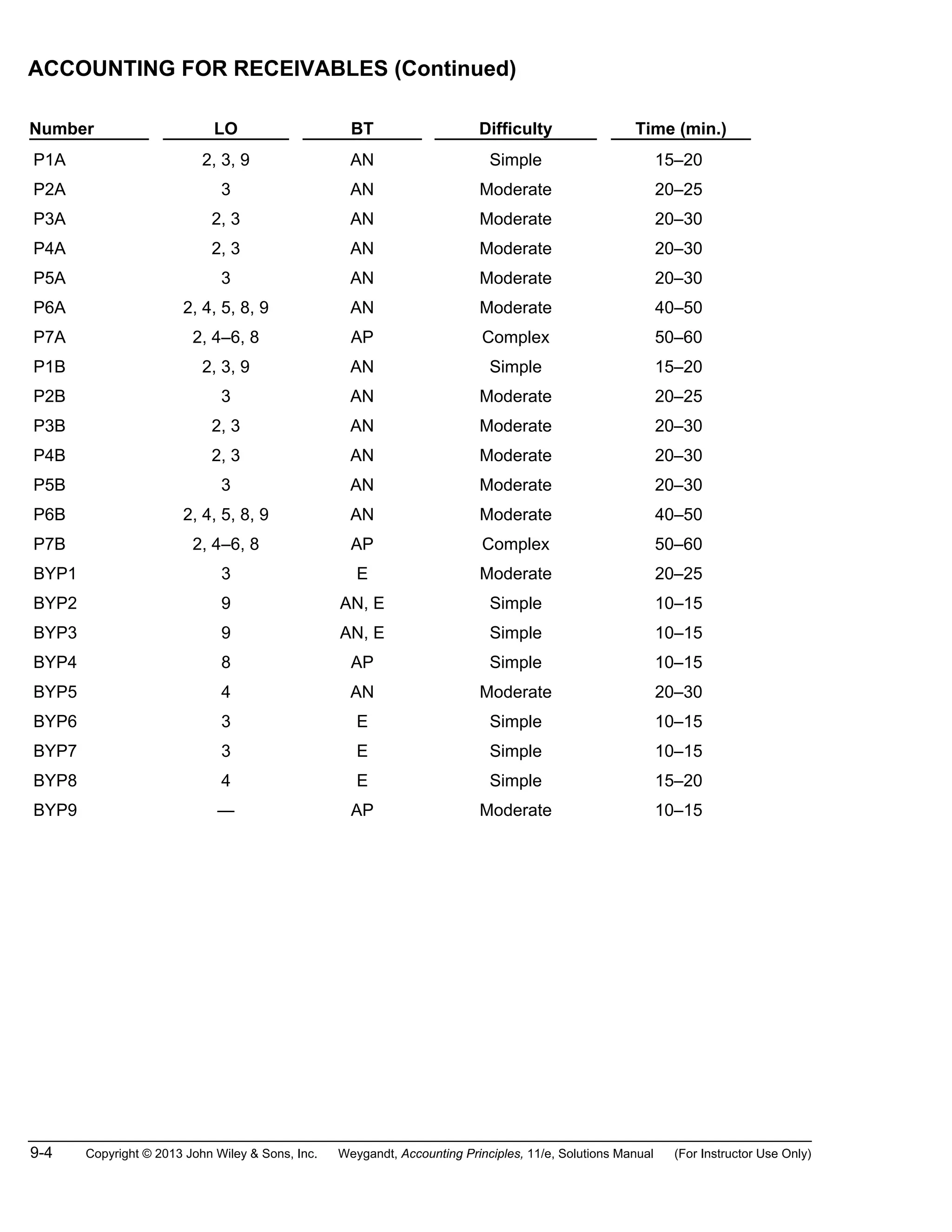

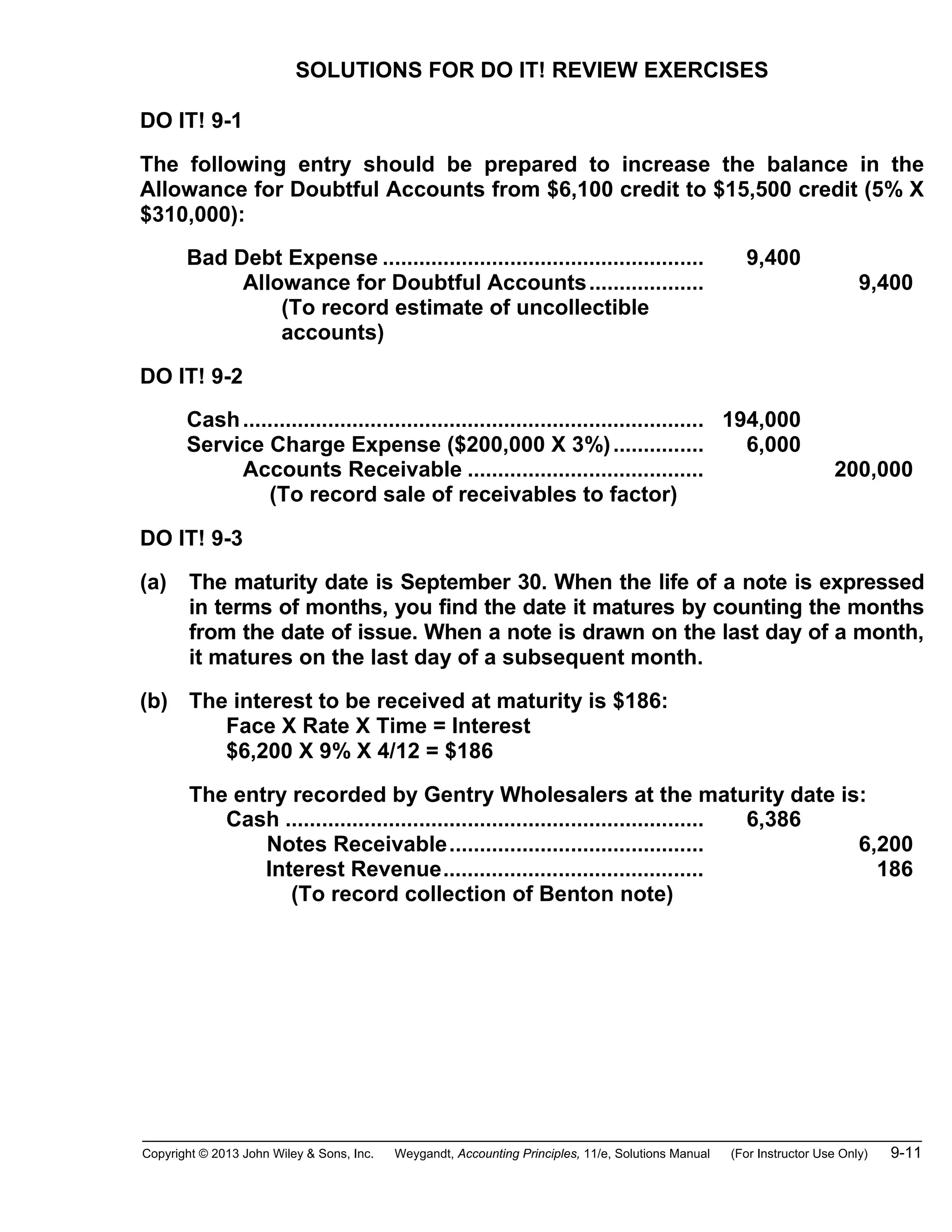
![Copyright © 2013 John Wiley & Sons, Inc. Weygandt, Accounting Principles, 11/e, Solutions Manual (For Instructor Use Only) 9-9
BRIEF EXERCISE 9-4
(a) Allowance for Doubtful Accounts ............................. 6,200
Accounts Receivable—Gray .............................. 6,200
(b) (1) Before Write-Off (2) After Write-Off
Accounts receivable
Allowance for doubtful
accounts
Cash realizable value
$700,000
54,000
$646,000
$693,800
47,800
$646,000
BRIEF EXERCISE 9-5
Accounts Receivable—Gray.............................................. 6,200
Allowance for Doubtful Accounts ............................. 6,200
Cash..................................................................................... 6,200
Accounts Receivable—Gray...................................... 6,200
BRIEF EXERCISE 9-6
Bad Debt Expense [($800,000 – $40,000) X 2%]............... 15,200
Allowance for Doubtful Accounts ............................. 15,200
BRIEF EXERCISE 9-7
(a) Bad Debt Expense [($420,000 X 1%) – $1,500] ............ 2,700
Allowance for Doubtful Accounts ..................... 2,700
(b) Bad Debt Expense [($420,000 X 1%) + $800] = $5,000
BRIEF EXERCISE 9-8
(a) Cash ($175 – $7).......................................................... 168
Service Charge Expense ($175 X 4%)....................... 7
Sales Revenue..................................................... 175
(b) Cash ($60,000 – $1,800).............................................. 58,200
Service Charge Expense ($60,000 X 3%).................. 1,800
Accounts Receivable.......................................... 60,000](https://image.slidesharecdn.com/10431-250416115305-f19f9a50/75/Accounting-Principles-11th-Edition-Weygandt-Solutions-Manual-13-2048.jpg)

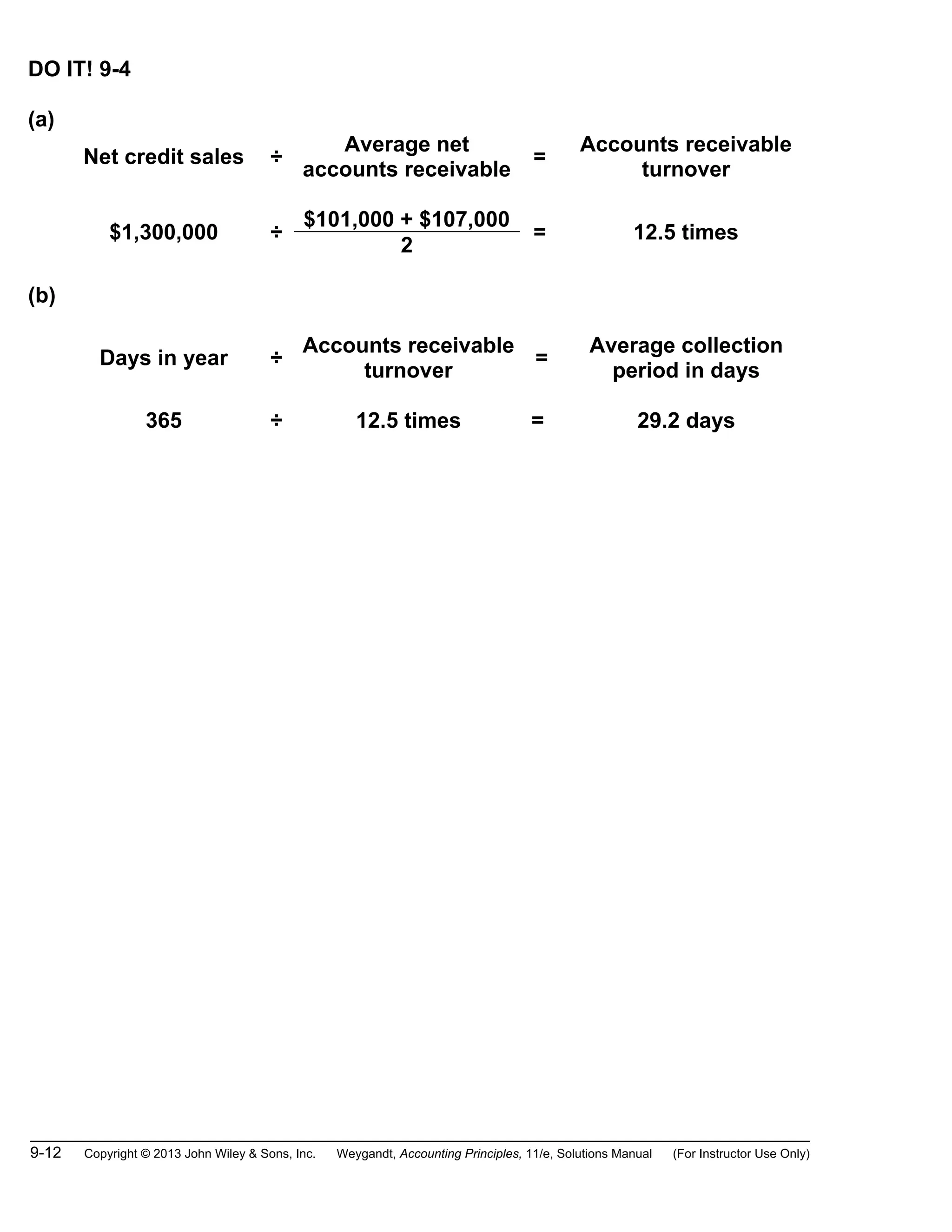
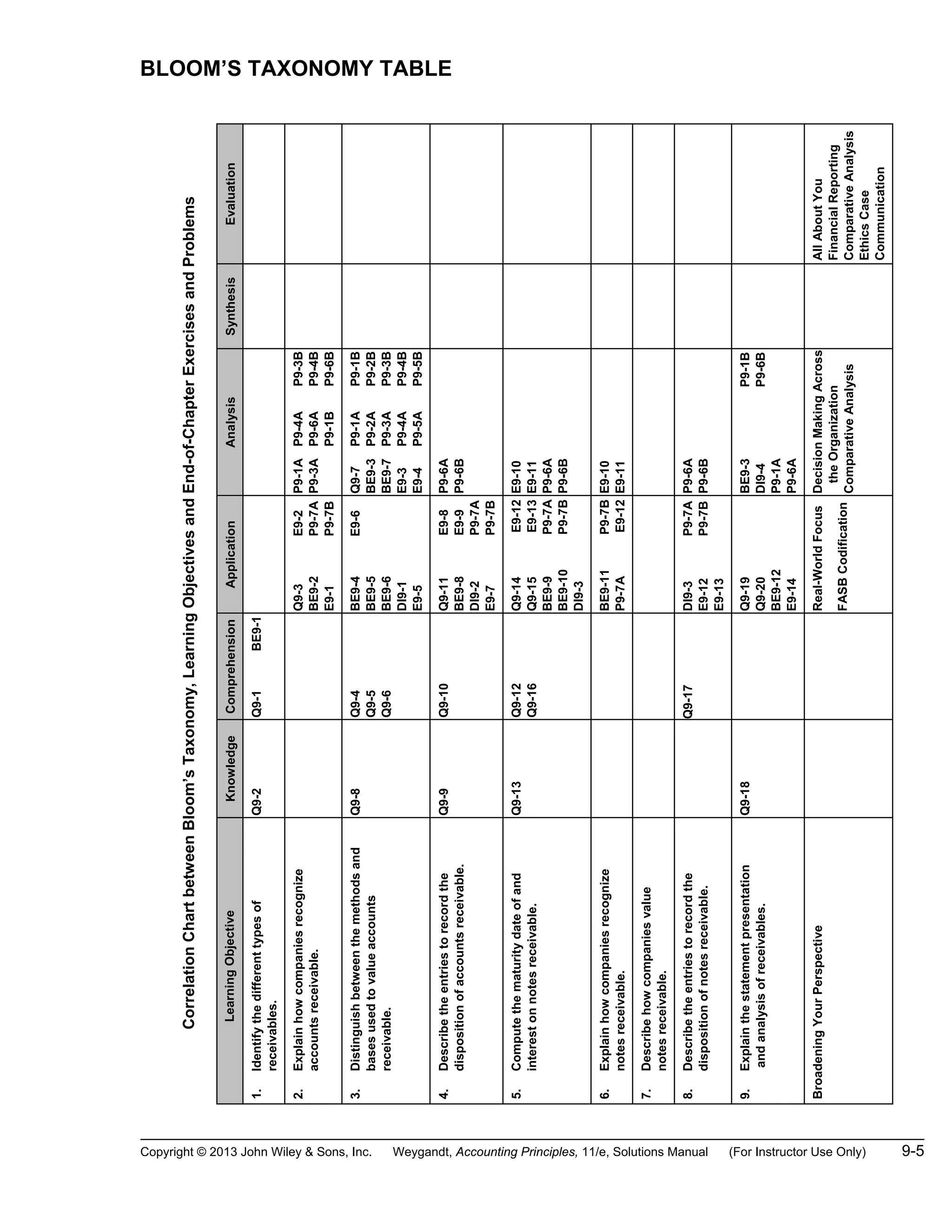
![Copyright © 2013 John Wiley & Sons, Inc. Weygandt, Accounting Principles, 11/e, Solutions Manual (For Instructor Use Only) 9-13
SOLUTIONS TO EXERCISES
EXERCISE 9-1
March 1 Accounts Receivable—Dodson Company.. 5,000
Sales Revenue ....................................... 5,000
3 Sales Returns and Allowances .................... 500
Accounts Receivable—Dodson
Company .............................................. 500
9 Cash................................................................ 4,410
Sales Discounts............................................. 90
Accounts Receivable—Dodson
Company .............................................. 4,500
15 Accounts Receivable .................................... 400
Sales Revenue ....................................... 400
31 Accounts Receivable .................................... 3
Interest Revenue.................................... 3
EXERCISE 9-2
(a) Jan. 6 Accounts Receivable—Pryor ....................... 7,000
Sales Revenue ....................................... 7,000
16 Cash ($7,000 – $140) ..................................... 6,860
Sales Discounts (2% X $7,000)..................... 140
Accounts Receivable—Pryor................ 7,000
(b) Jan. 10 Accounts Receivable—Farley...................... 9,000
Sales Revenue ....................................... 9,000
Feb. 12 Cash................................................................ 5,000
Accounts Receivable—Farley .............. 5,000
Mar. 10 Accounts Receivable—Farley...................... 40
Interest Revenue
[1% X ($9,000 – $5,000)] .................... 40](https://image.slidesharecdn.com/10431-250416115305-f19f9a50/75/Accounting-Principles-11th-Edition-Weygandt-Solutions-Manual-17-2048.jpg)
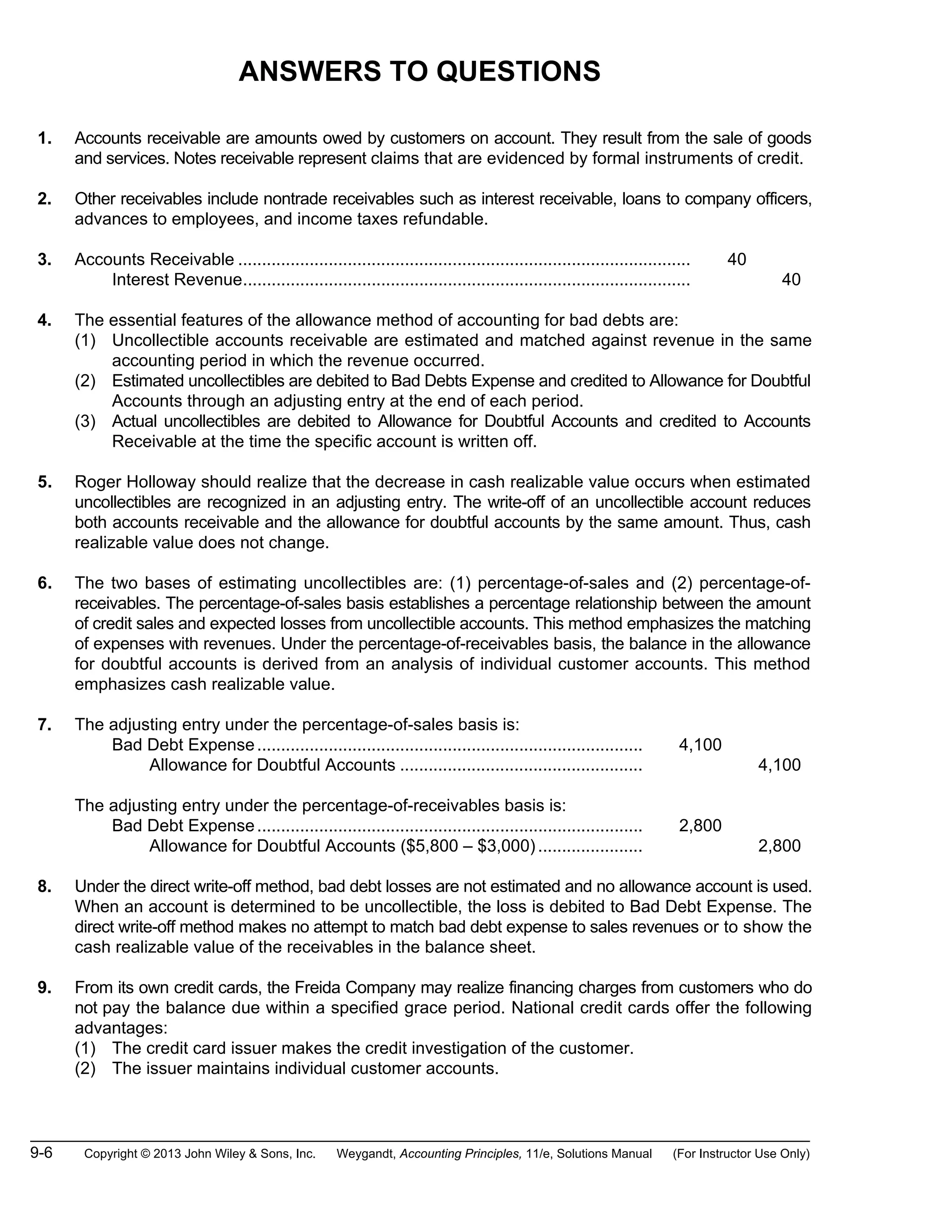
![9-14 Copyright © 2013 John Wiley & Sons, Inc. Weygandt, Accounting Principles, 11/e, Solutions Manual (For Instructor Use Only)
EXERCISE 9-3
(a) Dec. 31 Bad Debt Expense ............................... 1,400
Accounts Receivable—L. Dole ....... 1,400
(b) (1) Dec. 31 Bad Debt Expense
[($840,000 – $20,000) X 1%]............. 8,200
Allowance for Doubtful
Accounts................................... 8,200
(2) Dec. 31 Bad Debt Expense ............................... 8,900
Allowance for Doubtful Accounts
[($110,000 X 10%) – $2,100]...... 8,900
(c) (1) Dec. 31 Bad Debt Expense
[($840,000 – $20,000) X .75%].......... 6,150
Allowance for Doubtful
Accounts................................... 6,150
(2) Dec. 31 Bad Debt Expense ............................... 6,800
Allowance for Doubtful Accounts
[($110,000 X 6%) + $200].......... 6,800
EXERCISE 9-4
(a) Accounts Receivable Amount % Estimated Uncollectible
1–30 days
31–60 days
61–90 days
Over 90 days
$60,000
17,600
8,500
7,000
2.0
5.0
20.0
50.0
$1,200
880
1,700
3,500
$7,280
(b) Mar. 31 Bad Debt Expense ....................................... 6,080
Allowance for Doubtful Accounts
($7,280 – $1,200)............................... 6,080](https://image.slidesharecdn.com/10431-250416115305-f19f9a50/75/Accounting-Principles-11th-Edition-Weygandt-Solutions-Manual-18-2048.jpg)
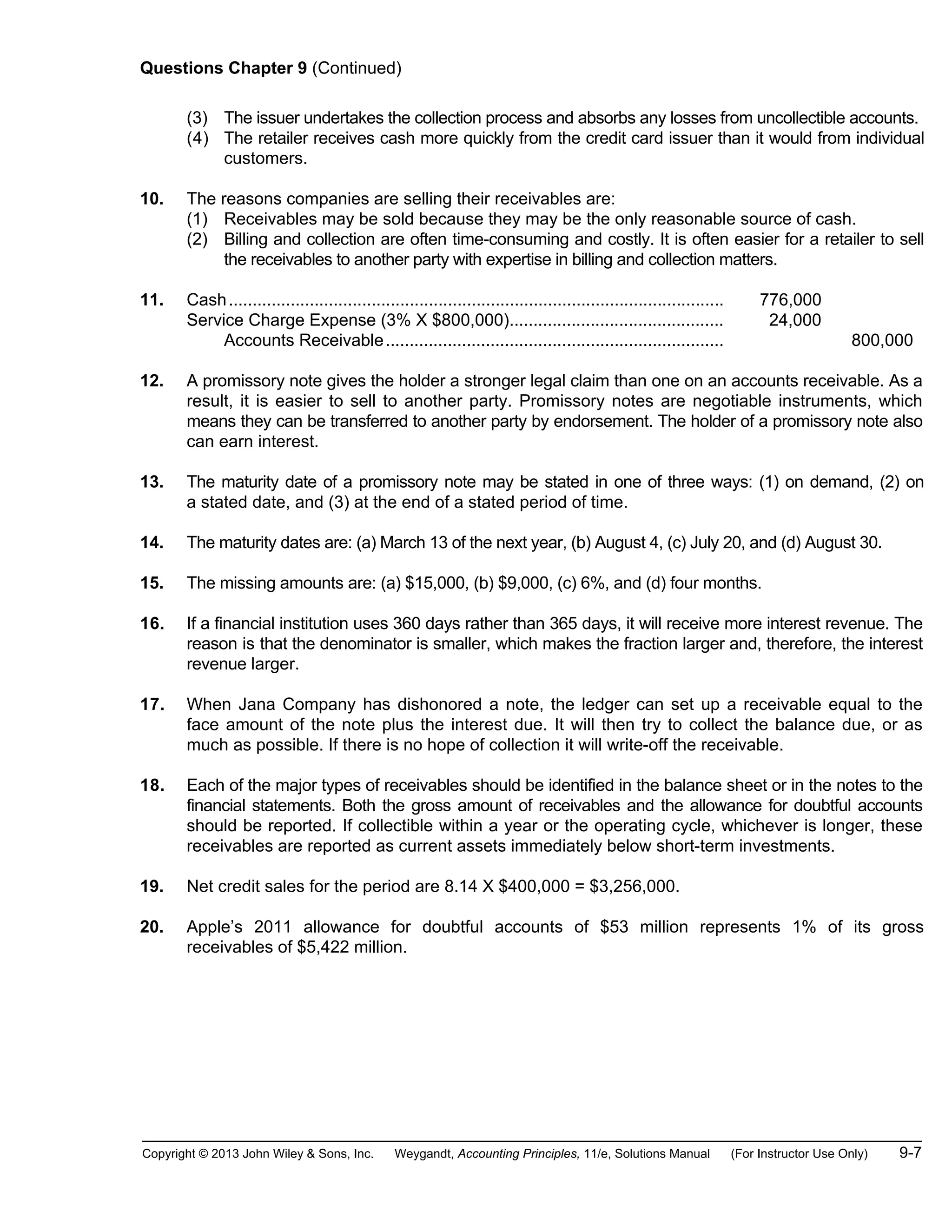
![Copyright © 2013 John Wiley & Sons, Inc. Weygandt, Accounting Principles, 11/e, Solutions Manual (For Instructor Use Only) 9-15
EXERCISE 9-5
Allowance for Doubtful Accounts.................................... 11,000
Accounts Receivable................................................. 11,000
Accounts Receivable ........................................................ 1,800
Allowance for Doubtful Accounts ............................ 1,800
Cash.................................................................................... 1,800
Accounts Receivable................................................. 1,800
Bad Debt Expense............................................................. 13,200
Allowance for Doubtful Accounts
[$19,000 – ($15,000 – $11,000 + $1,800)] .............. 13,200
EXERCISE 9-6
December 31, 2014
Bad Debt Expense (2% X $450,000)................................. 9,000
Allowance for Doubtful Accounts ............................ 9,000
May 11, 2015
Allowance for Doubtful Accounts.................................... 1,100
Accounts Receivable—Shoemaker.......................... 1,100
June 12, 2015
Accounts Receivable—Shoemaker ................................. 1,100
Allowance for Doubtful Accounts ............................ 1,100
Cash.................................................................................... 1,100
Accounts Receivable—Shoemaker.......................... 1,100
EXERCISE 9-7
(a) Mar. 3 Cash ($650,000 – $19,500) ....................... 630,500
Service Charge Expense
(3% X $650,000) .................................... 19,500
Accounts Receivable........................ 650,000
(b) May 10 Cash ($3,000 – $120) ................................ 2,880
Service Charge Expense
(4% X $3,000) ........................................ 120
Sales Revenue .................................. 3,000](https://image.slidesharecdn.com/10431-250416115305-f19f9a50/75/Accounting-Principles-11th-Edition-Weygandt-Solutions-Manual-19-2048.jpg)
![9-16 Copyright © 2013 John Wiley & Sons, Inc. Weygandt, Accounting Principles, 11/e, Solutions Manual (For Instructor Use Only)
EXERCISE 9-8
(a) Apr. 2 Accounts Receivable—J. Elston ............. 1,500
Sales Revenue................................... 1,500
May 3 Cash........................................................... 500
Accounts Receivable—
J. Elston ......................................... 500
June 1 Accounts Receivable—J. Elston ............. 10
Interest Revenue
[($1,500 – $500) X 1%]................... 10
(b) July 4 Cash........................................................... 196
Service Charge Expense
(2% X $200)............................................ 4
Sales Revenue................................... 200
EXERCISE 9-9
(a) Jan. 15 Accounts Receivable................................ 18,000
Sales Revenue................................... 18,000
20 Cash ($4,500 – $90)................................... 4,410
Service Charge Expense
($4,500 X 2%)......................................... 90
Sales Revenue................................... 4,500
Feb. 10 Cash........................................................... 10,000
Accounts Receivable........................ 10,000
15 Accounts Receivable ($8,000 X 1.5%)..... 120
Interest Revenue ............................... 120
(b) Interest Revenue is reported under other revenues and gains.
Service Charge Expense is a selling expense.](https://image.slidesharecdn.com/10431-250416115305-f19f9a50/75/Accounting-Principles-11th-Edition-Weygandt-Solutions-Manual-20-2048.jpg)


![Copyright © 2013 John Wiley & Sons, Inc. Weygandt, Accounting Principles, 11/e, Solutions Manual (For Instructor Use Only) 9-19
EXERCISE 9-13
(a) May 2 Notes Receivable ....................................... 9,000
Cash ..................................................... 9,000
(b) Nov. 2 Accounts Receivable—Chang
Inc............................................................. 9,405
Notes Receivable ................................ 9,000
Interest Revenue
($9,000 X 9% X 1/2).......................... 405
(To record the dishonor of
Chang Inc. note with
expectation of collection)
(c) Nov. 2 Allowance for Doubtful Accounts ............. 9,000
Notes Receivable ................................ 9,000
(To record the dishonor of
Chang Inc. note with no
expectation of collection)
EXERCISE 9-14
(a) Beginning accounts receivable........................................ $ 100,000
Net credit sales .................................................................. 1,000,000
Cash collections ................................................................ (920,000)
Accounts written off.......................................................... (30,000)
Ending accounts receivable ............................................. $ 150,000
(b) $1,000,000/[($100,000 + $150,000)/2] = 8
(c) 365/8 = 45.6 days](https://image.slidesharecdn.com/10431-250416115305-f19f9a50/75/Accounting-Principles-11th-Edition-Weygandt-Solutions-Manual-23-2048.jpg)

![Copyright © 2013 John Wiley & Sons, Inc. Weygandt, Accounting Principles, 11/e, Solutions Manual (For Instructor Use Only) 9-21
PROBLEM 9-1A (Continued)
(c) Balance before adjustment [see (b)]..................................... $ 19,000
Balance needed ...................................................................... 115,000
Adjustment required............................................................... $ 96,000
The journal entry would therefore be as follows:
Bad Debt Expense........................................... 96,000
Allowance for Doubtful Accounts.......... 96,000
(d)
$3,700,000–$50,000
880 595
($ ,000+$1, ,000) ÷ 2
=
$3,650,000
1,237 5
$ , 00
= 2.95 times](https://image.slidesharecdn.com/10431-250416115305-f19f9a50/75/Accounting-Principles-11th-Edition-Weygandt-Solutions-Manual-25-2048.jpg)
![9-22 Copyright © 2013 John Wiley & Sons, Inc. Weygandt, Accounting Principles, 11/e, Solutions Manual (For Instructor Use Only)
PROBLEM 9-2A
(a) $33,000.
(b) $50,000 ($2,500,000 X 2%).
(c) $49,500 [($875,000 X 6%) – $3,000].
(d) $55,500 [($875,000 X 6%) + $3,000].
(e) The weakness of the direct write-off method is two-fold. First, it does not
match expenses with revenues. Second, the accounts receivable are not
stated at cash realizable value at the balance sheet date.](https://image.slidesharecdn.com/10431-250416115305-f19f9a50/75/Accounting-Principles-11th-Edition-Weygandt-Solutions-Manual-26-2048.jpg)

![9-24 Copyright © 2013 John Wiley & Sons, Inc. Weygandt, Accounting Principles, 11/e, Solutions Manual (For Instructor Use Only)
PROBLEM 9-4A
(a) Total estimated bad debts
Number of Days Outstanding
Total 0–30 31–60 61–90 91–120 Over 120
Accounts
receivable $200,000 $77,000 $46,000 $39,000 $23,000 $15,000
% uncollectible 1% 4% 5% 8% 20%
Estimated
Bad debts $ 9,400 $ 770 $ 1,840 $ 1,950 $ 1,840 $ 3,000
(b) Bad Debt Expense...................................................... 17,400
Allowance for Doubtful Accounts
[$9,400 + $8,000] ................................................ 17,400
(c) Allowance for Doubtful Accounts............................. 5,000
Accounts Receivable............................................ 5,000
(d) Accounts Receivable ................................................. 5,000
Allowance for Doubtful Accounts ....................... 5,000
Cash ............................................................................ 5,000
Accounts Receivable............................................ 5,000
(e) If Rigney Inc. used 4% of total accounts receivable rather than aging the
individual accounts the bad debt expense adjustment would be $16,000
[($200,000 X 4%) + $8,000]. The rest of the entries would be the same as
they were when aging the accounts receivable.
Aging the individual accounts rather than applying a percentage to the
total accounts receivable should produce a more accurate allowance
account and bad debts expense.](https://image.slidesharecdn.com/10431-250416115305-f19f9a50/75/Accounting-Principles-11th-Edition-Weygandt-Solutions-Manual-28-2048.jpg)
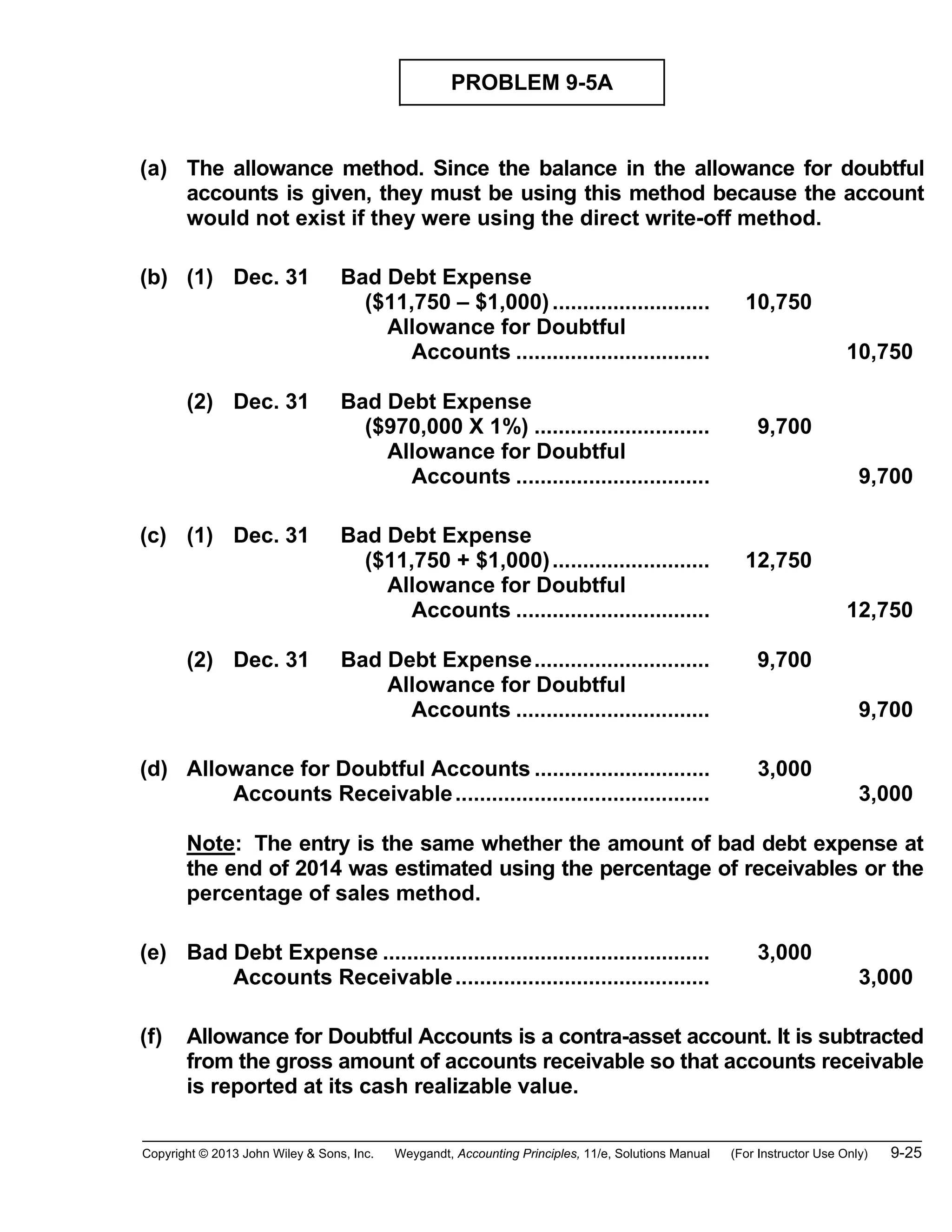



![Copyright © 2013 John Wiley & Sons, Inc. Weygandt, Accounting Principles, 11/e, Solutions Manual (For Instructor Use Only) 9-29
PROBLEM 9-1B
(a) 1. Accounts Receivable.................................... 2,600,000
Sales Revenue....................................... 2,600,000
2. Sales Returns and Allowances.................... 45,000
Accounts Receivable............................ 45,000
3. Cash............................................................... 2,250,000
Accounts Receivable............................ 2,250,000
4. Allowance for Doubtful Accounts ............... 10,000
Accounts Receivable............................ 10,000
5. Accounts Receivable.................................... 3,000
Allowance for Doubtful
Accounts............................................ 3,000
Cash............................................................... 3,000
Accounts Receivable............................ 3,000
(b)
Accounts Receivable Allowance for Doubtful Accounts
Bal. 250,000
(1) 2,600,000
(5) 3,000
(2) 45,000
(3) 2,250,000
(4) 10,000
(5) 3,000
(4) 10,000 Bal. 15,000
(5) 3,000
Bal. 545,000 Bal. 8,000
(c) Balance before adjustment [see (b)]..................................... $ 8,000
Balance needed ...................................................................... 22,000
Adjustment required............................................................... $14,000
The journal entry would therefore be as follows:
Bad Debt Expense............................................. 14,000
Allowance for Doubtful Accounts............ 14,000
(d)
$2,600,000 – $45,000
523 235
($ ,000 + $ ,000) ÷ 2
=
$2,555,000
379 0
$ , 00
= 6.74 times](https://image.slidesharecdn.com/10431-250416115305-f19f9a50/75/Accounting-Principles-11th-Edition-Weygandt-Solutions-Manual-33-2048.jpg)
![9-30 Copyright © 2013 John Wiley & Sons, Inc. Weygandt, Accounting Principles, 11/e, Solutions Manual (For Instructor Use Only)
PROBLEM 9-2B
(a) $22,150.
(b) $20,000 ($1,000,000 X 2%).
(c) $14,450 [($369,000 X 5%) – $4,000].
(d) $20,450 [($369,000 X 5%) + $2,000].
(e) There are two major weaknesses with the direct write-off method. First,
it does not match expenses with the associated revenues. Second, the
accounts receivable are not stated at cash realizable value at the balance
sheet date.](https://image.slidesharecdn.com/10431-250416115305-f19f9a50/75/Accounting-Principles-11th-Edition-Weygandt-Solutions-Manual-34-2048.jpg)

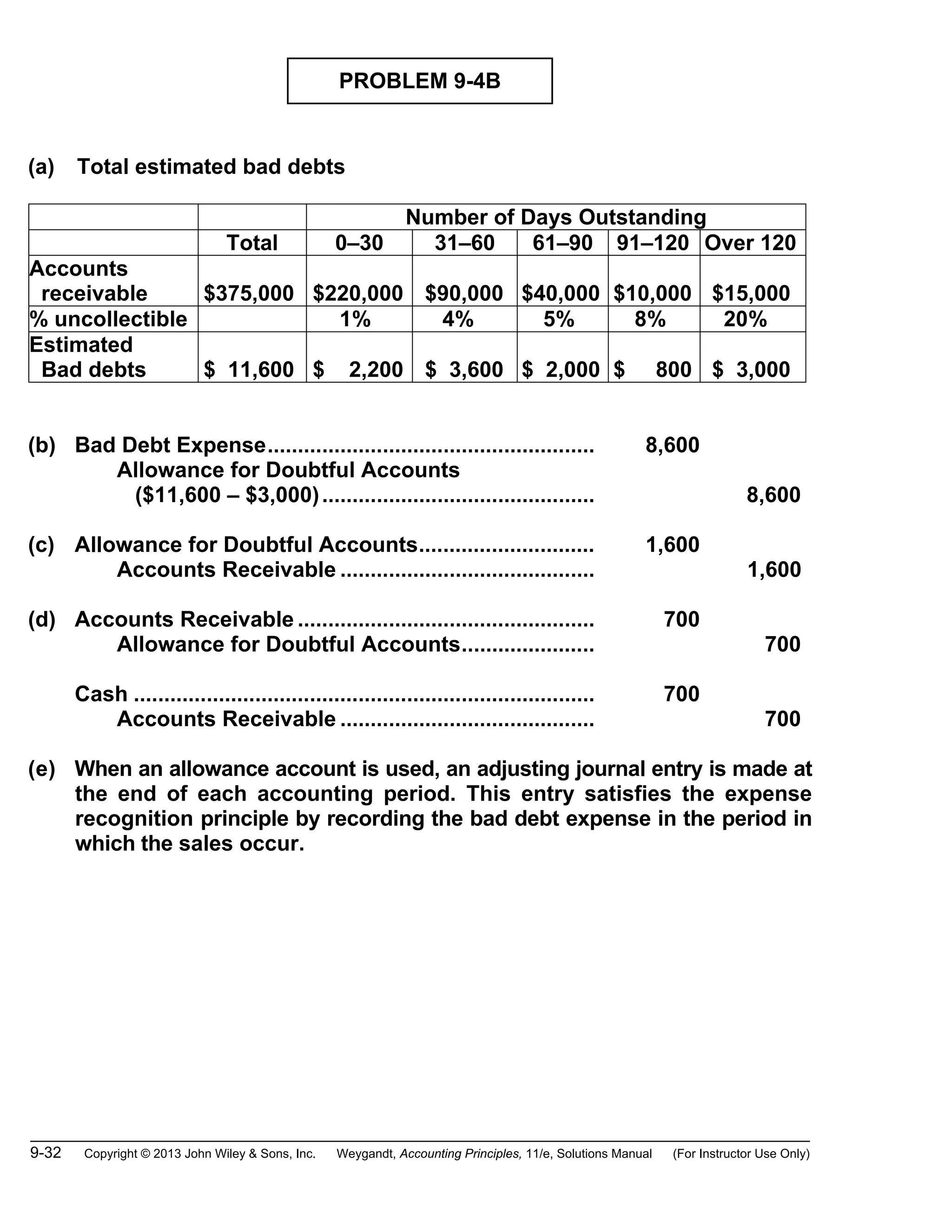




![At this point, after repeating what I had heard him say before,
concerning the grace and dexterity with which Socrates “played at
ball” in his last moments—the ball being his life and his family—
Epictetus passed on to emphasize the duty of the philosopher to
preserve his peace of mind even at the cost of detaching himself
from those nearest and dearest to him. Suppose, for example, you
are alarmed by portents of evil, you must say to yourself “These
portents threaten my body, or my goods, or my reputation, or my
children, or my wife; but they do not threaten me.” Then he insisted
on the necessity of placing “the supreme good” above all ties of
kindred. “I have nothing to do,” he exclaimed, “with my father, but
only with the supreme good.” Scarcely waiting for him to finish his
sentence, Glaucus rose from his seat, pressed some folded papers
into my hand, and left the room.
I think Epictetus saw him go. At all events, he immediately put
himself, as it were, in Glaucus’s place, as though uttering just such a
remonstrance as Glaucus would have liked to utter, “Are you so hard
hearted?” To this Epictetus replied in his own person, “Nay, I have
been framed by Nature thus. God has given me this coinage.” What
our Master really meant was, that God has ordained that men should
part with everything at the price of duty and virtue. “Duty” or
“virtue” is to be the “coin” in exchange for which we must be ready
to sell everything, even at the risk of disobeying a father. A father
may bid his son betray his country that he, the father, may gain ten
thousand sesterces. In such a case the son ought to reply—as
Epictetus said—“Am I to neglect my supreme good that you may
have it [i.e. what you consider your supreme good]? Am I to make
way for you? What for?” “I am your father,” says the father. “Yes, but
you are not my supreme good.” “I am your brother,” says the
brother. “Yes, but you are not my supreme good.”
All this (I thought) was very moral in intention, but might it not
have been put differently—“Father, I must needs disobey you for
your sake as well as mine,” “Brother, you are going the way to
dishonour yourself as well as me”? Glaucus could not have taken
offence at that. However, this occasional austerity was characteristic](https://image.slidesharecdn.com/10431-250416115305-f19f9a50/75/Accounting-Principles-11th-Edition-Weygandt-Solutions-Manual-71-2048.jpg)