Accounting Information Systems Understanding
Business Processes 4th Edition Considine Test
Bank download
https://testbankdeal.com/product/accounting-information-systems-
understanding-business-processes-4th-edition-considine-test-bank/
Explore and download more test bank or solution manual
at testbankdeal.com
We have selected some products that you may be interested in
Click the link to download now or visit testbankdeal.com
for more options!.
Accounting Information Systems Understanding Business
Processes 5th Edition Parkes Test Bank
https://testbankdeal.com/product/accounting-information-systems-
understanding-business-processes-5th-edition-parkes-test-bank/
Accounting Information Systems Understanding Business
Processes 5th Edition Parkes Solutions Manual
https://testbankdeal.com/product/accounting-information-systems-
understanding-business-processes-5th-edition-parkes-solutions-manual/
Accounting Information Systems Controls Processes 3rd
Edition Turner Test Bank
https://testbankdeal.com/product/accounting-information-systems-
controls-processes-3rd-edition-turner-test-bank/
Understanding Basic Statistics Enhanced 7th Edition Brase
Solutions Manual
https://testbankdeal.com/product/understanding-basic-statistics-
enhanced-7th-edition-brase-solutions-manual/
Survey of Mathematics with Applications 9th Edition Angel
Test Bank
https://testbankdeal.com/product/survey-of-mathematics-with-
applications-9th-edition-angel-test-bank/
Financial Accounting Information for Decisions 8th Edition
John Wild Test Bank
https://testbankdeal.com/product/financial-accounting-information-for-
decisions-8th-edition-john-wild-test-bank/
Statistics Data Analysis and Decision Modeling 5th Edition
Evans Solutions Manual
https://testbankdeal.com/product/statistics-data-analysis-and-
decision-modeling-5th-edition-evans-solutions-manual/
Chemistry The Central Science 13th Edition Brown Test Bank
https://testbankdeal.com/product/chemistry-the-central-science-13th-
edition-brown-test-bank/
College Algebra with Intermediate Algebra A Blended Course
1st Edition Beecher Solutions Manual
https://testbankdeal.com/product/college-algebra-with-intermediate-
algebra-a-blended-course-1st-edition-beecher-solutions-manual/
Introduction to Analysis 4th Edition Wade Solutions Manual
https://testbankdeal.com/product/introduction-to-analysis-4th-edition-
wade-solutions-manual/
Testbank
to accompany
Accounting Information
Systems 4e
Brett Considine, Alison Parkes, Karin
Olesen, Yvette Blount & Derek Speer
Prepared by
Zhong Zheng
and
Kent Wilson
John Wiley & Sons Australia, Ltd 2012
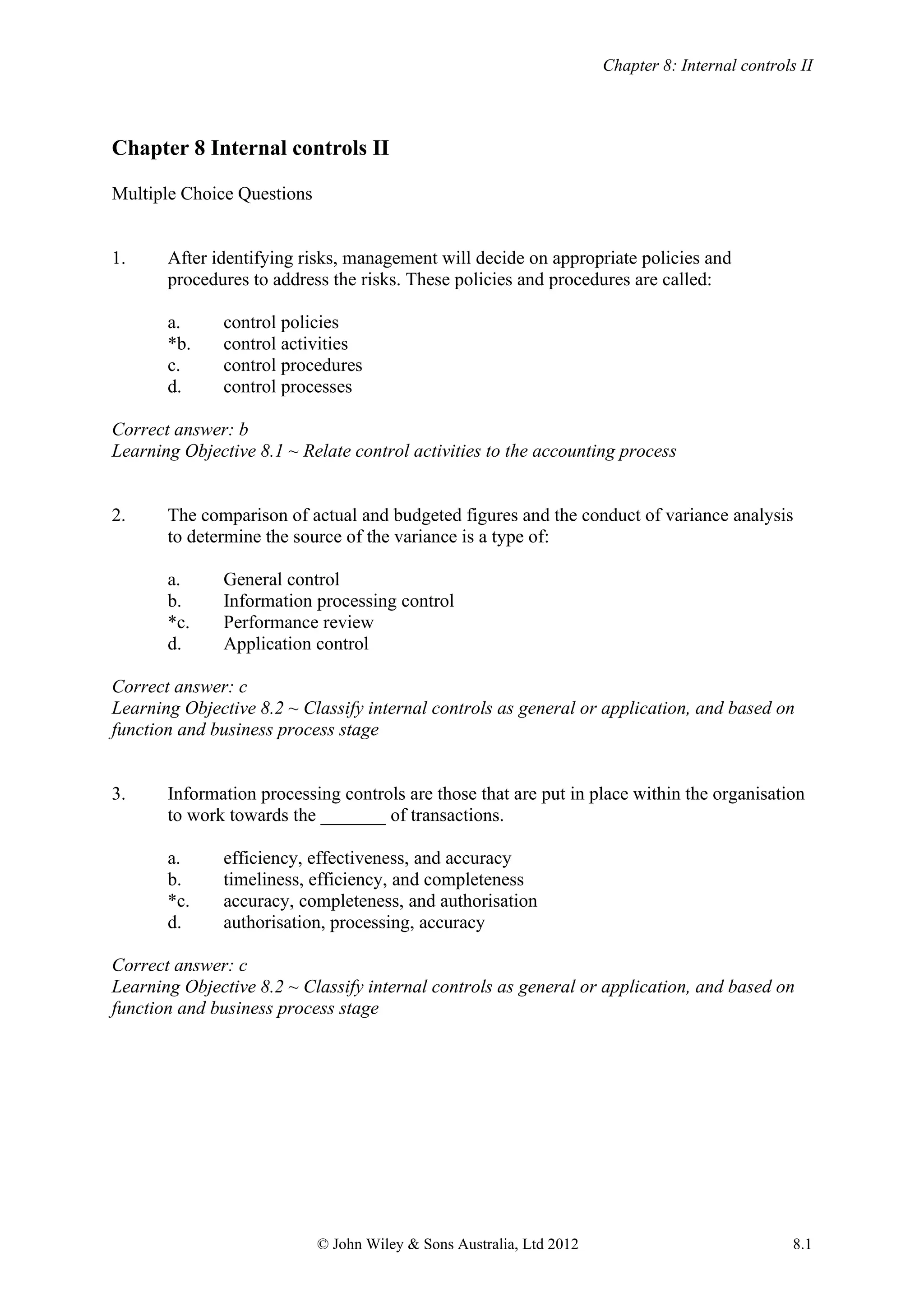
Chapter 8: Internal controls II
© John Wiley & Sons Australia, Ltd 2012 8.1
Chapter 8 Internal controls II
Multiple Choice Questions
1. After identifying risks, management will decide on appropriate policies and
procedures to address the risks. These policies and procedures are called:
a. control policies
*b. control activities
c. control procedures
d. control processes
Correct answer: b
Learning Objective 8.1 ~ Relate control activities to the accounting process
2. The comparison of actual and budgeted figures and the conduct of variance analysis
to determine the source of the variance is a type of:
a. General control
b. Information processing control
*c. Performance review
d. Application control
Correct answer: c
Learning Objective 8.2 ~ Classify internal controls as general or application, and based on
function and business process stage
3. Information processing controls are those that are put in place within the organisation
to work towards the _______ of transactions.
a. efficiency, effectiveness, and accuracy
b. timeliness, efficiency, and completeness
*c. accuracy, completeness, and authorisation
d. authorisation, processing, accuracy
Correct answer: c
Learning Objective 8.2 ~ Classify internal controls as general or application, and based on
function and business process stage
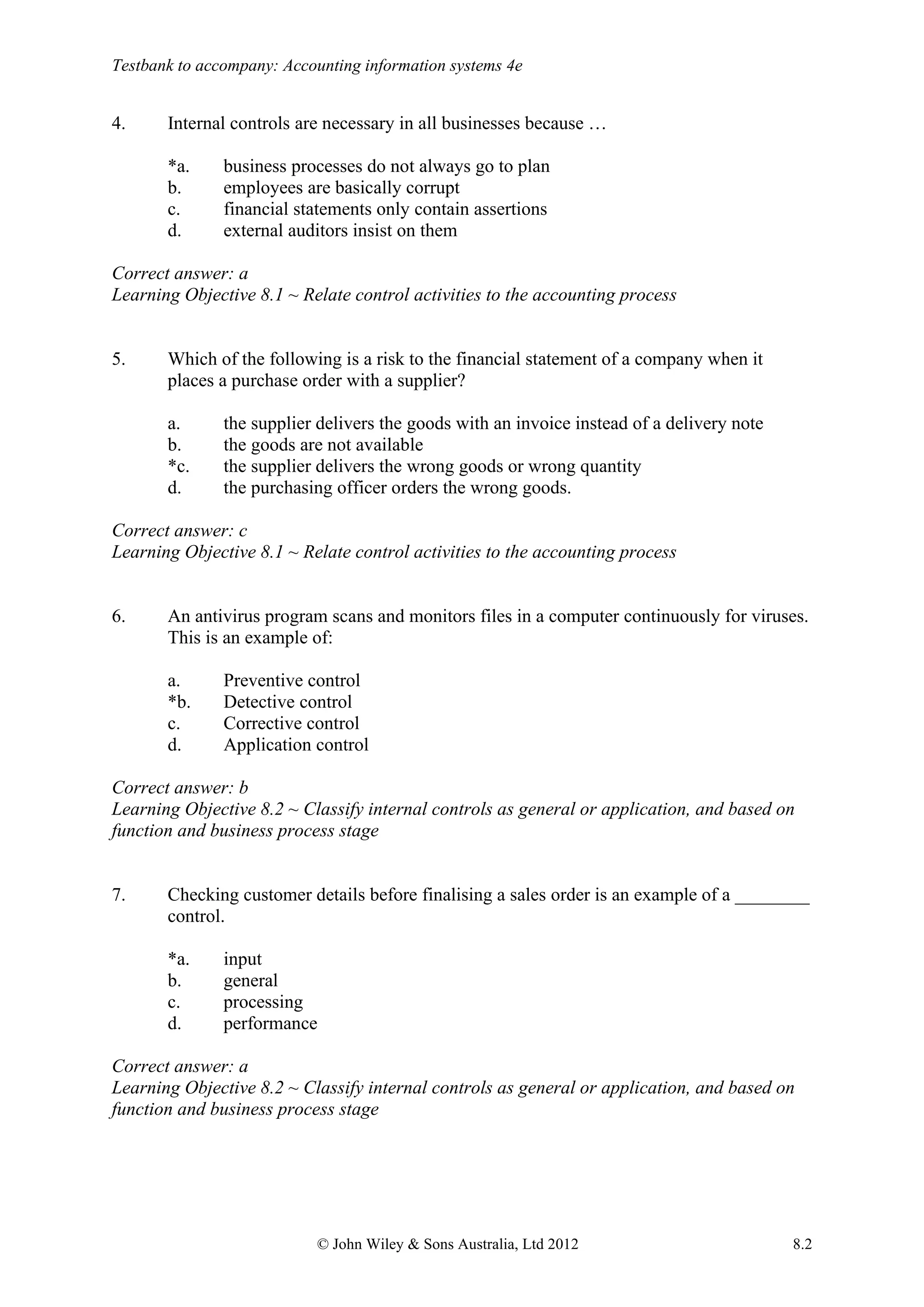
Testbank to accompany: Accounting information systems 4e
© John Wiley & Sons Australia, Ltd 2012 8.2
4. Internal controls are necessary in all businesses because …
*a. business processes do not always go to plan
b. employees are basically corrupt
c. financial statements only contain assertions
d. external auditors insist on them
Correct answer: a
Learning Objective 8.1 ~ Relate control activities to the accounting process
5. Which of the following is a risk to the financial statement of a company when it
places a purchase order with a supplier?
a. the supplier delivers the goods with an invoice instead of a delivery note
b. the goods are not available
*c. the supplier delivers the wrong goods or wrong quantity
d. the purchasing officer orders the wrong goods.
Correct answer: c
Learning Objective 8.1 ~ Relate control activities to the accounting process
6. An antivirus program scans and monitors files in a computer continuously for viruses.
This is an example of:
a. Preventive control
*b. Detective control
c. Corrective control
d. Application control
Correct answer: b
Learning Objective 8.2 ~ Classify internal controls as general or application, and based on
function and business process stage
7. Checking customer details before finalising a sales order is an example of a ________
control.
*a. input
b. general
c. processing
d. performance
Correct answer: a
Learning Objective 8.2 ~ Classify internal controls as general or application, and based on
function and business process stage
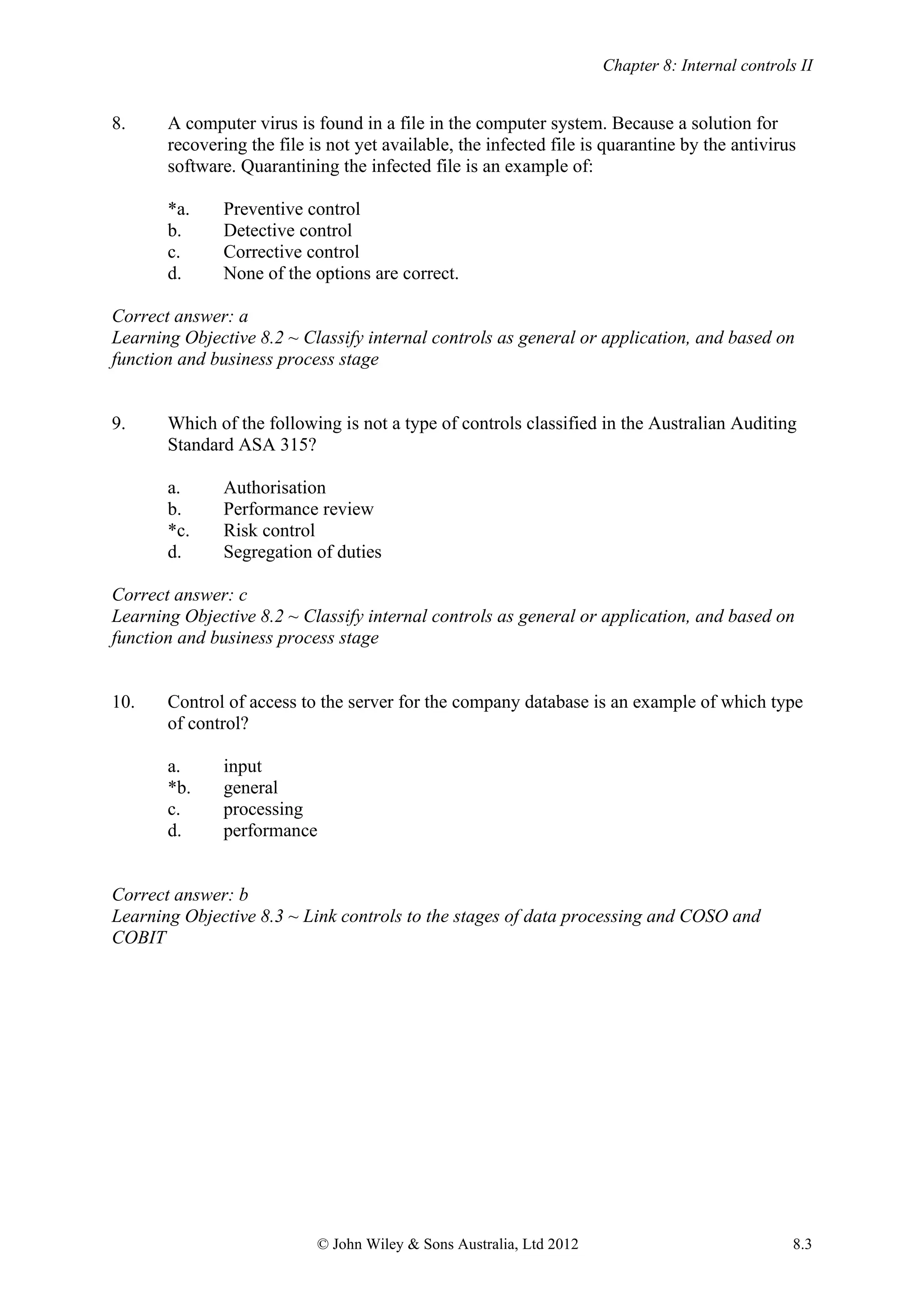
Chapter 8: Internal controls II
© John Wiley & Sons Australia, Ltd 2012 8.3
8. A computer virus is found in a file in the computer system. Because a solution for
recovering the file is not yet available, the infected file is quarantine by the antivirus
software. Quarantining the infected file is an example of:
*a. Preventive control
b. Detective control
c. Corrective control
d. None of the options are correct.
Correct answer: a
Learning Objective 8.2 ~ Classify internal controls as general or application, and based on
function and business process stage
9. Which of the following is not a type of controls classified in the Australian Auditing
Standard ASA 315?
a. Authorisation
b. Performance review
*c. Risk control
d. Segregation of duties
Correct answer: c
Learning Objective 8.2 ~ Classify internal controls as general or application, and based on
function and business process stage
10. Control of access to the server for the company database is an example of which type
of control?
a. input
*b. general
c. processing
d. performance
Correct answer: b
Learning Objective 8.3 ~ Link controls to the stages of data processing and COSO and
COBIT
Testbank to accompany: Accounting information systems 4e
© John Wiley & Sons Australia, Ltd 2012 8.4
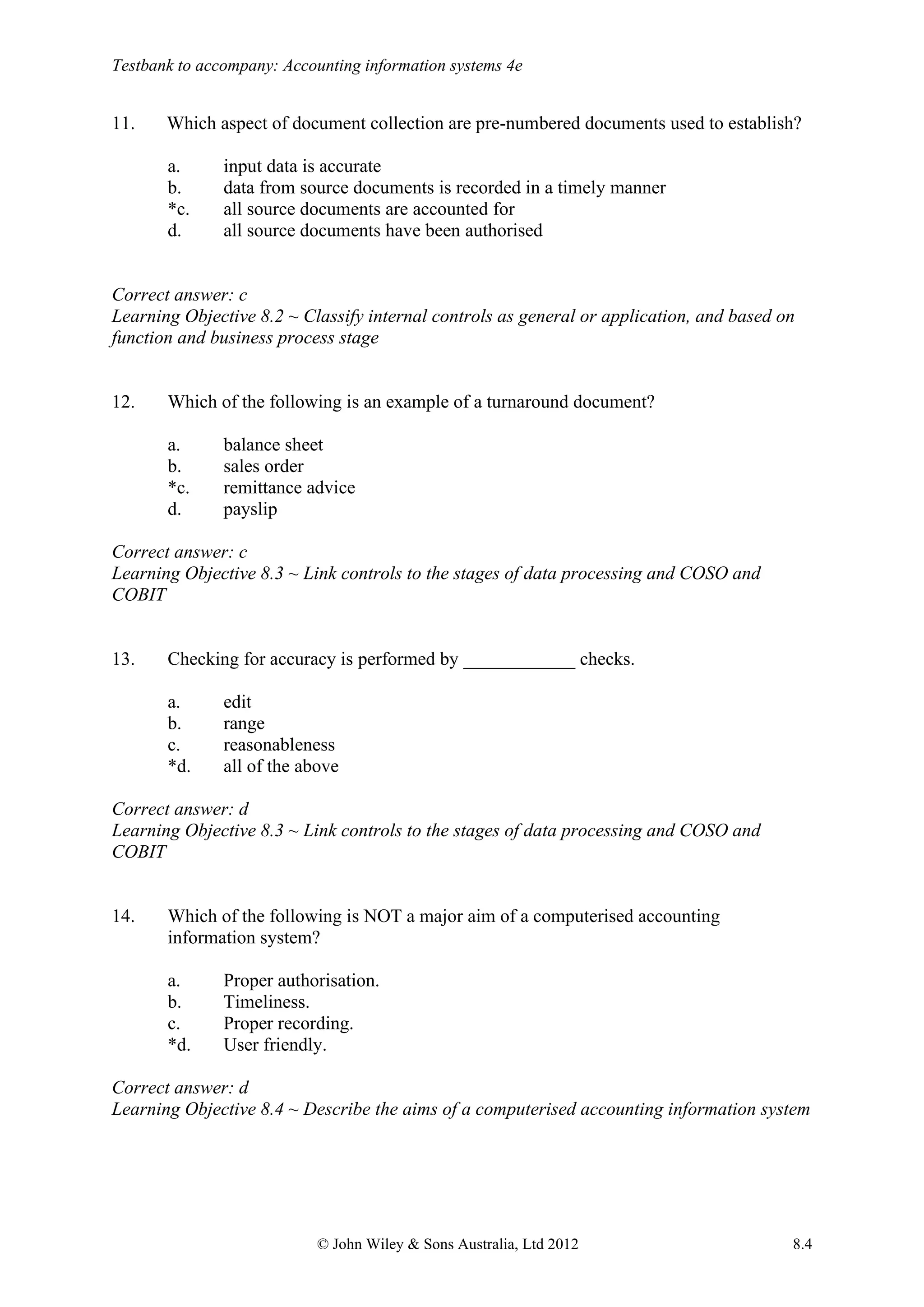
11. Which aspect of document collection are pre-numbered documents used to establish?
a. input data is accurate
b. data from source documents is recorded in a timely manner
*c. all source documents are accounted for
d. all source documents have been authorised
Correct answer: c
Learning Objective 8.2 ~ Classify internal controls as general or application, and based on
function and business process stage
12. Which of the following is an example of a turnaround document?
a. balance sheet
b. sales order
*c. remittance advice
d. payslip
Correct answer: c
Learning Objective 8.3 ~ Link controls to the stages of data processing and COSO and
COBIT
13. Checking for accuracy is performed by ____________ checks.
a. edit
b. range
c. reasonableness
*d. all of the above
Correct answer: d
Learning Objective 8.3 ~ Link controls to the stages of data processing and COSO and
COBIT
14. Which of the following is NOT a major aim of a computerised accounting
information system?
a. Proper authorisation.
b. Timeliness.
c. Proper recording.
*d. User friendly.
Correct answer: d
Learning Objective 8.4 ~ Describe the aims of a computerised accounting information system
Chapter 8: Internal controls II
© John Wiley & Sons Australia, Ltd 2012 8.5
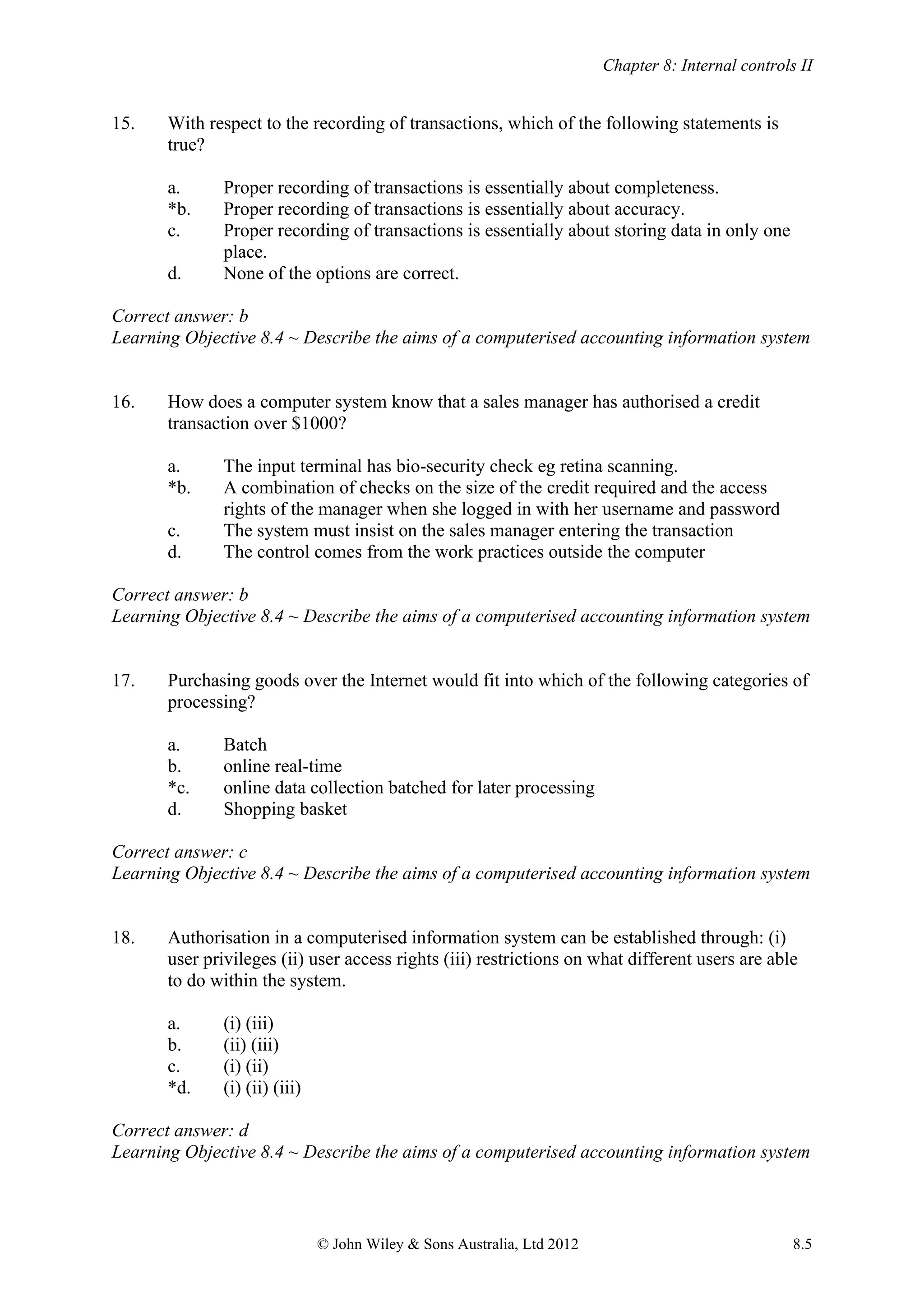
15. With respect to the recording of transactions, which of the following statements is
true?
a. Proper recording of transactions is essentially about completeness.
*b. Proper recording of transactions is essentially about accuracy.
c. Proper recording of transactions is essentially about storing data in only one
place.
d. None of the options are correct.
Correct answer: b
Learning Objective 8.4 ~ Describe the aims of a computerised accounting information system
16. How does a computer system know that a sales manager has authorised a credit
transaction over $1000?
a. The input terminal has bio-security check eg retina scanning.
*b. A combination of checks on the size of the credit required and the access
rights of the manager when she logged in with her username and password
c. The system must insist on the sales manager entering the transaction
d. The control comes from the work practices outside the computer
Correct answer: b
Learning Objective 8.4 ~ Describe the aims of a computerised accounting information system
17. Purchasing goods over the Internet would fit into which of the following categories of
processing?
a. Batch
b. online real-time
*c. online data collection batched for later processing
d. Shopping basket
Correct answer: c
Learning Objective 8.4 ~ Describe the aims of a computerised accounting information system
18. Authorisation in a computerised information system can be established through: (i)
user privileges (ii) user access rights (iii) restrictions on what different users are able
to do within the system.
a. (i) (iii)
b. (ii) (iii)
c. (i) (ii)
*d. (i) (ii) (iii)
Correct answer: d
Learning Objective 8.4 ~ Describe the aims of a computerised accounting information system
Testbank to accompany: Accounting information systems 4e
© John Wiley & Sons Australia, Ltd 2012 8.6
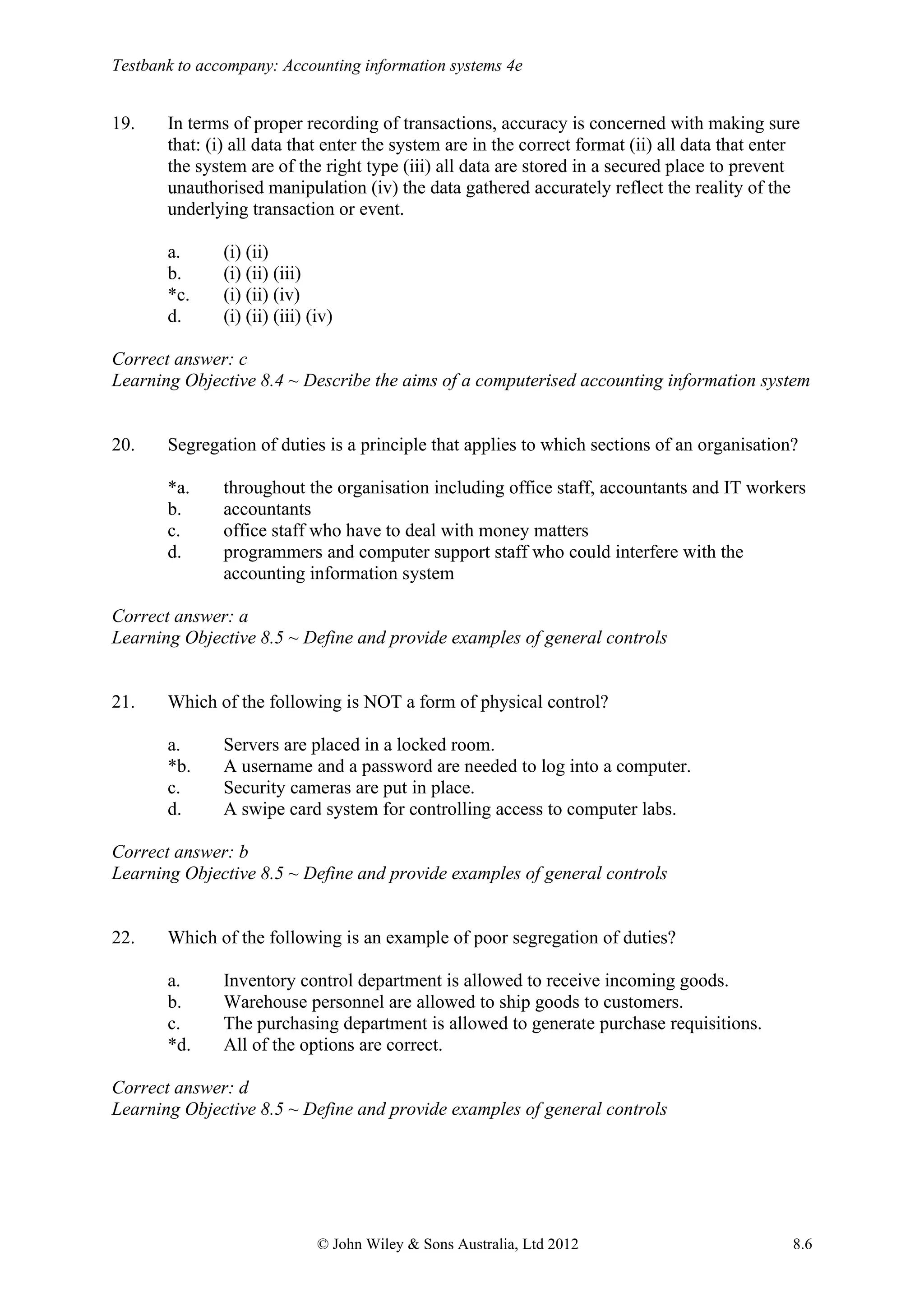
19. In terms of proper recording of transactions, accuracy is concerned with making sure
that: (i) all data that enter the system are in the correct format (ii) all data that enter
the system are of the right type (iii) all data are stored in a secured place to prevent
unauthorised manipulation (iv) the data gathered accurately reflect the reality of the
underlying transaction or event.
a. (i) (ii)
b. (i) (ii) (iii)
*c. (i) (ii) (iv)
d. (i) (ii) (iii) (iv)
Correct answer: c
Learning Objective 8.4 ~ Describe the aims of a computerised accounting information system
20. Segregation of duties is a principle that applies to which sections of an organisation?
*a. throughout the organisation including office staff, accountants and IT workers
b. accountants
c. office staff who have to deal with money matters
d. programmers and computer support staff who could interfere with the
accounting information system
Correct answer: a
Learning Objective 8.5 ~ Define and provide examples of general controls
21. Which of the following is NOT a form of physical control?
a. Servers are placed in a locked room.
*b. A username and a password are needed to log into a computer.
c. Security cameras are put in place.
d. A swipe card system for controlling access to computer labs.
Correct answer: b
Learning Objective 8.5 ~ Define and provide examples of general controls
22. Which of the following is an example of poor segregation of duties?
a. Inventory control department is allowed to receive incoming goods.
b. Warehouse personnel are allowed to ship goods to customers.
c. The purchasing department is allowed to generate purchase requisitions.
*d. All of the options are correct.
Correct answer: d
Learning Objective 8.5 ~ Define and provide examples of general controls
Chapter 8: Internal controls II
© John Wiley & Sons Australia, Ltd 2012 8.7
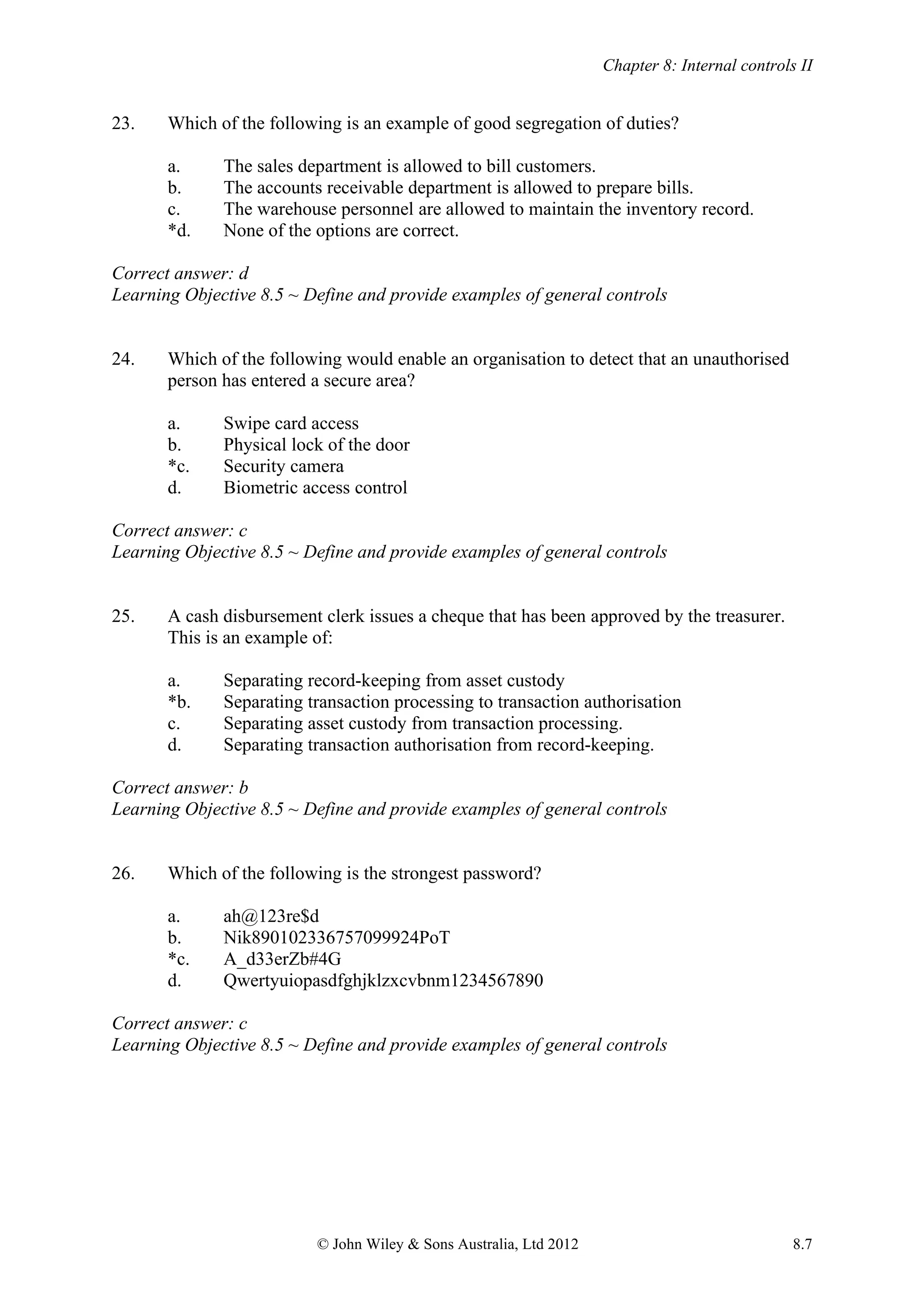
23. Which of the following is an example of good segregation of duties?
a. The sales department is allowed to bill customers.
b. The accounts receivable department is allowed to prepare bills.
c. The warehouse personnel are allowed to maintain the inventory record.
*d. None of the options are correct.
Correct answer: d
Learning Objective 8.5 ~ Define and provide examples of general controls
24. Which of the following would enable an organisation to detect that an unauthorised
person has entered a secure area?
a. Swipe card access
b. Physical lock of the door
*c. Security camera
d. Biometric access control
Correct answer: c
Learning Objective 8.5 ~ Define and provide examples of general controls
25. A cash disbursement clerk issues a cheque that has been approved by the treasurer.
This is an example of:
a. Separating record-keeping from asset custody
*b. Separating transaction processing to transaction authorisation
c. Separating asset custody from transaction processing.
d. Separating transaction authorisation from record-keeping.
Correct answer: b
Learning Objective 8.5 ~ Define and provide examples of general controls
26. Which of the following is the strongest password?
a. ah@123re$d
b. Nik890102336757099924PoT
*c. A_d33erZb#4G
d. Qwertyuiopasdfghjklzxcvbnm1234567890
Correct answer: c
Learning Objective 8.5 ~ Define and provide examples of general controls
Testbank to accompany: Accounting information systems 4e
© John Wiley & Sons Australia, Ltd 2012 8.8
27. Which of the following statements concerning passwords is true?
a. Strong passwords are not required to be changed periodically.
b. As long as a strong password is devised, it can be as the password to multiple
accounts of a single user.
*c. A good control system should force the users to change their password
periodically.
d. For the sake of convenience and efficiency, users should select simple easy to
remember passwords.
Correct answer: c
Learning Objective 8.5 ~ Define and provide examples of general controls
28. The pre-numbering of cheques helps to achieve completeness because it:
a. provides control over cheques
b. prevents the issue of false cheques
*c. allows us to account for all cheques through a sequence check
d. allows us to ensure all cheque payments are properly authorised
Correct answer: c
Learning Objective 8.6 ~ Define and provide examples of application controls
29. A purchase order is entered into a computer purchasing system. The purchase is for
$25 000 and has been entered by the purchase clerk. Company policy dictates that
purchases over $2000 must be entered by the purchasing manager. This is an example
of a breach of controls relating to:
a. Timeliness
b. Input accuracy
c. Input validity
*d. Authorisation
Correct answer: d
Learning Objective 8.6 ~ Define and provide examples of application controls
30. What should happen if a valid username is supplied but the password is incorrect?
*a. the user is allowed to retry
b. the user’s account is frozen
c. nothing happens, not even a message to say the login failed
d. security guards appear and interrogate the user
Correct answer: a
Learning Objective 8.5 ~ Define and provide examples of general controls
Chapter 8: Internal controls II
© John Wiley & Sons Australia, Ltd 2012 8.9
32. A reasonableness check that is used when processing fortnightly employee wage
payments would best be used to:
a. avoid the entry of false employee names
b. detect any employees who have their payments entered twice
c. detect any potentially incorrect employee numbers
*d. detect potentially high values for hours worked
Correct answer: d
Learning Objective 8.6 ~ Define and provide examples of application controls
33. Which of the following controls will best help detect inventory input accuracy
concerns when entering credit sales into a system?
a. A batch total of the number of sales invoices in the batch.
*b. A hash total of the number of inventory items ordered across all invoices.
c. A hash total of customer numbers from all sales invoices.
d. A sequence check on sales invoice numbers.
Correct answer: b
Learning Objective 8.6 ~ Define and provide examples of application controls
34. Which control would best help achieve the aim of correct valuation for purchase
transactions entered into a system?
*a. Range checks – checking the quantity ordered against acceptable ranges.
b. Validity checks – checking the supplier is listed in our supplier master file.
c. Sequence check – ensuring the purchase order number is the next number in
the sequence.
d. Authorisation – getting a manager to approve all purchases.
Correct answer: a
Learning Objective 8.6 ~ Define and provide examples of application controls
35. An example of an output control in a payroll system may be that:
a. Only the HR manager can change an employee’s rate of pay.
*b. Only an employee with a valid employee number and password can request a
summary of wages received over the past month.
c. Only the payroll clerk can enter payroll details each month.
d. Only the payroll clerk can process payments made to employees.
Correct answer: b
Learning Objective 8.6 ~ Define and provide examples of application controls
Visit https://testbankdead.com
now to explore a rich
collection of testbank,
solution manual and enjoy
exciting offers!
Testbank to accompany: Accounting information systems 4e
© John Wiley & Sons Australia, Ltd 2012 8.10
36. In general, disaster recovery plans include all of the following except:
a. Temporary sites
b. Staffing
*c. Employee evacuation procedures
d. Business relationships restoration
Correct answer: c
Learning Objective 8.7 ~ Describe the operation and components of a disaster recovery plan
37. In terms of disaster recovery, organisations’ reaction to the threat of disaster can be:
a. detective or preventive
*b. preventive or corrective
c. detective or corrective
d. preventive, detective and corrective.
Correct answer: b
Learning Objective 8.7 ~ Describe the operation and components of a disaster recovery plan
38. Which of the following is NOT one of the main aims for an organisation in the event
of a natural disaster that disrupts business operations?
a. Limit the time the business is out of operation.
b. Minimise the extent of loss to existing business resources.
*c. Limit the extended harm done to business partners.
d. Minimise the loss of data and information.
Correct answer: c
Learning Objective 8.7 ~ Describe the operation and components of a disaster recovery plan
39. A “hot site” is:
a. A separate facility located close to the organisation’s usual premises but does
not contain offices and the necessary equipment.
b. A separate facility located away from the organisation’s usual premises but
does not contain offices and the necessary equipment.
c. A separate facility located close to the organisation’s usual premises and
contains offices and the necessary equipment to get the business back up and
running in the minimal amount of time after a disaster occurs.
*d. A separate facility located away from the organisation’s usual premises and
contains offices and the necessary equipment to get the business back up and
running in the minimal amount of time after a disaster occurs.
Correct answer: d
Learning Objective 8.7 ~ Describe the operation and components of a disaster recovery plan
Chapter 8: Internal controls II
© John Wiley & Sons Australia, Ltd 2012 8.11
40. The first that financial giant Morgan Stanley knew about the 9/11 bombings were that
their business started running from their ________________ several kilometres away
from Wall St.
a. cold site
*b. hot site
c. off-site backup
d. hosted site
Correct answer: b
Learning Objective 8.7 ~ Describe the operation and components of a disaster recovery plan
41. Disadvantages of manual controls include all of the following except:
a. Manual controls are prone to human errors.
b. Manual controls are prone to inconsistent application.
*c. Manual controls used up too many human resources.
d. Manual controls are easier to avoid and work around.
Correct answer: c
Learning Objective 8.8 ~ Analyse the execution of control activities
42. Advantages of computer-based controls include all of the following except:
a. Consistent application
b. Timely execution
c. Greater degree of difficulty in working around or avoiding the control
*d. Handling one-off events
Correct answer: d
Learning Objective 8.8 ~ Analyse the execution of control activities
43. Computer-based controls are extremely dependent on: (i) a sound control environment
(ii) sound general controls (iii) the COBIT framework
*a. (i) (ii)
b. (i) (iii)
c. (ii) (iii)
d. (i) (ii) (iii)
Correct answer: a
Learning Objective 8.8 ~ Analyse the execution of control activities
Testbank to accompany: Accounting information systems 4e
© John Wiley & Sons Australia, Ltd 2012 8.12
44. A company wants all sales orders over $1000 to be authorised by the sales manager.
Are the procedures covering this an example of computer or human controls?
a. human
b. computer
c. human followed by computer
*d. computer followed by human
Correct answer: d
Learning Objective 8.8 ~ Analyse the execution of control activities
45. The control matrix does NOT tell us:
a. the control objectives of a control system
b. how control objectives would ideally be attained
c. whether control objectives actually exist within a system
*d. the effectiveness of the control objectives
Correct answer: d
Learning Objective 8.9 ~ Understand different techniques for documenting a control system
46. The system documentation tool that is most useful for documenting controls is …
a. process map
b. structured narrative
c. logical data flow diagram
*d. system flowchart
Correct answer: d
Learning Objective 8.9 ~ Understand different techniques for documenting a control system
47. CPA Australia identifies five reasons an internal control system does not provide 100
per cent assurance that an organisation’s objectives will be achieved. These reasons
do NOT include:
a. Judgement error
b. Unexpected transactions
c. Weak internal controls
*d. Natural disasters
Correct answer: d
Learning Objective 8.1 ~ Relate control activities to the accounting process
Chapter 8: Internal controls II
© John Wiley & Sons Australia, Ltd 2012 8.13
48. To minimise the possible negative impact brought about by unexpected transactions,
an organisation should:
a. Ask designers of a control system to predict every possible outcome and every
future event.
*b. Place a strong emphasis on ethical and responsible behaviour.
c. Ask external auditors to audit their internal control system.
d. Refuse carrying out unexpected transactions.
Correct answer: b
Learning Objective 8.1 ~ Relate control activities to the accounting process
49. Which of the follow is also considered threats to internal controls?
a. Management incompetence.
b. Employee turnover.
c. Complexity of organisational structure.
*d. All of the options are correct.
Correct answer: d
Learning Objective 8.1 ~ Relate control activities to the accounting process
50. Information processing controls are those that are put in place within the organisation
to work towards the ____________ of transactions.
a. efficiency, effectiveness, and accuracy
b. timeliness, efficiency, and completeness
*c. accuracy, completeness, and authorisation
d. authorisation, processing, accuracy
Correct answer: c
Learning Objective 8.2 ~ Classify internal controls as general or application, and based on
function and business process stage
Testbank to accompany: Accounting information systems 4e
© John Wiley & Sons Australia, Ltd 2012 8.14
Short Answer Questions
1. Briefly describe and compare general controls and application controls.
Answer:
General controls are those policies and procedures that ‘relate to many applications and
support the effective functioning of application controls by helping to ensure the continued
proper operation of information systems’. General controls operate across the organisation
and relate to the overall environment in which different information systems are located. Note
from the definition that general controls do not relate to a specific application or process and,
as a result, will not directly affect the operation of the different information systems that may
exist within the organisation. General controls may provide a suitable environment in which
separation of duties and restricted access to resources can be applied, but they do not help to
control the actual operation of the different computer systems that the organisation uses. As
such, general controls provide the environment within which application controls operate.
General controls, Controls that relate to the overall computerised information system
environment.
Application controls ‘apply to the processing of individual applications’ or processes. As
stated in the previous version of ASA 315, ‘these controls help to provide reasonable
assurance that all transactions have occurred, are authorised, and are completely and
accurately recorded and processed’. As this definition indicates, application controls are
designed around the control objectives of a specific business process or system and relate to
processing within individual applications. That is, application controls are specific to a
particular business process in that they will be implemented to address the risks and threats
unique to that process. Application controls operate within the scope of general controls.
2. Briefly describe and compare preventive control, detective control, and corrective control.
Answer:
Preventive controls are designed to stop errors or irregularities occurring. Unlike preventive
controls, detective controls will not prevent errors from occurring. Rather, the function of a
detective control is to alert those involved in the system when an error or anomaly occurs. So,
as the name would suggest, it detects errors or anomalies. Corrective controls are designed to
correct an error or irregularity after it has occurred.
3. Briefly describe and compare input control, processing control, and output control.
Answer:
Input controls are designed to operate as data enters the system. These controls will typically
aim to provide reasonable assurance about the accuracy, validity and completeness of data
being entered. Processing controls are put in place to work towards the correct handling of
data within the information processing stages. Output controls are concerned with the various
outputs generated by the process, and are focused on issues such as who can request outputs,
how outputs are prepared and making sure all outputs are accounted for.
Other documents randomly have
different content
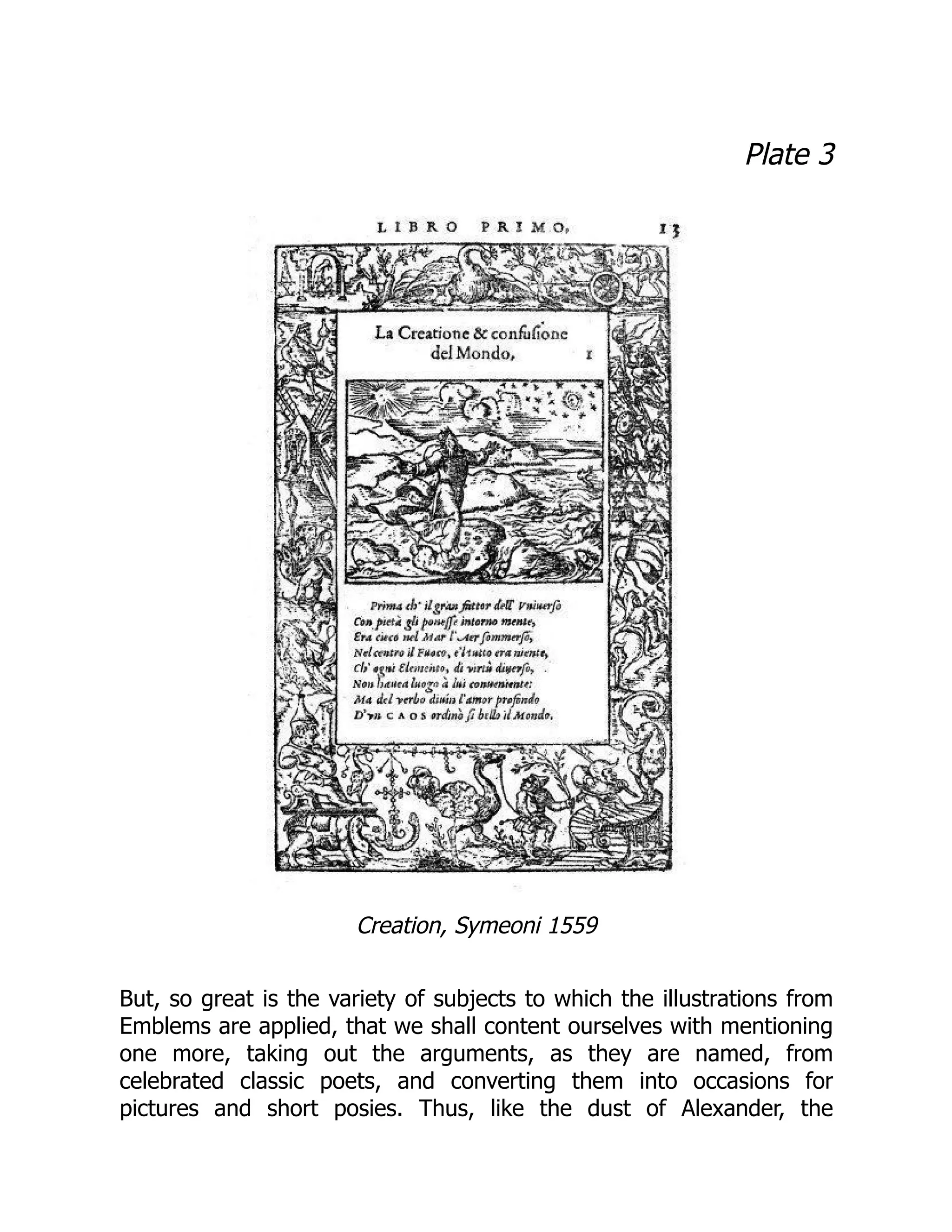
Plate 3
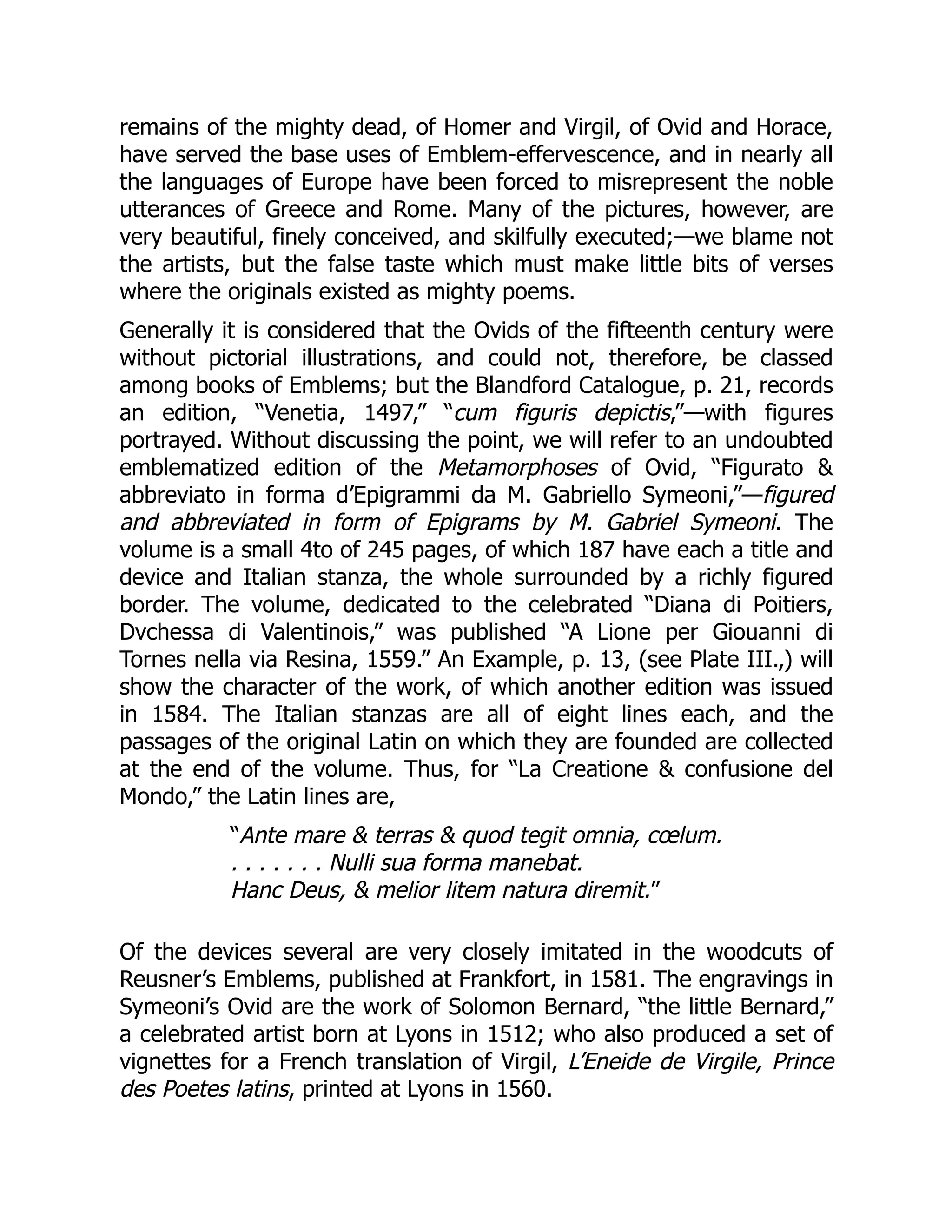
Creation, Symeoni 1559
But, so great is the variety of subjects to which the illustrations from
Emblems are applied, that we shall content ourselves with mentioning
one more, taking out the arguments, as they are named, from
celebrated classic poets, and converting them into occasions for
pictures and short posies. Thus, like the dust of Alexander, the
remains of the mighty dead, of Homer and Virgil, of Ovid and Horace,
have served the base uses of Emblem-effervescence, and in nearly all
the languages of Europe have been forced to misrepresent the noble
utterances of Greece and Rome. Many of the pictures, however, are
very beautiful, finely conceived, and skilfully executed;—we blame not
the artists, but the false taste which must make little bits of verses
where the originals existed as mighty poems.
Generally it is considered that the Ovids of the fifteenth century were
without pictorial illustrations, and could not, therefore, be classed
among books of Emblems; but the Blandford Catalogue, p. 21, records
an edition, “Venetia, 1497,” “cum figuris depictis,”—with figures
portrayed. Without discussing the point, we will refer to an undoubted
emblematized edition of the Metamorphoses of Ovid, “Figurato &
abbreviato in forma d’Epigrammi da M. Gabriello Symeoni,”—figured
and abbreviated in form of Epigrams by M. Gabriel Symeoni. The
volume is a small 4to of 245 pages, of which 187 have each a title and
device and Italian stanza, the whole surrounded by a richly figured
border. The volume, dedicated to the celebrated “Diana di Poitiers,
Dvchessa di Valentinois,” was published “A Lione per Giouanni di
Tornes nella via Resina, 1559.” An Example, p. 13, (see Plate III.,) will
show the character of the work, of which another edition was issued
in 1584. The Italian stanzas are all of eight lines each, and the
passages of the original Latin on which they are founded are collected
at the end of the volume. Thus, for “La Creatione & confusione del
Mondo,” the Latin lines are,
“Ante mare & terras & quod tegit omnia, cœlum.
. . . . . . . Nulli sua forma manebat.
Hanc Deus, & melior litem natura diremit.”
Of the devices several are very closely imitated in the woodcuts of
Reusner’s Emblems, published at Frankfort, in 1581. The engravings in
Symeoni’s Ovid are the work of Solomon Bernard, “the little Bernard,”
a celebrated artist born at Lyons in 1512; who also produced a set of
vignettes for a French translation of Virgil, L’Eneide de Virgile, Prince
des Poetes latins, printed at Lyons in 1560.
“Qvinti Horatii Flacci Emblemata,” as Otho Vænius names one of his
choicest works, first published in 1607, is a similar adaptation of a
classic author to the prevailing taste of the age for emblematical
representation. The volume is a very fine 4to of 214 pages, of which
103 are plates; and a corresponding 103 contain extracts from Horace
and other Latin authors, followed, in the edition of 1612, by stanzas in
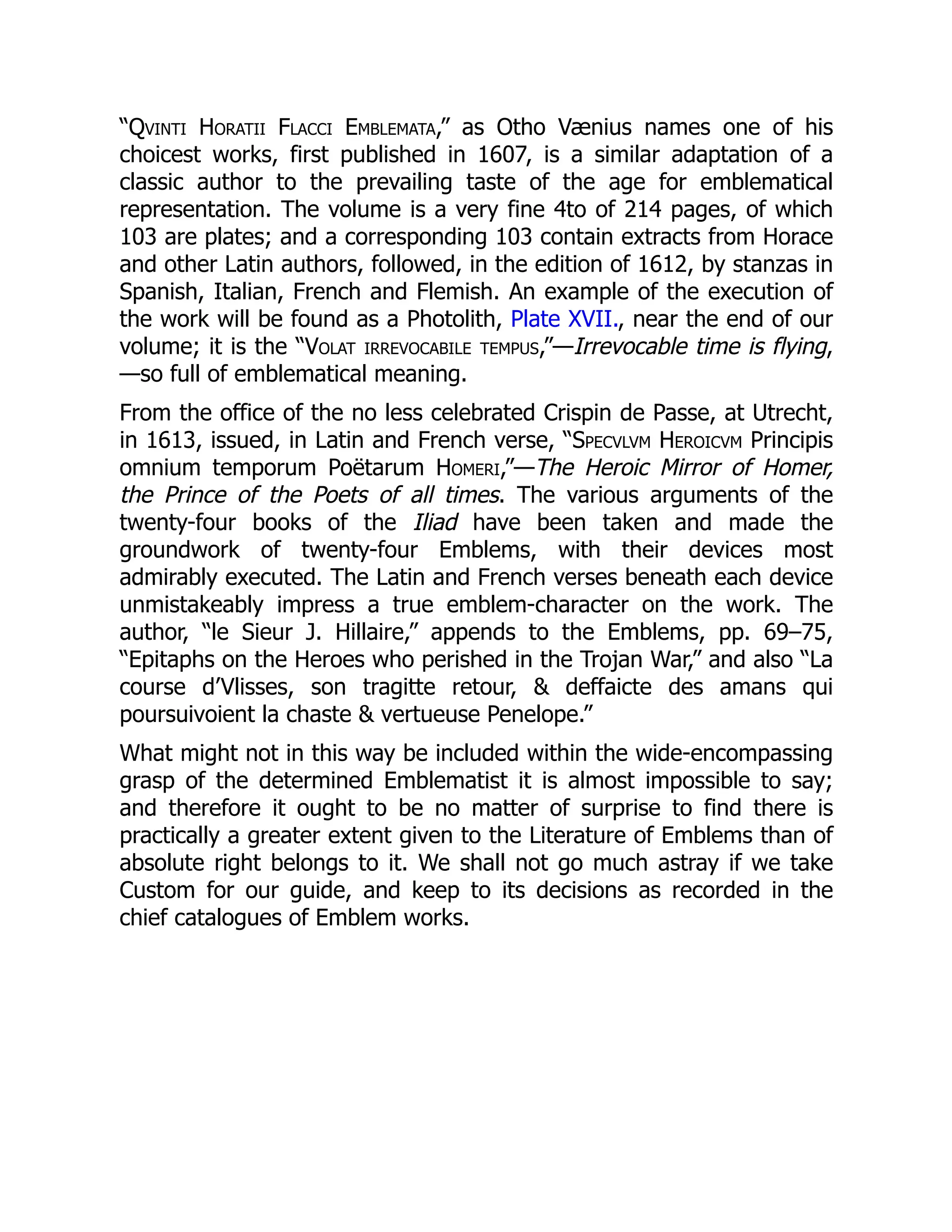
Spanish, Italian, French and Flemish. An example of the execution of
the work will be found as a Photolith, Plate XVII., near the end of our
volume; it is the “Volat irrevocabile tempus,”—Irrevocable time is flying,
—so full of emblematical meaning.
From the office of the no less celebrated Crispin de Passe, at Utrecht,
in 1613, issued, in Latin and French verse, “Specvlvm Heroicvm Principis
omnium temporum Poëtarum Homeri,”—The Heroic Mirror of Homer,
the Prince of the Poets of all times. The various arguments of the
twenty-four books of the Iliad have been taken and made the
groundwork of twenty-four Emblems, with their devices most
admirably executed. The Latin and French verses beneath each device
unmistakeably impress a true emblem-character on the work. The
author, “le Sieur J. Hillaire,” appends to the Emblems, pp. 69–75,
“Epitaphs on the Heroes who perished in the Trojan War,” and also “La
course d’Vlisses, son tragitte retour, & deffaicte des amans qui
poursuivoient la chaste & vertueuse Penelope.”
What might not in this way be included within the wide-encompassing
grasp of the determined Emblematist it is almost impossible to say;
and therefore it ought to be no matter of surprise to find there is
practically a greater extent given to the Literature of Emblems than of
absolute right belongs to it. We shall not go much astray if we take
Custom for our guide, and keep to its decisions as recorded in the
chief catalogues of Emblem works.
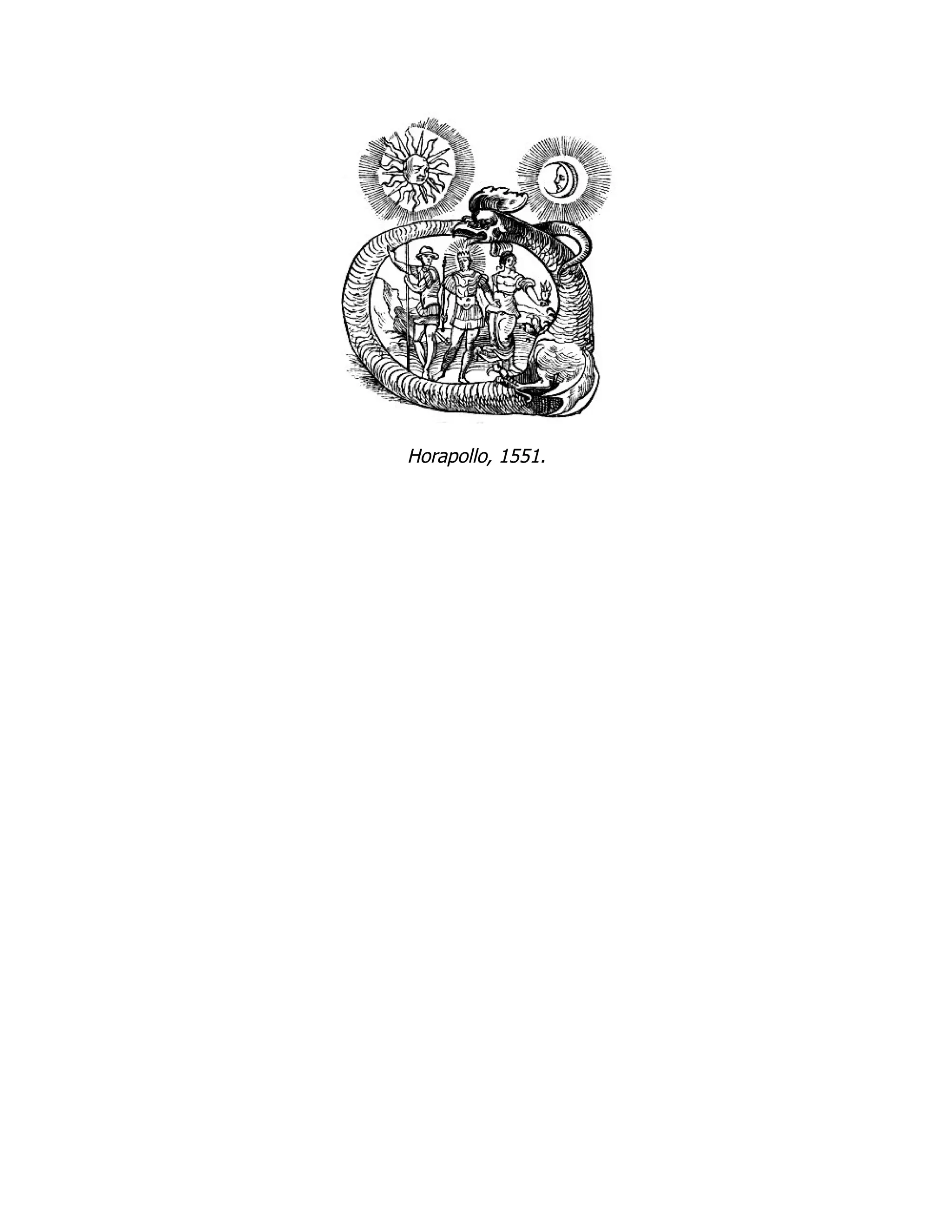
Horapollo, 1551.
Section II.
EMBLEM WORKS AND EDITIONS DOWN TO THE END OF THE FIFTEENTH CENTURY.
EAVING for the most part out of view the discussions
which have taken place as to the exact time and the
veritable originators of the arts of printing by fixed or
moveable types, and of the embellishing of books by
engravings on blocks of wood or plates of copper, we are
yet—for the full development of the condition and extent of the
Emblem Literature in the age of Shakespeare—required to notice the
growth of that species of ornamental device in books which depends
upon Emblems for its force and meaning. We say advisedly
“ornamental device in books,” for infinite almost are the applications
of Symbol and Emblem to Architecture, Sculpture, and Painting, as is
testified by the Remains of Antiquity in all parts of the world, by the
Pagan tombs and Christian catacombs of ancient Rome, by nearly
every temple and church and stately building in the empires of the
earth, and especially in those wonderful creations of human skill in
which form and colour bring forth to sight nearly every thought and
fancy of our souls.
Long before either block-printing or
type-printing was practised, it is well
known how extensively the limner’s
art was employed “to illuminate,” as it
is called, the Manuscripts that were
to be found in the rich abbeys or
convents, and in the mansions of the
great and noble. For instance, the
devices in the Dance of Macaber,
undoubtedly an Emblem Manuscript
of the fourteenth century, were of
painter’s workmanship, and
afterwards employed by the wood-
engravers to embellish type-printed
volumes of a devotional character. To
this Brunet, in his Manuel du Libraire,
vol. v. c. 1557–1560, bears witness,
when speaking of the printer Philip
Pigouchet, and of the bookseller
Simon Vostre, who “furent les
premiers à Paris qui surent allier avec
succès la gravure à la typographie;”
and adds in a note, “La plus ancienne
édition de la Danse macabre que
citent les bibliographes est celle de
Paris, 1484; mais, plus d’un siècle
avant cette date, des miniaturistes
français avaient déjà figuré, sur les
marges de plusieurs Heures
manuscrites, des Danses de morts,
représentées et disposées à peu près
comme elles l’ont été depuis dans les
livres de Simon Vostre; c’est ce que
nous avons pu remarquer dans un
magnifique manuscrit de la seconde
moitié du quatorzième siècle, enrichi
de nombreuses et admirables
miniatures qui, après avoir été
conservé en Angleterre dans le
cabinet du docteur Mead, à qui le roi
Louis XV. en avait fait présent, est
venu prendre place parmi les
curiosités de premier ordre réunies
dans celui de M. Ambr. Firmin Didot.”
From Brunet, v. 1559.
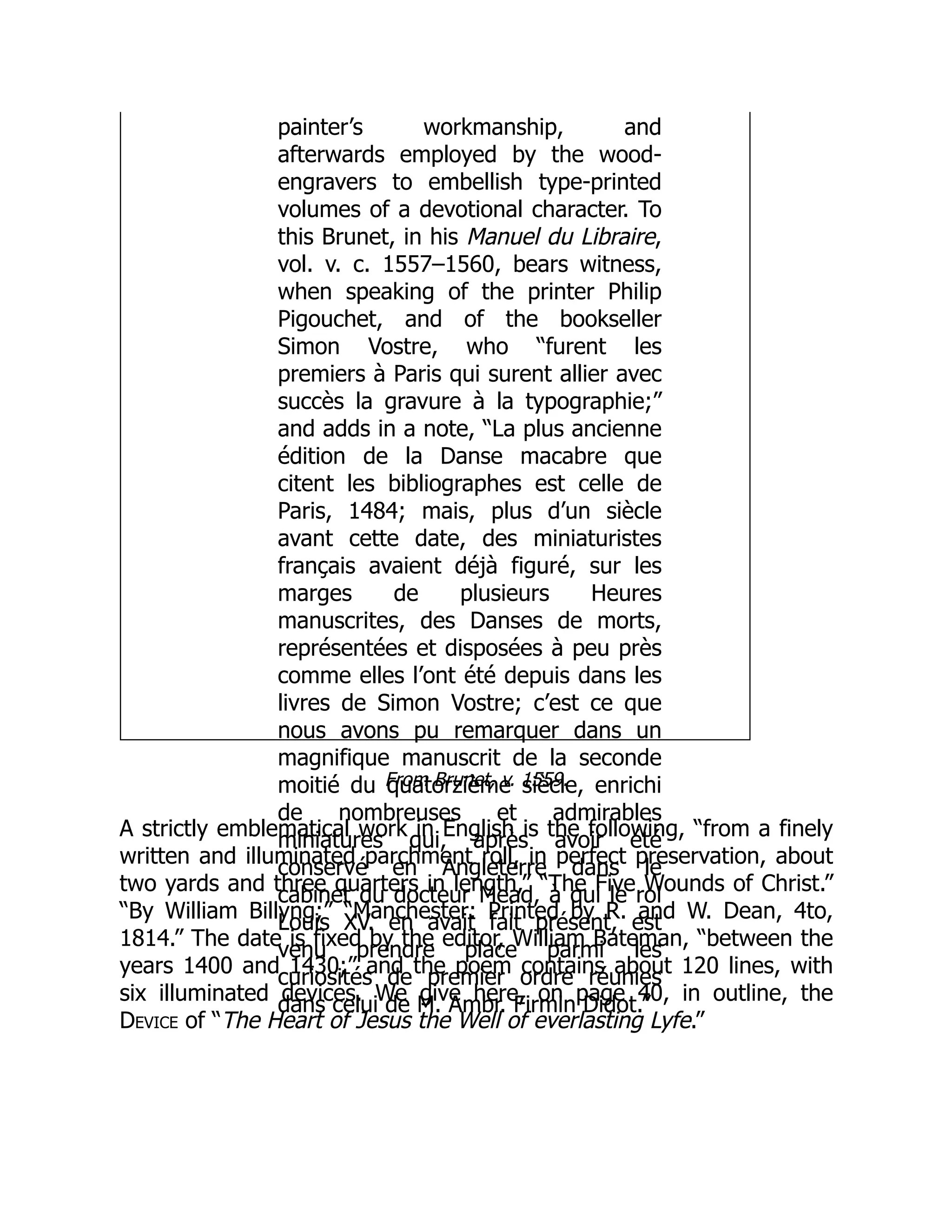
A strictly emblematical work in English is the following, “from a finely
written and illuminated parchment roll, in perfect preservation, about
two yards and three quarters in length,” “The Five Wounds of Christ.”
“By William Billyng;” “Manchester: Printed by R. and W. Dean, 4to,
1814.” The date is fixed by the editor, William Bateman, “between the
years 1400 and 1430;” and the poem contains about 120 lines, with
six illuminated devices. We give here, on page 40, in outline, the
Device of “The Heart of Jesus the Well of everlasting Lyfe.”
Five wounds of Christ, 1400–1430.
There follows, as to each of the Emblems, a Prayer, or Invocation; the
Device in question has these lines,—
“Hayle welle and cõdyte of eu̾ lastyng lyffe
Thorow launced so ferre wt
yn my lordes syde
The flodys owt traylyng most aromatys
Hayle prious ♥ wounded so large and wyde
Hayle trusty treuloue our joy to provide
Hayle porte of glorie wt
paynes alle embrued
On alle I sprynglyde lyke purpul dew enhuede.”
An Astronomical Manuscript in the Chetham Library, Manchester, the
eclipses in which are calculated from A.D. 1330 to A.D. 1462, contains
emblematical devices for the months of the year, and the signs of the
zodiac; these are painted medallions at the beginning of each month;
and to each of the months is attached a metrical line explanatory of
the device.
Januarius. Ouer yis feer I warme myn handes.
Februarius. Wyth yis spade I delve my londes.
Martius. Here knitte I my vynes in springe.
Aprilis. So merie I here yese foules singe.
Mayus. I am as Joly as brid on bouz.
Junius. Here wede I my corn, clene I houz.
Julius. Wyth yis sythe my medis I mowe.
Augustus. Here repe I my corn so lowe.
September. Wyth ys flayll I yresche my bred.
October. Here sowe I my Whete so reed.
November. Wyth ys knyf I steke my swyn.
December. Welcome cristemasse Wyth ale and
Wyn.
This manuscript contains, as J. O. Halliwell says of it, “an astrological
volvelle—an instrument mentioned by Chaucer: it is the only
specimen, I believe, now remaining in which the steel stylus or index
has been preserved in its original state.”
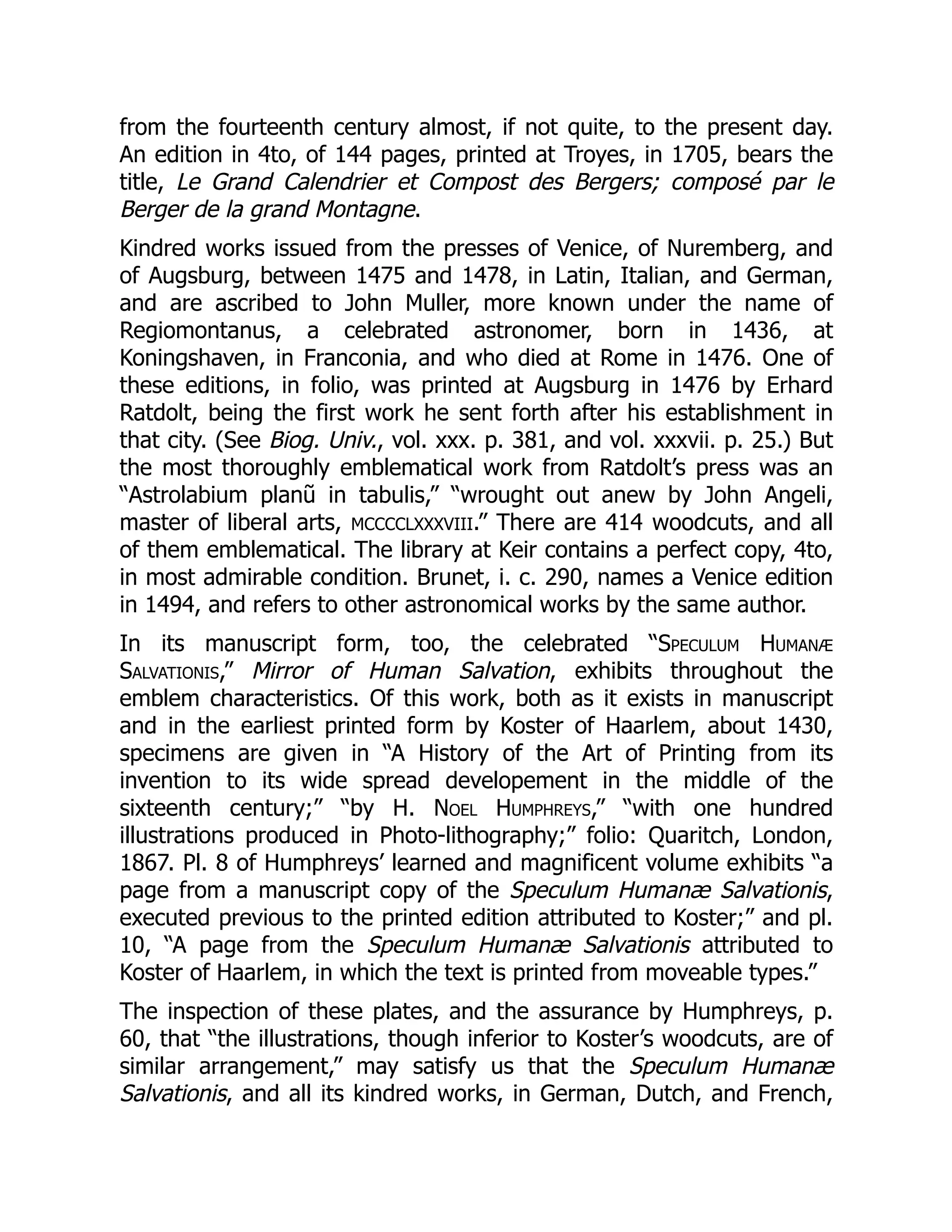
Doubtless it is a copy of the Kalendrier des Bergers, which with the
Compost des Bergers, has in various forms been circulated in France
from the fourteenth century almost, if not quite, to the present day.
An edition in 4to, of 144 pages, printed at Troyes, in 1705, bears the
title, Le Grand Calendrier et Compost des Bergers; composé par le
Berger de la grand Montagne.
Kindred works issued from the presses of Venice, of Nuremberg, and
of Augsburg, between 1475 and 1478, in Latin, Italian, and German,
and are ascribed to John Muller, more known under the name of
Regiomontanus, a celebrated astronomer, born in 1436, at
Koningshaven, in Franconia, and who died at Rome in 1476. One of
these editions, in folio, was printed at Augsburg in 1476 by Erhard
Ratdolt, being the first work he sent forth after his establishment in
that city. (See Biog. Univ., vol. xxx. p. 381, and vol. xxxvii. p. 25.) But
the most thoroughly emblematical work from Ratdolt’s press was an
“Astrolabium planũ in tabulis,” “wrought out anew by John Angeli,
master of liberal arts, MCCCCLXXXVIII.” There are 414 woodcuts, and all
of them emblematical. The library at Keir contains a perfect copy, 4to,
in most admirable condition. Brunet, i. c. 290, names a Venice edition
in 1494, and refers to other astronomical works by the same author.
In its manuscript form, too, the celebrated “Speculum Humanæ
Salvationis,” Mirror of Human Salvation, exhibits throughout the
emblem characteristics. Of this work, both as it exists in manuscript
and in the earliest printed form by Koster of Haarlem, about 1430,
specimens are given in “A History of the Art of Printing from its
invention to its wide spread developement in the middle of the
sixteenth century;” “by H. Noel Humphreys,” “with one hundred
illustrations produced in Photo-lithography;” folio: Quaritch, London,
1867. Pl. 8 of Humphreys’ learned and magnificent volume exhibits “a
page from a manuscript copy of the Speculum Humanæ Salvationis,
executed previous to the printed edition attributed to Koster;” and pl.
10, “A page from the Speculum Humanæ Salvationis attributed to
Koster of Haarlem, in which the text is printed from moveable types.”
The inspection of these plates, and the assurance by Humphreys, p.
60, that “the illustrations, though inferior to Koster’s woodcuts, are of
similar arrangement,” may satisfy us that the Speculum Humanæ
Salvationis, and all its kindred works, in German, Dutch, and French,
amounting to many editions previous to the year 1500,[35]
are truly
books that belong to the Emblem literature. Thus pl. 8, “though
without the decorative Gothic framework which separates, and, at the
same time, binds together the double illustrations of the xylographic
artist,” exhibits to us the exact character of “the double pictures of the
Speculum.” “These double pictures,” p. 60 of Humphreys, “illustrate
first a passage in the New Testament, and secondly the corresponding
subject of the Old, of which it is the antitype. In the present page we
have Christ bearing His cross (Christus bajulat crucem) typified by
Isaac carrying the wood for his own sacrifice (Isaac portat ligna sua).”
“The engravings,” p. 58, “i.e., of Koster’s first great effort, occur at the
top of each leaf, and the rest of the page is filled with two columns of
text, which, in the supposed first edition, is composed of Latin verse
(or, rather, Latin prose with rhymed terminations to the lines, as the
lines do not scan); and in later editions, in Dutch prose.” “This
specimen,” pl. 8, p. 60, “will enable the student to understand
precisely the kind of manuscript book which Koster reproduced in a
cheaper form by xylography, to which he eventually allied the still
more important invention of moveable types.”
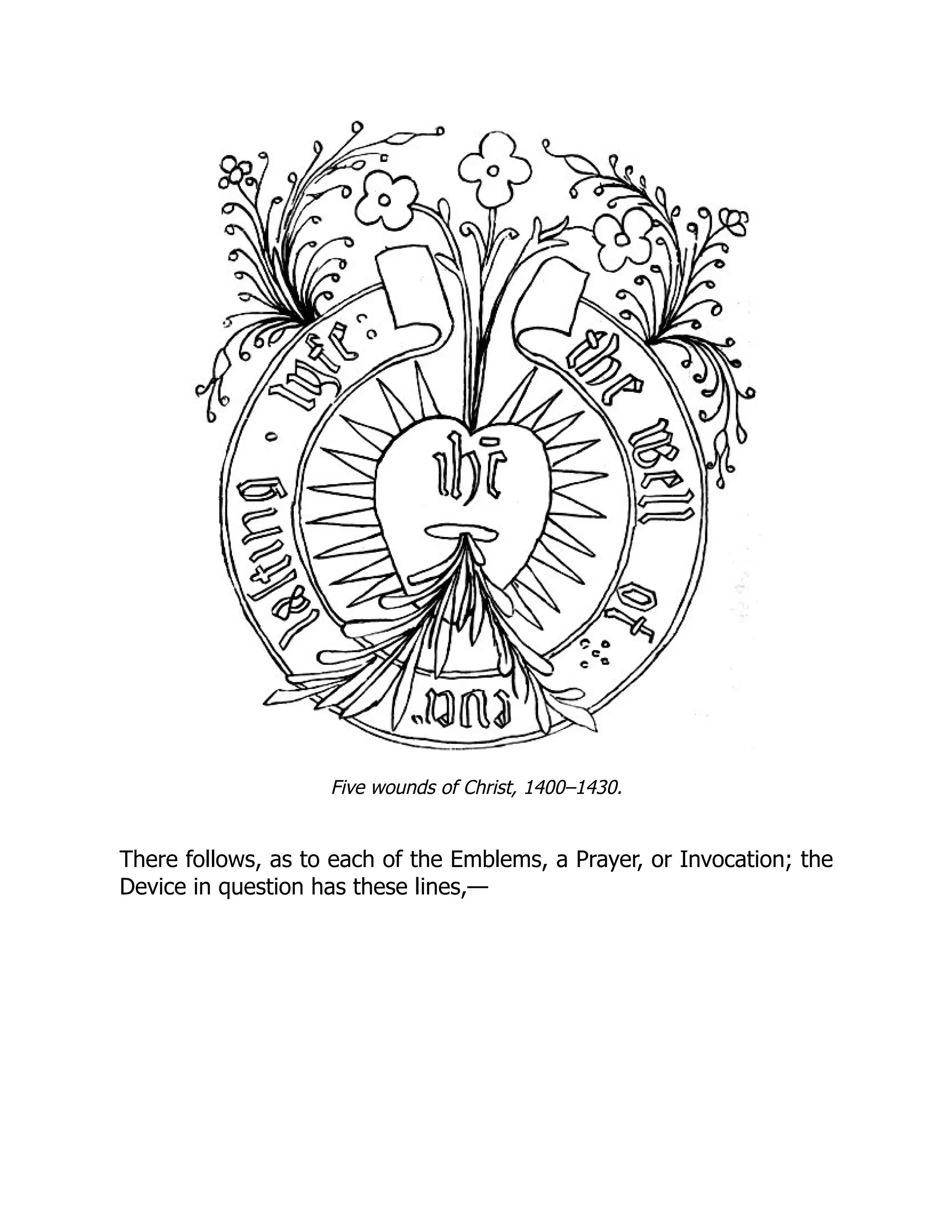
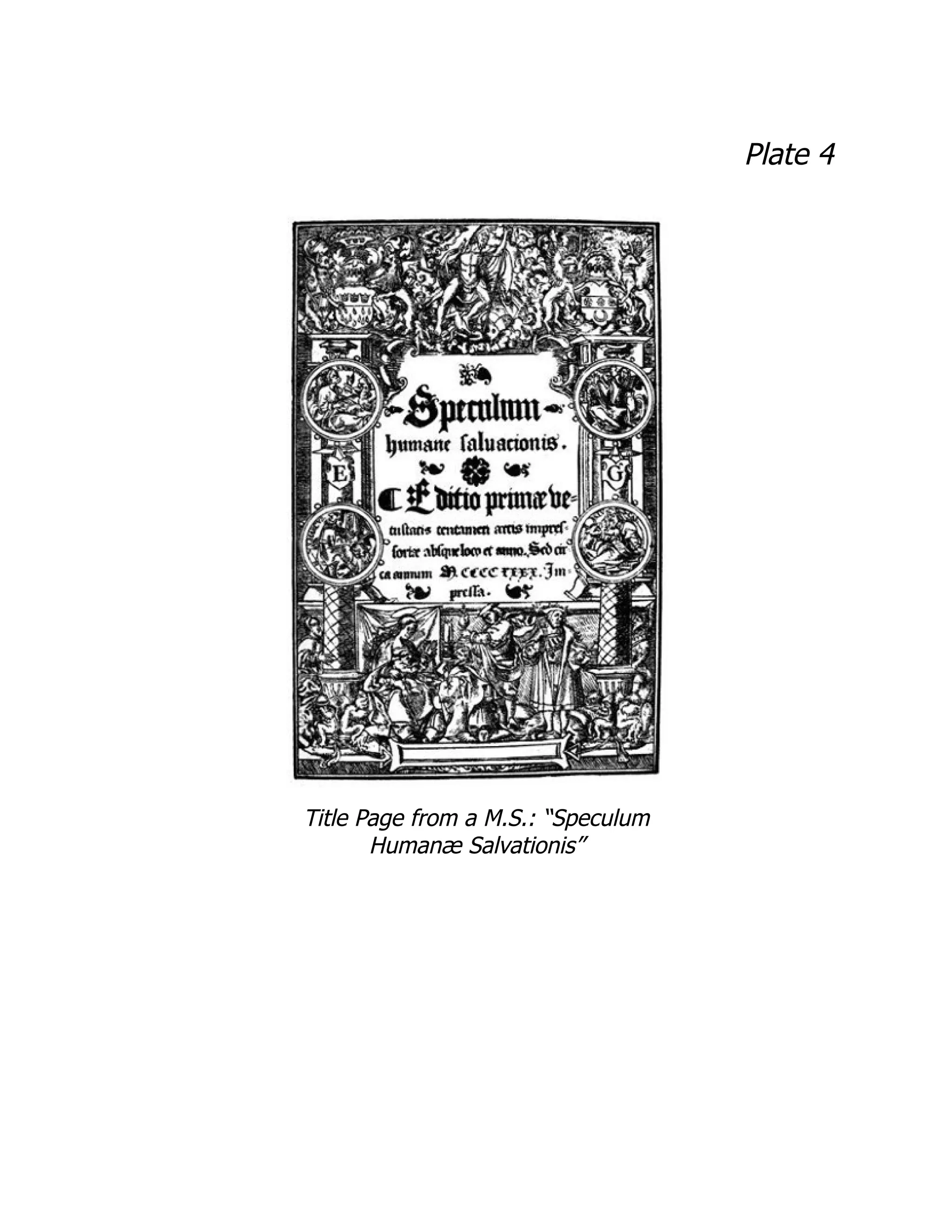
From a very fine MS. copy of the Speculum Humanæ Salvationis,
belonging to Mr. Henry Yates Thompson, our fac-simile Plates IV. and
V., though on a smaller scale, present the Title and the first Pair of
devices with their text. The work is in twenty-nine chapters, and to
each there are four devices in four columns, with appropriate
explanations in Latin verse, and at the foot of the columns are the
references to the Old or the New Testament.
The manuscript entitled “De Volueribus, sive de tribus Columbis,”—
Concerning Birds, or the Three Doves, in the library “du Grand
Seminaire,” at Bruges, is also an emblem-book. It is excellently
illuminated, and the workmanship is probably of the thirteenth
century. (See the Whitney Reprint, p. xxxii.)
Plate 4
Title Page from a M.S.: “Speculum
Humanæ Salvationis”
Plate 5
Leaf 31 from a M.S. “Speculum Humanæ
Salvationis”
The illuminated Missal,[36]
executed in 1425 for John, Duke of Bedford
and regent of France, according to the account published of it by
Richard Gough, 4to, London, 1794, and by others, abounds in emblem
devices. It contains “fifty-nine large miniatures, which nearly occupy
the page, and above a thousand small ones in circles of about an inch
and half diameter, displayed in brilliant borders of golden foliage, with
variegated flowers, &c. At the bottom of every page are two lines in
blue and gold letters, which explain the subject of each miniature.”
“The Missal,” says Dibdin, “frequently displays the arms of these noble
personages,” (John, Duke of Bedford, and of his wife Jane, daughter
of the Duke of Burgundy,) “and also affords a pleasing testimony of
the affectionate gallantry of the pair: the motto of the former being ‘A
VOUS ENTIER;’ that of the latter, ‘J’EN SUIS CONTENTE.’” Among its
ornaments are emblems or symbols of the twelve months, and a large
variety of paintings derived from the Sacred Scriptures, many of which
possess an emblematical meaning.
Not aiming at any exhaustive method in the information we gather
and impart respecting Emblem works and editions previous to the
year A.D. 1500, we pass by the very numerous other instances in
support of our theme which a search into manuscripts would supply.
The “Block-Books,”[37]
which, in the main, are especially emblematical,
we next consider. We select two instances as representative of the
whole set;—namely, the “Biblia Pauperum,” Bibles of the Poor, and the
“Ars Memorandi,” The Art of Remembering.
In his “Bibliographical Decameron,” vol. i. p. 160, Dibdin tells us, “The
earliest printed book, containing text and engravings illustrative of
scriptural subjects, is called the Histories of Joseph, Daniel, Judith,
and Esther. This was executed in the German language, and was
printed by Pfister at Bamberg in 1462. It is among the rarest of
typographical curiosities in existence.” Dibdin’s dictum is considerably
modified, if not set aside, by Noel Humphreys; who, though affirming,
p. 41, that “a late German edition of the Biblia Pauperum has the date
1475, but that before that period editions had been printed at the
regular press with moveable types, as, for instance, that of Pfister,
printed at Bamberg in 1462,”—yet had previously declared, p. 39,
“many suppose that Laurens Koster, of Haarlem, who afterwards
invented moveable types, was one of the earliest engravers of Block-
books, and that in fact the Biblia Pauperum was actually his work.”
“The period of its execution may probably be estimated as lying
between 1410 and 1420: probably earlier, but certainly not later.”
The earliest editions of these Biblia Pauperum contain forty leaves, the
later editions fifty, printed only on one side. Opposite to p. 40, Noel
Humphreys gives, pl. 2, “A Page from the Biblia Pauperum generally
supposed to be one of the earliest block-books.”
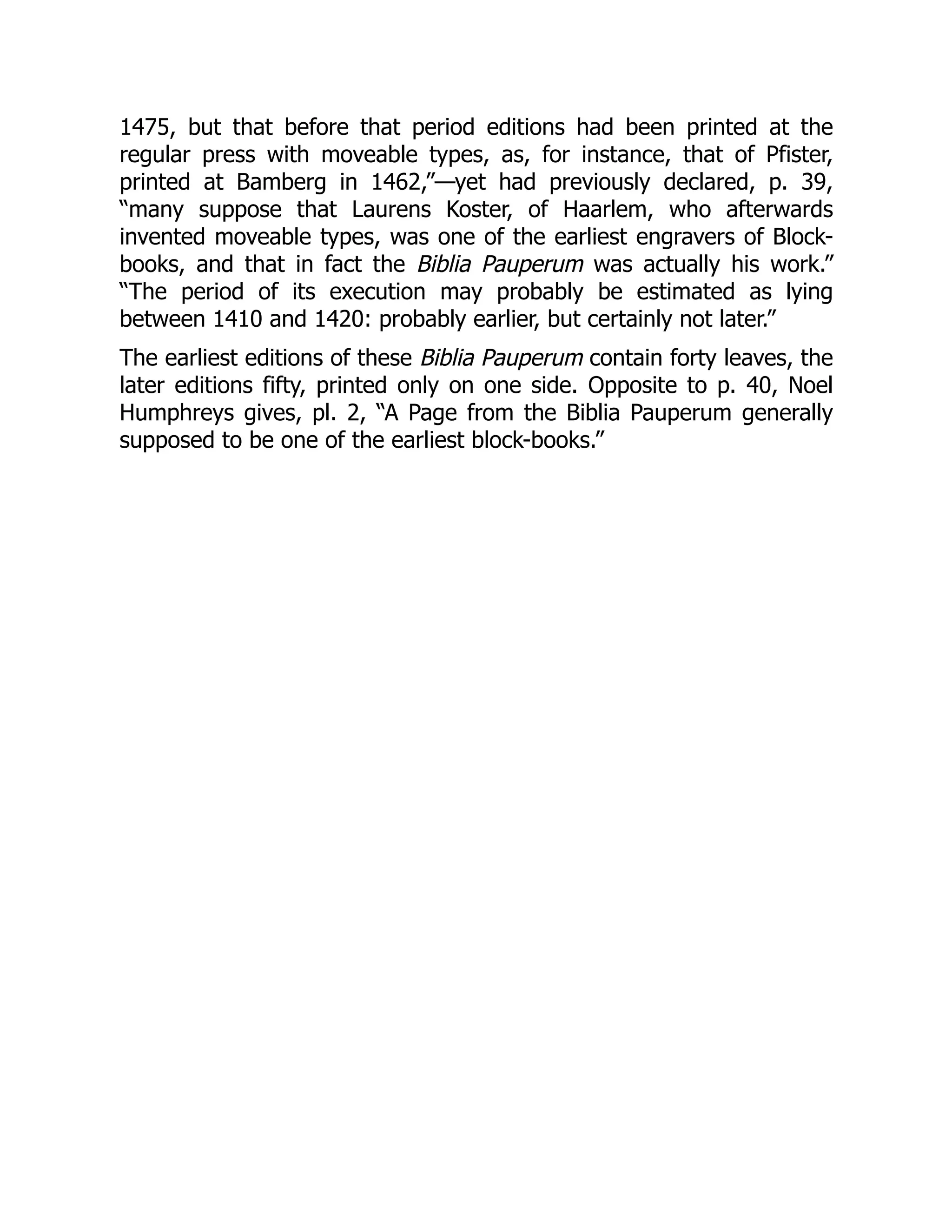
Plate 6
A Page from the “Biblia Pauperum” generally
supposed one of the earliest Block Books
Availing ourselves of the Author’s remarks, p. 40, we yet prefer, on
account of some inaccuracies in his decyphering the Latin
contractions, giving our own description of this plate. The page is in
three divisions, all in the Gothic decorative style, with separating
archways between the subjects. In the upper division, in the centre,
are seated, each in his niche, “Isaya” and “Dauid.” (See Plate VI.) In
the upper corners, on the right hand of the first, and on the left hand
of the second, are Latin inscriptions,—the former relating to Eve’s
seed bruising the serpent’s head, Genesis iii. c., and the latter to
Gideon’s fleece saturated with dew, Judges vi. c. The middle
compartment is a triptych, consisting of Eve’s Temptation, the
Annunciation by the Angel to the Blessed Virgin; and Gideon in his
armour, on his knees, with his shield on the ground, watching the
fleece. Over Eve’s Temptation there is a scroll issuing from Isaiah’s
niche, and having this inscription: “Ecce virgo concipiet et pariet
filium,”—Behold a virgin shall conceive and bear a son, Is. vii. 14; Eve
stands near the tree of life, emblematized by God the Father among
the branches,—and erect before her is the serpent, almost on the tip
of its tail, with its body slightly curved. In the Annunciation appears a
ray of light breathed upon the Virgin from God the Father seated in
the clouds, and in the ray are the dove, the emblem of the Holy Spirit,
descending, and an infant Christ bearing his cross; the Angel stands
before Mary addressing to her the salutation, “Ave gratiâ plena,
dominus tecum,”—Hail full of grace, the Lord is with thee, Luke i. 28;
and Mary, seated with a book on her knees, and her hands devoutly
crossed on her breast, replies, “Ecce, ancilla domini, fiat mihi,”—
Behold, the handmaid of the Lord, be it unto me, Luke i. 38. Of
Gideon and the fleece little needs be said, except that over him from
the niche of David issues a scroll with the words “Descendet dominus
sicut pluvia in vellus,” in the Latin Vulgate, Ps. lxxi. 6, i.e. The Lord
shall descend as rain upon the fleece; but in the English version, Ps.
lxxii. 6, He shall come down like rain upon the mown grass. The Angel
also addressing Gideon bears a scroll, not quite legible, but evidently
meaning, “Dominus tecum virorum fortissime,” Judges vi. 12,—English
version, The Lord is with thee, thou mighty man of valour. The lower
compartment, like the upper, has in the centre two arched niches,
which contain, the one Ezekiel, the other Jeremiah; beneath Eve’s
temptation and Gideon’s omen are the alliterative and rhyming
couplets
“Vipera vim perdet,
Sine vi pariente
puella.”
and “Rore madet vellus
Permansit arida
tellus;”[38]
and beneath the Annunciation, “Virgo salutatur, Innupta manens
gravidatur.”
From Ezekiel’s niche issues the scroll, Ez. xliv. 2, “Porta hæc clausa
erit, et non aperietur;” and from Jeremiah’s, xxxi. 22, “Creavit
dominus novum super terram, femina circumdabit virum.”
It requires no argument to prove the emblematical nature of the
middle compartment of this page from the Biblia Pauperum; and the
texts on scrolls are but the accessories to the devices, and serve only
the more clearly to mark this Block-book as an Emblem-book.
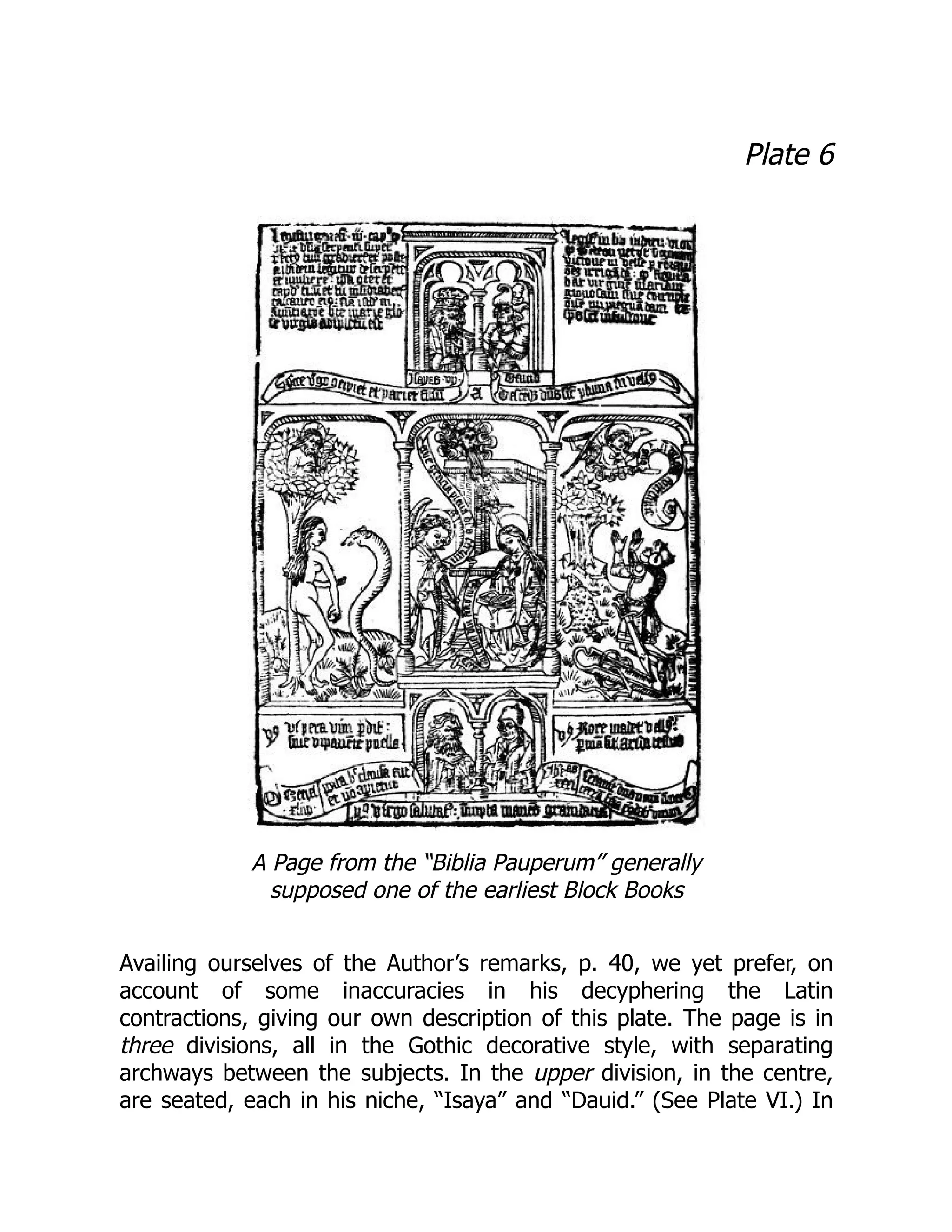
Plate 7
S. John the Evangelist. 1st edition Block
Book from the Corser Collection.
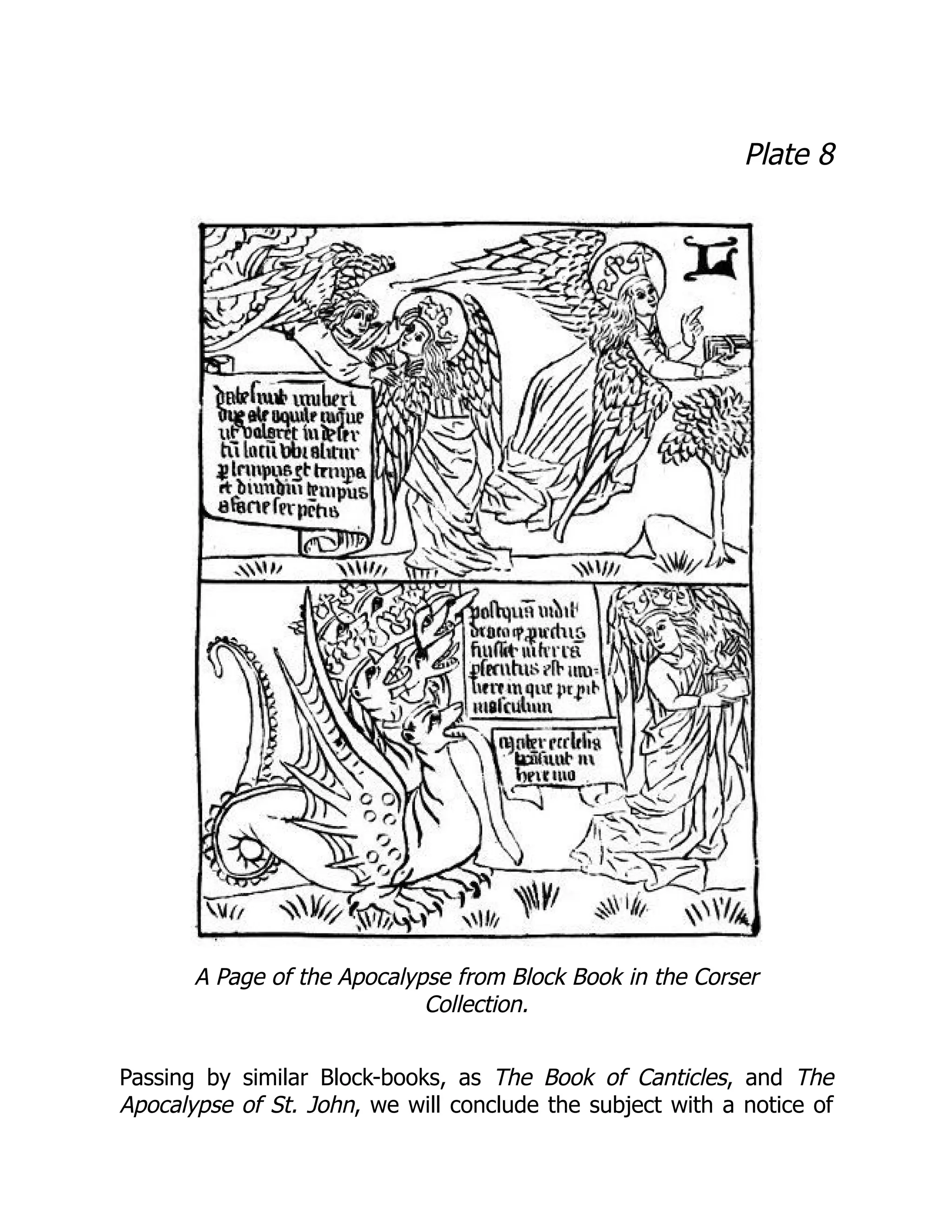
Plate 8
A Page of the Apocalypse from Block Book in the Corser
Collection.
Passing by similar Block-books, as The Book of Canticles, and The
Apocalypse of St. John, we will conclude the subject with a notice of
Humphreys’ pl. 5, following p. 42 of his text; it is “A Subject from the
Block-book entitled ‘Ars memorandi,’ executed probably at the
beginning of the fifteenth century.”
“The entire work,” we are informed, p. 42, “consists of the symbols of
the four evangelists, each occupying a page, and being most
grotesquely treated, the bull of St. Luke and the lion of St. Mark
standing upright on their hind legs. These symbols are surrounded
with various objects, calculated to recall the leading events in their
respective Gospels.”
But the whole passage in explanation of the Plate is so much to our
purpose, that we ask pardon of the author for inserting it entire. He
says:—
“The page I have selected for reproduction is the fourth ‘image or
symbol’ of St. Matthew—the Angel. The objects grouped around are
many of them very curious, and, without the assistance of the
accompanying explanations, would certainly not serve to aid the
memory of the modern Biblical students. The symbolic Angel holds in
the left hand objects numbered 18, which by the explanation we learn
to be the sun and moon, accompanied by an unusual arrangement of
stars and planets; intended to recall the passage, ‘there were signs in
the sun and moon’—erant signa in sole et luna. I give the text of
monkish explanation in MS. No. 19, the clasped hands, represents
marriage, in reference to the generations of the Ancestors of Christ as
enumerated by St. Matthew. No. 20, the cockle shell and the bunch of
grapes are emblems of travelling and pilgrimage, and appear to
represent the flight into Egypt; 21, the head of an ass, is intended to
recall the entrance of Christ into Jerusalem riding on an ass; 22, a
table, with bread-knife and drinking cup, recalls the Last Supper
(Cæna magna); and the accompanying symbol, without a number,
represents the census rendered to Cæsar.”[39]
With great kindness Mr. Corser, of Stand, offered me, in the spring of
1868, the use of a very choice Block-book, soon after sold for £415,
entitled Historia S. Joan. Euangelist. per Figuras, and which is, I
believe, the very copy from which Sotheby’s specimens of the work
are taken. Whether it be the “editio princeps,” as a former owner
claimed it to be, is doubted on merely conjectural grounds; but a most
precious copy it is, internally vindicating its claim to priority. The
volume measures 2.82 decimetres by 2.14; or 11 inches by 8.42.
There are forty-eight leaves, in perfect preservation, printed on one
side. The figures, all coloured, relate either to the traditions and
legends of the Evangelist, or to the visions of the Apocalypse, the
former being simply pictorial, the latter emblematical.
The two Plates uncoloured (Plate VII. and Plate VIII.) very clearly
show the difference between the mere drawing and the device. The
pictures of the Evangelist preaching, of Drusiana being baptized, and
of the search after John, have no meaning beyond the historical or
legendary event;—but the two wings of an eagle given to the woman,
of the angel flying with a book above the tree of life, of the dragon
persecuting the woman, and of the mother-church passing into the
desert: these have a meaning beyond that of the figures delineated;—
they are emblematical of hidden truths;—so are all the other plates of
this Block-book which represent the visions of the Apocalypse. The
date is probably 1420 to 1425.
The Bodleian Library at Oxford is very rich in this particular Block-
book, possessing no fewer than three copies of the History of S. John
the Evangelist. Among its treasures, however, is a MS. on the same
subject, worth them all by reason of its beauty and exquisite finish,
which the Block-books certainly do not claim. This MS., on fine vellum
and finely drawn and illuminated, is said to have been written in the
twelfth century, and to have belonged to Henry II.
But the printing with moveable types is firmly established, and
Emblem-books are among its earliest productions. At Bamberg, a city
on the Regnitz, near its influx into the Main, the first purely German
book was printed in 1461, by the same Pfister who published an
edition of the Biblia Pauperum, and who probably learned his art at
Mayence with Guttenberg himself. The work in question was a
Collection of eighty-five Fables in German, with 101 vignettes cut on
wood, each accompanied by a German text of rhyming verses. The
first device, says Brunet, vol. i. p. 1096, represents three apes and a
tree, and the verses begin with—
“Once on a time came an ape (gerãt) upright.”
The colophon, or subscription, at the end informs us,
“At Bamberg this little book ended is
After the birth of our Lord Jesus Christ,
When one counts a thousand four hundred year,
And to it, as truth, one and sixty more,
On the day of holy Valentine;
God shield us from the wrath divine. Amen.”
The fables were collected by Ulric Boner, a Dominican friar of Bonn, in
the thirteenth or at the beginning of the fourteenth century. Their
chief value is that they present the most precious remains of the
Minnesingers, or German Troubadours, and possess much grace, and
“une moralité piquante.” See Biographie Universelle, vol. v. pp. 97, 98:
Paris, 1812; and vol. xxxiii. p. 584: Paris, 1823.
Of Æsop’s Fables in Greek, the Milan edition, about A.D. 1480, was
the earliest. There had been Latin versions, previously at Rome in
1473, at Bologna and Antwerp in 1486, and elsewhere. The German
translation appeared in 1473, the Italian in 1479, the French and the
English in 1484, and the Spanish in 1489. Besides these there were at
least thirty other editions previous to the year 1500.
It has been doubted if Fables should be classed among the Emblem
Literature,—but whether nude, as other emblems have been named
when unclothed in the ornaments of wood or copper engravings, or
adorned with richly embellished devices, they are, as Whitney would
name them, naturally emblematical. Apart from whatever artistic skill
can effect for them, they have in themselves meanings to be evolved
different from those which the words convey. The Lion, the Fox, and
the Ass are not simply names for the veritable animals, but emblems
of different characters and qualities among the human race; they
symbolize moral sentiments and actions, and when we add the figures
of the creatures, though we may make pleasing and significant
pictures, we do little for the real development of the emblems.
Books of Fables, however, are so numerous that they and their editors
may be counted by hundreds; and as Dibdin intimates, the
Bibliomaniac who had gathered up all the editions of Æsop in nearly
all the languages of the civilized world, would have formed a very
considerable library. Only on a few occasions therefore shall we make
mention of books of Fables in our present inquiries.
We shall not however pass unnoticed, since it belongs especially to
this period, the “Dyalogus Creaturarum,” or, Dialogues of the
Creatures, a collection of Latin Fables, attributed in the fourteenth
century to Nicolas Pergaminus, first printed at Gouda in Holland by
Gerard Leeu in 1480, and at Stockholm by John Snell in 1483. (See
Brunet, vol. ii. p. 674.) A French version, by Colard Mansion, was
issued at Lyons in 1482, Dialogue des Creatures moralizie; and an
English version, about 1520, by J. Rastall, “Powly’s Churche,” London,
namely, “The Dialogue of Creatures moralyzed, of late translated out
of latyn in to our English tonge.”
Welcome to our website – the perfect destination for book lovers and
knowledge seekers. We believe that every book holds a new world,
offering opportunities for learning, discovery, and personal growth.
That’s why we are dedicated to bringing you a diverse collection of
books, ranging from classic literature and specialized publications to
self-development guides and children's books.
More than just a book-buying platform, we strive to be a bridge
connecting you with timeless cultural and intellectual values. With an
elegant, user-friendly interface and a smart search system, you can
quickly find the books that best suit your interests. Additionally,
our special promotions and home delivery services help you save time
and fully enjoy the joy of reading.
Join us on a journey of knowledge exploration, passion nurturing, and
personal growth every day!
testbankdeal.com

Accounting Information Systems Understanding Business Processes 4th Edition Considine Test Bank
  • 1.
    Accounting Information SystemsUnderstanding Business Processes 4th Edition Considine Test Bank download https://testbankdeal.com/product/accounting-information-systems- understanding-business-processes-4th-edition-considine-test-bank/ Explore and download more test bank or solution manual at testbankdeal.com
  • 2.
    We have selectedsome products that you may be interested in Click the link to download now or visit testbankdeal.com for more options!. Accounting Information Systems Understanding Business Processes 5th Edition Parkes Test Bank https://testbankdeal.com/product/accounting-information-systems- understanding-business-processes-5th-edition-parkes-test-bank/ Accounting Information Systems Understanding Business Processes 5th Edition Parkes Solutions Manual https://testbankdeal.com/product/accounting-information-systems- understanding-business-processes-5th-edition-parkes-solutions-manual/ Accounting Information Systems Controls Processes 3rd Edition Turner Test Bank https://testbankdeal.com/product/accounting-information-systems- controls-processes-3rd-edition-turner-test-bank/ Understanding Basic Statistics Enhanced 7th Edition Brase Solutions Manual https://testbankdeal.com/product/understanding-basic-statistics- enhanced-7th-edition-brase-solutions-manual/
  • 3.
    Survey of Mathematicswith Applications 9th Edition Angel Test Bank https://testbankdeal.com/product/survey-of-mathematics-with- applications-9th-edition-angel-test-bank/ Financial Accounting Information for Decisions 8th Edition John Wild Test Bank https://testbankdeal.com/product/financial-accounting-information-for- decisions-8th-edition-john-wild-test-bank/ Statistics Data Analysis and Decision Modeling 5th Edition Evans Solutions Manual https://testbankdeal.com/product/statistics-data-analysis-and- decision-modeling-5th-edition-evans-solutions-manual/ Chemistry The Central Science 13th Edition Brown Test Bank https://testbankdeal.com/product/chemistry-the-central-science-13th- edition-brown-test-bank/ College Algebra with Intermediate Algebra A Blended Course 1st Edition Beecher Solutions Manual https://testbankdeal.com/product/college-algebra-with-intermediate- algebra-a-blended-course-1st-edition-beecher-solutions-manual/
  • 4.
    Introduction to Analysis4th Edition Wade Solutions Manual https://testbankdeal.com/product/introduction-to-analysis-4th-edition- wade-solutions-manual/
  • 5.
    Testbank to accompany Accounting Information Systems4e Brett Considine, Alison Parkes, Karin Olesen, Yvette Blount & Derek Speer Prepared by Zhong Zheng and Kent Wilson John Wiley & Sons Australia, Ltd 2012
  • 6.
    Chapter 8: Internalcontrols II © John Wiley & Sons Australia, Ltd 2012 8.1 Chapter 8 Internal controls II Multiple Choice Questions 1. After identifying risks, management will decide on appropriate policies and procedures to address the risks. These policies and procedures are called: a. control policies *b. control activities c. control procedures d. control processes Correct answer: b Learning Objective 8.1 ~ Relate control activities to the accounting process 2. The comparison of actual and budgeted figures and the conduct of variance analysis to determine the source of the variance is a type of: a. General control b. Information processing control *c. Performance review d. Application control Correct answer: c Learning Objective 8.2 ~ Classify internal controls as general or application, and based on function and business process stage 3. Information processing controls are those that are put in place within the organisation to work towards the _______ of transactions. a. efficiency, effectiveness, and accuracy b. timeliness, efficiency, and completeness *c. accuracy, completeness, and authorisation d. authorisation, processing, accuracy Correct answer: c Learning Objective 8.2 ~ Classify internal controls as general or application, and based on function and business process stage
  • 7.
    Testbank to accompany:Accounting information systems 4e © John Wiley & Sons Australia, Ltd 2012 8.2 4. Internal controls are necessary in all businesses because … *a. business processes do not always go to plan b. employees are basically corrupt c. financial statements only contain assertions d. external auditors insist on them Correct answer: a Learning Objective 8.1 ~ Relate control activities to the accounting process 5. Which of the following is a risk to the financial statement of a company when it places a purchase order with a supplier? a. the supplier delivers the goods with an invoice instead of a delivery note b. the goods are not available *c. the supplier delivers the wrong goods or wrong quantity d. the purchasing officer orders the wrong goods. Correct answer: c Learning Objective 8.1 ~ Relate control activities to the accounting process 6. An antivirus program scans and monitors files in a computer continuously for viruses. This is an example of: a. Preventive control *b. Detective control c. Corrective control d. Application control Correct answer: b Learning Objective 8.2 ~ Classify internal controls as general or application, and based on function and business process stage 7. Checking customer details before finalising a sales order is an example of a ________ control. *a. input b. general c. processing d. performance Correct answer: a Learning Objective 8.2 ~ Classify internal controls as general or application, and based on function and business process stage
  • 8.
    Chapter 8: Internalcontrols II © John Wiley & Sons Australia, Ltd 2012 8.3 8. A computer virus is found in a file in the computer system. Because a solution for recovering the file is not yet available, the infected file is quarantine by the antivirus software. Quarantining the infected file is an example of: *a. Preventive control b. Detective control c. Corrective control d. None of the options are correct. Correct answer: a Learning Objective 8.2 ~ Classify internal controls as general or application, and based on function and business process stage 9. Which of the following is not a type of controls classified in the Australian Auditing Standard ASA 315? a. Authorisation b. Performance review *c. Risk control d. Segregation of duties Correct answer: c Learning Objective 8.2 ~ Classify internal controls as general or application, and based on function and business process stage 10. Control of access to the server for the company database is an example of which type of control? a. input *b. general c. processing d. performance Correct answer: b Learning Objective 8.3 ~ Link controls to the stages of data processing and COSO and COBIT
  • 9.
    Testbank to accompany:Accounting information systems 4e © John Wiley & Sons Australia, Ltd 2012 8.4 11. Which aspect of document collection are pre-numbered documents used to establish? a. input data is accurate b. data from source documents is recorded in a timely manner *c. all source documents are accounted for d. all source documents have been authorised Correct answer: c Learning Objective 8.2 ~ Classify internal controls as general or application, and based on function and business process stage 12. Which of the following is an example of a turnaround document? a. balance sheet b. sales order *c. remittance advice d. payslip Correct answer: c Learning Objective 8.3 ~ Link controls to the stages of data processing and COSO and COBIT 13. Checking for accuracy is performed by ____________ checks. a. edit b. range c. reasonableness *d. all of the above Correct answer: d Learning Objective 8.3 ~ Link controls to the stages of data processing and COSO and COBIT 14. Which of the following is NOT a major aim of a computerised accounting information system? a. Proper authorisation. b. Timeliness. c. Proper recording. *d. User friendly. Correct answer: d Learning Objective 8.4 ~ Describe the aims of a computerised accounting information system
  • 10.
    Chapter 8: Internalcontrols II © John Wiley & Sons Australia, Ltd 2012 8.5 15. With respect to the recording of transactions, which of the following statements is true? a. Proper recording of transactions is essentially about completeness. *b. Proper recording of transactions is essentially about accuracy. c. Proper recording of transactions is essentially about storing data in only one place. d. None of the options are correct. Correct answer: b Learning Objective 8.4 ~ Describe the aims of a computerised accounting information system 16. How does a computer system know that a sales manager has authorised a credit transaction over $1000? a. The input terminal has bio-security check eg retina scanning. *b. A combination of checks on the size of the credit required and the access rights of the manager when she logged in with her username and password c. The system must insist on the sales manager entering the transaction d. The control comes from the work practices outside the computer Correct answer: b Learning Objective 8.4 ~ Describe the aims of a computerised accounting information system 17. Purchasing goods over the Internet would fit into which of the following categories of processing? a. Batch b. online real-time *c. online data collection batched for later processing d. Shopping basket Correct answer: c Learning Objective 8.4 ~ Describe the aims of a computerised accounting information system 18. Authorisation in a computerised information system can be established through: (i) user privileges (ii) user access rights (iii) restrictions on what different users are able to do within the system. a. (i) (iii) b. (ii) (iii) c. (i) (ii) *d. (i) (ii) (iii) Correct answer: d Learning Objective 8.4 ~ Describe the aims of a computerised accounting information system
  • 11.
    Testbank to accompany:Accounting information systems 4e © John Wiley & Sons Australia, Ltd 2012 8.6 19. In terms of proper recording of transactions, accuracy is concerned with making sure that: (i) all data that enter the system are in the correct format (ii) all data that enter the system are of the right type (iii) all data are stored in a secured place to prevent unauthorised manipulation (iv) the data gathered accurately reflect the reality of the underlying transaction or event. a. (i) (ii) b. (i) (ii) (iii) *c. (i) (ii) (iv) d. (i) (ii) (iii) (iv) Correct answer: c Learning Objective 8.4 ~ Describe the aims of a computerised accounting information system 20. Segregation of duties is a principle that applies to which sections of an organisation? *a. throughout the organisation including office staff, accountants and IT workers b. accountants c. office staff who have to deal with money matters d. programmers and computer support staff who could interfere with the accounting information system Correct answer: a Learning Objective 8.5 ~ Define and provide examples of general controls 21. Which of the following is NOT a form of physical control? a. Servers are placed in a locked room. *b. A username and a password are needed to log into a computer. c. Security cameras are put in place. d. A swipe card system for controlling access to computer labs. Correct answer: b Learning Objective 8.5 ~ Define and provide examples of general controls 22. Which of the following is an example of poor segregation of duties? a. Inventory control department is allowed to receive incoming goods. b. Warehouse personnel are allowed to ship goods to customers. c. The purchasing department is allowed to generate purchase requisitions. *d. All of the options are correct. Correct answer: d Learning Objective 8.5 ~ Define and provide examples of general controls
  • 12.
    Chapter 8: Internalcontrols II © John Wiley & Sons Australia, Ltd 2012 8.7 23. Which of the following is an example of good segregation of duties? a. The sales department is allowed to bill customers. b. The accounts receivable department is allowed to prepare bills. c. The warehouse personnel are allowed to maintain the inventory record. *d. None of the options are correct. Correct answer: d Learning Objective 8.5 ~ Define and provide examples of general controls 24. Which of the following would enable an organisation to detect that an unauthorised person has entered a secure area? a. Swipe card access b. Physical lock of the door *c. Security camera d. Biometric access control Correct answer: c Learning Objective 8.5 ~ Define and provide examples of general controls 25. A cash disbursement clerk issues a cheque that has been approved by the treasurer. This is an example of: a. Separating record-keeping from asset custody *b. Separating transaction processing to transaction authorisation c. Separating asset custody from transaction processing. d. Separating transaction authorisation from record-keeping. Correct answer: b Learning Objective 8.5 ~ Define and provide examples of general controls 26. Which of the following is the strongest password? a. ah@123re$d b. Nik890102336757099924PoT *c. A_d33erZb#4G d. Qwertyuiopasdfghjklzxcvbnm1234567890 Correct answer: c Learning Objective 8.5 ~ Define and provide examples of general controls
  • 13.
    Testbank to accompany:Accounting information systems 4e © John Wiley & Sons Australia, Ltd 2012 8.8 27. Which of the following statements concerning passwords is true? a. Strong passwords are not required to be changed periodically. b. As long as a strong password is devised, it can be as the password to multiple accounts of a single user. *c. A good control system should force the users to change their password periodically. d. For the sake of convenience and efficiency, users should select simple easy to remember passwords. Correct answer: c Learning Objective 8.5 ~ Define and provide examples of general controls 28. The pre-numbering of cheques helps to achieve completeness because it: a. provides control over cheques b. prevents the issue of false cheques *c. allows us to account for all cheques through a sequence check d. allows us to ensure all cheque payments are properly authorised Correct answer: c Learning Objective 8.6 ~ Define and provide examples of application controls 29. A purchase order is entered into a computer purchasing system. The purchase is for $25 000 and has been entered by the purchase clerk. Company policy dictates that purchases over $2000 must be entered by the purchasing manager. This is an example of a breach of controls relating to: a. Timeliness b. Input accuracy c. Input validity *d. Authorisation Correct answer: d Learning Objective 8.6 ~ Define and provide examples of application controls 30. What should happen if a valid username is supplied but the password is incorrect? *a. the user is allowed to retry b. the user’s account is frozen c. nothing happens, not even a message to say the login failed d. security guards appear and interrogate the user Correct answer: a Learning Objective 8.5 ~ Define and provide examples of general controls
  • 14.
    Chapter 8: Internalcontrols II © John Wiley & Sons Australia, Ltd 2012 8.9 32. A reasonableness check that is used when processing fortnightly employee wage payments would best be used to: a. avoid the entry of false employee names b. detect any employees who have their payments entered twice c. detect any potentially incorrect employee numbers *d. detect potentially high values for hours worked Correct answer: d Learning Objective 8.6 ~ Define and provide examples of application controls 33. Which of the following controls will best help detect inventory input accuracy concerns when entering credit sales into a system? a. A batch total of the number of sales invoices in the batch. *b. A hash total of the number of inventory items ordered across all invoices. c. A hash total of customer numbers from all sales invoices. d. A sequence check on sales invoice numbers. Correct answer: b Learning Objective 8.6 ~ Define and provide examples of application controls 34. Which control would best help achieve the aim of correct valuation for purchase transactions entered into a system? *a. Range checks – checking the quantity ordered against acceptable ranges. b. Validity checks – checking the supplier is listed in our supplier master file. c. Sequence check – ensuring the purchase order number is the next number in the sequence. d. Authorisation – getting a manager to approve all purchases. Correct answer: a Learning Objective 8.6 ~ Define and provide examples of application controls 35. An example of an output control in a payroll system may be that: a. Only the HR manager can change an employee’s rate of pay. *b. Only an employee with a valid employee number and password can request a summary of wages received over the past month. c. Only the payroll clerk can enter payroll details each month. d. Only the payroll clerk can process payments made to employees. Correct answer: b Learning Objective 8.6 ~ Define and provide examples of application controls
  • 15.
    Visit https://testbankdead.com now toexplore a rich collection of testbank, solution manual and enjoy exciting offers!
  • 16.
    Testbank to accompany:Accounting information systems 4e © John Wiley & Sons Australia, Ltd 2012 8.10 36. In general, disaster recovery plans include all of the following except: a. Temporary sites b. Staffing *c. Employee evacuation procedures d. Business relationships restoration Correct answer: c Learning Objective 8.7 ~ Describe the operation and components of a disaster recovery plan 37. In terms of disaster recovery, organisations’ reaction to the threat of disaster can be: a. detective or preventive *b. preventive or corrective c. detective or corrective d. preventive, detective and corrective. Correct answer: b Learning Objective 8.7 ~ Describe the operation and components of a disaster recovery plan 38. Which of the following is NOT one of the main aims for an organisation in the event of a natural disaster that disrupts business operations? a. Limit the time the business is out of operation. b. Minimise the extent of loss to existing business resources. *c. Limit the extended harm done to business partners. d. Minimise the loss of data and information. Correct answer: c Learning Objective 8.7 ~ Describe the operation and components of a disaster recovery plan 39. A “hot site” is: a. A separate facility located close to the organisation’s usual premises but does not contain offices and the necessary equipment. b. A separate facility located away from the organisation’s usual premises but does not contain offices and the necessary equipment. c. A separate facility located close to the organisation’s usual premises and contains offices and the necessary equipment to get the business back up and running in the minimal amount of time after a disaster occurs. *d. A separate facility located away from the organisation’s usual premises and contains offices and the necessary equipment to get the business back up and running in the minimal amount of time after a disaster occurs. Correct answer: d Learning Objective 8.7 ~ Describe the operation and components of a disaster recovery plan
  • 17.
    Chapter 8: Internalcontrols II © John Wiley & Sons Australia, Ltd 2012 8.11 40. The first that financial giant Morgan Stanley knew about the 9/11 bombings were that their business started running from their ________________ several kilometres away from Wall St. a. cold site *b. hot site c. off-site backup d. hosted site Correct answer: b Learning Objective 8.7 ~ Describe the operation and components of a disaster recovery plan 41. Disadvantages of manual controls include all of the following except: a. Manual controls are prone to human errors. b. Manual controls are prone to inconsistent application. *c. Manual controls used up too many human resources. d. Manual controls are easier to avoid and work around. Correct answer: c Learning Objective 8.8 ~ Analyse the execution of control activities 42. Advantages of computer-based controls include all of the following except: a. Consistent application b. Timely execution c. Greater degree of difficulty in working around or avoiding the control *d. Handling one-off events Correct answer: d Learning Objective 8.8 ~ Analyse the execution of control activities 43. Computer-based controls are extremely dependent on: (i) a sound control environment (ii) sound general controls (iii) the COBIT framework *a. (i) (ii) b. (i) (iii) c. (ii) (iii) d. (i) (ii) (iii) Correct answer: a Learning Objective 8.8 ~ Analyse the execution of control activities
  • 18.
    Testbank to accompany:Accounting information systems 4e © John Wiley & Sons Australia, Ltd 2012 8.12 44. A company wants all sales orders over $1000 to be authorised by the sales manager. Are the procedures covering this an example of computer or human controls? a. human b. computer c. human followed by computer *d. computer followed by human Correct answer: d Learning Objective 8.8 ~ Analyse the execution of control activities 45. The control matrix does NOT tell us: a. the control objectives of a control system b. how control objectives would ideally be attained c. whether control objectives actually exist within a system *d. the effectiveness of the control objectives Correct answer: d Learning Objective 8.9 ~ Understand different techniques for documenting a control system 46. The system documentation tool that is most useful for documenting controls is … a. process map b. structured narrative c. logical data flow diagram *d. system flowchart Correct answer: d Learning Objective 8.9 ~ Understand different techniques for documenting a control system 47. CPA Australia identifies five reasons an internal control system does not provide 100 per cent assurance that an organisation’s objectives will be achieved. These reasons do NOT include: a. Judgement error b. Unexpected transactions c. Weak internal controls *d. Natural disasters Correct answer: d Learning Objective 8.1 ~ Relate control activities to the accounting process
  • 19.
    Chapter 8: Internalcontrols II © John Wiley & Sons Australia, Ltd 2012 8.13 48. To minimise the possible negative impact brought about by unexpected transactions, an organisation should: a. Ask designers of a control system to predict every possible outcome and every future event. *b. Place a strong emphasis on ethical and responsible behaviour. c. Ask external auditors to audit their internal control system. d. Refuse carrying out unexpected transactions. Correct answer: b Learning Objective 8.1 ~ Relate control activities to the accounting process 49. Which of the follow is also considered threats to internal controls? a. Management incompetence. b. Employee turnover. c. Complexity of organisational structure. *d. All of the options are correct. Correct answer: d Learning Objective 8.1 ~ Relate control activities to the accounting process 50. Information processing controls are those that are put in place within the organisation to work towards the ____________ of transactions. a. efficiency, effectiveness, and accuracy b. timeliness, efficiency, and completeness *c. accuracy, completeness, and authorisation d. authorisation, processing, accuracy Correct answer: c Learning Objective 8.2 ~ Classify internal controls as general or application, and based on function and business process stage
  • 20.
    Testbank to accompany:Accounting information systems 4e © John Wiley & Sons Australia, Ltd 2012 8.14 Short Answer Questions 1. Briefly describe and compare general controls and application controls. Answer: General controls are those policies and procedures that ‘relate to many applications and support the effective functioning of application controls by helping to ensure the continued proper operation of information systems’. General controls operate across the organisation and relate to the overall environment in which different information systems are located. Note from the definition that general controls do not relate to a specific application or process and, as a result, will not directly affect the operation of the different information systems that may exist within the organisation. General controls may provide a suitable environment in which separation of duties and restricted access to resources can be applied, but they do not help to control the actual operation of the different computer systems that the organisation uses. As such, general controls provide the environment within which application controls operate. General controls, Controls that relate to the overall computerised information system environment. Application controls ‘apply to the processing of individual applications’ or processes. As stated in the previous version of ASA 315, ‘these controls help to provide reasonable assurance that all transactions have occurred, are authorised, and are completely and accurately recorded and processed’. As this definition indicates, application controls are designed around the control objectives of a specific business process or system and relate to processing within individual applications. That is, application controls are specific to a particular business process in that they will be implemented to address the risks and threats unique to that process. Application controls operate within the scope of general controls. 2. Briefly describe and compare preventive control, detective control, and corrective control. Answer: Preventive controls are designed to stop errors or irregularities occurring. Unlike preventive controls, detective controls will not prevent errors from occurring. Rather, the function of a detective control is to alert those involved in the system when an error or anomaly occurs. So, as the name would suggest, it detects errors or anomalies. Corrective controls are designed to correct an error or irregularity after it has occurred. 3. Briefly describe and compare input control, processing control, and output control. Answer: Input controls are designed to operate as data enters the system. These controls will typically aim to provide reasonable assurance about the accuracy, validity and completeness of data being entered. Processing controls are put in place to work towards the correct handling of data within the information processing stages. Output controls are concerned with the various outputs generated by the process, and are focused on issues such as who can request outputs, how outputs are prepared and making sure all outputs are accounted for.
  • 21.
    Other documents randomlyhave different content
  • 22.
    Plate 3 Creation, Symeoni1559 But, so great is the variety of subjects to which the illustrations from Emblems are applied, that we shall content ourselves with mentioning one more, taking out the arguments, as they are named, from celebrated classic poets, and converting them into occasions for pictures and short posies. Thus, like the dust of Alexander, the
  • 23.
    remains of themighty dead, of Homer and Virgil, of Ovid and Horace, have served the base uses of Emblem-effervescence, and in nearly all the languages of Europe have been forced to misrepresent the noble utterances of Greece and Rome. Many of the pictures, however, are very beautiful, finely conceived, and skilfully executed;—we blame not the artists, but the false taste which must make little bits of verses where the originals existed as mighty poems. Generally it is considered that the Ovids of the fifteenth century were without pictorial illustrations, and could not, therefore, be classed among books of Emblems; but the Blandford Catalogue, p. 21, records an edition, “Venetia, 1497,” “cum figuris depictis,”—with figures portrayed. Without discussing the point, we will refer to an undoubted emblematized edition of the Metamorphoses of Ovid, “Figurato & abbreviato in forma d’Epigrammi da M. Gabriello Symeoni,”—figured and abbreviated in form of Epigrams by M. Gabriel Symeoni. The volume is a small 4to of 245 pages, of which 187 have each a title and device and Italian stanza, the whole surrounded by a richly figured border. The volume, dedicated to the celebrated “Diana di Poitiers, Dvchessa di Valentinois,” was published “A Lione per Giouanni di Tornes nella via Resina, 1559.” An Example, p. 13, (see Plate III.,) will show the character of the work, of which another edition was issued in 1584. The Italian stanzas are all of eight lines each, and the passages of the original Latin on which they are founded are collected at the end of the volume. Thus, for “La Creatione & confusione del Mondo,” the Latin lines are, “Ante mare & terras & quod tegit omnia, cœlum. . . . . . . . Nulli sua forma manebat. Hanc Deus, & melior litem natura diremit.” Of the devices several are very closely imitated in the woodcuts of Reusner’s Emblems, published at Frankfort, in 1581. The engravings in Symeoni’s Ovid are the work of Solomon Bernard, “the little Bernard,” a celebrated artist born at Lyons in 1512; who also produced a set of vignettes for a French translation of Virgil, L’Eneide de Virgile, Prince des Poetes latins, printed at Lyons in 1560.
  • 24.
    “Qvinti Horatii FlacciEmblemata,” as Otho Vænius names one of his choicest works, first published in 1607, is a similar adaptation of a classic author to the prevailing taste of the age for emblematical representation. The volume is a very fine 4to of 214 pages, of which 103 are plates; and a corresponding 103 contain extracts from Horace and other Latin authors, followed, in the edition of 1612, by stanzas in Spanish, Italian, French and Flemish. An example of the execution of the work will be found as a Photolith, Plate XVII., near the end of our volume; it is the “Volat irrevocabile tempus,”—Irrevocable time is flying, —so full of emblematical meaning. From the office of the no less celebrated Crispin de Passe, at Utrecht, in 1613, issued, in Latin and French verse, “Specvlvm Heroicvm Principis omnium temporum Poëtarum Homeri,”—The Heroic Mirror of Homer, the Prince of the Poets of all times. The various arguments of the twenty-four books of the Iliad have been taken and made the groundwork of twenty-four Emblems, with their devices most admirably executed. The Latin and French verses beneath each device unmistakeably impress a true emblem-character on the work. The author, “le Sieur J. Hillaire,” appends to the Emblems, pp. 69–75, “Epitaphs on the Heroes who perished in the Trojan War,” and also “La course d’Vlisses, son tragitte retour, & deffaicte des amans qui poursuivoient la chaste & vertueuse Penelope.” What might not in this way be included within the wide-encompassing grasp of the determined Emblematist it is almost impossible to say; and therefore it ought to be no matter of surprise to find there is practically a greater extent given to the Literature of Emblems than of absolute right belongs to it. We shall not go much astray if we take Custom for our guide, and keep to its decisions as recorded in the chief catalogues of Emblem works.
  • 25.
  • 27.
    Section II. EMBLEM WORKSAND EDITIONS DOWN TO THE END OF THE FIFTEENTH CENTURY. EAVING for the most part out of view the discussions which have taken place as to the exact time and the veritable originators of the arts of printing by fixed or moveable types, and of the embellishing of books by engravings on blocks of wood or plates of copper, we are yet—for the full development of the condition and extent of the Emblem Literature in the age of Shakespeare—required to notice the growth of that species of ornamental device in books which depends upon Emblems for its force and meaning. We say advisedly “ornamental device in books,” for infinite almost are the applications of Symbol and Emblem to Architecture, Sculpture, and Painting, as is testified by the Remains of Antiquity in all parts of the world, by the Pagan tombs and Christian catacombs of ancient Rome, by nearly every temple and church and stately building in the empires of the earth, and especially in those wonderful creations of human skill in which form and colour bring forth to sight nearly every thought and fancy of our souls. Long before either block-printing or type-printing was practised, it is well known how extensively the limner’s art was employed “to illuminate,” as it is called, the Manuscripts that were to be found in the rich abbeys or convents, and in the mansions of the great and noble. For instance, the devices in the Dance of Macaber, undoubtedly an Emblem Manuscript of the fourteenth century, were of
  • 28.
    painter’s workmanship, and afterwardsemployed by the wood- engravers to embellish type-printed volumes of a devotional character. To this Brunet, in his Manuel du Libraire, vol. v. c. 1557–1560, bears witness, when speaking of the printer Philip Pigouchet, and of the bookseller Simon Vostre, who “furent les premiers à Paris qui surent allier avec succès la gravure à la typographie;” and adds in a note, “La plus ancienne édition de la Danse macabre que citent les bibliographes est celle de Paris, 1484; mais, plus d’un siècle avant cette date, des miniaturistes français avaient déjà figuré, sur les marges de plusieurs Heures manuscrites, des Danses de morts, représentées et disposées à peu près comme elles l’ont été depuis dans les livres de Simon Vostre; c’est ce que nous avons pu remarquer dans un magnifique manuscrit de la seconde moitié du quatorzième siècle, enrichi de nombreuses et admirables miniatures qui, après avoir été conservé en Angleterre dans le cabinet du docteur Mead, à qui le roi Louis XV. en avait fait présent, est venu prendre place parmi les curiosités de premier ordre réunies dans celui de M. Ambr. Firmin Didot.” From Brunet, v. 1559. A strictly emblematical work in English is the following, “from a finely written and illuminated parchment roll, in perfect preservation, about two yards and three quarters in length,” “The Five Wounds of Christ.” “By William Billyng;” “Manchester: Printed by R. and W. Dean, 4to, 1814.” The date is fixed by the editor, William Bateman, “between the years 1400 and 1430;” and the poem contains about 120 lines, with six illuminated devices. We give here, on page 40, in outline, the Device of “The Heart of Jesus the Well of everlasting Lyfe.”
  • 29.
    Five wounds ofChrist, 1400–1430. There follows, as to each of the Emblems, a Prayer, or Invocation; the Device in question has these lines,—
  • 30.
    “Hayle welle andcõdyte of eu̾ lastyng lyffe Thorow launced so ferre wt yn my lordes syde The flodys owt traylyng most aromatys Hayle prious ♥ wounded so large and wyde Hayle trusty treuloue our joy to provide Hayle porte of glorie wt paynes alle embrued On alle I sprynglyde lyke purpul dew enhuede.” An Astronomical Manuscript in the Chetham Library, Manchester, the eclipses in which are calculated from A.D. 1330 to A.D. 1462, contains emblematical devices for the months of the year, and the signs of the zodiac; these are painted medallions at the beginning of each month; and to each of the months is attached a metrical line explanatory of the device. Januarius. Ouer yis feer I warme myn handes. Februarius. Wyth yis spade I delve my londes. Martius. Here knitte I my vynes in springe. Aprilis. So merie I here yese foules singe. Mayus. I am as Joly as brid on bouz. Junius. Here wede I my corn, clene I houz. Julius. Wyth yis sythe my medis I mowe. Augustus. Here repe I my corn so lowe. September. Wyth ys flayll I yresche my bred. October. Here sowe I my Whete so reed. November. Wyth ys knyf I steke my swyn. December. Welcome cristemasse Wyth ale and Wyn. This manuscript contains, as J. O. Halliwell says of it, “an astrological volvelle—an instrument mentioned by Chaucer: it is the only specimen, I believe, now remaining in which the steel stylus or index has been preserved in its original state.” Doubtless it is a copy of the Kalendrier des Bergers, which with the Compost des Bergers, has in various forms been circulated in France
  • 31.
    from the fourteenthcentury almost, if not quite, to the present day. An edition in 4to, of 144 pages, printed at Troyes, in 1705, bears the title, Le Grand Calendrier et Compost des Bergers; composé par le Berger de la grand Montagne. Kindred works issued from the presses of Venice, of Nuremberg, and of Augsburg, between 1475 and 1478, in Latin, Italian, and German, and are ascribed to John Muller, more known under the name of Regiomontanus, a celebrated astronomer, born in 1436, at Koningshaven, in Franconia, and who died at Rome in 1476. One of these editions, in folio, was printed at Augsburg in 1476 by Erhard Ratdolt, being the first work he sent forth after his establishment in that city. (See Biog. Univ., vol. xxx. p. 381, and vol. xxxvii. p. 25.) But the most thoroughly emblematical work from Ratdolt’s press was an “Astrolabium planũ in tabulis,” “wrought out anew by John Angeli, master of liberal arts, MCCCCLXXXVIII.” There are 414 woodcuts, and all of them emblematical. The library at Keir contains a perfect copy, 4to, in most admirable condition. Brunet, i. c. 290, names a Venice edition in 1494, and refers to other astronomical works by the same author. In its manuscript form, too, the celebrated “Speculum Humanæ Salvationis,” Mirror of Human Salvation, exhibits throughout the emblem characteristics. Of this work, both as it exists in manuscript and in the earliest printed form by Koster of Haarlem, about 1430, specimens are given in “A History of the Art of Printing from its invention to its wide spread developement in the middle of the sixteenth century;” “by H. Noel Humphreys,” “with one hundred illustrations produced in Photo-lithography;” folio: Quaritch, London, 1867. Pl. 8 of Humphreys’ learned and magnificent volume exhibits “a page from a manuscript copy of the Speculum Humanæ Salvationis, executed previous to the printed edition attributed to Koster;” and pl. 10, “A page from the Speculum Humanæ Salvationis attributed to Koster of Haarlem, in which the text is printed from moveable types.” The inspection of these plates, and the assurance by Humphreys, p. 60, that “the illustrations, though inferior to Koster’s woodcuts, are of similar arrangement,” may satisfy us that the Speculum Humanæ Salvationis, and all its kindred works, in German, Dutch, and French,
  • 32.
    amounting to manyeditions previous to the year 1500,[35] are truly books that belong to the Emblem literature. Thus pl. 8, “though without the decorative Gothic framework which separates, and, at the same time, binds together the double illustrations of the xylographic artist,” exhibits to us the exact character of “the double pictures of the Speculum.” “These double pictures,” p. 60 of Humphreys, “illustrate first a passage in the New Testament, and secondly the corresponding subject of the Old, of which it is the antitype. In the present page we have Christ bearing His cross (Christus bajulat crucem) typified by Isaac carrying the wood for his own sacrifice (Isaac portat ligna sua).” “The engravings,” p. 58, “i.e., of Koster’s first great effort, occur at the top of each leaf, and the rest of the page is filled with two columns of text, which, in the supposed first edition, is composed of Latin verse (or, rather, Latin prose with rhymed terminations to the lines, as the lines do not scan); and in later editions, in Dutch prose.” “This specimen,” pl. 8, p. 60, “will enable the student to understand precisely the kind of manuscript book which Koster reproduced in a cheaper form by xylography, to which he eventually allied the still more important invention of moveable types.” From a very fine MS. copy of the Speculum Humanæ Salvationis, belonging to Mr. Henry Yates Thompson, our fac-simile Plates IV. and V., though on a smaller scale, present the Title and the first Pair of devices with their text. The work is in twenty-nine chapters, and to each there are four devices in four columns, with appropriate explanations in Latin verse, and at the foot of the columns are the references to the Old or the New Testament. The manuscript entitled “De Volueribus, sive de tribus Columbis,”— Concerning Birds, or the Three Doves, in the library “du Grand Seminaire,” at Bruges, is also an emblem-book. It is excellently illuminated, and the workmanship is probably of the thirteenth century. (See the Whitney Reprint, p. xxxii.)
  • 34.
    Plate 4 Title Pagefrom a M.S.: “Speculum Humanæ Salvationis”
  • 36.
    Plate 5 Leaf 31from a M.S. “Speculum Humanæ Salvationis”
  • 37.
    The illuminated Missal,[36] executedin 1425 for John, Duke of Bedford and regent of France, according to the account published of it by Richard Gough, 4to, London, 1794, and by others, abounds in emblem devices. It contains “fifty-nine large miniatures, which nearly occupy the page, and above a thousand small ones in circles of about an inch and half diameter, displayed in brilliant borders of golden foliage, with variegated flowers, &c. At the bottom of every page are two lines in blue and gold letters, which explain the subject of each miniature.” “The Missal,” says Dibdin, “frequently displays the arms of these noble personages,” (John, Duke of Bedford, and of his wife Jane, daughter of the Duke of Burgundy,) “and also affords a pleasing testimony of the affectionate gallantry of the pair: the motto of the former being ‘A VOUS ENTIER;’ that of the latter, ‘J’EN SUIS CONTENTE.’” Among its ornaments are emblems or symbols of the twelve months, and a large variety of paintings derived from the Sacred Scriptures, many of which possess an emblematical meaning. Not aiming at any exhaustive method in the information we gather and impart respecting Emblem works and editions previous to the year A.D. 1500, we pass by the very numerous other instances in support of our theme which a search into manuscripts would supply. The “Block-Books,”[37] which, in the main, are especially emblematical, we next consider. We select two instances as representative of the whole set;—namely, the “Biblia Pauperum,” Bibles of the Poor, and the “Ars Memorandi,” The Art of Remembering. In his “Bibliographical Decameron,” vol. i. p. 160, Dibdin tells us, “The earliest printed book, containing text and engravings illustrative of scriptural subjects, is called the Histories of Joseph, Daniel, Judith, and Esther. This was executed in the German language, and was printed by Pfister at Bamberg in 1462. It is among the rarest of typographical curiosities in existence.” Dibdin’s dictum is considerably modified, if not set aside, by Noel Humphreys; who, though affirming, p. 41, that “a late German edition of the Biblia Pauperum has the date
  • 38.
    1475, but thatbefore that period editions had been printed at the regular press with moveable types, as, for instance, that of Pfister, printed at Bamberg in 1462,”—yet had previously declared, p. 39, “many suppose that Laurens Koster, of Haarlem, who afterwards invented moveable types, was one of the earliest engravers of Block- books, and that in fact the Biblia Pauperum was actually his work.” “The period of its execution may probably be estimated as lying between 1410 and 1420: probably earlier, but certainly not later.” The earliest editions of these Biblia Pauperum contain forty leaves, the later editions fifty, printed only on one side. Opposite to p. 40, Noel Humphreys gives, pl. 2, “A Page from the Biblia Pauperum generally supposed to be one of the earliest block-books.”
  • 39.
    Plate 6 A Pagefrom the “Biblia Pauperum” generally supposed one of the earliest Block Books Availing ourselves of the Author’s remarks, p. 40, we yet prefer, on account of some inaccuracies in his decyphering the Latin contractions, giving our own description of this plate. The page is in three divisions, all in the Gothic decorative style, with separating archways between the subjects. In the upper division, in the centre, are seated, each in his niche, “Isaya” and “Dauid.” (See Plate VI.) In
  • 40.
    the upper corners,on the right hand of the first, and on the left hand of the second, are Latin inscriptions,—the former relating to Eve’s seed bruising the serpent’s head, Genesis iii. c., and the latter to Gideon’s fleece saturated with dew, Judges vi. c. The middle compartment is a triptych, consisting of Eve’s Temptation, the Annunciation by the Angel to the Blessed Virgin; and Gideon in his armour, on his knees, with his shield on the ground, watching the fleece. Over Eve’s Temptation there is a scroll issuing from Isaiah’s niche, and having this inscription: “Ecce virgo concipiet et pariet filium,”—Behold a virgin shall conceive and bear a son, Is. vii. 14; Eve stands near the tree of life, emblematized by God the Father among the branches,—and erect before her is the serpent, almost on the tip of its tail, with its body slightly curved. In the Annunciation appears a ray of light breathed upon the Virgin from God the Father seated in the clouds, and in the ray are the dove, the emblem of the Holy Spirit, descending, and an infant Christ bearing his cross; the Angel stands before Mary addressing to her the salutation, “Ave gratiâ plena, dominus tecum,”—Hail full of grace, the Lord is with thee, Luke i. 28; and Mary, seated with a book on her knees, and her hands devoutly crossed on her breast, replies, “Ecce, ancilla domini, fiat mihi,”— Behold, the handmaid of the Lord, be it unto me, Luke i. 38. Of Gideon and the fleece little needs be said, except that over him from the niche of David issues a scroll with the words “Descendet dominus sicut pluvia in vellus,” in the Latin Vulgate, Ps. lxxi. 6, i.e. The Lord shall descend as rain upon the fleece; but in the English version, Ps. lxxii. 6, He shall come down like rain upon the mown grass. The Angel also addressing Gideon bears a scroll, not quite legible, but evidently meaning, “Dominus tecum virorum fortissime,” Judges vi. 12,—English version, The Lord is with thee, thou mighty man of valour. The lower compartment, like the upper, has in the centre two arched niches, which contain, the one Ezekiel, the other Jeremiah; beneath Eve’s temptation and Gideon’s omen are the alliterative and rhyming couplets
  • 41.
    “Vipera vim perdet, Sinevi pariente puella.” and “Rore madet vellus Permansit arida tellus;”[38] and beneath the Annunciation, “Virgo salutatur, Innupta manens gravidatur.” From Ezekiel’s niche issues the scroll, Ez. xliv. 2, “Porta hæc clausa erit, et non aperietur;” and from Jeremiah’s, xxxi. 22, “Creavit dominus novum super terram, femina circumdabit virum.” It requires no argument to prove the emblematical nature of the middle compartment of this page from the Biblia Pauperum; and the texts on scrolls are but the accessories to the devices, and serve only the more clearly to mark this Block-book as an Emblem-book.
  • 42.
    Plate 7 S. Johnthe Evangelist. 1st edition Block Book from the Corser Collection.
  • 43.
    Plate 8 A Pageof the Apocalypse from Block Book in the Corser Collection. Passing by similar Block-books, as The Book of Canticles, and The Apocalypse of St. John, we will conclude the subject with a notice of
  • 44.
    Humphreys’ pl. 5,following p. 42 of his text; it is “A Subject from the Block-book entitled ‘Ars memorandi,’ executed probably at the beginning of the fifteenth century.” “The entire work,” we are informed, p. 42, “consists of the symbols of the four evangelists, each occupying a page, and being most grotesquely treated, the bull of St. Luke and the lion of St. Mark standing upright on their hind legs. These symbols are surrounded with various objects, calculated to recall the leading events in their respective Gospels.” But the whole passage in explanation of the Plate is so much to our purpose, that we ask pardon of the author for inserting it entire. He says:— “The page I have selected for reproduction is the fourth ‘image or symbol’ of St. Matthew—the Angel. The objects grouped around are many of them very curious, and, without the assistance of the accompanying explanations, would certainly not serve to aid the memory of the modern Biblical students. The symbolic Angel holds in the left hand objects numbered 18, which by the explanation we learn to be the sun and moon, accompanied by an unusual arrangement of stars and planets; intended to recall the passage, ‘there were signs in the sun and moon’—erant signa in sole et luna. I give the text of monkish explanation in MS. No. 19, the clasped hands, represents marriage, in reference to the generations of the Ancestors of Christ as enumerated by St. Matthew. No. 20, the cockle shell and the bunch of grapes are emblems of travelling and pilgrimage, and appear to represent the flight into Egypt; 21, the head of an ass, is intended to recall the entrance of Christ into Jerusalem riding on an ass; 22, a table, with bread-knife and drinking cup, recalls the Last Supper (Cæna magna); and the accompanying symbol, without a number, represents the census rendered to Cæsar.”[39] With great kindness Mr. Corser, of Stand, offered me, in the spring of 1868, the use of a very choice Block-book, soon after sold for £415, entitled Historia S. Joan. Euangelist. per Figuras, and which is, I believe, the very copy from which Sotheby’s specimens of the work are taken. Whether it be the “editio princeps,” as a former owner
  • 45.
    claimed it tobe, is doubted on merely conjectural grounds; but a most precious copy it is, internally vindicating its claim to priority. The volume measures 2.82 decimetres by 2.14; or 11 inches by 8.42. There are forty-eight leaves, in perfect preservation, printed on one side. The figures, all coloured, relate either to the traditions and legends of the Evangelist, or to the visions of the Apocalypse, the former being simply pictorial, the latter emblematical. The two Plates uncoloured (Plate VII. and Plate VIII.) very clearly show the difference between the mere drawing and the device. The pictures of the Evangelist preaching, of Drusiana being baptized, and of the search after John, have no meaning beyond the historical or legendary event;—but the two wings of an eagle given to the woman, of the angel flying with a book above the tree of life, of the dragon persecuting the woman, and of the mother-church passing into the desert: these have a meaning beyond that of the figures delineated;— they are emblematical of hidden truths;—so are all the other plates of this Block-book which represent the visions of the Apocalypse. The date is probably 1420 to 1425. The Bodleian Library at Oxford is very rich in this particular Block- book, possessing no fewer than three copies of the History of S. John the Evangelist. Among its treasures, however, is a MS. on the same subject, worth them all by reason of its beauty and exquisite finish, which the Block-books certainly do not claim. This MS., on fine vellum and finely drawn and illuminated, is said to have been written in the twelfth century, and to have belonged to Henry II. But the printing with moveable types is firmly established, and Emblem-books are among its earliest productions. At Bamberg, a city on the Regnitz, near its influx into the Main, the first purely German book was printed in 1461, by the same Pfister who published an edition of the Biblia Pauperum, and who probably learned his art at Mayence with Guttenberg himself. The work in question was a Collection of eighty-five Fables in German, with 101 vignettes cut on wood, each accompanied by a German text of rhyming verses. The first device, says Brunet, vol. i. p. 1096, represents three apes and a tree, and the verses begin with—
  • 46.
    “Once on atime came an ape (gerãt) upright.” The colophon, or subscription, at the end informs us, “At Bamberg this little book ended is After the birth of our Lord Jesus Christ, When one counts a thousand four hundred year, And to it, as truth, one and sixty more, On the day of holy Valentine; God shield us from the wrath divine. Amen.” The fables were collected by Ulric Boner, a Dominican friar of Bonn, in the thirteenth or at the beginning of the fourteenth century. Their chief value is that they present the most precious remains of the Minnesingers, or German Troubadours, and possess much grace, and “une moralité piquante.” See Biographie Universelle, vol. v. pp. 97, 98: Paris, 1812; and vol. xxxiii. p. 584: Paris, 1823. Of Æsop’s Fables in Greek, the Milan edition, about A.D. 1480, was the earliest. There had been Latin versions, previously at Rome in 1473, at Bologna and Antwerp in 1486, and elsewhere. The German translation appeared in 1473, the Italian in 1479, the French and the English in 1484, and the Spanish in 1489. Besides these there were at least thirty other editions previous to the year 1500. It has been doubted if Fables should be classed among the Emblem Literature,—but whether nude, as other emblems have been named when unclothed in the ornaments of wood or copper engravings, or adorned with richly embellished devices, they are, as Whitney would name them, naturally emblematical. Apart from whatever artistic skill can effect for them, they have in themselves meanings to be evolved different from those which the words convey. The Lion, the Fox, and the Ass are not simply names for the veritable animals, but emblems of different characters and qualities among the human race; they symbolize moral sentiments and actions, and when we add the figures of the creatures, though we may make pleasing and significant pictures, we do little for the real development of the emblems.
  • 47.
    Books of Fables,however, are so numerous that they and their editors may be counted by hundreds; and as Dibdin intimates, the Bibliomaniac who had gathered up all the editions of Æsop in nearly all the languages of the civilized world, would have formed a very considerable library. Only on a few occasions therefore shall we make mention of books of Fables in our present inquiries. We shall not however pass unnoticed, since it belongs especially to this period, the “Dyalogus Creaturarum,” or, Dialogues of the Creatures, a collection of Latin Fables, attributed in the fourteenth century to Nicolas Pergaminus, first printed at Gouda in Holland by Gerard Leeu in 1480, and at Stockholm by John Snell in 1483. (See Brunet, vol. ii. p. 674.) A French version, by Colard Mansion, was issued at Lyons in 1482, Dialogue des Creatures moralizie; and an English version, about 1520, by J. Rastall, “Powly’s Churche,” London, namely, “The Dialogue of Creatures moralyzed, of late translated out of latyn in to our English tonge.”
  • 48.
    Welcome to ourwebsite – the perfect destination for book lovers and knowledge seekers. We believe that every book holds a new world, offering opportunities for learning, discovery, and personal growth. That’s why we are dedicated to bringing you a diverse collection of books, ranging from classic literature and specialized publications to self-development guides and children's books. More than just a book-buying platform, we strive to be a bridge connecting you with timeless cultural and intellectual values. With an elegant, user-friendly interface and a smart search system, you can quickly find the books that best suit your interests. Additionally, our special promotions and home delivery services help you save time and fully enjoy the joy of reading. Join us on a journey of knowledge exploration, passion nurturing, and personal growth every day! testbankdeal.com