Learning Objectives
1. Describethe nature of partnership
2. Identify the different kinds of partners
3. Identify the classifications of partnership
4. Record the contributions of partners into the partnership
5. Account for the conversion of single proprietorship into partnership
6. Prepare a statement of financial position for the partnership
immediately after its formation
Partnership
is a formalagreement between two or more individuals or entities
to manage and operate a business together, with the intention of
sharing profits and losses.
Legal Basis:
· Civil Code of the Philippines (Title IX, Art. 1767–1867)
· Accounting Standards: CFAS, PFRS, PAS 1 (for general-purpose FS)
5.
The Nature ofPartnership
Co-ownership of Property
Assets contributed are shared by
all partners as common property.
Mutual Agency
Each partner acts as an agent,
binding the partnership in
normal business.
Unlimited Liability
Partners are personally
responsible for all debts, even
from personal assets.
Limited Life
The partnership ends after
changes like death, bankruptcy,
or goal completion.
Profit Division
Profits are shared per
agreement, emphasizing profit
as the main purpose.
6.
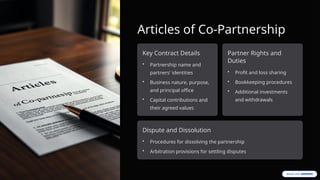
Articles of Co-Partnership
KeyContract Details
• Partnership name and
partners' identities
• Business nature, purpose,
and principal office
• Capital contributions and
their agreed values
Partner Rights and
Duties
• Profit and loss sharing
• Bookkeeping procedures
• Additional investments
and withdrawals
Dispute and Dissolution
• Procedures for dissolving the partnership
• Arbitration provisions for settling disputes
7.
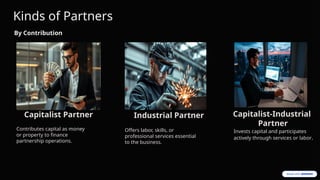
Capitalist Partner
Contributes capitalas money
or property to finance
partnership operations.
Industrial Partner
Offers labor, skills, or
professional services essential
to the business.
Capitalist-Industrial
Partner
Invests capital and participates
actively through services or labor.
Kinds of Partners
By Contribution
8.
General Partner
Holds unlimitedliability,
responsible beyond their
capital contribution.
Limited Partner
Liability limited to capital
contribution, usually not involved in
management.
Kinds of Partners
By Liability
9.
Managing Partner
Directs day-to-daybusiness operations
and decisions actively.
Invests or manages discreetly
without public disclosure.
Silent Partner
Known to outsiders but not involved
in daily management.
Dormant Partner
Neither publicly known nor active;
typically, an investor only.
Ostensible Partner
Seen by outsiders as a partner and
may be liable to third parties.
Secret Partner
Kinds of Partners
By Role
10.
Classification of
Partnerships byLiability
General Partnership
All partners have unlimited liability extending to
personal assets.
Limited Partnership
Includes one or more general partners and
limited partners; firm name includes “Limited”
or “Ltd.”
11.
Classification by Objectof Partnership
Universal Partnership of All
Present Property
Partners contribute all their current
property to a common fund to share
profits and assets.
Universal Partnership of
Profits
Partners share all profits acquired
through their industry or work during
the partnership.
Particular Partnership
Formed for specific things,
undertakings, or professional
exercise.
12.
Classification by Duration
Partnershipat Will
No fixed period; can be terminated anytime by
mutual agreement or partner’s will.
Partnership with Fixed Term
Exists for a specified period or objective agreed
upon by partners.
13.
Classification by Purpose
Commercial/TradingPartnership
Organized to conduct business
transactions like merchandising or
manufacturing.
Professional Partnership
Formed for practicing professions such as
law, accounting, or medicine.
14.
Advantages and Disadvantagesof Partnerships
Advantages
• Combines skills and talents of multiple
individuals
• Generates more capital than sole
proprietorship
Disadvantages
• Potential conflicts from decision-making
differences
• Limited life due to partner changes
• Mutual agency risks liability for wrongful acts
• Unlimited liability risks personal assets
15.
Accounting for Partnership
Formation
AccountingProcedures
Similar to sole proprietorship but with separate
capital and drawing accounts for each partner.
Recording Contributions
Assets contributed are recorded by crediting
the contributing partner’s capital account.
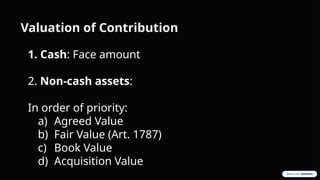
Valuation of Contribution
1.Cash: Face amount
2. Non-cash assets:
In order of priority:
a) Agreed Value
b) Fair Value (Art. 1787)
c) Book Value
d) Acquisition Value
18.
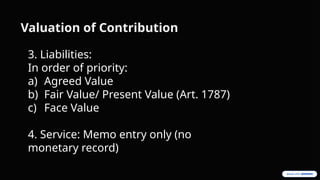
Valuation of Contribution
3.Liabilities:
In order of priority:
a) Agreed Value
b) Fair Value/ Present Value (Art. 1787)
c) Face Value
4. Service: Memo entry only (no
monetary record)
19.
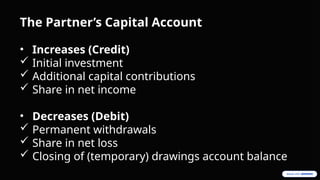
The Partner’s CapitalAccount
• Increases (Credit)
Initial investment
Additional capital contributions
Share in net income
• Decreases (Debit)
Permanent withdrawals
Share in net loss
Closing of (temporary) drawings account balance
20.
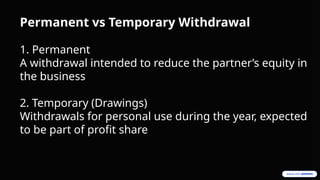
Permanent vs TemporaryWithdrawal
1. Permanent
A withdrawal intended to reduce the partner’s equity in
the business
2. Temporary (Drawings)
Withdrawals for personal use during the year, expected
to be part of profit share
21.
Journal Entries:
1. InitialInvestment (Cash & Non-Cash):
Michael contributes ₱100,000 cash and equipment
worth ₱50,000:
Cash 100,000
Equipment 50,000
Michael, Capital 150,000
22.
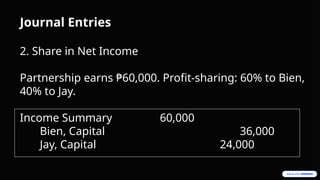
Journal Entries
2. Sharein Net Income
Partnership earns ₱60,000. Profit-sharing: 60% to Bien,
40% to Jay.
Income Summary 60,000
Bien, Capital 36,000
Jay, Capital 24,000
23.
Journal Entries
3. PermanentWithdrawal
Partner Michael withdraws ₱30,000 as permanent
reduction in equity.
Michael, Capital 30,000
Cash 30,000
24.
Journal Entries
4. TemporaryWithdrawals (Drawings):
Partner Jay makes multiple temporary withdrawals
totaling ₱10,000 during the year:
Jay, Drawings 10,000
Cash 10,000
#1 This chapter covers the essentials of partnership formation. You will learn to describe the nature of partnerships, identify different kinds of partners, and classify partnerships. Additionally, you will understand how to record partner contributions, convert a sole proprietorship into a partnership, and prepare a statement of financial position after formation.
These foundational skills are critical for managing and accounting for partnerships effectively.
#4 It's a business structure where partners contribute resources, which can include money, property, labor, or
skills, to a common fund and collectively oversee the business
operations.
#13 a locally grown coffee chain in the Philippines, was founded by Steve Benitez and Carmen Benitez. Beginning as a small coffee cart in 1996, this company has burgeoned into a flourishing chain boasting over 100 branches nationwide