*
                   AADL Overview
                         Brief and Pointless


                           Ivan Ruchkin

                      November 12, 2012


                                               1
*Architecture Analysis and Design Language
Agenda

●   Intro
●   Elements
       –    Components
       –    Ports
       –    Connections
●   Special features
       –    Modes
       –    Flows
                               2
       –    Annexes
Definition

●   What it is:
       –   (Systems Engineering) A high-level system
             specification language, specialized on real-
             time and embedded systems.
       –   (Architecture Description) an ADL for the
             domain of avionics and automotive.
●   What is it not:
       –   Not UML
       –   Not programming language
                                                            3
Use of AADL

●   Capture topology of architecture + properties
       –   Specific to embedded real-time systems
●   Generate code
       –   C, Simulink, UML
●   Do analysis
       –   For example, end-to-end latency
       –   May extend with annexes
       –   Tools not included into AADL
                                                    4
Timeline

●   2004: the Society of Automotive Engineers
     (SAE) released AADL v1.0.
       –   4 annexes
●   2009: AADL v2.0.
       –   Several major additions and improvements, +3
            annexes
●   09/2012: AADL v2.1.
       –   Minor fixes, +3 annexes
    * This presentation considers 1.0                     5
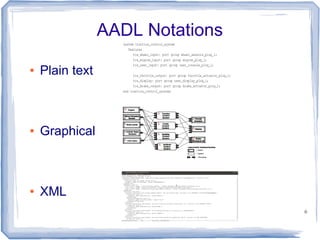
AADL Notations

●   Plain text


●   Graphical


●   XML
                                  6
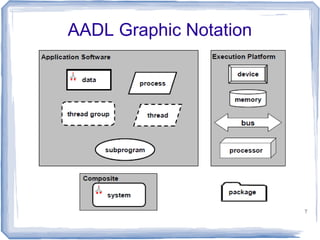
AADL Graphic Notation


                        7
Component Base Types 1 of 2

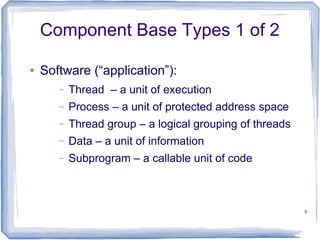
●   Software (“application”):
       –   Thread – a unit of execution
       –   Process – a unit of protected address space
       –   Thread group – a logical grouping of threads
       –   Data – a unit of information
       –   Subprogram – a callable unit of code


                                                          8
Component Base Types 2 of 2

●   Hardware (“execution platform”):
       –   Processor – an executer for threads
       –   Memory – a binary data storage
       –   Device – a component that interfaces with
            external environment (transducer)
       –   Bus – a communication channel
●   Composite
       –   System – a composite component
                                                       9
Separation of Type and Impl
●   Component type: externally visible
       –   Extends
       –   Features
       –   Flows
       –   Properties
●   Component impl: externally invisible
       –   Extends, refines
       –   Subcomponents, calls, connections
       –   Flows
       –   Modes
                                               10
       –   Properties
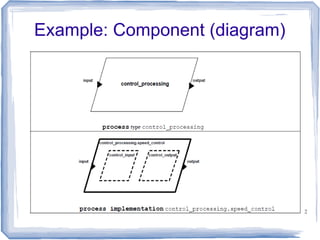
Example: Component (text)
process control_processing
      features
      input: in data port sensor_data;
      output: out data port command_data;
end control_processing;


process implementation control_processing.speed_control
      subcomponents
      control_input: thread control_in.input_processing_01;
      control_output: thread control_out.output_processing_01;
                                                                 11
end control_processing.speed_control;
Example: Component (diagram)


                               12
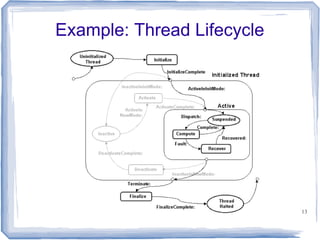
Example: Thread Lifecycle


                            13
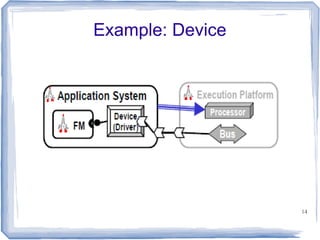
Example: Device


                  14
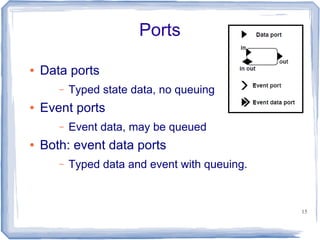
Ports

●   Data ports
       –   Typed state data, no queuing
●   Event ports
       –   Event data, may be queued
●   Both: event data ports
       –   Typed data and event with queuing.


                                                15
Connectors (conceptually)

●   Port dataflow
●   Shared data access (data or bus)
●   Subprogram call
       –   By value
       –   By reference
       –   Global


    * Not first-class elements, unlike e.g. ports
                                                    16
Binding

●   For a model to be complete:
       –   Each thread bound to processor
       –   Each process, data, and port bound to
            memory
       –   Each interprocessor communication is bound
            to bus
       –   …
●   No language primitives to bind
       –   Assuming it is done automatically
                                                        17
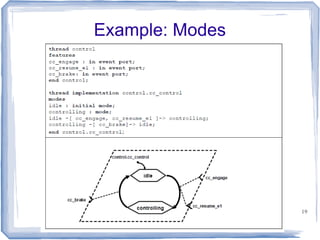
Modes

●   State of a component
●   Part of the component's state machine


                                            18
Example: Modes


                 19
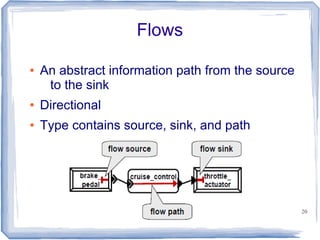
Flows

●   An abstract information path from the source
     to the sink
●   Directional
●   Type contains source, sink, and path


                                                   20
Annexes

●   Language extensions (not libraries of types!)
●   Needs to be approved
●   Currently around 10:
       –   Notation annexes (graphical, XML)
       –   Error model annex
       –   Behavior annex
       –   ...

                                                    21
Summary for the Language

●   Separation of software and hardware
●   Separation of type and implementation
●   Specific semantics: properties and constraints
●   Special features: modes, flows
●   Generation to code, Simulink, UML
●   Analysis tools - standalone
●   Analogy to views: implementations
       –   Unified through shared types          22
References
●   P. Feiler, D. Gluch, J. Hudak, B. Lewis.
     Embedded System Architecture Analysis
     Using SAE AADL. CMU/SEI-2004-TN-005.
     June 2004.
●   P. Feiler, D. Gluch, J. Hudak. The
     Architecture Analysis & Design Language
     (AADL): An Introduction. CMU/SEI-2006-
     TN-011. February 2006.
●   P. Feiler, J. Hudak. Developing AADL Models
     for Control Systems: A Practitioner’s Guide. 23
     CMU/SEI-2006-TR-019. October 2006.
Thank you!


             24

AADL Overview: Brief and Pointless

  • 1.
    * AADL Overview Brief and Pointless Ivan Ruchkin November 12, 2012 1 *Architecture Analysis and Design Language
  • 2.
    Agenda ● Intro ● Elements – Components – Ports – Connections ● Special features – Modes – Flows 2 – Annexes
  • 3.
    Definition ● What it is: – (Systems Engineering) A high-level system specification language, specialized on real- time and embedded systems. – (Architecture Description) an ADL for the domain of avionics and automotive. ● What is it not: – Not UML – Not programming language 3
  • 4.
    Use of AADL ● Capture topology of architecture + properties – Specific to embedded real-time systems ● Generate code – C, Simulink, UML ● Do analysis – For example, end-to-end latency – May extend with annexes – Tools not included into AADL 4
  • 5.
    Timeline ● 2004: the Society of Automotive Engineers (SAE) released AADL v1.0. – 4 annexes ● 2009: AADL v2.0. – Several major additions and improvements, +3 annexes ● 09/2012: AADL v2.1. – Minor fixes, +3 annexes * This presentation considers 1.0 5
  • 6.
    AADL Notations ● Plain text ● Graphical ● XML 6
  • 7.
  • 8.
    Component Base Types1 of 2 ● Software (“application”): – Thread – a unit of execution – Process – a unit of protected address space – Thread group – a logical grouping of threads – Data – a unit of information – Subprogram – a callable unit of code 8
  • 9.
    Component Base Types2 of 2 ● Hardware (“execution platform”): – Processor – an executer for threads – Memory – a binary data storage – Device – a component that interfaces with external environment (transducer) – Bus – a communication channel ● Composite – System – a composite component 9
  • 10.
    Separation of Typeand Impl ● Component type: externally visible – Extends – Features – Flows – Properties ● Component impl: externally invisible – Extends, refines – Subcomponents, calls, connections – Flows – Modes 10 – Properties
  • 11.
    Example: Component (text) processcontrol_processing features input: in data port sensor_data; output: out data port command_data; end control_processing; process implementation control_processing.speed_control subcomponents control_input: thread control_in.input_processing_01; control_output: thread control_out.output_processing_01; 11 end control_processing.speed_control;
  • 12.
  • 13.
  • 14.
  • 15.
    Ports ● Data ports – Typed state data, no queuing ● Event ports – Event data, may be queued ● Both: event data ports – Typed data and event with queuing. 15
  • 16.
    Connectors (conceptually) ● Port dataflow ● Shared data access (data or bus) ● Subprogram call – By value – By reference – Global * Not first-class elements, unlike e.g. ports 16
  • 17.
    Binding ● For a model to be complete: – Each thread bound to processor – Each process, data, and port bound to memory – Each interprocessor communication is bound to bus – … ● No language primitives to bind – Assuming it is done automatically 17
  • 18.
    Modes ● State of a component ● Part of the component's state machine 18
  • 19.
  • 20.
    Flows ● An abstract information path from the source to the sink ● Directional ● Type contains source, sink, and path 20
  • 21.
    Annexes ● Language extensions (not libraries of types!) ● Needs to be approved ● Currently around 10: – Notation annexes (graphical, XML) – Error model annex – Behavior annex – ... 21
  • 22.
    Summary for theLanguage ● Separation of software and hardware ● Separation of type and implementation ● Specific semantics: properties and constraints ● Special features: modes, flows ● Generation to code, Simulink, UML ● Analysis tools - standalone ● Analogy to views: implementations – Unified through shared types 22
  • 23.
    References ● P. Feiler, D. Gluch, J. Hudak, B. Lewis. Embedded System Architecture Analysis Using SAE AADL. CMU/SEI-2004-TN-005. June 2004. ● P. Feiler, D. Gluch, J. Hudak. The Architecture Analysis & Design Language (AADL): An Introduction. CMU/SEI-2006- TN-011. February 2006. ● P. Feiler, J. Hudak. Developing AADL Models for Control Systems: A Practitioner’s Guide. 23 CMU/SEI-2006-TR-019. October 2006.
  • 24.