A PRESENTATION ON PRIM’S AND
KRUSKAL’S ALGORITHM
By:
Gaurav Vivek Kolekar
and
Lionel Sequeira
GRAPHS AND IT’S EXAMPLES
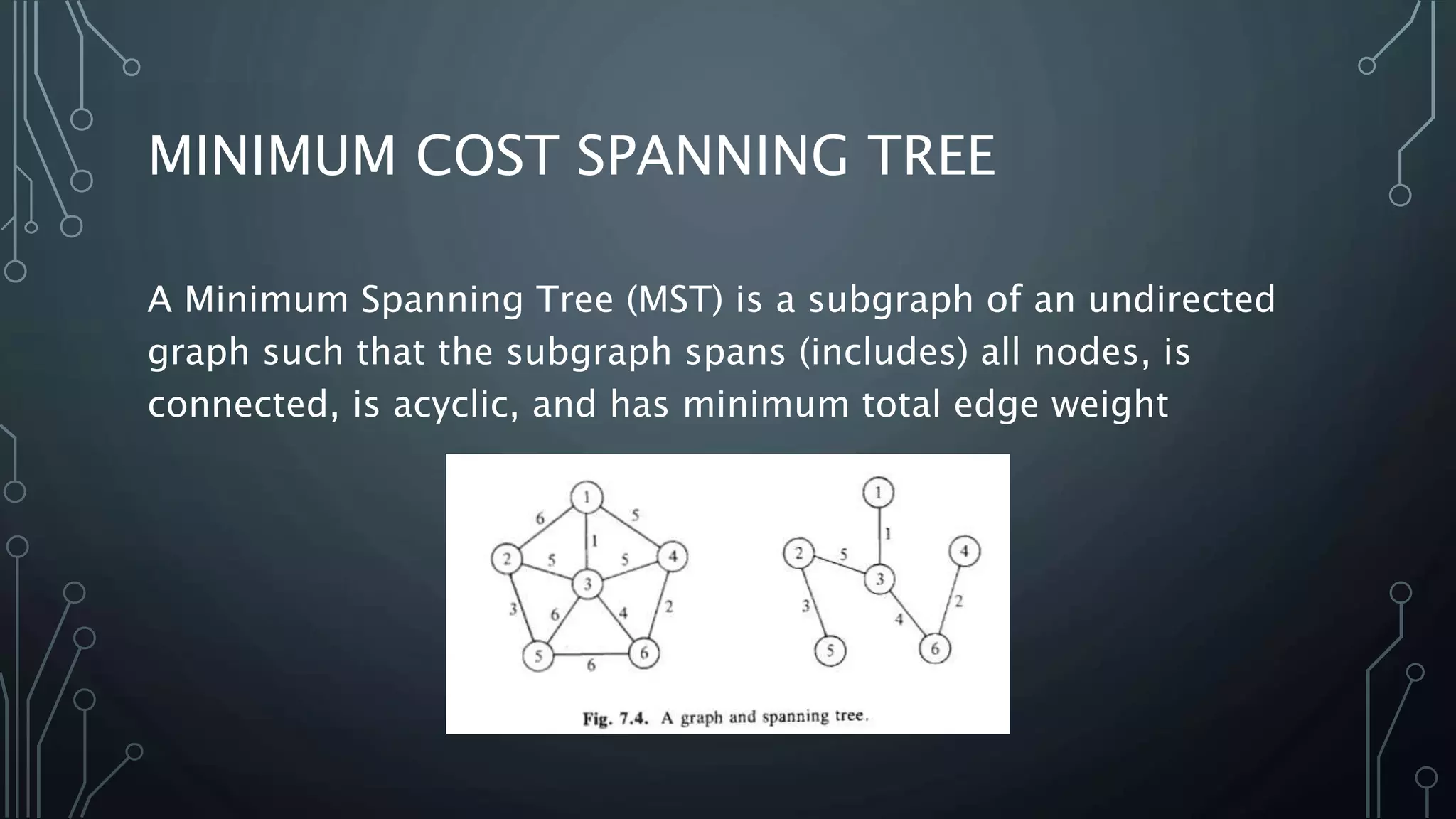
MINIMUM COST SPANNING TREE
A Minimum Spanning Tree (MST) is a subgraph of an undirected
graph such that the subgraph spans (includes) all nodes, is
connected, is acyclic, and has minimum total edge weight
ALGORITHM CHARACTERISTICS
• Both Prim’s and Kruskal’s Algorithms work with
undirected graphs
• Both work with weighted and unweighted graphs
• Both are greedy algorithms that produce optimal
solutions
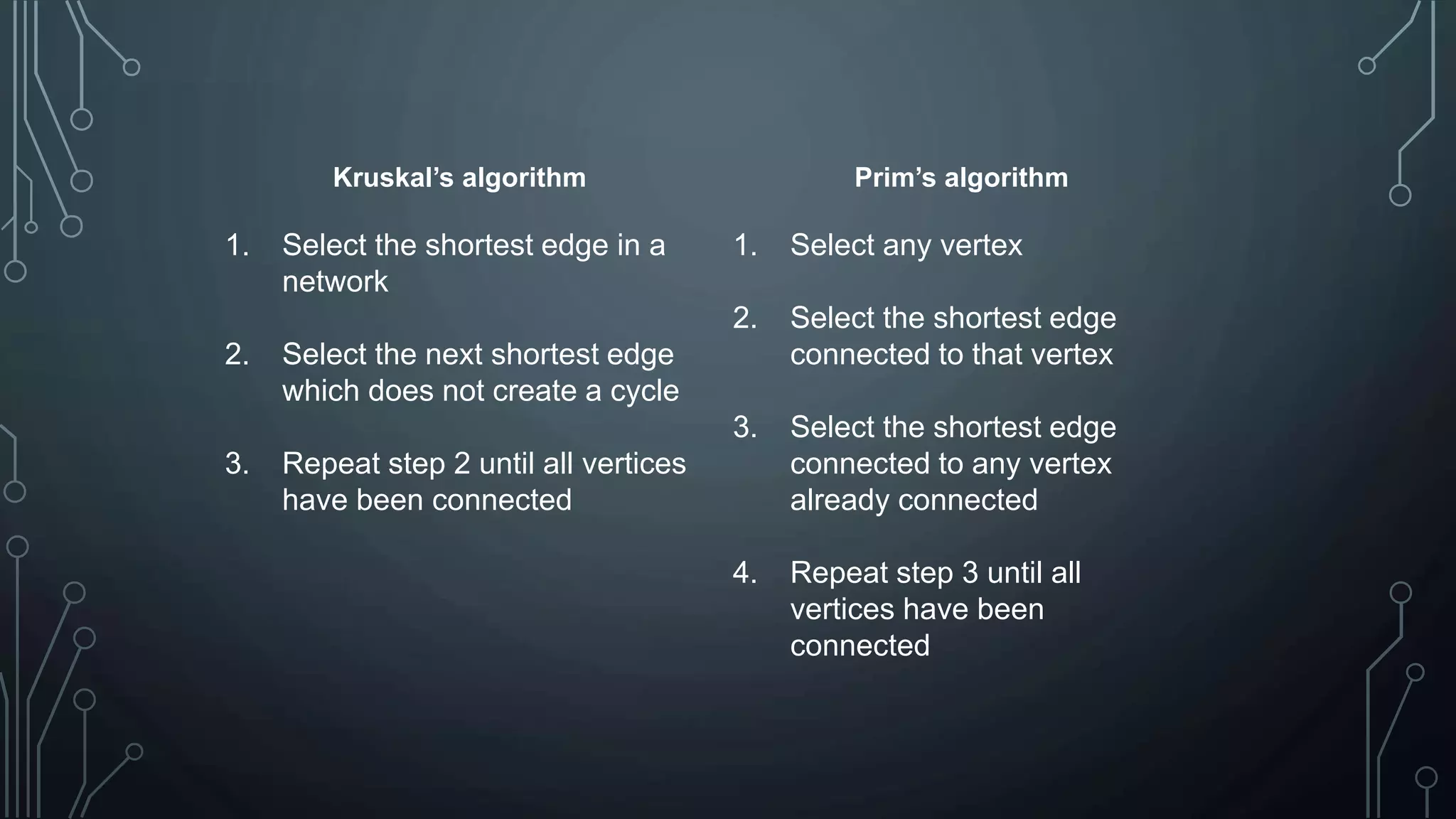
Kruskal’s algorithm
1. Select the shortest edge in a
network
2. Select the next shortest edge
which does not create a cycle
3. Repeat step 2 until all vertices
have been connected
Prim’s algorithm
1. Select any vertex
2. Select the shortest edge
connected to that vertex
3. Select the shortest edge
connected to any vertex
already connected
4. Repeat step 3 until all
vertices have been
connected
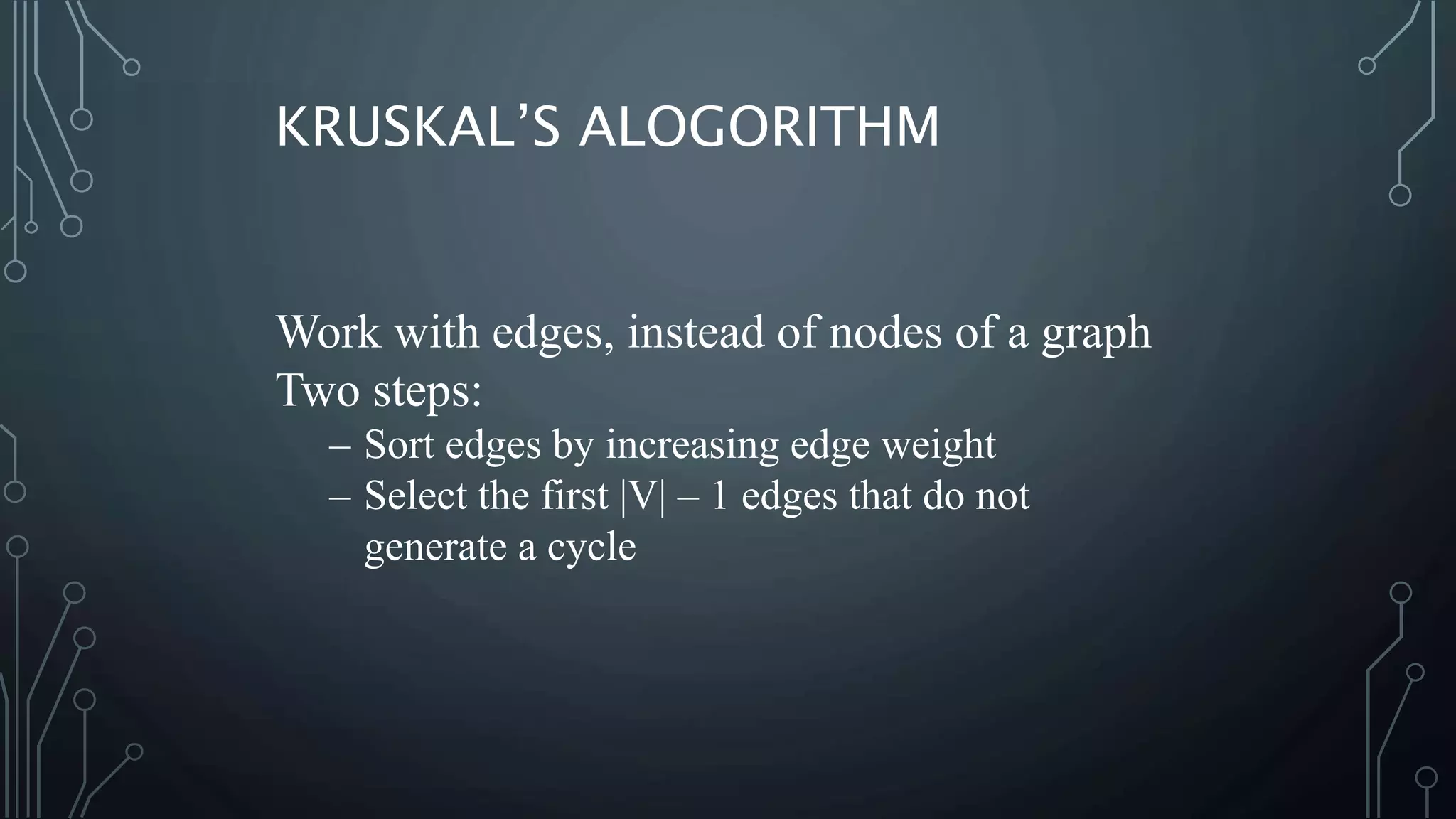
Work with edges, instead of nodes of a graph
Two steps:
– Sort edges by increasing edge weight
– Select the first |V| – 1 edges that do not
generate a cycle
KRUSKAL’S ALOGORITHM
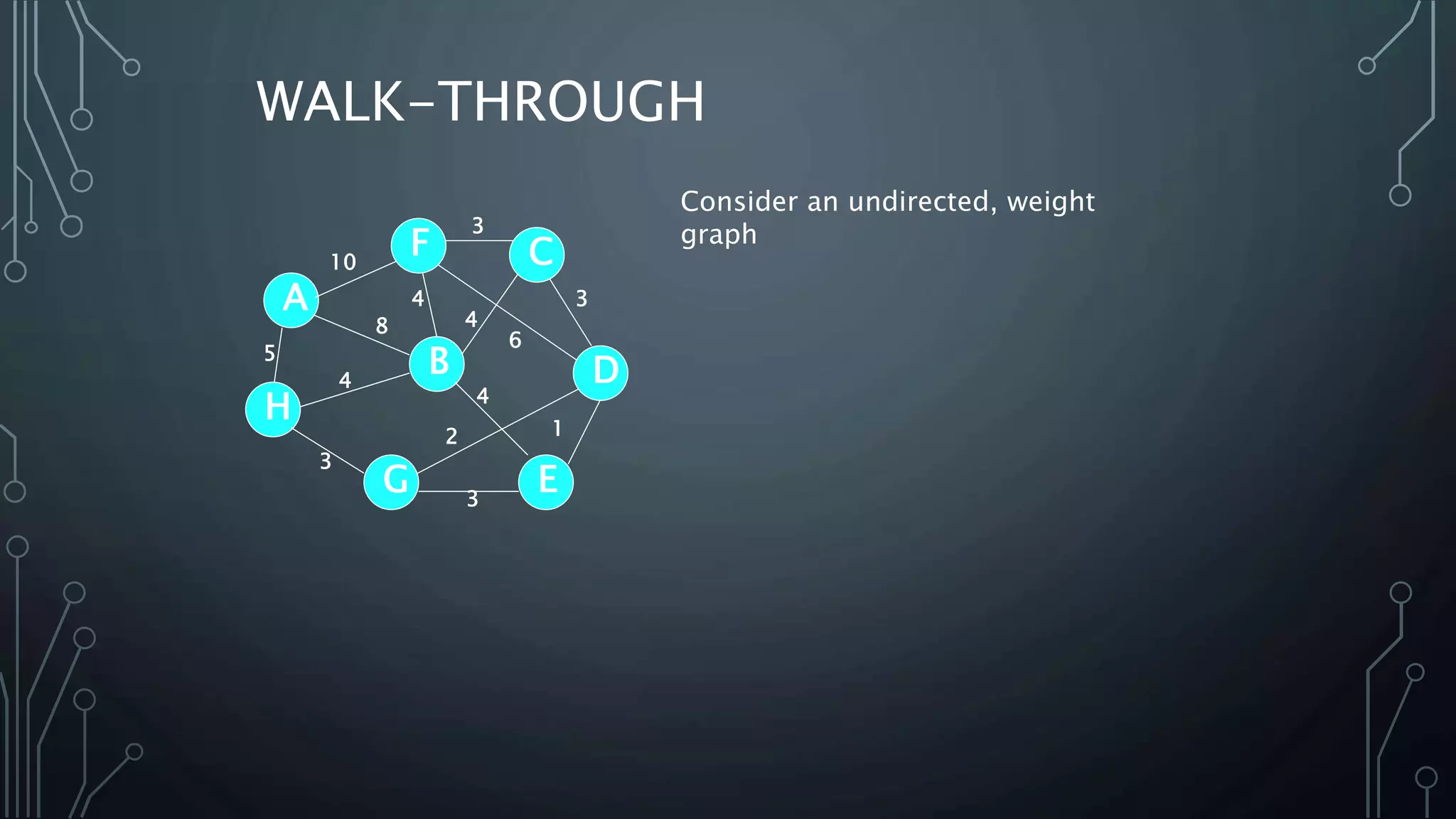
Consider an undirected, weight
graph
5
1
A
H
B
F
E
D
C
G 3
2
4
6
3
4
3
4
8
4
3
10
WALK-THROUGH
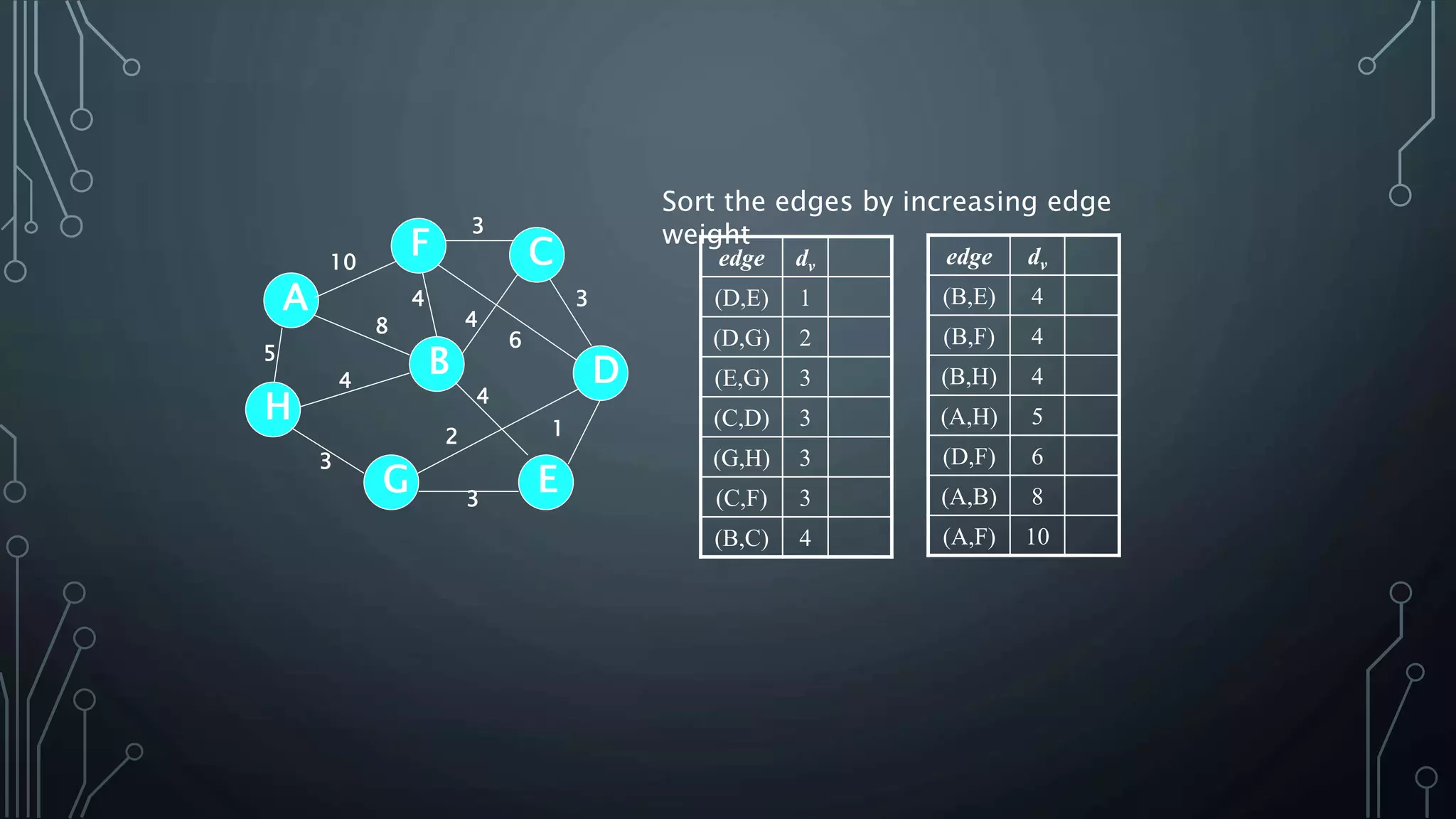
Sort the edges by increasing edge
weight
edge dv
(D,E) 1
(D,G) 2
(E,G) 3
(C,D) 3
(G,H) 3
(C,F) 3
(B,C) 4
5
1
A
H
B
F
E
D
C
G 3
2
4
6
3
4
3
4
8
4
3
10 edge dv
(B,E) 4
(B,F) 4
(B,H) 4
(A,H) 5
(D,F) 6
(A,B) 8
(A,F) 10
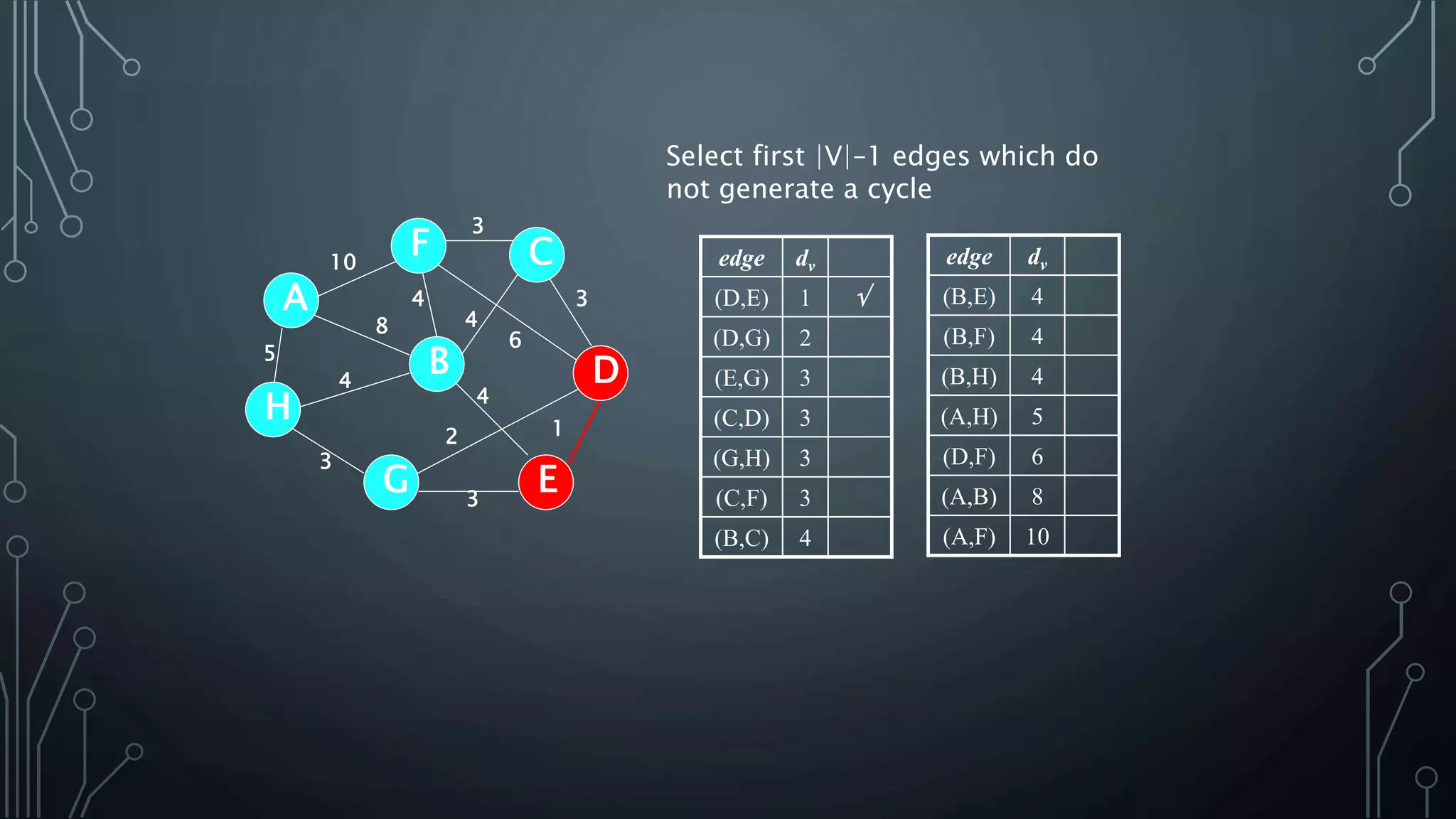
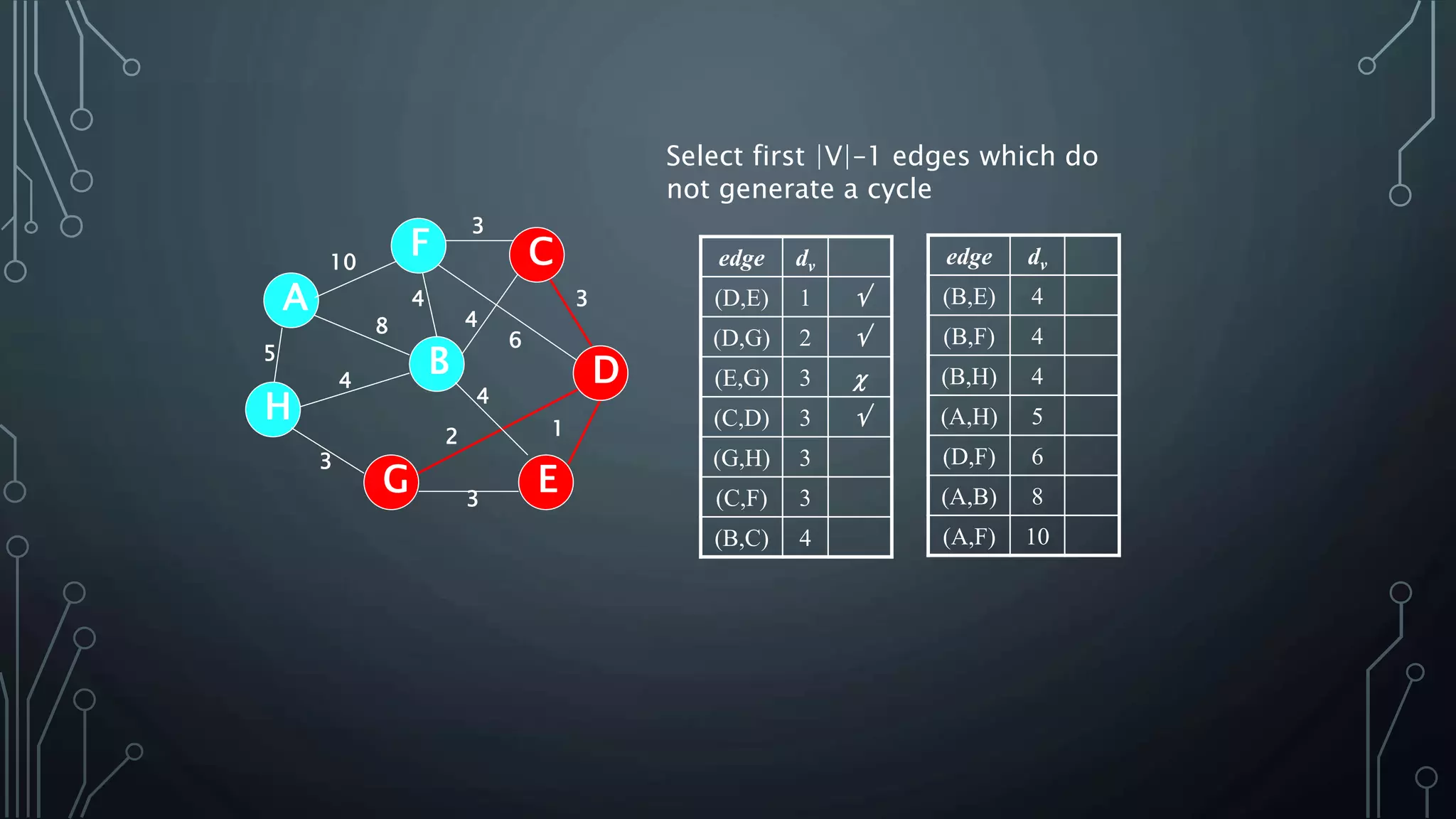
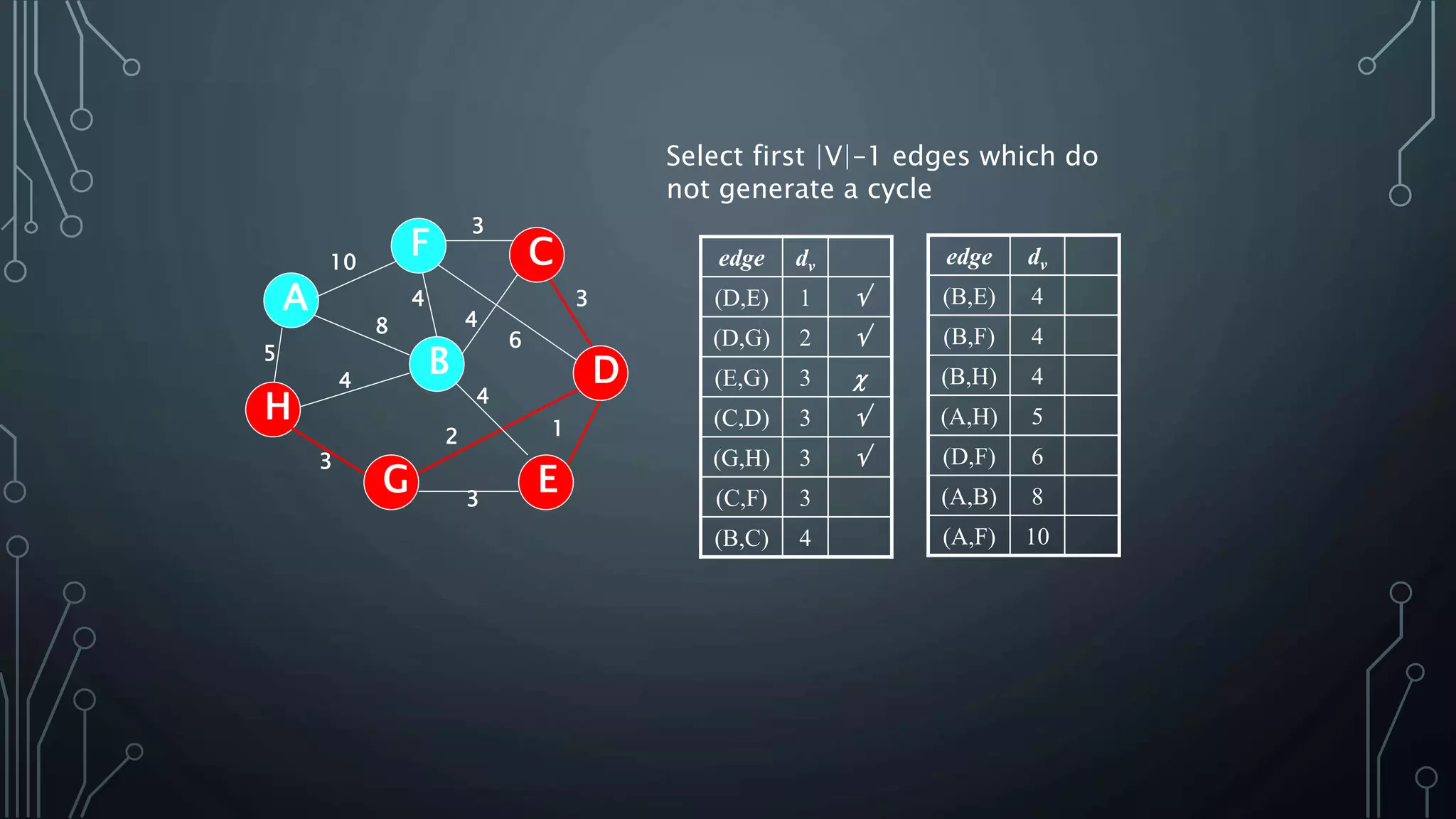
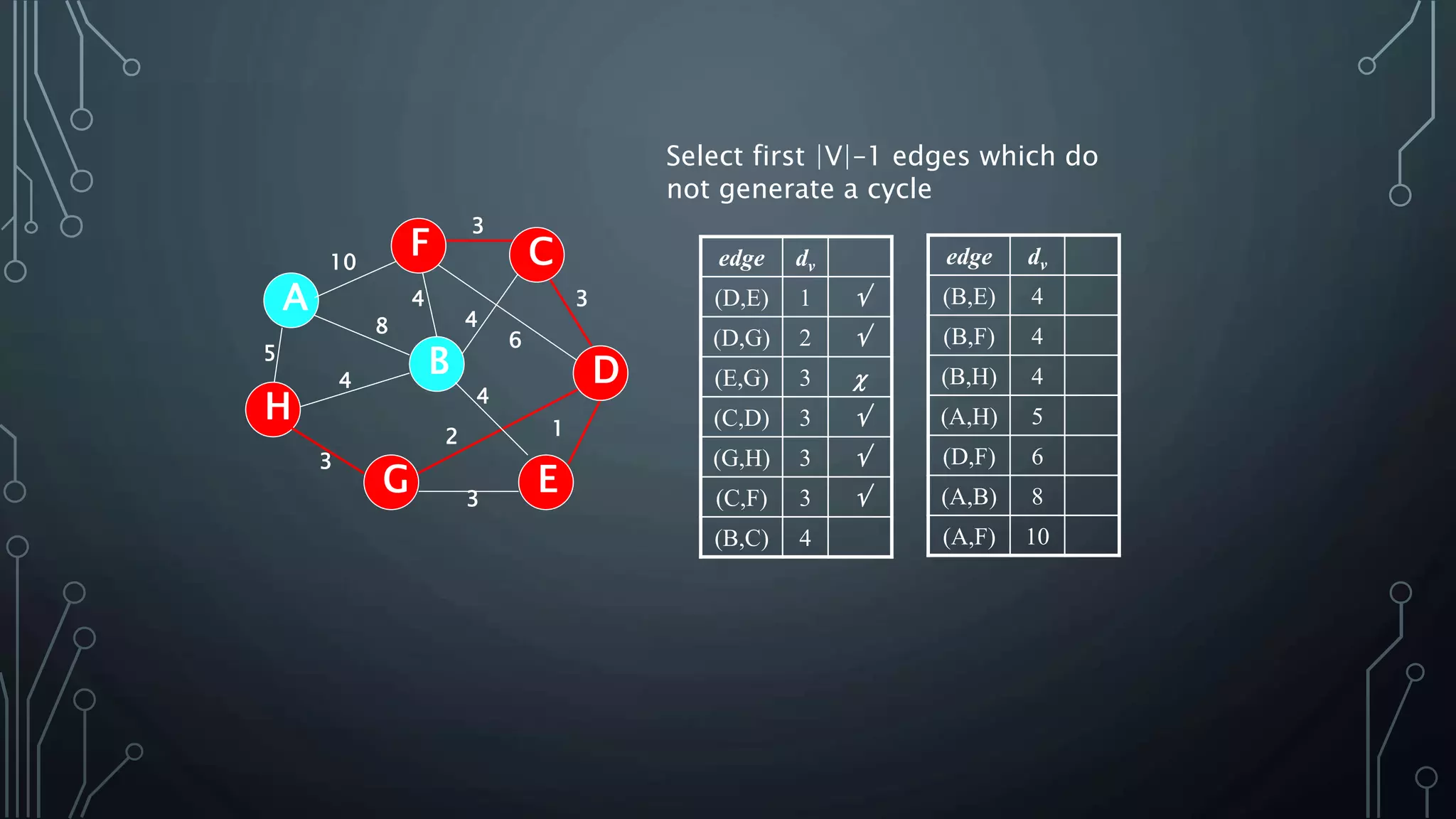
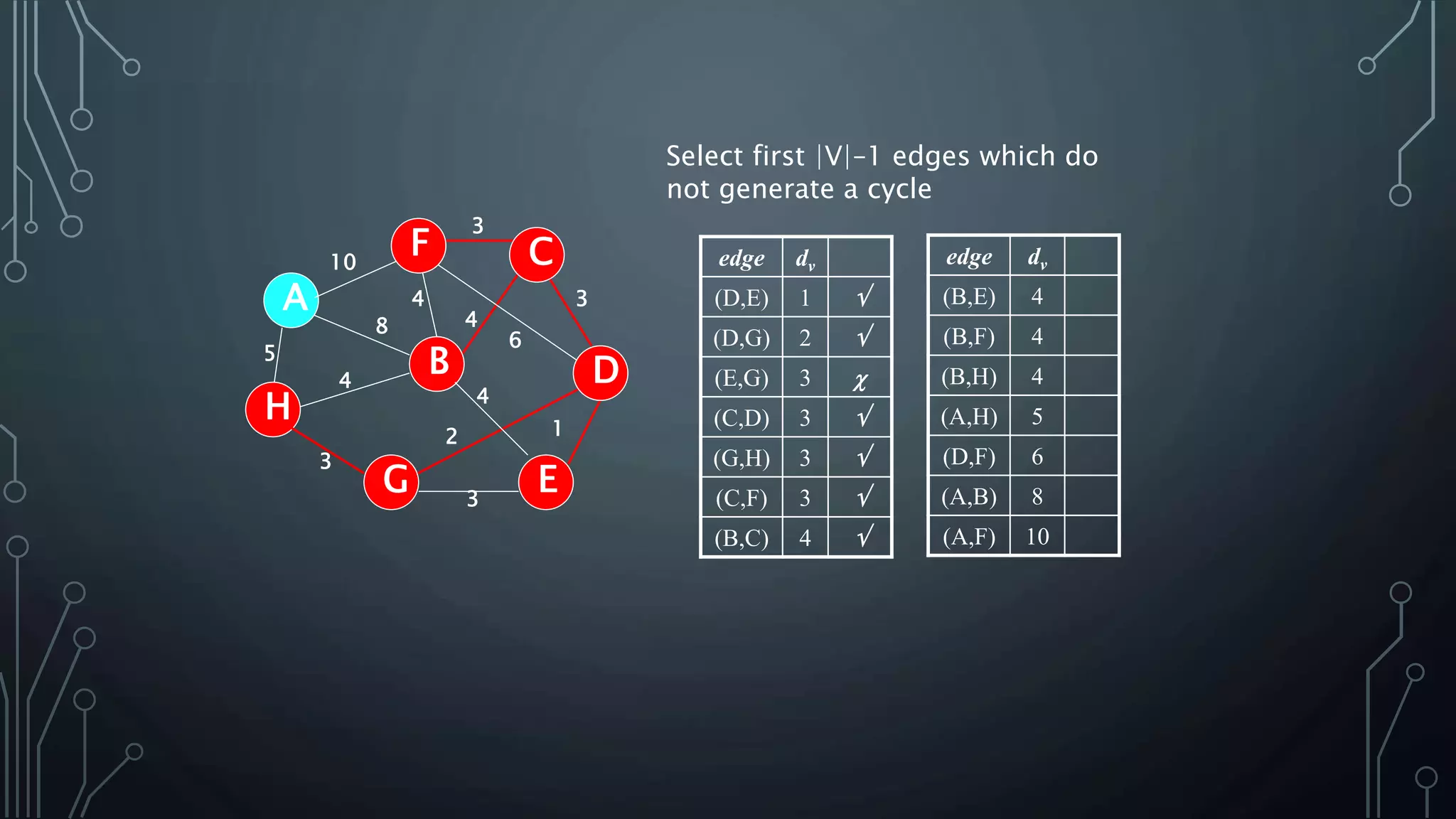
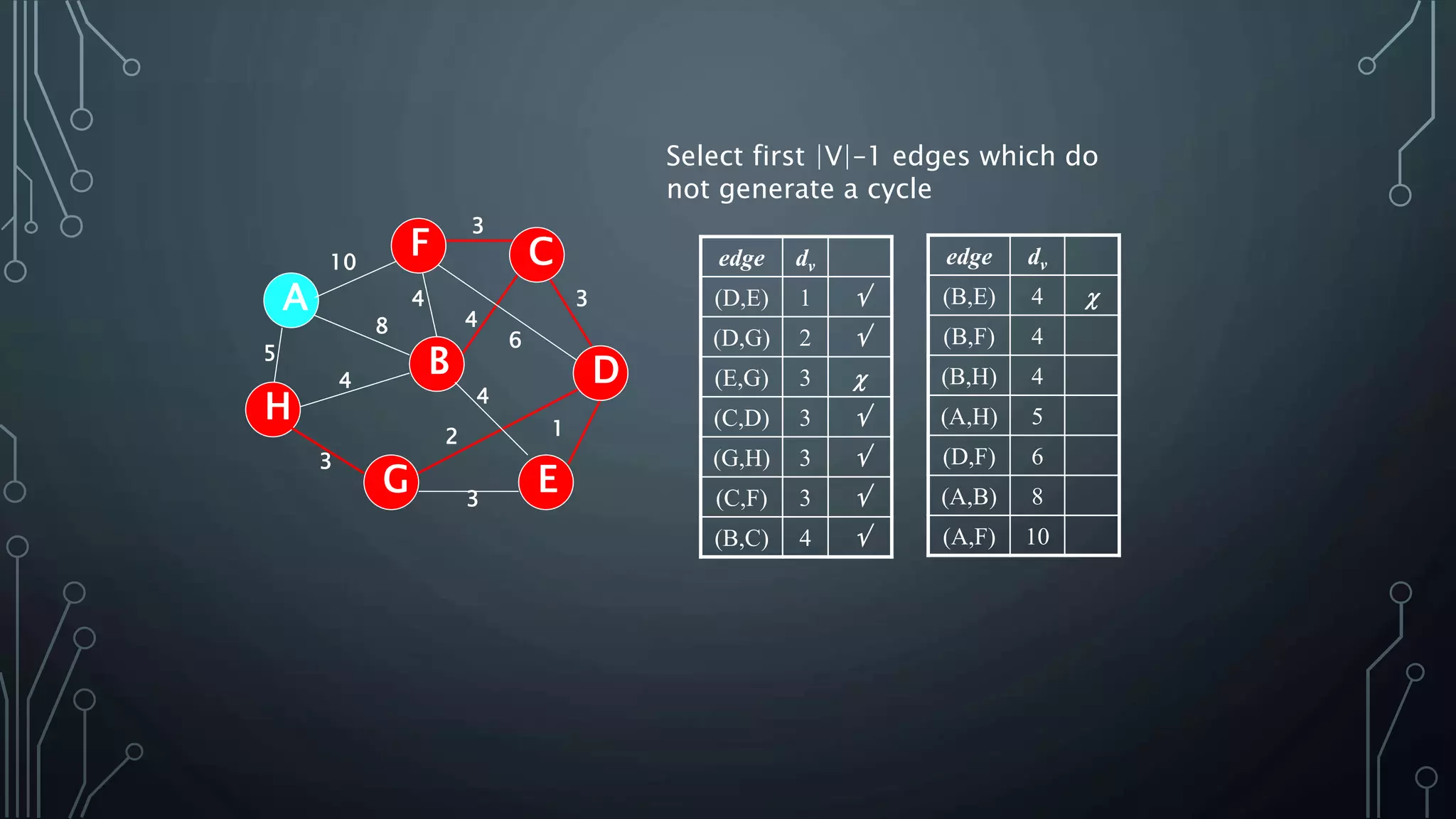
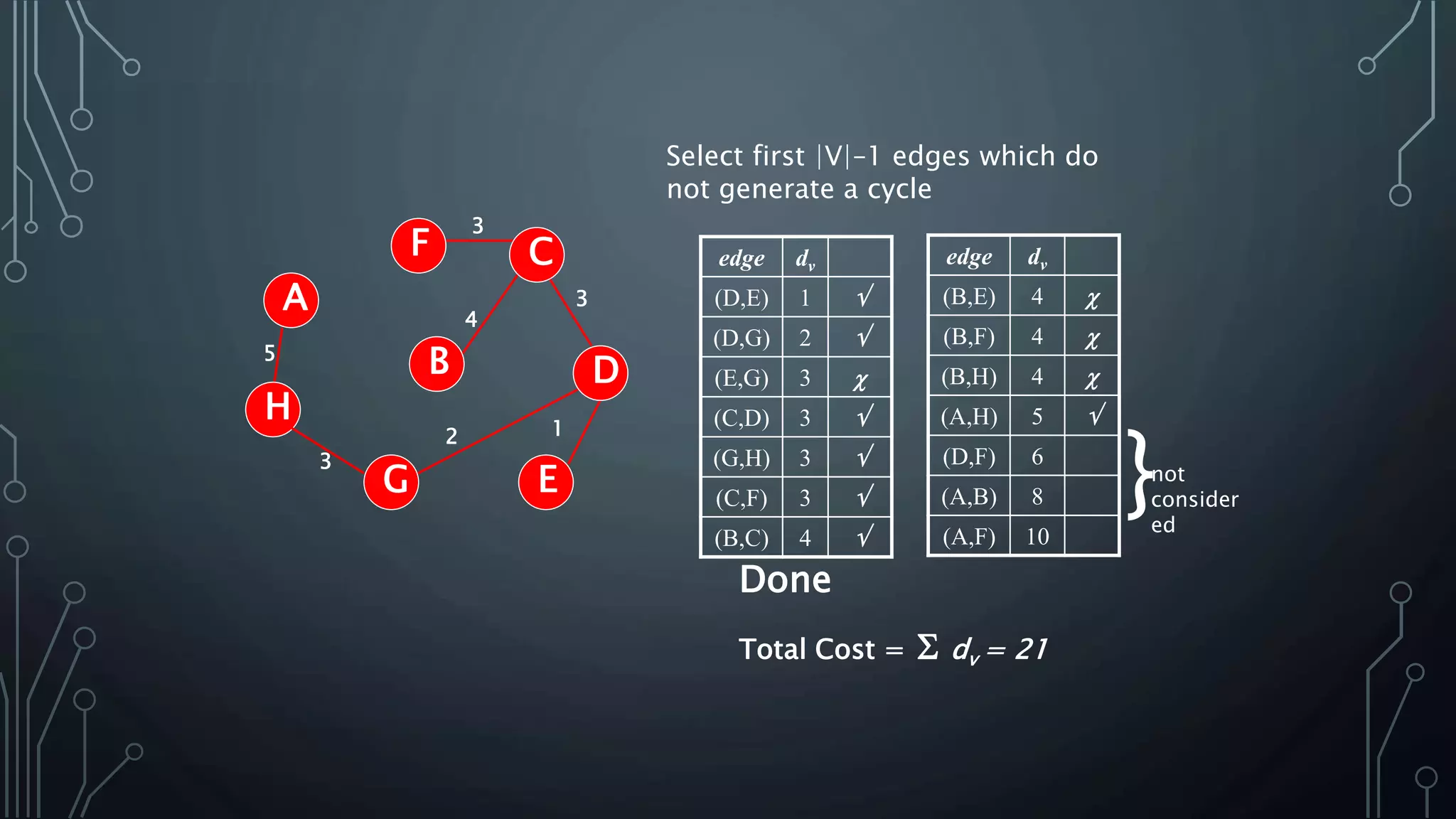
Select first |V|–1 edges which do
not generate a cycle
edge dv
(D,E) 1 
(D,G) 2
(E,G) 3
(C,D) 3
(G,H) 3
(C,F) 3
(B,C) 4
5
1
A
H
B
F
E
D
C
G 3
2
4
6
3
4
3
4
8
4
3
10 edge dv
(B,E) 4
(B,F) 4
(B,H) 4
(A,H) 5
(D,F) 6
(A,B) 8
(A,F) 10
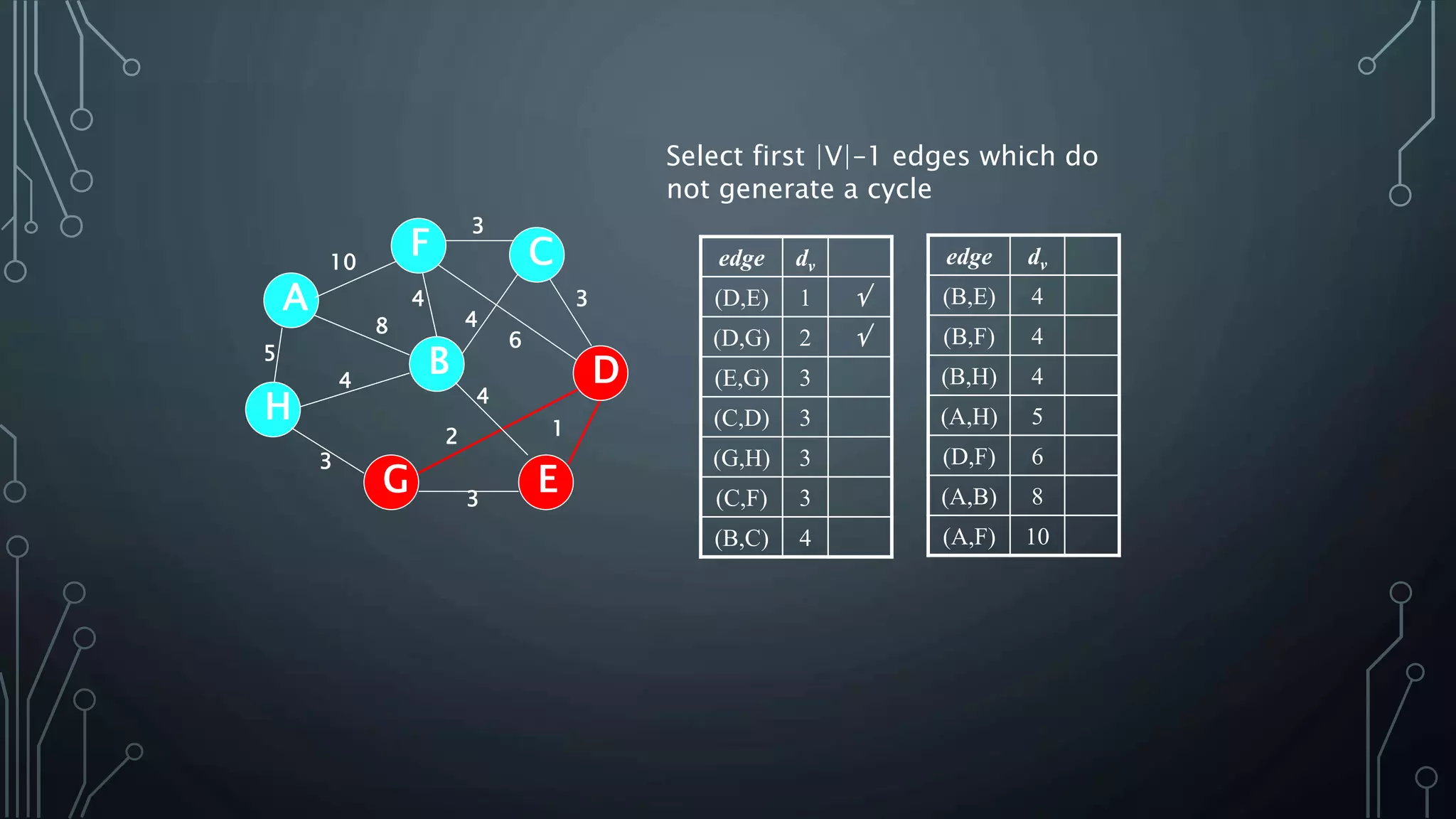
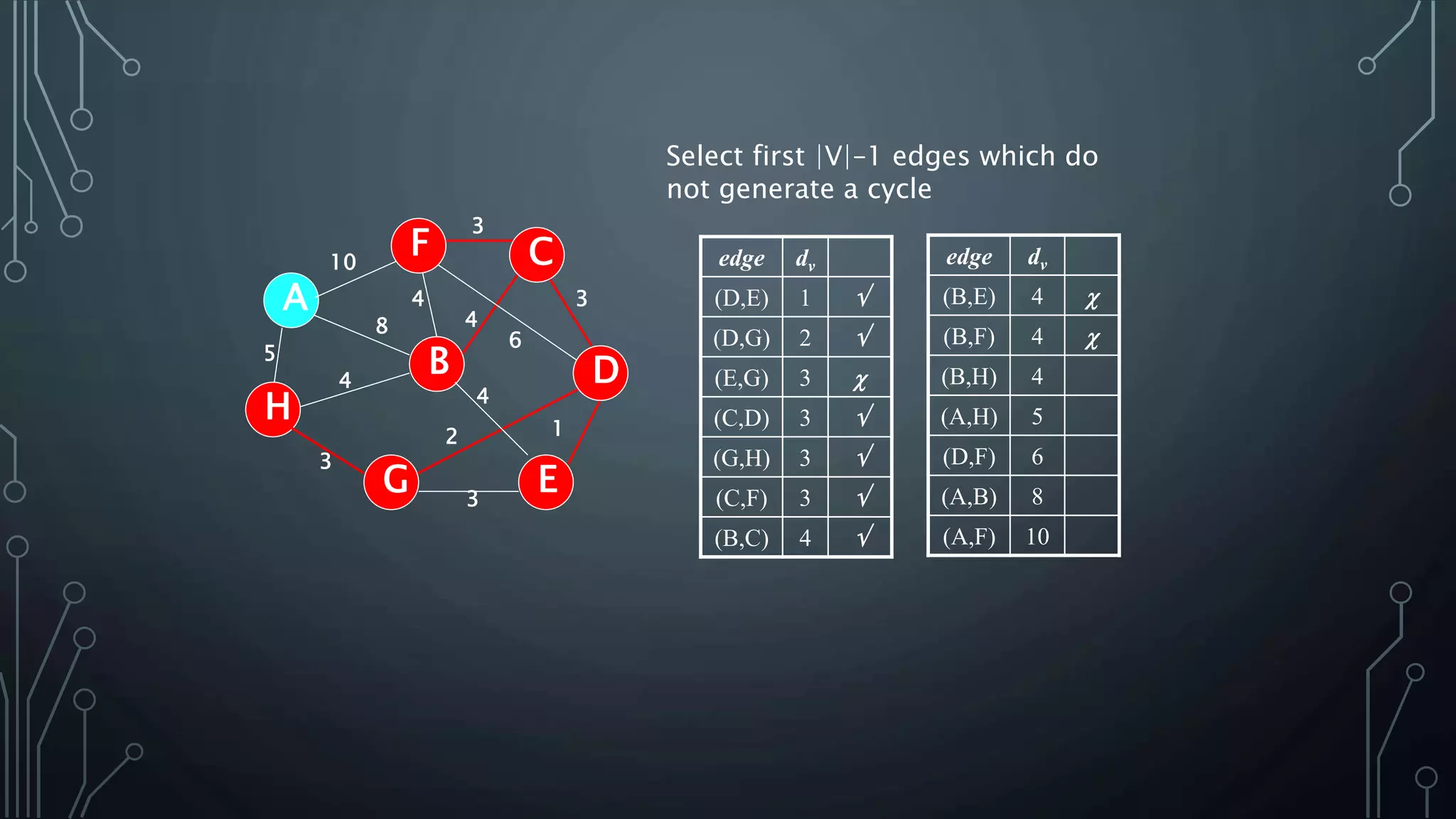
Select first |V|–1 edges which do
not generate a cycle
edge dv
(D,E) 1 
(D,G) 2 
(E,G) 3
(C,D) 3
(G,H) 3
(C,F) 3
(B,C) 4
5
1
A
H
B
F
E
D
C
G 3
2
4
6
3
4
3
4
8
4
3
10 edge dv
(B,E) 4
(B,F) 4
(B,H) 4
(A,H) 5
(D,F) 6
(A,B) 8
(A,F) 10
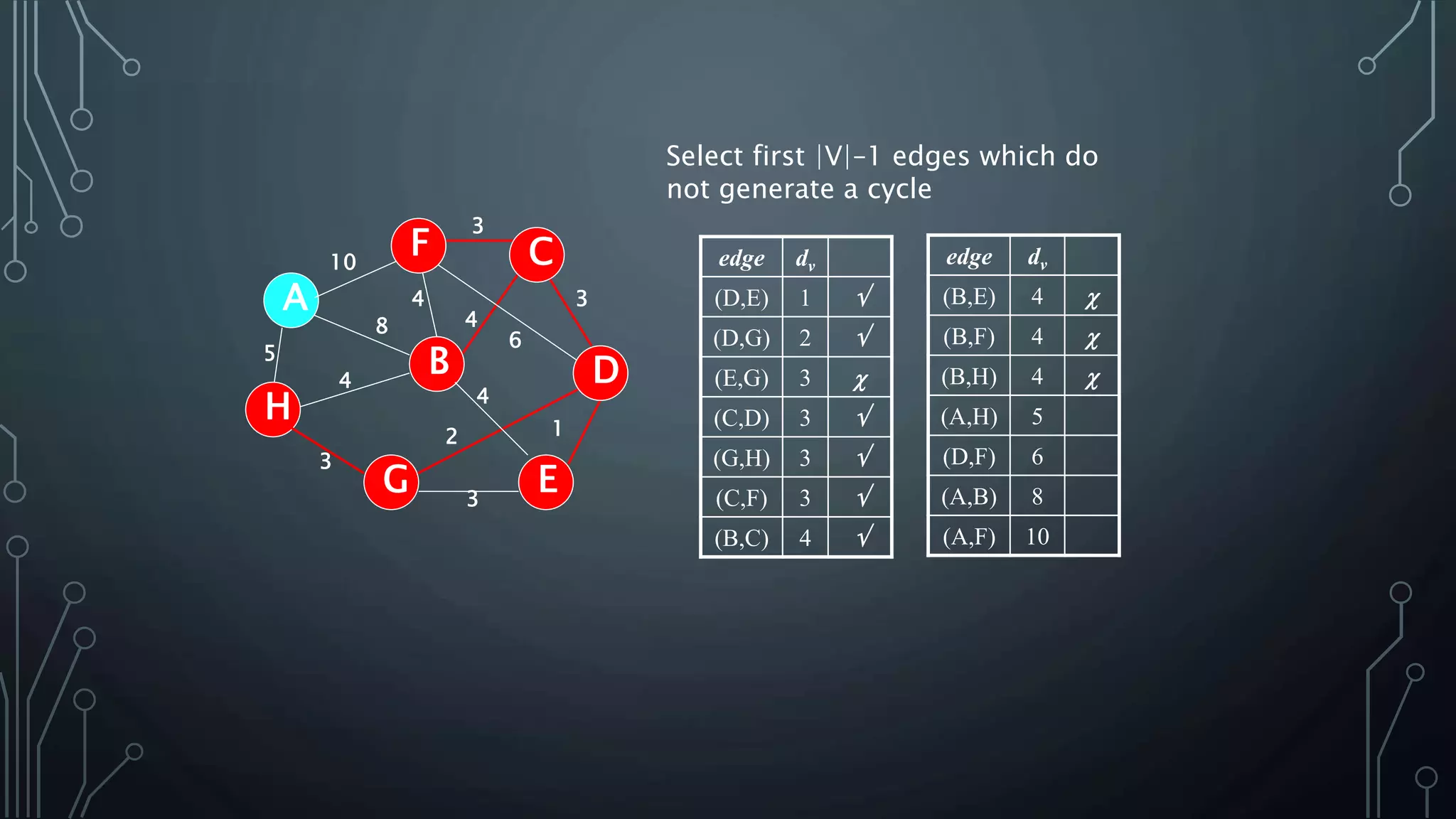
Select first |V|–1 edges which do
not generate a cycle
edge dv
(D,E) 1 
(D,G) 2 
(E,G) 3 
(C,D) 3
(G,H) 3
(C,F) 3
(B,C) 4
5
1
A
H
B
F
E
D
C
G 3
2
4
6
3
4
3
4
8
4
3
10 edge dv
(B,E) 4
(B,F) 4
(B,H) 4
(A,H) 5
(D,F) 6
(A,B) 8
(A,F) 10
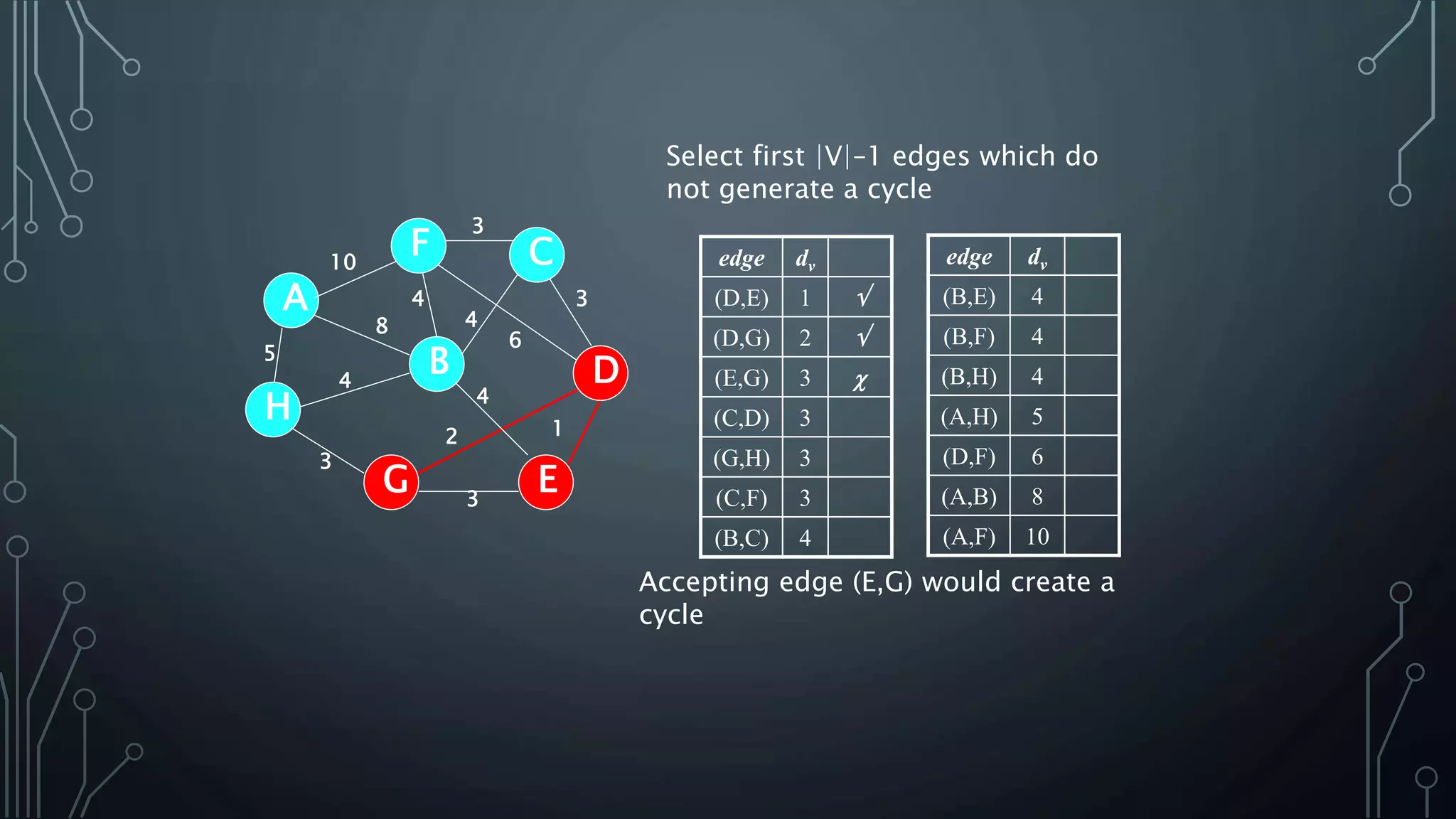
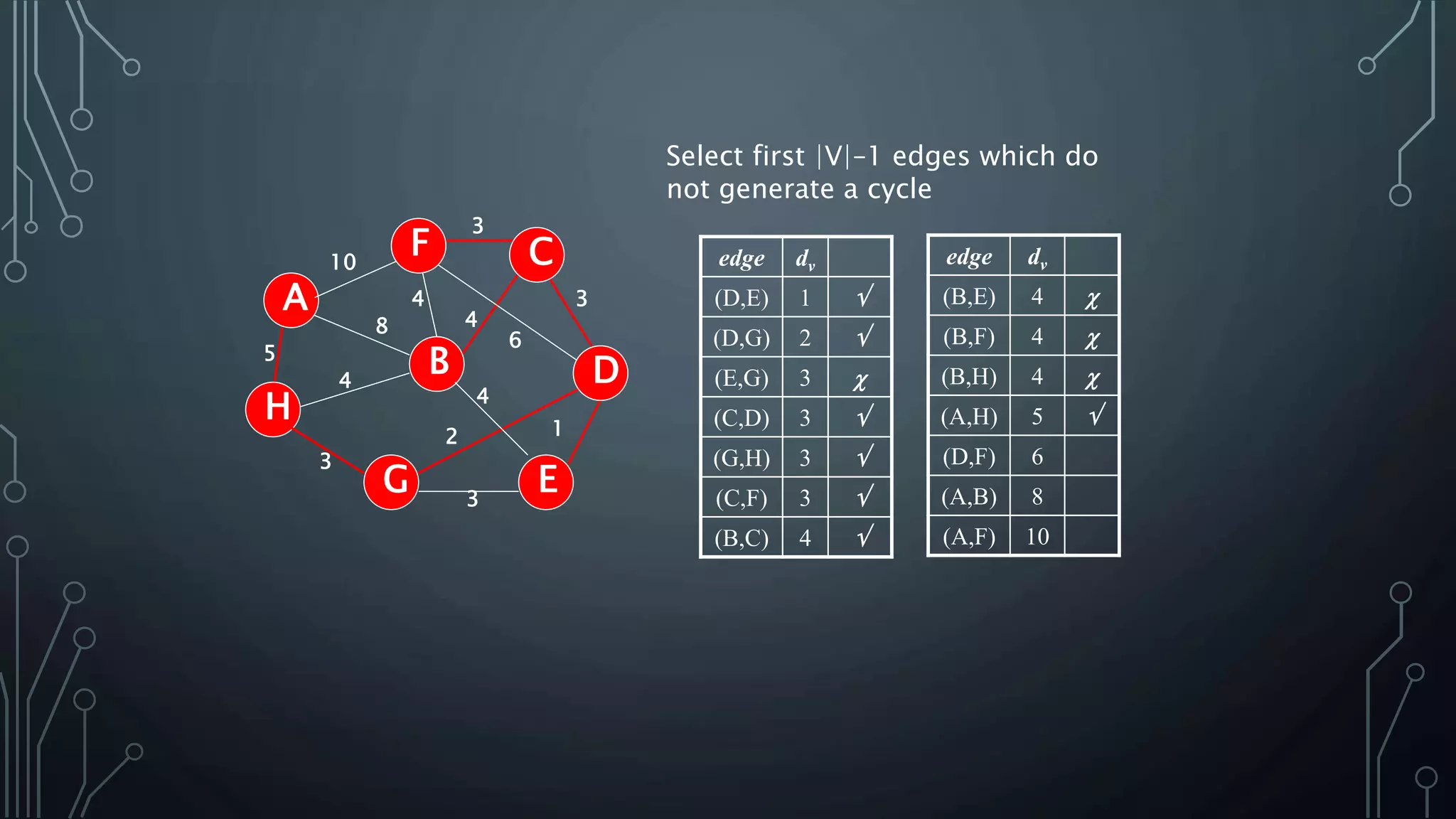
Accepting edge (E,G) would create a
cycle
Select first |V|–1 edges which do
not generate a cycle
edge dv
(D,E) 1 
(D,G) 2 
(E,G) 3 
(C,D) 3 
(G,H) 3
(C,F) 3
(B,C) 4
5
1
A
H
B
F
E
D
C
G 3
2
4
6
3
4
3
4
8
4
3
10 edge dv
(B,E) 4
(B,F) 4
(B,H) 4
(A,H) 5
(D,F) 6
(A,B) 8
(A,F) 10
Select first |V|–1 edges which do
not generate a cycle
edge dv
(D,E) 1 
(D,G) 2 
(E,G) 3 
(C,D) 3 
(G,H) 3 
(C,F) 3
(B,C) 4
5
1
A
H
B
F
E
D
C
G 3
2
4
6
3
4
3
4
8
4
3
10 edge dv
(B,E) 4
(B,F) 4
(B,H) 4
(A,H) 5
(D,F) 6
(A,B) 8
(A,F) 10
Select first |V|–1 edges which do
not generate a cycle
edge dv
(D,E) 1 
(D,G) 2 
(E,G) 3 
(C,D) 3 
(G,H) 3 
(C,F) 3 
(B,C) 4
5
1
A
H
B
F
E
D
C
G 3
2
4
6
3
4
3
4
8
4
3
10 edge dv
(B,E) 4
(B,F) 4
(B,H) 4
(A,H) 5
(D,F) 6
(A,B) 8
(A,F) 10
Select first |V|–1 edges which do
not generate a cycle
edge dv
(D,E) 1 
(D,G) 2 
(E,G) 3 
(C,D) 3 
(G,H) 3 
(C,F) 3 
(B,C) 4 
5
1
A
H
B
F
E
D
C
G 3
2
4
6
3
4
3
4
8
4
3
10 edge dv
(B,E) 4
(B,F) 4
(B,H) 4
(A,H) 5
(D,F) 6
(A,B) 8
(A,F) 10
Select first |V|–1 edges which do
not generate a cycle
edge dv
(D,E) 1 
(D,G) 2 
(E,G) 3 
(C,D) 3 
(G,H) 3 
(C,F) 3 
(B,C) 4 
5
1
A
H
B
F
E
D
C
G 3
2
4
6
3
4
3
4
8
4
3
10 edge dv
(B,E) 4 
(B,F) 4
(B,H) 4
(A,H) 5
(D,F) 6
(A,B) 8
(A,F) 10
Select first |V|–1 edges which do
not generate a cycle
edge dv
(D,E) 1 
(D,G) 2 
(E,G) 3 
(C,D) 3 
(G,H) 3 
(C,F) 3 
(B,C) 4 
5
1
A
H
B
F
E
D
C
G 3
2
4
6
3
4
3
4
8
4
3
10 edge dv
(B,E) 4 
(B,F) 4 
(B,H) 4
(A,H) 5
(D,F) 6
(A,B) 8
(A,F) 10
Select first |V|–1 edges which do
not generate a cycle
edge dv
(D,E) 1 
(D,G) 2 
(E,G) 3 
(C,D) 3 
(G,H) 3 
(C,F) 3 
(B,C) 4 
5
1
A
H
B
F
E
D
C
G 3
2
4
6
3
4
3
4
8
4
3
10 edge dv
(B,E) 4 
(B,F) 4 
(B,H) 4 
(A,H) 5
(D,F) 6
(A,B) 8
(A,F) 10
Select first |V|–1 edges which do
not generate a cycle
edge dv
(D,E) 1 
(D,G) 2 
(E,G) 3 
(C,D) 3 
(G,H) 3 
(C,F) 3 
(B,C) 4 
5
1
A
H
B
F
E
D
C
G 3
2
4
6
3
4
3
4
8
4
3
10 edge dv
(B,E) 4 
(B,F) 4 
(B,H) 4 
(A,H) 5 
(D,F) 6
(A,B) 8
(A,F) 10
Select first |V|–1 edges which do
not generate a cycle
edge dv
(D,E) 1 
(D,G) 2 
(E,G) 3 
(C,D) 3 
(G,H) 3 
(C,F) 3 
(B,C) 4 
5
1
A
H
B
F
E
D
C
G
2
3
3
3
edge dv
(B,E) 4 
(B,F) 4 
(B,H) 4 
(A,H) 5 
(D,F) 6
(A,B) 8
(A,F) 10
Done
Total Cost =  dv = 21
4
}not
consider
ed
PRIM’S ALGORITHM
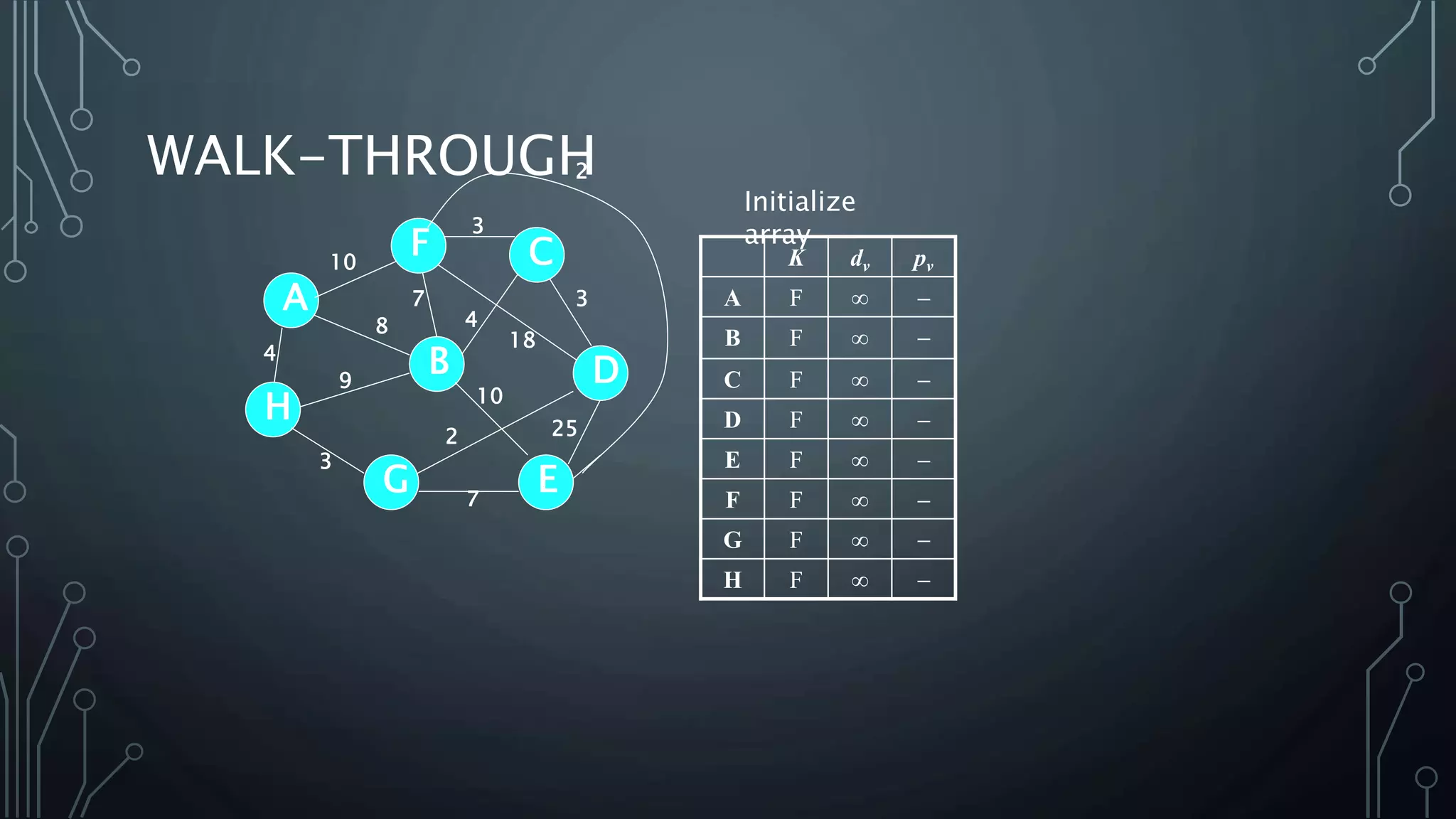
WALK-THROUGH
Initialize
array
K dv pv
A F  
B F  
C F  
D F  
E F  
F F  
G F  
H F  
4
25
A
H
B
F
E
D
C
G 7
2
10
18
3
4
3
7
8
9
3
10
2
4
25
A
H
B
F
E
D
C
G 7
2
10
18
3
4
3
7
8
9
3
10
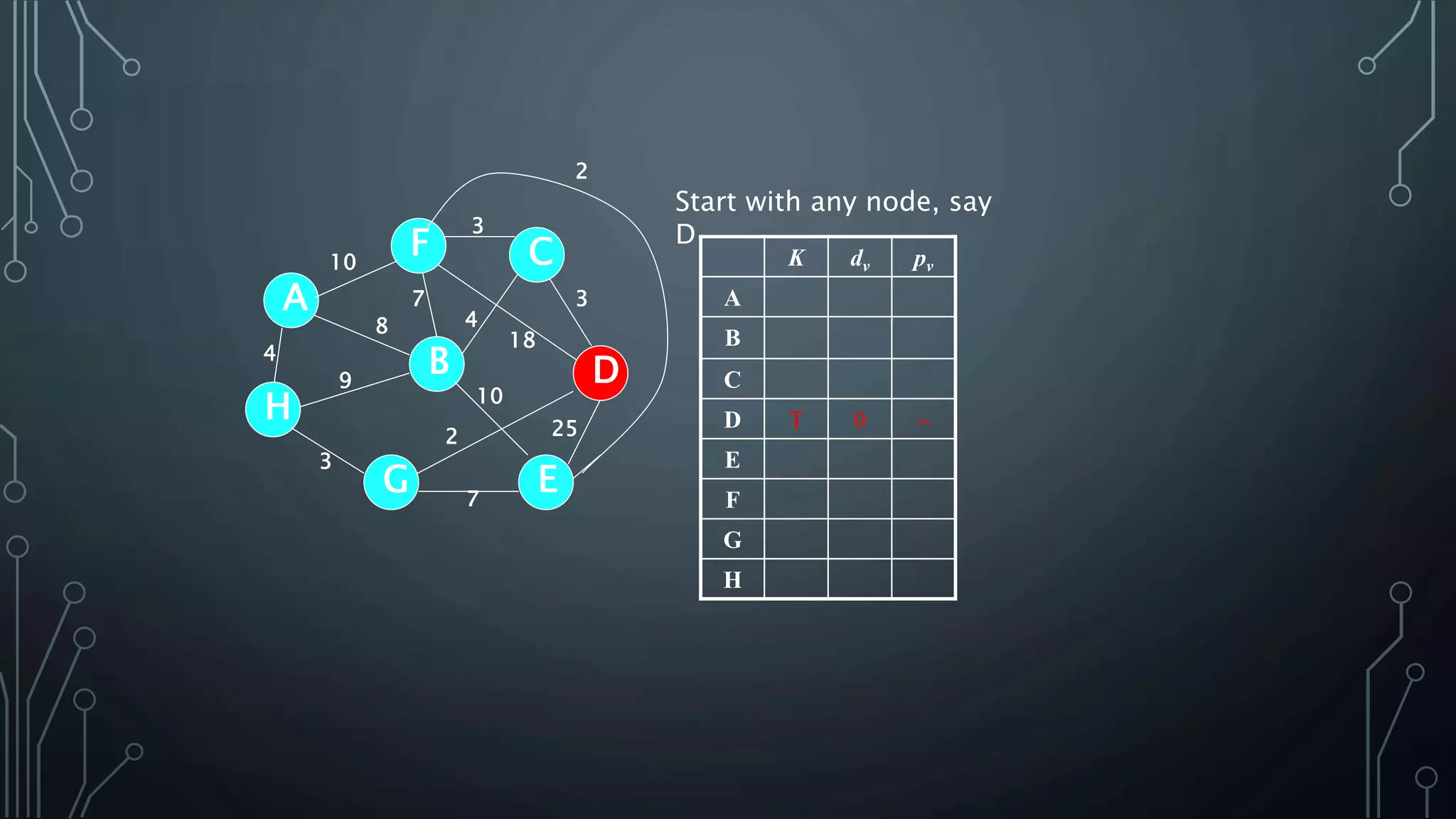
Start with any node, say
D
K dv pv
A
B
C
D T 0 
E
F
G
H
2
4
25
A
H
B
F
E
D
C
G 7
2
10
18
3
4
3
7
8
9
3
10
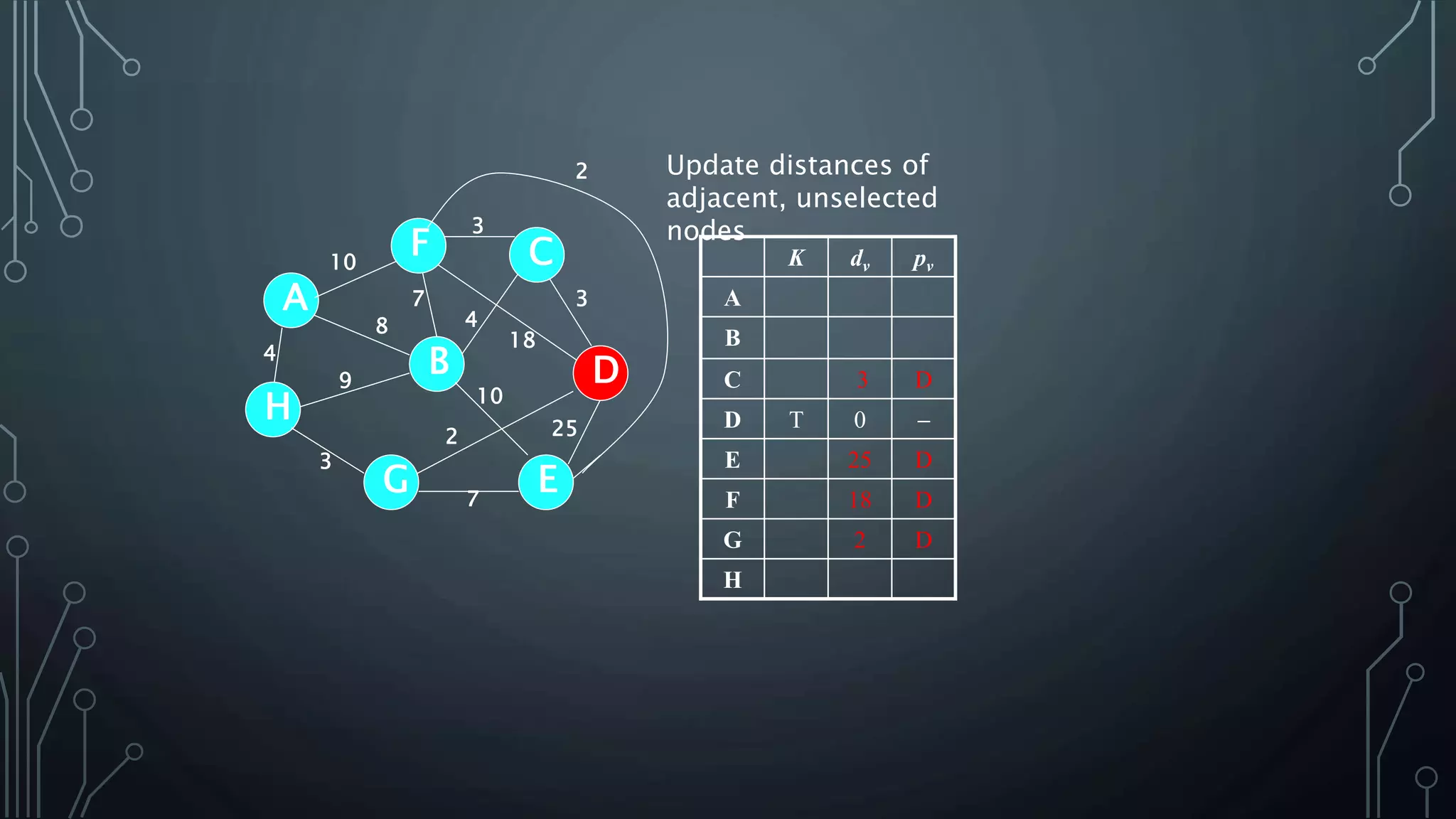
Update distances of
adjacent, unselected
nodes
K dv pv
A
B
C 3 D
D T 0 
E 25 D
F 18 D
G 2 D
H
2
4
25
A
H
B
F
E
D
C
G 7
2
10
18
3
4
3
7
8
9
3
10
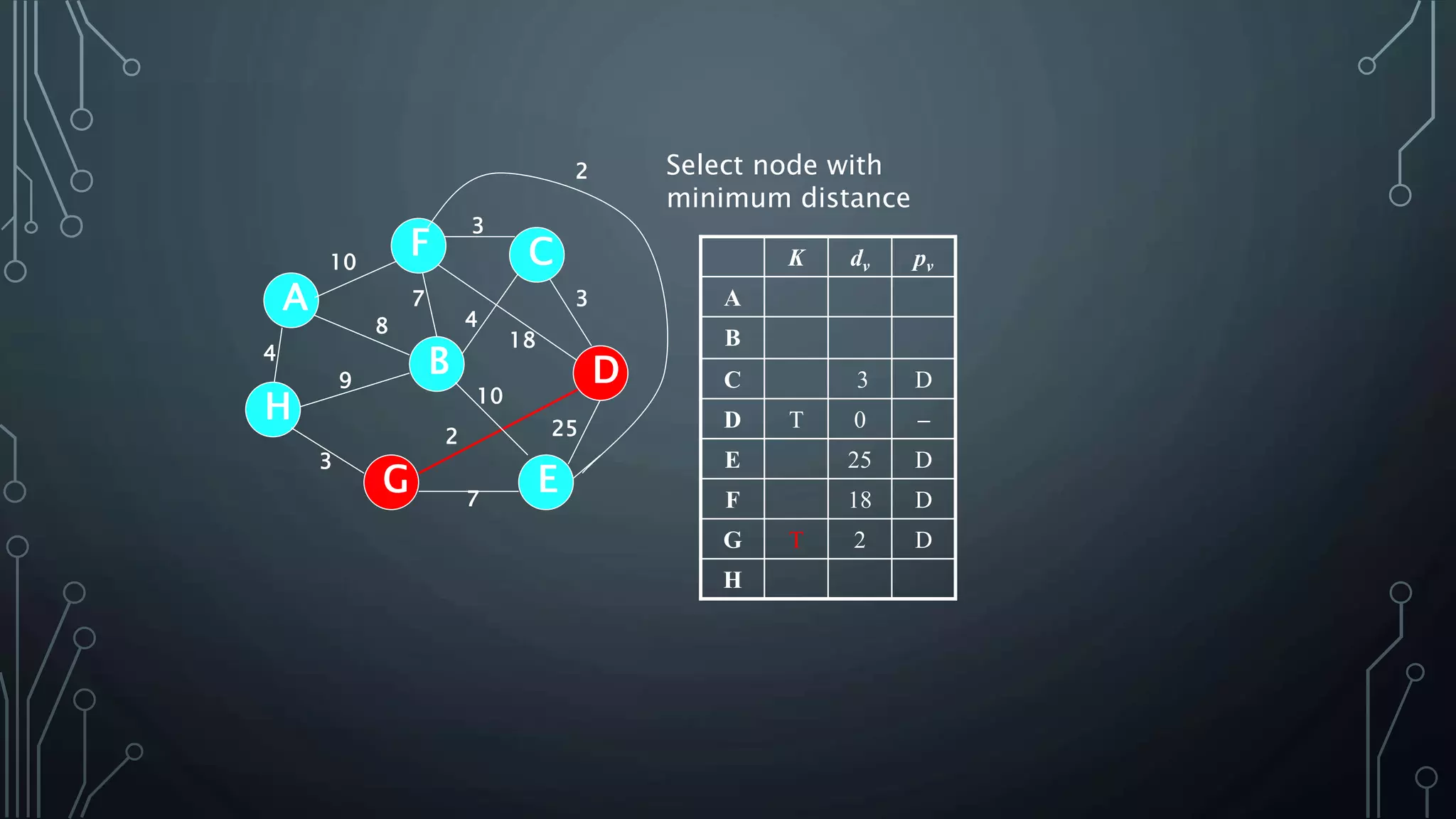
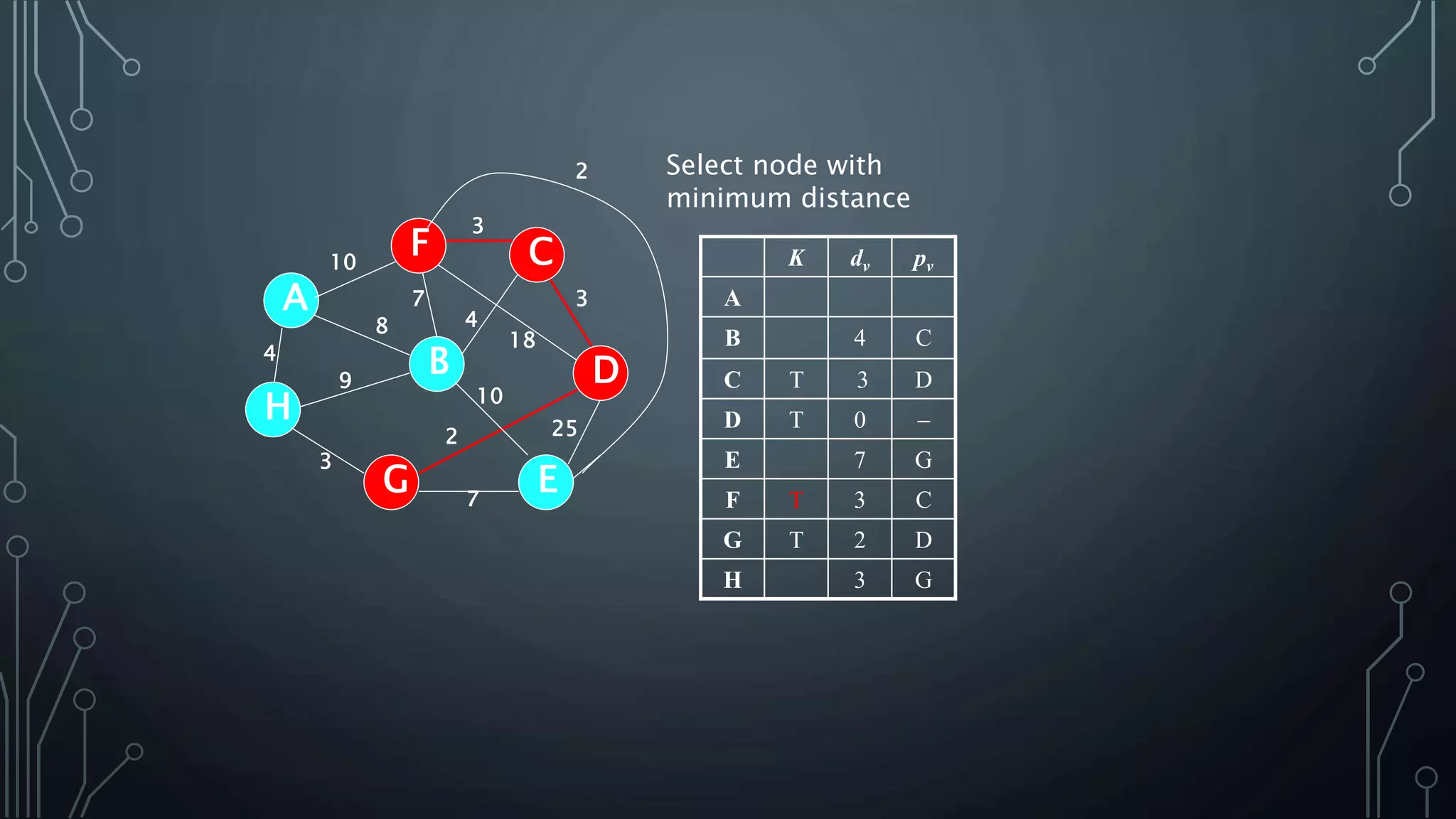
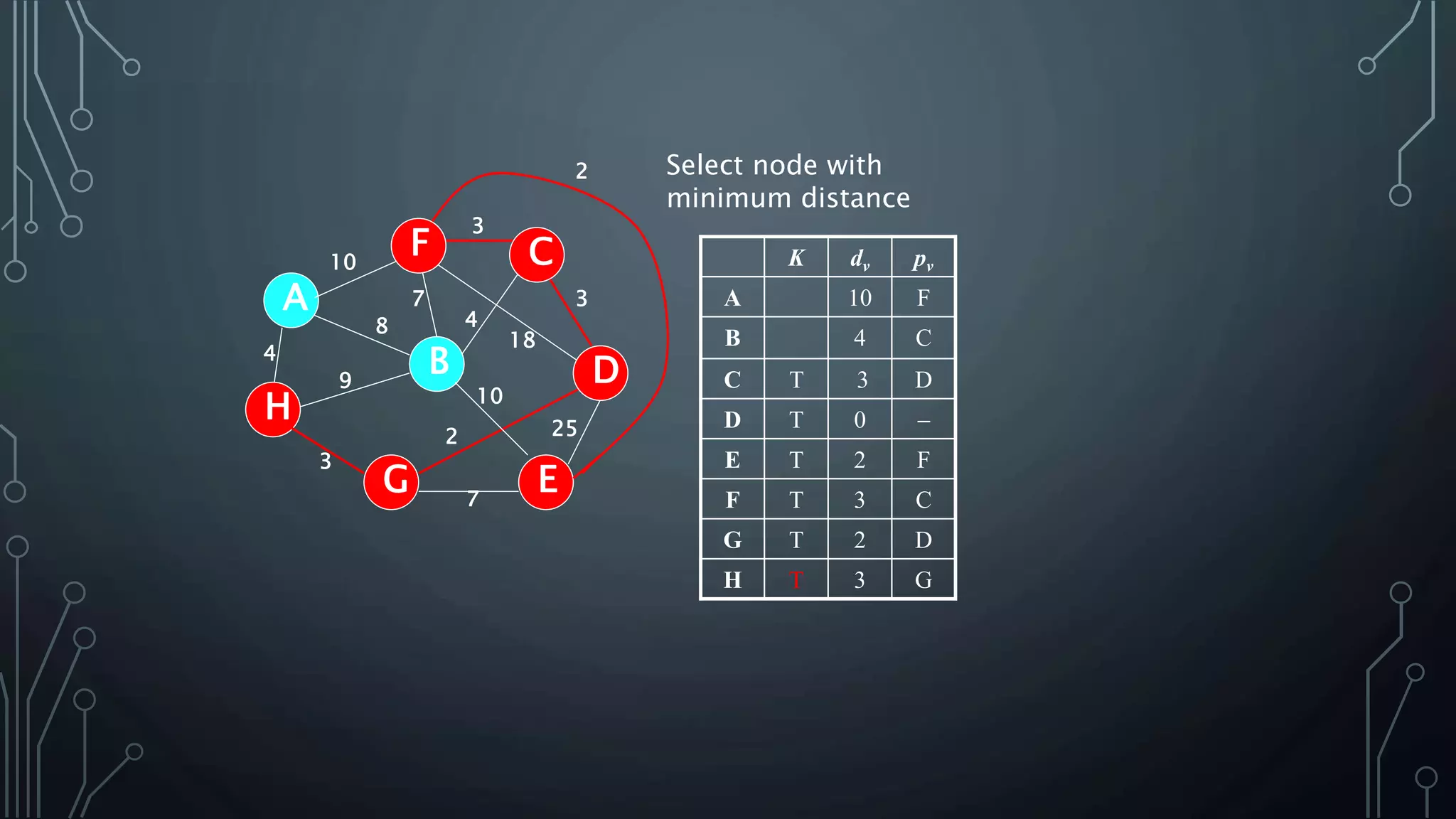
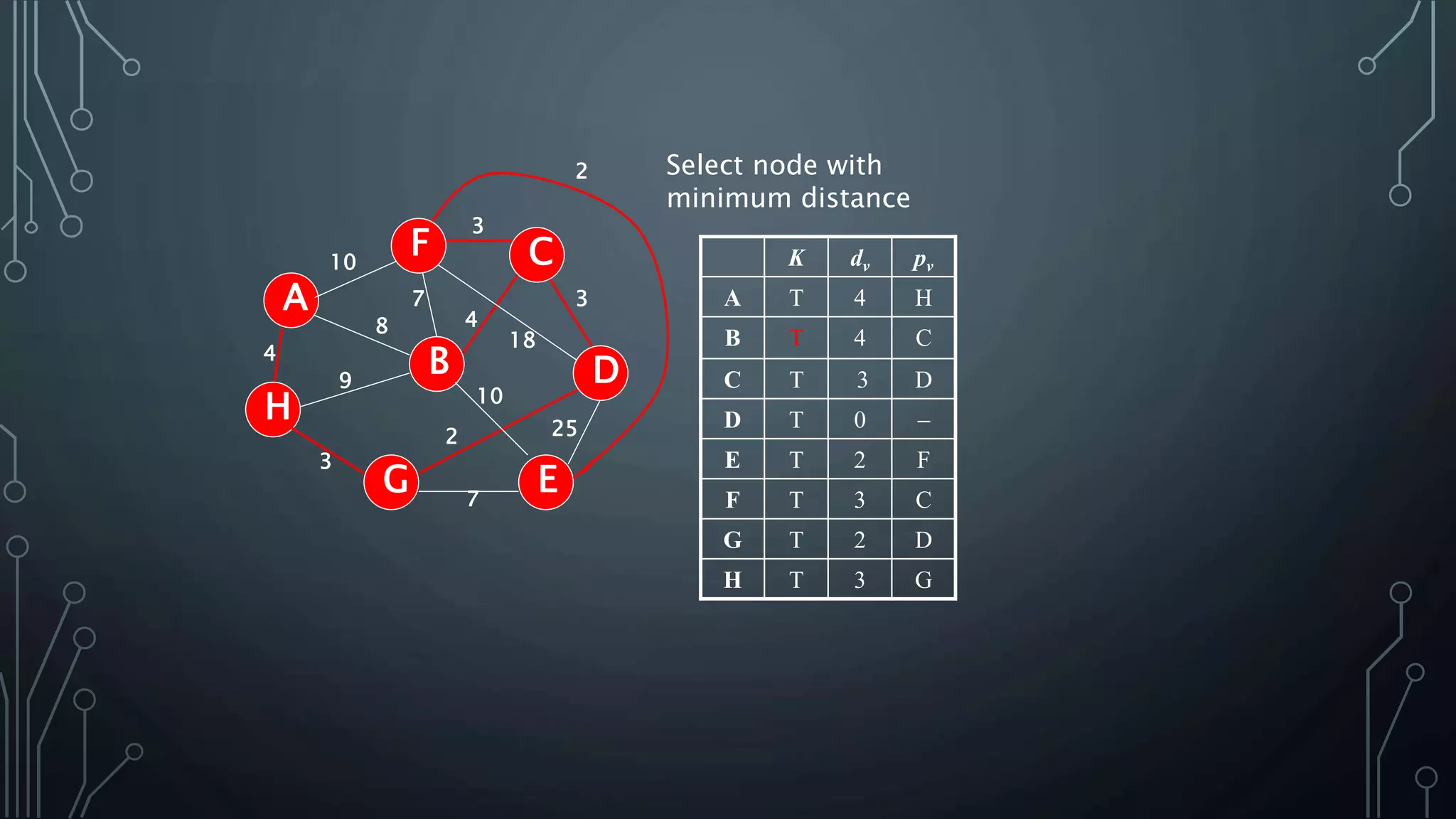
Select node with
minimum distance
K dv pv
A
B
C 3 D
D T 0 
E 25 D
F 18 D
G T 2 D
H
2
4
25
A
H
B
F
E
D
C
G 7
2
10
18
3
4
3
7
8
9
3
10
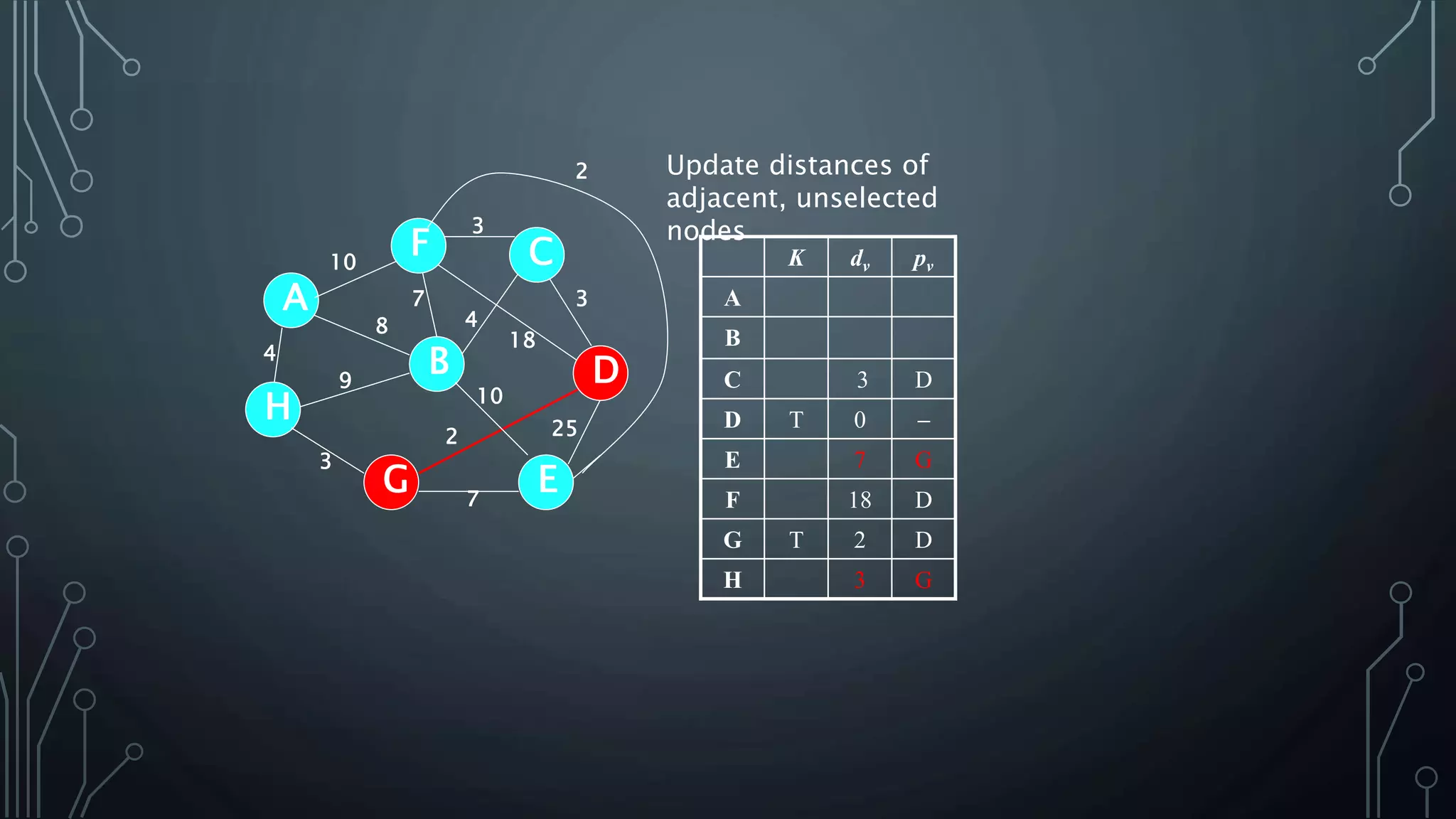
Update distances of
adjacent, unselected
nodes
K dv pv
A
B
C 3 D
D T 0 
E 7 G
F 18 D
G T 2 D
H 3 G
2
4
25
A
H
B
F
E
D
C
G 7
2
10
18
3
4
3
7
8
9
3
10
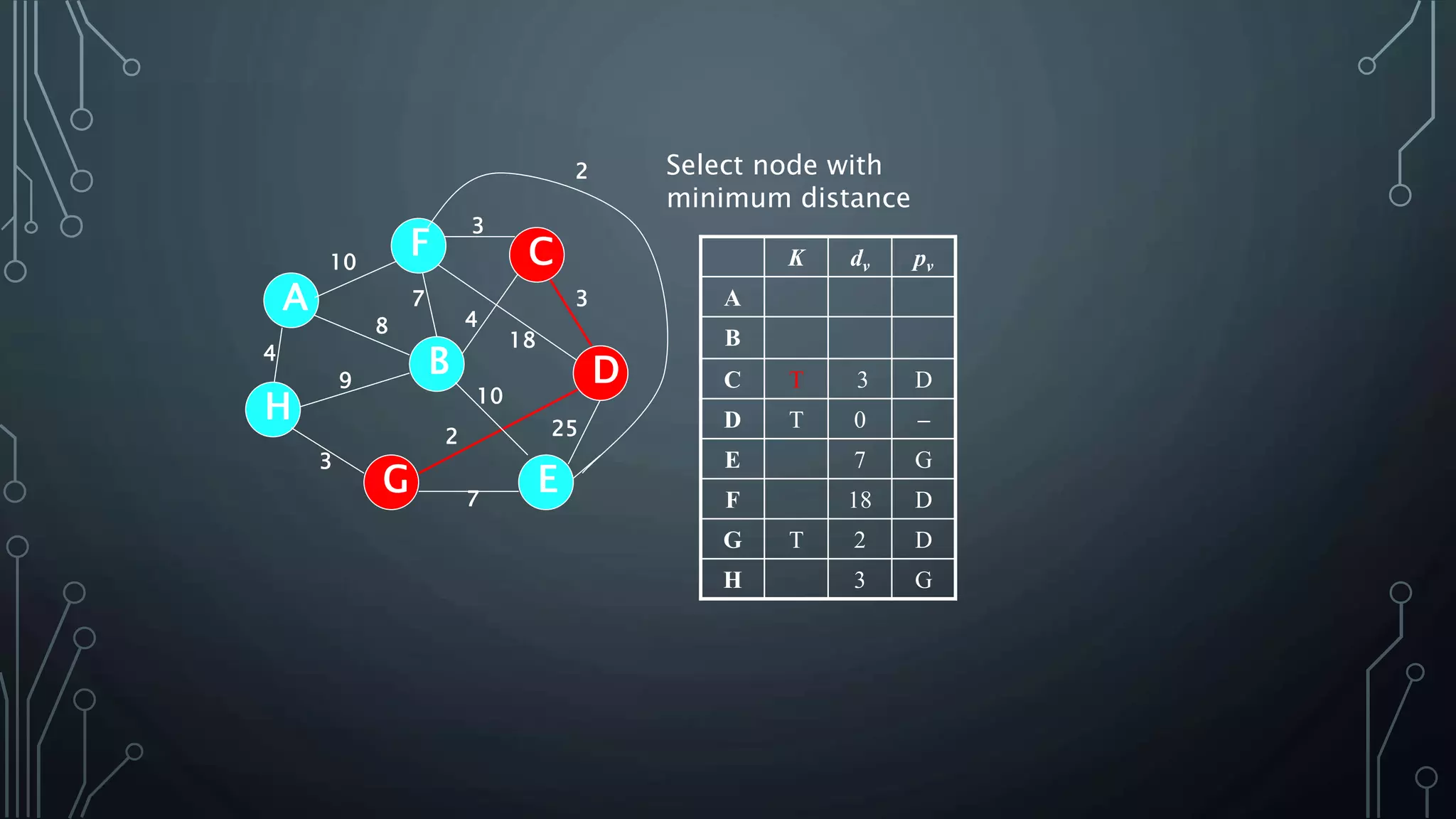
Select node with
minimum distance
K dv pv
A
B
C T 3 D
D T 0 
E 7 G
F 18 D
G T 2 D
H 3 G
2
4
25
A
H
B
F
E
D
C
G 7
2
10
18
3
4
3
7
8
9
3
10
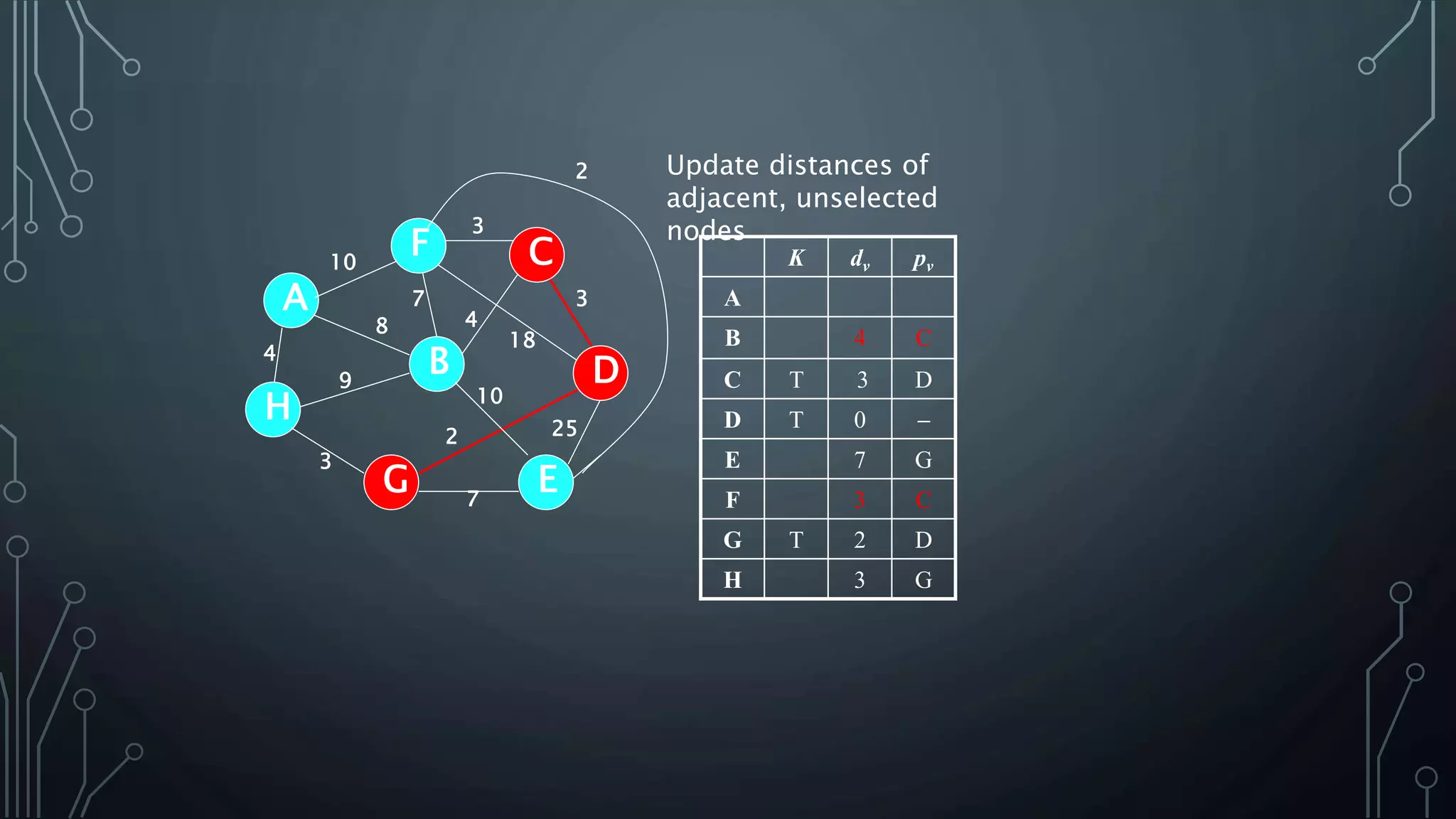
Update distances of
adjacent, unselected
nodes
K dv pv
A
B 4 C
C T 3 D
D T 0 
E 7 G
F 3 C
G T 2 D
H 3 G
2
4
25
A
H
B
F
E
D
C
G 7
2
10
18
3
4
3
7
8
9
3
10
Select node with
minimum distance
K dv pv
A
B 4 C
C T 3 D
D T 0 
E 7 G
F T 3 C
G T 2 D
H 3 G
2
4
25
A
H
B
F
E
D
C
G 7
2
10
18
3
4
3
7
8
9
3
10
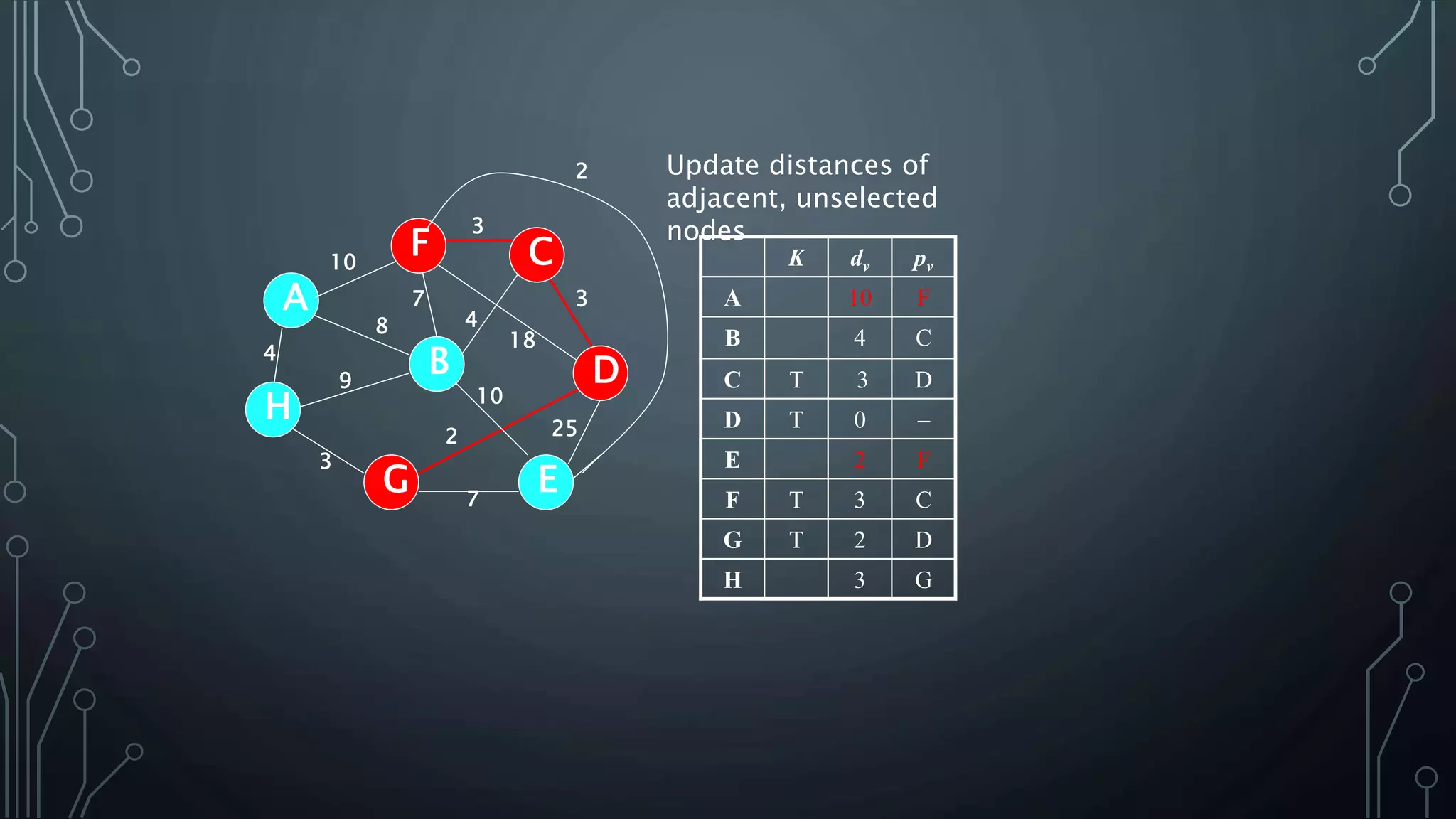
Update distances of
adjacent, unselected
nodes
K dv pv
A 10 F
B 4 C
C T 3 D
D T 0 
E 2 F
F T 3 C
G T 2 D
H 3 G
2
4
25
A
H
B
F
E
D
C
G 7
2
10
18
3
4
3
7
8
9
3
10
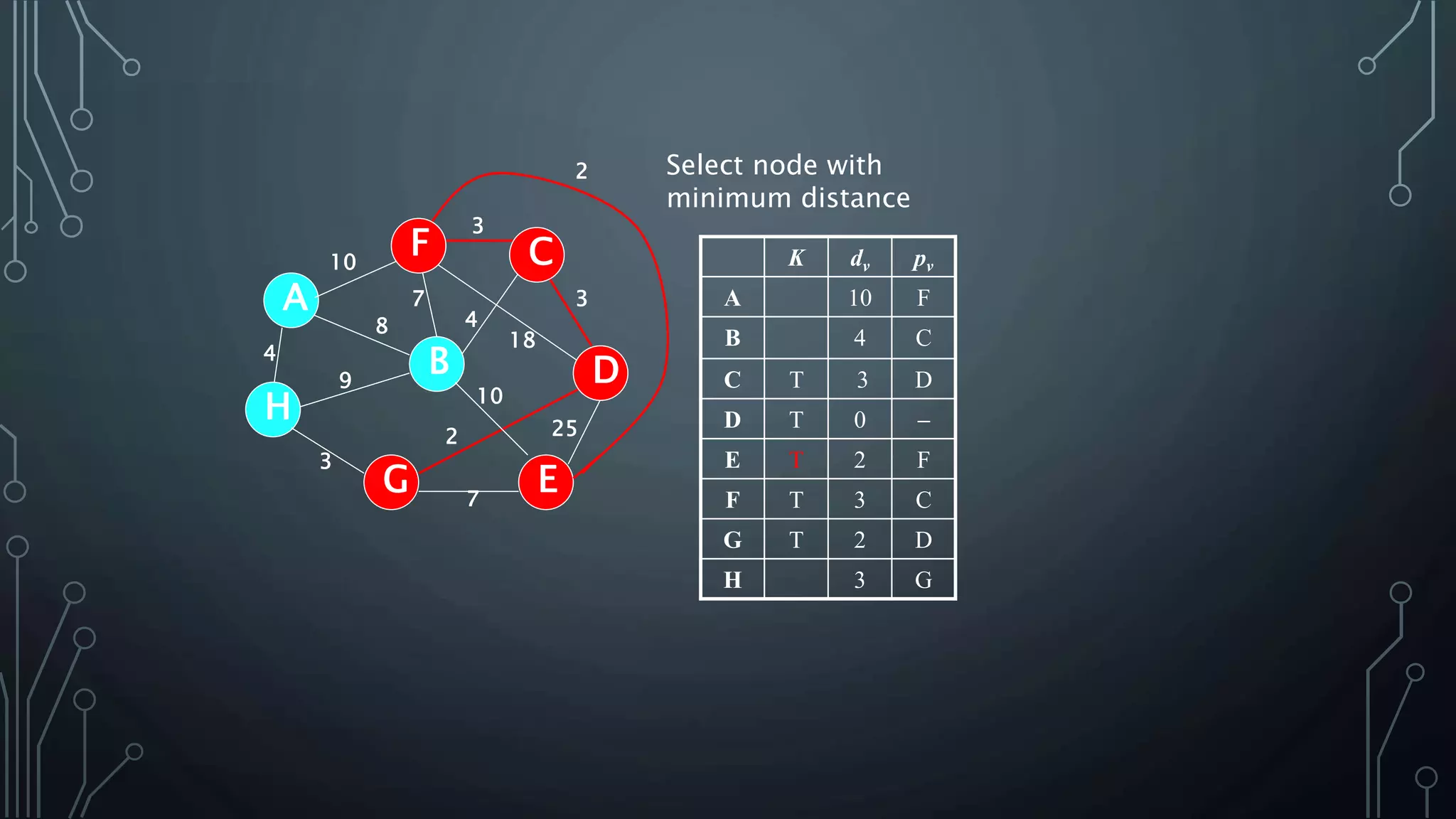
Select node with
minimum distance
K dv pv
A 10 F
B 4 C
C T 3 D
D T 0 
E T 2 F
F T 3 C
G T 2 D
H 3 G
2
4
25
A
H
B
F
E
D
C
G 7
2
10
18
3
4
3
7
8
9
3
10
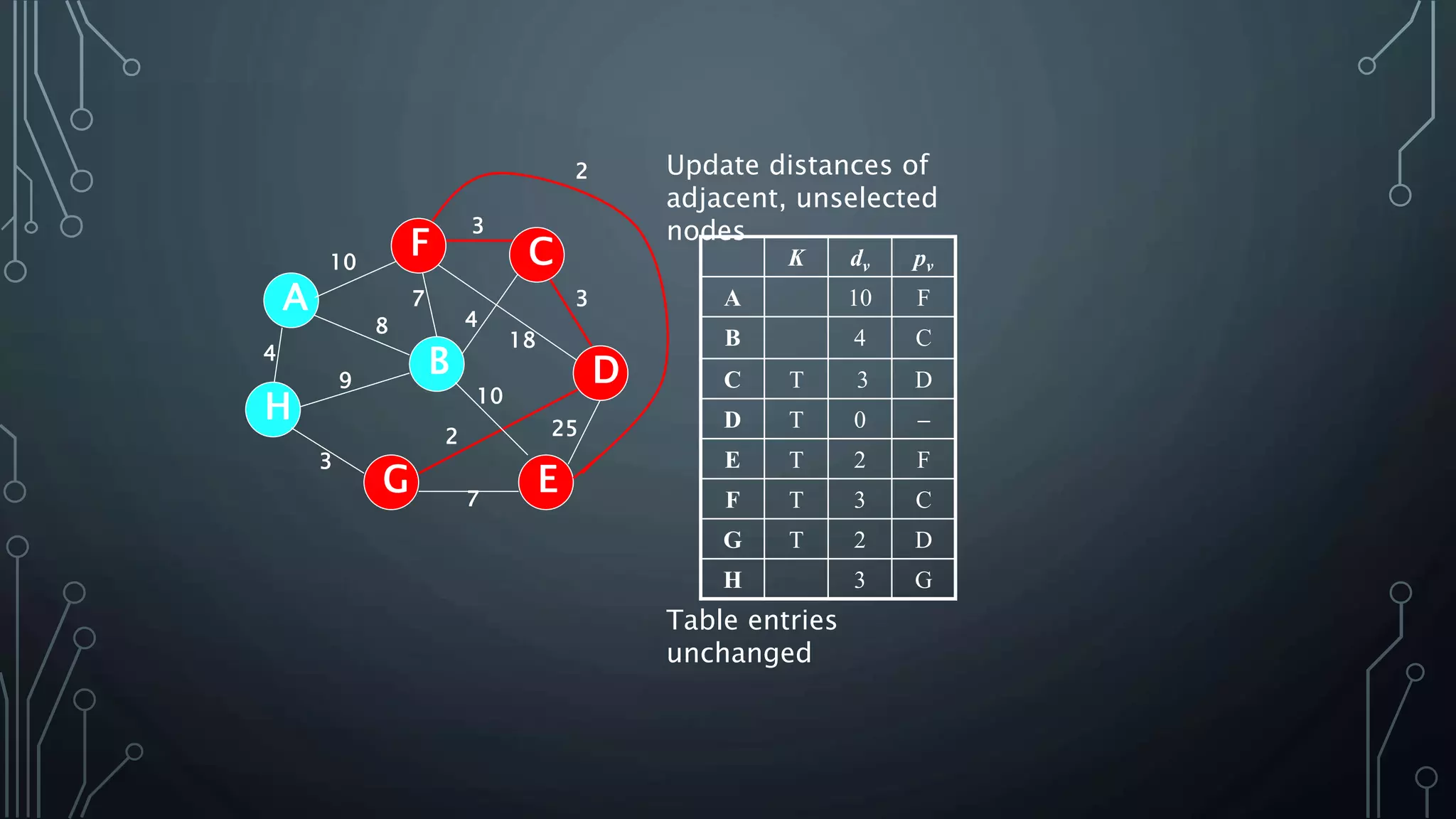
Update distances of
adjacent, unselected
nodes
K dv pv
A 10 F
B 4 C
C T 3 D
D T 0 
E T 2 F
F T 3 C
G T 2 D
H 3 G
2
Table entries
unchanged
4
25
A
H
B
F
E
D
C
G 7
2
10
18
3
4
3
7
8
9
3
10
Select node with
minimum distance
K dv pv
A 10 F
B 4 C
C T 3 D
D T 0 
E T 2 F
F T 3 C
G T 2 D
H T 3 G
2
4
25
A
H
B
F
E
D
C
G 7
2
10
18
3
4
3
7
8
9
3
10
Update distances of
adjacent, unselected
nodes
K dv pv
A 4 H
B 4 C
C T 3 D
D T 0 
E T 2 F
F T 3 C
G T 2 D
H T 3 G
2
4
25
A
H
B
F
E
D
C
G 7
2
10
18
3
4
3
7
8
9
3
10
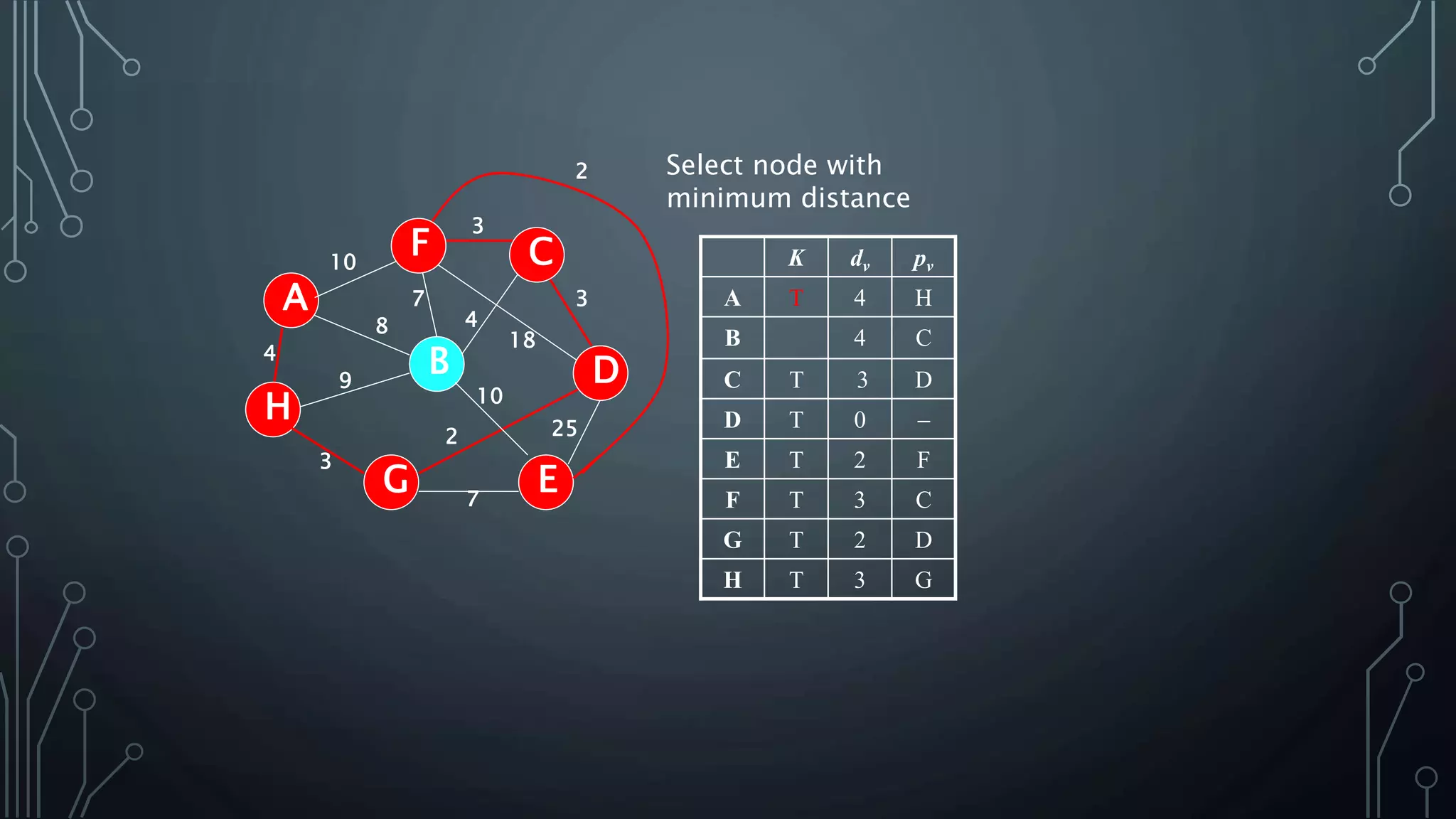
Select node with
minimum distance
K dv pv
A T 4 H
B 4 C
C T 3 D
D T 0 
E T 2 F
F T 3 C
G T 2 D
H T 3 G
2
4
25
A
H
B
F
E
D
C
G 7
2
10
18
3
4
3
7
8
9
3
10
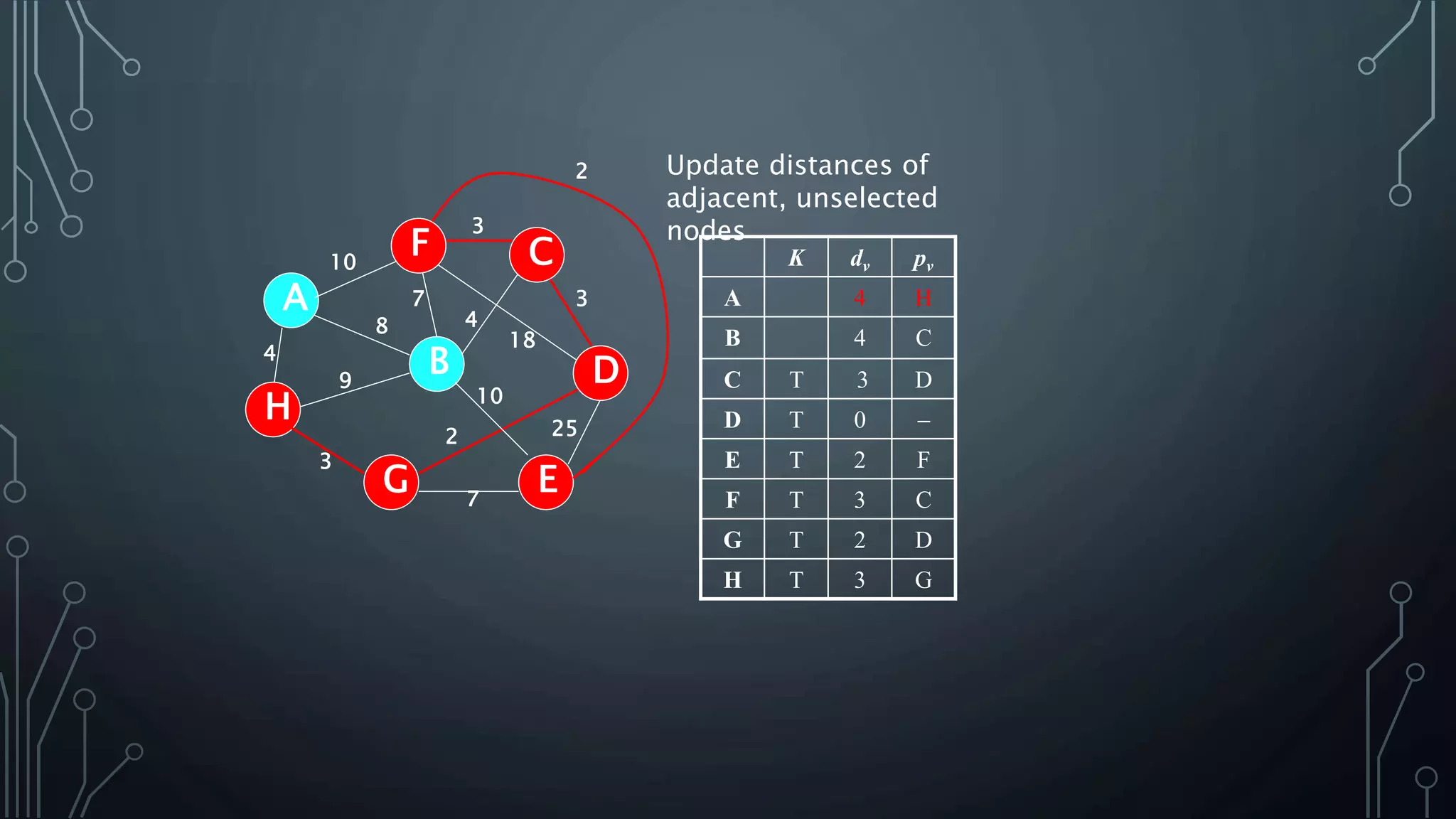
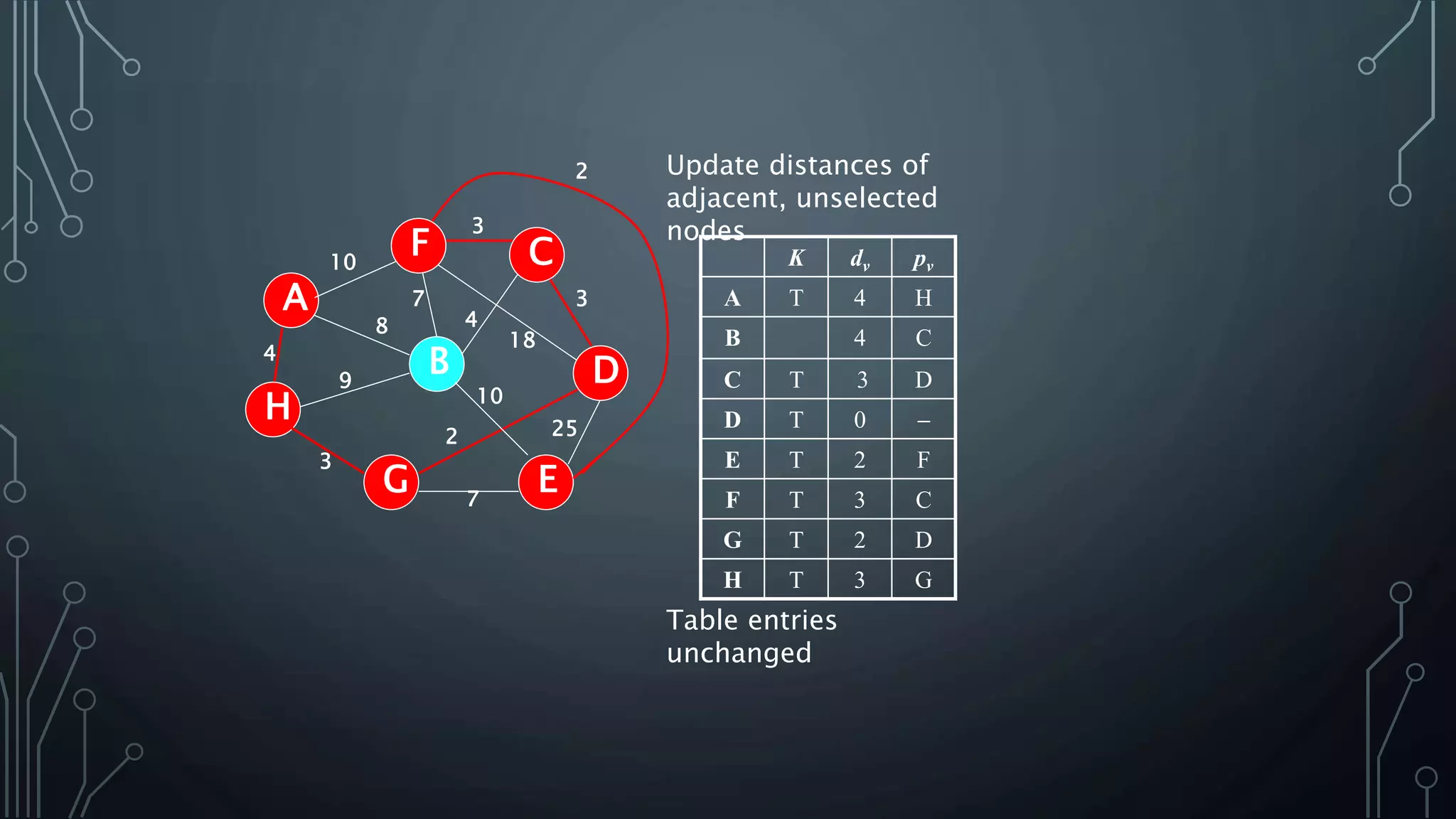
Update distances of
adjacent, unselected
nodes
K dv pv
A T 4 H
B 4 C
C T 3 D
D T 0 
E T 2 F
F T 3 C
G T 2 D
H T 3 G
2
Table entries
unchanged
4
25
A
H
B
F
E
D
C
G 7
2
10
18
3
4
3
7
8
9
3
10
Select node with
minimum distance
K dv pv
A T 4 H
B T 4 C
C T 3 D
D T 0 
E T 2 F
F T 3 C
G T 2 D
H T 3 G
2
4
A
H
B
F
E
D
C
G
2
3
4
3
3
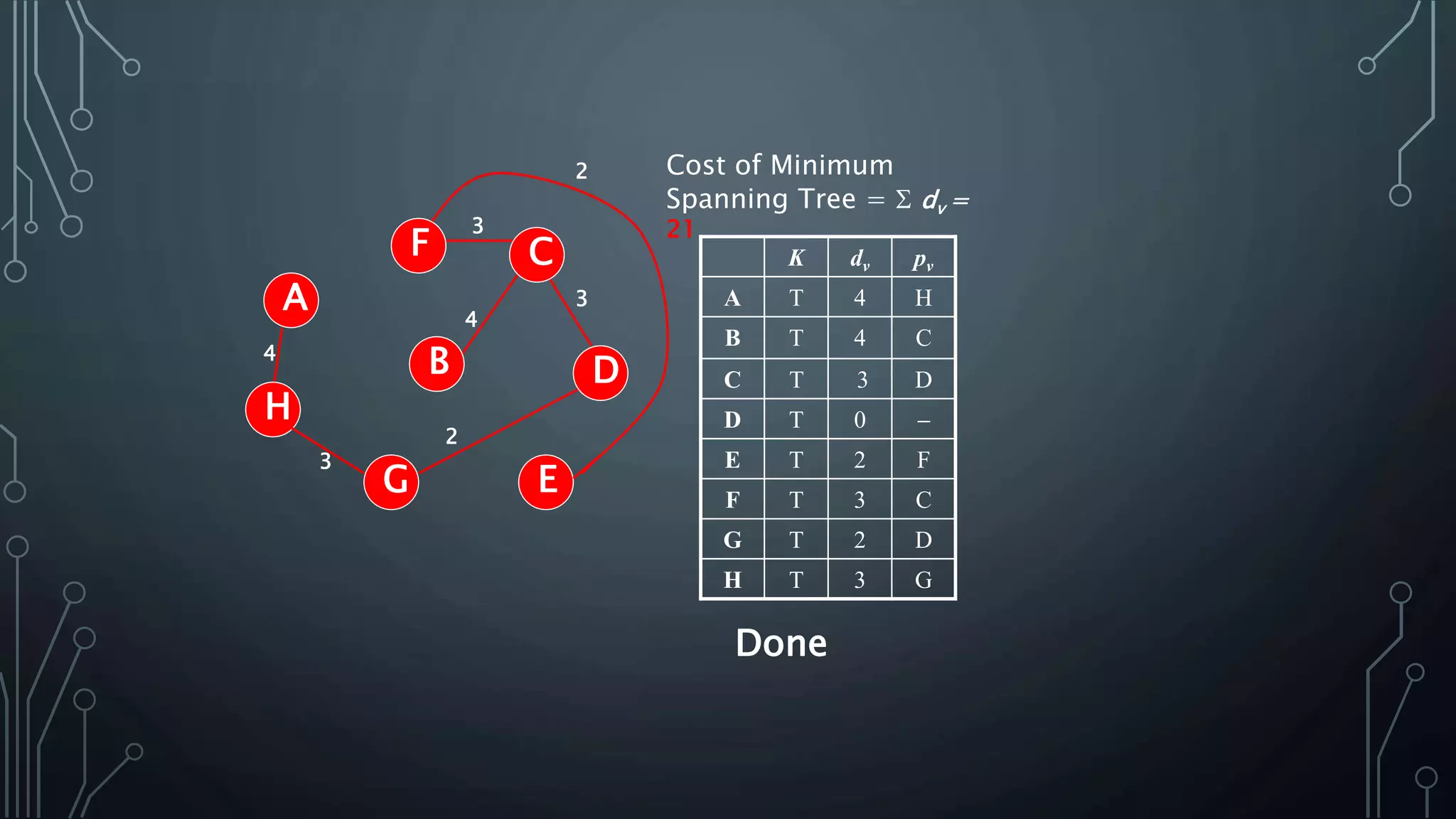
Cost of Minimum
Spanning Tree =  dv =
21
K dv pv
A T 4 H
B T 4 C
C T 3 D
D T 0 
E T 2 F
F T 3 C
G T 2 D
H T 3 G
2
Done
DIFFERENCE BETWEEN PRIM’S AND
KRUSKAL’S ALGORITHM
• The difference between Prim’s algorithm and Kruskal’s
algorithm is that the set of selected edges forms a tree at all
times when using Prim’s algorithm while a forest is formed
when using Kruskal’s algorithm.
• In Prim’s algorithm, a least-cost edge (u, v) is added to T such
that T∪ {(u, v)} is also a tree. This repeats until T contains n-1
edges.
•Both algorithms will always give solutions with
the same length.
•They will usually select edges in a different order.
•Occasionally they will use different edges – this
may happen when you have to choose between
edges with the same length.
SOME POINTS TO NOTE
READINGS

A presentation on prim's and kruskal's algorithm

  • 1.
    A PRESENTATION ONPRIM’S AND KRUSKAL’S ALGORITHM By: Gaurav Vivek Kolekar and Lionel Sequeira
  • 2.
  • 3.
    MINIMUM COST SPANNINGTREE A Minimum Spanning Tree (MST) is a subgraph of an undirected graph such that the subgraph spans (includes) all nodes, is connected, is acyclic, and has minimum total edge weight
  • 4.
    ALGORITHM CHARACTERISTICS • BothPrim’s and Kruskal’s Algorithms work with undirected graphs • Both work with weighted and unweighted graphs • Both are greedy algorithms that produce optimal solutions
  • 5.
    Kruskal’s algorithm 1. Selectthe shortest edge in a network 2. Select the next shortest edge which does not create a cycle 3. Repeat step 2 until all vertices have been connected Prim’s algorithm 1. Select any vertex 2. Select the shortest edge connected to that vertex 3. Select the shortest edge connected to any vertex already connected 4. Repeat step 3 until all vertices have been connected
  • 6.
    Work with edges,instead of nodes of a graph Two steps: – Sort edges by increasing edge weight – Select the first |V| – 1 edges that do not generate a cycle KRUSKAL’S ALOGORITHM
  • 7.
    Consider an undirected,weight graph 5 1 A H B F E D C G 3 2 4 6 3 4 3 4 8 4 3 10 WALK-THROUGH
  • 8.
    Sort the edgesby increasing edge weight edge dv (D,E) 1 (D,G) 2 (E,G) 3 (C,D) 3 (G,H) 3 (C,F) 3 (B,C) 4 5 1 A H B F E D C G 3 2 4 6 3 4 3 4 8 4 3 10 edge dv (B,E) 4 (B,F) 4 (B,H) 4 (A,H) 5 (D,F) 6 (A,B) 8 (A,F) 10
  • 9.
    Select first |V|–1edges which do not generate a cycle edge dv (D,E) 1  (D,G) 2 (E,G) 3 (C,D) 3 (G,H) 3 (C,F) 3 (B,C) 4 5 1 A H B F E D C G 3 2 4 6 3 4 3 4 8 4 3 10 edge dv (B,E) 4 (B,F) 4 (B,H) 4 (A,H) 5 (D,F) 6 (A,B) 8 (A,F) 10
  • 10.
    Select first |V|–1edges which do not generate a cycle edge dv (D,E) 1  (D,G) 2  (E,G) 3 (C,D) 3 (G,H) 3 (C,F) 3 (B,C) 4 5 1 A H B F E D C G 3 2 4 6 3 4 3 4 8 4 3 10 edge dv (B,E) 4 (B,F) 4 (B,H) 4 (A,H) 5 (D,F) 6 (A,B) 8 (A,F) 10
  • 11.
    Select first |V|–1edges which do not generate a cycle edge dv (D,E) 1  (D,G) 2  (E,G) 3  (C,D) 3 (G,H) 3 (C,F) 3 (B,C) 4 5 1 A H B F E D C G 3 2 4 6 3 4 3 4 8 4 3 10 edge dv (B,E) 4 (B,F) 4 (B,H) 4 (A,H) 5 (D,F) 6 (A,B) 8 (A,F) 10 Accepting edge (E,G) would create a cycle
  • 12.
    Select first |V|–1edges which do not generate a cycle edge dv (D,E) 1  (D,G) 2  (E,G) 3  (C,D) 3  (G,H) 3 (C,F) 3 (B,C) 4 5 1 A H B F E D C G 3 2 4 6 3 4 3 4 8 4 3 10 edge dv (B,E) 4 (B,F) 4 (B,H) 4 (A,H) 5 (D,F) 6 (A,B) 8 (A,F) 10
  • 13.
    Select first |V|–1edges which do not generate a cycle edge dv (D,E) 1  (D,G) 2  (E,G) 3  (C,D) 3  (G,H) 3  (C,F) 3 (B,C) 4 5 1 A H B F E D C G 3 2 4 6 3 4 3 4 8 4 3 10 edge dv (B,E) 4 (B,F) 4 (B,H) 4 (A,H) 5 (D,F) 6 (A,B) 8 (A,F) 10
  • 14.
    Select first |V|–1edges which do not generate a cycle edge dv (D,E) 1  (D,G) 2  (E,G) 3  (C,D) 3  (G,H) 3  (C,F) 3  (B,C) 4 5 1 A H B F E D C G 3 2 4 6 3 4 3 4 8 4 3 10 edge dv (B,E) 4 (B,F) 4 (B,H) 4 (A,H) 5 (D,F) 6 (A,B) 8 (A,F) 10
  • 15.
    Select first |V|–1edges which do not generate a cycle edge dv (D,E) 1  (D,G) 2  (E,G) 3  (C,D) 3  (G,H) 3  (C,F) 3  (B,C) 4  5 1 A H B F E D C G 3 2 4 6 3 4 3 4 8 4 3 10 edge dv (B,E) 4 (B,F) 4 (B,H) 4 (A,H) 5 (D,F) 6 (A,B) 8 (A,F) 10
  • 16.
    Select first |V|–1edges which do not generate a cycle edge dv (D,E) 1  (D,G) 2  (E,G) 3  (C,D) 3  (G,H) 3  (C,F) 3  (B,C) 4  5 1 A H B F E D C G 3 2 4 6 3 4 3 4 8 4 3 10 edge dv (B,E) 4  (B,F) 4 (B,H) 4 (A,H) 5 (D,F) 6 (A,B) 8 (A,F) 10
  • 17.
    Select first |V|–1edges which do not generate a cycle edge dv (D,E) 1  (D,G) 2  (E,G) 3  (C,D) 3  (G,H) 3  (C,F) 3  (B,C) 4  5 1 A H B F E D C G 3 2 4 6 3 4 3 4 8 4 3 10 edge dv (B,E) 4  (B,F) 4  (B,H) 4 (A,H) 5 (D,F) 6 (A,B) 8 (A,F) 10
  • 18.
    Select first |V|–1edges which do not generate a cycle edge dv (D,E) 1  (D,G) 2  (E,G) 3  (C,D) 3  (G,H) 3  (C,F) 3  (B,C) 4  5 1 A H B F E D C G 3 2 4 6 3 4 3 4 8 4 3 10 edge dv (B,E) 4  (B,F) 4  (B,H) 4  (A,H) 5 (D,F) 6 (A,B) 8 (A,F) 10
  • 19.
    Select first |V|–1edges which do not generate a cycle edge dv (D,E) 1  (D,G) 2  (E,G) 3  (C,D) 3  (G,H) 3  (C,F) 3  (B,C) 4  5 1 A H B F E D C G 3 2 4 6 3 4 3 4 8 4 3 10 edge dv (B,E) 4  (B,F) 4  (B,H) 4  (A,H) 5  (D,F) 6 (A,B) 8 (A,F) 10
  • 20.
    Select first |V|–1edges which do not generate a cycle edge dv (D,E) 1  (D,G) 2  (E,G) 3  (C,D) 3  (G,H) 3  (C,F) 3  (B,C) 4  5 1 A H B F E D C G 2 3 3 3 edge dv (B,E) 4  (B,F) 4  (B,H) 4  (A,H) 5  (D,F) 6 (A,B) 8 (A,F) 10 Done Total Cost =  dv = 21 4 }not consider ed
  • 21.
  • 22.
    WALK-THROUGH Initialize array K dv pv AF   B F   C F   D F   E F   F F   G F   H F   4 25 A H B F E D C G 7 2 10 18 3 4 3 7 8 9 3 10 2
  • 23.
    4 25 A H B F E D C G 7 2 10 18 3 4 3 7 8 9 3 10 Start withany node, say D K dv pv A B C D T 0  E F G H 2
  • 24.
    4 25 A H B F E D C G 7 2 10 18 3 4 3 7 8 9 3 10 Update distancesof adjacent, unselected nodes K dv pv A B C 3 D D T 0  E 25 D F 18 D G 2 D H 2
  • 25.
    4 25 A H B F E D C G 7 2 10 18 3 4 3 7 8 9 3 10 Select nodewith minimum distance K dv pv A B C 3 D D T 0  E 25 D F 18 D G T 2 D H 2
  • 26.
    4 25 A H B F E D C G 7 2 10 18 3 4 3 7 8 9 3 10 Update distancesof adjacent, unselected nodes K dv pv A B C 3 D D T 0  E 7 G F 18 D G T 2 D H 3 G 2
  • 27.
    4 25 A H B F E D C G 7 2 10 18 3 4 3 7 8 9 3 10 Select nodewith minimum distance K dv pv A B C T 3 D D T 0  E 7 G F 18 D G T 2 D H 3 G 2
  • 28.
    4 25 A H B F E D C G 7 2 10 18 3 4 3 7 8 9 3 10 Update distancesof adjacent, unselected nodes K dv pv A B 4 C C T 3 D D T 0  E 7 G F 3 C G T 2 D H 3 G 2
  • 29.
    4 25 A H B F E D C G 7 2 10 18 3 4 3 7 8 9 3 10 Select nodewith minimum distance K dv pv A B 4 C C T 3 D D T 0  E 7 G F T 3 C G T 2 D H 3 G 2
  • 30.
    4 25 A H B F E D C G 7 2 10 18 3 4 3 7 8 9 3 10 Update distancesof adjacent, unselected nodes K dv pv A 10 F B 4 C C T 3 D D T 0  E 2 F F T 3 C G T 2 D H 3 G 2
  • 31.
    4 25 A H B F E D C G 7 2 10 18 3 4 3 7 8 9 3 10 Select nodewith minimum distance K dv pv A 10 F B 4 C C T 3 D D T 0  E T 2 F F T 3 C G T 2 D H 3 G 2
  • 32.
    4 25 A H B F E D C G 7 2 10 18 3 4 3 7 8 9 3 10 Update distancesof adjacent, unselected nodes K dv pv A 10 F B 4 C C T 3 D D T 0  E T 2 F F T 3 C G T 2 D H 3 G 2 Table entries unchanged
  • 33.
    4 25 A H B F E D C G 7 2 10 18 3 4 3 7 8 9 3 10 Select nodewith minimum distance K dv pv A 10 F B 4 C C T 3 D D T 0  E T 2 F F T 3 C G T 2 D H T 3 G 2
  • 34.
    4 25 A H B F E D C G 7 2 10 18 3 4 3 7 8 9 3 10 Update distancesof adjacent, unselected nodes K dv pv A 4 H B 4 C C T 3 D D T 0  E T 2 F F T 3 C G T 2 D H T 3 G 2
  • 35.
    4 25 A H B F E D C G 7 2 10 18 3 4 3 7 8 9 3 10 Select nodewith minimum distance K dv pv A T 4 H B 4 C C T 3 D D T 0  E T 2 F F T 3 C G T 2 D H T 3 G 2
  • 36.
    4 25 A H B F E D C G 7 2 10 18 3 4 3 7 8 9 3 10 Update distancesof adjacent, unselected nodes K dv pv A T 4 H B 4 C C T 3 D D T 0  E T 2 F F T 3 C G T 2 D H T 3 G 2 Table entries unchanged
  • 37.
    4 25 A H B F E D C G 7 2 10 18 3 4 3 7 8 9 3 10 Select nodewith minimum distance K dv pv A T 4 H B T 4 C C T 3 D D T 0  E T 2 F F T 3 C G T 2 D H T 3 G 2
  • 38.
    4 A H B F E D C G 2 3 4 3 3 Cost of Minimum SpanningTree =  dv = 21 K dv pv A T 4 H B T 4 C C T 3 D D T 0  E T 2 F F T 3 C G T 2 D H T 3 G 2 Done
  • 39.
    DIFFERENCE BETWEEN PRIM’SAND KRUSKAL’S ALGORITHM • The difference between Prim’s algorithm and Kruskal’s algorithm is that the set of selected edges forms a tree at all times when using Prim’s algorithm while a forest is formed when using Kruskal’s algorithm. • In Prim’s algorithm, a least-cost edge (u, v) is added to T such that T∪ {(u, v)} is also a tree. This repeats until T contains n-1 edges.
  • 40.
    •Both algorithms willalways give solutions with the same length. •They will usually select edges in a different order. •Occasionally they will use different edges – this may happen when you have to choose between edges with the same length. SOME POINTS TO NOTE
  • 41.

Editor's Notes

  • #2 Introduce the topic and yourself.
  • #3 Just a quick revision about graphs: Graphs consist of two elements: points called vertices lines called edges Properties of Edges: Edges connect two vertices. Edges only intersect at vertices. Edges joining a vertex to itself are called loops. Moral of the Story for Graphs: One graph may be drawn in (infinitely) many ways, but it always provides us with the same information. Graphs are a structure for describing relationships between objects. The vertices denote the objects and the edges represent the relationship. Maps applications: Functional Genomics and Microarray technology Massive Appllication in Networks Network Clluster Analysis Network Comparison and aligment