










New Approaches for Data
   Reduction in Generalized
    Multi-valued Decision
Information System (GMDIS):
       Case Study of
  Rheumatic Fever Patients
            2006
By

   Abd El-Monem M. Kozea,
 Mohamed M. E. Abd El-Monsef,
   Mathematics Department, Faculty of Science,
            Tanta University, Egypt
               Email: akozae55@yahoo.com
               Email: mme1976@yahoo.com

                           &
Soaad Abd El-Badie Attia El-Afify
        Computer Science Department,
        Cairo Computer Academy (CCA)
              Email: savvymore@yahoo.com
           Homepage: www.savvymore.mysite.com
Outline
   Motivation / Introduction
   Basic Concepts of Rough Sets
   Rheumatic Fever Data: Characteristics
   New Thinking
     Generalized Multi-Valued Decision Information System
       (GMDIS)
     New Approaches for Data Reduction in GMDIS
          Non-equivalence Relations,
          Topological Spaces and
          Degree of Dependencies in GMDIS
   Reduct Algorithms based on GMDIS
     Rheumatic Fever GMDIS Reduction: Worked example
   Conclusion and Future Work
   Acknowledgment
Motivation / Introduction
   Rough set theory was developed by Zdzislaw Pawlak in
    the early 1982’s.
      RS is based on the idea of equivalence relations
       which partition the domain into different classes.
      It is a mathematical tool for dealing with incomplete
       data for induction of approximations of concepts and
       for discovering patterns hidden in data.
      It can be used for feature selection, data reduction,
       identifies partial/total dependencies in data, gives
       approach to null values and missing data, and
       decision rule generation.
Motivation / Introduction
   Rough Set Features:
     It is applicable to problems with both
      numeric and descriptive attributes
     It is capable of finding all minimal knowledge
      representation
     It is highly automated based on strict rules.
     A multi-valued information system (MIS) is a
      generalization of the idea of a single valued
      information system (SIS).
     In a multi-valued information system,
        Attribute functions are allowed to map
          elements to sets of attribute values.
Rough Set Theory:
          Basic Concepts
   Information/Decision Systems (Tables)
   Indiscernibility
   Set Approximation
   Reducts and Core
   Rough Membership
   Dependency of Attributes
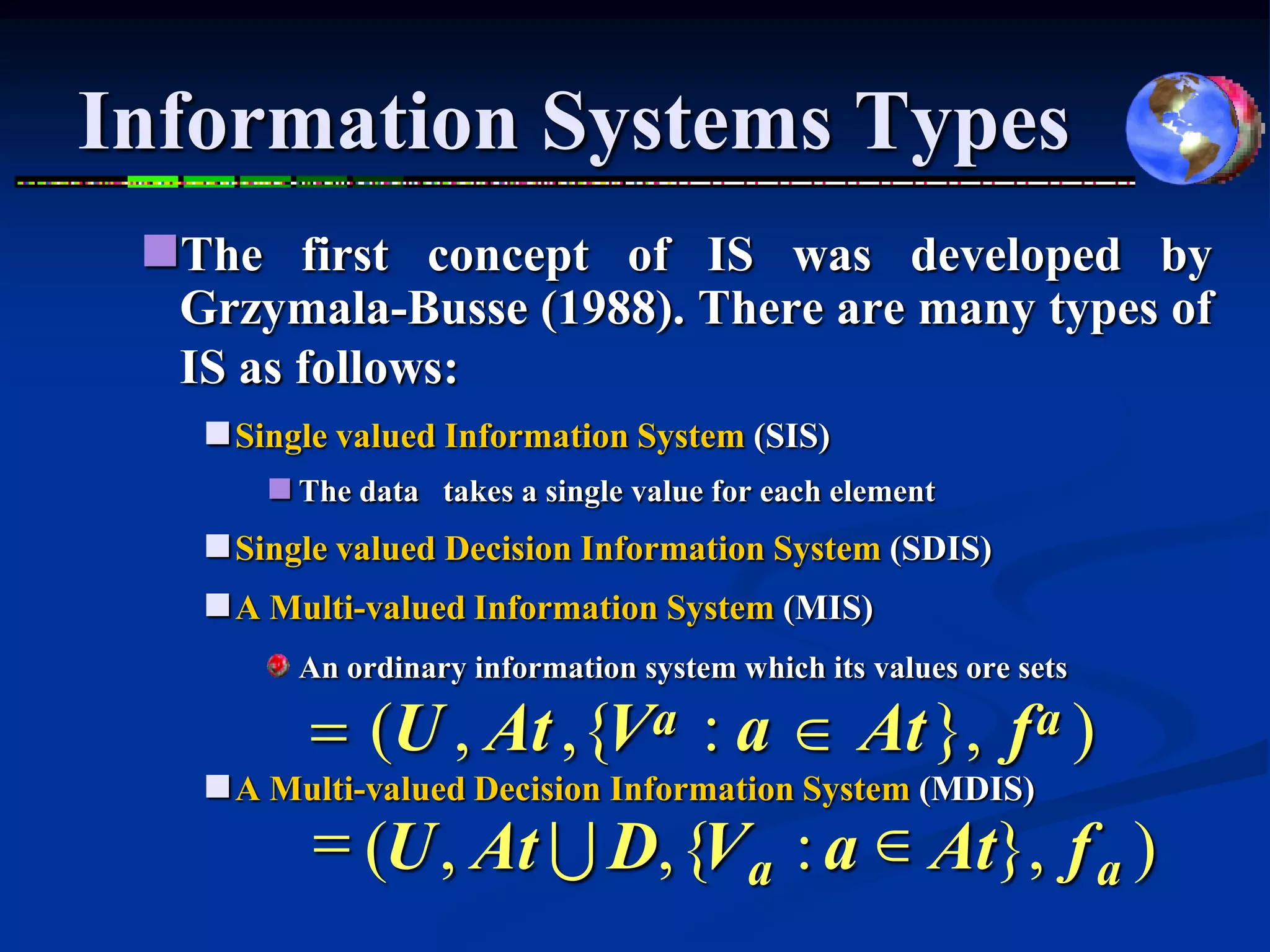
Information Systems Types
 The first concept of IS was developed by
  Grzymala-Busse (1988). There are many types of
  IS as follows:
    Single valued Information System (SIS)
        The data takes a single value for each element
    Single valued Decision Information System (SDIS)
    A Multi-valued Information System (MIS)
         An ordinary information system which its values ore sets

          = (U , At ,{Va : a  At }, f a )
    A Multi-valued Decision Information System (MDIS)
          = (U , At U D, {Va : a  At}, f a )
Rheumatic Fever Data:
            Characteristics
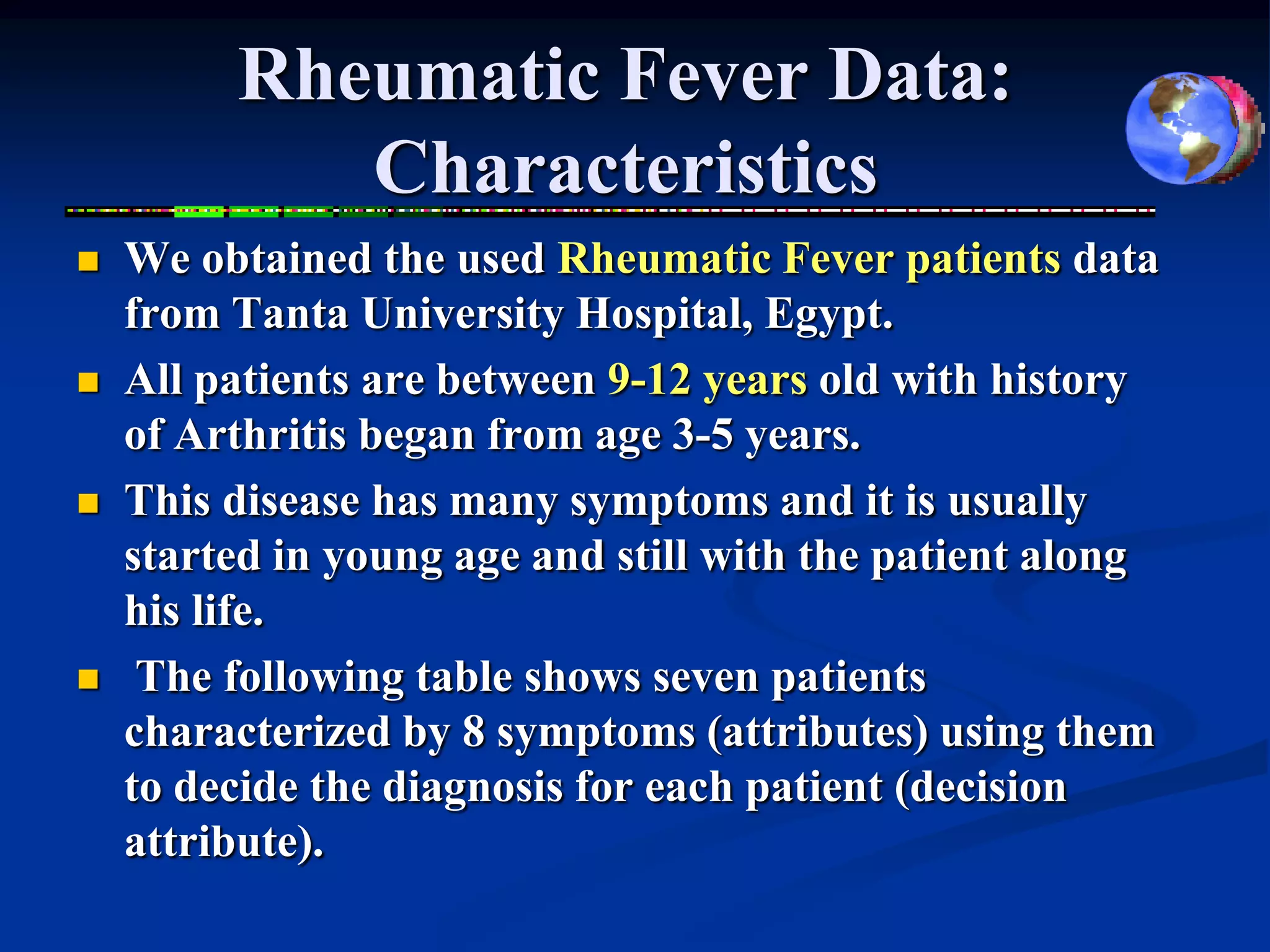
   We obtained the used Rheumatic Fever patients data
    from Tanta University Hospital, Egypt.
   All patients are between 9-12 years old with history
    of Arthritis began from age 3-5 years.
   This disease has many symptoms and it is usually
    started in young age and still with the patient along
    his life.
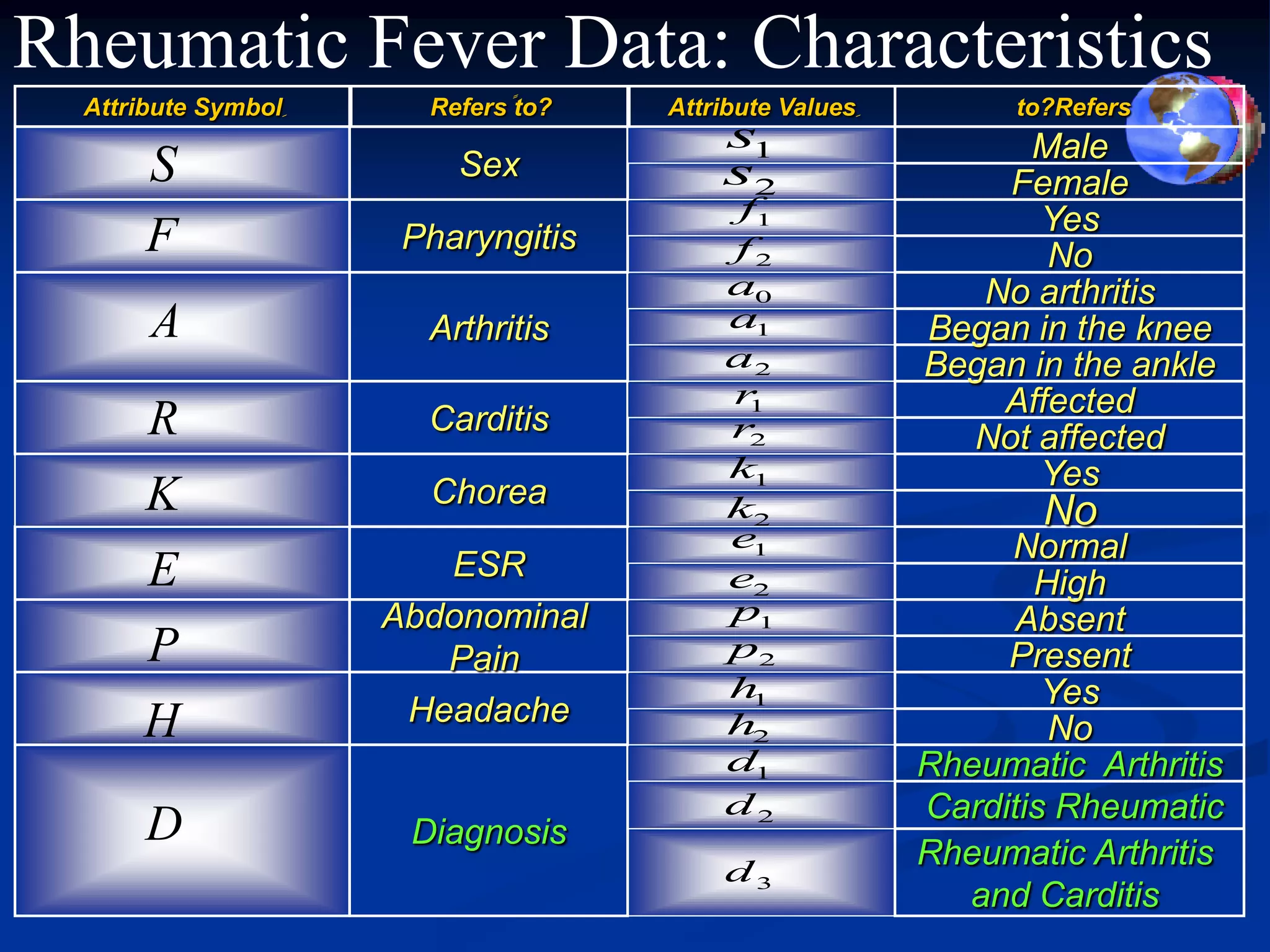
    The following table shows seven patients
    characterized by 8 symptoms (attributes) using them
    to decide the diagnosis for each patient (decision
    attribute).
Rheumatic Fever Data: Characteristics
  Attribute Symbolِ     Refersً to?   Attribute Valuesِ         to?Refers
                                          s1                    Male
       S                  Sex             s2                  Female
                                            f1                   Yes
       F               Pharyngitis         f2                    No
                                           a0                No arthritis
       A                Arthritis          a1             Began in the knee
                                           a2             Began in the ankle
                                           r 1                Affected
       R                Carditis           r2               Not affected
                                           k1                    Yes
       K                Chorea             k2                     No
                                           e1                  Normal
       E                 ESR               e2                    High
                      Abdonominal          p1                  Absent
       P                 Pain              p2                  Present
                                           h 1                    Yes
       H               Headache            h2                     No
                                           d1             Rheumatic Arthritis
                                           d2             Carditis Rheumatic
       D               Diagnosis
                                                          Rheumatic Arthritis
                                           d3
                                                            and Carditis
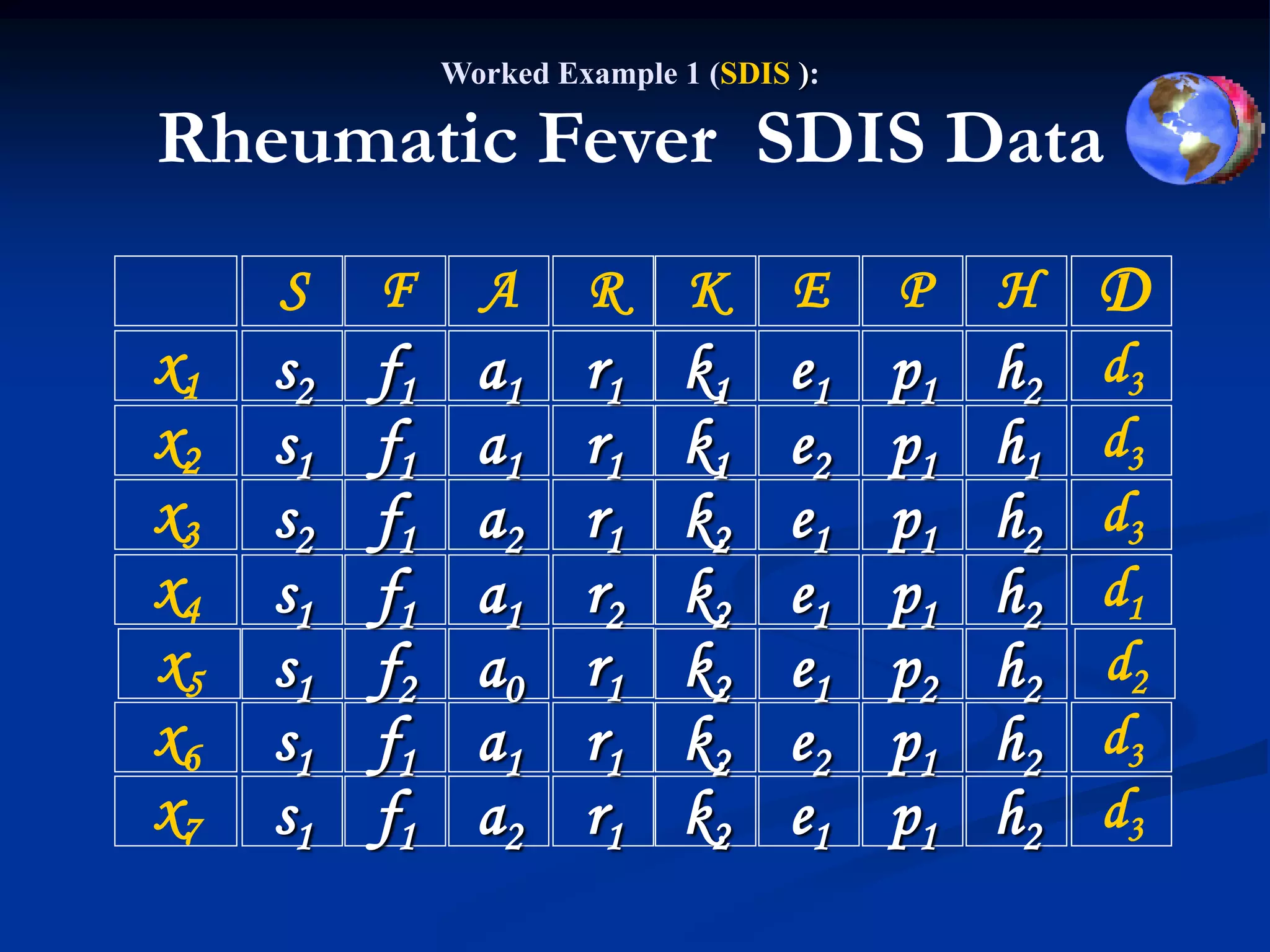
Worked Example 1 (SDIS ):

Rheumatic Fever SDIS Data
     S    F      A      R      K      E    P    H    D
x1   s2   f1     a1     r1    k1     e1    p1   h2   d3
x2   s1   f1     a1     r1    k1     e2    p1   h1   d3
x3   s2   f1     a2     r1    k2     e1    p1   h2   d3
x4   s1   f1     a1     r2    k2     e1    p1   h2   d1
x5   s1   f2     a0     r1    k2     e1    p2   h2   d2
x6   s1   f1     a1     r1    k2     e2    p1   h2   d3
x7   s1   f1     a2     r1    k2     e1    p1   h2   d3
New Thinking
A multi-valued information system (MIS) is a
generalization of the idea of a single valued information
system (SIS).

Initiative two methods to:
   Covert the SIS to a MIS and vice versa!

   Covert the SDIS to a MDIS and vice versa!


  by ( Collecting of Attributes).
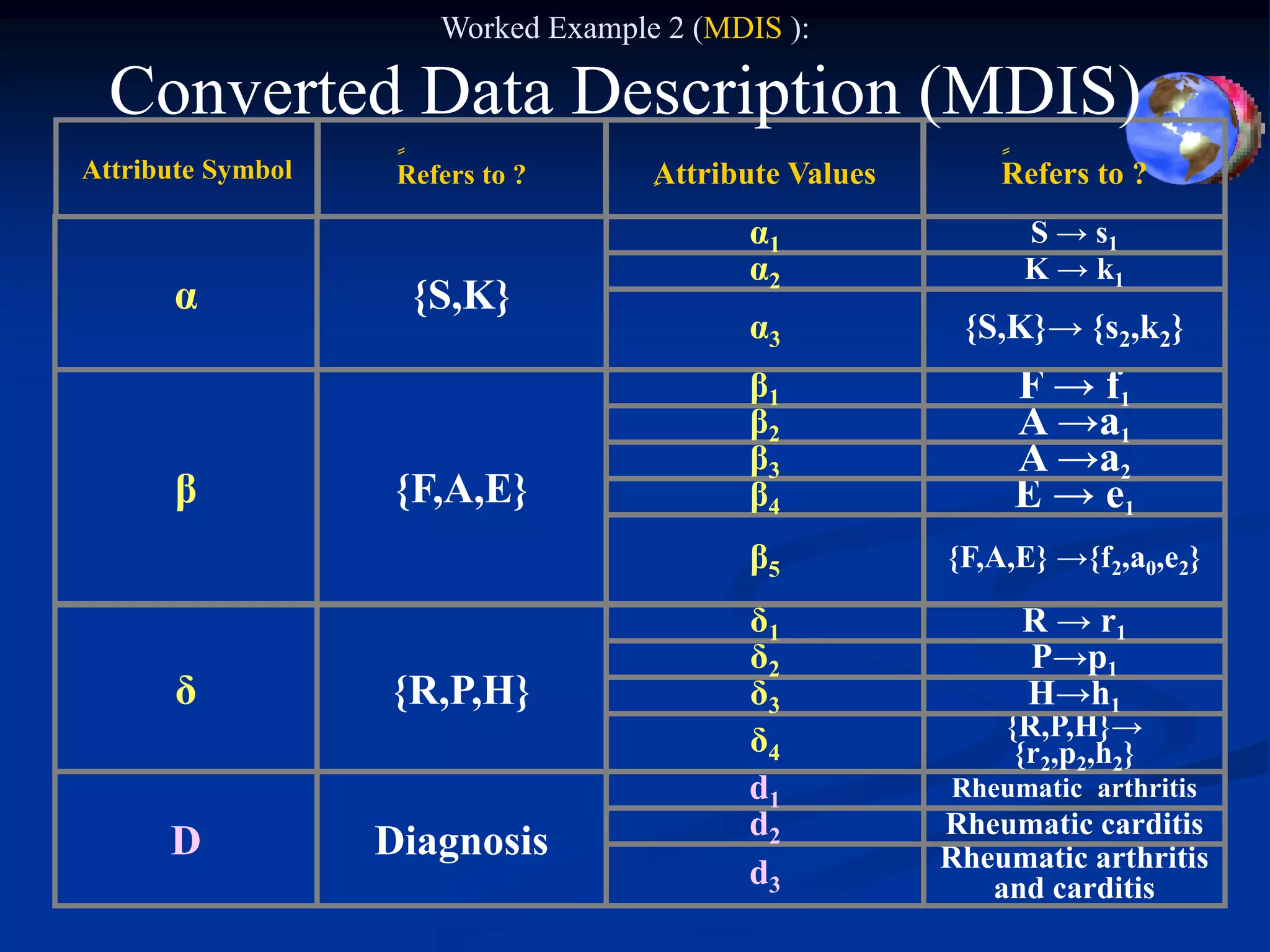
Worked Example 2 (MDIS ):

  Converted Data Description (MDIS)
Attribute Symbol    ًRefers to ?      ِAttribute Values       ًRefers to ?
                                             α1                S → s1
                                             α2                K → k1
       α             {S,K}
                                             α3            {S,K}→ {s2,k2}
                                             β1                F → f1
                                             β2                A →a1
                                             β3                A →a2
       β            {F,A,E}                  β4                E → e1
                                             β5           {F,A,E} →{f2,a0,e2}

                                             δ1                R → r1
                                             δ2                P→p1
       δ           {R,P,H}                   δ3                H→h1
                                             δ4               {R,P,H}→
                                                               {r2,p2,h2}
                                             d1           Rheumatic arthritis
                                             d2           Rheumatic carditis
      D            Diagnosis                              Rheumatic arthritis
                                             d3              and carditis
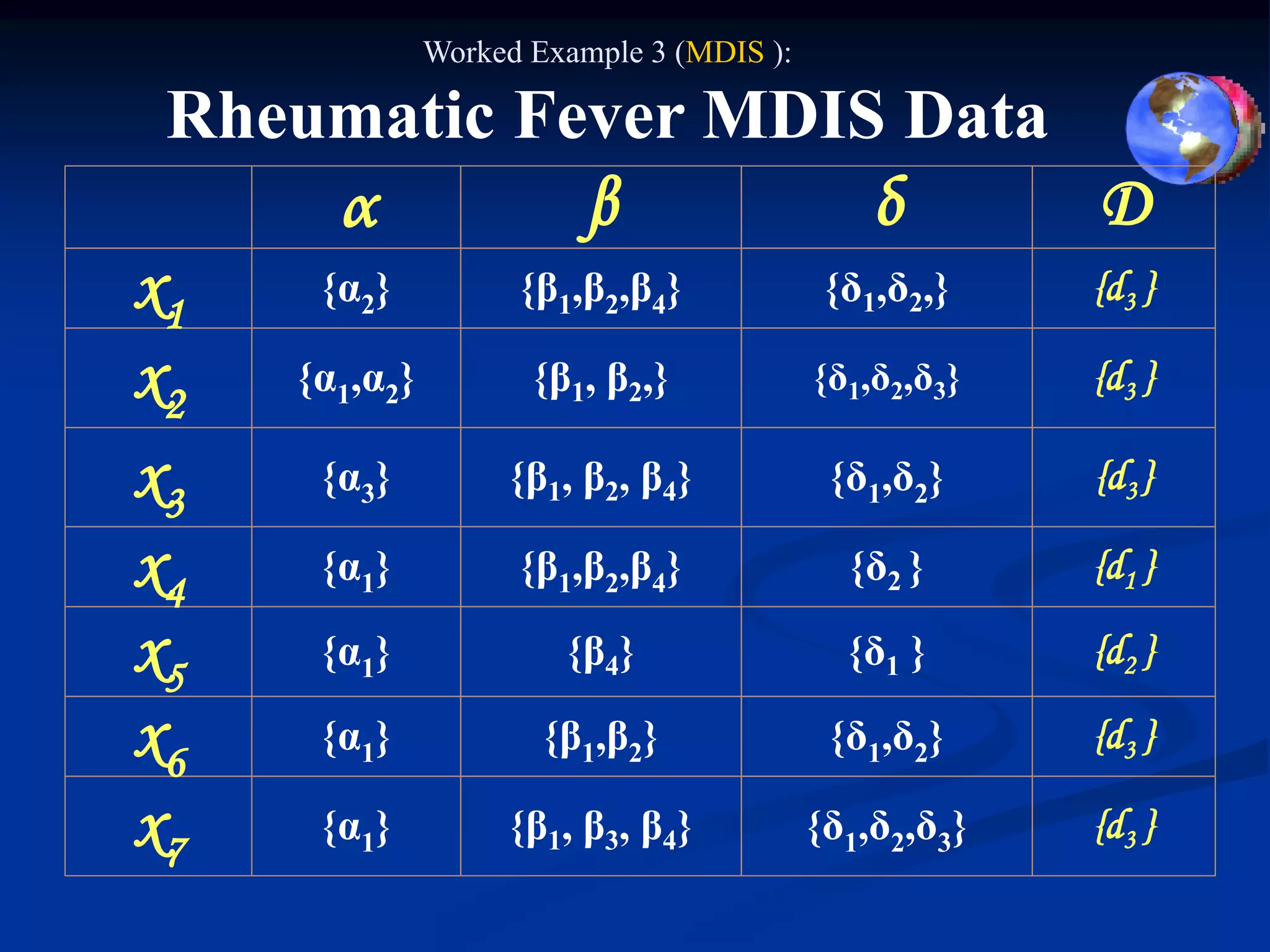
Worked Example 3 (MDIS ):

 Rheumatic Fever MDIS Data
     α       β       δ     D
x1    {α2}           {β1,β2,β4}             {δ1,δ2,}    {d3 }

x2   {α1,α2}          {β1, β2,}            {δ1,δ2,δ3}   {d3 }

x3    {α3}          {β1, β2, β4}            {δ1,δ2}     {d3 }

x4    {α1}           {β1,β2,β4}              {δ2 }      {d1 }

x5    {α1}              {β4}                 {δ1 }      {d2 }

x6    {α1}             {β1,β2}              {δ1,δ2}     {d3 }

x7    {α1}          {β1, β3, β4}           {δ1,δ2,δ3}   {d3 }
Generalized Multi-
  Valued Decision
Information System
     (GMDIS)
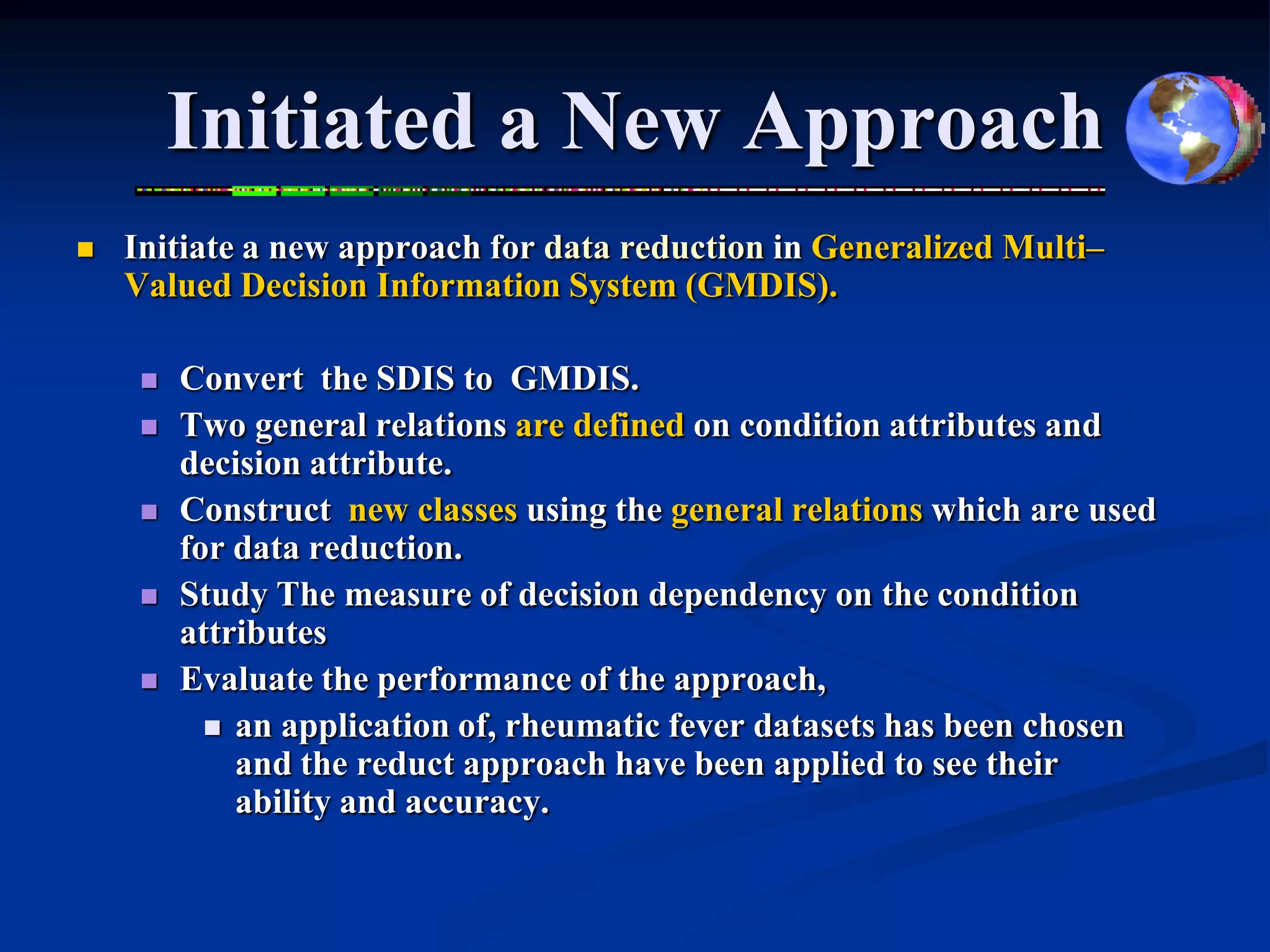
Initiated a New Approach
   Initiate a new approach for data reduction in Generalized Multi–
    Valued Decision Information System (GMDIS).

        Convert the SDIS to GMDIS.
        Two general relations are defined on condition attributes and
         decision attribute.
        Construct new classes using the general relations which are used
         for data reduction.
        Study The measure of decision dependency on the condition
         attributes
        Evaluate the performance of the approach,
            an application of, rheumatic fever datasets has been chosen
             and the reduct approach have been applied to see their
             ability and accuracy.
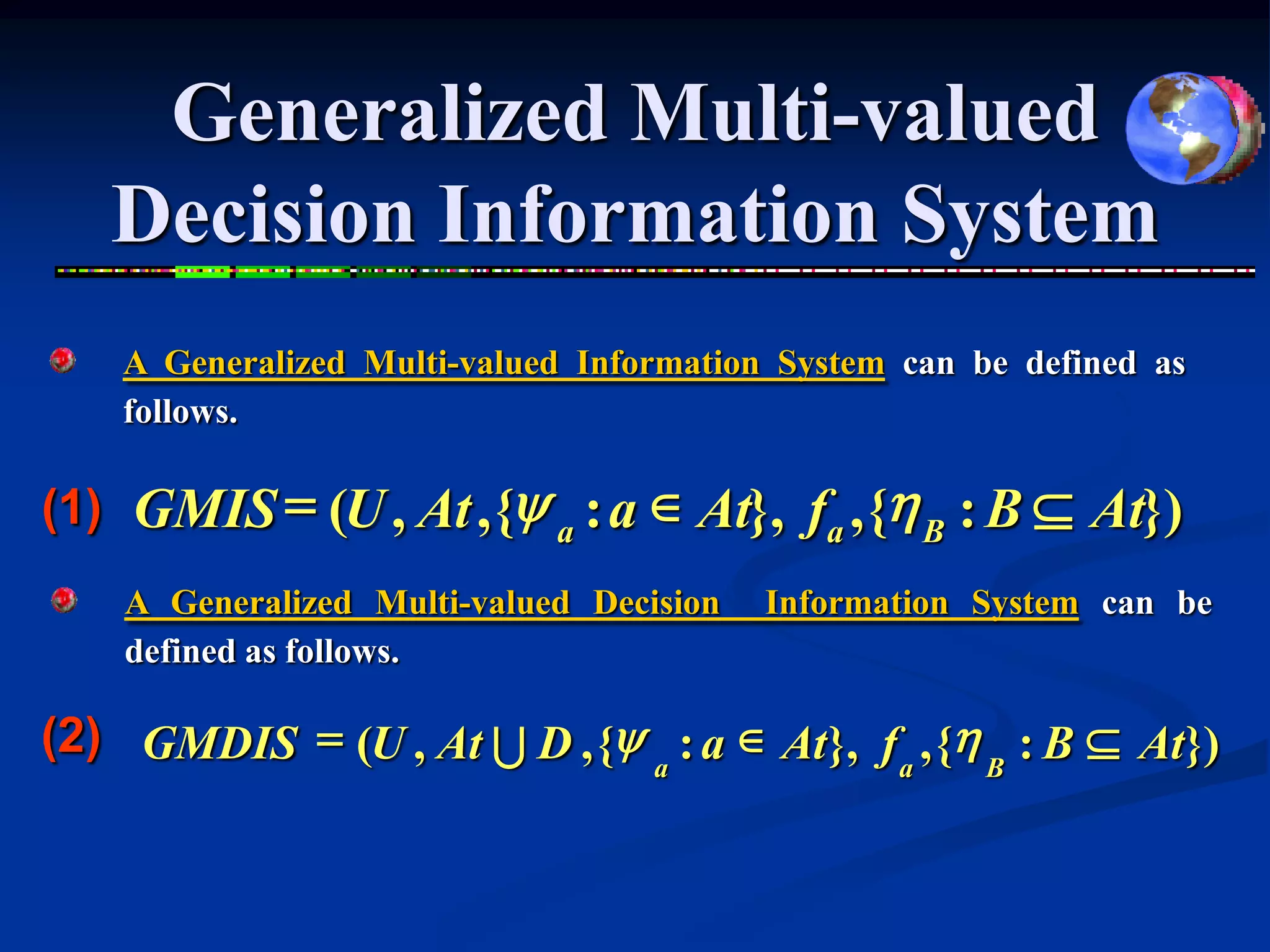
Generalized Multi-valued
   Decision Information System
    A Generalized Multi-valued Information System can be defined as
    follows.

(1) GMIS = (U , At , {y a : a  At}, fa , {h B : B  At})
    A Generalized Multi-valued Decision   Information System can be
    defined as follows.

(2) GMDIS = (U , At U D , {y : a  At}, f , {h : B  At})
                            a            a    B
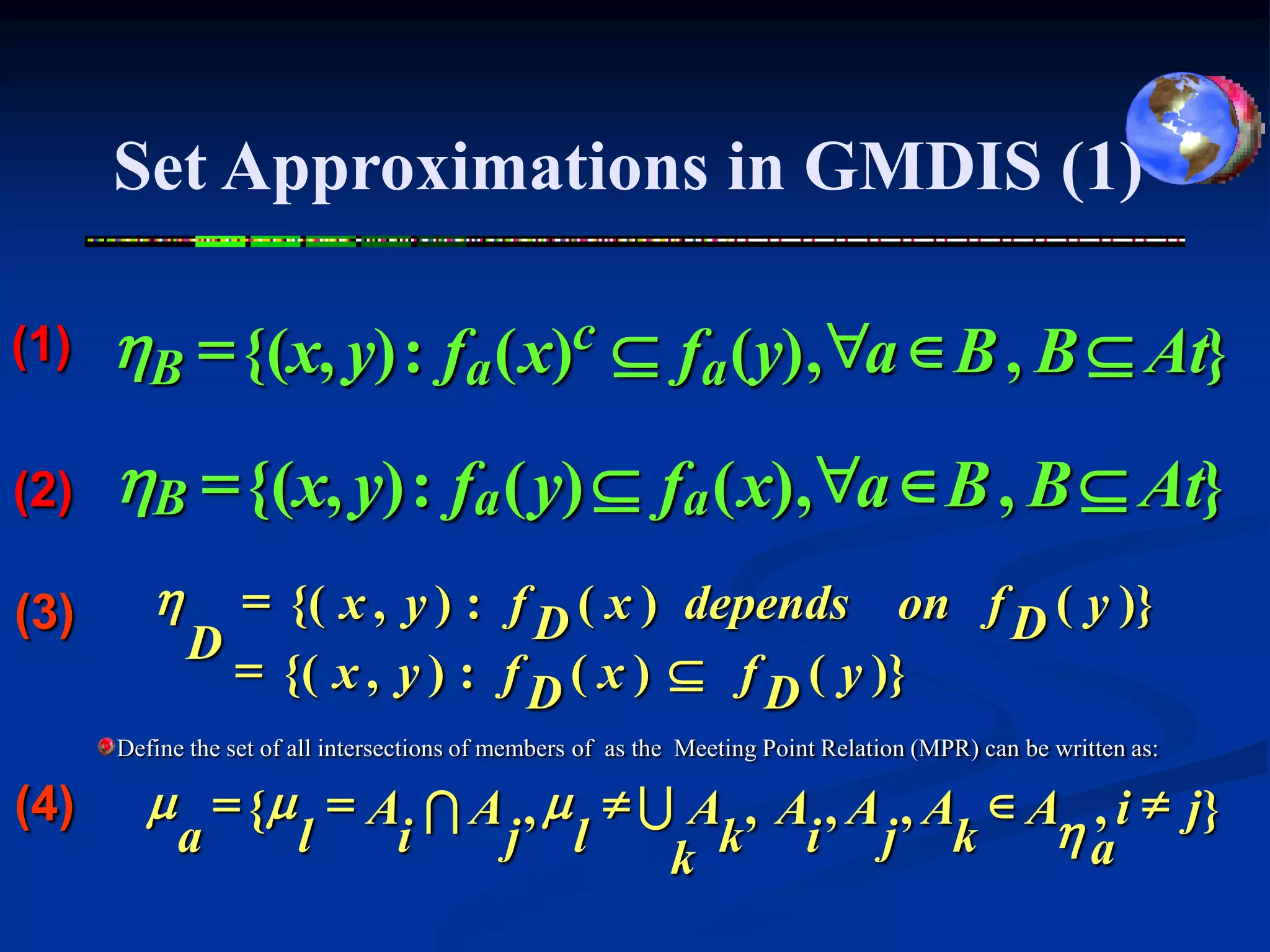
Set Approximations in GMDIS (1)

(1)   hB = {(x, y) : fa ( x)c  fa (y) , "a  B , B  At}

(2)   hB = {(x, y) : fa ( y)  fa ( x), "a  B , B  At}
(3)      h     = {( x , y ) : f ( x ) depends on f ( y )}
                               D                  D
             D
               = {( x , y ) : f ( x )  f ( y )}
                               D         D
      Define the set of all intersections of members of as the Meeting Point Relation (MPR) can be written as:

(4)     m = {m = A I A , m  U A , A , A , A  A , i  j }
         a    l   i   j l                       ha
                              k k i j k
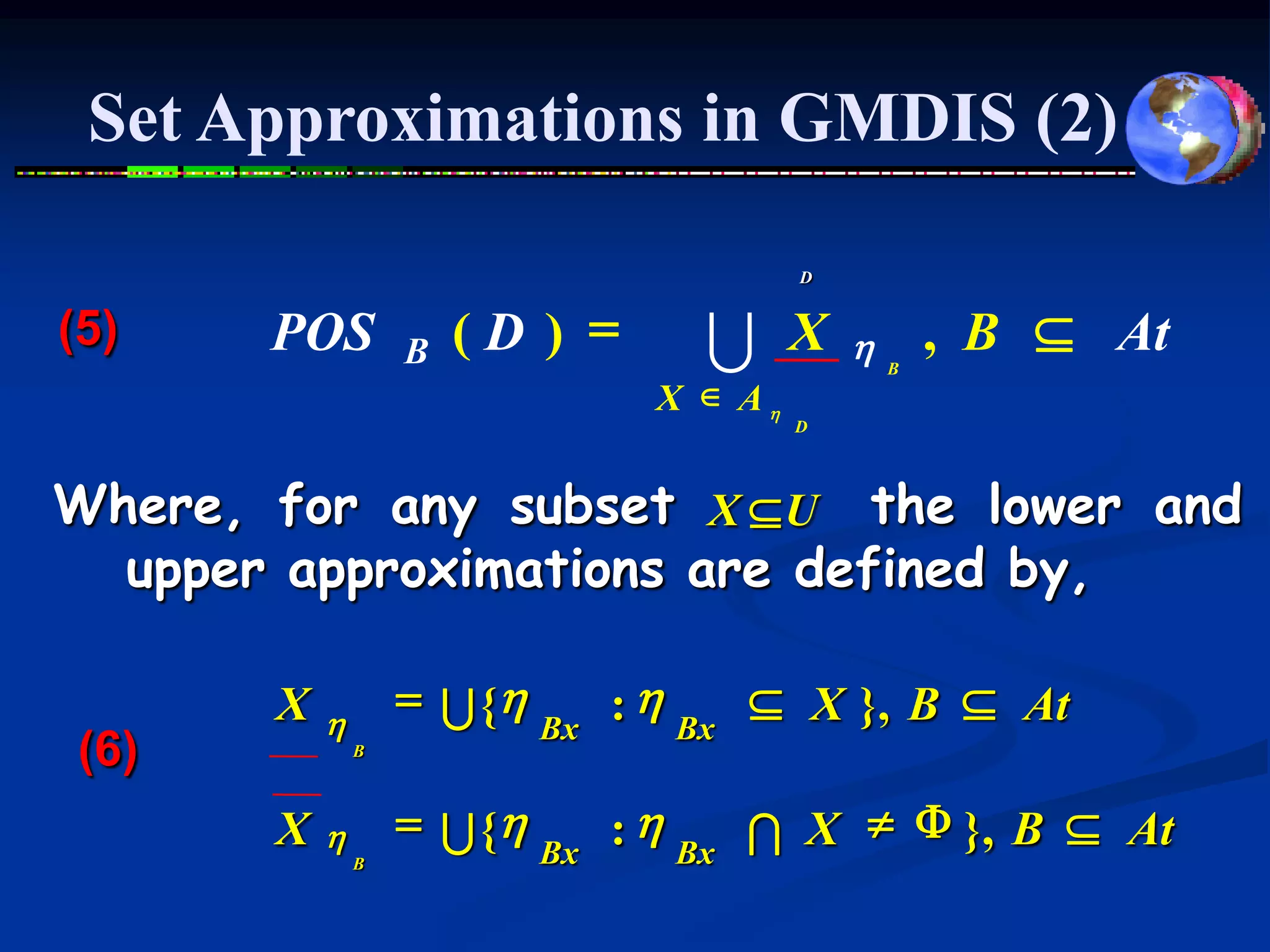
Set Approximations in GMDIS (2)

                                         D


(5)    POS         B   (D ) =     U      X   h   B
                                                     , B  At
                                X  Ah
                                         D


Where, for any subset X  U the lower and
  upper approximations are defined by,

       X   h
                   = U {h    : h Bx  X }, B  At
                          Bx
(6)            B


       X   h       = U {h    : h Bx I X  F }, B  At
               B          Bx
Suggested New Technique :
           Consideration (1)

1.The set of attributes B  At          is called a
  reduct if t B  t D and B is minimal, where
t B  t D iff " G  t B , $G ' t D s.t. G  G ' , G , G ' U

2.The attribute a  At      is called the principal
 attribute (PA) if , ta f tb , "a, b At b  a and
                                        ,
 if ta tb then both a and b are principal
        =
 attributes.
Suggested New Technique :
          Consideration (2)

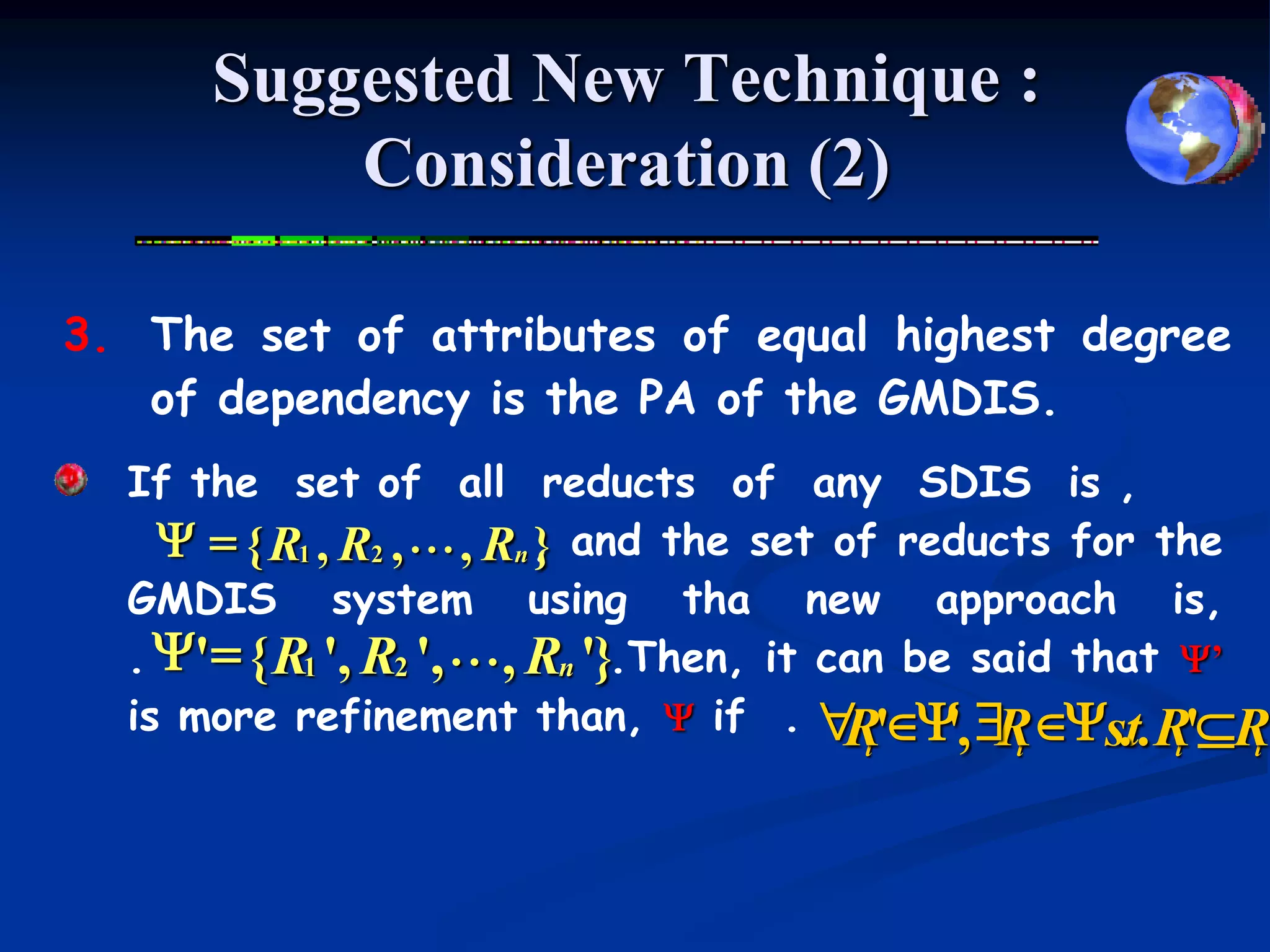
3. The set of attributes of equal highest degree
   of dependency is the PA of the GMDIS.
  If the set of all reducts of any SDIS is ,
    Y = { R1 , R2 , L , Rn , and the set of reducts for the
                           }
  GMDIS system using tha new approach is,
  . Y' = { R1 ', R2 ', L, Rn '}.Then, it can be said that Y’
  is more refinement than, Y if . " 'Y, $ Ys.t. R'R
                                          R ' R
                                       i       i       i   i
Simplified Reducts

Is the set of all reducts, after omitted
the supersets of each reduct in the set
RED (At), and we denote it by SRED (At).
GMDIS Reduction Algorithms

   Algorithm 1: GMDIS Reduct
   Algorithm 2: GMDIS PA Algorithm
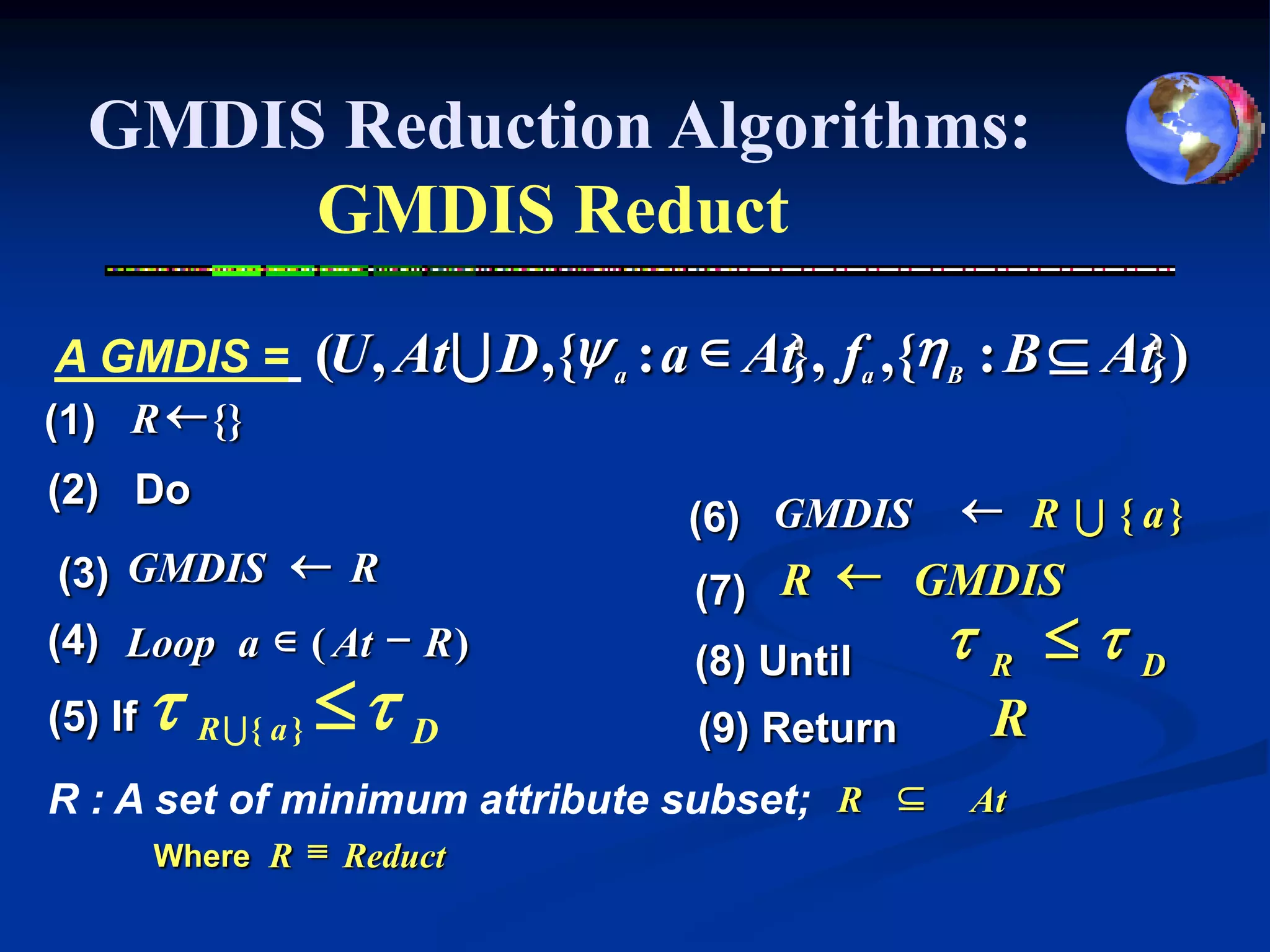
GMDIS Reduction Algorithms:
       GMDIS Reduct
A GMDIS =         (U , At U D ,{y a : a  At}, fa ,{hB : B  At})
(1) R  {}
(2) Do                                               R U { a}
                                      (6) GMDIS
(3) GMDIS  R                         (7) R  GMDIS
(4) Loop a  ( At - R )               (8) Until    tR tD
(5) If   t R U{ a }  t D             (9) Return      R
R : A set of minimum attribute subset; R            At
         Where R  Reduct
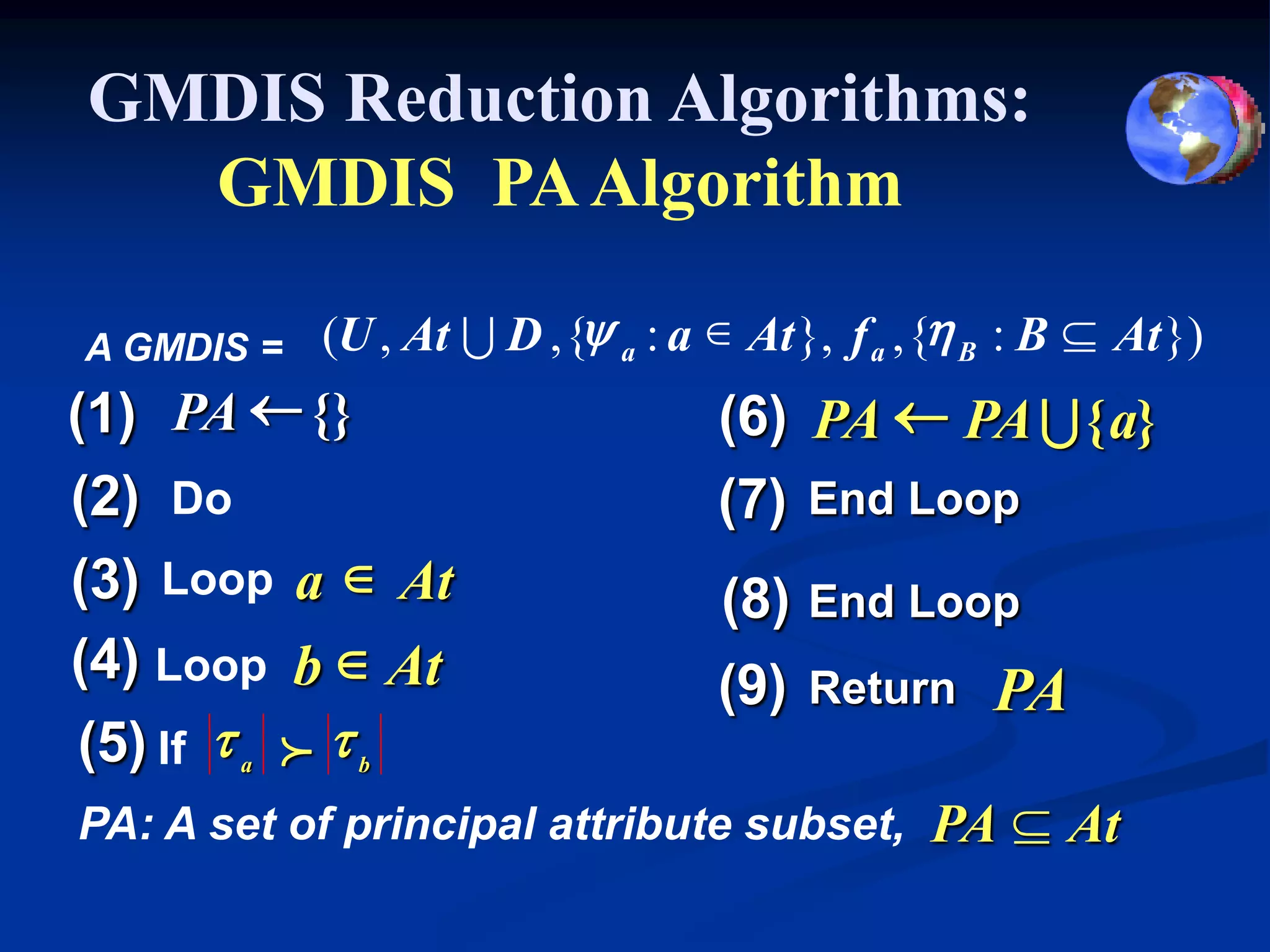
GMDIS Reduction Algorithms:
  GMDIS PA Algorithm

A GMDIS =   (U , At U D , {y a : a  At }, f a , {h B : B  At })
(1) PA  {}                        (6) PA  PA U { a}
(2) Do                             (7) End Loop
(3) Loop a  At                    (8) End Loop
(4) Loop b  At                    (9) Return PA
 (5) If t a f t b
PA: A set of principal attribute subset, PA  At
Rheumatic Fever GMDIS Reduction:
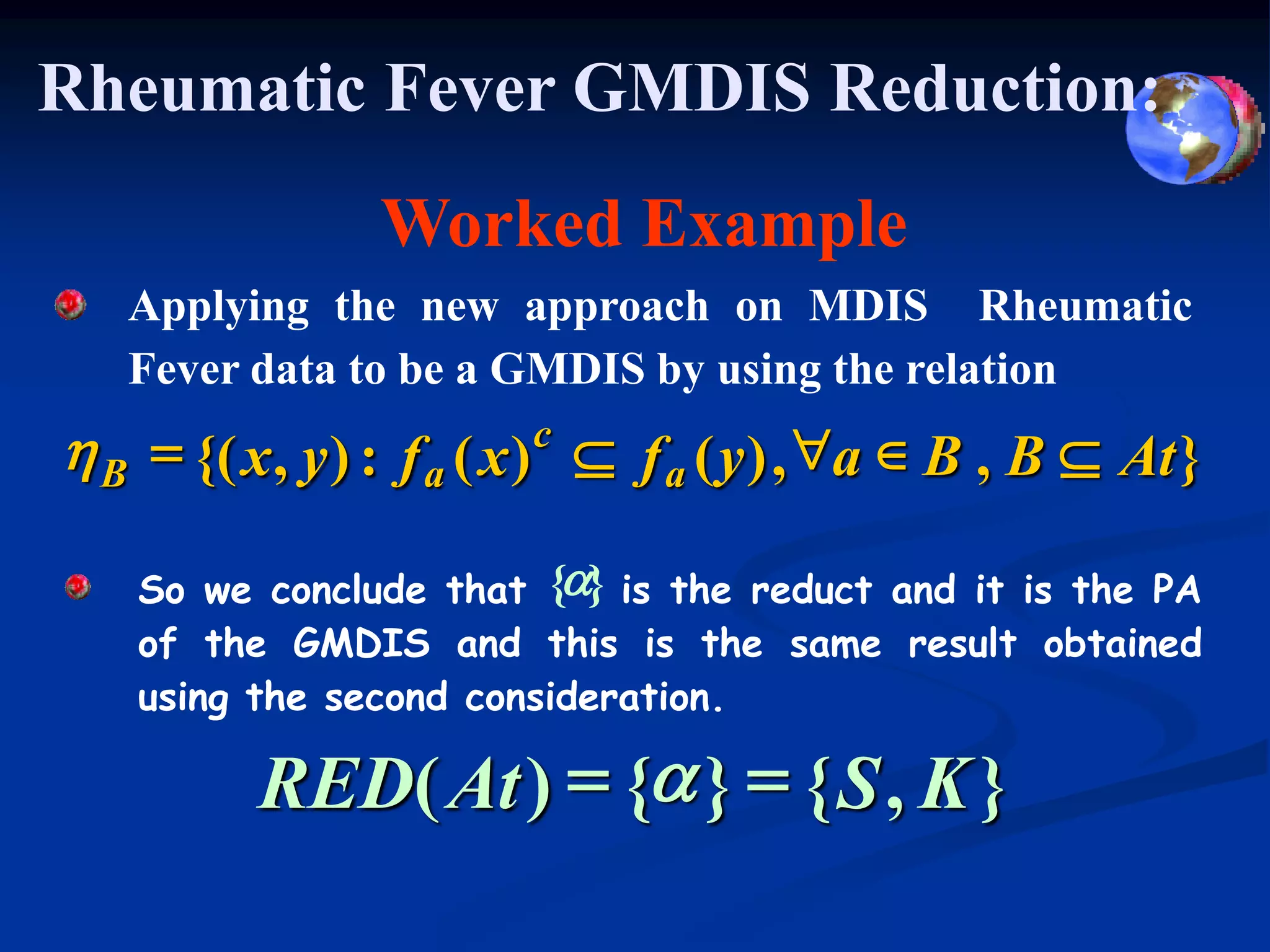
                 Worked Example
   Applying the new approach on MDIS Rheumatic
   Fever data to be a GMDIS by using the relation
h B = {( x , y ) : f a ( x ) c  f a ( y ) , "a  B , B  At }

    So we conclude that {a} is the reduct and it is the PA
    of the GMDIS and this is the same result obtained
    using the second consideration.

          RED( At ) = {a } = { S , K }
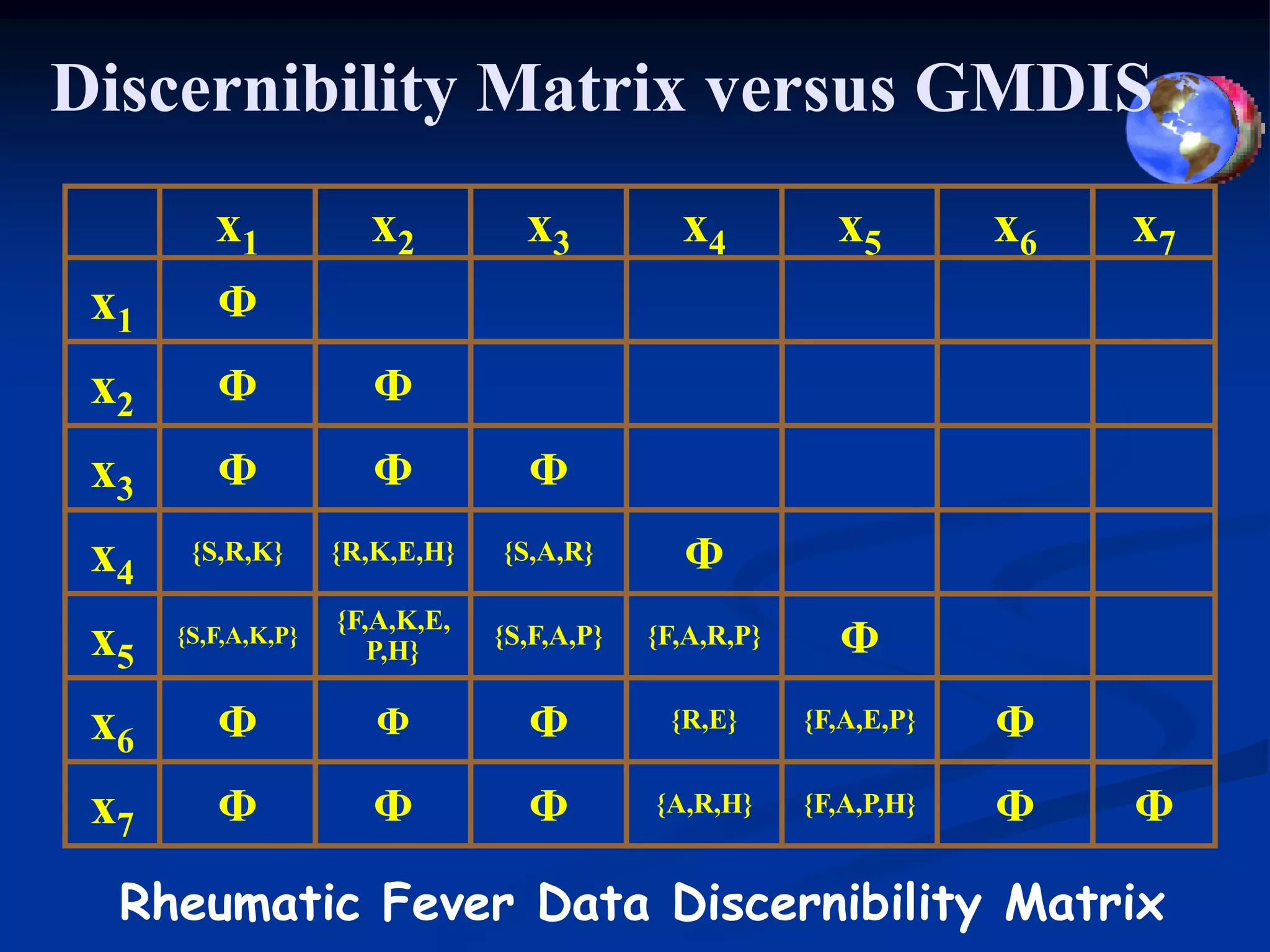
Discernibility Matrix versus GMDIS
         x1           x2          x3          x4          x5        x6   x7
 x1      Ф
 x2      Ф             Ф
 x3      Ф             Ф          Ф
 x4    {S,R,K}      {R,K,E,H}   {S,A,R}       Ф
                    {F,A,K,E,
 x5   {S,F,A,K,P}
                       P,H}
                                {S,F,A,P}   {F,A,R,P}     Ф
 x6      Ф             Ф          Ф          {R,E}      {F,A,E,P}   Ф
 x7      Ф             Ф          Ф         {A,R,H}     {F,A,P,H}   Ф    Ф

  Rheumatic Fever Data Discernibility Matrix
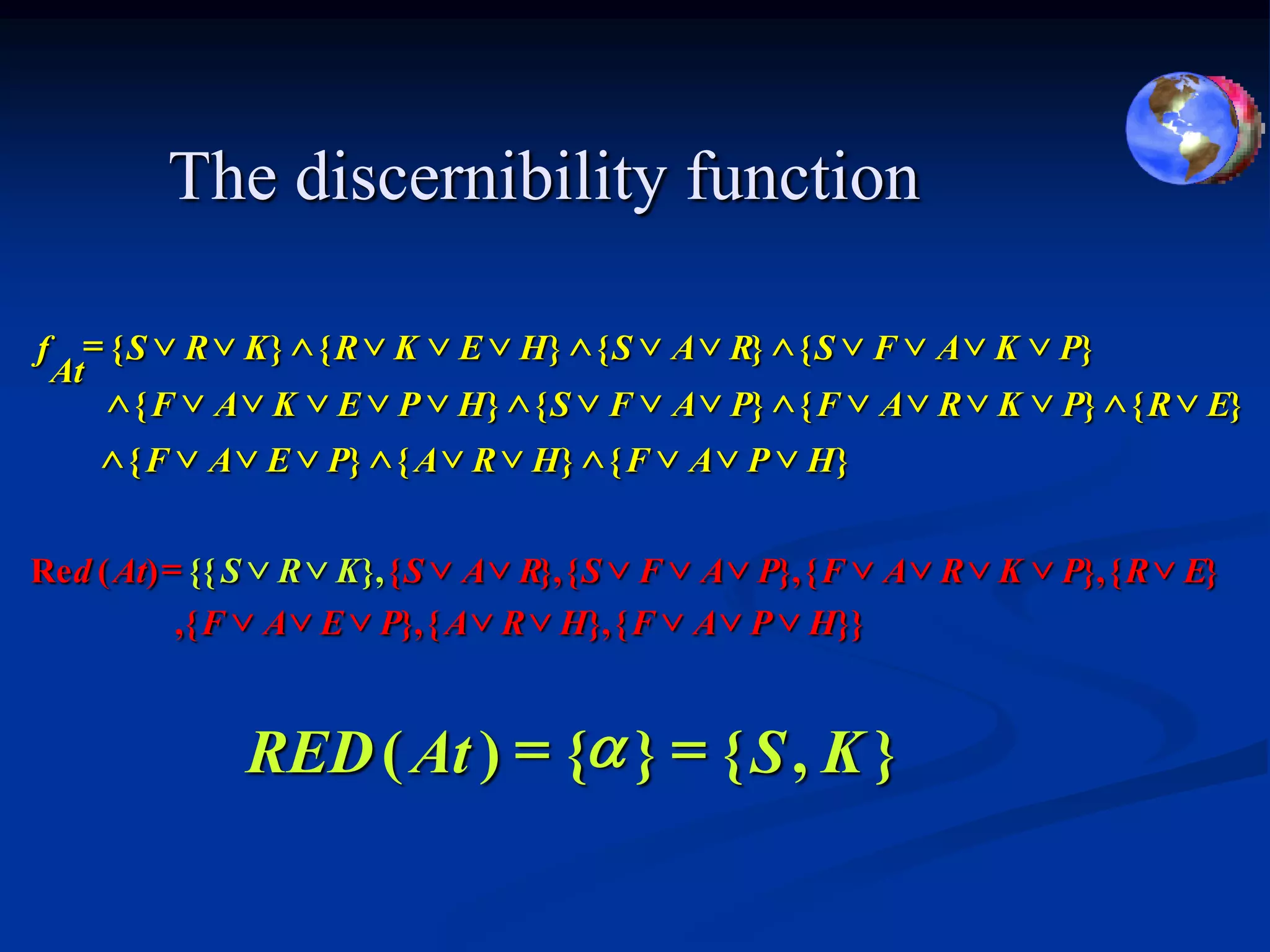
The discernibility function

f = { S  R  K }  { R  K  E  H}  { S  A  R}  { S  F  A  K  P}
 At
     { F  A  K  E  P  H}  { S  F  A  P}  { F  A  R  K  P}  { R  E}
      { F  A  E  P}  { A  R  H}  { F  A  P  H}


Re d ( At) = {{ S  R  K }, { S  A  R}, { S  F  A  P}, { F  A  R  K  P}, { R  E}
            ,{ F  A  E  P}, { A  R  H}, { F  A  P  H}}


                RED ( At ) = {a } = { S , K }
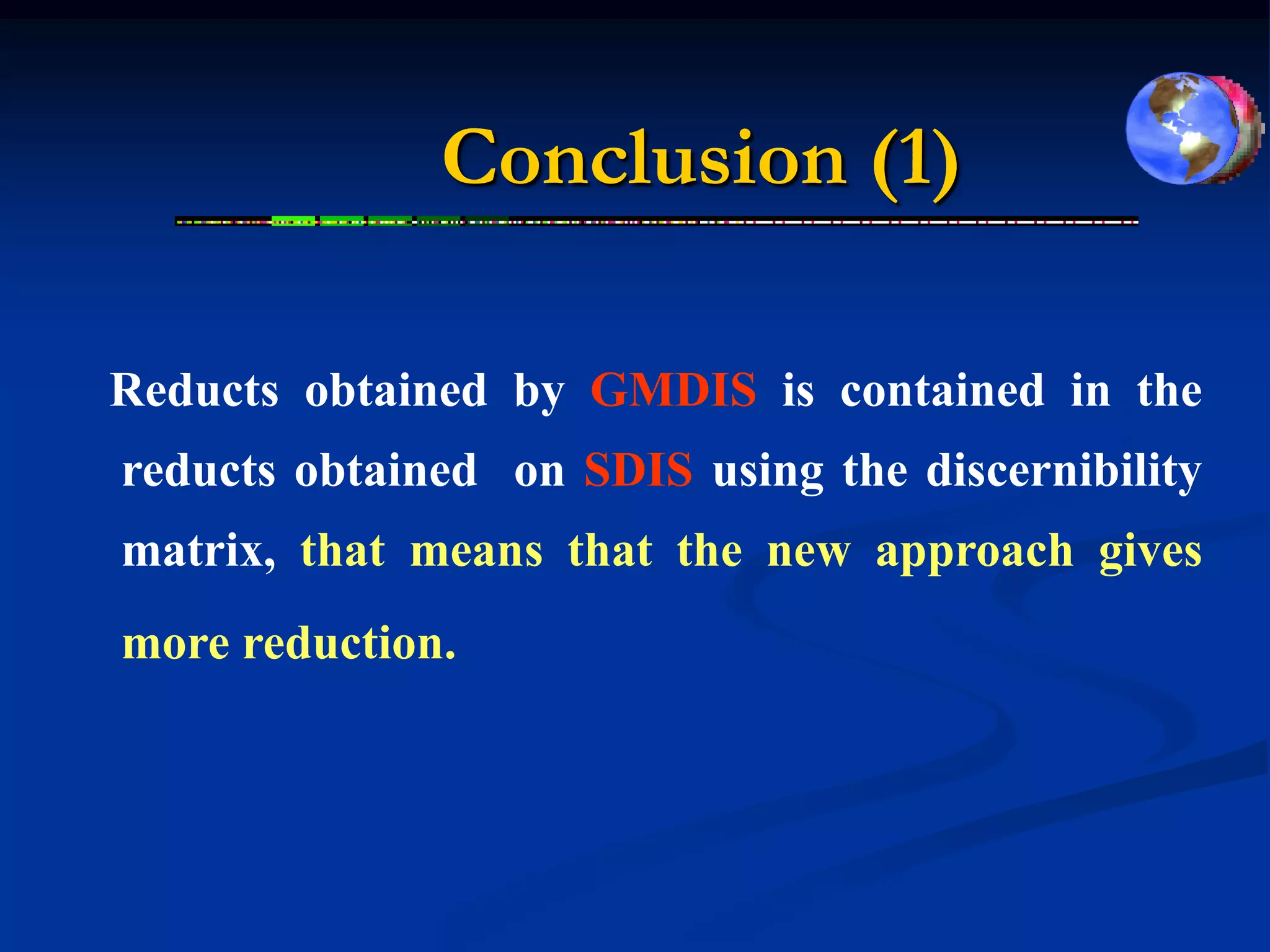
Conclusion (1)

Reducts obtained by GMDIS is contained in the
reducts obtained on SDIS using the discernibility
matrix, that means that the new approach gives
more reduction.
Conclusion (2)
New approach for data reduction in GMDIS is considered
as a generalization in the case of MDIS.

This approach extended to Pawlak approach if the system
is single-valued and the relations are equivalence.

It Opens the way for other approaches of data reduction
if we use the general topological recent concepts such as
Pre-open sets, Semi-open sets, etc.
Conclusion (3)
In many real life situations, the use of attributes in a
single fashion is not represetable for the actual effect of
attributes. So, it is necessary to consider subsets of the
attributes as a multi criteria.

An application of, Rheumatic Fever datasets has been
chosen and the reduct approach has been applied to see
their ability and accuracy.
Acknowledgment
   The authors greatly appreciate and thanks many
    peoples for their valuable comments and advices:

     Dr. K. E. Sturtz, , Air Force Research
      Laboratory, Wright Patterson Air Force Base,
      Ohio;
     Prof. Aboul Ella Hassanien, Cairo University
     Prof. E. Rady,, I.S.S.R., Cairo University.
     Dr. A. S. Salama. Pure Mathematics Dept.,
      Faculty of Science, Tanta University.
A new data reduction approach

A new data reduction approach

  • 1.
    New Approaches forData Reduction in Generalized Multi-valued Decision Information System (GMDIS): Case Study of Rheumatic Fever Patients 2006
  • 2.
    By Abd El-Monem M. Kozea, Mohamed M. E. Abd El-Monsef, Mathematics Department, Faculty of Science, Tanta University, Egypt Email: akozae55@yahoo.com Email: mme1976@yahoo.com & Soaad Abd El-Badie Attia El-Afify Computer Science Department, Cairo Computer Academy (CCA) Email: savvymore@yahoo.com Homepage: www.savvymore.mysite.com
  • 3.
    Outline  Motivation / Introduction  Basic Concepts of Rough Sets  Rheumatic Fever Data: Characteristics  New Thinking  Generalized Multi-Valued Decision Information System (GMDIS)  New Approaches for Data Reduction in GMDIS  Non-equivalence Relations,  Topological Spaces and  Degree of Dependencies in GMDIS  Reduct Algorithms based on GMDIS  Rheumatic Fever GMDIS Reduction: Worked example  Conclusion and Future Work  Acknowledgment
  • 4.
    Motivation / Introduction  Rough set theory was developed by Zdzislaw Pawlak in the early 1982’s.  RS is based on the idea of equivalence relations which partition the domain into different classes.  It is a mathematical tool for dealing with incomplete data for induction of approximations of concepts and for discovering patterns hidden in data.  It can be used for feature selection, data reduction, identifies partial/total dependencies in data, gives approach to null values and missing data, and decision rule generation.
  • 5.
    Motivation / Introduction  Rough Set Features:  It is applicable to problems with both numeric and descriptive attributes  It is capable of finding all minimal knowledge representation  It is highly automated based on strict rules.  A multi-valued information system (MIS) is a generalization of the idea of a single valued information system (SIS).  In a multi-valued information system,  Attribute functions are allowed to map elements to sets of attribute values.
  • 6.
    Rough Set Theory: Basic Concepts  Information/Decision Systems (Tables)  Indiscernibility  Set Approximation  Reducts and Core  Rough Membership  Dependency of Attributes
  • 7.
    Information Systems Types The first concept of IS was developed by Grzymala-Busse (1988). There are many types of IS as follows:  Single valued Information System (SIS)  The data takes a single value for each element  Single valued Decision Information System (SDIS)  A Multi-valued Information System (MIS) An ordinary information system which its values ore sets = (U , At ,{Va : a  At }, f a )  A Multi-valued Decision Information System (MDIS) = (U , At U D, {Va : a  At}, f a )
  • 8.
    Rheumatic Fever Data: Characteristics  We obtained the used Rheumatic Fever patients data from Tanta University Hospital, Egypt.  All patients are between 9-12 years old with history of Arthritis began from age 3-5 years.  This disease has many symptoms and it is usually started in young age and still with the patient along his life.  The following table shows seven patients characterized by 8 symptoms (attributes) using them to decide the diagnosis for each patient (decision attribute).
  • 9.
    Rheumatic Fever Data:Characteristics Attribute Symbolِ Refersً to? Attribute Valuesِ to?Refers s1 Male S Sex s2 Female f1 Yes F Pharyngitis f2 No a0 No arthritis A Arthritis a1 Began in the knee a2 Began in the ankle r 1 Affected R Carditis r2 Not affected k1 Yes K Chorea k2 No e1 Normal E ESR e2 High Abdonominal p1 Absent P Pain p2 Present h 1 Yes H Headache h2 No d1 Rheumatic Arthritis d2 Carditis Rheumatic D Diagnosis Rheumatic Arthritis d3 and Carditis
  • 10.
    Worked Example 1(SDIS ): Rheumatic Fever SDIS Data S F A R K E P H D x1 s2 f1 a1 r1 k1 e1 p1 h2 d3 x2 s1 f1 a1 r1 k1 e2 p1 h1 d3 x3 s2 f1 a2 r1 k2 e1 p1 h2 d3 x4 s1 f1 a1 r2 k2 e1 p1 h2 d1 x5 s1 f2 a0 r1 k2 e1 p2 h2 d2 x6 s1 f1 a1 r1 k2 e2 p1 h2 d3 x7 s1 f1 a2 r1 k2 e1 p1 h2 d3
  • 11.
    New Thinking A multi-valuedinformation system (MIS) is a generalization of the idea of a single valued information system (SIS). Initiative two methods to: Covert the SIS to a MIS and vice versa! Covert the SDIS to a MDIS and vice versa! by ( Collecting of Attributes).
  • 12.
    Worked Example 2(MDIS ): Converted Data Description (MDIS) Attribute Symbol ًRefers to ? ِAttribute Values ًRefers to ? α1 S → s1 α2 K → k1 α {S,K} α3 {S,K}→ {s2,k2} β1 F → f1 β2 A →a1 β3 A →a2 β {F,A,E} β4 E → e1 β5 {F,A,E} →{f2,a0,e2} δ1 R → r1 δ2 P→p1 δ {R,P,H} δ3 H→h1 δ4 {R,P,H}→ {r2,p2,h2} d1 Rheumatic arthritis d2 Rheumatic carditis D Diagnosis Rheumatic arthritis d3 and carditis
  • 13.
    Worked Example 3(MDIS ): Rheumatic Fever MDIS Data α β δ D x1 {α2} {β1,β2,β4} {δ1,δ2,} {d3 } x2 {α1,α2} {β1, β2,} {δ1,δ2,δ3} {d3 } x3 {α3} {β1, β2, β4} {δ1,δ2} {d3 } x4 {α1} {β1,β2,β4} {δ2 } {d1 } x5 {α1} {β4} {δ1 } {d2 } x6 {α1} {β1,β2} {δ1,δ2} {d3 } x7 {α1} {β1, β3, β4} {δ1,δ2,δ3} {d3 }
  • 14.
    Generalized Multi- Valued Decision Information System (GMDIS)
  • 15.
    Initiated a NewApproach  Initiate a new approach for data reduction in Generalized Multi– Valued Decision Information System (GMDIS).  Convert the SDIS to GMDIS.  Two general relations are defined on condition attributes and decision attribute.  Construct new classes using the general relations which are used for data reduction.  Study The measure of decision dependency on the condition attributes  Evaluate the performance of the approach,  an application of, rheumatic fever datasets has been chosen and the reduct approach have been applied to see their ability and accuracy.
  • 16.
    Generalized Multi-valued Decision Information System A Generalized Multi-valued Information System can be defined as follows. (1) GMIS = (U , At , {y a : a  At}, fa , {h B : B  At}) A Generalized Multi-valued Decision Information System can be defined as follows. (2) GMDIS = (U , At U D , {y : a  At}, f , {h : B  At}) a a B
  • 17.
    Set Approximations inGMDIS (1) (1) hB = {(x, y) : fa ( x)c  fa (y) , "a  B , B  At} (2) hB = {(x, y) : fa ( y)  fa ( x), "a  B , B  At} (3) h = {( x , y ) : f ( x ) depends on f ( y )} D D D = {( x , y ) : f ( x )  f ( y )} D D Define the set of all intersections of members of as the Meeting Point Relation (MPR) can be written as: (4) m = {m = A I A , m  U A , A , A , A  A , i  j } a l i j l ha k k i j k
  • 18.
    Set Approximations inGMDIS (2) D (5) POS B (D ) = U X h B , B  At X  Ah D Where, for any subset X  U the lower and upper approximations are defined by, X h = U {h : h Bx  X }, B  At Bx (6) B X h = U {h : h Bx I X  F }, B  At B Bx
  • 19.
    Suggested New Technique: Consideration (1) 1.The set of attributes B  At is called a reduct if t B  t D and B is minimal, where t B  t D iff " G  t B , $G ' t D s.t. G  G ' , G , G ' U 2.The attribute a  At is called the principal attribute (PA) if , ta f tb , "a, b At b  a and , if ta tb then both a and b are principal = attributes.
  • 20.
    Suggested New Technique: Consideration (2) 3. The set of attributes of equal highest degree of dependency is the PA of the GMDIS. If the set of all reducts of any SDIS is , Y = { R1 , R2 , L , Rn , and the set of reducts for the } GMDIS system using tha new approach is, . Y' = { R1 ', R2 ', L, Rn '}.Then, it can be said that Y’ is more refinement than, Y if . " 'Y, $ Ys.t. R'R R ' R i i i i
  • 21.
    Simplified Reducts Is theset of all reducts, after omitted the supersets of each reduct in the set RED (At), and we denote it by SRED (At).
  • 22.
    GMDIS Reduction Algorithms  Algorithm 1: GMDIS Reduct  Algorithm 2: GMDIS PA Algorithm
  • 23.
    GMDIS Reduction Algorithms: GMDIS Reduct A GMDIS = (U , At U D ,{y a : a  At}, fa ,{hB : B  At}) (1) R  {} (2) Do  R U { a} (6) GMDIS (3) GMDIS  R (7) R  GMDIS (4) Loop a  ( At - R ) (8) Until tR tD (5) If t R U{ a }  t D (9) Return R R : A set of minimum attribute subset; R  At Where R  Reduct
  • 24.
    GMDIS Reduction Algorithms: GMDIS PA Algorithm A GMDIS = (U , At U D , {y a : a  At }, f a , {h B : B  At }) (1) PA  {} (6) PA  PA U { a} (2) Do (7) End Loop (3) Loop a  At (8) End Loop (4) Loop b  At (9) Return PA (5) If t a f t b PA: A set of principal attribute subset, PA  At
  • 25.
    Rheumatic Fever GMDISReduction: Worked Example Applying the new approach on MDIS Rheumatic Fever data to be a GMDIS by using the relation h B = {( x , y ) : f a ( x ) c  f a ( y ) , "a  B , B  At } So we conclude that {a} is the reduct and it is the PA of the GMDIS and this is the same result obtained using the second consideration. RED( At ) = {a } = { S , K }
  • 26.
    Discernibility Matrix versusGMDIS x1 x2 x3 x4 x5 x6 x7 x1 Ф x2 Ф Ф x3 Ф Ф Ф x4 {S,R,K} {R,K,E,H} {S,A,R} Ф {F,A,K,E, x5 {S,F,A,K,P} P,H} {S,F,A,P} {F,A,R,P} Ф x6 Ф Ф Ф {R,E} {F,A,E,P} Ф x7 Ф Ф Ф {A,R,H} {F,A,P,H} Ф Ф Rheumatic Fever Data Discernibility Matrix
  • 27.
    The discernibility function f= { S  R  K }  { R  K  E  H}  { S  A  R}  { S  F  A  K  P} At  { F  A  K  E  P  H}  { S  F  A  P}  { F  A  R  K  P}  { R  E}  { F  A  E  P}  { A  R  H}  { F  A  P  H} Re d ( At) = {{ S  R  K }, { S  A  R}, { S  F  A  P}, { F  A  R  K  P}, { R  E} ,{ F  A  E  P}, { A  R  H}, { F  A  P  H}} RED ( At ) = {a } = { S , K }
  • 28.
    Conclusion (1) Reducts obtainedby GMDIS is contained in the reducts obtained on SDIS using the discernibility matrix, that means that the new approach gives more reduction.
  • 29.
    Conclusion (2) New approachfor data reduction in GMDIS is considered as a generalization in the case of MDIS. This approach extended to Pawlak approach if the system is single-valued and the relations are equivalence. It Opens the way for other approaches of data reduction if we use the general topological recent concepts such as Pre-open sets, Semi-open sets, etc.
  • 30.
    Conclusion (3) In manyreal life situations, the use of attributes in a single fashion is not represetable for the actual effect of attributes. So, it is necessary to consider subsets of the attributes as a multi criteria. An application of, Rheumatic Fever datasets has been chosen and the reduct approach has been applied to see their ability and accuracy.
  • 31.
    Acknowledgment  The authors greatly appreciate and thanks many peoples for their valuable comments and advices:  Dr. K. E. Sturtz, , Air Force Research Laboratory, Wright Patterson Air Force Base, Ohio;  Prof. Aboul Ella Hassanien, Cairo University  Prof. E. Rady,, I.S.S.R., Cairo University.  Dr. A. S. Salama. Pure Mathematics Dept., Faculty of Science, Tanta University.