A Mobile Application Testing Guide for Optimizing Apps
Copyright © 2023 HeadSpin, Inc. All Rights Reserved.
Mobile app testing includes testing applications for functionality,
usability, and consistency. This enables testers and QA teams to ensure
the app meets its requirements and provides a good user experience
across various devices, operating systems, and network environments.
Recently, enterprises are focusing significantly on automated mobile app
testing that further enhances outcomes by increasing test coverage,
improving accuracy, reducing time and cost, enabling continuous testing,
facilitating regression testing, and providing scalability.
Introduction
Copyright © 2023 HeadSpin, Inc. All Rights Reserved.
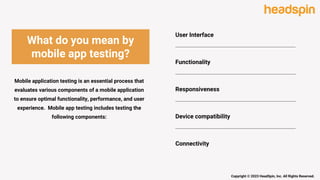
User Interface
Functionality
Responsiveness
Device compatibility
Connectivity
Copyright © 2023 HeadSpin, Inc. All Rights Reserved.
Mobile application testing is an essential process that
evaluates various components of a mobile application
to ensure optimal functionality, performance, and user
experience. Mobile app testing includes testing the
following components:
What do you mean by
mobile app testing?
Why are businesses focusing on
mobile app testing today?
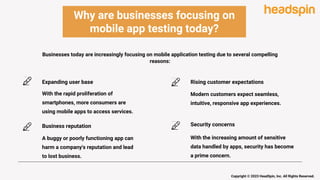
Expanding user base
With the rapid proliferation of
smartphones, more consumers are
using mobile apps to access services.
Business reputation
A buggy or poorly functioning app can
harm a company's reputation and lead
to lost business.
Rising customer expectations
Modern customers expect seamless,
intuitive, responsive app experiences.
Security concerns
With the increasing amount of sensitive
data handled by apps, security has become
a prime concern.
Businesses today are increasingly focusing on mobile application testing due to several compelling
reasons:
Copyright © 2023 HeadSpin, Inc. All Rights Reserved.
What are the primary
types of mobile apps?
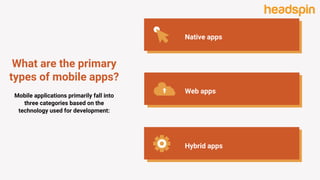
Native apps
Web apps
Hybrid apps
Mobile applications primarily fall into
three categories based on the
technology used for development:
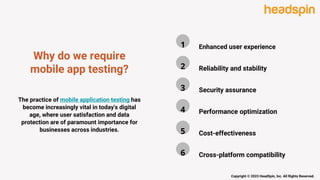
Why do we require
mobile app testing?
The practice of mobile application testing has
become increasingly vital in today's digital
age, where user satisfaction and data
protection are of paramount importance for
businesses across industries.
Copyright © 2023 HeadSpin, Inc. All Rights Reserved.
Enhanced user experience
1
Cross-platform compatibility
6
Cost-effectiveness
5
Performance optimization
4
Security assurance
3
Reliability and stability
2
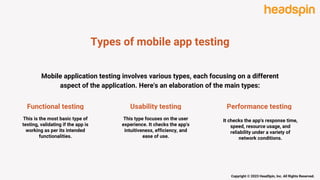
Types of mobile app testing
Functional testing
This is the most basic type of
testing, validating if the app is
working as per its intended
functionalities.
Usability testing
This type focuses on the user
experience. It checks the app's
intuitiveness, efficiency, and
ease of use.
Performance testing
It checks the app's response time,
speed, resource usage, and
reliability under a variety of
network conditions.
Copyright © 2023 HeadSpin, Inc. All Rights Reserved.
Mobile application testing involves various types, each focusing on a different
aspect of the application. Here's an elaboration of the main types:
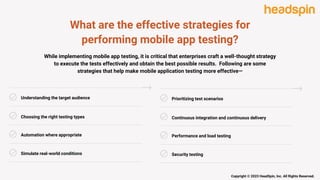
Understanding the target audience
Choosing the right testing types
Automation where appropriate
Simulate real-world conditions
While implementing mobile app testing, it is critical that enterprises craft a well-thought strategy
to execute the tests effectively and obtain the best possible results. Following are some
strategies that help make mobile application testing more effective—
Prioritizing test scenarios
Continuous integration and continuous delivery
Performance and load testing
Security testing
Copyright © 2023 HeadSpin, Inc. All Rights Reserved.
What are the effective strategies for
performing mobile app testing?
Benefits to test mobile apps on real devices
● The significance of testing mobile apps on real devices lies in their ability to offer a
realistic user experience, accurately assess hardware-software interactions, account for
device fragmentation, manage various network conditions, measure performance
effectively, and identify real-time bugs.
● By testing on real devices, one can capture the genuine feel of how the application behaves
in real-world scenarios, thus gaining invaluable insights into the app's aesthetics and user
experience.
Copyright © 2023 HeadSpin, Inc. All Rights Reserved.
● Performance metrics like speed, battery consumption, and memory usage can be assessed most
precisely on real devices. Lastly, using actual devices for testing helps uncover and rectify certain bugs
or issues that only surface in a real-world environment.
● Despite the higher costs and complexities involved compared to testing on emulators or simulators,
testing on real devices is indispensable for developing a high-quality, bug-free, and user-friendly mobile
application.
Copyright © 2023 HeadSpin, Inc. All Rights Reserved.
Benefits to test mobile apps on real devices
How does HeadSpin enable
companies to perform mobile
app testing?
• Test on real devices remotely
• Run multiple tests on mobile apps parallelly
• Automate test cases with HeadSpin's integration capabilities
• Monitor and test custom KPIs for the mobile apps
• Detect, reproduce, and fix bugs proactively
Copyright © 2023 HeadSpin, Inc. All Rights Reserved.
Conclusion
In the dynamic world of mobile apps, ensuring seamless functionality and usability is paramount.
Mobile app testing is the keystone in the creation of effective, efficient, and enjoyable mobile
applications. It highlights potential pitfalls, optimizes performance, and, ultimately, can make or
break the user experience. With a wide variety of testing types, strategies, and tools like HeadSpin
available, developers are better equipped than ever to deliver top-tier mobile applications.
Reference Link: https://www.headspin.io/blog/mobile-application-testing-guide
Copyright © 2023 HeadSpin, Inc. All Rights Reserved.

A Mobile Application Testing Guide for Optimizing Apps.pptx

  • 1.
    A Mobile ApplicationTesting Guide for Optimizing Apps Copyright © 2023 HeadSpin, Inc. All Rights Reserved.
  • 2.
    Mobile app testingincludes testing applications for functionality, usability, and consistency. This enables testers and QA teams to ensure the app meets its requirements and provides a good user experience across various devices, operating systems, and network environments. Recently, enterprises are focusing significantly on automated mobile app testing that further enhances outcomes by increasing test coverage, improving accuracy, reducing time and cost, enabling continuous testing, facilitating regression testing, and providing scalability. Introduction Copyright © 2023 HeadSpin, Inc. All Rights Reserved.
  • 3.
    User Interface Functionality Responsiveness Device compatibility Connectivity Copyright© 2023 HeadSpin, Inc. All Rights Reserved. Mobile application testing is an essential process that evaluates various components of a mobile application to ensure optimal functionality, performance, and user experience. Mobile app testing includes testing the following components: What do you mean by mobile app testing?
  • 4.
    Why are businessesfocusing on mobile app testing today? Expanding user base With the rapid proliferation of smartphones, more consumers are using mobile apps to access services. Business reputation A buggy or poorly functioning app can harm a company's reputation and lead to lost business. Rising customer expectations Modern customers expect seamless, intuitive, responsive app experiences. Security concerns With the increasing amount of sensitive data handled by apps, security has become a prime concern. Businesses today are increasingly focusing on mobile application testing due to several compelling reasons: Copyright © 2023 HeadSpin, Inc. All Rights Reserved.
  • 5.
    What are theprimary types of mobile apps? Native apps Web apps Hybrid apps Mobile applications primarily fall into three categories based on the technology used for development:
  • 6.
    Why do werequire mobile app testing? The practice of mobile application testing has become increasingly vital in today's digital age, where user satisfaction and data protection are of paramount importance for businesses across industries. Copyright © 2023 HeadSpin, Inc. All Rights Reserved. Enhanced user experience 1 Cross-platform compatibility 6 Cost-effectiveness 5 Performance optimization 4 Security assurance 3 Reliability and stability 2
  • 7.
    Types of mobileapp testing Functional testing This is the most basic type of testing, validating if the app is working as per its intended functionalities. Usability testing This type focuses on the user experience. It checks the app's intuitiveness, efficiency, and ease of use. Performance testing It checks the app's response time, speed, resource usage, and reliability under a variety of network conditions. Copyright © 2023 HeadSpin, Inc. All Rights Reserved. Mobile application testing involves various types, each focusing on a different aspect of the application. Here's an elaboration of the main types:
  • 8.
    Understanding the targetaudience Choosing the right testing types Automation where appropriate Simulate real-world conditions While implementing mobile app testing, it is critical that enterprises craft a well-thought strategy to execute the tests effectively and obtain the best possible results. Following are some strategies that help make mobile application testing more effective— Prioritizing test scenarios Continuous integration and continuous delivery Performance and load testing Security testing Copyright © 2023 HeadSpin, Inc. All Rights Reserved. What are the effective strategies for performing mobile app testing?
  • 9.
    Benefits to testmobile apps on real devices ● The significance of testing mobile apps on real devices lies in their ability to offer a realistic user experience, accurately assess hardware-software interactions, account for device fragmentation, manage various network conditions, measure performance effectively, and identify real-time bugs. ● By testing on real devices, one can capture the genuine feel of how the application behaves in real-world scenarios, thus gaining invaluable insights into the app's aesthetics and user experience. Copyright © 2023 HeadSpin, Inc. All Rights Reserved.
  • 10.
    ● Performance metricslike speed, battery consumption, and memory usage can be assessed most precisely on real devices. Lastly, using actual devices for testing helps uncover and rectify certain bugs or issues that only surface in a real-world environment. ● Despite the higher costs and complexities involved compared to testing on emulators or simulators, testing on real devices is indispensable for developing a high-quality, bug-free, and user-friendly mobile application. Copyright © 2023 HeadSpin, Inc. All Rights Reserved. Benefits to test mobile apps on real devices
  • 11.
    How does HeadSpinenable companies to perform mobile app testing? • Test on real devices remotely • Run multiple tests on mobile apps parallelly • Automate test cases with HeadSpin's integration capabilities • Monitor and test custom KPIs for the mobile apps • Detect, reproduce, and fix bugs proactively Copyright © 2023 HeadSpin, Inc. All Rights Reserved.
  • 12.
    Conclusion In the dynamicworld of mobile apps, ensuring seamless functionality and usability is paramount. Mobile app testing is the keystone in the creation of effective, efficient, and enjoyable mobile applications. It highlights potential pitfalls, optimizes performance, and, ultimately, can make or break the user experience. With a wide variety of testing types, strategies, and tools like HeadSpin available, developers are better equipped than ever to deliver top-tier mobile applications. Reference Link: https://www.headspin.io/blog/mobile-application-testing-guide Copyright © 2023 HeadSpin, Inc. All Rights Reserved.