A Marketer’s

Ultimate Guide

to Web Cookies
A Marketer’s Ultimate Guide to Web Cookies
Part 1:

Web Cookies 1 1
A Marketer’s Ultimate Guide to Web Cookies
First off — what are web cookies?
A web cookie is a tiny piece of code added to and stored in a user’s
web browser after they visit a particular website. 


It typically stores two types of data
An identifier for the unique user, which does not include
identifiable information, such as a name or email address. 

Instead, cookies delivered by websites include randomly generated
IDs that are typically long strings of random letters and number
Information about the user, such as what actions you took or 

what browser you’re using
A Marketer’s Ultimate Guide to Web Cookies
How are web cookies used in

digital marketing today?
Storing important data, such as the items you’ve
added to your shopping cart, as you navigate a websit
Session management — if you’ve ever had Google
autofill your login details or autocomplete your
address at checkout, those are cookies at work
Streamlining the customer journey by offering
personalized product rec
Personalizing a website experience based on each
user’s preferences
Retargeting ads that remind you to finish shoppin
Assessing and measuring marketing performance
What are the different types of cookies?
A Marketer’s Ultimate Guide to Web Cookies
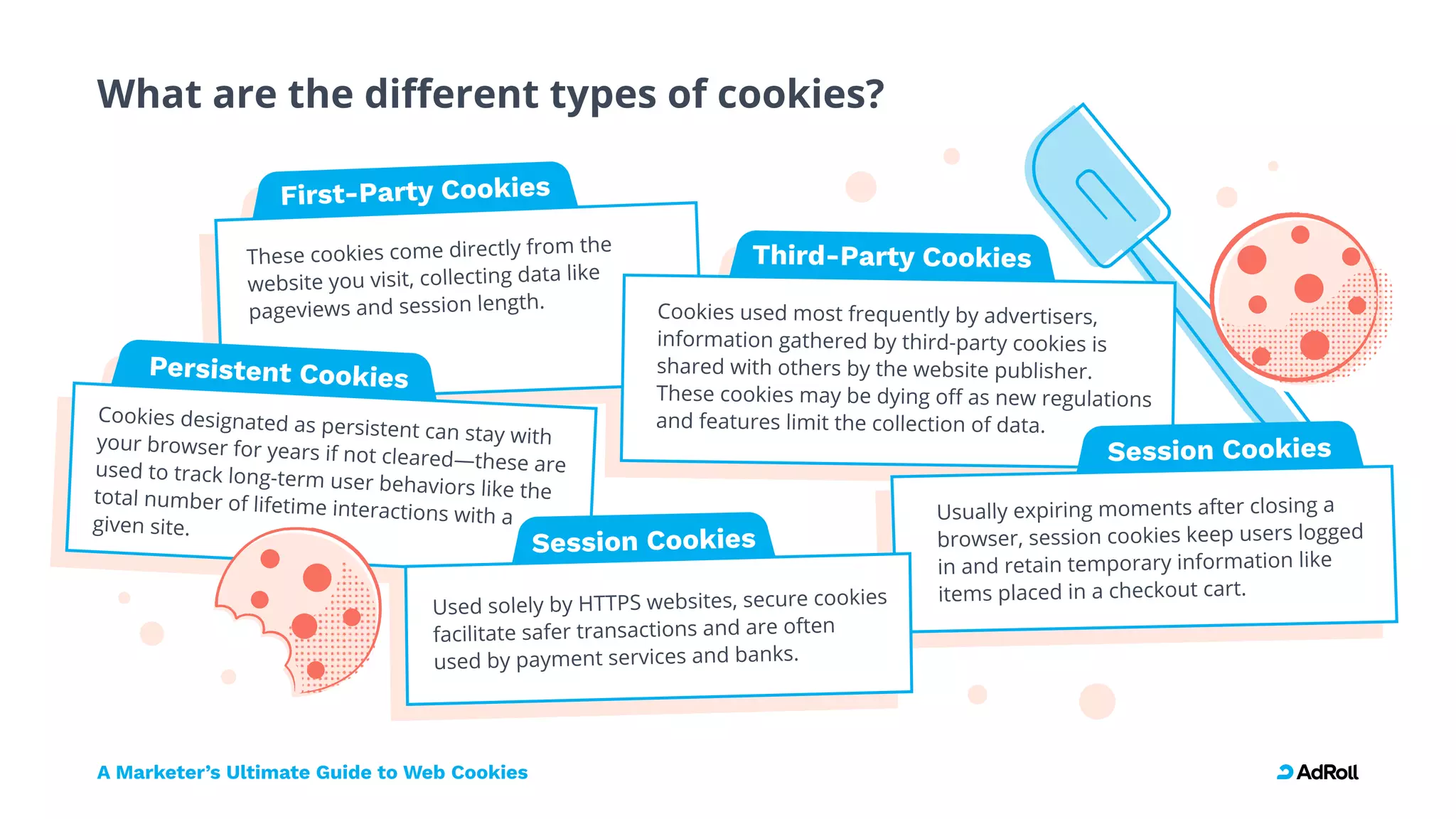
First-Party Cookies
These cookies come directly from the
website you visit, collecting data like
pageviews and session length.
Persistent Cookies
Cookies designated as persistent can stay with
your browser for years if not cleared—these are
used to track long-term user behaviors like the
total number of lifetime interactions with a 

given site.
Third-Party Cookies
Cookies used most frequently by advertisers,
information gathered by third-party cookies is
shared with others by the website publisher.
These cookies may be dying off as new regulations
and features limit the collection of data.
Session Cookies
Used solely by HTTPS websites, secure cookies

facilitate safer transactions and are often 

used by payment services and banks.
Session Cookies
Usually expiring moments after closing a

browser, session cookies keep users logged

in and retain temporary information like 

items placed in a checkout cart.
Part2:

Challengesof

Third-Party ’s
AMarketer’sUltimateGuidetoWebCookies
What are the privacy concerns 

surrounding third-party cookies?
As users grow more accustomed to personalized and cross-channel
advertising, they’re also on guard to third-party tracking and
— specifically the amount of data that companies have on
them, what they do with it, and whether or not they’ll sell it to other
advertisers.


To combat these concerns, the EU passed the General Data Protection
Regulation (GDPR) in 2016, while California passed a similar state statute,
the California Consumer Privacy Act (CCPA), in 2018.


( to all of the most important privacy terms to know!)
its effect on
digital privacy
Here’s a guide
A Marketer’s Ultimate Guide to Web Cookies
And beyond privacy concerns,

cookies have always had

technical drawbacks:
Inaccurate identification
for multiple people
Poor identification for multiple
computers/browsers
Varying web experiences 

for different browsers
A Marketer’s Ultimate Guide to Web Cookies
Google Chrome’s third-party

cookies changes:
In January of 2020, Google announced that its browser,
Google Chrome, will follow the footsteps of Safari and
Firefox and phase out support for third-party cookies.

It’s a collaborative approach to develop an advertising
solution that is healthy for users and everyone else in
its ecosystem, from ad companies to publishers to
digital brands.

When Google made its announcement last year, 

they estimated a two-year timeline. However, it later
clarified that this was not a hard deadline but rather 

a recommended timeline for companies to begin
exploring alternatives to third-party cookies.

A Marketer’s Ultimate Guide to Web Cookies
Part 3:

Digital Marketing
Without Third-Party ’s
Is this the end of digital marketing?
Contextual Targeting
Email Marketing
A Marketer’s Ultimate Guide to Web Cookies
Nope. In fact, it’s far from it. There are a whole host of digital marketing 

tools and tactics you can use to plug the hole left by third-party cookies:
Emerging channels
Ex. SMS marketing and connected TV
Retargeting will still be possible through

FLEDGE
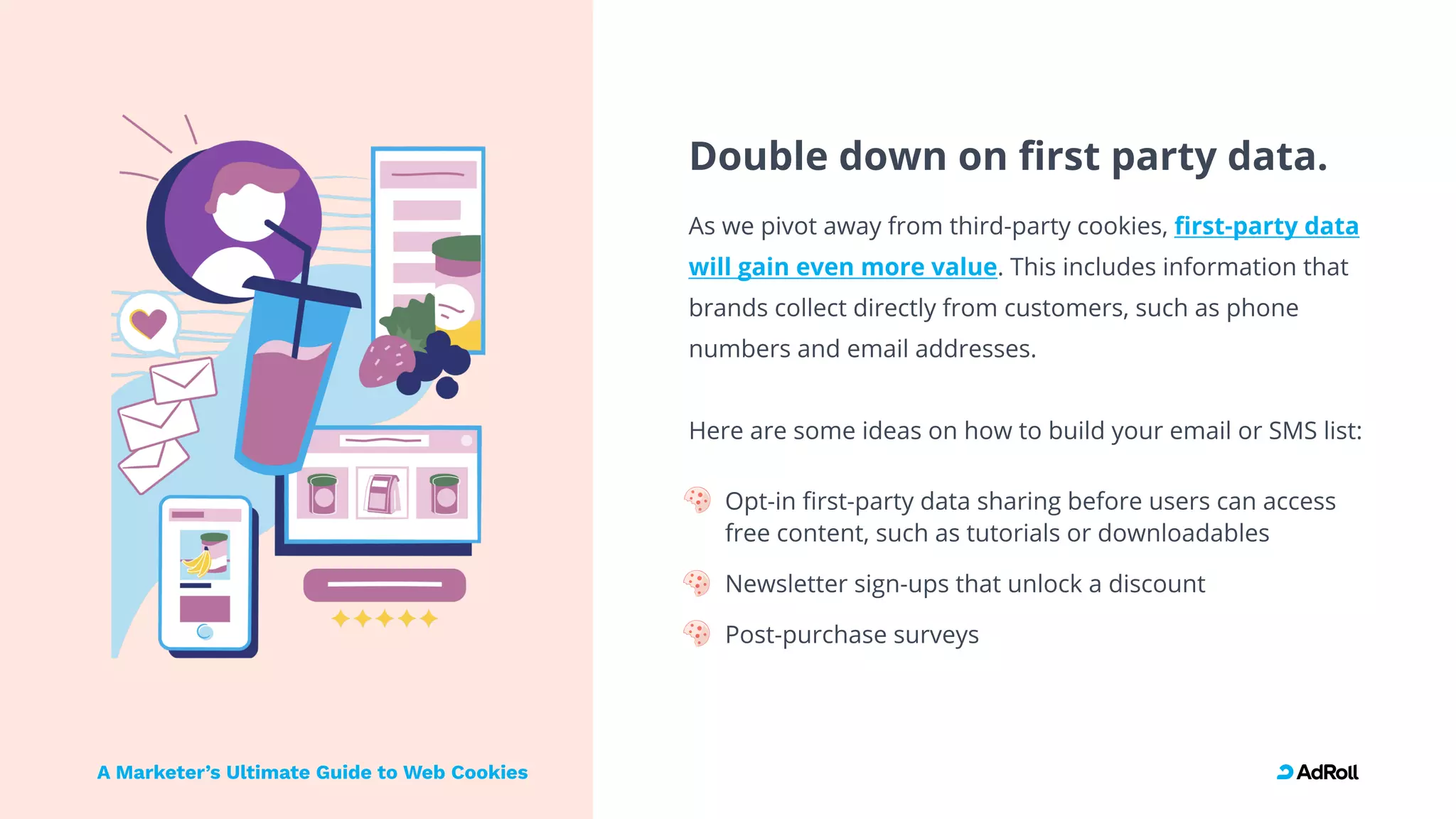
Double down on first party data.
As we pivot away from third-party cookies,
. This includes information that
brands collect directly from customers, such as phone
numbers and email addresses.


Here are some ideas on how to build your email or SMS list
Opt-in first-party data sharing before users can access
free content, such as tutorials or downloadables
Newsletter sign-ups that unlock a discount
Post-purchase surveys
first-party data
will gain even more value
A Marketer’s Ultimate Guide to Web Cookies
How can marketers prepare for the transition?
As marketing leaders, you must actively future-proof your business with concrete
actions beyond familiarizing yourself with the changes regarding third-party
cookies. Start by driving brand awareness to your site for more potential
customer profiles, and ask yourself:

How many of my marketing channels currently rely on
third-party cookies? How will my revenue be impacted
once third-party cookies are no longer supported?
Which other user identifiers can I lean on besides
third-party cookies
What are the non-third-party-cookies marketing tools and
channels that I can invest in? What is the timeline required
to begin these new efforts?
Follow us!
Subscribe to Our Newsletter:

Ecommerce Marketing Minute!
Sign up to:

Get the subscriber-exclusive Ecommerce
Marketing Cheat Code for marketing of the
month delivered directly to your inbox
Be the first to get access to resources that help
you grow your brand
Have priority registration for limited capacity
expert-led ecommerce marketing workshops,
brand exposure and personal development
opportunities, and community events
A Marketer’s Ultimate Guide to Web Cookies

A Marketer's Ultimate Guide to Web Cookies

  • 1.
  • 2.
    A Marketer’s UltimateGuide to Web Cookies Part 1: Web Cookies 1 1
  • 3.
    A Marketer’s UltimateGuide to Web Cookies First off — what are web cookies? A web cookie is a tiny piece of code added to and stored in a user’s web browser after they visit a particular website. 
 It typically stores two types of data An identifier for the unique user, which does not include identifiable information, such as a name or email address. 
 Instead, cookies delivered by websites include randomly generated IDs that are typically long strings of random letters and number Information about the user, such as what actions you took or 
 what browser you’re using
  • 4.
    A Marketer’s UltimateGuide to Web Cookies How are web cookies used in digital marketing today? Storing important data, such as the items you’ve added to your shopping cart, as you navigate a websit Session management — if you’ve ever had Google autofill your login details or autocomplete your address at checkout, those are cookies at work Streamlining the customer journey by offering personalized product rec Personalizing a website experience based on each user’s preferences Retargeting ads that remind you to finish shoppin Assessing and measuring marketing performance
  • 5.
    What are thedifferent types of cookies? A Marketer’s Ultimate Guide to Web Cookies First-Party Cookies These cookies come directly from the website you visit, collecting data like pageviews and session length. Persistent Cookies Cookies designated as persistent can stay with your browser for years if not cleared—these are used to track long-term user behaviors like the total number of lifetime interactions with a 
 given site. Third-Party Cookies Cookies used most frequently by advertisers, information gathered by third-party cookies is shared with others by the website publisher. These cookies may be dying off as new regulations and features limit the collection of data. Session Cookies Used solely by HTTPS websites, secure cookies facilitate safer transactions and are often 
 used by payment services and banks. Session Cookies Usually expiring moments after closing a browser, session cookies keep users logged in and retain temporary information like 
 items placed in a checkout cart.
  • 6.
  • 7.
    What are theprivacy concerns 
 surrounding third-party cookies? As users grow more accustomed to personalized and cross-channel advertising, they’re also on guard to third-party tracking and — specifically the amount of data that companies have on them, what they do with it, and whether or not they’ll sell it to other advertisers. To combat these concerns, the EU passed the General Data Protection Regulation (GDPR) in 2016, while California passed a similar state statute, the California Consumer Privacy Act (CCPA), in 2018. ( to all of the most important privacy terms to know!) its effect on digital privacy Here’s a guide A Marketer’s Ultimate Guide to Web Cookies
  • 8.
    And beyond privacyconcerns, cookies have always had technical drawbacks: Inaccurate identification for multiple people Poor identification for multiple computers/browsers Varying web experiences 
 for different browsers A Marketer’s Ultimate Guide to Web Cookies
  • 9.
    Google Chrome’s third-party
 cookieschanges: In January of 2020, Google announced that its browser, Google Chrome, will follow the footsteps of Safari and Firefox and phase out support for third-party cookies.
 It’s a collaborative approach to develop an advertising solution that is healthy for users and everyone else in its ecosystem, from ad companies to publishers to digital brands.
 When Google made its announcement last year, 
 they estimated a two-year timeline. However, it later clarified that this was not a hard deadline but rather 
 a recommended timeline for companies to begin exploring alternatives to third-party cookies. A Marketer’s Ultimate Guide to Web Cookies
  • 10.
    A Marketer’s UltimateGuide to Web Cookies Part 3: Digital Marketing Without Third-Party ’s
  • 11.
    Is this theend of digital marketing? Contextual Targeting Email Marketing A Marketer’s Ultimate Guide to Web Cookies Nope. In fact, it’s far from it. There are a whole host of digital marketing 
 tools and tactics you can use to plug the hole left by third-party cookies: Emerging channels Ex. SMS marketing and connected TV Retargeting will still be possible through FLEDGE
  • 12.
    Double down onfirst party data. As we pivot away from third-party cookies, . This includes information that brands collect directly from customers, such as phone numbers and email addresses. Here are some ideas on how to build your email or SMS list Opt-in first-party data sharing before users can access free content, such as tutorials or downloadables Newsletter sign-ups that unlock a discount Post-purchase surveys first-party data will gain even more value A Marketer’s Ultimate Guide to Web Cookies
  • 13.
    A Marketer’s UltimateGuide to Web Cookies How can marketers prepare for the transition? As marketing leaders, you must actively future-proof your business with concrete actions beyond familiarizing yourself with the changes regarding third-party cookies. Start by driving brand awareness to your site for more potential customer profiles, and ask yourself: How many of my marketing channels currently rely on third-party cookies? How will my revenue be impacted once third-party cookies are no longer supported? Which other user identifiers can I lean on besides third-party cookies What are the non-third-party-cookies marketing tools and channels that I can invest in? What is the timeline required to begin these new efforts?
  • 14.
    Follow us! Subscribe toOur Newsletter:
 Ecommerce Marketing Minute! Sign up to:
 Get the subscriber-exclusive Ecommerce Marketing Cheat Code for marketing of the month delivered directly to your inbox Be the first to get access to resources that help you grow your brand Have priority registration for limited capacity expert-led ecommerce marketing workshops, brand exposure and personal development opportunities, and community events A Marketer’s Ultimate Guide to Web Cookies