SHAREHOLDER PROTECTION: A GUIDE
SHAREHOLDER PROTECTION
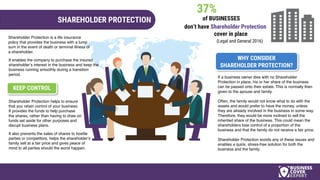
Shareholder Protection is a life insurance
policy that provides the business with a lump
sum in the event of death or terminal illness of
a shareholder.
of BUSINESSES
don’t have Shareholder Protection
cover in place
(Legal and General 2016)
37%
Shareholder Protection helps to ensure
that you retain control of your business.
It provides the funds to help purchase
the shares, rather than having to draw on
funds set aside for other purposes and
disrupt business plans.
It also prevents the sales of shares to hostile
parties or competitors, helps the shareholder’s
family sell at a fair price and gives peace of
mind to all parties should the worst happen.
KEEP CONTROL
If a business owner dies with no Shareholder
Protection in place, his or her share of the business
can be passed onto their estate. This is normally then
given to the spouse and family.
Often, the family would not know what to do with the
assets and would prefer to have the money, unless
they are already involved in the business in some way.
Therefore, they would be more inclined to sell the
inherited share of the business. This could mean the
shareholders lose control of a proportion of the
business and that the family do not receive a fair price.
Shareholder Protection avoids any of these issues and
enables a quick, stress-free solution for both the
business and the family.
It enables the company to purchase the insured
shareholder’s interest in the business and keep the
business running smoothly during a transition
period.
WHY CONSIDER
SHAREHOLDER PROTECTION?
CAN YOU AFFORD TO BUY OUT A SHAREHOLDER SHARE ?
The unexpected death of a business shareholder can be traumatic for those connected to the
business. In particular, the other shareholders and the shareholder’s family. Ideally, it would be
beneficial for that share of the business to be distributed to the other shareholders, in order for them
to keep the business running efficiently. However, this isn’t always the case.
Without Shareholder Protection, the share of the business will fall into the deceased’s estate. This is
normally then given to the individual’s spouse or family. Not only does this put the business at risk,
but it also can create more work for the family to deal with, when a simple financial solution would be
easier and more beneficial.
If a business partner dies without a plan for their share of the company, it will normally fall
into the employee’s estate, giving the family two options. They can either choose a member
of the family to take up the deceased’s position as a partner or the family can sell the
business share.
If a member of the family takes over the share of the business, there is no guarantee that
they will be able to contribute to the business and this could, in fact, be detrimental to the
running of the business.
The other alternative might see a competitor or an unwelcome partner buying the share of
the business, instead of the remaining shareholder’s retaining control. This can have
massive implications for the business.
NO PROTECTION
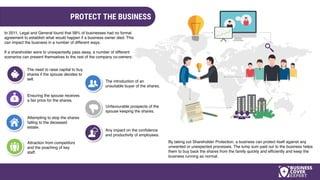
Attraction from competitors
and the poaching of key
staff.
The need to raise capital to buy
shares if the spouse decides to
sell.
Ensuring the spouse receives
a fair price for the shares.
The introduction of an
unsuitable buyer of the shares.
Attempting to stop the shares
falling to the deceased
estate.
Unfavourable prospects of the
spouse keeping the shares.
Any impact on the confidence
and productivity of employees.
PROTECT THE BUSINESS
In 2011, Legal and General found that 58% of businesses had no formal
agreement to establish what would happen if a business owner died. This
can impact the business in a number of different ways.
If a shareholder were to unexpectedly pass away, a number of different
scenarios can present themselves to the rest of the company co-owners:
By taking out Shareholder Protection, a business can protect itself against any
unwanted or unexpected processes. The lump sum paid out to the business helps
them to buy back the shares from the family quickly and efficiently and keep the
business running as normal.
BENEFITS
Instead of experiencing major changes within the
company that can disrupt the business environment,
protection can help to keep the business running as
normal and protect the current employees in a time of
uncertainty.
Shareholder Protection can be part of a safe and
stable plan for the business, making sure the
business is protected against future uncertainties.
Should the unexpected occur, the business can
continue to run as normal.
Shareholder Protection gives you the funds to buy back
any shares lost if a shareholder dies. It ensures any
funds saved for future projects within the business are
not at risk should the company need to buy back a share.
Not only can the co-owners and shareholders
have peace of mind that the business will be
protected and they will remain in control, the
employee can rest assured that they will be
protected should the worst happen.
Shareholder Protection ensures the family get a fair
price for a share in the business, which can provide
significant support when losing an income in the family.
As a Shareholder Protection Policy is put into a trust,
when it comes to making a claim and releasing the
funds, the process is quick and simple and ensures the
business continues to run smoothly.
With the option to cover an individual for critical illness, it
can be a big weight off an employee’s mind in the case
that they are diagnosed with a serious illness.
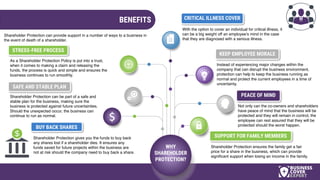
Shareholder Protection can provide support in a number of ways to a business in
the event of death of a shareholder.
WHY
SHAREHOLDER
PROTECTION?
STRESS-FREE PROCESS
CRITICAL ILLNESS COVER
SAFE AND STABLE PLAN
BUY BACK SHARES
KEEP EMPLOYEE MORALE
PEACE OF MIND
SUPPORT FOR FAMILY MEMBERS
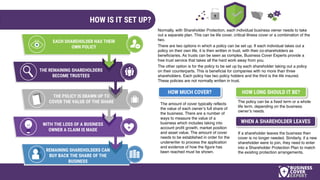
HOW IS IT SET UP?
Normally, with Shareholder Protection, each individual business owner needs to take
out a separate plan. This can be life cover, critical illness cover or a combination of the
two.
The amount of cover typically reflects
the value of each owner’s full share of
the business. There are a number of
ways to measure the value of a
business which includes taking into
account profit growth, market position
and asset value. The amount of cover
needs to be established in order for the
underwriter to process the application
and evidence of how the figure has
been reached must be shown.
EACH SHAREHOLDER HAS THEIR
OWN POLICY
THE REMAINING SHAREHOLDERS
BECOME TRUSTEES
THE POLICY IS DRAWN UP TO
COVER THE VALUE OF THE SHARE
WITH THE LOSS OF A BUSINESS
OWNER A CLAIM IS MADE
REMAINING SHAREHOLDERS CAN
BUY BACK THE SHARE OF THE
BUSINESS
HOW MUCH COVER? HOW LONG SHOULD IT BE?
The policy can be a fixed term or a whole
life term, depending on the business
owner’s needs.
WHEN A SHAREHOLDER LEAVES
If a shareholder leaves the business then
cover is no longer needed. Similarly, if a new
shareholder were to join, they need to enter
into a Shareholder Protection Plan to match
the existing protection arrangements.
There are two options in which a policy can be set up. If each individual takes out a
policy on their own life, it is then written in trust, with their co-shareholders as
beneficiaries. As trusts can be seen as complex, Business Cover Experts provide a
free trust service that takes all the hard work away from you.
The other option is for the policy to be set up by each shareholder taking out a policy
on their counterparts. This is beneficial for companies with no more than three
shareholders. Each policy has two policy holders and the third is the life insured.
These policies are not normally written in trust.
BUSINESS COVER EXPERT
Our team of specialist business advisors have in-depth
knowledge of the industry and the best products on the market.
We work with all types of businesses to make sure that we get
the right cover that suits you.
Business Cover Expert was established to provide advice and
guidance to organisations and businesses to protect themselves,
their shareholders and their managers from the financial impact of
the loss of key members of staff.
We’ll not only help you to understand what products will help to
protect your business, but also ensure that you can continue to
operate smoothly as a business should an unexpected event of
death occur. We tailor the amount and length of policy to your
exact business needs so that you can get the protection that’s
right for you.
WHAT WE DO
We offer advice on business insurance products including
Relevant Life Cover, Key Man Insurance, Shareholder Protection
and Partnership Protection so you can get the right protection for
your business. We provide a range of options that can offer full
cover should the worst happen, such as losing a critical member of
staff or shareholder.
0800 802 1793
info@businesscoverexpert.com
www.businesscoverexpert.com
GET IN TOUCH

A Guide to Shareholder Protection

  • 1.
  • 2.
    SHAREHOLDER PROTECTION Shareholder Protectionis a life insurance policy that provides the business with a lump sum in the event of death or terminal illness of a shareholder. of BUSINESSES don’t have Shareholder Protection cover in place (Legal and General 2016) 37% Shareholder Protection helps to ensure that you retain control of your business. It provides the funds to help purchase the shares, rather than having to draw on funds set aside for other purposes and disrupt business plans. It also prevents the sales of shares to hostile parties or competitors, helps the shareholder’s family sell at a fair price and gives peace of mind to all parties should the worst happen. KEEP CONTROL If a business owner dies with no Shareholder Protection in place, his or her share of the business can be passed onto their estate. This is normally then given to the spouse and family. Often, the family would not know what to do with the assets and would prefer to have the money, unless they are already involved in the business in some way. Therefore, they would be more inclined to sell the inherited share of the business. This could mean the shareholders lose control of a proportion of the business and that the family do not receive a fair price. Shareholder Protection avoids any of these issues and enables a quick, stress-free solution for both the business and the family. It enables the company to purchase the insured shareholder’s interest in the business and keep the business running smoothly during a transition period. WHY CONSIDER SHAREHOLDER PROTECTION?
  • 3.
    CAN YOU AFFORDTO BUY OUT A SHAREHOLDER SHARE ? The unexpected death of a business shareholder can be traumatic for those connected to the business. In particular, the other shareholders and the shareholder’s family. Ideally, it would be beneficial for that share of the business to be distributed to the other shareholders, in order for them to keep the business running efficiently. However, this isn’t always the case. Without Shareholder Protection, the share of the business will fall into the deceased’s estate. This is normally then given to the individual’s spouse or family. Not only does this put the business at risk, but it also can create more work for the family to deal with, when a simple financial solution would be easier and more beneficial. If a business partner dies without a plan for their share of the company, it will normally fall into the employee’s estate, giving the family two options. They can either choose a member of the family to take up the deceased’s position as a partner or the family can sell the business share. If a member of the family takes over the share of the business, there is no guarantee that they will be able to contribute to the business and this could, in fact, be detrimental to the running of the business. The other alternative might see a competitor or an unwelcome partner buying the share of the business, instead of the remaining shareholder’s retaining control. This can have massive implications for the business. NO PROTECTION
  • 4.
    Attraction from competitors andthe poaching of key staff. The need to raise capital to buy shares if the spouse decides to sell. Ensuring the spouse receives a fair price for the shares. The introduction of an unsuitable buyer of the shares. Attempting to stop the shares falling to the deceased estate. Unfavourable prospects of the spouse keeping the shares. Any impact on the confidence and productivity of employees. PROTECT THE BUSINESS In 2011, Legal and General found that 58% of businesses had no formal agreement to establish what would happen if a business owner died. This can impact the business in a number of different ways. If a shareholder were to unexpectedly pass away, a number of different scenarios can present themselves to the rest of the company co-owners: By taking out Shareholder Protection, a business can protect itself against any unwanted or unexpected processes. The lump sum paid out to the business helps them to buy back the shares from the family quickly and efficiently and keep the business running as normal.
  • 5.
    BENEFITS Instead of experiencingmajor changes within the company that can disrupt the business environment, protection can help to keep the business running as normal and protect the current employees in a time of uncertainty. Shareholder Protection can be part of a safe and stable plan for the business, making sure the business is protected against future uncertainties. Should the unexpected occur, the business can continue to run as normal. Shareholder Protection gives you the funds to buy back any shares lost if a shareholder dies. It ensures any funds saved for future projects within the business are not at risk should the company need to buy back a share. Not only can the co-owners and shareholders have peace of mind that the business will be protected and they will remain in control, the employee can rest assured that they will be protected should the worst happen. Shareholder Protection ensures the family get a fair price for a share in the business, which can provide significant support when losing an income in the family. As a Shareholder Protection Policy is put into a trust, when it comes to making a claim and releasing the funds, the process is quick and simple and ensures the business continues to run smoothly. With the option to cover an individual for critical illness, it can be a big weight off an employee’s mind in the case that they are diagnosed with a serious illness. Shareholder Protection can provide support in a number of ways to a business in the event of death of a shareholder. WHY SHAREHOLDER PROTECTION? STRESS-FREE PROCESS CRITICAL ILLNESS COVER SAFE AND STABLE PLAN BUY BACK SHARES KEEP EMPLOYEE MORALE PEACE OF MIND SUPPORT FOR FAMILY MEMBERS
  • 6.
    HOW IS ITSET UP? Normally, with Shareholder Protection, each individual business owner needs to take out a separate plan. This can be life cover, critical illness cover or a combination of the two. The amount of cover typically reflects the value of each owner’s full share of the business. There are a number of ways to measure the value of a business which includes taking into account profit growth, market position and asset value. The amount of cover needs to be established in order for the underwriter to process the application and evidence of how the figure has been reached must be shown. EACH SHAREHOLDER HAS THEIR OWN POLICY THE REMAINING SHAREHOLDERS BECOME TRUSTEES THE POLICY IS DRAWN UP TO COVER THE VALUE OF THE SHARE WITH THE LOSS OF A BUSINESS OWNER A CLAIM IS MADE REMAINING SHAREHOLDERS CAN BUY BACK THE SHARE OF THE BUSINESS HOW MUCH COVER? HOW LONG SHOULD IT BE? The policy can be a fixed term or a whole life term, depending on the business owner’s needs. WHEN A SHAREHOLDER LEAVES If a shareholder leaves the business then cover is no longer needed. Similarly, if a new shareholder were to join, they need to enter into a Shareholder Protection Plan to match the existing protection arrangements. There are two options in which a policy can be set up. If each individual takes out a policy on their own life, it is then written in trust, with their co-shareholders as beneficiaries. As trusts can be seen as complex, Business Cover Experts provide a free trust service that takes all the hard work away from you. The other option is for the policy to be set up by each shareholder taking out a policy on their counterparts. This is beneficial for companies with no more than three shareholders. Each policy has two policy holders and the third is the life insured. These policies are not normally written in trust.
  • 7.
    BUSINESS COVER EXPERT Ourteam of specialist business advisors have in-depth knowledge of the industry and the best products on the market. We work with all types of businesses to make sure that we get the right cover that suits you. Business Cover Expert was established to provide advice and guidance to organisations and businesses to protect themselves, their shareholders and their managers from the financial impact of the loss of key members of staff. We’ll not only help you to understand what products will help to protect your business, but also ensure that you can continue to operate smoothly as a business should an unexpected event of death occur. We tailor the amount and length of policy to your exact business needs so that you can get the protection that’s right for you. WHAT WE DO We offer advice on business insurance products including Relevant Life Cover, Key Man Insurance, Shareholder Protection and Partnership Protection so you can get the right protection for your business. We provide a range of options that can offer full cover should the worst happen, such as losing a critical member of staff or shareholder. 0800 802 1793 info@businesscoverexpert.com www.businesscoverexpert.com GET IN TOUCH