A Functional Approach to Java: Augmenting
Object-Oriented Java Code with Functional
Principles 1st Edition Ben Weidig download
https://textbookfull.com/product/a-functional-approach-to-java-
augmenting-object-oriented-java-code-with-functional-
principles-1st-edition-ben-weidig/
Download more ebook from https://textbookfull.com
We believe these products will be a great fit for you. Click
the link to download now, or visit textbookfull.com
to discover even more!
Object Oriented Data Structures Using Java 4th Edition
Dale
https://textbookfull.com/product/object-oriented-data-structures-
using-java-4th-edition-dale/
Learning Java Functional Programming 1st Edition Reese
Richard M
https://textbookfull.com/product/learning-java-functional-
programming-1st-edition-reese-richard-m/
Functional Python Programming: Use a functional
approach to write succinct, expressive, and efficient
Python code, 3rd Edition Lott
https://textbookfull.com/product/functional-python-programming-
use-a-functional-approach-to-write-succinct-expressive-and-
efficient-python-code-3rd-edition-lott/
Functional Interfaces in Java: Fundamentals and
Examples 1st Edition Ralph Lecessi [Lecessi
https://textbookfull.com/product/functional-interfaces-in-java-
fundamentals-and-examples-1st-edition-ralph-lecessi-lecessi/
Neurobiology: a functional approach Striedter
https://textbookfull.com/product/neurobiology-a-functional-
approach-striedter/
A Beginner’s Guide to Scala, Object Orientation and
Functional Programming John Hunt
https://textbookfull.com/product/a-beginners-guide-to-scala-
object-orientation-and-functional-programming-john-hunt/
Object-Oriented Design with ABAP: A Practical Approach
1st Edition James E. Mcdonough (Auth.)
https://textbookfull.com/product/object-oriented-design-with-
abap-a-practical-approach-1st-edition-james-e-mcdonough-auth/
Modern Java in Action Lambdas streams functional and
reactive programming Raoul-Gabriel Urma
https://textbookfull.com/product/modern-java-in-action-lambdas-
streams-functional-and-reactive-programming-raoul-gabriel-urma/
A Beginner's Guide to Scala, Object Orientation and
Functional Programming (Second Edition) John Hunt
https://textbookfull.com/product/a-beginners-guide-to-scala-
object-orientation-and-functional-programming-second-edition-
john-hunt/
Ben Weidig
AFunctional
Approach to
Java
Augmenting Object-Oriented Java Code
with Functional Principles
JAVA
A Functional Approach to Java
Twitter: @oreillymedia
linkedin.com/company/oreilly-media
youtube.com/oreillymedia
Java developers usually tackle the complexity of software
development through object-oriented programming (OOP).
But not every problem is a good match for OOP. The functional
programming (FP) paradigm offers you another approach to
solving problems, and Java provides easy-to-grasp FP tools
such as lambda expressions and Streams. If you’re interested in
applying FP concepts to your Java code, this book is for you.
Author Ben Weidig highlights different aspects of functional
programming and shows you how to incorporate them into your
code without going “fully functional.” You’ll learn how, when,
and why to use FP concepts such as immutability and pure
functions to write more concise, reasonable, and future-proof
code. Many developers seek to expand their horizons by
using OOP and FP together. It’s no longer either-or; it’s both.
In this book, you will:
• Get a high-level overview of functional programming,
including the types already available to Java developers
• Explore different FP concepts and learn how to use them
• Learn how to augment your code and use Java’s new
functional features in your daily work without going
fully functional
• Develop a functional mindset and improve your
programming skills regardless of language or paradigm
US $74.99 CAN $93.99
ISBN: 978-1-098-10992-9
“The functional paradigm
is a significant change
in Java programming,
but it doesn’t mean
abandoning OOP
completely. A Functional
Approach to Java is
a must-read for any
programmer looking
to improve their skills
and stay current in
programming.
—A N M Bazlur Rahman
SoftwareEngineer,JavaChampion,
Author,JUGLeader
Ben Weidig runs a Java-based SaaS
company. He has almost two decades
of experience in professional web,
mobile, and systems programming in
various languages. Ben is also an active
open source contributor.
Ben Weidig
A Functional Approach to Java
Augmenting Object-Oriented Code with
Functional Principles
Boston Farnham Sebastopol Tokyo
Beijing Boston Farnham Sebastopol Tokyo
Beijing
978-1-098-10992-9
[LSI]
A Functional Approach to Java
by Ben Weidig
Copyright © 2023 Benjamin Weidig. All rights reserved.
Printed in the United States of America.
Published by O’Reilly Media, Inc., 1005 Gravenstein Highway North, Sebastopol, CA 95472.
O’Reilly books may be purchased for educational, business, or sales promotional use. Online editions are
also available for most titles (http://oreilly.com). For more information, contact our corporate/institutional
sales department: 800-998-9938 or corporate@oreilly.com.
Acquisitions Editor: Brian Guerin
Development Editor: Rita Fernando
Production Editor: Ashley Stussy
Copyeditor: Liz Wheeler
Proofreader: Piper Editorial Consulting, LLC
Indexer: WordCo Indexing Services, Inc.
Interior Designer: David Futato
Cover Designer: Karen Montgomery
Illustrator: Kate Dullea
May 2023: First Edition
Revision History for the First Edition
2023-05-09: First Release
2024-02-02: Second Release
See http://oreilly.com/catalog/errata.csp?isbn=9781098109929 for release details.
The O’Reilly logo is a registered trademark of O’Reilly Media, Inc. A Functional Approach to Java, the
cover image, and related trade dress are trademarks of O’Reilly Media, Inc.
The views expressed in this work are those of the author, and do not represent the publisher’s views.
While the publisher and the author have used good faith efforts to ensure that the information and
instructions contained in this work are accurate, the publisher and the author disclaim all responsibility
for errors or omissions, including without limitation responsibility for damages resulting from the use
of or reliance on this work. Use of the information and instructions contained in this work is at your
own risk. If any code samples or other technology this work contains or describes is subject to open
source licenses or the intellectual property rights of others, it is your responsibility to ensure that your use
thereof complies with such licenses and/or rights.
Table of Contents
Preface. . . . . . . . . . . . . . . . . . . . . . . . . . . . . . . . . . . . . . . . . . . . . . . . . . . . . . . . . . . . . . . . . . . . . . . xi
Part I. Functional Basics
1. An Introduction to Functional Programming. . . . . . . . . . . . . . . . . . . . . . . . . . . . . . . . . . . 3
What Makes a Language Functional? 3
Functional Programming Concepts 6
Pure Functions and Referential Transparency 6
Immutability 7
Recursion 8
First-Class and Higher-Order Functions 8
Functional Composition 9
Currying 9
Partial Function Application 10
Lazy Evaluation 11
Advantages of Functional Programming 12
Disadvantages of Functional Programming 12
Takeaways 14
2. Functional Java. . . . . . . . . . . . . . . . . . . . . . . . . . . . . . . . . . . . . . . . . . . . . . . . . . . . . . . . . . . 15
What Are Java Lambdas? 15
Lambda Syntax 15
Functional Interfaces 17
Lambdas and Outside Variables 19
What about Anonymous Classes? 23
iii
Lambdas in Action 26
Creating Lambdas 26
Calling Lambdas 28
Method References 28
Functional Programming Concepts in Java 32
Pure Functions and Referential Transparency 32
Immutability 35
First-Class Citizenship 36
Functional Composition 36
Lazy Evaluation 37
Takeaways 38
3. Functional Interfaces of the JDK. . . . . . . . . . . . . . . . . . . . . . . . . . . . . . . . . . . . . . . . . . . . . 39
The Big Four Functional Interface Categories 39
Functions 40
Consumers 40
Suppliers 41
Predicates 41
Why So Many Functional Interface Variants? 42
Function Arity 42
Primitive Types 44
Bridging Functional Interfaces 46
Functional Composition 47
Extending Functional Support 49
Adding Default Methods 49
Implementing Functional Interfaces Explicitly 51
Creating Static Helpers 52
Takeaways 56
Part II. A Functional Approach
4. Immutability. . . . . . . . . . . . . . . . . . . . . . . . . . . . . . . . . . . . . . . . . . . . . . . . . . . . . . . . . . . . . 59
Mutability and Data Structures in OOP 59
Immutability (Not Only) in FP 61
The State of Java Immutability 63
java.lang.String 63
Immutable Collections 65
Primitives and Primitive Wrappers 69
Immutable Math 69
iv | Table of Contents
Java Time API (JSR-310) 70
Enums 71
The final Keyword 71
Records 72
How to Achieve Immutability 73
Common Practices 74
Takeaways 75
5. Working with Records. . . . . . . . . . . . . . . . . . . . . . . . . . . . . . . . . . . . . . . . . . . . . . . . . . . . . . 77
Data Aggregation Types 77
Tuples 77
A Simple POJO 78
From POJO to Immutability 80
From POJO to Record 82
Records to the Rescue 82
Behind the Scenes 83
Record Features 84
Missing Features 88
Use Cases and Common Practices 96
Record Validation and Data Scrubbing 96
Increasing Immutability 97
Creating Modified Copies 98
Records as Local Nominal Tuples 101
Better Optional Data Handling 104
Serializing Evolving Records 106
Record Pattern Matching 109
Sealed Types as Components 110
Final Thoughts on Records 114
Takeaways 115
6. Data Processing with Streams. . . . . . . . . . . . . . . . . . . . . . . . . . . . . . . . . . . . . . . . . . . . . . 117
Data Processing with Iteration 117
External Iteration 118
Internal Iteration 120
Streams as Functional Data Pipelines 121
Stream Features 125
Spliterator, the Backbone of Streams 129
Building Stream Pipelines 131
Creating a Stream 132
Doing the Work 133
Terminating the Stream 141
Table of Contents | v
The Cost of Operations 155
Modifying Stream Behavior 158
To Use a Stream, or Not? 159
Takeaways 161
7. Working with Streams. . . . . . . . . . . . . . . . . . . . . . . . . . . . . . . . . . . . . . . . . . . . . . . . . . . . 163
Primitive Streams 163
Iterative Streams 165
Infinite Streams 167
Random Numbers 168
Memory Isn’t Infinite 169
From Arrays to Streams and Back 170
Object-Type Arrays 171
Primitive Arrays 171
Low-Level Stream Creation 172
Working with File I/O 173
Reading Directory Contents 174
Depth-First Directory Traversal 174
Searching the Filesystem 176
Reading Files Line-By-Line 177
Caveats of File I/O Streams 179
Dealing with Date and Time 180
Querying Temporal Types 180
LocalDate-Range Streams 181
Measuring Stream Performance with JMH 181
More about Collectors 182
Downstream Collectors 183
Creating Your Own Collector 192
Customizing Intermediate Operations (Java 22+) 194
Custom Distinct Operation without Gatherer 195
Creating a Custom Distinct Gatherer 196
Final Thoughts on (Sequential) Streams 198
Takeaways 199
8. Parallel Data Processing with Streams. . . . . . . . . . . . . . . . . . . . . . . . . . . . . . . . . . . . . . . 201
Concurrency versus Parallelism 201
Streams as Parallel Functional Pipelines 203
Parallel Streams in Action 205
When to Use and When to Avoid Parallel Streams 208
Choosing the Right Data Source 208
Number of Elements 210
vi | Table of Contents
Stream Operations 210
Stream Overhead and Available Resources 214
Example: War and Peace (revisited) 215
Example: Random Numbers 216
Parallel Streams Checklist 219
Takeaways 220
9. Handling null with Optionals. . . . . . . . . . . . . . . . . . . . . . . . . . . . . . . . . . . . . . . . . . . . . . 221
The Problem with null References 221
How to Handle null in Java (Before Optionals) 224
Best Practices for Handling null 225
Tool-Assisted null Checks 227
Specialized Types Like Optional 228
Optionals to the Rescue 228
What’s an Optional? 229
Building Optional Pipelines 232
Optionals and Streams 239
Optionals as Stream Elements 240
Terminal Stream Operations 241
Optional Primitives 243
Caveats 244
Optionals Are Ordinary Types 245
Identity-Sensitive Methods 245
Performance Overhead 246
Special Considerations for Collections 247
Optionals and Serialization 247
Final Thoughts on null References 248
Takeaways 249
10. Functional Exception Handling. . . . . . . . . . . . . . . . . . . . . . . . . . . . . . . . . . . . . . . . . . . . . 251
Java Exception Handling in a Nutshell 251
The try-catch block 252
The Different Types of Exceptions and Errors 252
Checked Exceptions in Lambdas 255
Safe Method Extraction 256
Un-Checking Exceptions 258
Sneaky Throws 259
A Functional Approach to Exceptions 261
Not Throwing Exceptions 261
Errors as Values 262
The Try/Success/Failure Pattern 267
Table of Contents | vii
Final Thoughts on Functional Exception Handling 274
Takeaways 275
11. Lazy Evaluation. . . . . . . . . . . . . . . . . . . . . . . . . . . . . . . . . . . . . . . . . . . . . . . . . . . . . . . . . . 277
Laziness Versus Strictness 277
How Strict Is Java? 279
Short-Circuit Evaluation 279
Control Structures 280
Lazy Types in the JDK 281
Lambdas and Higher-Order Functions 283
An Eager Approach 283
A Lazier Approach 284
A Functional Approach 284
Delayed Executions with Thunks 286
Creating a Simple Thunk 286
A Thread-Safe Thunk 288
Final Thoughts on Laziness 291
Takeaways 292
12. Recursion. . . . . . . . . . . . . . . . . . . . . . . . . . . . . . . . . . . . . . . . . . . . . . . . . . . . . . . . . . . . . . . 293
What Is Recursion? 293
Head Versus Tail Recursion 295
Recursion and the Call Stack 296
A More Complex Example 297
Iterative Tree Traversal 299
Recursive Tree Traversal 300
Recursion-Like Streams 302
Final Thoughts on Recursion 302
Takeaways 304
13. Asynchronous Tasks. . . . . . . . . . . . . . . . . . . . . . . . . . . . . . . . . . . . . . . . . . . . . . . . . . . . . . 305
Synchronous versus Asynchronous 305
Java Futures 306
Designing Asynchronous Pipelines with CompletableFutures 308
Promising a Value 309
Creating a CompletableFuture 309
Compositing and Combining Tasks 310
Exception Handling 314
Terminal Operations 316
Creating a CompletableFuture Helper 317
Manual Creation and Completion 322
viii | Table of Contents
Manual Creation 323
Manual Completion 323
Use Cases for Manually Created and Completed Instances 324
About Thread Pools and Timeouts 328
Final Thoughts on Asynchronous Tasks 329
Takeaways 330
14. Functional Design Patterns. . . . . . . . . . . . . . . . . . . . . . . . . . . . . . . . . . . . . . . . . . . . . . . . 333
What Are Design Patterns? 333
(Functional) Design Patterns 334
Factory Pattern 334
Decorator Pattern 337
Strategy Pattern 343
Builder Pattern 345
Final Thoughts on Functional Design Patterns 350
Takeaways 351
15. A Functional Approach to Java. . . . . . . . . . . . . . . . . . . . . . . . . . . . . . . . . . . . . . . . . . . . . 353
OOP Versus FP Principles 353
A Functional Mindset 354
Functions Are First-Class Citizens 355
Avoiding Side Effects 356
Functional Data Processing with Map/Filter/Reduce 363
Abstractions Guide Implementations 364
Building Functional Bridges 365
Parallelism and Concurrency Made Easy 370
Be Mindful of Potential Overhead 371
Functional Architecture in an Imperative World 372
From Objects to Values 374
Separation of Concerns 374
The Different Sizes of an FC/IS 376
Testing an FC/IS 377
Final Thoughts on a Functional Approach to Java 378
Takeaways 380
Index. . . . . . . . . . . . . . . . . . . . . . . . . . . . . . . . . . . . . . . . . . . . . . . . . . . . . . . . . . . . . . . . . . . . . . . 381
Table of Contents | ix
1 Originally specified in 1958, Lisp is the second-oldest high-level programming language still in common use.
It also builds the foundation of a variety of programming languages, like Emacs Lisp, or the functional JVM
language Clojure.
Preface
A mind that is stretched by a new experience can never go back to its old dimensions.
—Oliver Wendell Holmes, Jr.
Developing software is quite a complex endeavor. As Java developers, we usually try
to tame this complexity with object-oriented programming (OOP) as a metaphor to
represent the things we are developing, such as data structures, and use a primarily
imperative-focused coding style to handle our program’s state. Although OOP is a
well-known and battle-tested approach to developing sensible software, not every
problem is a good match for it. We might introduce a certain amount of unnecessary
complexity by forcing OOP principles on every problem instead of using more
appropriate tools and paradigms also available to us. The functional programming
(FP) paradigm offers an alternative approach to solving problems.
Functional programming isn’t a new idea. In fact, it’s even older than object-oriented
programming! It first appeared in the early years of computing, in the 1950s, in
the Lisp1
programming language and has been used quite commonly in academia
and niche fields. In recent years, however, there has been an increasing interest in
functional paradigms.
Many new functional languages have emerged, and non-functional languages are
including functional features to various degrees. The ideas and concepts behind FP
are now adopted in almost every mainstream multiparadigm and general-purpose
language, allowing us to use some form of functional programming regardless of the
context and chosen language. Nothing stops us from taking the best parts of FP and
xi
2 Moore’s law was coined in 1965 by the cofounder of Intel, Gordon Moore, as the observation of transistor
counts doubling every two years and, therefore, the performance per core available to us. Chris Edwards,
“Moore’s Law: What Comes Next?” Communications of the ACM, Vol. 64, No. 2 (Feb. 2021): 12-14.
3 N. C. Thompson and Svenja Spanuth, “The Decline of Computers as a General-Purpose Technology,” Com‐
munications of the ACM, Vol. 64, No. 3 (Mar. 2021): 64-72.
augmenting our existing way of programming and software development tools—and
that’s what this book is about!
In this book, you’ll learn the fundamentals of functional programming and how to
apply this knowledge to your daily work using Java.
New Hardware Needs a New Way of Thinking
Hardware is evolving in a new direction. For quite some time, single-core perfor‐
mance improvements haven’t been as significant as with each previous processor
generation. Moore’s law2
seems to slow down, but such a slowdown doesn’t mean that
hardware isn’t improving anymore. But instead of primarily focussing on single-core
performance and even higher GHz numbers, the manufacturers favor more and
more cores.3
So, for modern workloads to reap all the benefits of new hardware that
favors more cores rather than faster ones, we need to adopt techniques that can use
more cores to their advantage without compromising productivity or introducing
additional complexity.
Scaling your software horizontally through parallelism isn’t an easy task in OOP. Not
every problem is a good fit for parallelism. More painters might paint a room faster,
but you can’t speed up pregnancy by involving more people. If the problem consists
of serial or interdependent tasks, concurrency is preferable to parallelism. But paral‐
lelism really shines if a problem breaks down into smaller, non-related subproblems.
That’s where functional programming comes in. The stateless and immutable nature
of idiomatic FP provides all the tools necessary to build small, reliable, reusable, and
higher-quality tasks that elegantly fit into parallel and concurrent environments.
Adopting a functional mindset adds another set of tools to your toolbelt that will
allow you to tackle your daily development problems in a new way and scale your
code more easily and safely than before.
Next, let’s look at why Java can be a good choice for functional programming.
Java Can Be Functional, Too
Many programming languages out there are great for functional programming.
Haskell is a favorite if you prefer a pure functional language with almost no support
for an imperative coding style. Elixir is another exciting option that leverages the
xii | Preface
4 Erlang is a functional and concurrency-oriented programming language that is known for building low-
latency, distributed, and fault-tolerant systems.
5 Dean Wampler shows in his book Functional Programming for Java Developers (O’Reilly) in detail how to
implement and facilitate the missing functional programming features in Java all by yourself. He describes
many techniques that weren’t easily feasible before version 8. But now, many of the shortcomings and gaps
in the JDK are closed up, and it provides many of the tools necessary to incorporate FP concisely and more
straightforwardly.
6 Oracle introduced a faster release schedule for Java with the release of versions beyond 9 with a fixed release
cadence of six months. To meet such a tight schedule, not every release is considered “long-term-support,” in
favor of releasing features faster than before.
Erlang Virtual Machine.4
However, you don’t have to leave the vast JVM ecosystem
behind to find FP-capable languages. Scala shines in combining OOP and FP para‐
digms into a concise, high-level language. Another popular choice, Clojure, was
designed from the ground up as a functional language with a dynamic type system at
heart.
In a perfect world, you’d have the luxury of choosing the perfect functional language
for your next project. In reality, you might not have a choice at all about what
language to use, and you’ll have to play the cards you’re dealt.
As a Java developer, you’d use Java, which was historically seen as not ideal for
functional programming. Before we continue, though, I need to stress that you
can implement most functional principles in Java, regardless of deeply integrated
language-level support5
. Still, the resulting code won’t be as concise and easy to rea‐
son with as it would in other languages that allow a functional approach in the first
place. This caveat scares many developers away from even trying to apply functional
principles to Java, despite the fact that it might have provided a more productive
approach or better overall solution.
In the past, many people thought of Java as a slow-moving behemoth, a “too big
to become extinct” enterprise language, like a more modern version of COBOL or
Fortran. And in my opinion that’s partially true, or at least it was in the past. The
pace didn’t pick up until Java 9 and the shortened release timeframes6
. It took Java five
years to go from version 6 to 7 (2006-2011). And even though there were significant
new features, like try-with-resources, none of them were “groundbreaking.” The
few and slow changes in the past led to projects and developers not adopting the
“latest and greatest” Java Development Kit (JDK) and missing out on many language
improvements. Three years later, in 2014, the next version, Java 8, was released.
This time, it introduced one of the most significant changes to Java’s future: lambda
expressions.
A better foundation for functional programming had finally arrived in arguably the
most prominent object-oriented programming language of the world, changing the
language and its idioms significantly:
Preface | xiii
Runnable runnable = () -> System.out.println("hello, functional world!");
The addition of lambda expressions was monumental in making it possible to finally
use functional programming in Java as an integrated language and runtime feature.
Not only that, but a whole new world of ideas and concepts was made available to
Java developers. Many of the JDK’s new features, like Streams, the Optional type,
or CompletableFuture, are only possible in such a concise and straightforward way
thanks to language-level lambda expressions and Java’s other functional additions.
These new idioms and new ways of doing things with FP in Java may seem strange
and might not come naturally, especially if you’re primarily accustomed to OOP.
Throughout this book, I’ll show you how to develop a mindset that’ll help you apply
FP principles to your code and how to make it better without needing to go “fully
functional.”
Why I Wrote This Book
After using another multipurpose language with excellent functional programming
support—Swift—and seeing the benefits firsthand, I gradually introduced more and
more functional principles in my Java-based projects, too. Thanks to lambda expres‐
sions and all the other features introduced in Java 8 and later, all the tools necessary
were readily available. But after using these tools more frequently and discussing
them with my colleagues, I realized something: How to use lambdas, Streams, and all
the other functional goodies provided by Java is easy to grasp. But without a deeper
understanding of why and when you should use them—and when not to—you won’t
unlock their full potential, and it will just be “new wine in old wineskins.”
So I decided to write this book to highlight the different concepts that make a lan‐
guage functional, and how you can incorporate them into your Java code, either with
the tools provided by the JDK or by creating them yourself. A functional approach to
your Java code will most likely challenge the status quo and go against best practices
you were using before. But by embracing a more functional way of doing things,
like immutability and pure functions, you will be able to write more concise, more
reasonable, and future-proof code that is less prone to bugs.
Who Should Read This Book
This book is for you if you are curious about functional programming and want to
know what all the fuss is about and apply it to your Java code. You might already be
using some functional Java types but desire a more profound knowledge of why and
how to apply them more effectively.
There is no need to be an expert on OOP, but the book is not a beginner’s guide to
Java or OOP. You should already be familiar with the Java standard library. No prior
xiv | Preface
knowledge of functional programming is required. Every concept is introduced with
an explanation and examples.
The book covers Java 17 as the latest Long-Term-Support (LTS) version available
at publication. Knowing that many developers need to support projects with earlier
versions, the general baseline will be the previous LTS, Java 11. But even if you’re
stuck on Java 8, many of the discussed topics are relevant. However, some chapters
will rely on newer features, like Records, which were introduced in Java 14.
This book might not be for you if you are looking for a compartmentalized, recipe-
style book presenting “ready-to-implement” solutions. Its main intention is to intro‐
duce functional concepts and idioms and teach you how to incorporate them into
your Java code.
What You Will Learn
By the end of this book, you will have a fundamental knowledge of functional
programming and its underlying concepts and how to apply this knowledge to your
daily work. Every Java functional type will be at your disposal, and you will be able to
build anything missing from the JDK by yourself, if necessary.
You will learn about the concepts and importance of the following aspects of func‐
tional programming:
Composition
Build modular and easy composable blocks.
Expressiveness
Write more concise code that clearly expresses its intent.
Safer code
Create safer data structures without side effects that don’t need to deal with race
conditions or locks, which are hard to use without introducing bugs.
Modularity
Break down larger projects into more easily manageable modules.
Maintainability
Use smaller functional blocks with less interconnection to make changes and
refactoring safer without breaking other parts of your code.
Data manipulation
Build efficient data manipulation pipelines with less complexity.
Performance
Immutability and predictability allow you to scale horizontally with parallelism
without much thought about it.
Preface | xv
7 The Android Open Source Project provides a good overview of the features and the reasoning behind
Android’s runtime.
Even without going fully functional, your code will benefit from the concepts and
idioms presented in this book. And not only your Java code. You will tackle develop‐
ment challenges with a functional mindset, improving your programming regardless
of the used language or paradigm.
What about Android?
It’s hard to talk about Java without bringing up Android as well. Even though you
can write Android applications in Java, the underlying API and runtime aren’t the
same. So what does this mean for adopting a functional approach to Java for Android
apps? To better understand that, we first need to look at what makes Java for Android
different from “normal” Java.
Android doesn’t run Java bytecode directly on a minimalistic JVM optimized for
smaller devices, like Java Platform Micro Edition. Instead, the bytecode gets recom‐
piled. The Dex-compiler creates Dalvik bytecode, which is then run on a specialized
runtime: the Android Runtime (ART) and previously on the Dalvik virtual machine.7
Recompiling Java bytecode to Dalvik bytecode allows the devices to run highly
optimized code, getting the most out of their hardware constraints. For you as a
developer, however, that means that even though your code looks and feels like
Java on the surface—most of the public API is identical—there isn’t a feature parity
between the JDK and Android SDK you can rely on. For example, the cornerstones
of this book—lambda expressions and Streams—were among the missing features in
Android for a long time.
The Android Gradle plugin started supporting some of the missing functional fea‐
tures (lambda expressions, method references, default and static interface methods)
with version 3.0.0 by using so-called desugaring: the compiler uses bytecode transfor‐
mations to replicate a feature behind the scenes without supporting the new syntax or
providing an implementation in the runtime itself.
The next major version, 4.0.0, added even more functional features: Streams, Option‐
als, and the java.util.function package. That allows you to benefit from the func‐
tional paradigms and tools discussed in this book, even as an Android developer.
Even though most of the JDK’s functional features are available
on Android, too, they are not verbatim copies8
and might have
different performance characteristics and edge cases. The available
features are listed in the official documentation on the Java 8+
support.
xvi | Preface
8 Jake Wharton, a well-known Android developer, provides a detailed insight on how Android desugars
modern Java code.
9 See the official Kotlin documentation for an overview of supported platforms.
10 Each lambda compiles to an anonymous class extending kotlin.jvm.internal.FunctionImpl, as explained
in the function type specs.
A Functional Approach to Android
In 2019, Kotlin took the mantle of preferred language for Android developers from
Java. It’s a multiplatform language that mainly targets the JVM but also compiles
to JavaScript and multiple native platforms.9
It aims to be a “modern and more
concise” Java, fixing many of Java’s debatable shortcomings and cruft accumulated
over the years due to backward compatibility, without forgoing all the frameworks
and libraries available to Java. And it’s 100% interoperable: you can easily mix Java
and Kotlin in the same project.
One obvious advantage of Kotlin over Java is that many functional concepts and
idioms are integral to the language itself. Still, as a different language, Kotlin has its
own idioms and best practices that differ from Java’s. The generated bytecode might
differ, too, like that used to generate lambdas.10
The most significant advantage of
Kotlin is its attempt to create a more concise and predictable language compared to
Java. And just like you can be more functional in Java without going fully functional,
you can use Kotlin-only features without going full Kotlin in your Android projects,
too. By mixing Java and Kotlin, you can pick the best features from both languages.
Keep in mind that this book’s primary focus is the Java language and the JDK. Still,
most of the ideas behind what you will learn are transferrable to Android, even if you
use Kotlin. However, there won’t be any special considerations for Android or Kotlin
throughout the book.
Navigating This Book
This book consists of two different parts:
• Part I, Functional Basics, introduces the history and core concepts of functional
•
programming, how Java implements these concepts, and what types are already
available to us as developers.
• Part II, A Functional Approach, is a topic-based deep dive through the more
•
generalized programming concepts and how to augment them with functional
principles and the newly available tools. Certain features, like Records and
Streams, are highlighted with extended examples and use cases.
Preface | xvii
Reading the chapters in their respective order will let you get the most out of them
because they usually build on each other. But feel free to skim for the bits that might
interest you and jump around. Any necessary connections are cross-referenced to fill
in any blanks if needed.
Conventions Used in This Book
The following typographical conventions are used in this book:
Italic
Indicates new terms, URLs, email addresses, filenames, and file extensions.
Constant width
Used for program listings, as well as within paragraphs, to refer to program
elements such as variable or function names, databases, data types, environment
variables, statements, and keywords.
Constant width bold
Shows commands or other text that should be typed literally by the user.
Constant width italic
Shows text that should be replaced with user-supplied values or by values deter‐
mined by context.
This element signifies a tip or suggestion.
This element signifies a general note.
This element indicates a warning or caution.
xviii | Preface
Using Code Examples
The source code for the book is available on GitHub: https://github.com/benweidig/a-
functional-approach-to-java. Besides compilable Java code, there are also JShell scripts
available to run the code more easily.
If you have a technical question or a problem using the code examples, please send an
email to support@oreilly.com.
This book is here to help you get your job done. In general, if example code is
offered with this book, you may use it in your programs and documentation. You
do not need to contact us for permission unless you’re reproducing a significant
portion of the code. For example, writing a program that uses several chunks of code
from this book does not require permission. Selling or distributing examples from
O’Reilly books does require permission. Answering a question by citing this book
and quoting example code does not require permission. Incorporating a significant
amount of example code from this book into your product’s documentation does
require permission.
We appreciate, but generally do not require, attribution. An attribution usu‐
ally includes the title, author, publisher, and ISBN. For example: “A Functional
Approach to Java by Ben Weidig (O’Reilly). Copyright 2023 Benjamin Weidig,
978-1-098-10992-9.”
If you feel your use of code examples falls outside fair use or the permission given
above, feel free to contact us at permissions@oreilly.com.
O’Reilly Online Learning
For more than 40 years, O’Reilly Media has provided technol‐
ogy and business training, knowledge, and insight to help
companies succeed.
Our unique network of experts and innovators share their knowledge and expertise
through books, articles, and our online learning platform. O’Reilly’s online learning
platform gives you on-demand access to live training courses, in-depth learning
paths, interactive coding environments, and a vast collection of text and video from
O’Reilly and 200+ other publishers. For more information, visit https://oreilly.com.
Please address comments and questions concerning this book to the publisher:
O’Reilly Media, Inc.
1005 Gravenstein Highway North
Sebastopol, CA 95472
Preface | xix
800-889-8969 (in the United States or Canada)
707-829-7019 (international or local)
707-829-0104 (fax)
support@oreilly.com
https://www.oreilly.com/about/contact.html
We have a web page for this book, where we list errata, examples, and any addi‐
tional information. You can access this page at https://oreil.ly/functional-approach-to-
java-1e.
For news and information about our books and courses, visit https://oreilly.com.
Find us on LinkedIn: https://linkedin.com/company/oreilly-media
Follow us on Twitter: https://twitter.com/oreillymedia
Watch us on YouTube: https://www.youtube.com/oreillymedia
Acknowledgments
This book is for Alexander Neumer, the best mentor I could’ve wished for in my early
career. Without him, I wouldn’t be the developer I am today.
I want especially to thank Zan McQuade for her encouragement and for proposing to
aggregate my ramblings about functional Java into a book in the first place.
The technical reviewers deserve special thanks, too: Dean Wampler, Venkat Subrama‐
niam, Thiago H. de Paula Figueiredo, and A N M Bazlur Rahman. Their support,
suggestions, and sometimes harsh critique throughout the different stages of the book
made it better than I ever could have by myself.
I would also like to thank Felix Gonschorek and Benjamin Quenzer, the two friends
and colleagues that “suffered” with me from the beginning and provided invaluable
feedback up to the end.
Last but not least, I want to thank my Acquisitions Editor Brian Guerin and everyone
at O’Reilly. My Editor Rita Fernando, who always found a way to polish a few rough
edges and get the best out of what I wrote. Ashley Stussy, the Production Editor,
and her team, who made all my layout requests possible. Nick and Theresa from the
O’Reilly Tools Team, who patiently helped me through any Asciidoc issues that arose.
And all the other ones involved behind the scenes. Thank you!
xx | Preface
PART I
Functional Basics
Functional programming isn’t more complicated than object-oriented programming
with its primarily imperative coding style. It’s just a different way of approaching the
same problems. Every problem that you can solve imperatively can also be solved
functionally.
Mathematics builds the foundation for functional programming, making it harder
to approach than an object-oriented mindset. But just like learning a new foreign
language, the similarities and shared roots become more visible over time until it just
clicks.
You can implement almost any of the upcoming concepts without Java lambda
expression. Compared to other languages, though, the result won’t be as elegant and
concise. The functional tools available in Java allow your implementations of these
concepts and functional idioms to be less verbose and more concise and efficient.
1 Alonzo Church, “An Unsolvable Problem of Elementary Number Theory,” American Journal of Mathematics,
Vol. 58 (1936): 345-363.
CHAPTER 1
An Introduction to
Functional Programming
To better understand how to incorporate a more functional programming style in
Java, you first need to understand what it means for a language to be functional and
what its foundational concepts are.
This chapter will explore the roots of functional programming needed to incorporate
a more functional programming style into your workflow.
What Makes a Language Functional?
Programming Paradigms, like object-oriented, functional, or procedural, are syn‐
thetic overall concepts that classify languages and provide ways to structure your pro‐
grams in a specific style and use different approaches to solving problems. Like most
paradigms, functional programming doesn’t have a single agreed-upon definition,
and many turf wars are fought about what defines a language as actually functional.
Instead of giving my own definition, I will go over different aspects of what makes a
language functional.
A language is considered functional when there’s a way to express computations
by creating and combining abstract functions. This concept is rooted in the formal
mathematical system lambda calculus, invented by the logician Alonzo Church in the
1930s.1
It’s a system to express computations with abstract functions and how to apply
variables to them. The name “lambda calculus” came from the Greek letter “lambda”
chosen for its symbol: λ.
3
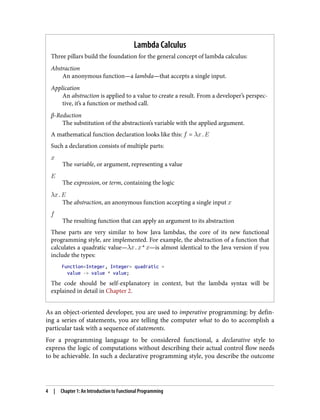
Lambda Calculus
Three pillars build the foundation for the general concept of lambda calculus:
Abstraction
An anonymous function—a lambda—that accepts a single input.
Application
An abstraction is applied to a value to create a result. From a developer’s perspec‐
tive, it’s a function or method call.
β-Reduction
The substitution of the abstraction’s variable with the applied argument.
A mathematical function declaration looks like this: f = λx . E
Such a declaration consists of multiple parts:
x
The variable, or argument, representing a value
E
The expression, or term, containing the logic
λx . E
The abstraction, an anonymous function accepting a single input x
f
The resulting function that can apply an argument to its abstraction
These parts are very similar to how Java lambdas, the core of its new functional
programming style, are implemented. For example, the abstraction of a function that
calculates a quadratic value—λx . x * x—is almost identical to the Java version if you
include the types:
Function<Integer, Integer> quadratic =
value -> value * value;
The code should be self-explanatory in context, but the lambda syntax will be
explained in detail in Chapter 2.
As an object-oriented developer, you are used to imperative programming: by defin‐
ing a series of statements, you are telling the computer what to do to accomplish a
particular task with a sequence of statements.
For a programming language to be considered functional, a declarative style to
express the logic of computations without describing their actual control flow needs
to be achievable. In such a declarative programming style, you describe the outcome
4 | Chapter 1: An Introduction to Functional Programming
and how your program should work with expressions, not what it should do with
statements.
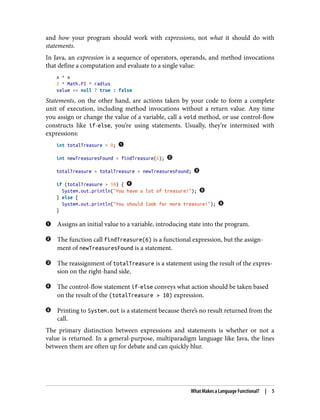
In Java, an expression is a sequence of operators, operands, and method invocations
that define a computation and evaluate to a single value:
x * x
2 * Math.PI * radius
value == null ? true : false
Statements, on the other hand, are actions taken by your code to form a complete
unit of execution, including method invocations without a return value. Any time
you assign or change the value of a variable, call a void method, or use control-flow
constructs like if-else, you’re using statements. Usually, they’re intermixed with
expressions:
int totalTreasure = 0;
int newTreasuresFound = findTreasure(6);
totalTreasure = totalTreasure + newTreasuresFound;
if (totalTreasure > 10) {
System.out.println("You have a lot of treasure!");
} else {
System.out.println("You should look for more treasure!");
}
Assigns an initial value to a variable, introducing state into the program.
The function call findTreasure(6) is a functional expression, but the assign‐
ment of newTreasuresFound is a statement.
The reassignment of totalTreasure is a statement using the result of the expres‐
sion on the right-hand side.
The control-flow statement if-else conveys what action should be taken based
on the result of the (totalTreasure > 10) expression.
Printing to System.out is a statement because there’s no result returned from the
call.
The primary distinction between expressions and statements is whether or not a
value is returned. In a general-purpose, multiparadigm language like Java, the lines
between them are often up for debate and can quickly blur.
What Makes a Language Functional? | 5
Functional Programming Concepts
Since functional programming is based primarily on abstract functions, its many
concepts that form the paradigm can focus on “what to solve” in a declarative style, in
contrast to the imperative “how to solve” approach.
We will go through the most common and significant aspects that functional pro‐
gramming uses at its foundation. These aren’t exclusive to the functional paradigm,
though. Many of the ideas behind them apply to other programming paradigms as
well.
Pure Functions and Referential Transparency
Functional programming categorizes functions into two categories: pure and impure.
Pure functions have two elemental guarantees:
The same input will always create the same output
The return value of a pure function must solely depend on its input arguments.
They are self-contained without any kind of side effect
The code cannot affect the global state, like changing argument values or using
any I/O.
These two guarantees allow pure functions to be safe to use in any environment, even
in a parallel fashion. The following code shows a method being a pure function that
accepts an argument without affecting anything outside of its context:
public String toLowercase(String str) {
return str;
}
Functions violating either of the two guarantees are considered impure. The following
code is an example of an impure function, as it uses the current time for its logic:
public String buildGreeting(String name) {
var now = LocalTime.now();
if (now.getHour() < 12) {
return "Good morning " + name;
} else {
return "Hello " + name;
}
}
The signifiers “pure” and “impure” are rather unfortunate names because of the
connotation they might invoke. Impure functions aren’t inferior to pure functions
in general. They are just used in different ways depending on the coding style and
paradigm you want to adhere to.
6 | Chapter 1: An Introduction to Functional Programming
Another aspect of side-effect-free expressions or pure functions is their deterministic
nature, which makes them referentially transparent. That means you can replace them
with their respective evaluated result for any further invocations without changing
the behavior of your program.
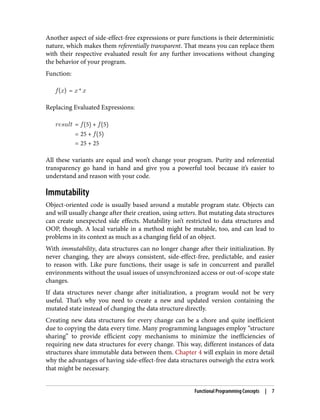
Function:
f x = x * x
Replacing Evaluated Expressions:
result = f 5 + f 5
= 25 + f 5
= 25 + 25
All these variants are equal and won’t change your program. Purity and referential
transparency go hand in hand and give you a powerful tool because it’s easier to
understand and reason with your code.
Immutability
Object-oriented code is usually based around a mutable program state. Objects can
and will usually change after their creation, using setters. But mutating data structures
can create unexpected side effects. Mutability isn’t restricted to data structures and
OOP, though. A local variable in a method might be mutable, too, and can lead to
problems in its context as much as a changing field of an object.
With immutability, data structures can no longer change after their initialization. By
never changing, they are always consistent, side-effect-free, predictable, and easier
to reason with. Like pure functions, their usage is safe in concurrent and parallel
environments without the usual issues of unsynchronized access or out-of-scope state
changes.
If data structures never change after initialization, a program would not be very
useful. That’s why you need to create a new and updated version containing the
mutated state instead of changing the data structure directly.
Creating new data structures for every change can be a chore and quite inefficient
due to copying the data every time. Many programming languages employ “structure
sharing” to provide efficient copy mechanisms to minimize the inefficiencies of
requiring new data structures for every change. This way, different instances of data
structures share immutable data between them. Chapter 4 will explain in more detail
why the advantages of having side-effect-free data structures outweigh the extra work
that might be necessary.
Functional Programming Concepts | 7
Random documents with unrelated
content Scribd suggests to you:
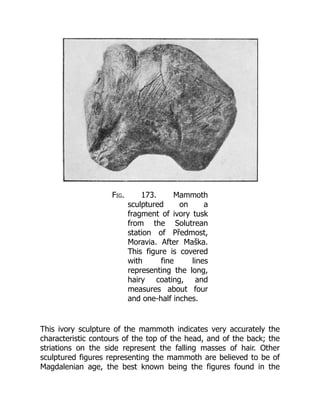
Fig. 173. Mammoth
sculptured on a
fragment of ivory tusk
from the Solutrean
station of Předmost,
Moravia. After Maška.
This figure is covered
with fine lines
representing the long,
hairy coating, and
measures about four
and one-half inches.
This ivory sculpture of the mammoth indicates very accurately the
characteristic contours of the top of the head, and of the back; the
striations on the side represent the falling masses of hair. Other
sculptured figures representing the mammoth are believed to be of
Magdalenian age, the best known being the figures found in the
grottos of Bruniquel and Laugerie Basse, a fragment from
Raymonden, Dordogne, and a bas-relief in the grotto of Figuier,
Gard. All these sculptures of the mammoth have in common the
indication of a very small ear—similar to that in the Předmost model
—feet shaped like inverted mushrooms, bordered with short, coarse
hairs, the tail terminating in a long tuft of hairs. If the figure of
Předmost is of Solutrean age, it is by far the earliest of all the
sculptured or engraved animal representations in the mobile art, and
is also the most complete of the animal figurines of this group. It is
certainly of more recent date than the engraved designs of
Aurignacian age in the grottos of Gargas and of Chabot or than the
red or black tracings of the mammoth, also of Aurignacian age, at
Castillo, Pindal, and Font-de-Gaume. It is probable that the
mammoth figures of Combarelles are of later date than the
Předmost sculpture and belong to the beginning of Magdalenian
times, while those at Font-de-Gaume belong to the end of
Magdalenian times and are the most recent of all the parietal
designs. Despite the differences in age and technique, all the
designs of the mammoth are undoubtedly the work of artists of a
single race; they agree in faithfully portraying the external form of
this great proboscidian which wandered over the steppes and
prairies of western Europe from the beginning of the fourth
glaciation until near the close of Postglacial times.
(1) Breuil, 1912.7.
(2) Verneau, 1906.1, pp. 202-207.
(3) Op. cit., p. 204.
(4) Keith, 1911.1, p. 60.
(5) Obermaier, 1912.1, p. 178.
(6) Breuil, 1912.7, p. 174.
(7) Op. cit., pp. 165-168.
(8) Obermaier, 1912.1, pp. 177, 178.
(9) Wiegers, 1913.1.
(10) Schmidt, 1912.1, p. 266.
(11) Geikie, 1914.1, p. 278.
(12) Dawkins, 1880.1, pp. 148, 149.
(13) Ewart, 1904.1.
(14) Obermaier, 1909.2, p. 145.
(15) Sollas, 1913.1, p. 325.
(16) Broca, 1868.1.
(17) Lartet, 1875.1.
(18) Verneau, 1886.1; 1906.1, pp. 68, 69.
(19) Obermaier, 1912.2.
(20) Martin, R., 1914.1, pp. 15, 16.
(21) Keith, 1911.1, p. 71.
(22) Klaatsch, 1909.1.
(23) Keith, op. cit., p. 56.
(24) Hauser, 1909.1.
(25) Fischer, 1913.1.
(26) Schliz, 1912.1, p. 554.
(27) Breuil, 1912.7, p. 175.
(28) Op. cit., p. 183.
(29) Op. cit., pp. 177-180.
(30) Schmidt, 1912.1, p. 266.
(31) Breuil, op. cit., p. 178.
(32) Obermaier, 1912.1, p. 181.
(33) Breuil, 1912.7, p. 169.
(34) Breuil, 1912.1, pp. 194-200.
(35) Schmidt, 1912.1.
(36) Breuil, op. cit.
(37) Schmidt, 1912.1, p. 142.
(38) Breuil, 1912.1, p. 202.
(39) Breuil, 1912.6.
(40) Hilzheimer, 1913.1, p. 151.
(41) Fischer, 1913.1.
(42) Makowsky, 1902.1.
(43) Schwalbe, 1906.1.
(44) Makowsky, op. cit.
(45) Obermaier, 1912.1, pp. 342-355.
(46) Martin, R., 1914.1, pp. 15, 16.
(47) Schliz, 1912.1.
(48) Déchelette, 1908.1, vol. I, p. 28.
(49) Keane, 1901.1, p. 147.
(50) Keith, 1911.1, p. 30.
(51) Op. cit., pp. 28-45.
(52) Op. cit., pp. 51-56.
(53) Obermaier, 1912.1, p. 93.
(54) Breuil, 1912.7, p. 188.
(55) Arcelin, 1869.1.
(56) Déchelette, 1908.1, vol. I, pp. 137-141.
(57) Schmidt, 1912.1, p. 144, Tafel B.
CHAPTER V
MAGDALENIAN TIMES—CLIMATE AND
MAMMALIAN LIFE OF EUROPE—
CUSTOMS AND LIFE OF THE CRÔ-
MAGNONS; THEIR INDUSTRY IN
FLINT AND BONE; THEIR
DISTRIBUTION—DEVELOPMENT OF
THEIR ART, ENGRAVING, PAINTING,
SCULPTURE—ART IN THE CAVERNS
—CLIMAX OF THE MAGDALENIAN
ART AND INDUSTRY OF THE CRÔ-
MAGNONS—APPARENT DECLINE OF
THE RACE.
The art and industrial epoch of Magdalenian times is by far the best
known and most fascinating of the Old Stone Age. This period forms
the culmination of Palæolithic civilization; it marks the highest
development of the Crô-Magnon race preceding their sudden decline
and disappearance as the dominant type of western Europe. The
men of this time are commonly known as the Magdalenians, taking
their name from the type station of La Madeleine, as the Greeks in
their highest stage took their name from Athens and were known as
the Athenians.
We would assign the minimum prehistoric date of 16,000 B. C. for
the beginning of the Magdalenian culture, and since we have
assigned to the beginning of the Aurignacian culture the date of
25,000 B. C., we should allow 9,000 years for the development of
the Aurignacian and Solutrean industries in western Europe.
Introduction. Industrial and Artistic Development
Well as this culture is known, its origin is obscured by the fact that it
shows little or no connection with the preceding Solutrean industry,
which, as we have noted (p. 331), seems like a technical invasion in
the history of western Europe and not an inherent part of the main
line of cultural development. Thus Breuil(1) observes that it appears
as if the fundamental elements of the superior Aurignacian culture
had contributed by some unknown route to constitute the kernel of
the Magdalenian civilization while the Solutrean episode was going
on elsewhere. Again, early Magdalenian art bears striking
resemblances to the superior Aurignacian art of the Pyrenees,
especially the parietal art, as shown by comparing the Aurignacian
engravings of Gargas with the early Magdalenian of Combarelles.
Moreover, the same author observes that, if there is one certain
prehistoric fact, it is that the first Magdalenian culture was not
evolved from the Solutrean—that these Magdalenians were
newcomers in western France, as unskilful in the art of shaping and
retouching flints as their predecessors were skilled. Ancient
Magdalenian hearths are found in many localities close to the levels
of the upper Solutrean industries with their shouldered spear points
(pointes à cran) and highly perfected flint work. Yet the
Magdalenians show a radical departure from the Solutrean type of
flint working; both in Dordogne (Laugerie Haute and Laussel) and in
Charente (Placard) the splinters of flint are massive, heavy, badly
selected, often of poor quality, and poorly retouched, sometimes
almost in an Eolithic manner; at the same time, the chance flints,
that is, the piercers and graving-tools made from splinters of any
accidental shape, are abundant. To these people flint implements
appear to be altogether of secondary importance; although the flints
are very numerous, they are not finished with any of the perfection
of the Solutrean technique; the laurel-leaf spear head and
shouldered dart head have disappeared entirely, but a great variety
of smaller graving and chasing forms are employed for fashioning
the implements of bone and horn. What a contrast to the beautiful
flints so finely retouched and of such carefully selected materials,
found in the very same stations in middle and upper Solutrean
layers!
Thus Breuil, always predisposed to believe in an invasion of culture
rather than in an autochthonous development, favors the theory of
eastern origin for the Magdalenian industry, because this is not
wanting either in Austria or in Poland; two sites of ancient
Magdalenian industry have been found by Obermaier in the 'loess'
stations of Austria, while in Russian Poland the grotto of Mas̆ zycka,
near Ojcow, exhibits workings in bone resembling those found at the
grotto of Placard, Charente, in the layers directly succeeding the
base of the Magdalenian. The fact that near the Ural Mountains
there has also been found a peculiar Magdalenian culture, the origin
of which is not western, inclines us to believe that the Magdalenian
culture extended from the east toward the west, and then, later,
toward the Baltic.
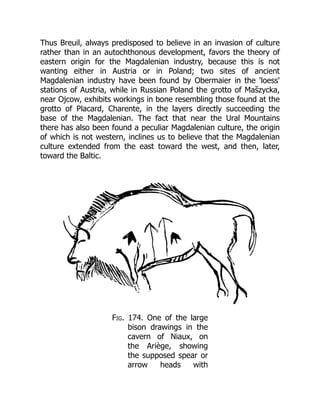
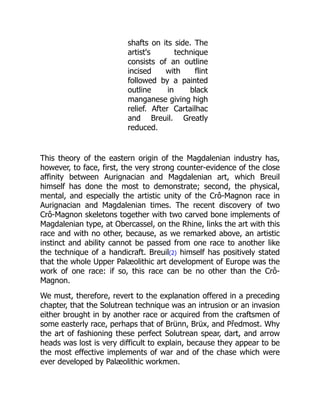
Fig. 174. One of the large
bison drawings in the
cavern of Niaux, on
the Ariège, showing
the supposed spear or
arrow heads with
shafts on its side. The
artist's technique
consists of an outline
incised with flint
followed by a painted
outline in black
manganese giving high
relief. After Cartailhac
and Breuil. Greatly
reduced.
This theory of the eastern origin of the Magdalenian industry has,
however, to face, first, the very strong counter-evidence of the close
affinity between Aurignacian and Magdalenian art, which Breuil
himself has done the most to demonstrate; second, the physical,
mental, and especially the artistic unity of the Crô-Magnon race in
Aurignacian and Magdalenian times. The recent discovery of two
Crô-Magnon skeletons together with two carved bone implements of
Magdalenian type, at Obercassel, on the Rhine, links the art with this
race and with no other, because, as we remarked above, an artistic
instinct and ability cannot be passed from one race to another like
the technique of a handicraft. Breuil(2) himself has positively stated
that the whole Upper Palæolithic art development of Europe was the
work of one race: if so, this race can be no other than the Crô-
Magnon.
We must, therefore, revert to the explanation offered in a preceding
chapter, that the Solutrean technique was an intrusion or an invasion
either brought in by another race or acquired from the craftsmen of
some easterly race, perhaps that of Brünn, Brüx, and Předmost. Why
the art of fashioning these perfect Solutrean spear, dart, and arrow
heads was lost is very difficult to explain, because they appear to be
the most effective implements of war and of the chase which were
ever developed by Palæolithic workmen.
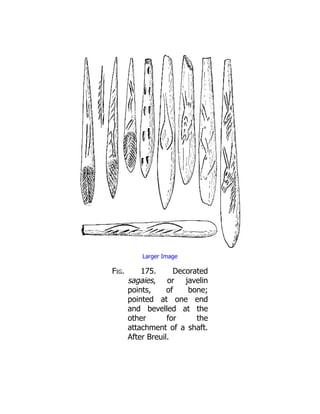
Larger Image
Fig. 175. Decorated
sagaies, or javelin
points, of bone;
pointed at one end
and bevelled at the
other for the
attachment of a shaft.
After Breuil.
It is possible, although not probable, that the bow was introduced at
this time and that a less perfect flint point, fastened to a shaft like
an arrow-head and projected with great velocity and accuracy,
proved to be far more effective than the spear. The bison in the
cavern of Niaux show several barbed points adhering to the sides,
and the symbol of the flèche appears on the sides of many of the
bison, cattle, and other animals of the chase in Magdalenian
drawings. From these drawings and symbols it would appear that
barbed weapons of some kind were used in the chase, but no
barbed flints occur at any time in the Palæolithic, nor has any trace
been found of bone barbed arrow-heads or any direct evidence of
the existence of the bow.
In compensation for the decline of flint is the rapid development of
bone implements, the most distinctive feature of Magdalenian
industry. In the late Solutrean we have noted the occasional
appearance of the bone javelin points (sagaies) with their decorative
motifs; these become much more frequent in Magdalenian times.
They occur in the most ancient Magdalenian levels of the grotto of
Placard, Charente, which are prior even to the appearance of
prototypes of the harpoon, the evolution of which clearly marks off
the early, middle, and late divisions of Magdalenian times. These
primitive javelins, decorated in a characteristic fashion, are found in
Poland, at the grotto of Kesslerloch and other places in Switzerland,
at many stations in Dordogne and the region of the Pyrenees in
southern France, and in the Cantabrian Mountains of northern Spain.
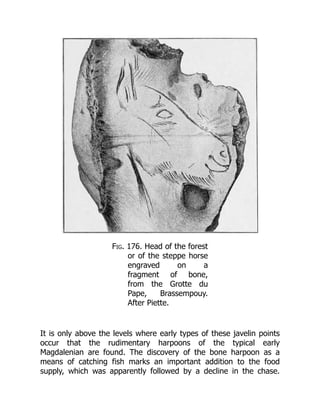
Fig. 176. Head of the forest
or of the steppe horse
engraved on a
fragment of bone,
from the Grotte du
Pape, Brassempouy.
After Piette.
It is only above the levels where early types of these javelin points
occur that the rudimentary harpoons of the typical early
Magdalenian are found. The discovery of the bone harpoon as a
means of catching fish marks an important addition to the food
supply, which was apparently followed by a decline in the chase.
Later, to the javelin, lance, and harpoon is added the dart-thrower
(propulseur), which gradually spreads all over western Europe,
where also the evolution of these bone implements and of the
decoration with which they are richly adorned enables the trained
archæologist to establish corresponding subdivisions of Magdalenian
time.
Fig. 177. Polychrome wall-
painting of a wolf from
the cavern of Font-de-
Gaume. After Breuil.
From the uniform character of Palæolithic art in its highest forms of
engraving, painting, and animal sculpture we may infer the probable
unity of the Crô-Magnon race, especially throughout western Europe.
During Magdalenian times various branches of art reached their
highest point and were the culmination of a movement begun in the
early Aurignacian. The artist, whose life brought him into close touch
with nature and who evidently followed the movements both of the
individual animals and of the herds for hours at a time, has rendered
his observations in the most realistic manner. Among the animals
represented are the bison, mammoth, wild horse, reindeer, wild
cattle, deer, and rhinoceros; less frequent are representations of the
ibex, wolf, and wild boar, and there are comparatively few
representations of fishes or of any form of plant life; the nobler
beasts of prey, such as the lion and the bear, are often represented,
but there are no figures of the skulking hyæna, which at that time
was a rare if not almost extinct animal. While many figures are of
real artistic worth and reach a high level, others are more or less
crude attempts; the composition of figures or of groups of animals is
rarely undertaken.
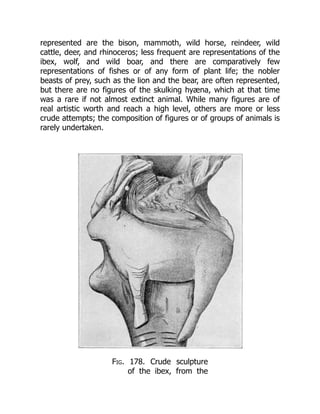
Fig. 178. Crude sculpture
of the ibex, from the
Magdalenian deposit
at Mas d'Azil on the
right bank of the Arize.
After Piette. A little
less than actual size.
The artistic sense of these people is also manifest in the decoration
of their household utensils and weapons of the chase. Here the
smaller animals of the chase, the saiga, the ibex, and the chamois,
are executed with a sure hand. Sculpture of animal forms in the
large, which begins in Solutrean times, is continued and reaches its
highest point in the early Magdalenian. At this period the use of
sculpture as a means of decoration arises and extends into the
middle and late Magdalenian. These latter divisions are also
distinguished by the reappearance of human figurines, nude, like the
Aurignacian, and occasionally somewhat more slender. Thus it would
appear that the artistic spirit, more or less dormant in Solutrean
times, was revived.
In the variety of industries we find evidences of a race endowed with
closely observant and creative minds, in which the two chief motives
of life seem to have been the chase and the pursuit of art. The
Magdalenian flints are fashioned in a somewhat different manner
from the Solutrean: long, slender flakes or 'blades' with little or no
retouch are frequent, and in other implements the work is
apparently carried only to a point where the flint will serve its
purpose. No attempt is made to attain perfect symmetry. Thus the
old technical impulse of the flint industry seems to be far less than
that among the makers of the Solutrean flints, while a new technical
impulse manifests itself in several branches of art: arms and utensils
are carved in ivory, reindeer horn and bone, and sculpture and
engraving on bone and ivory are greatly developed. We find that
these people are beginning to utilize the walls of dark, mysterious
caverns for their drawings and paintings, which show deep
appreciation for the perfection of the animal form, depicted by them
in most lifelike attitudes.
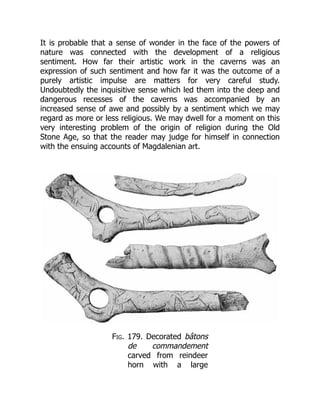
We may infer that there was a tribal organization, and it has been
suggested that certain unexplained implements of reindeer horn,
often beautifully carved and known as 'bâtons de commandement,'
were insignia of authority borne by the chieftains.
There can be little doubt that such diversities of temperament, of
talent, and of predisposition as obtain to-day also prevailed then,
and that they tended to differentiate society into chieftains, priests,
and medicine-men, hunters of large game and fishermen, fashioners
of flints and dressers of hides, makers of clothing and footwear,
makers of ornaments, engravers, sculptors in wood, bone, ivory, and
stone, and artists with color and brush. In their artistic work, at
least, these people were animated with a compelling sense of truth,
and we cannot deny them a strong appreciation of beauty.
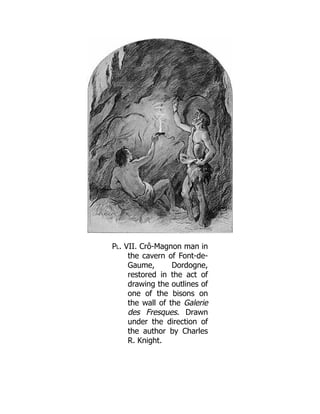
Pl. VII. Crô-Magnon man in
the cavern of Font-de-
Gaume, Dordogne,
restored in the act of
drawing the outlines of
one of the bisons on
the wall of the Galerie
des Fresques. Drawn
under the direction of
the author by Charles
R. Knight.
It is probable that a sense of wonder in the face of the powers of
nature was connected with the development of a religious
sentiment. How far their artistic work in the caverns was an
expression of such sentiment and how far it was the outcome of a
purely artistic impulse are matters for very careful study.
Undoubtedly the inquisitive sense which led them into the deep and
dangerous recesses of the caverns was accompanied by an
increased sense of awe and possibly by a sentiment which we may
regard as more or less religious. We may dwell for a moment on this
very interesting problem of the origin of religion during the Old
Stone Age, so that the reader may judge for himself in connection
with the ensuing accounts of Magdalenian art.
Fig. 179. Decorated bâtons
de commandement
carved from reindeer
horn with a large
perforation opposite
the brow tine. After
Lartet and Christy.
"The religious phenomenon," observes James,(3) "has shown itself to
consist everywhere, and in all its stages, in the consciousness which
individuals have of an intercourse between themselves and higher
powers with which they feel themselves to be related. This
intercourse is realized at the time as being both active and mutual....
The gods believed in—whether by crude savages or by men
disciplined intellectually—agree with each other in recognizing
personal calls.... To coerce the spiritual powers, or to square them
and get them on our side, was, during enormous tracts of time, the
one great object in our dealings with the natural world."
The study of this race, in our opinion, would suggest a still earlier
phase in the development of religious thought than that considered
by James, namely, a phase in which the wonders of nature in their
various manifestations begin to arouse in the primitive mind a desire
for an explanation of these phenomena, and in which it is attempted
to seek such cause in some vague supernatural power underlying
these otherwise unaccountable occurrences, a cause to which the
primitive human spirit commences to make its appeal. According to
certain anthropologists,[AU] this wonder-working force may either be
personal, like the gods of Homer, or impersonal, like the Mana of the
Melanesian, or the Manitou of the North American Indian. It may
impress an individual when he is in a proper frame of mind, and
through magic or propitiation may be brought into relation with his
individual ends. Magic and religion jointly belong to the supernatural
as opposed to the every-day world of the savage.
We have already seen evidence from the burials that these people
apparently believed in the preparation of the bodies of the dead for
a future existence. How far these beliefs and the votive sense of
propitiation for protection and success in the chase are indicated by
the art of the caverns is to be judged in connection with their entire
life and productive effort, with their burials associated with offerings
of implements and articles of food, and with their art.
The Three Climatic Cycles of Magdalenian Times
The culture of the Crô-Magnons was doubtless influenced by the
changing climatic conditions of Magdalenian times, which were quite
varied, so that we may trace three parallel lines of development:
that of environment, as indicated by the climate and the forms of
animal life, that of industry, and that of art.
The entire climatic, life, and industrial cycle of which the
Magdalenian marks the conclusion has been presented in Chapter IV
(p. 281). After a very long period of cold and somewhat arid climate
following the fourth glaciation, it would appear that western Europe
in early Magdalenian times again experienced a stage of increasing
cold and moisture accompanied by the renewed advance of the
glaciers in the Alpine region, in Scandinavia, and in Great Britain.
This is known as the Bühl stage in the Alps, in which the snow-line
descended 2,700 feet below its present level and the great glaciers
thrust down along the southerly borders of Lake Lucerne a series of
new moraines distinctly overlying those of the fourth glaciation.
Another indication of the lowered temperature and increased
moisture in the same geographic region is found in the return of the
arctic lemmings from the northern tundras; these migrants have left
their remains in several of the large grottos north of the Alps,
especially in Schweizersbild and Kesslerloch, composing what is
known as the Upper Rodent Layer, with which are associated the
implements and art objects of the early Magdalenian culture stage.
We have adopted the minimum estimate of 25,000 years since the
fourth glaciation, but Heim(4) has estimated that the much more
recent prehistoric event of the advance of this minor Bühl glaciation
began at least 24,000 years ago, that it extended over a very long
period of time, and that the Bühl moraines in Lake Lucerne are at
least 16,000 years of age.
The three climatic changes of Magdalenian times are therefore as
follows:
First, the Bühl Postglacial Stage in the Alps, which corresponds with
what Geikie has named the Fifth Glacial Epoch, or Lower Turbarian,
in Scotland; for he believes that a relapse to cold conditions in
northern Britain was accompanied by a partial subsidence of the
coast lands, that snow-fields again appeared, that considerable
glaciers descended the mountain valleys, and even reached the sea.
At this time the arctic alpine flora of Scotland also descended to
within 150 feet of the sea-level. The result of this renewed or fifth
glaciation in western Europe was the advent of the great wave of
tundra life and the descent to the plains of all the forms of Alpine
life.
Larger Image
Fig. 180. Correlation of the
Postglacial climatic
changes with the four
stages of Upper
Palæolithic culture: the
Aurignacian coincident
with the final retreat of
the fourth glaciation;
the Solutrean
coincident with the
interval preceding the
Bühl advance; the
Magdalenian
coincident with the
Bühl and Gschnitz
Postglacial advances;
and the Azilian
coincident with the
Daun or third
Postglacial advance.
(Compare Fig. 14.)
Second, it would appear that in middle Magdalenian times, after the
Bühl advance, there occurred a temporary retreat of the ice-fields,
and that during this period the full tide of life from the steppes of
western Asia and eastern Europe for the first time spread over
western Europe, including especially such animals as the jerboa and
the saiga antelope, the dwarf pika and steppe hamster. Correlation is
very hazardous, but this ice retreat may correspond with the Upper
Forestian, or Fifth Interglacial Stage in Scotland, described by Geikie,
the stage which he mentions as marked by the elevation of the
Scottish coast with the retreat of the sea beyond the present coast-
lines; geographic changes which were accompanied by the
disappearance of perennial snow and ice, and the return of more
genial conditions. The tundra fauna still prevailed; such a typical
arctic animal as the musk-ox wandered as far south as Dordogne
and the Pyrenees, and became one of the objects of the chase.
During what is known as the middle or 'full Magdalenian' the tundra,
steppe, alpine, forest, and meadow faunæ spread over the plains
and valleys throughout western Europe.
Third, the second Postglacial advance, known as the Gschnitz stage
in the Alpine region, appears to have been contemporaneous with
the closing period of Magdalenian culture. This was the last great
effort of the ice-fields to conquer western Europe, and in the Alpine
region the snow-line descended 1,800 feet below the present levels;
it marked the closing stage of the long cold climatic period that had
favored the presence of the reindeer, the woolly mammoth, and the
woolly rhinoceros in western Europe, as well as the close of the
'Reindeer Epoch' of Lartet. Again, in the north of Britain Geikie
observes an Upper Turbarian or Sixth Glacial Epoch, accompanied by
a partial subsidence of the Scottish coast, and the return of a cold
and wet climate; there is evidence of the existence of snow glaciers
upon the high mountains only. The Gschnitz stage marks the end of
glacial conditions in Europe, the retreat of the tundra and steppe
faunæ, and the predominance of the forest and meadow
environment and life.
In the Alps there was, however, still a final effort of the glaciers,
known as the Daun stage, which, it is believed, broadly corresponds
with the period of the Azilian-Tardenoisian industry, and a climatic
condition in Europe favorable to the spread of the Eurasiatic forest
and meadow life.
The key to this great prehistoric chronology is found in
palæontology. The arctic tundra rodents especially are the most
invaluable timekeepers; according to Schmidt(5) there is no doubt
whatever that the Upper Rodent Layer, composed of the animals of
the second invasion from the arctic tundras, corresponds, on the one
hand, with the beginning of the Magdalenian industry and, on the
other, with the renewed glacial advance in the Alpine region, known
as the Bühl stage, and probably also with that in the north. The
Upper Rodent Layer of Magdalenian times is found in the remarkably
complete succession of deposits at the stations of Schweizersbild
Welcome to our website – the ideal destination for book lovers and
knowledge seekers. With a mission to inspire endlessly, we offer a
vast collection of books, ranging from classic literary works to
specialized publications, self-development books, and children's
literature. Each book is a new journey of discovery, expanding
knowledge and enriching the soul of the reade
Our website is not just a platform for buying books, but a bridge
connecting readers to the timeless values of culture and wisdom. With
an elegant, user-friendly interface and an intelligent search system,
we are committed to providing a quick and convenient shopping
experience. Additionally, our special promotions and home delivery
services ensure that you save time and fully enjoy the joy of reading.
Let us accompany you on the journey of exploring knowledge and
personal growth!
textbookfull.com

A Functional Approach to Java: Augmenting Object-Oriented Java Code with Functional Principles 1st Edition Ben Weidig
  • 1.
    A Functional Approachto Java: Augmenting Object-Oriented Java Code with Functional Principles 1st Edition Ben Weidig download https://textbookfull.com/product/a-functional-approach-to-java- augmenting-object-oriented-java-code-with-functional- principles-1st-edition-ben-weidig/ Download more ebook from https://textbookfull.com
  • 2.
    We believe theseproducts will be a great fit for you. Click the link to download now, or visit textbookfull.com to discover even more! Object Oriented Data Structures Using Java 4th Edition Dale https://textbookfull.com/product/object-oriented-data-structures- using-java-4th-edition-dale/ Learning Java Functional Programming 1st Edition Reese Richard M https://textbookfull.com/product/learning-java-functional- programming-1st-edition-reese-richard-m/ Functional Python Programming: Use a functional approach to write succinct, expressive, and efficient Python code, 3rd Edition Lott https://textbookfull.com/product/functional-python-programming- use-a-functional-approach-to-write-succinct-expressive-and- efficient-python-code-3rd-edition-lott/ Functional Interfaces in Java: Fundamentals and Examples 1st Edition Ralph Lecessi [Lecessi https://textbookfull.com/product/functional-interfaces-in-java- fundamentals-and-examples-1st-edition-ralph-lecessi-lecessi/
  • 3.
    Neurobiology: a functionalapproach Striedter https://textbookfull.com/product/neurobiology-a-functional- approach-striedter/ A Beginner’s Guide to Scala, Object Orientation and Functional Programming John Hunt https://textbookfull.com/product/a-beginners-guide-to-scala- object-orientation-and-functional-programming-john-hunt/ Object-Oriented Design with ABAP: A Practical Approach 1st Edition James E. Mcdonough (Auth.) https://textbookfull.com/product/object-oriented-design-with- abap-a-practical-approach-1st-edition-james-e-mcdonough-auth/ Modern Java in Action Lambdas streams functional and reactive programming Raoul-Gabriel Urma https://textbookfull.com/product/modern-java-in-action-lambdas- streams-functional-and-reactive-programming-raoul-gabriel-urma/ A Beginner's Guide to Scala, Object Orientation and Functional Programming (Second Edition) John Hunt https://textbookfull.com/product/a-beginners-guide-to-scala- object-orientation-and-functional-programming-second-edition- john-hunt/
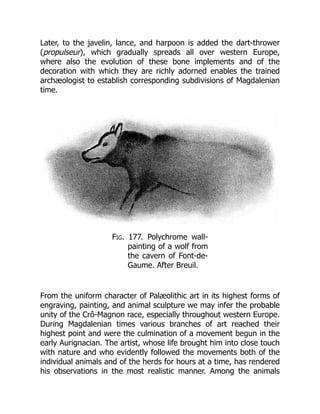
  • 4.
    Ben Weidig AFunctional Approach to Java AugmentingObject-Oriented Java Code with Functional Principles
  • 5.
    JAVA A Functional Approachto Java Twitter: @oreillymedia linkedin.com/company/oreilly-media youtube.com/oreillymedia Java developers usually tackle the complexity of software development through object-oriented programming (OOP). But not every problem is a good match for OOP. The functional programming (FP) paradigm offers you another approach to solving problems, and Java provides easy-to-grasp FP tools such as lambda expressions and Streams. If you’re interested in applying FP concepts to your Java code, this book is for you. Author Ben Weidig highlights different aspects of functional programming and shows you how to incorporate them into your code without going “fully functional.” You’ll learn how, when, and why to use FP concepts such as immutability and pure functions to write more concise, reasonable, and future-proof code. Many developers seek to expand their horizons by using OOP and FP together. It’s no longer either-or; it’s both. In this book, you will: • Get a high-level overview of functional programming, including the types already available to Java developers • Explore different FP concepts and learn how to use them • Learn how to augment your code and use Java’s new functional features in your daily work without going fully functional • Develop a functional mindset and improve your programming skills regardless of language or paradigm US $74.99 CAN $93.99 ISBN: 978-1-098-10992-9 “The functional paradigm is a significant change in Java programming, but it doesn’t mean abandoning OOP completely. A Functional Approach to Java is a must-read for any programmer looking to improve their skills and stay current in programming. —A N M Bazlur Rahman SoftwareEngineer,JavaChampion, Author,JUGLeader Ben Weidig runs a Java-based SaaS company. He has almost two decades of experience in professional web, mobile, and systems programming in various languages. Ben is also an active open source contributor.
  • 6.
    Ben Weidig A FunctionalApproach to Java Augmenting Object-Oriented Code with Functional Principles Boston Farnham Sebastopol Tokyo Beijing Boston Farnham Sebastopol Tokyo Beijing
  • 7.
    978-1-098-10992-9 [LSI] A Functional Approachto Java by Ben Weidig Copyright © 2023 Benjamin Weidig. All rights reserved. Printed in the United States of America. Published by O’Reilly Media, Inc., 1005 Gravenstein Highway North, Sebastopol, CA 95472. O’Reilly books may be purchased for educational, business, or sales promotional use. Online editions are also available for most titles (http://oreilly.com). For more information, contact our corporate/institutional sales department: 800-998-9938 or corporate@oreilly.com. Acquisitions Editor: Brian Guerin Development Editor: Rita Fernando Production Editor: Ashley Stussy Copyeditor: Liz Wheeler Proofreader: Piper Editorial Consulting, LLC Indexer: WordCo Indexing Services, Inc. Interior Designer: David Futato Cover Designer: Karen Montgomery Illustrator: Kate Dullea May 2023: First Edition Revision History for the First Edition 2023-05-09: First Release 2024-02-02: Second Release See http://oreilly.com/catalog/errata.csp?isbn=9781098109929 for release details. The O’Reilly logo is a registered trademark of O’Reilly Media, Inc. A Functional Approach to Java, the cover image, and related trade dress are trademarks of O’Reilly Media, Inc. The views expressed in this work are those of the author, and do not represent the publisher’s views. While the publisher and the author have used good faith efforts to ensure that the information and instructions contained in this work are accurate, the publisher and the author disclaim all responsibility for errors or omissions, including without limitation responsibility for damages resulting from the use of or reliance on this work. Use of the information and instructions contained in this work is at your own risk. If any code samples or other technology this work contains or describes is subject to open source licenses or the intellectual property rights of others, it is your responsibility to ensure that your use thereof complies with such licenses and/or rights.
  • 8.
    Table of Contents Preface.. . . . . . . . . . . . . . . . . . . . . . . . . . . . . . . . . . . . . . . . . . . . . . . . . . . . . . . . . . . . . . . . . . . . . . xi Part I. Functional Basics 1. An Introduction to Functional Programming. . . . . . . . . . . . . . . . . . . . . . . . . . . . . . . . . . . 3 What Makes a Language Functional? 3 Functional Programming Concepts 6 Pure Functions and Referential Transparency 6 Immutability 7 Recursion 8 First-Class and Higher-Order Functions 8 Functional Composition 9 Currying 9 Partial Function Application 10 Lazy Evaluation 11 Advantages of Functional Programming 12 Disadvantages of Functional Programming 12 Takeaways 14 2. Functional Java. . . . . . . . . . . . . . . . . . . . . . . . . . . . . . . . . . . . . . . . . . . . . . . . . . . . . . . . . . . 15 What Are Java Lambdas? 15 Lambda Syntax 15 Functional Interfaces 17 Lambdas and Outside Variables 19 What about Anonymous Classes? 23 iii
  • 9.
    Lambdas in Action26 Creating Lambdas 26 Calling Lambdas 28 Method References 28 Functional Programming Concepts in Java 32 Pure Functions and Referential Transparency 32 Immutability 35 First-Class Citizenship 36 Functional Composition 36 Lazy Evaluation 37 Takeaways 38 3. Functional Interfaces of the JDK. . . . . . . . . . . . . . . . . . . . . . . . . . . . . . . . . . . . . . . . . . . . . 39 The Big Four Functional Interface Categories 39 Functions 40 Consumers 40 Suppliers 41 Predicates 41 Why So Many Functional Interface Variants? 42 Function Arity 42 Primitive Types 44 Bridging Functional Interfaces 46 Functional Composition 47 Extending Functional Support 49 Adding Default Methods 49 Implementing Functional Interfaces Explicitly 51 Creating Static Helpers 52 Takeaways 56 Part II. A Functional Approach 4. Immutability. . . . . . . . . . . . . . . . . . . . . . . . . . . . . . . . . . . . . . . . . . . . . . . . . . . . . . . . . . . . . 59 Mutability and Data Structures in OOP 59 Immutability (Not Only) in FP 61 The State of Java Immutability 63 java.lang.String 63 Immutable Collections 65 Primitives and Primitive Wrappers 69 Immutable Math 69 iv | Table of Contents
  • 10.
    Java Time API(JSR-310) 70 Enums 71 The final Keyword 71 Records 72 How to Achieve Immutability 73 Common Practices 74 Takeaways 75 5. Working with Records. . . . . . . . . . . . . . . . . . . . . . . . . . . . . . . . . . . . . . . . . . . . . . . . . . . . . . 77 Data Aggregation Types 77 Tuples 77 A Simple POJO 78 From POJO to Immutability 80 From POJO to Record 82 Records to the Rescue 82 Behind the Scenes 83 Record Features 84 Missing Features 88 Use Cases and Common Practices 96 Record Validation and Data Scrubbing 96 Increasing Immutability 97 Creating Modified Copies 98 Records as Local Nominal Tuples 101 Better Optional Data Handling 104 Serializing Evolving Records 106 Record Pattern Matching 109 Sealed Types as Components 110 Final Thoughts on Records 114 Takeaways 115 6. Data Processing with Streams. . . . . . . . . . . . . . . . . . . . . . . . . . . . . . . . . . . . . . . . . . . . . . 117 Data Processing with Iteration 117 External Iteration 118 Internal Iteration 120 Streams as Functional Data Pipelines 121 Stream Features 125 Spliterator, the Backbone of Streams 129 Building Stream Pipelines 131 Creating a Stream 132 Doing the Work 133 Terminating the Stream 141 Table of Contents | v
  • 11.
    The Cost ofOperations 155 Modifying Stream Behavior 158 To Use a Stream, or Not? 159 Takeaways 161 7. Working with Streams. . . . . . . . . . . . . . . . . . . . . . . . . . . . . . . . . . . . . . . . . . . . . . . . . . . . 163 Primitive Streams 163 Iterative Streams 165 Infinite Streams 167 Random Numbers 168 Memory Isn’t Infinite 169 From Arrays to Streams and Back 170 Object-Type Arrays 171 Primitive Arrays 171 Low-Level Stream Creation 172 Working with File I/O 173 Reading Directory Contents 174 Depth-First Directory Traversal 174 Searching the Filesystem 176 Reading Files Line-By-Line 177 Caveats of File I/O Streams 179 Dealing with Date and Time 180 Querying Temporal Types 180 LocalDate-Range Streams 181 Measuring Stream Performance with JMH 181 More about Collectors 182 Downstream Collectors 183 Creating Your Own Collector 192 Customizing Intermediate Operations (Java 22+) 194 Custom Distinct Operation without Gatherer 195 Creating a Custom Distinct Gatherer 196 Final Thoughts on (Sequential) Streams 198 Takeaways 199 8. Parallel Data Processing with Streams. . . . . . . . . . . . . . . . . . . . . . . . . . . . . . . . . . . . . . . 201 Concurrency versus Parallelism 201 Streams as Parallel Functional Pipelines 203 Parallel Streams in Action 205 When to Use and When to Avoid Parallel Streams 208 Choosing the Right Data Source 208 Number of Elements 210 vi | Table of Contents
  • 12.
    Stream Operations 210 StreamOverhead and Available Resources 214 Example: War and Peace (revisited) 215 Example: Random Numbers 216 Parallel Streams Checklist 219 Takeaways 220 9. Handling null with Optionals. . . . . . . . . . . . . . . . . . . . . . . . . . . . . . . . . . . . . . . . . . . . . . 221 The Problem with null References 221 How to Handle null in Java (Before Optionals) 224 Best Practices for Handling null 225 Tool-Assisted null Checks 227 Specialized Types Like Optional 228 Optionals to the Rescue 228 What’s an Optional? 229 Building Optional Pipelines 232 Optionals and Streams 239 Optionals as Stream Elements 240 Terminal Stream Operations 241 Optional Primitives 243 Caveats 244 Optionals Are Ordinary Types 245 Identity-Sensitive Methods 245 Performance Overhead 246 Special Considerations for Collections 247 Optionals and Serialization 247 Final Thoughts on null References 248 Takeaways 249 10. Functional Exception Handling. . . . . . . . . . . . . . . . . . . . . . . . . . . . . . . . . . . . . . . . . . . . . 251 Java Exception Handling in a Nutshell 251 The try-catch block 252 The Different Types of Exceptions and Errors 252 Checked Exceptions in Lambdas 255 Safe Method Extraction 256 Un-Checking Exceptions 258 Sneaky Throws 259 A Functional Approach to Exceptions 261 Not Throwing Exceptions 261 Errors as Values 262 The Try/Success/Failure Pattern 267 Table of Contents | vii
  • 13.
    Final Thoughts onFunctional Exception Handling 274 Takeaways 275 11. Lazy Evaluation. . . . . . . . . . . . . . . . . . . . . . . . . . . . . . . . . . . . . . . . . . . . . . . . . . . . . . . . . . 277 Laziness Versus Strictness 277 How Strict Is Java? 279 Short-Circuit Evaluation 279 Control Structures 280 Lazy Types in the JDK 281 Lambdas and Higher-Order Functions 283 An Eager Approach 283 A Lazier Approach 284 A Functional Approach 284 Delayed Executions with Thunks 286 Creating a Simple Thunk 286 A Thread-Safe Thunk 288 Final Thoughts on Laziness 291 Takeaways 292 12. Recursion. . . . . . . . . . . . . . . . . . . . . . . . . . . . . . . . . . . . . . . . . . . . . . . . . . . . . . . . . . . . . . . 293 What Is Recursion? 293 Head Versus Tail Recursion 295 Recursion and the Call Stack 296 A More Complex Example 297 Iterative Tree Traversal 299 Recursive Tree Traversal 300 Recursion-Like Streams 302 Final Thoughts on Recursion 302 Takeaways 304 13. Asynchronous Tasks. . . . . . . . . . . . . . . . . . . . . . . . . . . . . . . . . . . . . . . . . . . . . . . . . . . . . . 305 Synchronous versus Asynchronous 305 Java Futures 306 Designing Asynchronous Pipelines with CompletableFutures 308 Promising a Value 309 Creating a CompletableFuture 309 Compositing and Combining Tasks 310 Exception Handling 314 Terminal Operations 316 Creating a CompletableFuture Helper 317 Manual Creation and Completion 322 viii | Table of Contents
  • 14.
    Manual Creation 323 ManualCompletion 323 Use Cases for Manually Created and Completed Instances 324 About Thread Pools and Timeouts 328 Final Thoughts on Asynchronous Tasks 329 Takeaways 330 14. Functional Design Patterns. . . . . . . . . . . . . . . . . . . . . . . . . . . . . . . . . . . . . . . . . . . . . . . . 333 What Are Design Patterns? 333 (Functional) Design Patterns 334 Factory Pattern 334 Decorator Pattern 337 Strategy Pattern 343 Builder Pattern 345 Final Thoughts on Functional Design Patterns 350 Takeaways 351 15. A Functional Approach to Java. . . . . . . . . . . . . . . . . . . . . . . . . . . . . . . . . . . . . . . . . . . . . 353 OOP Versus FP Principles 353 A Functional Mindset 354 Functions Are First-Class Citizens 355 Avoiding Side Effects 356 Functional Data Processing with Map/Filter/Reduce 363 Abstractions Guide Implementations 364 Building Functional Bridges 365 Parallelism and Concurrency Made Easy 370 Be Mindful of Potential Overhead 371 Functional Architecture in an Imperative World 372 From Objects to Values 374 Separation of Concerns 374 The Different Sizes of an FC/IS 376 Testing an FC/IS 377 Final Thoughts on a Functional Approach to Java 378 Takeaways 380 Index. . . . . . . . . . . . . . . . . . . . . . . . . . . . . . . . . . . . . . . . . . . . . . . . . . . . . . . . . . . . . . . . . . . . . . . 381 Table of Contents | ix
  • 16.
    1 Originally specifiedin 1958, Lisp is the second-oldest high-level programming language still in common use. It also builds the foundation of a variety of programming languages, like Emacs Lisp, or the functional JVM language Clojure. Preface A mind that is stretched by a new experience can never go back to its old dimensions. —Oliver Wendell Holmes, Jr. Developing software is quite a complex endeavor. As Java developers, we usually try to tame this complexity with object-oriented programming (OOP) as a metaphor to represent the things we are developing, such as data structures, and use a primarily imperative-focused coding style to handle our program’s state. Although OOP is a well-known and battle-tested approach to developing sensible software, not every problem is a good match for it. We might introduce a certain amount of unnecessary complexity by forcing OOP principles on every problem instead of using more appropriate tools and paradigms also available to us. The functional programming (FP) paradigm offers an alternative approach to solving problems. Functional programming isn’t a new idea. In fact, it’s even older than object-oriented programming! It first appeared in the early years of computing, in the 1950s, in the Lisp1 programming language and has been used quite commonly in academia and niche fields. In recent years, however, there has been an increasing interest in functional paradigms. Many new functional languages have emerged, and non-functional languages are including functional features to various degrees. The ideas and concepts behind FP are now adopted in almost every mainstream multiparadigm and general-purpose language, allowing us to use some form of functional programming regardless of the context and chosen language. Nothing stops us from taking the best parts of FP and xi
  • 17.
    2 Moore’s lawwas coined in 1965 by the cofounder of Intel, Gordon Moore, as the observation of transistor counts doubling every two years and, therefore, the performance per core available to us. Chris Edwards, “Moore’s Law: What Comes Next?” Communications of the ACM, Vol. 64, No. 2 (Feb. 2021): 12-14. 3 N. C. Thompson and Svenja Spanuth, “The Decline of Computers as a General-Purpose Technology,” Com‐ munications of the ACM, Vol. 64, No. 3 (Mar. 2021): 64-72. augmenting our existing way of programming and software development tools—and that’s what this book is about! In this book, you’ll learn the fundamentals of functional programming and how to apply this knowledge to your daily work using Java. New Hardware Needs a New Way of Thinking Hardware is evolving in a new direction. For quite some time, single-core perfor‐ mance improvements haven’t been as significant as with each previous processor generation. Moore’s law2 seems to slow down, but such a slowdown doesn’t mean that hardware isn’t improving anymore. But instead of primarily focussing on single-core performance and even higher GHz numbers, the manufacturers favor more and more cores.3 So, for modern workloads to reap all the benefits of new hardware that favors more cores rather than faster ones, we need to adopt techniques that can use more cores to their advantage without compromising productivity or introducing additional complexity. Scaling your software horizontally through parallelism isn’t an easy task in OOP. Not every problem is a good fit for parallelism. More painters might paint a room faster, but you can’t speed up pregnancy by involving more people. If the problem consists of serial or interdependent tasks, concurrency is preferable to parallelism. But paral‐ lelism really shines if a problem breaks down into smaller, non-related subproblems. That’s where functional programming comes in. The stateless and immutable nature of idiomatic FP provides all the tools necessary to build small, reliable, reusable, and higher-quality tasks that elegantly fit into parallel and concurrent environments. Adopting a functional mindset adds another set of tools to your toolbelt that will allow you to tackle your daily development problems in a new way and scale your code more easily and safely than before. Next, let’s look at why Java can be a good choice for functional programming. Java Can Be Functional, Too Many programming languages out there are great for functional programming. Haskell is a favorite if you prefer a pure functional language with almost no support for an imperative coding style. Elixir is another exciting option that leverages the xii | Preface
  • 18.
    4 Erlang isa functional and concurrency-oriented programming language that is known for building low- latency, distributed, and fault-tolerant systems. 5 Dean Wampler shows in his book Functional Programming for Java Developers (O’Reilly) in detail how to implement and facilitate the missing functional programming features in Java all by yourself. He describes many techniques that weren’t easily feasible before version 8. But now, many of the shortcomings and gaps in the JDK are closed up, and it provides many of the tools necessary to incorporate FP concisely and more straightforwardly. 6 Oracle introduced a faster release schedule for Java with the release of versions beyond 9 with a fixed release cadence of six months. To meet such a tight schedule, not every release is considered “long-term-support,” in favor of releasing features faster than before. Erlang Virtual Machine.4 However, you don’t have to leave the vast JVM ecosystem behind to find FP-capable languages. Scala shines in combining OOP and FP para‐ digms into a concise, high-level language. Another popular choice, Clojure, was designed from the ground up as a functional language with a dynamic type system at heart. In a perfect world, you’d have the luxury of choosing the perfect functional language for your next project. In reality, you might not have a choice at all about what language to use, and you’ll have to play the cards you’re dealt. As a Java developer, you’d use Java, which was historically seen as not ideal for functional programming. Before we continue, though, I need to stress that you can implement most functional principles in Java, regardless of deeply integrated language-level support5 . Still, the resulting code won’t be as concise and easy to rea‐ son with as it would in other languages that allow a functional approach in the first place. This caveat scares many developers away from even trying to apply functional principles to Java, despite the fact that it might have provided a more productive approach or better overall solution. In the past, many people thought of Java as a slow-moving behemoth, a “too big to become extinct” enterprise language, like a more modern version of COBOL or Fortran. And in my opinion that’s partially true, or at least it was in the past. The pace didn’t pick up until Java 9 and the shortened release timeframes6 . It took Java five years to go from version 6 to 7 (2006-2011). And even though there were significant new features, like try-with-resources, none of them were “groundbreaking.” The few and slow changes in the past led to projects and developers not adopting the “latest and greatest” Java Development Kit (JDK) and missing out on many language improvements. Three years later, in 2014, the next version, Java 8, was released. This time, it introduced one of the most significant changes to Java’s future: lambda expressions. A better foundation for functional programming had finally arrived in arguably the most prominent object-oriented programming language of the world, changing the language and its idioms significantly: Preface | xiii
  • 19.
    Runnable runnable =() -> System.out.println("hello, functional world!"); The addition of lambda expressions was monumental in making it possible to finally use functional programming in Java as an integrated language and runtime feature. Not only that, but a whole new world of ideas and concepts was made available to Java developers. Many of the JDK’s new features, like Streams, the Optional type, or CompletableFuture, are only possible in such a concise and straightforward way thanks to language-level lambda expressions and Java’s other functional additions. These new idioms and new ways of doing things with FP in Java may seem strange and might not come naturally, especially if you’re primarily accustomed to OOP. Throughout this book, I’ll show you how to develop a mindset that’ll help you apply FP principles to your code and how to make it better without needing to go “fully functional.” Why I Wrote This Book After using another multipurpose language with excellent functional programming support—Swift—and seeing the benefits firsthand, I gradually introduced more and more functional principles in my Java-based projects, too. Thanks to lambda expres‐ sions and all the other features introduced in Java 8 and later, all the tools necessary were readily available. But after using these tools more frequently and discussing them with my colleagues, I realized something: How to use lambdas, Streams, and all the other functional goodies provided by Java is easy to grasp. But without a deeper understanding of why and when you should use them—and when not to—you won’t unlock their full potential, and it will just be “new wine in old wineskins.” So I decided to write this book to highlight the different concepts that make a lan‐ guage functional, and how you can incorporate them into your Java code, either with the tools provided by the JDK or by creating them yourself. A functional approach to your Java code will most likely challenge the status quo and go against best practices you were using before. But by embracing a more functional way of doing things, like immutability and pure functions, you will be able to write more concise, more reasonable, and future-proof code that is less prone to bugs. Who Should Read This Book This book is for you if you are curious about functional programming and want to know what all the fuss is about and apply it to your Java code. You might already be using some functional Java types but desire a more profound knowledge of why and how to apply them more effectively. There is no need to be an expert on OOP, but the book is not a beginner’s guide to Java or OOP. You should already be familiar with the Java standard library. No prior xiv | Preface
  • 20.
    knowledge of functionalprogramming is required. Every concept is introduced with an explanation and examples. The book covers Java 17 as the latest Long-Term-Support (LTS) version available at publication. Knowing that many developers need to support projects with earlier versions, the general baseline will be the previous LTS, Java 11. But even if you’re stuck on Java 8, many of the discussed topics are relevant. However, some chapters will rely on newer features, like Records, which were introduced in Java 14. This book might not be for you if you are looking for a compartmentalized, recipe- style book presenting “ready-to-implement” solutions. Its main intention is to intro‐ duce functional concepts and idioms and teach you how to incorporate them into your Java code. What You Will Learn By the end of this book, you will have a fundamental knowledge of functional programming and its underlying concepts and how to apply this knowledge to your daily work. Every Java functional type will be at your disposal, and you will be able to build anything missing from the JDK by yourself, if necessary. You will learn about the concepts and importance of the following aspects of func‐ tional programming: Composition Build modular and easy composable blocks. Expressiveness Write more concise code that clearly expresses its intent. Safer code Create safer data structures without side effects that don’t need to deal with race conditions or locks, which are hard to use without introducing bugs. Modularity Break down larger projects into more easily manageable modules. Maintainability Use smaller functional blocks with less interconnection to make changes and refactoring safer without breaking other parts of your code. Data manipulation Build efficient data manipulation pipelines with less complexity. Performance Immutability and predictability allow you to scale horizontally with parallelism without much thought about it. Preface | xv
  • 21.
    7 The AndroidOpen Source Project provides a good overview of the features and the reasoning behind Android’s runtime. Even without going fully functional, your code will benefit from the concepts and idioms presented in this book. And not only your Java code. You will tackle develop‐ ment challenges with a functional mindset, improving your programming regardless of the used language or paradigm. What about Android? It’s hard to talk about Java without bringing up Android as well. Even though you can write Android applications in Java, the underlying API and runtime aren’t the same. So what does this mean for adopting a functional approach to Java for Android apps? To better understand that, we first need to look at what makes Java for Android different from “normal” Java. Android doesn’t run Java bytecode directly on a minimalistic JVM optimized for smaller devices, like Java Platform Micro Edition. Instead, the bytecode gets recom‐ piled. The Dex-compiler creates Dalvik bytecode, which is then run on a specialized runtime: the Android Runtime (ART) and previously on the Dalvik virtual machine.7 Recompiling Java bytecode to Dalvik bytecode allows the devices to run highly optimized code, getting the most out of their hardware constraints. For you as a developer, however, that means that even though your code looks and feels like Java on the surface—most of the public API is identical—there isn’t a feature parity between the JDK and Android SDK you can rely on. For example, the cornerstones of this book—lambda expressions and Streams—were among the missing features in Android for a long time. The Android Gradle plugin started supporting some of the missing functional fea‐ tures (lambda expressions, method references, default and static interface methods) with version 3.0.0 by using so-called desugaring: the compiler uses bytecode transfor‐ mations to replicate a feature behind the scenes without supporting the new syntax or providing an implementation in the runtime itself. The next major version, 4.0.0, added even more functional features: Streams, Option‐ als, and the java.util.function package. That allows you to benefit from the func‐ tional paradigms and tools discussed in this book, even as an Android developer. Even though most of the JDK’s functional features are available on Android, too, they are not verbatim copies8 and might have different performance characteristics and edge cases. The available features are listed in the official documentation on the Java 8+ support. xvi | Preface
  • 22.
    8 Jake Wharton,a well-known Android developer, provides a detailed insight on how Android desugars modern Java code. 9 See the official Kotlin documentation for an overview of supported platforms. 10 Each lambda compiles to an anonymous class extending kotlin.jvm.internal.FunctionImpl, as explained in the function type specs. A Functional Approach to Android In 2019, Kotlin took the mantle of preferred language for Android developers from Java. It’s a multiplatform language that mainly targets the JVM but also compiles to JavaScript and multiple native platforms.9 It aims to be a “modern and more concise” Java, fixing many of Java’s debatable shortcomings and cruft accumulated over the years due to backward compatibility, without forgoing all the frameworks and libraries available to Java. And it’s 100% interoperable: you can easily mix Java and Kotlin in the same project. One obvious advantage of Kotlin over Java is that many functional concepts and idioms are integral to the language itself. Still, as a different language, Kotlin has its own idioms and best practices that differ from Java’s. The generated bytecode might differ, too, like that used to generate lambdas.10 The most significant advantage of Kotlin is its attempt to create a more concise and predictable language compared to Java. And just like you can be more functional in Java without going fully functional, you can use Kotlin-only features without going full Kotlin in your Android projects, too. By mixing Java and Kotlin, you can pick the best features from both languages. Keep in mind that this book’s primary focus is the Java language and the JDK. Still, most of the ideas behind what you will learn are transferrable to Android, even if you use Kotlin. However, there won’t be any special considerations for Android or Kotlin throughout the book. Navigating This Book This book consists of two different parts: • Part I, Functional Basics, introduces the history and core concepts of functional • programming, how Java implements these concepts, and what types are already available to us as developers. • Part II, A Functional Approach, is a topic-based deep dive through the more • generalized programming concepts and how to augment them with functional principles and the newly available tools. Certain features, like Records and Streams, are highlighted with extended examples and use cases. Preface | xvii
  • 23.
    Reading the chaptersin their respective order will let you get the most out of them because they usually build on each other. But feel free to skim for the bits that might interest you and jump around. Any necessary connections are cross-referenced to fill in any blanks if needed. Conventions Used in This Book The following typographical conventions are used in this book: Italic Indicates new terms, URLs, email addresses, filenames, and file extensions. Constant width Used for program listings, as well as within paragraphs, to refer to program elements such as variable or function names, databases, data types, environment variables, statements, and keywords. Constant width bold Shows commands or other text that should be typed literally by the user. Constant width italic Shows text that should be replaced with user-supplied values or by values deter‐ mined by context. This element signifies a tip or suggestion. This element signifies a general note. This element indicates a warning or caution. xviii | Preface
  • 24.
    Using Code Examples Thesource code for the book is available on GitHub: https://github.com/benweidig/a- functional-approach-to-java. Besides compilable Java code, there are also JShell scripts available to run the code more easily. If you have a technical question or a problem using the code examples, please send an email to support@oreilly.com. This book is here to help you get your job done. In general, if example code is offered with this book, you may use it in your programs and documentation. You do not need to contact us for permission unless you’re reproducing a significant portion of the code. For example, writing a program that uses several chunks of code from this book does not require permission. Selling or distributing examples from O’Reilly books does require permission. Answering a question by citing this book and quoting example code does not require permission. Incorporating a significant amount of example code from this book into your product’s documentation does require permission. We appreciate, but generally do not require, attribution. An attribution usu‐ ally includes the title, author, publisher, and ISBN. For example: “A Functional Approach to Java by Ben Weidig (O’Reilly). Copyright 2023 Benjamin Weidig, 978-1-098-10992-9.” If you feel your use of code examples falls outside fair use or the permission given above, feel free to contact us at permissions@oreilly.com. O’Reilly Online Learning For more than 40 years, O’Reilly Media has provided technol‐ ogy and business training, knowledge, and insight to help companies succeed. Our unique network of experts and innovators share their knowledge and expertise through books, articles, and our online learning platform. O’Reilly’s online learning platform gives you on-demand access to live training courses, in-depth learning paths, interactive coding environments, and a vast collection of text and video from O’Reilly and 200+ other publishers. For more information, visit https://oreilly.com. Please address comments and questions concerning this book to the publisher: O’Reilly Media, Inc. 1005 Gravenstein Highway North Sebastopol, CA 95472 Preface | xix
  • 25.
    800-889-8969 (in theUnited States or Canada) 707-829-7019 (international or local) 707-829-0104 (fax) support@oreilly.com https://www.oreilly.com/about/contact.html We have a web page for this book, where we list errata, examples, and any addi‐ tional information. You can access this page at https://oreil.ly/functional-approach-to- java-1e. For news and information about our books and courses, visit https://oreilly.com. Find us on LinkedIn: https://linkedin.com/company/oreilly-media Follow us on Twitter: https://twitter.com/oreillymedia Watch us on YouTube: https://www.youtube.com/oreillymedia Acknowledgments This book is for Alexander Neumer, the best mentor I could’ve wished for in my early career. Without him, I wouldn’t be the developer I am today. I want especially to thank Zan McQuade for her encouragement and for proposing to aggregate my ramblings about functional Java into a book in the first place. The technical reviewers deserve special thanks, too: Dean Wampler, Venkat Subrama‐ niam, Thiago H. de Paula Figueiredo, and A N M Bazlur Rahman. Their support, suggestions, and sometimes harsh critique throughout the different stages of the book made it better than I ever could have by myself. I would also like to thank Felix Gonschorek and Benjamin Quenzer, the two friends and colleagues that “suffered” with me from the beginning and provided invaluable feedback up to the end. Last but not least, I want to thank my Acquisitions Editor Brian Guerin and everyone at O’Reilly. My Editor Rita Fernando, who always found a way to polish a few rough edges and get the best out of what I wrote. Ashley Stussy, the Production Editor, and her team, who made all my layout requests possible. Nick and Theresa from the O’Reilly Tools Team, who patiently helped me through any Asciidoc issues that arose. And all the other ones involved behind the scenes. Thank you! xx | Preface
  • 26.
    PART I Functional Basics Functionalprogramming isn’t more complicated than object-oriented programming with its primarily imperative coding style. It’s just a different way of approaching the same problems. Every problem that you can solve imperatively can also be solved functionally. Mathematics builds the foundation for functional programming, making it harder to approach than an object-oriented mindset. But just like learning a new foreign language, the similarities and shared roots become more visible over time until it just clicks. You can implement almost any of the upcoming concepts without Java lambda expression. Compared to other languages, though, the result won’t be as elegant and concise. The functional tools available in Java allow your implementations of these concepts and functional idioms to be less verbose and more concise and efficient.
  • 28.
    1 Alonzo Church,“An Unsolvable Problem of Elementary Number Theory,” American Journal of Mathematics, Vol. 58 (1936): 345-363. CHAPTER 1 An Introduction to Functional Programming To better understand how to incorporate a more functional programming style in Java, you first need to understand what it means for a language to be functional and what its foundational concepts are. This chapter will explore the roots of functional programming needed to incorporate a more functional programming style into your workflow. What Makes a Language Functional? Programming Paradigms, like object-oriented, functional, or procedural, are syn‐ thetic overall concepts that classify languages and provide ways to structure your pro‐ grams in a specific style and use different approaches to solving problems. Like most paradigms, functional programming doesn’t have a single agreed-upon definition, and many turf wars are fought about what defines a language as actually functional. Instead of giving my own definition, I will go over different aspects of what makes a language functional. A language is considered functional when there’s a way to express computations by creating and combining abstract functions. This concept is rooted in the formal mathematical system lambda calculus, invented by the logician Alonzo Church in the 1930s.1 It’s a system to express computations with abstract functions and how to apply variables to them. The name “lambda calculus” came from the Greek letter “lambda” chosen for its symbol: λ. 3
  • 29.
    Lambda Calculus Three pillarsbuild the foundation for the general concept of lambda calculus: Abstraction An anonymous function—a lambda—that accepts a single input. Application An abstraction is applied to a value to create a result. From a developer’s perspec‐ tive, it’s a function or method call. β-Reduction The substitution of the abstraction’s variable with the applied argument. A mathematical function declaration looks like this: f = λx . E Such a declaration consists of multiple parts: x The variable, or argument, representing a value E The expression, or term, containing the logic λx . E The abstraction, an anonymous function accepting a single input x f The resulting function that can apply an argument to its abstraction These parts are very similar to how Java lambdas, the core of its new functional programming style, are implemented. For example, the abstraction of a function that calculates a quadratic value—λx . x * x—is almost identical to the Java version if you include the types: Function<Integer, Integer> quadratic = value -> value * value; The code should be self-explanatory in context, but the lambda syntax will be explained in detail in Chapter 2. As an object-oriented developer, you are used to imperative programming: by defin‐ ing a series of statements, you are telling the computer what to do to accomplish a particular task with a sequence of statements. For a programming language to be considered functional, a declarative style to express the logic of computations without describing their actual control flow needs to be achievable. In such a declarative programming style, you describe the outcome 4 | Chapter 1: An Introduction to Functional Programming
  • 30.
    and how yourprogram should work with expressions, not what it should do with statements. In Java, an expression is a sequence of operators, operands, and method invocations that define a computation and evaluate to a single value: x * x 2 * Math.PI * radius value == null ? true : false Statements, on the other hand, are actions taken by your code to form a complete unit of execution, including method invocations without a return value. Any time you assign or change the value of a variable, call a void method, or use control-flow constructs like if-else, you’re using statements. Usually, they’re intermixed with expressions: int totalTreasure = 0; int newTreasuresFound = findTreasure(6); totalTreasure = totalTreasure + newTreasuresFound; if (totalTreasure > 10) { System.out.println("You have a lot of treasure!"); } else { System.out.println("You should look for more treasure!"); } Assigns an initial value to a variable, introducing state into the program. The function call findTreasure(6) is a functional expression, but the assign‐ ment of newTreasuresFound is a statement. The reassignment of totalTreasure is a statement using the result of the expres‐ sion on the right-hand side. The control-flow statement if-else conveys what action should be taken based on the result of the (totalTreasure > 10) expression. Printing to System.out is a statement because there’s no result returned from the call. The primary distinction between expressions and statements is whether or not a value is returned. In a general-purpose, multiparadigm language like Java, the lines between them are often up for debate and can quickly blur. What Makes a Language Functional? | 5
  • 31.
    Functional Programming Concepts Sincefunctional programming is based primarily on abstract functions, its many concepts that form the paradigm can focus on “what to solve” in a declarative style, in contrast to the imperative “how to solve” approach. We will go through the most common and significant aspects that functional pro‐ gramming uses at its foundation. These aren’t exclusive to the functional paradigm, though. Many of the ideas behind them apply to other programming paradigms as well. Pure Functions and Referential Transparency Functional programming categorizes functions into two categories: pure and impure. Pure functions have two elemental guarantees: The same input will always create the same output The return value of a pure function must solely depend on its input arguments. They are self-contained without any kind of side effect The code cannot affect the global state, like changing argument values or using any I/O. These two guarantees allow pure functions to be safe to use in any environment, even in a parallel fashion. The following code shows a method being a pure function that accepts an argument without affecting anything outside of its context: public String toLowercase(String str) { return str; } Functions violating either of the two guarantees are considered impure. The following code is an example of an impure function, as it uses the current time for its logic: public String buildGreeting(String name) { var now = LocalTime.now(); if (now.getHour() < 12) { return "Good morning " + name; } else { return "Hello " + name; } } The signifiers “pure” and “impure” are rather unfortunate names because of the connotation they might invoke. Impure functions aren’t inferior to pure functions in general. They are just used in different ways depending on the coding style and paradigm you want to adhere to. 6 | Chapter 1: An Introduction to Functional Programming
  • 32.
    Another aspect ofside-effect-free expressions or pure functions is their deterministic nature, which makes them referentially transparent. That means you can replace them with their respective evaluated result for any further invocations without changing the behavior of your program. Function: f x = x * x Replacing Evaluated Expressions: result = f 5 + f 5 = 25 + f 5 = 25 + 25 All these variants are equal and won’t change your program. Purity and referential transparency go hand in hand and give you a powerful tool because it’s easier to understand and reason with your code. Immutability Object-oriented code is usually based around a mutable program state. Objects can and will usually change after their creation, using setters. But mutating data structures can create unexpected side effects. Mutability isn’t restricted to data structures and OOP, though. A local variable in a method might be mutable, too, and can lead to problems in its context as much as a changing field of an object. With immutability, data structures can no longer change after their initialization. By never changing, they are always consistent, side-effect-free, predictable, and easier to reason with. Like pure functions, their usage is safe in concurrent and parallel environments without the usual issues of unsynchronized access or out-of-scope state changes. If data structures never change after initialization, a program would not be very useful. That’s why you need to create a new and updated version containing the mutated state instead of changing the data structure directly. Creating new data structures for every change can be a chore and quite inefficient due to copying the data every time. Many programming languages employ “structure sharing” to provide efficient copy mechanisms to minimize the inefficiencies of requiring new data structures for every change. This way, different instances of data structures share immutable data between them. Chapter 4 will explain in more detail why the advantages of having side-effect-free data structures outweigh the extra work that might be necessary. Functional Programming Concepts | 7
  • 33.
    Random documents withunrelated content Scribd suggests to you:
  • 34.
    Fig. 173. Mammoth sculpturedon a fragment of ivory tusk from the Solutrean station of Předmost, Moravia. After Maška. This figure is covered with fine lines representing the long, hairy coating, and measures about four and one-half inches. This ivory sculpture of the mammoth indicates very accurately the characteristic contours of the top of the head, and of the back; the striations on the side represent the falling masses of hair. Other sculptured figures representing the mammoth are believed to be of Magdalenian age, the best known being the figures found in the
  • 35.
    grottos of Bruniqueland Laugerie Basse, a fragment from Raymonden, Dordogne, and a bas-relief in the grotto of Figuier, Gard. All these sculptures of the mammoth have in common the indication of a very small ear—similar to that in the Předmost model —feet shaped like inverted mushrooms, bordered with short, coarse hairs, the tail terminating in a long tuft of hairs. If the figure of Předmost is of Solutrean age, it is by far the earliest of all the sculptured or engraved animal representations in the mobile art, and is also the most complete of the animal figurines of this group. It is certainly of more recent date than the engraved designs of Aurignacian age in the grottos of Gargas and of Chabot or than the red or black tracings of the mammoth, also of Aurignacian age, at Castillo, Pindal, and Font-de-Gaume. It is probable that the mammoth figures of Combarelles are of later date than the Předmost sculpture and belong to the beginning of Magdalenian times, while those at Font-de-Gaume belong to the end of Magdalenian times and are the most recent of all the parietal designs. Despite the differences in age and technique, all the designs of the mammoth are undoubtedly the work of artists of a single race; they agree in faithfully portraying the external form of this great proboscidian which wandered over the steppes and prairies of western Europe from the beginning of the fourth glaciation until near the close of Postglacial times. (1) Breuil, 1912.7. (2) Verneau, 1906.1, pp. 202-207. (3) Op. cit., p. 204. (4) Keith, 1911.1, p. 60. (5) Obermaier, 1912.1, p. 178. (6) Breuil, 1912.7, p. 174.
  • 36.
    (7) Op. cit.,pp. 165-168. (8) Obermaier, 1912.1, pp. 177, 178. (9) Wiegers, 1913.1. (10) Schmidt, 1912.1, p. 266. (11) Geikie, 1914.1, p. 278. (12) Dawkins, 1880.1, pp. 148, 149. (13) Ewart, 1904.1. (14) Obermaier, 1909.2, p. 145. (15) Sollas, 1913.1, p. 325. (16) Broca, 1868.1. (17) Lartet, 1875.1. (18) Verneau, 1886.1; 1906.1, pp. 68, 69. (19) Obermaier, 1912.2. (20) Martin, R., 1914.1, pp. 15, 16. (21) Keith, 1911.1, p. 71. (22) Klaatsch, 1909.1. (23) Keith, op. cit., p. 56. (24) Hauser, 1909.1. (25) Fischer, 1913.1. (26) Schliz, 1912.1, p. 554. (27) Breuil, 1912.7, p. 175. (28) Op. cit., p. 183.
  • 37.
    (29) Op. cit.,pp. 177-180. (30) Schmidt, 1912.1, p. 266. (31) Breuil, op. cit., p. 178. (32) Obermaier, 1912.1, p. 181. (33) Breuil, 1912.7, p. 169. (34) Breuil, 1912.1, pp. 194-200. (35) Schmidt, 1912.1. (36) Breuil, op. cit. (37) Schmidt, 1912.1, p. 142. (38) Breuil, 1912.1, p. 202. (39) Breuil, 1912.6. (40) Hilzheimer, 1913.1, p. 151. (41) Fischer, 1913.1. (42) Makowsky, 1902.1. (43) Schwalbe, 1906.1. (44) Makowsky, op. cit. (45) Obermaier, 1912.1, pp. 342-355. (46) Martin, R., 1914.1, pp. 15, 16. (47) Schliz, 1912.1. (48) Déchelette, 1908.1, vol. I, p. 28. (49) Keane, 1901.1, p. 147. (50) Keith, 1911.1, p. 30.
  • 38.
    (51) Op. cit.,pp. 28-45. (52) Op. cit., pp. 51-56. (53) Obermaier, 1912.1, p. 93. (54) Breuil, 1912.7, p. 188. (55) Arcelin, 1869.1. (56) Déchelette, 1908.1, vol. I, pp. 137-141. (57) Schmidt, 1912.1, p. 144, Tafel B.
  • 39.
    CHAPTER V MAGDALENIAN TIMES—CLIMATEAND MAMMALIAN LIFE OF EUROPE— CUSTOMS AND LIFE OF THE CRÔ- MAGNONS; THEIR INDUSTRY IN FLINT AND BONE; THEIR DISTRIBUTION—DEVELOPMENT OF THEIR ART, ENGRAVING, PAINTING, SCULPTURE—ART IN THE CAVERNS —CLIMAX OF THE MAGDALENIAN ART AND INDUSTRY OF THE CRÔ- MAGNONS—APPARENT DECLINE OF THE RACE. The art and industrial epoch of Magdalenian times is by far the best known and most fascinating of the Old Stone Age. This period forms the culmination of Palæolithic civilization; it marks the highest development of the Crô-Magnon race preceding their sudden decline and disappearance as the dominant type of western Europe. The men of this time are commonly known as the Magdalenians, taking their name from the type station of La Madeleine, as the Greeks in their highest stage took their name from Athens and were known as the Athenians. We would assign the minimum prehistoric date of 16,000 B. C. for the beginning of the Magdalenian culture, and since we have assigned to the beginning of the Aurignacian culture the date of 25,000 B. C., we should allow 9,000 years for the development of the Aurignacian and Solutrean industries in western Europe. Introduction. Industrial and Artistic Development
  • 40.
    Well as thisculture is known, its origin is obscured by the fact that it shows little or no connection with the preceding Solutrean industry, which, as we have noted (p. 331), seems like a technical invasion in the history of western Europe and not an inherent part of the main line of cultural development. Thus Breuil(1) observes that it appears as if the fundamental elements of the superior Aurignacian culture had contributed by some unknown route to constitute the kernel of the Magdalenian civilization while the Solutrean episode was going on elsewhere. Again, early Magdalenian art bears striking resemblances to the superior Aurignacian art of the Pyrenees, especially the parietal art, as shown by comparing the Aurignacian engravings of Gargas with the early Magdalenian of Combarelles. Moreover, the same author observes that, if there is one certain prehistoric fact, it is that the first Magdalenian culture was not evolved from the Solutrean—that these Magdalenians were newcomers in western France, as unskilful in the art of shaping and retouching flints as their predecessors were skilled. Ancient Magdalenian hearths are found in many localities close to the levels of the upper Solutrean industries with their shouldered spear points (pointes à cran) and highly perfected flint work. Yet the Magdalenians show a radical departure from the Solutrean type of flint working; both in Dordogne (Laugerie Haute and Laussel) and in Charente (Placard) the splinters of flint are massive, heavy, badly selected, often of poor quality, and poorly retouched, sometimes almost in an Eolithic manner; at the same time, the chance flints, that is, the piercers and graving-tools made from splinters of any accidental shape, are abundant. To these people flint implements appear to be altogether of secondary importance; although the flints are very numerous, they are not finished with any of the perfection of the Solutrean technique; the laurel-leaf spear head and shouldered dart head have disappeared entirely, but a great variety of smaller graving and chasing forms are employed for fashioning the implements of bone and horn. What a contrast to the beautiful flints so finely retouched and of such carefully selected materials, found in the very same stations in middle and upper Solutrean layers!
  • 41.
    Thus Breuil, alwayspredisposed to believe in an invasion of culture rather than in an autochthonous development, favors the theory of eastern origin for the Magdalenian industry, because this is not wanting either in Austria or in Poland; two sites of ancient Magdalenian industry have been found by Obermaier in the 'loess' stations of Austria, while in Russian Poland the grotto of Mas̆ zycka, near Ojcow, exhibits workings in bone resembling those found at the grotto of Placard, Charente, in the layers directly succeeding the base of the Magdalenian. The fact that near the Ural Mountains there has also been found a peculiar Magdalenian culture, the origin of which is not western, inclines us to believe that the Magdalenian culture extended from the east toward the west, and then, later, toward the Baltic. Fig. 174. One of the large bison drawings in the cavern of Niaux, on the Ariège, showing the supposed spear or arrow heads with
  • 42.
    shafts on itsside. The artist's technique consists of an outline incised with flint followed by a painted outline in black manganese giving high relief. After Cartailhac and Breuil. Greatly reduced. This theory of the eastern origin of the Magdalenian industry has, however, to face, first, the very strong counter-evidence of the close affinity between Aurignacian and Magdalenian art, which Breuil himself has done the most to demonstrate; second, the physical, mental, and especially the artistic unity of the Crô-Magnon race in Aurignacian and Magdalenian times. The recent discovery of two Crô-Magnon skeletons together with two carved bone implements of Magdalenian type, at Obercassel, on the Rhine, links the art with this race and with no other, because, as we remarked above, an artistic instinct and ability cannot be passed from one race to another like the technique of a handicraft. Breuil(2) himself has positively stated that the whole Upper Palæolithic art development of Europe was the work of one race: if so, this race can be no other than the Crô- Magnon. We must, therefore, revert to the explanation offered in a preceding chapter, that the Solutrean technique was an intrusion or an invasion either brought in by another race or acquired from the craftsmen of some easterly race, perhaps that of Brünn, Brüx, and Předmost. Why the art of fashioning these perfect Solutrean spear, dart, and arrow heads was lost is very difficult to explain, because they appear to be the most effective implements of war and of the chase which were ever developed by Palæolithic workmen.
  • 43.
    Larger Image Fig. 175.Decorated sagaies, or javelin points, of bone; pointed at one end and bevelled at the other for the attachment of a shaft. After Breuil.
  • 44.
    It is possible,although not probable, that the bow was introduced at this time and that a less perfect flint point, fastened to a shaft like an arrow-head and projected with great velocity and accuracy, proved to be far more effective than the spear. The bison in the cavern of Niaux show several barbed points adhering to the sides, and the symbol of the flèche appears on the sides of many of the bison, cattle, and other animals of the chase in Magdalenian drawings. From these drawings and symbols it would appear that barbed weapons of some kind were used in the chase, but no barbed flints occur at any time in the Palæolithic, nor has any trace been found of bone barbed arrow-heads or any direct evidence of the existence of the bow. In compensation for the decline of flint is the rapid development of bone implements, the most distinctive feature of Magdalenian industry. In the late Solutrean we have noted the occasional appearance of the bone javelin points (sagaies) with their decorative motifs; these become much more frequent in Magdalenian times. They occur in the most ancient Magdalenian levels of the grotto of Placard, Charente, which are prior even to the appearance of prototypes of the harpoon, the evolution of which clearly marks off the early, middle, and late divisions of Magdalenian times. These primitive javelins, decorated in a characteristic fashion, are found in Poland, at the grotto of Kesslerloch and other places in Switzerland, at many stations in Dordogne and the region of the Pyrenees in southern France, and in the Cantabrian Mountains of northern Spain.
  • 45.
    Fig. 176. Headof the forest or of the steppe horse engraved on a fragment of bone, from the Grotte du Pape, Brassempouy. After Piette. It is only above the levels where early types of these javelin points occur that the rudimentary harpoons of the typical early Magdalenian are found. The discovery of the bone harpoon as a means of catching fish marks an important addition to the food supply, which was apparently followed by a decline in the chase.
  • 46.
    Later, to thejavelin, lance, and harpoon is added the dart-thrower (propulseur), which gradually spreads all over western Europe, where also the evolution of these bone implements and of the decoration with which they are richly adorned enables the trained archæologist to establish corresponding subdivisions of Magdalenian time. Fig. 177. Polychrome wall- painting of a wolf from the cavern of Font-de- Gaume. After Breuil. From the uniform character of Palæolithic art in its highest forms of engraving, painting, and animal sculpture we may infer the probable unity of the Crô-Magnon race, especially throughout western Europe. During Magdalenian times various branches of art reached their highest point and were the culmination of a movement begun in the early Aurignacian. The artist, whose life brought him into close touch with nature and who evidently followed the movements both of the individual animals and of the herds for hours at a time, has rendered his observations in the most realistic manner. Among the animals
  • 47.
    represented are thebison, mammoth, wild horse, reindeer, wild cattle, deer, and rhinoceros; less frequent are representations of the ibex, wolf, and wild boar, and there are comparatively few representations of fishes or of any form of plant life; the nobler beasts of prey, such as the lion and the bear, are often represented, but there are no figures of the skulking hyæna, which at that time was a rare if not almost extinct animal. While many figures are of real artistic worth and reach a high level, others are more or less crude attempts; the composition of figures or of groups of animals is rarely undertaken. Fig. 178. Crude sculpture of the ibex, from the
  • 48.
    Magdalenian deposit at Masd'Azil on the right bank of the Arize. After Piette. A little less than actual size. The artistic sense of these people is also manifest in the decoration of their household utensils and weapons of the chase. Here the smaller animals of the chase, the saiga, the ibex, and the chamois, are executed with a sure hand. Sculpture of animal forms in the large, which begins in Solutrean times, is continued and reaches its highest point in the early Magdalenian. At this period the use of sculpture as a means of decoration arises and extends into the middle and late Magdalenian. These latter divisions are also distinguished by the reappearance of human figurines, nude, like the Aurignacian, and occasionally somewhat more slender. Thus it would appear that the artistic spirit, more or less dormant in Solutrean times, was revived. In the variety of industries we find evidences of a race endowed with closely observant and creative minds, in which the two chief motives of life seem to have been the chase and the pursuit of art. The Magdalenian flints are fashioned in a somewhat different manner from the Solutrean: long, slender flakes or 'blades' with little or no retouch are frequent, and in other implements the work is apparently carried only to a point where the flint will serve its purpose. No attempt is made to attain perfect symmetry. Thus the old technical impulse of the flint industry seems to be far less than that among the makers of the Solutrean flints, while a new technical impulse manifests itself in several branches of art: arms and utensils are carved in ivory, reindeer horn and bone, and sculpture and engraving on bone and ivory are greatly developed. We find that these people are beginning to utilize the walls of dark, mysterious caverns for their drawings and paintings, which show deep
  • 49.
    appreciation for theperfection of the animal form, depicted by them in most lifelike attitudes. We may infer that there was a tribal organization, and it has been suggested that certain unexplained implements of reindeer horn, often beautifully carved and known as 'bâtons de commandement,' were insignia of authority borne by the chieftains. There can be little doubt that such diversities of temperament, of talent, and of predisposition as obtain to-day also prevailed then, and that they tended to differentiate society into chieftains, priests, and medicine-men, hunters of large game and fishermen, fashioners of flints and dressers of hides, makers of clothing and footwear, makers of ornaments, engravers, sculptors in wood, bone, ivory, and stone, and artists with color and brush. In their artistic work, at least, these people were animated with a compelling sense of truth, and we cannot deny them a strong appreciation of beauty.
  • 50.
    Pl. VII. Crô-Magnonman in the cavern of Font-de- Gaume, Dordogne, restored in the act of drawing the outlines of one of the bisons on the wall of the Galerie des Fresques. Drawn under the direction of the author by Charles R. Knight.
  • 51.
    It is probablethat a sense of wonder in the face of the powers of nature was connected with the development of a religious sentiment. How far their artistic work in the caverns was an expression of such sentiment and how far it was the outcome of a purely artistic impulse are matters for very careful study. Undoubtedly the inquisitive sense which led them into the deep and dangerous recesses of the caverns was accompanied by an increased sense of awe and possibly by a sentiment which we may regard as more or less religious. We may dwell for a moment on this very interesting problem of the origin of religion during the Old Stone Age, so that the reader may judge for himself in connection with the ensuing accounts of Magdalenian art. Fig. 179. Decorated bâtons de commandement carved from reindeer horn with a large
  • 52.
    perforation opposite the browtine. After Lartet and Christy. "The religious phenomenon," observes James,(3) "has shown itself to consist everywhere, and in all its stages, in the consciousness which individuals have of an intercourse between themselves and higher powers with which they feel themselves to be related. This intercourse is realized at the time as being both active and mutual.... The gods believed in—whether by crude savages or by men disciplined intellectually—agree with each other in recognizing personal calls.... To coerce the spiritual powers, or to square them and get them on our side, was, during enormous tracts of time, the one great object in our dealings with the natural world." The study of this race, in our opinion, would suggest a still earlier phase in the development of religious thought than that considered by James, namely, a phase in which the wonders of nature in their various manifestations begin to arouse in the primitive mind a desire for an explanation of these phenomena, and in which it is attempted to seek such cause in some vague supernatural power underlying these otherwise unaccountable occurrences, a cause to which the primitive human spirit commences to make its appeal. According to certain anthropologists,[AU] this wonder-working force may either be personal, like the gods of Homer, or impersonal, like the Mana of the Melanesian, or the Manitou of the North American Indian. It may impress an individual when he is in a proper frame of mind, and through magic or propitiation may be brought into relation with his individual ends. Magic and religion jointly belong to the supernatural as opposed to the every-day world of the savage. We have already seen evidence from the burials that these people apparently believed in the preparation of the bodies of the dead for a future existence. How far these beliefs and the votive sense of propitiation for protection and success in the chase are indicated by
  • 53.
    the art ofthe caverns is to be judged in connection with their entire life and productive effort, with their burials associated with offerings of implements and articles of food, and with their art. The Three Climatic Cycles of Magdalenian Times The culture of the Crô-Magnons was doubtless influenced by the changing climatic conditions of Magdalenian times, which were quite varied, so that we may trace three parallel lines of development: that of environment, as indicated by the climate and the forms of animal life, that of industry, and that of art. The entire climatic, life, and industrial cycle of which the Magdalenian marks the conclusion has been presented in Chapter IV (p. 281). After a very long period of cold and somewhat arid climate following the fourth glaciation, it would appear that western Europe in early Magdalenian times again experienced a stage of increasing cold and moisture accompanied by the renewed advance of the glaciers in the Alpine region, in Scandinavia, and in Great Britain. This is known as the Bühl stage in the Alps, in which the snow-line descended 2,700 feet below its present level and the great glaciers thrust down along the southerly borders of Lake Lucerne a series of new moraines distinctly overlying those of the fourth glaciation. Another indication of the lowered temperature and increased moisture in the same geographic region is found in the return of the arctic lemmings from the northern tundras; these migrants have left their remains in several of the large grottos north of the Alps, especially in Schweizersbild and Kesslerloch, composing what is known as the Upper Rodent Layer, with which are associated the implements and art objects of the early Magdalenian culture stage. We have adopted the minimum estimate of 25,000 years since the fourth glaciation, but Heim(4) has estimated that the much more recent prehistoric event of the advance of this minor Bühl glaciation began at least 24,000 years ago, that it extended over a very long
  • 54.
    period of time,and that the Bühl moraines in Lake Lucerne are at least 16,000 years of age. The three climatic changes of Magdalenian times are therefore as follows: First, the Bühl Postglacial Stage in the Alps, which corresponds with what Geikie has named the Fifth Glacial Epoch, or Lower Turbarian, in Scotland; for he believes that a relapse to cold conditions in northern Britain was accompanied by a partial subsidence of the coast lands, that snow-fields again appeared, that considerable glaciers descended the mountain valleys, and even reached the sea. At this time the arctic alpine flora of Scotland also descended to within 150 feet of the sea-level. The result of this renewed or fifth glaciation in western Europe was the advent of the great wave of tundra life and the descent to the plains of all the forms of Alpine life. Larger Image Fig. 180. Correlation of the Postglacial climatic changes with the four
  • 55.
    stages of Upper Palæolithicculture: the Aurignacian coincident with the final retreat of the fourth glaciation; the Solutrean coincident with the interval preceding the Bühl advance; the Magdalenian coincident with the Bühl and Gschnitz Postglacial advances; and the Azilian coincident with the Daun or third Postglacial advance. (Compare Fig. 14.) Second, it would appear that in middle Magdalenian times, after the Bühl advance, there occurred a temporary retreat of the ice-fields, and that during this period the full tide of life from the steppes of western Asia and eastern Europe for the first time spread over western Europe, including especially such animals as the jerboa and the saiga antelope, the dwarf pika and steppe hamster. Correlation is very hazardous, but this ice retreat may correspond with the Upper Forestian, or Fifth Interglacial Stage in Scotland, described by Geikie, the stage which he mentions as marked by the elevation of the Scottish coast with the retreat of the sea beyond the present coast- lines; geographic changes which were accompanied by the disappearance of perennial snow and ice, and the return of more genial conditions. The tundra fauna still prevailed; such a typical arctic animal as the musk-ox wandered as far south as Dordogne and the Pyrenees, and became one of the objects of the chase.
  • 56.
    During what isknown as the middle or 'full Magdalenian' the tundra, steppe, alpine, forest, and meadow faunæ spread over the plains and valleys throughout western Europe. Third, the second Postglacial advance, known as the Gschnitz stage in the Alpine region, appears to have been contemporaneous with the closing period of Magdalenian culture. This was the last great effort of the ice-fields to conquer western Europe, and in the Alpine region the snow-line descended 1,800 feet below the present levels; it marked the closing stage of the long cold climatic period that had favored the presence of the reindeer, the woolly mammoth, and the woolly rhinoceros in western Europe, as well as the close of the 'Reindeer Epoch' of Lartet. Again, in the north of Britain Geikie observes an Upper Turbarian or Sixth Glacial Epoch, accompanied by a partial subsidence of the Scottish coast, and the return of a cold and wet climate; there is evidence of the existence of snow glaciers upon the high mountains only. The Gschnitz stage marks the end of glacial conditions in Europe, the retreat of the tundra and steppe faunæ, and the predominance of the forest and meadow environment and life. In the Alps there was, however, still a final effort of the glaciers, known as the Daun stage, which, it is believed, broadly corresponds with the period of the Azilian-Tardenoisian industry, and a climatic condition in Europe favorable to the spread of the Eurasiatic forest and meadow life. The key to this great prehistoric chronology is found in palæontology. The arctic tundra rodents especially are the most invaluable timekeepers; according to Schmidt(5) there is no doubt whatever that the Upper Rodent Layer, composed of the animals of the second invasion from the arctic tundras, corresponds, on the one hand, with the beginning of the Magdalenian industry and, on the other, with the renewed glacial advance in the Alpine region, known as the Bühl stage, and probably also with that in the north. The Upper Rodent Layer of Magdalenian times is found in the remarkably complete succession of deposits at the stations of Schweizersbild
  • 57.
    Welcome to ourwebsite – the ideal destination for book lovers and knowledge seekers. With a mission to inspire endlessly, we offer a vast collection of books, ranging from classic literary works to specialized publications, self-development books, and children's literature. Each book is a new journey of discovery, expanding knowledge and enriching the soul of the reade Our website is not just a platform for buying books, but a bridge connecting readers to the timeless values of culture and wisdom. With an elegant, user-friendly interface and an intelligent search system, we are committed to providing a quick and convenient shopping experience. Additionally, our special promotions and home delivery services ensure that you save time and fully enjoy the joy of reading. Let us accompany you on the journey of exploring knowledge and personal growth! textbookfull.com