Project Management Case
Studies
By Jamal Moustafaev, BBA, MBA, PMP
Agenda
 Project Management Case Studies:
• Krestovsky Stadium – Russia
• USS Gerald R. Ford - USA
• Kashagan Oil Field – Kazakhstan
• University Construction – Gulf
• Ashghabat Airport – Turkmenistan
• Ibaraki Airport – Japan
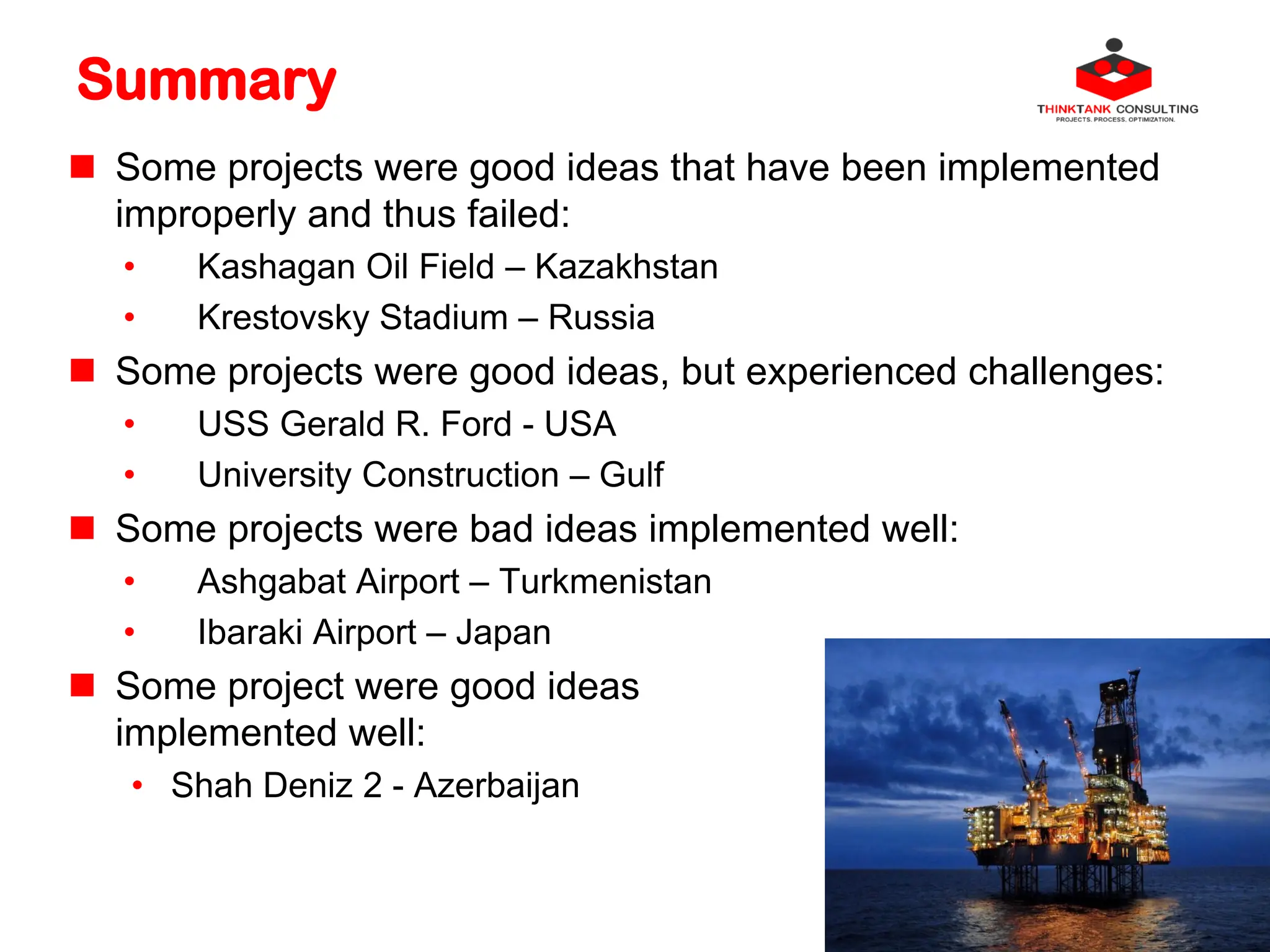
• Shah Deniz 2 - Azerbaijan
 Summary
Thanks for Signing Up!
 Please take a moment to join my exclusive online community,
connect with fellow learners and gain access to additional free
resources:
• http://www.thinktankconsulting.ca/apply
 My other online courses (PDU Certificates available):
• Advanced Practical Project Management
• Project Portfolio Management
• Business Analysis for IT and Software Projects
• Business Analysis for All Types of Projects
• Troubled Projects Recovery
• How to Write a Great Requirements Document
Introductions
 Jamal Moustafaev, MBA, PMP - President and founder of
Thinktank Consulting (Vancouver, Canada)
 Expert in the areas of project/portfolio management, project
scoping, process improvement and corporate training
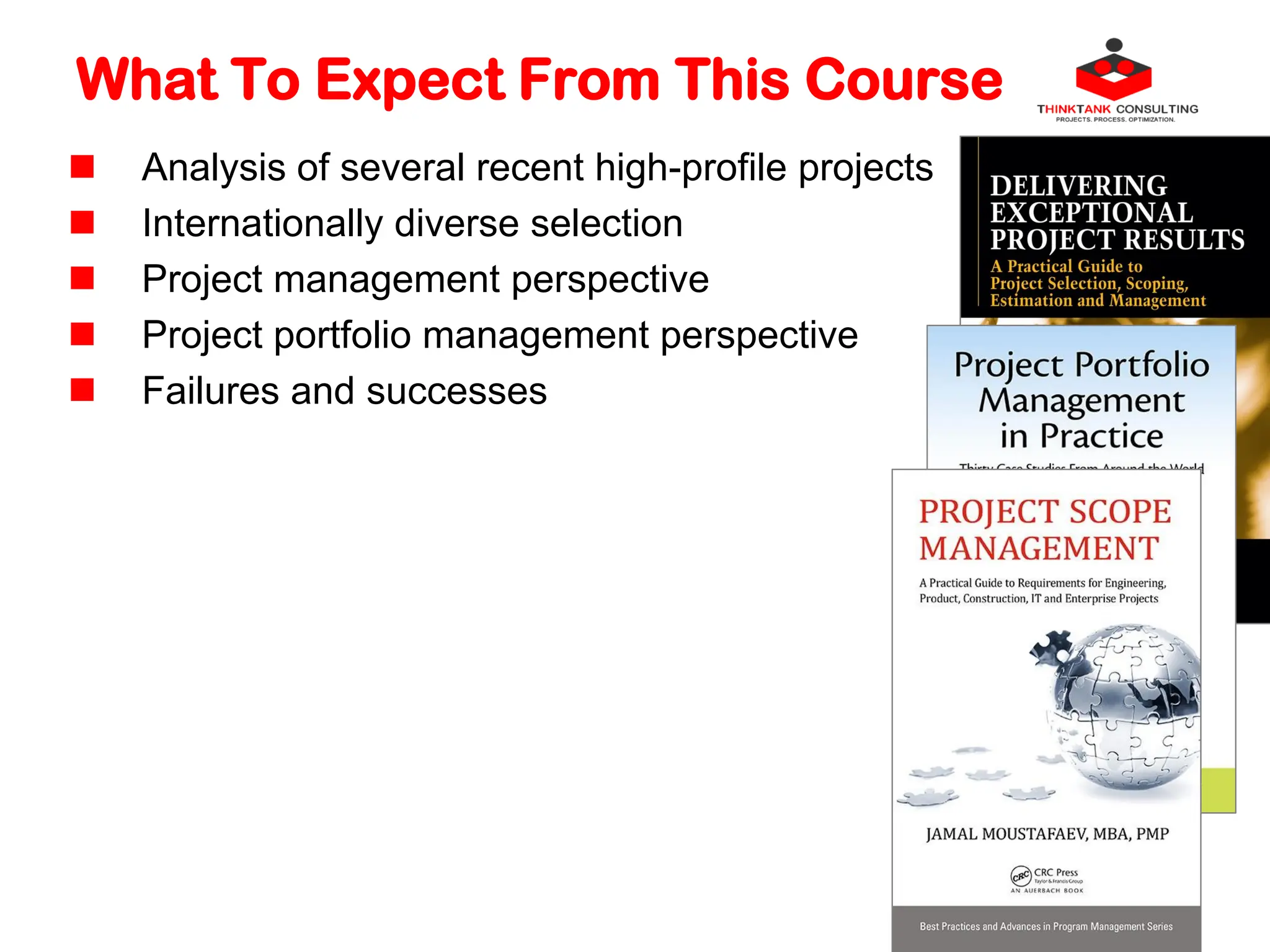
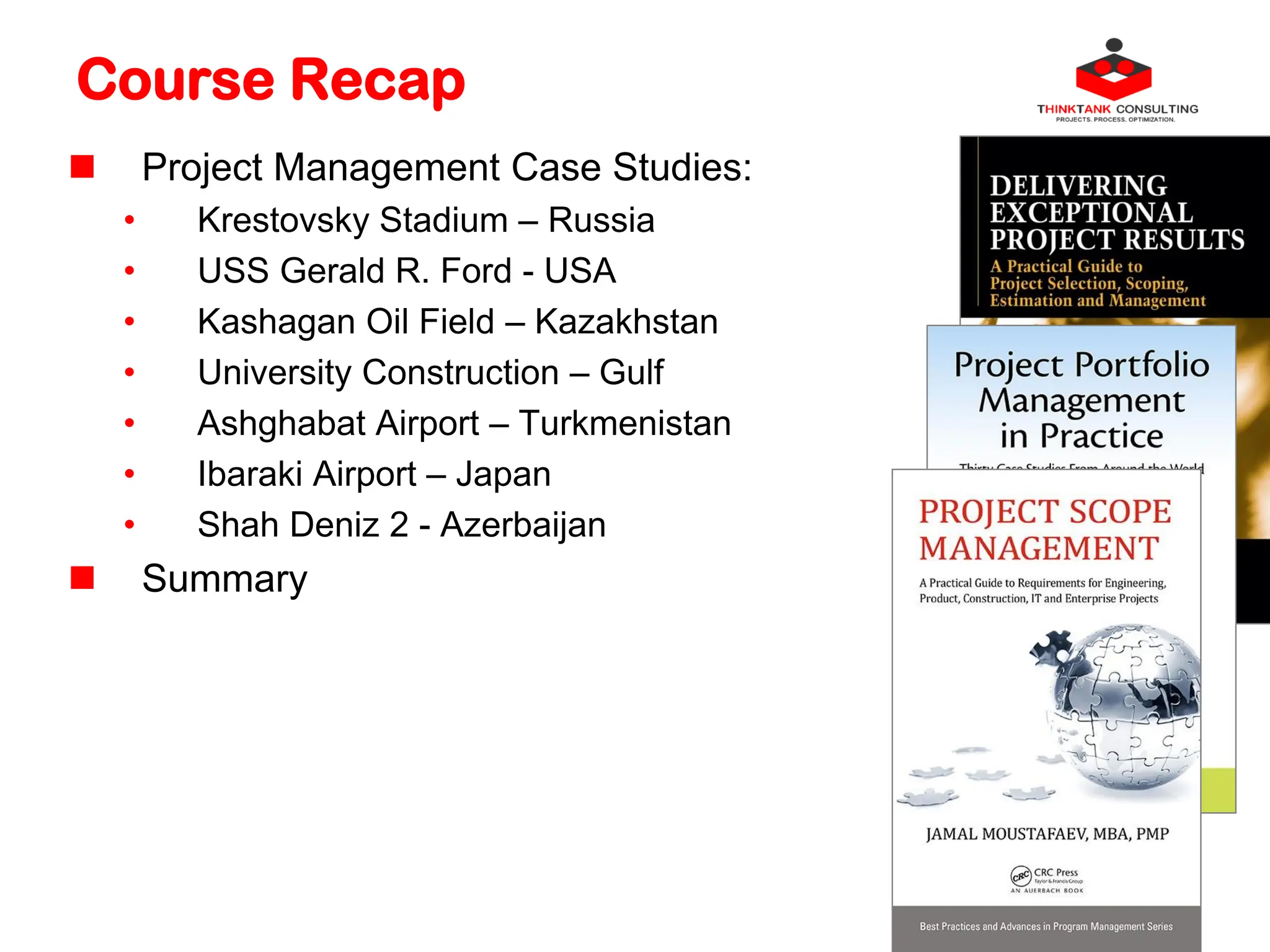
 Author of the books:
• Delivering Exceptional Project Results: A Practical Guide to Project
Selection, Scoping, Estimation and Management
• Project Scope Management: A Practical Guide to Requirements for
Engineering, Product, Construction, IT and Enterprise Projects
• Project Portfolio Management in Theory and Practice: Thirty Case
Studies from around the World
 Consulted for numerous private-sector and government
organizations in Canada, US, Asia, Middle East and Europe
 MBA and a BBA (Finance and Management Science) from
Simon Fraser University
 Frequent contributor to various publications and speaker at
conferences
Introductions
 Thinktank Consulting is a professional services company specializing
in the following areas:
 Project Management and Business Analysis consulting and
outsourcing
 Process improvement audits & programmes including:
 Project Management methodology development
 Portfolio Management methodology development
 Requirements Engineering methodology development
 Estimation methodology development
 Training
 “Practical Portfolio Management - Selecting & Managing The Right
Projects”
 “Successful Hands-On Management of Modern-Day Projects”
 “Project Scope Management - Practical Requirements Engineering”
www.thinktankconsulting.ca
info@thinktankconsulting.ca
Introductions
Contact Info
Watch my courses on Udemy
https://www.udemy.com/user/jamal-moustafaev/
Subscribe to this YouTube Channel:
youtube.com/user/ThinktankConsulting
Follow us on Twitter:
twitter.com/ThinktankConsul
Like our page on Facebook:
facebook.com/ProjectManagementThinktankConsulting
Connect with me on LinkedIn:
linkedin.com/in/jmoustafaev
Email me:
jamal@thinktankconsulting.ca
Subscribe to my blog (RSS feed):
ThinktankConsulting.ca/rss.xml
Visit our website:
ThinktankConsulting.ca
© 2008 Thinktank Consulting. All rights reserved
Target Audience
 Project and program managers who run projects and supply
executives with key information
 C-level executives who still contemplate the value of project
management
 Functional department directors and managers who are
responsible for providing project resources
 Young professionals who are just entering the workforce
 “Technical resources” whose work is crucial to the project
success
 Professionals who are not certified project
managers but manage projects anyways
What To Expect From This Course
 Analysis of several recent high-profile projects
 Internationally diverse selection
 Project management perspective
 Project portfolio management perspective
 Failures and successes
Krestovsky Stadium
What Happens When Corruption Meets
Incompetence
Introduction
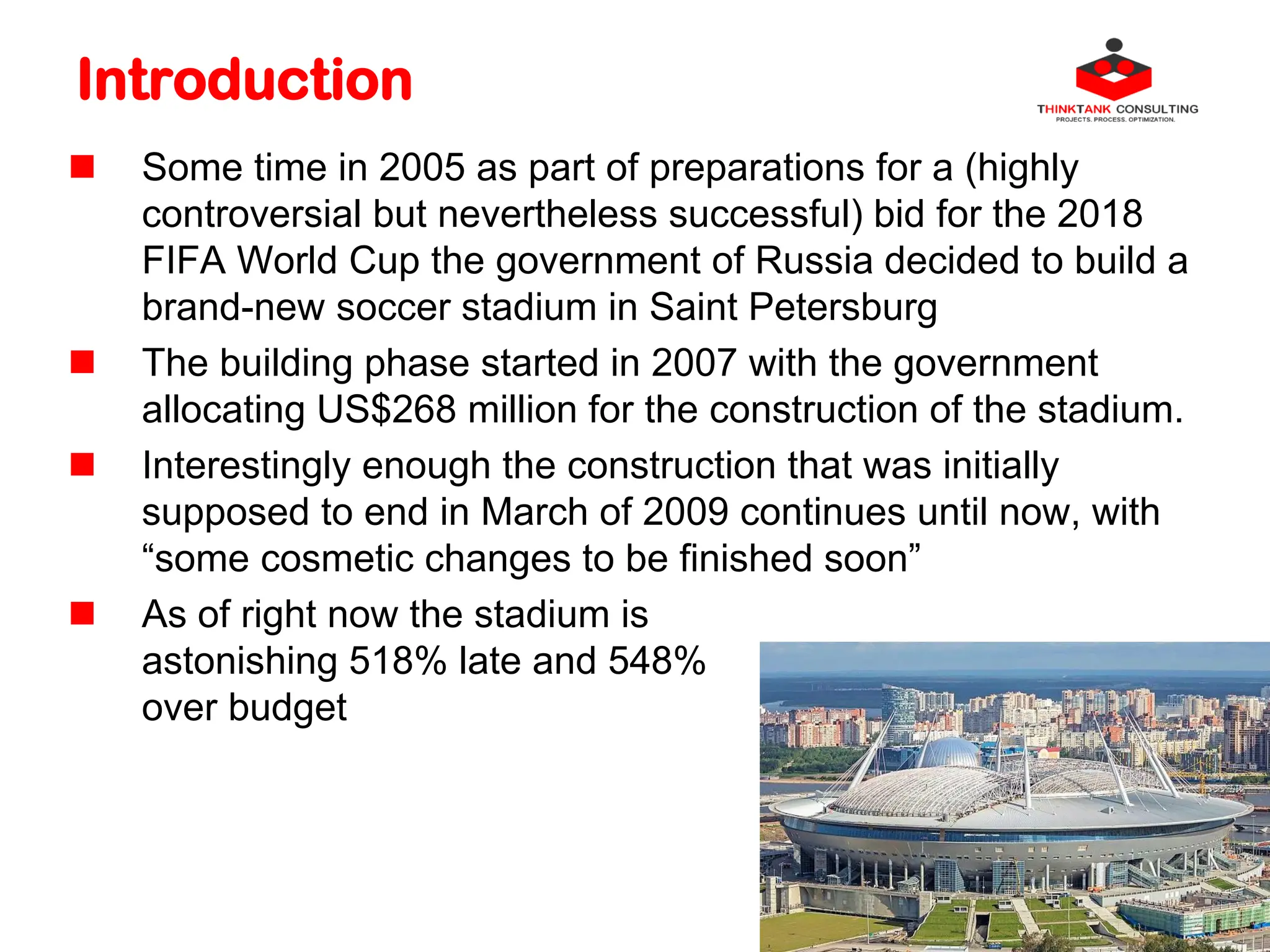
 Some time in 2005 as part of preparations for a (highly
controversial but nevertheless successful) bid for the 2018
FIFA World Cup the government of Russia decided to build a
brand-new soccer stadium in Saint Petersburg
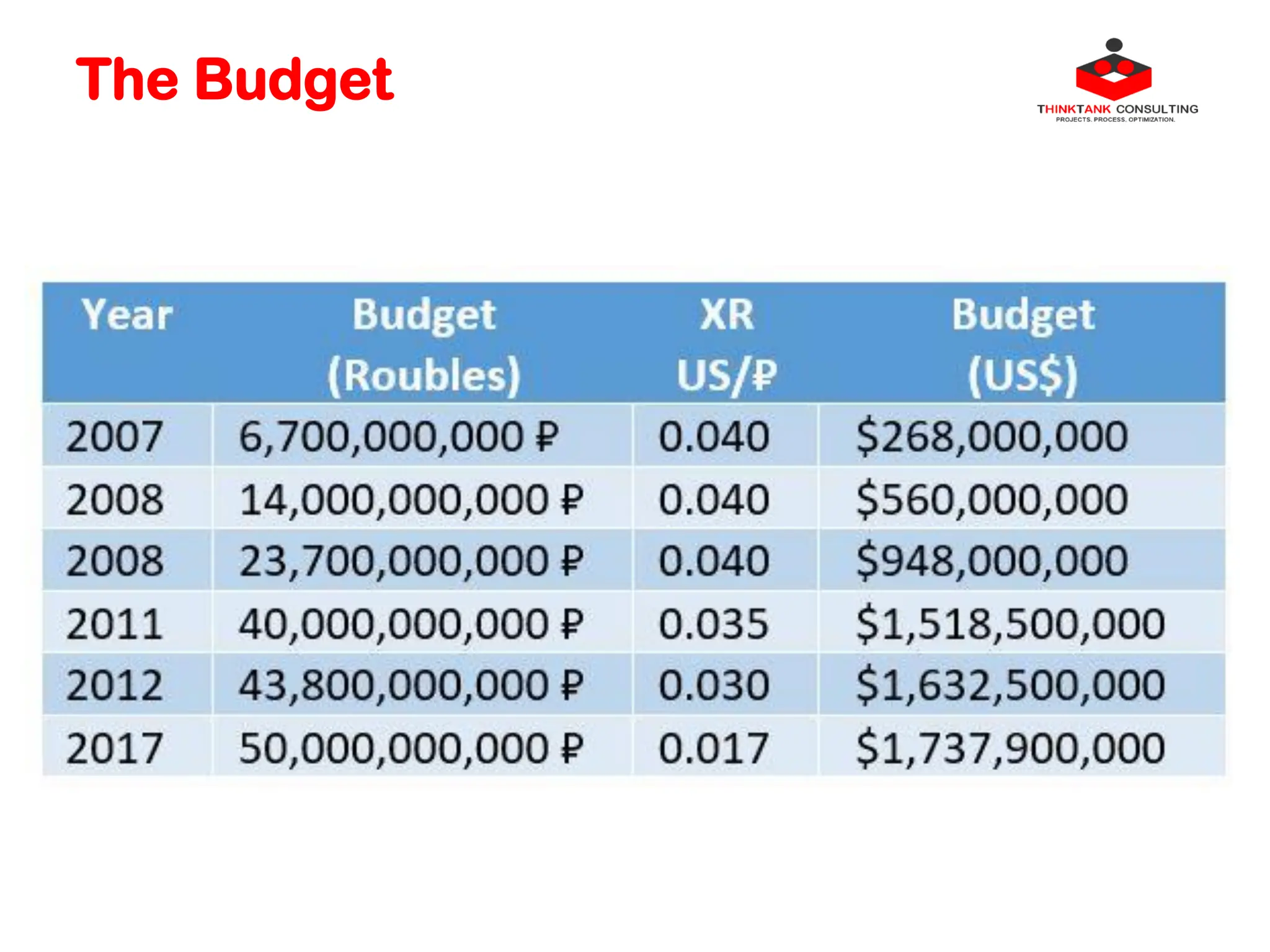
 The building phase started in 2007 with the government
allocating US$268 million for the construction of the stadium.
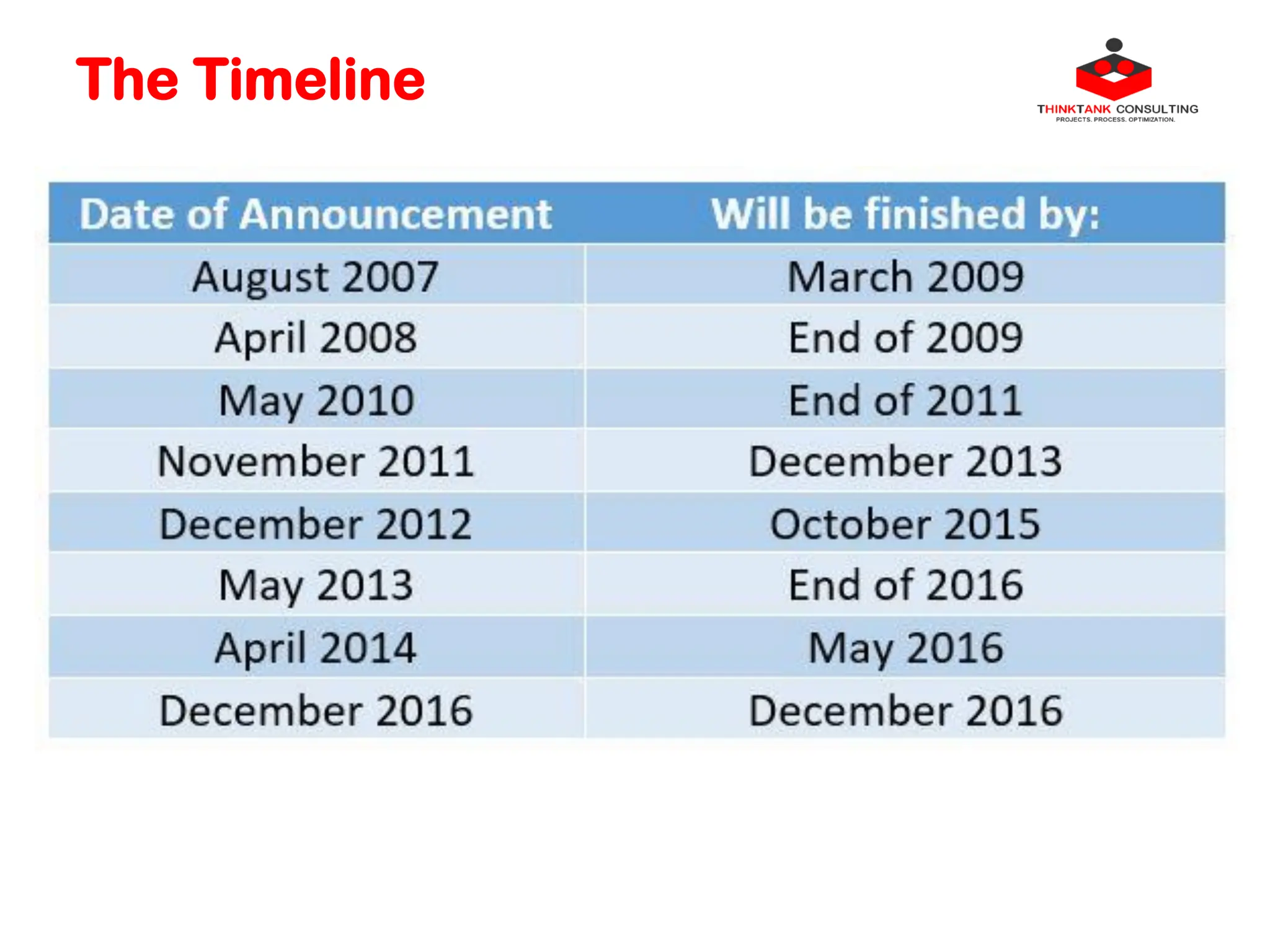
 Interestingly enough the construction that was initially
supposed to end in March of 2009 continues until now, with
“some cosmetic changes to be finished soon”
 As of right now the stadium is
astonishing 518% late and 548%
over budget
The Timeline
The Budget
Root Causes and Explanations
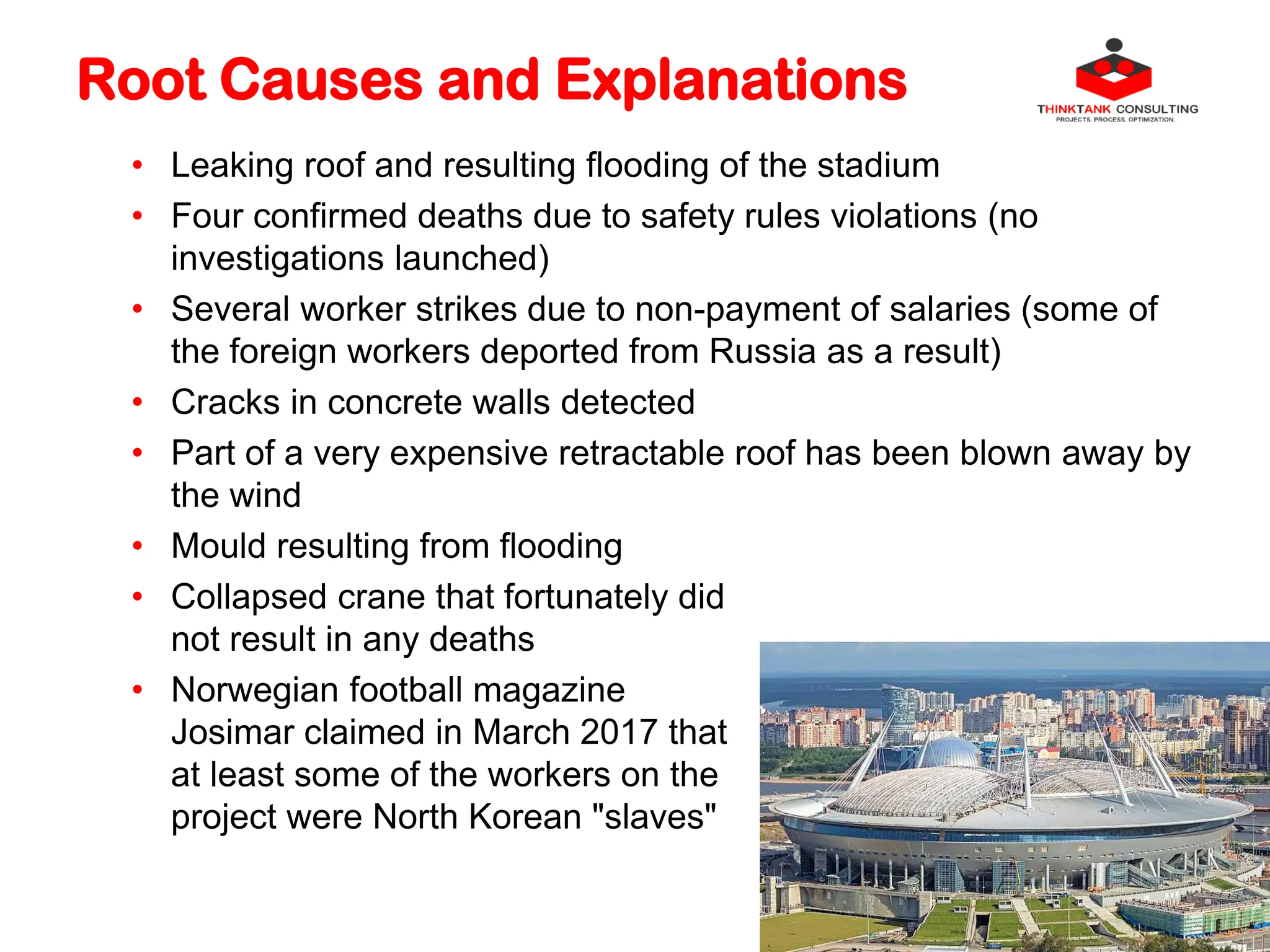
 Based on the reports of various newspapers there were two
major causes of delays, cost overruns and quality issues:
poor planning and rampant corruption
 Some of the issues encountered during the construction of the
Krestovsky Stadium:
• One of the major delays has been attributed to the sudden death
of the Japanese architect Kisho Kurokawa: apparently nobody
bothered to translate his blueprints from Japanese to Russian
• Severe vibrations of the retractable field (reported by FIFA)
• “Finished” stadium does not have a media center
• Crowd access control “issues”
(reported by FIFA)
• Severe problems with the grass
pitch
Root Causes and Explanations
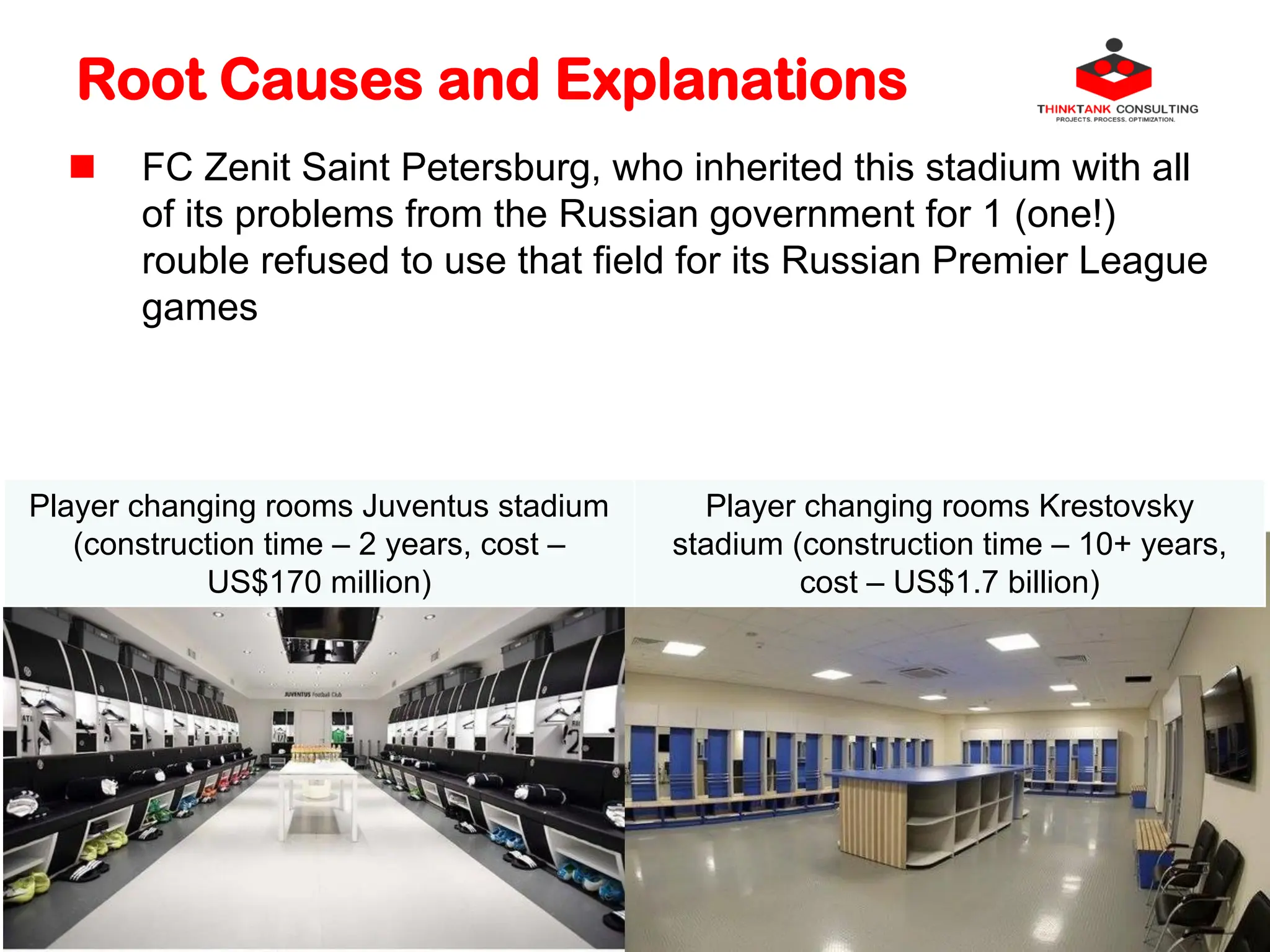
• Leaking roof and resulting flooding of the stadium
• Four confirmed deaths due to safety rules violations (no
investigations launched)
• Several worker strikes due to non-payment of salaries (some of
the foreign workers deported from Russia as a result)
• Cracks in concrete walls detected
• Part of a very expensive retractable roof has been blown away by
the wind
• Mould resulting from flooding
• Collapsed crane that fortunately did
not result in any deaths
• Norwegian football magazine
Josimar claimed in March 2017 that
at least some of the workers on the
project were North Korean "slaves"
Root Causes and Explanations
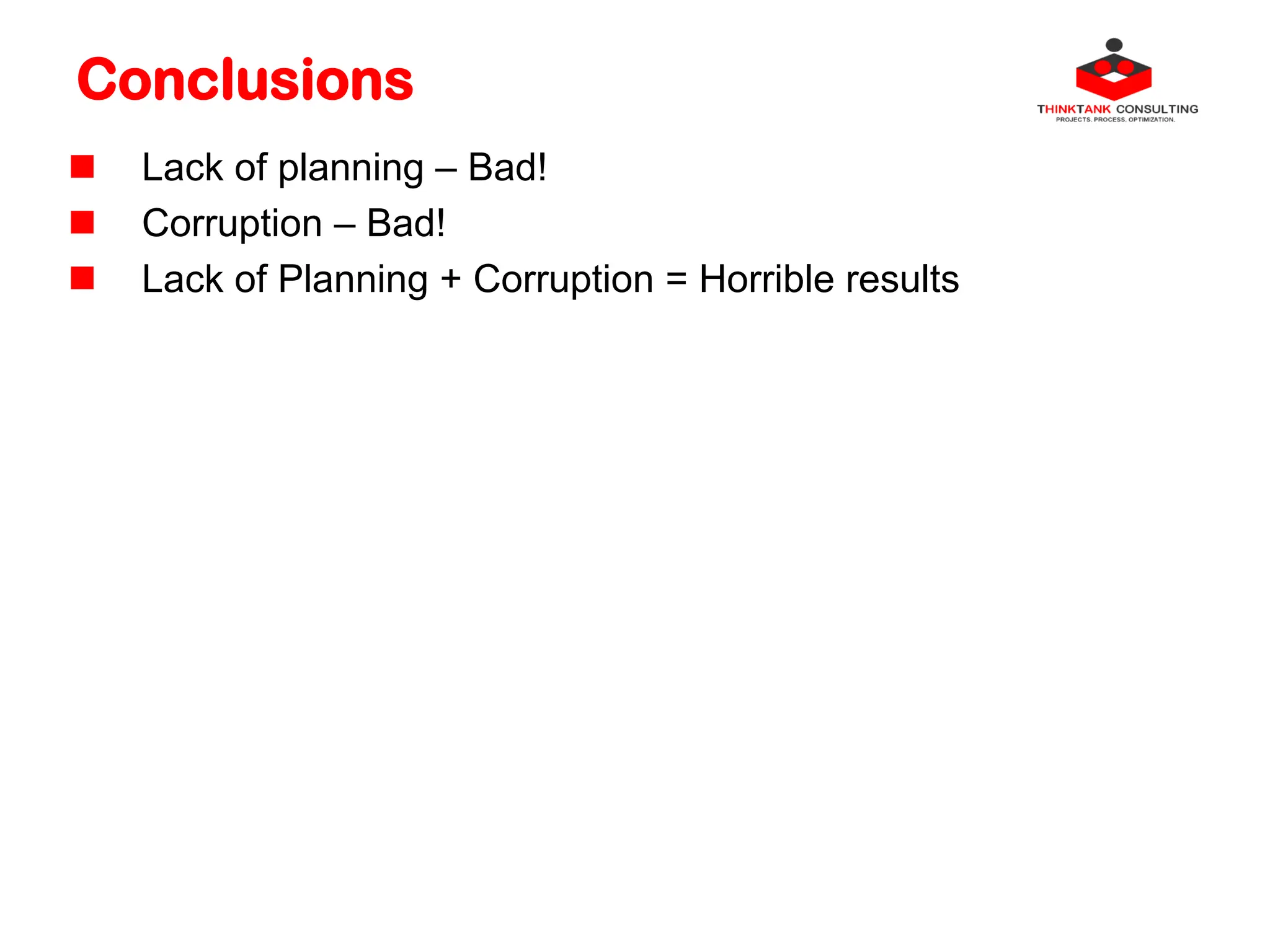
 FC Zenit Saint Petersburg, who inherited this stadium with all
of its problems from the Russian government for 1 (one!)
rouble refused to use that field for its Russian Premier League
games
Player changing rooms Juventus stadium
(construction time – 2 years, cost –
US$170 million)
Player changing rooms Krestovsky
stadium (construction time – 10+ years,
cost – US$1.7 billion)
Conclusions
 Lack of planning – Bad!
 Corruption – Bad!
 Lack of Planning + Corruption = Horrible results
USS Gerald R. Ford
What Went Wrong with the Most Expensive
Warship?
Introduction
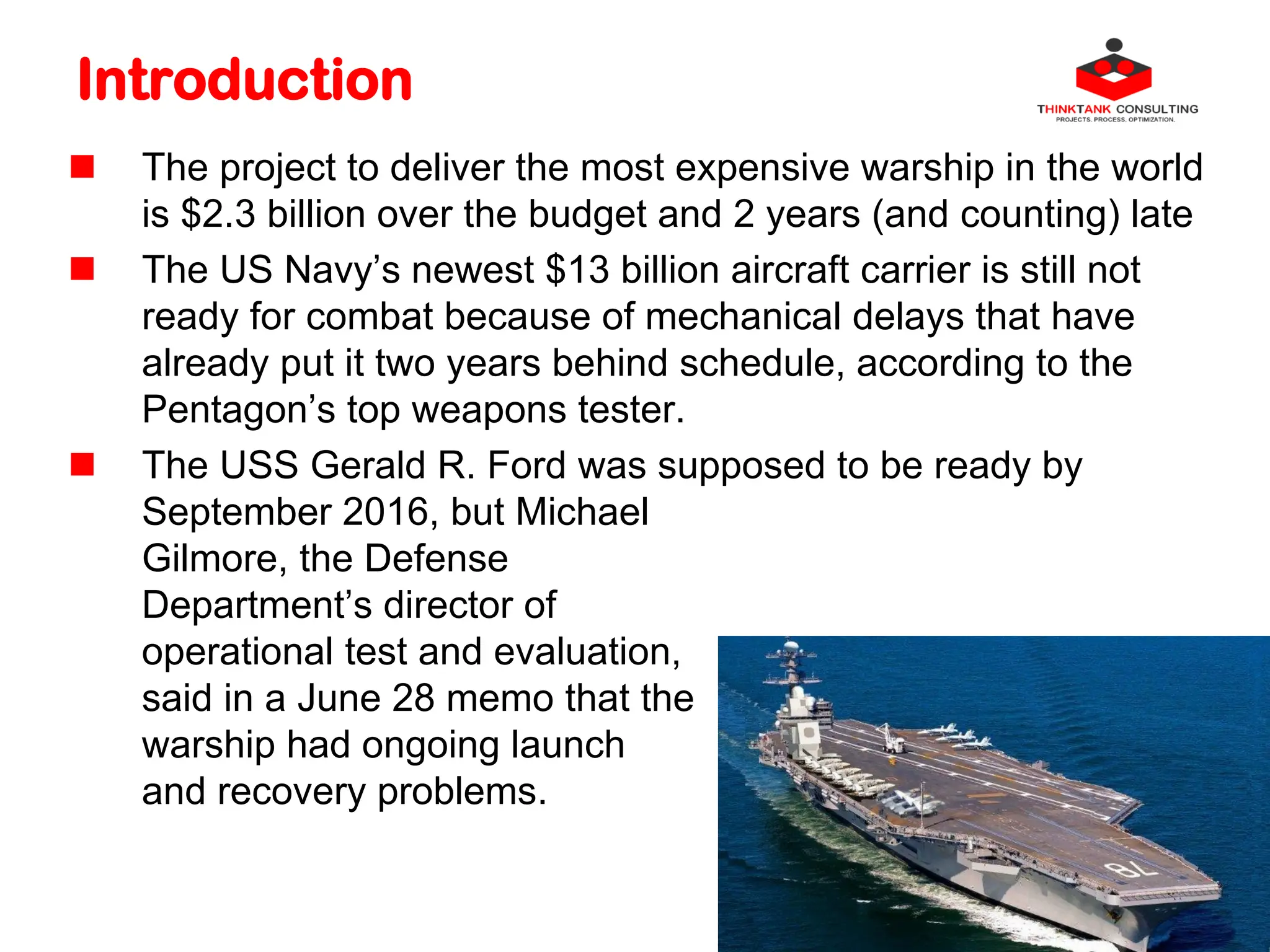
 The project to deliver the most expensive warship in the world
is $2.3 billion over the budget and 2 years (and counting) late
 The US Navy’s newest $13 billion aircraft carrier is still not
ready for combat because of mechanical delays that have
already put it two years behind schedule, according to the
Pentagon’s top weapons tester.
 The USS Gerald R. Ford was supposed to be ready by
September 2016, but Michael
Gilmore, the Defense
Department’s director of
operational test and evaluation,
said in a June 28 memo that the
warship had ongoing launch
and recovery problems.
Introduction
Root Causes and Explanations
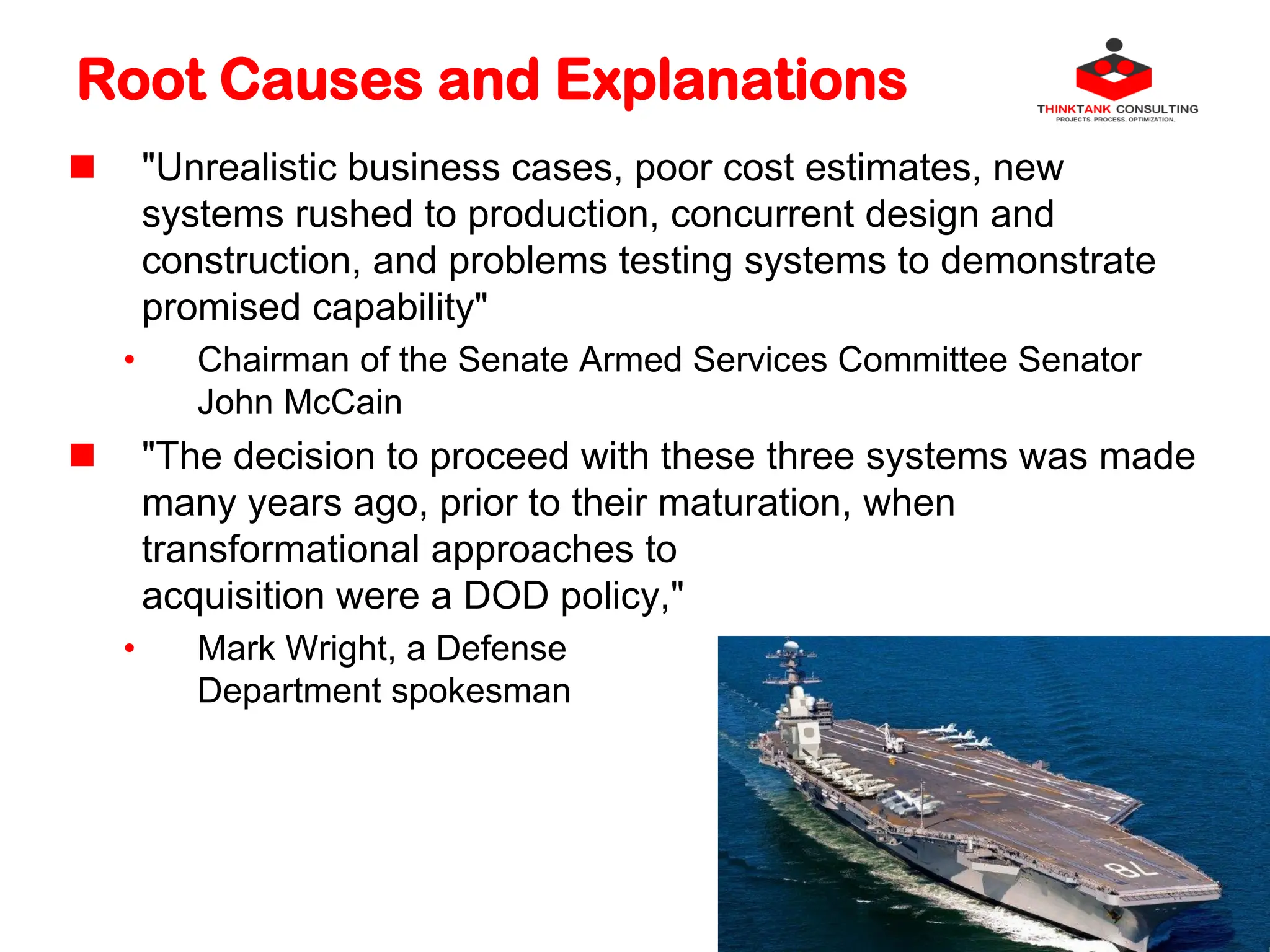
 "Unrealistic business cases, poor cost estimates, new
systems rushed to production, concurrent design and
construction, and problems testing systems to demonstrate
promised capability"
• Chairman of the Senate Armed Services Committee Senator
John McCain
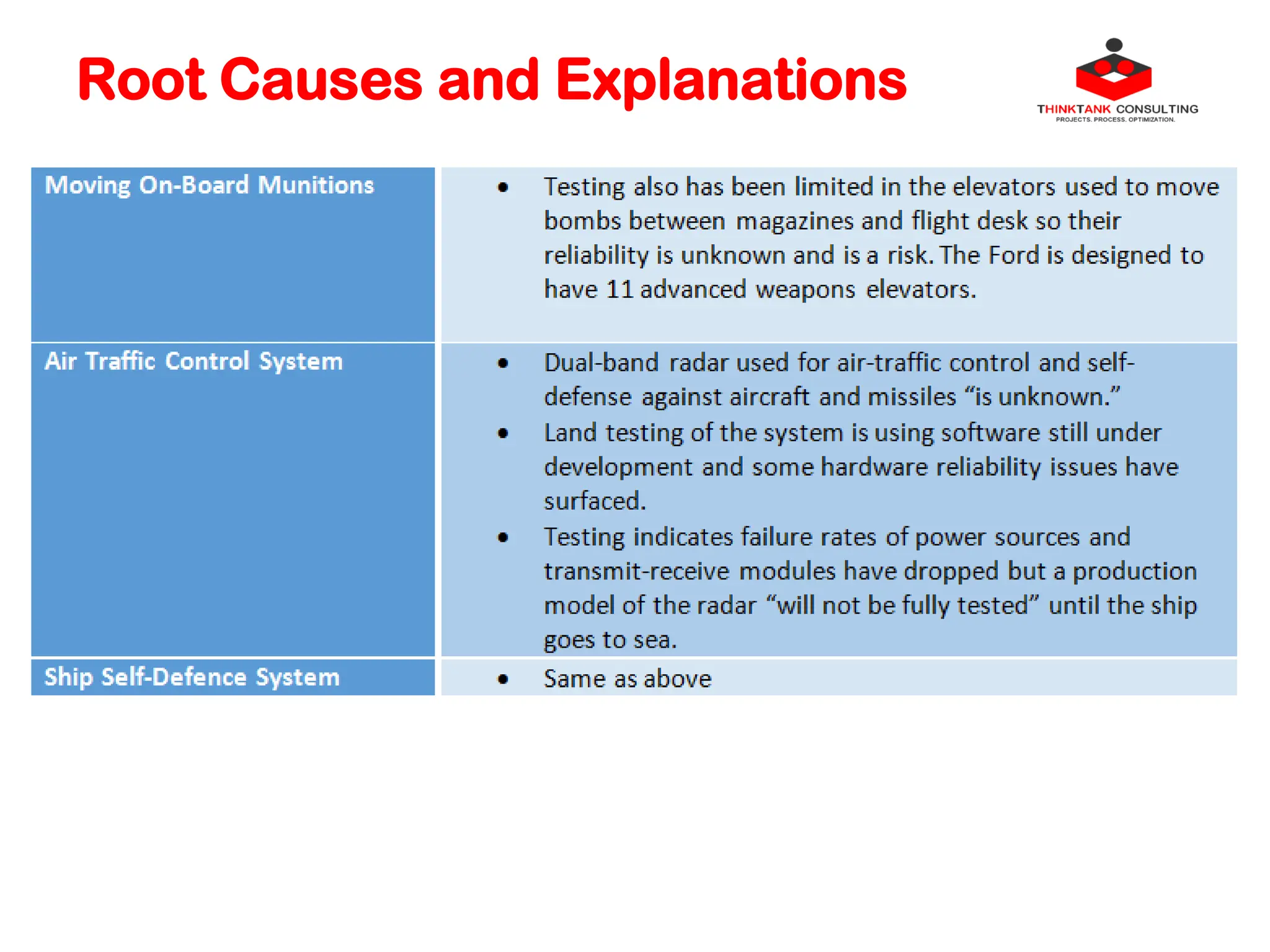
 "The decision to proceed with these three systems was made
many years ago, prior to their maturation, when
transformational approaches to
acquisition were a DOD policy,"
• Mark Wright, a Defense
Department spokesman
Conclusions
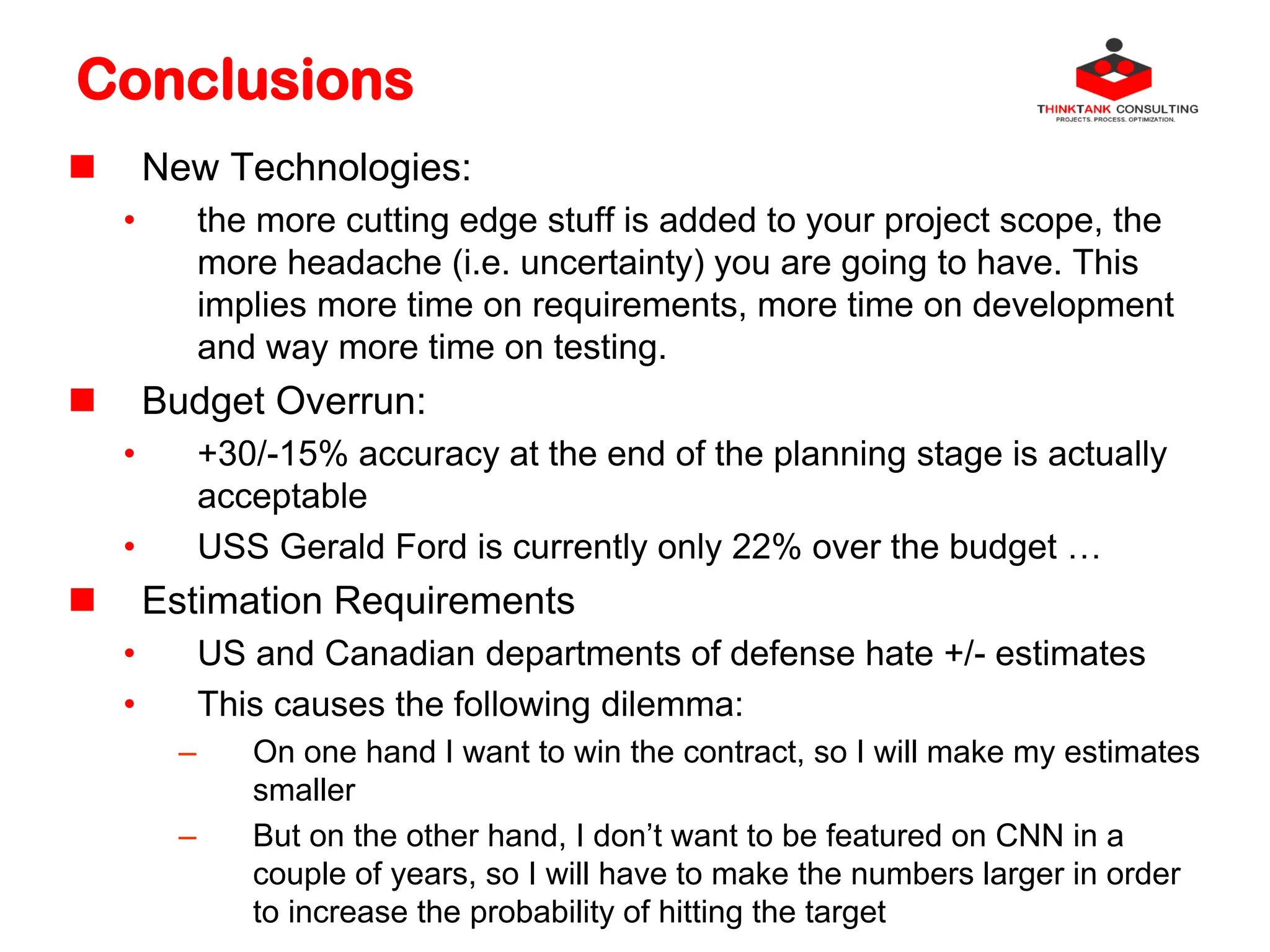
 New Technologies:
• the more cutting edge stuff is added to your project scope, the
more headache (i.e. uncertainty) you are going to have. This
implies more time on requirements, more time on development
and way more time on testing.
 Budget Overrun:
• +30/-15% accuracy at the end of the planning stage is actually
acceptable
• USS Gerald Ford is currently only 22% over the budget …
 Estimation Requirements
• US and Canadian departments of defense hate +/- estimates
• This causes the following dilemma:
– On one hand I want to win the contract, so I will make my estimates
smaller
– But on the other hand, I don’t want to be featured on CNN in a
couple of years, so I will have to make the numbers larger in order
to increase the probability of hitting the target
Kashagan Oil Field
A Fiasco That is 11 Years Late and $100 Billion
Over Budget
Introduction
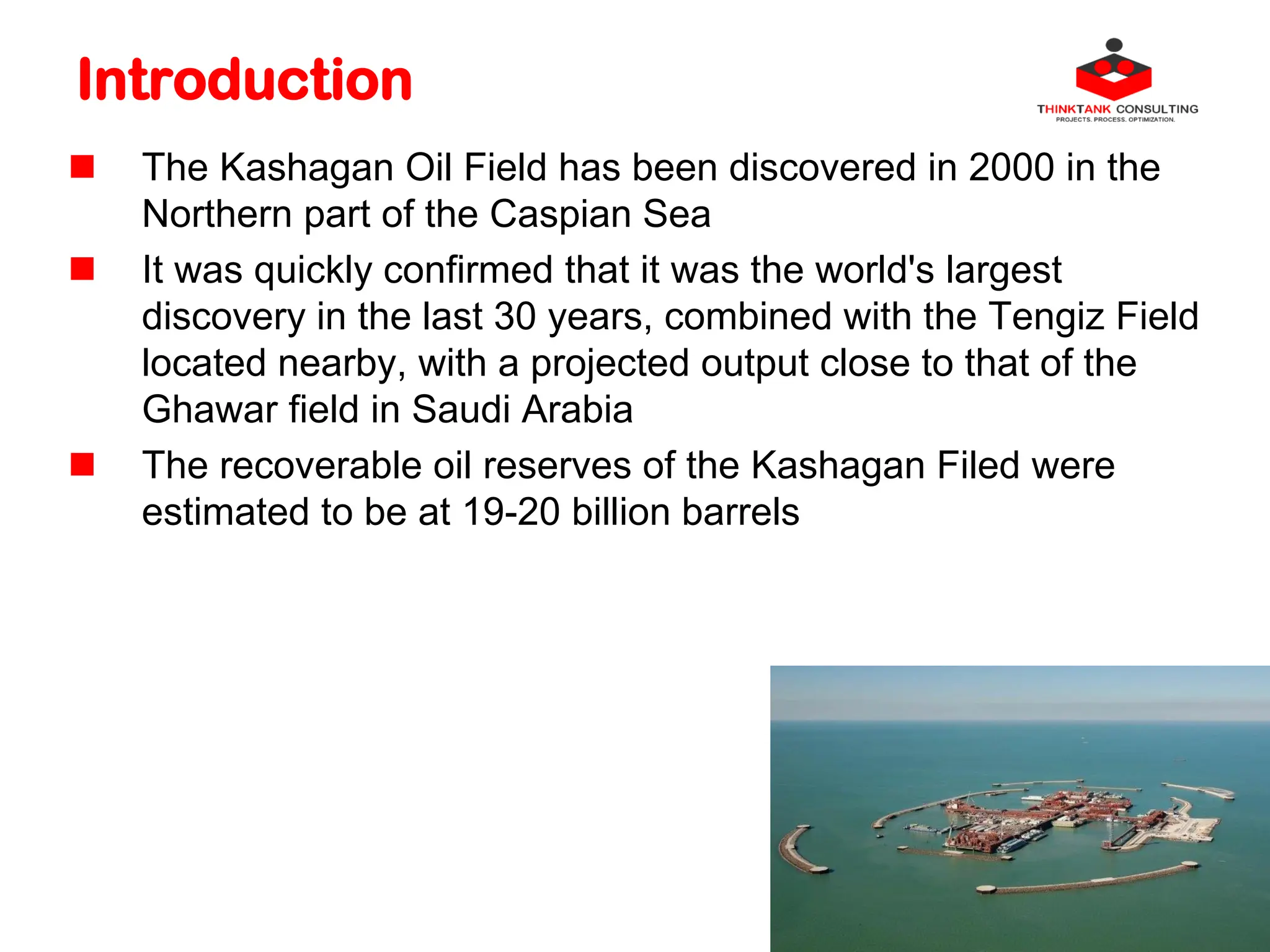
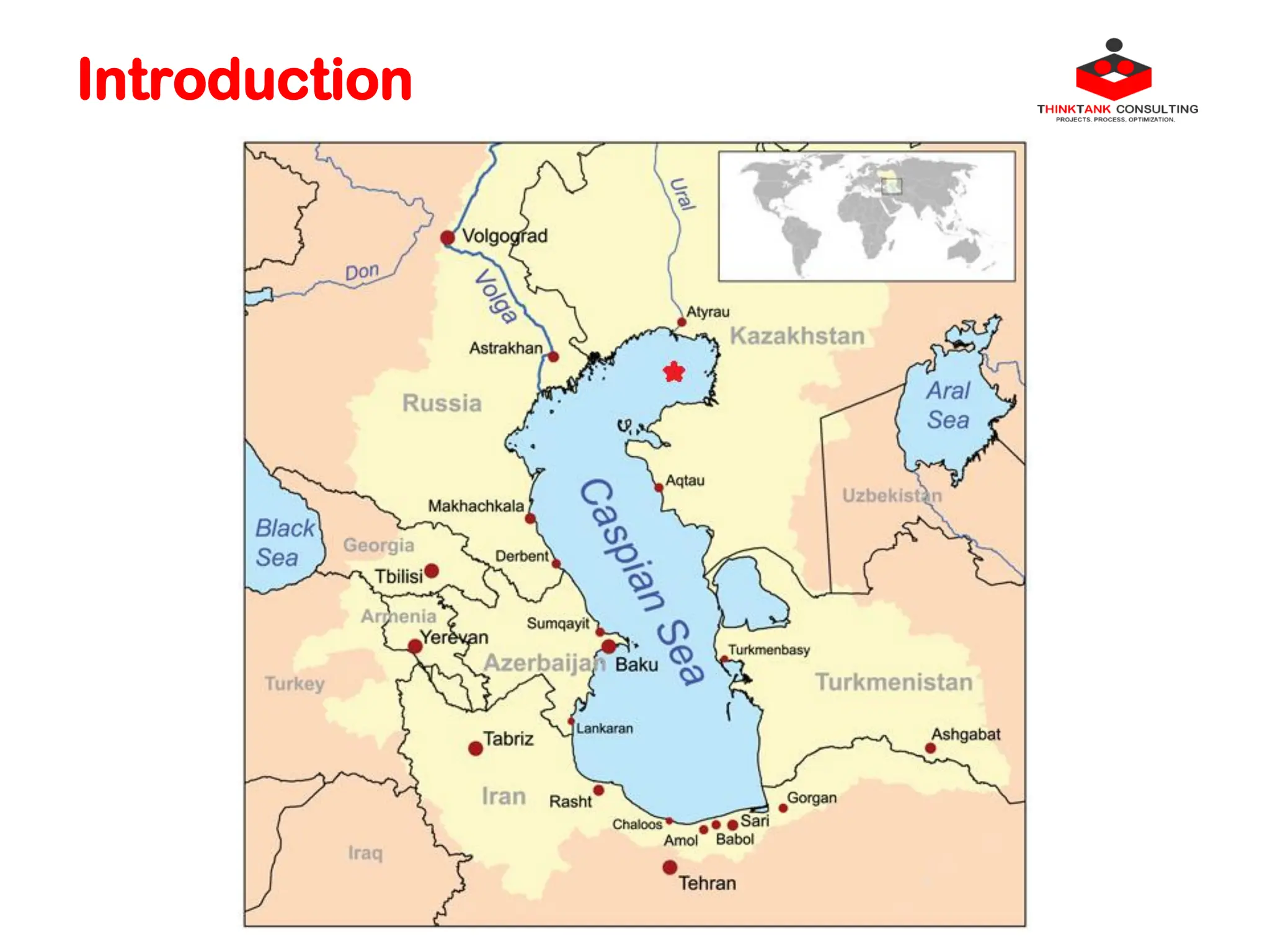
 The Kashagan Oil Field has been discovered in 2000 in the
Northern part of the Caspian Sea
 It was quickly confirmed that it was the world's largest
discovery in the last 30 years, combined with the Tengiz Field
located nearby, with a projected output close to that of the
Ghawar field in Saudi Arabia
 The recoverable oil reserves of the Kashagan Filed were
estimated to be at 19-20 billion barrels
Introduction
Introduction
 The project started in 2001 with an expected completion date
of 2005
• Budget - US$10 billion
• The oilfield was expected to become operational around 2005
and produce anywhere between 90,000 and 370,000 barrels (at
peak production) a day
 Fell 8 years behind the schedule and ended up costing a bit
more than the original forecast:
• Kazakhstan – US$50 billion
• CNN Money – US$115 billion
• Other sources - US$150 billion
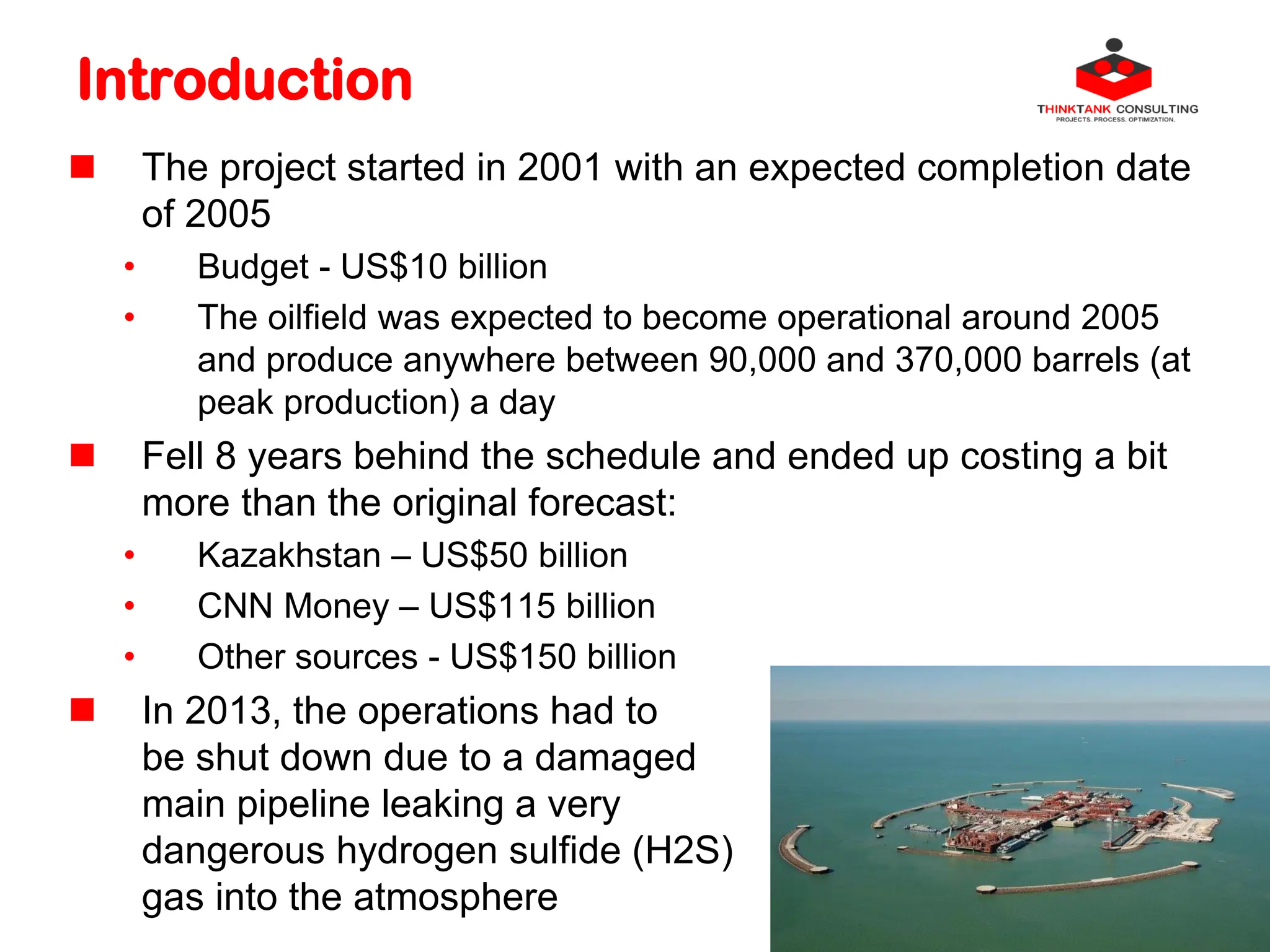
 In 2013, the operations had to
be shut down due to a damaged
main pipeline leaking a very
dangerous hydrogen sulfide (H2S)
gas into the atmosphere
Root Causes and Explanations
Conclusion
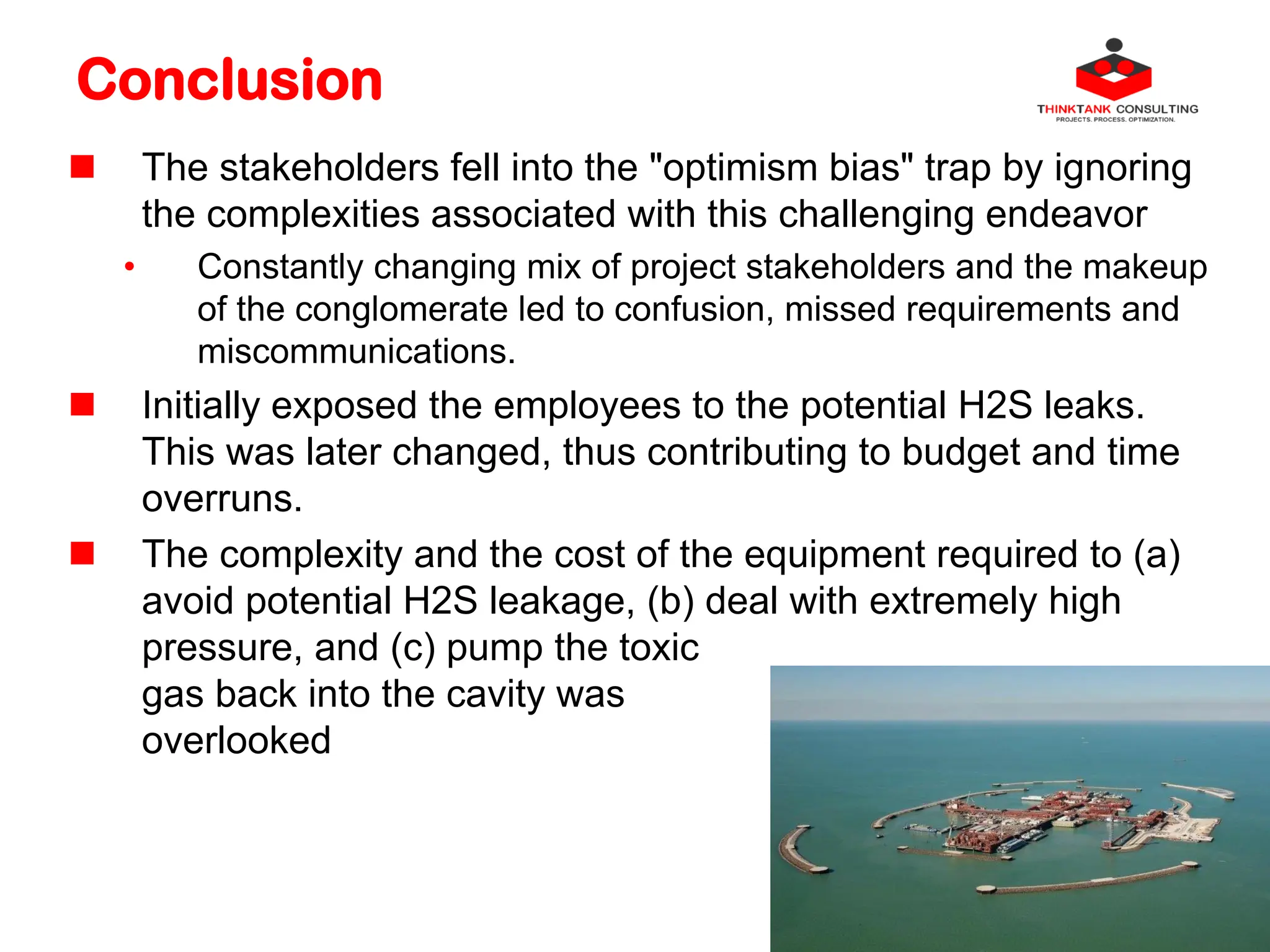
 The stakeholders fell into the "optimism bias" trap by ignoring
the complexities associated with this challenging endeavor
• Constantly changing mix of project stakeholders and the makeup
of the conglomerate led to confusion, missed requirements and
miscommunications.
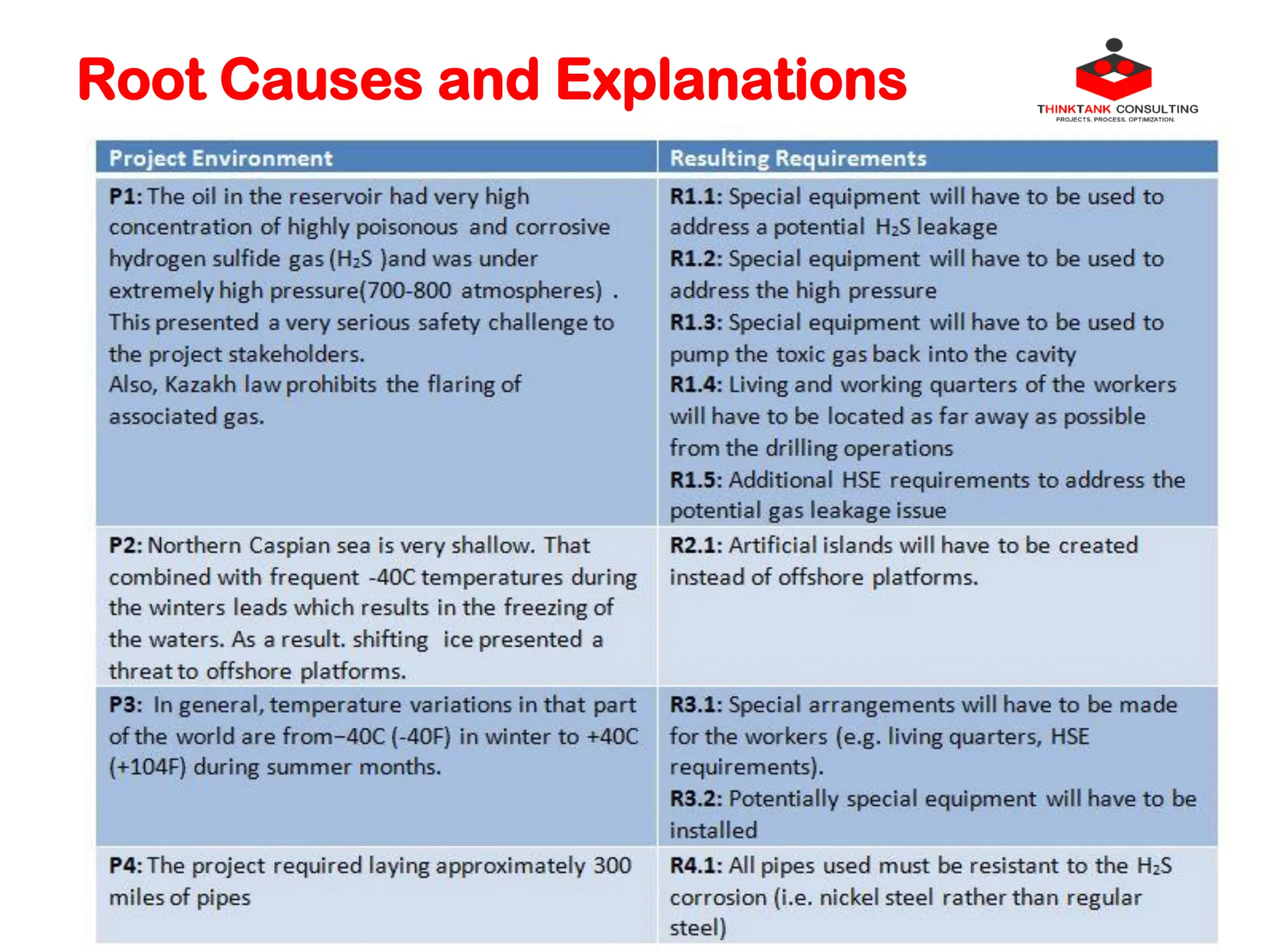
 Initially exposed the employees to the potential H2S leaks.
This was later changed, thus contributing to budget and time
overruns.
 The complexity and the cost of the equipment required to (a)
avoid potential H2S leakage, (b) deal with extremely high
pressure, and (c) pump the toxic
gas back into the cavity was
overlooked
Conclusion
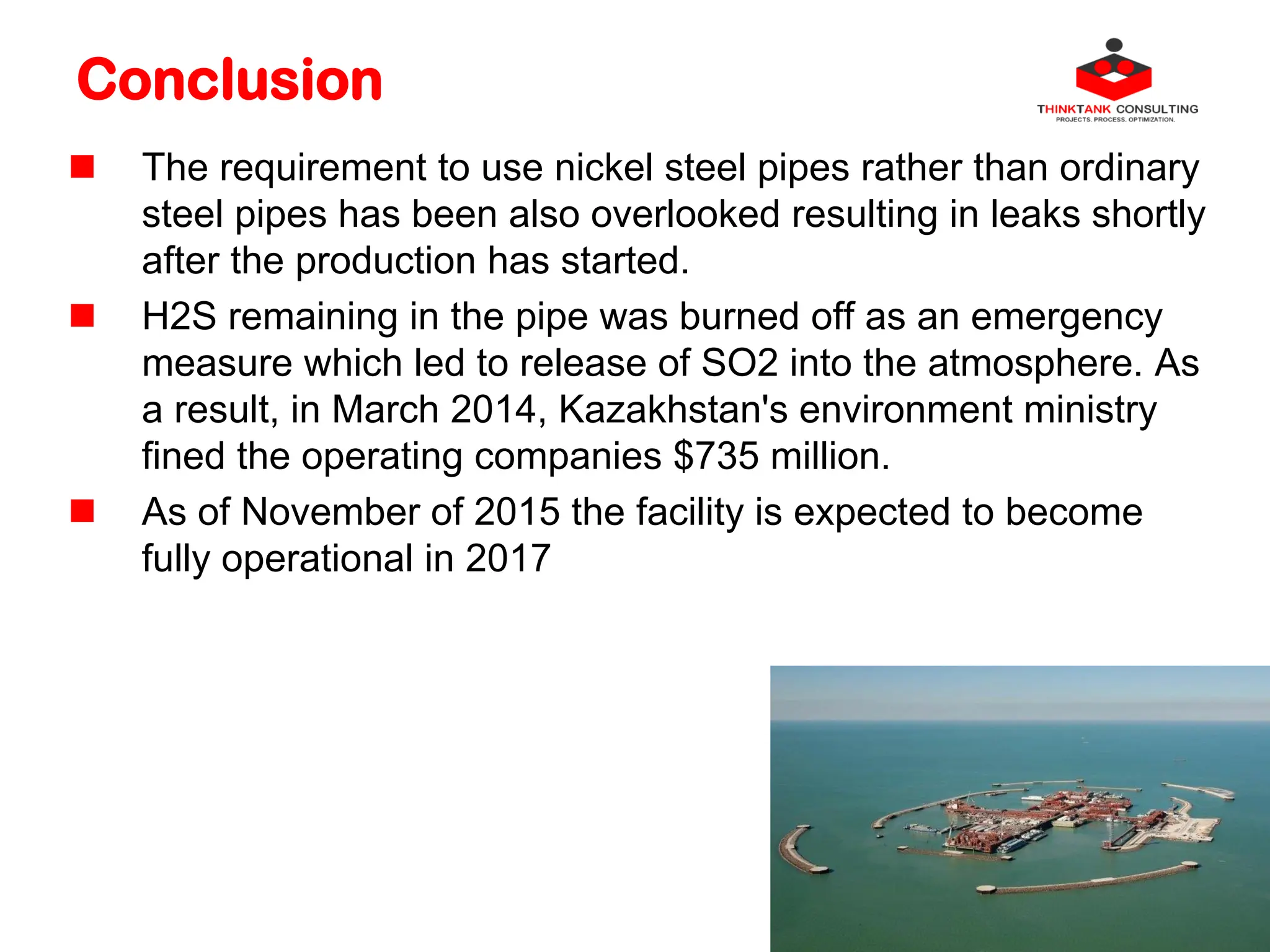
 The requirement to use nickel steel pipes rather than ordinary
steel pipes has been also overlooked resulting in leaks shortly
after the production has started.
 H2S remaining in the pipe was burned off as an emergency
measure which led to release of SO2 into the atmosphere. As
a result, in March 2014, Kazakhstan's environment ministry
fined the operating companies $735 million.
 As of November of 2015 the facility is expected to become
fully operational in 2017
The University Construction
Introduction
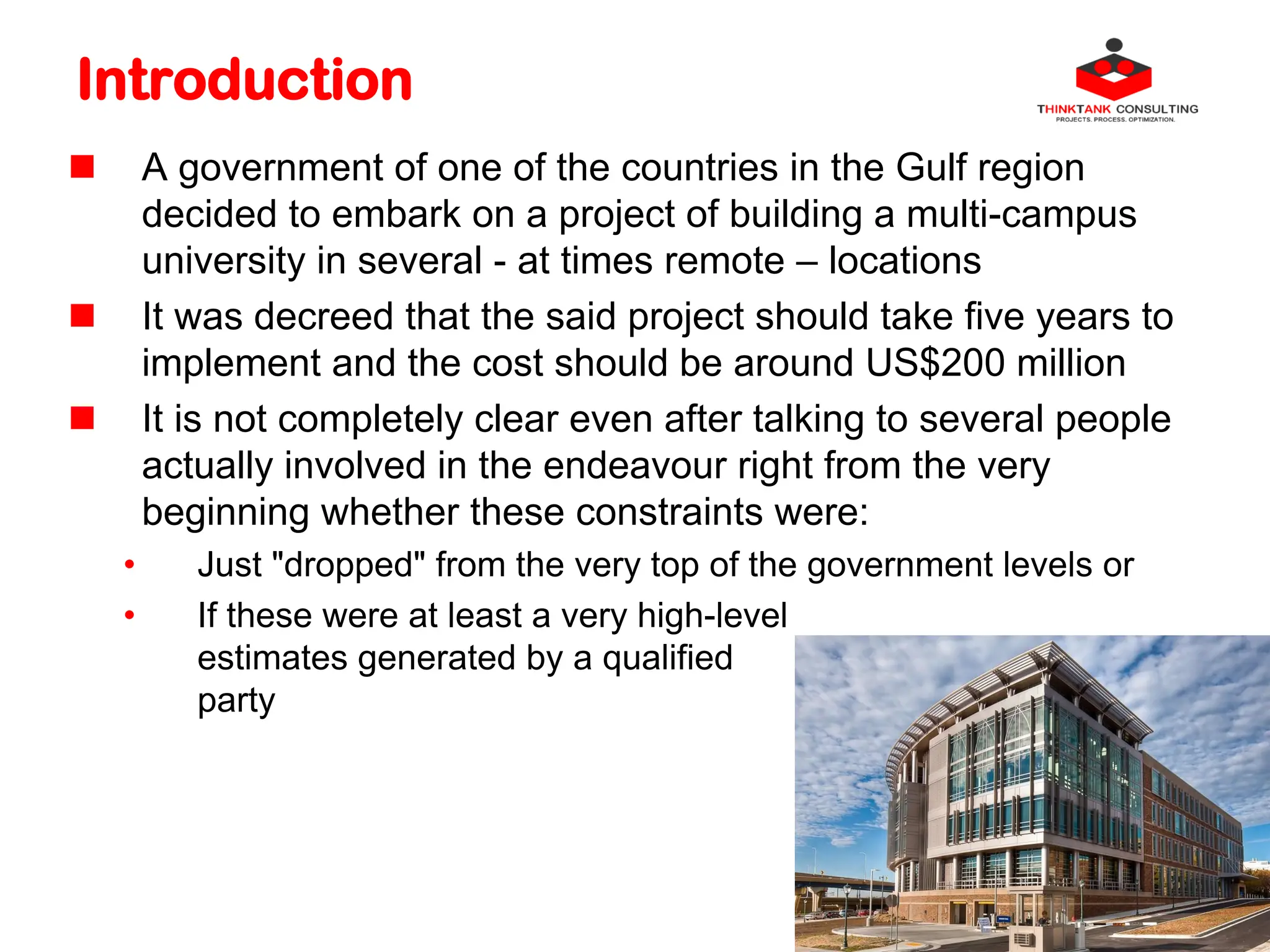
 A government of one of the countries in the Gulf region
decided to embark on a project of building a multi-campus
university in several - at times remote – locations
 It was decreed that the said project should take five years to
implement and the cost should be around US$200 million
 It is not completely clear even after talking to several people
actually involved in the endeavour right from the very
beginning whether these constraints were:
• Just "dropped" from the very top of the government levels or
• If these were at least a very high-level
estimates generated by a qualified
party
Introduction
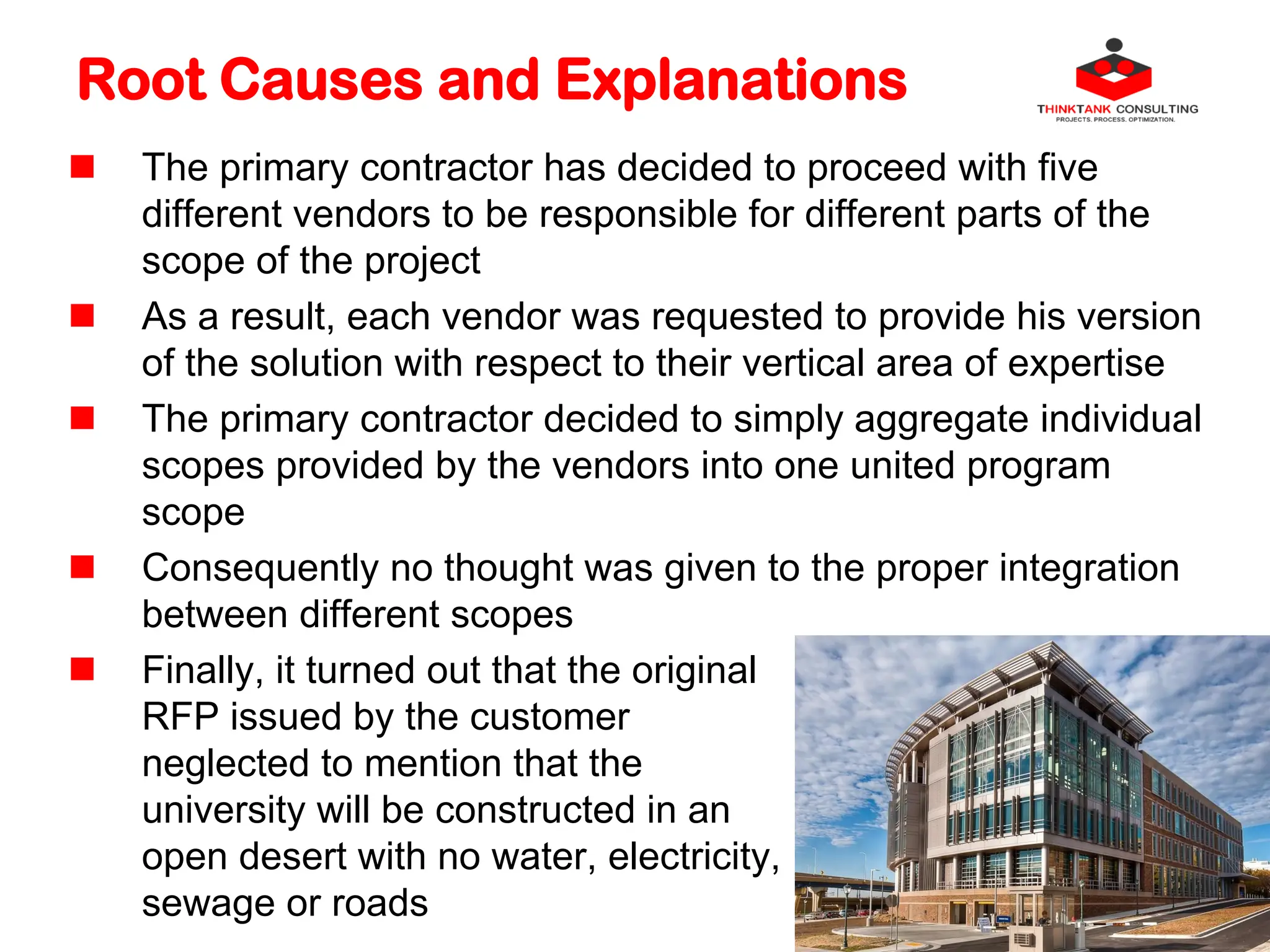
 The scope of the project, at least at a very high level, was
also thought to be well-understood. It included the following
requirements:
• Engineering design of all five campuses (both conceptual and
final)
• Construction of classrooms and lab training facilities
• Construction of dormitories
• Procurement and installation of all necessary equipment
• Setup of a new IT infrastructure including several data centers
• Design, development and delivery for over100 new courses
• Setup and customization for a web
e-learning portal
Root Causes and Explanations
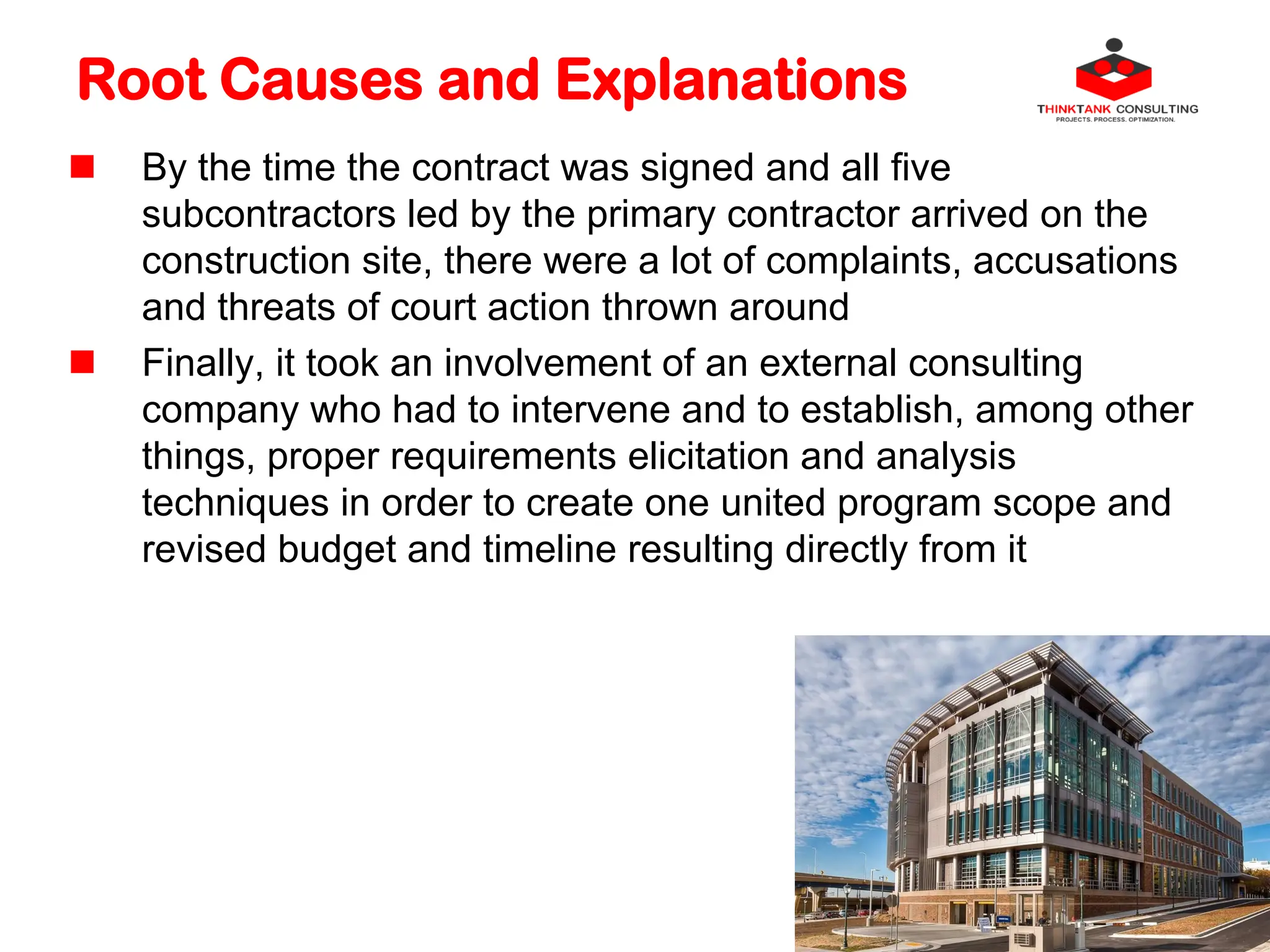
 The primary contractor has decided to proceed with five
different vendors to be responsible for different parts of the
scope of the project
 As a result, each vendor was requested to provide his version
of the solution with respect to their vertical area of expertise
 The primary contractor decided to simply aggregate individual
scopes provided by the vendors into one united program
scope
 Consequently no thought was given to the proper integration
between different scopes
 Finally, it turned out that the original
RFP issued by the customer
neglected to mention that the
university will be constructed in an
open desert with no water, electricity,
sewage or roads
Root Causes and Explanations
 By the time the contract was signed and all five
subcontractors led by the primary contractor arrived on the
construction site, there were a lot of complaints, accusations
and threats of court action thrown around
 Finally, it took an involvement of an external consulting
company who had to intervene and to establish, among other
things, proper requirements elicitation and analysis
techniques in order to create one united program scope and
revised budget and timeline resulting directly from it
Conclusions
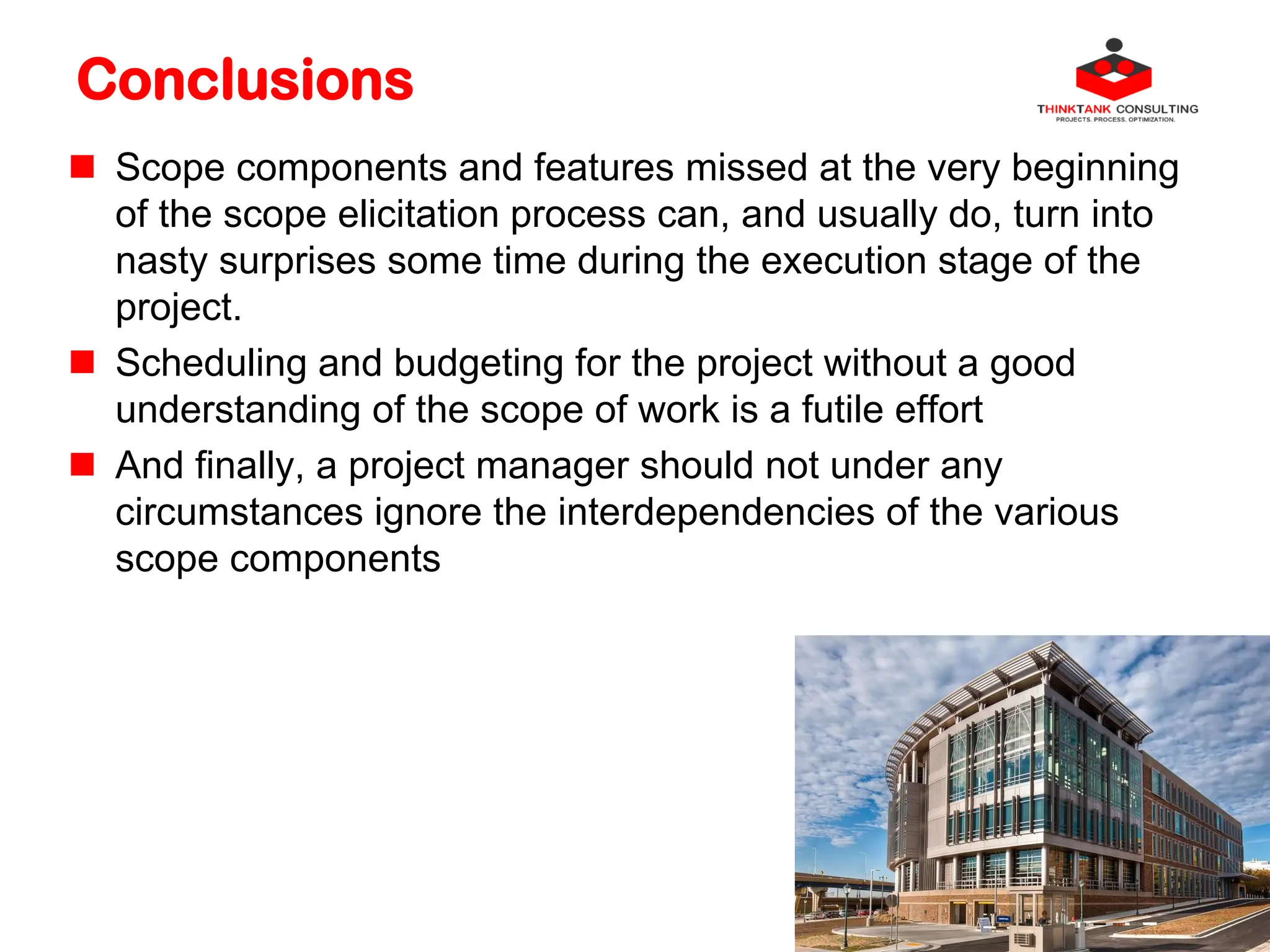
 Scope components and features missed at the very beginning
of the scope elicitation process can, and usually do, turn into
nasty surprises some time during the execution stage of the
project.
 Scheduling and budgeting for the project without a good
understanding of the scope of work is a futile effort
 And finally, a project manager should not under any
circumstances ignore the interdependencies of the various
scope components
Ashgabat Airport
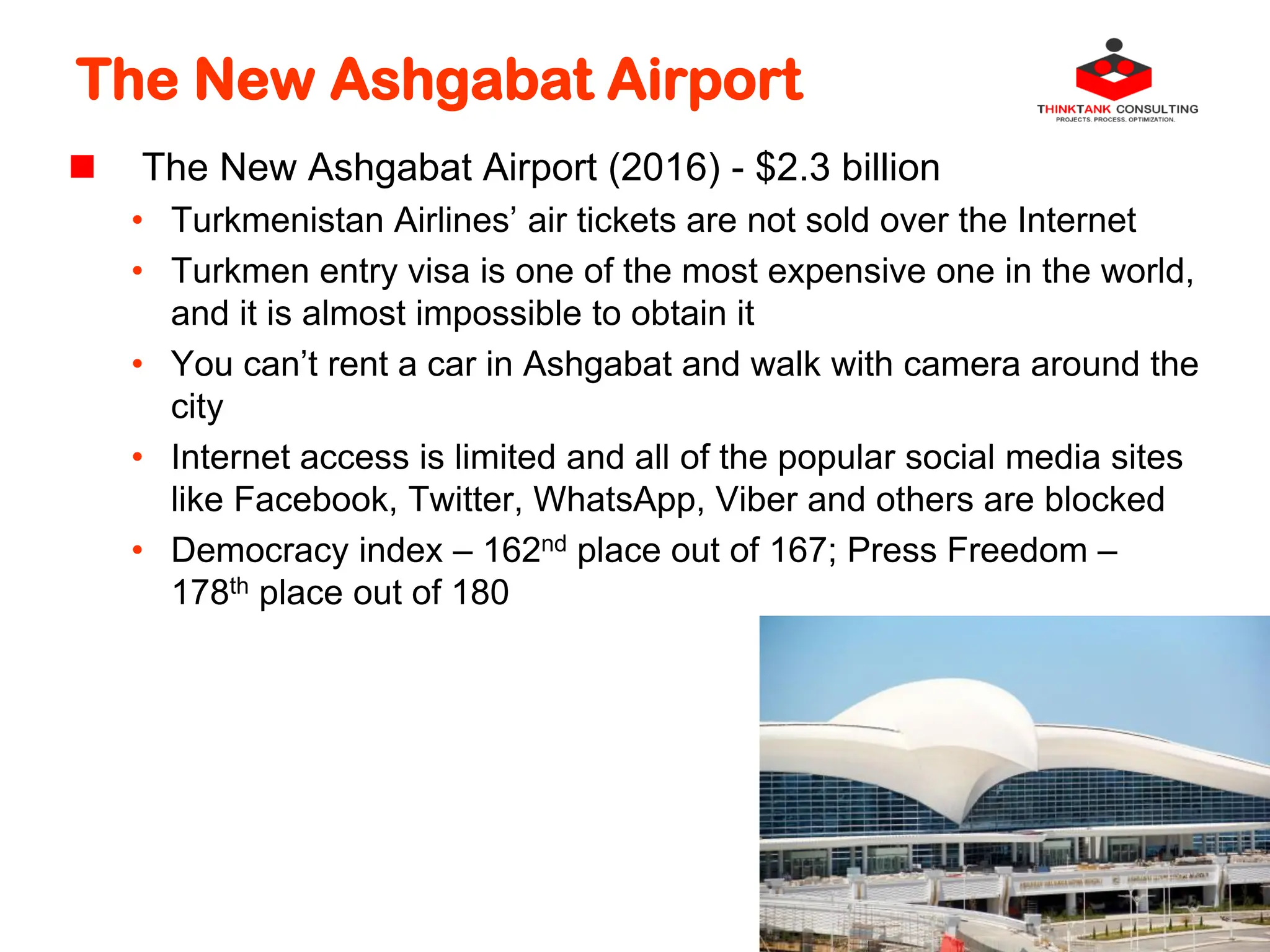
The New Ashgabat Airport
 The New Ashgabat Airport (2016) - $2.3 billion
• Turkmenistan Airlines’ air tickets are not sold over the Internet
• Turkmen entry visa is one of the most expensive one in the world,
and it is almost impossible to obtain it
• You can’t rent a car in Ashgabat and walk with camera around the
city
• Internet access is limited and all of the popular social media sites
like Facebook, Twitter, WhatsApp, Viber and others are blocked
• Democracy index – 162nd place out of 167; Press Freedom –
178th place out of 180
Ibaraki Airport
An Airport without the Planes
Ibaraki Airport
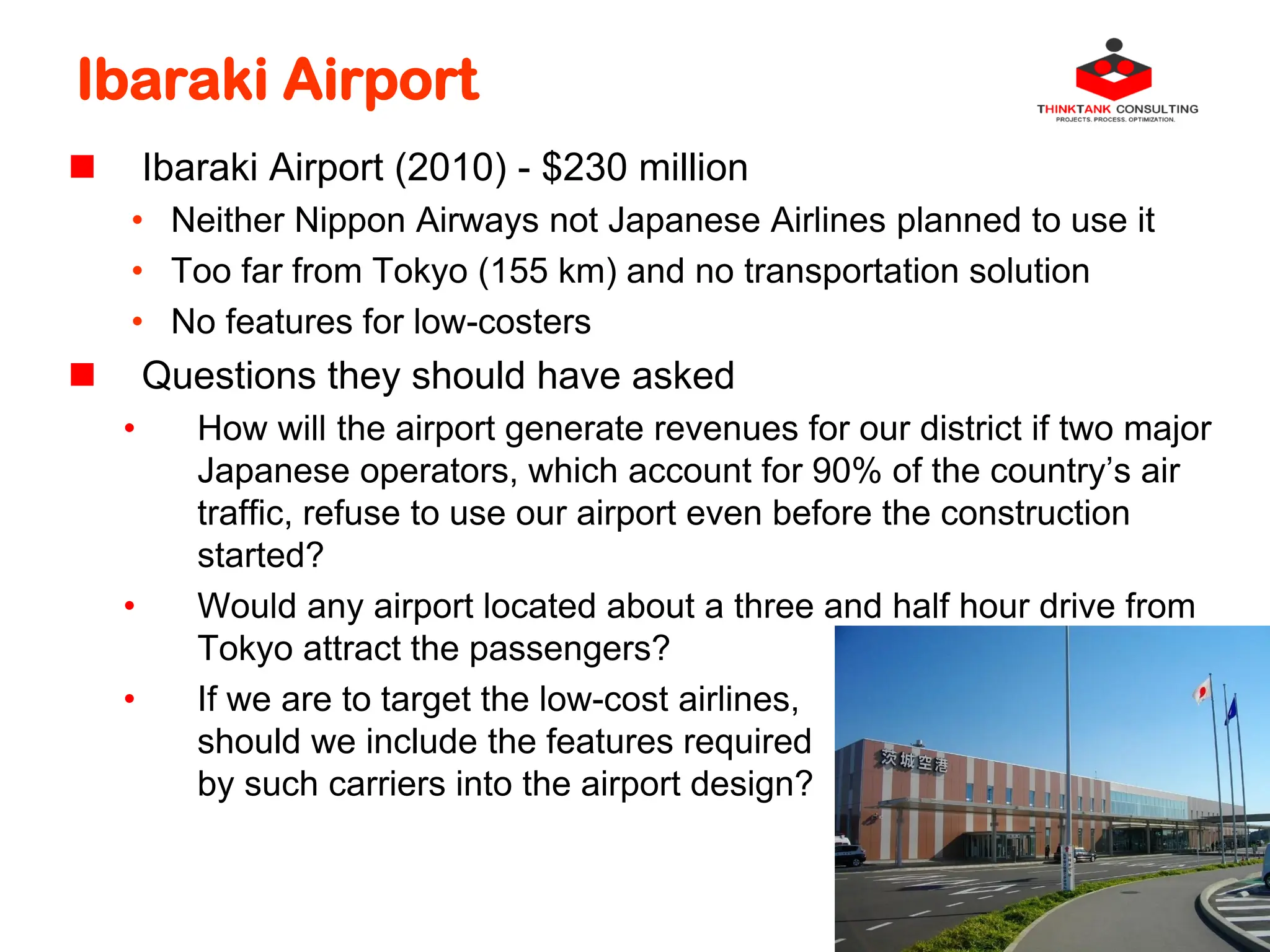
 Ibaraki Airport (2010) - $230 million
• Neither Nippon Airways not Japanese Airlines planned to use it
• Too far from Tokyo (155 km) and no transportation solution
• No features for low-costers
 Questions they should have asked
• How will the airport generate revenues for our district if two major
Japanese operators, which account for 90% of the country’s air
traffic, refuse to use our airport even before the construction
started?
• Would any airport located about a three and half hour drive from
Tokyo attract the passengers?
• If we are to target the low-cost airlines,
should we include the features required
by such carriers into the airport design?
Shah Deniz 2
Megaprojects Can Be Successful After All!
Introduction
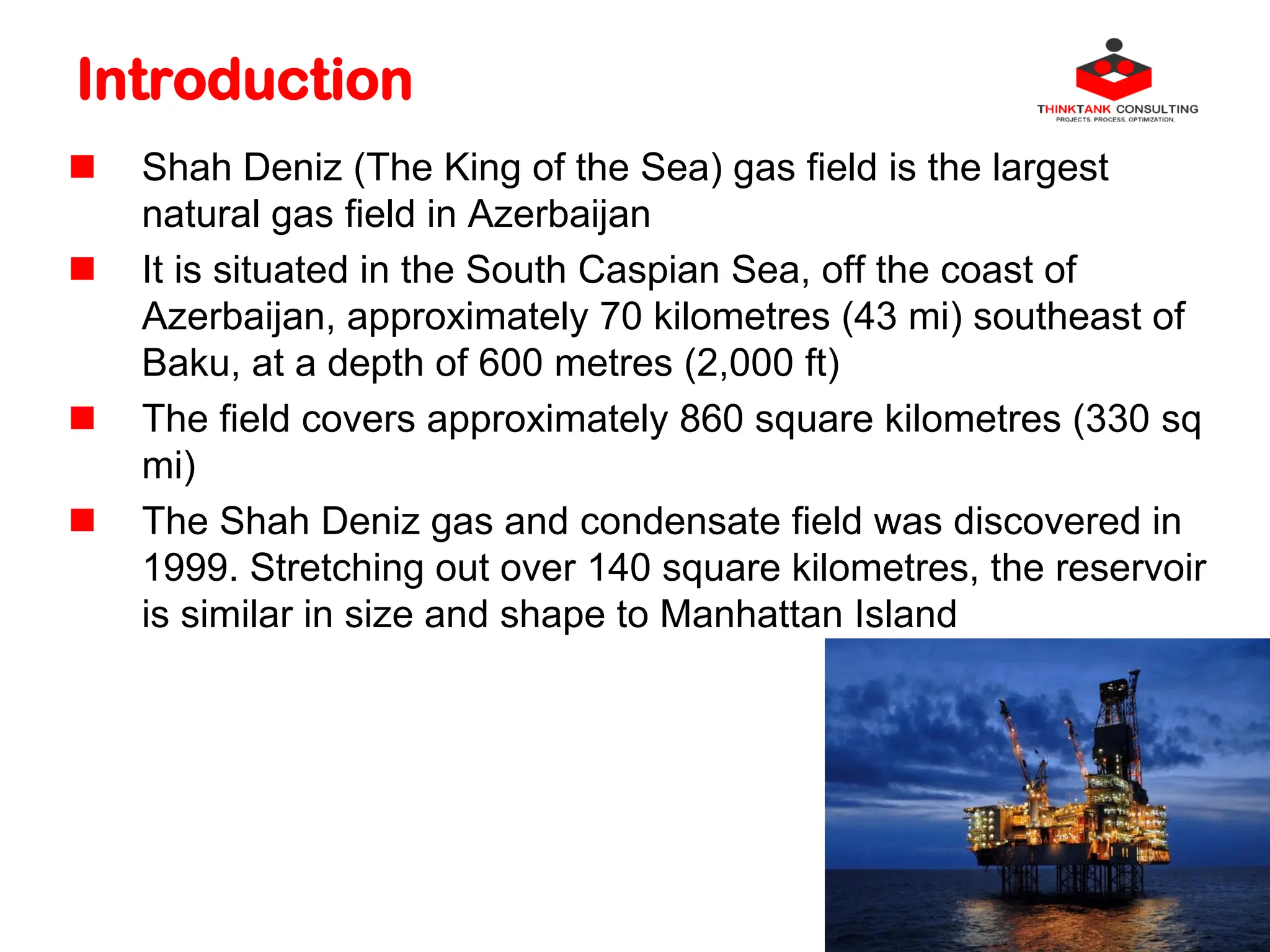
 Shah Deniz (The King of the Sea) gas field is the largest
natural gas field in Azerbaijan
 It is situated in the South Caspian Sea, off the coast of
Azerbaijan, approximately 70 kilometres (43 mi) southeast of
Baku, at a depth of 600 metres (2,000 ft)
 The field covers approximately 860 square kilometres (330 sq
mi)
 The Shah Deniz gas and condensate field was discovered in
1999. Stretching out over 140 square kilometres, the reservoir
is similar in size and shape to Manhattan Island
Introduction
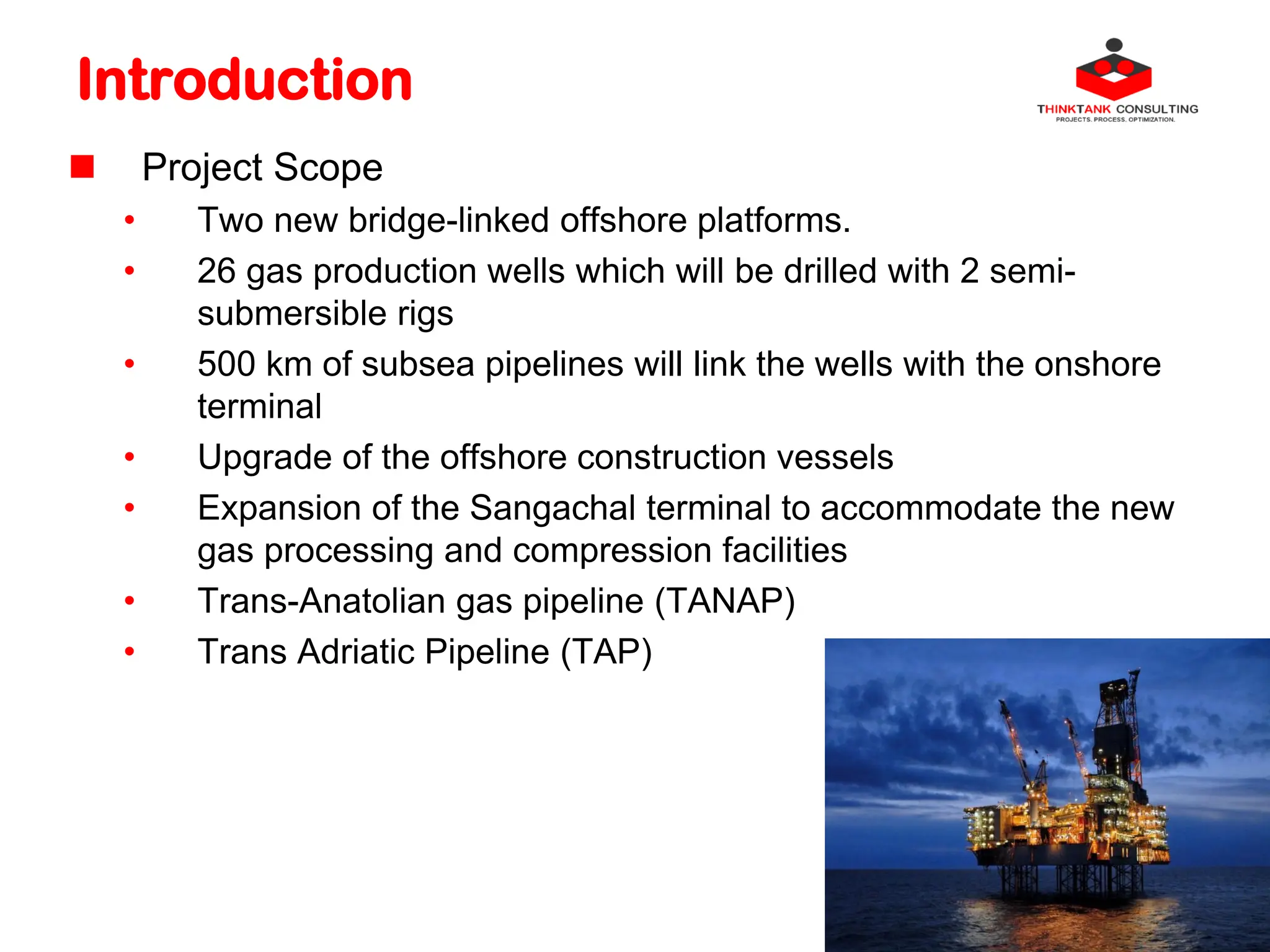
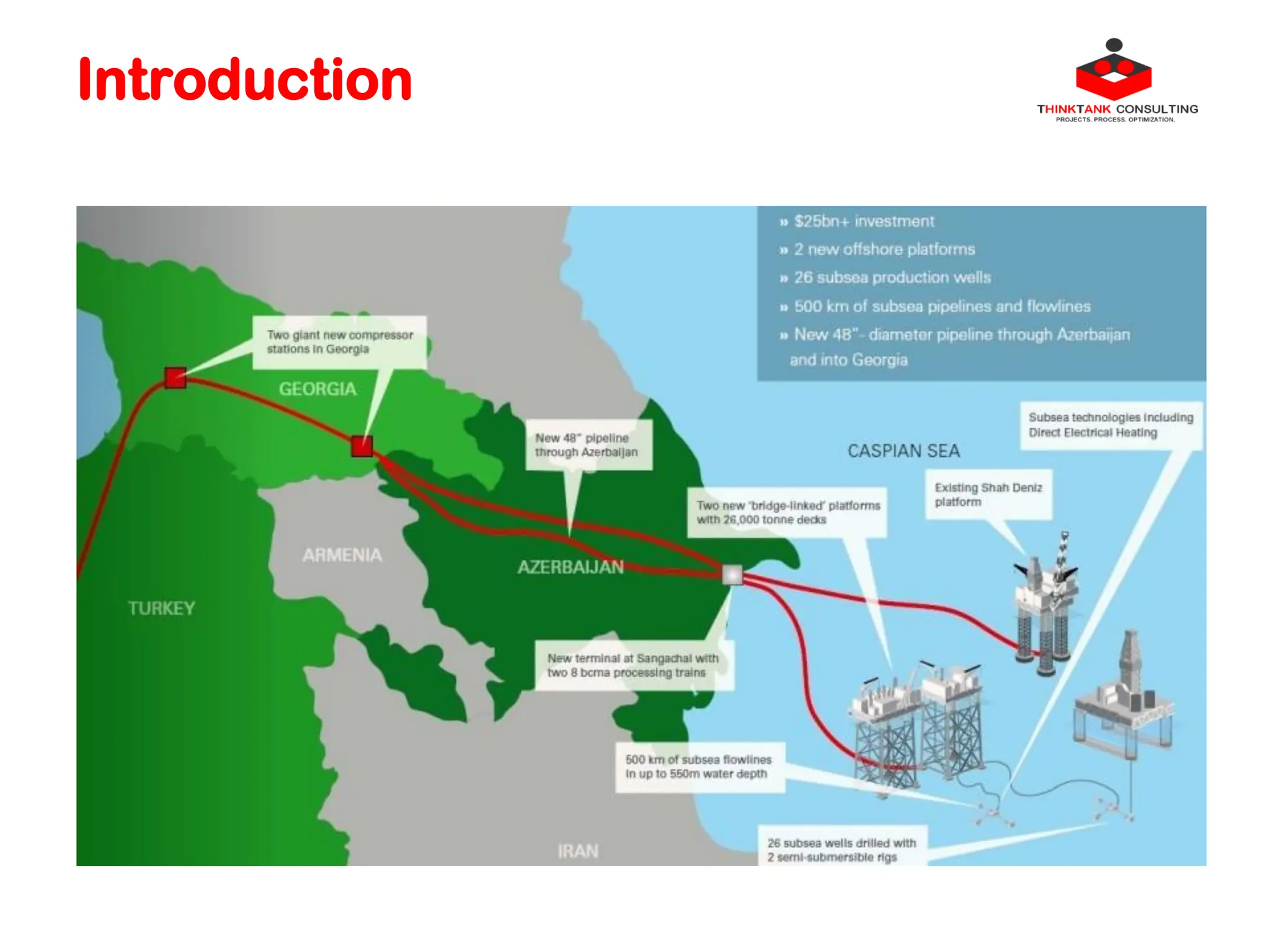
 Project Scope
• Two new bridge-linked offshore platforms.
• 26 gas production wells which will be drilled with 2 semi-
submersible rigs
• 500 km of subsea pipelines will link the wells with the onshore
terminal
• Upgrade of the offshore construction vessels
• Expansion of the Sangachal terminal to accommodate the new
gas processing and compression facilities
• Trans-Anatolian gas pipeline (TANAP)
• Trans Adriatic Pipeline (TAP)
Introduction
Results So Far
 Over 50% of planned work has been completed within the
second stage of development of the giant Shah Deniz gas
and condensate field in the Caspian Sea, offshore Azerbaijan.
The project is on target for production of first gas in late 2018,
operator BP has said.
 The work includes engineering, procurement and construction
of onshore and offshore facilities as well as drilling subsea
wells, according to BP Azerbaijan
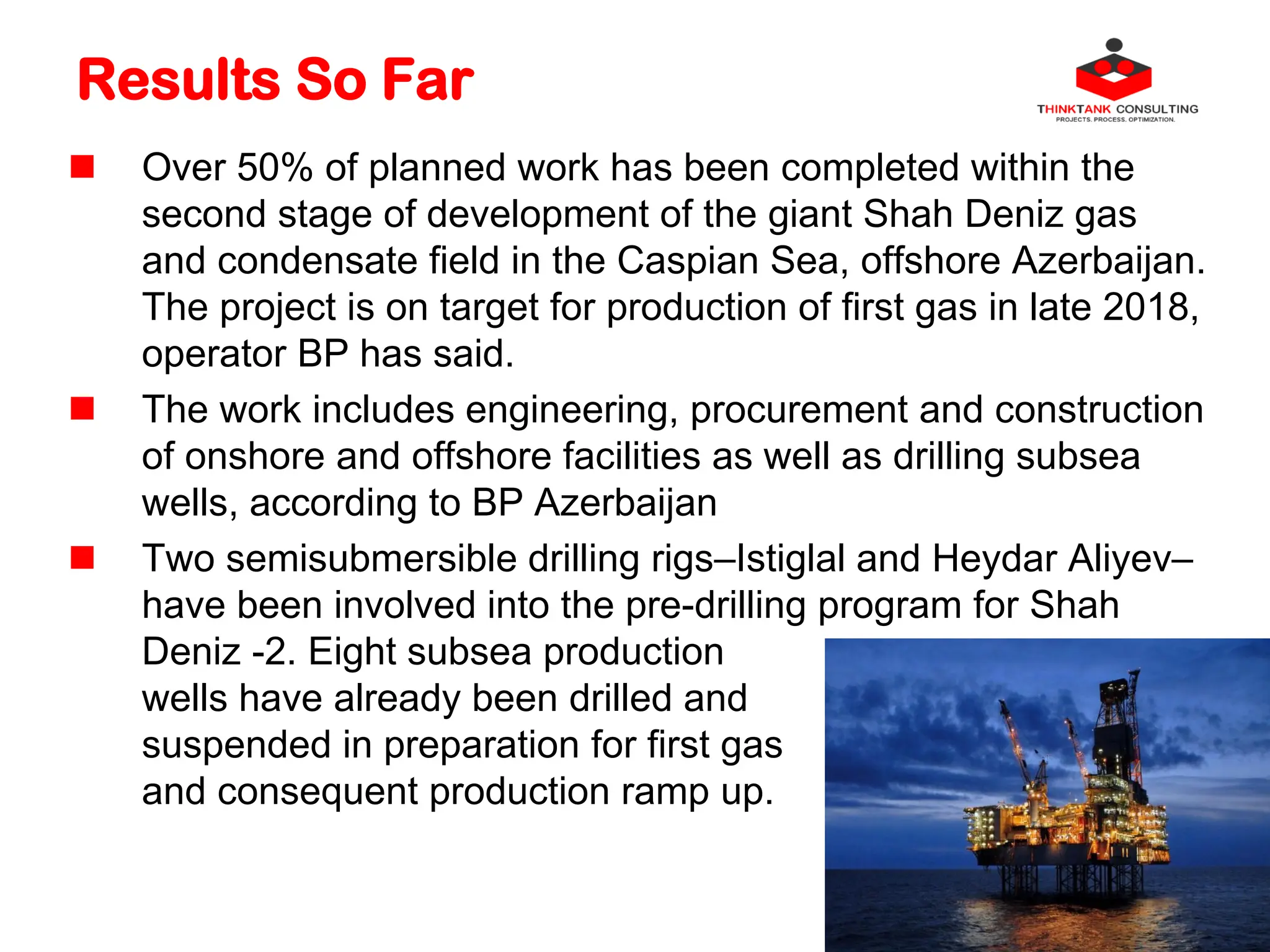
 Two semisubmersible drilling rigs–Istiglal and Heydar Aliyev–
have been involved into the pre-drilling program for Shah
Deniz -2. Eight subsea production
wells have already been drilled and
suspended in preparation for first gas
and consequent production ramp up.
Conclusions
 Project management works!
Summary
 Some projects were good ideas that have been implemented
improperly and thus failed:
• Kashagan Oil Field – Kazakhstan
• Krestovsky Stadium – Russia
 Some projects were good ideas, but experienced challenges:
• USS Gerald R. Ford - USA
• University Construction – Gulf
 Some projects were bad ideas implemented well:
• Ashgabat Airport – Turkmenistan
• Ibaraki Airport – Japan
 Some project were good ideas
implemented well:
• Shah Deniz 2 - Azerbaijan
Course Recap
 Project Management Case Studies:
• Krestovsky Stadium – Russia
• USS Gerald R. Ford - USA
• Kashagan Oil Field – Kazakhstan
• University Construction – Gulf
• Ashghabat Airport – Turkmenistan
• Ibaraki Airport – Japan
• Shah Deniz 2 - Azerbaijan
 Summary
Thanks for Signing Up!
 Please take a moment to join my exclusive online community,
connect with fellow learners and gain access to additional free
resources:
• http://www.thinktankconsulting.ca/apply
 My other online courses (PDU Certificates available):
• Advanced Practical Project Management
• Project Portfolio Management
• Business Analysis for IT and Software Projects
• Business Analysis for All Types of Projects
• Troubled Projects Recovery
• How to Write a Great Requirements Document
Contact Info
Watch my courses on Udemy
https://www.udemy.com/user/jamal-moustafaev/
Subscribe to this YouTube Channel:
youtube.com/user/ThinktankConsulting
Follow us on Twitter:
twitter.com/ThinktankConsul
Like our page on Facebook:
facebook.com/ProjectManagementThinktankConsulting
Connect with me on LinkedIn:
linkedin.com/in/jmoustafaev
Email me:
jamal@thinktankconsulting.ca
Subscribe to my blog (RSS feed):
ThinktankConsulting.ca/rss.xml
Visit our website:
ThinktankConsulting.ca

A collection of project management case studies.

  • 1.
    Project Management Case Studies ByJamal Moustafaev, BBA, MBA, PMP
  • 2.
    Agenda  Project ManagementCase Studies: • Krestovsky Stadium – Russia • USS Gerald R. Ford - USA • Kashagan Oil Field – Kazakhstan • University Construction – Gulf • Ashghabat Airport – Turkmenistan • Ibaraki Airport – Japan • Shah Deniz 2 - Azerbaijan  Summary
  • 3.
    Thanks for SigningUp!  Please take a moment to join my exclusive online community, connect with fellow learners and gain access to additional free resources: • http://www.thinktankconsulting.ca/apply  My other online courses (PDU Certificates available): • Advanced Practical Project Management • Project Portfolio Management • Business Analysis for IT and Software Projects • Business Analysis for All Types of Projects • Troubled Projects Recovery • How to Write a Great Requirements Document
  • 4.
    Introductions  Jamal Moustafaev,MBA, PMP - President and founder of Thinktank Consulting (Vancouver, Canada)  Expert in the areas of project/portfolio management, project scoping, process improvement and corporate training  Author of the books: • Delivering Exceptional Project Results: A Practical Guide to Project Selection, Scoping, Estimation and Management • Project Scope Management: A Practical Guide to Requirements for Engineering, Product, Construction, IT and Enterprise Projects • Project Portfolio Management in Theory and Practice: Thirty Case Studies from around the World  Consulted for numerous private-sector and government organizations in Canada, US, Asia, Middle East and Europe  MBA and a BBA (Finance and Management Science) from Simon Fraser University  Frequent contributor to various publications and speaker at conferences
  • 5.
    Introductions  Thinktank Consultingis a professional services company specializing in the following areas:  Project Management and Business Analysis consulting and outsourcing  Process improvement audits & programmes including:  Project Management methodology development  Portfolio Management methodology development  Requirements Engineering methodology development  Estimation methodology development  Training  “Practical Portfolio Management - Selecting & Managing The Right Projects”  “Successful Hands-On Management of Modern-Day Projects”  “Project Scope Management - Practical Requirements Engineering” www.thinktankconsulting.ca info@thinktankconsulting.ca
  • 6.
  • 7.
    Contact Info Watch mycourses on Udemy https://www.udemy.com/user/jamal-moustafaev/ Subscribe to this YouTube Channel: youtube.com/user/ThinktankConsulting Follow us on Twitter: twitter.com/ThinktankConsul Like our page on Facebook: facebook.com/ProjectManagementThinktankConsulting Connect with me on LinkedIn: linkedin.com/in/jmoustafaev Email me: jamal@thinktankconsulting.ca Subscribe to my blog (RSS feed): ThinktankConsulting.ca/rss.xml Visit our website: ThinktankConsulting.ca
  • 8.
    © 2008 ThinktankConsulting. All rights reserved Target Audience  Project and program managers who run projects and supply executives with key information  C-level executives who still contemplate the value of project management  Functional department directors and managers who are responsible for providing project resources  Young professionals who are just entering the workforce  “Technical resources” whose work is crucial to the project success  Professionals who are not certified project managers but manage projects anyways
  • 9.
    What To ExpectFrom This Course  Analysis of several recent high-profile projects  Internationally diverse selection  Project management perspective  Project portfolio management perspective  Failures and successes
  • 10.
    Krestovsky Stadium What HappensWhen Corruption Meets Incompetence
  • 11.
    Introduction  Some timein 2005 as part of preparations for a (highly controversial but nevertheless successful) bid for the 2018 FIFA World Cup the government of Russia decided to build a brand-new soccer stadium in Saint Petersburg  The building phase started in 2007 with the government allocating US$268 million for the construction of the stadium.  Interestingly enough the construction that was initially supposed to end in March of 2009 continues until now, with “some cosmetic changes to be finished soon”  As of right now the stadium is astonishing 518% late and 548% over budget
  • 12.
  • 13.
  • 14.
    Root Causes andExplanations  Based on the reports of various newspapers there were two major causes of delays, cost overruns and quality issues: poor planning and rampant corruption  Some of the issues encountered during the construction of the Krestovsky Stadium: • One of the major delays has been attributed to the sudden death of the Japanese architect Kisho Kurokawa: apparently nobody bothered to translate his blueprints from Japanese to Russian • Severe vibrations of the retractable field (reported by FIFA) • “Finished” stadium does not have a media center • Crowd access control “issues” (reported by FIFA) • Severe problems with the grass pitch
  • 15.
    Root Causes andExplanations • Leaking roof and resulting flooding of the stadium • Four confirmed deaths due to safety rules violations (no investigations launched) • Several worker strikes due to non-payment of salaries (some of the foreign workers deported from Russia as a result) • Cracks in concrete walls detected • Part of a very expensive retractable roof has been blown away by the wind • Mould resulting from flooding • Collapsed crane that fortunately did not result in any deaths • Norwegian football magazine Josimar claimed in March 2017 that at least some of the workers on the project were North Korean "slaves"
  • 16.
    Root Causes andExplanations  FC Zenit Saint Petersburg, who inherited this stadium with all of its problems from the Russian government for 1 (one!) rouble refused to use that field for its Russian Premier League games Player changing rooms Juventus stadium (construction time – 2 years, cost – US$170 million) Player changing rooms Krestovsky stadium (construction time – 10+ years, cost – US$1.7 billion)
  • 17.
    Conclusions  Lack ofplanning – Bad!  Corruption – Bad!  Lack of Planning + Corruption = Horrible results
  • 18.
    USS Gerald R.Ford What Went Wrong with the Most Expensive Warship?
  • 19.
    Introduction  The projectto deliver the most expensive warship in the world is $2.3 billion over the budget and 2 years (and counting) late  The US Navy’s newest $13 billion aircraft carrier is still not ready for combat because of mechanical delays that have already put it two years behind schedule, according to the Pentagon’s top weapons tester.  The USS Gerald R. Ford was supposed to be ready by September 2016, but Michael Gilmore, the Defense Department’s director of operational test and evaluation, said in a June 28 memo that the warship had ongoing launch and recovery problems.
  • 20.
  • 21.
    Root Causes andExplanations
  • 22.
    Root Causes andExplanations
  • 23.
    Root Causes andExplanations  "Unrealistic business cases, poor cost estimates, new systems rushed to production, concurrent design and construction, and problems testing systems to demonstrate promised capability" • Chairman of the Senate Armed Services Committee Senator John McCain  "The decision to proceed with these three systems was made many years ago, prior to their maturation, when transformational approaches to acquisition were a DOD policy," • Mark Wright, a Defense Department spokesman
  • 24.
    Conclusions  New Technologies: •the more cutting edge stuff is added to your project scope, the more headache (i.e. uncertainty) you are going to have. This implies more time on requirements, more time on development and way more time on testing.  Budget Overrun: • +30/-15% accuracy at the end of the planning stage is actually acceptable • USS Gerald Ford is currently only 22% over the budget …  Estimation Requirements • US and Canadian departments of defense hate +/- estimates • This causes the following dilemma: – On one hand I want to win the contract, so I will make my estimates smaller – But on the other hand, I don’t want to be featured on CNN in a couple of years, so I will have to make the numbers larger in order to increase the probability of hitting the target
  • 25.
    Kashagan Oil Field AFiasco That is 11 Years Late and $100 Billion Over Budget
  • 26.
    Introduction  The KashaganOil Field has been discovered in 2000 in the Northern part of the Caspian Sea  It was quickly confirmed that it was the world's largest discovery in the last 30 years, combined with the Tengiz Field located nearby, with a projected output close to that of the Ghawar field in Saudi Arabia  The recoverable oil reserves of the Kashagan Filed were estimated to be at 19-20 billion barrels
  • 27.
  • 28.
    Introduction  The projectstarted in 2001 with an expected completion date of 2005 • Budget - US$10 billion • The oilfield was expected to become operational around 2005 and produce anywhere between 90,000 and 370,000 barrels (at peak production) a day  Fell 8 years behind the schedule and ended up costing a bit more than the original forecast: • Kazakhstan – US$50 billion • CNN Money – US$115 billion • Other sources - US$150 billion  In 2013, the operations had to be shut down due to a damaged main pipeline leaking a very dangerous hydrogen sulfide (H2S) gas into the atmosphere
  • 29.
    Root Causes andExplanations
  • 30.
    Conclusion  The stakeholdersfell into the "optimism bias" trap by ignoring the complexities associated with this challenging endeavor • Constantly changing mix of project stakeholders and the makeup of the conglomerate led to confusion, missed requirements and miscommunications.  Initially exposed the employees to the potential H2S leaks. This was later changed, thus contributing to budget and time overruns.  The complexity and the cost of the equipment required to (a) avoid potential H2S leakage, (b) deal with extremely high pressure, and (c) pump the toxic gas back into the cavity was overlooked
  • 31.
    Conclusion  The requirementto use nickel steel pipes rather than ordinary steel pipes has been also overlooked resulting in leaks shortly after the production has started.  H2S remaining in the pipe was burned off as an emergency measure which led to release of SO2 into the atmosphere. As a result, in March 2014, Kazakhstan's environment ministry fined the operating companies $735 million.  As of November of 2015 the facility is expected to become fully operational in 2017
  • 32.
  • 33.
    Introduction  A governmentof one of the countries in the Gulf region decided to embark on a project of building a multi-campus university in several - at times remote – locations  It was decreed that the said project should take five years to implement and the cost should be around US$200 million  It is not completely clear even after talking to several people actually involved in the endeavour right from the very beginning whether these constraints were: • Just "dropped" from the very top of the government levels or • If these were at least a very high-level estimates generated by a qualified party
  • 34.
    Introduction  The scopeof the project, at least at a very high level, was also thought to be well-understood. It included the following requirements: • Engineering design of all five campuses (both conceptual and final) • Construction of classrooms and lab training facilities • Construction of dormitories • Procurement and installation of all necessary equipment • Setup of a new IT infrastructure including several data centers • Design, development and delivery for over100 new courses • Setup and customization for a web e-learning portal
  • 35.
    Root Causes andExplanations  The primary contractor has decided to proceed with five different vendors to be responsible for different parts of the scope of the project  As a result, each vendor was requested to provide his version of the solution with respect to their vertical area of expertise  The primary contractor decided to simply aggregate individual scopes provided by the vendors into one united program scope  Consequently no thought was given to the proper integration between different scopes  Finally, it turned out that the original RFP issued by the customer neglected to mention that the university will be constructed in an open desert with no water, electricity, sewage or roads
  • 36.
    Root Causes andExplanations  By the time the contract was signed and all five subcontractors led by the primary contractor arrived on the construction site, there were a lot of complaints, accusations and threats of court action thrown around  Finally, it took an involvement of an external consulting company who had to intervene and to establish, among other things, proper requirements elicitation and analysis techniques in order to create one united program scope and revised budget and timeline resulting directly from it
  • 37.
    Conclusions  Scope componentsand features missed at the very beginning of the scope elicitation process can, and usually do, turn into nasty surprises some time during the execution stage of the project.  Scheduling and budgeting for the project without a good understanding of the scope of work is a futile effort  And finally, a project manager should not under any circumstances ignore the interdependencies of the various scope components
  • 38.
  • 39.
    The New AshgabatAirport  The New Ashgabat Airport (2016) - $2.3 billion • Turkmenistan Airlines’ air tickets are not sold over the Internet • Turkmen entry visa is one of the most expensive one in the world, and it is almost impossible to obtain it • You can’t rent a car in Ashgabat and walk with camera around the city • Internet access is limited and all of the popular social media sites like Facebook, Twitter, WhatsApp, Viber and others are blocked • Democracy index – 162nd place out of 167; Press Freedom – 178th place out of 180
  • 40.
    Ibaraki Airport An Airportwithout the Planes
  • 41.
    Ibaraki Airport  IbarakiAirport (2010) - $230 million • Neither Nippon Airways not Japanese Airlines planned to use it • Too far from Tokyo (155 km) and no transportation solution • No features for low-costers  Questions they should have asked • How will the airport generate revenues for our district if two major Japanese operators, which account for 90% of the country’s air traffic, refuse to use our airport even before the construction started? • Would any airport located about a three and half hour drive from Tokyo attract the passengers? • If we are to target the low-cost airlines, should we include the features required by such carriers into the airport design?
  • 42.
    Shah Deniz 2 MegaprojectsCan Be Successful After All!
  • 43.
    Introduction  Shah Deniz(The King of the Sea) gas field is the largest natural gas field in Azerbaijan  It is situated in the South Caspian Sea, off the coast of Azerbaijan, approximately 70 kilometres (43 mi) southeast of Baku, at a depth of 600 metres (2,000 ft)  The field covers approximately 860 square kilometres (330 sq mi)  The Shah Deniz gas and condensate field was discovered in 1999. Stretching out over 140 square kilometres, the reservoir is similar in size and shape to Manhattan Island
  • 44.
    Introduction  Project Scope •Two new bridge-linked offshore platforms. • 26 gas production wells which will be drilled with 2 semi- submersible rigs • 500 km of subsea pipelines will link the wells with the onshore terminal • Upgrade of the offshore construction vessels • Expansion of the Sangachal terminal to accommodate the new gas processing and compression facilities • Trans-Anatolian gas pipeline (TANAP) • Trans Adriatic Pipeline (TAP)
  • 45.
  • 46.
    Results So Far Over 50% of planned work has been completed within the second stage of development of the giant Shah Deniz gas and condensate field in the Caspian Sea, offshore Azerbaijan. The project is on target for production of first gas in late 2018, operator BP has said.  The work includes engineering, procurement and construction of onshore and offshore facilities as well as drilling subsea wells, according to BP Azerbaijan  Two semisubmersible drilling rigs–Istiglal and Heydar Aliyev– have been involved into the pre-drilling program for Shah Deniz -2. Eight subsea production wells have already been drilled and suspended in preparation for first gas and consequent production ramp up.
  • 47.
  • 48.
    Summary  Some projectswere good ideas that have been implemented improperly and thus failed: • Kashagan Oil Field – Kazakhstan • Krestovsky Stadium – Russia  Some projects were good ideas, but experienced challenges: • USS Gerald R. Ford - USA • University Construction – Gulf  Some projects were bad ideas implemented well: • Ashgabat Airport – Turkmenistan • Ibaraki Airport – Japan  Some project were good ideas implemented well: • Shah Deniz 2 - Azerbaijan
  • 49.
    Course Recap  ProjectManagement Case Studies: • Krestovsky Stadium – Russia • USS Gerald R. Ford - USA • Kashagan Oil Field – Kazakhstan • University Construction – Gulf • Ashghabat Airport – Turkmenistan • Ibaraki Airport – Japan • Shah Deniz 2 - Azerbaijan  Summary
  • 50.
    Thanks for SigningUp!  Please take a moment to join my exclusive online community, connect with fellow learners and gain access to additional free resources: • http://www.thinktankconsulting.ca/apply  My other online courses (PDU Certificates available): • Advanced Practical Project Management • Project Portfolio Management • Business Analysis for IT and Software Projects • Business Analysis for All Types of Projects • Troubled Projects Recovery • How to Write a Great Requirements Document
  • 51.
    Contact Info Watch mycourses on Udemy https://www.udemy.com/user/jamal-moustafaev/ Subscribe to this YouTube Channel: youtube.com/user/ThinktankConsulting Follow us on Twitter: twitter.com/ThinktankConsul Like our page on Facebook: facebook.com/ProjectManagementThinktankConsulting Connect with me on LinkedIn: linkedin.com/in/jmoustafaev Email me: jamal@thinktankconsulting.ca Subscribe to my blog (RSS feed): ThinktankConsulting.ca/rss.xml Visit our website: ThinktankConsulting.ca