Learning Built To Last™ Who can benefit from study skills? Struggling students Highly social, busy students Stressed out students ADD or ADHD students High achievers Honor students Students in transition years All students can benefit!
10 Study Tips Every Student Should Know Your guide to better study habits “ The students who do best in school are not the smartest ones, but the ones who are the most effective studiers and managers of time .”  Dr. William R. Luckie, Author of Study Power
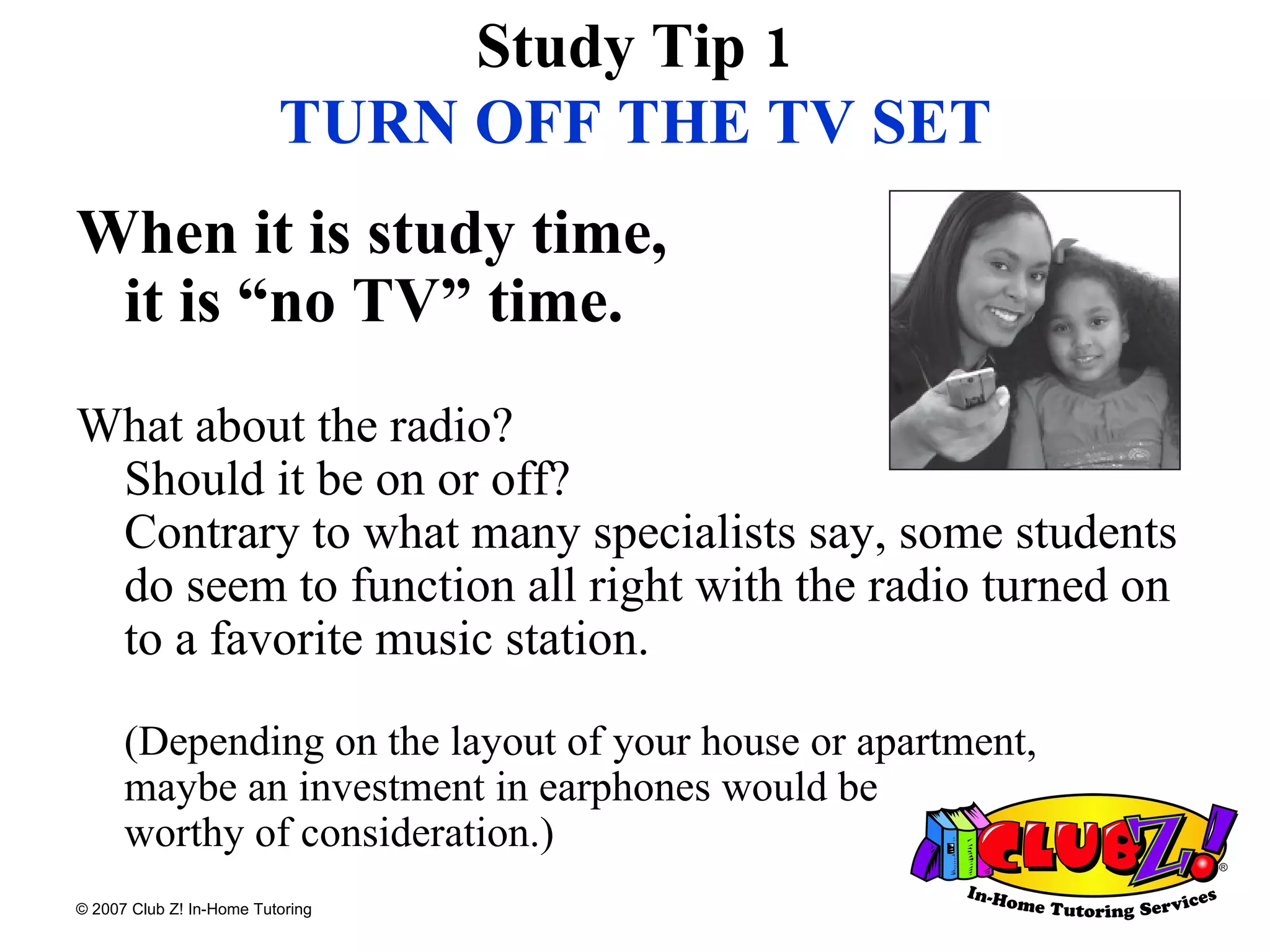
Study Tip 1 TURN OFF THE TV SET When it is study time,  it is “no TV” time.   What about the radio?  Should it be on or off?  Contrary to what many specialists say, some students do seem to function all right with the radio turned on to a favorite music station.  (Depending on the layout of your house or apartment,  maybe an investment in earphones would be  worthy of consideration.)
Study Tip 2 SET A CONSISTENT SCHEDULE Try to organize the household  so that dinner is served at a  standard time, and once it and  family discussions are over, it’s  time to crack the books.  If the student doesn’t have other commitments and gets home reasonably early from school, some homework can be done before supper.  Consider you child’s developmental level when  setting the amount of time for homework.  While high school students can focus for over an hour,  first-graders are unlikely to last more than  15 minutes on a single task.  Allow your child to take breaks, perhaps as a reward for finishing a section of the work.  If you don’t schedule the time for homework, it will take a back seat to other activities
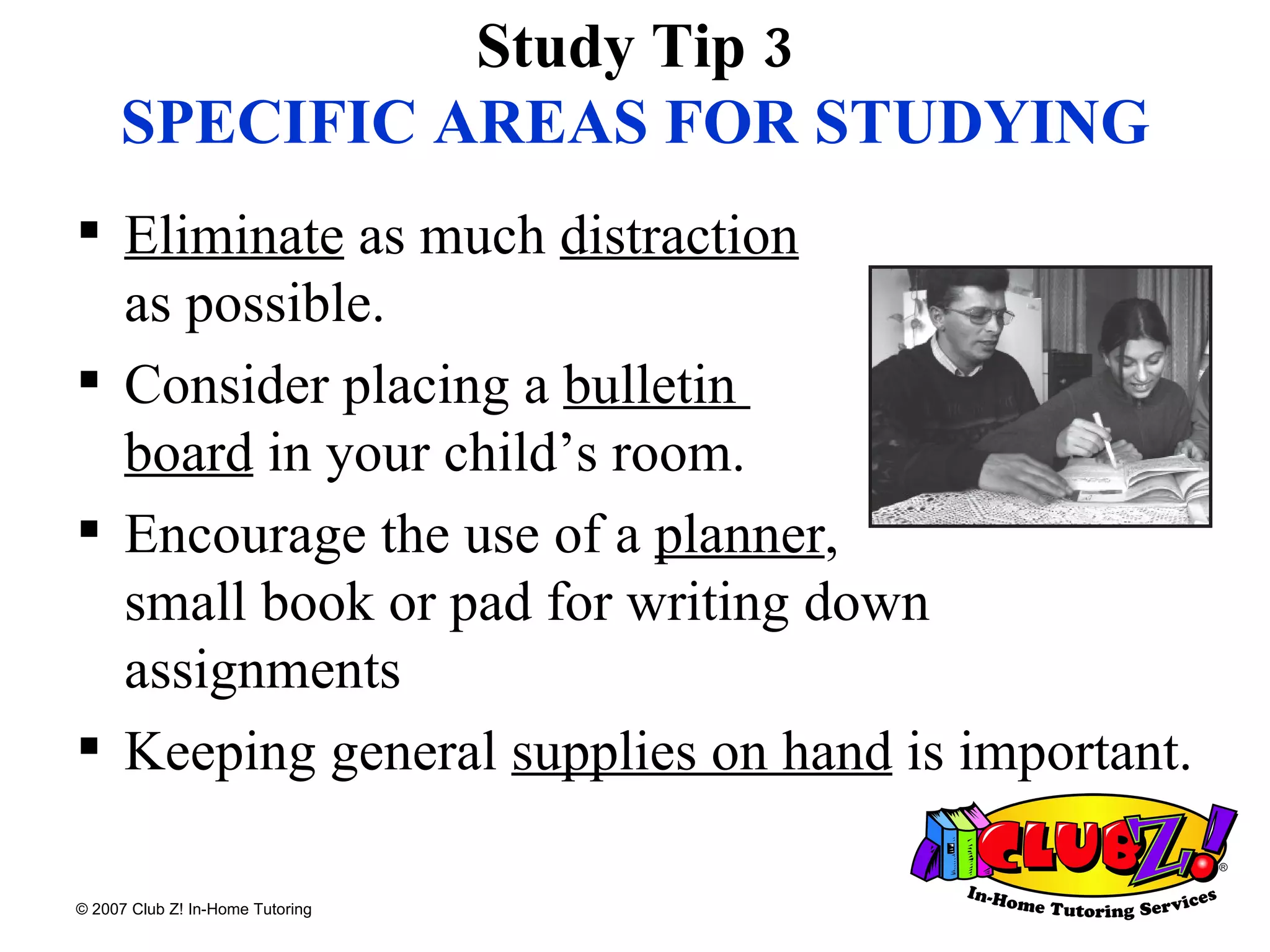
Study Tip 3 SPECIFIC AREAS FOR STUDYING Eliminate  as much  distraction   as possible.  Consider placing a  bulletin  board  in your child’s room.  Encourage the use of a  planner ,  small book or pad for writing down assignments Keeping general  supplies on hand  is important.
Study Tip 4 PORTABLE HOMEWORK STATION Pencils, pens, paper, scissors, highlighters, graph paper, calculator, stapler, paper clips, folders-take away the excuses about not having supplies!  Use a portable file box for transport. Reference Books needed: Dictionary Encyclopedia Thesaurus
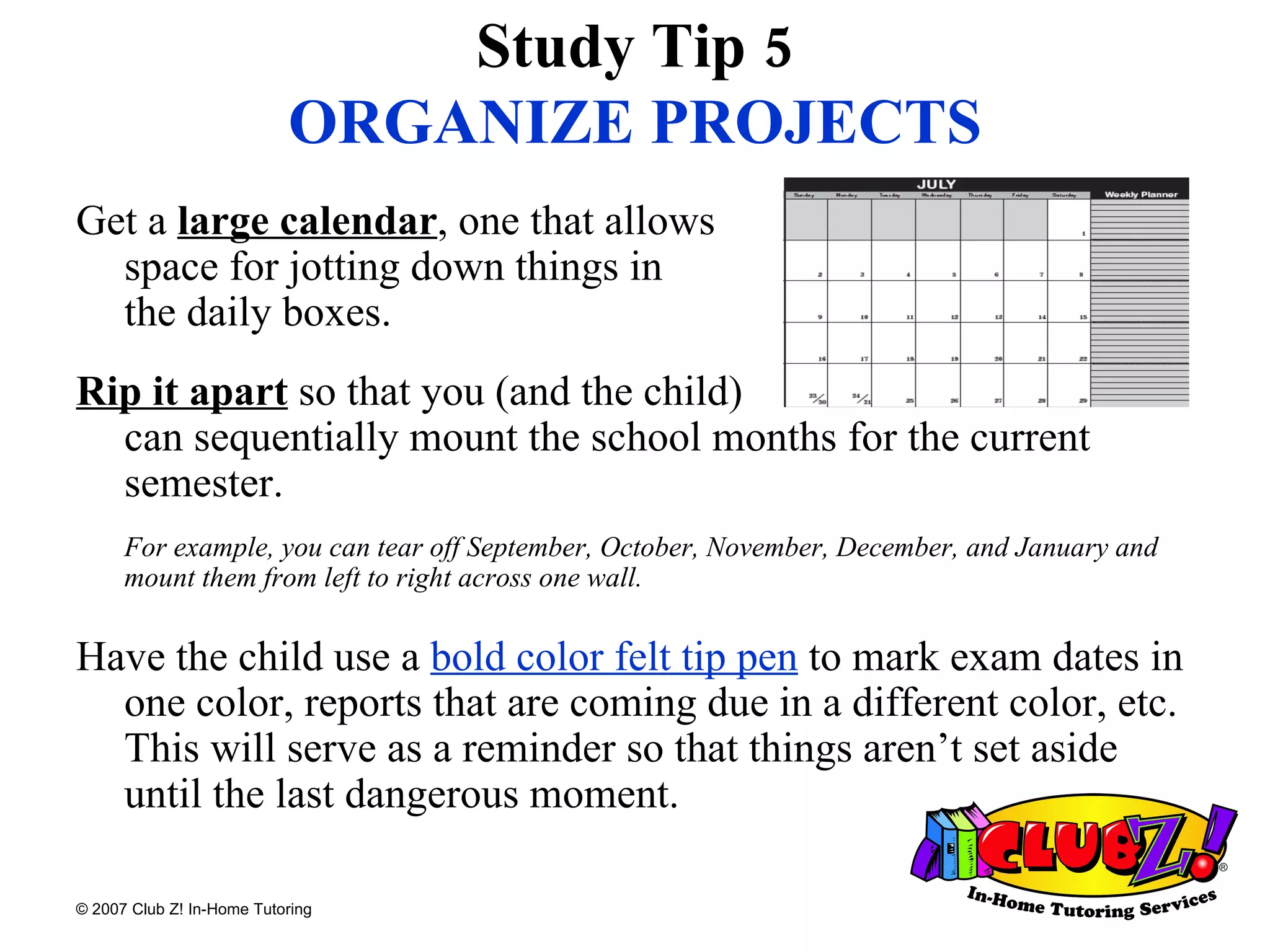
Get a  large calendar , one that allows  space for jotting down things in  the daily boxes.  Rip it apart  so that you (and the child)  can sequentially mount the school months for the current semester.  For example, you can tear off September, October, November, December, and January and mount them from left to right across one wall.   Have the child use a  bold color felt tip pen  to mark exam dates in one color, reports that are coming due in a different color, etc. This will serve as a reminder so that things aren’t set aside until the last dangerous moment. Study Tip 5 ORGANIZE PROJECTS
Study Tip 6 ENCOURAGE   GOING ABOVE AND BEYOND Take notes  while reading Learn to  skim material Learn to  study tables and charts Learn to  summarize  in your own words Learn to make  flashcards or other study aids Make your own  study sheet Have someone  quiz  you on the material
Study Tip 7 TAKE STRONG NOTES Always print – no  cursive Use an outline format Use bulleted text – no paragraphs Use white space – don’t crowd the page Use clean notes – rewrite if necessary Use  underlines ,  bold , or  color  to make words stand out Draw pictures Most importantly: Be present and attentive in class!
Study Tip 7 TAKE STRONG NOTES Always print – no cursive Use an outline format Use bulleted text – no paragraphs Use white space – don’t crowd the page Use clean notes – rewrite if necessary Use  underlines ,  bold , or  color  to make words stand out Draw pictures
Study Tip 8 KNOW HOW TO TEST WELL Don’t try to “cram” –  repetition is the key ! Get a  good night’s sleep . Carefully read the question  – know what it’s asking for in the answer. Skip questions you don’t know  – come back later if there is time left. Smile, breathe, relax !
Study Tip 9 LET YOUR CHILD DO THE WORK Have them do the work  they can before you sit down to help. Show them how  and then  have them try  on their own.  Resist doing it for them. Be positive and cheerful  – it’ll be more fun for you and them!  Have them teach you!  You can spot missing skills easily.
Study Tip 10 DISCOVER YOUR CHILD’S LEARNING STYLE You packet contains a brief learning styles diagnostic test.  Not everyone learns the same way, nor should they study the same way! Once your child learns their style they can be more efficient with their study time.
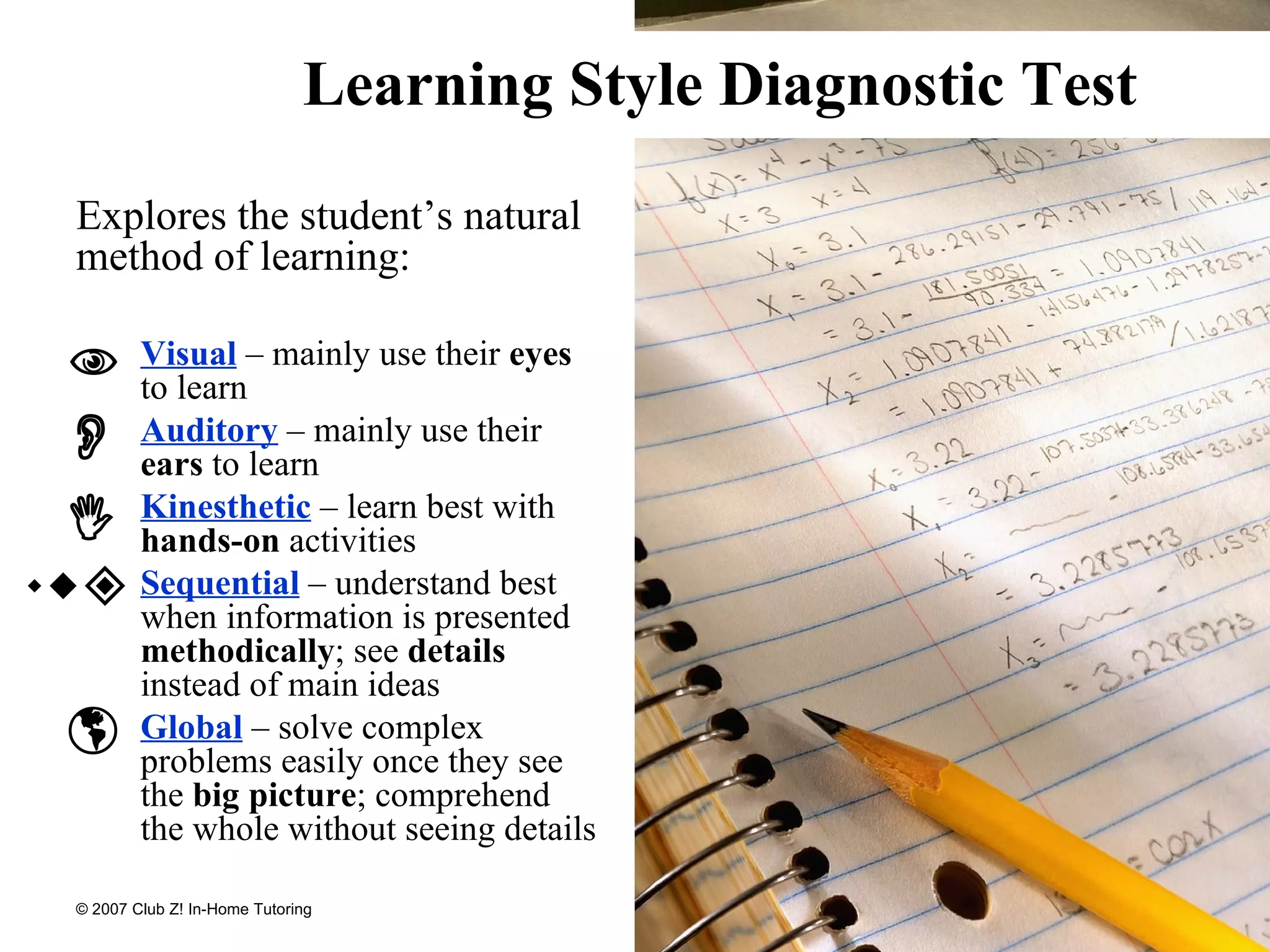
Learning Style Diagnostic Test Explores the student’s natural method of learning: Visual  – mainly use their  eyes  to learn Auditory  – mainly use their  ears  to learn Kinesthetic  – learn best with  hands-on  activities Sequential  – understand best when information is presented  methodically ; see  details  instead of main ideas Global  – solve complex problems easily once they see the  big picture ; comprehend the whole without seeing details              
Power Study Hour (PSH) The PSH Promise Higher Grades Stress-Free Tests Better Social Life Easy Exams “ If you give a student an answer, you will teach him for a day. If you give a student study skills, you will teach him for life.”
Power Study Hour  means  committing  yourself to studying for  one hour  a day (out of your 24!) for  6 days   a week,  every week , for the  whole school year . Power Study Hour (PSH)
Power Study Hour (PSH) Responsibility on five school days: File “homeless” papers Make a self-test from that  day’s class work for each  subject Take and correct your  self-test so far
Power Study Hour (PSH) Responsibility on the sixth day: Manage your monthly calendar Re-take and correct your old  self-tests Make memory aides for the questions you got wrong
Types of Self-Tests Flash Cards with color, diagrams and the answer on the back (visual learners) Paper folded in half with questions on one side and answers on the other (kinesthetic learners) Tape record questions, pause and record the answers for later playback (auditory learners) Chart with blanks to fill in (sequential learners)
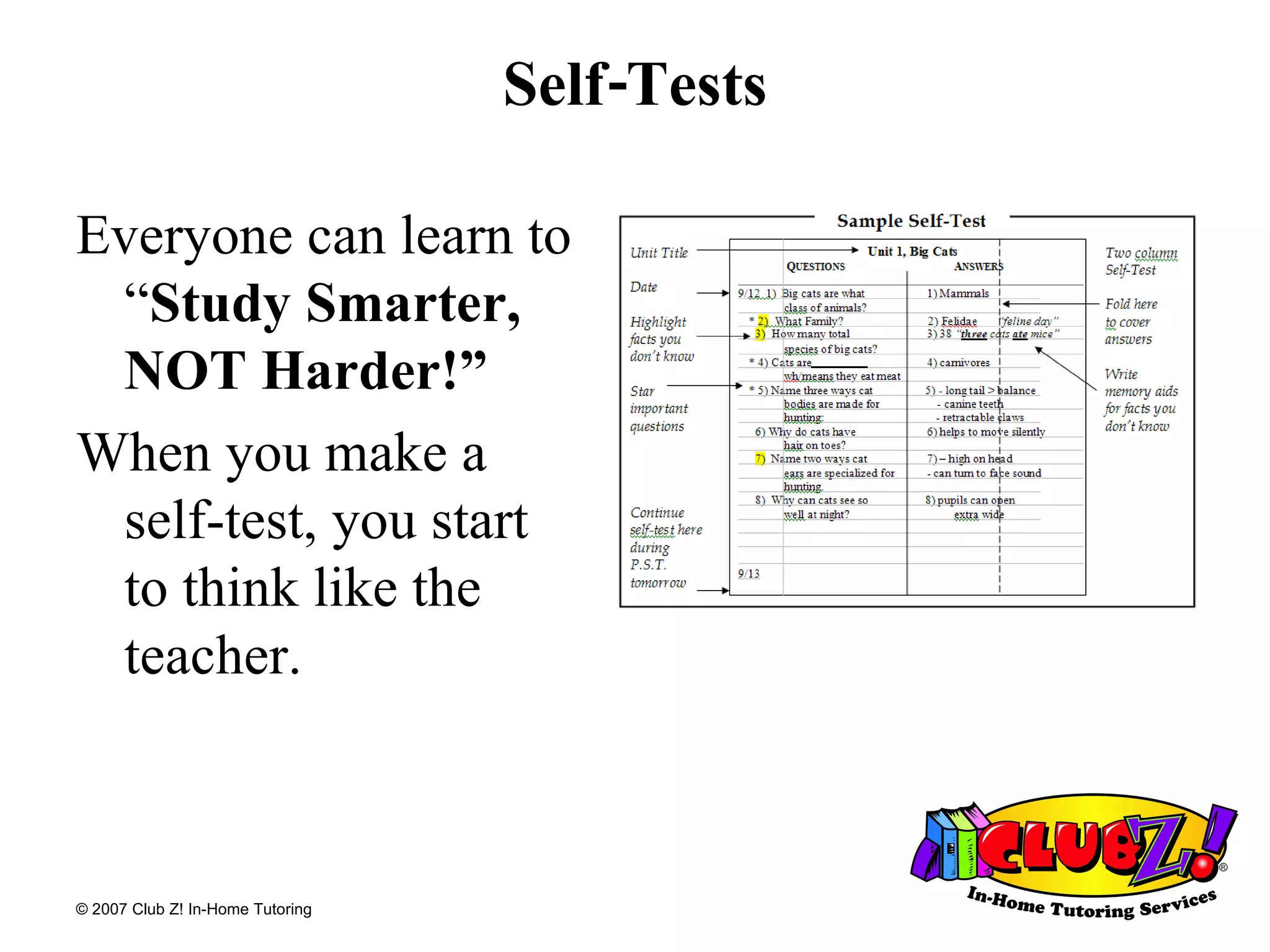
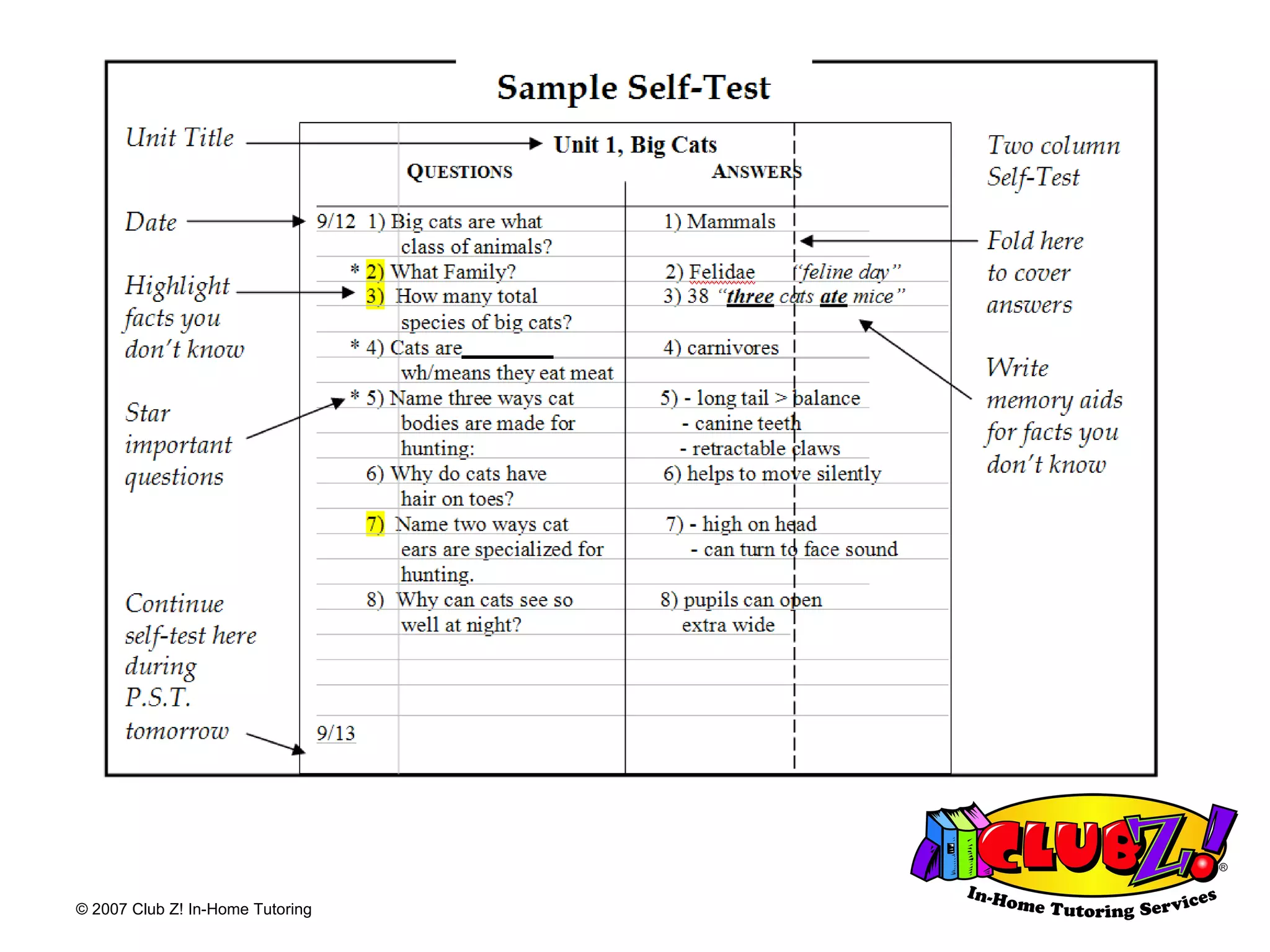
Self-Tests Everyone can learn to “ Study Smarter, NOT Harder!” When you make a  self-test, you start  to think like the teacher.
 
Establish Rock Solid Commitments Where will your student find the time to study?  The jar represents their daily time. How do they spend the big chunks of time in a day? School Sports Friends Job Chores Homework Studying? Video Games Sleep Eating TV/ Computer
An All-Star Attitude:  The Counterpart of Success “One thing which sounds obvious – but it’s terribly overlooked – is that you have to be willing to work hard, no matter how bright you are.”  Dr. Catherine Krupnick Harvard University School of Education
For more information on Tutoring or  Study Skills programs from Club Z!,  call 770-460-4208 or  visit www.clubztutoring.com. Thank you for attending our workshop today!

Study Skills Tips By Club Z! In-Home Tutoring

  • 1.
    Learning Built ToLast™ Who can benefit from study skills? Struggling students Highly social, busy students Stressed out students ADD or ADHD students High achievers Honor students Students in transition years All students can benefit!
  • 2.
    10 Study TipsEvery Student Should Know Your guide to better study habits “ The students who do best in school are not the smartest ones, but the ones who are the most effective studiers and managers of time .” Dr. William R. Luckie, Author of Study Power
  • 3.
    Study Tip 1TURN OFF THE TV SET When it is study time, it is “no TV” time. What about the radio? Should it be on or off? Contrary to what many specialists say, some students do seem to function all right with the radio turned on to a favorite music station. (Depending on the layout of your house or apartment, maybe an investment in earphones would be worthy of consideration.)
  • 4.
    Study Tip 2SET A CONSISTENT SCHEDULE Try to organize the household so that dinner is served at a standard time, and once it and family discussions are over, it’s time to crack the books. If the student doesn’t have other commitments and gets home reasonably early from school, some homework can be done before supper. Consider you child’s developmental level when setting the amount of time for homework. While high school students can focus for over an hour, first-graders are unlikely to last more than 15 minutes on a single task. Allow your child to take breaks, perhaps as a reward for finishing a section of the work. If you don’t schedule the time for homework, it will take a back seat to other activities
  • 5.
    Study Tip 3SPECIFIC AREAS FOR STUDYING Eliminate as much distraction as possible. Consider placing a bulletin board in your child’s room. Encourage the use of a planner , small book or pad for writing down assignments Keeping general supplies on hand is important.
  • 6.
    Study Tip 4PORTABLE HOMEWORK STATION Pencils, pens, paper, scissors, highlighters, graph paper, calculator, stapler, paper clips, folders-take away the excuses about not having supplies! Use a portable file box for transport. Reference Books needed: Dictionary Encyclopedia Thesaurus
  • 7.
    Get a large calendar , one that allows space for jotting down things in the daily boxes. Rip it apart so that you (and the child) can sequentially mount the school months for the current semester. For example, you can tear off September, October, November, December, and January and mount them from left to right across one wall. Have the child use a bold color felt tip pen to mark exam dates in one color, reports that are coming due in a different color, etc. This will serve as a reminder so that things aren’t set aside until the last dangerous moment. Study Tip 5 ORGANIZE PROJECTS
  • 8.
    Study Tip 6ENCOURAGE GOING ABOVE AND BEYOND Take notes while reading Learn to skim material Learn to study tables and charts Learn to summarize in your own words Learn to make flashcards or other study aids Make your own study sheet Have someone quiz you on the material
  • 9.
    Study Tip 7TAKE STRONG NOTES Always print – no cursive Use an outline format Use bulleted text – no paragraphs Use white space – don’t crowd the page Use clean notes – rewrite if necessary Use underlines , bold , or color to make words stand out Draw pictures Most importantly: Be present and attentive in class!
  • 10.
    Study Tip 7TAKE STRONG NOTES Always print – no cursive Use an outline format Use bulleted text – no paragraphs Use white space – don’t crowd the page Use clean notes – rewrite if necessary Use underlines , bold , or color to make words stand out Draw pictures
  • 11.
    Study Tip 8KNOW HOW TO TEST WELL Don’t try to “cram” – repetition is the key ! Get a good night’s sleep . Carefully read the question – know what it’s asking for in the answer. Skip questions you don’t know – come back later if there is time left. Smile, breathe, relax !
  • 12.
    Study Tip 9LET YOUR CHILD DO THE WORK Have them do the work they can before you sit down to help. Show them how and then have them try on their own. Resist doing it for them. Be positive and cheerful – it’ll be more fun for you and them! Have them teach you! You can spot missing skills easily.
  • 13.
    Study Tip 10DISCOVER YOUR CHILD’S LEARNING STYLE You packet contains a brief learning styles diagnostic test. Not everyone learns the same way, nor should they study the same way! Once your child learns their style they can be more efficient with their study time.
  • 14.
    Learning Style DiagnosticTest Explores the student’s natural method of learning: Visual – mainly use their eyes to learn Auditory – mainly use their ears to learn Kinesthetic – learn best with hands-on activities Sequential – understand best when information is presented methodically ; see details instead of main ideas Global – solve complex problems easily once they see the big picture ; comprehend the whole without seeing details     
  • 15.
    Power Study Hour(PSH) The PSH Promise Higher Grades Stress-Free Tests Better Social Life Easy Exams “ If you give a student an answer, you will teach him for a day. If you give a student study skills, you will teach him for life.”
  • 16.
    Power Study Hour means committing yourself to studying for one hour a day (out of your 24!) for 6 days a week, every week , for the whole school year . Power Study Hour (PSH)
  • 17.
    Power Study Hour(PSH) Responsibility on five school days: File “homeless” papers Make a self-test from that day’s class work for each subject Take and correct your self-test so far
  • 18.
    Power Study Hour(PSH) Responsibility on the sixth day: Manage your monthly calendar Re-take and correct your old self-tests Make memory aides for the questions you got wrong
  • 19.
    Types of Self-TestsFlash Cards with color, diagrams and the answer on the back (visual learners) Paper folded in half with questions on one side and answers on the other (kinesthetic learners) Tape record questions, pause and record the answers for later playback (auditory learners) Chart with blanks to fill in (sequential learners)
  • 20.
    Self-Tests Everyone canlearn to “ Study Smarter, NOT Harder!” When you make a self-test, you start to think like the teacher.
  • 21.
  • 22.
    Establish Rock SolidCommitments Where will your student find the time to study? The jar represents their daily time. How do they spend the big chunks of time in a day? School Sports Friends Job Chores Homework Studying? Video Games Sleep Eating TV/ Computer
  • 23.
    An All-Star Attitude: The Counterpart of Success “One thing which sounds obvious – but it’s terribly overlooked – is that you have to be willing to work hard, no matter how bright you are.” Dr. Catherine Krupnick Harvard University School of Education
  • 24.
    For more informationon Tutoring or Study Skills programs from Club Z!, call 770-460-4208 or visit www.clubztutoring.com. Thank you for attending our workshop today!

Editor's Notes

  • #2 You are probably thinking I am an A or B student, how can this possibly help me? Or the opposite, I am so low, study skills is the least of my problems….