
How to Incorporate
Study Skills into the
everyday classroom!
By Tarryn Audas
Secondary English, Health and Physical
Education
Kununurra District High School

1
5 Steps to Incorporating Study Skills
1.Setting Classroom Priorities
2.Setting Achievable Goals
3.Establishing what obstacles in concentration
can occur
4.Creating a Positive Study Environment
5.Creating a Study Plan– time management
strategies
2
Setting Priorities
 Plan:
• Class discussion with students about their extra-curricular
activities and commitments – what do they do after school.
• Get students to write down their out of school commitments
in their subject book.
• Students then write down what is expected of them at
school in the subject area. (English)
• Then students rank what they have written down in order of
importance to them.

3
Setting Priorities Continued
 How to set priorities?
• Discuss what priorities are? Why it is important to have the
right set of priorities. Definition: Precedence, especially
established by order of importance or urgency.
• Ask students to think about their ordering of priorities and
see if they would change anything. Discuss Changes.
 Discuss with students the consequences of having the wrong
priorities, particularly related to achievement at school
particularly in that subject area.

4
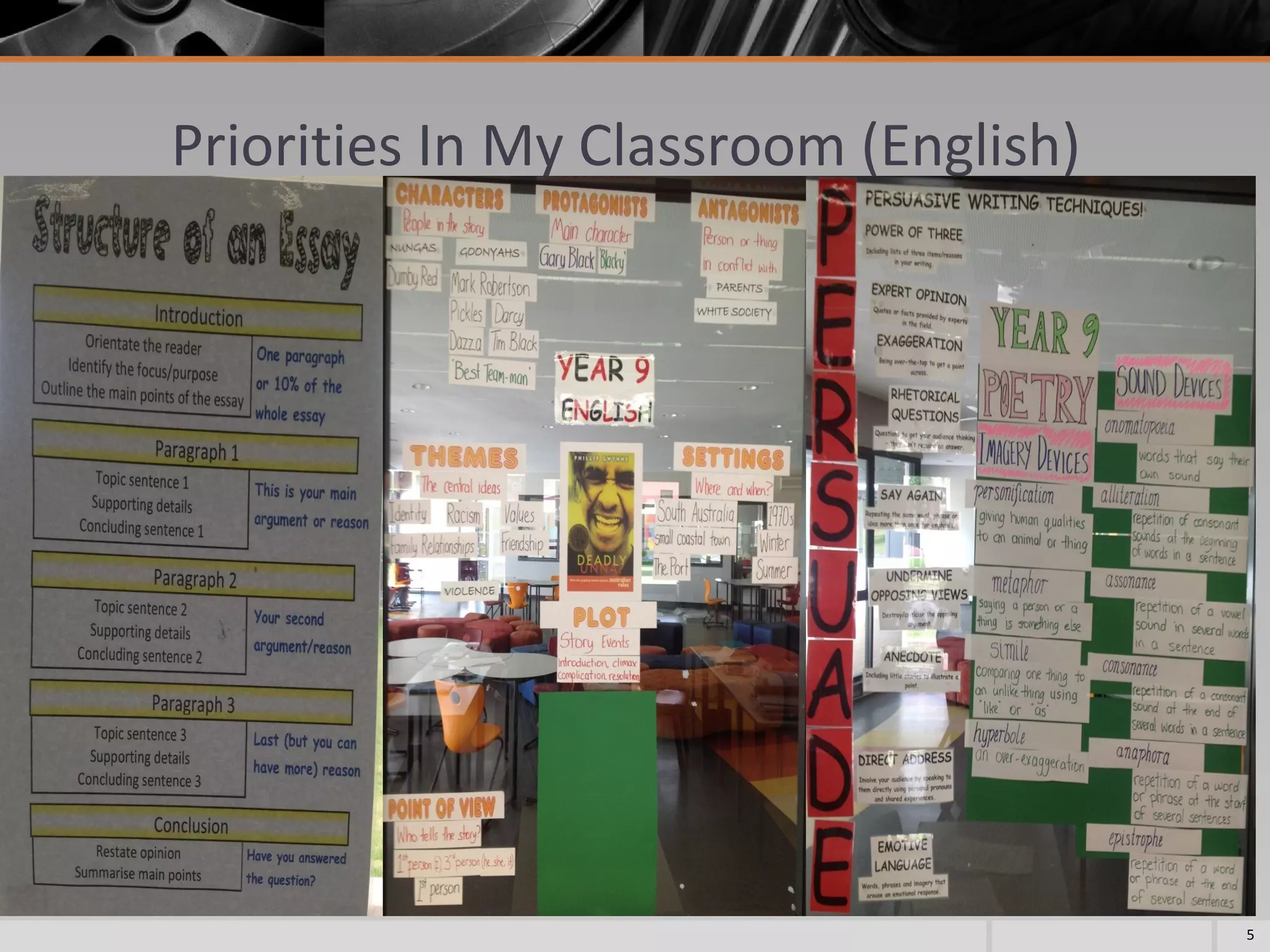
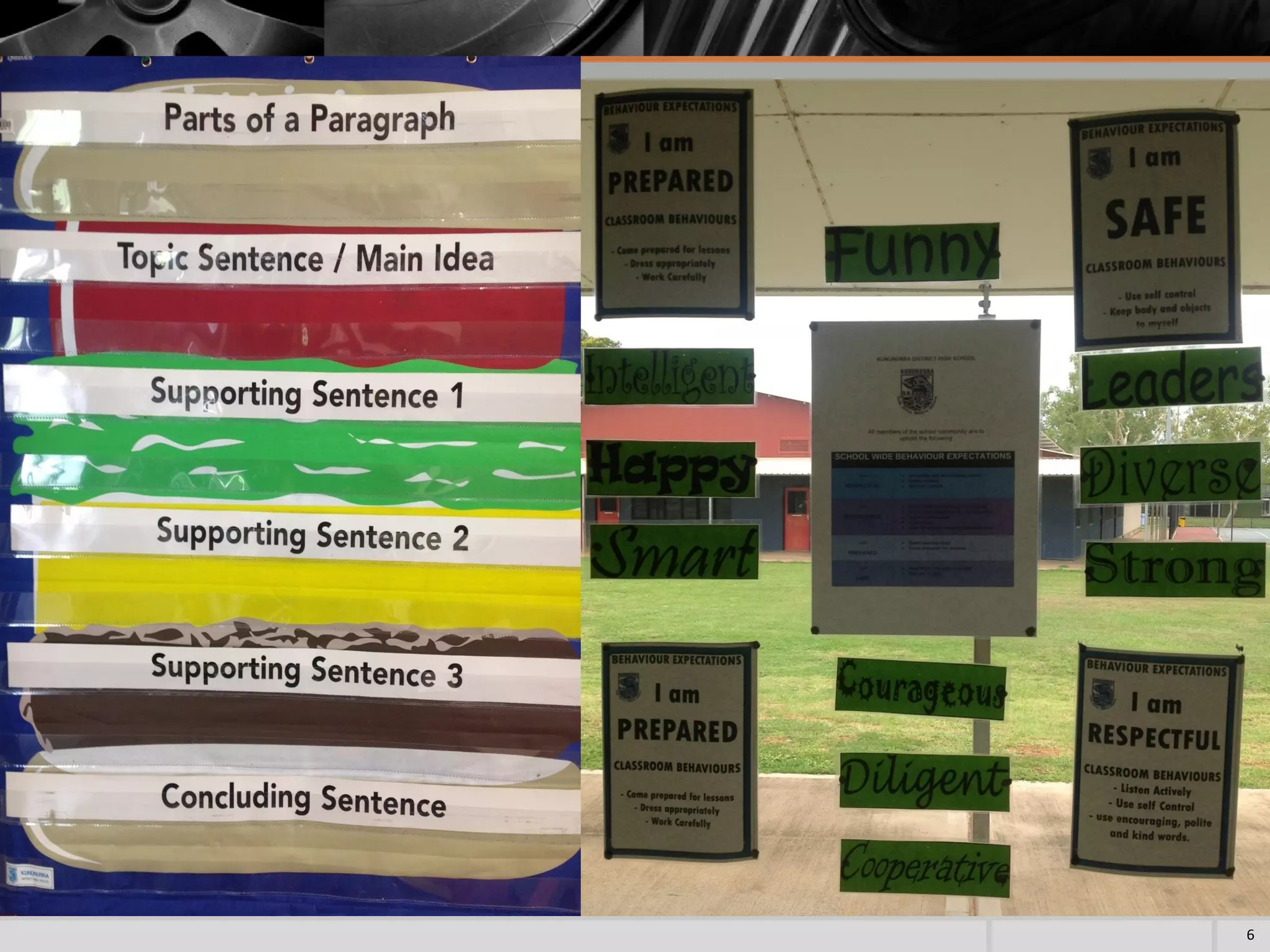
Priorities In My Classroom (English)

5
6
7
Setting Achievable Goals
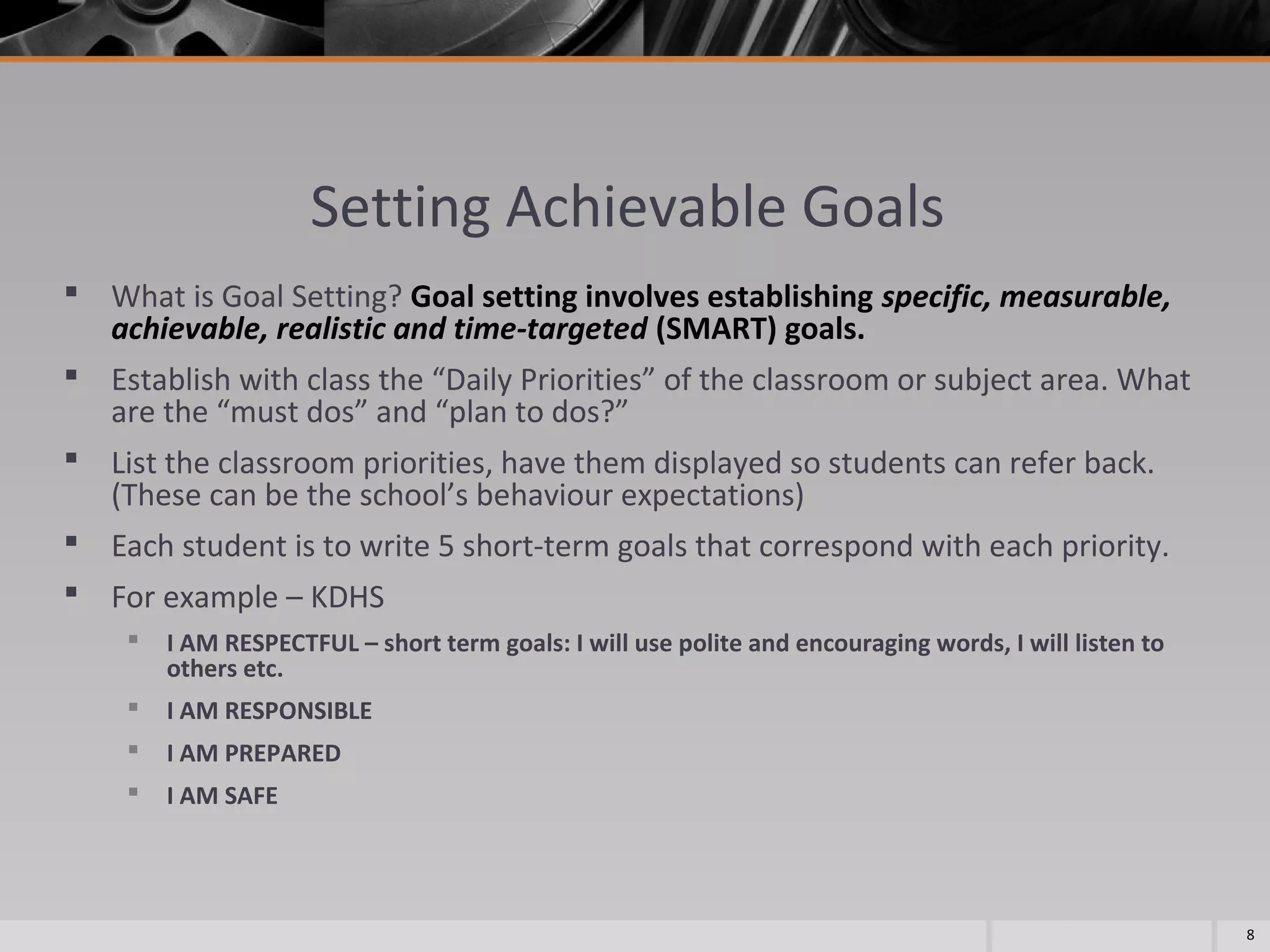
 What is Goal Setting? Goal setting involves establishing specific, measurable,
achievable, realistic and time-targeted (SMART) goals.
 Establish with class the “Daily Priorities” of the classroom or subject area. What
are the “must dos” and “plan to dos?”
 List the classroom priorities, have them displayed so students can refer back.
(These can be the school’s behaviour expectations)
 Each student is to write 5 short-term goals that correspond with each priority.
 For example – KDHS


I AM RESPECTFUL – short term goals: I will use polite and encouraging words, I will listen to
others etc.



I AM RESPONSIBLE



I AM PREPARED



I AM SAFE

8
Obstacles in concentration – Creating a
Positive Learning Environment
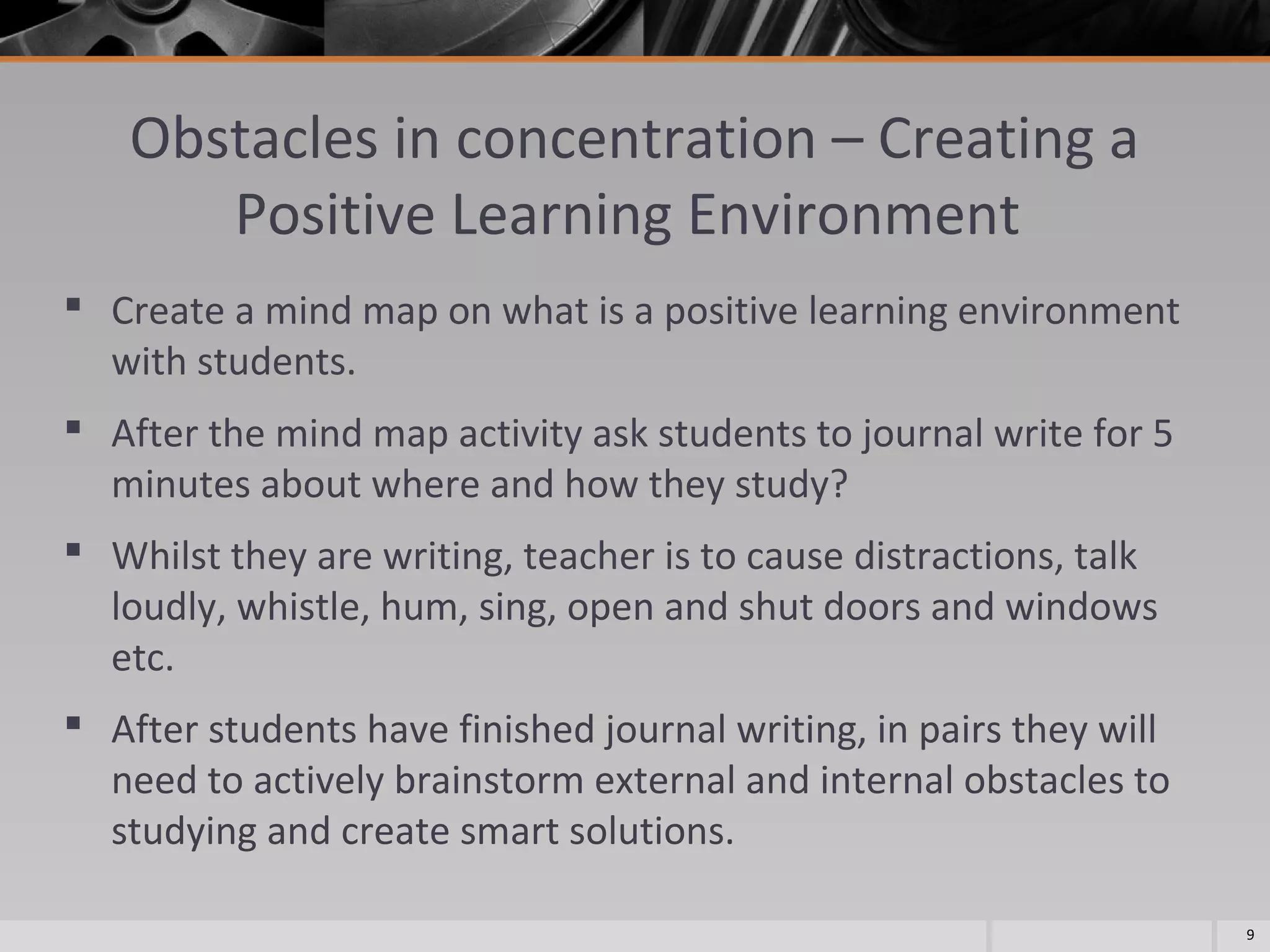
 Create a mind map on what is a positive learning environment
with students.
 After the mind map activity ask students to journal write for 5
minutes about where and how they study?
 Whilst they are writing, teacher is to cause distractions, talk
loudly, whistle, hum, sing, open and shut doors and windows
etc.
 After students have finished journal writing, in pairs they will
need to actively brainstorm external and internal obstacles to
studying and create smart solutions.
9
Creating a Study Environment
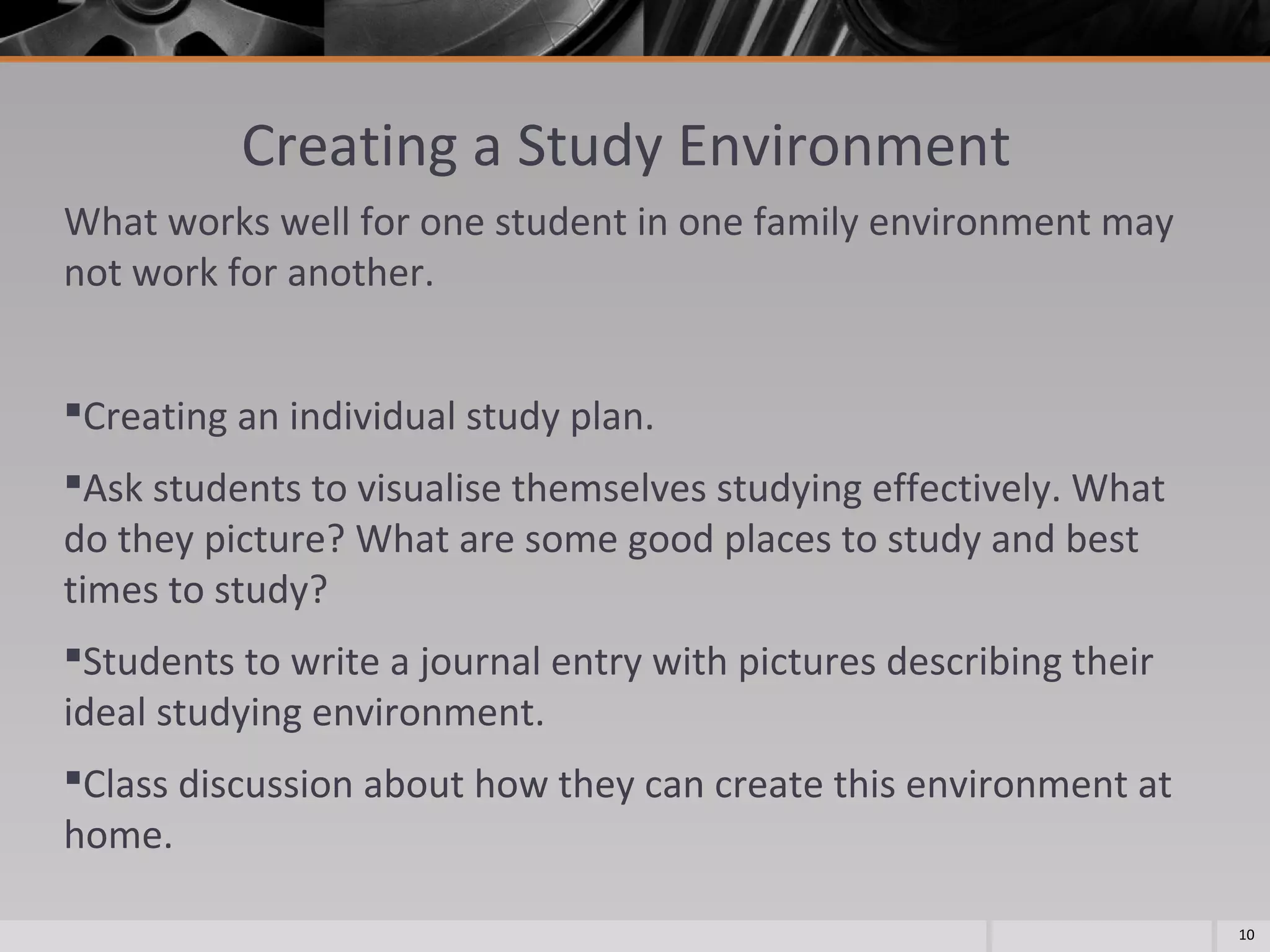
What works well for one student in one family environment may
not work for another.
Creating an individual study plan.
Ask students to visualise themselves studying effectively. What
do they picture? What are some good places to study and best
times to study?
Students to write a journal entry with pictures describing their
ideal studying environment.
Class discussion about how they can create this environment at
home.
10
Creating a Study Plan – Time Management
 Get students to come up with some estimations around how
much time they sleep, eat, watch TV, play sport etc.
 Students are to then conduct research on how they spend their
time over a three day period. (see attached hand out)
 Follow up activity – students reflect on their time sheets and
come up with three ways they can better use their time.
 Lastly incorporate a individual study plan – ask students to
block out all extra curricular activities first and then ask them
to fill in study periods 4 times a week for your subject area.
(Minimum ½ hour per session).
11
Any Questions?
 Please see me after presentations if you have any
questions?
 After these 5 techniques have been incorporated into
your class, you can teach other specific study skills like
note taking, creating efficient study notes,
summarising, paraphrasing, quoting etc.
 Sample high school and primary school hand outs if
you are interested.
12

Tarryn Audas - Effective Study Skills

  • 1.
    How to Incorporate StudySkills into the everyday classroom! By Tarryn Audas Secondary English, Health and Physical Education Kununurra District High School 1
  • 2.
    5 Steps toIncorporating Study Skills 1.Setting Classroom Priorities 2.Setting Achievable Goals 3.Establishing what obstacles in concentration can occur 4.Creating a Positive Study Environment 5.Creating a Study Plan– time management strategies 2
  • 3.
    Setting Priorities  Plan: •Class discussion with students about their extra-curricular activities and commitments – what do they do after school. • Get students to write down their out of school commitments in their subject book. • Students then write down what is expected of them at school in the subject area. (English) • Then students rank what they have written down in order of importance to them. 3
  • 4.
    Setting Priorities Continued How to set priorities? • Discuss what priorities are? Why it is important to have the right set of priorities. Definition: Precedence, especially established by order of importance or urgency. • Ask students to think about their ordering of priorities and see if they would change anything. Discuss Changes.  Discuss with students the consequences of having the wrong priorities, particularly related to achievement at school particularly in that subject area. 4
  • 5.
    Priorities In MyClassroom (English) 5
  • 6.
  • 7.
  • 8.
    Setting Achievable Goals What is Goal Setting? Goal setting involves establishing specific, measurable, achievable, realistic and time-targeted (SMART) goals.  Establish with class the “Daily Priorities” of the classroom or subject area. What are the “must dos” and “plan to dos?”  List the classroom priorities, have them displayed so students can refer back. (These can be the school’s behaviour expectations)  Each student is to write 5 short-term goals that correspond with each priority.  For example – KDHS  I AM RESPECTFUL – short term goals: I will use polite and encouraging words, I will listen to others etc.  I AM RESPONSIBLE  I AM PREPARED  I AM SAFE 8
  • 9.
    Obstacles in concentration– Creating a Positive Learning Environment  Create a mind map on what is a positive learning environment with students.  After the mind map activity ask students to journal write for 5 minutes about where and how they study?  Whilst they are writing, teacher is to cause distractions, talk loudly, whistle, hum, sing, open and shut doors and windows etc.  After students have finished journal writing, in pairs they will need to actively brainstorm external and internal obstacles to studying and create smart solutions. 9
  • 10.
    Creating a StudyEnvironment What works well for one student in one family environment may not work for another. Creating an individual study plan. Ask students to visualise themselves studying effectively. What do they picture? What are some good places to study and best times to study? Students to write a journal entry with pictures describing their ideal studying environment. Class discussion about how they can create this environment at home. 10
  • 11.
    Creating a StudyPlan – Time Management  Get students to come up with some estimations around how much time they sleep, eat, watch TV, play sport etc.  Students are to then conduct research on how they spend their time over a three day period. (see attached hand out)  Follow up activity – students reflect on their time sheets and come up with three ways they can better use their time.  Lastly incorporate a individual study plan – ask students to block out all extra curricular activities first and then ask them to fill in study periods 4 times a week for your subject area. (Minimum ½ hour per session). 11
  • 12.
    Any Questions?  Pleasesee me after presentations if you have any questions?  After these 5 techniques have been incorporated into your class, you can teach other specific study skills like note taking, creating efficient study notes, summarising, paraphrasing, quoting etc.  Sample high school and primary school hand outs if you are interested. 12