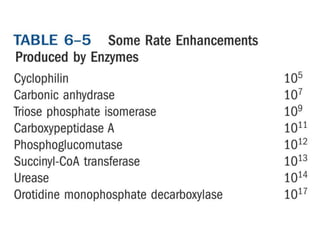
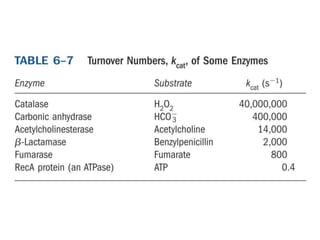
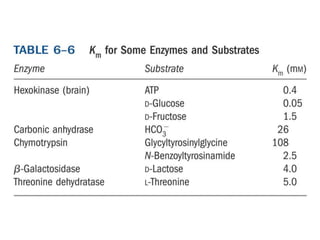
Enzyme Kinetics
Enzymes Are Uniquely Powerful Catalysts
• Enzymes are proteins that can accelerate
biochemical reactions by factors of 105 to 1017!
This is much higher than chemical catalysts.
• Enzymes can be extremely specific in terms of
reaction substrates and products.
• Enzymes catalyze reactions under mild
conditions (e.g., pH 7.4, 37ºC).
• The catalytic activities of many enzymes can be
regulated by allosteric effectors.
Chemical Kinetics
Irreversible First-Order Reactions
A  B
v = d[B]/dt = -d[A]/dt = k[A]
(k = first-order rate constant (s-1))
Change in [A] with time (t):
[A]= [A]o e –kt or
[A]/[A]o = e –kt
ln([A]/[A]o) = –kt
([A]o = initial concentration)
k
Reversible First-Order Reactions
A B
v = -d[A]/dt = k1[A] - k-1[B]
At equilibrium: k1[A]eq - k-1[B]eq = 0
[B]eq/[A]eq = k1/k-1 = Keq
k1
k-1


Second-Order Reactions
2A  P
v = -d[A]/dt = k[A]2
Change in [A] with time:
1/[A] = 1/[A]o + kt
A + B  P
v = -d[A]/dt = -d[B]/dt = k[A][B]
(k = second-order rate constant (M-1s-1))
k
k
Note: third-order reactions rare, fourth- and higher-order reactions unknown.
Free Energy Diagrams
Keq = e –∆Gº/RT
For A A‡
[A]‡/[A]o = e –∆Gº‡/RT
[A]‡ = [A]o e –∆Gº‡/RT
Keq = equilibrium constant
[A]‡ = concentration of molecules having the activation energy
[A]o = total concentration of A
–∆Gº‡ = standard free energy change of activation (activation energy)


Relationship of Reaction Rate Constant to
Activation Energy and Temperature: The
Arrhenius Equation
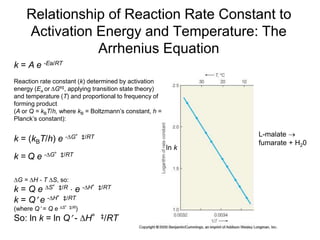
k = A e -Ea/RT
Reaction rate constant (k) determined by activation
energy (Ea or ∆Gº‡, applying transition state theory)
and temperature (T) and proportional to frequency of
forming product
(A or Q = kBT/h, where kB = Boltzmann’s constant, h =
Planck’s constant):
k = (kBT/h) e -G°‡/RT
k = Q e -G°‡/RT
G = H - T S, so:
k = Q e S°‡/R  e -H°‡/RT
k = Q e -H°‡/RT
(where Q = Q e S°‡/R)
So: ln k = ln Q - H°‡/RT
L-malate 
fumarate + H20
ln k
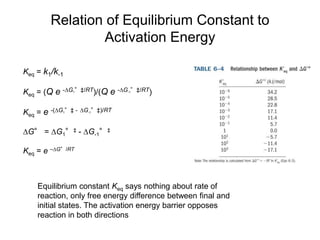
Relation of Equilibrium Constant to
Activation Energy
Keq = k1/k-1
Keq = (Q e -G1°‡/RT)/(Q e -G-1°‡/RT)
Keq = e -(G1°‡ - G-1°‡)/RT
∆G° = G1°‡ - G-1°‡
Keq = e –∆G°/RT
Equilibrium constant Keq says nothing about rate of
reaction, only free energy difference between final and
initial states. The activation energy barrier opposes
reaction in both directions
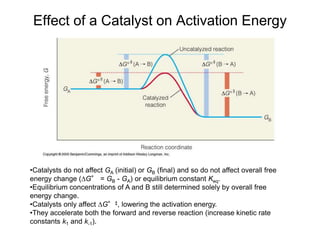
Effect of a Catalyst on Activation Energy
•Catalysts do not affect GA (initial) or GB (final) and so do not affect overall free
energy change (∆G° = GB - GA) or equilibrium constant Keq.
•Equilibrium concentrations of A and B still determined solely by overall free
energy change.
•Catalysts only affect ∆G°‡, lowering the activation energy.
•They accelerate both the forward and reverse reaction (increase kinetic rate
constants k1 and k-1).
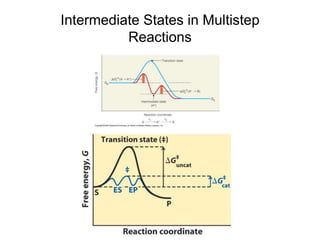
Intermediate States in Multistep
Reactions
Enzyme Kinetics
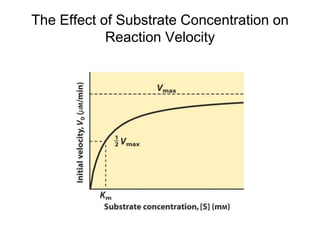
The Effect of Substrate Concentration on
Reaction Velocity
Michaelis-Menten Kinetics (1)
v = k2[ES]
(Note: k2 also referred to as kcat)
[Enzyme]total = [E]t = [E] + [ES]
How to solve for [ES]?
1. Assume equilibrium, if k-1 >> k2:
KS = k-1/k1 = [E][S]/[ES]
or
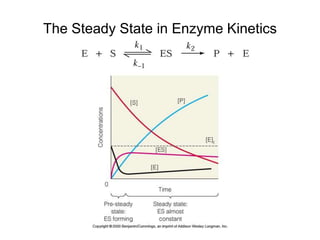
2. Assume steady state:
d[ES]/dt = 0
(Michaelis and
Menten, 1913)
(Briggs and
Haldane, 1925)
E = enzyme, S = substrate,
ES = enzyme-substrate complex,
P = product
The Steady State in Enzyme Kinetics
Michaelis-Menten Kinetics Continued (2)
Rate of formation of ES complex = k1[E][S]
Rate of breakdown of ES complex = k-1[ES] + k2[ES]
Because of steady state assumption:
k1[E][S] = k-1[ES] + k2[ES]
Rearranging: [ES] = (k1/(k-1 + k2))[E][S]
Substituting Michaelis constant = KM = (k-1 + k2)/k1) = KS + k2/k1:
[ES] = ([E][S])/KM
So: KM[ES] = [E][S]
Michaelis-Menten Kinetics Continued (3)
Substituting [E] = [E]t - [ES]:
KM[ES] = [E]t[S] - [ES][S]
Rearranging: [ES](KM + [S]) = [E]t[S]
So: [ES] = [E]t[S]/(KM + [S])
Michaelis-Menten Kinetics Continued (4)
Now we can substitute for [ES] in the rate equation
vo = k2[ES].
But first note that the velocity in v = k2[ES] we use is the initial
velocity, vo, the velocity of the reaction after the pre-steady state
and in the early part of the steady state, i.e., before ~10% of
substrate is converted to product. This is because at this stage of
the reaction, the steady-state assumption is reasonable ([ES] is still
approximately constant). Also, since not much P has yet
accumulated, we can approximate the kinetics for even reversible
reactions with this equation if we limit ourselves to vo.
The Michaelis-Menten Equation
vo = k2[E]t[S]/(KM + [S])
or
vo = Vmax[S]/(KM + [S])
(since Vmax = k2[E]t when [S] >> KM)
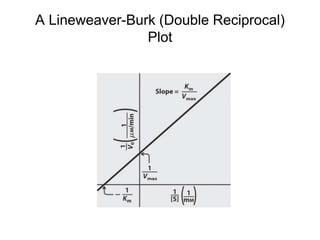
A Lineweaver-Burk (Double Reciprocal)
Plot
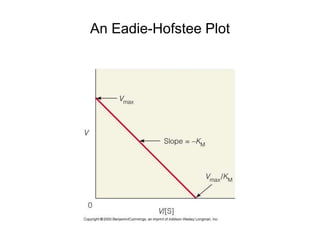
An Eadie-Hofstee Plot
Multistep Reactions
E + S ES  ES  E + P
vo = kcat[E]t[S]/(KM + [S])
k2 k3
k1
k-1


kcat = empirical rate constant that reflects rate-
determining component. Mathematically, for the
reaction above,
kcat = k2k3/(k2 + k3).
However, k2 and k3 often very hard to establish
with precision as individual rate constants.
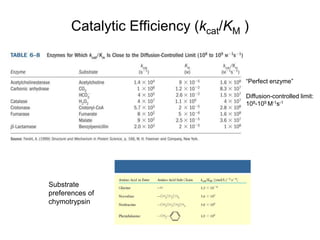
Catalytic Efficiency (kcat/KM )
“Perfect enzyme”
Diffusion-controlled limit:
108-109 M-1s-1
Substrate
preferences of
chymotrypsin
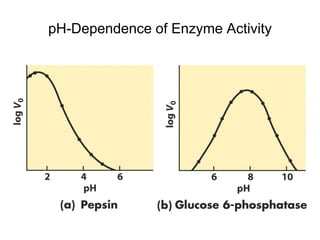
pH-Dependence of Enzyme Activity
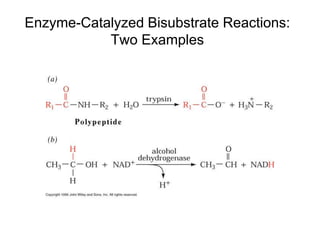
Enzyme-Catalyzed Bisubstrate Reactions:
Two Examples
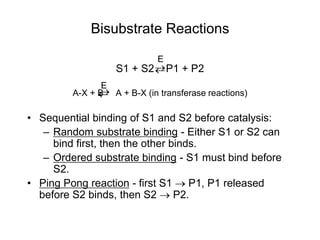
Bisubstrate Reactions
S1 + S2 P1 + P2
A-X + B A + B-X (in transferase reactions)
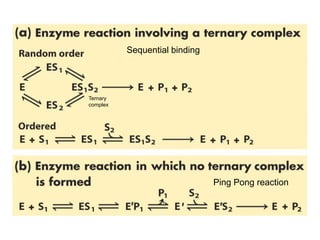
• Sequential binding of S1 and S2 before catalysis:
– Random substrate binding - Either S1 or S2 can
bind first, then the other binds.
– Ordered substrate binding - S1 must bind before
S2.
• Ping Pong reaction - first S1  P1, P1 released
before S2 binds, then S2  P2.
E


E


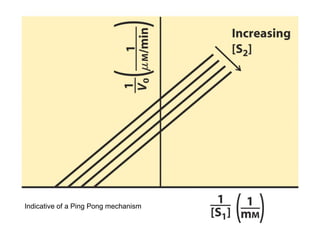
Ping Pong reaction
Sequential binding
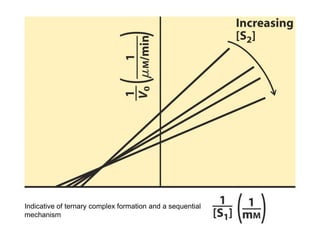
Ternary
complex
Indicative of ternary complex formation and a sequential
mechanism
Indicative of a Ping Pong mechanism
Enzyme Inhibition
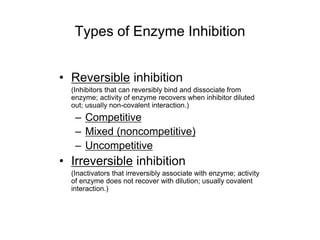
Types of Enzyme Inhibition
• Reversible inhibition
(Inhibitors that can reversibly bind and dissociate from
enzyme; activity of enzyme recovers when inhibitor diluted
out; usually non-covalent interaction.)
– Competitive
– Mixed (noncompetitive)
– Uncompetitive
• Irreversible inhibition
(Inactivators that irreversibly associate with enzyme; activity
of enzyme does not recover with dilution; usually covalent
interaction.)
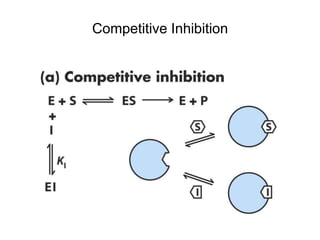
Competitive Inhibition
Effects of Competitive Inhibitor on
Enzyme Kinetics
Kapp
M = KM(1 + [I]/KI) > KM
Vapp
max = Vmax
KI (inhibitor dissociation
constant) = koff/kon
a = 1 + [I]/KI
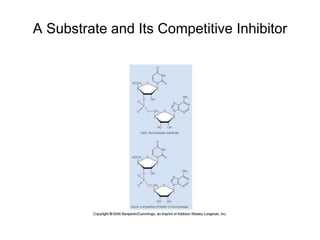
A Substrate and Its Competitive Inhibitor
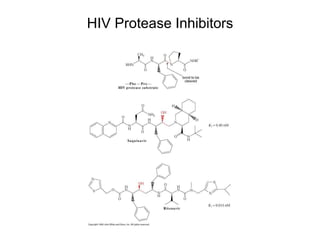
HIV Protease Inhibitors
Relationship of KI to Half-Maximal
Inhibitory Concentration (IC50)
For a competitive inhibitor of an enzyme that follows
Michaelis-Menton kinetics:
vI/v0 = (Vmax[S]/(KMa + [S]))/(Vmax[S]/(KM + [S])) = (KM +
[S])/(KMa + [S])
vI = initial velocity with inhibitor
v0 = initial velocity without inhibitor
a = 1 + [I]/KI
When vI/v0 = 0.5, [I] = IC50 = KI(1 + [S]/KM)
If measurement made when [S] << KM, IC50 = KI
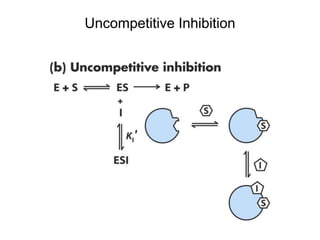
Uncompetitive Inhibition
Effects of Uncompetitive Inhibitor on
Enzyme Kinetics
Kapp
M = KM/(1 + [I]/KI) < KM
Vapp
max = Vmax/(1 + [I]/KI) < Vmax
a = 1 + [I]/KI
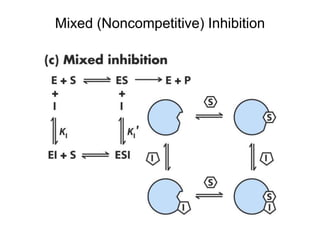
Mixed (Noncompetitive) Inhibition
Effects of Mixed (Noncompetitive)
Inhibitor on Enzyme Kinetics
Kapp
M = (1 + [I]/KI)KM/(1 + [I]/KI)
(= KM, when KI = KI, which is often the case.)
Vapp
max = Vmax/(1 + [I]/KI) < Vmax
k1


k-1
•Not the same as uncompetitive inhibition.
•In mixed inhibition, inhibitor can bind E or
ES.
a = 1 + [I]/KI
a = 1 + [I]/KI
a = 1 + [I]/KI
a = 1 + [I]/KI
(For mixed inhibitor,
generally, ~ KM)
Irreversible Inhibition
k1


k-1
k2
E + I E·I  E-I
Plot:
ln(residual enzyme activity) vs. time
If [I]>>[E], conditions are pseudo-first
order and slope is -kobs (pseudo-first
order inactivation rate constant)
kinact (second-order inactivation constant)
= k1k2/k-1 = kobs/[I]
Slope = -kobs
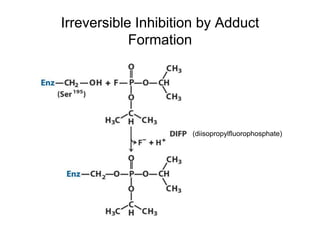
Irreversible Inhibition by Adduct
Formation
(diisopropylfluorophosphate)
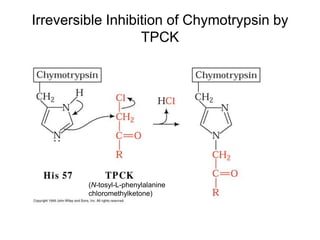
Irreversible Inhibition of Chymotrypsin by
TPCK
(N-tosyl-L-phenylalanine
chloromethylketone)

9392189.ppt

  • 1.
  • 2.
    Enzymes Are UniquelyPowerful Catalysts • Enzymes are proteins that can accelerate biochemical reactions by factors of 105 to 1017! This is much higher than chemical catalysts. • Enzymes can be extremely specific in terms of reaction substrates and products. • Enzymes catalyze reactions under mild conditions (e.g., pH 7.4, 37ºC). • The catalytic activities of many enzymes can be regulated by allosteric effectors.
  • 3.
  • 4.
    Irreversible First-Order Reactions A B v = d[B]/dt = -d[A]/dt = k[A] (k = first-order rate constant (s-1)) Change in [A] with time (t): [A]= [A]o e –kt or [A]/[A]o = e –kt ln([A]/[A]o) = –kt ([A]o = initial concentration) k
  • 5.
    Reversible First-Order Reactions AB v = -d[A]/dt = k1[A] - k-1[B] At equilibrium: k1[A]eq - k-1[B]eq = 0 [B]eq/[A]eq = k1/k-1 = Keq k1 k-1  
  • 6.
    Second-Order Reactions 2A P v = -d[A]/dt = k[A]2 Change in [A] with time: 1/[A] = 1/[A]o + kt A + B  P v = -d[A]/dt = -d[B]/dt = k[A][B] (k = second-order rate constant (M-1s-1)) k k Note: third-order reactions rare, fourth- and higher-order reactions unknown.
  • 7.
    Free Energy Diagrams Keq= e –∆Gº/RT For A A‡ [A]‡/[A]o = e –∆Gº‡/RT [A]‡ = [A]o e –∆Gº‡/RT Keq = equilibrium constant [A]‡ = concentration of molecules having the activation energy [A]o = total concentration of A –∆Gº‡ = standard free energy change of activation (activation energy)  
  • 8.
    Relationship of ReactionRate Constant to Activation Energy and Temperature: The Arrhenius Equation k = A e -Ea/RT Reaction rate constant (k) determined by activation energy (Ea or ∆Gº‡, applying transition state theory) and temperature (T) and proportional to frequency of forming product (A or Q = kBT/h, where kB = Boltzmann’s constant, h = Planck’s constant): k = (kBT/h) e -G°‡/RT k = Q e -G°‡/RT G = H - T S, so: k = Q e S°‡/R  e -H°‡/RT k = Q e -H°‡/RT (where Q = Q e S°‡/R) So: ln k = ln Q - H°‡/RT L-malate  fumarate + H20 ln k
  • 9.
    Relation of EquilibriumConstant to Activation Energy Keq = k1/k-1 Keq = (Q e -G1°‡/RT)/(Q e -G-1°‡/RT) Keq = e -(G1°‡ - G-1°‡)/RT ∆G° = G1°‡ - G-1°‡ Keq = e –∆G°/RT Equilibrium constant Keq says nothing about rate of reaction, only free energy difference between final and initial states. The activation energy barrier opposes reaction in both directions
  • 10.
    Effect of aCatalyst on Activation Energy •Catalysts do not affect GA (initial) or GB (final) and so do not affect overall free energy change (∆G° = GB - GA) or equilibrium constant Keq. •Equilibrium concentrations of A and B still determined solely by overall free energy change. •Catalysts only affect ∆G°‡, lowering the activation energy. •They accelerate both the forward and reverse reaction (increase kinetic rate constants k1 and k-1).
  • 11.
    Intermediate States inMultistep Reactions
  • 12.
  • 13.
    The Effect ofSubstrate Concentration on Reaction Velocity
  • 14.
    Michaelis-Menten Kinetics (1) v= k2[ES] (Note: k2 also referred to as kcat) [Enzyme]total = [E]t = [E] + [ES] How to solve for [ES]? 1. Assume equilibrium, if k-1 >> k2: KS = k-1/k1 = [E][S]/[ES] or 2. Assume steady state: d[ES]/dt = 0 (Michaelis and Menten, 1913) (Briggs and Haldane, 1925) E = enzyme, S = substrate, ES = enzyme-substrate complex, P = product
  • 15.
    The Steady Statein Enzyme Kinetics
  • 16.
    Michaelis-Menten Kinetics Continued(2) Rate of formation of ES complex = k1[E][S] Rate of breakdown of ES complex = k-1[ES] + k2[ES] Because of steady state assumption: k1[E][S] = k-1[ES] + k2[ES] Rearranging: [ES] = (k1/(k-1 + k2))[E][S] Substituting Michaelis constant = KM = (k-1 + k2)/k1) = KS + k2/k1: [ES] = ([E][S])/KM So: KM[ES] = [E][S]
  • 17.
    Michaelis-Menten Kinetics Continued(3) Substituting [E] = [E]t - [ES]: KM[ES] = [E]t[S] - [ES][S] Rearranging: [ES](KM + [S]) = [E]t[S] So: [ES] = [E]t[S]/(KM + [S])
  • 18.
    Michaelis-Menten Kinetics Continued(4) Now we can substitute for [ES] in the rate equation vo = k2[ES]. But first note that the velocity in v = k2[ES] we use is the initial velocity, vo, the velocity of the reaction after the pre-steady state and in the early part of the steady state, i.e., before ~10% of substrate is converted to product. This is because at this stage of the reaction, the steady-state assumption is reasonable ([ES] is still approximately constant). Also, since not much P has yet accumulated, we can approximate the kinetics for even reversible reactions with this equation if we limit ourselves to vo.
  • 19.
    The Michaelis-Menten Equation vo= k2[E]t[S]/(KM + [S]) or vo = Vmax[S]/(KM + [S]) (since Vmax = k2[E]t when [S] >> KM)
  • 20.
    A Lineweaver-Burk (DoubleReciprocal) Plot
  • 21.
  • 22.
    Multistep Reactions E +S ES  ES  E + P vo = kcat[E]t[S]/(KM + [S]) k2 k3 k1 k-1   kcat = empirical rate constant that reflects rate- determining component. Mathematically, for the reaction above, kcat = k2k3/(k2 + k3). However, k2 and k3 often very hard to establish with precision as individual rate constants.
  • 26.
    Catalytic Efficiency (kcat/KM) “Perfect enzyme” Diffusion-controlled limit: 108-109 M-1s-1 Substrate preferences of chymotrypsin
  • 27.
  • 28.
  • 29.
    Bisubstrate Reactions S1 +S2 P1 + P2 A-X + B A + B-X (in transferase reactions) • Sequential binding of S1 and S2 before catalysis: – Random substrate binding - Either S1 or S2 can bind first, then the other binds. – Ordered substrate binding - S1 must bind before S2. • Ping Pong reaction - first S1  P1, P1 released before S2 binds, then S2  P2. E   E  
  • 30.
    Ping Pong reaction Sequentialbinding Ternary complex
  • 31.
    Indicative of ternarycomplex formation and a sequential mechanism
  • 32.
    Indicative of aPing Pong mechanism
  • 33.
  • 34.
    Types of EnzymeInhibition • Reversible inhibition (Inhibitors that can reversibly bind and dissociate from enzyme; activity of enzyme recovers when inhibitor diluted out; usually non-covalent interaction.) – Competitive – Mixed (noncompetitive) – Uncompetitive • Irreversible inhibition (Inactivators that irreversibly associate with enzyme; activity of enzyme does not recover with dilution; usually covalent interaction.)
  • 35.
  • 36.
    Effects of CompetitiveInhibitor on Enzyme Kinetics Kapp M = KM(1 + [I]/KI) > KM Vapp max = Vmax KI (inhibitor dissociation constant) = koff/kon
  • 37.
    a = 1+ [I]/KI
  • 38.
    A Substrate andIts Competitive Inhibitor
  • 39.
  • 40.
    Relationship of KIto Half-Maximal Inhibitory Concentration (IC50) For a competitive inhibitor of an enzyme that follows Michaelis-Menton kinetics: vI/v0 = (Vmax[S]/(KMa + [S]))/(Vmax[S]/(KM + [S])) = (KM + [S])/(KMa + [S]) vI = initial velocity with inhibitor v0 = initial velocity without inhibitor a = 1 + [I]/KI When vI/v0 = 0.5, [I] = IC50 = KI(1 + [S]/KM) If measurement made when [S] << KM, IC50 = KI
  • 41.
  • 42.
    Effects of UncompetitiveInhibitor on Enzyme Kinetics Kapp M = KM/(1 + [I]/KI) < KM Vapp max = Vmax/(1 + [I]/KI) < Vmax
  • 43.
    a = 1+ [I]/KI
  • 44.
  • 45.
    Effects of Mixed(Noncompetitive) Inhibitor on Enzyme Kinetics Kapp M = (1 + [I]/KI)KM/(1 + [I]/KI) (= KM, when KI = KI, which is often the case.) Vapp max = Vmax/(1 + [I]/KI) < Vmax k1   k-1 •Not the same as uncompetitive inhibition. •In mixed inhibition, inhibitor can bind E or ES.
  • 46.
    a = 1+ [I]/KI a = 1 + [I]/KI
  • 47.
    a = 1+ [I]/KI a = 1 + [I]/KI (For mixed inhibitor, generally, ~ KM)
  • 48.
    Irreversible Inhibition k1   k-1 k2 E +I E·I  E-I Plot: ln(residual enzyme activity) vs. time If [I]>>[E], conditions are pseudo-first order and slope is -kobs (pseudo-first order inactivation rate constant) kinact (second-order inactivation constant) = k1k2/k-1 = kobs/[I] Slope = -kobs
  • 49.
    Irreversible Inhibition byAdduct Formation (diisopropylfluorophosphate)
  • 50.
    Irreversible Inhibition ofChymotrypsin by TPCK (N-tosyl-L-phenylalanine chloromethylketone)