Selecting a Study Design
Goals
 Describe the cohort study design.
 Describe the case-control study design.
 Compare situations in which cohort and
case-control study designs should be
used.
About Analytic Studies
 We can use analytic studies to test hypotheses.
 We want to know:
 Whether there is an association between hypothesized
exposure and disease,
 How strong the association is,
 What proportion of cases are due to exposure, and
 Whether there is an increased risk of disease with increased
exposure (a dose-response relationship).
 Two common types of analytic studies are cohort
study and case-control study.
What is a Cohort?
 A “cohort” is a group of people who have
something in common.
 Can represent the source population—the
population from which cases of disease arise.
 Examples of cohorts:
 All employees in an office building
 Everyone who attended a football game
 All the residents of a neighborhood
Cohort Studies
 Tend to be retrospective (exposures in the
past in relation to disease that has already
happened).
 Occurrence of disease in exposed group
compared to occurrence of disease in
unexposed group = risk ratio.
 Risk ratio tells whether disease is associated
with exposure and strength of association.
Identifying a Cohort
 To use a cohort study, you must identify
every person in the cohort.
 Possible when the group is small and well
defined (e.g., wedding reception, cruise
ship, school, prison).
 Option to interview every member of
the cohort or a sample of the cohort.
Identifying a Cohort
 Sometimes it may be difficult to define
a suitable cohort.
 Can you find every single person who ate
at the Main Street Deli on January 10-20?
 How would you locate every person buying
and/or eating contaminated lunch meat
from a local supermarket chain?
 An alternative: the case-control study.
Case-Control Studies
 The most frequently used type of study in
outbreaks.
 Can be quickly implemented.
 Can be used when cohort study might be large
and time-consuming.
 Identify people with disease (case-patients)
and people without disease (controls), then
ask everyone about past exposures.
 You already know who is sick through doctor
diagnosis, lab culture, or health department.
Case-Control Studies
 Calculate odds ratio to measure
strength of association between illness
and exposure.
 Compare odds of exposure among case-
patients to odds of exposure among
controls.
 Cannot calculate risk ratio in case-
control study.
Selecting Cases and Controls
 Defining the source population may help
narrow down potential controls.
 Do the cases live in the same city or attend the
same event?
 Are they of a particular race or ethnicity?
 Understanding where cases came from will
help select your controls.
 Controls are a sample of people from the
source population.
Selecting Cases and Controls
 Example: Outbreak of gastrointestinal illness linked to
eating at the Main Street Deli during January 10-20.
 Cases recruited from people who ate at the Deli and
experienced vomiting. Controls recruited from people who
ate at the Deli but did not experience vomiting.
 All cases recruited into study; only a portion of healthy
controls contacted because could not identify every person
who ate at the restaurant during these 10 days.
 Want to know what case-patients and controls ate.
 Controls selected from customers who ate at the Deli
during the time period of interest.
Case-Control or Cohort:
Which one is right?
 The choice depends on the situation.
 Always think about the source
population:
 Are members of the group easily
identifiable? Can you interview all or a
sample of them?
 Use a cohort study.
 Is the cohort difficult to identify or too
large to contact all members?
 Use a case-control study design.
Case-Control or Cohort:
Which one is right?
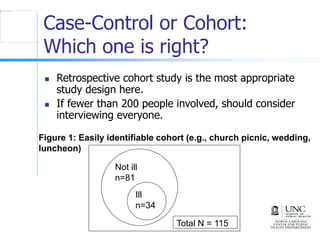
 Retrospective cohort study is the most appropriate
study design here.
 If fewer than 200 people involved, should consider
interviewing everyone.
Not ill
n=81
Ill
n=34
Total N = 115
Figure 1: Easily identifiable cohort (e.g., church picnic, wedding,
luncheon)
Case-Control or Cohort:
Which one is right?
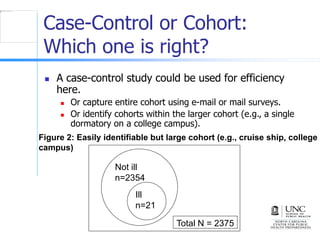
 A case-control study could be used for efficiency
here.
 Or capture entire cohort using e-mail or mail surveys.
 Or identify cohorts within the larger cohort (e.g., a single
dormatory on a college campus).
Not ill
n=2354
Ill
n=21
Total N = 2375
Figure 2: Easily identifiable but large cohort (e.g., cruise ship, college
campus)
Case-Control or Cohort:
Which one is right?
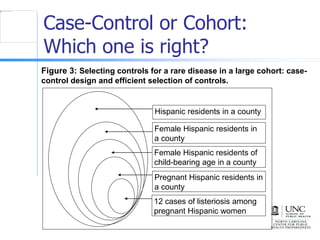
Figure 3: Selecting controls for a rare disease in a large cohort: case-
control design and efficient selection of controls.
Hispanic residents in a county
Female Hispanic residents in
a county
Female Hispanic residents of
child-bearing age in a county
Pregnant Hispanic residents in
a county
12 cases of listeriosis among
pregnant Hispanic women
Case Studies:
Yersinia and chitterlings
 11/15/2001–2/15/2002: 12 cases of Yersinia
enterocolitica identified at large urban pediatric
emergency department in Tennessee.
 Source population: black infants with access to
medical care from population served by hospital.
 Controls chosen: black infants who presented to the
emergency department of same hospital with chief
complaint other than gastroenteritis.
 Case-control study implicated source of outbreak:
 Chitterlings prepared in 100% of case households but only
35% of control households.
 Parents able to identify ways kitchen might have become
contaminated (e.g., chitterlings cleaned in sink).
Case Studies:
Pseudomonas from ear piercing
 September 2000: Oregon physician treating 2 patients on 2
consecutive days with infections of the cartilage of the ear; both
patients received ear piercings at same kiosk.
 Investigators could contact all patrons of kiosk; used a cohort
study design:
 118 people received 186 piercings August 1 through September 15.
 7 piercings (4%): laboratory-confirmed Pseudomonas aeruginosa.
 18 piercings (10%): suspected case.
 Risk of infection increased if piercing in cartilage rather than
earlobe.
 The investigators were able to:
 Determine the risk of infection among the entire population,
 Determine that the risk was different based on site of piercing, and
 Identify practices that might have led to contamination of
equipment and subsequent infection.
Conclusion
 Cohort and case-control studies are both
options for determining cause of an outbreak.
 Both study the source population.
 Cohort uses entire population or representative
sample.
 Case-control uses all cases of disease and
sampled controls.
 Both types of studies are effective; your
choice will depend on the circumstances of
the outbreak you are investigating.
References
1. Dwyer DM, Strickler H, Goodman RA, Armenian HK. Use of
case-control studies in outbreak investigations. Epidemiol Rev.
1994;16(1):109-123.
2. MacDonald PM, Whitwam RE, Boggs JD, et al. Outbreak of
Listeriosis among Mexican Immigrants as a Result of
Consumption of Illicitly Produced Mexican-Style Cheese. Clin
Infect Dis. 2005; 40:677-682.
3. Jones TF. From pig to pacifier: chitterling-associated yersiniosis
outbreak among black infants. Emerg Infect Dis.
2003;9(8):1007-1009.
4. Keene WE, Markum AC, Samadpour M. Outbreak of
Pseudomonas aeruginosa infections caused by commercial
piercing of upper ear cartilage. Jama. 2004;291(8):981-985.

2-4StudyDesign_slides.ppt

  • 1.
  • 2.
    Goals  Describe thecohort study design.  Describe the case-control study design.  Compare situations in which cohort and case-control study designs should be used.
  • 3.
    About Analytic Studies We can use analytic studies to test hypotheses.  We want to know:  Whether there is an association between hypothesized exposure and disease,  How strong the association is,  What proportion of cases are due to exposure, and  Whether there is an increased risk of disease with increased exposure (a dose-response relationship).  Two common types of analytic studies are cohort study and case-control study.
  • 4.
    What is aCohort?  A “cohort” is a group of people who have something in common.  Can represent the source population—the population from which cases of disease arise.  Examples of cohorts:  All employees in an office building  Everyone who attended a football game  All the residents of a neighborhood
  • 5.
    Cohort Studies  Tendto be retrospective (exposures in the past in relation to disease that has already happened).  Occurrence of disease in exposed group compared to occurrence of disease in unexposed group = risk ratio.  Risk ratio tells whether disease is associated with exposure and strength of association.
  • 6.
    Identifying a Cohort To use a cohort study, you must identify every person in the cohort.  Possible when the group is small and well defined (e.g., wedding reception, cruise ship, school, prison).  Option to interview every member of the cohort or a sample of the cohort.
  • 7.
    Identifying a Cohort Sometimes it may be difficult to define a suitable cohort.  Can you find every single person who ate at the Main Street Deli on January 10-20?  How would you locate every person buying and/or eating contaminated lunch meat from a local supermarket chain?  An alternative: the case-control study.
  • 8.
    Case-Control Studies  Themost frequently used type of study in outbreaks.  Can be quickly implemented.  Can be used when cohort study might be large and time-consuming.  Identify people with disease (case-patients) and people without disease (controls), then ask everyone about past exposures.  You already know who is sick through doctor diagnosis, lab culture, or health department.
  • 9.
    Case-Control Studies  Calculateodds ratio to measure strength of association between illness and exposure.  Compare odds of exposure among case- patients to odds of exposure among controls.  Cannot calculate risk ratio in case- control study.
  • 10.
    Selecting Cases andControls  Defining the source population may help narrow down potential controls.  Do the cases live in the same city or attend the same event?  Are they of a particular race or ethnicity?  Understanding where cases came from will help select your controls.  Controls are a sample of people from the source population.
  • 11.
    Selecting Cases andControls  Example: Outbreak of gastrointestinal illness linked to eating at the Main Street Deli during January 10-20.  Cases recruited from people who ate at the Deli and experienced vomiting. Controls recruited from people who ate at the Deli but did not experience vomiting.  All cases recruited into study; only a portion of healthy controls contacted because could not identify every person who ate at the restaurant during these 10 days.  Want to know what case-patients and controls ate.  Controls selected from customers who ate at the Deli during the time period of interest.
  • 12.
    Case-Control or Cohort: Whichone is right?  The choice depends on the situation.  Always think about the source population:  Are members of the group easily identifiable? Can you interview all or a sample of them?  Use a cohort study.  Is the cohort difficult to identify or too large to contact all members?  Use a case-control study design.
  • 13.
    Case-Control or Cohort: Whichone is right?  Retrospective cohort study is the most appropriate study design here.  If fewer than 200 people involved, should consider interviewing everyone. Not ill n=81 Ill n=34 Total N = 115 Figure 1: Easily identifiable cohort (e.g., church picnic, wedding, luncheon)
  • 14.
    Case-Control or Cohort: Whichone is right?  A case-control study could be used for efficiency here.  Or capture entire cohort using e-mail or mail surveys.  Or identify cohorts within the larger cohort (e.g., a single dormatory on a college campus). Not ill n=2354 Ill n=21 Total N = 2375 Figure 2: Easily identifiable but large cohort (e.g., cruise ship, college campus)
  • 15.
    Case-Control or Cohort: Whichone is right? Figure 3: Selecting controls for a rare disease in a large cohort: case- control design and efficient selection of controls. Hispanic residents in a county Female Hispanic residents in a county Female Hispanic residents of child-bearing age in a county Pregnant Hispanic residents in a county 12 cases of listeriosis among pregnant Hispanic women
  • 16.
    Case Studies: Yersinia andchitterlings  11/15/2001–2/15/2002: 12 cases of Yersinia enterocolitica identified at large urban pediatric emergency department in Tennessee.  Source population: black infants with access to medical care from population served by hospital.  Controls chosen: black infants who presented to the emergency department of same hospital with chief complaint other than gastroenteritis.  Case-control study implicated source of outbreak:  Chitterlings prepared in 100% of case households but only 35% of control households.  Parents able to identify ways kitchen might have become contaminated (e.g., chitterlings cleaned in sink).
  • 17.
    Case Studies: Pseudomonas fromear piercing  September 2000: Oregon physician treating 2 patients on 2 consecutive days with infections of the cartilage of the ear; both patients received ear piercings at same kiosk.  Investigators could contact all patrons of kiosk; used a cohort study design:  118 people received 186 piercings August 1 through September 15.  7 piercings (4%): laboratory-confirmed Pseudomonas aeruginosa.  18 piercings (10%): suspected case.  Risk of infection increased if piercing in cartilage rather than earlobe.  The investigators were able to:  Determine the risk of infection among the entire population,  Determine that the risk was different based on site of piercing, and  Identify practices that might have led to contamination of equipment and subsequent infection.
  • 18.
    Conclusion  Cohort andcase-control studies are both options for determining cause of an outbreak.  Both study the source population.  Cohort uses entire population or representative sample.  Case-control uses all cases of disease and sampled controls.  Both types of studies are effective; your choice will depend on the circumstances of the outbreak you are investigating.
  • 19.
    References 1. Dwyer DM,Strickler H, Goodman RA, Armenian HK. Use of case-control studies in outbreak investigations. Epidemiol Rev. 1994;16(1):109-123. 2. MacDonald PM, Whitwam RE, Boggs JD, et al. Outbreak of Listeriosis among Mexican Immigrants as a Result of Consumption of Illicitly Produced Mexican-Style Cheese. Clin Infect Dis. 2005; 40:677-682. 3. Jones TF. From pig to pacifier: chitterling-associated yersiniosis outbreak among black infants. Emerg Infect Dis. 2003;9(8):1007-1009. 4. Keene WE, Markum AC, Samadpour M. Outbreak of Pseudomonas aeruginosa infections caused by commercial piercing of upper ear cartilage. Jama. 2004;291(8):981-985.