




Welcoming, Coping & Committing to Change Welcoming  Change
On Change CHARLES F. KETTERING Said,  Change  “is a high hat word that scares a lot of people” Welcoming  Change
Near the end of the 15 th  century BC, a Greek Philosopher Heraclitus pointed out , " You can not step twice into the same river” For Heraclitus,  change  was a fundamental constant in a way he conceived the world. Welcoming  Change
If we accept this account, it is not surprising that we see change as fundamental to our definition as human beings.  We  change  along with the world around us. Welcoming  Change
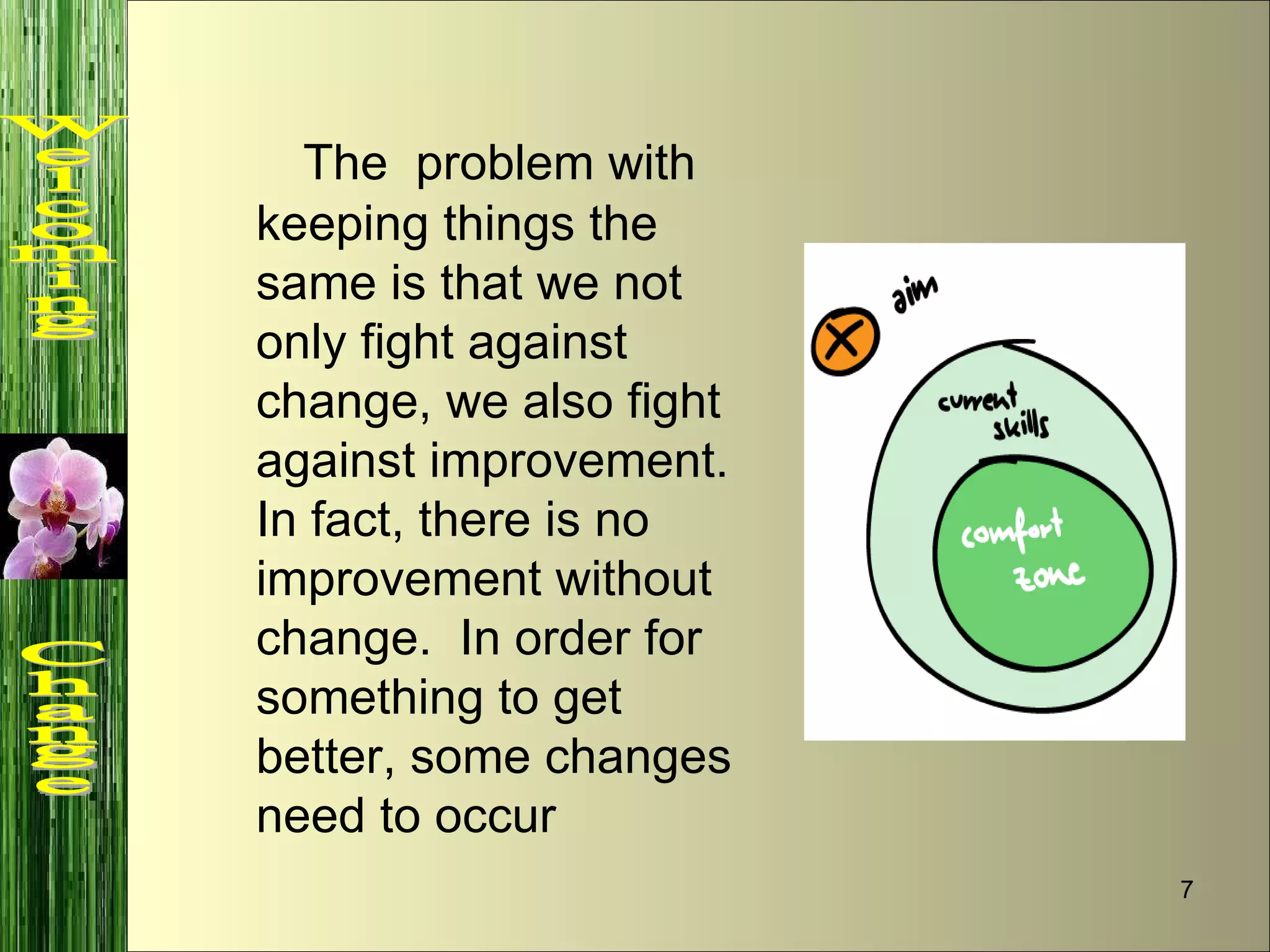
It is common and to a certain extent human beings resist change.  Most people have a tendency for nesting.  That is being contented .  Arranging life around us to make it comfortable place we can. Then we try to dwell it in that comforting place   Comfort Zone Welcoming  Change
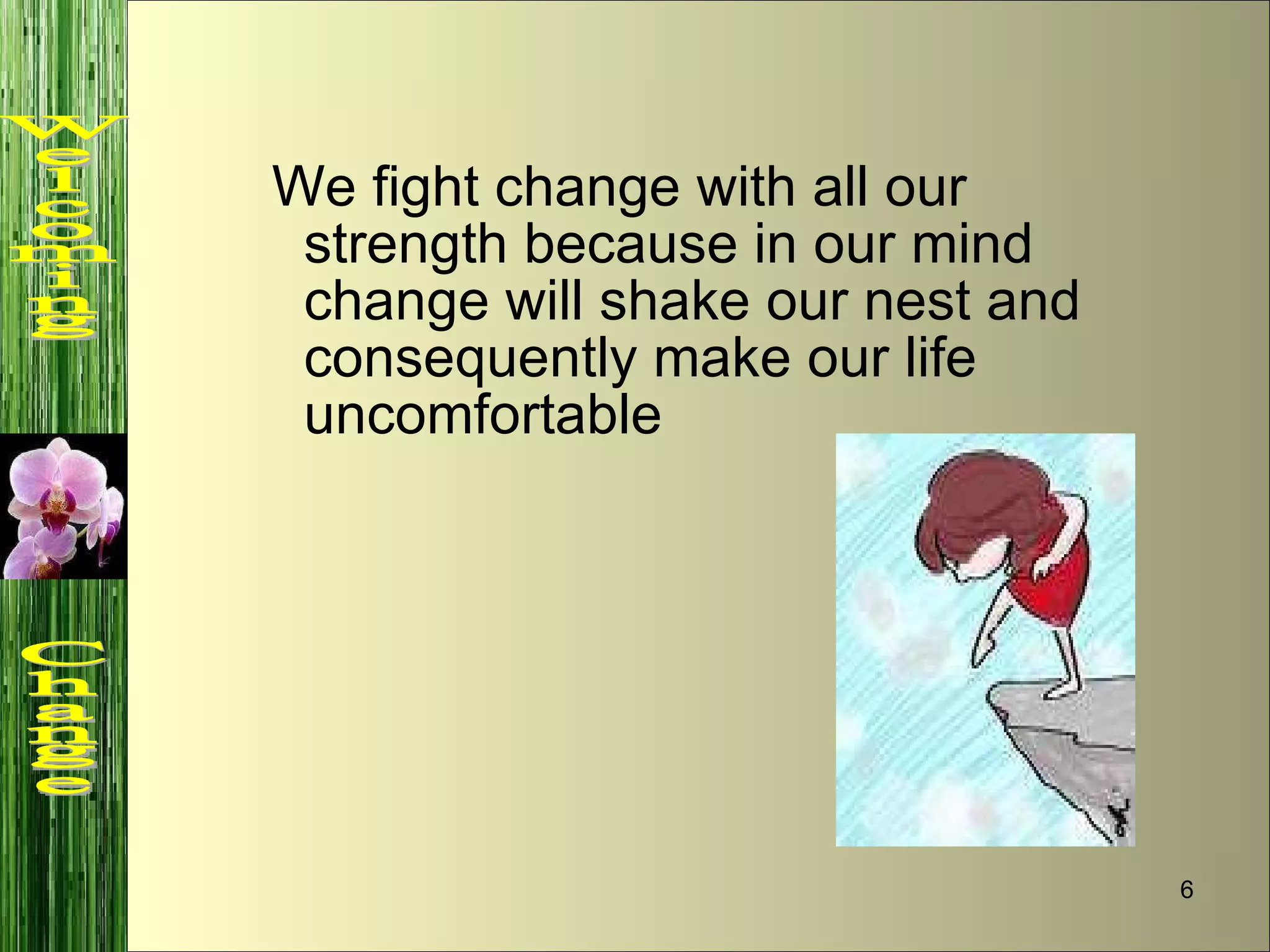
  We fight change with all our strength because in our mind change will shake our nest and consequently make our life uncomfortable Welcoming  Change
The  problem with keeping things the same is that we not only fight against change, we also fight against improvement.  In fact, there is no improvement without change.  In order for something to get better, some changes need to occur  Welcoming  Change
But should we welcome change?  The answer depends on what we mean by word WELCOME, if the answer is clearly YES, we are ready to leave our comfort zone. . . Welcoming Change Welcoming  Change
Welcoming  Change
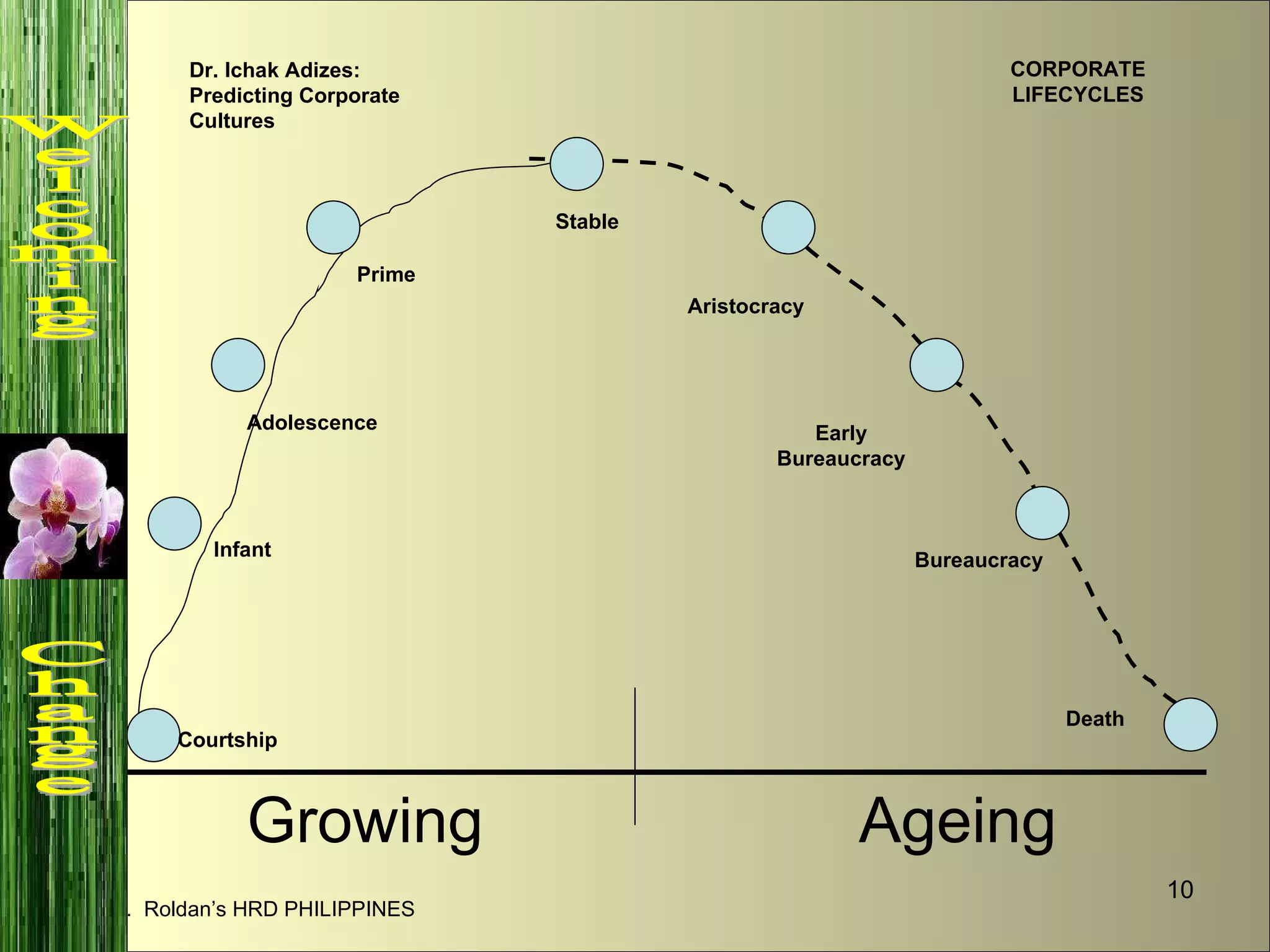
Growing Ageing CORPORATE LIFECYCLES Dr. Ichak Adizes:  Predicting Corporate Cultures Ref.  Roldan’s HRD PHILIPPINES Courtship Infant Adolescence Prime Stable Aristocracy Early Bureaucracy Bureaucracy Death Welcoming  Change
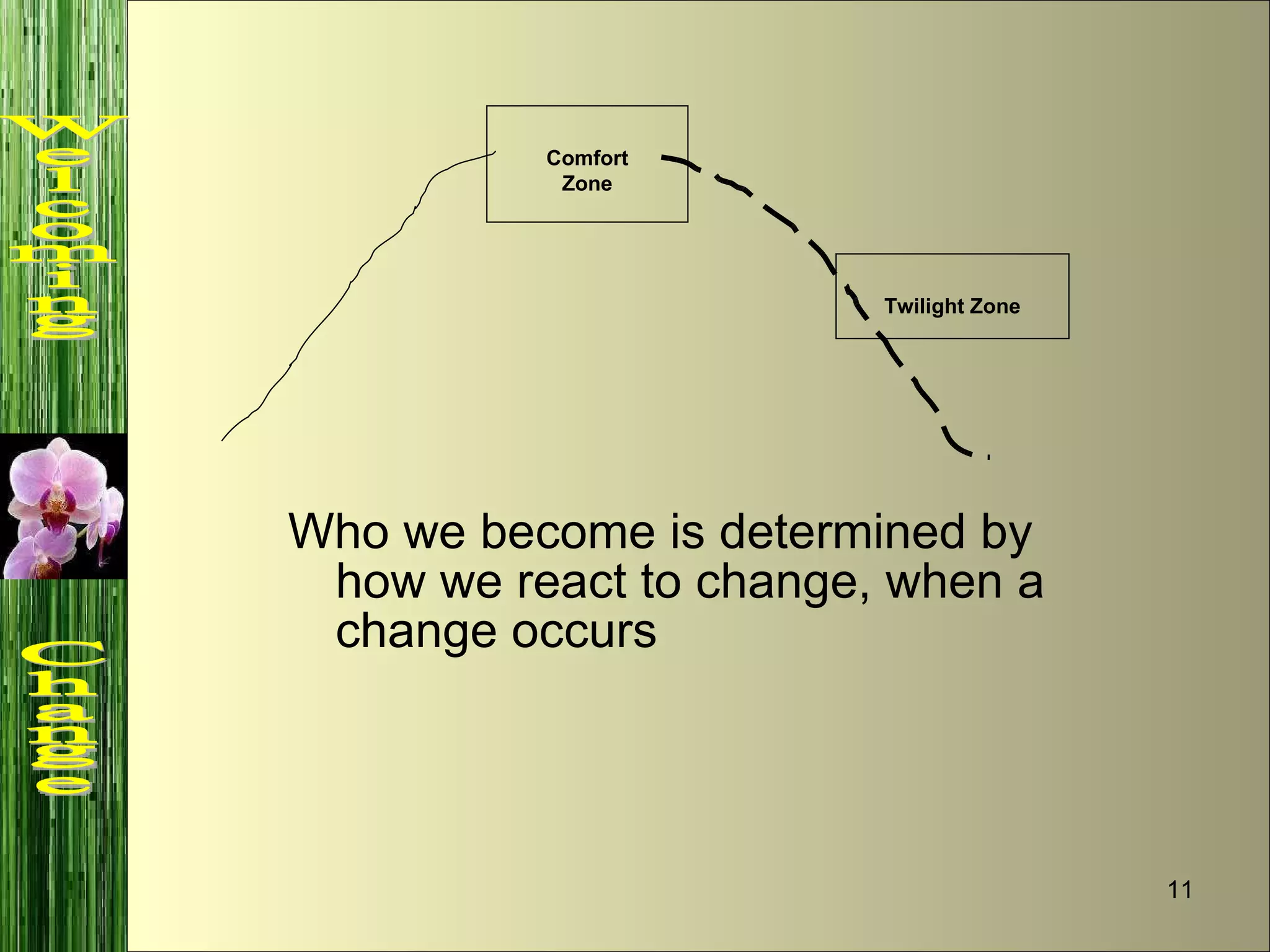
Who we become is determined by how we react to change, when a change occurs Comfort Zone Twilight Zone Welcoming  Change
There are several key aspects welcoming change: a.  Graciousness and openness to difference b.  A welcoming attitude towards change requires listening and making the strange familiar Welcoming  Change
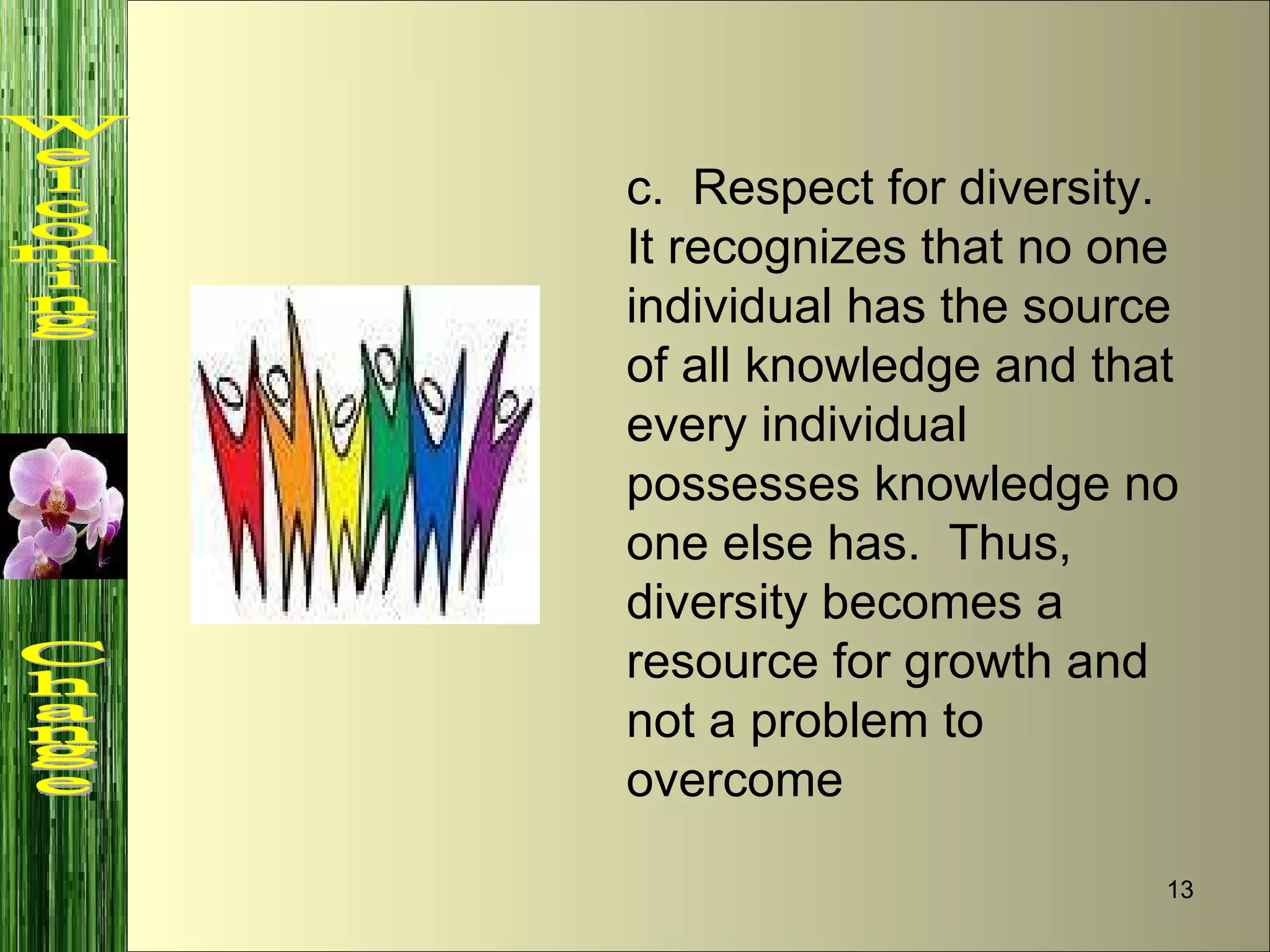
c.  Respect for diversity.  It recognizes that no one individual has the source of all knowledge and that every individual possesses knowledge no one else has.  Thus, diversity becomes a resource for growth and not a problem to overcome Welcoming  Change
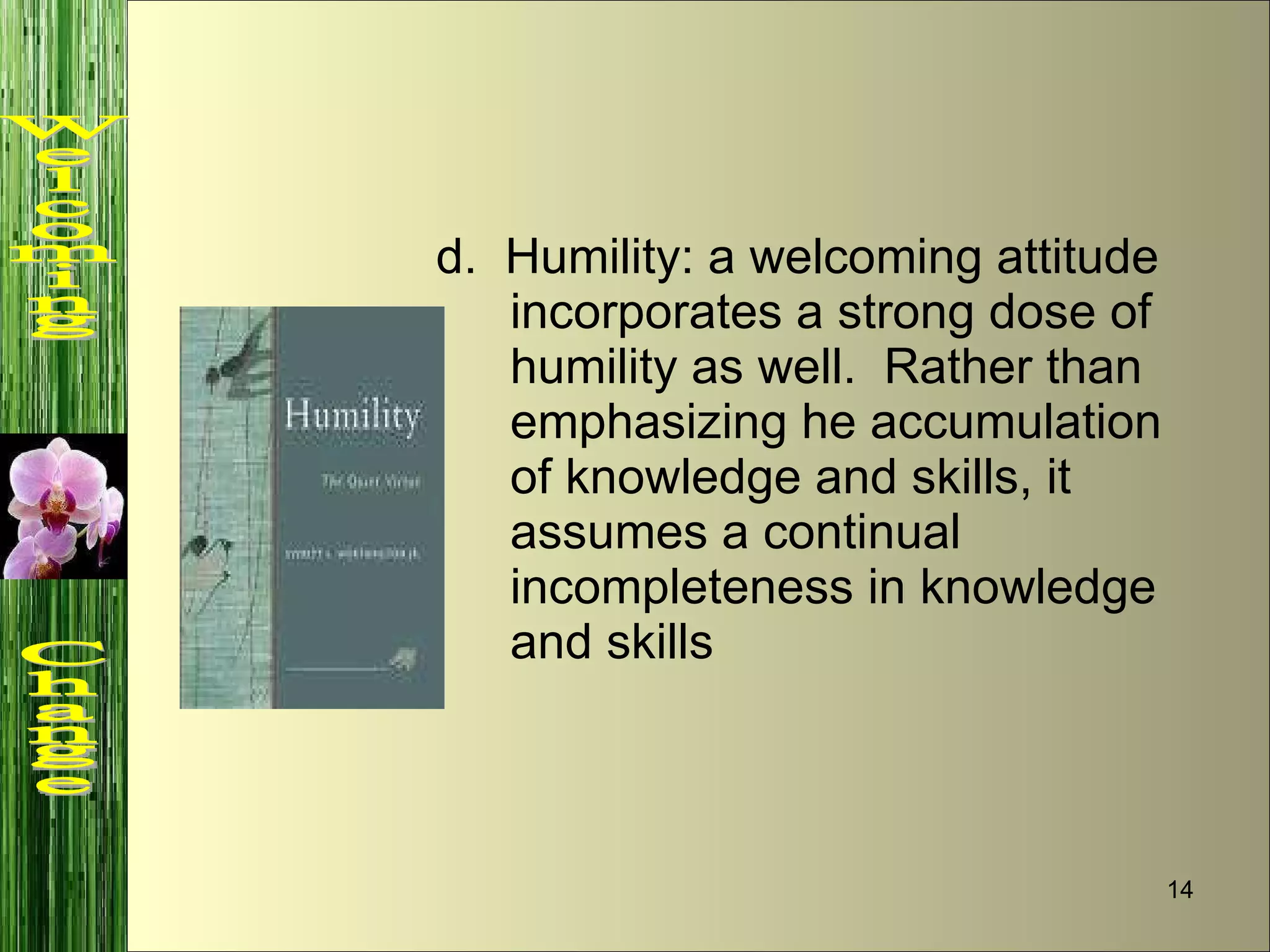
d.  Humility: a welcoming attitude incorporates a strong dose of humility as well.  Rather than emphasizing he accumulation of knowledge and skills, it assumes a continual incompleteness in knowledge and skills Welcoming  Change
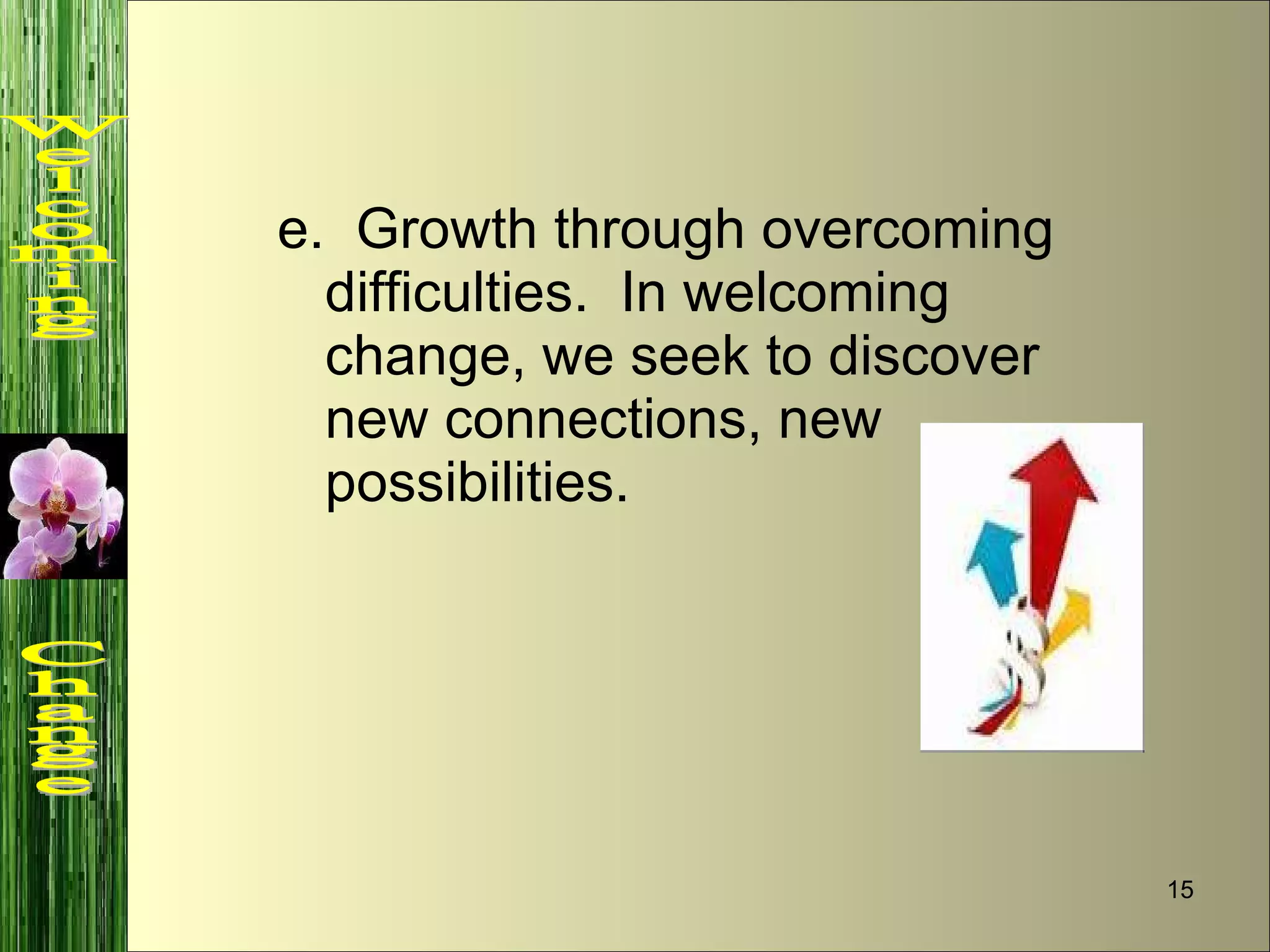
e.  Growth through overcoming difficulties.  In welcoming change, we seek to discover new connections, new possibilities.  Welcoming  Change
When experience are negative.  We move on.  Mistakes are our learning points.  If you make mistakes don’t pass the blame. Avoid blame casting. Successful entrepreneurs learn from their mistakes.  Welcoming  Change
Nelson Mandela of South Africa said: “The greatest glory of living lies in never failing but in rising every time you fall” Welcoming  Change
g. Welcome any suggestions or comments that could help your organization move up further.  Get ideas from everywhere Welcoming  Change
A Journey of a thousand miles begins with a single step Welcoming  Change
to change? to transform? to redirect our  mindset   & our perspective? to let go in order to hold on to something stronger ? Are we willing to take the journey ?   Welcoming  Change
Welcoming  Change
Mindset Fixed   Growth vs. Stagnate Vegetate or  obsolescence Inaction Do nothing Innovate Continuous improvement Decide   Do something Welcoming  Change
The irony is that the fixed mindset person ends up sabotaging himself because his fixed mindset world view also makes it difficult for him to take risks, or to develop his abilities, in other words, to grow. The fixed mindset person doesn't, after all, believe in growth. As a result fixed mindset people become quite frustrated. Fixed Mindset Welcoming  Change
Prof. Dweck definition of success for a person with a growth mindset -  is growth and improvement. Have I improved? Am I doing better today than yesterday? These are the questions a growth mindset uses to evaluate performance.  If I have improved then I am a success. If I have not improved then I need to change the way I'm studying, or practicing or preparing. Growth Mindset Welcoming  Change
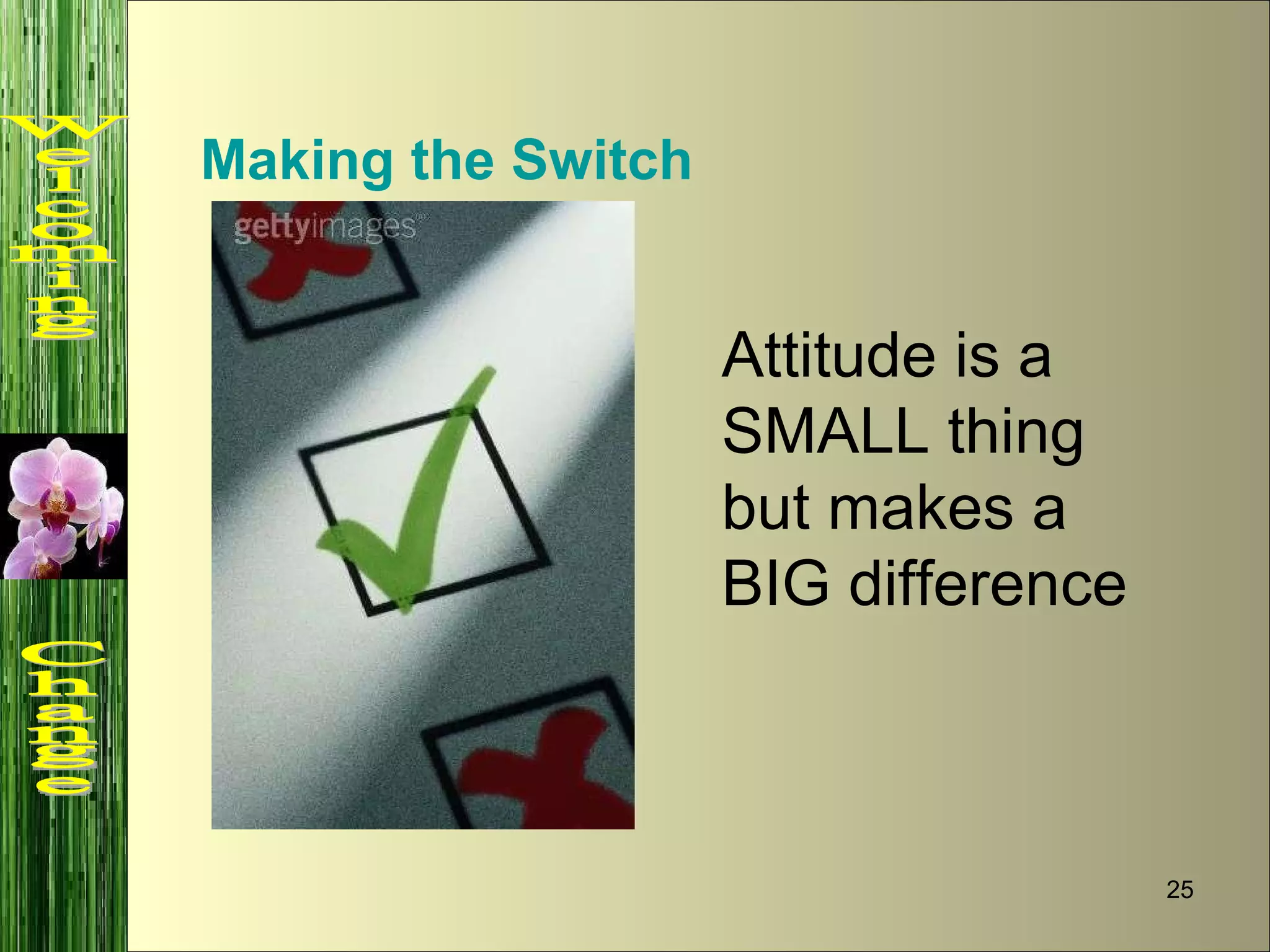
Making the Switch Attitude is a SMALL thing but makes a BIG difference Welcoming  Change
“ Change will not come in one fell swoop. It will be built on a daily basis with the sacrifices and unselfish acts of each one of us. Even simple acts of self discipline go a long way,”  Welcoming  Change
Getting people to change is a slow process particularly if some aspects of their life style need to be curtailed, but gradually they will come on board if the change process is managed properly. Welcoming  Change
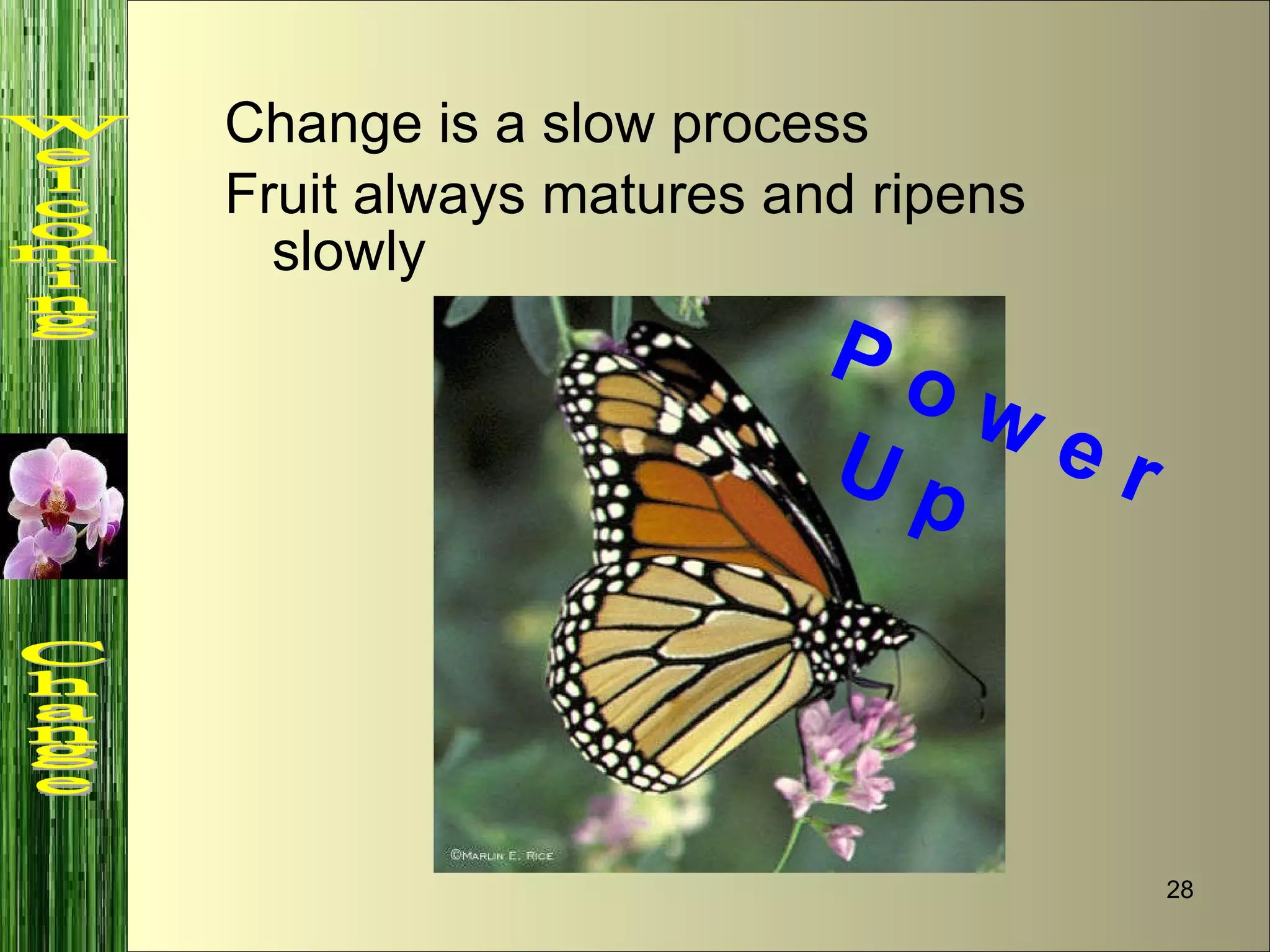
Change is a slow process Fruit always matures and ripens slowly P o w e r  U p Welcoming  Change
Change never ends.  Organizations that appreciate this reality fare better than those do not Welcoming  Change
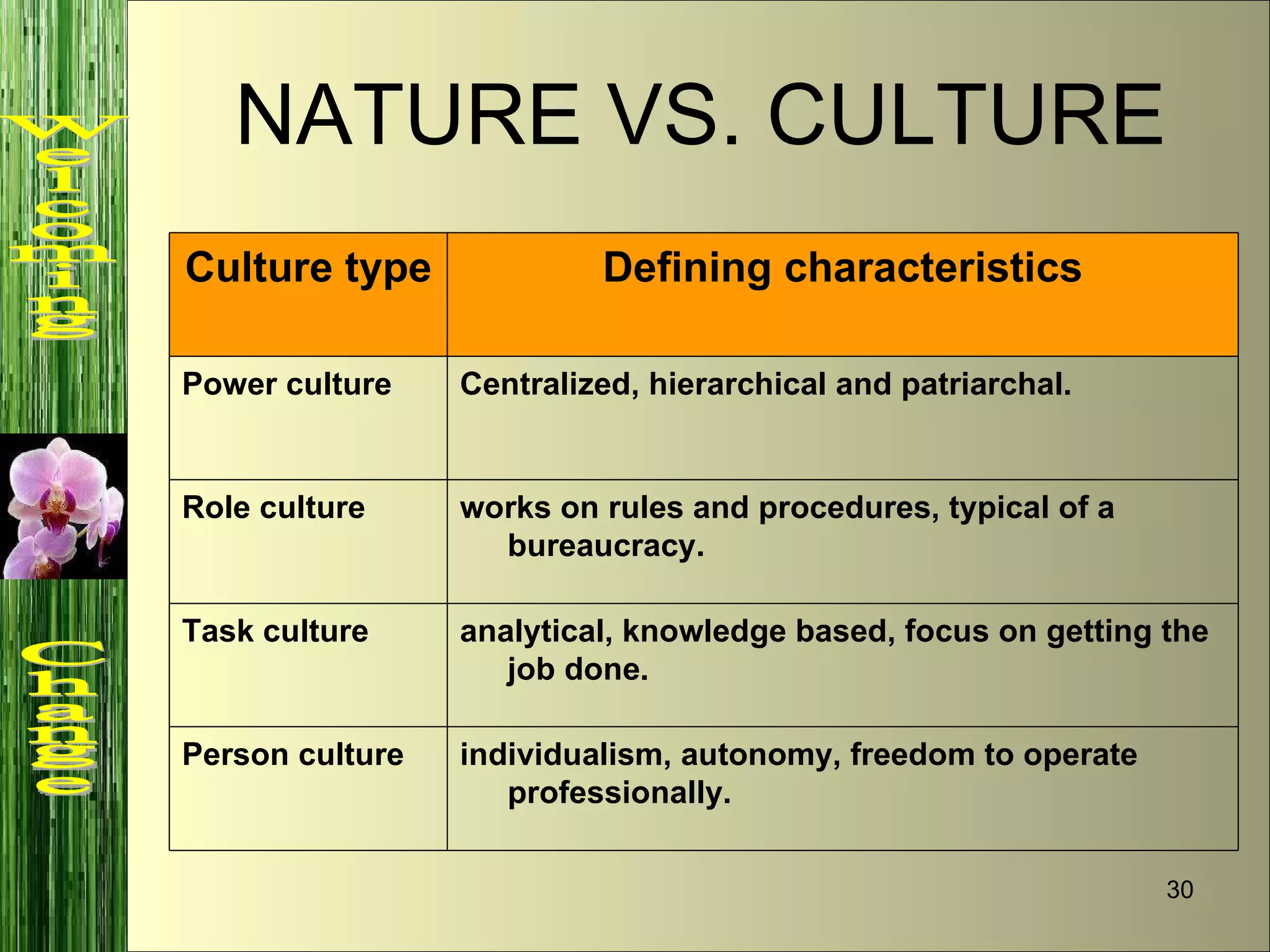
NATURE VS. CULTURE Welcoming  Change Culture type Defining characteristics Power culture Centralized, hierarchical and patriarchal. Role culture works on rules and procedures, typical of a bureaucracy. Task culture  analytical, knowledge based, focus on getting the job done. Person culture individualism, autonomy, freedom to operate professionally.
NATURE  VS.  NURTURE Welcoming  Change
Managers to develop an appropriate culture. New employees will not be aware of the culture and this may lead to people not 'fitting in' and not operating effectively.  Managers must be aware of the culture and attempt to modify it if it is not appropriate for the success of the organization Welcoming  Change
Induction training must make new employees aware of the culture. Culture is not a visible management system to be designed but it is something that evolves in an organization over a period of time and is influenced by the attitudes of its senior members.. Welcoming  Change
Stimulated Motivated Enhanced Nurtured Managed Sustained TEAM CHALLENGE Welcoming  Change
ADAPTATION HABITUATION CULTURALIZATION Welcoming  Change
When life has meaning, you can bear almost anything, without it nothing is bearable Welcoming  Change
“ it has been said that people  can be placed in three classes,  the  MANY  who watch things happen classes;  the  FEW  who makes things happen and  The  OVERWHELMING MAJORITY who have no idea what has happened.” NICHOLAS  MURRAY BUTLER Welcoming  Change
Thank You for your Attention  & Participation Welcoming  Change

9 welcoming change

  • 1.
    Welcoming, Coping &Committing to Change Welcoming Change
  • 2.
    On Change CHARLESF. KETTERING Said, Change “is a high hat word that scares a lot of people” Welcoming Change
  • 3.
    Near the endof the 15 th century BC, a Greek Philosopher Heraclitus pointed out , " You can not step twice into the same river” For Heraclitus, change was a fundamental constant in a way he conceived the world. Welcoming Change
  • 4.
    If we acceptthis account, it is not surprising that we see change as fundamental to our definition as human beings. We change along with the world around us. Welcoming Change
  • 5.
    It is commonand to a certain extent human beings resist change. Most people have a tendency for nesting. That is being contented . Arranging life around us to make it comfortable place we can. Then we try to dwell it in that comforting place   Comfort Zone Welcoming Change
  • 6.
      We fightchange with all our strength because in our mind change will shake our nest and consequently make our life uncomfortable Welcoming Change
  • 7.
    The problemwith keeping things the same is that we not only fight against change, we also fight against improvement. In fact, there is no improvement without change. In order for something to get better, some changes need to occur Welcoming Change
  • 8.
    But should wewelcome change? The answer depends on what we mean by word WELCOME, if the answer is clearly YES, we are ready to leave our comfort zone. . . Welcoming Change Welcoming Change
  • 9.
  • 10.
    Growing Ageing CORPORATELIFECYCLES Dr. Ichak Adizes: Predicting Corporate Cultures Ref. Roldan’s HRD PHILIPPINES Courtship Infant Adolescence Prime Stable Aristocracy Early Bureaucracy Bureaucracy Death Welcoming Change
  • 11.
    Who we becomeis determined by how we react to change, when a change occurs Comfort Zone Twilight Zone Welcoming Change
  • 12.
    There are severalkey aspects welcoming change: a. Graciousness and openness to difference b. A welcoming attitude towards change requires listening and making the strange familiar Welcoming Change
  • 13.
    c. Respectfor diversity. It recognizes that no one individual has the source of all knowledge and that every individual possesses knowledge no one else has. Thus, diversity becomes a resource for growth and not a problem to overcome Welcoming Change
  • 14.
    d. Humility:a welcoming attitude incorporates a strong dose of humility as well. Rather than emphasizing he accumulation of knowledge and skills, it assumes a continual incompleteness in knowledge and skills Welcoming Change
  • 15.
    e. Growththrough overcoming difficulties. In welcoming change, we seek to discover new connections, new possibilities. Welcoming Change
  • 16.
    When experience arenegative. We move on. Mistakes are our learning points. If you make mistakes don’t pass the blame. Avoid blame casting. Successful entrepreneurs learn from their mistakes. Welcoming Change
  • 17.
    Nelson Mandela ofSouth Africa said: “The greatest glory of living lies in never failing but in rising every time you fall” Welcoming Change
  • 18.
    g. Welcome anysuggestions or comments that could help your organization move up further. Get ideas from everywhere Welcoming Change
  • 19.
    A Journey ofa thousand miles begins with a single step Welcoming Change
  • 20.
    to change? totransform? to redirect our mindset & our perspective? to let go in order to hold on to something stronger ? Are we willing to take the journey ? Welcoming Change
  • 21.
  • 22.
    Mindset Fixed Growth vs. Stagnate Vegetate or obsolescence Inaction Do nothing Innovate Continuous improvement Decide Do something Welcoming Change
  • 23.
    The irony isthat the fixed mindset person ends up sabotaging himself because his fixed mindset world view also makes it difficult for him to take risks, or to develop his abilities, in other words, to grow. The fixed mindset person doesn't, after all, believe in growth. As a result fixed mindset people become quite frustrated. Fixed Mindset Welcoming Change
  • 24.
    Prof. Dweck definitionof success for a person with a growth mindset - is growth and improvement. Have I improved? Am I doing better today than yesterday? These are the questions a growth mindset uses to evaluate performance. If I have improved then I am a success. If I have not improved then I need to change the way I'm studying, or practicing or preparing. Growth Mindset Welcoming Change
  • 25.
    Making the Switch Attitudeis a SMALL thing but makes a BIG difference Welcoming Change
  • 26.
    “ Change willnot come in one fell swoop. It will be built on a daily basis with the sacrifices and unselfish acts of each one of us. Even simple acts of self discipline go a long way,” Welcoming Change
  • 27.
    Getting people tochange is a slow process particularly if some aspects of their life style need to be curtailed, but gradually they will come on board if the change process is managed properly. Welcoming Change
  • 28.
    Change is aslow process Fruit always matures and ripens slowly P o w e r U p Welcoming Change
  • 29.
    Change never ends. Organizations that appreciate this reality fare better than those do not Welcoming Change
  • 30.
    NATURE VS. CULTUREWelcoming Change Culture type Defining characteristics Power culture Centralized, hierarchical and patriarchal. Role culture works on rules and procedures, typical of a bureaucracy. Task culture analytical, knowledge based, focus on getting the job done. Person culture individualism, autonomy, freedom to operate professionally.
  • 31.
    NATURE VS. NURTURE Welcoming Change
  • 32.
    Managers to developan appropriate culture. New employees will not be aware of the culture and this may lead to people not 'fitting in' and not operating effectively. Managers must be aware of the culture and attempt to modify it if it is not appropriate for the success of the organization Welcoming Change
  • 33.
    Induction training mustmake new employees aware of the culture. Culture is not a visible management system to be designed but it is something that evolves in an organization over a period of time and is influenced by the attitudes of its senior members.. Welcoming Change
  • 34.
    Stimulated Motivated EnhancedNurtured Managed Sustained TEAM CHALLENGE Welcoming Change
  • 35.
  • 36.
    When life hasmeaning, you can bear almost anything, without it nothing is bearable Welcoming Change
  • 37.
    “ it hasbeen said that people can be placed in three classes, the MANY who watch things happen classes; the FEW who makes things happen and The OVERWHELMING MAJORITY who have no idea what has happened.” NICHOLAS MURRAY BUTLER Welcoming Change
  • 38.
    Thank You foryour Attention & Participation Welcoming Change