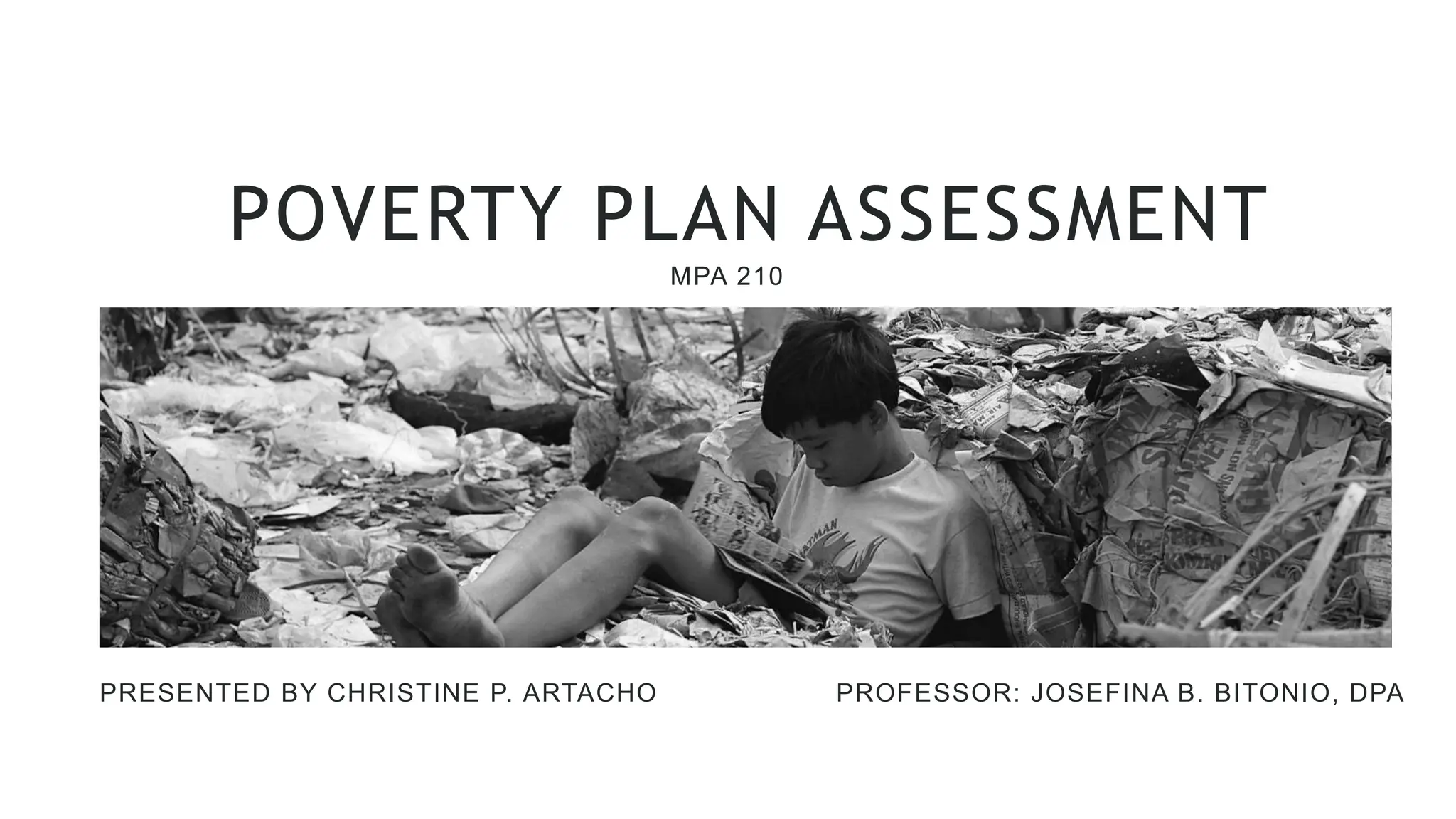
POVERTY PLAN ASSESSMENT
MPA 210
PRESENTED BY CHRISTINE P. ARTACHO PROFESSOR: JOSEFINA B. BITONIO, DPA
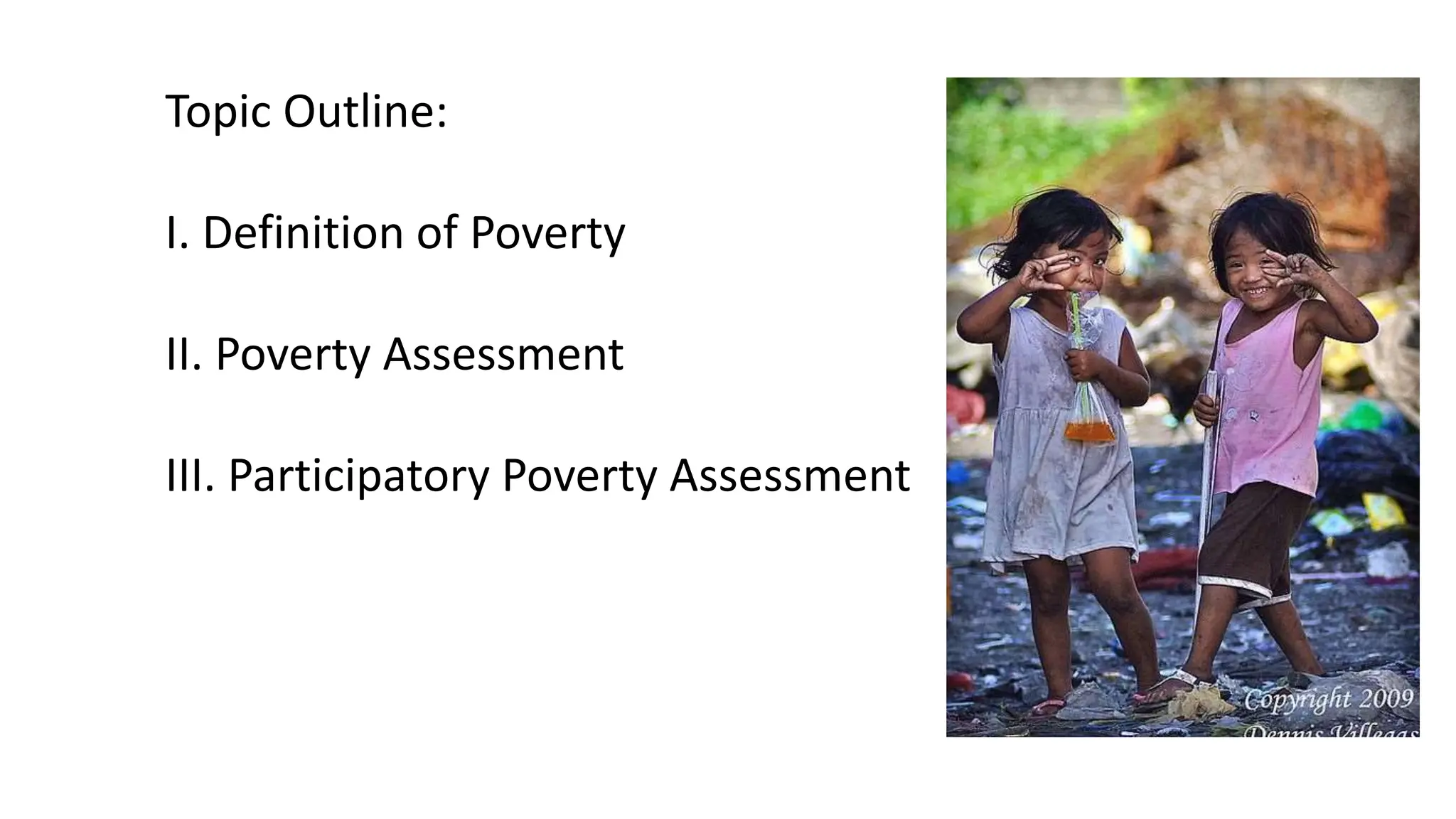
Topic Outline:
I. Definition of Poverty
II. Poverty Assessment
III. Participatory Poverty Assessment
Poverty is a state or condition in which one lacks the financial
resources and essentials for a certain standard of living.
Poverty can have diverse social, economic, and political causes
and effects.
United Nations: Poverty is a denial of choices and
opportunities, a violation of human dignity. It means lack of
basic capacity to participate effectively in society.
DEFINING POVERTY
European Union (EU): Poverty is measured in relation to
the distribution of income in each member country using
relative income poverty lines.
World Bank: Poverty is pronounced deprivation in well-
being, and comprises many dimensions. It includes low
incomes and the inability to acquire the basic goods and
services necessary for survival with dignity.
DEFINING POVERTY
TWO MAIN MEASURES OF EVALUATING
POVERTY IN STATISTICS OR ECONOMICS
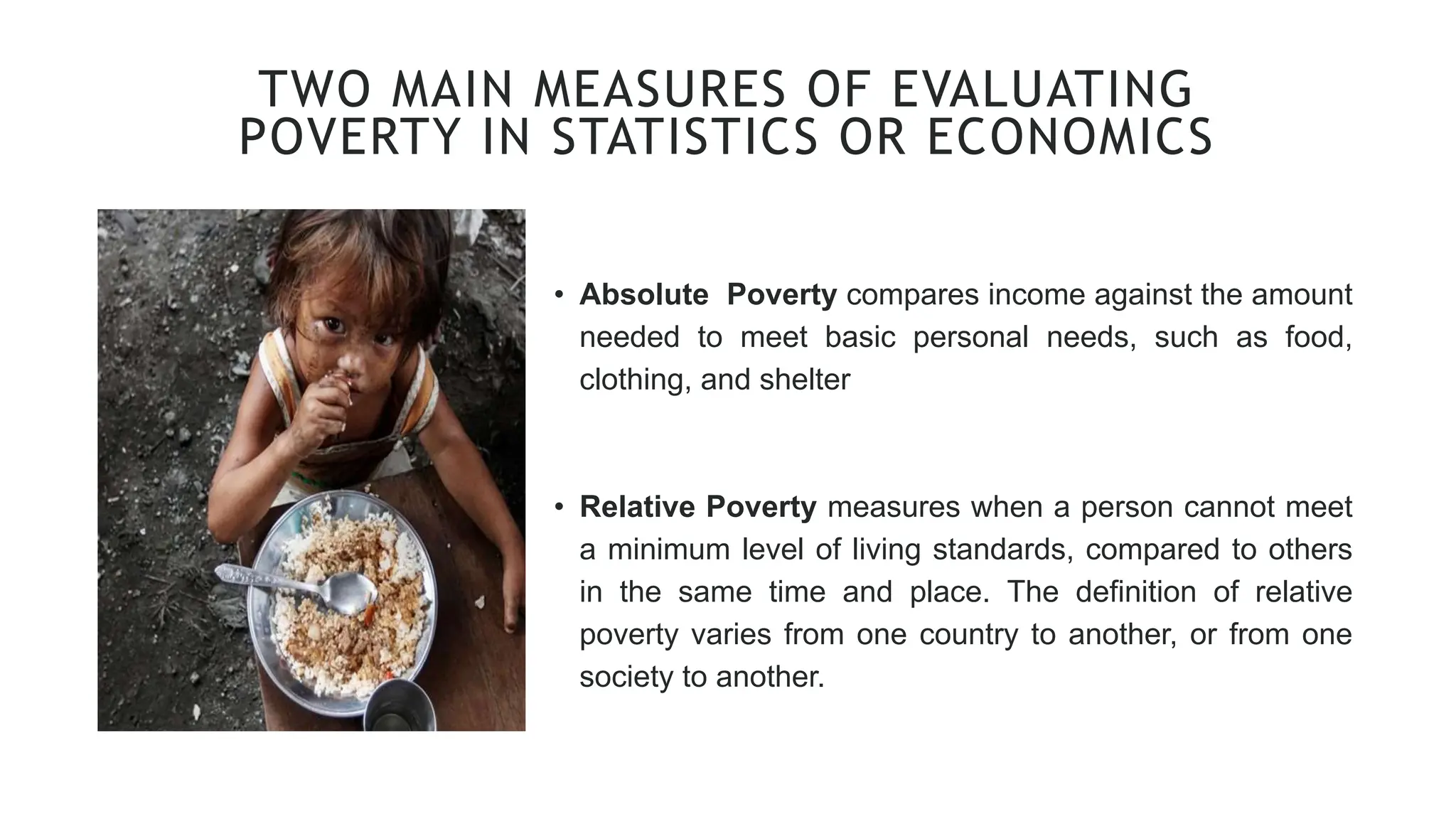
• Absolute Poverty compares income against the amount
needed to meet basic personal needs, such as food,
clothing, and shelter
• Relative Poverty measures when a person cannot meet
a minimum level of living standards, compared to others
in the same time and place. The definition of relative
poverty varies from one country to another, or from one
society to another.
POVERTY RATE
• Share of units in households in which total
household income (divided by the number of
household members) is below a given
poverty line.
• The unit that is considered when determining
poverty rates is the household itself or a
person in the household.
• Each household member is defined to have
the same poverty status (or estimated poverty
likelihood) as does the household as a whole.
• New definition of the national threshold starts with a
reference food basket that provides 100 percent of
the daily requirements for energy (2000 Calories)
and protein and that also fulfills 80 percent of the
requirements for vitamins and minerals (Virola,
2011a).
• This basket is then adjusted for each province to use
the cheapest locally-available items that meet the
nutritional requirements, that are consistent with
revealed preferences (Arndt and Simler, 2010), and
that fit local practices in that they can be (and
actually are) cooked and eaten (NCSB, 2011, p. 2).
POVERTY STATUS
WORLD BANK GROUP
• World Bank Group has made it a mission to end
extreme poverty globally by 2030.
• Together with the United Nations and Member
States, they have been tackling this mission, as
well as their mission of boosting shared
prosperity.
• The following steps are carried out to help
alleviate poverty: (1) Provide low-interest loans;
(2) Zero to low-interest credits; and (3) Grants to
developing countries.
World Bank Group
“Support a wide array of
investments in such areas as
education, health, public
administration, infrastructure,
financial and private sector
development, agriculture, and
environmental and natural
resource management.”
INDICATORS OF POVERTY
Employment
Number of household members
Household composition
the number of members
Education
School attendance
Housing
Type of outer walls
Ownership of durable assets
Sala sets or washing machines
• Poverty assessment is a quantitative and qualitative
analysis that gives a country’s officials and the Bank
a basis to work together to reduce poverty and to
establish an agenda for policies that are likely to
succeed.
• Programs cannot be designed appropriately unless
the Bank and the countries identify and agree on the
problems that create poverty and their potential
solutions.
POVERTY ASSESSMENT
• To this end, the Bank developed the poverty
assessment as a tool for understanding the
relationship between poverty and the policy
environment and for strengthening its
approach to poverty reduction.
POVERTY ASSESSMENT
PURPOSE OF
POVERTY ASSESSMENT
• It is designed to assess the extent and causes of poverty in a given country and to propose
a strategy to ameliorate its effects.
• Approach to analyzing and reducing poverty by incorporating the views of the poor.
• PPAs attempt to better understand the poor, to give the poor more influence over
decisions that affect their lives, and to increase effectiveness of poverty reduction
policies.
PARTICIPATORY POVERTY
ASSESSMENT
Before the 1990s
Household-survey
approaches were used
to measure poverty
1992
Participatory poverty
assessment was
coined within the
World Bank
1998
43 PPAs had been conducted:
28 in Africa, 6 in Latin
America, 5 in Eastern Europe,
and 4 in Asia
2012
World Bank's Voices
of the Poor is the
largest PPA ever to
have been conducted
• Typically, PPAs are done within several weeks or
month
• Whereas the following methods are carried out in
PPA:
PARTICIPATORY POVERTY
ASSESSMENT
• Field work and conducting interviews
• Rapid rural appraisal
• Participatory rural appraisal (includes use of
visuals, such as matrices and diagramming)
• SARAR (self-esteem, associative strength,
resourcefulness, action planning, and
responsibility)
• Beneficiary assessment
• Focus groups
• Field work and conducting interviews
METHODS IN PARTICIPATORY
POVERTY ASSESSMENT
Interviews are a qualitative research method used to
collect primary data by asking one or more people
about their opinions, experiences or perspectives on
a particular topic or subject matter. Three main types
of interviews are structured, unstructured, and semi-
structured.
• Rural rapid appraisal (RRA)
METHODS IN PARTICIPATORY
POVERTY ASSESSMENT
A social science approach that emerged in the early
1980s. A multidisciplinary team employs simple,
nonstandard methods and the knowledge of local
people to elicit, analyze, and evaluate information
and hypotheses on rural life and rural resources
relevant for planning action.
• Participatory rural appraisal (includes use of visuals,
such as matrices and diagramming)
METHODS IN PARTICIPATORY
POVERTY ASSESSMENT
The approach aims to incorporate the knowledge and
opinions of rural people in the planning and
management of development projects and
programmes.
• SARAR Approach
METHODS IN PARTICIPATORY
POVERTY ASSESSMENT
The acronym SARAR stands for the five attributes
and capacities that are considered the minimum
essentials for participation to be a dynamic and self-
sustaining process:
• Self-esteem: A sense of self-worth and a valuable
resource for development
• Associative strength: Capacity to define and work
toward a common vision
• Resourcefulness: Capacity to visualise new
solutions to problems even against the odds
• SARAR Approach
METHODS IN PARTICIPATORY
POVERTY ASSESSMENT
• Action planning: Combining critical thinking and
creativity to come up with new, effective, and
reality-based plans in which each participant has
a useful and fulfilling role
• Responsibility: For follow-through until the
commitments made are fully discharged and the
hoped-for benefits achieved
Developed during the 1970s and 1980s by Dr. Lyra
Srinivasan and colleagues for a variety of
development purposes.
• Beneficiary assessment
METHODS IN PARTICIPATORY
POVERTY ASSESSMENT
Focused on gaining insights into community
perspectives through interviews and group
discussions at community level, by working with
members of similar communities (peers) as primary
field researchers.
• Focus group
METHODS IN PARTICIPATORY
POVERTY ASSESSMENT
A research technique used to collect data through
group interaction. The group comprises a small
number of carefully selected people who discuss a
given topic. Focus groups are used to identify and
explore how people think and behave, and they
throw light on why, what and how questions.
ORGANIZATIONS USING
THE PPA APPROACH
World Bank
United Nations Asian Development Bank
Thailand Development Institute
• Participatory poverty assessments confirmed the multidimensional nature of poverty:
RELEVANCE OF PPA
• The poor deal not just with lack of money, but with various problems like lack
of resources, poor health, physical violence, or social isolation
• PPAs have also been able to access information that was not obtained in
household surveys by building trust
• These information include sensitive topics such as child prostitution, drug
use, and domestic violence that can be related to poverty
POVERTY
ALLEVIATION IN
THE MUNICIPALITY
OF BAYAMBANG
Introduction
One of the biggest problems facing the world today is poverty, which has a negative
impact on millions of people’s lives and restricts socioeconomic development in many places.
This conflict is not unique to the Municipality of Bayambang. Effective methods that address
the underlying causes of poverty and improve the lives of the municipality’s citizens are
essential as the municipality struggles with the difficulties of poverty.
VISION
• A globally competitive, poverty-free, and smart town with transparent and
participative governance, modern and sustainable agriculture, tourism and
infrastructure development, ecological balance, and a resilient and empowered
citizenry
MISSION
To maintain a
peaceful and orderly
town with modern
technology and
infrastructure
development;
01
To promote and
preserve its rich
historical and cultural
heritage;
02
To institute
transparency,
accountability and
integrity in
governance;
03
To empower its
citizens in the areas
of health, education,
economics, tourism,
environmental
protection and
disaster response.
04
GOALS
improve the quality of life of the
people through enhanced social
and infrastructure services and
facilities
increased production and
economic opportunities, stable,
accountable and effective political
organization
well-protected and managed
natural environment, disaster
resilient community
an equally active citizenry in the
prioritization, formulation,
implementation and monitoring of
development programs and
projects
Issues
• Out of the 22,483 assessed households, there are 5,881 poor households or 36,638 poor
individuals in the Municipality of Bayambang
• The Local Government Unit (LGU) of Bayambang was placed second in terms of the number of
poor households and tenth in terms of the proportion of poor households in the province of
Pangasinan in the second round of household assessments done in 2015.
• From 2015 to 2016, Bayambang was reported to have the highest number of malnourished
children in Region 1.
In 2018, Mayor Cezar Quiambao vowed to reduce poverty in town, with the introduction of
Bayambang Poverty Reduction Plan (BPRP).
BPRAT – Bayambang Poverty Reduction Action Team
- Coordinative body in the fight against poverty
- The BPRAT sprang forth from the Municipal Administrator’s Office after the issue of
poverty emerged at one seminar in 2017 as an issue in need of sharper focus and urgent
measures.
Population and Poverty Incidence
2018 2023
Population (Bayambang) 118,205 129,011
Poverty Incidence :
Philippines
Region I
Province
Bayambang
21%
11%
14%
26.16%
24%
20%
23.6%
35.06%
FIVE SECTORS OF THE
REVOLUTION
1. Good Governance
2. Socio-Cultural Development
and Social Protection
3. Agricultural Modernization
4. Economic and Infrastructure
Development
5. Environmental Protection and
Disaster Resiliency
FINDINGS
AND
ANALYSIS
The Quiambao administration developed the policies, programs, and initiatives in
order to reduce the poverty that already exists in the Municipality. However, several of
the programs encountered significant shortcomings and problems while putting into
action strategies to meet the requirements of low-income people and households in
the fundamental sectors. Many of these programs weren’t monitored properly.
The Social Welfare Sub-sector’s assessment suggests that implementers should
have a greater understanding of the many types and intensities of requirements, as
well as the risks and vulnerabilities that impoverished people and their families
confront. This implies that solutions for reducing poverty must be both broad-based
and specific. Assistive mechanisms to help the poor obtain an adequate income
through employment facilitation or enterprise development, as well as capacity
development strategies that support the poor in establishing sustainability and self-
reliance, are also necessary for effectively reducing poverty.
Because of the limited opportunities available to children who are born into poverty, it
can become a generational trap. Poverty reduction lays the groundwork for improved
connections between generations and upward mobility by using programs and
policies to break this cycle through targeted interventions. However, the Municipality’s
goal of ending poverty will not be achieved without community cooperation and active
government.
CONCLUSION
The Bayambang Poverty Reduction Plan (BPRP) has a huge impact on the lives of the
people in Bayambang. The programs created by Quiambao administration help reduce
the poverty, improve livelihood, improve the agricultural production through
modernization, and contribute to the development of infrastructure that will encourage
investors which helps to create employment that gives opportunities to people to have a
better life.
Also, the Kasama Kita sa Barangay Foundation program has helped many people
especially those who are less fortunate. Many have been given a livelihood and free
housing through this program. As part of this program , the Department of Social
Welfare and Development (DSWD) has already graduated about 1,149 families from
the 4Ps – a marked fulfillment of a goal revolution against poverty.
Poverty alleviation is vital for fostering equitable societies that prioritize the well-being
and opportunities of all individuals, regardless of their socio-economic backgrounds.
By addressing poverty, we can build societies that are fair, inclusive, and sustainable,
promoting a brighter future for everyone.
References:
• https://en.wikipedia.org/wiki/Participatory_poverty_assessment
• https://www.investopedia.com/terms/p/poverty.asp#:~:text=Poverty%20is%20a%20state%20or,he
althy%20food%2C%20and%20medical%20attention.
• https://www.worldbank.org/content/dam/Worldbank/document
• https://www.un.org
• https://www.eurounion.org
THANK YOU

MPA 210 : POVERTY PLAN ASSESSMENT.pptx

  • 1.
    POVERTY PLAN ASSESSMENT MPA210 PRESENTED BY CHRISTINE P. ARTACHO PROFESSOR: JOSEFINA B. BITONIO, DPA
  • 2.
    Topic Outline: I. Definitionof Poverty II. Poverty Assessment III. Participatory Poverty Assessment
  • 3.
    Poverty is astate or condition in which one lacks the financial resources and essentials for a certain standard of living. Poverty can have diverse social, economic, and political causes and effects. United Nations: Poverty is a denial of choices and opportunities, a violation of human dignity. It means lack of basic capacity to participate effectively in society. DEFINING POVERTY
  • 4.
    European Union (EU):Poverty is measured in relation to the distribution of income in each member country using relative income poverty lines. World Bank: Poverty is pronounced deprivation in well- being, and comprises many dimensions. It includes low incomes and the inability to acquire the basic goods and services necessary for survival with dignity. DEFINING POVERTY
  • 5.
    TWO MAIN MEASURESOF EVALUATING POVERTY IN STATISTICS OR ECONOMICS • Absolute Poverty compares income against the amount needed to meet basic personal needs, such as food, clothing, and shelter • Relative Poverty measures when a person cannot meet a minimum level of living standards, compared to others in the same time and place. The definition of relative poverty varies from one country to another, or from one society to another.
  • 6.
    POVERTY RATE • Shareof units in households in which total household income (divided by the number of household members) is below a given poverty line. • The unit that is considered when determining poverty rates is the household itself or a person in the household. • Each household member is defined to have the same poverty status (or estimated poverty likelihood) as does the household as a whole.
  • 7.
    • New definitionof the national threshold starts with a reference food basket that provides 100 percent of the daily requirements for energy (2000 Calories) and protein and that also fulfills 80 percent of the requirements for vitamins and minerals (Virola, 2011a). • This basket is then adjusted for each province to use the cheapest locally-available items that meet the nutritional requirements, that are consistent with revealed preferences (Arndt and Simler, 2010), and that fit local practices in that they can be (and actually are) cooked and eaten (NCSB, 2011, p. 2). POVERTY STATUS
  • 8.
    WORLD BANK GROUP •World Bank Group has made it a mission to end extreme poverty globally by 2030. • Together with the United Nations and Member States, they have been tackling this mission, as well as their mission of boosting shared prosperity. • The following steps are carried out to help alleviate poverty: (1) Provide low-interest loans; (2) Zero to low-interest credits; and (3) Grants to developing countries.
  • 9.
    World Bank Group “Supporta wide array of investments in such areas as education, health, public administration, infrastructure, financial and private sector development, agriculture, and environmental and natural resource management.”
  • 10.
    INDICATORS OF POVERTY Employment Numberof household members Household composition the number of members Education School attendance Housing Type of outer walls Ownership of durable assets Sala sets or washing machines
  • 11.
    • Poverty assessmentis a quantitative and qualitative analysis that gives a country’s officials and the Bank a basis to work together to reduce poverty and to establish an agenda for policies that are likely to succeed. • Programs cannot be designed appropriately unless the Bank and the countries identify and agree on the problems that create poverty and their potential solutions. POVERTY ASSESSMENT
  • 12.
    • To thisend, the Bank developed the poverty assessment as a tool for understanding the relationship between poverty and the policy environment and for strengthening its approach to poverty reduction. POVERTY ASSESSMENT
  • 13.
    PURPOSE OF POVERTY ASSESSMENT •It is designed to assess the extent and causes of poverty in a given country and to propose a strategy to ameliorate its effects.
  • 14.
    • Approach toanalyzing and reducing poverty by incorporating the views of the poor. • PPAs attempt to better understand the poor, to give the poor more influence over decisions that affect their lives, and to increase effectiveness of poverty reduction policies. PARTICIPATORY POVERTY ASSESSMENT Before the 1990s Household-survey approaches were used to measure poverty 1992 Participatory poverty assessment was coined within the World Bank 1998 43 PPAs had been conducted: 28 in Africa, 6 in Latin America, 5 in Eastern Europe, and 4 in Asia 2012 World Bank's Voices of the Poor is the largest PPA ever to have been conducted
  • 15.
    • Typically, PPAsare done within several weeks or month • Whereas the following methods are carried out in PPA: PARTICIPATORY POVERTY ASSESSMENT • Field work and conducting interviews • Rapid rural appraisal • Participatory rural appraisal (includes use of visuals, such as matrices and diagramming) • SARAR (self-esteem, associative strength, resourcefulness, action planning, and responsibility) • Beneficiary assessment • Focus groups
  • 16.
    • Field workand conducting interviews METHODS IN PARTICIPATORY POVERTY ASSESSMENT Interviews are a qualitative research method used to collect primary data by asking one or more people about their opinions, experiences or perspectives on a particular topic or subject matter. Three main types of interviews are structured, unstructured, and semi- structured.
  • 17.
    • Rural rapidappraisal (RRA) METHODS IN PARTICIPATORY POVERTY ASSESSMENT A social science approach that emerged in the early 1980s. A multidisciplinary team employs simple, nonstandard methods and the knowledge of local people to elicit, analyze, and evaluate information and hypotheses on rural life and rural resources relevant for planning action.
  • 18.
    • Participatory ruralappraisal (includes use of visuals, such as matrices and diagramming) METHODS IN PARTICIPATORY POVERTY ASSESSMENT The approach aims to incorporate the knowledge and opinions of rural people in the planning and management of development projects and programmes.
  • 19.
    • SARAR Approach METHODSIN PARTICIPATORY POVERTY ASSESSMENT The acronym SARAR stands for the five attributes and capacities that are considered the minimum essentials for participation to be a dynamic and self- sustaining process: • Self-esteem: A sense of self-worth and a valuable resource for development • Associative strength: Capacity to define and work toward a common vision • Resourcefulness: Capacity to visualise new solutions to problems even against the odds
  • 20.
    • SARAR Approach METHODSIN PARTICIPATORY POVERTY ASSESSMENT • Action planning: Combining critical thinking and creativity to come up with new, effective, and reality-based plans in which each participant has a useful and fulfilling role • Responsibility: For follow-through until the commitments made are fully discharged and the hoped-for benefits achieved Developed during the 1970s and 1980s by Dr. Lyra Srinivasan and colleagues for a variety of development purposes.
  • 21.
    • Beneficiary assessment METHODSIN PARTICIPATORY POVERTY ASSESSMENT Focused on gaining insights into community perspectives through interviews and group discussions at community level, by working with members of similar communities (peers) as primary field researchers.
  • 22.
    • Focus group METHODSIN PARTICIPATORY POVERTY ASSESSMENT A research technique used to collect data through group interaction. The group comprises a small number of carefully selected people who discuss a given topic. Focus groups are used to identify and explore how people think and behave, and they throw light on why, what and how questions.
  • 23.
    ORGANIZATIONS USING THE PPAAPPROACH World Bank United Nations Asian Development Bank Thailand Development Institute
  • 24.
    • Participatory povertyassessments confirmed the multidimensional nature of poverty: RELEVANCE OF PPA • The poor deal not just with lack of money, but with various problems like lack of resources, poor health, physical violence, or social isolation • PPAs have also been able to access information that was not obtained in household surveys by building trust • These information include sensitive topics such as child prostitution, drug use, and domestic violence that can be related to poverty
  • 25.
  • 26.
    Introduction One of thebiggest problems facing the world today is poverty, which has a negative impact on millions of people’s lives and restricts socioeconomic development in many places. This conflict is not unique to the Municipality of Bayambang. Effective methods that address the underlying causes of poverty and improve the lives of the municipality’s citizens are essential as the municipality struggles with the difficulties of poverty.
  • 27.
    VISION • A globallycompetitive, poverty-free, and smart town with transparent and participative governance, modern and sustainable agriculture, tourism and infrastructure development, ecological balance, and a resilient and empowered citizenry
  • 28.
    MISSION To maintain a peacefuland orderly town with modern technology and infrastructure development; 01 To promote and preserve its rich historical and cultural heritage; 02 To institute transparency, accountability and integrity in governance; 03 To empower its citizens in the areas of health, education, economics, tourism, environmental protection and disaster response. 04
  • 29.
    GOALS improve the qualityof life of the people through enhanced social and infrastructure services and facilities increased production and economic opportunities, stable, accountable and effective political organization well-protected and managed natural environment, disaster resilient community an equally active citizenry in the prioritization, formulation, implementation and monitoring of development programs and projects
  • 31.
    Issues • Out ofthe 22,483 assessed households, there are 5,881 poor households or 36,638 poor individuals in the Municipality of Bayambang • The Local Government Unit (LGU) of Bayambang was placed second in terms of the number of poor households and tenth in terms of the proportion of poor households in the province of Pangasinan in the second round of household assessments done in 2015. • From 2015 to 2016, Bayambang was reported to have the highest number of malnourished children in Region 1.
  • 32.
    In 2018, MayorCezar Quiambao vowed to reduce poverty in town, with the introduction of Bayambang Poverty Reduction Plan (BPRP).
  • 33.
    BPRAT – BayambangPoverty Reduction Action Team - Coordinative body in the fight against poverty - The BPRAT sprang forth from the Municipal Administrator’s Office after the issue of poverty emerged at one seminar in 2017 as an issue in need of sharper focus and urgent measures.
  • 34.
    Population and PovertyIncidence 2018 2023 Population (Bayambang) 118,205 129,011 Poverty Incidence : Philippines Region I Province Bayambang 21% 11% 14% 26.16% 24% 20% 23.6% 35.06%
  • 35.
    FIVE SECTORS OFTHE REVOLUTION 1. Good Governance 2. Socio-Cultural Development and Social Protection 3. Agricultural Modernization 4. Economic and Infrastructure Development 5. Environmental Protection and Disaster Resiliency
  • 36.
    FINDINGS AND ANALYSIS The Quiambao administrationdeveloped the policies, programs, and initiatives in order to reduce the poverty that already exists in the Municipality. However, several of the programs encountered significant shortcomings and problems while putting into action strategies to meet the requirements of low-income people and households in the fundamental sectors. Many of these programs weren’t monitored properly. The Social Welfare Sub-sector’s assessment suggests that implementers should have a greater understanding of the many types and intensities of requirements, as well as the risks and vulnerabilities that impoverished people and their families confront. This implies that solutions for reducing poverty must be both broad-based and specific. Assistive mechanisms to help the poor obtain an adequate income through employment facilitation or enterprise development, as well as capacity development strategies that support the poor in establishing sustainability and self- reliance, are also necessary for effectively reducing poverty. Because of the limited opportunities available to children who are born into poverty, it can become a generational trap. Poverty reduction lays the groundwork for improved connections between generations and upward mobility by using programs and policies to break this cycle through targeted interventions. However, the Municipality’s goal of ending poverty will not be achieved without community cooperation and active government.
  • 37.
    CONCLUSION The Bayambang PovertyReduction Plan (BPRP) has a huge impact on the lives of the people in Bayambang. The programs created by Quiambao administration help reduce the poverty, improve livelihood, improve the agricultural production through modernization, and contribute to the development of infrastructure that will encourage investors which helps to create employment that gives opportunities to people to have a better life. Also, the Kasama Kita sa Barangay Foundation program has helped many people especially those who are less fortunate. Many have been given a livelihood and free housing through this program. As part of this program , the Department of Social Welfare and Development (DSWD) has already graduated about 1,149 families from the 4Ps – a marked fulfillment of a goal revolution against poverty. Poverty alleviation is vital for fostering equitable societies that prioritize the well-being and opportunities of all individuals, regardless of their socio-economic backgrounds. By addressing poverty, we can build societies that are fair, inclusive, and sustainable, promoting a brighter future for everyone.
  • 38.
  • 39.