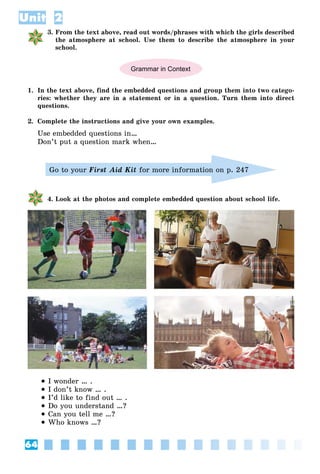
Л.В. Калініна, І.В. Самойлюкевич
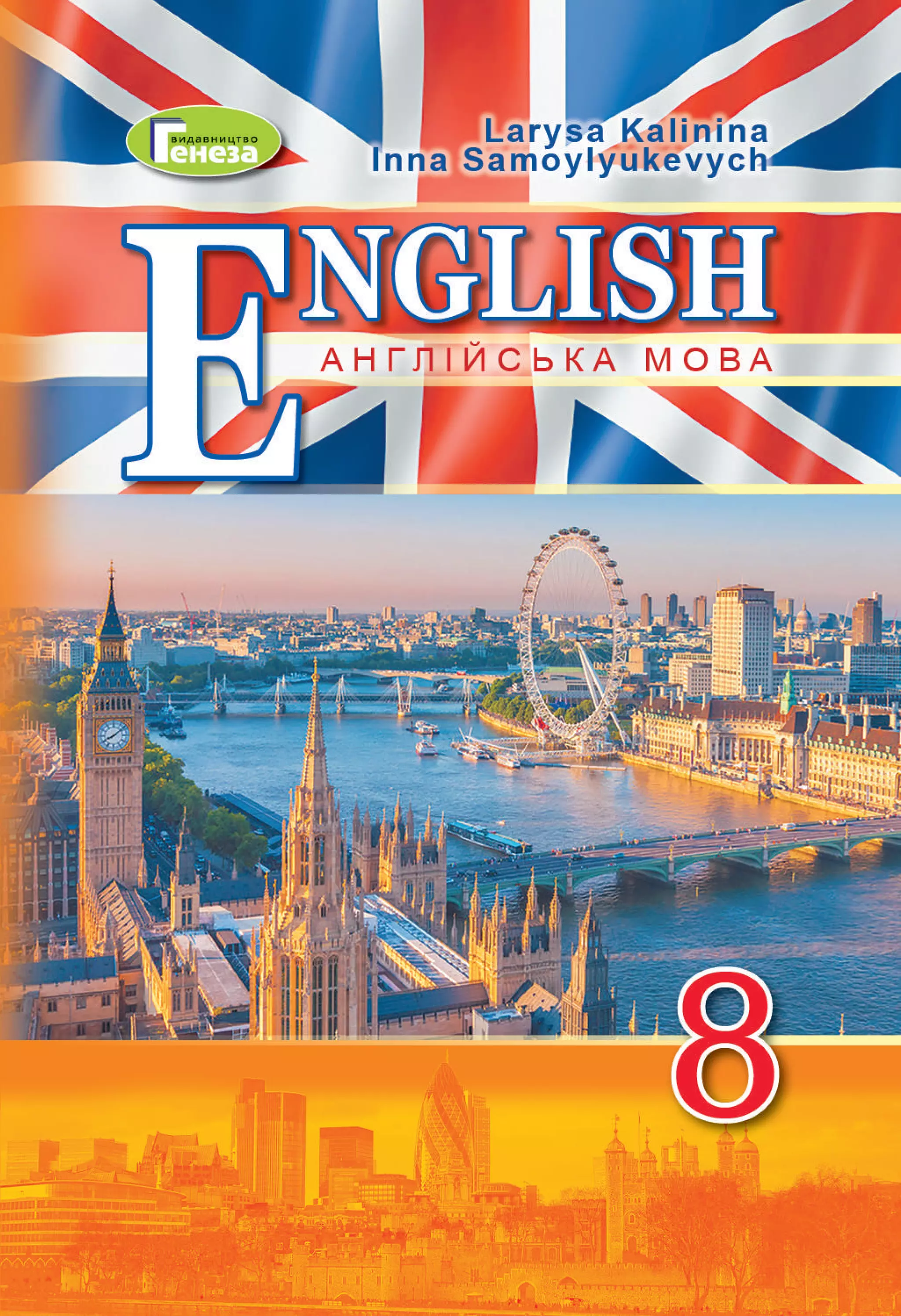
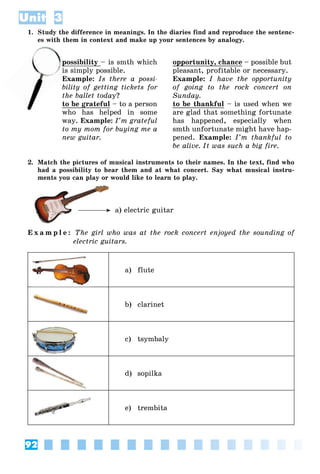
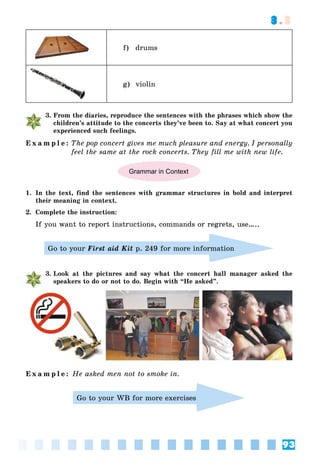
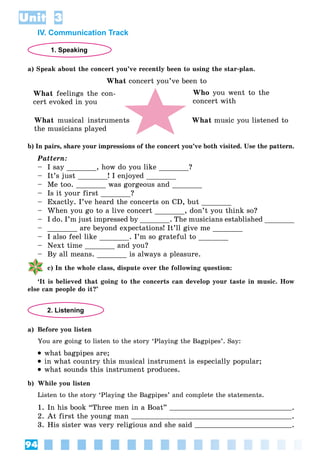
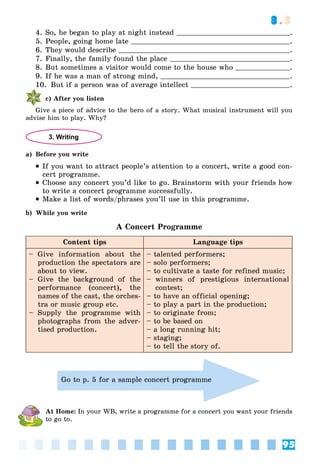
Larysa Kalinina, Inna Samoylyukevych
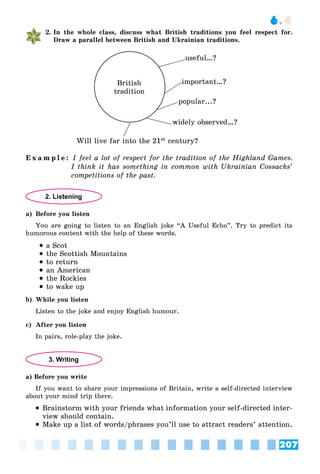
Київ
«ГЕНЕЗА»
2021
Англійська мова
Підручник для 8 класу
з поглибленим вивченням англійської мови
закладів загальної середньої освіти
English
A textbook for Grade 8 specializing in English
of general secondary education establishments
Ðåêîìåíäîâàíî Ìіíіñòåðñòâîì îñâіòè і íàóêè Óêðàїíè
3
Любий друже і люба подружко!
Ïåðåä âàìè ïіäðó÷íèê ç àíãëіéñüêîї ìîâè. Âіí ìіñòèòü ñіì ðîçäіëіâ –
Units. Êîæåí ç íèõ – öå âåëèêà òåìà, íàïðèêëàä “My Friends and Me” àáî
“Live and Learn”. Äëÿ òîãî ùîá ç êíèæêîþ áóëî çðó÷íіøå ïðàöþâàòè,
óðîêè ïîäіëåíî íà äåêіëüêà ÷àñòèí.
Êîæåí óðîê ïî÷èíàєòüñÿ ç áåñіäè – Now for it!, ÿêà äîïîìîæå âàì
àêòèâíî âêëþ÷èòèñÿ â ðîáîòó, «çàíóðèòèñÿ» â ñåðåäîâèùå àíãëіéñüêîї
ìîâè, âіäíîâèòè â ïàì’ÿòі ñâîї çíàííÿ.
Ó âàñ ç’ÿâëÿòüñÿ íîâі äðóçі. Öå ïåðñîíàæі Annie, Alice, Peter, Ted òà
іíøі, ç ÿêèìè âè áóäåòå ñïіëêóâàòèñÿ àíãëіéñüêîþ, âèâ÷àòè ãðàìàòèêó,
ïîïîâíþâàòè ñëîâíèêîâèé çàïàñ.
Ïіäëіòêè ðîçêàæóòü âàì ïðî æèòòÿ øêîëÿðіâ і øêîëÿðîê ó ñâîїõ
êðàїíàõ, íàâ÷àòü ñïіëêóâàòèñÿ ìîâîþ, ÿêà є äëÿ íèõ ðіäíîþ. Âè
îáãîâîðþâàòèìåòå óëþáëåíі êíèæêè òà æóðíàëè, öіêàâі òåëåïåðåäà÷і,
âіäîìèõ ìóçèêàíòіâ, ïîáóâàєòå â ïîïóëÿðíèõ êîíöåðòíèõ çàëàõ âàøèõ
êðàїí. Âè ïîêàæåòå ñâîїì çàêîðäîííèì äðóçÿì âàøó ðіäíó êðàїíó –
Óêðàїíó, îçíàéîìèòå їõ ç âèçíà÷íèìè ìіñöÿìè.
Ç óðèâêіâ òâîðіâ âіäîìèõ àíãëіéñüêèõ òà àìåðèêàíñüêèõ ïèñüìåííèêіâ
і ïèñüìåííèöü âè äіçíàєòåñÿ áіëüøå ïðî àíãëîìîâíі êðàїíè. Öå äîïîìîæå
âàì íå òіëüêè ïîãëèáèòè çíàííÿ ç àíãëіéñüêîї ìîâè, à é íàâ÷èòèñÿ
ñïіëêóâàòèñÿ ç îäíîëіòêàìè, ñòàòè öіêàâèì ñïіâðîçìîâíèêîì àáî ñïіâ-
ðîçìîâíèöåþ.
Good luck!
Õàé ùàñòèòü!
УМОВНІ ПОЗНАЧЕННЯ:
– Домашнє завдання
– Завдання підвищеної складності
4
CONTENTS
Introduction ............................................................................... 3
UNIT 1: My Friends and Me.......................................................... 5
UNIT 2: Live and Learn ............................................................... 37
UNIT 3: Music to My Ears............................................................ 73
UNIT 4: In the World of Mass Media ............................................ 107
UNIT 5: The More You Read......................................................... 147
UNIT 6: Britain Is Great .............................................................. 179
UNIT 7: Visiting Ukraine ............................................................. 213
First Aid Kit .............................................................................. 245
Vocabulary ................................................................................. 259
Keys to the Test Files................................................................... 271
Ìàòåðіàëè ðîçäіëіâ Writing Samples òà Audioscripts ìîæíà
ïåðåãëÿíóòè àáî çàâàíòàæèòè çà QR–êîäîì.
5
In this unit you will learn how:
Unit 1
My Friends and Me
• to talk about making friends;
• to describe your best friends;
• to speak about your pen-friends;
• to discuss your leisure time with friends;
• to check your knowledge and skills on the
topic getting ready for your independent testing.
6
Unit One: My Friends and Me
1.1. Making Friends
Word Bank Phrase Bank Communication Box
 pen-friend
 cute
 zits
 peers
 to hurt
 elective
 band
 trendy clothes
 make fun of somebody
 to be cool
 to do fun stuff
 to be true to oneself
 to be unpopular
 to be hard on somebody
 to come along
 to be a good mixer
 to think much of somebody
 to make friends with some-
body
 So far…
I. Now for it!
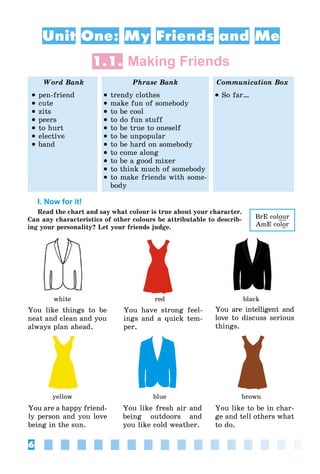
Read the chart and say what colour is true about your character.
Can any characteristics of other colours be attributable to describ-
ing your personality? Let your friends judge.
white
yellow
red
blue
black
brown
You like things to be
neat and clean and you
always plan ahead.
You have strong feel-
ings and a quick tem-
per.
You are intelligent and
love to discuss serious
things.
You are a happy friend-
ly person and you love
being in the sun.
You like fresh air and
being outdoors and
you like cold weather.
You like to be in char-
ge and tell others what
to do.
BrE colour
AmE color
7
1.1
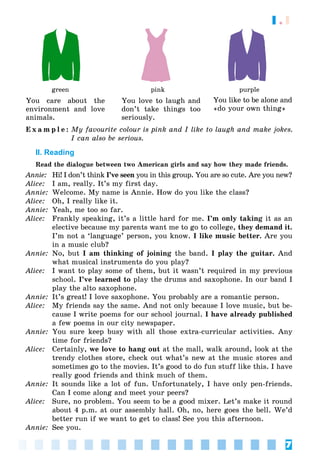
green pink purple
You care about the
environment and love
animals.
You love to laugh and
don’t take things too
seriously.
You like to be alone and
«do your own thing»
E x a m p l e : My favourite colour is pink and I like to laugh and make jokes.
I can also be serious.
II. Reading
Read the dialogue between two American girls and say how they made friends.
Annie: Hi! I don’t think I’ve seen you in this group. You are so cute. Are you new?
n
Alice: I am, really. It’s my first day.
Annie: Welcome. My name is Annie. How do you like the class?
Alice: Oh, I really like it.
Annie: Yeah, me too so far.
Alice: Frankly speaking, it’s a little hard for me. I’m only taking it as an
elective because my parents want me to go to college, they demand it.
I’m not a ‘language’ person, you know. I like music better. Are you
in a music club?
Annie: No, but I am thinking of joining the band. I play the guitar. And
what musical instruments do you play?
Alice: I want to play some of them, but it wasn’t required in my previous
school. I’ve learned to play the drums and saxophone. In our band I
play the alto saxophone.
Annie: It’s great! I love saxophone. You probably are a romantic person.
Alice: My friends say the same. And not only because I love music, but be-
cause I write poems for our school journal. I have already published
a few poems in our city newspaper.
Annie: You sure keep busy with all those extra-curricular activities. Any
time for friends?
Alice: Certainly, we love to hang out at the mall, walk around, look at the
trendy clothes store, check out what’s new at the music stores and
sometimes go to the movies. It’s good to do fun stuff like this. I have
really good friends and think much of them.
Annie: It sounds like a lot of fun. Unfortunately, I have only pen-friends.
Can I come along and meet your peers?
Alice: Sure, no problem. You seem to be a good mixer. Let’s make it round
about 4 p.m. at our assembly hall. Oh, no, here goes the bell. We’d
better run if we want to get to class! See you this afternoon.
Annie: See you.
8
Unit 1
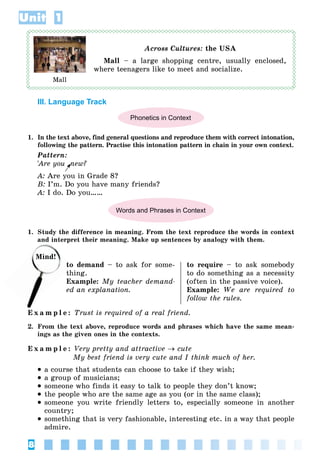
Across Cultures: the USA
Mall – a large shopping centre, usually enclosed,
where teenagers like to meet and socialize.
III. Language Track
Phonetics in Context
1. In the text above, find general questions and reproduce them with correct intonation,
following the pattern. Practise this intonation pattern in chain in your own context.
Pattern:
'Are you
' new?
A: Are you in Grade 8?
B: I’m. Do you have many friends?
A: I do. Do you……
Words and Phrases in Context
1. Study the difference in meaning. From the text reproduce the words in context
and interpret their meaning. Make up sentences by analogy with them.
to demand – to ask for some-
thing.
Example: My teacher demand-
ed an explanation.
to require – to ask somebody
to do something as a necessity
(often in the passive voice).
Example: We are required to
follow the rules.
E x a m p l e : Trust is required of a real friend.
2. From the text above, reproduce words and phrases which have the same mean-
ings as the given ones in the contexts.
E x a m p l e : Very pretty and attractive  cute
My best friend is very cute and I think much of her.
 a course that students can choose to take if they wish;
 a group of musicians;
 someone who finds it easy to talk to people they don’t know;
 the people who are the same age as you (or in the same class);
 someone you write friendly letters to, especially someone in another
country;
 something that is very fashionable, interesting etc. in a way that people
admire.
Mall
nd
Mind!
to
t
9
1.1
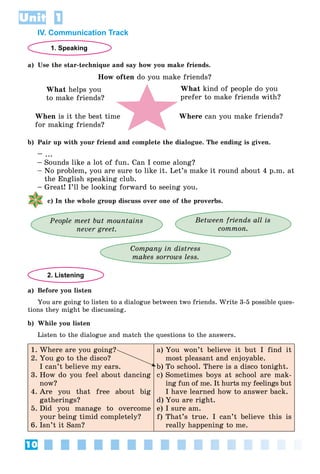
3. Read what Alice told Annie. Now she became cool and made friends with
her classmates. From the box choose words and phrases suitable for the
proper context and comment on their meaning.
to be unpopular making fun of me took sport
zits made friends trendy clothes cool
peers true to yourself
In the eighth grade I was unpopular. I was short and had some ________
on my face. I watched my classmates even ______________.
But at the end of the eighth year I _____________ and became more ath-
letic and _____________ with some of the popular girls in my field hockey
team. It was my passport to popularity. My best friend now is the one who
gave me a hard time and made me feel stupid.
I think to be popular with your __________, you have to be perfect __to
wear ______, to have perfect hair and face and to look just like them. It’s
really ________ to stay with the group, but at the same time to be _________.
My new friends respect me when I stick to my principles.
Grammar in Context
1. From the text, reproduce the grammar constructions in bold and interpret their
meanings.
2. Complete the instructions and make up your own sentences with them.
 If you want to describe your friend and your everyday activities use
__________________________________________________________.
 If you want to talk about the process which takes place at the moment
use _______________________________________________________.
 If you want to speak about things that have happened before now, use
__________________________________________________________.
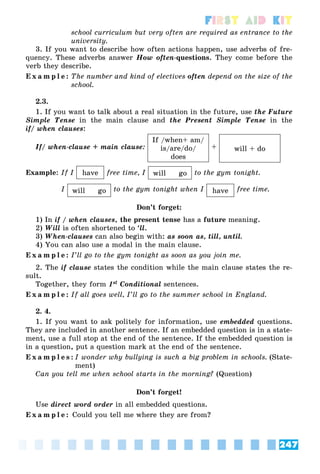
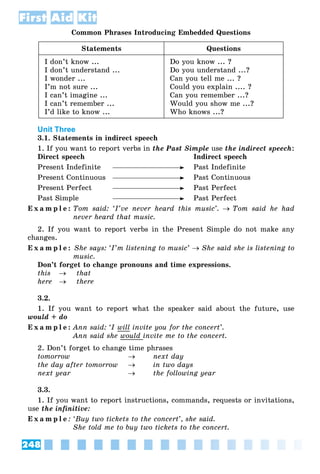
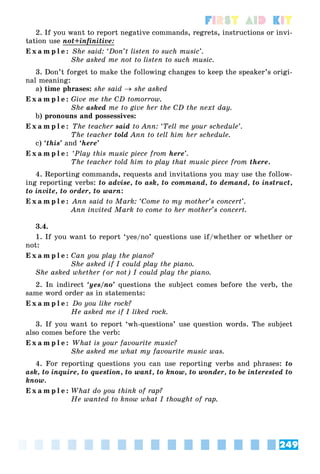
Go to your First Aid Kit on p. 245 for more information
3. Using the text you’ve read say:
 What Annie and Alice do regularly;
 What questions they are discussing at the moment;
 What the girls have managed to do before now.
Go to your WB for more exercises
10
Unit 1
IV. Communication Track
1. Speaking
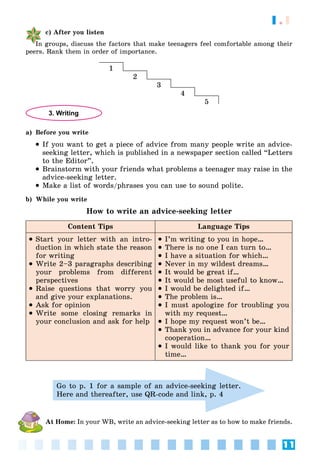
a) Use the star-technique and say how you make friends.
How often do you make friends?
What helps you
to make friends?
What kind of people do you
prefer to make friends with?
Where can you make friends?
When is it the best time
for making friends?
b) Pair up with your friend and complete the dialogue. The ending is given.
– ...
 Sounds like a lot of fun. Can I come along?
 No problem, you are sure to like it. Let’s make it round about 4 p.m. at
the English speaking club.
 Great! I’ll be looking forward to seeing you.
c) In the whole group discuss over one of the proverbs.
People meet but mountains
never greet.
Between friends all is
common.
Company in distress
makes sorrows less.
2. Listening
a) Before you listen
You are going to listen to a dialogue between two friends. Write 3-5 possible ques-
tions they might be discussing.
b) While you listen
Listen to the dialogue and match the questions to the answers.
1. Where are you going?
2. You go to the disco?
I can’t believe my ears.
3. How do you feel about dancing
now?
4. Are you that free about big
gatherings?
5. Did you manage to overcome
your being timid completely?
6. Isn’t it Sam?
a) You won’t believe it but I find it
most pleasant and enjoyable.
b) To school. There is a disco tonight.
c) Sometimes boys at school are mak-
ing fun of me. It hurts my feelings but
I have learned how to answer back.
d) You are right.
e) I sure am.
f) That’s true. I can’t believe this is
really happening to me.
11
1.1
ñ) After you listen
In groups, discuss the factors that make teenagers feel comfortable among their
peers. Rank them in order of importance.
1
2
3
4
5
3. Writing
a) Before you write
 If you want to get a piece of advice from many people write an advice-
seeking letter, which is published in a newspaper section called “Letters
to the Editor”.
 Brainstorm with your friends what problems a teenager may raise in the
advice-seeking letter.
 Make a list of words/phrases you can use to sound polite.
b) While you write
How to write an advice-seeking letter
Content Tips Language Tips
 Start your letter with an intro-
duction in which state the reason
for writing
 Write 2–3 paragraphs describing
your problems from different
perspectives
 Raise questions that worry you
and give your explanations.
 Ask for opinion
 Write some closing remarks in
your conclusion and ask for help
 I’m writing to you in hope…
 There is no one I can turn to…
 I have a situation for which…
 Never in my wildest dreams…
 It would be great if…
 It would be most useful to know…
 I would be delighted if…
 The problem is…
 I must apologize for troubling you
with my request…
 I hope my request won’t be…
 Thank you in advance for your kind
cooperation…
 I would like to thank you for your
time…
Go to ð. 1 for a sample of an advice-seeking letter.
Here and thereafter, use QR-code and link, p. 4
At Home: In your WB, write an advice-seeking letter as to how to make friends.
12
Unit 1
1.2. A Friend in Need...
Word Bank Phrase Bank
Communication
Box
 to bully
 to betray
 jealous
 supportive
 sincere
 to date
 to reassure
 confident
 reliable
 to pour one’s heart out
 to see life through someone’s eyes
 to feel inferior to somebody/some-
thing
 to be a shoulder to cry on
 to turn a deaf ear to somebody
 to do one’s best to do something
 to envy somebody something
 to cope with
 to experience one’s own power
 Vice versa, …
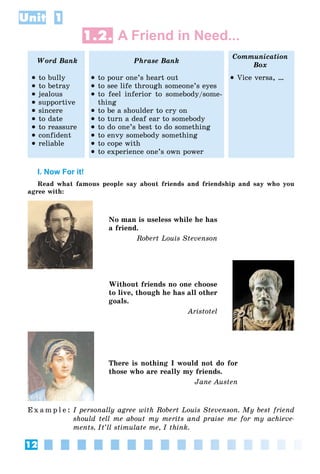
I. Now For it!
Read what famous people say about friends and friendship and say who you
agree with:
No man is useless while he has
a friend.
Robert Louis Stevenson
Without friends no one choose
to live, though he has all other
goals.
Aristotel
There is nothing I would not do for
those who are really my friends.
Jane Austen
E x a m p l e : I personally agree with Robert Louis Stevenson. My best friend
should tell me about my merits and praise me for my achieve-
ments. It’ll stimulate me, I think.
13
1.2
II. Reading
Read what different children say about their friends and say what qualities men-
tioned by them your devoted friend has.
PART I
My name is David and I’m happy to have many
friends. I believe that life is meaningless without them,
because sometimes you need a friend to pour your heart
out. Of course, you feel safe and protected in the family,
but very often I’d like to have a piece of advice from
someone who sees life through my eyes and this is my
best friend Andrew. He supports me in all situations, no
matter if I’m sometimes wrong. But then later he’ll tell
me to my face whether I was impolite or unfair. He has
never been insincere. I appreciate that.
My friend’s name is Dan. I like to socialize with him
because he is unpredictable. Every date is different with
him and unforgettable. Last time he taught me how to
write a limerick. It’s a kind of a little illogical and
strange at first poem which has only five rhyming lines.
I thought my efforts would be useless, but Dan praised
me. He can find the words to encourage me and I never
feel inferior to him. I suppose due to this quality Dan
has many devoted friends and finds them easily. It’s im-
possible not to love him, he is so cute!
PART II
My best friend Ann calls me ‘a shoulder to cry on’.
She always tells me secrets and I never turn a deaf ear
to her. My pieces of advice are never discouraging or
disrespectful. And vice versa. I do my best to help her
out.
Very often friends are everything to me. It’s cool
always doing fun stuff like dancing at parties, hanging
at the computer club or just talking. They say I’m a
good mixer because I have many friends. Very often I
bake a cake and invite them to my place to talk about
life, listen to music or watch a new film. Sometimes we
argue, but they never bully me.
Life is cool with them.
They say it’s neat to have friends. Unfortunately, I’m
unpopular with my classmates because I don’t have
trendy clothes and don’t hang at parties or concerts. I
think friends can betray you or make fun of you.
Some of my classmates envy my success. I study
well and it makes them feel jealous because they
are often irresponsible and that’s why they are unreli-
able. My parents try to reassure me and say that there
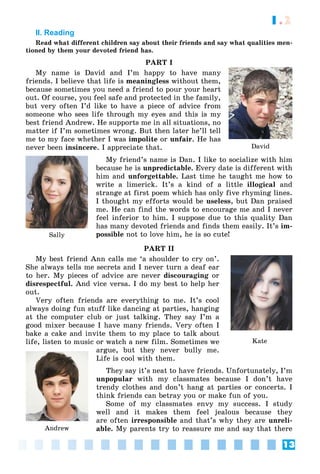
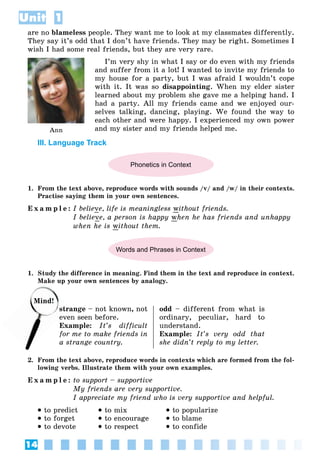
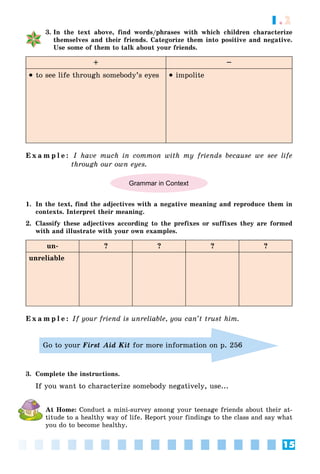
David
Sally
Kate
Andrew
14
Unit 1
are no blameless people. They want me to look at my classmates differently.
They say it’s odd that I don’t have friends. They may be right. Sometimes I
wish I had some real friends, but they are very rare.
I’m very shy in what I say or do even with my friends
and suffer from it a lot! I wanted to invite my friends to
my house for a party, but I was afraid I wouldn’t cope
with it. It was so disappointing. When my elder sister
learned about my problem she gave me a helping hand. I
had a party. All my friends came and we enjoyed our-
selves talking, dancing, playing. We found the way to
each other and were happy. I experienced my own power
and my sister and my friends helped me.
III. Language Track
Phonetics in Context
1. From the text above, reproduce words with sounds /v/ and /w/ in their contexts.
Practise saying them in your own sentences.
E x a m p l e : I believe, life is meaningless without friends.
I believe, a person is happy when he has friends and unhappy
when he is without them.
Words and Phrases in Context
1. Study the difference in meaning. Find them in the text and reproduce in context.
Make up your own sentences by analogy.
trange – not known, not
even seen before.
Example: It’s difficult
for me to make friends in
a strange country.
odd – different from what is
ordinary, peculiar, hard to
understand.
Example: It’s very odd that
she didn’t reply to my letter.
2. From the text above, reproduce words in contexts which are formed from the fol-
lowing verbs. Illustrate them with your own examples.
E x a m p l e : to support – supportive
My friends are very supportive.
I appreciate my friend who is very supportive and helpful.
 to predict
 to forget
 to devote
 to mix
 to encourage
 to respect
 to popularize
 to blame
 to confide
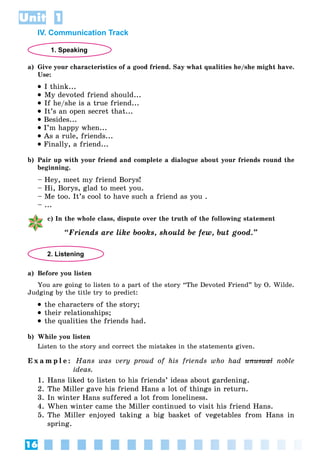
Ann
Ma
Mind!
stra
e
15
1.2
3. In the text above, find words/phrases with which children characterize
themselves and their friends. Categorize them into positive and negative.
Use some of them to talk about your friends.
+ –
 to see life through somebody’s eyes  impolite
E x a m p l e : I have much in common with my friends because we see life
through our own eyes.
Grammar in Context
1. In the text, find the adjectives with a negative meaning and reproduce them in
contexts. Interpret their meaning.
2. Classify these adjectives according to the prefixes or suffixes they are formed
with and illustrate with your own examples.
un- ? ? ? ?
unreliable
E x a m p l e : If your friend is unreliable, you can’t trust him.
Go to your First Aid Kit for more information on p. 256
3. Complete the instructions.
If you want to characterize somebody negatively, use...
At Home: Conduct a mini-survey among your teenage friends about their at-
titude to a healthy way of life. Report your findings to the class and say what
you do to become healthy.
16
Unit 1
IV. Communication Track
1. Speaking
a) Give your characteristics of a good friend. Say what qualities he/she might have.
Use:
 I think...
 My devoted friend should...
 If he/she is a true friend...
 It’s an open secret that...
 Besides...
 I’m happy when...
 As a rule, friends...
 Finally, a friend...
b) Pair up with your friend and complete a dialogue about your friends round the
beginning.
– Hey, meet my friend Borys!
– Hi, Borys, glad to meet you.
– Me too. It’s cool to have such a friend as you .
– ...
c) In the whole class, dispute over the truth of the following statement
“Friends are like books, should be few, but good.”
2. Listening
a) Before you listen
You are going to listen to a part of the story “The Devoted Friend” by O. Wilde.
Judging by the title try to predict:
 the characters of the story;
 their relationships;
 the qualities the friends had.
b) While you listen
Listen to the story and correct the mistakes in the statements given.
E x a m p l e : Hans was very proud of his friends who had unusual
unusual noble
ideas.
1. Hans liked to listen to his friends’ ideas about gardening.
2. The Miller gave his friend Hans a lot of things in return.
3. In winter Hans suffered a lot from loneliness.
4. When winter came the Miller continued to visit his friend Hans.
5. The Miller enjoyed taking a big basket of vegetables from Hans in
spring.
17
1.2
c) After you listen
Comment on the Miller’s ideas of friendship.
“Real friends should have everything in common”.
“True friendship is free from selfishness”.
“When friends are in trouble they should be left alone and not be bothered
by visitors”.
Group up for the project to design a post in your blog about your friends.
Consider the following points:
 What makes them special to you;
 What interests you share;
 Which of your friends’ qualities you appreciate and want to develop in
yourself.
3. Writing
a) Before you write
 If you want to argue with people about devoted friends and friendship
and express your opinion, write an opinion essay.
 In groups, brainstorm with your friends what arguments should your
essay contain.
 Make a list of words and phrases you can use in your opinion essay to
sound convincing.
b) While you write
How to write an informal opinion essay
Content Tips Language Tips
 State the topic and your
opinion in an introductory
paragraph
 Write two or more paragraphs
and present separate view-
points supported by your rea-
sons
 Restate your opinion in con-
clusion
 In my view…
 In my opinion…
 It seems to me…
 To start with…
 Another major reason is…
 Furthermore…
 In addition to this…
 It’s argued that…
 Contrary to what people may believe…
 As opposed to the above ideas…
 To sum up…
 All things considered…
 Taking everything into account…
At Home: In your WB, write an opinion essay about devoted friends and
friendship.
18
Unit 1
1.3. News from Pen-Friends
Word Bank Phrase Bank Communicative Box
 windsurfing
 diving
 coach
 to explore
 ranger
 incredible
 flippers
 turtle
 to make a decision
 to approve of something
 in case of emergency
 to be thrilled at the prospect of
 to get a certificate
 to know everything there is to
know about something
 to be responsible for somebody
 to rack one’s brains
 to be like-minded people
 to have quality time
 First things first.
 Furthermore…
 No matter…
 Incredible!
I. Now for it!
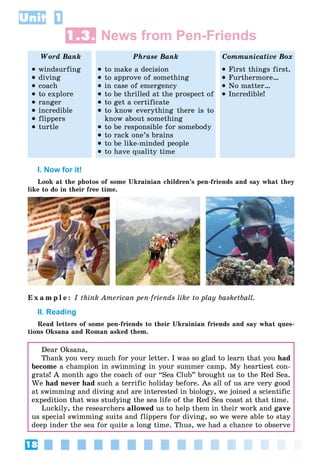
Look at the photos of some Ukrainian children’s pen-friends and say what they
like to do in their free time.
E x a m p l e : I think American pen-friends like to play basketball.
II. Reading
Read letters of some pen-friends to their Ukrainian friends and say what ques-
tions Oksana and Roman asked them.
Dear Oksana,
Thank you very much for your letter. I was so glad to learn that you had
become a champion in swimming in your summer camp. My heartiest con-
grats! A month ago the coach of our “Sea Club” brought us to the Red Sea.
We had never had such a terrific holiday before. As all of us are very good
at swimming and diving and are interested in biology, we joined a scientific
expedition that was studying the sea life of the Red Sea coast at that time.
Luckily, the researchers allowed us to help them in their work and gave
us special swimming suits and flippers for diving, so we were able to stay
deep inder the sea for quite a long time. Thus, we had a chance to observe
19
1.3
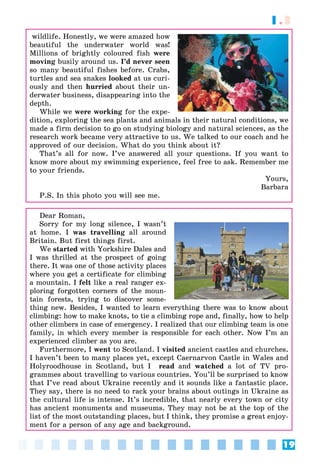
wildlife. Honestly, we were amazed how
beautiful the underwater world was!
Millions of brightly coloured fish were
moving busily around us. I’d never seen
so many beautiful fishes before. Crabs,
turtles and sea snakes looked at us curi-
ously and then hurried about their un-
derwater business, disappearing into the
depth.
While we were working for the expe-
dition, exploring the sea plants and animals in their natural conditions, we
made a firm decision to go on studying biology and natural sciences, as the
research work became very attractive to us. We talked to our coach and he
approved of our decision. What do you think about it?
That’s all for now. I’ve answered all your questions. If you want to
know more about my swimming experience, feel free to ask. Remember me
to your friends.
Yours,
Barbara
P.S. In this photo you will see me.
Dear Roman,
Sorry for my long silence, I wasn’t
at home. I was travelling all around
Britain. But first things first.
We started with Yorkshire Dales and
I was thrilled at the prospect of going
there. It was one of those activity places
where you get a certificate for climbing
a mountain. I felt like a real ranger ex-
ploring forgotten corners of the moun-
tain forests, trying to discover some-
thing new. Besides, I wanted to learn everything there was to know about
climbing: how to make knots, to tie a climbing rope and, finally, how to help
other climbers in case of emergency. I realized that our climbing team is one
family, in which every member is responsible for each other. Now I’m an
experienced climber as you are.
Furthermore, I went to Scotland. I visited ancient castles and churches.
I haven’t been to many places yet, except Caernarvon Castle in Wales and
Holyroodhouse in Scotland, but I read and watched a lot of TV pro-
grammes about travelling to various countries. You’ll be surprised to know
that I’ve read about Ukraine recently and it sounds like a fantastic place.
They say, there is no need to rack your brains about outings in Ukraine as
the cultural life is intense. It’s incredible, that nearly every town or city
has ancient monuments and museums. They may not be at the top of the
list of the most outstanding places, but I think, they promise a great enjoy-
ment for a person of any age and background.
20
Unit 1
I told my friends about it. We are like-minded people and usually spend
our holidays together. We are interested in history, folk tales and songs
from other countries. And of course all of us enjoy sightseeing of all kinds.
As you see, our interests unite us and we usually have fun every summer.
So we are going to Ukraine for the next summer holidays and feel delight-
ed about it.
I must stop here. Hope to meet you when in Ukraine. Take care.
Yours,
Sam.
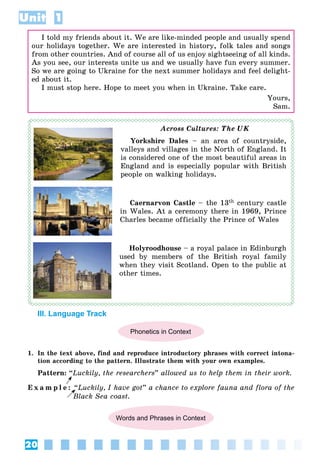
Across Cultures: The UK
Yorkshire Dales – an area of countryside,
valleys and villages in the North of England. It
is considered one of the most beautiful areas in
England and is especially popular with British
people on walking holidays.
Caernarvon Castle – the 13th century castle
in Wales. At a ceremony there in 1969, Prince
Charles became officially the Prince of Wales
Holyroodhouse – a royal palace in Edinburgh
used by members of the British royal family
when they visit Scotland. Open to the public at
other times.
III. Language Track
Phonetics in Context
1. In the text above, find and reproduce introductory phrases with correct intona-
tion according to the pattern. Illustrate them with your own examples.
Pattern: “Luckily, the researchers” allowed us to help them in their work.
E x a m p l e : “Luckily, I have got” a chance to explore fauna and flora of the
Black Sea coast.
Words and Phrases in Context
B
21
1.3
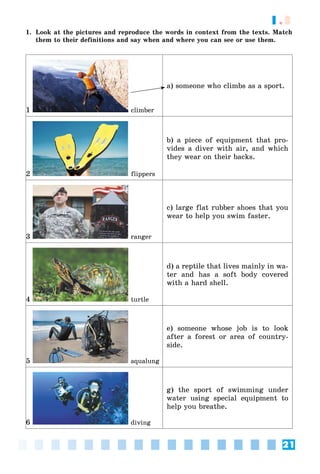
1. Look at the pictures and reproduce the words in context from the texts. Match
them to their definitions and say when and where you can see or use them.
1 climber
a) someone who climbs as a sport.

2 flippers
b) a piece of equipment that pro-
vides a diver with air, and which
they wear on their backs.
3 ranger
c) large flat rubber shoes that you
wear to help you swim faster.
4 turtle
d) a reptile that lives mainly in wa-
ter and has a soft body covered
with a hard shell.
5 àqualung
e) someone whose job is to look
after a forest or area of country-
side.
6 diving
g) the sport of swimming under
water using special equipment to
help you breathe.
22
Unit 1
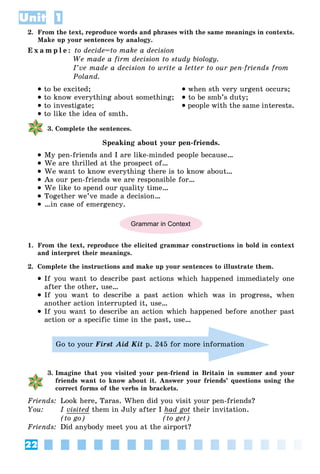
2. From the text, reproduce words and phrases with the same meanings in contexts.
Make up your sentences by analogy.
E x a m p l e : to decide=to make a decision
We made a firm decision to study biology.
I’ve made a decision to write a letter to our pen-friends from
Poland.
 to be excited;
 to know everything about something;
 to investigate;
 to like the idea of smth.
 when sth very urgent occurs;
 to be smb’s duty;
 people with the same interests.
3. Complete the sentences.
Speaking about your pen-friends.
 My pen-friends and I are like-minded people because…
 We are thrilled at the prospect of…
 We want to know everything there is to know about…
 As our pen-friends we are responsible for…
 We like to spend our quality time…
 Together we’ve made a decision…
 …in case of emergency.
Grammar in Context
1. From the text, reproduce the elicited grammar constructions in bold in context
and interpret their meanings.
2. Complete the instructions and make up your sentences to illustrate them.
 If you want to describe past actions which happened immediately one
after the other, use…
 If you want to describe a past action which was in progress, when
another action interrupted it, use…
 If you want to describe an action which happened before another past
action or a specific time in the past, use…
Go to your First Aid Kit p. 245 for more information
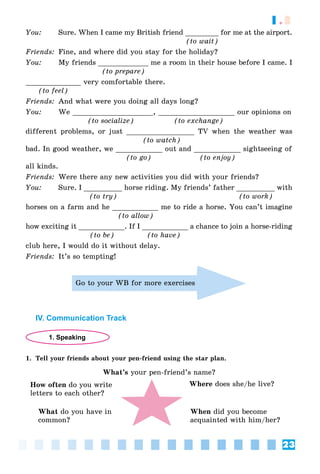
3. Imagine that you visited your pen-friend in Britain in summer and your
friends want to know about it. Answer your friends’ questions using the
correct forms of the verbs in brackets.
Friends: Look here, Taras. When did you visit your pen-friends?
You: I visited them in July after I had got their invitation.
(to go) (to get)
Friends: Did anybody meet you at the airport?
23
1.3
You: Sure. When I came my British friend ________ for me at the airport.
(to wait)
Friends: Fine, and where did you stay for the holiday?
You: My friends ____________ me a room in their house before I came. I
(to prepare)
_____________ very comfortable there.
(to feel)
Friends: And what were you doing all days long?
You: We ___________________, __________________ our opinions on
(to socialize) (to exchange)
different problems, or just ________________ TV when the weather was
(to watch)
bad. In good weather, we ___________ out and ___________ sightseeing of
(to go) (to enjoy)
all kinds.
Friends: Were there any new activities you did with your friends?
You: Sure. I _________ horse riding. My friends’ father _________ with
(to try) (to work)
horses on a farm and he ___________ me to ride a horse. You can’t imagine
(to allow)
how exciting it ___________. If I ___________ a chance to join a horse-riding
(to be) (to have)
club here, I would do it without delay.
Friends: It’s so tempting!
Go to your WB for more exercises
IV. Communication Track
1. Speaking
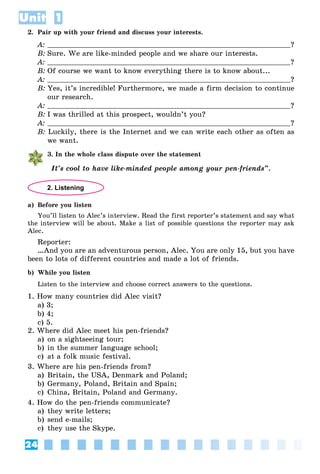
1. Tell your friends about your pen-friend using the star plan.
What’s your pen-friend’s name?
How often do you write
letters to each other?
Where does she/he live?
When did you become
acquainted with him/her?
What do you have in
common?
24
Unit 1
2. Pair up with your friend and discuss your interests.
A: ?
B: Sure. We are like-minded people and we share our interests.
A: ?
B: Of course we want to know everything there is to know about...
A: ?
B: Yes, it’s incredible! Furthermore, we made a firm decision to continue
our research.
A: ?
B: I was thrilled at this prospect, wouldn’t you?
A: ?
B: Luckily, there is the Internet and we can write each other as often as
we want.
3. In the whole class dispute over the statement
It’s cool to have like-minded people among your pen-friends”.
2. Listening
a) Before you listen
You’ll listen to Alec’s interview. Read the first reporter’s statement and say what
the interview will be about. Make a list of possible questions the reporter may ask
Alec.
Reporter:
…And you are an adventurous person, Alec. You are only 15, but you have
been to lots of different countries and made a lot of friends.
b) While you listen
Listen to the interview and choose correct answers to the questions.
1. How many countries did Alec visit?
a) 3;
b) 4;
c) 5.
2. Where did Alec meet his pen-friends?
a) on a sightseeing tour;
b) in the summer language school;
c) at a folk music festival.
3. Where are his pen-friends from?
a) Britain, the USA, Denmark and Poland;
b) Germany, Poland, Britain and Spain;
c) China, Britain, Poland and Germany.
4. How do the pen-friends communicate?
a) they write letters;
b) send e-mails;
c) they use the Skype.
25
1.3
5. What skills did Alec develop communicating with his pen-friends?
a) writing and speaking; b) speaking and listening;
c) listening and reading.
6. Why is Alec thankful to his pen-friends?
a) due to them he travels a lot;
b) due to them he speaks English better;
c) due to them he works much on his computer.
c) After you listen
In groups think and decide how your pen-friend and you may benefit from com-
municating with each other.
Group up for the project to design a poster: “Wherever you have a rest, be
environmentally friendly!”
3. Writing
a) Before you write
 If you want to communicate with your pen-friend, write a personal let-
ter to him.
 In groups, brainstorm with your friends what you can write your pen-
friends about.
 Look through two personal letters of Barbara and Sam on p. 18–20 and
make a list of introducting phrases used by them.
b) While you write
How to write a personal letter
Content Tips Language Tips
 Start your letter with greetings
and informal introductions
 Write 1–2 paragraphs in which
you introduce a topic or surpris-
ing news
 Go back to the previous topic
and make sure you answered
questions that your friend had
asked before
 Write your closing remarks in
the ending
 Finish your letter with your
first name
 I’m writing to apologize for…
 I hope this letter will find you well.
 I’m writing to tell you my wonderful
news.
 Well, you would never guess…
 By the way, did you know…
 Anyway, as I was saying earlier, I re-
ally…
 Actually…
 Well, that’s all for now. Write back
and tell me what you’ve been up to.
 I look forward to hearing from you.
 Remember me to…
Go to your p. 1 for a sample of a personal letter
At Home: In your WB, write a personal letter to your pen-friend.
26
Unit 1
1.4. Being Together
Word Bank Phrase Bank
 latecomers
 to admit
 stuntman
 to take up a hobby
 to feel safe and sound
 to join the fun
 to participate in singing karaoke
 talent contest
 a stand-up comedian
 leisure time
Communication Box:
How to express preferences spending time together
 Are you planning on …?
 Does … appeal to you?
 Does …work well for you?
 Won’t you feel depressed
knowing you … can’t make it?
 Is … on your list of likes?
 Do you mean you are a great
lover of …?
 What’s your preference … or …?
 Would you like to …?
 I’m just here…
 Well, sure, maybe a little bit
…
 I think it’s pretty extreme …
 I really feel like …
 I refuse to believe that …
 Well, frankly speaking, I feel
(no) enthusiasm for …
I. Now for it!
Read the advertisements and say which of them you’ll choose for your friends
and yourself and why.
Are you a great admirer of
music?
Then the rock concert on
Saturday afternoon is just
for you! Don’t miss it! 5
p.m. Central Park
You enjoy humour, don’t you?
Fun Quiz!
Tonight 6.30 p.m.
Town Assembly Hall
Free entrance
(Late comers will not be admitted,
so be on time)
27
1.4
City Art Club
can improve your artistic
abilities if you feel like
drawing. All you need is time
and patience. Come to us on
Sunday at 4 p.m.
A day out!
Gorgeous sunshine and a lot of fun!
Join us on Sunday and be ready to
take colours from what you see!
Meet the group at school at
10 o’clock in the morning.
E x a m p l e : As my friends and I are keen on music, we’ll go to the concert.
I think we’ll enjoy it.
II. Reading
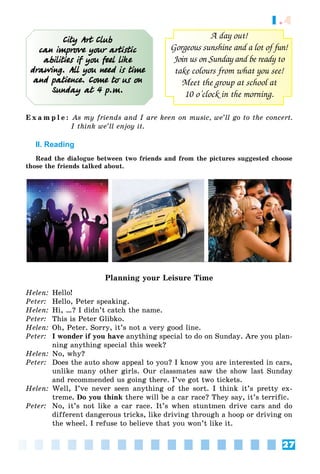
Read the dialogue between two friends and from the pictures suggested choose
those the friends talked about.
Planning your Leisure Time
Helen: Hello!
Peter: Hello, Peter speaking.
Helen: Hi, …? I didn’t catch the name.
Peter: This is Peter Glibko.
Helen: Oh, Peter. Sorry, it’s not a very good line.
Peter: I wonder if you have anything special to do on Sunday. Are you plan-
ning anything special this week?
Helen: No, why?
Peter: Does the auto show appeal to you? I know you are interested in cars,
unlike many other girls. Our classmates saw the show last Sunday
and recommended us going there. I’ve got two tickets.
Helen: Well, I’ve never seen anything of the sort. I think it’s pretty ex-
treme. Do you think there will be a car race? They say, it’s terrific.
Peter: No, it’s not like a car race. It’s when stuntmen drive cars and do
different dangerous tricks, like driving through a hoop or driving on
the wheel. I refuse to believe that you won’t like it.
28
Unit 1
Helen: Oh, I’m thrilled at the prospect. Stuntmen are courageous people.
They perform breathtaking tricks. I’m absolutely sure I’d like to see
it. So, I’m eager to join you. Do you know when it is going to start?
Peter: At 12 o’clock. We will have much fun together.
Helen: Speaking about fun, do you feel like going to our central park after
the car race?
Peter: … to see the Karaoke competition? Some girls from our class were
going to participate in it. I think it promises a great time, too.
Helen: Do you mean you are a great lover of Karaoke singing?
Peter: Not me. My cousin Oksana took up that hobby. She won the talent
contest last year. She hopes to win and I’d like to support her.
Helen: I know Oksana. She is the best stand-up comedian in our school. But
I never heard her singing. Can you tell me what songs she likes?
Peter: Wait a little and you’ll see for yourself. I’m sure it’ll be a fascinating
show.
Helen: OK.
III. Language Track
Phonetics in Context
1. From the dialogue, reproduce the general questions in context with a correct
intonation. Follow the pattern.
Pattern:
'Are you
' 'planning
' 'anything special this week?
Practise saying them in your own sentences.
Words and Phrases in Context
1. Study the difference in meaning. From the text, reproduce the words in context
and interpret their meanings. Make up your sentences by analogy.
contest – a competi-
tion, usually in which a
judge or a group of
judges, or the public
decide the winner.
Example: My pen-
friend from Britain
participated in a beauty
contest last spring.
competition – an orga-
nized event in which
people or teams compete
against each other.
Example: My friends
and I take part in sport
competitions.
2. Match words and phrases to their definitions. Find them in the dialogue and re-
produce in their contexts. Give your examples with them.
t
ju
29
1.4
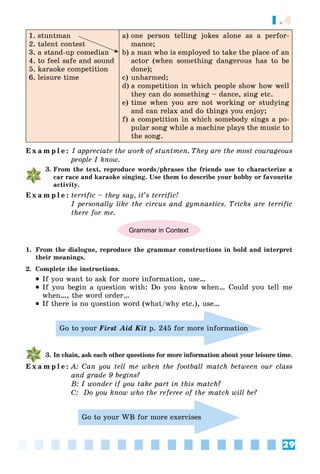
1. stuntman
2. talent contest
3. a stand-up comedian
4. to feel safe and sound
5. karaoke competition
6. leisure time
a) one person telling jokes alone as a perfor-
mance;
b) a man who is employed to take the place of an
actor (when something dangerous has to be
done);
c) unharmed;
d) a competition in which people show how well
they can do something – dance, sing etc.
e) time when you are not working or studying
and can relax and do things you enjoy;
f) a competition in which somebody sings a po-
pular song while a machine plays the music to
the song.
E x a m p l e : I appreciate the work of stuntmen. They are the most courageous
people I know.
3. From the text, reproduce words/phrases the friends use to characterize a
car race and karaoke singing. Use them to describe your hobby or favourite
activity.
E x a m p l e : terrific – they say, it’s terrific!
I personally like the circus and gymnastics. Tricks are terrific
there for me.
Grammar in Context
1. From the dialogue, reproduce the grammar constructions in bold and interpret
their meanings.
2. Complete the instructions.
 If you want to ask for more information, use…
 If you begin a question with: Do you know when… Could you tell me
when…, the word order…
 If there is no question word (what/why etc.), use…
Go to your First Aid Kit p. 245 for more information
3. In chain, ask each other questions for more information about your leisure time.
E x a m p l e : A: Can you tell me when the football match between our class
and grade 9 begins?
B: I wonder if you take part in this match?
C: Do you know who the referee of the match will be?
Go to your WB for more exercises
30
Unit 1
IV. Communication Track
1. Speaking
1. Tell your classmates how you prefer to spend your leisure time with your friends.
Use the guiding questions.
 How often do you spend your leisure time together?
 What does the choice of this activity depend on?
 How do you plan your leisure time?
 What activities are your favourite?
 Why do you like being together with your friends?
2. Read and learn how to express preferences on being together. Make up a dialogue
round one of the mini-dialogues.
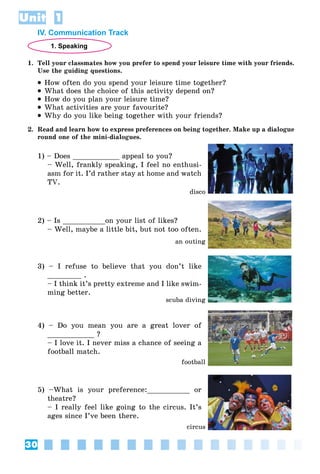
1) – Does ___________ appeal to you?
– Well, frankly speaking, I feel no enthusi-
asm for it. I’d rather stay at home and watch
TV.
2) – Is __________on your list of likes?
– Well, maybe a little bit, but not too often.
3) – I refuse to believe that you don’t like
________ .
– I think it’s pretty extreme and I like swim-
ming better.
4) – Do you mean you are a great lover of
___________ ?
– I love it. I never miss a chance of seeing a
football match.
5) –What is your preference:__________ or
theatre?
– I really feel like going to the circus. It’s
ages since I’ve been there.
disco
an outing
scuba diving
football
circus
31
1.4
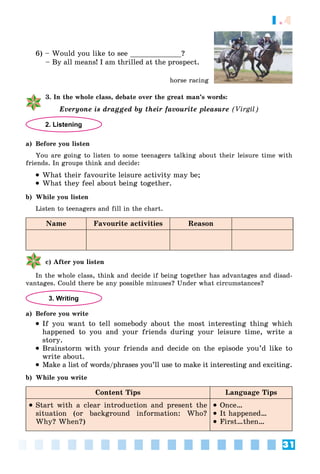
6) – Would you like to see ____________?
– By all means! I am thrilled at the prospect.
3. In the whole class, debate over the great man’s words:
Everyone is dragged by their favourite pleasure (Virgil)
2. Listening
a) Before you listen
You are going to listen to some teenagers talking about their leisure time with
friends. In groups think and decide:
 What their favourite leisure activity may be;
 What they feel about being together.
b) While you listen
Listen to teenagers and fill in the chart.
Name Favourite activities Reason
c) After you listen
In the whole class, think and decide if being together has advantages and disad-
vantages. Could there be any possible minuses? Under what circumstances?
3. Writing
a) Before you write
 If you want to tell somebody about the most interesting thing which
happened to you and your friends during your leisure time, write a
story.
 Brainstorm with your friends and decide on the episode you’d like to
write about.
 Make a list of words/phrases you’ll use to make it interesting and exciting.
b) While you write
Content Tips Language Tips
 Start with a clear introduction and present the
situation (or background information: Who?
Why? When?)
 Once…
 It happened…
 First…then…
horse racing
32
Unit 1
Content Tips Language Tips
 Develop the story line in the middle part
and give more background information
(Why? How? What happened next?). Don’t
forget about interesting details.
 Focus on final events in the conclusion
(What happened at the end? How do you feel
about it?)
 Although….
 After a while…
 A short time later
 To somebody’s surprise…
 In addition…
 Due to…
 Apart from…
 As a result…
 Consequently…
 Finally…
Go to p. 2 for a sample story
At Home: In your WB write a story about the most memorable leisure time
with your friends.
DEVELOPING INTEGRATED SKILLS 1
I. Suppose your Polish friend invited you for a two-week holiday to Poland. Think
and calculate how much pocket money you need for your holiday, and how you
are going to spend it.
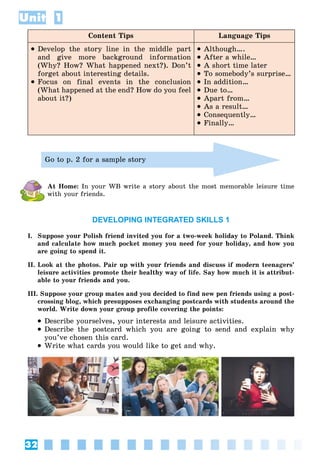
II. Look at the photos. Pair up with your friends and discuss if modern teenagers’
leisure activities promote their healthy way of life. Say how much it is attribut-
able to your friends and you.
III. Suppose your group mates and you decided to find new pen friends using a post-
crossing blog, which presupposes exchanging postcards with students around the
world. Write down your group profile covering the points:
 Describe yourselves, your interests and leisure activities.
 Describe the postcard which you are going to send and explain why
you’ve chosen this card.
 Write what cards you would like to get and why.
33
1.5
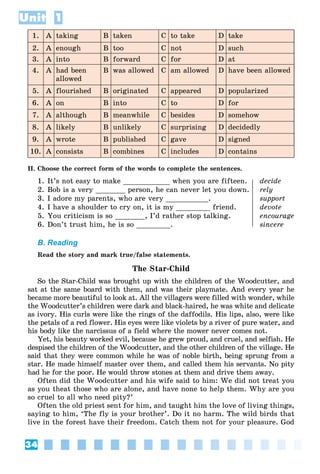
IV. Your friend is an environmental activist and invited you to the eco-club meeting.
Group up with your friends, look at the photo and role-play the dialogue accord-
ing to the situation.
1.5. YOUR TEST FILES
A. Use of English
I. Read the text below. For questions (1–10) choose the correct answer (A, B, C or D).
The American National Folk Dance
When I was a small girl, my parents used ___1___ me with them when
they were going to square dancing. I was ___2___ young to take part in the
squares, but I enjoyed looking ___3___ them.
Fifteen years later I ___4___ to attend square dancing parties. In the
1980-s square dancing ___5___ in the United States and spread ___6___
several foreign countries such as Germany, Japan, Australia and Canada.
___7___ square dancing may have reached its peak in the United States, it is
___8___ that it will die out completely. Something as American as this me-
dium will survive as it had gone in the past through many ups and downs in
its history President Reagan ___9___ an act of congress in 1982 that desig-
nated square dancing as the ‘official national folk dance’.
For me it is the best form of entertainment and socialization. It ___10___
meeting new friends, aerobic exercise and keeping time to music all in one
delightful activity.
34
Unit 1
1. A taking B taken C to take D take
2. A enough B too C not D such
3. A into B forward C for D at
4. A had been
allowed
B was allowed C am allowed D have been allowed
5. A flourished B originated C appeared D popularized
6. A on B into C to D for
7. A although B meanwhile C besides D somehow
8. A likely B unlikely C surprising D decidedly
9. A wrote B published C gave D signed
10. A consists B combines C includes D contains
II. Choose the correct form of the words to complete the sentences.
1. It’s not easy to make ___________ when you are fifteen. decide
2. Bob is a very _______ person, he can never let you down. rely
3. I adore my parents, who are very __________. support
4. I have a shoulder to cry on, it is my ________ friend. devote
5. You criticism is so _______, I’d rather stop talking. encourage
6. Don’t trust him, he is so ________. sincere
B. Reading
Read the story and mark true/false statements.
The Star-Child
So the Star-Child was brought up with the children of the Woodcutter, and
sat at the same board with them, and was their playmate. And every year he
became more beautiful to look at. All the villagers were filled with wonder, while
the Woodcutter’s children were dark and black-haired, he was white and delicate
as ivory. His curls were like the rings of the daffodils. His lips, also, were like
the petals of a red flower. His eyes were like violets by a river of pure water, and
his body like the narcissus of a field where the mower never comes not.
Yet, his beauty worked evil, because he grew proud, and cruel, and selfish. He
despised the children of the Woodcutter, and the other children of the village. He
said that they were common while he was of noble birth, being sprung from a
star. He made himself master over them, and called them his servants. No pity
had he for the poor. He would throw stones at them and drive them away.
Often did the Woodcutter and his wife said to him: We did not treat you
as you theat those who are alone, and have none to help them. Why are you
so cruel to all who need pity?’
Often the old priest sent for him, and taught him the love of living things,
saying to him, ‘The fly is your brother’. Do it no harm. The wild birds that
live in the forest have their freedom. Catch them not for your pleasure. God
35
1.5
made the blind worm and the mole, and each has its place. Who are you to
bring pain into God’s world?’
But the Star-Child needed not their words, but would frown and mock, and
go back to his companions, and lead them. And his companions followed him,
for he was fair, could run fast and dance, play the pipe and make music. And
wherever the Star-Child led them, they followed him, and whatever the Star-
Child ordered them to do, they did. And in all things he ruled over them, and
they became hard at heart, as he was.
1. The woodcutter’s children and the star-child looked alike.
2. The star-child’s beauty added to his kindness.
3. The star-child treated poor people badly.
4. He disliked the children of the village and made them serve him.
5. The children always obeyed the star-child.
6. The woodcutter and his wife liked the boy’s behaviour.
7. The priest tried to convince the star-child not to wrong anyone by
words or deeds.
8. The star-child listened to the woodcutter and the priest and changed his
character.
C. Listening
Listen to the conversation of two friends and choose the right variant to com-
plete the sentences.
1. David makes Emma’s life ______.
a) happy;
b) exciting;
c) impossible.
2. David is constantly ______________.
a) beating Emma;
b) bullying Emma;
c) helping Emma.
3. Chloe advises Emma ___________.
a) not to pay attention to him;
b) to bully him;
c) not to talk to him.
4. Emma’s teacher comforted her and said ________.
a) that David would apologise;
b) that David would leave her alone soon;
c) that David would be sent to the police.
5. Emma’s dad explained her that _______.
a) bullies are very impatient people;
b) bullies are very cunning;
c) bullies are very selfish.
36
Unit 1
6. Finally Emma decided ___________.
a) to ignore David;
b) to attack David;
c) to talk to him.
D. Writing
Write a letter to your pen-friend and:
 Ask him what he/she appreciates in his friends;
 Tell him/her about your best friend;
 Say what you think about friendship and real friends.
37
1–2
B. Reading
Unit 2
Live and Learn
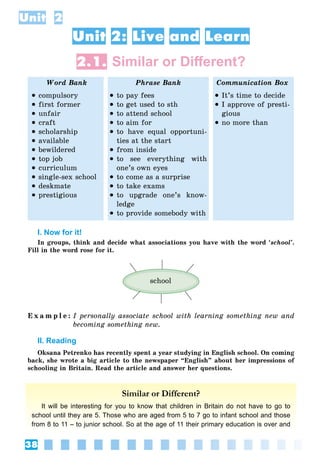
In this unit you will learn how:
• to talk about schooling;
• to compare school life in different countries;
• to speak about school routine;
• to discuss your extra-curricular activities;
• to check your knowledge and skills on the topic
getting ready for your independent testing.
38
Unit 2
Unit 2: Live and Learn
2.1. Similar or Different?
Word Bank Phrase Bank Communication Box
 compulsory
 first former
 unfair
 craft
 scholarship
 available
 bewildered
 top job
 curriculum
 single-sex school
 deskmate
 prestigious
 to pay fees
 to get used to sth
 to attend school
 to aim for
 to have equal opportuni-
ties at the start
 from inside
 to see everything with
one’s own eyes
 to come as a surprise
 to take exams
 to upgrade one’s know-
ledge
 to provide somebody with
 It’s time to decide
 I approve of presti-
gious
 no more than
I. Now for it!
In groups, think and decide what associations you have with the word ‘school’.
Fill in the word rose for it.
school
E x a m p l e : I personally associate school with learning something new and
becoming something new.
II. Reading
Oksana Petrenko has recently spent a year studying in English school. On coming
back, she wrote a big article to the newspaper “English” about her impressions of
schooling in Britain. Read the article and answer her questions.
Similar or Different?
It will be interesting for you to know that children in Britain do not have to go to
school until they are 5. Those who are aged from 5 to 7 go to infant school and those
from 8 to 11 – to junior school. So at the age of 11 their primary education is over and
39
2.1
compulsory secondary education begins. I’ve lear-
ned that traditionally, secondary schools in Britain
are divided into five years called forms. Unlike
Ukrainian children, English pupils go to the first form
only when they are 11/12 years old. It was odd to
hear grown-ups saying they were second or the
third formers and it took me time to get used to it.
My tutor Miss Joy told me that many years ago
all children in Britain had to take the exam called
‘eleven-plus’. Those who got the best results in the exam were chosen to go to the
best state school called “grammar school”. Most British towns used to have at least
one “grammar school” at which more academic subjects were studied. It was prestigious
to study at such schools because pupils got sufficient academic education that gave
them an opportunity to go to university. Those who failed the ‘eleven-plus’ went to
secondary modern schools, which gave secondary education only in name and didn’t
prepare children for universities, but for practical jobs. Many people thought that this
system was unfair, and as a result, ‘comprehensive schools’ were introduced. Miss Joy
said that it was the right thing to do because nowadays pupils have the equal oppor-
tunities. I guess Miss Joy is right saying this as she has been working at school for
more than 30 years.
I was studying at a comprehensive school and could see everything with my own
eyes from the inside. Pupils are offered a wide choice of subjects there: from art and
craft to science and computers. Besides, pupils are often put into “sets” for such sub-
jects as Maths or languages. I was in the English language set with other pupils who
were interested in this subject. Can you imagine that one pupil may be in the highest
set for Maths and the lowest set for English? It came as a surprise to me.
At the end of the fifth form (at the age of 16) pupils take their first public exam for
the General Certificate of Secondary Education (GCSE). It’s time to decide: to leave
school and to get professional training at further education college or to stay on into
the sixth form for another 2 years and prepare for the “A” Level exams. Some of my
friends study there as they want to get “A” Level results at least in two or three subjects
to get a place at one of British universities. I approve of them and think it’s good to
have the sixth form for upgrading your knowledge and making a final decision. I told
my host mum Mrs Collins about it and she said that not all schools in Britain are avai-
lable to all children. Seeing my bewildered face, she explained that there are private
or independent, so called public schools, which are attended by no more than 10 per
cent of schoolchildren. These schools are costly (from £6,000 – 9,000 a year and par-
ents have to pay fees). Nevertheless some parents choose them because they aim for
high academic standards and provide pupils with the right social background for top
jobs. Mrs Collins added that public schools like Harrow, Winchester and Eton are very
ancient and have a high reputation for academic achievement. I asked myself: Are
pupils similar or different? Shouldn’t they be given equal opportunities at the start?
What do you think?
?
40
Unit 2
Across Cultures: Great Britain
tutor – a teacher who directs the studies of a number of subjects and is
responsible to give them
advice on personal matters.
host mum – a person who receives oversea students and provides food,
drink and amusement for them.
“A” Level – an examination in a particular subject which students in
England take at the age of 18. Students usually need to pass at least
three “A” Levels in order to go to university.
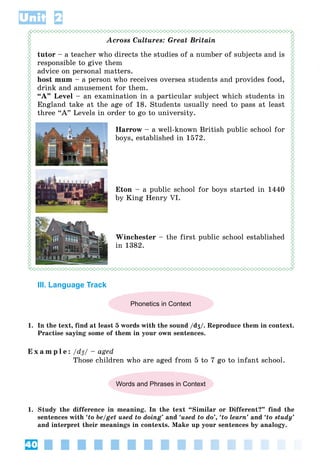
Harrow – a well-known British public school for
boys, established in 1572.
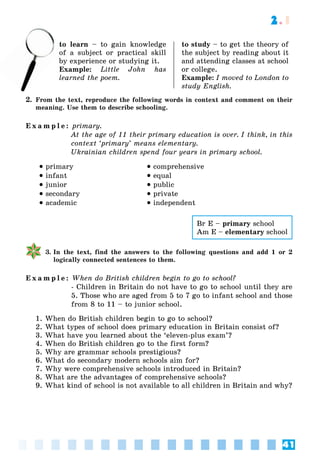
Eton – a public school for boys started in 1440
by King Henry VI.
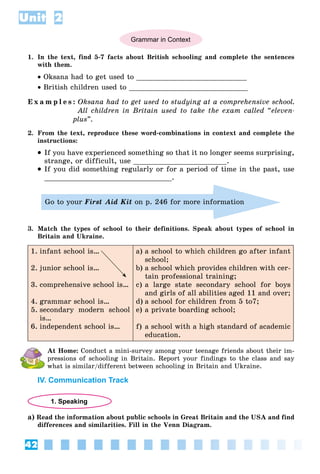
Winchester – the first public school established
in 1382.
III. Language Track
Phonetics in Context
1. In the text, find at least 5 words with the sound /dʒ/. Reproduce them in context.
Practise saying some of them in your own sentences.
E x a m p l e : /dʒ
d / – aged
Those children who are aged from 5 to 7 go to infant school.
Words and Phrases in Context
1. Study the difference in meaning. In the text “Similar or Different?” find the
sentences with ‘to be/get used to doing’ and ‘used to do’, ‘to learn’ and ‘to study’
and interpret their meanings in contexts. Make up your sentences by analogy.
41
2.1
to learn – to gain knowledge
of a subject or practical skill
by experience or studying it.
Example: Little John has
learned the poem.
to study – to get the theory of
the subject by reading about it
and attending classes at school
or college.
Example: I moved to London to
study English.
2. From the text, reproduce the following words in context and comment on their
meaning. Use them to describe schooling.
E x a m p l e : primary.
At the age of 11 their primary education is over. I think, in this
context ‘primary’ means elementary.
Ukrainian children spend four years in primary school.
 primary
 infant
 junior
 secondary
 academic
 comprehensive
 equal
 public
 private
 independent
3. In the text, find the answers to the following questions and add 1 or 2
logically connected sentences to them.
E x a m p l e : When do British children begin to go to school?
- Children in Britain do not have to go to school until they are
5. Those who are aged from 5 to 7 go to infant school and those
from 8 to 11 – to junior school.
1. When do British children begin to go to school?
2. What types of school does primary education in Britain consist of?
3. What have you learned about the ‘eleven-plus exam’?
4. When do British children go to the first form?
5. Why are grammar schools prestigious?
6. What do secondary modern schools aim for?
7. Why were comprehensive schools introduced in Britain?
8. What are the advantages of comprehensive schools?
9. What kind of school is not available to all children in Britain and why?
to
of
Br E – primary school
Am E – elementary school
42
Unit 2
Grammar in Context
1. In the text, find 5-7 facts about British schooling and complete the sentences
with them.
 Oksana had to get used to __________________________
 British children used to ____________________________
E x a m p l e s : Oksana had to get used to studying at a comprehensive school.
All children in Britain used to take the exam called “eleven-
plus”.
2. From the text, reproduce these word-combinations in context and complete the
instructions:
 If you have experienced something so that it no longer seems surprising,
strange, or difficult, use ______________________.
 If you did something regularly or for a period of time in the past, use
______________________________.
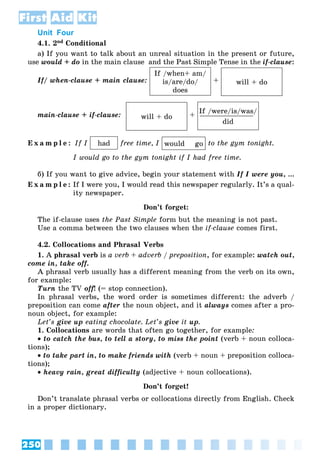
Go to your First Aid Kit on p. 246 for more information
3. Match the types of school to their definitions. Speak about types of school in
Britain and Ukraine.
1. infant school is…
2. junior school is…
3. comprehensive school is…
4. grammar school is…
5. secondary modern school
is…
6. independent school is…
a) a school to which children go after infant
school;
b) a school which provides children with cer-
tain professional training;
c) a large state secondary school for boys
and girls of all abilities aged 11 and over;
d) a school for children from 5 to7;
e) a private boarding school;
f) a school with a high standard of academic
education.
At Home: Conduct a mini-survey among your teenage friends about their im-
pressions of schooling in Britain. Report your findings to the class and say
what is similar/different between schooling in Britain and Ukraine.
IV. Communication Track
1. Speaking
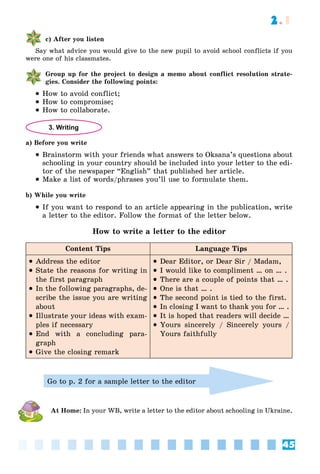
a) Read the information about public schools in Great Britain and the USA and find
differences and similarities. Fill in the Venn Diagram.
43
2.1
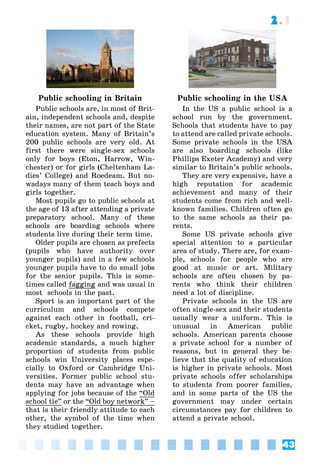
Public schooling in Britain
Public schools are, in most of Brit-
ain, independent schools and, despite
their names, are not part of the State
education system. Many of Britain’s
200 public schools are very old. At
first there were single-sex schools
only for boys (Eton, Harrow, Win-
chester) or for girls (Cheltenham La-
dies’ College) and Roedeam. But no-
wadays many of them teach boys and
girls together.
Most pupils go to public schools at
the age of 13 after attending a private
preparatory school. Many of these
schools are boarding schools where
students live during their term time.
Older pupils are chosen as prefects
(pupils who have authority over
younger pupils) and in a few schools
younger pupils have to do small jobs
for the senior pupils. This is some-
times called fagging and was usual in
most schools in the past.
Sport is an important part of the
curriculum and schools compete
against each other in football, cri-
cket, rugby, hockey and rowing.
As these schools provide high
academic standards, a much higher
proportion of students from public
schools win University places espe-
cially to Oxford or Cambridge Uni-
versities. Former public school stu-
dents may have an advantage when
applying for jobs because of the “Old
school tie” or the “Old boy network” –
that is their friendly attitude to each
other, the symbol of the time when
they studied together.
Public schooling in the USA
In the US a public school is a
school run by the government.
Schools that students have to pay
to attend are called private schools.
Some private schools in the USA
are also boarding schools (like
Phillips Exeter Academy) and very
similar to Britain’s public schools.
They are very expensive, have a
high reputation for academic
achievement and many of their
students come from rich and well-
known families. Children often go
to the same schools as their pa-
rents.
Some US private schools give
special attention to a particular
area of study. There are, for exam-
ple, schools for people who are
good at music or art. Military
schools are often chosen by pa-
rents who think their children
need a lot of discipline.
Private schools in the US are
often single-sex and their students
usually wear a uniform. This is
unusual in American public
schools. American parents choose
a private school for a number of
reasons, but in general they be-
lieve that the quality of education
is higher in private schools. Most
private schools offer scholarships
to students from poorer families,
and in some parts of the US the
government may under certain
circumstances pay for children to
attend a private school.
44
Unit 2
Venn Diagram
Great Britain
_______________
_______________
_______________
_______________
_______________
_______________
_______________
_______________
_______________
_____________
the USA
_______________
_______________
_______________
_______________
_______________
Say if there are schools of such kind in Ukraine.
b) Suppose you had a chance to talk with one of the pupils from Britain. Discuss
schooling in your countries using the pattern below.
Pattern:
– I say, ... when do children begin to go to school in Britain?
– In my country ... . Is it the same in yours?
– No, in Ukraine children aged ... . I have read that there are different
types of school in Britain. Which of them do ... ?
– You are right. In Britain ... I personally go ... senior pupils of my
school can... . Is it similar with you?
– Sure. We can choose ... , but it isn’t called a “set”. We also have a very
broad ... at our secondary schools.
– We have the sixth form which ... and we need at least 3 “A” Levels ... .
And what ... in Ukraine?
– We differ. All secondary schools ... .
– Are public schools typical in your country?
– No, we don’t have them. There are ... but they are not well spread. Our
schools are so ... .
– May I ... with my own eyes?
– No problem. You are welcome ... .
– Thank you.
c) In the whole class, discuss the following statement:
“School should give learners equal opportunities at the start”.
2. Listening
a) Before you listen
You are going to listen to the story “Treacle Tart”. Make up a list of 3-5 ideas
about what can cause a school conflict.
b) While you listen
Listen to the story “Treacle Tart” and say what the school conflict was about.
45
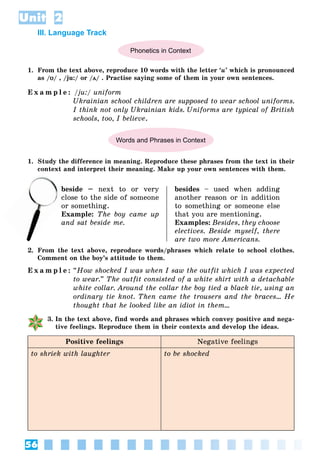
2.1
c) After you listen
Say what advice you would give to the new pupil to avoid school conflicts if you
were one of his classmates.
Group up for the project to design a memo about conflict resolution strate-
gies. Consider the following points:
 How to avoid conflict;
 How to compromise;
 How to collaborate.
3. Writing
a) Before you write
 Brainstorm with your friends what answers to Oksana’s questions about
schooling in your country should be included into your letter to the edi-
tor of the newspaper “English” that published her article.
 Make a list of words/phrases you’ll use to formulate them.
b) While you write
 If you want to respond to an article appearing in the publication, write
a letter to the editor. Follow the format of the letter below.
How to write a letter to the editor
Content Tips Language Tips
 Address the editor
 State the reasons for writing in
the first paragraph
 In the following paragraphs, de-
scribe the issue you are writing
about
 Illustrate your ideas with exam-
ples if necessary
 End with a concluding para-
graph
 Give the closing remark
 Dear Editor, or Dear Sir / Madam,
 I would like to compliment … on … .
 There are a couple of points that … .
 One is that … .
 The second point is tied to the first.
 In closing I want to thank you for … .
 It is hoped that readers will decide …
 Yours sincerely / Sincerely yours /
Yours faithfully
Go to p. 2 for a sample letter to the editor
At Home: In your WB, write a letter to the editor about schooling in Ukraine.
46
Unit 2
2.2. The best Days of Your Life
Word Bank Phrase Bank Communication Box
 kindergarten
 record
 scholastic
achievements
 failing
 unfavourable
 dropout
 to be privately run
 to be required by students
 to move on to something
 to refer to somebody/some-
thing
 to relate to somebody/some-
thing
 to be more specific about some-
thing
 to retake a class next grade
 to follow an individual sched-
ule
 to graduate from high school
 in an attempt to do something
 school leaving exams
 That’s pretty inter-
esting!
 It’s important to
mention ...
 It’s up to me to de-
cide
 In a word, …
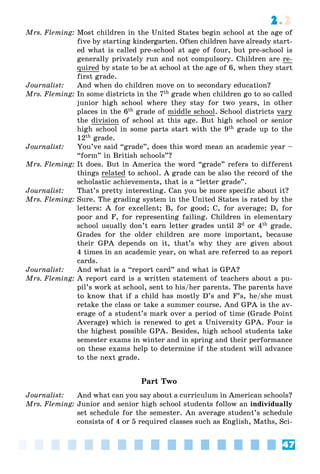
I. Now for it!
Look at the pictures and say how things in them are connected with American
schools.
Graduation cap badge basketball team testing
E x a m p l e : Square academic caps are worn by those graduating from school
in a graduation ceremony.
II. Reading
a) Read the extracts of the interview with a high school principal about the system
of education in the USA and think to what three questions you would like to get
answers from the text.
Interview with a High School Principle:
The Best Days of My Life
Part One
Journalist: Mrs. Fleming, thank you for agreeing
to answer a few questions about the edu-
cational system of the USA. What age
does education start in the USA?
47
2.2
Mrs. Fleming: Most children in the United States begin school at the age of
five by starting kindergarten. Often children have already start-
ed what is called pre-school at age of four, but pre-school is
generally privately run and not compulsory. Children are re-
quired by state to be at school at the age of 6, when they start
first grade.
Journalist: And when do children move on to secondary education?
Mrs. Fleming: In some districts in the 7th grade when children go to so called
junior high school where they stay for two years, in other
places in the 6th grade of middle school. School districts vary
the division of school at this age. But high school or senior
high school in some parts start with the 9th grade up to the
12th grade.
Journalist: You’ve said “grade”, does this word mean an academic year –
“form” in British schools”?
Mrs. Fleming: It does. But in America the word “grade” refers to different
things related to school. A grade can be also the record of the
scholastic achievements, that is a “letter grade”.
Journalist: That’s pretty interesting. Can you be more specific about it?
Mrs. Fleming: Sure. The grading system in the United States is rated by the
letters: A for excellent; B, for good; C, for average; D, for
poor and F, for representing failing. Children in elementary
school usually don’t earn letter grades until 3d or 4th grade.
Grades for the older children are more important, because
their GPA depends on it, that’s why they are given about
4 times in an academic year, on what are referred to as report
cards.
Journalist: And what is a “report card” and what is GPA?
Mrs. Fleming: A report card is a written statement of teachers about a pu-
pil’s work at school, sent to his/her parents. The parents have
to know that if a child has mostly D’s and F’s, he/she must
retake the class or take a summer course. And GPA is the av-
erage of a student’s mark over a period of time (Grade Point
Average) which is renewed to get a University GPA. Four is
the highest possible GPA. Besides, high school students take
semester exams in winter and in spring and their performance
on these exams help to determine if the student will advance
to the next grade.
Part Two
Journalist: And what can you say about a curriculum in American schools?
Mrs. Fleming: Junior and senior high school students follow an individually
set schedule for the semester. An average student’s schedule
consists of 4 or 5 required classes such as English, Maths, Sci-
48
Unit 2
ence, Physical Education, History and 2 or 3 elective courses
which the students take up for themselves. The number and
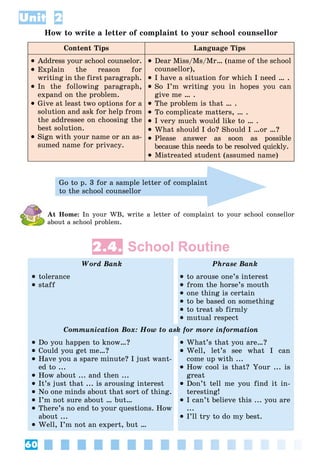
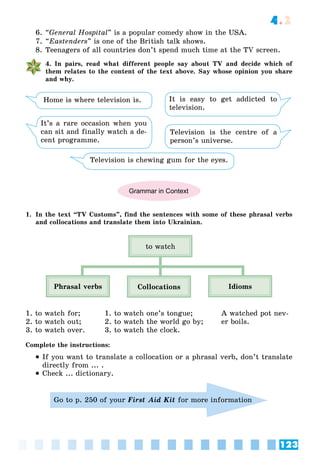
kind of electives often depend on the size of the school but
they usually include music, art, mechanics, homemaking,
journalism, computers, dance, and foreign languages. It’s
highly important to mention that classes such as advanced
studies or foreign languages are not usually required in the
high school curriculum but very often are required as entrance
to the university.
Journalist: Do the students take any state exams before finishing high
schools?
Mrs. Fleming: No. As a rule, a student graduates from high school and re-
ceives a diploma when all the courses required in the curricu-
lum were passed with a D (sometimes C) or better grades.
Many students take the SAT attempt to enter college or Uni-
versity but it’s not required to graduate from high school.
Most students are 17 or 18 at that time and it’s up to them to
decide.
Journalist: You are absolutely right, Mrs. Fleming. And thank you for
this inside look into schools in the USA.
Across Cultures: The USA
SAT – (Scholastic Aptitude Test); a private
two-part examination which must be taken by
students who wish to go to US universities.
Elective – a course that you can choose to study
because you are interested in it while you are
studying for a degree in different subjects.
III. Language Track
Phonetics in Context
1. In the text of the interview, find the yes/no questions and wh-questions and
reproduce them following the pattern. Practise asking your own questions.
Pattern: 'Does this 'word 'mean an aca'demic year?
'What 'age does edu'cation start in the USA?
49
2.2
Words and Phrases in Context
1. Study the difference in meaning. In the text of the interview, find the sentences
with these word-combinations and interpret their meanings in context. Make up
your own sentences by analogy with them.
Phrasal verbs
– to take up
– to take to
– to take after
Collocations
– to take exams
– to take responsibility
– to take pleasure/de-
light in something
Idioms
– take time off
2. From the text of the interview, reproduce words/phrases characterizing grades
and the curriculum. Fill in the word-maps for them and illustrate them in your
own examples.
a letter grade schedule
Grades Curriculum
E x a m p l e : The grading system in the United States is rated by the letters.
An average student’s schedule consists of 4 or 5 required classes.
3. In the text of the interview, find words and phrases attributable to school start
and school finish. Use them to describe schooling in Ukraine.
E x a m p l e : Most children in Ukraine begin school at the age of six…
Grammar in Context
1. In the text of the interview, find adverbs and interpret their meanings in con-
texts.
2. Categorize the adverbs according to their types and illustrate them with your
own examples.
Adverbs of manner Adverbs of frequency
privately
…
often
…
Ph
to take
50
Unit 2
E x a m p l e : Pre-school is generally privately run and not compulsory.
Go to your First Aid Kit on p. 257 for more information
3. Complete the sentences using adverbs formed from the adjectives in the box.
traditional early usual interesting private
general important individual
harm depend
E x a m p l e : Traditionally,
y a student graduates from high school and re-
ceives a diploma.
1. At what age does education __________ start in the USA?
2. Pre-school is ____________ not compulsory.
3. ____________ run schools are quite expensive.
4. ____________, in America the word “grade” refers to different things
related to school.
5. Most children in the United States begin school _______, at the age of
five, by starting kindergarten.
6. _____________, classes such as advanced studies or foreign languages
are not always required in the high school curriculum.
7. Junior and senior high school students follow an __________ set sche-
dule for the semester.
Go to your WB for more exercises
V. Communication Track
1. Speaking
a) Having read the interview about the American education system, describe it
following the plan below.
Plan
1. Pre-school education in America.
2. Elementary education in the USA.
3. American secondary education.
4. Grading system in high schools.
5. Students’ individual schedule.
6. Graduation from school.
51
2.2
b) Read the journalist’s questions in the text “The Best Days of My Life” and use
some of them for interviewing your friend about Ukrainian schooling.
c) Compare the systems of education in the USA, Britain and Ukraine using the
culture comparison profile.
Culture Comparison Profile
Comparison items Great Britain the USA Ukraine
1. Pre-school education
2. Primary education
3. Secondary education
4. Privately run
education
5. Subjects taught
6. Examinations taken
2. Listening
a) Before you listen
You are going to listen to the impressions of an American teenager about his night
school. Judging by the title, try to predict what made him apply to it.
b) While you listen
In pairs, ask and answer the star questions.
What?
Why? When?
Where?
Who?
c) After you listen
In groups, brainstorm with your friends some pluses and minuses of attending a
night school.
Group up for the project to design a slogan for a night school.
52
Unit 2
3. Writing
a) Before you write
1. If you want to write a class journal entry about your impressions of Amer-
ican schooling, ask yourself the following questions:
 What impressions do I want to create by writing the description? To
help my classmates to understand something? To persuade them to act?
 Why would my writing interest them?
 What dominant impression will I develop?
2. Brainstorm with your friends any possible features of American school-
ing.
3. Make a list of words/phrases you can use to describe your impressions of
American schooling.
b) While you write
How to write a class journal entry
Content Tips Language Tips
 Begin your entry with an introduc-
tion to the topic.
 Enumerate the major features of
 Present each feature in the order
you’ve mapped out.
 Describe settings, activities, and
people in enough detail.
 Give your personal interpretations
of these features.
 End your entry by pulling your
ideas together.
 Today I…
 My first impressions were…
 I’m glad I …
 I’m excited to …
 To start off, I had no idea of…
 I learnt that …
 I could imagine that…
 I wonder what it would be like for
me, if I …
 I can’t wait to find out…
Go to your p. 3 for a sample class journal entry
At Home: In your WB, write a class journal entry about your impressions of
American schooling.
53
2.3
2.3. School Life: Here and There
Word Bank Phrase Bank Communication Box
 to expel
 mascot
 departure
 outfit
 braces
 to button
 brand new
 ridiculous garment
 waistcoat
 wide-brimmed straw
hat
 eccentric
 to remove privileges
from
 to enroll sb at school
 to go about in something
 to lace shoes
 to do up the button
 to shriek with laughter
 to look dignified
 to lose one’s nerve com-
pletely
 to take notice of some-
body
 I can’t possibly…
 How lucky you
are!
 With immense
reluctance, …
I. Now for it
Look at the pictures and say what school activities are more typical of school
children in the US, Great Britain and Ukraine. Explain why you think so.
rugby cheerleading baseball gymnastics
E x a m p l e : I think rugby is a typical school activity in great Britain because
it originated there.
II. Reading
1. Read the story “Getting Dressed for Big School” and say if the boy liked his
uniform.
Getting Dressed for Big School
Part One
When I was twelve, my mother said to me, “I’ve enrolled you at Marlbor-
ough and Repton. Which would you like to go to?”
Both were famous Public Schools, but that was all I knew about them.
“Repton”, I said. “I’ll go to Repton”. It was an easier word to say than Marl-
borough.
“Very well”, my mother said. “You’ll go to Repton.”
54
Unit 2
We were living in Kent then. Repton was up in the Midlands, near Derby,
and some 140 miles away to the north.
On the day of my departure, I had to get dressed for the part. I had been to
London with my mother the week before to buy the school clothes, and I remem-
ber, how shocked I was when I saw the outfit which I was expected to wear.
“I can’t possibly go about in those!” I cried. “Nobody wears things like
that!”
“Are you sure you haven’t made a mistake?” my mother said to the shop
assistant.
“If he’s going to Repton, madam, he must wear these clothes”, the assis-
tant said firmly.
And now this amazing fancy dress was all laid out on beside my bed waiting
to be put on. “Put it on”, my mother said. “Hurry up or you’ll miss the train”.
“I’ll look like a complete idiot if I put it on”, I said. My mother went out
of the room and left me to it. With immense reluctance I began to dress.
Part Two
First there was a white shirt with a detachable white collar. Around the
collar I tied a black tie, using an ordinary tie knot.
Then came the trousers and the braces. The trousers were black with thin
grey lines running down them. I buttoned the braces on to the trousers, six
buttons in all, then I put on the trousers and fixed the braces to the correct
length.
I put on a brand new pair of black shoes and laced them up.
Now for the waistcoat. This was also black and it had twelve buttons down
the front and two little waistcoat pockets on either side, one above the other.
I put it on and did up the buttons, starting at the top and working down.
All this was bad enough for a boy who had never before worn anything
better than a pair of shorts and a blazer. But the jacket put the lid on it. It
wasn’t actually a jacket, it was a sort of tailcoat, and it was without a doubt
the most ridiculous garment I had ever seen. Like the waistcoat, it was jet
black and made of a heavy material. In the front the two sides of it met only
at the point. Here there was a single button and this had to be done up. From
the button downwards, the lines of the coat separated and came together
again at the backs of the knees, forming a pair of “tails”. Besides, when you
walked, these tails flapped against your legs. Feeling like an undertaker’s
apprentice in a funeral parlour, I crept downstairs.
My sisters shrieked with laughter when I appeared. “He can’t go out in
those!” they cried. “He’ll be arrested by the police when they see him!”
“Put your hat on”, my mother said, handing me a stiff wide-brimmed
straw hat with a blue and black band around it. I put it on and did my best
to look dignified. The sisters fell all over the room laughing.
My mother got me out of the house before I lost my nerve completely and
together we walked through the village to the station.
“Nobody’s taking the slightest notice of you”, my mother said as we walked
through High Street.
And curiously enough nobody was.
55
2.3
“I have learnt one thing about England”, my mother went on. “It’s a coun-
try in which men love to wear uniforms and eccentric clothes. Two hundred
years ago their clothes were even more eccentric than they are today. Think
how lucky you are. You don’t have to wear a wig on your head and ruffles on
your sleeves!”
“I still feel stupid,” I said.
(Adapted from Roald Dahl
“Getting Dressed for the Big School”)
Across Cultures: Great Britain
Marlborough – a town in south-west England
known for the famous public school, Marlbor-
ough College, established in 1843.
Repton – a town in the heart of England, South
Derbyshire, also known for the famous public
school, Repton School, established in 1559.
Kent – a county in south-east England, known as
the “Garden of England” because of its fruit and
vegetable crop.
The Midlands – the central parts of England, an
important area for light engineering industries.
Derby /da:bi/ – a city in Derbyshire famous for
its industries (engineering and china) and a very
important yearly horse race held in Epsom in
England in May or June, on a day which is known
as Derby Day.
56
Unit 2
III. Language Track
Phonetics in Context
1. From the text above, reproduce 10 words with the letter ‘u’ which is pronounced
as /ʊ
ʊ/ , /ju:/ or /ʌ
ʌ/ . Practise saying some of them in your own sentences.
E x a m p l e : /ju:/ uniform
Ukrainian school children are supposed to wear school uniforms.
I think not only Ukrainian kids. Uniforms are typical of British
schools, too, I believe.
Words and Phrases in Context
1. Study the difference in meaning. Reproduce these phrases from the text in their
context and interpret their meaning. Make up your own sentences with them.
beside – next to or very
lose to the side of someone
or something.
Example: The boy came up
and sat beside me.
besides – used when adding
another reason or in addition
to something or someone else
that you are mentioning.
Examples: Besides, they choose
electives. Beside myself, there
are two more Americans.
2. From the text above, reproduce words/phrases which relate to school clothes.
Comment on the boy’s attitude to them.
E x a m p l e : “How shocked I was when I saw the outfit which I was expected
to wear.” The outfit consisted of a white shirt with a detachable
white collar. Around the collar the boy tied a black tie, using an
ordinary tie knot. Then came the trousers and the braces… He
thought that he looked like an idiot in them…
3. In the text above, find words and phrases which convey positive and nega-
tive feelings. Reproduce them in their contexts and develop the ideas.
Positive feelings Negative feelings
to shriek with laughter to be shocked
b
clo
o
57
2.3
E x a m p l e : The boy was shocked when he saw his school clothes. He felt stu-
pid in them but he had to wear them because he was going to
Repton School.
Grammar in Context
1. In the text above, find and reproduce the sentences with if / when clauses and
interpret their meanings.
2. Say what clothes you will wear if / when:
 you go to school on Saturday;
 you are going to the gym;
 you want to impress someone;
 if you are going to see a school play.
E x a m p l e : If I go to school on Saturday, I will wear something casual, like
jeans and a jacket.
Go to your First Aid Kit p. 247 for more information
1. Complete the sentences about what will happen to you under certain condi-
tions in the future.
E x a m p l e : If I do well on my test, ________________
If I do well on my test, I’ll get a high grade.
1. If I campaign for school president, …
2. What will you do after school if …
3. If the education system improves, …
4. If I get a summer job, …
5. If you are going to become an interpreter, …
6. I’ll stay after classes if …
58
Unit 2
IV. Communication Track
1. Speaking
a) Look at the picture and describe the boy’s uniform as if you were the main char-
acter of the story. Use the word list below. Say how you would feel if you had to
wear such eccentric clothes.
to be enrolled at Repton;
amazing fancy dress;
a white shirt with a detachable collar;
to tie a black tie;
to button braces on the trousers;
to lace shoes up;
the most ridiculous garment;
eccentric clothes.
b) In pairs, discuss pluses and minuses of wearing school uniform. Use the pattern
below.
Pattern
– I say ... what do you think of ... at school?
– I’m quite positive about it. A uniform instills discipline and gives you
a feeling ... .
– But how can you express your individuality if ... ?
– But when children are dressed in the same uniform nobody ... .
– I see your point. But isn’t it boring to ... ?
– I believe children should concentrate on ... but not on their classmates’
clothes.
– Right. But if I look funny in it and it doesn’t ... . Isn’t it better ... ?
– Maybe. You know that in the most schools pupils in America and Britain
... . It helps them to ... . Besides, it is easy to say which school ... .
– They ... traditionally. But in some modern schools ... .
– I won’t argue with you. To each his own.
3. In the whole group, read the encyclopedia entry about school uniform and discuss
how you would edit it using the story and your own experience. Give your illus-
trations.
A school uniform is an outfit – a set of standardized clothes – worn pri-
marily for an educational institution. They are common in primary and sec-
ondary schools in many nations. When used, they form the basis of a school’s
dress code.
Traditionally, school uniforms have tended to be subdued and profession-
al. Boys’ uniforms often consist of dark short or long trousers and a light-
coloured shirt, often with a tie. Girls’ uniforms vary greatly between coun-
tries and schooling systems, but typically consist of a dress or a blouse worn
either with a skirt or culottes or under a pinafore. In some countries, gender-
specific uniforms have been a point of contention, with some schools permit-
59
2.3
ting female students to choose either skirts or trousers while still requiring
male students to wear trousers. The use of a blazer or suit-like jacket for
either gender is also fairly common, especially in countries with relatively
cold weather.
2. Listening
a) Before you listen
You are going to listen to a teacher talking about punishing and rewarding in
British schools. Say which ways are used in Ukrainian schools.
b) While you listen
Listen to the teacher’s talk and say which of these words stand for rewards and
which – for punishment. Give context for the following words.
a) Say which ways are used in Ukrainian schools.
detention sticker chart suspension
time out
removal of privileges expulsion
increased
autonomy
increased
responsibility
house/reward points
c) After you listen
Say what advice you would give to a new pupil on reward and punishment schemes
in your school.
Group up for the project to design your own reward and punishment scheme.
3. Writing
a) Before you write
 Brainstorm with your friends what school problem can represent com-
mon subjects of advice seeking letters to a teenagers’ magazine.
 Make a list of words/phrases you’ll use to formulate them.
b) While you write
 If you want to ask for professional help on a school problem, write an
informal letter of complaint to your school counsellor. Follow the for-
mat of the letter below.
60
Unit 2
How to write a letter of complaint to your school counsellor
Content Tips Language Tips
 Address your school counselor.
 Explain the reason for
writing in the first paragraph.
 In the following paragraph,
expand on the problem.
 Give at least two options for a
solution and ask for help from
the addressee on choosing the
best solution.
 Sign with your name or an as-
sumed name for privacy.
 Dear Miss/Ms/Mr… (name of the school
counsellor),
 I have a situation for which I need … .
 So I’m writing you in hopes you can
give me … .
 The problem is that … .
 To complicate matters, … .
 I very much would like to … .
 What should I do? Should I …or …?
 Please answer as soon as possible
because this needs to be resolved quickly.
 Mistreated student (assumed name)
Go to p. 3 for a sample letter of complaint
to the school counsellor
At Home: In your WB, write a letter of complaint to your school consellor
about a school problem.
2.4. School Routine
Word Bank Phrase Bank
 tolerance
 staff
 to arouse one’s interest
 from the horse’s mouth
 one thing is certain
 to be based on something
 to treat sb firmly
 mutual respect
Communication Box: How to ask for more information
 Do you happen to know…?
 Could you get me…?
 Have you a spare minute? I just want-
ed to ...
 How about ... and then ...
 It’s just that ... is arousing interest
 No one minds about that sort of thing.
 I’m not sure about … but…
 There’s no end to your questions. How
about ...
 Well, I’m not an expert, but …
 What’s that you are…?
 Well, let’s see what I can
come up with ...
 How cool is that? Your ... is
great
 Don’t tell me you find it in-
teresting!
 I can’t believe this ... you are
...
 I’ll try to do my best.
61
2.4
I. Now for it!
Read what different pupils like or dislike about their school life and have your
say.
I must say that I like school very much. I like all the
subjects, except chemistry. I’ve never been good at
it. I enjoy working in the library, making displays of
books. I think I’ll become a librarian in future.
I confess I don’t like to get up very early on week
days, but I like coming to school to see my friends.
We take sports after lessons and learn how to play
basketball well. It’s a lot of fun.
I really like my English classes. They are incredible! I
can see how all of us are making progress in it. I like
to communicate in English, to pick up new words and
phrases. It’s great!
Wendy
Andy
Peter
Ann
I enjoy my literature classes. You have to understand
the writers’ vision of the time, the characters’ say-
ings and doings. My teacher is really great! She knows
so much and inspires us so greatly!
E x a m p l e : I personally think that school is a place both for learning and
socializing. I especially enjoy learning in a fun way when teach-
ers engage me in using my gadgets and doing something new
with them.
I. Reading
a) Ann is talking to her friend, a former exchange student Helen, asking her for
more information about schooling in Britain. Read the conversation and say
what has aroused Ann’s interest.
62
Unit 2
Talking about School Routine
Ann: I say, Helen, do you think you have some spare time for telling me
more about British schools? I’m writing a report and the information
from the horse’s mouth will be very suitable.
Helen: What’s that you are interested in?
Ann: I wonder what was the structure of a usual working day at the school
where you studied.
Helen: Well, morning registration at 8:50 a. m. Then come five lessons each
morning with a 20-minute break. After the first three we usually had
lunch- break at about 1 p.m. and after that after-school activities. As
far as I remember, last lesson was over at 4 p.m.
Ann: Fine. And can you give the idea of Saturday’s working schedule?
Does it differ much from everyday routine?
Helen: Oh, I’m not sure about it because we had trips to local places of inte-
rest every weekend. But one thing is certain – there are no lessons,
all pupils are involved in sports, music, drama or other activities.
Ann: And you? What sport activity did you take part in?
Helen: Don’t tell me you are interested in sport. You’ve never been!
Ann: It’s just that typical British sports are arousing my interest.
Helen: All students choose a sport they take delight in. The boys can take up
football or rugby, the girls – cricket, tennis or athletics. All sports
are available in my school in Ukraine.
Ann: I see. And one more question: could you describe what the atmosphere
was like in that school?
Helen: Generally, it was reasonably relaxed and friendly, because it was
based on tolerance and mutual respect. Poor behaviour, especially
bullying, was treated very firmly. I guess relations between pupils
and staff are excellent.
Ann: And then another question arises…
Helen: Oh, there’s no end to your questions. How about having a cup of tea
and then we may continue.
Ann: Thank you. No one minds that sort of thing.
Helen: Agreed, then.
63
2.4
Across cultures: Great Britain, Ukraine
rugby – a type of football in which the ball can be
handled, played with an oval (egg-shaped) ball by
two teams of either 13 players (professional) or 15
players (non-professional).
cricket – an outdoor game, popular in Britain, played
in summer with a small ball covered with red leather,
a bat, and wickets, by two teams of 11 players each,
usually dressed all in white.
III. Language Track
Phonetics in Context
1. In the text above, find 10 words in which ‘wh’ and ‘w’ give the sound /w/ and
reproduce them in contexts. Practise saying them in your own context.
E x a m p l e : /w/ I wonder what was the structure of a usual working day at
the school where you studied.
Well, morning registration at 8:50 a. m. Then come five lessons
each morning with a 20 minute break.
Words and Phrases in Context
1. Study the difference in meaning. From the text reproduce the words in the con-
text and interpret their meanings. Make up your own sentences by analogy.
arouse (v) as in arouse interest /
expectations etc. – to make you
become interested, expect some-
thing.
Example: This extra-curricular
activity has aroused everybody’s
interest.
arise (v) – if something arises
from or out of a situation, it is
caused or started by that situ-
ation.
Example: More behavior prob-
lems are sure to arise if you
don’t take measures.
2. In the text above, find words/phrases with the same meanings and reproduce them
in context. Add 1-2 logically connected sentences to them which the friends could say.
E x a m p l e : I’m writing a report about British schools and the information
from the horse’s mouth will be very suitable. I’m bursting with
questions.
 first-hand information
 extra-curricular activities
 all the teachers of a school
 to be against something
 to go on doing something
 to have free time
a
ex
64
Unit 2
3. From the text above, read out words/phrases with which the girls described
the atmosphere at school. Use them to describe the atmosphere in your
school.
Grammar in Context
1. In the text above, find the embedded questions and group them into two catego-
ries: whether they are in a statement or in a question. Turn them into direct
questions.
2. Complete the instructions and give your own examples.
Use embedded questions in…
Don’t put a question mark when…
Go to your First Aid Kit for more information on p. 247
4. Look at the photos and complete embedded question about school life.
 I wonder … .
 I don’t know … .
 I’d like to find out … .
 Do you understand …?
 Can you tell me …?
 Who knows …?
65
2.4
IV. Communication Track
1. Speaking
1. Speak about an ordinary day at your school. Cover the following points:
 the structure of the day at your school;
 after-school activities pupils take part in;
 the atmosphere at school and relations between the pupils and the
staff.
2. Read and learn how to ask for more information. Look at the pictures and fill in
the mini-dialogues.
1. It’s just that ... is arousing my interest.
– I’m not sure about it, but we can read up.
behaviour code
2. Hey ... , do you have a spare minute? I just
wanted ask you about the ... in English
school?
– Well, let’s see what I can come up with.
curriculum
3. Do you think you’ve got time for telling me
about ... in the USA?
– Don’t you tell me you find it interesting?
school traditions
66
Unit 2
4. Do you happen to know anything about ...
?
– How about I tell you something and then
you’ll search the Internet?
bullying
5. Can you give me the idea of ... ?
– What’s that you are interested in?
School museum
3. In the whole class, have a questions-and-answers session about school life
in different countries.
2. Listening
a) Before you listen
You are going to listen to the description of after-school activities in American
schools. Try to predict its content with the help of these words.
 variety
 active
 orchestra
 academic
 to compete
 trips
b) While you listen
Listen to the description and list the after-school activities mentioned.
c) After you listen
Say which of the activities are similar to those in your school.
3. Writing
a) Before you write
If you want to advertise an after-class activity, write a notice.
 Brainstorm with your friends what information your notice should con-
tain.
 Make up a list of words/phrases you’ll use to attract readers’ attention.
67
2.4
a) While you write
Follow the format of a notice.
How to write a notice
Content Tips Language Tips
 Address the target audience;
 In the introduction name the ac-
tivities being described;
 In the main body give some basic
information about the activities;
 Encourage the readers to contact
you.
 Sign it and put down the date.
 Dear parents / friends,
 There are many ways in which ...
 The school will provide ...
 You may also be invited to ...
 You may also participate in ...
 If you would like any information
about ..., please contact ...
Go to p. 4 for a sample notice
At Home: In your WB, write a notice to advertise an after-class activity.
DEVELOPING INTEGRATED SKILLS 2
I. Suppose you are going to study in an American high school for two semesters as
an exchange student. Think and decide how elective courses you would like to
take each semester, and how you could contribute to your new school life so-
cially or athletically.
II. Look at the school behaviour chart (p. 68). Pair up with your friends and discuss
how obeying school rules can help you become better citizens. Say how much it
is attributable to your school routine.
III. Suppose your school has joined the eTwinning Community in order to communi-
cate, collaborate, and develop online and offline projects with other European
schools. You and your classmate are invited to apply. Write down your class
profile covering the points:
 Describe your classmates, their academic interests and their favourite
after-school activities.
 Describe the project which you would like to develop and explain why
you’ve chosen it.
 Write in what European country you would like to find partners in edu-
cation and why.
68
Unit 2
Bethel
Eagles
S.O.A.R.
Aim
High,
Together
We
Will
Fly!
What
it
looks
like
in...
Classrooms
Hallways
Cafeterias
Playground
Assemblies
Bathrooms
S
Safety

Make
positive
choices

Keep
hands,
feet
and
all
objects
to
yourself

Stay
in
line

Always
walk

Stand
in
line

Use
inside
voices

Use
equipment
safely

No
rough
play

Sit
quietly
in
place

Hands
and
feet
to
youself

Wash
and
dry
hands

Keep
water
off
the
floor

Flush
the
toi-
let
O
Opportu-
nity

Follow
direct-
lons

Ask
questions

Be
a
problem
solver

Pick
up
a
trash

Be
polite

Go
directly
to
where
you
need
to
go

Practise
good
table
manners

Clean
up
eat-
ing
area

Raise
your
hand

Share
equip-
ment

Include
others

Line
up
on
time

Sit
on
your
assigned
spot
with
your
yes
on
the
speaker

Keep
all
areas
clean

Use
closest
bathroom
to
your
area
A
Achieve-
ment

Do
your
school
work

Give
your
best
effort

Have
your
homework
done

Enjoy
items
on
display
with
your
eyes,
not
your
hands

Eat
all
food
in
the
cafeteria(take
nothing
out-
side)

Use
your
time
wisely

Have
a
plan
for
play

Problem
solv-
ing
works

Seek
adult
help
when
needed

Listen,
watch
and
hear

Practise
good
hygiene

Report
any
needs
or
mess
to
an
adult
R
Respect

Take
care
of
personal
and
school
prop-
erty

Be
a
good
helper

Collaborate
positively
with
others

Use
inside
voice
when
appropriate

Hands
to
yourself

Silent
in
group
lines

Follow
the
directions
of
all
school
adults

Wait
patiently
in
line

Have
respect-
ful
conversa-
tions

Use
good
sportsmanship

Use
approprri-
ate
language

Follow
direc-
tions
of
adults

Use
appropri-
ate
applause

Sit
flat
on
your
bottom

Respect
pri-
vacy
of
others

Use
quiet
voices

Respect
school
proprty
69
2.5
IV. Your friend, who is an active member of the student council in your school, has
invited you to the meeting on preventing bullying. Group up with your friends,
look at the situation in the photo and fill in the speech bubbles. Role-play the
situation.
2.5. Your Test Files
A. Use of English
I. Combine two sentences into one with an if/when clause..
1. I will feel tired and exhausted. I won’t work anymore.
2. You won’t come home at 10 p.m.. Mum will close the door.
3. You will not buy a dictionary. I will borrow one from the library.
4. The traffic will be too heavy in the morning. I won’t go to work by car.
5. He will feel better tomorrow. He will take part in the competition.
6. Ann will have straight A’s. She won’t retake her exams.
7. Helen will work hard. She will be a top pupil.
8. You will switch on the TV set. It will be out of order.
9. I will do well on my test. I will get a high grade.
10. Mike will stay after classes. He will attend the meeting of the drama
club.
II. Read the sentences and insert the propositions.
1. You sing so well, Ann, I advise you to take ... music.
2. Children should have equal opportunities ... the start.
3. The school aims ... training cooks, carpenters, locksmiths and other
servicemen.
4. Many parents try to enroll their children ... prestigious schools.
5. I looked so funny in my new suit that the girls shrieked ... laughter.
70
Unit 2
6. Nobody took any notice ... me when I entered the classroom.
7. Compulsory education is required ... the state in my country.
8. The school rules refer ... all the students without exceptions.
9. We asked Helen to be more specific ... the school curriculum in her
school.
10. A student can’t advance ... the next grade if he has all Fs and Ds.
B. Reading
Read the text and mark the true statements.
Interview: Teenage Times
Tanya (18) and Jessy (15) are two sisters who live in Cambridge. Tanya is
at a Sixth Form College doing 3 A-level examinations in English, Art and
History. Jessy is doing 11 GCSE examinations.
Let’s start with school. Jessy, do you enjoy school?
Jessy: Um… yeah. There are certain subjects that I wish I didn’t have to do,
but because those subjects that I do, I really enjoy. I look forward to
going to sixth form where I can choose.
Do you think it will be different?
Jessy: Yes, and the sixth form college I want to go to is very, very big, like
there’s 600 in each year.
And why do you think that’ll be good?
Jessy: I really want to be able to do those subjects that I want.
Tanya: It’s also a chance to meet different people. I found when I went there
that suddenly…you’re not with the same group that you’ve been since
you were 11, you get the chance to meet more people.
What subjects do you have to do that you don’t like?
Jessy: At our school they’ve made it compulsory to do Construction as a
GCSE. That’s half GSCE in Woodwork, and that’s the main half,
then you choose to include Textiles or Graphics. It’s quite mindless
that… I just wish I could spend my time doing something else, or get-
ting up to date with my other work.
So certain GCSE are compulsory?
Tanya: Actually the Government said that all schools had to do Construction
or Technology, Science, Maths and English. But then some schools
were able to say “No, we can’t fit it into our time-table”, especially
private schools.
Are there subjects that you should have been taught?
Jessy: There are subjects I would have liked to have done but I couldn’t ‘cos
of the choice I was making, like I would have liked to have done Mu-
sic and Drama, but I choose to do Music and so I couldn’t do Drama,
and now I want to do A-level in Theatre studies and I haven’t had any
of the back-up.
71
2.5
Tanya: It’s not fair because in England we
have to choose GCSE at 13 or 14
and I had to make a choice between
History or Geography, and which
language I was to do – you either do
French or German and you have to
stick to that.
Would you like to have gone to a private
school?
Jessy: We’re very influenced by our par-
ents, and the fact that it’s not right
to have private schools…
Tanya: At the moment I’m looking to finishing my A-levels and having no
kind of pressing exams to do. And next year I’m taking a gap year
before going to University, and I’m going to Mexico for five months
to teach English, hopefully with small children, which I’m really ex-
cited ‘cos it’s going to be so different. I’ve always wanted to travel,
and this is my chance!
Do you know University you want to go to?
Tanya: At the moment I’ve applied to do History and Politics. I want to go
to a big city where there’s a big student population. Cambridge is
lovely but as you grow older you do realize that it’s limited in what
is to do. And everybody says, you know, University should be the
best time of your life.
Statements
1. Tanya approves of her sister’s decision to go to sixth form.
2. Tanya studied at that form some years ago.
3. Jessy wants to go to sixth form because it is big.
4. Jessy is dissatisfied with subjects at her school.
5. All schools in Britain take construction as a part of GCSE.
6. Jessy wants to do Science, Maths, Music and Drama.
7. Jessy wants to do “A” Level in Theatre studies.
8. Jessy’s sister says that to choose at the age of 13 or 14 is too early.
C. Listening
Listen to the text and choose the right variant.
Oksana Voytenko is eleven years old. She lives in Ternopil. This is a
“soundtrack” of a typical day in her life.
1. Oksana is …
a) an early riser;
b) a sleepy head;
c) always tardy.
72
Unit 2
2. She gets to school …
a) on foot;
b) by car;
c) by public transport.
3. The girl takes …
a) dancing lessons;
b) music lessons;
c) French lessons.
4. Oksana’s mum tells her to …
a) clean the bathroom;
b) clean the dishes;
c) clean her room.
5. In the evening, the girl doesn’t …
a) meet her friends;
b) play computer games;
c) watch TV.
D. Writing
Write a letter to the editor about your school.
73
1–2
Unit 3
Music to my Ears
In this unit you will learn how:
• to share your opinions on different music styles;
• to talk about your favourite musicians and composers;
• to give information about musical instruments;
• to describe your visit to the concert;
• to discuss your tastes in music
• to check your knowledge and skills on the topic getting
ready for independent testing.
74
Unit Three: Music to my Ears
3.1. Music Styles
Word Bank Phrase Bank Communication Box
 to hypnotize
 band
 uplifting
 lyric
 deafening
 melodious
 poetic
 to put somebody in a good
mood
 to evoke emotions (feelings) –
to be hooked on
 music preferences
 music scene
 to be really cool
 to be particular about some-
thing
 to cut across all the barriers
 to be to somebody’s liking
 to judge somebody’s music
 to be in somebody’s list of
likes
 Well, to each his
own.
 I can’t wait to see.
 That sounds good.
I. Now for it!
Look at the pictures and say what style of music performed by the musicians is
to your liking. Why?
rock music classical music folk music
E x a m p l e : Classical music is on my list of likes. It calms me down and
makes me think.
II. Reading
Read the dialogue of two American friends discussing their music preferences and
say if they like the same style of music.
Talking about Music Styles
Part One
Bill: Hey, Ted, where are you going?
Ted: To the record store. The new Metallica CD comes out today and I want
to be the first to have one.
75
3.1
Bill: Well, before you spend all your money,
you should come with me to get a ticket
to the show at the Cattle Club tomorrow.
Ted: Why? Who’s playing?
Bill: This band is called Nirvana. My cousin
saw them in Seattle and he said they
were excellent.
Ted: Really? I have heard the Seattle music
scene is really cool and there are a lot of
good new bands and clubs up there.
Bill: Well, my cousin went to a lot of concerts and he said Nirvana was one
of the best. He thinks a major record company is probably going to of-
fer them a contract soon.
Ted: Wow, then this would be our last chance to see them in a small club,
before they get really well known. When is it going to be?
Bill: Tomorrow. Do you want to come with me? Bob said tickets for the con-
cert were only $12.
Ted: Okay, that sounds good, but I still want to go to the record store and
get that CD.
Bill: I’ll go with you. I just got some money, so I can afford some new music
too.
Ted: Why not?
Part Two
Ted: Here’s that Metallica CD. I hope it’s
good.
Bill: My brother said it was fantastic. I’m
sure it is. I’m thinking about getting
this Red Hot Chili Peppers CD.
Ted: Yeah, I’ve heard a lot of their songs on
your favourite radio station FM 103.5.
Bill: I love FM 103.5. They play all the best
songs. I only listen to FM 103.5 because
I don’t like the rap, pop and country they play on all the other stations.
Ted: You are sure particular about your radio stations, Bill. I just listen to
any radio station that happens to be playing a good song at the moment.
But I definitely don’t listen to the classical music station – to sym-
phony orchestra or any other; it’s so boring.
Bill: Speaking of classic music, here are some classic Rolling Stones albums.
I think I’ll buy one of these. Some of our guys said it was good.
Ted: Oh, I hate classic rock! I can’t believe you listen to that stuff. Why not
any other music?
Bill: Well, to each his own. Classic rock is to my liking. I don’t judge your
music so you shouldn’t judge mine. Let’s pay for these and then go get
our tickets.
Ted: Okay, I can’t wait to see Nirvana in concert!
Rolling Stones
Metallica
76
Unit 3
Across Cultures: the USA
Metallica – a US heavy metal group.
Nirvana – a US group that developed a style of rock
music called “Grunge.”
FM – frequency modulation; a system used for broadcast-
ing radio programmes which produces a very clear sound.
Rolling Stones – a British rock group; one of the most
successful groups ever.
III. Language Track
Phonetics in Context
1. In the text, find and read out ‘wh-questions’ with correct intonation following
the pattern. Practise them asking your friend.
E x a m p l e s : Where are you going?
Ann, what music do you prefer?
Words and Phrases in Context
1. Study the difference in meaning. In the text ‘Talking about Music Styles’, find
the sentences with these words and interpret their meanings. Make up your own
sentences by analogy.
band (group) – a group
of musicians that plays
music.
Example: I grew up
playing in rock bands.
orchestra – a large group
of musicians playing many
different instruments and
led by a conductor.
Example: He conducts the
London Symphony Orches-
tra.
b
of
77
3.1
2. In the text find and reproduce the sentences which are about styles of music.
Match the music styles to their definition and say which of them might be popu-
lar in the USA and in your country.
1. rap
a) a type of pop music in which the words of a song
are spoken in time with music with a steady beat.
This music is performed especially by black people
in the US.
2. ______________
b) any of several styles of popular modern music
which are based in rock-n-roll, usually played on
electrical instruments.
3. ______________
c) music written with serious artistic intentions and
having an attraction that lasts over a long period of
time.
4. ______________
d) popular music in the style of the Southern and
Western US.
5. ______________
e) modern popular music of a simple kind with a
strong beat and not usually of lasting interest, liked
especially by younger people.
E x a m p l e : I think rap is popular in Ukraine. There are many well-known
rappers, Potap, for instance.
3. In the text, find and complete the following sentences with new words and
phrases. Add one logically connected sentence.
E x a m p l e : I have heard the Seattle music scene is really cool and there are
a lot of good new bands and clubs up there. Many well-known
American musicians started in clubs of Seattle.
 I still want to go …
 I only listen to…
 You are sure particular about…
 But I definitely don’t listen to…
 Speaking of classic music…
 …is to my liking.
Grammar in Context
1. From the text, read out the sentences in bold and interpret their meaning in
context.
78
Unit 3
2. Read the following examples of reported speech, make a table of changes and
comment on them.
E x a m p l e : He says, ‘This is good concert’.  He said that it was a good
concert.
 Ann said, ‘I’m listening to the concert here’. Ann said she was listen-
ing to the concert there.
 Ted says, ‘Bill, I have bought two tickets for the concert’.  Ted told
Bill that he had bought two tickets for the concert.
Complete the instruction
To report what a speaker said use…
E x a m p l e : Nick said, “I bought the CD here.”
Nick said he had bought that CD there.
 to use say as a reporting verb when the listener is not mentioned and tell
when it is mentioned
E x a m p l e : Mark said, “Ann, the music is perfect.”
Mark told Ann that the music was perfect.
Go to your First Aid Kit p. 248 for more information
Group up for the project to design a leaflet “Music can promote your
healthy way of life”.
3. Read what different teenagers say about their fa-
vourite music styles and report what they said.
“I like jazz. It is so romantic! I have bought a new CD
with Louis Armstrong’s music.”
“I’m fond of ñountry music because it
has its incomparable colouring and melody. It reminds me
of the American wild west.
this  that
is good  was good
Br E – hypnotise
Am E – hypnotize
Phil
Ann
79
3.1
I’m learning to play the violin. Classical
music is my favourite. It hypnotizes me
and fills me with a new life.
Rock is to my liking. It puts me in a
good mood.
As I’m a rapper, I am keen on rap. It’s uplifting and en-
ergetic, that’s why this music excites me!
I adore folk music. I’ve learned so
many Ukrainian songs. They are so poetic
and melodious.
IV. Communication Track
1. Speaking
a) Characterize your favourite music style using the star map.
What is your favourite music style?
Why do you think
you feel like this?
When do you like
to listen to it?
Where do you like
to enjoy it?
What emotions does
it evoke in you?
E x a m p l e : Of all the music styles I prefer romantic music for its simple
musical language. I like to listen to it alone sitting in a comfort-
able armchair. Thus it can evoke different emotions in me…
b) Pair up with your friend and make up a dialogue discussing your favourite music
styles round its beginning.
– Hey, Alex, listening to music again? What music piece are you hooked
on now?
– It’s a new CD of __________________........
c) In the whole class, dispute over the famous quotes.
“I think I should have no other moral wants, if I could
always have plenty of music. It seems to infuse strength into
my limbs and ideas with my brain. Life seems to go on with-
out effort when I am filled with music.”
(George Elliot)
“Music can be all things to all persons. It is like a great
dynamic sun in the centre of a solar system which sends out its rays and in-
Helen Steve
Ray Martha
p
plift
fting
g
g
g
g
g
g
g
g
g
g
g
g
g
g
g
g
g
g
g
g
g
g
g
g
g
g
g
g
g
g
g
g
g
g
g
g
g
g
g
g
g n
an
an
an
an
an
n
n
an
an
an
an
an
a
an
an
a
an
a
an
a
an
an
a
an
an
an
n
an
an
an
an
a
a
an
n
an
an
a
an
a
an
n
nd
d
d
d
d
d
d
d
d en
80
Unit 3
spiration in every direction. Music makes us feel that the
heavens upon and a divine voice calls. Something in our souls
responds and understands.”
(Leopold Stokowski)
2. Listening
a) Before you listen
You are going to listen to a mini-lecture about a country of wide musical tastes.
Write five questions you want to get answers to from the lecture.
b) While you listen
Listen and fill in the chart.
Style
of music
The place
of origin
Its distinguishing
features
Great musicians in
this style if any
c) After you listen
Say what interesting unknown facts you’ve learned from the lecture. Can you add
more information?
3. Writing
a) Before you write
If you want to describe one particular thing in a group of sentences, write a de-
scriptive paragraph.
 Brainstorm with your friends and say what you’ll draw your readers’
attention to while describing your favourite music style.
 Make a list of words and phrases you’ll use writing a descriptive para-
graph.
b) While you write
Follow the format of writing a descriptive paragraph.
Content Tips Language Tips
 Name the style of music you are
going to describe
 Formulate the topic sentences of
the paragraph
 Illustrate your topic sentence with
supporting ideas.
 I’d like to present…
 …was originally…
 …is a well-known poet
 Apart from…
 It is charactertised by…
 Its brightest representative…
81
3.2
Go to your p. 4 for a sample of a descriptive
paragraph
At Home: In your WB, write a descriptive paragraph about your favourite
music style.
3.2. Parade of Fame
Word Bank Phrase Bank Communication
Box
 impeccable
 immortal
 influential
 to revolutionize
 repertoire
 incomparable
 to be widely recognized
 to pave the way for something
 to earn somebody a worldwide
reputation
 to become the unchallenged lead-
er of…
 to be the epitome of…
 to give a new impulse for…
 to be a number one hit
 to be a rebel at heart
 to contribute to the course of
peace
 to absorb the beauty of…
 to embody the soul of the nature
 unfading masterpieces
 In short…
 In a word …
 I’m with you
on that …
 All the more…
I. Now for it!
Look at the portraits of famous musicians and say who you’ve heard about and
enjoyed listening to.
Wolfgang Michelle Andrade Selena Gomez Elton John
Amadeus Mozart
E x a m p l e : I personally enjoy listening to Elton John. He is a talented com-
poser and a good singer at that.
82
Unit 3
II. Reading
In the international project ‘Parade of Fame’ children of different countries pre-
sented their prominent musicians. Read what the participants said about their fa-
vourites. Say why they have chosen these musicians.
Parade of Fame
Part One
My name is Martha and I’m a great music fan.
Many styles of music were born in America, such as
blues, jazz, rock-n-roll, country music, pop. Teenag-
ers associate American music with Michael Jackson,
Madonna, Britney Spears and other pop singers. Of
course, these names are widely recognized and ex-
tremely popular because they represent the music of
the country. But when my granny was a “bobbysox”,
her teen idol was Frank Sinatra, the finest vocalist of all times, renowned for
his impeccable timbre. She said she would love him forever.
My parents were brought up with the songs of Elvis Presley who broke
hearts of millions of young people and is remembered as the first king of
rock-n-roll. My dad claimed that there would be no other king of rock-and-
roll like Elvis. But as my preferences lie in jazz, I’d like to talk about the
man whose music is immortal and who paved the way for other musicians.
I mean a giant among American jazz musicians, the most influential music
person Louis Armstrong. He broke with all traditions and brought about a
new rhythmic freedom for the performer, put an accent on a soloist, invented
a new form of singing – “scat singing”. In short, he revolutionized jazz. I’m
sure that because of his peculiar genius, the classic music of black Americans
became the music of all Americans. To me, he is the epitome of jazz and will
always be. He is, as Duke Ellington called him, an “American Standard, an
American original”. And I’m happy and proud that America had such a musi-
cian with the global audience for his music and timeless influence.
Part Two
I’m Phil and I’d like to speak about musicians whose music travelled from
the British Isles to Europe, America and other countries, inspiring others
and creating new original music, giving a fresh impulse for the development
of a new musical style. I mean the rock group from Liverpool “The Beatles”.
The admirers of the group said that there wouldn’t ever be the 2-nd Beatles
and I agree. There was hardly a person in the 60-s who
didn’t sing their songs. The records of this group were
regularly Number One hits all over the world and every-
body knew the names of the “Fab Four” as they were
called sometimes: John Lennon, Paul McCartney, George
Harrison and Ringo Starr. Most of their energetic and
powerful songs were written by John Lennon and Paul
McCartney. It was John Lennon, a rebel at heart, who
83
3.2
founded the group in 1960. At the beginning of his music career he rebelled
against “parents’ tiny slow music”, in the 70-s – against the Vietnam War
and injustice. His recording “Give Peace a Chance” in 1970 contributed
greatly to the course of peace. Unfortunately, that year the group broke up.
Ten years later, in 1980, the idol of millions of fans, John Lennon, was mur-
dered. But Paul McCartney continues to be an active creative musician. You
probably know that he composed not only songs like “Yesterday”, “Mull of
Kintyre”, but classical pieces including “Liverpool Oratorio” (1991) and
“Standing Stone”. I personally think much of this great musician all the more
for his establishing a college for the performing arts in Liverpool, thus help-
ing young and promising musicians to find their creative way. Isn’t it great?!
Part III
I'm Ann and I’d like to tell you about my countrywoman Solomiya Krush-
elnytska. She was a world-famous singer (dramatic soprano). Her opera rep-
ertoire numbered about 60 roles. She combined a colourful voice of great
range (three octaves), with a fiery temperament and enormous acting ability.
Solomiya Krushelnytska made her debut in the Lviv Opera House, which is
now named after her.
Part IV
I’m Helen. I agree with my friends that every genera-
tion has its own musical idol, but there are musicians
whose unfading masterpieces still live in the hearts of peo-
ple. When I say so, I’m thinking about Mykola Lysenko, the
founder of Ukrainian classic music, the author of many
music pieces, including folk songs which are noted for
their charming and tender melodies. I’m a member of my
music school choir and we sing different folk songs, but
M. Lysenko’s songs are incomparable. It seems to me that
they have absorbed the beauty of blossoming apple-trees in
spring, the striking colours of golden autumn, the peace-
ful summer nights of the country. In a word, they embody the very soul of
the nation. Only a composer of great talent could create such songs, I believe.
Ukraine prides itself on M. Lysenko’s operas both for adults and kids, which
are in the repertoire of many world-famous theatres nowadays. Melodious,
lyric, poetic, they won the hearts of thousands of people. You’ll agree with
me that his name is rightfully inscribed in golden letters into the history of
Ukrainian culture if you hear one of his music pieces. Am I old-fashioned?
Not in the least. I just adore classic. My friends said they wouldn’t go to any
classical music concert, but so many men, so many tastes.
Across Cultures: the USA
bobbysox – young girls between the ages of 13–15 espe-
cially during the 1950s in America
84
Unit 3
Duke Ellington – a US jazz composer and piano play-
er who was also a successful band leader
Liverpool – a city in the northwest
of England
III. Language Track
Phonetics in Context
1. In the text, find the words in which -ar- and -or- are read as /ɑ:/ /ͻ:/. Repro-
duce the sentences with them in context. Practise saying them in your own
sentences.
E x a m p l e : /ͻ:/ – immortal.
I’d like to speak about the man whose music is immortal. I think
the music pieces of Pyotr Tchaikovsky are immortal.
Words and Phrases in Context
1. In the text, find 8 adjectives which characterize great musicians and their work.
Interpret their meanings in context and say if you agree with the participants of
the parade.
E x a m p l e : Louis Armstrong was the most influential music person in Amer-
ica. It means that Armstrong made a great influence on many
musicians. I agree with Martha, because L. Armstrong brought a
lot of novelties to jazz music.
2. Look at the portraits of great musicians the children introduced in the ‘Parade
of Fame’. In the text, find phrases which describe their contribution to the world
music. Apply them to the appropriate musician and comment on them.
E x a m p l e : It was L. Armstrong who paved the way for other musicians.
Thanks to him jazz, became popular not only among black
people.
85
3.2
Louis Armstrong the Beatles Mykola Lysenko
to pave the way
3. Look at the advertisement. In 2 groups, read the information about one of
the authors of the music piece. Make a list of words and phrases character-
izing it. Use them to present each author to the class.
JESUS CHRIST SUPERSTAR
LYRICS
MUSIC BY
TIM RICE
ANDREW LLOYD WEBBER
When Tim Rice and Andrew Lloyd Web-
ber’s Jesus Christ Superstar first exploded
onto the West End stage, it was clear that
the musical world would never be the same
again. Twenty five years on and this aston-
ishing show is back. Without doubt one of
the best scores Andrew Lloyd Webber has
ever written, Jesus Christ Superstar is
packed with his songs including I Don’t
Know How to Love Him, Everything’s Al-
right, Gethsemane and, of course, Super-
star. Electric rock, chunky power chords
and heart searing ballads all combine to
create a fantastic musical theatre evening.
Direct from the West End, Jesus Christ Superstar is as compelling today as
the day it was written.
Box Office 0113 222 6 222
Open Monday – Saturday 10 a.m. – 9 p.m. and Sunday 11.30 a.m. – 7 p.m.
Tuesday 10 November – Saturday 28
November Performance Times
Monday-Saturday evenings 7.30 p.m.
Thursday and Saturday matinees 2.30 p. m.
The Grand Theatre Leeds 46 New Briggate Leeds LS1 6NZ
86
Unit 3
Andrew Lloyd Webber (1948) is a
very successful English writer of
musicals. He created a number of
rock operas written with
Tim Rice. His musicals “Cats”,“The
Phantom of the Opera”, “The
Woman in White” brought him un-
fading glory. He won an Oscar in
1996 for his song “You Must Love
Me” and was chosen for the song-
writers “Hall of Fame” in 1995. He
was also made a knight in 1992
and a life peer in 1997.
Tim Rice (1944) an English writer
and performer. He is best known
for his work with Andrew Lloyd
Webber, writing words for his mu-
sicals “Jesus Christ Superstar”. He
has also written words for songs in
films “The Lion King”. Tim Rice
appears regularly on radio and TV
with his creative works. He was
made a knight in 1994.
Grammar in Context
1. From the text, reproduce the grammar constructions in bold and interpret their
meanings in context.
2. Read the examples given and notice the changes.
She said, ‘I will go to the concert
tomorrow’.
She said, ‘I will give you my CD
next Sunday’.
She said, ‘I will play the piano
the day after tomorrow’.



She said she would go to the concert
next day.
She said she would give me her CD the
following day.
She said she would play the piano in
two days.
Formulate the instruction.
– If you want to report what the speaker said about the future, use……
Go to your First Aid Kit p. 248 for more information
87
3.2
3. Ask your neighbor whose music he/she will listen to soon. Report his/her
answer to the class.
E x a m p l e : A: Ann, the music of what musician will you listen to soon?
B: As I adore ‘Ocean Elza’ and its singer S. Vakarchuk, I’ll
listen to this new song ‘It’s not your war’.
A: Ann said she would listen to S. Vakarchuk’s new song ‘It’s not
Your War’.
Go to your WB for more exercises
IV. Communication Track
1. Speaking
a) Speak about your favourite musician. Use the following question plan.
Question Plan
1. When did he/she start thinking about music?
2. When did he/she take up music seriously?
3. How was his/her music career developing?
4. What genre of music does/did a musician work in?
5. What contribution did she/he make in music culture?
6. How were his/her achievements evaluated by people?
7. What do you think of this musician’s creative activity?
8. Which of his/her music works are your favourite and why?
b) In pairs, talk about your favourite musicians using the pattern below.
Pattern:
– I say _______, do you have any favourite _______?
– Sure, as many teenagers, I _______
– Which of the great musicians___________________________________?
– There are many _______, but _______ is the one I like most. His/her im-
peccable music _______
– Agreed. _______ earned a worldwide reputation for _______. His/her
_______ is a Number One hit.
– Do you _______?
– You can’t deny that _______, but I personally _______. I think much of
_______, because _______
– If you ask me _______, all the more _______ is really an unchallenged
leader _______, whatever can be said against him/her.
– Great musicians are great, because _______
– Exactly. Their incomparable music _______
– I’m with you on that.
88
Unit 3
c) Read the definition of “a good musician” given once by a famous pianist Teddy
Wilson about Louis Armstrong. As a whole class debate over it and say whom
of the great composers of Ukraine this definition can be attributable. Give your
reasons.
… he has all the factors that make a good musician. He has balance – this
is most of all. Tone. Harmonic sense. Excitement. Technical skill. Originali-
ty. He has no weak point.
2. Listening
a) Before you listen
Listen to the conductor Charles Hazelwood’s reminiscences of his favourite ‘First
of the Great Romantics’. Look at the portraits and say who may be called so. Give
your reasons.
David Oistrakh Sviatoslav Richter Wolfgang Amadeus Mozart
b) While you listen
Listen to what a great conductor Charles Hazelwood said about one musician and
correct the mistakes in the underlined words of the statements given.
1. Many composers wrote music to entertain a patron or an employer.
2. The composer’s genius was such that he worked irrespective of the con-
ventions.
3. Mozart could express hundreds of different colours of emotions.
4. If you look at his manuscripts, there are a lot of second thoughts and
crossing outs.
5. Mozart was quite old when he was at might of his power.
6. Mozart’s 31-st symphony is on every mobile phone.
7. His 40-th symphony is the composer’s last will and testament.
8. Mozart’s last symphony opens a whole new era of creativity.
Group up for the project to design your own Hall of Fame.
3. Writing
a) Before you write
If you want to say what a musician did in his/her life, write his/her biosketch.
 Brainstorm with your friends what facts a biographic sketch of a great
musician should contain.
 Make a list of words/phrases you’ll use to make the biosketch interesting.
89
3.3
Go to p. 4 for a sample of biosketch
b) While you write
How to write a biosketch
Content Tips Language Tips
 Develop a core concept
 Outline the life of a composer
 Paint a mental picture of him
 …was born…
 On his/her first days at school…
 He/she started…
 In his/ her early years…
 Luckily for him/her
Go to your WB for more exercises
At Home: Write a biosketch of your favourite musician.
3.3. At the Concert Hall
Word Bank Phrase Bank Communication Box
 magnetic
 enchanting
 incredible
 flute
 clarinet
 violin
 Conductor
 drum
 gorgeous
 spectacular
 to tune instruments
 to burst into applause
 a live concert
 to be beyond expectations
 to draw the music out of the
players
 to stay in the magic world of
music
 to put on clothes for the oc-
casion
 Suddenly …
 Don’t miss it.
 I wished it would
never end.
I. Now for it!
Look at the people at the concert halls and say what they feel. Say what
you feel when you are at the concert.
90
Unit 3
E x a m p l e : I think if the audience likes the music, they will express their feelings.
I personally usually do it. I clap my hands and dance. It’s normal.
II. Reading
Read the pages of teenagers’ diaries about their visits to the concerts and say
what concerts they’ve been to.
…Yesterday my boyfriend Tom telephoned me and asked not to plan
anything for the next day. He said he had bought two tickets for the
concert, so I’ve got the opportunity to go to the concert!
The night of the concert came, and Tom dropped by to pick me up. My
mother advised me to put on the appropriate clothing for the occasion so
I put on tight black jeans and a silver jumper. It matched all right and
I looked great in it. At least Tom thought so. We promised our parents
to behave well and to be home on time.
We went to see the famous rock group of our city. They were great!
The electric quality sounded all right and I liked the drums a lot. The
special effects were marvellous. To tell the truth, I prefer this style of
music to others. It’s very energetic and rhythmic. It makes you jump,
and dance, and scream. It may be too loud sometimes and everybody
around you looks a little bit crazy, but what’s wrong with that? It’s only
for two hours and it gives you pleasure and energy for many days after-
wards. It gives you spirit of joy and happiness, and I was happy! Unfor-
tunately, I was unable to dance with all others because of my tight jeans,
but I had fun.
I hope that when I am an old lady, I will still be able to understand
and even share my grandchildren’s tastes in music. That’s why I’m en-
joying myself now.
… My dreams had come true. I got the opportunity to go to a live
concert and to listen to that enchanting music I had been dreaming
about for such a long time. I’m grateful to my mum for inviting me.
It was also the first time I was at the Albert Hall.
When we came, the orchestra was just beginning to come in. The vio-
lins, flutes and clarinets were tuning instruments.
A burst of applause was heard when the first violin came in. Mum
asked me to look at stage. The orchestra sprang to their feet. The con-
ductor walked in with a quick step and bowed from the conductor’s plat-
form to right and left several times. All the eyes were turned to him.
Then the orchestra sat down again and the conductor spread his arms.
Dead silence fell. The concert began.
I watched the conductor fascinated. I’d never heard or seen anything
like that before. With the whole body he seemed to be drawing the music
91
3.3
out of his players. A wave of the arm and the harp joined in, a shake of
the fist and the drums were heard. Sometimes he turned to the violins,
and a thread of sounds as soft as silk was drawn out of them. It was so
magnetic that I wished it would never end. I wanted to stay in that
magic world of music for ever. I was so sorry when my mother asked me
not to forget anything because it was the time to go home.
… This is the most memorable event of my stay in Ukraine. My friends
asked me to join them for a weekend. When I asked them what we were
going to do, they told me just to wait. They said it would be a surprise
and it really was!
It was a real treat for me to listen to the orchestra of Ukrainian folk
instruments, and see the extraordinary kobza, bandura, sopilka, buben,
and tsymbaly. Their sound is still ringing in my heart. However, what
struck me most was the trembita. I was told that it is traditionally
played by shepherds in the Carpathian mountains, and that it is some-
times used on special occasions.
Incredible! I would never have thought that a concert of Ukrainian
folk music would be so impressive and spectacular! Now I understand
why Peter Tchaikovsky once wrote, ‘There are happily gifted nations.
I saw such a nation, a truly musical one. They are Ukrainians’.
It was a breathtaking experience and something I will take home and
share with my students. It was a nice possibility of getting acquainted
with Ukrainian music culture.
Across Cultures: Great Britain
Royal Albert Hall – a large 19th century building in
London where concerts take place.
III. Language Track
Phonetics in Context
1. In the text, find and reproduce exclamatory sentences with correct intonation
following the pattern. Say what feelings they express and practise them in your
own sentences.
Pattern: Incredible! I think, it shows joy.
Incredible! I’ll listen to the harp!
Words and Phrases in Context
92
Unit 3
1. Study the difference in meanings. In the diaries find and reproduce the sentenc-
es with them in context and make up your sentences by analogy.
possibility – is smth which
s simply possible.
Example: Is there a possi-
bility of getting tickets for
the ballet today?
to be grateful – to a person
who has helped in some
way. Example: I’m grateful
to my mom for buying me a
new guitar.
opportunity, chance – possible but
pleasant, profitable or necessary.
Example: I have the opportunity
of going to the rock concert on
Sunday.
to be thankful – is used when we
are glad that something fortunate
has happened, especially when
smth unfortunate might have hap-
pened. Example: I’m thankful to
be alive. It was such a big fire.
2. Match the pictures of musical instruments to their names. In the text, find who
had a possibility to hear them and at what concert. Say what musical instru-
ments you can play or would like to learn to play.
a) electric guitar
E x a m p l e : The girl who was at the rock concert enjoyed the sounding of
electric guitars.
a) flute
b) clarinet
c) tsymbaly
d) sopilka
e) trembita
w
po
is s
E
93
3.3
f) drums
g) violin
3. From the diaries, reproduce the sentences with the phrases which show the
children’s attitude to the concerts they’ve been to. Say at what concert you
experienced such feelings.
E x a m p l e : The pop concert gives me much pleasure and energy. I personally
feel the same at the rock concerts. They fill me with new life.
Grammar in Context
1. In the text, find the sentences with grammar structures in bold and interpret
their meaning in context.
2. Complete the instruction:
If you want to report instructions, commands or regrets, use…..
Go to your First aid Kit p. 249 for more information
3. Look at the pictures and say what the concert hall manager asked the
speakers to do or not to do. Begin with “He asked”.
E x a m p l e : He asked men not to smoke in.
Go to your WB for more exercises
94
Unit 3
IV. Communication Track
1. Speaking
a) Speak about the concert you’ve recently been to using the star-plan.
What concert you’ve been to
What feelings the con-
cert evoked in you
Who you went to the
concert with
What music you listened to
What musical instruments
the musicians played
b) In pairs, share your impressions of the concert you’ve both visited. Use the pattern.
Pattern:
– I say _______, how do you like _______?
– It’s just _______! I enjoyed _______
– Me too. _______ was gorgeous and _______
– Is it your first _______?
– Exactly. I’ve heard the concerts on CD, but _______
– When you go to a live concert _______, don’t you think so?
– I do. I’m just impressed by _______. The musicians established _______
– _______ are beyond expectations! It’ll give me _______
– I also feel like _______. I’m so grateful to _______
– Next time _______ and you?
– By all means. _______ is always a pleasure.
c) In the whole class, dispute over the following question:
‘It is believed that going to the concerts can develop your taste in music. How
else can people do it?’
2. Listening
a) Before you listen
You are going to listen to the story ‘Playing the Bagpipes’. Say:
 what bagpipes are;
 in what country this musical instrument is especially popular;
 what sounds this instrument produces.
b) While you listen
Listen to the story ‘Playing the Bagpipes’ and complete the statements.
1. In his book “Three men in a Boat” .
2. At first the young man .
3. His sister was very religious and she said .
95
3.3
4. So, he began to play at night instead .
5. People, going home late .
6. They would describe .
7. Finally, the family found the place .
8. But sometimes a visitor would come to the house who .
9. If he was a man of strong mind, .
10. But if a person was of average intellect .
c) After you listen
Give a piece of advice to the hero of a story. What musical instrument will you
advise him to play. Why?
3. Writing
a) Before you write
 If you want to attract people’s attention to a concert, write a good con-
cert programme.
 Choose any concert you’d like to go. Brainstorm with your friends how
to write a concert programme successfully.
 Make a list of words/phrases you’ll use in this programme.
b) While you write
A Concert Programme
Content tips Language tips
– Give information about the
production the spectators are
about to view.
– Give the background of the
performance (concert), the
names of the cast, the orches-
tra or music group etc.
– Supply the programme with
photographs from the adver-
tised production.
– talented performers;
– solo performers;
– to cultivate a taste for refined music;
– winners of prestigious international
contest;
– to have an official opening;
– to play a part in the production;
– to originate from;
– to be based on
– a long running hit;
– staging;
– to tell the story of.
Go to p. 5 for a sample concert programme
At Home: In your WB, write a programme for a concert you want your friends
to go to.
96
Unit 3
3.4. Matter of Taste
Word Bank Phrase Bank
 ugly
 to vary
 vulgar
 rendering
 dreamlike
 an unusual range
 to carry somebody away
 just the reserve
 to dance to rhythmic music
 to be romantic at heart
 to calm down
 to have a good ear for music
 to be tone-deaf
 to conform to the tastes of others
Communication Box
How to discuss tastes in music
 What are your preferences in…?
 Does ___ appeal to you?
 How do you find ___?
 Please don’t tell me you enjoy
___
 Where do your tastes in ___ lie?
 Wow, I bet…
 What’s (who’s) that you are…?
 It’s ___ you are especially fond
of ___ , right?
 I’m traditional when it comes to…
 It’s boring! I hate ___
 I can’t believe you listen to that
stuff!
 Okay, I can’t wait to…
 It’s cool!
 There’s nothing better than___
 Yeah, but I like that sort of things
 ___ is my thing! I just love it.
 It’s a real treat to…
 It simply carries me away.
I. Now For it!
Look at the facial expressions of teenagers after the concert and talk about the
music they were listening to. How do you feel when you listen to the music you like?
E x a m p l e : I think the boy liked the concert. Definitely, the music was to his
liking. When I listen to my favourite music I’m also in the best
of spirits.
97
3.4
II. Reading
Read the dialogue “Talking about Music Tastes” and say what music both friends
like and why.
Talking about Music Tastes
Ann: How wonderfully Alex sings! I’m a great admirer of his talent. He has
a good ear for music and never conforms to the tastes of others.
Mike: Me too. His voice has an unusual range from high to low. I can’t wait
to listen to his renditions of popular folk songs. I asked him what
songs he was going to perform but he said it was a secret.
Ann: I see you are so traditional when it comes to music. And how do you
find pop music, I wonder?
Mike: It’s boring to me. New styles as heavy metal or hard rock are too loud,
unmusical, angry and ugly, even pessimistic.
Ann: But I like that sort of things and I don’t find this music ugly or angry
as you do. Just the reverse, it calms me down.
Mike: Don’t be angry! You asked me how I felt about pop music and I gave
you a fair answer. But I am glad that you are so romantic at heart!
Ann: Yes, I am and nevertheless, I can listen to disco music. It simply car-
ries me away.
Mike: But disco music is different, it’s not that vulgar.
Ann: It varies: sometimes it’s deafening and uplifting, sometimes it’s sim-
ply rhythmic. My preferences are with the second kind.
Mike: I don’t ask you why you like rhythmic music. You adore dancing, right?
Ann: Exactly.
Mike: I also like to dance to rhythmic music. By the way, are you going to
the school disco party on Saturday?
Ann: Sure. I never miss such a chance! I asked Alex if he would sing there.
Mike: What did he say?
Ann: Surprise! Come with me and you’ll see.
III. Language Track
Phonetics in Context
1. In the text, find the words with the sounds /v/ and /w/ and reproduce the sen-
tences with them. Practise saying them in the sentences of your own.
E x a m p l e : voice. His voice has an unusual range from high to low. I like N.
Mogilevska’s voice, it’s so tender and lyrical.
Words and Phrases in Context
1. In the text, find the words with the opposite meanings to the given ones. Repro-
duce them in context and say what they characterize in the text.
E x a m p l e : usual  unusual
98
Unit 3
This word characterises Alex’s voice. It is unusual.
 musical
 beautiful
 quiet
 optimistic
 comforting
 unrhythmic
 innovative
2. From the dialogue, reproduce the phrases which show the friends’ preferen-
ces in music. Which of them will you use to express your tastes in music?
E x a m p l e : You are so traditional when it comes to music! I am personally
also traditional in my music tastes as I adore classical music.
3. Read the following phrases and say when you use them: in the same context
as in the dialogue or differently?
 The music carries me away.
 I can’t wait to listen to this music.
 The music is boring for me.
 I like that sort of things!
 I don’t find this music ugly or angry!
E x a m p l e : I tell my friend, ‘You are so romantic at heart!’ when she is too
overwhelmed with slow, lyrical music.
In the dialogue, one friend compliments the other using the phrase.
Grammar in Context
1. From the text, reproduce the grammar constructions in bold and interpret their
meanings in context.
2. Complete the instructions and illustrate them with your own example.
If you want to report ‘yes/no question’, use…
If you want to report a ‘wh-question’, use…
Go to your First Aid Kit p. 249 for more information
3. Ask your friend two questions about his tastes in music and let him/her
report the questions and answers to the class. Use: wanted to know… ; won-
dered… ; was interested to know… .
E x a m p l e :
Ann: Are you an admirer of rap, Val?
Val: Oh, no, it’s not in my list of likes.
Ann: What music carries you away?
Val: Disco.
Ann asked me if I was a great admirer of rap. I said it was not in my list of
likes. Then she wanted to know what music carried me away. I said it was disco.
Go to your WB for more exercises
99
3.4
IV. Communication Track
1. Speaking
a) Describe your preferences in music using six guiding questions as a possible plan.
 Do you have a good ear for music or are you tone-deaf?
 Are you original in your choice or do you conform to the tastes of oth-
ers?
 Does music help you or does it interfere with your studies/other inter-
ests?
 Do you prefer to listen to live or ‘canned’ music?
 How many times can you listen to your favourite piece of music or the
same song? Why?
 Would you like to know more about music? Do you think it could help
you understand music better or enjoy it more?
b) Read and learn how to discuss tastes in music.
1. – I say ___, what are your preferences in music?
– I’m traditional when it comes to music.
There’s nothing better than ___ for me.
Classical music
2. – How do you find ___ , I wonder?
– It’s cool! It simply carries me away.
Rock music
3. – Please don’t tell me you enjoy ___
– Yeah, I like that sort of things.
Folk music
4. – Wow, I bet you are a great admirer of ___ , aren’t
you?
– I really am. And I can’t wait to listen to her
again.
Lady Gaga
100
Unit 3
5. – What is that you are so fond of?
– It’s ___. It fills me with energy for many days
afterwards.
– I can’t believe you listen to that stuff!
techno
6. – It’s __________you are especially fond of, right?
– It’s a real treat to listen to her.
Go your WB for more exercises
2. Listening
a) Before you listen
You are going to listen to the text ‘Pop today – and tomorrow’. Read/listen to the
first sentence and try to predict what it may be about.
Today pop is for everyone. When Elvis made ‘Heartbreak Hotel’, pop didn’t
have a past and pop was for the young.
b) While you listen
Listen to the text and mark the true statements.
1. All people are indifferent to pop.
2. You can hear pop music on your radio.
3. Music TV broadcasts in 60 countries.
4. Nobody helps pop musicians to become pop stars.
5. You can enjoy your music on computers as well.
6. Technoartists make pop music more enjoyable.
c) After you listen
Say how much this information is attributable to Ukraine.
3. Writing
a) Before you write
If you want to send letters through the postal system, use a personal e-mail.
 In groups, brainstorm with your friends and decide on 5-8 subjects you
typically use for your e-mails.
Lama
101
3.4
 Think of some special linguistic means of wording e-mails and keeping
them short.
b) While you write
Content Tips Language Tips
 Write the address first.
 Decide on the subject.
 Concentrate on the body of the letter.
 Make the body of your e-letter short,
not more than 2-3 paragraphs.
 Follow the structure of the e-mail
greeting.
 Reaction to somebody’s e-mail.
 Asking about the news.
 Telling the news (if any).
 Choosing strategies.
 It was exciting to get your e-mail…
 I’m wondering how you are be-
cause…
 It seems like forever since I heard
from you…
 I did enjoy reading your e-mail,
especially your news…
 Please, write again and…
 Write when you have some free
time and…
 I always like to hear from you…
Group up for the project to design a post in your blog about your preferences
in music. Consider the following points:
 your favourite music style;
 its brightest representatives;
 your impressions of the concert in this style.
Go to p. 5 for a sample e-mail
At Home: Write an e-mail to your friend about the music you’ve recently heard
and liked.
DEVELOPING INTEGRATED SKILLS 3
I. Suppose your city/town council gave your school 50 000 hryvnias to set up a new
music club in your area. Group up with your friends and come up with your ideas
on such items:
Item 1
 Who may be participants of the club?
 How will you call the club?
Item 2
 What kinds of music your club members will listen to?
 What activities will the club focus on?
 Who will be in charge of the club’s activities?
Item 3
 How would you distribute the money given?
 What will be the main financial priority?
102
Unit 3
II. Look at the word cloud below, read its content and together with your partner
decide what music the creator of this word cloud prefers. Give your reasons.
Use one of the sites given and design your own word-cloud. Let your friends guess
your preferences in music.
https://www.wordclouds.com/
https://worditout.com/word-cloud/create
https://wordart.com/
III. Sometimes the music concerts take place out in the open. Look at the photo sug-
gested and say how the people in it feel. Think and decide if music and nature
around create a special harmonious blend.
IV. Look at the people taking sports to music. Group up with your friends and com-
ment on the photos below. What role does music play, if you want to be healthy
or just to keep fit?
103
3.5
3.5. Your Test Files
A. Use of English
I. Read the text below. For questions (1-10) choose the correct answer (A, B, C or D).
Listening to Pop
I’m a great admirer of music and I never miss a chance of ___O - B___ to
it. But ___1___ one of the best ways to get the real feeling of pop music is
going to a live concert. The one I want to ___2___ in a big concert hall. My
friend ___3___ it and said that it was worth seeing. And it was really so.
You ___4___ in the dark. You ___5___ for a long time. You can’t see
anything. It’s hot. The place is crowded ___6___ people. But it’s exciting.
And then a loud voice said, that it ___7___ time to begin. Suddenly the
lights are___8___ and the place is full___9___ sound. The band begins to
play. The noise is loud. Some people in the crowd are jumping up and down.
The music gets louder and louder and it sounds ___10___. Coloured lights
move fast round the stage and across the crowd. Now everyone is dancing.
0. A listen B listening C to listen D had listened
1. A definitely B importantly C surprisingly D fortunately
2. A has taken
place
B took place C had taken place D was taking
place
3. A sees B has seen it C saw D had already
seen
4. A stand B are standing C have been standing D will stand
5. A are waiting B wait C have been waiting D will wait
6. A by B around C with D near
7. A is B was C has been D will be
8. A on B out C off D up
9. A of B in C by D with
10. A well B deafening C loudly D quickly
104
Unit 3
II. Complete the sentences using the words in bold.
1. I’ve enjoyed every minute of the concert.
She said she had enjoyed every minute of the concert.
said
2. Will you listen to this music piece?, asked John.
if
_____________________________ listen to the music piece.
3. First you must switch on the tape-recorder and then you’ll listen to
your favourite music piece.
that
He _______________________________ listen to your favourite piece.
4. ‘Will I see this singer again soon?’, she asked herself.
would
She _______________________________ see the actor again soon.
5. ‘Let’s go to the concert’, Ann said to her friend.
asked
Ann ______________________________ to go to the concert.
6. ‘Don’t listen to that awful stuff’, Helen said to me.
not
Helen _____________________________ to this awful stuff.
7. ‘Why are you late for the concert, Ann?’, Bill asked.
wondered
Bill ________________________________ late for the concert.
8. ‘You shouldn’t judge Mark’s music, Helen’, Boris said.
advised
Boris ______________________________ Mark’s music.
9. ‘Stop that deafening music’, my dad said to me.
ordered
My dad _____________________________ that deafening music.
10. ‘Can you play the guitar, John?’, Bob asked.
whether
Bob asked ___________________________ play the guitar.
105
3.5
B. Reading
Read the text below. For questions (1-6) choose the correct answer (A, B, C, D).
Classical Style of Music
Music critics claim that there are two main traditions of music, generally
known as classical and popular, although the line between them is not always
dear.
Classical music is often used to describe ‘serious’ music and classics are
associated with orchestral music, opera and choral music.
It is considered that European classic music grew from the music of the
Christian church in the Middle Ages. In the church one could hear chants –
simple music for one voice. In time, some churches, added a second voice,
producing a kind of harmony. Much later composers started to write music
for four or even more voices. By the year 1600, music both for the church
and for the courts of kings and nobles was highly developed. First operas and
ballets appeared. Composers of those times wrote polyphonic music combin-
ing two or more parts for more voices or instruments.
Baroque music was a so called bridge between the early style and later
styles. Instrumental music for groups of instruments was developed. They
resembled the modern orchestras. Johann Sebastian Bach, a great organist
and composer, may be called the father of this style.
By 1750, European composers were tired of the complicated many-voiced
baroque music. They were looking for a simpler style of music, understand-
able for people. Besides, a newly developed musical instrument – pianoforte
appeared. This instrument is an early version of the modern piano. As a re-
sult, symphony, concertos for solo instruments with orchestra were composed
by two great composers Franz Joseph Haydn (1732-1809) and Wolfgang
Amadeus Mozart (1756-1791). This period which lasted from 1760 to 1790
symbolized the truly classical period in Europe.
1. Which of the following is true about classical music?
a) it is associated with old times;
b) it deals with sad music;
c) it describes the tradition of serious music;
d) it is typical of special instruments.
2. Where did the first European classical music come from?
a) Catholic church; c) Moslem church;
b) Christian church; d) Buddhist church.
3. How is polyphonic music characterized?
a) as one-voiced music; c) as two-instrument music
b) as one-instrument music; d) as many-voiced music.
4. What is Baroque music famous for?
a) it linked early and later styles;
b) it continued the styles of the previous epoch;
c) it broke off with all old traditions;
d) it didn’t perform anything new.
106
Unit 3
5. When did a new classical period in European music begin?
a) in early 20s; c) in the 60s;
b) in late 30s; d) in the 40s.
6. Why did a new wave of classical music appear?
a) baroque music seemed to be very complicated;
b) early styles became old-fashioned;
c) people wanted a new style of music;
d) early music was banned.
C. Listening
Listen to a story “A Musical Evening” and write answers to the questions given.
1. Why did the boy like musicals?
2. Where did he see ‘The Lion King’?
3. Who bought the tickets for the performance and why?
4. How did the performance begin?
5. Where was the scene laid?
6. What music did the boy listen to?
7. How did he feel at the show?
8. What did he get from his parents at the end of the show?
D. Writing
Write an essay about your preferences in music.
107
4.1
IV. Communication Track
Unit 4
In the World of
Mass Media
In this unit you will learn how:
• to share your preferences in reading the press;
• to talk about your favourite TV programmes;
• to describe Internet innovations;
• to discuss radio news;
• to check your knowledge and skills on the topic getting
ready for independent testing.
108
Unit 4: In the World of Mass
Media
4.1. Are You a Newspaper or Magazine
Reader?
Word Bank Phrase Bank Communication Box
 issue
 to comprehend
 interpretation
 to subscribe
 well-illustrated
 strip cartoons
 domestic/foreign
news
 to provide somebody with
something
 up-to-date information
 to specialize in something
 to give a wide coverage of
something
 to see for oneself
 to be in the know of some-
thing
 quality paper
 By all means.
 Take it for granted
 Here it is.
 I can hardly do
without it.
I. Now for it!
In groups, look at the pictures and say what these people are reading in different
places. How much true is it about you?
E x a m p l e : Some of these people are reading newspapers, others are reading
books or magazines. I prefer to read about the news on the Inter-
net.
109
4.1
II. Reading
Read the dialogue “Magazines or Newspapers?” in which the teenagers are dis-
cussing their preferences in the press and speak about their tastes.
Magazines or Newspapers?
Part One
John: I say, Paul, do you like to read maga-
zines?
Paul: Sure. They provide me with lots of in-
teresting and up-to-date information. I
can hardly do without them.
John: And what are your favourite maga-
zines, I wonder?
Paul: As I’m interested in politics, I prefer
to read the “Current”.
John: The “Current”? What information does it publish? I’ve never seen it.
Paul: That’s a pity. This is a magazine for young grown-ups that special-
ises in writing about world news, politics and social life in different
countries. Its correspondents describe world news and other events in
the language, which any teenager can comprehend. If you read it,
you’ll see for yourself.
John: Don’t be ridiculous! If I were you, I would rather turn to newspapers
than to youth magazines. Newspapers always give a wide coverage of
events.
Paul: And you? Are you much of a newspaper reader?
John: Not really, though I like to read Sunday newspapers, especially comic
strips because they are funny, look at the numerous drawings and do
the puzzles. But my elder brother always buys the evening papers like
the Evening News which pays special attention to sport news.
Paul: My parents want to know about domestic and foreign news so they
read “The Guardian”. As you see – to each his own.
John: British quality papers are so thick with lots of information in poli-
tics, finance, and business.
Paul: True, true. A man with “The Times” has become a symbol of a typical
British person.
Part Two
Martha: Hey, Bob, what are you reading now?
You seem to be surrounded by infor-
mation from the time you wake up in
the morning until the time you sleep
at night. You are a typical American.
Bob: Take it for granted, I can hardly
imagine my life without the press.
110
Unit 4
It’s crucial for me to stay current with the news. And this is the
latest issue of the Saturday Evening Post, if you like.
Martha: No, but I like being in the know, for instance, comparing prices or
reading funny comics about some of them.
Bob: I also like reading supermarket tabloids. They look like newspapers
but pay much attention to celebrities’ lives, children, pets, diet and
health tips!
Martha: What’s your favourite?
Bob: It’s the National Enquirer.
Martha: My dad says this tabloid has the biggest circulation.
Bob: That’s right, about more than 4 million copies.
Martha: That means we are not the only readers of that stuff.
Bob: I thought you were reading the New York Times. Is there anything
worth reading?
Martha: As a rule, they publish interesting information for leisure reading
and, besides, there are quite a lot of adverts.
Bob: Is there anything you want to buy?..
Part Three
Lesya: Hey, Oksana, have you bought
today’s issue of your favourite
magazine?
Oksana: You mean “Round the World”?
Here it is. There is a continua-
tion of the story about Austra-
lian fauna. If you were inte-
rested in wild life, you would
like it. If I’m not mistaken, you
have green fingers. So, why
don’t you read it? I also like
reading about interesting dis-
coveries or historical findings.
Lesya: You are lucky. There are a few
magazines for teenagers in Ukraine, like “Discoveries and Hypo-
theses”. They are extremely popular, especially with boys. My broth-
er reads it on a regular basis. He has even subscribed to it for an-
other year. He is keen on modelling ships and the magazine pub-
lishes material about different ancient and modern ships and gives
instructions how to make their models. Taras has already made
10 model ships.
Oksana: Quite a big collection, I should say. Can I borrow some magazines to
look through?
111
4.1
Great Britain/the USA
Melody Maker – a British weekly magazine about rock
and pop music.
Jackie Jackie – a British weekly magazines for teenage
girls.
Hello – a popular magazine published each week in Brit-
ain, which contains photographs of and articles about
famous people.
The Times, The Guardian – British national newspa-
pers.
The Saturday Evening Post – a popular US family mag-
azine which contains news, short stories, humorous car-
toons and reviews.
tabloid – a newspaper which contains many pictures
and short accounts of the main points of the news.
The National Enquirer – a US weekly tabloid newspa-
per known for its strange unbelievable articles about
supernatural events and famous people.
112
Unit 4
III. Language Track
Phonetics in Context
1. In the text “Magazines or Newspapers?”, find at least 6 words with -or which
conveys the sounds /ɒ/, /ɔ:/ and /ə:/. Reproduce them in context. Practise saying
some of them in your own sentences.
E x a m p l e : /ɒ/ – borrow
Can I borrow some magazines to look through?
Words and Phrases in Context
1. Study the difference in meaning. In the text ‘Magazines or Newspapers?” find
the sentences with ‘funny and ‘ridiculous’, ‘hard’ and ‘hardly’ and interpret their
meanings in contexts. Make up your sentences by analogy.
funny –
ausing laughter.
Example: The paper has
all sorts of funny ideas.
hard –
using a lot of energy or effort.
Example: She has worked
hard all her life
ridiculous –
very silly or unreasonable
Example: You can read
about ridiculous things there.
hardly –
almost not.
Example: I could hardly speak.
2. Choose the right words and complete the sentences.
1. It was a funny/ridiculous
y story and we couldn’t but laugh.
2. Look! It’s raining hard/hardly
y.
3. Sorry, but I can hard/hardly
/ y believe your words.
4. You look funny/ridiculous
y/ in this yellow hat.
5. If you see this programme, you will like it, because it is so funny/ri-
y
diculous.
6. The pain was so sharp that I could hard/hardly
y move.
7. I can hard/hardly
y breathe in this stuffy room.
8. Don’t be funny/ridiculous
y/ , nobody will believe you.
3. Look at the most popular American, British and Ukrainian newspapers and mag-
azines and match them to the sayings about them. Say which of them you’ve seen
or read.
The New
York
Times
a) It is an early reading and has a
more general readership, because
it runs comic strips, humorous
drawings and has a women’s page
and readers’ letters.
cau
Ex
113
4.1
The Daily
Telegraph
b) It’s a newspaper for readers of
all ages and professions with dif-
ferent interests, tastes and hob-
bies.
Ãàçåòà
ïî
óêðà-
їíñüêè
c) It’s a serious quality paper for
those who want to know more
about important happenings ev-
erywhere, both domestic news
and foreign news.
Cosmo-
politan
d) The publications of this news-
paper deal with burning problems
of our present life and at the same
time contain amusing stories,
crosswords and puzzles that can
entertain you in your spare time.
Äåíü
e) It caters for Americans leisure
time and has lots of incredible
stories and adverbs.
The Daily
Mail
f) It’s a standard by which jour-
nalism is judged in the country.
114
Unit 4
Grammar in Context
1. From the text above, read out sentences with an unreal condition and interpret
their meaning in context.
2. Read the following examples of 2nd Conditional, make a table of changes and
comment on them.
E x a m p l e : If I have free time, I will read this magazine from cover to
cover. 
If I had free time, I would read this magazine from cover to
cover.
have  had
will read  would read
 If all goes well, Ann will go to study abroad. 
If all went well, Ann would go to study abroad.
 If Peter becomes a good journalist, he will work for the Times. 
If Peter became a good journalist, he would work for the Times.
Complete the instruction
 To talk about an unreal situation, use…
E x a m p l e : If I were a regular reader of this magazine, I would subscribe to it.
 To give advice, use…
E x a m p l e : If I were you, I would subscribe to this newspaper.
Go to your First Aid Kit p. 250 for more information
Group up for the project to design a newsletter for the student council in
your school.
3. Say what newspapers or magazines you would read if:
 you had more free time;
 you were interested in international affairs;
 you wanted to know more about Ukrainian society;
 if you wanted to stay current with the news.
E x a m p l e : If I had much free time, I would read my favourite magazine
“Animals Around Us”. I have some pets at home, I want to know
more about them.
Go to your WB for more exercises
115
4.1
IV. Communication Track
1. Speaking
a) Read the information about the press in Britain and America and find similarities
and differences. Fill in Venn diagram and comment on your findings.
The Press in Britain...
It’s common knowledge that newspapers report the news. Published on a
regular basis, usually daily or weekly, they also interpret events behind the
news. In addition, newspapers give useful information, such as stock market
prices, weather reports and television programmes.
They are also a popular source of reading for entertainment. People often
buy newspapers for their feature articles on subjects of wide interest, such
as travel and fashion, for their comics and crosswords, and for their regular
columns on topics, such as gardening, eating out, show business and astrol-
ogy.
The British are believed to be the greatest newspaper readers in the world.
They read newspapers at breakfast, on the bus or on the train when they go
to work and on the way back home.
British daily papers are published from Monday
to Saturday. The series of quality papers such as
The Times, The Guardian, The Financial Times, The
Independent and The Daily Telegraph are for those
who want to know about important happenings ev-
erywhere, both domestic news and foreign news.
Compared with Ukrainian papers, British quality
papers are very thick. They usually consist of sepa-
rate sections such as Politics, Finances, Business,
etc. It’s not uncommon for a newspaper reader to
use only one or two sections and throw the others
away.
Popular papers or tabloids, such as The Daily
Mail, The Sun or The Daily Express make a much
easier reading and have a more general readership.
Nearly all papers pay special attention to sports
news. The evening papers, such as The Evening
News are often bought because people want to know
the winner of a race or the result of football pools.
The Sunday papers are not Sunday editions of
the daily papers but separate weekly editions com-
ing out on Sundays. In addition to the news, they
usually provide interesting articles on arts, newly-
published books, and gardening. Some of them, such as The Sunday Times
have a very high reputation and the best critics and journalists write for
them.
The Daily Telegraph
Daily Mail
The Sunday Times
116
Unit 4
... And Elsewhere
Americans can’t imagine their lives without
press.
The New York Times is considered to be the na-
tion’s most prestigious newspaper. It established
itself a serious alternative to sensationalist journa-
lism. The paper stressed coverage of important na-
tional and international events – a tradition which
still continues. Today the Times is issued as a major
reference tool by American libraries and is standard
reading for diplomats, scholars and government of-
ficials.
Among the most prominent are the Washington
Post, the Los Angeles Times, the Boston Globe, and
the Christian Science Monitor. The Miami Herald,
for instance, responded to the needs of its city’s
influx of Spanish-speaking residents by presenting
extensive coverage of Latin America and printing a
separate Spanish edition.
But the largest readerships were won by maga-
zines that catered for Americans’ increasing leisure
time and appetite for consumer goods, such as Cos-
mopolitan, The Ladies Home Journal and The Sa-
turday Evening Post. Publishers were no longer just
selling reading material: they were selling readers
to advertisers.
Another popular phenomenon is the appearance
of supermarket tabloids, sold mainly at grocery
stores.
Now the total number of daily newspapers in the
USA is declining. There are several reasons for this. The movement of people
from cities to suburbs led to growing popularity of local weekly newspapers.
Working husbands and wives found they had less time to read. But the most
important reason was probably the growing popularity of television including
TV news like, for example, CNN, and also the internet.
Venn Diagram
Great Britain
_______________
_______________
_______________
_______________
_______________
_______________
_______________
_______________
_______________
_____________
the USA
_______________
_______________
_______________
_______________
_______________
The New York Times
The Miami Herald
The National Enquirer
117
4.1
b) Suppose you have a chance to talk with an English (American) teenager about the
press in your countries. Discuss the newspapers and magazines popular with
teenagers. Use the pattern.
Pattern:
– I say ..., what newspapers and magazines are ... in your country?
– It’s ... and ... . We can hardly imagine our life without it. Are Ukrai-
nians ... ?
– Exactly. There is a great variety of ... and ... in Ukraine, for all ages,
.... ..., and ... . And what about teenagers? Are they ...?
– I think most of them ... but ..., are also extremely popular. Have you
ever ...?
– Sure. Our English teacher ... and we ... . I think that newspapers in
Ukraine and in ... have much in common. Firstly, ... . Secondly, ... .
And finally, ... .
– Can’t agree more. And where do your interests lie? Are you ... or ... ?
– My friends and I prefer ... because ... . We never miss a chance of ... .
It is typical of ... ?
– In a way. Many teenagers are ... and that’s why ... . I have ... about me.
Would you like ... ?
– With pleasure. And I can ... if you want.
– I’ll be delighted.
c) In the whole class, discuss the following statement:
“Reading newspapers can help everyone to be in the know.”
2. Listening
a) Before you listen
You are going to listen to a newspaper joke. Make up a list of 3-5 ideas about what
it can be about.
b) While you listen
Listen to the newspaper joke and say how the newspaper taught their rivals a good
lesson.
c) After you listen
Say how the story inspires you to read the press.
3. Writing
a) Before you write
 Brainstorm with your friends how you would describe your tastes in
reading magazines.
 Make a list of words/phrases you’ll use to write about them.
118
Unit 4
b) While you write
If you want to compare magazines or newspapers, write a comparative paragraph.
Follow the format of the paragraph below.
How to write a comparative paragraph
Content Tips Language Tips
 Introduce the magazines you are
comparing
 State the criteria for your com-
parison
 Compare the target audience
 Illustrate your ideas with exam-
ples if necessary
 End with a concluding sentence
 I like reading …
 In contrast with …
 Especially it can help …
 Every issue contains …
 If I were you, ….
 So I strongly recommend...
 In closing I want to thank you for …
Go to p. 6 for a sample comparative paragraph
At Home: In your WB, write a comparative paragraph about magazines for
teenagers published in Ukraine.
4.2. What’s on TV?
Word Bank Phrase Bank Communication Box
 watershed
 news show
 reality show
 day-time serial
 feature
 to exaggerate
 TV conductor
 peculiarity
 to change the channel
 to be invaded by television
 to set up activities and
lifestyles
 to have a carefully worked
out plot
 to triumph over something
 to be involved in something
 to raise one’s spirits
 to conduct a programme
 to broaden one’s outlook
 to see something on the box
 to watch something for
hours on end
 magazine programme
 disco soap
 At the same
time...
 Let alone...
119
4.2
I. Now for it!
In pairs, look at the pictures of the TV programmes and say which of them you
would watch regularly and why.
E x a m p l e : I personally would watch the Discovery Channel as it gives am-
ple opportunity to learn new striking facts about life on our
planet.
II. Reading
Read what these teenagers think about TV in their countries and say what pro-
grammes they prefer and why.
TV Customs
When I’m off school sick, I always watch TV. It
helps me to pass the time. We have the normal 5
channels that everyone has. But I like to watch
BBC1, BBC2 and ITV. My morning usually starts
with a magazine programme. That’s what they call a
programme with lots of different sections, such as:
news, home, fashion, or politics. It’s like a maga-
zine, so they call it a magazine programme. This one
is all about news and business.
Then I watch a couple of docusoaps. This kind of programme is really
popular right now, and they seem to be on television constantly. They are a
mix between a documentary (a factual programme that gives you lots of in-
formation) and a soap opera (a fictional series following the lives of different
people). Docusoaps follow the lives of real people going about their work, in
Johanna
120
Unit 4
a hospital, or an airport. It gives a lot of useful information, but feels more
personal and real than a boring documentary.
In the evening I have a holiday programme, a documentary and “Eas-
tenders”. “Eastenders” is a soap opera that has been running for years. It’s
set in London, and can be a little depressing at times, but my Mum really
likes it. She won’t miss it for anything.
It’s now 9 o’clock, and time for my little sister to go to bed. After the
9 p.m. ‘watershed’, as it’s called, there are more adult programmes. I’m
allowed to stay up and watch them, but my sister is only 10, and Mum and
Dad don’t want her to watch TV after the watershed.
***
American houses are simply invaded by televi-
sion. People like to see ‘live’ shows in their living
rooms. You won’t believe it but it has become a so-
cial ritual! Most Americans set up their activities
and lifestyles around TV programme schedule.
There are five major TV networks, which we usu-
ally watch CBS, WBC, Fox, the CW and
W ABC. Every
morning my dad switches on TV and he watches an
early morning news show on TV during breakfast.
Then there’ll be children’s programmes, especially
cartoons, which are for really young kids who are
too young to go to school. All of them are education-
al, not like the cartoons I used to watch as a kid. Many of them like “Micky
Mouse”, “Pluto” and “Goofy” have carefully worked out plots and, as a rule,
the innocence triumphs over the wicked world in them. All W. Disney’s car-
toons preach a moral, giving a message of optimism and success.
In the afternoon, there are lots of documentaries. I think my granddad
would have enjoyed them, but I find them really boring and I look forward to
entertaining programmes. There will be the popular soap opera “General Hos-
pital” which is quite tempting to teenagers. It’s a daytime serial when I come
back from school to watch it. We like them because they feature teenagers in
important roles, who are involved in some very adults’ problems like drugs,
teenage pregnancy and romance. How can teenage viewers resist such thril-
lers? Besides, the TV characters are recognizable and teens would like to
identify themselves with them. We see our lives not just mirrored, but exag-
gerated and glamorized. It provides an escape from routine of school, family
life and homework.
***
Ukrainians are great admirers of TV. Happily, there are TV programmes
to every taste and age, because we have government-run TV companies, pri-
vate TV, let alone satellite or cable TV.
The choice of any TV programme I’m going to see depends on my mood. If
I want to raise my spirits I try to watch a cartoon, Ukrainian cartoons about
“Kozaks’ Adventures” or “There Lived an Old Dog” have become many teena-
gers’ favourites, because in them we can find resemblance between the ani-
mal and the human world. They end happily, the characters are good-
Rob
121
4.2
humoured and cruelty, violence and tragedy are ex-
cluded. It gives those who watch them something
easy and undemanding. My little sister can watch
them for hours on end. I often warn her, ‘You’ll
become a real coach potato if you don’t watch out’.
Sometimes it helps, but unfortunately not very of-
ten.
There are also interesting cooking programmes
conducted by Boris Burda or Dasha Malakhova.
I love them because they teach to cook something delicious. I tried some of
the recipes I had borrowed from them and my mum said it was a good try.
While cooking, TV conductors give a lot of interesting information about the
countries the dishes came from, the people who first cooked them, and the
peculiarities of the dishes in ofter countries. Isn’t it amazing?! You can get
not only cookery skills but broaden your outlook.
Across Cultures: Great Britain/The USA
BBC1 – the oldest government controlled channel, providing
entertainment, news and current affairs programmes for every age
group.
BBC2 – A sister channel to BBC1, traditionally serving an older age
group. This is where most of the documentaries and more informative
programmes are shown.
ITV – Independent Television; an independent channel, which tries to
cater for the whole family.
“Eastenders” – a popular British television soap opera set in East End
of London in the imaginary Albert Square.
Watershed – at 9 p.m. After this time, viewing is not recommended
for children.
CBS – Columbia Broadcasting System – one of the television network.
NBC – National Broadcasting Company.
ABC – American Broadcasting Corporation – one of the main national
networks in the USA.
Fox – American Broodcasting Company.
Natalia
122
Unit 4
III. Language Track
Phonetics in Context
1. In the text, find 10 words in which ‘w’ or ‘wh’ is read as /w/ and reproduce them
in context. Practise saying them in the sentences of your own.
E x a m p l e : /w/ – watershed My sister is only 10, and Mum and Dad
don’t want her to watch TV after the watershed. I’m allowed to
stay up and watch more adult programmes after 9pm.
Words and Phrases in Context
1. Study the difference in meaning. In the text “TV Customs”, find the sentences
with these words and interpret their meanings. Make up your own sentences by
analogy.
magazine – a large thin book
that contains news, stories, ar-
ticles, photographs, etc.
Example: She is the editor of
a popular women’s magazine.
spirit – the qualities that make
someone live the way they do;
character.
Example: She is strong and in-
dependent. She is my kindred
spirit.
journal – serious magazine pro-
duced for professional people or
those with a particular interest.
Example: He is a regular reader
of the British Medical journal.
spirits – the way someone feels
at a particular time; mood.
Example: He is in high spirits
after winning the race.
2. Choose the right words and complete the sentences.
1. British housewives enjoy ... programmes.
2. Martha is my kindred ... .
3. My brother is in the best of ... these days – he got a promotion in his
office.
4. Our teacher of English has contributed an article to the Modern Tea-
cher ... .
5. His ... were so low that he refused to answer his phone.
6. My family has subscribed to “Correspondent”. It’s a ... magazine.
3. Read the sentences and correct the ideas according to the text “TVCustoms”, p. 113.
1. British people set up their activities and lifestyles around TV pro-
gramme schedule.
2. “Neighbours” is a popular American soup opera.
3. American teenagers enjoy magazine programmes.
4. Ukrainian teenagers like to watch cartoons and soap operas.
5. British teens like to identify themselves with TV characters.
n
th
123
4.2
6. “General Hospital” is a popular comedy show in the USA.
7. “Eastenders” is one of the British talk shows.
8. Teenagers of all countries don’t spend much time at the TV screen.
4. In pairs, read what different people say about TV and decide which of
them relates to the content of the text above. Say whose opinion you share
and why.
Home is where television is. It is easy to get addicted to
television.
It’s a rare occasion when you
can sit and finally watch a de-
cent programme.
Television is the centre of a
person’s universe.
Television is chewing gum for the eyes.
Grammar in Context
1. In the text “TV Customs”, find the sentences with some of these phrasal verbs
and collocations and translate them into Ukrainian.
to watch
Phrasal verbs Collocations Idioms
1. to watch for;
2. to watch out;
3. to watch over.
1. to watch one’s tongue;
2. to watch the world go by;
3. to watch the clock.
A watched pot nev-
er boils.
Complete the instructions:
 If you want to translate a collocation or a phrasal verb, don’t translate
directly from ... .
 Check ... dictionary.
Go to p. 250 of your First Aid Kit for more information
124
Unit 4
2. Match the phrasal verbs and collocations to their definitions.
1. to watch for;
2. to watch out;
3. to watch over;
4. to watch one’s tongue;
5. to watch the clock;
6. to watch the world go
by.
a) to tell sth to be careful;
b) to be careful not to hurt or offend people by
what you say;
c) to pay close attention to a particular situa-
tion because you avoid sth to happen or sth
bad;
d) to relax outside by just looking at the people
around you;
e) to protect someone so that they are not
harmed;
f) to keep looking at the time because you are
worried or bored.
3. Illustrate the proverb “A watched pot never boils” with your own context.
Go to your WB for more exercises
IV. Communication Track
1. Speaking
a) Look through the part of a Ukrainian TV Guide and characterize different kinds
of programmes you would like to see.
Inter Chanel I
6.00, 7.00, 8.00, 12.00, 17.30 News
8.50 Red Hard
11.20 Jack Show
13.40 TV serial Swearing School – 4, 5
l
15.25 Weather forcast
17.00 Wait for me
6.10 Round the world
7.10 Good morning, Ukraine
8.40 TV Serial “Wedding Ring”
9.20 Cartoons
10.30 Meet a Celebrity
12.40 Sport
13.50 Granny’s Lessons
14.10 In seat of the Truth
Channel K1 1+1 TRK Ukraine
7.00 Tom and Jerry
8.25 TV Serial Sabrina –
Teenage Witch
9.30 N. Marvin’s Adventures
10.40 The Greatest Air Battles
11.30 Ancient Olympiads
14.20 One Day (film)
15.30 Cartoons
16.10 The Fast Warrior
W
W (film)
r
7.00 Wild World
7.40 Tasty with Boris Burda
y
8.10 A family from A to Z
9.50-17.00 Love in Berlin
11.40 Square Metre
12.45 Sport Events
12.00 News
12.30 Woman’s Magazine
7.00 Events
7.30 Club 700
8.20 Paradise Lost (film)
t
Cartoons
9.40 Most Beautiful castles
of Europe
11.45 The Cleverest
13.15 Cartoons
14.10 A silver orange
125
4.2
b) In pairs, discuss your plans for televiewing on Sunday. Use the pattern below.
Pattern:
A: I say, ..., what is on TV on Sunday?
B: A ... programme, and some documentary about ...
A: Really. As I’m interested in ... . I’d like to see that.
B: That’s documentary is on for ... . How about watching ... on ... ?
A: I know you can’t resist ... .
B: True, true. Such ... broaden my outlook and ... . And will you ... ? I
know you are so found of ...
A: That’s right. I never miss a chance of ... . Can you tell me the time?
B: If I’m not mistaken ...
A: And after it there will be ... and ... .
B: Well, well, I’m not going ...
A: It’s harmful for eyes.
B: But ... and ... .
c) In groups, look at the pictures of the TV programmes which are going to be
on soon and try to predict what they may be about. Which of them would you
like to see? Why?
“Challenge Yourself” “Follow Me”
“When the Stars Come Out” “Flying Up”
126
Unit 4
2. Listening
a) Before you listen
You are going to listen to the descriptions of the TV programmes in the pictures
below. Make up a list of 3-5 ideas about the formats of the programmes.
b) While you listen
Listen to the descriptions and say to what pictures they refer. Give grounds for
your choice and say what you think of these programmes.
Group up for the project to design a TV channel for teenagers.
3. Writing
a) Before you write
 Brainstorm with your friends what information should be included in a
synopsis (summary) for television which can be published in a TV guide.
 Make a list of words/phrases you’ll use to formulate it.
b) While you write
If you want to draw other TV viewers’ attention to your favourite TV programme,
write a synopsis for television. Follow the format of the synopsis below.
127
4.3
How to write a synopsis for television
Content Tips Language Tips
 Give the title and the format of a
TV programme
 Write what the TV programme is
about
 State what sort of characters/people
are involved
 Indicate where the action takes
place
 Suggest who would want to watch it.
 End with a concluding remark
 The title of my favourite TV pro-
gramme is …
 It is about …
 The major plot point of the story
is …
 The characters are ….
 The action takes place in …
 The target audience is ….
 In closing I want to recommend
you to…
Go to p. 6 for a sample synopsis for television
At Home: In your WB, write a synopsis for your favourite series on Ukrainian
television.
4.3. Internet Innovations
Word Bank Phrase Bank Communication Box
 website
 instant message
 gorgeous
 fabulous
 to talk online
 to access information
through the Internet
 to get news by electronic
media
 to download something
from the Internet
 to log online
 technological advances
 electronic encyclopaedia
 But along with ...
I. Now for it!
In pairs, read what the Internet users think about this relatively new mass media
and say with whom you agree.
I believe the electronic ency-
clopedia is very convenient.
You can find a lot of informa-
tion at the click of the mouse.
I often use the Internet to help
me with my school work. Study-
ing with the WEB is different
from studying with books and I
like it more.
128
Unit 4
I find it amazing that any In-
ternet user has access to the
best libraries of the world.
Yet it’s true that not every
computer user can benefit
from it.
In my opinion, students who
rely on the Internet to do all
their work are being cheated
out of mind – expanding expe-
rience. They should jog their
brain at learning fundamentals
like math or reading.
You must be careful not to become a computer addict. Some
students feel comfortable only when they get access to the Inter-
net. So it’s a serious problem.
E x a m p l e : I agree with the internet user who finds the electronic encyclo-
pedia very convenient to use. I personally often refer to Wikipe-
dia for information and even edit some of the entries there.
II. Reading
1. Read the following part of an Internet chat and say what Rosie was doing in
Boston.
Where Rainbows End
You have an instant message from: STEPH.
Steph: Hey, you, you’re not answering your phone.
Steph: I know you’re there, Rosie. I can see that you’ve logged on!
Steph: Ok, I’m going to stalk you until you reply.
Steph: Heloooo!
Rosie: Hi.
Steph: Well, hello there! Why do I get the feeling I’m being ignored?
Rosie: Sorry, I was too tired to speak to anyone.
Steph: I suppose I can forgive you. Everything OK? How was the trip to
Boston? Was it as beautiful as it looks in the photos Alex sent us?
Rosie: Yeah, the place is really gorgeous. Alex showed me around every-
where. I hadn’t a minute to spare while I was over there. He really
took care of me.
Steph: As he should. So where did you go?
Rosie: He showed me around Boston College so I could see what it would
have been like for me to study there if I had entered it, and it is so
magical and beautiful, and the weather was just fabulous…
Steph: Wow, it sounds great. I take it you liked it then?
Rosie: Yeah, I liked it. It was even better than the photographs I saw of it
when I was applying. It would have been a nice place to study if I had
chosen it …
Steph: I’m sure it would. Where did you stay?
129
4.3
Rosie: I stayed in Alex’s parents’ house. They live in a very posh area, not
at all like around here. The house is really lovely: Alex’s dad is obvi-
ously making loads of money at that job.
Steph: What else did you two do? I know there has to be some exciting story
here! There’s never a dull moment when you two are involved!
Rosie: Well, we went looking round the shops, he brought me to a Red Sox
game in Fenway Park and I didn’t have a clue what was going on but
I had a nice hot dog, we went out to a few clubs…sorry I’ve nothing
that interesting to tell you, Steph…
Steph: Hey, that’s a lot more interesting than what I did all week, believe
me!
Rosie has logged off.
(Adapted from “Where Rainbows End” by Cecelia Ahern)
The USA
Boston – one of the oldest cities in the US which is
situated on the Atlantic coast.
Fenway Park – is a baseball park near Kenmore
Square in Boston, Massachusetts. Located at 4
Yawkey Way. It has served as the home ballpark of
the Boston Red Sox baseball club since it opened in
1912, and is the oldest Major League Baseball
stadium currently in use. It is the only one of the
original standards ballparks that is still in use.
Red Sox – are a member of the Major League
Baseball’s American League Eastern Division. Since
1912, the Red Sox’s home ballpark has been Fenway
Park. The «Red Sox» name originates from the
iconic uniform feature.
Boston College – is a private research university
located in the village of Chestnut Hill,
Massachusetts. Its name reflects its early history
as a liberal arts college and preparatory school in
Boston’s South End. It is a member of the 568
Group and the Association of Jesuit Colleges and
Universities. Its main campus is a historic district
and features some of the earliest examples of
collegiate gothic architecture in North America.
130
Unit 4
III. Language Track
Phonetics in Context
1. From the text above, reproduce 10 words with the letter ‘o’ which is pronounced
as /ɒ/, /əʊ/, /ɔ:/ or /ʌ/. Practise saying some of them in your own sentences.
E x a m p l e s : /ɒ/ logged I can see that you’ve logged on!
/əʊ/ phone Hey, you, you’re not answering your phone.
/ɔ:/ gorgeous Yeah, the place is really gorgeous.
/ʌ/ lovely The house is really lovely.
Words and Phrases in Context
1. Study the difference in meaning. Reproduce these words / phrases from the text
in their context and interpret their meaning. Make up your own sentences by
analogy.
instant (before nouns) – happen-
ing or produced immediately
Example: The girls took an in-
stant dislike to one another.
clue – a piece of information that
helps you understand the reasons
why something happens
Example: Your experience may
provide a clue as to your behav-
iour.
instant – food or coffee in the
form of powder and prepared by
adding hot water
Example: I’d like a jar of
instant coffee.
(not have) a clue – not to have
any idea answer to a question
Example: I haven’t got a clue
what I was going to say.
2. In the text above, find the sentences which have the same meanings as the ones
suggested below.
1. They live in an expensive house.
2. His father earned much money.
3. I’ll phone you until you answer.
4. Did you like your journey to Boston?
5. You are never bored when you are together.
6. I had no idea what was going on.
7. The place is really marvellous.
8. I hadn’t free time while I was in Boston.
3. Read the sentences from the Internet chat and give them in full using stan-
dard English.
E x a m p l e : Anybody home?  Is there anybody home?
1. I take you liked it then.
2. Anything else you two get up to?
3. Sorry, nothing that interesting to tell you.
in
ing
131
4.3
Grammar in Context
1. From the text above, read out sentences with a past condition and a result that
never happened. Interpret their meaning in context.
2. Read the following examples of 3d Conditional, make a table of changes and com-
ment on them.
E x a m p l e : If I apply for that University next year, I will enjoy a fresh-
man’s life there.
If I had applied for that university last year, I would have en-
joyed a freshman’s life there.
apply  had applied
will enjoy  would have enjoyed
 If all goes well, Ann will go to study abroad.  If all had gone well then,
Ann would have gone to study abroad.
 If Peter becomes a good journalist, he will work for the Times.  If
Peter had become a good journalist, he would have worked for the Times
right at the start of his career.
Complete the instruction
 To talk about a past condition and a result that never happened, use…
E x a m p l e : If the film had won an Oscar, it would have become famous at
once.
 To express regret about what happened or didn’t happen in the past,
use…
E x a m p l e : If I had known about this magazine before, I would have sub-
scribed to it long ago.
Go to your First Aid Kit p. 251 for more information
3. Say what your early childhood would have been different if:
 you hadn’t watched cartoons;
 you hadn’t used the Internet ...
 you hadn’t had friends.
E x a m p l e : If I hadn’t watched cartoons, my early childhood would have
been colourless.
Go to your WB for more exercises
132
Unit 4
IV. Communication Track
1. Speaking
1. Look at the pictures and the plan suggested below and describe Rosie’s visit to
Boston. Say what you feel when going places.
A Stay in Boston
1. Getting around Boston.
2. Visiting Boston College.
3. Staying in a posh house.
4. Doing the shopping.
5. Entertaining in Fenway Park.
6. Eating out.
2. In pairs, discuss your Internet preferences. Use the pattern below.
Pattern:
A: I say, ... are you ...?
B: Sure. I believe that the Internet ... and ... I can’t imagine my life ...
A: Me too. Mum says I ... . But it is so ... .
B: Exactly. I find it amazing that ... .
A: Yet, it’s true that ... . If you ask me, I ... and ... .
B: I’m not that positive about it. If you rely ... on the Internet ... , I’m
afraid. You should ... .
A: But I really feel comfortable when ... .
B: So you do. But there is the other side of the medal. You must be careful
... or ... .
A: It’s easier said than done. The Internet ... .
B: For every evil under the sun there is a remedy, you know. Try ... and ... .
133
4.3
3. In the whole class, have a questions-and-answers session about Internet in-
novations.
2. Listening
a) Before you listen
You are going to listen to the definitions of 10 Internet terms. Read the following
questions and try to answer them.
Questions
1. What system allows computer users around the world to send and ob-
tain information?
2. What is a special term which means ‘to obtain’ stored information from
a computer’s memory?
3. Where on the Internet can you look for information about products and
services offered by a company or organization?
4. What is WWW?
5. What provides much faster and more reliable Internet connection and
can do two Internet operations at the same time?
6. With the help of what can you download music and video to your mo-
bile?
7. What can give you the freedom to use a laptop or notebook without
connecting it to a phone line?
8. How do Internet messages travel?
9. With the help of what can you transmit images live over the Internet?
10. What do you call a live television programme?
a) While you listen
Listen to the definitions and say to what questions they refer. Compare them to
your answers.
Group up for the project to design a template for your class website. Consider
having the following types of information on it:
 Class calendar
 Class rules
 Contact information
 Relevant links
 Announcements/events
 Homework
 Information for parents, etc.
134
Unit 4
3. Writing
a) Before you write
If you want to send an instant note to a friend, write a text message.
 Brainstorm with your friends what information your text message can
contain.
 Make up a list of net slang you’ll use to attract readers’ attention.
b) While you write
Look at the net slang and compose your own text message.
RL – real life
lol – laugh out loud
bbl – be back later
n2m – not too much
BTW – by the way
SYS – see you soon
IMHO – in my humble opinion
LY – love you
4u – for you
wuzup – what’s up?
GF – girlfriend
F2F – face to face
ASAP – as soon as possible
UR – you are
cu – see you
tia – thanks in advance
ty – thank you
l8er – later
net potato – someone who
spends a great deal of time
surfing the net
newbie – a new user of the
Internet
puter – computer
:-) – smile
:-) – crying, disappointed
:-O – shocked
MSG – message
Go to p. 6 for a sample text message
At Home: In your WB, write a text message to a friend.
4.4. Radio News
Word Bank Phrase Bank
 newscast  to break the news
 to welcome the news
 to hear on the news
 to put on the news
 a news broadcast
 news network
 a piece of news
 current events
135
4.4
Communication Box:
How to discuss the news
 Do you like to keep up with the news ...?
 Are you currently following the news in ...
 If you want to be in the know ...
 I believe one of the good point about real news is that ...
 The good thing about ... is ...
 It is concerned with ..., isn’t it?
 Have you heard the latest news ...?
 How can you account for ...?
 I use the news at 7 o’clock to finally wake me up.
 We’ll put your favourite radio channel on.
 I think ... was the most important news story last year.
 I’ll try to keep up to date.
 ... provides details of the local news.
 ... has many plus points, I believe.
 I think the downside of ... is ...
 ... is a highly controversial issue.
 No news is good news, as the English proverb goes.
I. Now for it!
Look at the pictures and speak about these people’s preferences in listening to
the radio. Say which pattern is yours.
E x a m p l e : The boy in the picture is helping his mother and listening to the
music on the radio. I do the same every now and then. I usually
switch on my favourite FM station.
136
Unit 4
II. Reading
a) Read the conversation of two friends discussing the radio news and say if they
have the same interests.
Talking about the Radio News
Natalka: Hi, Pete, have you heard the latest news over the radio?
Pete: No news is good news, as the English proverb goes.
Natalka: Come on. It has been broadcast on all radio stations.
Pete: That’s the problem. I set the radio for an early hour in the morning
to wake me up.
Natalka: It’s you all over. You should be in the know of what is going on
around you.
Pete: I’m not a “radio” person, you know. I learn the news from the In-
ternet or TV.
Natalka: So you do. But it happens … in the evening when you are back from
school and then through with your home task. This is the downside
of the Internet news, because you are in the dark all day long.
Pete: Don’t come an elder sister over me, Natasha. Break your news.
Natalka: Out football team “Shakhtar” has won! Now the Ukrainian foot-
ballers are world famous and all over the sport reporters pay credit
to them for their spectacular achievements.
Pete: That’s a really good piece of news. All football fans welcome it,
I suppose. Did you find out the score of the match?
Natalka: I was the first to know it. I’ve heard it on the news in the morning.
There’ll be a special issue of the news bulletin in a couple of min-
utes. Would you like to keep up with the news? I happen to have a
small radio.
Pete: With pleasure. It may provide details about the match.
Natalka: No doubt. I think it’s the most important news of the day, so far.
It’s not that bad to be in the know, is it?
Natalka: It isn’t. Switch on your radio, or we’ll miss it.
III. Language Track
Phonetics in Context
1. In the text above, find 5 words in which ‘er’, ‘ear’, ‘or’ and ‘eir’ give the sound
/ə:/ and reproduce them in contexts. Practise saying them in your own context.
137
4.4
Words and Phrases in Context
1. Study the difference in meaning. From the text reproduce the words in the con-
text and interpret their meaning. Make up your own sentences by analogy.
to learn (verb) – to hear news
from someone else or read it
Example: I learn the news from
the Internet or TV.
to find out (verb) – to get
information, after trying to
discover it or by chance.
Example: Did you find out the
score of the match?
2. Explain what is meant by:
 a radio station;
 a radio person;
 a news bulletin;
 a special issue;
 a sport reporter;
 a news report.
2. In groups, present a news summary which may be based on the following head-
lines.
‘Leave us alone’, say
teenagers
A boy’s suicide: ‘I blame the press, says mum
Violence on TV as a cause
of teenage problems
Internet going cheap to
schools
Time is money
Use the following plan:
Time  Place  People involved  Events  Cause  Consequences 
Comments
Grammar in Context
1. In the text above, find the sentences with the uncountable noun ‘news’ and trans-
late them into Ukrainian.
2. Complete the instructions and give your own examples.
 If you want to talk about the news, use …, but don’t use …
 If you want to ‘count’ the news, use …
te
to
fr
2
138
Unit 4
Go to your First Aid Kit for more information on p. 251
3. Fill in the articles if necessary.
1. ___ good news is that tomorrow it will be fine and sunny.
2. What’s ___ latest news?
3. No news is ___ good news.
4. David has just told me ___ interesting piece of news.
5. Have you heard ___ news?
6. Let’s watch ___ news report.
Go to your WB for more exercises
IV. Communication Track
1. Speaking
1. In pairs, look at these news photos. Say what is happening. Discuss which news
you find the most interesting and why.
139
4.4
2. Read and learn how to discuss the news. Look at the pictures and fill in the mini-
dialogues and make up your own round one of them.
1) – Hey ... , have you heard the latest news about
...?
– Sure. I think it is the most important news.
flood in the Carpathian
Mountains
2) – Are you currently following ... ?
– Yes. I’m trying to keep up to date.
world news
3) – If you want to be in the know about ... in Ukraine,
you should put on a culture radio channel.
– They say it provides details of cultural news.
cultural events
4) – The Verkhovna Rada channel is concerned with
highlighting ... , isn’t it?
– Exactly. The good thing about it is a many-sided
presentation of political events. home news
5) – I believe one of the good points about the radio
... is that it is always up to the minute.
– It has many plus points, I believe.
sport news
6) – How do you account for ... in the Black Sea?
– It’s terrible beyond words. It’s the downside of
the Environment Policy.
water pollution
140
Unit 4
3. In the whole class, discuss your attitudes to the radio news using the ques-
tionnaire suggested.
Questionnaire
The News and Current Events
1. How much time do you spend learning about the news every day?
 no time  10 minutes  more than 30 minutes
2. How do you learn about the news?
 radio  TV  newspapers/magazines  Internet
3. Which news don’t you miss for anything?
 world news  home news  sport news  music news
4. Which news do you never read/listen to/watch?
 business news  weather  local news  other
5. Which is your favourite radio station?
________ _________ _________  other
2. Listening
a) Before you listen
You are going to listen to a joke about the press. Try to predict its content with
the help of these words.
 suggestions;
 paper;
 interesting;
 wastepaper basket;
 to carry out;
 office boy.
b) While you listen
Listen to the joke and say in what case ‘to carry out’ is used as “âèêîíóâàòè”. Try
to guess the second meaning of this expression.
c) After you listen
Say which of the activities are similar to those in your school.
3. Writing
a) Before you write
If you want to break the news, write a news report.
 Say where news reports can be found and if they are popular in your
country.
 Say when and why you read, watch or listen to news reports.
b) While you write
Follow the format of the notice.
141
4.4
How to write a news report
Content Tips Language Tips
 News reports describe particular
event on topic which is of inter-
est to the readers.
 It is written in formal style and
gives accurate facts only, not
chatting descriptions.
 A good report should have short-
eye catching headline, which in-
troduces the subject of the re-
port.
 News reports consist of:
an introduction, which summarises
the event giving information about
the time, place and the people in-
volved;
a main body, in which the event is
developed in details;
a conclusion in which action to be
taken or people’s comments on the
event are given.
 Today’s main story is about...
 According to...
 Local residents who witnessed …
said that...
 … commented later...
 It was announced yesterday that...
 If you would like more information
about ... , please contact...
At Home: Listen to the radio news, watch TV news, read newspapers or search
the Internet and, in your W/B, write a brief report about the latest news
you’ve heard.
Go to p. 6 for a sample news report
DEVELOPING INTEGRATED SKILLS 4
I. There is a radio or television studio in many schools. Suppose you have one, too,
and are asked to set up a monthly talk show for teens. Your School Parents’
Council decided to donate 7000 hryvnias for this event. Think and say on what
you will spend the money. Group up with your friends and come up with your
ideas on such items:
Item 1
 Who may be participants of the talk show?
 How will you call the talk show?
Item 2
 What issues will the participants discuss?
 Who will be in charge of the talk show?
142
Unit 4
Item 3
 How would you spend the donations?
 What will be the main financial priority: redecorating the studio for the
talk show? Buying new equipment (mikes, a close-up camera)? Inviting
a host / a guest / a stylist, etc.?
II. Look at the word cloud below, read its content and together with your partner
decide what media the creator of this word cloud prefers. Give your reasons.
Use one of the sites given and design your own word-cloud. Let your friends guess
your preferences in media.
https://www.wordclouds.com/
https://worditout.com/word-cloud/create
https://wordart.com/
III. Important events are often broadcast live. Look at the photo and say what is
happening. Think and decide how the news about this event will be reported in a
newspaper, on TV and on the radio.
143
4.4
Group up with your friends and read these teenagers’ opinions on social media.
Discuss which of them you would agree or disagree with. Give your reasons.
“It has given many kids my age an outlet to express their
opinions and emotions, and connect with people who feel
the same way.”
“It makes it harder for people to socialize in real life,
because they become accustomed to not interacting with
people in person.”
“I think social media have a positive effect because it
lets you talk to family members far away.”
“It enables people to connect with friends easily and be
able to make new friends as well.”
Source: https://www.pewresearch.org/internet/2018/05/31/teens-social-
media-technology-2018/
144
Unit 4
4.5. Your Test Files
A. Use of English
I. Open the brackets.
1. If you _____________ (to read) this article, you _____________ (to
learn) some new facts about the USA.
2. I _____________ (to join) your discussion if/when I _____________
(to look) through the newspapers.
3. We _____________ (to have) the Internet Conference unless we (to
buy) a webcam.
4. She _____________ (to feel) better if she _____________ (not to
know) the news.
5. I _____________ (to surf) the Internet unless I _____________ (to be)
busy.
6. When the news report _____________ (to be) ready I _____________
(to comment) on it.
7. I _____________ (to write) about this event if my friend (not to do)
it.
8. If you _____________ (to rely) only on the Internet you _____________
(to love) much.
9. Watch the news on TV unless I _____________ (to come).
10. When she _____________ (to come) I _____________ (to break) the
news.
II. Paraphrase the sentences.
1. I often watch TV to make my mood better.
2. I switched on the news.
3. Nelly uses the Internet regularly.
4. This is a TV show about different dishes and recipes.
5. I like the way Mikola Veresen hosts a TV programme.
6. I bought a special camera which transmits images over the Internet.
7. My dad’s company has a special place on the Internet that gives infor-
mation about it.
8. We greeted the news warmly.
9. I watch TV regularly.
10. We’ve seen the film on TV.
B. Reading
Read a piece of the Internet chat and correct the errors in the statements below.
To Rosie from Alex
You have an instant message from: ALEX.
Alex: Have you a minute to chat?
Rosie: No, sorry, I’m busy licking stamps.
145
4.5
Alex: Oh, OK. Can I call you sometime later?
Rosie: I was only joking, Alex. Miss Big Nose Smelly Breath Casey has asked
me to put together the year’s first newsletter, so I’m on the school
website trying to figure out what happened or is happening that’s
worth writing about. I’m thinking of putting the fact that I’m work-
ing here as the main story.
Alex: How’s the job?
Rosie: It’s OK. I’ve been here a few weeks now so I’ve settled in and it’s
going OK. Nothing to write home about.
Alex: Sorry I wasn’t in touch sooner. I hadn’t realised it had been so long.
Time has been flying by once again.
Rosie: It’s OK. I assumed you were busy. I’ve moved into my apartment
now and everything.
Alex: Oh, gosh, that’s right. How is it?
Rosie: It’s OK. It was absolutely dire when we first moved in, but Brian the
Whine was a really good help. He fixed all that was broken and
cleaned what was dirty. Just like a regular little helper.
Alex: So are you and he getting along then?
Rosie: Better. I only have the urge to strangle him ten times a day now.
Alex: Well, it’s a start. Any romance?
Rosie: What? With Brian the Whine? You need your head examined. The
man was created for scraping mould and sanding floors only.
Alex: Oh. Anyone else in your life?
Rosie: Yes, actually. A thirteen-year-old daughter, a new job and a drawer
stuffed with bills. My hands are pretty full at the moment…
Rosie has logged off.
(from “Where Rainbows End” by Cecelia Ahern)
1. Rosie was licking envelopes.
2. Rosie was asked to paint for the year’s first newsletter.
3. Alex writes Rosie very often.
4. Rosie moves into a new house.
5. Her new flat is in prefect order.
6. Brian the Whine helped Rosie to find a new flat.
7. Rosie found Brian the Whine very poetic and creative.
8. Rosie has a small daughter.
146
Unit 4
C. Listening
Listen to the text about “Online Dating” and mark the True statements.
1. Patricia Costello tried Internet dating for only four months.
2. For meeting a husband, Patricia thinks the Internet is the best choice.
3. Most people go to online dating sites to find a casual relationship.
4. Most people on dating sites overstate their good characteristics.
5. David Collins and Sharon West are engaged to be married.
6. In 1975, most married couples found one another in school.
7. “Find the Mate You Want Now” is a book by Daniel Weston.
8. It can be difficult to tell if you like someone without meeting in person.
9. Even those who find a mate online feel they can find a better one.
10. It is easy to find a partner at an online dating site.
D. Writing
Write a paragraph about your preferences in mass media.
147
1–2
Unit 5
In this unit you will learn how:
• to discuss your reading choices;
• share your impressions of your favourite books and l
iterary characters;
• talk about the writer/poet you like best;
• speak about your visit to the library;
• to check your knowledge and skills on the topic,
getting ready for independent testing.
The More You Read ...
148
Unit 5. The More You Read ...
5.1. Reading Choices
Word Bank Phrase Bank Communication Box
 crucial
 particularly
 fiction
 solution
 plain
 well-read
 fable
 genre
 book worm
 to swallow a book
 to care for something
 (not) to mind doing some-
thing
 to keep sb in the know
 to squander one’s time
 to familiarise oneself with
something/somebody
 to turn to something
 to read page by page
 to meet the needs of the
day
 … is something I can’t
do without.
 Actually, ...
 I can’t afford to … .
 With me, it’s just the
other way round.
 Once in a while.
 There is nothing like … .
 Oh no, that’s not my
idea of heaven.
I. Now for it!
Read the quotations about reading and illustrate them with your reading experi-
ence.
Reading makes a full man.
Francis Bacon
Books help us understand who we are and how
we are to behave.
Anne Lamott, American novelist
If one cannot enjoy reading a book over and
over again, there is no use reading it at all.
Oscar Wilde
149
5.1
E x a m p l e : I agree with Francis Bacon. When I read much, I know much
and can discuss my favourite books, writers, literary characters
with friends. I can also express my opinion on the books I’ve
read. Reading makes a person educated and well-read.
II. Reading
Two friends are talking about books. Read the dialogue and say whose side you
would take. Why?
Talking about Books
Part One
Steve: Are you ready for the break, Ann?
Ann: Actually, I can’t wait to find out what is going to happen in my book.
I had to stop reading at an absolutely crucial moment!
Steve: What? Swallowing another novel? Reading these books of crime and
unhappiness? I can’t afford to read fiction: I’m much too busy.
Besides, I don’t particularly care for it.
Ann: With me, it’s just the other way round. I’m fond of fables and leg-
ends, poetry and science fiction. I even don’t mind reading a detec-
tive novel once in a while just for relaxation.
Steve: I differ. I don’t have my favourite literary genre, I prefer reading
newspapers and magazines. They keep me in the know, see? Why
squander your precious time on reading books? You ought to give
yourself more time for sleeping, eating, socialising and watching TV.
Ann: You may think so, but there is nothing like a good book to me, such
as: Daniel Defoe’s Robinson Crusoe, Jack London’s White Fang or
g
J. Salinger’s The Catcher in the Rye. Reading makes a full man, you
know. But I agree – it does take time.
Part Two
Steve: Here is the solution: read the Reader’s Di-
gest. It is designed to meet the needs of the
day. Life is fast. And time is money. So ev-
ery month when you receive a magazine from your Book of the Month
Club, you may familiarise yourself with the title and the table of
contents.
Ann: But what about the story itself? How do you know its content?
Br E – familiarise
Am E - familiarize
150
Unit 5
Steve: You ought to turn to the inside and read the summary of the book …
It’s just about two hundred words! You get plain action, a brief ac-
count of characters and all that goes into the making of a work of
good literature.
Ann: Oh no, that’s not my idea of heaven. I would rather read a whole book
page by page, and fill in my reading log in which I record the key
events that impressed or puzzled me, put questions to the characters
and write my own associations with something exciting I have read.
Steve: Wow, you are a true book-worm!
Ann: Exactly. Reading is definitely something I can’t do without!
Steve: Tastes differ.
Across cultures: the UK and the USA
Reader’s Digest is a monthly family magazine popular in more than 70
countries, with 50 editions in 21 languages. It covers a variety of topics
from pop culture to business, and it also publishes a regular book ex-
cerpt.
The Book of the Month Club is a business in the United States where you
order books by mail. Members are offered a new book each month.
III. Language Track
Phonetics in Context
1. From the text, find out 8 words in which -ng is read as /ŋ/. Reproduce them
in context. Practise saying them in your own sentences.
/ŋ/ going, reading…
E x a m p l e : I had to stop reading at an absolutely crucial moment. I’m fond
of reading novels.
Words and Phrases in Context
1. Study the difference in meaning. Reproduce the sentences with them from the
text and interpret their meaning in contexts. Make up your own sentences by
analogy.
content (n) a subject that a
book deals with or the story
that it tells.
Example: I like the content of
the book but not the author’s
style.
contents (n) the list of
different chapters of a
book.
Example: Every book has
a table of contents.
c
bo
151
5.1
2. From the text, reproduce the sentences which have the same meaning as the
given ones.
E x a m p l e : Why waste your time on reading? 
Why squander your precious time on reading books?
 I like to read books more than anything else in the world.
 If you read more, you know more.
 Read the short content of the book.
 I’d rather read all pages of the book.
 I personally can’t live without books.
 You read one book after another.
Say which of the phrases characterize your reading choices.
3. Match the words and phrases from the text to their explanations. Make up
your sentences.
1. reading log
2. book-worm
3. a fable
4. fiction
5. genre
6. novel
a) a traditional short story, that teaches a moral les-
son, especially a story about animals;
b) a long written story in which the characters and
events are usually imaginary;
c) a record of events in the book;
d) books and stories about imaginary people and events.
e) someone who likes reading very much;
f) a particular type of literature which has certain fea-
tures which all examples of this type share.
Grammar in Context
1. From the text, read out the sentences with elicited modal verbs and interpret
their meaning in context. Complete the instructions:
 If you want to express future possibility, use ...
 If you want to give a mild suggestion, advice or opinion, use ...
Go to your First Aid Kit p. 250 for more information
2. Say what books your classmates ought to read at school and what books they
may read in their free time.
E x a m p l e : I ought to read text-books on different subjects at school. In my
free time, I prefer to read my favourite adventure books.
3. Say what the following people may or ought to do.
E x a m p l e : A boy doesn’t like reading.
You ought to read, because reading makes a full man.
 your friend complains that he has no time for reading
 your classmate doesn’t know what books to read
152
Unit 5
 you younger sister/brother reads only fairy tales
 your friend swallows the books and has no time for other activities
 your cousin prefers watching TV to reading.
Go to your WB for more exercises
IV. Communication Track
1. Speaking
a) Speak about your reading choices. Use a completion map.
Completion Map
E x a m p l e : I personally adore reading.
 My reading choices depend on...
 Sometimes I turn to...
 But more often I...
 If the book is particularly interesting, I...
 I squander my time on reading...
 There is nothing like...
 I prefer to read...and...
 For me, reading is something ...
b) Pair up with your friend and strike a conversation round the beginning given.
– Swallowing another book? What is it about this time?
– As I’m a great admirer of detective stories, it’s Agatha Christie’s “The
Mouse Trap”. Have you read it?
...
Ann
Bob
Helen
There is nothing like a good book to me.
Reading is something I can’t do without.
I don’t care for reading. It takes so
much time.
153
5.1
I don’t squander my time on reading. I
watch TV to keep me in the know.
I share the truth of the old proverb “The
more you read, the more you know”.
That’s why I read a lot.
ñ) In the whole class, discuss children’s ideas about reading.
2. Listening
a) Before you listen
Read these words and phrases and predict what the story may be about.
history the South black people
slavery courageous freedom
to express the opinion to escape
to influence somebody evil
b) While you listen
Listen to Paul’s story and mark True/False statements.
1. Paul is fond of reading books about the war.
2. Paul’s favourite literary genre is science fiction.
3. Paul is interested in literary characters’ feelings.
4. Paul believes that a book can help to change history.
5. “Uncle Tom’s Cabin” describes the hard life of black people in the
North of the USA.
6. Paul admired a brave young woman Eliza.
7. He also approves of old slave Tom’s doings.
8. The author of the book started a big war against slavery.
Group up for the project. Interview your classmates to find out what books
make a great impact on them. Summarise the information to design a letter
of recommendation for teenagers “The books worth reading”.
3. Writing
a) Before you write
If you want to give a brief restatement of the main points of a book without
giving details, write a summary.
 Brainstorm with your friends what makes your favourite books memorable.
 Make a list of words and phrases you can use to describe your favourite
book.
Oksana
Mike
154
Unit 5
b) While you write
Follow the summary of a book.
How to Write a Summary of a Book
Content Tips Language Tips
 Briefly tell what the book is
about
 Keep your description short
 Finish with a concluding
thought of the book as a
whole.
 The major topic is...
 The events that moved the story forward
include...
 The unique thing about...seems to be...
 The book depicts...
 The central figure (idea) is...
 Throughout most of the book...
 In the final chapter...
 I would recommend it to others because...
 There is no question that...
Go to p. 7 for a sample book summary
At Home: In your WB, write a summary of the book you’ve recently read.
5.2. My Favourites
Word Bank Phrase Bank Communication Box
 enjoyable
 to encourage
 catching
 well-loved
 pen name
 mischievous
 fascinating
 intriguing
 amazing
 to view something sympathet-
ically
 thirst for reading
 to read at a gulp
 to strengthen the impression
 to inspire somebody for some-
thing
 to find reflection in some-
thing
 to come alive
 to be overwhelmed with some-
thing
 to be thrilled
 to become a phototype of sb
 to win triumphantly
 to watch endlessly
 to endear a book to somebody
 colourful illustration
 You are sure to like
it.
 Thereafter...
155
5.2
I. Now for it!
Read what these children think about their favourite books and say whose lite-
rary tastes you share. Why?
Andrew Taras
Ann
Oksana
The Jungle Book is my favou-
rite. I was so thrilled to read
about Mowgli’s life among
wild animals in the jungle.
Harry Potter is the book to read!
r
It’s so catching and full of ex-
traordinary events.
As for me, I like Tom Sawyer
best of all. The book is full of
funny jokes and exciting ad-
ventures.
I adore books about Irka-Khortitsia
super witch. It’s a set of fantastic
stories about Ukrainian teenagers.
E x a m p l e : I personally also enjoy reading ‘The Jungle Book’. There are so
many interesting episodes about wild life. I think animals often
talk and act like people.
II. Reading
Read the story about Bill’s favourite book and say why he liked it so much.
Bill’s Memorable Present
When I was a small child, my granny taught me to read and often read
stories for me. I had a big collection of books and remember that at the age
of five I could read fast and well. My parents were
delighted to see my thirst for reading and encour-
aged it in any possible way. In my childhood I be-
came a good reader.
One day, on my 13th birthday, Dad brought me a
book of a beautiful design with many colourful il-
lustrations and said, “Read it, you are sure to like
it. It’s about children.” I read it at a gulp, it was so
exciting. By now I’ve read and re-read it several
times and my first impressions of its content have
strengthened. So “The Adventure of Tom Sawyer”
became my first and most memorable book.
Recently I have been to the library to learn more
about its author Mark Twain. I wanted to know
156
Unit 5
what might inspire him to write such a lovely adven-
ture book. It was interesting for me to learn that Mark
Twain was the pen-name of Samuel Langhorne Clemens,
that the first 36 years of his life gave him experience –
as a boy in a little town in Missouri, as a boat man, a
reporter on the far Western frontier, as a traveller
abroad. Thereafter all these materials found reflection
in his best and most successful writings.
I have found out that Hannibal with its wide Mississippi river was the
town of Sam Clemens’s boyhood, where together with his classmates he could
watch endlessly fascinating pictures of its life. So steamboat men and towns-
people became prototypes of well-loved characters.
Now I’ve understood Twain’s secret of success. He told us the story of a
mischievous, irresponsible, but always good-hearted boy, who gets into dif-
ferent troubles but is always winning triumph. These happy endings endear
the book to children. And not only to them. The life-like picture of a boy and
his friends is enjoyed by both young and old. I also believed in the charac-
ters’ existence and was so thrilled to read about them. Mark Twain himself
viewed them sympathetically, characterizing the book as “... a hymn put
into prose form to give it a worldly air”. To understand the writer’s humour,
one should read between the lines and I learned how to do it.
Since that time I’ve read many other books but this one is still my favou-
rite. I carefully put the book on the shelf in my room keeping the unforget-
table impressions and joy with which I was overwhelmed while reading it.
Across cultures: the USA
Missouri – a state in the central US, an industrial
and farming area.
the Mississippi – the longest river in the USA, about
2350 miles long, which flows from Minnesota to the
Gulf of Mexico.
III. Language Track
Phonetics in Context
1. In the text, find 10 words in which ‘th’ is read as /θ/ and reproduce them in con-
text. Practise saying them in the sentences of your own.
157
5.2
E x a m p l e : /θ/ – thirst
My parents were delighted to see my thirst for reading. As for
me, I also have a thirst for reading, especially poems.
Words and Phrases in Context
1. In the text, find words and phrases with the opposite meaning to those given
below. Reproduce them in context. Make up your own sentences with them.
E x a m p l e : Colourless illustration  colourful illustration.
My friend presented me with a book with many colourful illus-
trations.
 boring reading;
 to weaken the impression;
 unsuccessful writing;
 well-behaved;
 responsible;
 to lose the battle;
 to view somebody unsympathetically;
 to make the book unpopular and disliked.
2. In the text find and reproduce the sentences which speak about:
 the boy swallowing his favourite book;
 the boy longing for reading;
 the boy reading the book several times;
 the boy’s attitude to the characters of the book;
 Mark Twain’s attitude to his character;
 the boy’s feelings while he was reading a book.
Illustrate them with your examples.
E x a m p l e : I read it at a gulp.  When I have an interesting book to read
I also read it at a gulp.
3. In the text, find words and phrases which characterize Bill’s favourite
book. Make a list of them and use some of them to describe your favourite
book.
Grammar in Context
1. From the text read out the sentences with elicited nouns and interpret their
meaning in context. Classify them according to the suffixes they are formed with.
E x a m p l e : illustration – pictures or drawings illustrating the story
? ? ?
illustra tion read er
158
Unit 5
2. From the text, reproduce the nouns which are formed with the help of two
nouns. Add more nouns to your list of such nouns and make up sentences with
them.
Go to your First Aid Kit p. 252 for more information
E x a m p l e : Many schoolchildren enjoy reading books.
3. Complete the definitions. Use one word from the box in each sentence.
a writer a storyteller a classmate
pen name countryman
feedback a reading room
E x a m p l e : a writer is a person who writes books.
 is a place in the library where you can look through any book,
magazine or a newspaper.
 is a person who is able to tell different stories.
 is a person who studies in the same class with you.
 are people who live with you in the same country.
 is criticism of readers and writing about how successful the
book is.
 is a name used by the writer instead of their real name.
IV. Communication Track
1. Speaking
a) Look at the photos of teenagers, read what they say about their likes and decide
what type of books might make enjoyable reading for them. Search the Internet
to find any books to their interests.
Taras
Olha
I’ve learned much about the armies
of different countries, famous histo-
rical battles and their heroes. I have
a big collection of toy soldiers and
models of war planes and ships.
I’m so thrilled to learn
about people’s travels
to different countries
and their extraordinary
adventures. Sometimes
I fancy myself an expe-
rienced traveller.
Br E – traveller
Am E – traveler
159
5.2
Ann
I’m interested in scientific facts about
well-known discoveries and new inno-
vations. I like to know more about
great scientists and their scientific
achievements. I wish I could become
one myself some day.
I am dreaming of becoming a great de-
tective, like Sherlock Holmes. My elder
brother is a detective. I like to listen to
him when he talks about his job.
E x a m p l e : I think Taras will like to read historical novels, because he is
interested in historical events. “Ivanhoe” by Walter Scott may
become an enjoyable reading for him as it is based on British
history and tells about amazing adventures of a brave knight
Ivanhoe.
b) In pairs, discuss your favourite books. Strike a conversation round its middle part.
– ...
– It’s a really exciting book, full of unexpected adventures which you even
can’t think of. I was overwhelmed with it.
– Great! And what impressed you the most?
– ...
c) In the whole class, dispute over the quote “Reading is to the mind what
exercise is to the body” (Sir Richard Steel)
2. Listening
a) Before you listen
You are going to listen to the poem “Friends”. Judging by the title, try to predict
what it may be about.
b) While you listen
Answer the poem’s question and say if your prediction was right.
Group up for the project. Interview your classmates to find out what books
make a great impact on them. Summarise the information to design a letter
of recommendation for teenagers “The books worth reading”.
160
Unit 5
3. Writing
a) Before you write
 If you want to recommend other people a book to read, you should write
a book review, in which you will briefly inform the readers of the con-
tent of the book and give them your opinion/recommendation why the
book is worth reading.
 In groups, brainstorm with your friends what good book you would
recommend to somebody.
 Make a list of words/phrases you would use to sound convincing.
b) While you write
Follow the book review format.
Content Tips Language Tips
 Begin with instruction (give
the title of the book, the name
of its author, the main charac-
ters, the setting etc.)
 Give the main points of the
plot of the book in the body
(give the main point of the plot
of the book)
 Give reasons to support your
recommendation
 The book goes under the title…
 It is written by a well-known writer…
 The scene is laid in…
 The main characters are…
 The book opens with…
 The book is full of…
 It is intriguing…
 If you are an admirer…
 You’ll be amazed to learn…
 …is the best.
Go to p. 7 for a sample book review
At Home: Write the review of your favourite book.
5.3. Literary Discussion Club
Word Bank Phrase Bank Communication Box
 instructive
 to feature
 impressive
 amazing
 novelist
 bedbook
 ambitious
 gripping
 renowned
 to help somebody out
 to put a word in
 to read from cover to cover
 teenager’s romance
 grown-up books
 fantasy books
 public library
 to have much in common
 to be on one’s list of likes
 to be worth reading
 to help somebody out
 From then on ...
 Believe it or not …
 Good guess!
 Not in the least.
 To be exact …
 Not for nothing …
 It’s you all over.
161
5.3
I. Now for it!
Look at the books of different English, Ukrainian and American writers and
match them to their authors. Say which of them you’ve enjoyed reading. Why?
“Harry Potter” “Irka Khortytsia
and a Magic Quest”
Tom Sawyer
“Charlie and the
Chocolate Factory”
“Nezrozumili”
 J.K. Rowling
 Volynska,
K. Kascheiev
 M. Twain
 R. Dahl
 S. Grydin
E x a m p l e : I’ve read “Charlie and the Chocolate Factory”. It’s a fantastic
book about Charlie and four other children and their amazing
adventures.
II. Reading
1. Read teenagers’ opinions about their favourite writers and literary characters
and say what surprise the library has prepared for them.
Literary Discussion Club
Part One
Oksana: Welcome to our Literary Discussion club. You are ready to share
your preferences in literature, aren’t you? Then let’s speak about
our favourite writers and well-loved characters. We might have
much in common.
Vasyl: As I study at the humanitarian gymnasia, British literature and
its writers are on my list of likes. I’m overwhelmed with delight
162
Unit 5
reading J.K. Rowling’s books about Harry Potter. Recently I’ve
found out that the writer has been a good storyteller since her
childhood and used to tell her amazing stories to her friends at
lunch time.
Oksana: She might had an idea of writing the books, I believe.
Vasyl: Yes, J.K. Rowling had an idea to write about something unbeliev-
able, that’s why she wrote about a boy who is a wizard and doesn’t
know it. Believe it or not, Rowling’s friends said that Joanne had
been so absorbed in writing this book that she continued to write
it everywhere: in the trains, pubs and cafes. No wonder that she
published one book after another and in every book the story of a
boy-wizard, his childhood and his adventures at Hogwarts school
caught the imagination of readers of all ages.
Oksana: Then Harry Potter must be your favourite literary character,
right?
Vasyl: Good guess! The boy has the power of imagination and is learning
to develop his full potential. It’s a good character trait, isn’t it?
Vasylyna: So, it is Harry Potter who impressed me as well. I also adore fan-
tasy. By the way, have you read any of the books of the ‘so called’
Ukrainian response to the books about Harry Potter?
Oksana: You might be joking, Vasylyna.
Vasylyna: Not in the least. I’ve read two of these gripping books by Ilona
Volynska and Kyrylo Kasheiev. Unfortunately, I don’t know much
about these Ukrainian writers, but the books
are worth reading.
Oksana: Will you say a few more words about it?
Part Two
Vasylyna: Sure. The books are about Ukrainian teenage wizards – Irka,
Tanka and Bohdan. They are devoted friends and all their sayings
and doings are aimed at helping people out. Besides, the books are
based on Ukrainian and Slav folklore. I’ve learned much new in-
formation about the traditions of Ivan Kupala celebrations and
Khortytsia night. You must read it.
Andrew: I’m also a great admirer of adventure books and there is my fa-
vourite Ukrainian writer who wrote such books. It is a renowned
novelist Mykola Trublaini.
Oksana: It might be the writer’s pen name, right?
Andrew: Sure. His real name is Mykola Trublaevsky. He wrote more than
30 books for teenagers and some of them reflected his personal
adventures. The writer himself was an adventurous traveller who
travelled a lot in the Far East, the North and even in the Antarctic
and saw extraordinary things with his own eyes, that’s why his
stories and books are so impressive. I’ve read only two of them
“A Man is Hurrying to the North” and “Schooner Columbus”.
It was really a very memorable and enjoyable reading.
Br E – learned
Am E – learnt
163
5.3
Ann: Since we are discussing adventure books and fantasy, I’d like to
put a word in and tell you about my favourite British novelist and
short story writer Roald Dahl.
Oksana: The writer’s name doesn’t sound British, does it? He must have
been born in another country.
Ann: His parents came from Norway, but the writer was born in Wales,
in Cardiff, to be exact.
Vasyl: I’ve read his “Charlie and the Chocolate Factory”, “James and the
Giant Peach”. Both books made an unforgettable impression on
me. I couldn’t but laugh at their inventive characters.
Ann: It’s Roald Dahl all over. All his short stories and novels feature
grotesque figures and often have unexpected endings. But they all
are instructive and teach the reader to be kind and honest. Not for
nothing is the writer considered to be one of the greatest story-
tellers of all time. There is a Roald Dahl museum and story centre
in Great Missenden, which shows the works of Dahl.
Oksana: Thank you for mentioning this, Ann. There is a surprise for all of
us prepared by our library. We’ll see the film about this centre
today. I think we must love it.
Across cultures: Great Britain, Ukraine
J.K. Rowling – a British writer, the author of the
books about Harry Potter.
Roald Dahl (1916–1990) – a British writer, known
for his very popular children’s books.
Sergiy Grydin – a modern Ukrainian writer, the
author of books for teenagers.
164
Unit 5
Phonetics in Context
1. In the dialogue “Literary Discussion Club”, find tag questions and reproduce
them with correct intonation. Follow the pattern.
Pattern: You are ready to share your preferences in reading, aren’t you?
Practise saying your own tag questions.
Words and Phrases in Context
1. Study the difference in meaning. Reproduce the sentences with them and inter-
pret their meanings in context. Make your own sentences by analogy.
to catch the imagination
of someone – to make
people feel very interes-
ted and excited.
Example: Dahl’s book
“Matilda” really caught
my imagination.
to have imagination – to
have the ability to form
pictures or ideas in your
mind.
Example: Irka Khortytsia
has a very vivid imagina-
tion.
2. From the text, reproduce the words which are formed from these ones in their
contexts. Illustrate them in your own sentences.
E x a m p l e :
 literature – literary.
Irka Khortytsia is my favourite literary character.
 fortune –  to imagine –
 adventure –  to grip –
 to amaze –  to admire –
 to believe –
3. In the same text, find words and phrases with which the children describe
their favourite writers and literary characters and say what they mean. Fill
in the semantic maps for them and use them to describe your favourite
writer/literary character.
a good story teller well-loved
writer literary
character
of
p
165
5.3
Grammar in Context
1. From the text, reproduce the sentences with elicited modal verbs ‘must’ and
‘might’ and interpret their meaning in the context. Complete the following in-
structions:
If you are almost 100 per cent certain that something is possible, use ... .
If you are less certain that smth is impossible, use ... .
Go to your First Aid Kit on p. 252 for more information
2. Express your certainty/uncertainty. Add logically connected sentences to the
given statements.
E x a m p l e : The title of the book is “Mouse Trap”. I think it might be about
mice or any other things connected with them.
 This American writer wrote short stories about the North.
 This literary character lived among animals.
 The book tells the readers about the boy.
 The book tells the readers about the boy who could fly around London.
 The book is so funny!
 The author of the story is an experienced traveller.
 The main character is an American boy.
3. Look at the literary characters and read small dialogues between them.
Try to guess what book they are from and who wrote the book. Follow the
example.
E x a m p l e :
– What’s you name, boy?
– Tom Canty, sir. I’ve come to the palace
to look at you.
– It must be the novel ‘The Prince and the Pauper’ by M. Twain. In the
picture, I can see the Prince and Tom Canty, the pauper.
166
Unit 5
– There is an enormous
fish, captain.
– Let me have a look at it.
– Goodbye, Mary, we’ll
miss you badly.
– Goodbye. I’ll come back.
– One for all.
– And all for one.
III. Communication Track
1. Speaking
a) Speak about your favourite writer using the star map.
What is the writer’s name?
What is your favourite
book?
Where did the writer
live and work?
When did he/she start writing?
Why did you like the
writer?
b) Pair up with your friend and strike up a conversation about your favourite liter-
ary character round its ending.
– ...
– So, your well-loved characters are noble and intelligent people.
– Right! I think any positive literary character should be a kind of a role-
model and encourage for reasoning and decision making.
– I can’t agree more.
c) In the whole class, dispute over the G.K. Chesterton’s quote “A good novel
tells us the truth about its hero; but a bad novel tells us the truth about its
author”.
2. Listening
a) Before you listen.
Listen to the beginning of the joke to predict what it will be about.
“Two great readers are talking at the entrance of the library”.
b) While you listen
Think of the reply where the name of the writer is used to express surprise.
167
5.3
– Some readers find great Scott the best writer.
– Great Scott!
c) After you listen
Say what funny episodes connected with your reading experience happened to you.
Group up for the project to design a list of questions you’d like to discuss at
your literary club.
3. Writing
a) Before you write
If you want to talk about a particular subject or a person to a group of people,
write a speech.
 Brainstorm with your friends and decide what you will include into your
speech about your favourite writer.
 Make a list of words and phrases you’ll use to sound instructive and
convincing.
b) While you write
How to write a speech about your favourite writer
Content Tips Language Tips
 Choose a writer you’d like to talk about
 Find enough material to cover the follow-
ing points about a writer:
– short biography;
– education;
– a sphere of literary interests;
– the most important books of the writer;
– contribution to the world literature/
your country
 Organise your speech logically
 Illustrate your speech with a writer’s
or some quotes of famous people about
him/her.
 Finish your speech with your personal at-
titude to the writer and his books. Under-
line why this particular writer is your
favourite one.
 I intend to give you...
 Going back...
 A brief summary of...
 It’s important to stress...
 It’s known far and wide...
 Some people claim that...
 Importantly...
 To pay tribute to...
 To illustrate the idea, I’d
like...
 In the way of summing up,
I’d like...
Go to p. 7 for a sample speech
At Home: In your WB, write a speech about your favourite writer.
168
Unit 5
5.4. A Visit to the Library
Word Bank Phrase Bank
 classic
 newcomer
 librarian
 trilogy
 to exchange books
 public library
 good stuff
 to be well-stocked
 to be enlisted in it
 to borrow books from the library
 coming back to ...
 to have a membership in a library
 a regular reader
 a set of books
Communication:
How to share opinions on books
 In my view ...
 In my opinion ...
 As far as I’m concerned ...
 There is sth in what you say
but ...
 I don’t think I like ...
 It’s not in my list of likes ...
 What do you think of ...
 What are your tastes in ...?
 I’m with you on that and ...
 I differ, I’m afraid, because
...
 As much as you do.
 If you ask me ...
 I enjoy ... a lot more.
 It’s really good stuff.
 I’m with you on that.
I. Now for it!
Do the quiz about the first library and check your answers using the Internet
resourses. Say what information was new for you.
1. When was the first library founded? BC AD
2. Where was it founded? Beijing Rome
3. How did the first book look like? they were
printed
they were
handwritten
4. Why couldn’t the readers borrow the
books from the library?
books were too
heavy
books were
chained to the
shelves
5. Where were the first books printed? India China
E x a m p l e : I personally didn’t know that the first library was founded that
early.
169
5.4
II. Reading
Read the dialogue of two friends and say why Boris wants to become a regular
reader of the library.
A Library Talk
Boris: Hi, Ann, thank you for the marvellous book
you’ve given to me. I’ve read it at a gulp. Can
you give me another book of the set?
Ann: Unfortunately, I haven’t got any. But you can borrow it from our
public library.
Boris: Oh, really? I have never thought about it.
Ann: It’s a well-stocked library and I’m a regular visitor. I’ve borrowed an
adventure book from the library recently. It’s Treasure Island by Rob-
ert Louis Stevenson. It is really good stuff. If you wish, I can give it
to you in a day or two. You are sure to like it.
Boris: Thank you, you are so kind. Coming back to the library, is there a
great choice of books?
Ann: Exactly. You can find books in different languages on different prob-
lems there. Besides, there is a good reading hall where librarians orga-
nise interesting meetings with poets, writers or just discussions of
books. Importantly, there is a computer information centre, where you
can find the book you need yourself. It might be very useful. The li-
brarians are very helpful and can help you to choose the book you want.
Boris: That sounds tempting but I don’t have a membership in our library. Is
there any chance to get it? What about the admission?
Ann: Of course there is. I’m going to exchange my books tomorrow. You
may join me, if you feel like it.
Boris: Thank you. It suits me perfectly. My parents promised me to buy an
e-reader soon. It might help me to have a quick access to the books.
But I can’t wait to read the second book of the trilogy.
Ann: OK. Let’s make it round about 5 o’clock.
Boris: Agreed then.
Across Cultures: Great Britain
Robert Louis Stevenson (1850-1894) – a well-known
Scottish writer whose books ‘Treasure Island’ and
‘Kidnapped’ are the best-known adventure stories in
English.
Br E – marvellous
Am E – marvelous
170
Unit 5
III. Language Track
Phonetics in Context
In the text, find the sentences with introductory phrases and reproduce them in
context with correct information. Follow the intonation pattern.
Pattern:
Luckily, there is a great choice of books.
Practise saying them in your own sentences.
Words and Phrases in Context
1. Study the difference in meaning. In the text, find the sentences with these words
and interpret their meanings in context. Make up your own sentences by analogy.
admission – permission
given to someone to enter
a building or a place.
Example: The admission to
the library is free.
access – the right to use
something, see something
etc.
Example: The access to
the book is restricted.
2. Match the words and phrases from the text to their explanations. Illustrate them
in your own sentences.
 a regular reader
 a librarian
 a well-read person
 good stuff
 well-stocked
 membership
a) someone who has read a lot of books and knows
a lot about many subjects.
b) a person who reads very often or visits the li-
brary constantly.
c) having a large supply and variety of things.
d) someone who works in the library.
e) used to tell someone that something is good.
f) when someone is a member of a club, group or an
organization.
E x a m p l e : I’m a regular reader of the library magazine.
3. In the text, find the words and phrases attributable to the word ‘library’.
Use them to describe your school library.
Library
Words
librarian
_______________
_______________
_______________
Phrases
reading room
_______________
_______________
_______________
a
giv
171
5.4
E x a m p l e : The librarians of our school library often organize displays of
new books.
Grammar in Context
1. From the text, read out the sentences with the words in bold. Interpret their
meanings in context.
E x a m p l e : It might be useful. The verb ‘might’ shows that a person isn’t certain.
2. In the text, find and reproduce the sentences with the modal verb ‘can’. Complete
the instruction.
The modal verb ‘can’ may express...
Go to First Aid Kit on p. 252 for more information
3. Say what you may, can, must or might do at the library.
E x a m p l e : The readers can borrow any book from the library.
IV. Communication Track
1. Speaking
a) Read some facts about famous libraries. Summarise the information and say why
they are world famous.
 the largest library of the USA;
 situated in Washington DC;
 set up in 1800;
 president Thomas Jefferson
contributed his personal collec-
tion of 6,487 books;
 contains books in more than
450 languages;
 every book, magazine etc. that
is produced in the USA has to
give a copy to the library.
 the largest library in the world by
number of items catalogued;
 contains 170 million items from many
countries, both printed and digital;
 located on the North side in St Pan-
cras, London;
 sponsored by the Department of Cul-
ture, Media and Sport;
 founded on July, 1, 1973
 open to everyone who has a genuine
need to use its collection;
 provides free online access to con-
sulting reports, working papers and
articles.
The Library
of Congress
The British
Library
172
Unit 5
 the biggest library in Ukraine;
 one of the 10 biggest libraries in the
world;
 set up on August, 25, 1918;
 located in Kyiv
 contains about 15 million items;
 serves as a scientific centre;
 prepares candidates and doctors of
sciences.
b) Read and learn how to share opinions on books and characters. Look at the pic-
tures and fill in the mini-dialogues. Pair up with your friend and make up a dia-
logue round one of the mini-dialogues.
1) – _____________ is an enjoyable reading, isn’t it?
– I disagree, I’m afraid, it is not on my list of likes.
2) – I dislike ____________, it’s so dull.
– But in my opinion, it is good stuff, full of historical
events.
3) – In my view, ________ is both for grown-ups and
teenagers.
– I’m with you on that.
4) – I think ___________ is a book to read and re-read.
– If you ask me, I enjoy fantasy book a lot more.
The Vernadsky National
Library of Ukraine
“Alice in Wonderland”
“Oliver Twist”
“The Happy Prince”
“Ñaptain Grant’s Children”
173
5.4
5) – What do you think of ______________________?
– Oh, I enjoy ___________________ a lot more than
other books.
c) In the whole class, debate over the statement:
“Time will come when libraries die out.”
2. Listening
a) Before you listen
Listen to the sentence from the story you are going to listen to and make a por-
trait of a girl.
‘So on the afternoon of the day when her father had refused to buy her a
book, Matilda decided to walk to the public library in the village all by herself’.
b) While you listen
Listen to a piece of story and choose a correct answer.
1. When did Matilda learn to read?
a) at the age of 5;
b) at the age of 3;
c) at the age of 10.
2. What did the girl ask her father about?
a) to buy her a book;
b) to switch on TV;
c) to go to the library with her.
3. Why was Mrs Phelps surprised?
a) the girl was very small;
b) the girl asked for serious books;
c) the girl was impolite.
4. How long did the girl spend in the library?
a) ten minutes;
b) the whole day;
c) two hours.
5. When did the girl need the librarian’s help?
a) when she had finished all books for children;
b) when she couldn’t reach books on the shelf;
c) when she couldn’t understand something.
“Toreadors from Vasiukivka”
174
Unit 5
6. What books did the girl want to read next?
a) books for curious children;
b) books for adults;
c) books for young girls.
c) After you listen
Say what children are usually regular readers of a library. How much true it is
about you?
3. Writing
a) Before you write
If you intended to persuade readers to take part in the event that is going to hap-
pen, write an advertisement as a picture, a set of words or a short film.
 There will be an interesting meeting at your city library. Brainstorm
with your friends what to write in the advertisement so that other stu-
dents wanted to come.
 Make a list of words and phrases you’ll use to attract readers’ attention.
b) While you write
How to write an advertisement
Content Tips Language Tips
 Think of an unusual beginning of your ad-
vertisement to encourage readers to partici-
pate in your activity
 Focus on the most outstanding features of
the activity
 Try to accompany it with some photos or
other illustrations
 Be precise in time and place description
 Are you interested in...?
 Do you like…?
 There is nothing more
interesting that…
 Come and...
 Join us...
 You’ll enjoy...
Go to p. 8 for a sample advertisement
At Home: In your WB, write an advertisement about any event in your library.
175
5.4
DEVELOPING INTEGRATED SKILLS 5
I. Many teenagers nowadays turn to reading e-books. Pair up with your friends and
discuss possible advantages and disadvantages of them in view of a healthy way
of life.
II. Read what the author of the word cloud wrote and guess what books she/he likes
to read.
Group up with your friends, use one of the sites given to design your own
world cloud. Let your friends guess your reading preferences.
https://www.wordclouds.com/
https://worditout.com/word-cloud/create
https://wordart.com/
III. Your friends are great admirers of nature and the books about nature protection
appeal to them. Search the Internet to find some books on this problem, present
them to your friends and comment on your choice.
176
Unit 5
IV. There is a big Book Fair in Lviv every year and you plan to visit it to buy some
books. Make a list of books you’d like to buy, find out about their possible prices
to calculate the approximate sum of money you need.
5.5. Your Test Files
A.Use of English
I. Read the text below. For questions (1-10) choose the correct answers (A, B, C, D).
E x a m p l e : 0 (A)
Two days ago I ___0___ a very interesting book. I borrowed it ___1___
our local public library and read it at a gulp. You ___2___ read the book but
it was my first ___3___ with Charlotte Bront¸, a brilliant British novelist.
Her novel ‘Jane Eyre’ ___4___ in 1847 under her ___5___ “Currer Bell”.
The book made a great impression ___6___ the readers as it trully described
the system of education of which Charlotte Bront¸ had a thorough knowl-
edge, ___7___ a school teacher herself the writer believed that education was
the ___8___ to all social problems, and that ___9___ improving of the school
system of teaching, most of evils of society could be removed. She criticised
the essential principles of the British system of education in the19-th century,
the aim of which was to bring ___10___ obedient slaves for the rich.
0 A read B have read C had read D was reading
1 A in B at C from D out of
2 A could B might C ought to D must
3 A familiarization B meeting C introduction D acquaintance
4 A has been
published
B was
published
C is published D had been
published
177
5.5
5 A pen-name B name C mother’s name D surname
6 A at B in C by D on
7 A has been B being C becomes D was
8 A key B reason C purpose D explanation
9 A of B in C through D by
10 A out B down C of D up
II. Use the word given in capitals to form a word that fits in the space.
1. The writer is a very adventurous person. adventure
2. Tha story made a great __________on me. impress
3. The characters are very _________. invent
4. The boy has a very bright________. imagine
5. It’s a very _________ reading. enjoy
6. You have a good _________ of books. collect
B. Reading
Read the text below. Choose (A-H) one which best fits each space (1-6). There are
two choices you do not need to use.
Ernest Hemingway
Critics claim that it is not often that even the best writers are like their
best characters. But Hemingway was. He fought in Italy ___1___ hunted the
big animals of Africa and caught the big fish ___2___. His life was full of
danger and twice newspapers published news of his death. ___3___ Heming-
way hated wars. It was because he hated them he ___4___ in almast all the
wars of the first half of the 20-th century as a soldier or as a correspondent.
He made friends with fighters – with matadors, hunters, fishermen, work-
ers, sailors ___5___. Hemingway once said: ‘The main critics of one’s work
are the mind and the heart. Perhaps the heart even more that the mind…
because the mind can ___6___, but the heart – never. The truth, only the
truth is what one must write’.
A in the sea near Cuba
B sometimes agree to a compromise
C during World War I
D long ago
E took part
F because he was a fighter himself
G more that anything else
H had been known to him
178
Unit 5
C. Listening
Listen to the information about one of the most famous Ukrainian writers and
poet and mark the true statements.
1. Lina Kostenko’s life was successful from the very start.
2. The girl’s parents were school teachers.
3. Her parents’ arrest changed the life of the girl.
4. Lina displayed her talent for writing at school.
5. The literary career of the poetess started in the sixties.
6. The writer wrote five novels in verses.
7. Lina Kostenko has got many honorable awards.
8. Her poems and novels are popular only in Ukraine.
D. Writing
Write a review of any book you’ve read recently.
179
1–2
II. Reading
Unit 6
Britain is Great
In this unit you will learn how:
• to talk about the geographical features of Great Britain;
• to give facts about the four lands of the UK;
• to talk about people in Britain;
• to plan your visit to Britain;
• to express respect for British traditions;
• to check your knowledge and skills on the topic getting
ready for independent testing.
180
Unit 6: Britain is Great
6.1. Where?
Word Bank Phrase Bank Communication Box
 tunnel
 landscape
 destination
 populous
 leek
 daffodil
 dragon
 thistle
 heather
 to be separated from…by…
 to go down like a backbone
 to be home of something
 to look forward to something
 to have a border with some-
thing
 chalk cliffs
 ... for short.
 ... , I must admit
I. Now for it!
Look at the map of the British Isles and label its parts with the words from the
box. Say what geographical features it shows.
C
D
A
B
E x a m p l e : If you look at the map, you can see two big islands – Great Bri-
tain and Ireland. The North Sea is to the east of Great Britain…
the North Sea
the Irish sea
Ireland
Great Britain
181
6.1
II. Reading
Read the entry from Paul’s travel diary and say what natural attractions he
hasn’t seen in Britain yet.
Paul’s Travel Diary
Look at the map of the British Isles. You can see them to the north-west
of the mainland of Europe. Do you know what the two largest islands are
called? Those are Great Britain and Ireland. Besides, there are over five hun-
dred small islands. Altogether they make the United Kingdom of Great Bri-
tain and Northern Ireland, Britain, for short. That’s where I have arrived
recently.
As Britain is separated from the continent by the English Channel, I had
three options – to take a plane or cross it by ferry or by train through the
channel tunnel. I chose the quickest and the most popular way of travelling
and there I was – landing at Gatwick Airport, 43 kilometres south of London
(as said in the leaflet I picked at the Information desk.)
I could hardly believe my eyes: quite beautiful landscapes and 2,000 years
of history were waiting for me to explore. I must admit that it is easier said
than done as this island state is made up of four lands: England, Wales, Scot-
land, and Northern Ireland. My first destination was England as it is the
largest and most populous of the four. I have already bought the postcards
of rather famous natural attractions such as the rivers Thames and Mersey,
the south-eastern coast, sandy or muddy, with occasional chalk cliffs, the
Pennines going down England almost like a backbone, and the Lake District,
of course.
West of England is Wales. With a charm of its own, it is home of Mount
Snowdon, over 1,000m high, capital Cardiff, the leek, the daffodil, and the
red dragon as the national symbol of the Welsh country. I’m so looking for-
ward to visiting Wales!
If I have a chance to go to the North of England, I’ll find myself in Scot-
land some day and enjoy the Highlands and the Lowlands, many beautiful
rivers and lakes (called lochs), the legendary thistle and heather covering the
mountainsides. Maybe, I will even be the one to discover the mystery of the
Loch Ness Monster at last! Hooray!
Last, but not least Northern Ireland. It is at its nearest point only 21 km
from Scotland. It is separated from Great Britain by the Irish Sea. It has a
border in the south and west with the Irish Republic. At its centre lies Lough
Neagh, Britain’s largest freshwater lake. The whole island is known for its
beautiful, green countryside, that is why it is sometimes called the Emerald
Isle.
I can’t wait to see it all!
182
Unit 6
Across Cultures: Great Britain
Gatwick Airport – one of the airports serving
London, which is used for international flights.
The Thames – the main river flowing through
London, and England’s most important river,
which flows into the North Sea.
The Mersey – an important river in the north-
west of England which flows into the Irish Sea.
The English Channel – the piece of water
between France and England.
The Pennines – a mountain range running down
the centre from the north to central England.
The Highlands – mountainous area in the North
of Scotland.
The Lowlands – the central and eastern low-
lying part of Scotland.
The Loch Ness Monster, also Nessie – the name
given to a very large animal, supposed to live in
Loch Ness in North Scotland
183
6.1
III. Language Track
Phonetics in Context
1. In the text above, find and read out the geographical names with correct stress.
Practise saying the sentences with them to your friend.
E x a m p l e : the British Isles, the United Kingdom, the English Channel.
Words and Phrases in Context
1. Study the difference in meaning. In the text ‘Paul’s Travel Diary”, find the sen-
tences with these words and interpret their meanings. Make up your own sen-
tences with them.
popular (adj.) – liked by
lot of people.
Example: Brighton is a
popular holiday resort.
populous (adj.) – with a
large population in rela-
tion to the size of an
area.
Example: England is the
most populous land in
Britain.
2. Look at the photos in the box “Across Cultures” and describe Paul’s travel expe-
rience.
3. Imagine you’ve met Paul. Ask him questions about Britain’s geographical fea-
tures. Role-play the dialogue following the pattern below.
Pattern:
You: Hello, ... recently, haven’t you?
Paul: Yes, I took ... and ... .
You: What have ... yet?
Paul: My first destination was ... . Besides, I have already ... .
You: What about ... ?
Paul: ... has a charm of its own. It is ... .
You: How about ... ?
Paul: If I have a chance, I’ll find myself ... and ... . Maybe, I will even ... .
You: What are you planning ... , to finish with?
Paul: ... , of course. It is only ... . I can’t wait to see ... .
You: Have a ... trip!
Paul: Don’t worry, I will.
p
a lo
Ex
184
Unit 6
Grammar in Context
1. From the text “Paul’s Travel Diary”, read out the sentences with the adverbs of
degree rather, quite, almost and interpret their meaning in context. Complete
the instructions:
 If you want to make adjectives stronger, use...
 If you want to make adjectives weaker, use...
Go to p. 252 of your First Aid Kit for more information
2. Make the meaning of the sentences stronger or weaker.
E x a m p l e : The Thames is a beautiful river. – The Thames is a really beau-
tiful river.
1. Great Britain is a big island.
2. Ireland is a smaller island than Great Britain.
3. There are a lot of beautiful landscapes in Britain.
4. The English Channel is not deep.
5. England is a populous land.
6. Mount Snowdon is not high.
3. Read about Paul’s visit to England and fill in adverbs of degree.
Paul has arrived in London _____ recently. Yesterday he saw _____ many
places of interest: the British Museum, the Houses of Parliament, the Na-
tional Gallery, the Zoological Gardens and others. Of course, he hasn’t been
outside London yet – he was ____ busy. He is planning to go to Cambridge
on a weekend trip as it is a ___ popular tourist destination.
Group up for the project. Interview your classmates to find out what places of
interest they would like to visit in Great Britain. Summarise the information
to design a route map for your mind trip “Seeing is believing”.
IV. Communication Track
1. Speaking
a) Read the questions of “United Kingdom Quiz” and try to answer them. To com-
pare your answers with the right ones, you can use this link:
http://resources.woodlands-junior.kent.sch.uk/geography/britain.htmi
Take our United Kingdom Quiz.
Questions about England
Why does England dominate the UK? 
185
6.1
Questions about Great Britain
What is Great Britain?
Is Britain the same as Great Britain?
Which countries are in Great Britain? Find out about Great Britain 
Questions about the United Kingdom
Where is the UK?
What countries make up the UK?
What is the official title (name)
of the UK?
Why is the whole of Ireland not part
of the UK?
How and why was the UK formed? Find out about the UK 
Questions about the British Isles
What are the British Isles? Find out about the British Isles 
b) In pairs, make up a dialogue discussing what questions about the geography of
Great Britain you’ll ask your British e-pals round the beginning given.
– Do you know what ... ? Our British e-pals Gerry and Suzie have taken
part in the “United Kingdom Quiz” and won!
– Great! Now we can ask them any questions about the geography of Great
Britain.
– I think we should start with some particulars.
– …?
c) In the whole class, draw a parallel between Great Britain and Ukraine in
some general facts basing on what you have read and learned.
Comparison Items Great Britain Ukraine
1. Population
2. Area
3. Parts
4. Borders
5. Highest mountains
6. Longest rivers
7. Largest lakes
8. Climate
186
Unit 6
2. Listening
a) Before you listen
You are going to listen to the story “The Scottish Thistle”. Write three questions
you want to get answers to from the story.
b) While you listen
Listen to the story “The Scottish Thistle” and say why the Scots took the thistle
as their national emblem. Correct the errors.
1. In old times the Norsemen landed on the west coast of Scotland.
2. They wanted to make friends with the Scots.
3. The Scots moved to the River Clyde.
4. They put up their camp in the morning.
5. The Norsemen made a lot of noise on their way.
6. They took the Scots by surprise.
c) After you listen
Say if you find the legend curious. Give your ideas on the geographical position
of Scotland.
3. Writing
a) Before you write
If you want to advertise area attractions or special events to the public, write a
flyer.
 Brainstorm with your friends and say what you’ll draw your readers’
attention to while advertising a place in Great Britain.
 Make a list of words and phrases you’ll use writing a flyer.
b) While you write
Follow the format of writing a flyer.
How to write a flyer
Content Tips Language Tips
 Introduce a place or an event and
specify its importance to the visi-
tors.
 Describe its major attractions
 Encourage the reader to visit the
place or to participate in the event.
 ... is a large area of breathtaking
natural beauty.
 It contains ... .
 It is associated with... .
 It attracts ... spectators.
 Don’t miss your chance to...
187
6.2
Go to p. 8 for the sample of a flyer
At Home: In your WB, write a flyer about your favourite area attractions in
Great Britain.
6.2. What?
Word Bank Phrase Bank Communication Box
 abbreviation
 to represent
 shield
 harp
 link
 to reign
 on the background…
 to border on something
 to be washed by something
 United Nations
 patron saint
 floral symbol
 hereditary peer
 reference book
 To finish with
 Approximately
I. Now for it!
Look at the pictures and say which of them symbolize Great Britain. Say what
you know about them.
Royal Family outings Big Ben
Union Jack a bagpipe
Independence Square
E x a m p l e : The UK is a parliamentary monarchy. That is why the royal fam-
ily can serve a symbol of the country. If I’m not mistaken, Queen
Elizabeth II is the longest reigning monarch of the country.
188
Unit 6
II. Reading
Oksana is a member of her School English Club. This time she has prepared a
report about Britain. Read it and match the pictures to the information given.
Some More Facts about Britain
You probably know that the official or political name of the country is the
United Kingdom of Great Britain and Northern Ireland. However, at the
United Nations and the European Parliament
it is usually known by a shorter name: The
United Kingdom or the abbreviation the UK.
We often call the country Britain. In addi-
tion, there is also a poetic name of the country
Albion. The geographical name of the country
is the British Isles, because the country occu-
pies the islands which are called the British
Isles. For this reason, it has the only land bor-
derline with Ireland and sea borderline with France.
As all the countries the UK has its symbol, the flag. It is called the Union
Flag as well as the Union Jack. Why such a name you may ask me? Then you
ought to know that in 1603, King James I of England (or Jack for short)
united England and Scotland. Then in 1801 there was the union with Ireland.
Now the flag combines the elements of the three countries (England, Scotland
and Northern Ireland) united under one nation. Wales is not represented in
189
6.2
the flag because at the time the flag appeared in 1606, Wales was already
united with England.
Look at the Union Jack. It is a combination of three crosses of three pa-
tron saints of the country: the red cross of Saint George for England on a
white background; the white diagonal cross of Saint Patrick of Ireland on a
white background.
As for the State Emblem of the United Kingdom of Great Britain and
Northern Ireland, it shows the union of its four parts.
There are emblems of each part of the UK: the emblem of England (three
lions on a red background), the emblem of Scotland (a red lion on a yellow
background), the emblem of Wales (Saint David and the Daffodil) and the
emblem of Northern Ireland (a yellow harp on a blue background).
The two emblems of the English lions symbolize the leading role of Eng-
land in this union. The shield is supported by two mythic animals: the Eng-
lish Lion and the Scottish Unicorn. The emblem is headed with a crowned
lion, the symbol of power and might. In addition, below the emblem, there
are four floral symbols of the four parts of the country. Do you know them?
It’s the Red Rose for England, a wild plant called Thistle for Scotland, a
vegetable called the Leek for Wales and another wild plant called Shamrock
for Northern Ireland.
To finish with, I’d name the historic colours of the parts of Great Britain:
England – White; Scotland – Blue; Wales – Red; Northern Ireland – Green.
Sport teams of the nations wear these colours.
Across Cultures: Great Britain
European Parliament – a parliament whose mem-
bers are elected by the citizens of the European
Union.
James I – the King of England 1603–1625).
III. Language Track
Phonetics in Context
1. In the text above, find and read out cases of enumeration with correct intonation
following the pattern. Practise saying the sentences with them to your friend.
E x a m p l e : England, Scotland and 'Northern Ireland.
190
Unit 6
Words and Phrases in Context
1. Study the difference in meaning. In the text “Some More Facts about Britain”,
find the sentences with these words and interpret their meanings. Make up your
own sentences with them.
borderline (n) – a border be-
tween two countries.
Example: Great Britain has a
borderline with France.
symbol – a picture or shape
that has a particular idea.
Example: Shamrock is the
symbol of Northern Ireland.
borderline (adj) – very close to
not being acceptable.
Example: The decision of the
Parliament was a borderline.
symbol – someone or something
that represents a particular
quality.
Example: A lion is a symbol of
power.
2. In the same text, find the answers to the following questions.
1. What is the poetic name of Great Britain?
2. What is the Union Jack?
3. How can you explain this name?
4. What do the crosses and colours on the flag mean?
5. What does the state Emblem of the UK show?
6. What do the lions on the Emblem symbolize?
7. What can you say about every floral symbol of the state emblem?
8. Where are the historic colours of every part of Great Britain?
1. Read the sentences which have been left out of the text. Think about where they
came from and reproduce the whole information.
This plant helped St. Patric explain to the people of his country what
the Holy Trinity is.
At one point, the Scandinavians planned to attack a Scottish village.
Late at night they came in their bare feet, so as to not awaken the Scottish
warriors in the village. But the thorns of the plant hurt their bare feet.
Their yell of pain pierced the silence and the Scots awoke to fight the en-
emy.
Earlier, it decorated the arms of the House of Lancaster. The Lancastri-
ans were fighting for the throne of England with the Yorkists whose arms
had a white rose. The war for the throne between the Lancastrians and the
Yorkists became known in the history of the country as the War of the
Roses, which lasted for thirty years. When the Lancastrians won the war,
their arms of the Red Rose became the symbol of the whole England.
The patron Saint of Wales, David, ate only leeks and bread. In memory
of him this plant became the symbol. Daffodils which burst into flames by
the first of March also celebrate the birthday of the Welsh Saint.
tw
E
191
6.2
Grammar in Context
1. In the text above, find the linking words and phrases and interpret their mean-
ings in contexts.
2. Categorize the linking words and phrases according to the functions they per-
form and illustrate them with your own examples.
Giving extra
information
Ordering
events
Introducing
a difference
Introducing
a cause
Introducing
a result
In addition, …
E x a m p l e : We often call the country Britain. In addition, there is also a
poetic name of the country Albion.
Go to p.253 of your First Aid Kit fore more information
3. Which of the historical facts about Great Britain given above is the most inter-
esting to you? Why? Search the Internet to find out more and talk to your class-
mates about it. Begin with: …
 You probably know….
 It’s a well-known fact….
 Interestingly….
 I’ve never known that….
 It came as a big surprise to me….
 seems very impressive.
 didn’t leave me indifferent.
 It was really great ….
IV. Communication Track
1. Speaking
a) Read the information chart with some new political facts about Britain and com-
pare it with your country in items of:
1. political structure; 2. the government; 3. Prime Minister.
192
Unit 6
Political Information Chart
Britain is a parliamentary democracy with
a Constitutional monarch, Queen Elizabeth II
as head of the State. She was crowned in 1953.
The Queen has now reigned longer than any
other monarch in modern Britain. The coun-
try is governed in the Queen’s name by the
Government. Also she performs certain im-
portant acts of government on the advice of
her ministers. Elizabeth II is also head of Commonwealth and is head of state
in 14 of its 41 member countries, including Australia, New Zealand and
Canada.
The British Parliament consists of the House
of Lords which is made up of hereditary and life
peers and peeresses and the House of Commons,
which plays the major part in law making 1635
elected members of parliament. The Government
is formed by the political power which can com-
mand majority support in the House of Com-
mons. Its leader is the Prime Minister who
chooses a number of ministers, of whom 20 or so are in the Cabinet which is
collectively responsible for all Government decisions.
b) Pair up with your friend and make up a dialogue round its ending.
– …
– Sounds interesting. Can I take a look at this “Guide to Britain”, please?
– Sure. Here it is
c) In the whole group, debate over the message of the poem “Roadway”. Say
what parts of the British Isles it describes.
Roadway
One road leads to London,
One road leads to Wales,
My road leads me seawards
To the white dipping sail.
My road calls me, lures me
West, east, south and north.
Most roads lead men homewards,
My road leads me forth.
(by John Masefield)
2. Listening
a) Before you listen
You are going to listen to the description of English climate and weather. Write
3-5 possible features that might be mentioned.
b) While you listen
Listen to the text and correct the mistakes in the sentences given.
193
6.2
1. British industry is a stock subject for conversation.
2. The English do not like to talk about the weather.
3. The weather forecasts are always correct in Britain.
4. Rainfalls often interrupt traffic.
5. The climate in Britain is warmed by the English Channel.
6. The driest months in Britain are from September to January.
7. It is usually wet from March to June.
8. The longest duration of sunshine in spring and in June is in Northern
Ireland.
9. The English climate is without any changes.
10. You can do without umbrella in Britain.
c) Compare the climate and weather in England with those in your part of Ukraine.
3. Writing
a) Before you write
If you want to add information to a report, write an informative paragraph.
 Brainstorm with your friends and say what you’ll inform the readers
about in relation to Great Britain.
 Make a list of words and phrases you’ll use writing an informative para-
graph.
b) While you write
Follow the format of writing an informative paragraph.
How to write an informative paragragh
Content Tips Language Tips
 Start with a topic sentence.
 Write three supporting sentences.
 Write a concluding sentence.
 Another interesting issue is .…
 … consists of …
 In addition ….
 For this reason, … However,…
 It was …
Go to p. 9 for a sample informative paragraph
At Home: In your WB, write an informative paragraph adding it to Oksana’s
report.
194
6.3. Who?
Word Bank Phrase Bank Communication Box
 ordinary
 population
 majority
 overseas
 trend
 suburbs
 to retire
 service
 industries
 multicultural
 community
 carnival
 to increase
 to bombard somebody
with questions
 to have a broad picture
 to be concentrated
 to move away from…to..
 to enjoy rights
 to settle in…
 No wonder,
 Am I right to believe
so? –
 Absolutely!
I. Now For it!
Look and say which people in the photos may be British to you. Say why you
think so. What parts of Britain, do you think, they come from?
E x a m p l e : This elderly lady looks typically British to me because she is
well-dressed, reserved and good-mannered. I think she comes
from England.
195
6.3
II. Reading
Read the dialogue “Talking about People in Britain” in pairs. Say what the
British society is like.
Talking about People in Britain
It’s a Friday afternoon. Paul, who is taking a guided tour of Greater Lon-
don, is bombarding the guide with questions about people in Britain.
Guide: Now, boys and girls, let’s have a broad picture of ordinary people
living in Britain today.
Paul: What is Britain’s population at present?
Guide: About 58 million people, the 17th largest population in the world. The
great majority live in England, Scotland has just over 5 million
people, Wales 2,9 million and Northern Ireland about 1,6 million.
However, they are all British.
Paul: Do they mostly live in cities or in the country?
Guide: Most people are concentrated in towns and cities, although there has
been a trend, especially in the capital London, for people to move
away from city centres into the suburbs.
Paul: No wonder, they are so overcrowded. Life is too busy there even for
young people, let alone the elderly.
Guide: Right, especially nowadays when the number of retired people is in-
creasing.
Paul: Where do most people work before they retire?
Guide: More and more people have jobs in service industries, such as bank-
ing, medical and educational services, transport and communication.
Paul: What other changes are happening in the British society?
Guide: It is becoming more and more multicultural. Historically, people in
the four lands of Britain came from many cultures: the ancient
Celtic and Germanic peoples, the Romans, the Normans, the Vikings,
and others. Besides, for centuries people from overseas have settled
in Britain, looking for better opportunities.
Paul: What are the largest international communities, I wonder?
Guide: Those from India, Pakistan and other Asian countries. There are also
immigrants from Australia, China, Greece, South Africa, wherever.
They all enjoy equal democratic rights.
Paul: I have recently read about the Notting Hill Carnival which is a co-
lourful celebration of the black community in London. Am I right to
believe so?
Guide: Absolutely! This large international event takes place in the West of
London every August. Tens of thousands of people get together in the
streets to enjoy the colourful costumes, live music and dancing.
Paul: Wow!
196
Unit 6
Across Cultures: Great Britain
Greater London – an area including the whole of London and parts of
other areas surrounding London.
The Celtic peoples – peoples who inhabited western and central Europe
in ancient times.
The Germanic peoples – the Angles, Saxons and Jutes who began to
settle in Britain from the third century.
The Romans – peoples from ancient Rome who occupied Britain for over
300 years from AD 43.
The Normans – peoples from France who invaded England in 1066.
The Vikings – peoples from Scandinavia who settled areas of Britain and
Ireland from the end of the eighth century.
III. Language Track
Phonetics in Context
1. In the dialogue above, find at least 10 words in which ‘or’ is read as /ɔ:/ and “o”
as /ɒ/ and reproduce them in context. Practise saying them in the sentences of
your own.
E x a m p l e : /ɔ:/ – ordinary
/ɒ/ – Scotland
Let’s have a broad picture of ordinary people living in Britain
today.
Scotland has just over 5 million people.
Words and Phrases in Context
1. Study the difference in meaning. Reproduce these phrases from the text in their
context and interpret their meaning. Make up your own sentences with them.
to enjoy (things and expe-
rience) – to get pleasure
from something
Example: People get to-
gether to enjoy colourful
costumes, live music and
dancing at the carnival.
to enjoy (rights) – to pos-
sess or use (something
good)
Example: British people
enjoy equal democratic
rights.
to
rie
197
6.3
2. Fill in the table. Say what people live in what countries.
Country/ Continent People
England
Scots
India
Australians
China
Greeks
Africa
Asian
Wales
Irish
Britain
E x a m p l e : The English live in England.
In the following sentences, use the correct word forms from the table above.
1. Who are _____________ (Britain)?
2. Over 48 million live in ____________ (England).
3. The largest international communities are from __________ (India)
and __________ (Pakistan).
4. There are also _________________ (Austria), ________________
(êèòàéñüêі) and _______________ (Greece) immigrants.
5. Many people from overseas have settled in ___________________
(Britain).
_____________ (Ireland) have formed a large group of population.
6. A lot of people from _____________ (Asia) countries look for better
opportunities in the UK.
3. Say what words and phrases from the dialogue above may refer to:
history
geography
work
culture
Make sentences to support your ideas.
198
Unit 6
Grammar in Context
1. From the text above, read out the sentences with the verbs describing changes
and trends and interpret their meanings in context. Classify them according to
their active or stative meaning.
E x a m p l e : to happen (active meaning): What other changes are happening
in the British society?
Verbs with an active
meaning
Verbs with a stative
meaning
Examples
to become The British society is becom-
ing more and more multicul-
tural.
to have More and more people have
jobs in service industries.
2. Complete the instruction.
 To describe actions, use …
E x a m p l e : More and more people are moving away from city centres into
the suburbs.
 To describe states or situations, use …
E x a m p l e : More and more people have jobs in service industries.
Go to your First Aid Kit p. 253 for more information
3. Describe changes and trends in the 21st century. Express your opinion about
them.
E x a m p l e : lifestyles – to become more active
People’s lifestyles are becoming more active. I think it is going to
make us more healthy.
1. schools– to become computerized
2. life – to become more complicated
3. a lot of people – to use English as an international language
4. more people – to travel abroad
5. climate – to change
6. distance education – to become more popular
199
6.3
Go to your WB for more exercises
III. Communication Track
1. Speaking
a) Read the questions in the chant “Who are the British?” again and try to answer
them, using the dialogue above. Say what you can learn from the answers to
these questions.
Who are “The British”?
Are they one people?
How did they evolve?
How many are there?
What are their rights?
What jobs do they do?
How do they live?
What do they believe?
What do they enjoy?
E x a m p l e : They are all British and enjoy equal rights. I can learn from this
answer that British people are mastering the art of living togeth-
er.
b) Pair up with your friend and make up a dialogue in which you ask Paul questions
after his guided tour of Greater London. Use the following pattern.
Pattern:
A. Well, Paul, how was your guided tour of Greater London?
B. .
A. What did you learn about people in Britain?
B. .
A. What changes are happening in the British society?
B. .
A. Who are ‘the British’ historically?
B. .
A. What British traditions have you learnt about?
B. .
Group up for the project to design a poster about ordinary people living in
Britain at present.
200
Unit 6
2. Listening
a) Before you listen
You are going to listen to an interview with a British teenager, Claudia. Write 3-5
possible social issues that may worry her.
b) While you listen
Fill in the chart.
Where is she
from?
What is her
generation?
What is her
opinion?
How does she
support her opinion?
c) After you listen
Say if you are aware of the same problem. What is your opinion on this issue? Can
you add more information?
3. Writing
a) Before you write
If you are asked about your opinion to a social problem, write your answer in a
supported opinion paragraph.
 Brainstorm with your friends possible questions and say what social
problems can be their focal point.
 Make a list of words and phrases you’ll use while writing a supported
opinion paragraph.
b) While you write
Follow the format of writing a supported opinion paragraph.
How to write a Supported Opinion Paragraph
Content Tips Language Tips
 Write a topic sentence that
contains part of the question.
 Give evidence that supports
your opinion.
 Make a concluding statement
that sums up the details.
 Give recommendations.
 I think …
 To support my opinion, I would like to
…
 For example, …
 In addition,….
 Finally,.…
 In conclusion, I think …
 I recommend …
201
6.4
Go to p. 9 for a sample supported opinion paragraph
At Home: In your WB, write a supported opinion paragraph about people in
Britain.
6.4. How?
Word Bank Phrase Bank
 sorrow
 to shape
 scenery
 centerpiece
 to be accompanied with some-
thing
 to enjoy popularity
 to come to an end
Communication Box: How to ask for more information
 What is your attitude to the tradi-
tion of ... ?
 What do you think of the future of
... ?
 What is going to happen to the tra-
dition of ... ?
 They say, ... is perhaps the most
widely observed tradition of the year.
 I find it extremely useful.
 I’m absolutely positive that ...
will enjoy more and more popu-
larity.
 I believe ... will live far into the
21st century.
 It adds up to ... .
 It is at the heart of modern life.
I. Now for it!
Read the statements in the speech bubbles and say who has respect for a tradition.
It is at the heart of
modern life. We can easily do
without it.
It is a rich cultural
heritage It may be a bit
outdated 



E x a m p l e : I think the first person has respect for a tradition and calls it
“the heart of modern life”.
II. Reading
Read the dialogue “Talking about British Traditions”. In the pictures below, tick
off the objects relating to them. One picture is not needed.
202
Unit 6
Talking about British Traditions
Paul: Well, Helen, time flies, and my two-week trip to Britain is coming to
an end.
Helen: Yeah, parting is such sweet sorrow, isn’t it? Now you know from
your life experience that the United Kingdom is, above all, a nation
where tradition has shaped many aspects of their daily lives: from
their customs and celebrations to the food they eat, sporting events
and children’s games.
Paul: Exactly. During my stay here I came to love Britain’s natural won-
ders, British people, even weather in the British Isles!
Helen: Let’s take the tradition of keeping national parks, for example. What
is your attitude to it?
Paul: I find it extremely important. I have found out that there are eight
national parks in England and three in Wales. These are the well-
known landscapes of outstanding natural beauty protected by law.
The first national park was established in northern England over 50
years ago. Scotland’s first National Park – Loch Lomond – opened
recently.
Helen: And what is the largest of the English National Parks?
Paul: The Lake District, if I’m not mistaken. The guide said, it attracts
more than 12 million visitors every year who “wander lonely as a
cloud”, as William Wordsworth put it, inspired by its scenery.
203
6.4
Helen: You have heard of the so-called Highland Games, haven’t you?
Paul: Sure. These Scottish games have been popular since the days of Queen
Victoria in the 19th century. Today, they include Highland dancing,
playing the bagpipes, and various athletic events such as throwing
the hammer.
Helen: What’s going to happen to them in the future?
Paul: I believe they will live far into the 21st century.
Helen: And what do you say to tea dancing?
Paul: It is an old entertainment ritual which is enjoying more and more
popularity. People visit tea gardens to take a walk, dance, listen to
music, watch fireworks and enjoy a cup of tea.
Helen: Right you are. And do you happen to know the most widely observed
traditional meal of the year?
Paul: Christmas dinner, of course, with roast turkey as its centrepiece.
Helen: I know, I know. It is eaten in the early afternoon of Christmas day,
accompanied with bread sauce, sausages rolled in bacon, roast chest-
nuts, carrots and peas. The main course is followed by Christmas
pudding which is made from dried fruit.
Paul: It adds up to the enjoyment, doesn’t it?
Helen: I am absolutely positive that tradition is at the heart of modern Brit-
ain.
Across Cultures
Wordsworth, William (1770-1850) – an English
romantic poet whose poems are mainly about the
beauty of nature and often describe the country-
side of the Lake District in north-west England
where he went to live.
The Lake District – an area in north-west Eng-
land where thre are a number of lakes in beauti-
ful mountain scenery which attract many tour-
ist. It includes England’s highest mountain,
Scafell Pike.
Loch Lomond – a lake in north west Scotland
near Glasgow, popular with tourists; Scotland’s
first National Park
204
Unit 6
III. Language Track
Phonetics in Context
1. In the text above, find tag-questions that are used to ask for information or
agreement and reproduce them in context with correct intonation. Practise
asking your own tag-questions.
Pattern:
You have heard of the Highland (asking for information – Low Rise)
Games, haven’t you?
It adds up to the enjoyment, (asking for agreement – Low fall)
doesn’t it?
Words and Phrases in Context
1. Study the difference in meaning. From the text above, reproduce the words in
context and interpret their meaning. Make up your own sentences by analogy.
landscape (countable noun) –
) an area of countryside or
land of a particular type;
Example: The beauty of Eng-
land’s rural landscape is irre-
sistible.
2) a picture showing an area
of countryside or land;
Example: J. Reynolds and W.
Turner, English landscape
artists, are world famous.
scenery (uncountable noun) –
1) the natural features of a par-
ticular part of a country that
you can see, such as mountains,
forests, deserts, etc.
Example: The best part of the
trip was the fantastic scenery.
2) the painted background, fur-
niture, etc. used on a theatre
stage.
Example: The scenery added up
to the enjoyment of the perfor-
mance.
1. In the text above, find words/phrases with the same meanings and reproduce
them in context. Add 1-2 logically connected sentences to them which the friends
could say.
E x a m p l e : My trip to Britain is coming to an end.
 to finish
 ceremony
 daily routine
 a decoration in the middle of the table
 to form
 lately
2. From the text above, read out words/phrases with which the boy described Bri-
tain’s natural wonders. Use them to describe Ukraine’s natural wonders.
l
1)
la
205
6.4
Grammar in Context
1. In the text above, find the compound words and group them into two categories:
compound nouns and compound adjectives.
2. Complete the instructions and give your own examples.
A compound noun is a noun made from …
Compound adjectives can be made from …
3. Match the two halves of the compound nouns and adjectives given in the boxes
and use them in your own context.
traffic low well user
film dish shopping
ten high world
+
friendly kilometer school
star wide centre washer
jam known price
E x a m p l e : traffic jam  There is always a traffic jam in this street during
rush hour.
Group up for the project to design a thank-you note from Paul to Helen for
helping him understand British traditions.
IV. Communication Track
1. Speaking
1. Read and learn how to express respect for tradition. Look at the pictures and fill
in the dialogues.
1. – What is your attitude to the tradition of
keeping ... ?
– I find it extremely useful.
National Parks
2. – What do you think of the future of ... ?
– I believe they will live far into the 21st cen-
tury.
The Highland Games
206
Unit 6
3. – What is going to happen to the tradition of
... ?
– I’m absolutely positive that it will enjoy
more and more popularity.
Tea dancing
4. – They say, ... is perhaps the most widely ob-
served traditional meal of the year.
– It certainly is. It adds up to the enjoyment.
Christmas Dinner
2. Complete the dialogue “At the Heart of Modern Britain”.
At the Heart of Modern Britain
What is your attitude
to…? I find it ... .
I know from my own
experience
Today, ... .
I believe ... .
Right you are. Anoth-
er important ... .
I’m absolutely posi-
tive that ... . Let’s take ... .
What’s going to hap-
pen ... ? It will certainly ... .
It adds up to ... .
207
6.4
2. In the whole class, discuss what British traditions you feel respect for.
Draw a parallel between British and Ukrainian traditions.
British
tradition
useful…?
important…?
popular...?
widely observed…?
Will live far into the 21st century?
E x a m p l e : I feel a lot of respect for the tradition of the Highland Games.
I think it has something in common with Ukrainian Cossacks’
competitions of the past.
2. Listening
a) Before you listen
You are going to listen to an English joke “A Useful Echo”. Try to predict its
humorous content with the help of these words.
 a Scot
 the Scottish Mountains
 to return
 an American
 the Rockies
 to wake up
b) While you listen
Listen to the joke and enjoy English humour.
c) After you listen
In pairs, role-play the joke.
3. Writing
a) Before you write
If you want to share your impressions of Britain, write a self-directed interview
about your mind trip there.
 Brainstorm with your friends what information your self-directed inter-
view should contain.
 Make up a list of words/phrases you’ll use to attract readers’ attention.
208
Unit 6
b) While you write
Follow the format of the self-directed interview.
How to write a self directed interview
Content Tips Language Tips
 Formulate 3-5 questions which you
would like to be asked;
 Answer them and add more infor-
mation;
 Analyse your answers and decide
how successful your mind trip to
Britain was.
 I wonder,...
 There are many ways in which ...
 The country is well-known for ...
 I have been to ...
 I have seen ...
 I have done ...
 It’s no exaggeration to say that ...
Go to p. 9 for a sample self-directed interview
At Home: In your WB, write a self-directed interview about your mind trip to
Britain.
DEVELOPING INTEGRATED SKILLS 6
I. Nowadays, anyone can turn to watching blogs on YouTube. Pair up with your
friends and discuss what you would expect to see in a good blog about life in
Britain.
II. All British people know that there is more to the UK than a range of ‘old-world’
castles, winding roads and rolling hills. Challenge yourself and search the Inter-
net to find out more about these British traditions. Group up with your friends
and discuss how they reflect British character.
Summer Solstice
at Stonehenge in Summer
A British Bonfire Night British Maypole Dancing
III. Individually, fill in the diagram below to make connections between what you
read about Britain and what you thought about it. Group up with your class-
mates and compare your ideas.
209
6.4
IV. The Edinburgh International Festival takes place over three weeks every sum-
mer and you plan to visit it to see some breathtaking performances. Look at the
photos below and make a list of events you would like to attend. Search the In-
ternet to find out about their possible prices to calculate the approximate sum of
money you need.
210
Unit 6
6.5. Your Test Files
A. Use of English
a) Fill in the prepositions if necessary.
1. Many people move ... city centres ... suburbs.
2. What is Britain’s population ... present?
3. Scotland has just ... 5 million people.
4. The climate ... the British Isles is influenced .. the Atlantic Ocean.
5. Once my holiday was completely ruined ... the weather.
6. The weather is a thing that is strange ... me altogether.
b) Open the brackets.
1. What changes (to happen) in the British society?
2. More and more people (to migrate) these days.
3. Life is (to get) too busy there even for young people, let
alone the elderly.
4. More and more people (to have) jobs in service industries.
5. The British society (to become) more and more multicul-
tural.
6. Tens of thousands of people (to get) together in the
streets every August to enjoy the colourful costumes, live music and
dancing.
B. Reading
Read the text and mark the true statements.
Seasons and Weather
When two Englishmen meet, their first words will be “How are you?” and
after the reply “Very well, thank you; how are you?” the next remark is sure
to be about the weather.
“It’s a lovely morning, isn’t it” or “Isn’t it hot today?” and the other per-
son will reply “Yes, it’s wonderful weather we are having.”
Weather talk can be used as a simple greeting or it can help to lead the
conversation on other matters.
To many English people the word “weather” means good weather. Seaside
landladies say, during a season of rain, “Not having much weather, are we?”
The uncertainty of the weather has made the English patient and thankful
together whatever the weather. Of course, umbrellas, plastic coverings and
wellingtons are always at hand, for good luck with the weather.
I remember a holiday of mine that was completely ruined one late autumn
because we took the weather report of the local newspaper seriously. “There
may be heavy showers, with thunderstorms today”, it said and so we gave up
our picnic, and stayed indoors all day, waiting for the rain. And people were
211
6.5
passing the house, jolly and merry as could be; the sun was shining, and not
a cloud was seen.
“Ah,” we said, “how wet they are going to get!” By twelve o’clock, the heat
became quite oppressive, and we wondered when those heavy showers and oc-
casional thunderstorms were going to begin. But not a drop ever fell, and it
was a great day, and a lovely night after it.
The next morning we read that it was going to be a “warm fine day, much
heat”, and we dressed ourselves in light things and went out, and, half-an-
hour after we had started, suddenly it began to rain hard, and a bitterly cold
wind went blowing, and both kept on steadily for the whole day. We came
home with colds all over us, and went to bed.
The weather is a thing that is beyond me altogether. I never can under-
stand it.
(Adapted from “Three Men in a Boat” by Jerome K. Jerome)
Statements
1. When two Englishmen meet, they always greet with words about the
weather.
2. The meaning of ‘weather’ is bad weather.
3. The weather in England is very changeable.
4. The weather reports are often unreliable.
5. English people often carry umbrellas with them, to attract good
weather.
6. The weather in England is easy to adjust to.
C. Listening
Listen to Paul’s story about his visit to the Punch and Judy show and choose the
correct answer.
1. What has Paul seen today?
a. comic show;
b. music show;
c. quiz show.
2. What is true about Mr. Punch?
a. He is a travelling showman;
b. He is a puppet character;
c. He is an editor of the comic magazine “Punch”.
3. When did the show appear in Britain?
a. In the 16th century;
b. In the 17th century;
c. In the 19th century.
4. Where was it performed in old days?
a. In Kensington Gardens;
212
Unit 6
b. In Hyde Park;
c. In Covent Garden.
5. Who is Judy to Punch?
a. his sister;
b. his daughter;
c. his wife.
6. When can Paul see a pantomime?
a. in summer;
b. in autumn;
c. in winter.
D. Writing
Write a paragraph about a place in Great Britain that you would like to visit.
213
1–2
Unit 7
Visiting Ukraine
In this unit you will learn how:
• to speak about the geographical position of your country;
• to describe the weather and climate in different seasons;
• to present different nationalities of Ukraine;
• to discuss travelling options in your country;
• to check the level of knowledge and skills on the topic,
getting ready for independent testing.
dent testing.
214
Unit 7: Visiting Ukraine
7.1. Round Ukraine
Word Bank Phrase Bank
 to explore
 majestic
 preserve
 to climb
 gorgeous
 breathtaking
 fertile
 to boarder on something
 to be washed by something
 a round-Ukraine trip
 Alpine meadows
 to specify the route
 to be rewarded with something
 flower-studded grass
 to be amazed to do something
 to share sth with somebody
 to regret something
Communication Box
If it isn’t Lucy!
That sounds interesting.
Perfect!
By all means.
I must fly!
I. Now for it!
Look at the map of Europe and say what countries Ukraine boarders on.
E x a m p l e : Ukraine boarders on Poland in the West.
215
7.1
II. Reading
Read the dialogue “Planning a Round-Ukraine Trip”. From the photos below,
choose those which are mentioned by children in the dialogue.
Planning a Round-Ukraine Trip
Paul: If it isn’t Lucy? Where are you hurrying, I wonder?
Lucy: To our school Geography Club. Our teacher said we would plan a
round-Ukraine trip for our international friends.
Paul: That sounds interesting! Are they from the USA? What are your
friends interested in?
Lucy: They study geography as we do. They wrote that they could come to
Ukraine to explore some interesting places.
Paul: That’s great. Where will the trip start?
Lucy: Our teacher said we would specify their route today. Maybe we will
start from the Black Sea or the Sea of Azov by which Ukraine is
washed.
Paul: I think you should start with the village of Dilove (district of Rakhiv)
near the Carpathians which is considered to be the geographical cen-
tre of Europe. You can get there either by train or by bus.
Lucy: I’ve been there once and I still remember the majestic dense forest of
the Hoverla preserve. It was so exciting. By the way, our friends said
they would like to go to the famous Carpathian Mountains and even
climb Mount Hoverla.
Paul: Perfect! Once they get to the top they will be rewarded with a gor-
geous breathtaking view of Alpine meadows and flower-studded grass.
Lucy: Our teacher said we could find a cross, an obelisk, and the Ukrainian
national flag there. I believe it’ll be a good start.
Paul: Sure, and while travelling in the North-West of the country, don’t
miss a chance of seeing the largest of the Shatski lakes, the beautiful
Lake Svitiaz. I suggest you going there and you won’t regret it.
Lucy: By all means! I think our foreign guests will be amazed to see the crys-
tal clear water of the lake. Not for nothing is Svitiaz often called the
Ukrainian Baikal.
Paul: You see, Ukraine has a lot to offer in the South, North, East or West
as it occupies an area larger than all of England, Ireland, Austria and
Greece combined.
216
Unit 7
Lucy: True, true. It’s so nice seeing you, Paul, but I really must fly. Thank
you for your ideas. I’ll share them with my club members.
Paul: You are welcome. Have a nice meeting and enjoy your discussion.
Across Cultures: Ukraine
Mount Hoverla (2,061m) in the Carpathians is
the highest mountain in Ukraine.
Lake Svitiaz is the largest of the Shatski lakes in
the North-West of Ukraine.
III. Language Track
Phonetics in Context
1. In the text, find six words in which ‘th’ is read as /D
D/. Reproduce them in context.
Practise saying some of them in your own sentences.
E x a m p l e : /D/ – that; That is a good idea!
Words and Phrases in Context
1. Study the difference in meanings. In the text “Planning a Round-Ukraine Trip”,
find the sentences with ‘to offer’ and ‘to suggest’ and interpret their meanings in
context. Make up your sentences by analogy.
to offer – to say that you
are willing to do some-
thing
Example: Can I offer you a
cup of tea?
But: to offer help
Example: Can I offer you
my help?
to suggest – to tell
someone your ideas
about what they
should do.
Example: I suggest
going to Rakhiv.
ar
t
217
7.1
2. From the text, reproduce the following words in context and comment on their
meaning. Use them to describe any interesting places in Ukraine.
E x a m p l e : Majestic.
I still remember the majestic forest of the Hoverla preserve.
I think, in this context ‘majestic’ means very beautiful.
There are many majestic places in Ukraine.
 exciting
 gorgeous
 flower-studded
 crystal
 breathtaking
 national
3. In the text, find the answers to the following questions and add 1 or 2
logically connected sentences to them.
E x a m p l e : – What seas is Ukraine washed by?
– It is washed by the Black Sea in the South and by the Sea
of Azov in the East. There are many resorts on the Black Sea
coast.
 Where is the geographical centre of Europe?
 Where are the most beautiful mountains of Ukraine?
 What is the highest peak of the mountains?
 What lakes are situated in the North-West of your country?
 What lake is called the Ukrainian Baikal?
 What is the area of Ukraine?
Grammar in Context
1. In the text, find the words in bold and categorize them in two groups: those
which are used with the article or without it.
E x a m p l e :
‘the’ ‘0’
The Black Sea
2. From the text, reproduce these words in context and complete the instructions:
 The names of ... are used with the definite articles.
 The names of ... are used without articles.
Go to your First Aid Kit on p. 254 for more information
Br E – categorise
Am E – categorize
218
Unit 7
3. Look at the photos and say in what part of Ukraine it is situated. Speak
about the place in it filling in the article if necessary.
E x a m p l e :
Mount Goverla is situated in the Carpathian moun-
tains in the West of x Ukraine.
Synevyr is in ___ West of ___ Ukraine.
___ Sea of Azov washes ____Ukraine in ___ South.
___ Odesa is on ____ Black Sea coast in ___ South of
Ukraine.
___ Kyiv stands on ___ Dnipro.
___ Moldova boarders on ___ Ukraine in ___ South.
Go to your WB for more exercises
219
7.1
IV. Communication Track
1. Speaking
a) Read the fact file and present the information about your country to your inter-
national friends.
Fact File
 Area: 603,700 sq.km;
 Mountains: the Carpathian (the highest peak is Hoverla (2061);
 Seas: the Black Sea (the deepest point – 2,210m) and the Sea of Azov.
 Rivers: the Dnipro, the Dnister, the Southern Buh, the Danube;
 Lakes: the Shatski Lakes (Svityaz), Synevyr.
 Mineral resources: 80 different types including coal, iron, natural gas,
graphite, manganese, non-metallic minerals;
 Flora: steppes (feather grass), forest (plantations of pine, oak, beech and
birch);
 Fauna: forest animals: wolves, foxes, wild pigs, deer; steppe zone ani-
mals: horses, field mice, gophers;
 Birds: carrion eagle, black griffon, woodpeckers, storks.
b) Pair up with your friend and discuss what interesting facts about the geography
of Ukraine you’ll tell your foreign friends round the beginning given.
– Do you know what ________? Our Polish friends Wanda and Marek are
coming to us for two weeks.
– Great! It is their first visit to Ukraine and we must present our country
in the best possible way.
– I think we should start with some general facts.
– …?
c) In the whole class, discuss the following statement: “Ukraine is a country
of enchanting beauty and has much to offer in the East, West, South and
North”.
2. Listening
a) Before you listen
You are going to listen to the answers of the tourist guide about Ukraine. Make
up a list of 5-6 questions foreigners might ask the guide.
b) While you listen
Listen to the answers and see if you were right in your predictions. Formulate the
real questions to the guide’s answers.
Group up for the project to design a leaflet for tourists “Visit Ukraine”. Pres-
ent it to the class.
220
Unit 7
3. Writing
a) Before you write
 Brainstorm with your friends what facts about
the geographical position of your country should
be included into your international friends’ travelogue.
 Make a list of words/phrases you’ll use to describe them.
b) While you write
 If you want to give general information about your country to your in-
ternational friends who would like to travel in Ukraine, write an entry
to a travelogue. Follow the format of the entry to a travelogue.
How to write an entry to a travelogue
Content Tips Language Tips
 Name the fact you are going
to present
 Give precise information about
it
 Illustrate it with dates, num-
bers, percentage if necessary
 Point to its importance for the
country
 …is situated in…
 It ranks as…
 …is known as…
 …is rich in…
 …is full of…
 …may be characterized as…
 …is of great attraction for tourists…
 Its importance lies in…
Go to p. 10 for a sample entry to a travelogue
At Home: In your WB, write an entry to a travelogue about the geography of
Ukraine.
7.2. Whatever the weather
Word Bank Phrase Bank Communication Box
 humid
 latitude
 altitude
 proximity
 draught
 previous
 admirable
 urban
 oppressive
 to follow a traditional four sea-
son pattern
 to turn into
 to fill the air with something.
 to break weather conditions
 to tempt somebody out
 to glow in the colours of changing
leaves
 to do something for hours on end
 to have an irresistible fascination
 In general, ...
 Fancy ...
 Now it ..., now it
... .
 Small wonder.
Br E – travelogue
Am E – travelog
221
7.2
 to identify
 evergreen
 to pour
 irresistible
 to decide on something
 to experience different types of
weather
 to conform the agreement
 alongside something
I. Now for it!
Read the factors which may influence the climate. Rank them in order of their
importance for Ukraine. Give your reasons.
 latitude
 relief
 altitude
 proximity to seas
 water resources
E x a m p l e : I think water resources may influence the climate greatly as
they make it wet and humid.
II. Reading
1. Oksana’s international friends are going to make a round-Ukraine tour. Read
Oksana’s letter and say when she advises them to come.
Oksana’s Advice
Dear friends,
We were glad to receive your letter which confirms your agreement to
visit our country.You said you hadn’t decided on a season because you don’t
know much about our climate. Don’t worry. Let me write a couple of words
about our climate and weather in every season as well.
Because of the large territory, the regions of Ukraine experience different
types of weather. The particular weather of a region often serves to identify
that region. For example. Odesa or Kherson coastlines with their evergreen
plants are favourite places for tourists due to their subtropical climate. The
place where I live, Polissia, is known for its hot and humid weather in sum-
mer, and temperate weather in other seasons.
In general, the country’s climate is temperately continental, because
Ukraine lies in the temperate belt. But recent years are characterized by a
considerable variation in weather conditions. Alongside very wet weather
there can be draughts in Polissia. You won’t believe it, but the two previous
1
2
3
4
5
222
Unit 7
summers were extremely hot – nearly 35° above zero in the shade. At times,
the heat was so oppressive that we could hardly breathe. And there were no
rains all summers long either. Small wonder that city-dwellers were seeking
refuge somewhere near a body of water. They saw no point in staying in town
any longer.
Normally, the weather in all regions follows a traditional four-season pat-
tern. Winters are mostly cold, but not very snowy. In some parts the weath-
er is changeable: now it drizzles, now it snows! Fancy having the weather
like this right in the middle of winter! But a snowstorm brings a lot of snow.
We have a lot of fun outdoors.
Spring is a favourite season for many people, because everything is in
bloom and blossom in Ukraine. Fruit trees fill in the air with delicate fra-
grance which tempts people out of their houses. You know that our capital
city Kyiv is famous for its chestnut trees and if you come in spring you’ll see
how fantastic the capital is. It’s a really breathtaking view. They are all
wonderful.
If you choose autumn, you won’t regret it either. Early autumn which we
call Indian summer is an admirable season. In the zone of Polissia or in the
Carpathian Mountains it is really golden because forests glow in the colours
of red, yellow, orange and brown changing leaves. Today it is warm and
sunny outside, just the day for s good country walk.
I think I should stop here, because I love all seasons and I can talk about
their gorgeous beauty for hours on end. Every season in Ukraine has a charm
of its own and an irresistible fascination. And whenever you come, you’ll
enjoy our beautiful weather and marvellous climate. We will be happy to
meet you.
Yours,
Oksana.
Across Cultures: Ukraine
Kherson – a city on the Black sea coast.
Odesa – a large city on the Black sea famous
for its sea port.
223
7.2
III. Language Track
Phonetics in Context
1. In the text, find the sentences with introductory phrases and reproduce them in
context following the pattern. Practise saying them in your own sentences.
Pattern: In general, the country’s climate is temperately continental.
In general, the weather is very changeable in Ukraine.
Words and Phrases in Context
2. Study the difference in meaning. In the text “Oksana’s Advice”, find the sen-
tences with these words and interpret their meanings in context. Make up your
own sentences by analogy with them.
either – is used to show
that a negative statement
is true about both things
or people.
Example: You don’t like
rain and I don’t like it
either.
too/as well – are used
when you are adding ano-
ther fact about someone/
something.
Example: Warm spring
weather tempts me out of
the house too/as well.
2. From the text, reproduce words/phrases characterizing weather, climate and sea-
sons. Fill in the word-maps for them and illustrate them in your own examples.
wet admirable
seasons
weather
and climate
E x a m p l e : Alongside very wet weather there can be draughts in Polissia. I,
personally, like wet weather in summer, because it isn’t so hot.
3. In the text, find words, phrases attributable to weather and climate with
positive and negative meanings. Use them to describe the weather in your
part in different seasons.
E x a m p l e : As I live in the South, the weather is usually very hot there in
summer, but…
th
is
224
Unit 7
Grammar in Context
1. In the text, find the adjectives in bold and interpret their meanings in contexts.
2. Categorize the adjectives according to the suffixes they are formed with and il-
lustrate them with your own examples.
-ful -al -able/-ible -ic -ing -ous
traditional
E x a m p l e : Warm summers are traditional for the biggest parts of Ukraine.
Go to your First Aid Kit p. 258 for more information
3. Complete the sentences using adjectives formed from the words in the box.
comfort fame wonder beauty
practice change region
harm depend
E x a m p l e : Spring is especially beautiful in Ukraine.
1. The weather in many parts of Ukraine has characteristics.
2. I feel in any weather as I’m not a weather per-
son.
3. In weather nobody stays at home, it’s the kind of weather
for outings.
4. To clean the streets from snow in winter is a activity for
many cities of our country.
5. It can be if you are caught in rain and don’t have an um-
brella.
6. In spring the weather is very . Now it drizzles, now it pours.
7. In general, Ukraine is for its climate and weather.
Go to your WB for more exercises
V. Communication Track
1. Speaking
1. Look at the Ukrainian weather maps and describe the weather in different parts
of your country.
225
7.2
2. In pairs, make up and role-play the dialogue discussing the climate and weather
in different parts as in the pattern.
Role I. You live in the South of Ukraine.
Role II. You live in the North of Ukraine.
Pattern:
A: You have a gorgeous tan, _____! The weather in the South is marvel-
ous, I guess.
B: ...
A: Unfortunately, we don’t have such hot and sunny weather in my parts,
though the climate is changing all the time. How does the climate in
the South differ?
B: ...
A: I see it’s typical of all the parts. And what do you think causes a con-
siderable variation in weather condition?
B: ...
A: Agreed. My granny said, some 10 years ago winters were snowy with
lots of snowstorms and even blizzards. It was the best season for them.
And what do winters look like in the South?
B: ...
A: And what is a well-loved season in your parts?
B: ...
A: I see.
3. In the whole class, debate over the truth of weather proverbs. Which of
them are typical of your parts?
226
Unit 7
It never rains but
pours!
After rain comes
fair weather.
April showers bring
May flowers.
Every cloud has its silver
lining.
2. Listening
a) Before you listen
You are going to listen to the poem. Read/listen to its last line and try to predict
what the poem will be about. “But be thankful together whatever the weather”.
b) While you listen
Listen to the poem and complete the sentences:
When the weather is ... When it’s too ...
We must not ... . We shouldn’t ... .
When the weather is ... When it’s too ...
We must not ... . We shouldn’t ... .
Say what you enjoy doing in the types of weather mentioned in the poem.
Group up for the project to design the weather map of the area you live in.
3. Writing
a) Before you write
 Suppose you are asked to be a weather person. Brainstorm with your
friends what facts should any weather report contain.
 Make a list of words and phrases to make your weather report clear and
understandable for everybody.
b) While you write
How to write a weather report
Content Tips Language Tips
 Begin with a general picture of the
weather to come
 Give the main points of the weath-
er differences in different parts
 Give the best wishes for your lis-
teners
 In the coming days…
 We are in for a spell of…
 The weather is expected to be…
 …is most probable.
 It may…in the morning.
 It’ll clear up…
 The sky will be…
 The average temperature is …
227
7.3
Go to p. 10 for a sample weather report
At Home: Write a weather report in your WB.
7.3. Watching Ukrainians
Word Bank Phrase Bank Communication Box
 melodious
 garlic
 hospitable
 enthusiastic
 peaceloving
 countrymen
 populous
competitive
 overseas
Ukrainians
 approximately
 multicultural
 to have a sense of humour
 to be a great eater
 to welcome somebody
wholeheartedly
 far and wide
 to be scattered throughout
some place
 melted beeswax
 encoded wishes
 to inherit something from
 ethnic groups
 It deserves apprecia-
tion.
 They are supposed to
...
 There is something in
what you say.
 Suffice it to mention …
.
I. Now for it
Look at the pictures and say the people of what ethnic groups live in Ukraine.
E x a m p l e : I think many Polish people live in Ukraine because there are
many Catholic churches in Ukraine. In many schools children
learn Polish.
II. Reading
1. Read about how some foreigners characterize Ukrainians and say with what you
agree or disagree:
228
Unit 7
Watching Ukrainians
Mario, Milan,
Italy
Stephen, Toronto,
Canada
Pamela, Birming-
ham, England
Brad, Cardiff,
Wales
“I asked my Italian relatives who visited Ukraine
what they thought about Ukraine and Ukraini-
ans. They said that Ukraine is one of the most
populous European countries with the population
of 42 million people. They stressed that it is a
multicultural country in which different ethnic
groups live in peace and harmony with others.
But they also consider that Ukrainians have a
good sense of humour and can laugh at a good
joke. They like the Ukrainian language and find
it very melodious, but not so melodious as their
Italian language of course”.
“I know that Ukrainians are supposed to be great
eaters and to eat large amounts of their tradition-
al food, like borsch, varenyky, holubtsi, galushky,
etc. They say that borsch has had a special and
important place on the daily menu of the Ukraini-
an people for generations. When Ukrainians have
guests they usually treat them to borsch which
they serve with pampushkas and garlic.”
I’ve been to Ukraine twice and can say that Ukrai-
nians are very kind and hospitable. They welcome
visitors open-heartedly and treat them warmly and
generously. I think it is traditional in the country
to greet guests with bread and salt and offer them
Ukrainian hospitality and friendliness. I think
they are as hospitable as any Slavonic nation.
I call Ukrainians “a singing nation” because nearly
everyone in Ukraine sings or plays a musical in-
strument. They are emotional and really enjoy mu-
sic and many of them like to perform in a folk
dance group or in a choir. Some folk dance groups
are very renowned and popular far and wide.
Welsh people are also fond of singing, suffice to
say our annual singing festival Eisteddfod bit I be-
lieve we are not as enthusiastic as Ukrainians.
229
7.3
Ann Lou, Mis-
souri, the USA
Bernadine and
Kenneth, Perth,
Australia
I find Ukrainians very hard-working. They seem
to be busy all days including week-ends. It is typ-
ical of any season. My friend has a dacha near
Kyiv and when the snow only begins to melt in
spring she is already there doing some physical
labour. And she is not alone, many retired people
in Ukraine think it to be a good hobby. We, Ame-
ricans, are also hard-working and competitive.
We were pleasantly surprised to see how Ukraini-
ans teach their youth to keep the traditions of their
families. They create special groups in which they
learn different amazing things like embroidering,
knitting, painting, things like that. We also joined
a group where children were taught how to paint
on an egg with melted beeswax. The elderly lady
explained that the patterns that pysankas are deco-
rated with contain encoded wishes for happiness, a
rich harvest, health and weather. The children cre-
ated real works of art. They are as creative as
adults. It deserves appreciation, indeed!
Across Cultures: Great Britain
Eisteddfod – a yearly meeting in Wales in
which competitions are held for Welsh poets,
singers and musicians. It’s a great honour to
win a prize or a title at an Eisteddfod.
III. Language Track
Phonetics in Context
1. From the text, reproduce 10 words in which ‘ea’ and ‘ee’ are pronounced as /i:/.
Practise saying some of them in your own sentences.
E x a m p l e : /i:/ eaters
Ukrainians are supposed to be heavy eaters. I think not only
Ukrainians are heavy eaters. It’s typical of all Slav nations,
I believe.
230
Unit 7
Words and Phrases in Context
1. Study the difference in meaning. Reproduce these phrases from the text in their
context and interpret their meaning. Make up your own sentences by analogy.
to treat somebody –
o behave towards so-
mebody
Example: He treated
our guest well.
to treat to something –
to do something special
for someone that you
know they’ll enjoy.
Example: We treated
our guests to borsch and
they were very deli-
ghted.
2. From the text, reproduce words/phrases which have the opposite meanings.
Comment on the statements.
E x a m p l e : lazy – hard-working.
I think Ukrainians are not lazy. On the contrary, they are very
hard-working and are not afraid of any work.
 lazy
 cruel
 bottled up
 greedy
 not humorous
 unemotional
3. In the text, find words and phrases which characterize Ukrainians. Repro-
duce them in their context and develop the ideas.
E x a m p l e : Ukrainians have a good sense of humour. Not for nothing do we
have a number of popular humorous TV programmes. Besides,
Odesa is considered to be a city of humour where humorous pa-
rades and competitions take place.
Grammar in Context
1. In the text find and reproduce the grammar constructions in bold and interpret
their meanings.
2. Complete the instructions and illustrate them with examples.
If you want to talk about similarities of two objects, use…
If you want to talk about differences between two objects, use…
Go to your Firs Aid Kit p. 255 for more information
to
231
7.3
3. Use one of the adjectives from the text to the prompts and create a new
context for them. Describe differences or similarities.
E x a m p l e : competitive
(Ukrainian people – American people)
Ukrainian people are as hard-working as American people. But I
think we are not so competitive as Americans.
 creative
(children-adults)
 enthusiastic
(Welsh people-Ukrainians)
 popular
(folk music – national dancer)
 populous
(Ukraine-Poland)
 hospitable
(Ukrainians – Slave people)
 peaceloving
(Ukrainians – people of the world)
Go to your WB for more exercises
IV. Communication Track
1. Speaking
1. Read the descriptive words and phrases and choose those which can be attribut-
able to making a character sketch of a typical Ukrainian. Give reasons for your
choice.
 Hospitable
 good-humoured
 reserved
 open-hearted
 lyrical and poetic
 peace loving
 competitive
 sociable
 greedy
 emotional
 selfish and idle
2. Pair up with your friend and talk about Ukrainian identity. Use the pattern.
Pattern:
A: ?
B: Agreed. I think hospitability is a national trait of all Ukrainians. We
love to receive guests and treat them warmly. Do you think kindness
and friendliness are typical of Ukrainians?
232
Unit 7
A: ?
B: There is something in what you say. Many of us are open-hearted and
good to people around us.
A: ?
B: Exactly. Suffice it to say, that every year on the First of April a lot of
people come to Odesa to take part in the so-called ‘Humoryna’. I love to
watch this holiday on TV, and you?
A: ?
B: Certainly. It deserves appreciation. We should not only keep the tradi-
tions of our grandparents but develop and spread them. By the way, if
you are asked to name one most important characteristics of a Ukrai-
nian, what will it be?
A: ?
B: I can’t agree more. I’m also proud to be a Ukrainian and to live in a
peaceful independent country.
3. In the whole group, read the quotations about peoples’ virtues and discuss
those which Ukrainians have demonstrated or are demonstrating at pres-
ent. Give your illustrations.
‘He who loves not his country
loves nothing’
(George Gordon Byron)
‘Patriots always talk of dying
for their country, never of
killing for their country’
(Bernard Russel)
‘It is better to die on your feet
than to live on your knees’
(Dolores Ibarruri)
233
7.3
‘Justice, sir, is the greatest
interest of man on earth’
(Daniel Webster)
2. Listening
a) Before you listen
You are going to listen to a mini-lecture “Signs of National Identity”. Judging by
the title try to predict what signs of national identity will be mentioned in the lec-
ture. Say why.
b) While you listen
Listen and correct the mistakes in the statements given below.
1. To understand the Ukrainians, one must know where they work.
2. Enthusiasm, just enthusiasm, characterizes the people of the Carpa-
thians.
3. Being competitive Ukrainians work much in their gardens and orchards.
4. The climate of the South shapes the tradition of hard work.
5. Ukrainians can be also recognized by their traditional trousers and
shirts.
6. Musical instruments like the guitar and the violin are traditionally
Ukrainian.
c) After you listen
In groups, brainstorm with your friends what other signs of national identity are
typical of Ukrainians.
Group up for the project to design a commemorative booklet “When in Ukraine
do as Ukrainians do”.
3. Writing
a) Before you write
If you want to describe the particular combinations of qualities that make some-
one a particular type of a person, write a character sketch.
 Brainstorm with your friends about any positive signs of Ukrainian
teenagers’ identity.
 Make a list of words/phrases you can use to describe a teenager as a
typical Ukrainian.
234
Unit 7
b) While you write
How to write a character sketch
Content Tips Language Tips
 Identify the age of a person you are going
to characterize
 Enumerate the common national features
the person has
 Describe the specific personal features of
a character which make him/her different
 Give your personal interpretations of
these character traits of the person
 Try to give some evidence of these qualities
 I’m going to present…
 As all Ukrainians he/she…
 On the whole…
 In fact…
 In my view…
 However…
 My friends agree that…
 In this respect…
 Alongside…
Go to p. 10 for a sample character sketch
At Home: In your WB, write a character sketch of a Ukrainian teenager
7.4. Travel Options
Word Bank Phrase Bank
 sail
 safe
 liner
 endangered
 tremendous
 to look forward to doing something
 to insist on doing something
 to burn with impatience
 to be scared stiff
 to compare something with something
 to make somebody nervous
 to be seasick
 to have a lifetime dream
 rough sea
Communication Box:
How to Make Future Plans For Exploring Your Native Land
 Do you have any big plans
for …?
 Where are you planning to
…?
 Why don’t you try …?
 What are your plans for …?
 I suggest … , it may be … .
 Definitely. I’d like to explore … .
 I might have an opportunity to … .
 You know, you are probably
right. I’ll learn everything there
is to know about … .
 I have huge plans: … .
 That would be perfect.
 It sounds good.
235
7.4
I. Now for it!
Look at the pictures and say how your international friends may explore your
native land.
by plane by ship by train on foot
E x a m p l e : They might have an opportunity to explore my native country on
foot and to stop at the places they’d like to see.
II. Reading
a) Read about how English friends are planning to make a stop in Ukraine on their
way from Turkey to England and say what decision they’ve made.
Seeing is Believing
Laura: Are you looking forward to your trip to Ukraine, Ann?
Ann: I can’t wait to see Ukraine. We might have an opportunity to see the
gorgeous Carpathian Mountains and even climb the highest point,
Mount Hoverla. It’s so exciting. Oksana insists on flying, but I want
to sail from Istanbul to Odesa. Planes make me nervous. Besides, I
want to go sightseeing in Odesa and to see its amazing places with my
own eyes, like the famous Potemkin stairs and Prymorskyi Boulevard
with its unique platan trees.
Laura: There’s nothing to be frightened of. Going by plane saves time.
Ann: You know you are probably right. But aeroplanes fly so high and fast
that I’m afraid to be airsick.
Laura: Don’t say so! Air transport is really safe compared with other means
of transport.
Ann: I’d still prefer to go by sea. Ships may not travel fast but at least you
can relax. I’d love a trip on a liner. Besides I’ve never seen the Black
Sea. Oksana said we would visit Kherson and its great Askaniya-
Nova Preserve. So I will learn everything there is to know about its
flora and fauna: tall trees, unique flowers and bushes, amazing ani-
mals and birds, some of which are endangered species.
Laura: You have huge plans. It’s fine if you’re a good sailor, but have you
ever travelled far in a rough sea?
Ann: No. I’ve only been in a boat twice. I sailed down the river Thames on
sightseeing tours.
Laura: Then you have a good experience travelling by boat. Why don’t we
have some boat trips round Ukraine? I have a lifetime dream to visit
one of the most ancient cities of Ukraine Chernihiv. If we have a boat
236
Unit 7
trip down the Desna river we can see the majestic Dytynets (Fortress)
and tremendous Spaso-Preobrazhenskyi Cathedral and Troyitsko-
Illinsky monasteries. I’ve read much about them in the Internet,
while getting ready for a trip to Ukraine. These are the treasures of
the 7th and 11th centuries. We can make a film about it!
Ann: You know, you are probably right. You adore Ukrainian history and
I’m interested in geography. So we can make a brilliant travelogue
for our classmates. They’ve never been to Ukraine and seen their
wonders.
Laura: Definitely, I’ll let Oksana know about our decision. Seeing is believ-
ing, you know.
Ann: Agreed, then.
Across Cultures: Ukraine
Dytynets – an ancient fortress in Chernihiv
built in the 7th century.
Spaso-Preobrazhenskyi Cathedral – the most
ancient cathedral of the 11th century, where
Duke Igor is buried.
Troyitsko-Illinska church – the orthodox
church of the Kyivan Rus time of 12–13 centu-
ries in Ukraine.
Antoniev caves – is an ancient cave monastery
of the country.
237
7.4
III. Language Track
Phonetics in Context
1. In the text, find 10 words in which ‘ng’ gives the sound /ŋ/ and reproduce them
in contexts. Practise saying them in your own context.
E x a m p l e : /ŋ/ Are you looking forward to your trip to Ukraine, Ann?
I’m looking forward to visiting Lviv. I can’t wait to see its an-
cient cathedrals.
Words and Phrases in Context
1. Study the difference in meanings. From the text reproduce the words in context
and interpret their meanings. Make up your own sentences by analogy.
high – measuring a long
distance from top to bot-
tom in a position a long
above the ground.
Example: Mount Petros is
the second largest moun-
tain in the Carpathians.
tall – high and not wide
or long (used usually
about people and things
that are more high than
wide.
Example: Andrew is the
tallest boy in the class.
2. In the text, find words/phrases with the same meanings and reproduce them in
context. Add 1-2 logically connected sentences to them which the friends could say.
E x a m p l e : We might have the opportunity to see the gorgeous Carpathian
Mountains. The mountains are so picturesque! I’ve seen the pho-
tos Oksana had made and sent me and I’m burning with impa-
tience to see them.
 to want somebody to do something
 to see the places of interest
 to see for oneself
 in comparison with
 to be frightened very much
 to wish something very much
3. From the text, read out words/phrases with which the girls described the
things they wanted to see. Use them to describe the place (thing) you’d like
to see.
Grammar in Context
1. In the text, find the words and phrases in bold and categorize them into two
categories according to the articles (no articles) they are used with. Reproduce
them in context.
di
t
238
Unit 7
2. Complete the instructions and give your own examples.
Use the definite article when…
Don’t use any article when…
Go to your First Aid Kit for more information on p. 256
3. Look at the photos of places the friends might see and fill in the article if
necessary.
___ Ñhernihiv is situated on ___
Desna river. You can visit ___
Historiry-literary museum, named
after M. Kotsiubynskyi, _____
T. Shevchenko Drama Theatre.
___Odesa is situated on ___Black
Sea. ___ Derybasivska street is the
main street in the city. ___ Sea
museum attracts a lot of tourists.
IV. Communication Track
1. Speaking
1. Say how you plan your visit to any country. Cover the following points:
 choosing a route;
 choosing means of transport;
 deciding on places to see.
2. Read and learn how to make plans for exploring your native country. Look at the
pictures and fill in the mini-dialogues.
1. – Do you have any big plans for exploring
____________?
– Definitely. I’d like to climb _________.
I love climbing.
The Carpathian Mountains.
Mount Hoverla
239
7.4
2. – How are you planning to reach
________?
– I might have an opportunity to go
______.
Kherson; by ship
3. – Why don’t you try to go to __________?
– You know, you’re probably right.
We’ll learn everything there is to know
about its ___________.
Lviv, Ancient cathedral and church
4. – What are your plans for a ______
________?
– I have huge plans: I’m thinking of
going to_____________.
– That would be perfect.
round-Ukraine trip, the Black Sea
5. – I suggest visiting ______________
it may be very interesting to see _____
_____.
– It sounds good. Maybe we’ll try.
Odesa sea port
3. In the whole class, debate on the statements
“Wherever you plan to go, Ukraine has much to offer.”
240
Unit 7
2. Listening
a) Before you listen
You are going to listen to the poem “Let’s Take a Trip”. Judging by the key-words
given, try to predict its content.
 a trip
 mountains
 the Sea
 train
 dish
 Christmas
b) While you listen
Listen to the poem and complete the lines of the poems:
 Let’s take a trip...
 I’ll give you a ride...
 You’ll feel what it’s like...
 You’ll have a taste...
 And stay with us...
 You won’t believe but...
 Christmas in this country...
c) After you listen
Suggest your own route round Ukraine for your international friend.
Group up for the project to design your own route round Ukraine for your
International friends.
3. Writing
a) Before you write
If you want to advertise a round Ukraine trip write a leaflet.
 Brainstorm with your friends what information your leaflet should con-
tain.
 Make up a list of words/phrases you’ll use to attract readers’ attention.
b) While you write
Follow the format of the leaflet.
Content Tips Language Tips
 Begin with a striking title
 In the introduction name the
places being described
 In the main body give some basic
information about the trip to be
 Encourage the readers to take
part in the tour at the end of the
leaflet
 ...is the most exciting place to visit
 First and foremost...
 You’ll be delighted to see...
 ...keeps the spirit of something alive
 It’ll remind you of...
 You’ll enjoy...
 Don’t miss a chance and...
241
7.4
Go to p. 11 for a sample leaflet
At Home: In your WB, write a leaflet of a round-Ukraine trip.
DEVELOPING INTEGRATED SKILLS 7
I. Suppose you are asked to set a two week health camp somewhere in Ukraine.
Group up with your friends and decide on the following items:
 the age of people who will improve their health in your camp;
 the activities which will promote their health;
 the place your health camp will be situated in and the reasons for your
choice.
II. Suppose you are asked to come up with a stereotype of a Ukrainian. Group up
with your friends and come up with your idea of a typical Ukrainian. Rank the
character traits in order of importance.
III. Suppose you have a chance to interview a Minister of ecology in Ukraine. Look
at the photos below which reflect urgent ecological problems in the country and
in groups design a questionnaire for the Minister.
242
Unit 7
IV. A Travel Agency of your region launched a competition with the prize of 15 000
hryvnias for those who will design the best brochure to attract tourists to your
area. You decided to enter the competition. In the whole class design the bro-
chure and discuss how you will spend the money if you win the prize.
7.5. Your Test Files
A. Use of English
I. Read the text below. For questions 1-10 choose the correct answers (A, B, C, D).
Ukraine is a state in Eastern Europe, which boarders ___1___ Bilorus,
Russia, Poland, Hungary, Romania and Moldova. The term Ukraine first ap-
peared in the 12th century as a geographical name for the Southern lands
___2___ ancient Kyivan Rus.
On August 24, 1991 Ukraine ___3___ an independent state. Today it is a
free sovereign state, which has ___4___ national emblem, state flag and
anthem. The national Emblem is the ___5___ ancient and dignified of all
Ukrainian symbols. Its history ___6___ to the 1st century AD Ukraine is an
industrial country which is rich ___7___ many mineral resources, but some
aspects of the economy are weak. We know about ___8___ problems and re
trying hard ___9___ difficult. I think that by 2020 all the problems
___10____.
1. A in B at C on D by
2. A of B In C by D off
3. A was
proclaimed
B has been
proclaimed
C is proclaimed D proclaims
4. A it’s B its C his D their
5. A less B very C little D most
6. A starts B goes back C begins D ends
7. A over B by C in D of
8. A these B this C that D those
9. A to save B to hide C to preserve D to overcome
10. A will have
been resolved
B will be
resolved
C have resolved D are being
resolved
243
7.5
II. Read the sentences and fill in the right word-form.
1. Ukrainians are known far and wide for their _______.
2. Spring is an ____ season in Ukraine, because everything
is in bloom and blossom.
3. Ukraine is famous for its _____ traditions and customs.
4. Every season has its ______and charm.
5. The climate of the country is ____, now it’s warm, now
it’s cold.
6. Ukraine is also a _____ country and stands for peace and
friendship all over the world.
hospitable
admire
nation
fascinate
change
peace
B. Reading
Read the text and match the paragraphs 1-5 to headings A-E.
A. Expert knowledge
B. Geography
C. First steps in educational development
D. History
E. A big break in higher education.
1
Kharkiv is the second largest city in Ukraine after Kyiv. It used to be the
capital of the Ukrainian Soviet Socialist Republic in the period 1918-1934. It
is situated in the Northeastern part of the country, at the point where the
Lopan, Udy, Kharkiv and Nemyshlya rivers meet. The city is home to 1.6
million people, including 230/000 students.
2
The ancestors of the present-day students were Cossacks who founded the
city as a fortress in 1654 to protect southern Russian borders from the
Crimean Tatars and named it Kharkiv after the river flowing through it. The
wooden fort had ten towers and was surrounded by a double wall.
3
In 1726 Kharkiv Collegium (the first Slavonic-Greek-Latin school) was
founded where the famous Ukrainian poet and philosopher Hryhoriy Skovo-
roda taught.
4
In 1805, Kharkiv University was founded. It was the first in Livober-
ezhna Ukraine (on the left bank of the Dnipro) and the third in the Russian
empire. At present,, Kharkiv National University is named after the talented
scientist V.N. Karazin who worked hard to raise money for this outstanding
project. There are 15 departments at the university.
244
Unit 7
5
The education and research potential of the city is covered by over 150
state institutions about 200 secondary schools and a growing number of pri-
vate educational establishments. Specialists in various fields of expertise are
trained in Kharkiv state institutions including six academies, 10 universities
and eight institutes, among them Kharkiv Polytechnic university, Kharkiv
State Law Academy, Kharkiv Pedagogical University, National Pharmaceuti-
cal Academy and others.
C. Listening
Listen to the text and mark True or False statements.
1. The first express train in Ukraine was launched in 2003.
2. The first express train connected Dnipropetrovsk and Kyiv.
3. Now there are about eight routes which connect different cities.
4. It’ll take passengers about five hours to get to their destination.
5. The trip is comfortable because you can watch the TV and have a bite.
6. It’s not easy to buy tickets, you should buy tickets beforehand.
D. Writing
Write an essay “Meet Ukraine and Ukrainians”.
245
First Aid Kit
First Aid Kit
GRAMMAR
Unit One
1.1.
1. If you want to talk about what happens regularly use the Present
Simple.
E x a m p l e : We usually meet at the mall.
2. If you want to express how often something happens use the adverbs
of frequency: always, usually, often, sometimes, rarely, never.
E x a m p l e : She never makes fun of her friends.
3. If you want to describe something that is happening now, use the Pres-
ent Continuous Tense.
E x a m p l e : We are listening to music now.
4. If you want to talk about the things that have happened before now use
the Present Perfect Tense.
Use ‘already’ if you want to stress some time before now and use ‘just’ if you
mean recently. Put these words between have and Past Participle.
E x a m p l e : I have already joined the band. We have just met our peers.
Use ‘not yet’ to talk about things that haven’t happened before now, which
usually comes at the end of the structure.
E x a m p l e : John hasn’t made friends with us yet.
1.3.
1. If you want to talk about things that are now finished, use the Past
Indefinite Tense with time expressions that refer to the past (last week, by
2005, 2 years ago, in the 19th century).
E x a m p l e : I got a letter from my pen-friend a week ago.
2. If you want to describe an action which was in progress at a specific
time in the past use the Past Continuous Tense.
E x a m p l e : We were having a meeting at 3:00.
3. If you want to talk about two actions in progress at the same time use
the Past Continuous in both of them.
E x a m p l e : We were talking while Dan was completing his task.
4. If you want to show that something happened before a specific time in
the past, use the Past Perfect Tense.
E x a m p l e : When our pen-friends came we had already planned our trip
round Ukraine.
1.4. Questions for more information
If you want to ask for information, use:
246
First Aid Kit
Do you know ...?
Could you tell me ...?
I wonder ...
Please, explain ...
I don’t know ...
Have you any idea ...?
E x a m p l e : Do you know when the telephone was invented?
If you begin a question like this, the word order is different from a simple
question.
1 2 3
E x a m p l e : When was the telephone invented?
(simple question)
2 3 1
Can you tell me when the telephone was invented?
Be careful with do / does / did questions:
E x a m p l e : When did Alexander Bell invent the telephone?
Please tell me when Alexander Belll invented the telephone?
Use if or whether where there is no other question word (what, why etc.)
E x a m p l e : Have you got a travel bug?
I wonder if /whether you have got a travel bug.
Unit Two
2.1.
1. If you want to talk about something you have experienced so that it no
longer seems surprising, strange, or difficult, use to be/get used to doing
something. In this expression ‘to’ is a preposition, not part of an infinitive
form. For this reason it can be followed the gerund.
E x a m p l e : Kate is used to coming on top in her class.
2. If you want to talk about something you did regularly or for a period
of time in the past that no longer exists in the present, use used to do. Used
to always has a past meaning, there is no present form.
E x a m p l e : I used to go to that school.
Form questions with did + use to and the negative with didn’t + use to.
E x a m p l e s : Did you use to go to that school?
He didn’t use to go to that school.
2.2.
1. If you want to describe action verbs, use adverbs of manner. These ad-
verbs answer How-questions. They come after the verb they describe.
E x a m p l e : Pre-school is privately run and not compulsory.
2. If you want to describe adjectives and other adverbs, use adverbs im-
mediately before the word they describe.
E x a m p l e : It’s highly important to mention that classes such as advanced
studies or foreign languages are not usually required in the high
247
First Aid Kit
school curriculum but very often are required as entrance to the
university.
3. If you want to describe how often actions happen, use adverbs of fre-
quency. These adverbs answer How often-questions. They come before the
verb they describe.
E x a m p l e : The number and kind of electives often depend on the size of the
school.
2.3.
1. If you want to talk about a real situation in the future, use the Future
Simple Tense in the main clause and the Present Simple Tense in the
if/ when clauses:
If/ when-clause + main clause:
If /when+ am/
is/are/do/
does
+ will + do
Example: If I have free time, I will go to the gym tonight.
I will go to the gym tonight when I have free time.
Don’t forget:
1) In if / when clauses, the present tense has a future meaning.
2) Will is often shortened to ‘ll.
3) When-clauses can also begin with: as soon as, till, until.
4) You can also use a modal in the main clause.
E x a m p l e : I’ll go to the gym tonight as soon as you join me.
2. The if clause states the condition while the main clause states the re-
sult.
Together, they form 1st Conditional sentences.
E x a m p l e : If all goes well, I’ll go to the summer school in England.
2. 4.
1. If you want to ask politely for information, use embedded questions.
They are included in another sentence. If an embedded question is in a state-
ment, use a full stop at the end of the sentence. If the embedded question is
in a question, put a question mark at the end of the sentence.
E x a m p l e s : I wonder why bullying is such a big problem in schools. (State-
ment)
Can you tell me when school starts in the morning? (Question)
Don’t forget!
Use direct word order in all embedded questions.
E x a m p l e : Could you tell me where they are from?
248
First Aid Kit
Common Phrases Introducing Embedded Questions
Statements Questions
I don’t know ...
I don’t understand ...
I wonder ...
I’m not sure ...
I can’t imagine ...
I can’t remember ...
I’d like to know ...
Do you know ... ?
Do you understand ...?
Can you tell me ... ?
Could you explain .... ?
Can you remember ...?
Would you show me ...?
Who knows ...?
Unit Three
3.1. Statements in indirect speech
1. If you want to report verbs in the Past Simple use the indirect speech:
Direct speech Indirect speech
Present Indefinite Past Indefinite
Present Continuous Past Continuous
Present Perfect Past Perfect
Past Simple Past Perfect
E x a m p l e : Tom said: ‘I’ve never heard this music’.  Tom said he had
never heard that music.
2. If you want to report verbs in the Present Simple do not make any
changes.
E x a m p l e : She says: ‘I’m listening to music’  She said she is listening to
music.
Don’t forget to change pronouns and time expressions.
this  that
here  there
3.2.
1. If you want to report what the speaker said about the future, use
would + do
E x a m p l e : Ann said: ‘I will invite you for the concert’.
Ann said she would invite me to the concert.
2. Don’t forget to change time phrases
tomorrow  next day
the day after tomorrow  in two days
next year  the following year
3.3.
1. If you want to report instructions, commands, requests or invitations,
use the infinitive:
E x a m p l e : ‘Buy two tickets to the concert’, she said.
She told me to buy two tickets to the concert.
249
First Aid Kit
2. If you want to report negative commands, regrets, instructions or invi-
tation use not+infinitive:
E x a m p l e : She said: ‘Don’t listen to such music’.
She asked me not to listen to such music.
3. Don’t forget to make the following changes to keep the speaker’s origi-
nal meaning:
a) time phrases: she said  she asked
E x a m p l e : Give me the CD tomorrow.
She asked me to give her the CD the next day.
b) pronouns and possessives:
E x a m p l e : The teacher said to Ann: ‘Tell me your schedule’.
The teacher told Ann to tell him her schedule.
c) ‘this’ and ‘here’
E x a m p l e : ‘Play this music piece from here’.
The teacher told him to play that music piece from there.
4. Reporting commands, requests and invitations you may use the follow-
ing reporting verbs: to advise, to ask, to command, to demand, to instruct,
to invite, to order, to warn:
E x a m p l e : Ann said to Mark: ‘Come to my mother’s concert’.
Ann invited Mark to come to her mother’s concert.
3.4.
1. If you want to report ‘yes/no’ questions use if/whether or whether or
not:
E x a m p l e : Can you play the piano?
She asked if I could play the piano.
She asked whether (or not) I could play the piano.
2. In indirect ‘yes/no’ questions the subject comes before the verb, the
same word order as in statements:
E x a m p l e : Do you like rock?
He asked me if I liked rock.
3. If you want to report ‘wh-questions’ use question words. The subject
also comes before the verb:
E x a m p l e : What is your favourite music?
She asked me what my favourite music was.
4. For reporting questions you can use reporting verbs and phrases: to
ask, to inquire, to question, to want, to know, to wonder, to be interested to
know.
E x a m p l e : What do you think of rap?
He wanted to know what I thought of rap.
250
First Aid Kit
Unit Four
4.1. 2nd Conditional
à) If you want to talk about an unreal situation in the present or future,
use would + do in the main clause and the Past Simple Tense in the if-clause:
If/ when-clause + main clause:
If /when+ am/
is/are/do/
does
+ will + do
main-clause + if-clause: will + do +
If /were/is/was/
____________
did
E x a m p l e : If I had free time, I would go to the gym tonight.
I would go to the gym tonight if I had free time.
á) If you want to give advice, begin your statement with If I were you, …
E x a m p l e : If I were you, I would read this newspaper regularly. It’s a qual-
ity newspaper.
Don’t forget:
The if-clause uses the Past Simple form but the meaning is not past.
Use a comma between the two clauses when the if-clause comes first.
4.2. Collocations and Phrasal Verbs
1. A phrasal verb is a verb + adverb / preposition, for example: watch out,
come in, take off.
A phrasal verb usually has a different meaning from the verb on its own,
for example:
Turn the TV off! (= stop connection).
In phrasal verbs, the word order is sometimes different: the adverb /
preposition can come after the noun object, and it always comes after a pro-
noun object, for example:
Let’s give up eating chocolate. Let’s give it up.
1. Collocations are words that often go together, for example:
 to catch the bus, to tell a story, to miss the point (verb + noun colloca-
tions);
 to take part in, to make friends with (verb + noun + preposition colloca-
tions);
 heavy rain, great difficulty (adjective + noun collocations).
Don’t forget!
Don’t translate phrasal verbs or collocations directly from English. Check
in a proper dictionary.
251
First Aid Kit
4.3. 3d Conditional
1. If you want to talk about past conditions and results that never hap-
pened, use would + have done in the main clause and the Past Perfect Tense
in the if-clause:
If/ when-clause + main clause:
if + had done
+ would + have
done
main-clause + if-clause: would + have
done
+
if + had done
E x a m p l e : If the film had won an Oscar, it would have become famous at
once.
2. If you want to express regret about what happened or didn’t happen in
the past, use would + have done in the main clause and the Past Perfect
Tense in the if-clause:
E x a m p l e : If I had known about this magazine before, I would have sub-
scribed to it long ago.
Don’t forget:
 Use a comma between the two clauses when the if-clause comes first.
4.4. Uncountable Nouns
Uncountable nouns are things we can’t count. They can be grouped into
the following categories:
 food and drink: bread, butter, meat, tea, coffee
 materials: water, wood, plastic
 school subjects and languages: history, physics, English
 ideas: advice, news, education
 feelings: love, admiration, respect
 activities: swimming, jogging, shopping
Don’t forget!
Uncountable nouns do not usually have a plural form: some news.
Use a singular verb only: No news is good news.
Use the but don’t use a/an before an uncountable noun: What’s the news?
To ‘count’ some uncountable nouns, use a piece of, an item of, a bit of :
f
a piece of advice, a bit of information, an item of news.
Unit Five
5.1.
1. Modal verb ‘may’ suggests that sth is possible.
E x a m p l e : Ann knows much about books and their authors. She may be a
good reader.
2. ‘Ought’ is followed by ‘to’ and is used for less strong suggestions, ad-
vice and opinions.
E x a m p l e : Your answer is not good enough today, you ought to read more.
252
First Aid Kit
5.2.
1. If you are almost 100 percent certain that smth is possible, use ‘must’,
‘have to’ or ‘have got to’ to make deductions or ‘best guesses’ based on infor-
mation we have about a present situation.
E x a m p l e : Robin Hood is a courageous man. He must help a lot of poor
people.
2. When you are less certain, use ‘may’, ‘might’ or ‘could’.
E x a m p l e : He knows much about travelling. He might be an experienced
traveller.
3. If you are almost 100 per cent certain that something is impossible use:
can’t/couldn’t or may not or might not.
E x a m p l e : He can’t write such a story. He is a writer just a beginner.
5.3.
1. If you want to talk about general ability or possibility in the present,
use ‘can’.
E x a m p l e : You can borrow the book from the library.
2. If you want to talk about general ability or possibility in the past, use
‘could’.
E x a m p l e : Matilda could read when she was three.
3. If you want to make a request, use ‘can’.
E x a m p l e : Can you give me another book to read?
Unit Six
6.1. Making Adjectives Stronger or Weaker
If you want to make adjectives stronger or weaker, use adverbs of degree:
weaker stronger
a bit/slightly fairly quite rather almost very really extremely
E x a m p l e s : The Highlands are really beautiful.(stronger meaning)
The trip was a bit boring. (weaker meaning)
6.2. Linking Words and Phrases
If you want to connect two pieces of information in speaking and writing,
use linking words and phrases.
Functions Linking words
and phrases
Examples
Giving
extra
information
In addition, …
…and …
…as well as …
We often call the country Britain. In addi-
tion, there is also a poetic name of the
country Albion.
Ordering
events
After that,…
Then, …
Finally, …
King James I of England (or Jack for
short) united England and Scotland. Then
in 1801 there was the union with Ireland.
253
First Aid Kit
Functions Linking words
and phrases
Examples
Introducing
a difference
However, … You probably know that the official or po-
litical name of the country is the United
Kingdom of Great Britain and Northern
Ireland. However, at the United Nations
and the European Parliament it is usually
known by a shorter name: The United King-
dom or the abbreviation the UK.
Introducing
a cause
As …
… because …
Wales is not represented in the flag because
at the time the flag appeared in 1606,
Wales was already united with England.
Introducing
a result
As a result, …
For this
reason, …
The geographical name of the country is
the British Isles, because the country occu-
pies the islands which are called the British
Isles. For this reason, it has the only land
borderline with Ireland and sea borderline
with France.
6.3. The Present Continuous for Changes and Trends
1. If you want to describe actions, use verbs with an active meaning, for
example: to move, to do, to say, to go.
2. If you want to talk about changes and trends, use verbs with an active
meaning in the Present Continuous tense.
E x a m p l e : More and more people are moving away from city centres into
the suburbs.
3. If you want to describe states or situations, use stative verbs, for ex-
ample: to have, to want, to feel, to prefer.
Functions Stative verbs Examples
Describing a state of being to be
to feel
They are all British
and enjoy equal rights.
Expressing emotions to like
to love
to hate
I love travelling.
Describing mental states to know
to remember
to think
to believe
to suppose
to understand
Paul knows much
about Britain.
Showing possession to have
to have got
to own
to possess
to belong
The Highlands belong
to Scotland.
254
First Aid Kit
Functions Stative verbs Examples
Describing needs and pref-
erences
to need
to want
to prefer
I need your help.
Describing senses to hear
to see
to smell
to taste
to feel
I can’t hear you.
6.4. Compound Nouns and Adjectives
If you want to give more information in simple or complex sentences, use
compound nouns and adjectives.
E x a m p l e s : Christmas dinner is the most widely observed traditional meal
of the year, with roast turkey as its centerpiece. (a compound
noun)
My four-day trip is coming to an end. (compound adjective)
Compound
nouns
Word-building
method
Compound
adjectives
Word-building
method
homework
traffic jam
website
noun + noun two-hour
five-day
ten-year-old
number + noun
Taxi driver
Dishwasher
DVD player
noun + verb (er) high-quality
low-price
high-speed
adjective + noun
horse-riding
window shopping
hairdressing
noun + verb (-ing) user-friend-
ly
duty-free
colour-blind
noun + adjective
living room
swimming pool
washing machine
adjective + noun well-known
left-handed
well-paid
Adjective/adverb +
participle
(-ed/-ing)
Unit Seven
7.1.
1. If you want to talk about the geography of Ukraine use the definite
article the with:
 the parts of the world: the South, the North, the East, the West.
E x a m p l e : Ukraine is in the West.
 the names of the seas and rivers.
E x a m p l e : Ukraine is washed by the Black Sea.
 the groups of lakes
255
First Aid Kit
E x a m p l e : The Shatski lakes are majestic.
 the mountain ranges
E x a m p l e : the Carpathian mountains are gorgeous.
2. Use no article with:
the names of the continents: Europe, Asia, America, Australia, Africa.
E x a m p l e : Ukraine is situated in Europe.
 the names of many countries like Ukraine, Poland, Romania, Moldova.
E x a m p l e : Ukraine boarders on Moldova, Poland, Russia and other coun-
tries.
 the names of towns and cities.
E x a m p l e : We’ll visit Zhytomyr soon.
 the names of the mountain peaks.
E x a m p l e : I climed mount Hoverla last summer.
 the names of lakes.
E x a m p l e : Svitiaz is the most beautiful lake in the West of Ukraine, I be-
lieve.
7.3.
1. If you want to compare two things use the comparative construction
‘as+adj+as’
j .
E x a m p l e : My country is as beautiful as yours.
2. If you mean ‘less...than’ use the comparative construction ‘not
as+adj+as’
j .
E x a m p l e : The Teteriv River is not as long as the Dnipro.
3. If you want to express a big difference between two things use the com-
parative constructions: ‘not nearly as+adj+as’
y j .
E x a m p l e : The trip to the mountains was not nearly as tiresome as I thought
it would be.
- ‘far/a lot/much+comparative+(than)’
p
E x a m p l e : Ukrainians today are far more independent than they used to
be.
‘as far (easily)+superlative’
E x a m p l e : Many Ukrainian cities are by far the most ancient in the world.
4. If you want to express a small differences, use ‘a (little) bit
(slightly)+comparative+(than)’
g y p
E x a m p l e : Travelling to Ukraine by train is slightly cheaper than by plane.
256
First Aid Kit
7.4
1. Use the definite article ‘the’ with:
 the names of the theatres, cinemas, hotels and museums
E x a m p l e : The theatre of Opera and Ballet in Lviv is named after S. Krush-
elnytska.
 the names of the places
E x a m p l e : The Mariyinskiy Palace is a fine monument of the 18th-19th cen-
tury architecture.
2. Don’t use any article with:
 the names of the towns, cities or villages
E x a m p l e : I’d like to see Odesa with my own eyes.
 the names of the streets, boulevards and squares
E x a m p l e : Prymorskyi Boulevard with its tall platans is a breathtaking
view.
 generalization with uncountable nouns
E x a m p l e : I’m interested in Ukrainian history.
 names of cathedrals, churches and fortresses
E x a m p l e : St. George’s Cathedral in Lviv is a classical example of Ukrai-
nian Boroque architecture.
WORD-BUILDING
Unit One, 1.2.
1. If you want to make adjectives negative use
a) the following prefixes:
‘un-’ – uncomfortable, unfair
E x a m p l e : My friend has never been unfair to me.
‘im-’ – impolite, impossible
E x a m p l e : I don’t respect impolite people.
‘in-’ – inconsiderate, incompetent
E x a m p l e : Some people are inconsiderate of children’s feelings.
‘il-’ – illogical, illiterate
E x a m p l e : My friend’s ideas are sometimes illogical.
‘ir-’ – irresponsible, irregular
E x a m p l e : You can’t rely on irresponsible people.
‘dis-’ – disappointing, disrespective
E x a m p l e : My friend’s sayings are so disappointing at times.
b) the following suffixes:
‘-less’ – careless, useless
E x a m p l e : Sometimes my friend is careless but I can put up with it.
257
First Aid Kit
Unit Two, 2.2.
Adverbs of manner are often formed by adding -ly to adjectives.
E x a m p l e : individual – individually
Some common adverbs of manner do NOT end in -ly.
E x a m p l e s : early, fast, wrong, late, hard.
Unit Five, 5.4.
1. Nouns are formed from adjectives with these suffixes:
‘-ness’ bright brightness
happy happiness
‘-ity/-iety’ active actively
various variously
‘-ence’ intelligent intelligence
patient patience
‘-th’ warm warmth
deep depth
2. Nouns are formed from the verbs with these suffixes:
‘-ion’ to collect collection
to impress impression
‘-er/-or’ to read reader
to write writer
to research researcher
‘-ment’ to agree agreement
to involve involvement
‘-y’ to discover discovery
3. Nouns are formed from the nouns (if we want to change the meaning)
by adding suffixes.
‘-hood’ brother brotherhood
boy boyhood
‘-ism’ terror terrorism
race racism
‘-ist’ novel novelist
drama dramatist
4. Compound nouns are formed in these ways:
 noun+noun a pen name
a bookworm
 -ing form+noun a reading room
an opening hour
258
First Aid Kit
7.2.
Forming adjectives with suffixes
If you want to form adjectives from verbs and nouns use the following
suffixes:
‘-able/-ible’
E x a m p l e : to admire admirable
to resist irresistible
‘-ful’
E x a m p l e : wonder wonderful
beauty beautiful
‘-al’
E x a m p l e : tradition traditional
region regional
‘-ous’
E x a m p l e : mountain mountainous
glory glorious
259
Vocabulary
Aa
abbreviation (n) /ə"briːvɪ'eɪʃ(ə)n/ ñêîðî-
÷åííÿ
absorb (v) /əb'zɔːb/ ïîãëèíàòè
access (n) /'ækses/ äîñòóï
accommodation (n) /ə"kɒmə'deɪʃn̩/ æèòëî
accompany (v) /ə'kʌmpəni/ ñóïðîâîäæó-
âàòè
according to… /ə'kɔːdɪŋ/ çãіäíî …
achievement (n) /ə'tʃiːvmənt/ óñïіõ; äî-
ñÿãíåííÿ
acquaintance (n) /ə'kweɪntəns/ çíàéîìèé
acquire (v) /ə'kwaɪə/ íàáóâàòè; çäîáóâàòè
activity (n) /æk'tɪvəti/ äіÿëüíіñòü
admission (n) /əd'mɪʃn̩/ âõіä
adult (n) /'ædʌlt/ äîðîñëèé
advanced (adj) /əd'vɑːnst / ïðîäâèíóòèé
t
adventure (n) /əd'ventʃə/ ïðèãîäà
advertisement (n)/əd'vɜːtɪsmənt/ ðåêëà-
ìà; îãîëîøåííÿ
advice (n) /əd'vaɪs/ ïîðàäà
advice-seeking letter ëèñò ç ïðîõàííÿì
ïîðàäè
afford (v) /ə'fɔːd/ äîçâîëÿòè
against (prep) /ə'mʌŋ/ ïðîòè
agree (v) /ə'ɡriː/ ïîãîäæóâàòèñÿ
agriculture (n) /'æɡrɪ"kʌltʃə/ ñіëüñüêå
ãîñïîäàðñòâî
allow (v) /ə'laʊ/ äîçâîëÿòè
altitude (n) /'æltɪtjuːd/ âèñîòà
amazing (adj) /ə'meɪzɪŋ/ ïðèãîëîìøëè-
âèé
ambassador (n) /æm'bæsədə/ ïîñîë
ambitious (adj) /æm'bɪʃəs/ àìáіöіéíèé
among (prep) /ə'mʌŋ/ ñåðåä
analogy (n) /ə'nælədʒi/ àíàëîãіÿ
analyse /'ænəlaɪz/ àíàëіçóâàòè
ancestor (n) /'ænsestə/ ïðàùóð
ancient (adj) /'eɪnʃənt/ ñòàðîäàâíіé
angry (adj) /'æŋɡri/ ñåðäèòèé
annual (adj) /'ænjuəl/ ùîðі÷íèé
anthem (n) /'ænθəm/ ãіìí
apologise (v) /ə'pɒlədʒaɪz/ ïðîñèòè ïðî-
áà÷åííÿ
appeal to… /ə'piːl/ іìïîíóâàòè…
applause (n) /ə'plɔːz/ àïëîäèñìåíòè
appreciate (v) /ə'priːʃieɪt/ öіíóâàòè
appropriate (adj) /ə'prəʊprɪət/ âіäïîâіä-
íèé
approve (v) /ə'pruːv/ ñõâàëþâàòè
approximately (adv) /ə'prɒksɪmətli/ ïðè-
áëèçíî
architecture (n) /'ɑːkɪtektʃə/ àðõіòåêòóðà
area (n) /'eərɪə/ òåðèòîðіÿ
argue (v) /'ɑːɡjuː/ ñïåðå÷àòèñÿ
around (adv) /ə'raʊnd/ íàâêîëî
arrive (v) /ə'raɪv/ ïðèáóâàòè
article (n) /'ɑːtɪkl̩ / ñòàòòÿ
̩
associate (v) /ə'səʊsɪət/ àñîöіþâàòè
astonishing (adj) /ə'stɒnɪʃɪŋ/ äèâîâèæ-
íèé; âðàæàþ÷èé
athletic (adj) /æθ'letɪk/ ñïîðòèâíèé
attend (v) /ə'tend/ âіäâіäóâàòè
attention (n) /ə'tenʃn̩/ óâàãà
attitude (n) /'ætɪtjuːd/ ñòàâëåííÿ
attractive (adj) /ə'træktɪv/ ïðèâàáëèâèé
audience (n) /'ɔːdɪəns/ àóäèòîðіÿ; ïóáëіêà
author (n) /'ɔːθə/ àâòîð
authority (n) /ɔː'θɒrɪti/ àâòîðèòåò
available (adj) /ə'veɪləbl̩/ äîñòóïíèé
average (adj) /'ævərɪdʒ/ ñåðåäíіé
avoid (v) /ə'vɔɪd/ óíèêàòè
award (n) /ə'wɔːd/ íàãîðîäà
awful (adj) /'ɔːfl̩/ æàõëèâèé
Bb
backbone (n) /'bækbəʊn/ õðåáåò
background (n) /'bækɡraʊnd/ ôîí
bagpipes (n) /'bæɡpaɪps/ âîëèíêè
ballet (n) /'bæleɪ/ áàëåò
ban (v) /bæn/ çàáîðîíÿòè
band (n) /bænd/ ìóçè÷íà ãðóïà
bare (adj) /beə/ ãîëèé
barrier (n) /'bærɪə/ áàð’єð
basic (adj) /'beɪsɪk/ îñíîâíèé
battle (n) /'bætl̩/ áèòâà
beach (n) /biːtʃ/ ïëÿæ
ʃ
ʃ
beeswax (n) /'biːzwæks/ áäæîëèíèé âіñê
beforehand (adv) /bɪ'fɔːhænd/ çàâ÷àñíî
behave (v) /bɪ'heɪv/ ïîâîäèòè ñåáå
believe (v) /bɪ'liːv/ âіðèòè
benefit (n,v) /'benɪfɪt/ âèãîäà; îòðèìóâà-
òè âèãîäó
besides (adv) /bɪ'saɪdz/ êðіì òîãî
bet (v) /'bet/ áèòèñÿ îá çàêëàä
betray (v) /bɪ'treɪ/ çðàäæóâàòè
beyond expectations ïåðåâåðøóâàòè î÷і-
êóâàííÿ
VOCABULARY
260
Vocabulary
biography (n) /baɪ'ɒɡrəfi/ áіîãðàôіÿ
biology (n) /baɪ'ɒlədʒi/ áіîëîãіÿ
birch (n) /bɜːtʃ/ áåðåçà
ʃ
ʃ
birth (n) /bɜːθ/ ïîõîäæåííÿ
bite (v, n) /baɪt/ êóñàòè; óêóñ
blame (v, n) /bleɪm/ çâèíóâà÷óâàòè;
âèíà
bloom (v) /bluːm/ êâіòíóòè (ïðî êâіòè)
blossoming (adj) /'blɒsəmɪŋ/ êâіòó÷èé
boarder on… (v) /'bɔːdə/ ìåæóâàòè ç…
bombard (v) /'bɒmbɑːd/ çàêèäàòè ïè-
òàííÿìè
book a ticket çàìîâëÿòè áіëåò
book-worm (n) /'bʊkwɜːm/ êíèæêîâèé
÷åðâ’ÿê
borrow (v) /'bɒrəʊ/ ïîçè÷àòè
bother (v) /'bɒðə/ òóðáóâàòè
bottled up (adj) /'bɒtl̩d/ çàìêíóòèé
bottom (n) /'bɒtəm/ äíî
boundary (n) /'baʊndri/ êîðäîí
bow (v) /baʊ/ êëàíÿòèñÿ
braces (n) /'breɪsɪz/ ïіäòÿæêè
branch (n) /brɑːntʃ/ ãіëêà; ãàëóçü
ʃ
ʃ
brand new àáñîëþòíî íîâèé
break into blossom ðîçêâіòàòè (ïðî äå-
ðåâà)
breathtaking (adj) /'breθteɪkɪŋ/ çàõîïëþ-
þ÷èé ïîäèõ
bridge (n) /brɪdʒ/ ìіñò
brief (adj) /briːf/ êîðîòêèé; ñòèñëèé
f
brilliant (adj) /'brɪlɪənt/ áëèñêó÷èé
broadcast (v) /'brɔːdkɑːst/ òðàíñëþâàòè
ïî ðàäіî/òåëåáà÷åííþ
brochure (n) /'brəʊʃə/ áðîøóðà
bully (v) /'bʊli/ äðàæíèòè; çíóùàòèñÿ
burst into applause âèáóõíóòè àïëîäèñ-
ìåíòàìè
button (n) /'bʌtn/ ãóäçèê
Ññ
at least ïðèíàéìíі
cable TV êàáåëüíå òåëåáà÷åííÿ
cancel (v) /'kænsəl/ âіäìіíÿòè
career (n) /kə'rɪə/ êàð’єðà
carriage (n) /'kærɪʤ/ – âàãîí
castle (n) /'kɑːsl/ çàìîê
catching (adj) /'kæʧɪŋ/ çàõîïëþþ÷èé
categorize (v) /'kætɪgəraɪz/ êëàñèôіêóâàòè
cathedral (n) /kə'θiːdrəl/ ñîáîð
cave (n) /'keiv/ ïå÷åðà
century (n) /'senʧʊri/ âіê, ñòîëіòòÿ
certificate /sə'tɪfɪkəɪt/ ïîñâіä÷åííÿ
change (v) /ʧeɪnʤ/ çìіíþâàòè, ìіíÿòè
channel (n) /'ʧænl/ êàíàë
character trait ðèñà õàðàêòåðó
characteristics (n) /"kærɪktə'rɪstɪks/ õà-
ðàêòåðèñòèêè
characterize (v) /'kærɪktəraɪz / õàðàêòåðè-
çóâàòè
charming (adj) /'ʧɑːmɪŋ/ ÷ àðіâíèé
cheerful (adj) /'ʧɪəfʊl/ âåñåëèé; áàäüî-
ðèé
chestnut trees êàøòàíè
childhood (n) /'ʧaɪldhʊd/ äèòèíñòâî
choice (n) /ʧɔɪs/ âèáіð
choir (n) /'kwaɪə/ õîð
chronological succession õðîíîëîãі÷íà
ïîñëіäîâíіñòü
church (n) /ʧɜːʧ/ öåðêâà
ʧ
ʧ
circumstances (n) /'sɜːkəmstənsɪz/ îáñòà-
âèíè
citizen (n) /'sɪtɪz(ə)n/ æèòåëü
claim (v) /kleɪm/ ñòâåðäæóâàòè
clap hands ïëåñêàòè ó äîëîíі
clarinet (n) /"klærɪ'nət/ êëàðíåò
climb (v) /klaɪm/ іòè â ãîðó
coach (n,v) /kəʊʧ/ òðåíåð, òðåíóâàòè
ʧ
ʧ
coach potato òåëåìàí
coal (n) /kəʊl/ âóãіëëÿ
coastline (n) /'kəʊstlaɪn/ áåðåãîâà ëіíіÿ
coin (n) /kɔɪn/ ìîíåòà
collar (n) /'kɒlə/ êîìіðåöü
collect (v) /kə' lekt/ çáèðàòè; êîëåêöіî-
íóâàòè
combine (v) /'kɒmbaɪn/ ïîєäíóâàòè
compare (v) /kəm'peə/ ïîðіâíþâàòè
compartment (n) /kəm'pɑːtmənt/ êóïå
competition (n) /"kɒmpɪ'tɪʃ(ə)n/ çìàãàííÿ
complete failure ïîâíèé ïðîâàë
complicated (adj) /'kɒmplɪkeɪtɪd/ ñêëàä-
íèé
composer (n) /kəm'pəʊzə/ êîìïîçèòîð
composition (n) /"kɒmpə'zɪʃ(ə)n/ òâіð
comprehend (v) /"kɒmprɪ'hend/ ñïðèéìàòè
compulsory (adj) /kəm'pʌlsəri/ îáîâ’ÿç-
êîâèé
concert (n) /kɒnsət/ êîíöåðò
conclusion (n) /kən'kluːʒən/ âèñíîâîê
condition (n) /kən'dɪʃ(
ʃ
ʃ ə)n/ óìîâà
conductor (n) /kən'dʌktə/ äèðèãåíò îð-
êåñòðó
confident (adj) /'kɒnfɪdənt/ âïåâíåíèé
confirm (v) /kən'fɜːm/ ïіäòâåðäæóâàòè
connect (v) /kə'nekt/ ïîєäíóâàòè
consequently (adv) /'kɒnsɪkwəntli/ ÿê
íàñëіäîê
261
Vocabulary
consider (v) /kən'sɪdə/ ââàæàòè; ïðèïóñ-
êàòè
contain (v) /kən'teɪn/ ìіñòèòè
contents (n) /'kɒntənts/ çìіñò
context (n) /'kɒntəkst/ êîíòåêñò
contribute (v) /kən'trɪbju(ː)t/ ðîáèòè âíå-
ñîê
contribution (n) /kɒntrɪ'bjuːʃ(ə)n/ âíåñîê
convention (n) /kən'venʃ(ə)n/ óìîâíіñòü;
çâè÷àé
convey (v) /kən'veɪ/ ïåðåäàâàòè
cool (adj) /kuːl/ êëàñíèé
cooperation (n) /kəʊpə'reɪʃən/ ñïіâïðàöÿ
cope (v) /kəʊp/ ñïðàâëÿòèñÿ
cost (v) /kɒst/ êîøòóâàòè
couple (n) /kʌpl/ ïàðà
courageous (adj) /kə'reɪʤəs/ ñìіëèâèé
course of peace ñïðàâà ìèðó
court (n) /kɔːt/ ñóä
coverage (n) /'kʌvərɪʤ/ ïîêðèòòÿ
craft (n) /krɑːft/ ðåìåñëî
crazy (adj) /'kreɪzi/ áîæåâіëüíèé
create (v) /krɪ'eɪt/ ñòâîðþâàòè
creativity (n) /"kriːeɪ'tɪvɪti/ òâîð÷іñòü
crime (n) /kraɪm/ çëî÷èí
cross (v) /krɒs/ õðåñò
crowd (n) /kraʊd/ íàòîâï
crown (n) /kraʊn/ êîðîíà
crucial (adj) /'kruːʃəl/ âèðіøàëüíèé;
êëþ÷îâèé
cruelty (n) /k'ruəlti/ æîðñòîêèé
culture (n) /'kʌlʧə/ êóëüòóðà
cunning (adj) /'kʌnɪŋ/ õèòðèé
curiosity (n) /kjʊərɪ'ɒsɪti/ äîïèòëèâіñòü
current events îñòàííі ïîäії
curriculum (n) /kə'rɪkjʊləm/ ïðîãðàìà
curtains (n) /'kɜːtn/ çàâіñà (â òåàòðі)
cute (adj) / kjuːt/ êìіòëèâèé; ìèëèé
importance (n) /ɪm'pɔːtəns/ âàæëèâіñòü
Dd
daffodil (n) /'dæfədɪl/ íàðöèñ
dark (adj) /da:k/ òåìíèé
date (n,v) /deɪt/ ïîáà÷åííÿ; õîäèòè íà
ïîáà÷åííÿ
deaf (n, adj) /de:f/ ãëóõèé
f
deafening (adj) /'defnɪŋ/ äóæå ãîëîñíèé;
îãëóøëèâèé
decision (n) /dɪ'sɪʒ(ə)n/ ðіøåííÿ
definition (n) /dfɪ'nɪʃən/ âèçíà÷åííÿ
degree (n) /dig'ri:/ ãðàäóñ
delight (n) /dɪ'laɪt/ íàñîëîäà
dense (adj) /dens/ ùіëüíèé; ãóñòèé
department (n) /dɪ'pɑːtmənt/ âіääіëåííÿ
departure (n) /dɪ'pɑːʧə/ âіä’їçä
depict (v) /də'pɪkt/ îïèñóâàòè
depth (n) /depθ/ ãëèáèíà
description (n) /dɪs'krɪpʃ(ə)n/ îïèñ
deserve (v) /dɪ'zɜːv/ çàñëóãîâóâàòè
deskmate (n) /'deskmeɪt/ ñóñіä ïî ïàðòі
dessert island áåçëþäíèé îñòðіâ
destination (n) /dəstɪ'neɪʃ(ə)n/ ìіñöå
ïðèçíà÷åííÿ
destroy (v) /dɪs'trɔɪ/ çíèùóâàòè
detention (n) /dɪ'tenʃ(ə)n/ çàòðèìêà
develop (v) /dɪ'veləp/ ðîçâèâàòè
devote (v) /dɪ'vəʊt/ ïðèñâÿ÷óâàòè
devoted (adj) /dɪ'vəʊtɪd/ âіääàíèé
diary (n) /'daɪəri/ ùîäåííèê
die (v) /daɪ/ ïîìèðàòè
die out âèìèðàòè
differ (v) /'dɪfə/ âіäðіçíÿòèñÿ
digital TV öèôðîâå òåëåáà÷åííÿ
dignity (n) /'dɪgnɪti/ ãіäíіñòü
diligence (n) /'dɪlɪʤəns/ ñòàðàííÿ
direct (adj)/daɪ'rekt/ ïðÿìèé
direction (n) /daɪ'rekʃ(ə)n/ íàïðÿì
disabled people ëþäè ç îáìåæåíèìè
ìîæëèâîñòÿìè
disappear (v) /dɪsə'pɪə/ çíèêàòè
disappointing (adj) /"dɪsə'pɔɪntɪŋ/ ðîç÷à-
ðîâóþ÷èé
disease (n) /dɪ'ziːz/ õâîðîáà
dish (n) /dɪʃ/ ñòðàâà
ʃ
ʃ
dispute (v, n) /dɪs'pjuːt/ äèñïóòóâàòè;
äèïóè
distinguish (v) /dɪs'tɪŋgwɪʃ/ ðîçðіçíþâàòè
ʃ
ʃ
ditch (n) /dɪʧ/ êàíàâà
ʧ
ʧ
diving (n) /'daɪvɪŋ/ çàíóðåííÿ
division (n) /dɪ'vɪʒ(ə)n/ ðîçïîäіë; äіëåííÿ
documentary (n) /"dɒkjʊ'mentəri/ äîêó-
ìåíòàëüíèé ôіëüì
domestic (adj) /də'mestɪk/ äîìàøíіé
domestic news ìіñöåâі íîâèíè
double (adj) /'dʌbl/ ïîäâіéíèé
doubt (n,v) /daʊt/ ñóìíіâ; ñóìíіâàòèñÿ
download from the Internet ñêà÷óâàòè ç
іíòåðíåòó
draught (n) /drɑːft/ çàñóõà
drizzle (n) /drɪzl/ ìðÿêà; äðіáíèé äî-
ùèê
drug(s) (n) /drʌg(z)/ íàðêîòèêè
drum (n) /drʌm/ áàðàáàí
due to çàâäÿêè…
dull (adj) /dʌl/ íóäíèé
262
Vocabulary
Ee
each /iːʧ/ êîæíèé
ʧ
ʧ
eagle (n) /i:gl/ îðåë
earn (v) /ɜːn/ çàðîáëÿòè
editor (n) /'edɪtə/ ãîëîâíèé ðåäàêòîð ãà-
çåòè
education (n) /edju(ː)'keɪʃən/ îñâіòà
effort (n) /'efət/ çóñèëëÿ; ñïðîáà
elective (adj) /ɪ'lektɪv/ âèáіðêîâèé;
íåîáîâ’ÿçêîâèé
elicit (v) /ɪ'lɪsɪt/ âèäіëÿòè
embody (v) /ɪm'bɒdi/ âòіëþâàòè; âêëþ-
÷àòè
embroidery (n) /ɪm'brɔɪdəri/ âèøèâàííÿ
emergency (n) /ɪ'mɜːʤənsi/ òåðìіíî-
âіñòü; íåâіäêëàäíіñòü
empire (n) /'empaɪə/ іìïåðіÿ
employer (n) /ɪm'plɔɪə/ ðîáîòîäàâåöü
enchanting (adj) /ɪn'ʧɑːntɪŋ/ ÷àðóþ÷èé
encode (v) /ɪn'kəʊd/ êîäóâàòè
encourage (v) /ɪn'kʌrɪʤ/ ïіäáàäüîðþâà-
òè; çàîõî÷óâàòè
end (v, n) /end/ çàêіí÷óâàòè; êіíåöü
endangered (adj) /ɪn'deɪnʤəd/ âèìèðàþ-
÷èé
energetic (adj) /enə'ʤetɪk/ åíåðãіéíèé
enjoy (v) /ɪn'ʤɔɪ/ íàñîëîäæóâàòèñÿ
enormous (adj) /ɪ'nɔːməs/ âåëè÷åçíèé
enough (adv) /ɪ'nʌf/ äîñòàòíüî
f
enroll (v) /ɪn'rəʊl/ çàïèñóâàòèñÿ
entertain (v) /entə'teɪn/ ðîçâàæàòè
entrance (n) /'entrəns/ âõіä
enumerate (v) /ɪ'njuːməreɪt/ ïåðåðàõîâó-
âàòè; ïåðåëі÷óâàòè
envy (v, n) /'envi/ çàçäðèòè; çàçäðіñòü
epitome (n) /ɪ'pɪtəmi/ óîñîáëåííÿ
epoch (n) /'iːpɒk/ åïîõà
equal (adj) /'iːkwəl/ ðіâíèé
equality (n) /i'kwɒlɪti/ ðіâíіñòü
equipment (n) /ɪ'kwɪpmənt/ îáëàäíàííÿ
escape (v, n) /ɪs'keɪp/ âòіêàòè; âòå÷à
essential (adj) /ɪ'sɛnʃəl/ ãîëîâíèé
establish (v) /ɪs'tæblɪʃ/ âñòàíîâëþâàòè;
ʃ
ʃ
çàñíîâóâàòè
ethnic (adj) /'eθnɪk/ åòíі÷íèé
even (adv) /'iːv(ə)n/ íàâіòü
event (n) /ɪ'vent/ ïîäіÿ
evergreen (n) /'evəgriːn/ âі÷íîçåëåíèé
ever-living (adj) /'evə'lɪvɪŋ/ âі÷íî æè-
âèé; áåçñìåðòíèé
evoke feelings ïðîáóäæóâàòè ïî÷óòòÿ
exact (adj) /ɪg'zækt/ òî÷íèé
excellent (adj) /'eksələnt/ âіäìіííèé
exchange (v) /ɪks'ʧeɪnʤ/ îáìіíþâàòèñÿ
exhibition (n) /ekzɪ'bɪʃ(ə)n/ âèñòàâêà
existence (n) /ɪg'zɪstəns/ іñíóâàííÿ
expand (v) /ɪks'pænd/ ðîçøèðþâàòè(ñÿ)
expedition (n) /ekspɪ'dɪʃ(ə)n/ åêñïåäèöіÿ
expel (v) /ɪks'pel/ âèêëþ÷àòè; âèãàíÿòè
experience (n,v) /ɪks'pɪərɪəns/ äîñâіä,
ìàòè äîñâіä
explain (v) /ɪks'pleɪn/ ïîÿñíþâàòè
explore (v) /ɪks'plɔː/ äîñëіäæóâàòè
express (v) /ɪksp'res/ âèðàæàòè
extract (n) /'ekstrəkt/ óðèâîê
extra-curriculum /'ekstrəkə'rɪkjʊləm/ ïî-
çàóðî÷íèé
extraordinary (adj) /ɪks'trɔːd(ə)n(ə)ri/ íå-
çâè÷àéíèé
extremely (adv) /ɪks'triːmli/ íàäçâè÷àéíî
Ff
fable (n) /feɪbl/ áàéêà
fabulous (adj) /'fæbjʊləs/ ðîçêіøíèé;
êàçêîâèé
false (n) /fɔːls/ ôàëüøèâèé
fame (n) /feɪm/ ñëàâà
familiarize (v) /fə'mɪljəraɪz/ çíàéîìèòèñÿ
famous (adj) /'feɪməs/ âіäîìèé
fan (n) /fæn/ âáîëіâàëüíèê; ôàíàò
fancy (n,v) /'fænsi/ óÿâà; óÿâëÿòè
fantasy books ôàíòàñòèêà
far and wide /flʌd/ äàëåêî çà ìåæàìè
fascinating (adj) /'fæsɪneɪtɪŋ/ ÷àðіâíèé
fault (n) /fɔːlt/ âèíà
favourable (adj) /'feɪvərəbl/ ñïðèÿòëèâèé
favourite (adj) /'feɪvərɪt/ óëþáëåíèé
fee (n) /fi:/ ïëàòà
feedback (n) /'fiːdbæk/ çâîðîòíіé çâ’ÿ-
çîê; çâîðîòíà ðåàêöіÿ
feeling (n) /'fiːlɪŋ/ ïî÷óòòÿ
fertile (adj) /'fɜːtaɪl/ ïëîäîâèòèé
fiction (n) /'fɪkʃən/ õóäîæíÿ ëіòåðàòóðà
final (adj) /'faɪn(ə)l/ ôіíàëüíèé; âèðі-
øàëüíèé
first and foremost ïåðåäóñіì
firstly (adv) /'fɜːstli/ ïî-ïåðøå
first-rate (adj) /'fɜːst'reɪt/ ïåðøîêëàñ-
íèé; ÷óäîâèé
flippers (n) /'flɪpəz/ ëàñòè
floral (adj) /'flɔːrəl/ –êâіòêîâèé
flour (n) /'flaʊə/ áîðîøíî
flourish (v) /'flʌrɪʃ/ ïðîöâіòàòè
ʃ
ʃ
flower-studied âêðèòèé êâіòàìè
263
Vocabulary
flute (n) /flu:t/ ôëåéòà
foam (n) /fəʊm/ ïіíà
folk (adj) /fəʊk/ íàðîäíèé
foreign (adj) /'fɒrɪn/ іíîçåìíèé
foreign news іíîçåìíі íîâèíè
forever /fə'revə/ íàçàâæäè
fortress (n) /'fɔːtrɪs/ ôîðòåöÿ
founder (n) /'faʊndə/ çàñíîâíèê
fragrance (n) /'freɪgrəns/ àðîìàò
freedom (n) /'friːdəm/ ñâîáîäà
fresh (adj) /freʃ/ ñâіæèé
ʃ
ʃ
friendship (n) /'frendʃɪp/ äðóæáà
from cover to cover âіä ïî÷àòêó і äî êіíöÿ
r
fulfill (v) /fʊl'fɪl/ çàäîâîëüíÿòè; âіäïî-
âіäàòè
full (adj) /fʊl/ ïîâíèé
funny (adj) /'fʌni/ ñìіøíèé
Gg
gallery (n) /'gæləri/ ãàëåðåÿ
garlic (n) /'ga:lik/ ÷àñíèê
gem (n) /ʤem/ ñêàðá
generation (n) /"ʤɛnə'reɪʃən/ ïîêîëіííÿ
genius (n) /'ʤiːnjəs/ ãåíіé
genre (n) /ʒɑːŋr/ æàíð
gentle (adj) /'ʤentl/ ì’ÿêèé; ëàãіäíèé
geographical (adj) /ʤɪə'græfɪkəl/ ãåîãðà-
ôі÷íèé
get drowned âòîïèòèñÿ
ghost story ñòðàøíà ðîçïîâіäü
giant (adj) /'ʤaɪənt/ ãіãàíò
glorify (v) /'glɔːrɪfaɪ/ ïðîñëàâëÿòè
glory (n) /'glɔːri/ ñëàâà
goal (n) /gəʊl/ öіëü
golden (adj) /'gəʊldən/ çîëîòèé
gorgeous (adj) /'gɔːʤəs/ ÷óäîâèé; ðîç-
êіøíèé
gossip (v, n) /'gɒsɪp/ ïëіòêóâàòè; ïëіòêè
graduate (v) /'grædjʊət/ çàêіí÷óâàòè íà-
â÷àëüíèé çàêëàä
graduation (n) /"grædjʊ'eɪʃ(ə)n/ âèïóñê â
øêîëі; çàêіí÷åííÿ íàâ÷àëüíîãî çà-
êëàäó
grateful (adj) /'greɪtfʊl/ âäÿ÷íèé
greedy (adj) /'griːdi/ æàäіáíèé
greet (v) /gri:t/ âіòàòè
gripping (adj) /'grɪpɪŋ/ çàõîïëþþ÷èé
grown-up books êíèãè äëÿ äîðîñëèõ
guest (n) /gest/ ãіñòü
guide (n) /gaɪd/ ãіä; ïðîâіäíèê
guitar (n) /gi'ta:/ ãіòàðà
guy (n) /gaɪ/ õëîïåöü
Hh
handwriting (n) /'hænd"raɪtɪŋ/ ïî÷åðê
harbour (n) /'hɑːbə/ ãàâàíü; ïîðò
hardship (n) /'hɑːdʃɪp/ òðóäíіñòü
harmful (adj) /'hɑːmfʊl/ øêіäëèâèé
harmony (n) /'hɑːməni/ ãàðìîíіÿ
harp (n) /ha:p/ àðôà
harvest (n) /'hɑːvɪst/ âðîæàé
hatred (n) /'heɪtrɪd/ íåíàâèñòü
have in common ìàòè ñïіëüíå
health (n) /helθ/ çäîðîâ’ÿ
heart (n) /ha:t/ ñåðöå
heartiest congrats ñåðäå÷íі âіòàííÿ
heat (n) /hi:t/ ñïåêà
heaven (n) /'hevn/ íåáåñà
heavy (adj) /'hevɪ/ âàæêèé
height (n) /haɪt/ âåðøèíà
hereditary peer ñïàäêîâèé ïåð
heritage (n) /'hɛrɪtɪʤ/ ñïàäîê
hesitate (v) /'hɛzɪteɪt/ âàãàòèñÿ
high (adj) /haɪ/ âèñîêèé
high-speed (adj) /haɪ spi:d/ âèñîêîøâèä-
êіñíèé
honest (adj) /'ɒnɪst/ ÷åñíèé
honour (n) /'ɒnə/ ÷åñòü
hope (v, n) /həʊp/ ñïîäіâàòèñÿ; ñïîäі-
âàííÿ
horse-riding їçäà âåðõîì
hospitable (adj) /'hɒspɪtəbl/ ãîñòèííèé
huge (adj) /hjuːʤ/ âåëè÷åçíèé
human (adj) /'hjuːmən/ ëþäñüêèé
humanitarian (adj) /hju(ː)"mænɪ'teərɪən/
ãóìàíіòàðíèé
humid (adj) /'hjuːmɪd/ âîëîãèé
humiliate (v) /hju(ː)'mɪlɪeɪt/ ïðèíèæóâà-
òè
humour (n) /h'juːmə
' / ãóìîð
hundred /'hʌndrəd/ ñòî
hunter (n) /'hʌntə/ ìèñëèâåöü
hurt (v) /hɜːt/ âäàðÿòè; áîëіòè
hymn (n) /hɪm/ ãіìí
hypnotize (v) /'hɪpnə"taɪz/ ãіïíîòèçóâàòè
Ii
identify (v) /aɪ'dɛntɪfaɪ/ âèçíà÷àòè
idle (adj) /'aɪdl/ áåçïå÷íèé
illustrate (v) /'ɪləstreɪt/ іëþñòðóâàòè
image (n) /'ɪmɪʤ/ îáðàç
imagine (v) /ɪ'mæʤɪn/ óÿâëÿòè
immediately (adv) /ɪ'miːdjətli/ îäðàçó
immortal (adj) /ɪ'mɔːtl/ áåçñìåðòíèé
impatient (adj) /ɪm'peɪʃənt/íåòåðïëÿ÷èé
264
Vocabulary
impeccable (adj) /ɪm'pekəbl/ áåçäîãàí-
íèé
importance (n) /ɪm'pɔːtəns/ âàæëèâіñòü
impossible (adj) /ɪm'pɒsɪbl/ íåìîæëèâèé
impress (v) /'ɪmpres/ âðàæàòè
improve (v) /ɪm'pruːv/ ïîêðàùóâàòè
impulse (n) /'ɪmpʌls/ іìïóëüñ
in addition íà äîäàòîê
in advance çàçäàëåãіäü
in return âçàìіí
include (v) /ɪn'klu:d/ ìіñòèòè
incomparable (adj) /ɪn'kɒmpərəbl/ íå-
çðіâíÿííèé
incredible (adj) /ɪn'kredɪbl/ íåéìîâіðíèé
independent (adj) /"ɪndɪ'pendənt/ íåçà-
ëåæíèé
industrious (adj) /ɪn'dʌstrɪəs/ ïðàöüîâèòèé
influence (v, n) /'ɪnflʊəns/ âïëèâàòè;
âïëèâ
influential (adj) /"ɪnflʊ'ɛnʃəl/ âïëèâîâèé
informative (adj) /ɪn'fɔːmətɪv/ іíôîðìà-
òèâíèé
injustice (n) /ɪn'ʤʌstɪs/ íåñïðàâåäëè-
âіñòü
inner world âíóòðіøíіé ñâіò
innocent (adj) /'ɪnəsənt/ íåâèííèé
innovative (adj) /'ɪnnɒvəɪtɪv/ іííîâàöіé-
íèé
inside /ɪn'saɪd/ âñåðåäèíі
insist (v) /in'sɪst/ íàïîëÿãàòè
inspiration (n) /"ɪnspə'reɪʃən/ íàòõíåííÿ
inspire (v) /ɪn'spaɪə/ íàäèõàòè
instead /in'sted/ çàìіñòü
instruction (n) /ɪn'strʌkʃən/ іíñòðóêöіÿ
instrument (n) /'ɪnstrʊmənt/ іíñòðóìåíò
intellectual (adj) /"ɪntɪ'lɛktjʊəl/ іíòåëåê-
òóàëüíèé
intend (v) /ɪn’tend/ ìàòè íàìіð
interdependent (adj) /"ɪntədɪ'pendənt/
âçàєìîïîâ’ÿçàíèé
interfere (v) /"ɪntə'fɪə/ âòðó÷àòèñÿ
interpret (v) /ɪn'tɜːprɪt/ іíòåðïðåòóâàòè
intriguing (adj) /ɪn'triːgɪŋ/ іíòðèãóþ-
÷èé; çàõîïëþþ÷èé
introduction (n) /"ɪntrə'dʌkʃən/ âñòóï
invent (v) /in'vent/ âèíàõîäèòè
involve (v) /ɪn'vɒlv/ âêëþ÷àòè, ìіñòèòè;
çàëó÷àòè
iron (n) /'aɪən/ çàëіçî
irresistible (adj) /"ɪrɪ'zɪstəbl/ íåñòðèì-
íèé; íåïåðåáîðíèé
irrespective of… íåçàëåæíî âіä…
island (n) /'aɪlənd/ îñòðіâ
issue (n) /'ɪʃuː/ âèïóñê; âèäàííÿ
Jj
jazz (n) /ʤæz/ äæàç
jealous (adj) /'ʤɛləs/ ðåâíèâèé
jeans (n) /ʤiːnz/ äæèíñè
jewelry (n) /'ʤuːəlri/ êîøòîâíіñòü
join (v) /ʤɔɪn/ äîëó÷àòèñÿ
joke (n) /ʤəʊk/ æàðò
journalist (n) /'ʤɜːnəlɪst/ æóðíàëіñò
journey (n) /'ʤɜːni/ ïîäîðîæ
joy (n) /ʤɔɪ/ ðàäіñòü
judge (v, n) /'ʤʌʤ/ ñóäèòè; ñóääÿ
judgment (n) /'ʤʌʤmənt/ ñóäæåííÿ;
äóìêà
jump (v) /ʤʌmp/ ñòðèáàòè
jumper (n) /'ʤʌmpə/ äæåìïåð
jungle (n) /'ʤʌŋgl/ äæóíãëі
junior (adj) /'ʤuːnjə/ ìîëîäøèé
just the reverse ÿê ðàç íàâïàêè
justice (n) /'ʤʌstɪs/ ñïðàâåäëèâіñòü
Kk
keepsake (n) /'kiːpseɪk/ ñóâåíіð íà çãàäêó
key events êëþ÷îâі ïîäії
kindergarden (n) /'kaɪndə'gɑːdn/ äèòÿ-
÷èé ñàäîê
king (n) /kɪŋ/ êîðîëü
knee-deep äî êîëіíà
knight (n) /naɪt/ ëèöàð
knitting (n) /'nɪtɪŋ/ â’ÿçàííÿ
knock (v, n) /nɒk/ ñòóêàòè; ñòóê
knowledge (n) /'nɒlɪʤ/ çíàííÿ
Ll
labour (n) /'leɪbə/ ïðàöÿ
lace shoes çàøíóðîâóâàòè ÷åðåâèêè
lamenting (adj) /lə'mɛntɪŋ/ æàëіáíèé;
ñóìíèé
landmark (n) /'lændmɑːk/ âіõà
latecomer (n) /'leɪt'kʌmə/ òîé, õòî ñïіç-
íèâñÿ
latitude (n) /'lætɪtjuːd/ øèðîòà
laugh (v, n) /la:f/ ñìіÿòèñÿ; ñìіõ
f
launch (v) /lɔːnʧ/ çàïóñêàòè
ʧ
ʧ
lazy (adj) /'leɪzi/ ëіíèâèé
leader (n) /'liːdə/ ëіäåð
leaflet (n) /'liːflɪt/ ëèñòіâêà
leave alone çàëèøàòè ó ñïîêîї
leek (n) /li:k/ öèáóëÿ-ïîðåé
left (adj) /left/ ëіâèé
265
Vocabulary
legend (n) /'lɛʤənd/ ëåãåíäà
leisure time äîçâіëëÿ
level (n) /'levl/ ðіâåíü
librarian (n) /laɪ'breərɪən/ áіáëіîòåêàð
library (n) /'laɪbrəri/ áіáëіîòåêà
life-like (adj) /'laɪflaɪk/ æèòòєâèé
lifetime dream ìðіÿ óñüîãî æèòòÿ
like-minded (adj) /'laɪk'maɪndɪd/ îäíîäó-
ìåöü
limerick (n) /'lɪmərɪk/ ëіìåðèê; æàðòіâ-
ëèâèé âіðø
line (n) /lain/ ðÿäîê
link (v, n) /lɪnk/ ç’єäíóâàòè; ëàíêà
literacy (n) /'lɪtərəsi/ ïèñüìåííіñòü; ãðà-
ìîòíіñòü
literature (n) /'lɪtərɪʧə/ ëіòåðàòóðà
local (adj) /'ləʊkəl/ ìіñöåâèé
loss (n) /lɒs/ âòðàòà
low (adj) /ləʊ/ íèçüêèé
luckily (adv) /'lʌkɪli/ íà ùàñòÿ
lyrical (adj) /'lɪrɪkəl/ ëіðè÷íèé
lyrics (n) /'lɪrɪks/ òåêñò ïіñíі
Mm
magazine (n) /"mægə'ziːn/ æóðíàë
magic (adj) /'mæʤɪk/ ìàãі÷íèé
major (adj) /'meɪʤə/ îñíîâíèé; ãîëî-
âíèé
majority (n) /mə'ʤɒrɪti/ áіëüøіñòü
mankind (n) /mæn'kaɪnd/ ëþäñòâî
manuscript (n) /'mænjʊskrɪpt/ ðóêîïèñ
marble (n, adj) /'mɑːbl/ ìàðìóð; ìàðìó-
ðîâèé
mascot (n) /'mæskət/ òàëіñìàí
masterpiece (n) /'mɑːstəpiːs/ øåäåâð
mature (adj) /mə'tjʊə/ çðіëèé
meadow (n) /'medəʊ/ ëóã
meaning (n) /'miːnɪŋ/ çíà÷åííÿ
means of transport òðàíñïîðòíі çàñîáè
medicine (n) /'medsɪn/ ëіêè
melodious (adj) /mə'ləʊdiəs/ ìåëîäіéíèé
member (n) /'membə/ ÷ëåí
membership (n) /'membəʃɪp/ ÷ëåíñòâî
memorable (adj) /'memərəbl/ íåçàáóòíіé
mental (adj) /'mentl/ ìåíòàëüíèé; ðîçó-
ìîâèé
mention (v) /'mɛnʃ(ə)n/ çãàäóâàòè; çà-
çíà÷àòè
mercy (n) /'mɜːsi/ ïîùàäà
merit (n) /'merɪt/ çàñëóãà
message (n) /'mɛsɪʤ/ ïîâіäîìëåííÿ; ïî-
ñëàííÿ
middle ages Cåðåäíüîâі÷÷ÿ
military (n, adj) /'mɪlɪtəri/ âіéñüêîâèé;
âîєííèé
mill (n) /mɪl/ ìëèí
mineral recourses êîðèñíі êîïàëèíè
miracle (n) /'mɪrəkl/ äèâî
mischievous (adj) /'mɪsʧɪvəs/ íåñëóõíÿ-
íèé
miss a chance âòðà÷àòè ìîæëèâіñòü
miss sb badly äóæå ñóìóâàòè çà êèìîñü
mistake (n) /mɪs'teɪk/ ïîìèëêà
modern (adj) /'mɒdən/ ñó÷àñíèé
monastery (n) /'mɒnəstəri/ ìîíàñòèð
month (n) /mʌnθ/ ìіñÿöü
mosquitoes (n) /məs'kiːtəʊz/ êîìàðè
motherland (n) /'mʌðəlænd/ áàòüêіâùè-
íà
movement (n) /'muːvmənt/ ðóõ
multicultural (adj) /"mʌltɪ'kʌlʧərəl/ áàãà-
òîêóëüòóðíèé
murder (n,v) /'mɜːdə/ âáèâñòâî, âáèâàòè
musician (n) /mju(ː)'zɪʃən/ ìóçèêàíò
mutual (adj) /'mjuːtjʊəl/ ñïіëüíèé
mystery (n) /'mɪstəri/ òàєìíèöÿ
Nn
narrative (n, adj) /'nærətɪv/ îïîâіäàííÿ;
îïîâіäàëüíèé
nation (n) /'neɪʃ(ə)n/ íàöіÿ
native (n, adj) /'neɪtɪv/ ðіäíèé; óðîäæå-
íåöü
nature (n) /'neɪʧə/ ïðèðîäà
naughty (adj) /'nɔːti/ íåñëóõíÿíèé
necessity (n) / nɪ'sesɪti/ íåîáõіäíіñòü
need (v, n) /ni:d/ ìàòè ïîòðåáó; âіä÷ó-
âàòè íåîáõіäíіñòü
negative (adj) /'nɛgətɪv/ íåãàòèâíèé
neglect (v) / nɪ'glekt/ íåõòóâàòè
neighbour (n) /'neɪbə/ ñóñіä
nervous (adj) /'nɜːvəs/ íåðâîâèé
never (adv) /'nevə/ íіêîëè
nevertheless /"nevəðə'ləs/ òèì íå ìåíø
newcomer (n) /'njuː"kʌmə/ íîâà÷îê
newspaper (n) /'njuːz"peɪpə/ ãàçåòà
next (adj) /nekst/ íàñòóïíèé
night (n) /naɪt/íі÷
noble (adj) /'nəʊbl/ áëàãîðîäíèé
novel (n) /'nɒvəl/ ðîìàí
novelty (n) /'nɒvəlti/ - íîâèçíà
nowadays /'naʊədeɪz/ â íàø ÷àñ
number one íîìåð îäèí
numerous (adj) /'njuːmərəs/ ÷èñëåííèé
266
Vocabulary
Oo
obey (v) /ə'beɪ/ ïіäêîðÿòèñÿ; ñëóõàòè
object to… (v) /ɒbʤekt/ çàïåðå÷óâàòè
ïðîòè…
observe (v) /əb'zɜːv/ ñïîñòåðіãàòè
obsession (n) /əb'seʃ(ə)n/ íàâ’ÿçëèâà іäåÿ
obvious (adj) /'ɒbvɪəs/ âіðîãіäíèé
occupy (v) /'ɒkjʊpaɪ/ çàéìàòè
ocean (n) /'əʊʃ(ə)n/ îêåàí
oil (n) /ɔɪl/ íàôòà
omelet (n) /'ɒmlɪt/ îìëåò
once (adv) /wʌns/ îäíîãî ðàçó
open-hearted (adj) /'əʊpən'hɑːtɪd/ âіä-
êðèòèé äóøåþ
opera (n) /'ɒpərə/ îïåðà
opinion (n) /ə'pɪnjən/ äóìêà; ïîãëÿä
opposite (adj) /'ɒpəzɪt/ ïðîòèëåæíèé
oppressive (adj) /ə'prɛsɪv/ ãíіòþ÷èé
orchestra (n) /'ɔːkɪstrə/ îðêåñòð
original (adj) /ə'rɪʤɪn(ə)l/ îðèãіíàëüíèé
originate from… ïîõîäèòè âіä…
orphan (n) /'ɔːfən/ ñèðîòà
otherwise (adv) /'ʌðəwaɪz/ іíàêøå
outing (n) /'aʊtɪŋ/ ïðîãóëÿíêà çà ìåæі
ìіñòà
outline (v, n) / 'aʊtlaɪn/ ñêëàäàòè ïëàí;
ïëàí
outstanding (adj) /aʊt'stændɪŋ/ âèçíà÷-
íèé
outwit (v) /aʊt'wɪt/ ïåðåõèòðèòè; îáäó-
ðèòè
overcome (adj) /"əʊvə'kʌm/ ïîäîëàòè
overwhelming (adj) /"əʊvə'welmɪŋ/ ïåðå-
âàæíèé; áåçìåæíèé
Pp
page by page ñòîðіíêà çà ñòîðіíêîþ
pail (adj) /peɪl/ âіäðî
palace (n) /'pælɪs/ ïàëàö
parent (n) /'peərənt/ áàòüêî, ìàòè
participate (v) /pɑː'tɪsɪpeɪt/ áðàòè ó÷àñòü
passenger (n) /'pæsɪnʤə/ ïàñàæèð
passion (n) /'pæʃən/ ïðèñòðàñòü
pasture (n) /'pɑːsʧə/ ïàñîâèùå
patron (n) /'peɪtrən/ ïîêðîâèòåëü
patron saint ñâÿòèé ïîêðîâèòåëü
pauper (n) /'pɔːpə/ æåáðàê
pave the wave ïðîêëàäàòè äîðîãó
pay tribute âіääàâàòè íàëåæíå
peaceful (adj) /'piːsfʊl/ ìèðíèé
peaceloving (adj) /'piːs"lʌvɪŋ/ ìèðîëþá-
íèé
peer (n) /pɪə/ îäíîëіòîê
peninsula (n) /pɪ'nɪnsjʊlə/ ïіâîñòðіâ
pen-name ïñåâäîíіì
perish (v) /'perɪʃ/ çíèêàòè
ʃ
ʃ
permit (v) /pə'mɪt/ äîçâîëÿòè
persistence (n) /pə'sɪstəns/ íàïîëåãëè-
âіñòü
persuade (v) /pə'sweɪd/ ïåðåêîíóâàòè
pessimistic (adj) /"pesɪ'mɪstɪk/ ïåñèìіñ-
òè÷íèé
phantom (n) /'fæntəm/ ïðèâèä
philosopher (n) /fɪ'lɒsəfə/ ôіëîñîô
picturesque (adj) /"pɪkʧə'rəsk/ ìàëüîâíè-
÷èé
plain (adj) /pleɪn/ ïðîñòèé
plead (v) /pli:d/ áëàãàòè
pleasure (n) /'pleʒə/ çàäîâîëåííÿ
plum (n) /plʌm/ ñëèâà
pneumonia (n) /nju(ː)'məʊnjə/ ïíåâìîíіÿ
pocket (n) /'pɒkɪt/ êèøåíÿ
polite (adj) /pə'laɪt/ ââі÷ëèâèé
popular (adj) /'pɒpjʊlə/ ïîïóëÿðíèé
population (n) /"pɒpjʊ'leɪʃ(ə)n/ íàñåëåííÿ
populous (adj) /'pɒpjʊləs/ ãóñòîíàñåëåíèé
positive (adj) /'pɒzətɪv/ ïîçèòèâíèé
postman (n) /'pəʊstmən/ ïîøòàð
powerful (adj) /'paʊəfʊl/ ñèëüíèé
precious (adj) /'preʃəs/ öіííèé
precise (adj) /prɪ'saɪz/ òî÷íèé
predict (v) /prɪ'dɪkt/ ïðîãíîçóâàòè
prefer (v) /prɪ'fɜː/ íàäàâàòè ïåðåâàãó
preference (n) /pre'fərəns/ âïîäîáàííÿ
pre-school education äîøêіëüíå íàâ-
÷àííÿ
preserve (v) /prɪ'zɜːv/ çáåðіãàòè
prestigious (adj) /prə'stɪʤəs/ ïðåñòèæ-
íèé
prevent (v) /prɪ'vent/ çàïîáіãàòè; ïîïå-
ðåäæàòè
previous (adj) /'priːvɪəs/ ïîïåðåäíіé
pride (n,v) /praɪd/ ãîðäіñòü; ïèøàòèñÿ
priest (n) /priːst/ ñâÿùåííèê
primary education ïî÷àòêîâå íàâ÷àííÿ
private (adj) /'praɪvɪt/ ïðèâàòíèé
probably (adv) /'prɒbəbli/ âіðîãіäíî
prominent (adj) /'prɒmɪnənt/ âèäàòíèé
promising (adj) /'prɒmɪsɪŋ/ áàãàòîîáіöÿ-
þ÷èé; ïåðñïåêòèâíèé
prompt (n) /prɒmpt/ ïіäêàçêà
proper (adj) /'prɒpə/ âëàñòèâèé
prose (n) /prəʊz/ ïðîçà
protect (v) /prə'tekt/ çàõèùàòè
proud (adj) /praʊd/ ãîðäèé
267
Vocabulary
proximity (n) /prɒk'sɪmɪti/ ïðèáëèçíіñòü
publish (v) /'pʌblɪʃ/ ïóáëіêóâàòè
ʃ
ʃ
punctual (adj) /'pʌŋktjʊəl/ ïóíêòóàëüíèé
purpose (n) /'pɜːpəs/ öіëü
puzzle (v, n) /'pʌzl/ ñïàíòåëè÷óâàòè; çà-
ãàäêà
Qq
quality (n) /'kwɒlɪti/ ÿêіñòü
quality time âіëüíèé ÷àñ
question (n,v) /'kwesʧən/ ïèòàííÿ, ñòà-
âèòè ïèòàííÿ
quote (v, n) /kwəʊt/ öèòóâàòè; öèòàòà
quiet (adj) /'kwaɪət/ òèõèé
queen (n) /kwiːn/ êîðîëåâà
quarrel (n) /'kwɒrəl/ ñâàðêà
qualification (n) /"kwɒlɪfɪ'keɪʃ(ə)n/ êâàëі-
ôіêàöіÿ
queue (n) /kjuː/ ÷åðãà
quiz show (n) /kwɪz ʃəʊ/ âіêòîðèíà
quality paper ÿêіñíà ãàçåòà
Rr
rack one’s brains íàïðóæóâàòè ìіçêè
radio station ðàäіî ñòàíöіÿ
rag(s) (n) /rægz/ ëàõìіòòÿ
range (n) /reɪnʤ/ ðіçíîìàíіòíіñòü
ranger (n) /'reɪnʤə/ ëіñíèê
rank (v) /ræŋk/ ðîçïîäіëÿòè
rapid (adj) /'ræpɪd/ ñòðіìêèé; øâèäêèé
rather (adv) /'rɑːðə/ ñêîðіøå; ðàäøå
ray (n) /reɪ/ ïðîìіíü
read at a gulp ‘ïðîêîâòíóòè’ êíèãó
reading room ÷èòàëüíà çàëà
realm (n) /relm/ êîðîëіâñòâî; öàðñòâî
reason (n) /'rɪzən/ ïðè÷èíà
reassure (v) /"rɪə'ʃʊə
' / ïåðåêîíóâàòè
rebel (v) /rɪ'bel/ ïîâñòàâàòè
receive (v) /rɪ'siːv/ îòðèìóâàòè
recently (adv) /'riːs(ə)ntli/ íåùîäàâíî
recognize (v) /'rekəgnaɪz/ âïіçíàâàòè
record (n) /'rɪkɔːd/ çàïèñ (çâóêó, çîáðà-
æåííÿ)
reference book äîâіäíèê
reflection (n) /rɪ'flekʃ(ə)n/ âіäîáðàæåííÿ
refuge (n) /'refjuːʤ/ ñõîâàíêà; ïðèòóëîê
refuse (v) /"riː'fjuːz/ âіäìîâëÿòè
regret (v) /rɪ'gret/ æàëêóâàòè
regular reader ïîñòіéíèé ÷èòà÷
regularly (adv) /'regjʊləli/ ðåãóëÿðíî
reign (v) /reɪn/ ïðàâèòè
relationship (n) /rɪ'leɪʃ(ə)n"ʃɪp
"" / âіäíî-
øåííÿ
relax (v) /rɪ'læks/ âіäïî÷èâàòè; ðîçñëà-
áëÿòèñÿ
reliable (v) /rɪ'laɪəb(ə)l/ íàäіéíèé
religion (n) /rɪ'lɪʤən/ ðåëіãіÿ
reluctance (n) /rɪ'lʌktəns/ íåáàæàííÿ; îïіð
remarkable (adj) /rɪ'mɑːkəbl/ âèçíà÷íèé
remember (v) /rɪ'membə/ ïàì’ÿòàòè
remind (v) /'rɪmaɪnd/ íàãàäóâàòè
render (v) /'rendə/ ïåðåäàâàòè (іíøèìè
ñëîâàìè)
renewed (adj) /rɪ'njuːd/ îíîâëåíèé
renowned (adj) /rɪ'naʊnd/ ïðîñëàâëåíèé
repertoire (n) /'rɪpətwɑː/ ðåïåðòóàð
reply (n) /rɪ'plaɪ/ ðåïëіêà; âіäïîâіäü
reporter (n) /rɪ'pɔːtə/ ðåïîðòåð
represent (v) /"rəprɪ'zent/ ïðåäñòàâëÿòè
(ó ÿêîìó-íåáóäü àñïåêòі)
reproduce (v) /"riːprə'djuːs/ âіäòâîðþâàòè
reputation (n) /"rəpju(ː)'teɪʃ(ə)n/ ðåïóòàöіÿ
request (v) / rɪ'kwest/ ïðîõàííÿ
require (v) /rɪ'kwaɪə/ âèìàãàòè
resemblance (n) /rɪ'zembləns/ ïîäі-
áíіñòü; ñõîæіñòü
resistance (n) /rɪ'zɪstəns/ îïіð; ïðîòèäіÿ
respect (v, n) /rɪs'pekt/ ïîâàæàòè; ïîâàãà
responsible (adj) /rɪs'pɒnsɪbl/ âіäïîâі-
äàëüíèé
rest home äіì âіäïî÷èíêó
restore (v) /rɪs'tɔː/ âіäíîâëþâàòè
restriction (n) /rɪs'trɪkʃ(ə)n/ îáìåæåííÿ
retire (v) /rɪ'taɪə/ âèõîäèòè ó âіäñòàâêó
retired (adj) /rɪ'taɪəd/ âіäñòàâíèé
revolutionize (v) /"rɪvə'luːʃ(ə)naɪz/ ðåâî-
ëþöіîíіçóâàòè
rhythmic (adj) /'rɪðmɪk/ ðèòìі÷íèé
right (adj) /raɪt/ ïðàâèé
roam (n) /rəʊm/ áëóêàòè; ìàíäðóâàòè
roller coasters àìåðèêàíñüêі ãіðêè
romantic (adj) /rəʊ'mæntɪk/ ðîìàíòè÷íèé
rough sea íåñïîêіéíå ìîðå
route (n) /ruːt/ ìàðøðóò
row (n) /rəʊ/ ðÿä
rule (n) /ru:l/ ïðàâèëî
Ss
shadow (n) /'ʃædəʊ
' / òіíü
suddenly (adv) /'sʌd(ə)nli/ ðàïòîì
successful (adj) /sək'sesfʊl/ óñïіøíèé
style (n) /staɪl/ ñòèëü
268
Vocabulary
soul (n) /səʊl/ äóøà
several /'sevrəl/ äåêіëüêà
separate (v) /'sepəreɪt/ ðîçäіëÿòè
spring to one’s feet ïіäõîïèòèñÿ íà íîãè
silver (adj) /'sɪlvə/ ñðіáíèé
sound (v, n) /'saʊnd/ çâó÷àòè; çâóê
special (adj) /'speʃ(ə)l/ îñîáëèâèé
silence (n) /'saɪləns/ ìîâ÷àííÿ
solar system ñîíÿ÷íà ñèñòåìà
serious (adj) /'sɪrɪəs/ ñåðéîçíèé
skill (n) /skɪl/ óìіííÿ
socialize (v) /'səʊʃəlaɪz/ ñïіëêóâàòèñÿ
suitable (adj) /'sjuːtəbl/ ïіäõîäÿùèé
stupid (adj) /'stjuːpɪd/ äóðíèé
stick to principles äîòðèìóâàòèñÿ ïðèí-
öèïіâ
sorrow (n) /'sɒrəʊ/ ñóì
supportive (adj) /sə'pɔːtɪv/ ïіäòðèìóþ÷èé
sincere (adj) /sɪn'sɪə/ âіäâåðòèé
shy (adj) /ʃaɪ
/
/ / ñîðîì’ÿçëèâèé
shoulder to cry on “íàäіéíå ïëå÷å”
statement (n) /'steɪtmənt/ òâåðäæåííÿ
sack (n) /sæk/ ìіøîê
sheep (n) /ʃi:p
/
/ / âіâöÿ
selfish (adj) /'selfiʃ/ åãîїñòè÷íèé
ʃ
ʃ
scientific (adj) /"saɪən'tɪfɪk/ íàóêîâèé
sightseeing tour òóð âèçíà÷íèìè ìіñ-
öÿìè
stream (n) /stri:m/ ñòðóìîê
safe and sound öіëèé і íåóøêîäæåíèé
stuntman (n) /'stʌntmən/ ãîíùèê; äó-
áëåð
solution (n) /sə'luːʃ(ə)n/ âèðіøåííÿ
swallow (v) /'swɒləʊ/ êîâòàòè
squander (v) /'skwɒndə/ âèòðà÷àòè
slavery (n) /'sleɪvəri/ ðàáñòâî
summary (n) /'sʌməri/ êîðîòêèé çìіñò
suggest (v) /sə'ʤest/ ïðîïîíóâàòè
space (n) /speɪs/ ïðîñòіð; êîñìîñ
strengthen (v) /'streŋθən/ ïіäñèëþâàòè
steamboat (n) /'stiːmbəʊt/ ïàðîïëàâ
sympathetic (adj) /"sɪmpə'θetɪk/ ñïіâ÷ó-
âàþ÷èé
storyteller (n) /'stɔːrɪ"telə/ îïîâіäà÷
sailor (n) /'seɪlə/ ìîðÿê
survive (v) /sə'vaɪv/ âèæèâàòè
share (v, n) /ʃeə
/
/ / äіëèòè
speech (n) /spiːʧ/ – ìîâà; ïðîìîâà
ʧ
ʧ
satisfaction (n) /"sætɪs'fækʃ(ə)n/ çàäîâî-
ëåííÿ
spoil (v) /spɔːɪl/ ïñóâàòè
struggle (v, n) /'strʌgl/ áîðîòèñÿ; áî-
ðîòüáà
specify (v) /'spesɪfaɪ/ óòî÷íèòè
shade (n) /ʃeɪd
/
/ / òіíü
sweet tooth ïðèñòðàñòü äî ñîëîäêîãî
souvenir (n) /'suːvənɪə/ ñóâåíіð
shriek (v, n) /ʃriːk
/
/ / âèùàííÿ; âåðåñê
switch on âìèêàòè
stage (n) /steɪʤ/ ñöåíà
spontaneous (adj) /spɒn'teɪnjəs/ ñïîí-
òàííèé
spectator (n) /spək'teɪtə/ ãëÿäà÷
spot (n) /spɒt/ ìіñöå
sunbathe (v) /'sʌn"beɪð/ çàãîðÿòè
scuba diving çàíóðþâàòèñÿ ç àêâàëàí-
ãîì
sight (n) /saɪt/ âèçíà÷íå ìіñöå
similarity (n) /"sɪmɪ'lærɪti/ ïîäіáíіñòü
seasick òîé, ÿêèé ñòðàæäàє ìîðñüêîþ
õâîðîáîþ
species (n) /'spiːʃiːz/ âèäè
surround (v) /sə'raʊnd/ îòî÷óâàòè
soil (n) /sɔɪl/ ãðóíò
scenery (n) /'siːnəri/ ïåéçàæ
security (n) /sɪ'kjʊərɪti/ áåçïåêà
sidewalk singer âóëè÷íèé ñïіâàê
supernatural (adj) /"sjuːpə'næʧrəl/ íàä-
ïðèðîäíіé
sample (n) /'sɑːmpl/ ïðèêëàä
seldom (adv) /'seldəm/ ðіäêî
secondary education ñåðåäíÿ îñâіòà
single-sex (adj) /'sɪŋglseks/ îäíîñòàòå-
âèé
scholarship (n) /'skɒləʃɪp/ ñòèïåíäіÿ
suspension (n) /səs'penʃ(ə)n/ ïðèçóïè-
íåííÿ
staff (n) /
f stɑːf/ ïåðñîíàë
f
subscribe to... /səb'skraɪb/ ïіäïèñóâàòè-
ñÿ íà…
satellite TV ñóïóòíèêîâå òåëåáà÷åííÿ
shamrock (n) /'ʃæmrɒk
' / òðèëèñíèê
shield (n) /ʃiːld
/
/ / ùèò
sward (n) /swɔːd/ ìå÷
suburb (n) /'sʌbɜːb/ ïåðåäìіñòÿ
Tt
tabloid (n) /'tæblɔɪd/ ìàëîôîðìàòíà,
áóëüâàðíà ãàçåòà
tailcoat (n) /'teɪl'kəʊt/ ñìîêіíã
talent (n) /'tælənt/ òàëàíò
talented (adj) /'tæləntɪd/ òàëàíîâèòèé
tan (n) /tæn/ çàñìàãà
taste (v, n) /teɪst/ êîøòóâàòè; ñìàê
team (n) /ti:m/ êîìàíäà
269
Vocabulary
technology (n) /tek'nɒləʤi/ òåõíîëîãіÿ
teenager (n) /'tiːn"eɪʤə/ ïіäëіòîê
temperate (adj) /'tempərɪt/ ïîìіðíèé
tempting (adj) /'temptɪŋ/ ñïîêóñëèâèé
tender (adj) /'tendə/ íіæíèé
tense (adj) /tens/ íàïðóæåíèé
tent (n) /tent/ ïàëàòêà
testament (n) /'testəmənt/ çàïîâіò
theater (n) /'θɪətə/ òåàòð
thereafter (adv) /ðeər'ɑːftə/ ïіñëÿ öüîãî
thirst (n) /θɜːst/ æàãà
thistle (n) /'θɪsl/ ÷îðòîïîëîõ
thoroughly (adv) /'θʌrəli/ ðåòåëüíî
thousand (n) /'θaʊzənd/ òèñÿ÷à
thread (n) /θred/ íèòêà
thrilling (adj) /'θrɪlɪŋ/ õâèëþþ÷èé
through /θruː/ ÷åðåç
ticket (n) /'tɪkɪt/ áіëåò
tight (adj) /taɪt/ âóçüêèé
timid (adj) /'tɪmɪd/ ñîðîì’ÿçëèâèé
tiresome (adj) /'taɪəsəm/ âòîìëþþ÷èé
title (n) /'taɪtl/ çàãîëîâîê
together /tə'gɛðə/ ðàçîì
tomorrow (adv) /tə'mɒrəʊ / çàâòðà
torch (n) /tɔːʧ/ ëіõòàðèê
ʧ
ʧ
tower (n) /'taʊə/ âåæà
townspeople (n) /'taʊnz"piːpl/ ìіñöåâі
æèòåëі
trade (v, n) /treɪd/ òîðãóâàòè; òîãіâëÿ
tradition (n) /trə'dɪʃ(ə)n/ òðàäèöіÿ
train (n) /treɪn/ ïîòÿã
transport (v) /'trænspɔːt/ òðàíñïîðò
travelling (n) /'træv(ə)lɪŋ/ ïîäîðîæóâàí-
íÿ
treasure (n) /'treʒə/ ñêàðá
treat (n) /tri:t/ çàäîâîëåííÿ
tremendous (adj) /trɪ'mendəs/ âåëè÷åç-
íèé
trendy clothes ìîäíèé îäÿã
trident (n) /'traɪdənt/ òðèçóáåöü
trinity (n) /'trɪnɪti/ òðèєäíіñòü
trip (n) /trip/ /trɪp/ ïîäîðîæ
triumph (n) /'traɪəmf/ òіóìô
f
trouble (n) /'trʌbl/ íåïðèєìíіñòü; áіäà
trumpet (n) /'trʌmpɪt/ òðóáà
trust (v, n) /trʌst/ äîâіðÿòè; äîâіðà
truth (n) /truːθ/ ïðàâäà
turtle (n) /'tɜːtl/ ÷åðåïàõà
twice (adv) /twaɪs/ äâà ðàçè
type (n) /taɪp/ òèï
typical (adj) /'tɪpɪk(ə)l/ òèïîâèé
Uu
ugly (adj) /ʌgli/ ñòðàøíèé
unchallenged leader ëіäåð, ÿêîìó íåìàє
ðіâíèõ
uncle (n) /ʌnkl/ äÿäüêî
underline (v) /'ʌndəlaɪn/ ïіäêðåñëþâàòè
understandable (adj) /"ʌndə'stændəbl/
çðîçóìіëèé
unexpected (adj) /"ʌnɪks'pektɪd/ íåî÷іêó-
âàíèé
unfading (adj) /ʌn'feɪdɪŋ/ íåâ’ÿíó÷èé
unforgettable (adj) /"ʌnfə'getəbl/ íåçà-
áóòíіé
uniform (n) /'juːnɪfɔːm
' / ôîðìà
unique (adj) /juː
/
/ 'niːk/ óíіêàëüíèé
unity (n) /'juːnɪti
' / єäíіñòü
universal (adj) /"juːnɪ
"" 'vɜːsəl/ çàãàëüíî-
ïðèéíÿòíèé; óíіâåðñàëüíèé
until /ən'tɪl/ äîêè
uplifting (adj) /ʌp'lɪftɪŋ/ òàêèé, ùî ïî-
êðàùóє íàñòðіé
up-to-date (adj) /'ʌptə'deɪt/ ñó÷àñíèé
urban (adj) /'ɜːbən/ ìіñöåâèé
urgent (adj) /'ɜːʤənt/ òåðìіíîâèé
useful (adj) /'juːsfʊl
' / êîðèñíèé
usual (adj) /'juːʒʊəl
' / çâè÷àéíèé
Vv
vacant (adj) /'veɪkənt/ âіëüíèé
vague (v) /veɪg/ íåâèçíà÷åíèé; íåÿñ-
íèé
valley (n) /'væli/ äîëèíà
value (n) /'væljuː/ öіííіñòü
variation (n) /"veərɪ'eɪʃən/ âàðіàíò
vary (v) /'veər/ âàðіþâàòèñÿ
vegetables (n) /'vɛʤɪtəblz/ îâî÷і
verse (n) /vɜːs/ âіðø
version (n) /'vɜːʃ(ə)n/ âåðñіÿ
victim (n) /'vɪktim/ æåðòâà
viewpoint (n) /'vjuːpɔɪnt/ òî÷êà çîðó
village (n) /'vɪlɪʤ/ ñåëî
violence (n) /'vaɪələns/ æîðñòîêіñòü; íà-
ñèëüñòâî
violin (n) /"vaɪə'lɪn/ ñêðèïêà
visit (v) /'vɪzɪt/ âіäâіäóâàòè
vocalist (n) /'vəʊkəlɪst/ âîêàëіñò
voice (n) /vɔɪs/ ãîëîñ
volume (n) /'vɒljʊm/ òîì
vote (v) /vəʊt/ ãîëîñóâàòè
voyage (n) /'vɔɪɪʤ/ ìîðñüêà ïîäîðîæ
vulgar (adj) /'vʌlgə/ ãðóáèé
270
Audioscripts
Ww
waistcoat (n) /'weɪskəʊt/ æèëåò
wait (v) /weɪt/ ÷åêàòè
wake up (v) /weɪk ʌp/ ïðîêèäàòèñÿ
wall (n) /wɔːl/ ñòіíà
war (n) /wɔː/ âіéíà
waste (v) /weɪst/ âèòðà÷àòè
watch (v) /wɒʧ/ ñïîñòåðіãàòè
ʧ
ʧ
waterway /'wɔːtəweɪ/ âîäíèé øëÿõ
wave (n) /weɪv/ õâèëÿ
way (n) /weɪ/ øëÿõ
weak point ñëàáêå ìіñöå
weaken (v) /'wi:k(ə)n/ ïîñëàáëþâàòè
wealth (n) /welθ/ áàãàòñòâî
wear (v) /weə/ íîñèòè
weather (n) /'wɛðə/ ïîãîäà
weekly ùîòèæíåâà ãàçåòà
weight (n) /weɪt/ âàãà
welcome (v) /'wɛlkəm/ âіòàòè; ïðèâіòíî
ïðèéìàòè
well-illustrated äîáðå іëþñòðîâàíèé
well-known (adj) /wɛl'nəʊn/ äîáðå âіäîìèé
well-loved (adj) /wel'lʌvd/ óëþáëåíèé
well-read (adj) /wel'red/ íà÷èòàíèé
well-stocked (adj) /wel stɒkt/ äîáðå
óêîìïëåêòîâàíèé
wet (adj) /wet/ ñèðèé; âîëîãèé
whatever you say ùîá òè íå êàçàâ
whole (adj) /həʊl/ öіëèé
whole-heartedly /'həʊl'hɑːtɪdli/ âіä óñüîãî
ñåðöÿ
wide (adj) /waɪd/ øèðîêèé
wide-brimmed straw hat ñîëîì’ÿíèé êà-
ïåëþõ ç øèðîêèìè ïîëÿìè
widely recognized øèðîêî âіäîìèé; çà-
ãàëüíîâèçíàíèé
wild (adj) /waɪld/ äèêèé
wildlife (n) /'waɪldlaɪf/ äèêà ïðèðîäà
f
willingly (adv) /'wɪlɪŋli/ îõî÷å
win (v) /wɪn/ âèãðàâàòè
windsurfing (n) /'wɪnd"sɜːfɪŋ/ âіíäñåð-
ôіíã
windy (adj) /'wɪndi/ âіòðÿíèé
wing (n) /wɪŋ/ êðèëî
wisdom (n) /'wɪzdəm/ ìóäðіñòü
wish (n,v) /wɪʃ/ áàæàííÿ; áàæàòè
ʃ
ʃ
without (adv) /wɪ'ðaʊt/ áåç
wizard (n) /'wɪzəd/ ÷àðіâíèê
wood (n) /wʊd/ ëіñ
woodcutter (n) /'wʊd"kʌtə/ ëіñîðóá
woodpecker (n) /'wʊd"pekə/ äÿòåë
wool (n) /wʊl/ âîâíà
world (n) /wɜːld/ ñâіò
worldwide (adj) /"wɜːld'waɪd/ ñâіòîâèé
worldwide reputation âñåñâіòíÿ ñëàâà
wrong (adj) /rɒŋ/ íåâіðíèé
Yy
yacht (n) /jɒt
/
/ / ÿõòà
yesterday (adv) /'jestədeɪ
' / â÷îðà
young (adj) /jʌŋ
/
/ / ìîëîäèé
youth (n) /juːθ
/
/ / ìîëîäіñòü
Zz
zero (n) /'zɪərəʊ/ íóëü
zits (n) /zɪts/ ïðèùі
zone (n) /zəʊn/ çîíà
271
KEYS
Unit 1.
A. Use of English
I. 1 c; 2 b; 3 d; 4 b; 5 a; 6 c; 7 a; 8 b;
9 d; 10 b.
II. 1. decisions; 2. unreliable; 3. suppor-
tive; 4. devoted; 5. discouraging; 6. in-
sincere.
B. Reading
1 – ; 2 – ; 3 +; 4 +; 5 +; 6 – ; 7 + ; 8 – .
C. Listening
1 c; 2 b; 3 a; 4 b; 5 a; 6 c.
Unit 2.
A. Use of English
1. If/when I feel tired and exhausted,
I won’t work anymore.
2. If you don’t come home at 10 p.m.,
Mum will close the door.
3. If you don’t buy a dictionary, I will
borrow one from the library.
4. If the traffic is too heavy in the mor-
ning, I won’t go to work by car.
5. If he feels better tomorrow, he will
take part in the competition.
6. If Ann has straight A’s, she won’t re-
take her exams.
7. If Helen works hard, she will be a top
pupil.
8. If you switch on the TV set, it will be
out of order.
9. If I do well on my test, I will get a
high grade.
10. If Mike stays after classes, he will
attend the meeting of the drama club.
II. 1. up; 2. at; 3. at; 4. into; 5. with;
6. of; 7. by; 8. to; 9. about; 10. to.
B. Reading
1 T; 2 T; 3 F; 4 T; 5 F; 6 F; 7 T; 8 T;
9 F; 10 F
C. Listening
1 a; 2 c; 3 b; 4 c; 5 b.
Unit 3.
A. Use of English
I. 1 C; 2 B; 3 D; 4 B; 5 A; 6 D; 7 B; 8 A;
9 D; 10 D.
II. 1. adventurous; 2.impession; 3. inven-
tive; 4. imagination; 5. enjoyable; 6. col-
lection.
Keys to the Test Files
B. Reading
1 C; 2 A; 3 G; 4 E; 5 F; 6 B.
C. Listening
2; 3; 4; 6; 7.
Unit 4
A. Use of English
I. 1. read/will learn; 2. will join/look
through; 3. will have/buy; 4. will feel/
doesn’t know; 5. will surf/am; 6. is/will;
7. will/doesn’t do; 8. rely/will lose;
9. come; 10. comes/will break.
II. 1. to raise spirits; 2. put on the news;
3. the Internet user; 4. a cookery show;
5. He is a good TV conductor. 6. webcam;
7. website; 8. welcome the news; 9. I am
a regular televiewer. 10. on the box.
B. Reading 1. stamps; 2. to put together;
3. Alex wasn’t in touch for a long time;
4. into a new apartment;5. Her flat is
absolutely dirty.6. Brain the Whine
helped Rosie to put everything in order.
7. Brian the Whine was created for scra-
ping mould and sanding floors. 8. Rosie
has a teenage daughter.
C. Listening
1 F; 2 T; 3 T; 4 T; 5 T; 6 T; 7 F; 9 T; 10 F.
Unit 5.
A. Use of English
I. 1 A; 2 B; 3 D; 4 B; 5 C; 6 C; 7 B; 8 A;
9 A; 10 B.
II. 1. John asked if I would listen to that
piece of music. 2. He told me that I must
switch on the tape-recorder first than lis-
ten to my favourite music piece. 3. She
asked herself if she would see that singer
again soon. 4. Ann asked her friends to go
to the concert with her. 5. Helen told me
not to listen to that awful stuff. 6. Bill
wondered why Ann was late for the con-
cert.7. Boris advised Nelly not to judge
Mark’s music. 8. My dad ordered me to
stop that deafening music. 9. Boris asked
if John could play the guitar.
B. Reading
1 C; 2 B; 3 D; 4 A; 5 C; 6 A.
C. Listening
1 F; 2 T; 3 F; 4 T; 5 T; 6 F; 7 T; 8 F.

8-klas-angliyska-kalinina-2021.pdf

  • 2.
    Л.В. Калініна, І.В.Самойлюкевич Larysa Kalinina, Inna Samoylyukevych Київ «ГЕНЕЗА» 2021 Англійська мова Підручник для 8 класу з поглибленим вивченням англійської мови закладів загальної середньої освіти English A textbook for Grade 8 specializing in English of general secondary education establishments Ðåêîìåíäîâàíî Ìіíіñòåðñòâîì îñâіòè і íàóêè Óêðàїíè
  • 3.
    3 Любий друже ілюба подружко! Ïåðåä âàìè ïіäðó÷íèê ç àíãëіéñüêîї ìîâè. Âіí ìіñòèòü ñіì ðîçäіëіâ – Units. Êîæåí ç íèõ – öå âåëèêà òåìà, íàïðèêëàä “My Friends and Me” àáî “Live and Learn”. Äëÿ òîãî ùîá ç êíèæêîþ áóëî çðó÷íіøå ïðàöþâàòè, óðîêè ïîäіëåíî íà äåêіëüêà ÷àñòèí. Êîæåí óðîê ïî÷èíàєòüñÿ ç áåñіäè – Now for it!, ÿêà äîïîìîæå âàì àêòèâíî âêëþ÷èòèñÿ â ðîáîòó, «çàíóðèòèñÿ» â ñåðåäîâèùå àíãëіéñüêîї ìîâè, âіäíîâèòè â ïàì’ÿòі ñâîї çíàííÿ. Ó âàñ ç’ÿâëÿòüñÿ íîâі äðóçі. Öå ïåðñîíàæі Annie, Alice, Peter, Ted òà іíøі, ç ÿêèìè âè áóäåòå ñïіëêóâàòèñÿ àíãëіéñüêîþ, âèâ÷àòè ãðàìàòèêó, ïîïîâíþâàòè ñëîâíèêîâèé çàïàñ. Ïіäëіòêè ðîçêàæóòü âàì ïðî æèòòÿ øêîëÿðіâ і øêîëÿðîê ó ñâîїõ êðàїíàõ, íàâ÷àòü ñïіëêóâàòèñÿ ìîâîþ, ÿêà є äëÿ íèõ ðіäíîþ. Âè îáãîâîðþâàòèìåòå óëþáëåíі êíèæêè òà æóðíàëè, öіêàâі òåëåïåðåäà÷і, âіäîìèõ ìóçèêàíòіâ, ïîáóâàєòå â ïîïóëÿðíèõ êîíöåðòíèõ çàëàõ âàøèõ êðàїí. Âè ïîêàæåòå ñâîїì çàêîðäîííèì äðóçÿì âàøó ðіäíó êðàїíó – Óêðàїíó, îçíàéîìèòå їõ ç âèçíà÷íèìè ìіñöÿìè. Ç óðèâêіâ òâîðіâ âіäîìèõ àíãëіéñüêèõ òà àìåðèêàíñüêèõ ïèñüìåííèêіâ і ïèñüìåííèöü âè äіçíàєòåñÿ áіëüøå ïðî àíãëîìîâíі êðàїíè. Öå äîïîìîæå âàì íå òіëüêè ïîãëèáèòè çíàííÿ ç àíãëіéñüêîї ìîâè, à é íàâ÷èòèñÿ ñïіëêóâàòèñÿ ç îäíîëіòêàìè, ñòàòè öіêàâèì ñïіâðîçìîâíèêîì àáî ñïіâ- ðîçìîâíèöåþ. Good luck! Õàé ùàñòèòü! УМОВНІ ПОЗНАЧЕННЯ: – Домашнє завдання – Завдання підвищеної складності
  • 4.
    4 CONTENTS Introduction ............................................................................... 3 UNIT1: My Friends and Me.......................................................... 5 UNIT 2: Live and Learn ............................................................... 37 UNIT 3: Music to My Ears............................................................ 73 UNIT 4: In the World of Mass Media ............................................ 107 UNIT 5: The More You Read......................................................... 147 UNIT 6: Britain Is Great .............................................................. 179 UNIT 7: Visiting Ukraine ............................................................. 213 First Aid Kit .............................................................................. 245 Vocabulary ................................................................................. 259 Keys to the Test Files................................................................... 271 Ìàòåðіàëè ðîçäіëіâ Writing Samples òà Audioscripts ìîæíà ïåðåãëÿíóòè àáî çàâàíòàæèòè çà QR–êîäîì.
  • 5.
    5 In this unityou will learn how: Unit 1 My Friends and Me • to talk about making friends; • to describe your best friends; • to speak about your pen-friends; • to discuss your leisure time with friends; • to check your knowledge and skills on the topic getting ready for your independent testing.
  • 6.
    6 Unit One: MyFriends and Me 1.1. Making Friends Word Bank Phrase Bank Communication Box  pen-friend  cute  zits  peers  to hurt  elective  band  trendy clothes  make fun of somebody  to be cool  to do fun stuff  to be true to oneself  to be unpopular  to be hard on somebody  to come along  to be a good mixer  to think much of somebody  to make friends with some- body  So far… I. Now for it! Read the chart and say what colour is true about your character. Can any characteristics of other colours be attributable to describ- ing your personality? Let your friends judge. white yellow red blue black brown You like things to be neat and clean and you always plan ahead. You have strong feel- ings and a quick tem- per. You are intelligent and love to discuss serious things. You are a happy friend- ly person and you love being in the sun. You like fresh air and being outdoors and you like cold weather. You like to be in char- ge and tell others what to do. BrE colour AmE color
  • 7.
    7 1.1 green pink purple Youcare about the environment and love animals. You love to laugh and don’t take things too seriously. You like to be alone and «do your own thing» E x a m p l e : My favourite colour is pink and I like to laugh and make jokes. I can also be serious. II. Reading Read the dialogue between two American girls and say how they made friends. Annie: Hi! I don’t think I’ve seen you in this group. You are so cute. Are you new? n Alice: I am, really. It’s my first day. Annie: Welcome. My name is Annie. How do you like the class? Alice: Oh, I really like it. Annie: Yeah, me too so far. Alice: Frankly speaking, it’s a little hard for me. I’m only taking it as an elective because my parents want me to go to college, they demand it. I’m not a ‘language’ person, you know. I like music better. Are you in a music club? Annie: No, but I am thinking of joining the band. I play the guitar. And what musical instruments do you play? Alice: I want to play some of them, but it wasn’t required in my previous school. I’ve learned to play the drums and saxophone. In our band I play the alto saxophone. Annie: It’s great! I love saxophone. You probably are a romantic person. Alice: My friends say the same. And not only because I love music, but be- cause I write poems for our school journal. I have already published a few poems in our city newspaper. Annie: You sure keep busy with all those extra-curricular activities. Any time for friends? Alice: Certainly, we love to hang out at the mall, walk around, look at the trendy clothes store, check out what’s new at the music stores and sometimes go to the movies. It’s good to do fun stuff like this. I have really good friends and think much of them. Annie: It sounds like a lot of fun. Unfortunately, I have only pen-friends. Can I come along and meet your peers? Alice: Sure, no problem. You seem to be a good mixer. Let’s make it round about 4 p.m. at our assembly hall. Oh, no, here goes the bell. We’d better run if we want to get to class! See you this afternoon. Annie: See you.
  • 8.
    8 Unit 1 Across Cultures:the USA Mall – a large shopping centre, usually enclosed, where teenagers like to meet and socialize. III. Language Track Phonetics in Context 1. In the text above, find general questions and reproduce them with correct intonation, following the pattern. Practise this intonation pattern in chain in your own context. Pattern: 'Are you ' new? A: Are you in Grade 8? B: I’m. Do you have many friends? A: I do. Do you…… Words and Phrases in Context 1. Study the difference in meaning. From the text reproduce the words in context and interpret their meaning. Make up sentences by analogy with them. to demand – to ask for some- thing. Example: My teacher demand- ed an explanation. to require – to ask somebody to do something as a necessity (often in the passive voice). Example: We are required to follow the rules. E x a m p l e : Trust is required of a real friend. 2. From the text above, reproduce words and phrases which have the same mean- ings as the given ones in the contexts. E x a m p l e : Very pretty and attractive  cute My best friend is very cute and I think much of her.  a course that students can choose to take if they wish;  a group of musicians;  someone who finds it easy to talk to people they don’t know;  the people who are the same age as you (or in the same class);  someone you write friendly letters to, especially someone in another country;  something that is very fashionable, interesting etc. in a way that people admire. Mall nd Mind! to t
  • 9.
    9 1.1 3. Read whatAlice told Annie. Now she became cool and made friends with her classmates. From the box choose words and phrases suitable for the proper context and comment on their meaning. to be unpopular making fun of me took sport zits made friends trendy clothes cool peers true to yourself In the eighth grade I was unpopular. I was short and had some ________ on my face. I watched my classmates even ______________. But at the end of the eighth year I _____________ and became more ath- letic and _____________ with some of the popular girls in my field hockey team. It was my passport to popularity. My best friend now is the one who gave me a hard time and made me feel stupid. I think to be popular with your __________, you have to be perfect __to wear ______, to have perfect hair and face and to look just like them. It’s really ________ to stay with the group, but at the same time to be _________. My new friends respect me when I stick to my principles. Grammar in Context 1. From the text, reproduce the grammar constructions in bold and interpret their meanings. 2. Complete the instructions and make up your own sentences with them.  If you want to describe your friend and your everyday activities use __________________________________________________________.  If you want to talk about the process which takes place at the moment use _______________________________________________________.  If you want to speak about things that have happened before now, use __________________________________________________________. Go to your First Aid Kit on p. 245 for more information 3. Using the text you’ve read say:  What Annie and Alice do regularly;  What questions they are discussing at the moment;  What the girls have managed to do before now. Go to your WB for more exercises
  • 10.
    10 Unit 1 IV. CommunicationTrack 1. Speaking a) Use the star-technique and say how you make friends. How often do you make friends? What helps you to make friends? What kind of people do you prefer to make friends with? Where can you make friends? When is it the best time for making friends? b) Pair up with your friend and complete the dialogue. The ending is given. – ...  Sounds like a lot of fun. Can I come along?  No problem, you are sure to like it. Let’s make it round about 4 p.m. at the English speaking club.  Great! I’ll be looking forward to seeing you. c) In the whole group discuss over one of the proverbs. People meet but mountains never greet. Between friends all is common. Company in distress makes sorrows less. 2. Listening a) Before you listen You are going to listen to a dialogue between two friends. Write 3-5 possible ques- tions they might be discussing. b) While you listen Listen to the dialogue and match the questions to the answers. 1. Where are you going? 2. You go to the disco? I can’t believe my ears. 3. How do you feel about dancing now? 4. Are you that free about big gatherings? 5. Did you manage to overcome your being timid completely? 6. Isn’t it Sam? a) You won’t believe it but I find it most pleasant and enjoyable. b) To school. There is a disco tonight. c) Sometimes boys at school are mak- ing fun of me. It hurts my feelings but I have learned how to answer back. d) You are right. e) I sure am. f) That’s true. I can’t believe this is really happening to me.
  • 11.
    11 1.1 ñ) After youlisten In groups, discuss the factors that make teenagers feel comfortable among their peers. Rank them in order of importance. 1 2 3 4 5 3. Writing a) Before you write  If you want to get a piece of advice from many people write an advice- seeking letter, which is published in a newspaper section called “Letters to the Editor”.  Brainstorm with your friends what problems a teenager may raise in the advice-seeking letter.  Make a list of words/phrases you can use to sound polite. b) While you write How to write an advice-seeking letter Content Tips Language Tips  Start your letter with an intro- duction in which state the reason for writing  Write 2–3 paragraphs describing your problems from different perspectives  Raise questions that worry you and give your explanations.  Ask for opinion  Write some closing remarks in your conclusion and ask for help  I’m writing to you in hope…  There is no one I can turn to…  I have a situation for which…  Never in my wildest dreams…  It would be great if…  It would be most useful to know…  I would be delighted if…  The problem is…  I must apologize for troubling you with my request…  I hope my request won’t be…  Thank you in advance for your kind cooperation…  I would like to thank you for your time… Go to ð. 1 for a sample of an advice-seeking letter. Here and thereafter, use QR-code and link, p. 4 At Home: In your WB, write an advice-seeking letter as to how to make friends.
  • 12.
    12 Unit 1 1.2. AFriend in Need... Word Bank Phrase Bank Communication Box  to bully  to betray  jealous  supportive  sincere  to date  to reassure  confident  reliable  to pour one’s heart out  to see life through someone’s eyes  to feel inferior to somebody/some- thing  to be a shoulder to cry on  to turn a deaf ear to somebody  to do one’s best to do something  to envy somebody something  to cope with  to experience one’s own power  Vice versa, … I. Now For it! Read what famous people say about friends and friendship and say who you agree with: No man is useless while he has a friend. Robert Louis Stevenson Without friends no one choose to live, though he has all other goals. Aristotel There is nothing I would not do for those who are really my friends. Jane Austen E x a m p l e : I personally agree with Robert Louis Stevenson. My best friend should tell me about my merits and praise me for my achieve- ments. It’ll stimulate me, I think.
  • 13.
    13 1.2 II. Reading Read whatdifferent children say about their friends and say what qualities men- tioned by them your devoted friend has. PART I My name is David and I’m happy to have many friends. I believe that life is meaningless without them, because sometimes you need a friend to pour your heart out. Of course, you feel safe and protected in the family, but very often I’d like to have a piece of advice from someone who sees life through my eyes and this is my best friend Andrew. He supports me in all situations, no matter if I’m sometimes wrong. But then later he’ll tell me to my face whether I was impolite or unfair. He has never been insincere. I appreciate that. My friend’s name is Dan. I like to socialize with him because he is unpredictable. Every date is different with him and unforgettable. Last time he taught me how to write a limerick. It’s a kind of a little illogical and strange at first poem which has only five rhyming lines. I thought my efforts would be useless, but Dan praised me. He can find the words to encourage me and I never feel inferior to him. I suppose due to this quality Dan has many devoted friends and finds them easily. It’s im- possible not to love him, he is so cute! PART II My best friend Ann calls me ‘a shoulder to cry on’. She always tells me secrets and I never turn a deaf ear to her. My pieces of advice are never discouraging or disrespectful. And vice versa. I do my best to help her out. Very often friends are everything to me. It’s cool always doing fun stuff like dancing at parties, hanging at the computer club or just talking. They say I’m a good mixer because I have many friends. Very often I bake a cake and invite them to my place to talk about life, listen to music or watch a new film. Sometimes we argue, but they never bully me. Life is cool with them. They say it’s neat to have friends. Unfortunately, I’m unpopular with my classmates because I don’t have trendy clothes and don’t hang at parties or concerts. I think friends can betray you or make fun of you. Some of my classmates envy my success. I study well and it makes them feel jealous because they are often irresponsible and that’s why they are unreli- able. My parents try to reassure me and say that there David Sally Kate Andrew
  • 14.
    14 Unit 1 are noblameless people. They want me to look at my classmates differently. They say it’s odd that I don’t have friends. They may be right. Sometimes I wish I had some real friends, but they are very rare. I’m very shy in what I say or do even with my friends and suffer from it a lot! I wanted to invite my friends to my house for a party, but I was afraid I wouldn’t cope with it. It was so disappointing. When my elder sister learned about my problem she gave me a helping hand. I had a party. All my friends came and we enjoyed our- selves talking, dancing, playing. We found the way to each other and were happy. I experienced my own power and my sister and my friends helped me. III. Language Track Phonetics in Context 1. From the text above, reproduce words with sounds /v/ and /w/ in their contexts. Practise saying them in your own sentences. E x a m p l e : I believe, life is meaningless without friends. I believe, a person is happy when he has friends and unhappy when he is without them. Words and Phrases in Context 1. Study the difference in meaning. Find them in the text and reproduce in context. Make up your own sentences by analogy. trange – not known, not even seen before. Example: It’s difficult for me to make friends in a strange country. odd – different from what is ordinary, peculiar, hard to understand. Example: It’s very odd that she didn’t reply to my letter. 2. From the text above, reproduce words in contexts which are formed from the fol- lowing verbs. Illustrate them with your own examples. E x a m p l e : to support – supportive My friends are very supportive. I appreciate my friend who is very supportive and helpful.  to predict  to forget  to devote  to mix  to encourage  to respect  to popularize  to blame  to confide Ann Ma Mind! stra e
  • 15.
    15 1.2 3. In thetext above, find words/phrases with which children characterize themselves and their friends. Categorize them into positive and negative. Use some of them to talk about your friends. + –  to see life through somebody’s eyes  impolite E x a m p l e : I have much in common with my friends because we see life through our own eyes. Grammar in Context 1. In the text, find the adjectives with a negative meaning and reproduce them in contexts. Interpret their meaning. 2. Classify these adjectives according to the prefixes or suffixes they are formed with and illustrate with your own examples. un- ? ? ? ? unreliable E x a m p l e : If your friend is unreliable, you can’t trust him. Go to your First Aid Kit for more information on p. 256 3. Complete the instructions. If you want to characterize somebody negatively, use... At Home: Conduct a mini-survey among your teenage friends about their at- titude to a healthy way of life. Report your findings to the class and say what you do to become healthy.
  • 16.
    16 Unit 1 IV. CommunicationTrack 1. Speaking a) Give your characteristics of a good friend. Say what qualities he/she might have. Use:  I think...  My devoted friend should...  If he/she is a true friend...  It’s an open secret that...  Besides...  I’m happy when...  As a rule, friends...  Finally, a friend... b) Pair up with your friend and complete a dialogue about your friends round the beginning. – Hey, meet my friend Borys! – Hi, Borys, glad to meet you. – Me too. It’s cool to have such a friend as you . – ... c) In the whole class, dispute over the truth of the following statement “Friends are like books, should be few, but good.” 2. Listening a) Before you listen You are going to listen to a part of the story “The Devoted Friend” by O. Wilde. Judging by the title try to predict:  the characters of the story;  their relationships;  the qualities the friends had. b) While you listen Listen to the story and correct the mistakes in the statements given. E x a m p l e : Hans was very proud of his friends who had unusual unusual noble ideas. 1. Hans liked to listen to his friends’ ideas about gardening. 2. The Miller gave his friend Hans a lot of things in return. 3. In winter Hans suffered a lot from loneliness. 4. When winter came the Miller continued to visit his friend Hans. 5. The Miller enjoyed taking a big basket of vegetables from Hans in spring.
  • 17.
    17 1.2 c) After youlisten Comment on the Miller’s ideas of friendship. “Real friends should have everything in common”. “True friendship is free from selfishness”. “When friends are in trouble they should be left alone and not be bothered by visitors”. Group up for the project to design a post in your blog about your friends. Consider the following points:  What makes them special to you;  What interests you share;  Which of your friends’ qualities you appreciate and want to develop in yourself. 3. Writing a) Before you write  If you want to argue with people about devoted friends and friendship and express your opinion, write an opinion essay.  In groups, brainstorm with your friends what arguments should your essay contain.  Make a list of words and phrases you can use in your opinion essay to sound convincing. b) While you write How to write an informal opinion essay Content Tips Language Tips  State the topic and your opinion in an introductory paragraph  Write two or more paragraphs and present separate view- points supported by your rea- sons  Restate your opinion in con- clusion  In my view…  In my opinion…  It seems to me…  To start with…  Another major reason is…  Furthermore…  In addition to this…  It’s argued that…  Contrary to what people may believe…  As opposed to the above ideas…  To sum up…  All things considered…  Taking everything into account… At Home: In your WB, write an opinion essay about devoted friends and friendship.
  • 18.
    18 Unit 1 1.3. Newsfrom Pen-Friends Word Bank Phrase Bank Communicative Box  windsurfing  diving  coach  to explore  ranger  incredible  flippers  turtle  to make a decision  to approve of something  in case of emergency  to be thrilled at the prospect of  to get a certificate  to know everything there is to know about something  to be responsible for somebody  to rack one’s brains  to be like-minded people  to have quality time  First things first.  Furthermore…  No matter…  Incredible! I. Now for it! Look at the photos of some Ukrainian children’s pen-friends and say what they like to do in their free time. E x a m p l e : I think American pen-friends like to play basketball. II. Reading Read letters of some pen-friends to their Ukrainian friends and say what ques- tions Oksana and Roman asked them. Dear Oksana, Thank you very much for your letter. I was so glad to learn that you had become a champion in swimming in your summer camp. My heartiest con- grats! A month ago the coach of our “Sea Club” brought us to the Red Sea. We had never had such a terrific holiday before. As all of us are very good at swimming and diving and are interested in biology, we joined a scientific expedition that was studying the sea life of the Red Sea coast at that time. Luckily, the researchers allowed us to help them in their work and gave us special swimming suits and flippers for diving, so we were able to stay deep inder the sea for quite a long time. Thus, we had a chance to observe
  • 19.
    19 1.3 wildlife. Honestly, wewere amazed how beautiful the underwater world was! Millions of brightly coloured fish were moving busily around us. I’d never seen so many beautiful fishes before. Crabs, turtles and sea snakes looked at us curi- ously and then hurried about their un- derwater business, disappearing into the depth. While we were working for the expe- dition, exploring the sea plants and animals in their natural conditions, we made a firm decision to go on studying biology and natural sciences, as the research work became very attractive to us. We talked to our coach and he approved of our decision. What do you think about it? That’s all for now. I’ve answered all your questions. If you want to know more about my swimming experience, feel free to ask. Remember me to your friends. Yours, Barbara P.S. In this photo you will see me. Dear Roman, Sorry for my long silence, I wasn’t at home. I was travelling all around Britain. But first things first. We started with Yorkshire Dales and I was thrilled at the prospect of going there. It was one of those activity places where you get a certificate for climbing a mountain. I felt like a real ranger ex- ploring forgotten corners of the moun- tain forests, trying to discover some- thing new. Besides, I wanted to learn everything there was to know about climbing: how to make knots, to tie a climbing rope and, finally, how to help other climbers in case of emergency. I realized that our climbing team is one family, in which every member is responsible for each other. Now I’m an experienced climber as you are. Furthermore, I went to Scotland. I visited ancient castles and churches. I haven’t been to many places yet, except Caernarvon Castle in Wales and Holyroodhouse in Scotland, but I read and watched a lot of TV pro- grammes about travelling to various countries. You’ll be surprised to know that I’ve read about Ukraine recently and it sounds like a fantastic place. They say, there is no need to rack your brains about outings in Ukraine as the cultural life is intense. It’s incredible, that nearly every town or city has ancient monuments and museums. They may not be at the top of the list of the most outstanding places, but I think, they promise a great enjoy- ment for a person of any age and background.
  • 20.
    20 Unit 1 I toldmy friends about it. We are like-minded people and usually spend our holidays together. We are interested in history, folk tales and songs from other countries. And of course all of us enjoy sightseeing of all kinds. As you see, our interests unite us and we usually have fun every summer. So we are going to Ukraine for the next summer holidays and feel delight- ed about it. I must stop here. Hope to meet you when in Ukraine. Take care. Yours, Sam. Across Cultures: The UK Yorkshire Dales – an area of countryside, valleys and villages in the North of England. It is considered one of the most beautiful areas in England and is especially popular with British people on walking holidays. Caernarvon Castle – the 13th century castle in Wales. At a ceremony there in 1969, Prince Charles became officially the Prince of Wales Holyroodhouse – a royal palace in Edinburgh used by members of the British royal family when they visit Scotland. Open to the public at other times. III. Language Track Phonetics in Context 1. In the text above, find and reproduce introductory phrases with correct intona- tion according to the pattern. Illustrate them with your own examples. Pattern: “Luckily, the researchers” allowed us to help them in their work. E x a m p l e : “Luckily, I have got” a chance to explore fauna and flora of the Black Sea coast. Words and Phrases in Context B
  • 21.
    21 1.3 1. Look atthe pictures and reproduce the words in context from the texts. Match them to their definitions and say when and where you can see or use them. 1 climber a) someone who climbs as a sport. 2 flippers b) a piece of equipment that pro- vides a diver with air, and which they wear on their backs. 3 ranger c) large flat rubber shoes that you wear to help you swim faster. 4 turtle d) a reptile that lives mainly in wa- ter and has a soft body covered with a hard shell. 5 àqualung e) someone whose job is to look after a forest or area of country- side. 6 diving g) the sport of swimming under water using special equipment to help you breathe.
  • 22.
    22 Unit 1 2. Fromthe text, reproduce words and phrases with the same meanings in contexts. Make up your sentences by analogy. E x a m p l e : to decide=to make a decision We made a firm decision to study biology. I’ve made a decision to write a letter to our pen-friends from Poland.  to be excited;  to know everything about something;  to investigate;  to like the idea of smth.  when sth very urgent occurs;  to be smb’s duty;  people with the same interests. 3. Complete the sentences. Speaking about your pen-friends.  My pen-friends and I are like-minded people because…  We are thrilled at the prospect of…  We want to know everything there is to know about…  As our pen-friends we are responsible for…  We like to spend our quality time…  Together we’ve made a decision…  …in case of emergency. Grammar in Context 1. From the text, reproduce the elicited grammar constructions in bold in context and interpret their meanings. 2. Complete the instructions and make up your sentences to illustrate them.  If you want to describe past actions which happened immediately one after the other, use…  If you want to describe a past action which was in progress, when another action interrupted it, use…  If you want to describe an action which happened before another past action or a specific time in the past, use… Go to your First Aid Kit p. 245 for more information 3. Imagine that you visited your pen-friend in Britain in summer and your friends want to know about it. Answer your friends’ questions using the correct forms of the verbs in brackets. Friends: Look here, Taras. When did you visit your pen-friends? You: I visited them in July after I had got their invitation. (to go) (to get) Friends: Did anybody meet you at the airport?
  • 23.
    23 1.3 You: Sure. WhenI came my British friend ________ for me at the airport. (to wait) Friends: Fine, and where did you stay for the holiday? You: My friends ____________ me a room in their house before I came. I (to prepare) _____________ very comfortable there. (to feel) Friends: And what were you doing all days long? You: We ___________________, __________________ our opinions on (to socialize) (to exchange) different problems, or just ________________ TV when the weather was (to watch) bad. In good weather, we ___________ out and ___________ sightseeing of (to go) (to enjoy) all kinds. Friends: Were there any new activities you did with your friends? You: Sure. I _________ horse riding. My friends’ father _________ with (to try) (to work) horses on a farm and he ___________ me to ride a horse. You can’t imagine (to allow) how exciting it ___________. If I ___________ a chance to join a horse-riding (to be) (to have) club here, I would do it without delay. Friends: It’s so tempting! Go to your WB for more exercises IV. Communication Track 1. Speaking 1. Tell your friends about your pen-friend using the star plan. What’s your pen-friend’s name? How often do you write letters to each other? Where does she/he live? When did you become acquainted with him/her? What do you have in common?
  • 24.
    24 Unit 1 2. Pairup with your friend and discuss your interests. A: ? B: Sure. We are like-minded people and we share our interests. A: ? B: Of course we want to know everything there is to know about... A: ? B: Yes, it’s incredible! Furthermore, we made a firm decision to continue our research. A: ? B: I was thrilled at this prospect, wouldn’t you? A: ? B: Luckily, there is the Internet and we can write each other as often as we want. 3. In the whole class dispute over the statement It’s cool to have like-minded people among your pen-friends”. 2. Listening a) Before you listen You’ll listen to Alec’s interview. Read the first reporter’s statement and say what the interview will be about. Make a list of possible questions the reporter may ask Alec. Reporter: …And you are an adventurous person, Alec. You are only 15, but you have been to lots of different countries and made a lot of friends. b) While you listen Listen to the interview and choose correct answers to the questions. 1. How many countries did Alec visit? a) 3; b) 4; c) 5. 2. Where did Alec meet his pen-friends? a) on a sightseeing tour; b) in the summer language school; c) at a folk music festival. 3. Where are his pen-friends from? a) Britain, the USA, Denmark and Poland; b) Germany, Poland, Britain and Spain; c) China, Britain, Poland and Germany. 4. How do the pen-friends communicate? a) they write letters; b) send e-mails; c) they use the Skype.
  • 25.
    25 1.3 5. What skillsdid Alec develop communicating with his pen-friends? a) writing and speaking; b) speaking and listening; c) listening and reading. 6. Why is Alec thankful to his pen-friends? a) due to them he travels a lot; b) due to them he speaks English better; c) due to them he works much on his computer. c) After you listen In groups think and decide how your pen-friend and you may benefit from com- municating with each other. Group up for the project to design a poster: “Wherever you have a rest, be environmentally friendly!” 3. Writing a) Before you write  If you want to communicate with your pen-friend, write a personal let- ter to him.  In groups, brainstorm with your friends what you can write your pen- friends about.  Look through two personal letters of Barbara and Sam on p. 18–20 and make a list of introducting phrases used by them. b) While you write How to write a personal letter Content Tips Language Tips  Start your letter with greetings and informal introductions  Write 1–2 paragraphs in which you introduce a topic or surpris- ing news  Go back to the previous topic and make sure you answered questions that your friend had asked before  Write your closing remarks in the ending  Finish your letter with your first name  I’m writing to apologize for…  I hope this letter will find you well.  I’m writing to tell you my wonderful news.  Well, you would never guess…  By the way, did you know…  Anyway, as I was saying earlier, I re- ally…  Actually…  Well, that’s all for now. Write back and tell me what you’ve been up to.  I look forward to hearing from you.  Remember me to… Go to your p. 1 for a sample of a personal letter At Home: In your WB, write a personal letter to your pen-friend.
  • 26.
    26 Unit 1 1.4. BeingTogether Word Bank Phrase Bank  latecomers  to admit  stuntman  to take up a hobby  to feel safe and sound  to join the fun  to participate in singing karaoke  talent contest  a stand-up comedian  leisure time Communication Box: How to express preferences spending time together  Are you planning on …?  Does … appeal to you?  Does …work well for you?  Won’t you feel depressed knowing you … can’t make it?  Is … on your list of likes?  Do you mean you are a great lover of …?  What’s your preference … or …?  Would you like to …?  I’m just here…  Well, sure, maybe a little bit …  I think it’s pretty extreme …  I really feel like …  I refuse to believe that …  Well, frankly speaking, I feel (no) enthusiasm for … I. Now for it! Read the advertisements and say which of them you’ll choose for your friends and yourself and why. Are you a great admirer of music? Then the rock concert on Saturday afternoon is just for you! Don’t miss it! 5 p.m. Central Park You enjoy humour, don’t you? Fun Quiz! Tonight 6.30 p.m. Town Assembly Hall Free entrance (Late comers will not be admitted, so be on time)
  • 27.
    27 1.4 City Art Club canimprove your artistic abilities if you feel like drawing. All you need is time and patience. Come to us on Sunday at 4 p.m. A day out! Gorgeous sunshine and a lot of fun! Join us on Sunday and be ready to take colours from what you see! Meet the group at school at 10 o’clock in the morning. E x a m p l e : As my friends and I are keen on music, we’ll go to the concert. I think we’ll enjoy it. II. Reading Read the dialogue between two friends and from the pictures suggested choose those the friends talked about. Planning your Leisure Time Helen: Hello! Peter: Hello, Peter speaking. Helen: Hi, …? I didn’t catch the name. Peter: This is Peter Glibko. Helen: Oh, Peter. Sorry, it’s not a very good line. Peter: I wonder if you have anything special to do on Sunday. Are you plan- ning anything special this week? Helen: No, why? Peter: Does the auto show appeal to you? I know you are interested in cars, unlike many other girls. Our classmates saw the show last Sunday and recommended us going there. I’ve got two tickets. Helen: Well, I’ve never seen anything of the sort. I think it’s pretty ex- treme. Do you think there will be a car race? They say, it’s terrific. Peter: No, it’s not like a car race. It’s when stuntmen drive cars and do different dangerous tricks, like driving through a hoop or driving on the wheel. I refuse to believe that you won’t like it.
  • 28.
    28 Unit 1 Helen: Oh,I’m thrilled at the prospect. Stuntmen are courageous people. They perform breathtaking tricks. I’m absolutely sure I’d like to see it. So, I’m eager to join you. Do you know when it is going to start? Peter: At 12 o’clock. We will have much fun together. Helen: Speaking about fun, do you feel like going to our central park after the car race? Peter: … to see the Karaoke competition? Some girls from our class were going to participate in it. I think it promises a great time, too. Helen: Do you mean you are a great lover of Karaoke singing? Peter: Not me. My cousin Oksana took up that hobby. She won the talent contest last year. She hopes to win and I’d like to support her. Helen: I know Oksana. She is the best stand-up comedian in our school. But I never heard her singing. Can you tell me what songs she likes? Peter: Wait a little and you’ll see for yourself. I’m sure it’ll be a fascinating show. Helen: OK. III. Language Track Phonetics in Context 1. From the dialogue, reproduce the general questions in context with a correct intonation. Follow the pattern. Pattern: 'Are you ' 'planning ' 'anything special this week? Practise saying them in your own sentences. Words and Phrases in Context 1. Study the difference in meaning. From the text, reproduce the words in context and interpret their meanings. Make up your sentences by analogy. contest – a competi- tion, usually in which a judge or a group of judges, or the public decide the winner. Example: My pen- friend from Britain participated in a beauty contest last spring. competition – an orga- nized event in which people or teams compete against each other. Example: My friends and I take part in sport competitions. 2. Match words and phrases to their definitions. Find them in the dialogue and re- produce in their contexts. Give your examples with them. t ju
  • 29.
    29 1.4 1. stuntman 2. talentcontest 3. a stand-up comedian 4. to feel safe and sound 5. karaoke competition 6. leisure time a) one person telling jokes alone as a perfor- mance; b) a man who is employed to take the place of an actor (when something dangerous has to be done); c) unharmed; d) a competition in which people show how well they can do something – dance, sing etc. e) time when you are not working or studying and can relax and do things you enjoy; f) a competition in which somebody sings a po- pular song while a machine plays the music to the song. E x a m p l e : I appreciate the work of stuntmen. They are the most courageous people I know. 3. From the text, reproduce words/phrases the friends use to characterize a car race and karaoke singing. Use them to describe your hobby or favourite activity. E x a m p l e : terrific – they say, it’s terrific! I personally like the circus and gymnastics. Tricks are terrific there for me. Grammar in Context 1. From the dialogue, reproduce the grammar constructions in bold and interpret their meanings. 2. Complete the instructions.  If you want to ask for more information, use…  If you begin a question with: Do you know when… Could you tell me when…, the word order…  If there is no question word (what/why etc.), use… Go to your First Aid Kit p. 245 for more information 3. In chain, ask each other questions for more information about your leisure time. E x a m p l e : A: Can you tell me when the football match between our class and grade 9 begins? B: I wonder if you take part in this match? C: Do you know who the referee of the match will be? Go to your WB for more exercises
  • 30.
    30 Unit 1 IV. CommunicationTrack 1. Speaking 1. Tell your classmates how you prefer to spend your leisure time with your friends. Use the guiding questions.  How often do you spend your leisure time together?  What does the choice of this activity depend on?  How do you plan your leisure time?  What activities are your favourite?  Why do you like being together with your friends? 2. Read and learn how to express preferences on being together. Make up a dialogue round one of the mini-dialogues. 1) – Does ___________ appeal to you? – Well, frankly speaking, I feel no enthusi- asm for it. I’d rather stay at home and watch TV. 2) – Is __________on your list of likes? – Well, maybe a little bit, but not too often. 3) – I refuse to believe that you don’t like ________ . – I think it’s pretty extreme and I like swim- ming better. 4) – Do you mean you are a great lover of ___________ ? – I love it. I never miss a chance of seeing a football match. 5) –What is your preference:__________ or theatre? – I really feel like going to the circus. It’s ages since I’ve been there. disco an outing scuba diving football circus
  • 31.
    31 1.4 6) – Wouldyou like to see ____________? – By all means! I am thrilled at the prospect. 3. In the whole class, debate over the great man’s words: Everyone is dragged by their favourite pleasure (Virgil) 2. Listening a) Before you listen You are going to listen to some teenagers talking about their leisure time with friends. In groups think and decide:  What their favourite leisure activity may be;  What they feel about being together. b) While you listen Listen to teenagers and fill in the chart. Name Favourite activities Reason c) After you listen In the whole class, think and decide if being together has advantages and disad- vantages. Could there be any possible minuses? Under what circumstances? 3. Writing a) Before you write  If you want to tell somebody about the most interesting thing which happened to you and your friends during your leisure time, write a story.  Brainstorm with your friends and decide on the episode you’d like to write about.  Make a list of words/phrases you’ll use to make it interesting and exciting. b) While you write Content Tips Language Tips  Start with a clear introduction and present the situation (or background information: Who? Why? When?)  Once…  It happened…  First…then… horse racing
  • 32.
    32 Unit 1 Content TipsLanguage Tips  Develop the story line in the middle part and give more background information (Why? How? What happened next?). Don’t forget about interesting details.  Focus on final events in the conclusion (What happened at the end? How do you feel about it?)  Although….  After a while…  A short time later  To somebody’s surprise…  In addition…  Due to…  Apart from…  As a result…  Consequently…  Finally… Go to p. 2 for a sample story At Home: In your WB write a story about the most memorable leisure time with your friends. DEVELOPING INTEGRATED SKILLS 1 I. Suppose your Polish friend invited you for a two-week holiday to Poland. Think and calculate how much pocket money you need for your holiday, and how you are going to spend it. II. Look at the photos. Pair up with your friends and discuss if modern teenagers’ leisure activities promote their healthy way of life. Say how much it is attribut- able to your friends and you. III. Suppose your group mates and you decided to find new pen friends using a post- crossing blog, which presupposes exchanging postcards with students around the world. Write down your group profile covering the points:  Describe yourselves, your interests and leisure activities.  Describe the postcard which you are going to send and explain why you’ve chosen this card.  Write what cards you would like to get and why.
  • 33.
    33 1.5 IV. Your friendis an environmental activist and invited you to the eco-club meeting. Group up with your friends, look at the photo and role-play the dialogue accord- ing to the situation. 1.5. YOUR TEST FILES A. Use of English I. Read the text below. For questions (1–10) choose the correct answer (A, B, C or D). The American National Folk Dance When I was a small girl, my parents used ___1___ me with them when they were going to square dancing. I was ___2___ young to take part in the squares, but I enjoyed looking ___3___ them. Fifteen years later I ___4___ to attend square dancing parties. In the 1980-s square dancing ___5___ in the United States and spread ___6___ several foreign countries such as Germany, Japan, Australia and Canada. ___7___ square dancing may have reached its peak in the United States, it is ___8___ that it will die out completely. Something as American as this me- dium will survive as it had gone in the past through many ups and downs in its history President Reagan ___9___ an act of congress in 1982 that desig- nated square dancing as the ‘official national folk dance’. For me it is the best form of entertainment and socialization. It ___10___ meeting new friends, aerobic exercise and keeping time to music all in one delightful activity.
  • 34.
    34 Unit 1 1. Ataking B taken C to take D take 2. A enough B too C not D such 3. A into B forward C for D at 4. A had been allowed B was allowed C am allowed D have been allowed 5. A flourished B originated C appeared D popularized 6. A on B into C to D for 7. A although B meanwhile C besides D somehow 8. A likely B unlikely C surprising D decidedly 9. A wrote B published C gave D signed 10. A consists B combines C includes D contains II. Choose the correct form of the words to complete the sentences. 1. It’s not easy to make ___________ when you are fifteen. decide 2. Bob is a very _______ person, he can never let you down. rely 3. I adore my parents, who are very __________. support 4. I have a shoulder to cry on, it is my ________ friend. devote 5. You criticism is so _______, I’d rather stop talking. encourage 6. Don’t trust him, he is so ________. sincere B. Reading Read the story and mark true/false statements. The Star-Child So the Star-Child was brought up with the children of the Woodcutter, and sat at the same board with them, and was their playmate. And every year he became more beautiful to look at. All the villagers were filled with wonder, while the Woodcutter’s children were dark and black-haired, he was white and delicate as ivory. His curls were like the rings of the daffodils. His lips, also, were like the petals of a red flower. His eyes were like violets by a river of pure water, and his body like the narcissus of a field where the mower never comes not. Yet, his beauty worked evil, because he grew proud, and cruel, and selfish. He despised the children of the Woodcutter, and the other children of the village. He said that they were common while he was of noble birth, being sprung from a star. He made himself master over them, and called them his servants. No pity had he for the poor. He would throw stones at them and drive them away. Often did the Woodcutter and his wife said to him: We did not treat you as you theat those who are alone, and have none to help them. Why are you so cruel to all who need pity?’ Often the old priest sent for him, and taught him the love of living things, saying to him, ‘The fly is your brother’. Do it no harm. The wild birds that live in the forest have their freedom. Catch them not for your pleasure. God
  • 35.
    35 1.5 made the blindworm and the mole, and each has its place. Who are you to bring pain into God’s world?’ But the Star-Child needed not their words, but would frown and mock, and go back to his companions, and lead them. And his companions followed him, for he was fair, could run fast and dance, play the pipe and make music. And wherever the Star-Child led them, they followed him, and whatever the Star- Child ordered them to do, they did. And in all things he ruled over them, and they became hard at heart, as he was. 1. The woodcutter’s children and the star-child looked alike. 2. The star-child’s beauty added to his kindness. 3. The star-child treated poor people badly. 4. He disliked the children of the village and made them serve him. 5. The children always obeyed the star-child. 6. The woodcutter and his wife liked the boy’s behaviour. 7. The priest tried to convince the star-child not to wrong anyone by words or deeds. 8. The star-child listened to the woodcutter and the priest and changed his character. C. Listening Listen to the conversation of two friends and choose the right variant to com- plete the sentences. 1. David makes Emma’s life ______. a) happy; b) exciting; c) impossible. 2. David is constantly ______________. a) beating Emma; b) bullying Emma; c) helping Emma. 3. Chloe advises Emma ___________. a) not to pay attention to him; b) to bully him; c) not to talk to him. 4. Emma’s teacher comforted her and said ________. a) that David would apologise; b) that David would leave her alone soon; c) that David would be sent to the police. 5. Emma’s dad explained her that _______. a) bullies are very impatient people; b) bullies are very cunning; c) bullies are very selfish.
  • 36.
    36 Unit 1 6. FinallyEmma decided ___________. a) to ignore David; b) to attack David; c) to talk to him. D. Writing Write a letter to your pen-friend and:  Ask him what he/she appreciates in his friends;  Tell him/her about your best friend;  Say what you think about friendship and real friends.
  • 37.
    37 1–2 B. Reading Unit 2 Liveand Learn In this unit you will learn how: • to talk about schooling; • to compare school life in different countries; • to speak about school routine; • to discuss your extra-curricular activities; • to check your knowledge and skills on the topic getting ready for your independent testing.
  • 38.
    38 Unit 2 Unit 2:Live and Learn 2.1. Similar or Different? Word Bank Phrase Bank Communication Box  compulsory  first former  unfair  craft  scholarship  available  bewildered  top job  curriculum  single-sex school  deskmate  prestigious  to pay fees  to get used to sth  to attend school  to aim for  to have equal opportuni- ties at the start  from inside  to see everything with one’s own eyes  to come as a surprise  to take exams  to upgrade one’s know- ledge  to provide somebody with  It’s time to decide  I approve of presti- gious  no more than I. Now for it! In groups, think and decide what associations you have with the word ‘school’. Fill in the word rose for it. school E x a m p l e : I personally associate school with learning something new and becoming something new. II. Reading Oksana Petrenko has recently spent a year studying in English school. On coming back, she wrote a big article to the newspaper “English” about her impressions of schooling in Britain. Read the article and answer her questions. Similar or Different? It will be interesting for you to know that children in Britain do not have to go to school until they are 5. Those who are aged from 5 to 7 go to infant school and those from 8 to 11 – to junior school. So at the age of 11 their primary education is over and
  • 39.
    39 2.1 compulsory secondary educationbegins. I’ve lear- ned that traditionally, secondary schools in Britain are divided into five years called forms. Unlike Ukrainian children, English pupils go to the first form only when they are 11/12 years old. It was odd to hear grown-ups saying they were second or the third formers and it took me time to get used to it. My tutor Miss Joy told me that many years ago all children in Britain had to take the exam called ‘eleven-plus’. Those who got the best results in the exam were chosen to go to the best state school called “grammar school”. Most British towns used to have at least one “grammar school” at which more academic subjects were studied. It was prestigious to study at such schools because pupils got sufficient academic education that gave them an opportunity to go to university. Those who failed the ‘eleven-plus’ went to secondary modern schools, which gave secondary education only in name and didn’t prepare children for universities, but for practical jobs. Many people thought that this system was unfair, and as a result, ‘comprehensive schools’ were introduced. Miss Joy said that it was the right thing to do because nowadays pupils have the equal oppor- tunities. I guess Miss Joy is right saying this as she has been working at school for more than 30 years. I was studying at a comprehensive school and could see everything with my own eyes from the inside. Pupils are offered a wide choice of subjects there: from art and craft to science and computers. Besides, pupils are often put into “sets” for such sub- jects as Maths or languages. I was in the English language set with other pupils who were interested in this subject. Can you imagine that one pupil may be in the highest set for Maths and the lowest set for English? It came as a surprise to me. At the end of the fifth form (at the age of 16) pupils take their first public exam for the General Certificate of Secondary Education (GCSE). It’s time to decide: to leave school and to get professional training at further education college or to stay on into the sixth form for another 2 years and prepare for the “A” Level exams. Some of my friends study there as they want to get “A” Level results at least in two or three subjects to get a place at one of British universities. I approve of them and think it’s good to have the sixth form for upgrading your knowledge and making a final decision. I told my host mum Mrs Collins about it and she said that not all schools in Britain are avai- lable to all children. Seeing my bewildered face, she explained that there are private or independent, so called public schools, which are attended by no more than 10 per cent of schoolchildren. These schools are costly (from £6,000 – 9,000 a year and par- ents have to pay fees). Nevertheless some parents choose them because they aim for high academic standards and provide pupils with the right social background for top jobs. Mrs Collins added that public schools like Harrow, Winchester and Eton are very ancient and have a high reputation for academic achievement. I asked myself: Are pupils similar or different? Shouldn’t they be given equal opportunities at the start? What do you think? ?
  • 40.
    40 Unit 2 Across Cultures:Great Britain tutor – a teacher who directs the studies of a number of subjects and is responsible to give them advice on personal matters. host mum – a person who receives oversea students and provides food, drink and amusement for them. “A” Level – an examination in a particular subject which students in England take at the age of 18. Students usually need to pass at least three “A” Levels in order to go to university. Harrow – a well-known British public school for boys, established in 1572. Eton – a public school for boys started in 1440 by King Henry VI. Winchester – the first public school established in 1382. III. Language Track Phonetics in Context 1. In the text, find at least 5 words with the sound /dʒ/. Reproduce them in context. Practise saying some of them in your own sentences. E x a m p l e : /dʒ d / – aged Those children who are aged from 5 to 7 go to infant school. Words and Phrases in Context 1. Study the difference in meaning. In the text “Similar or Different?” find the sentences with ‘to be/get used to doing’ and ‘used to do’, ‘to learn’ and ‘to study’ and interpret their meanings in contexts. Make up your sentences by analogy.
  • 41.
    41 2.1 to learn –to gain knowledge of a subject or practical skill by experience or studying it. Example: Little John has learned the poem. to study – to get the theory of the subject by reading about it and attending classes at school or college. Example: I moved to London to study English. 2. From the text, reproduce the following words in context and comment on their meaning. Use them to describe schooling. E x a m p l e : primary. At the age of 11 their primary education is over. I think, in this context ‘primary’ means elementary. Ukrainian children spend four years in primary school.  primary  infant  junior  secondary  academic  comprehensive  equal  public  private  independent 3. In the text, find the answers to the following questions and add 1 or 2 logically connected sentences to them. E x a m p l e : When do British children begin to go to school? - Children in Britain do not have to go to school until they are 5. Those who are aged from 5 to 7 go to infant school and those from 8 to 11 – to junior school. 1. When do British children begin to go to school? 2. What types of school does primary education in Britain consist of? 3. What have you learned about the ‘eleven-plus exam’? 4. When do British children go to the first form? 5. Why are grammar schools prestigious? 6. What do secondary modern schools aim for? 7. Why were comprehensive schools introduced in Britain? 8. What are the advantages of comprehensive schools? 9. What kind of school is not available to all children in Britain and why? to of Br E – primary school Am E – elementary school
  • 42.
    42 Unit 2 Grammar inContext 1. In the text, find 5-7 facts about British schooling and complete the sentences with them.  Oksana had to get used to __________________________  British children used to ____________________________ E x a m p l e s : Oksana had to get used to studying at a comprehensive school. All children in Britain used to take the exam called “eleven- plus”. 2. From the text, reproduce these word-combinations in context and complete the instructions:  If you have experienced something so that it no longer seems surprising, strange, or difficult, use ______________________.  If you did something regularly or for a period of time in the past, use ______________________________. Go to your First Aid Kit on p. 246 for more information 3. Match the types of school to their definitions. Speak about types of school in Britain and Ukraine. 1. infant school is… 2. junior school is… 3. comprehensive school is… 4. grammar school is… 5. secondary modern school is… 6. independent school is… a) a school to which children go after infant school; b) a school which provides children with cer- tain professional training; c) a large state secondary school for boys and girls of all abilities aged 11 and over; d) a school for children from 5 to7; e) a private boarding school; f) a school with a high standard of academic education. At Home: Conduct a mini-survey among your teenage friends about their im- pressions of schooling in Britain. Report your findings to the class and say what is similar/different between schooling in Britain and Ukraine. IV. Communication Track 1. Speaking a) Read the information about public schools in Great Britain and the USA and find differences and similarities. Fill in the Venn Diagram.
  • 43.
    43 2.1 Public schooling inBritain Public schools are, in most of Brit- ain, independent schools and, despite their names, are not part of the State education system. Many of Britain’s 200 public schools are very old. At first there were single-sex schools only for boys (Eton, Harrow, Win- chester) or for girls (Cheltenham La- dies’ College) and Roedeam. But no- wadays many of them teach boys and girls together. Most pupils go to public schools at the age of 13 after attending a private preparatory school. Many of these schools are boarding schools where students live during their term time. Older pupils are chosen as prefects (pupils who have authority over younger pupils) and in a few schools younger pupils have to do small jobs for the senior pupils. This is some- times called fagging and was usual in most schools in the past. Sport is an important part of the curriculum and schools compete against each other in football, cri- cket, rugby, hockey and rowing. As these schools provide high academic standards, a much higher proportion of students from public schools win University places espe- cially to Oxford or Cambridge Uni- versities. Former public school stu- dents may have an advantage when applying for jobs because of the “Old school tie” or the “Old boy network” – that is their friendly attitude to each other, the symbol of the time when they studied together. Public schooling in the USA In the US a public school is a school run by the government. Schools that students have to pay to attend are called private schools. Some private schools in the USA are also boarding schools (like Phillips Exeter Academy) and very similar to Britain’s public schools. They are very expensive, have a high reputation for academic achievement and many of their students come from rich and well- known families. Children often go to the same schools as their pa- rents. Some US private schools give special attention to a particular area of study. There are, for exam- ple, schools for people who are good at music or art. Military schools are often chosen by pa- rents who think their children need a lot of discipline. Private schools in the US are often single-sex and their students usually wear a uniform. This is unusual in American public schools. American parents choose a private school for a number of reasons, but in general they be- lieve that the quality of education is higher in private schools. Most private schools offer scholarships to students from poorer families, and in some parts of the US the government may under certain circumstances pay for children to attend a private school.
  • 44.
    44 Unit 2 Venn Diagram GreatBritain _______________ _______________ _______________ _______________ _______________ _______________ _______________ _______________ _______________ _____________ the USA _______________ _______________ _______________ _______________ _______________ Say if there are schools of such kind in Ukraine. b) Suppose you had a chance to talk with one of the pupils from Britain. Discuss schooling in your countries using the pattern below. Pattern: – I say, ... when do children begin to go to school in Britain? – In my country ... . Is it the same in yours? – No, in Ukraine children aged ... . I have read that there are different types of school in Britain. Which of them do ... ? – You are right. In Britain ... I personally go ... senior pupils of my school can... . Is it similar with you? – Sure. We can choose ... , but it isn’t called a “set”. We also have a very broad ... at our secondary schools. – We have the sixth form which ... and we need at least 3 “A” Levels ... . And what ... in Ukraine? – We differ. All secondary schools ... . – Are public schools typical in your country? – No, we don’t have them. There are ... but they are not well spread. Our schools are so ... . – May I ... with my own eyes? – No problem. You are welcome ... . – Thank you. c) In the whole class, discuss the following statement: “School should give learners equal opportunities at the start”. 2. Listening a) Before you listen You are going to listen to the story “Treacle Tart”. Make up a list of 3-5 ideas about what can cause a school conflict. b) While you listen Listen to the story “Treacle Tart” and say what the school conflict was about.
  • 45.
    45 2.1 c) After youlisten Say what advice you would give to the new pupil to avoid school conflicts if you were one of his classmates. Group up for the project to design a memo about conflict resolution strate- gies. Consider the following points:  How to avoid conflict;  How to compromise;  How to collaborate. 3. Writing a) Before you write  Brainstorm with your friends what answers to Oksana’s questions about schooling in your country should be included into your letter to the edi- tor of the newspaper “English” that published her article.  Make a list of words/phrases you’ll use to formulate them. b) While you write  If you want to respond to an article appearing in the publication, write a letter to the editor. Follow the format of the letter below. How to write a letter to the editor Content Tips Language Tips  Address the editor  State the reasons for writing in the first paragraph  In the following paragraphs, de- scribe the issue you are writing about  Illustrate your ideas with exam- ples if necessary  End with a concluding para- graph  Give the closing remark  Dear Editor, or Dear Sir / Madam,  I would like to compliment … on … .  There are a couple of points that … .  One is that … .  The second point is tied to the first.  In closing I want to thank you for … .  It is hoped that readers will decide …  Yours sincerely / Sincerely yours / Yours faithfully Go to p. 2 for a sample letter to the editor At Home: In your WB, write a letter to the editor about schooling in Ukraine.
  • 46.
    46 Unit 2 2.2. Thebest Days of Your Life Word Bank Phrase Bank Communication Box  kindergarten  record  scholastic achievements  failing  unfavourable  dropout  to be privately run  to be required by students  to move on to something  to refer to somebody/some- thing  to relate to somebody/some- thing  to be more specific about some- thing  to retake a class next grade  to follow an individual sched- ule  to graduate from high school  in an attempt to do something  school leaving exams  That’s pretty inter- esting!  It’s important to mention ...  It’s up to me to de- cide  In a word, … I. Now for it! Look at the pictures and say how things in them are connected with American schools. Graduation cap badge basketball team testing E x a m p l e : Square academic caps are worn by those graduating from school in a graduation ceremony. II. Reading a) Read the extracts of the interview with a high school principal about the system of education in the USA and think to what three questions you would like to get answers from the text. Interview with a High School Principle: The Best Days of My Life Part One Journalist: Mrs. Fleming, thank you for agreeing to answer a few questions about the edu- cational system of the USA. What age does education start in the USA?
  • 47.
    47 2.2 Mrs. Fleming: Mostchildren in the United States begin school at the age of five by starting kindergarten. Often children have already start- ed what is called pre-school at age of four, but pre-school is generally privately run and not compulsory. Children are re- quired by state to be at school at the age of 6, when they start first grade. Journalist: And when do children move on to secondary education? Mrs. Fleming: In some districts in the 7th grade when children go to so called junior high school where they stay for two years, in other places in the 6th grade of middle school. School districts vary the division of school at this age. But high school or senior high school in some parts start with the 9th grade up to the 12th grade. Journalist: You’ve said “grade”, does this word mean an academic year – “form” in British schools”? Mrs. Fleming: It does. But in America the word “grade” refers to different things related to school. A grade can be also the record of the scholastic achievements, that is a “letter grade”. Journalist: That’s pretty interesting. Can you be more specific about it? Mrs. Fleming: Sure. The grading system in the United States is rated by the letters: A for excellent; B, for good; C, for average; D, for poor and F, for representing failing. Children in elementary school usually don’t earn letter grades until 3d or 4th grade. Grades for the older children are more important, because their GPA depends on it, that’s why they are given about 4 times in an academic year, on what are referred to as report cards. Journalist: And what is a “report card” and what is GPA? Mrs. Fleming: A report card is a written statement of teachers about a pu- pil’s work at school, sent to his/her parents. The parents have to know that if a child has mostly D’s and F’s, he/she must retake the class or take a summer course. And GPA is the av- erage of a student’s mark over a period of time (Grade Point Average) which is renewed to get a University GPA. Four is the highest possible GPA. Besides, high school students take semester exams in winter and in spring and their performance on these exams help to determine if the student will advance to the next grade. Part Two Journalist: And what can you say about a curriculum in American schools? Mrs. Fleming: Junior and senior high school students follow an individually set schedule for the semester. An average student’s schedule consists of 4 or 5 required classes such as English, Maths, Sci-
  • 48.
    48 Unit 2 ence, PhysicalEducation, History and 2 or 3 elective courses which the students take up for themselves. The number and kind of electives often depend on the size of the school but they usually include music, art, mechanics, homemaking, journalism, computers, dance, and foreign languages. It’s highly important to mention that classes such as advanced studies or foreign languages are not usually required in the high school curriculum but very often are required as entrance to the university. Journalist: Do the students take any state exams before finishing high schools? Mrs. Fleming: No. As a rule, a student graduates from high school and re- ceives a diploma when all the courses required in the curricu- lum were passed with a D (sometimes C) or better grades. Many students take the SAT attempt to enter college or Uni- versity but it’s not required to graduate from high school. Most students are 17 or 18 at that time and it’s up to them to decide. Journalist: You are absolutely right, Mrs. Fleming. And thank you for this inside look into schools in the USA. Across Cultures: The USA SAT – (Scholastic Aptitude Test); a private two-part examination which must be taken by students who wish to go to US universities. Elective – a course that you can choose to study because you are interested in it while you are studying for a degree in different subjects. III. Language Track Phonetics in Context 1. In the text of the interview, find the yes/no questions and wh-questions and reproduce them following the pattern. Practise asking your own questions. Pattern: 'Does this 'word 'mean an aca'demic year? 'What 'age does edu'cation start in the USA?
  • 49.
    49 2.2 Words and Phrasesin Context 1. Study the difference in meaning. In the text of the interview, find the sentences with these word-combinations and interpret their meanings in context. Make up your own sentences by analogy with them. Phrasal verbs – to take up – to take to – to take after Collocations – to take exams – to take responsibility – to take pleasure/de- light in something Idioms – take time off 2. From the text of the interview, reproduce words/phrases characterizing grades and the curriculum. Fill in the word-maps for them and illustrate them in your own examples. a letter grade schedule Grades Curriculum E x a m p l e : The grading system in the United States is rated by the letters. An average student’s schedule consists of 4 or 5 required classes. 3. In the text of the interview, find words and phrases attributable to school start and school finish. Use them to describe schooling in Ukraine. E x a m p l e : Most children in Ukraine begin school at the age of six… Grammar in Context 1. In the text of the interview, find adverbs and interpret their meanings in con- texts. 2. Categorize the adverbs according to their types and illustrate them with your own examples. Adverbs of manner Adverbs of frequency privately … often … Ph to take
  • 50.
    50 Unit 2 E xa m p l e : Pre-school is generally privately run and not compulsory. Go to your First Aid Kit on p. 257 for more information 3. Complete the sentences using adverbs formed from the adjectives in the box. traditional early usual interesting private general important individual harm depend E x a m p l e : Traditionally, y a student graduates from high school and re- ceives a diploma. 1. At what age does education __________ start in the USA? 2. Pre-school is ____________ not compulsory. 3. ____________ run schools are quite expensive. 4. ____________, in America the word “grade” refers to different things related to school. 5. Most children in the United States begin school _______, at the age of five, by starting kindergarten. 6. _____________, classes such as advanced studies or foreign languages are not always required in the high school curriculum. 7. Junior and senior high school students follow an __________ set sche- dule for the semester. Go to your WB for more exercises V. Communication Track 1. Speaking a) Having read the interview about the American education system, describe it following the plan below. Plan 1. Pre-school education in America. 2. Elementary education in the USA. 3. American secondary education. 4. Grading system in high schools. 5. Students’ individual schedule. 6. Graduation from school.
  • 51.
    51 2.2 b) Read thejournalist’s questions in the text “The Best Days of My Life” and use some of them for interviewing your friend about Ukrainian schooling. c) Compare the systems of education in the USA, Britain and Ukraine using the culture comparison profile. Culture Comparison Profile Comparison items Great Britain the USA Ukraine 1. Pre-school education 2. Primary education 3. Secondary education 4. Privately run education 5. Subjects taught 6. Examinations taken 2. Listening a) Before you listen You are going to listen to the impressions of an American teenager about his night school. Judging by the title, try to predict what made him apply to it. b) While you listen In pairs, ask and answer the star questions. What? Why? When? Where? Who? c) After you listen In groups, brainstorm with your friends some pluses and minuses of attending a night school. Group up for the project to design a slogan for a night school.
  • 52.
    52 Unit 2 3. Writing a)Before you write 1. If you want to write a class journal entry about your impressions of Amer- ican schooling, ask yourself the following questions:  What impressions do I want to create by writing the description? To help my classmates to understand something? To persuade them to act?  Why would my writing interest them?  What dominant impression will I develop? 2. Brainstorm with your friends any possible features of American school- ing. 3. Make a list of words/phrases you can use to describe your impressions of American schooling. b) While you write How to write a class journal entry Content Tips Language Tips  Begin your entry with an introduc- tion to the topic.  Enumerate the major features of  Present each feature in the order you’ve mapped out.  Describe settings, activities, and people in enough detail.  Give your personal interpretations of these features.  End your entry by pulling your ideas together.  Today I…  My first impressions were…  I’m glad I …  I’m excited to …  To start off, I had no idea of…  I learnt that …  I could imagine that…  I wonder what it would be like for me, if I …  I can’t wait to find out… Go to your p. 3 for a sample class journal entry At Home: In your WB, write a class journal entry about your impressions of American schooling.
  • 53.
    53 2.3 2.3. School Life:Here and There Word Bank Phrase Bank Communication Box  to expel  mascot  departure  outfit  braces  to button  brand new  ridiculous garment  waistcoat  wide-brimmed straw hat  eccentric  to remove privileges from  to enroll sb at school  to go about in something  to lace shoes  to do up the button  to shriek with laughter  to look dignified  to lose one’s nerve com- pletely  to take notice of some- body  I can’t possibly…  How lucky you are!  With immense reluctance, … I. Now for it Look at the pictures and say what school activities are more typical of school children in the US, Great Britain and Ukraine. Explain why you think so. rugby cheerleading baseball gymnastics E x a m p l e : I think rugby is a typical school activity in great Britain because it originated there. II. Reading 1. Read the story “Getting Dressed for Big School” and say if the boy liked his uniform. Getting Dressed for Big School Part One When I was twelve, my mother said to me, “I’ve enrolled you at Marlbor- ough and Repton. Which would you like to go to?” Both were famous Public Schools, but that was all I knew about them. “Repton”, I said. “I’ll go to Repton”. It was an easier word to say than Marl- borough. “Very well”, my mother said. “You’ll go to Repton.”
  • 54.
    54 Unit 2 We wereliving in Kent then. Repton was up in the Midlands, near Derby, and some 140 miles away to the north. On the day of my departure, I had to get dressed for the part. I had been to London with my mother the week before to buy the school clothes, and I remem- ber, how shocked I was when I saw the outfit which I was expected to wear. “I can’t possibly go about in those!” I cried. “Nobody wears things like that!” “Are you sure you haven’t made a mistake?” my mother said to the shop assistant. “If he’s going to Repton, madam, he must wear these clothes”, the assis- tant said firmly. And now this amazing fancy dress was all laid out on beside my bed waiting to be put on. “Put it on”, my mother said. “Hurry up or you’ll miss the train”. “I’ll look like a complete idiot if I put it on”, I said. My mother went out of the room and left me to it. With immense reluctance I began to dress. Part Two First there was a white shirt with a detachable white collar. Around the collar I tied a black tie, using an ordinary tie knot. Then came the trousers and the braces. The trousers were black with thin grey lines running down them. I buttoned the braces on to the trousers, six buttons in all, then I put on the trousers and fixed the braces to the correct length. I put on a brand new pair of black shoes and laced them up. Now for the waistcoat. This was also black and it had twelve buttons down the front and two little waistcoat pockets on either side, one above the other. I put it on and did up the buttons, starting at the top and working down. All this was bad enough for a boy who had never before worn anything better than a pair of shorts and a blazer. But the jacket put the lid on it. It wasn’t actually a jacket, it was a sort of tailcoat, and it was without a doubt the most ridiculous garment I had ever seen. Like the waistcoat, it was jet black and made of a heavy material. In the front the two sides of it met only at the point. Here there was a single button and this had to be done up. From the button downwards, the lines of the coat separated and came together again at the backs of the knees, forming a pair of “tails”. Besides, when you walked, these tails flapped against your legs. Feeling like an undertaker’s apprentice in a funeral parlour, I crept downstairs. My sisters shrieked with laughter when I appeared. “He can’t go out in those!” they cried. “He’ll be arrested by the police when they see him!” “Put your hat on”, my mother said, handing me a stiff wide-brimmed straw hat with a blue and black band around it. I put it on and did my best to look dignified. The sisters fell all over the room laughing. My mother got me out of the house before I lost my nerve completely and together we walked through the village to the station. “Nobody’s taking the slightest notice of you”, my mother said as we walked through High Street. And curiously enough nobody was.
  • 55.
    55 2.3 “I have learntone thing about England”, my mother went on. “It’s a coun- try in which men love to wear uniforms and eccentric clothes. Two hundred years ago their clothes were even more eccentric than they are today. Think how lucky you are. You don’t have to wear a wig on your head and ruffles on your sleeves!” “I still feel stupid,” I said. (Adapted from Roald Dahl “Getting Dressed for the Big School”) Across Cultures: Great Britain Marlborough – a town in south-west England known for the famous public school, Marlbor- ough College, established in 1843. Repton – a town in the heart of England, South Derbyshire, also known for the famous public school, Repton School, established in 1559. Kent – a county in south-east England, known as the “Garden of England” because of its fruit and vegetable crop. The Midlands – the central parts of England, an important area for light engineering industries. Derby /da:bi/ – a city in Derbyshire famous for its industries (engineering and china) and a very important yearly horse race held in Epsom in England in May or June, on a day which is known as Derby Day.
  • 56.
    56 Unit 2 III. LanguageTrack Phonetics in Context 1. From the text above, reproduce 10 words with the letter ‘u’ which is pronounced as /ʊ ʊ/ , /ju:/ or /ʌ ʌ/ . Practise saying some of them in your own sentences. E x a m p l e : /ju:/ uniform Ukrainian school children are supposed to wear school uniforms. I think not only Ukrainian kids. Uniforms are typical of British schools, too, I believe. Words and Phrases in Context 1. Study the difference in meaning. Reproduce these phrases from the text in their context and interpret their meaning. Make up your own sentences with them. beside – next to or very lose to the side of someone or something. Example: The boy came up and sat beside me. besides – used when adding another reason or in addition to something or someone else that you are mentioning. Examples: Besides, they choose electives. Beside myself, there are two more Americans. 2. From the text above, reproduce words/phrases which relate to school clothes. Comment on the boy’s attitude to them. E x a m p l e : “How shocked I was when I saw the outfit which I was expected to wear.” The outfit consisted of a white shirt with a detachable white collar. Around the collar the boy tied a black tie, using an ordinary tie knot. Then came the trousers and the braces… He thought that he looked like an idiot in them… 3. In the text above, find words and phrases which convey positive and nega- tive feelings. Reproduce them in their contexts and develop the ideas. Positive feelings Negative feelings to shriek with laughter to be shocked b clo o
  • 57.
    57 2.3 E x am p l e : The boy was shocked when he saw his school clothes. He felt stu- pid in them but he had to wear them because he was going to Repton School. Grammar in Context 1. In the text above, find and reproduce the sentences with if / when clauses and interpret their meanings. 2. Say what clothes you will wear if / when:  you go to school on Saturday;  you are going to the gym;  you want to impress someone;  if you are going to see a school play. E x a m p l e : If I go to school on Saturday, I will wear something casual, like jeans and a jacket. Go to your First Aid Kit p. 247 for more information 1. Complete the sentences about what will happen to you under certain condi- tions in the future. E x a m p l e : If I do well on my test, ________________ If I do well on my test, I’ll get a high grade. 1. If I campaign for school president, … 2. What will you do after school if … 3. If the education system improves, … 4. If I get a summer job, … 5. If you are going to become an interpreter, … 6. I’ll stay after classes if …
  • 58.
    58 Unit 2 IV. CommunicationTrack 1. Speaking a) Look at the picture and describe the boy’s uniform as if you were the main char- acter of the story. Use the word list below. Say how you would feel if you had to wear such eccentric clothes. to be enrolled at Repton; amazing fancy dress; a white shirt with a detachable collar; to tie a black tie; to button braces on the trousers; to lace shoes up; the most ridiculous garment; eccentric clothes. b) In pairs, discuss pluses and minuses of wearing school uniform. Use the pattern below. Pattern – I say ... what do you think of ... at school? – I’m quite positive about it. A uniform instills discipline and gives you a feeling ... . – But how can you express your individuality if ... ? – But when children are dressed in the same uniform nobody ... . – I see your point. But isn’t it boring to ... ? – I believe children should concentrate on ... but not on their classmates’ clothes. – Right. But if I look funny in it and it doesn’t ... . Isn’t it better ... ? – Maybe. You know that in the most schools pupils in America and Britain ... . It helps them to ... . Besides, it is easy to say which school ... . – They ... traditionally. But in some modern schools ... . – I won’t argue with you. To each his own. 3. In the whole group, read the encyclopedia entry about school uniform and discuss how you would edit it using the story and your own experience. Give your illus- trations. A school uniform is an outfit – a set of standardized clothes – worn pri- marily for an educational institution. They are common in primary and sec- ondary schools in many nations. When used, they form the basis of a school’s dress code. Traditionally, school uniforms have tended to be subdued and profession- al. Boys’ uniforms often consist of dark short or long trousers and a light- coloured shirt, often with a tie. Girls’ uniforms vary greatly between coun- tries and schooling systems, but typically consist of a dress or a blouse worn either with a skirt or culottes or under a pinafore. In some countries, gender- specific uniforms have been a point of contention, with some schools permit-
  • 59.
    59 2.3 ting female studentsto choose either skirts or trousers while still requiring male students to wear trousers. The use of a blazer or suit-like jacket for either gender is also fairly common, especially in countries with relatively cold weather. 2. Listening a) Before you listen You are going to listen to a teacher talking about punishing and rewarding in British schools. Say which ways are used in Ukrainian schools. b) While you listen Listen to the teacher’s talk and say which of these words stand for rewards and which – for punishment. Give context for the following words. a) Say which ways are used in Ukrainian schools. detention sticker chart suspension time out removal of privileges expulsion increased autonomy increased responsibility house/reward points c) After you listen Say what advice you would give to a new pupil on reward and punishment schemes in your school. Group up for the project to design your own reward and punishment scheme. 3. Writing a) Before you write  Brainstorm with your friends what school problem can represent com- mon subjects of advice seeking letters to a teenagers’ magazine.  Make a list of words/phrases you’ll use to formulate them. b) While you write  If you want to ask for professional help on a school problem, write an informal letter of complaint to your school counsellor. Follow the for- mat of the letter below.
  • 60.
    60 Unit 2 How towrite a letter of complaint to your school counsellor Content Tips Language Tips  Address your school counselor.  Explain the reason for writing in the first paragraph.  In the following paragraph, expand on the problem.  Give at least two options for a solution and ask for help from the addressee on choosing the best solution.  Sign with your name or an as- sumed name for privacy.  Dear Miss/Ms/Mr… (name of the school counsellor),  I have a situation for which I need … .  So I’m writing you in hopes you can give me … .  The problem is that … .  To complicate matters, … .  I very much would like to … .  What should I do? Should I …or …?  Please answer as soon as possible because this needs to be resolved quickly.  Mistreated student (assumed name) Go to p. 3 for a sample letter of complaint to the school counsellor At Home: In your WB, write a letter of complaint to your school consellor about a school problem. 2.4. School Routine Word Bank Phrase Bank  tolerance  staff  to arouse one’s interest  from the horse’s mouth  one thing is certain  to be based on something  to treat sb firmly  mutual respect Communication Box: How to ask for more information  Do you happen to know…?  Could you get me…?  Have you a spare minute? I just want- ed to ...  How about ... and then ...  It’s just that ... is arousing interest  No one minds about that sort of thing.  I’m not sure about … but…  There’s no end to your questions. How about ...  Well, I’m not an expert, but …  What’s that you are…?  Well, let’s see what I can come up with ...  How cool is that? Your ... is great  Don’t tell me you find it in- teresting!  I can’t believe this ... you are ...  I’ll try to do my best.
  • 61.
    61 2.4 I. Now forit! Read what different pupils like or dislike about their school life and have your say. I must say that I like school very much. I like all the subjects, except chemistry. I’ve never been good at it. I enjoy working in the library, making displays of books. I think I’ll become a librarian in future. I confess I don’t like to get up very early on week days, but I like coming to school to see my friends. We take sports after lessons and learn how to play basketball well. It’s a lot of fun. I really like my English classes. They are incredible! I can see how all of us are making progress in it. I like to communicate in English, to pick up new words and phrases. It’s great! Wendy Andy Peter Ann I enjoy my literature classes. You have to understand the writers’ vision of the time, the characters’ say- ings and doings. My teacher is really great! She knows so much and inspires us so greatly! E x a m p l e : I personally think that school is a place both for learning and socializing. I especially enjoy learning in a fun way when teach- ers engage me in using my gadgets and doing something new with them. I. Reading a) Ann is talking to her friend, a former exchange student Helen, asking her for more information about schooling in Britain. Read the conversation and say what has aroused Ann’s interest.
  • 62.
    62 Unit 2 Talking aboutSchool Routine Ann: I say, Helen, do you think you have some spare time for telling me more about British schools? I’m writing a report and the information from the horse’s mouth will be very suitable. Helen: What’s that you are interested in? Ann: I wonder what was the structure of a usual working day at the school where you studied. Helen: Well, morning registration at 8:50 a. m. Then come five lessons each morning with a 20-minute break. After the first three we usually had lunch- break at about 1 p.m. and after that after-school activities. As far as I remember, last lesson was over at 4 p.m. Ann: Fine. And can you give the idea of Saturday’s working schedule? Does it differ much from everyday routine? Helen: Oh, I’m not sure about it because we had trips to local places of inte- rest every weekend. But one thing is certain – there are no lessons, all pupils are involved in sports, music, drama or other activities. Ann: And you? What sport activity did you take part in? Helen: Don’t tell me you are interested in sport. You’ve never been! Ann: It’s just that typical British sports are arousing my interest. Helen: All students choose a sport they take delight in. The boys can take up football or rugby, the girls – cricket, tennis or athletics. All sports are available in my school in Ukraine. Ann: I see. And one more question: could you describe what the atmosphere was like in that school? Helen: Generally, it was reasonably relaxed and friendly, because it was based on tolerance and mutual respect. Poor behaviour, especially bullying, was treated very firmly. I guess relations between pupils and staff are excellent. Ann: And then another question arises… Helen: Oh, there’s no end to your questions. How about having a cup of tea and then we may continue. Ann: Thank you. No one minds that sort of thing. Helen: Agreed, then.
  • 63.
    63 2.4 Across cultures: GreatBritain, Ukraine rugby – a type of football in which the ball can be handled, played with an oval (egg-shaped) ball by two teams of either 13 players (professional) or 15 players (non-professional). cricket – an outdoor game, popular in Britain, played in summer with a small ball covered with red leather, a bat, and wickets, by two teams of 11 players each, usually dressed all in white. III. Language Track Phonetics in Context 1. In the text above, find 10 words in which ‘wh’ and ‘w’ give the sound /w/ and reproduce them in contexts. Practise saying them in your own context. E x a m p l e : /w/ I wonder what was the structure of a usual working day at the school where you studied. Well, morning registration at 8:50 a. m. Then come five lessons each morning with a 20 minute break. Words and Phrases in Context 1. Study the difference in meaning. From the text reproduce the words in the con- text and interpret their meanings. Make up your own sentences by analogy. arouse (v) as in arouse interest / expectations etc. – to make you become interested, expect some- thing. Example: This extra-curricular activity has aroused everybody’s interest. arise (v) – if something arises from or out of a situation, it is caused or started by that situ- ation. Example: More behavior prob- lems are sure to arise if you don’t take measures. 2. In the text above, find words/phrases with the same meanings and reproduce them in context. Add 1-2 logically connected sentences to them which the friends could say. E x a m p l e : I’m writing a report about British schools and the information from the horse’s mouth will be very suitable. I’m bursting with questions.  first-hand information  extra-curricular activities  all the teachers of a school  to be against something  to go on doing something  to have free time a ex
  • 64.
    64 Unit 2 3. Fromthe text above, read out words/phrases with which the girls described the atmosphere at school. Use them to describe the atmosphere in your school. Grammar in Context 1. In the text above, find the embedded questions and group them into two catego- ries: whether they are in a statement or in a question. Turn them into direct questions. 2. Complete the instructions and give your own examples. Use embedded questions in… Don’t put a question mark when… Go to your First Aid Kit for more information on p. 247 4. Look at the photos and complete embedded question about school life.  I wonder … .  I don’t know … .  I’d like to find out … .  Do you understand …?  Can you tell me …?  Who knows …?
  • 65.
    65 2.4 IV. Communication Track 1.Speaking 1. Speak about an ordinary day at your school. Cover the following points:  the structure of the day at your school;  after-school activities pupils take part in;  the atmosphere at school and relations between the pupils and the staff. 2. Read and learn how to ask for more information. Look at the pictures and fill in the mini-dialogues. 1. It’s just that ... is arousing my interest. – I’m not sure about it, but we can read up. behaviour code 2. Hey ... , do you have a spare minute? I just wanted ask you about the ... in English school? – Well, let’s see what I can come up with. curriculum 3. Do you think you’ve got time for telling me about ... in the USA? – Don’t you tell me you find it interesting? school traditions
  • 66.
    66 Unit 2 4. Doyou happen to know anything about ... ? – How about I tell you something and then you’ll search the Internet? bullying 5. Can you give me the idea of ... ? – What’s that you are interested in? School museum 3. In the whole class, have a questions-and-answers session about school life in different countries. 2. Listening a) Before you listen You are going to listen to the description of after-school activities in American schools. Try to predict its content with the help of these words.  variety  active  orchestra  academic  to compete  trips b) While you listen Listen to the description and list the after-school activities mentioned. c) After you listen Say which of the activities are similar to those in your school. 3. Writing a) Before you write If you want to advertise an after-class activity, write a notice.  Brainstorm with your friends what information your notice should con- tain.  Make up a list of words/phrases you’ll use to attract readers’ attention.
  • 67.
    67 2.4 a) While youwrite Follow the format of a notice. How to write a notice Content Tips Language Tips  Address the target audience;  In the introduction name the ac- tivities being described;  In the main body give some basic information about the activities;  Encourage the readers to contact you.  Sign it and put down the date.  Dear parents / friends,  There are many ways in which ...  The school will provide ...  You may also be invited to ...  You may also participate in ...  If you would like any information about ..., please contact ... Go to p. 4 for a sample notice At Home: In your WB, write a notice to advertise an after-class activity. DEVELOPING INTEGRATED SKILLS 2 I. Suppose you are going to study in an American high school for two semesters as an exchange student. Think and decide how elective courses you would like to take each semester, and how you could contribute to your new school life so- cially or athletically. II. Look at the school behaviour chart (p. 68). Pair up with your friends and discuss how obeying school rules can help you become better citizens. Say how much it is attributable to your school routine. III. Suppose your school has joined the eTwinning Community in order to communi- cate, collaborate, and develop online and offline projects with other European schools. You and your classmate are invited to apply. Write down your class profile covering the points:  Describe your classmates, their academic interests and their favourite after-school activities.  Describe the project which you would like to develop and explain why you’ve chosen it.  Write in what European country you would like to find partners in edu- cation and why.
  • 68.
    68 Unit 2 Bethel Eagles S.O.A.R. Aim High, Together We Will Fly! What it looks like in... Classrooms Hallways Cafeterias Playground Assemblies Bathrooms S Safety  Make positive choices  Keep hands, feet and all objects to yourself  Stay in line  Always walk  Stand in line  Use inside voices  Use equipment safely  No rough play  Sit quietly in place  Hands and feet to youself  Wash and dry hands  Keep water off the floor  Flush the toi- let O Opportu- nity  Follow direct- lons  Ask questions  Be a problem solver  Pick up a trash  Be polite  Go directly to where you need to go  Practise good table manners  Clean up eat- ing area  Raise your hand  Share equip- ment  Include others  Line up on time  Sit on your assigned spot with your yes on the speaker  Keep all areas clean  Use closest bathroom to your area A Achieve- ment  Do your school work  Give your best effort  Have your homework done  Enjoy items on display with your eyes, not your hands  Eat all food in the cafeteria(take nothing out- side)  Use your time wisely  Have a plan for play  Problem solv- ing works  Seek adult help when needed  Listen, watch and hear  Practise good hygiene  Report any needs or mess to an adult R Respect  Take care of personal and school prop- erty  Be a good helper  Collaborate positively with others  Use inside voice when appropriate  Hands to yourself  Silent in group lines  Follow the directions of all school adults  Wait patiently in line  Have respect- ful conversa- tions  Use good sportsmanship  Use approprri- ate language  Follow direc- tions of adults  Use appropri- ate applause  Sit flat on your bottom  Respect pri- vacy of others  Use quiet voices  Respect school proprty
  • 69.
    69 2.5 IV. Your friend,who is an active member of the student council in your school, has invited you to the meeting on preventing bullying. Group up with your friends, look at the situation in the photo and fill in the speech bubbles. Role-play the situation. 2.5. Your Test Files A. Use of English I. Combine two sentences into one with an if/when clause.. 1. I will feel tired and exhausted. I won’t work anymore. 2. You won’t come home at 10 p.m.. Mum will close the door. 3. You will not buy a dictionary. I will borrow one from the library. 4. The traffic will be too heavy in the morning. I won’t go to work by car. 5. He will feel better tomorrow. He will take part in the competition. 6. Ann will have straight A’s. She won’t retake her exams. 7. Helen will work hard. She will be a top pupil. 8. You will switch on the TV set. It will be out of order. 9. I will do well on my test. I will get a high grade. 10. Mike will stay after classes. He will attend the meeting of the drama club. II. Read the sentences and insert the propositions. 1. You sing so well, Ann, I advise you to take ... music. 2. Children should have equal opportunities ... the start. 3. The school aims ... training cooks, carpenters, locksmiths and other servicemen. 4. Many parents try to enroll their children ... prestigious schools. 5. I looked so funny in my new suit that the girls shrieked ... laughter.
  • 70.
    70 Unit 2 6. Nobodytook any notice ... me when I entered the classroom. 7. Compulsory education is required ... the state in my country. 8. The school rules refer ... all the students without exceptions. 9. We asked Helen to be more specific ... the school curriculum in her school. 10. A student can’t advance ... the next grade if he has all Fs and Ds. B. Reading Read the text and mark the true statements. Interview: Teenage Times Tanya (18) and Jessy (15) are two sisters who live in Cambridge. Tanya is at a Sixth Form College doing 3 A-level examinations in English, Art and History. Jessy is doing 11 GCSE examinations. Let’s start with school. Jessy, do you enjoy school? Jessy: Um… yeah. There are certain subjects that I wish I didn’t have to do, but because those subjects that I do, I really enjoy. I look forward to going to sixth form where I can choose. Do you think it will be different? Jessy: Yes, and the sixth form college I want to go to is very, very big, like there’s 600 in each year. And why do you think that’ll be good? Jessy: I really want to be able to do those subjects that I want. Tanya: It’s also a chance to meet different people. I found when I went there that suddenly…you’re not with the same group that you’ve been since you were 11, you get the chance to meet more people. What subjects do you have to do that you don’t like? Jessy: At our school they’ve made it compulsory to do Construction as a GCSE. That’s half GSCE in Woodwork, and that’s the main half, then you choose to include Textiles or Graphics. It’s quite mindless that… I just wish I could spend my time doing something else, or get- ting up to date with my other work. So certain GCSE are compulsory? Tanya: Actually the Government said that all schools had to do Construction or Technology, Science, Maths and English. But then some schools were able to say “No, we can’t fit it into our time-table”, especially private schools. Are there subjects that you should have been taught? Jessy: There are subjects I would have liked to have done but I couldn’t ‘cos of the choice I was making, like I would have liked to have done Mu- sic and Drama, but I choose to do Music and so I couldn’t do Drama, and now I want to do A-level in Theatre studies and I haven’t had any of the back-up.
  • 71.
    71 2.5 Tanya: It’s notfair because in England we have to choose GCSE at 13 or 14 and I had to make a choice between History or Geography, and which language I was to do – you either do French or German and you have to stick to that. Would you like to have gone to a private school? Jessy: We’re very influenced by our par- ents, and the fact that it’s not right to have private schools… Tanya: At the moment I’m looking to finishing my A-levels and having no kind of pressing exams to do. And next year I’m taking a gap year before going to University, and I’m going to Mexico for five months to teach English, hopefully with small children, which I’m really ex- cited ‘cos it’s going to be so different. I’ve always wanted to travel, and this is my chance! Do you know University you want to go to? Tanya: At the moment I’ve applied to do History and Politics. I want to go to a big city where there’s a big student population. Cambridge is lovely but as you grow older you do realize that it’s limited in what is to do. And everybody says, you know, University should be the best time of your life. Statements 1. Tanya approves of her sister’s decision to go to sixth form. 2. Tanya studied at that form some years ago. 3. Jessy wants to go to sixth form because it is big. 4. Jessy is dissatisfied with subjects at her school. 5. All schools in Britain take construction as a part of GCSE. 6. Jessy wants to do Science, Maths, Music and Drama. 7. Jessy wants to do “A” Level in Theatre studies. 8. Jessy’s sister says that to choose at the age of 13 or 14 is too early. C. Listening Listen to the text and choose the right variant. Oksana Voytenko is eleven years old. She lives in Ternopil. This is a “soundtrack” of a typical day in her life. 1. Oksana is … a) an early riser; b) a sleepy head; c) always tardy.
  • 72.
    72 Unit 2 2. Shegets to school … a) on foot; b) by car; c) by public transport. 3. The girl takes … a) dancing lessons; b) music lessons; c) French lessons. 4. Oksana’s mum tells her to … a) clean the bathroom; b) clean the dishes; c) clean her room. 5. In the evening, the girl doesn’t … a) meet her friends; b) play computer games; c) watch TV. D. Writing Write a letter to the editor about your school.
  • 73.
    73 1–2 Unit 3 Music tomy Ears In this unit you will learn how: • to share your opinions on different music styles; • to talk about your favourite musicians and composers; • to give information about musical instruments; • to describe your visit to the concert; • to discuss your tastes in music • to check your knowledge and skills on the topic getting ready for independent testing.
  • 74.
    74 Unit Three: Musicto my Ears 3.1. Music Styles Word Bank Phrase Bank Communication Box  to hypnotize  band  uplifting  lyric  deafening  melodious  poetic  to put somebody in a good mood  to evoke emotions (feelings) – to be hooked on  music preferences  music scene  to be really cool  to be particular about some- thing  to cut across all the barriers  to be to somebody’s liking  to judge somebody’s music  to be in somebody’s list of likes  Well, to each his own.  I can’t wait to see.  That sounds good. I. Now for it! Look at the pictures and say what style of music performed by the musicians is to your liking. Why? rock music classical music folk music E x a m p l e : Classical music is on my list of likes. It calms me down and makes me think. II. Reading Read the dialogue of two American friends discussing their music preferences and say if they like the same style of music. Talking about Music Styles Part One Bill: Hey, Ted, where are you going? Ted: To the record store. The new Metallica CD comes out today and I want to be the first to have one.
  • 75.
    75 3.1 Bill: Well, beforeyou spend all your money, you should come with me to get a ticket to the show at the Cattle Club tomorrow. Ted: Why? Who’s playing? Bill: This band is called Nirvana. My cousin saw them in Seattle and he said they were excellent. Ted: Really? I have heard the Seattle music scene is really cool and there are a lot of good new bands and clubs up there. Bill: Well, my cousin went to a lot of concerts and he said Nirvana was one of the best. He thinks a major record company is probably going to of- fer them a contract soon. Ted: Wow, then this would be our last chance to see them in a small club, before they get really well known. When is it going to be? Bill: Tomorrow. Do you want to come with me? Bob said tickets for the con- cert were only $12. Ted: Okay, that sounds good, but I still want to go to the record store and get that CD. Bill: I’ll go with you. I just got some money, so I can afford some new music too. Ted: Why not? Part Two Ted: Here’s that Metallica CD. I hope it’s good. Bill: My brother said it was fantastic. I’m sure it is. I’m thinking about getting this Red Hot Chili Peppers CD. Ted: Yeah, I’ve heard a lot of their songs on your favourite radio station FM 103.5. Bill: I love FM 103.5. They play all the best songs. I only listen to FM 103.5 because I don’t like the rap, pop and country they play on all the other stations. Ted: You are sure particular about your radio stations, Bill. I just listen to any radio station that happens to be playing a good song at the moment. But I definitely don’t listen to the classical music station – to sym- phony orchestra or any other; it’s so boring. Bill: Speaking of classic music, here are some classic Rolling Stones albums. I think I’ll buy one of these. Some of our guys said it was good. Ted: Oh, I hate classic rock! I can’t believe you listen to that stuff. Why not any other music? Bill: Well, to each his own. Classic rock is to my liking. I don’t judge your music so you shouldn’t judge mine. Let’s pay for these and then go get our tickets. Ted: Okay, I can’t wait to see Nirvana in concert! Rolling Stones Metallica
  • 76.
    76 Unit 3 Across Cultures:the USA Metallica – a US heavy metal group. Nirvana – a US group that developed a style of rock music called “Grunge.” FM – frequency modulation; a system used for broadcast- ing radio programmes which produces a very clear sound. Rolling Stones – a British rock group; one of the most successful groups ever. III. Language Track Phonetics in Context 1. In the text, find and read out ‘wh-questions’ with correct intonation following the pattern. Practise them asking your friend. E x a m p l e s : Where are you going? Ann, what music do you prefer? Words and Phrases in Context 1. Study the difference in meaning. In the text ‘Talking about Music Styles’, find the sentences with these words and interpret their meanings. Make up your own sentences by analogy. band (group) – a group of musicians that plays music. Example: I grew up playing in rock bands. orchestra – a large group of musicians playing many different instruments and led by a conductor. Example: He conducts the London Symphony Orches- tra. b of
  • 77.
    77 3.1 2. In thetext find and reproduce the sentences which are about styles of music. Match the music styles to their definition and say which of them might be popu- lar in the USA and in your country. 1. rap a) a type of pop music in which the words of a song are spoken in time with music with a steady beat. This music is performed especially by black people in the US. 2. ______________ b) any of several styles of popular modern music which are based in rock-n-roll, usually played on electrical instruments. 3. ______________ c) music written with serious artistic intentions and having an attraction that lasts over a long period of time. 4. ______________ d) popular music in the style of the Southern and Western US. 5. ______________ e) modern popular music of a simple kind with a strong beat and not usually of lasting interest, liked especially by younger people. E x a m p l e : I think rap is popular in Ukraine. There are many well-known rappers, Potap, for instance. 3. In the text, find and complete the following sentences with new words and phrases. Add one logically connected sentence. E x a m p l e : I have heard the Seattle music scene is really cool and there are a lot of good new bands and clubs up there. Many well-known American musicians started in clubs of Seattle.  I still want to go …  I only listen to…  You are sure particular about…  But I definitely don’t listen to…  Speaking of classic music…  …is to my liking. Grammar in Context 1. From the text, read out the sentences in bold and interpret their meaning in context.
  • 78.
    78 Unit 3 2. Readthe following examples of reported speech, make a table of changes and comment on them. E x a m p l e : He says, ‘This is good concert’.  He said that it was a good concert.  Ann said, ‘I’m listening to the concert here’. Ann said she was listen- ing to the concert there.  Ted says, ‘Bill, I have bought two tickets for the concert’.  Ted told Bill that he had bought two tickets for the concert. Complete the instruction To report what a speaker said use… E x a m p l e : Nick said, “I bought the CD here.” Nick said he had bought that CD there.  to use say as a reporting verb when the listener is not mentioned and tell when it is mentioned E x a m p l e : Mark said, “Ann, the music is perfect.” Mark told Ann that the music was perfect. Go to your First Aid Kit p. 248 for more information Group up for the project to design a leaflet “Music can promote your healthy way of life”. 3. Read what different teenagers say about their fa- vourite music styles and report what they said. “I like jazz. It is so romantic! I have bought a new CD with Louis Armstrong’s music.” “I’m fond of ñountry music because it has its incomparable colouring and melody. It reminds me of the American wild west. this  that is good  was good Br E – hypnotise Am E – hypnotize Phil Ann
  • 79.
    79 3.1 I’m learning toplay the violin. Classical music is my favourite. It hypnotizes me and fills me with a new life. Rock is to my liking. It puts me in a good mood. As I’m a rapper, I am keen on rap. It’s uplifting and en- ergetic, that’s why this music excites me! I adore folk music. I’ve learned so many Ukrainian songs. They are so poetic and melodious. IV. Communication Track 1. Speaking a) Characterize your favourite music style using the star map. What is your favourite music style? Why do you think you feel like this? When do you like to listen to it? Where do you like to enjoy it? What emotions does it evoke in you? E x a m p l e : Of all the music styles I prefer romantic music for its simple musical language. I like to listen to it alone sitting in a comfort- able armchair. Thus it can evoke different emotions in me… b) Pair up with your friend and make up a dialogue discussing your favourite music styles round its beginning. – Hey, Alex, listening to music again? What music piece are you hooked on now? – It’s a new CD of __________________........ c) In the whole class, dispute over the famous quotes. “I think I should have no other moral wants, if I could always have plenty of music. It seems to infuse strength into my limbs and ideas with my brain. Life seems to go on with- out effort when I am filled with music.” (George Elliot) “Music can be all things to all persons. It is like a great dynamic sun in the centre of a solar system which sends out its rays and in- Helen Steve Ray Martha p plift fting g g g g g g g g g g g g g g g g g g g g g g g g g g g g g g g g g g g g g g g g g n an an an an an n n an an an an an a an an a an a an a an an a an an an n an an an an a a an n an an a an a an n nd d d d d d d d d en
  • 80.
    80 Unit 3 spiration inevery direction. Music makes us feel that the heavens upon and a divine voice calls. Something in our souls responds and understands.” (Leopold Stokowski) 2. Listening a) Before you listen You are going to listen to a mini-lecture about a country of wide musical tastes. Write five questions you want to get answers to from the lecture. b) While you listen Listen and fill in the chart. Style of music The place of origin Its distinguishing features Great musicians in this style if any c) After you listen Say what interesting unknown facts you’ve learned from the lecture. Can you add more information? 3. Writing a) Before you write If you want to describe one particular thing in a group of sentences, write a de- scriptive paragraph.  Brainstorm with your friends and say what you’ll draw your readers’ attention to while describing your favourite music style.  Make a list of words and phrases you’ll use writing a descriptive para- graph. b) While you write Follow the format of writing a descriptive paragraph. Content Tips Language Tips  Name the style of music you are going to describe  Formulate the topic sentences of the paragraph  Illustrate your topic sentence with supporting ideas.  I’d like to present…  …was originally…  …is a well-known poet  Apart from…  It is charactertised by…  Its brightest representative…
  • 81.
    81 3.2 Go to yourp. 4 for a sample of a descriptive paragraph At Home: In your WB, write a descriptive paragraph about your favourite music style. 3.2. Parade of Fame Word Bank Phrase Bank Communication Box  impeccable  immortal  influential  to revolutionize  repertoire  incomparable  to be widely recognized  to pave the way for something  to earn somebody a worldwide reputation  to become the unchallenged lead- er of…  to be the epitome of…  to give a new impulse for…  to be a number one hit  to be a rebel at heart  to contribute to the course of peace  to absorb the beauty of…  to embody the soul of the nature  unfading masterpieces  In short…  In a word …  I’m with you on that …  All the more… I. Now for it! Look at the portraits of famous musicians and say who you’ve heard about and enjoyed listening to. Wolfgang Michelle Andrade Selena Gomez Elton John Amadeus Mozart E x a m p l e : I personally enjoy listening to Elton John. He is a talented com- poser and a good singer at that.
  • 82.
    82 Unit 3 II. Reading Inthe international project ‘Parade of Fame’ children of different countries pre- sented their prominent musicians. Read what the participants said about their fa- vourites. Say why they have chosen these musicians. Parade of Fame Part One My name is Martha and I’m a great music fan. Many styles of music were born in America, such as blues, jazz, rock-n-roll, country music, pop. Teenag- ers associate American music with Michael Jackson, Madonna, Britney Spears and other pop singers. Of course, these names are widely recognized and ex- tremely popular because they represent the music of the country. But when my granny was a “bobbysox”, her teen idol was Frank Sinatra, the finest vocalist of all times, renowned for his impeccable timbre. She said she would love him forever. My parents were brought up with the songs of Elvis Presley who broke hearts of millions of young people and is remembered as the first king of rock-n-roll. My dad claimed that there would be no other king of rock-and- roll like Elvis. But as my preferences lie in jazz, I’d like to talk about the man whose music is immortal and who paved the way for other musicians. I mean a giant among American jazz musicians, the most influential music person Louis Armstrong. He broke with all traditions and brought about a new rhythmic freedom for the performer, put an accent on a soloist, invented a new form of singing – “scat singing”. In short, he revolutionized jazz. I’m sure that because of his peculiar genius, the classic music of black Americans became the music of all Americans. To me, he is the epitome of jazz and will always be. He is, as Duke Ellington called him, an “American Standard, an American original”. And I’m happy and proud that America had such a musi- cian with the global audience for his music and timeless influence. Part Two I’m Phil and I’d like to speak about musicians whose music travelled from the British Isles to Europe, America and other countries, inspiring others and creating new original music, giving a fresh impulse for the development of a new musical style. I mean the rock group from Liverpool “The Beatles”. The admirers of the group said that there wouldn’t ever be the 2-nd Beatles and I agree. There was hardly a person in the 60-s who didn’t sing their songs. The records of this group were regularly Number One hits all over the world and every- body knew the names of the “Fab Four” as they were called sometimes: John Lennon, Paul McCartney, George Harrison and Ringo Starr. Most of their energetic and powerful songs were written by John Lennon and Paul McCartney. It was John Lennon, a rebel at heart, who
  • 83.
    83 3.2 founded the groupin 1960. At the beginning of his music career he rebelled against “parents’ tiny slow music”, in the 70-s – against the Vietnam War and injustice. His recording “Give Peace a Chance” in 1970 contributed greatly to the course of peace. Unfortunately, that year the group broke up. Ten years later, in 1980, the idol of millions of fans, John Lennon, was mur- dered. But Paul McCartney continues to be an active creative musician. You probably know that he composed not only songs like “Yesterday”, “Mull of Kintyre”, but classical pieces including “Liverpool Oratorio” (1991) and “Standing Stone”. I personally think much of this great musician all the more for his establishing a college for the performing arts in Liverpool, thus help- ing young and promising musicians to find their creative way. Isn’t it great?! Part III I'm Ann and I’d like to tell you about my countrywoman Solomiya Krush- elnytska. She was a world-famous singer (dramatic soprano). Her opera rep- ertoire numbered about 60 roles. She combined a colourful voice of great range (three octaves), with a fiery temperament and enormous acting ability. Solomiya Krushelnytska made her debut in the Lviv Opera House, which is now named after her. Part IV I’m Helen. I agree with my friends that every genera- tion has its own musical idol, but there are musicians whose unfading masterpieces still live in the hearts of peo- ple. When I say so, I’m thinking about Mykola Lysenko, the founder of Ukrainian classic music, the author of many music pieces, including folk songs which are noted for their charming and tender melodies. I’m a member of my music school choir and we sing different folk songs, but M. Lysenko’s songs are incomparable. It seems to me that they have absorbed the beauty of blossoming apple-trees in spring, the striking colours of golden autumn, the peace- ful summer nights of the country. In a word, they embody the very soul of the nation. Only a composer of great talent could create such songs, I believe. Ukraine prides itself on M. Lysenko’s operas both for adults and kids, which are in the repertoire of many world-famous theatres nowadays. Melodious, lyric, poetic, they won the hearts of thousands of people. You’ll agree with me that his name is rightfully inscribed in golden letters into the history of Ukrainian culture if you hear one of his music pieces. Am I old-fashioned? Not in the least. I just adore classic. My friends said they wouldn’t go to any classical music concert, but so many men, so many tastes. Across Cultures: the USA bobbysox – young girls between the ages of 13–15 espe- cially during the 1950s in America
  • 84.
    84 Unit 3 Duke Ellington– a US jazz composer and piano play- er who was also a successful band leader Liverpool – a city in the northwest of England III. Language Track Phonetics in Context 1. In the text, find the words in which -ar- and -or- are read as /ɑ:/ /ͻ:/. Repro- duce the sentences with them in context. Practise saying them in your own sentences. E x a m p l e : /ͻ:/ – immortal. I’d like to speak about the man whose music is immortal. I think the music pieces of Pyotr Tchaikovsky are immortal. Words and Phrases in Context 1. In the text, find 8 adjectives which characterize great musicians and their work. Interpret their meanings in context and say if you agree with the participants of the parade. E x a m p l e : Louis Armstrong was the most influential music person in Amer- ica. It means that Armstrong made a great influence on many musicians. I agree with Martha, because L. Armstrong brought a lot of novelties to jazz music. 2. Look at the portraits of great musicians the children introduced in the ‘Parade of Fame’. In the text, find phrases which describe their contribution to the world music. Apply them to the appropriate musician and comment on them. E x a m p l e : It was L. Armstrong who paved the way for other musicians. Thanks to him jazz, became popular not only among black people.
  • 85.
    85 3.2 Louis Armstrong theBeatles Mykola Lysenko to pave the way 3. Look at the advertisement. In 2 groups, read the information about one of the authors of the music piece. Make a list of words and phrases character- izing it. Use them to present each author to the class. JESUS CHRIST SUPERSTAR LYRICS MUSIC BY TIM RICE ANDREW LLOYD WEBBER When Tim Rice and Andrew Lloyd Web- ber’s Jesus Christ Superstar first exploded onto the West End stage, it was clear that the musical world would never be the same again. Twenty five years on and this aston- ishing show is back. Without doubt one of the best scores Andrew Lloyd Webber has ever written, Jesus Christ Superstar is packed with his songs including I Don’t Know How to Love Him, Everything’s Al- right, Gethsemane and, of course, Super- star. Electric rock, chunky power chords and heart searing ballads all combine to create a fantastic musical theatre evening. Direct from the West End, Jesus Christ Superstar is as compelling today as the day it was written. Box Office 0113 222 6 222 Open Monday – Saturday 10 a.m. – 9 p.m. and Sunday 11.30 a.m. – 7 p.m. Tuesday 10 November – Saturday 28 November Performance Times Monday-Saturday evenings 7.30 p.m. Thursday and Saturday matinees 2.30 p. m. The Grand Theatre Leeds 46 New Briggate Leeds LS1 6NZ
  • 86.
    86 Unit 3 Andrew LloydWebber (1948) is a very successful English writer of musicals. He created a number of rock operas written with Tim Rice. His musicals “Cats”,“The Phantom of the Opera”, “The Woman in White” brought him un- fading glory. He won an Oscar in 1996 for his song “You Must Love Me” and was chosen for the song- writers “Hall of Fame” in 1995. He was also made a knight in 1992 and a life peer in 1997. Tim Rice (1944) an English writer and performer. He is best known for his work with Andrew Lloyd Webber, writing words for his mu- sicals “Jesus Christ Superstar”. He has also written words for songs in films “The Lion King”. Tim Rice appears regularly on radio and TV with his creative works. He was made a knight in 1994. Grammar in Context 1. From the text, reproduce the grammar constructions in bold and interpret their meanings in context. 2. Read the examples given and notice the changes. She said, ‘I will go to the concert tomorrow’. She said, ‘I will give you my CD next Sunday’. She said, ‘I will play the piano the day after tomorrow’.    She said she would go to the concert next day. She said she would give me her CD the following day. She said she would play the piano in two days. Formulate the instruction. – If you want to report what the speaker said about the future, use…… Go to your First Aid Kit p. 248 for more information
  • 87.
    87 3.2 3. Ask yourneighbor whose music he/she will listen to soon. Report his/her answer to the class. E x a m p l e : A: Ann, the music of what musician will you listen to soon? B: As I adore ‘Ocean Elza’ and its singer S. Vakarchuk, I’ll listen to this new song ‘It’s not your war’. A: Ann said she would listen to S. Vakarchuk’s new song ‘It’s not Your War’. Go to your WB for more exercises IV. Communication Track 1. Speaking a) Speak about your favourite musician. Use the following question plan. Question Plan 1. When did he/she start thinking about music? 2. When did he/she take up music seriously? 3. How was his/her music career developing? 4. What genre of music does/did a musician work in? 5. What contribution did she/he make in music culture? 6. How were his/her achievements evaluated by people? 7. What do you think of this musician’s creative activity? 8. Which of his/her music works are your favourite and why? b) In pairs, talk about your favourite musicians using the pattern below. Pattern: – I say _______, do you have any favourite _______? – Sure, as many teenagers, I _______ – Which of the great musicians___________________________________? – There are many _______, but _______ is the one I like most. His/her im- peccable music _______ – Agreed. _______ earned a worldwide reputation for _______. His/her _______ is a Number One hit. – Do you _______? – You can’t deny that _______, but I personally _______. I think much of _______, because _______ – If you ask me _______, all the more _______ is really an unchallenged leader _______, whatever can be said against him/her. – Great musicians are great, because _______ – Exactly. Their incomparable music _______ – I’m with you on that.
  • 88.
    88 Unit 3 c) Readthe definition of “a good musician” given once by a famous pianist Teddy Wilson about Louis Armstrong. As a whole class debate over it and say whom of the great composers of Ukraine this definition can be attributable. Give your reasons. … he has all the factors that make a good musician. He has balance – this is most of all. Tone. Harmonic sense. Excitement. Technical skill. Originali- ty. He has no weak point. 2. Listening a) Before you listen Listen to the conductor Charles Hazelwood’s reminiscences of his favourite ‘First of the Great Romantics’. Look at the portraits and say who may be called so. Give your reasons. David Oistrakh Sviatoslav Richter Wolfgang Amadeus Mozart b) While you listen Listen to what a great conductor Charles Hazelwood said about one musician and correct the mistakes in the underlined words of the statements given. 1. Many composers wrote music to entertain a patron or an employer. 2. The composer’s genius was such that he worked irrespective of the con- ventions. 3. Mozart could express hundreds of different colours of emotions. 4. If you look at his manuscripts, there are a lot of second thoughts and crossing outs. 5. Mozart was quite old when he was at might of his power. 6. Mozart’s 31-st symphony is on every mobile phone. 7. His 40-th symphony is the composer’s last will and testament. 8. Mozart’s last symphony opens a whole new era of creativity. Group up for the project to design your own Hall of Fame. 3. Writing a) Before you write If you want to say what a musician did in his/her life, write his/her biosketch.  Brainstorm with your friends what facts a biographic sketch of a great musician should contain.  Make a list of words/phrases you’ll use to make the biosketch interesting.
  • 89.
    89 3.3 Go to p.4 for a sample of biosketch b) While you write How to write a biosketch Content Tips Language Tips  Develop a core concept  Outline the life of a composer  Paint a mental picture of him  …was born…  On his/her first days at school…  He/she started…  In his/ her early years…  Luckily for him/her Go to your WB for more exercises At Home: Write a biosketch of your favourite musician. 3.3. At the Concert Hall Word Bank Phrase Bank Communication Box  magnetic  enchanting  incredible  flute  clarinet  violin  Conductor  drum  gorgeous  spectacular  to tune instruments  to burst into applause  a live concert  to be beyond expectations  to draw the music out of the players  to stay in the magic world of music  to put on clothes for the oc- casion  Suddenly …  Don’t miss it.  I wished it would never end. I. Now for it! Look at the people at the concert halls and say what they feel. Say what you feel when you are at the concert.
  • 90.
    90 Unit 3 E xa m p l e : I think if the audience likes the music, they will express their feelings. I personally usually do it. I clap my hands and dance. It’s normal. II. Reading Read the pages of teenagers’ diaries about their visits to the concerts and say what concerts they’ve been to. …Yesterday my boyfriend Tom telephoned me and asked not to plan anything for the next day. He said he had bought two tickets for the concert, so I’ve got the opportunity to go to the concert! The night of the concert came, and Tom dropped by to pick me up. My mother advised me to put on the appropriate clothing for the occasion so I put on tight black jeans and a silver jumper. It matched all right and I looked great in it. At least Tom thought so. We promised our parents to behave well and to be home on time. We went to see the famous rock group of our city. They were great! The electric quality sounded all right and I liked the drums a lot. The special effects were marvellous. To tell the truth, I prefer this style of music to others. It’s very energetic and rhythmic. It makes you jump, and dance, and scream. It may be too loud sometimes and everybody around you looks a little bit crazy, but what’s wrong with that? It’s only for two hours and it gives you pleasure and energy for many days after- wards. It gives you spirit of joy and happiness, and I was happy! Unfor- tunately, I was unable to dance with all others because of my tight jeans, but I had fun. I hope that when I am an old lady, I will still be able to understand and even share my grandchildren’s tastes in music. That’s why I’m en- joying myself now. … My dreams had come true. I got the opportunity to go to a live concert and to listen to that enchanting music I had been dreaming about for such a long time. I’m grateful to my mum for inviting me. It was also the first time I was at the Albert Hall. When we came, the orchestra was just beginning to come in. The vio- lins, flutes and clarinets were tuning instruments. A burst of applause was heard when the first violin came in. Mum asked me to look at stage. The orchestra sprang to their feet. The con- ductor walked in with a quick step and bowed from the conductor’s plat- form to right and left several times. All the eyes were turned to him. Then the orchestra sat down again and the conductor spread his arms. Dead silence fell. The concert began. I watched the conductor fascinated. I’d never heard or seen anything like that before. With the whole body he seemed to be drawing the music
  • 91.
    91 3.3 out of hisplayers. A wave of the arm and the harp joined in, a shake of the fist and the drums were heard. Sometimes he turned to the violins, and a thread of sounds as soft as silk was drawn out of them. It was so magnetic that I wished it would never end. I wanted to stay in that magic world of music for ever. I was so sorry when my mother asked me not to forget anything because it was the time to go home. … This is the most memorable event of my stay in Ukraine. My friends asked me to join them for a weekend. When I asked them what we were going to do, they told me just to wait. They said it would be a surprise and it really was! It was a real treat for me to listen to the orchestra of Ukrainian folk instruments, and see the extraordinary kobza, bandura, sopilka, buben, and tsymbaly. Their sound is still ringing in my heart. However, what struck me most was the trembita. I was told that it is traditionally played by shepherds in the Carpathian mountains, and that it is some- times used on special occasions. Incredible! I would never have thought that a concert of Ukrainian folk music would be so impressive and spectacular! Now I understand why Peter Tchaikovsky once wrote, ‘There are happily gifted nations. I saw such a nation, a truly musical one. They are Ukrainians’. It was a breathtaking experience and something I will take home and share with my students. It was a nice possibility of getting acquainted with Ukrainian music culture. Across Cultures: Great Britain Royal Albert Hall – a large 19th century building in London where concerts take place. III. Language Track Phonetics in Context 1. In the text, find and reproduce exclamatory sentences with correct intonation following the pattern. Say what feelings they express and practise them in your own sentences. Pattern: Incredible! I think, it shows joy. Incredible! I’ll listen to the harp! Words and Phrases in Context
  • 92.
    92 Unit 3 1. Studythe difference in meanings. In the diaries find and reproduce the sentenc- es with them in context and make up your sentences by analogy. possibility – is smth which s simply possible. Example: Is there a possi- bility of getting tickets for the ballet today? to be grateful – to a person who has helped in some way. Example: I’m grateful to my mom for buying me a new guitar. opportunity, chance – possible but pleasant, profitable or necessary. Example: I have the opportunity of going to the rock concert on Sunday. to be thankful – is used when we are glad that something fortunate has happened, especially when smth unfortunate might have hap- pened. Example: I’m thankful to be alive. It was such a big fire. 2. Match the pictures of musical instruments to their names. In the text, find who had a possibility to hear them and at what concert. Say what musical instru- ments you can play or would like to learn to play. a) electric guitar E x a m p l e : The girl who was at the rock concert enjoyed the sounding of electric guitars. a) flute b) clarinet c) tsymbaly d) sopilka e) trembita w po is s E
  • 93.
    93 3.3 f) drums g) violin 3.From the diaries, reproduce the sentences with the phrases which show the children’s attitude to the concerts they’ve been to. Say at what concert you experienced such feelings. E x a m p l e : The pop concert gives me much pleasure and energy. I personally feel the same at the rock concerts. They fill me with new life. Grammar in Context 1. In the text, find the sentences with grammar structures in bold and interpret their meaning in context. 2. Complete the instruction: If you want to report instructions, commands or regrets, use….. Go to your First aid Kit p. 249 for more information 3. Look at the pictures and say what the concert hall manager asked the speakers to do or not to do. Begin with “He asked”. E x a m p l e : He asked men not to smoke in. Go to your WB for more exercises
  • 94.
    94 Unit 3 IV. CommunicationTrack 1. Speaking a) Speak about the concert you’ve recently been to using the star-plan. What concert you’ve been to What feelings the con- cert evoked in you Who you went to the concert with What music you listened to What musical instruments the musicians played b) In pairs, share your impressions of the concert you’ve both visited. Use the pattern. Pattern: – I say _______, how do you like _______? – It’s just _______! I enjoyed _______ – Me too. _______ was gorgeous and _______ – Is it your first _______? – Exactly. I’ve heard the concerts on CD, but _______ – When you go to a live concert _______, don’t you think so? – I do. I’m just impressed by _______. The musicians established _______ – _______ are beyond expectations! It’ll give me _______ – I also feel like _______. I’m so grateful to _______ – Next time _______ and you? – By all means. _______ is always a pleasure. c) In the whole class, dispute over the following question: ‘It is believed that going to the concerts can develop your taste in music. How else can people do it?’ 2. Listening a) Before you listen You are going to listen to the story ‘Playing the Bagpipes’. Say:  what bagpipes are;  in what country this musical instrument is especially popular;  what sounds this instrument produces. b) While you listen Listen to the story ‘Playing the Bagpipes’ and complete the statements. 1. In his book “Three men in a Boat” . 2. At first the young man . 3. His sister was very religious and she said .
  • 95.
    95 3.3 4. So, hebegan to play at night instead . 5. People, going home late . 6. They would describe . 7. Finally, the family found the place . 8. But sometimes a visitor would come to the house who . 9. If he was a man of strong mind, . 10. But if a person was of average intellect . c) After you listen Give a piece of advice to the hero of a story. What musical instrument will you advise him to play. Why? 3. Writing a) Before you write  If you want to attract people’s attention to a concert, write a good con- cert programme.  Choose any concert you’d like to go. Brainstorm with your friends how to write a concert programme successfully.  Make a list of words/phrases you’ll use in this programme. b) While you write A Concert Programme Content tips Language tips – Give information about the production the spectators are about to view. – Give the background of the performance (concert), the names of the cast, the orches- tra or music group etc. – Supply the programme with photographs from the adver- tised production. – talented performers; – solo performers; – to cultivate a taste for refined music; – winners of prestigious international contest; – to have an official opening; – to play a part in the production; – to originate from; – to be based on – a long running hit; – staging; – to tell the story of. Go to p. 5 for a sample concert programme At Home: In your WB, write a programme for a concert you want your friends to go to.
  • 96.
    96 Unit 3 3.4. Matterof Taste Word Bank Phrase Bank  ugly  to vary  vulgar  rendering  dreamlike  an unusual range  to carry somebody away  just the reserve  to dance to rhythmic music  to be romantic at heart  to calm down  to have a good ear for music  to be tone-deaf  to conform to the tastes of others Communication Box How to discuss tastes in music  What are your preferences in…?  Does ___ appeal to you?  How do you find ___?  Please don’t tell me you enjoy ___  Where do your tastes in ___ lie?  Wow, I bet…  What’s (who’s) that you are…?  It’s ___ you are especially fond of ___ , right?  I’m traditional when it comes to…  It’s boring! I hate ___  I can’t believe you listen to that stuff!  Okay, I can’t wait to…  It’s cool!  There’s nothing better than___  Yeah, but I like that sort of things  ___ is my thing! I just love it.  It’s a real treat to…  It simply carries me away. I. Now For it! Look at the facial expressions of teenagers after the concert and talk about the music they were listening to. How do you feel when you listen to the music you like? E x a m p l e : I think the boy liked the concert. Definitely, the music was to his liking. When I listen to my favourite music I’m also in the best of spirits.
  • 97.
    97 3.4 II. Reading Read thedialogue “Talking about Music Tastes” and say what music both friends like and why. Talking about Music Tastes Ann: How wonderfully Alex sings! I’m a great admirer of his talent. He has a good ear for music and never conforms to the tastes of others. Mike: Me too. His voice has an unusual range from high to low. I can’t wait to listen to his renditions of popular folk songs. I asked him what songs he was going to perform but he said it was a secret. Ann: I see you are so traditional when it comes to music. And how do you find pop music, I wonder? Mike: It’s boring to me. New styles as heavy metal or hard rock are too loud, unmusical, angry and ugly, even pessimistic. Ann: But I like that sort of things and I don’t find this music ugly or angry as you do. Just the reverse, it calms me down. Mike: Don’t be angry! You asked me how I felt about pop music and I gave you a fair answer. But I am glad that you are so romantic at heart! Ann: Yes, I am and nevertheless, I can listen to disco music. It simply car- ries me away. Mike: But disco music is different, it’s not that vulgar. Ann: It varies: sometimes it’s deafening and uplifting, sometimes it’s sim- ply rhythmic. My preferences are with the second kind. Mike: I don’t ask you why you like rhythmic music. You adore dancing, right? Ann: Exactly. Mike: I also like to dance to rhythmic music. By the way, are you going to the school disco party on Saturday? Ann: Sure. I never miss such a chance! I asked Alex if he would sing there. Mike: What did he say? Ann: Surprise! Come with me and you’ll see. III. Language Track Phonetics in Context 1. In the text, find the words with the sounds /v/ and /w/ and reproduce the sen- tences with them. Practise saying them in the sentences of your own. E x a m p l e : voice. His voice has an unusual range from high to low. I like N. Mogilevska’s voice, it’s so tender and lyrical. Words and Phrases in Context 1. In the text, find the words with the opposite meanings to the given ones. Repro- duce them in context and say what they characterize in the text. E x a m p l e : usual  unusual
  • 98.
    98 Unit 3 This wordcharacterises Alex’s voice. It is unusual.  musical  beautiful  quiet  optimistic  comforting  unrhythmic  innovative 2. From the dialogue, reproduce the phrases which show the friends’ preferen- ces in music. Which of them will you use to express your tastes in music? E x a m p l e : You are so traditional when it comes to music! I am personally also traditional in my music tastes as I adore classical music. 3. Read the following phrases and say when you use them: in the same context as in the dialogue or differently?  The music carries me away.  I can’t wait to listen to this music.  The music is boring for me.  I like that sort of things!  I don’t find this music ugly or angry! E x a m p l e : I tell my friend, ‘You are so romantic at heart!’ when she is too overwhelmed with slow, lyrical music. In the dialogue, one friend compliments the other using the phrase. Grammar in Context 1. From the text, reproduce the grammar constructions in bold and interpret their meanings in context. 2. Complete the instructions and illustrate them with your own example. If you want to report ‘yes/no question’, use… If you want to report a ‘wh-question’, use… Go to your First Aid Kit p. 249 for more information 3. Ask your friend two questions about his tastes in music and let him/her report the questions and answers to the class. Use: wanted to know… ; won- dered… ; was interested to know… . E x a m p l e : Ann: Are you an admirer of rap, Val? Val: Oh, no, it’s not in my list of likes. Ann: What music carries you away? Val: Disco. Ann asked me if I was a great admirer of rap. I said it was not in my list of likes. Then she wanted to know what music carried me away. I said it was disco. Go to your WB for more exercises
  • 99.
    99 3.4 IV. Communication Track 1.Speaking a) Describe your preferences in music using six guiding questions as a possible plan.  Do you have a good ear for music or are you tone-deaf?  Are you original in your choice or do you conform to the tastes of oth- ers?  Does music help you or does it interfere with your studies/other inter- ests?  Do you prefer to listen to live or ‘canned’ music?  How many times can you listen to your favourite piece of music or the same song? Why?  Would you like to know more about music? Do you think it could help you understand music better or enjoy it more? b) Read and learn how to discuss tastes in music. 1. – I say ___, what are your preferences in music? – I’m traditional when it comes to music. There’s nothing better than ___ for me. Classical music 2. – How do you find ___ , I wonder? – It’s cool! It simply carries me away. Rock music 3. – Please don’t tell me you enjoy ___ – Yeah, I like that sort of things. Folk music 4. – Wow, I bet you are a great admirer of ___ , aren’t you? – I really am. And I can’t wait to listen to her again. Lady Gaga
  • 100.
    100 Unit 3 5. –What is that you are so fond of? – It’s ___. It fills me with energy for many days afterwards. – I can’t believe you listen to that stuff! techno 6. – It’s __________you are especially fond of, right? – It’s a real treat to listen to her. Go your WB for more exercises 2. Listening a) Before you listen You are going to listen to the text ‘Pop today – and tomorrow’. Read/listen to the first sentence and try to predict what it may be about. Today pop is for everyone. When Elvis made ‘Heartbreak Hotel’, pop didn’t have a past and pop was for the young. b) While you listen Listen to the text and mark the true statements. 1. All people are indifferent to pop. 2. You can hear pop music on your radio. 3. Music TV broadcasts in 60 countries. 4. Nobody helps pop musicians to become pop stars. 5. You can enjoy your music on computers as well. 6. Technoartists make pop music more enjoyable. c) After you listen Say how much this information is attributable to Ukraine. 3. Writing a) Before you write If you want to send letters through the postal system, use a personal e-mail.  In groups, brainstorm with your friends and decide on 5-8 subjects you typically use for your e-mails. Lama
  • 101.
    101 3.4  Think ofsome special linguistic means of wording e-mails and keeping them short. b) While you write Content Tips Language Tips  Write the address first.  Decide on the subject.  Concentrate on the body of the letter.  Make the body of your e-letter short, not more than 2-3 paragraphs.  Follow the structure of the e-mail greeting.  Reaction to somebody’s e-mail.  Asking about the news.  Telling the news (if any).  Choosing strategies.  It was exciting to get your e-mail…  I’m wondering how you are be- cause…  It seems like forever since I heard from you…  I did enjoy reading your e-mail, especially your news…  Please, write again and…  Write when you have some free time and…  I always like to hear from you… Group up for the project to design a post in your blog about your preferences in music. Consider the following points:  your favourite music style;  its brightest representatives;  your impressions of the concert in this style. Go to p. 5 for a sample e-mail At Home: Write an e-mail to your friend about the music you’ve recently heard and liked. DEVELOPING INTEGRATED SKILLS 3 I. Suppose your city/town council gave your school 50 000 hryvnias to set up a new music club in your area. Group up with your friends and come up with your ideas on such items: Item 1  Who may be participants of the club?  How will you call the club? Item 2  What kinds of music your club members will listen to?  What activities will the club focus on?  Who will be in charge of the club’s activities? Item 3  How would you distribute the money given?  What will be the main financial priority?
  • 102.
    102 Unit 3 II. Lookat the word cloud below, read its content and together with your partner decide what music the creator of this word cloud prefers. Give your reasons. Use one of the sites given and design your own word-cloud. Let your friends guess your preferences in music. https://www.wordclouds.com/ https://worditout.com/word-cloud/create https://wordart.com/ III. Sometimes the music concerts take place out in the open. Look at the photo sug- gested and say how the people in it feel. Think and decide if music and nature around create a special harmonious blend. IV. Look at the people taking sports to music. Group up with your friends and com- ment on the photos below. What role does music play, if you want to be healthy or just to keep fit?
  • 103.
    103 3.5 3.5. Your TestFiles A. Use of English I. Read the text below. For questions (1-10) choose the correct answer (A, B, C or D). Listening to Pop I’m a great admirer of music and I never miss a chance of ___O - B___ to it. But ___1___ one of the best ways to get the real feeling of pop music is going to a live concert. The one I want to ___2___ in a big concert hall. My friend ___3___ it and said that it was worth seeing. And it was really so. You ___4___ in the dark. You ___5___ for a long time. You can’t see anything. It’s hot. The place is crowded ___6___ people. But it’s exciting. And then a loud voice said, that it ___7___ time to begin. Suddenly the lights are___8___ and the place is full___9___ sound. The band begins to play. The noise is loud. Some people in the crowd are jumping up and down. The music gets louder and louder and it sounds ___10___. Coloured lights move fast round the stage and across the crowd. Now everyone is dancing. 0. A listen B listening C to listen D had listened 1. A definitely B importantly C surprisingly D fortunately 2. A has taken place B took place C had taken place D was taking place 3. A sees B has seen it C saw D had already seen 4. A stand B are standing C have been standing D will stand 5. A are waiting B wait C have been waiting D will wait 6. A by B around C with D near 7. A is B was C has been D will be 8. A on B out C off D up 9. A of B in C by D with 10. A well B deafening C loudly D quickly
  • 104.
    104 Unit 3 II. Completethe sentences using the words in bold. 1. I’ve enjoyed every minute of the concert. She said she had enjoyed every minute of the concert. said 2. Will you listen to this music piece?, asked John. if _____________________________ listen to the music piece. 3. First you must switch on the tape-recorder and then you’ll listen to your favourite music piece. that He _______________________________ listen to your favourite piece. 4. ‘Will I see this singer again soon?’, she asked herself. would She _______________________________ see the actor again soon. 5. ‘Let’s go to the concert’, Ann said to her friend. asked Ann ______________________________ to go to the concert. 6. ‘Don’t listen to that awful stuff’, Helen said to me. not Helen _____________________________ to this awful stuff. 7. ‘Why are you late for the concert, Ann?’, Bill asked. wondered Bill ________________________________ late for the concert. 8. ‘You shouldn’t judge Mark’s music, Helen’, Boris said. advised Boris ______________________________ Mark’s music. 9. ‘Stop that deafening music’, my dad said to me. ordered My dad _____________________________ that deafening music. 10. ‘Can you play the guitar, John?’, Bob asked. whether Bob asked ___________________________ play the guitar.
  • 105.
    105 3.5 B. Reading Read thetext below. For questions (1-6) choose the correct answer (A, B, C, D). Classical Style of Music Music critics claim that there are two main traditions of music, generally known as classical and popular, although the line between them is not always dear. Classical music is often used to describe ‘serious’ music and classics are associated with orchestral music, opera and choral music. It is considered that European classic music grew from the music of the Christian church in the Middle Ages. In the church one could hear chants – simple music for one voice. In time, some churches, added a second voice, producing a kind of harmony. Much later composers started to write music for four or even more voices. By the year 1600, music both for the church and for the courts of kings and nobles was highly developed. First operas and ballets appeared. Composers of those times wrote polyphonic music combin- ing two or more parts for more voices or instruments. Baroque music was a so called bridge between the early style and later styles. Instrumental music for groups of instruments was developed. They resembled the modern orchestras. Johann Sebastian Bach, a great organist and composer, may be called the father of this style. By 1750, European composers were tired of the complicated many-voiced baroque music. They were looking for a simpler style of music, understand- able for people. Besides, a newly developed musical instrument – pianoforte appeared. This instrument is an early version of the modern piano. As a re- sult, symphony, concertos for solo instruments with orchestra were composed by two great composers Franz Joseph Haydn (1732-1809) and Wolfgang Amadeus Mozart (1756-1791). This period which lasted from 1760 to 1790 symbolized the truly classical period in Europe. 1. Which of the following is true about classical music? a) it is associated with old times; b) it deals with sad music; c) it describes the tradition of serious music; d) it is typical of special instruments. 2. Where did the first European classical music come from? a) Catholic church; c) Moslem church; b) Christian church; d) Buddhist church. 3. How is polyphonic music characterized? a) as one-voiced music; c) as two-instrument music b) as one-instrument music; d) as many-voiced music. 4. What is Baroque music famous for? a) it linked early and later styles; b) it continued the styles of the previous epoch; c) it broke off with all old traditions; d) it didn’t perform anything new.
  • 106.
    106 Unit 3 5. Whendid a new classical period in European music begin? a) in early 20s; c) in the 60s; b) in late 30s; d) in the 40s. 6. Why did a new wave of classical music appear? a) baroque music seemed to be very complicated; b) early styles became old-fashioned; c) people wanted a new style of music; d) early music was banned. C. Listening Listen to a story “A Musical Evening” and write answers to the questions given. 1. Why did the boy like musicals? 2. Where did he see ‘The Lion King’? 3. Who bought the tickets for the performance and why? 4. How did the performance begin? 5. Where was the scene laid? 6. What music did the boy listen to? 7. How did he feel at the show? 8. What did he get from his parents at the end of the show? D. Writing Write an essay about your preferences in music.
  • 107.
    107 4.1 IV. Communication Track Unit4 In the World of Mass Media In this unit you will learn how: • to share your preferences in reading the press; • to talk about your favourite TV programmes; • to describe Internet innovations; • to discuss radio news; • to check your knowledge and skills on the topic getting ready for independent testing.
  • 108.
    108 Unit 4: Inthe World of Mass Media 4.1. Are You a Newspaper or Magazine Reader? Word Bank Phrase Bank Communication Box  issue  to comprehend  interpretation  to subscribe  well-illustrated  strip cartoons  domestic/foreign news  to provide somebody with something  up-to-date information  to specialize in something  to give a wide coverage of something  to see for oneself  to be in the know of some- thing  quality paper  By all means.  Take it for granted  Here it is.  I can hardly do without it. I. Now for it! In groups, look at the pictures and say what these people are reading in different places. How much true is it about you? E x a m p l e : Some of these people are reading newspapers, others are reading books or magazines. I prefer to read about the news on the Inter- net.
  • 109.
    109 4.1 II. Reading Read thedialogue “Magazines or Newspapers?” in which the teenagers are dis- cussing their preferences in the press and speak about their tastes. Magazines or Newspapers? Part One John: I say, Paul, do you like to read maga- zines? Paul: Sure. They provide me with lots of in- teresting and up-to-date information. I can hardly do without them. John: And what are your favourite maga- zines, I wonder? Paul: As I’m interested in politics, I prefer to read the “Current”. John: The “Current”? What information does it publish? I’ve never seen it. Paul: That’s a pity. This is a magazine for young grown-ups that special- ises in writing about world news, politics and social life in different countries. Its correspondents describe world news and other events in the language, which any teenager can comprehend. If you read it, you’ll see for yourself. John: Don’t be ridiculous! If I were you, I would rather turn to newspapers than to youth magazines. Newspapers always give a wide coverage of events. Paul: And you? Are you much of a newspaper reader? John: Not really, though I like to read Sunday newspapers, especially comic strips because they are funny, look at the numerous drawings and do the puzzles. But my elder brother always buys the evening papers like the Evening News which pays special attention to sport news. Paul: My parents want to know about domestic and foreign news so they read “The Guardian”. As you see – to each his own. John: British quality papers are so thick with lots of information in poli- tics, finance, and business. Paul: True, true. A man with “The Times” has become a symbol of a typical British person. Part Two Martha: Hey, Bob, what are you reading now? You seem to be surrounded by infor- mation from the time you wake up in the morning until the time you sleep at night. You are a typical American. Bob: Take it for granted, I can hardly imagine my life without the press.
  • 110.
    110 Unit 4 It’s crucialfor me to stay current with the news. And this is the latest issue of the Saturday Evening Post, if you like. Martha: No, but I like being in the know, for instance, comparing prices or reading funny comics about some of them. Bob: I also like reading supermarket tabloids. They look like newspapers but pay much attention to celebrities’ lives, children, pets, diet and health tips! Martha: What’s your favourite? Bob: It’s the National Enquirer. Martha: My dad says this tabloid has the biggest circulation. Bob: That’s right, about more than 4 million copies. Martha: That means we are not the only readers of that stuff. Bob: I thought you were reading the New York Times. Is there anything worth reading? Martha: As a rule, they publish interesting information for leisure reading and, besides, there are quite a lot of adverts. Bob: Is there anything you want to buy?.. Part Three Lesya: Hey, Oksana, have you bought today’s issue of your favourite magazine? Oksana: You mean “Round the World”? Here it is. There is a continua- tion of the story about Austra- lian fauna. If you were inte- rested in wild life, you would like it. If I’m not mistaken, you have green fingers. So, why don’t you read it? I also like reading about interesting dis- coveries or historical findings. Lesya: You are lucky. There are a few magazines for teenagers in Ukraine, like “Discoveries and Hypo- theses”. They are extremely popular, especially with boys. My broth- er reads it on a regular basis. He has even subscribed to it for an- other year. He is keen on modelling ships and the magazine pub- lishes material about different ancient and modern ships and gives instructions how to make their models. Taras has already made 10 model ships. Oksana: Quite a big collection, I should say. Can I borrow some magazines to look through?
  • 111.
    111 4.1 Great Britain/the USA MelodyMaker – a British weekly magazine about rock and pop music. Jackie Jackie – a British weekly magazines for teenage girls. Hello – a popular magazine published each week in Brit- ain, which contains photographs of and articles about famous people. The Times, The Guardian – British national newspa- pers. The Saturday Evening Post – a popular US family mag- azine which contains news, short stories, humorous car- toons and reviews. tabloid – a newspaper which contains many pictures and short accounts of the main points of the news. The National Enquirer – a US weekly tabloid newspa- per known for its strange unbelievable articles about supernatural events and famous people.
  • 112.
    112 Unit 4 III. LanguageTrack Phonetics in Context 1. In the text “Magazines or Newspapers?”, find at least 6 words with -or which conveys the sounds /ɒ/, /ɔ:/ and /ə:/. Reproduce them in context. Practise saying some of them in your own sentences. E x a m p l e : /ɒ/ – borrow Can I borrow some magazines to look through? Words and Phrases in Context 1. Study the difference in meaning. In the text ‘Magazines or Newspapers?” find the sentences with ‘funny and ‘ridiculous’, ‘hard’ and ‘hardly’ and interpret their meanings in contexts. Make up your sentences by analogy. funny – ausing laughter. Example: The paper has all sorts of funny ideas. hard – using a lot of energy or effort. Example: She has worked hard all her life ridiculous – very silly or unreasonable Example: You can read about ridiculous things there. hardly – almost not. Example: I could hardly speak. 2. Choose the right words and complete the sentences. 1. It was a funny/ridiculous y story and we couldn’t but laugh. 2. Look! It’s raining hard/hardly y. 3. Sorry, but I can hard/hardly / y believe your words. 4. You look funny/ridiculous y/ in this yellow hat. 5. If you see this programme, you will like it, because it is so funny/ri- y diculous. 6. The pain was so sharp that I could hard/hardly y move. 7. I can hard/hardly y breathe in this stuffy room. 8. Don’t be funny/ridiculous y/ , nobody will believe you. 3. Look at the most popular American, British and Ukrainian newspapers and mag- azines and match them to the sayings about them. Say which of them you’ve seen or read. The New York Times a) It is an early reading and has a more general readership, because it runs comic strips, humorous drawings and has a women’s page and readers’ letters. cau Ex
  • 113.
    113 4.1 The Daily Telegraph b) It’sa newspaper for readers of all ages and professions with dif- ferent interests, tastes and hob- bies. Ãàçåòà ïî óêðà- їíñüêè c) It’s a serious quality paper for those who want to know more about important happenings ev- erywhere, both domestic news and foreign news. Cosmo- politan d) The publications of this news- paper deal with burning problems of our present life and at the same time contain amusing stories, crosswords and puzzles that can entertain you in your spare time. Äåíü e) It caters for Americans leisure time and has lots of incredible stories and adverbs. The Daily Mail f) It’s a standard by which jour- nalism is judged in the country.
  • 114.
    114 Unit 4 Grammar inContext 1. From the text above, read out sentences with an unreal condition and interpret their meaning in context. 2. Read the following examples of 2nd Conditional, make a table of changes and comment on them. E x a m p l e : If I have free time, I will read this magazine from cover to cover.  If I had free time, I would read this magazine from cover to cover. have  had will read  would read  If all goes well, Ann will go to study abroad.  If all went well, Ann would go to study abroad.  If Peter becomes a good journalist, he will work for the Times.  If Peter became a good journalist, he would work for the Times. Complete the instruction  To talk about an unreal situation, use… E x a m p l e : If I were a regular reader of this magazine, I would subscribe to it.  To give advice, use… E x a m p l e : If I were you, I would subscribe to this newspaper. Go to your First Aid Kit p. 250 for more information Group up for the project to design a newsletter for the student council in your school. 3. Say what newspapers or magazines you would read if:  you had more free time;  you were interested in international affairs;  you wanted to know more about Ukrainian society;  if you wanted to stay current with the news. E x a m p l e : If I had much free time, I would read my favourite magazine “Animals Around Us”. I have some pets at home, I want to know more about them. Go to your WB for more exercises
  • 115.
    115 4.1 IV. Communication Track 1.Speaking a) Read the information about the press in Britain and America and find similarities and differences. Fill in Venn diagram and comment on your findings. The Press in Britain... It’s common knowledge that newspapers report the news. Published on a regular basis, usually daily or weekly, they also interpret events behind the news. In addition, newspapers give useful information, such as stock market prices, weather reports and television programmes. They are also a popular source of reading for entertainment. People often buy newspapers for their feature articles on subjects of wide interest, such as travel and fashion, for their comics and crosswords, and for their regular columns on topics, such as gardening, eating out, show business and astrol- ogy. The British are believed to be the greatest newspaper readers in the world. They read newspapers at breakfast, on the bus or on the train when they go to work and on the way back home. British daily papers are published from Monday to Saturday. The series of quality papers such as The Times, The Guardian, The Financial Times, The Independent and The Daily Telegraph are for those who want to know about important happenings ev- erywhere, both domestic news and foreign news. Compared with Ukrainian papers, British quality papers are very thick. They usually consist of sepa- rate sections such as Politics, Finances, Business, etc. It’s not uncommon for a newspaper reader to use only one or two sections and throw the others away. Popular papers or tabloids, such as The Daily Mail, The Sun or The Daily Express make a much easier reading and have a more general readership. Nearly all papers pay special attention to sports news. The evening papers, such as The Evening News are often bought because people want to know the winner of a race or the result of football pools. The Sunday papers are not Sunday editions of the daily papers but separate weekly editions com- ing out on Sundays. In addition to the news, they usually provide interesting articles on arts, newly- published books, and gardening. Some of them, such as The Sunday Times have a very high reputation and the best critics and journalists write for them. The Daily Telegraph Daily Mail The Sunday Times
  • 116.
    116 Unit 4 ... AndElsewhere Americans can’t imagine their lives without press. The New York Times is considered to be the na- tion’s most prestigious newspaper. It established itself a serious alternative to sensationalist journa- lism. The paper stressed coverage of important na- tional and international events – a tradition which still continues. Today the Times is issued as a major reference tool by American libraries and is standard reading for diplomats, scholars and government of- ficials. Among the most prominent are the Washington Post, the Los Angeles Times, the Boston Globe, and the Christian Science Monitor. The Miami Herald, for instance, responded to the needs of its city’s influx of Spanish-speaking residents by presenting extensive coverage of Latin America and printing a separate Spanish edition. But the largest readerships were won by maga- zines that catered for Americans’ increasing leisure time and appetite for consumer goods, such as Cos- mopolitan, The Ladies Home Journal and The Sa- turday Evening Post. Publishers were no longer just selling reading material: they were selling readers to advertisers. Another popular phenomenon is the appearance of supermarket tabloids, sold mainly at grocery stores. Now the total number of daily newspapers in the USA is declining. There are several reasons for this. The movement of people from cities to suburbs led to growing popularity of local weekly newspapers. Working husbands and wives found they had less time to read. But the most important reason was probably the growing popularity of television including TV news like, for example, CNN, and also the internet. Venn Diagram Great Britain _______________ _______________ _______________ _______________ _______________ _______________ _______________ _______________ _______________ _____________ the USA _______________ _______________ _______________ _______________ _______________ The New York Times The Miami Herald The National Enquirer
  • 117.
    117 4.1 b) Suppose youhave a chance to talk with an English (American) teenager about the press in your countries. Discuss the newspapers and magazines popular with teenagers. Use the pattern. Pattern: – I say ..., what newspapers and magazines are ... in your country? – It’s ... and ... . We can hardly imagine our life without it. Are Ukrai- nians ... ? – Exactly. There is a great variety of ... and ... in Ukraine, for all ages, .... ..., and ... . And what about teenagers? Are they ...? – I think most of them ... but ..., are also extremely popular. Have you ever ...? – Sure. Our English teacher ... and we ... . I think that newspapers in Ukraine and in ... have much in common. Firstly, ... . Secondly, ... . And finally, ... . – Can’t agree more. And where do your interests lie? Are you ... or ... ? – My friends and I prefer ... because ... . We never miss a chance of ... . It is typical of ... ? – In a way. Many teenagers are ... and that’s why ... . I have ... about me. Would you like ... ? – With pleasure. And I can ... if you want. – I’ll be delighted. c) In the whole class, discuss the following statement: “Reading newspapers can help everyone to be in the know.” 2. Listening a) Before you listen You are going to listen to a newspaper joke. Make up a list of 3-5 ideas about what it can be about. b) While you listen Listen to the newspaper joke and say how the newspaper taught their rivals a good lesson. c) After you listen Say how the story inspires you to read the press. 3. Writing a) Before you write  Brainstorm with your friends how you would describe your tastes in reading magazines.  Make a list of words/phrases you’ll use to write about them.
  • 118.
    118 Unit 4 b) Whileyou write If you want to compare magazines or newspapers, write a comparative paragraph. Follow the format of the paragraph below. How to write a comparative paragraph Content Tips Language Tips  Introduce the magazines you are comparing  State the criteria for your com- parison  Compare the target audience  Illustrate your ideas with exam- ples if necessary  End with a concluding sentence  I like reading …  In contrast with …  Especially it can help …  Every issue contains …  If I were you, ….  So I strongly recommend...  In closing I want to thank you for … Go to p. 6 for a sample comparative paragraph At Home: In your WB, write a comparative paragraph about magazines for teenagers published in Ukraine. 4.2. What’s on TV? Word Bank Phrase Bank Communication Box  watershed  news show  reality show  day-time serial  feature  to exaggerate  TV conductor  peculiarity  to change the channel  to be invaded by television  to set up activities and lifestyles  to have a carefully worked out plot  to triumph over something  to be involved in something  to raise one’s spirits  to conduct a programme  to broaden one’s outlook  to see something on the box  to watch something for hours on end  magazine programme  disco soap  At the same time...  Let alone...
  • 119.
    119 4.2 I. Now forit! In pairs, look at the pictures of the TV programmes and say which of them you would watch regularly and why. E x a m p l e : I personally would watch the Discovery Channel as it gives am- ple opportunity to learn new striking facts about life on our planet. II. Reading Read what these teenagers think about TV in their countries and say what pro- grammes they prefer and why. TV Customs When I’m off school sick, I always watch TV. It helps me to pass the time. We have the normal 5 channels that everyone has. But I like to watch BBC1, BBC2 and ITV. My morning usually starts with a magazine programme. That’s what they call a programme with lots of different sections, such as: news, home, fashion, or politics. It’s like a maga- zine, so they call it a magazine programme. This one is all about news and business. Then I watch a couple of docusoaps. This kind of programme is really popular right now, and they seem to be on television constantly. They are a mix between a documentary (a factual programme that gives you lots of in- formation) and a soap opera (a fictional series following the lives of different people). Docusoaps follow the lives of real people going about their work, in Johanna
  • 120.
    120 Unit 4 a hospital,or an airport. It gives a lot of useful information, but feels more personal and real than a boring documentary. In the evening I have a holiday programme, a documentary and “Eas- tenders”. “Eastenders” is a soap opera that has been running for years. It’s set in London, and can be a little depressing at times, but my Mum really likes it. She won’t miss it for anything. It’s now 9 o’clock, and time for my little sister to go to bed. After the 9 p.m. ‘watershed’, as it’s called, there are more adult programmes. I’m allowed to stay up and watch them, but my sister is only 10, and Mum and Dad don’t want her to watch TV after the watershed. *** American houses are simply invaded by televi- sion. People like to see ‘live’ shows in their living rooms. You won’t believe it but it has become a so- cial ritual! Most Americans set up their activities and lifestyles around TV programme schedule. There are five major TV networks, which we usu- ally watch CBS, WBC, Fox, the CW and W ABC. Every morning my dad switches on TV and he watches an early morning news show on TV during breakfast. Then there’ll be children’s programmes, especially cartoons, which are for really young kids who are too young to go to school. All of them are education- al, not like the cartoons I used to watch as a kid. Many of them like “Micky Mouse”, “Pluto” and “Goofy” have carefully worked out plots and, as a rule, the innocence triumphs over the wicked world in them. All W. Disney’s car- toons preach a moral, giving a message of optimism and success. In the afternoon, there are lots of documentaries. I think my granddad would have enjoyed them, but I find them really boring and I look forward to entertaining programmes. There will be the popular soap opera “General Hos- pital” which is quite tempting to teenagers. It’s a daytime serial when I come back from school to watch it. We like them because they feature teenagers in important roles, who are involved in some very adults’ problems like drugs, teenage pregnancy and romance. How can teenage viewers resist such thril- lers? Besides, the TV characters are recognizable and teens would like to identify themselves with them. We see our lives not just mirrored, but exag- gerated and glamorized. It provides an escape from routine of school, family life and homework. *** Ukrainians are great admirers of TV. Happily, there are TV programmes to every taste and age, because we have government-run TV companies, pri- vate TV, let alone satellite or cable TV. The choice of any TV programme I’m going to see depends on my mood. If I want to raise my spirits I try to watch a cartoon, Ukrainian cartoons about “Kozaks’ Adventures” or “There Lived an Old Dog” have become many teena- gers’ favourites, because in them we can find resemblance between the ani- mal and the human world. They end happily, the characters are good- Rob
  • 121.
    121 4.2 humoured and cruelty,violence and tragedy are ex- cluded. It gives those who watch them something easy and undemanding. My little sister can watch them for hours on end. I often warn her, ‘You’ll become a real coach potato if you don’t watch out’. Sometimes it helps, but unfortunately not very of- ten. There are also interesting cooking programmes conducted by Boris Burda or Dasha Malakhova. I love them because they teach to cook something delicious. I tried some of the recipes I had borrowed from them and my mum said it was a good try. While cooking, TV conductors give a lot of interesting information about the countries the dishes came from, the people who first cooked them, and the peculiarities of the dishes in ofter countries. Isn’t it amazing?! You can get not only cookery skills but broaden your outlook. Across Cultures: Great Britain/The USA BBC1 – the oldest government controlled channel, providing entertainment, news and current affairs programmes for every age group. BBC2 – A sister channel to BBC1, traditionally serving an older age group. This is where most of the documentaries and more informative programmes are shown. ITV – Independent Television; an independent channel, which tries to cater for the whole family. “Eastenders” – a popular British television soap opera set in East End of London in the imaginary Albert Square. Watershed – at 9 p.m. After this time, viewing is not recommended for children. CBS – Columbia Broadcasting System – one of the television network. NBC – National Broadcasting Company. ABC – American Broadcasting Corporation – one of the main national networks in the USA. Fox – American Broodcasting Company. Natalia
  • 122.
    122 Unit 4 III. LanguageTrack Phonetics in Context 1. In the text, find 10 words in which ‘w’ or ‘wh’ is read as /w/ and reproduce them in context. Practise saying them in the sentences of your own. E x a m p l e : /w/ – watershed My sister is only 10, and Mum and Dad don’t want her to watch TV after the watershed. I’m allowed to stay up and watch more adult programmes after 9pm. Words and Phrases in Context 1. Study the difference in meaning. In the text “TV Customs”, find the sentences with these words and interpret their meanings. Make up your own sentences by analogy. magazine – a large thin book that contains news, stories, ar- ticles, photographs, etc. Example: She is the editor of a popular women’s magazine. spirit – the qualities that make someone live the way they do; character. Example: She is strong and in- dependent. She is my kindred spirit. journal – serious magazine pro- duced for professional people or those with a particular interest. Example: He is a regular reader of the British Medical journal. spirits – the way someone feels at a particular time; mood. Example: He is in high spirits after winning the race. 2. Choose the right words and complete the sentences. 1. British housewives enjoy ... programmes. 2. Martha is my kindred ... . 3. My brother is in the best of ... these days – he got a promotion in his office. 4. Our teacher of English has contributed an article to the Modern Tea- cher ... . 5. His ... were so low that he refused to answer his phone. 6. My family has subscribed to “Correspondent”. It’s a ... magazine. 3. Read the sentences and correct the ideas according to the text “TVCustoms”, p. 113. 1. British people set up their activities and lifestyles around TV pro- gramme schedule. 2. “Neighbours” is a popular American soup opera. 3. American teenagers enjoy magazine programmes. 4. Ukrainian teenagers like to watch cartoons and soap operas. 5. British teens like to identify themselves with TV characters. n th
  • 123.
    123 4.2 6. “General Hospital”is a popular comedy show in the USA. 7. “Eastenders” is one of the British talk shows. 8. Teenagers of all countries don’t spend much time at the TV screen. 4. In pairs, read what different people say about TV and decide which of them relates to the content of the text above. Say whose opinion you share and why. Home is where television is. It is easy to get addicted to television. It’s a rare occasion when you can sit and finally watch a de- cent programme. Television is the centre of a person’s universe. Television is chewing gum for the eyes. Grammar in Context 1. In the text “TV Customs”, find the sentences with some of these phrasal verbs and collocations and translate them into Ukrainian. to watch Phrasal verbs Collocations Idioms 1. to watch for; 2. to watch out; 3. to watch over. 1. to watch one’s tongue; 2. to watch the world go by; 3. to watch the clock. A watched pot nev- er boils. Complete the instructions:  If you want to translate a collocation or a phrasal verb, don’t translate directly from ... .  Check ... dictionary. Go to p. 250 of your First Aid Kit for more information
  • 124.
    124 Unit 4 2. Matchthe phrasal verbs and collocations to their definitions. 1. to watch for; 2. to watch out; 3. to watch over; 4. to watch one’s tongue; 5. to watch the clock; 6. to watch the world go by. a) to tell sth to be careful; b) to be careful not to hurt or offend people by what you say; c) to pay close attention to a particular situa- tion because you avoid sth to happen or sth bad; d) to relax outside by just looking at the people around you; e) to protect someone so that they are not harmed; f) to keep looking at the time because you are worried or bored. 3. Illustrate the proverb “A watched pot never boils” with your own context. Go to your WB for more exercises IV. Communication Track 1. Speaking a) Look through the part of a Ukrainian TV Guide and characterize different kinds of programmes you would like to see. Inter Chanel I 6.00, 7.00, 8.00, 12.00, 17.30 News 8.50 Red Hard 11.20 Jack Show 13.40 TV serial Swearing School – 4, 5 l 15.25 Weather forcast 17.00 Wait for me 6.10 Round the world 7.10 Good morning, Ukraine 8.40 TV Serial “Wedding Ring” 9.20 Cartoons 10.30 Meet a Celebrity 12.40 Sport 13.50 Granny’s Lessons 14.10 In seat of the Truth Channel K1 1+1 TRK Ukraine 7.00 Tom and Jerry 8.25 TV Serial Sabrina – Teenage Witch 9.30 N. Marvin’s Adventures 10.40 The Greatest Air Battles 11.30 Ancient Olympiads 14.20 One Day (film) 15.30 Cartoons 16.10 The Fast Warrior W W (film) r 7.00 Wild World 7.40 Tasty with Boris Burda y 8.10 A family from A to Z 9.50-17.00 Love in Berlin 11.40 Square Metre 12.45 Sport Events 12.00 News 12.30 Woman’s Magazine 7.00 Events 7.30 Club 700 8.20 Paradise Lost (film) t Cartoons 9.40 Most Beautiful castles of Europe 11.45 The Cleverest 13.15 Cartoons 14.10 A silver orange
  • 125.
    125 4.2 b) In pairs,discuss your plans for televiewing on Sunday. Use the pattern below. Pattern: A: I say, ..., what is on TV on Sunday? B: A ... programme, and some documentary about ... A: Really. As I’m interested in ... . I’d like to see that. B: That’s documentary is on for ... . How about watching ... on ... ? A: I know you can’t resist ... . B: True, true. Such ... broaden my outlook and ... . And will you ... ? I know you are so found of ... A: That’s right. I never miss a chance of ... . Can you tell me the time? B: If I’m not mistaken ... A: And after it there will be ... and ... . B: Well, well, I’m not going ... A: It’s harmful for eyes. B: But ... and ... . c) In groups, look at the pictures of the TV programmes which are going to be on soon and try to predict what they may be about. Which of them would you like to see? Why? “Challenge Yourself” “Follow Me” “When the Stars Come Out” “Flying Up”
  • 126.
    126 Unit 4 2. Listening a)Before you listen You are going to listen to the descriptions of the TV programmes in the pictures below. Make up a list of 3-5 ideas about the formats of the programmes. b) While you listen Listen to the descriptions and say to what pictures they refer. Give grounds for your choice and say what you think of these programmes. Group up for the project to design a TV channel for teenagers. 3. Writing a) Before you write  Brainstorm with your friends what information should be included in a synopsis (summary) for television which can be published in a TV guide.  Make a list of words/phrases you’ll use to formulate it. b) While you write If you want to draw other TV viewers’ attention to your favourite TV programme, write a synopsis for television. Follow the format of the synopsis below.
  • 127.
    127 4.3 How to writea synopsis for television Content Tips Language Tips  Give the title and the format of a TV programme  Write what the TV programme is about  State what sort of characters/people are involved  Indicate where the action takes place  Suggest who would want to watch it.  End with a concluding remark  The title of my favourite TV pro- gramme is …  It is about …  The major plot point of the story is …  The characters are ….  The action takes place in …  The target audience is ….  In closing I want to recommend you to… Go to p. 6 for a sample synopsis for television At Home: In your WB, write a synopsis for your favourite series on Ukrainian television. 4.3. Internet Innovations Word Bank Phrase Bank Communication Box  website  instant message  gorgeous  fabulous  to talk online  to access information through the Internet  to get news by electronic media  to download something from the Internet  to log online  technological advances  electronic encyclopaedia  But along with ... I. Now for it! In pairs, read what the Internet users think about this relatively new mass media and say with whom you agree. I believe the electronic ency- clopedia is very convenient. You can find a lot of informa- tion at the click of the mouse. I often use the Internet to help me with my school work. Study- ing with the WEB is different from studying with books and I like it more.
  • 128.
    128 Unit 4 I findit amazing that any In- ternet user has access to the best libraries of the world. Yet it’s true that not every computer user can benefit from it. In my opinion, students who rely on the Internet to do all their work are being cheated out of mind – expanding expe- rience. They should jog their brain at learning fundamentals like math or reading. You must be careful not to become a computer addict. Some students feel comfortable only when they get access to the Inter- net. So it’s a serious problem. E x a m p l e : I agree with the internet user who finds the electronic encyclo- pedia very convenient to use. I personally often refer to Wikipe- dia for information and even edit some of the entries there. II. Reading 1. Read the following part of an Internet chat and say what Rosie was doing in Boston. Where Rainbows End You have an instant message from: STEPH. Steph: Hey, you, you’re not answering your phone. Steph: I know you’re there, Rosie. I can see that you’ve logged on! Steph: Ok, I’m going to stalk you until you reply. Steph: Heloooo! Rosie: Hi. Steph: Well, hello there! Why do I get the feeling I’m being ignored? Rosie: Sorry, I was too tired to speak to anyone. Steph: I suppose I can forgive you. Everything OK? How was the trip to Boston? Was it as beautiful as it looks in the photos Alex sent us? Rosie: Yeah, the place is really gorgeous. Alex showed me around every- where. I hadn’t a minute to spare while I was over there. He really took care of me. Steph: As he should. So where did you go? Rosie: He showed me around Boston College so I could see what it would have been like for me to study there if I had entered it, and it is so magical and beautiful, and the weather was just fabulous… Steph: Wow, it sounds great. I take it you liked it then? Rosie: Yeah, I liked it. It was even better than the photographs I saw of it when I was applying. It would have been a nice place to study if I had chosen it … Steph: I’m sure it would. Where did you stay?
  • 129.
    129 4.3 Rosie: I stayedin Alex’s parents’ house. They live in a very posh area, not at all like around here. The house is really lovely: Alex’s dad is obvi- ously making loads of money at that job. Steph: What else did you two do? I know there has to be some exciting story here! There’s never a dull moment when you two are involved! Rosie: Well, we went looking round the shops, he brought me to a Red Sox game in Fenway Park and I didn’t have a clue what was going on but I had a nice hot dog, we went out to a few clubs…sorry I’ve nothing that interesting to tell you, Steph… Steph: Hey, that’s a lot more interesting than what I did all week, believe me! Rosie has logged off. (Adapted from “Where Rainbows End” by Cecelia Ahern) The USA Boston – one of the oldest cities in the US which is situated on the Atlantic coast. Fenway Park – is a baseball park near Kenmore Square in Boston, Massachusetts. Located at 4 Yawkey Way. It has served as the home ballpark of the Boston Red Sox baseball club since it opened in 1912, and is the oldest Major League Baseball stadium currently in use. It is the only one of the original standards ballparks that is still in use. Red Sox – are a member of the Major League Baseball’s American League Eastern Division. Since 1912, the Red Sox’s home ballpark has been Fenway Park. The «Red Sox» name originates from the iconic uniform feature. Boston College – is a private research university located in the village of Chestnut Hill, Massachusetts. Its name reflects its early history as a liberal arts college and preparatory school in Boston’s South End. It is a member of the 568 Group and the Association of Jesuit Colleges and Universities. Its main campus is a historic district and features some of the earliest examples of collegiate gothic architecture in North America.
  • 130.
    130 Unit 4 III. LanguageTrack Phonetics in Context 1. From the text above, reproduce 10 words with the letter ‘o’ which is pronounced as /ɒ/, /əʊ/, /ɔ:/ or /ʌ/. Practise saying some of them in your own sentences. E x a m p l e s : /ɒ/ logged I can see that you’ve logged on! /əʊ/ phone Hey, you, you’re not answering your phone. /ɔ:/ gorgeous Yeah, the place is really gorgeous. /ʌ/ lovely The house is really lovely. Words and Phrases in Context 1. Study the difference in meaning. Reproduce these words / phrases from the text in their context and interpret their meaning. Make up your own sentences by analogy. instant (before nouns) – happen- ing or produced immediately Example: The girls took an in- stant dislike to one another. clue – a piece of information that helps you understand the reasons why something happens Example: Your experience may provide a clue as to your behav- iour. instant – food or coffee in the form of powder and prepared by adding hot water Example: I’d like a jar of instant coffee. (not have) a clue – not to have any idea answer to a question Example: I haven’t got a clue what I was going to say. 2. In the text above, find the sentences which have the same meanings as the ones suggested below. 1. They live in an expensive house. 2. His father earned much money. 3. I’ll phone you until you answer. 4. Did you like your journey to Boston? 5. You are never bored when you are together. 6. I had no idea what was going on. 7. The place is really marvellous. 8. I hadn’t free time while I was in Boston. 3. Read the sentences from the Internet chat and give them in full using stan- dard English. E x a m p l e : Anybody home?  Is there anybody home? 1. I take you liked it then. 2. Anything else you two get up to? 3. Sorry, nothing that interesting to tell you. in ing
  • 131.
    131 4.3 Grammar in Context 1.From the text above, read out sentences with a past condition and a result that never happened. Interpret their meaning in context. 2. Read the following examples of 3d Conditional, make a table of changes and com- ment on them. E x a m p l e : If I apply for that University next year, I will enjoy a fresh- man’s life there. If I had applied for that university last year, I would have en- joyed a freshman’s life there. apply  had applied will enjoy  would have enjoyed  If all goes well, Ann will go to study abroad.  If all had gone well then, Ann would have gone to study abroad.  If Peter becomes a good journalist, he will work for the Times.  If Peter had become a good journalist, he would have worked for the Times right at the start of his career. Complete the instruction  To talk about a past condition and a result that never happened, use… E x a m p l e : If the film had won an Oscar, it would have become famous at once.  To express regret about what happened or didn’t happen in the past, use… E x a m p l e : If I had known about this magazine before, I would have sub- scribed to it long ago. Go to your First Aid Kit p. 251 for more information 3. Say what your early childhood would have been different if:  you hadn’t watched cartoons;  you hadn’t used the Internet ...  you hadn’t had friends. E x a m p l e : If I hadn’t watched cartoons, my early childhood would have been colourless. Go to your WB for more exercises
  • 132.
    132 Unit 4 IV. CommunicationTrack 1. Speaking 1. Look at the pictures and the plan suggested below and describe Rosie’s visit to Boston. Say what you feel when going places. A Stay in Boston 1. Getting around Boston. 2. Visiting Boston College. 3. Staying in a posh house. 4. Doing the shopping. 5. Entertaining in Fenway Park. 6. Eating out. 2. In pairs, discuss your Internet preferences. Use the pattern below. Pattern: A: I say, ... are you ...? B: Sure. I believe that the Internet ... and ... I can’t imagine my life ... A: Me too. Mum says I ... . But it is so ... . B: Exactly. I find it amazing that ... . A: Yet, it’s true that ... . If you ask me, I ... and ... . B: I’m not that positive about it. If you rely ... on the Internet ... , I’m afraid. You should ... . A: But I really feel comfortable when ... . B: So you do. But there is the other side of the medal. You must be careful ... or ... . A: It’s easier said than done. The Internet ... . B: For every evil under the sun there is a remedy, you know. Try ... and ... .
  • 133.
    133 4.3 3. In thewhole class, have a questions-and-answers session about Internet in- novations. 2. Listening a) Before you listen You are going to listen to the definitions of 10 Internet terms. Read the following questions and try to answer them. Questions 1. What system allows computer users around the world to send and ob- tain information? 2. What is a special term which means ‘to obtain’ stored information from a computer’s memory? 3. Where on the Internet can you look for information about products and services offered by a company or organization? 4. What is WWW? 5. What provides much faster and more reliable Internet connection and can do two Internet operations at the same time? 6. With the help of what can you download music and video to your mo- bile? 7. What can give you the freedom to use a laptop or notebook without connecting it to a phone line? 8. How do Internet messages travel? 9. With the help of what can you transmit images live over the Internet? 10. What do you call a live television programme? a) While you listen Listen to the definitions and say to what questions they refer. Compare them to your answers. Group up for the project to design a template for your class website. Consider having the following types of information on it:  Class calendar  Class rules  Contact information  Relevant links  Announcements/events  Homework  Information for parents, etc.
  • 134.
    134 Unit 4 3. Writing a)Before you write If you want to send an instant note to a friend, write a text message.  Brainstorm with your friends what information your text message can contain.  Make up a list of net slang you’ll use to attract readers’ attention. b) While you write Look at the net slang and compose your own text message. RL – real life lol – laugh out loud bbl – be back later n2m – not too much BTW – by the way SYS – see you soon IMHO – in my humble opinion LY – love you 4u – for you wuzup – what’s up? GF – girlfriend F2F – face to face ASAP – as soon as possible UR – you are cu – see you tia – thanks in advance ty – thank you l8er – later net potato – someone who spends a great deal of time surfing the net newbie – a new user of the Internet puter – computer :-) – smile :-) – crying, disappointed :-O – shocked MSG – message Go to p. 6 for a sample text message At Home: In your WB, write a text message to a friend. 4.4. Radio News Word Bank Phrase Bank  newscast  to break the news  to welcome the news  to hear on the news  to put on the news  a news broadcast  news network  a piece of news  current events
  • 135.
    135 4.4 Communication Box: How todiscuss the news  Do you like to keep up with the news ...?  Are you currently following the news in ...  If you want to be in the know ...  I believe one of the good point about real news is that ...  The good thing about ... is ...  It is concerned with ..., isn’t it?  Have you heard the latest news ...?  How can you account for ...?  I use the news at 7 o’clock to finally wake me up.  We’ll put your favourite radio channel on.  I think ... was the most important news story last year.  I’ll try to keep up to date.  ... provides details of the local news.  ... has many plus points, I believe.  I think the downside of ... is ...  ... is a highly controversial issue.  No news is good news, as the English proverb goes. I. Now for it! Look at the pictures and speak about these people’s preferences in listening to the radio. Say which pattern is yours. E x a m p l e : The boy in the picture is helping his mother and listening to the music on the radio. I do the same every now and then. I usually switch on my favourite FM station.
  • 136.
    136 Unit 4 II. Reading a)Read the conversation of two friends discussing the radio news and say if they have the same interests. Talking about the Radio News Natalka: Hi, Pete, have you heard the latest news over the radio? Pete: No news is good news, as the English proverb goes. Natalka: Come on. It has been broadcast on all radio stations. Pete: That’s the problem. I set the radio for an early hour in the morning to wake me up. Natalka: It’s you all over. You should be in the know of what is going on around you. Pete: I’m not a “radio” person, you know. I learn the news from the In- ternet or TV. Natalka: So you do. But it happens … in the evening when you are back from school and then through with your home task. This is the downside of the Internet news, because you are in the dark all day long. Pete: Don’t come an elder sister over me, Natasha. Break your news. Natalka: Out football team “Shakhtar” has won! Now the Ukrainian foot- ballers are world famous and all over the sport reporters pay credit to them for their spectacular achievements. Pete: That’s a really good piece of news. All football fans welcome it, I suppose. Did you find out the score of the match? Natalka: I was the first to know it. I’ve heard it on the news in the morning. There’ll be a special issue of the news bulletin in a couple of min- utes. Would you like to keep up with the news? I happen to have a small radio. Pete: With pleasure. It may provide details about the match. Natalka: No doubt. I think it’s the most important news of the day, so far. It’s not that bad to be in the know, is it? Natalka: It isn’t. Switch on your radio, or we’ll miss it. III. Language Track Phonetics in Context 1. In the text above, find 5 words in which ‘er’, ‘ear’, ‘or’ and ‘eir’ give the sound /ə:/ and reproduce them in contexts. Practise saying them in your own context.
  • 137.
    137 4.4 Words and Phrasesin Context 1. Study the difference in meaning. From the text reproduce the words in the con- text and interpret their meaning. Make up your own sentences by analogy. to learn (verb) – to hear news from someone else or read it Example: I learn the news from the Internet or TV. to find out (verb) – to get information, after trying to discover it or by chance. Example: Did you find out the score of the match? 2. Explain what is meant by:  a radio station;  a radio person;  a news bulletin;  a special issue;  a sport reporter;  a news report. 2. In groups, present a news summary which may be based on the following head- lines. ‘Leave us alone’, say teenagers A boy’s suicide: ‘I blame the press, says mum Violence on TV as a cause of teenage problems Internet going cheap to schools Time is money Use the following plan: Time  Place  People involved  Events  Cause  Consequences  Comments Grammar in Context 1. In the text above, find the sentences with the uncountable noun ‘news’ and trans- late them into Ukrainian. 2. Complete the instructions and give your own examples.  If you want to talk about the news, use …, but don’t use …  If you want to ‘count’ the news, use … te to fr 2
  • 138.
    138 Unit 4 Go toyour First Aid Kit for more information on p. 251 3. Fill in the articles if necessary. 1. ___ good news is that tomorrow it will be fine and sunny. 2. What’s ___ latest news? 3. No news is ___ good news. 4. David has just told me ___ interesting piece of news. 5. Have you heard ___ news? 6. Let’s watch ___ news report. Go to your WB for more exercises IV. Communication Track 1. Speaking 1. In pairs, look at these news photos. Say what is happening. Discuss which news you find the most interesting and why.
  • 139.
    139 4.4 2. Read andlearn how to discuss the news. Look at the pictures and fill in the mini- dialogues and make up your own round one of them. 1) – Hey ... , have you heard the latest news about ...? – Sure. I think it is the most important news. flood in the Carpathian Mountains 2) – Are you currently following ... ? – Yes. I’m trying to keep up to date. world news 3) – If you want to be in the know about ... in Ukraine, you should put on a culture radio channel. – They say it provides details of cultural news. cultural events 4) – The Verkhovna Rada channel is concerned with highlighting ... , isn’t it? – Exactly. The good thing about it is a many-sided presentation of political events. home news 5) – I believe one of the good points about the radio ... is that it is always up to the minute. – It has many plus points, I believe. sport news 6) – How do you account for ... in the Black Sea? – It’s terrible beyond words. It’s the downside of the Environment Policy. water pollution
  • 140.
    140 Unit 4 3. Inthe whole class, discuss your attitudes to the radio news using the ques- tionnaire suggested. Questionnaire The News and Current Events 1. How much time do you spend learning about the news every day?  no time  10 minutes  more than 30 minutes 2. How do you learn about the news?  radio  TV  newspapers/magazines  Internet 3. Which news don’t you miss for anything?  world news  home news  sport news  music news 4. Which news do you never read/listen to/watch?  business news  weather  local news  other 5. Which is your favourite radio station? ________ _________ _________  other 2. Listening a) Before you listen You are going to listen to a joke about the press. Try to predict its content with the help of these words.  suggestions;  paper;  interesting;  wastepaper basket;  to carry out;  office boy. b) While you listen Listen to the joke and say in what case ‘to carry out’ is used as “âèêîíóâàòè”. Try to guess the second meaning of this expression. c) After you listen Say which of the activities are similar to those in your school. 3. Writing a) Before you write If you want to break the news, write a news report.  Say where news reports can be found and if they are popular in your country.  Say when and why you read, watch or listen to news reports. b) While you write Follow the format of the notice.
  • 141.
    141 4.4 How to writea news report Content Tips Language Tips  News reports describe particular event on topic which is of inter- est to the readers.  It is written in formal style and gives accurate facts only, not chatting descriptions.  A good report should have short- eye catching headline, which in- troduces the subject of the re- port.  News reports consist of: an introduction, which summarises the event giving information about the time, place and the people in- volved; a main body, in which the event is developed in details; a conclusion in which action to be taken or people’s comments on the event are given.  Today’s main story is about...  According to...  Local residents who witnessed … said that...  … commented later...  It was announced yesterday that...  If you would like more information about ... , please contact... At Home: Listen to the radio news, watch TV news, read newspapers or search the Internet and, in your W/B, write a brief report about the latest news you’ve heard. Go to p. 6 for a sample news report DEVELOPING INTEGRATED SKILLS 4 I. There is a radio or television studio in many schools. Suppose you have one, too, and are asked to set up a monthly talk show for teens. Your School Parents’ Council decided to donate 7000 hryvnias for this event. Think and say on what you will spend the money. Group up with your friends and come up with your ideas on such items: Item 1  Who may be participants of the talk show?  How will you call the talk show? Item 2  What issues will the participants discuss?  Who will be in charge of the talk show?
  • 142.
    142 Unit 4 Item 3 How would you spend the donations?  What will be the main financial priority: redecorating the studio for the talk show? Buying new equipment (mikes, a close-up camera)? Inviting a host / a guest / a stylist, etc.? II. Look at the word cloud below, read its content and together with your partner decide what media the creator of this word cloud prefers. Give your reasons. Use one of the sites given and design your own word-cloud. Let your friends guess your preferences in media. https://www.wordclouds.com/ https://worditout.com/word-cloud/create https://wordart.com/ III. Important events are often broadcast live. Look at the photo and say what is happening. Think and decide how the news about this event will be reported in a newspaper, on TV and on the radio.
  • 143.
    143 4.4 Group up withyour friends and read these teenagers’ opinions on social media. Discuss which of them you would agree or disagree with. Give your reasons. “It has given many kids my age an outlet to express their opinions and emotions, and connect with people who feel the same way.” “It makes it harder for people to socialize in real life, because they become accustomed to not interacting with people in person.” “I think social media have a positive effect because it lets you talk to family members far away.” “It enables people to connect with friends easily and be able to make new friends as well.” Source: https://www.pewresearch.org/internet/2018/05/31/teens-social- media-technology-2018/
  • 144.
    144 Unit 4 4.5. YourTest Files A. Use of English I. Open the brackets. 1. If you _____________ (to read) this article, you _____________ (to learn) some new facts about the USA. 2. I _____________ (to join) your discussion if/when I _____________ (to look) through the newspapers. 3. We _____________ (to have) the Internet Conference unless we (to buy) a webcam. 4. She _____________ (to feel) better if she _____________ (not to know) the news. 5. I _____________ (to surf) the Internet unless I _____________ (to be) busy. 6. When the news report _____________ (to be) ready I _____________ (to comment) on it. 7. I _____________ (to write) about this event if my friend (not to do) it. 8. If you _____________ (to rely) only on the Internet you _____________ (to love) much. 9. Watch the news on TV unless I _____________ (to come). 10. When she _____________ (to come) I _____________ (to break) the news. II. Paraphrase the sentences. 1. I often watch TV to make my mood better. 2. I switched on the news. 3. Nelly uses the Internet regularly. 4. This is a TV show about different dishes and recipes. 5. I like the way Mikola Veresen hosts a TV programme. 6. I bought a special camera which transmits images over the Internet. 7. My dad’s company has a special place on the Internet that gives infor- mation about it. 8. We greeted the news warmly. 9. I watch TV regularly. 10. We’ve seen the film on TV. B. Reading Read a piece of the Internet chat and correct the errors in the statements below. To Rosie from Alex You have an instant message from: ALEX. Alex: Have you a minute to chat? Rosie: No, sorry, I’m busy licking stamps.
  • 145.
    145 4.5 Alex: Oh, OK.Can I call you sometime later? Rosie: I was only joking, Alex. Miss Big Nose Smelly Breath Casey has asked me to put together the year’s first newsletter, so I’m on the school website trying to figure out what happened or is happening that’s worth writing about. I’m thinking of putting the fact that I’m work- ing here as the main story. Alex: How’s the job? Rosie: It’s OK. I’ve been here a few weeks now so I’ve settled in and it’s going OK. Nothing to write home about. Alex: Sorry I wasn’t in touch sooner. I hadn’t realised it had been so long. Time has been flying by once again. Rosie: It’s OK. I assumed you were busy. I’ve moved into my apartment now and everything. Alex: Oh, gosh, that’s right. How is it? Rosie: It’s OK. It was absolutely dire when we first moved in, but Brian the Whine was a really good help. He fixed all that was broken and cleaned what was dirty. Just like a regular little helper. Alex: So are you and he getting along then? Rosie: Better. I only have the urge to strangle him ten times a day now. Alex: Well, it’s a start. Any romance? Rosie: What? With Brian the Whine? You need your head examined. The man was created for scraping mould and sanding floors only. Alex: Oh. Anyone else in your life? Rosie: Yes, actually. A thirteen-year-old daughter, a new job and a drawer stuffed with bills. My hands are pretty full at the moment… Rosie has logged off. (from “Where Rainbows End” by Cecelia Ahern) 1. Rosie was licking envelopes. 2. Rosie was asked to paint for the year’s first newsletter. 3. Alex writes Rosie very often. 4. Rosie moves into a new house. 5. Her new flat is in prefect order. 6. Brian the Whine helped Rosie to find a new flat. 7. Rosie found Brian the Whine very poetic and creative. 8. Rosie has a small daughter.
  • 146.
    146 Unit 4 C. Listening Listento the text about “Online Dating” and mark the True statements. 1. Patricia Costello tried Internet dating for only four months. 2. For meeting a husband, Patricia thinks the Internet is the best choice. 3. Most people go to online dating sites to find a casual relationship. 4. Most people on dating sites overstate their good characteristics. 5. David Collins and Sharon West are engaged to be married. 6. In 1975, most married couples found one another in school. 7. “Find the Mate You Want Now” is a book by Daniel Weston. 8. It can be difficult to tell if you like someone without meeting in person. 9. Even those who find a mate online feel they can find a better one. 10. It is easy to find a partner at an online dating site. D. Writing Write a paragraph about your preferences in mass media.
  • 147.
    147 1–2 Unit 5 In thisunit you will learn how: • to discuss your reading choices; • share your impressions of your favourite books and l iterary characters; • talk about the writer/poet you like best; • speak about your visit to the library; • to check your knowledge and skills on the topic, getting ready for independent testing. The More You Read ...
  • 148.
    148 Unit 5. TheMore You Read ... 5.1. Reading Choices Word Bank Phrase Bank Communication Box  crucial  particularly  fiction  solution  plain  well-read  fable  genre  book worm  to swallow a book  to care for something  (not) to mind doing some- thing  to keep sb in the know  to squander one’s time  to familiarise oneself with something/somebody  to turn to something  to read page by page  to meet the needs of the day  … is something I can’t do without.  Actually, ...  I can’t afford to … .  With me, it’s just the other way round.  Once in a while.  There is nothing like … .  Oh no, that’s not my idea of heaven. I. Now for it! Read the quotations about reading and illustrate them with your reading experi- ence. Reading makes a full man. Francis Bacon Books help us understand who we are and how we are to behave. Anne Lamott, American novelist If one cannot enjoy reading a book over and over again, there is no use reading it at all. Oscar Wilde
  • 149.
    149 5.1 E x am p l e : I agree with Francis Bacon. When I read much, I know much and can discuss my favourite books, writers, literary characters with friends. I can also express my opinion on the books I’ve read. Reading makes a person educated and well-read. II. Reading Two friends are talking about books. Read the dialogue and say whose side you would take. Why? Talking about Books Part One Steve: Are you ready for the break, Ann? Ann: Actually, I can’t wait to find out what is going to happen in my book. I had to stop reading at an absolutely crucial moment! Steve: What? Swallowing another novel? Reading these books of crime and unhappiness? I can’t afford to read fiction: I’m much too busy. Besides, I don’t particularly care for it. Ann: With me, it’s just the other way round. I’m fond of fables and leg- ends, poetry and science fiction. I even don’t mind reading a detec- tive novel once in a while just for relaxation. Steve: I differ. I don’t have my favourite literary genre, I prefer reading newspapers and magazines. They keep me in the know, see? Why squander your precious time on reading books? You ought to give yourself more time for sleeping, eating, socialising and watching TV. Ann: You may think so, but there is nothing like a good book to me, such as: Daniel Defoe’s Robinson Crusoe, Jack London’s White Fang or g J. Salinger’s The Catcher in the Rye. Reading makes a full man, you know. But I agree – it does take time. Part Two Steve: Here is the solution: read the Reader’s Di- gest. It is designed to meet the needs of the day. Life is fast. And time is money. So ev- ery month when you receive a magazine from your Book of the Month Club, you may familiarise yourself with the title and the table of contents. Ann: But what about the story itself? How do you know its content? Br E – familiarise Am E - familiarize
  • 150.
    150 Unit 5 Steve: Youought to turn to the inside and read the summary of the book … It’s just about two hundred words! You get plain action, a brief ac- count of characters and all that goes into the making of a work of good literature. Ann: Oh no, that’s not my idea of heaven. I would rather read a whole book page by page, and fill in my reading log in which I record the key events that impressed or puzzled me, put questions to the characters and write my own associations with something exciting I have read. Steve: Wow, you are a true book-worm! Ann: Exactly. Reading is definitely something I can’t do without! Steve: Tastes differ. Across cultures: the UK and the USA Reader’s Digest is a monthly family magazine popular in more than 70 countries, with 50 editions in 21 languages. It covers a variety of topics from pop culture to business, and it also publishes a regular book ex- cerpt. The Book of the Month Club is a business in the United States where you order books by mail. Members are offered a new book each month. III. Language Track Phonetics in Context 1. From the text, find out 8 words in which -ng is read as /ŋ/. Reproduce them in context. Practise saying them in your own sentences. /ŋ/ going, reading… E x a m p l e : I had to stop reading at an absolutely crucial moment. I’m fond of reading novels. Words and Phrases in Context 1. Study the difference in meaning. Reproduce the sentences with them from the text and interpret their meaning in contexts. Make up your own sentences by analogy. content (n) a subject that a book deals with or the story that it tells. Example: I like the content of the book but not the author’s style. contents (n) the list of different chapters of a book. Example: Every book has a table of contents. c bo
  • 151.
    151 5.1 2. From thetext, reproduce the sentences which have the same meaning as the given ones. E x a m p l e : Why waste your time on reading?  Why squander your precious time on reading books?  I like to read books more than anything else in the world.  If you read more, you know more.  Read the short content of the book.  I’d rather read all pages of the book.  I personally can’t live without books.  You read one book after another. Say which of the phrases characterize your reading choices. 3. Match the words and phrases from the text to their explanations. Make up your sentences. 1. reading log 2. book-worm 3. a fable 4. fiction 5. genre 6. novel a) a traditional short story, that teaches a moral les- son, especially a story about animals; b) a long written story in which the characters and events are usually imaginary; c) a record of events in the book; d) books and stories about imaginary people and events. e) someone who likes reading very much; f) a particular type of literature which has certain fea- tures which all examples of this type share. Grammar in Context 1. From the text, read out the sentences with elicited modal verbs and interpret their meaning in context. Complete the instructions:  If you want to express future possibility, use ...  If you want to give a mild suggestion, advice or opinion, use ... Go to your First Aid Kit p. 250 for more information 2. Say what books your classmates ought to read at school and what books they may read in their free time. E x a m p l e : I ought to read text-books on different subjects at school. In my free time, I prefer to read my favourite adventure books. 3. Say what the following people may or ought to do. E x a m p l e : A boy doesn’t like reading. You ought to read, because reading makes a full man.  your friend complains that he has no time for reading  your classmate doesn’t know what books to read
  • 152.
    152 Unit 5  youyounger sister/brother reads only fairy tales  your friend swallows the books and has no time for other activities  your cousin prefers watching TV to reading. Go to your WB for more exercises IV. Communication Track 1. Speaking a) Speak about your reading choices. Use a completion map. Completion Map E x a m p l e : I personally adore reading.  My reading choices depend on...  Sometimes I turn to...  But more often I...  If the book is particularly interesting, I...  I squander my time on reading...  There is nothing like...  I prefer to read...and...  For me, reading is something ... b) Pair up with your friend and strike a conversation round the beginning given. – Swallowing another book? What is it about this time? – As I’m a great admirer of detective stories, it’s Agatha Christie’s “The Mouse Trap”. Have you read it? ... Ann Bob Helen There is nothing like a good book to me. Reading is something I can’t do without. I don’t care for reading. It takes so much time.
  • 153.
    153 5.1 I don’t squandermy time on reading. I watch TV to keep me in the know. I share the truth of the old proverb “The more you read, the more you know”. That’s why I read a lot. ñ) In the whole class, discuss children’s ideas about reading. 2. Listening a) Before you listen Read these words and phrases and predict what the story may be about. history the South black people slavery courageous freedom to express the opinion to escape to influence somebody evil b) While you listen Listen to Paul’s story and mark True/False statements. 1. Paul is fond of reading books about the war. 2. Paul’s favourite literary genre is science fiction. 3. Paul is interested in literary characters’ feelings. 4. Paul believes that a book can help to change history. 5. “Uncle Tom’s Cabin” describes the hard life of black people in the North of the USA. 6. Paul admired a brave young woman Eliza. 7. He also approves of old slave Tom’s doings. 8. The author of the book started a big war against slavery. Group up for the project. Interview your classmates to find out what books make a great impact on them. Summarise the information to design a letter of recommendation for teenagers “The books worth reading”. 3. Writing a) Before you write If you want to give a brief restatement of the main points of a book without giving details, write a summary.  Brainstorm with your friends what makes your favourite books memorable.  Make a list of words and phrases you can use to describe your favourite book. Oksana Mike
  • 154.
    154 Unit 5 b) Whileyou write Follow the summary of a book. How to Write a Summary of a Book Content Tips Language Tips  Briefly tell what the book is about  Keep your description short  Finish with a concluding thought of the book as a whole.  The major topic is...  The events that moved the story forward include...  The unique thing about...seems to be...  The book depicts...  The central figure (idea) is...  Throughout most of the book...  In the final chapter...  I would recommend it to others because...  There is no question that... Go to p. 7 for a sample book summary At Home: In your WB, write a summary of the book you’ve recently read. 5.2. My Favourites Word Bank Phrase Bank Communication Box  enjoyable  to encourage  catching  well-loved  pen name  mischievous  fascinating  intriguing  amazing  to view something sympathet- ically  thirst for reading  to read at a gulp  to strengthen the impression  to inspire somebody for some- thing  to find reflection in some- thing  to come alive  to be overwhelmed with some- thing  to be thrilled  to become a phototype of sb  to win triumphantly  to watch endlessly  to endear a book to somebody  colourful illustration  You are sure to like it.  Thereafter...
  • 155.
    155 5.2 I. Now forit! Read what these children think about their favourite books and say whose lite- rary tastes you share. Why? Andrew Taras Ann Oksana The Jungle Book is my favou- rite. I was so thrilled to read about Mowgli’s life among wild animals in the jungle. Harry Potter is the book to read! r It’s so catching and full of ex- traordinary events. As for me, I like Tom Sawyer best of all. The book is full of funny jokes and exciting ad- ventures. I adore books about Irka-Khortitsia super witch. It’s a set of fantastic stories about Ukrainian teenagers. E x a m p l e : I personally also enjoy reading ‘The Jungle Book’. There are so many interesting episodes about wild life. I think animals often talk and act like people. II. Reading Read the story about Bill’s favourite book and say why he liked it so much. Bill’s Memorable Present When I was a small child, my granny taught me to read and often read stories for me. I had a big collection of books and remember that at the age of five I could read fast and well. My parents were delighted to see my thirst for reading and encour- aged it in any possible way. In my childhood I be- came a good reader. One day, on my 13th birthday, Dad brought me a book of a beautiful design with many colourful il- lustrations and said, “Read it, you are sure to like it. It’s about children.” I read it at a gulp, it was so exciting. By now I’ve read and re-read it several times and my first impressions of its content have strengthened. So “The Adventure of Tom Sawyer” became my first and most memorable book. Recently I have been to the library to learn more about its author Mark Twain. I wanted to know
  • 156.
    156 Unit 5 what mightinspire him to write such a lovely adven- ture book. It was interesting for me to learn that Mark Twain was the pen-name of Samuel Langhorne Clemens, that the first 36 years of his life gave him experience – as a boy in a little town in Missouri, as a boat man, a reporter on the far Western frontier, as a traveller abroad. Thereafter all these materials found reflection in his best and most successful writings. I have found out that Hannibal with its wide Mississippi river was the town of Sam Clemens’s boyhood, where together with his classmates he could watch endlessly fascinating pictures of its life. So steamboat men and towns- people became prototypes of well-loved characters. Now I’ve understood Twain’s secret of success. He told us the story of a mischievous, irresponsible, but always good-hearted boy, who gets into dif- ferent troubles but is always winning triumph. These happy endings endear the book to children. And not only to them. The life-like picture of a boy and his friends is enjoyed by both young and old. I also believed in the charac- ters’ existence and was so thrilled to read about them. Mark Twain himself viewed them sympathetically, characterizing the book as “... a hymn put into prose form to give it a worldly air”. To understand the writer’s humour, one should read between the lines and I learned how to do it. Since that time I’ve read many other books but this one is still my favou- rite. I carefully put the book on the shelf in my room keeping the unforget- table impressions and joy with which I was overwhelmed while reading it. Across cultures: the USA Missouri – a state in the central US, an industrial and farming area. the Mississippi – the longest river in the USA, about 2350 miles long, which flows from Minnesota to the Gulf of Mexico. III. Language Track Phonetics in Context 1. In the text, find 10 words in which ‘th’ is read as /θ/ and reproduce them in con- text. Practise saying them in the sentences of your own.
  • 157.
    157 5.2 E x am p l e : /θ/ – thirst My parents were delighted to see my thirst for reading. As for me, I also have a thirst for reading, especially poems. Words and Phrases in Context 1. In the text, find words and phrases with the opposite meaning to those given below. Reproduce them in context. Make up your own sentences with them. E x a m p l e : Colourless illustration  colourful illustration. My friend presented me with a book with many colourful illus- trations.  boring reading;  to weaken the impression;  unsuccessful writing;  well-behaved;  responsible;  to lose the battle;  to view somebody unsympathetically;  to make the book unpopular and disliked. 2. In the text find and reproduce the sentences which speak about:  the boy swallowing his favourite book;  the boy longing for reading;  the boy reading the book several times;  the boy’s attitude to the characters of the book;  Mark Twain’s attitude to his character;  the boy’s feelings while he was reading a book. Illustrate them with your examples. E x a m p l e : I read it at a gulp.  When I have an interesting book to read I also read it at a gulp. 3. In the text, find words and phrases which characterize Bill’s favourite book. Make a list of them and use some of them to describe your favourite book. Grammar in Context 1. From the text read out the sentences with elicited nouns and interpret their meaning in context. Classify them according to the suffixes they are formed with. E x a m p l e : illustration – pictures or drawings illustrating the story ? ? ? illustra tion read er
  • 158.
    158 Unit 5 2. Fromthe text, reproduce the nouns which are formed with the help of two nouns. Add more nouns to your list of such nouns and make up sentences with them. Go to your First Aid Kit p. 252 for more information E x a m p l e : Many schoolchildren enjoy reading books. 3. Complete the definitions. Use one word from the box in each sentence. a writer a storyteller a classmate pen name countryman feedback a reading room E x a m p l e : a writer is a person who writes books.  is a place in the library where you can look through any book, magazine or a newspaper.  is a person who is able to tell different stories.  is a person who studies in the same class with you.  are people who live with you in the same country.  is criticism of readers and writing about how successful the book is.  is a name used by the writer instead of their real name. IV. Communication Track 1. Speaking a) Look at the photos of teenagers, read what they say about their likes and decide what type of books might make enjoyable reading for them. Search the Internet to find any books to their interests. Taras Olha I’ve learned much about the armies of different countries, famous histo- rical battles and their heroes. I have a big collection of toy soldiers and models of war planes and ships. I’m so thrilled to learn about people’s travels to different countries and their extraordinary adventures. Sometimes I fancy myself an expe- rienced traveller. Br E – traveller Am E – traveler
  • 159.
    159 5.2 Ann I’m interested inscientific facts about well-known discoveries and new inno- vations. I like to know more about great scientists and their scientific achievements. I wish I could become one myself some day. I am dreaming of becoming a great de- tective, like Sherlock Holmes. My elder brother is a detective. I like to listen to him when he talks about his job. E x a m p l e : I think Taras will like to read historical novels, because he is interested in historical events. “Ivanhoe” by Walter Scott may become an enjoyable reading for him as it is based on British history and tells about amazing adventures of a brave knight Ivanhoe. b) In pairs, discuss your favourite books. Strike a conversation round its middle part. – ... – It’s a really exciting book, full of unexpected adventures which you even can’t think of. I was overwhelmed with it. – Great! And what impressed you the most? – ... c) In the whole class, dispute over the quote “Reading is to the mind what exercise is to the body” (Sir Richard Steel) 2. Listening a) Before you listen You are going to listen to the poem “Friends”. Judging by the title, try to predict what it may be about. b) While you listen Answer the poem’s question and say if your prediction was right. Group up for the project. Interview your classmates to find out what books make a great impact on them. Summarise the information to design a letter of recommendation for teenagers “The books worth reading”.
  • 160.
    160 Unit 5 3. Writing a)Before you write  If you want to recommend other people a book to read, you should write a book review, in which you will briefly inform the readers of the con- tent of the book and give them your opinion/recommendation why the book is worth reading.  In groups, brainstorm with your friends what good book you would recommend to somebody.  Make a list of words/phrases you would use to sound convincing. b) While you write Follow the book review format. Content Tips Language Tips  Begin with instruction (give the title of the book, the name of its author, the main charac- ters, the setting etc.)  Give the main points of the plot of the book in the body (give the main point of the plot of the book)  Give reasons to support your recommendation  The book goes under the title…  It is written by a well-known writer…  The scene is laid in…  The main characters are…  The book opens with…  The book is full of…  It is intriguing…  If you are an admirer…  You’ll be amazed to learn…  …is the best. Go to p. 7 for a sample book review At Home: Write the review of your favourite book. 5.3. Literary Discussion Club Word Bank Phrase Bank Communication Box  instructive  to feature  impressive  amazing  novelist  bedbook  ambitious  gripping  renowned  to help somebody out  to put a word in  to read from cover to cover  teenager’s romance  grown-up books  fantasy books  public library  to have much in common  to be on one’s list of likes  to be worth reading  to help somebody out  From then on ...  Believe it or not …  Good guess!  Not in the least.  To be exact …  Not for nothing …  It’s you all over.
  • 161.
    161 5.3 I. Now forit! Look at the books of different English, Ukrainian and American writers and match them to their authors. Say which of them you’ve enjoyed reading. Why? “Harry Potter” “Irka Khortytsia and a Magic Quest” Tom Sawyer “Charlie and the Chocolate Factory” “Nezrozumili”  J.K. Rowling  Volynska, K. Kascheiev  M. Twain  R. Dahl  S. Grydin E x a m p l e : I’ve read “Charlie and the Chocolate Factory”. It’s a fantastic book about Charlie and four other children and their amazing adventures. II. Reading 1. Read teenagers’ opinions about their favourite writers and literary characters and say what surprise the library has prepared for them. Literary Discussion Club Part One Oksana: Welcome to our Literary Discussion club. You are ready to share your preferences in literature, aren’t you? Then let’s speak about our favourite writers and well-loved characters. We might have much in common. Vasyl: As I study at the humanitarian gymnasia, British literature and its writers are on my list of likes. I’m overwhelmed with delight
  • 162.
    162 Unit 5 reading J.K.Rowling’s books about Harry Potter. Recently I’ve found out that the writer has been a good storyteller since her childhood and used to tell her amazing stories to her friends at lunch time. Oksana: She might had an idea of writing the books, I believe. Vasyl: Yes, J.K. Rowling had an idea to write about something unbeliev- able, that’s why she wrote about a boy who is a wizard and doesn’t know it. Believe it or not, Rowling’s friends said that Joanne had been so absorbed in writing this book that she continued to write it everywhere: in the trains, pubs and cafes. No wonder that she published one book after another and in every book the story of a boy-wizard, his childhood and his adventures at Hogwarts school caught the imagination of readers of all ages. Oksana: Then Harry Potter must be your favourite literary character, right? Vasyl: Good guess! The boy has the power of imagination and is learning to develop his full potential. It’s a good character trait, isn’t it? Vasylyna: So, it is Harry Potter who impressed me as well. I also adore fan- tasy. By the way, have you read any of the books of the ‘so called’ Ukrainian response to the books about Harry Potter? Oksana: You might be joking, Vasylyna. Vasylyna: Not in the least. I’ve read two of these gripping books by Ilona Volynska and Kyrylo Kasheiev. Unfortunately, I don’t know much about these Ukrainian writers, but the books are worth reading. Oksana: Will you say a few more words about it? Part Two Vasylyna: Sure. The books are about Ukrainian teenage wizards – Irka, Tanka and Bohdan. They are devoted friends and all their sayings and doings are aimed at helping people out. Besides, the books are based on Ukrainian and Slav folklore. I’ve learned much new in- formation about the traditions of Ivan Kupala celebrations and Khortytsia night. You must read it. Andrew: I’m also a great admirer of adventure books and there is my fa- vourite Ukrainian writer who wrote such books. It is a renowned novelist Mykola Trublaini. Oksana: It might be the writer’s pen name, right? Andrew: Sure. His real name is Mykola Trublaevsky. He wrote more than 30 books for teenagers and some of them reflected his personal adventures. The writer himself was an adventurous traveller who travelled a lot in the Far East, the North and even in the Antarctic and saw extraordinary things with his own eyes, that’s why his stories and books are so impressive. I’ve read only two of them “A Man is Hurrying to the North” and “Schooner Columbus”. It was really a very memorable and enjoyable reading. Br E – learned Am E – learnt
  • 163.
    163 5.3 Ann: Since weare discussing adventure books and fantasy, I’d like to put a word in and tell you about my favourite British novelist and short story writer Roald Dahl. Oksana: The writer’s name doesn’t sound British, does it? He must have been born in another country. Ann: His parents came from Norway, but the writer was born in Wales, in Cardiff, to be exact. Vasyl: I’ve read his “Charlie and the Chocolate Factory”, “James and the Giant Peach”. Both books made an unforgettable impression on me. I couldn’t but laugh at their inventive characters. Ann: It’s Roald Dahl all over. All his short stories and novels feature grotesque figures and often have unexpected endings. But they all are instructive and teach the reader to be kind and honest. Not for nothing is the writer considered to be one of the greatest story- tellers of all time. There is a Roald Dahl museum and story centre in Great Missenden, which shows the works of Dahl. Oksana: Thank you for mentioning this, Ann. There is a surprise for all of us prepared by our library. We’ll see the film about this centre today. I think we must love it. Across cultures: Great Britain, Ukraine J.K. Rowling – a British writer, the author of the books about Harry Potter. Roald Dahl (1916–1990) – a British writer, known for his very popular children’s books. Sergiy Grydin – a modern Ukrainian writer, the author of books for teenagers.
  • 164.
    164 Unit 5 Phonetics inContext 1. In the dialogue “Literary Discussion Club”, find tag questions and reproduce them with correct intonation. Follow the pattern. Pattern: You are ready to share your preferences in reading, aren’t you? Practise saying your own tag questions. Words and Phrases in Context 1. Study the difference in meaning. Reproduce the sentences with them and inter- pret their meanings in context. Make your own sentences by analogy. to catch the imagination of someone – to make people feel very interes- ted and excited. Example: Dahl’s book “Matilda” really caught my imagination. to have imagination – to have the ability to form pictures or ideas in your mind. Example: Irka Khortytsia has a very vivid imagina- tion. 2. From the text, reproduce the words which are formed from these ones in their contexts. Illustrate them in your own sentences. E x a m p l e :  literature – literary. Irka Khortytsia is my favourite literary character.  fortune –  to imagine –  adventure –  to grip –  to amaze –  to admire –  to believe – 3. In the same text, find words and phrases with which the children describe their favourite writers and literary characters and say what they mean. Fill in the semantic maps for them and use them to describe your favourite writer/literary character. a good story teller well-loved writer literary character of p
  • 165.
    165 5.3 Grammar in Context 1.From the text, reproduce the sentences with elicited modal verbs ‘must’ and ‘might’ and interpret their meaning in the context. Complete the following in- structions: If you are almost 100 per cent certain that something is possible, use ... . If you are less certain that smth is impossible, use ... . Go to your First Aid Kit on p. 252 for more information 2. Express your certainty/uncertainty. Add logically connected sentences to the given statements. E x a m p l e : The title of the book is “Mouse Trap”. I think it might be about mice or any other things connected with them.  This American writer wrote short stories about the North.  This literary character lived among animals.  The book tells the readers about the boy.  The book tells the readers about the boy who could fly around London.  The book is so funny!  The author of the story is an experienced traveller.  The main character is an American boy. 3. Look at the literary characters and read small dialogues between them. Try to guess what book they are from and who wrote the book. Follow the example. E x a m p l e : – What’s you name, boy? – Tom Canty, sir. I’ve come to the palace to look at you. – It must be the novel ‘The Prince and the Pauper’ by M. Twain. In the picture, I can see the Prince and Tom Canty, the pauper.
  • 166.
    166 Unit 5 – Thereis an enormous fish, captain. – Let me have a look at it. – Goodbye, Mary, we’ll miss you badly. – Goodbye. I’ll come back. – One for all. – And all for one. III. Communication Track 1. Speaking a) Speak about your favourite writer using the star map. What is the writer’s name? What is your favourite book? Where did the writer live and work? When did he/she start writing? Why did you like the writer? b) Pair up with your friend and strike up a conversation about your favourite liter- ary character round its ending. – ... – So, your well-loved characters are noble and intelligent people. – Right! I think any positive literary character should be a kind of a role- model and encourage for reasoning and decision making. – I can’t agree more. c) In the whole class, dispute over the G.K. Chesterton’s quote “A good novel tells us the truth about its hero; but a bad novel tells us the truth about its author”. 2. Listening a) Before you listen. Listen to the beginning of the joke to predict what it will be about. “Two great readers are talking at the entrance of the library”. b) While you listen Think of the reply where the name of the writer is used to express surprise.
  • 167.
    167 5.3 – Some readersfind great Scott the best writer. – Great Scott! c) After you listen Say what funny episodes connected with your reading experience happened to you. Group up for the project to design a list of questions you’d like to discuss at your literary club. 3. Writing a) Before you write If you want to talk about a particular subject or a person to a group of people, write a speech.  Brainstorm with your friends and decide what you will include into your speech about your favourite writer.  Make a list of words and phrases you’ll use to sound instructive and convincing. b) While you write How to write a speech about your favourite writer Content Tips Language Tips  Choose a writer you’d like to talk about  Find enough material to cover the follow- ing points about a writer: – short biography; – education; – a sphere of literary interests; – the most important books of the writer; – contribution to the world literature/ your country  Organise your speech logically  Illustrate your speech with a writer’s or some quotes of famous people about him/her.  Finish your speech with your personal at- titude to the writer and his books. Under- line why this particular writer is your favourite one.  I intend to give you...  Going back...  A brief summary of...  It’s important to stress...  It’s known far and wide...  Some people claim that...  Importantly...  To pay tribute to...  To illustrate the idea, I’d like...  In the way of summing up, I’d like... Go to p. 7 for a sample speech At Home: In your WB, write a speech about your favourite writer.
  • 168.
    168 Unit 5 5.4. AVisit to the Library Word Bank Phrase Bank  classic  newcomer  librarian  trilogy  to exchange books  public library  good stuff  to be well-stocked  to be enlisted in it  to borrow books from the library  coming back to ...  to have a membership in a library  a regular reader  a set of books Communication: How to share opinions on books  In my view ...  In my opinion ...  As far as I’m concerned ...  There is sth in what you say but ...  I don’t think I like ...  It’s not in my list of likes ...  What do you think of ...  What are your tastes in ...?  I’m with you on that and ...  I differ, I’m afraid, because ...  As much as you do.  If you ask me ...  I enjoy ... a lot more.  It’s really good stuff.  I’m with you on that. I. Now for it! Do the quiz about the first library and check your answers using the Internet resourses. Say what information was new for you. 1. When was the first library founded? BC AD 2. Where was it founded? Beijing Rome 3. How did the first book look like? they were printed they were handwritten 4. Why couldn’t the readers borrow the books from the library? books were too heavy books were chained to the shelves 5. Where were the first books printed? India China E x a m p l e : I personally didn’t know that the first library was founded that early.
  • 169.
    169 5.4 II. Reading Read thedialogue of two friends and say why Boris wants to become a regular reader of the library. A Library Talk Boris: Hi, Ann, thank you for the marvellous book you’ve given to me. I’ve read it at a gulp. Can you give me another book of the set? Ann: Unfortunately, I haven’t got any. But you can borrow it from our public library. Boris: Oh, really? I have never thought about it. Ann: It’s a well-stocked library and I’m a regular visitor. I’ve borrowed an adventure book from the library recently. It’s Treasure Island by Rob- ert Louis Stevenson. It is really good stuff. If you wish, I can give it to you in a day or two. You are sure to like it. Boris: Thank you, you are so kind. Coming back to the library, is there a great choice of books? Ann: Exactly. You can find books in different languages on different prob- lems there. Besides, there is a good reading hall where librarians orga- nise interesting meetings with poets, writers or just discussions of books. Importantly, there is a computer information centre, where you can find the book you need yourself. It might be very useful. The li- brarians are very helpful and can help you to choose the book you want. Boris: That sounds tempting but I don’t have a membership in our library. Is there any chance to get it? What about the admission? Ann: Of course there is. I’m going to exchange my books tomorrow. You may join me, if you feel like it. Boris: Thank you. It suits me perfectly. My parents promised me to buy an e-reader soon. It might help me to have a quick access to the books. But I can’t wait to read the second book of the trilogy. Ann: OK. Let’s make it round about 5 o’clock. Boris: Agreed then. Across Cultures: Great Britain Robert Louis Stevenson (1850-1894) – a well-known Scottish writer whose books ‘Treasure Island’ and ‘Kidnapped’ are the best-known adventure stories in English. Br E – marvellous Am E – marvelous
  • 170.
    170 Unit 5 III. LanguageTrack Phonetics in Context In the text, find the sentences with introductory phrases and reproduce them in context with correct information. Follow the intonation pattern. Pattern: Luckily, there is a great choice of books. Practise saying them in your own sentences. Words and Phrases in Context 1. Study the difference in meaning. In the text, find the sentences with these words and interpret their meanings in context. Make up your own sentences by analogy. admission – permission given to someone to enter a building or a place. Example: The admission to the library is free. access – the right to use something, see something etc. Example: The access to the book is restricted. 2. Match the words and phrases from the text to their explanations. Illustrate them in your own sentences.  a regular reader  a librarian  a well-read person  good stuff  well-stocked  membership a) someone who has read a lot of books and knows a lot about many subjects. b) a person who reads very often or visits the li- brary constantly. c) having a large supply and variety of things. d) someone who works in the library. e) used to tell someone that something is good. f) when someone is a member of a club, group or an organization. E x a m p l e : I’m a regular reader of the library magazine. 3. In the text, find the words and phrases attributable to the word ‘library’. Use them to describe your school library. Library Words librarian _______________ _______________ _______________ Phrases reading room _______________ _______________ _______________ a giv
  • 171.
    171 5.4 E x am p l e : The librarians of our school library often organize displays of new books. Grammar in Context 1. From the text, read out the sentences with the words in bold. Interpret their meanings in context. E x a m p l e : It might be useful. The verb ‘might’ shows that a person isn’t certain. 2. In the text, find and reproduce the sentences with the modal verb ‘can’. Complete the instruction. The modal verb ‘can’ may express... Go to First Aid Kit on p. 252 for more information 3. Say what you may, can, must or might do at the library. E x a m p l e : The readers can borrow any book from the library. IV. Communication Track 1. Speaking a) Read some facts about famous libraries. Summarise the information and say why they are world famous.  the largest library of the USA;  situated in Washington DC;  set up in 1800;  president Thomas Jefferson contributed his personal collec- tion of 6,487 books;  contains books in more than 450 languages;  every book, magazine etc. that is produced in the USA has to give a copy to the library.  the largest library in the world by number of items catalogued;  contains 170 million items from many countries, both printed and digital;  located on the North side in St Pan- cras, London;  sponsored by the Department of Cul- ture, Media and Sport;  founded on July, 1, 1973  open to everyone who has a genuine need to use its collection;  provides free online access to con- sulting reports, working papers and articles. The Library of Congress The British Library
  • 172.
    172 Unit 5  thebiggest library in Ukraine;  one of the 10 biggest libraries in the world;  set up on August, 25, 1918;  located in Kyiv  contains about 15 million items;  serves as a scientific centre;  prepares candidates and doctors of sciences. b) Read and learn how to share opinions on books and characters. Look at the pic- tures and fill in the mini-dialogues. Pair up with your friend and make up a dia- logue round one of the mini-dialogues. 1) – _____________ is an enjoyable reading, isn’t it? – I disagree, I’m afraid, it is not on my list of likes. 2) – I dislike ____________, it’s so dull. – But in my opinion, it is good stuff, full of historical events. 3) – In my view, ________ is both for grown-ups and teenagers. – I’m with you on that. 4) – I think ___________ is a book to read and re-read. – If you ask me, I enjoy fantasy book a lot more. The Vernadsky National Library of Ukraine “Alice in Wonderland” “Oliver Twist” “The Happy Prince” “Ñaptain Grant’s Children”
  • 173.
    173 5.4 5) – Whatdo you think of ______________________? – Oh, I enjoy ___________________ a lot more than other books. c) In the whole class, debate over the statement: “Time will come when libraries die out.” 2. Listening a) Before you listen Listen to the sentence from the story you are going to listen to and make a por- trait of a girl. ‘So on the afternoon of the day when her father had refused to buy her a book, Matilda decided to walk to the public library in the village all by herself’. b) While you listen Listen to a piece of story and choose a correct answer. 1. When did Matilda learn to read? a) at the age of 5; b) at the age of 3; c) at the age of 10. 2. What did the girl ask her father about? a) to buy her a book; b) to switch on TV; c) to go to the library with her. 3. Why was Mrs Phelps surprised? a) the girl was very small; b) the girl asked for serious books; c) the girl was impolite. 4. How long did the girl spend in the library? a) ten minutes; b) the whole day; c) two hours. 5. When did the girl need the librarian’s help? a) when she had finished all books for children; b) when she couldn’t reach books on the shelf; c) when she couldn’t understand something. “Toreadors from Vasiukivka”
  • 174.
    174 Unit 5 6. Whatbooks did the girl want to read next? a) books for curious children; b) books for adults; c) books for young girls. c) After you listen Say what children are usually regular readers of a library. How much true it is about you? 3. Writing a) Before you write If you intended to persuade readers to take part in the event that is going to hap- pen, write an advertisement as a picture, a set of words or a short film.  There will be an interesting meeting at your city library. Brainstorm with your friends what to write in the advertisement so that other stu- dents wanted to come.  Make a list of words and phrases you’ll use to attract readers’ attention. b) While you write How to write an advertisement Content Tips Language Tips  Think of an unusual beginning of your ad- vertisement to encourage readers to partici- pate in your activity  Focus on the most outstanding features of the activity  Try to accompany it with some photos or other illustrations  Be precise in time and place description  Are you interested in...?  Do you like…?  There is nothing more interesting that…  Come and...  Join us...  You’ll enjoy... Go to p. 8 for a sample advertisement At Home: In your WB, write an advertisement about any event in your library.
  • 175.
    175 5.4 DEVELOPING INTEGRATED SKILLS5 I. Many teenagers nowadays turn to reading e-books. Pair up with your friends and discuss possible advantages and disadvantages of them in view of a healthy way of life. II. Read what the author of the word cloud wrote and guess what books she/he likes to read. Group up with your friends, use one of the sites given to design your own world cloud. Let your friends guess your reading preferences. https://www.wordclouds.com/ https://worditout.com/word-cloud/create https://wordart.com/ III. Your friends are great admirers of nature and the books about nature protection appeal to them. Search the Internet to find some books on this problem, present them to your friends and comment on your choice.
  • 176.
    176 Unit 5 IV. Thereis a big Book Fair in Lviv every year and you plan to visit it to buy some books. Make a list of books you’d like to buy, find out about their possible prices to calculate the approximate sum of money you need. 5.5. Your Test Files A.Use of English I. Read the text below. For questions (1-10) choose the correct answers (A, B, C, D). E x a m p l e : 0 (A) Two days ago I ___0___ a very interesting book. I borrowed it ___1___ our local public library and read it at a gulp. You ___2___ read the book but it was my first ___3___ with Charlotte Bront¸, a brilliant British novelist. Her novel ‘Jane Eyre’ ___4___ in 1847 under her ___5___ “Currer Bell”. The book made a great impression ___6___ the readers as it trully described the system of education of which Charlotte Bront¸ had a thorough knowl- edge, ___7___ a school teacher herself the writer believed that education was the ___8___ to all social problems, and that ___9___ improving of the school system of teaching, most of evils of society could be removed. She criticised the essential principles of the British system of education in the19-th century, the aim of which was to bring ___10___ obedient slaves for the rich. 0 A read B have read C had read D was reading 1 A in B at C from D out of 2 A could B might C ought to D must 3 A familiarization B meeting C introduction D acquaintance 4 A has been published B was published C is published D had been published
  • 177.
    177 5.5 5 A pen-nameB name C mother’s name D surname 6 A at B in C by D on 7 A has been B being C becomes D was 8 A key B reason C purpose D explanation 9 A of B in C through D by 10 A out B down C of D up II. Use the word given in capitals to form a word that fits in the space. 1. The writer is a very adventurous person. adventure 2. Tha story made a great __________on me. impress 3. The characters are very _________. invent 4. The boy has a very bright________. imagine 5. It’s a very _________ reading. enjoy 6. You have a good _________ of books. collect B. Reading Read the text below. Choose (A-H) one which best fits each space (1-6). There are two choices you do not need to use. Ernest Hemingway Critics claim that it is not often that even the best writers are like their best characters. But Hemingway was. He fought in Italy ___1___ hunted the big animals of Africa and caught the big fish ___2___. His life was full of danger and twice newspapers published news of his death. ___3___ Heming- way hated wars. It was because he hated them he ___4___ in almast all the wars of the first half of the 20-th century as a soldier or as a correspondent. He made friends with fighters – with matadors, hunters, fishermen, work- ers, sailors ___5___. Hemingway once said: ‘The main critics of one’s work are the mind and the heart. Perhaps the heart even more that the mind… because the mind can ___6___, but the heart – never. The truth, only the truth is what one must write’. A in the sea near Cuba B sometimes agree to a compromise C during World War I D long ago E took part F because he was a fighter himself G more that anything else H had been known to him
  • 178.
    178 Unit 5 C. Listening Listento the information about one of the most famous Ukrainian writers and poet and mark the true statements. 1. Lina Kostenko’s life was successful from the very start. 2. The girl’s parents were school teachers. 3. Her parents’ arrest changed the life of the girl. 4. Lina displayed her talent for writing at school. 5. The literary career of the poetess started in the sixties. 6. The writer wrote five novels in verses. 7. Lina Kostenko has got many honorable awards. 8. Her poems and novels are popular only in Ukraine. D. Writing Write a review of any book you’ve read recently.
  • 179.
    179 1–2 II. Reading Unit 6 Britainis Great In this unit you will learn how: • to talk about the geographical features of Great Britain; • to give facts about the four lands of the UK; • to talk about people in Britain; • to plan your visit to Britain; • to express respect for British traditions; • to check your knowledge and skills on the topic getting ready for independent testing.
  • 180.
    180 Unit 6: Britainis Great 6.1. Where? Word Bank Phrase Bank Communication Box  tunnel  landscape  destination  populous  leek  daffodil  dragon  thistle  heather  to be separated from…by…  to go down like a backbone  to be home of something  to look forward to something  to have a border with some- thing  chalk cliffs  ... for short.  ... , I must admit I. Now for it! Look at the map of the British Isles and label its parts with the words from the box. Say what geographical features it shows. C D A B E x a m p l e : If you look at the map, you can see two big islands – Great Bri- tain and Ireland. The North Sea is to the east of Great Britain… the North Sea the Irish sea Ireland Great Britain
  • 181.
    181 6.1 II. Reading Read theentry from Paul’s travel diary and say what natural attractions he hasn’t seen in Britain yet. Paul’s Travel Diary Look at the map of the British Isles. You can see them to the north-west of the mainland of Europe. Do you know what the two largest islands are called? Those are Great Britain and Ireland. Besides, there are over five hun- dred small islands. Altogether they make the United Kingdom of Great Bri- tain and Northern Ireland, Britain, for short. That’s where I have arrived recently. As Britain is separated from the continent by the English Channel, I had three options – to take a plane or cross it by ferry or by train through the channel tunnel. I chose the quickest and the most popular way of travelling and there I was – landing at Gatwick Airport, 43 kilometres south of London (as said in the leaflet I picked at the Information desk.) I could hardly believe my eyes: quite beautiful landscapes and 2,000 years of history were waiting for me to explore. I must admit that it is easier said than done as this island state is made up of four lands: England, Wales, Scot- land, and Northern Ireland. My first destination was England as it is the largest and most populous of the four. I have already bought the postcards of rather famous natural attractions such as the rivers Thames and Mersey, the south-eastern coast, sandy or muddy, with occasional chalk cliffs, the Pennines going down England almost like a backbone, and the Lake District, of course. West of England is Wales. With a charm of its own, it is home of Mount Snowdon, over 1,000m high, capital Cardiff, the leek, the daffodil, and the red dragon as the national symbol of the Welsh country. I’m so looking for- ward to visiting Wales! If I have a chance to go to the North of England, I’ll find myself in Scot- land some day and enjoy the Highlands and the Lowlands, many beautiful rivers and lakes (called lochs), the legendary thistle and heather covering the mountainsides. Maybe, I will even be the one to discover the mystery of the Loch Ness Monster at last! Hooray! Last, but not least Northern Ireland. It is at its nearest point only 21 km from Scotland. It is separated from Great Britain by the Irish Sea. It has a border in the south and west with the Irish Republic. At its centre lies Lough Neagh, Britain’s largest freshwater lake. The whole island is known for its beautiful, green countryside, that is why it is sometimes called the Emerald Isle. I can’t wait to see it all!
  • 182.
    182 Unit 6 Across Cultures:Great Britain Gatwick Airport – one of the airports serving London, which is used for international flights. The Thames – the main river flowing through London, and England’s most important river, which flows into the North Sea. The Mersey – an important river in the north- west of England which flows into the Irish Sea. The English Channel – the piece of water between France and England. The Pennines – a mountain range running down the centre from the north to central England. The Highlands – mountainous area in the North of Scotland. The Lowlands – the central and eastern low- lying part of Scotland. The Loch Ness Monster, also Nessie – the name given to a very large animal, supposed to live in Loch Ness in North Scotland
  • 183.
    183 6.1 III. Language Track Phoneticsin Context 1. In the text above, find and read out the geographical names with correct stress. Practise saying the sentences with them to your friend. E x a m p l e : the British Isles, the United Kingdom, the English Channel. Words and Phrases in Context 1. Study the difference in meaning. In the text ‘Paul’s Travel Diary”, find the sen- tences with these words and interpret their meanings. Make up your own sen- tences with them. popular (adj.) – liked by lot of people. Example: Brighton is a popular holiday resort. populous (adj.) – with a large population in rela- tion to the size of an area. Example: England is the most populous land in Britain. 2. Look at the photos in the box “Across Cultures” and describe Paul’s travel expe- rience. 3. Imagine you’ve met Paul. Ask him questions about Britain’s geographical fea- tures. Role-play the dialogue following the pattern below. Pattern: You: Hello, ... recently, haven’t you? Paul: Yes, I took ... and ... . You: What have ... yet? Paul: My first destination was ... . Besides, I have already ... . You: What about ... ? Paul: ... has a charm of its own. It is ... . You: How about ... ? Paul: If I have a chance, I’ll find myself ... and ... . Maybe, I will even ... . You: What are you planning ... , to finish with? Paul: ... , of course. It is only ... . I can’t wait to see ... . You: Have a ... trip! Paul: Don’t worry, I will. p a lo Ex
  • 184.
    184 Unit 6 Grammar inContext 1. From the text “Paul’s Travel Diary”, read out the sentences with the adverbs of degree rather, quite, almost and interpret their meaning in context. Complete the instructions:  If you want to make adjectives stronger, use...  If you want to make adjectives weaker, use... Go to p. 252 of your First Aid Kit for more information 2. Make the meaning of the sentences stronger or weaker. E x a m p l e : The Thames is a beautiful river. – The Thames is a really beau- tiful river. 1. Great Britain is a big island. 2. Ireland is a smaller island than Great Britain. 3. There are a lot of beautiful landscapes in Britain. 4. The English Channel is not deep. 5. England is a populous land. 6. Mount Snowdon is not high. 3. Read about Paul’s visit to England and fill in adverbs of degree. Paul has arrived in London _____ recently. Yesterday he saw _____ many places of interest: the British Museum, the Houses of Parliament, the Na- tional Gallery, the Zoological Gardens and others. Of course, he hasn’t been outside London yet – he was ____ busy. He is planning to go to Cambridge on a weekend trip as it is a ___ popular tourist destination. Group up for the project. Interview your classmates to find out what places of interest they would like to visit in Great Britain. Summarise the information to design a route map for your mind trip “Seeing is believing”. IV. Communication Track 1. Speaking a) Read the questions of “United Kingdom Quiz” and try to answer them. To com- pare your answers with the right ones, you can use this link: http://resources.woodlands-junior.kent.sch.uk/geography/britain.htmi Take our United Kingdom Quiz. Questions about England Why does England dominate the UK? 
  • 185.
    185 6.1 Questions about GreatBritain What is Great Britain? Is Britain the same as Great Britain? Which countries are in Great Britain? Find out about Great Britain  Questions about the United Kingdom Where is the UK? What countries make up the UK? What is the official title (name) of the UK? Why is the whole of Ireland not part of the UK? How and why was the UK formed? Find out about the UK  Questions about the British Isles What are the British Isles? Find out about the British Isles  b) In pairs, make up a dialogue discussing what questions about the geography of Great Britain you’ll ask your British e-pals round the beginning given. – Do you know what ... ? Our British e-pals Gerry and Suzie have taken part in the “United Kingdom Quiz” and won! – Great! Now we can ask them any questions about the geography of Great Britain. – I think we should start with some particulars. – …? c) In the whole class, draw a parallel between Great Britain and Ukraine in some general facts basing on what you have read and learned. Comparison Items Great Britain Ukraine 1. Population 2. Area 3. Parts 4. Borders 5. Highest mountains 6. Longest rivers 7. Largest lakes 8. Climate
  • 186.
    186 Unit 6 2. Listening a)Before you listen You are going to listen to the story “The Scottish Thistle”. Write three questions you want to get answers to from the story. b) While you listen Listen to the story “The Scottish Thistle” and say why the Scots took the thistle as their national emblem. Correct the errors. 1. In old times the Norsemen landed on the west coast of Scotland. 2. They wanted to make friends with the Scots. 3. The Scots moved to the River Clyde. 4. They put up their camp in the morning. 5. The Norsemen made a lot of noise on their way. 6. They took the Scots by surprise. c) After you listen Say if you find the legend curious. Give your ideas on the geographical position of Scotland. 3. Writing a) Before you write If you want to advertise area attractions or special events to the public, write a flyer.  Brainstorm with your friends and say what you’ll draw your readers’ attention to while advertising a place in Great Britain.  Make a list of words and phrases you’ll use writing a flyer. b) While you write Follow the format of writing a flyer. How to write a flyer Content Tips Language Tips  Introduce a place or an event and specify its importance to the visi- tors.  Describe its major attractions  Encourage the reader to visit the place or to participate in the event.  ... is a large area of breathtaking natural beauty.  It contains ... .  It is associated with... .  It attracts ... spectators.  Don’t miss your chance to...
  • 187.
    187 6.2 Go to p.8 for the sample of a flyer At Home: In your WB, write a flyer about your favourite area attractions in Great Britain. 6.2. What? Word Bank Phrase Bank Communication Box  abbreviation  to represent  shield  harp  link  to reign  on the background…  to border on something  to be washed by something  United Nations  patron saint  floral symbol  hereditary peer  reference book  To finish with  Approximately I. Now for it! Look at the pictures and say which of them symbolize Great Britain. Say what you know about them. Royal Family outings Big Ben Union Jack a bagpipe Independence Square E x a m p l e : The UK is a parliamentary monarchy. That is why the royal fam- ily can serve a symbol of the country. If I’m not mistaken, Queen Elizabeth II is the longest reigning monarch of the country.
  • 188.
    188 Unit 6 II. Reading Oksanais a member of her School English Club. This time she has prepared a report about Britain. Read it and match the pictures to the information given. Some More Facts about Britain You probably know that the official or political name of the country is the United Kingdom of Great Britain and Northern Ireland. However, at the United Nations and the European Parliament it is usually known by a shorter name: The United Kingdom or the abbreviation the UK. We often call the country Britain. In addi- tion, there is also a poetic name of the country Albion. The geographical name of the country is the British Isles, because the country occu- pies the islands which are called the British Isles. For this reason, it has the only land bor- derline with Ireland and sea borderline with France. As all the countries the UK has its symbol, the flag. It is called the Union Flag as well as the Union Jack. Why such a name you may ask me? Then you ought to know that in 1603, King James I of England (or Jack for short) united England and Scotland. Then in 1801 there was the union with Ireland. Now the flag combines the elements of the three countries (England, Scotland and Northern Ireland) united under one nation. Wales is not represented in
  • 189.
    189 6.2 the flag becauseat the time the flag appeared in 1606, Wales was already united with England. Look at the Union Jack. It is a combination of three crosses of three pa- tron saints of the country: the red cross of Saint George for England on a white background; the white diagonal cross of Saint Patrick of Ireland on a white background. As for the State Emblem of the United Kingdom of Great Britain and Northern Ireland, it shows the union of its four parts. There are emblems of each part of the UK: the emblem of England (three lions on a red background), the emblem of Scotland (a red lion on a yellow background), the emblem of Wales (Saint David and the Daffodil) and the emblem of Northern Ireland (a yellow harp on a blue background). The two emblems of the English lions symbolize the leading role of Eng- land in this union. The shield is supported by two mythic animals: the Eng- lish Lion and the Scottish Unicorn. The emblem is headed with a crowned lion, the symbol of power and might. In addition, below the emblem, there are four floral symbols of the four parts of the country. Do you know them? It’s the Red Rose for England, a wild plant called Thistle for Scotland, a vegetable called the Leek for Wales and another wild plant called Shamrock for Northern Ireland. To finish with, I’d name the historic colours of the parts of Great Britain: England – White; Scotland – Blue; Wales – Red; Northern Ireland – Green. Sport teams of the nations wear these colours. Across Cultures: Great Britain European Parliament – a parliament whose mem- bers are elected by the citizens of the European Union. James I – the King of England 1603–1625). III. Language Track Phonetics in Context 1. In the text above, find and read out cases of enumeration with correct intonation following the pattern. Practise saying the sentences with them to your friend. E x a m p l e : England, Scotland and 'Northern Ireland.
  • 190.
    190 Unit 6 Words andPhrases in Context 1. Study the difference in meaning. In the text “Some More Facts about Britain”, find the sentences with these words and interpret their meanings. Make up your own sentences with them. borderline (n) – a border be- tween two countries. Example: Great Britain has a borderline with France. symbol – a picture or shape that has a particular idea. Example: Shamrock is the symbol of Northern Ireland. borderline (adj) – very close to not being acceptable. Example: The decision of the Parliament was a borderline. symbol – someone or something that represents a particular quality. Example: A lion is a symbol of power. 2. In the same text, find the answers to the following questions. 1. What is the poetic name of Great Britain? 2. What is the Union Jack? 3. How can you explain this name? 4. What do the crosses and colours on the flag mean? 5. What does the state Emblem of the UK show? 6. What do the lions on the Emblem symbolize? 7. What can you say about every floral symbol of the state emblem? 8. Where are the historic colours of every part of Great Britain? 1. Read the sentences which have been left out of the text. Think about where they came from and reproduce the whole information. This plant helped St. Patric explain to the people of his country what the Holy Trinity is. At one point, the Scandinavians planned to attack a Scottish village. Late at night they came in their bare feet, so as to not awaken the Scottish warriors in the village. But the thorns of the plant hurt their bare feet. Their yell of pain pierced the silence and the Scots awoke to fight the en- emy. Earlier, it decorated the arms of the House of Lancaster. The Lancastri- ans were fighting for the throne of England with the Yorkists whose arms had a white rose. The war for the throne between the Lancastrians and the Yorkists became known in the history of the country as the War of the Roses, which lasted for thirty years. When the Lancastrians won the war, their arms of the Red Rose became the symbol of the whole England. The patron Saint of Wales, David, ate only leeks and bread. In memory of him this plant became the symbol. Daffodils which burst into flames by the first of March also celebrate the birthday of the Welsh Saint. tw E
  • 191.
    191 6.2 Grammar in Context 1.In the text above, find the linking words and phrases and interpret their mean- ings in contexts. 2. Categorize the linking words and phrases according to the functions they per- form and illustrate them with your own examples. Giving extra information Ordering events Introducing a difference Introducing a cause Introducing a result In addition, … E x a m p l e : We often call the country Britain. In addition, there is also a poetic name of the country Albion. Go to p.253 of your First Aid Kit fore more information 3. Which of the historical facts about Great Britain given above is the most inter- esting to you? Why? Search the Internet to find out more and talk to your class- mates about it. Begin with: …  You probably know….  It’s a well-known fact….  Interestingly….  I’ve never known that….  It came as a big surprise to me….  seems very impressive.  didn’t leave me indifferent.  It was really great …. IV. Communication Track 1. Speaking a) Read the information chart with some new political facts about Britain and com- pare it with your country in items of: 1. political structure; 2. the government; 3. Prime Minister.
  • 192.
    192 Unit 6 Political InformationChart Britain is a parliamentary democracy with a Constitutional monarch, Queen Elizabeth II as head of the State. She was crowned in 1953. The Queen has now reigned longer than any other monarch in modern Britain. The coun- try is governed in the Queen’s name by the Government. Also she performs certain im- portant acts of government on the advice of her ministers. Elizabeth II is also head of Commonwealth and is head of state in 14 of its 41 member countries, including Australia, New Zealand and Canada. The British Parliament consists of the House of Lords which is made up of hereditary and life peers and peeresses and the House of Commons, which plays the major part in law making 1635 elected members of parliament. The Government is formed by the political power which can com- mand majority support in the House of Com- mons. Its leader is the Prime Minister who chooses a number of ministers, of whom 20 or so are in the Cabinet which is collectively responsible for all Government decisions. b) Pair up with your friend and make up a dialogue round its ending. – … – Sounds interesting. Can I take a look at this “Guide to Britain”, please? – Sure. Here it is c) In the whole group, debate over the message of the poem “Roadway”. Say what parts of the British Isles it describes. Roadway One road leads to London, One road leads to Wales, My road leads me seawards To the white dipping sail. My road calls me, lures me West, east, south and north. Most roads lead men homewards, My road leads me forth. (by John Masefield) 2. Listening a) Before you listen You are going to listen to the description of English climate and weather. Write 3-5 possible features that might be mentioned. b) While you listen Listen to the text and correct the mistakes in the sentences given.
  • 193.
    193 6.2 1. British industryis a stock subject for conversation. 2. The English do not like to talk about the weather. 3. The weather forecasts are always correct in Britain. 4. Rainfalls often interrupt traffic. 5. The climate in Britain is warmed by the English Channel. 6. The driest months in Britain are from September to January. 7. It is usually wet from March to June. 8. The longest duration of sunshine in spring and in June is in Northern Ireland. 9. The English climate is without any changes. 10. You can do without umbrella in Britain. c) Compare the climate and weather in England with those in your part of Ukraine. 3. Writing a) Before you write If you want to add information to a report, write an informative paragraph.  Brainstorm with your friends and say what you’ll inform the readers about in relation to Great Britain.  Make a list of words and phrases you’ll use writing an informative para- graph. b) While you write Follow the format of writing an informative paragraph. How to write an informative paragragh Content Tips Language Tips  Start with a topic sentence.  Write three supporting sentences.  Write a concluding sentence.  Another interesting issue is .…  … consists of …  In addition ….  For this reason, … However,…  It was … Go to p. 9 for a sample informative paragraph At Home: In your WB, write an informative paragraph adding it to Oksana’s report.
  • 194.
    194 6.3. Who? Word BankPhrase Bank Communication Box  ordinary  population  majority  overseas  trend  suburbs  to retire  service  industries  multicultural  community  carnival  to increase  to bombard somebody with questions  to have a broad picture  to be concentrated  to move away from…to..  to enjoy rights  to settle in…  No wonder,  Am I right to believe so? –  Absolutely! I. Now For it! Look and say which people in the photos may be British to you. Say why you think so. What parts of Britain, do you think, they come from? E x a m p l e : This elderly lady looks typically British to me because she is well-dressed, reserved and good-mannered. I think she comes from England.
  • 195.
    195 6.3 II. Reading Read thedialogue “Talking about People in Britain” in pairs. Say what the British society is like. Talking about People in Britain It’s a Friday afternoon. Paul, who is taking a guided tour of Greater Lon- don, is bombarding the guide with questions about people in Britain. Guide: Now, boys and girls, let’s have a broad picture of ordinary people living in Britain today. Paul: What is Britain’s population at present? Guide: About 58 million people, the 17th largest population in the world. The great majority live in England, Scotland has just over 5 million people, Wales 2,9 million and Northern Ireland about 1,6 million. However, they are all British. Paul: Do they mostly live in cities or in the country? Guide: Most people are concentrated in towns and cities, although there has been a trend, especially in the capital London, for people to move away from city centres into the suburbs. Paul: No wonder, they are so overcrowded. Life is too busy there even for young people, let alone the elderly. Guide: Right, especially nowadays when the number of retired people is in- creasing. Paul: Where do most people work before they retire? Guide: More and more people have jobs in service industries, such as bank- ing, medical and educational services, transport and communication. Paul: What other changes are happening in the British society? Guide: It is becoming more and more multicultural. Historically, people in the four lands of Britain came from many cultures: the ancient Celtic and Germanic peoples, the Romans, the Normans, the Vikings, and others. Besides, for centuries people from overseas have settled in Britain, looking for better opportunities. Paul: What are the largest international communities, I wonder? Guide: Those from India, Pakistan and other Asian countries. There are also immigrants from Australia, China, Greece, South Africa, wherever. They all enjoy equal democratic rights. Paul: I have recently read about the Notting Hill Carnival which is a co- lourful celebration of the black community in London. Am I right to believe so? Guide: Absolutely! This large international event takes place in the West of London every August. Tens of thousands of people get together in the streets to enjoy the colourful costumes, live music and dancing. Paul: Wow!
  • 196.
    196 Unit 6 Across Cultures:Great Britain Greater London – an area including the whole of London and parts of other areas surrounding London. The Celtic peoples – peoples who inhabited western and central Europe in ancient times. The Germanic peoples – the Angles, Saxons and Jutes who began to settle in Britain from the third century. The Romans – peoples from ancient Rome who occupied Britain for over 300 years from AD 43. The Normans – peoples from France who invaded England in 1066. The Vikings – peoples from Scandinavia who settled areas of Britain and Ireland from the end of the eighth century. III. Language Track Phonetics in Context 1. In the dialogue above, find at least 10 words in which ‘or’ is read as /ɔ:/ and “o” as /ɒ/ and reproduce them in context. Practise saying them in the sentences of your own. E x a m p l e : /ɔ:/ – ordinary /ɒ/ – Scotland Let’s have a broad picture of ordinary people living in Britain today. Scotland has just over 5 million people. Words and Phrases in Context 1. Study the difference in meaning. Reproduce these phrases from the text in their context and interpret their meaning. Make up your own sentences with them. to enjoy (things and expe- rience) – to get pleasure from something Example: People get to- gether to enjoy colourful costumes, live music and dancing at the carnival. to enjoy (rights) – to pos- sess or use (something good) Example: British people enjoy equal democratic rights. to rie
  • 197.
    197 6.3 2. Fill inthe table. Say what people live in what countries. Country/ Continent People England Scots India Australians China Greeks Africa Asian Wales Irish Britain E x a m p l e : The English live in England. In the following sentences, use the correct word forms from the table above. 1. Who are _____________ (Britain)? 2. Over 48 million live in ____________ (England). 3. The largest international communities are from __________ (India) and __________ (Pakistan). 4. There are also _________________ (Austria), ________________ (êèòàéñüêі) and _______________ (Greece) immigrants. 5. Many people from overseas have settled in ___________________ (Britain). _____________ (Ireland) have formed a large group of population. 6. A lot of people from _____________ (Asia) countries look for better opportunities in the UK. 3. Say what words and phrases from the dialogue above may refer to: history geography work culture Make sentences to support your ideas.
  • 198.
    198 Unit 6 Grammar inContext 1. From the text above, read out the sentences with the verbs describing changes and trends and interpret their meanings in context. Classify them according to their active or stative meaning. E x a m p l e : to happen (active meaning): What other changes are happening in the British society? Verbs with an active meaning Verbs with a stative meaning Examples to become The British society is becom- ing more and more multicul- tural. to have More and more people have jobs in service industries. 2. Complete the instruction.  To describe actions, use … E x a m p l e : More and more people are moving away from city centres into the suburbs.  To describe states or situations, use … E x a m p l e : More and more people have jobs in service industries. Go to your First Aid Kit p. 253 for more information 3. Describe changes and trends in the 21st century. Express your opinion about them. E x a m p l e : lifestyles – to become more active People’s lifestyles are becoming more active. I think it is going to make us more healthy. 1. schools– to become computerized 2. life – to become more complicated 3. a lot of people – to use English as an international language 4. more people – to travel abroad 5. climate – to change 6. distance education – to become more popular
  • 199.
    199 6.3 Go to yourWB for more exercises III. Communication Track 1. Speaking a) Read the questions in the chant “Who are the British?” again and try to answer them, using the dialogue above. Say what you can learn from the answers to these questions. Who are “The British”? Are they one people? How did they evolve? How many are there? What are their rights? What jobs do they do? How do they live? What do they believe? What do they enjoy? E x a m p l e : They are all British and enjoy equal rights. I can learn from this answer that British people are mastering the art of living togeth- er. b) Pair up with your friend and make up a dialogue in which you ask Paul questions after his guided tour of Greater London. Use the following pattern. Pattern: A. Well, Paul, how was your guided tour of Greater London? B. . A. What did you learn about people in Britain? B. . A. What changes are happening in the British society? B. . A. Who are ‘the British’ historically? B. . A. What British traditions have you learnt about? B. . Group up for the project to design a poster about ordinary people living in Britain at present.
  • 200.
    200 Unit 6 2. Listening a)Before you listen You are going to listen to an interview with a British teenager, Claudia. Write 3-5 possible social issues that may worry her. b) While you listen Fill in the chart. Where is she from? What is her generation? What is her opinion? How does she support her opinion? c) After you listen Say if you are aware of the same problem. What is your opinion on this issue? Can you add more information? 3. Writing a) Before you write If you are asked about your opinion to a social problem, write your answer in a supported opinion paragraph.  Brainstorm with your friends possible questions and say what social problems can be their focal point.  Make a list of words and phrases you’ll use while writing a supported opinion paragraph. b) While you write Follow the format of writing a supported opinion paragraph. How to write a Supported Opinion Paragraph Content Tips Language Tips  Write a topic sentence that contains part of the question.  Give evidence that supports your opinion.  Make a concluding statement that sums up the details.  Give recommendations.  I think …  To support my opinion, I would like to …  For example, …  In addition,….  Finally,.…  In conclusion, I think …  I recommend …
  • 201.
    201 6.4 Go to p.9 for a sample supported opinion paragraph At Home: In your WB, write a supported opinion paragraph about people in Britain. 6.4. How? Word Bank Phrase Bank  sorrow  to shape  scenery  centerpiece  to be accompanied with some- thing  to enjoy popularity  to come to an end Communication Box: How to ask for more information  What is your attitude to the tradi- tion of ... ?  What do you think of the future of ... ?  What is going to happen to the tra- dition of ... ?  They say, ... is perhaps the most widely observed tradition of the year.  I find it extremely useful.  I’m absolutely positive that ... will enjoy more and more popu- larity.  I believe ... will live far into the 21st century.  It adds up to ... .  It is at the heart of modern life. I. Now for it! Read the statements in the speech bubbles and say who has respect for a tradition. It is at the heart of modern life. We can easily do without it. It is a rich cultural heritage It may be a bit outdated     E x a m p l e : I think the first person has respect for a tradition and calls it “the heart of modern life”. II. Reading Read the dialogue “Talking about British Traditions”. In the pictures below, tick off the objects relating to them. One picture is not needed.
  • 202.
    202 Unit 6 Talking aboutBritish Traditions Paul: Well, Helen, time flies, and my two-week trip to Britain is coming to an end. Helen: Yeah, parting is such sweet sorrow, isn’t it? Now you know from your life experience that the United Kingdom is, above all, a nation where tradition has shaped many aspects of their daily lives: from their customs and celebrations to the food they eat, sporting events and children’s games. Paul: Exactly. During my stay here I came to love Britain’s natural won- ders, British people, even weather in the British Isles! Helen: Let’s take the tradition of keeping national parks, for example. What is your attitude to it? Paul: I find it extremely important. I have found out that there are eight national parks in England and three in Wales. These are the well- known landscapes of outstanding natural beauty protected by law. The first national park was established in northern England over 50 years ago. Scotland’s first National Park – Loch Lomond – opened recently. Helen: And what is the largest of the English National Parks? Paul: The Lake District, if I’m not mistaken. The guide said, it attracts more than 12 million visitors every year who “wander lonely as a cloud”, as William Wordsworth put it, inspired by its scenery.
  • 203.
    203 6.4 Helen: You haveheard of the so-called Highland Games, haven’t you? Paul: Sure. These Scottish games have been popular since the days of Queen Victoria in the 19th century. Today, they include Highland dancing, playing the bagpipes, and various athletic events such as throwing the hammer. Helen: What’s going to happen to them in the future? Paul: I believe they will live far into the 21st century. Helen: And what do you say to tea dancing? Paul: It is an old entertainment ritual which is enjoying more and more popularity. People visit tea gardens to take a walk, dance, listen to music, watch fireworks and enjoy a cup of tea. Helen: Right you are. And do you happen to know the most widely observed traditional meal of the year? Paul: Christmas dinner, of course, with roast turkey as its centrepiece. Helen: I know, I know. It is eaten in the early afternoon of Christmas day, accompanied with bread sauce, sausages rolled in bacon, roast chest- nuts, carrots and peas. The main course is followed by Christmas pudding which is made from dried fruit. Paul: It adds up to the enjoyment, doesn’t it? Helen: I am absolutely positive that tradition is at the heart of modern Brit- ain. Across Cultures Wordsworth, William (1770-1850) – an English romantic poet whose poems are mainly about the beauty of nature and often describe the country- side of the Lake District in north-west England where he went to live. The Lake District – an area in north-west Eng- land where thre are a number of lakes in beauti- ful mountain scenery which attract many tour- ist. It includes England’s highest mountain, Scafell Pike. Loch Lomond – a lake in north west Scotland near Glasgow, popular with tourists; Scotland’s first National Park
  • 204.
    204 Unit 6 III. LanguageTrack Phonetics in Context 1. In the text above, find tag-questions that are used to ask for information or agreement and reproduce them in context with correct intonation. Practise asking your own tag-questions. Pattern: You have heard of the Highland (asking for information – Low Rise) Games, haven’t you? It adds up to the enjoyment, (asking for agreement – Low fall) doesn’t it? Words and Phrases in Context 1. Study the difference in meaning. From the text above, reproduce the words in context and interpret their meaning. Make up your own sentences by analogy. landscape (countable noun) – ) an area of countryside or land of a particular type; Example: The beauty of Eng- land’s rural landscape is irre- sistible. 2) a picture showing an area of countryside or land; Example: J. Reynolds and W. Turner, English landscape artists, are world famous. scenery (uncountable noun) – 1) the natural features of a par- ticular part of a country that you can see, such as mountains, forests, deserts, etc. Example: The best part of the trip was the fantastic scenery. 2) the painted background, fur- niture, etc. used on a theatre stage. Example: The scenery added up to the enjoyment of the perfor- mance. 1. In the text above, find words/phrases with the same meanings and reproduce them in context. Add 1-2 logically connected sentences to them which the friends could say. E x a m p l e : My trip to Britain is coming to an end.  to finish  ceremony  daily routine  a decoration in the middle of the table  to form  lately 2. From the text above, read out words/phrases with which the boy described Bri- tain’s natural wonders. Use them to describe Ukraine’s natural wonders. l 1) la
  • 205.
    205 6.4 Grammar in Context 1.In the text above, find the compound words and group them into two categories: compound nouns and compound adjectives. 2. Complete the instructions and give your own examples. A compound noun is a noun made from … Compound adjectives can be made from … 3. Match the two halves of the compound nouns and adjectives given in the boxes and use them in your own context. traffic low well user film dish shopping ten high world + friendly kilometer school star wide centre washer jam known price E x a m p l e : traffic jam  There is always a traffic jam in this street during rush hour. Group up for the project to design a thank-you note from Paul to Helen for helping him understand British traditions. IV. Communication Track 1. Speaking 1. Read and learn how to express respect for tradition. Look at the pictures and fill in the dialogues. 1. – What is your attitude to the tradition of keeping ... ? – I find it extremely useful. National Parks 2. – What do you think of the future of ... ? – I believe they will live far into the 21st cen- tury. The Highland Games
  • 206.
    206 Unit 6 3. –What is going to happen to the tradition of ... ? – I’m absolutely positive that it will enjoy more and more popularity. Tea dancing 4. – They say, ... is perhaps the most widely ob- served traditional meal of the year. – It certainly is. It adds up to the enjoyment. Christmas Dinner 2. Complete the dialogue “At the Heart of Modern Britain”. At the Heart of Modern Britain What is your attitude to…? I find it ... . I know from my own experience Today, ... . I believe ... . Right you are. Anoth- er important ... . I’m absolutely posi- tive that ... . Let’s take ... . What’s going to hap- pen ... ? It will certainly ... . It adds up to ... .
  • 207.
    207 6.4 2. In thewhole class, discuss what British traditions you feel respect for. Draw a parallel between British and Ukrainian traditions. British tradition useful…? important…? popular...? widely observed…? Will live far into the 21st century? E x a m p l e : I feel a lot of respect for the tradition of the Highland Games. I think it has something in common with Ukrainian Cossacks’ competitions of the past. 2. Listening a) Before you listen You are going to listen to an English joke “A Useful Echo”. Try to predict its humorous content with the help of these words.  a Scot  the Scottish Mountains  to return  an American  the Rockies  to wake up b) While you listen Listen to the joke and enjoy English humour. c) After you listen In pairs, role-play the joke. 3. Writing a) Before you write If you want to share your impressions of Britain, write a self-directed interview about your mind trip there.  Brainstorm with your friends what information your self-directed inter- view should contain.  Make up a list of words/phrases you’ll use to attract readers’ attention.
  • 208.
    208 Unit 6 b) Whileyou write Follow the format of the self-directed interview. How to write a self directed interview Content Tips Language Tips  Formulate 3-5 questions which you would like to be asked;  Answer them and add more infor- mation;  Analyse your answers and decide how successful your mind trip to Britain was.  I wonder,...  There are many ways in which ...  The country is well-known for ...  I have been to ...  I have seen ...  I have done ...  It’s no exaggeration to say that ... Go to p. 9 for a sample self-directed interview At Home: In your WB, write a self-directed interview about your mind trip to Britain. DEVELOPING INTEGRATED SKILLS 6 I. Nowadays, anyone can turn to watching blogs on YouTube. Pair up with your friends and discuss what you would expect to see in a good blog about life in Britain. II. All British people know that there is more to the UK than a range of ‘old-world’ castles, winding roads and rolling hills. Challenge yourself and search the Inter- net to find out more about these British traditions. Group up with your friends and discuss how they reflect British character. Summer Solstice at Stonehenge in Summer A British Bonfire Night British Maypole Dancing III. Individually, fill in the diagram below to make connections between what you read about Britain and what you thought about it. Group up with your class- mates and compare your ideas.
  • 209.
    209 6.4 IV. The EdinburghInternational Festival takes place over three weeks every sum- mer and you plan to visit it to see some breathtaking performances. Look at the photos below and make a list of events you would like to attend. Search the In- ternet to find out about their possible prices to calculate the approximate sum of money you need.
  • 210.
    210 Unit 6 6.5. YourTest Files A. Use of English a) Fill in the prepositions if necessary. 1. Many people move ... city centres ... suburbs. 2. What is Britain’s population ... present? 3. Scotland has just ... 5 million people. 4. The climate ... the British Isles is influenced .. the Atlantic Ocean. 5. Once my holiday was completely ruined ... the weather. 6. The weather is a thing that is strange ... me altogether. b) Open the brackets. 1. What changes (to happen) in the British society? 2. More and more people (to migrate) these days. 3. Life is (to get) too busy there even for young people, let alone the elderly. 4. More and more people (to have) jobs in service industries. 5. The British society (to become) more and more multicul- tural. 6. Tens of thousands of people (to get) together in the streets every August to enjoy the colourful costumes, live music and dancing. B. Reading Read the text and mark the true statements. Seasons and Weather When two Englishmen meet, their first words will be “How are you?” and after the reply “Very well, thank you; how are you?” the next remark is sure to be about the weather. “It’s a lovely morning, isn’t it” or “Isn’t it hot today?” and the other per- son will reply “Yes, it’s wonderful weather we are having.” Weather talk can be used as a simple greeting or it can help to lead the conversation on other matters. To many English people the word “weather” means good weather. Seaside landladies say, during a season of rain, “Not having much weather, are we?” The uncertainty of the weather has made the English patient and thankful together whatever the weather. Of course, umbrellas, plastic coverings and wellingtons are always at hand, for good luck with the weather. I remember a holiday of mine that was completely ruined one late autumn because we took the weather report of the local newspaper seriously. “There may be heavy showers, with thunderstorms today”, it said and so we gave up our picnic, and stayed indoors all day, waiting for the rain. And people were
  • 211.
    211 6.5 passing the house,jolly and merry as could be; the sun was shining, and not a cloud was seen. “Ah,” we said, “how wet they are going to get!” By twelve o’clock, the heat became quite oppressive, and we wondered when those heavy showers and oc- casional thunderstorms were going to begin. But not a drop ever fell, and it was a great day, and a lovely night after it. The next morning we read that it was going to be a “warm fine day, much heat”, and we dressed ourselves in light things and went out, and, half-an- hour after we had started, suddenly it began to rain hard, and a bitterly cold wind went blowing, and both kept on steadily for the whole day. We came home with colds all over us, and went to bed. The weather is a thing that is beyond me altogether. I never can under- stand it. (Adapted from “Three Men in a Boat” by Jerome K. Jerome) Statements 1. When two Englishmen meet, they always greet with words about the weather. 2. The meaning of ‘weather’ is bad weather. 3. The weather in England is very changeable. 4. The weather reports are often unreliable. 5. English people often carry umbrellas with them, to attract good weather. 6. The weather in England is easy to adjust to. C. Listening Listen to Paul’s story about his visit to the Punch and Judy show and choose the correct answer. 1. What has Paul seen today? a. comic show; b. music show; c. quiz show. 2. What is true about Mr. Punch? a. He is a travelling showman; b. He is a puppet character; c. He is an editor of the comic magazine “Punch”. 3. When did the show appear in Britain? a. In the 16th century; b. In the 17th century; c. In the 19th century. 4. Where was it performed in old days? a. In Kensington Gardens;
  • 212.
    212 Unit 6 b. InHyde Park; c. In Covent Garden. 5. Who is Judy to Punch? a. his sister; b. his daughter; c. his wife. 6. When can Paul see a pantomime? a. in summer; b. in autumn; c. in winter. D. Writing Write a paragraph about a place in Great Britain that you would like to visit.
  • 213.
    213 1–2 Unit 7 Visiting Ukraine Inthis unit you will learn how: • to speak about the geographical position of your country; • to describe the weather and climate in different seasons; • to present different nationalities of Ukraine; • to discuss travelling options in your country; • to check the level of knowledge and skills on the topic, getting ready for independent testing. dent testing.
  • 214.
    214 Unit 7: VisitingUkraine 7.1. Round Ukraine Word Bank Phrase Bank  to explore  majestic  preserve  to climb  gorgeous  breathtaking  fertile  to boarder on something  to be washed by something  a round-Ukraine trip  Alpine meadows  to specify the route  to be rewarded with something  flower-studded grass  to be amazed to do something  to share sth with somebody  to regret something Communication Box If it isn’t Lucy! That sounds interesting. Perfect! By all means. I must fly! I. Now for it! Look at the map of Europe and say what countries Ukraine boarders on. E x a m p l e : Ukraine boarders on Poland in the West.
  • 215.
    215 7.1 II. Reading Read thedialogue “Planning a Round-Ukraine Trip”. From the photos below, choose those which are mentioned by children in the dialogue. Planning a Round-Ukraine Trip Paul: If it isn’t Lucy? Where are you hurrying, I wonder? Lucy: To our school Geography Club. Our teacher said we would plan a round-Ukraine trip for our international friends. Paul: That sounds interesting! Are they from the USA? What are your friends interested in? Lucy: They study geography as we do. They wrote that they could come to Ukraine to explore some interesting places. Paul: That’s great. Where will the trip start? Lucy: Our teacher said we would specify their route today. Maybe we will start from the Black Sea or the Sea of Azov by which Ukraine is washed. Paul: I think you should start with the village of Dilove (district of Rakhiv) near the Carpathians which is considered to be the geographical cen- tre of Europe. You can get there either by train or by bus. Lucy: I’ve been there once and I still remember the majestic dense forest of the Hoverla preserve. It was so exciting. By the way, our friends said they would like to go to the famous Carpathian Mountains and even climb Mount Hoverla. Paul: Perfect! Once they get to the top they will be rewarded with a gor- geous breathtaking view of Alpine meadows and flower-studded grass. Lucy: Our teacher said we could find a cross, an obelisk, and the Ukrainian national flag there. I believe it’ll be a good start. Paul: Sure, and while travelling in the North-West of the country, don’t miss a chance of seeing the largest of the Shatski lakes, the beautiful Lake Svitiaz. I suggest you going there and you won’t regret it. Lucy: By all means! I think our foreign guests will be amazed to see the crys- tal clear water of the lake. Not for nothing is Svitiaz often called the Ukrainian Baikal. Paul: You see, Ukraine has a lot to offer in the South, North, East or West as it occupies an area larger than all of England, Ireland, Austria and Greece combined.
  • 216.
    216 Unit 7 Lucy: True,true. It’s so nice seeing you, Paul, but I really must fly. Thank you for your ideas. I’ll share them with my club members. Paul: You are welcome. Have a nice meeting and enjoy your discussion. Across Cultures: Ukraine Mount Hoverla (2,061m) in the Carpathians is the highest mountain in Ukraine. Lake Svitiaz is the largest of the Shatski lakes in the North-West of Ukraine. III. Language Track Phonetics in Context 1. In the text, find six words in which ‘th’ is read as /D D/. Reproduce them in context. Practise saying some of them in your own sentences. E x a m p l e : /D/ – that; That is a good idea! Words and Phrases in Context 1. Study the difference in meanings. In the text “Planning a Round-Ukraine Trip”, find the sentences with ‘to offer’ and ‘to suggest’ and interpret their meanings in context. Make up your sentences by analogy. to offer – to say that you are willing to do some- thing Example: Can I offer you a cup of tea? But: to offer help Example: Can I offer you my help? to suggest – to tell someone your ideas about what they should do. Example: I suggest going to Rakhiv. ar t
  • 217.
    217 7.1 2. From thetext, reproduce the following words in context and comment on their meaning. Use them to describe any interesting places in Ukraine. E x a m p l e : Majestic. I still remember the majestic forest of the Hoverla preserve. I think, in this context ‘majestic’ means very beautiful. There are many majestic places in Ukraine.  exciting  gorgeous  flower-studded  crystal  breathtaking  national 3. In the text, find the answers to the following questions and add 1 or 2 logically connected sentences to them. E x a m p l e : – What seas is Ukraine washed by? – It is washed by the Black Sea in the South and by the Sea of Azov in the East. There are many resorts on the Black Sea coast.  Where is the geographical centre of Europe?  Where are the most beautiful mountains of Ukraine?  What is the highest peak of the mountains?  What lakes are situated in the North-West of your country?  What lake is called the Ukrainian Baikal?  What is the area of Ukraine? Grammar in Context 1. In the text, find the words in bold and categorize them in two groups: those which are used with the article or without it. E x a m p l e : ‘the’ ‘0’ The Black Sea 2. From the text, reproduce these words in context and complete the instructions:  The names of ... are used with the definite articles.  The names of ... are used without articles. Go to your First Aid Kit on p. 254 for more information Br E – categorise Am E – categorize
  • 218.
    218 Unit 7 3. Lookat the photos and say in what part of Ukraine it is situated. Speak about the place in it filling in the article if necessary. E x a m p l e : Mount Goverla is situated in the Carpathian moun- tains in the West of x Ukraine. Synevyr is in ___ West of ___ Ukraine. ___ Sea of Azov washes ____Ukraine in ___ South. ___ Odesa is on ____ Black Sea coast in ___ South of Ukraine. ___ Kyiv stands on ___ Dnipro. ___ Moldova boarders on ___ Ukraine in ___ South. Go to your WB for more exercises
  • 219.
    219 7.1 IV. Communication Track 1.Speaking a) Read the fact file and present the information about your country to your inter- national friends. Fact File  Area: 603,700 sq.km;  Mountains: the Carpathian (the highest peak is Hoverla (2061);  Seas: the Black Sea (the deepest point – 2,210m) and the Sea of Azov.  Rivers: the Dnipro, the Dnister, the Southern Buh, the Danube;  Lakes: the Shatski Lakes (Svityaz), Synevyr.  Mineral resources: 80 different types including coal, iron, natural gas, graphite, manganese, non-metallic minerals;  Flora: steppes (feather grass), forest (plantations of pine, oak, beech and birch);  Fauna: forest animals: wolves, foxes, wild pigs, deer; steppe zone ani- mals: horses, field mice, gophers;  Birds: carrion eagle, black griffon, woodpeckers, storks. b) Pair up with your friend and discuss what interesting facts about the geography of Ukraine you’ll tell your foreign friends round the beginning given. – Do you know what ________? Our Polish friends Wanda and Marek are coming to us for two weeks. – Great! It is their first visit to Ukraine and we must present our country in the best possible way. – I think we should start with some general facts. – …? c) In the whole class, discuss the following statement: “Ukraine is a country of enchanting beauty and has much to offer in the East, West, South and North”. 2. Listening a) Before you listen You are going to listen to the answers of the tourist guide about Ukraine. Make up a list of 5-6 questions foreigners might ask the guide. b) While you listen Listen to the answers and see if you were right in your predictions. Formulate the real questions to the guide’s answers. Group up for the project to design a leaflet for tourists “Visit Ukraine”. Pres- ent it to the class.
  • 220.
    220 Unit 7 3. Writing a)Before you write  Brainstorm with your friends what facts about the geographical position of your country should be included into your international friends’ travelogue.  Make a list of words/phrases you’ll use to describe them. b) While you write  If you want to give general information about your country to your in- ternational friends who would like to travel in Ukraine, write an entry to a travelogue. Follow the format of the entry to a travelogue. How to write an entry to a travelogue Content Tips Language Tips  Name the fact you are going to present  Give precise information about it  Illustrate it with dates, num- bers, percentage if necessary  Point to its importance for the country  …is situated in…  It ranks as…  …is known as…  …is rich in…  …is full of…  …may be characterized as…  …is of great attraction for tourists…  Its importance lies in… Go to p. 10 for a sample entry to a travelogue At Home: In your WB, write an entry to a travelogue about the geography of Ukraine. 7.2. Whatever the weather Word Bank Phrase Bank Communication Box  humid  latitude  altitude  proximity  draught  previous  admirable  urban  oppressive  to follow a traditional four sea- son pattern  to turn into  to fill the air with something.  to break weather conditions  to tempt somebody out  to glow in the colours of changing leaves  to do something for hours on end  to have an irresistible fascination  In general, ...  Fancy ...  Now it ..., now it ... .  Small wonder. Br E – travelogue Am E – travelog
  • 221.
    221 7.2  to identify evergreen  to pour  irresistible  to decide on something  to experience different types of weather  to conform the agreement  alongside something I. Now for it! Read the factors which may influence the climate. Rank them in order of their importance for Ukraine. Give your reasons.  latitude  relief  altitude  proximity to seas  water resources E x a m p l e : I think water resources may influence the climate greatly as they make it wet and humid. II. Reading 1. Oksana’s international friends are going to make a round-Ukraine tour. Read Oksana’s letter and say when she advises them to come. Oksana’s Advice Dear friends, We were glad to receive your letter which confirms your agreement to visit our country.You said you hadn’t decided on a season because you don’t know much about our climate. Don’t worry. Let me write a couple of words about our climate and weather in every season as well. Because of the large territory, the regions of Ukraine experience different types of weather. The particular weather of a region often serves to identify that region. For example. Odesa or Kherson coastlines with their evergreen plants are favourite places for tourists due to their subtropical climate. The place where I live, Polissia, is known for its hot and humid weather in sum- mer, and temperate weather in other seasons. In general, the country’s climate is temperately continental, because Ukraine lies in the temperate belt. But recent years are characterized by a considerable variation in weather conditions. Alongside very wet weather there can be draughts in Polissia. You won’t believe it, but the two previous 1 2 3 4 5
  • 222.
    222 Unit 7 summers wereextremely hot – nearly 35° above zero in the shade. At times, the heat was so oppressive that we could hardly breathe. And there were no rains all summers long either. Small wonder that city-dwellers were seeking refuge somewhere near a body of water. They saw no point in staying in town any longer. Normally, the weather in all regions follows a traditional four-season pat- tern. Winters are mostly cold, but not very snowy. In some parts the weath- er is changeable: now it drizzles, now it snows! Fancy having the weather like this right in the middle of winter! But a snowstorm brings a lot of snow. We have a lot of fun outdoors. Spring is a favourite season for many people, because everything is in bloom and blossom in Ukraine. Fruit trees fill in the air with delicate fra- grance which tempts people out of their houses. You know that our capital city Kyiv is famous for its chestnut trees and if you come in spring you’ll see how fantastic the capital is. It’s a really breathtaking view. They are all wonderful. If you choose autumn, you won’t regret it either. Early autumn which we call Indian summer is an admirable season. In the zone of Polissia or in the Carpathian Mountains it is really golden because forests glow in the colours of red, yellow, orange and brown changing leaves. Today it is warm and sunny outside, just the day for s good country walk. I think I should stop here, because I love all seasons and I can talk about their gorgeous beauty for hours on end. Every season in Ukraine has a charm of its own and an irresistible fascination. And whenever you come, you’ll enjoy our beautiful weather and marvellous climate. We will be happy to meet you. Yours, Oksana. Across Cultures: Ukraine Kherson – a city on the Black sea coast. Odesa – a large city on the Black sea famous for its sea port.
  • 223.
    223 7.2 III. Language Track Phoneticsin Context 1. In the text, find the sentences with introductory phrases and reproduce them in context following the pattern. Practise saying them in your own sentences. Pattern: In general, the country’s climate is temperately continental. In general, the weather is very changeable in Ukraine. Words and Phrases in Context 2. Study the difference in meaning. In the text “Oksana’s Advice”, find the sen- tences with these words and interpret their meanings in context. Make up your own sentences by analogy with them. either – is used to show that a negative statement is true about both things or people. Example: You don’t like rain and I don’t like it either. too/as well – are used when you are adding ano- ther fact about someone/ something. Example: Warm spring weather tempts me out of the house too/as well. 2. From the text, reproduce words/phrases characterizing weather, climate and sea- sons. Fill in the word-maps for them and illustrate them in your own examples. wet admirable seasons weather and climate E x a m p l e : Alongside very wet weather there can be draughts in Polissia. I, personally, like wet weather in summer, because it isn’t so hot. 3. In the text, find words, phrases attributable to weather and climate with positive and negative meanings. Use them to describe the weather in your part in different seasons. E x a m p l e : As I live in the South, the weather is usually very hot there in summer, but… th is
  • 224.
    224 Unit 7 Grammar inContext 1. In the text, find the adjectives in bold and interpret their meanings in contexts. 2. Categorize the adjectives according to the suffixes they are formed with and il- lustrate them with your own examples. -ful -al -able/-ible -ic -ing -ous traditional E x a m p l e : Warm summers are traditional for the biggest parts of Ukraine. Go to your First Aid Kit p. 258 for more information 3. Complete the sentences using adjectives formed from the words in the box. comfort fame wonder beauty practice change region harm depend E x a m p l e : Spring is especially beautiful in Ukraine. 1. The weather in many parts of Ukraine has characteristics. 2. I feel in any weather as I’m not a weather per- son. 3. In weather nobody stays at home, it’s the kind of weather for outings. 4. To clean the streets from snow in winter is a activity for many cities of our country. 5. It can be if you are caught in rain and don’t have an um- brella. 6. In spring the weather is very . Now it drizzles, now it pours. 7. In general, Ukraine is for its climate and weather. Go to your WB for more exercises V. Communication Track 1. Speaking 1. Look at the Ukrainian weather maps and describe the weather in different parts of your country.
  • 225.
    225 7.2 2. In pairs,make up and role-play the dialogue discussing the climate and weather in different parts as in the pattern. Role I. You live in the South of Ukraine. Role II. You live in the North of Ukraine. Pattern: A: You have a gorgeous tan, _____! The weather in the South is marvel- ous, I guess. B: ... A: Unfortunately, we don’t have such hot and sunny weather in my parts, though the climate is changing all the time. How does the climate in the South differ? B: ... A: I see it’s typical of all the parts. And what do you think causes a con- siderable variation in weather condition? B: ... A: Agreed. My granny said, some 10 years ago winters were snowy with lots of snowstorms and even blizzards. It was the best season for them. And what do winters look like in the South? B: ... A: And what is a well-loved season in your parts? B: ... A: I see. 3. In the whole class, debate over the truth of weather proverbs. Which of them are typical of your parts?
  • 226.
    226 Unit 7 It neverrains but pours! After rain comes fair weather. April showers bring May flowers. Every cloud has its silver lining. 2. Listening a) Before you listen You are going to listen to the poem. Read/listen to its last line and try to predict what the poem will be about. “But be thankful together whatever the weather”. b) While you listen Listen to the poem and complete the sentences: When the weather is ... When it’s too ... We must not ... . We shouldn’t ... . When the weather is ... When it’s too ... We must not ... . We shouldn’t ... . Say what you enjoy doing in the types of weather mentioned in the poem. Group up for the project to design the weather map of the area you live in. 3. Writing a) Before you write  Suppose you are asked to be a weather person. Brainstorm with your friends what facts should any weather report contain.  Make a list of words and phrases to make your weather report clear and understandable for everybody. b) While you write How to write a weather report Content Tips Language Tips  Begin with a general picture of the weather to come  Give the main points of the weath- er differences in different parts  Give the best wishes for your lis- teners  In the coming days…  We are in for a spell of…  The weather is expected to be…  …is most probable.  It may…in the morning.  It’ll clear up…  The sky will be…  The average temperature is …
  • 227.
    227 7.3 Go to p.10 for a sample weather report At Home: Write a weather report in your WB. 7.3. Watching Ukrainians Word Bank Phrase Bank Communication Box  melodious  garlic  hospitable  enthusiastic  peaceloving  countrymen  populous competitive  overseas Ukrainians  approximately  multicultural  to have a sense of humour  to be a great eater  to welcome somebody wholeheartedly  far and wide  to be scattered throughout some place  melted beeswax  encoded wishes  to inherit something from  ethnic groups  It deserves apprecia- tion.  They are supposed to ...  There is something in what you say.  Suffice it to mention … . I. Now for it Look at the pictures and say the people of what ethnic groups live in Ukraine. E x a m p l e : I think many Polish people live in Ukraine because there are many Catholic churches in Ukraine. In many schools children learn Polish. II. Reading 1. Read about how some foreigners characterize Ukrainians and say with what you agree or disagree:
  • 228.
    228 Unit 7 Watching Ukrainians Mario,Milan, Italy Stephen, Toronto, Canada Pamela, Birming- ham, England Brad, Cardiff, Wales “I asked my Italian relatives who visited Ukraine what they thought about Ukraine and Ukraini- ans. They said that Ukraine is one of the most populous European countries with the population of 42 million people. They stressed that it is a multicultural country in which different ethnic groups live in peace and harmony with others. But they also consider that Ukrainians have a good sense of humour and can laugh at a good joke. They like the Ukrainian language and find it very melodious, but not so melodious as their Italian language of course”. “I know that Ukrainians are supposed to be great eaters and to eat large amounts of their tradition- al food, like borsch, varenyky, holubtsi, galushky, etc. They say that borsch has had a special and important place on the daily menu of the Ukraini- an people for generations. When Ukrainians have guests they usually treat them to borsch which they serve with pampushkas and garlic.” I’ve been to Ukraine twice and can say that Ukrai- nians are very kind and hospitable. They welcome visitors open-heartedly and treat them warmly and generously. I think it is traditional in the country to greet guests with bread and salt and offer them Ukrainian hospitality and friendliness. I think they are as hospitable as any Slavonic nation. I call Ukrainians “a singing nation” because nearly everyone in Ukraine sings or plays a musical in- strument. They are emotional and really enjoy mu- sic and many of them like to perform in a folk dance group or in a choir. Some folk dance groups are very renowned and popular far and wide. Welsh people are also fond of singing, suffice to say our annual singing festival Eisteddfod bit I be- lieve we are not as enthusiastic as Ukrainians.
  • 229.
    229 7.3 Ann Lou, Mis- souri,the USA Bernadine and Kenneth, Perth, Australia I find Ukrainians very hard-working. They seem to be busy all days including week-ends. It is typ- ical of any season. My friend has a dacha near Kyiv and when the snow only begins to melt in spring she is already there doing some physical labour. And she is not alone, many retired people in Ukraine think it to be a good hobby. We, Ame- ricans, are also hard-working and competitive. We were pleasantly surprised to see how Ukraini- ans teach their youth to keep the traditions of their families. They create special groups in which they learn different amazing things like embroidering, knitting, painting, things like that. We also joined a group where children were taught how to paint on an egg with melted beeswax. The elderly lady explained that the patterns that pysankas are deco- rated with contain encoded wishes for happiness, a rich harvest, health and weather. The children cre- ated real works of art. They are as creative as adults. It deserves appreciation, indeed! Across Cultures: Great Britain Eisteddfod – a yearly meeting in Wales in which competitions are held for Welsh poets, singers and musicians. It’s a great honour to win a prize or a title at an Eisteddfod. III. Language Track Phonetics in Context 1. From the text, reproduce 10 words in which ‘ea’ and ‘ee’ are pronounced as /i:/. Practise saying some of them in your own sentences. E x a m p l e : /i:/ eaters Ukrainians are supposed to be heavy eaters. I think not only Ukrainians are heavy eaters. It’s typical of all Slav nations, I believe.
  • 230.
    230 Unit 7 Words andPhrases in Context 1. Study the difference in meaning. Reproduce these phrases from the text in their context and interpret their meaning. Make up your own sentences by analogy. to treat somebody – o behave towards so- mebody Example: He treated our guest well. to treat to something – to do something special for someone that you know they’ll enjoy. Example: We treated our guests to borsch and they were very deli- ghted. 2. From the text, reproduce words/phrases which have the opposite meanings. Comment on the statements. E x a m p l e : lazy – hard-working. I think Ukrainians are not lazy. On the contrary, they are very hard-working and are not afraid of any work.  lazy  cruel  bottled up  greedy  not humorous  unemotional 3. In the text, find words and phrases which characterize Ukrainians. Repro- duce them in their context and develop the ideas. E x a m p l e : Ukrainians have a good sense of humour. Not for nothing do we have a number of popular humorous TV programmes. Besides, Odesa is considered to be a city of humour where humorous pa- rades and competitions take place. Grammar in Context 1. In the text find and reproduce the grammar constructions in bold and interpret their meanings. 2. Complete the instructions and illustrate them with examples. If you want to talk about similarities of two objects, use… If you want to talk about differences between two objects, use… Go to your Firs Aid Kit p. 255 for more information to
  • 231.
    231 7.3 3. Use oneof the adjectives from the text to the prompts and create a new context for them. Describe differences or similarities. E x a m p l e : competitive (Ukrainian people – American people) Ukrainian people are as hard-working as American people. But I think we are not so competitive as Americans.  creative (children-adults)  enthusiastic (Welsh people-Ukrainians)  popular (folk music – national dancer)  populous (Ukraine-Poland)  hospitable (Ukrainians – Slave people)  peaceloving (Ukrainians – people of the world) Go to your WB for more exercises IV. Communication Track 1. Speaking 1. Read the descriptive words and phrases and choose those which can be attribut- able to making a character sketch of a typical Ukrainian. Give reasons for your choice.  Hospitable  good-humoured  reserved  open-hearted  lyrical and poetic  peace loving  competitive  sociable  greedy  emotional  selfish and idle 2. Pair up with your friend and talk about Ukrainian identity. Use the pattern. Pattern: A: ? B: Agreed. I think hospitability is a national trait of all Ukrainians. We love to receive guests and treat them warmly. Do you think kindness and friendliness are typical of Ukrainians?
  • 232.
    232 Unit 7 A: ? B:There is something in what you say. Many of us are open-hearted and good to people around us. A: ? B: Exactly. Suffice it to say, that every year on the First of April a lot of people come to Odesa to take part in the so-called ‘Humoryna’. I love to watch this holiday on TV, and you? A: ? B: Certainly. It deserves appreciation. We should not only keep the tradi- tions of our grandparents but develop and spread them. By the way, if you are asked to name one most important characteristics of a Ukrai- nian, what will it be? A: ? B: I can’t agree more. I’m also proud to be a Ukrainian and to live in a peaceful independent country. 3. In the whole group, read the quotations about peoples’ virtues and discuss those which Ukrainians have demonstrated or are demonstrating at pres- ent. Give your illustrations. ‘He who loves not his country loves nothing’ (George Gordon Byron) ‘Patriots always talk of dying for their country, never of killing for their country’ (Bernard Russel) ‘It is better to die on your feet than to live on your knees’ (Dolores Ibarruri)
  • 233.
    233 7.3 ‘Justice, sir, isthe greatest interest of man on earth’ (Daniel Webster) 2. Listening a) Before you listen You are going to listen to a mini-lecture “Signs of National Identity”. Judging by the title try to predict what signs of national identity will be mentioned in the lec- ture. Say why. b) While you listen Listen and correct the mistakes in the statements given below. 1. To understand the Ukrainians, one must know where they work. 2. Enthusiasm, just enthusiasm, characterizes the people of the Carpa- thians. 3. Being competitive Ukrainians work much in their gardens and orchards. 4. The climate of the South shapes the tradition of hard work. 5. Ukrainians can be also recognized by their traditional trousers and shirts. 6. Musical instruments like the guitar and the violin are traditionally Ukrainian. c) After you listen In groups, brainstorm with your friends what other signs of national identity are typical of Ukrainians. Group up for the project to design a commemorative booklet “When in Ukraine do as Ukrainians do”. 3. Writing a) Before you write If you want to describe the particular combinations of qualities that make some- one a particular type of a person, write a character sketch.  Brainstorm with your friends about any positive signs of Ukrainian teenagers’ identity.  Make a list of words/phrases you can use to describe a teenager as a typical Ukrainian.
  • 234.
    234 Unit 7 b) Whileyou write How to write a character sketch Content Tips Language Tips  Identify the age of a person you are going to characterize  Enumerate the common national features the person has  Describe the specific personal features of a character which make him/her different  Give your personal interpretations of these character traits of the person  Try to give some evidence of these qualities  I’m going to present…  As all Ukrainians he/she…  On the whole…  In fact…  In my view…  However…  My friends agree that…  In this respect…  Alongside… Go to p. 10 for a sample character sketch At Home: In your WB, write a character sketch of a Ukrainian teenager 7.4. Travel Options Word Bank Phrase Bank  sail  safe  liner  endangered  tremendous  to look forward to doing something  to insist on doing something  to burn with impatience  to be scared stiff  to compare something with something  to make somebody nervous  to be seasick  to have a lifetime dream  rough sea Communication Box: How to Make Future Plans For Exploring Your Native Land  Do you have any big plans for …?  Where are you planning to …?  Why don’t you try …?  What are your plans for …?  I suggest … , it may be … .  Definitely. I’d like to explore … .  I might have an opportunity to … .  You know, you are probably right. I’ll learn everything there is to know about … .  I have huge plans: … .  That would be perfect.  It sounds good.
  • 235.
    235 7.4 I. Now forit! Look at the pictures and say how your international friends may explore your native land. by plane by ship by train on foot E x a m p l e : They might have an opportunity to explore my native country on foot and to stop at the places they’d like to see. II. Reading a) Read about how English friends are planning to make a stop in Ukraine on their way from Turkey to England and say what decision they’ve made. Seeing is Believing Laura: Are you looking forward to your trip to Ukraine, Ann? Ann: I can’t wait to see Ukraine. We might have an opportunity to see the gorgeous Carpathian Mountains and even climb the highest point, Mount Hoverla. It’s so exciting. Oksana insists on flying, but I want to sail from Istanbul to Odesa. Planes make me nervous. Besides, I want to go sightseeing in Odesa and to see its amazing places with my own eyes, like the famous Potemkin stairs and Prymorskyi Boulevard with its unique platan trees. Laura: There’s nothing to be frightened of. Going by plane saves time. Ann: You know you are probably right. But aeroplanes fly so high and fast that I’m afraid to be airsick. Laura: Don’t say so! Air transport is really safe compared with other means of transport. Ann: I’d still prefer to go by sea. Ships may not travel fast but at least you can relax. I’d love a trip on a liner. Besides I’ve never seen the Black Sea. Oksana said we would visit Kherson and its great Askaniya- Nova Preserve. So I will learn everything there is to know about its flora and fauna: tall trees, unique flowers and bushes, amazing ani- mals and birds, some of which are endangered species. Laura: You have huge plans. It’s fine if you’re a good sailor, but have you ever travelled far in a rough sea? Ann: No. I’ve only been in a boat twice. I sailed down the river Thames on sightseeing tours. Laura: Then you have a good experience travelling by boat. Why don’t we have some boat trips round Ukraine? I have a lifetime dream to visit one of the most ancient cities of Ukraine Chernihiv. If we have a boat
  • 236.
    236 Unit 7 trip downthe Desna river we can see the majestic Dytynets (Fortress) and tremendous Spaso-Preobrazhenskyi Cathedral and Troyitsko- Illinsky monasteries. I’ve read much about them in the Internet, while getting ready for a trip to Ukraine. These are the treasures of the 7th and 11th centuries. We can make a film about it! Ann: You know, you are probably right. You adore Ukrainian history and I’m interested in geography. So we can make a brilliant travelogue for our classmates. They’ve never been to Ukraine and seen their wonders. Laura: Definitely, I’ll let Oksana know about our decision. Seeing is believ- ing, you know. Ann: Agreed, then. Across Cultures: Ukraine Dytynets – an ancient fortress in Chernihiv built in the 7th century. Spaso-Preobrazhenskyi Cathedral – the most ancient cathedral of the 11th century, where Duke Igor is buried. Troyitsko-Illinska church – the orthodox church of the Kyivan Rus time of 12–13 centu- ries in Ukraine. Antoniev caves – is an ancient cave monastery of the country.
  • 237.
    237 7.4 III. Language Track Phoneticsin Context 1. In the text, find 10 words in which ‘ng’ gives the sound /ŋ/ and reproduce them in contexts. Practise saying them in your own context. E x a m p l e : /ŋ/ Are you looking forward to your trip to Ukraine, Ann? I’m looking forward to visiting Lviv. I can’t wait to see its an- cient cathedrals. Words and Phrases in Context 1. Study the difference in meanings. From the text reproduce the words in context and interpret their meanings. Make up your own sentences by analogy. high – measuring a long distance from top to bot- tom in a position a long above the ground. Example: Mount Petros is the second largest moun- tain in the Carpathians. tall – high and not wide or long (used usually about people and things that are more high than wide. Example: Andrew is the tallest boy in the class. 2. In the text, find words/phrases with the same meanings and reproduce them in context. Add 1-2 logically connected sentences to them which the friends could say. E x a m p l e : We might have the opportunity to see the gorgeous Carpathian Mountains. The mountains are so picturesque! I’ve seen the pho- tos Oksana had made and sent me and I’m burning with impa- tience to see them.  to want somebody to do something  to see the places of interest  to see for oneself  in comparison with  to be frightened very much  to wish something very much 3. From the text, read out words/phrases with which the girls described the things they wanted to see. Use them to describe the place (thing) you’d like to see. Grammar in Context 1. In the text, find the words and phrases in bold and categorize them into two categories according to the articles (no articles) they are used with. Reproduce them in context. di t
  • 238.
    238 Unit 7 2. Completethe instructions and give your own examples. Use the definite article when… Don’t use any article when… Go to your First Aid Kit for more information on p. 256 3. Look at the photos of places the friends might see and fill in the article if necessary. ___ Ñhernihiv is situated on ___ Desna river. You can visit ___ Historiry-literary museum, named after M. Kotsiubynskyi, _____ T. Shevchenko Drama Theatre. ___Odesa is situated on ___Black Sea. ___ Derybasivska street is the main street in the city. ___ Sea museum attracts a lot of tourists. IV. Communication Track 1. Speaking 1. Say how you plan your visit to any country. Cover the following points:  choosing a route;  choosing means of transport;  deciding on places to see. 2. Read and learn how to make plans for exploring your native country. Look at the pictures and fill in the mini-dialogues. 1. – Do you have any big plans for exploring ____________? – Definitely. I’d like to climb _________. I love climbing. The Carpathian Mountains. Mount Hoverla
  • 239.
    239 7.4 2. – Howare you planning to reach ________? – I might have an opportunity to go ______. Kherson; by ship 3. – Why don’t you try to go to __________? – You know, you’re probably right. We’ll learn everything there is to know about its ___________. Lviv, Ancient cathedral and church 4. – What are your plans for a ______ ________? – I have huge plans: I’m thinking of going to_____________. – That would be perfect. round-Ukraine trip, the Black Sea 5. – I suggest visiting ______________ it may be very interesting to see _____ _____. – It sounds good. Maybe we’ll try. Odesa sea port 3. In the whole class, debate on the statements “Wherever you plan to go, Ukraine has much to offer.”
  • 240.
    240 Unit 7 2. Listening a)Before you listen You are going to listen to the poem “Let’s Take a Trip”. Judging by the key-words given, try to predict its content.  a trip  mountains  the Sea  train  dish  Christmas b) While you listen Listen to the poem and complete the lines of the poems:  Let’s take a trip...  I’ll give you a ride...  You’ll feel what it’s like...  You’ll have a taste...  And stay with us...  You won’t believe but...  Christmas in this country... c) After you listen Suggest your own route round Ukraine for your international friend. Group up for the project to design your own route round Ukraine for your International friends. 3. Writing a) Before you write If you want to advertise a round Ukraine trip write a leaflet.  Brainstorm with your friends what information your leaflet should con- tain.  Make up a list of words/phrases you’ll use to attract readers’ attention. b) While you write Follow the format of the leaflet. Content Tips Language Tips  Begin with a striking title  In the introduction name the places being described  In the main body give some basic information about the trip to be  Encourage the readers to take part in the tour at the end of the leaflet  ...is the most exciting place to visit  First and foremost...  You’ll be delighted to see...  ...keeps the spirit of something alive  It’ll remind you of...  You’ll enjoy...  Don’t miss a chance and...
  • 241.
    241 7.4 Go to p.11 for a sample leaflet At Home: In your WB, write a leaflet of a round-Ukraine trip. DEVELOPING INTEGRATED SKILLS 7 I. Suppose you are asked to set a two week health camp somewhere in Ukraine. Group up with your friends and decide on the following items:  the age of people who will improve their health in your camp;  the activities which will promote their health;  the place your health camp will be situated in and the reasons for your choice. II. Suppose you are asked to come up with a stereotype of a Ukrainian. Group up with your friends and come up with your idea of a typical Ukrainian. Rank the character traits in order of importance. III. Suppose you have a chance to interview a Minister of ecology in Ukraine. Look at the photos below which reflect urgent ecological problems in the country and in groups design a questionnaire for the Minister.
  • 242.
    242 Unit 7 IV. ATravel Agency of your region launched a competition with the prize of 15 000 hryvnias for those who will design the best brochure to attract tourists to your area. You decided to enter the competition. In the whole class design the bro- chure and discuss how you will spend the money if you win the prize. 7.5. Your Test Files A. Use of English I. Read the text below. For questions 1-10 choose the correct answers (A, B, C, D). Ukraine is a state in Eastern Europe, which boarders ___1___ Bilorus, Russia, Poland, Hungary, Romania and Moldova. The term Ukraine first ap- peared in the 12th century as a geographical name for the Southern lands ___2___ ancient Kyivan Rus. On August 24, 1991 Ukraine ___3___ an independent state. Today it is a free sovereign state, which has ___4___ national emblem, state flag and anthem. The national Emblem is the ___5___ ancient and dignified of all Ukrainian symbols. Its history ___6___ to the 1st century AD Ukraine is an industrial country which is rich ___7___ many mineral resources, but some aspects of the economy are weak. We know about ___8___ problems and re trying hard ___9___ difficult. I think that by 2020 all the problems ___10____. 1. A in B at C on D by 2. A of B In C by D off 3. A was proclaimed B has been proclaimed C is proclaimed D proclaims 4. A it’s B its C his D their 5. A less B very C little D most 6. A starts B goes back C begins D ends 7. A over B by C in D of 8. A these B this C that D those 9. A to save B to hide C to preserve D to overcome 10. A will have been resolved B will be resolved C have resolved D are being resolved
  • 243.
    243 7.5 II. Read thesentences and fill in the right word-form. 1. Ukrainians are known far and wide for their _______. 2. Spring is an ____ season in Ukraine, because everything is in bloom and blossom. 3. Ukraine is famous for its _____ traditions and customs. 4. Every season has its ______and charm. 5. The climate of the country is ____, now it’s warm, now it’s cold. 6. Ukraine is also a _____ country and stands for peace and friendship all over the world. hospitable admire nation fascinate change peace B. Reading Read the text and match the paragraphs 1-5 to headings A-E. A. Expert knowledge B. Geography C. First steps in educational development D. History E. A big break in higher education. 1 Kharkiv is the second largest city in Ukraine after Kyiv. It used to be the capital of the Ukrainian Soviet Socialist Republic in the period 1918-1934. It is situated in the Northeastern part of the country, at the point where the Lopan, Udy, Kharkiv and Nemyshlya rivers meet. The city is home to 1.6 million people, including 230/000 students. 2 The ancestors of the present-day students were Cossacks who founded the city as a fortress in 1654 to protect southern Russian borders from the Crimean Tatars and named it Kharkiv after the river flowing through it. The wooden fort had ten towers and was surrounded by a double wall. 3 In 1726 Kharkiv Collegium (the first Slavonic-Greek-Latin school) was founded where the famous Ukrainian poet and philosopher Hryhoriy Skovo- roda taught. 4 In 1805, Kharkiv University was founded. It was the first in Livober- ezhna Ukraine (on the left bank of the Dnipro) and the third in the Russian empire. At present,, Kharkiv National University is named after the talented scientist V.N. Karazin who worked hard to raise money for this outstanding project. There are 15 departments at the university.
  • 244.
    244 Unit 7 5 The educationand research potential of the city is covered by over 150 state institutions about 200 secondary schools and a growing number of pri- vate educational establishments. Specialists in various fields of expertise are trained in Kharkiv state institutions including six academies, 10 universities and eight institutes, among them Kharkiv Polytechnic university, Kharkiv State Law Academy, Kharkiv Pedagogical University, National Pharmaceuti- cal Academy and others. C. Listening Listen to the text and mark True or False statements. 1. The first express train in Ukraine was launched in 2003. 2. The first express train connected Dnipropetrovsk and Kyiv. 3. Now there are about eight routes which connect different cities. 4. It’ll take passengers about five hours to get to their destination. 5. The trip is comfortable because you can watch the TV and have a bite. 6. It’s not easy to buy tickets, you should buy tickets beforehand. D. Writing Write an essay “Meet Ukraine and Ukrainians”.
  • 245.
    245 First Aid Kit FirstAid Kit GRAMMAR Unit One 1.1. 1. If you want to talk about what happens regularly use the Present Simple. E x a m p l e : We usually meet at the mall. 2. If you want to express how often something happens use the adverbs of frequency: always, usually, often, sometimes, rarely, never. E x a m p l e : She never makes fun of her friends. 3. If you want to describe something that is happening now, use the Pres- ent Continuous Tense. E x a m p l e : We are listening to music now. 4. If you want to talk about the things that have happened before now use the Present Perfect Tense. Use ‘already’ if you want to stress some time before now and use ‘just’ if you mean recently. Put these words between have and Past Participle. E x a m p l e : I have already joined the band. We have just met our peers. Use ‘not yet’ to talk about things that haven’t happened before now, which usually comes at the end of the structure. E x a m p l e : John hasn’t made friends with us yet. 1.3. 1. If you want to talk about things that are now finished, use the Past Indefinite Tense with time expressions that refer to the past (last week, by 2005, 2 years ago, in the 19th century). E x a m p l e : I got a letter from my pen-friend a week ago. 2. If you want to describe an action which was in progress at a specific time in the past use the Past Continuous Tense. E x a m p l e : We were having a meeting at 3:00. 3. If you want to talk about two actions in progress at the same time use the Past Continuous in both of them. E x a m p l e : We were talking while Dan was completing his task. 4. If you want to show that something happened before a specific time in the past, use the Past Perfect Tense. E x a m p l e : When our pen-friends came we had already planned our trip round Ukraine. 1.4. Questions for more information If you want to ask for information, use:
  • 246.
    246 First Aid Kit Doyou know ...? Could you tell me ...? I wonder ... Please, explain ... I don’t know ... Have you any idea ...? E x a m p l e : Do you know when the telephone was invented? If you begin a question like this, the word order is different from a simple question. 1 2 3 E x a m p l e : When was the telephone invented? (simple question) 2 3 1 Can you tell me when the telephone was invented? Be careful with do / does / did questions: E x a m p l e : When did Alexander Bell invent the telephone? Please tell me when Alexander Belll invented the telephone? Use if or whether where there is no other question word (what, why etc.) E x a m p l e : Have you got a travel bug? I wonder if /whether you have got a travel bug. Unit Two 2.1. 1. If you want to talk about something you have experienced so that it no longer seems surprising, strange, or difficult, use to be/get used to doing something. In this expression ‘to’ is a preposition, not part of an infinitive form. For this reason it can be followed the gerund. E x a m p l e : Kate is used to coming on top in her class. 2. If you want to talk about something you did regularly or for a period of time in the past that no longer exists in the present, use used to do. Used to always has a past meaning, there is no present form. E x a m p l e : I used to go to that school. Form questions with did + use to and the negative with didn’t + use to. E x a m p l e s : Did you use to go to that school? He didn’t use to go to that school. 2.2. 1. If you want to describe action verbs, use adverbs of manner. These ad- verbs answer How-questions. They come after the verb they describe. E x a m p l e : Pre-school is privately run and not compulsory. 2. If you want to describe adjectives and other adverbs, use adverbs im- mediately before the word they describe. E x a m p l e : It’s highly important to mention that classes such as advanced studies or foreign languages are not usually required in the high
  • 247.
    247 First Aid Kit schoolcurriculum but very often are required as entrance to the university. 3. If you want to describe how often actions happen, use adverbs of fre- quency. These adverbs answer How often-questions. They come before the verb they describe. E x a m p l e : The number and kind of electives often depend on the size of the school. 2.3. 1. If you want to talk about a real situation in the future, use the Future Simple Tense in the main clause and the Present Simple Tense in the if/ when clauses: If/ when-clause + main clause: If /when+ am/ is/are/do/ does + will + do Example: If I have free time, I will go to the gym tonight. I will go to the gym tonight when I have free time. Don’t forget: 1) In if / when clauses, the present tense has a future meaning. 2) Will is often shortened to ‘ll. 3) When-clauses can also begin with: as soon as, till, until. 4) You can also use a modal in the main clause. E x a m p l e : I’ll go to the gym tonight as soon as you join me. 2. The if clause states the condition while the main clause states the re- sult. Together, they form 1st Conditional sentences. E x a m p l e : If all goes well, I’ll go to the summer school in England. 2. 4. 1. If you want to ask politely for information, use embedded questions. They are included in another sentence. If an embedded question is in a state- ment, use a full stop at the end of the sentence. If the embedded question is in a question, put a question mark at the end of the sentence. E x a m p l e s : I wonder why bullying is such a big problem in schools. (State- ment) Can you tell me when school starts in the morning? (Question) Don’t forget! Use direct word order in all embedded questions. E x a m p l e : Could you tell me where they are from?
  • 248.
    248 First Aid Kit CommonPhrases Introducing Embedded Questions Statements Questions I don’t know ... I don’t understand ... I wonder ... I’m not sure ... I can’t imagine ... I can’t remember ... I’d like to know ... Do you know ... ? Do you understand ...? Can you tell me ... ? Could you explain .... ? Can you remember ...? Would you show me ...? Who knows ...? Unit Three 3.1. Statements in indirect speech 1. If you want to report verbs in the Past Simple use the indirect speech: Direct speech Indirect speech Present Indefinite Past Indefinite Present Continuous Past Continuous Present Perfect Past Perfect Past Simple Past Perfect E x a m p l e : Tom said: ‘I’ve never heard this music’.  Tom said he had never heard that music. 2. If you want to report verbs in the Present Simple do not make any changes. E x a m p l e : She says: ‘I’m listening to music’  She said she is listening to music. Don’t forget to change pronouns and time expressions. this  that here  there 3.2. 1. If you want to report what the speaker said about the future, use would + do E x a m p l e : Ann said: ‘I will invite you for the concert’. Ann said she would invite me to the concert. 2. Don’t forget to change time phrases tomorrow  next day the day after tomorrow  in two days next year  the following year 3.3. 1. If you want to report instructions, commands, requests or invitations, use the infinitive: E x a m p l e : ‘Buy two tickets to the concert’, she said. She told me to buy two tickets to the concert.
  • 249.
    249 First Aid Kit 2.If you want to report negative commands, regrets, instructions or invi- tation use not+infinitive: E x a m p l e : She said: ‘Don’t listen to such music’. She asked me not to listen to such music. 3. Don’t forget to make the following changes to keep the speaker’s origi- nal meaning: a) time phrases: she said  she asked E x a m p l e : Give me the CD tomorrow. She asked me to give her the CD the next day. b) pronouns and possessives: E x a m p l e : The teacher said to Ann: ‘Tell me your schedule’. The teacher told Ann to tell him her schedule. c) ‘this’ and ‘here’ E x a m p l e : ‘Play this music piece from here’. The teacher told him to play that music piece from there. 4. Reporting commands, requests and invitations you may use the follow- ing reporting verbs: to advise, to ask, to command, to demand, to instruct, to invite, to order, to warn: E x a m p l e : Ann said to Mark: ‘Come to my mother’s concert’. Ann invited Mark to come to her mother’s concert. 3.4. 1. If you want to report ‘yes/no’ questions use if/whether or whether or not: E x a m p l e : Can you play the piano? She asked if I could play the piano. She asked whether (or not) I could play the piano. 2. In indirect ‘yes/no’ questions the subject comes before the verb, the same word order as in statements: E x a m p l e : Do you like rock? He asked me if I liked rock. 3. If you want to report ‘wh-questions’ use question words. The subject also comes before the verb: E x a m p l e : What is your favourite music? She asked me what my favourite music was. 4. For reporting questions you can use reporting verbs and phrases: to ask, to inquire, to question, to want, to know, to wonder, to be interested to know. E x a m p l e : What do you think of rap? He wanted to know what I thought of rap.
  • 250.
    250 First Aid Kit UnitFour 4.1. 2nd Conditional à) If you want to talk about an unreal situation in the present or future, use would + do in the main clause and the Past Simple Tense in the if-clause: If/ when-clause + main clause: If /when+ am/ is/are/do/ does + will + do main-clause + if-clause: will + do + If /were/is/was/ ____________ did E x a m p l e : If I had free time, I would go to the gym tonight. I would go to the gym tonight if I had free time. á) If you want to give advice, begin your statement with If I were you, … E x a m p l e : If I were you, I would read this newspaper regularly. It’s a qual- ity newspaper. Don’t forget: The if-clause uses the Past Simple form but the meaning is not past. Use a comma between the two clauses when the if-clause comes first. 4.2. Collocations and Phrasal Verbs 1. A phrasal verb is a verb + adverb / preposition, for example: watch out, come in, take off. A phrasal verb usually has a different meaning from the verb on its own, for example: Turn the TV off! (= stop connection). In phrasal verbs, the word order is sometimes different: the adverb / preposition can come after the noun object, and it always comes after a pro- noun object, for example: Let’s give up eating chocolate. Let’s give it up. 1. Collocations are words that often go together, for example:  to catch the bus, to tell a story, to miss the point (verb + noun colloca- tions);  to take part in, to make friends with (verb + noun + preposition colloca- tions);  heavy rain, great difficulty (adjective + noun collocations). Don’t forget! Don’t translate phrasal verbs or collocations directly from English. Check in a proper dictionary.
  • 251.
    251 First Aid Kit 4.3.3d Conditional 1. If you want to talk about past conditions and results that never hap- pened, use would + have done in the main clause and the Past Perfect Tense in the if-clause: If/ when-clause + main clause: if + had done + would + have done main-clause + if-clause: would + have done + if + had done E x a m p l e : If the film had won an Oscar, it would have become famous at once. 2. If you want to express regret about what happened or didn’t happen in the past, use would + have done in the main clause and the Past Perfect Tense in the if-clause: E x a m p l e : If I had known about this magazine before, I would have sub- scribed to it long ago. Don’t forget:  Use a comma between the two clauses when the if-clause comes first. 4.4. Uncountable Nouns Uncountable nouns are things we can’t count. They can be grouped into the following categories:  food and drink: bread, butter, meat, tea, coffee  materials: water, wood, plastic  school subjects and languages: history, physics, English  ideas: advice, news, education  feelings: love, admiration, respect  activities: swimming, jogging, shopping Don’t forget! Uncountable nouns do not usually have a plural form: some news. Use a singular verb only: No news is good news. Use the but don’t use a/an before an uncountable noun: What’s the news? To ‘count’ some uncountable nouns, use a piece of, an item of, a bit of : f a piece of advice, a bit of information, an item of news. Unit Five 5.1. 1. Modal verb ‘may’ suggests that sth is possible. E x a m p l e : Ann knows much about books and their authors. She may be a good reader. 2. ‘Ought’ is followed by ‘to’ and is used for less strong suggestions, ad- vice and opinions. E x a m p l e : Your answer is not good enough today, you ought to read more.
  • 252.
    252 First Aid Kit 5.2. 1.If you are almost 100 percent certain that smth is possible, use ‘must’, ‘have to’ or ‘have got to’ to make deductions or ‘best guesses’ based on infor- mation we have about a present situation. E x a m p l e : Robin Hood is a courageous man. He must help a lot of poor people. 2. When you are less certain, use ‘may’, ‘might’ or ‘could’. E x a m p l e : He knows much about travelling. He might be an experienced traveller. 3. If you are almost 100 per cent certain that something is impossible use: can’t/couldn’t or may not or might not. E x a m p l e : He can’t write such a story. He is a writer just a beginner. 5.3. 1. If you want to talk about general ability or possibility in the present, use ‘can’. E x a m p l e : You can borrow the book from the library. 2. If you want to talk about general ability or possibility in the past, use ‘could’. E x a m p l e : Matilda could read when she was three. 3. If you want to make a request, use ‘can’. E x a m p l e : Can you give me another book to read? Unit Six 6.1. Making Adjectives Stronger or Weaker If you want to make adjectives stronger or weaker, use adverbs of degree: weaker stronger a bit/slightly fairly quite rather almost very really extremely E x a m p l e s : The Highlands are really beautiful.(stronger meaning) The trip was a bit boring. (weaker meaning) 6.2. Linking Words and Phrases If you want to connect two pieces of information in speaking and writing, use linking words and phrases. Functions Linking words and phrases Examples Giving extra information In addition, … …and … …as well as … We often call the country Britain. In addi- tion, there is also a poetic name of the country Albion. Ordering events After that,… Then, … Finally, … King James I of England (or Jack for short) united England and Scotland. Then in 1801 there was the union with Ireland.
  • 253.
    253 First Aid Kit FunctionsLinking words and phrases Examples Introducing a difference However, … You probably know that the official or po- litical name of the country is the United Kingdom of Great Britain and Northern Ireland. However, at the United Nations and the European Parliament it is usually known by a shorter name: The United King- dom or the abbreviation the UK. Introducing a cause As … … because … Wales is not represented in the flag because at the time the flag appeared in 1606, Wales was already united with England. Introducing a result As a result, … For this reason, … The geographical name of the country is the British Isles, because the country occu- pies the islands which are called the British Isles. For this reason, it has the only land borderline with Ireland and sea borderline with France. 6.3. The Present Continuous for Changes and Trends 1. If you want to describe actions, use verbs with an active meaning, for example: to move, to do, to say, to go. 2. If you want to talk about changes and trends, use verbs with an active meaning in the Present Continuous tense. E x a m p l e : More and more people are moving away from city centres into the suburbs. 3. If you want to describe states or situations, use stative verbs, for ex- ample: to have, to want, to feel, to prefer. Functions Stative verbs Examples Describing a state of being to be to feel They are all British and enjoy equal rights. Expressing emotions to like to love to hate I love travelling. Describing mental states to know to remember to think to believe to suppose to understand Paul knows much about Britain. Showing possession to have to have got to own to possess to belong The Highlands belong to Scotland.
  • 254.
    254 First Aid Kit FunctionsStative verbs Examples Describing needs and pref- erences to need to want to prefer I need your help. Describing senses to hear to see to smell to taste to feel I can’t hear you. 6.4. Compound Nouns and Adjectives If you want to give more information in simple or complex sentences, use compound nouns and adjectives. E x a m p l e s : Christmas dinner is the most widely observed traditional meal of the year, with roast turkey as its centerpiece. (a compound noun) My four-day trip is coming to an end. (compound adjective) Compound nouns Word-building method Compound adjectives Word-building method homework traffic jam website noun + noun two-hour five-day ten-year-old number + noun Taxi driver Dishwasher DVD player noun + verb (er) high-quality low-price high-speed adjective + noun horse-riding window shopping hairdressing noun + verb (-ing) user-friend- ly duty-free colour-blind noun + adjective living room swimming pool washing machine adjective + noun well-known left-handed well-paid Adjective/adverb + participle (-ed/-ing) Unit Seven 7.1. 1. If you want to talk about the geography of Ukraine use the definite article the with:  the parts of the world: the South, the North, the East, the West. E x a m p l e : Ukraine is in the West.  the names of the seas and rivers. E x a m p l e : Ukraine is washed by the Black Sea.  the groups of lakes
  • 255.
    255 First Aid Kit Ex a m p l e : The Shatski lakes are majestic.  the mountain ranges E x a m p l e : the Carpathian mountains are gorgeous. 2. Use no article with: the names of the continents: Europe, Asia, America, Australia, Africa. E x a m p l e : Ukraine is situated in Europe.  the names of many countries like Ukraine, Poland, Romania, Moldova. E x a m p l e : Ukraine boarders on Moldova, Poland, Russia and other coun- tries.  the names of towns and cities. E x a m p l e : We’ll visit Zhytomyr soon.  the names of the mountain peaks. E x a m p l e : I climed mount Hoverla last summer.  the names of lakes. E x a m p l e : Svitiaz is the most beautiful lake in the West of Ukraine, I be- lieve. 7.3. 1. If you want to compare two things use the comparative construction ‘as+adj+as’ j . E x a m p l e : My country is as beautiful as yours. 2. If you mean ‘less...than’ use the comparative construction ‘not as+adj+as’ j . E x a m p l e : The Teteriv River is not as long as the Dnipro. 3. If you want to express a big difference between two things use the com- parative constructions: ‘not nearly as+adj+as’ y j . E x a m p l e : The trip to the mountains was not nearly as tiresome as I thought it would be. - ‘far/a lot/much+comparative+(than)’ p E x a m p l e : Ukrainians today are far more independent than they used to be. ‘as far (easily)+superlative’ E x a m p l e : Many Ukrainian cities are by far the most ancient in the world. 4. If you want to express a small differences, use ‘a (little) bit (slightly)+comparative+(than)’ g y p E x a m p l e : Travelling to Ukraine by train is slightly cheaper than by plane.
  • 256.
    256 First Aid Kit 7.4 1.Use the definite article ‘the’ with:  the names of the theatres, cinemas, hotels and museums E x a m p l e : The theatre of Opera and Ballet in Lviv is named after S. Krush- elnytska.  the names of the places E x a m p l e : The Mariyinskiy Palace is a fine monument of the 18th-19th cen- tury architecture. 2. Don’t use any article with:  the names of the towns, cities or villages E x a m p l e : I’d like to see Odesa with my own eyes.  the names of the streets, boulevards and squares E x a m p l e : Prymorskyi Boulevard with its tall platans is a breathtaking view.  generalization with uncountable nouns E x a m p l e : I’m interested in Ukrainian history.  names of cathedrals, churches and fortresses E x a m p l e : St. George’s Cathedral in Lviv is a classical example of Ukrai- nian Boroque architecture. WORD-BUILDING Unit One, 1.2. 1. If you want to make adjectives negative use a) the following prefixes: ‘un-’ – uncomfortable, unfair E x a m p l e : My friend has never been unfair to me. ‘im-’ – impolite, impossible E x a m p l e : I don’t respect impolite people. ‘in-’ – inconsiderate, incompetent E x a m p l e : Some people are inconsiderate of children’s feelings. ‘il-’ – illogical, illiterate E x a m p l e : My friend’s ideas are sometimes illogical. ‘ir-’ – irresponsible, irregular E x a m p l e : You can’t rely on irresponsible people. ‘dis-’ – disappointing, disrespective E x a m p l e : My friend’s sayings are so disappointing at times. b) the following suffixes: ‘-less’ – careless, useless E x a m p l e : Sometimes my friend is careless but I can put up with it.
  • 257.
    257 First Aid Kit UnitTwo, 2.2. Adverbs of manner are often formed by adding -ly to adjectives. E x a m p l e : individual – individually Some common adverbs of manner do NOT end in -ly. E x a m p l e s : early, fast, wrong, late, hard. Unit Five, 5.4. 1. Nouns are formed from adjectives with these suffixes: ‘-ness’ bright brightness happy happiness ‘-ity/-iety’ active actively various variously ‘-ence’ intelligent intelligence patient patience ‘-th’ warm warmth deep depth 2. Nouns are formed from the verbs with these suffixes: ‘-ion’ to collect collection to impress impression ‘-er/-or’ to read reader to write writer to research researcher ‘-ment’ to agree agreement to involve involvement ‘-y’ to discover discovery 3. Nouns are formed from the nouns (if we want to change the meaning) by adding suffixes. ‘-hood’ brother brotherhood boy boyhood ‘-ism’ terror terrorism race racism ‘-ist’ novel novelist drama dramatist 4. Compound nouns are formed in these ways:  noun+noun a pen name a bookworm  -ing form+noun a reading room an opening hour
  • 258.
    258 First Aid Kit 7.2. Formingadjectives with suffixes If you want to form adjectives from verbs and nouns use the following suffixes: ‘-able/-ible’ E x a m p l e : to admire admirable to resist irresistible ‘-ful’ E x a m p l e : wonder wonderful beauty beautiful ‘-al’ E x a m p l e : tradition traditional region regional ‘-ous’ E x a m p l e : mountain mountainous glory glorious
  • 259.
    259 Vocabulary Aa abbreviation (n) /ə"briːvɪ'eɪʃ(ə)n/ñêîðî- ÷åííÿ absorb (v) /əb'zɔːb/ ïîãëèíàòè access (n) /'ækses/ äîñòóï accommodation (n) /ə"kɒmə'deɪʃn̩/ æèòëî accompany (v) /ə'kʌmpəni/ ñóïðîâîäæó- âàòè according to… /ə'kɔːdɪŋ/ çãіäíî … achievement (n) /ə'tʃiːvmənt/ óñïіõ; äî- ñÿãíåííÿ acquaintance (n) /ə'kweɪntəns/ çíàéîìèé acquire (v) /ə'kwaɪə/ íàáóâàòè; çäîáóâàòè activity (n) /æk'tɪvəti/ äіÿëüíіñòü admission (n) /əd'mɪʃn̩/ âõіä adult (n) /'ædʌlt/ äîðîñëèé advanced (adj) /əd'vɑːnst / ïðîäâèíóòèé t adventure (n) /əd'ventʃə/ ïðèãîäà advertisement (n)/əd'vɜːtɪsmənt/ ðåêëà- ìà; îãîëîøåííÿ advice (n) /əd'vaɪs/ ïîðàäà advice-seeking letter ëèñò ç ïðîõàííÿì ïîðàäè afford (v) /ə'fɔːd/ äîçâîëÿòè against (prep) /ə'mʌŋ/ ïðîòè agree (v) /ə'ɡriː/ ïîãîäæóâàòèñÿ agriculture (n) /'æɡrɪ"kʌltʃə/ ñіëüñüêå ãîñïîäàðñòâî allow (v) /ə'laʊ/ äîçâîëÿòè altitude (n) /'æltɪtjuːd/ âèñîòà amazing (adj) /ə'meɪzɪŋ/ ïðèãîëîìøëè- âèé ambassador (n) /æm'bæsədə/ ïîñîë ambitious (adj) /æm'bɪʃəs/ àìáіöіéíèé among (prep) /ə'mʌŋ/ ñåðåä analogy (n) /ə'nælədʒi/ àíàëîãіÿ analyse /'ænəlaɪz/ àíàëіçóâàòè ancestor (n) /'ænsestə/ ïðàùóð ancient (adj) /'eɪnʃənt/ ñòàðîäàâíіé angry (adj) /'æŋɡri/ ñåðäèòèé annual (adj) /'ænjuəl/ ùîðі÷íèé anthem (n) /'ænθəm/ ãіìí apologise (v) /ə'pɒlədʒaɪz/ ïðîñèòè ïðî- áà÷åííÿ appeal to… /ə'piːl/ іìïîíóâàòè… applause (n) /ə'plɔːz/ àïëîäèñìåíòè appreciate (v) /ə'priːʃieɪt/ öіíóâàòè appropriate (adj) /ə'prəʊprɪət/ âіäïîâіä- íèé approve (v) /ə'pruːv/ ñõâàëþâàòè approximately (adv) /ə'prɒksɪmətli/ ïðè- áëèçíî architecture (n) /'ɑːkɪtektʃə/ àðõіòåêòóðà area (n) /'eərɪə/ òåðèòîðіÿ argue (v) /'ɑːɡjuː/ ñïåðå÷àòèñÿ around (adv) /ə'raʊnd/ íàâêîëî arrive (v) /ə'raɪv/ ïðèáóâàòè article (n) /'ɑːtɪkl̩ / ñòàòòÿ ̩ associate (v) /ə'səʊsɪət/ àñîöіþâàòè astonishing (adj) /ə'stɒnɪʃɪŋ/ äèâîâèæ- íèé; âðàæàþ÷èé athletic (adj) /æθ'letɪk/ ñïîðòèâíèé attend (v) /ə'tend/ âіäâіäóâàòè attention (n) /ə'tenʃn̩/ óâàãà attitude (n) /'ætɪtjuːd/ ñòàâëåííÿ attractive (adj) /ə'træktɪv/ ïðèâàáëèâèé audience (n) /'ɔːdɪəns/ àóäèòîðіÿ; ïóáëіêà author (n) /'ɔːθə/ àâòîð authority (n) /ɔː'θɒrɪti/ àâòîðèòåò available (adj) /ə'veɪləbl̩/ äîñòóïíèé average (adj) /'ævərɪdʒ/ ñåðåäíіé avoid (v) /ə'vɔɪd/ óíèêàòè award (n) /ə'wɔːd/ íàãîðîäà awful (adj) /'ɔːfl̩/ æàõëèâèé Bb backbone (n) /'bækbəʊn/ õðåáåò background (n) /'bækɡraʊnd/ ôîí bagpipes (n) /'bæɡpaɪps/ âîëèíêè ballet (n) /'bæleɪ/ áàëåò ban (v) /bæn/ çàáîðîíÿòè band (n) /bænd/ ìóçè÷íà ãðóïà bare (adj) /beə/ ãîëèé barrier (n) /'bærɪə/ áàð’єð basic (adj) /'beɪsɪk/ îñíîâíèé battle (n) /'bætl̩/ áèòâà beach (n) /biːtʃ/ ïëÿæ ʃ ʃ beeswax (n) /'biːzwæks/ áäæîëèíèé âіñê beforehand (adv) /bɪ'fɔːhænd/ çàâ÷àñíî behave (v) /bɪ'heɪv/ ïîâîäèòè ñåáå believe (v) /bɪ'liːv/ âіðèòè benefit (n,v) /'benɪfɪt/ âèãîäà; îòðèìóâà- òè âèãîäó besides (adv) /bɪ'saɪdz/ êðіì òîãî bet (v) /'bet/ áèòèñÿ îá çàêëàä betray (v) /bɪ'treɪ/ çðàäæóâàòè beyond expectations ïåðåâåðøóâàòè î÷і- êóâàííÿ VOCABULARY
  • 260.
    260 Vocabulary biography (n) /baɪ'ɒɡrəfi/áіîãðàôіÿ biology (n) /baɪ'ɒlədʒi/ áіîëîãіÿ birch (n) /bɜːtʃ/ áåðåçà ʃ ʃ birth (n) /bɜːθ/ ïîõîäæåííÿ bite (v, n) /baɪt/ êóñàòè; óêóñ blame (v, n) /bleɪm/ çâèíóâà÷óâàòè; âèíà bloom (v) /bluːm/ êâіòíóòè (ïðî êâіòè) blossoming (adj) /'blɒsəmɪŋ/ êâіòó÷èé boarder on… (v) /'bɔːdə/ ìåæóâàòè ç… bombard (v) /'bɒmbɑːd/ çàêèäàòè ïè- òàííÿìè book a ticket çàìîâëÿòè áіëåò book-worm (n) /'bʊkwɜːm/ êíèæêîâèé ÷åðâ’ÿê borrow (v) /'bɒrəʊ/ ïîçè÷àòè bother (v) /'bɒðə/ òóðáóâàòè bottled up (adj) /'bɒtl̩d/ çàìêíóòèé bottom (n) /'bɒtəm/ äíî boundary (n) /'baʊndri/ êîðäîí bow (v) /baʊ/ êëàíÿòèñÿ braces (n) /'breɪsɪz/ ïіäòÿæêè branch (n) /brɑːntʃ/ ãіëêà; ãàëóçü ʃ ʃ brand new àáñîëþòíî íîâèé break into blossom ðîçêâіòàòè (ïðî äå- ðåâà) breathtaking (adj) /'breθteɪkɪŋ/ çàõîïëþ- þ÷èé ïîäèõ bridge (n) /brɪdʒ/ ìіñò brief (adj) /briːf/ êîðîòêèé; ñòèñëèé f brilliant (adj) /'brɪlɪənt/ áëèñêó÷èé broadcast (v) /'brɔːdkɑːst/ òðàíñëþâàòè ïî ðàäіî/òåëåáà÷åííþ brochure (n) /'brəʊʃə/ áðîøóðà bully (v) /'bʊli/ äðàæíèòè; çíóùàòèñÿ burst into applause âèáóõíóòè àïëîäèñ- ìåíòàìè button (n) /'bʌtn/ ãóäçèê Ññ at least ïðèíàéìíі cable TV êàáåëüíå òåëåáà÷åííÿ cancel (v) /'kænsəl/ âіäìіíÿòè career (n) /kə'rɪə/ êàð’єðà carriage (n) /'kærɪʤ/ – âàãîí castle (n) /'kɑːsl/ çàìîê catching (adj) /'kæʧɪŋ/ çàõîïëþþ÷èé categorize (v) /'kætɪgəraɪz/ êëàñèôіêóâàòè cathedral (n) /kə'θiːdrəl/ ñîáîð cave (n) /'keiv/ ïå÷åðà century (n) /'senʧʊri/ âіê, ñòîëіòòÿ certificate /sə'tɪfɪkəɪt/ ïîñâіä÷åííÿ change (v) /ʧeɪnʤ/ çìіíþâàòè, ìіíÿòè channel (n) /'ʧænl/ êàíàë character trait ðèñà õàðàêòåðó characteristics (n) /"kærɪktə'rɪstɪks/ õà- ðàêòåðèñòèêè characterize (v) /'kærɪktəraɪz / õàðàêòåðè- çóâàòè charming (adj) /'ʧɑːmɪŋ/ ÷ àðіâíèé cheerful (adj) /'ʧɪəfʊl/ âåñåëèé; áàäüî- ðèé chestnut trees êàøòàíè childhood (n) /'ʧaɪldhʊd/ äèòèíñòâî choice (n) /ʧɔɪs/ âèáіð choir (n) /'kwaɪə/ õîð chronological succession õðîíîëîãі÷íà ïîñëіäîâíіñòü church (n) /ʧɜːʧ/ öåðêâà ʧ ʧ circumstances (n) /'sɜːkəmstənsɪz/ îáñòà- âèíè citizen (n) /'sɪtɪz(ə)n/ æèòåëü claim (v) /kleɪm/ ñòâåðäæóâàòè clap hands ïëåñêàòè ó äîëîíі clarinet (n) /"klærɪ'nət/ êëàðíåò climb (v) /klaɪm/ іòè â ãîðó coach (n,v) /kəʊʧ/ òðåíåð, òðåíóâàòè ʧ ʧ coach potato òåëåìàí coal (n) /kəʊl/ âóãіëëÿ coastline (n) /'kəʊstlaɪn/ áåðåãîâà ëіíіÿ coin (n) /kɔɪn/ ìîíåòà collar (n) /'kɒlə/ êîìіðåöü collect (v) /kə' lekt/ çáèðàòè; êîëåêöіî- íóâàòè combine (v) /'kɒmbaɪn/ ïîєäíóâàòè compare (v) /kəm'peə/ ïîðіâíþâàòè compartment (n) /kəm'pɑːtmənt/ êóïå competition (n) /"kɒmpɪ'tɪʃ(ə)n/ çìàãàííÿ complete failure ïîâíèé ïðîâàë complicated (adj) /'kɒmplɪkeɪtɪd/ ñêëàä- íèé composer (n) /kəm'pəʊzə/ êîìïîçèòîð composition (n) /"kɒmpə'zɪʃ(ə)n/ òâіð comprehend (v) /"kɒmprɪ'hend/ ñïðèéìàòè compulsory (adj) /kəm'pʌlsəri/ îáîâ’ÿç- êîâèé concert (n) /kɒnsət/ êîíöåðò conclusion (n) /kən'kluːʒən/ âèñíîâîê condition (n) /kən'dɪʃ( ʃ ʃ ə)n/ óìîâà conductor (n) /kən'dʌktə/ äèðèãåíò îð- êåñòðó confident (adj) /'kɒnfɪdənt/ âïåâíåíèé confirm (v) /kən'fɜːm/ ïіäòâåðäæóâàòè connect (v) /kə'nekt/ ïîєäíóâàòè consequently (adv) /'kɒnsɪkwəntli/ ÿê íàñëіäîê
  • 261.
    261 Vocabulary consider (v) /kən'sɪdə/ââàæàòè; ïðèïóñ- êàòè contain (v) /kən'teɪn/ ìіñòèòè contents (n) /'kɒntənts/ çìіñò context (n) /'kɒntəkst/ êîíòåêñò contribute (v) /kən'trɪbju(ː)t/ ðîáèòè âíå- ñîê contribution (n) /kɒntrɪ'bjuːʃ(ə)n/ âíåñîê convention (n) /kən'venʃ(ə)n/ óìîâíіñòü; çâè÷àé convey (v) /kən'veɪ/ ïåðåäàâàòè cool (adj) /kuːl/ êëàñíèé cooperation (n) /kəʊpə'reɪʃən/ ñïіâïðàöÿ cope (v) /kəʊp/ ñïðàâëÿòèñÿ cost (v) /kɒst/ êîøòóâàòè couple (n) /kʌpl/ ïàðà courageous (adj) /kə'reɪʤəs/ ñìіëèâèé course of peace ñïðàâà ìèðó court (n) /kɔːt/ ñóä coverage (n) /'kʌvərɪʤ/ ïîêðèòòÿ craft (n) /krɑːft/ ðåìåñëî crazy (adj) /'kreɪzi/ áîæåâіëüíèé create (v) /krɪ'eɪt/ ñòâîðþâàòè creativity (n) /"kriːeɪ'tɪvɪti/ òâîð÷іñòü crime (n) /kraɪm/ çëî÷èí cross (v) /krɒs/ õðåñò crowd (n) /kraʊd/ íàòîâï crown (n) /kraʊn/ êîðîíà crucial (adj) /'kruːʃəl/ âèðіøàëüíèé; êëþ÷îâèé cruelty (n) /k'ruəlti/ æîðñòîêèé culture (n) /'kʌlʧə/ êóëüòóðà cunning (adj) /'kʌnɪŋ/ õèòðèé curiosity (n) /kjʊərɪ'ɒsɪti/ äîïèòëèâіñòü current events îñòàííі ïîäії curriculum (n) /kə'rɪkjʊləm/ ïðîãðàìà curtains (n) /'kɜːtn/ çàâіñà (â òåàòðі) cute (adj) / kjuːt/ êìіòëèâèé; ìèëèé importance (n) /ɪm'pɔːtəns/ âàæëèâіñòü Dd daffodil (n) /'dæfədɪl/ íàðöèñ dark (adj) /da:k/ òåìíèé date (n,v) /deɪt/ ïîáà÷åííÿ; õîäèòè íà ïîáà÷åííÿ deaf (n, adj) /de:f/ ãëóõèé f deafening (adj) /'defnɪŋ/ äóæå ãîëîñíèé; îãëóøëèâèé decision (n) /dɪ'sɪʒ(ə)n/ ðіøåííÿ definition (n) /dfɪ'nɪʃən/ âèçíà÷åííÿ degree (n) /dig'ri:/ ãðàäóñ delight (n) /dɪ'laɪt/ íàñîëîäà dense (adj) /dens/ ùіëüíèé; ãóñòèé department (n) /dɪ'pɑːtmənt/ âіääіëåííÿ departure (n) /dɪ'pɑːʧə/ âіä’їçä depict (v) /də'pɪkt/ îïèñóâàòè depth (n) /depθ/ ãëèáèíà description (n) /dɪs'krɪpʃ(ə)n/ îïèñ deserve (v) /dɪ'zɜːv/ çàñëóãîâóâàòè deskmate (n) /'deskmeɪt/ ñóñіä ïî ïàðòі dessert island áåçëþäíèé îñòðіâ destination (n) /dəstɪ'neɪʃ(ə)n/ ìіñöå ïðèçíà÷åííÿ destroy (v) /dɪs'trɔɪ/ çíèùóâàòè detention (n) /dɪ'tenʃ(ə)n/ çàòðèìêà develop (v) /dɪ'veləp/ ðîçâèâàòè devote (v) /dɪ'vəʊt/ ïðèñâÿ÷óâàòè devoted (adj) /dɪ'vəʊtɪd/ âіääàíèé diary (n) /'daɪəri/ ùîäåííèê die (v) /daɪ/ ïîìèðàòè die out âèìèðàòè differ (v) /'dɪfə/ âіäðіçíÿòèñÿ digital TV öèôðîâå òåëåáà÷åííÿ dignity (n) /'dɪgnɪti/ ãіäíіñòü diligence (n) /'dɪlɪʤəns/ ñòàðàííÿ direct (adj)/daɪ'rekt/ ïðÿìèé direction (n) /daɪ'rekʃ(ə)n/ íàïðÿì disabled people ëþäè ç îáìåæåíèìè ìîæëèâîñòÿìè disappear (v) /dɪsə'pɪə/ çíèêàòè disappointing (adj) /"dɪsə'pɔɪntɪŋ/ ðîç÷à- ðîâóþ÷èé disease (n) /dɪ'ziːz/ õâîðîáà dish (n) /dɪʃ/ ñòðàâà ʃ ʃ dispute (v, n) /dɪs'pjuːt/ äèñïóòóâàòè; äèïóè distinguish (v) /dɪs'tɪŋgwɪʃ/ ðîçðіçíþâàòè ʃ ʃ ditch (n) /dɪʧ/ êàíàâà ʧ ʧ diving (n) /'daɪvɪŋ/ çàíóðåííÿ division (n) /dɪ'vɪʒ(ə)n/ ðîçïîäіë; äіëåííÿ documentary (n) /"dɒkjʊ'mentəri/ äîêó- ìåíòàëüíèé ôіëüì domestic (adj) /də'mestɪk/ äîìàøíіé domestic news ìіñöåâі íîâèíè double (adj) /'dʌbl/ ïîäâіéíèé doubt (n,v) /daʊt/ ñóìíіâ; ñóìíіâàòèñÿ download from the Internet ñêà÷óâàòè ç іíòåðíåòó draught (n) /drɑːft/ çàñóõà drizzle (n) /drɪzl/ ìðÿêà; äðіáíèé äî- ùèê drug(s) (n) /drʌg(z)/ íàðêîòèêè drum (n) /drʌm/ áàðàáàí due to çàâäÿêè… dull (adj) /dʌl/ íóäíèé
  • 262.
    262 Vocabulary Ee each /iːʧ/ êîæíèé ʧ ʧ eagle(n) /i:gl/ îðåë earn (v) /ɜːn/ çàðîáëÿòè editor (n) /'edɪtə/ ãîëîâíèé ðåäàêòîð ãà- çåòè education (n) /edju(ː)'keɪʃən/ îñâіòà effort (n) /'efət/ çóñèëëÿ; ñïðîáà elective (adj) /ɪ'lektɪv/ âèáіðêîâèé; íåîáîâ’ÿçêîâèé elicit (v) /ɪ'lɪsɪt/ âèäіëÿòè embody (v) /ɪm'bɒdi/ âòіëþâàòè; âêëþ- ÷àòè embroidery (n) /ɪm'brɔɪdəri/ âèøèâàííÿ emergency (n) /ɪ'mɜːʤənsi/ òåðìіíî- âіñòü; íåâіäêëàäíіñòü empire (n) /'empaɪə/ іìïåðіÿ employer (n) /ɪm'plɔɪə/ ðîáîòîäàâåöü enchanting (adj) /ɪn'ʧɑːntɪŋ/ ÷àðóþ÷èé encode (v) /ɪn'kəʊd/ êîäóâàòè encourage (v) /ɪn'kʌrɪʤ/ ïіäáàäüîðþâà- òè; çàîõî÷óâàòè end (v, n) /end/ çàêіí÷óâàòè; êіíåöü endangered (adj) /ɪn'deɪnʤəd/ âèìèðàþ- ÷èé energetic (adj) /enə'ʤetɪk/ åíåðãіéíèé enjoy (v) /ɪn'ʤɔɪ/ íàñîëîäæóâàòèñÿ enormous (adj) /ɪ'nɔːməs/ âåëè÷åçíèé enough (adv) /ɪ'nʌf/ äîñòàòíüî f enroll (v) /ɪn'rəʊl/ çàïèñóâàòèñÿ entertain (v) /entə'teɪn/ ðîçâàæàòè entrance (n) /'entrəns/ âõіä enumerate (v) /ɪ'njuːməreɪt/ ïåðåðàõîâó- âàòè; ïåðåëі÷óâàòè envy (v, n) /'envi/ çàçäðèòè; çàçäðіñòü epitome (n) /ɪ'pɪtəmi/ óîñîáëåííÿ epoch (n) /'iːpɒk/ åïîõà equal (adj) /'iːkwəl/ ðіâíèé equality (n) /i'kwɒlɪti/ ðіâíіñòü equipment (n) /ɪ'kwɪpmənt/ îáëàäíàííÿ escape (v, n) /ɪs'keɪp/ âòіêàòè; âòå÷à essential (adj) /ɪ'sɛnʃəl/ ãîëîâíèé establish (v) /ɪs'tæblɪʃ/ âñòàíîâëþâàòè; ʃ ʃ çàñíîâóâàòè ethnic (adj) /'eθnɪk/ åòíі÷íèé even (adv) /'iːv(ə)n/ íàâіòü event (n) /ɪ'vent/ ïîäіÿ evergreen (n) /'evəgriːn/ âі÷íîçåëåíèé ever-living (adj) /'evə'lɪvɪŋ/ âі÷íî æè- âèé; áåçñìåðòíèé evoke feelings ïðîáóäæóâàòè ïî÷óòòÿ exact (adj) /ɪg'zækt/ òî÷íèé excellent (adj) /'eksələnt/ âіäìіííèé exchange (v) /ɪks'ʧeɪnʤ/ îáìіíþâàòèñÿ exhibition (n) /ekzɪ'bɪʃ(ə)n/ âèñòàâêà existence (n) /ɪg'zɪstəns/ іñíóâàííÿ expand (v) /ɪks'pænd/ ðîçøèðþâàòè(ñÿ) expedition (n) /ekspɪ'dɪʃ(ə)n/ åêñïåäèöіÿ expel (v) /ɪks'pel/ âèêëþ÷àòè; âèãàíÿòè experience (n,v) /ɪks'pɪərɪəns/ äîñâіä, ìàòè äîñâіä explain (v) /ɪks'pleɪn/ ïîÿñíþâàòè explore (v) /ɪks'plɔː/ äîñëіäæóâàòè express (v) /ɪksp'res/ âèðàæàòè extract (n) /'ekstrəkt/ óðèâîê extra-curriculum /'ekstrəkə'rɪkjʊləm/ ïî- çàóðî÷íèé extraordinary (adj) /ɪks'trɔːd(ə)n(ə)ri/ íå- çâè÷àéíèé extremely (adv) /ɪks'triːmli/ íàäçâè÷àéíî Ff fable (n) /feɪbl/ áàéêà fabulous (adj) /'fæbjʊləs/ ðîçêіøíèé; êàçêîâèé false (n) /fɔːls/ ôàëüøèâèé fame (n) /feɪm/ ñëàâà familiarize (v) /fə'mɪljəraɪz/ çíàéîìèòèñÿ famous (adj) /'feɪməs/ âіäîìèé fan (n) /fæn/ âáîëіâàëüíèê; ôàíàò fancy (n,v) /'fænsi/ óÿâà; óÿâëÿòè fantasy books ôàíòàñòèêà far and wide /flʌd/ äàëåêî çà ìåæàìè fascinating (adj) /'fæsɪneɪtɪŋ/ ÷àðіâíèé fault (n) /fɔːlt/ âèíà favourable (adj) /'feɪvərəbl/ ñïðèÿòëèâèé favourite (adj) /'feɪvərɪt/ óëþáëåíèé fee (n) /fi:/ ïëàòà feedback (n) /'fiːdbæk/ çâîðîòíіé çâ’ÿ- çîê; çâîðîòíà ðåàêöіÿ feeling (n) /'fiːlɪŋ/ ïî÷óòòÿ fertile (adj) /'fɜːtaɪl/ ïëîäîâèòèé fiction (n) /'fɪkʃən/ õóäîæíÿ ëіòåðàòóðà final (adj) /'faɪn(ə)l/ ôіíàëüíèé; âèðі- øàëüíèé first and foremost ïåðåäóñіì firstly (adv) /'fɜːstli/ ïî-ïåðøå first-rate (adj) /'fɜːst'reɪt/ ïåðøîêëàñ- íèé; ÷óäîâèé flippers (n) /'flɪpəz/ ëàñòè floral (adj) /'flɔːrəl/ –êâіòêîâèé flour (n) /'flaʊə/ áîðîøíî flourish (v) /'flʌrɪʃ/ ïðîöâіòàòè ʃ ʃ flower-studied âêðèòèé êâіòàìè
  • 263.
    263 Vocabulary flute (n) /flu:t/ôëåéòà foam (n) /fəʊm/ ïіíà folk (adj) /fəʊk/ íàðîäíèé foreign (adj) /'fɒrɪn/ іíîçåìíèé foreign news іíîçåìíі íîâèíè forever /fə'revə/ íàçàâæäè fortress (n) /'fɔːtrɪs/ ôîðòåöÿ founder (n) /'faʊndə/ çàñíîâíèê fragrance (n) /'freɪgrəns/ àðîìàò freedom (n) /'friːdəm/ ñâîáîäà fresh (adj) /freʃ/ ñâіæèé ʃ ʃ friendship (n) /'frendʃɪp/ äðóæáà from cover to cover âіä ïî÷àòêó і äî êіíöÿ r fulfill (v) /fʊl'fɪl/ çàäîâîëüíÿòè; âіäïî- âіäàòè full (adj) /fʊl/ ïîâíèé funny (adj) /'fʌni/ ñìіøíèé Gg gallery (n) /'gæləri/ ãàëåðåÿ garlic (n) /'ga:lik/ ÷àñíèê gem (n) /ʤem/ ñêàðá generation (n) /"ʤɛnə'reɪʃən/ ïîêîëіííÿ genius (n) /'ʤiːnjəs/ ãåíіé genre (n) /ʒɑːŋr/ æàíð gentle (adj) /'ʤentl/ ì’ÿêèé; ëàãіäíèé geographical (adj) /ʤɪə'græfɪkəl/ ãåîãðà- ôі÷íèé get drowned âòîïèòèñÿ ghost story ñòðàøíà ðîçïîâіäü giant (adj) /'ʤaɪənt/ ãіãàíò glorify (v) /'glɔːrɪfaɪ/ ïðîñëàâëÿòè glory (n) /'glɔːri/ ñëàâà goal (n) /gəʊl/ öіëü golden (adj) /'gəʊldən/ çîëîòèé gorgeous (adj) /'gɔːʤəs/ ÷óäîâèé; ðîç- êіøíèé gossip (v, n) /'gɒsɪp/ ïëіòêóâàòè; ïëіòêè graduate (v) /'grædjʊət/ çàêіí÷óâàòè íà- â÷àëüíèé çàêëàä graduation (n) /"grædjʊ'eɪʃ(ə)n/ âèïóñê â øêîëі; çàêіí÷åííÿ íàâ÷àëüíîãî çà- êëàäó grateful (adj) /'greɪtfʊl/ âäÿ÷íèé greedy (adj) /'griːdi/ æàäіáíèé greet (v) /gri:t/ âіòàòè gripping (adj) /'grɪpɪŋ/ çàõîïëþþ÷èé grown-up books êíèãè äëÿ äîðîñëèõ guest (n) /gest/ ãіñòü guide (n) /gaɪd/ ãіä; ïðîâіäíèê guitar (n) /gi'ta:/ ãіòàðà guy (n) /gaɪ/ õëîïåöü Hh handwriting (n) /'hænd"raɪtɪŋ/ ïî÷åðê harbour (n) /'hɑːbə/ ãàâàíü; ïîðò hardship (n) /'hɑːdʃɪp/ òðóäíіñòü harmful (adj) /'hɑːmfʊl/ øêіäëèâèé harmony (n) /'hɑːməni/ ãàðìîíіÿ harp (n) /ha:p/ àðôà harvest (n) /'hɑːvɪst/ âðîæàé hatred (n) /'heɪtrɪd/ íåíàâèñòü have in common ìàòè ñïіëüíå health (n) /helθ/ çäîðîâ’ÿ heart (n) /ha:t/ ñåðöå heartiest congrats ñåðäå÷íі âіòàííÿ heat (n) /hi:t/ ñïåêà heaven (n) /'hevn/ íåáåñà heavy (adj) /'hevɪ/ âàæêèé height (n) /haɪt/ âåðøèíà hereditary peer ñïàäêîâèé ïåð heritage (n) /'hɛrɪtɪʤ/ ñïàäîê hesitate (v) /'hɛzɪteɪt/ âàãàòèñÿ high (adj) /haɪ/ âèñîêèé high-speed (adj) /haɪ spi:d/ âèñîêîøâèä- êіñíèé honest (adj) /'ɒnɪst/ ÷åñíèé honour (n) /'ɒnə/ ÷åñòü hope (v, n) /həʊp/ ñïîäіâàòèñÿ; ñïîäі- âàííÿ horse-riding їçäà âåðõîì hospitable (adj) /'hɒspɪtəbl/ ãîñòèííèé huge (adj) /hjuːʤ/ âåëè÷åçíèé human (adj) /'hjuːmən/ ëþäñüêèé humanitarian (adj) /hju(ː)"mænɪ'teərɪən/ ãóìàíіòàðíèé humid (adj) /'hjuːmɪd/ âîëîãèé humiliate (v) /hju(ː)'mɪlɪeɪt/ ïðèíèæóâà- òè humour (n) /h'juːmə ' / ãóìîð hundred /'hʌndrəd/ ñòî hunter (n) /'hʌntə/ ìèñëèâåöü hurt (v) /hɜːt/ âäàðÿòè; áîëіòè hymn (n) /hɪm/ ãіìí hypnotize (v) /'hɪpnə"taɪz/ ãіïíîòèçóâàòè Ii identify (v) /aɪ'dɛntɪfaɪ/ âèçíà÷àòè idle (adj) /'aɪdl/ áåçïå÷íèé illustrate (v) /'ɪləstreɪt/ іëþñòðóâàòè image (n) /'ɪmɪʤ/ îáðàç imagine (v) /ɪ'mæʤɪn/ óÿâëÿòè immediately (adv) /ɪ'miːdjətli/ îäðàçó immortal (adj) /ɪ'mɔːtl/ áåçñìåðòíèé impatient (adj) /ɪm'peɪʃənt/íåòåðïëÿ÷èé
  • 264.
    264 Vocabulary impeccable (adj) /ɪm'pekəbl/áåçäîãàí- íèé importance (n) /ɪm'pɔːtəns/ âàæëèâіñòü impossible (adj) /ɪm'pɒsɪbl/ íåìîæëèâèé impress (v) /'ɪmpres/ âðàæàòè improve (v) /ɪm'pruːv/ ïîêðàùóâàòè impulse (n) /'ɪmpʌls/ іìïóëüñ in addition íà äîäàòîê in advance çàçäàëåãіäü in return âçàìіí include (v) /ɪn'klu:d/ ìіñòèòè incomparable (adj) /ɪn'kɒmpərəbl/ íå- çðіâíÿííèé incredible (adj) /ɪn'kredɪbl/ íåéìîâіðíèé independent (adj) /"ɪndɪ'pendənt/ íåçà- ëåæíèé industrious (adj) /ɪn'dʌstrɪəs/ ïðàöüîâèòèé influence (v, n) /'ɪnflʊəns/ âïëèâàòè; âïëèâ influential (adj) /"ɪnflʊ'ɛnʃəl/ âïëèâîâèé informative (adj) /ɪn'fɔːmətɪv/ іíôîðìà- òèâíèé injustice (n) /ɪn'ʤʌstɪs/ íåñïðàâåäëè- âіñòü inner world âíóòðіøíіé ñâіò innocent (adj) /'ɪnəsənt/ íåâèííèé innovative (adj) /'ɪnnɒvəɪtɪv/ іííîâàöіé- íèé inside /ɪn'saɪd/ âñåðåäèíі insist (v) /in'sɪst/ íàïîëÿãàòè inspiration (n) /"ɪnspə'reɪʃən/ íàòõíåííÿ inspire (v) /ɪn'spaɪə/ íàäèõàòè instead /in'sted/ çàìіñòü instruction (n) /ɪn'strʌkʃən/ іíñòðóêöіÿ instrument (n) /'ɪnstrʊmənt/ іíñòðóìåíò intellectual (adj) /"ɪntɪ'lɛktjʊəl/ іíòåëåê- òóàëüíèé intend (v) /ɪn’tend/ ìàòè íàìіð interdependent (adj) /"ɪntədɪ'pendənt/ âçàєìîïîâ’ÿçàíèé interfere (v) /"ɪntə'fɪə/ âòðó÷àòèñÿ interpret (v) /ɪn'tɜːprɪt/ іíòåðïðåòóâàòè intriguing (adj) /ɪn'triːgɪŋ/ іíòðèãóþ- ÷èé; çàõîïëþþ÷èé introduction (n) /"ɪntrə'dʌkʃən/ âñòóï invent (v) /in'vent/ âèíàõîäèòè invent (v) /in'vent/ âèíàõîäèòè involve (v) /ɪn'vɒlv/ âêëþ÷àòè, ìіñòèòè; çàëó÷àòè iron (n) /'aɪən/ çàëіçî irresistible (adj) /"ɪrɪ'zɪstəbl/ íåñòðèì- íèé; íåïåðåáîðíèé irrespective of… íåçàëåæíî âіä… island (n) /'aɪlənd/ îñòðіâ issue (n) /'ɪʃuː/ âèïóñê; âèäàííÿ Jj jazz (n) /ʤæz/ äæàç jealous (adj) /'ʤɛləs/ ðåâíèâèé jeans (n) /ʤiːnz/ äæèíñè jewelry (n) /'ʤuːəlri/ êîøòîâíіñòü join (v) /ʤɔɪn/ äîëó÷àòèñÿ joke (n) /ʤəʊk/ æàðò journalist (n) /'ʤɜːnəlɪst/ æóðíàëіñò journey (n) /'ʤɜːni/ ïîäîðîæ joy (n) /ʤɔɪ/ ðàäіñòü judge (v, n) /'ʤʌʤ/ ñóäèòè; ñóääÿ judgment (n) /'ʤʌʤmənt/ ñóäæåííÿ; äóìêà jump (v) /ʤʌmp/ ñòðèáàòè jumper (n) /'ʤʌmpə/ äæåìïåð jungle (n) /'ʤʌŋgl/ äæóíãëі junior (adj) /'ʤuːnjə/ ìîëîäøèé just the reverse ÿê ðàç íàâïàêè justice (n) /'ʤʌstɪs/ ñïðàâåäëèâіñòü Kk keepsake (n) /'kiːpseɪk/ ñóâåíіð íà çãàäêó key events êëþ÷îâі ïîäії kindergarden (n) /'kaɪndə'gɑːdn/ äèòÿ- ÷èé ñàäîê king (n) /kɪŋ/ êîðîëü knee-deep äî êîëіíà knight (n) /naɪt/ ëèöàð knitting (n) /'nɪtɪŋ/ â’ÿçàííÿ knock (v, n) /nɒk/ ñòóêàòè; ñòóê knowledge (n) /'nɒlɪʤ/ çíàííÿ Ll labour (n) /'leɪbə/ ïðàöÿ lace shoes çàøíóðîâóâàòè ÷åðåâèêè lamenting (adj) /lə'mɛntɪŋ/ æàëіáíèé; ñóìíèé landmark (n) /'lændmɑːk/ âіõà latecomer (n) /'leɪt'kʌmə/ òîé, õòî ñïіç- íèâñÿ latitude (n) /'lætɪtjuːd/ øèðîòà laugh (v, n) /la:f/ ñìіÿòèñÿ; ñìіõ f launch (v) /lɔːnʧ/ çàïóñêàòè ʧ ʧ lazy (adj) /'leɪzi/ ëіíèâèé leader (n) /'liːdə/ ëіäåð leaflet (n) /'liːflɪt/ ëèñòіâêà leave alone çàëèøàòè ó ñïîêîї leek (n) /li:k/ öèáóëÿ-ïîðåé left (adj) /left/ ëіâèé
  • 265.
    265 Vocabulary legend (n) /'lɛʤənd/ëåãåíäà leisure time äîçâіëëÿ level (n) /'levl/ ðіâåíü librarian (n) /laɪ'breərɪən/ áіáëіîòåêàð library (n) /'laɪbrəri/ áіáëіîòåêà life-like (adj) /'laɪflaɪk/ æèòòєâèé lifetime dream ìðіÿ óñüîãî æèòòÿ like-minded (adj) /'laɪk'maɪndɪd/ îäíîäó- ìåöü limerick (n) /'lɪmərɪk/ ëіìåðèê; æàðòіâ- ëèâèé âіðø line (n) /lain/ ðÿäîê link (v, n) /lɪnk/ ç’єäíóâàòè; ëàíêà literacy (n) /'lɪtərəsi/ ïèñüìåííіñòü; ãðà- ìîòíіñòü literature (n) /'lɪtərɪʧə/ ëіòåðàòóðà local (adj) /'ləʊkəl/ ìіñöåâèé loss (n) /lɒs/ âòðàòà low (adj) /ləʊ/ íèçüêèé luckily (adv) /'lʌkɪli/ íà ùàñòÿ lyrical (adj) /'lɪrɪkəl/ ëіðè÷íèé lyrics (n) /'lɪrɪks/ òåêñò ïіñíі Mm magazine (n) /"mægə'ziːn/ æóðíàë magic (adj) /'mæʤɪk/ ìàãі÷íèé major (adj) /'meɪʤə/ îñíîâíèé; ãîëî- âíèé majority (n) /mə'ʤɒrɪti/ áіëüøіñòü mankind (n) /mæn'kaɪnd/ ëþäñòâî manuscript (n) /'mænjʊskrɪpt/ ðóêîïèñ marble (n, adj) /'mɑːbl/ ìàðìóð; ìàðìó- ðîâèé mascot (n) /'mæskət/ òàëіñìàí masterpiece (n) /'mɑːstəpiːs/ øåäåâð mature (adj) /mə'tjʊə/ çðіëèé meadow (n) /'medəʊ/ ëóã meaning (n) /'miːnɪŋ/ çíà÷åííÿ means of transport òðàíñïîðòíі çàñîáè medicine (n) /'medsɪn/ ëіêè melodious (adj) /mə'ləʊdiəs/ ìåëîäіéíèé member (n) /'membə/ ÷ëåí membership (n) /'membəʃɪp/ ÷ëåíñòâî memorable (adj) /'memərəbl/ íåçàáóòíіé mental (adj) /'mentl/ ìåíòàëüíèé; ðîçó- ìîâèé mention (v) /'mɛnʃ(ə)n/ çãàäóâàòè; çà- çíà÷àòè mercy (n) /'mɜːsi/ ïîùàäà merit (n) /'merɪt/ çàñëóãà message (n) /'mɛsɪʤ/ ïîâіäîìëåííÿ; ïî- ñëàííÿ middle ages Cåðåäíüîâі÷÷ÿ military (n, adj) /'mɪlɪtəri/ âіéñüêîâèé; âîєííèé mill (n) /mɪl/ ìëèí mineral recourses êîðèñíі êîïàëèíè miracle (n) /'mɪrəkl/ äèâî mischievous (adj) /'mɪsʧɪvəs/ íåñëóõíÿ- íèé miss a chance âòðà÷àòè ìîæëèâіñòü miss sb badly äóæå ñóìóâàòè çà êèìîñü mistake (n) /mɪs'teɪk/ ïîìèëêà modern (adj) /'mɒdən/ ñó÷àñíèé monastery (n) /'mɒnəstəri/ ìîíàñòèð month (n) /mʌnθ/ ìіñÿöü mosquitoes (n) /məs'kiːtəʊz/ êîìàðè motherland (n) /'mʌðəlænd/ áàòüêіâùè- íà movement (n) /'muːvmənt/ ðóõ multicultural (adj) /"mʌltɪ'kʌlʧərəl/ áàãà- òîêóëüòóðíèé murder (n,v) /'mɜːdə/ âáèâñòâî, âáèâàòè musician (n) /mju(ː)'zɪʃən/ ìóçèêàíò mutual (adj) /'mjuːtjʊəl/ ñïіëüíèé mystery (n) /'mɪstəri/ òàєìíèöÿ Nn narrative (n, adj) /'nærətɪv/ îïîâіäàííÿ; îïîâіäàëüíèé nation (n) /'neɪʃ(ə)n/ íàöіÿ native (n, adj) /'neɪtɪv/ ðіäíèé; óðîäæå- íåöü nature (n) /'neɪʧə/ ïðèðîäà naughty (adj) /'nɔːti/ íåñëóõíÿíèé necessity (n) / nɪ'sesɪti/ íåîáõіäíіñòü need (v, n) /ni:d/ ìàòè ïîòðåáó; âіä÷ó- âàòè íåîáõіäíіñòü negative (adj) /'nɛgətɪv/ íåãàòèâíèé neglect (v) / nɪ'glekt/ íåõòóâàòè neighbour (n) /'neɪbə/ ñóñіä nervous (adj) /'nɜːvəs/ íåðâîâèé never (adv) /'nevə/ íіêîëè nevertheless /"nevəðə'ləs/ òèì íå ìåíø newcomer (n) /'njuː"kʌmə/ íîâà÷îê newspaper (n) /'njuːz"peɪpə/ ãàçåòà next (adj) /nekst/ íàñòóïíèé night (n) /naɪt/íі÷ noble (adj) /'nəʊbl/ áëàãîðîäíèé novel (n) /'nɒvəl/ ðîìàí novelty (n) /'nɒvəlti/ - íîâèçíà nowadays /'naʊədeɪz/ â íàø ÷àñ number one íîìåð îäèí numerous (adj) /'njuːmərəs/ ÷èñëåííèé
  • 266.
    266 Vocabulary Oo obey (v) /ə'beɪ/ïіäêîðÿòèñÿ; ñëóõàòè object to… (v) /ɒbʤekt/ çàïåðå÷óâàòè ïðîòè… observe (v) /əb'zɜːv/ ñïîñòåðіãàòè obsession (n) /əb'seʃ(ə)n/ íàâ’ÿçëèâà іäåÿ obvious (adj) /'ɒbvɪəs/ âіðîãіäíèé occupy (v) /'ɒkjʊpaɪ/ çàéìàòè ocean (n) /'əʊʃ(ə)n/ îêåàí oil (n) /ɔɪl/ íàôòà omelet (n) /'ɒmlɪt/ îìëåò once (adv) /wʌns/ îäíîãî ðàçó open-hearted (adj) /'əʊpən'hɑːtɪd/ âіä- êðèòèé äóøåþ opera (n) /'ɒpərə/ îïåðà opinion (n) /ə'pɪnjən/ äóìêà; ïîãëÿä opposite (adj) /'ɒpəzɪt/ ïðîòèëåæíèé oppressive (adj) /ə'prɛsɪv/ ãíіòþ÷èé orchestra (n) /'ɔːkɪstrə/ îðêåñòð original (adj) /ə'rɪʤɪn(ə)l/ îðèãіíàëüíèé originate from… ïîõîäèòè âіä… orphan (n) /'ɔːfən/ ñèðîòà otherwise (adv) /'ʌðəwaɪz/ іíàêøå outing (n) /'aʊtɪŋ/ ïðîãóëÿíêà çà ìåæі ìіñòà outline (v, n) / 'aʊtlaɪn/ ñêëàäàòè ïëàí; ïëàí outstanding (adj) /aʊt'stændɪŋ/ âèçíà÷- íèé outwit (v) /aʊt'wɪt/ ïåðåõèòðèòè; îáäó- ðèòè overcome (adj) /"əʊvə'kʌm/ ïîäîëàòè overwhelming (adj) /"əʊvə'welmɪŋ/ ïåðå- âàæíèé; áåçìåæíèé Pp page by page ñòîðіíêà çà ñòîðіíêîþ pail (adj) /peɪl/ âіäðî palace (n) /'pælɪs/ ïàëàö parent (n) /'peərənt/ áàòüêî, ìàòè participate (v) /pɑː'tɪsɪpeɪt/ áðàòè ó÷àñòü passenger (n) /'pæsɪnʤə/ ïàñàæèð passion (n) /'pæʃən/ ïðèñòðàñòü pasture (n) /'pɑːsʧə/ ïàñîâèùå patron (n) /'peɪtrən/ ïîêðîâèòåëü patron saint ñâÿòèé ïîêðîâèòåëü pauper (n) /'pɔːpə/ æåáðàê pave the wave ïðîêëàäàòè äîðîãó pay tribute âіääàâàòè íàëåæíå peaceful (adj) /'piːsfʊl/ ìèðíèé peaceloving (adj) /'piːs"lʌvɪŋ/ ìèðîëþá- íèé peer (n) /pɪə/ îäíîëіòîê peninsula (n) /pɪ'nɪnsjʊlə/ ïіâîñòðіâ pen-name ïñåâäîíіì perish (v) /'perɪʃ/ çíèêàòè ʃ ʃ permit (v) /pə'mɪt/ äîçâîëÿòè persistence (n) /pə'sɪstəns/ íàïîëåãëè- âіñòü persuade (v) /pə'sweɪd/ ïåðåêîíóâàòè pessimistic (adj) /"pesɪ'mɪstɪk/ ïåñèìіñ- òè÷íèé phantom (n) /'fæntəm/ ïðèâèä philosopher (n) /fɪ'lɒsəfə/ ôіëîñîô picturesque (adj) /"pɪkʧə'rəsk/ ìàëüîâíè- ÷èé plain (adj) /pleɪn/ ïðîñòèé plead (v) /pli:d/ áëàãàòè pleasure (n) /'pleʒə/ çàäîâîëåííÿ plum (n) /plʌm/ ñëèâà pneumonia (n) /nju(ː)'məʊnjə/ ïíåâìîíіÿ pocket (n) /'pɒkɪt/ êèøåíÿ polite (adj) /pə'laɪt/ ââі÷ëèâèé popular (adj) /'pɒpjʊlə/ ïîïóëÿðíèé population (n) /"pɒpjʊ'leɪʃ(ə)n/ íàñåëåííÿ populous (adj) /'pɒpjʊləs/ ãóñòîíàñåëåíèé positive (adj) /'pɒzətɪv/ ïîçèòèâíèé postman (n) /'pəʊstmən/ ïîøòàð powerful (adj) /'paʊəfʊl/ ñèëüíèé precious (adj) /'preʃəs/ öіííèé precise (adj) /prɪ'saɪz/ òî÷íèé predict (v) /prɪ'dɪkt/ ïðîãíîçóâàòè prefer (v) /prɪ'fɜː/ íàäàâàòè ïåðåâàãó preference (n) /pre'fərəns/ âïîäîáàííÿ pre-school education äîøêіëüíå íàâ- ÷àííÿ preserve (v) /prɪ'zɜːv/ çáåðіãàòè prestigious (adj) /prə'stɪʤəs/ ïðåñòèæ- íèé prevent (v) /prɪ'vent/ çàïîáіãàòè; ïîïå- ðåäæàòè previous (adj) /'priːvɪəs/ ïîïåðåäíіé pride (n,v) /praɪd/ ãîðäіñòü; ïèøàòèñÿ priest (n) /priːst/ ñâÿùåííèê primary education ïî÷àòêîâå íàâ÷àííÿ private (adj) /'praɪvɪt/ ïðèâàòíèé probably (adv) /'prɒbəbli/ âіðîãіäíî prominent (adj) /'prɒmɪnənt/ âèäàòíèé promising (adj) /'prɒmɪsɪŋ/ áàãàòîîáіöÿ- þ÷èé; ïåðñïåêòèâíèé prompt (n) /prɒmpt/ ïіäêàçêà proper (adj) /'prɒpə/ âëàñòèâèé prose (n) /prəʊz/ ïðîçà protect (v) /prə'tekt/ çàõèùàòè proud (adj) /praʊd/ ãîðäèé
  • 267.
    267 Vocabulary proximity (n) /prɒk'sɪmɪti/ïðèáëèçíіñòü publish (v) /'pʌblɪʃ/ ïóáëіêóâàòè ʃ ʃ punctual (adj) /'pʌŋktjʊəl/ ïóíêòóàëüíèé purpose (n) /'pɜːpəs/ öіëü puzzle (v, n) /'pʌzl/ ñïàíòåëè÷óâàòè; çà- ãàäêà Qq quality (n) /'kwɒlɪti/ ÿêіñòü quality time âіëüíèé ÷àñ question (n,v) /'kwesʧən/ ïèòàííÿ, ñòà- âèòè ïèòàííÿ quote (v, n) /kwəʊt/ öèòóâàòè; öèòàòà quiet (adj) /'kwaɪət/ òèõèé queen (n) /kwiːn/ êîðîëåâà quarrel (n) /'kwɒrəl/ ñâàðêà qualification (n) /"kwɒlɪfɪ'keɪʃ(ə)n/ êâàëі- ôіêàöіÿ queue (n) /kjuː/ ÷åðãà quiz show (n) /kwɪz ʃəʊ/ âіêòîðèíà quality paper ÿêіñíà ãàçåòà Rr rack one’s brains íàïðóæóâàòè ìіçêè radio station ðàäіî ñòàíöіÿ rag(s) (n) /rægz/ ëàõìіòòÿ range (n) /reɪnʤ/ ðіçíîìàíіòíіñòü ranger (n) /'reɪnʤə/ ëіñíèê rank (v) /ræŋk/ ðîçïîäіëÿòè rapid (adj) /'ræpɪd/ ñòðіìêèé; øâèäêèé rather (adv) /'rɑːðə/ ñêîðіøå; ðàäøå ray (n) /reɪ/ ïðîìіíü read at a gulp ‘ïðîêîâòíóòè’ êíèãó reading room ÷èòàëüíà çàëà realm (n) /relm/ êîðîëіâñòâî; öàðñòâî reason (n) /'rɪzən/ ïðè÷èíà reassure (v) /"rɪə'ʃʊə ' / ïåðåêîíóâàòè rebel (v) /rɪ'bel/ ïîâñòàâàòè receive (v) /rɪ'siːv/ îòðèìóâàòè recently (adv) /'riːs(ə)ntli/ íåùîäàâíî recently (adv) /'riːs(ə)ntli/ íåùîäàâíî recognize (v) /'rekəgnaɪz/ âïіçíàâàòè record (n) /'rɪkɔːd/ çàïèñ (çâóêó, çîáðà- æåííÿ) reference book äîâіäíèê reflection (n) /rɪ'flekʃ(ə)n/ âіäîáðàæåííÿ refuge (n) /'refjuːʤ/ ñõîâàíêà; ïðèòóëîê refuse (v) /"riː'fjuːz/ âіäìîâëÿòè regret (v) /rɪ'gret/ æàëêóâàòè regular reader ïîñòіéíèé ÷èòà÷ regularly (adv) /'regjʊləli/ ðåãóëÿðíî reign (v) /reɪn/ ïðàâèòè relationship (n) /rɪ'leɪʃ(ə)n"ʃɪp "" / âіäíî- øåííÿ relax (v) /rɪ'læks/ âіäïî÷èâàòè; ðîçñëà- áëÿòèñÿ reliable (v) /rɪ'laɪəb(ə)l/ íàäіéíèé religion (n) /rɪ'lɪʤən/ ðåëіãіÿ reluctance (n) /rɪ'lʌktəns/ íåáàæàííÿ; îïіð remarkable (adj) /rɪ'mɑːkəbl/ âèçíà÷íèé remember (v) /rɪ'membə/ ïàì’ÿòàòè remind (v) /'rɪmaɪnd/ íàãàäóâàòè render (v) /'rendə/ ïåðåäàâàòè (іíøèìè ñëîâàìè) renewed (adj) /rɪ'njuːd/ îíîâëåíèé renowned (adj) /rɪ'naʊnd/ ïðîñëàâëåíèé repertoire (n) /'rɪpətwɑː/ ðåïåðòóàð reply (n) /rɪ'plaɪ/ ðåïëіêà; âіäïîâіäü reporter (n) /rɪ'pɔːtə/ ðåïîðòåð represent (v) /"rəprɪ'zent/ ïðåäñòàâëÿòè (ó ÿêîìó-íåáóäü àñïåêòі) reproduce (v) /"riːprə'djuːs/ âіäòâîðþâàòè reputation (n) /"rəpju(ː)'teɪʃ(ə)n/ ðåïóòàöіÿ request (v) / rɪ'kwest/ ïðîõàííÿ require (v) /rɪ'kwaɪə/ âèìàãàòè resemblance (n) /rɪ'zembləns/ ïîäі- áíіñòü; ñõîæіñòü resistance (n) /rɪ'zɪstəns/ îïіð; ïðîòèäіÿ respect (v, n) /rɪs'pekt/ ïîâàæàòè; ïîâàãà responsible (adj) /rɪs'pɒnsɪbl/ âіäïîâі- äàëüíèé rest home äіì âіäïî÷èíêó restore (v) /rɪs'tɔː/ âіäíîâëþâàòè restriction (n) /rɪs'trɪkʃ(ə)n/ îáìåæåííÿ retire (v) /rɪ'taɪə/ âèõîäèòè ó âіäñòàâêó retired (adj) /rɪ'taɪəd/ âіäñòàâíèé revolutionize (v) /"rɪvə'luːʃ(ə)naɪz/ ðåâî- ëþöіîíіçóâàòè rhythmic (adj) /'rɪðmɪk/ ðèòìі÷íèé right (adj) /raɪt/ ïðàâèé roam (n) /rəʊm/ áëóêàòè; ìàíäðóâàòè roller coasters àìåðèêàíñüêі ãіðêè romantic (adj) /rəʊ'mæntɪk/ ðîìàíòè÷íèé rough sea íåñïîêіéíå ìîðå route (n) /ruːt/ ìàðøðóò row (n) /rəʊ/ ðÿä rule (n) /ru:l/ ïðàâèëî Ss shadow (n) /'ʃædəʊ ' / òіíü suddenly (adv) /'sʌd(ə)nli/ ðàïòîì successful (adj) /sək'sesfʊl/ óñïіøíèé style (n) /staɪl/ ñòèëü
  • 268.
    268 Vocabulary soul (n) /səʊl/äóøà several /'sevrəl/ äåêіëüêà separate (v) /'sepəreɪt/ ðîçäіëÿòè spring to one’s feet ïіäõîïèòèñÿ íà íîãè silver (adj) /'sɪlvə/ ñðіáíèé sound (v, n) /'saʊnd/ çâó÷àòè; çâóê special (adj) /'speʃ(ə)l/ îñîáëèâèé silence (n) /'saɪləns/ ìîâ÷àííÿ solar system ñîíÿ÷íà ñèñòåìà serious (adj) /'sɪrɪəs/ ñåðéîçíèé skill (n) /skɪl/ óìіííÿ socialize (v) /'səʊʃəlaɪz/ ñïіëêóâàòèñÿ suitable (adj) /'sjuːtəbl/ ïіäõîäÿùèé stupid (adj) /'stjuːpɪd/ äóðíèé stick to principles äîòðèìóâàòèñÿ ïðèí- öèïіâ sorrow (n) /'sɒrəʊ/ ñóì supportive (adj) /sə'pɔːtɪv/ ïіäòðèìóþ÷èé sincere (adj) /sɪn'sɪə/ âіäâåðòèé shy (adj) /ʃaɪ / / / ñîðîì’ÿçëèâèé shoulder to cry on “íàäіéíå ïëå÷å” statement (n) /'steɪtmənt/ òâåðäæåííÿ sack (n) /sæk/ ìіøîê sheep (n) /ʃi:p / / / âіâöÿ selfish (adj) /'selfiʃ/ åãîїñòè÷íèé ʃ ʃ scientific (adj) /"saɪən'tɪfɪk/ íàóêîâèé sightseeing tour òóð âèçíà÷íèìè ìіñ- öÿìè stream (n) /stri:m/ ñòðóìîê safe and sound öіëèé і íåóøêîäæåíèé stuntman (n) /'stʌntmən/ ãîíùèê; äó- áëåð solution (n) /sə'luːʃ(ə)n/ âèðіøåííÿ swallow (v) /'swɒləʊ/ êîâòàòè squander (v) /'skwɒndə/ âèòðà÷àòè slavery (n) /'sleɪvəri/ ðàáñòâî summary (n) /'sʌməri/ êîðîòêèé çìіñò suggest (v) /sə'ʤest/ ïðîïîíóâàòè space (n) /speɪs/ ïðîñòіð; êîñìîñ strengthen (v) /'streŋθən/ ïіäñèëþâàòè steamboat (n) /'stiːmbəʊt/ ïàðîïëàâ sympathetic (adj) /"sɪmpə'θetɪk/ ñïіâ÷ó- âàþ÷èé storyteller (n) /'stɔːrɪ"telə/ îïîâіäà÷ sailor (n) /'seɪlə/ ìîðÿê survive (v) /sə'vaɪv/ âèæèâàòè share (v, n) /ʃeə / / / äіëèòè speech (n) /spiːʧ/ – ìîâà; ïðîìîâà ʧ ʧ satisfaction (n) /"sætɪs'fækʃ(ə)n/ çàäîâî- ëåííÿ spoil (v) /spɔːɪl/ ïñóâàòè struggle (v, n) /'strʌgl/ áîðîòèñÿ; áî- ðîòüáà specify (v) /'spesɪfaɪ/ óòî÷íèòè shade (n) /ʃeɪd / / / òіíü sweet tooth ïðèñòðàñòü äî ñîëîäêîãî souvenir (n) /'suːvənɪə/ ñóâåíіð shriek (v, n) /ʃriːk / / / âèùàííÿ; âåðåñê switch on âìèêàòè stage (n) /steɪʤ/ ñöåíà spontaneous (adj) /spɒn'teɪnjəs/ ñïîí- òàííèé spectator (n) /spək'teɪtə/ ãëÿäà÷ spot (n) /spɒt/ ìіñöå sunbathe (v) /'sʌn"beɪð/ çàãîðÿòè scuba diving çàíóðþâàòèñÿ ç àêâàëàí- ãîì sight (n) /saɪt/ âèçíà÷íå ìіñöå similarity (n) /"sɪmɪ'lærɪti/ ïîäіáíіñòü seasick òîé, ÿêèé ñòðàæäàє ìîðñüêîþ õâîðîáîþ species (n) /'spiːʃiːz/ âèäè surround (v) /sə'raʊnd/ îòî÷óâàòè soil (n) /sɔɪl/ ãðóíò scenery (n) /'siːnəri/ ïåéçàæ security (n) /sɪ'kjʊərɪti/ áåçïåêà sidewalk singer âóëè÷íèé ñïіâàê supernatural (adj) /"sjuːpə'næʧrəl/ íàä- ïðèðîäíіé sample (n) /'sɑːmpl/ ïðèêëàä seldom (adv) /'seldəm/ ðіäêî secondary education ñåðåäíÿ îñâіòà single-sex (adj) /'sɪŋglseks/ îäíîñòàòå- âèé scholarship (n) /'skɒləʃɪp/ ñòèïåíäіÿ suspension (n) /səs'penʃ(ə)n/ ïðèçóïè- íåííÿ staff (n) / f stɑːf/ ïåðñîíàë f subscribe to... /səb'skraɪb/ ïіäïèñóâàòè- ñÿ íà… satellite TV ñóïóòíèêîâå òåëåáà÷åííÿ shamrock (n) /'ʃæmrɒk ' / òðèëèñíèê shield (n) /ʃiːld / / / ùèò sward (n) /swɔːd/ ìå÷ suburb (n) /'sʌbɜːb/ ïåðåäìіñòÿ Tt tabloid (n) /'tæblɔɪd/ ìàëîôîðìàòíà, áóëüâàðíà ãàçåòà tailcoat (n) /'teɪl'kəʊt/ ñìîêіíã talent (n) /'tælənt/ òàëàíò talented (adj) /'tæləntɪd/ òàëàíîâèòèé tan (n) /tæn/ çàñìàãà taste (v, n) /teɪst/ êîøòóâàòè; ñìàê team (n) /ti:m/ êîìàíäà
  • 269.
    269 Vocabulary technology (n) /tek'nɒləʤi/òåõíîëîãіÿ teenager (n) /'tiːn"eɪʤə/ ïіäëіòîê temperate (adj) /'tempərɪt/ ïîìіðíèé tempting (adj) /'temptɪŋ/ ñïîêóñëèâèé tender (adj) /'tendə/ íіæíèé tense (adj) /tens/ íàïðóæåíèé tent (n) /tent/ ïàëàòêà testament (n) /'testəmənt/ çàïîâіò theater (n) /'θɪətə/ òåàòð thereafter (adv) /ðeər'ɑːftə/ ïіñëÿ öüîãî thirst (n) /θɜːst/ æàãà thistle (n) /'θɪsl/ ÷îðòîïîëîõ thoroughly (adv) /'θʌrəli/ ðåòåëüíî thousand (n) /'θaʊzənd/ òèñÿ÷à thread (n) /θred/ íèòêà thrilling (adj) /'θrɪlɪŋ/ õâèëþþ÷èé through /θruː/ ÷åðåç ticket (n) /'tɪkɪt/ áіëåò tight (adj) /taɪt/ âóçüêèé timid (adj) /'tɪmɪd/ ñîðîì’ÿçëèâèé tiresome (adj) /'taɪəsəm/ âòîìëþþ÷èé title (n) /'taɪtl/ çàãîëîâîê together /tə'gɛðə/ ðàçîì tomorrow (adv) /tə'mɒrəʊ / çàâòðà torch (n) /tɔːʧ/ ëіõòàðèê ʧ ʧ tower (n) /'taʊə/ âåæà townspeople (n) /'taʊnz"piːpl/ ìіñöåâі æèòåëі trade (v, n) /treɪd/ òîðãóâàòè; òîãіâëÿ tradition (n) /trə'dɪʃ(ə)n/ òðàäèöіÿ train (n) /treɪn/ ïîòÿã transport (v) /'trænspɔːt/ òðàíñïîðò travelling (n) /'træv(ə)lɪŋ/ ïîäîðîæóâàí- íÿ treasure (n) /'treʒə/ ñêàðá treat (n) /tri:t/ çàäîâîëåííÿ tremendous (adj) /trɪ'mendəs/ âåëè÷åç- íèé trendy clothes ìîäíèé îäÿã trident (n) /'traɪdənt/ òðèçóáåöü trinity (n) /'trɪnɪti/ òðèєäíіñòü trip (n) /trip/ /trɪp/ ïîäîðîæ triumph (n) /'traɪəmf/ òіóìô f trouble (n) /'trʌbl/ íåïðèєìíіñòü; áіäà trumpet (n) /'trʌmpɪt/ òðóáà trust (v, n) /trʌst/ äîâіðÿòè; äîâіðà truth (n) /truːθ/ ïðàâäà turtle (n) /'tɜːtl/ ÷åðåïàõà twice (adv) /twaɪs/ äâà ðàçè type (n) /taɪp/ òèï typical (adj) /'tɪpɪk(ə)l/ òèïîâèé Uu ugly (adj) /ʌgli/ ñòðàøíèé unchallenged leader ëіäåð, ÿêîìó íåìàє ðіâíèõ uncle (n) /ʌnkl/ äÿäüêî underline (v) /'ʌndəlaɪn/ ïіäêðåñëþâàòè understandable (adj) /"ʌndə'stændəbl/ çðîçóìіëèé unexpected (adj) /"ʌnɪks'pektɪd/ íåî÷іêó- âàíèé unfading (adj) /ʌn'feɪdɪŋ/ íåâ’ÿíó÷èé unforgettable (adj) /"ʌnfə'getəbl/ íåçà- áóòíіé uniform (n) /'juːnɪfɔːm ' / ôîðìà unique (adj) /juː / / 'niːk/ óíіêàëüíèé unity (n) /'juːnɪti ' / єäíіñòü universal (adj) /"juːnɪ "" 'vɜːsəl/ çàãàëüíî- ïðèéíÿòíèé; óíіâåðñàëüíèé until /ən'tɪl/ äîêè uplifting (adj) /ʌp'lɪftɪŋ/ òàêèé, ùî ïî- êðàùóє íàñòðіé up-to-date (adj) /'ʌptə'deɪt/ ñó÷àñíèé urban (adj) /'ɜːbən/ ìіñöåâèé urgent (adj) /'ɜːʤənt/ òåðìіíîâèé useful (adj) /'juːsfʊl ' / êîðèñíèé usual (adj) /'juːʒʊəl ' / çâè÷àéíèé Vv vacant (adj) /'veɪkənt/ âіëüíèé vague (v) /veɪg/ íåâèçíà÷åíèé; íåÿñ- íèé valley (n) /'væli/ äîëèíà value (n) /'væljuː/ öіííіñòü variation (n) /"veərɪ'eɪʃən/ âàðіàíò vary (v) /'veər/ âàðіþâàòèñÿ vegetables (n) /'vɛʤɪtəblz/ îâî÷і verse (n) /vɜːs/ âіðø version (n) /'vɜːʃ(ə)n/ âåðñіÿ victim (n) /'vɪktim/ æåðòâà viewpoint (n) /'vjuːpɔɪnt/ òî÷êà çîðó village (n) /'vɪlɪʤ/ ñåëî violence (n) /'vaɪələns/ æîðñòîêіñòü; íà- ñèëüñòâî violin (n) /"vaɪə'lɪn/ ñêðèïêà visit (v) /'vɪzɪt/ âіäâіäóâàòè vocalist (n) /'vəʊkəlɪst/ âîêàëіñò voice (n) /vɔɪs/ ãîëîñ volume (n) /'vɒljʊm/ òîì vote (v) /vəʊt/ ãîëîñóâàòè voyage (n) /'vɔɪɪʤ/ ìîðñüêà ïîäîðîæ vulgar (adj) /'vʌlgə/ ãðóáèé
  • 270.
    270 Audioscripts Ww waistcoat (n) /'weɪskəʊt/æèëåò wait (v) /weɪt/ ÷åêàòè wake up (v) /weɪk ʌp/ ïðîêèäàòèñÿ wall (n) /wɔːl/ ñòіíà war (n) /wɔː/ âіéíà waste (v) /weɪst/ âèòðà÷àòè watch (v) /wɒʧ/ ñïîñòåðіãàòè ʧ ʧ waterway /'wɔːtəweɪ/ âîäíèé øëÿõ wave (n) /weɪv/ õâèëÿ way (n) /weɪ/ øëÿõ weak point ñëàáêå ìіñöå weaken (v) /'wi:k(ə)n/ ïîñëàáëþâàòè wealth (n) /welθ/ áàãàòñòâî wear (v) /weə/ íîñèòè weather (n) /'wɛðə/ ïîãîäà weekly ùîòèæíåâà ãàçåòà weight (n) /weɪt/ âàãà welcome (v) /'wɛlkəm/ âіòàòè; ïðèâіòíî ïðèéìàòè well-illustrated äîáðå іëþñòðîâàíèé well-known (adj) /wɛl'nəʊn/ äîáðå âіäîìèé well-loved (adj) /wel'lʌvd/ óëþáëåíèé well-read (adj) /wel'red/ íà÷èòàíèé well-stocked (adj) /wel stɒkt/ äîáðå óêîìïëåêòîâàíèé wet (adj) /wet/ ñèðèé; âîëîãèé whatever you say ùîá òè íå êàçàâ whole (adj) /həʊl/ öіëèé whole-heartedly /'həʊl'hɑːtɪdli/ âіä óñüîãî ñåðöÿ wide (adj) /waɪd/ øèðîêèé wide-brimmed straw hat ñîëîì’ÿíèé êà- ïåëþõ ç øèðîêèìè ïîëÿìè widely recognized øèðîêî âіäîìèé; çà- ãàëüíîâèçíàíèé wild (adj) /waɪld/ äèêèé wildlife (n) /'waɪldlaɪf/ äèêà ïðèðîäà f willingly (adv) /'wɪlɪŋli/ îõî÷å win (v) /wɪn/ âèãðàâàòè windsurfing (n) /'wɪnd"sɜːfɪŋ/ âіíäñåð- ôіíã windy (adj) /'wɪndi/ âіòðÿíèé wing (n) /wɪŋ/ êðèëî wisdom (n) /'wɪzdəm/ ìóäðіñòü wish (n,v) /wɪʃ/ áàæàííÿ; áàæàòè ʃ ʃ without (adv) /wɪ'ðaʊt/ áåç wizard (n) /'wɪzəd/ ÷àðіâíèê wood (n) /wʊd/ ëіñ woodcutter (n) /'wʊd"kʌtə/ ëіñîðóá woodpecker (n) /'wʊd"pekə/ äÿòåë wool (n) /wʊl/ âîâíà world (n) /wɜːld/ ñâіò worldwide (adj) /"wɜːld'waɪd/ ñâіòîâèé worldwide reputation âñåñâіòíÿ ñëàâà wrong (adj) /rɒŋ/ íåâіðíèé Yy yacht (n) /jɒt / / / ÿõòà yesterday (adv) /'jestədeɪ ' / â÷îðà young (adj) /jʌŋ / / / ìîëîäèé youth (n) /juːθ / / / ìîëîäіñòü Zz zero (n) /'zɪərəʊ/ íóëü zits (n) /zɪts/ ïðèùі zone (n) /zəʊn/ çîíà
  • 271.
    271 KEYS Unit 1. A. Useof English I. 1 c; 2 b; 3 d; 4 b; 5 a; 6 c; 7 a; 8 b; 9 d; 10 b. II. 1. decisions; 2. unreliable; 3. suppor- tive; 4. devoted; 5. discouraging; 6. in- sincere. B. Reading 1 – ; 2 – ; 3 +; 4 +; 5 +; 6 – ; 7 + ; 8 – . C. Listening 1 c; 2 b; 3 a; 4 b; 5 a; 6 c. Unit 2. A. Use of English 1. If/when I feel tired and exhausted, I won’t work anymore. 2. If you don’t come home at 10 p.m., Mum will close the door. 3. If you don’t buy a dictionary, I will borrow one from the library. 4. If the traffic is too heavy in the mor- ning, I won’t go to work by car. 5. If he feels better tomorrow, he will take part in the competition. 6. If Ann has straight A’s, she won’t re- take her exams. 7. If Helen works hard, she will be a top pupil. 8. If you switch on the TV set, it will be out of order. 9. If I do well on my test, I will get a high grade. 10. If Mike stays after classes, he will attend the meeting of the drama club. II. 1. up; 2. at; 3. at; 4. into; 5. with; 6. of; 7. by; 8. to; 9. about; 10. to. B. Reading 1 T; 2 T; 3 F; 4 T; 5 F; 6 F; 7 T; 8 T; 9 F; 10 F C. Listening 1 a; 2 c; 3 b; 4 c; 5 b. Unit 3. A. Use of English I. 1 C; 2 B; 3 D; 4 B; 5 A; 6 D; 7 B; 8 A; 9 D; 10 D. II. 1. adventurous; 2.impession; 3. inven- tive; 4. imagination; 5. enjoyable; 6. col- lection. Keys to the Test Files B. Reading 1 C; 2 A; 3 G; 4 E; 5 F; 6 B. C. Listening 2; 3; 4; 6; 7. Unit 4 A. Use of English I. 1. read/will learn; 2. will join/look through; 3. will have/buy; 4. will feel/ doesn’t know; 5. will surf/am; 6. is/will; 7. will/doesn’t do; 8. rely/will lose; 9. come; 10. comes/will break. II. 1. to raise spirits; 2. put on the news; 3. the Internet user; 4. a cookery show; 5. He is a good TV conductor. 6. webcam; 7. website; 8. welcome the news; 9. I am a regular televiewer. 10. on the box. B. Reading 1. stamps; 2. to put together; 3. Alex wasn’t in touch for a long time; 4. into a new apartment;5. Her flat is absolutely dirty.6. Brain the Whine helped Rosie to put everything in order. 7. Brian the Whine was created for scra- ping mould and sanding floors. 8. Rosie has a teenage daughter. C. Listening 1 F; 2 T; 3 T; 4 T; 5 T; 6 T; 7 F; 9 T; 10 F. Unit 5. A. Use of English I. 1 A; 2 B; 3 D; 4 B; 5 C; 6 C; 7 B; 8 A; 9 A; 10 B. II. 1. John asked if I would listen to that piece of music. 2. He told me that I must switch on the tape-recorder first than lis- ten to my favourite music piece. 3. She asked herself if she would see that singer again soon. 4. Ann asked her friends to go to the concert with her. 5. Helen told me not to listen to that awful stuff. 6. Bill wondered why Ann was late for the con- cert.7. Boris advised Nelly not to judge Mark’s music. 8. My dad ordered me to stop that deafening music. 9. Boris asked if John could play the guitar. B. Reading 1 C; 2 B; 3 D; 4 A; 5 C; 6 A. C. Listening 1 F; 2 T; 3 F; 4 T; 5 T; 6 F; 7 T; 8 F.