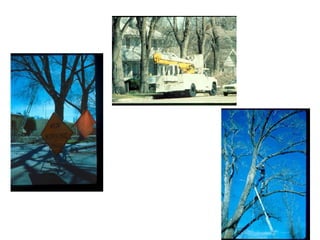
Colorado Master Gardener Training Pruning Mature Shade Trees
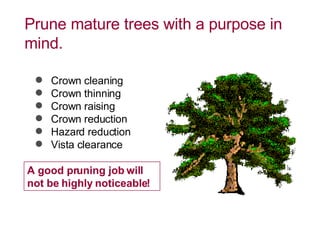
Prune mature trees with a purpose in mind. Crown cleaning Crown thinning Crown raising Crown reduction Hazard reduction  Vista clearance A good pruning job will not be highly noticeable!
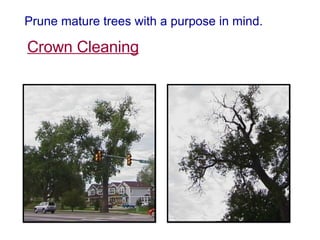
Prune mature trees with a purpose in mind. Crown Cleaning
 
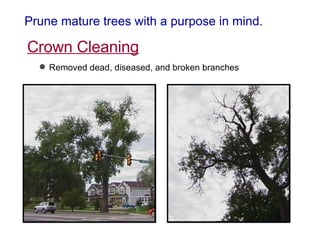
Prune mature trees with a purpose in mind. Crown Cleaning Removed dead, diseased, and broken branches
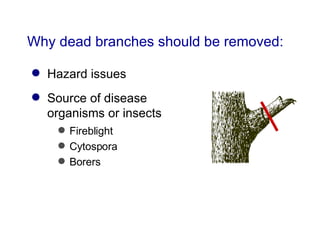
Why dead branches should be removed: Hazard issues  Source of disease organisms or insects Fireblight Cytospora Borers
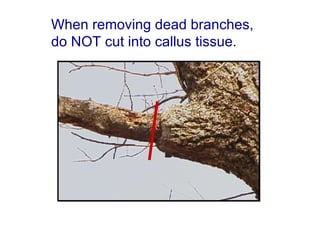
When removing dead branches, do NOT cut into callus tissue.
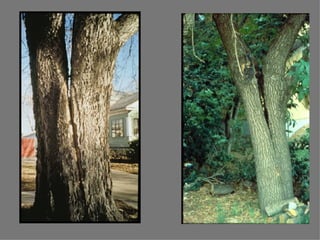
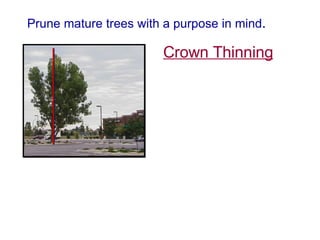
Prune mature trees with a purpose in mind . Crown Thinning
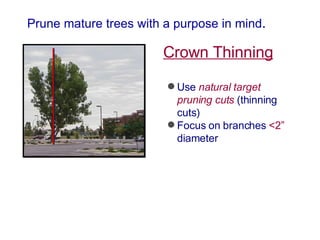
Prune mature trees with a purpose in mind . Crown Thinning Use  natural target pruning cuts  (thinning cuts) Focus on branches  <2”  diameter
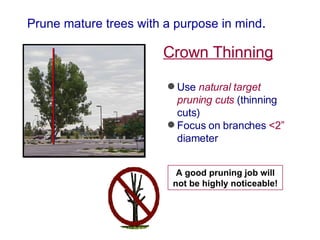
Prune mature trees with a purpose in mind . Crown Thinning Use  natural target pruning cuts  (thinning cuts) Focus on branches  <2”  diameter   A good pruning job will not be highly noticeable!
Prune mature trees with a purpose in mind. Crown Raising
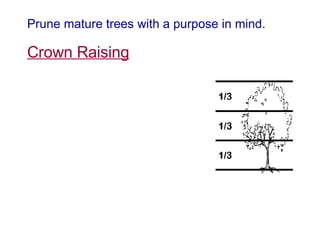
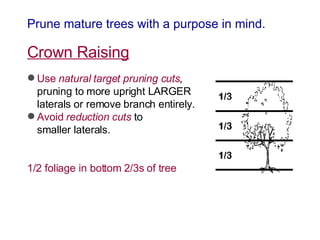
Prune mature trees with a purpose in mind. Crown Raising Use  natural target pruning cuts ,  pruning to more upright LARGER laterals or remove branch entirely.  Avoid  reduction cuts  to  smaller laterals. 1/2 foliage in bottom 2/3s of tree
Prune large trees with a purpose in mind. Crown Reduction
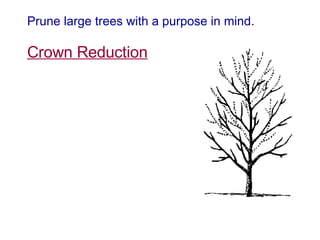
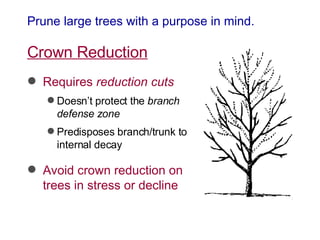
Prune large trees with a purpose in mind. Crown Reduction Requires  reduction cuts Doesn’t protect the  branch defense zone Predisposes branch/trunk to internal decay Avoid crown reduction on trees in stress or decline
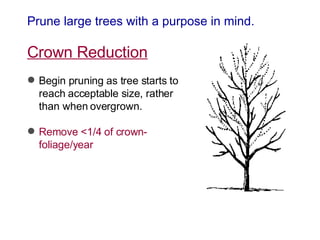
Prune large trees with a purpose in mind. Crown Reduction Begin pruning as tree starts to reach acceptable size, rather than when overgrown. Remove <1/4 of crown-foliage/year
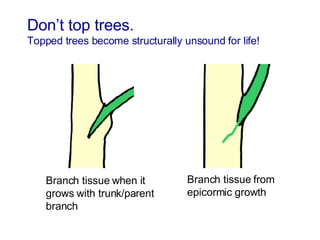
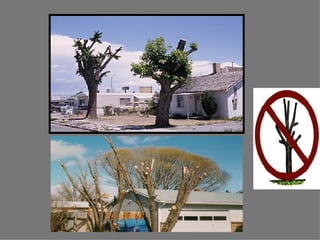
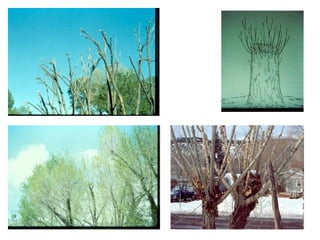
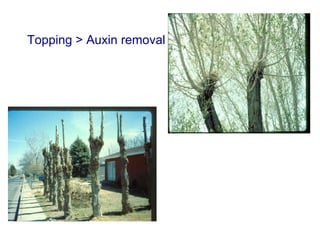
Don’t top trees. Topped trees become structurally unsound for life! Branch tissue when it grows with trunk/parent branch Branch tissue from epicormic growth
 
 
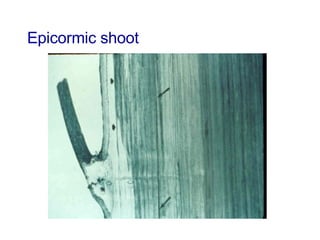
Epicormic shoot
Topping > Auxin removal
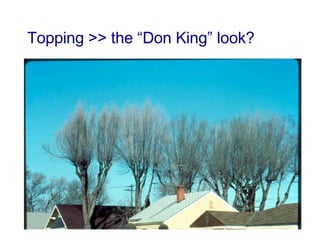
Topping >> the “Don King” look?
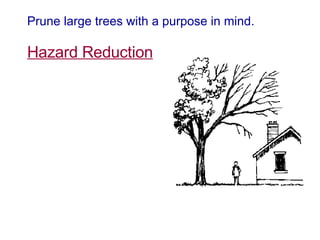
Prune large trees with a purpose in mind. Hazard Reduction
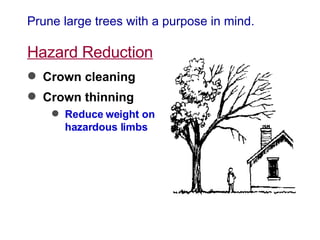
Prune large trees with a purpose in mind. Hazard Reduction Crown cleaning Crown thinning Reduce weight on  hazardous limbs
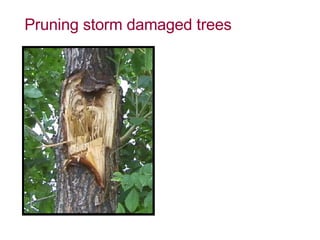
Pruning storm damaged trees
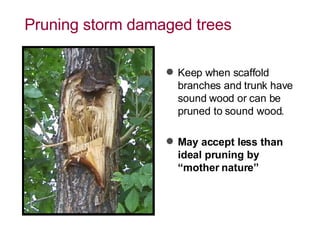
Pruning storm damaged trees Keep when scaffold branches and trunk have sound wood or can be pruned to sound wood. May accept less than ideal pruning by “mother nature”
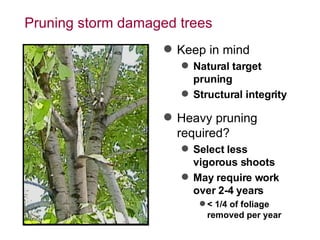
Pruning storm damaged trees Keep in mind Natural target pruning Structural integrity Heavy pruning required? Select less vigorous shoots May require work over 2-4 years < 1/4 of foliage removed per year
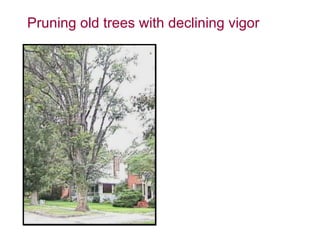
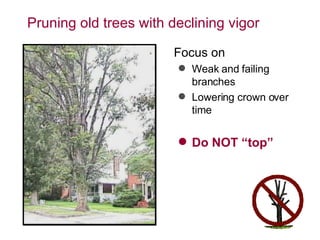
Pruning old trees with declining vigor
Pruning old trees with declining vigor Focus on Weak and failing branches Lowering crown over time Do NOT “top”
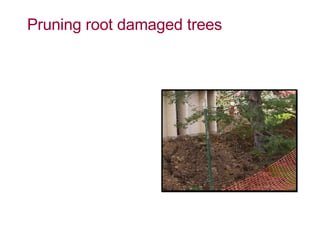
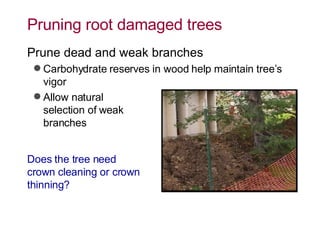
Pruning root damaged trees
Pruning root damaged trees Prune dead and weak branches Carbohydrate reserves in wood help maintain tree’s vigor Allow natural  selection of weak  branches Does the tree need  crown cleaning or crown thinning?
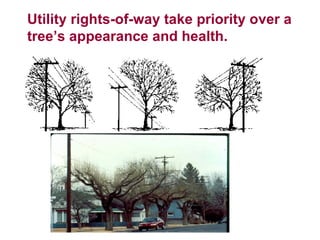
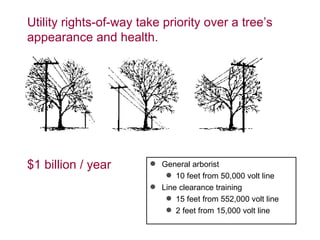
Utility rights-of-way take priority over a tree’s appearance and health.
Utility rights-of-way take priority over a tree’s appearance and health. $1 billion / year General arborist  10 feet from 50,000 volt line Line clearance training 15 feet from 552,000 volt line 2 feet from 15,000 volt line
 
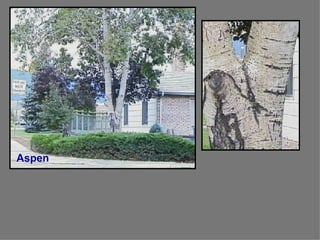
Aspen
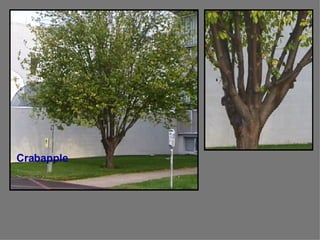
Crabapple
 
 
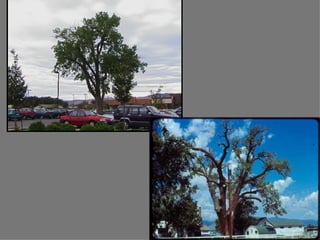
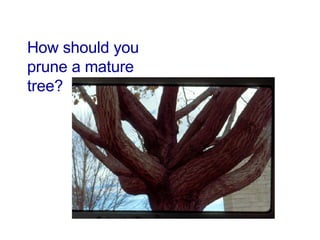
How should you prune a mature tree?
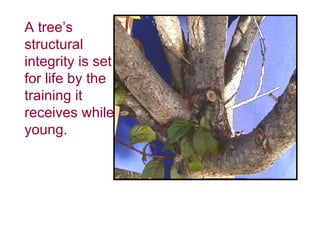
A tree’s structural integrity is set for life by the training it receives while young.
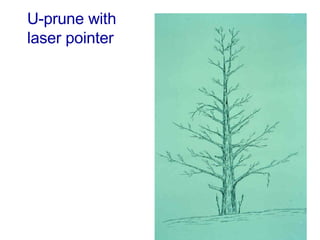
U-prune with  laser pointer
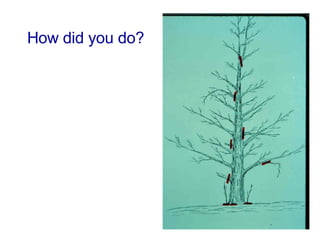
How did you do?
 

8a Pruning Mature Shade Trees

  • 1.
    Colorado Master GardenerTraining Pruning Mature Shade Trees
  • 2.
    Prune mature treeswith a purpose in mind. Crown cleaning Crown thinning Crown raising Crown reduction Hazard reduction Vista clearance A good pruning job will not be highly noticeable!
  • 3.
    Prune mature treeswith a purpose in mind. Crown Cleaning
  • 4.
  • 5.
    Prune mature treeswith a purpose in mind. Crown Cleaning Removed dead, diseased, and broken branches
  • 6.
    Why dead branchesshould be removed: Hazard issues Source of disease organisms or insects Fireblight Cytospora Borers
  • 7.
    When removing deadbranches, do NOT cut into callus tissue.
  • 8.
    Prune mature treeswith a purpose in mind . Crown Thinning
  • 9.
    Prune mature treeswith a purpose in mind . Crown Thinning Use natural target pruning cuts (thinning cuts) Focus on branches <2” diameter
  • 10.
    Prune mature treeswith a purpose in mind . Crown Thinning Use natural target pruning cuts (thinning cuts) Focus on branches <2” diameter A good pruning job will not be highly noticeable!
  • 11.
    Prune mature treeswith a purpose in mind. Crown Raising
  • 12.
    Prune mature treeswith a purpose in mind. Crown Raising Use natural target pruning cuts , pruning to more upright LARGER laterals or remove branch entirely. Avoid reduction cuts to smaller laterals. 1/2 foliage in bottom 2/3s of tree
  • 13.
    Prune large treeswith a purpose in mind. Crown Reduction
  • 14.
    Prune large treeswith a purpose in mind. Crown Reduction Requires reduction cuts Doesn’t protect the branch defense zone Predisposes branch/trunk to internal decay Avoid crown reduction on trees in stress or decline
  • 15.
    Prune large treeswith a purpose in mind. Crown Reduction Begin pruning as tree starts to reach acceptable size, rather than when overgrown. Remove <1/4 of crown-foliage/year
  • 16.
    Don’t top trees.Topped trees become structurally unsound for life! Branch tissue when it grows with trunk/parent branch Branch tissue from epicormic growth
  • 17.
  • 18.
  • 19.
  • 20.
  • 21.
    Topping >> the“Don King” look?
  • 22.
    Prune large treeswith a purpose in mind. Hazard Reduction
  • 23.
    Prune large treeswith a purpose in mind. Hazard Reduction Crown cleaning Crown thinning Reduce weight on hazardous limbs
  • 24.
  • 25.
    Pruning storm damagedtrees Keep when scaffold branches and trunk have sound wood or can be pruned to sound wood. May accept less than ideal pruning by “mother nature”
  • 26.
    Pruning storm damagedtrees Keep in mind Natural target pruning Structural integrity Heavy pruning required? Select less vigorous shoots May require work over 2-4 years < 1/4 of foliage removed per year
  • 27.
    Pruning old treeswith declining vigor
  • 28.
    Pruning old treeswith declining vigor Focus on Weak and failing branches Lowering crown over time Do NOT “top”
  • 29.
  • 30.
    Pruning root damagedtrees Prune dead and weak branches Carbohydrate reserves in wood help maintain tree’s vigor Allow natural selection of weak branches Does the tree need crown cleaning or crown thinning?
  • 31.
    Utility rights-of-way takepriority over a tree’s appearance and health.
  • 32.
    Utility rights-of-way takepriority over a tree’s appearance and health. $1 billion / year General arborist 10 feet from 50,000 volt line Line clearance training 15 feet from 552,000 volt line 2 feet from 15,000 volt line
  • 33.
  • 34.
  • 35.
  • 36.
  • 37.
  • 38.
    How should youprune a mature tree?
  • 39.
    A tree’s structuralintegrity is set for life by the training it receives while young.
  • 40.
    U-prune with laser pointer
  • 41.
  • 42.