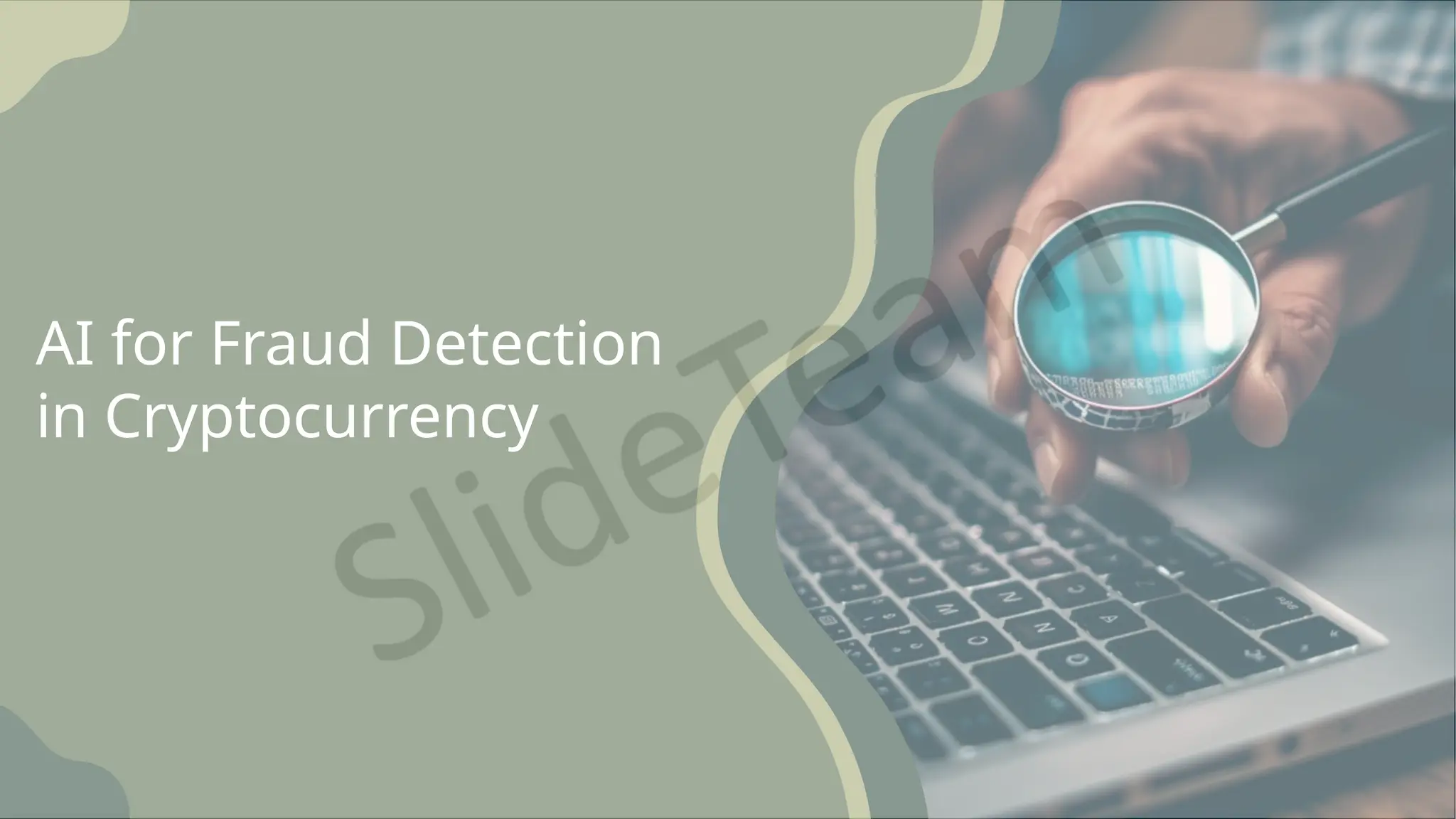
AI for Fraud Detection
in Cryptocurrency
AI for Fraud Detection in Cryptocurrency Introduction
01 Transaction Monitoring
Utilizing machine learning algorithms to analyze
transaction patterns in real-time, enabling early
detection of suspicious activities such as money
laundering and fraud.
02 Anomaly Detection
Implementing AI-driven systems to identify irregularities
in trading behaviors, helping to flag potential fraudulent
activity and protect users from scams.
Understanding Cryptocurrency Fraud Mechanics
01 Fraud Patterns
Analyze transaction data to
spot unusual activity trends.
02 Data Anomalies
Identify anomalies using AI to
flag suspicious transactions.
03 Behavioral Analysis
Evaluate user behavior to
detect potential fraud
indicators.
04 Risk Scoring
Implement risk scoring models
to prioritize transaction
reviews.
05 Real-time Monitoring
Utilize AI for continuous
surveillance of
cryptocurrency transactions.
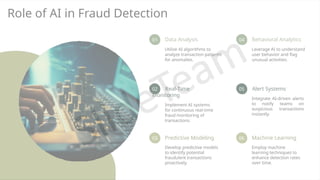
Role of AI in Fraud Detection
01 Data Analysis
Utilize AI algorithms to
analyze transaction patterns
for anomalies.
02 Real-Time
Monitoring
Implement AI systems
for continuous real-time
fraud monitoring of
transactions.
03 Predictive Modeling
Develop predictive models
to identify potential
fraudulent transactions
proactively.
04 Behavioral Analytics
Leverage AI to understand
user behavior and flag
unusual activities.
05 Alert Systems
Integrate AI-driven alerts
to notify teams on
suspicious transactions
instantly.
06 Machine Learning
Employ machine
learning techniques to
enhance detection rates
over time.
Data Sources for Cryptocurrency Analysis
Source Type Description Example Tools Usage
Blockchain Data On-chain transactions Record of all transactions Blockchain explorers Analyze transaction patterns
Market Data Price, volume trends Market movements Cryptocurrency exchanges Monitor price fluctuations
User Behavior User activity metrics Behavioral analysis Analytics platforms Identify abnormal behaviors
Social Media Sentiment Public sentiment Influence on price Social media APIs Gauge market trends
AI Algorithms for Fraud Detection
01 Anomaly Detection
Utilize machine learning models to identify unusual
transaction patterns indicating potential fraud.
02 Neural Networks
Implement deep learning algorithms to analyze
complex transactions and detect fraudulent
behavior effectively.
03 Predictive Analytics
Leverage historical data to predict and mitigate potential
fraud scenarios in cryptocurrency trading.
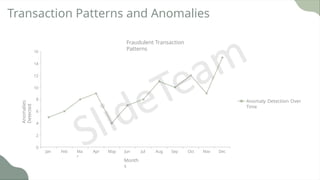
Transaction Patterns and Anomalies
Jan Feb Ma
r
Apr May Jun Jul Aug Sep Oct Nov Dec
6
4
2
0
8
16
14
12
10
Fraudulent Transaction
Patterns
Anomaly Detection Over
Time
Month
s
Anomalies
Detected
Machine Learning Techniques for Detection
Implement supervised learning algorithms like
Random Forest and Support Vector Machines to
analyze transaction patterns, identifying
anomalies indicative of fraud in cryptocurrency
exchanges.
Leverage historical transaction data for
training models to enhance accuracy in real-
time fraud detection.
Deep Learning Applications in Cryptocurrency
01 Anomaly Detection
Utilizing deep learning models to analyze transaction
patterns, identifying unusual behavior indicative of
fraudulent activities in cryptocurrency exchanges.
02 Transaction Classification
Employing neural networks to classify transactions as legitimate
or fraudulent, improving the accuracy of fraud detection
systems within blockchain networks.
Natural Language Processing in Fraud Detection
01 Text Analysis
Analyze
cryptocurrency-
related text to identify
suspicious patterns.
02 Sentiment
Analysis
Assess social media
sentiment toward
cryptocurrencies for
risk evaluation.
04 User Feedback
Gather user reports
and complaints to
uncover potential
fraud.
05
Automate
d
Monitorin
g
Implement real-
time monitoring of
news articles for
fraud detection.
03 Anomaly Detection 06 Risk Scoring 07 Fraud Alerts 08 Data Enrichment
Detect unusual
transaction behaviors
using NLP techniques.
Utilize NLP to generate
risk scores from
transaction texts.
Send alerts based on
detected negative
keywords in discussions.
Combine transaction data
with external text sources
for improved insights.
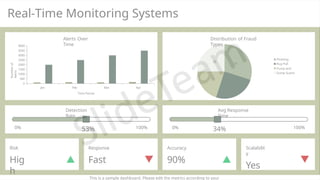
Real-Time Monitoring Systems
Risk
Hig
h
Response
Fast
Accuracy
90%
Scalabilit
y
Yes
Detection
Rate
0% 100%
53%
Avg Response
Time
0% 100%
34%
30
25
20
25
Distribution of Fraud
Types
Phishing
Rug Pull
Pump and
Dump Scams
Jan Feb Mar Apr
4000
3500
3000
2500
2000
1500
1000
500
0
Alerts Over
Time
Time Period
Number
of
Alerts
This is a sample dashboard. Please edit the metrics according to your
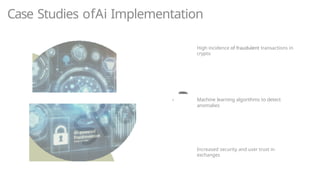
Case Studies ofAi Implementation
High incidence of fraudulent transactions in
crypto
› Machine learning algorithms to detect
anomalies
Increased security and user trust in
exchanges
Regulatory Compliance and Standards
01 Regulatory
Adhere to local and
international
cryptocurrency
regulations.
02 KYC Procedures
Implement Know Your
Customer protocols for
all transactions.
03 AML Practices
Establish Anti-Money
Laundering practices to
monitor activities.
04 Data Security
Ensure robust data
security measures to
protect user information.
05 Reporting Obligations
Meet all required financial
reporting obligations
regularly.
06 Audit Trails
Maintain detailed audit trails
for compliance verification.
07 Risk Management
Develop comprehensive
risk management
frameworks for fraud
detection.
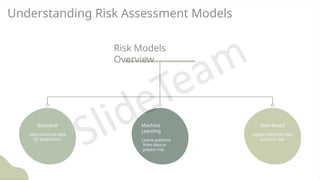
Understanding Risk Assessment Models
Risk Models
Overview
Statistical
Uses historical data
for predictions.
Machine
Learning
Learns patterns
from data to
predict risk.
Rule-Based
Applies defined rules
to assess risk.
Common Fraud Techniques in the Market
01 Pump-and-Dump
Manipulating asset prices through false information and
hype.
02 Phishing Attacks
Deceptive emails or messages to steal credentials and
funds.
03 Rug Pulls
Developers abandon a project taking investors' funds
unexpectedly.
04 Fake Exchanges
Fraudulent platforms that steal funds masquerading as
legitimate.
Best Practices for Implementing AI Solutions
Data Quality
Ensure high-quality and
relevant data is collected
for training AI models
effectively.
Regular Updates
Implement a routine for
regularly updating models
to adapt to new fraud
patterns.
Model Transparency
Maintain transparency in
AI algorithms to build
trust among stakeholders
using clear
documentation.
Compliance Checks
Regularly review AI
systems for compliance
with current regulations
and industry standards.
User Training
Provide comprehensive
training for users to
understand and
effectively interact with
AI systems.
Challenges in AI Integration
01 Data Quality
Ensuring high-quality and representative data for
effective AI model training and accuracy.
02 Regulatory Compliance
Navigating complex regulations while implementing AI
solutions for fraud detection in cryptocurrency.
03 Scalability Issues
Handling the increasing volume of transactions
without compromising performance of AI systems.
Future Trends in AI for Fraud Detection
01 Enhanced Algorithms
Utilizing advanced machine learning algorithms for real-time
analysis.
02 Blockchain Integration
Integrating fraud detection systems directly with blockchain
technology.
03 Predictive Analytics
Implementing predictive analytics for proactive fraud risk
assessment.
04 Automated Alerts
Establishing automated alerts for suspicious transaction
patterns.
Ethical Considerations in AI Use
01 Data Privacy
Ensure that user data is anonymized and protected, implementing
strong encryption methods to avoid unauthorized access and
maintain user trust in AI applications.
02 Bias Mitigation
Continuously monitor and retrain AI models to identify and
eliminate biases in training data, ensuring fair and equitable
outcomes in fraud detection processes.
Impact of Blockchain Technology
01 Transparency
Blockchain enables
transparent transaction
records for all participants.
02 Security
Enhanced security through
cryptography and
decentralized network
structure.
03 Traceability
Allows traceability of assets
and transactions to prevent
fraud.
04 Efficiency
Reduces transaction times
and costs through
automated processes.
05 Decentralization
Minimizes reliance on
central authorities,
increasing accessibility.
User Behavior Analysis and Profiling
01 Data Mining
Utilize large datasets to
uncover hidden patterns and
trends.
02 Anomaly Detection
Implement algorithms to
identify deviations from
normal user behavior.
03 User Segmentation
Group users based on
behavior for targeted fraud
prevention strategies.
04 Real-Time Monitoring
Continuously track user
activities for immediate fraud
alerts.
05 Machine Learning
Apply supervised learning
models to improve
detection accuracy over
time.
Predictive Analytics for Fraud Prevention
01 Data Analysis
Utilize historical transaction data to identify patterns
indicative of potential fraud risk scenarios.
02 Machine Learning
Implement algorithms that can learn from new data and
improve detection of unusual cryptocurrency activity over
time.
03 Real-Time Monitoring
Establish systems that evaluate transactions in real-
time to quickly flag and block suspicious activities.
Enhancing Security Protocols with AI
01 Real-time Monitoring
Utilize AI algorithms to
monitor transactions in
real- time.
02 Anomaly Detection
Implement machine
learning to identify
unusual transaction
patterns.
04 Risk Scoring
Assign risk scores to
transactions based on
historical data
analysis.
05
User
Behavior
Analysis
Track user behavior to
detect deviations for
fraud prevention.
03 Adaptive Learning 06 Automated Alerts 07 Data Encryption 08 Regulatory
Compliance
Enable systems to adapt
and evolve with emerging
fraud tactics.
Set up automated alerts
for suspicious activities
flagged by AI.
Leverage AI to enhance
encryption protocols for
data integrity.
Ensure AI systems are
compliant with local
financial regulations.
Building Cross-Industry Collaborations
John
Data
Analyst
Sarah
Technical Lead
Mike
Fraud
Specialist
Emma
Compliance
Officer
Tom
Software
Engineer
Lily
Research
Analyst
Jake
Project
Manager
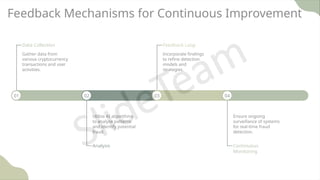
Feedback Mechanisms for Continuous Improvement
01
Data Collection
Gather data from
various cryptocurrency
transactions and user
activities.
02
Analysis
Utilize AI algorithms
to analyze patterns
and identify potential
fraud.
03
Feedback Loop
Incorporate findings
to refine detection
models and
strategies.
04
Continuous
Monitoring
Ensure ongoing
surveillance of systems
for real-time fraud
detection.
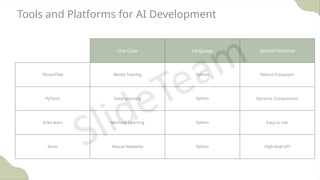
Tools and Platforms for AI Development
Use Case Language Special Features
TensorFlow Model Training Python Robust Ecosystem
PyTorch Deep Learning Python Dynamic Computation
Scikit-learn Machine Learning Python Easy to Use
Keras Neural Networks Python High-level API
Scalability of AI Solutions
01 Data Processing
Implement real-time data
processing algorithms to
enhance fraud detection.
02 Model Expansion
Scale AI models to include
diverse cryptocurrency
transaction data sets.
03 Infrastructure
Upgrade
Upgrade servers to
manage increased load
and improve response
times.
04 Automated Learning
Incorporate machine learning
for continuous adaptability to
new fraud patterns.
05 Cloud Integration
Utilize cloud technologies
to improve accessibility
and resource allocation.
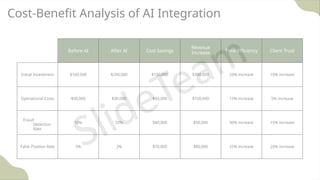
Cost-Benefit Analysis of AI Integration
Before AI After AI Cost Savings
Revenue
Increase Time Efficiency Client Trust
Initial Investment $100,000 $200,000 $150,000 $300,000 20% increase 10% increase
Operational Costs $50,000 $30,000 $60,000 $100,000 15% increase 5% increase
Fraud
Detection
Rate
10% 25% $40,000 $50,000 30% increase 15% increase
False Positive Rate 5% 2% $70,000 $80,000 25% increase 20% increase
Building an Interdisciplinary
Team
John
Data
Analyst
Sara
AI Researcher
Emily
Blockchain
Expert
Michael
Cybersecurity
Specialist
Sophia
Legal
Advisor
Understanding Market Geographies
This is a sample way to show your message. Please edit and move the pins above according to your
01
Increased regulatory
developments
affecting trading
02 Your Text Here
03 Your Text
Here
04 Your Text
Here
05 Your Text Here
01
02
03
04
05
User Education and Awareness Programs
Know Fraud
Understand the different
types of cryptocurrency
fraud schemes.
Stay Updated
Regularly read news on
cryptocurrency fraud
trends and prevention.
Use Tools
Leverage AI tools for
enhanced fraud detection
and reporting.
Verify Sources
Always check the legitimacy
of any investment
opportunity presented.
Educate Others
Share knowledge
about cryptocurrency
risks with friends and
family.
Recognize Patterns
Learn to identify
suspicious patterns in
transactions effectively.
Report Fraud
Immediately report
any suspected
fraudulent activities
to authorities.
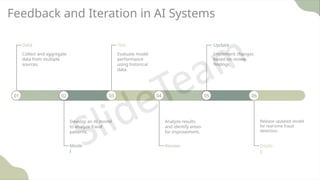
Feedback and Iteration in AI Systems
01
Data
Collect and aggregate
data from multiple
sources.
02
Mode
l
Develop an AI model
to analyze fraud
patterns.
03
Test
Evaluate model
performance
using historical
data.
04
Review
Analyze results
and identify areas
for improvement.
05
Update
Implement changes
based on review
findings.
06
Deplo
y
Release updated model
for real-time fraud
detection.
Global Perspectives on Cryptocurrency Fraud
This is a sample way to show your message. Please edit and move the pins above according to your
01
High occurrence in
online platforms
observed
02
Significant rise in
digital currency scams
noted
03
Increased phishing
attacks on wallets
reported
04
Fraudulent transactions
within exchanges
detected
05
Risky investment
schemes targeting users
found
01
02
03
04
05
Final Thoughts and Conclusion
Utilizing AI significantly boosts
security measures in detecting
fraud.
Machine learning algorithms
can identify complex patterns
in cryptocurrency
transactions.
AI systems can easily scale to
handle growing transaction
volumes in the cryptocurrency
space.
AI enables real-time
monitoring of transactions for
immediate fraud detection.
AI helps reduce false
positives, improving the
accuracy of fraud detection
systems.
Continuous advancements in AI
will further enhance fraud
detection capabilities.
Address
123 Crypto St, Blockchain City,
CA
Email Address
contact@cryptofraudai.co
m
Contact
Number
(555) 123-4567
Thank
You
Instructions to Change Color of
Shapes
Some shapes in this deck need to be ungrouped
to change colors
Step 1:
Select the shape,
and right click on
it
Step 2:
Select Group -
> Ungroup.
Step 3:
Once ungrouped,
you will be able
to change colors
using the “Format
Shape” option

6808a6311af19275b5032be9.pptx.pptx for d

  • 1.
    AI for FraudDetection in Cryptocurrency
  • 2.
    AI for FraudDetection in Cryptocurrency Introduction 01 Transaction Monitoring Utilizing machine learning algorithms to analyze transaction patterns in real-time, enabling early detection of suspicious activities such as money laundering and fraud. 02 Anomaly Detection Implementing AI-driven systems to identify irregularities in trading behaviors, helping to flag potential fraudulent activity and protect users from scams.
  • 3.
    Understanding Cryptocurrency FraudMechanics 01 Fraud Patterns Analyze transaction data to spot unusual activity trends. 02 Data Anomalies Identify anomalies using AI to flag suspicious transactions. 03 Behavioral Analysis Evaluate user behavior to detect potential fraud indicators. 04 Risk Scoring Implement risk scoring models to prioritize transaction reviews. 05 Real-time Monitoring Utilize AI for continuous surveillance of cryptocurrency transactions.
  • 4.
    Role of AIin Fraud Detection 01 Data Analysis Utilize AI algorithms to analyze transaction patterns for anomalies. 02 Real-Time Monitoring Implement AI systems for continuous real-time fraud monitoring of transactions. 03 Predictive Modeling Develop predictive models to identify potential fraudulent transactions proactively. 04 Behavioral Analytics Leverage AI to understand user behavior and flag unusual activities. 05 Alert Systems Integrate AI-driven alerts to notify teams on suspicious transactions instantly. 06 Machine Learning Employ machine learning techniques to enhance detection rates over time.
  • 5.
    Data Sources forCryptocurrency Analysis Source Type Description Example Tools Usage Blockchain Data On-chain transactions Record of all transactions Blockchain explorers Analyze transaction patterns Market Data Price, volume trends Market movements Cryptocurrency exchanges Monitor price fluctuations User Behavior User activity metrics Behavioral analysis Analytics platforms Identify abnormal behaviors Social Media Sentiment Public sentiment Influence on price Social media APIs Gauge market trends


  • 6.
    AI Algorithms forFraud Detection 01 Anomaly Detection Utilize machine learning models to identify unusual transaction patterns indicating potential fraud. 02 Neural Networks Implement deep learning algorithms to analyze complex transactions and detect fraudulent behavior effectively. 03 Predictive Analytics Leverage historical data to predict and mitigate potential fraud scenarios in cryptocurrency trading.

  • 7.
    Transaction Patterns andAnomalies Jan Feb Ma r Apr May Jun Jul Aug Sep Oct Nov Dec 6 4 2 0 8 16 14 12 10 Fraudulent Transaction Patterns Anomaly Detection Over Time Month s Anomalies Detected
  • 8.
    Machine Learning Techniquesfor Detection Implement supervised learning algorithms like Random Forest and Support Vector Machines to analyze transaction patterns, identifying anomalies indicative of fraud in cryptocurrency exchanges. Leverage historical transaction data for training models to enhance accuracy in real- time fraud detection.
  • 9.
    Deep Learning Applicationsin Cryptocurrency 01 Anomaly Detection Utilizing deep learning models to analyze transaction patterns, identifying unusual behavior indicative of fraudulent activities in cryptocurrency exchanges. 02 Transaction Classification Employing neural networks to classify transactions as legitimate or fraudulent, improving the accuracy of fraud detection systems within blockchain networks.
  • 10.
    Natural Language Processingin Fraud Detection 01 Text Analysis Analyze cryptocurrency- related text to identify suspicious patterns. 02 Sentiment Analysis Assess social media sentiment toward cryptocurrencies for risk evaluation. 04 User Feedback Gather user reports and complaints to uncover potential fraud. 05 Automate d Monitorin g Implement real- time monitoring of news articles for fraud detection. 03 Anomaly Detection 06 Risk Scoring 07 Fraud Alerts 08 Data Enrichment Detect unusual transaction behaviors using NLP techniques. Utilize NLP to generate risk scores from transaction texts. Send alerts based on detected negative keywords in discussions. Combine transaction data with external text sources for improved insights.
  • 11.
    Real-Time Monitoring Systems Risk Hig h Response Fast Accuracy 90% Scalabilit y Yes Detection Rate 0%100% 53% Avg Response Time 0% 100% 34% 30 25 20 25 Distribution of Fraud Types Phishing Rug Pull Pump and Dump Scams Jan Feb Mar Apr 4000 3500 3000 2500 2000 1500 1000 500 0 Alerts Over Time Time Period Number of Alerts This is a sample dashboard. Please edit the metrics according to your
  • 12.
    Case Studies ofAiImplementation High incidence of fraudulent transactions in crypto › Machine learning algorithms to detect anomalies Increased security and user trust in exchanges
  • 13.
    Regulatory Compliance andStandards 01 Regulatory Adhere to local and international cryptocurrency regulations. 02 KYC Procedures Implement Know Your Customer protocols for all transactions. 03 AML Practices Establish Anti-Money Laundering practices to monitor activities. 04 Data Security Ensure robust data security measures to protect user information. 05 Reporting Obligations Meet all required financial reporting obligations regularly. 06 Audit Trails Maintain detailed audit trails for compliance verification. 07 Risk Management Develop comprehensive risk management frameworks for fraud detection.
  • 14.
    Understanding Risk AssessmentModels Risk Models Overview Statistical Uses historical data for predictions. Machine Learning Learns patterns from data to predict risk. Rule-Based Applies defined rules to assess risk.
  • 15.
    Common Fraud Techniquesin the Market 01 Pump-and-Dump Manipulating asset prices through false information and hype. 02 Phishing Attacks Deceptive emails or messages to steal credentials and funds. 03 Rug Pulls Developers abandon a project taking investors' funds unexpectedly. 04 Fake Exchanges Fraudulent platforms that steal funds masquerading as legitimate.
  • 16.
    Best Practices forImplementing AI Solutions Data Quality Ensure high-quality and relevant data is collected for training AI models effectively. Regular Updates Implement a routine for regularly updating models to adapt to new fraud patterns. Model Transparency Maintain transparency in AI algorithms to build trust among stakeholders using clear documentation. Compliance Checks Regularly review AI systems for compliance with current regulations and industry standards. User Training Provide comprehensive training for users to understand and effectively interact with AI systems.
  • 17.
    Challenges in AIIntegration 01 Data Quality Ensuring high-quality and representative data for effective AI model training and accuracy. 02 Regulatory Compliance Navigating complex regulations while implementing AI solutions for fraud detection in cryptocurrency. 03 Scalability Issues Handling the increasing volume of transactions without compromising performance of AI systems.
  • 18.
    Future Trends inAI for Fraud Detection 01 Enhanced Algorithms Utilizing advanced machine learning algorithms for real-time analysis. 02 Blockchain Integration Integrating fraud detection systems directly with blockchain technology. 03 Predictive Analytics Implementing predictive analytics for proactive fraud risk assessment. 04 Automated Alerts Establishing automated alerts for suspicious transaction patterns.
  • 19.
    Ethical Considerations inAI Use 01 Data Privacy Ensure that user data is anonymized and protected, implementing strong encryption methods to avoid unauthorized access and maintain user trust in AI applications. 02 Bias Mitigation Continuously monitor and retrain AI models to identify and eliminate biases in training data, ensuring fair and equitable outcomes in fraud detection processes.
  • 20.
    Impact of BlockchainTechnology 01 Transparency Blockchain enables transparent transaction records for all participants. 02 Security Enhanced security through cryptography and decentralized network structure. 03 Traceability Allows traceability of assets and transactions to prevent fraud. 04 Efficiency Reduces transaction times and costs through automated processes. 05 Decentralization Minimizes reliance on central authorities, increasing accessibility.
  • 21.
    User Behavior Analysisand Profiling 01 Data Mining Utilize large datasets to uncover hidden patterns and trends. 02 Anomaly Detection Implement algorithms to identify deviations from normal user behavior. 03 User Segmentation Group users based on behavior for targeted fraud prevention strategies. 04 Real-Time Monitoring Continuously track user activities for immediate fraud alerts. 05 Machine Learning Apply supervised learning models to improve detection accuracy over time.
  • 22.
    Predictive Analytics forFraud Prevention 01 Data Analysis Utilize historical transaction data to identify patterns indicative of potential fraud risk scenarios. 02 Machine Learning Implement algorithms that can learn from new data and improve detection of unusual cryptocurrency activity over time. 03 Real-Time Monitoring Establish systems that evaluate transactions in real- time to quickly flag and block suspicious activities.
  • 23.
    Enhancing Security Protocolswith AI 01 Real-time Monitoring Utilize AI algorithms to monitor transactions in real- time. 02 Anomaly Detection Implement machine learning to identify unusual transaction patterns. 04 Risk Scoring Assign risk scores to transactions based on historical data analysis. 05 User Behavior Analysis Track user behavior to detect deviations for fraud prevention. 03 Adaptive Learning 06 Automated Alerts 07 Data Encryption 08 Regulatory Compliance Enable systems to adapt and evolve with emerging fraud tactics. Set up automated alerts for suspicious activities flagged by AI. Leverage AI to enhance encryption protocols for data integrity. Ensure AI systems are compliant with local financial regulations.
  • 24.
    Building Cross-Industry Collaborations John Data Analyst Sarah TechnicalLead Mike Fraud Specialist Emma Compliance Officer Tom Software Engineer Lily Research Analyst Jake Project Manager
  • 25.
    Feedback Mechanisms forContinuous Improvement 01 Data Collection Gather data from various cryptocurrency transactions and user activities. 02 Analysis Utilize AI algorithms to analyze patterns and identify potential fraud. 03 Feedback Loop Incorporate findings to refine detection models and strategies. 04 Continuous Monitoring Ensure ongoing surveillance of systems for real-time fraud detection.
  • 26.
    Tools and Platformsfor AI Development Use Case Language Special Features TensorFlow Model Training Python Robust Ecosystem PyTorch Deep Learning Python Dynamic Computation Scikit-learn Machine Learning Python Easy to Use Keras Neural Networks Python High-level API
  • 27.
    Scalability of AISolutions 01 Data Processing Implement real-time data processing algorithms to enhance fraud detection. 02 Model Expansion Scale AI models to include diverse cryptocurrency transaction data sets. 03 Infrastructure Upgrade Upgrade servers to manage increased load and improve response times. 04 Automated Learning Incorporate machine learning for continuous adaptability to new fraud patterns. 05 Cloud Integration Utilize cloud technologies to improve accessibility and resource allocation.
  • 28.
    Cost-Benefit Analysis ofAI Integration Before AI After AI Cost Savings Revenue Increase Time Efficiency Client Trust Initial Investment $100,000 $200,000 $150,000 $300,000 20% increase 10% increase Operational Costs $50,000 $30,000 $60,000 $100,000 15% increase 5% increase Fraud Detection Rate 10% 25% $40,000 $50,000 30% increase 15% increase False Positive Rate 5% 2% $70,000 $80,000 25% increase 20% increase
  • 29.
    Building an Interdisciplinary Team John Data Analyst Sara AIResearcher Emily Blockchain Expert Michael Cybersecurity Specialist Sophia Legal Advisor
  • 30.
    Understanding Market Geographies Thisis a sample way to show your message. Please edit and move the pins above according to your 01 Increased regulatory developments affecting trading 02 Your Text Here 03 Your Text Here 04 Your Text Here 05 Your Text Here 01 02 03 04 05
  • 31.
    User Education andAwareness Programs Know Fraud Understand the different types of cryptocurrency fraud schemes. Stay Updated Regularly read news on cryptocurrency fraud trends and prevention. Use Tools Leverage AI tools for enhanced fraud detection and reporting. Verify Sources Always check the legitimacy of any investment opportunity presented. Educate Others Share knowledge about cryptocurrency risks with friends and family. Recognize Patterns Learn to identify suspicious patterns in transactions effectively. Report Fraud Immediately report any suspected fraudulent activities to authorities.
  • 32.
    Feedback and Iterationin AI Systems 01 Data Collect and aggregate data from multiple sources. 02 Mode l Develop an AI model to analyze fraud patterns. 03 Test Evaluate model performance using historical data. 04 Review Analyze results and identify areas for improvement. 05 Update Implement changes based on review findings. 06 Deplo y Release updated model for real-time fraud detection.
  • 33.
    Global Perspectives onCryptocurrency Fraud This is a sample way to show your message. Please edit and move the pins above according to your 01 High occurrence in online platforms observed 02 Significant rise in digital currency scams noted 03 Increased phishing attacks on wallets reported 04 Fraudulent transactions within exchanges detected 05 Risky investment schemes targeting users found 01 02 03 04 05
  • 34.
    Final Thoughts andConclusion Utilizing AI significantly boosts security measures in detecting fraud. Machine learning algorithms can identify complex patterns in cryptocurrency transactions. AI systems can easily scale to handle growing transaction volumes in the cryptocurrency space. AI enables real-time monitoring of transactions for immediate fraud detection. AI helps reduce false positives, improving the accuracy of fraud detection systems. Continuous advancements in AI will further enhance fraud detection capabilities.
  • 35.
    Address 123 Crypto St,Blockchain City, CA Email Address contact@cryptofraudai.co m Contact Number (555) 123-4567 Thank You
  • 36.
    Instructions to ChangeColor of Shapes Some shapes in this deck need to be ungrouped to change colors Step 1: Select the shape, and right click on it Step 2: Select Group - > Ungroup. Step 3: Once ungrouped, you will be able to change colors using the “Format Shape” option