Revenue	
  Cycle	
  Management	
  	
  
Wednesday,	
  June	
  11,	
  2014	
  
Disclaimer:	
  Nothing	
  that	
  we	
  are	
  sharing	
  is	
  intended	
  as	
  legally	
  binding	
  or	
  prescrip7ve	
  advice.	
  This	
  
presenta7on	
  is	
  a	
  synthesis	
  of	
  publically	
  available	
  informa7on	
  and	
  best	
  prac7ces.	
  
In	
  an	
  industry,	
  that’s	
  ever	
  changing,	
  one	
  thing	
  
remains	
  consistent-­‐	
  Delivery	
  of	
  healthcare	
  must	
  
first	
  be	
  viewed	
  as	
  a	
  Business.	
  	
  
If	
  you	
  are	
  not	
  profitable,	
  you	
  can’t	
  keep	
  the	
  
doors	
  open	
  to	
  provide	
  services	
  to	
  your	
  pa@ents	
  
in	
  need.	
  	
  
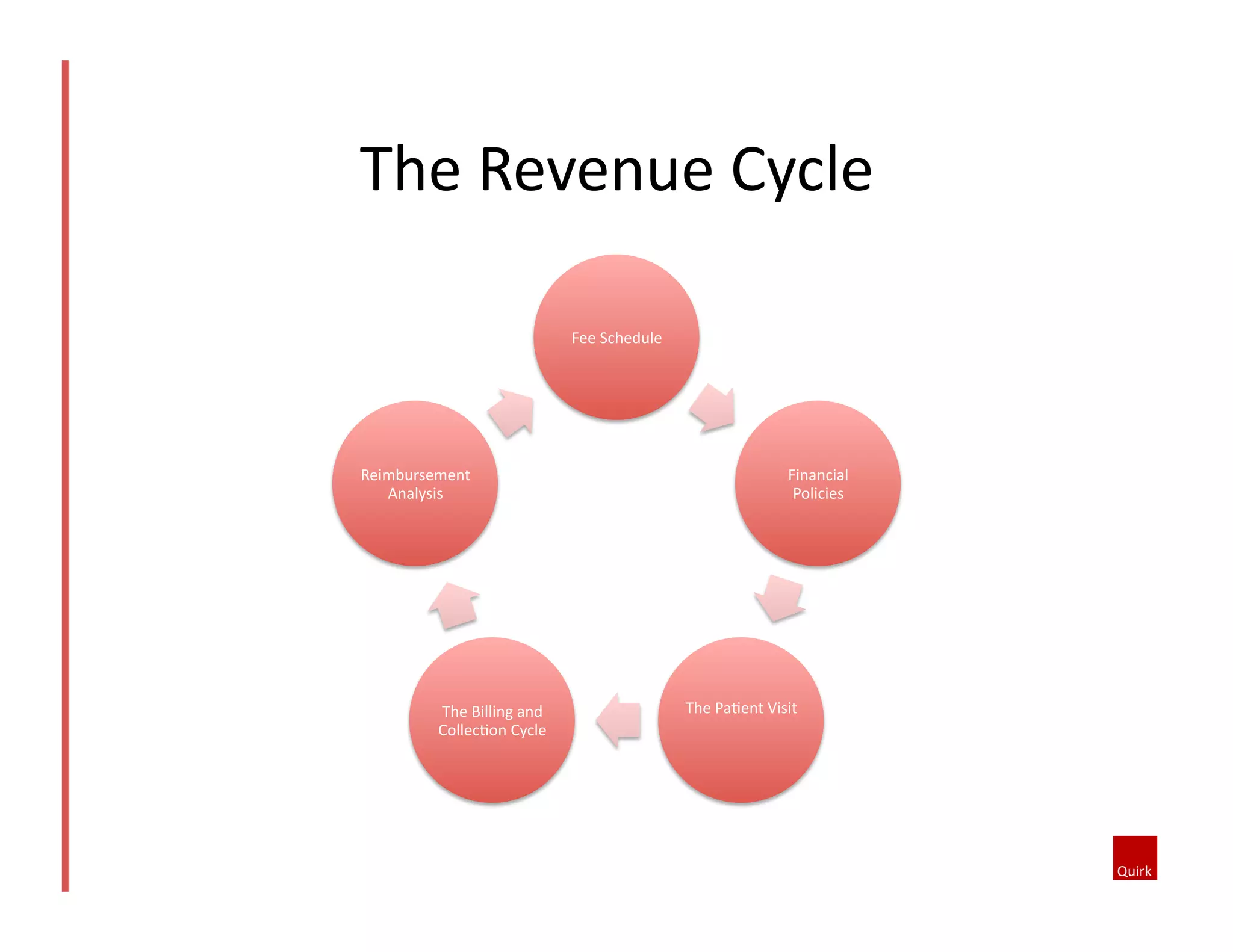
Revenue	
  Cycle	
  Management	
  
Fee	
  Schedule	
  	
  
Financial	
  
Policies	
  	
  
The	
  Pa@ent	
  Visit	
  	
  The	
  Billing	
  and	
  
Collec@on	
  Cycle	
  	
  
Reimbursement	
  
Analysis	
  
The	
  Revenue	
  Cycle	
  
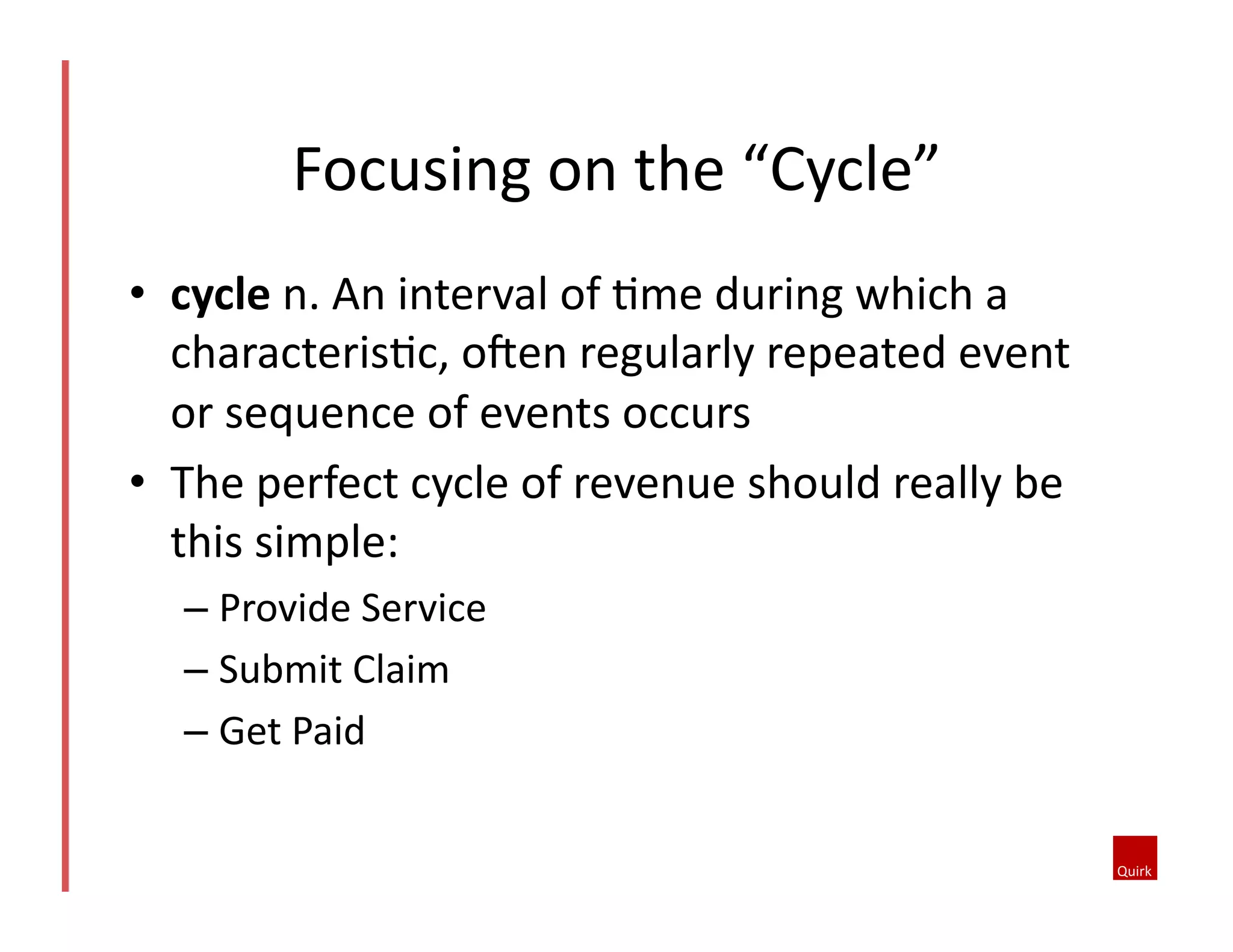
•  cycle	
  n.	
  An	
  interval	
  of	
  @me	
  during	
  which	
  a	
  
characteris@c,	
  oJen	
  regularly	
  repeated	
  event	
  
or	
  sequence	
  of	
  events	
  occurs	
  
•  The	
  perfect	
  cycle	
  of	
  revenue	
  should	
  really	
  be	
  
this	
  simple:	
  
– Provide	
  Service	
  
– Submit	
  Claim	
  	
  
– Get	
  Paid	
  
Focusing	
  on	
  the	
  “Cycle”	
  
How	
  did	
  you	
  arrive	
  at	
  your	
  fee	
  schedule?	
  
–  What	
  does	
  it	
  cost	
  you	
  to	
  provide	
  service?	
  
•  Have	
  you	
  done	
  a	
  cost	
  study?	
  
–  Can	
  you	
  manage	
  this	
  internally?	
  
–  Should	
  you	
  reach	
  out	
  to	
  a	
  consultant?	
  
•  Fees	
  should	
  be	
  built	
  based	
  on	
  what	
  keeps	
  your	
  business	
  running	
  
and	
  profitable,	
  rather	
  than	
  what	
  sounds	
  “reasonable	
  an	
  
customary”.	
  
–  Are	
  you	
  basing	
  it	
  on	
  a	
  percentage	
  of	
  Medicare?	
  	
  
–  Are	
  you	
  basing	
  it	
  on	
  RVU’s?	
  
–  Did	
  you	
  base	
  it	
  on	
  your	
  highest	
  payer?	
  
–  	
  When	
  you	
  nego@ate	
  contracts,	
  you	
  need	
  to	
  know	
  your	
  
cost,	
  to	
  know	
  if	
  the	
  contract	
  makes	
  good	
  business	
  sense.	
  	
  
Fee	
  Schedule	
  	
  
•  UpdaCng	
  your	
  fee	
  schedule	
  
– Maintain	
  your	
  fee	
  schedule	
  
•  Update	
  the	
  fee	
  schedule	
  every	
  3-­‐12	
  months.	
  
– Does	
  your	
  soJware	
  have	
  a	
  place	
  to	
  load	
  RVU’s	
  
•  Does	
  your	
  vendor/consultant	
  offer	
  a	
  u@lity	
  to	
  upload	
  
published	
  RVU’s	
  into	
  your	
  prac@ce	
  management	
  
soJware	
  
– Does	
  your	
  soJware	
  have	
  a	
  place	
  to	
  load	
  costs	
  
•  How	
  are	
  you	
  recovering	
  costs	
  of	
  medical	
  supplies?	
  	
  
•  Are	
  you	
  geYng	
  paid	
  more	
  than	
  your	
  cost	
  on	
  vaccines?	
  
Fee	
  Schedule	
  	
  
–  What	
  is	
  your	
  expecta@on	
  of	
  the	
  pa@ent	
  to	
  fulfill	
  their	
  
financial	
  responsibility?	
  	
  
•  Do	
  you	
  require	
  them	
  to	
  pay	
  their	
  por@on	
  at	
  the	
  @me	
  of	
  service?	
  	
  
–  A	
  survey	
  by	
  the	
  MGMA	
  found	
  that	
  30	
  percent	
  of	
  pa@ents	
  walk	
  out	
  the	
  
door	
  without	
  paying	
  any	
  amount	
  at	
  the	
  @me	
  of	
  service.	
  
•  Request	
  full	
  payment	
  at	
  the	
  @me	
  of	
  service	
  for	
  non-­‐covered	
  and	
  
elec@ve	
  services.	
  	
  
•  If	
  the	
  pa@ent	
  is	
  unable	
  to	
  pay	
  in	
  full,	
  what	
  Is	
  the	
  minimum	
  amount	
  
accepted?	
  	
  
•  Do	
  you	
  offer	
  payment	
  plans?	
  
•  Do	
  you	
  offer	
  discounts	
  for	
  payment	
  at	
  the	
  @me	
  of	
  service?	
  
–  Is	
  your	
  expecta@on	
  defined	
  in	
  wri@ng?	
  	
  
•  Is	
  it	
  posted	
  on	
  your	
  website	
  
•  Do	
  you	
  communicate	
  it	
  on	
  your	
  pa@ent	
  portal	
  
•  Is	
  it	
  included	
  it	
  in	
  new	
  pa@ent	
  packet	
  
•  Is	
  there	
  signage	
  at	
  the	
  check-­‐in	
  and	
  check-­‐out	
  areas.	
  	
  
Financial	
  Policies	
  
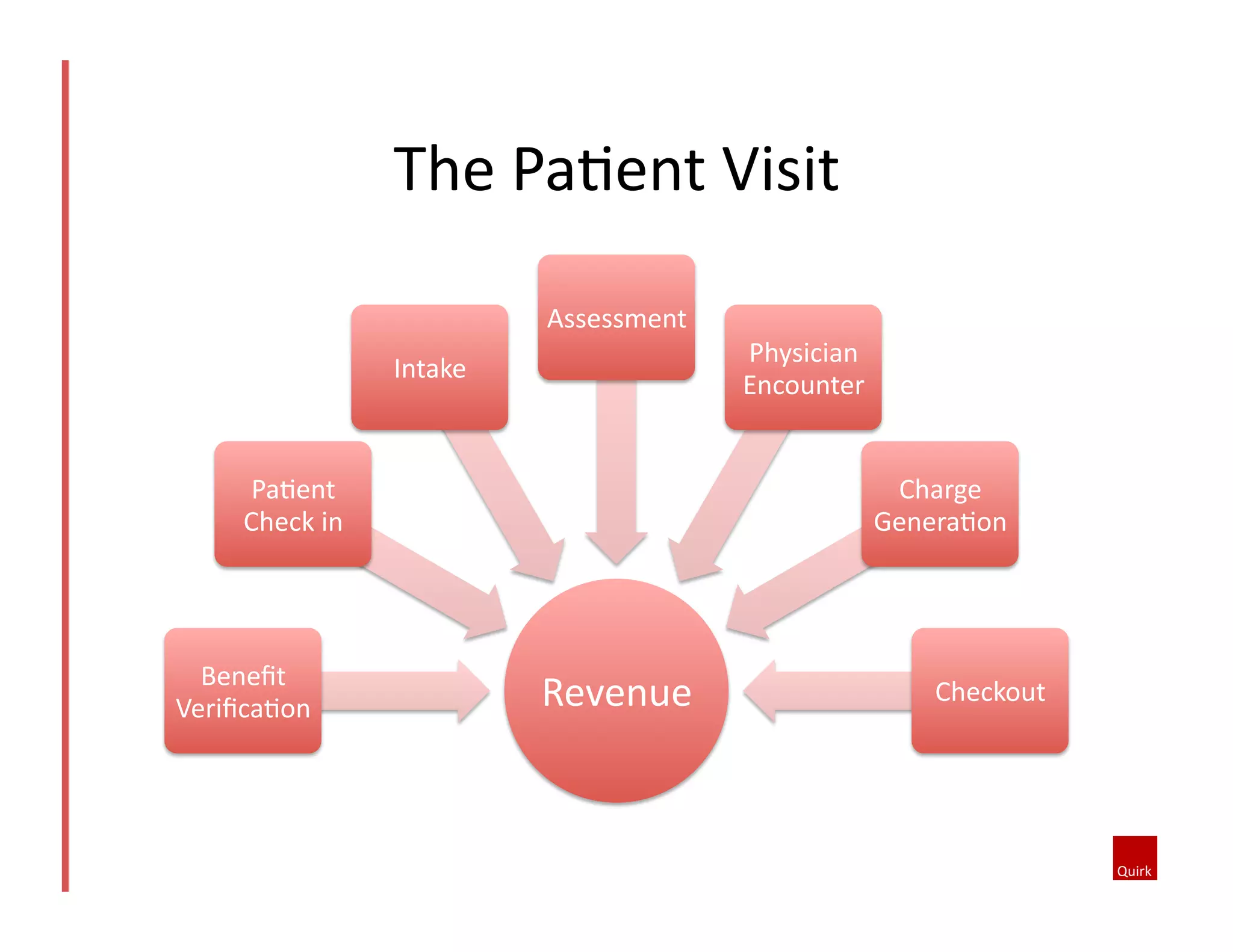
Revenue	
  Benefit	
  
Verifica@on	
  	
  
Pa@ent	
  
Check	
  in	
  	
  
Intake	
  	
  
Assessment	
  	
  
Physician	
  
Encounter	
  	
  
Charge	
  
Genera@on	
  	
  
Checkout	
  
The	
  Pa@ent	
  Visit	
  
– At	
  what	
  point	
  does	
  the	
  Billing	
  Cycle	
  Begin?	
  
•  When	
  the	
  pa@ent	
  schedules	
  the	
  appointment?	
  	
  
•  When	
  the	
  benefits	
  are	
  verified?	
  	
  
•  AJer	
  the	
  service	
  is	
  provided?	
  
The	
  moment	
  the	
  service	
  has	
  been	
  provided,	
  the	
  
billing	
  cycle	
  begins.	
  
Everything	
  you	
  did	
  prior	
  to	
  the	
  service	
  being	
  
provided,	
  determines	
  how	
  quickly	
  you	
  complete	
  the	
  
cycle.	
  	
  
The	
  Pa@ent	
  Visit	
  
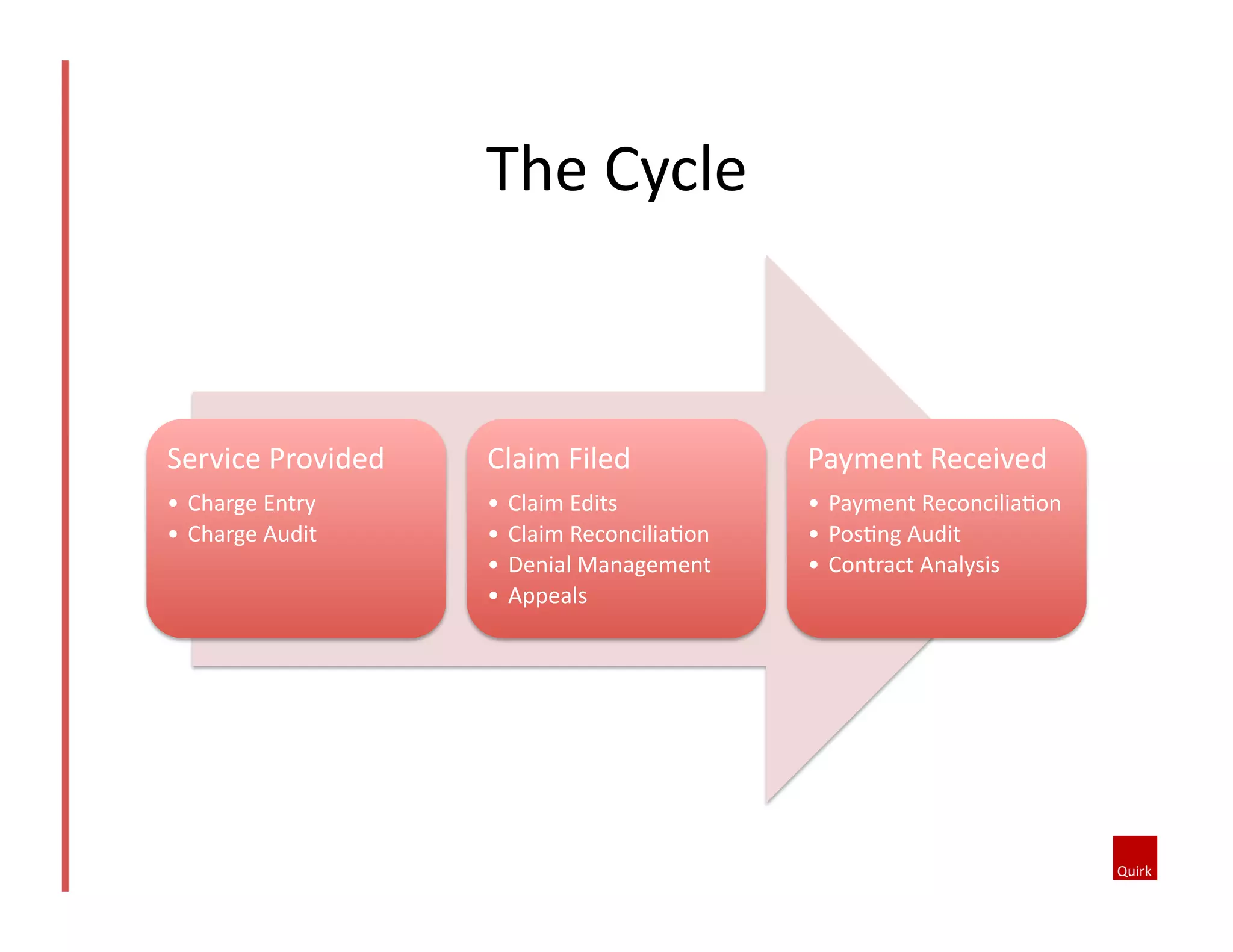
Service	
  Provided	
  
•  Charge	
  Entry	
  
•  Charge	
  Audit	
  	
  
Claim	
  Filed	
  	
  
•  Claim	
  Edits	
  
•  Claim	
  Reconcilia@on	
  
•  Denial	
  Management	
  	
  
•  Appeals	
  
Payment	
  Received	
  
•  Payment	
  Reconcilia@on	
  
•  Pos@ng	
  Audit	
  
•  Contract	
  Analysis	
  
The	
  Cycle	
  	
  
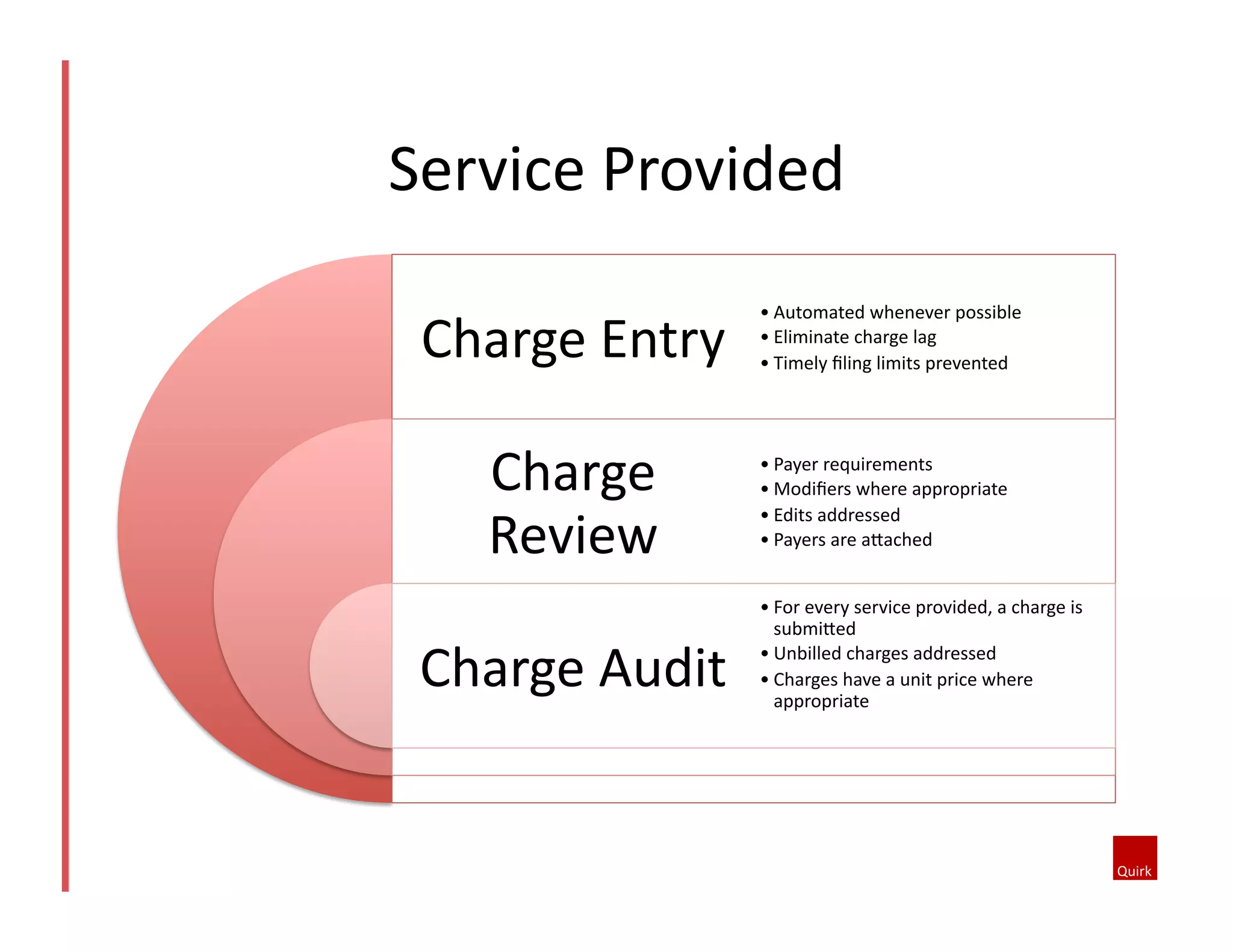
Service	
  Provided	
  
Charge	
  Entry	
  
Charge	
  
Review	
  
Charge	
  Audit	
  
• Automated	
  whenever	
  possible	
  
• Eliminate	
  charge	
  lag	
  
• Timely	
  filing	
  limits	
  prevented	
  
• Payer	
  requirements	
  
• Modifiers	
  where	
  appropriate	
  
• Edits	
  addressed	
  
• Payers	
  are	
  a^ached	
  
• For	
  every	
  service	
  provided,	
  a	
  charge	
  is	
  
submi^ed	
  
• Unbilled	
  charges	
  addressed	
  
• Charges	
  have	
  a	
  unit	
  price	
  where	
  
appropriate	
  
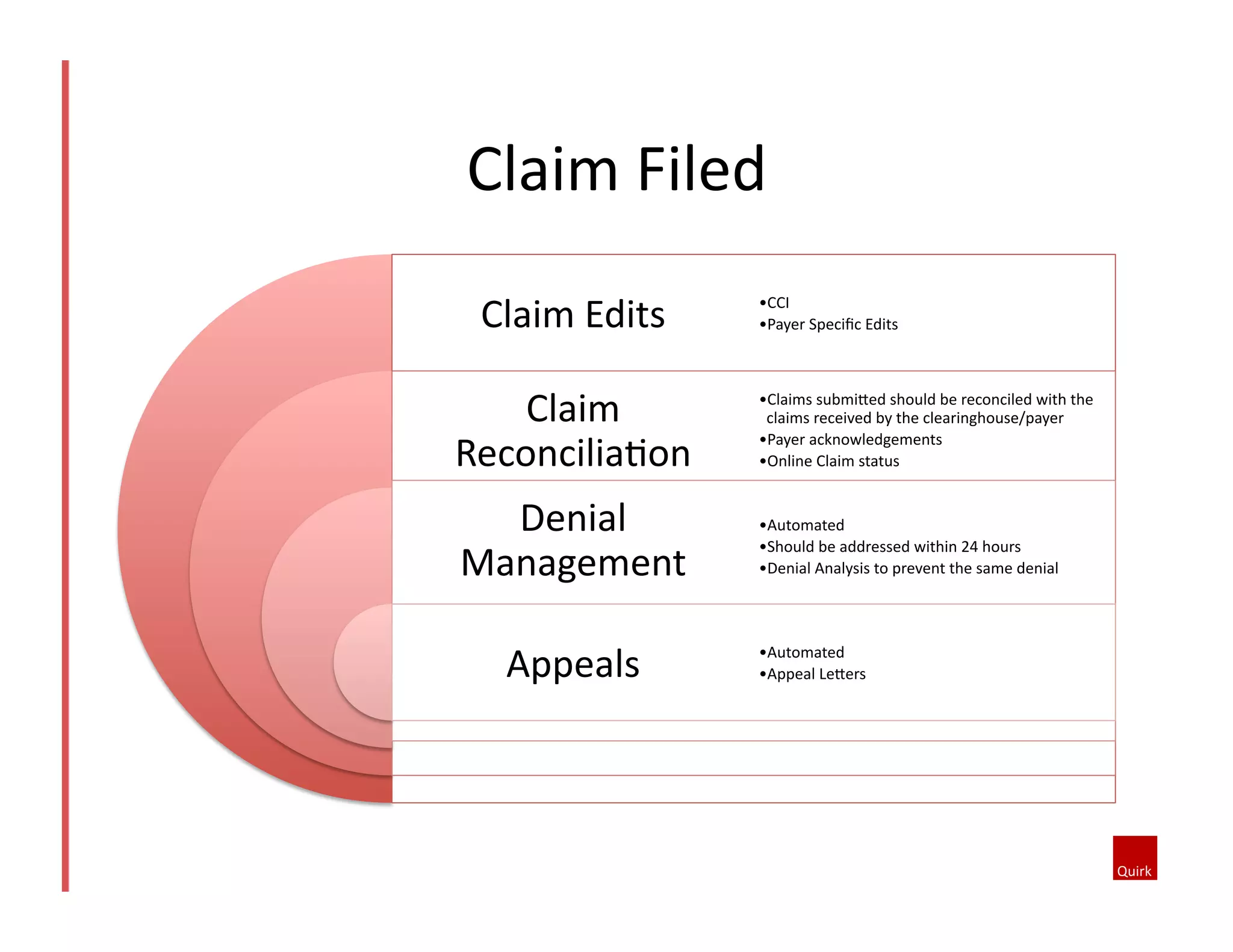
Claim	
  Filed	
  
Claim	
  Edits	
  
Claim	
  
Reconcilia@on	
  
Denial	
  
Management	
  
Appeals 	
  	
  
• CCI	
  
• Payer	
  Specific	
  Edits	
  	
  
• Claims	
  submi^ed	
  should	
  be	
  reconciled	
  with	
  the	
  
claims	
  received	
  by	
  the	
  clearinghouse/payer	
  	
  
• Payer	
  acknowledgements	
  
• Online	
  Claim	
  status	
  
• Automated	
  
• Should	
  be	
  addressed	
  within	
  24	
  hours	
  
• Denial	
  Analysis	
  to	
  prevent	
  the	
  same	
  denial	
  
• Automated	
  
• Appeal	
  Le^ers	
  
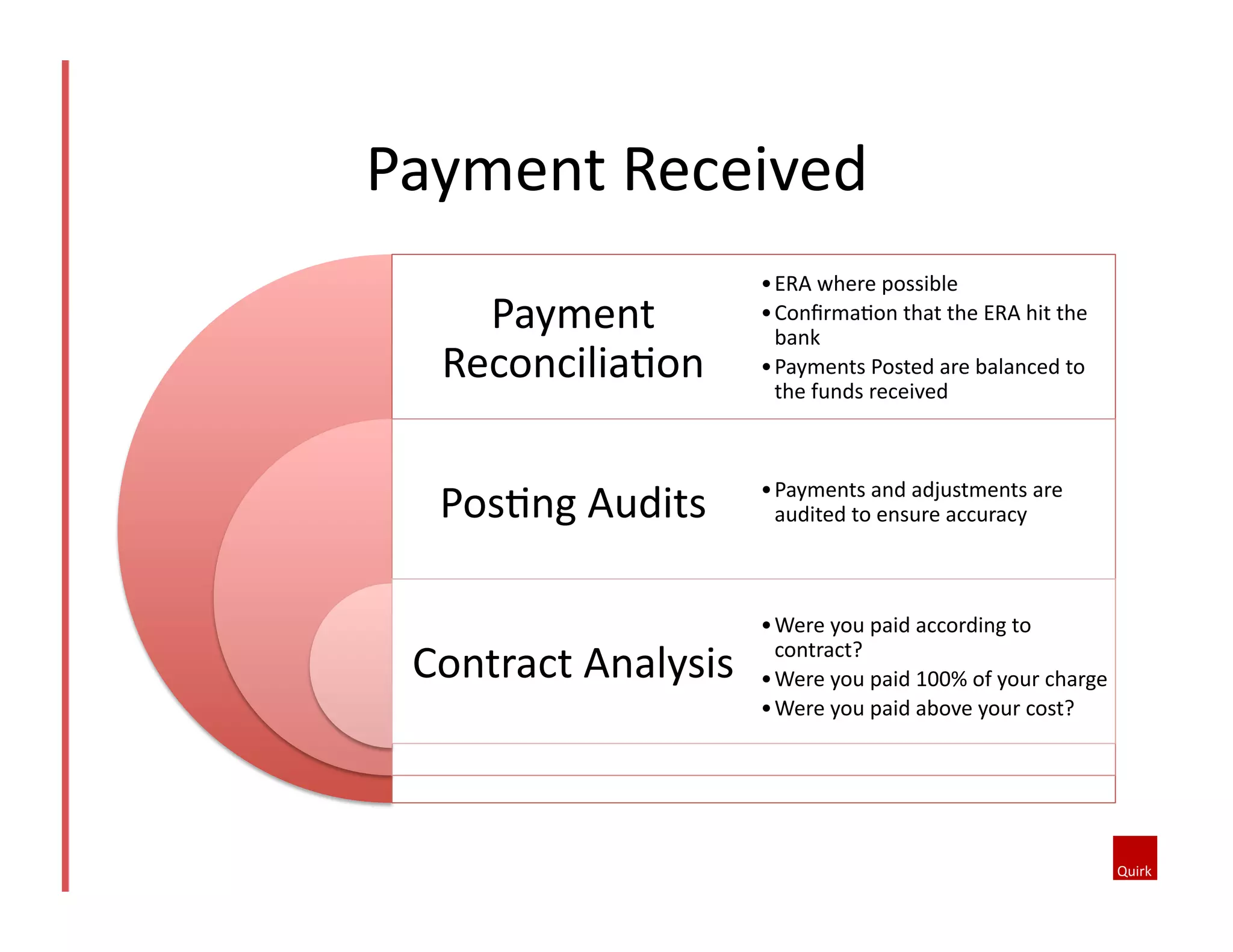
Payment	
  Received	
  	
  
Payment	
  
Reconcilia@on 	
  	
  
Pos@ng	
  Audits	
  
Contract	
  Analysis	
  
• ERA	
  where	
  possible	
  	
  
• Confirma@on	
  that	
  the	
  ERA	
  hit	
  the	
  
bank	
  
• Payments	
  Posted	
  are	
  balanced	
  to	
  
the	
  funds	
  received	
  
• Payments	
  and	
  adjustments	
  are	
  
audited	
  to	
  ensure	
  accuracy	
  
• Were	
  you	
  paid	
  according	
  to	
  
contract?	
  
• Were	
  you	
  paid	
  100%	
  of	
  your	
  charge	
  
• Were	
  you	
  paid	
  above	
  your	
  cost?	
  
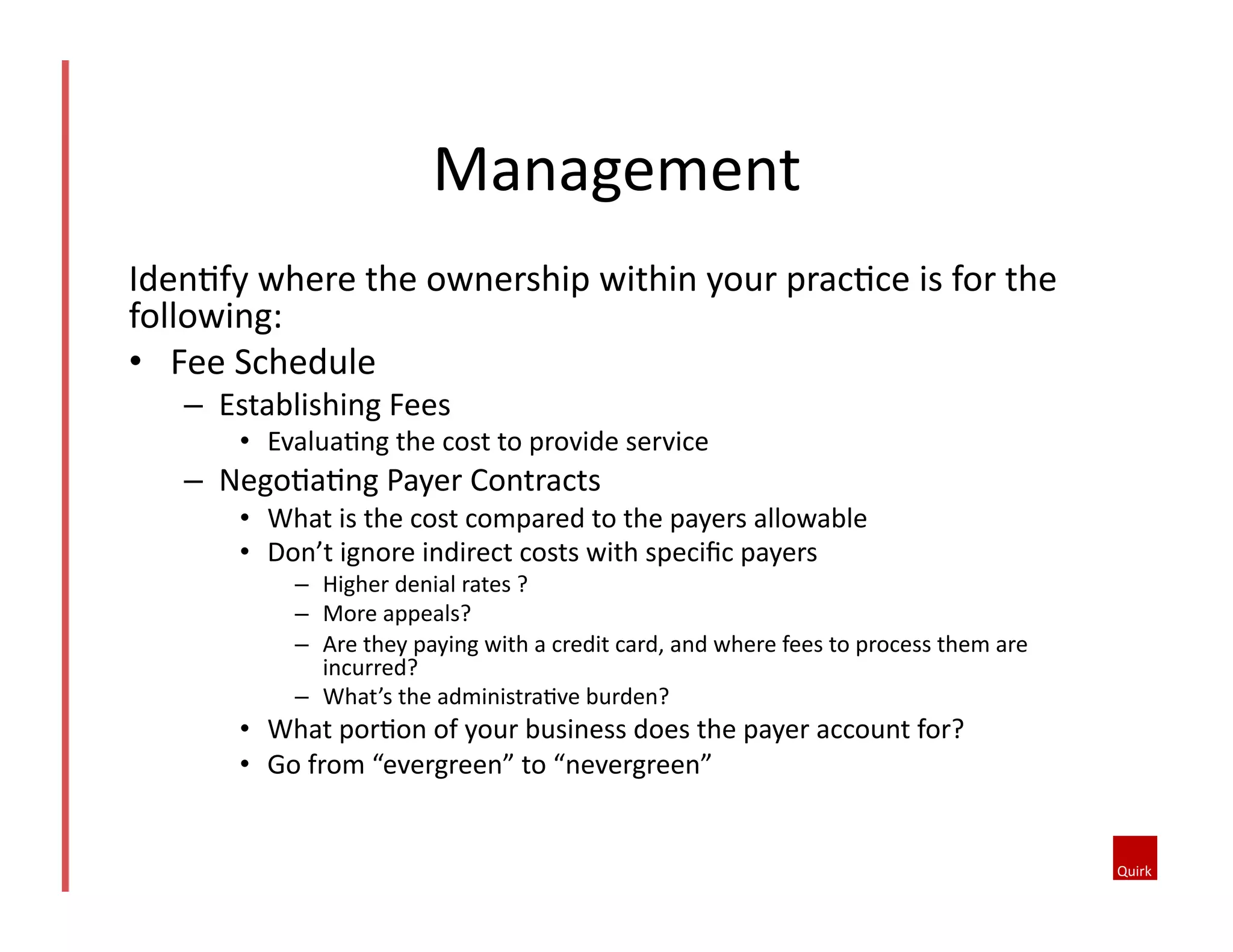
Management	
  
Management	
  
Iden@fy	
  where	
  the	
  ownership	
  within	
  your	
  prac@ce	
  is	
  for	
  the	
  
following:	
  
•  Fee	
  Schedule	
  	
  
–  Establishing	
  Fees	
  
•  Evalua@ng	
  the	
  cost	
  to	
  provide	
  service	
  
–  Nego@a@ng	
  Payer	
  Contracts	
  
•  What	
  is	
  the	
  cost	
  compared	
  to	
  the	
  payers	
  allowable	
  
•  Don’t	
  ignore	
  indirect	
  costs	
  with	
  specific	
  payers	
  
–  Higher	
  denial	
  rates	
  ?	
  
–  More	
  appeals?	
  
–  Are	
  they	
  paying	
  with	
  a	
  credit	
  card,	
  and	
  where	
  fees	
  to	
  process	
  them	
  are	
  
incurred?	
  
–  What’s	
  the	
  administra@ve	
  burden?	
  	
  
•  What	
  por@on	
  of	
  your	
  business	
  does	
  the	
  payer	
  account	
  for?	
  
•  Go	
  from	
  “evergreen”	
  to	
  “nevergreen”	
  
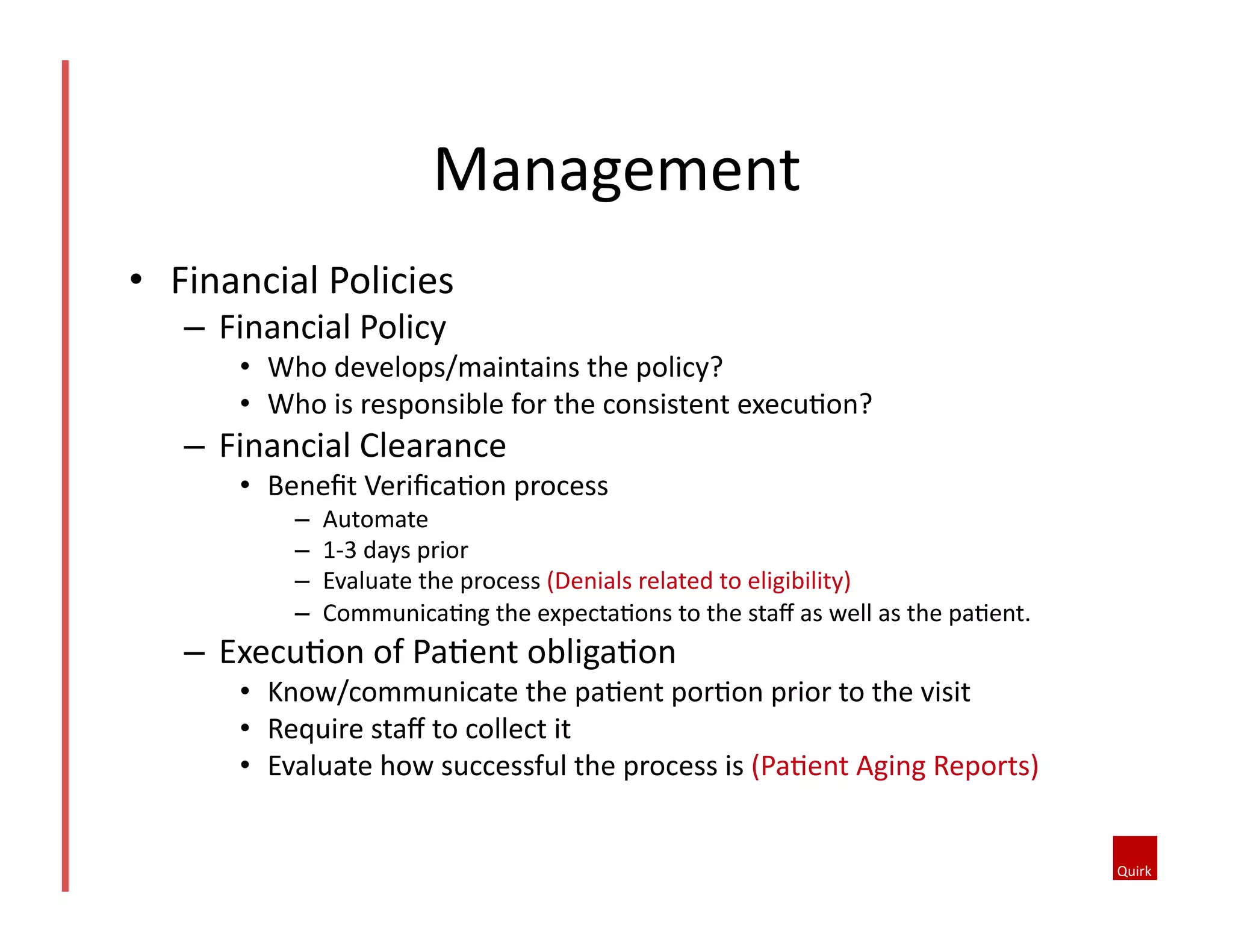
Management	
  
•  Financial	
  Policies	
  
–  Financial	
  Policy	
  
•  Who	
  develops/maintains	
  the	
  policy?	
  
•  Who	
  is	
  responsible	
  for	
  the	
  consistent	
  execu@on?	
  	
  
–  Financial	
  Clearance	
  
•  Benefit	
  Verifica@on	
  process	
  
–  Automate	
  
–  1-­‐3	
  days	
  prior	
  
–  Evaluate	
  the	
  process	
  (Denials	
  related	
  to	
  eligibility)	
  
–  Communica@ng	
  the	
  expecta@ons	
  to	
  the	
  staff	
  as	
  well	
  as	
  the	
  pa@ent.	
  
–  Execu@on	
  of	
  Pa@ent	
  obliga@on	
  
•  Know/communicate	
  the	
  pa@ent	
  por@on	
  prior	
  to	
  the	
  visit	
  
•  Require	
  staff	
  to	
  collect	
  it	
  
•  Evaluate	
  how	
  successful	
  the	
  process	
  is	
  (Pa@ent	
  Aging	
  Reports)	
  
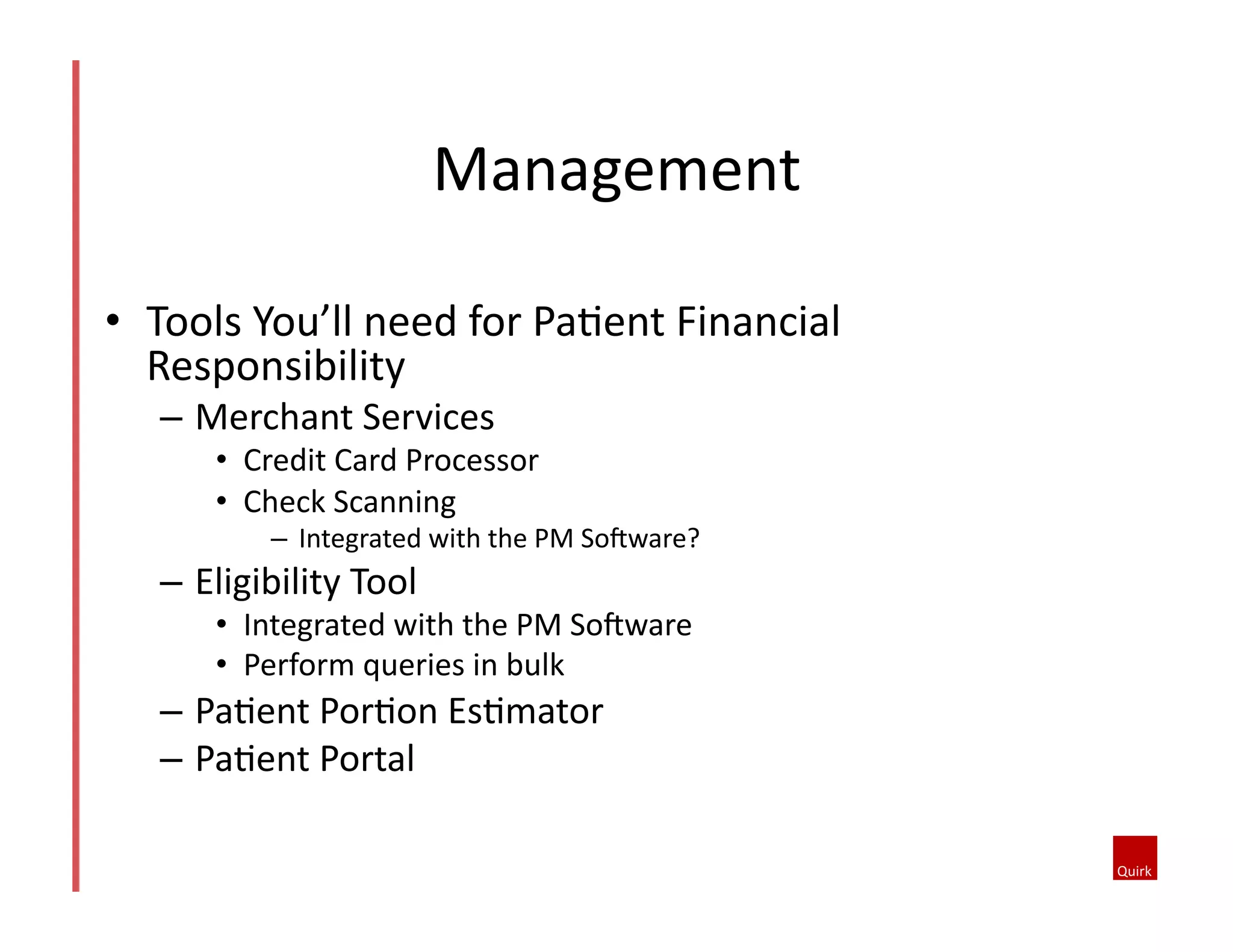
Management	
  
•  Tools	
  You’ll	
  need	
  for	
  Pa@ent	
  Financial	
  
Responsibility	
  
–  Merchant	
  Services	
  
•  Credit	
  Card	
  Processor	
  	
  
•  Check	
  Scanning	
  
–  Integrated	
  with	
  the	
  PM	
  SoJware?	
  	
  
–  Eligibility	
  Tool	
  	
  
•  Integrated	
  with	
  the	
  PM	
  SoJware	
  
•  Perform	
  queries	
  in	
  bulk	
  
–  Pa@ent	
  Por@on	
  Es@mator	
  
–  Pa@ent	
  Portal	
  
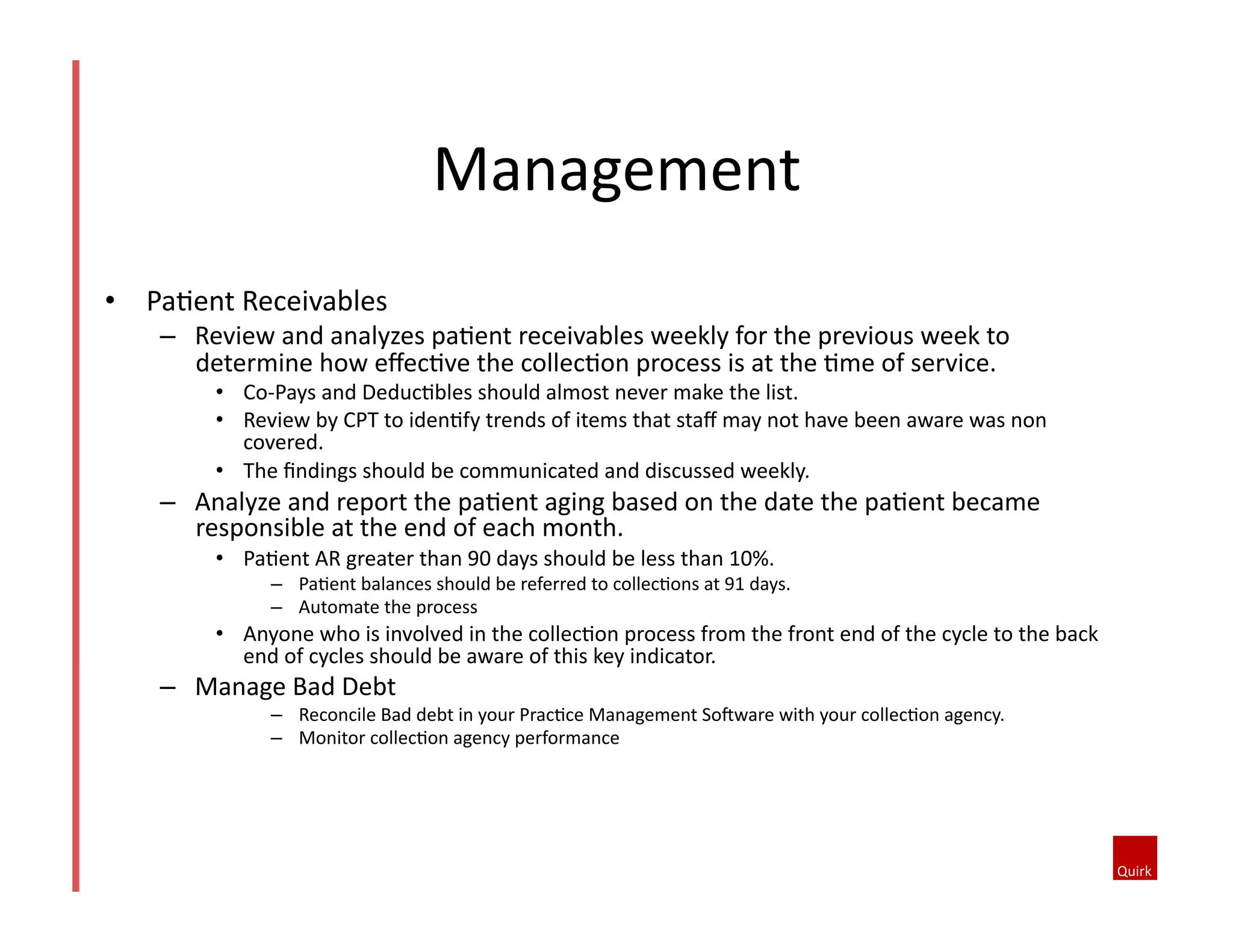
Management	
  
•  Pa@ent	
  Receivables	
  
–  Review	
  and	
  analyzes	
  pa@ent	
  receivables	
  weekly	
  for	
  the	
  previous	
  week	
  to	
  
determine	
  how	
  effec@ve	
  the	
  collec@on	
  process	
  is	
  at	
  the	
  @me	
  of	
  service.	
  	
  
•  Co-­‐Pays	
  and	
  Deduc@bles	
  should	
  almost	
  never	
  make	
  the	
  list.	
  
•  Review	
  by	
  CPT	
  to	
  iden@fy	
  trends	
  of	
  items	
  that	
  staff	
  may	
  not	
  have	
  been	
  aware	
  was	
  non	
  
covered.	
  
•  The	
  findings	
  should	
  be	
  communicated	
  and	
  discussed	
  weekly.	
  
–  Analyze	
  and	
  report	
  the	
  pa@ent	
  aging	
  based	
  on	
  the	
  date	
  the	
  pa@ent	
  became	
  
responsible	
  at	
  the	
  end	
  of	
  each	
  month.	
  	
  
•  Pa@ent	
  AR	
  greater	
  than	
  90	
  days	
  should	
  be	
  less	
  than	
  10%.	
  
–  Pa@ent	
  balances	
  should	
  be	
  referred	
  to	
  collec@ons	
  at	
  91	
  days.	
  
–  Automate	
  the	
  process	
  	
  
•  Anyone	
  who	
  is	
  involved	
  in	
  the	
  collec@on	
  process	
  from	
  the	
  front	
  end	
  of	
  the	
  cycle	
  to	
  the	
  back	
  
end	
  of	
  cycles	
  should	
  be	
  aware	
  of	
  this	
  key	
  indicator.	
  	
  
–  Manage	
  Bad	
  Debt	
  	
  
–  Reconcile	
  Bad	
  debt	
  in	
  your	
  Prac@ce	
  Management	
  SoJware	
  with	
  your	
  collec@on	
  agency.	
  	
  
–  Monitor	
  collec@on	
  agency	
  performance	
  
Management	
  
•  Charges	
  
–  Solicit	
  feedback	
  from	
  the	
  staff	
  performing	
  the	
  charge	
  process.	
  	
  
•  How	
  oJen	
  are	
  they,	
  making	
  changes	
  and	
  what	
  are	
  they	
  changing.	
  
–  Does	
  there	
  need	
  to	
  be	
  training	
  of	
  the	
  end	
  user?	
  
–  Are	
  there	
  system	
  set	
  up	
  issues	
  that	
  need	
  to	
  be	
  addressed?	
  	
  
•  Manage	
  and	
  report	
  charge	
  lag	
  and	
  unbilled	
  charges.	
  
•  The	
  findings	
  should	
  be	
  communicated	
  and	
  discussed	
  weekly.	
  
•  Claims	
  	
  
–  What	
  issues	
  are	
  iden@fied	
  through	
  the	
  claims	
  reconcilia@on?	
  
–  Monitor	
  Clearinghouse	
  rejec@ons	
  daily	
  
•  Are	
  they	
  being	
  worked	
  daily?	
  
•  What	
  are	
  they	
  are	
  correc@ng	
  and	
  how	
  can	
  they	
  be	
  prevented?	
  
•  Denials	
  	
  
•  Report	
  Denial	
  %	
  Monthly	
  
–  Should	
  be	
  less	
  than	
  2%	
  of	
  your	
  submi^ed	
  charges	
  
•  Evaluate	
  what	
  is	
  being	
  denied	
  weekly	
  
•  Take	
  ac@on	
  to	
  prevent	
  the	
  same	
  denials	
  in	
  the	
  future	
  
•  Monitor	
  ac@on	
  taken	
  on	
  denials	
  
–  Worked	
  within	
  24	
  hours?	
  	
  
–  Did	
  their	
  work	
  result	
  in	
  payment?	
  	
  
Management	
  
•  Pos@ng	
  	
  
–  Are	
  pa@ents	
  being	
  billed	
  appropriately?	
  
–  Are	
  adjustments	
  Appropriate?	
  
–  Are	
  payment	
  reconciling	
  with	
  receipts	
  
•  Contract	
  Analysis	
  	
  
–  Are	
  you	
  being	
  paid	
  according	
  to	
  your	
  contract?	
  
–  Are	
  you	
  being	
  paid	
  at	
  100%	
  of	
  your	
  charge	
  
•  Evaluate	
  the	
  fees,	
  and	
  increase	
  as	
  appropriate	
  so	
  that	
  you	
  are	
  
not	
  leaving	
  money	
  on	
  the	
  table.	
  
–  Are	
  you	
  paid	
  more	
  than	
  the	
  cost?	
  	
  
End	
  of	
  Month	
  Repor@ng	
  	
  
!  Iden@fy	
  key	
  indicators	
  for	
  
your	
  group	
  or	
  prac@ce	
  
!  Days	
  in	
  AR	
  
!  Denial	
  Percentage	
  	
  
!  %	
  of	
  AR	
  over	
  90	
  
Days	
  by	
  payer	
  and	
  
pa@ent	
  
!  Charge	
  Lag	
  	
  
Communicate	
  results	
  to	
  anyone	
  who	
  has	
  involvement	
  
with	
  the	
  cycle	
  so	
  that	
  they	
  can	
  align	
  their	
  efforts	
  and	
  
share	
  in	
  the	
  success	
  of	
  your	
  results.	
  	
  
Q&A	
  
Shawna.matonis@quirkhealthcare.com	
  

Revenue Cycle Management

  • 1.
    Revenue  Cycle  Management     Wednesday,  June  11,  2014   Disclaimer:  Nothing  that  we  are  sharing  is  intended  as  legally  binding  or  prescrip7ve  advice.  This   presenta7on  is  a  synthesis  of  publically  available  informa7on  and  best  prac7ces.  
  • 2.
    In  an  industry,  that’s  ever  changing,  one  thing   remains  consistent-­‐  Delivery  of  healthcare  must   first  be  viewed  as  a  Business.     If  you  are  not  profitable,  you  can’t  keep  the   doors  open  to  provide  services  to  your  pa@ents   in  need.     Revenue  Cycle  Management  
  • 3.
    Fee  Schedule     Financial   Policies     The  Pa@ent  Visit    The  Billing  and   Collec@on  Cycle     Reimbursement   Analysis   The  Revenue  Cycle  
  • 4.
    •  cycle  n.  An  interval  of  @me  during  which  a   characteris@c,  oJen  regularly  repeated  event   or  sequence  of  events  occurs   •  The  perfect  cycle  of  revenue  should  really  be   this  simple:   – Provide  Service   – Submit  Claim     – Get  Paid   Focusing  on  the  “Cycle”  
  • 5.
    How  did  you  arrive  at  your  fee  schedule?   –  What  does  it  cost  you  to  provide  service?   •  Have  you  done  a  cost  study?   –  Can  you  manage  this  internally?   –  Should  you  reach  out  to  a  consultant?   •  Fees  should  be  built  based  on  what  keeps  your  business  running   and  profitable,  rather  than  what  sounds  “reasonable  an   customary”.   –  Are  you  basing  it  on  a  percentage  of  Medicare?     –  Are  you  basing  it  on  RVU’s?   –  Did  you  base  it  on  your  highest  payer?   –   When  you  nego@ate  contracts,  you  need  to  know  your   cost,  to  know  if  the  contract  makes  good  business  sense.     Fee  Schedule    
  • 6.
    •  UpdaCng  your  fee  schedule   – Maintain  your  fee  schedule   •  Update  the  fee  schedule  every  3-­‐12  months.   – Does  your  soJware  have  a  place  to  load  RVU’s   •  Does  your  vendor/consultant  offer  a  u@lity  to  upload   published  RVU’s  into  your  prac@ce  management   soJware   – Does  your  soJware  have  a  place  to  load  costs   •  How  are  you  recovering  costs  of  medical  supplies?     •  Are  you  geYng  paid  more  than  your  cost  on  vaccines?   Fee  Schedule    
  • 7.
    –  What  is  your  expecta@on  of  the  pa@ent  to  fulfill  their   financial  responsibility?     •  Do  you  require  them  to  pay  their  por@on  at  the  @me  of  service?     –  A  survey  by  the  MGMA  found  that  30  percent  of  pa@ents  walk  out  the   door  without  paying  any  amount  at  the  @me  of  service.   •  Request  full  payment  at  the  @me  of  service  for  non-­‐covered  and   elec@ve  services.     •  If  the  pa@ent  is  unable  to  pay  in  full,  what  Is  the  minimum  amount   accepted?     •  Do  you  offer  payment  plans?   •  Do  you  offer  discounts  for  payment  at  the  @me  of  service?   –  Is  your  expecta@on  defined  in  wri@ng?     •  Is  it  posted  on  your  website   •  Do  you  communicate  it  on  your  pa@ent  portal   •  Is  it  included  it  in  new  pa@ent  packet   •  Is  there  signage  at  the  check-­‐in  and  check-­‐out  areas.     Financial  Policies  
  • 8.
    Revenue  Benefit   Verifica@on     Pa@ent   Check  in     Intake     Assessment     Physician   Encounter     Charge   Genera@on     Checkout   The  Pa@ent  Visit  
  • 9.
    – At  what  point  does  the  Billing  Cycle  Begin?   •  When  the  pa@ent  schedules  the  appointment?     •  When  the  benefits  are  verified?     •  AJer  the  service  is  provided?   The  moment  the  service  has  been  provided,  the   billing  cycle  begins.   Everything  you  did  prior  to  the  service  being   provided,  determines  how  quickly  you  complete  the   cycle.     The  Pa@ent  Visit  
  • 10.
    Service  Provided   • Charge  Entry   •  Charge  Audit     Claim  Filed     •  Claim  Edits   •  Claim  Reconcilia@on   •  Denial  Management     •  Appeals   Payment  Received   •  Payment  Reconcilia@on   •  Pos@ng  Audit   •  Contract  Analysis   The  Cycle    
  • 11.
    Service  Provided   Charge  Entry   Charge   Review   Charge  Audit   • Automated  whenever  possible   • Eliminate  charge  lag   • Timely  filing  limits  prevented   • Payer  requirements   • Modifiers  where  appropriate   • Edits  addressed   • Payers  are  a^ached   • For  every  service  provided,  a  charge  is   submi^ed   • Unbilled  charges  addressed   • Charges  have  a  unit  price  where   appropriate  
  • 12.
    Claim  Filed   Claim  Edits   Claim   Reconcilia@on   Denial   Management   Appeals     • CCI   • Payer  Specific  Edits     • Claims  submi^ed  should  be  reconciled  with  the   claims  received  by  the  clearinghouse/payer     • Payer  acknowledgements   • Online  Claim  status   • Automated   • Should  be  addressed  within  24  hours   • Denial  Analysis  to  prevent  the  same  denial   • Automated   • Appeal  Le^ers  
  • 13.
    Payment  Received     Payment   Reconcilia@on     Pos@ng  Audits   Contract  Analysis   • ERA  where  possible     • Confirma@on  that  the  ERA  hit  the   bank   • Payments  Posted  are  balanced  to   the  funds  received   • Payments  and  adjustments  are   audited  to  ensure  accuracy   • Were  you  paid  according  to   contract?   • Were  you  paid  100%  of  your  charge   • Were  you  paid  above  your  cost?  
  • 14.
  • 15.
    Management   Iden@fy  where  the  ownership  within  your  prac@ce  is  for  the   following:   •  Fee  Schedule     –  Establishing  Fees   •  Evalua@ng  the  cost  to  provide  service   –  Nego@a@ng  Payer  Contracts   •  What  is  the  cost  compared  to  the  payers  allowable   •  Don’t  ignore  indirect  costs  with  specific  payers   –  Higher  denial  rates  ?   –  More  appeals?   –  Are  they  paying  with  a  credit  card,  and  where  fees  to  process  them  are   incurred?   –  What’s  the  administra@ve  burden?     •  What  por@on  of  your  business  does  the  payer  account  for?   •  Go  from  “evergreen”  to  “nevergreen”  
  • 16.
    Management   •  Financial  Policies   –  Financial  Policy   •  Who  develops/maintains  the  policy?   •  Who  is  responsible  for  the  consistent  execu@on?     –  Financial  Clearance   •  Benefit  Verifica@on  process   –  Automate   –  1-­‐3  days  prior   –  Evaluate  the  process  (Denials  related  to  eligibility)   –  Communica@ng  the  expecta@ons  to  the  staff  as  well  as  the  pa@ent.   –  Execu@on  of  Pa@ent  obliga@on   •  Know/communicate  the  pa@ent  por@on  prior  to  the  visit   •  Require  staff  to  collect  it   •  Evaluate  how  successful  the  process  is  (Pa@ent  Aging  Reports)  
  • 17.
    Management   •  Tools  You’ll  need  for  Pa@ent  Financial   Responsibility   –  Merchant  Services   •  Credit  Card  Processor     •  Check  Scanning   –  Integrated  with  the  PM  SoJware?     –  Eligibility  Tool     •  Integrated  with  the  PM  SoJware   •  Perform  queries  in  bulk   –  Pa@ent  Por@on  Es@mator   –  Pa@ent  Portal  
  • 18.
    Management   •  Pa@ent  Receivables   –  Review  and  analyzes  pa@ent  receivables  weekly  for  the  previous  week  to   determine  how  effec@ve  the  collec@on  process  is  at  the  @me  of  service.     •  Co-­‐Pays  and  Deduc@bles  should  almost  never  make  the  list.   •  Review  by  CPT  to  iden@fy  trends  of  items  that  staff  may  not  have  been  aware  was  non   covered.   •  The  findings  should  be  communicated  and  discussed  weekly.   –  Analyze  and  report  the  pa@ent  aging  based  on  the  date  the  pa@ent  became   responsible  at  the  end  of  each  month.     •  Pa@ent  AR  greater  than  90  days  should  be  less  than  10%.   –  Pa@ent  balances  should  be  referred  to  collec@ons  at  91  days.   –  Automate  the  process     •  Anyone  who  is  involved  in  the  collec@on  process  from  the  front  end  of  the  cycle  to  the  back   end  of  cycles  should  be  aware  of  this  key  indicator.     –  Manage  Bad  Debt     –  Reconcile  Bad  debt  in  your  Prac@ce  Management  SoJware  with  your  collec@on  agency.     –  Monitor  collec@on  agency  performance  
  • 19.
    Management   •  Charges   –  Solicit  feedback  from  the  staff  performing  the  charge  process.     •  How  oJen  are  they,  making  changes  and  what  are  they  changing.   –  Does  there  need  to  be  training  of  the  end  user?   –  Are  there  system  set  up  issues  that  need  to  be  addressed?     •  Manage  and  report  charge  lag  and  unbilled  charges.   •  The  findings  should  be  communicated  and  discussed  weekly.   •  Claims     –  What  issues  are  iden@fied  through  the  claims  reconcilia@on?   –  Monitor  Clearinghouse  rejec@ons  daily   •  Are  they  being  worked  daily?   •  What  are  they  are  correc@ng  and  how  can  they  be  prevented?   •  Denials     •  Report  Denial  %  Monthly   –  Should  be  less  than  2%  of  your  submi^ed  charges   •  Evaluate  what  is  being  denied  weekly   •  Take  ac@on  to  prevent  the  same  denials  in  the  future   •  Monitor  ac@on  taken  on  denials   –  Worked  within  24  hours?     –  Did  their  work  result  in  payment?    
  • 20.
    Management   •  Pos@ng     –  Are  pa@ents  being  billed  appropriately?   –  Are  adjustments  Appropriate?   –  Are  payment  reconciling  with  receipts   •  Contract  Analysis     –  Are  you  being  paid  according  to  your  contract?   –  Are  you  being  paid  at  100%  of  your  charge   •  Evaluate  the  fees,  and  increase  as  appropriate  so  that  you  are   not  leaving  money  on  the  table.   –  Are  you  paid  more  than  the  cost?    
  • 21.
    End  of  Month  Repor@ng     !  Iden@fy  key  indicators  for   your  group  or  prac@ce   !  Days  in  AR   !  Denial  Percentage     !  %  of  AR  over  90   Days  by  payer  and   pa@ent   !  Charge  Lag     Communicate  results  to  anyone  who  has  involvement   with  the  cycle  so  that  they  can  align  their  efforts  and   share  in  the  success  of  your  results.    
  • 22.