Understanding the Difference Between Medical Billing and Revenue Cycle Management
In the labyrinthine landscape of healthcare administration, where every dollar
counts and every process intertwines, two fundamental pillars stand tall: medical
billing and revenue cycle management (RCM). Picture this: you're in a hospital's
bustling billing department, where a symphony of keyboards clack and phones ring
incessantly. Amidst this orchestrated chaos, there's a distinct rhythm, a dance
between medical billing specialists and RCM wizards, each playing their part in the
financial symphony of healthcare.
But what exactly sets these two apart? Imagine this analogy: medical billing is like
the precision work of a skilled chef, meticulously crafting each dish to perfection,
while revenue cycle management is the behind-the-scenes maestro, orchestrating
the entire culinary experience from reservation to dessert.
In this exploration, we embark on a journey to demystify the nuances between
medical billing and revenue cycle management, illuminating their distinct roles,
symbiotic relationships, and their profound impact on the healthcare ecosystem.
But here's the twist: we'll not only dissect their differences but also uncover a fresh
perspective, a new lens through which to view these essential processes. So, buckle
up as we venture into the heart of healthcare finance, where every claim, every code,
and every dollar tells a story of care and commerce intertwined.
Medical Billing: An Overview of the Process
Ever wondered what happens behind the scenes after your doctor's visit? Enter the
world of medical billing, where paperwork meets precision, and your healthcare
journey takes on a financial dimension. Let's take a stroll through the process,
humanizing each step along the way.
Step 1: Patient Encounter
It all begins with your visit to the doctor's office. As you discuss your health
concerns and undergo examinations, a crucial process quietly commences in the
background. This encounter lays the foundation for the medical billing journey,
where your healthcare needs intersect with administrative procedures.
Step 2: Documentation
After your appointment, the healthcare team swings into action, meticulously
documenting every aspect of your visit. From the services provided to the
procedures performed, no detail is too small to escape their attention. It's like
creating a snapshot of your medical history, ensuring that nothing is overlooked in
the billing process.
Step 3: Coding
Now comes the part where things get technical. The documented services and
procedures are translated into standardized codes, akin to a secret language of the
healthcare world. These codes serve as the backbone of medical billing, facilitating
communication between healthcare providers, insurance companies, and other
stakeholders.
Step 4: Claim Submission
With codes in hand, it's time to submit your medical claim to the insurance
company. This is where accuracy is paramount. Any errors or omissions could lead
to delays or denials, potentially disrupting the billing process and causing
frustration for all involved.
Step 5: Adjudication
Once the insurance company receives your claim, they embark on a journey of their
own. Adjudication involves reviewing the claim to determine coverage and
reimbursement. It's like navigating a maze of policies and procedures, ensuring that
everything aligns correctly before moving forward.
Step 6: Payment
If all goes well, the insurance company approves your claim and issues payment to
the healthcare provider. It's the culmination of a journey that began with your
patient encounter, marking the successful completion of the billing process.
Step 7: Patient Responsibility
But wait, the billing process isn't over just yet. Depending on your insurance
coverage and deductible, you may still be responsible for a portion of the bill. It's
essential to review your explanation of benefits carefully, ensuring that you
understand your financial responsibilities.
Step 8: Follow-Up
Even after payment is received, the billing process continues. Providers may follow
up on outstanding balances or address any billing inquiries from patients or
insurance companies. It's all part of ensuring that the financial aspect of your
healthcare experience is handled with care and attention to detail.
And there you have it—a humanized overview of the medical billing process. From
patient encounter to payment, each step plays a crucial role in ensuring that your
healthcare journey is not just medically sound but also financially secure. It's a
process that combines technical expertise with a touch of compassion, reflecting the
intricate dance of healthcare administration.
Revenue Cycle Management: Optimizing Financial Operations
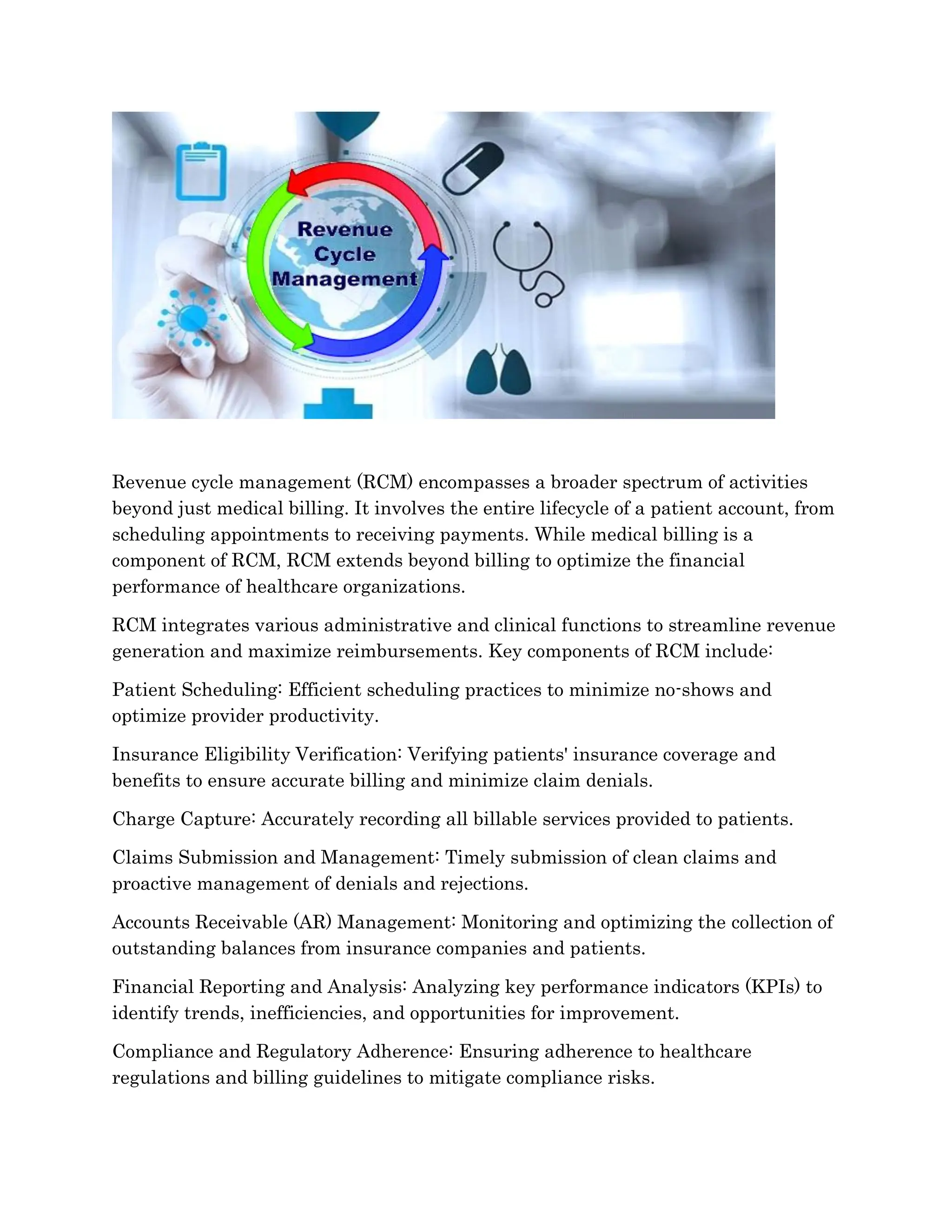
In the dynamic realm of healthcare finance, revenue cycle management (RCM)
stands as the backbone of financial operations within healthcare organizations.
Imagine yourself as an RCM specialist, equipped with the expertise and tools to
orchestrate a symphony of financial processes aimed at maximizing revenue and
ensuring the financial health of healthcare providers.
Key Components of Revenue Cycle Management:
⦁ Patient Scheduling
⦁ Insurance Eligibility Verification
⦁ Charge Capture
⦁ Claims Submission and Management
⦁ Accounts Receivable (AR) Management
⦁ Financial Reporting and Analysis
⦁ Compliance and Regulatory Adherence
These components form the foundation of RCM, each playing a crucial role in
optimizing financial operations and driving revenue generation. From ensuring
accurate insurance verification to proactive claims management and meticulous
financial reporting, RCM specialists navigate through a complex landscape to
streamline processes and maximize revenue opportunities.
Together, these components work in harmony to ensure that healthcare providers
receive timely and accurate reimbursement for services rendered, while also
maintaining compliance with regulatory requirements and industry standards. In
the following sections, we'll explore each component in detail, shedding light on
their importance and the strategies employed to optimize their effectiveness. So,
let's dive into the world of revenue cycle management and uncover the intricacies of
optimizing financial operations within healthcare.
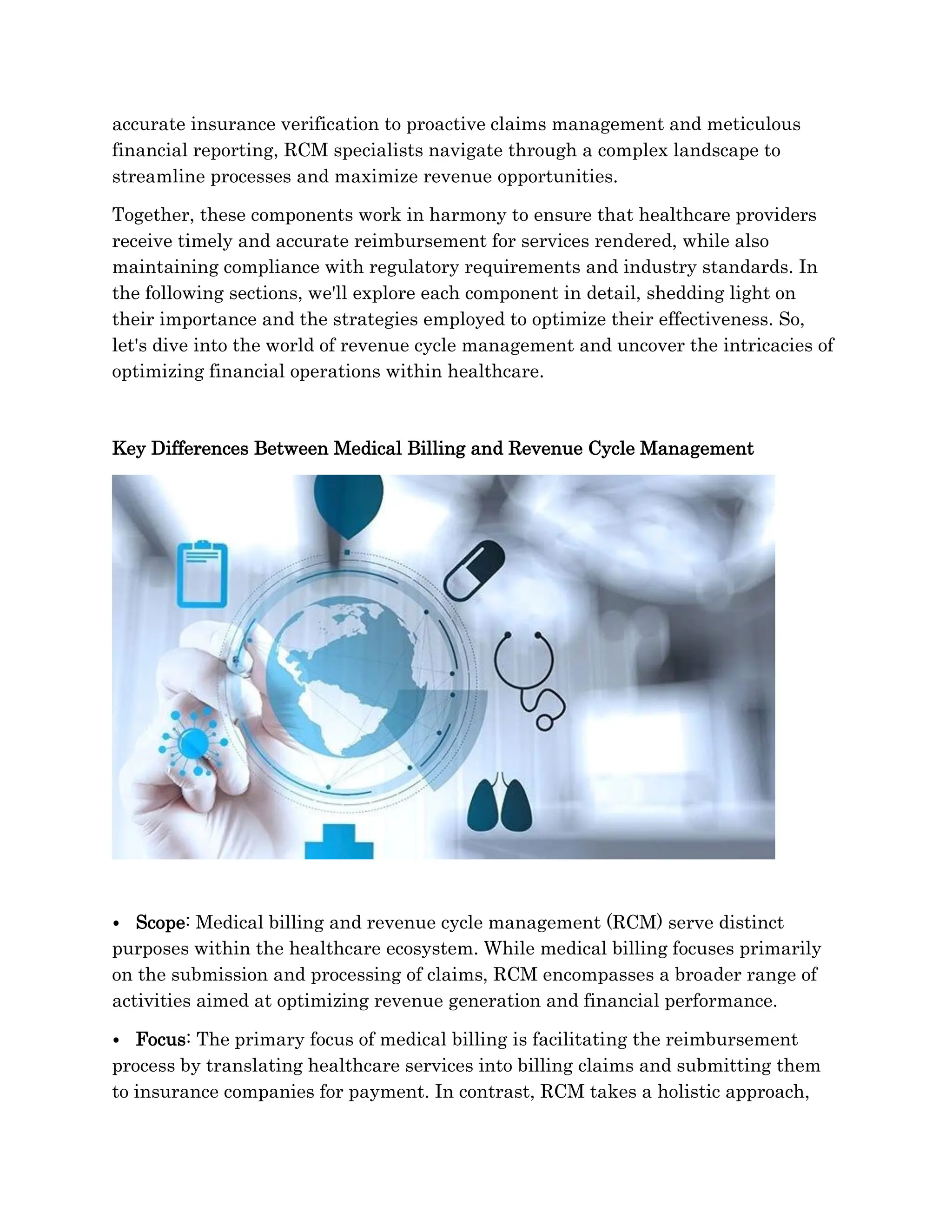
Key Differences Between Medical Billing and Revenue Cycle Management
⦁ Scope: Medical billing and revenue cycle management (RCM) serve distinct
purposes within the healthcare ecosystem. While medical billing focuses primarily
on the submission and processing of claims, RCM encompasses a broader range of
activities aimed at optimizing revenue generation and financial performance.
⦁ Focus: The primary focus of medical billing is facilitating the reimbursement
process by translating healthcare services into billing claims and submitting them
to insurance companies for payment. In contrast, RCM takes a holistic approach,
integrating administrative, clinical, and financial functions to streamline revenue
generation and maximize reimbursements.
⦁ Objective: The objective of medical billing is to ensure timely and accurate
reimbursement for services rendered by healthcare providers. On the other hand,
RCM aims to optimize the entire revenue cycle from patient intake to payment
collection, with a focus on maximizing revenue and improving financial efficiency.
⦁ Integration: While medical billing is a component of RCM, it represents only one
aspect of the broader revenue cycle management process. RCM integrates various
administrative and clinical functions, such as patient scheduling, insurance
eligibility verification, charge capture, claims submission, accounts receivable
management, financial reporting, and compliance adherence, to optimize revenue
generation and financial performance.
⦁ Transactional vs. Strategic: Medical billing is more transactional in nature,
focusing on the day-to-day tasks of claims submission, coding, and reimbursement.
In contrast, RCM takes a strategic approach, leveraging data analytics, technology,
and industry best practices to identify opportunities for process improvement,
revenue enhancement, and cost reduction across the entire revenue cycle.
In essence, while medical billing and revenue cycle management are closely related,
they serve distinct purposes and encompass different functions within the
healthcare revenue cycle. Understanding the differences between the two is
essential for healthcare organizations to optimize their financial performance and
ensure long-term sustainability.
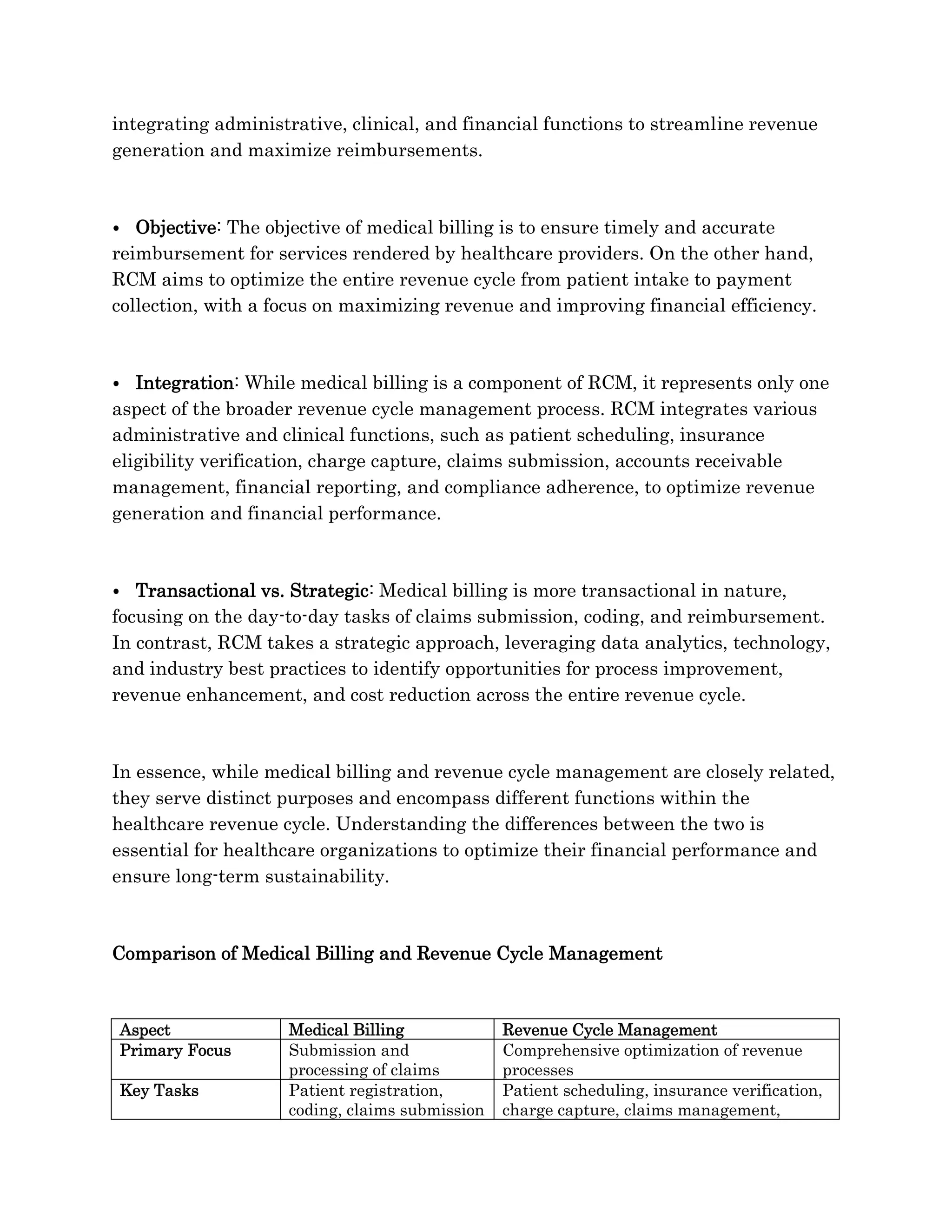
Comparison of Medical Billing and Revenue Cycle Management
Aspect Medical Billing Revenue Cycle Management
Primary Focus Submission and
processing of claims
Comprehensive optimization of revenue
processes
Key Tasks Patient registration,
coding, claims submission
Patient scheduling, insurance verification,
charge capture, claims management,
financial reporting
Objective Ensure accurate
reimbursement for
services
Maximize revenue generation and financial
efficiency
Integration Component of RCM Integral part of holistic revenue
management
Impact Directly affects
reimbursement and cash
flow
Influences overall financial performance
and sustainability
Scope Narrow focus on billing
processes
Broad encompassing of administrative and
financial functions
Collaboration Collaboration with RCM
for efficiency
Collaboration with billing for seamless
operations
Importance of Medical Billing and Revenue Cycle Management
Both medical billing and revenue cycle management are critical components of
healthcare revenue cycle operations. Efficient and effective billing and revenue
management practices are essential for the financial viability and sustainability of
healthcare organizations. Here's why:
Revenue Generation: Accurate and timely billing practices directly impact revenue
generation by ensuring that healthcare services are properly documented, coded,
and billed for reimbursement.
Cash Flow: Cash flow, akin to the pulse of a healthcare organization, sustains its
operations and vitality. It embodies the movement of funds in and out, crucial for
meeting financial obligations and providing quality care. However, maintaining this
flow encounters challenges like delayed reimbursements and fluctuating patient
volumes. To ensure a steady stream, vigilant monitoring, proactive management,
and strategic planning are essential. Like skilled navigators, healthcare providers
steer through financial storms, ensuring stability and resilience to fulfill their
mission of caring for patients.
Compliance: Compliance in healthcare is like a steadfast guide, ensuring providers
navigate the ethical and legal terrain with integrity. It's the commitment to
upholding patient confidentiality, treatment standards, and accurate
documentation. However, compliance is akin to traversing a dense forest of
regulations. Providers must stay informed, undergo training, and implement robust
programs to safeguard trust. Just as a compass points north, compliance directs
ethical conduct and quality care in healthcare.
Patient Satisfaction: Patient satisfaction is the heartbeat of healthcare, resonating
with the essence of compassionate care and empathy. It's like a warm embrace,
comforting patients during times of vulnerability and uncertainty. Picture it as a
radiant smile lighting up a darkened room, instilling hope and reassurance.
However, nurturing patient satisfaction is akin to tending to a delicate garden,
requiring attention to every detail. Healthcare providers must listen attentively,
communicate effectively, and prioritize patient needs to cultivate a nurturing
environment where trust and respect flourish. Just as a gardener tends to their
plants with care, healthcare providers nurture patient satisfaction, ensuring each
encounter leaves a lasting positive impression, like a blooming flower in the garden
of healing.
Operational Efficiency: Operational efficiency in healthcare is the engine driving
seamless care delivery. It's akin to a well-choreographed dance, where tasks are
executed with precision and purpose. Achieving efficiency requires identifying
bottlenecks, streamlining workflows, and leveraging technology. Just as a conductor
guides an orchestra, healthcare leaders steer their teams toward excellence,
ensuring every patient receives timely, high-quality care.
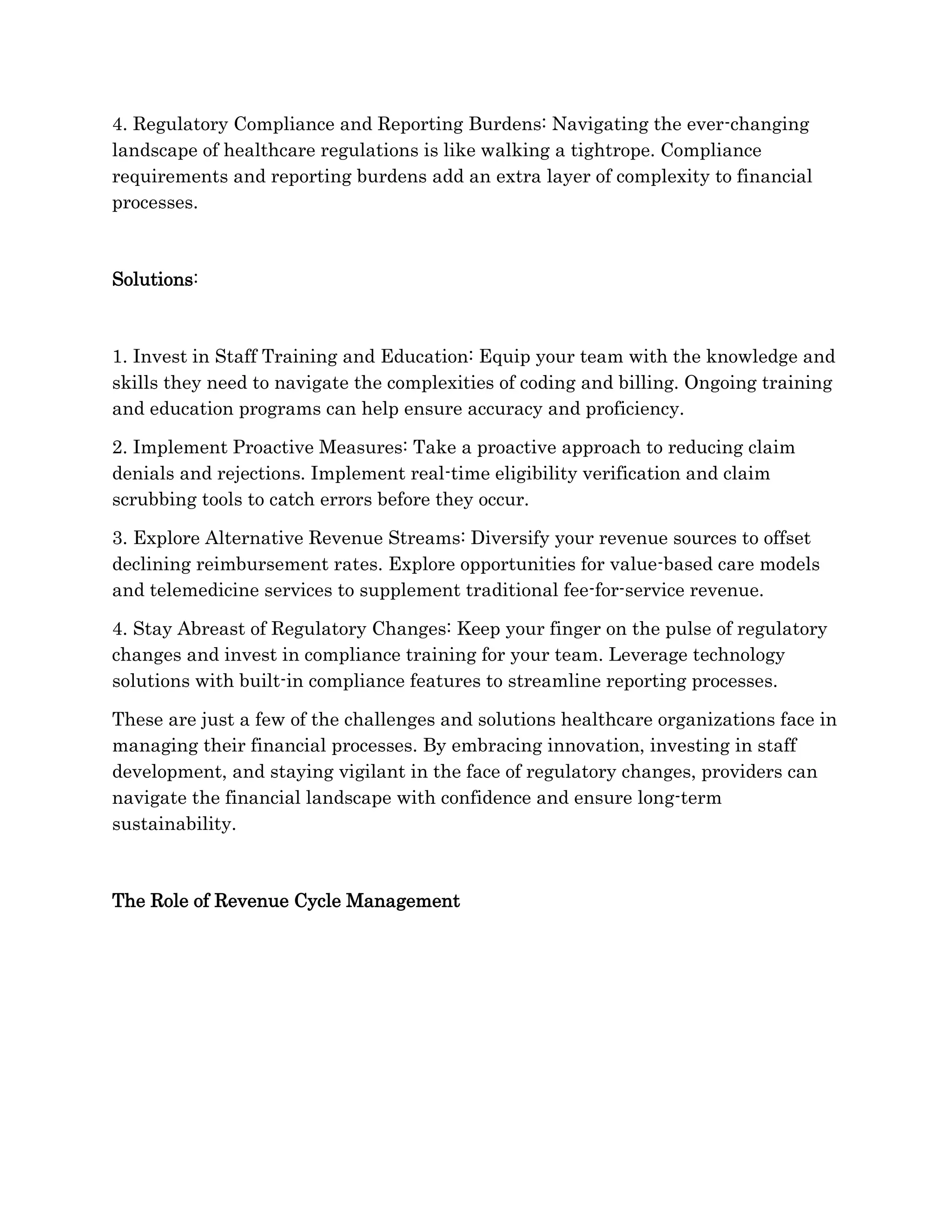
Challenges and Solutions in Healthcare Financial Processes
Navigating the financial landscape of healthcare is like embarking on a journey
through a maze—filled with twists, turns, and unexpected challenges. Imagine
yourself as a seasoned traveler, equipped with the knowledge and tools to overcome
obstacles and chart a course toward financial success.
Challenges:
1. Complexity of Coding and Billing: Picture yourself deciphering hieroglyphics as
you grapple with the intricate world of medical coding and billing. The complexity of
healthcare coding systems and billing processes can often lead to errors and delays
in reimbursement.
2. Insurance Claim Denials and Rejections: Ever received a rejection letter? Now
imagine dealing with a constant stream of them. Insurance claim denials and
rejections can be a major headache for healthcare providers, leading to delays in
payment and loss of revenue.
3. Rising Healthcare Costs and Declining Reimbursements: It's like trying to fill a
leaky bucket—healthcare costs continue to rise while reimbursement rates decline.
Balancing the books in the face of mounting financial pressure is no easy feat.
4. Regulatory Compliance and Reporting Burdens: Navigating the ever-changing
landscape of healthcare regulations is like walking a tightrope. Compliance
requirements and reporting burdens add an extra layer of complexity to financial
processes.
Solutions:
1. Invest in Staff Training and Education: Equip your team with the knowledge and
skills they need to navigate the complexities of coding and billing. Ongoing training
and education programs can help ensure accuracy and proficiency.
2. Implement Proactive Measures: Take a proactive approach to reducing claim
denials and rejections. Implement real-time eligibility verification and claim
scrubbing tools to catch errors before they occur.
3. Explore Alternative Revenue Streams: Diversify your revenue sources to offset
declining reimbursement rates. Explore opportunities for value-based care models
and telemedicine services to supplement traditional fee-for-service revenue.
4. Stay Abreast of Regulatory Changes: Keep your finger on the pulse of regulatory
changes and invest in compliance training for your team. Leverage technology
solutions with built-in compliance features to streamline reporting processes.
These are just a few of the challenges and solutions healthcare organizations face in
managing their financial processes. By embracing innovation, investing in staff
development, and staying vigilant in the face of regulatory changes, providers can
navigate the financial landscape with confidence and ensure long-term
sustainability.
The Role of Revenue Cycle Management
Revenue cycle management (RCM) encompasses a broader spectrum of activities
beyond just medical billing. It involves the entire lifecycle of a patient account, from
scheduling appointments to receiving payments. While medical billing is a
component of RCM, RCM extends beyond billing to optimize the financial
performance of healthcare organizations.
RCM integrates various administrative and clinical functions to streamline revenue
generation and maximize reimbursements. Key components of RCM include:
Patient Scheduling: Efficient scheduling practices to minimize no-shows and
optimize provider productivity.
Insurance Eligibility Verification: Verifying patients' insurance coverage and
benefits to ensure accurate billing and minimize claim denials.
Charge Capture: Accurately recording all billable services provided to patients.
Claims Submission and Management: Timely submission of clean claims and
proactive management of denials and rejections.
Accounts Receivable (AR) Management: Monitoring and optimizing the collection of
outstanding balances from insurance companies and patients.
Financial Reporting and Analysis: Analyzing key performance indicators (KPIs) to
identify trends, inefficiencies, and opportunities for improvement.
Compliance and Regulatory Adherence: Ensuring adherence to healthcare
regulations and billing guidelines to mitigate compliance risks.
Case Studies: Real-World Examples Highlighting the Impact of Billing and Revenue
Management
Case Study 1: Optimizing Billing Processes
Imagine a small medical clinic struggling to keep up with the demands of billing.
Their manual processes were leading to delays in claims submission and revenue
loss due to overlooked charges.
Solution: The clinic implemented a user-friendly billing software that automated
billing processes and streamlined workflows. Staff received training to effectively
utilize the new system, ensuring accurate coding and timely claim submission.
Outcome: With the new billing software in place, the clinic experienced significant
improvements in efficiency and revenue generation. Claims were processed faster,
reducing accounts receivable aging and improving cash flow. Staff morale also
improved, as they were able to focus more on patient care rather than
administrative tasks.
Case Study 2: Enhancing Revenue Cycle Performance
Consider a mid-sized hospital facing challenges with revenue cycle performance.
Despite efforts to address claim denials and optimize reimbursement, revenue
leakage persisted, impacting financial sustainability.
Solution: The hospital implemented a comprehensive revenue cycle management
(RCM) solution that incorporated advanced analytics and predictive modeling. This
enabled proactive identification of revenue opportunities and targeted interventions
to minimize revenue loss.
Outcome: With the new RCM solution, the hospital achieved significant
improvements in revenue cycle performance. Denials were reduced, and collections
accelerated, leading to enhanced cash flow and financial stability. The hospital was
better equipped to navigate regulatory changes and market dynamics, ensuring
long-term financial viability.
Conclusion :
In conclusion, while medical billing and revenue cycle management are integral
parts of the healthcare financial landscape, they play distinct yet complementary
roles. Medical billing ensures accurate reimbursement for healthcare services
rendered, acting as the frontline soldier in the battle for fair compensation.
On the other hand, revenue cycle management takes a broader view, orchestrating
financial operations across the organization to optimize revenue generation and
financial efficiency. Though different, integrating medical billing and revenue cycle
management is essential for streamlining operations and maximizing revenue
opportunities.
In essence, these components work hand in hand, ensuring financial success while
delivering quality care to patients.

Understanding the Difference Between Medical Billing and Revenue Cycle Management

  • 1.
    Understanding the DifferenceBetween Medical Billing and Revenue Cycle Management In the labyrinthine landscape of healthcare administration, where every dollar counts and every process intertwines, two fundamental pillars stand tall: medical billing and revenue cycle management (RCM). Picture this: you're in a hospital's bustling billing department, where a symphony of keyboards clack and phones ring incessantly. Amidst this orchestrated chaos, there's a distinct rhythm, a dance between medical billing specialists and RCM wizards, each playing their part in the financial symphony of healthcare. But what exactly sets these two apart? Imagine this analogy: medical billing is like the precision work of a skilled chef, meticulously crafting each dish to perfection, while revenue cycle management is the behind-the-scenes maestro, orchestrating the entire culinary experience from reservation to dessert. In this exploration, we embark on a journey to demystify the nuances between medical billing and revenue cycle management, illuminating their distinct roles, symbiotic relationships, and their profound impact on the healthcare ecosystem. But here's the twist: we'll not only dissect their differences but also uncover a fresh perspective, a new lens through which to view these essential processes. So, buckle
  • 2.
    up as weventure into the heart of healthcare finance, where every claim, every code, and every dollar tells a story of care and commerce intertwined. Medical Billing: An Overview of the Process Ever wondered what happens behind the scenes after your doctor's visit? Enter the world of medical billing, where paperwork meets precision, and your healthcare journey takes on a financial dimension. Let's take a stroll through the process, humanizing each step along the way.
  • 3.
    Step 1: PatientEncounter It all begins with your visit to the doctor's office. As you discuss your health concerns and undergo examinations, a crucial process quietly commences in the background. This encounter lays the foundation for the medical billing journey, where your healthcare needs intersect with administrative procedures. Step 2: Documentation After your appointment, the healthcare team swings into action, meticulously documenting every aspect of your visit. From the services provided to the procedures performed, no detail is too small to escape their attention. It's like creating a snapshot of your medical history, ensuring that nothing is overlooked in the billing process. Step 3: Coding Now comes the part where things get technical. The documented services and procedures are translated into standardized codes, akin to a secret language of the healthcare world. These codes serve as the backbone of medical billing, facilitating communication between healthcare providers, insurance companies, and other stakeholders. Step 4: Claim Submission With codes in hand, it's time to submit your medical claim to the insurance company. This is where accuracy is paramount. Any errors or omissions could lead to delays or denials, potentially disrupting the billing process and causing frustration for all involved. Step 5: Adjudication Once the insurance company receives your claim, they embark on a journey of their own. Adjudication involves reviewing the claim to determine coverage and reimbursement. It's like navigating a maze of policies and procedures, ensuring that everything aligns correctly before moving forward. Step 6: Payment If all goes well, the insurance company approves your claim and issues payment to the healthcare provider. It's the culmination of a journey that began with your patient encounter, marking the successful completion of the billing process. Step 7: Patient Responsibility
  • 4.
    But wait, thebilling process isn't over just yet. Depending on your insurance coverage and deductible, you may still be responsible for a portion of the bill. It's essential to review your explanation of benefits carefully, ensuring that you understand your financial responsibilities. Step 8: Follow-Up Even after payment is received, the billing process continues. Providers may follow up on outstanding balances or address any billing inquiries from patients or insurance companies. It's all part of ensuring that the financial aspect of your healthcare experience is handled with care and attention to detail. And there you have it—a humanized overview of the medical billing process. From patient encounter to payment, each step plays a crucial role in ensuring that your healthcare journey is not just medically sound but also financially secure. It's a process that combines technical expertise with a touch of compassion, reflecting the intricate dance of healthcare administration. Revenue Cycle Management: Optimizing Financial Operations In the dynamic realm of healthcare finance, revenue cycle management (RCM) stands as the backbone of financial operations within healthcare organizations. Imagine yourself as an RCM specialist, equipped with the expertise and tools to orchestrate a symphony of financial processes aimed at maximizing revenue and ensuring the financial health of healthcare providers. Key Components of Revenue Cycle Management: ⦁ Patient Scheduling ⦁ Insurance Eligibility Verification ⦁ Charge Capture ⦁ Claims Submission and Management ⦁ Accounts Receivable (AR) Management ⦁ Financial Reporting and Analysis ⦁ Compliance and Regulatory Adherence These components form the foundation of RCM, each playing a crucial role in optimizing financial operations and driving revenue generation. From ensuring
  • 5.
    accurate insurance verificationto proactive claims management and meticulous financial reporting, RCM specialists navigate through a complex landscape to streamline processes and maximize revenue opportunities. Together, these components work in harmony to ensure that healthcare providers receive timely and accurate reimbursement for services rendered, while also maintaining compliance with regulatory requirements and industry standards. In the following sections, we'll explore each component in detail, shedding light on their importance and the strategies employed to optimize their effectiveness. So, let's dive into the world of revenue cycle management and uncover the intricacies of optimizing financial operations within healthcare. Key Differences Between Medical Billing and Revenue Cycle Management ⦁ Scope: Medical billing and revenue cycle management (RCM) serve distinct purposes within the healthcare ecosystem. While medical billing focuses primarily on the submission and processing of claims, RCM encompasses a broader range of activities aimed at optimizing revenue generation and financial performance. ⦁ Focus: The primary focus of medical billing is facilitating the reimbursement process by translating healthcare services into billing claims and submitting them to insurance companies for payment. In contrast, RCM takes a holistic approach,
  • 6.
    integrating administrative, clinical,and financial functions to streamline revenue generation and maximize reimbursements. ⦁ Objective: The objective of medical billing is to ensure timely and accurate reimbursement for services rendered by healthcare providers. On the other hand, RCM aims to optimize the entire revenue cycle from patient intake to payment collection, with a focus on maximizing revenue and improving financial efficiency. ⦁ Integration: While medical billing is a component of RCM, it represents only one aspect of the broader revenue cycle management process. RCM integrates various administrative and clinical functions, such as patient scheduling, insurance eligibility verification, charge capture, claims submission, accounts receivable management, financial reporting, and compliance adherence, to optimize revenue generation and financial performance. ⦁ Transactional vs. Strategic: Medical billing is more transactional in nature, focusing on the day-to-day tasks of claims submission, coding, and reimbursement. In contrast, RCM takes a strategic approach, leveraging data analytics, technology, and industry best practices to identify opportunities for process improvement, revenue enhancement, and cost reduction across the entire revenue cycle. In essence, while medical billing and revenue cycle management are closely related, they serve distinct purposes and encompass different functions within the healthcare revenue cycle. Understanding the differences between the two is essential for healthcare organizations to optimize their financial performance and ensure long-term sustainability. Comparison of Medical Billing and Revenue Cycle Management Aspect Medical Billing Revenue Cycle Management Primary Focus Submission and processing of claims Comprehensive optimization of revenue processes Key Tasks Patient registration, coding, claims submission Patient scheduling, insurance verification, charge capture, claims management,
  • 7.
    financial reporting Objective Ensureaccurate reimbursement for services Maximize revenue generation and financial efficiency Integration Component of RCM Integral part of holistic revenue management Impact Directly affects reimbursement and cash flow Influences overall financial performance and sustainability Scope Narrow focus on billing processes Broad encompassing of administrative and financial functions Collaboration Collaboration with RCM for efficiency Collaboration with billing for seamless operations Importance of Medical Billing and Revenue Cycle Management Both medical billing and revenue cycle management are critical components of healthcare revenue cycle operations. Efficient and effective billing and revenue management practices are essential for the financial viability and sustainability of healthcare organizations. Here's why: Revenue Generation: Accurate and timely billing practices directly impact revenue generation by ensuring that healthcare services are properly documented, coded, and billed for reimbursement. Cash Flow: Cash flow, akin to the pulse of a healthcare organization, sustains its operations and vitality. It embodies the movement of funds in and out, crucial for meeting financial obligations and providing quality care. However, maintaining this flow encounters challenges like delayed reimbursements and fluctuating patient volumes. To ensure a steady stream, vigilant monitoring, proactive management, and strategic planning are essential. Like skilled navigators, healthcare providers steer through financial storms, ensuring stability and resilience to fulfill their mission of caring for patients. Compliance: Compliance in healthcare is like a steadfast guide, ensuring providers navigate the ethical and legal terrain with integrity. It's the commitment to upholding patient confidentiality, treatment standards, and accurate documentation. However, compliance is akin to traversing a dense forest of regulations. Providers must stay informed, undergo training, and implement robust
  • 8.
    programs to safeguardtrust. Just as a compass points north, compliance directs ethical conduct and quality care in healthcare. Patient Satisfaction: Patient satisfaction is the heartbeat of healthcare, resonating with the essence of compassionate care and empathy. It's like a warm embrace, comforting patients during times of vulnerability and uncertainty. Picture it as a radiant smile lighting up a darkened room, instilling hope and reassurance. However, nurturing patient satisfaction is akin to tending to a delicate garden, requiring attention to every detail. Healthcare providers must listen attentively, communicate effectively, and prioritize patient needs to cultivate a nurturing environment where trust and respect flourish. Just as a gardener tends to their plants with care, healthcare providers nurture patient satisfaction, ensuring each encounter leaves a lasting positive impression, like a blooming flower in the garden of healing. Operational Efficiency: Operational efficiency in healthcare is the engine driving seamless care delivery. It's akin to a well-choreographed dance, where tasks are executed with precision and purpose. Achieving efficiency requires identifying bottlenecks, streamlining workflows, and leveraging technology. Just as a conductor guides an orchestra, healthcare leaders steer their teams toward excellence, ensuring every patient receives timely, high-quality care. Challenges and Solutions in Healthcare Financial Processes
  • 9.
    Navigating the financiallandscape of healthcare is like embarking on a journey through a maze—filled with twists, turns, and unexpected challenges. Imagine yourself as a seasoned traveler, equipped with the knowledge and tools to overcome obstacles and chart a course toward financial success. Challenges: 1. Complexity of Coding and Billing: Picture yourself deciphering hieroglyphics as you grapple with the intricate world of medical coding and billing. The complexity of healthcare coding systems and billing processes can often lead to errors and delays in reimbursement. 2. Insurance Claim Denials and Rejections: Ever received a rejection letter? Now imagine dealing with a constant stream of them. Insurance claim denials and rejections can be a major headache for healthcare providers, leading to delays in payment and loss of revenue. 3. Rising Healthcare Costs and Declining Reimbursements: It's like trying to fill a leaky bucket—healthcare costs continue to rise while reimbursement rates decline. Balancing the books in the face of mounting financial pressure is no easy feat.
  • 10.
    4. Regulatory Complianceand Reporting Burdens: Navigating the ever-changing landscape of healthcare regulations is like walking a tightrope. Compliance requirements and reporting burdens add an extra layer of complexity to financial processes. Solutions: 1. Invest in Staff Training and Education: Equip your team with the knowledge and skills they need to navigate the complexities of coding and billing. Ongoing training and education programs can help ensure accuracy and proficiency. 2. Implement Proactive Measures: Take a proactive approach to reducing claim denials and rejections. Implement real-time eligibility verification and claim scrubbing tools to catch errors before they occur. 3. Explore Alternative Revenue Streams: Diversify your revenue sources to offset declining reimbursement rates. Explore opportunities for value-based care models and telemedicine services to supplement traditional fee-for-service revenue. 4. Stay Abreast of Regulatory Changes: Keep your finger on the pulse of regulatory changes and invest in compliance training for your team. Leverage technology solutions with built-in compliance features to streamline reporting processes. These are just a few of the challenges and solutions healthcare organizations face in managing their financial processes. By embracing innovation, investing in staff development, and staying vigilant in the face of regulatory changes, providers can navigate the financial landscape with confidence and ensure long-term sustainability. The Role of Revenue Cycle Management
  • 11.
    Revenue cycle management(RCM) encompasses a broader spectrum of activities beyond just medical billing. It involves the entire lifecycle of a patient account, from scheduling appointments to receiving payments. While medical billing is a component of RCM, RCM extends beyond billing to optimize the financial performance of healthcare organizations. RCM integrates various administrative and clinical functions to streamline revenue generation and maximize reimbursements. Key components of RCM include: Patient Scheduling: Efficient scheduling practices to minimize no-shows and optimize provider productivity. Insurance Eligibility Verification: Verifying patients' insurance coverage and benefits to ensure accurate billing and minimize claim denials. Charge Capture: Accurately recording all billable services provided to patients. Claims Submission and Management: Timely submission of clean claims and proactive management of denials and rejections. Accounts Receivable (AR) Management: Monitoring and optimizing the collection of outstanding balances from insurance companies and patients. Financial Reporting and Analysis: Analyzing key performance indicators (KPIs) to identify trends, inefficiencies, and opportunities for improvement. Compliance and Regulatory Adherence: Ensuring adherence to healthcare regulations and billing guidelines to mitigate compliance risks.
  • 12.
    Case Studies: Real-WorldExamples Highlighting the Impact of Billing and Revenue Management Case Study 1: Optimizing Billing Processes Imagine a small medical clinic struggling to keep up with the demands of billing. Their manual processes were leading to delays in claims submission and revenue loss due to overlooked charges. Solution: The clinic implemented a user-friendly billing software that automated billing processes and streamlined workflows. Staff received training to effectively utilize the new system, ensuring accurate coding and timely claim submission. Outcome: With the new billing software in place, the clinic experienced significant improvements in efficiency and revenue generation. Claims were processed faster, reducing accounts receivable aging and improving cash flow. Staff morale also improved, as they were able to focus more on patient care rather than administrative tasks. Case Study 2: Enhancing Revenue Cycle Performance Consider a mid-sized hospital facing challenges with revenue cycle performance. Despite efforts to address claim denials and optimize reimbursement, revenue leakage persisted, impacting financial sustainability. Solution: The hospital implemented a comprehensive revenue cycle management (RCM) solution that incorporated advanced analytics and predictive modeling. This enabled proactive identification of revenue opportunities and targeted interventions to minimize revenue loss. Outcome: With the new RCM solution, the hospital achieved significant improvements in revenue cycle performance. Denials were reduced, and collections accelerated, leading to enhanced cash flow and financial stability. The hospital was better equipped to navigate regulatory changes and market dynamics, ensuring long-term financial viability.
  • 13.
    Conclusion : In conclusion,while medical billing and revenue cycle management are integral parts of the healthcare financial landscape, they play distinct yet complementary roles. Medical billing ensures accurate reimbursement for healthcare services rendered, acting as the frontline soldier in the battle for fair compensation. On the other hand, revenue cycle management takes a broader view, orchestrating financial operations across the organization to optimize revenue generation and financial efficiency. Though different, integrating medical billing and revenue cycle management is essential for streamlining operations and maximizing revenue opportunities. In essence, these components work hand in hand, ensuring financial success while delivering quality care to patients.