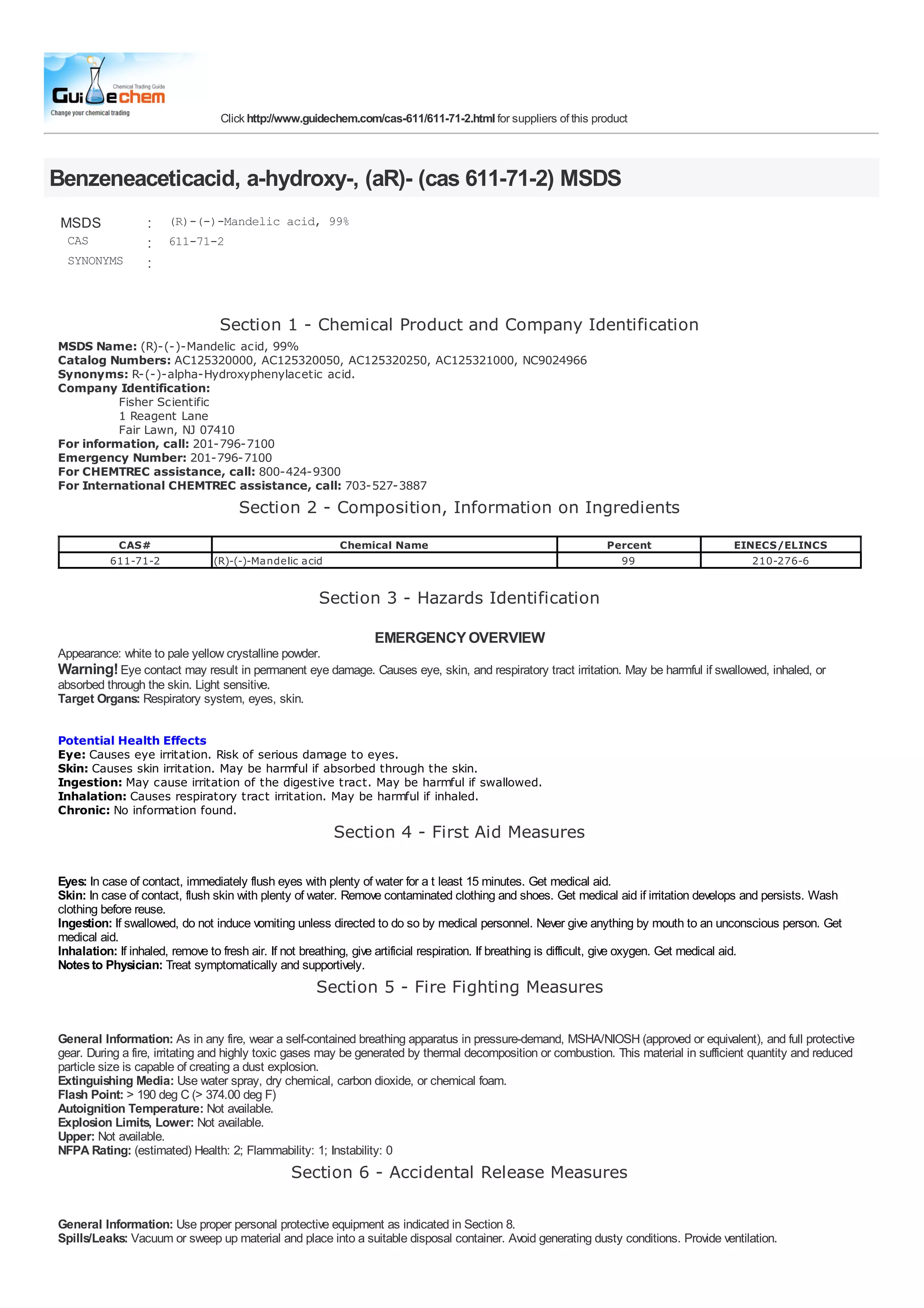
Click http://www.guidechem.com/cas-611/611-71-2.html for suppliers of this product


Benzeneaceticacid, a-hydroxy-, (aR)- (cas 611-71-2) MSDS
 MSDS            :    (R)-(-)-Mandelic acid, 99%
 CAS             :    611-71-2
 SYNONYMS        :


                                Section 1 - Chemical Product and Company Identification
MSDS Name: (R)-(-)-Mandelic acid, 99%
Catalog Numbers: AC125320000, AC125320050, AC125320250, AC125321000, NC9024966
Synonyms: R-(-)-alpha-Hydroxyphenylacetic acid.
Company Identification:
          Fisher Scientific
          1 Reagent Lane
          Fair Lawn, NJ 07410
For information, call: 201-796-7100
Emergency Number: 201-796-7100
For CHEMTREC assistance, call: 800-424-9300
For International CHEMTREC assistance, call: 703-527-3887
                                    Section 2 - Composition, Information on Ingredients
           CAS#                                         Chemical Name                                         Percent                  EINECS/ELINCS
          611-71-2             (R)-(-)-Mandelic acid                                                            99                        210-276-6


                                                    Section 3 - Hazards Identification
                                                               EMERGENCY OVERVIEW
Appearance: white to pale yellow crystalline powder.
Warning! Eye contact may result in permanent eye damage. Causes eye, skin, and respiratory tract irritation. May be harmful if swallowed, inhaled, or
absorbed through the skin. Light sensitive.
Target Organs: Respiratory system, eyes, skin.


Potential Health Effects
Eye: Causes eye irritation. Risk of serious damage to eyes.
Skin: Causes skin irritation. May be harmful if absorbed through the skin.
Ingestion: May cause irritation of the digestive tract. May be harmful if swallowed.
Inhalation: Causes respiratory tract irritation. May be harmful if inhaled.
Chronic: No information found.
                                                       Section 4 - First Aid Measures

Eyes: In case of contact, immediately flush eyes with plenty of water for a t least 15 minutes. Get medical aid.
Skin: In case of contact, flush skin with plenty of water. Remove contaminated clothing and shoes. Get medical aid if irritation develops and persists. Wash
clothing before reuse.
Ingestion: If swallowed, do not induce vomiting unless directed to do so by medical personnel. Never give anything by mouth to an unconscious person. Get
medical aid.
Inhalation: If inhaled, remove to fresh air. If not breathing, give artificial respiration. If breathing is difficult, give oxygen. Get medical aid.
Notes to Physician: Treat symptomatically and supportively.
                                                   Section 5 - Fire Fighting Measures

General Information: As in any fire, wear a self-contained breathing apparatus in pressure-demand, MSHA/NIOSH (approved or equivalent), and full protective
gear. During a fire, irritating and highly toxic gases may be generated by thermal decomposition or combustion. This material in sufficient quantity and reduced
particle size is capable of creating a dust explosion.
Extinguishing Media: Use water spray, dry chemical, carbon dioxide, or chemical foam.
Flash Point: > 190 deg C (> 374.00 deg F)
Autoignition Temperature: Not available.
Explosion Limits, Lower: Not available.
Upper: Not available.
NFPA Rating: (estimated) Health: 2; Flammability: 1; Instability: 0
                                              Section 6 - Accidental Release Measures

General Information: Use proper personal protective equipment as indicated in Section 8.
Spills/Leaks: Vacuum or sweep up material and place into a suitable disposal container. Avoid generating dusty conditions. Provide ventilation.
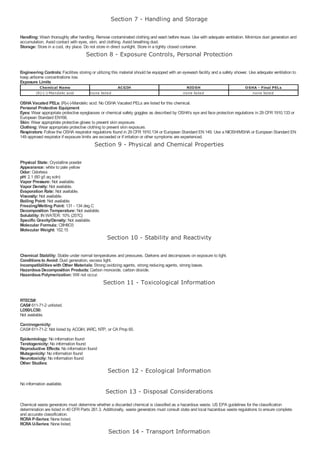
Section 7 - Handling and Storage

Handling: Wash thoroughly after handling. Remove contaminated clothing and wash before reuse. Use with adequate ventilation. Minimize dust generation and
accumulation. Avoid contact with eyes, skin, and clothing. Avoid breathing dust.
Storage: Store in a cool, dry place. Do not store in direct sunlight. Store in a tightly closed container.
                                      Section 8 - Exposure Controls, Personal Protection

Engineering Controls: Facilities storing or utilizing this material should be equipped with an eyewash facility and a safety shower. Use adequate ventilation to
keep airborne concentrations low.
Exposure Limits
           Chemical Name                                ACGIH                                  NIOSH                              OSHA - Final PELs
         (R)-(-)-Mandelic acid          none listed                                           none listed                            none listed

OSHA Vacated PELs: (R)-(-)-Mandelic acid: No OSHA Vacated PELs are listed for this chemical.
Personal Protective Equipment
Eyes: Wear appropriate protective eyeglasses or chemical safety goggles as described by OSHA's eye and face protection regulations in 29 CFR 1910.133 or
European Standard EN166.
Skin: Wear appropriate protective gloves to prevent skin exposure.
Clothing: Wear appropriate protective clothing to prevent skin exposure.
Respirators: Follow the OSHA respirator regulations found in 29 CFR 1910.134 or European Standard EN 149. Use a NIOSH/MSHA or European Standard EN
149 approved respirator if exposure limits are exceeded or if irritation or other symptoms are experienced.
                                           Section 9 - Physical and Chemical Properties

Physical State: Crystalline powder
Appearance: white to pale yellow
Odor: Odorless
pH: 2.1 (60 g/l aq soln)
Vapor Pressure: Not available.
Vapor Density: Not available.
Evaporation Rate: Not available.
Viscosity: Not available.
Boiling Point: Not available.
Freezing/Melting Point: 131 - 134 deg C
Decomposition Temperature: Not available.
Solubility: IN WATER: 10% (25?C)
Specific Gravity/Density: Not available.
Molecular Formula: C8H8O3
Molecular Weight: 152.15
                                                  Section 10 - Stability and Reactivity

Chemical Stability: Stable under normal temperatures and pressures. Darkens and decomposes on exposure to light.
Conditions to Avoid: Dust generation, excess light.
Incompatibilities with Other Materials: Strong oxidizing agents, strong reducing agents, strong bases.
Hazardous Decomposition Products: Carbon monoxide, carbon dioxide.
Hazardous Polymerization: Will not occur.
                                                Section 11 - Toxicological Information

RTECS#:
CAS# 611-71-2 unlisted.
LD50/LC50:
Not available.
Carcinogenicity:
CAS# 611-71-2: Not listed by ACGIH, IARC, NTP, or CA Prop 65.
Epidemiology: No information found
Teratogenicity: No information found
Reproductive Effects: No information found
Mutagenicity: No information found
Neurotoxicity: No information found
Other Studies:
                                                  Section 12 - Ecological Information
No information available.
                                                 Section 13 - Disposal Considerations
Chemical waste generators must determine whether a discarded chemical is classified as a hazardous waste. US EPA guidelines for the classification
determination are listed in 40 CFR Parts 261.3. Additionally, waste generators must consult state and local hazardous waste regulations to ensure complete
and accurate classification.
RCRA P-Series: None listed.
RCRA U-Series: None listed.
                                                   Section 14 - Transport Information
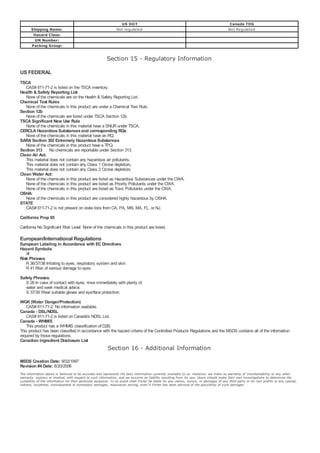
US DOT                                                                    Canada TDG
       Shipping Name:                                           Not regulated                                                              Not Regulated
        Hazard Class:
         UN Number:
       Packing Group:


                                                          Section 15 - Regulatory Information
US FEDERAL
TSCA
   CAS# 611-71-2 is listed on the TSCA inventory.
Health & Safety Reporting List
   None of the chemicals are on the Health & Safety Reporting List.
Chemical Test Rules
   None of the chemicals in this product are under a Chemical Test Rule.
Section 12b
   None of the chemicals are listed under TSCA Section 12b.
TSCA Significant New Use Rule
   None of the chemicals in this material have a SNUR under TSCA.
CERCLA Hazardous Substances and corresponding RQs
   None of the chemicals in this material have an RQ.
SARA Section 302 Extremely Hazardous Substances
   None of the chemicals in this product have a TPQ.
Section 313 No chemicals are reportable under Section 313.
Clean Air Act:
   This material does not contain any hazardous air pollutants.
   This material does not contain any Class 1 Ozone depletors.
   This material does not contain any Class 2 Ozone depletors.
Clean Water Act:
   None of the chemicals in this product are listed as Hazardous Substances under the CWA.
   None of the chemicals in this product are listed as Priority Pollutants under the CWA.
   None of the chemicals in this product are listed as Toxic Pollutants under the CWA.
OSHA:
   None of the chemicals in this product are considered highly hazardous by OSHA.
STATE
   CAS# 611-71-2 is not present on state lists from CA, PA, MN, MA, FL, or NJ.
California Prop 65
California No Significant Risk Level: None of the chemicals in this product are listed.

European/International Regulations
European Labeling in Accordance with EC Directives
Hazard Symbols:
   XI
Risk Phrases:
   R 36/37/38 Irritating to eyes, respiratory system and skin.
   R 41 Risk of serious damage to eyes.
Safety Phrases:
   S 26 In case of contact with eyes, rinse immediately with plenty of
   water and seek medical advice.
   S 37/39 Wear suitable gloves and eye/face protection.
WGK (Water Danger/Protection)
   CAS# 611-71-2: No information available.
Canada - DSL/NDSL
   CAS# 611-71-2 is listed on Canada's NDSL List.
Canada - WHMIS
   This product has a WHMIS classification of D2B.
This product has been classified in accordance with the hazard criteria of the Controlled Products Regulations and the MSDS contains all of the information
required by those regulations.
Canadian Ingredient Disclosure List
                                                          Section 16 - Additional Information
MSDS Creation Date: 9/02/1997
Revision #4 Date: 6/20/2006
The information above is believed to be accurate and represents the best information currently available to us. However, we make no warranty of merchantability or any other
warranty, express or implied, with respect to such information, and we assume no liability resulting from its use. Users should make their own investigations to determine the
suitability of the information for their particular purposes. In no event shall Fisher be liable for any claims, losses, or damages of any third party or for lost profits or any special,
indirect, incidental, consequential or exemplary damages, howsoever arising, even if Fisher has been advised of the possibility of such damages.

611 71-2

  • 1.
    Click http://www.guidechem.com/cas-611/611-71-2.html forsuppliers of this product Benzeneaceticacid, a-hydroxy-, (aR)- (cas 611-71-2) MSDS MSDS : (R)-(-)-Mandelic acid, 99% CAS : 611-71-2 SYNONYMS : Section 1 - Chemical Product and Company Identification MSDS Name: (R)-(-)-Mandelic acid, 99% Catalog Numbers: AC125320000, AC125320050, AC125320250, AC125321000, NC9024966 Synonyms: R-(-)-alpha-Hydroxyphenylacetic acid. Company Identification: Fisher Scientific 1 Reagent Lane Fair Lawn, NJ 07410 For information, call: 201-796-7100 Emergency Number: 201-796-7100 For CHEMTREC assistance, call: 800-424-9300 For International CHEMTREC assistance, call: 703-527-3887 Section 2 - Composition, Information on Ingredients CAS# Chemical Name Percent EINECS/ELINCS 611-71-2 (R)-(-)-Mandelic acid 99 210-276-6 Section 3 - Hazards Identification EMERGENCY OVERVIEW Appearance: white to pale yellow crystalline powder. Warning! Eye contact may result in permanent eye damage. Causes eye, skin, and respiratory tract irritation. May be harmful if swallowed, inhaled, or absorbed through the skin. Light sensitive. Target Organs: Respiratory system, eyes, skin. Potential Health Effects Eye: Causes eye irritation. Risk of serious damage to eyes. Skin: Causes skin irritation. May be harmful if absorbed through the skin. Ingestion: May cause irritation of the digestive tract. May be harmful if swallowed. Inhalation: Causes respiratory tract irritation. May be harmful if inhaled. Chronic: No information found. Section 4 - First Aid Measures Eyes: In case of contact, immediately flush eyes with plenty of water for a t least 15 minutes. Get medical aid. Skin: In case of contact, flush skin with plenty of water. Remove contaminated clothing and shoes. Get medical aid if irritation develops and persists. Wash clothing before reuse. Ingestion: If swallowed, do not induce vomiting unless directed to do so by medical personnel. Never give anything by mouth to an unconscious person. Get medical aid. Inhalation: If inhaled, remove to fresh air. If not breathing, give artificial respiration. If breathing is difficult, give oxygen. Get medical aid. Notes to Physician: Treat symptomatically and supportively. Section 5 - Fire Fighting Measures General Information: As in any fire, wear a self-contained breathing apparatus in pressure-demand, MSHA/NIOSH (approved or equivalent), and full protective gear. During a fire, irritating and highly toxic gases may be generated by thermal decomposition or combustion. This material in sufficient quantity and reduced particle size is capable of creating a dust explosion. Extinguishing Media: Use water spray, dry chemical, carbon dioxide, or chemical foam. Flash Point: > 190 deg C (> 374.00 deg F) Autoignition Temperature: Not available. Explosion Limits, Lower: Not available. Upper: Not available. NFPA Rating: (estimated) Health: 2; Flammability: 1; Instability: 0 Section 6 - Accidental Release Measures General Information: Use proper personal protective equipment as indicated in Section 8. Spills/Leaks: Vacuum or sweep up material and place into a suitable disposal container. Avoid generating dusty conditions. Provide ventilation.
  • 2.
    Section 7 -Handling and Storage Handling: Wash thoroughly after handling. Remove contaminated clothing and wash before reuse. Use with adequate ventilation. Minimize dust generation and accumulation. Avoid contact with eyes, skin, and clothing. Avoid breathing dust. Storage: Store in a cool, dry place. Do not store in direct sunlight. Store in a tightly closed container. Section 8 - Exposure Controls, Personal Protection Engineering Controls: Facilities storing or utilizing this material should be equipped with an eyewash facility and a safety shower. Use adequate ventilation to keep airborne concentrations low. Exposure Limits Chemical Name ACGIH NIOSH OSHA - Final PELs (R)-(-)-Mandelic acid none listed none listed none listed OSHA Vacated PELs: (R)-(-)-Mandelic acid: No OSHA Vacated PELs are listed for this chemical. Personal Protective Equipment Eyes: Wear appropriate protective eyeglasses or chemical safety goggles as described by OSHA's eye and face protection regulations in 29 CFR 1910.133 or European Standard EN166. Skin: Wear appropriate protective gloves to prevent skin exposure. Clothing: Wear appropriate protective clothing to prevent skin exposure. Respirators: Follow the OSHA respirator regulations found in 29 CFR 1910.134 or European Standard EN 149. Use a NIOSH/MSHA or European Standard EN 149 approved respirator if exposure limits are exceeded or if irritation or other symptoms are experienced. Section 9 - Physical and Chemical Properties Physical State: Crystalline powder Appearance: white to pale yellow Odor: Odorless pH: 2.1 (60 g/l aq soln) Vapor Pressure: Not available. Vapor Density: Not available. Evaporation Rate: Not available. Viscosity: Not available. Boiling Point: Not available. Freezing/Melting Point: 131 - 134 deg C Decomposition Temperature: Not available. Solubility: IN WATER: 10% (25?C) Specific Gravity/Density: Not available. Molecular Formula: C8H8O3 Molecular Weight: 152.15 Section 10 - Stability and Reactivity Chemical Stability: Stable under normal temperatures and pressures. Darkens and decomposes on exposure to light. Conditions to Avoid: Dust generation, excess light. Incompatibilities with Other Materials: Strong oxidizing agents, strong reducing agents, strong bases. Hazardous Decomposition Products: Carbon monoxide, carbon dioxide. Hazardous Polymerization: Will not occur. Section 11 - Toxicological Information RTECS#: CAS# 611-71-2 unlisted. LD50/LC50: Not available. Carcinogenicity: CAS# 611-71-2: Not listed by ACGIH, IARC, NTP, or CA Prop 65. Epidemiology: No information found Teratogenicity: No information found Reproductive Effects: No information found Mutagenicity: No information found Neurotoxicity: No information found Other Studies: Section 12 - Ecological Information No information available. Section 13 - Disposal Considerations Chemical waste generators must determine whether a discarded chemical is classified as a hazardous waste. US EPA guidelines for the classification determination are listed in 40 CFR Parts 261.3. Additionally, waste generators must consult state and local hazardous waste regulations to ensure complete and accurate classification. RCRA P-Series: None listed. RCRA U-Series: None listed. Section 14 - Transport Information
  • 3.
    US DOT Canada TDG Shipping Name: Not regulated Not Regulated Hazard Class: UN Number: Packing Group: Section 15 - Regulatory Information US FEDERAL TSCA CAS# 611-71-2 is listed on the TSCA inventory. Health & Safety Reporting List None of the chemicals are on the Health & Safety Reporting List. Chemical Test Rules None of the chemicals in this product are under a Chemical Test Rule. Section 12b None of the chemicals are listed under TSCA Section 12b. TSCA Significant New Use Rule None of the chemicals in this material have a SNUR under TSCA. CERCLA Hazardous Substances and corresponding RQs None of the chemicals in this material have an RQ. SARA Section 302 Extremely Hazardous Substances None of the chemicals in this product have a TPQ. Section 313 No chemicals are reportable under Section 313. Clean Air Act: This material does not contain any hazardous air pollutants. This material does not contain any Class 1 Ozone depletors. This material does not contain any Class 2 Ozone depletors. Clean Water Act: None of the chemicals in this product are listed as Hazardous Substances under the CWA. None of the chemicals in this product are listed as Priority Pollutants under the CWA. None of the chemicals in this product are listed as Toxic Pollutants under the CWA. OSHA: None of the chemicals in this product are considered highly hazardous by OSHA. STATE CAS# 611-71-2 is not present on state lists from CA, PA, MN, MA, FL, or NJ. California Prop 65 California No Significant Risk Level: None of the chemicals in this product are listed. European/International Regulations European Labeling in Accordance with EC Directives Hazard Symbols: XI Risk Phrases: R 36/37/38 Irritating to eyes, respiratory system and skin. R 41 Risk of serious damage to eyes. Safety Phrases: S 26 In case of contact with eyes, rinse immediately with plenty of water and seek medical advice. S 37/39 Wear suitable gloves and eye/face protection. WGK (Water Danger/Protection) CAS# 611-71-2: No information available. Canada - DSL/NDSL CAS# 611-71-2 is listed on Canada's NDSL List. Canada - WHMIS This product has a WHMIS classification of D2B. This product has been classified in accordance with the hazard criteria of the Controlled Products Regulations and the MSDS contains all of the information required by those regulations. Canadian Ingredient Disclosure List Section 16 - Additional Information MSDS Creation Date: 9/02/1997 Revision #4 Date: 6/20/2006 The information above is believed to be accurate and represents the best information currently available to us. However, we make no warranty of merchantability or any other warranty, express or implied, with respect to such information, and we assume no liability resulting from its use. Users should make their own investigations to determine the suitability of the information for their particular purposes. In no event shall Fisher be liable for any claims, losses, or damages of any third party or for lost profits or any special, indirect, incidental, consequential or exemplary damages, howsoever arising, even if Fisher has been advised of the possibility of such damages.