1
Lecture 5:
Relational calculus
www.cl.cam.ac.uk/Teaching/current/Databases/
2
Relational calculus
• There are two versions of the relational
calculus:
– Tuple relational calculus (TRC)
– Domain relational calculus (DRC)
• Both TRC and DRC are simple subsets of first-
order logic
• The difference is the level at which variables are
used: for fields (domains) or for tuples
• The calculus is non-procedural (‘declarative’)
compared to the relational algebra
3
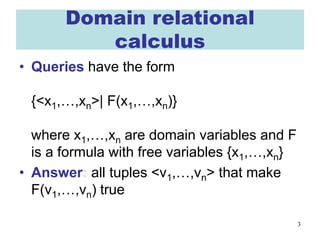
Domain relational
calculus
• Queries have the form
{<x1,…,xn>| F(x1,…,xn)}
where x1,…,xn are domain variables and F
is a formula with free variables {x1,…,xn}
• Answer: all tuples <v1,…,vn> that make
F(v1,…,vn) true
4
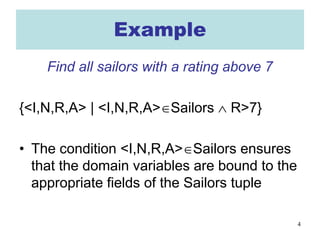
Example
Find all sailors with a rating above 7
{<I,N,R,A> | <I,N,R,A>∈Sailors ∧ R>7}
• The condition <I,N,R,A>∈Sailors ensures
that the domain variables are bound to the
appropriate fields of the Sailors tuple
5
Example
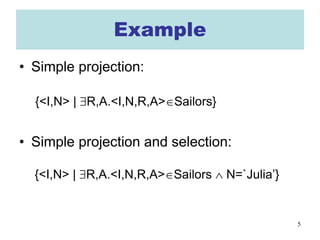
• Simple projection:
{<I,N> | ∃R,A.<I,N,R,A>∈Sailors}
• Simple projection and selection:
{<I,N> | ∃R,A.<I,N,R,A>∈Sailors ∧ N=`Julia’}
6
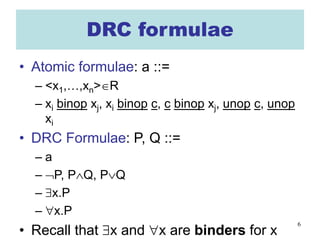
DRC formulae
• Atomic formulae: a ::=
– <x1,…,xn>∈R
– xi binop xj, xi binop c, c binop xj, unop c, unop
xi
• DRC Formulae: P, Q ::=
– a
– ¬P, P∧Q, P∨Q
– ∃x.P
– ∀x.P
• Recall that ∃x and ∀x are binders for x
7
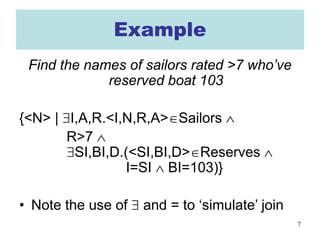
Example
Find the names of sailors rated >7 who’ve
reserved boat 103
{<N> | ∃I,A,R.<I,N,R,A>∈Sailors ∧
R>7 ∧
∃SI,BI,D.(<SI,BI,D>∈Reserves ∧
I=SI ∧ BI=103)}
• Note the use of ∃ and = to ‘simulate’ join
8
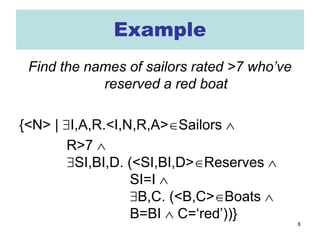
Example
Find the names of sailors rated >7 who’ve
reserved a red boat
{<N> | ∃I,A,R.<I,N,R,A>∈Sailors ∧
R>7 ∧
∃SI,BI,D. (<SI,BI,D>∈Reserves ∧
SI=I ∧
∃B,C. (<B,C>∈Boats ∧
B=BI ∧ C=‘red’))}
9
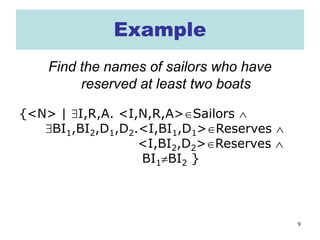
Example
Find the names of sailors who have
reserved at least two boats
{<N> | ∃I,R,A. <I,N,R,A>∈Sailors ∧
∃BI1,BI2,D1,D2.<I,BI1,D1>∈Reserves ∧
<I,BI2,D2>∈Reserves ∧
BI1≠BI2 }
10
Example
Find names of sailors who’ve reserved all
boats
11
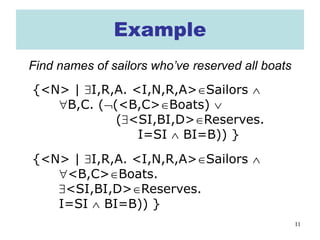
Example
Find names of sailors who’ve reserved all boats
{<N> | ∃I,R,A. <I,N,R,A>∈Sailors ∧
∀B,C. (¬(<B,C>∈Boats) ∨
(∃<SI,BI,D>∈Reserves.
I=SI ∧ BI=B)) }
{<N> | ∃I,R,A. <I,N,R,A>∈Sailors ∧
∀<B,C>∈Boats.
∃<SI,BI,D>∈Reserves.
I=SI ∧ BI=B)) }
12
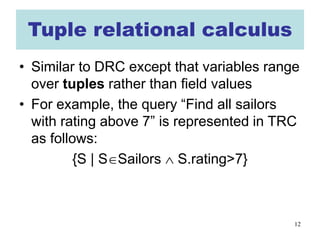
Tuple relational calculus
• Similar to DRC except that variables range
over tuples rather than field values
• For example, the query “Find all sailors
with rating above 7” is represented in TRC
as follows:
{S | S∈Sailors ∧ S.rating>7}
13
Semantics of TRC queries
• In general a TRC query is of the form
{t | P}
where FV(P)={t}
• The answer to such a query is the set of
all tuples T for which P[T/t] is true
14
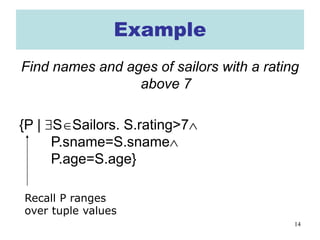
Example
Find names and ages of sailors with a rating
above 7
{P | ∃S∈Sailors. S.rating>7∧
P.sname=S.sname∧
P.age=S.age}
Recall P ranges
over tuple values
15
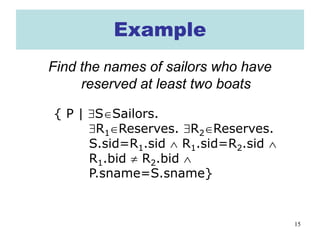
Example
Find the names of sailors who have
reserved at least two boats
{ P | ∃S∈Sailors.
∃R1∈Reserves. ∃R2∈Reserves.
S.sid=R1.sid ∧ R1.sid=R2.sid ∧
R1.bid ≠ R2.bid ∧
P.sname=S.sname}
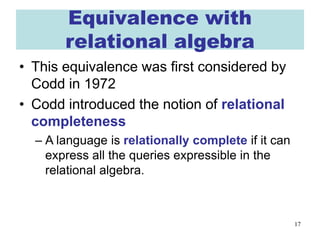
17
Equivalence with
relational algebra
• This equivalence was first considered by
Codd in 1972
• Codd introduced the notion of relational
completeness
– A language is relationally complete if it can
express all the queries expressible in the
relational algebra.
18
Encoding relational
algebra
• Let’s consider the first direction of the
equivalence: can the relational algebra be
coded up in the (domain) relational
calculus?
• This translation can be done
systematically, we define a translation
function [-]
• Simple case:
[R] = {<x1,…,xn> | <x1,…,xn>∈R}
19
Encoding selection
• Assume
[e] = {<x1,…,xn> | F }
• Then
[σc(e)] = {<x1,…,xn> | F ∧ C’}
where C’ is obtained from C by replacing
each attribute with the corresponding
variable
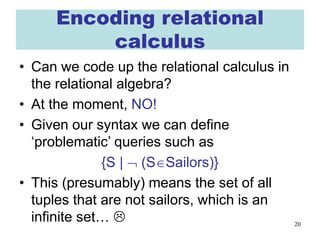
20
Encoding relational
calculus
• Can we code up the relational calculus in
the relational algebra?
• At the moment, NO!
• Given our syntax we can define
‘problematic’ queries such as
{S | ¬ (S∈Sailors)}
• This (presumably) means the set of all
tuples that are not sailors, which is an
infinite set… 
21
Safe queries
• A query is said to be safe if no matter how we instantiate
the relations, it always produces a finite answer
• Unfortunately, safety (a semantic condition) is
undecidable 
– That is, given a arbitrary query, no program can decide if it is
safe
• Fortunately, we can define a restricted syntactic class of
queries which are guaranteed to be safe 
• Safe queries can be encoded in the relational algebra
22
Summary
You should now understand
• The relational calculus
– Tuple relational calculus
– Domain relational calculus
• Translation from relational algebra to
relational calculus
• Safe queries and relational completeness
Next lecture: Basic SQL

6 - Relational Calculus.pdf

  • 1.
  • 2.
    2 Relational calculus • Thereare two versions of the relational calculus: – Tuple relational calculus (TRC) – Domain relational calculus (DRC) • Both TRC and DRC are simple subsets of first- order logic • The difference is the level at which variables are used: for fields (domains) or for tuples • The calculus is non-procedural (‘declarative’) compared to the relational algebra
  • 3.
    3 Domain relational calculus • Querieshave the form {<x1,…,xn>| F(x1,…,xn)} where x1,…,xn are domain variables and F is a formula with free variables {x1,…,xn} • Answer: all tuples <v1,…,vn> that make F(v1,…,vn) true
  • 4.
    4 Example Find all sailorswith a rating above 7 {<I,N,R,A> | <I,N,R,A>∈Sailors ∧ R>7} • The condition <I,N,R,A>∈Sailors ensures that the domain variables are bound to the appropriate fields of the Sailors tuple
  • 5.
    5 Example • Simple projection: {<I,N>| ∃R,A.<I,N,R,A>∈Sailors} • Simple projection and selection: {<I,N> | ∃R,A.<I,N,R,A>∈Sailors ∧ N=`Julia’}
  • 6.
    6 DRC formulae • Atomicformulae: a ::= – <x1,…,xn>∈R – xi binop xj, xi binop c, c binop xj, unop c, unop xi • DRC Formulae: P, Q ::= – a – ¬P, P∧Q, P∨Q – ∃x.P – ∀x.P • Recall that ∃x and ∀x are binders for x
  • 7.
    7 Example Find the namesof sailors rated >7 who’ve reserved boat 103 {<N> | ∃I,A,R.<I,N,R,A>∈Sailors ∧ R>7 ∧ ∃SI,BI,D.(<SI,BI,D>∈Reserves ∧ I=SI ∧ BI=103)} • Note the use of ∃ and = to ‘simulate’ join
  • 8.
    8 Example Find the namesof sailors rated >7 who’ve reserved a red boat {<N> | ∃I,A,R.<I,N,R,A>∈Sailors ∧ R>7 ∧ ∃SI,BI,D. (<SI,BI,D>∈Reserves ∧ SI=I ∧ ∃B,C. (<B,C>∈Boats ∧ B=BI ∧ C=‘red’))}
  • 9.
    9 Example Find the namesof sailors who have reserved at least two boats {<N> | ∃I,R,A. <I,N,R,A>∈Sailors ∧ ∃BI1,BI2,D1,D2.<I,BI1,D1>∈Reserves ∧ <I,BI2,D2>∈Reserves ∧ BI1≠BI2 }
  • 10.
    10 Example Find names ofsailors who’ve reserved all boats
  • 11.
    11 Example Find names ofsailors who’ve reserved all boats {<N> | ∃I,R,A. <I,N,R,A>∈Sailors ∧ ∀B,C. (¬(<B,C>∈Boats) ∨ (∃<SI,BI,D>∈Reserves. I=SI ∧ BI=B)) } {<N> | ∃I,R,A. <I,N,R,A>∈Sailors ∧ ∀<B,C>∈Boats. ∃<SI,BI,D>∈Reserves. I=SI ∧ BI=B)) }
  • 12.
    12 Tuple relational calculus •Similar to DRC except that variables range over tuples rather than field values • For example, the query “Find all sailors with rating above 7” is represented in TRC as follows: {S | S∈Sailors ∧ S.rating>7}
  • 13.
    13 Semantics of TRCqueries • In general a TRC query is of the form {t | P} where FV(P)={t} • The answer to such a query is the set of all tuples T for which P[T/t] is true
  • 14.
    14 Example Find names andages of sailors with a rating above 7 {P | ∃S∈Sailors. S.rating>7∧ P.sname=S.sname∧ P.age=S.age} Recall P ranges over tuple values
  • 15.
    15 Example Find the namesof sailors who have reserved at least two boats { P | ∃S∈Sailors. ∃R1∈Reserves. ∃R2∈Reserves. S.sid=R1.sid ∧ R1.sid=R2.sid ∧ R1.bid ≠ R2.bid ∧ P.sname=S.sname}
  • 16.
    17 Equivalence with relational algebra •This equivalence was first considered by Codd in 1972 • Codd introduced the notion of relational completeness – A language is relationally complete if it can express all the queries expressible in the relational algebra.
  • 17.
    18 Encoding relational algebra • Let’sconsider the first direction of the equivalence: can the relational algebra be coded up in the (domain) relational calculus? • This translation can be done systematically, we define a translation function [-] • Simple case: [R] = {<x1,…,xn> | <x1,…,xn>∈R}
  • 18.
    19 Encoding selection • Assume [e]= {<x1,…,xn> | F } • Then [σc(e)] = {<x1,…,xn> | F ∧ C’} where C’ is obtained from C by replacing each attribute with the corresponding variable
  • 19.
    20 Encoding relational calculus • Canwe code up the relational calculus in the relational algebra? • At the moment, NO! • Given our syntax we can define ‘problematic’ queries such as {S | ¬ (S∈Sailors)} • This (presumably) means the set of all tuples that are not sailors, which is an infinite set… 
  • 20.
    21 Safe queries • Aquery is said to be safe if no matter how we instantiate the relations, it always produces a finite answer • Unfortunately, safety (a semantic condition) is undecidable  – That is, given a arbitrary query, no program can decide if it is safe • Fortunately, we can define a restricted syntactic class of queries which are guaranteed to be safe  • Safe queries can be encoded in the relational algebra
  • 21.
    22 Summary You should nowunderstand • The relational calculus – Tuple relational calculus – Domain relational calculus • Translation from relational algebra to relational calculus • Safe queries and relational completeness Next lecture: Basic SQL