©
Copyright,
Joint
Commission
International
The Challenges for
The Challenges for
Accreditation in a Rapidly
Changing Health Care
Environment
Environment
Quality and Safety Workshop
September 2008, Delhi, India
Paul Chang MBBS, MPH
Derick P. Pasternak MD, MBA
Managing Directors, JCI
©
Copyright,
Joint
Commission
International
Presentation Topics
Presentation Topics
 Short overview of Joint Commission
International (JCI)
 Common characteristics of accreditation
programs
 Current challenges
 How programs must change to meet
those challenges
©
Copyright,
Joint
Commission
International
Mission of Joint Commission
International
International
 To improve the safety and quality of
care in the international community through
the provision of education, publications,
consultation, evaluation, and accreditation
services
©
Copyright,
Joint
Commission
International
Organizational Base
Organizational Base
 Joint Commission International (JCI) is the
international arm of The Joint Commission (TJC).
 TJC and JCI are independent non-profit, non-
governmental agencies
 Accredit over 17,000 organizations Worldwide
• 143 of those are acute care hospitals in 28 countries
©
Copyright,
Joint
Commission
International
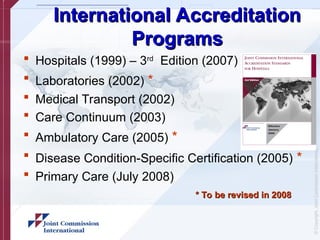
International Accreditation
Programs
Programs
 Hospitals (1999) – 3rd
Edition (2007)
 Laboratories (2002) *
 Medical Transport (2002)
 Care Continuum (2003)
 Ambulatory Care (2005) *
 Disease Condition-Specific Certification (2005) *
 Primary Care (July 2008)
* To be revised in 2008
©
Copyright,
Joint
Commission
International
 Usually a voluntary process by which a
government or non-government agency grants
recognition to health care institutions which meet
certain standards that require continuous
improvement in structures, processes, and
outcomes.
 Accreditation is often confused with:
• Licensure-governmental activity that sets minimum
standards to protect the public
• Certification that evaluates special capability or unique
skills/ability
Accreditation – A Definition
©
Copyright,
Joint
Commission
International
What is Accreditation
Intended to Accomplish?
 Awareness of quality of care issues
 Stimulate continuous improvement in patient care
 Increase efficiency/reduce costs
 Strengthen the public’s confidence
 Improve the management of health services
 Create a learning organization
 Enhance staff recruitment and retention
 Improve or expand sources of payment
©
Copyright,
Joint
Commission
International
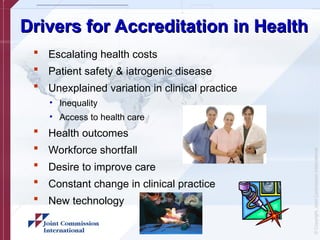
Drivers for Accreditation in Health
 Escalating health costs
 Patient safety & iatrogenic disease
 Unexplained variation in clinical practice
• Inequality
• Access to health care
 Health outcomes
 Workforce shortfall
 Desire to improve care
 Constant change in clinical practice
 New technology
©
Copyright,
Joint
Commission
International
The Changing Health Care
Environment
Environment
 Aging populations with multiple chronic
diseases
 Urbanization of population with intense
pressure on urban health care systems-over
50% of worlds population live in urban areas
 Movement of patients and health care
practitioners across borders
 Globalization of service and manufacturing
sectors
©
Copyright,
Joint
Commission
International
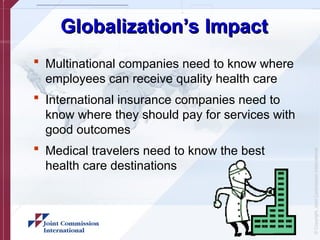
Globalization’s Impact
 Multinational companies need to know where
employees can receive quality health care
 International insurance companies need to
know where they should pay for services with
good outcomes
 Medical travelers need to know the best
health care destinations
©
Copyright,
Joint
Commission
International
What Questions Arise
 Has the health care organization been
evaluated by an external body?
• Licensure, accreditation, certification
 Does the organization meet
international norms - e.g., patient rights,
research, ethics?
 Is clinical care guided by the best
science – e.g., practice guidelines
©
Copyright,
Joint
Commission
International
What Questions Arise
 Are the clinical staff qualified and
competent and the credentials verified?
 Is the health care organization low risk
and patient safe?
 Is the organization efficient and well
managed?
 How does the quality compare with
other organizations in other countries?
©
Copyright,
Joint
Commission
International
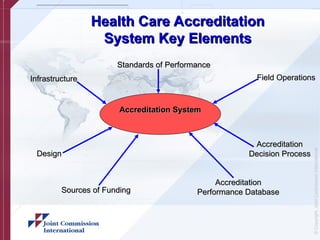
Standards of Performance
Infrastructure
Infrastructure
Design
Design
Field Operations
Field Operations
Accreditation
Accreditation
Decision Process
Decision Process
Accreditation
Accreditation
Performance Database
Sources of Funding
Sources of Funding
Health Care Accreditation
System Key Elements
System Key Elements
Accreditation System
©
Copyright,
Joint
Commission
International
Do Traditional Accreditation
Programs Address these Questions?
 Most national accreditation programs address the
laws, regulations, clinical and professional norms of
the particular country.
 International accreditation programs, that use one set
of standards, can address these questions and
provide comparative results.
©
Copyright,
Joint
Commission
International
What Do You Find in JCI
Accredited Organizations?
 A culture of quality and patient safety
 An integrated management structure
 Qualified staff
 Lower risks and data on the risks
 Quantifiable outcomes of care
 Medical staff use latest science
©
Copyright,
Joint
Commission
International
How Must Accreditation
Programs Change
Programs Change
 Accreditation must change to meet the
needs of new stakeholders in a global
society.
• On-site evaluation to ensure standards are
met – not just self-evaluation
• Evaluation must look at systems and how
patients move through the systems -
tracers
©
Copyright,
Joint
Commission
International
How Must Accreditation
Programs Change
Programs Change
• Evaluation must be frequent and ongoing
not every few years
• The findings of the evaluation should be
made public
• On-site evaluations should be made
without advance notice
• Adverse/sentinel events are reported and
root causes discovered for the organization
to learn
©
Copyright,
Joint
Commission
International
©
Copyright,
Joint
Commission
International
How Must Accreditation
Programs Change
Programs Change
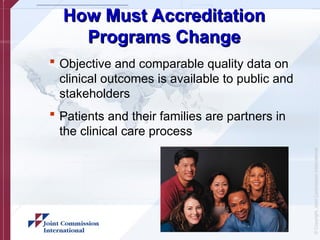
 Objective and comparable quality data on
clinical outcomes is available to public and
stakeholders
 Patients and their families are partners in
the clinical care process
©
Copyright,
Joint
Commission
International
Conclusions
Conclusions
 Traditional national accreditation programs
are not positioned to provide comparative
information to those new stakeholders with
global needs for quality information.
 International accreditation programs can
provide the needed information but need to
be structured in a way that ensures
international transparency and accountability.
©
Copyright,
Joint
Commission
International
Conclusions
Conclusions
 The methodology of accreditation is
flexible enough to be customized to
meet particular stakeholder needs
• e.g., Patient safety and risk assessments,
leadership assessments, infection or
medication risk assessments
©
Copyright,
Joint
Commission
International
Thank You
Thank You
www.jointcommissioninternational.org

59809616-Challenges-for-Accreditation.ppt

Editor's Notes

  • #3 Those in health care that choose to live their lives working in health care, no matter where they live, language they speak, share this – that is a common/consistent goal to improve safety and quality of care provided to their patients. Can do this in a variety of ways – education, publications, consultation, and accreditation.
  • #6 This is a traditional definition of accreditation Voluntary – although come countries it is mandatory. Includes recognition given to health care organizations who meet the standards. Public recognition via certification/announcement, financial or requirement that one is accredited. In order to do something else, have a nursing or medical school, insurance discount. Philosophy commonly includes improvement – continuous improvement over time – not a one time effort. Not any one “right” definition. Accreditation must be relevant to unique characteristics of each county’s heath care system, financial reimbursement/payment scheme, culture, level of care provided.